CLOUDONOMICS
2
Contents
 Cloudonomics
 Laws of Cloudonomics
Cloudonomics is the Economics of Cloud Computing. It is based on the business value of
cloud computing.
Cloudonomics gives us overall knowledge into the business estimation of the Cloud for
officials, experts, and strategists in for all intents and purposes any industry innovation
administrators as well as those in the promoting, operations, financial aspects, funding, and
monetary fields.
3
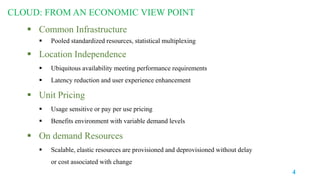
CLOUD: FROM AN ECONOMIC VIEW POINT
 Common Infrastructure
 Pooled standardized resources, statistical multiplexing
 Location Independence
 Ubiquitous availability meeting performance requirements
 Latency reduction and user experience enhancement
 Unit Pricing
 Usage sensitive or pay per use pricing
 Benefits environment with variable demand levels
 On demand Resources
 Scalable, elastic resources are provisioned and deprovisioned without delay
or cost associated with change
4
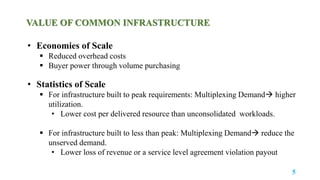
• Economies of Scale
 Reduced overhead costs
 Buyer power through volume purchasing
• Statistics of Scale
 For infrastructure built to peak requirements: Multiplexing Demand higher
utilization.
• Lower cost per delivered resource than unconsolidated workloads.
 For infrastructure built to less than peak: Multiplexing Demand reduce the
unserved demand.
• Lower loss of revenue or a service level agreement violation payout
VALUE OF COMMON INFRASTRUCTURE
5
Economics of cloud providers
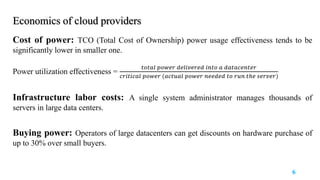
Cost of power: TCO (Total Cost of Ownership) power usage effectiveness tends to be
significantly lower in smaller one.
Power utilization effectiveness =
𝑡𝑜𝑡𝑎𝑙 𝑝𝑜𝑤𝑒𝑟 𝑑𝑒𝑙𝑖𝑣𝑒𝑟𝑒𝑑 𝑖𝑛𝑡𝑜 𝑎 𝑑𝑎𝑡𝑎𝑐𝑒𝑛𝑡𝑒𝑟
𝑐𝑟𝑖𝑡𝑖𝑐𝑎𝑙 𝑝𝑜𝑤𝑒𝑟 (𝑎𝑐𝑡𝑢𝑎𝑙 𝑝𝑜𝑤𝑒𝑟 𝑛𝑒𝑒𝑑𝑒𝑑 𝑡𝑜 𝑟𝑢𝑛 𝑡ℎ𝑒 𝑠𝑒𝑟𝑣𝑒𝑟)
Infrastructure labor costs: A single system administrator manages thousands of
servers in large data centers.
Buying power: Operators of large datacenters can get discounts on hardware purchase of
up to 30% over small buyers.
6
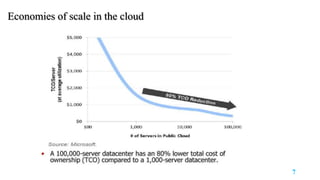
Economies of scale in the cloud
7
8
9
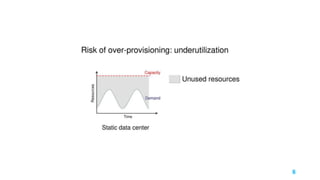
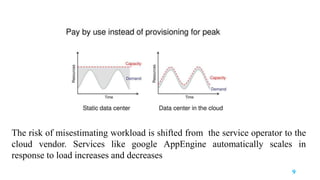
The risk of misestimating workload is shifted from the service operator to the
cloud vendor. Services like google AppEngine automatically scales in
response to load increases and decreases
10
VALUE OF LOCATION INDEPENDENCE
We used to go to computers but now but applications, services, contents
now come to us! Through networks : wired, wireless, satellite etc.
But what about Latency?
• Latency is correlated with distance (strongly)
• Routing algorithm of routers and switches are also related
That’s why supporting a global user base requires a dispersed service
architecture.
11
VALUE OF UNIT PRICING
Cloud services don’t need to be cheaper to be economic!
Consider a car
• Buy or lease for $10 per day
• Rent a car for $45 a day
• If you need a car for 2 days in a trip, buying would be much more costly than renting
• It depends on the demand
 Utility Pricing is good when demand varies over time, as is the case of a start-up or a
seasonal business.
 When Utility Premium is less than ratio of Peak Demand to Average Demand, Cloud
computing is beneficial.
12
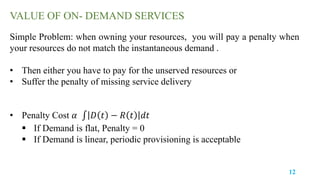
Simple Problem: when owning your resources, you will pay a penalty when
your resources do not match the instantaneous demand .
• Then either you have to pay for the unserved resources or
• Suffer the penalty of missing service delivery
• Penalty Cost 𝛼 𝐷 𝑡 − 𝑅 𝑡 𝑑𝑡
 If Demand is flat, Penalty = 0
 If Demand is linear, periodic provisioning is acceptable
VALUE OF ON- DEMAND SERVICES
LAWS OF
CLOUDONOMICS
13
In 2008, Joe Weinman, created the 10 Laws of Cloudonomics that still, are the foundation for
the economics of Cloud Computing.
•Cloudonomics Law #1: Utility services cost less even though they cost more.
Although utilities cost more when they are used, they cost nothing when they are not.
Consequently, customers save money by replacing fixed infrastructure with Clouds when
workloads are spiky, specifically when the peak-to-average ratio is greater than the utility
premium.
•Cloudonomics Law #2: On-demand trumps forecasting. Forecasting is often wrong, the
ability to up and down scale to meet unpredictable demand spikes allows for revenue and
cost optimalities.
14
Cloudonomics Law #3: The peak of the sum is never greater than the sum of the
peaks. Enterprises deploy capacity to handle their peak demands. Under this strategy, the
total capacity deployed is the sum of these individual peaks. However, since clouds can
reallocate resources across many enterprises with different peak periods, a cloud needs to
deploy less capacity.
•Cloudonomics Law #4: Aggregate demand is smoother than individual. Aggregating
demand from multiple customers tends to smooth out variation. Therefore, Clouds get
higher utilization, enabling better economics.
•Cloudonomics Law #5: Average unit costs are reduced. They are reduced by
distributing fixed costs over more units of output. Larger cloud providers can therefore
achieve economies of scale.
15
•Cloudonomics Law #6: Superiority in numbers. Superiority in numbers is the most
important factor in the result of a combat. Service providers have the scale to fight rogue
attacks.
•Cloudonomics Law #7: Space-time is a continuum. Organizations derive competitive
advantage from responding to changing business conditions faster than the competition. With
Cloud scalability, for the same cost, a business can accelerate its information processing and
decision-making.
•Cloudonomics Law #8: Dispersion is the inverse square of latency. Reduced latency is
increasingly essential to modern applications. A Cloud Computing provider is able to provide
more nodes, and hence reduced latency, than an enterprise would want to deploy.
16
•Cloudonomics Law #9: Don’t put all your eggs in one basket. The reliability of a system
increases with the addition of redundant, geographically dispersed components such as data
centers and storage arrays. Cloud Computing vendors have the scale and diversity to do so.
•Cloudonomics Law #10: An object at rest tends to stay at rest. A data center is a very
large object. Private data centers tend to remain in locations for reasons such as being where
the company was founded, or where they got a good deal on property or a lease. A Cloud
service provider can locate greenfield sites optimally and without such limits of legacy logic.
17
Questions
1. What is Cloudonomics?
2. Explain cloud from economic view point.
3. Describe about Unit Pricing.
4. Describe about on- demand service penalty cost.
5. Briefly explain the laws of Cloudonomics.
18
Thank You
19

Cloudonomics in Advanced Cloud Computing

  • 1.
  • 2.
  • 3.
    Cloudonomics is theEconomics of Cloud Computing. It is based on the business value of cloud computing. Cloudonomics gives us overall knowledge into the business estimation of the Cloud for officials, experts, and strategists in for all intents and purposes any industry innovation administrators as well as those in the promoting, operations, financial aspects, funding, and monetary fields. 3
  • 4.
    CLOUD: FROM ANECONOMIC VIEW POINT  Common Infrastructure  Pooled standardized resources, statistical multiplexing  Location Independence  Ubiquitous availability meeting performance requirements  Latency reduction and user experience enhancement  Unit Pricing  Usage sensitive or pay per use pricing  Benefits environment with variable demand levels  On demand Resources  Scalable, elastic resources are provisioned and deprovisioned without delay or cost associated with change 4
  • 5.
    • Economies ofScale  Reduced overhead costs  Buyer power through volume purchasing • Statistics of Scale  For infrastructure built to peak requirements: Multiplexing Demand higher utilization. • Lower cost per delivered resource than unconsolidated workloads.  For infrastructure built to less than peak: Multiplexing Demand reduce the unserved demand. • Lower loss of revenue or a service level agreement violation payout VALUE OF COMMON INFRASTRUCTURE 5
  • 6.
    Economics of cloudproviders Cost of power: TCO (Total Cost of Ownership) power usage effectiveness tends to be significantly lower in smaller one. Power utilization effectiveness = 𝑡𝑜𝑡𝑎𝑙 𝑝𝑜𝑤𝑒𝑟 𝑑𝑒𝑙𝑖𝑣𝑒𝑟𝑒𝑑 𝑖𝑛𝑡𝑜 𝑎 𝑑𝑎𝑡𝑎𝑐𝑒𝑛𝑡𝑒𝑟 𝑐𝑟𝑖𝑡𝑖𝑐𝑎𝑙 𝑝𝑜𝑤𝑒𝑟 (𝑎𝑐𝑡𝑢𝑎𝑙 𝑝𝑜𝑤𝑒𝑟 𝑛𝑒𝑒𝑑𝑒𝑑 𝑡𝑜 𝑟𝑢𝑛 𝑡ℎ𝑒 𝑠𝑒𝑟𝑣𝑒𝑟) Infrastructure labor costs: A single system administrator manages thousands of servers in large data centers. Buying power: Operators of large datacenters can get discounts on hardware purchase of up to 30% over small buyers. 6
  • 7.
    Economies of scalein the cloud 7
  • 8.
  • 9.
    9 The risk ofmisestimating workload is shifted from the service operator to the cloud vendor. Services like google AppEngine automatically scales in response to load increases and decreases
  • 10.
    10 VALUE OF LOCATIONINDEPENDENCE We used to go to computers but now but applications, services, contents now come to us! Through networks : wired, wireless, satellite etc. But what about Latency? • Latency is correlated with distance (strongly) • Routing algorithm of routers and switches are also related That’s why supporting a global user base requires a dispersed service architecture.
  • 11.
    11 VALUE OF UNITPRICING Cloud services don’t need to be cheaper to be economic! Consider a car • Buy or lease for $10 per day • Rent a car for $45 a day • If you need a car for 2 days in a trip, buying would be much more costly than renting • It depends on the demand  Utility Pricing is good when demand varies over time, as is the case of a start-up or a seasonal business.  When Utility Premium is less than ratio of Peak Demand to Average Demand, Cloud computing is beneficial.
  • 12.
    12 Simple Problem: whenowning your resources, you will pay a penalty when your resources do not match the instantaneous demand . • Then either you have to pay for the unserved resources or • Suffer the penalty of missing service delivery • Penalty Cost 𝛼 𝐷 𝑡 − 𝑅 𝑡 𝑑𝑡  If Demand is flat, Penalty = 0  If Demand is linear, periodic provisioning is acceptable VALUE OF ON- DEMAND SERVICES
  • 13.
  • 14.
    In 2008, JoeWeinman, created the 10 Laws of Cloudonomics that still, are the foundation for the economics of Cloud Computing. •Cloudonomics Law #1: Utility services cost less even though they cost more. Although utilities cost more when they are used, they cost nothing when they are not. Consequently, customers save money by replacing fixed infrastructure with Clouds when workloads are spiky, specifically when the peak-to-average ratio is greater than the utility premium. •Cloudonomics Law #2: On-demand trumps forecasting. Forecasting is often wrong, the ability to up and down scale to meet unpredictable demand spikes allows for revenue and cost optimalities. 14
  • 15.
    Cloudonomics Law #3:The peak of the sum is never greater than the sum of the peaks. Enterprises deploy capacity to handle their peak demands. Under this strategy, the total capacity deployed is the sum of these individual peaks. However, since clouds can reallocate resources across many enterprises with different peak periods, a cloud needs to deploy less capacity. •Cloudonomics Law #4: Aggregate demand is smoother than individual. Aggregating demand from multiple customers tends to smooth out variation. Therefore, Clouds get higher utilization, enabling better economics. •Cloudonomics Law #5: Average unit costs are reduced. They are reduced by distributing fixed costs over more units of output. Larger cloud providers can therefore achieve economies of scale. 15
  • 16.
    •Cloudonomics Law #6:Superiority in numbers. Superiority in numbers is the most important factor in the result of a combat. Service providers have the scale to fight rogue attacks. •Cloudonomics Law #7: Space-time is a continuum. Organizations derive competitive advantage from responding to changing business conditions faster than the competition. With Cloud scalability, for the same cost, a business can accelerate its information processing and decision-making. •Cloudonomics Law #8: Dispersion is the inverse square of latency. Reduced latency is increasingly essential to modern applications. A Cloud Computing provider is able to provide more nodes, and hence reduced latency, than an enterprise would want to deploy. 16
  • 17.
    •Cloudonomics Law #9:Don’t put all your eggs in one basket. The reliability of a system increases with the addition of redundant, geographically dispersed components such as data centers and storage arrays. Cloud Computing vendors have the scale and diversity to do so. •Cloudonomics Law #10: An object at rest tends to stay at rest. A data center is a very large object. Private data centers tend to remain in locations for reasons such as being where the company was founded, or where they got a good deal on property or a lease. A Cloud service provider can locate greenfield sites optimally and without such limits of legacy logic. 17
  • 18.
    Questions 1. What isCloudonomics? 2. Explain cloud from economic view point. 3. Describe about Unit Pricing. 4. Describe about on- demand service penalty cost. 5. Briefly explain the laws of Cloudonomics. 18
  • 19.