PETROLEUM AND ITS
FORMATION
Petroleum exploration and extraction
MRT 327-3
Group No: 04 1
2
What is Petroleum?
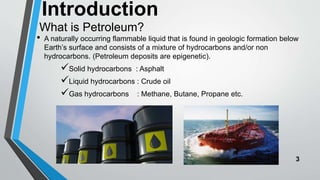
• A naturally occurring flammable liquid that is found in geologic formation below
Earth’s surface and consists of a mixture of hydrocarbons and/or non
hydrocarbons. (Petroleum deposits are epigenetic).
Solid hydrocarbons : Asphalt
Liquid hydrocarbons : Crude oil
Gas hydrocarbons : Methane, Butane, Propane etc.
3
Introduction
4
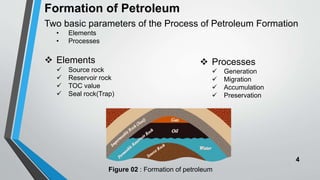
Formation of Petroleum
Two basic parameters of the Process of Petroleum Formation
• Elements
• Processes
 Elements
 Source rock
 Reservoir rock
 TOC value
 Seal rock(Trap)
 Processes
 Generation
 Migration
 Accumulation
 Preservation
Figure 02 : Formation of petroleum
5
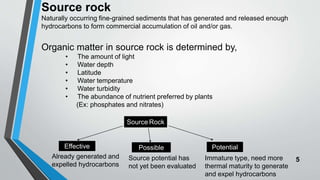
Source rock
Naturally occurring fine-grained sediments that has generated and released enough
hydrocarbons to form commercial accumulation of oil and/or gas.
Organic matter in source rock is determined by,
• The amount of light
• Water depth
• Latitude
• Water temperature
• Water turbidity
• The abundance of nutrient preferred by plants
(Ex: phosphates and nitrates)
Source Rock
Effective Possible Potential
Already generated and
expelled hydrocarbons
Source potential has
not yet been evaluated
Immature type, need more
thermal maturity to generate
and expel hydrocarbons
6
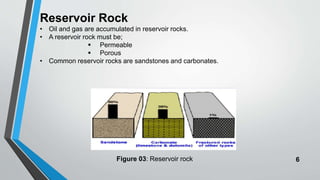
Reservoir Rock
• Oil and gas are accumulated in reservoir rocks.
• A reservoir rock must be;
 Permeable
 Porous
• Common reservoir rocks are sandstones and carbonates.
Figure 03: Reservoir rock
7
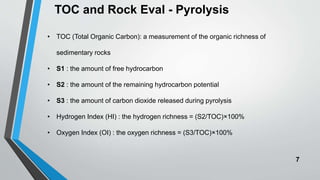
TOC and Rock Eval - Pyrolysis
• TOC (Total Organic Carbon): a measurement of the organic richness of
sedimentary rocks
• S1 : the amount of free hydrocarbon
• S2 : the amount of the remaining hydrocarbon potential
• S3 : the amount of carbon dioxide released during pyrolysis
• Hydrogen Index (HI) : the hydrogen richness = (S2/TOC)×100%
• Oxygen Index (OI) : the oxygen richness = (S3/TOC)×100%
8
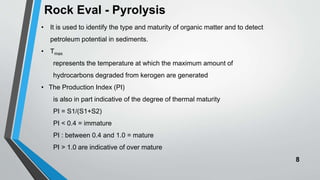
Rock Eval - Pyrolysis
• It is used to identify the type and maturity of organic matter and to detect
petroleum potential in sediments.
• Tmax
represents the temperature at which the maximum amount of
hydrocarbons degraded from kerogen are generated
• The Production Index (PI)
is also in part indicative of the degree of thermal maturity
PI = S1/(S1+S2)
PI < 0.4 = immature
PI : between 0.4 and 1.0 = mature
PI > 1.0 are indicative of over mature
9
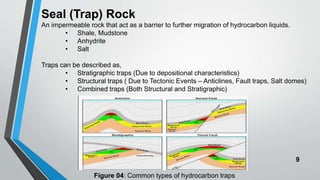
Seal (Trap) Rock
An impermeable rock that act as a barrier to further migration of hydrocarbon liquids.
• Shale, Mudstone
• Anhydrite
• Salt
Traps can be described as,
• Stratigraphic traps (Due to depositional characteristics)
• Structural traps ( Due to Tectonic Events – Anticlines, Fault traps, Salt domes)
• Combined traps (Both Structural and Stratigraphic)
Figure 04: Common types of hydrocarbon traps
10
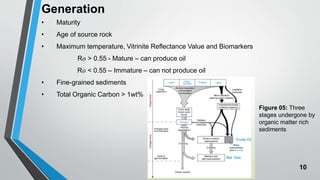
Generation
• Maturity
• Age of source rock
• Maximum temperature, Vitrinite Reflectance Value and Biomarkers
R𝑜 > 0.55 - Mature – can produce oil
R𝑜 < 0.55 – Immature – can not produce oil
• Fine-grained sediments
• Total Organic Carbon > 1wt%
Figure 05: Three
stages undergone by
organic matter rich
sediments
11
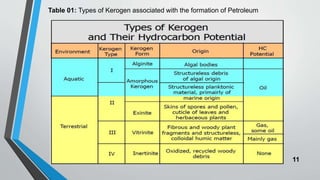
Table 01: Types of Kerogen associated with the formation of Petroleum
12
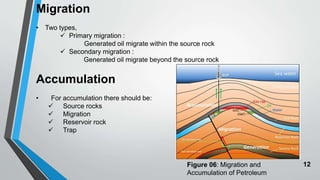
Migration
• Two types,
 Primary migration :
Generated oil migrate within the source rock
 Secondary migration :
Generated oil migrate beyond the source rock
Accumulation
• For accumulation there should be:
 Source rocks
 Migration
 Reservoir rock
 Trap
Figure 06: Migration and
Accumulation of Petroleum
13
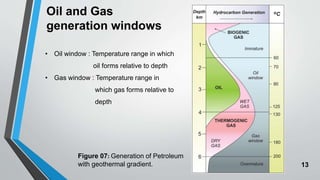
Oil and Gas
generation windows
• Oil window : Temperature range in which
oil forms relative to depth
• Gas window : Temperature range in
which gas forms relative to
depth
Figure 07: Generation of Petroleum
with geothermal gradient.
14
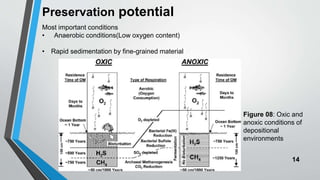
Preservation potential
Most important conditions
• Anaerobic conditions(Low oxygen content)
• Rapid sedimentation by fine-grained material
Figure 08: Oxic and
anoxic conditions of
depositional
environments
15
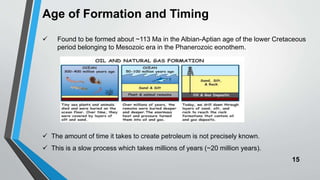
Age of Formation and Timing
 Found to be formed about ~113 Ma in the Albian-Aptian age of the lower Cretaceous
period belonging to Mesozoic era in the Phanerozoic eonothem.
 The amount of time it takes to create petroleum is not precisely known.
 This is a slow process which takes millions of years (~20 million years).
16
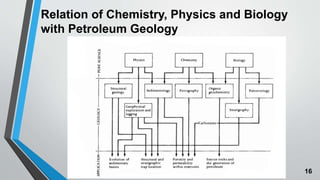
Relation of Chemistry, Physics and Biology
with Petroleum Geology
17
• Chemistry
 Geochemistry is a major component of petroleum geology
• Detailed knowledge of mineralogical composition of rocks –
reservoir quality.
• Pore-fluid chemistry.
• Physics
 Geophysics contributes to:
• Understand the structures involved in trapping : folds , faults
• Understanding the wells : wireline logs, lithology, porosity
• Biology
• Biochemistry : transformation of plant and animal tissues into
kerogen and through to oil and gas.
• Study of fossils life : paleontology
18
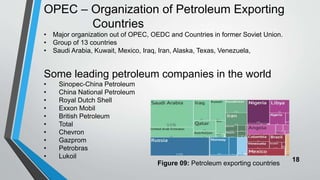
OPEC – Organization of Petroleum Exporting
Countries
• Major organization out of OPEC, OEDC and Countries in former Soviet Union.
• Group of 13 countries
• Saudi Arabia, Kuwait, Mexico, Iraq, Iran, Alaska, Texas, Venezuela,
Some leading petroleum companies in the world
• Sinopec-China Petroleum
• China National Petroleum
• Royal Dutch Shell
• Exxon Mobil
• British Petroleum
• Total
• Chevron
• Gazprom
• Petrobras
• Lukoil
Figure 09: Petroleum exporting countries
19
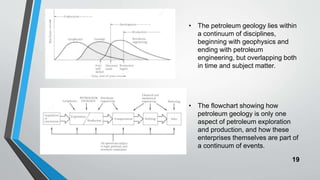
• The petroleum geology lies within
a continuum of disciplines,
beginning with geophysics and
ending with petroleum
engineering, but overlapping both
in time and subject matter.
• The flowchart showing how
petroleum geology is only one
aspect of petroleum exploration
and production, and how these
enterprises themselves are part of
a continuum of events.
20
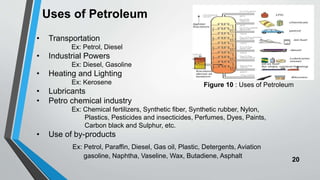
• Transportation
Ex: Petrol, Diesel
• Industrial Powers
Ex: Diesel, Gasoline
• Heating and Lighting
Ex: Kerosene
• Lubricants
• Petro chemical industry
Ex: Chemical fertilizers, Synthetic fiber, Synthetic rubber, Nylon,
Plastics, Pesticides and insecticides, Perfumes, Dyes, Paints,
Carbon black and Sulphur, etc.
• Use of by-products
Ex: Petrol, Paraffin, Diesel, Gas oil, Plastic, Detergents, Aviation
gasoline, Naphtha, Vaseline, Wax, Butadiene, Asphalt
Figure 10 : Uses of Petroleum
Uses of Petroleum
• Shamal Y.P.N.
• Subasinghe H.C.S.
• Sutharshan B.
• Wijekoon A.S.K.
• UWU/MRT/15/032
• UWU/MRT/15/036
• UWU/MRT/15/037
• UWU/MRT/15/043
Group No. 04
21
22
THANK YOU FOR
YOUR
ATTENTION!!!!

Group 04

  • 1.
    PETROLEUM AND ITS FORMATION Petroleumexploration and extraction MRT 327-3 Group No: 04 1
  • 2.
  • 3.
    What is Petroleum? •A naturally occurring flammable liquid that is found in geologic formation below Earth’s surface and consists of a mixture of hydrocarbons and/or non hydrocarbons. (Petroleum deposits are epigenetic). Solid hydrocarbons : Asphalt Liquid hydrocarbons : Crude oil Gas hydrocarbons : Methane, Butane, Propane etc. 3 Introduction
  • 4.
    4 Formation of Petroleum Twobasic parameters of the Process of Petroleum Formation • Elements • Processes  Elements  Source rock  Reservoir rock  TOC value  Seal rock(Trap)  Processes  Generation  Migration  Accumulation  Preservation Figure 02 : Formation of petroleum
  • 5.
    5 Source rock Naturally occurringfine-grained sediments that has generated and released enough hydrocarbons to form commercial accumulation of oil and/or gas. Organic matter in source rock is determined by, • The amount of light • Water depth • Latitude • Water temperature • Water turbidity • The abundance of nutrient preferred by plants (Ex: phosphates and nitrates) Source Rock Effective Possible Potential Already generated and expelled hydrocarbons Source potential has not yet been evaluated Immature type, need more thermal maturity to generate and expel hydrocarbons
  • 6.
    6 Reservoir Rock • Oiland gas are accumulated in reservoir rocks. • A reservoir rock must be;  Permeable  Porous • Common reservoir rocks are sandstones and carbonates. Figure 03: Reservoir rock
  • 7.
    7 TOC and RockEval - Pyrolysis • TOC (Total Organic Carbon): a measurement of the organic richness of sedimentary rocks • S1 : the amount of free hydrocarbon • S2 : the amount of the remaining hydrocarbon potential • S3 : the amount of carbon dioxide released during pyrolysis • Hydrogen Index (HI) : the hydrogen richness = (S2/TOC)×100% • Oxygen Index (OI) : the oxygen richness = (S3/TOC)×100%
  • 8.
    8 Rock Eval -Pyrolysis • It is used to identify the type and maturity of organic matter and to detect petroleum potential in sediments. • Tmax represents the temperature at which the maximum amount of hydrocarbons degraded from kerogen are generated • The Production Index (PI) is also in part indicative of the degree of thermal maturity PI = S1/(S1+S2) PI < 0.4 = immature PI : between 0.4 and 1.0 = mature PI > 1.0 are indicative of over mature
  • 9.
    9 Seal (Trap) Rock Animpermeable rock that act as a barrier to further migration of hydrocarbon liquids. • Shale, Mudstone • Anhydrite • Salt Traps can be described as, • Stratigraphic traps (Due to depositional characteristics) • Structural traps ( Due to Tectonic Events – Anticlines, Fault traps, Salt domes) • Combined traps (Both Structural and Stratigraphic) Figure 04: Common types of hydrocarbon traps
  • 10.
    10 Generation • Maturity • Ageof source rock • Maximum temperature, Vitrinite Reflectance Value and Biomarkers R𝑜 > 0.55 - Mature – can produce oil R𝑜 < 0.55 – Immature – can not produce oil • Fine-grained sediments • Total Organic Carbon > 1wt% Figure 05: Three stages undergone by organic matter rich sediments
  • 11.
    11 Table 01: Typesof Kerogen associated with the formation of Petroleum
  • 12.
    12 Migration • Two types, Primary migration : Generated oil migrate within the source rock  Secondary migration : Generated oil migrate beyond the source rock Accumulation • For accumulation there should be:  Source rocks  Migration  Reservoir rock  Trap Figure 06: Migration and Accumulation of Petroleum
  • 13.
    13 Oil and Gas generationwindows • Oil window : Temperature range in which oil forms relative to depth • Gas window : Temperature range in which gas forms relative to depth Figure 07: Generation of Petroleum with geothermal gradient.
  • 14.
    14 Preservation potential Most importantconditions • Anaerobic conditions(Low oxygen content) • Rapid sedimentation by fine-grained material Figure 08: Oxic and anoxic conditions of depositional environments
  • 15.
    15 Age of Formationand Timing  Found to be formed about ~113 Ma in the Albian-Aptian age of the lower Cretaceous period belonging to Mesozoic era in the Phanerozoic eonothem.  The amount of time it takes to create petroleum is not precisely known.  This is a slow process which takes millions of years (~20 million years).
  • 16.
    16 Relation of Chemistry,Physics and Biology with Petroleum Geology
  • 17.
    17 • Chemistry  Geochemistryis a major component of petroleum geology • Detailed knowledge of mineralogical composition of rocks – reservoir quality. • Pore-fluid chemistry. • Physics  Geophysics contributes to: • Understand the structures involved in trapping : folds , faults • Understanding the wells : wireline logs, lithology, porosity • Biology • Biochemistry : transformation of plant and animal tissues into kerogen and through to oil and gas. • Study of fossils life : paleontology
  • 18.
    18 OPEC – Organizationof Petroleum Exporting Countries • Major organization out of OPEC, OEDC and Countries in former Soviet Union. • Group of 13 countries • Saudi Arabia, Kuwait, Mexico, Iraq, Iran, Alaska, Texas, Venezuela, Some leading petroleum companies in the world • Sinopec-China Petroleum • China National Petroleum • Royal Dutch Shell • Exxon Mobil • British Petroleum • Total • Chevron • Gazprom • Petrobras • Lukoil Figure 09: Petroleum exporting countries
  • 19.
    19 • The petroleumgeology lies within a continuum of disciplines, beginning with geophysics and ending with petroleum engineering, but overlapping both in time and subject matter. • The flowchart showing how petroleum geology is only one aspect of petroleum exploration and production, and how these enterprises themselves are part of a continuum of events.
  • 20.
    20 • Transportation Ex: Petrol,Diesel • Industrial Powers Ex: Diesel, Gasoline • Heating and Lighting Ex: Kerosene • Lubricants • Petro chemical industry Ex: Chemical fertilizers, Synthetic fiber, Synthetic rubber, Nylon, Plastics, Pesticides and insecticides, Perfumes, Dyes, Paints, Carbon black and Sulphur, etc. • Use of by-products Ex: Petrol, Paraffin, Diesel, Gas oil, Plastic, Detergents, Aviation gasoline, Naphtha, Vaseline, Wax, Butadiene, Asphalt Figure 10 : Uses of Petroleum Uses of Petroleum
  • 21.
    • Shamal Y.P.N. •Subasinghe H.C.S. • Sutharshan B. • Wijekoon A.S.K. • UWU/MRT/15/032 • UWU/MRT/15/036 • UWU/MRT/15/037 • UWU/MRT/15/043 Group No. 04 21
  • 22.