Grounding Simulation
using FEA Software
Camilo Chaves
Electrical Engineer and Physicist
https://de.linkedin.com/pub/camilo-chaves/11/323/a72
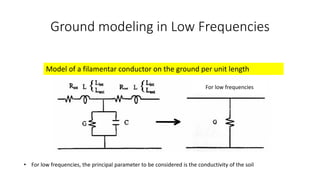
Ground modeling in Low Frequencies
Model of a filamentar conductor on the ground per unit length
For low frequencies
• For low frequencies, the principal parameter to be considered is the conductivity of the soil
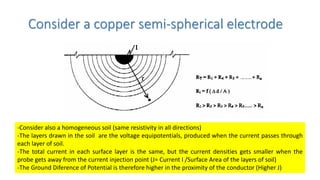
Consider a copper semi-spherical electrode
-Consider also a homogeneous soil (same resistivity in all directions)
-The layers drawn in the soil are the voltage equipotentials, produced when the current passes through
each layer of soil.
-The total current in each surface layer is the same, but the current densities gets smaller when the
probe gets away from the current injection point (J= Current I /Surface Area of the layers of soil)
-The Ground Diference of Potential is therefore higher in the proximity of the conductor (Higher J)
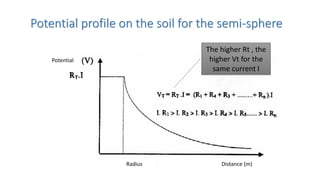
Potential profile on the soil for the semi-sphere
The higher Rt , the
higher Vt for the
same current I
Potential
Radius Distance (m)
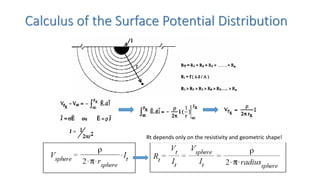
Calculus of the Surface Potential Distribution
Rt depends only on the resistivity and geometric shape!
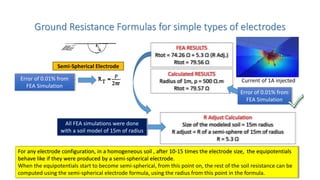
Ground Resistance Formulas for simple types of electrodes
Semi-Spherical Electrode
Error of 0.01% from
FEA Simulation
Calculated RESULTS
Radius of 1m, ρ = 500 Ω.m
Rtot = 79.57 Ω
FEA RESULTS
Rtot = 74.26 Ω + 5.3 Ω (R Adj.)
Rtot = 79.56 Ω
R Adjust Calculation
Size of the modeled soil = 15m radius
R adjust = R of a semi-sphere of 15m of radius
R = 5.3 Ω
All FEA simulations were done
with a soil model of 15m of radius
For any electrode configuration, in a homogeneous soil , after 10-15 times the electrode size, the equipotentials
behave like if they were produced by a semi-spherical electrode.
When the equipotentials start to become semi-spherical, from this point on, the rest of the soil resistance can be
computed using the semi-spherical electrode formula, using the radius from this point in the formula.
Error of 0.01% from
FEA Simulation
Current of 1A injected
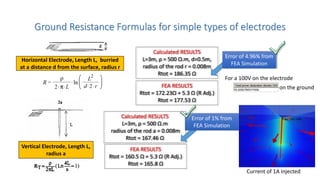
Ground Resistance Formulas for simple types of electrodes
Horizontal Electrode, Length L, burried
at a distance d from the surface, radius r
Calculated RESULTS
L=3m, ρ = 500 Ω.m, d=0.5m,
radius of the rod r = 0.008m
Rtot = 186.35 Ω
FEA RESULTS
Rtot = 172.23Ω + 5.3 Ω (R Adj.)
Rtot = 177.53 Ω
Vertical Electrode, Length L,
radius a
Calculated RESULTS
L=3m, ρ = 500 Ω.m
radius of the rod a = 0.008m
Rtot = 167.46 Ω
FEA RESULTS
Rtot = 160.5 Ω + 5.3 Ω (R Adj.)
Rtot = 165.8 Ω
Error of 4.96% from
FEA Simulation
Error of 1% from
FEA Simulation
For a 100V on the electrode
on the ground
Current of 1A injected
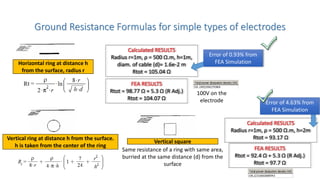
Horizontal ring at distance h
from the surface, radius r
Vertical square
Same resistance of a ring with same area,
burried at the same distance (d) from the
surface
Ground Resistance Formulas for simple types of electrodes
Calculated RESULTS
Radius r=1m, ρ = 500 Ω.m, h=1m,
diam. of cable (d)= 1.6e-2 m
Rtot = 105.04 Ω
FEA RESULTS
Rtot = 98.77 Ω + 5.3 Ω (R Adj.)
Rtot = 104.07 Ω
Error of 0.93% from
FEA Simulation
Calculated RESULTS
Radius r=1m, ρ = 500 Ω.m, h=2m
Rtot = 93.17 Ω
FEA RESULTS
Rtot = 92.4 Ω + 5.3 Ω (R Adj.)
Rtot = 97.7 Ω
Error of 4.63% from
FEA Simulation
100V on the
electrode
Vertical ring at distance h from the surface.
h is taken from the center of the ring
Ground Resistance Formulas for simple types of electrodes
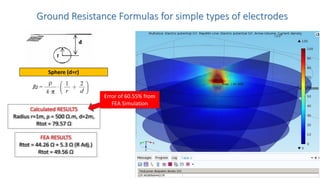
Sphere (d≈r)
Calculated RESULTS
Radius r=1m, ρ = 500 Ω.m, d=2m,
Rtot = 79.57 Ω
FEA RESULTS
Rtot = 44.26 Ω + 5.3 Ω (R Adj.)
Rtot = 49.56 Ω
Error of 60.55% from
FEA Simulation
Ground Resistance Formulas for simple types of electrodes
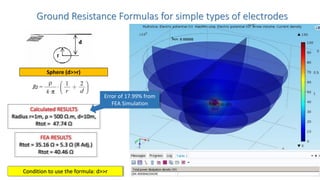
Sphere (d>>r)
Calculated RESULTS
Radius r=1m, ρ = 500 Ω.m, d=10m,
Rtot = 47.74 Ω
FEA RESULTS
Rtot = 35.16 Ω + 5.3 Ω (R Adj.)
Rtot = 40.46 Ω
Error of 17.99% from
FEA Simulation
Condition to use the formula: d>>r
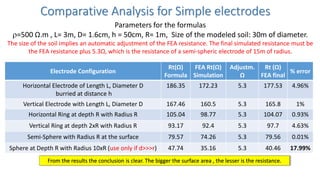
Comparative Analysis for Simple electrodes
Electrode Configuration
Rt(Ω)
Formula
FEA Rt(Ω)
Simulation
Adjustm.
Ω
Rt (Ω)
FEA final
% error
Horizontal Electrode of Length L, Diameter D
burried at distance h
186.35 172.23 5.3 177.53 4.96%
Vertical Electrode with Length L, Diameter D 167.46 160.5 5.3 165.8 1%
Horizontal Ring at depth R with Radius R 105.04 98.77 5.3 104.07 0.93%
Vertical Ring at depth 2xR with Radius R 93.17 92.4 5.3 97.7 4.63%
Semi-Sphere with Radius R at the surface 79.57 74.26 5.3 79.56 0.01%
Sphere at Depth R with Radius 10xR (use only if d>>>r) 47.74 35.16 5.3 40.46 17.99%
Parameters for the formulas
=500 Ω.m , L= 3m, D= 1.6cm, h = 50cm, R= 1m, Size of the modeled soil: 30m of diameter.
The size of the soil implies an automatic adjustment of the FEA resistance. The final simulated resistance must be
the FEA resistance plus 5.3Ω, which is the resistance of a semi-spheric electrode of 15m of radius.
From the results the conclusion is clear. The bigger the surface area , the lesser is the resistance.
Ground Resistance Formulas for multiple electrodes
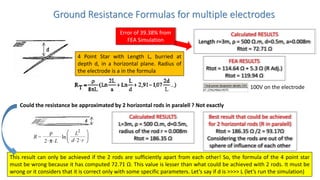
4 Point Star with Length L, burried at
depth d, in a horizontal plane. Radius of
the electrode is a in the formula
Calculated RESULTS
Length r=3m, ρ = 500 Ω.m, d=0.5m, a=0.008m
Rtot = 72.71 Ω
FEA RESULTS
Rtot = 114.64 Ω + 5.3 Ω (R Adj.)
Rtot = 119.94 Ω
100V on the electrode
Error of 39.38% from
FEA Simulation
Could the resistance be approximated by 2 horizontal rods in paralell ? Not exactly
Calculated RESULTS
L=3m, ρ = 500 Ω.m, d=0.5m,
radius of the rod r = 0.008m
Rtot = 186.35 Ω
Best result that could be achieved
for 2 horizontal rods (R in paralell)
Rtot = 186.35 Ω /2 = 93.17Ω
Considering the rods are out of the
sphere of influence of each other
This result can only be achieved if the 2 rods are sufficiently apart from each other! So, the formula of the 4 point star
must be wrong because it has computed 72.71 Ω. This value is lesser than what could be achieved with 2 rods. It must be
wrong or it considers that it is correct only with some specific parameters. Let’s say if d is >>>> L (let’s run the simulation)
Ground Resistance Formulas for multiple electrodes
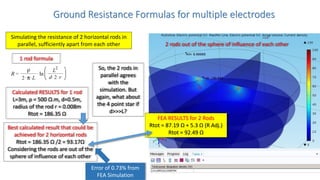
Simulating the resistance of 2 horizontal rods in
parallel, sufficiently apart from each other
Calculated RESULTS for 1 rod
L=3m, ρ = 500 Ω.m, d=0.5m,
radius of the rod r = 0.008m
Rtot = 186.35 Ω
Best calculated result that could be
achieved for 2 horizontal rods
Rtot = 186.35 Ω /2 = 93.17Ω
Considering the rods are out of the
sphere of influence of each other
FEA RESULTS for 2 Rods
Rtot = 87.19 Ω + 5.3 Ω (R Adj.)
Rtot = 92.49 Ω
2 rods out of the sphere of influence of each other
So, the 2 rods in
parallel agrees
with the
simulation. But
again, what about
the 4 point star if
d>>>L?
Error of 0.73% from
FEA Simulation
1 rod formula
Ground Resistance Formulas for multiple electrodes
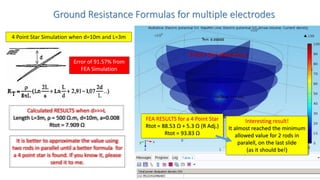
4 Point Star Simulation when d=10m and L=3m
FEA RESULTS for a 4 Point Star
Rtot = 88.53 Ω + 5.3 Ω (R Adj.)
Rtot = 93.83 Ω
4 Point Star when d>>>L
Calculated RESULTS when d>>>L
Length L=3m, ρ = 500 Ω.m, d=10m, a=0.008
Rtot = 7.909 Ω
It is better to approximate the value using
two rods in parallel until a better formula for
a 4 point star is found. If you know it, please
send it to me.
Interesting result!
It almost reached the minimum
allowed value for 2 rods in
paralell, on the last slide
(as it should be!)
Error of 91.57% from
FEA Simulation
Ground Resistance Formulas for multiple electrodes
Conclusion for 4 point star electrode configuration
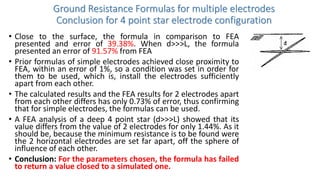
• Close to the surface, the formula in comparison to FEA
presented and error of 39.38%. When d>>>L, the formula
presented an error of 91.57% from FEA
• Prior formulas of simple electrodes achieved close proximity to
FEA, within an error of 1%, so a condition was set in order for
them to be used, which is, install the electrodes sufficiently
apart from each other.
• The calculated results and the FEA results for 2 electrodes apart
from each other differs has only 0.73% of error, thus confirming
that for simple electrodes, the formulas can be used.
• A FEA analysis of a deep 4 point star (d>>>L) showed that its
value differs from the value of 2 electrodes for only 1.44%. As it
should be, because the minimum resistance is to be found were
the 2 horizontal electrodes are set far apart, off the sphere of
influence of each other.
• Conclusion: For the parameters chosen, the formula has failed
to return a value closed to a simulated one.
Ground Resistance Formulas for multiple electrodes
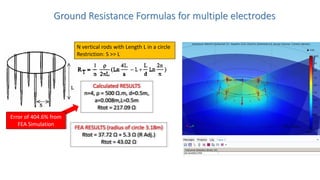
Calculated RESULTS
n=4, ρ = 500 Ω.m, d=0.5m,
a=0.008m,L=0.5m
Rtot = 217.09 Ω
FEA RESULTS (radius of circle 3.18m)
Rtot = 37.72 Ω + 5.3 Ω (R Adj.)
Rtot = 43.02 Ω
Error of 404.6% from
FEA Simulation
N vertical rods with Length L in a circle
Restriction: S >> L
Ground Resistance Formulas for multiple electrodes
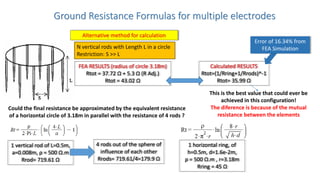
FEA RESULTS (radius of circle 3.18m)
Rtot = 37.72 Ω + 5.3 Ω (R Adj.)
Rtot = 43.02 Ω
N vertical rods with Length L in a circle
Restriction: S >> L
Could the final resistance be approximated by the equivalent resistance
of a horizontal circle of 3.18m in parallel with the resistance of 4 rods ?
1 vertical rod of L=0.5m,
a=0.008m, ρ = 500 Ω.m
Rrod= 719.61 Ω
4 rods out of the sphere of
influence of each other
Rrods= 719.61/4=179.9 Ω
1 horizontal ring, of
h=0.5m, d=1.6e-2m,
ρ = 500 Ω.m , r=3.18m
Rring = 45 Ω
Calculated RESULTS
Rtot=(1/Rring+1/Rrods)^-1
Rtot= 35.99 Ω
Error of 16.34% from
FEA Simulation
This is the best value that could ever be
achieved in this configuration!
The diference is because of the mutual
resistance between the elements
Alternative method for calculation
Ground Resistance Formulas for multiple electrodes
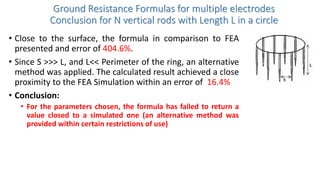
Conclusion for N vertical rods with Length L in a circle
• Close to the surface, the formula in comparison to FEA
presented and error of 404.6%.
• Since S >>> L, and L<< Perimeter of the ring, an alternative
method was applied. The calculated result achieved a close
proximity to the FEA Simulation within an error of 16.4%
• Conclusion:
• For the parameters chosen, the formula has failed to return a
value closed to a simulated one (an alternative method was
provided within certain restrictions of use)
Ground Resistance Formulas for multiple electrodes
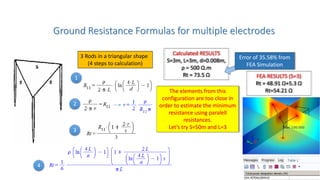
3 Rods in a triangular shape
(4 steps to calculation)
1
2
3
4
Calculated RESULTS
S=3m, L=3m, d=0.008m,
ρ = 500 Ω.m
Rt = 73.5 Ω FEA RESULTS (S=3)
Rt = 48.91 Ω+5.3 Ω
Rt=54.21 Ω
Error of 35.58% from
FEA Simulation
The elements from this
configuration are too close in
order to estimate the minimum
resistance using paralell
resistances.
Let’s try S=50m and L=3
Ground Resistance Formulas for multiple electrodes
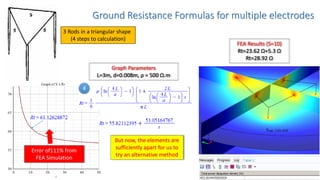
3 Rods in a triangular shape
(4 steps to calculation)
4
Graph Parameters
L=3m, d=0.008m, ρ = 500 Ω.m
FEA Results (S=10)
Rt=23.62 Ω+5.3 Ω
Rt=28.92 Ω
Error of111% from
FEA Simulation
But now, the elements are
sufficiently apart for us to
try an alternative method
Ground Resistance Formulas for multiple electrodes
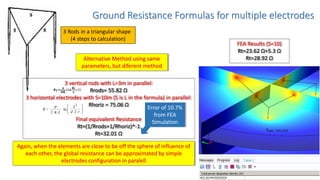
3 Rods in a triangular shape
(4 steps to calculation)
FEA Results (S=10)
Rt=23.62 Ω+5.3 Ω
Rt=28.92 ΩAlternative Method using same
parameters, but diferent method
3 vertical rods with L=3m in parallel:
Rrods= 55.82 Ω
3 horizontal electrodes with S=10m (S is L in the formula) in parallel:
Rhoriz = 75.06 Ω
Final equivalent Resistance
Rt=(1/Rrods+1/Rhoriz)^-1
Rt=32.01 Ω
Again, when the elements are close to be off the sphere of influence of
each other, the global resistance can be approximated by simple
electrodes configuration in paralell
Error of 10.7%
from FEA
Simulation
Ground Resistance Formulas for multiple electrodes
Conclusion for 3 Rods in a triangular shape
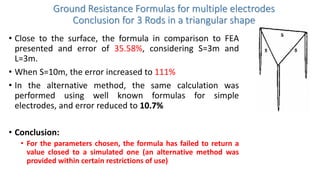
• Close to the surface, the formula in comparison to FEA
presented and error of 35.58%, considering S=3m and
L=3m.
• When S=10m, the error increased to 111%
• In the alternative method, the same calculation was
performed using well known formulas for simple
electrodes, and error reduced to 10.7%
• Conclusion:
• For the parameters chosen, the formula has failed to return a
value closed to a simulated one (an alternative method was
provided within certain restrictions of use)
Ground Resistance Formulas for multiple electrodes
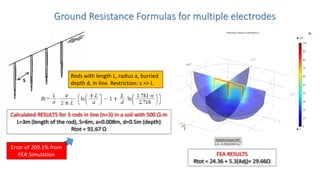
Error of 209.1% from
FEA Simulation FEA RESULTS
Rtot = 24.36 + 5.3(Adj)= 29.66Ω
Rods with length L, radius a, burried
depth d, in line. Restriction: s >> L
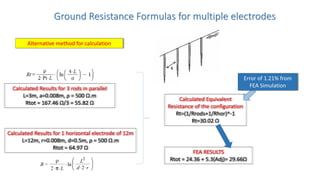
Calculated RESULTS for 3 rods in line (n=3) in a soil with 500 Ω.m
L=3m (length of the rod), S=6m, a=0.008m, d=0.5m (depth)
Rtot = 91.67 Ω
Ground Resistance Formulas for multiple electrodes
FEA RESULTS
Rtot = 24.36 + 5.3(Adj)= 29.66Ω
Calculated Results for 3 rods in parallel
L=3m, a=0.008m, ρ = 500 Ω.m
Rtot = 167.46 Ω/3 = 55.82 Ω
Calculated Results for 1 horizontal electrode of 12m
L=12m, r=0.008m, d=0.5m, ρ = 500 Ω.m
Rtot = 64.97 Ω
Calculated Equivalent
Resistance of the configuration
Rt=(1/Rrods+1/Rhor)^-1
Rt=30.02 Ω
Error of 1.21% from
FEA Simulation
Alternative method for calculation
Ground Resistance Formulas for multiple electrodes
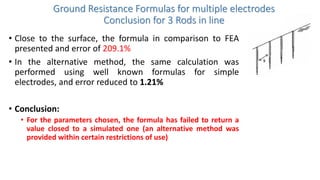
Conclusion for 3 Rods in line
• Close to the surface, the formula in comparison to FEA
presented and error of 209.1%
• In the alternative method, the same calculation was
performed using well known formulas for simple
electrodes, and error reduced to 1.21%
• Conclusion:
• For the parameters chosen, the formula has failed to return a
value closed to a simulated one (an alternative method was
provided within certain restrictions of use)
Ground Resistance Formulas for multiple electrodes
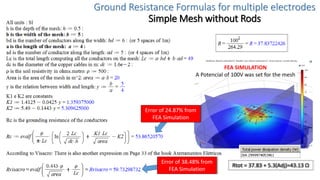
Simple Mesh without Rods
FEA SIMULATION
A Potencial of 100V was set for the mesh
Rtot = 37.83 + 5.3(Adj)=43.13 Ω
Error of 38.48% from
FEA Simulation
Error of 24.87% from
FEA Simulation
Ground Resistance Formulas for multiple electrodes
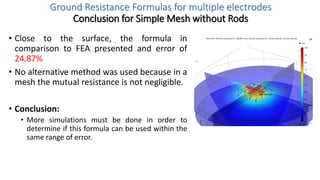
Conclusion for Simple Mesh without Rods
• Close to the surface, the formula in
comparison to FEA presented and error of
24.87%
• No alternative method was used because in a
mesh the mutual resistance is not negligible.
• Conclusion:
• More simulations must be done in order to
determine if this formula can be used within the
same range of error.
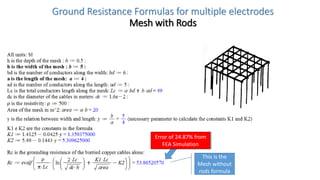
Ground Resistance Formulas for multiple electrodes
Mesh with Rods
Error of 24.87% from
FEA Simulation
This is the
Mesh without
rods formula
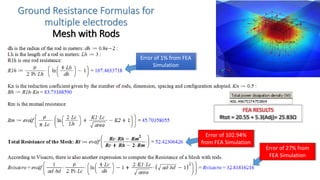
Ground Resistance Formulas for
multiple electrodes
Mesh with Rods
FEA RESULTS
Rtot = 20.55 + 5.3(Adj)= 25.83Ω
Error of 102.94%
from FEA Simulation
Error of 1% from FEA
Simulation
Error of 27% from
FEA Simulation
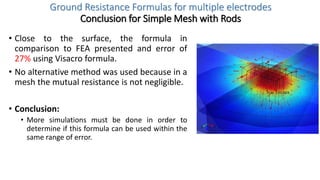
Ground Resistance Formulas for multiple electrodes
Conclusion for Simple Mesh with Rods
• Close to the surface, the formula in
comparison to FEA presented and error of
27% using Visacro formula.
• No alternative method was used because in a
mesh the mutual resistance is not negligible.
• Conclusion:
• More simulations must be done in order to
determine if this formula can be used within the
same range of error.
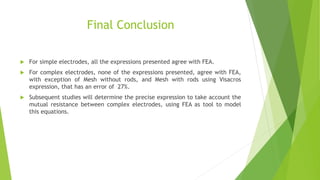
Final Conclusion
 For simple electrodes, all the expressions presented agree with FEA.
 For complex electrodes, none of the expressions presented, agree with FEA,
with exception of Mesh without rods, and Mesh with rods using Visacros
expression, that has an error of 27%.
 Subsequent studies will determine the precise expression to take account the
mutual resistance between complex electrodes, using FEA as tool to model
this equations.
Thank you for your time
 Please, let me know if you have any other expressions for the grounding
electrodes configurations. I will test them and insert them in another
presentation
 Any errors you found, incorrect expressions you find, wrong calculations,
suggestions that you want to share, please, leave a comment on my post.
 https://de.linkedin.com/pub/camilo-chaves/11/323/a72

Grounding simulation slides

  • 1.
    Grounding Simulation using FEASoftware Camilo Chaves Electrical Engineer and Physicist https://de.linkedin.com/pub/camilo-chaves/11/323/a72
  • 2.
    Ground modeling inLow Frequencies Model of a filamentar conductor on the ground per unit length For low frequencies • For low frequencies, the principal parameter to be considered is the conductivity of the soil
  • 3.
    Consider a coppersemi-spherical electrode -Consider also a homogeneous soil (same resistivity in all directions) -The layers drawn in the soil are the voltage equipotentials, produced when the current passes through each layer of soil. -The total current in each surface layer is the same, but the current densities gets smaller when the probe gets away from the current injection point (J= Current I /Surface Area of the layers of soil) -The Ground Diference of Potential is therefore higher in the proximity of the conductor (Higher J)
  • 4.
    Potential profile onthe soil for the semi-sphere The higher Rt , the higher Vt for the same current I Potential Radius Distance (m)
  • 5.
    Calculus of theSurface Potential Distribution Rt depends only on the resistivity and geometric shape!
  • 6.
    Ground Resistance Formulasfor simple types of electrodes Semi-Spherical Electrode Error of 0.01% from FEA Simulation Calculated RESULTS Radius of 1m, ρ = 500 Ω.m Rtot = 79.57 Ω FEA RESULTS Rtot = 74.26 Ω + 5.3 Ω (R Adj.) Rtot = 79.56 Ω R Adjust Calculation Size of the modeled soil = 15m radius R adjust = R of a semi-sphere of 15m of radius R = 5.3 Ω All FEA simulations were done with a soil model of 15m of radius For any electrode configuration, in a homogeneous soil , after 10-15 times the electrode size, the equipotentials behave like if they were produced by a semi-spherical electrode. When the equipotentials start to become semi-spherical, from this point on, the rest of the soil resistance can be computed using the semi-spherical electrode formula, using the radius from this point in the formula. Error of 0.01% from FEA Simulation Current of 1A injected
  • 7.
    Ground Resistance Formulasfor simple types of electrodes Horizontal Electrode, Length L, burried at a distance d from the surface, radius r Calculated RESULTS L=3m, ρ = 500 Ω.m, d=0.5m, radius of the rod r = 0.008m Rtot = 186.35 Ω FEA RESULTS Rtot = 172.23Ω + 5.3 Ω (R Adj.) Rtot = 177.53 Ω Vertical Electrode, Length L, radius a Calculated RESULTS L=3m, ρ = 500 Ω.m radius of the rod a = 0.008m Rtot = 167.46 Ω FEA RESULTS Rtot = 160.5 Ω + 5.3 Ω (R Adj.) Rtot = 165.8 Ω Error of 4.96% from FEA Simulation Error of 1% from FEA Simulation For a 100V on the electrode on the ground Current of 1A injected
  • 8.
    Horizontal ring atdistance h from the surface, radius r Vertical square Same resistance of a ring with same area, burried at the same distance (d) from the surface Ground Resistance Formulas for simple types of electrodes Calculated RESULTS Radius r=1m, ρ = 500 Ω.m, h=1m, diam. of cable (d)= 1.6e-2 m Rtot = 105.04 Ω FEA RESULTS Rtot = 98.77 Ω + 5.3 Ω (R Adj.) Rtot = 104.07 Ω Error of 0.93% from FEA Simulation Calculated RESULTS Radius r=1m, ρ = 500 Ω.m, h=2m Rtot = 93.17 Ω FEA RESULTS Rtot = 92.4 Ω + 5.3 Ω (R Adj.) Rtot = 97.7 Ω Error of 4.63% from FEA Simulation 100V on the electrode Vertical ring at distance h from the surface. h is taken from the center of the ring
  • 9.
    Ground Resistance Formulasfor simple types of electrodes Sphere (d≈r) Calculated RESULTS Radius r=1m, ρ = 500 Ω.m, d=2m, Rtot = 79.57 Ω FEA RESULTS Rtot = 44.26 Ω + 5.3 Ω (R Adj.) Rtot = 49.56 Ω Error of 60.55% from FEA Simulation
  • 10.
    Ground Resistance Formulasfor simple types of electrodes Sphere (d>>r) Calculated RESULTS Radius r=1m, ρ = 500 Ω.m, d=10m, Rtot = 47.74 Ω FEA RESULTS Rtot = 35.16 Ω + 5.3 Ω (R Adj.) Rtot = 40.46 Ω Error of 17.99% from FEA Simulation Condition to use the formula: d>>r
  • 11.
    Comparative Analysis forSimple electrodes Electrode Configuration Rt(Ω) Formula FEA Rt(Ω) Simulation Adjustm. Ω Rt (Ω) FEA final % error Horizontal Electrode of Length L, Diameter D burried at distance h 186.35 172.23 5.3 177.53 4.96% Vertical Electrode with Length L, Diameter D 167.46 160.5 5.3 165.8 1% Horizontal Ring at depth R with Radius R 105.04 98.77 5.3 104.07 0.93% Vertical Ring at depth 2xR with Radius R 93.17 92.4 5.3 97.7 4.63% Semi-Sphere with Radius R at the surface 79.57 74.26 5.3 79.56 0.01% Sphere at Depth R with Radius 10xR (use only if d>>>r) 47.74 35.16 5.3 40.46 17.99% Parameters for the formulas =500 Ω.m , L= 3m, D= 1.6cm, h = 50cm, R= 1m, Size of the modeled soil: 30m of diameter. The size of the soil implies an automatic adjustment of the FEA resistance. The final simulated resistance must be the FEA resistance plus 5.3Ω, which is the resistance of a semi-spheric electrode of 15m of radius. From the results the conclusion is clear. The bigger the surface area , the lesser is the resistance.
  • 12.
    Ground Resistance Formulasfor multiple electrodes 4 Point Star with Length L, burried at depth d, in a horizontal plane. Radius of the electrode is a in the formula Calculated RESULTS Length r=3m, ρ = 500 Ω.m, d=0.5m, a=0.008m Rtot = 72.71 Ω FEA RESULTS Rtot = 114.64 Ω + 5.3 Ω (R Adj.) Rtot = 119.94 Ω 100V on the electrode Error of 39.38% from FEA Simulation Could the resistance be approximated by 2 horizontal rods in paralell ? Not exactly Calculated RESULTS L=3m, ρ = 500 Ω.m, d=0.5m, radius of the rod r = 0.008m Rtot = 186.35 Ω Best result that could be achieved for 2 horizontal rods (R in paralell) Rtot = 186.35 Ω /2 = 93.17Ω Considering the rods are out of the sphere of influence of each other This result can only be achieved if the 2 rods are sufficiently apart from each other! So, the formula of the 4 point star must be wrong because it has computed 72.71 Ω. This value is lesser than what could be achieved with 2 rods. It must be wrong or it considers that it is correct only with some specific parameters. Let’s say if d is >>>> L (let’s run the simulation)
  • 13.
    Ground Resistance Formulasfor multiple electrodes Simulating the resistance of 2 horizontal rods in parallel, sufficiently apart from each other Calculated RESULTS for 1 rod L=3m, ρ = 500 Ω.m, d=0.5m, radius of the rod r = 0.008m Rtot = 186.35 Ω Best calculated result that could be achieved for 2 horizontal rods Rtot = 186.35 Ω /2 = 93.17Ω Considering the rods are out of the sphere of influence of each other FEA RESULTS for 2 Rods Rtot = 87.19 Ω + 5.3 Ω (R Adj.) Rtot = 92.49 Ω 2 rods out of the sphere of influence of each other So, the 2 rods in parallel agrees with the simulation. But again, what about the 4 point star if d>>>L? Error of 0.73% from FEA Simulation 1 rod formula
  • 14.
    Ground Resistance Formulasfor multiple electrodes 4 Point Star Simulation when d=10m and L=3m FEA RESULTS for a 4 Point Star Rtot = 88.53 Ω + 5.3 Ω (R Adj.) Rtot = 93.83 Ω 4 Point Star when d>>>L Calculated RESULTS when d>>>L Length L=3m, ρ = 500 Ω.m, d=10m, a=0.008 Rtot = 7.909 Ω It is better to approximate the value using two rods in parallel until a better formula for a 4 point star is found. If you know it, please send it to me. Interesting result! It almost reached the minimum allowed value for 2 rods in paralell, on the last slide (as it should be!) Error of 91.57% from FEA Simulation
  • 15.
    Ground Resistance Formulasfor multiple electrodes Conclusion for 4 point star electrode configuration • Close to the surface, the formula in comparison to FEA presented and error of 39.38%. When d>>>L, the formula presented an error of 91.57% from FEA • Prior formulas of simple electrodes achieved close proximity to FEA, within an error of 1%, so a condition was set in order for them to be used, which is, install the electrodes sufficiently apart from each other. • The calculated results and the FEA results for 2 electrodes apart from each other differs has only 0.73% of error, thus confirming that for simple electrodes, the formulas can be used. • A FEA analysis of a deep 4 point star (d>>>L) showed that its value differs from the value of 2 electrodes for only 1.44%. As it should be, because the minimum resistance is to be found were the 2 horizontal electrodes are set far apart, off the sphere of influence of each other. • Conclusion: For the parameters chosen, the formula has failed to return a value closed to a simulated one.
  • 16.
    Ground Resistance Formulasfor multiple electrodes Calculated RESULTS n=4, ρ = 500 Ω.m, d=0.5m, a=0.008m,L=0.5m Rtot = 217.09 Ω FEA RESULTS (radius of circle 3.18m) Rtot = 37.72 Ω + 5.3 Ω (R Adj.) Rtot = 43.02 Ω Error of 404.6% from FEA Simulation N vertical rods with Length L in a circle Restriction: S >> L
  • 17.
    Ground Resistance Formulasfor multiple electrodes FEA RESULTS (radius of circle 3.18m) Rtot = 37.72 Ω + 5.3 Ω (R Adj.) Rtot = 43.02 Ω N vertical rods with Length L in a circle Restriction: S >> L Could the final resistance be approximated by the equivalent resistance of a horizontal circle of 3.18m in parallel with the resistance of 4 rods ? 1 vertical rod of L=0.5m, a=0.008m, ρ = 500 Ω.m Rrod= 719.61 Ω 4 rods out of the sphere of influence of each other Rrods= 719.61/4=179.9 Ω 1 horizontal ring, of h=0.5m, d=1.6e-2m, ρ = 500 Ω.m , r=3.18m Rring = 45 Ω Calculated RESULTS Rtot=(1/Rring+1/Rrods)^-1 Rtot= 35.99 Ω Error of 16.34% from FEA Simulation This is the best value that could ever be achieved in this configuration! The diference is because of the mutual resistance between the elements Alternative method for calculation
  • 18.
    Ground Resistance Formulasfor multiple electrodes Conclusion for N vertical rods with Length L in a circle • Close to the surface, the formula in comparison to FEA presented and error of 404.6%. • Since S >>> L, and L<< Perimeter of the ring, an alternative method was applied. The calculated result achieved a close proximity to the FEA Simulation within an error of 16.4% • Conclusion: • For the parameters chosen, the formula has failed to return a value closed to a simulated one (an alternative method was provided within certain restrictions of use)
  • 19.
    Ground Resistance Formulasfor multiple electrodes 3 Rods in a triangular shape (4 steps to calculation) 1 2 3 4 Calculated RESULTS S=3m, L=3m, d=0.008m, ρ = 500 Ω.m Rt = 73.5 Ω FEA RESULTS (S=3) Rt = 48.91 Ω+5.3 Ω Rt=54.21 Ω Error of 35.58% from FEA Simulation The elements from this configuration are too close in order to estimate the minimum resistance using paralell resistances. Let’s try S=50m and L=3
  • 20.
    Ground Resistance Formulasfor multiple electrodes 3 Rods in a triangular shape (4 steps to calculation) 4 Graph Parameters L=3m, d=0.008m, ρ = 500 Ω.m FEA Results (S=10) Rt=23.62 Ω+5.3 Ω Rt=28.92 Ω Error of111% from FEA Simulation But now, the elements are sufficiently apart for us to try an alternative method
  • 21.
    Ground Resistance Formulasfor multiple electrodes 3 Rods in a triangular shape (4 steps to calculation) FEA Results (S=10) Rt=23.62 Ω+5.3 Ω Rt=28.92 ΩAlternative Method using same parameters, but diferent method 3 vertical rods with L=3m in parallel: Rrods= 55.82 Ω 3 horizontal electrodes with S=10m (S is L in the formula) in parallel: Rhoriz = 75.06 Ω Final equivalent Resistance Rt=(1/Rrods+1/Rhoriz)^-1 Rt=32.01 Ω Again, when the elements are close to be off the sphere of influence of each other, the global resistance can be approximated by simple electrodes configuration in paralell Error of 10.7% from FEA Simulation
  • 22.
    Ground Resistance Formulasfor multiple electrodes Conclusion for 3 Rods in a triangular shape • Close to the surface, the formula in comparison to FEA presented and error of 35.58%, considering S=3m and L=3m. • When S=10m, the error increased to 111% • In the alternative method, the same calculation was performed using well known formulas for simple electrodes, and error reduced to 10.7% • Conclusion: • For the parameters chosen, the formula has failed to return a value closed to a simulated one (an alternative method was provided within certain restrictions of use)
  • 23.
    Ground Resistance Formulasfor multiple electrodes Error of 209.1% from FEA Simulation FEA RESULTS Rtot = 24.36 + 5.3(Adj)= 29.66Ω Rods with length L, radius a, burried depth d, in line. Restriction: s >> L Calculated RESULTS for 3 rods in line (n=3) in a soil with 500 Ω.m L=3m (length of the rod), S=6m, a=0.008m, d=0.5m (depth) Rtot = 91.67 Ω
  • 24.
    Ground Resistance Formulasfor multiple electrodes FEA RESULTS Rtot = 24.36 + 5.3(Adj)= 29.66Ω Calculated Results for 3 rods in parallel L=3m, a=0.008m, ρ = 500 Ω.m Rtot = 167.46 Ω/3 = 55.82 Ω Calculated Results for 1 horizontal electrode of 12m L=12m, r=0.008m, d=0.5m, ρ = 500 Ω.m Rtot = 64.97 Ω Calculated Equivalent Resistance of the configuration Rt=(1/Rrods+1/Rhor)^-1 Rt=30.02 Ω Error of 1.21% from FEA Simulation Alternative method for calculation
  • 25.
    Ground Resistance Formulasfor multiple electrodes Conclusion for 3 Rods in line • Close to the surface, the formula in comparison to FEA presented and error of 209.1% • In the alternative method, the same calculation was performed using well known formulas for simple electrodes, and error reduced to 1.21% • Conclusion: • For the parameters chosen, the formula has failed to return a value closed to a simulated one (an alternative method was provided within certain restrictions of use)
  • 26.
    Ground Resistance Formulasfor multiple electrodes Simple Mesh without Rods FEA SIMULATION A Potencial of 100V was set for the mesh Rtot = 37.83 + 5.3(Adj)=43.13 Ω Error of 38.48% from FEA Simulation Error of 24.87% from FEA Simulation
  • 27.
    Ground Resistance Formulasfor multiple electrodes Conclusion for Simple Mesh without Rods • Close to the surface, the formula in comparison to FEA presented and error of 24.87% • No alternative method was used because in a mesh the mutual resistance is not negligible. • Conclusion: • More simulations must be done in order to determine if this formula can be used within the same range of error.
  • 28.
    Ground Resistance Formulasfor multiple electrodes Mesh with Rods Error of 24.87% from FEA Simulation This is the Mesh without rods formula
  • 29.
    Ground Resistance Formulasfor multiple electrodes Mesh with Rods FEA RESULTS Rtot = 20.55 + 5.3(Adj)= 25.83Ω Error of 102.94% from FEA Simulation Error of 1% from FEA Simulation Error of 27% from FEA Simulation
  • 30.
    Ground Resistance Formulasfor multiple electrodes Conclusion for Simple Mesh with Rods • Close to the surface, the formula in comparison to FEA presented and error of 27% using Visacro formula. • No alternative method was used because in a mesh the mutual resistance is not negligible. • Conclusion: • More simulations must be done in order to determine if this formula can be used within the same range of error.
  • 31.
    Final Conclusion  Forsimple electrodes, all the expressions presented agree with FEA.  For complex electrodes, none of the expressions presented, agree with FEA, with exception of Mesh without rods, and Mesh with rods using Visacros expression, that has an error of 27%.  Subsequent studies will determine the precise expression to take account the mutual resistance between complex electrodes, using FEA as tool to model this equations.
  • 32.
    Thank you foryour time  Please, let me know if you have any other expressions for the grounding electrodes configurations. I will test them and insert them in another presentation  Any errors you found, incorrect expressions you find, wrong calculations, suggestions that you want to share, please, leave a comment on my post.  https://de.linkedin.com/pub/camilo-chaves/11/323/a72