Group # 4 Slide Show Tzu-Yin Lin  Page 2 -- 8 Jie  Ma  Page 9 -- 15 Gary W McCloud  Page 16 -- 22 Shawn Y Mohamed  Page 23 -- 27 02/09/11
Accuracy in Speaking English Tzu-Yin Lin 003861766 01/22/10 02/09/11
Why teaching accuracy in speaking English? People always talk about that for an ESL students should just speak out without hesitation, even when there’s some grammar error. Of course to speak fluently is everyone’s priority,  but to speak accuracy is important, too . Therefore, I think that the accuracy in English what I   consider in teaching speaking.  02/09/11
Tips for teaching accuracy in speaking English In cognitive way,  1. Remind the students that there are different  grammatical structure in different languages.  2. Motivate the students to challenge  themselves by speak accurately.  3. Encourage the students to speak.  4. An in-class drama play. 02/09/11
Remind the students that there are different grammatical structure in different languages.  Take myself as an ESL students, my first language is  Mandarin. There is no tense for our language. We  simply put  yesterday/today/tomorrow  in out sentence  ( ex: I yesterday eat an apple )  to make it  past/present/future tense . Therefore the teacher  should provide very clear grammar instructions to show  the students that they should always remember to use  tenses not just in writing, but also in speaking.  02/09/11
Motive the students to challenge themselves  by speak accurately. To motivate students, the teacher can provide  interesting topic for the students, such as movie/music.  Then to encourage the students to speak out.  Structured the sentence in their head first, then to  speak out. The teacher takes note when in-class  speaking, who can reach the highest point of making  no grammatical error when speaking can receive a gift.  The students will willing to challenge themselves to  reach the goal. 02/09/11
An in-class drama play To make the class more interesting, role-play or a  drama play is always the best way for the students to  speak out and also speak accurately. Also, this is a good way to interest the students. If there’s only lecture in  the classroom, it will be too boring for the students.  02/09/11
Encourage the students to speak As a teacher, instruction is not the only way to lead the  students to perfection. To give out appropriate  encouragement or compliment is another way to lead  the students to perfection.  With positive feedback  from the teacher, the students will willing to speak out  and speak accurately.  02/09/11
I dioms in  L istening is  H ard  to Learn  for ESL  S tudents Jie Ma
Idioms is hard for ESL studnets Listening comprehension exists in a lot of English exams, it is an important factor for ESL students to get high score in English exams. So, ESL students focus to remember vocabulary, it will help them comprehend the listening material. But, when they meet the idioms in  listening, we can say it is the most difficult part for ESL students.
Why idioms is the hardest part for ESL students?? Each country has their own culture, each ESL student has their own idioms. When they learn a new language, they should face to a new culture, but they are not live in that culture, so they can't understand idioms easily, although sometimes the idioms are formed by some simple words.
Tips to learn idioms well (1) Read Original English Newspapers more eg: Car is the  Pandora's box  of pollution. => Car is the  cause  of pollution.
(2) Listen to VOA as much as possible In Feb,2008, there is an idiom appeared in "Special English" in VOA. -->> hit the spot (It is formed by simple words, but it's hard for ESL students,because they lack the culture background) eg: Pepsi Cola  hits the spot . = Pepsi Cola  tatses good and makes me feel satisfied.
(3) Watch original English movie ,no translation lines. In the year of 1995, there is an idiom appeared in the movie "Othello". green-eyed monster = jealousy eg: Oh, Beware, my lord, of jealousy. It is the  green-eyed monster  which doth mock the meat it feeds on.
Learn idioms, have fun in English! Those tips above are good way for ESL students to learn idioms well, meanwhile, students can have fun from those activities. Interest is the best teacher for learning! Those activities will also evoke their interest of learning English. They can learn English better, not only for idioms.
PROBLEMS IN TEACHING LISTENING IN EFL CLASSROOMS By Gary McCloud 02/09/11
OUR FOCUS IS: How To Improve Listening Comprehension by the L2 Student OUR SOLUTION IS: By Increasing L2 listener’s  Use of Cognitive Listening Strategies We begin by asking: Why do so many L2 students in EFL classrooms have trouble understanding what they listen to?  From beginners to advanced, most L2 students often say “… but I didn’t understand what they said...” why? why? why? why? why? 02/09/11
To answer this, we must take a look at exactly what the listening process is The listening Process can be defined as: “ an active process in which listener’s select and interpret information that comes from auditory and visual clues in order to define what is going on and what the speakers are trying to say” (Thompson & Rubin, 1996). But as we know, many L2 listeners believe they can’t do this well.  What exactly are some of the reasons they give: 02/09/11
Three major reasons that L2 listeners give for not understanding are: Speed of Speaking:  what L2 listeners hear seems to be spoken too quickly; they can’t control the pace at which the speaker speaks Phonology:  L2 listeners often can’t hear or pronounce letters/sounds that don’t occur in their mother language;  they often can’t decode reduced forms Interpretation Problems:  L2 listeners often hear words/phrases correctly but get the wrong meaning. They get lost in the idioms and colloquialisms Therefore, how can we as teachers help L2 learners who have such difficulties improve their listening comprehension? 02/09/11
Teachers Can Focus on Listening Strategies Now,  we will focus on the cognitive listening strategy and how it relates to the 3 problems above  The cognitive listening strategy can be partially defined as  “ situation-specific techniques used during the performance of a speaking/listening task to facilitate comprehension, for example, listening for details, making inferences, using background knowledge (top-down processing), getting the gist of material, etc.” 02/09/11
Cognitive listening strategy as it relates to L2 problem “Speed of Speaking”: Since L2 learners think speakers speak too fast,  teachers need to be aware of why this happens.  Teachers need to understand how to better organize a listening activity in the classroom.  Teachers need to understand that students, when hearing a recording in class, are unable to get non verbal clues or pick up on sounds or catch the gist. 02/09/11
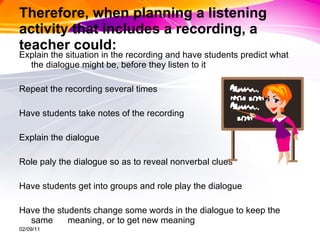
Therefore, when planning a listening activity that includes a recording, a teacher could: Explain the situation in the recording and have students predict what the dialogue might be, before they listen to it Repeat the recording several times Have students take notes of the recording Explain the dialogue Role paly the dialogue so as to reveal nonverbal clues Have students get into groups and role play the dialogue Have the students change some words in the dialogue to keep the same  meaning, or to get new meaning 02/09/11
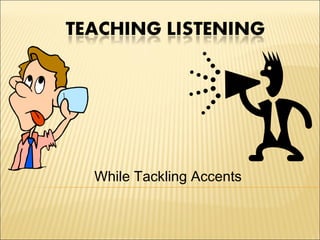
While Tackling Accents
English is spoken as a Native language in  United States of America United Kingdom Canada Australia Many others as well Within these countries English takes on many different accents and dialects
With the student who is learning all new language sounds foreign. We may not realize it but some of our accents make it hard for our students to hear particular sounds in words. Some of us may not have really strong or pronounced accents but we may have speech impediments that augment our speech as well. Deaf people who have high speech ability People with lisps People with stutters
Utilize other teachers that you work with as your resources to improve your students listening skills. Utilize movies from different English speaking countries. Create audio listening files for your students to listen to.
A good exercise would be to show an episode of “The Office” to your students (if they are Adults) The Office is a popular show in both the U.S. and U.K. and the students can practice listening to dialogue in British English as well as in American English. Then afterwards go through the different and similar words that the students heard and see what needs clarification.

Group 4 assignment 2

  • 1.
    Group # 4Slide Show Tzu-Yin Lin Page 2 -- 8 Jie Ma Page 9 -- 15 Gary W McCloud Page 16 -- 22 Shawn Y Mohamed Page 23 -- 27 02/09/11
  • 2.
    Accuracy in SpeakingEnglish Tzu-Yin Lin 003861766 01/22/10 02/09/11
  • 3.
    Why teaching accuracyin speaking English? People always talk about that for an ESL students should just speak out without hesitation, even when there’s some grammar error. Of course to speak fluently is everyone’s priority, but to speak accuracy is important, too . Therefore, I think that the accuracy in English what I consider in teaching speaking. 02/09/11
  • 4.
    Tips for teachingaccuracy in speaking English In cognitive way, 1. Remind the students that there are different grammatical structure in different languages. 2. Motivate the students to challenge themselves by speak accurately. 3. Encourage the students to speak. 4. An in-class drama play. 02/09/11
  • 5.
    Remind the studentsthat there are different grammatical structure in different languages. Take myself as an ESL students, my first language is Mandarin. There is no tense for our language. We simply put yesterday/today/tomorrow in out sentence ( ex: I yesterday eat an apple ) to make it past/present/future tense . Therefore the teacher should provide very clear grammar instructions to show the students that they should always remember to use tenses not just in writing, but also in speaking. 02/09/11
  • 6.
    Motive the studentsto challenge themselves by speak accurately. To motivate students, the teacher can provide interesting topic for the students, such as movie/music. Then to encourage the students to speak out. Structured the sentence in their head first, then to speak out. The teacher takes note when in-class speaking, who can reach the highest point of making no grammatical error when speaking can receive a gift. The students will willing to challenge themselves to reach the goal. 02/09/11
  • 7.
    An in-class dramaplay To make the class more interesting, role-play or a drama play is always the best way for the students to speak out and also speak accurately. Also, this is a good way to interest the students. If there’s only lecture in the classroom, it will be too boring for the students. 02/09/11
  • 8.
    Encourage the studentsto speak As a teacher, instruction is not the only way to lead the students to perfection. To give out appropriate encouragement or compliment is another way to lead the students to perfection. With positive feedback from the teacher, the students will willing to speak out and speak accurately. 02/09/11
  • 9.
    I dioms in L istening is H ard to Learn for ESL S tudents Jie Ma
  • 10.
    Idioms is hardfor ESL studnets Listening comprehension exists in a lot of English exams, it is an important factor for ESL students to get high score in English exams. So, ESL students focus to remember vocabulary, it will help them comprehend the listening material. But, when they meet the idioms in listening, we can say it is the most difficult part for ESL students.
  • 11.
    Why idioms isthe hardest part for ESL students?? Each country has their own culture, each ESL student has their own idioms. When they learn a new language, they should face to a new culture, but they are not live in that culture, so they can't understand idioms easily, although sometimes the idioms are formed by some simple words.
  • 12.
    Tips to learnidioms well (1) Read Original English Newspapers more eg: Car is the Pandora's box of pollution. => Car is the cause of pollution.
  • 13.
    (2) Listen toVOA as much as possible In Feb,2008, there is an idiom appeared in "Special English" in VOA. -->> hit the spot (It is formed by simple words, but it's hard for ESL students,because they lack the culture background) eg: Pepsi Cola hits the spot . = Pepsi Cola tatses good and makes me feel satisfied.
  • 14.
    (3) Watch originalEnglish movie ,no translation lines. In the year of 1995, there is an idiom appeared in the movie "Othello". green-eyed monster = jealousy eg: Oh, Beware, my lord, of jealousy. It is the green-eyed monster which doth mock the meat it feeds on.
  • 15.
    Learn idioms, havefun in English! Those tips above are good way for ESL students to learn idioms well, meanwhile, students can have fun from those activities. Interest is the best teacher for learning! Those activities will also evoke their interest of learning English. They can learn English better, not only for idioms.
  • 16.
    PROBLEMS IN TEACHINGLISTENING IN EFL CLASSROOMS By Gary McCloud 02/09/11
  • 17.
    OUR FOCUS IS:How To Improve Listening Comprehension by the L2 Student OUR SOLUTION IS: By Increasing L2 listener’s Use of Cognitive Listening Strategies We begin by asking: Why do so many L2 students in EFL classrooms have trouble understanding what they listen to? From beginners to advanced, most L2 students often say “… but I didn’t understand what they said...” why? why? why? why? why? 02/09/11
  • 18.
    To answer this,we must take a look at exactly what the listening process is The listening Process can be defined as: “ an active process in which listener’s select and interpret information that comes from auditory and visual clues in order to define what is going on and what the speakers are trying to say” (Thompson & Rubin, 1996). But as we know, many L2 listeners believe they can’t do this well. What exactly are some of the reasons they give: 02/09/11
  • 19.
    Three major reasonsthat L2 listeners give for not understanding are: Speed of Speaking: what L2 listeners hear seems to be spoken too quickly; they can’t control the pace at which the speaker speaks Phonology: L2 listeners often can’t hear or pronounce letters/sounds that don’t occur in their mother language; they often can’t decode reduced forms Interpretation Problems: L2 listeners often hear words/phrases correctly but get the wrong meaning. They get lost in the idioms and colloquialisms Therefore, how can we as teachers help L2 learners who have such difficulties improve their listening comprehension? 02/09/11
  • 20.
    Teachers Can Focuson Listening Strategies Now, we will focus on the cognitive listening strategy and how it relates to the 3 problems above The cognitive listening strategy can be partially defined as “ situation-specific techniques used during the performance of a speaking/listening task to facilitate comprehension, for example, listening for details, making inferences, using background knowledge (top-down processing), getting the gist of material, etc.” 02/09/11
  • 21.
    Cognitive listening strategyas it relates to L2 problem “Speed of Speaking”: Since L2 learners think speakers speak too fast, teachers need to be aware of why this happens. Teachers need to understand how to better organize a listening activity in the classroom. Teachers need to understand that students, when hearing a recording in class, are unable to get non verbal clues or pick up on sounds or catch the gist. 02/09/11
  • 22.
    Therefore, when planninga listening activity that includes a recording, a teacher could: Explain the situation in the recording and have students predict what the dialogue might be, before they listen to it Repeat the recording several times Have students take notes of the recording Explain the dialogue Role paly the dialogue so as to reveal nonverbal clues Have students get into groups and role play the dialogue Have the students change some words in the dialogue to keep the same meaning, or to get new meaning 02/09/11
  • 23.
  • 24.
    English is spokenas a Native language in United States of America United Kingdom Canada Australia Many others as well Within these countries English takes on many different accents and dialects
  • 25.
    With the studentwho is learning all new language sounds foreign. We may not realize it but some of our accents make it hard for our students to hear particular sounds in words. Some of us may not have really strong or pronounced accents but we may have speech impediments that augment our speech as well. Deaf people who have high speech ability People with lisps People with stutters
  • 26.
    Utilize other teachersthat you work with as your resources to improve your students listening skills. Utilize movies from different English speaking countries. Create audio listening files for your students to listen to.
  • 27.
    A good exercisewould be to show an episode of “The Office” to your students (if they are Adults) The Office is a popular show in both the U.S. and U.K. and the students can practice listening to dialogue in British English as well as in American English. Then afterwards go through the different and similar words that the students heard and see what needs clarification.