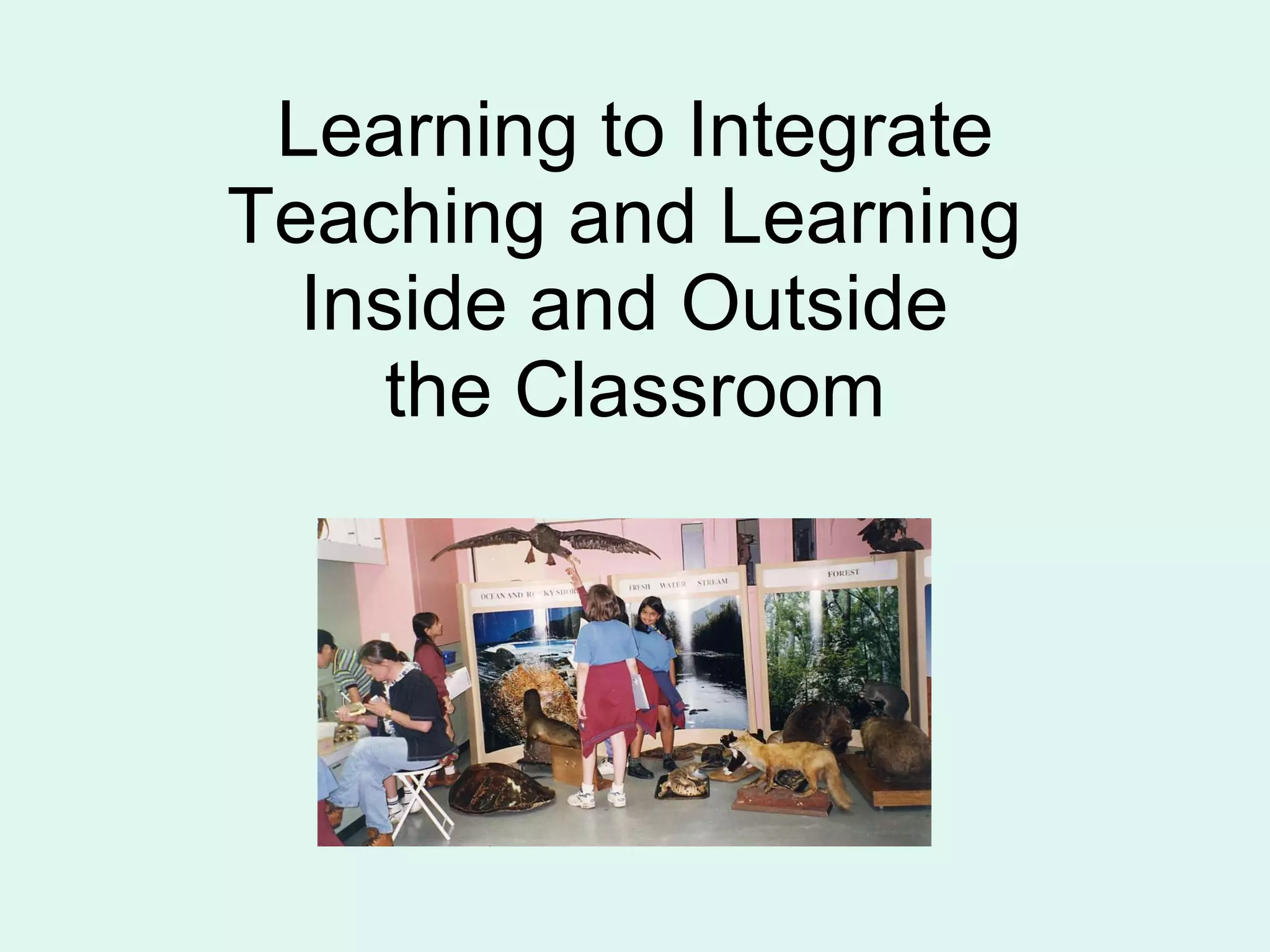
Learning to Integrate Teaching and Learning  Inside and Outside  the Classroom
University of Technology, Sydney  Janette Griffin  Pauline Beverley Damian Maher Sue Rohanna
Aim: To give primary teacher education students enhanced understanding and practical experience  with learning and teaching in  informal settings.
Theoretical Background School Museum Integrated Learning Experiences for Students (SMILES) Integrate school and museum learning Provide conditions for self-directed learning Facilitate learning strategies appropriate to the setting
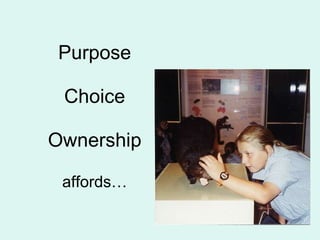
Purpose Choice Ownership affords…
Learning that is: Unstructured and non-sequential, self-paced, voluntary, exploratory open-ended social includes choice
Learning what school students want most: To see behind the scenes A modern and welcoming atmosphere A sense of “easygoingness”: able to sit on the floor, talk, sketch, take photos Challenging and confronting issues To be involved and consulted
How did we help our teacher education students to learn about this? Specific class time devoted to learning the theoretical   background to the pedagogy of taking students on field trips.
In class students explore the nature and practicalities of student centered, socio-cultural views of learning… And learn the pedagogy of taking students on field trips (before and after the practical experience)
Five weeks of theoretical background about learning outside the classroom walls Students explored the nature and practicalities of student centered,  socio-cultural views of learning
Logistics 150  2 nd  or 3 rd   year Bachelor of Education (Primary) students 40 placements (in groups of 3 or 4 students) at 26 sites in and around Sydney and  Canberra
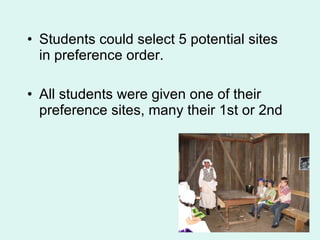
Students could select 5 potential sites in preference order. All students were given one of their preference sites, many their 1st or 2nd
Students visited 3 sites The groups of 4 students visited one site for 3 days, to observe the relationships and the learning approaches with different classes of students, teachers and museum educators.  They also developed a project for the site. They then visited two other sites to get some comparison with different types of museums.
Overall they spent 5 days working with educators at informal learning settings:  observing and helping school classes, teachers and museum educators,  developing authentic educational materials for the venue staff.
After the practical experience Considerable discussion between class members and lecturer,  everyone wanted to share their experiences,  and some even related this to the literature!! and some had strong views about what the class teachers were doing (or not)!
Data collection Prior experiences discussion Anonymous on-line perspectives recorded  before and after Prof. Experience  Focus groups before and after Prof. Experience Class feedback discussion Student survey Site staff survey Student Final Assessment UTS Student Feedback survey
Outcomes? Students were very interested and very cooperative and patient  (most) Contact with site staff indicated positive experiences on both sides ( mostly) Many students made contact with me during their  time at the site.
In the students’ words: I thought it was fantastic, I got so much out of it that I wasn’t expecting The educators were passionate and I learnt how important it was to prepare your students before the visit I found it worthwhile and actually got a lot more out of it than I thought I would I enjoyed seeing more than one program  and  observing different age groups
Debrief back at uni made me realise how much I had learned It was really good to share with other students about where they went because then you know about really good places to take a class I don’t think we realised how much this is going to help us with planning excursions
Issues & responses Initial evaluation reports were not appropriate  (we have dramatically changed these now) Need more direct communication with each site  (this is developing) Students prefer this to be in 2nd year  (it was changed to 2 nd  year for 2010) Wanted to visit more than one site  (now visit three sites) Some sites were difficult to arrange More notice of site allocations  (working on this)
Site educators’ views Program is a great opportunity for students to see that education can take place out of the classroom The students were highly motivated and professional - would love to have some more next time
Students’ final essay: Discuss, with reference to relevant literature, how we can develop an effective working relationship between teachers and informal learning educators to afford successful student learning beyond the classroom.  Describe how your experiences during the practical experience will inform your future practices so that all partners have meaningful input into the learning.
 

Griffin

  • 1.
    Learning to IntegrateTeaching and Learning Inside and Outside the Classroom
  • 2.
    University of Technology,Sydney Janette Griffin Pauline Beverley Damian Maher Sue Rohanna
  • 3.
    Aim: To giveprimary teacher education students enhanced understanding and practical experience with learning and teaching in informal settings.
  • 4.
    Theoretical Background SchoolMuseum Integrated Learning Experiences for Students (SMILES) Integrate school and museum learning Provide conditions for self-directed learning Facilitate learning strategies appropriate to the setting
  • 5.
  • 6.
    Learning that is:Unstructured and non-sequential, self-paced, voluntary, exploratory open-ended social includes choice
  • 7.
    Learning what schoolstudents want most: To see behind the scenes A modern and welcoming atmosphere A sense of “easygoingness”: able to sit on the floor, talk, sketch, take photos Challenging and confronting issues To be involved and consulted
  • 8.
    How did wehelp our teacher education students to learn about this? Specific class time devoted to learning the theoretical background to the pedagogy of taking students on field trips.
  • 9.
    In class studentsexplore the nature and practicalities of student centered, socio-cultural views of learning… And learn the pedagogy of taking students on field trips (before and after the practical experience)
  • 10.
    Five weeks oftheoretical background about learning outside the classroom walls Students explored the nature and practicalities of student centered, socio-cultural views of learning
  • 11.
    Logistics 150 2 nd or 3 rd year Bachelor of Education (Primary) students 40 placements (in groups of 3 or 4 students) at 26 sites in and around Sydney and Canberra
  • 12.
    Students could select5 potential sites in preference order. All students were given one of their preference sites, many their 1st or 2nd
  • 13.
    Students visited 3sites The groups of 4 students visited one site for 3 days, to observe the relationships and the learning approaches with different classes of students, teachers and museum educators. They also developed a project for the site. They then visited two other sites to get some comparison with different types of museums.
  • 14.
    Overall they spent5 days working with educators at informal learning settings: observing and helping school classes, teachers and museum educators, developing authentic educational materials for the venue staff.
  • 15.
    After the practicalexperience Considerable discussion between class members and lecturer, everyone wanted to share their experiences, and some even related this to the literature!! and some had strong views about what the class teachers were doing (or not)!
  • 16.
    Data collection Priorexperiences discussion Anonymous on-line perspectives recorded before and after Prof. Experience Focus groups before and after Prof. Experience Class feedback discussion Student survey Site staff survey Student Final Assessment UTS Student Feedback survey
  • 17.
    Outcomes? Students werevery interested and very cooperative and patient (most) Contact with site staff indicated positive experiences on both sides ( mostly) Many students made contact with me during their time at the site.
  • 18.
    In the students’words: I thought it was fantastic, I got so much out of it that I wasn’t expecting The educators were passionate and I learnt how important it was to prepare your students before the visit I found it worthwhile and actually got a lot more out of it than I thought I would I enjoyed seeing more than one program and observing different age groups
  • 19.
    Debrief back atuni made me realise how much I had learned It was really good to share with other students about where they went because then you know about really good places to take a class I don’t think we realised how much this is going to help us with planning excursions
  • 20.
    Issues & responsesInitial evaluation reports were not appropriate (we have dramatically changed these now) Need more direct communication with each site (this is developing) Students prefer this to be in 2nd year (it was changed to 2 nd year for 2010) Wanted to visit more than one site (now visit three sites) Some sites were difficult to arrange More notice of site allocations (working on this)
  • 21.
    Site educators’ viewsProgram is a great opportunity for students to see that education can take place out of the classroom The students were highly motivated and professional - would love to have some more next time
  • 22.
    Students’ final essay:Discuss, with reference to relevant literature, how we can develop an effective working relationship between teachers and informal learning educators to afford successful student learning beyond the classroom. Describe how your experiences during the practical experience will inform your future practices so that all partners have meaningful input into the learning.
  • 23.