Grievance
Introduction
&
Redressal
Mechanism
Course Instructor: Dr. Parikshit Joshi
Asst. Professor
HR & IR
Introduction
 DISSATISFACTION , COMPLAINT &
GRIEVANCES
Dissatisfaction :Anything that disturbs an employee, whether
or not the unrest is expressed in words.
Complaint : A spoken or written dissatisfaction brought to the
attention of the supervisor or the Shop Steward ( In – Charge ).
Grievance : A complaint that has been formally presented to a
Management Representative or to a Union Official
© Dr. Parikshit Joshi
Grievance Defined
 A grievance as a complaint of one or more
workers with respect to wages and
allowances, conditions of work and
interpretation of service, condition covering
such areas as overtime, leave, transfer,
promotion, seniority, job assignment and
termination of service.
 International Labour Organization(ILO)
© Dr. Parikshit Joshi
Definitions of Grievances
1. A grievance is a formal dispute between an
employee & management on the conditions of
employment.
2. Grievances are complaints that have been
formally registered in accordance with the
grievance procedure.
3. A grievance is any dissatisfaction or feeling of
injustice in connection with one’s employment
situation that is brought to the attention of the
management.
© Dr. Parikshit Joshi
Features of Grievances
 Discontent or Dissatisfaction.
 Dissatisfaction must arise out of
employment & not due to personal reasons.
 The discontentment can arise out of real or
imaginary reasons.
 The discontent may be voiced or unvoiced
but it must expression in some form.
 Broadly speaking a grievance is noticeable
& traceable to real or perceived non-
fulfillment of one’s expectations.
© Dr. Parikshit Joshi
Forms of Grievances
a) FACTUAL.
b) IMAGINARY.
c) DISGUISED.
© Dr. Parikshit Joshi
Reasons of Grievances
 1. ECONOMIC.
 2. WORK ENVIRONMENT.
 3. SUPERVISION.
 4. WORK GROUP.
 5. MISCELLANEOUS.
© Dr. Parikshit Joshi
Human Aspects
1. Work Environment : Light , space ,heat.
2. Use of equipment : Tools / Poor Maintenance.
3. Supervisory Practices.
4. Personality clashes.
5. Managers’ Behavior.
6. Problems with pay / allowances.
7. Perceived inequalities in treatment : Pay,
appeals against performance related awards.
8. Organizational Change.
© Dr. Parikshit Joshi
Types of Grievances
 Individual Grievance: complaint
that an action by management has
violated the rights of an individual as
set out in the collective agreement or
law, or by some unfair practice.
 Examples: discipline, demotion,
classification disputes, denial of
benefits, etc.
© Dr. Parikshit Joshi
Types of Grievance
 Group Grievance: complaint by a
group of individuals, for example, a
department or a shift that has been affected
the same way and at the same time by an
action taken by management.
 An example of a group grievance would be
where the employer refuses to pay a shift
premium to the employees who work on
afternoon shift when the contract entitles
them to it.
© Dr. Parikshit Joshi
Types of Grievance
 Policy Grievance: complaint by the
union that an action of management (or its
failure or refusal to act) is a violation of the
agreement that could affect all who are
covered by the agreement.
 Group grievances are often treated as policy
grievances.
 For example, management assigns a steady
day-shift employee to work on an off shift
without regard to seniority.
© Dr. Parikshit Joshi
EFFECT OF GRIEVANCES
1. On Production : Low quality of production ,
Low productivity , Increase in wastage , Increase
in cost of production
2. On Employees : Increased absenteeism ,
Reduction in level of commitment , Increase in
accidents , Reduced level of employee morale.
3. On Managers : Strained superior –
subordinate relations , Need for increased
supervision/control & follow up Increase in
unrest ,thereby machinery to maintain industrial
peace.
© Dr. Parikshit Joshi
BENEFITS OF GRIEVANCE
HANDLING PROCEDURES
 1. It encourages employees to raise concerns
without fear of reprisal.
 2. It provides a fair & speedy means of dealing
of grievances.
 3. It prevents minor disagreements developing
into more serious disputes.
 4. It saves employer’s time & money as solutions
are found for workplace problems.
 5. It helps build in organisational climate based
on openness and trust.
© Dr. Parikshit Joshi
Objectives of Grievance Handling
1. To enable employee to air his/her grievance.
2. To clarify the nature of grievance.
3. To investigate the reasons of dissatisfaction.
4. To obtain where possible a speedy resolution to
the problem.
5. To take appropriate actions & ensure that the
promises are kept.
6. To inform the employee his /her right to voice
the grievance & take it to next stage of the
procedure.
© Dr. Parikshit Joshi
Key Features of Grievance Redressal
Procedure
1. FAIRNESS.
2. FACILITIES FOR REPRESENTATION.
3. PROCEDURAL STEPS.
4. PROMPTNESS.
© Dr. Parikshit Joshi
Discovery of Grievance
a) Observation.
b) Grievance procedure.
c) Gripe Boxes.
d) Open Door Policy.
e) Exit Interview.
f) Opinion Survey.
© Dr. Parikshit Joshi
Value Addition - HR Glossary
 Joint/labor
management
committee
 Key result areas
 A panel comprised of management
and union representatives whose
purpose is to address problems,
resolve conflicts and build on
relationships.
 The parts of an organization’s
intangible assets that relate
specifically to knowledge, expertise,
information, ideas, best practices,
intellectual property and other
capabilities.
© Dr. Parikshit Joshi
Value Addition - HR Terminology
 Knowledge- based
pay
 Knowledge
management
 A salary differentiation system that
bases compensation on an individual’s
education, experience, knowledge,
skills or specialized training. Also
referred to as skill based pay.
 The process of creating, acquiring,
sharing and managing knowledge to
expand individual and organizational
performance.
© Dr. Parikshit Joshi
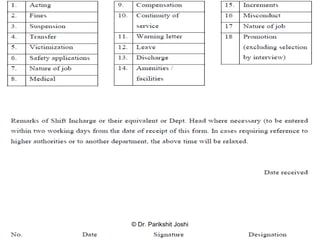
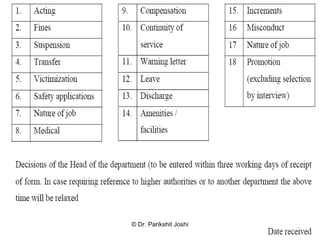
Handling Grievance
 Amenities
 Compensation
 Conditions of work
 Continuity of service
 Disciplinary action
 Fines
 Leave
 Medical benefits
 Nature of job
 Payments
 Promotions
 Safety environment
 Super Annuation
 Supersession
 Transfers
 Victimisation
© Dr. Parikshit Joshi
Individual or Collective (Group)
Grievances
 It is important to make a distinction
between individual grievances and group
grievances.
 If the issue involved relate to one or a few
individual employees, it needs to be
handled through a grievance procedure,
but when general issues with policy
implications and wider interest are
involved they become the subject matter
for collective bargaining.© Dr. Parikshit Joshi
Reasons for Grievances
 Economic
 Wage fixation, wage computation, overtime, bonus
 Employees feel they are getting less than what they
ought to get
 Working Environment
 Poor working conditions, defective equipment and
machinery, tools, materials.
 Supervision
 Disposition of the boss towards the employee
perceived notions of favoritism, nepotism, bias etc.
© Dr. Parikshit Joshi
Reasons for Grievances
 Work Group
 Strained relations or incompatibility with
peers. Feeling of neglect, obstruction and
victimisation.
 Work Organisation
 Rigid and unfair rules, too much less work
responsibility, lack of recognition.
© Dr. Parikshit Joshi
Effects of Grievance
a. Loss of interest in work and consequent
lack of moral and commitment
b. Poor quality of production
c. Low productivity
d. Increase in wastage and costs
e. Increase in employee turnover
f. Increase in the incidence of accidents
g. Indiscipline
h. Unrest, etc. © Dr. Parikshit Joshi
Value Addition - HR Terminology
 Ability test
 Ability
 Absenteeism
 An assessment instrument used to
measure an individual’s abilities,
mental or physical skills level (i.e.
problem solving, manual dexterity,
etc.)
 Aptitude or competence, the skill
or proficiency needed to perform
certain tasks.
 Referred to as the habitual failure
of employees to report for work
when they are scheduled to work.
© Dr. Parikshit Joshi
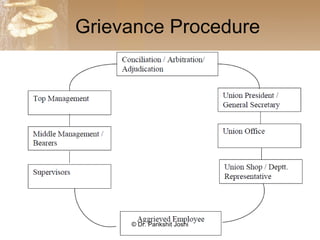
Grievance Procedure
© Dr. Parikshit Joshi
Dispute settlement machinery
 Different methods for settlement of
industrial disputes provided in the
Industrial Dispute Act 1947.
 Conciliation
 Arbitration
 Adjudication
© Dr. Parikshit Joshi
Conciliation
 The Government (Central or the State) appoints conciliation
officers who are usually officials of the State Labour
Department or the officials of the Ministry of Labour
Government of India.
 Appointed for a particular geographical area, usually a
revenue district.
 In certain cases the conciliation officer is appointed for a
particular industry in a particular area.
 If any industrial dispute arises between an employer and his
workmen the either can approach the Conciliation Officer for
the area in which the industry is situated and request him to
hold conciliation talks in the dispute and settle the issue.
© Dr. Parikshit Joshi
 The talks initiated by the conciliation officer are called
conciliation talks.
 The conciliation talks may end in the settlement of the
disputes in which case a settlement is drafted and signed by
the employer, the workmen(trade union) and the conciliation
officer.
 There may be cases when the conciliation officer may not be
able to settle the dispute for several reasons.
 In such circumstances, the conciliation officer sends a report
to the Government.
 This report is called the conciliation failure report.
 The Government may refers the issue in dispute to the
Labour Court/Industrial Tribunal.© Dr. Parikshit Joshi
Adjudication
 The Labour Court/Industrial Tribunal gets the jurisdiction to
decide an industrial only if the Government makes a
reference of that dispute to it.
 The proceedings before the Labour Court/Industrial Tribunal
are called adjudication proceedings.
 The Labour Court/Industrial Tribunal after following the
procedure prescribed under law finally gives its decision.
 This decision is sent to the Government and becomes
operational thirty days after the date of its publication by the
Government.
 However, any one of the can challenge the decision by
means of a writ petition before the High Court.
© Dr. Parikshit Joshi
Arbitration
 The parties agree that the issue in
dispute between them should be settled
by referring the issues for arbitration.
 The parties to the dispute can select the
person who should arbitrate the issue
i.e., the arbitrator.
© Dr. Parikshit Joshi
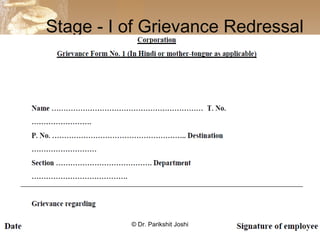
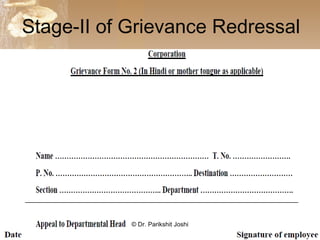
Grievance Redressal Procedure
 Grievance Redressal Procedure
has been divided into three
stages:
 Stage I
 Stage II
 Stage III
© Dr. Parikshit Joshi
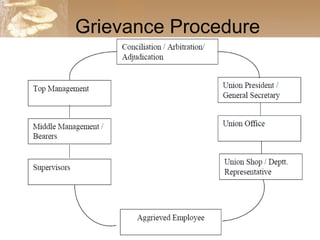
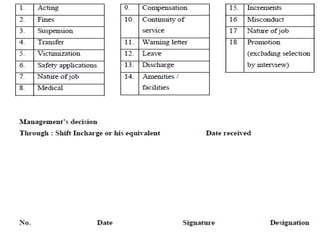
Grievance Procedure
Stage - I of Grievance Redressal
© Dr. Parikshit Joshi
Stage-II of Grievance Redressal
© Dr. Parikshit Joshi
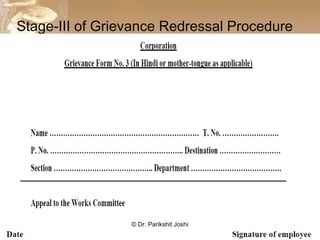
Stage-III of Grievance Redressal Procedure
© Dr. Parikshit Joshi
The Unit Grievance
Redressal Committee/Work
Committee
 Comes into picture in stage III.
 Matter to be dealt with committee include the following:
 Settlement of grievances relating to the terms and conditions of
employment of employees in the day today working
 Questions as to whether or not the Company’s rules have been
followed in any particular case, e.g. violation of acting rules
 Matters relating to discipline and conduct as between the
management and the employees
 Matters relating to severity of punishment given as a disciplinary
measure.
 Complaints regarding withholding of increments.
 Questions relating to the abuse of privileges of provision of
amenities
© Dr. Parikshit Joshi
Limitations of committee
 The committee is not concerned with the problems
of planning and development in their wide sense.
 The committee also does not discuss matters
which are trade questions such as wages,
allowance, hours of work, leave, old age benefits
and the like, which are covered by agreement with
the trade unions or by reports of Conciliation
boards or awards of Industrial tribunal.
 Any decision of the committee must be superseded
by an agreement between the management and
the union. © Dr. Parikshit Joshi
Members of Committee
 The committee consists of ten members of whom
five represent the management and five represent
the employees (Joint Management Committee)
 Management Representatives : The representatives
of the Management on the committee are nominated
by the management
 Employees Representatives : The representatives of
employees on the committee are nominated by the
union, which is registered under the Trade Union
Act, is representative of the employees and is
recognized by the management for this purpose.
© Dr. Parikshit Joshi
Officers of the committee
 The Committee has a Chairman, a Vice-
Chairman and a member Secretary
 The Chairman is nominated by the management
from amongst its representatives on the
committees
 The Vice-Chairman is nominated by the union
from amongst it’s employees’ representatives on
the committee.
 The Secretary is nominated by the management
from amongst its representatives on the
committee
© Dr. Parikshit Joshi
Tenure of Officers
 Term of office of the employee’s
representative on the committee
other than members nominated to fill
casual vacancies, is 36 months from
the date of formation of the
Committee.
 A member nominated to fill a casual
vacancy holds office for the unexpired
term of his predecessor.
© Dr. Parikshit Joshi
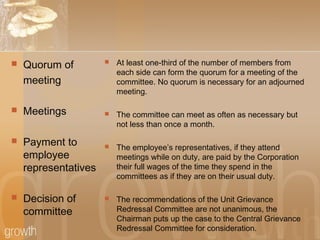
 Quorum of
meeting
 Meetings
 Payment to
employee
representatives
 Decision of
committee
 At least one-third of the number of members from
each side can form the quorum for a meeting of the
committee. No quorum is necessary for an adjourned
meeting.
 The committee can meet as often as necessary but
not less than once a month.
 The employee’s representatives, if they attend
meetings while on duty, are paid by the Corporation
their full wages of the time they spend in the
committees as if they are on their usual duty.
 The recommendations of the Unit Grievance
Redressal Committee are not unanimous, the
Chairman puts up the case to the Central Grievance
Redressal Committee for consideration.
 Date and Time of
Meeting
 Notice of meeting
 Decided by chairman
 The notice of meeting with
it’s agenda is ordinarily sent
by the secretary to each
member of the committee
three days before the date
of the meeting.
© Dr. Parikshit Joshi
The Central Grievance
Redressal Committee
 If the matter involves large number of employees.
 The Central Grievance Redressal Committee has the power
to deal with :-
 Cases which have been referred by the Unit Grievance Redressal
Committees and the non-factory employees works committee.
 Cases in which the unanimous decisions of any of the Unit Grievance
Redressal Committees and the non-factory employee’s works
committee have been objected to by management or union.
 Individual grievances or complaints of employees, which the union
wishes to discuss
 Issues of policy and their interpretation in regard to labour matters
which the union wishes to discuss.
© Dr. Parikshit Joshi
Limitations of committee
 The committee is not concerned
with the problems of planning,
works development and
management of the plant in the
wider sense.
 Any decision of the committee can
be superseded by an agreement
between the management and the
union
© Dr. Parikshit Joshi
 Membership
 Term of officers
 Officers of
committee
 Quorum of
meeting
 Eight members of whom four
represent the management and four
represent the employees.
 36 months
 Chairman, Vice-Chairman and
Secretary
 Atleast half of the number of members
representing management and the
employees constitute the quorum for
a meeting of the committee. No
quorum for an adjourned meeting.
© Dr. Parikshit Joshi
 Notice of meeting
 Acting on
committees
decision
 The notice of the meeting,
together with the agenda, is
ordinarily sent one day before the
date of the meeting.
 The unanimous decision of the
committee is binding on the
Management, the employees, and
the union where the decision
relates to a matter of policy or
general principle, the approval or
order of the managing agents is
necessary. In all such cases,
decision of the committee is
forwarded by the Chairman to the
appropriate authority for
necessary action.
© Dr. Parikshit Joshi
Informal Grievance Redressal Procedur
 More than half of the employees interviewed
said that the informal method of resolving
grievances by way of oral consultants with
their superiors is a much better and less
complicated method to undertake.
 The aggrieved employee can directly
approach his shift incharge or the section
head (in case of a major grievance) engage
into a direct consultation and have his
grievance resolved amicably in stage I itself.
GOD BLESSGOD BLESS
YOU………YOU………
© Dr. Parikshit Joshi 51
Regards:
Dr. Parikshit Joshi
Assistant Professor
Department of Management Science
Sri Ram Murti Smarak College of Engg. & Technology
Bareilly (U.P.), India
E-mail: drparikshitjoshi@gmail.com
Blog: www.joshimannu.blogspot.com

Grievance Redressal

  • 1.
  • 2.
    Introduction  DISSATISFACTION ,COMPLAINT & GRIEVANCES Dissatisfaction :Anything that disturbs an employee, whether or not the unrest is expressed in words. Complaint : A spoken or written dissatisfaction brought to the attention of the supervisor or the Shop Steward ( In – Charge ). Grievance : A complaint that has been formally presented to a Management Representative or to a Union Official © Dr. Parikshit Joshi
  • 3.
    Grievance Defined  Agrievance as a complaint of one or more workers with respect to wages and allowances, conditions of work and interpretation of service, condition covering such areas as overtime, leave, transfer, promotion, seniority, job assignment and termination of service.  International Labour Organization(ILO) © Dr. Parikshit Joshi
  • 4.
    Definitions of Grievances 1.A grievance is a formal dispute between an employee & management on the conditions of employment. 2. Grievances are complaints that have been formally registered in accordance with the grievance procedure. 3. A grievance is any dissatisfaction or feeling of injustice in connection with one’s employment situation that is brought to the attention of the management. © Dr. Parikshit Joshi
  • 5.
    Features of Grievances Discontent or Dissatisfaction.  Dissatisfaction must arise out of employment & not due to personal reasons.  The discontentment can arise out of real or imaginary reasons.  The discontent may be voiced or unvoiced but it must expression in some form.  Broadly speaking a grievance is noticeable & traceable to real or perceived non- fulfillment of one’s expectations. © Dr. Parikshit Joshi
  • 6.
    Forms of Grievances a)FACTUAL. b) IMAGINARY. c) DISGUISED. © Dr. Parikshit Joshi
  • 7.
    Reasons of Grievances 1. ECONOMIC.  2. WORK ENVIRONMENT.  3. SUPERVISION.  4. WORK GROUP.  5. MISCELLANEOUS. © Dr. Parikshit Joshi
  • 8.
    Human Aspects 1. WorkEnvironment : Light , space ,heat. 2. Use of equipment : Tools / Poor Maintenance. 3. Supervisory Practices. 4. Personality clashes. 5. Managers’ Behavior. 6. Problems with pay / allowances. 7. Perceived inequalities in treatment : Pay, appeals against performance related awards. 8. Organizational Change. © Dr. Parikshit Joshi
  • 9.
    Types of Grievances Individual Grievance: complaint that an action by management has violated the rights of an individual as set out in the collective agreement or law, or by some unfair practice.  Examples: discipline, demotion, classification disputes, denial of benefits, etc. © Dr. Parikshit Joshi
  • 10.
    Types of Grievance Group Grievance: complaint by a group of individuals, for example, a department or a shift that has been affected the same way and at the same time by an action taken by management.  An example of a group grievance would be where the employer refuses to pay a shift premium to the employees who work on afternoon shift when the contract entitles them to it. © Dr. Parikshit Joshi
  • 11.
    Types of Grievance Policy Grievance: complaint by the union that an action of management (or its failure or refusal to act) is a violation of the agreement that could affect all who are covered by the agreement.  Group grievances are often treated as policy grievances.  For example, management assigns a steady day-shift employee to work on an off shift without regard to seniority. © Dr. Parikshit Joshi
  • 12.
    EFFECT OF GRIEVANCES 1.On Production : Low quality of production , Low productivity , Increase in wastage , Increase in cost of production 2. On Employees : Increased absenteeism , Reduction in level of commitment , Increase in accidents , Reduced level of employee morale. 3. On Managers : Strained superior – subordinate relations , Need for increased supervision/control & follow up Increase in unrest ,thereby machinery to maintain industrial peace. © Dr. Parikshit Joshi
  • 13.
    BENEFITS OF GRIEVANCE HANDLINGPROCEDURES  1. It encourages employees to raise concerns without fear of reprisal.  2. It provides a fair & speedy means of dealing of grievances.  3. It prevents minor disagreements developing into more serious disputes.  4. It saves employer’s time & money as solutions are found for workplace problems.  5. It helps build in organisational climate based on openness and trust. © Dr. Parikshit Joshi
  • 14.
    Objectives of GrievanceHandling 1. To enable employee to air his/her grievance. 2. To clarify the nature of grievance. 3. To investigate the reasons of dissatisfaction. 4. To obtain where possible a speedy resolution to the problem. 5. To take appropriate actions & ensure that the promises are kept. 6. To inform the employee his /her right to voice the grievance & take it to next stage of the procedure. © Dr. Parikshit Joshi
  • 15.
    Key Features ofGrievance Redressal Procedure 1. FAIRNESS. 2. FACILITIES FOR REPRESENTATION. 3. PROCEDURAL STEPS. 4. PROMPTNESS. © Dr. Parikshit Joshi
  • 16.
    Discovery of Grievance a)Observation. b) Grievance procedure. c) Gripe Boxes. d) Open Door Policy. e) Exit Interview. f) Opinion Survey. © Dr. Parikshit Joshi
  • 17.
    Value Addition -HR Glossary  Joint/labor management committee  Key result areas  A panel comprised of management and union representatives whose purpose is to address problems, resolve conflicts and build on relationships.  The parts of an organization’s intangible assets that relate specifically to knowledge, expertise, information, ideas, best practices, intellectual property and other capabilities. © Dr. Parikshit Joshi
  • 18.
    Value Addition -HR Terminology  Knowledge- based pay  Knowledge management  A salary differentiation system that bases compensation on an individual’s education, experience, knowledge, skills or specialized training. Also referred to as skill based pay.  The process of creating, acquiring, sharing and managing knowledge to expand individual and organizational performance. © Dr. Parikshit Joshi
  • 19.
    Handling Grievance  Amenities Compensation  Conditions of work  Continuity of service  Disciplinary action  Fines  Leave  Medical benefits  Nature of job  Payments  Promotions  Safety environment  Super Annuation  Supersession  Transfers  Victimisation © Dr. Parikshit Joshi
  • 20.
    Individual or Collective(Group) Grievances  It is important to make a distinction between individual grievances and group grievances.  If the issue involved relate to one or a few individual employees, it needs to be handled through a grievance procedure, but when general issues with policy implications and wider interest are involved they become the subject matter for collective bargaining.© Dr. Parikshit Joshi
  • 21.
    Reasons for Grievances Economic  Wage fixation, wage computation, overtime, bonus  Employees feel they are getting less than what they ought to get  Working Environment  Poor working conditions, defective equipment and machinery, tools, materials.  Supervision  Disposition of the boss towards the employee perceived notions of favoritism, nepotism, bias etc. © Dr. Parikshit Joshi
  • 22.
    Reasons for Grievances Work Group  Strained relations or incompatibility with peers. Feeling of neglect, obstruction and victimisation.  Work Organisation  Rigid and unfair rules, too much less work responsibility, lack of recognition. © Dr. Parikshit Joshi
  • 23.
    Effects of Grievance a.Loss of interest in work and consequent lack of moral and commitment b. Poor quality of production c. Low productivity d. Increase in wastage and costs e. Increase in employee turnover f. Increase in the incidence of accidents g. Indiscipline h. Unrest, etc. © Dr. Parikshit Joshi
  • 24.
    Value Addition -HR Terminology  Ability test  Ability  Absenteeism  An assessment instrument used to measure an individual’s abilities, mental or physical skills level (i.e. problem solving, manual dexterity, etc.)  Aptitude or competence, the skill or proficiency needed to perform certain tasks.  Referred to as the habitual failure of employees to report for work when they are scheduled to work. © Dr. Parikshit Joshi
  • 25.
  • 26.
    Dispute settlement machinery Different methods for settlement of industrial disputes provided in the Industrial Dispute Act 1947.  Conciliation  Arbitration  Adjudication © Dr. Parikshit Joshi
  • 27.
    Conciliation  The Government(Central or the State) appoints conciliation officers who are usually officials of the State Labour Department or the officials of the Ministry of Labour Government of India.  Appointed for a particular geographical area, usually a revenue district.  In certain cases the conciliation officer is appointed for a particular industry in a particular area.  If any industrial dispute arises between an employer and his workmen the either can approach the Conciliation Officer for the area in which the industry is situated and request him to hold conciliation talks in the dispute and settle the issue. © Dr. Parikshit Joshi
  • 28.
     The talksinitiated by the conciliation officer are called conciliation talks.  The conciliation talks may end in the settlement of the disputes in which case a settlement is drafted and signed by the employer, the workmen(trade union) and the conciliation officer.  There may be cases when the conciliation officer may not be able to settle the dispute for several reasons.  In such circumstances, the conciliation officer sends a report to the Government.  This report is called the conciliation failure report.  The Government may refers the issue in dispute to the Labour Court/Industrial Tribunal.© Dr. Parikshit Joshi
  • 29.
    Adjudication  The LabourCourt/Industrial Tribunal gets the jurisdiction to decide an industrial only if the Government makes a reference of that dispute to it.  The proceedings before the Labour Court/Industrial Tribunal are called adjudication proceedings.  The Labour Court/Industrial Tribunal after following the procedure prescribed under law finally gives its decision.  This decision is sent to the Government and becomes operational thirty days after the date of its publication by the Government.  However, any one of the can challenge the decision by means of a writ petition before the High Court. © Dr. Parikshit Joshi
  • 30.
    Arbitration  The partiesagree that the issue in dispute between them should be settled by referring the issues for arbitration.  The parties to the dispute can select the person who should arbitrate the issue i.e., the arbitrator. © Dr. Parikshit Joshi
  • 31.
    Grievance Redressal Procedure Grievance Redressal Procedure has been divided into three stages:  Stage I  Stage II  Stage III © Dr. Parikshit Joshi
  • 32.
  • 33.
    Stage - Iof Grievance Redressal © Dr. Parikshit Joshi
  • 34.
  • 35.
    Stage-II of GrievanceRedressal © Dr. Parikshit Joshi
  • 36.
  • 37.
    Stage-III of GrievanceRedressal Procedure © Dr. Parikshit Joshi
  • 39.
    The Unit Grievance RedressalCommittee/Work Committee  Comes into picture in stage III.  Matter to be dealt with committee include the following:  Settlement of grievances relating to the terms and conditions of employment of employees in the day today working  Questions as to whether or not the Company’s rules have been followed in any particular case, e.g. violation of acting rules  Matters relating to discipline and conduct as between the management and the employees  Matters relating to severity of punishment given as a disciplinary measure.  Complaints regarding withholding of increments.  Questions relating to the abuse of privileges of provision of amenities © Dr. Parikshit Joshi
  • 40.
    Limitations of committee The committee is not concerned with the problems of planning and development in their wide sense.  The committee also does not discuss matters which are trade questions such as wages, allowance, hours of work, leave, old age benefits and the like, which are covered by agreement with the trade unions or by reports of Conciliation boards or awards of Industrial tribunal.  Any decision of the committee must be superseded by an agreement between the management and the union. © Dr. Parikshit Joshi
  • 41.
    Members of Committee The committee consists of ten members of whom five represent the management and five represent the employees (Joint Management Committee)  Management Representatives : The representatives of the Management on the committee are nominated by the management  Employees Representatives : The representatives of employees on the committee are nominated by the union, which is registered under the Trade Union Act, is representative of the employees and is recognized by the management for this purpose. © Dr. Parikshit Joshi
  • 42.
    Officers of thecommittee  The Committee has a Chairman, a Vice- Chairman and a member Secretary  The Chairman is nominated by the management from amongst its representatives on the committees  The Vice-Chairman is nominated by the union from amongst it’s employees’ representatives on the committee.  The Secretary is nominated by the management from amongst its representatives on the committee © Dr. Parikshit Joshi
  • 43.
    Tenure of Officers Term of office of the employee’s representative on the committee other than members nominated to fill casual vacancies, is 36 months from the date of formation of the Committee.  A member nominated to fill a casual vacancy holds office for the unexpired term of his predecessor. © Dr. Parikshit Joshi
  • 44.
     Quorum of meeting Meetings  Payment to employee representatives  Decision of committee  At least one-third of the number of members from each side can form the quorum for a meeting of the committee. No quorum is necessary for an adjourned meeting.  The committee can meet as often as necessary but not less than once a month.  The employee’s representatives, if they attend meetings while on duty, are paid by the Corporation their full wages of the time they spend in the committees as if they are on their usual duty.  The recommendations of the Unit Grievance Redressal Committee are not unanimous, the Chairman puts up the case to the Central Grievance Redressal Committee for consideration.
  • 45.
     Date andTime of Meeting  Notice of meeting  Decided by chairman  The notice of meeting with it’s agenda is ordinarily sent by the secretary to each member of the committee three days before the date of the meeting. © Dr. Parikshit Joshi
  • 46.
    The Central Grievance RedressalCommittee  If the matter involves large number of employees.  The Central Grievance Redressal Committee has the power to deal with :-  Cases which have been referred by the Unit Grievance Redressal Committees and the non-factory employees works committee.  Cases in which the unanimous decisions of any of the Unit Grievance Redressal Committees and the non-factory employee’s works committee have been objected to by management or union.  Individual grievances or complaints of employees, which the union wishes to discuss  Issues of policy and their interpretation in regard to labour matters which the union wishes to discuss. © Dr. Parikshit Joshi
  • 47.
    Limitations of committee The committee is not concerned with the problems of planning, works development and management of the plant in the wider sense.  Any decision of the committee can be superseded by an agreement between the management and the union © Dr. Parikshit Joshi
  • 48.
     Membership  Termof officers  Officers of committee  Quorum of meeting  Eight members of whom four represent the management and four represent the employees.  36 months  Chairman, Vice-Chairman and Secretary  Atleast half of the number of members representing management and the employees constitute the quorum for a meeting of the committee. No quorum for an adjourned meeting. © Dr. Parikshit Joshi
  • 49.
     Notice ofmeeting  Acting on committees decision  The notice of the meeting, together with the agenda, is ordinarily sent one day before the date of the meeting.  The unanimous decision of the committee is binding on the Management, the employees, and the union where the decision relates to a matter of policy or general principle, the approval or order of the managing agents is necessary. In all such cases, decision of the committee is forwarded by the Chairman to the appropriate authority for necessary action. © Dr. Parikshit Joshi
  • 50.
    Informal Grievance RedressalProcedur  More than half of the employees interviewed said that the informal method of resolving grievances by way of oral consultants with their superiors is a much better and less complicated method to undertake.  The aggrieved employee can directly approach his shift incharge or the section head (in case of a major grievance) engage into a direct consultation and have his grievance resolved amicably in stage I itself.
  • 51.
    GOD BLESSGOD BLESS YOU………YOU……… ©Dr. Parikshit Joshi 51 Regards: Dr. Parikshit Joshi Assistant Professor Department of Management Science Sri Ram Murti Smarak College of Engg. & Technology Bareilly (U.P.), India E-mail: drparikshitjoshi@gmail.com Blog: www.joshimannu.blogspot.com