Cloud Deployments
MODELS – METHODS - TYPES

By Mohamed Sami and Mostafa El-Hefnawy
Agenda
Cloud Deployment Models

Deployment Models Adoption Rate

Selection for best model

Related research topics

References

2
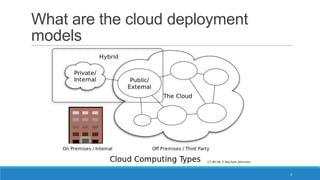
What are the cloud deployment
models

3
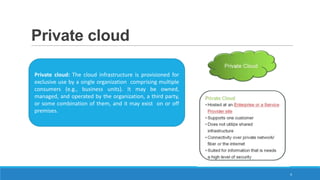
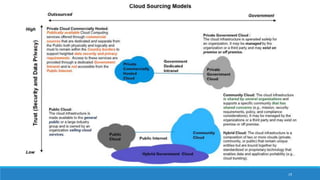
Private cloud
Private cloud: The cloud infrastructure is provisioned for
exclusive use by a single organization comprising multiple
consumers (e.g., business units). It may be owned,
managed, and operated by the organization, a third party,
or some combination of them, and it may exist on or off
premises.

4
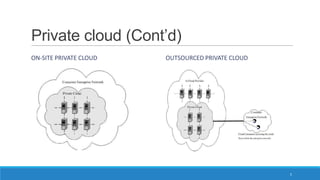
Private cloud (Cont’d)
ON-SITE PRIVATE CLOUD

OUTSOURCED PRIVATE CLOUD

5
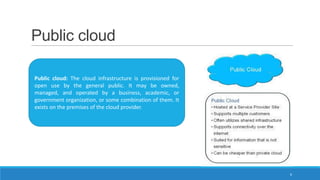
Public cloud
Public cloud: The cloud infrastructure is provisioned for
open use by the general public. It may be owned,
managed, and operated by a business, academic, or
government organization, or some combination of them. It
exists on the premises of the cloud provider.

6
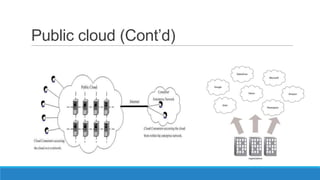
Public cloud (Cont’d)
Community cloud
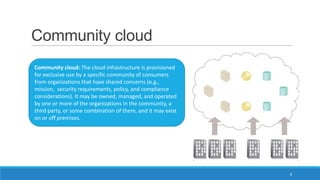
Community cloud: The cloud infrastructure is provisioned
for exclusive use by a specific community of consumers
from organizations that have shared concerns (e.g.,
mission, security requirements, policy, and compliance
considerations). It may be owned, managed, and operated
by one or more of the organizations in the community, a
third party, or some combination of them, and it may exist
on or off premises.

8
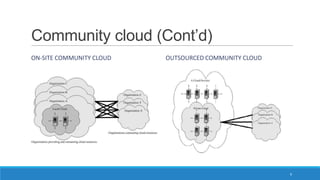
Community cloud (Cont’d)
ON-SITE COMMUNITY CLOUD

OUTSOURCED COMMUNITY CLOUD

9
Hybrid cloud
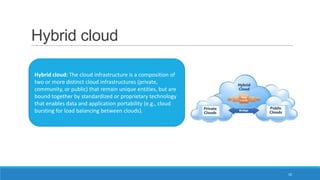
Hybrid cloud: The cloud infrastructure is a composition of
two or more distinct cloud infrastructures (private,
community, or public) that remain unique entities, but are
bound together by standardized or proprietary technology
that enables data and application portability (e.g., cloud
bursting for load balancing between clouds).

10
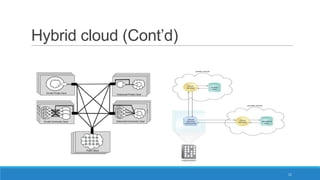
Hybrid cloud (Cont’d)

11
12
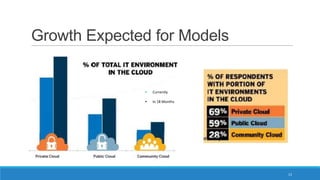
Growth Expected for Models



Currently



In 18 Months

13
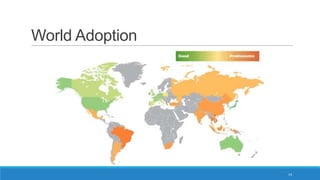
World Adoption

14
15
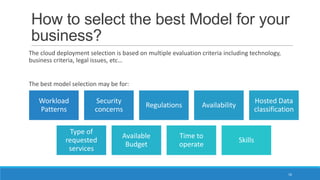
How to select the best Model for your
business?
The cloud deployment selection is based on multiple evaluation criteria including technology,
business criteria, legal issues, etc…

The best model selection may be for:

Workload
Patterns

Security
concerns

Type of
requested
services

Regulations

Available
Budget

Hosted Data
classification

Availability

Time to
operate

Skills

16
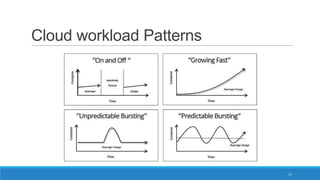
Cloud workload Patterns

17
18
19
Summary

20
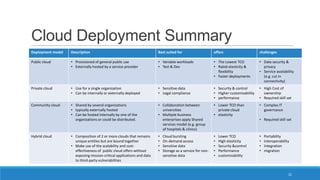
Cloud Deployment Summary
Deployment model

Description

Best suited for

offers

challenges

Public cloud

• Provisioned of general public use
• Externally hosted by a service provider

• Variable workloads
• Test & Dev

• The Lowest TCO
• Rabid elasticity &
flexibility
• Faster deployments

• Data security &
privacy
• Service availability
(e.g. cut in
connectivity)

Private cloud

• Use for a single organization
• Can be internally or externally deployed

• Sensitive data
• Legal compliance

• Security & control
• Higher customizability
• performance

• High Cost of
ownership
• Required skill set

Community cloud

• Shared by several organizations
• typically externally hosted
• Can be hosted internally by one of the
organizations or could be distributed.

• Collaboration between
universities
• Multiple business
enterprises apply Shared
services model (e.g. group
of hospitals & clinics)

• Lower TCO than
private cloud
• elasticity

• Complex IT
governance

• Composition of 2 or more clouds that remains
unique entities but are bound together.
• Make use of the scalability and costeffectiveness of public cloud offers without
exposing mission-critical applications and data
to third-party vulnerabilities

•
•
•
•

•
•
•
•
•

Hybrid cloud

Cloud bursting
On-demand access
Sensitive data
Storage as a service for nonsensitive data

• Required skill set

Lower TCO
High elasticity
Security &control
Performance
customizability

•
•
•
•

Portability
interoperability
Integration
migration

21
Research hot topics
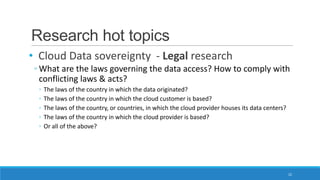
• Cloud Data sovereignty - Legal research
◦ What are the laws governing the data access? How to comply with
conflicting laws & acts?
◦
◦
◦
◦
◦

The laws of the country in which the data originated?
The laws of the country in which the cloud customer is based?
The laws of the country, or countries, in which the cloud provider houses its data centers?
The laws of the country in which the cloud provider is based?
Or all of the above?

22
Research hot topics (Cont’d)
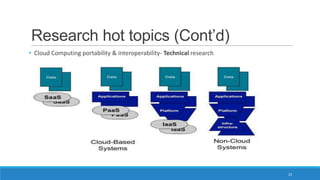
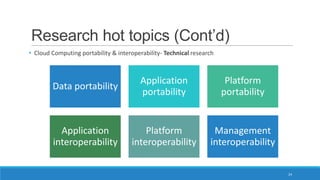
• Cloud Computing portability & interoperability- Technical research

23
Research hot topics (Cont’d)
• Cloud Computing portability & interoperability- Technical research

Data portability

Application
portability

Platform
portability

Application
interoperability

Platform
interoperability

Management
interoperability
24
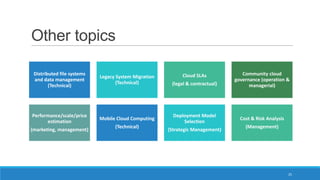
Other topics
Distributed file systems
and data management
(Technical)

Legacy System Migration
(Technical)

Performance/scale/price
estimation

Mobile Cloud Computing

(marketing, management)

(Technical)

Cloud SLAs
(legal & contractual)

Deployment Model
Selection
(Strategic Management)

Community cloud
governance (operation &
managerial)

Cost & Risk Analysis
(Management)

25
References
• NIST SP 800-145, “A NIST definition of cloud computing”, http://csrc.nist.gov/publications/drafts/800-145/Draft-SP800-145_cloud-definition.pdf
• NIST Cloud Computing Reference Architecture,
http://www.cloudcredential.org/images/pdf_files/nist%20reference%20architecture.pdf
• NIST SP 800-146, “NIST Cloud Computing Synopsis and Recommendations”,
http://csrc.nist.gov/publications/drafts/800-146/Draft-NIST-SP800-146.pdf
• Cloud Computing Portability and Interoperability, http://www.opengroup.org/cloud/cloud_iop/cloud_port.htm
• Towards Multi-criteria Cloud Service Selection, IEEE,
http://ieeexplore.ieee.org/xpl/login.jsp?tp=&arnumber=5976164&url=http%3A%2F%2Fieeexplore.ieee.org%2Fxpls%
2Fabs_all.jsp%3Farnumber%3D5976164
• Cloud Computing – A Classification, Business Models, and Research Directions, springer,
http://download.springer.com/static/pdf/458/art%253A10.1007%252Fs12599-009-00712.pdf?auth66=1388152113_369819fc6a3a7900814b03a13546acf7&ext=.pdf

26
References (Cont’d)
• Deployment models: Towards eliminating security concerns from cloud computing, IEEE
http://ieeexplore.ieee.org/xpl/login.jsp?tp=&arnumber=5547137&url=http%3A%2F%2Fieeexplore.ieee.org%2Fxpls%
2Fabs_all.jsp%3Farnumber%3D5547137
• Cloud computing: Issues and challenges, IEEE
http://ieeexplore.ieee.org/xpl/login.jsp?tp=&arnumber=5474674&url=http%3A%2F%2Fieeexplore.ieee.org%2Fxpls%
2Fabs_all.jsp%3Farnumber%3D5474674
• Virtual Infrastructure Management in Private and Hybrid Clouds, IEEE
http://ieeexplore.ieee.org/xpl/login.jsp?tp=&arnumber=5233608&url=http%3A%2F%2Fieeexplore.ieee.org%2Fxpls%
2Fabs_all.jsp%3Farnumber%3D5233608
• Building a Flexible Service Architecture for User Controlled Hybrid Clouds, IEEE
http://ieeexplore.ieee.org/xpl/articleDetails.jsp?arnumber=6329175

27
Thank you
28

Cloud Deployments Models

  • 1.
    Cloud Deployments MODELS –METHODS - TYPES By Mohamed Sami and Mostafa El-Hefnawy
  • 2.
    Agenda Cloud Deployment Models DeploymentModels Adoption Rate Selection for best model Related research topics References 2
  • 3.
    What are thecloud deployment models 3
  • 4.
    Private cloud Private cloud:The cloud infrastructure is provisioned for exclusive use by a single organization comprising multiple consumers (e.g., business units). It may be owned, managed, and operated by the organization, a third party, or some combination of them, and it may exist on or off premises. 4
  • 5.
    Private cloud (Cont’d) ON-SITEPRIVATE CLOUD OUTSOURCED PRIVATE CLOUD 5
  • 6.
    Public cloud Public cloud:The cloud infrastructure is provisioned for open use by the general public. It may be owned, managed, and operated by a business, academic, or government organization, or some combination of them. It exists on the premises of the cloud provider. 6
  • 7.
  • 8.
    Community cloud Community cloud:The cloud infrastructure is provisioned for exclusive use by a specific community of consumers from organizations that have shared concerns (e.g., mission, security requirements, policy, and compliance considerations). It may be owned, managed, and operated by one or more of the organizations in the community, a third party, or some combination of them, and it may exist on or off premises. 8
  • 9.
    Community cloud (Cont’d) ON-SITECOMMUNITY CLOUD OUTSOURCED COMMUNITY CLOUD 9
  • 10.
    Hybrid cloud Hybrid cloud:The cloud infrastructure is a composition of two or more distinct cloud infrastructures (private, community, or public) that remain unique entities, but are bound together by standardized or proprietary technology that enables data and application portability (e.g., cloud bursting for load balancing between clouds). 10
  • 11.
  • 12.
  • 13.
    Growth Expected forModels  Currently  In 18 Months 13
  • 14.
  • 15.
  • 16.
    How to selectthe best Model for your business? The cloud deployment selection is based on multiple evaluation criteria including technology, business criteria, legal issues, etc… The best model selection may be for: Workload Patterns Security concerns Type of requested services Regulations Available Budget Hosted Data classification Availability Time to operate Skills 16
  • 17.
  • 18.
  • 19.
  • 20.
  • 21.
    Cloud Deployment Summary Deploymentmodel Description Best suited for offers challenges Public cloud • Provisioned of general public use • Externally hosted by a service provider • Variable workloads • Test & Dev • The Lowest TCO • Rabid elasticity & flexibility • Faster deployments • Data security & privacy • Service availability (e.g. cut in connectivity) Private cloud • Use for a single organization • Can be internally or externally deployed • Sensitive data • Legal compliance • Security & control • Higher customizability • performance • High Cost of ownership • Required skill set Community cloud • Shared by several organizations • typically externally hosted • Can be hosted internally by one of the organizations or could be distributed. • Collaboration between universities • Multiple business enterprises apply Shared services model (e.g. group of hospitals & clinics) • Lower TCO than private cloud • elasticity • Complex IT governance • Composition of 2 or more clouds that remains unique entities but are bound together. • Make use of the scalability and costeffectiveness of public cloud offers without exposing mission-critical applications and data to third-party vulnerabilities • • • • • • • • • Hybrid cloud Cloud bursting On-demand access Sensitive data Storage as a service for nonsensitive data • Required skill set Lower TCO High elasticity Security &control Performance customizability • • • • Portability interoperability Integration migration 21
  • 22.
    Research hot topics •Cloud Data sovereignty - Legal research ◦ What are the laws governing the data access? How to comply with conflicting laws & acts? ◦ ◦ ◦ ◦ ◦ The laws of the country in which the data originated? The laws of the country in which the cloud customer is based? The laws of the country, or countries, in which the cloud provider houses its data centers? The laws of the country in which the cloud provider is based? Or all of the above? 22
  • 23.
    Research hot topics(Cont’d) • Cloud Computing portability & interoperability- Technical research 23
  • 24.
    Research hot topics(Cont’d) • Cloud Computing portability & interoperability- Technical research Data portability Application portability Platform portability Application interoperability Platform interoperability Management interoperability 24
  • 25.
    Other topics Distributed filesystems and data management (Technical) Legacy System Migration (Technical) Performance/scale/price estimation Mobile Cloud Computing (marketing, management) (Technical) Cloud SLAs (legal & contractual) Deployment Model Selection (Strategic Management) Community cloud governance (operation & managerial) Cost & Risk Analysis (Management) 25
  • 26.
    References • NIST SP800-145, “A NIST definition of cloud computing”, http://csrc.nist.gov/publications/drafts/800-145/Draft-SP800-145_cloud-definition.pdf • NIST Cloud Computing Reference Architecture, http://www.cloudcredential.org/images/pdf_files/nist%20reference%20architecture.pdf • NIST SP 800-146, “NIST Cloud Computing Synopsis and Recommendations”, http://csrc.nist.gov/publications/drafts/800-146/Draft-NIST-SP800-146.pdf • Cloud Computing Portability and Interoperability, http://www.opengroup.org/cloud/cloud_iop/cloud_port.htm • Towards Multi-criteria Cloud Service Selection, IEEE, http://ieeexplore.ieee.org/xpl/login.jsp?tp=&arnumber=5976164&url=http%3A%2F%2Fieeexplore.ieee.org%2Fxpls% 2Fabs_all.jsp%3Farnumber%3D5976164 • Cloud Computing – A Classification, Business Models, and Research Directions, springer, http://download.springer.com/static/pdf/458/art%253A10.1007%252Fs12599-009-00712.pdf?auth66=1388152113_369819fc6a3a7900814b03a13546acf7&ext=.pdf 26
  • 27.
    References (Cont’d) • Deploymentmodels: Towards eliminating security concerns from cloud computing, IEEE http://ieeexplore.ieee.org/xpl/login.jsp?tp=&arnumber=5547137&url=http%3A%2F%2Fieeexplore.ieee.org%2Fxpls% 2Fabs_all.jsp%3Farnumber%3D5547137 • Cloud computing: Issues and challenges, IEEE http://ieeexplore.ieee.org/xpl/login.jsp?tp=&arnumber=5474674&url=http%3A%2F%2Fieeexplore.ieee.org%2Fxpls% 2Fabs_all.jsp%3Farnumber%3D5474674 • Virtual Infrastructure Management in Private and Hybrid Clouds, IEEE http://ieeexplore.ieee.org/xpl/login.jsp?tp=&arnumber=5233608&url=http%3A%2F%2Fieeexplore.ieee.org%2Fxpls% 2Fabs_all.jsp%3Farnumber%3D5233608 • Building a Flexible Service Architecture for User Controlled Hybrid Clouds, IEEE http://ieeexplore.ieee.org/xpl/articleDetails.jsp?arnumber=6329175 27
  • 28.

Editor's Notes

  • #22 Hybrid cloud challenges: portability, interoperability, integration, migrationCommunity cloud advantages:The costs are spread over fewer users than a public cloud (but more than a private cloud), so only some of the cost savings potential of cloud computing are realized
  • #23 What are the laws governing the data access? How to comply with conflicting laws & acts?The laws of the country in which the data originated?The laws of the country in which the cloud customer is based?The laws of the country, or countries, in which the cloud provider houses its data centers?The laws of the country in which the cloud provider is based?Or all of the above?
  • #24 A system that involves cloud computing typically includes data, application, platform, and infrastructure components, where:Data is the machine-processable representation of information, held in computer storage.Applications are software programs that perform functions related to business problems.Platforms are programs that support the applications and perform generic functions that are not business-related.Infrastructure is a collection of physical computation, storage, and communication resources.
  • #25 A system that involves cloud computing typically includes data, application, platform, and infrastructure components, where:Data is the machine-processable representation of information, held in computer storage.Applications are software programs that perform functions related to business problems.Platforms are programs that support the applications and perform generic functions that are not business-related.Infrastructure is a collection of physical computation, storage, and communication resources.Data portabilitySuppose that an enterprise uses a SaaS product for Customer Relations Management (CRM), for example, and the commercial terms for use of that product become unattractive compared with other SaaS products or with use of an in-house CRM solution. The customer data held by the SaaS product may be crucial to the enterprise's operation. How easy will it be to move that data to another CRM solution?Application PortabilityEnables the re-use of application components across cloud PaaS services and traditional computing platforms. Application portability requires a standard interface exposed by the supporting platform.Platform PortabilityHas 2 types:Re-use of platform components across cloud IaaS services and non-cloud infrastructure – platform source portabilityRe-use of bundles containing applications and data with their supporting platforms – machine image portabilityApplication InteroperabilityIs the interoperability between application components deployed as SaaS, as applications using PaaS, as applications on platforms using IaaS, in a traditional enterprise IT environment, or on client devicesCloud SaaS gives enterprises the possibility of acquiring new application capabilities quickly and easily, but much of the benefit of this is lost if costly integration work is needed to make the SaaS service interoperate with other applications and services that the enterprise uses.Application components typically intercommunicate by invoking their respective platforms, which implement the necessary communications protocols. It requires that the interoperating applications Platform interoperability is achieved at firstshare common process and data models. These are not appropriate subjects for generic standards, although there are specific standards for some particular applications and business areas.Platform InteroperabilityPlatform interoperability is interoperability between platform componentsPlatform interoperability requires standard protocols for service discovery and information exchange.Application interoperability cannot be achieved without platform interoperability.Protocols for information exchange between platforms should support the establishment of sessions and transfer of session information, as well as information transport. (In the case of IaaS, the platform in question is not part of the infrastructure service but implemented on top of it.) Session information might, for example, include the user’s identity, the authorization level established by the user for access control purposes, the user’s time-zone, the user’s language, and the user’s preferred cultural environment.Management Interoperabilityinteroperability between cloud services (SaaS, PaaS, or IaaS) and programs concerned with the implementation of on-demand self-service.This can only be achieved if cloud services have standard interfaces.