For Applicants to
the NSF Graduate Research Fellowship Program
nsf.gov/grfp
www.nsfgrfp.org
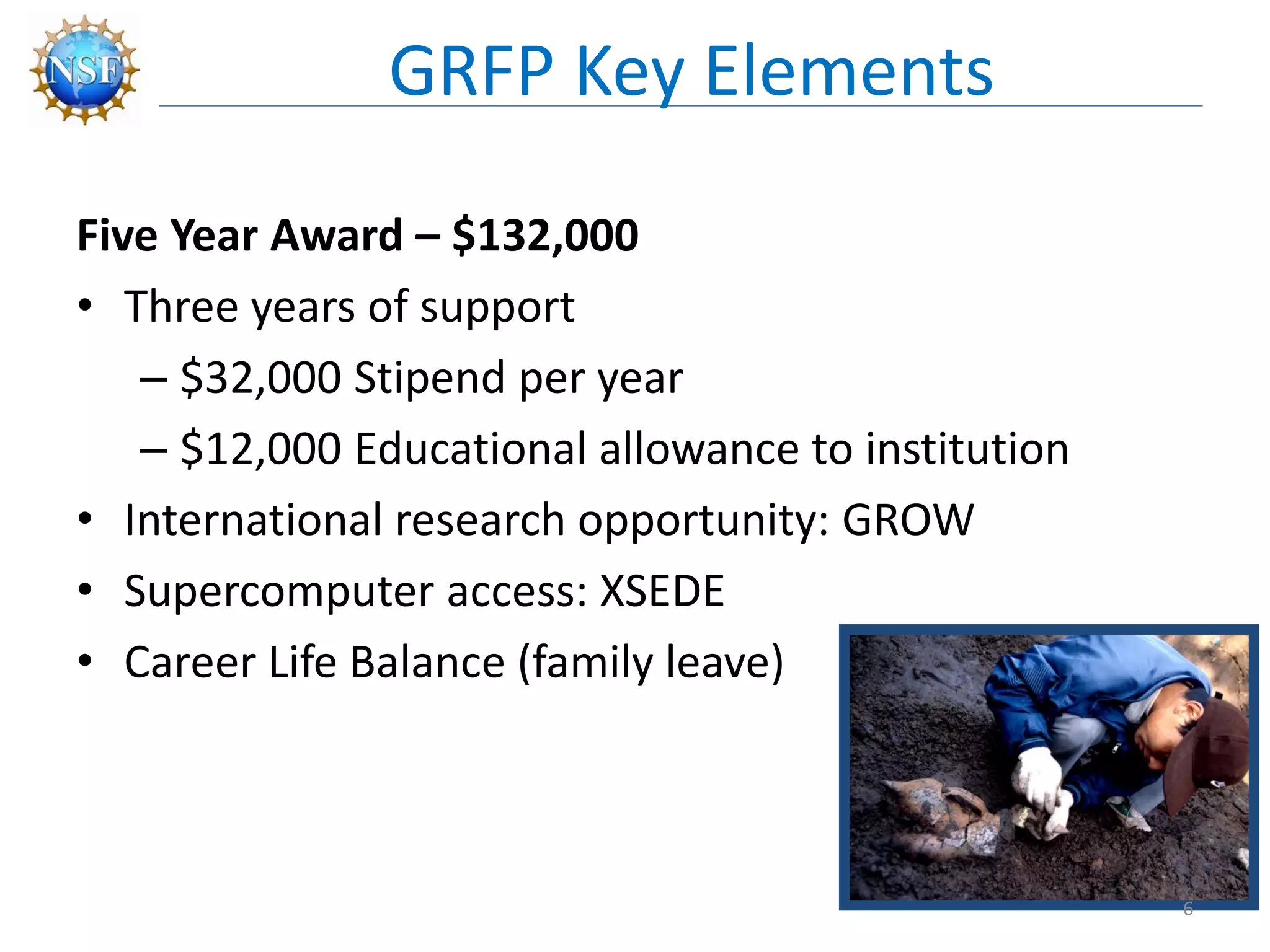
• To select, recognize, and financially support
individuals early in their careers with the
demonstrated potential to be high achieving scientists
and engineers
• To broaden participation in science and engineering of
underrepresented groups, including women,
minorities, persons with disabilities, and veterans
GRFP Goals
5
Five Year Award – $132,000
• Three years of support
– $32,000 Stipend per year
– $12,000 Educational allowance to institution
• International research opportunity: GROW
• Supercomputer access: XSEDE
• Career Life Balance (family leave)
GRFP Key Elements
6
• Awarded to individual
• Flexible: choice of project, advisor & program
• Unrestrictive: No service requirement
• Portable: Any accredited U.S. institution
– MS, MS and PhD, PhD
• 2010 - 2014: 2,000 Fellowships each year
– 2014: 14,000 Applications - ~14 % success rate
GRFP Unique Features
7
• Contains the following information:
– Program Description
– Award Information
– Eligibility requirements
– Application preparation
– Submission instructions
– Application Review Criteria
GRFP Solicitation (NSF 14-590)
8
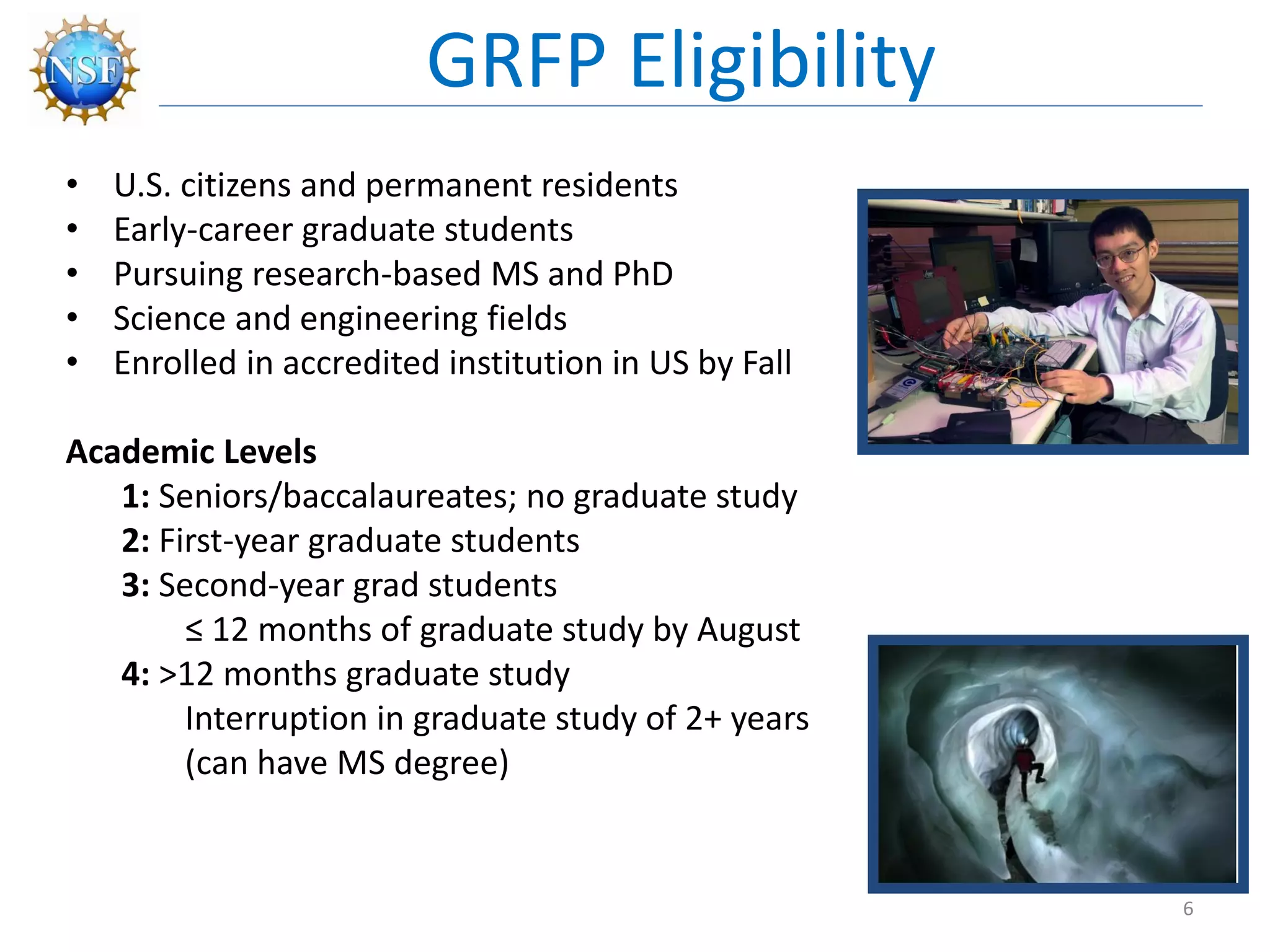
• U.S. citizens and permanent residents
• Early-career graduate students
• Pursuing research-based MS and PhD
• Science and engineering fields
• Enrolled in accredited institution in US by Fall
Academic Levels
1: Seniors/baccalaureates; no graduate study
2: First-year graduate students
3: Second-year grad students
≤ 12 months of graduate study by August
4: >12 months graduate study
Interruption in graduate study of 2+ years
(can have MS degree)
GRFP Eligibility
6
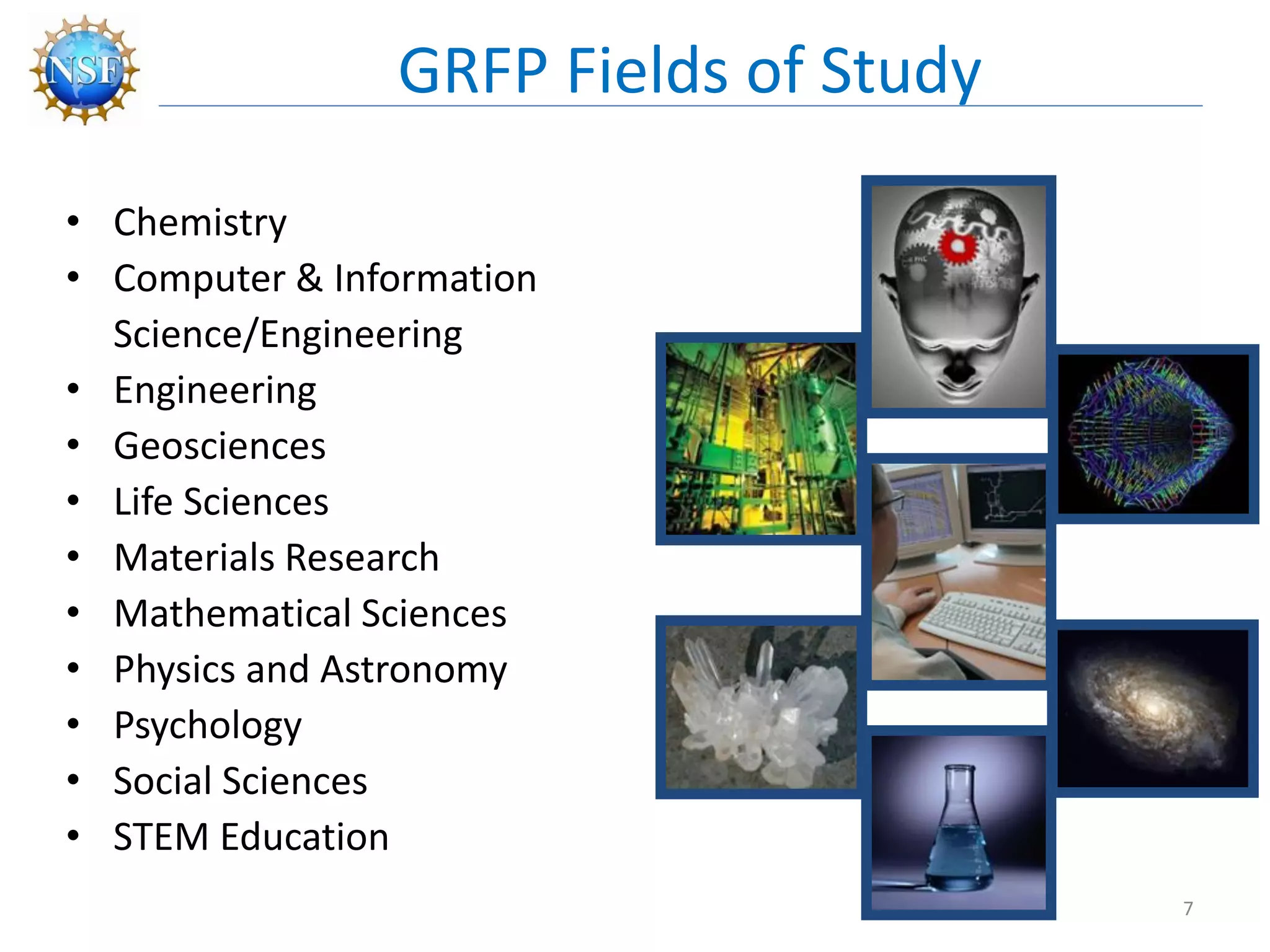
• Chemistry
• Computer & Information
Science/Engineering
• Engineering
• Geosciences
• Life Sciences
• Materials Research
• Mathematical Sciences
• Physics and Astronomy
• Psychology
• Social Sciences
• STEM Education
GRFP Fields of Study
7
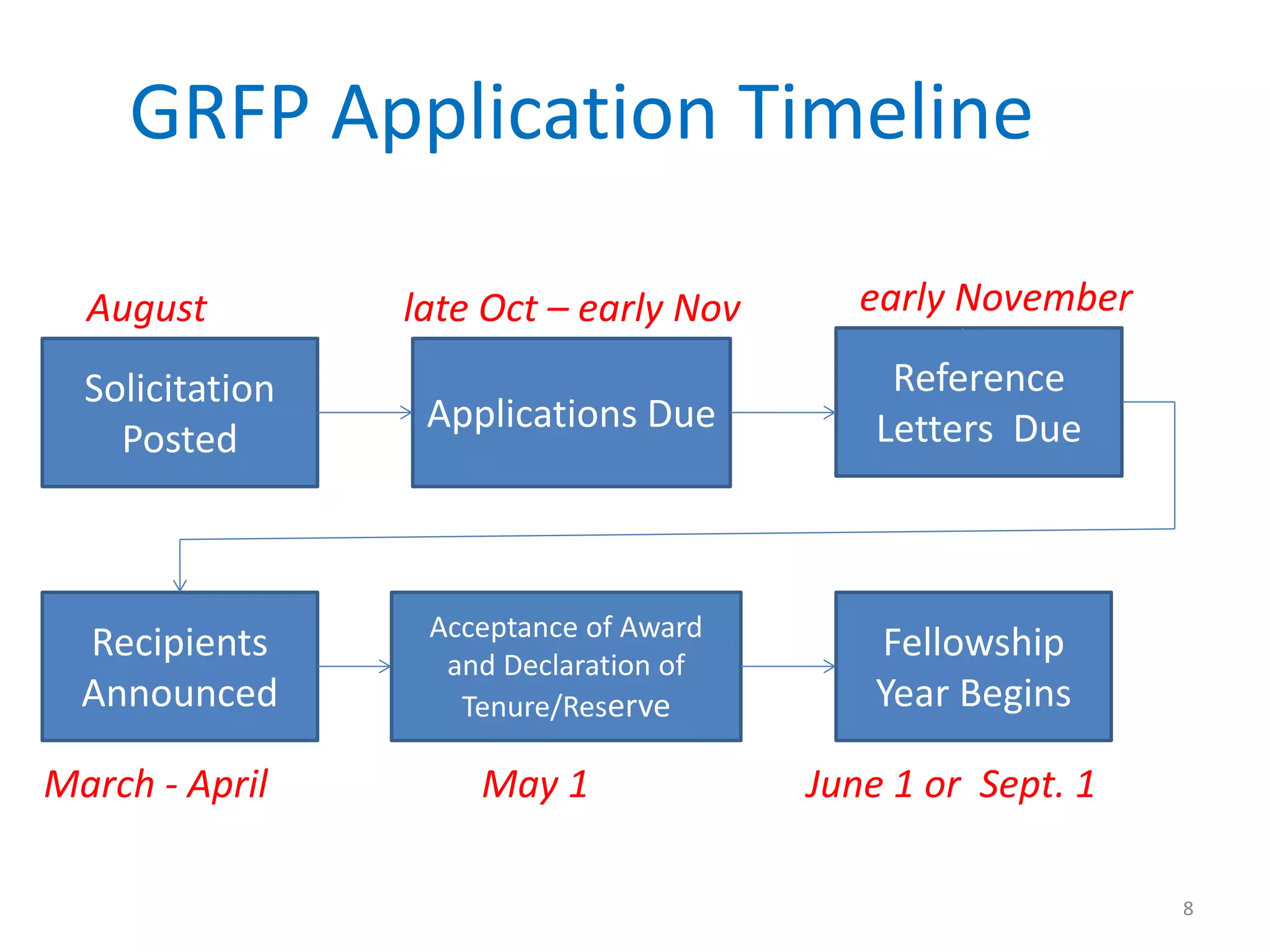
August late Oct – early Nov
March - April May 1
Solicitation
Posted
early November
Recipients
Announced
Applications Due
Acceptance of Award
and Declaration of
Tenure/Reserve
Reference
Letters Due
GRFP Application Timeline
Fellowship
Year Begins
June 1 or Sept. 1
8
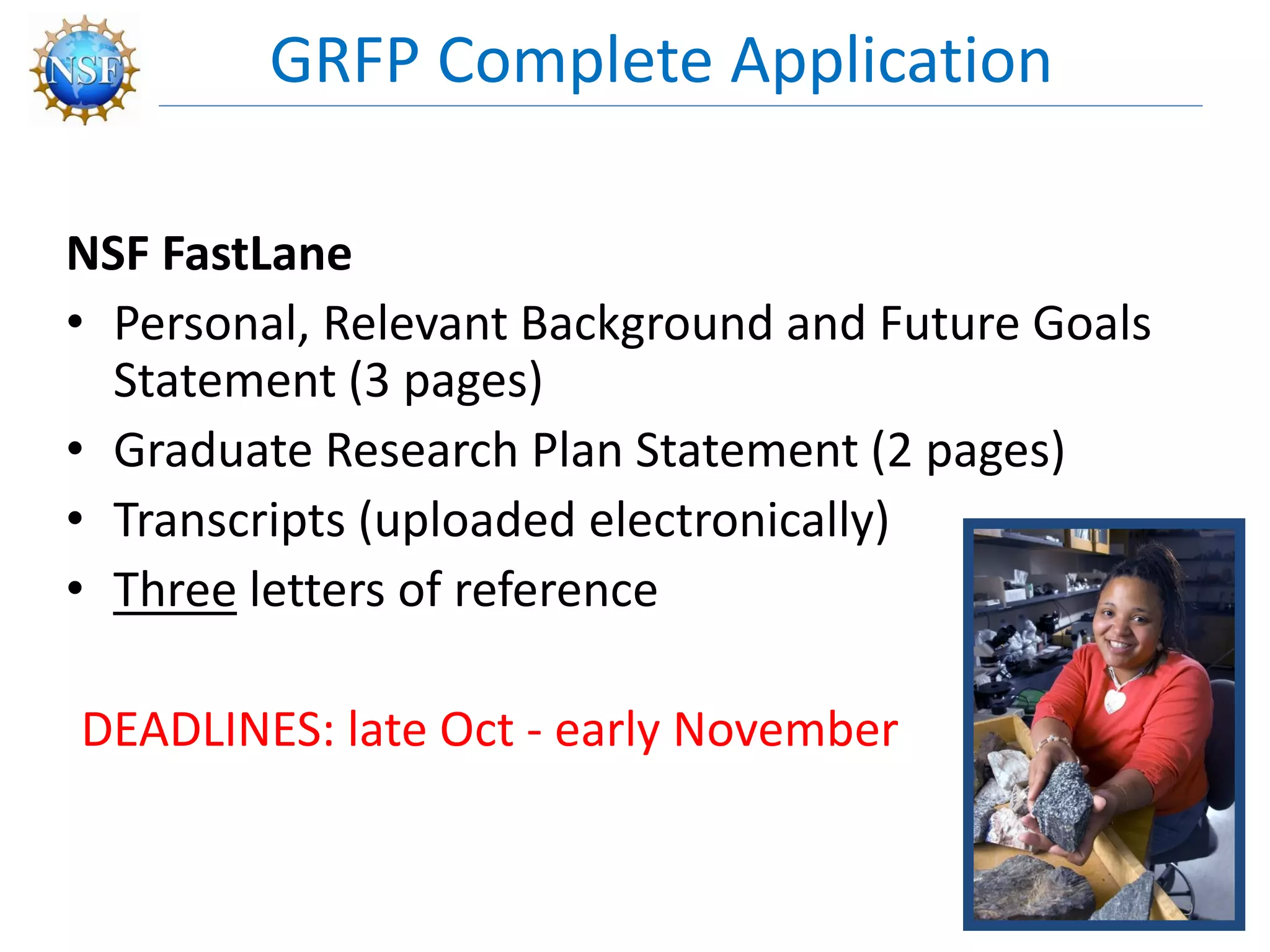
NSF FastLane
• Personal, Relevant Background and Future Goals
Statement (3 pages)
• Graduate Research Plan Statement (2 pages)
• Transcripts (uploaded electronically)
• Three letters of reference
DEADLINES: late Oct - early November
GRFP Complete Application
9
• Personal, Relevant Background and Future Goals Statement
Describe your personal, educational and/or professional
experiences that motivate your decision to pursue advanced
study. Include examples of research and/or professional
activities in which you have participated. Describe the
contributions to advancing knowledge in STEM fields and the
potential for broader societal impacts. Include future plans to
contribute to broader impacts.
• Graduate Research Plan Statement
Present an original research topic that you would like to pursue
in graduate school. Describe the research idea, your general
approach. Address the potential of the research to advance
knowledge and understanding within science as well as the
potential for broader impacts on society.
Two Statements
10
• Applications are reviewed by panels of disciplinary and
interdisciplinary scientists and engineers
• Applications assigned to panels based on the applicant's
chosen Primary Field(s) of Study and the discipline(s)
represented
• Applicants are advised to select the Primary Field of
Study that is most closely aligned with the proposed
graduate program of study
• Holistic evaluation
Application Review Process
11
• Two National Science Board-approved criteria
–Intellectual Merit
–Broader Impacts
NSF Review Criteria
12
• How important is the proposed activity to advancing
knowledge within its own field or across different
fields?
AND
• How well does the proposed activity benefit society
or advance desired societal outcomes?
– Separate sections for Intellectual Merit and
Broader Impacts
Intellectual Merit and Broader impacts
13
• Demonstrated intellectual ability and other accepted
requisites for scholarly scientific study, such as the
ability to:
– Plan and conduct research
– Work as a member of a team as well as
independently
– Interpret and communicate research
Intellectual Merit
14
Societal benefits include, but not limited to,
• Impact of project or individual student on society
• Increased participation of underrepresented groups,
women/minority, students with disabilities, veterans
• Improved STEM education in schools and teacher development
• Impact on society: Increased public scientific literacy;
increased public engagement with science and technology
• Community outreach: science clubs, radio, TV, newspaper,
• Potential to impact diverse audiences: museums, aquarium
• Development of a diverse, globally competitive workforce
• Increased partnerships between academia, industry and others
• Leadership potential
Plans to share your science with the broader community?
Broader Impacts
15
Intellectual Merit Assessment
• Academic performance; grades, curricula, awards, etc.
• Graduate Research plan
• Research/professional experience
• Reference letters
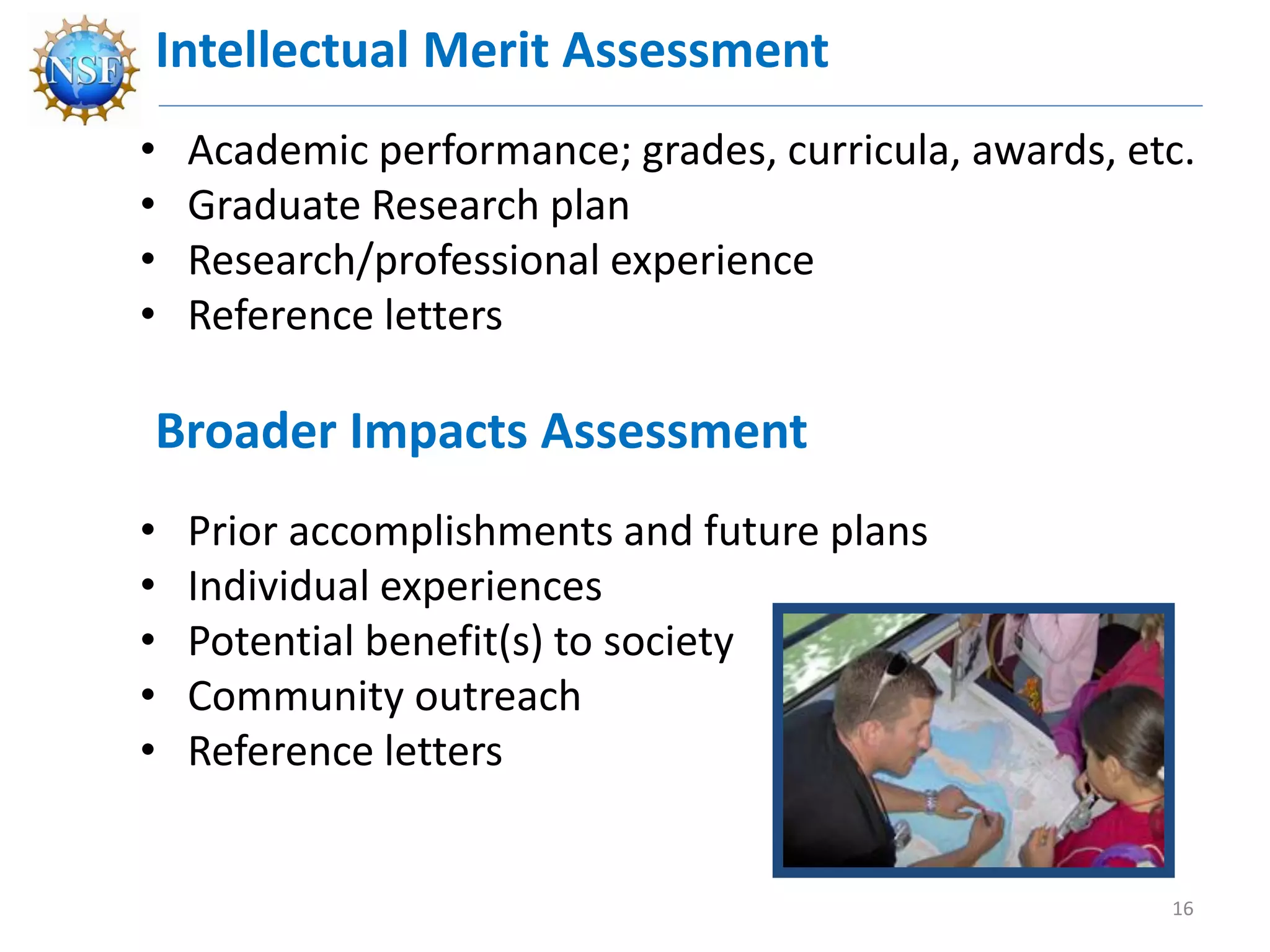
Broader Impacts Assessment
• Prior accomplishments and future plans
• Individual experiences
• Potential benefit(s) to society
• Community outreach
• Reference letters
16
 Start early
 Read Solicitation, and read it again
 Read NSF GRFP websites
 Select and confirm reference letter writers
 Pay attention to merit review criteria
 Share your application materials and the merit
review criteria with reference writers
 Monitor receipt of reference letters (3 required for
review)
Advice
17
• Select your reference writers carefully, as they will provide
important information about your potential as a leader,
researcher, and educator – familiarity with you as a person is
important
• Your selected reference writers will submit their own
references; provide them all necessary information well in
advance of deadline
• You may request up to 5 references. It is your responsibility to
ensure three letters of references are submitted by the
published deadline in order for your application to be
complete and reviewed
Reference writers
18
• NSF GRFP Website (nsf.gov/grfp)
– Solicitation and links
• NSF GRFP FastLane Website (fastlane.nsf.gov/grfp)
– Application, guides, announcements
• GRFP Website (nsfgrfp.org)
• Current & former Fellows
• Phone & e-mail
– 866-NSF-GRFP (673-4737)
– info@nsfgrfp.org
GRFP Resources
19

GRFP Outreach Presentation NSF AUG 14

  • 1.
    For Applicants to theNSF Graduate Research Fellowship Program nsf.gov/grfp www.nsfgrfp.org
  • 2.
    • To select,recognize, and financially support individuals early in their careers with the demonstrated potential to be high achieving scientists and engineers • To broaden participation in science and engineering of underrepresented groups, including women, minorities, persons with disabilities, and veterans GRFP Goals 5
  • 3.
    Five Year Award– $132,000 • Three years of support – $32,000 Stipend per year – $12,000 Educational allowance to institution • International research opportunity: GROW • Supercomputer access: XSEDE • Career Life Balance (family leave) GRFP Key Elements 6
  • 4.
    • Awarded toindividual • Flexible: choice of project, advisor & program • Unrestrictive: No service requirement • Portable: Any accredited U.S. institution – MS, MS and PhD, PhD • 2010 - 2014: 2,000 Fellowships each year – 2014: 14,000 Applications - ~14 % success rate GRFP Unique Features 7
  • 5.
    • Contains thefollowing information: – Program Description – Award Information – Eligibility requirements – Application preparation – Submission instructions – Application Review Criteria GRFP Solicitation (NSF 14-590) 8
  • 6.
    • U.S. citizensand permanent residents • Early-career graduate students • Pursuing research-based MS and PhD • Science and engineering fields • Enrolled in accredited institution in US by Fall Academic Levels 1: Seniors/baccalaureates; no graduate study 2: First-year graduate students 3: Second-year grad students ≤ 12 months of graduate study by August 4: >12 months graduate study Interruption in graduate study of 2+ years (can have MS degree) GRFP Eligibility 6
  • 7.
    • Chemistry • Computer& Information Science/Engineering • Engineering • Geosciences • Life Sciences • Materials Research • Mathematical Sciences • Physics and Astronomy • Psychology • Social Sciences • STEM Education GRFP Fields of Study 7
  • 8.
    August late Oct– early Nov March - April May 1 Solicitation Posted early November Recipients Announced Applications Due Acceptance of Award and Declaration of Tenure/Reserve Reference Letters Due GRFP Application Timeline Fellowship Year Begins June 1 or Sept. 1 8
  • 9.
    NSF FastLane • Personal,Relevant Background and Future Goals Statement (3 pages) • Graduate Research Plan Statement (2 pages) • Transcripts (uploaded electronically) • Three letters of reference DEADLINES: late Oct - early November GRFP Complete Application 9
  • 10.
    • Personal, RelevantBackground and Future Goals Statement Describe your personal, educational and/or professional experiences that motivate your decision to pursue advanced study. Include examples of research and/or professional activities in which you have participated. Describe the contributions to advancing knowledge in STEM fields and the potential for broader societal impacts. Include future plans to contribute to broader impacts. • Graduate Research Plan Statement Present an original research topic that you would like to pursue in graduate school. Describe the research idea, your general approach. Address the potential of the research to advance knowledge and understanding within science as well as the potential for broader impacts on society. Two Statements 10
  • 11.
    • Applications arereviewed by panels of disciplinary and interdisciplinary scientists and engineers • Applications assigned to panels based on the applicant's chosen Primary Field(s) of Study and the discipline(s) represented • Applicants are advised to select the Primary Field of Study that is most closely aligned with the proposed graduate program of study • Holistic evaluation Application Review Process 11
  • 12.
    • Two NationalScience Board-approved criteria –Intellectual Merit –Broader Impacts NSF Review Criteria 12
  • 13.
    • How importantis the proposed activity to advancing knowledge within its own field or across different fields? AND • How well does the proposed activity benefit society or advance desired societal outcomes? – Separate sections for Intellectual Merit and Broader Impacts Intellectual Merit and Broader impacts 13
  • 14.
    • Demonstrated intellectualability and other accepted requisites for scholarly scientific study, such as the ability to: – Plan and conduct research – Work as a member of a team as well as independently – Interpret and communicate research Intellectual Merit 14
  • 15.
    Societal benefits include,but not limited to, • Impact of project or individual student on society • Increased participation of underrepresented groups, women/minority, students with disabilities, veterans • Improved STEM education in schools and teacher development • Impact on society: Increased public scientific literacy; increased public engagement with science and technology • Community outreach: science clubs, radio, TV, newspaper, • Potential to impact diverse audiences: museums, aquarium • Development of a diverse, globally competitive workforce • Increased partnerships between academia, industry and others • Leadership potential Plans to share your science with the broader community? Broader Impacts 15
  • 16.
    Intellectual Merit Assessment •Academic performance; grades, curricula, awards, etc. • Graduate Research plan • Research/professional experience • Reference letters Broader Impacts Assessment • Prior accomplishments and future plans • Individual experiences • Potential benefit(s) to society • Community outreach • Reference letters 16
  • 17.
     Start early Read Solicitation, and read it again  Read NSF GRFP websites  Select and confirm reference letter writers  Pay attention to merit review criteria  Share your application materials and the merit review criteria with reference writers  Monitor receipt of reference letters (3 required for review) Advice 17
  • 18.
    • Select yourreference writers carefully, as they will provide important information about your potential as a leader, researcher, and educator – familiarity with you as a person is important • Your selected reference writers will submit their own references; provide them all necessary information well in advance of deadline • You may request up to 5 references. It is your responsibility to ensure three letters of references are submitted by the published deadline in order for your application to be complete and reviewed Reference writers 18
  • 19.
    • NSF GRFPWebsite (nsf.gov/grfp) – Solicitation and links • NSF GRFP FastLane Website (fastlane.nsf.gov/grfp) – Application, guides, announcements • GRFP Website (nsfgrfp.org) • Current & former Fellows • Phone & e-mail – 866-NSF-GRFP (673-4737) – info@nsfgrfp.org GRFP Resources 19