WHAT YOU NEED TO KNOW
by Kelsey Wood, PhD, NSF-GRF ’14
More information at grfp.info
Introduction to the NSF
What do I know about writing fellowships and grants?
• NSF-GRFP Fellow 2014
• USDA AFRI-NIFA Predoctoral Fellow 2017
• Lead NSF-GRFP workshops at UC Davis attended by 100+ students
• Taught in-depth courses on grant writing for graduate students
Why apply for fellowships?
MONEY FREEDOM FAME
You could earn a livable wage!
3 years of $34,000/year stipend+
$12,000 institutional expense
Additional funding opps for
international collabs (GROW) and
internships (GRIP)
Your PI can no
longer tell you what
to do
You don’t have to TA
Boost your CV and
gain recognition
Winning awards and
fellowships leads to
winning more awards
and fellowships
Also it’s good practice: writing grants and selling yourself & your research will be a part of your job in academia
Who wins these fellowships?
• Grad students with high potential
to become leaders in their field
• 2000 awardees out of ~13000
applicants (~15% acceptance rate)
• Number of NSF-GRFP Awardees at
UC Davis:
• 2020: 9
• 2019: 11
• 2018: 18
• 2017: 15
• 2016: 22
• 2015: 25
• 2014: 22
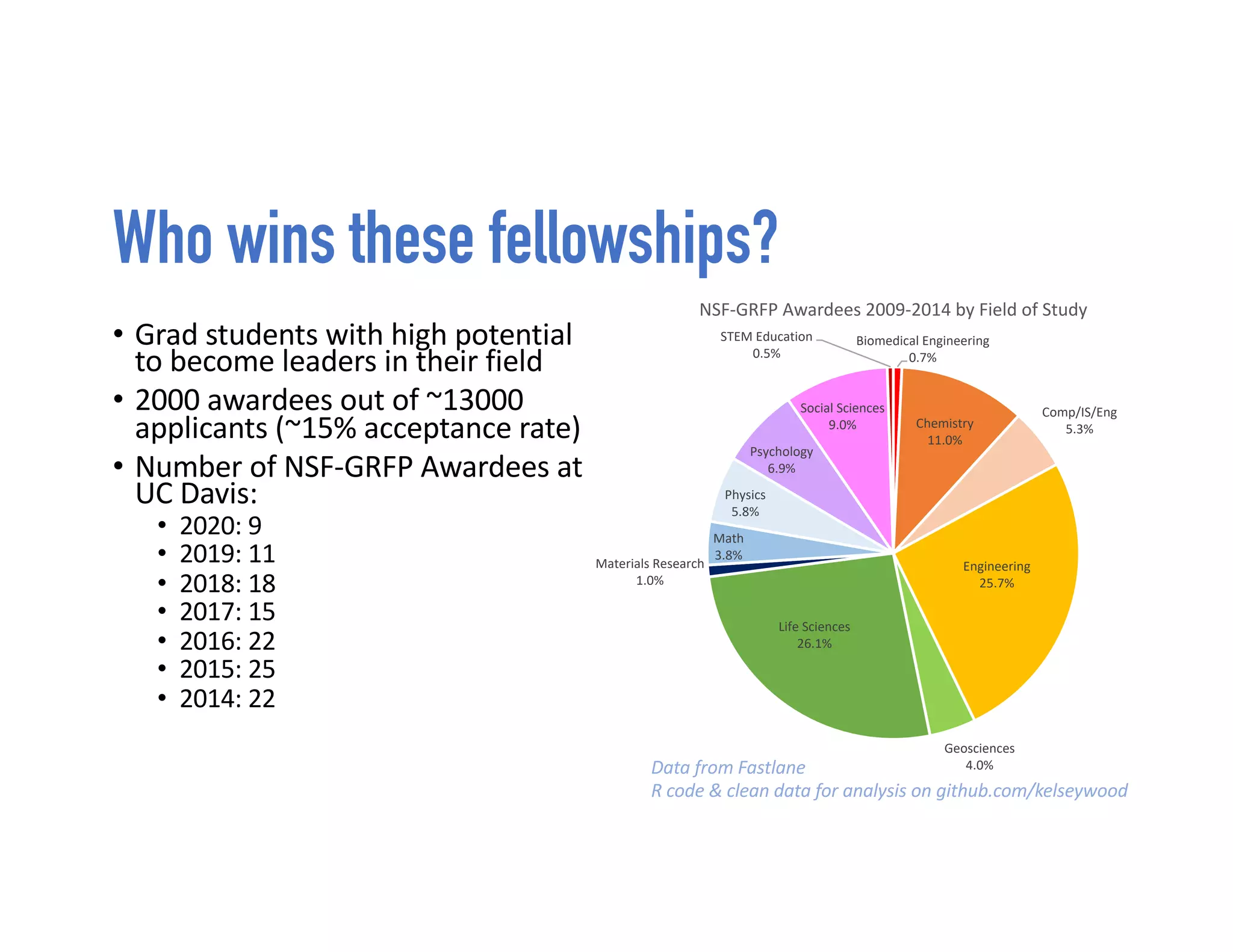
Biomedical Engineering
0.7%
Chemistry
11.0%
Comp/IS/Eng
5.3%
Engineering
25.7%
Geosciences
4.0%
Life Sciences
26.1%
Materials Research
1.0%
Math
3.8%
Physics
5.8%
Psychology
6.9%
Social Sciences
9.0%
STEM Education
0.5%
NSF-GRFP Awardees 2009-2014 by Field of Study
Data from Fastlane
R code & clean data for analysis on github.com/kelseywood
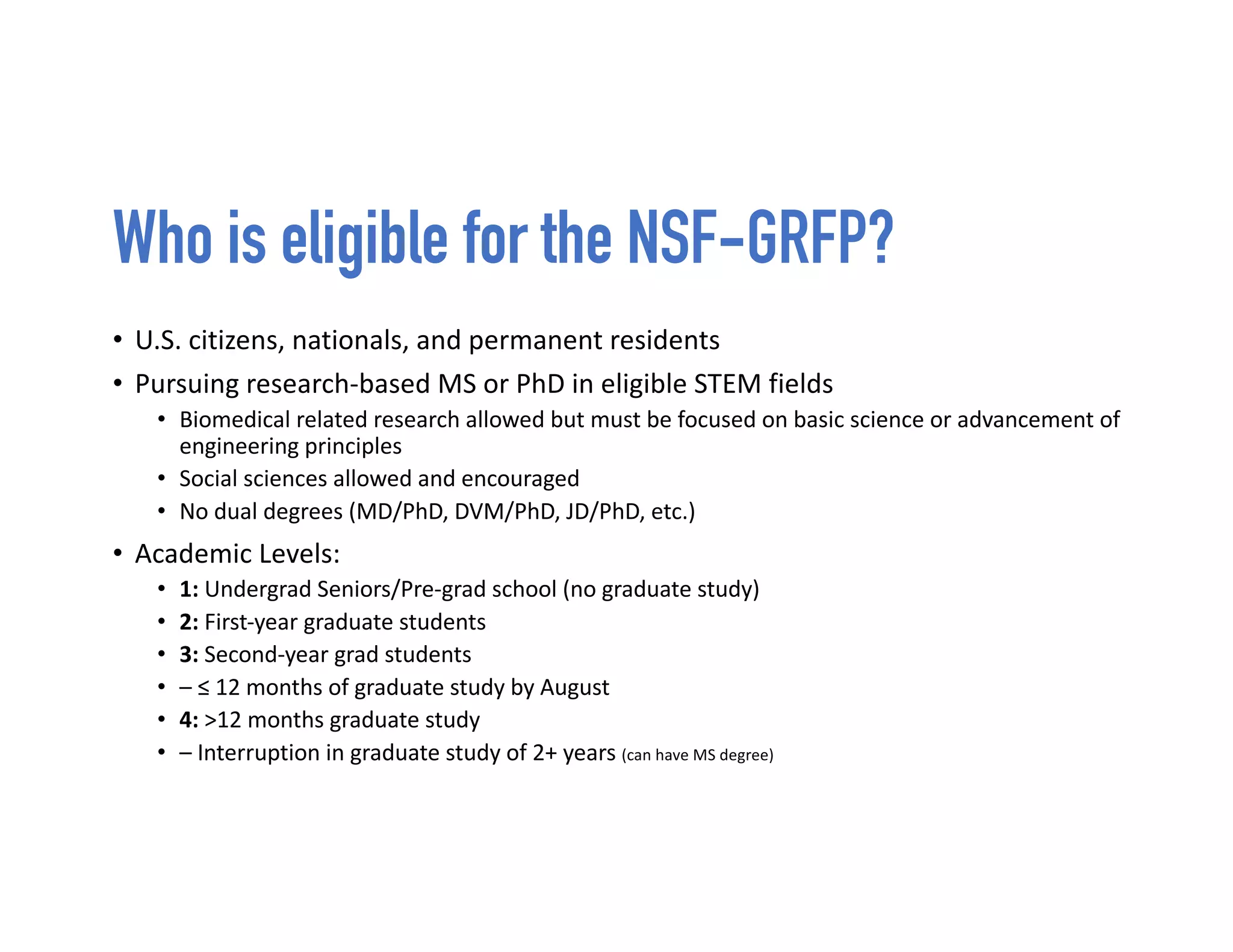
Who is eligible for the NSF-GRFP?
• U.S. citizens, nationals, and permanent residents
• Pursuing research-based MS or PhD in eligible STEM fields
• Biomedical related research allowed but must be focused on basic science or advancement of
engineering principles
• Social sciences allowed and encouraged
• No dual degrees (MD/PhD, DVM/PhD, JD/PhD, etc.)
• Academic Levels:
• 1: Undergrad Seniors/Pre-grad school (no graduate study)
• 2: First-year graduate students
• 3: Second-year grad students
• – ≤ 12 months of graduate study by August
• 4: >12 months graduate study
• – Interruption in graduate study of 2+ years (can have MS degree)
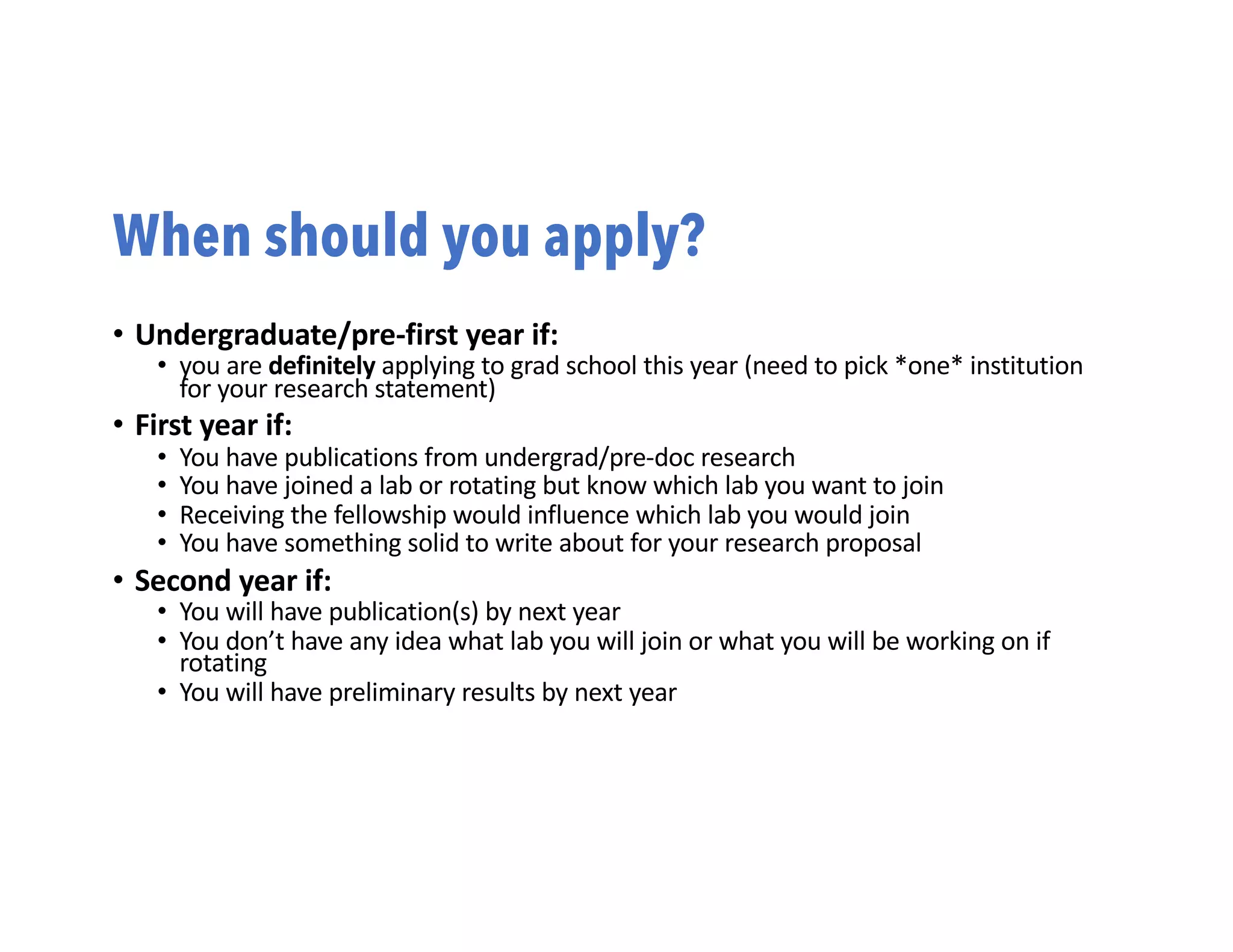
When should you apply?
• Undergraduate/pre-first year if:
• you are definitely applying to grad school this year (need to pick *one* institution
for your research statement)
• First year if:
• You have publications from undergrad/pre-doc research
• You have joined a lab or rotating but know which lab you want to join
• Receiving the fellowship would influence which lab you would join
• You have something solid to write about for your research proposal
• Second year if:
• You will have publication(s) by next year
• You don’t have any idea what lab you will join or what you will be working on if
rotating
• You will have preliminary results by next year
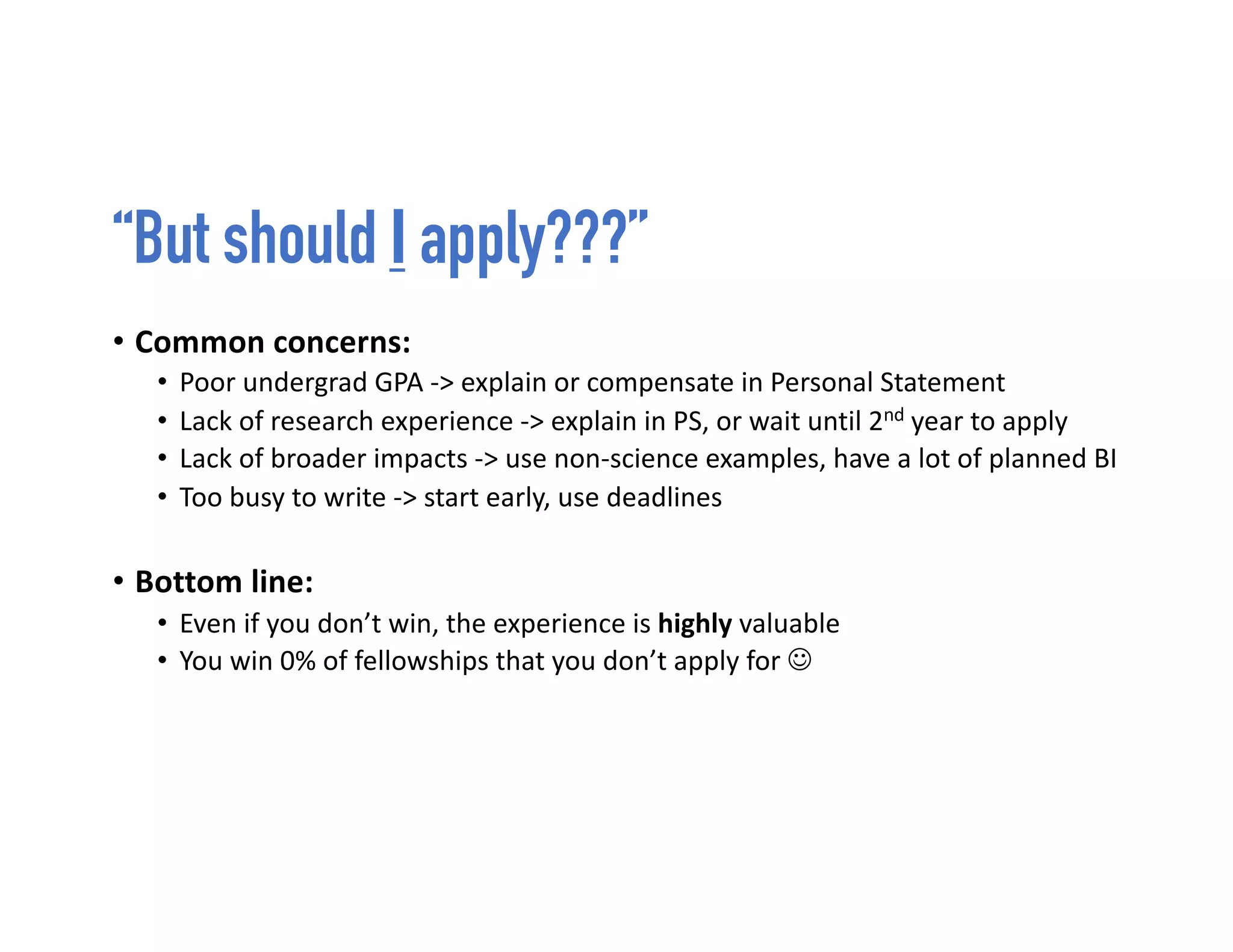
“But should I apply???”
• Common concerns:
• Poor undergrad GPA -> explain or compensate in Personal Statement
• Lack of research experience -> explain in PS, or wait until 2nd year to apply
• Lack of broader impacts -> use non-science examples, have a lot of planned BI
• Too busy to write -> start early, use deadlines
• Bottom line:
• Even if you don’t win, the experience is highly valuable
• You win 0% of fellowships that you don’t apply for J
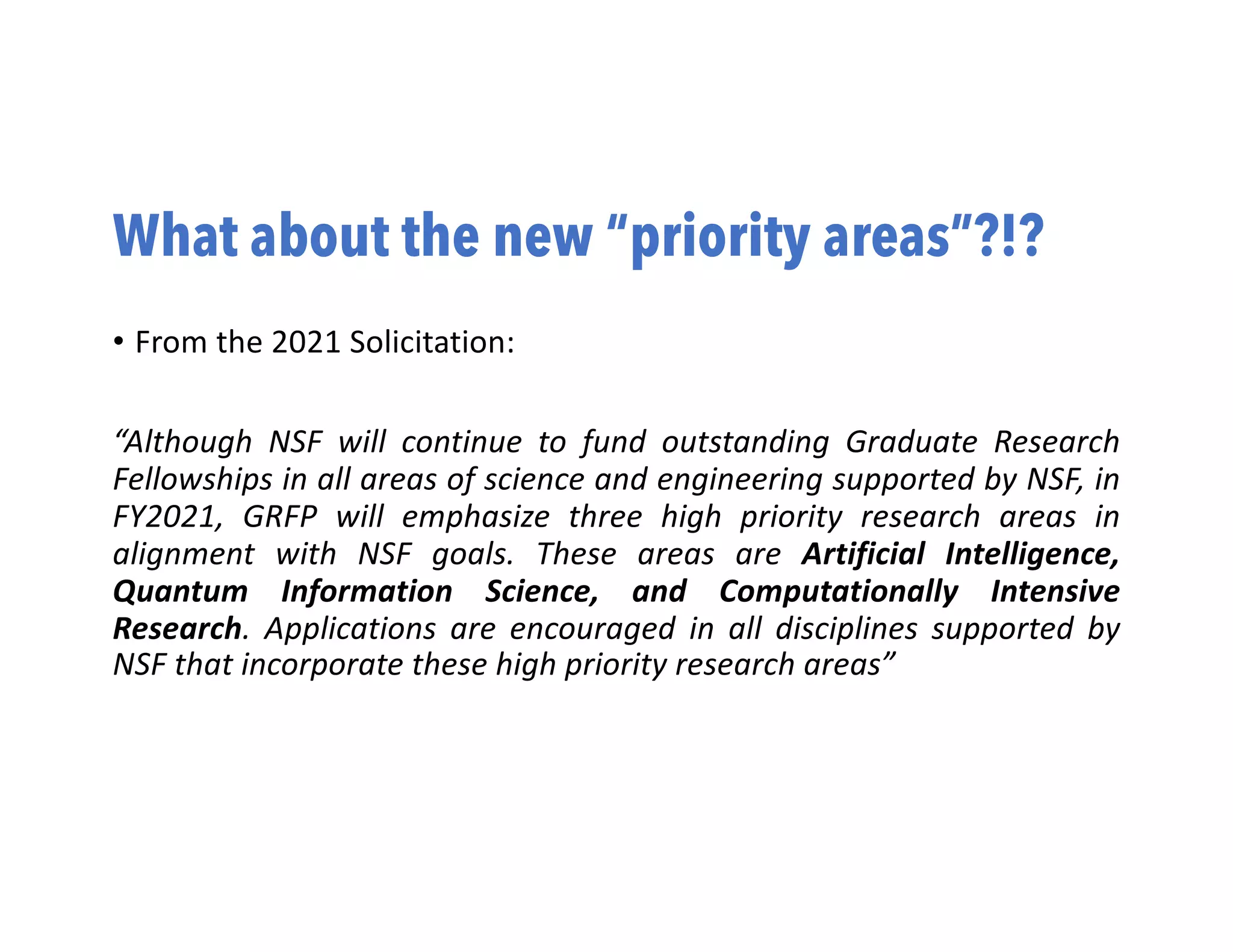
What about the new “priority areas”?!?
• From the 2021 Solicitation:
“Although NSF will continue to fund outstanding Graduate Research
Fellowships in all areas of science and engineering supported by NSF, in
FY2021, GRFP will emphasize three high priority research areas in
alignment with NSF goals. These areas are Artificial Intelligence,
Quantum Information Science, and Computationally Intensive
Research. Applications are encouraged in all disciplines supported by
NSF that incorporate these high priority research areas”
What about the new “priority areas”?!?
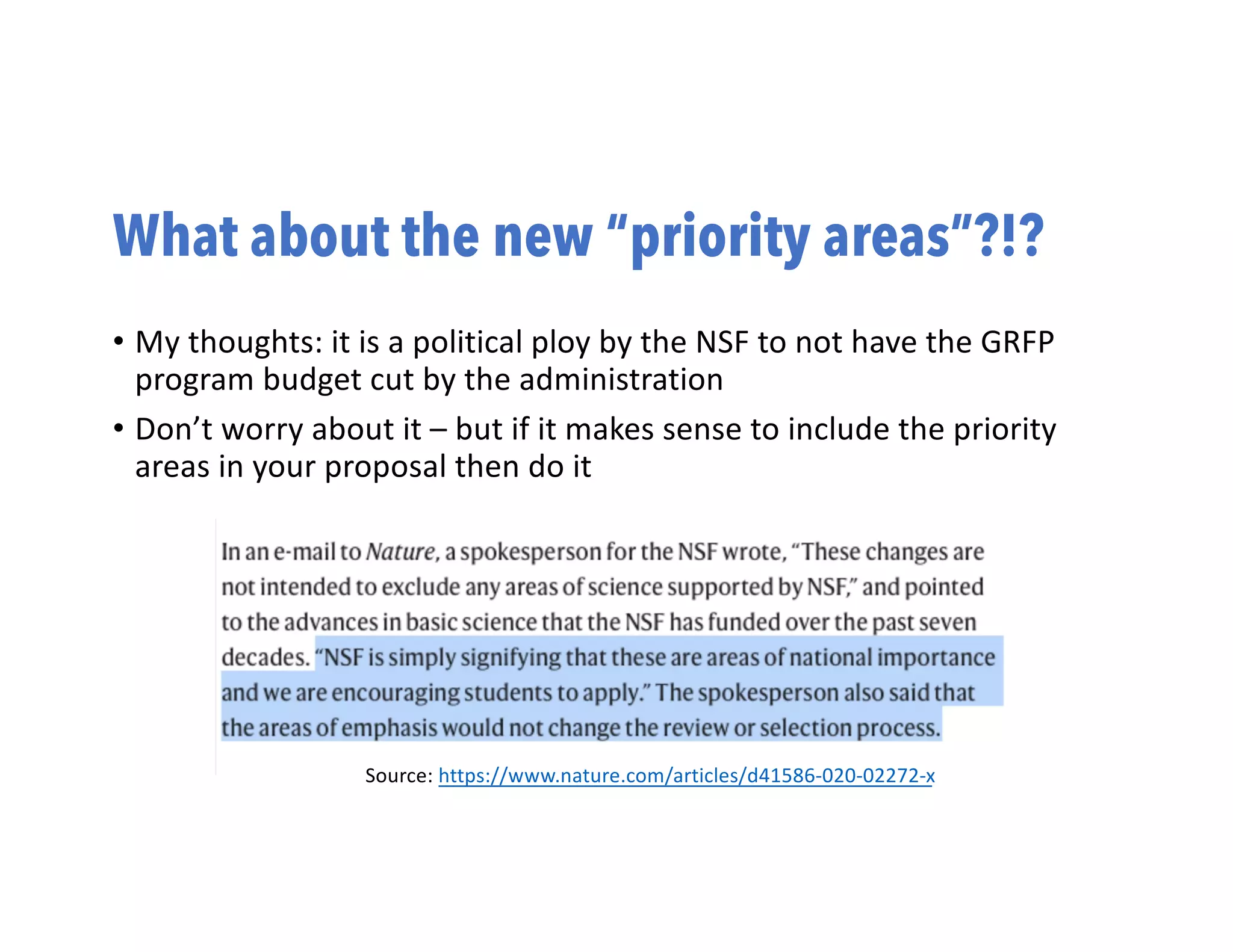
• My thoughts: it is a political ploy by the NSF to not have the GRFP
program budget cut by the administration
• Don’t worry about it – but if it makes sense to include the priority
areas in your proposal then do it
Source: https://www.nature.com/articles/d41586-020-02272-x
The NSF-GRFP Application
• Personal, Relevant Background and Future Goals Statement (3 pages)
• Graduate Research Statement (2 pages)
• Undergraduate & Graduate Transcripts
• Three letters of reference
• Fastlane extras: List of fellowships, scholarships, teaching and work
experiences relevant to your field of study; List of significant academic
honors, publications, and presentations
Official NSF Criteria
Intellectual Merit: your potential to advance knowledge
• Academic performance; grades, courses, awards, etc.
• Graduate Research proposal
• Research/professional experience
• Reference letters
Broader Impacts: your potential to benefit society and contribute to the
achievement of specific, desired societal outcomes.
• Outreach experience
• Potential benefits to society of your research
• Personal background
• Reference letters
NSF requires a separate section with its own header for Intellectual Merit and Broader
Impacts in each statement
Personal Statement, Relevant Background, Future Goals
• Introduce yourself as a scientist and as a person
• Be unique and memorable without being cliché
• Relevant background = your CV in paragraph format
• Demonstrate that you have the experience to be successful in grad
school
• Future goals: include why do you want to be a professor in academia
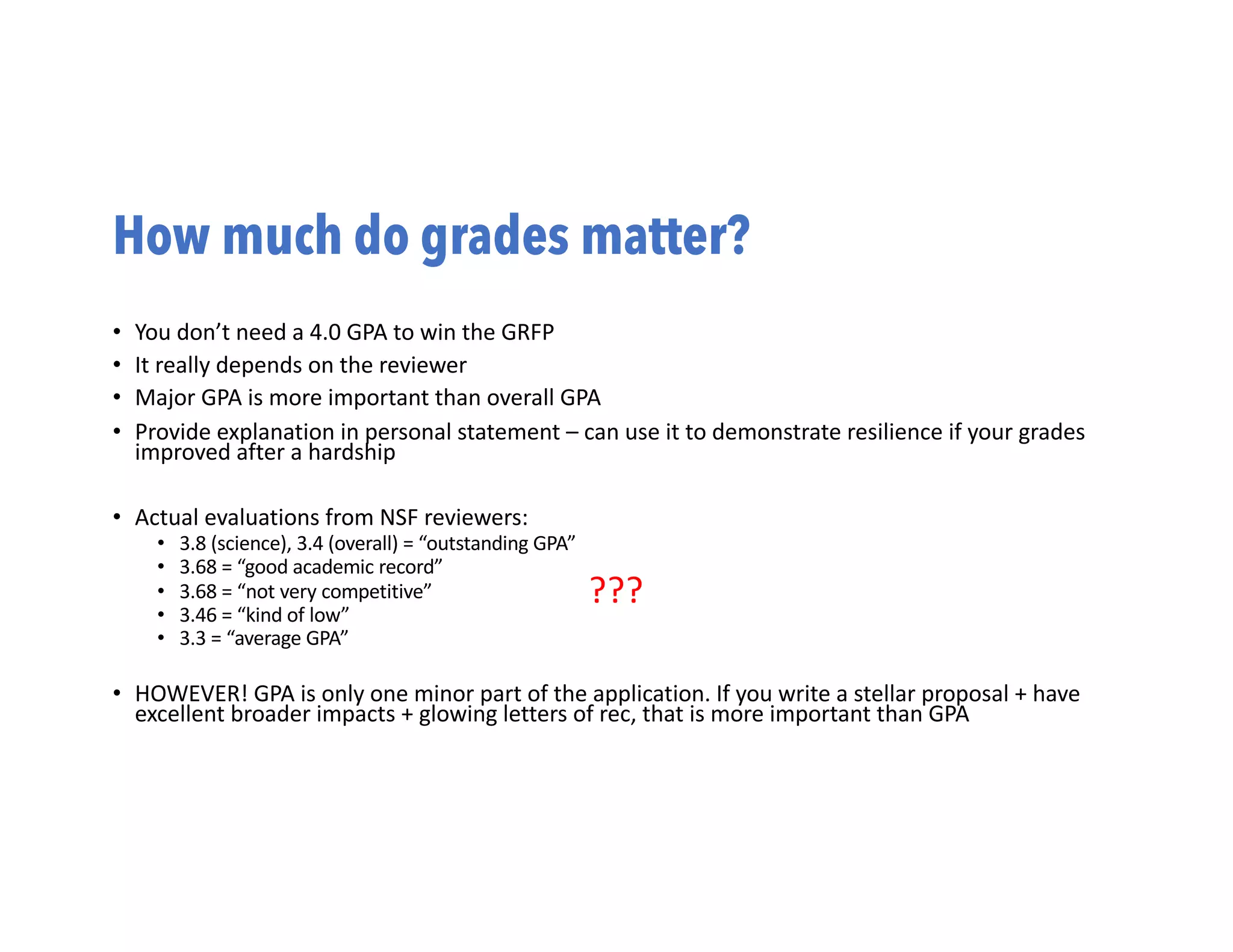
How much do grades matter?
• You don’t need a 4.0 GPA to win the GRFP
• It really depends on the reviewer
• Major GPA is more important than overall GPA
• Provide explanation in personal statement – can use it to demonstrate resilience if your grades
improved after a hardship
• Actual evaluations from NSF reviewers:
• 3.8 (science), 3.4 (overall) = “outstanding GPA”
• 3.68 = “good academic record”
• 3.68 = “not very competitive”
• 3.46 = “kind of low”
• 3.3 = “average GPA”
• HOWEVER! GPA is only one minor part of the application. If you write a stellar proposal + have
excellent broader impacts + glowing letters of rec, that is more important than GPA
???
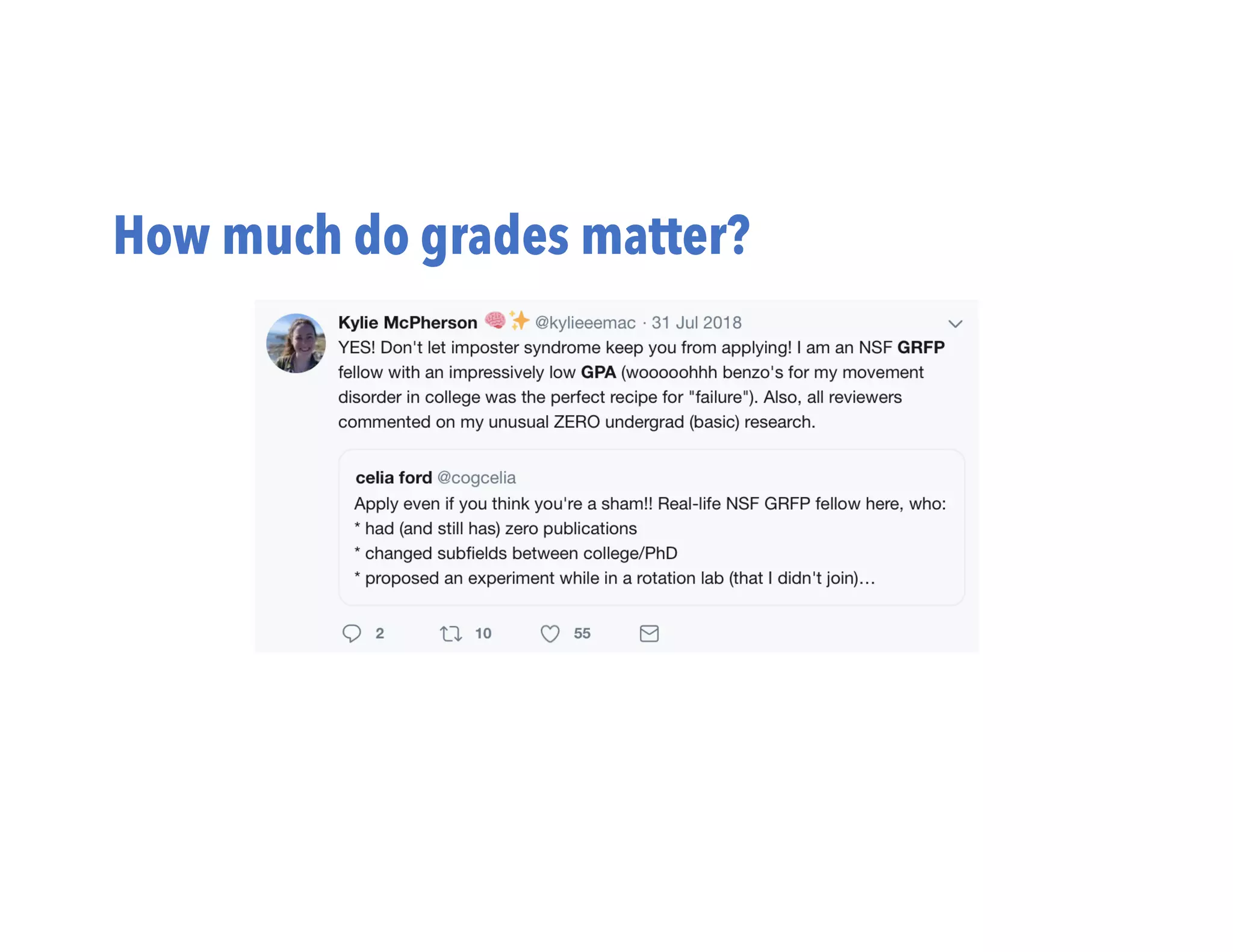
How much do grades matter?
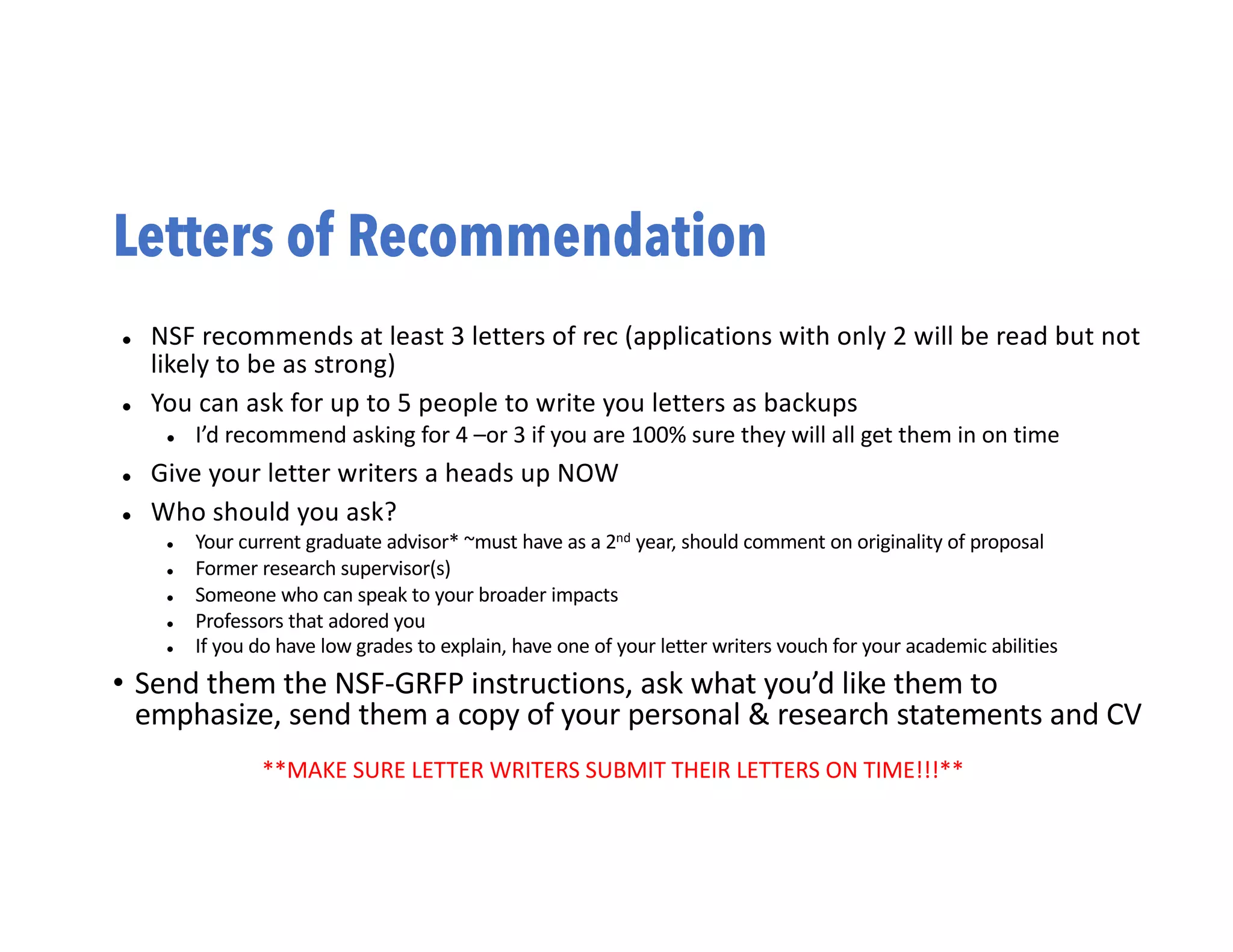
Letters of Recommendation
l NSF recommends at least 3 letters of rec (applications with only 2 will be read but not
likely to be as strong)
l You can ask for up to 5 people to write you letters as backups
l I’d recommend asking for 4 –or 3 if you are 100% sure they will all get them in on time
l Give your letter writers a heads up NOW
l Who should you ask?
l Your current graduate advisor* ~must have as a 2nd year, should comment on originality of proposal
l Former research supervisor(s)
l Someone who can speak to your broader impacts
l Professors that adored you
l If you do have low grades to explain, have one of your letter writers vouch for your academic abilities
• Send them the NSF-GRFP instructions, ask what you’d like them to
emphasize, send them a copy of your personal & research statements and CV
**MAKE SURE LETTER WRITERS SUBMIT THEIR LETTERS ON TIME!!!**
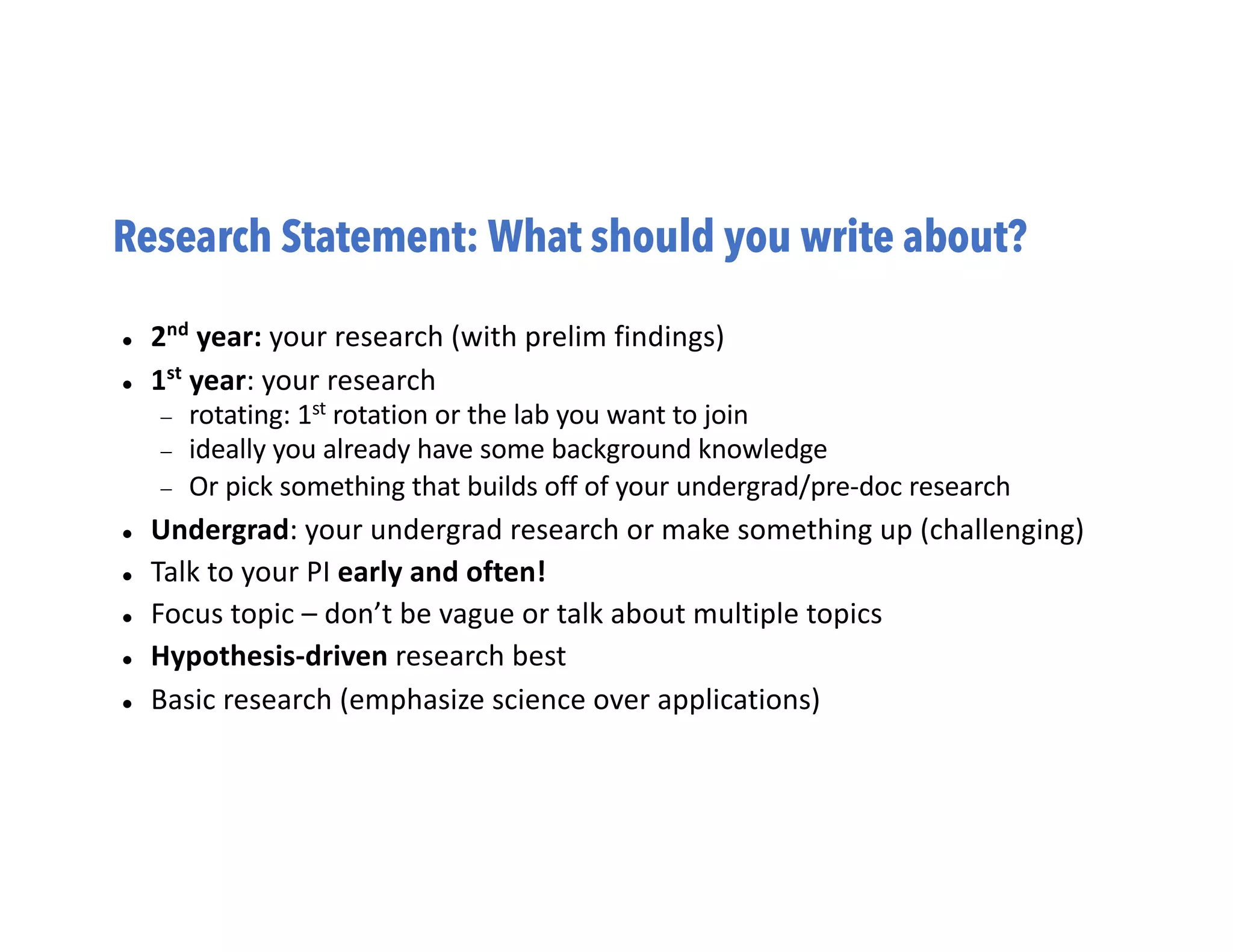
Research Statement: What should you write about?
l 2nd
year: your research (with prelim findings)
l 1st
year: your research
- rotating: 1st rotation or the lab you want to join
- ideally you already have some background knowledge
- Or pick something that builds off of your undergrad/pre-doc research
l Undergrad: your undergrad research or make something up (challenging)
l Talk to your PI early and often!
l Focus topic – don’t be vague or talk about multiple topics
l Hypothesis-driven research best
l Basic research (emphasize science over applications)
Research Statement: What should you write about?
• Keep in mind:
• You don’t actually have to do your proposed research
• NSF funds the person not the research
Are broader impacts actually important?
YES!
YES!
YES!
YES!
YES!
YES!
YES! YES!
YES! YES!
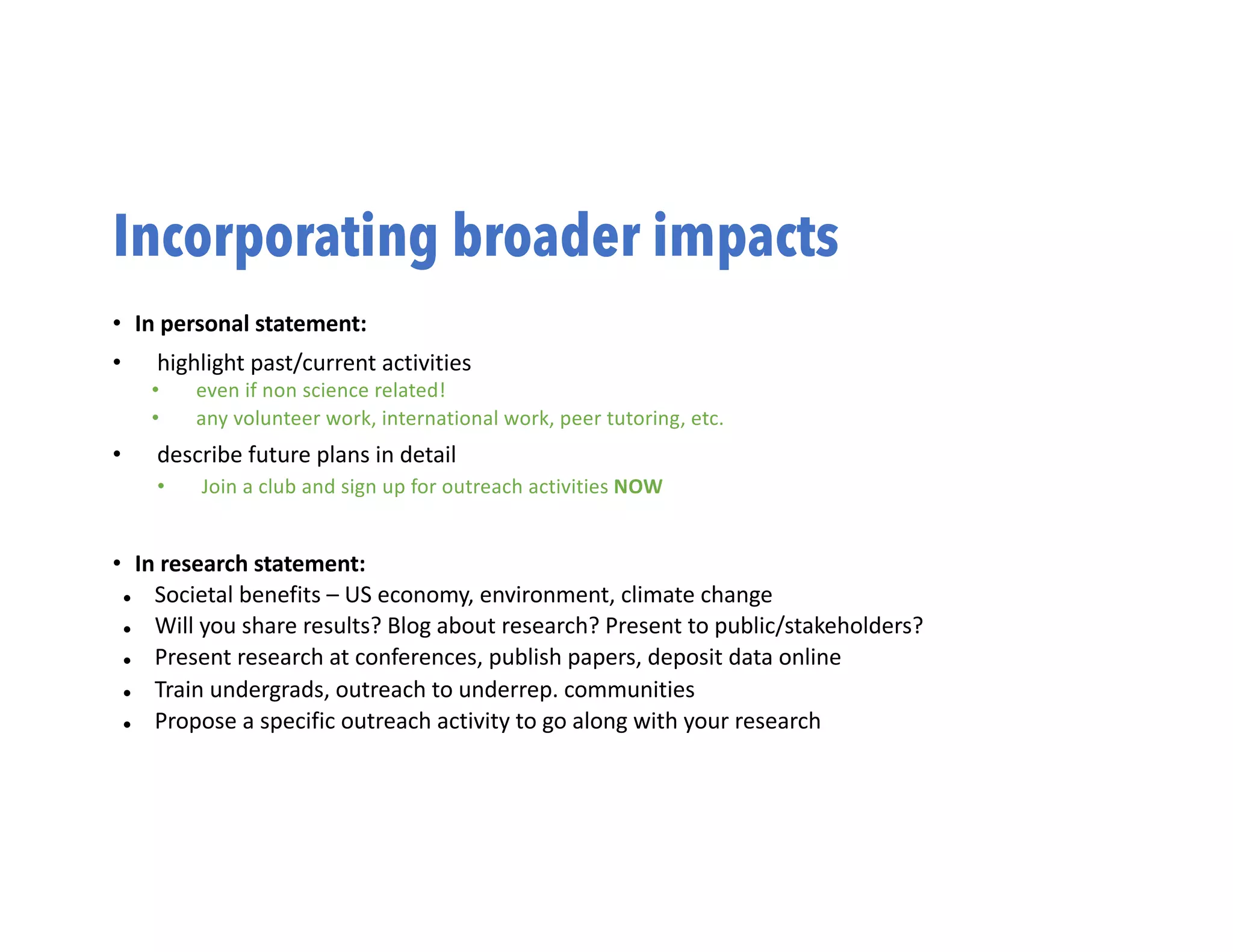
Incorporating broader impacts
• In personal statement:
• highlight past/current activities
• even if non science related!
• any volunteer work, international work, peer tutoring, etc.
• describe future plans in detail
• Join a club and sign up for outreach activities NOW
• In research statement:
l Societal benefits – US economy, environment, climate change
l Will you share results? Blog about research? Present to public/stakeholders?
l Present research at conferences, publish papers, deposit data online
l Train undergrads, outreach to underrep. communities
l Propose a specific outreach activity to go along with your research
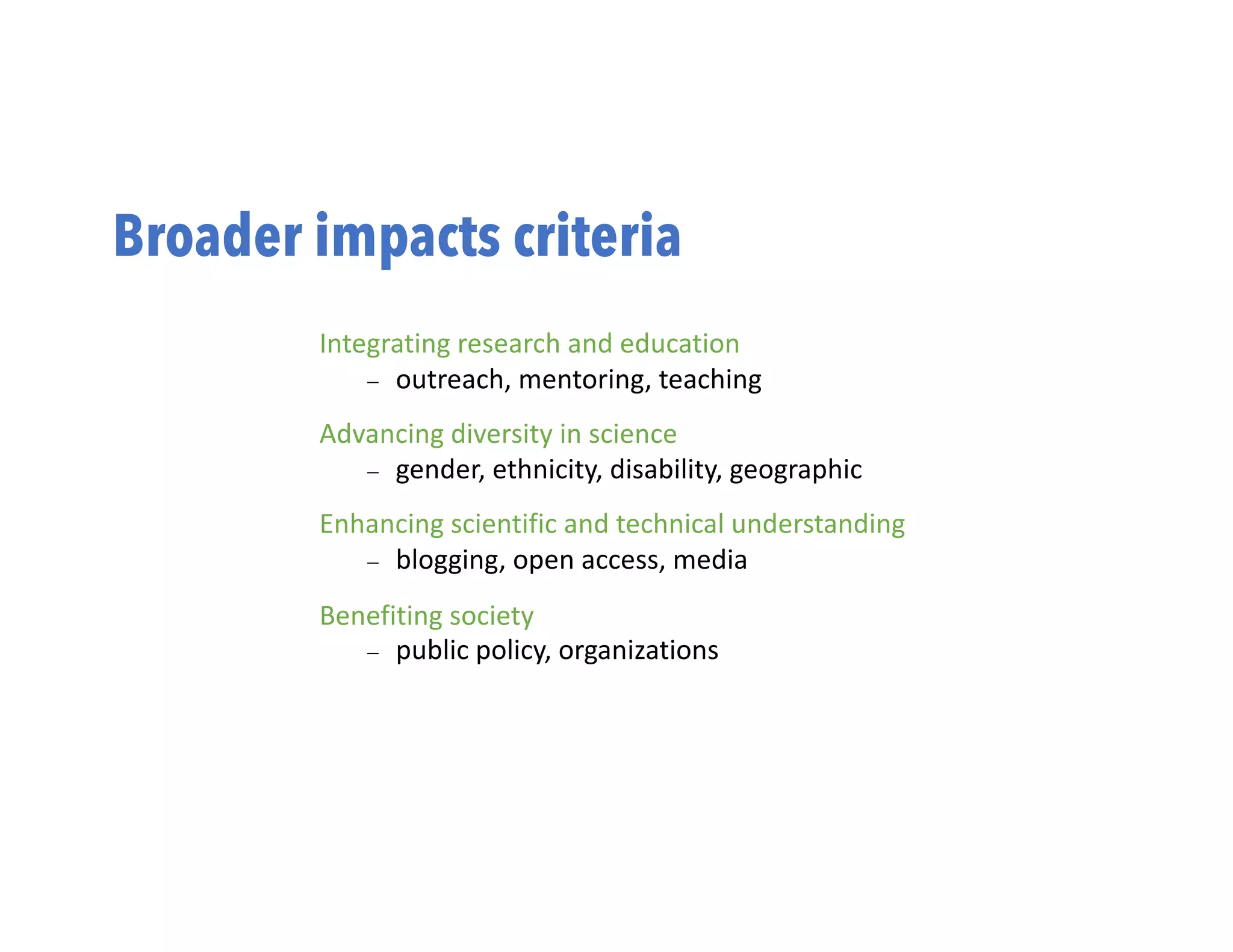
Broader impacts criteria
Integrating research and education
- outreach, mentoring, teaching
Advancing diversity in science
- gender, ethnicity, disability, geographic
Enhancing scientific and technical understanding
- blogging, open access, media
Benefiting society
- public policy, organizations
What are NOT broader impacts?
Biomedical impacts (can mention but do not emphasize)
Intellectual merit (advancing knowledge)
Example
• I will study ________ (specific research topic) to learn more about
_______ (broader, important topic)
INTELLECTUAL MERIT
• I will study ________ (specific research topic) to [help disadvantaged
population]/[increase agricultural productivity]/[protect environment
from climate change]/etc..
BROADER IMPACTS
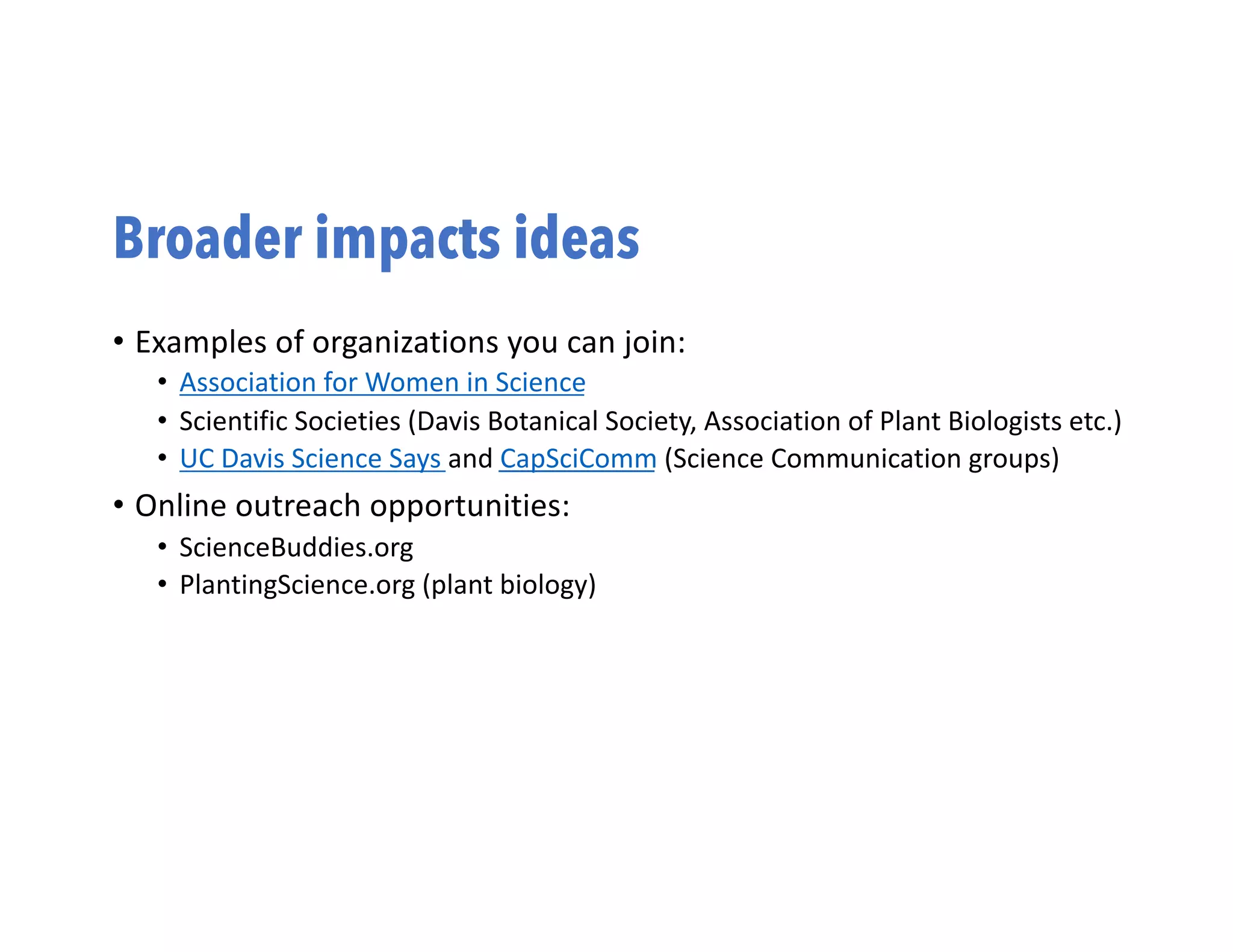
Broader impacts ideas
• Examples of organizations you can join:
• Association for Women in Science
• Scientific Societies (Davis Botanical Society, Association of Plant Biologists etc.)
• UC Davis Science Says and CapSciComm (Science Communication groups)
• Online outreach opportunities:
• ScienceBuddies.org
• PlantingScience.org (plant biology)
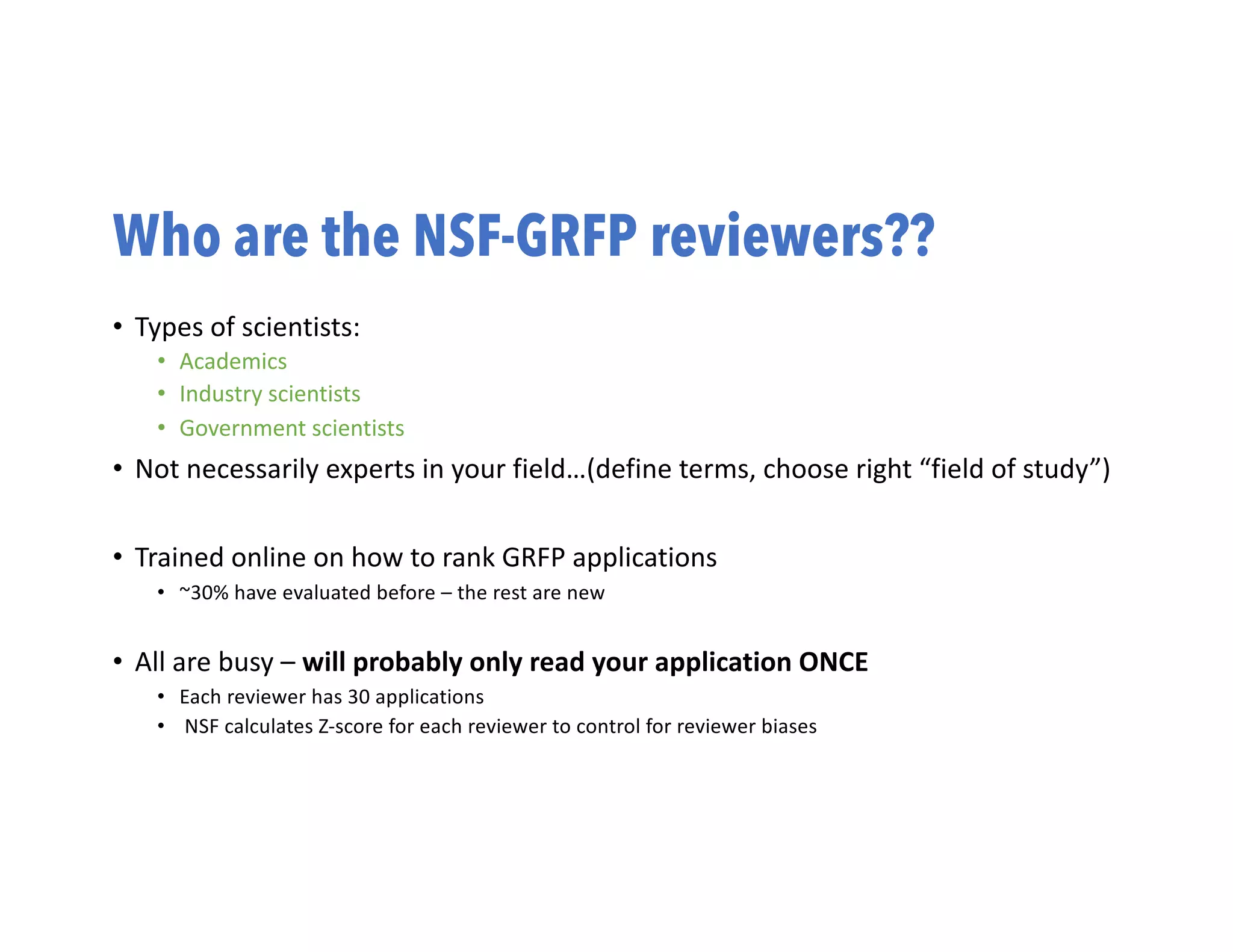
Who are the NSF-GRFP reviewers??
• Types of scientists:
• Academics
• Industry scientists
• Government scientists
• Not necessarily experts in your field…(define terms, choose right “field of study”)
• Trained online on how to rank GRFP applications
• ~30% have evaluated before – the rest are new
• All are busy – will probably only read your application ONCE
• Each reviewer has 30 applications
• NSF calculates Z-score for each reviewer to control for reviewer biases
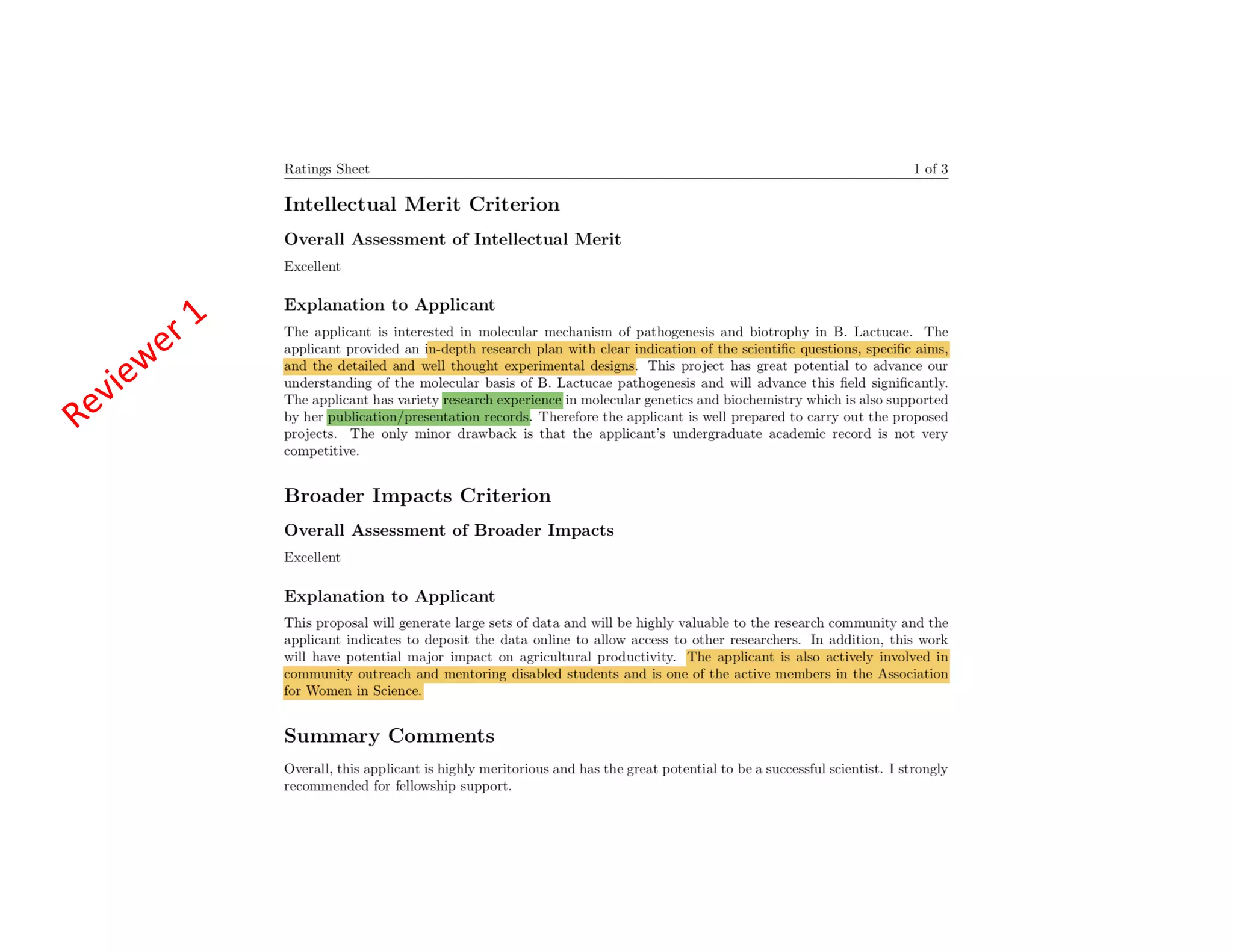
Reviewer 1
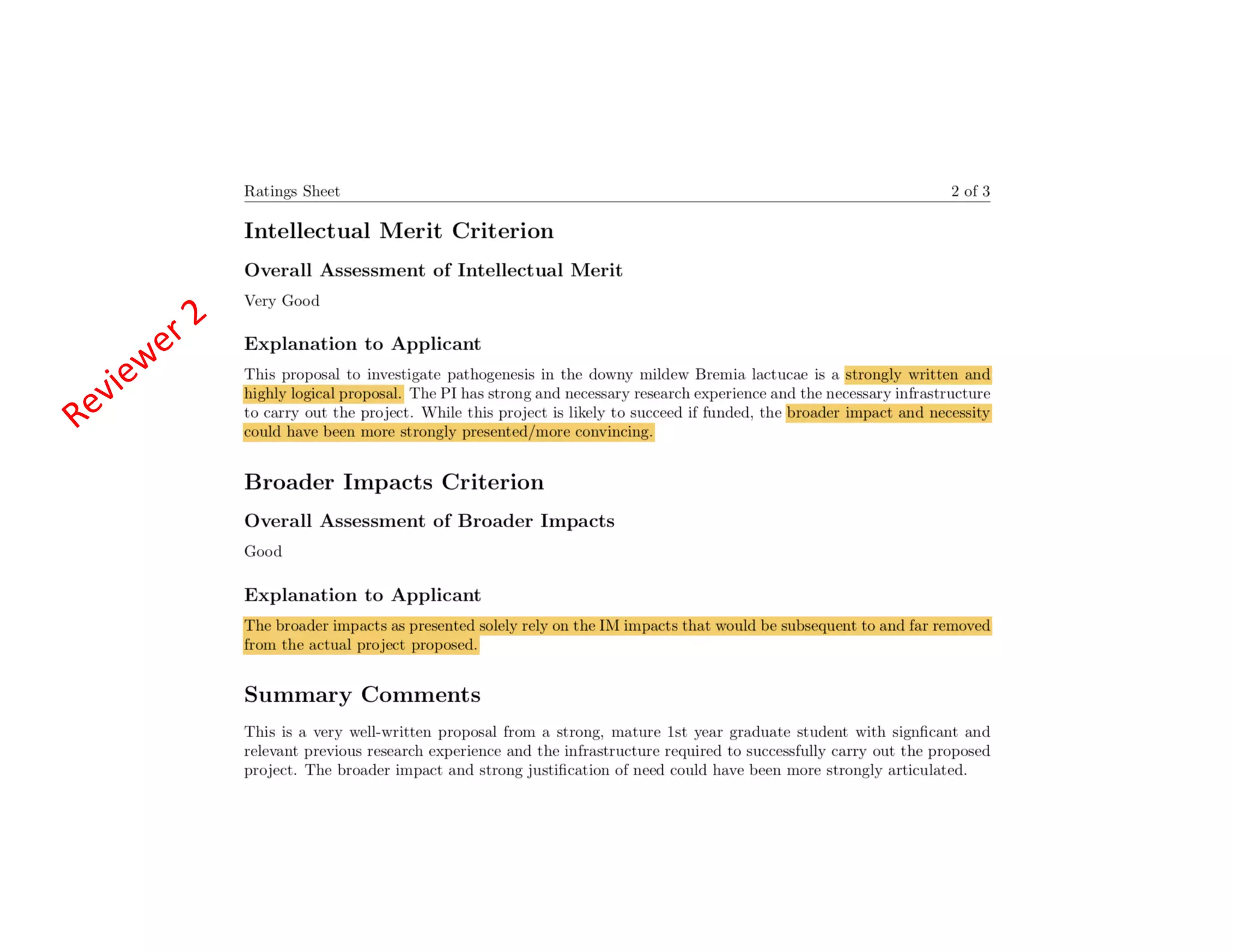
Reviewer 2
Procrastination – the invisible roadblock
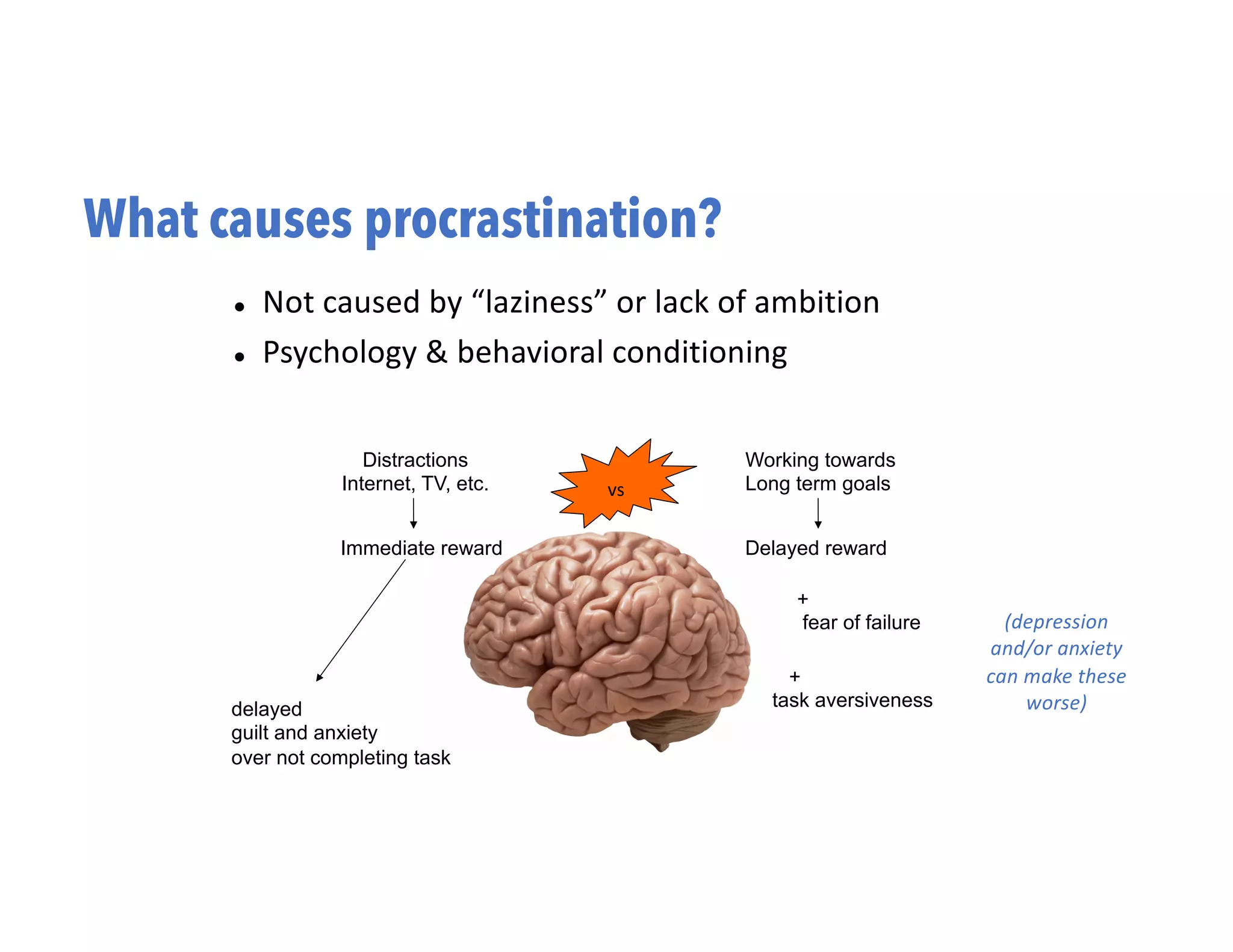
What causes procrastination?
l Not caused by “laziness” or lack of ambition
l Psychology & behavioral conditioning
Immediate reward
Working towards
Long term goals
Distractions
Internet, TV, etc.
Delayed reward
+
fear of failure
+
task aversiveness
delayed
guilt and anxiety
over not completing task
vs
(depression
and/or anxiety
can make these
worse)
Techniques for dealing with procrastination
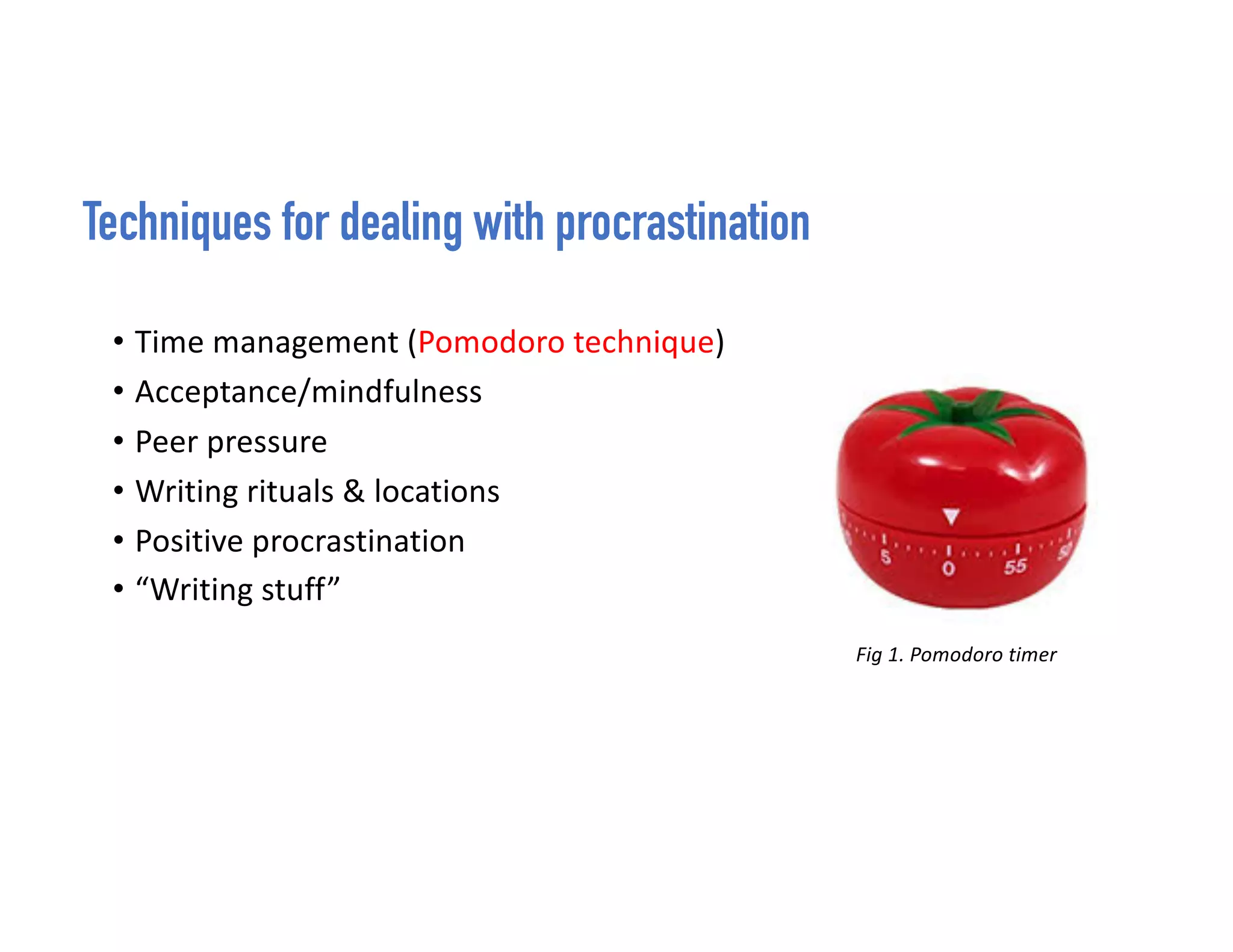
• Time management (Pomodoro technique)
• Acceptance/mindfulness
• Peer pressure
• Writing rituals & locations
• Positive procrastination
• “Writing stuff”
Fig 1. Pomodoro timer
Suggested Timeline
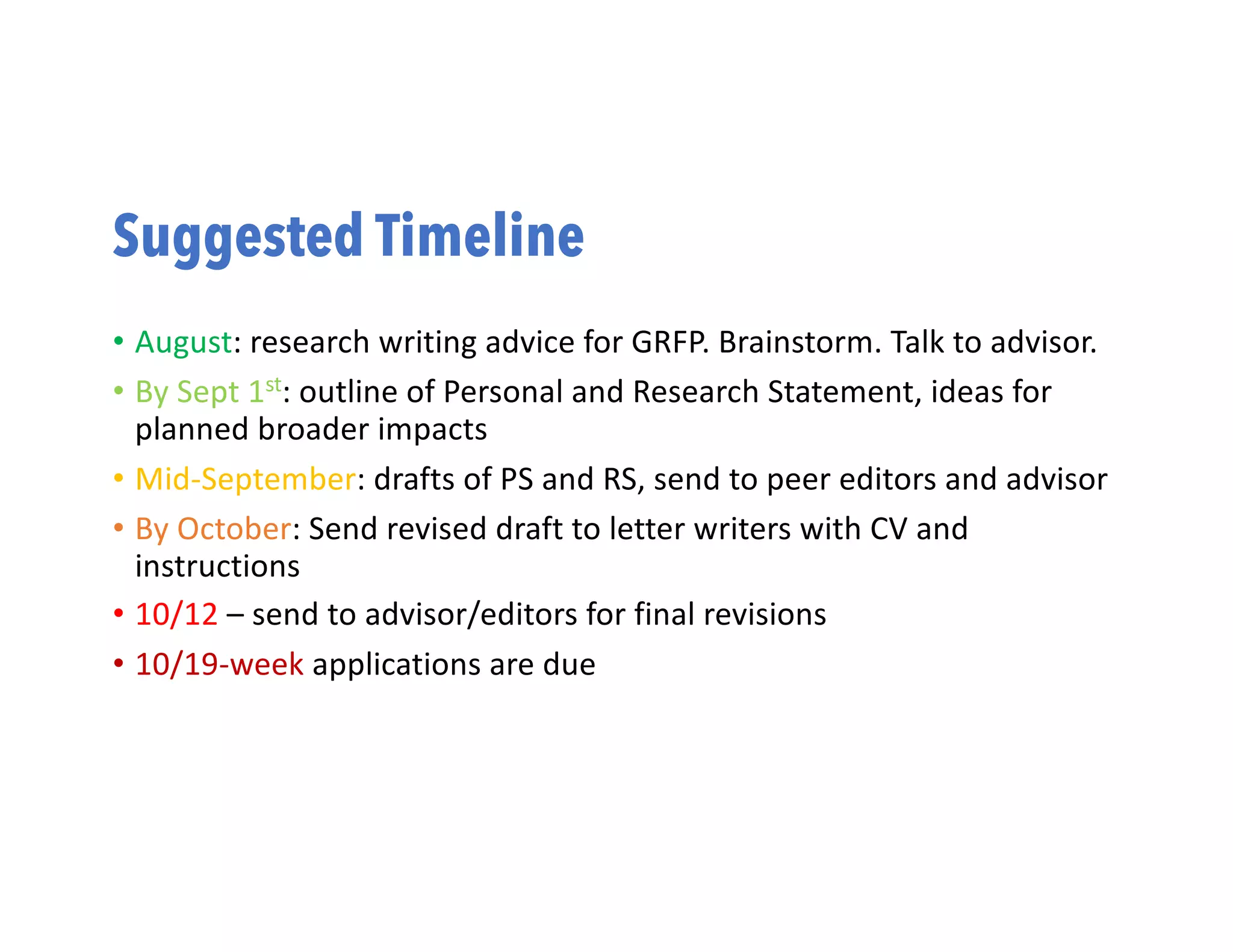
• August: research writing advice for GRFP. Brainstorm. Talk to advisor.
• By Sept 1st: outline of Personal and Research Statement, ideas for
planned broader impacts
• Mid-September: drafts of PS and RS, send to peer editors and advisor
• By October: Send revised draft to letter writers with CV and
instructions
• 10/12 – send to advisor/editors for final revisions
• 10/19-week applications are due
What should you do now?
• Read up on resources, example essays
• Begin planning your broader impact activities!
• Join a peer editing group with others at your institution
• Consider enrolling in an online course on the GRFP

NSF-GRFP: What you need to know (2020)

  • 1.
    WHAT YOU NEEDTO KNOW by Kelsey Wood, PhD, NSF-GRF ’14 More information at grfp.info Introduction to the NSF
  • 2.
    What do Iknow about writing fellowships and grants? • NSF-GRFP Fellow 2014 • USDA AFRI-NIFA Predoctoral Fellow 2017 • Lead NSF-GRFP workshops at UC Davis attended by 100+ students • Taught in-depth courses on grant writing for graduate students
  • 3.
    Why apply forfellowships? MONEY FREEDOM FAME You could earn a livable wage! 3 years of $34,000/year stipend+ $12,000 institutional expense Additional funding opps for international collabs (GROW) and internships (GRIP) Your PI can no longer tell you what to do You don’t have to TA Boost your CV and gain recognition Winning awards and fellowships leads to winning more awards and fellowships Also it’s good practice: writing grants and selling yourself & your research will be a part of your job in academia
  • 4.
    Who wins thesefellowships? • Grad students with high potential to become leaders in their field • 2000 awardees out of ~13000 applicants (~15% acceptance rate) • Number of NSF-GRFP Awardees at UC Davis: • 2020: 9 • 2019: 11 • 2018: 18 • 2017: 15 • 2016: 22 • 2015: 25 • 2014: 22 Biomedical Engineering 0.7% Chemistry 11.0% Comp/IS/Eng 5.3% Engineering 25.7% Geosciences 4.0% Life Sciences 26.1% Materials Research 1.0% Math 3.8% Physics 5.8% Psychology 6.9% Social Sciences 9.0% STEM Education 0.5% NSF-GRFP Awardees 2009-2014 by Field of Study Data from Fastlane R code & clean data for analysis on github.com/kelseywood
  • 5.
    Who is eligiblefor the NSF-GRFP? • U.S. citizens, nationals, and permanent residents • Pursuing research-based MS or PhD in eligible STEM fields • Biomedical related research allowed but must be focused on basic science or advancement of engineering principles • Social sciences allowed and encouraged • No dual degrees (MD/PhD, DVM/PhD, JD/PhD, etc.) • Academic Levels: • 1: Undergrad Seniors/Pre-grad school (no graduate study) • 2: First-year graduate students • 3: Second-year grad students • – ≤ 12 months of graduate study by August • 4: >12 months graduate study • – Interruption in graduate study of 2+ years (can have MS degree)
  • 6.
    When should youapply? • Undergraduate/pre-first year if: • you are definitely applying to grad school this year (need to pick *one* institution for your research statement) • First year if: • You have publications from undergrad/pre-doc research • You have joined a lab or rotating but know which lab you want to join • Receiving the fellowship would influence which lab you would join • You have something solid to write about for your research proposal • Second year if: • You will have publication(s) by next year • You don’t have any idea what lab you will join or what you will be working on if rotating • You will have preliminary results by next year
  • 7.
    “But should Iapply???” • Common concerns: • Poor undergrad GPA -> explain or compensate in Personal Statement • Lack of research experience -> explain in PS, or wait until 2nd year to apply • Lack of broader impacts -> use non-science examples, have a lot of planned BI • Too busy to write -> start early, use deadlines • Bottom line: • Even if you don’t win, the experience is highly valuable • You win 0% of fellowships that you don’t apply for J
  • 8.
    What about thenew “priority areas”?!? • From the 2021 Solicitation: “Although NSF will continue to fund outstanding Graduate Research Fellowships in all areas of science and engineering supported by NSF, in FY2021, GRFP will emphasize three high priority research areas in alignment with NSF goals. These areas are Artificial Intelligence, Quantum Information Science, and Computationally Intensive Research. Applications are encouraged in all disciplines supported by NSF that incorporate these high priority research areas”
  • 9.
    What about thenew “priority areas”?!? • My thoughts: it is a political ploy by the NSF to not have the GRFP program budget cut by the administration • Don’t worry about it – but if it makes sense to include the priority areas in your proposal then do it Source: https://www.nature.com/articles/d41586-020-02272-x
  • 10.
    The NSF-GRFP Application •Personal, Relevant Background and Future Goals Statement (3 pages) • Graduate Research Statement (2 pages) • Undergraduate & Graduate Transcripts • Three letters of reference • Fastlane extras: List of fellowships, scholarships, teaching and work experiences relevant to your field of study; List of significant academic honors, publications, and presentations
  • 11.
    Official NSF Criteria IntellectualMerit: your potential to advance knowledge • Academic performance; grades, courses, awards, etc. • Graduate Research proposal • Research/professional experience • Reference letters Broader Impacts: your potential to benefit society and contribute to the achievement of specific, desired societal outcomes. • Outreach experience • Potential benefits to society of your research • Personal background • Reference letters NSF requires a separate section with its own header for Intellectual Merit and Broader Impacts in each statement
  • 12.
    Personal Statement, RelevantBackground, Future Goals • Introduce yourself as a scientist and as a person • Be unique and memorable without being cliché • Relevant background = your CV in paragraph format • Demonstrate that you have the experience to be successful in grad school • Future goals: include why do you want to be a professor in academia
  • 13.
    How much dogrades matter? • You don’t need a 4.0 GPA to win the GRFP • It really depends on the reviewer • Major GPA is more important than overall GPA • Provide explanation in personal statement – can use it to demonstrate resilience if your grades improved after a hardship • Actual evaluations from NSF reviewers: • 3.8 (science), 3.4 (overall) = “outstanding GPA” • 3.68 = “good academic record” • 3.68 = “not very competitive” • 3.46 = “kind of low” • 3.3 = “average GPA” • HOWEVER! GPA is only one minor part of the application. If you write a stellar proposal + have excellent broader impacts + glowing letters of rec, that is more important than GPA ???
  • 14.
    How much dogrades matter?
  • 15.
    Letters of Recommendation lNSF recommends at least 3 letters of rec (applications with only 2 will be read but not likely to be as strong) l You can ask for up to 5 people to write you letters as backups l I’d recommend asking for 4 –or 3 if you are 100% sure they will all get them in on time l Give your letter writers a heads up NOW l Who should you ask? l Your current graduate advisor* ~must have as a 2nd year, should comment on originality of proposal l Former research supervisor(s) l Someone who can speak to your broader impacts l Professors that adored you l If you do have low grades to explain, have one of your letter writers vouch for your academic abilities • Send them the NSF-GRFP instructions, ask what you’d like them to emphasize, send them a copy of your personal & research statements and CV **MAKE SURE LETTER WRITERS SUBMIT THEIR LETTERS ON TIME!!!**
  • 16.
    Research Statement: Whatshould you write about? l 2nd year: your research (with prelim findings) l 1st year: your research - rotating: 1st rotation or the lab you want to join - ideally you already have some background knowledge - Or pick something that builds off of your undergrad/pre-doc research l Undergrad: your undergrad research or make something up (challenging) l Talk to your PI early and often! l Focus topic – don’t be vague or talk about multiple topics l Hypothesis-driven research best l Basic research (emphasize science over applications)
  • 17.
    Research Statement: Whatshould you write about? • Keep in mind: • You don’t actually have to do your proposed research • NSF funds the person not the research
  • 18.
    Are broader impactsactually important? YES! YES! YES! YES! YES! YES! YES! YES! YES! YES!
  • 19.
    Incorporating broader impacts •In personal statement: • highlight past/current activities • even if non science related! • any volunteer work, international work, peer tutoring, etc. • describe future plans in detail • Join a club and sign up for outreach activities NOW • In research statement: l Societal benefits – US economy, environment, climate change l Will you share results? Blog about research? Present to public/stakeholders? l Present research at conferences, publish papers, deposit data online l Train undergrads, outreach to underrep. communities l Propose a specific outreach activity to go along with your research
  • 20.
    Broader impacts criteria Integratingresearch and education - outreach, mentoring, teaching Advancing diversity in science - gender, ethnicity, disability, geographic Enhancing scientific and technical understanding - blogging, open access, media Benefiting society - public policy, organizations
  • 21.
    What are NOTbroader impacts? Biomedical impacts (can mention but do not emphasize) Intellectual merit (advancing knowledge)
  • 22.
    Example • I willstudy ________ (specific research topic) to learn more about _______ (broader, important topic) INTELLECTUAL MERIT • I will study ________ (specific research topic) to [help disadvantaged population]/[increase agricultural productivity]/[protect environment from climate change]/etc.. BROADER IMPACTS
  • 23.
    Broader impacts ideas •Examples of organizations you can join: • Association for Women in Science • Scientific Societies (Davis Botanical Society, Association of Plant Biologists etc.) • UC Davis Science Says and CapSciComm (Science Communication groups) • Online outreach opportunities: • ScienceBuddies.org • PlantingScience.org (plant biology)
  • 24.
    Who are theNSF-GRFP reviewers?? • Types of scientists: • Academics • Industry scientists • Government scientists • Not necessarily experts in your field…(define terms, choose right “field of study”) • Trained online on how to rank GRFP applications • ~30% have evaluated before – the rest are new • All are busy – will probably only read your application ONCE • Each reviewer has 30 applications • NSF calculates Z-score for each reviewer to control for reviewer biases
  • 25.
  • 26.
  • 27.
    Procrastination – theinvisible roadblock
  • 28.
    What causes procrastination? lNot caused by “laziness” or lack of ambition l Psychology & behavioral conditioning Immediate reward Working towards Long term goals Distractions Internet, TV, etc. Delayed reward + fear of failure + task aversiveness delayed guilt and anxiety over not completing task vs (depression and/or anxiety can make these worse)
  • 29.
    Techniques for dealingwith procrastination • Time management (Pomodoro technique) • Acceptance/mindfulness • Peer pressure • Writing rituals & locations • Positive procrastination • “Writing stuff” Fig 1. Pomodoro timer
  • 30.
    Suggested Timeline • August:research writing advice for GRFP. Brainstorm. Talk to advisor. • By Sept 1st: outline of Personal and Research Statement, ideas for planned broader impacts • Mid-September: drafts of PS and RS, send to peer editors and advisor • By October: Send revised draft to letter writers with CV and instructions • 10/12 – send to advisor/editors for final revisions • 10/19-week applications are due
  • 31.
    What should youdo now? • Read up on resources, example essays • Begin planning your broader impact activities! • Join a peer editing group with others at your institution • Consider enrolling in an online course on the GRFP