Gail E. Gasparich, Ph.D.
Associate Dean, Fisher College of
Science and Mathematics
Towson University
STRATEGIES FOR
EFFECTIVE GRANT
WRITING
Workshop Questions:
1.Where do you search for appropriate
funding sources?
2.What should you know before
beginning the grant writing process?
3.What are the main components of a
research grant (Best Practices and What
to Avoid)?
4.What is the general grant review
process?
5.What if you do not get funded?
What is a Grant?
♦ A sum of money given by an organization
(esp. a government) for a particular purpose
♦ What would be your expectations as the
grantor?
– Return on investment
– Worthy of risk
♦ You have to become a salesperson of sorts
—convince the grantor your idea is worthy
of funding
STEM Granting Agencies
♦ Government
♦ Foundations/Non-Profit Organizations
♦ Business and Industry (e.g. contracts)
Important Considerations
♦ Be aware of the mission and criteria of the
funding agency
– Read RFPs/RFAs carefully (Request for
Proposal/Application)
– Discuss ideas with Program Officers (check fit)
– Review recently funded grants by same
program
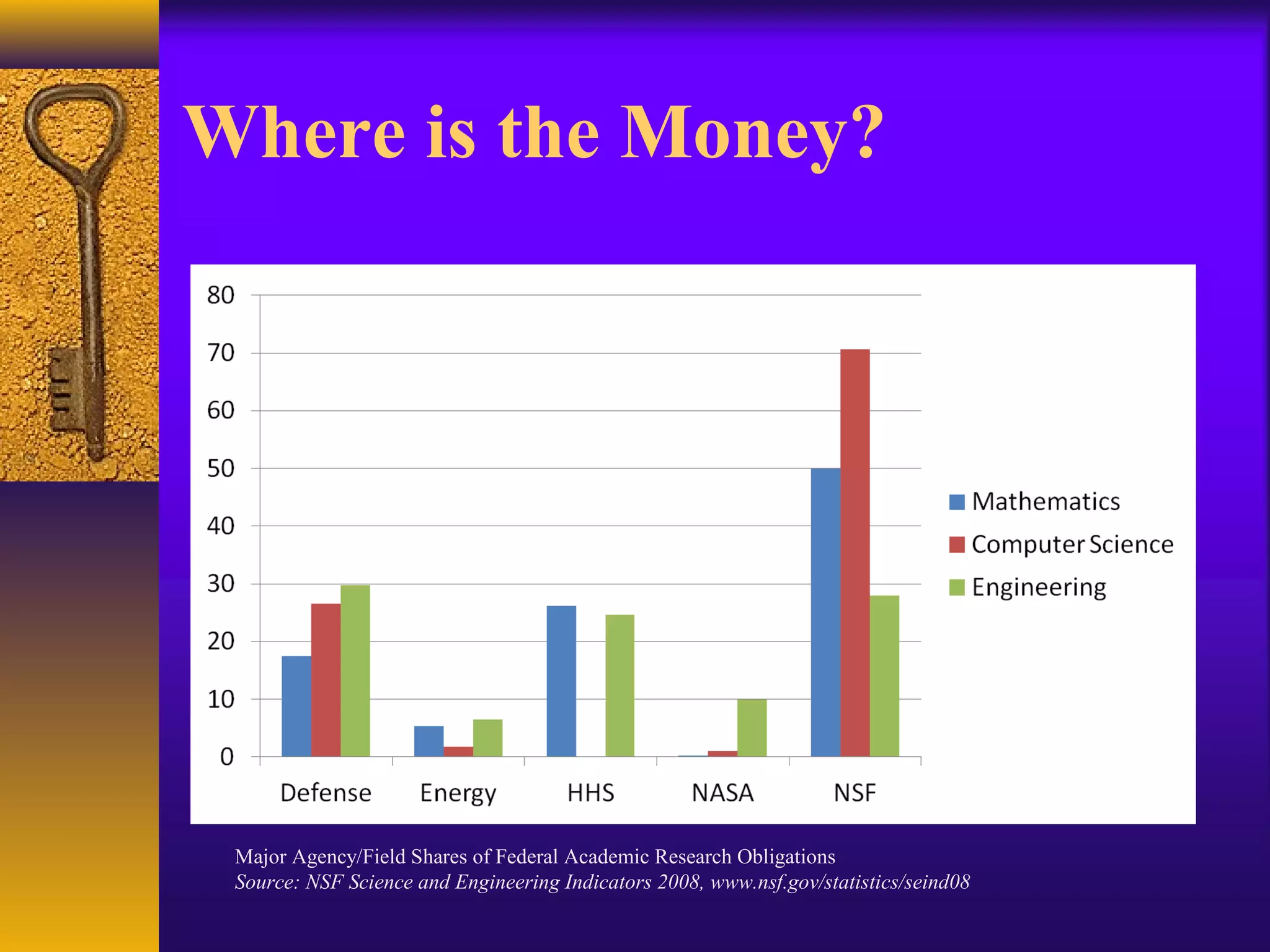
Where is the Money?
Major Agency/Field Shares of Federal Academic Research Obligations
Source: NSF Science and Engineering Indicators 2008, www.nsf.gov/statistics/seind08
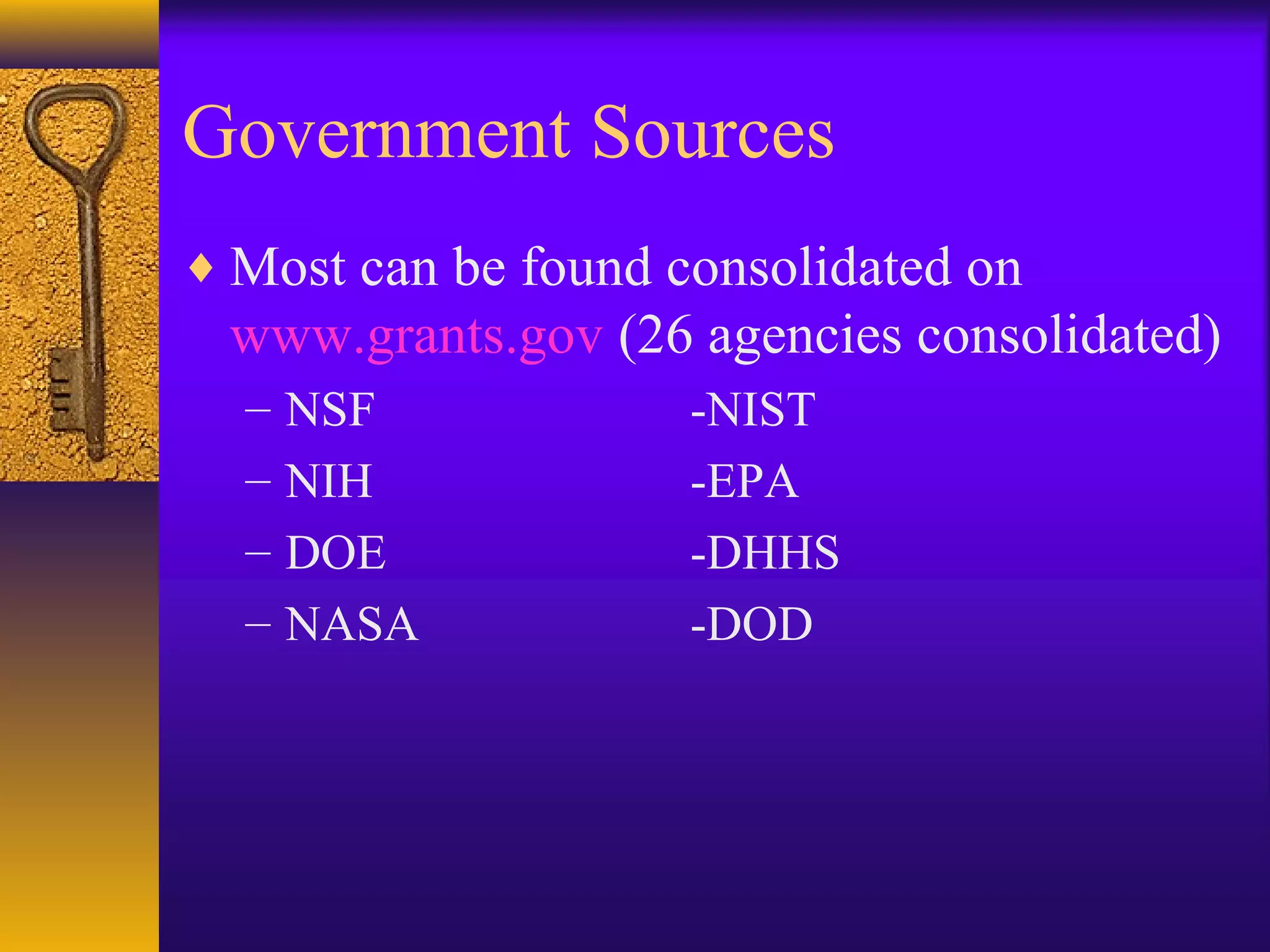
Government Sources
♦ Most can be found consolidated on
www.grants.gov (26 agencies consolidated)
– NSF -NIST
– NIH -EPA
– DOE -DHHS
– NASA -DOD
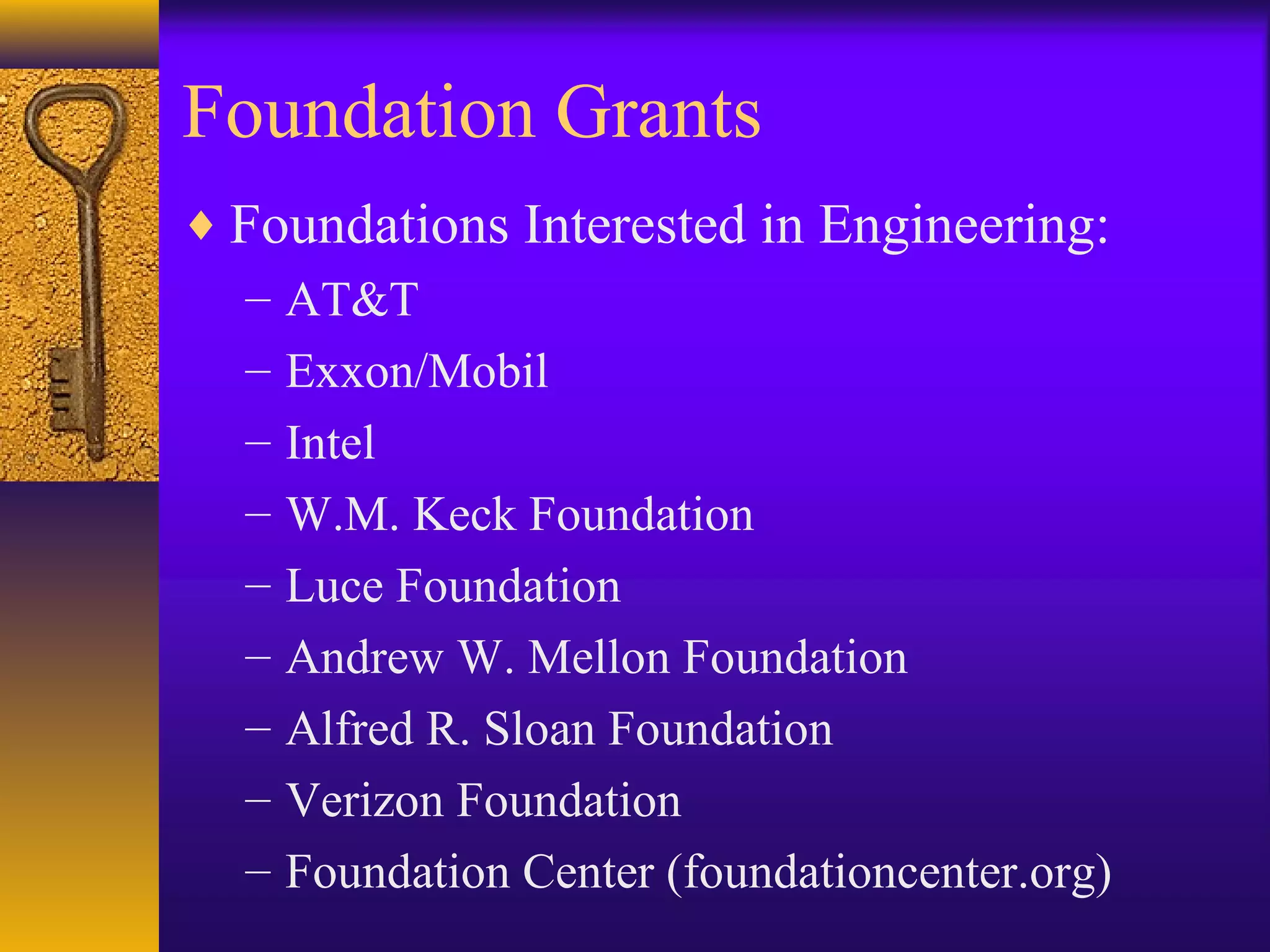
Foundation Grants
♦ Foundations Interested in Engineering:
– AT&T
– Exxon/Mobil
– Intel
– W.M. Keck Foundation
– Luce Foundation
– Andrew W. Mellon Foundation
– Alfred R. Sloan Foundation
– Verizon Foundation
– Foundation Center (foundationcenter.org)
Databases Requiring Institutional
Subscriptions
♦ GrantSelect
♦ SPIN (Sponsored Programs Information
Network)
♦ ResearchResearch
♦ IRIS (Illinois Research Information
Service)
♦ GRC (Grants Resource Center)
♦ COS (Community of Science)
♦ Grant Advisor Plus
Getting Started!
♦ Review Guidelines Carefully!
♦ Contact the Program Officer
♦ Review Abstracts of Past Awardees
♦ Contact your Sponsored Project Office
♦ Create a Timeline for Preparation
♦ Organize Narrative Outline Following the
Sequence of Components in RFP/RFA
Title
♦ The reader’s first impression
♦ Should capture and intrigue the reader
♦ Should be clear, concise and meaningful
♦ Too detailed appears too narrow and too
broad appears unachievable
Elevator Speech Activity
1.Find a partner
2.In two minutes convey your project to
them and then switch
3.Try to cover the following:
What is the problem you are
addressing?
How will you address it?
What is the significance?
What is the likelihood of success?
Summary
♦ Written last to summarize, aim for non-
technical audience and will be made public
if funded
♦ What do you intend to do and why is it important?
♦ How are you going to do it and what has already
been done?
♦ Why are you, rather than someone else, qualified
to do the project?
♦ What difference will the project make to: your
university, your students, your discipline, the
state, the nation, etc.?
GoalsObjectives/Specific
Aims
♦ AimsHypotheses driven and testable with
defined measurable outcomes
– based on new ideas
– should be succinct
– should be independent
♦ Potential Problems with specific aims:
Too ambitious, Too much work proposed;
Unfocused and/or limited aims
Background and Significance
♦ Why is the problem important to the agency?
♦ What have others done to address this problem
and why wasn’t that sufficient? (Literature
Review)
♦ What do you plan to do that is different from
previous studies?
♦ How will your research have an impact on the
public?
♦ Why is your plan novel, cutting edge, and
exciting?
Literature Review
♦ Support proposal’s significance with a
balanced literature review
♦ Establishes the framework for the study
♦ Demonstrates your knowledge of the field
♦ Incorporate references that support and
conflict with your contentions if appropriate
♦ Be as comprehensive as possible—never
know who will be a reviewer
♦ Include your work to show expertise!
Preliminary Data
♦ Your chance to highlight your ability to be
successful with what you propose
♦ Demonstrate feasibility of project
♦ Data should be unequivocal and clearly
presented
♦ Discuss limitations
♦ Balance unpublished data with published
work
Experimental Design
♦ Organize according to specific aims
♦ Provide enough detail (published vs.
unpublished) including controls
♦ Provide alternate approaches
♦ Justify the approach you will use
♦ Explain how data will be collected,
analyzed and interpreted
♦ Discuss potential difficulties and limitations
Experimental Design (cont.)
♦ Potential problems:
– Inappropriate level of experimental detail
– Feasibility of each aim not shown
– Little or no expertise with approach
– Lack of appropriate controls
– No discussion of alternative models or
hypotheses
– No discussion of potential pitfalls
– No discussion of interpretation of data
Personnel Qualifications
♦ Indicate your expertise in the area
♦ PI vs. co-PI
♦ Collaborators
♦ Bottom Line-Are investigators competent to
perform the experiments described in the
proposal
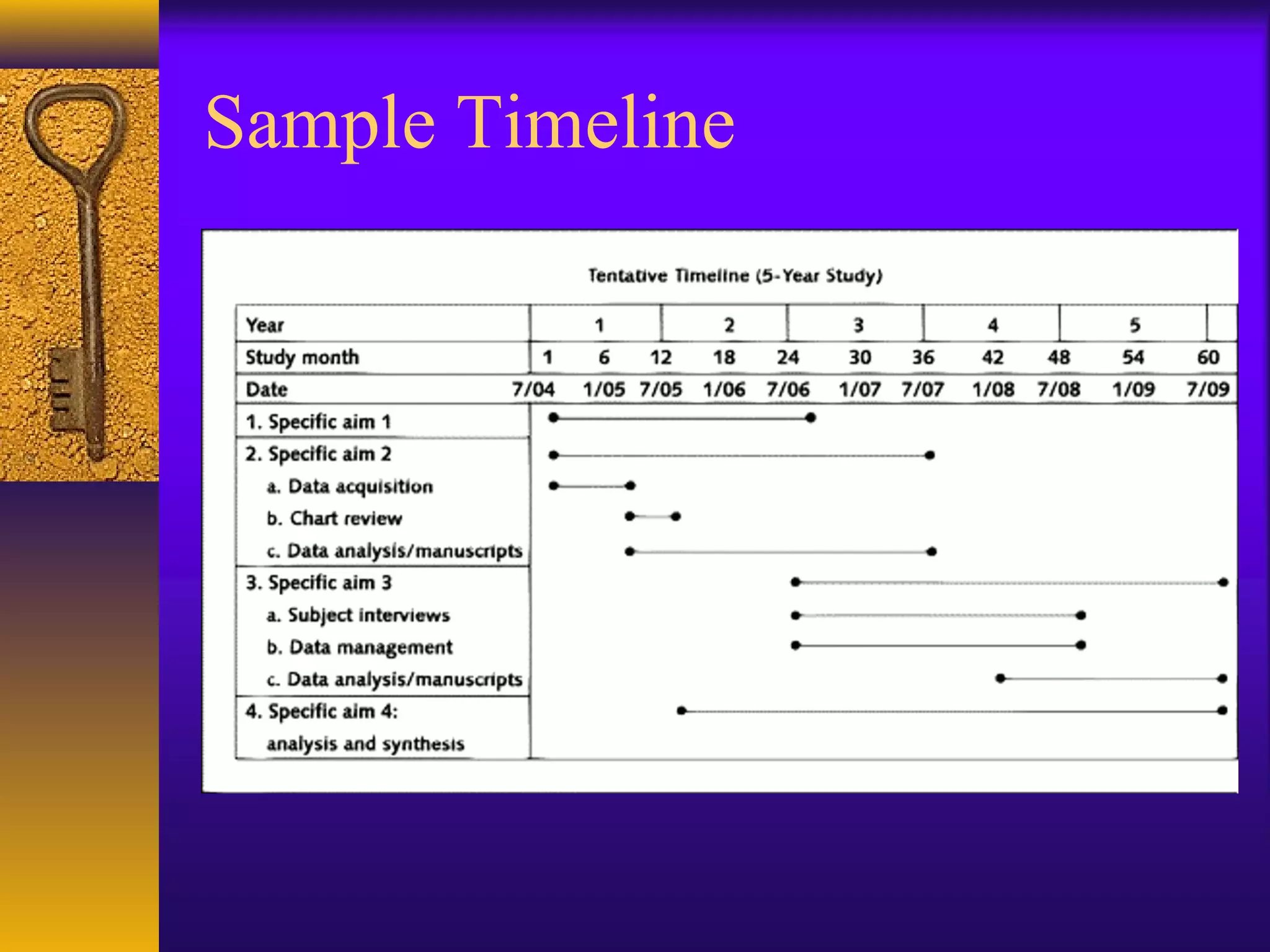
Timeline
♦ BE REALISTIC
♦ Not too overly ambitious
♦ Show you are familiar with the techniques
and know how long it should take for each
of your objectives
♦ Good place to use a graphic to save space
Sample Timeline
Broader Impacts
♦ Includes discovery, increasing knowledge
base (basic and applied), promoting
teaching, training and learning
– Technology transfer
– Science policy influence
– K-16 STEM education and teacher
development-broadening participation
– Increase science literacy and public
engagement
– Broad dissemination of results
References Cited
♦ List all relevant literature
♦ You never know who will be reviewing!
Budget
♦ Be realistic--Do not be excessive or a
bargain-be "just right"
♦ Check what is allowable and median
funding level in RFP/RFA to use as guide
♦ Direct Costs: Personnel costs, Tuition
remission, travel expenses, equipment and
maintenance, supplies, consultants, pub
costs, etc.
♦ Indirect Costs: “Tax” to university for
overhead—rate negotiated with agency
Budget Justification
♦ Explain time and effort for salary and wages-
describe what each person will be doing
♦ Explain why equipment is needed
♦ Explain specifics on travel (what meeting, when,
who to go)
♦ Explain supply budget (in sufficient detail to
demonstrate you have anticipated needs for
proposal)
♦ Cost share??? Only if needed usually
Appendices
♦ Only if allowed—read RFP/RFA carefully
♦ Letters from collaborators showing
agreement with what is written and what
their role will be
SWEAT THE SMALL STUFF!
♦ Follow the guidelines (font size, font type,
margins, page limits….)
♦ PROOFREAD
♦ Get outside critiques
♦ Use “friendly” writing style for reviewers
Grant Review Process
♦ May request someone be excluded as reviewer
♦ Grant submitted and reviewed for general
compliance and fit to guidelines (6-9+ months)
♦ Sent out for review (ad hoc)
♦ Review by grant panel
♦ Program or foundation officers determine funding
based on panel review
♦ Might be follow up questions and budget issues to
grantee before final answer
Foundation Requests
♦ May require letter of inquiry and/or pre-
proposal (~3 pages):
– succinct description of problem
– proposed project
– your qualifications
Determine if the fit is right to get invitation to
submit a formal proposal
Rejection…………..
♦ Allow 8 hours of depression and
commiserate with friends, then….
♦ Use the comments to make a better proposal
♦ Resubmit an improved proposal (address
ALL comments and questions)
♦ Usually 3-4 attempts max-then move on to
modified or different project
Key Points
♦ Match the mission of the funding agency
♦ Read funded grants and talk to program
officer
♦ Follow the instructions
♦ Make friends with your Institutional
Sponsored Projects officer
Questions?
Contact Information:
Gail Gasparich
ggasparich@towson.edu
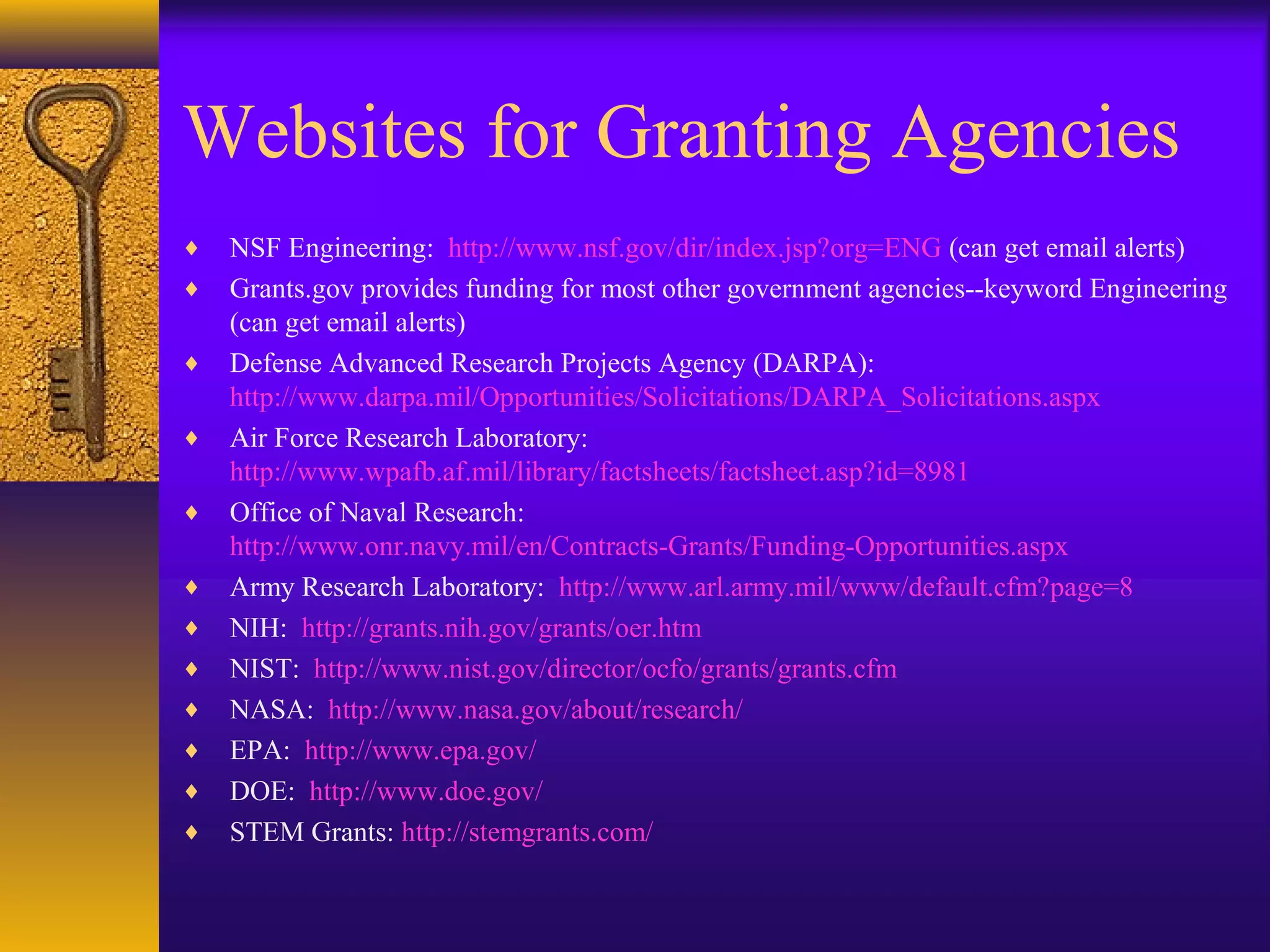
Websites for Granting Agencies
♦ NSF Engineering: http://www.nsf.gov/dir/index.jsp?org=ENG (can get email alerts)
♦ Grants.gov provides funding for most other government agencies--keyword Engineering
(can get email alerts)
♦ Defense Advanced Research Projects Agency (DARPA):
http://www.darpa.mil/Opportunities/Solicitations/DARPA_Solicitations.aspx
♦ Air Force Research Laboratory:
http://www.wpafb.af.mil/library/factsheets/factsheet.asp?id=8981
♦ Office of Naval Research:
http://www.onr.navy.mil/en/Contracts-Grants/Funding-Opportunities.aspx
♦ Army Research Laboratory: http://www.arl.army.mil/www/default.cfm?page=8
♦ NIH: http://grants.nih.gov/grants/oer.htm
♦ NIST: http://www.nist.gov/director/ocfo/grants/grants.cfm
♦ NASA: http://www.nasa.gov/about/research/
♦ EPA: http://www.epa.gov/
♦ DOE: http://www.doe.gov/
♦ STEM Grants: http://stemgrants.com/
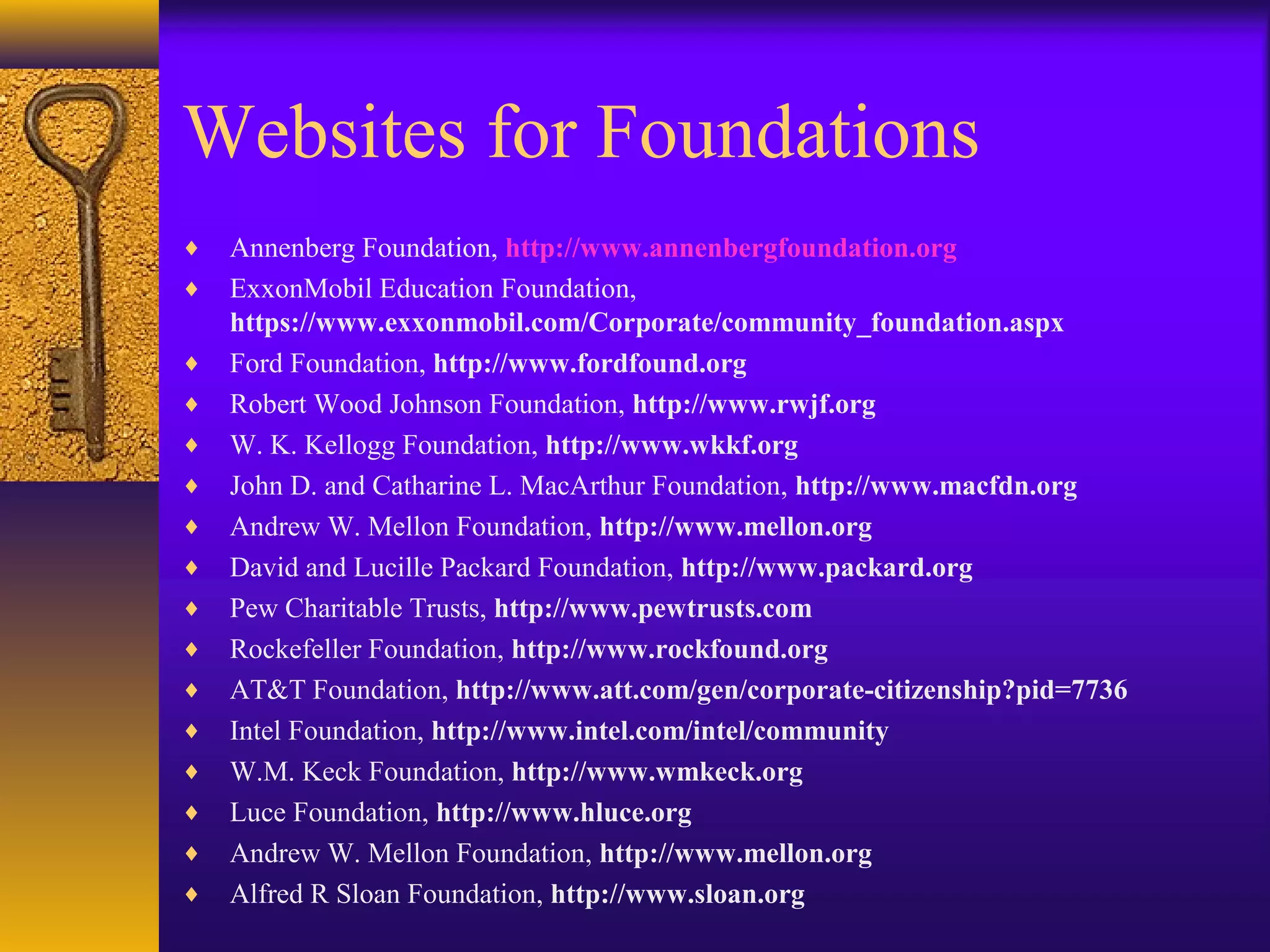
Websites for Foundations
♦ Annenberg Foundation, http://www.annenbergfoundation.org
♦ ExxonMobil Education Foundation,
https://www.exxonmobil.com/Corporate/community_foundation.aspx
♦ Ford Foundation, http://www.fordfound.org
♦ Robert Wood Johnson Foundation, http://www.rwjf.org
♦ W. K. Kellogg Foundation, http://www.wkkf.org
♦ John D. and Catharine L. MacArthur Foundation, http://www.macfdn.org
♦ Andrew W. Mellon Foundation, http://www.mellon.org
♦ David and Lucille Packard Foundation, http://www.packard.org
♦ Pew Charitable Trusts, http://www.pewtrusts.com
♦ Rockefeller Foundation, http://www.rockfound.org
♦ AT&T Foundation, http://www.att.com/gen/corporate-citizenship?pid=7736
♦ Intel Foundation, http://www.intel.com/intel/community
♦ W.M. Keck Foundation, http://www.wmkeck.org
♦ Luce Foundation, http://www.hluce.org
♦ Andrew W. Mellon Foundation, http://www.mellon.org
♦ Alfred R Sloan Foundation, http://www.sloan.org

Strategies for Effective Grant Writing

  • 1.
    Gail E. Gasparich,Ph.D. Associate Dean, Fisher College of Science and Mathematics Towson University STRATEGIES FOR EFFECTIVE GRANT WRITING
  • 2.
    Workshop Questions: 1.Where doyou search for appropriate funding sources? 2.What should you know before beginning the grant writing process? 3.What are the main components of a research grant (Best Practices and What to Avoid)? 4.What is the general grant review process? 5.What if you do not get funded?
  • 3.
    What is aGrant? ♦ A sum of money given by an organization (esp. a government) for a particular purpose ♦ What would be your expectations as the grantor? – Return on investment – Worthy of risk ♦ You have to become a salesperson of sorts —convince the grantor your idea is worthy of funding
  • 4.
    STEM Granting Agencies ♦Government ♦ Foundations/Non-Profit Organizations ♦ Business and Industry (e.g. contracts)
  • 5.
    Important Considerations ♦ Beaware of the mission and criteria of the funding agency – Read RFPs/RFAs carefully (Request for Proposal/Application) – Discuss ideas with Program Officers (check fit) – Review recently funded grants by same program
  • 6.
    Where is theMoney? Major Agency/Field Shares of Federal Academic Research Obligations Source: NSF Science and Engineering Indicators 2008, www.nsf.gov/statistics/seind08
  • 7.
    Government Sources ♦ Mostcan be found consolidated on www.grants.gov (26 agencies consolidated) – NSF -NIST – NIH -EPA – DOE -DHHS – NASA -DOD
  • 8.
    Foundation Grants ♦ FoundationsInterested in Engineering: – AT&T – Exxon/Mobil – Intel – W.M. Keck Foundation – Luce Foundation – Andrew W. Mellon Foundation – Alfred R. Sloan Foundation – Verizon Foundation – Foundation Center (foundationcenter.org)
  • 9.
    Databases Requiring Institutional Subscriptions ♦GrantSelect ♦ SPIN (Sponsored Programs Information Network) ♦ ResearchResearch ♦ IRIS (Illinois Research Information Service) ♦ GRC (Grants Resource Center) ♦ COS (Community of Science) ♦ Grant Advisor Plus
  • 11.
    Getting Started! ♦ ReviewGuidelines Carefully! ♦ Contact the Program Officer ♦ Review Abstracts of Past Awardees ♦ Contact your Sponsored Project Office ♦ Create a Timeline for Preparation ♦ Organize Narrative Outline Following the Sequence of Components in RFP/RFA
  • 12.
    Title ♦ The reader’sfirst impression ♦ Should capture and intrigue the reader ♦ Should be clear, concise and meaningful ♦ Too detailed appears too narrow and too broad appears unachievable
  • 13.
    Elevator Speech Activity 1.Finda partner 2.In two minutes convey your project to them and then switch 3.Try to cover the following: What is the problem you are addressing? How will you address it? What is the significance? What is the likelihood of success?
  • 14.
    Summary ♦ Written lastto summarize, aim for non- technical audience and will be made public if funded ♦ What do you intend to do and why is it important? ♦ How are you going to do it and what has already been done? ♦ Why are you, rather than someone else, qualified to do the project? ♦ What difference will the project make to: your university, your students, your discipline, the state, the nation, etc.?
  • 15.
    GoalsObjectives/Specific Aims ♦ AimsHypotheses drivenand testable with defined measurable outcomes – based on new ideas – should be succinct – should be independent ♦ Potential Problems with specific aims: Too ambitious, Too much work proposed; Unfocused and/or limited aims
  • 16.
    Background and Significance ♦Why is the problem important to the agency? ♦ What have others done to address this problem and why wasn’t that sufficient? (Literature Review) ♦ What do you plan to do that is different from previous studies? ♦ How will your research have an impact on the public? ♦ Why is your plan novel, cutting edge, and exciting?
  • 17.
    Literature Review ♦ Supportproposal’s significance with a balanced literature review ♦ Establishes the framework for the study ♦ Demonstrates your knowledge of the field ♦ Incorporate references that support and conflict with your contentions if appropriate ♦ Be as comprehensive as possible—never know who will be a reviewer ♦ Include your work to show expertise!
  • 19.
    Preliminary Data ♦ Yourchance to highlight your ability to be successful with what you propose ♦ Demonstrate feasibility of project ♦ Data should be unequivocal and clearly presented ♦ Discuss limitations ♦ Balance unpublished data with published work
  • 20.
    Experimental Design ♦ Organizeaccording to specific aims ♦ Provide enough detail (published vs. unpublished) including controls ♦ Provide alternate approaches ♦ Justify the approach you will use ♦ Explain how data will be collected, analyzed and interpreted ♦ Discuss potential difficulties and limitations
  • 21.
    Experimental Design (cont.) ♦Potential problems: – Inappropriate level of experimental detail – Feasibility of each aim not shown – Little or no expertise with approach – Lack of appropriate controls – No discussion of alternative models or hypotheses – No discussion of potential pitfalls – No discussion of interpretation of data
  • 22.
    Personnel Qualifications ♦ Indicateyour expertise in the area ♦ PI vs. co-PI ♦ Collaborators ♦ Bottom Line-Are investigators competent to perform the experiments described in the proposal
  • 23.
    Timeline ♦ BE REALISTIC ♦Not too overly ambitious ♦ Show you are familiar with the techniques and know how long it should take for each of your objectives ♦ Good place to use a graphic to save space
  • 24.
  • 25.
    Broader Impacts ♦ Includesdiscovery, increasing knowledge base (basic and applied), promoting teaching, training and learning – Technology transfer – Science policy influence – K-16 STEM education and teacher development-broadening participation – Increase science literacy and public engagement – Broad dissemination of results
  • 26.
    References Cited ♦ Listall relevant literature ♦ You never know who will be reviewing!
  • 27.
    Budget ♦ Be realistic--Donot be excessive or a bargain-be "just right" ♦ Check what is allowable and median funding level in RFP/RFA to use as guide ♦ Direct Costs: Personnel costs, Tuition remission, travel expenses, equipment and maintenance, supplies, consultants, pub costs, etc. ♦ Indirect Costs: “Tax” to university for overhead—rate negotiated with agency
  • 28.
    Budget Justification ♦ Explaintime and effort for salary and wages- describe what each person will be doing ♦ Explain why equipment is needed ♦ Explain specifics on travel (what meeting, when, who to go) ♦ Explain supply budget (in sufficient detail to demonstrate you have anticipated needs for proposal) ♦ Cost share??? Only if needed usually
  • 29.
    Appendices ♦ Only ifallowed—read RFP/RFA carefully ♦ Letters from collaborators showing agreement with what is written and what their role will be
  • 30.
    SWEAT THE SMALLSTUFF! ♦ Follow the guidelines (font size, font type, margins, page limits….) ♦ PROOFREAD ♦ Get outside critiques ♦ Use “friendly” writing style for reviewers
  • 31.
    Grant Review Process ♦May request someone be excluded as reviewer ♦ Grant submitted and reviewed for general compliance and fit to guidelines (6-9+ months) ♦ Sent out for review (ad hoc) ♦ Review by grant panel ♦ Program or foundation officers determine funding based on panel review ♦ Might be follow up questions and budget issues to grantee before final answer
  • 33.
    Foundation Requests ♦ Mayrequire letter of inquiry and/or pre- proposal (~3 pages): – succinct description of problem – proposed project – your qualifications Determine if the fit is right to get invitation to submit a formal proposal
  • 35.
    Rejection………….. ♦ Allow 8hours of depression and commiserate with friends, then…. ♦ Use the comments to make a better proposal ♦ Resubmit an improved proposal (address ALL comments and questions) ♦ Usually 3-4 attempts max-then move on to modified or different project
  • 36.
    Key Points ♦ Matchthe mission of the funding agency ♦ Read funded grants and talk to program officer ♦ Follow the instructions ♦ Make friends with your Institutional Sponsored Projects officer
  • 37.
  • 38.
    Websites for GrantingAgencies ♦ NSF Engineering: http://www.nsf.gov/dir/index.jsp?org=ENG (can get email alerts) ♦ Grants.gov provides funding for most other government agencies--keyword Engineering (can get email alerts) ♦ Defense Advanced Research Projects Agency (DARPA): http://www.darpa.mil/Opportunities/Solicitations/DARPA_Solicitations.aspx ♦ Air Force Research Laboratory: http://www.wpafb.af.mil/library/factsheets/factsheet.asp?id=8981 ♦ Office of Naval Research: http://www.onr.navy.mil/en/Contracts-Grants/Funding-Opportunities.aspx ♦ Army Research Laboratory: http://www.arl.army.mil/www/default.cfm?page=8 ♦ NIH: http://grants.nih.gov/grants/oer.htm ♦ NIST: http://www.nist.gov/director/ocfo/grants/grants.cfm ♦ NASA: http://www.nasa.gov/about/research/ ♦ EPA: http://www.epa.gov/ ♦ DOE: http://www.doe.gov/ ♦ STEM Grants: http://stemgrants.com/
  • 39.
    Websites for Foundations ♦Annenberg Foundation, http://www.annenbergfoundation.org ♦ ExxonMobil Education Foundation, https://www.exxonmobil.com/Corporate/community_foundation.aspx ♦ Ford Foundation, http://www.fordfound.org ♦ Robert Wood Johnson Foundation, http://www.rwjf.org ♦ W. K. Kellogg Foundation, http://www.wkkf.org ♦ John D. and Catharine L. MacArthur Foundation, http://www.macfdn.org ♦ Andrew W. Mellon Foundation, http://www.mellon.org ♦ David and Lucille Packard Foundation, http://www.packard.org ♦ Pew Charitable Trusts, http://www.pewtrusts.com ♦ Rockefeller Foundation, http://www.rockfound.org ♦ AT&T Foundation, http://www.att.com/gen/corporate-citizenship?pid=7736 ♦ Intel Foundation, http://www.intel.com/intel/community ♦ W.M. Keck Foundation, http://www.wmkeck.org ♦ Luce Foundation, http://www.hluce.org ♦ Andrew W. Mellon Foundation, http://www.mellon.org ♦ Alfred R Sloan Foundation, http://www.sloan.org