Methodological Proposal 
for Evaluating Performance 
of Social Science 
Researchers in Mexico 
Cristina Restrepo-Arango and Jane M. Russell 
Universidad Nacional Autónoma de México
Background 
 Bibliometric techniques inadequate to assess 
research outputs of Social Scientists, especially 
those from developing world. 
 Web of Science, primary source for data 
collection, the majority of journals are published 
in English. 
 Metric evaluation does not take into account 
indicators of “cultural capital” . 
 Particularly in Social Sciences, bibliometrics is 
recommended in combination with qualitative 
techniques.
Overall aim 
Propose a model for assessing scientific 
performance that takes into consideration 
other factors in addition to bibliometric 
indicators, and apply it to a selected 
sample of Social Science researchers in 
Mexico.
Our approach 
• Integrates variables of scientific production with 
other variables: teaching activities; professional 
involvement; and scholarly recognition. 
• Builds a holistic view of scientific achievement. 
• Recognizes that research is a social process 
inserted in a specific cultural context and 
influenced by the behaviour of the individual 
researchers.
Main research question 
What are the relative impacts of these four 
main groups of variables on the scientific 
performance of Mexican researchers in 
Social Sciences, members of the Mexican 
National Researchers System (SNI)?
Mexican National Researchers 
System (SNI) 
 Created in 1984 by Mexican government to recognise 
the work of individuals in the creation of knowledge. 
 Recognition and financial incentives given at four 
levels: I, II, III y Emeritus. 
 Peer review by expert committees in 7 knowledge 
areas. 
 Area V. Social Sciences (Administration, Political 
Science, Communication, Accountancy, Demography, 
Law, Economics, Human Geography, Sociology).
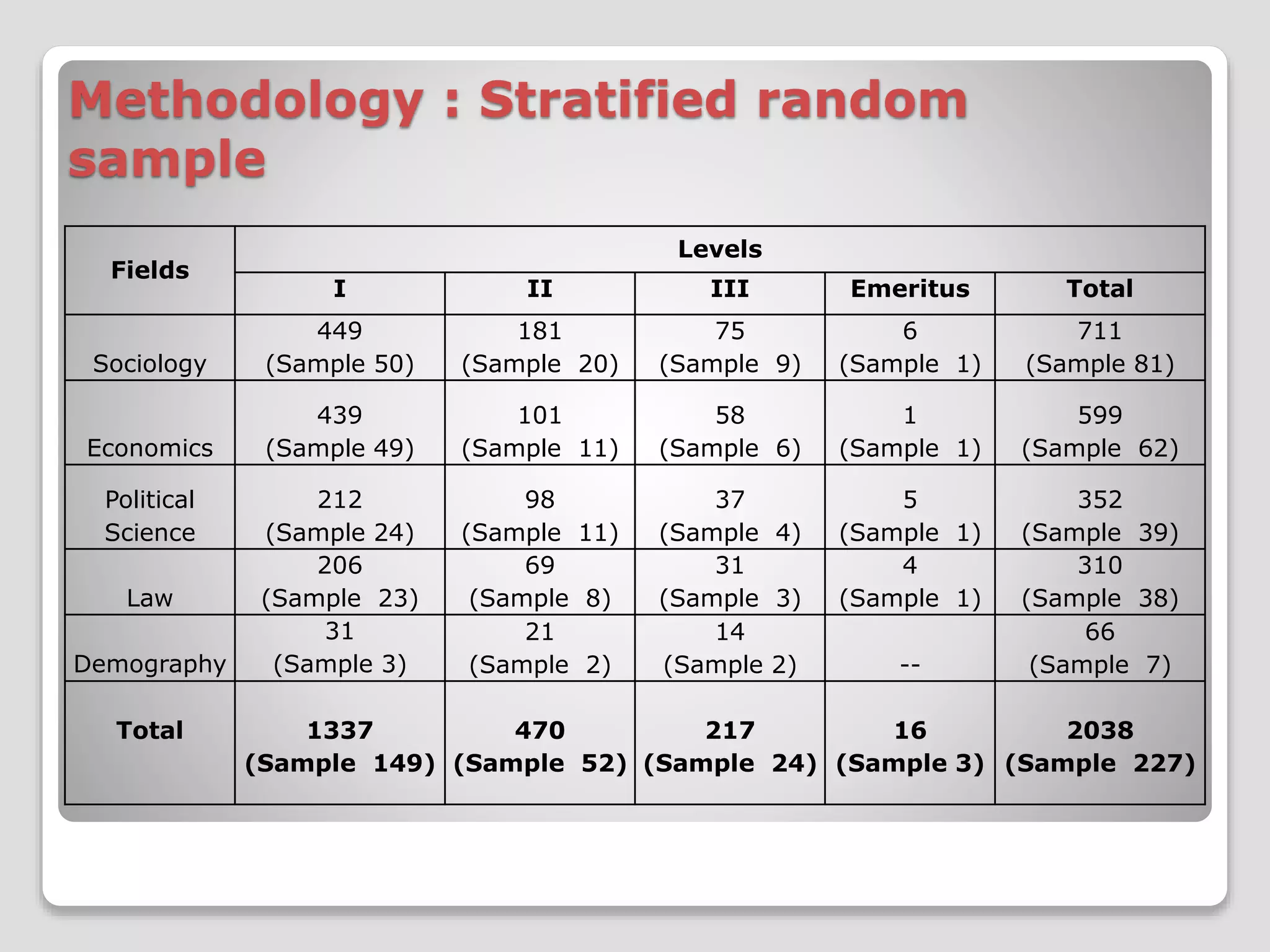
Methodology : Stratified random 
sample 
Fields 
Levels 
I II III Emeritus Total 
Sociology 
449 
(Sample 50) 
181 
(Sample 20) 
75 
(Sample 9) 
6 
(Sample 1) 
711 
(Sample 81) 
Economics 
439 
(Sample 49) 
101 
(Sample 11) 
58 
(Sample 6) 
1 
(Sample 1) 
599 
(Sample 62) 
Political 
Science 
212 
(Sample 24) 
98 
(Sample 11) 
37 
(Sample 4) 
5 
(Sample 1) 
352 
(Sample 39) 
Law 
206 
(Sample 23) 
69 
(Sample 8) 
31 
(Sample 3) 
4 
(Sample 1) 
310 
(Sample 38) 
Demography 
31 
(Sample 3) 
21 
(Sample 2) 
14 
(Sample 2) -- 
66 
(Sample 7) 
Total 1337 
(Sample 149) 
470 
(Sample 52) 
217 
(Sample 24) 
16 
(Sample 3) 
2038 
(Sample 227)
Data Collection and Analysis 
 Data were collected from the CVs requested via email. 
 Each CV was carefully examined for any mention of activities relating 
to our four main groups, from the onset of their scientific careers. 
 Individual criteria were constructed on the basis of previous studies, 
as well as preliminary analysis of a representative sample of CVs. 
 Data matrix was created for number of occurrences of each criterion, 
extracted from the CVs. 
 SPSS software version 20 for Windows is used to process the data. 
 Analysis of results of multivariate techniques by multiple 
correspondence analysis and principal components analysis, is under 
evaluation.
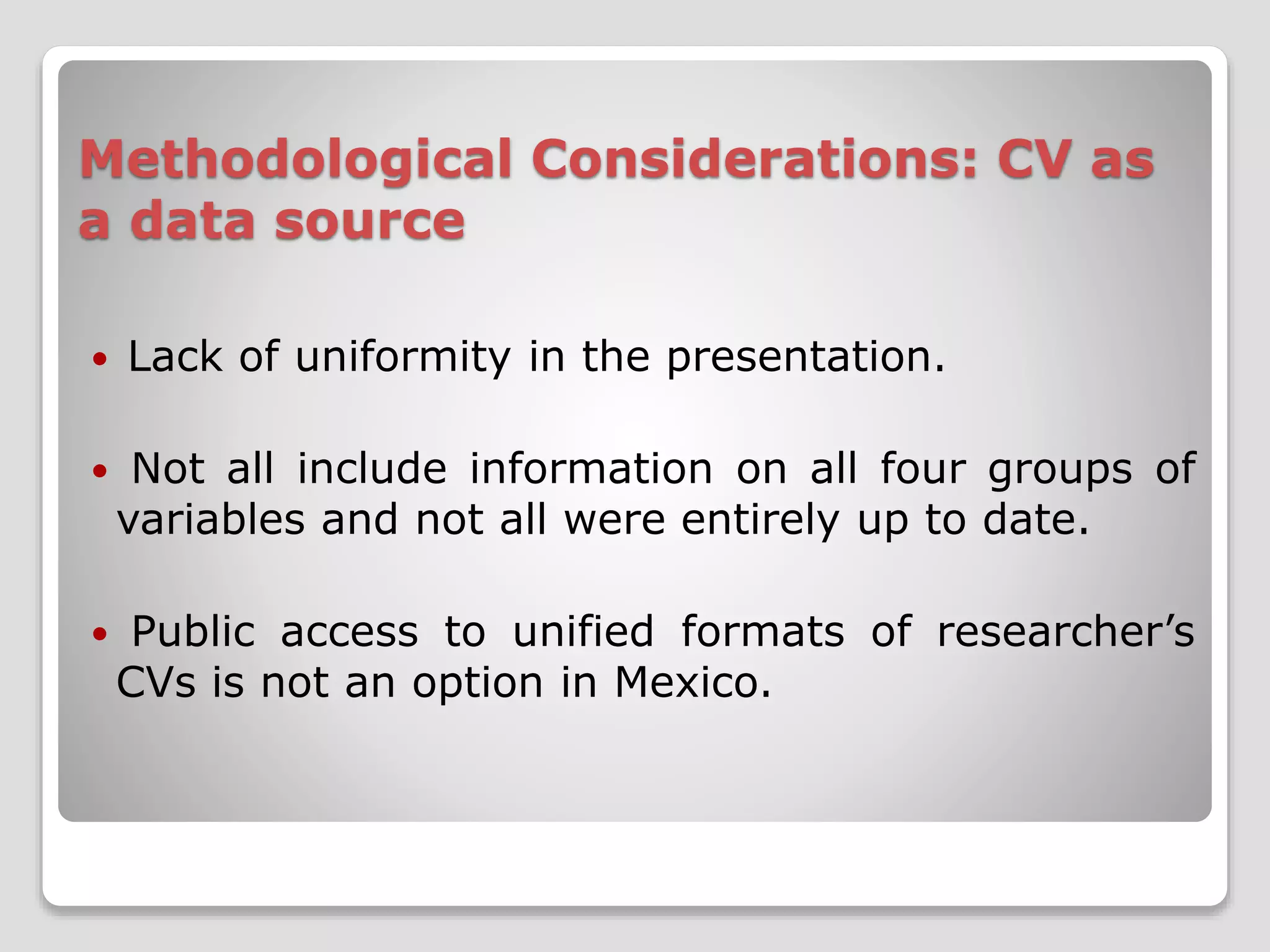
Methodological Considerations: CV as 
a data source 
 Lack of uniformity in the presentation. 
 Not all include information on all four groups of 
variables and not all were entirely up to date. 
 Public access to unified formats of researcher’s 
CVs is not an option in Mexico.
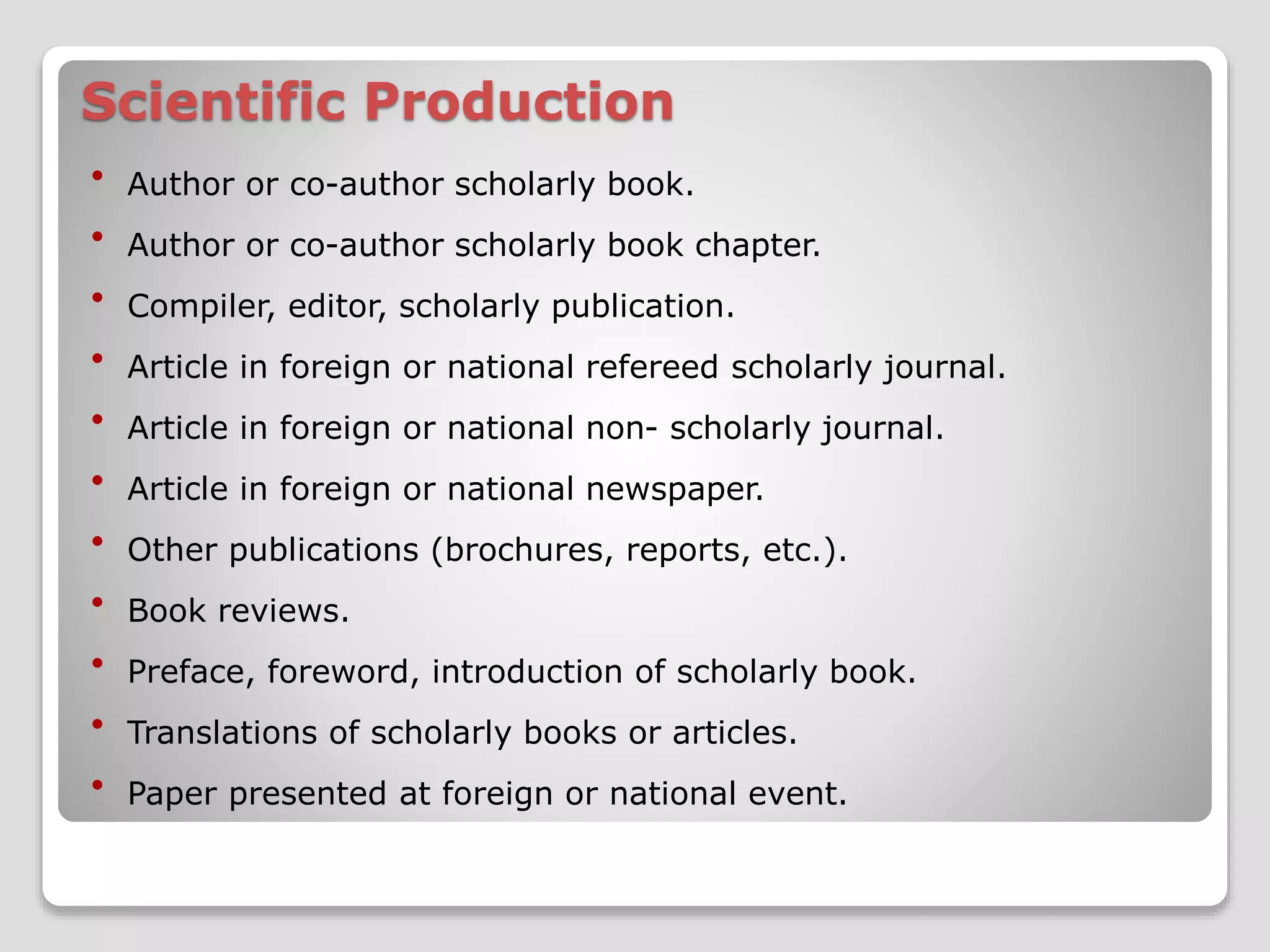
Scientific Production 
 Author or co-author scholarly book. 
 Author or co-author scholarly book chapter. 
 Compiler, editor, scholarly publication. 
 Article in foreign or national refereed scholarly journal. 
 Article in foreign or national non- scholarly journal. 
 Article in foreign or national newspaper. 
 Other publications (brochures, reports, etc.). 
 Book reviews. 
 Preface, foreword, introduction of scholarly book. 
 Translations of scholarly books or articles. 
 Paper presented at foreign or national event.
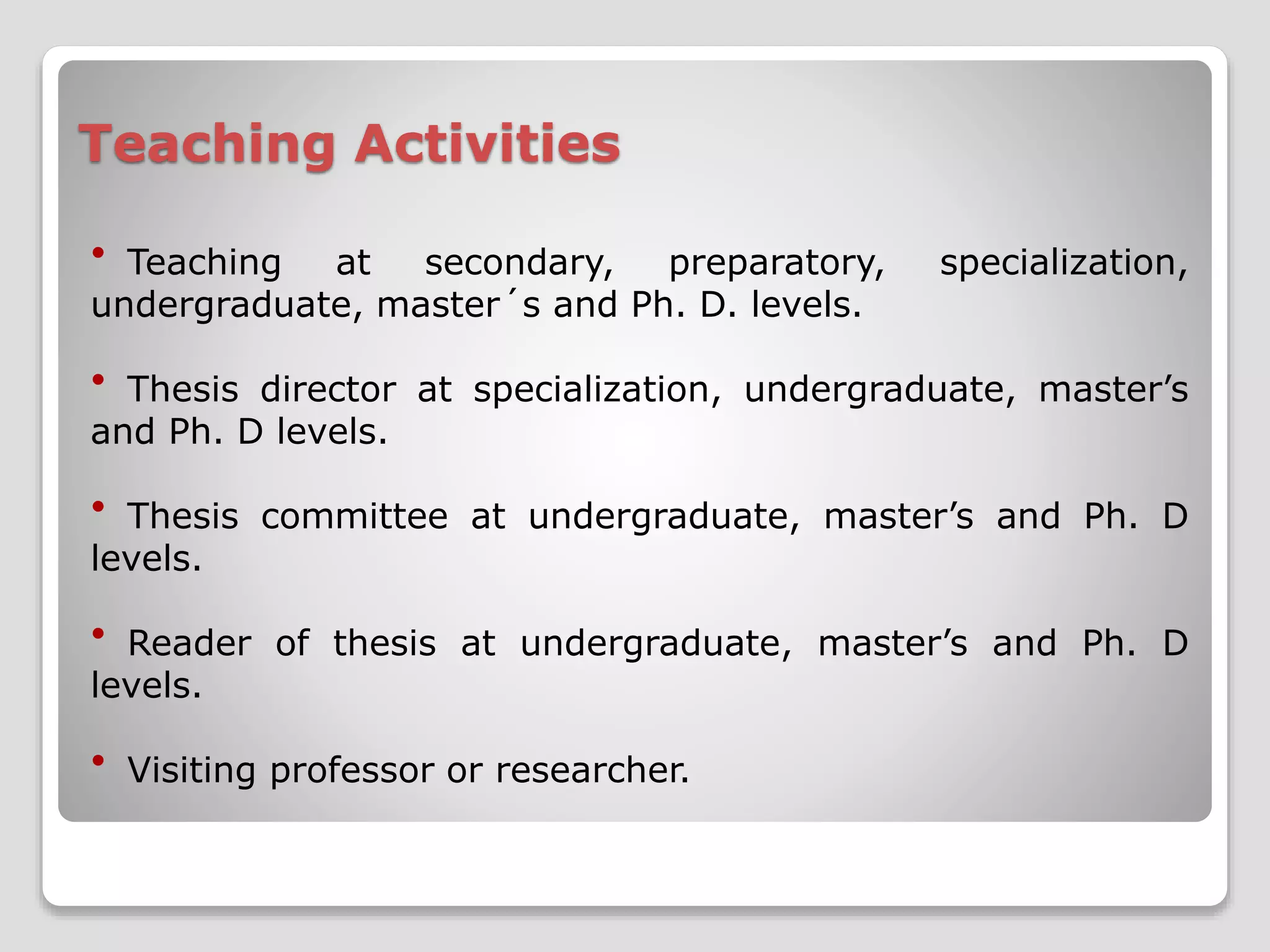
Teaching Activities 
 Teaching at secondary, preparatory, specialization, 
undergraduate, master´s and Ph. D. levels. 
 Thesis director at specialization, undergraduate, master’s 
and Ph. D levels. 
 Thesis committee at undergraduate, master’s and Ph. D 
levels. 
 Reader of thesis at undergraduate, master’s and Ph. D 
levels. 
 Visiting professor or researcher.
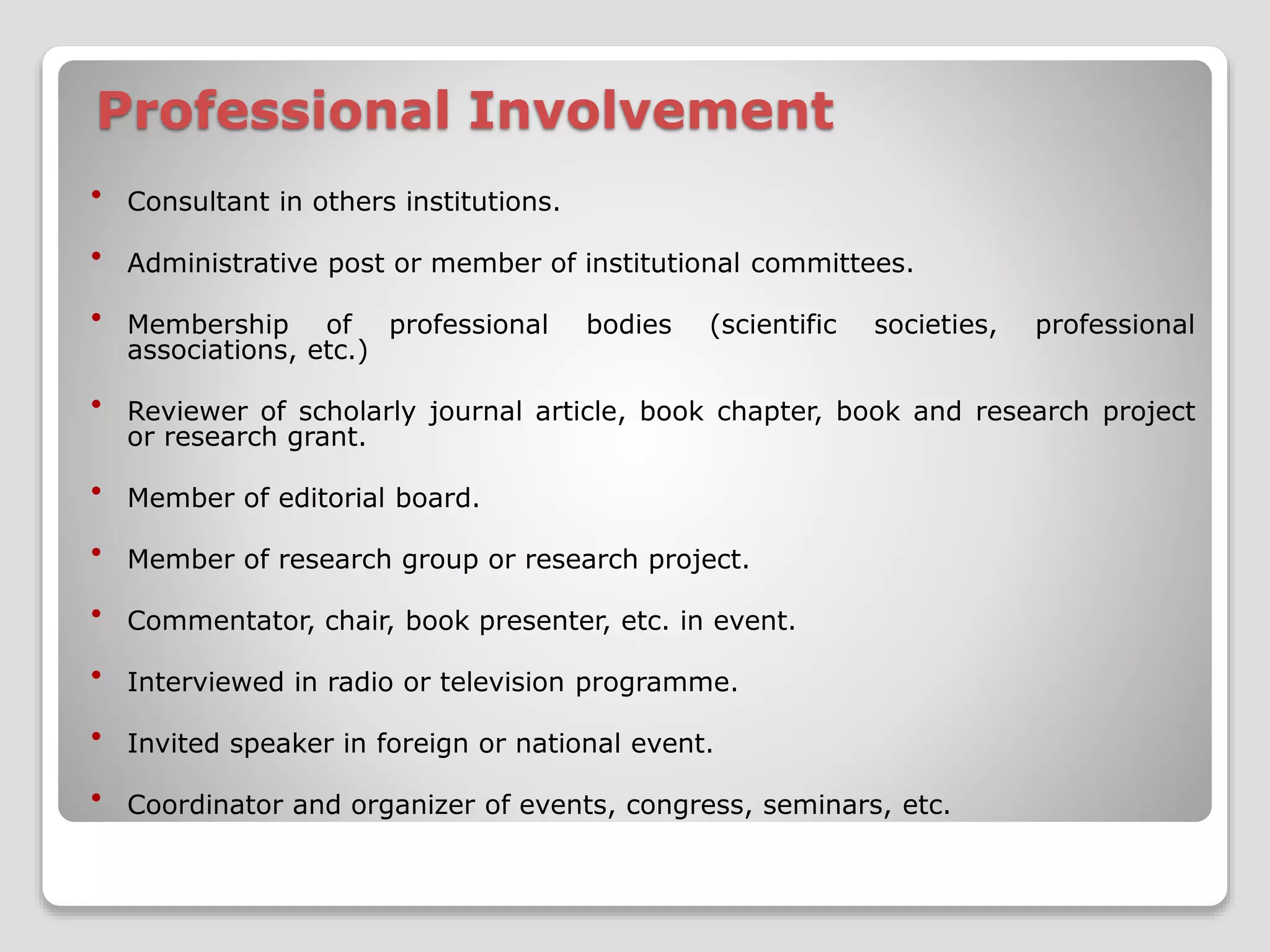
Professional Involvement 
 Consultant in others institutions. 
 Administrative post or member of institutional committees. 
 Membership of professional bodies (scientific societies, professional 
associations, etc.) 
 Reviewer of scholarly journal article, book chapter, book and research project 
or research grant. 
 Member of editorial board. 
 Member of research group or research project. 
 Commentator, chair, book presenter, etc. in event. 
 Interviewed in radio or television programme. 
 Invited speaker in foreign or national event. 
 Coordinator and organizer of events, congress, seminars, etc.
Scholarly Recognition 
 Awards presented for academic papers. 
 Awards for distinguished service (emeritus, 
distinctions, etc.) 
 Tributes for academic career. 
 Research grants obtained by public competition. 
 Scholarships (graduate, postdoctoral and research). 
 Honourable mentions and academic incentives. 
 Doctorate Honoris Causa.
Preliminary Findings 
Our preliminary data reveal important differences between 
researchers in the various category levels of the SNI: 
o Emeritus & Level III publish more scholarly books and 
newspaper articles. 
o Level II more articles in peer-reviewed foreign journals. 
We also found differences with respect to the fields of the 
researchers: 
o Law: predominance of scholarly books 
o Economics: articles in peer-reviewed foreign journals 
o Political science: newspaper articles
Thank you very much for your 
attention
Contacts 
Cristina Restrepo-Arango 
crestrepoarango@gmail.com 
Programa de Posgrado en Bibliotecología y Estudios de la 
Información. 
Universidad Nacional Autónoma de México, Unidad de Posgrado, 
Edificio H, 1er. Nivel, H-104. Circuito de Posgrado, Ciudad 
Universitaria. 
Coyoacán, México D.F. C.P. 04510 (Mexico) 
Jane M. Russell 
jrussell@unam.mx 
Instituto de Investigaciones Bibliotecológicas y de la Información, 
Universidad Nacional Autónoma de México, Torre II de 
Humanidades pisos 11-13, Ciudad Universitaria. 
Coyoacán, México D.F. C.P. 04510 (Mexico)

Restrepo arango russell-sti2014 (1)

  • 1.
    Methodological Proposal forEvaluating Performance of Social Science Researchers in Mexico Cristina Restrepo-Arango and Jane M. Russell Universidad Nacional Autónoma de México
  • 2.
    Background  Bibliometrictechniques inadequate to assess research outputs of Social Scientists, especially those from developing world.  Web of Science, primary source for data collection, the majority of journals are published in English.  Metric evaluation does not take into account indicators of “cultural capital” .  Particularly in Social Sciences, bibliometrics is recommended in combination with qualitative techniques.
  • 3.
    Overall aim Proposea model for assessing scientific performance that takes into consideration other factors in addition to bibliometric indicators, and apply it to a selected sample of Social Science researchers in Mexico.
  • 4.
    Our approach •Integrates variables of scientific production with other variables: teaching activities; professional involvement; and scholarly recognition. • Builds a holistic view of scientific achievement. • Recognizes that research is a social process inserted in a specific cultural context and influenced by the behaviour of the individual researchers.
  • 5.
    Main research question What are the relative impacts of these four main groups of variables on the scientific performance of Mexican researchers in Social Sciences, members of the Mexican National Researchers System (SNI)?
  • 6.
    Mexican National Researchers System (SNI)  Created in 1984 by Mexican government to recognise the work of individuals in the creation of knowledge.  Recognition and financial incentives given at four levels: I, II, III y Emeritus.  Peer review by expert committees in 7 knowledge areas.  Area V. Social Sciences (Administration, Political Science, Communication, Accountancy, Demography, Law, Economics, Human Geography, Sociology).
  • 7.
    Methodology : Stratifiedrandom sample Fields Levels I II III Emeritus Total Sociology 449 (Sample 50) 181 (Sample 20) 75 (Sample 9) 6 (Sample 1) 711 (Sample 81) Economics 439 (Sample 49) 101 (Sample 11) 58 (Sample 6) 1 (Sample 1) 599 (Sample 62) Political Science 212 (Sample 24) 98 (Sample 11) 37 (Sample 4) 5 (Sample 1) 352 (Sample 39) Law 206 (Sample 23) 69 (Sample 8) 31 (Sample 3) 4 (Sample 1) 310 (Sample 38) Demography 31 (Sample 3) 21 (Sample 2) 14 (Sample 2) -- 66 (Sample 7) Total 1337 (Sample 149) 470 (Sample 52) 217 (Sample 24) 16 (Sample 3) 2038 (Sample 227)
  • 8.
    Data Collection andAnalysis  Data were collected from the CVs requested via email.  Each CV was carefully examined for any mention of activities relating to our four main groups, from the onset of their scientific careers.  Individual criteria were constructed on the basis of previous studies, as well as preliminary analysis of a representative sample of CVs.  Data matrix was created for number of occurrences of each criterion, extracted from the CVs.  SPSS software version 20 for Windows is used to process the data.  Analysis of results of multivariate techniques by multiple correspondence analysis and principal components analysis, is under evaluation.
  • 9.
    Methodological Considerations: CVas a data source  Lack of uniformity in the presentation.  Not all include information on all four groups of variables and not all were entirely up to date.  Public access to unified formats of researcher’s CVs is not an option in Mexico.
  • 10.
    Scientific Production Author or co-author scholarly book.  Author or co-author scholarly book chapter.  Compiler, editor, scholarly publication.  Article in foreign or national refereed scholarly journal.  Article in foreign or national non- scholarly journal.  Article in foreign or national newspaper.  Other publications (brochures, reports, etc.).  Book reviews.  Preface, foreword, introduction of scholarly book.  Translations of scholarly books or articles.  Paper presented at foreign or national event.
  • 11.
    Teaching Activities Teaching at secondary, preparatory, specialization, undergraduate, master´s and Ph. D. levels.  Thesis director at specialization, undergraduate, master’s and Ph. D levels.  Thesis committee at undergraduate, master’s and Ph. D levels.  Reader of thesis at undergraduate, master’s and Ph. D levels.  Visiting professor or researcher.
  • 12.
    Professional Involvement Consultant in others institutions.  Administrative post or member of institutional committees.  Membership of professional bodies (scientific societies, professional associations, etc.)  Reviewer of scholarly journal article, book chapter, book and research project or research grant.  Member of editorial board.  Member of research group or research project.  Commentator, chair, book presenter, etc. in event.  Interviewed in radio or television programme.  Invited speaker in foreign or national event.  Coordinator and organizer of events, congress, seminars, etc.
  • 13.
    Scholarly Recognition Awards presented for academic papers.  Awards for distinguished service (emeritus, distinctions, etc.)  Tributes for academic career.  Research grants obtained by public competition.  Scholarships (graduate, postdoctoral and research).  Honourable mentions and academic incentives.  Doctorate Honoris Causa.
  • 14.
    Preliminary Findings Ourpreliminary data reveal important differences between researchers in the various category levels of the SNI: o Emeritus & Level III publish more scholarly books and newspaper articles. o Level II more articles in peer-reviewed foreign journals. We also found differences with respect to the fields of the researchers: o Law: predominance of scholarly books o Economics: articles in peer-reviewed foreign journals o Political science: newspaper articles
  • 15.
    Thank you verymuch for your attention
  • 16.
    Contacts Cristina Restrepo-Arango crestrepoarango@gmail.com Programa de Posgrado en Bibliotecología y Estudios de la Información. Universidad Nacional Autónoma de México, Unidad de Posgrado, Edificio H, 1er. Nivel, H-104. Circuito de Posgrado, Ciudad Universitaria. Coyoacán, México D.F. C.P. 04510 (Mexico) Jane M. Russell jrussell@unam.mx Instituto de Investigaciones Bibliotecológicas y de la Información, Universidad Nacional Autónoma de México, Torre II de Humanidades pisos 11-13, Ciudad Universitaria. Coyoacán, México D.F. C.P. 04510 (Mexico)