Project Proposal
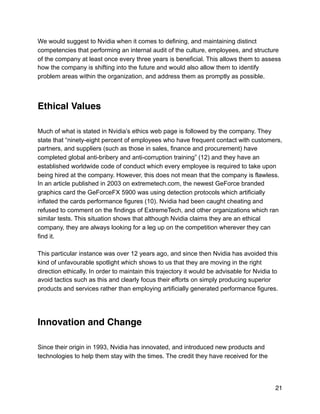
FOR NVIDIA CORPORATION
CONDUCTED BY
COLTON GOERTZEN & GURMINDER GREWAL
BUSINESS 403: STRATEGIC MANAGEMENT
MARK LEE
MAY 23, 2016
1
Vitae Consultants is a local company comprising of two students of the University
of the Fraser Valley; currently enrolled in Business 403: Strategic Management,
and has been charged with developing a comprehensive strategic planning
document for an organization of our own choosing. These members are Colton
Goertzen and Gurminder Grewal and as a corporate unit we have chosen Nvidia
Corporation as our preferred organization.
We have chosen this organization because it is situated within the market as being
the premier graphics card provider to companies such as ASUS Computer
International, EVGA Corporation, and GIGABYTE among others. Another reason
for this is because it is a direct rival to AMD Corporation, another graphics card
manufacturer. Both companies have clashed head to head over the years by
offering increased performance in their products in an effort to steal market share
from the other. It also offers opportunities for us as students to showcase our
individual talents in a constructive assessment of a publicly traded company which
we hope will directly result in gainful employment at Nvidia or a similar
organization.
For Colton this provides opportunity to assess what a successful company
embodies. This is extremely important for him because his ambition is to operate
his own organization and by directly dissecting a firm such as this offers valuable
insight into how his own should run. Furthermore Nvidia is a company he has little
experience with and is increasingly curious as to how an organization such as this
operates in the market. Particularly he is interested in how it has positioned itself
against its competitors in such a clouded industry, with a large part of the
population unaware of the product offerings from companies such as this.
By performing an analysis on Nvidia, this gives Gurminder insight into the company
and how it’s positioned versus its competitors. He has always been an investor in
the stock market and his stock picks have revolved around the technology sector,
mainly Nvidia and its chief rival AMD. It is also a goal of his to be part of a finance
team in Nvidia as it is a corporation he endears greatly. This project will increase
his knowledge of Nvidia and he hopes to use this knowledge to better his short
term stock, and long term career goals.
Indirectly, as a group we hope to determine how a strategic plan can be
implemented and carried out on firms in general, and how, by developing a plan,
assessment of success is determined in the marketplace. Nvidia’s relatively recent
2
growth within the past 20 years has allowed it to ride the technology boom and has
caused it to influence much of the computing world our culture revolves around. As
a result it has had indirectly shaped the first world environment by providing
increased capability within computers, gaming consoles, and tablets. This fast
growing company offers our team the ability to measure the lifespan of a company
from beginning to end and allows us first hand experience with the organization
because it has directly impacted our own lives in one form or another.
During this project we will be utilizing the company’s own financial statements to
determine our financial ratios, coupled with information on the company compiled
by outside financial institutions. These will be assembled to establish as accurate a
picture as we are able, while on the outside of the organization. To access publicly
available information we will be using:
• Yahoo Finance
• The corporation's own websites
• The company’s Investor Reports
• Academic articles about the company available through the university library
• Bloomberg L.P.
3
Organizational Analysis of NVIDIA
Corporation
CONDUCTED BY
COLTON GOERTZEN & GURMINDER GREWAL
BUSINESS 403: STRATEGIC MANAGEMENT
MARK LEE
4
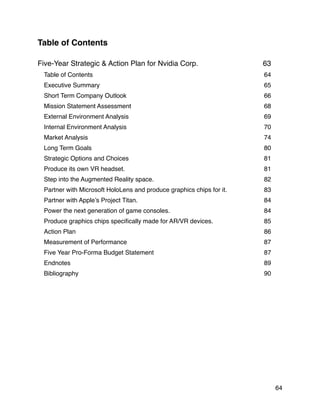
Table of Contents
Project Proposal 1
Organizational Analysis of NVIDIA Corporation 4
Table of Contents 5
Executive Summary 6
Corporate Overview 7
Organizational Strategies 9
Organizational Design and Effectiveness 11
Organizational Structure 12
External environment 15
Internal environment 16
International Organizational Design 16
Products 17
Information Technology and Control Systems 18
Organization Lifespan 19
Organizational Culture 20
Ethical Values 21
Innovation and Change 21
Decision Making Processes 23
Conflict, Power, and Politics 23
Summary and Recommendations 24
Endnotes 25
Bibliography 26
Appendix 30
5
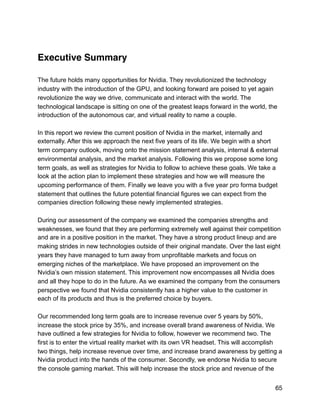
Executive Summary
The graphics processing unit, a small seemingly unimportant part being thrown into a
computer as it leaves the factory. What significance could this minute piece of hardware
have? If you were to ask the founders of Nvidia these questions, their reply would be
something along the lines of: “It's only the biggest leap forward in graphical effects for
this modern computing age.” For Jen-Hsun Huang, Chris Malachowsky and Curtis
Priem, the founders of Nvidia Corporation, this small invention opened a new frontier for
computing and paved the way for modern gaming, computer, mobile, and video
graphics which have completely immersed our lives in the 21st century.
In this report we look into what makes this company tick, why they are so successful,
and how they can be improved using methods and tactics learned from our Business
403 class. We will begin with a look at the origin of the company, how it has grown over
the course of its lifetime, some of the software that gives them different advantages in
the industry, organizational strategies which have been implemented in the business
and how they can be improved. Next we will see how effective they are with the design
of the business, what exactly the organizational structure of this company is and its
factors that have an impact on the organization, internally and externally. How their
company is run on a global scale, the multitude of products that they manufacture and
implement into other products. We will understand how these products give them a
distinct competitive advantage in the marketplace, what kinds of systems they have set
in place to control information throughout the organization. Then we will look at what
can be expected from the business over the course of its lifespan, the kind of culture
they project throughout the company, and ethics that they hold themselves to. We will
look into how this company manages to control innovation and change, how it handles
its decision making process, and as a result, who holds the power within the
organization. Subsequently we will delve into how conflict is resolved within the
business when it arises, and finally we will offer some recommendations for the
company, closing with a summary of our findings.
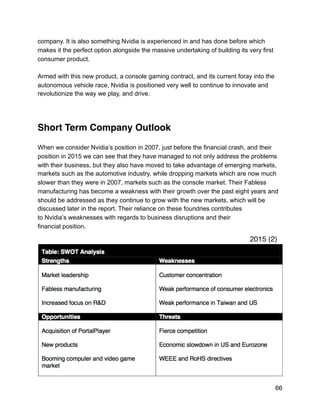
What we have found while compiling this report is that Nvidia is well placed in the
markets they have chosen to compete in. With a forward focus on visual computing, and
entrance into new markets such as artificial intelligence, driverless cars, and cloud
gaming to name a few, Nvidia is making strides capturing sales, revenue, and market
share all while innovating and adapting to change. With the use of low cost, value, and
differentiation strategies, Nvidia consistently comes out as the forerunner versus its
6
competitors. R&D is its biggest competency which is how it should be for a technology
company. A vast array of innovative and quality products partnered with other industry
leading organizations will have Nvidia getting closer to reaching its goal of building one
of the most influential tech companies in the world.
A few key remarks are to be made of Nvidia. They should consider vertical integration to
avoid manufacturing issues in the future, and increase their foothold in the artificial
intelligence and driverless car market. R&D is a major key to this corporation and
should always be catered to and supported so they can continue to innovate, offer new
products, and expand as a company. Finally they should consider adopting a matrix
structure to increase flow of ideas and information within the company and encourage
teamwork and cooperation.
Corporate Overview
Nvidia Corporation is credited with the invention of the graphics processing unit (GPU)
in 1999, and single handedly awakened the world to the power of having a dedicated
graphics center within the personal computer (2). Since this point in the company's life,
they have consistently set higher and higher standards for visual computing and have
had their products integrated into a multitude of devices within the technology industry.
Nvidia's breakthroughs in programmable GPUs have resulted in greater efficiencies in
parallel processing, allowing supercomputing to be available widely to the public by
essentially lining up the processors in series. Today this organization holds in excess of
1100 patents in the US and more than 7300 patent assets worldwide (2).
Prior to Nvidia’s inception in 1993, by Jen-Hsun Huang, Chris Malachowsky and Curtis
Priem, the computer graphics industry relied heavily on single chip processing
capabilities. These chips were found in many of the early arcade style video games
such as Space Invaders and Robotron: 2084 (18). It wasn't until 1995 that Nvidia
launched its first product, the Diamond Edge 3-D which allowed for cutting edge 3-D
graphics but fell short with its audio and cost compared to its competitors. It was then in
1999 that Nvidia brought forth what is understood today as the foundation of the
graphics processing unit (GPU), allowing for outstanding image rendering, visual
lighting, and clipping of images (14). This processor was able to process 15 million
separate polygons per second whereas the competition was only processing 8 million
per second (15). Then, in 2000, Nvidia won the contract to supply Microsoft with
7
graphics processors for their new Xbox gaming console allowing Nvidia the working
capital to acquire 3dfx Interactive, one of its main rivals, which was on a steady decline
since 1990 (2). Nvidia then had access to a vast amount of intellectual property held by
3dfx and was able to utilize it to solve inefficiencies they had with prior products.
In the years that followed Nvidia made many advances in graphics, from aiding NASA in
recreating the surface of Mars to its collaboration with Blizzard in creating World of
Warcraft, which became the world’s most popular massively multiplayer online game
(2). Then in 2006 Nvidia purchased Integrated Hybrid Graphics, which was a company
that developed embedded 2D and 3D graphics software for handheld devices. They did
this in an effort to further enter the handheld market, and in 2008 they acquired AGEIA,
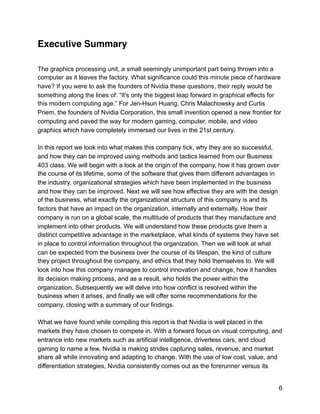
a developer of gaming physics technology. With this acquisition, PhysX software
became fully integrated into Nvidia's GPUs, allowing developers to utilize lifelike physics
within games. This newly proprietary software’s impact on different objects within the
game’s physical world gave Nvidia a dramatic advantage, immersing gamers with new
forms of gameplay. We can see in the figure below how this software impacts in game
environments and its effects on modern games. Consequently, with this new software
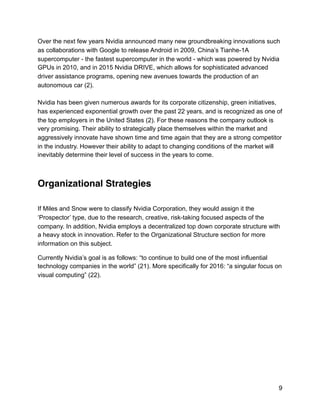
Nvidia is able to differentiate itself from its competition even further.


! 

Comparison of Nvidia PhysX software – Off and On (13).
8
Over the next few years Nvidia announced many new groundbreaking innovations such
as collaborations with Google to release Android in 2009, China’s Tianhe-1A
supercomputer - the fastest supercomputer in the world - which was powered by Nvidia
GPUs in 2010, and in 2015 Nvidia DRIVE, which allows for sophisticated advanced
driver assistance programs, opening new avenues towards the production of an
autonomous car (2).
Nvidia has been given numerous awards for its corporate citizenship, green initiatives,
has experienced exponential growth over the past 22 years, and is recognized as one of
the top employers in the United States (2). For these reasons the company outlook is
very promising. Their ability to strategically place themselves within the market and
aggressively innovate have shown time and time again that they are a strong competitor
in the industry. However their ability to adapt to changing conditions of the market will
inevitably determine their level of success in the years to come.
Organizational Strategies
If Miles and Snow were to classify Nvidia Corporation, they would assign it the
‘Prospector’ type, due to the research, creative, risk-taking focused aspects of the
company. In addition, Nvidia employs a decentralized top down corporate structure with
a heavy stock in innovation. Refer to the Organizational Structure section for more
information on this subject.
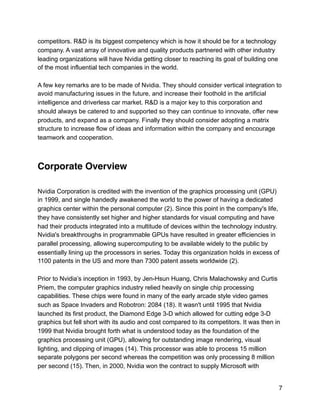
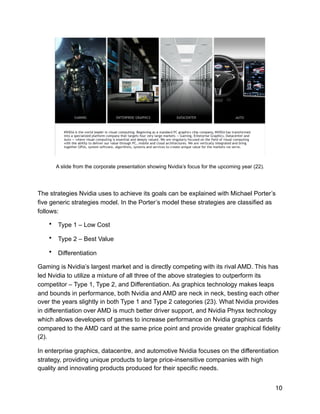
Currently Nvidia’s goal is as follows: “to continue to build one of the most influential
technology companies in the world” (21). More specifically for 2016: “a singular focus on
visual computing” (22).
9
!
A slide from the corporate presentation showing Nvidia’s focus for the upcoming year (22).
The strategies Nvidia uses to achieve its goals can be explained with Michael Porter’s
five generic strategies model. In the Porter’s model these strategies are classified as
follows:
• Type 1 – Low Cost
• Type 2 – Best Value
• Differentiation
Gaming is Nvidia’s largest market and is directly competing with its rival AMD. This has
led Nvidia to utilize a mixture of all three of the above strategies to outperform its
competitor – Type 1, Type 2, and Differentiation. As graphics technology makes leaps
and bounds in performance, both Nvidia and AMD are neck in neck, besting each other
over the years slightly in both Type 1 and Type 2 categories (23). What Nvidia provides
in differentiation over AMD is much better driver support, and Nvidia Physx technology
which allows developers of games to increase performance on Nvidia graphics cards
compared to the AMD card at the same price point and provide greater graphical fidelity
(2).
In enterprise graphics, datacentre, and automotive Nvidia focuses on the differentiation
strategy, providing unique products to large price-insensitive companies with high
quality and innovating products produced for their specific needs.
10
The above strategies have been working quite impressively for Nvidia. With 77.2% of
the gaming market share (24), and an average of 44.5% growth in revenue across all
four of its visual computing markets (22), it is difficult to argue Nvidia is not crushing its
goals.
Organizational Design and Effectiveness
Nvidia’s organizational design follows the prospector role, as such they have come to a
peak in the graphics industry and are now exploring new options in unrelated markets.
In order for Nvidia to become involved with an industry they become very methodical,
attempting to acquire companies which have been in that industry for a long time. This
is a tactic we saw them do with 3dfx, and AGEIA just to name a few (2). They do this to
develop a competitive advantage in the industry and to make up for their lack of
experience in the new industry. In the case of AGEIA the acquisition gave them a very
strong proprietary software and caused them to become a very strong force in the
industry.
Utilizing outside factories to actually manufacture the goods Nvidia sells is a design
which many in the technology industry employ. It has proven to be a prudent choice and
helps with the overall strategic direction they have chosen. The advantage of allowing
suppliers to manufacture the goods has many advantages, which we will explore later in
this report. Some of the disadvantages are that Nvidia’s competitors all use this design
which means that in order to be competitive they new need to continue production in
this way, they have very little control over the actual production of the goods they are
selling, also the scale of the company is much smaller when comparing to its
competition. What this means for Nvidia is that they can’t exercise any economies of
scale in their operation. In spite of these inefficiencies Nvidia has been able to remain
competitive and in many case outperform its larger rivals because of its organic
approach to business. Its ability to shift itself to where the market is headed is
remarkable and its this trait which marks a strong business.
11
Organizational Structure
Nvidia Corporation operates in four markets primarily, these markets are gaming,
enterprise graphics, datacenter and automotive. The company has successfully
entrenched itself in these four industries and has become a competitive force to be
reckoned with the world over. They also hold more than 7300 patent assets, including a
number of patents covering designs, and insights which have become fundamental to
modern computing. Nvidia has operated with the same president, Chief Executive
Officer, member of the Board of Directors and co-founder Jen-Hsun Huang, since 1993
(3).
Huang was originally employed for Nvidia's primary competitor AMD, but together with
his two partners decided to form Nvidia, and broke away from his employer. He is
credited with a Bachelor of Science in Electrical Engineering from Oregon State
University, a Master's of Science in Electrical Engineering from Stanford University, and
holds an honorary doctorate from Oregon State University (3). He is also the recipient of
one of the world's 100 best performing CEOs over the lifetime of their tenure from the
Harvard Business Review in 2015, and has also been awarded the Daniel J. Epstein
Engineering Management award from the University of Southern California (3).
Huang’s second in command is co-founder Chris A. Malachowsky who serves on the
board of directors, has been an integral part of the management team, and has helped
define and drive the company's core technologies as it grew from startup to its global
presence. Over his time with Nvidia, he has served in numerous positions through the
company including IT, operations, and product engineering. He is also responsible for
Nvidia's research organization, which is mandated to push future growth for the
organization by developing strategic technologies (3).
Malachowsky has authored nearly 40 patents related to integrated circuit design and
methodology and holds a Bachelor’s of Science in Electrical Engineering from the
University of Florida. He has also been issued a Master’s of Science in Computer
Science from Santa Clara University.
Nvidia’s Executive Vice President, and Chief Financial Officer currently is Colette Kress.
She became a member of the Nvidia team in 2013 after serving a 25 year career in
numerous financial roles at prominent technology companies.
12
Most recently she served for three years as Senior Vice President, and CFO of Cisco
Systems Inc. at the Business Technology, and Operations Finance organization arm of
the business (3). Prior to that she worked at Microsoft for 13 years which included four
years as Corporate Vice President. She also holds a Bachelor's degree in Science from
the University of Arizona, and an MBA from Southern Methodist University (3).
Executive Vice President of Worldwide Field Operations, Jay Puri is currently
responsible for the company's global sales and regional marketing of its products. Puri
has been a part of Nvidia since 2005, after his 22 year career at Sun Microsystems Asia
Pacific Group. During his time at Sun, he was Vice President of Worldwide Sales for
Software and Technology, Vice President of Worldwide Product Marketing, and has
seen the company grow from 25 to 35,000 employees (3). In the past he has also held
positions at Hewlett-Packard Company, Hamilton & Texas Instruments and Booz Allen
(3). As far as education, Puri is credited with a Bachelor’s of Science in Electrical
Engineering from the University of Minnesota, and a Masters of Electrical Engineering
from the California Institute of technology as well as a Masters of Business
Administration from Harvard Business School (3).
David M. Shannon is Executive Vice President, Chief Administrative Officer and
Secretary at Nvidia. This means that he is responsible for the organization's legal, HR
and intellectual property licensing. In his past employment he held various counsel
positions at Intel and has practiced law for 8 years for the law firm Gibson Dunn &
Crutcher. As a result he holds a Bachelors of Business Administration and a Doctorate
of Law degree both from Pepperdine University (3).
The last member of the executive team is Debora Shoquist, her position is Executive
Vice President of Operations and her responsibilities in this role are to oversee the
company's IT department, its operations, and supply chain functions. Since 2009 she
has overseen manufacturing product, test engineering, foundry operations, supplier/
contract manufacturing management, supply planning, logistics, facilities, and the
company's quality management system. She was charged with overseeing construction
of the new building at Nvidia's Santa Clara headquarters. Currently she holds a
Bachelor’s of Science degree in Electrical Engineering from Kansas State University
and a Bachelor’s of Science degree in Biology from Santa Clara University (3).
Huang’s management team consists of managing directors Tench Coxe, and James C.
Gaither. Both of which are also directors of Sutten Hill Ventures, which is a capital
13
investment firm (19). As is important in organizations, these directors have strong ties to
investment capital, which allows Nvidia to access large amounts of capital when new
technologies become available to bring to market.
Officially the company does not have any corporate structure and as a result it makes it
extremely difficult for employees to understand where they fit into the company. One
employee admitted on www.glassdoor.com:
“Well, this is the least structured company I have ever worked for. Try finding an
organizational chart to use with your job. Forget it.” (4)
This ambiguity is quickly remedied by the management producing a chain of command
for employees to follow. That being said the company does try to produce an
environment where innovation is encouraged, as is evident in their flexible approach to
time off, and offering employees access to the Stanford Health Navigator service in the
United States. This service allows employees and their families advanced, and speedy
medical care when they need it.
Nvidia may not have a stated organizational structure but it does use a typical hierarchal
structure when making its strategic decisions. With front line staff being the face of the
organization, then middle managers, senior managers and finally top level executives
making the majority of decisions relating to the strategic direction of the company. This
system works well for them at the top level of the organization, however as they
continue expanding into new markets such as automotive, or the medical field this
structure hinders them. The company’s solution for this problem is that they allow senior
and middle management to branch into strategic business units, which has the
advantage of allowing different product lines a dedicated team to manage them. As a
result this approach streamlines the process of bringing a product to market. Within
these different units the management employs a functional strategy allowing employees
to focus on their functions such as marketing, finance, and sales. By implementing
these three different command styles we believe that they are maximizing their ability to
control how they are positioned in the market, and the company’s overall efficiency is at
its peak for this size of business.
14
External environment

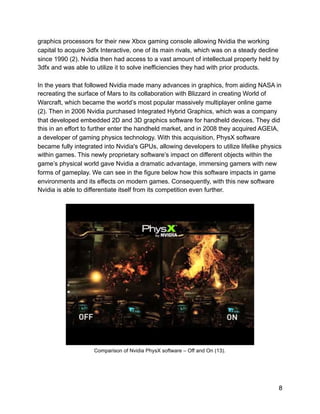
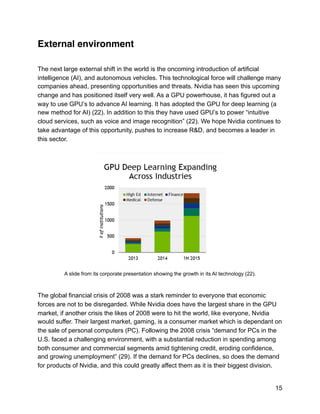
The next large external shift in the world is the oncoming introduction of artificial
intelligence (AI), and autonomous vehicles. This technological force will challenge many
companies ahead, presenting opportunities and threats. Nvidia has seen this upcoming
change and has positioned itself very well. As a GPU powerhouse, it has figured out a
way to use GPU’s to advance AI learning. It has adopted the GPU for deep learning (a
new method for AI) (22). In addition to this they have used GPU’s to power “intuitive
cloud services, such as voice and image recognition” (22). We hope Nvidia continues to
take advantage of this opportunity, pushes to increase R&D, and becomes a leader in
this sector.
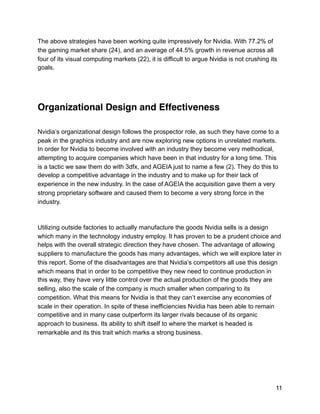
!
A slide from its corporate presentation showing the growth in its AI technology (22).
The global financial crisis of 2008 was a stark reminder to everyone that economic
forces are not to be disregarded. While Nvidia does have the largest share in the GPU
market, if another crisis the likes of 2008 were to hit the world, like everyone, Nvidia
would suffer. Their largest market, gaming, is a consumer market which is dependant on
the sale of personal computers (PC). Following the 2008 crisis “demand for PCs in the
U.S. faced a challenging environment, with a substantial reduction in spending among
both consumer and commercial segments amid tightening credit, eroding confidence,
and growing unemployment” (29). If the demand for PCs declines, so does the demand
for products of Nvidia, and this could greatly affect them as it is their biggest division.
15
Our recommendation is that while Nvidia should keep a foot in the consumer gaming
market, to move further into AI technology as we see a global interest in that industry
increase. While a global recession would affect the AI industry, it is a force that is
coming and the industry is only going to grow from here on out, giving way to massive
opportunity, and gain to those capable of taking advantage.
Internal environment
Nvidia’s biggest distinct competency is its R&D. Ranging from products in consumer
goods to large datacentres for corporations, it is quick to innovate and provide new
products. This keeps it above its competitors and can introduce new lines of products
and niche markets to grow its sales and revenue. For example, the company has
yielded almost 7,300 patent assets over its lifetime (28). If it continues to invest in R&D,
this number will increase over time.
However, we encourage Nvidia to vertically integrate as well. Specifically, it relies on
other parties for its silicon wafers, and these foundries have a limited capacity. For
example, a large portion of Nvidia’s wafers are supplied by Taiwan Semiconductor
Manufacturing Company (TSMC). TSMC also manufactures products for Nvidia’s
competitors meaning its competitors could secure a large contract with TSMC and leave
Nvidia with a limited number of wafers to use in its products, something that could
hinder sales and growth (28). A solution for this is for Nvidia to manufacture its own
silicon wafers, and adding an element of vertical integration. While it is cost effective for
most companies to outsource in this day and age, it makes sense for Nvidia to invest in
its own manufacturing facility.
International Organizational Design
Nvidia has markets all over the world and as a result demand for their products is
extremely high. They capitalize on this by producing their products largely in Taiwan,
and Korea where labor is at a reduced price, and factory management is able to
16
maintain a relatively high output rate (1). The products are then shipped to Hong Kong,
China where the majority of sales are carried out selling graphics cards to other
business’ to put into their own products. Nvidia chooses to ship its products out of Hong
Kong because it offers the greatest access to that market, and allows Nvidia to easily
ship around the world from that point (1).
Santa Clara California is the home of the headquarters for Nvidia. It is here that they
carry out their engineering, and some of their API development but the actual products
are made in Asia and then distributed from there. They organize their business this way
because it allows for greater security from competitors looking to copy Nvidia’s product
designs, and it allows them to monitor the creation of new products closely (1).
When Nvidia chooses where to produce its products it creates the design at the
headquarters then accepts bids by multiple manufacturing organizations to have them
produce the products at their factories. This design has major advantages when running
the business. First, it allows them the ability to leave the actual operation of the factories
to the individual companies and focus on research and development in North America.
Second, it gives Nvidia a degree of anonymity as far as legality is concerned. For
example when certain groups look at working practices in factories and companies like
Nike come under fire for allowing certain practices to carry on, Nvidia has the option to
reply that “the organization was under contract and in the future we will not partner with
such companies”. This gives Nvidia a quick solution to a complex problem many firms
face with producing products in Asia and other third world countries. Third, they are
better situated to create corporate contracts with other manufacturers who produce
products in Asia. They then can create partnerships with companies like they did with
Sony to have Nvidia technology in their PlayStation 3 (2) and thus shipping products
from factory to factory is much simpler because of their close proximity to each other.
Products
Nvidia has a vast array of products which they break into 27 separate categories (5).
They range from 3D technology, to graphics cards, to software which allows scientists to
visualize molecules or analyze air traffic flow around the world (16). Largely though
Nvidia got its start in the early days of arcade games and remains distinctly active in the
video game market with their line of GeForce graphics cards, processors, and
motherboards. Nvidia was also the company that powered the revolutionary graphics on
17
the PlayStation 3 gaming console and has since created a website dedicated to
downloadable games for gamers at www.GeForce.com, all of which require Nvidia
graphics cards to function properly (2). Essentially Nvidia is a fabrication-less company
and does what they call End-to-End Visual Computing. What this means is that they
focus their attention on the conceptualization of and delivery of all their customers
graphic needs leaving manufacturing to contracted companies.
Their product lines are GeForce, and GRID, which are catered to the gaming market.
Quadro, GRID and Tesla, which are meant for design. VDI (virtual desktop
infrastructure), big data for firms, and Tegra which is focused on new computing
devices. Each of these lines has a slew of software which comes with them to give
Nvidia a leg up on the competition (6).
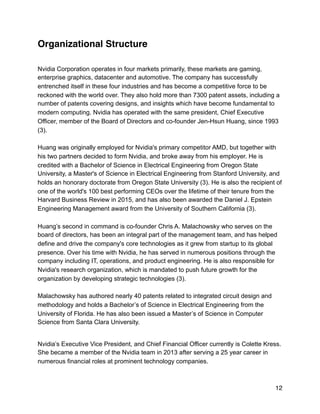
!
The logo for Nvidia’s flagship graphics (3).
One software available from Nvidia is called Geforce Experience which optimizes game
settings for any configuration of your particular PC. This allows for delivery of the power
of a PC with the ease of a console during gameplay. Gamers can also utilize cloud
computing to easily operate graphic intense games, which are prone to “lagging”
especially on the cloud, through GRID software. This is possible by allowing gamers to
play through the cloud, which means they can play their games on any display they
choose without the typical cloud issues (6).
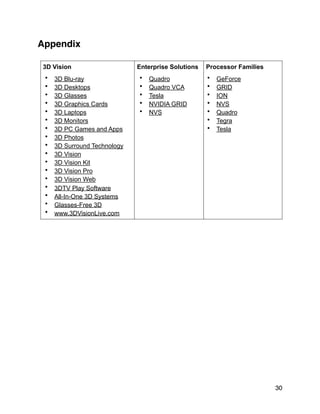
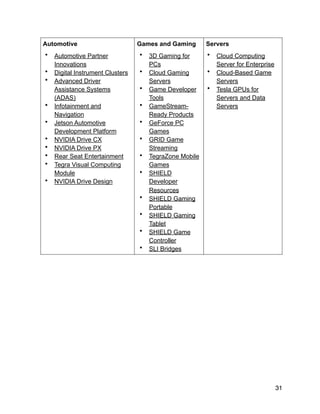
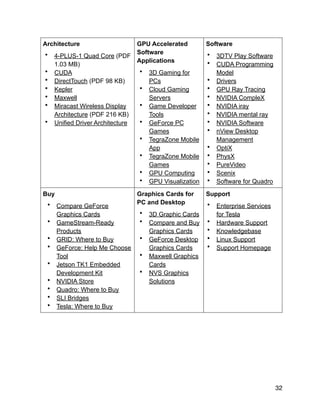
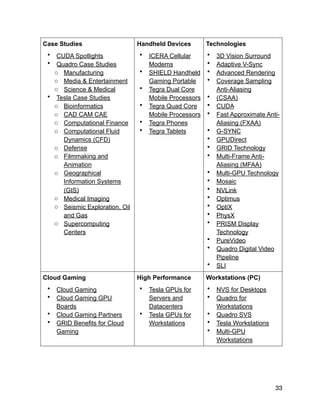
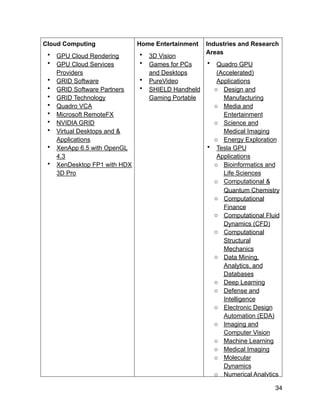
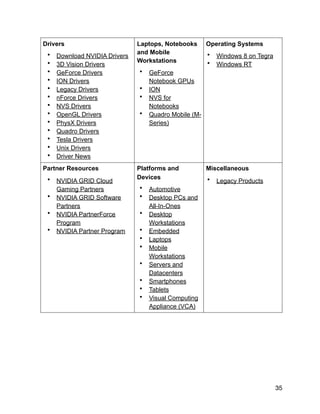
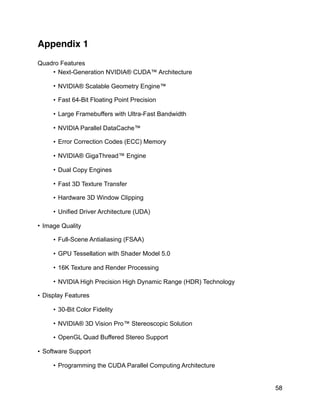
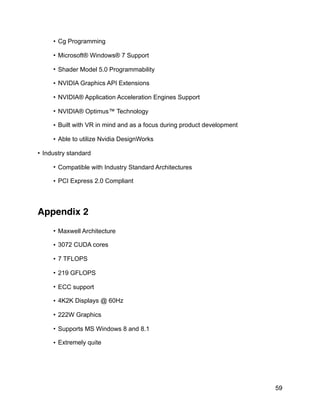
For a complete list of products that Nvidia offers please see appendix 1
Information Technology and Control Systems
18
Company and customer data is always under threat via cyber-attacks, system security
and data breaches. Nvidia manages this with their own IT infrastructure and manage
and store various sensitive, confidential or proprietary information themselves (30).
Nvidia’s CIO is Robert Warrell (26). They control inventory levels by communicating with
customers and partners to forecast demand. Nvidia generally maintains substantial
inventories because the “semiconductor industry is characterized by short lead time
orders and quick delivery schedules” (30). Inventory costs are computed on an adjusted
standard basis, which approximates actual cost on an average or first-in, first-out basis
(31). Cost of sales is charged for inventory provisions to write down inventory to the
lower of cost or estimated market value or to completely write off obsolete or excess
inventory. Most provisions relate to the write-off of excess quantities of products. Once
inventory has been written-off or written-down, it creates a new cost basis for the
inventory that is not subsequently written-up (31).
Organization Lifespan
Since Nvidia’s inception in 1993 it has entered a period of extreme growth, and has
seen the returns associated with this rapid start up. However with this company being a
technology based organization the lifespan associated with this industry is based on the
company’s ability to innovate and produce the latest and greatest products. For these
reasons we feel that the business has opportunity for massive growth over the long
term. We however do not feel that its growth will be solely based on its ability to produce
increased graphics with each product. They will in fact have to branch out into more
diverse markets, something they are already doing, by moving further into the AI,
automotive, 3D, software, and mobile devices markets.
19
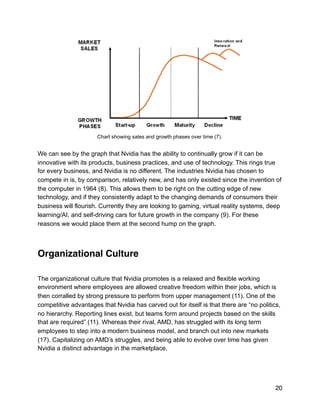
!
Chart showing sales and growth phases over time (7).
We can see by the graph that Nvidia has the ability to continually grow if it can be
innovative with its products, business practices, and use of technology. This rings true
for every business, and Nvidia is no different. The industries Nvidia has chosen to
compete in is, by comparison, relatively new, and has only existed since the invention of
the computer in 1964 (8). This allows them to be right on the cutting edge of new
technology, and if they consistently adapt to the changing demands of consumers their
business will flourish. Currently they are looking to gaming, virtual reality systems, deep
learning/AI, and self-driving cars for future growth in the company (9). For these
reasons we would place them at the second hump on the graph.
Organizational Culture
The organizational culture that Nvidia promotes is a relaxed and flexible working
environment where employees are allowed creative freedom within their jobs, which is
then corralled by strong pressure to perform from upper management (11). One of the
competitive advantages that Nvidia has carved out for itself is that there are “no politics,
no hierarchy. Reporting lines exist, but teams form around projects based on the skills
that are required” (11). Whereas their rival, AMD, has struggled with its long term
employees to step into a modern business model, and branch out into new markets
(17). Capitalizing on AMD’s struggles, and being able to evolve over time has given
Nvidia a distinct advantage in the marketplace.
20
We would suggest to Nvidia when it comes to defining, and maintaining distinct
competencies that performing an internal audit of the culture, employees, and structure
of the company at least once every three years is beneficial. This allows them to assess
how the company is shifting into the future and would also allow them to identify
problem areas within the organization, and address them as promptly as possible.
Ethical Values
Much of what is stated in Nvidia’s ethics web page is followed by the company. They
state that “ninety-eight percent of employees who have frequent contact with customers,
partners, and suppliers (such as those in sales, finance and procurement) have
completed global anti-bribery and anti-corruption training” (12) and they have an
established worldwide code of conduct which every employee is required to take upon
being hired at the company. However, this does not mean that the company is flawless.
In an article published in 2003 on extremetech.com, the newest GeForce branded
graphics card the GeForceFX 5900 was using detection protocols which artificially
inflated the cards performance figures (10). Nvidia had been caught cheating and
refused to comment on the findings of ExtremeTech, and other organizations which ran
similar tests. This situation shows that although Nvidia claims they are an ethical
company, they are always looking for a leg up on the competition wherever they can
find it.
This particular instance was over 12 years ago, and since then Nvidia has avoided this
kind of unfavourable spotlight which shows to us that they are moving in the right
direction ethically. In order to maintain this trajectory it would be advisable for Nvidia to
avoid tactics such as this and clearly focus their efforts on simply producing superior
products and services rather than employing artificially generated performance figures.
Innovation and Change
Since their origin in 1993, Nvidia has innovated, and introduced new products and
technologies to help them stay with the times. The credit they have received for the
21
invention of the graphics processing unit just six years after the company was founded
speaks greatly of their ability to not only innovate, but revolutionize (2).
In today’s ever evolving technological world however, companies must move faster than
that, and while Nvidia is in constant competition with AMD in the GPU market, Nvidia
has truly managed to keep up. It has extended its reach into software, cloud computing,
servers, enterprise, supercomputers, and autonomous vehicles to name a few. Some of
these markets are accessed due to their pure innovative ability, some due to changes in
other industries like the automotive industry.
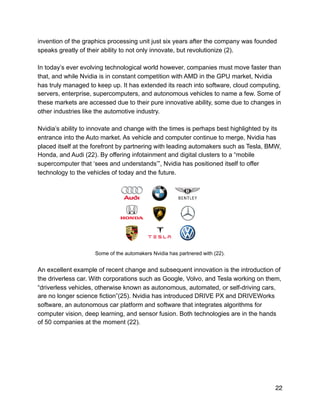
Nvidia’s ability to innovate and change with the times is perhaps best highlighted by its
entrance into the Auto market. As vehicle and computer continue to merge, Nvidia has
placed itself at the forefront by partnering with leading automakers such as Tesla, BMW,
Honda, and Audi (22). By offering infotainment and digital clusters to a “mobile
supercomputer that ‘sees and understands’”, Nvidia has positioned itself to offer
technology to the vehicles of today and the future.
!
Some of the automakers Nvidia has partnered with (22).
An excellent example of recent change and subsequent innovation is the introduction of
the driverless car. With corporations such as Google, Volvo, and Tesla working on them,
“driverless vehicles, otherwise known as autonomous, automated, or self-driving cars,
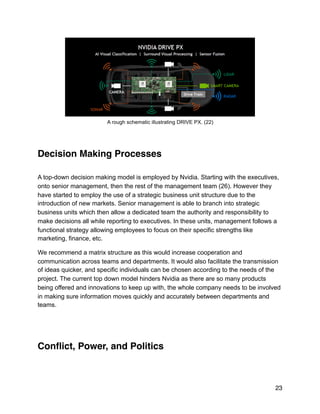
are no longer science fiction”(25). Nvidia has introduced DRIVE PX and DRIVEWorks
software, an autonomous car platform and software that integrates algorithms for
computer vision, deep learning, and sensor fusion. Both technologies are in the hands
of 50 companies at the moment (22).
22
!
A rough schematic illustrating DRIVE PX. (22)
Decision Making Processes
A top-down decision making model is employed by Nvidia. Starting with the executives,
onto senior management, then the rest of the management team (26). However they
have started to employ the use of a strategic business unit structure due to the
introduction of new markets. Senior management is able to branch into strategic
business units which then allow a dedicated team the authority and responsibility to
make decisions all while reporting to executives. In these units, management follows a
functional strategy allowing employees to focus on their specific strengths like
marketing, finance, etc.
We recommend a matrix structure as this would increase cooperation and
communication across teams and departments. It would also facilitate the transmission
of ideas quicker, and specific individuals can be chosen according to the needs of the
project. The current top down model hinders Nvidia as there are so many products
being offered and innovations to keep up with, the whole company needs to be involved
in making sure information moves quickly and accurately between departments and
teams.
Conflict, Power, and Politics
23
Conflict and power are handled within management and executives. There is no politics
as employees are focused getting the project done. As stated by a current employee on
Glassdoor.com: “The project is the boss (removing) boundaries and politics from getting
work done” (27).
Summary and Recommendations
What we have found is that Nvidia is currently very well positioned in the market. With a
rich history, effective strategies, innovative and quality products, a wide array of
products, services, and a solid management team, Nvidia is setup for success in the
years to come. By keeping R&D as its main focus, it should continue to innovate in
current technological areas, and new markets such as artificial intelligence and
driverless vehicles. Partnering with current leaders in other industries will keep it in the
spotlight and at the head of technological improvement.
There are a few recommendations we have for Nvidia. It should consider vertical
integration for its silicon wafer manufacturing to avoid future issues. They should
produce a stated hierarchy for the business to help employees to understand where
they fit into the business. A matrix structure is also recommended to be integrated into
the business model to increase the flow of ideas and information across the company
and encourage cooperation and teamwork. They should also perform internal audits
periodically to assess how the business in doing as a whole and weed out problem
areas as soon as possible. Nvidia should also avoid using back hat tactics when
producing its products so as to be seen by the public as an honest, upstanding
company. With all of this in mind, Nvidia is well on its way to achieving its goal of
becoming one of the largest technology companies in the world.
24
Endnotes
1. (Intrigo systems, 2015)
2. (Nvidia Corporation, 2016)
3. (Nvidia Corporation, 2016)
4. (anonymous, 2014)
5. (Nvidia Corporation, 2016)
6. (Trivedi, 2013)
7. (Banyan Consulting, 2016)
8. (Tech Blog, 2012)
9. (Nvidia Corporation, 2016)
10.(Hachman, 2003)
11. (Nvidia Corporation, 2014)
12.(Nvidia Corporation, 2016)
13.(Nvidia Corporation, 2016)
14.(Nvidia Corporation, 2016)
15.(Ballegoie, 1999)
16.(Nvidia Corporation, 2016)
17.(Sisney, 2013)
18.(Kumar, Jha, & Singh, 2014)
19.(Nvidia Corporation, 2016)
20.(Nvidia Corporation, 2016)
21.(Nvidia Corporation, 2016)
22.(Nvidia Corporation, 2016)
23.(Kotaku, 2015)
24.(Jon Peddie Research, 2016)
25.(Bank Rate, 2015)
26.(Nvidia Corporation, 2016)
27.(Glass Door, 2016)
28.(Nvidia Corporation, 2016)
29.(Softpedia, 2016)
30.(Nvidia Corporation, 2016)
31.(Nvidia Corporation, 2016)
25
Bibliography
1. Sladewski, L., & Bhalla, T. (Narrator). (2015). Supply Chain Transformation:
NVIDIA's Jo [Online video]. Retrieved from https://www.youtube.com/watch?
v=ou8aFYB2m3I
2. Nvidia History (2016). In Nvidia Corporation. Retrieved from http://
www.nvidia.com/page/corporate_timeline.html
3. Nvidia Executive Bios (2016). In Nvidia Corporation. Retrieved June 5, 2016,
from http://nvidianews.nvidia.com/bios
4. "Not Structured" (2012, October 4). In glassdoor. Retrieved June 5, 2016, from
https://www.glassdoor.com/Reviews/Employee-Review-NVIDIA-
RVW2018875.htm
5. Nvidia Product and Technologies (2016). In Nvidia Corporation. Retrieved June
5, 2016, from http://www.nvidia.com/page/products.html#Buy
6. Trivedi, S. (2013, May 7). Nvidia Corporate Presentation. In Slideshare.
Retrieved June 5, 2016, from http://www.slideshare.net/shankert/nvidia-
intro-0513?from_action=save
7. (2016). [Image of painting]. Sydney, Australia; Banyan Consulting. Retrieved
June 5, 2016, from http://www.banyanconsulting.com.au/files/images/content/
buslifecycles1.gif.gif
8. The incredible story of the first PC, from 1965 (2012, August 28). In
PINGDOM.com. Retrieved June 5, 2016, from http://royal.pingdom.com/
2012/08/28/the-first-pc-from-1965/
9. ANNUAL MEETING OF STOCKHOLDERS (2016, May 18). In Nvidia
Corporation. Retrieved from http://files.shareholder.com/downloads/
AMDA-1XAJD4/2045208450x0x892559/04904D44-B168-47C3-
B459-5F12C2D5CB05/
NVIDIA_Corporation_2016_Annual_Meeting_of_Stockholders.pdf
26
10.Hachman, M. (2003, June 6). New Benchmark Controversy Engulfs Nvidia. In
ExtremeTech. Retrieved June 5, 2016, from http://www.extremetech.com/
extreme/54356-new-benchmark-controversy-engulfs-nvidia
11. Our Culture (2016). In Nvidia Corporation. Retrieved from http://www.nvidia.com/
object/culture-at-nvidia.html
12.Governance and Ethics (2016). In Nvidia Corporation. Retrieved June 5, 2016,
from http://www.nvidia.ca/object/fy14-gcr-governance-ethics.html
13.(2016). [Image of photograph]. Santa Clara, California; Nvidia Corporation.
Retrieved June 5, 2016, from https://developer.nvidia.com/particles
14.NVIDIA Launches the World's First Graphics Processing Unit: GeForce 256
(2016). In Nvidia Corporation. Retrieved June 5, 2016, from http://
www.nvidia.com/object/IO_20020111_5424.html
15.Ballegoie, E. V. (1999, April 9). 3dfx Voodoo 3 3000. In Fast Graphics. Retrieved
from http://www.telecommander.com/pics/links/vgacards/voodoo33000/3dfx
%20Voodoo%203%203000%20review%20--%20Fast%20Graphics.htm
16.Tesla (2016). In Nvidia Corporation. Retrieved from http://www.nvidia.com/object/
gpu-applications.html
17.Sisney, L. (2013, April 25). A Scathing Portrait of the Innovator Leadership Style
at AMD. In Organizational Physics. Retrieved from http://
organizationalphysics.com/2013/04/25/a-scathing-portrait-of-the-innovator-
leadership-style-at-amd/
18.Kumar, S., Bhushan Jha, S., & Kumar Singh, R. (2014, November). Graphical
Process Unit A New Era [Electronic version]. Journal of Emerging Technologies
and Innovative Research, 1(6), 591.
19.Nvidia Board of Directors (2016). In Nvidia Corporation. Retrieved June 5, 2016,
from http://investor.nvidia.com/directors.cfm
20.Who we are and what we do… (2016) In Nvidia Corporation. Retreived from
http://www.nvidia.com/object/employment_culture.html
27
21.Nvidia Board of Directors (2016). In Nvidia Corporation. Retrieved from http://
files.shareholder.com/downloads/
AMDA-1XAJD4/2171622686x0x851125/8E46E195-B65B-40AB-
AF11-2A810F9B63D6/NVIDIA_2015.pdf
22.Graphics Card Battle 2015: Nvidia Versus AMD At Every Price Point (2015). In
Kotaku. Retrieved from http://kotaku.com/graphics-card-battle-2015-nvidia-
versus-amd-at-every-p-1739764338
23.High-end add-in boards shipments increased in 1 2016, while all else declined. In
Jon Peddie Research. Retrieved fromhttp://www.jonpeddie.com/publications/add-
in-board-report
24.6 firms that are testing driverless cars (2016). In Bankrate. Retrieved from http://
www.bankrate.com/finance/auto/companies-testing-driverless-cars-1.aspx
25.NVIDIA Corporation. (2015). NVIDIA Corporation MarketLine Company Profile,
1-32.
26.Nvidia Reviews (2016). In Glassdoor. Retrieved fromhttps://www.glassdoor.ca/
Reviews/NVIDIA-Reviews-E7633.htm?
sort.sortType=RD&sort.ascending=false&filter.includePastEmployees=false&filter
.defaultEmploymentStatuses=false&filter.defaultLocation=false&filter.employment
Status=PART_TIME&filter.employmentStatus=REGULAR&filter.employmentStatu
s=UNKNOWN
27.NVIDIA Corporation SWOT Analysis. (2014). NVIDIA Corporation SWOT
Analysis, 1-9
28.PC Market Growth Hit Hard By Financial Crisis (2008). In Softpedia. Retrieved
from http://news.softpedia.com/news/PC-Market-Growth-Hit-Hard-by-Financial-
Crisis-102034.shtml
29.Nvidia Board of Directors (2016). In Nvidia Corporation. Retrieved from http://
investor.nvidia.com/secfiling.cfm?filingID=1045810-16-205&CIK=1045810
28
30.Nvidia Board of Directors (2016). In Nvidia Corporation. Retrieved from http://
files.shareholder.com/downloads/
AMDA-1XAJD4/2171622686x0x820289/9580F59D-32B1-43FB-944E-8A4A77B7
E912/2015_NVDA_Annual_Report.pdf


29
Appendix
3D Vision	
• 3D Blu-ray
• 3D Desktops
• 3D Glasses
• 3D Graphics Cards
• 3D Laptops
• 3D Monitors
• 3D PC Games and Apps
• 3D Photos
• 3D Surround Technology
• 3D Vision
• 3D Vision Kit
• 3D Vision Pro
• 3D Vision Web
• 3DTV Play Software
• All-In-One 3D Systems
• Glasses-Free 3D
• www.3DVisionLive.com
Enterprise Solutions	
• Quadro
• Quadro VCA
• Tesla
• NVIDIA GRID
• NVS
Processor Families	
• GeForce
• GRID
• ION
• NVS
• Quadro
• Tegra
• Tesla
30
Automotive	
• Automotive Partner
Innovations
• Digital Instrument Clusters
• Advanced Driver
Assistance Systems
(ADAS)
• Infotainment and
Navigation
• Jetson Automotive
Development Platform
• NVIDIA Drive CX
• NVIDIA Drive PX
• Rear Seat Entertainment
• Tegra Visual Computing
Module
• NVIDIA Drive Design
Games and Gaming	
• 3D Gaming for
PCs
• Cloud Gaming
Servers
• Game Developer
Tools
• GameStream-
Ready Products
• GeForce PC
Games
• GRID Game
Streaming
• TegraZone Mobile
Games
• SHIELD
Developer
Resources
• SHIELD Gaming
Portable
• SHIELD Gaming
Tablet
• SHIELD Game
Controller
• SLI Bridges
Servers	
• Cloud Computing
Server for Enterprise
• Cloud-Based Game
Servers
• Tesla GPUs for
Servers and Data
Servers
31
Architecture	
• 4-PLUS-1 Quad Core (PDF
1.03 MB)
• CUDA
• DirectTouch (PDF 98 KB)
• Kepler
• Maxwell
• Miracast Wireless Display
Architecture (PDF 216 KB)
• Unified Driver Architecture
GPU Accelerated
Software
Applications	
• 3D Gaming for
PCs
• Cloud Gaming
Servers
• Game Developer
Tools
• GeForce PC
Games
• TegraZone Mobile
App
• TegraZone Mobile
Games
• GPU Computing
• GPU Visualization
Software	
• 3DTV Play Software
• CUDA Programming
Model
• Drivers
• GPU Ray Tracing
• NVIDIA CompleX
• NVIDIA iray
• NVIDIA mental ray
• NVIDIA Software
• nView Desktop
Management
• OptiX
• PhysX
• PureVideo
• Scenix
• Software for Quadro
Buy	
• Compare GeForce
Graphics Cards
• GameStream-Ready
Products
• GRID: Where to Buy
• GeForce: Help Me Choose
Tool
• Jetson TK1 Embedded
Development Kit
• NVIDIA Store
• Quadro: Where to Buy
• SLI Bridges
• Tesla: Where to Buy
Graphics Cards for
PC and Desktop	
• 3D Graphic Cards
• Compare and Buy
Graphics Cards
• GeForce Desktop
Graphics Cards
• Maxwell Graphics
Cards
• NVS Graphics
Solutions
Support	
• Enterprise Services
for Tesla
• Hardware Support
• Knowledgebase
• Linux Support
• Support Homepage
32
Case Studies	
• CUDA Spotlights
• Quadro Case Studies
o Manufacturing
o Media & Entertainment
o Science & Medical
• Tesla Case Studies
o Bioinformatics
o CAD CAM CAE
o Computational Finance
o Computational Fluid
Dynamics (CFD)
o Defense
o Filmmaking and
Animation
o Geographical
Information Systems
(GIS)
o Medical Imaging
o Seismic Exploration, Oil
and Gas
o Supercomputing
Centers
Handheld Devices	
• ICERA Cellular
Modems
• SHIELD Handheld
Gaming Portable
• Tegra Dual Core
Mobile Processors
• Tegra Quad Core
Mobile Processors
• Tegra Phones
• Tegra Tablets
Technologies	
• 3D Vision Surround
• Adaptive V-Sync
• Advanced Rendering
• Coverage Sampling
Anti-Aliasing
• (CSAA)
• CUDA
• Fast Approximate Anti-
Aliasing (FXAA)
• G-SYNC
• GPUDirect
• GRID Technology
• Multi-Frame Anti-
Aliasing (MFAA)
• Multi-GPU Technology
• Mosaic
• NVLink
• Optimus
• OptiX
• PhysX
• PRISM Display
Technology
• PureVideo
• Quadro Digital Video
Pipeline
• SLI
Cloud Gaming	
• Cloud Gaming
• Cloud Gaming GPU
Boards
• Cloud Gaming Partners
• GRID Benefits for Cloud
Gaming
High Performance	
• Tesla GPUs for
Servers and
Datacenters
• Tesla GPUs for
Workstations
Workstations (PC)	
• NVS for Desktops
• Quadro for
Workstations
• Quadro SVS
• Tesla Workstations
• Multi-GPU
Workstations
33
Cloud Computing	
• GPU Cloud Rendering
• GPU Cloud Services
Providers
• GRID Software
• GRID Software Partners
• GRID Technology
• Quadro VCA
• Microsoft RemoteFX
• NVIDIA GRID
• Virtual Desktops and &
Applications
• XenApp 6.5 with OpenGL
4.3
• XenDesktop FP1 with HDX
3D Pro
Home Entertainment	
• 3D Vision
• Games for PCs
and Desktops
• PureVideo
• SHIELD Handheld
Gaming Portable
Industries and Research
Areas	
• Quadro GPU
(Accelerated)
Applications
o Design and
Manufacturing
o Media and
Entertainment
o Science and
Medical Imaging
o Energy Exploration
• Tesla GPU
Applications
o Bioinformatics and
Life Sciences
o Computational &
Quantum Chemistry
o Computational
Finance
o Computational Fluid
Dynamics (CFD)
o Computational
Structural
Mechanics
o Data Mining,
Analytics, and
Databases
o Deep Learning
o Defense and
Intelligence
o Electronic Design
Automation (EDA)
o Imaging and
Computer Vision
o Machine Learning
o Medical Imaging
o Molecular
Dynamics
o Numerical Analytics
34
Drivers	
• Download NVIDIA Drivers
• 3D Vision Drivers
• GeForce Drivers
• ION Drivers
• Legacy Drivers
• nForce Drivers
• NVS Drivers
• OpenGL Drivers
• PhysX Drivers
• Quadro Drivers
• Tesla Drivers
• Unix Drivers
• Driver News
Laptops, Notebooks
and Mobile
Workstations	
• GeForce
Notebook GPUs
• ION
• NVS for
Notebooks
• Quadro Mobile (M-
Series)
Operating Systems	
• Windows 8 on Tegra
• Windows RT
Partner Resources	
• NVIDIA GRID Cloud
Gaming Partners
• NVIDIA GRID Software
Partners
• NVIDIA PartnerForce
Program
• NVIDIA Partner Program
Platforms and
Devices	
• Automotive
• Desktop PCs and
All-In-Ones
• Desktop
Workstations
• Embedded
• Laptops
• Mobile
Workstations
• Servers and
Datacenters
• Smartphones
• Tablets
• Visual Computing
Appliance (VCA)
Miscellaneous	
• Legacy Products
35
Industry Analysis
CONDUCTED BY
COLTON GOERTZEN & GURMINDER GREWAL
BUSINESS 403: STRATEGIC MANAGEMENT
MARK LEE
36
Industry Analysis
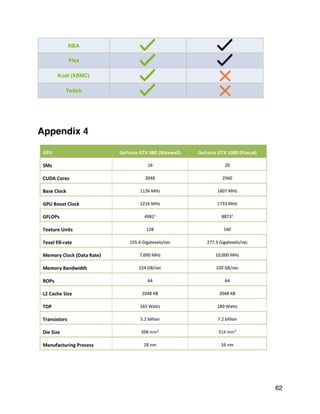
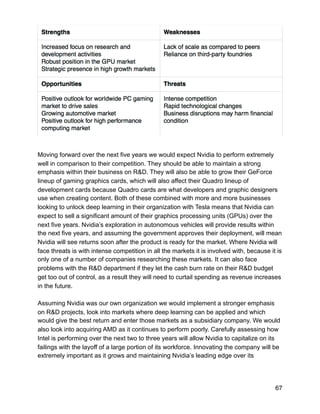
The Graphics Processing Unit (GPU) is essentially the cornerstone of Nvidia’s business
and is required in all of Nvidia’s product and technology, as such the company that is
Nvidia’s most influential competitor is Advanced Micro Devices (AMD) in the standalone
GPU market, which is the GPU which is sold outside of a complete computational set
up. Now Nvidia currently owns 82% if this GPU market and AMD holds 18% (27),
however if we include all computers which come with graphics cards then Intel controls
over 72.8%, AMD 11.5% and Nvidia maintains just under 16% (28). What this means is
that though Nvidia does a phenomenal job at maintaining a competitive advantage over
AMD, however compared with Intel it is quite small. That being said the CEO of Nvidia
did acknowledge that:
“In fact 97% of all high performance computers and super computers contain Nvidia
technology”
- Jen Hsun Huang CEO of Nvidia
This indicates to us that Nvidia does not want to compete with the ordinary PC market.
They are in fact looking to the high performance modification market to drive their
business and with that detail in mind the company is walking over the competition
completely.
Nvidia is looking to three new advancements in technology to open up new
opportunities for their business. These technologies are virtual reality (VR), deep
learning and automotive. In the computing industry Nvidia has positioned itself to take
advantage of these most recent advancements. But the company got its start in the
gaming industry and still maintains a very loyal following. Currently Nvidia’s gaming
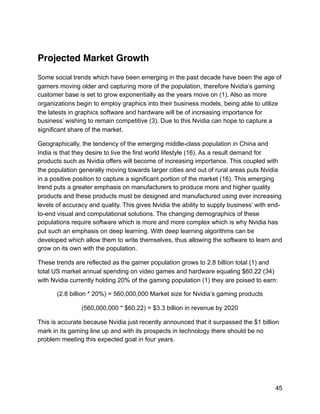
lineup occupies 22% of the entire gaming GPU market with a 25% annual growth rate in
selling price and a 25% compounded annual growth rate in sales revenue (1). The
market is set to grow exponentially as the population of gamers grows older but
continues to play games alongside the younger generation, introducing them to the
gaming industry (1). Nvidia is also able to boast a 16% growth rate in units sold per year
on their GeForce lineup, with users reaching 2.8 billion worldwide in the next four years
(1).
Nvidia’s Quadro line up which is largely meant for designers, artists, scientists or
professional visualization of data contributes 25 million users total to Nvidia. That
37
breaks down into 15 million involved with manufacturing, 9 million in the media and
entertainment industry and one million in the scientific visualization sector (2).
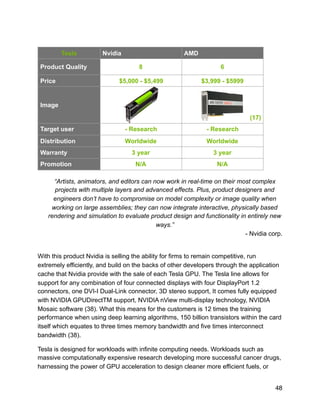
Nvidia’s Tesla line is expected to grow dramatically in the coming years with the market
growing from $109 million spent in 2015 on enterprise applications of deep learning to
$10.4 billion by 2024 forecasted by Tratica (4). For this reason Nvidia is devoting much
of its attention to this line of products. By focusing on its technological and software
supremacy Nvidia will be able to carve out a hugely substantial niche within the
graphics and supercomputing market.
“Technologies such as NVIDIA GRID...will greatly contribute to the growth of the virtual
client computing market, which is currently forecasted to reach $4.6 billion by 2020.”
- Robert Young IDC 2016
Nvidia’s automotive software Nvidia DRIVE currently is employed by 21 automakers, 16
suppliers and 39 automotive technology and software companies (5). What this
translates into for Nvidia is a 75% growth in revenue in 2016 from $183 million in 2015
to a forecasted $320 million in 2016 (5). The total market opportunity for Nvidia in this
industry is $2 billion in digital cockpit systems for cars, $2 billion into research and
testing of self-driving cars and $2 - 6 billion in transport service vehicles (5). This robust
market which is set to explode with the invention of autonomous vehicles puts Nvidia in
a prime spot to supply the auto sector with the technology required to produce these
highly demanded products.
When it comes to virtual reality (VR) the way the market understands it is essentially
based off of movies from the 80’s and 90’s and is quite antiquated, with the headset and
gloves standing in a room which changes based on the environment chosen. Todays
modern VR systems are somewhat based off this idea, however instead of a room you
have a head mounted goggle set and a controller in one hand. This system allows for
exploration of areas which are unattainable at this point in time, such as the surface of
Mars or the peak of Everest, all constructed using Nvidia software (6). This new
technology opens up a huge market for Nvidia because by creating these hypothetical,
realistic environments, graphics designers can now create places which don’t exists as
of yet. From a walk through of a building which hasn’t been constructed, to doctors
training to perform surgeries in the classroom, or giving manufacturers the ability to see
their new product without having to actually produce it in a factory, all by using Nvidia
software and technology. This market is set to grow massively from approximately $3
million spent this year to approximately $16 million by 2020 (1). VR will allow for a fully
38
immersive experience of environments where previous levels of depth only scratched
the surface.
The next advancement is deep learning. This technology holds the most potential for
Nvidia because through it computers can learn to do things humans simply can’t. They
do this by commanding them through trial and error to learn, for example Microsoft and
Google were able to have a machine recognize images far superior to a human for the
first time and then were able to tell it to create a brand new image on its own based on
what it learned (6). The research institute Deepmind was able to teach a robot to put a
square peg in a square hole on its own without any input other then the code which told
it to learn, it also then took a bottle cap and was able to screw it on a bottle top purely
by learning (6). Programs such as these are far too complex for humans to write on their
own but with deep learning they are able to tell a computer to figure it out by itself. The
result of this is that it opens up a vast new area of computing where organizations are
able to employ this artificial intelligence to learn and control networks. Companies such
as General Electric are using deep learning to monitor and control everything from
elevators to power distribution centres all over the world. By linking the systems
together they are able to take early action to repair a failing part or give an early warning
in the event of a catastrophe (6). Because of deep learnings generality of use and
implications on the computing world Nvidia has again positioned itself in the industry to
take full advantage of this technology and stands to obtain a large amount of
marketshare from this breakthrough. Nvidia believes that every business in every
industry has an opportunity to apply deep learning into their organization, with market
analysts claiming that the market will grow to $10.4 billion by 2024 (4) companies like
Amazon, Google, twitter, and Microsoft already utilize deep learning in their
business’ (6). Nvidia believes with further advancements deep learning is going to be
the next big leap in personal computing.
The last of the three technological breakthroughs comes from a combination of
automotive and deep learning. What this means is that by using the deep learning
program combined with the computer monitoring how we drive it can learn how to drive
the car on its own. The difficult point in the system is that it requires the power of a
supercomputer to be present in the car as it’s being driven. Now Nvidia’s DRIVE
software combined with Nvidia GPUs allows for this to take place through end-to-end
mapping of environments. essentially sensing, planning, and acting as surroundings
change outside the car the computer senses its environment, plans its moves
accordingly, then it acts on those moves and restarts the loop until it reaches its
destination (6). The result is that the computer can drive the car on roads without lanes,
39
on gravel, on highways and city streets. This industry is going to grow dramatically with
Nvidia at the forefront and leading the charge for the autonomous car. With Nvidia’s
advancements in deep learning and artificial intelligence the autonomous car is more of
a reality then a concept. This gives Nvidia full control over the cutting edge of
technology for years to come.
When it comes to the international market Nvidia’s products largely go into other
companies products and their ability to customize their offerings begins and ends with
other companies products successes. For this reason Nvidia won’t have to worry about
end consumers purchasing its products. They need only worry about delivering superior
products to other business’ so as to allow those business’ the ability to give consumers
products which outperform the competition. This becomes even easier because Nvidia
is pouring a large amount of funds into software development thus exporting around the
world becomes extremely easy with the internet, however unless Nvidia can deliver their
GPUs worldwide use of the software will be limited.
Target Market
Nvidia’s customer base is broken down into two major categories, business to business
and business to consumer. Largely the business to business customers are
organizations that can profit from deep learning, research institutes and automotive (6).
Whereas the business to consumer customers are majorly gamers (1), graphic
designers (3), and VR developers (2). Nvidia also has partnerships with certain
business’ such as IBM with its supercomputer and high power computer market
offerings (6). This gives Nvidia the ability to sell an all-inclusive package when
customers are looking for that level of performance.
Currently Nvidia seeks to supply every business with some form of deep learning. Thus
developing the algorithms increases its ability to offer this product to business’ in every
industry. They have 526 educational institutions worldwide which are currently utilizing
Nvidia GPUs (29) and automotive business’ like BMW, Volkswagen, Hyundai, Honda
and others are already implementing Nvidia GPUs into their vehicles (5). IBM also holds
a large amount of the high performance computer market; approximately 32% of all high
performance computers sold are from IBM (6), therefore Nvidia automatically has 32%
of the high performance computer market as well. These kinds of business’ have one
thing to gain by purchasing from Nvidia, that is to save money (3). By buying the newest
40
technology organizations can save money simply based on the level of productivity they
can gain from upgrading to the newest technology (3).
“This unprecedented level of power and flexibility is greatly improving employee
productivity, mobility, and morale”
- Bell Helicopter
“We can work from anywhere on any device, continue working if there are location
restrictions, and update project files in real-time”
- Populous Inc.
When it comes to business to consumer markets Nvidia’s following is vast. Their ideal
end-consumer customer is between 18 and 40 years old, they own a PC, are able to
access Nvidia’s GRID (a software platform where games and other programs are held
much like the app store in a virtual marketplace) or Nvidia’s workstation line up of
software, they also require graphically a very high performance system to run these
games or programs (1). Because Nvidia’s customers are demanding when it comes to
the level of performance of their computers systems they are also extremely insistent on
the level of performance attained from a Nvidia GPU. Due to this Nvidia is obligated to
produce high quality products and to constantly be updating them year after year.
Consumers are looking for Nvidia’s products because 80% of gamers are playing on
GPUs older then Sony’s Playstation 4, this coupled with the market expected to grow to
2.8 billion gamers within 4 years and multiplayer online battle arena (MOAB) gamers
are expected to grow to over 100 million by 2018 (1), they act as early adopters in the
marketplace and this means that end consumers can expect a huge leap in
performance over their current products. Linking all of these together means that Nvidia
is poised to supply a majority of the market with its products in the near future.
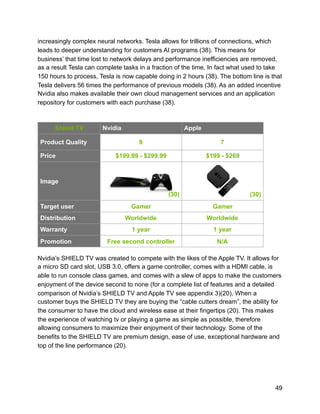
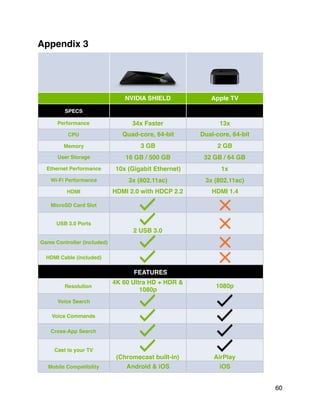
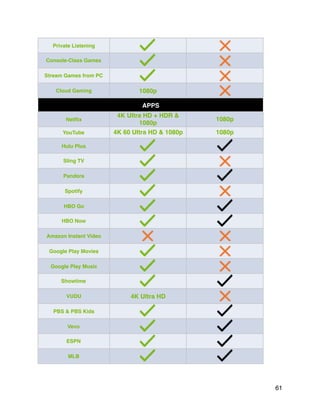
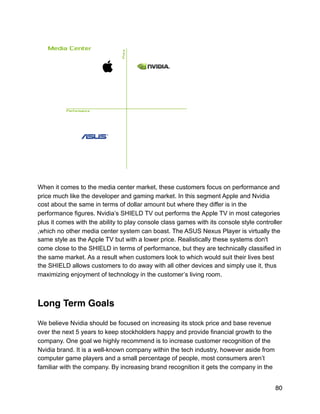
Where Nvida’s end customers vary is with its SHEILD Android TV. These customers
require a seamless experience and are looking for the biggest bang for their buck (30).
They are typically individuals who are looking to tie together their entire media system
into one package and are wanting to cut the cord on each of the multitude of devices in
their living room. They are between the ages of 18 and 40, they will have their own TV,
be considered a light gamer who is looking to replace their console with something
more suited to handle the whole media center and looking for the latest and greatest in
entertainment (30).
41
Major Competitors and Participants
Competition in the GPU market is extremely fierce, however Nvidia has positioned itself
to be much more then a GPU company in the industry by exploring new markets like we
have discussed previously. Companies like Intel and other competitors are by
comparison much larger than Nvidia. Nvidia may be smaller then its competitors in the
GPU market but Intel recently entered its third wave of layoffs (8). This indicates that
though it is much larger than Nvidia it is in financial difficulty. According to Intel they are
streamlining their business and eliminating redundancies (8). This may be true but
Intel’s latest income statement paints a picture that their sales were so low that laying
off these jobs didn’t even let them meet their benchmark of $13.83 billion in profit last
year. When we look at AMD we see a similar story. AMD has just 18% of the standalone
GPU market with the remainder going to Nvidia (27) and AMD is not exploring new
technologies to the same extent as Nvidia, which means that they are not producing
enough income to generate working capital past reworking their current technology.
Some major differences Nvidia has over its competition is that it’s a small company, its
business structure allows for a very organic and responsive adaptation to changing
trends within the market (7), this is echoed within the company with its flexible approach
to its employees, its proprietary products also let it carve out and maintain a niche
market with its own set of loyal customers. Its position in the GPU market means that it
can only grow in the years to come. This enhances the company's brand image and
provides a competitive advantage in terms of pricing and bargaining power with
customers, but Nvidia’s greatest strength right now is that its presence in high growth
markets which makes it a company to watch (7).
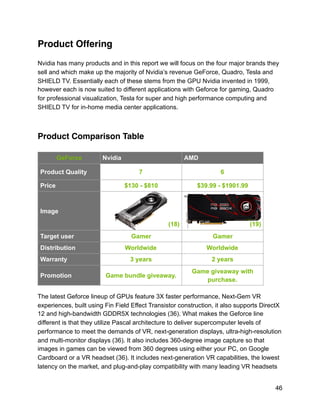
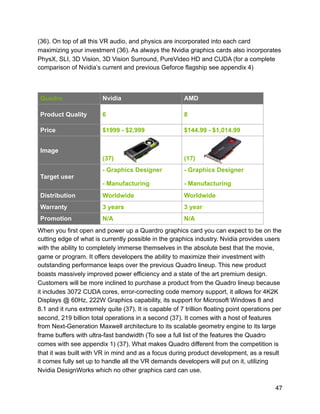
Nvidia’s Tesla and GRID products grew 60% in the past year. Revenue from Tesla
increased due to large project wins with cloud service providers and revenue from its
NVIDIA GRID virtualization products also increased as the GRID platform was able to
gain traction this past year (31). Nvidia also grew its mobile and auto businesses by
45% due to revenue from its Tegra processor increasing by 45% (31). This was because
higher levels of Tegra products are now serving automotive infotainment systems,
smartphones and tablet devices from other companies. All of these show that customers
like what Nvidia is producing and are migrating from current suppliers to Nvidia’s
products. Moreover Nvidia’s ability to concentrate its R&D with partnerships from
leaders in the computer-aided design industry help them determine what their
customers are looking for. This allows Nvidia to quickly and efficiently bring these
products to market. The result is that these partnerships end up working for both Nvidia
and the companies they partner with.
42
When it comes to the competitive strengths of Nvidia’s competitors, Intel has a history of
a very strong and successful R&D model which they plan on utilizing to bring out new
Intel Core microarchitecture for desktops, notebooks and Intel Xeon processors
approximately every two to three years (32) which is an industry Nvidia has not entered
as of yet. For this reason Intel controlled 72.8% of the total market during the first
quarter of this year (29). Intel also has an integrated manufacturing network which
Nvidia is lacking at this point in time. The one strength that Nvidia and Intel share is that
the both have an established market position in the marketplace (32). AMD also has a
very strong focus on R&D and is positioned to use their business transformation
strategy well in the future (33). They also like to explore high growth markets but not to
the same extent as Nvidia is comfortable with. One thing that they maintain is that they
have a wide geographic presence like Nvidia (33). For these reasons AMD only
maintained 11.5% of the overall GPU market this past quarter (28).
Some problems that Intel faces with their business is that they do not have a strong
presence in the mobility market (32) and both AMD and Intel have very concentrated
customer bases which adds to the business risk in the financial marketplace (32) (33).
Since this market is extremely competitive with only a few players, combined with the
fact that the tech based industry is one that requires a large amount of capital, or a
revolutionary product to get started, and since all three of the major competitors in this
industry have very large budgets for R&D, intrusion from an outside competitor is highly
unlikely to occur.
When it comes to how the competitions products are compared to Nvidia, we have to
look at how the product is meant to be used. When Intel produces a product it is largely
meant for laptops and desktops with a focus on computing power for all in one style
PCs, therefore they choose not to focus on the high-performance market like Nvidia
does (10). AMD on the other hand does focus on high end computing, but common
complaints about their products are that they are noisy, run hot and as such require
additional cooling capabilities. They are generally aimed at a lower quality higher
performance market and AMD tends to put a high amount of effort into securing
contracts to supply graphics cards for consoles, while Nvidia has moved on from this
market for some time (9).
43
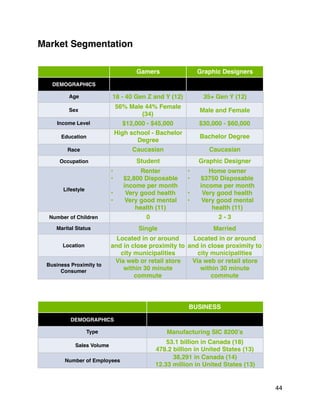
Market Segmentation
  Gamers Graphic Designers
DEMOGRAPHICS    
Age 18 - 40 Gen Z and Y (12) 35+ Gen Y (12)
Sex
56% Male 44% Female
(34)
Male and Female
Income Level $12,000 - $45,000 $30,000 - $60,000
Education
High school - Bachelor
Degree
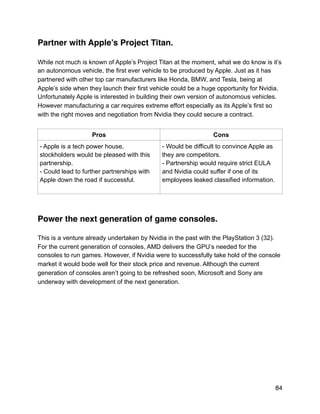
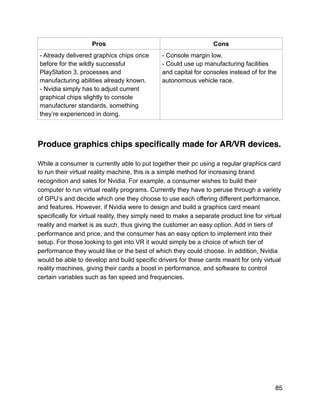
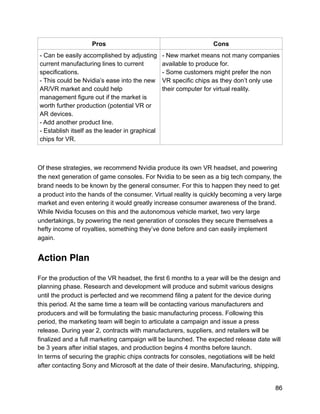
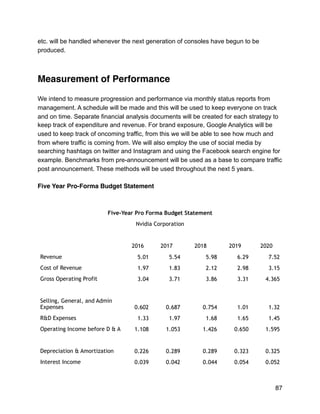
Bachelor Degree
Race Caucasian Caucasian
Occupation Student Graphic Designer
Lifestyle
• Renter
• $2,800 Disposable
income per month
• Very good health
• Very good mental
health (11)
• Home owner
• $3750 Disposable
income per month
• Very good health
• Very good mental
health (11)
Number of Children 0 2 - 3
Marital Status Single Married
Location
Located in or around
and in close proximity to
city municipalities
Located in or around
and in close proximity to
city municipalities
Business Proximity to
Consumer
Via web or retail store
within 30 minute
commute
Via web or retail store
within 30 minute
commute
  BUSINESS
DEMOGRAPHICS  
Type Manufacturing SIC 8200’s
Sales Volume
53.1 billion in Canada (18)
478.2 billion in United States (13)
Number of Employees
38,291 in Canada (14)
12.33 million in United States (13)
44
Projected Market Growth
Some social trends which have been emerging in the past decade have been the age of
gamers moving older and capturing more of the population, therefore Nvidia’s gaming
customer base is set to grow exponentially as the years move on (1). Also as more
organizations begin to employ graphics into their business models, being able to utilize
the latests in graphics software and hardware will be of increasing importance for
business’ wishing to remain competitive (3). Due to this Nvidia can hope to capture a
significant share of the market.
Geographically, the tendency of the emerging middle-class population in China and
India is that they desire to live the first world lifestyle (16). As a result demand for
products such as Nvidia offers will become of increasing importance. This coupled with
the population generally moving towards larger cities and out of rural areas puts Nvidia
in a positive position to capture a significant portion of the market (16). This emerging
trend puts a greater emphasis on manufacturers to produce more and higher quality
products and these products must be designed and manufactured using ever increasing
levels of accuracy and quality. This gives Nvidia the ability to supply business’ with end-
to-end visual and computational solutions. The changing demographics of these
populations require software which is more and more complex which is why Nvidia has
put such an emphasis on deep learning. With deep learning algorithms can be
developed which allow them to write themselves, thus allowing the software to learn and
grow on its own with the population.
These trends are reflected as the gamer population grows to 2.8 billion total (1) and
total US market annual spending on video games and hardware equaling $60.22 (34)
with Nvidia currently holding 20% of the gaming population (1) they are poised to earn:
(2.8 billion * 20%) = 560,000,000 Market size for Nvidia’s gaming products
(560,000,000 * $60.22) = $3.3 billion in revenue by 2020
This is accurate because Nvidia just recently announced that it surpassed the $1 billion
mark in its gaming line up and with its prospects in technology there should be no
problem meeting this expected goal in four years.
45
Product Offering
Nvidia has many products and in this report we will focus on the four major brands they
sell and which make up the majority of Nvidia’s revenue GeForce, Quadro, Tesla and
SHIELD TV. Essentially each of these stems from the GPU Nvidia invented in 1999,
however each is now suited to different applications with Geforce for gaming, Quadro
for professional visualization, Tesla for super and high performance computing and
SHIELD TV for in-home media center applications.
Product Comparison Table
The latest Geforce lineup of GPUs feature 3X faster performance, Next-Gem VR
experiences, built using Fin Field Effect Transistor construction, it also supports DirectX
12 and high-bandwidth GDDR5X technologies (36). What makes the Geforce line
different is that they utilize Pascal architecture to deliver supercomputer levels of
performance to meet the demands of VR, next-generation displays, ultra-high-resolution
and multi-monitor displays (36). It also includes 360-degree image capture so that
images in games can be viewed from 360 degrees using either your PC, on Google
Cardboard or a VR headset (36). It includes next-generation VR capabilities, the lowest
latency on the market, and plug-and-play compatibility with many leading VR headsets
GeForce Nvidia AMD
Product Quality 7 6
Price $130 - $810 $39.99 - $1901.99
Image
(18) (19)
Target user Gamer Gamer
Distribution Worldwide Worldwide
Warranty 3 years 2 years
Promotion Game bundle giveaway.
Game giveaway with
purchase.
46
(36). On top of all this VR audio, and physics are incorporated into each card
maximizing your investment (36). As always the Nvidia graphics cards also incorporates
PhysX, SLI, 3D Vision, 3D Vision Surround, PureVideo HD and CUDA (for a complete
comparison of Nvidia’s current and previous Geforce flagship see appendix 4)
When you first open and power up a Quardro graphics card you can expect to be on the
cutting edge of what is currently possible in the graphics industry. Nvidia provides users
with the ability to completely immerse themselves in the absolute best that the movie,
game or program. It offers developers the ability to maximize their investment with
outstanding performance leaps over the previous Quadro lineup. This new product
boasts massively improved power efficiency and a state of the art premium design.
Customers will be more inclined to purchase a product from the Quadro lineup because
it includes 3072 CUDA cores, error-correcting code memory support, it allows for 4K2K
Displays @ 60Hz, 222W Graphics capability, its support for Microsoft Windows 8 and
8.1 and it runs extremely quite (37). It is capable of 7 trillion floating point operations per
second, 219 billion total operations in a second (37). It comes with a host of features
from Next-Generation Maxwell architecture to its scalable geometry engine to its large
frame buffers with ultra-fast bandwidth (To see a full list of the features the Quadro
comes with see appendix 1) (37). What makes Quadro different from the competition is
that it was built with VR in mind and as a focus during product development, as a result
it comes fully set up to handle all the VR demands developers will put on it, utilizing
Nvidia DesignWorks which no other graphics card can use.
Quadro Nvidia AMD
Product Quality 6 8
Price $1999 - $2,999 $144.99 - $1,014.99
Image
(37) (17)
Target user
- Graphics Designer
- Manufacturing
- Graphics Designer
- Manufacturing
Distribution Worldwide Worldwide
Warranty 3 years 3 year
Promotion N/A N/A
47
“Artists, animators, and editors can now work in real-time on their most complex
projects with multiple layers and advanced effects. Plus, product designers and
engineers don’t have to compromise on model complexity or image quality when
working on large assemblies; they can now integrate interactive, physically based
rendering and simulation to evaluate product design and functionality in entirely new
ways.”
- Nvidia corp.
With this product Nvidia is selling the ability for firms to remain competitive, run
extremely efficiently, and build on the backs of other developers through the application
cache that Nvidia provide with the sale of each Tesla GPU. The Tesla line allows for
support for any combination of four connected displays with four DisplayPort 1.2
connectors, one DVI-I Dual-Link connector, 3D stereo support, It comes fully equipped
with NVIDIA GPUDirectTM support, NVIDIA nView multi-display technology, NVIDIA
Mosaic software (38). What this means for the customers is 12 times the training
performance when using deep learning algorithms, 150 billion transistors within the card
itself which equates to three times memory bandwidth and five times interconnect
bandwidth (38).
Tesla is designed for workloads with infinite computing needs. Workloads such as
massive computationally expensive research developing more successful cancer drugs,
harnessing the power of GPU acceleration to design cleaner more efficient fuels, or
Tesla Nvidia AMD
Product Quality 8 6
Price $5,000 - $5,499 $3,999 - $5999
Image
(17)
Target user - Research - Research
Distribution Worldwide Worldwide
Warranty 3 year 3 year
Promotion N/A N/A
48
increasingly complex neural networks. Tesla allows for trillions of connections, which
leads to deeper understanding for customers AI programs (38). This means for
business’ that time lost to network delays and performance inefficiencies are removed,
as a result Tesla can complete tasks in a fraction of the time. In fact what used to take
150 hours to process, Tesla is now capable doing in 2 hours (38). The bottom line is that
Tesla delivers 56 times the performance of previous models (38). As an added incentive
Nvidia also makes available their own cloud management services and an application
repository for customers with each purchase (38).
Nvidia’s SHIELD TV was created to compete with the likes of the Apple TV. It allows for
a micro SD card slot, USB 3.0, offers a game controller, comes with a HDMI cable, is
able to run console class games, and comes with a slew of apps to make the customers
enjoyment of the device second to none (for a complete list of features and a detailed
comparison of Nvidia’s SHIELD TV and Apple TV see appendix 3)(20). When a
customer buys the SHIELD TV they are buying the “cable cutters dream”, the ability for
the consumer to have the cloud and wireless ease at their fingertips (20). This makes
the experience of watching tv or playing a game as simple as possible, therefore
allowing consumers to maximize their enjoyment of their technology. Some of the
benefits to the SHIELD TV are premium design, ease of use, exceptional hardware and
top of the line performance (20).
Shield TV Nvidia Apple
Product Quality 9 7
Price $199.99 - $299.99 $199 - $269
Image
(30) (30)
Target user Gamer Gamer
Distribution Worldwide Worldwide
Warranty 1 year 1 year
Promotion Free second controller N/A
49
Research and Development
Nvidia keeps its R&D processes in-house and as such does not disclose how they
develop new product offerings for the market, however in this recent year Nvidia has put
an emphasis on deep learning technology and seeks to be at the forefront of this
technology breakthrough. It follows then that they are funnelling most of the research
funding to this technology and from this they hope to crack autonomous vehicles and
artificial intelligence within the next five years (5). They also seek with their partnerships
to put this technology into everything from elevators to TVs in what is being called the
“industrial internet” (6). All of these goals do not fall under the scope of their mission
statement “Build a great company and be the most influential 3D graphics company in
the world.” which is why it needs to be reworked in the future.
Throughout this report we have talked about Nvidia's plans for the future and gone over
the steps needed to take Nvidia to their goals. So to recap:
• Nvidia has put in motion plans to roll out the worlds first self driving car in
competition with Google and Apple (5).
• They are also planning on producing their own VR headset software for
developers of professional, gaming and entertainment programs (2).
• By utilizing the cloud and incorporating it into each part of their business Nvidia
is tying together mobile, desktop, home media devices and servers in one
package for their customers (3).
• By 2020 Nvidia plans to capture a significant portion of the VR market of just
under $16m in sales, the MOAB gamers market of just over 100m users. These
users will all require high end graphics in each of their devices (1).
Due to Nvidia’s plans for new markets and with the introduction of brand new
platforms emerging R&D is going to be very important for them to keep ahead of the
competition. For this reason Nvidia is going to spend a large amount of its revenue
on R&D and product development. Just in the first quarter of 2016 Nvidia spent $346
million on the R&D (21) whereas AMD only spent $242 million (22), however both of
these were completely overshadowed by Intel who spent $3.246 billion (21). The
result is that Nvidia spends hugely on R&D, but compared to its closest competitors
Nvidia lies in the middle of the pack. Simply put spending a high amount on R&D
does not guarantee success of your products. In 2015 Intel spent a record $56.4
billion on R&D, while this year are laying off thousands of employees just to meet its
50
net income goals (39). This tactic of meeting the company's goals will work for this
year but Intel will pay the price in the years to come as firing employees in these
numbers only hurts the business in the long run. We can see from the table below
that Nvidia’s spending on R&D is directly proportional to their sales and reflects what
the competition is also spending. This level of money being spent is to be expected
in this industry, with its high levels of competition and incredibly fast rate of
technological evolution.
Patents and Trademarks
When it comes to patents and trademarks Nvidia owns over 7300 patents for its
products and software. As such they keep close tabs on the competition so that they
can be sure if the competition is not infringing on Nvidia’s property. Nvidia has cross-
licence some technology to Intel in 2011 for $200 million per year, however this contract
is due for renewal by March 31, 2017. So based on this Nvidia may choose to renew if
they feel they require more working capital or not (24). Nvidia does maintains full
assignment of patent rights and as a result holding this number of patents opens up a
large pool of funding from licensing agreements if they required working capital in the
future. However doing this could lead to competition undermining them with their own
technology, so this is something that would need to be carefully planned out for the
company to profit from it.
Q1 2016 Nvidia AMD Intel Industry Ave.
R&D Spend
percent of
sales
26.5%
(22)
29.1%
(23)
23.5%
(21)
13.6%
(25)
51
Endnotes
1. (Fisher, 2016)
2. (Pette, 2016)
3. (Mchugh, 2016)
4. (Deep Learning for Enterprise Applications, 2016)
5. (Csongor, 2016)
6. (Huang, 2016)
7. (NVIDIA Corporation SWOT Analysis, 2014)
8. (Taipei, M., & Tsai, J., 2016)
9. (Chacos, 2015)
10.(Gutierrez, 2015)
11.(Macneela, Dring, Van Lente, Place, Dring, McCaffrey, 2015)
12.(Wilson, 2009)
13.(Top 20 Facts About Manufacturing, 2016)
14.(MANUFACTURING AND TRADE INVENTORIES AND SALES APRIL 2016, 2016)
15.(Isfeld, 2016)
16.(Liang, 2012)
17.(AMD Shop, 2016)
18.(Nvidia Corporation, 2016)
19.(Smith, 2016)
20.(Summerson, 2015)
21.(NVIDIA Research and Development Expense (Quarterly), 2016)
22.(Financial Tables, 2016)
23.(NVIDIA Announces Financial Results for First Quarter Fiscal 2017, 2016)
24.(Form 8-K, 2011)
25.(Balakrishnan, 2016)
26.(Jusko, 2008)
27.(Evangelho, 2013)
28.(Garreffa, 2015)
29.(Mujtaba, 2015)
30.(GPU Centers Listing, 2016)
31.(COMPARE STREAMING MEDIA PLAYERS, 2016)
32.(Shields, 2015)
33.(Intel Corporation SWOT Analysis, 2014)
34.(AMD Corporation SWOT Analysis, 2014)
35.(Entertainment Software Association, 2015)
36.(GEFORCE GTX 1080, 2016)
52
37.(Quadro M6000 24GB, 2016)
38.(Accelerate Your Data Center, 2016)
53
Bibliography
1. Fisher, J. (2016, April 5). Investor Day 2016 Gaming. In Nvidia Corporation. Retrieved
from http://files.shareholder.com/downloads/AMDA-1XAJD4/2045208450x0x884482/
BDF42C2A-3E1D-457E-8720-ACEAF110972C/
2016_Investor_Day_Gaming_Jeff_Fisher.pdf
2. Pette, B. (2016, April 5). Investor Day 2016 Pro Visualization. In Nvidia Corporation.
Retrieved fromhttp://files.shareholder.com/downloads/
AMDA-1XAJD4/2045208450x0x884483/5EA24708-0157-465C-A477-
B1435AA8DF5F/2016_Investor_Day_Pro_Visualization_Bob_Pette.pdf
3. Mchugh, J. (2016, April 5). Investor Day 2016 Graphics Virtualization. In Nvidia
Corporation. Retrieved from http://files.shareholder.com/downloads/
AMDA-1XAJD4/2045208450x0x884485/7B7FAF2E-880C-47CB-A037-
B96645F8156C/2016_Investor_Day_Graphics_Virtualization_Jim_McHugh.pdf
4. Deep Learning for Enterprise Applications. (2016). In Tractica. Retrieved from https://
www.tractica.com/research/deep-learning-for-enterprise-applications/
5. Csongor, R. (2016, April 5). Investor Day 2016 Tomorrow's Cars, Today. In Nvidia
Corporation. Retrieved from http://files.shareholder.com/downloads/
AMDA-1XAJD4/2045208450x0x884491/5891F179-28B4-4DED-
AFE9-2EC409AB5882/2016_Investor_Day_Tomorrow_s_Cars_Today_Rob_Csongor.
pdf
6. Huang, J. (Actor). (2016). GTC 2016 Opening Keynote [Online video]. Retrieved from
http://www.ustream.tv/recorded/85315086
7. NVIDIA Corporation SWOT Analysis. (2014). NVIDIA Corporation SWOT Analysis,
1-9.
8. Taipei, M., & Tsai, J. (2016, June 27). Intel to initialize 3rd wave of layoffs that could
affect Taiwan suppliers. In DIGITIMES. Retrieved from http://www.digitimes.com/
news/a20160627PD203.html
9. Chacos, B. (2015, November 19). Tested: Nvidia GeForce and AMD Radeon graphics
cards for every budget. In PCWorld. Retrieved July 4, 2016, from http://
54
www.pcworld.com/article/2883752/components-graphics/tested-nvidia-geforce-and-
amd-radeon-graphics-cards-for-every-budget.html?page=7
10.Gutierrez, G. (Actor). (2015). AMD vs Intel HD vs Nvidia Graphics 2015 [Online
video]. Retrieved July 4, 2016, from https://www.youtube.com/watch?v=Bqqrafb8dpU
11.Macneela, P., Dring, C., Van Lente, E., Place, C., Dring, J., & McCaffrey, J. (2015,
July 17). HEALTH AND WELL-BEING OF NUI GALWAY UNDERGRADUATE
STUDENTS: THE STUDENT LIFESTYLE SURVEY. In Nuigalway. Retrieved from
http://www.nuigalway.ie/student_services/health_promotion/documents/
sls_june_2012_2.pdf
12.Wilson, E. (2009, June 19). Know Your Target Market. In Entrepreneur. Retrieved
from https://www.entrepreneur.com/article/202334
13.Top 20 Facts About Manufacturing. (2016). In National Association of Manufacturers.
Retrieved from http://www.nam.org/Newsroom/Top-20-Facts-About-Manufacturing/
14.MANUFACTURING AND TRADE INVENTORIES AND SALES APRIL 2016. (2016,
June 14). In U.S. Census. Retrieved from https://www.census.gov/mtis/www/data/pdf/
mtis_current.pdf
15.Isfeld, G. (2016, March 16). Statistics Canada says manufacturing sales hit new
record of $53.1 billion in January. In Financial Post. Retrieved from http://
business.financialpost.com/news/economy/statistics-canada-says-manufacturing-
sales-hit-new-record-of-53-1-billion-in-january
16.Liang, Z. (2012, December 3). Recent Migration Trends in China: Recent Migration
Trends in China: Geographic and Demographic Geographic and Demographic
Aspects and Development Aspects and Development Implications. Implications. In
United Nations. Retrieved from http://www.un.org/esa/population/meetings/
EGM_MigrationTrends/UN_presentatoin_Dec_2012_FINAL_SH.pdf
17.AMD Shop. (2016). In Advanced Micro Devices. Retrieved July 4, 2016, from http://
shop.amd.com/en-ca/components/graphic-cards#4092cec5-70d9-430c-996d-
d27ae5b3c64d=%7B%22k%22%3A%22%22%2C%22o%22%3A%5B%7B%22d
%22%3A1%2C%22p%22%3A%22shopLowestPrice%22%7D%5D%2C%22r
%22%3A%5B%7B%22n
55
18.(2016). [Image of photograph]. Santa Clara, California; Nvidia Corporation. Retrieved
July 4, 2016, from http://images.nvidia.com/pascal/img/gtx1080/
GeForce_GTX_1080_3qtr_Front_Left.png
19.Smith, R. (2016, March 31). AMD Announces FirePro S9300 X2: Dual Fiji for HPC. In
AnandTech. Retrieved from http://www.anandtech.com/show/10209/amd-announces-
firepro-s9300-x2
20.Summerson, C. (2015, May 28). NVIDIA SHIELD And SHIELD Pro Review: Easily
The Best Android TV On The Market, But Don't Toss Out Your Game Consoles Just
Yet. In Android Police. Retrieved from http://www.androidpolice.com/2015/05/28/
nvidia-shield-and-shield-pro-review-easily-the-best-android-tv-on-the-market-but-
dont-toss-out-your-game-consoles-just-yet/
21.NVIDIA Research and Development Expense (Quarterly). (2016, April 30). In
YCHARTS. Retrieved from https://ycharts.com/companies/NVDA/r_and_d_expense
22.Financial Tables. (2016). In AMD Quarterly Earning. Retrieved from http://
quarterlyearnings.amd.com/phoenix.zhtml?c=74093&p=quarterlyearnings
23.NVIDIA Announces Financial Results for First Quarter Fiscal 2017. (2016). In Nvidia
Corporation. Retrieved from http://nvidianews.nvidia.com/news/nvidia-announces-
financial-results-for-first-quarter-fiscal-2017
24.Form 8-K. (2011, January 10). In Nvidia Corporation. Retrieved from http://
investor.nvidia.com/secfiling.cfm?filingid=1193125-11-5134&cik=1045810'
25.Jusko, J. (2008, December 10). R&D Spending: By the Numbers. In IndustryWeek.
Retrieved from http://www.industryweek.com/articles/
rd_spending_by_the_numbers_17988.aspx
26.Garreffa, A. (2015, August 18). AMD's GPU market share drops again, even after the
release of Fury X Read more: http://www.tweaktown.com/news/47105/amds-gpu-
market-share-drops-again-even-release-fury/index.html. In TweakTown. Retrieved
July 4, 2016, from http://www.tweaktown.com/news/47105/amds-gpu-market-share-
drops-again-even-release-fury/index.html
56
27.Mujtaba, H. (2015, November). GPU Market Share Results For Q3 2015 – AMD and
NVIDIA See Increased AIB GPU Shipments as PC Gaming Market Grows. In WCCF
Tech. Retrieved July 4, 2016, from http://wccftech.com/gpu-market-share-q3-2015-
amd-nvidia/
28.GPU Centers Listing. (2016). In Nvidia Corporation. Retrieved July 4, 2016, from
https://developer.nvidia.com/centers-listing
29.COMPARE STREAMING MEDIA PLAYERS. (2016). In Nvidia Corporation.
Retrieved July 4, 2016, from https://shield.nvidia.com/android-tv/shield-androidtv-vs-
appletv-vs-roku-vs-firetv
30.Shields, A. (2015, March 4). Nvidia's innovative product launches indicate a bright
future. In Market Realist. Retrieved July 4, 2016, from http://marketrealist.com/
2015/02/potential-key-drivers-nvidias-tegra/
31.Intel Corporation SWOT Analysis. (2014). Intel Corporation SWOT Analysis, 1-9.
32.AMD Corporation SWOT Analysis. (2014). AMD Corporation SWOT Analysis, 1-9.
33.Entertainment Software Association. (2015). Essential Facts About the Computer
and Video Gamer Industry. In The ESA. Retrieved July 4, 2016, from http://
www.theesa.com/wp-content/uploads/2015/04/ESA-Essential-Facts-2015.pdf
34.GEFORCE GTX 1080. (2016). In Nvidia Corporation. Retrieved July 4, 2016, from
http://www.geforce.com/hardware/10series/geforce-gtx-1080
35.Quadro M6000 24GB. (2016). In Nvidia Corporation. Retrieved July 4, 2016, from
http://images.nvidia.com/content/pdf/quadro/data-sheets/NV-DS-Quadro-
M6000-24GB-US-NV-fnl-HR.pdf
36.Accelerate Your Data Center. (2016). In Nvidia Corporation. Retrieved July 4, 2016,
from http://images.nvidia.com/content/pdf/tesla/k80-benchmark-infographics.pdf
(GEFORCE GTX 1080, 2016)
(Quadro M6000 24GB, 2016)
(Accelerate Your Data Center, 2016)
57
Appendix 1
Quadro Features
• Next-Generation NVIDIA® CUDA™ Architecture
• NVIDIA® Scalable Geometry Engine™
• Fast 64-Bit Floating Point Precision
• Large Framebuffers with Ultra-Fast Bandwidth
• NVIDIA Parallel DataCache™
• Error Correction Codes (ECC) Memory
• NVIDIA® GigaThread™ Engine
• Dual Copy Engines
• Fast 3D Texture Transfer
• Hardware 3D Window Clipping
• Unified Driver Architecture (UDA)
• Image Quality
• Full-Scene Antialiasing (FSAA)
• GPU Tessellation with Shader Model 5.0
• 16K Texture and Render Processing
• NVIDIA High Precision High Dynamic Range (HDR) Technology
• Display Features
• 30-Bit Color Fidelity
• NVIDIA® 3D Vision Pro™ Stereoscopic Solution
• OpenGL Quad Buffered Stereo Support
• Software Support
• Programming the CUDA Parallel Computing Architecture
58
• Cg Programming
• Microsoft® Windows® 7 Support
• Shader Model 5.0 Programmability
• NVIDIA Graphics API Extensions
• NVIDIA® Application Acceleration Engines Support
• NVIDIA® Optimus™ Technology
• Built with VR in mind and as a focus during product development
• Able to utilize Nvidia DesignWorks
• Industry standard
• Compatible with Industry Standard Architectures
• PCI Express 2.0 Compliant
Appendix 2
• Maxwell Architecture
• 3072 CUDA cores
• 7 TFLOPS
• 219 GFLOPS
• ECC support
• 4K2K Displays @ 60Hz
• 222W Graphics
• Supports MS Windows 8 and 8.1
• Extremely quite
59
Appendix 3
 
  NVIDIA SHIELD Apple TV
SPECS    
Performance 34x Faster 13x
CPU Quad-core, 64-bit Dual-core, 64-bit
Memory 3 GB 2 GB
User Storage 16 GB / 500 GB 32 GB / 64 GB
Ethernet Performance 10x (Gigabit Ethernet) 1x
Wi-Fi Performance 3x (802.11ac) 3x (802.11ac)
HDMI HDMI 2.0 with HDCP 2.2 HDMI 1.4
MicroSD Card Slot
USB 3.0 Ports
Game Controller (included)
HDMI Cable (included)
FEATURES
      Resolution
4K 60 Ultra HD + HDR &
1080p
1080p
Voice Search
Voice Commands
Cross-App Search
Cast to your TV
Mobile Compatibility Android & iOS iOS
(Chromecast built-in) AirPlay
2 USB 3.0
60
Private Listening
Console-Class Games
Stream Games from PC
Cloud Gaming 1080p
APPS
Netflix
4K Ultra HD + HDR &
1080p
1080p
YouTube 4K 60 Ultra HD & 1080p 1080p
Hulu Plus
Sling TV
Pandora
Spotify
HBO Go
HBO Now
Amazon Instant Video
Google Play Movies
Google Play Music
Showtime
VUDU 4K Ultra HD
PBS & PBS Kids
Vevo
ESPN
MLB
61
Appendix 4
NBA
Plex
Kodi (XBMC)
Twitch
62
Five-Year Strategic & Action
Plan for Nvidia Corp.
CONDUCTED BY
COLTON GOERTZEN & GURMINDER GREWAL
BUSINESS 403: STRATEGIC MANAGEMENT
MARK LEE
63
Table of Contents
Five-Year Strategic & Action Plan for Nvidia Corp. 63
Table of Contents 64
Executive Summary 65
Short Term Company Outlook 66
Mission Statement Assessment 68
External Environment Analysis 69
Internal Environment Analysis 70
Market Analysis 74
Long Term Goals 80
Strategic Options and Choices 81
Produce its own VR headset. 81
Step into the Augmented Reality space. 82
Partner with Microsoft HoloLens and produce graphics chips for it. 83
Partner with Apple’s Project Titan. 84
Power the next generation of game consoles. 84
Produce graphics chips specifically made for AR/VR devices. 85
Action Plan 86
Measurement of Performance 87
Five Year Pro-Forma Budget Statement 87
Endnotes 89
Bibliography 90
64
Executive Summary
The future holds many opportunities for Nvidia. They revolutionized the technology
industry with the introduction of the GPU, and looking forward are poised to yet again
revolutionize the way we drive, communicate and interact with the world. The
technological landscape is sitting on one of the greatest leaps forward in the world, the
introduction of the autonomous car, and virtual reality to name a couple.
In this report we review the current position of Nvidia in the market, internally and
externally. After this we approach the next five years of its life. We begin with a short
term company outlook, moving onto the mission statement analysis, internal & external
environmental analysis, and the market analysis. Following this we propose some long
term goals, as well as strategies for Nvidia to follow to achieve these goals. We take a
look at the action plan to implement these strategies and how we will measure the
upcoming performance of them. Finally we leave you with a five year pro forma budget
statement that outlines the future potential financial figures we can expect from the
companies direction following these newly implemented strategies.
During our assessment of the company we examined the companies strengths and
weaknesses, we found that they are performing extremely well against their competition
and are in a positive position in the market. They have a strong product lineup and are
making strides in new technologies outside of their original mandate. Over the last eight
years they have managed to turn away from unprofitable markets and focus on
emerging niches of the marketplace. We have proposed an improvement on the
Nvidia’s own mission statement. This improvement now encompasses all Nvidia does
and all they hope to do in the future. As we examined the company from the consumers
perspective we found that Nvidia consistently has a higher value to the customer in
each of its products and thus is the preferred choice by buyers.
Our recommended long term goals are to increase revenue over 5 years by 50%,
increase the stock price by 35%, and increase overall brand awareness of Nvidia. We
have outlined a few strategies for Nvidia to follow, however we recommend two. The
first is to enter the virtual reality market with its own VR headset. This will accomplish
two things, help increase revenue over time, and increase brand awareness by getting a
Nvidia product into the hands of the consumer. Secondly, we endorse Nvidia to secure
the console gaming market. This will help increase the stock price and revenue of the
65
company. It is also something Nvidia is experienced in and has done before which
makes it the perfect option alongside the massive undertaking of building its very first
consumer product.
Armed with this new product, a console gaming contract, and its current foray into the
autonomous vehicle race, Nvidia is positioned very well to continue to innovate and
revolutionize the way we play, and drive.
Short Term Company Outlook
When we consider Nvidia’s position in 2007, just before the financial crash, and their
position in 2015 we can see that they have managed to not only address the problems
with their business, but they also have moved to take advantage of emerging markets,
markets such as the automotive industry, while dropping markets which are now much
slower than they were in 2007, markets such as the console market. Their Fabless
manufacturing has become a weakness with their growth over the past eight years and
should be addressed as they continue to grow with the new markets, which will be
discussed later in the report. Their reliance on these foundries contributes
to Nvidia’s weaknesses with regards to business disruptions and their
financial position.
66
2015 (2)
Moving forward over the next five years we would expect Nvidia to perform extremely
well in comparison to their competition. They should be able to maintain a strong
emphasis within their business on R&D. They will also be able to grow their GeForce
lineup of gaming graphics cards, which will also affect their Quadro lineup of
development cards because Quadro cards are what developers and graphic designers
use when creating content. Both of these combined with more and more businesses
looking to unlock deep learning in their organization with Tesla means that Nvidia can
expect to sell a significant amount of their graphics processing units (GPUs) over the
next five years. Nvidia’s exploration in autonomous vehicles will provide results within
the next five years, and assuming the government approves their deployment, will mean
Nvidia will see returns soon after the product is ready for the market. Where Nvidia will
face threats is with intense competition in all the markets it is involved with, because it is
only one of a number of companies researching these markets. It can also face
problems with the R&D department if they let the cash burn rate on their R&D budget
get too out of control, as a result they will need to curtail spending as revenue increases
in the future.
Assuming Nvidia was our own organization we would implement a stronger emphasis
on R&D projects, look into markets where deep learning can be applied and which
would give the best return and enter those markets as a subsidiary company. We would
also look into acquiring AMD as it continues to perform poorly. Carefully assessing how
Intel is performing over the next two to three years will allow Nvidia to capitalize on its
failings with the layoff of a large portion of its workforce. Innovating the company will be
extremely important as it grows and maintaining Nvidia’s leading edge over its
67
competition will make or break the company in the future. As such if they relax their
grasp on the market they open themselves up for competition to step in.
We would steer Nvidia more and more towards a world where people and technology
are bridged together. We believe that humanity will be integrated with technology in the
future and we would intend for Nvidia to be at the forefront of this natural evolutionary
step. We feel this is important because in the next few years the advancements in
technology will surpass the biological advancement of humanity, resulting in the hybrid
of man and machine. Through technological breakthroughs we anticipate that Nvidia
has an opportunity to influence the world in a positive way and by unlocking this next
step they will be contributing to humanity as a whole.
Mission Statement Assessment
“Build a great company and be the most influential 3D graphics company in the
world.” (4)
Nvidia’s current mission statement simply doesn’t cover all of the branches the company
has under it. Much of what Nvidia does is involved with 3D graphics which is good, but
they fail to take into account that the business is involved with more than just graphics
and being influential does not always mean the company is performing well. Companies
like Kodak were influential in the photography industry too. This mission statement fit
Nvidia five years ago, but today Nvidia is pioneering the move in the technology industry
towards unprecedented technological development. For this reason the business’s
mission statement should reflect that.
“Nvidia’s mission is to unlock the universe through computing and to make it universally
accessible to everyone.”
Our proposed mission statement takes its inspiration from Google (3). It captures focus
on the end user, it is all encompassing and continuous, you don’t need to be on a
computer to feel the effects Nvidia has had in your environment, by focusing on
computing as a whole Nvidia has the flexibility to branch further, there’s always new
ways to understand the universe. By not limiting Nvidia to 3D graphics, the organization
can then move in the future into markets where the world is headed without the need to
completely rework the foundation of the company.
68
External Environment Analysis
When we look at the external factors impacting Nvidia we must consider that the world
of technology is changing, never before has there been such radical innovation of
existing technologies, the political world is changing, Nvidia’s customers are pushing for
the latest and greatest with an ever increasing appetite, there is coming a point where
Nvidia must take control over its own manufacturing and these are all converging in
Nvidia’s future very quickly. The choices Nvidia makes to combat each of these factors
will determine their level of success in the coming years.
Recently we have seen the exit of Britain from the European Union (5). This has lead us
to question the very existence of the union as being a positive influence in the world and
if it is decided that it is, what will the world look like moving forward? This shift in the
makeup of Europe will make it increasingly difficult for Nvidia to move its products
around the continent. This means that the demand for their product is uncertain which
has implications on the manufacturing arm of Nvidia’s business. When we couple this
with Asia’s population changing and moving geographically (7) it is easy to understand
that they must carefully measure where and how much product to ship when it comes to
these sensitive areas of the world.
Nvidia’s ability to revolutionize their products and keep innovating will drive demand in
this changing world. As we saw in the 2008 crisis “demand for PCs in the U.S. faced a
challenging environment, with a substantial reduction in spending among both
consumer and commercial segments amid tightening credit, eroding confidence, and
growing unemployment” (8). As a result if demand for PCs declines, so does the
demand for Nvidia’s technology, and this will definitely affect their gaming market. Nvidia
is in a good position to counter this external influence on their business, with their high
quality products and very loyal gaming customer base set to grow to 2.8 billion by 2020
(9) Nvidia will be able to utilize their strengths in their markets. However this is
predicated on their manufacturing base being able to supply this new level of demand
from consumers.
With this increase of demand for the first world lifestyle the products Nvidia supplies will
also be in demand, thus it will be up to Nvidia to grow their manufacturing sectors to
meet said demand. As Nvidia relies on outside manufacturing plants to carry out
production of its products this will become a strong hindrance to the organization for two
reasons. One, these plants accept contracts from other companies to have them
produce these other companies products, which leads Nvidia to be put in a queue and
69
orders may not be filled as a result. Two, Nvidia can’t minimize its costs by outsourcing
its manufacturing, what this means for their bottom line is that profit is being spent
paying an outside company’s overhead. If Nvidia can position itself to carry out
manufacturing themselves they can counter this threat and use it to their advantage in
the future.
Nvidia’s ability to capitalize on the global trend towards deep learning and artificial
intelligence (AI) will be a determining factor in the company’s future. By hopping into this
race as early as they have Nvidia can hope to be the first company to successfully
create a working program where AI will be a driving force in the advancement of
humanity. With the radical pace of societies technological innovation Nvidia’s choices
are going to play a major part of the future of their business as well as their competitors,
Intel and AMD to name a few. Primarily technology companies are moving towards a
world where computers take charge of most people’s everyday lives. Computers will be
driving our cars, controlling our utilities, eventually be inside our bodies in one form or
another. Ray Kurzweil classifies this point in time as “the singularity” (10) which is to say
the point in time where the human brain can fully be integrated into a machine. Nvidia’s
push for this has implications in the world over and has the potential to destroy our
society:
“The development of full AI could spell the end of the human race.” (11)
-Stephen Hawking
As a result Nvidia must come to a point where they have to decide if the machines
ability to think on its own is in fact in humanities best interests going forward.
It becomes clear that as the world changes Nvidia will have many important choices to
make to counteract the level of uncertainty present in all aspects of the external
environment around the company. From technology, politics, demand, and the
company’s manufacturing struggles Nvidia must decide which avenues to take to
properly maneuver through this time of calamity. This is something the organization has
had to do previously, during the global financial crisis, and as the company grows it will
have new challenges to combat. How it handles these challenges will determine the
success or failure of Nvidia.
Internal Environment Analysis
70
Nvidia was founded by Jen-Hsun Huang, Chris Malachowsky and Curtis Priem in 1993
and is still run by Huang as CEO (6). The company’s biggest contribution to the digital
world to date is the invention of the GPU, which allows the computer to offload some
intense calculations from the main processor onto the GPU therefore allowing for
increased performance of the overall computer. Nvidia has since branched this
invention out and now carries many products based on this system. These products
have been designed and engineered to cater to very different markets but essentially
they all stem from the GPU. They have also heavily developed proprietary software to
help optimize the capabilities of these products, giving them a leg up on the competition.
Nvidia’s ability to operate in its four main markets, gaming, enterprise graphics,
datacenter and automotive, have put them in the forefront of technological
advancement. Nvidia’s most significant competency is its R&D department, which range
from products for end-consumers to large datacenter applications for corporations. Its
ability to quickly innovate and provide new products keeps it above its competitors. Its
talent for introducing new lines of products to niche markets lets the business grow its
sales and revenue with each fiscal year.
When we classify the company under Miles and Snow’s classifications it has a
prospector style business strategy, thus are always looking for new markets and
avenues where their products can be entered. They tend to treat themselves as an
organic being, always moving with the market and adjusting their organization to meet
demand. We see this trend reflected from inside the business with their relaxed
treatment of vacation time and lack of an overall business structure. It is this drive to
seek innovative ways to use their products that has lead Nvidia to acquire companies
like 3dfx and AGEIA, just to name a few (12), which has given them the ability to enter
markets like mobile and give them exclusive access to software such as PhysX.
Internationally, Nvidia has markets worldwide, thus demand for their products is
extremely high. Their strategy to capitalize on this it to produce products largely in
Taiwan, and Korea where labor costs are much lower, and factory management is able
to maintain a relatively high output (13). Products are then shipped to Hong Kong,
China where the majority of sales are carried out selling graphics cards to other
businesses to put into their own products. Nvidia chooses to ship its products out of
Hong Kong because it offers the greatest access to that market, and allows Nvidia to
easily ship around the world from that point (13). Essentially this means Nvidia is a
fabrication-less company and does what they call End-to-End Visual Computing. What
71
this means is that they focus their attention on the conceptualization and delivery of all
their customers graphic needs, leaving manufacturing to contracted companies.
Nvidia’s headquarters are in Santa Clara California and it is there they carry out
engineering, product development, and some of their application program interface
(API) development, but the actual products are mass produced in Asia and then
distributed. They have chosen to organize their organization in this fashion because it
allows for increased security from competitors looking to copy Nvidia’s product designs,
and it allows them to monitor the creation of new products closely (13).
Nvidia’s lineup of products break into 27 different categories (14) and range from 3D
technology, to graphics cards, to software which allows scientists to visualize molecules
or analyze air traffic flow around the world (15). However their main form of income
originates from their original market, gaming. Nvidia therefore remains extremely active
in the video-gaming industry both on the development and consumption side, supplying
both parties with the hardware required to run todays high end games. For gamers their
product line is GeForce and for developers they supply Quadro GPUs. Nvidia does also
develop products like Tesla for high-end, supercomputing and it’s these products which
are allowing for the major breakthroughs in science, computing and efficiency in large
businesses.
The organization manages its inventory by forecasting demand from its partners and
customers then supplying customers from its warehousing operations. They tend to
keep large inventories inside their warehouses because the “semiconductor industry is
characterized by short lead time orders and quick delivery schedules” (16). As a result
cost associated with inventories are computed on an adjusted standard basis, which
approximates actual cost on an average or first-in, first-out basis (17). The cost of sales
are charged for inventory to be written-down to the best estimated market value or when
Nvidia completely writes off obsolete or excess inventory. Most of Nvidia’s inventory
provisions are in conjunction to the writing off of excess quantities of products. Once
inventory has been written-off, it creates a new cost associated with that inventory
which is not written-up again (17).
When we analyze Nvidia as a company and how the lifespan of the organization affects
it, we see that in 1993 the company was able to take advantage of the new technology
of the time and was able to grow exponentially. Now though customers are asking -
what’s next? This proves that Nvidia has reached the maturity stage of its lifecycle and
72
to avoid decline they are looking to their R&D department to help offset this. This
automatic shift Nvidia is going through places a large emphasis on new technology
which Nvidia is developing, technology in gaming, virtual reality systems, deep learning/
AI, and self-driving cars. Each of these are predicted to drive future growth for the
company (18). Incorporating these new products must be met with innovative business
practices if they are going to succeed and Nvidia does this very well.
Particularly with Nvidia’s corporate culture, they try to focus on a flexible, relaxed
working environment, but the strong pressure to perform placed on employees by upper
management does result in the highest level of performance by employees (19). This
has lead Nvidia to be culture that has “no politics, no hierarchy.” They keep a formal
hierarchy in that “reporting lines exist, but teams form around projects based on the
skills that are required” (19). It is these forward business practices that give Nvidia a
distinct competitive advantage in the marketplace. Companies like AMD and Intel have
very rigid and top-down structures set in their businesses which cause creative
stagnation within the organization.
Nvidia’s corporate ethics page states that “ninety-eight percent of employees who have
frequent contact with customers, partners, and suppliers (such as those in sales,
finance and procurement) have completed global anti-bribery and anti-corruption
training” (20), plus they have a worldwide code of conduct and require every employee
to take upon starting at the company. This however does not mean that they are without
fault. In an article from extremetech.com published in 2003, the newest GeForce
branded graphics card the GeForceFX 5900 was found to be using detection algorithms
which inflated the cards performance figures (21). When Nvidia was questioned about
this they had no comment. This proves to us that with Nvidia competing in such a highly
competitive market that they are always looking for a leg up on the competition, even at
the cost of their own integrity.
The organizations ability to look at the world from an innovative mindset is the
cornerstone of the business. They are always looking for new markets and new
products by which to serve these markets. This is best highlighted by their entrance into
the automotive sector, where Nvidia has placed itself at the forefront of the technological
revolution. The increase of technology in vehicles, which is sweeping the automotive
market, means Nvidia is among the first to market by partnering with leading
automakers such as Tesla, BMW, Honda, and Audi (22) to introduce new advances in
digital technology in their onboard vehicle systems.
73
Nvidia is set to dominate the new age of technology if it maintains a forward looking
attitude through innovation. Too often companies like Nvidia grow massive and become
bogged down in “the way it’s done” that they lose focus on what allowed them to grow to
that point in the first place. If Nvidia can understand this and take preventative
measures to counter this problem there is no reason why they could not become an
even greater technological powerhouse.
Market Analysis
When it comes to the GPU Nvidia is in a league all its own. They have taken a small
computer chip and transformed it into one of the biggest breakthrough in computing this
world has ever seen. From the small part of the computer Nvidia is hoping to unlock the
secrets of humanity through the next three technological breakthroughs. These
technologies are virtual reality (VR), deep learning and automotive. VR promises the
open new parts of this universe that humans just simply can't experience, while deep
learning will usher in an unprecedented level of technological advancement within an
extremely short time, pairing this with the automobile, the need for a human to drive is a
thing of the past.
Nvidia is currently in competition with many other companies to crack these
technologies first and bring in a new wave of technological advancement for the world.
Advanced Micro Devices (AMD) in the standalone GPU market, which is the GPU which
is sold outside of the standard personal computer set up, Intel in the overall graphics
market, Google and Apple are both trying to outperform Nvidia when it comes to self-
driving cars. But this has not deterred Nvidia in any way, instead they're looking into
their partners to help them develop new avenues for these technologies. With IBM’s
offering of super and high-performance computers, General Electric’s “Industrial
Internet” and finally all the developers that utilize Nvidia's technology when releasing
software or video games. Each of these is an example of Nvidia’s strive to push the
boundaries on what is possible in this age of technology, and it is simply something that
their competition is not comfortable doing.
When it comes to the strengths of Nvidia’s competition, Intel’s history of a very strong
and successful R&D department merits serious monitoring by Nvidia. They plan on
rolling out new Intel Core microarchitecture for desktops, notebooks and Intel Xeon
processors approximately every two to three years (23). These may be in an industry
Nvidia has not entered but does give Intel a leg up on Nvidia at the moment. AMD’s
74
strong focus on R&D puts it in a position to use their business transformation strategy
very effectively in the years to come (24). This coupled with the fact that they also like to
explore high growth markets, not to the same extent as Nvidia is comfortable with
means that they could be serious competition to Nvidia if Nvidia’s prospects fail to
produce significant results.
Nvidia is predicting a time of extreme growth in the next 10 years with breakthroughs in
VR, self-driving cars and deep learning. However their competition is struggling with
Intel’s waves of layoffs and AMD’s shrinking market share, putting Nvidia in charge of
the high-performance and supercomputer markets. The differences that Nvidia has over
its competitors is that it’s a smaller organization, while its business structure allows for
strong responsive adaptation to changing trends within its customer base (25), this is
present from inside the company as well with its flexible working environment. Its
proprietary products let it maintain a niche in the market with its own set of very loyal
customers. With Nvidia’s prospects so favorable it might be expected to see them move
away from their most original customer base, however they have been able to maintain
their product offerings for the gaming community and are predicting this market to grow
to 2.8 billion by 2020 (9). As the gamer market grows the game developer market also
increases and Nvidia has been able to capture market share in both of these.
Nvidia’s lineup of products ranges from GeForce GPUs for the gaming community to
Tesla for the supercomputer market with many branches of products in-between. Each
of these stems from the GPU which Nvidia invented in 1999 but now each product line
is catered to different consumers. These customers are broken down into two major
categories, business to business and business to consumer. While the business to
business customers are typically organizations seeking to profit from the multitude of
deep learning applications, or research institutes developing the latest and greatest in
new products, or automotive companies incorporating the latest technology into their
vehicles (22). The business to consumer customers are largely gamers (9), graphic
designers (26), and VR developers (27). Internationally, Nvidia’s products usually go
into other companies products and these companies’ ability to customize their products
to meet their customers’ needs relies heavily on the technology used in them. For this
reason Nvidia’s ability to outperform their competition determines how well these
companies’ products will sell. Nvidia’s patents and trademarks significantly help with this
aspect of their business, they own over 7300 patents for their products and software.
The result is that they have a vast repository of knowledge which can be unlocked at
any time and licensed to numerous companies for a fee. Thus if their customers choose
to they can utilize Nvidia’s knowledge to help improve their own products further.
75
We looked at Nvidia’s major revenue earning brands during our analysis. These were
the GeForce, Quadro, Tesla and SHIELD TV. GeForce is intended to be used for
gaming and allows for the gaming community to get the most out of each of their high
end graphics intense games. Each card comes fully integrated with a number of
proprietary software to help give Nvidia a leg up on the competition (28). More recently
they have incorporated a slew of VR technology into the graphics cards. What this
means for gamers is that they can easily jump on the VR bandwagon with their own
setup and play all the games that utilize VR into their design. Quadro also has begun
using VR technology in their design, however Quadro is meant for a different market,
they are to be sold to graphics designers and developers who demand the top of the
line in graphical capabilities from their computers. With all new efficiencies and a
premium design Quadro pushes the boundaries of what’s possible with today’s modern
technology (29). Tesla is catered to companies wanting to step into the future of
computing. It features capabilities which allow for supercomputing levels of
performance, delivering to customers 12 times the training performance when using
deep learning algorithms, 150 billion transistors within the card equating to three times
memory bandwidth and five times interconnect bandwidth (30). SHIELD TV offers the
ability to connect the multitude of devices in customers media centers wirelessly, while
offering the gaming performance of a console connected to the NVIDIA GRID. Putting
the entirety of all video games a click away.
The trends of gamers are but one example of how Nvidia is set to profit from its position
in the market. As the gamer population grows to 2.8 billion worldwide (9) and total US
market annual spending on video games and hardware equaling $60.22 (34). Since
Nvidia currently holds 20% of the gaming market (9) they have positioned themselves to
earn a maximum revenue of:
(2.8 billion * 20%) = 560,000,000 Market size for Nvidia’s gaming products
(560,000,000 * $60.22) = $3.3 billion in revenue by 2020
As Nvidia transitions into these new product offerings of VR, deep learning and
automobiles, many companies will be looking to see what comes next in the world of
computing. Particularly with their efforts in deep learning and artificial intelligence.
Nvidia truly has brought together all aspects of the graphical computing world under
their company and with the organization set to grow exponentially in the years to come,
we have only seen Nvidia scratch the surface of their potential.
76
As we’ve seen Nvidia has numerous products and as such they also have a multitude of
customers looking for different products to suit their needs. For these reasons we need
to split Nvidia’s product performance for each of these product categories. We will first
look at Nvidia’s gaming customer, then their development minded customer, their high-
performance and supercomputing customers and finally their media center solution
minded customer base.
!
Nvidia’s gaming customers largely consider two aspects of the products on the market.
These are the performance of that particular product and how much performance they
get for their money. Nvidia has been able to offer customers a lower price coupled with
higher performance than both Intel and AMD, though AMD is very close to Nvidia in
terms of performance and price. With Nvidia’s most recent product release in their
GeForce lineup this gap has grown but is still very close. Intel on the other hand is
usually what customers have when they buy a standard PC and depending on their
commitment to gaming will typically upgrade to either AMD or Nvidia, which is why it is
placed in the lower left hand corner of the map.
77
!
In the development market there really are only two competitors and they are AMD and
Nvidia because most of the customers in this market are developing games for the
gaming industry or are developing products which are meant to advance the graphics
industry in some way i.e. VR. As a result these customers are looking for the next step
in terms of performance and Intel’s graphics processors simply won’t cut it. Thus as
these customers are looking for the higher performance they weigh the same scales as
the gaming market, performance and price. Again Nvidia has the higher performing
product but they do charge more than AMD and as a result may lose market share in
this segment.
78
!
In the supercomputing and high-performance market Nvidia has the upper hand
because they offer software with each purchase of a Tesla GPU free of charge. For
these customers the price factor is rather small, as is typical in a business to business
relationship. They are seeking long-term use out of these products and which gives a
better profit margin for their organization, thus Nvidia offers just a bit more than AMD.
Nvidia’s partnership with IBM really shines in this market with IBM supplying 97% of all
high-performance and supercomputing computers worldwide (31). The end result of this
market is that as deep learning and self-driving cars become more and more important
the need for these products will skyrocket worldwide, which puts Nvidia in a position to
win moving forward.
79
!
When it comes to the media center market, these customers focus on performance and
price much like the developer and gaming market. In this segment Apple and Nvidia
cost about the same in terms of dollar amount but where they differ is in the
performance figures. Nvidia’s SHIELD TV out performs the Apple TV in most categories
plus it comes with the ability to play console class games with its console style controller
,which no other media center system can boast. The ASUS Nexus Player is virtually the
same style as the Apple TV but with a lower price. Realistically these systems don't
come close to the SHIELD in terms of performance, but they are technically classified in
the same market. As a result when customers look to which would suit their lives best
the SHIELD allows customers to do away with all other devices and simply use it, thus
maximizing enjoyment of technology in the customer’s living room.
Long Term Goals
We believe Nvidia should be focused on increasing its stock price and base revenue
over the next 5 years to keep stockholders happy and provide financial growth to the
company. One goal we highly recommend is to increase customer recognition of the
Nvidia brand. It is a well-known company within the tech industry, however aside from
computer game players and a small percentage of people, most consumers aren’t
familiar with the company. By increasing brand recognition it gets the company in the
80
consumers head, increasing sales and its already strong brand loyalty. To build the most
influential and successful tech company in the world (4), Nvidia has to follow suit with
companies such as Apple, and Microsoft and become a household name. The goals we
recommend are as follows:
1 – Increase stock price by 35% over the next five years.
2 – Increase customer recognition of brand.
3 – Increase revenue by 50% over the next five years.
The next section focuses on the strategies we have devised to ensure success in the
aforementioned goals.
Strategic Options and Choices
Produce its own VR headset.
In the year 2016 virtual reality is a budding billion dollar market (31). The biggest names
in it at the moment are HTC Vive, Oculus Rift, and PlayStation VR. There are many
potential customers as it is a new and exciting market, something people have been
predicting and looking forward to since the invention of the computer.
As a graphics chip manufacturer Nvidia has the ability to directly influence its software
and hardware to develop it to the VR headsets requirements. The most compelling
options for VR today require a powerful computer to run, something most people don’t
have access to. However, as the company that pioneered GPU technology, Nvidia
certainly has the potential to deliver a product with exceptional graphical power that is
not only the latest and greatest in its field but is programmed and developed by Nvidia
itself, something other VR headsets would not be able to rival. In addition, this will make
it easier for customers who simply wish to plug and play, not purchase a headset and
make sure it is connected to the computer properly or figure out if their pc is even
capable of running a VR headset. Additionally, having one of the first VR headsets in
this newly emerging industry would greatly increase brand recognition. Users would
come home from a long day of work and grab their Nvidia headset to spend some
leisure time in virtual reality, making Nvidia a household name.
81
Step into the Augmented Reality space.
While the augmented reality space is currently smaller than virtual, we believe it is the
future. The downside of VR is it requires your time. VR requires you to stay in a specific
area for the duration of its use and for many this is not a luxury always available.
Individuals in today’s fast paced society need something that moves with them,
something like a pair of glasses fitted with AR technology, or a device like a cell phone.
If an individual could walk the streets with a pair of glasses that had an on screen
display which showed the time, upcoming appointments, directions, and even reviews of
passing by businesses, the demand for such a product would be astounding. A product
that assisted people in their day to day lives, saved time, and decreased headache
could revolutionize the way the world works. In addition to this, if Nvidia were to pair it
with an AI it would transform the world. Imagine walking down the street with a product
that served all the purposes of an AR device, but it was a companion as well.
For Nvidia we suggest the production of a contact lens or glasses type device as this is
currently the best way to deliver the AR experience. This will increase brand recognition
as people will take note of the almost future-like technology. Getting products into
consumer hands will increase Nvidia name throughout households.
Pros Cons
- Nvidia becomes a household name
- Greatly increase revenues and the stock
price of the company if done correctly as
the market for VR gaming is already in the
billion dollar mark for 2016 (31).
-Establish producers and more supply
chains for ease of producing new
products down the line.
-Costly as this is Nvidia’s first consumer
product. Expenses will be very high for
the first year as Nvidia sets up factories.
-Depending on stockholder viewpoints this
could decrease stock price initially.
-If expected sales are not met stock price
will drop.
82
Partner with Microsoft HoloLens and produce graphics chips
for it.
Like every computational device that has a user interface, it needs a chip that powers it.
Being one of the biggest tech companies in the world and the pioneer in augmented
reality at the moment, partnering with Microsoft to produce small but powerful graphics
chips for its HoloLens product could greatly increase revenue and stock price. Also,
having the Nvidia name beside Microsoft’s would greatly increase brand recognition,
awareness, and lead to a jump in stock price as investors would see this as a boon.
Pros Cons
-New market with very little competition
could make for an easy market share
grab.
-Could introduce a vast array of products
and product lines.
-Significantly smaller product than a VR
headset and requires less computational
power.
-Able to use Nvidia Tegra chips to power
graphical processes as they already exist
in mobile phones.
-Competing head to head with one of the
biggest technology companies in the
world, Microsoft.
-GPS systems are only accurate within 9
meters making application development
difficult.
Pros Cons
- Easily adjust manufacturing facilities to
take on this project as similar chips are
being built already.
- Could tune the existing Tegra chip
available in devices to Microsoft’s
standards, therefore not requiring a totally
new product to be manufactured.
- Microsoft might have a chip provider
already.
- Depending on specification requirements
the current Tegra chips might not be
sufficient to power the HoloLens.
83
Partner with Apple’s Project Titan.
While not much is known of Apple’s Project Titan at the moment, what we do know is it’s
an autonomous vehicle, the first ever vehicle to be produced by Apple. Just as it has
partnered with other top car manufacturers like Honda, BMW, and Tesla, being at
Apple’s side when they launch their first vehicle could be a huge opportunity for Nvidia.
Unfortunately Apple is interested in building their own version of autonomous vehicles.
However manufacturing a car requires extreme effort especially as its Apple’s first so
with the right moves and negotiation from Nvidia they could secure a contract.
Power the next generation of game consoles.
This is a venture already undertaken by Nvidia in the past with the PlayStation 3 (32).
For the current generation of consoles, AMD delivers the GPU’s needed for the
consoles to run games. However, if Nvidia were to successfully take hold of the console
market it would bode well for their stock price and revenue. Although the current
generation of consoles aren’t going to be refreshed soon, Microsoft and Sony are
underway with development of the next generation.
Pros Cons
- Apple is a tech power house,
stockholders would be pleased with this
partnership.
- Could lead to further partnerships with
Apple down the road if successful.
- Would be difficult to convince Apple as
they are competitors.
- Partnership would require strict EULA
and Nvidia could suffer if one of its
employees leaked classified information.
84
Produce graphics chips specifically made for AR/VR devices.
While a consumer is currently able to put together their pc using a regular graphics card
to run their virtual reality machine, this is a simple method for increasing brand
recognition and sales for Nvidia. For example, a consumer wishes to build their
computer to run virtual reality programs. Currently they have to peruse through a variety
of GPU’s and decide which one they choose to use each offering different performance,
and features. However, if Nvidia were to design and build a graphics card meant
specifically for virtual reality, they simply need to make a separate product line for virtual
reality and market is as such, thus giving the customer an easy option. Add in tiers of
performance and price, and the consumer has an easy option to implement into their
setup. For those looking to get into VR it would simply be a choice of which tier of
performance they would like or the best of which they could choose. In addition, Nvidia
would be able to develop and build specific drivers for these cards meant for only virtual
reality machines, giving their cards a boost in performance, and software to control
certain variables such as fan speed and frequencies.
Pros Cons
- Already delivered graphics chips once
before for the wildly successful
PlayStation 3, processes and
manufacturing abilities already known.
- Nvidia simply has to adjust current
graphical chips slightly to console
manufacturer standards, something
they’re experienced in doing.
- Console margin low.
- Could use up manufacturing facilities
and capital for consoles instead of for the
autonomous vehicle race.
85
Of these strategies, we recommend Nvidia produce its own VR headset, and powering
the next generation of game consoles. For Nvidia to be seen as a big tech company, the
brand needs to be known by the general consumer. For this to happen they need to get
a product into the hands of the consumer. Virtual reality is quickly becoming a very large
market and even entering it would greatly increase consumer awareness of the brand.
While Nvidia focuses on this and the autonomous vehicle market, two very large
undertakings, by powering the next generation of consoles they secure themselves a
hefty income of royalties, something they’ve done before and can easily implement
again.
Action Plan
For the production of the VR headset, the first 6 months to a year will be the design and
planning phase. Research and development will produce and submit various designs
until the product is perfected and we recommend filing a patent for the device during
this period. At the same time a team will be contacting various manufacturers and
producers and will be formulating the basic manufacturing process. Following this
period, the marketing team will begin to articulate a campaign and issue a press
release. During year 2, contracts with manufacturers, suppliers, and retailers will be
finalized and a full marketing campaign will be launched. The expected release date will
be 3 years after initial stages, and production begins 4 months before launch.
In terms of securing the graphic chips contracts for consoles, negotiations will be held
after contacting Sony and Microsoft at the date of their desire. Manufacturing, shipping,
Pros Cons
- Can be easily accomplished by adjusting
current manufacturing lines to current
specifications.
- This could be Nvidia’s ease into the new
AR/VR market and could help
management figure out if the market is
worth further production (potential VR or
AR devices.
- Add another product line.
- Establish itself as the leader in graphical
chips for VR.
- New market means not many companies
available to produce for.
- Some customers might prefer the non
VR specific chips as they don’t only use
their computer for virtual reality.
86
etc. will be handled whenever the next generation of consoles have begun to be
produced.
Measurement of Performance
We intend to measure progression and performance via monthly status reports from
management. A schedule will be made and this will be used to keep everyone on track
and on time. Separate financial analysis documents will be created for each strategy to
keep track of expenditure and revenue. For brand exposure, Google Analytics will be
used to keep track of oncoming traffic, from this we will be able to see how much and
from where traffic is coming from. We will also employ the use of social media by
searching hashtags on twitter and Instagram and using the Facebook search engine for
example. Benchmarks from pre-announcement will be used as a base to compare traffic
post announcement. These methods will be used throughout the next 5 years.
Five Year Pro-Forma Budget Statement
Five-Year Pro Forma Budget Statement
Nvidia Corporation
2016 2017 2018 2019 2020
Revenue 5.01 5.54 5.98 6.29 7.52
Cost of Revenue 1.97 1.83 2.12 2.98 3.15
Gross Operating Profit 3.04 3.71 3.86 3.31 4.365
Selling, General, and Admin
Expenses 0.602 0.687 0.754 1.01 1.32
R&D Expenses 1.33 1.97 1.68 1.65 1.45
Operating Income before D & A 1.108 1.053 1.426 0.650 1.595
Depreciation & Amortization 0.226 0.289 0.289 0.323 0.325
Interest Income 0.039 0.042 0.044 0.054 0.052
87
The revenue figures were calculated according to a 50% increase in revenue over 5
years. Taking a look at previous income statements, on average over the previous 3
years, Nvidia was able to increase revenue by 17%. All costs including selling, general
& admin, and R&D saw an increase as well due to the production of the VR headset.
Income tax was a flat rate of 15%. Depreciation & amortization, interest income, and
interest expense all followed a steady increase using averages over the past 3 years.
EBIT 0.843 0.722 1.093 0.273 1.218
Interest Expense 0.047 0.052 0.064 0.065 0.064
Pre-Tax Income 0.796 0.67 1.029 0.208 1.154
Income Taxes 0.129 0.1005 0.15435 0.0312 0.1731
Net Income 0.667 0.5695 0.87465 0.1768 0.9809
All figures in billions of
dollars
88
Endnotes
(1) (Company Spotlight: Nvidia Corporation, 2007)
(2) (NVIDIA Corporation SWOT Analysis, 2014)
(3) (Google Company, 2016)
(4) (Koger, 2016)
(5) (Ghosh, 2016)
(6) (Nvidia History, 2016)
(7) (Liang, 2012)
(8) (Nvidia, 2016)
(9) (Fisher, 2016)
(10)(Tucker, 2006)
(11)(Cellan-Jones, 2014)
(12)(Nvidia History, 2016)
(13)(Intigo, 2015)
(14)(Nvidia, 2016)
(15)(Tesla, 2016)
(16)(Shields, 2015)
(17)(Nvidia, 2016)
(18)(Nvidia Corporation, 2016)
(19)(Nvidia Corporation, 2016)
(20)(Nvidia Corporation, 2016)
(21)(Hachman, 2003)
(22)(Csongor, 2016)
(23)(AMD Corporation, 2016)
(24)(Entertainment Software Association, 2015)
(25)(NVIDIA Corporation, 2014)
(26)(Mchugh, 2016)
(27)(Pette, 2016)
(28)(Nvidia Corporation, 2016)
(29)(Quadro M6000 24GB, 2016)
(30)(Accelerate Your Data Center, 2016)
(31)(Huang, 2016)
(32)(Deloitte, 2016)
(33)(Nvidia, 2016)
(34)(Brandwatch, 2016)
89
Bibliography
(1) Company Spotlight: Nvidia Corporation. (2007, August). In Data Monitor . Retrieved
from Business Source Complete (26492930).
(2) NVIDIA Corporation SWOT Analysis. (2014). NVIDIA Corporation SWOT Analysis,
1-9.
(3) Google Company. (2016). In Google. Retrieved July 16, 2016, from https://
www.google.ca/about/company/
(4) Koger, B. (2016). Nvidia Corporation. In Prezi. Retrieved April 15, 2016, from https://
prezi.com/8ax0r6zmu3wy/nvidia-corporation/
(5) Ghosh, A. (2016, June 24). Brexit impact: Samsung may move EU headquarters
from London. In International Business Times. Retrieved from http://
www.ibtimes.co.uk/brexit-impact-samsung-may-move-eu-headquarters-
london-1567262
(6) Nvidia History (2016). In Nvidia Corporation. Retrieved from http://www.nvidia.com/
page/corporate_timeline.html
(7) Liang, Z. (2012, December 3). Recent Migration Trends in China: Recent Migration
Trends in China: Geographic and Demographic Geographic and Demographic
Aspects and Development Aspects and Development Implications. Implications. In
United Nations. Retrieved from http://www.un.org/esa/population/meetings/
EGM_MigrationTrends/UN_presentatoin_Dec_2012_FINAL_SH.pdf
(8) Nvidia Board of Directors (2016). In Nvidia Corporation. Retrieved from http://
investor.nvidia.com/secfiling.cfm?filingID=1045810-16-205&CIK=1045810
(9) Fisher, J. (2016, April 5). Investor Day 2016 Gaming. In Nvidia Corporation.
Retrieved from http://files.shareholder.com/downloads/
AMDA-1XAJD4/2045208450x0x884482/BDF42C2A-3E1D-457E-8720-
ACEAF110972C/2016_Investor_Day_Gaming_Jeff_Fisher.pdf
(10)Tucker, P. (2006, March). The Singularity and Human Destiny. In Singularity.
Retrieved from http://www.singularity.com/KurzweilFuturist.pdf
90
(11)Cellan-Jones, R. (2014, December). Stephen Hawking warns artificial intelligence
could end mankind. In BBC News. Retrieved from http://www.bbc.com/news/
technology-30290540
(12)Nvidia History (2016). In Nvidia Corporation. Retrieved from http://www.nvidia.com/
page/corporate_timeline.html
(13)Sladewski, L., & Bhalla, T. (Narrator). (2015). Supply Chain Transformation:
NVIDIA's Jo [Online video]. Retrieved from https://www.youtube.com/watch?
v=ou8aFYB2m3I
(14)Nvidia Product and Technologies (2016). In Nvidia Corporation. Retrieved June 5,
2016, from http://www.nvidia.com/page/products.html#Buy
(15)Tesla (2016). In Nvidia Corporation. Retrieved from http://www.nvidia.com/object/
gpu-applications.html
(16)Shields, A. (2015, March 4). Nvidia's innovative product launches indicate a bright
future. In Market Realist. Retrieved July 4, 2016, from http://marketrealist.com/
2015/02/potential-key-drivers-nvidias-tegra/
(17)Nvidia Board of Directors (2016). In Nvidia Corporation. Retrieved from http://
files.shareholder.com/downloads/
AMDA-1XAJD4/2171622686x0x820289/9580F59D-32B1-43FB-944E-8A4A77B7E9
12/2015_NVDA_Annual_Report.pdf
(18)ANNUAL MEETING OF STOCKHOLDERS (2016, May 18). In Nvidia Corporation.
Retrieved from http://files.shareholder.com/downloads/
AMDA-1XAJD4/2045208450x0x892559/04904D44-B168-47C3-
B459-5F12C2D5CB05/
NVIDIA_Corporation_2016_Annual_Meeting_of_Stockholders.pdf
(19)Our Culture (2016). In Nvidia Corporation. Retrieved from http://www.nvidia.com/
object/culture-at-nvidia.html
(20)Governance and Ethics (2016). In Nvidia Corporation. Retrieved June 5, 2016, from
http://www.nvidia.ca/object/fy14-gcr-governance-ethics.html
91
(21)Hachman, M. (2003, June 6). New Benchmark Controversy Engulfs Nvidia. In
ExtremeTech. Retrieved June 5, 2016, from http://www.extremetech.com/extreme/
54356-new-benchmark-controversy-engulfs-nvidia
(22)Csongor, R. (2016, April 5). Investor Day 2016 Tomorrow's Cars, Today. In Nvidia
Corporation. Retrieved from http://files.shareholder.com/downloads/
AMDA-1XAJD4/2045208450x0x884491/5891F179-28B4-4DED-
AFE9-2EC409AB5882/2016_Investor_Day_Tomorrow_s_Cars_Today_Rob_Csongo
r.pdf
(23)AMD Corporation SWOT Analysis. (2014). AMD Corporation SWOT Analysis, 1-9.
(24)Entertainment Software Association. (2015). Essential Facts About the Computer
and Video Gamer Industry. In The ESA. Retrieved July 4, 2016, from http://
www.theesa.com/wp-content/uploads/2015/04/ESA-Essential-Facts-2015.pdf
(25)NVIDIA Corporation SWOT Analysis. (2014). NVIDIA Corporation SWOT Analysis,
1-9.
(26)Mchugh, J. (2016, April 5). Investor Day 2016 Graphics Virtualization. In Nvidia
Corporation. Retrieved from http://files.shareholder.com/downloads/
AMDA-1XAJD4/2045208450x0x884485/7B7FAF2E-880C-47CB-A037-
B96645F8156C/2016_Investor_Day_Graphics_Virtualization_Jim_McHugh.pdf
(27)Pette, B. (2016, April 5). Investor Day 2016 Pro Visualization. In Nvidia Corporation.
Retrieved fromhttp://files.shareholder.com/downloads/
AMDA-1XAJD4/2045208450x0x884483/5EA24708-0157-465C-A477-
B1435AA8DF5F/2016_Investor_Day_Pro_Visualization_Bob_Pette.pdf
(28)Accelerate Your Data Center. (2016). In Nvidia Corporation. Retrieved July 4, 2016,
from http://images.nvidia.com/content/pdf/tesla/k80-benchmark-infographics.pdf
(29)Technology Sector (2016). In CSIMarket. Retrieved July 4, 2016 from http://
csimarket.com/Industry/industry_Financial_Strength_Ratios.php?s=1000
(30)Profitability Information & Trends (2016). Retrieved July 4, 2016 from http://
csimarket.com/Industry/industry_Profitability_Ratios.php?s=1000
92
(31)Huang, J. (Actor). (2016). GTC 2016 Opening Keynote [Online video]. Retrieved
from http://www.ustream.tv/recorded/85315086
(32)Virtual Reality (VR): a billion dollar niche. (2016). Deloitte. Retrieved from: http://
www2.deloitte.com/global/en/pages/technology-media-and-telecommunications/
articles/tmt-pred16-media-virtual-reality-billion-dollar-niche.html
(33)Nvidia Consoles. (2016). Nvidia Game Consoles. Retrieved from: http://
www.nvidia.ca/page/console.html
(34)Marketing: How to Measure Brand Awareness (2015). Brandwatch. Retrieved from:
https://www.brandwatch.com/2015/10/marketing-how-to-measure-brand-awareness/
(35)Nvidia. (2016). In Nvidia Shareholders. Retrieved from: http://investor.nvidia.com/
financials-statements.cfm
93

Nvidia Project Full

  • 1.
    Project Proposal FOR NVIDIACORPORATION CONDUCTED BY COLTON GOERTZEN & GURMINDER GREWAL BUSINESS 403: STRATEGIC MANAGEMENT MARK LEE MAY 23, 2016 1
  • 2.
    Vitae Consultants isa local company comprising of two students of the University of the Fraser Valley; currently enrolled in Business 403: Strategic Management, and has been charged with developing a comprehensive strategic planning document for an organization of our own choosing. These members are Colton Goertzen and Gurminder Grewal and as a corporate unit we have chosen Nvidia Corporation as our preferred organization. We have chosen this organization because it is situated within the market as being the premier graphics card provider to companies such as ASUS Computer International, EVGA Corporation, and GIGABYTE among others. Another reason for this is because it is a direct rival to AMD Corporation, another graphics card manufacturer. Both companies have clashed head to head over the years by offering increased performance in their products in an effort to steal market share from the other. It also offers opportunities for us as students to showcase our individual talents in a constructive assessment of a publicly traded company which we hope will directly result in gainful employment at Nvidia or a similar organization. For Colton this provides opportunity to assess what a successful company embodies. This is extremely important for him because his ambition is to operate his own organization and by directly dissecting a firm such as this offers valuable insight into how his own should run. Furthermore Nvidia is a company he has little experience with and is increasingly curious as to how an organization such as this operates in the market. Particularly he is interested in how it has positioned itself against its competitors in such a clouded industry, with a large part of the population unaware of the product offerings from companies such as this. By performing an analysis on Nvidia, this gives Gurminder insight into the company and how it’s positioned versus its competitors. He has always been an investor in the stock market and his stock picks have revolved around the technology sector, mainly Nvidia and its chief rival AMD. It is also a goal of his to be part of a finance team in Nvidia as it is a corporation he endears greatly. This project will increase his knowledge of Nvidia and he hopes to use this knowledge to better his short term stock, and long term career goals. Indirectly, as a group we hope to determine how a strategic plan can be implemented and carried out on firms in general, and how, by developing a plan, assessment of success is determined in the marketplace. Nvidia’s relatively recent 2
  • 3.
    growth within thepast 20 years has allowed it to ride the technology boom and has caused it to influence much of the computing world our culture revolves around. As a result it has had indirectly shaped the first world environment by providing increased capability within computers, gaming consoles, and tablets. This fast growing company offers our team the ability to measure the lifespan of a company from beginning to end and allows us first hand experience with the organization because it has directly impacted our own lives in one form or another. During this project we will be utilizing the company’s own financial statements to determine our financial ratios, coupled with information on the company compiled by outside financial institutions. These will be assembled to establish as accurate a picture as we are able, while on the outside of the organization. To access publicly available information we will be using: • Yahoo Finance • The corporation's own websites • The company’s Investor Reports • Academic articles about the company available through the university library • Bloomberg L.P. 3
  • 4.
    Organizational Analysis ofNVIDIA Corporation CONDUCTED BY COLTON GOERTZEN & GURMINDER GREWAL BUSINESS 403: STRATEGIC MANAGEMENT MARK LEE 4
  • 5.
    Table of Contents ProjectProposal 1 Organizational Analysis of NVIDIA Corporation 4 Table of Contents 5 Executive Summary 6 Corporate Overview 7 Organizational Strategies 9 Organizational Design and Effectiveness 11 Organizational Structure 12 External environment 15 Internal environment 16 International Organizational Design 16 Products 17 Information Technology and Control Systems 18 Organization Lifespan 19 Organizational Culture 20 Ethical Values 21 Innovation and Change 21 Decision Making Processes 23 Conflict, Power, and Politics 23 Summary and Recommendations 24 Endnotes 25 Bibliography 26 Appendix 30 5
  • 6.
    Executive Summary The graphicsprocessing unit, a small seemingly unimportant part being thrown into a computer as it leaves the factory. What significance could this minute piece of hardware have? If you were to ask the founders of Nvidia these questions, their reply would be something along the lines of: “It's only the biggest leap forward in graphical effects for this modern computing age.” For Jen-Hsun Huang, Chris Malachowsky and Curtis Priem, the founders of Nvidia Corporation, this small invention opened a new frontier for computing and paved the way for modern gaming, computer, mobile, and video graphics which have completely immersed our lives in the 21st century. In this report we look into what makes this company tick, why they are so successful, and how they can be improved using methods and tactics learned from our Business 403 class. We will begin with a look at the origin of the company, how it has grown over the course of its lifetime, some of the software that gives them different advantages in the industry, organizational strategies which have been implemented in the business and how they can be improved. Next we will see how effective they are with the design of the business, what exactly the organizational structure of this company is and its factors that have an impact on the organization, internally and externally. How their company is run on a global scale, the multitude of products that they manufacture and implement into other products. We will understand how these products give them a distinct competitive advantage in the marketplace, what kinds of systems they have set in place to control information throughout the organization. Then we will look at what can be expected from the business over the course of its lifespan, the kind of culture they project throughout the company, and ethics that they hold themselves to. We will look into how this company manages to control innovation and change, how it handles its decision making process, and as a result, who holds the power within the organization. Subsequently we will delve into how conflict is resolved within the business when it arises, and finally we will offer some recommendations for the company, closing with a summary of our findings. What we have found while compiling this report is that Nvidia is well placed in the markets they have chosen to compete in. With a forward focus on visual computing, and entrance into new markets such as artificial intelligence, driverless cars, and cloud gaming to name a few, Nvidia is making strides capturing sales, revenue, and market share all while innovating and adapting to change. With the use of low cost, value, and differentiation strategies, Nvidia consistently comes out as the forerunner versus its 6
  • 7.
    competitors. R&D isits biggest competency which is how it should be for a technology company. A vast array of innovative and quality products partnered with other industry leading organizations will have Nvidia getting closer to reaching its goal of building one of the most influential tech companies in the world. A few key remarks are to be made of Nvidia. They should consider vertical integration to avoid manufacturing issues in the future, and increase their foothold in the artificial intelligence and driverless car market. R&D is a major key to this corporation and should always be catered to and supported so they can continue to innovate, offer new products, and expand as a company. Finally they should consider adopting a matrix structure to increase flow of ideas and information within the company and encourage teamwork and cooperation. Corporate Overview Nvidia Corporation is credited with the invention of the graphics processing unit (GPU) in 1999, and single handedly awakened the world to the power of having a dedicated graphics center within the personal computer (2). Since this point in the company's life, they have consistently set higher and higher standards for visual computing and have had their products integrated into a multitude of devices within the technology industry. Nvidia's breakthroughs in programmable GPUs have resulted in greater efficiencies in parallel processing, allowing supercomputing to be available widely to the public by essentially lining up the processors in series. Today this organization holds in excess of 1100 patents in the US and more than 7300 patent assets worldwide (2). Prior to Nvidia’s inception in 1993, by Jen-Hsun Huang, Chris Malachowsky and Curtis Priem, the computer graphics industry relied heavily on single chip processing capabilities. These chips were found in many of the early arcade style video games such as Space Invaders and Robotron: 2084 (18). It wasn't until 1995 that Nvidia launched its first product, the Diamond Edge 3-D which allowed for cutting edge 3-D graphics but fell short with its audio and cost compared to its competitors. It was then in 1999 that Nvidia brought forth what is understood today as the foundation of the graphics processing unit (GPU), allowing for outstanding image rendering, visual lighting, and clipping of images (14). This processor was able to process 15 million separate polygons per second whereas the competition was only processing 8 million per second (15). Then, in 2000, Nvidia won the contract to supply Microsoft with 7
  • 8.
    graphics processors fortheir new Xbox gaming console allowing Nvidia the working capital to acquire 3dfx Interactive, one of its main rivals, which was on a steady decline since 1990 (2). Nvidia then had access to a vast amount of intellectual property held by 3dfx and was able to utilize it to solve inefficiencies they had with prior products. In the years that followed Nvidia made many advances in graphics, from aiding NASA in recreating the surface of Mars to its collaboration with Blizzard in creating World of Warcraft, which became the world’s most popular massively multiplayer online game (2). Then in 2006 Nvidia purchased Integrated Hybrid Graphics, which was a company that developed embedded 2D and 3D graphics software for handheld devices. They did this in an effort to further enter the handheld market, and in 2008 they acquired AGEIA, a developer of gaming physics technology. With this acquisition, PhysX software became fully integrated into Nvidia's GPUs, allowing developers to utilize lifelike physics within games. This newly proprietary software’s impact on different objects within the game’s physical world gave Nvidia a dramatic advantage, immersing gamers with new forms of gameplay. We can see in the figure below how this software impacts in game environments and its effects on modern games. Consequently, with this new software Nvidia is able to differentiate itself from its competition even further. 
 ! 
 Comparison of Nvidia PhysX software – Off and On (13). 8
  • 9.
    Over the nextfew years Nvidia announced many new groundbreaking innovations such as collaborations with Google to release Android in 2009, China’s Tianhe-1A supercomputer - the fastest supercomputer in the world - which was powered by Nvidia GPUs in 2010, and in 2015 Nvidia DRIVE, which allows for sophisticated advanced driver assistance programs, opening new avenues towards the production of an autonomous car (2). Nvidia has been given numerous awards for its corporate citizenship, green initiatives, has experienced exponential growth over the past 22 years, and is recognized as one of the top employers in the United States (2). For these reasons the company outlook is very promising. Their ability to strategically place themselves within the market and aggressively innovate have shown time and time again that they are a strong competitor in the industry. However their ability to adapt to changing conditions of the market will inevitably determine their level of success in the years to come. Organizational Strategies If Miles and Snow were to classify Nvidia Corporation, they would assign it the ‘Prospector’ type, due to the research, creative, risk-taking focused aspects of the company. In addition, Nvidia employs a decentralized top down corporate structure with a heavy stock in innovation. Refer to the Organizational Structure section for more information on this subject. Currently Nvidia’s goal is as follows: “to continue to build one of the most influential technology companies in the world” (21). More specifically for 2016: “a singular focus on visual computing” (22). 9
  • 10.
    ! A slide fromthe corporate presentation showing Nvidia’s focus for the upcoming year (22). The strategies Nvidia uses to achieve its goals can be explained with Michael Porter’s five generic strategies model. In the Porter’s model these strategies are classified as follows: • Type 1 – Low Cost • Type 2 – Best Value • Differentiation Gaming is Nvidia’s largest market and is directly competing with its rival AMD. This has led Nvidia to utilize a mixture of all three of the above strategies to outperform its competitor – Type 1, Type 2, and Differentiation. As graphics technology makes leaps and bounds in performance, both Nvidia and AMD are neck in neck, besting each other over the years slightly in both Type 1 and Type 2 categories (23). What Nvidia provides in differentiation over AMD is much better driver support, and Nvidia Physx technology which allows developers of games to increase performance on Nvidia graphics cards compared to the AMD card at the same price point and provide greater graphical fidelity (2). In enterprise graphics, datacentre, and automotive Nvidia focuses on the differentiation strategy, providing unique products to large price-insensitive companies with high quality and innovating products produced for their specific needs. 10
  • 11.
    The above strategieshave been working quite impressively for Nvidia. With 77.2% of the gaming market share (24), and an average of 44.5% growth in revenue across all four of its visual computing markets (22), it is difficult to argue Nvidia is not crushing its goals. Organizational Design and Effectiveness Nvidia’s organizational design follows the prospector role, as such they have come to a peak in the graphics industry and are now exploring new options in unrelated markets. In order for Nvidia to become involved with an industry they become very methodical, attempting to acquire companies which have been in that industry for a long time. This is a tactic we saw them do with 3dfx, and AGEIA just to name a few (2). They do this to develop a competitive advantage in the industry and to make up for their lack of experience in the new industry. In the case of AGEIA the acquisition gave them a very strong proprietary software and caused them to become a very strong force in the industry. Utilizing outside factories to actually manufacture the goods Nvidia sells is a design which many in the technology industry employ. It has proven to be a prudent choice and helps with the overall strategic direction they have chosen. The advantage of allowing suppliers to manufacture the goods has many advantages, which we will explore later in this report. Some of the disadvantages are that Nvidia’s competitors all use this design which means that in order to be competitive they new need to continue production in this way, they have very little control over the actual production of the goods they are selling, also the scale of the company is much smaller when comparing to its competition. What this means for Nvidia is that they can’t exercise any economies of scale in their operation. In spite of these inefficiencies Nvidia has been able to remain competitive and in many case outperform its larger rivals because of its organic approach to business. Its ability to shift itself to where the market is headed is remarkable and its this trait which marks a strong business. 11
  • 12.
    Organizational Structure Nvidia Corporationoperates in four markets primarily, these markets are gaming, enterprise graphics, datacenter and automotive. The company has successfully entrenched itself in these four industries and has become a competitive force to be reckoned with the world over. They also hold more than 7300 patent assets, including a number of patents covering designs, and insights which have become fundamental to modern computing. Nvidia has operated with the same president, Chief Executive Officer, member of the Board of Directors and co-founder Jen-Hsun Huang, since 1993 (3). Huang was originally employed for Nvidia's primary competitor AMD, but together with his two partners decided to form Nvidia, and broke away from his employer. He is credited with a Bachelor of Science in Electrical Engineering from Oregon State University, a Master's of Science in Electrical Engineering from Stanford University, and holds an honorary doctorate from Oregon State University (3). He is also the recipient of one of the world's 100 best performing CEOs over the lifetime of their tenure from the Harvard Business Review in 2015, and has also been awarded the Daniel J. Epstein Engineering Management award from the University of Southern California (3). Huang’s second in command is co-founder Chris A. Malachowsky who serves on the board of directors, has been an integral part of the management team, and has helped define and drive the company's core technologies as it grew from startup to its global presence. Over his time with Nvidia, he has served in numerous positions through the company including IT, operations, and product engineering. He is also responsible for Nvidia's research organization, which is mandated to push future growth for the organization by developing strategic technologies (3). Malachowsky has authored nearly 40 patents related to integrated circuit design and methodology and holds a Bachelor’s of Science in Electrical Engineering from the University of Florida. He has also been issued a Master’s of Science in Computer Science from Santa Clara University. Nvidia’s Executive Vice President, and Chief Financial Officer currently is Colette Kress. She became a member of the Nvidia team in 2013 after serving a 25 year career in numerous financial roles at prominent technology companies. 12
  • 13.
    Most recently sheserved for three years as Senior Vice President, and CFO of Cisco Systems Inc. at the Business Technology, and Operations Finance organization arm of the business (3). Prior to that she worked at Microsoft for 13 years which included four years as Corporate Vice President. She also holds a Bachelor's degree in Science from the University of Arizona, and an MBA from Southern Methodist University (3). Executive Vice President of Worldwide Field Operations, Jay Puri is currently responsible for the company's global sales and regional marketing of its products. Puri has been a part of Nvidia since 2005, after his 22 year career at Sun Microsystems Asia Pacific Group. During his time at Sun, he was Vice President of Worldwide Sales for Software and Technology, Vice President of Worldwide Product Marketing, and has seen the company grow from 25 to 35,000 employees (3). In the past he has also held positions at Hewlett-Packard Company, Hamilton & Texas Instruments and Booz Allen (3). As far as education, Puri is credited with a Bachelor’s of Science in Electrical Engineering from the University of Minnesota, and a Masters of Electrical Engineering from the California Institute of technology as well as a Masters of Business Administration from Harvard Business School (3). David M. Shannon is Executive Vice President, Chief Administrative Officer and Secretary at Nvidia. This means that he is responsible for the organization's legal, HR and intellectual property licensing. In his past employment he held various counsel positions at Intel and has practiced law for 8 years for the law firm Gibson Dunn & Crutcher. As a result he holds a Bachelors of Business Administration and a Doctorate of Law degree both from Pepperdine University (3). The last member of the executive team is Debora Shoquist, her position is Executive Vice President of Operations and her responsibilities in this role are to oversee the company's IT department, its operations, and supply chain functions. Since 2009 she has overseen manufacturing product, test engineering, foundry operations, supplier/ contract manufacturing management, supply planning, logistics, facilities, and the company's quality management system. She was charged with overseeing construction of the new building at Nvidia's Santa Clara headquarters. Currently she holds a Bachelor’s of Science degree in Electrical Engineering from Kansas State University and a Bachelor’s of Science degree in Biology from Santa Clara University (3). Huang’s management team consists of managing directors Tench Coxe, and James C. Gaither. Both of which are also directors of Sutten Hill Ventures, which is a capital 13
  • 14.
    investment firm (19).As is important in organizations, these directors have strong ties to investment capital, which allows Nvidia to access large amounts of capital when new technologies become available to bring to market. Officially the company does not have any corporate structure and as a result it makes it extremely difficult for employees to understand where they fit into the company. One employee admitted on www.glassdoor.com: “Well, this is the least structured company I have ever worked for. Try finding an organizational chart to use with your job. Forget it.” (4) This ambiguity is quickly remedied by the management producing a chain of command for employees to follow. That being said the company does try to produce an environment where innovation is encouraged, as is evident in their flexible approach to time off, and offering employees access to the Stanford Health Navigator service in the United States. This service allows employees and their families advanced, and speedy medical care when they need it. Nvidia may not have a stated organizational structure but it does use a typical hierarchal structure when making its strategic decisions. With front line staff being the face of the organization, then middle managers, senior managers and finally top level executives making the majority of decisions relating to the strategic direction of the company. This system works well for them at the top level of the organization, however as they continue expanding into new markets such as automotive, or the medical field this structure hinders them. The company’s solution for this problem is that they allow senior and middle management to branch into strategic business units, which has the advantage of allowing different product lines a dedicated team to manage them. As a result this approach streamlines the process of bringing a product to market. Within these different units the management employs a functional strategy allowing employees to focus on their functions such as marketing, finance, and sales. By implementing these three different command styles we believe that they are maximizing their ability to control how they are positioned in the market, and the company’s overall efficiency is at its peak for this size of business. 14
  • 15.
    External environment
 The nextlarge external shift in the world is the oncoming introduction of artificial intelligence (AI), and autonomous vehicles. This technological force will challenge many companies ahead, presenting opportunities and threats. Nvidia has seen this upcoming change and has positioned itself very well. As a GPU powerhouse, it has figured out a way to use GPU’s to advance AI learning. It has adopted the GPU for deep learning (a new method for AI) (22). In addition to this they have used GPU’s to power “intuitive cloud services, such as voice and image recognition” (22). We hope Nvidia continues to take advantage of this opportunity, pushes to increase R&D, and becomes a leader in this sector. ! A slide from its corporate presentation showing the growth in its AI technology (22). The global financial crisis of 2008 was a stark reminder to everyone that economic forces are not to be disregarded. While Nvidia does have the largest share in the GPU market, if another crisis the likes of 2008 were to hit the world, like everyone, Nvidia would suffer. Their largest market, gaming, is a consumer market which is dependant on the sale of personal computers (PC). Following the 2008 crisis “demand for PCs in the U.S. faced a challenging environment, with a substantial reduction in spending among both consumer and commercial segments amid tightening credit, eroding confidence, and growing unemployment” (29). If the demand for PCs declines, so does the demand for products of Nvidia, and this could greatly affect them as it is their biggest division. 15
  • 16.
    Our recommendation isthat while Nvidia should keep a foot in the consumer gaming market, to move further into AI technology as we see a global interest in that industry increase. While a global recession would affect the AI industry, it is a force that is coming and the industry is only going to grow from here on out, giving way to massive opportunity, and gain to those capable of taking advantage. Internal environment Nvidia’s biggest distinct competency is its R&D. Ranging from products in consumer goods to large datacentres for corporations, it is quick to innovate and provide new products. This keeps it above its competitors and can introduce new lines of products and niche markets to grow its sales and revenue. For example, the company has yielded almost 7,300 patent assets over its lifetime (28). If it continues to invest in R&D, this number will increase over time. However, we encourage Nvidia to vertically integrate as well. Specifically, it relies on other parties for its silicon wafers, and these foundries have a limited capacity. For example, a large portion of Nvidia’s wafers are supplied by Taiwan Semiconductor Manufacturing Company (TSMC). TSMC also manufactures products for Nvidia’s competitors meaning its competitors could secure a large contract with TSMC and leave Nvidia with a limited number of wafers to use in its products, something that could hinder sales and growth (28). A solution for this is for Nvidia to manufacture its own silicon wafers, and adding an element of vertical integration. While it is cost effective for most companies to outsource in this day and age, it makes sense for Nvidia to invest in its own manufacturing facility. International Organizational Design Nvidia has markets all over the world and as a result demand for their products is extremely high. They capitalize on this by producing their products largely in Taiwan, and Korea where labor is at a reduced price, and factory management is able to 16
  • 17.
    maintain a relativelyhigh output rate (1). The products are then shipped to Hong Kong, China where the majority of sales are carried out selling graphics cards to other business’ to put into their own products. Nvidia chooses to ship its products out of Hong Kong because it offers the greatest access to that market, and allows Nvidia to easily ship around the world from that point (1). Santa Clara California is the home of the headquarters for Nvidia. It is here that they carry out their engineering, and some of their API development but the actual products are made in Asia and then distributed from there. They organize their business this way because it allows for greater security from competitors looking to copy Nvidia’s product designs, and it allows them to monitor the creation of new products closely (1). When Nvidia chooses where to produce its products it creates the design at the headquarters then accepts bids by multiple manufacturing organizations to have them produce the products at their factories. This design has major advantages when running the business. First, it allows them the ability to leave the actual operation of the factories to the individual companies and focus on research and development in North America. Second, it gives Nvidia a degree of anonymity as far as legality is concerned. For example when certain groups look at working practices in factories and companies like Nike come under fire for allowing certain practices to carry on, Nvidia has the option to reply that “the organization was under contract and in the future we will not partner with such companies”. This gives Nvidia a quick solution to a complex problem many firms face with producing products in Asia and other third world countries. Third, they are better situated to create corporate contracts with other manufacturers who produce products in Asia. They then can create partnerships with companies like they did with Sony to have Nvidia technology in their PlayStation 3 (2) and thus shipping products from factory to factory is much simpler because of their close proximity to each other. Products Nvidia has a vast array of products which they break into 27 separate categories (5). They range from 3D technology, to graphics cards, to software which allows scientists to visualize molecules or analyze air traffic flow around the world (16). Largely though Nvidia got its start in the early days of arcade games and remains distinctly active in the video game market with their line of GeForce graphics cards, processors, and motherboards. Nvidia was also the company that powered the revolutionary graphics on 17
  • 18.
    the PlayStation 3gaming console and has since created a website dedicated to downloadable games for gamers at www.GeForce.com, all of which require Nvidia graphics cards to function properly (2). Essentially Nvidia is a fabrication-less company and does what they call End-to-End Visual Computing. What this means is that they focus their attention on the conceptualization of and delivery of all their customers graphic needs leaving manufacturing to contracted companies. Their product lines are GeForce, and GRID, which are catered to the gaming market. Quadro, GRID and Tesla, which are meant for design. VDI (virtual desktop infrastructure), big data for firms, and Tegra which is focused on new computing devices. Each of these lines has a slew of software which comes with them to give Nvidia a leg up on the competition (6). ! The logo for Nvidia’s flagship graphics (3). One software available from Nvidia is called Geforce Experience which optimizes game settings for any configuration of your particular PC. This allows for delivery of the power of a PC with the ease of a console during gameplay. Gamers can also utilize cloud computing to easily operate graphic intense games, which are prone to “lagging” especially on the cloud, through GRID software. This is possible by allowing gamers to play through the cloud, which means they can play their games on any display they choose without the typical cloud issues (6). For a complete list of products that Nvidia offers please see appendix 1 Information Technology and Control Systems 18
  • 19.
    Company and customerdata is always under threat via cyber-attacks, system security and data breaches. Nvidia manages this with their own IT infrastructure and manage and store various sensitive, confidential or proprietary information themselves (30). Nvidia’s CIO is Robert Warrell (26). They control inventory levels by communicating with customers and partners to forecast demand. Nvidia generally maintains substantial inventories because the “semiconductor industry is characterized by short lead time orders and quick delivery schedules” (30). Inventory costs are computed on an adjusted standard basis, which approximates actual cost on an average or first-in, first-out basis (31). Cost of sales is charged for inventory provisions to write down inventory to the lower of cost or estimated market value or to completely write off obsolete or excess inventory. Most provisions relate to the write-off of excess quantities of products. Once inventory has been written-off or written-down, it creates a new cost basis for the inventory that is not subsequently written-up (31). Organization Lifespan Since Nvidia’s inception in 1993 it has entered a period of extreme growth, and has seen the returns associated with this rapid start up. However with this company being a technology based organization the lifespan associated with this industry is based on the company’s ability to innovate and produce the latest and greatest products. For these reasons we feel that the business has opportunity for massive growth over the long term. We however do not feel that its growth will be solely based on its ability to produce increased graphics with each product. They will in fact have to branch out into more diverse markets, something they are already doing, by moving further into the AI, automotive, 3D, software, and mobile devices markets. 19
  • 20.
    ! Chart showing salesand growth phases over time (7). We can see by the graph that Nvidia has the ability to continually grow if it can be innovative with its products, business practices, and use of technology. This rings true for every business, and Nvidia is no different. The industries Nvidia has chosen to compete in is, by comparison, relatively new, and has only existed since the invention of the computer in 1964 (8). This allows them to be right on the cutting edge of new technology, and if they consistently adapt to the changing demands of consumers their business will flourish. Currently they are looking to gaming, virtual reality systems, deep learning/AI, and self-driving cars for future growth in the company (9). For these reasons we would place them at the second hump on the graph. Organizational Culture The organizational culture that Nvidia promotes is a relaxed and flexible working environment where employees are allowed creative freedom within their jobs, which is then corralled by strong pressure to perform from upper management (11). One of the competitive advantages that Nvidia has carved out for itself is that there are “no politics, no hierarchy. Reporting lines exist, but teams form around projects based on the skills that are required” (11). Whereas their rival, AMD, has struggled with its long term employees to step into a modern business model, and branch out into new markets (17). Capitalizing on AMD’s struggles, and being able to evolve over time has given Nvidia a distinct advantage in the marketplace. 20
  • 21.
    We would suggestto Nvidia when it comes to defining, and maintaining distinct competencies that performing an internal audit of the culture, employees, and structure of the company at least once every three years is beneficial. This allows them to assess how the company is shifting into the future and would also allow them to identify problem areas within the organization, and address them as promptly as possible. Ethical Values Much of what is stated in Nvidia’s ethics web page is followed by the company. They state that “ninety-eight percent of employees who have frequent contact with customers, partners, and suppliers (such as those in sales, finance and procurement) have completed global anti-bribery and anti-corruption training” (12) and they have an established worldwide code of conduct which every employee is required to take upon being hired at the company. However, this does not mean that the company is flawless. In an article published in 2003 on extremetech.com, the newest GeForce branded graphics card the GeForceFX 5900 was using detection protocols which artificially inflated the cards performance figures (10). Nvidia had been caught cheating and refused to comment on the findings of ExtremeTech, and other organizations which ran similar tests. This situation shows that although Nvidia claims they are an ethical company, they are always looking for a leg up on the competition wherever they can find it. This particular instance was over 12 years ago, and since then Nvidia has avoided this kind of unfavourable spotlight which shows to us that they are moving in the right direction ethically. In order to maintain this trajectory it would be advisable for Nvidia to avoid tactics such as this and clearly focus their efforts on simply producing superior products and services rather than employing artificially generated performance figures. Innovation and Change Since their origin in 1993, Nvidia has innovated, and introduced new products and technologies to help them stay with the times. The credit they have received for the 21
  • 22.
    invention of thegraphics processing unit just six years after the company was founded speaks greatly of their ability to not only innovate, but revolutionize (2). In today’s ever evolving technological world however, companies must move faster than that, and while Nvidia is in constant competition with AMD in the GPU market, Nvidia has truly managed to keep up. It has extended its reach into software, cloud computing, servers, enterprise, supercomputers, and autonomous vehicles to name a few. Some of these markets are accessed due to their pure innovative ability, some due to changes in other industries like the automotive industry. Nvidia’s ability to innovate and change with the times is perhaps best highlighted by its entrance into the Auto market. As vehicle and computer continue to merge, Nvidia has placed itself at the forefront by partnering with leading automakers such as Tesla, BMW, Honda, and Audi (22). By offering infotainment and digital clusters to a “mobile supercomputer that ‘sees and understands’”, Nvidia has positioned itself to offer technology to the vehicles of today and the future. ! Some of the automakers Nvidia has partnered with (22). An excellent example of recent change and subsequent innovation is the introduction of the driverless car. With corporations such as Google, Volvo, and Tesla working on them, “driverless vehicles, otherwise known as autonomous, automated, or self-driving cars, are no longer science fiction”(25). Nvidia has introduced DRIVE PX and DRIVEWorks software, an autonomous car platform and software that integrates algorithms for computer vision, deep learning, and sensor fusion. Both technologies are in the hands of 50 companies at the moment (22). 22
  • 23.
    ! A rough schematicillustrating DRIVE PX. (22) Decision Making Processes A top-down decision making model is employed by Nvidia. Starting with the executives, onto senior management, then the rest of the management team (26). However they have started to employ the use of a strategic business unit structure due to the introduction of new markets. Senior management is able to branch into strategic business units which then allow a dedicated team the authority and responsibility to make decisions all while reporting to executives. In these units, management follows a functional strategy allowing employees to focus on their specific strengths like marketing, finance, etc. We recommend a matrix structure as this would increase cooperation and communication across teams and departments. It would also facilitate the transmission of ideas quicker, and specific individuals can be chosen according to the needs of the project. The current top down model hinders Nvidia as there are so many products being offered and innovations to keep up with, the whole company needs to be involved in making sure information moves quickly and accurately between departments and teams. Conflict, Power, and Politics 23
  • 24.
    Conflict and powerare handled within management and executives. There is no politics as employees are focused getting the project done. As stated by a current employee on Glassdoor.com: “The project is the boss (removing) boundaries and politics from getting work done” (27). Summary and Recommendations What we have found is that Nvidia is currently very well positioned in the market. With a rich history, effective strategies, innovative and quality products, a wide array of products, services, and a solid management team, Nvidia is setup for success in the years to come. By keeping R&D as its main focus, it should continue to innovate in current technological areas, and new markets such as artificial intelligence and driverless vehicles. Partnering with current leaders in other industries will keep it in the spotlight and at the head of technological improvement. There are a few recommendations we have for Nvidia. It should consider vertical integration for its silicon wafer manufacturing to avoid future issues. They should produce a stated hierarchy for the business to help employees to understand where they fit into the business. A matrix structure is also recommended to be integrated into the business model to increase the flow of ideas and information across the company and encourage cooperation and teamwork. They should also perform internal audits periodically to assess how the business in doing as a whole and weed out problem areas as soon as possible. Nvidia should also avoid using back hat tactics when producing its products so as to be seen by the public as an honest, upstanding company. With all of this in mind, Nvidia is well on its way to achieving its goal of becoming one of the largest technology companies in the world. 24
  • 25.
    Endnotes 1. (Intrigo systems,2015) 2. (Nvidia Corporation, 2016) 3. (Nvidia Corporation, 2016) 4. (anonymous, 2014) 5. (Nvidia Corporation, 2016) 6. (Trivedi, 2013) 7. (Banyan Consulting, 2016) 8. (Tech Blog, 2012) 9. (Nvidia Corporation, 2016) 10.(Hachman, 2003) 11. (Nvidia Corporation, 2014) 12.(Nvidia Corporation, 2016) 13.(Nvidia Corporation, 2016) 14.(Nvidia Corporation, 2016) 15.(Ballegoie, 1999) 16.(Nvidia Corporation, 2016) 17.(Sisney, 2013) 18.(Kumar, Jha, & Singh, 2014) 19.(Nvidia Corporation, 2016) 20.(Nvidia Corporation, 2016) 21.(Nvidia Corporation, 2016) 22.(Nvidia Corporation, 2016) 23.(Kotaku, 2015) 24.(Jon Peddie Research, 2016) 25.(Bank Rate, 2015) 26.(Nvidia Corporation, 2016) 27.(Glass Door, 2016) 28.(Nvidia Corporation, 2016) 29.(Softpedia, 2016) 30.(Nvidia Corporation, 2016) 31.(Nvidia Corporation, 2016) 25
  • 26.
    Bibliography 1. Sladewski, L.,& Bhalla, T. (Narrator). (2015). Supply Chain Transformation: NVIDIA's Jo [Online video]. Retrieved from https://www.youtube.com/watch? v=ou8aFYB2m3I 2. Nvidia History (2016). In Nvidia Corporation. Retrieved from http:// www.nvidia.com/page/corporate_timeline.html 3. Nvidia Executive Bios (2016). In Nvidia Corporation. Retrieved June 5, 2016, from http://nvidianews.nvidia.com/bios 4. "Not Structured" (2012, October 4). In glassdoor. Retrieved June 5, 2016, from https://www.glassdoor.com/Reviews/Employee-Review-NVIDIA- RVW2018875.htm 5. Nvidia Product and Technologies (2016). In Nvidia Corporation. Retrieved June 5, 2016, from http://www.nvidia.com/page/products.html#Buy 6. Trivedi, S. (2013, May 7). Nvidia Corporate Presentation. In Slideshare. Retrieved June 5, 2016, from http://www.slideshare.net/shankert/nvidia- intro-0513?from_action=save 7. (2016). [Image of painting]. Sydney, Australia; Banyan Consulting. Retrieved June 5, 2016, from http://www.banyanconsulting.com.au/files/images/content/ buslifecycles1.gif.gif 8. The incredible story of the first PC, from 1965 (2012, August 28). In PINGDOM.com. Retrieved June 5, 2016, from http://royal.pingdom.com/ 2012/08/28/the-first-pc-from-1965/ 9. ANNUAL MEETING OF STOCKHOLDERS (2016, May 18). In Nvidia Corporation. Retrieved from http://files.shareholder.com/downloads/ AMDA-1XAJD4/2045208450x0x892559/04904D44-B168-47C3- B459-5F12C2D5CB05/ NVIDIA_Corporation_2016_Annual_Meeting_of_Stockholders.pdf 26
  • 27.
    10.Hachman, M. (2003,June 6). New Benchmark Controversy Engulfs Nvidia. In ExtremeTech. Retrieved June 5, 2016, from http://www.extremetech.com/ extreme/54356-new-benchmark-controversy-engulfs-nvidia 11. Our Culture (2016). In Nvidia Corporation. Retrieved from http://www.nvidia.com/ object/culture-at-nvidia.html 12.Governance and Ethics (2016). In Nvidia Corporation. Retrieved June 5, 2016, from http://www.nvidia.ca/object/fy14-gcr-governance-ethics.html 13.(2016). [Image of photograph]. Santa Clara, California; Nvidia Corporation. Retrieved June 5, 2016, from https://developer.nvidia.com/particles 14.NVIDIA Launches the World's First Graphics Processing Unit: GeForce 256 (2016). In Nvidia Corporation. Retrieved June 5, 2016, from http:// www.nvidia.com/object/IO_20020111_5424.html 15.Ballegoie, E. V. (1999, April 9). 3dfx Voodoo 3 3000. In Fast Graphics. Retrieved from http://www.telecommander.com/pics/links/vgacards/voodoo33000/3dfx %20Voodoo%203%203000%20review%20--%20Fast%20Graphics.htm 16.Tesla (2016). In Nvidia Corporation. Retrieved from http://www.nvidia.com/object/ gpu-applications.html 17.Sisney, L. (2013, April 25). A Scathing Portrait of the Innovator Leadership Style at AMD. In Organizational Physics. Retrieved from http:// organizationalphysics.com/2013/04/25/a-scathing-portrait-of-the-innovator- leadership-style-at-amd/ 18.Kumar, S., Bhushan Jha, S., & Kumar Singh, R. (2014, November). Graphical Process Unit A New Era [Electronic version]. Journal of Emerging Technologies and Innovative Research, 1(6), 591. 19.Nvidia Board of Directors (2016). In Nvidia Corporation. Retrieved June 5, 2016, from http://investor.nvidia.com/directors.cfm 20.Who we are and what we do… (2016) In Nvidia Corporation. Retreived from http://www.nvidia.com/object/employment_culture.html 27
  • 28.
    21.Nvidia Board ofDirectors (2016). In Nvidia Corporation. Retrieved from http:// files.shareholder.com/downloads/ AMDA-1XAJD4/2171622686x0x851125/8E46E195-B65B-40AB- AF11-2A810F9B63D6/NVIDIA_2015.pdf 22.Graphics Card Battle 2015: Nvidia Versus AMD At Every Price Point (2015). In Kotaku. Retrieved from http://kotaku.com/graphics-card-battle-2015-nvidia- versus-amd-at-every-p-1739764338 23.High-end add-in boards shipments increased in 1 2016, while all else declined. In Jon Peddie Research. Retrieved fromhttp://www.jonpeddie.com/publications/add- in-board-report 24.6 firms that are testing driverless cars (2016). In Bankrate. Retrieved from http:// www.bankrate.com/finance/auto/companies-testing-driverless-cars-1.aspx 25.NVIDIA Corporation. (2015). NVIDIA Corporation MarketLine Company Profile, 1-32. 26.Nvidia Reviews (2016). In Glassdoor. Retrieved fromhttps://www.glassdoor.ca/ Reviews/NVIDIA-Reviews-E7633.htm? sort.sortType=RD&sort.ascending=false&filter.includePastEmployees=false&filter .defaultEmploymentStatuses=false&filter.defaultLocation=false&filter.employment Status=PART_TIME&filter.employmentStatus=REGULAR&filter.employmentStatu s=UNKNOWN 27.NVIDIA Corporation SWOT Analysis. (2014). NVIDIA Corporation SWOT Analysis, 1-9 28.PC Market Growth Hit Hard By Financial Crisis (2008). In Softpedia. Retrieved from http://news.softpedia.com/news/PC-Market-Growth-Hit-Hard-by-Financial- Crisis-102034.shtml 29.Nvidia Board of Directors (2016). In Nvidia Corporation. Retrieved from http:// investor.nvidia.com/secfiling.cfm?filingID=1045810-16-205&CIK=1045810 28
  • 29.
    30.Nvidia Board ofDirectors (2016). In Nvidia Corporation. Retrieved from http:// files.shareholder.com/downloads/ AMDA-1XAJD4/2171622686x0x820289/9580F59D-32B1-43FB-944E-8A4A77B7 E912/2015_NVDA_Annual_Report.pdf 
 
 29
  • 30.
    Appendix 3D Vision • 3DBlu-ray • 3D Desktops • 3D Glasses • 3D Graphics Cards • 3D Laptops • 3D Monitors • 3D PC Games and Apps • 3D Photos • 3D Surround Technology • 3D Vision • 3D Vision Kit • 3D Vision Pro • 3D Vision Web • 3DTV Play Software • All-In-One 3D Systems • Glasses-Free 3D • www.3DVisionLive.com Enterprise Solutions • Quadro • Quadro VCA • Tesla • NVIDIA GRID • NVS Processor Families • GeForce • GRID • ION • NVS • Quadro • Tegra • Tesla 30
  • 31.
    Automotive • Automotive Partner Innovations •Digital Instrument Clusters • Advanced Driver Assistance Systems (ADAS) • Infotainment and Navigation • Jetson Automotive Development Platform • NVIDIA Drive CX • NVIDIA Drive PX • Rear Seat Entertainment • Tegra Visual Computing Module • NVIDIA Drive Design Games and Gaming • 3D Gaming for PCs • Cloud Gaming Servers • Game Developer Tools • GameStream- Ready Products • GeForce PC Games • GRID Game Streaming • TegraZone Mobile Games • SHIELD Developer Resources • SHIELD Gaming Portable • SHIELD Gaming Tablet • SHIELD Game Controller • SLI Bridges Servers • Cloud Computing Server for Enterprise • Cloud-Based Game Servers • Tesla GPUs for Servers and Data Servers 31
  • 32.
    Architecture • 4-PLUS-1 QuadCore (PDF 1.03 MB) • CUDA • DirectTouch (PDF 98 KB) • Kepler • Maxwell • Miracast Wireless Display Architecture (PDF 216 KB) • Unified Driver Architecture GPU Accelerated Software Applications • 3D Gaming for PCs • Cloud Gaming Servers • Game Developer Tools • GeForce PC Games • TegraZone Mobile App • TegraZone Mobile Games • GPU Computing • GPU Visualization Software • 3DTV Play Software • CUDA Programming Model • Drivers • GPU Ray Tracing • NVIDIA CompleX • NVIDIA iray • NVIDIA mental ray • NVIDIA Software • nView Desktop Management • OptiX • PhysX • PureVideo • Scenix • Software for Quadro Buy • Compare GeForce Graphics Cards • GameStream-Ready Products • GRID: Where to Buy • GeForce: Help Me Choose Tool • Jetson TK1 Embedded Development Kit • NVIDIA Store • Quadro: Where to Buy • SLI Bridges • Tesla: Where to Buy Graphics Cards for PC and Desktop • 3D Graphic Cards • Compare and Buy Graphics Cards • GeForce Desktop Graphics Cards • Maxwell Graphics Cards • NVS Graphics Solutions Support • Enterprise Services for Tesla • Hardware Support • Knowledgebase • Linux Support • Support Homepage 32
  • 33.
    Case Studies • CUDASpotlights • Quadro Case Studies o Manufacturing o Media & Entertainment o Science & Medical • Tesla Case Studies o Bioinformatics o CAD CAM CAE o Computational Finance o Computational Fluid Dynamics (CFD) o Defense o Filmmaking and Animation o Geographical Information Systems (GIS) o Medical Imaging o Seismic Exploration, Oil and Gas o Supercomputing Centers Handheld Devices • ICERA Cellular Modems • SHIELD Handheld Gaming Portable • Tegra Dual Core Mobile Processors • Tegra Quad Core Mobile Processors • Tegra Phones • Tegra Tablets Technologies • 3D Vision Surround • Adaptive V-Sync • Advanced Rendering • Coverage Sampling Anti-Aliasing • (CSAA) • CUDA • Fast Approximate Anti- Aliasing (FXAA) • G-SYNC • GPUDirect • GRID Technology • Multi-Frame Anti- Aliasing (MFAA) • Multi-GPU Technology • Mosaic • NVLink • Optimus • OptiX • PhysX • PRISM Display Technology • PureVideo • Quadro Digital Video Pipeline • SLI Cloud Gaming • Cloud Gaming • Cloud Gaming GPU Boards • Cloud Gaming Partners • GRID Benefits for Cloud Gaming High Performance • Tesla GPUs for Servers and Datacenters • Tesla GPUs for Workstations Workstations (PC) • NVS for Desktops • Quadro for Workstations • Quadro SVS • Tesla Workstations • Multi-GPU Workstations 33
  • 34.
    Cloud Computing • GPUCloud Rendering • GPU Cloud Services Providers • GRID Software • GRID Software Partners • GRID Technology • Quadro VCA • Microsoft RemoteFX • NVIDIA GRID • Virtual Desktops and & Applications • XenApp 6.5 with OpenGL 4.3 • XenDesktop FP1 with HDX 3D Pro Home Entertainment • 3D Vision • Games for PCs and Desktops • PureVideo • SHIELD Handheld Gaming Portable Industries and Research Areas • Quadro GPU (Accelerated) Applications o Design and Manufacturing o Media and Entertainment o Science and Medical Imaging o Energy Exploration • Tesla GPU Applications o Bioinformatics and Life Sciences o Computational & Quantum Chemistry o Computational Finance o Computational Fluid Dynamics (CFD) o Computational Structural Mechanics o Data Mining, Analytics, and Databases o Deep Learning o Defense and Intelligence o Electronic Design Automation (EDA) o Imaging and Computer Vision o Machine Learning o Medical Imaging o Molecular Dynamics o Numerical Analytics 34
  • 35.
    Drivers • Download NVIDIADrivers • 3D Vision Drivers • GeForce Drivers • ION Drivers • Legacy Drivers • nForce Drivers • NVS Drivers • OpenGL Drivers • PhysX Drivers • Quadro Drivers • Tesla Drivers • Unix Drivers • Driver News Laptops, Notebooks and Mobile Workstations • GeForce Notebook GPUs • ION • NVS for Notebooks • Quadro Mobile (M- Series) Operating Systems • Windows 8 on Tegra • Windows RT Partner Resources • NVIDIA GRID Cloud Gaming Partners • NVIDIA GRID Software Partners • NVIDIA PartnerForce Program • NVIDIA Partner Program Platforms and Devices • Automotive • Desktop PCs and All-In-Ones • Desktop Workstations • Embedded • Laptops • Mobile Workstations • Servers and Datacenters • Smartphones • Tablets • Visual Computing Appliance (VCA) Miscellaneous • Legacy Products 35
  • 36.
    Industry Analysis CONDUCTED BY COLTONGOERTZEN & GURMINDER GREWAL BUSINESS 403: STRATEGIC MANAGEMENT MARK LEE 36
  • 37.
    Industry Analysis The GraphicsProcessing Unit (GPU) is essentially the cornerstone of Nvidia’s business and is required in all of Nvidia’s product and technology, as such the company that is Nvidia’s most influential competitor is Advanced Micro Devices (AMD) in the standalone GPU market, which is the GPU which is sold outside of a complete computational set up. Now Nvidia currently owns 82% if this GPU market and AMD holds 18% (27), however if we include all computers which come with graphics cards then Intel controls over 72.8%, AMD 11.5% and Nvidia maintains just under 16% (28). What this means is that though Nvidia does a phenomenal job at maintaining a competitive advantage over AMD, however compared with Intel it is quite small. That being said the CEO of Nvidia did acknowledge that: “In fact 97% of all high performance computers and super computers contain Nvidia technology” - Jen Hsun Huang CEO of Nvidia This indicates to us that Nvidia does not want to compete with the ordinary PC market. They are in fact looking to the high performance modification market to drive their business and with that detail in mind the company is walking over the competition completely. Nvidia is looking to three new advancements in technology to open up new opportunities for their business. These technologies are virtual reality (VR), deep learning and automotive. In the computing industry Nvidia has positioned itself to take advantage of these most recent advancements. But the company got its start in the gaming industry and still maintains a very loyal following. Currently Nvidia’s gaming lineup occupies 22% of the entire gaming GPU market with a 25% annual growth rate in selling price and a 25% compounded annual growth rate in sales revenue (1). The market is set to grow exponentially as the population of gamers grows older but continues to play games alongside the younger generation, introducing them to the gaming industry (1). Nvidia is also able to boast a 16% growth rate in units sold per year on their GeForce lineup, with users reaching 2.8 billion worldwide in the next four years (1). Nvidia’s Quadro line up which is largely meant for designers, artists, scientists or professional visualization of data contributes 25 million users total to Nvidia. That 37
  • 38.
    breaks down into15 million involved with manufacturing, 9 million in the media and entertainment industry and one million in the scientific visualization sector (2). Nvidia’s Tesla line is expected to grow dramatically in the coming years with the market growing from $109 million spent in 2015 on enterprise applications of deep learning to $10.4 billion by 2024 forecasted by Tratica (4). For this reason Nvidia is devoting much of its attention to this line of products. By focusing on its technological and software supremacy Nvidia will be able to carve out a hugely substantial niche within the graphics and supercomputing market. “Technologies such as NVIDIA GRID...will greatly contribute to the growth of the virtual client computing market, which is currently forecasted to reach $4.6 billion by 2020.” - Robert Young IDC 2016 Nvidia’s automotive software Nvidia DRIVE currently is employed by 21 automakers, 16 suppliers and 39 automotive technology and software companies (5). What this translates into for Nvidia is a 75% growth in revenue in 2016 from $183 million in 2015 to a forecasted $320 million in 2016 (5). The total market opportunity for Nvidia in this industry is $2 billion in digital cockpit systems for cars, $2 billion into research and testing of self-driving cars and $2 - 6 billion in transport service vehicles (5). This robust market which is set to explode with the invention of autonomous vehicles puts Nvidia in a prime spot to supply the auto sector with the technology required to produce these highly demanded products. When it comes to virtual reality (VR) the way the market understands it is essentially based off of movies from the 80’s and 90’s and is quite antiquated, with the headset and gloves standing in a room which changes based on the environment chosen. Todays modern VR systems are somewhat based off this idea, however instead of a room you have a head mounted goggle set and a controller in one hand. This system allows for exploration of areas which are unattainable at this point in time, such as the surface of Mars or the peak of Everest, all constructed using Nvidia software (6). This new technology opens up a huge market for Nvidia because by creating these hypothetical, realistic environments, graphics designers can now create places which don’t exists as of yet. From a walk through of a building which hasn’t been constructed, to doctors training to perform surgeries in the classroom, or giving manufacturers the ability to see their new product without having to actually produce it in a factory, all by using Nvidia software and technology. This market is set to grow massively from approximately $3 million spent this year to approximately $16 million by 2020 (1). VR will allow for a fully 38
  • 39.
    immersive experience ofenvironments where previous levels of depth only scratched the surface. The next advancement is deep learning. This technology holds the most potential for Nvidia because through it computers can learn to do things humans simply can’t. They do this by commanding them through trial and error to learn, for example Microsoft and Google were able to have a machine recognize images far superior to a human for the first time and then were able to tell it to create a brand new image on its own based on what it learned (6). The research institute Deepmind was able to teach a robot to put a square peg in a square hole on its own without any input other then the code which told it to learn, it also then took a bottle cap and was able to screw it on a bottle top purely by learning (6). Programs such as these are far too complex for humans to write on their own but with deep learning they are able to tell a computer to figure it out by itself. The result of this is that it opens up a vast new area of computing where organizations are able to employ this artificial intelligence to learn and control networks. Companies such as General Electric are using deep learning to monitor and control everything from elevators to power distribution centres all over the world. By linking the systems together they are able to take early action to repair a failing part or give an early warning in the event of a catastrophe (6). Because of deep learnings generality of use and implications on the computing world Nvidia has again positioned itself in the industry to take full advantage of this technology and stands to obtain a large amount of marketshare from this breakthrough. Nvidia believes that every business in every industry has an opportunity to apply deep learning into their organization, with market analysts claiming that the market will grow to $10.4 billion by 2024 (4) companies like Amazon, Google, twitter, and Microsoft already utilize deep learning in their business’ (6). Nvidia believes with further advancements deep learning is going to be the next big leap in personal computing. The last of the three technological breakthroughs comes from a combination of automotive and deep learning. What this means is that by using the deep learning program combined with the computer monitoring how we drive it can learn how to drive the car on its own. The difficult point in the system is that it requires the power of a supercomputer to be present in the car as it’s being driven. Now Nvidia’s DRIVE software combined with Nvidia GPUs allows for this to take place through end-to-end mapping of environments. essentially sensing, planning, and acting as surroundings change outside the car the computer senses its environment, plans its moves accordingly, then it acts on those moves and restarts the loop until it reaches its destination (6). The result is that the computer can drive the car on roads without lanes, 39
  • 40.
    on gravel, onhighways and city streets. This industry is going to grow dramatically with Nvidia at the forefront and leading the charge for the autonomous car. With Nvidia’s advancements in deep learning and artificial intelligence the autonomous car is more of a reality then a concept. This gives Nvidia full control over the cutting edge of technology for years to come. When it comes to the international market Nvidia’s products largely go into other companies products and their ability to customize their offerings begins and ends with other companies products successes. For this reason Nvidia won’t have to worry about end consumers purchasing its products. They need only worry about delivering superior products to other business’ so as to allow those business’ the ability to give consumers products which outperform the competition. This becomes even easier because Nvidia is pouring a large amount of funds into software development thus exporting around the world becomes extremely easy with the internet, however unless Nvidia can deliver their GPUs worldwide use of the software will be limited. Target Market Nvidia’s customer base is broken down into two major categories, business to business and business to consumer. Largely the business to business customers are organizations that can profit from deep learning, research institutes and automotive (6). Whereas the business to consumer customers are majorly gamers (1), graphic designers (3), and VR developers (2). Nvidia also has partnerships with certain business’ such as IBM with its supercomputer and high power computer market offerings (6). This gives Nvidia the ability to sell an all-inclusive package when customers are looking for that level of performance. Currently Nvidia seeks to supply every business with some form of deep learning. Thus developing the algorithms increases its ability to offer this product to business’ in every industry. They have 526 educational institutions worldwide which are currently utilizing Nvidia GPUs (29) and automotive business’ like BMW, Volkswagen, Hyundai, Honda and others are already implementing Nvidia GPUs into their vehicles (5). IBM also holds a large amount of the high performance computer market; approximately 32% of all high performance computers sold are from IBM (6), therefore Nvidia automatically has 32% of the high performance computer market as well. These kinds of business’ have one thing to gain by purchasing from Nvidia, that is to save money (3). By buying the newest 40
  • 41.
    technology organizations cansave money simply based on the level of productivity they can gain from upgrading to the newest technology (3). “This unprecedented level of power and flexibility is greatly improving employee productivity, mobility, and morale” - Bell Helicopter “We can work from anywhere on any device, continue working if there are location restrictions, and update project files in real-time” - Populous Inc. When it comes to business to consumer markets Nvidia’s following is vast. Their ideal end-consumer customer is between 18 and 40 years old, they own a PC, are able to access Nvidia’s GRID (a software platform where games and other programs are held much like the app store in a virtual marketplace) or Nvidia’s workstation line up of software, they also require graphically a very high performance system to run these games or programs (1). Because Nvidia’s customers are demanding when it comes to the level of performance of their computers systems they are also extremely insistent on the level of performance attained from a Nvidia GPU. Due to this Nvidia is obligated to produce high quality products and to constantly be updating them year after year. Consumers are looking for Nvidia’s products because 80% of gamers are playing on GPUs older then Sony’s Playstation 4, this coupled with the market expected to grow to 2.8 billion gamers within 4 years and multiplayer online battle arena (MOAB) gamers are expected to grow to over 100 million by 2018 (1), they act as early adopters in the marketplace and this means that end consumers can expect a huge leap in performance over their current products. Linking all of these together means that Nvidia is poised to supply a majority of the market with its products in the near future. Where Nvida’s end customers vary is with its SHEILD Android TV. These customers require a seamless experience and are looking for the biggest bang for their buck (30). They are typically individuals who are looking to tie together their entire media system into one package and are wanting to cut the cord on each of the multitude of devices in their living room. They are between the ages of 18 and 40, they will have their own TV, be considered a light gamer who is looking to replace their console with something more suited to handle the whole media center and looking for the latest and greatest in entertainment (30). 41
  • 42.
    Major Competitors andParticipants Competition in the GPU market is extremely fierce, however Nvidia has positioned itself to be much more then a GPU company in the industry by exploring new markets like we have discussed previously. Companies like Intel and other competitors are by comparison much larger than Nvidia. Nvidia may be smaller then its competitors in the GPU market but Intel recently entered its third wave of layoffs (8). This indicates that though it is much larger than Nvidia it is in financial difficulty. According to Intel they are streamlining their business and eliminating redundancies (8). This may be true but Intel’s latest income statement paints a picture that their sales were so low that laying off these jobs didn’t even let them meet their benchmark of $13.83 billion in profit last year. When we look at AMD we see a similar story. AMD has just 18% of the standalone GPU market with the remainder going to Nvidia (27) and AMD is not exploring new technologies to the same extent as Nvidia, which means that they are not producing enough income to generate working capital past reworking their current technology. Some major differences Nvidia has over its competition is that it’s a small company, its business structure allows for a very organic and responsive adaptation to changing trends within the market (7), this is echoed within the company with its flexible approach to its employees, its proprietary products also let it carve out and maintain a niche market with its own set of loyal customers. Its position in the GPU market means that it can only grow in the years to come. This enhances the company's brand image and provides a competitive advantage in terms of pricing and bargaining power with customers, but Nvidia’s greatest strength right now is that its presence in high growth markets which makes it a company to watch (7). Nvidia’s Tesla and GRID products grew 60% in the past year. Revenue from Tesla increased due to large project wins with cloud service providers and revenue from its NVIDIA GRID virtualization products also increased as the GRID platform was able to gain traction this past year (31). Nvidia also grew its mobile and auto businesses by 45% due to revenue from its Tegra processor increasing by 45% (31). This was because higher levels of Tegra products are now serving automotive infotainment systems, smartphones and tablet devices from other companies. All of these show that customers like what Nvidia is producing and are migrating from current suppliers to Nvidia’s products. Moreover Nvidia’s ability to concentrate its R&D with partnerships from leaders in the computer-aided design industry help them determine what their customers are looking for. This allows Nvidia to quickly and efficiently bring these products to market. The result is that these partnerships end up working for both Nvidia and the companies they partner with. 42
  • 43.
    When it comesto the competitive strengths of Nvidia’s competitors, Intel has a history of a very strong and successful R&D model which they plan on utilizing to bring out new Intel Core microarchitecture for desktops, notebooks and Intel Xeon processors approximately every two to three years (32) which is an industry Nvidia has not entered as of yet. For this reason Intel controlled 72.8% of the total market during the first quarter of this year (29). Intel also has an integrated manufacturing network which Nvidia is lacking at this point in time. The one strength that Nvidia and Intel share is that the both have an established market position in the marketplace (32). AMD also has a very strong focus on R&D and is positioned to use their business transformation strategy well in the future (33). They also like to explore high growth markets but not to the same extent as Nvidia is comfortable with. One thing that they maintain is that they have a wide geographic presence like Nvidia (33). For these reasons AMD only maintained 11.5% of the overall GPU market this past quarter (28). Some problems that Intel faces with their business is that they do not have a strong presence in the mobility market (32) and both AMD and Intel have very concentrated customer bases which adds to the business risk in the financial marketplace (32) (33). Since this market is extremely competitive with only a few players, combined with the fact that the tech based industry is one that requires a large amount of capital, or a revolutionary product to get started, and since all three of the major competitors in this industry have very large budgets for R&D, intrusion from an outside competitor is highly unlikely to occur. When it comes to how the competitions products are compared to Nvidia, we have to look at how the product is meant to be used. When Intel produces a product it is largely meant for laptops and desktops with a focus on computing power for all in one style PCs, therefore they choose not to focus on the high-performance market like Nvidia does (10). AMD on the other hand does focus on high end computing, but common complaints about their products are that they are noisy, run hot and as such require additional cooling capabilities. They are generally aimed at a lower quality higher performance market and AMD tends to put a high amount of effort into securing contracts to supply graphics cards for consoles, while Nvidia has moved on from this market for some time (9). 43
  • 44.
    Market Segmentation   GamersGraphic Designers DEMOGRAPHICS     Age 18 - 40 Gen Z and Y (12) 35+ Gen Y (12) Sex 56% Male 44% Female (34) Male and Female Income Level $12,000 - $45,000 $30,000 - $60,000 Education High school - Bachelor Degree Bachelor Degree Race Caucasian Caucasian Occupation Student Graphic Designer Lifestyle • Renter • $2,800 Disposable income per month • Very good health • Very good mental health (11) • Home owner • $3750 Disposable income per month • Very good health • Very good mental health (11) Number of Children 0 2 - 3 Marital Status Single Married Location Located in or around and in close proximity to city municipalities Located in or around and in close proximity to city municipalities Business Proximity to Consumer Via web or retail store within 30 minute commute Via web or retail store within 30 minute commute   BUSINESS DEMOGRAPHICS   Type Manufacturing SIC 8200’s Sales Volume 53.1 billion in Canada (18) 478.2 billion in United States (13) Number of Employees 38,291 in Canada (14) 12.33 million in United States (13) 44
  • 45.
    Projected Market Growth Somesocial trends which have been emerging in the past decade have been the age of gamers moving older and capturing more of the population, therefore Nvidia’s gaming customer base is set to grow exponentially as the years move on (1). Also as more organizations begin to employ graphics into their business models, being able to utilize the latests in graphics software and hardware will be of increasing importance for business’ wishing to remain competitive (3). Due to this Nvidia can hope to capture a significant share of the market. Geographically, the tendency of the emerging middle-class population in China and India is that they desire to live the first world lifestyle (16). As a result demand for products such as Nvidia offers will become of increasing importance. This coupled with the population generally moving towards larger cities and out of rural areas puts Nvidia in a positive position to capture a significant portion of the market (16). This emerging trend puts a greater emphasis on manufacturers to produce more and higher quality products and these products must be designed and manufactured using ever increasing levels of accuracy and quality. This gives Nvidia the ability to supply business’ with end- to-end visual and computational solutions. The changing demographics of these populations require software which is more and more complex which is why Nvidia has put such an emphasis on deep learning. With deep learning algorithms can be developed which allow them to write themselves, thus allowing the software to learn and grow on its own with the population. These trends are reflected as the gamer population grows to 2.8 billion total (1) and total US market annual spending on video games and hardware equaling $60.22 (34) with Nvidia currently holding 20% of the gaming population (1) they are poised to earn: (2.8 billion * 20%) = 560,000,000 Market size for Nvidia’s gaming products (560,000,000 * $60.22) = $3.3 billion in revenue by 2020 This is accurate because Nvidia just recently announced that it surpassed the $1 billion mark in its gaming line up and with its prospects in technology there should be no problem meeting this expected goal in four years. 45
  • 46.
    Product Offering Nvidia hasmany products and in this report we will focus on the four major brands they sell and which make up the majority of Nvidia’s revenue GeForce, Quadro, Tesla and SHIELD TV. Essentially each of these stems from the GPU Nvidia invented in 1999, however each is now suited to different applications with Geforce for gaming, Quadro for professional visualization, Tesla for super and high performance computing and SHIELD TV for in-home media center applications. Product Comparison Table The latest Geforce lineup of GPUs feature 3X faster performance, Next-Gem VR experiences, built using Fin Field Effect Transistor construction, it also supports DirectX 12 and high-bandwidth GDDR5X technologies (36). What makes the Geforce line different is that they utilize Pascal architecture to deliver supercomputer levels of performance to meet the demands of VR, next-generation displays, ultra-high-resolution and multi-monitor displays (36). It also includes 360-degree image capture so that images in games can be viewed from 360 degrees using either your PC, on Google Cardboard or a VR headset (36). It includes next-generation VR capabilities, the lowest latency on the market, and plug-and-play compatibility with many leading VR headsets GeForce Nvidia AMD Product Quality 7 6 Price $130 - $810 $39.99 - $1901.99 Image (18) (19) Target user Gamer Gamer Distribution Worldwide Worldwide Warranty 3 years 2 years Promotion Game bundle giveaway. Game giveaway with purchase. 46
  • 47.
    (36). On topof all this VR audio, and physics are incorporated into each card maximizing your investment (36). As always the Nvidia graphics cards also incorporates PhysX, SLI, 3D Vision, 3D Vision Surround, PureVideo HD and CUDA (for a complete comparison of Nvidia’s current and previous Geforce flagship see appendix 4) When you first open and power up a Quardro graphics card you can expect to be on the cutting edge of what is currently possible in the graphics industry. Nvidia provides users with the ability to completely immerse themselves in the absolute best that the movie, game or program. It offers developers the ability to maximize their investment with outstanding performance leaps over the previous Quadro lineup. This new product boasts massively improved power efficiency and a state of the art premium design. Customers will be more inclined to purchase a product from the Quadro lineup because it includes 3072 CUDA cores, error-correcting code memory support, it allows for 4K2K Displays @ 60Hz, 222W Graphics capability, its support for Microsoft Windows 8 and 8.1 and it runs extremely quite (37). It is capable of 7 trillion floating point operations per second, 219 billion total operations in a second (37). It comes with a host of features from Next-Generation Maxwell architecture to its scalable geometry engine to its large frame buffers with ultra-fast bandwidth (To see a full list of the features the Quadro comes with see appendix 1) (37). What makes Quadro different from the competition is that it was built with VR in mind and as a focus during product development, as a result it comes fully set up to handle all the VR demands developers will put on it, utilizing Nvidia DesignWorks which no other graphics card can use. Quadro Nvidia AMD Product Quality 6 8 Price $1999 - $2,999 $144.99 - $1,014.99 Image (37) (17) Target user - Graphics Designer - Manufacturing - Graphics Designer - Manufacturing Distribution Worldwide Worldwide Warranty 3 years 3 year Promotion N/A N/A 47
  • 48.
    “Artists, animators, andeditors can now work in real-time on their most complex projects with multiple layers and advanced effects. Plus, product designers and engineers don’t have to compromise on model complexity or image quality when working on large assemblies; they can now integrate interactive, physically based rendering and simulation to evaluate product design and functionality in entirely new ways.” - Nvidia corp. With this product Nvidia is selling the ability for firms to remain competitive, run extremely efficiently, and build on the backs of other developers through the application cache that Nvidia provide with the sale of each Tesla GPU. The Tesla line allows for support for any combination of four connected displays with four DisplayPort 1.2 connectors, one DVI-I Dual-Link connector, 3D stereo support, It comes fully equipped with NVIDIA GPUDirectTM support, NVIDIA nView multi-display technology, NVIDIA Mosaic software (38). What this means for the customers is 12 times the training performance when using deep learning algorithms, 150 billion transistors within the card itself which equates to three times memory bandwidth and five times interconnect bandwidth (38). Tesla is designed for workloads with infinite computing needs. Workloads such as massive computationally expensive research developing more successful cancer drugs, harnessing the power of GPU acceleration to design cleaner more efficient fuels, or Tesla Nvidia AMD Product Quality 8 6 Price $5,000 - $5,499 $3,999 - $5999 Image (17) Target user - Research - Research Distribution Worldwide Worldwide Warranty 3 year 3 year Promotion N/A N/A 48
  • 49.
    increasingly complex neuralnetworks. Tesla allows for trillions of connections, which leads to deeper understanding for customers AI programs (38). This means for business’ that time lost to network delays and performance inefficiencies are removed, as a result Tesla can complete tasks in a fraction of the time. In fact what used to take 150 hours to process, Tesla is now capable doing in 2 hours (38). The bottom line is that Tesla delivers 56 times the performance of previous models (38). As an added incentive Nvidia also makes available their own cloud management services and an application repository for customers with each purchase (38). Nvidia’s SHIELD TV was created to compete with the likes of the Apple TV. It allows for a micro SD card slot, USB 3.0, offers a game controller, comes with a HDMI cable, is able to run console class games, and comes with a slew of apps to make the customers enjoyment of the device second to none (for a complete list of features and a detailed comparison of Nvidia’s SHIELD TV and Apple TV see appendix 3)(20). When a customer buys the SHIELD TV they are buying the “cable cutters dream”, the ability for the consumer to have the cloud and wireless ease at their fingertips (20). This makes the experience of watching tv or playing a game as simple as possible, therefore allowing consumers to maximize their enjoyment of their technology. Some of the benefits to the SHIELD TV are premium design, ease of use, exceptional hardware and top of the line performance (20). Shield TV Nvidia Apple Product Quality 9 7 Price $199.99 - $299.99 $199 - $269 Image (30) (30) Target user Gamer Gamer Distribution Worldwide Worldwide Warranty 1 year 1 year Promotion Free second controller N/A 49
  • 50.
    Research and Development Nvidiakeeps its R&D processes in-house and as such does not disclose how they develop new product offerings for the market, however in this recent year Nvidia has put an emphasis on deep learning technology and seeks to be at the forefront of this technology breakthrough. It follows then that they are funnelling most of the research funding to this technology and from this they hope to crack autonomous vehicles and artificial intelligence within the next five years (5). They also seek with their partnerships to put this technology into everything from elevators to TVs in what is being called the “industrial internet” (6). All of these goals do not fall under the scope of their mission statement “Build a great company and be the most influential 3D graphics company in the world.” which is why it needs to be reworked in the future. Throughout this report we have talked about Nvidia's plans for the future and gone over the steps needed to take Nvidia to their goals. So to recap: • Nvidia has put in motion plans to roll out the worlds first self driving car in competition with Google and Apple (5). • They are also planning on producing their own VR headset software for developers of professional, gaming and entertainment programs (2). • By utilizing the cloud and incorporating it into each part of their business Nvidia is tying together mobile, desktop, home media devices and servers in one package for their customers (3). • By 2020 Nvidia plans to capture a significant portion of the VR market of just under $16m in sales, the MOAB gamers market of just over 100m users. These users will all require high end graphics in each of their devices (1). Due to Nvidia’s plans for new markets and with the introduction of brand new platforms emerging R&D is going to be very important for them to keep ahead of the competition. For this reason Nvidia is going to spend a large amount of its revenue on R&D and product development. Just in the first quarter of 2016 Nvidia spent $346 million on the R&D (21) whereas AMD only spent $242 million (22), however both of these were completely overshadowed by Intel who spent $3.246 billion (21). The result is that Nvidia spends hugely on R&D, but compared to its closest competitors Nvidia lies in the middle of the pack. Simply put spending a high amount on R&D does not guarantee success of your products. In 2015 Intel spent a record $56.4 billion on R&D, while this year are laying off thousands of employees just to meet its 50
  • 51.
    net income goals(39). This tactic of meeting the company's goals will work for this year but Intel will pay the price in the years to come as firing employees in these numbers only hurts the business in the long run. We can see from the table below that Nvidia’s spending on R&D is directly proportional to their sales and reflects what the competition is also spending. This level of money being spent is to be expected in this industry, with its high levels of competition and incredibly fast rate of technological evolution. Patents and Trademarks When it comes to patents and trademarks Nvidia owns over 7300 patents for its products and software. As such they keep close tabs on the competition so that they can be sure if the competition is not infringing on Nvidia’s property. Nvidia has cross- licence some technology to Intel in 2011 for $200 million per year, however this contract is due for renewal by March 31, 2017. So based on this Nvidia may choose to renew if they feel they require more working capital or not (24). Nvidia does maintains full assignment of patent rights and as a result holding this number of patents opens up a large pool of funding from licensing agreements if they required working capital in the future. However doing this could lead to competition undermining them with their own technology, so this is something that would need to be carefully planned out for the company to profit from it. Q1 2016 Nvidia AMD Intel Industry Ave. R&D Spend percent of sales 26.5% (22) 29.1% (23) 23.5% (21) 13.6% (25) 51
  • 52.
    Endnotes 1. (Fisher, 2016) 2.(Pette, 2016) 3. (Mchugh, 2016) 4. (Deep Learning for Enterprise Applications, 2016) 5. (Csongor, 2016) 6. (Huang, 2016) 7. (NVIDIA Corporation SWOT Analysis, 2014) 8. (Taipei, M., & Tsai, J., 2016) 9. (Chacos, 2015) 10.(Gutierrez, 2015) 11.(Macneela, Dring, Van Lente, Place, Dring, McCaffrey, 2015) 12.(Wilson, 2009) 13.(Top 20 Facts About Manufacturing, 2016) 14.(MANUFACTURING AND TRADE INVENTORIES AND SALES APRIL 2016, 2016) 15.(Isfeld, 2016) 16.(Liang, 2012) 17.(AMD Shop, 2016) 18.(Nvidia Corporation, 2016) 19.(Smith, 2016) 20.(Summerson, 2015) 21.(NVIDIA Research and Development Expense (Quarterly), 2016) 22.(Financial Tables, 2016) 23.(NVIDIA Announces Financial Results for First Quarter Fiscal 2017, 2016) 24.(Form 8-K, 2011) 25.(Balakrishnan, 2016) 26.(Jusko, 2008) 27.(Evangelho, 2013) 28.(Garreffa, 2015) 29.(Mujtaba, 2015) 30.(GPU Centers Listing, 2016) 31.(COMPARE STREAMING MEDIA PLAYERS, 2016) 32.(Shields, 2015) 33.(Intel Corporation SWOT Analysis, 2014) 34.(AMD Corporation SWOT Analysis, 2014) 35.(Entertainment Software Association, 2015) 36.(GEFORCE GTX 1080, 2016) 52
  • 53.
    37.(Quadro M6000 24GB,2016) 38.(Accelerate Your Data Center, 2016) 53
  • 54.
    Bibliography 1. Fisher, J.(2016, April 5). Investor Day 2016 Gaming. In Nvidia Corporation. Retrieved from http://files.shareholder.com/downloads/AMDA-1XAJD4/2045208450x0x884482/ BDF42C2A-3E1D-457E-8720-ACEAF110972C/ 2016_Investor_Day_Gaming_Jeff_Fisher.pdf 2. Pette, B. (2016, April 5). Investor Day 2016 Pro Visualization. In Nvidia Corporation. Retrieved fromhttp://files.shareholder.com/downloads/ AMDA-1XAJD4/2045208450x0x884483/5EA24708-0157-465C-A477- B1435AA8DF5F/2016_Investor_Day_Pro_Visualization_Bob_Pette.pdf 3. Mchugh, J. (2016, April 5). Investor Day 2016 Graphics Virtualization. In Nvidia Corporation. Retrieved from http://files.shareholder.com/downloads/ AMDA-1XAJD4/2045208450x0x884485/7B7FAF2E-880C-47CB-A037- B96645F8156C/2016_Investor_Day_Graphics_Virtualization_Jim_McHugh.pdf 4. Deep Learning for Enterprise Applications. (2016). In Tractica. Retrieved from https:// www.tractica.com/research/deep-learning-for-enterprise-applications/ 5. Csongor, R. (2016, April 5). Investor Day 2016 Tomorrow's Cars, Today. In Nvidia Corporation. Retrieved from http://files.shareholder.com/downloads/ AMDA-1XAJD4/2045208450x0x884491/5891F179-28B4-4DED- AFE9-2EC409AB5882/2016_Investor_Day_Tomorrow_s_Cars_Today_Rob_Csongor. pdf 6. Huang, J. (Actor). (2016). GTC 2016 Opening Keynote [Online video]. Retrieved from http://www.ustream.tv/recorded/85315086 7. NVIDIA Corporation SWOT Analysis. (2014). NVIDIA Corporation SWOT Analysis, 1-9. 8. Taipei, M., & Tsai, J. (2016, June 27). Intel to initialize 3rd wave of layoffs that could affect Taiwan suppliers. In DIGITIMES. Retrieved from http://www.digitimes.com/ news/a20160627PD203.html 9. Chacos, B. (2015, November 19). Tested: Nvidia GeForce and AMD Radeon graphics cards for every budget. In PCWorld. Retrieved July 4, 2016, from http:// 54
  • 55.
    www.pcworld.com/article/2883752/components-graphics/tested-nvidia-geforce-and- amd-radeon-graphics-cards-for-every-budget.html?page=7 10.Gutierrez, G. (Actor).(2015). AMD vs Intel HD vs Nvidia Graphics 2015 [Online video]. Retrieved July 4, 2016, from https://www.youtube.com/watch?v=Bqqrafb8dpU 11.Macneela, P., Dring, C., Van Lente, E., Place, C., Dring, J., & McCaffrey, J. (2015, July 17). HEALTH AND WELL-BEING OF NUI GALWAY UNDERGRADUATE STUDENTS: THE STUDENT LIFESTYLE SURVEY. In Nuigalway. Retrieved from http://www.nuigalway.ie/student_services/health_promotion/documents/ sls_june_2012_2.pdf 12.Wilson, E. (2009, June 19). Know Your Target Market. In Entrepreneur. Retrieved from https://www.entrepreneur.com/article/202334 13.Top 20 Facts About Manufacturing. (2016). In National Association of Manufacturers. Retrieved from http://www.nam.org/Newsroom/Top-20-Facts-About-Manufacturing/ 14.MANUFACTURING AND TRADE INVENTORIES AND SALES APRIL 2016. (2016, June 14). In U.S. Census. Retrieved from https://www.census.gov/mtis/www/data/pdf/ mtis_current.pdf 15.Isfeld, G. (2016, March 16). Statistics Canada says manufacturing sales hit new record of $53.1 billion in January. In Financial Post. Retrieved from http:// business.financialpost.com/news/economy/statistics-canada-says-manufacturing- sales-hit-new-record-of-53-1-billion-in-january 16.Liang, Z. (2012, December 3). Recent Migration Trends in China: Recent Migration Trends in China: Geographic and Demographic Geographic and Demographic Aspects and Development Aspects and Development Implications. Implications. In United Nations. Retrieved from http://www.un.org/esa/population/meetings/ EGM_MigrationTrends/UN_presentatoin_Dec_2012_FINAL_SH.pdf 17.AMD Shop. (2016). In Advanced Micro Devices. Retrieved July 4, 2016, from http:// shop.amd.com/en-ca/components/graphic-cards#4092cec5-70d9-430c-996d- d27ae5b3c64d=%7B%22k%22%3A%22%22%2C%22o%22%3A%5B%7B%22d %22%3A1%2C%22p%22%3A%22shopLowestPrice%22%7D%5D%2C%22r %22%3A%5B%7B%22n 55
  • 56.
    18.(2016). [Image ofphotograph]. Santa Clara, California; Nvidia Corporation. Retrieved July 4, 2016, from http://images.nvidia.com/pascal/img/gtx1080/ GeForce_GTX_1080_3qtr_Front_Left.png 19.Smith, R. (2016, March 31). AMD Announces FirePro S9300 X2: Dual Fiji for HPC. In AnandTech. Retrieved from http://www.anandtech.com/show/10209/amd-announces- firepro-s9300-x2 20.Summerson, C. (2015, May 28). NVIDIA SHIELD And SHIELD Pro Review: Easily The Best Android TV On The Market, But Don't Toss Out Your Game Consoles Just Yet. In Android Police. Retrieved from http://www.androidpolice.com/2015/05/28/ nvidia-shield-and-shield-pro-review-easily-the-best-android-tv-on-the-market-but- dont-toss-out-your-game-consoles-just-yet/ 21.NVIDIA Research and Development Expense (Quarterly). (2016, April 30). In YCHARTS. Retrieved from https://ycharts.com/companies/NVDA/r_and_d_expense 22.Financial Tables. (2016). In AMD Quarterly Earning. Retrieved from http:// quarterlyearnings.amd.com/phoenix.zhtml?c=74093&p=quarterlyearnings 23.NVIDIA Announces Financial Results for First Quarter Fiscal 2017. (2016). In Nvidia Corporation. Retrieved from http://nvidianews.nvidia.com/news/nvidia-announces- financial-results-for-first-quarter-fiscal-2017 24.Form 8-K. (2011, January 10). In Nvidia Corporation. Retrieved from http:// investor.nvidia.com/secfiling.cfm?filingid=1193125-11-5134&cik=1045810' 25.Jusko, J. (2008, December 10). R&D Spending: By the Numbers. In IndustryWeek. Retrieved from http://www.industryweek.com/articles/ rd_spending_by_the_numbers_17988.aspx 26.Garreffa, A. (2015, August 18). AMD's GPU market share drops again, even after the release of Fury X Read more: http://www.tweaktown.com/news/47105/amds-gpu- market-share-drops-again-even-release-fury/index.html. In TweakTown. Retrieved July 4, 2016, from http://www.tweaktown.com/news/47105/amds-gpu-market-share- drops-again-even-release-fury/index.html 56
  • 57.
    27.Mujtaba, H. (2015,November). GPU Market Share Results For Q3 2015 – AMD and NVIDIA See Increased AIB GPU Shipments as PC Gaming Market Grows. In WCCF Tech. Retrieved July 4, 2016, from http://wccftech.com/gpu-market-share-q3-2015- amd-nvidia/ 28.GPU Centers Listing. (2016). In Nvidia Corporation. Retrieved July 4, 2016, from https://developer.nvidia.com/centers-listing 29.COMPARE STREAMING MEDIA PLAYERS. (2016). In Nvidia Corporation. Retrieved July 4, 2016, from https://shield.nvidia.com/android-tv/shield-androidtv-vs- appletv-vs-roku-vs-firetv 30.Shields, A. (2015, March 4). Nvidia's innovative product launches indicate a bright future. In Market Realist. Retrieved July 4, 2016, from http://marketrealist.com/ 2015/02/potential-key-drivers-nvidias-tegra/ 31.Intel Corporation SWOT Analysis. (2014). Intel Corporation SWOT Analysis, 1-9. 32.AMD Corporation SWOT Analysis. (2014). AMD Corporation SWOT Analysis, 1-9. 33.Entertainment Software Association. (2015). Essential Facts About the Computer and Video Gamer Industry. In The ESA. Retrieved July 4, 2016, from http:// www.theesa.com/wp-content/uploads/2015/04/ESA-Essential-Facts-2015.pdf 34.GEFORCE GTX 1080. (2016). In Nvidia Corporation. Retrieved July 4, 2016, from http://www.geforce.com/hardware/10series/geforce-gtx-1080 35.Quadro M6000 24GB. (2016). In Nvidia Corporation. Retrieved July 4, 2016, from http://images.nvidia.com/content/pdf/quadro/data-sheets/NV-DS-Quadro- M6000-24GB-US-NV-fnl-HR.pdf 36.Accelerate Your Data Center. (2016). In Nvidia Corporation. Retrieved July 4, 2016, from http://images.nvidia.com/content/pdf/tesla/k80-benchmark-infographics.pdf (GEFORCE GTX 1080, 2016) (Quadro M6000 24GB, 2016) (Accelerate Your Data Center, 2016) 57
  • 58.
    Appendix 1 Quadro Features •Next-Generation NVIDIA® CUDA™ Architecture • NVIDIA® Scalable Geometry Engine™ • Fast 64-Bit Floating Point Precision • Large Framebuffers with Ultra-Fast Bandwidth • NVIDIA Parallel DataCache™ • Error Correction Codes (ECC) Memory • NVIDIA® GigaThread™ Engine • Dual Copy Engines • Fast 3D Texture Transfer • Hardware 3D Window Clipping • Unified Driver Architecture (UDA) • Image Quality • Full-Scene Antialiasing (FSAA) • GPU Tessellation with Shader Model 5.0 • 16K Texture and Render Processing • NVIDIA High Precision High Dynamic Range (HDR) Technology • Display Features • 30-Bit Color Fidelity • NVIDIA® 3D Vision Pro™ Stereoscopic Solution • OpenGL Quad Buffered Stereo Support • Software Support • Programming the CUDA Parallel Computing Architecture 58
  • 59.
    • Cg Programming •Microsoft® Windows® 7 Support • Shader Model 5.0 Programmability • NVIDIA Graphics API Extensions • NVIDIA® Application Acceleration Engines Support • NVIDIA® Optimus™ Technology • Built with VR in mind and as a focus during product development • Able to utilize Nvidia DesignWorks • Industry standard • Compatible with Industry Standard Architectures • PCI Express 2.0 Compliant Appendix 2 • Maxwell Architecture • 3072 CUDA cores • 7 TFLOPS • 219 GFLOPS • ECC support • 4K2K Displays @ 60Hz • 222W Graphics • Supports MS Windows 8 and 8.1 • Extremely quite 59
  • 60.
    Appendix 3     NVIDIASHIELD Apple TV SPECS     Performance 34x Faster 13x CPU Quad-core, 64-bit Dual-core, 64-bit Memory 3 GB 2 GB User Storage 16 GB / 500 GB 32 GB / 64 GB Ethernet Performance 10x (Gigabit Ethernet) 1x Wi-Fi Performance 3x (802.11ac) 3x (802.11ac) HDMI HDMI 2.0 with HDCP 2.2 HDMI 1.4 MicroSD Card Slot USB 3.0 Ports Game Controller (included) HDMI Cable (included) FEATURES       Resolution 4K 60 Ultra HD + HDR & 1080p 1080p Voice Search Voice Commands Cross-App Search Cast to your TV Mobile Compatibility Android & iOS iOS (Chromecast built-in) AirPlay 2 USB 3.0 60
  • 61.
    Private Listening Console-Class Games StreamGames from PC Cloud Gaming 1080p APPS Netflix 4K Ultra HD + HDR & 1080p 1080p YouTube 4K 60 Ultra HD & 1080p 1080p Hulu Plus Sling TV Pandora Spotify HBO Go HBO Now Amazon Instant Video Google Play Movies Google Play Music Showtime VUDU 4K Ultra HD PBS & PBS Kids Vevo ESPN MLB 61
  • 62.
  • 63.
    Five-Year Strategic &Action Plan for Nvidia Corp. CONDUCTED BY COLTON GOERTZEN & GURMINDER GREWAL BUSINESS 403: STRATEGIC MANAGEMENT MARK LEE 63
  • 64.
    Table of Contents Five-YearStrategic & Action Plan for Nvidia Corp. 63 Table of Contents 64 Executive Summary 65 Short Term Company Outlook 66 Mission Statement Assessment 68 External Environment Analysis 69 Internal Environment Analysis 70 Market Analysis 74 Long Term Goals 80 Strategic Options and Choices 81 Produce its own VR headset. 81 Step into the Augmented Reality space. 82 Partner with Microsoft HoloLens and produce graphics chips for it. 83 Partner with Apple’s Project Titan. 84 Power the next generation of game consoles. 84 Produce graphics chips specifically made for AR/VR devices. 85 Action Plan 86 Measurement of Performance 87 Five Year Pro-Forma Budget Statement 87 Endnotes 89 Bibliography 90 64
  • 65.
    Executive Summary The futureholds many opportunities for Nvidia. They revolutionized the technology industry with the introduction of the GPU, and looking forward are poised to yet again revolutionize the way we drive, communicate and interact with the world. The technological landscape is sitting on one of the greatest leaps forward in the world, the introduction of the autonomous car, and virtual reality to name a couple. In this report we review the current position of Nvidia in the market, internally and externally. After this we approach the next five years of its life. We begin with a short term company outlook, moving onto the mission statement analysis, internal & external environmental analysis, and the market analysis. Following this we propose some long term goals, as well as strategies for Nvidia to follow to achieve these goals. We take a look at the action plan to implement these strategies and how we will measure the upcoming performance of them. Finally we leave you with a five year pro forma budget statement that outlines the future potential financial figures we can expect from the companies direction following these newly implemented strategies. During our assessment of the company we examined the companies strengths and weaknesses, we found that they are performing extremely well against their competition and are in a positive position in the market. They have a strong product lineup and are making strides in new technologies outside of their original mandate. Over the last eight years they have managed to turn away from unprofitable markets and focus on emerging niches of the marketplace. We have proposed an improvement on the Nvidia’s own mission statement. This improvement now encompasses all Nvidia does and all they hope to do in the future. As we examined the company from the consumers perspective we found that Nvidia consistently has a higher value to the customer in each of its products and thus is the preferred choice by buyers. Our recommended long term goals are to increase revenue over 5 years by 50%, increase the stock price by 35%, and increase overall brand awareness of Nvidia. We have outlined a few strategies for Nvidia to follow, however we recommend two. The first is to enter the virtual reality market with its own VR headset. This will accomplish two things, help increase revenue over time, and increase brand awareness by getting a Nvidia product into the hands of the consumer. Secondly, we endorse Nvidia to secure the console gaming market. This will help increase the stock price and revenue of the 65
  • 66.
    company. It isalso something Nvidia is experienced in and has done before which makes it the perfect option alongside the massive undertaking of building its very first consumer product. Armed with this new product, a console gaming contract, and its current foray into the autonomous vehicle race, Nvidia is positioned very well to continue to innovate and revolutionize the way we play, and drive. Short Term Company Outlook When we consider Nvidia’s position in 2007, just before the financial crash, and their position in 2015 we can see that they have managed to not only address the problems with their business, but they also have moved to take advantage of emerging markets, markets such as the automotive industry, while dropping markets which are now much slower than they were in 2007, markets such as the console market. Their Fabless manufacturing has become a weakness with their growth over the past eight years and should be addressed as they continue to grow with the new markets, which will be discussed later in the report. Their reliance on these foundries contributes to Nvidia’s weaknesses with regards to business disruptions and their financial position. 66 2015 (2)
  • 67.
    Moving forward overthe next five years we would expect Nvidia to perform extremely well in comparison to their competition. They should be able to maintain a strong emphasis within their business on R&D. They will also be able to grow their GeForce lineup of gaming graphics cards, which will also affect their Quadro lineup of development cards because Quadro cards are what developers and graphic designers use when creating content. Both of these combined with more and more businesses looking to unlock deep learning in their organization with Tesla means that Nvidia can expect to sell a significant amount of their graphics processing units (GPUs) over the next five years. Nvidia’s exploration in autonomous vehicles will provide results within the next five years, and assuming the government approves their deployment, will mean Nvidia will see returns soon after the product is ready for the market. Where Nvidia will face threats is with intense competition in all the markets it is involved with, because it is only one of a number of companies researching these markets. It can also face problems with the R&D department if they let the cash burn rate on their R&D budget get too out of control, as a result they will need to curtail spending as revenue increases in the future. Assuming Nvidia was our own organization we would implement a stronger emphasis on R&D projects, look into markets where deep learning can be applied and which would give the best return and enter those markets as a subsidiary company. We would also look into acquiring AMD as it continues to perform poorly. Carefully assessing how Intel is performing over the next two to three years will allow Nvidia to capitalize on its failings with the layoff of a large portion of its workforce. Innovating the company will be extremely important as it grows and maintaining Nvidia’s leading edge over its 67
  • 68.
    competition will makeor break the company in the future. As such if they relax their grasp on the market they open themselves up for competition to step in. We would steer Nvidia more and more towards a world where people and technology are bridged together. We believe that humanity will be integrated with technology in the future and we would intend for Nvidia to be at the forefront of this natural evolutionary step. We feel this is important because in the next few years the advancements in technology will surpass the biological advancement of humanity, resulting in the hybrid of man and machine. Through technological breakthroughs we anticipate that Nvidia has an opportunity to influence the world in a positive way and by unlocking this next step they will be contributing to humanity as a whole. Mission Statement Assessment “Build a great company and be the most influential 3D graphics company in the world.” (4) Nvidia’s current mission statement simply doesn’t cover all of the branches the company has under it. Much of what Nvidia does is involved with 3D graphics which is good, but they fail to take into account that the business is involved with more than just graphics and being influential does not always mean the company is performing well. Companies like Kodak were influential in the photography industry too. This mission statement fit Nvidia five years ago, but today Nvidia is pioneering the move in the technology industry towards unprecedented technological development. For this reason the business’s mission statement should reflect that. “Nvidia’s mission is to unlock the universe through computing and to make it universally accessible to everyone.” Our proposed mission statement takes its inspiration from Google (3). It captures focus on the end user, it is all encompassing and continuous, you don’t need to be on a computer to feel the effects Nvidia has had in your environment, by focusing on computing as a whole Nvidia has the flexibility to branch further, there’s always new ways to understand the universe. By not limiting Nvidia to 3D graphics, the organization can then move in the future into markets where the world is headed without the need to completely rework the foundation of the company. 68
  • 69.
    External Environment Analysis Whenwe look at the external factors impacting Nvidia we must consider that the world of technology is changing, never before has there been such radical innovation of existing technologies, the political world is changing, Nvidia’s customers are pushing for the latest and greatest with an ever increasing appetite, there is coming a point where Nvidia must take control over its own manufacturing and these are all converging in Nvidia’s future very quickly. The choices Nvidia makes to combat each of these factors will determine their level of success in the coming years. Recently we have seen the exit of Britain from the European Union (5). This has lead us to question the very existence of the union as being a positive influence in the world and if it is decided that it is, what will the world look like moving forward? This shift in the makeup of Europe will make it increasingly difficult for Nvidia to move its products around the continent. This means that the demand for their product is uncertain which has implications on the manufacturing arm of Nvidia’s business. When we couple this with Asia’s population changing and moving geographically (7) it is easy to understand that they must carefully measure where and how much product to ship when it comes to these sensitive areas of the world. Nvidia’s ability to revolutionize their products and keep innovating will drive demand in this changing world. As we saw in the 2008 crisis “demand for PCs in the U.S. faced a challenging environment, with a substantial reduction in spending among both consumer and commercial segments amid tightening credit, eroding confidence, and growing unemployment” (8). As a result if demand for PCs declines, so does the demand for Nvidia’s technology, and this will definitely affect their gaming market. Nvidia is in a good position to counter this external influence on their business, with their high quality products and very loyal gaming customer base set to grow to 2.8 billion by 2020 (9) Nvidia will be able to utilize their strengths in their markets. However this is predicated on their manufacturing base being able to supply this new level of demand from consumers. With this increase of demand for the first world lifestyle the products Nvidia supplies will also be in demand, thus it will be up to Nvidia to grow their manufacturing sectors to meet said demand. As Nvidia relies on outside manufacturing plants to carry out production of its products this will become a strong hindrance to the organization for two reasons. One, these plants accept contracts from other companies to have them produce these other companies products, which leads Nvidia to be put in a queue and 69
  • 70.
    orders may notbe filled as a result. Two, Nvidia can’t minimize its costs by outsourcing its manufacturing, what this means for their bottom line is that profit is being spent paying an outside company’s overhead. If Nvidia can position itself to carry out manufacturing themselves they can counter this threat and use it to their advantage in the future. Nvidia’s ability to capitalize on the global trend towards deep learning and artificial intelligence (AI) will be a determining factor in the company’s future. By hopping into this race as early as they have Nvidia can hope to be the first company to successfully create a working program where AI will be a driving force in the advancement of humanity. With the radical pace of societies technological innovation Nvidia’s choices are going to play a major part of the future of their business as well as their competitors, Intel and AMD to name a few. Primarily technology companies are moving towards a world where computers take charge of most people’s everyday lives. Computers will be driving our cars, controlling our utilities, eventually be inside our bodies in one form or another. Ray Kurzweil classifies this point in time as “the singularity” (10) which is to say the point in time where the human brain can fully be integrated into a machine. Nvidia’s push for this has implications in the world over and has the potential to destroy our society: “The development of full AI could spell the end of the human race.” (11) -Stephen Hawking As a result Nvidia must come to a point where they have to decide if the machines ability to think on its own is in fact in humanities best interests going forward. It becomes clear that as the world changes Nvidia will have many important choices to make to counteract the level of uncertainty present in all aspects of the external environment around the company. From technology, politics, demand, and the company’s manufacturing struggles Nvidia must decide which avenues to take to properly maneuver through this time of calamity. This is something the organization has had to do previously, during the global financial crisis, and as the company grows it will have new challenges to combat. How it handles these challenges will determine the success or failure of Nvidia. Internal Environment Analysis 70
  • 71.
    Nvidia was foundedby Jen-Hsun Huang, Chris Malachowsky and Curtis Priem in 1993 and is still run by Huang as CEO (6). The company’s biggest contribution to the digital world to date is the invention of the GPU, which allows the computer to offload some intense calculations from the main processor onto the GPU therefore allowing for increased performance of the overall computer. Nvidia has since branched this invention out and now carries many products based on this system. These products have been designed and engineered to cater to very different markets but essentially they all stem from the GPU. They have also heavily developed proprietary software to help optimize the capabilities of these products, giving them a leg up on the competition. Nvidia’s ability to operate in its four main markets, gaming, enterprise graphics, datacenter and automotive, have put them in the forefront of technological advancement. Nvidia’s most significant competency is its R&D department, which range from products for end-consumers to large datacenter applications for corporations. Its ability to quickly innovate and provide new products keeps it above its competitors. Its talent for introducing new lines of products to niche markets lets the business grow its sales and revenue with each fiscal year. When we classify the company under Miles and Snow’s classifications it has a prospector style business strategy, thus are always looking for new markets and avenues where their products can be entered. They tend to treat themselves as an organic being, always moving with the market and adjusting their organization to meet demand. We see this trend reflected from inside the business with their relaxed treatment of vacation time and lack of an overall business structure. It is this drive to seek innovative ways to use their products that has lead Nvidia to acquire companies like 3dfx and AGEIA, just to name a few (12), which has given them the ability to enter markets like mobile and give them exclusive access to software such as PhysX. Internationally, Nvidia has markets worldwide, thus demand for their products is extremely high. Their strategy to capitalize on this it to produce products largely in Taiwan, and Korea where labor costs are much lower, and factory management is able to maintain a relatively high output (13). Products are then shipped to Hong Kong, China where the majority of sales are carried out selling graphics cards to other businesses to put into their own products. Nvidia chooses to ship its products out of Hong Kong because it offers the greatest access to that market, and allows Nvidia to easily ship around the world from that point (13). Essentially this means Nvidia is a fabrication-less company and does what they call End-to-End Visual Computing. What 71
  • 72.
    this means isthat they focus their attention on the conceptualization and delivery of all their customers graphic needs, leaving manufacturing to contracted companies. Nvidia’s headquarters are in Santa Clara California and it is there they carry out engineering, product development, and some of their application program interface (API) development, but the actual products are mass produced in Asia and then distributed. They have chosen to organize their organization in this fashion because it allows for increased security from competitors looking to copy Nvidia’s product designs, and it allows them to monitor the creation of new products closely (13). Nvidia’s lineup of products break into 27 different categories (14) and range from 3D technology, to graphics cards, to software which allows scientists to visualize molecules or analyze air traffic flow around the world (15). However their main form of income originates from their original market, gaming. Nvidia therefore remains extremely active in the video-gaming industry both on the development and consumption side, supplying both parties with the hardware required to run todays high end games. For gamers their product line is GeForce and for developers they supply Quadro GPUs. Nvidia does also develop products like Tesla for high-end, supercomputing and it’s these products which are allowing for the major breakthroughs in science, computing and efficiency in large businesses. The organization manages its inventory by forecasting demand from its partners and customers then supplying customers from its warehousing operations. They tend to keep large inventories inside their warehouses because the “semiconductor industry is characterized by short lead time orders and quick delivery schedules” (16). As a result cost associated with inventories are computed on an adjusted standard basis, which approximates actual cost on an average or first-in, first-out basis (17). The cost of sales are charged for inventory to be written-down to the best estimated market value or when Nvidia completely writes off obsolete or excess inventory. Most of Nvidia’s inventory provisions are in conjunction to the writing off of excess quantities of products. Once inventory has been written-off, it creates a new cost associated with that inventory which is not written-up again (17). When we analyze Nvidia as a company and how the lifespan of the organization affects it, we see that in 1993 the company was able to take advantage of the new technology of the time and was able to grow exponentially. Now though customers are asking - what’s next? This proves that Nvidia has reached the maturity stage of its lifecycle and 72
  • 73.
    to avoid declinethey are looking to their R&D department to help offset this. This automatic shift Nvidia is going through places a large emphasis on new technology which Nvidia is developing, technology in gaming, virtual reality systems, deep learning/ AI, and self-driving cars. Each of these are predicted to drive future growth for the company (18). Incorporating these new products must be met with innovative business practices if they are going to succeed and Nvidia does this very well. Particularly with Nvidia’s corporate culture, they try to focus on a flexible, relaxed working environment, but the strong pressure to perform placed on employees by upper management does result in the highest level of performance by employees (19). This has lead Nvidia to be culture that has “no politics, no hierarchy.” They keep a formal hierarchy in that “reporting lines exist, but teams form around projects based on the skills that are required” (19). It is these forward business practices that give Nvidia a distinct competitive advantage in the marketplace. Companies like AMD and Intel have very rigid and top-down structures set in their businesses which cause creative stagnation within the organization. Nvidia’s corporate ethics page states that “ninety-eight percent of employees who have frequent contact with customers, partners, and suppliers (such as those in sales, finance and procurement) have completed global anti-bribery and anti-corruption training” (20), plus they have a worldwide code of conduct and require every employee to take upon starting at the company. This however does not mean that they are without fault. In an article from extremetech.com published in 2003, the newest GeForce branded graphics card the GeForceFX 5900 was found to be using detection algorithms which inflated the cards performance figures (21). When Nvidia was questioned about this they had no comment. This proves to us that with Nvidia competing in such a highly competitive market that they are always looking for a leg up on the competition, even at the cost of their own integrity. The organizations ability to look at the world from an innovative mindset is the cornerstone of the business. They are always looking for new markets and new products by which to serve these markets. This is best highlighted by their entrance into the automotive sector, where Nvidia has placed itself at the forefront of the technological revolution. The increase of technology in vehicles, which is sweeping the automotive market, means Nvidia is among the first to market by partnering with leading automakers such as Tesla, BMW, Honda, and Audi (22) to introduce new advances in digital technology in their onboard vehicle systems. 73
  • 74.
    Nvidia is setto dominate the new age of technology if it maintains a forward looking attitude through innovation. Too often companies like Nvidia grow massive and become bogged down in “the way it’s done” that they lose focus on what allowed them to grow to that point in the first place. If Nvidia can understand this and take preventative measures to counter this problem there is no reason why they could not become an even greater technological powerhouse. Market Analysis When it comes to the GPU Nvidia is in a league all its own. They have taken a small computer chip and transformed it into one of the biggest breakthrough in computing this world has ever seen. From the small part of the computer Nvidia is hoping to unlock the secrets of humanity through the next three technological breakthroughs. These technologies are virtual reality (VR), deep learning and automotive. VR promises the open new parts of this universe that humans just simply can't experience, while deep learning will usher in an unprecedented level of technological advancement within an extremely short time, pairing this with the automobile, the need for a human to drive is a thing of the past. Nvidia is currently in competition with many other companies to crack these technologies first and bring in a new wave of technological advancement for the world. Advanced Micro Devices (AMD) in the standalone GPU market, which is the GPU which is sold outside of the standard personal computer set up, Intel in the overall graphics market, Google and Apple are both trying to outperform Nvidia when it comes to self- driving cars. But this has not deterred Nvidia in any way, instead they're looking into their partners to help them develop new avenues for these technologies. With IBM’s offering of super and high-performance computers, General Electric’s “Industrial Internet” and finally all the developers that utilize Nvidia's technology when releasing software or video games. Each of these is an example of Nvidia’s strive to push the boundaries on what is possible in this age of technology, and it is simply something that their competition is not comfortable doing. When it comes to the strengths of Nvidia’s competition, Intel’s history of a very strong and successful R&D department merits serious monitoring by Nvidia. They plan on rolling out new Intel Core microarchitecture for desktops, notebooks and Intel Xeon processors approximately every two to three years (23). These may be in an industry Nvidia has not entered but does give Intel a leg up on Nvidia at the moment. AMD’s 74
  • 75.
    strong focus onR&D puts it in a position to use their business transformation strategy very effectively in the years to come (24). This coupled with the fact that they also like to explore high growth markets, not to the same extent as Nvidia is comfortable with means that they could be serious competition to Nvidia if Nvidia’s prospects fail to produce significant results. Nvidia is predicting a time of extreme growth in the next 10 years with breakthroughs in VR, self-driving cars and deep learning. However their competition is struggling with Intel’s waves of layoffs and AMD’s shrinking market share, putting Nvidia in charge of the high-performance and supercomputer markets. The differences that Nvidia has over its competitors is that it’s a smaller organization, while its business structure allows for strong responsive adaptation to changing trends within its customer base (25), this is present from inside the company as well with its flexible working environment. Its proprietary products let it maintain a niche in the market with its own set of very loyal customers. With Nvidia’s prospects so favorable it might be expected to see them move away from their most original customer base, however they have been able to maintain their product offerings for the gaming community and are predicting this market to grow to 2.8 billion by 2020 (9). As the gamer market grows the game developer market also increases and Nvidia has been able to capture market share in both of these. Nvidia’s lineup of products ranges from GeForce GPUs for the gaming community to Tesla for the supercomputer market with many branches of products in-between. Each of these stems from the GPU which Nvidia invented in 1999 but now each product line is catered to different consumers. These customers are broken down into two major categories, business to business and business to consumer. While the business to business customers are typically organizations seeking to profit from the multitude of deep learning applications, or research institutes developing the latest and greatest in new products, or automotive companies incorporating the latest technology into their vehicles (22). The business to consumer customers are largely gamers (9), graphic designers (26), and VR developers (27). Internationally, Nvidia’s products usually go into other companies products and these companies’ ability to customize their products to meet their customers’ needs relies heavily on the technology used in them. For this reason Nvidia’s ability to outperform their competition determines how well these companies’ products will sell. Nvidia’s patents and trademarks significantly help with this aspect of their business, they own over 7300 patents for their products and software. The result is that they have a vast repository of knowledge which can be unlocked at any time and licensed to numerous companies for a fee. Thus if their customers choose to they can utilize Nvidia’s knowledge to help improve their own products further. 75
  • 76.
    We looked atNvidia’s major revenue earning brands during our analysis. These were the GeForce, Quadro, Tesla and SHIELD TV. GeForce is intended to be used for gaming and allows for the gaming community to get the most out of each of their high end graphics intense games. Each card comes fully integrated with a number of proprietary software to help give Nvidia a leg up on the competition (28). More recently they have incorporated a slew of VR technology into the graphics cards. What this means for gamers is that they can easily jump on the VR bandwagon with their own setup and play all the games that utilize VR into their design. Quadro also has begun using VR technology in their design, however Quadro is meant for a different market, they are to be sold to graphics designers and developers who demand the top of the line in graphical capabilities from their computers. With all new efficiencies and a premium design Quadro pushes the boundaries of what’s possible with today’s modern technology (29). Tesla is catered to companies wanting to step into the future of computing. It features capabilities which allow for supercomputing levels of performance, delivering to customers 12 times the training performance when using deep learning algorithms, 150 billion transistors within the card equating to three times memory bandwidth and five times interconnect bandwidth (30). SHIELD TV offers the ability to connect the multitude of devices in customers media centers wirelessly, while offering the gaming performance of a console connected to the NVIDIA GRID. Putting the entirety of all video games a click away. The trends of gamers are but one example of how Nvidia is set to profit from its position in the market. As the gamer population grows to 2.8 billion worldwide (9) and total US market annual spending on video games and hardware equaling $60.22 (34). Since Nvidia currently holds 20% of the gaming market (9) they have positioned themselves to earn a maximum revenue of: (2.8 billion * 20%) = 560,000,000 Market size for Nvidia’s gaming products (560,000,000 * $60.22) = $3.3 billion in revenue by 2020 As Nvidia transitions into these new product offerings of VR, deep learning and automobiles, many companies will be looking to see what comes next in the world of computing. Particularly with their efforts in deep learning and artificial intelligence. Nvidia truly has brought together all aspects of the graphical computing world under their company and with the organization set to grow exponentially in the years to come, we have only seen Nvidia scratch the surface of their potential. 76
  • 77.
    As we’ve seenNvidia has numerous products and as such they also have a multitude of customers looking for different products to suit their needs. For these reasons we need to split Nvidia’s product performance for each of these product categories. We will first look at Nvidia’s gaming customer, then their development minded customer, their high- performance and supercomputing customers and finally their media center solution minded customer base. ! Nvidia’s gaming customers largely consider two aspects of the products on the market. These are the performance of that particular product and how much performance they get for their money. Nvidia has been able to offer customers a lower price coupled with higher performance than both Intel and AMD, though AMD is very close to Nvidia in terms of performance and price. With Nvidia’s most recent product release in their GeForce lineup this gap has grown but is still very close. Intel on the other hand is usually what customers have when they buy a standard PC and depending on their commitment to gaming will typically upgrade to either AMD or Nvidia, which is why it is placed in the lower left hand corner of the map. 77
  • 78.
    ! In the developmentmarket there really are only two competitors and they are AMD and Nvidia because most of the customers in this market are developing games for the gaming industry or are developing products which are meant to advance the graphics industry in some way i.e. VR. As a result these customers are looking for the next step in terms of performance and Intel’s graphics processors simply won’t cut it. Thus as these customers are looking for the higher performance they weigh the same scales as the gaming market, performance and price. Again Nvidia has the higher performing product but they do charge more than AMD and as a result may lose market share in this segment. 78
  • 79.
    ! In the supercomputingand high-performance market Nvidia has the upper hand because they offer software with each purchase of a Tesla GPU free of charge. For these customers the price factor is rather small, as is typical in a business to business relationship. They are seeking long-term use out of these products and which gives a better profit margin for their organization, thus Nvidia offers just a bit more than AMD. Nvidia’s partnership with IBM really shines in this market with IBM supplying 97% of all high-performance and supercomputing computers worldwide (31). The end result of this market is that as deep learning and self-driving cars become more and more important the need for these products will skyrocket worldwide, which puts Nvidia in a position to win moving forward. 79
  • 80.
    ! When it comesto the media center market, these customers focus on performance and price much like the developer and gaming market. In this segment Apple and Nvidia cost about the same in terms of dollar amount but where they differ is in the performance figures. Nvidia’s SHIELD TV out performs the Apple TV in most categories plus it comes with the ability to play console class games with its console style controller ,which no other media center system can boast. The ASUS Nexus Player is virtually the same style as the Apple TV but with a lower price. Realistically these systems don't come close to the SHIELD in terms of performance, but they are technically classified in the same market. As a result when customers look to which would suit their lives best the SHIELD allows customers to do away with all other devices and simply use it, thus maximizing enjoyment of technology in the customer’s living room. Long Term Goals We believe Nvidia should be focused on increasing its stock price and base revenue over the next 5 years to keep stockholders happy and provide financial growth to the company. One goal we highly recommend is to increase customer recognition of the Nvidia brand. It is a well-known company within the tech industry, however aside from computer game players and a small percentage of people, most consumers aren’t familiar with the company. By increasing brand recognition it gets the company in the 80
  • 81.
    consumers head, increasingsales and its already strong brand loyalty. To build the most influential and successful tech company in the world (4), Nvidia has to follow suit with companies such as Apple, and Microsoft and become a household name. The goals we recommend are as follows: 1 – Increase stock price by 35% over the next five years. 2 – Increase customer recognition of brand. 3 – Increase revenue by 50% over the next five years. The next section focuses on the strategies we have devised to ensure success in the aforementioned goals. Strategic Options and Choices Produce its own VR headset. In the year 2016 virtual reality is a budding billion dollar market (31). The biggest names in it at the moment are HTC Vive, Oculus Rift, and PlayStation VR. There are many potential customers as it is a new and exciting market, something people have been predicting and looking forward to since the invention of the computer. As a graphics chip manufacturer Nvidia has the ability to directly influence its software and hardware to develop it to the VR headsets requirements. The most compelling options for VR today require a powerful computer to run, something most people don’t have access to. However, as the company that pioneered GPU technology, Nvidia certainly has the potential to deliver a product with exceptional graphical power that is not only the latest and greatest in its field but is programmed and developed by Nvidia itself, something other VR headsets would not be able to rival. In addition, this will make it easier for customers who simply wish to plug and play, not purchase a headset and make sure it is connected to the computer properly or figure out if their pc is even capable of running a VR headset. Additionally, having one of the first VR headsets in this newly emerging industry would greatly increase brand recognition. Users would come home from a long day of work and grab their Nvidia headset to spend some leisure time in virtual reality, making Nvidia a household name. 81
  • 82.
    Step into theAugmented Reality space. While the augmented reality space is currently smaller than virtual, we believe it is the future. The downside of VR is it requires your time. VR requires you to stay in a specific area for the duration of its use and for many this is not a luxury always available. Individuals in today’s fast paced society need something that moves with them, something like a pair of glasses fitted with AR technology, or a device like a cell phone. If an individual could walk the streets with a pair of glasses that had an on screen display which showed the time, upcoming appointments, directions, and even reviews of passing by businesses, the demand for such a product would be astounding. A product that assisted people in their day to day lives, saved time, and decreased headache could revolutionize the way the world works. In addition to this, if Nvidia were to pair it with an AI it would transform the world. Imagine walking down the street with a product that served all the purposes of an AR device, but it was a companion as well. For Nvidia we suggest the production of a contact lens or glasses type device as this is currently the best way to deliver the AR experience. This will increase brand recognition as people will take note of the almost future-like technology. Getting products into consumer hands will increase Nvidia name throughout households. Pros Cons - Nvidia becomes a household name - Greatly increase revenues and the stock price of the company if done correctly as the market for VR gaming is already in the billion dollar mark for 2016 (31). -Establish producers and more supply chains for ease of producing new products down the line. -Costly as this is Nvidia’s first consumer product. Expenses will be very high for the first year as Nvidia sets up factories. -Depending on stockholder viewpoints this could decrease stock price initially. -If expected sales are not met stock price will drop. 82
  • 83.
    Partner with MicrosoftHoloLens and produce graphics chips for it. Like every computational device that has a user interface, it needs a chip that powers it. Being one of the biggest tech companies in the world and the pioneer in augmented reality at the moment, partnering with Microsoft to produce small but powerful graphics chips for its HoloLens product could greatly increase revenue and stock price. Also, having the Nvidia name beside Microsoft’s would greatly increase brand recognition, awareness, and lead to a jump in stock price as investors would see this as a boon. Pros Cons -New market with very little competition could make for an easy market share grab. -Could introduce a vast array of products and product lines. -Significantly smaller product than a VR headset and requires less computational power. -Able to use Nvidia Tegra chips to power graphical processes as they already exist in mobile phones. -Competing head to head with one of the biggest technology companies in the world, Microsoft. -GPS systems are only accurate within 9 meters making application development difficult. Pros Cons - Easily adjust manufacturing facilities to take on this project as similar chips are being built already. - Could tune the existing Tegra chip available in devices to Microsoft’s standards, therefore not requiring a totally new product to be manufactured. - Microsoft might have a chip provider already. - Depending on specification requirements the current Tegra chips might not be sufficient to power the HoloLens. 83
  • 84.
    Partner with Apple’sProject Titan. While not much is known of Apple’s Project Titan at the moment, what we do know is it’s an autonomous vehicle, the first ever vehicle to be produced by Apple. Just as it has partnered with other top car manufacturers like Honda, BMW, and Tesla, being at Apple’s side when they launch their first vehicle could be a huge opportunity for Nvidia. Unfortunately Apple is interested in building their own version of autonomous vehicles. However manufacturing a car requires extreme effort especially as its Apple’s first so with the right moves and negotiation from Nvidia they could secure a contract. Power the next generation of game consoles. This is a venture already undertaken by Nvidia in the past with the PlayStation 3 (32). For the current generation of consoles, AMD delivers the GPU’s needed for the consoles to run games. However, if Nvidia were to successfully take hold of the console market it would bode well for their stock price and revenue. Although the current generation of consoles aren’t going to be refreshed soon, Microsoft and Sony are underway with development of the next generation. Pros Cons - Apple is a tech power house, stockholders would be pleased with this partnership. - Could lead to further partnerships with Apple down the road if successful. - Would be difficult to convince Apple as they are competitors. - Partnership would require strict EULA and Nvidia could suffer if one of its employees leaked classified information. 84
  • 85.
    Produce graphics chipsspecifically made for AR/VR devices. While a consumer is currently able to put together their pc using a regular graphics card to run their virtual reality machine, this is a simple method for increasing brand recognition and sales for Nvidia. For example, a consumer wishes to build their computer to run virtual reality programs. Currently they have to peruse through a variety of GPU’s and decide which one they choose to use each offering different performance, and features. However, if Nvidia were to design and build a graphics card meant specifically for virtual reality, they simply need to make a separate product line for virtual reality and market is as such, thus giving the customer an easy option. Add in tiers of performance and price, and the consumer has an easy option to implement into their setup. For those looking to get into VR it would simply be a choice of which tier of performance they would like or the best of which they could choose. In addition, Nvidia would be able to develop and build specific drivers for these cards meant for only virtual reality machines, giving their cards a boost in performance, and software to control certain variables such as fan speed and frequencies. Pros Cons - Already delivered graphics chips once before for the wildly successful PlayStation 3, processes and manufacturing abilities already known. - Nvidia simply has to adjust current graphical chips slightly to console manufacturer standards, something they’re experienced in doing. - Console margin low. - Could use up manufacturing facilities and capital for consoles instead of for the autonomous vehicle race. 85
  • 86.
    Of these strategies,we recommend Nvidia produce its own VR headset, and powering the next generation of game consoles. For Nvidia to be seen as a big tech company, the brand needs to be known by the general consumer. For this to happen they need to get a product into the hands of the consumer. Virtual reality is quickly becoming a very large market and even entering it would greatly increase consumer awareness of the brand. While Nvidia focuses on this and the autonomous vehicle market, two very large undertakings, by powering the next generation of consoles they secure themselves a hefty income of royalties, something they’ve done before and can easily implement again. Action Plan For the production of the VR headset, the first 6 months to a year will be the design and planning phase. Research and development will produce and submit various designs until the product is perfected and we recommend filing a patent for the device during this period. At the same time a team will be contacting various manufacturers and producers and will be formulating the basic manufacturing process. Following this period, the marketing team will begin to articulate a campaign and issue a press release. During year 2, contracts with manufacturers, suppliers, and retailers will be finalized and a full marketing campaign will be launched. The expected release date will be 3 years after initial stages, and production begins 4 months before launch. In terms of securing the graphic chips contracts for consoles, negotiations will be held after contacting Sony and Microsoft at the date of their desire. Manufacturing, shipping, Pros Cons - Can be easily accomplished by adjusting current manufacturing lines to current specifications. - This could be Nvidia’s ease into the new AR/VR market and could help management figure out if the market is worth further production (potential VR or AR devices. - Add another product line. - Establish itself as the leader in graphical chips for VR. - New market means not many companies available to produce for. - Some customers might prefer the non VR specific chips as they don’t only use their computer for virtual reality. 86
  • 87.
    etc. will behandled whenever the next generation of consoles have begun to be produced. Measurement of Performance We intend to measure progression and performance via monthly status reports from management. A schedule will be made and this will be used to keep everyone on track and on time. Separate financial analysis documents will be created for each strategy to keep track of expenditure and revenue. For brand exposure, Google Analytics will be used to keep track of oncoming traffic, from this we will be able to see how much and from where traffic is coming from. We will also employ the use of social media by searching hashtags on twitter and Instagram and using the Facebook search engine for example. Benchmarks from pre-announcement will be used as a base to compare traffic post announcement. These methods will be used throughout the next 5 years. Five Year Pro-Forma Budget Statement Five-Year Pro Forma Budget Statement Nvidia Corporation 2016 2017 2018 2019 2020 Revenue 5.01 5.54 5.98 6.29 7.52 Cost of Revenue 1.97 1.83 2.12 2.98 3.15 Gross Operating Profit 3.04 3.71 3.86 3.31 4.365 Selling, General, and Admin Expenses 0.602 0.687 0.754 1.01 1.32 R&D Expenses 1.33 1.97 1.68 1.65 1.45 Operating Income before D & A 1.108 1.053 1.426 0.650 1.595 Depreciation & Amortization 0.226 0.289 0.289 0.323 0.325 Interest Income 0.039 0.042 0.044 0.054 0.052 87
  • 88.
    The revenue figureswere calculated according to a 50% increase in revenue over 5 years. Taking a look at previous income statements, on average over the previous 3 years, Nvidia was able to increase revenue by 17%. All costs including selling, general & admin, and R&D saw an increase as well due to the production of the VR headset. Income tax was a flat rate of 15%. Depreciation & amortization, interest income, and interest expense all followed a steady increase using averages over the past 3 years. EBIT 0.843 0.722 1.093 0.273 1.218 Interest Expense 0.047 0.052 0.064 0.065 0.064 Pre-Tax Income 0.796 0.67 1.029 0.208 1.154 Income Taxes 0.129 0.1005 0.15435 0.0312 0.1731 Net Income 0.667 0.5695 0.87465 0.1768 0.9809 All figures in billions of dollars 88
  • 89.
    Endnotes (1) (Company Spotlight:Nvidia Corporation, 2007) (2) (NVIDIA Corporation SWOT Analysis, 2014) (3) (Google Company, 2016) (4) (Koger, 2016) (5) (Ghosh, 2016) (6) (Nvidia History, 2016) (7) (Liang, 2012) (8) (Nvidia, 2016) (9) (Fisher, 2016) (10)(Tucker, 2006) (11)(Cellan-Jones, 2014) (12)(Nvidia History, 2016) (13)(Intigo, 2015) (14)(Nvidia, 2016) (15)(Tesla, 2016) (16)(Shields, 2015) (17)(Nvidia, 2016) (18)(Nvidia Corporation, 2016) (19)(Nvidia Corporation, 2016) (20)(Nvidia Corporation, 2016) (21)(Hachman, 2003) (22)(Csongor, 2016) (23)(AMD Corporation, 2016) (24)(Entertainment Software Association, 2015) (25)(NVIDIA Corporation, 2014) (26)(Mchugh, 2016) (27)(Pette, 2016) (28)(Nvidia Corporation, 2016) (29)(Quadro M6000 24GB, 2016) (30)(Accelerate Your Data Center, 2016) (31)(Huang, 2016) (32)(Deloitte, 2016) (33)(Nvidia, 2016) (34)(Brandwatch, 2016) 89
  • 90.
    Bibliography (1) Company Spotlight:Nvidia Corporation. (2007, August). In Data Monitor . Retrieved from Business Source Complete (26492930). (2) NVIDIA Corporation SWOT Analysis. (2014). NVIDIA Corporation SWOT Analysis, 1-9. (3) Google Company. (2016). In Google. Retrieved July 16, 2016, from https:// www.google.ca/about/company/ (4) Koger, B. (2016). Nvidia Corporation. In Prezi. Retrieved April 15, 2016, from https:// prezi.com/8ax0r6zmu3wy/nvidia-corporation/ (5) Ghosh, A. (2016, June 24). Brexit impact: Samsung may move EU headquarters from London. In International Business Times. Retrieved from http:// www.ibtimes.co.uk/brexit-impact-samsung-may-move-eu-headquarters- london-1567262 (6) Nvidia History (2016). In Nvidia Corporation. Retrieved from http://www.nvidia.com/ page/corporate_timeline.html (7) Liang, Z. (2012, December 3). Recent Migration Trends in China: Recent Migration Trends in China: Geographic and Demographic Geographic and Demographic Aspects and Development Aspects and Development Implications. Implications. In United Nations. Retrieved from http://www.un.org/esa/population/meetings/ EGM_MigrationTrends/UN_presentatoin_Dec_2012_FINAL_SH.pdf (8) Nvidia Board of Directors (2016). In Nvidia Corporation. Retrieved from http:// investor.nvidia.com/secfiling.cfm?filingID=1045810-16-205&CIK=1045810 (9) Fisher, J. (2016, April 5). Investor Day 2016 Gaming. In Nvidia Corporation. Retrieved from http://files.shareholder.com/downloads/ AMDA-1XAJD4/2045208450x0x884482/BDF42C2A-3E1D-457E-8720- ACEAF110972C/2016_Investor_Day_Gaming_Jeff_Fisher.pdf (10)Tucker, P. (2006, March). The Singularity and Human Destiny. In Singularity. Retrieved from http://www.singularity.com/KurzweilFuturist.pdf 90
  • 91.
    (11)Cellan-Jones, R. (2014,December). Stephen Hawking warns artificial intelligence could end mankind. In BBC News. Retrieved from http://www.bbc.com/news/ technology-30290540 (12)Nvidia History (2016). In Nvidia Corporation. Retrieved from http://www.nvidia.com/ page/corporate_timeline.html (13)Sladewski, L., & Bhalla, T. (Narrator). (2015). Supply Chain Transformation: NVIDIA's Jo [Online video]. Retrieved from https://www.youtube.com/watch? v=ou8aFYB2m3I (14)Nvidia Product and Technologies (2016). In Nvidia Corporation. Retrieved June 5, 2016, from http://www.nvidia.com/page/products.html#Buy (15)Tesla (2016). In Nvidia Corporation. Retrieved from http://www.nvidia.com/object/ gpu-applications.html (16)Shields, A. (2015, March 4). Nvidia's innovative product launches indicate a bright future. In Market Realist. Retrieved July 4, 2016, from http://marketrealist.com/ 2015/02/potential-key-drivers-nvidias-tegra/ (17)Nvidia Board of Directors (2016). In Nvidia Corporation. Retrieved from http:// files.shareholder.com/downloads/ AMDA-1XAJD4/2171622686x0x820289/9580F59D-32B1-43FB-944E-8A4A77B7E9 12/2015_NVDA_Annual_Report.pdf (18)ANNUAL MEETING OF STOCKHOLDERS (2016, May 18). In Nvidia Corporation. Retrieved from http://files.shareholder.com/downloads/ AMDA-1XAJD4/2045208450x0x892559/04904D44-B168-47C3- B459-5F12C2D5CB05/ NVIDIA_Corporation_2016_Annual_Meeting_of_Stockholders.pdf (19)Our Culture (2016). In Nvidia Corporation. Retrieved from http://www.nvidia.com/ object/culture-at-nvidia.html (20)Governance and Ethics (2016). In Nvidia Corporation. Retrieved June 5, 2016, from http://www.nvidia.ca/object/fy14-gcr-governance-ethics.html 91
  • 92.
    (21)Hachman, M. (2003,June 6). New Benchmark Controversy Engulfs Nvidia. In ExtremeTech. Retrieved June 5, 2016, from http://www.extremetech.com/extreme/ 54356-new-benchmark-controversy-engulfs-nvidia (22)Csongor, R. (2016, April 5). Investor Day 2016 Tomorrow's Cars, Today. In Nvidia Corporation. Retrieved from http://files.shareholder.com/downloads/ AMDA-1XAJD4/2045208450x0x884491/5891F179-28B4-4DED- AFE9-2EC409AB5882/2016_Investor_Day_Tomorrow_s_Cars_Today_Rob_Csongo r.pdf (23)AMD Corporation SWOT Analysis. (2014). AMD Corporation SWOT Analysis, 1-9. (24)Entertainment Software Association. (2015). Essential Facts About the Computer and Video Gamer Industry. In The ESA. Retrieved July 4, 2016, from http:// www.theesa.com/wp-content/uploads/2015/04/ESA-Essential-Facts-2015.pdf (25)NVIDIA Corporation SWOT Analysis. (2014). NVIDIA Corporation SWOT Analysis, 1-9. (26)Mchugh, J. (2016, April 5). Investor Day 2016 Graphics Virtualization. In Nvidia Corporation. Retrieved from http://files.shareholder.com/downloads/ AMDA-1XAJD4/2045208450x0x884485/7B7FAF2E-880C-47CB-A037- B96645F8156C/2016_Investor_Day_Graphics_Virtualization_Jim_McHugh.pdf (27)Pette, B. (2016, April 5). Investor Day 2016 Pro Visualization. In Nvidia Corporation. Retrieved fromhttp://files.shareholder.com/downloads/ AMDA-1XAJD4/2045208450x0x884483/5EA24708-0157-465C-A477- B1435AA8DF5F/2016_Investor_Day_Pro_Visualization_Bob_Pette.pdf (28)Accelerate Your Data Center. (2016). In Nvidia Corporation. Retrieved July 4, 2016, from http://images.nvidia.com/content/pdf/tesla/k80-benchmark-infographics.pdf (29)Technology Sector (2016). In CSIMarket. Retrieved July 4, 2016 from http:// csimarket.com/Industry/industry_Financial_Strength_Ratios.php?s=1000 (30)Profitability Information & Trends (2016). Retrieved July 4, 2016 from http:// csimarket.com/Industry/industry_Profitability_Ratios.php?s=1000 92
  • 93.
    (31)Huang, J. (Actor).(2016). GTC 2016 Opening Keynote [Online video]. Retrieved from http://www.ustream.tv/recorded/85315086 (32)Virtual Reality (VR): a billion dollar niche. (2016). Deloitte. Retrieved from: http:// www2.deloitte.com/global/en/pages/technology-media-and-telecommunications/ articles/tmt-pred16-media-virtual-reality-billion-dollar-niche.html (33)Nvidia Consoles. (2016). Nvidia Game Consoles. Retrieved from: http:// www.nvidia.ca/page/console.html (34)Marketing: How to Measure Brand Awareness (2015). Brandwatch. Retrieved from: https://www.brandwatch.com/2015/10/marketing-how-to-measure-brand-awareness/ (35)Nvidia. (2016). In Nvidia Shareholders. Retrieved from: http://investor.nvidia.com/ financials-statements.cfm 93