Heat Mapping in The HighlandsKenny Monteath, AECOM13th October 2011
OverviewBackground MethodologyFunctionalitySummary
Background: The Highland Heat MapThis is a pilot project funded by Scottish Government arising out of a previous Heat Mapping exercise carried out in 2007. A steering group of Scottish Government, Highlands and Islands Enterprise and The Highland Council have been responsible for leading and directing the work.Project completed – April 2011
National ContextClimate Change (Scotland) Act 2009Scotland’s Climate Change Delivery Plan / Renewable Heat Action Plan (2009)42% reduction in carbon emissions from heating buildings 2006-2020
SG target of at least 11% of all heat demand to be met from renewable sources by 2020Scottish Zero Waste Plan70% recycling / compost by 2025
5% Landfill (max)
25% EFW
Anaerobic Digestion
Reduction in landfill
Scope for Energy from wasteRenewable Heat Incentive (DECC)Oil ~ $115 per barrelHeating oil ~ 60p per litreBackground: National context
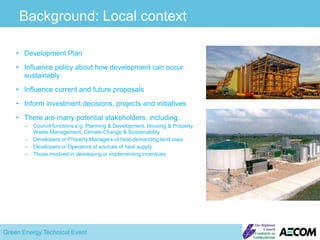
Background: Local contextDevelopment PlanInfluence policy about how development can occur sustainablyInfluence current and future proposalsInform investment decisions, projects and initiativesThere are many potential stakeholders, including:Council functions e.g. Planning & Development, Housing & Property, Waste Management, Climate Change & SustainabilityDevelopers or Property Managers of heat-demanding land usesDevelopers or Operators of sources of heat supplyThose involved in developing or implementing incentives
Background: What is The Highland Heat Map?The “Heat Map” is a Geographic Information System (GIS) based spatial planning tool. It brings together spatial information relating to:Demand – domestic, commercial and industrial heating
Supply issues – “waste” industrial heat, biomass fuel sources, technology providers, expertise etc.
Opportunities/ Constraints – locations of major energy loads, development opportunities, flood zones etc.Spatial information is complemented by a suite of GIS tools designed to allow interrogation and analysis of the spatial information. This added functionality allows the Heat Map to be used to inform the planning process by predicting the potential impacts of development scenarios and identifying suitable locations for renewable heat opportunities
Methodology: The Highland Heat MapThe “Heat Map” heat demand methodology is based upon a model which calculates heat demand at an individual property level allowing the outputs to be scalable.The model is mainly based upon the following key types of information:Address locations
Energy consumption details for public buildings

Highland Heat Mapping - Kenny Monteath, AECOM (http://www.aecom.com/)

  • 1.
    Heat Mapping inThe HighlandsKenny Monteath, AECOM13th October 2011
  • 2.
  • 3.
    Background: The HighlandHeat MapThis is a pilot project funded by Scottish Government arising out of a previous Heat Mapping exercise carried out in 2007. A steering group of Scottish Government, Highlands and Islands Enterprise and The Highland Council have been responsible for leading and directing the work.Project completed – April 2011
  • 4.
    National ContextClimate Change(Scotland) Act 2009Scotland’s Climate Change Delivery Plan / Renewable Heat Action Plan (2009)42% reduction in carbon emissions from heating buildings 2006-2020
  • 5.
    SG target ofat least 11% of all heat demand to be met from renewable sources by 2020Scottish Zero Waste Plan70% recycling / compost by 2025
  • 6.
  • 7.
  • 8.
  • 9.
  • 10.
    Scope for Energyfrom wasteRenewable Heat Incentive (DECC)Oil ~ $115 per barrelHeating oil ~ 60p per litreBackground: National context
  • 11.
    Background: Local contextDevelopmentPlanInfluence policy about how development can occur sustainablyInfluence current and future proposalsInform investment decisions, projects and initiativesThere are many potential stakeholders, including:Council functions e.g. Planning & Development, Housing & Property, Waste Management, Climate Change & SustainabilityDevelopers or Property Managers of heat-demanding land usesDevelopers or Operators of sources of heat supplyThose involved in developing or implementing incentives
  • 12.
    Background: What isThe Highland Heat Map?The “Heat Map” is a Geographic Information System (GIS) based spatial planning tool. It brings together spatial information relating to:Demand – domestic, commercial and industrial heating
  • 13.
    Supply issues –“waste” industrial heat, biomass fuel sources, technology providers, expertise etc.
  • 14.
    Opportunities/ Constraints –locations of major energy loads, development opportunities, flood zones etc.Spatial information is complemented by a suite of GIS tools designed to allow interrogation and analysis of the spatial information. This added functionality allows the Heat Map to be used to inform the planning process by predicting the potential impacts of development scenarios and identifying suitable locations for renewable heat opportunities
  • 15.
    Methodology: The HighlandHeat MapThe “Heat Map” heat demand methodology is based upon a model which calculates heat demand at an individual property level allowing the outputs to be scalable.The model is mainly based upon the following key types of information:Address locations
  • 16.
    Energy consumption detailsfor public buildings