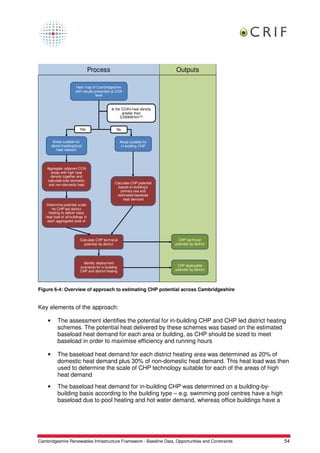
This project was developed by Cambridgeshire Horizons with funding through the
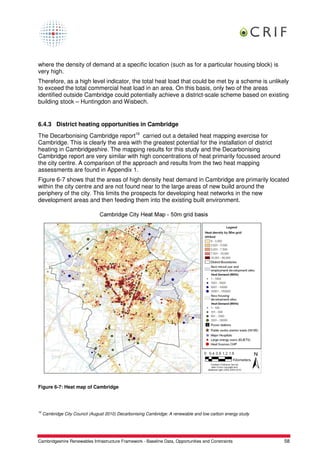
   Climate Change Skills Fund from Sustainability East and Improvement East. It may
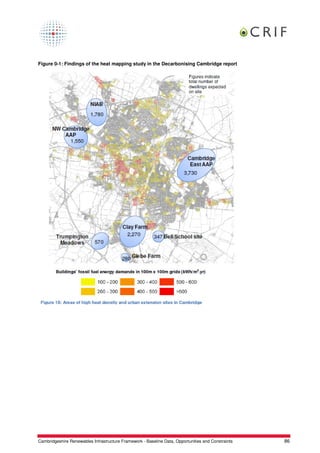
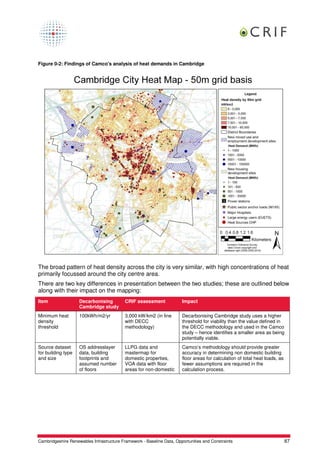
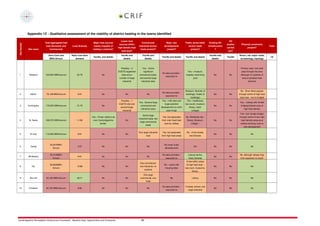
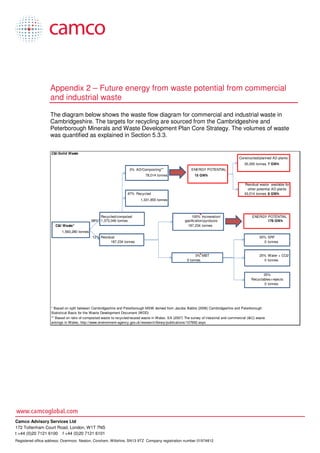
   be used to share learning throughout the public sector but not for commercial gain


Cambridgeshire Renewables Infrastructure Framework -
Baseline Data, Opportunities and Constraints


    Presented to:   Cambridgeshire Horizons
    Author:         Daniel Archard
    Date:           12 December 2011
    Reference no.   003290
    Version:        Final
Document type:            Report
Client:                   Cambridgeshire Horizons
Client contact:
Other details:


File name:                Version 10
Report:
Final:                    12 December 2011


Author:                   Daniel Archard


Signature                  ............................................................................ (hard copy only)
Date:                      ............................................................................ (hard copy only)


QA:                       Duncan Price


Signature                  ............................................................................ (hard copy only)
Date:                      ............................................................................ (hard copy only)


Author contact details
Email:                    daniel.archard@camcoglobal.com
Telephone:                020 7121 6441


Disclaimer: This report has been prepared for the above named client for the purpose agreed
in Camco's terms of engagement. Whilst every effort has been made to ensure the accuracy
and suitability of the information contained in this report, the results and recommendations
presented should not be used as the basis of design, management or implementation of
decisions unless the client has first discussed with Camco their suitability for these purposes
and Camco has confirmed their suitability in writing to the client. Camco does not warrant, in
any way whatsoever, the use of information contained in this report by parties other than the
above named client.


Cambridgeshire Renewables Infrastructure Framework - Baseline Data, Opportunities and Constraints                          3
Contents

               Executive Summary ...................................................................................6
               1       Introduction.................................................................................11
               1.1     Aims of the study ........................................................................11
               1.2     Overview of approach.................................................................11
               1.3     East of England Renewable and Low Carbon Energy Capacity Study
                       ...................................................................................................12
               1.4     Decarbonising Cambridge study.................................................12
               1.5     Renewable energy policy context ...............................................13
               2       Cambridgeshire’s Carbon Objectives..........................................17
               2.1     Background to the CRIF .............................................................17
               2.2     Carbon reduction objectives for Cambridgeshire ........................17
               2.3     Renewable energy objectives for Cambridgeshire ......................19
               2.4     Housing growth in Cambridgeshire.............................................20
               3       Energy consumption in Cambridgeshire .....................................22
               3.1     Current energy consumption and carbon emissions in Cambridgeshire
                       ...................................................................................................22
               3.2     Projection of future energy consumption in Cambridgeshire .......23
               4       Present contribution of renewable energy...................................25
               4.1     Cambridgeshire is already doing well .........................................25
               4.2     Current installed capacity across the districts .............................25
               4.3     Recent approved renewable energy projects..............................27
               5       Renewable energy technical potential ........................................29
               5.1     Methodology...............................................................................29
               5.2     Wind potential.............................................................................31
               5.3     Biomass and Energy from Waste potential .................................37
               5.4     PV potential ................................................................................40
               5.5     Solar water heating potential ......................................................41
               5.6     Heat pump potential ...................................................................43
               5.7     Summary of renewable energy technical potential......................45
               6       District heating and CHP potential ..............................................49
               6.1     Methodology...............................................................................49
               6.2     Mapping heat demand in Cambridgeshire ..................................50
               6.3     Assessment of the technical potential for CHP supplying district heat
                       networks.....................................................................................53
               6.4     More detailed assessment of towns identified with district heating potential
                       ...................................................................................................56
               6.5     Deployment potential of CHP within Cambridgeshire..................61


Cambridgeshire Renewables Infrastructure Framework - Baseline Data, Opportunities and Constraints                              4
6.6    Comparison of biomass supply potential with the district heating demand
                      potential......................................................................................65
               7      Scenarios of renewable energy deployment ...............................67
               7.1    Introduction to the deployment scenarios ...................................67
               7.2    Summary of deployment modelling methodology........................68
               7.3    Deployment modelling methodology by technology ....................70
               7.4    Role of new development in contributing to the deployment potential
                       ...................................................................................................76
               7.5    Contribution of renewable energy to Cambridgeshire carbon objectives
                       ...................................................................................................76
               7.6    Investment opportunity ...............................................................77
               8      Assessing impact of energy demand reductions.........................79
               8.1    Introducing the energy efficiency scenarios ................................79
               8.2    Impact of future energy demand on the contribution from renewable energy
                       ...................................................................................................79
               Appendix 1 – Heat mapping .....................................................................81
               Appendix 1A – Heat mapping methodology..............................................81
               Appendix 1B – Cambridge heat map – comparison with Decarbonising Cambridge
                      study...........................................................................................85
               Appendix 1C - Qualitative assessment of the viability of district heating in the towns
                      identified.....................................................................................88


Cambridgeshire Renewables Infrastructure Framework - Baseline Data, Opportunities and Constraints                          5
Executive Summary

Introduction
This study provides a technical baseline assessment of Cambridgeshire’s energy demand and
renewable energy resource for the Cambridgeshire Renewables Infrastructure Framework
(CRIF). It provides an underpinning evidence base for the CRIF to obtain a key understanding
of the main opportunities and high level constraints facing renewable energy deployment in
Cambridgeshire.
Cambridgeshire faces tough energy and carbon objectives
In May 2011 the Government adopted the 4th Carbon Budget1 which requires a 50% reduction
in carbon emissions by 2025 based on 1990 levels. Applying the 4th carbon budget to
Cambridgeshire emissions implies a 43% reduction between 2010 and 2025, which needs to be
delivered through a combination of energy efficiency improvements, national electricity grid
decarbonisation, local renewable energy deployment and transport measures. Committee on
Climate Change advice to Government proposes an 18% renewable electricity target and a
35% renewable heat target for 2030. This equates to a 28% overall renewable energy target for
Cambridgeshire (excluding transport). It is worth noting that some of the district councils have
set their own targets such as Cambridge City Council which has a carbon reduction target of
89% by 2050 with interim targets in between.
Cambridgeshire is already doing well
Cambridgeshire already has the greatest installed renewable energy capacity in the East of
England and has one of the highest renewable energy outputs of any county in England. Wind
turbines play a key role in this output and Fenland currently has the greatest number of installed
wind turbines. East Cambridgeshire also has one of the largest dedicated biomass plants in the
country due to the straw burning plant near Ely. 7% of Cambridgeshire’s energy demand is
already met by renewable energy installations.
Potential for greater deployment
The technical theoretical potential of Cambridgeshire’s renewable energy resource is extremely
large at over 200% of Cambridgeshire’s current energy demand. This figure has been
calculated after consideration of primary technical constraints but secondary deployment
constraints will substantially reduce this potential. Primary technical constraints include aspects
such as wind speed and available land area for wind turbines or the orientation of roof space for
solar technologies. Deployment constraints incorporate issues such as economic feasibility and
obtaining planning permission, . Wind has the greatest potential and constitutes over 70% of the
overall renewable energy resource, followed by heat pumps and PV which could each
contribute up to 30% and 15% of energy demand respectively. Biomass and energy from waste
technologies could contribute a further 15% to Cambridgeshire’s energy demand.
All technologies are needed
Although the majority of the technical potential resides in the wind resource, there is still a great
deal of potential from the other technologies and the successful deployment of renewable
energy in Cambridgeshire will require the utilisation of all technologies. Policy support for
renewable energy needs to consider all forms of energy as renewable heat and renewable
electricity are both needed in order to realise Cambridgeshire’s share of the UK targets.
Traditionally there has been a focus nationally on renewable electricity, but the main energy

1
 Committee on Climate Change (2010) The Fourth Carbon Budget Reducing emissions through the 2020s ;
http://www.theccc.org.uk/reports/fourth-carbon-budget


Cambridgeshire Renewables Infrastructure Framework - Baseline Data, Opportunities and Constraints     6
demand in the housing sector is for heat. The analysis suggests that the main area for
improvement and the biggest challenge for Cambridgeshire is that of deploying renewable heat
technologies which currently contribute very little to energy demand.
South Cambridgeshire and Huntingdonshire have the largest resource
Huntingdonshire and South Cambridgeshire, the two biggest districts, have the greatest
renewable energy potential and also the greatest energy demand. Although these two districts
have the largest technical wind resource they also have substantial PV and air source heat
pump potential as they have a larger building stock than the other districts. Due to their large
size these two districts are also likely to have the greatest number of off-gas properties which
further increases their renewable energy opportunities in terms of substituting heat pumps or
biomass boilers for oil heating systems. Cambridge lacks the wind resource but has substantial
potential for air source heat pumps and PV, although the higher density urban environment and
relatively large number of conservation areas does limit the potential for building integrated
technologies compared with the other districts.
District heating opportunity lies in Cambridge and Huntingdon
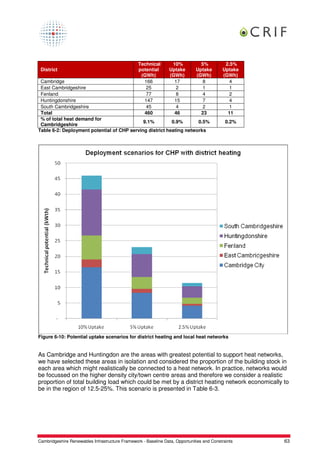
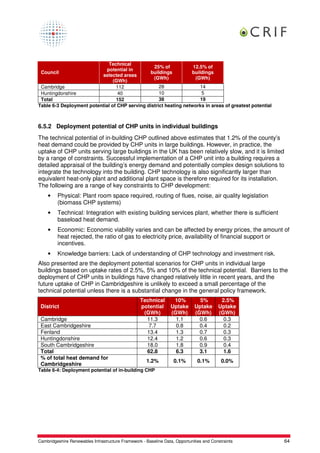
Although the technical potential of district heating networks served by CHP is estimated at 9%
of Cambridgeshire’s overall heat demand, its practical deployment potential is much smaller due
to a number of reasons including the challenge of establishing heat networks in the existing built
environment.
The potential for district heating resides in urban areas focused on town centres where there is
high density of heat demand due to the presence of high density public sector, commercial and
domestic buildings. The vast majority of the potential lies in Cambridge and Huntingdon, with
some further potential in other market towns. More detailed heat mapping analysis based on
suitability of potential anchor load buildings and the scale of heat demand that could enable the
development of heat networks, suggests that only Cambridge and Huntingdon have suitable
deployment potential for heat networks. If a quarter of the total district heating potential in
Cambridge and Huntingdon were connected to a heat network then approximately 1% of the
county’s energy demand could be met by district heating systems fuelled by low carbon fuel
sources. District heating feasibility studies are currently underway in Cambridge and St Neots.
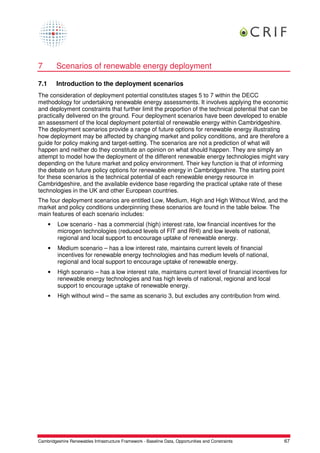
The ‘supply potential’ of the biomass and energy from waste resource that could fuel CHP plant
feeding heat networks is less than the technical potential for district heating in Cambridgeshire.
However, as outlined above, the deployment potential of district heating networks is far lower
than this and is focused on central areas in Cambridge and Huntingdon. An ambitious
deployment target for district heating networks in Cambridge and Huntingdon would constitute
approximately a tenth of the overall district heating technical potential, and could easily be met
by Cambridgeshire’s endemic biomass and EfW fuel resource. Although the combustion of solid
biomass fuel would be challenging in Cambridge due to an Air Quality Management Area
(AQMA) covering most of the city centre, a district heating network could rely on fuels with a low
impact on local air quality, such as natural gas or biogas.
Deployment options for renewable energy in Cambridgeshire
Four deployment scenarios have been developed to enable an assessment of the local
deployment potential of renewable energy within Cambridgeshire. The scenarios do not
constitute a prediction of what will happen or an opinion on what should happen. They are
simply an attempt to model deployment of different renewable energy technologies under
varying future market and policy environment, and their key function is that of informing the
debate on future policy options for renewable energy in Cambridgeshire. A brief description of
the scenarios is provided below:


Cambridgeshire Renewables Infrastructure Framework - Baseline Data, Opportunities and Constraints   7
•   Scenario 1 (Low scenario) - has a commercial (high) interest rate, low financial
           incentives for the microgen technologies (reduced levels of FIT and RHI) and low levels
           of national, regional and local support to encourage uptake of renewable energy.
       •   Scenario 2 (Medium scenario) - has a low interest rate, maintains current levels of
           financial incentives for renewable energy technologies and has medium levels of
           national, regional and local support to encourage uptake of renewable energy.
       •   Scenario 3 (High scenario) - has a low interest rate, maintains current level of financial
           incentives for renewable energy technologies and has high levels of national, regional
           and local support to encourage uptake of renewable energy.
       •   Scenario 4 (High without wind) - the same as scenario 3, but excludes any contribution
           from wind.


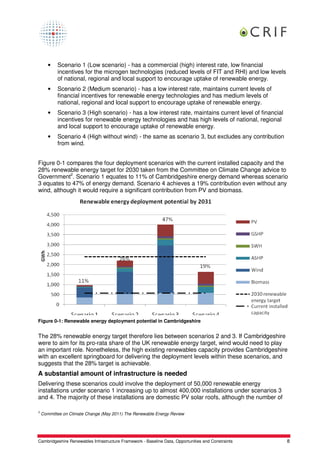
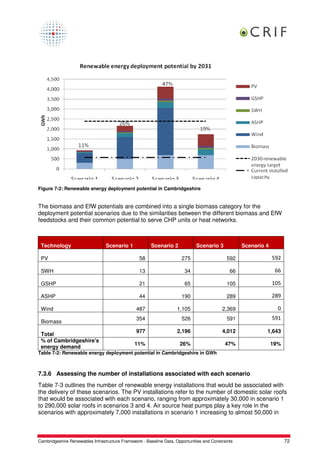
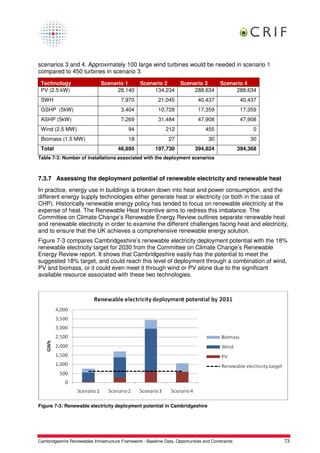
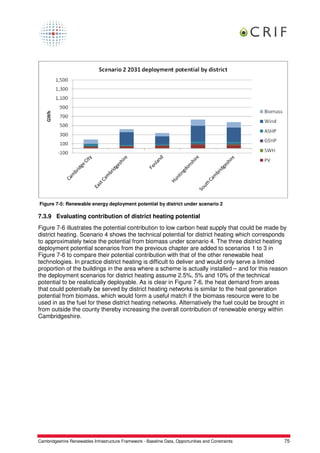
Figure 0-1 compares the four deployment scenarios with the current installed capacity and the
28% renewable energy target for 2030 taken from the Committee on Climate Change advice to
Government2. Scenario 1 equates to 11% of Cambridgeshire energy demand whereas scenario
3 equates to 47% of energy demand. Scenario 4 achieves a 19% contribution even without any
wind, although it would require a significant contribution from PV and biomass.


Figure 0-1: Renewable energy deployment potential in Cambridgeshire


The 28% renewable energy target therefore lies between scenarios 2 and 3. If Cambridgeshire
were to aim for its pro-rata share of the UK renewable energy target, wind would need to play
an important role. Nonetheless, the high existing renewables capacity provides Cambridgeshire
with an excellent springboard for delivering the deployment levels within these scenarios, and
suggests that the 28% target is achievable.
A substantial amount of infrastructure is needed
Delivering these scenarios could involve the deployment of 50,000 renewable energy
installations under scenario 1 increasing up to almost 400,000 installations under scenarios 3
and 4. The majority of these installations are domestic PV solar roofs, although the number of

2
    Committee on Climate Change (May 2011) The Renewable Energy Review


Cambridgeshire Renewables Infrastructure Framework - Baseline Data, Opportunities and Constraints       8
solar roofs would be less if a proportion of these installations were undertaken on non-domestic
roof space where larger panels could be installed. Approximately 100 large wind turbines would
be needed in scenario 1 compared to 450 turbines in scenario 3.

 Technology                    Scenario 1         Scenario 2          Scenario 3          Scenario 4
 PV (2.5 kW)                           28,140             134,234             288,634               288,634
 SWH                                     7,970             21,045              40,437                40,437
 GSHP (5kW)                              3,404             10,728              17,359                17,359
 ASHP (5kW)                              7,269             31,484              47,908                47,908
 Wind (2.5 MW)                               94                212                 455                   0
 Biomass (1.5 MW)                          16                  25                  35                    35
 Total                                 46,893             197,729             394,829               394,373
Table 0-1: Number of installations associated with the deployment scenarios


Renewable energy has the potential to help close the carbon gap to meet the 4th
carbon budget objectives
Cambridgeshire will need substantial improvements in energy efficiency and a significant
contribution from local renewable energy, as well as relying upon a nationally decarbonised
electricity grid to achieve a 50% carbon reduction by 2025.
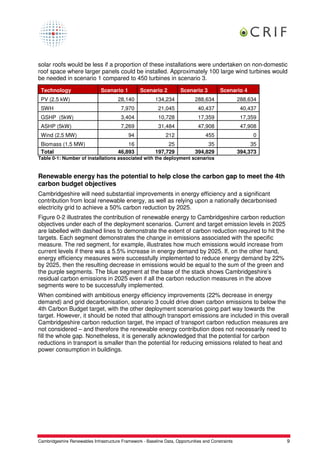
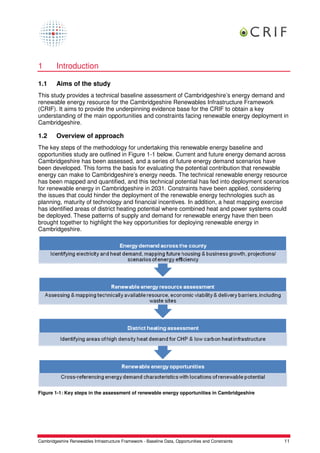
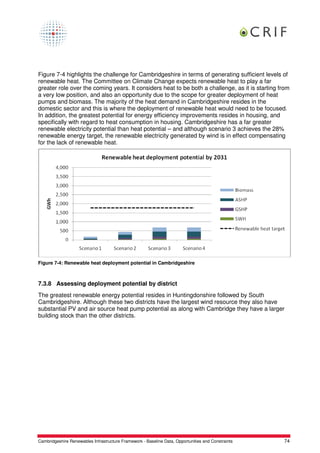
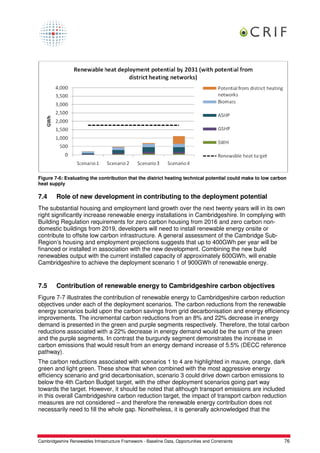
Figure 0-2 illustrates the contribution of renewable energy to Cambridgeshire carbon reduction
objectives under each of the deployment scenarios. Current and target emission levels in 2025
are labelled with dashed lines to demonstrate the extent of carbon reduction required to hit the
targets. Each segment demonstrates the change in emissions associated with the specific
measure. The red segment, for example, illustrates how much emissions would increase from
current levels if there was a 5.5% increase in energy demand by 2025. If, on the other hand,
energy efficiency measures were successfully implemented to reduce energy demand by 22%
by 2025, then the resulting decrease in emissions would be equal to the sum of the green and
the purple segments. The blue segment at the base of the stack shows Cambridgeshire’s
residual carbon emissions in 2025 even if all the carbon reduction measures in the above
segments were to be successfully implemented.
When combined with ambitious energy efficiency improvements (22% decrease in energy
demand) and grid decarbonisation, scenario 3 could drive down carbon emissions to below the
4th Carbon Budget target, with the other deployment scenarios going part way towards the
target. However, it should be noted that although transport emissions are included in this overall
Cambridgeshire carbon reduction target, the impact of transport carbon reduction measures are
not considered – and therefore the renewable energy contribution does not necessarily need to
fill the whole gap. Nonetheless, it is generally acknowledged that the potential for carbon
reductions in transport is smaller than the potential for reducing emissions related to heat and
power consumption in buildings.


Cambridgeshire Renewables Infrastructure Framework - Baseline Data, Opportunities and Constraints             9
Figure 0-2: Potential contribution of renewable energy to Cambridgeshire carbon reduction targets


Cambridgeshire renewable energy resource has significant investment potential
Scenario 2 has an investment potential of £3 billion in projects with an indicative rate of return of
5 to 10%. This illustrates the substantial economic benefits that would accompany the
installation of renewable energy infrastructure at these scales.
Energy efficiency and renewable energy are both needed
Figure 0-2 demonstrates that energy efficiency improvements, local renewable energy supply
and national grid decarbonisation measures are all needed in order to meet carbon reduction
objectives in Cambridgeshire. In addition to this, although reductions in future energy demand
would increase the proportion of energy consumption that could be met by local renewable
energy supply, the overall impact is relatively small. For example, the contribution of renewable
energy to Cambridgeshire’s energy demand under scenario 2 could increase from a quarter to
one third if energy consumption is driven down by a quarter over the next few decades.
Although this all helps in reducing carbon emissions, it illustrates that significant renewable
energy contributions will be needed regardless of whether Cambridgeshire manages to achieve
ambitious energy efficiency improvements.


Cambridgeshire Renewables Infrastructure Framework - Baseline Data, Opportunities and Constraints   10
1        Introduction

1.1      Aims of the study
This study provides a technical baseline assessment of Cambridgeshire’s energy demand and
renewable energy resource for the Cambridgeshire Renewables Infrastructure Framework
(CRIF). It aims to provide the underpinning evidence base for the CRIF to obtain a key
understanding of the main opportunities and constraints facing renewable energy deployment in
Cambridgeshire.

1.2      Overview of approach
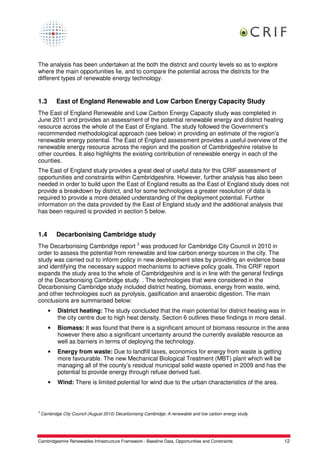
The key steps of the methodology for undertaking this renewable energy baseline and
opportunities study are outlined in Figure 1-1 below. Current and future energy demand across
Cambridgeshire has been assessed, and a series of future energy demand scenarios have
been developed. This forms the basis for evaluating the potential contribution that renewable
energy can make to Cambridgeshire’s energy needs. The technical renewable energy resource
has been mapped and quantified, and this technical potential has fed into deployment scenarios
for renewable energy in Cambridgeshire in 2031. Constraints have been applied, considering
the issues that could hinder the deployment of the renewable energy technologies such as
planning, maturity of technology and financial incentives. In addition, a heat mapping exercise
has identified areas of district heating potential where combined heat and power systems could
be deployed. These patterns of supply and demand for renewable energy have then been
brought together to highlight the key opportunities for deploying renewable energy in
Cambridgeshire.


Figure 1-1: Key steps in the assessment of renewable energy opportunities in Cambridgeshire


Cambridgeshire Renewables Infrastructure Framework - Baseline Data, Opportunities and Constraints   11
The analysis has been undertaken at the both the district and county levels so as to explore
where the main opportunities lie, and to compare the potential across the districts for the
different types of renewable energy technology.


1.3        East of England Renewable and Low Carbon Energy Capacity Study
The East of England Renewable and Low Carbon Energy Capacity study was completed in
June 2011 and provides an assessment of the potential renewable energy and district heating
resource across the whole of the East of England. The study followed the Government’s
recommended methodological approach (see below) in providing an estimate of the region’s
renewable energy potential. The East of England assessment provides a useful overview of the
renewable energy resource across the region and the position of Cambridgeshire relative to
other counties. It also highlights the existing contribution of renewable energy in each of the
counties.
The East of England study provides a great deal of useful data for this CRIF assessment of
opportunities and constraints within Cambridgeshire. However, further analysis has also been
needed in order to build upon the East of England results as the East of England study does not
provide a breakdown by district, and for some technologies a greater resolution of data is
required to provide a more detailed understanding of the deployment potential. Further
information on the data provided by the East of England study and the additional analysis that
has been required is provided in section 5 below.


1.4        Decarbonising Cambridge study
The Decarbonising Cambridge report 3 was produced for Cambridge City Council in 2010 in
order to assess the potential from renewable and low carbon energy sources in the city. The
study was carried out to inform policy in new development sites by providing an evidence base
and identifying the necessary support mechanisms to achieve policy goals. This CRIF report
expands the study area to the whole of Cambridgeshire and is in line with the general findings
of the Decarbonising Cambridge study. . The technologies that were considered in the
Decarbonising Cambridge study included district heating, biomass, energy from waste, wind,
and other technologies such as pyrolysis, gasification and anaerobic digestion. The main
conclusions are summarised below:
       •    District heating: The study concluded that the main potential for district heating was in
            the city centre due to high heat density. Section 6 outlines these findings in more detail.
       •    Biomass: It was found that there is a significant amount of biomass resource in the area
            however there also a significant uncertainty around the currently available resource as
            well as barriers in terms of deploying the technology.
       •    Energy from waste: Due to landfill taxes, economics for energy from waste is getting
            more favourable. The new Mechanical Biological Treatment (MBT) plant which will be
            managing all of the county’s residual municipal solid waste opened in 2009 and has the
            potential to provide energy through refuse derived fuel.
       •    Wind: There is limited potential for wind due to the urban characteristics of the area.


3
    Cambridge City Council (August 2010) Decarbonising Cambridge: A renewable and low carbon energy study


Cambridgeshire Renewables Infrastructure Framework - Baseline Data, Opportunities and Constraints           12
•   Other technologies: Gasification and pyrolysis can be used as conversion technologies
          however there is limited experience of using the latter technology in UK. Anaerobic
          digestion is also not likely to be suitable for Cambridge due to its urban characteristics.
          However micro generation technologies such as PV, solar thermal and heat pumps are
          expected to have an increased uptake and could contribute to the renewable energy
          generation in the region.

1.5       Renewable energy policy context

1.5.1 General climate change and energy policy
There is a wide range of national policy which influences renewable energy development in the
UK and Cambridgeshire. A significant amount of new legislation and policy has recently been
put in place.


      •   Climate Change Act
The Climate Change Act 2008 introduced a statutory target of reducing carbon dioxide
emissions by at least 80% below 1990 levels by 2050, with an interim target of 34% by 2020.
Government departments have prepared carbon budgets to indicate how greenhouse gas
emissions will be reduced across the Government estate and in sectors where each takes a
policy lead. The Act also created a framework for climate change adaptation. A national
Climate Change Risk Assessment is currently being undertaken and will be completed in 2012.


      •   4th Carbon Budget
The Climate Change Act requires Parliament to set ‘carbon budgets’ for 5 year periods which
sets the maximum amount of emissions to be emitted in order to hit the target of 80% reduction
in carbon emissions by 2050. Within this context, the Committee on Climate Change published
the 4th Carbon Budget in December 2010 which sets out the required pathway for the period
2023-2027 and considers the level of emissions for ensuring long term compliance with the
2050 target. According to the report, it is recommended that the UK decreases its emissions by
50% by 2025 (below 1990 levels) within the ‘Domestic Action Budget’ i.e. without the support
from the international carbon markets. In May 2011, the government announced its commitment
to adopt the recommendations of Committee on Climate Change and the recommended target
is now legally binding.


      •   15% renewable energy target
In response to EU Directive 2009/28/EC on the promotion of the use of energy from renewable
sources, the UK has committed to sourcing 15% of its energy from renewable sources by 2020
– a five-fold increase on the share of about 3% in 2009, in less than a decade. This target
covers all energy needs, including electricity, heat and transport.


      •   Renewable Energy Review, Committee on Climate Change, May 2011
In 2010, the Government asked the Committee on Climate Change to review the potential for
renewable energy and provide advice on suitable future renewable energy targets, specifically
the level of appropriate ambition beyond 2020. The Committee on Climate Change published its
findings in May 2011 and the Renewable Energy Review provides options for renewable
electricity and renewable heat targets for 2030 and beyond.


Cambridgeshire Renewables Infrastructure Framework - Baseline Data, Opportunities and Constraints   13
•    Feed-In Tariff (FIT), Renewable Heat Incentive(RHI)
FITs came into effect on 1 April 2010 and provide generation linked payments for a range of
small scale renewable electricity technologies of <5MW: wind, hydro, anaerobic digestion, micro
CHP and PV.
The RHI is a tariff-based scheme with payments made to the generators of renewable heat per
unit of heat output. It will be available for all scales of installation within industrial, public and
commercial sectors from Autumn 2011. The scheme will be extended to the domestic sector in
2012 with an interim arrangement (‘RHI Premium Payment’) put in place to provide around
£15m of grants for renewable heat installations, equivalent to around 25,000 homes. Unlike
FITs, the RHI will be paid from general taxation rather than a pass through to consumer energy
bills.
The existence of these support mechanisms is very relevant for the findings of this study as
both FIT and RHI transform eligible renewable energy technologies into attractive investment
options and hence accelerate the rate of uptake of these technologies.

1.5.2    Planning and building control policy

    •    National Planning Policy Framework
Planning policy in the UK is about to undergo fairly substantial upheaval with the Government
consulting on a draft National Planning Policy Framework during Summer 2011. This aims to
streamline the planning system with simplified planning guidance and a speeding up of planning
decisions. Decentralisation of decision-making is also a key feature of these planning reforms
with neighbourhood plans simultaneously being introduced through the Localism Bill.
A key element of the new proposals is a ‘presumption in favour of sustainable development’
which requires local planning decision-making to favour development if it contributes to the
Government’s definition of sustainable development. The draft Framework explicitly mentions
renewable energy as a component of sustainable development and makes it clear that local
authorities should consider identifying suitable areas for renewable and low-carbon energy.
When it comes into force in 2012 or 2013, the new National Planning Policy Framework will
cancel the PPS 1 Supplement on Climate Change which has been a key policy document in
encouraging local planning for renewable energy. However, until the new Framework comes
into force the PPS 1 Supplement and accompanying documents are still the Government’s
official planning policy documents on climate change issues.

    •    Planning Policy Statement 1 (PPS1): Delivering Sustainable Development and the
         PPS1 Supplement (Planning and Climate Change)
PPS1 has had a key role over the past few years in encouraging local authorities to compile
accurate renewable energy evidence bases on the potential within their areas so as to inform
planning policy. PPS1 expects new development to make good use of opportunities for
decentralised and renewable or low-carbon energy. The supplement to Planning Policy
Statement 1 ‘Planning and Climate Change’ highlights situations where it could be appropriate
for planning authorities to anticipate levels of building sustainability in advance of those set
nationally. This could include where:
    •    there are clear opportunities for significant use of decentralised and renewable or low carbon-
         energy; or
    •    without the requirement, for example on water efficiency, the envisaged development would be
         unacceptable for its proposed location.


Cambridgeshire Renewables Infrastructure Framework - Baseline Data, Opportunities and Constraints          14
The PPS 1 Supplement requires local planning authorities to develop planning policies for new
developments that are based on:
    “….an evidence-based understanding of the local feasibility and potential for renewable and low-
    carbon technologies, including microgeneration”.

    •    Planning Policy Statement 22 (PPS22): Renewable Energy
         PPS22 sets out the Government's policies for renewable energy, to which planning
         authorities should have regard when preparing Local Development Documents and
         when taking planning decisions.

         Local policies should reflect paragraph 8 of PPS22 which states that:
    •    Local planning authorities may include policies in local development documents that require a
         percentage of the energy to be used in new residential, commercial or industrial developments to
         come from on-site renewable energy developments.

    •    Zero carbon timeline and allowable solutions
The Government has set out a timeline for improving the carbon performance of new
developments through tightening Building Regulation standards for new homes:
    •    2013 – a 44% carbon reduction beyond 2006 requirements; and,
    •    2016 – a 100% carbon reduction beyond 2006 requirements.
In the March 2008 budget Government also announced its intentions for all non-domestic
buildings to be zero carbon by 2019. Therefore, the various phases of development across the
county will face stricter and stricter mandatory requirements, and all housing development after
2016 will need to account for all carbon emissions from regulated energy uses.
The government is introducing a more flexible definition of ‘zero carbon’ to guide building policy
which will apply a minimum requirement for energy efficiency and on-site renewable energy,
and a set of off-site ‘allowable solutions’ to allow the residual emissions to be offset. The
allowable measures have yet to be fully defined but could include large scale off-site renewable
energy infrastructure, investment in energy efficiency measures for existing building stock,
energy efficient white goods and building controls, or S106 contributions. Cambridgeshire
Horizons are undertaking work to develop a Carbon Offset Fund in preparation for the allowable
solutions mechanism so that funds can be effectively targeted towards low carbon
infrastructure.
Future developments in Cambridgeshire will therefore need to achieve minimum fabric
standards and some onsite renewable energy generation, with financial contributions for
investment in allowable solutions to offset the residual emissions. For any specific development
site, developers will need to assess the prospects for different technical solutions including
combined heat and power, biomass, medium to large scale wind turbines, heat pumps, PV and
solar water heating before determining the contribution of allowable solutions in offsetting the
residual carbon emissions. Building Regulations will therefore drive the growth of renewable
energy in the county. Local planning policies are also expected to complement and in some
cases exceed Building Regulations which would further ramp up the uptake of renewable
energy technologies.

    •    Local Climate Change Strategies and Initiatives
         Individual district councils are carrying out work in different areas to minimise the
         impacts of climate change. Examples of these include Cambridge City Council setting a


Cambridgeshire Renewables Infrastructure Framework - Baseline Data, Opportunities and Constraints      15
carbon reduction target of 89% to be achieved by 2050 in its Climate Change Strategy
         and Action Plan, and Fenland District Council signing up to the CRed Initiative to reduce
         carbon emissions by 60% by 2025. Most of the district councils also have local planning
         policies promoting renewable energy in new developments which is contributing to the
         growth of renewable energy in Cambridgeshire.


Cambridgeshire Renewables Infrastructure Framework - Baseline Data, Opportunities and Constraints   16
2        Cambridgeshire’s Carbon Objectives

2.1      Background to the CRIF
The Cambridgeshire Renewables Infrastructure Framework (CRIF) is providing a structure for
supporting the development of renewable energy in Cambridgeshire. As well as identifying
opportunities to generate renewable energy in the county, it is providing the framework for
delivering projects on the ground through the involvement of the community and providing an
attractive setting for investment. The findings of the project will inform planning policies and
demonstrate Cambridgeshire’s commitment to lead on the transition to a low carbon economy.
This report relates to Workpackage 1 which is providing a technical evidence base for the CRIF,
looking at the energy demand baseline and future growth areas together with the potential for
renewable energy technologies across the county. Workpackage 2 and 3 will build upon the
findings of this report to identify the most appropriate delivery pathways for realising renewable
energy potential in Cambridgeshire.


2.2      Carbon reduction objectives for Cambridgeshire

2.2.1 Quantifying Cambridgeshire’s carbon reduction objectives
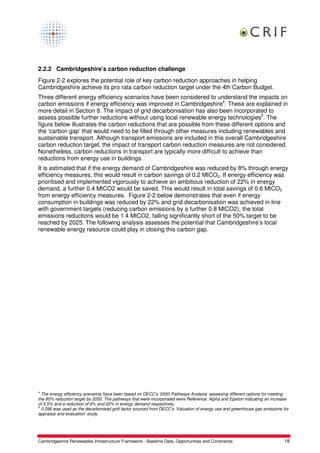
As outlined above, the 4th Carbon Budget requires the UK to reduce carbon emissions by 50%
by 2025 compared to 1990 levels. Transposing this target to Cambridgeshire, compared to an
estimated baseline of 7 million tonnes of CO2 in 1990, the required emissions by 2025 should be
no higher than 3.5 million tonnes of CO2. With emissions currently at 6.1 million tonnes of CO2
in the county, this represents a 43% decrease in emissions to be achieved in only 14 years and
is illustrated in Figure 2-1. This highlights the significance of the task that lies ahead for
Cambridgeshire in the near future and the necessity of exploring different options to meet this
challenge.


Figure 2-1: Cambridgeshire’s pro rata carbon reduction target under the 4th Carbon Budget


Cambridgeshire Renewables Infrastructure Framework - Baseline Data, Opportunities and Constraints   17
2.2.2 Cambridgeshire’s carbon reduction challenge
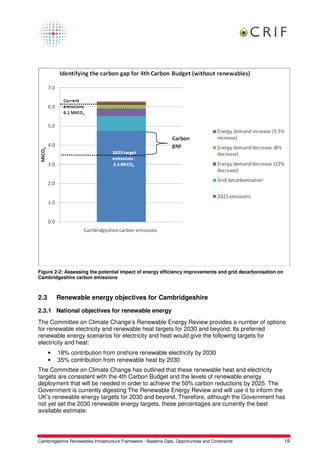
Figure 2-2 explores the potential role of key carbon reduction approaches in helping
Cambridgeshire achieve its pro rata carbon reduction target under the 4th Carbon Budget.
Three different energy efficiency scenarios have been considered to understand the impacts on
carbon emissions if energy efficiency was improved in Cambridgeshire4. These are explained in
more detail in Section 8. The impact of grid decarbonisation has also been incorporated to
assess possible further reductions without using local renewable energy technologies5. The
figure below illustrates the carbon reductions that are possible from these different options and
the ‘carbon gap’ that would need to be filled through other measures including renewables and
sustainable transport. Although transport emissions are included in this overall Cambridgeshire
carbon reduction target, the impact of transport carbon reduction measures are not considered.
Nonetheless, carbon reductions in transport are typically more difficult to achieve than
reductions from energy use in buildings.
It is estimated that if the energy demand of Cambridgeshire was reduced by 8% through energy
efficiency measures, this would result in carbon savings of 0.2 MtCO2. If energy efficiency was
prioritised and implemented vigorously to achieve an ambitious reduction of 22% in energy
demand, a further 0.4 MtCO2 would be saved. This would result in total savings of 0.6 MtCO2
from energy efficiency measures. Figure 2-2 below demonstrates that even if energy
consumption in buildings was reduced by 22% and grid decarbonisation was achieved in line
with government targets (reducing carbon emissions by a further 0.8 MtCO2), the total
emissions reductions would be 1.4 MtCO2, falling significantly short of the 50% target to be
reached by 2025. The following analysis assesses the potential that Cambridgeshire’s local
renewable energy resource could play in closing this carbon gap.


4
  The energy efficiency scenarios have been based on DECC’s ‘2050 Pathways Analysis’ assessing different options for meeting
the 80% reduction target by 2050. The pathways that were incorporated were Reference, Alpha and Epsilon indicating an increase
of 5.5% and a reduction of 8% and 22% in energy demand respectively.
5
  0.296 was used as the decarbonised grid factor sourced from DECC’s ‘Valuation of energy use and greenhouse gas emissions for
appraisal and evaluation’ study.


Cambridgeshire Renewables Infrastructure Framework - Baseline Data, Opportunities and Constraints                          18
Figure 2-2: Assessing the potential impact of energy efficiency improvements and grid decarbonisation on
Cambridgeshire carbon emissions


2.3       Renewable energy objectives for Cambridgeshire

2.3.1 National objectives for renewable energy
The Committee on Climate Change’s Renewable Energy Review provides a number of options
for renewable electricity and renewable heat targets for 2030 and beyond. Its preferred
renewable energy scenarios for electricity and heat would give the following targets for
electricity and heat:
      •   18% contribution from onshore renewable electricity by 2030
      •   35% contribution from renewable heat by 2030
The Committee on Climate Change has outlined that these renewable heat and electricity
targets are consistent with the 4th Carbon Budget and the levels of renewable energy
deployment that will be needed in order to achieve the 50% carbon reductions by 2025. The
Government is currently digesting The Renewable Energy Review and will use it to inform the
UK’s renewable energy targets for 2030 and beyond. Therefore, although the Government has
not yet set the 2030 renewable energy targets, these percentages are currently the best
available estimate.


Cambridgeshire Renewables Infrastructure Framework - Baseline Data, Opportunities and Constraints          19
2.3.2 Cambridgeshire’s renewable energy targets
Combining the Committee on Climate Change renewable heat and electricity targets into an
overall renewable energy target (for both electricity and heat) for Cambridgeshire equates to a
renewable energy target of 28% by 2030. This renewable energy target has been calculated by
assessing the ratio of heat and power consumption within Cambridgeshire so as to evaluate the
overall level of energy demand that would be met if 18% of electricity and 35% of heat was
generated from renewable sources.
Transposing these possible national targets for renewable electricity and renewable heat to
Cambridgeshire leads to the following targets for 2030:
      •   18% renewable electricity
      •   35% renewable heat
      •   28% renewable energy (both heat and electricity)
The analysis below assesses the potential of Cambridgeshire’s renewable energy resource to
meet these targets and to ‘fill’ Cambridgeshire’s carbon reduction gap identified above.


2.4       Housing growth in Cambridgeshire
Although the substantial housing growth and associated physical and social infrastructure for
the Cambridge Sub-Region over the next few decades presents a huge challenge to the
objective of reducing carbon emissions by 50% by 2025, it also presents an opportunity for
integrating renewable energy within Cambridgeshire. The 6 main development locations in
Cambridgeshire are outlined in Table 2-1, and these are supplemented by general housing
growth across Cambridgeshire’s market towns. The majority of the large growth sites are
located around Cambridge with Northstowe ecotown located at a former MoD site in South
Cambridgeshire.


Cambridgeshire Renewables Infrastructure Framework - Baseline Data, Opportunities and Constraints   20
Location                          Description                               District

Cambridge East                    Eastern urban extension to the            Cambridge City,
                                  city of Cambridge. Three main             South
                                  development areas include:                Cambridgeshire
                                  North of Newmarket road, north
                                  of Cherry Hinton and
                                  Cambridge Airport.
Cambridge North West              Two major areas include                   Cambridge City,
                                  University of Cambridge and               South
                                  NIAB.                                     Cambridgeshire


Cambridge Southern                Four major areas including:               Cambridge City,
Fringe                            Trumpington meadows, Clay                 South
                                  and Glebe farm, Bell school and           Cambridgeshire
                                  Addenbrookes.

Market Towns                      Significant amount of Housing             Fenland,
                                  planned to develop by 2021 in             Huntingdonshire,
                                  the three districts.                      East
                                                                            Cambridgeshire.
Northstowe                        Large eco-town serving as an              South
                                  exemplar for sustainability               Cambridgeshire
                                  through incorporating energy
                                  efficiency, renewable energy
                                  and water saving applications.
Orchard Park                      New community development,                South
                                  60% of homes already occupied             Cambridgeshire
Table 2-1: Key growth sites in the Cambridge sub-region


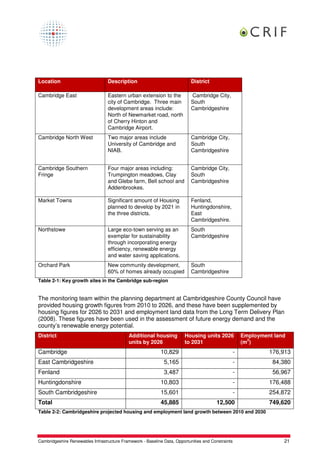
The monitoring team within the planning department at Cambridgeshire County Council have
provided housing growth figures from 2010 to 2026, and these have been supplemented by
housing figures for 2026 to 2031 and employment land data from the Long Term Delivery Plan
(2008). These figures have been used in the assessment of future energy demand and the
county’s renewable energy potential.
District                                     Additional housing          Housing units 2026             Employment land
                                                                                                          2
                                             units by 2026               to 2031                        (m )
Cambridge                                                    10,829                                 -            176,913
East Cambridgeshire                                           5,165                                 -             84,380
Fenland                                                       3,487                                 -             56,967
Huntingdonshire                                              10,803                                 -            176,488
South Cambridgeshire                                         15,601                                 -            254,872
Total                                                        45,885                      12,500                  749,620
Table 2-2: Cambridgeshire projected housing and employment land growth between 2010 and 2030


Cambridgeshire Renewables Infrastructure Framework - Baseline Data, Opportunities and Constraints                     21
3        Energy consumption in Cambridgeshire

3.1      Current energy consumption and carbon emissions in Cambridgeshire
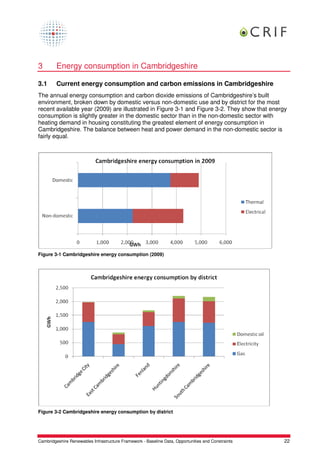
The annual energy consumption and carbon dioxide emissions of Cambridgeshire’s built
environment, broken down by domestic versus non-domestic use and by district for the most
recent available year (2009) are illustrated in Figure 3-1 and Figure 3-2. They show that energy
consumption is slightly greater in the domestic sector than in the non-domestic sector with
heating demand in housing constituting the greatest element of energy consumption in
Cambridgeshire. The balance between heat and power demand in the non-domestic sector is
fairly equal.


Figure 3-1 Cambridgeshire energy consumption (2009)


Figure 3-2 Cambridgeshire energy consumption by district


Cambridgeshire Renewables Infrastructure Framework - Baseline Data, Opportunities and Constraints   22
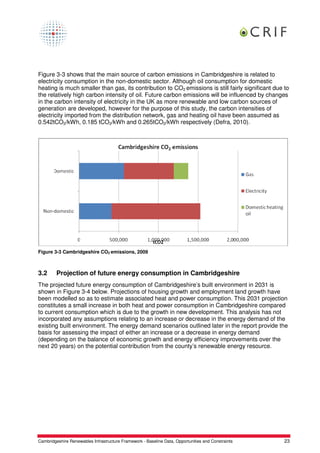
Figure 3-3 shows that the main source of carbon emissions in Cambridgeshire is related to
electricity consumption in the non-domestic sector. Although oil consumption for domestic
heating is much smaller than gas, its contribution to CO2 emissions is still fairly significant due to
the relatively high carbon intensity of oil. Future carbon emissions will be influenced by changes
in the carbon intensity of electricity in the UK as more renewable and low carbon sources of
generation are developed, however for the purpose of this study, the carbon intensities of
electricity imported from the distribution network, gas and heating oil have been assumed as
0.542tCO2/kWh, 0.185 tCO2/kWh and 0.265tCO2/kWh respectively (Defra, 2010).


Figure 3-3 Cambridgeshire CO2 emissions, 2009


3.2      Projection of future energy consumption in Cambridgeshire
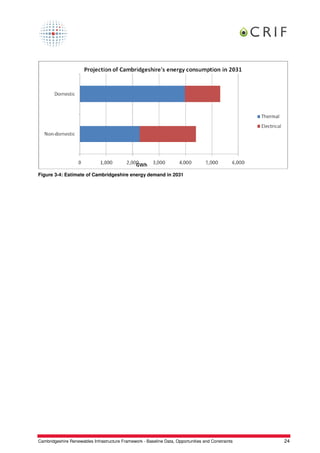
The projected future energy consumption of Cambridgeshire’s built environment in 2031 is
shown in Figure 3-4 below. Projections of housing growth and employment land growth have
been modelled so as to estimate associated heat and power consumption. This 2031 projection
constitutes a small increase in both heat and power consumption in Cambridgeshire compared
to current consumption which is due to the growth in new development. This analysis has not
incorporated any assumptions relating to an increase or decrease in the energy demand of the
existing built environment. The energy demand scenarios outlined later in the report provide the
basis for assessing the impact of either an increase or a decrease in energy demand
(depending on the balance of economic growth and energy efficiency improvements over the
next 20 years) on the potential contribution from the county’s renewable energy resource.


Cambridgeshire Renewables Infrastructure Framework - Baseline Data, Opportunities and Constraints   23
Figure 3-4: Estimate of Cambridgeshire energy demand in 2031


Cambridgeshire Renewables Infrastructure Framework - Baseline Data, Opportunities and Constraints   24
4        Present contribution of renewable energy

4.1      Cambridgeshire is already doing well
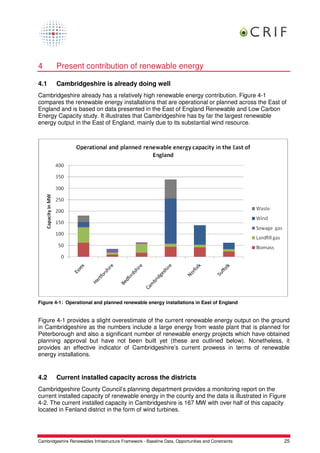
Cambridgeshire already has a relatively high renewable energy contribution. Figure 4-1
compares the renewable energy installations that are operational or planned across the East of
England and is based on data presented in the East of England Renewable and Low Carbon
Energy Capacity study. It illustrates that Cambridgeshire has by far the largest renewable
energy output in the East of England, mainly due to its substantial wind resource.


Figure 4-1: Operational and planned renewable energy installations in East of England


Figure 4-1 provides a slight overestimate of the current renewable energy output on the ground
in Cambridgeshire as the numbers include a large energy from waste plant that is planned for
Peterborough and also a significant number of renewable energy projects which have obtained
planning approval but have not been built yet (these are outlined below). Nonetheless, it
provides an effective indicator of Cambridgeshire’s current prowess in terms of renewable
energy installations.


4.2      Current installed capacity across the districts
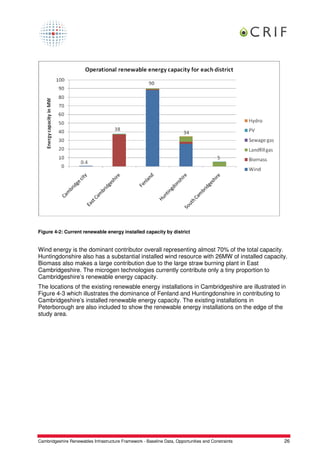
Cambridgeshire County Council’s planning department provides a monitoring report on the
current installed capacity of renewable energy in the county and the data is illustrated in Figure
4-2. The current installed capacity in Cambridgeshire is 167 MW with over half of this capacity
located in Fenland district in the form of wind turbines.


Cambridgeshire Renewables Infrastructure Framework - Baseline Data, Opportunities and Constraints   25
Figure 4-2: Current renewable energy installed capacity by district


Wind energy is the dominant contributor overall representing almost 70% of the total capacity.
Huntingdonshire also has a substantial installed wind resource with 26MW of installed capacity.
Biomass also makes a large contribution due to the large straw burning plant in East
Cambridgeshire. The microgen technologies currently contribute only a tiny proportion to
Cambridgeshire’s renewable energy capacity.
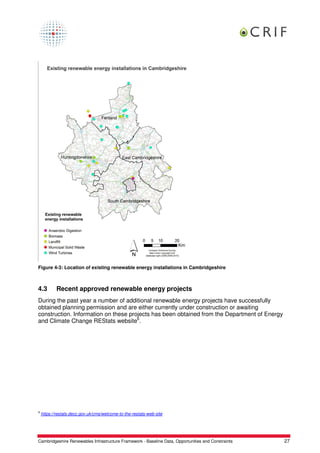
The locations of the existing renewable energy installations in Cambridgeshire are illustrated in
Figure 4-3 which illustrates the dominance of Fenland and Huntingdonshire in contributing to
Cambridgeshire’s installed renewable energy capacity. The existing installations in
Peterborough are also included to show the renewable energy installations on the edge of the
study area.


Cambridgeshire Renewables Infrastructure Framework - Baseline Data, Opportunities and Constraints   26
Figure 4-3: Location of existing renewable energy installations in Cambridgeshire


4.3         Recent approved renewable energy projects
During the past year a number of additional renewable energy projects have successfully
obtained planning permission and are either currently under construction or awaiting
construction. Information on these projects has been obtained from the Department of Energy
and Climate Change REStats website6.


6
    https://restats.decc.gov.uk/cms/welcome-to-the-restats-web-site


Cambridgeshire Renewables Infrastructure Framework - Baseline Data, Opportunities and Constraints   27
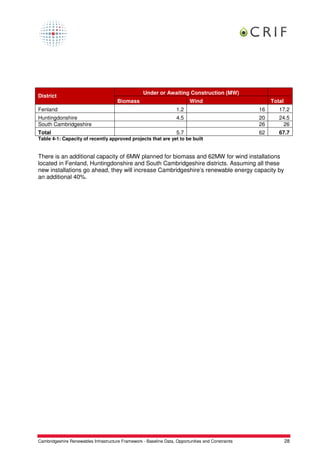
Under or Awaiting Construction (MW)
District
                                       Biomass                             Wind                          Total
Fenland                                                             1.2                             16      17.2
Huntingdonshire                                                     4.5                             20      24.5
South Cambridgeshire                                                                                26       26
Total                                                               5.7                             62      67.7
Table 4-1: Capacity of recently approved projects that are yet to be built


There is an additional capacity of 6MW planned for biomass and 62MW for wind installations
located in Fenland, Huntingdonshire and South Cambridgeshire districts. Assuming all these
new installations go ahead, they will increase Cambridgeshire’s renewable energy capacity by
an additional 40%.


Cambridgeshire Renewables Infrastructure Framework - Baseline Data, Opportunities and Constraints                28
5         Renewable energy technical potential

5.1       Methodology

5.1.1 Overview of approach
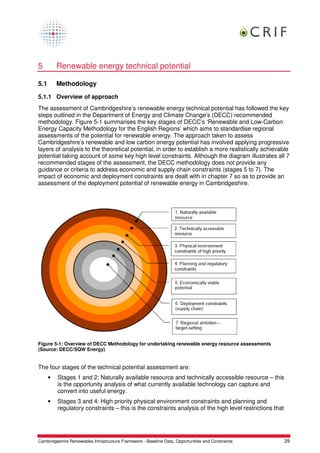
The assessment of Cambridgeshire’s renewable energy technical potential has followed the key
steps outlined in the Department of Energy and Climate Change’s (DECC) recommended
methodology. Figure 5-1 summarises the key stages of DECC’s ‘Renewable and Low-Carbon
Energy Capacity Methodology for the English Regions’ which aims to standardise regional
assessments of the potential for renewable energy. The approach taken to assess
Cambridgeshire’s renewable and low carbon energy potential has involved applying progressive
layers of analysis to the theoretical potential, in order to establish a more realistically achievable
potential taking account of some key high level constraints. Although the diagram illustrates all 7
recommended stages of the assessment, the DECC methodology does not provide any
guidance or criteria to address economic and supply chain constraints (stages 5 to 7). The
impact of economic and deployment constraints are dealt with in chapter 7 so as to provide an
assessment of the deployment potential of renewable energy in Cambridgeshire.


Figure 5-1: Overview of DECC Methodology for undertaking renewable energy resource assessments
(Source: DECC/SQW Energy)


The four stages of the technical potential assessment are:
      •   Stages 1 and 2: Naturally available resource and technically accessible resource – this
          is the opportunity analysis of what currently available technology can capture and
          convert into useful energy.
      •   Stages 3 and 4: High priority physical environment constraints and planning and
          regulatory constraints – this is the constraints analysis of the high level restrictions that


Cambridgeshire Renewables Infrastructure Framework - Baseline Data, Opportunities and Constraints         29
the physical environment and planning designations or other legislation places on the
         deployment of the technology. However, neither the technical nor the deployment
         assessment address specific site constraints and issues.
The stage 1 to 4 assessments cover both the existing and the future built environment of
Cambridgeshire as it includes the renewable energy potential associated with the planned new
developments between now and 2031.

5.1.2 Assessing ‘technical potential’
The ‘technical potential’ refers to the output from stages 1 to 4 of the DECC methodology, and
is defined as the total renewable energy resource that could be delivered if all technically
suitable sites or locations were developed. The technical potential is then further constrained by
economic considerations and other deployment barriers, such as obtaining planning permission
or site-specific technical constraints that cannot be assessed in detail within the scope of this
study. Nonetheless, the technical potential provides a good indication of which renewable
energy technologies have the greatest potential within a certain area or region.

5.1.3 Data gap analysis
The East of England Renewable Energy Capacity Study provides an assessment of the
renewable energy potential across Cambridgeshire following the DECC methodology outlined
above. However, the East of England study does not provide a breakdown by authority and it
provides a very high level assessment of heat demand, which does not provide the necessary
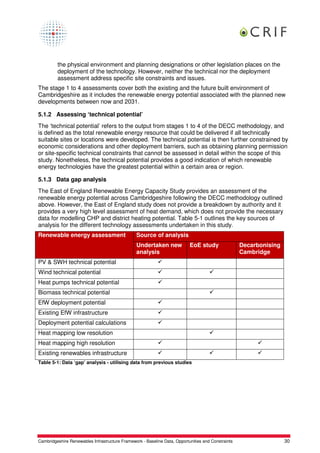
data for modelling CHP and district heating potential. Table 5-1 outlines the key sources of
analysis for the different technology assessments undertaken in this study.
Renewable energy assessment                     Source of analysis
                                                Undertaken new             EoE study                Decarbonising
                                                analysis                                            Cambridge
PV & SWH technical potential
Wind technical potential
Heat pumps technical potential
Biomass technical potential
EfW deployment potential
Existing EfW infrastructure
Deployment potential calculations
Heat mapping low resolution
Heat mapping high resolution
Existing renewables infrastructure
Table 5-1: Data ‘gap’ analysis - utilising data from previous studies


Cambridgeshire Renewables Infrastructure Framework - Baseline Data, Opportunities and Constraints                   30
5.2      Wind potential

5.2.1 Overview of approach
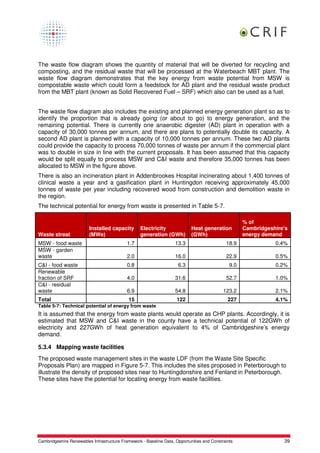
A GIS analysis has been undertaken to identify sites which are theoretically suitable for wind
turbines. The DECC methodology for assessing wind potential has been followed and is
summarised in Figure 5-2. The process is essentially that of mapping sites where wind turbines
could be located by applying a series of high level constraints that limit the geographical scope
for installing turbines.
                                                  WIND POTENTIAL METHODOLOGY
           STAGE 1                           STAGE 2                           STAGE 3                            STAGE 4
                                        AREAS WITH A WIND                                                  BUFFERS APPLIED TO
                                                                      PHYSICAL ENVIRONMENT
                                         SPEED <5m/s ARE                                                 INDIVIDUAL PROPERTIES
   GENERATE WIND SPEED                                                CONSTRAINTS APPLIED TO
                                     EXCLUDED AND MAXIMUM                                                    AND ALLOWABLE
          MAPS                                                            EXCLUDE NON-
                                      INSTALLED CAPACITY IS                                              PROXIMITY TO BUILDINGS
                                                                        ACCESSIBLE AREAS
                                           CALCULATED                                                          IS REDUCED


Figure 5-2: Methodology for assessing the technical potential of wind in Cambridgeshire


Assessment of technical potential
The ‘technical potential’ is defined as the wind generation that could be delivered if turbines are
installed at all potential sites which do not have absolute constraints to wind. The maximum
number of wind turbines that could be installed at each site is determined by the separation
distance between turbines required to prevent air stream interference and any associated
operational detriment to the turbines. In line with the DECC Methodology, we have assumed a
separation distance equivalent to five rotor diameters. In addition, we have assumed a wind
turbine capacity of 2.5MW to provide an upper estimate of the potential7. The generation
potential is based on an assumed capacity factor of 25%, and a 95% turbine availability factor8.
Capacity factors are highly dependent on wind speed and site specific parameters which
influence wind flow. 25% is taken as an reasonable estimate of performance, being a
conservative reduction on the 10 year annual average wind farm performance of 28%
(published by DECC, for all on-shore UK wind farms).
The absolute constraints that have been applied to the wind analysis in calculating the technical
potential for large-scale wind turbines are outlined in Table 5-2 below. These include the key
constraints of buildings, roads, waterways, woodland, airports, MoD sites and buffer zones
around these constraints. The assessment has also included nationally and internationally
designated nature conservation sites including Sites of Special Scientific Interest, Special Areas
of Conservation, Special Protection Areas, National Nature reserve and Ramsar Sites.
The technical potential does not address all potential site constraints and issues that would
need to be considered to determine whether a site or location is suitable for wind turbines.
Impact on landscape and townscape, the historic environment, or other site-specific issues
would need to be considered with regard to any site.


7
  The typical dimensions of a 2.5MWe wind turbine are: height to the tip of the blade at the top of its swept area of approximately
135 m, and rotor diameter of 100m. With the quoted load factor and availability assumptions such turbines would be expected
produce approximately 5,200MWh/yr, equivalent to the current typical annual consumption of approximately 1,250 households.
8
  Annual generation (MWh/yr) = Capacity (MWe) x Capacity Factor (%) x Availability (%) x Hours in Year (hrs)


Cambridgeshire Renewables Infrastructure Framework - Baseline Data, Opportunities and Constraints                                     31
Large -scale turbines (~ 2.5MW)                Medium -scale turbines (~0.25MW)
  Assessment stage
                                          Layer                  Buffer                   Layer             Buffer
 Stage 1: Naturally
                            Wind speed at 45 m agl                  -       Wind speed at 25 m agl            -
 available resource
                            Exclude areas with wind speed                   Exclude areas with wind speed
 Stage 2: Technically
                            @ 45m above ground level <              -       @ 25m above ground level <        -
 accessible resource
                            5m/s                                            5m/s

                            Roads (A, B, and motorways)             -       Roads (A, B, and motorways)       -

                            Railways                                -       Railways                          -

 Stage 3:                   Inland waters                           -       Inland waters                     -
 Non accessible
 areas due to               Residential properties                  -       Residential properties            -
 physical
 environment                Commercial buildings                    -       Commercial buildings              -
 constraints
                            Airports and airfields                  -       Airports and airfields            -

                            MoD training sites                      -       MoD training sites                -

                            Ancient woodland                        -       Ancient woodland                  -

                            Roads (A, B, and motorways)                     Roads (A, B, and motorways)
                                                                 150m                                       150m
                            and Railways                                    and Railways

                            Residential properties               600m       Residential properties          400m
 Stage 4: Areas
 where wind                 Commercial buildings                  50m       Commercial buildings             50m
 developments are
 unlikely to be             Civil airports and airfields          5km       Civil airports and airfields     3km
 permitted
                            MoD airbases                          5km       MoD airbases                     3km

                            Sites of historic interest              -       Sites of historic interest        -

                            International and National
                            Designations for Nature                 -        As per DECC methodology          -
                            Conservation
                            International and National
                                                                    -       As per DECC methodology           -
                            Landscape designations
Table 5-2: Parameters and constraints applied to the assessment of wind technical potential


The assessment has identified all individual buildings in Cambridgeshire and applied a buffer of
600m for large wind turbines and 400m for medium turbines, so that the assessment of
technical potential does not allow turbines nearer than 600m and 400m to a building
respectively. For non-domestic buildings, the buffer was applied as 50 m. The identification of
individual buildings constitutes an approach which goes beyond the DECC recommended
standard approach of applying ‘settlements’ as constraints rather than individual buildings.
Given that a large proportion of Cambridgeshire’s environment is rural, there are a significant
number of isolated and clustered properties that are not classified as “built-up areas”. It is
therefore considered appropriate to apply a buffer around each individual property within the
study area as an additional layer of constraint in order to avoid a large overestimation of
potential development opportunities. This reflects the fact that owners of all properties, even
isolated rural properties, can raise objections and there is a reasonable likelihood that if a


Cambridgeshire Renewables Infrastructure Framework - Baseline Data, Opportunities and Constraints                    32
development is closer than a stated ‘rule of thumb’ (600m in this case for large turbines) it will
not achieve planning permission or be perceived as a high planning risk by wind developers.
Large-scale wind turbines are typically favoured commercially due to their considerably greater
power output and much lower capital costs per kW installed. However, medium-scale turbines
can be an alternative where smaller turbines are favoured due to their lower visual impact. The
assessment has considered the potential from both large and medium scale wind turbines, and
has assessed the potential output from a combination of large and medium scale turbines which
would have the scope of increasing the potential through locating medium scale turbines nearer
to buildings.
  Scale                 Capacity       Hub             Rotor
                                       height          diameter
 Large                       2.5MW              85m          100m
 Medium                      250kW              31m           27m

Table 5-3: Capacity and size of wind turbines assessed


5.2.2 Maps of Cambridgeshire technical wind potential
Figure 5-3 illustrates the technical potential for siting large scale wind turbines in
Cambridgeshire.
Table 5-4 represents the total technical potential for large scale wind energy in Cambridgeshire
after the constraints outlined above have been applied and the impact of the Lordsbridge
observatory exclusion zone. It shows that almost 14,000GWh of electricity could be generated
based on the available space for 2,500 wind turbines.


 District                      Total MW installed           Annual generation (GWh)
 Cambridge                                               20                        42
 East Cambridgeshire District                         1,688                     3,511
 Fenland District                                     1,018                     2,117
 Huntingdonshire District                             2,088                     4,343
 South Cambridgeshire
 District                                             1,863                     3,875
 Cambridgeshire                                       6,675                    13,887
Table 5-4: Technical potential of large scale wind in Cambridgeshire


Cambridgeshire Renewables Infrastructure Framework - Baseline Data, Opportunities and Constraints    33
Figure 5-3: Technical potential of large scale wind in Cambridgeshire


Cambridgeshire Renewables Infrastructure Framework - Baseline Data, Opportunities and Constraints   34
Figure 5-3 illustrates that Cambridgeshire is a predominantly rural county with substantial scope
for installing wind turbines. This assessment identifies a technical potential of over 2,500 large
scale and 13,000 medium scale turbines to be installed on Cambridgeshire farm land.
Housing growth and associated infrastructure over the coming decades will also reduce the total
area that is potentially available for turbine locations. However, the impact of these sites on the
total area available to wind turbines will be small overall, particularly as they are generally
located on the immediate periphery of existing urban areas (Northstowe excluded) which are
locations not available to turbines. If the identified growth sites are all developed then they
would only reduce the total technical potential by a couple of percentage points.


5.2.3 Wind technical potential based on urban settlement constraint rather than
      individual buildings
The East of England study assesses the wind technical potential taking urban settlements
rather than individual buildings as a constraint layer. This provides a very large estimate of
technical potential as it considers that all areas outside towns and villages are available for wind
turbines regardless of whether there are individual dwellings in the vicinity. The wind technical
potential estimated by the East of England study is almost three times the potential in this report
at 41,500GWh per year. The map of the larger technical potential as outlined in the East of
England report is found in the Appendix 2.


5.2.4 Wind technical potential based on a combination of large and medium scale
      turbines
Figure 5-4 illustrates the additional areas that could be available for medium scale turbines in
addition to large scale turbines. The area of potential for large turbines has been excluded to
ensure that the two technologies are additional – therefore potential for medium wind exists
primarily in a 200m wide belt around the outside of the large wind sites. This is due to the buffer
zone applied to residential buildings being 200m smaller for medium sized turbines than for
large turbines. The extra land area available due to the smaller buffer would allow the space for
13,000 medium scale turbines to be installed. In combination with the large scale turbines this
could generate an overall potential of 19,390GWh, which is a third greater than the output from
large scale turbines alone.


District                         Total MW installed             Electricity generation (GWh)
Cambridge                                                   31                              60
East Cambridgeshire District                             2,355                           4,621
Fenland District                                         1,608                           3,099
Huntingdonshire District                                 3,165                           6,135
South Cambridgeshire District                            2,824                           5,474
Cambridgeshire                                           9,982                          19,390
Table 5-5: Technical potential from a combination of large and medium scale turbines


Cambridgeshire Renewables Infrastructure Framework - Baseline Data, Opportunities and Constraints   35
Figure 5-4: Additional areas available to medium scale turbines (above and beyond large turbine potential
sites)


Cambridgeshire Renewables Infrastructure Framework - Baseline Data, Opportunities and Constraints           36
5.3        Biomass and Energy from Waste potential

5.3.1 Overview of approach
The overview of the approach to estimating the technical potential from biomass and energy
from waste are outlined in the figure below.
                                   BIOMASS AND ENERGY FROM WASTE OVERALL METHODOLOGY

                                                                          STAGES 3-4

     IDENTIFY THE DIFFERENT           ESTIMATE FRACTION OF                                       CONVERT PRIMARY ENERGY
                                                                     REDUCE POTENTIAL TO
        BIOMASS AND EfW             EACH FEEDSTOCK THAT CAN                                      INTO ENERGY GENERATION
                                                                        ACCOUNT FOR
        FEEDSTOCKS, AND                BE RECOVERED, TO                                            BY APPLYING TYPICAL
                                                                    ALTERNATIVE USES SUCH
         QUANTIFY TOTAL              ACCOUNT FOR TECHNICAL                                           EFFICIENCY OF THE
                                                                        AS RECYCLING
      AVAILABLE RESOURCE                  CONSTRAINTS                                             RELEVANT CONVERSION


Figure 5-5: Methodology for assessing the technical potential of biomass in Cambridgeshire
The assessment of biomass and energy from waste technical potential has been undertaken in
two parts – the biomass potential has been taken from the East of England study which
provides a breakdown of the different biomass feedstocks whereas the energy from waste
potential has been estimated through quantifying the waste flows in Cambridgeshire.

5.3.2 Biomass potential
The biomass potential was taken from the East of England study and Peterborough has been
excluded from the potential. Table 5-6 shows the technical potential of electricity and heat
generation from biomass sources.9
                                       Electricity         Heat
District                               generation          generation          % of energy
                                       (GWh)               (GWh)               demand
Cambridge                                         149                    17            2%
East Cambridgeshire                               104                    12            1%
Fenland                                           115                    13            2%
Huntingdonshire                                   207                    23            3%
South Cambridgeshire                              179                    20            2%
Total                                             753                    85           10%
Table 5-6 Technical potential of biomass in Cambridgeshire


The technical potential of biomass indicates that this resource alone could meet 10% of the
county’s energy demand if all of this potential was deployed. Around 80% of this biomass
potential comes from straw which has the potential to produce 680GWh of electricity per year.
The 38MW straw power station in Ely currently generates 270GWh of electricity each year
which indicates that Cambridgeshire already achieved 40% of its technical potential of
producing energy from straw and around 30% of the total energy it could technically generate
from its biomass sources.


9
    Derived and sourced from AECOM (2011) East of England renewable and low carbon energy capacity study (not published yet)


Cambridgeshire Renewables Infrastructure Framework - Baseline Data, Opportunities and Constraints                              37
5.3.3 Energy from waste potential
The energy from waste potential was estimated by identifying the 2031 waste flows in
Cambridgeshire and the potential quantities available for energy generation. The three key
waste flows include Municipal Solid Waste (MSW), Commercial and Industrial waste (C&I) and
Construction and Demolition waste (C&D). The energy potential from C&D waste has already
been quantified in the form of waste wood in the East of England study’s biomass potential
figures and therefore this energy from waste assessment on consider the potential from MSW
and C&I waste.
The volumes of waste and future recycling targets have been sourced from the Cambridgeshire
and Peterborough Minerals and Waste Development Plan[1] and discussions have been held
with waste planning staff at Cambridgeshire County Council. In order to extract the amount of
waste specific to Cambridgeshire, figures were used from a previous study carried out by
Jacobs Babtie 10. Energy potential has been quantified based on the targets set as well as
taking into account the current and planned energy from waste plants in the region. Figure 5-6
shows the waste flow diagram for municipal solid waste (MSW) and identifies the potential
waste flows available for energy generation in 2031. The 2031 waste flow diagrams for C&I
waste is found in Appendix 2.


Municipal Solid Waste
                                                           46% Recycled**                                                             Constructed/planned AD plants
                                                                  140,071 tonnes                                                            35,000 tonnes 15 GWh

                                                           54% AD/Composting**                               ENERGY POTENTIAL
                                                                  164,431 tonnes                                71 GWh

                                                                                                                                      Remaining potential for
                                                                                                                                      further AD plants
                                67% Recycled/composted                                                                                   129,431 tonnes 56 GWh
             MSW*                   304,502 tonnes
        454,480 tonnes
                                    Residual
                                33% 149,978 tonnes


                                                                                                               50% SRF***                          ENERGY POTENTIAL
                                                                                                                                                   0
                                                             0% Other                                              74,989 tonnes                  74,989 tonnes
                                                                0 tonnes                                                                             84 GWh
                                                                                                               25% Water + CO2***
                                                          100% MBT                                                    37,495 tonnes
                                                               149,978 tonnes
                                                                                                               25% Recyclables+rejects***
                                                                                                                   37,495 tonnes


* Based on split betw een Cambridgeshire and Peterborough MSW derived from Jacobs Babtie (2006) Cambridgeshire and Peterborough
Statistical Basis for the Waste Development Document (WDD)

** Based on current ratio of recycled/composted w aste derived from Waste Data Flow , http://w w w .w astedataflow .org/
*** Shanks (2010) Intelligent Transfer Station. w ebsite. http://w w w .shanks.co.uk/sites/default/files/ITS_brochure_new _lo3.pdf


Figure 5-6 Future energy from waste potential from municipal and solid waste
Figure flow diagram identifying Cambridgeshire's energy from waste potential


[1]
  Cambridgeshire County Council and Peterborough City Council (2010) Cambridgeshire and Peterborough Minerals and Waste
Development Plan Core Strategy
10
      Jacobs Babtie (2006) Cambridgeshire and Peterborough Statistical Basis for the Waste Development Document (WDD)


Cambridgeshire Renewables Infrastructure Framework - Baseline Data, Opportunities and Constraints                                                                     38
The waste flow diagram shows the quantity of material that will be diverted for recycling and
composting, and the residual waste that will be processed at the Waterbeach MBT plant. The
waste flow diagram demonstrates that the key energy from waste potential from MSW is
compostable waste which could form a feedstock for AD plant and the residual waste product
from the MBT plant (known as Solid Recovered Fuel – SRF) which also can be used as a fuel.


The waste flow diagram also includes the existing and planned energy generation plant so as to
identify the proportion that is already going (or about to go) to energy generation, and the
remaining potential. There is currently one anaerobic digester (AD) plant in operation with a
capacity of 30,000 tonnes per annum, and there are plans to potentially double its capacity. A
second AD plant is planned with a capacity of 10,000 tonnes per annum. These two AD plants
could provide the capacity to process 70,000 tonnes of waste per annum if the commercial plant
was to double in size in line with the current proposals. It has been assumed that this capacity
would be split equally to process MSW and C&I waste and therefore 35,000 tonnes has been
allocated to MSW in the figure above.
There is also an incineration plant in Addenbrookes Hospital incinerating about 1,400 tonnes of
clinical waste a year and a gasification plant in Huntingdon receiving approximately 45,000
tonnes of waste per year including recovered wood from construction and demolition waste in
the region.
The technical potential for energy from waste is presented in Table 5-7.

                                                                                                     % of
                         Installed capacity       Electricity               Heat generation          Cambridgeshire's
Waste streat             (MWe)                    generation (GWh)          (GWh)                    energy demand
MSW - food waste                            1.7                     13.3                     18.9               0.4%
MSW - garden
waste                                       2.0                     16.0                     22.9               0.5%
C&I - food waste                            0.8                      6.3                       9.0              0.2%
Renewable
fraction of SRF                             4.0                     31.6                     52.7               1.0%
C&I - residual
waste                                       6.9                     54.8                    123.2               2.1%
Total                                        15                      122                      227               4.1%
Table 5-7: Technical potential of energy from waste
It is assumed that the energy from waste plants would operate as CHP plants. Accordingly, it is
estimated that MSW and C&I waste in the county have a technical potential of 122GWh of
electricity and 227GWh of heat generation equivalent to 4% of Cambridgeshire’s energy
demand.

5.3.4 Mapping waste facilities
The proposed waste management sites in the waste LDF (from the Waste Site Specific
Proposals Plan) are mapped in Figure 5-7. This includes the sites proposed in Peterborough to
illustrate the density of proposed sites near to Huntingdonshire and Fenland in Peterborough.
These sites have the potential for locating energy from waste facilities.


Cambridgeshire Renewables Infrastructure Framework - Baseline Data, Opportunities and Constraints                  39
Figure 5-7: Proposed future waste management sites in Cambridgeshire

5.3.5 Landfill gas potential
Potential from landfill gas was also sourced from the East of England study and was estimated
to produce 19.1GWh of electricity in Cambridgeshire with 3.6MW of installed capacity. This
technical potential is lower than the current installed capacity as it was assumed that some of
the existing plants will be closed down and there will be less landfill waste due to higher rates of
recycling.


5.4      PV potential

5.4.1 Assessing technical potential of PV
The PV methodology calculates the actual roof area that could accommodate PV panels and
calculates an installed PV capacity from this, as outlined in Figure 5-8. The orientation of roofs
was accounted for by only considering south, south east and south west facing roofs.


Cambridgeshire Renewables Infrastructure Framework - Baseline Data, Opportunities and Constraints    40
Differentiation was also made between horizontal and inclined panels based on the different
efficiency factors under these conditions. The impact on PV potential of over-shading and
competing roof space uses in high and medium density areas was incorporated by applying
constraint factors. Finally, constraints on the installation of PV on roofs in conservation areas
were considered by assuming a lower installation rate on buildings in conservation areas.
Additional roof space created by an increase in properties between now and 2031 due to
increases in domestic and non-domestic buildings have been incorporated by considering
projections of housing and employment land provided by Cambridgeshire County Council.
                                              PHOTOVOLTAICS METHODOLOGY
                         STAGES 1-2                                                     STAGES 3-4
                                                                       THE IMPACT OF
                                ROOF AREA AT A SUITABLE                                        CONSERVATION AREAS ARE
       FOOTPRINT OF ALL                                               OVERSHADING +
                                    ORIENTATION IS                                              REMOVED AND OVERALL
   BUILDINGS IS CALCULATED                                          COMPETING BUILDING
                                      DETERMINED                                               POTENTIAL IS CALCULATED
                                                                  SERVICES IS CONSIDERED


Figure 5-8: Methodology for assessing the technical potential of PV in Cambridgeshire

5.4.2 Summary of PV technical potential
                                                                                             % of
District                                   Installed              Electricity                District/Cambridgeshire'
                                           capacity (MW)          generation (GWh)           s electricity demand
Cambridge                                               232                      169                              22%
East Cambridgeshire                                     298                      216                              56%
Fenland                                                 380                      275                              53%
Huntingdonshire                                         547                      397                              43%
South Cambridgeshire                                    528                      383                              44%
Total                                                 1,985                    1,439                              42%
Table 5-8: Technical potential of PV in Cambridgeshire


Total technical potential of PV in Cambridgeshire is equivalent to 1,985MW of installed capacity
generating 1,439GWh of electricity. If all this technical potential was deployed, it would meet
42% of Cambridgeshire’s electricity demand.
The highest potential for PV installations is in Huntingdonshire and South Cambridgeshire due
to greater number of buildings and hence larger roof space in these districts as well as a
relatively lower number of buildings designated under conservation areas than in Cambridge.
When potential is measured on the basis of density (MWh/ha), the greatest potential of PV is
clustered in Cambridge where building density is highest. Please refer to the Appendix of maps
for a map of the distribution of PV potential across Cambridgeshire.


5.5      Solar water heating potential

5.5.1 Assessing technical potential of solar water heating
Two different methodologies were used to assess solar water heating potential across domestic
and non-domestic buildings in Cambridgeshire. For the domestic stock a system size of 3m2 per
dwelling was used and only 20% of flats and 75% of houses were assumed to be suitable due
to lack of roof space for installing panels on flats and for higher density housing. In the same
way as for the assessment of PV potential, constraints were applied in conservation areas
assuming a reducing number of panels to be installed. To avoid double-counting, it was


Cambridgeshire Renewables Infrastructure Framework - Baseline Data, Opportunities and Constraints                        41
assumed that SWH would take priority over the installation of PV panels as they may be
competing for the same roof space. Therefore the potential of this technology was deducted
from total PV potential. The methodology for working out the potential in domestic buildings is
summarised in Figure 5-9.
                                      SOLAR WATER HEATING (DOMESTIC) - TAILORED METHODOLOGY
                                                              Stages 1-4

       NUMBER OF DOMESTIC
                                 ASSUMED INSTALLATION SIZE OF       TOTAL CAPACITY CALCULATED BASED ON AN ASSUMED OUTPUT OF
     BUILDINGS (LSOA LEVEL) IS
                                       3M²/DWELLING                                         525KWH/M²
            CALCULATED


Figure 5-9 Methodology for assessing the technical potential of SWH in Cambridgeshire for domestic stock


For the non-domestic stock, it was assumed that 75% of the properties would be suitable for the
installation of SWH systems. Non-domestic buildings generally have a fairly low hot water
demand and therefore a typical SWH system would not require significant amounts of roof
space. The hot water demand was predicted based on published benchmarks11. The non-
domestic SWH systems were sized to produce 50% of the predicted hot water demand. A lower
installation rate in conservation areas has been assumed for both the domestic and non-
domestic assessment.
                                    SOLAR WATER HEATING (NON-DOMESTIC) - TAILORED METHODOLOGY
                                                              Stages 1-4

     NUMBER OF NON-DOMESTIC
                                 FLOOR AREA USED TO ESTIMATE       TOTAL CAPACITY DETERMINED - PANELS SIZED TO GENERATE 50% OF
     BUILDINGS - 75% ASSUMED
                                     HOT WATER DEMAND                         HOT WATER DEMAND FOR EACH BUILDING
        SUITABLE FOR SWH


Figure 5-10: Methodology for assessing the technical potential of solar water heating in Cambridgeshire

5.5.2 Summary of solar water heating technical potential
The technical potential of SWH is 134GWh which could supply 2% of Cambridgeshire’s heat
demand. As expected, this is much lower than the PV potential due to the fact that SWH
installation sizes are limited by the hot water demand of a building as excess hot water cannot
be exported to neighbouring buildings. In the case of PV however, the whole of the available
roof space can be utilised with excess electricity exported to the local grid.
                                                                                 % of
 District                                                                        District/Cambridgeshire’s
                                         Heat generation (GWh)                   heat demand
 Cambridge                                                                 23                              1%
 East Cambridgeshire                                                       18                              2%
 Fenland                                                                   22                              1%
 Huntingdonshire                                                           36                              2%
 South Cambridgeshire                                                      36                              2%
 Total                                                                     134                             2%
Table 5-9: Technical potential of solar water heating in Cambridgeshire


11
     CIBSE (2007) CIBSE Guide F: Energy efficiency in buildings Section 20, Second Edition


Cambridgeshire Renewables Infrastructure Framework - Baseline Data, Opportunities and Constraints                                42
5.6       Heat pump potential

5.6.1 Ground source heat pumps

5.6.1.1 Assessing technical potential for ground source heat pumps
Separate methodologies have been used for assessing the technical potential of heat pumps for
domestic and non-domestic buildings due to their differing characteristics. Due to the space
requirements of GSHP, it has been assumed that no flats would be suitable. Across the
remaining housing stock, only houses with an Energy Efficiency Rating (EER) of C or higher,
corresponding to 7.9% of the stock12, were assumed to be technically suitable for GSHP. This is
due to the poor performance of heat pumps in thermally inefficient buildings. In line with the
DECC methodology, a fixed capacity of 5kW was assumed for all suitable domestic properties.
                                           GROUND SOURCE HEAT PUMPS (DOMESTIC)
                                                          Stages 1-4
      NUMBER OF DOMESTIC
     PROPERTIES DETERMINED    IMPACT OF ENERGY PERFORMANCE OF HOUSING ON SUITABILITY         TOTAL POTENTIAL CALCULATED
         AS PER DECC         FOR GROUND SOURCE HEAT PUMPS (ONLY SUITABLE FOR HOUSES         ASSUMING 5KW SYSTEM FOR ALL
      METHODOLOGY (FLATS                    WITH EFFICIENCY RATINGS A-C)                          HOUSES RATED A-C
          EXCLUDED )


Figure 5-11: Methodology for assessing the technical potential of GSHP in domestic buildings in
Cambridgeshire
For non-domestic properties, the methodology is similar to the DECC methodology however
further constraints were applied and it was assumed that only 5% of existing commercial
properties would be suitable for ground source heat pumps. For industrial properties, the
suitable proportion of the stock was assumed to be 40%. The remaining 60% was assumed to
either have space constraints or not be eligible for heat pumps due to poor energy efficiency
performance of the buildings.


For future developments, the potential for ground source heat pumps was based on applying
the same methodology to projected domestic and non-domestic development. In addition, it was
assumed that 75% of the existing domestic building stock that currently have an EER of less
than C could be technically upgraded to at least a C rating by 2031.
                                         GROUND SOURCE HEAT PUMPS (NON-DOMESTIC)
                                                          Stages 1-4

                                                                                             TOTAL POTENTIAL CALCULATED
        TOTAL NUMBER OF         TOTAL NUMBER OF COMMERCIAL AND INDUSTRIAL BUILDINGS
                                                                                              ASSUMING 100 KW SYSTEM
        COMMERCIAL AND        SUITABLE FOR GROUND SOURCE HEAT PUMPS (5% COMMERCIAL,
                                                                                                 CAPACITY AS IN DECC
      INDUSTRIAL BUILDINGS                        40% INDUSTRIAL)
                                                                                                    METHODOLOGY


Figure 5-12: Methodology for assessing the technical potential of GSHP in non-domestic buildings in
Cambridgeshire


5.6.1.2 Summary of ground source heat pump technical potential
Table 5-10 shows the technical potential of ground source heat pumps in Cambridgeshire by
local authority. If all this potential was installed, the technology could meet up to 13% of heat

12
  DCLG (2007) English House Condition Survey, Summary Statistics Table 7.2, Standard Tables, Summary Statistics
http://www.communities.gov.uk/housing/housingresearch/housingsurveys/englishhousecondition/ehcsdatasupporting/ehcsstandardt
ables/summarystatistics/


Cambridgeshire Renewables Infrastructure Framework - Baseline Data, Opportunities and Constraints                         43
demand. However, the electricity consumption associated with this scale of heat pump use
would be significant, corresponding to a 12% increase in Cambridgeshire’s electricity demand.

                                                                                                             % Increase in
                               Installed capacity        Heat generation
 District                                                                          % of heat demand          electricity
                               (MW)                      (GWh)                                                            13
                                                                                                             consumption

 Cambridge                                        147                      178                      11%                         9%
 East Cambridgeshire                              119                      144                      16%                       15%
 Fenland                                          139                      167                      10%                       13%
 Huntingdonshire                                  249                      300                      14%                       13%
 South Cambridgeshire                             237                      286                      14%                       13%
 Total                                   890              1,075                                     13%                       12%
Table 5-10: Technical potential of GSHP in Cambridgeshire


5.6.2 Air source heat pumps

5.6.2.1Assessing technical potential for air source heat pumps
The methodology for assessing the technical potential of ASHP is similar to GSHP however,
because this technology does not require a ground heat exchanger it has wider applicability
within towns and cities. Hence, flats were also included whilst estimating the total technical
potential. Properties that have an EER banding of C or less were excluded from the
assessment, as these properties would not be technically suitable due to the low temperature
heat output from ASHP.
The calculated GSHP potential has been subtracted from the ASHP potential in order to avoid
double-counting as these technologies are mutually exclusive. Whilst doing this, it was assumed
that GSHP would be of first preference due to their higher efficiency. For non-domestic
buildings, 50% of buildings are assumed to be suitable for ASHP.
                                                AIR SOURCE HEAT PUMPS (DOMESTIC)
                                                             Stages 1-4

                                                                                                   TOTAL POTENTIAL CALCULATED
                                  IMPACT OF ENERGY PERFORMANCE OF HOUSING STOCK ON
      TOTAL NUMBER OF                                                                             BASED ON DECC SYSTEM SIZES,
                                                     SUITABILITY FOR
         DWELLINGS                                                                               SUBTRACT GSHP POTENTIAL FROM
                                                AIR SOURCE HEAT PUMPS
                                                                                                             ASHP


Figure 5-13: Methodology for assessing the technical potential of ASHP in housing in Cambridgeshire


                                              AIR SOURCE HEAT PUMPS (NON-DOMESTIC)
                                                             Stages 1-4

                                                                                                 USE DECC METHODOLOGY SYSTEM
       TOTAL NUMBER OF
                                   ASSUMED 50% OF COMMERCIAL AND INDUSTRIAL BUILDINGS             SIZES TO CALCULATE POTENTIAL,
       COMMERCIAL AND
                                          SUITABLE FOR AIR SOURCE HEAT PUMPS                     SUBTRACT GSHP POTENTIAL FROM
     INDUSTRIAL BUILDINGS
                                                                                                              ASHP


Figure 5-14: Methodology for assessing the technical potential of ASHP in non-domestic buildings


13
  Based on a coefficient of performance of 2.5 sourced from EST field trial: EST (2010) Getting warmer: a field trial of heat pumps
http://www.energysavingtrust.org.uk/Media/node_1422/Getting-warmer-a-field-trial-of-heat-pumps-PDF


Cambridgeshire Renewables Infrastructure Framework - Baseline Data, Opportunities and Constraints                                 44
5.6.2.2 Summary of air source heat pump technical potential

                                                                                                                  % Increase in
                                 Installed capacity         Heat generation            % of heat
 District                                                                                                         electricity
                                 (MW)                       (GWh)                      demand                                  14
                                                                                                                  consumption

 Cambridge                                          288                        348                        22%                         20%
 East Cambridgeshire                                134                        161                        18%                         19%
 Fenland                                            163                        197                        12%                         17%
 Huntingdonshire                                    293                        354                        17%                         18%
 South Cambridgeshire                               289                        349                        17%                         18%
 Total                                            1,166                      1,409                        17%                         19%
Table 5-11: Technical potential of ASHPs in Cambridgeshire
The total technical potential for ASHPs is equivalent to 1,409GWh which would meet 17% of
Cambridgeshire’s heat potential. With a lower coefficient of performance than GSHP, the
additional electricity demand associated with this level of heat pump deployment is also very
significant, equivalent to 19% of electricity consumption. This additional electricity demand could
have implications for the capacity of the local electricity distribution network and may require
local grid reinforcement to enable the greater electrical supply. The national programme of
electrical grid decarbonisation is also key to the carbon savings from heat pumps and in the
short term heat pumps would deliver negligible carbon savings due to the current high carbon
content of the grid.

5.6.3 Potential of heat pumps in off-gas properties

Properties that are not connected to the gas grid are a significant source of potential for heat
pumps as they would be replacing heating systems that run with electricity or heating oil which
are more carbon intensive than natural gas. Therefore the prioritisation of the installation of heat
pumps in off-gas properties would ensure the reduction of carbon emissions in an effective way.
Energy consumption figures for Cambridgeshire suggest that on average 5.6% of homes use
heating oil in Cambridgeshire and this figure could go up to as much as 11% in East
Cambridgeshire. Installing heat pumps in these properties as well as in properties that use
electric heating would both reduce the running costs of heating for the residents and help to
reduce carbon emissions.

5.7      Summary of renewable energy technical potential

5.7.1 Overview of Cambridgeshire’s renewable energy technical potential
Table 5-12 provides a summary of the technical potential of renewable energy in
Cambridgeshire. Although the technical potential could provide 226% of Cambridgeshire’s
energy demand, the majority of this resource is wind, and the potential from renewable heat
technologies is far less at approximately 60% of Cambridgeshire’s heat demand.
ASHPs and PV have the second and third largest technical potentials at approximately 16% and
15% of energy demand respectively. The PV and ASHP technical potentials are both large
because these technologies could potentially be installed in or on most buildings. GSHP
potential is also large at 12.6% as there are a lot of rural properties in Cambridgeshire with

14
  Based on a coefficient of performance of 2.2 sourced from EST field trial: EST (2010) Getting warmer: a field trial of heat pumps
http://www.energysavingtrust.org.uk/Media/node_1422/Getting-warmer-a-field-trial-of-heat-pumps-PDF


Cambridgeshire Renewables Infrastructure Framework - Baseline Data, Opportunities and Constraints                                 45
available garden space for installing the ground loop pipework. Biomass and EfW have a
combined potential of almost 13% with the largest contribution coming from the agricultural
straw resource. The aggressive recycling targets in the Waste LDF will divert a lot of material
away from general waste streams thereby reducing the EfW potential. SWH has a fairly low
potential at just under 2% of energy demand as it is constrained by the hot water demand in
buildings. The potential from landfill gas is very small as the quantity of landfilled waste will
decline in the future.


                   Installed          Electricity        Heat                Carbon             % of
 Technology        capacity           generation         generation          savings            Cambridgeshire's
                   (MW)               (GWh)              (GWh)               (MtCO2)            energy demand

 PV                         1,591               1,304                              508,706                  15%
 SWH                              -                  -               134             29,252                1.6%
 GSHP                          890                   -             1,075           105,000                12.6%
 ASHP                       1,166                    -             1,409           114,494                16.6%
 Biomass                       132                753                  85          312,094                  10%
 EfW                            25                194                362           154,645                 2.6%
 Wind                       6,675             13,888                     -       5,416,167               163.3%
 Landfill gas                  5.4               28.2                    -           11,016                0.3%
 Total
                                                                                                           226%
                           10,484             16,167               3,065         6,651,375
Table 5-12: Overview of renewable energy technical potential in Cambridgeshire


Figure 5-15 highlights the dominance of wind’s contribution to the county’s technical resource.
Wind could provide four times the county’s current electricity demand and twice its overall
energy demand. Nonetheless, the technical potential of the other renewable energy
technologies is still fairly significant, and if wind is removed from the picture their combined
contributions could still supply 60% of the county’s energy demand.


Cambridgeshire Renewables Infrastructure Framework - Baseline Data, Opportunities and Constraints                  46
Figure 5-15: Renewable heat and electricity technical potential


Figure 5-16 outlines the renewable energy technical potential across the districts. The greatest
potential resides in Huntingdonshire followed closely by South Cambridgeshire – these two
districts have both a substantial wind potential and large microgeneration potential due to their
relatively large building stock. The rural nature of these districts makes them suitable for the
deployment of GSHPs and small biomass particularly for off gas areas.


Figure 5-16: Renewable energy technical potential by district


Cambridgeshire Renewables Infrastructure Framework - Baseline Data, Opportunities and Constraints   47
5.7.2 Comparison with existing deployment for wind and biomass
Wind and biomass have the largest installed capacity currently in Cambridgeshire. Due to the
very large technical potential of wind, the current installations only represent a fraction of the
technical resource. However, as the biomass and energy from waste technical potential is much
smaller, almost a third of the technical resource is already deployed


Figure 5-17: Comparison of the technical potential of wind and biomass with their current installed capacity


Cambridgeshire Renewables Infrastructure Framework - Baseline Data, Opportunities and Constraints          48
6         District heating and CHP potential

6.1       Methodology
An overview of the approach to mapping heat demand and quantifying CHP and district heating
potential is outlined in Figure 6-1. The analysis has mapped heat loads across the county, and
then provided a more refined assessment of areas which have potential for district heating.


Figure 6-1: Heat mapping methodology overview


The key steps in the methodology were:
      •   All individual buildings in Cambridgeshire (both domestic and non-domestic) have been
          identified through the use of three different data sets and the average energy
          consumption of typical houses in Cambridgeshire determined
      •   Heat demand for non-domestic buildings was determined from CIBSE15 benchmarks
          which are viewed as an industry standard. Domestic building heat loads were
          determined from national statistics on the gas consumption of domestic properties in
          Cambridgeshire. Boiler efficiencies of 80 or 85% were assumed for converting fuel
          demand to heat demand when analysing building loads (80% was used for any more
          dated benchmarks)
      •   New developments were mapped and their heat demand modelled
      •   Areas with high heat demand were identified based on a threshold of 3,000 kW/km2 in
          line with DECC recommended methodology
      •   Potential heat sources were identified from recognised datasets including the register of
          EU-ETS heat installations, waste incinerators, power stations, and large industrial users

15
  The Chartered Institute of Building Services Engineers: Documents used: TM46 “Energy Benchmarking” (2008) and CIBSE Guide
F (2004)


Cambridgeshire Renewables Infrastructure Framework - Baseline Data, Opportunities and Constraints                       49
identified from the VOA dataset. Potential anchor loads were identified by filtering the
          LLPG building dataset to identify building types with high baseloads, and the VOA
          dataset to identify large heat users
      •   Adjacent areas of high heat demand were aggregated together, and the total heat
          demand in each aggregated area determined, along with the split between domestic and
          commercial heat demand in each of these areas
A detailed overview of the methodology is provided in Appendix 1.


6.2       Mapping heat demand in Cambridgeshire
The heat mapping assessment provides a strategic overview of the locations within each district
which have a high heat density and are therefore potential candidates for the installation of
district heating systems. These district heating systems could then distribute renewable or low
carbon heat to Cambridgeshire’s buildings. Heat demand maps have been produced for each
local authority, with the heat density represented in a graded colour scale in units of kW/km2.
Figure 6-2 below highlights the areas in Cambridgeshire with a heat demand over the threshold
of 3,000 kW/km2 where district heating networks could be viable. The greatest potential resides
in Cambridge followed by Huntingdon and the remaining larger towns in Cambridgeshire. In
general the areas of high heat demand make up a relatively small portion of the total land area
of the county, which is in keeping with the predominantly rural nature of the district. From this
map it is possible to gain a high level strategic overview of the key areas which may be suitable
for district heating and local heat networks – which can then be examined in further detail in the
subsequent higher resolution mapping.


Cambridgeshire Renewables Infrastructure Framework - Baseline Data, Opportunities and Constraints    50
Figure 6-2: Areas with potential for district heating in Cambridgeshire


Table 6-1 provides a quantification of high density heat demand across the districts, and the
percentage of Cambridgeshire’s heat demand that could therefore potentially be met by district
heating networks. The ‘district heating technical potential’ for Cambridgeshire is approximately
9% of the total heat demand, with two-thirds of this potential residing in Cambridge and
Huntingdonshire.
                                        Heat demand
                                                          Baseload         % of total
                          Total        in COA areas                                           % of district
                                                          which could      heat load
                         heat          with heat                                              heating
 District                                                 be fed by        which could
                         demand        density                                                potential for
                                                          DH with          be met by DH
                         (GWh)         >3,000                                                 Cambridgeshire
                                                          CHP (GWh)        with CHP
                                       kW/km2
 Cambridge                   1119                715        166                       15%               36%
 East
                              463              120           25                        5%                5%
 Cambridgeshire
 Fenland                     1011              335           77                        8%               17%
 Huntingdonshire             1196              670          147                       12%               32%
 South
                             1255              205           45                        4%               10%
 Cambridgeshire
 TOTAL                      5,044            2,045          460                         9%             100%
Table 6-1: District heating potential across Cambridgeshire


Cambridgeshire Renewables Infrastructure Framework - Baseline Data, Opportunities and Constraints              51
The heat map for Huntingdonshire is presented and discussed below as an example; the
remaining four district heat maps are presented in the Appendix of maps.
The areas of high heat demand in Huntingdonshire are concentrated in a limited number of
urban areas, making up a small part of the area of the district. Huntingdon is the largest area of
high heat demand, with further concentrations in St Neots (in the south), St Ives (to the east)
and Yaxley (in the North). This is exactly as would be expected in a predominantly rural area
such as this.
Significant new development is proposed in the district in the coming years, represented by the
blue and green hatched areas on the map, and the graduated blue and green dots with black
borders. It is noted that many of the proposed new developments are located in or on the
outskirts of the larger existing settlements. The larger developments may act as triggers to kick
start district heating in these regions – if new development provides a suitable location for the
inception of a district heating network, these networks then have the potential to be extended in
to areas of high heat load in existing buildings nearby.
There are no major heat sources (power stations/ CHP stations) within the district, although one
power station is located just over the border south of St Neots, and another is located to the
north in Peterborough.
Based on this county level mapping, high resolution maps of Huntingdon, St Neots, St Ives) and
Yaxley have been prepared and are presented in the appendices. The high resolution map of
Huntingdon is analysed in section 6.4 below.


Cambridgeshire Renewables Infrastructure Framework - Baseline Data, Opportunities and Constraints   52
Figure 6-3: Example heat map of Huntingdonshire District


6.3      Assessment of the technical potential for CHP supplying district heat
         networks

6.3.1 Using the heat mapping to estimate CHP potential
The methodology for assessing the potential for CHP and district heating is summarised in
Figure 6-4. The heat mapping exercise identified areas with a high heat demand density which
may be suitable for district heating or local heat networks. For the areas where district heating is
not feasible, large buildings with a high heat demand have been assessed for their suitability for
in-building CHP, whereby an individual CHP unit can be installed in large buildings that have a
suitable balance of heat and electricity demand.


Cambridgeshire Renewables Infrastructure Framework - Baseline Data, Opportunities and Constraints   53
Process                                   Outputs

                         Heat map of Cambridgeshire
                         with results presented at COA
                                       level


                                                 Is the COA's heat density
                                                        greater than
                                                       3,000kW/km 2?


                            Yes                     No


         Areas suitable for                             Areas suitable for
        district heating/local                           in-building CHP
           heat network


    Aggregate adjacent COA
      areas with high heat
      density together and
    calculate total domestic
     and non-domestic heat                         Calculate CHP potential
                                                    based on building's
                                                      primary use and
                                                    estimated baseload
                                                       heat demand
   Determine potential scale
       for CHP led district
     heating to deliver base
   heat load of all buildings in
    each aggregated area of


                            Calculate CHP technical                            CHP technical
                              potential by district                          potential by district


                              Identify deployment
                            scenarios for in-building                         CHP deployable
                            CHP and district heating                         potenital by district


Figure 6-4: Overview of approach to estimating CHP potential across Cambridgeshire


Key elements of the approach:

    •       The assessment identifies the potential for in-building CHP and CHP led district heating
            schemes. The potential heat delivered by these schemes was based on the estimated
            baseload heat demand for each area or building, as CHP should be sized to meet
            baseload in order to maximise efficiency and running hours

    •       The baseload heat demand for each district heating area was determined as 20% of
            domestic heat demand plus 30% of non-domestic heat demand. This heat load was then
            used to determine the scale of CHP technology suitable for each of the areas of high
            heat demand
    •       The baseload heat demand for in-building CHP was determined on a building-by-
            building basis according to the building type – e.g. swimming pool centres have a high
            baseload due to pool heating and hot water demand, whereas office buildings have a


Cambridgeshire Renewables Infrastructure Framework - Baseline Data, Opportunities and Constraints    54
low baseload as they use little hot water and no heating in summer months. A list of
         building types deemed suitable for CHP are included in appendix 1
    •    The likely peak output (in kWe for electricity and kWth for thermal) of each CHP unit was
         determined on the basis of the baseload to be met and the assumed number of annual
         running hours (these are specified in the appendices).


6.3.2 CHP units in individual buildings

Large buildings often have a suitable scale and balance of heat and power demand to support
their own CHP unit. Combined heat and power technology can prove to be a cost effective
means of meeting a building’s heat load and electrical consumption and a useful carbon
reduction technology due to the efficiency benefit of generating heat and power simultaneously.
Although in-building CHP units are likely to be fuelled by natural gas in the short term, there is
potential in future for the use of biogas or biodiesel in CHP units.

CHP is best suited to buildings with a high baseload heat demand – this means that there is a
high year-round demand for heat, allowing the unit to run for as many hours as possible in the
year. Baseload heat demand is any year round process requiring heat such as: hot water
generation for showers, toilets and catering, swimming pool heating, process heat loads which
can be fed by hot water (e.g. in food production or drying and forming processes). For this
reason buildings such as hotels, sports centres, swimming pools, hospitals, and certain
industrial users are generally best suited to the installation of CHP at building level.

It is assumed that no systems below 5kW (domestic scale) would be installed in non-domestic
buildings. This is due to the emergent nature of the technology, and the fact that very small non-
domestic buildings frequently have no gas supply, relying on electric space and water heating.
                                              Baseload
        Benchm ark category
                                        (% of total heat load)
Dry sports and leisure facility                            35%
Fitness and health centre                                  45%
General accommodations                                     30%
General manufacturing                                      20%
Hospital (clinical and research)                           50%
Hotel                                                      40%
Laboratory or operating theatre                            20%
Sw imming pool centre                                      60%
University campus                                          10%

Figure 6-5: Non-domestic building types suitable for CHP technologies

6.3.3 Technical potential of CHP
The technical potential of CHP linked to both district heating networks and individual CHP in
large buildings is presented in Figure 6-6. The technical potential from CHP linked to district
heating networks is approximately six times the potential from in-building CHP.


Cambridgeshire Renewables Infrastructure Framework - Baseline Data, Opportunities and Constraints   55
Figure 6-6: Technical potential for CHP systems in Cambridgeshire


CHP with district heating networks
The analysis has identified 711 Census Output Areas (COA) areas in a total of 110 separate
aggregations which had heat densities of over 3,000kW/km2 with potential for district heating
networks. Cambridge and Huntingdonshire have the greatest potential for district heating and
work is currently underway to progress the development of district heating in these areas. This
reflects the fact that they contain the larger urban centres within the county .whereas the
remaining districts are of a more rural nature, with fewer areas of high heat density.


Individual CHP units in large buildings
In Cambridgeshire, approximately 163,000 domestic buildings and 7,500 non-domestic
buildings are located in areas of low heat density, and may have the potential for installation of
in-building CHP. Of the total technical potential (62.8 GWh/year), 75% of the total potential is
from non-domestic buildings with the remaining 25% in domestic buildings.


6.4      More detailed assessment of towns identified with district heating potential

6.4.1 Key attributes of district heating networks
There are a range of parameters which affect the viability of developing a district heating system
in a particular location. These include:
      1. High aggregated heat load (domestic and commercial) – the scale of the high heat
         load areas determine the scope for district heating networks (calculated by aggregating
         adjacent COA areas of heat demand with heat density > 3,000 kW/km2).


Cambridgeshire Renewables Infrastructure Framework - Baseline Data, Opportunities and Constraints   56
2. Good load diversity/ mix - the ratio of commercial to domestic demand and a good
        balance of mixed demand – domestic only schemes typically have poor viability due to
        short periods of heat demand and extensive heat distribution networks required.
    3. Proximity of major heat sources (capable of leading a scheme) - is there a major
        heat source with the potential to be lead heat source for a DH scheme (e.g. EFW plant,
        power station, large CHP) nearby?
    4. Proximity of lesser heat sources - are there smaller waste heat sources within the
        boundaries of the high density heat area such as smaller CHP schemes or industrial
        sites that could prove low cost supplementary or peak heat loads for a network.
    5. Commercial anchor loads - are there large commercial users present within the high
        heat density area?
    6. Public sector anchor loads - are there large public sector users present in the high
        heat density area?
    7. Major new developments - are there major new development sites adjacent to or within
        the high heat density area?
    8. Existing DH infrastructure - are there significant existing DH schemes present or
        adjacent to the high heat density area that could be extended?
    9. Previous DH studies - have previous DH studies been carried out which could facilitate
        more rapid scheme development?
    10. Physical constraints – are there constraints to the installation or routing of a hot water
        pipe network, such as un-bridged rail, road or rivers?


6.4.2 Assessing the ‘top ten’ opportunities for district heating in Cambridgeshire
The top ten areas of district heating potential have been assessed in greater detail against
these key district heating parameters. The maps of district heating feasibility for the ten areas
are found in the appendix.
Aside from Cambridge, the majority of the areas of high density heat demand in Cambridgeshire
possess relatively few of the necessary attributes for developing district heating networks. The
identified areas constitute relatively small urban environments, ranging from market towns to
large villages, which have a comparatively small overall heat demand and a limited number of
large commercial or public buildings which could act as anchor loads for a district heating
network. Outside Cambridge, Huntingdon is the only location which has a good mix of building
types, plus large new developments in the near vicinity, and is therefore an optimum candidate
for developing district heating networks.


Cambridgeshire’s small heat loads limit the potential for district heating schemes
A typical district scale heating system would have a thermal production of 40,000 to 400,000
MWh of heat per annum. The total heat loads in the identified opportunity areas are in the range
of 30 to 190,000 MWh per year. The majority of district heating systems are initially made up of
early anchor loads such as new developments, public sector buildings, hotels, and large
commercial and industrial consumers. Network penetration can then increase gradually over
time as a wider network of non-domestic users and in some cases higher density housing are
connected. Operational district heating networks therefore serve significantly less than 100% of
the total heat load in an area, even when fully established. Serving existing lower density
domestic properties is particularly challenging due to high connection costs and typically with
existing buildings only larger blocks of flats would be connected. As much of the existing
housing stock in Cambridgeshire is likely to be relatively low density, one would expect only a
small proportion of the total housing stock to be potential candidates for district heating even


Cambridgeshire Renewables Infrastructure Framework - Baseline Data, Opportunities and Constraints   57
where the density of demand at a specific location (such as for a particular housing block) is
very high.
Therefore, as a high level indicator, the total heat load that could be met by a scheme is unlikely
to exceed the total commercial heat load in an area. On this basis, only two of the areas
identified outside Cambridge could potentially achieve a district-scale scheme based on existing
building stock – Huntingdon and Wisbech.


6.4.3 District heating opportunities in Cambridge
The Decarbonising Cambridge report16 carried out a detailed heat mapping exercise for
Cambridge. This is clearly the area with the greatest potential for the installation of district
heating in Cambridgeshire. The mapping results for this study and the Decarbonising
Cambridge report are very similar with high concentrations of heat primarily focussed around
the city centre. A comparison of the approach and results from the two heat mapping
assessments are found in Appendix 1.
Figure 6-7 shows that the areas of high density heat demand in Cambridge are primarily located
within the city centre and are not found near to the large areas of new build around the
periphery of the city. This limits the prospects for developing heat networks in the new
development areas and then feeding them into the existing built environment.


Figure 6-7: Heat map of Cambridge


16
     Cambridge City Council (August 2010) Decarbonising Cambridge: A renewable and low carbon energy study


Cambridgeshire Renewables Infrastructure Framework - Baseline Data, Opportunities and Constraints            58
The key conclusions from the Decarbonising Cambridge report are:
    •    Outside the city centre, areas of high heat demand are relatively dispersed.
    •    The main opportunity for district heating is likely to be in the urban extension sites, of
         which only the Bell School site is in close proximity to an area of existing high heat
         density (Addenbrookes). The approaches to meeting energy demands at these sites are
         covered by specific area action plans.
    •    There may be opportunities for district heating in the city centre on the basis of heat
         density.
    •    Exploitation of these opportunities will be subject to overcoming the technical, economic
         and practical barriers that retrofitting a community heating network in a historic city
         centre presents.
    •    Mapping areas of high heat demand with proposed development sites suggests that
         there could be an opportunity for cost-effective community heating in the redevelopment
         of CB1, around the station area.
    •    Most areas of highest heat demand are in the Cambridge air quality management area
         (AQMA) which will restrict the ability of operating biomass fuelled schemes.
These conclusions demonstrate that whilst the potential for district heating in Cambridge is quite
large due to the high density areas in the city centre, the delivery of district heating in practice
would be more difficult. Work is underway to assess the commercial viability of district heating in
the city centre.


6.4.4 District heating opportunities in Huntingdon
Figure 6-8 illustrates the district heating opportunity within Huntingdon, and maps of an
additional nine areas with district heating potential are presented in the appendix.
The heat load has been assessed on a 50m2 grid basis and identifies the COA areas which
have a heat load of over 3,000 kW/km2 (which are cross-hatched in red in the map). Areas with
the darkest red colouration are those with the highest heat demand density, and conversely
those with very pale colouration have low heat demand density. Large areas of dark red or
areas with many dark red pinpoints close together are the areas which are most likely to be
viable for scaling up a district heating network. These are also likely to be areas with larger
commercial demands. Areas with more even, paler colouration will have many smaller buildings
widely dispersed such as housing estates, and are likely to be poorly suited to installation of a
district heating system.
Also presented in the map are a range of potential “triggers” which could prove beneficial in
developing a district heating system, such as potential anchor loads, new development sites or
heat sources.


Cambridgeshire Renewables Infrastructure Framework - Baseline Data, Opportunities and Constraints   59
Figure 6-8: Opportunity area heat map for Huntingdon


The new development sites on the edge of Huntingdon are of particular interest, as district
heating can prove to be a highly cost effective way of achieving carbon emission reductions in
new developments. If large new developments sites are adjacent to areas of high heat density
there is a good opportunity for developing a heat network.
A number of potential heat sources - large energy users covered under the EUETS scheme
(those with larger boilers over 20MW) - are plotted on the map. All these sites may have the
potential to export low cost or waste heat into a district heating network and could therefore
improve the viability of a network compared to the use of conventional fossil fuel fired CHP.
Potential anchor loads are also plotted, including large energy users identified in the EUETS,
hospitals, hotels, and a number of buildings which are likely to be publically owned such as
libraries, museums and colleges. Large energy users often offer the best potential for
connection to district heating networks as the cost of connecting the building is generally low
relative to the quantity of heat purchased. Public sector organisations are key customers as
they typically view carbon reduction as a higher priority than commercial clients, and are more
likely to pursue a district heating connection even when the financial returns are marginal.
Examining the map above, we would identify two key opportunities for installation of heat
networks:
    1. Development of a town centre heat network focussed on the high heat density region to
       the south of the map – perhaps using the public buildings (libraries, healthcare, courts)
       and hotels as anchor loads


Cambridgeshire Renewables Infrastructure Framework - Baseline Data, Opportunities and Constraints   60
2. Development of a heat network to the north-west of Huntingdon, relying on the new
         developments as anchor heat loads and looking to extend into the industrial area either
         side of the railway.

6.4.5 District heating opportunities in St Neots
St Neots is potentially well positioned to use low carbon heat due to the opportunity of using
waste heat from Little Barford power station. Little Barford which is a 680 MW combined cycle
gas turbine power station located south of St Neots could provide a very significant proportion of
heat demand in the town if the waste heat is utilised in a district heating framework. It is only 2
miles away from the town centre and lies in close proximity to the major urban extension to the
north east of the power station. A study is currently underway to investigate district heating in
the area.


                       Little Barford Power
                             Station


Figure 6-9 Opportunity area heat map for St. Neots

6.5      Deployment potential of CHP within Cambridgeshire

6.5.1 Deployment potential of CHP serving district heating networks
The technical potential of CHP serving district heating networks is 9% of Cambridgeshire’s heat
demand. The technical potential assessment assumes that 100% of the buildings in the high
heat density areas would be connected to the district heating systems, and the systems would
likely serve 100% of the base load. In practice each connection would be made only if it was
economically viable to do so, and the network would serve significantly less than 100% of the


Cambridgeshire Renewables Infrastructure Framework - Baseline Data, Opportunities and Constraints   61
buildings. The uptake of district heating in the UK has been limited, especially when compared
with certain European countries such as Norway and Denmark. This is due to a wide range of
barriers. A recent report17 identified the three key barriers to UK development of district heating
networks as follows:
       •    Economic barriers – Project risk: the very large up-front capital required is the greatest
            barrier to development of DH networks. DH is viewed by many to be a risky investment
            due to the following:
                 o    A perceived lack of experience and knowledge of DH in the UK
                 o    Limited understanding of tariff structures and management of the customer
                      connection process.
                 o    Barriers to accessing capital due to uncertainty in predicting financial viability and
                      customer uptake
                 o    Unfamiliarity with the concept of district heating among consumers and the public
                      sector.
       •    Economic barriers – Project cost:
                 o    Lack of local expertise and supply chain for DH delivery.
                 o    UK housing mix is less suited to DH development than many other European
                      countries, as there are fewer large blocks of flats or apartments and more
                      individual dwellings
                 o    Lack of standardisation of contract structures
                 o    Increased financing costs due to uncertainty over revenue risks
       •    Institutional issues – the UK has variable levels of engagement from the public sector to
            underwrite the risks of DH schemes and provide anchor loads for the core of new
            schemes – this can be due to:
                 o    Energy viewed as a lower priority by LA’s compared to education and health
                 o    Inconsistency and lack of transparency in the application of planning policy
                      and/or building regulations
                 o    Lack of familiarity among LA’s with district heating technologies


In light of the economic and institutional barriers affecting the uptake of district heating and local
heat networks, we have initially presented the data at three levels of uptake: 10%, 5% and 2.5%
of the technical potential. These values have been chosen as they represent lower deployment
rates than market-driven renewable energy technologies with positive policy environments.
Furthermore, when a district heating scheme is developed it would not serve 100% of the
buildings in its catchment area – typically it would begin with key public sector, commercial and
industrial anchor loads then extend to more customers over time. Existing low density housing
is very rarely viable for district heating connection. In practice therefore, the district heating
system would serve a relatively small proportion of the total heat demand.
These results are presented in Table 6-2.


17
     POYRY/DECC/Faber Maunsell: “The potential and costs of district heating networks”, 2009


Cambridgeshire Renewables Infrastructure Framework - Baseline Data, Opportunities and Constraints         62
Technical        10%           5%          2.5%
 District                                        potential       Uptake       Uptake       Uptake
                                                  (GWh)          (GWh)        (GWh)        (GWh)
 Cambridge                                         166             17            8            4
 East Cambridgeshire                                25             2             1            1
 Fenland                                            77             8             4            2
 Huntingdonshire                                   147             15            7            4
 South Cambridgeshire                               45             4             2            1
 Total                                             460             46           23           11
 % of total heat demand for
                                             9.1%         0.9%       0.5%                    0.2%
 Cambridgeshire
Table 6-2: Deployment potential of CHP serving district heating networks


Figure 6-10: Potential uptake scenarios for district heating and local heat networks


As Cambridge and Huntingdon are the areas with greatest potential to support heat networks,
we have selected these areas in isolation and considered the proportion of the building stock in
each area which might realistically be connected to a heat network. In practice, networks would
be focussed on the higher density city/town centre areas and therefore we consider a realistic
proportion of total building load which could be met by a district heating network economically to
be in the region of 12.5-25%. This scenario is presented in Table 6-3.


Cambridgeshire Renewables Infrastructure Framework - Baseline Data, Opportunities and Constraints   63
Technical
                                                 25% of            12.5% of
                             potential in
 Council                                       buildings          buildings
                          selected areas
                                                 (GWh)              (GWh)
                                (GWh)
 Cambridge                       112                28                14
 Huntingdonshire                  40                10                 5
 Total                           152                38                19
Table 6-3 Deployment potential of CHP serving district heating networks in areas of greatest potential


6.5.2 Deployment potential of CHP units in individual buildings
The technical potential of in-building CHP outlined above estimates that 1.2% of the county’s
heat demand could be provided by CHP units in large buildings. However, in practice, the
uptake of CHP units serving large buildings in the UK has been relatively slow, and it is limited
by a range of constraints. Successful implementation of a CHP unit into a building requires a
detailed appraisal of the building’s energy demand and potentially complex design solutions to
integrate the technology into the building. CHP technology is also significantly larger than
equivalent heat-only plant and additional plant space is therefore required for its installation.
The following are a range of key constraints to CHP development:
    •    Physical: Plant room space required, routing of flues, noise, air quality legislation
         (biomass CHP systems)
    •    Technical: Integration with existing building services plant, whether there is sufficient
         baseload heat demand.
    •    Economic: Economic viability varies and can be affected by energy prices, the amount of
         heat rejected, the ratio of gas to electricity price, availability of financial support or
         incentives.
    •    Knowledge barriers: Lack of understanding of CHP technology and investment risk.
Also presented are the deployment potential scenarios for CHP units in individual large
buildings based on uptake rates of 2.5%, 5% and 10% of the technical potential. Barriers to the
deployment of CHP units in buildings have changed relatively little in recent years, and the
future uptake of CHP in Cambridgeshire is unlikely to exceed a small percentage of the
technical potential unless there is a substantial change in the general policy framework.
                                                  Technical        10%         5%         2.5%
 District                                         potential       Uptake     Uptake      Uptake
                                                   (GWh)          (GWh)      (GWh)       (GWh)
 Cambridge                                          11.3            1.1        0.6         0.3
 East Cambridgeshire                                 7.7            0.8        0.4         0.2
 Fenland                                            13.4            1.3        0.7         0.3
 Huntingdonshire                                    12.4            1.2        0.6         0.3
 South Cambridgeshire                               18.0            1.8        0.9         0.4
 Total                                              62.8            6.3        3.1         1.6
 % of total heat demand for
                                                     1.2%          0.1%        0.1%        0.0%
 Cambridgeshire
Table 6-4: Deployment potential of in-building CHP


Cambridgeshire Renewables Infrastructure Framework - Baseline Data, Opportunities and Constraints        64
Figure 6-11: Potential uptake scenarios for in-building CHP in Cambridgeshire


6.6      Comparison of biomass supply potential with the district heating demand
         potential


Figure 6-12: Comparing the biomass supply potential of with the district heating demand potential
The figure illustrates that the ‘supply potential’ of the biomass and energy from waste resource
that could fuel CHP plant feeding heat networks is less than the technical potential for district
heating in Cambridgeshire18. However, as outlined above, the realistically deployable potential
of district heating networks is far lower than this and is focused on central areas in Cambridge

1818
    Please note that a very significant proportion of biomass (sourced from the East of England study) came from straw which was
assumed to be used only for renewable electricity generation as they are likely to be used in few lar ge plants where heat generation
is more challenging.


Cambridgeshire Renewables Infrastructure Framework - Baseline Data, Opportunities and Constraints                                 65
and Huntingdon. An ambitious deployment target for district heating networks in Cambridge and
Huntingdon would constitute approximately a tenth of the overall technical potential figure, and
could easily be met by Cambridgeshire endemic biomass and EfW fuel resource.


Cambridgeshire Renewables Infrastructure Framework - Baseline Data, Opportunities and Constraints   66
7         Scenarios of renewable energy deployment

7.1       Introduction to the deployment scenarios
The consideration of deployment potential constitutes stages 5 to 7 within the DECC
methodology for undertaking renewable energy assessments. It involves applying the economic
and deployment constraints that further limit the proportion of the technical potential that can be
practically delivered on the ground. Four deployment scenarios have been developed to enable
an assessment of the local deployment potential of renewable energy within Cambridgeshire.
The deployment scenarios provide a range of future options for renewable energy illustrating
how deployment may be affected by changing market and policy conditions, and are therefore a
guide for policy making and target-setting. The scenarios are not a prediction of what will
happen and neither do they constitute an opinion on what should happen. They are simply an
attempt to model how the deployment of the different renewable energy technologies might vary
depending on the future market and policy environment. Their key function is that of informing
the debate on future policy options for renewable energy in Cambridgeshire. The starting point
for these scenarios is the technical potential of each renewable energy resource in
Cambridgeshire, and the available evidence base regarding the practical uptake rate of these
technologies in the UK and other European countries.
The four deployment scenarios are entitled Low, Medium, High and High Without Wind, and the
market and policy conditions underpinning these scenarios are found in the table below. The
main features of each scenario includes:
      •   Low scenario - has a commercial (high) interest rate, low financial incentives for the
          microgen technologies (reduced levels of FIT and RHI) and low levels of national,
          regional and local support to encourage uptake of renewable energy.
      •   Medium scenario – has a low interest rate, maintains current levels of financial
          incentives for renewable energy technologies and has medium levels of national,
          regional and local support to encourage uptake of renewable energy.
      •   High scenario – has a low interest rate, maintains current level of financial incentives for
          renewable energy technologies and has high levels of national, regional and local
          support to encourage uptake of renewable energy.
      •   High without wind – the same as scenario 3, but excludes any contribution from wind.


Cambridgeshire Renewables Infrastructure Framework - Baseline Data, Opportunities and Constraints   67
Scenario 4
                      Scenario 1            Scenario 2           Scenario 3            (high without
 Inputs               (low)                 (medium)             (high)                wind)
 Discount rate        9%                    7%                   6%                    6%
                                                                 DECC - 'high          DECC - 'high
 Energy price         DECC - 'low'          DECC - 'high'        high' energy          high' energy
 [1]
                      energy prices         energy prices        prices                prices
                                                                 current rates         current rates
                                                                 (FIT/ RHI             (FIT/ RHI
                                                                 designed to           designed to
                                                                 give fixed            give fixed
                                                                 return & will         return & will
 Financial            lower than                                 adjust to             adjust to
 incentives           current tariff                             energy                energy
 (FIT/RHI)            rates                 current rates        prices)               prices)
 Project
 deployment
 rate
 (wind/biomas)        8%/ 80%               15%/ 100%            30%/ 100%             0%/ 100%

 Green policy
 support (for
 building
 integrated
 technologies)        Low                    Medium               High                 High
Table 7-1: Input parameters for the deployment scenarios


7.2        Summary of deployment modelling methodology
The key elements of the modelling underpinning the deployment scenarios are outlined in
Figure 7-1.
         APPROACH TO QUANTIFYING DEPLOYMENT POTENTIAL OF RENEWABLE ENERGY TECHNOLOGIES


                                                       STAGES 5&6


       USE EMPIRICAL EVIDENCE
                                                                               BENCHMARK THE DEPLOYMENT RATES
         OR OTHER SUITABLE               APPLY THIS UPTAKE RATE
                                                                                OF THE OTHER SCENARIOS AGAINST
         REFERENCE POINT TO                 TO THE TECHNICAL
                                                                                MEDIUM SCENARIO BASED ON THE
       DETERMINE APPROPRIATE              POTENTIAL OF MEDIUM
                                                                               CHANGING MARKET CONDITIONS AND
        UPTAKE RATE FOR EACH             SCENARIO TO GENERATE
                                                                                  POLICY SUPPORT UNDER EACH
            TECHNOLOGY                   DEPLOYMENT POTENTIAL
                                                                                           SCENARIO


Figure 7-1: Approach to modelling of deployment scenarios


Cambridgeshire Renewables Infrastructure Framework - Baseline Data, Opportunities and Constraints                68
The key steps underpinning the scenarios include:
      •   Identifying empirical evidence for the deployment of the different renewable energy
          technologies;
      •   Applying the financial subsidies provided by ROCs, FIT and RHI to the economic
          assessment which have drastically improved the economics of renewable energy
          installations, particularly for the microgeneration technologies of PV, solar water heating
          and heat pumps.
      •   Applying a ‘share of utility rule’ to assess the propensity of a consumer to invest in
          renewable energy based on the level of return on investment.

7.2.1 Modelling economic potential
The subsidy provided by feed-in tariffs and the renewable heat incentive enables RE
technologies to be considered economically viable in most locations where they are technically
viable. However, whether they are installed in any given location is dependent on the economic
decision making of individual consumers and organisations. For example, the decision to invest
in RE is dependent on having access to capital and the alternatives to investing this capital in
RE. The economic potential under each scenario was derived through a two-step process; the
internal rate of return (IRR) for each technology was first calculated to assess the attractiveness
of the investment opportunity and then the probability of a consumer investing in the RE
technology was calculated based on the ‘share of utility rule’19 outlined below. The share of
utility rule assesses the probability of a consumer investing in a particular investment by
comparing the rate of return on that investment with that of an alternative investment. The
economic modelling has used the share of utility rule to compare the return on the RE
investment with the alternative of investing the money in the bank. Where the IRR for the
investment in the RE technology is equal to that of the interest rate on the bank investment
(which is equal to the discount rate chosen for each scenario) then the probability of RE
investment is 50%, and where the IRR is greater than the discount rate then the probability of
RE investment is greater than 50%.

     Probability of investment =                IRR (renewable investment)
                                                IRR (renewable investment) + IRR (alternative investment)


7.2.2 Modelling deployment and uptake rate
Deployment coefficients have been produced for each of the scenarios to model the impact of
the deployment parameters on the uptake of the RE technologies. The deployment parameters
include differing levels of local and central government support, readiness of the wider market
for RE installations (such as capacity of local electric grid to accept distributed power generation
or increased electrical demand from heat pumps) and planning approval and consenting rates
for larger scale installations. These deployment coefficients determined the amount of projects
that would be deployed from the projects that were defined as ‘economic potential’ in the
previous step of the methodology. The way the deployment coefficients were determined was
specific to each technology and are explained in more detail in the following sections.


19
 Trafford Publishing (2007) Principles of Marketing Engineering: http://www.mktgeng.com/downloadfiles/technotes/tn09%20-
%20conjoint%20analysis%20technical%20note.pdf


Cambridgeshire Renewables Infrastructure Framework - Baseline Data, Opportunities and Constraints                          69
7.3      Deployment modelling methodology by technology

7.3.1 Wind
The deployment rate of wind projects was based on empirical evidence of planning permissions
across England. According to the statistics published by BWEA20, 25% of planning applications
for wind turbines were successful in England in 2009. Considering the already high installed
capacity in Cambridgeshire, the planning approval rates were set lower at 15% in
Cambridgeshire for medium scenario. Approval rates of 7.5% and 30% were assumed for the
low and high scenarios respectively. The High Without Wind scenario assumed a 0% planning
approval rate for wind projects.


7.3.2 Biomass
The deployment rate for biomass was determined based on current installation rates in
Cambridgeshire for biomass and energy from waste plants. Current installed capacity already
accounts for 30% of the technical potential in Cambridgeshire and therefore deployment
coefficients were set so that medium scenario would enable the deployment of 45% of the
technical potential.

7.3.3 Photovoltaics and solar water heating
The deployment potential of PV and solar water heating was based on the uptake rates that
were achieved in Germany. It was estimated that 11% of its technical potential was achieved
within 10 years of implementation of the FITs in Germany. The German FITs are set at similar
rates to the UK tariffs and given the similar levels of affluence and market conditions between
the two countries; it is assumed that similar rates of growth in PV installations could also be
possible in the UK. It is also assumed that SWH has the same rate of growth as PV as it has
similar deployment characteristics (i.e. it is a solar, roof-top technology) and in the same way as
PV is supported by the FIT, SWH will be supported by the RHI in both non-domestic and
domestic buildings from 2012 onwards.
Therefore, the deployment coefficient of these technologies was set as to achieve 11% of
technical potential for the medium scenario. The remaining scenarios were benchmarked
against the medium scenario to reflect the different conditions defining the scenarios.

7.3.4 Heat pumps
Due to a lack of empirical evidence regarding the mainstream roll out of heat pumps, the
scenarios have modelled the impact of the various deployment challenges for heat pumps.
Energy efficiency uptake is used as a proxy for installing heat pumps as they typically require a
number of changes within the property. Heat pump installations are typically more complex and
involved than PV or SWH as they require external space for locating the heat pump in addition
to the internal components and the heating/ radiator system may need adjusting to a low
temperature system. They are a less well known technology and they are directly competing
against incumbent gas boilers. Heat pump uptake is benchmarked against the Committee on
Climate Change’s (CCC) Uptake of Energy Efficiency in Buildings report21 as this is a key
national report looking at the potential for energy efficiency and carbon reductions in buildings.


20
  British Wind Energy Association (2009) State of the industry report: http://www.bwea.com/pdf/publications/Industry_Report_08.pdf
21
  Committee on Climate Change (2009) Uptake of Energy Efficiency in Buildings:
http://downloads.theccc.org.uk/docs/Element%20Energy_final_efficiency_buildings.pdf


Cambridgeshire Renewables Infrastructure Framework - Baseline Data, Opportunities and Constraints                              70
Disruptive measures such as floor and solid wall insulation were considered in order to
understand the likely uptake rates for heat pumps.
GSHP were assumed to have lower deployment rates than ASHP, on the basis that the
installation process is more disruptive than ASHP, requires external space for installing
pipework, and is subject to additional risks due to ground conditions. As a result, deployment
coefficient was set at 10% for the medium scenario for air source heat pumps and 5% for
ground source heat pumps.
The large scale deployment of heat pumps in Cambridgeshire would lead to investment costs in
the local electricity grid due to an increased demand for power. This grid investment cost is
factored into the economic appraisal of heat pump deployment by assuming a charge of £1,000
for every property installing a heat pump. The actual extent and costs of the reinforcement
which may be required are unclear. The Phase 1 technical potential assessment assumes that
75% of Cambridgeshire’s housing stock will be suitable for installing heat pumps by 2031 due to
a large scale low carbon refurbishment programme over the next twenty years. However, the
deployment scenarios have down-scaled this assumption so that 40% to 60% of the county’s
housing stock is assumed to benefit from refurbishment over the next twenty years and is
therefore available for the installation of heat pumps. Summary of the deployment potential

7.3.5 Deployment potential scenarios
Figure 7-2 provides an overview of the four renewable energy deployment scenarios. The
deployment potentials are compared with both the current installed capacity and the 28%
renewable energy target for 2030 taken from the Renewable Energy Review. Scenario 1
equates to 11% of Cambridgeshire energy demand whereas scenario 3 equates to 47% of
energy demand. Scenario 4 achieves 19% contribution even without any wind, although it would
require a significant contribution from PV and biomass. The high existing renewables capacity
provides Cambridgeshire with an excellent springboard for delivering the deployment levels
within these scenarios.
Scenario 3 is the only scenario to achieve the 28% renewable energy target, and this is due to
the large contribution from wind. This demonstrates the significant potential that wind has to
offer and also the important role that wind would need to play if Cambridgeshire were to aim for
very ambitious renewable energy targets. Table 7-2 provides the underlying figures for these
deployment scenarios with the GWh contribution of each technology for each scenario.


Cambridgeshire Renewables Infrastructure Framework - Baseline Data, Opportunities and Constraints   71
Figure 7-2: Renewable energy deployment potential in Cambridgeshire


The biomass and EfW potentials are combined into a single biomass category for the
deployment potential scenarios due to the similarities between the different biomass and EfW
feedstocks and their common potential to serve CHP units or heat networks.


 Technology                      Scenario 1             Scenario 2            Scenario 3            Scenario 4

 PV                                               58                   275                    592                592

 SWH                                              13                     34                    66                 66

 GSHP                                             21                     65                   105                105

 ASHP                                             44                   190                    289                289

 Wind                                           487                  1,105                 2,369                   0
                                                354                    526                    591                591
 Biomass
                                                977                  2,196                 4,012             1,643
 Total
 % of Cambridgeshire's
                                                11%                   26%                    47%                 19%
 energy demand
Table 7-2: Renewable energy deployment potential in Cambridgeshire in GWh


7.3.6 Assessing the number of installations associated with each scenario
Table 7-3 outlines the number of renewable energy installations that would be associated with
the delivery of these scenarios. The PV installations refer to the number of domestic solar roofs
that would be associated with each scenario, ranging from approximately 30,000 in scenario 1
to 290,000 solar roofs in scenarios 3 and 4. Air source heat pumps play a key role in the
scenarios with approximately 7,000 installations in scenario 1 increasing to almost 50,000 in


Cambridgeshire Renewables Infrastructure Framework - Baseline Data, Opportunities and Constraints                      72
scenarios 3 and 4. Approximately 100 large wind turbines would be needed in scenario 1
compared to 450 turbines in scenario 3.
 Technology                    Scenario 1         Scenario 2          Scenario 3          Scenario 4
 PV (2.5 kW)                         28,140            134,234             288,634             288,634
 SWH                                     7,970             21,045              40,437                40,437
 GSHP (5kW)                              3,404             10,728              17,359                17,359
 ASHP (5kW)                              7,269             31,484              47,908                47,908
 Wind (2.5 MW)                               94                212                 455                   0
 Biomass (1.5 MW)                            18                  27                 30                  30
 Total                                 46,895             197,730             394,824               394,368
Table 7-3: Number of installations associated with the deployment scenarios


7.3.7 Assessing the deployment potential of renewable electricity and renewable heat
In practice, energy use in buildings is broken down into heat and power consumption, and the
different energy supply technologies either generate heat or electricity (or both in the case of
CHP). Historically renewable energy policy has tended to focus on renewable electricity at the
expense of heat. The Renewable Heat Incentive aims to redress this imbalance. The
Committee on Climate Change’s Renewable Energy Review outlines separate renewable heat
and renewable electricity in order to examine the different challenges facing heat and electricity,
and to ensure that the UK achieves a comprehensive renewable energy solution.
Figure 7-3 compares Cambridgeshire’s renewable electricity deployment potential with the 18%
renewable electricity target for 2030 from the Committee on Climate Change’s Renewable
Energy Review report. It shows that Cambridgeshire easily has the potential to meet the
suggested 18% target, and could reach this level of deployment through a combination of wind,
PV and biomass, or it could even meet it through wind or PV alone due to the significant
available resource associated with these two technologies.


Figure 7-3: Renewable electricity deployment potential in Cambridgeshire


Cambridgeshire Renewables Infrastructure Framework - Baseline Data, Opportunities and Constraints             73
Figure 7-4 highlights the challenge for Cambridgeshire in terms of generating sufficient levels of
renewable heat. The Committee on Climate Change expects renewable heat to play a far
greater role over the coming years. It considers heat to be both a challenge, as it is starting from
a very low position, and also an opportunity due to the scope for greater deployment of heat
pumps and biomass. The majority of the heat demand in Cambridgeshire resides in the
domestic sector and this is where the deployment of renewable heat would need to be focused.
In addition, the greatest potential for energy efficiency improvements resides in housing, and
specifically with regard to heat consumption in housing. Cambridgeshire has a far greater
renewable electricity potential than heat potential – and although scenario 3 achieves the 28%
renewable energy target, the renewable electricity generated by wind is in effect compensating
for the lack of renewable heat.


Figure 7-4: Renewable heat deployment potential in Cambridgeshire


7.3.8 Assessing deployment potential by district
The greatest renewable energy potential resides in Huntingdonshire followed by South
Cambridgeshire. Although these two districts have the largest wind resource they also have
substantial PV and air source heat pump potential as along with Cambridge they have a larger
building stock than the other districts.


Cambridgeshire Renewables Infrastructure Framework - Baseline Data, Opportunities and Constraints   74
Figure 7-5: Renewable energy deployment potential by district under scenario 2

7.3.9 Evaluating contribution of district heating potential
Figure 7-6 illustrates the potential contribution to low carbon heat supply that could be made by
district heating. Scenario 4 shows the technical potential for district heating which corresponds
to approximately twice the potential from biomass under scenario 4. The three district heating
deployment potential scenarios from the previous chapter are added to scenarios 1 to 3 in
Figure 7-6 to compare their potential contribution with that of the other renewable heat
technologies. In practice district heating is difficult to deliver and would only serve a limited
proportion of the buildings in the area where a scheme is actually installed – and for this reason
the deployment scenarios for district heating assume 2.5%, 5% and 10% of the technical
potential to be realistically deployable. As is clear in Figure 7-6, the heat demand from areas
that could potentially be served by district heating networks is similar to the heat generation
potential from biomass, which would form a useful match if the biomass resource were to be
used in as the fuel for these district heating networks. Alternatively the fuel could be brought in
from outside the county thereby increasing the overall contribution of renewable energy within
Cambridgeshire.


Cambridgeshire Renewables Infrastructure Framework - Baseline Data, Opportunities and Constraints   75
Figure 7-6: Evaluating the contribution that the district heating technical potential could make to low carbon
heat supply

7.4      Role of new development in contributing to the deployment potential
The substantial housing and employment land growth over the next twenty years will in its own
right significantly increase renewable energy installations in Cambridgeshire. In complying with
Building Regulation requirements for zero carbon housing from 2016 and zero carbon non-
domestic buildings from 2019, developers will need to install renewable energy onsite or
contribute to offsite low carbon infrastructure. A general assessment of the Cambridge Sub-
Region’s housing and employment projections suggests that up to 400GWh per year will be
financed or installed in association with the new development. Combining the new build
renewables output with the current installed capacity of approximately 600GWh, will enable
Cambridgeshire to achieve the deployment scenario 1 of 900GWh of renewable energy.


7.5      Contribution of renewable energy to Cambridgeshire carbon objectives
Figure 7-7 illustrates the contribution of renewable energy to Cambridgeshire carbon reduction
objectives under each of the deployment scenarios. The carbon reductions from the renewable
energy scenarios build upon the carbon savings from grid decarbonisation and energy efficiency
improvements. The incremental carbon reductions from an 8% and 22% decrease in energy
demand is presented in the green and purple segments respectively. Therefore, the total carbon
reductions associated with a 22% decrease in energy demand would be the sum of the green
and the purple segments. In contrast the burgundy segment demonstrates the increase in
carbon emissions that would result from an energy demand increase of 5.5% (DECC reference
pathway).
The carbon reductions associated with scenarios 1 to 4 are highlighted in mauve, orange, dark
green and light green. These show that when combined with the most aggressive energy
efficiency scenario and grid decarbonisation, scenario 3 could drive down carbon emissions to
below the 4th Carbon Budget target, with the other deployment scenarios going part way
towards the target. However, it should be noted that although transport emissions are included
in this overall Cambridgeshire carbon reduction target, the impact of transport carbon reduction
measures are not considered – and therefore the renewable energy contribution does not
necessarily need to fill the whole gap. Nonetheless, it is generally acknowledged that the


Cambridgeshire Renewables Infrastructure Framework - Baseline Data, Opportunities and Constraints            76
potential for carbon reductions in transport is smaller than the potential for reducing emissions
related to heat and power consumption in buildings.


Figure 7-7: Potential contribution of renewable energy to Cambridgeshire carbon reduction targets


In order for Cambridgeshire to play its role in delivering the 4th Carbon Budget 50% carbon
reduction target it will need substantial improvements in energy efficiency and a significant
contribution from local renewable energy, as well as relying upon a nationally decarbonised
electricity grid.

7.6      Investment opportunity
The total investment opportunity associated with each of the scenarios is outlined in Table 7-4.
The total capital investment associated with scenario 1 is £900 million, scenario 2 is £3 billion,
scenario 3 is £6.2 billion and scenario 4 is £4.7 billion. The majority of this investment cost is
associated with the PV installations, and for example in scenario 3 the investment cost of PV is
double that of wind even though the output of wind is four times than that of PV.
This large investment potential illustrates the substantial economic benefits that would
accompany the installation of renewable energy infrastructure at these scales. The degree to
which this economic opportunity could benefit Cambridgeshire, would depend upon the scope to
which Cambridgeshire based industries and workforce are involved in the delivery of the
infrastructure.

 Technology        Scenario 1                Scenario 2                  Scenario 3                 Scenario 4
 PV                                 £371                      £1,770                     £3,806                  £3,806
 SWH                                 £46                        £120                       £231                   £231
 GSHP                                £28                          £89                      £144                   £144
 ASHP                                £48                        £207                       £315                   £315
 Wind                               £293                        £664                     £1,423                     £0


Cambridgeshire Renewables Infrastructure Framework - Baseline Data, Opportunities and Constraints                     77
Biomass                            £135                        £200                       £225      £225
 Total                              £920                      £3,051                     £6,145     £4,722
Table 7-4: Level of capital investment associated with each deployment scenario in £millions


Cambridgeshire Renewables Infrastructure Framework - Baseline Data, Opportunities and Constraints        78
8        Assessing impact of energy demand reductions

8.1      Introducing the energy efficiency scenarios
The study has also assessed the impact of differing levels of energy demand on
Cambridgeshire’s renewable energy potential, so as to understand the degree to which a
smaller energy demand in the future might minimise the need to exploit Cambridgeshire’s
renewable energy resource.
Three scenarios of future energy demand have been used to explore the impact upon
renewable energy requirements. These scenarios have already been considered above in the
analysis of carbon reduction objectives for Cambridgeshire and the possible contributions from
different sectors. The energy efficiency scenarios are all taken from the Department of Energy
and Climate Change’s 2050 Pathways Analysis. There are seven 2050 Pathways looking at
different approaches to achieving the 80% carbon reductions by 2050. Each of the pathways
has differing packages of energy efficiency, renewable energy, nuclear power and Carbon
Capture and Storage. The Low, Medium and High energy efficiency scenarios outlined below
are based on the ‘reference’, ‘alpha’ and ‘epsilon’ pathways, respectively, and correspond with a
5.5% increase, a 8% decrease and a 22% decrease in energy demand by 2030. The ‘reference
pathway’ considers the business as usual approach with a failure to achieve substantial carbon
reductions, and an increase in energy demand. The alpha pathway represents a middle energy
efficiency rate amongst the 2050 pathways whilst the epsilon energy efficiency rate is the
highest of the 2050 pathways.


 Scenario               Description                                    Source


                        5.5% increase in energy demand                 Reference pathway (DECC 2050
 Low                    by 2030                                        Pathways Analysis)


                        8% decrease in energy demand                   Alpha pathway (DECC 2050
 Medium                 by 2030                                        Pathways Analysis)


                        22% decrease in energy demand                  Epsilon pathway (DECC 2050
 High                   by 2030                                        Pathways Analysis)
Table 8-1: Energy efficiency scenarios for 2031


8.2      Impact of future energy demand on the contribution from renewable energy
Although the energy demand across the scenarios varies by 27%, the resulting impact on the
contribution from renewable energy is fairly small. For example, the renewable energy
deployment scenario 2 would meet 24% of future energy demand if energy demand increases
by 5.5% as opposed to 33% of future energy demand if energy demand were to reduce by a
quarter over the next 20 years. In other words, under an ambitious policy of energy efficiency
improvements for the next 20 years the contribution from renewable energy supply (for


Cambridgeshire Renewables Infrastructure Framework - Baseline Data, Opportunities and Constraints     79
deployment scenario 2) would only increase from a quarter to a third of Cambridgeshire’s
energy demand.
Future energy demand                           Renewable energy deployment scenarios
scenarios
                                               Scenario 1          Scenario 2          Scenario 3         Scenario 4
Baseline scenario (current energy
demand including new build
projections)                                               11%                 26%                  47%           19%
Low energy efficiency scenario
                                                           11%                 24%                  45%           18%
Medium energy efficiency
scenario
                                                           12%                 28%                  51%           21%
High energy efficiency scenario
                                                           15%                 33%                  60%           25%
Table 8-2: Impact of energy efficiency improvements on contribution from renewable energy
This again illustrates the necessity of combining all approaches to delivering carbon reductions
and reducing dependence on fossil fuels; energy efficiency improvements, local renewable
energy supply and national grid decarbonisation measures are all needed in order to meet
carbon reduction objectives.


Cambridgeshire Renewables Infrastructure Framework - Baseline Data, Opportunities and Constraints                      80
Appendix 1 – Heat mapping

Appendix 1A – Heat mapping methodology

Data Sources
Heat loads at building level have been determined using the following datasets:
     •   Non-residential building data for Cambridgeshire was obtained from Valuation Office
         Agency (VOA) data detailing floor areas and usage categories for non domestic
         buildings.
     •   Local Land and Property Gazetteer (LLPG) data has been used to identify the locations
         of the buildings and differentiate between commercial and residential properties.
     •   Details of existing domestic building stock at Output Area level were be obtained from
         National Statistics and used to derive energy benchmarks specific for each Output Area.
     •   Details of proposed future developments have been identified through liaison with
         planning contacts at each district council. Assumptions were used to estimate possible
         energy consumption from each site.
     •   Industrial major heat users have been identified through examination of the VOA data to
         identify large floor plan industrial and manufacturing sites.

Benchmarking approach
Benchmark data has been used to determine the estimated energy demands from four different
categories of building:
     1. Existing domestic properties:
         National statistics provide details of the total gas consumption of domestic properties,
         and the number of domestic properties, in each output area. This is then used to
         determine average domestic energy consumption for each output area.
     2. Existing commercial properties
         Industry standard benchmark data from CIBSE22 has been used to determine heat loads
         from non domestic buildings.
     3. Existing industrial properties
         Industry standard benchmark data from CIBSE23 has been used to determine heat loads
         from industrial buildings. This has been calculated for space heating load only on the
         basis of their floor area as stated in the Valuation Office Agency (VOA) data. Industrial
         process loads are heavily process specific and therefore cannot be estimated based on
         the limited datasets available.
     4. Future domestic properties
         Heat loads for future domestic properties have been calculated on the basis of the
         Energy Saving Trust’s Advanced Practice Energy Efficiency (APEE) standard. This is a

22
  The Chartered Institute of Building Services Engineers: Documents used: TM46 “Energy Benchmarking” (2008) and CIBSE Guide
F (2004)
23
  The Chartered Institute of Building Services Engineers: Documents used: TM46 “Energy Benchmarking” (2008) and CIBSE Guide
F (2004)


Cambridgeshire Renewables Infrastructure Framework - Baseline Data, Opportunities and Constraints                       81
specification for new housing which achieves a reduction in carbon emissions of approx
         30% compared to the 2006 building regulations
     5. Future non-domestic development
         Industry standard detailed benchmark data from CIBSE has been used to determine
         heat loads for future non domestic buildings. This data has been refined to reflect the
         impact of the 2006 building regulations and a further 25% reduction applied to reflect
         further improvements to low energy building design in the near future.

Assumptions
Plant efficiencies
The heat maps present the heat demand of the buildings in the specific area. In order to
calculate heat demand from the energy consumption data and benchmark data, assumptions
have been made regarding the efficiency of heating plant in existing buildings.
The following table outlines the efficiencies which have been used in these calculations.
Table 0-1 Assumed plant efficiencies
Building type                             Heating system efficiency
                                                     24
Existing commercial                       85%/ 80%
Existing domestic                         85%
Existing council / county assets          80%
Future commercial                         86%
Future domestic                           90%
Table 0-2 Assumed plant efficiencies


New development sites
Detailed assessment of site-by-site development proposals is outside the scope of this study, In
order to estimate the potential energy demand of future development sites we have employed a
set of assumptions based on the land area and proposed usage of each development site.
Development site data was provided by each district council, and was classed as one of three
categories:
     •   Residential development
         Highly urban sites: 50 dwellings per hectare. Used in Cambridge only.
         Semi/extra-urban sites: 35 dwellings per hectare. Used for all sites outside Cambridge.
     •   Mixed use development
         Sites were defined by scale, according to the definitions presented in Table 0-3 below.
         Number of housing units and non-domestic floor areas were assigned pro-rata relative to
         the size of the site and the maximum extent of development at each scale.
     •   Employment land
         A fixed set of assumptions was used to determine floor areas of A1 retail, office and
         warehouse development for each employment site. These are outlined in Table 0-4
         below.

24
  85% used with benchmarks dated 2008, 80% used with older benchmarks from CIBSE guide F (these typically date from around
the year 2000)


Cambridgeshire Renewables Infrastructure Framework - Baseline Data, Opportunities and Constraints                       82
2
Scale                       Site size range     Housing units       A1 retail development       Office development (m
                                                                       2
                                                at maximum          (m at maximum site          at maximum site size)
                                                site size           size
Small                       Up to 4.3 Ha        100                 2,500                       2,700
Settlement extension        4.3 - 47.7 Ha       900                 10,000                      60,000
Urban extension/new         47.7 - 189.3 Ha     4,000               75,000                      180,000
settlement
Table 0-3: Development assumptions used for mixed use development sites


Scale         Site size            A1 retail development          Office development        Warehouse
                                      2                              2                                     2
                                   (m at maximum site             (m at maximum site        development (m at
                                   size                           size)                     maximum site size)
Base scale    10 Ha                10,000                         18,000                    12,000
Table 0-4: Ratio of non domestic development to site area for employment sites

Potential heat sources and anchor loads
The study has identified and mapped a number of potential heat sources and anchor loads to
assist in reviewing the heat maps. A selection of key items have been presented on the district
scale maps, and all items are presented on the more detailed maps of the “zones of high
potential”:
    •    Waste Heat: Our analysis examined the location and scale of major existing and future sources
         of waste heat in the region and consider these where they occur in close proximity.
              o    The register of EU ETS installations (heat generating plant of over 20MW and CHP
                   installations)
              o    Power stations were identified from EU ETS data.
              o    Locations and scale of existing and proposed energy from waste (EfW) plants obtained
                   from the appropriate Waste Planning Authorities (WPA’s)
              o    RESTATS Planning Database 2010 – details of locations and size of biomass plants,
                   biomass CHP, landfill gas sites and others
              o    UKWIN (UK Without Incineration Network) locations of existing and proposed
                   incinerators and their capacities
              o    Examination of VOA data to identify large industrial sites where the installation of CHP
                   systems which could export heat may be an option.
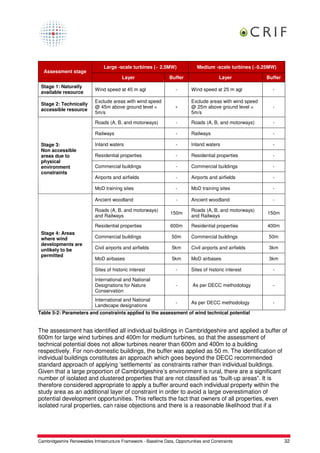
    •    Potential Anchor loads
              o    Examination of VOA data to identify large industrial and manufacturing sites.
              o    Large scale future developments are included in the maps as possible anchor loads, with
                   graduated markers to indicate potential energy demand.
              o    Examination of LLPG data to identify the locations of key potential anchor loads (public
                   sector and otherwise), such as hotels, schools, university buildings, hospitals/healthcare
                   buildings, prisons, etc.


Cambridgeshire Renewables Infrastructure Framework - Baseline Data, Opportunities and Constraints                       83
o    Data from the East of England study was also presented in the maps, including a layer
                   identifying large public sector buildings (heat demand over 1,500 MWh/annum from
                   NI185 data), major hospitals and large energy consumers indentified from EUETS data.
    •    Existing heat distribution infrastructure
              o    The regional study for the East of England identified that the only existing heat
                   distribution infrastructure in the region is located at the University of East Anglia in
                   Norwich – indicating that no district heating infrastructure is present in Cambridgeshire..

Processing and presentation of data
The heat map has been created using ArcGIS software. Heat load data has been imported into
this software from Microsoft Excel® spreadsheets detailing building locations and their heat
loads.
A number of separate layers are included in this heat map to represent the different heat loads
present in the region. Colour coding of output areas according to heat load is augmented by the
inclusion of point heat loads to identify areas with many large heat users. Major physical
constraints are identified (rivers, railways), as well as roads.
Future developments have been identified on the map as hatched areas, with scaled point loads
to identify the predicted energy demand. Domestic, and mixed use/employment development
areas are differentiated using different hatching patterns. Finally, the potential anchor
loads/major heat users have been represented using a range of symbols.


Methodology for estimating CHP and district heating potential
Assumptions required: CHP technologies
As our assessment of the technical potential is heat led (e.g. based on heat demand), it is
necessary to define the technology solutions which are suitable for CHP implementation at
different scales. It is assumed that all CHP systems are fuelled by natural gas.
The table below outlines the different scales of CHP used in our calculations and the assumed
technology solution employed at each scale.
                                                                      Size (kWe)         Size (kWth)

                                                      Heat to
                                            Assumed
 Technology type            Scale                     Pow er Low er          Upper     Low er       Upper
                                           technology
                                                       ratio

In-building          Domestic              Stirling engine   1.85      1          2         2             4
In-building          Micro                 Gas engine         1.2      5         50         6            60
In-building          Small                 Gas engine         1.2     50        500        60          600
CHP/DH               Local heat netw ork   Gas engine         1.2    100      4,500       120        5,400
CHP/DH               District heat         Gas turbine        1.8  3,000     30,000     5,400       54,000
CHP/DH               Transmission          Gas turbine        1.8 30,000               54,000          -

Table 0-5: Definition of scales for CHP units


Of the technologies listed above, domestic scale CHP units are an emergent technology, which
have only recently become commercially available. Although some limited financial incentives
are in place to encourage uptake (in the form of Feed-in-Tariff support for 10,000 installations
across the UK), CHP technology at this scale remains relatively unproven. It is best suited to
domestic properties with poor insulation which are difficult to improve (e.g. solid walled


Cambridgeshire Renewables Infrastructure Framework - Baseline Data, Opportunities and Constraints             84
properties). In these properties the CHP unit will be able to run for a large proportion of the year,
maximising electrical generation and improving its financial viability. Due to its emergent status
we have not included domestic scale CHP in our technical potential figures.
Micro and small CHP units are typically suited to individual buildings with high baseload heat
demands such as those with high domestic hot water use, process heat loads or swimming
pools. At this scale CHP is usually provided by a gas engine – this is an internal combustion
engine, modified to allow the efficient off-take of heat.
Larger systems are used to supply local or district heat networks or large industrial sites.
Smaller systems in this category may be gas engines, but as the amount of heat required
increases, gas turbines become more commonplace. These are very similar in design to the
gas turbines used for commercial electricity generation, although they are typically optimised to
achieve a high combined efficiency in generating electricity and heat. Turbines of this type are
suited to large schemes feeding a number of buildings through district heating mains.
Assumptions required: In-building CHP
Our assessment of in-building CHP potential is based on our dataset of energy demands at
building level taken from the heat mapping exercise. For non-domestic buildings, 30
benchmark categories (from CIBSE TM46 “Energy Benchmarks”) were used to estimate heat
loads. Of these 30 benchmarks, the following categories were deemed to be technically suitable
for the installation of CHP.
It is assumed that the CHP will meet the baseload heat demand of the building only (e.g. hot
water, swimming pool heating, and any other loads which are present most of the time). This is
due to the fact that CHP systems operate less efficiently if they are required to vary heat output
to match demand.
Assumptions required: Local heat networks and district heating

The assessment of the CHP capacity of areas with the potential for heat networks is based on
the total domestic and commercial demand in the area of high heat density. The baseload heat
demand for each area was determined as 20% of domestic heat demand plus 30% of non-
domestic heat demand. This heat load was then used to determine the scale of CHP technology
suitable for each of the areas of high heat demand.

Appendix 1B – Cambridge heat map – comparison with Decarbonising Cambridge
study
The Decarbonising Cambridge report25 carried out a detailed heat mapping exercise for
Cambridge City. This is clearly the area with the greatest potential for the installation of district
heating in Cambridgeshire. The mapping results for this study and the Decarbonising
Cambridge report are very similar with high concentrations of heat primarily focussed around
city centre areas.
In our assessment of heat demand across Cambridgeshire, we have carried out the heat
demand mapping at two different resolutions. The first is by output area (COA) level – a set of
geographical areas containing approximately 100 dwellings. The second is an assessment of
heat demand by 50m grid square, similar to the 100m scale used in the decarbonising
Cambridge study. The results from the two studies are presented below.


25
     Cambridge City Council (August 2010) Decarbonising Cambridge: A renewable and low carbon energy study


Cambridgeshire Renewables Infrastructure Framework - Baseline Data, Opportunities and Constraints            85
Figure 0-1: Findings of the heat mapping study in the Decarbonising Cambridge report


Cambridgeshire Renewables Infrastructure Framework - Baseline Data, Opportunities and Constraints   86
Figure 0-2: Findings of Camco's analysis of heat demands in Cambridge


The broad pattern of heat density across the city is very similar, with high concentrations of heat
primarily focussed around the city centre area.
There are two key differences in presentation between the two studies; these are outlined below
along with their impact on the mapping:
Item                Decarbonising          CRIF assessment             Impact
                    Cambridge study
Minimum heat        100kWh/m2/yr           3,000 kW/km2 (in line       Decarbonising Cambridge study uses a higher
density                                    with DECC                   threshold for viability than the value defined in
threshold                                  methodology)                the DECC methodology and used in the Camco
                                                                       study – hence identifies a smaller area as being
                                                                       potentially viable.
Source dataset      OS addresslayer        LLPG data and               Camco’s methodology should provide greater
for building type   data, building         mastermap for               accuracy in determining non domestic building
and size            footprints and         domestic properties,        floor areas for calculation of total heat loads, as
                    assumed number         VOA data with floor         fewer assumptions are required in the
                    of floors              areas for non-domestic      calculation process.


Cambridgeshire Renewables Infrastructure Framework - Baseline Data, Opportunities and Constraints                            87
Appendix 1C - Qualitative assessment of the viability of district heating in the towns identified

                                                                                                       Lesser heat                                                                                                   DH
                            Total aggregated heat                         Major heat sources                              Commercial/                Major new            Public sector/other      Existing DH
 Site Number


                                                                                                     sources within                                                                                                studies     Physical constraints
                             load (Domestic and       Load diversity       nearby (capable of                           Industrial anchor          developments             anchor loads          infrastructure                                           Total
                                                                                                    high density heat                                                                                              carried          present?
               Site name        Commercial)                               leading a scheme)?                             loads present?              present?                  present?                  ?
                                                                                                       load area?                                                                                                   out?

                               Dom+Com and           Ratio Com:Dom                                    Yes/No and           Yes/No and                                                              Yes/No and                Rivers, rail, major roads,
                                                                           Yes/No, and details                                                  Yes/No and details        Yes/No and details                       Yes/No                                   /16
                                MWh/Annum                demand                                         details              details                                                                 details                  archaeology, topology


                                                                                                      Possibly – 3         Yes – Some                                                                                         Primary road, river both
                                                                                                    EUETS registered        significant                                    Yes – museum,                                       pass through the area
                                                                                                                                                 No data provided –
 1              Wisbech     164,803 MWh/annum             22:78                    No                  sites and a      commercial loads,                                 hospital, swimming           No            No       although on outskirts of
                                                                                                                                                    assumed no
                                                                                                     number of large    and several large                                        pool                                          area of greatest heat
                                                                                                        industrial        industrial sites                                                                                            demand


                                                                                                                                                                          Museum, libraries (3                                 No - River Nene passes
                                                                                                                                                 No data provided –
 2               March       78,108 MWh/annum              9:91                    No                      No                   No                                        buildings), hotels (3        No            No      through centre of high heat
                                                                                                                                                    assumed no
                                                                                                                                                                               buildings)                                     load area – but is bridged
                                                                                                      Possibly – 1                               Yes – infill sites and     Yes – healthcare,
                                                                                                                        Yes - Several large                                                                                  Yes – railway with limited
                                                                                                     EUETS site and                                large potential        law courts, museum,
 3             Huntingdon   175,633 MWh/annum             21:79                    No                                    commercial and                                                                No            No       bridging bisects area of
                                                                                                      several large                             development on north          library, hotel,
                                                                                                                         industrial users                                                                                         high heat density
                                                                                                        industrial                                   west fringe                 colleges
                                                                                                                                                                                                                              Yes- river (single bridge)
                                                                                                                             Some large
                                                                         Yes – Power station just                                                Yes, but separated       No -Relatively few -                               through centre of two high
                                                                                                                        industrial loads, few
 4              St. Neots   189,572 MWh/annum             11:89           over Cambridgeshire              No                                   from main heat load        library, Museum,            No            No        heat density areas plus
                                                                                                                          large commercial
                                                                                border.                                                            area by railway              college –                                     railway blocking route to
                                                                                                                                loads
                                                                                                                                                                                                                                  new development

                                                                                                                        One large industrial     Yes, but separated        No - A few hotels,
 5               St Ives    113,046 MWh/Annum              9:81                    No                      No                                                                                          No            No                  No
                                                                                                                               load             from high heat areas         two libraries


                                53,027MWh/                                                                                                         No major scale
 6               Yaxley                                    3:97                    No                      No                   No                                                 No                  No            No                  No
                                   Annum                                                                                                           developments


                                46,512MWh/                                                                                                       No data provided –         Leisure centre,                                  No, although railway may
 7             Whittesley                                  9:81                    No                      No                   No                                                                     No            No
                                   Annum                                                                                                            assumed no              hotel, libraries                                  limit expansion to south
                                                                                                                                                                            A few within areas
                                                                                                                         One commercial,
                                59,802MWh/                                                                                                         No – some infill        of high heat load –
 8                Ely                                     12:88                    No                      No            one industrial, on                                                            No            No                  No
                                   Annum                                                                                                            housing sites         law court, museums,
                                                                                                                             outskirts
                                                                                                                                                                                 library.
                                                                                                                           One large
 9              Bar Hill     32,185 MWh/Annum             29:71                    No                      No            commercial, one                 No                     Library                No            No                  No
                                                                                                                             hotel

                                                                                                                                                 No data provided –       3 hotels, school, one
10              Chatteris    40,754 MWh/Annum              8:92                    No                      No                   No                                                                     No            No                  No
                                                                                                                                                    assumed no               large industrial


Cambridgeshire Renewables Infrastructure Framework - Baseline Data, Opportunities and Constraints                         88
Appendix 2 – Future energy from waste potential from commercial
                   and industrial waste

                   The diagram below shows the waste flow diagram for commercial and industrial waste in
                   Cambridgeshire. The targets for recycling are sourced from the Cambridgeshire and
                   Peterborough Minerals and Waste Development Plan Core Strategy. The volumes of waste
                   was quantified as explained in Section 5.3.3.

                   C&I Solid Waste
                                                                                                                                        Constructed/planned AD plants
                                                                                                                                           35,000 tonnes 7 GWh
                                                                   3% AD/Composting**                     ENERGY POTENTIAL
                                                                             78,014 tonnes                  15 GWh

                                                                                                                                           Residual waste available for
                                                                                                                                             other potential AD plants
                                                                  97% Recycled                                                             43,014 tonnes 8 GWh
                                                                          1,331,855 tonnes


                                                Recycled/compsted                                         100% Incineration/                    ENERGY POTENTIAL
                                            88% 1,373,046 tonnes                                      gasification/pyrolysis                           178 GWh
                      C&I Waste*                                                                        187,234 tonnes
                         1,560,280 tonnes
                                            12% Residual                                                                                            50% SRF
                                                      187,234 tonnes                                                                                  0 tonnes


                                                                                                            0% MBT                                  25% Water + CO2
                                                                                                       0 tonnes                                       0 tonnes


                                                                                                                                                      25%
                                                                                                                                               Recyclables+rejects
                                                                                                                                                      0 tonnes


                   * Based on split between Cambridgeshire and Peterborough MSW derived from Jacobs Babtie (2006) Cambridgeshire and Peterborough
                   Statistical Basis for the Waste Development Document (WDD)
                   ** Based on ratio of composted waste to recycled/reused waste in Wales. EA (2007) The survey of industrial and commercial (I&C) waste
                   arisings in Wales, http://www.environment-agency.gov.uk/research/library/publications/107692.aspx


Camco Advisory Services Ltd
172 Tottenham Court Road, London, W1T 7NS
t +44 (0)20 7121 6100 f +44 (0)20 7121 6101
Registered office address: Overmoor, Neston, Corsham, Wiltshire, SN13 9TZ Company registration number 01974812

CRIF - Baseline Data, Opportunities and Constraints

  • 1.
    This project wasdeveloped by Cambridgeshire Horizons with funding through the Climate Change Skills Fund from Sustainability East and Improvement East. It may be used to share learning throughout the public sector but not for commercial gain Cambridgeshire Renewables Infrastructure Framework - Baseline Data, Opportunities and Constraints Presented to: Cambridgeshire Horizons Author: Daniel Archard Date: 12 December 2011 Reference no. 003290 Version: Final
  • 3.
    Document type: Report Client: Cambridgeshire Horizons Client contact: Other details: File name: Version 10 Report: Final: 12 December 2011 Author: Daniel Archard Signature ............................................................................ (hard copy only) Date: ............................................................................ (hard copy only) QA: Duncan Price Signature ............................................................................ (hard copy only) Date: ............................................................................ (hard copy only) Author contact details Email: daniel.archard@camcoglobal.com Telephone: 020 7121 6441 Disclaimer: This report has been prepared for the above named client for the purpose agreed in Camco's terms of engagement. Whilst every effort has been made to ensure the accuracy and suitability of the information contained in this report, the results and recommendations presented should not be used as the basis of design, management or implementation of decisions unless the client has first discussed with Camco their suitability for these purposes and Camco has confirmed their suitability in writing to the client. Camco does not warrant, in any way whatsoever, the use of information contained in this report by parties other than the above named client. Cambridgeshire Renewables Infrastructure Framework - Baseline Data, Opportunities and Constraints 3
  • 4.
    Contents Executive Summary ...................................................................................6 1 Introduction.................................................................................11 1.1 Aims of the study ........................................................................11 1.2 Overview of approach.................................................................11 1.3 East of England Renewable and Low Carbon Energy Capacity Study ...................................................................................................12 1.4 Decarbonising Cambridge study.................................................12 1.5 Renewable energy policy context ...............................................13 2 Cambridgeshire’s Carbon Objectives..........................................17 2.1 Background to the CRIF .............................................................17 2.2 Carbon reduction objectives for Cambridgeshire ........................17 2.3 Renewable energy objectives for Cambridgeshire ......................19 2.4 Housing growth in Cambridgeshire.............................................20 3 Energy consumption in Cambridgeshire .....................................22 3.1 Current energy consumption and carbon emissions in Cambridgeshire ...................................................................................................22 3.2 Projection of future energy consumption in Cambridgeshire .......23 4 Present contribution of renewable energy...................................25 4.1 Cambridgeshire is already doing well .........................................25 4.2 Current installed capacity across the districts .............................25 4.3 Recent approved renewable energy projects..............................27 5 Renewable energy technical potential ........................................29 5.1 Methodology...............................................................................29 5.2 Wind potential.............................................................................31 5.3 Biomass and Energy from Waste potential .................................37 5.4 PV potential ................................................................................40 5.5 Solar water heating potential ......................................................41 5.6 Heat pump potential ...................................................................43 5.7 Summary of renewable energy technical potential......................45 6 District heating and CHP potential ..............................................49 6.1 Methodology...............................................................................49 6.2 Mapping heat demand in Cambridgeshire ..................................50 6.3 Assessment of the technical potential for CHP supplying district heat networks.....................................................................................53 6.4 More detailed assessment of towns identified with district heating potential ...................................................................................................56 6.5 Deployment potential of CHP within Cambridgeshire..................61 Cambridgeshire Renewables Infrastructure Framework - Baseline Data, Opportunities and Constraints 4
  • 5.
    6.6 Comparison of biomass supply potential with the district heating demand potential......................................................................................65 7 Scenarios of renewable energy deployment ...............................67 7.1 Introduction to the deployment scenarios ...................................67 7.2 Summary of deployment modelling methodology........................68 7.3 Deployment modelling methodology by technology ....................70 7.4 Role of new development in contributing to the deployment potential ...................................................................................................76 7.5 Contribution of renewable energy to Cambridgeshire carbon objectives ...................................................................................................76 7.6 Investment opportunity ...............................................................77 8 Assessing impact of energy demand reductions.........................79 8.1 Introducing the energy efficiency scenarios ................................79 8.2 Impact of future energy demand on the contribution from renewable energy ...................................................................................................79 Appendix 1 – Heat mapping .....................................................................81 Appendix 1A – Heat mapping methodology..............................................81 Appendix 1B – Cambridge heat map – comparison with Decarbonising Cambridge study...........................................................................................85 Appendix 1C - Qualitative assessment of the viability of district heating in the towns identified.....................................................................................88 Cambridgeshire Renewables Infrastructure Framework - Baseline Data, Opportunities and Constraints 5
  • 6.
    Executive Summary Introduction This studyprovides a technical baseline assessment of Cambridgeshire’s energy demand and renewable energy resource for the Cambridgeshire Renewables Infrastructure Framework (CRIF). It provides an underpinning evidence base for the CRIF to obtain a key understanding of the main opportunities and high level constraints facing renewable energy deployment in Cambridgeshire. Cambridgeshire faces tough energy and carbon objectives In May 2011 the Government adopted the 4th Carbon Budget1 which requires a 50% reduction in carbon emissions by 2025 based on 1990 levels. Applying the 4th carbon budget to Cambridgeshire emissions implies a 43% reduction between 2010 and 2025, which needs to be delivered through a combination of energy efficiency improvements, national electricity grid decarbonisation, local renewable energy deployment and transport measures. Committee on Climate Change advice to Government proposes an 18% renewable electricity target and a 35% renewable heat target for 2030. This equates to a 28% overall renewable energy target for Cambridgeshire (excluding transport). It is worth noting that some of the district councils have set their own targets such as Cambridge City Council which has a carbon reduction target of 89% by 2050 with interim targets in between. Cambridgeshire is already doing well Cambridgeshire already has the greatest installed renewable energy capacity in the East of England and has one of the highest renewable energy outputs of any county in England. Wind turbines play a key role in this output and Fenland currently has the greatest number of installed wind turbines. East Cambridgeshire also has one of the largest dedicated biomass plants in the country due to the straw burning plant near Ely. 7% of Cambridgeshire’s energy demand is already met by renewable energy installations. Potential for greater deployment The technical theoretical potential of Cambridgeshire’s renewable energy resource is extremely large at over 200% of Cambridgeshire’s current energy demand. This figure has been calculated after consideration of primary technical constraints but secondary deployment constraints will substantially reduce this potential. Primary technical constraints include aspects such as wind speed and available land area for wind turbines or the orientation of roof space for solar technologies. Deployment constraints incorporate issues such as economic feasibility and obtaining planning permission, . Wind has the greatest potential and constitutes over 70% of the overall renewable energy resource, followed by heat pumps and PV which could each contribute up to 30% and 15% of energy demand respectively. Biomass and energy from waste technologies could contribute a further 15% to Cambridgeshire’s energy demand. All technologies are needed Although the majority of the technical potential resides in the wind resource, there is still a great deal of potential from the other technologies and the successful deployment of renewable energy in Cambridgeshire will require the utilisation of all technologies. Policy support for renewable energy needs to consider all forms of energy as renewable heat and renewable electricity are both needed in order to realise Cambridgeshire’s share of the UK targets. Traditionally there has been a focus nationally on renewable electricity, but the main energy 1 Committee on Climate Change (2010) The Fourth Carbon Budget Reducing emissions through the 2020s ; http://www.theccc.org.uk/reports/fourth-carbon-budget Cambridgeshire Renewables Infrastructure Framework - Baseline Data, Opportunities and Constraints 6
  • 7.
    demand in thehousing sector is for heat. The analysis suggests that the main area for improvement and the biggest challenge for Cambridgeshire is that of deploying renewable heat technologies which currently contribute very little to energy demand. South Cambridgeshire and Huntingdonshire have the largest resource Huntingdonshire and South Cambridgeshire, the two biggest districts, have the greatest renewable energy potential and also the greatest energy demand. Although these two districts have the largest technical wind resource they also have substantial PV and air source heat pump potential as they have a larger building stock than the other districts. Due to their large size these two districts are also likely to have the greatest number of off-gas properties which further increases their renewable energy opportunities in terms of substituting heat pumps or biomass boilers for oil heating systems. Cambridge lacks the wind resource but has substantial potential for air source heat pumps and PV, although the higher density urban environment and relatively large number of conservation areas does limit the potential for building integrated technologies compared with the other districts. District heating opportunity lies in Cambridge and Huntingdon Although the technical potential of district heating networks served by CHP is estimated at 9% of Cambridgeshire’s overall heat demand, its practical deployment potential is much smaller due to a number of reasons including the challenge of establishing heat networks in the existing built environment. The potential for district heating resides in urban areas focused on town centres where there is high density of heat demand due to the presence of high density public sector, commercial and domestic buildings. The vast majority of the potential lies in Cambridge and Huntingdon, with some further potential in other market towns. More detailed heat mapping analysis based on suitability of potential anchor load buildings and the scale of heat demand that could enable the development of heat networks, suggests that only Cambridge and Huntingdon have suitable deployment potential for heat networks. If a quarter of the total district heating potential in Cambridge and Huntingdon were connected to a heat network then approximately 1% of the county’s energy demand could be met by district heating systems fuelled by low carbon fuel sources. District heating feasibility studies are currently underway in Cambridge and St Neots. The ‘supply potential’ of the biomass and energy from waste resource that could fuel CHP plant feeding heat networks is less than the technical potential for district heating in Cambridgeshire. However, as outlined above, the deployment potential of district heating networks is far lower than this and is focused on central areas in Cambridge and Huntingdon. An ambitious deployment target for district heating networks in Cambridge and Huntingdon would constitute approximately a tenth of the overall district heating technical potential, and could easily be met by Cambridgeshire’s endemic biomass and EfW fuel resource. Although the combustion of solid biomass fuel would be challenging in Cambridge due to an Air Quality Management Area (AQMA) covering most of the city centre, a district heating network could rely on fuels with a low impact on local air quality, such as natural gas or biogas. Deployment options for renewable energy in Cambridgeshire Four deployment scenarios have been developed to enable an assessment of the local deployment potential of renewable energy within Cambridgeshire. The scenarios do not constitute a prediction of what will happen or an opinion on what should happen. They are simply an attempt to model deployment of different renewable energy technologies under varying future market and policy environment, and their key function is that of informing the debate on future policy options for renewable energy in Cambridgeshire. A brief description of the scenarios is provided below: Cambridgeshire Renewables Infrastructure Framework - Baseline Data, Opportunities and Constraints 7
  • 8.
    Scenario 1 (Low scenario) - has a commercial (high) interest rate, low financial incentives for the microgen technologies (reduced levels of FIT and RHI) and low levels of national, regional and local support to encourage uptake of renewable energy. • Scenario 2 (Medium scenario) - has a low interest rate, maintains current levels of financial incentives for renewable energy technologies and has medium levels of national, regional and local support to encourage uptake of renewable energy. • Scenario 3 (High scenario) - has a low interest rate, maintains current level of financial incentives for renewable energy technologies and has high levels of national, regional and local support to encourage uptake of renewable energy. • Scenario 4 (High without wind) - the same as scenario 3, but excludes any contribution from wind. Figure 0-1 compares the four deployment scenarios with the current installed capacity and the 28% renewable energy target for 2030 taken from the Committee on Climate Change advice to Government2. Scenario 1 equates to 11% of Cambridgeshire energy demand whereas scenario 3 equates to 47% of energy demand. Scenario 4 achieves a 19% contribution even without any wind, although it would require a significant contribution from PV and biomass. Figure 0-1: Renewable energy deployment potential in Cambridgeshire The 28% renewable energy target therefore lies between scenarios 2 and 3. If Cambridgeshire were to aim for its pro-rata share of the UK renewable energy target, wind would need to play an important role. Nonetheless, the high existing renewables capacity provides Cambridgeshire with an excellent springboard for delivering the deployment levels within these scenarios, and suggests that the 28% target is achievable. A substantial amount of infrastructure is needed Delivering these scenarios could involve the deployment of 50,000 renewable energy installations under scenario 1 increasing up to almost 400,000 installations under scenarios 3 and 4. The majority of these installations are domestic PV solar roofs, although the number of 2 Committee on Climate Change (May 2011) The Renewable Energy Review Cambridgeshire Renewables Infrastructure Framework - Baseline Data, Opportunities and Constraints 8
  • 9.
    solar roofs wouldbe less if a proportion of these installations were undertaken on non-domestic roof space where larger panels could be installed. Approximately 100 large wind turbines would be needed in scenario 1 compared to 450 turbines in scenario 3. Technology Scenario 1 Scenario 2 Scenario 3 Scenario 4 PV (2.5 kW) 28,140 134,234 288,634 288,634 SWH 7,970 21,045 40,437 40,437 GSHP (5kW) 3,404 10,728 17,359 17,359 ASHP (5kW) 7,269 31,484 47,908 47,908 Wind (2.5 MW) 94 212 455 0 Biomass (1.5 MW) 16 25 35 35 Total 46,893 197,729 394,829 394,373 Table 0-1: Number of installations associated with the deployment scenarios Renewable energy has the potential to help close the carbon gap to meet the 4th carbon budget objectives Cambridgeshire will need substantial improvements in energy efficiency and a significant contribution from local renewable energy, as well as relying upon a nationally decarbonised electricity grid to achieve a 50% carbon reduction by 2025. Figure 0-2 illustrates the contribution of renewable energy to Cambridgeshire carbon reduction objectives under each of the deployment scenarios. Current and target emission levels in 2025 are labelled with dashed lines to demonstrate the extent of carbon reduction required to hit the targets. Each segment demonstrates the change in emissions associated with the specific measure. The red segment, for example, illustrates how much emissions would increase from current levels if there was a 5.5% increase in energy demand by 2025. If, on the other hand, energy efficiency measures were successfully implemented to reduce energy demand by 22% by 2025, then the resulting decrease in emissions would be equal to the sum of the green and the purple segments. The blue segment at the base of the stack shows Cambridgeshire’s residual carbon emissions in 2025 even if all the carbon reduction measures in the above segments were to be successfully implemented. When combined with ambitious energy efficiency improvements (22% decrease in energy demand) and grid decarbonisation, scenario 3 could drive down carbon emissions to below the 4th Carbon Budget target, with the other deployment scenarios going part way towards the target. However, it should be noted that although transport emissions are included in this overall Cambridgeshire carbon reduction target, the impact of transport carbon reduction measures are not considered – and therefore the renewable energy contribution does not necessarily need to fill the whole gap. Nonetheless, it is generally acknowledged that the potential for carbon reductions in transport is smaller than the potential for reducing emissions related to heat and power consumption in buildings. Cambridgeshire Renewables Infrastructure Framework - Baseline Data, Opportunities and Constraints 9
  • 10.
    Figure 0-2: Potentialcontribution of renewable energy to Cambridgeshire carbon reduction targets Cambridgeshire renewable energy resource has significant investment potential Scenario 2 has an investment potential of £3 billion in projects with an indicative rate of return of 5 to 10%. This illustrates the substantial economic benefits that would accompany the installation of renewable energy infrastructure at these scales. Energy efficiency and renewable energy are both needed Figure 0-2 demonstrates that energy efficiency improvements, local renewable energy supply and national grid decarbonisation measures are all needed in order to meet carbon reduction objectives in Cambridgeshire. In addition to this, although reductions in future energy demand would increase the proportion of energy consumption that could be met by local renewable energy supply, the overall impact is relatively small. For example, the contribution of renewable energy to Cambridgeshire’s energy demand under scenario 2 could increase from a quarter to one third if energy consumption is driven down by a quarter over the next few decades. Although this all helps in reducing carbon emissions, it illustrates that significant renewable energy contributions will be needed regardless of whether Cambridgeshire manages to achieve ambitious energy efficiency improvements. Cambridgeshire Renewables Infrastructure Framework - Baseline Data, Opportunities and Constraints 10
  • 11.
    1 Introduction 1.1 Aims of the study This study provides a technical baseline assessment of Cambridgeshire’s energy demand and renewable energy resource for the Cambridgeshire Renewables Infrastructure Framework (CRIF). It aims to provide the underpinning evidence base for the CRIF to obtain a key understanding of the main opportunities and constraints facing renewable energy deployment in Cambridgeshire. 1.2 Overview of approach The key steps of the methodology for undertaking this renewable energy baseline and opportunities study are outlined in Figure 1-1 below. Current and future energy demand across Cambridgeshire has been assessed, and a series of future energy demand scenarios have been developed. This forms the basis for evaluating the potential contribution that renewable energy can make to Cambridgeshire’s energy needs. The technical renewable energy resource has been mapped and quantified, and this technical potential has fed into deployment scenarios for renewable energy in Cambridgeshire in 2031. Constraints have been applied, considering the issues that could hinder the deployment of the renewable energy technologies such as planning, maturity of technology and financial incentives. In addition, a heat mapping exercise has identified areas of district heating potential where combined heat and power systems could be deployed. These patterns of supply and demand for renewable energy have then been brought together to highlight the key opportunities for deploying renewable energy in Cambridgeshire. Figure 1-1: Key steps in the assessment of renewable energy opportunities in Cambridgeshire Cambridgeshire Renewables Infrastructure Framework - Baseline Data, Opportunities and Constraints 11
  • 12.
    The analysis hasbeen undertaken at the both the district and county levels so as to explore where the main opportunities lie, and to compare the potential across the districts for the different types of renewable energy technology. 1.3 East of England Renewable and Low Carbon Energy Capacity Study The East of England Renewable and Low Carbon Energy Capacity study was completed in June 2011 and provides an assessment of the potential renewable energy and district heating resource across the whole of the East of England. The study followed the Government’s recommended methodological approach (see below) in providing an estimate of the region’s renewable energy potential. The East of England assessment provides a useful overview of the renewable energy resource across the region and the position of Cambridgeshire relative to other counties. It also highlights the existing contribution of renewable energy in each of the counties. The East of England study provides a great deal of useful data for this CRIF assessment of opportunities and constraints within Cambridgeshire. However, further analysis has also been needed in order to build upon the East of England results as the East of England study does not provide a breakdown by district, and for some technologies a greater resolution of data is required to provide a more detailed understanding of the deployment potential. Further information on the data provided by the East of England study and the additional analysis that has been required is provided in section 5 below. 1.4 Decarbonising Cambridge study The Decarbonising Cambridge report 3 was produced for Cambridge City Council in 2010 in order to assess the potential from renewable and low carbon energy sources in the city. The study was carried out to inform policy in new development sites by providing an evidence base and identifying the necessary support mechanisms to achieve policy goals. This CRIF report expands the study area to the whole of Cambridgeshire and is in line with the general findings of the Decarbonising Cambridge study. . The technologies that were considered in the Decarbonising Cambridge study included district heating, biomass, energy from waste, wind, and other technologies such as pyrolysis, gasification and anaerobic digestion. The main conclusions are summarised below: • District heating: The study concluded that the main potential for district heating was in the city centre due to high heat density. Section 6 outlines these findings in more detail. • Biomass: It was found that there is a significant amount of biomass resource in the area however there also a significant uncertainty around the currently available resource as well as barriers in terms of deploying the technology. • Energy from waste: Due to landfill taxes, economics for energy from waste is getting more favourable. The new Mechanical Biological Treatment (MBT) plant which will be managing all of the county’s residual municipal solid waste opened in 2009 and has the potential to provide energy through refuse derived fuel. • Wind: There is limited potential for wind due to the urban characteristics of the area. 3 Cambridge City Council (August 2010) Decarbonising Cambridge: A renewable and low carbon energy study Cambridgeshire Renewables Infrastructure Framework - Baseline Data, Opportunities and Constraints 12
  • 13.
    Other technologies: Gasification and pyrolysis can be used as conversion technologies however there is limited experience of using the latter technology in UK. Anaerobic digestion is also not likely to be suitable for Cambridge due to its urban characteristics. However micro generation technologies such as PV, solar thermal and heat pumps are expected to have an increased uptake and could contribute to the renewable energy generation in the region. 1.5 Renewable energy policy context 1.5.1 General climate change and energy policy There is a wide range of national policy which influences renewable energy development in the UK and Cambridgeshire. A significant amount of new legislation and policy has recently been put in place. • Climate Change Act The Climate Change Act 2008 introduced a statutory target of reducing carbon dioxide emissions by at least 80% below 1990 levels by 2050, with an interim target of 34% by 2020. Government departments have prepared carbon budgets to indicate how greenhouse gas emissions will be reduced across the Government estate and in sectors where each takes a policy lead. The Act also created a framework for climate change adaptation. A national Climate Change Risk Assessment is currently being undertaken and will be completed in 2012. • 4th Carbon Budget The Climate Change Act requires Parliament to set ‘carbon budgets’ for 5 year periods which sets the maximum amount of emissions to be emitted in order to hit the target of 80% reduction in carbon emissions by 2050. Within this context, the Committee on Climate Change published the 4th Carbon Budget in December 2010 which sets out the required pathway for the period 2023-2027 and considers the level of emissions for ensuring long term compliance with the 2050 target. According to the report, it is recommended that the UK decreases its emissions by 50% by 2025 (below 1990 levels) within the ‘Domestic Action Budget’ i.e. without the support from the international carbon markets. In May 2011, the government announced its commitment to adopt the recommendations of Committee on Climate Change and the recommended target is now legally binding. • 15% renewable energy target In response to EU Directive 2009/28/EC on the promotion of the use of energy from renewable sources, the UK has committed to sourcing 15% of its energy from renewable sources by 2020 – a five-fold increase on the share of about 3% in 2009, in less than a decade. This target covers all energy needs, including electricity, heat and transport. • Renewable Energy Review, Committee on Climate Change, May 2011 In 2010, the Government asked the Committee on Climate Change to review the potential for renewable energy and provide advice on suitable future renewable energy targets, specifically the level of appropriate ambition beyond 2020. The Committee on Climate Change published its findings in May 2011 and the Renewable Energy Review provides options for renewable electricity and renewable heat targets for 2030 and beyond. Cambridgeshire Renewables Infrastructure Framework - Baseline Data, Opportunities and Constraints 13
  • 14.
    Feed-In Tariff (FIT), Renewable Heat Incentive(RHI) FITs came into effect on 1 April 2010 and provide generation linked payments for a range of small scale renewable electricity technologies of <5MW: wind, hydro, anaerobic digestion, micro CHP and PV. The RHI is a tariff-based scheme with payments made to the generators of renewable heat per unit of heat output. It will be available for all scales of installation within industrial, public and commercial sectors from Autumn 2011. The scheme will be extended to the domestic sector in 2012 with an interim arrangement (‘RHI Premium Payment’) put in place to provide around £15m of grants for renewable heat installations, equivalent to around 25,000 homes. Unlike FITs, the RHI will be paid from general taxation rather than a pass through to consumer energy bills. The existence of these support mechanisms is very relevant for the findings of this study as both FIT and RHI transform eligible renewable energy technologies into attractive investment options and hence accelerate the rate of uptake of these technologies. 1.5.2 Planning and building control policy • National Planning Policy Framework Planning policy in the UK is about to undergo fairly substantial upheaval with the Government consulting on a draft National Planning Policy Framework during Summer 2011. This aims to streamline the planning system with simplified planning guidance and a speeding up of planning decisions. Decentralisation of decision-making is also a key feature of these planning reforms with neighbourhood plans simultaneously being introduced through the Localism Bill. A key element of the new proposals is a ‘presumption in favour of sustainable development’ which requires local planning decision-making to favour development if it contributes to the Government’s definition of sustainable development. The draft Framework explicitly mentions renewable energy as a component of sustainable development and makes it clear that local authorities should consider identifying suitable areas for renewable and low-carbon energy. When it comes into force in 2012 or 2013, the new National Planning Policy Framework will cancel the PPS 1 Supplement on Climate Change which has been a key policy document in encouraging local planning for renewable energy. However, until the new Framework comes into force the PPS 1 Supplement and accompanying documents are still the Government’s official planning policy documents on climate change issues. • Planning Policy Statement 1 (PPS1): Delivering Sustainable Development and the PPS1 Supplement (Planning and Climate Change) PPS1 has had a key role over the past few years in encouraging local authorities to compile accurate renewable energy evidence bases on the potential within their areas so as to inform planning policy. PPS1 expects new development to make good use of opportunities for decentralised and renewable or low-carbon energy. The supplement to Planning Policy Statement 1 ‘Planning and Climate Change’ highlights situations where it could be appropriate for planning authorities to anticipate levels of building sustainability in advance of those set nationally. This could include where: • there are clear opportunities for significant use of decentralised and renewable or low carbon- energy; or • without the requirement, for example on water efficiency, the envisaged development would be unacceptable for its proposed location. Cambridgeshire Renewables Infrastructure Framework - Baseline Data, Opportunities and Constraints 14
  • 15.
    The PPS 1Supplement requires local planning authorities to develop planning policies for new developments that are based on: “….an evidence-based understanding of the local feasibility and potential for renewable and low- carbon technologies, including microgeneration”. • Planning Policy Statement 22 (PPS22): Renewable Energy PPS22 sets out the Government's policies for renewable energy, to which planning authorities should have regard when preparing Local Development Documents and when taking planning decisions. Local policies should reflect paragraph 8 of PPS22 which states that: • Local planning authorities may include policies in local development documents that require a percentage of the energy to be used in new residential, commercial or industrial developments to come from on-site renewable energy developments. • Zero carbon timeline and allowable solutions The Government has set out a timeline for improving the carbon performance of new developments through tightening Building Regulation standards for new homes: • 2013 – a 44% carbon reduction beyond 2006 requirements; and, • 2016 – a 100% carbon reduction beyond 2006 requirements. In the March 2008 budget Government also announced its intentions for all non-domestic buildings to be zero carbon by 2019. Therefore, the various phases of development across the county will face stricter and stricter mandatory requirements, and all housing development after 2016 will need to account for all carbon emissions from regulated energy uses. The government is introducing a more flexible definition of ‘zero carbon’ to guide building policy which will apply a minimum requirement for energy efficiency and on-site renewable energy, and a set of off-site ‘allowable solutions’ to allow the residual emissions to be offset. The allowable measures have yet to be fully defined but could include large scale off-site renewable energy infrastructure, investment in energy efficiency measures for existing building stock, energy efficient white goods and building controls, or S106 contributions. Cambridgeshire Horizons are undertaking work to develop a Carbon Offset Fund in preparation for the allowable solutions mechanism so that funds can be effectively targeted towards low carbon infrastructure. Future developments in Cambridgeshire will therefore need to achieve minimum fabric standards and some onsite renewable energy generation, with financial contributions for investment in allowable solutions to offset the residual emissions. For any specific development site, developers will need to assess the prospects for different technical solutions including combined heat and power, biomass, medium to large scale wind turbines, heat pumps, PV and solar water heating before determining the contribution of allowable solutions in offsetting the residual carbon emissions. Building Regulations will therefore drive the growth of renewable energy in the county. Local planning policies are also expected to complement and in some cases exceed Building Regulations which would further ramp up the uptake of renewable energy technologies. • Local Climate Change Strategies and Initiatives Individual district councils are carrying out work in different areas to minimise the impacts of climate change. Examples of these include Cambridge City Council setting a Cambridgeshire Renewables Infrastructure Framework - Baseline Data, Opportunities and Constraints 15
  • 16.
    carbon reduction targetof 89% to be achieved by 2050 in its Climate Change Strategy and Action Plan, and Fenland District Council signing up to the CRed Initiative to reduce carbon emissions by 60% by 2025. Most of the district councils also have local planning policies promoting renewable energy in new developments which is contributing to the growth of renewable energy in Cambridgeshire. Cambridgeshire Renewables Infrastructure Framework - Baseline Data, Opportunities and Constraints 16
  • 17.
    2 Cambridgeshire’s Carbon Objectives 2.1 Background to the CRIF The Cambridgeshire Renewables Infrastructure Framework (CRIF) is providing a structure for supporting the development of renewable energy in Cambridgeshire. As well as identifying opportunities to generate renewable energy in the county, it is providing the framework for delivering projects on the ground through the involvement of the community and providing an attractive setting for investment. The findings of the project will inform planning policies and demonstrate Cambridgeshire’s commitment to lead on the transition to a low carbon economy. This report relates to Workpackage 1 which is providing a technical evidence base for the CRIF, looking at the energy demand baseline and future growth areas together with the potential for renewable energy technologies across the county. Workpackage 2 and 3 will build upon the findings of this report to identify the most appropriate delivery pathways for realising renewable energy potential in Cambridgeshire. 2.2 Carbon reduction objectives for Cambridgeshire 2.2.1 Quantifying Cambridgeshire’s carbon reduction objectives As outlined above, the 4th Carbon Budget requires the UK to reduce carbon emissions by 50% by 2025 compared to 1990 levels. Transposing this target to Cambridgeshire, compared to an estimated baseline of 7 million tonnes of CO2 in 1990, the required emissions by 2025 should be no higher than 3.5 million tonnes of CO2. With emissions currently at 6.1 million tonnes of CO2 in the county, this represents a 43% decrease in emissions to be achieved in only 14 years and is illustrated in Figure 2-1. This highlights the significance of the task that lies ahead for Cambridgeshire in the near future and the necessity of exploring different options to meet this challenge. Figure 2-1: Cambridgeshire’s pro rata carbon reduction target under the 4th Carbon Budget Cambridgeshire Renewables Infrastructure Framework - Baseline Data, Opportunities and Constraints 17
  • 18.
    2.2.2 Cambridgeshire’s carbonreduction challenge Figure 2-2 explores the potential role of key carbon reduction approaches in helping Cambridgeshire achieve its pro rata carbon reduction target under the 4th Carbon Budget. Three different energy efficiency scenarios have been considered to understand the impacts on carbon emissions if energy efficiency was improved in Cambridgeshire4. These are explained in more detail in Section 8. The impact of grid decarbonisation has also been incorporated to assess possible further reductions without using local renewable energy technologies5. The figure below illustrates the carbon reductions that are possible from these different options and the ‘carbon gap’ that would need to be filled through other measures including renewables and sustainable transport. Although transport emissions are included in this overall Cambridgeshire carbon reduction target, the impact of transport carbon reduction measures are not considered. Nonetheless, carbon reductions in transport are typically more difficult to achieve than reductions from energy use in buildings. It is estimated that if the energy demand of Cambridgeshire was reduced by 8% through energy efficiency measures, this would result in carbon savings of 0.2 MtCO2. If energy efficiency was prioritised and implemented vigorously to achieve an ambitious reduction of 22% in energy demand, a further 0.4 MtCO2 would be saved. This would result in total savings of 0.6 MtCO2 from energy efficiency measures. Figure 2-2 below demonstrates that even if energy consumption in buildings was reduced by 22% and grid decarbonisation was achieved in line with government targets (reducing carbon emissions by a further 0.8 MtCO2), the total emissions reductions would be 1.4 MtCO2, falling significantly short of the 50% target to be reached by 2025. The following analysis assesses the potential that Cambridgeshire’s local renewable energy resource could play in closing this carbon gap. 4 The energy efficiency scenarios have been based on DECC’s ‘2050 Pathways Analysis’ assessing different options for meeting the 80% reduction target by 2050. The pathways that were incorporated were Reference, Alpha and Epsilon indicating an increase of 5.5% and a reduction of 8% and 22% in energy demand respectively. 5 0.296 was used as the decarbonised grid factor sourced from DECC’s ‘Valuation of energy use and greenhouse gas emissions for appraisal and evaluation’ study. Cambridgeshire Renewables Infrastructure Framework - Baseline Data, Opportunities and Constraints 18
  • 19.
    Figure 2-2: Assessingthe potential impact of energy efficiency improvements and grid decarbonisation on Cambridgeshire carbon emissions 2.3 Renewable energy objectives for Cambridgeshire 2.3.1 National objectives for renewable energy The Committee on Climate Change’s Renewable Energy Review provides a number of options for renewable electricity and renewable heat targets for 2030 and beyond. Its preferred renewable energy scenarios for electricity and heat would give the following targets for electricity and heat: • 18% contribution from onshore renewable electricity by 2030 • 35% contribution from renewable heat by 2030 The Committee on Climate Change has outlined that these renewable heat and electricity targets are consistent with the 4th Carbon Budget and the levels of renewable energy deployment that will be needed in order to achieve the 50% carbon reductions by 2025. The Government is currently digesting The Renewable Energy Review and will use it to inform the UK’s renewable energy targets for 2030 and beyond. Therefore, although the Government has not yet set the 2030 renewable energy targets, these percentages are currently the best available estimate. Cambridgeshire Renewables Infrastructure Framework - Baseline Data, Opportunities and Constraints 19
  • 20.
    2.3.2 Cambridgeshire’s renewableenergy targets Combining the Committee on Climate Change renewable heat and electricity targets into an overall renewable energy target (for both electricity and heat) for Cambridgeshire equates to a renewable energy target of 28% by 2030. This renewable energy target has been calculated by assessing the ratio of heat and power consumption within Cambridgeshire so as to evaluate the overall level of energy demand that would be met if 18% of electricity and 35% of heat was generated from renewable sources. Transposing these possible national targets for renewable electricity and renewable heat to Cambridgeshire leads to the following targets for 2030: • 18% renewable electricity • 35% renewable heat • 28% renewable energy (both heat and electricity) The analysis below assesses the potential of Cambridgeshire’s renewable energy resource to meet these targets and to ‘fill’ Cambridgeshire’s carbon reduction gap identified above. 2.4 Housing growth in Cambridgeshire Although the substantial housing growth and associated physical and social infrastructure for the Cambridge Sub-Region over the next few decades presents a huge challenge to the objective of reducing carbon emissions by 50% by 2025, it also presents an opportunity for integrating renewable energy within Cambridgeshire. The 6 main development locations in Cambridgeshire are outlined in Table 2-1, and these are supplemented by general housing growth across Cambridgeshire’s market towns. The majority of the large growth sites are located around Cambridge with Northstowe ecotown located at a former MoD site in South Cambridgeshire. Cambridgeshire Renewables Infrastructure Framework - Baseline Data, Opportunities and Constraints 20
  • 21.
    Location Description District Cambridge East Eastern urban extension to the Cambridge City, city of Cambridge. Three main South development areas include: Cambridgeshire North of Newmarket road, north of Cherry Hinton and Cambridge Airport. Cambridge North West Two major areas include Cambridge City, University of Cambridge and South NIAB. Cambridgeshire Cambridge Southern Four major areas including: Cambridge City, Fringe Trumpington meadows, Clay South and Glebe farm, Bell school and Cambridgeshire Addenbrookes. Market Towns Significant amount of Housing Fenland, planned to develop by 2021 in Huntingdonshire, the three districts. East Cambridgeshire. Northstowe Large eco-town serving as an South exemplar for sustainability Cambridgeshire through incorporating energy efficiency, renewable energy and water saving applications. Orchard Park New community development, South 60% of homes already occupied Cambridgeshire Table 2-1: Key growth sites in the Cambridge sub-region The monitoring team within the planning department at Cambridgeshire County Council have provided housing growth figures from 2010 to 2026, and these have been supplemented by housing figures for 2026 to 2031 and employment land data from the Long Term Delivery Plan (2008). These figures have been used in the assessment of future energy demand and the county’s renewable energy potential. District Additional housing Housing units 2026 Employment land 2 units by 2026 to 2031 (m ) Cambridge 10,829 - 176,913 East Cambridgeshire 5,165 - 84,380 Fenland 3,487 - 56,967 Huntingdonshire 10,803 - 176,488 South Cambridgeshire 15,601 - 254,872 Total 45,885 12,500 749,620 Table 2-2: Cambridgeshire projected housing and employment land growth between 2010 and 2030 Cambridgeshire Renewables Infrastructure Framework - Baseline Data, Opportunities and Constraints 21
  • 22.
    3 Energy consumption in Cambridgeshire 3.1 Current energy consumption and carbon emissions in Cambridgeshire The annual energy consumption and carbon dioxide emissions of Cambridgeshire’s built environment, broken down by domestic versus non-domestic use and by district for the most recent available year (2009) are illustrated in Figure 3-1 and Figure 3-2. They show that energy consumption is slightly greater in the domestic sector than in the non-domestic sector with heating demand in housing constituting the greatest element of energy consumption in Cambridgeshire. The balance between heat and power demand in the non-domestic sector is fairly equal. Figure 3-1 Cambridgeshire energy consumption (2009) Figure 3-2 Cambridgeshire energy consumption by district Cambridgeshire Renewables Infrastructure Framework - Baseline Data, Opportunities and Constraints 22
  • 23.
    Figure 3-3 showsthat the main source of carbon emissions in Cambridgeshire is related to electricity consumption in the non-domestic sector. Although oil consumption for domestic heating is much smaller than gas, its contribution to CO2 emissions is still fairly significant due to the relatively high carbon intensity of oil. Future carbon emissions will be influenced by changes in the carbon intensity of electricity in the UK as more renewable and low carbon sources of generation are developed, however for the purpose of this study, the carbon intensities of electricity imported from the distribution network, gas and heating oil have been assumed as 0.542tCO2/kWh, 0.185 tCO2/kWh and 0.265tCO2/kWh respectively (Defra, 2010). Figure 3-3 Cambridgeshire CO2 emissions, 2009 3.2 Projection of future energy consumption in Cambridgeshire The projected future energy consumption of Cambridgeshire’s built environment in 2031 is shown in Figure 3-4 below. Projections of housing growth and employment land growth have been modelled so as to estimate associated heat and power consumption. This 2031 projection constitutes a small increase in both heat and power consumption in Cambridgeshire compared to current consumption which is due to the growth in new development. This analysis has not incorporated any assumptions relating to an increase or decrease in the energy demand of the existing built environment. The energy demand scenarios outlined later in the report provide the basis for assessing the impact of either an increase or a decrease in energy demand (depending on the balance of economic growth and energy efficiency improvements over the next 20 years) on the potential contribution from the county’s renewable energy resource. Cambridgeshire Renewables Infrastructure Framework - Baseline Data, Opportunities and Constraints 23
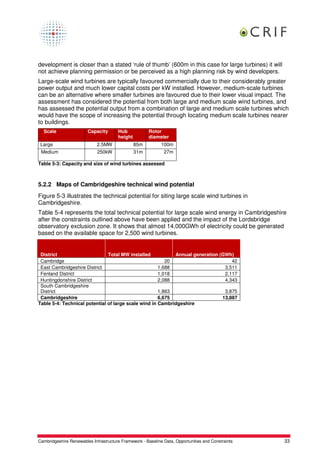
  • 24.
    Figure 3-4: Estimateof Cambridgeshire energy demand in 2031 Cambridgeshire Renewables Infrastructure Framework - Baseline Data, Opportunities and Constraints 24
  • 25.
    4 Present contribution of renewable energy 4.1 Cambridgeshire is already doing well Cambridgeshire already has a relatively high renewable energy contribution. Figure 4-1 compares the renewable energy installations that are operational or planned across the East of England and is based on data presented in the East of England Renewable and Low Carbon Energy Capacity study. It illustrates that Cambridgeshire has by far the largest renewable energy output in the East of England, mainly due to its substantial wind resource. Figure 4-1: Operational and planned renewable energy installations in East of England Figure 4-1 provides a slight overestimate of the current renewable energy output on the ground in Cambridgeshire as the numbers include a large energy from waste plant that is planned for Peterborough and also a significant number of renewable energy projects which have obtained planning approval but have not been built yet (these are outlined below). Nonetheless, it provides an effective indicator of Cambridgeshire’s current prowess in terms of renewable energy installations. 4.2 Current installed capacity across the districts Cambridgeshire County Council’s planning department provides a monitoring report on the current installed capacity of renewable energy in the county and the data is illustrated in Figure 4-2. The current installed capacity in Cambridgeshire is 167 MW with over half of this capacity located in Fenland district in the form of wind turbines. Cambridgeshire Renewables Infrastructure Framework - Baseline Data, Opportunities and Constraints 25
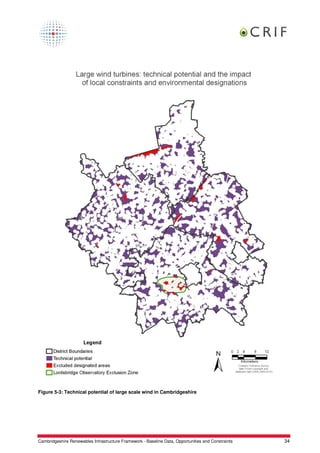
  • 26.
    Figure 4-2: Currentrenewable energy installed capacity by district Wind energy is the dominant contributor overall representing almost 70% of the total capacity. Huntingdonshire also has a substantial installed wind resource with 26MW of installed capacity. Biomass also makes a large contribution due to the large straw burning plant in East Cambridgeshire. The microgen technologies currently contribute only a tiny proportion to Cambridgeshire’s renewable energy capacity. The locations of the existing renewable energy installations in Cambridgeshire are illustrated in Figure 4-3 which illustrates the dominance of Fenland and Huntingdonshire in contributing to Cambridgeshire’s installed renewable energy capacity. The existing installations in Peterborough are also included to show the renewable energy installations on the edge of the study area. Cambridgeshire Renewables Infrastructure Framework - Baseline Data, Opportunities and Constraints 26
  • 27.
    Figure 4-3: Locationof existing renewable energy installations in Cambridgeshire 4.3 Recent approved renewable energy projects During the past year a number of additional renewable energy projects have successfully obtained planning permission and are either currently under construction or awaiting construction. Information on these projects has been obtained from the Department of Energy and Climate Change REStats website6. 6 https://restats.decc.gov.uk/cms/welcome-to-the-restats-web-site Cambridgeshire Renewables Infrastructure Framework - Baseline Data, Opportunities and Constraints 27
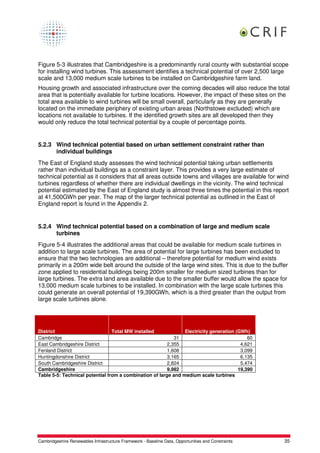
  • 28.
    Under or AwaitingConstruction (MW) District Biomass Wind Total Fenland 1.2 16 17.2 Huntingdonshire 4.5 20 24.5 South Cambridgeshire 26 26 Total 5.7 62 67.7 Table 4-1: Capacity of recently approved projects that are yet to be built There is an additional capacity of 6MW planned for biomass and 62MW for wind installations located in Fenland, Huntingdonshire and South Cambridgeshire districts. Assuming all these new installations go ahead, they will increase Cambridgeshire’s renewable energy capacity by an additional 40%. Cambridgeshire Renewables Infrastructure Framework - Baseline Data, Opportunities and Constraints 28
  • 29.
    5 Renewable energy technical potential 5.1 Methodology 5.1.1 Overview of approach The assessment of Cambridgeshire’s renewable energy technical potential has followed the key steps outlined in the Department of Energy and Climate Change’s (DECC) recommended methodology. Figure 5-1 summarises the key stages of DECC’s ‘Renewable and Low-Carbon Energy Capacity Methodology for the English Regions’ which aims to standardise regional assessments of the potential for renewable energy. The approach taken to assess Cambridgeshire’s renewable and low carbon energy potential has involved applying progressive layers of analysis to the theoretical potential, in order to establish a more realistically achievable potential taking account of some key high level constraints. Although the diagram illustrates all 7 recommended stages of the assessment, the DECC methodology does not provide any guidance or criteria to address economic and supply chain constraints (stages 5 to 7). The impact of economic and deployment constraints are dealt with in chapter 7 so as to provide an assessment of the deployment potential of renewable energy in Cambridgeshire. Figure 5-1: Overview of DECC Methodology for undertaking renewable energy resource assessments (Source: DECC/SQW Energy) The four stages of the technical potential assessment are: • Stages 1 and 2: Naturally available resource and technically accessible resource – this is the opportunity analysis of what currently available technology can capture and convert into useful energy. • Stages 3 and 4: High priority physical environment constraints and planning and regulatory constraints – this is the constraints analysis of the high level restrictions that Cambridgeshire Renewables Infrastructure Framework - Baseline Data, Opportunities and Constraints 29
  • 30.
    the physical environmentand planning designations or other legislation places on the deployment of the technology. However, neither the technical nor the deployment assessment address specific site constraints and issues. The stage 1 to 4 assessments cover both the existing and the future built environment of Cambridgeshire as it includes the renewable energy potential associated with the planned new developments between now and 2031. 5.1.2 Assessing ‘technical potential’ The ‘technical potential’ refers to the output from stages 1 to 4 of the DECC methodology, and is defined as the total renewable energy resource that could be delivered if all technically suitable sites or locations were developed. The technical potential is then further constrained by economic considerations and other deployment barriers, such as obtaining planning permission or site-specific technical constraints that cannot be assessed in detail within the scope of this study. Nonetheless, the technical potential provides a good indication of which renewable energy technologies have the greatest potential within a certain area or region. 5.1.3 Data gap analysis The East of England Renewable Energy Capacity Study provides an assessment of the renewable energy potential across Cambridgeshire following the DECC methodology outlined above. However, the East of England study does not provide a breakdown by authority and it provides a very high level assessment of heat demand, which does not provide the necessary data for modelling CHP and district heating potential. Table 5-1 outlines the key sources of analysis for the different technology assessments undertaken in this study. Renewable energy assessment Source of analysis Undertaken new EoE study Decarbonising analysis Cambridge PV & SWH technical potential Wind technical potential Heat pumps technical potential Biomass technical potential EfW deployment potential Existing EfW infrastructure Deployment potential calculations Heat mapping low resolution Heat mapping high resolution Existing renewables infrastructure Table 5-1: Data ‘gap’ analysis - utilising data from previous studies Cambridgeshire Renewables Infrastructure Framework - Baseline Data, Opportunities and Constraints 30
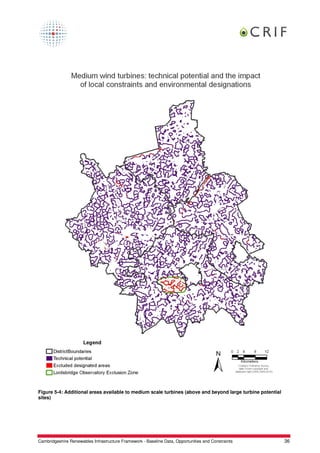
  • 31.
    5.2 Wind potential 5.2.1 Overview of approach A GIS analysis has been undertaken to identify sites which are theoretically suitable for wind turbines. The DECC methodology for assessing wind potential has been followed and is summarised in Figure 5-2. The process is essentially that of mapping sites where wind turbines could be located by applying a series of high level constraints that limit the geographical scope for installing turbines. WIND POTENTIAL METHODOLOGY STAGE 1 STAGE 2 STAGE 3 STAGE 4 AREAS WITH A WIND BUFFERS APPLIED TO PHYSICAL ENVIRONMENT SPEED <5m/s ARE INDIVIDUAL PROPERTIES GENERATE WIND SPEED CONSTRAINTS APPLIED TO EXCLUDED AND MAXIMUM AND ALLOWABLE MAPS EXCLUDE NON- INSTALLED CAPACITY IS PROXIMITY TO BUILDINGS ACCESSIBLE AREAS CALCULATED IS REDUCED Figure 5-2: Methodology for assessing the technical potential of wind in Cambridgeshire Assessment of technical potential The ‘technical potential’ is defined as the wind generation that could be delivered if turbines are installed at all potential sites which do not have absolute constraints to wind. The maximum number of wind turbines that could be installed at each site is determined by the separation distance between turbines required to prevent air stream interference and any associated operational detriment to the turbines. In line with the DECC Methodology, we have assumed a separation distance equivalent to five rotor diameters. In addition, we have assumed a wind turbine capacity of 2.5MW to provide an upper estimate of the potential7. The generation potential is based on an assumed capacity factor of 25%, and a 95% turbine availability factor8. Capacity factors are highly dependent on wind speed and site specific parameters which influence wind flow. 25% is taken as an reasonable estimate of performance, being a conservative reduction on the 10 year annual average wind farm performance of 28% (published by DECC, for all on-shore UK wind farms). The absolute constraints that have been applied to the wind analysis in calculating the technical potential for large-scale wind turbines are outlined in Table 5-2 below. These include the key constraints of buildings, roads, waterways, woodland, airports, MoD sites and buffer zones around these constraints. The assessment has also included nationally and internationally designated nature conservation sites including Sites of Special Scientific Interest, Special Areas of Conservation, Special Protection Areas, National Nature reserve and Ramsar Sites. The technical potential does not address all potential site constraints and issues that would need to be considered to determine whether a site or location is suitable for wind turbines. Impact on landscape and townscape, the historic environment, or other site-specific issues would need to be considered with regard to any site. 7 The typical dimensions of a 2.5MWe wind turbine are: height to the tip of the blade at the top of its swept area of approximately 135 m, and rotor diameter of 100m. With the quoted load factor and availability assumptions such turbines would be expected produce approximately 5,200MWh/yr, equivalent to the current typical annual consumption of approximately 1,250 households. 8 Annual generation (MWh/yr) = Capacity (MWe) x Capacity Factor (%) x Availability (%) x Hours in Year (hrs) Cambridgeshire Renewables Infrastructure Framework - Baseline Data, Opportunities and Constraints 31
  • 32.
    Large -scale turbines(~ 2.5MW) Medium -scale turbines (~0.25MW) Assessment stage Layer Buffer Layer Buffer Stage 1: Naturally Wind speed at 45 m agl - Wind speed at 25 m agl - available resource Exclude areas with wind speed Exclude areas with wind speed Stage 2: Technically @ 45m above ground level < - @ 25m above ground level < - accessible resource 5m/s 5m/s Roads (A, B, and motorways) - Roads (A, B, and motorways) - Railways - Railways - Stage 3: Inland waters - Inland waters - Non accessible areas due to Residential properties - Residential properties - physical environment Commercial buildings - Commercial buildings - constraints Airports and airfields - Airports and airfields - MoD training sites - MoD training sites - Ancient woodland - Ancient woodland - Roads (A, B, and motorways) Roads (A, B, and motorways) 150m 150m and Railways and Railways Residential properties 600m Residential properties 400m Stage 4: Areas where wind Commercial buildings 50m Commercial buildings 50m developments are unlikely to be Civil airports and airfields 5km Civil airports and airfields 3km permitted MoD airbases 5km MoD airbases 3km Sites of historic interest - Sites of historic interest - International and National Designations for Nature - As per DECC methodology - Conservation International and National - As per DECC methodology - Landscape designations Table 5-2: Parameters and constraints applied to the assessment of wind technical potential The assessment has identified all individual buildings in Cambridgeshire and applied a buffer of 600m for large wind turbines and 400m for medium turbines, so that the assessment of technical potential does not allow turbines nearer than 600m and 400m to a building respectively. For non-domestic buildings, the buffer was applied as 50 m. The identification of individual buildings constitutes an approach which goes beyond the DECC recommended standard approach of applying ‘settlements’ as constraints rather than individual buildings. Given that a large proportion of Cambridgeshire’s environment is rural, there are a significant number of isolated and clustered properties that are not classified as “built-up areas”. It is therefore considered appropriate to apply a buffer around each individual property within the study area as an additional layer of constraint in order to avoid a large overestimation of potential development opportunities. This reflects the fact that owners of all properties, even isolated rural properties, can raise objections and there is a reasonable likelihood that if a Cambridgeshire Renewables Infrastructure Framework - Baseline Data, Opportunities and Constraints 32
  • 33.
    development is closerthan a stated ‘rule of thumb’ (600m in this case for large turbines) it will not achieve planning permission or be perceived as a high planning risk by wind developers. Large-scale wind turbines are typically favoured commercially due to their considerably greater power output and much lower capital costs per kW installed. However, medium-scale turbines can be an alternative where smaller turbines are favoured due to their lower visual impact. The assessment has considered the potential from both large and medium scale wind turbines, and has assessed the potential output from a combination of large and medium scale turbines which would have the scope of increasing the potential through locating medium scale turbines nearer to buildings. Scale Capacity Hub Rotor height diameter Large 2.5MW 85m 100m Medium 250kW 31m 27m Table 5-3: Capacity and size of wind turbines assessed 5.2.2 Maps of Cambridgeshire technical wind potential Figure 5-3 illustrates the technical potential for siting large scale wind turbines in Cambridgeshire. Table 5-4 represents the total technical potential for large scale wind energy in Cambridgeshire after the constraints outlined above have been applied and the impact of the Lordsbridge observatory exclusion zone. It shows that almost 14,000GWh of electricity could be generated based on the available space for 2,500 wind turbines. District Total MW installed Annual generation (GWh) Cambridge 20 42 East Cambridgeshire District 1,688 3,511 Fenland District 1,018 2,117 Huntingdonshire District 2,088 4,343 South Cambridgeshire District 1,863 3,875 Cambridgeshire 6,675 13,887 Table 5-4: Technical potential of large scale wind in Cambridgeshire Cambridgeshire Renewables Infrastructure Framework - Baseline Data, Opportunities and Constraints 33
  • 34.
    Figure 5-3: Technicalpotential of large scale wind in Cambridgeshire Cambridgeshire Renewables Infrastructure Framework - Baseline Data, Opportunities and Constraints 34
  • 35.
    Figure 5-3 illustratesthat Cambridgeshire is a predominantly rural county with substantial scope for installing wind turbines. This assessment identifies a technical potential of over 2,500 large scale and 13,000 medium scale turbines to be installed on Cambridgeshire farm land. Housing growth and associated infrastructure over the coming decades will also reduce the total area that is potentially available for turbine locations. However, the impact of these sites on the total area available to wind turbines will be small overall, particularly as they are generally located on the immediate periphery of existing urban areas (Northstowe excluded) which are locations not available to turbines. If the identified growth sites are all developed then they would only reduce the total technical potential by a couple of percentage points. 5.2.3 Wind technical potential based on urban settlement constraint rather than individual buildings The East of England study assesses the wind technical potential taking urban settlements rather than individual buildings as a constraint layer. This provides a very large estimate of technical potential as it considers that all areas outside towns and villages are available for wind turbines regardless of whether there are individual dwellings in the vicinity. The wind technical potential estimated by the East of England study is almost three times the potential in this report at 41,500GWh per year. The map of the larger technical potential as outlined in the East of England report is found in the Appendix 2. 5.2.4 Wind technical potential based on a combination of large and medium scale turbines Figure 5-4 illustrates the additional areas that could be available for medium scale turbines in addition to large scale turbines. The area of potential for large turbines has been excluded to ensure that the two technologies are additional – therefore potential for medium wind exists primarily in a 200m wide belt around the outside of the large wind sites. This is due to the buffer zone applied to residential buildings being 200m smaller for medium sized turbines than for large turbines. The extra land area available due to the smaller buffer would allow the space for 13,000 medium scale turbines to be installed. In combination with the large scale turbines this could generate an overall potential of 19,390GWh, which is a third greater than the output from large scale turbines alone. District Total MW installed Electricity generation (GWh) Cambridge 31 60 East Cambridgeshire District 2,355 4,621 Fenland District 1,608 3,099 Huntingdonshire District 3,165 6,135 South Cambridgeshire District 2,824 5,474 Cambridgeshire 9,982 19,390 Table 5-5: Technical potential from a combination of large and medium scale turbines Cambridgeshire Renewables Infrastructure Framework - Baseline Data, Opportunities and Constraints 35
  • 36.
    Figure 5-4: Additionalareas available to medium scale turbines (above and beyond large turbine potential sites) Cambridgeshire Renewables Infrastructure Framework - Baseline Data, Opportunities and Constraints 36
  • 37.
    5.3 Biomass and Energy from Waste potential 5.3.1 Overview of approach The overview of the approach to estimating the technical potential from biomass and energy from waste are outlined in the figure below. BIOMASS AND ENERGY FROM WASTE OVERALL METHODOLOGY STAGES 3-4 IDENTIFY THE DIFFERENT ESTIMATE FRACTION OF CONVERT PRIMARY ENERGY REDUCE POTENTIAL TO BIOMASS AND EfW EACH FEEDSTOCK THAT CAN INTO ENERGY GENERATION ACCOUNT FOR FEEDSTOCKS, AND BE RECOVERED, TO BY APPLYING TYPICAL ALTERNATIVE USES SUCH QUANTIFY TOTAL ACCOUNT FOR TECHNICAL EFFICIENCY OF THE AS RECYCLING AVAILABLE RESOURCE CONSTRAINTS RELEVANT CONVERSION Figure 5-5: Methodology for assessing the technical potential of biomass in Cambridgeshire The assessment of biomass and energy from waste technical potential has been undertaken in two parts – the biomass potential has been taken from the East of England study which provides a breakdown of the different biomass feedstocks whereas the energy from waste potential has been estimated through quantifying the waste flows in Cambridgeshire. 5.3.2 Biomass potential The biomass potential was taken from the East of England study and Peterborough has been excluded from the potential. Table 5-6 shows the technical potential of electricity and heat generation from biomass sources.9 Electricity Heat District generation generation % of energy (GWh) (GWh) demand Cambridge 149 17 2% East Cambridgeshire 104 12 1% Fenland 115 13 2% Huntingdonshire 207 23 3% South Cambridgeshire 179 20 2% Total 753 85 10% Table 5-6 Technical potential of biomass in Cambridgeshire The technical potential of biomass indicates that this resource alone could meet 10% of the county’s energy demand if all of this potential was deployed. Around 80% of this biomass potential comes from straw which has the potential to produce 680GWh of electricity per year. The 38MW straw power station in Ely currently generates 270GWh of electricity each year which indicates that Cambridgeshire already achieved 40% of its technical potential of producing energy from straw and around 30% of the total energy it could technically generate from its biomass sources. 9 Derived and sourced from AECOM (2011) East of England renewable and low carbon energy capacity study (not published yet) Cambridgeshire Renewables Infrastructure Framework - Baseline Data, Opportunities and Constraints 37
  • 38.
    5.3.3 Energy fromwaste potential The energy from waste potential was estimated by identifying the 2031 waste flows in Cambridgeshire and the potential quantities available for energy generation. The three key waste flows include Municipal Solid Waste (MSW), Commercial and Industrial waste (C&I) and Construction and Demolition waste (C&D). The energy potential from C&D waste has already been quantified in the form of waste wood in the East of England study’s biomass potential figures and therefore this energy from waste assessment on consider the potential from MSW and C&I waste. The volumes of waste and future recycling targets have been sourced from the Cambridgeshire and Peterborough Minerals and Waste Development Plan[1] and discussions have been held with waste planning staff at Cambridgeshire County Council. In order to extract the amount of waste specific to Cambridgeshire, figures were used from a previous study carried out by Jacobs Babtie 10. Energy potential has been quantified based on the targets set as well as taking into account the current and planned energy from waste plants in the region. Figure 5-6 shows the waste flow diagram for municipal solid waste (MSW) and identifies the potential waste flows available for energy generation in 2031. The 2031 waste flow diagrams for C&I waste is found in Appendix 2. Municipal Solid Waste 46% Recycled** Constructed/planned AD plants 140,071 tonnes 35,000 tonnes 15 GWh 54% AD/Composting** ENERGY POTENTIAL 164,431 tonnes 71 GWh Remaining potential for further AD plants 67% Recycled/composted 129,431 tonnes 56 GWh MSW* 304,502 tonnes 454,480 tonnes Residual 33% 149,978 tonnes 50% SRF*** ENERGY POTENTIAL 0 0% Other 74,989 tonnes 74,989 tonnes 0 tonnes 84 GWh 25% Water + CO2*** 100% MBT 37,495 tonnes 149,978 tonnes 25% Recyclables+rejects*** 37,495 tonnes * Based on split betw een Cambridgeshire and Peterborough MSW derived from Jacobs Babtie (2006) Cambridgeshire and Peterborough Statistical Basis for the Waste Development Document (WDD) ** Based on current ratio of recycled/composted w aste derived from Waste Data Flow , http://w w w .w astedataflow .org/ *** Shanks (2010) Intelligent Transfer Station. w ebsite. http://w w w .shanks.co.uk/sites/default/files/ITS_brochure_new _lo3.pdf Figure 5-6 Future energy from waste potential from municipal and solid waste Figure flow diagram identifying Cambridgeshire's energy from waste potential [1] Cambridgeshire County Council and Peterborough City Council (2010) Cambridgeshire and Peterborough Minerals and Waste Development Plan Core Strategy 10 Jacobs Babtie (2006) Cambridgeshire and Peterborough Statistical Basis for the Waste Development Document (WDD) Cambridgeshire Renewables Infrastructure Framework - Baseline Data, Opportunities and Constraints 38
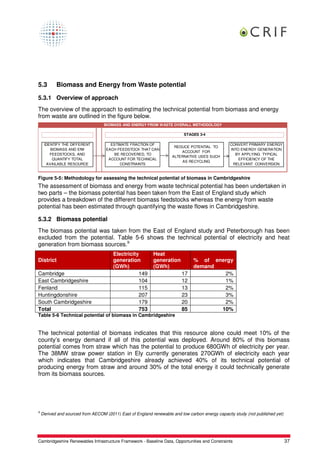
  • 39.
    The waste flowdiagram shows the quantity of material that will be diverted for recycling and composting, and the residual waste that will be processed at the Waterbeach MBT plant. The waste flow diagram demonstrates that the key energy from waste potential from MSW is compostable waste which could form a feedstock for AD plant and the residual waste product from the MBT plant (known as Solid Recovered Fuel – SRF) which also can be used as a fuel. The waste flow diagram also includes the existing and planned energy generation plant so as to identify the proportion that is already going (or about to go) to energy generation, and the remaining potential. There is currently one anaerobic digester (AD) plant in operation with a capacity of 30,000 tonnes per annum, and there are plans to potentially double its capacity. A second AD plant is planned with a capacity of 10,000 tonnes per annum. These two AD plants could provide the capacity to process 70,000 tonnes of waste per annum if the commercial plant was to double in size in line with the current proposals. It has been assumed that this capacity would be split equally to process MSW and C&I waste and therefore 35,000 tonnes has been allocated to MSW in the figure above. There is also an incineration plant in Addenbrookes Hospital incinerating about 1,400 tonnes of clinical waste a year and a gasification plant in Huntingdon receiving approximately 45,000 tonnes of waste per year including recovered wood from construction and demolition waste in the region. The technical potential for energy from waste is presented in Table 5-7. % of Installed capacity Electricity Heat generation Cambridgeshire's Waste streat (MWe) generation (GWh) (GWh) energy demand MSW - food waste 1.7 13.3 18.9 0.4% MSW - garden waste 2.0 16.0 22.9 0.5% C&I - food waste 0.8 6.3 9.0 0.2% Renewable fraction of SRF 4.0 31.6 52.7 1.0% C&I - residual waste 6.9 54.8 123.2 2.1% Total 15 122 227 4.1% Table 5-7: Technical potential of energy from waste It is assumed that the energy from waste plants would operate as CHP plants. Accordingly, it is estimated that MSW and C&I waste in the county have a technical potential of 122GWh of electricity and 227GWh of heat generation equivalent to 4% of Cambridgeshire’s energy demand. 5.3.4 Mapping waste facilities The proposed waste management sites in the waste LDF (from the Waste Site Specific Proposals Plan) are mapped in Figure 5-7. This includes the sites proposed in Peterborough to illustrate the density of proposed sites near to Huntingdonshire and Fenland in Peterborough. These sites have the potential for locating energy from waste facilities. Cambridgeshire Renewables Infrastructure Framework - Baseline Data, Opportunities and Constraints 39
  • 40.
    Figure 5-7: Proposedfuture waste management sites in Cambridgeshire 5.3.5 Landfill gas potential Potential from landfill gas was also sourced from the East of England study and was estimated to produce 19.1GWh of electricity in Cambridgeshire with 3.6MW of installed capacity. This technical potential is lower than the current installed capacity as it was assumed that some of the existing plants will be closed down and there will be less landfill waste due to higher rates of recycling. 5.4 PV potential 5.4.1 Assessing technical potential of PV The PV methodology calculates the actual roof area that could accommodate PV panels and calculates an installed PV capacity from this, as outlined in Figure 5-8. The orientation of roofs was accounted for by only considering south, south east and south west facing roofs. Cambridgeshire Renewables Infrastructure Framework - Baseline Data, Opportunities and Constraints 40
  • 41.
    Differentiation was alsomade between horizontal and inclined panels based on the different efficiency factors under these conditions. The impact on PV potential of over-shading and competing roof space uses in high and medium density areas was incorporated by applying constraint factors. Finally, constraints on the installation of PV on roofs in conservation areas were considered by assuming a lower installation rate on buildings in conservation areas. Additional roof space created by an increase in properties between now and 2031 due to increases in domestic and non-domestic buildings have been incorporated by considering projections of housing and employment land provided by Cambridgeshire County Council. PHOTOVOLTAICS METHODOLOGY STAGES 1-2 STAGES 3-4 THE IMPACT OF ROOF AREA AT A SUITABLE CONSERVATION AREAS ARE FOOTPRINT OF ALL OVERSHADING + ORIENTATION IS REMOVED AND OVERALL BUILDINGS IS CALCULATED COMPETING BUILDING DETERMINED POTENTIAL IS CALCULATED SERVICES IS CONSIDERED Figure 5-8: Methodology for assessing the technical potential of PV in Cambridgeshire 5.4.2 Summary of PV technical potential % of District Installed Electricity District/Cambridgeshire' capacity (MW) generation (GWh) s electricity demand Cambridge 232 169 22% East Cambridgeshire 298 216 56% Fenland 380 275 53% Huntingdonshire 547 397 43% South Cambridgeshire 528 383 44% Total 1,985 1,439 42% Table 5-8: Technical potential of PV in Cambridgeshire Total technical potential of PV in Cambridgeshire is equivalent to 1,985MW of installed capacity generating 1,439GWh of electricity. If all this technical potential was deployed, it would meet 42% of Cambridgeshire’s electricity demand. The highest potential for PV installations is in Huntingdonshire and South Cambridgeshire due to greater number of buildings and hence larger roof space in these districts as well as a relatively lower number of buildings designated under conservation areas than in Cambridge. When potential is measured on the basis of density (MWh/ha), the greatest potential of PV is clustered in Cambridge where building density is highest. Please refer to the Appendix of maps for a map of the distribution of PV potential across Cambridgeshire. 5.5 Solar water heating potential 5.5.1 Assessing technical potential of solar water heating Two different methodologies were used to assess solar water heating potential across domestic and non-domestic buildings in Cambridgeshire. For the domestic stock a system size of 3m2 per dwelling was used and only 20% of flats and 75% of houses were assumed to be suitable due to lack of roof space for installing panels on flats and for higher density housing. In the same way as for the assessment of PV potential, constraints were applied in conservation areas assuming a reducing number of panels to be installed. To avoid double-counting, it was Cambridgeshire Renewables Infrastructure Framework - Baseline Data, Opportunities and Constraints 41
  • 42.
    assumed that SWHwould take priority over the installation of PV panels as they may be competing for the same roof space. Therefore the potential of this technology was deducted from total PV potential. The methodology for working out the potential in domestic buildings is summarised in Figure 5-9. SOLAR WATER HEATING (DOMESTIC) - TAILORED METHODOLOGY Stages 1-4 NUMBER OF DOMESTIC ASSUMED INSTALLATION SIZE OF TOTAL CAPACITY CALCULATED BASED ON AN ASSUMED OUTPUT OF BUILDINGS (LSOA LEVEL) IS 3M²/DWELLING 525KWH/M² CALCULATED Figure 5-9 Methodology for assessing the technical potential of SWH in Cambridgeshire for domestic stock For the non-domestic stock, it was assumed that 75% of the properties would be suitable for the installation of SWH systems. Non-domestic buildings generally have a fairly low hot water demand and therefore a typical SWH system would not require significant amounts of roof space. The hot water demand was predicted based on published benchmarks11. The non- domestic SWH systems were sized to produce 50% of the predicted hot water demand. A lower installation rate in conservation areas has been assumed for both the domestic and non- domestic assessment. SOLAR WATER HEATING (NON-DOMESTIC) - TAILORED METHODOLOGY Stages 1-4 NUMBER OF NON-DOMESTIC FLOOR AREA USED TO ESTIMATE TOTAL CAPACITY DETERMINED - PANELS SIZED TO GENERATE 50% OF BUILDINGS - 75% ASSUMED HOT WATER DEMAND HOT WATER DEMAND FOR EACH BUILDING SUITABLE FOR SWH Figure 5-10: Methodology for assessing the technical potential of solar water heating in Cambridgeshire 5.5.2 Summary of solar water heating technical potential The technical potential of SWH is 134GWh which could supply 2% of Cambridgeshire’s heat demand. As expected, this is much lower than the PV potential due to the fact that SWH installation sizes are limited by the hot water demand of a building as excess hot water cannot be exported to neighbouring buildings. In the case of PV however, the whole of the available roof space can be utilised with excess electricity exported to the local grid. % of District District/Cambridgeshire’s Heat generation (GWh) heat demand Cambridge 23 1% East Cambridgeshire 18 2% Fenland 22 1% Huntingdonshire 36 2% South Cambridgeshire 36 2% Total 134 2% Table 5-9: Technical potential of solar water heating in Cambridgeshire 11 CIBSE (2007) CIBSE Guide F: Energy efficiency in buildings Section 20, Second Edition Cambridgeshire Renewables Infrastructure Framework - Baseline Data, Opportunities and Constraints 42
  • 43.
    5.6 Heat pump potential 5.6.1 Ground source heat pumps 5.6.1.1 Assessing technical potential for ground source heat pumps Separate methodologies have been used for assessing the technical potential of heat pumps for domestic and non-domestic buildings due to their differing characteristics. Due to the space requirements of GSHP, it has been assumed that no flats would be suitable. Across the remaining housing stock, only houses with an Energy Efficiency Rating (EER) of C or higher, corresponding to 7.9% of the stock12, were assumed to be technically suitable for GSHP. This is due to the poor performance of heat pumps in thermally inefficient buildings. In line with the DECC methodology, a fixed capacity of 5kW was assumed for all suitable domestic properties. GROUND SOURCE HEAT PUMPS (DOMESTIC) Stages 1-4 NUMBER OF DOMESTIC PROPERTIES DETERMINED IMPACT OF ENERGY PERFORMANCE OF HOUSING ON SUITABILITY TOTAL POTENTIAL CALCULATED AS PER DECC FOR GROUND SOURCE HEAT PUMPS (ONLY SUITABLE FOR HOUSES ASSUMING 5KW SYSTEM FOR ALL METHODOLOGY (FLATS WITH EFFICIENCY RATINGS A-C) HOUSES RATED A-C EXCLUDED ) Figure 5-11: Methodology for assessing the technical potential of GSHP in domestic buildings in Cambridgeshire For non-domestic properties, the methodology is similar to the DECC methodology however further constraints were applied and it was assumed that only 5% of existing commercial properties would be suitable for ground source heat pumps. For industrial properties, the suitable proportion of the stock was assumed to be 40%. The remaining 60% was assumed to either have space constraints or not be eligible for heat pumps due to poor energy efficiency performance of the buildings. For future developments, the potential for ground source heat pumps was based on applying the same methodology to projected domestic and non-domestic development. In addition, it was assumed that 75% of the existing domestic building stock that currently have an EER of less than C could be technically upgraded to at least a C rating by 2031. GROUND SOURCE HEAT PUMPS (NON-DOMESTIC) Stages 1-4 TOTAL POTENTIAL CALCULATED TOTAL NUMBER OF TOTAL NUMBER OF COMMERCIAL AND INDUSTRIAL BUILDINGS ASSUMING 100 KW SYSTEM COMMERCIAL AND SUITABLE FOR GROUND SOURCE HEAT PUMPS (5% COMMERCIAL, CAPACITY AS IN DECC INDUSTRIAL BUILDINGS 40% INDUSTRIAL) METHODOLOGY Figure 5-12: Methodology for assessing the technical potential of GSHP in non-domestic buildings in Cambridgeshire 5.6.1.2 Summary of ground source heat pump technical potential Table 5-10 shows the technical potential of ground source heat pumps in Cambridgeshire by local authority. If all this potential was installed, the technology could meet up to 13% of heat 12 DCLG (2007) English House Condition Survey, Summary Statistics Table 7.2, Standard Tables, Summary Statistics http://www.communities.gov.uk/housing/housingresearch/housingsurveys/englishhousecondition/ehcsdatasupporting/ehcsstandardt ables/summarystatistics/ Cambridgeshire Renewables Infrastructure Framework - Baseline Data, Opportunities and Constraints 43
  • 44.
    demand. However, theelectricity consumption associated with this scale of heat pump use would be significant, corresponding to a 12% increase in Cambridgeshire’s electricity demand. % Increase in Installed capacity Heat generation District % of heat demand electricity (MW) (GWh) 13 consumption Cambridge 147 178 11% 9% East Cambridgeshire 119 144 16% 15% Fenland 139 167 10% 13% Huntingdonshire 249 300 14% 13% South Cambridgeshire 237 286 14% 13% Total 890 1,075 13% 12% Table 5-10: Technical potential of GSHP in Cambridgeshire 5.6.2 Air source heat pumps 5.6.2.1Assessing technical potential for air source heat pumps The methodology for assessing the technical potential of ASHP is similar to GSHP however, because this technology does not require a ground heat exchanger it has wider applicability within towns and cities. Hence, flats were also included whilst estimating the total technical potential. Properties that have an EER banding of C or less were excluded from the assessment, as these properties would not be technically suitable due to the low temperature heat output from ASHP. The calculated GSHP potential has been subtracted from the ASHP potential in order to avoid double-counting as these technologies are mutually exclusive. Whilst doing this, it was assumed that GSHP would be of first preference due to their higher efficiency. For non-domestic buildings, 50% of buildings are assumed to be suitable for ASHP. AIR SOURCE HEAT PUMPS (DOMESTIC) Stages 1-4 TOTAL POTENTIAL CALCULATED IMPACT OF ENERGY PERFORMANCE OF HOUSING STOCK ON TOTAL NUMBER OF BASED ON DECC SYSTEM SIZES, SUITABILITY FOR DWELLINGS SUBTRACT GSHP POTENTIAL FROM AIR SOURCE HEAT PUMPS ASHP Figure 5-13: Methodology for assessing the technical potential of ASHP in housing in Cambridgeshire AIR SOURCE HEAT PUMPS (NON-DOMESTIC) Stages 1-4 USE DECC METHODOLOGY SYSTEM TOTAL NUMBER OF ASSUMED 50% OF COMMERCIAL AND INDUSTRIAL BUILDINGS SIZES TO CALCULATE POTENTIAL, COMMERCIAL AND SUITABLE FOR AIR SOURCE HEAT PUMPS SUBTRACT GSHP POTENTIAL FROM INDUSTRIAL BUILDINGS ASHP Figure 5-14: Methodology for assessing the technical potential of ASHP in non-domestic buildings 13 Based on a coefficient of performance of 2.5 sourced from EST field trial: EST (2010) Getting warmer: a field trial of heat pumps http://www.energysavingtrust.org.uk/Media/node_1422/Getting-warmer-a-field-trial-of-heat-pumps-PDF Cambridgeshire Renewables Infrastructure Framework - Baseline Data, Opportunities and Constraints 44
  • 45.
    5.6.2.2 Summary ofair source heat pump technical potential % Increase in Installed capacity Heat generation % of heat District electricity (MW) (GWh) demand 14 consumption Cambridge 288 348 22% 20% East Cambridgeshire 134 161 18% 19% Fenland 163 197 12% 17% Huntingdonshire 293 354 17% 18% South Cambridgeshire 289 349 17% 18% Total 1,166 1,409 17% 19% Table 5-11: Technical potential of ASHPs in Cambridgeshire The total technical potential for ASHPs is equivalent to 1,409GWh which would meet 17% of Cambridgeshire’s heat potential. With a lower coefficient of performance than GSHP, the additional electricity demand associated with this level of heat pump deployment is also very significant, equivalent to 19% of electricity consumption. This additional electricity demand could have implications for the capacity of the local electricity distribution network and may require local grid reinforcement to enable the greater electrical supply. The national programme of electrical grid decarbonisation is also key to the carbon savings from heat pumps and in the short term heat pumps would deliver negligible carbon savings due to the current high carbon content of the grid. 5.6.3 Potential of heat pumps in off-gas properties Properties that are not connected to the gas grid are a significant source of potential for heat pumps as they would be replacing heating systems that run with electricity or heating oil which are more carbon intensive than natural gas. Therefore the prioritisation of the installation of heat pumps in off-gas properties would ensure the reduction of carbon emissions in an effective way. Energy consumption figures for Cambridgeshire suggest that on average 5.6% of homes use heating oil in Cambridgeshire and this figure could go up to as much as 11% in East Cambridgeshire. Installing heat pumps in these properties as well as in properties that use electric heating would both reduce the running costs of heating for the residents and help to reduce carbon emissions. 5.7 Summary of renewable energy technical potential 5.7.1 Overview of Cambridgeshire’s renewable energy technical potential Table 5-12 provides a summary of the technical potential of renewable energy in Cambridgeshire. Although the technical potential could provide 226% of Cambridgeshire’s energy demand, the majority of this resource is wind, and the potential from renewable heat technologies is far less at approximately 60% of Cambridgeshire’s heat demand. ASHPs and PV have the second and third largest technical potentials at approximately 16% and 15% of energy demand respectively. The PV and ASHP technical potentials are both large because these technologies could potentially be installed in or on most buildings. GSHP potential is also large at 12.6% as there are a lot of rural properties in Cambridgeshire with 14 Based on a coefficient of performance of 2.2 sourced from EST field trial: EST (2010) Getting warmer: a field trial of heat pumps http://www.energysavingtrust.org.uk/Media/node_1422/Getting-warmer-a-field-trial-of-heat-pumps-PDF Cambridgeshire Renewables Infrastructure Framework - Baseline Data, Opportunities and Constraints 45
  • 46.
    available garden spacefor installing the ground loop pipework. Biomass and EfW have a combined potential of almost 13% with the largest contribution coming from the agricultural straw resource. The aggressive recycling targets in the Waste LDF will divert a lot of material away from general waste streams thereby reducing the EfW potential. SWH has a fairly low potential at just under 2% of energy demand as it is constrained by the hot water demand in buildings. The potential from landfill gas is very small as the quantity of landfilled waste will decline in the future. Installed Electricity Heat Carbon % of Technology capacity generation generation savings Cambridgeshire's (MW) (GWh) (GWh) (MtCO2) energy demand PV 1,591 1,304 508,706 15% SWH - - 134 29,252 1.6% GSHP 890 - 1,075 105,000 12.6% ASHP 1,166 - 1,409 114,494 16.6% Biomass 132 753 85 312,094 10% EfW 25 194 362 154,645 2.6% Wind 6,675 13,888 - 5,416,167 163.3% Landfill gas 5.4 28.2 - 11,016 0.3% Total 226% 10,484 16,167 3,065 6,651,375 Table 5-12: Overview of renewable energy technical potential in Cambridgeshire Figure 5-15 highlights the dominance of wind’s contribution to the county’s technical resource. Wind could provide four times the county’s current electricity demand and twice its overall energy demand. Nonetheless, the technical potential of the other renewable energy technologies is still fairly significant, and if wind is removed from the picture their combined contributions could still supply 60% of the county’s energy demand. Cambridgeshire Renewables Infrastructure Framework - Baseline Data, Opportunities and Constraints 46
  • 47.
    Figure 5-15: Renewableheat and electricity technical potential Figure 5-16 outlines the renewable energy technical potential across the districts. The greatest potential resides in Huntingdonshire followed closely by South Cambridgeshire – these two districts have both a substantial wind potential and large microgeneration potential due to their relatively large building stock. The rural nature of these districts makes them suitable for the deployment of GSHPs and small biomass particularly for off gas areas. Figure 5-16: Renewable energy technical potential by district Cambridgeshire Renewables Infrastructure Framework - Baseline Data, Opportunities and Constraints 47
  • 48.
    5.7.2 Comparison withexisting deployment for wind and biomass Wind and biomass have the largest installed capacity currently in Cambridgeshire. Due to the very large technical potential of wind, the current installations only represent a fraction of the technical resource. However, as the biomass and energy from waste technical potential is much smaller, almost a third of the technical resource is already deployed Figure 5-17: Comparison of the technical potential of wind and biomass with their current installed capacity Cambridgeshire Renewables Infrastructure Framework - Baseline Data, Opportunities and Constraints 48
  • 49.
    6 District heating and CHP potential 6.1 Methodology An overview of the approach to mapping heat demand and quantifying CHP and district heating potential is outlined in Figure 6-1. The analysis has mapped heat loads across the county, and then provided a more refined assessment of areas which have potential for district heating. Figure 6-1: Heat mapping methodology overview The key steps in the methodology were: • All individual buildings in Cambridgeshire (both domestic and non-domestic) have been identified through the use of three different data sets and the average energy consumption of typical houses in Cambridgeshire determined • Heat demand for non-domestic buildings was determined from CIBSE15 benchmarks which are viewed as an industry standard. Domestic building heat loads were determined from national statistics on the gas consumption of domestic properties in Cambridgeshire. Boiler efficiencies of 80 or 85% were assumed for converting fuel demand to heat demand when analysing building loads (80% was used for any more dated benchmarks) • New developments were mapped and their heat demand modelled • Areas with high heat demand were identified based on a threshold of 3,000 kW/km2 in line with DECC recommended methodology • Potential heat sources were identified from recognised datasets including the register of EU-ETS heat installations, waste incinerators, power stations, and large industrial users 15 The Chartered Institute of Building Services Engineers: Documents used: TM46 “Energy Benchmarking” (2008) and CIBSE Guide F (2004) Cambridgeshire Renewables Infrastructure Framework - Baseline Data, Opportunities and Constraints 49
  • 50.
    identified from theVOA dataset. Potential anchor loads were identified by filtering the LLPG building dataset to identify building types with high baseloads, and the VOA dataset to identify large heat users • Adjacent areas of high heat demand were aggregated together, and the total heat demand in each aggregated area determined, along with the split between domestic and commercial heat demand in each of these areas A detailed overview of the methodology is provided in Appendix 1. 6.2 Mapping heat demand in Cambridgeshire The heat mapping assessment provides a strategic overview of the locations within each district which have a high heat density and are therefore potential candidates for the installation of district heating systems. These district heating systems could then distribute renewable or low carbon heat to Cambridgeshire’s buildings. Heat demand maps have been produced for each local authority, with the heat density represented in a graded colour scale in units of kW/km2. Figure 6-2 below highlights the areas in Cambridgeshire with a heat demand over the threshold of 3,000 kW/km2 where district heating networks could be viable. The greatest potential resides in Cambridge followed by Huntingdon and the remaining larger towns in Cambridgeshire. In general the areas of high heat demand make up a relatively small portion of the total land area of the county, which is in keeping with the predominantly rural nature of the district. From this map it is possible to gain a high level strategic overview of the key areas which may be suitable for district heating and local heat networks – which can then be examined in further detail in the subsequent higher resolution mapping. Cambridgeshire Renewables Infrastructure Framework - Baseline Data, Opportunities and Constraints 50
  • 51.
    Figure 6-2: Areaswith potential for district heating in Cambridgeshire Table 6-1 provides a quantification of high density heat demand across the districts, and the percentage of Cambridgeshire’s heat demand that could therefore potentially be met by district heating networks. The ‘district heating technical potential’ for Cambridgeshire is approximately 9% of the total heat demand, with two-thirds of this potential residing in Cambridge and Huntingdonshire. Heat demand Baseload % of total Total in COA areas % of district which could heat load heat with heat heating District be fed by which could demand density potential for DH with be met by DH (GWh) >3,000 Cambridgeshire CHP (GWh) with CHP kW/km2 Cambridge 1119 715 166 15% 36% East 463 120 25 5% 5% Cambridgeshire Fenland 1011 335 77 8% 17% Huntingdonshire 1196 670 147 12% 32% South 1255 205 45 4% 10% Cambridgeshire TOTAL 5,044 2,045 460 9% 100% Table 6-1: District heating potential across Cambridgeshire Cambridgeshire Renewables Infrastructure Framework - Baseline Data, Opportunities and Constraints 51
  • 52.
    The heat mapfor Huntingdonshire is presented and discussed below as an example; the remaining four district heat maps are presented in the Appendix of maps. The areas of high heat demand in Huntingdonshire are concentrated in a limited number of urban areas, making up a small part of the area of the district. Huntingdon is the largest area of high heat demand, with further concentrations in St Neots (in the south), St Ives (to the east) and Yaxley (in the North). This is exactly as would be expected in a predominantly rural area such as this. Significant new development is proposed in the district in the coming years, represented by the blue and green hatched areas on the map, and the graduated blue and green dots with black borders. It is noted that many of the proposed new developments are located in or on the outskirts of the larger existing settlements. The larger developments may act as triggers to kick start district heating in these regions – if new development provides a suitable location for the inception of a district heating network, these networks then have the potential to be extended in to areas of high heat load in existing buildings nearby. There are no major heat sources (power stations/ CHP stations) within the district, although one power station is located just over the border south of St Neots, and another is located to the north in Peterborough. Based on this county level mapping, high resolution maps of Huntingdon, St Neots, St Ives) and Yaxley have been prepared and are presented in the appendices. The high resolution map of Huntingdon is analysed in section 6.4 below. Cambridgeshire Renewables Infrastructure Framework - Baseline Data, Opportunities and Constraints 52
  • 53.
    Figure 6-3: Exampleheat map of Huntingdonshire District 6.3 Assessment of the technical potential for CHP supplying district heat networks 6.3.1 Using the heat mapping to estimate CHP potential The methodology for assessing the potential for CHP and district heating is summarised in Figure 6-4. The heat mapping exercise identified areas with a high heat demand density which may be suitable for district heating or local heat networks. For the areas where district heating is not feasible, large buildings with a high heat demand have been assessed for their suitability for in-building CHP, whereby an individual CHP unit can be installed in large buildings that have a suitable balance of heat and electricity demand. Cambridgeshire Renewables Infrastructure Framework - Baseline Data, Opportunities and Constraints 53
  • 54.
    Process Outputs Heat map of Cambridgeshire with results presented at COA level Is the COA's heat density greater than 3,000kW/km 2? Yes No Areas suitable for Areas suitable for district heating/local in-building CHP heat network Aggregate adjacent COA areas with high heat density together and calculate total domestic and non-domestic heat Calculate CHP potential based on building's primary use and estimated baseload heat demand Determine potential scale for CHP led district heating to deliver base heat load of all buildings in each aggregated area of Calculate CHP technical CHP technical potential by district potential by district Identify deployment scenarios for in-building CHP deployable CHP and district heating potenital by district Figure 6-4: Overview of approach to estimating CHP potential across Cambridgeshire Key elements of the approach: • The assessment identifies the potential for in-building CHP and CHP led district heating schemes. The potential heat delivered by these schemes was based on the estimated baseload heat demand for each area or building, as CHP should be sized to meet baseload in order to maximise efficiency and running hours • The baseload heat demand for each district heating area was determined as 20% of domestic heat demand plus 30% of non-domestic heat demand. This heat load was then used to determine the scale of CHP technology suitable for each of the areas of high heat demand • The baseload heat demand for in-building CHP was determined on a building-by- building basis according to the building type – e.g. swimming pool centres have a high baseload due to pool heating and hot water demand, whereas office buildings have a Cambridgeshire Renewables Infrastructure Framework - Baseline Data, Opportunities and Constraints 54
  • 55.
    low baseload asthey use little hot water and no heating in summer months. A list of building types deemed suitable for CHP are included in appendix 1 • The likely peak output (in kWe for electricity and kWth for thermal) of each CHP unit was determined on the basis of the baseload to be met and the assumed number of annual running hours (these are specified in the appendices). 6.3.2 CHP units in individual buildings Large buildings often have a suitable scale and balance of heat and power demand to support their own CHP unit. Combined heat and power technology can prove to be a cost effective means of meeting a building’s heat load and electrical consumption and a useful carbon reduction technology due to the efficiency benefit of generating heat and power simultaneously. Although in-building CHP units are likely to be fuelled by natural gas in the short term, there is potential in future for the use of biogas or biodiesel in CHP units. CHP is best suited to buildings with a high baseload heat demand – this means that there is a high year-round demand for heat, allowing the unit to run for as many hours as possible in the year. Baseload heat demand is any year round process requiring heat such as: hot water generation for showers, toilets and catering, swimming pool heating, process heat loads which can be fed by hot water (e.g. in food production or drying and forming processes). For this reason buildings such as hotels, sports centres, swimming pools, hospitals, and certain industrial users are generally best suited to the installation of CHP at building level. It is assumed that no systems below 5kW (domestic scale) would be installed in non-domestic buildings. This is due to the emergent nature of the technology, and the fact that very small non- domestic buildings frequently have no gas supply, relying on electric space and water heating. Baseload Benchm ark category (% of total heat load) Dry sports and leisure facility 35% Fitness and health centre 45% General accommodations 30% General manufacturing 20% Hospital (clinical and research) 50% Hotel 40% Laboratory or operating theatre 20% Sw imming pool centre 60% University campus 10% Figure 6-5: Non-domestic building types suitable for CHP technologies 6.3.3 Technical potential of CHP The technical potential of CHP linked to both district heating networks and individual CHP in large buildings is presented in Figure 6-6. The technical potential from CHP linked to district heating networks is approximately six times the potential from in-building CHP. Cambridgeshire Renewables Infrastructure Framework - Baseline Data, Opportunities and Constraints 55
  • 56.
    Figure 6-6: Technicalpotential for CHP systems in Cambridgeshire CHP with district heating networks The analysis has identified 711 Census Output Areas (COA) areas in a total of 110 separate aggregations which had heat densities of over 3,000kW/km2 with potential for district heating networks. Cambridge and Huntingdonshire have the greatest potential for district heating and work is currently underway to progress the development of district heating in these areas. This reflects the fact that they contain the larger urban centres within the county .whereas the remaining districts are of a more rural nature, with fewer areas of high heat density. Individual CHP units in large buildings In Cambridgeshire, approximately 163,000 domestic buildings and 7,500 non-domestic buildings are located in areas of low heat density, and may have the potential for installation of in-building CHP. Of the total technical potential (62.8 GWh/year), 75% of the total potential is from non-domestic buildings with the remaining 25% in domestic buildings. 6.4 More detailed assessment of towns identified with district heating potential 6.4.1 Key attributes of district heating networks There are a range of parameters which affect the viability of developing a district heating system in a particular location. These include: 1. High aggregated heat load (domestic and commercial) – the scale of the high heat load areas determine the scope for district heating networks (calculated by aggregating adjacent COA areas of heat demand with heat density > 3,000 kW/km2). Cambridgeshire Renewables Infrastructure Framework - Baseline Data, Opportunities and Constraints 56
  • 57.
    2. Good loaddiversity/ mix - the ratio of commercial to domestic demand and a good balance of mixed demand – domestic only schemes typically have poor viability due to short periods of heat demand and extensive heat distribution networks required. 3. Proximity of major heat sources (capable of leading a scheme) - is there a major heat source with the potential to be lead heat source for a DH scheme (e.g. EFW plant, power station, large CHP) nearby? 4. Proximity of lesser heat sources - are there smaller waste heat sources within the boundaries of the high density heat area such as smaller CHP schemes or industrial sites that could prove low cost supplementary or peak heat loads for a network. 5. Commercial anchor loads - are there large commercial users present within the high heat density area? 6. Public sector anchor loads - are there large public sector users present in the high heat density area? 7. Major new developments - are there major new development sites adjacent to or within the high heat density area? 8. Existing DH infrastructure - are there significant existing DH schemes present or adjacent to the high heat density area that could be extended? 9. Previous DH studies - have previous DH studies been carried out which could facilitate more rapid scheme development? 10. Physical constraints – are there constraints to the installation or routing of a hot water pipe network, such as un-bridged rail, road or rivers? 6.4.2 Assessing the ‘top ten’ opportunities for district heating in Cambridgeshire The top ten areas of district heating potential have been assessed in greater detail against these key district heating parameters. The maps of district heating feasibility for the ten areas are found in the appendix. Aside from Cambridge, the majority of the areas of high density heat demand in Cambridgeshire possess relatively few of the necessary attributes for developing district heating networks. The identified areas constitute relatively small urban environments, ranging from market towns to large villages, which have a comparatively small overall heat demand and a limited number of large commercial or public buildings which could act as anchor loads for a district heating network. Outside Cambridge, Huntingdon is the only location which has a good mix of building types, plus large new developments in the near vicinity, and is therefore an optimum candidate for developing district heating networks. Cambridgeshire’s small heat loads limit the potential for district heating schemes A typical district scale heating system would have a thermal production of 40,000 to 400,000 MWh of heat per annum. The total heat loads in the identified opportunity areas are in the range of 30 to 190,000 MWh per year. The majority of district heating systems are initially made up of early anchor loads such as new developments, public sector buildings, hotels, and large commercial and industrial consumers. Network penetration can then increase gradually over time as a wider network of non-domestic users and in some cases higher density housing are connected. Operational district heating networks therefore serve significantly less than 100% of the total heat load in an area, even when fully established. Serving existing lower density domestic properties is particularly challenging due to high connection costs and typically with existing buildings only larger blocks of flats would be connected. As much of the existing housing stock in Cambridgeshire is likely to be relatively low density, one would expect only a small proportion of the total housing stock to be potential candidates for district heating even Cambridgeshire Renewables Infrastructure Framework - Baseline Data, Opportunities and Constraints 57
  • 58.
    where the densityof demand at a specific location (such as for a particular housing block) is very high. Therefore, as a high level indicator, the total heat load that could be met by a scheme is unlikely to exceed the total commercial heat load in an area. On this basis, only two of the areas identified outside Cambridge could potentially achieve a district-scale scheme based on existing building stock – Huntingdon and Wisbech. 6.4.3 District heating opportunities in Cambridge The Decarbonising Cambridge report16 carried out a detailed heat mapping exercise for Cambridge. This is clearly the area with the greatest potential for the installation of district heating in Cambridgeshire. The mapping results for this study and the Decarbonising Cambridge report are very similar with high concentrations of heat primarily focussed around the city centre. A comparison of the approach and results from the two heat mapping assessments are found in Appendix 1. Figure 6-7 shows that the areas of high density heat demand in Cambridge are primarily located within the city centre and are not found near to the large areas of new build around the periphery of the city. This limits the prospects for developing heat networks in the new development areas and then feeding them into the existing built environment. Figure 6-7: Heat map of Cambridge 16 Cambridge City Council (August 2010) Decarbonising Cambridge: A renewable and low carbon energy study Cambridgeshire Renewables Infrastructure Framework - Baseline Data, Opportunities and Constraints 58
  • 59.
    The key conclusionsfrom the Decarbonising Cambridge report are: • Outside the city centre, areas of high heat demand are relatively dispersed. • The main opportunity for district heating is likely to be in the urban extension sites, of which only the Bell School site is in close proximity to an area of existing high heat density (Addenbrookes). The approaches to meeting energy demands at these sites are covered by specific area action plans. • There may be opportunities for district heating in the city centre on the basis of heat density. • Exploitation of these opportunities will be subject to overcoming the technical, economic and practical barriers that retrofitting a community heating network in a historic city centre presents. • Mapping areas of high heat demand with proposed development sites suggests that there could be an opportunity for cost-effective community heating in the redevelopment of CB1, around the station area. • Most areas of highest heat demand are in the Cambridge air quality management area (AQMA) which will restrict the ability of operating biomass fuelled schemes. These conclusions demonstrate that whilst the potential for district heating in Cambridge is quite large due to the high density areas in the city centre, the delivery of district heating in practice would be more difficult. Work is underway to assess the commercial viability of district heating in the city centre. 6.4.4 District heating opportunities in Huntingdon Figure 6-8 illustrates the district heating opportunity within Huntingdon, and maps of an additional nine areas with district heating potential are presented in the appendix. The heat load has been assessed on a 50m2 grid basis and identifies the COA areas which have a heat load of over 3,000 kW/km2 (which are cross-hatched in red in the map). Areas with the darkest red colouration are those with the highest heat demand density, and conversely those with very pale colouration have low heat demand density. Large areas of dark red or areas with many dark red pinpoints close together are the areas which are most likely to be viable for scaling up a district heating network. These are also likely to be areas with larger commercial demands. Areas with more even, paler colouration will have many smaller buildings widely dispersed such as housing estates, and are likely to be poorly suited to installation of a district heating system. Also presented in the map are a range of potential “triggers” which could prove beneficial in developing a district heating system, such as potential anchor loads, new development sites or heat sources. Cambridgeshire Renewables Infrastructure Framework - Baseline Data, Opportunities and Constraints 59
  • 60.
    Figure 6-8: Opportunityarea heat map for Huntingdon The new development sites on the edge of Huntingdon are of particular interest, as district heating can prove to be a highly cost effective way of achieving carbon emission reductions in new developments. If large new developments sites are adjacent to areas of high heat density there is a good opportunity for developing a heat network. A number of potential heat sources - large energy users covered under the EUETS scheme (those with larger boilers over 20MW) - are plotted on the map. All these sites may have the potential to export low cost or waste heat into a district heating network and could therefore improve the viability of a network compared to the use of conventional fossil fuel fired CHP. Potential anchor loads are also plotted, including large energy users identified in the EUETS, hospitals, hotels, and a number of buildings which are likely to be publically owned such as libraries, museums and colleges. Large energy users often offer the best potential for connection to district heating networks as the cost of connecting the building is generally low relative to the quantity of heat purchased. Public sector organisations are key customers as they typically view carbon reduction as a higher priority than commercial clients, and are more likely to pursue a district heating connection even when the financial returns are marginal. Examining the map above, we would identify two key opportunities for installation of heat networks: 1. Development of a town centre heat network focussed on the high heat density region to the south of the map – perhaps using the public buildings (libraries, healthcare, courts) and hotels as anchor loads Cambridgeshire Renewables Infrastructure Framework - Baseline Data, Opportunities and Constraints 60
  • 61.
    2. Development ofa heat network to the north-west of Huntingdon, relying on the new developments as anchor heat loads and looking to extend into the industrial area either side of the railway. 6.4.5 District heating opportunities in St Neots St Neots is potentially well positioned to use low carbon heat due to the opportunity of using waste heat from Little Barford power station. Little Barford which is a 680 MW combined cycle gas turbine power station located south of St Neots could provide a very significant proportion of heat demand in the town if the waste heat is utilised in a district heating framework. It is only 2 miles away from the town centre and lies in close proximity to the major urban extension to the north east of the power station. A study is currently underway to investigate district heating in the area. Little Barford Power Station Figure 6-9 Opportunity area heat map for St. Neots 6.5 Deployment potential of CHP within Cambridgeshire 6.5.1 Deployment potential of CHP serving district heating networks The technical potential of CHP serving district heating networks is 9% of Cambridgeshire’s heat demand. The technical potential assessment assumes that 100% of the buildings in the high heat density areas would be connected to the district heating systems, and the systems would likely serve 100% of the base load. In practice each connection would be made only if it was economically viable to do so, and the network would serve significantly less than 100% of the Cambridgeshire Renewables Infrastructure Framework - Baseline Data, Opportunities and Constraints 61
  • 62.
    buildings. The uptakeof district heating in the UK has been limited, especially when compared with certain European countries such as Norway and Denmark. This is due to a wide range of barriers. A recent report17 identified the three key barriers to UK development of district heating networks as follows: • Economic barriers – Project risk: the very large up-front capital required is the greatest barrier to development of DH networks. DH is viewed by many to be a risky investment due to the following: o A perceived lack of experience and knowledge of DH in the UK o Limited understanding of tariff structures and management of the customer connection process. o Barriers to accessing capital due to uncertainty in predicting financial viability and customer uptake o Unfamiliarity with the concept of district heating among consumers and the public sector. • Economic barriers – Project cost: o Lack of local expertise and supply chain for DH delivery. o UK housing mix is less suited to DH development than many other European countries, as there are fewer large blocks of flats or apartments and more individual dwellings o Lack of standardisation of contract structures o Increased financing costs due to uncertainty over revenue risks • Institutional issues – the UK has variable levels of engagement from the public sector to underwrite the risks of DH schemes and provide anchor loads for the core of new schemes – this can be due to: o Energy viewed as a lower priority by LA’s compared to education and health o Inconsistency and lack of transparency in the application of planning policy and/or building regulations o Lack of familiarity among LA’s with district heating technologies In light of the economic and institutional barriers affecting the uptake of district heating and local heat networks, we have initially presented the data at three levels of uptake: 10%, 5% and 2.5% of the technical potential. These values have been chosen as they represent lower deployment rates than market-driven renewable energy technologies with positive policy environments. Furthermore, when a district heating scheme is developed it would not serve 100% of the buildings in its catchment area – typically it would begin with key public sector, commercial and industrial anchor loads then extend to more customers over time. Existing low density housing is very rarely viable for district heating connection. In practice therefore, the district heating system would serve a relatively small proportion of the total heat demand. These results are presented in Table 6-2. 17 POYRY/DECC/Faber Maunsell: “The potential and costs of district heating networks”, 2009 Cambridgeshire Renewables Infrastructure Framework - Baseline Data, Opportunities and Constraints 62
  • 63.
    Technical 10% 5% 2.5% District potential Uptake Uptake Uptake (GWh) (GWh) (GWh) (GWh) Cambridge 166 17 8 4 East Cambridgeshire 25 2 1 1 Fenland 77 8 4 2 Huntingdonshire 147 15 7 4 South Cambridgeshire 45 4 2 1 Total 460 46 23 11 % of total heat demand for 9.1% 0.9% 0.5% 0.2% Cambridgeshire Table 6-2: Deployment potential of CHP serving district heating networks Figure 6-10: Potential uptake scenarios for district heating and local heat networks As Cambridge and Huntingdon are the areas with greatest potential to support heat networks, we have selected these areas in isolation and considered the proportion of the building stock in each area which might realistically be connected to a heat network. In practice, networks would be focussed on the higher density city/town centre areas and therefore we consider a realistic proportion of total building load which could be met by a district heating network economically to be in the region of 12.5-25%. This scenario is presented in Table 6-3. Cambridgeshire Renewables Infrastructure Framework - Baseline Data, Opportunities and Constraints 63
  • 64.
    Technical 25% of 12.5% of potential in Council buildings buildings selected areas (GWh) (GWh) (GWh) Cambridge 112 28 14 Huntingdonshire 40 10 5 Total 152 38 19 Table 6-3 Deployment potential of CHP serving district heating networks in areas of greatest potential 6.5.2 Deployment potential of CHP units in individual buildings The technical potential of in-building CHP outlined above estimates that 1.2% of the county’s heat demand could be provided by CHP units in large buildings. However, in practice, the uptake of CHP units serving large buildings in the UK has been relatively slow, and it is limited by a range of constraints. Successful implementation of a CHP unit into a building requires a detailed appraisal of the building’s energy demand and potentially complex design solutions to integrate the technology into the building. CHP technology is also significantly larger than equivalent heat-only plant and additional plant space is therefore required for its installation. The following are a range of key constraints to CHP development: • Physical: Plant room space required, routing of flues, noise, air quality legislation (biomass CHP systems) • Technical: Integration with existing building services plant, whether there is sufficient baseload heat demand. • Economic: Economic viability varies and can be affected by energy prices, the amount of heat rejected, the ratio of gas to electricity price, availability of financial support or incentives. • Knowledge barriers: Lack of understanding of CHP technology and investment risk. Also presented are the deployment potential scenarios for CHP units in individual large buildings based on uptake rates of 2.5%, 5% and 10% of the technical potential. Barriers to the deployment of CHP units in buildings have changed relatively little in recent years, and the future uptake of CHP in Cambridgeshire is unlikely to exceed a small percentage of the technical potential unless there is a substantial change in the general policy framework. Technical 10% 5% 2.5% District potential Uptake Uptake Uptake (GWh) (GWh) (GWh) (GWh) Cambridge 11.3 1.1 0.6 0.3 East Cambridgeshire 7.7 0.8 0.4 0.2 Fenland 13.4 1.3 0.7 0.3 Huntingdonshire 12.4 1.2 0.6 0.3 South Cambridgeshire 18.0 1.8 0.9 0.4 Total 62.8 6.3 3.1 1.6 % of total heat demand for 1.2% 0.1% 0.1% 0.0% Cambridgeshire Table 6-4: Deployment potential of in-building CHP Cambridgeshire Renewables Infrastructure Framework - Baseline Data, Opportunities and Constraints 64
  • 65.
    Figure 6-11: Potentialuptake scenarios for in-building CHP in Cambridgeshire 6.6 Comparison of biomass supply potential with the district heating demand potential Figure 6-12: Comparing the biomass supply potential of with the district heating demand potential The figure illustrates that the ‘supply potential’ of the biomass and energy from waste resource that could fuel CHP plant feeding heat networks is less than the technical potential for district heating in Cambridgeshire18. However, as outlined above, the realistically deployable potential of district heating networks is far lower than this and is focused on central areas in Cambridge 1818 Please note that a very significant proportion of biomass (sourced from the East of England study) came from straw which was assumed to be used only for renewable electricity generation as they are likely to be used in few lar ge plants where heat generation is more challenging. Cambridgeshire Renewables Infrastructure Framework - Baseline Data, Opportunities and Constraints 65
  • 66.
    and Huntingdon. Anambitious deployment target for district heating networks in Cambridge and Huntingdon would constitute approximately a tenth of the overall technical potential figure, and could easily be met by Cambridgeshire endemic biomass and EfW fuel resource. Cambridgeshire Renewables Infrastructure Framework - Baseline Data, Opportunities and Constraints 66
  • 67.
    7 Scenarios of renewable energy deployment 7.1 Introduction to the deployment scenarios The consideration of deployment potential constitutes stages 5 to 7 within the DECC methodology for undertaking renewable energy assessments. It involves applying the economic and deployment constraints that further limit the proportion of the technical potential that can be practically delivered on the ground. Four deployment scenarios have been developed to enable an assessment of the local deployment potential of renewable energy within Cambridgeshire. The deployment scenarios provide a range of future options for renewable energy illustrating how deployment may be affected by changing market and policy conditions, and are therefore a guide for policy making and target-setting. The scenarios are not a prediction of what will happen and neither do they constitute an opinion on what should happen. They are simply an attempt to model how the deployment of the different renewable energy technologies might vary depending on the future market and policy environment. Their key function is that of informing the debate on future policy options for renewable energy in Cambridgeshire. The starting point for these scenarios is the technical potential of each renewable energy resource in Cambridgeshire, and the available evidence base regarding the practical uptake rate of these technologies in the UK and other European countries. The four deployment scenarios are entitled Low, Medium, High and High Without Wind, and the market and policy conditions underpinning these scenarios are found in the table below. The main features of each scenario includes: • Low scenario - has a commercial (high) interest rate, low financial incentives for the microgen technologies (reduced levels of FIT and RHI) and low levels of national, regional and local support to encourage uptake of renewable energy. • Medium scenario – has a low interest rate, maintains current levels of financial incentives for renewable energy technologies and has medium levels of national, regional and local support to encourage uptake of renewable energy. • High scenario – has a low interest rate, maintains current level of financial incentives for renewable energy technologies and has high levels of national, regional and local support to encourage uptake of renewable energy. • High without wind – the same as scenario 3, but excludes any contribution from wind. Cambridgeshire Renewables Infrastructure Framework - Baseline Data, Opportunities and Constraints 67
  • 68.
    Scenario 4 Scenario 1 Scenario 2 Scenario 3 (high without Inputs (low) (medium) (high) wind) Discount rate 9% 7% 6% 6% DECC - 'high DECC - 'high Energy price DECC - 'low' DECC - 'high' high' energy high' energy [1] energy prices energy prices prices prices current rates current rates (FIT/ RHI (FIT/ RHI designed to designed to give fixed give fixed return & will return & will Financial lower than adjust to adjust to incentives current tariff energy energy (FIT/RHI) rates current rates prices) prices) Project deployment rate (wind/biomas) 8%/ 80% 15%/ 100% 30%/ 100% 0%/ 100% Green policy support (for building integrated technologies) Low Medium High High Table 7-1: Input parameters for the deployment scenarios 7.2 Summary of deployment modelling methodology The key elements of the modelling underpinning the deployment scenarios are outlined in Figure 7-1. APPROACH TO QUANTIFYING DEPLOYMENT POTENTIAL OF RENEWABLE ENERGY TECHNOLOGIES STAGES 5&6 USE EMPIRICAL EVIDENCE BENCHMARK THE DEPLOYMENT RATES OR OTHER SUITABLE APPLY THIS UPTAKE RATE OF THE OTHER SCENARIOS AGAINST REFERENCE POINT TO TO THE TECHNICAL MEDIUM SCENARIO BASED ON THE DETERMINE APPROPRIATE POTENTIAL OF MEDIUM CHANGING MARKET CONDITIONS AND UPTAKE RATE FOR EACH SCENARIO TO GENERATE POLICY SUPPORT UNDER EACH TECHNOLOGY DEPLOYMENT POTENTIAL SCENARIO Figure 7-1: Approach to modelling of deployment scenarios Cambridgeshire Renewables Infrastructure Framework - Baseline Data, Opportunities and Constraints 68
  • 69.
    The key stepsunderpinning the scenarios include: • Identifying empirical evidence for the deployment of the different renewable energy technologies; • Applying the financial subsidies provided by ROCs, FIT and RHI to the economic assessment which have drastically improved the economics of renewable energy installations, particularly for the microgeneration technologies of PV, solar water heating and heat pumps. • Applying a ‘share of utility rule’ to assess the propensity of a consumer to invest in renewable energy based on the level of return on investment. 7.2.1 Modelling economic potential The subsidy provided by feed-in tariffs and the renewable heat incentive enables RE technologies to be considered economically viable in most locations where they are technically viable. However, whether they are installed in any given location is dependent on the economic decision making of individual consumers and organisations. For example, the decision to invest in RE is dependent on having access to capital and the alternatives to investing this capital in RE. The economic potential under each scenario was derived through a two-step process; the internal rate of return (IRR) for each technology was first calculated to assess the attractiveness of the investment opportunity and then the probability of a consumer investing in the RE technology was calculated based on the ‘share of utility rule’19 outlined below. The share of utility rule assesses the probability of a consumer investing in a particular investment by comparing the rate of return on that investment with that of an alternative investment. The economic modelling has used the share of utility rule to compare the return on the RE investment with the alternative of investing the money in the bank. Where the IRR for the investment in the RE technology is equal to that of the interest rate on the bank investment (which is equal to the discount rate chosen for each scenario) then the probability of RE investment is 50%, and where the IRR is greater than the discount rate then the probability of RE investment is greater than 50%. Probability of investment = IRR (renewable investment) IRR (renewable investment) + IRR (alternative investment) 7.2.2 Modelling deployment and uptake rate Deployment coefficients have been produced for each of the scenarios to model the impact of the deployment parameters on the uptake of the RE technologies. The deployment parameters include differing levels of local and central government support, readiness of the wider market for RE installations (such as capacity of local electric grid to accept distributed power generation or increased electrical demand from heat pumps) and planning approval and consenting rates for larger scale installations. These deployment coefficients determined the amount of projects that would be deployed from the projects that were defined as ‘economic potential’ in the previous step of the methodology. The way the deployment coefficients were determined was specific to each technology and are explained in more detail in the following sections. 19 Trafford Publishing (2007) Principles of Marketing Engineering: http://www.mktgeng.com/downloadfiles/technotes/tn09%20- %20conjoint%20analysis%20technical%20note.pdf Cambridgeshire Renewables Infrastructure Framework - Baseline Data, Opportunities and Constraints 69
  • 70.
    7.3 Deployment modelling methodology by technology 7.3.1 Wind The deployment rate of wind projects was based on empirical evidence of planning permissions across England. According to the statistics published by BWEA20, 25% of planning applications for wind turbines were successful in England in 2009. Considering the already high installed capacity in Cambridgeshire, the planning approval rates were set lower at 15% in Cambridgeshire for medium scenario. Approval rates of 7.5% and 30% were assumed for the low and high scenarios respectively. The High Without Wind scenario assumed a 0% planning approval rate for wind projects. 7.3.2 Biomass The deployment rate for biomass was determined based on current installation rates in Cambridgeshire for biomass and energy from waste plants. Current installed capacity already accounts for 30% of the technical potential in Cambridgeshire and therefore deployment coefficients were set so that medium scenario would enable the deployment of 45% of the technical potential. 7.3.3 Photovoltaics and solar water heating The deployment potential of PV and solar water heating was based on the uptake rates that were achieved in Germany. It was estimated that 11% of its technical potential was achieved within 10 years of implementation of the FITs in Germany. The German FITs are set at similar rates to the UK tariffs and given the similar levels of affluence and market conditions between the two countries; it is assumed that similar rates of growth in PV installations could also be possible in the UK. It is also assumed that SWH has the same rate of growth as PV as it has similar deployment characteristics (i.e. it is a solar, roof-top technology) and in the same way as PV is supported by the FIT, SWH will be supported by the RHI in both non-domestic and domestic buildings from 2012 onwards. Therefore, the deployment coefficient of these technologies was set as to achieve 11% of technical potential for the medium scenario. The remaining scenarios were benchmarked against the medium scenario to reflect the different conditions defining the scenarios. 7.3.4 Heat pumps Due to a lack of empirical evidence regarding the mainstream roll out of heat pumps, the scenarios have modelled the impact of the various deployment challenges for heat pumps. Energy efficiency uptake is used as a proxy for installing heat pumps as they typically require a number of changes within the property. Heat pump installations are typically more complex and involved than PV or SWH as they require external space for locating the heat pump in addition to the internal components and the heating/ radiator system may need adjusting to a low temperature system. They are a less well known technology and they are directly competing against incumbent gas boilers. Heat pump uptake is benchmarked against the Committee on Climate Change’s (CCC) Uptake of Energy Efficiency in Buildings report21 as this is a key national report looking at the potential for energy efficiency and carbon reductions in buildings. 20 British Wind Energy Association (2009) State of the industry report: http://www.bwea.com/pdf/publications/Industry_Report_08.pdf 21 Committee on Climate Change (2009) Uptake of Energy Efficiency in Buildings: http://downloads.theccc.org.uk/docs/Element%20Energy_final_efficiency_buildings.pdf Cambridgeshire Renewables Infrastructure Framework - Baseline Data, Opportunities and Constraints 70
  • 71.
    Disruptive measures suchas floor and solid wall insulation were considered in order to understand the likely uptake rates for heat pumps. GSHP were assumed to have lower deployment rates than ASHP, on the basis that the installation process is more disruptive than ASHP, requires external space for installing pipework, and is subject to additional risks due to ground conditions. As a result, deployment coefficient was set at 10% for the medium scenario for air source heat pumps and 5% for ground source heat pumps. The large scale deployment of heat pumps in Cambridgeshire would lead to investment costs in the local electricity grid due to an increased demand for power. This grid investment cost is factored into the economic appraisal of heat pump deployment by assuming a charge of £1,000 for every property installing a heat pump. The actual extent and costs of the reinforcement which may be required are unclear. The Phase 1 technical potential assessment assumes that 75% of Cambridgeshire’s housing stock will be suitable for installing heat pumps by 2031 due to a large scale low carbon refurbishment programme over the next twenty years. However, the deployment scenarios have down-scaled this assumption so that 40% to 60% of the county’s housing stock is assumed to benefit from refurbishment over the next twenty years and is therefore available for the installation of heat pumps. Summary of the deployment potential 7.3.5 Deployment potential scenarios Figure 7-2 provides an overview of the four renewable energy deployment scenarios. The deployment potentials are compared with both the current installed capacity and the 28% renewable energy target for 2030 taken from the Renewable Energy Review. Scenario 1 equates to 11% of Cambridgeshire energy demand whereas scenario 3 equates to 47% of energy demand. Scenario 4 achieves 19% contribution even without any wind, although it would require a significant contribution from PV and biomass. The high existing renewables capacity provides Cambridgeshire with an excellent springboard for delivering the deployment levels within these scenarios. Scenario 3 is the only scenario to achieve the 28% renewable energy target, and this is due to the large contribution from wind. This demonstrates the significant potential that wind has to offer and also the important role that wind would need to play if Cambridgeshire were to aim for very ambitious renewable energy targets. Table 7-2 provides the underlying figures for these deployment scenarios with the GWh contribution of each technology for each scenario. Cambridgeshire Renewables Infrastructure Framework - Baseline Data, Opportunities and Constraints 71
  • 72.
    Figure 7-2: Renewableenergy deployment potential in Cambridgeshire The biomass and EfW potentials are combined into a single biomass category for the deployment potential scenarios due to the similarities between the different biomass and EfW feedstocks and their common potential to serve CHP units or heat networks. Technology Scenario 1 Scenario 2 Scenario 3 Scenario 4 PV 58 275 592 592 SWH 13 34 66 66 GSHP 21 65 105 105 ASHP 44 190 289 289 Wind 487 1,105 2,369 0 354 526 591 591 Biomass 977 2,196 4,012 1,643 Total % of Cambridgeshire's 11% 26% 47% 19% energy demand Table 7-2: Renewable energy deployment potential in Cambridgeshire in GWh 7.3.6 Assessing the number of installations associated with each scenario Table 7-3 outlines the number of renewable energy installations that would be associated with the delivery of these scenarios. The PV installations refer to the number of domestic solar roofs that would be associated with each scenario, ranging from approximately 30,000 in scenario 1 to 290,000 solar roofs in scenarios 3 and 4. Air source heat pumps play a key role in the scenarios with approximately 7,000 installations in scenario 1 increasing to almost 50,000 in Cambridgeshire Renewables Infrastructure Framework - Baseline Data, Opportunities and Constraints 72
  • 73.
    scenarios 3 and4. Approximately 100 large wind turbines would be needed in scenario 1 compared to 450 turbines in scenario 3. Technology Scenario 1 Scenario 2 Scenario 3 Scenario 4 PV (2.5 kW) 28,140 134,234 288,634 288,634 SWH 7,970 21,045 40,437 40,437 GSHP (5kW) 3,404 10,728 17,359 17,359 ASHP (5kW) 7,269 31,484 47,908 47,908 Wind (2.5 MW) 94 212 455 0 Biomass (1.5 MW) 18 27 30 30 Total 46,895 197,730 394,824 394,368 Table 7-3: Number of installations associated with the deployment scenarios 7.3.7 Assessing the deployment potential of renewable electricity and renewable heat In practice, energy use in buildings is broken down into heat and power consumption, and the different energy supply technologies either generate heat or electricity (or both in the case of CHP). Historically renewable energy policy has tended to focus on renewable electricity at the expense of heat. The Renewable Heat Incentive aims to redress this imbalance. The Committee on Climate Change’s Renewable Energy Review outlines separate renewable heat and renewable electricity in order to examine the different challenges facing heat and electricity, and to ensure that the UK achieves a comprehensive renewable energy solution. Figure 7-3 compares Cambridgeshire’s renewable electricity deployment potential with the 18% renewable electricity target for 2030 from the Committee on Climate Change’s Renewable Energy Review report. It shows that Cambridgeshire easily has the potential to meet the suggested 18% target, and could reach this level of deployment through a combination of wind, PV and biomass, or it could even meet it through wind or PV alone due to the significant available resource associated with these two technologies. Figure 7-3: Renewable electricity deployment potential in Cambridgeshire Cambridgeshire Renewables Infrastructure Framework - Baseline Data, Opportunities and Constraints 73
  • 74.
    Figure 7-4 highlightsthe challenge for Cambridgeshire in terms of generating sufficient levels of renewable heat. The Committee on Climate Change expects renewable heat to play a far greater role over the coming years. It considers heat to be both a challenge, as it is starting from a very low position, and also an opportunity due to the scope for greater deployment of heat pumps and biomass. The majority of the heat demand in Cambridgeshire resides in the domestic sector and this is where the deployment of renewable heat would need to be focused. In addition, the greatest potential for energy efficiency improvements resides in housing, and specifically with regard to heat consumption in housing. Cambridgeshire has a far greater renewable electricity potential than heat potential – and although scenario 3 achieves the 28% renewable energy target, the renewable electricity generated by wind is in effect compensating for the lack of renewable heat. Figure 7-4: Renewable heat deployment potential in Cambridgeshire 7.3.8 Assessing deployment potential by district The greatest renewable energy potential resides in Huntingdonshire followed by South Cambridgeshire. Although these two districts have the largest wind resource they also have substantial PV and air source heat pump potential as along with Cambridge they have a larger building stock than the other districts. Cambridgeshire Renewables Infrastructure Framework - Baseline Data, Opportunities and Constraints 74
  • 75.
    Figure 7-5: Renewableenergy deployment potential by district under scenario 2 7.3.9 Evaluating contribution of district heating potential Figure 7-6 illustrates the potential contribution to low carbon heat supply that could be made by district heating. Scenario 4 shows the technical potential for district heating which corresponds to approximately twice the potential from biomass under scenario 4. The three district heating deployment potential scenarios from the previous chapter are added to scenarios 1 to 3 in Figure 7-6 to compare their potential contribution with that of the other renewable heat technologies. In practice district heating is difficult to deliver and would only serve a limited proportion of the buildings in the area where a scheme is actually installed – and for this reason the deployment scenarios for district heating assume 2.5%, 5% and 10% of the technical potential to be realistically deployable. As is clear in Figure 7-6, the heat demand from areas that could potentially be served by district heating networks is similar to the heat generation potential from biomass, which would form a useful match if the biomass resource were to be used in as the fuel for these district heating networks. Alternatively the fuel could be brought in from outside the county thereby increasing the overall contribution of renewable energy within Cambridgeshire. Cambridgeshire Renewables Infrastructure Framework - Baseline Data, Opportunities and Constraints 75
  • 76.
    Figure 7-6: Evaluatingthe contribution that the district heating technical potential could make to low carbon heat supply 7.4 Role of new development in contributing to the deployment potential The substantial housing and employment land growth over the next twenty years will in its own right significantly increase renewable energy installations in Cambridgeshire. In complying with Building Regulation requirements for zero carbon housing from 2016 and zero carbon non- domestic buildings from 2019, developers will need to install renewable energy onsite or contribute to offsite low carbon infrastructure. A general assessment of the Cambridge Sub- Region’s housing and employment projections suggests that up to 400GWh per year will be financed or installed in association with the new development. Combining the new build renewables output with the current installed capacity of approximately 600GWh, will enable Cambridgeshire to achieve the deployment scenario 1 of 900GWh of renewable energy. 7.5 Contribution of renewable energy to Cambridgeshire carbon objectives Figure 7-7 illustrates the contribution of renewable energy to Cambridgeshire carbon reduction objectives under each of the deployment scenarios. The carbon reductions from the renewable energy scenarios build upon the carbon savings from grid decarbonisation and energy efficiency improvements. The incremental carbon reductions from an 8% and 22% decrease in energy demand is presented in the green and purple segments respectively. Therefore, the total carbon reductions associated with a 22% decrease in energy demand would be the sum of the green and the purple segments. In contrast the burgundy segment demonstrates the increase in carbon emissions that would result from an energy demand increase of 5.5% (DECC reference pathway). The carbon reductions associated with scenarios 1 to 4 are highlighted in mauve, orange, dark green and light green. These show that when combined with the most aggressive energy efficiency scenario and grid decarbonisation, scenario 3 could drive down carbon emissions to below the 4th Carbon Budget target, with the other deployment scenarios going part way towards the target. However, it should be noted that although transport emissions are included in this overall Cambridgeshire carbon reduction target, the impact of transport carbon reduction measures are not considered – and therefore the renewable energy contribution does not necessarily need to fill the whole gap. Nonetheless, it is generally acknowledged that the Cambridgeshire Renewables Infrastructure Framework - Baseline Data, Opportunities and Constraints 76
  • 77.
    potential for carbonreductions in transport is smaller than the potential for reducing emissions related to heat and power consumption in buildings. Figure 7-7: Potential contribution of renewable energy to Cambridgeshire carbon reduction targets In order for Cambridgeshire to play its role in delivering the 4th Carbon Budget 50% carbon reduction target it will need substantial improvements in energy efficiency and a significant contribution from local renewable energy, as well as relying upon a nationally decarbonised electricity grid. 7.6 Investment opportunity The total investment opportunity associated with each of the scenarios is outlined in Table 7-4. The total capital investment associated with scenario 1 is £900 million, scenario 2 is £3 billion, scenario 3 is £6.2 billion and scenario 4 is £4.7 billion. The majority of this investment cost is associated with the PV installations, and for example in scenario 3 the investment cost of PV is double that of wind even though the output of wind is four times than that of PV. This large investment potential illustrates the substantial economic benefits that would accompany the installation of renewable energy infrastructure at these scales. The degree to which this economic opportunity could benefit Cambridgeshire, would depend upon the scope to which Cambridgeshire based industries and workforce are involved in the delivery of the infrastructure. Technology Scenario 1 Scenario 2 Scenario 3 Scenario 4 PV £371 £1,770 £3,806 £3,806 SWH £46 £120 £231 £231 GSHP £28 £89 £144 £144 ASHP £48 £207 £315 £315 Wind £293 £664 £1,423 £0 Cambridgeshire Renewables Infrastructure Framework - Baseline Data, Opportunities and Constraints 77
  • 78.
    Biomass £135 £200 £225 £225 Total £920 £3,051 £6,145 £4,722 Table 7-4: Level of capital investment associated with each deployment scenario in £millions Cambridgeshire Renewables Infrastructure Framework - Baseline Data, Opportunities and Constraints 78
  • 79.
    8 Assessing impact of energy demand reductions 8.1 Introducing the energy efficiency scenarios The study has also assessed the impact of differing levels of energy demand on Cambridgeshire’s renewable energy potential, so as to understand the degree to which a smaller energy demand in the future might minimise the need to exploit Cambridgeshire’s renewable energy resource. Three scenarios of future energy demand have been used to explore the impact upon renewable energy requirements. These scenarios have already been considered above in the analysis of carbon reduction objectives for Cambridgeshire and the possible contributions from different sectors. The energy efficiency scenarios are all taken from the Department of Energy and Climate Change’s 2050 Pathways Analysis. There are seven 2050 Pathways looking at different approaches to achieving the 80% carbon reductions by 2050. Each of the pathways has differing packages of energy efficiency, renewable energy, nuclear power and Carbon Capture and Storage. The Low, Medium and High energy efficiency scenarios outlined below are based on the ‘reference’, ‘alpha’ and ‘epsilon’ pathways, respectively, and correspond with a 5.5% increase, a 8% decrease and a 22% decrease in energy demand by 2030. The ‘reference pathway’ considers the business as usual approach with a failure to achieve substantial carbon reductions, and an increase in energy demand. The alpha pathway represents a middle energy efficiency rate amongst the 2050 pathways whilst the epsilon energy efficiency rate is the highest of the 2050 pathways. Scenario Description Source 5.5% increase in energy demand Reference pathway (DECC 2050 Low by 2030 Pathways Analysis) 8% decrease in energy demand Alpha pathway (DECC 2050 Medium by 2030 Pathways Analysis) 22% decrease in energy demand Epsilon pathway (DECC 2050 High by 2030 Pathways Analysis) Table 8-1: Energy efficiency scenarios for 2031 8.2 Impact of future energy demand on the contribution from renewable energy Although the energy demand across the scenarios varies by 27%, the resulting impact on the contribution from renewable energy is fairly small. For example, the renewable energy deployment scenario 2 would meet 24% of future energy demand if energy demand increases by 5.5% as opposed to 33% of future energy demand if energy demand were to reduce by a quarter over the next 20 years. In other words, under an ambitious policy of energy efficiency improvements for the next 20 years the contribution from renewable energy supply (for Cambridgeshire Renewables Infrastructure Framework - Baseline Data, Opportunities and Constraints 79
  • 80.
    deployment scenario 2)would only increase from a quarter to a third of Cambridgeshire’s energy demand. Future energy demand Renewable energy deployment scenarios scenarios Scenario 1 Scenario 2 Scenario 3 Scenario 4 Baseline scenario (current energy demand including new build projections) 11% 26% 47% 19% Low energy efficiency scenario 11% 24% 45% 18% Medium energy efficiency scenario 12% 28% 51% 21% High energy efficiency scenario 15% 33% 60% 25% Table 8-2: Impact of energy efficiency improvements on contribution from renewable energy This again illustrates the necessity of combining all approaches to delivering carbon reductions and reducing dependence on fossil fuels; energy efficiency improvements, local renewable energy supply and national grid decarbonisation measures are all needed in order to meet carbon reduction objectives. Cambridgeshire Renewables Infrastructure Framework - Baseline Data, Opportunities and Constraints 80
  • 81.
    Appendix 1 –Heat mapping Appendix 1A – Heat mapping methodology Data Sources Heat loads at building level have been determined using the following datasets: • Non-residential building data for Cambridgeshire was obtained from Valuation Office Agency (VOA) data detailing floor areas and usage categories for non domestic buildings. • Local Land and Property Gazetteer (LLPG) data has been used to identify the locations of the buildings and differentiate between commercial and residential properties. • Details of existing domestic building stock at Output Area level were be obtained from National Statistics and used to derive energy benchmarks specific for each Output Area. • Details of proposed future developments have been identified through liaison with planning contacts at each district council. Assumptions were used to estimate possible energy consumption from each site. • Industrial major heat users have been identified through examination of the VOA data to identify large floor plan industrial and manufacturing sites. Benchmarking approach Benchmark data has been used to determine the estimated energy demands from four different categories of building: 1. Existing domestic properties: National statistics provide details of the total gas consumption of domestic properties, and the number of domestic properties, in each output area. This is then used to determine average domestic energy consumption for each output area. 2. Existing commercial properties Industry standard benchmark data from CIBSE22 has been used to determine heat loads from non domestic buildings. 3. Existing industrial properties Industry standard benchmark data from CIBSE23 has been used to determine heat loads from industrial buildings. This has been calculated for space heating load only on the basis of their floor area as stated in the Valuation Office Agency (VOA) data. Industrial process loads are heavily process specific and therefore cannot be estimated based on the limited datasets available. 4. Future domestic properties Heat loads for future domestic properties have been calculated on the basis of the Energy Saving Trust’s Advanced Practice Energy Efficiency (APEE) standard. This is a 22 The Chartered Institute of Building Services Engineers: Documents used: TM46 “Energy Benchmarking” (2008) and CIBSE Guide F (2004) 23 The Chartered Institute of Building Services Engineers: Documents used: TM46 “Energy Benchmarking” (2008) and CIBSE Guide F (2004) Cambridgeshire Renewables Infrastructure Framework - Baseline Data, Opportunities and Constraints 81
  • 82.
    specification for newhousing which achieves a reduction in carbon emissions of approx 30% compared to the 2006 building regulations 5. Future non-domestic development Industry standard detailed benchmark data from CIBSE has been used to determine heat loads for future non domestic buildings. This data has been refined to reflect the impact of the 2006 building regulations and a further 25% reduction applied to reflect further improvements to low energy building design in the near future. Assumptions Plant efficiencies The heat maps present the heat demand of the buildings in the specific area. In order to calculate heat demand from the energy consumption data and benchmark data, assumptions have been made regarding the efficiency of heating plant in existing buildings. The following table outlines the efficiencies which have been used in these calculations. Table 0-1 Assumed plant efficiencies Building type Heating system efficiency 24 Existing commercial 85%/ 80% Existing domestic 85% Existing council / county assets 80% Future commercial 86% Future domestic 90% Table 0-2 Assumed plant efficiencies New development sites Detailed assessment of site-by-site development proposals is outside the scope of this study, In order to estimate the potential energy demand of future development sites we have employed a set of assumptions based on the land area and proposed usage of each development site. Development site data was provided by each district council, and was classed as one of three categories: • Residential development Highly urban sites: 50 dwellings per hectare. Used in Cambridge only. Semi/extra-urban sites: 35 dwellings per hectare. Used for all sites outside Cambridge. • Mixed use development Sites were defined by scale, according to the definitions presented in Table 0-3 below. Number of housing units and non-domestic floor areas were assigned pro-rata relative to the size of the site and the maximum extent of development at each scale. • Employment land A fixed set of assumptions was used to determine floor areas of A1 retail, office and warehouse development for each employment site. These are outlined in Table 0-4 below. 24 85% used with benchmarks dated 2008, 80% used with older benchmarks from CIBSE guide F (these typically date from around the year 2000) Cambridgeshire Renewables Infrastructure Framework - Baseline Data, Opportunities and Constraints 82
  • 83.
    2 Scale Site size range Housing units A1 retail development Office development (m 2 at maximum (m at maximum site at maximum site size) site size size Small Up to 4.3 Ha 100 2,500 2,700 Settlement extension 4.3 - 47.7 Ha 900 10,000 60,000 Urban extension/new 47.7 - 189.3 Ha 4,000 75,000 180,000 settlement Table 0-3: Development assumptions used for mixed use development sites Scale Site size A1 retail development Office development Warehouse 2 2 2 (m at maximum site (m at maximum site development (m at size size) maximum site size) Base scale 10 Ha 10,000 18,000 12,000 Table 0-4: Ratio of non domestic development to site area for employment sites Potential heat sources and anchor loads The study has identified and mapped a number of potential heat sources and anchor loads to assist in reviewing the heat maps. A selection of key items have been presented on the district scale maps, and all items are presented on the more detailed maps of the “zones of high potential”: • Waste Heat: Our analysis examined the location and scale of major existing and future sources of waste heat in the region and consider these where they occur in close proximity. o The register of EU ETS installations (heat generating plant of over 20MW and CHP installations) o Power stations were identified from EU ETS data. o Locations and scale of existing and proposed energy from waste (EfW) plants obtained from the appropriate Waste Planning Authorities (WPA’s) o RESTATS Planning Database 2010 – details of locations and size of biomass plants, biomass CHP, landfill gas sites and others o UKWIN (UK Without Incineration Network) locations of existing and proposed incinerators and their capacities o Examination of VOA data to identify large industrial sites where the installation of CHP systems which could export heat may be an option. • Potential Anchor loads o Examination of VOA data to identify large industrial and manufacturing sites. o Large scale future developments are included in the maps as possible anchor loads, with graduated markers to indicate potential energy demand. o Examination of LLPG data to identify the locations of key potential anchor loads (public sector and otherwise), such as hotels, schools, university buildings, hospitals/healthcare buildings, prisons, etc. Cambridgeshire Renewables Infrastructure Framework - Baseline Data, Opportunities and Constraints 83
  • 84.
    o Data from the East of England study was also presented in the maps, including a layer identifying large public sector buildings (heat demand over 1,500 MWh/annum from NI185 data), major hospitals and large energy consumers indentified from EUETS data. • Existing heat distribution infrastructure o The regional study for the East of England identified that the only existing heat distribution infrastructure in the region is located at the University of East Anglia in Norwich – indicating that no district heating infrastructure is present in Cambridgeshire.. Processing and presentation of data The heat map has been created using ArcGIS software. Heat load data has been imported into this software from Microsoft Excel® spreadsheets detailing building locations and their heat loads. A number of separate layers are included in this heat map to represent the different heat loads present in the region. Colour coding of output areas according to heat load is augmented by the inclusion of point heat loads to identify areas with many large heat users. Major physical constraints are identified (rivers, railways), as well as roads. Future developments have been identified on the map as hatched areas, with scaled point loads to identify the predicted energy demand. Domestic, and mixed use/employment development areas are differentiated using different hatching patterns. Finally, the potential anchor loads/major heat users have been represented using a range of symbols. Methodology for estimating CHP and district heating potential Assumptions required: CHP technologies As our assessment of the technical potential is heat led (e.g. based on heat demand), it is necessary to define the technology solutions which are suitable for CHP implementation at different scales. It is assumed that all CHP systems are fuelled by natural gas. The table below outlines the different scales of CHP used in our calculations and the assumed technology solution employed at each scale. Size (kWe) Size (kWth) Heat to Assumed Technology type Scale Pow er Low er Upper Low er Upper technology ratio In-building Domestic Stirling engine 1.85 1 2 2 4 In-building Micro Gas engine 1.2 5 50 6 60 In-building Small Gas engine 1.2 50 500 60 600 CHP/DH Local heat netw ork Gas engine 1.2 100 4,500 120 5,400 CHP/DH District heat Gas turbine 1.8 3,000 30,000 5,400 54,000 CHP/DH Transmission Gas turbine 1.8 30,000 54,000 - Table 0-5: Definition of scales for CHP units Of the technologies listed above, domestic scale CHP units are an emergent technology, which have only recently become commercially available. Although some limited financial incentives are in place to encourage uptake (in the form of Feed-in-Tariff support for 10,000 installations across the UK), CHP technology at this scale remains relatively unproven. It is best suited to domestic properties with poor insulation which are difficult to improve (e.g. solid walled Cambridgeshire Renewables Infrastructure Framework - Baseline Data, Opportunities and Constraints 84
  • 85.
    properties). In theseproperties the CHP unit will be able to run for a large proportion of the year, maximising electrical generation and improving its financial viability. Due to its emergent status we have not included domestic scale CHP in our technical potential figures. Micro and small CHP units are typically suited to individual buildings with high baseload heat demands such as those with high domestic hot water use, process heat loads or swimming pools. At this scale CHP is usually provided by a gas engine – this is an internal combustion engine, modified to allow the efficient off-take of heat. Larger systems are used to supply local or district heat networks or large industrial sites. Smaller systems in this category may be gas engines, but as the amount of heat required increases, gas turbines become more commonplace. These are very similar in design to the gas turbines used for commercial electricity generation, although they are typically optimised to achieve a high combined efficiency in generating electricity and heat. Turbines of this type are suited to large schemes feeding a number of buildings through district heating mains. Assumptions required: In-building CHP Our assessment of in-building CHP potential is based on our dataset of energy demands at building level taken from the heat mapping exercise. For non-domestic buildings, 30 benchmark categories (from CIBSE TM46 “Energy Benchmarks”) were used to estimate heat loads. Of these 30 benchmarks, the following categories were deemed to be technically suitable for the installation of CHP. It is assumed that the CHP will meet the baseload heat demand of the building only (e.g. hot water, swimming pool heating, and any other loads which are present most of the time). This is due to the fact that CHP systems operate less efficiently if they are required to vary heat output to match demand. Assumptions required: Local heat networks and district heating The assessment of the CHP capacity of areas with the potential for heat networks is based on the total domestic and commercial demand in the area of high heat density. The baseload heat demand for each area was determined as 20% of domestic heat demand plus 30% of non- domestic heat demand. This heat load was then used to determine the scale of CHP technology suitable for each of the areas of high heat demand. Appendix 1B – Cambridge heat map – comparison with Decarbonising Cambridge study The Decarbonising Cambridge report25 carried out a detailed heat mapping exercise for Cambridge City. This is clearly the area with the greatest potential for the installation of district heating in Cambridgeshire. The mapping results for this study and the Decarbonising Cambridge report are very similar with high concentrations of heat primarily focussed around city centre areas. In our assessment of heat demand across Cambridgeshire, we have carried out the heat demand mapping at two different resolutions. The first is by output area (COA) level – a set of geographical areas containing approximately 100 dwellings. The second is an assessment of heat demand by 50m grid square, similar to the 100m scale used in the decarbonising Cambridge study. The results from the two studies are presented below. 25 Cambridge City Council (August 2010) Decarbonising Cambridge: A renewable and low carbon energy study Cambridgeshire Renewables Infrastructure Framework - Baseline Data, Opportunities and Constraints 85
  • 86.
    Figure 0-1: Findingsof the heat mapping study in the Decarbonising Cambridge report Cambridgeshire Renewables Infrastructure Framework - Baseline Data, Opportunities and Constraints 86
  • 87.
    Figure 0-2: Findingsof Camco's analysis of heat demands in Cambridge The broad pattern of heat density across the city is very similar, with high concentrations of heat primarily focussed around the city centre area. There are two key differences in presentation between the two studies; these are outlined below along with their impact on the mapping: Item Decarbonising CRIF assessment Impact Cambridge study Minimum heat 100kWh/m2/yr 3,000 kW/km2 (in line Decarbonising Cambridge study uses a higher density with DECC threshold for viability than the value defined in threshold methodology) the DECC methodology and used in the Camco study – hence identifies a smaller area as being potentially viable. Source dataset OS addresslayer LLPG data and Camco’s methodology should provide greater for building type data, building mastermap for accuracy in determining non domestic building and size footprints and domestic properties, floor areas for calculation of total heat loads, as assumed number VOA data with floor fewer assumptions are required in the of floors areas for non-domestic calculation process. Cambridgeshire Renewables Infrastructure Framework - Baseline Data, Opportunities and Constraints 87
  • 88.
    Appendix 1C -Qualitative assessment of the viability of district heating in the towns identified Lesser heat DH Total aggregated heat Major heat sources Commercial/ Major new Public sector/other Existing DH Site Number sources within studies Physical constraints load (Domestic and Load diversity nearby (capable of Industrial anchor developments anchor loads infrastructure Total high density heat carried present? Site name Commercial) leading a scheme)? loads present? present? present? ? load area? out? Dom+Com and Ratio Com:Dom Yes/No and Yes/No and Yes/No and Rivers, rail, major roads, Yes/No, and details Yes/No and details Yes/No and details Yes/No /16 MWh/Annum demand details details details archaeology, topology Possibly – 3 Yes – Some Primary road, river both EUETS registered significant Yes – museum, pass through the area No data provided – 1 Wisbech 164,803 MWh/annum 22:78 No sites and a commercial loads, hospital, swimming No No although on outskirts of assumed no number of large and several large pool area of greatest heat industrial industrial sites demand Museum, libraries (3 No - River Nene passes No data provided – 2 March 78,108 MWh/annum 9:91 No No No buildings), hotels (3 No No through centre of high heat assumed no buildings) load area – but is bridged Possibly – 1 Yes – infill sites and Yes – healthcare, Yes - Several large Yes – railway with limited EUETS site and large potential law courts, museum, 3 Huntingdon 175,633 MWh/annum 21:79 No commercial and No No bridging bisects area of several large development on north library, hotel, industrial users high heat density industrial west fringe colleges Yes- river (single bridge) Some large Yes – Power station just Yes, but separated No -Relatively few - through centre of two high industrial loads, few 4 St. Neots 189,572 MWh/annum 11:89 over Cambridgeshire No from main heat load library, Museum, No No heat density areas plus large commercial border. area by railway college – railway blocking route to loads new development One large industrial Yes, but separated No - A few hotels, 5 St Ives 113,046 MWh/Annum 9:81 No No No No No load from high heat areas two libraries 53,027MWh/ No major scale 6 Yaxley 3:97 No No No No No No No Annum developments 46,512MWh/ No data provided – Leisure centre, No, although railway may 7 Whittesley 9:81 No No No No No Annum assumed no hotel, libraries limit expansion to south A few within areas One commercial, 59,802MWh/ No – some infill of high heat load – 8 Ely 12:88 No No one industrial, on No No No Annum housing sites law court, museums, outskirts library. One large 9 Bar Hill 32,185 MWh/Annum 29:71 No No commercial, one No Library No No No hotel No data provided – 3 hotels, school, one 10 Chatteris 40,754 MWh/Annum 8:92 No No No No No No assumed no large industrial Cambridgeshire Renewables Infrastructure Framework - Baseline Data, Opportunities and Constraints 88
  • 89.
    Appendix 2 –Future energy from waste potential from commercial and industrial waste The diagram below shows the waste flow diagram for commercial and industrial waste in Cambridgeshire. The targets for recycling are sourced from the Cambridgeshire and Peterborough Minerals and Waste Development Plan Core Strategy. The volumes of waste was quantified as explained in Section 5.3.3. C&I Solid Waste Constructed/planned AD plants 35,000 tonnes 7 GWh 3% AD/Composting** ENERGY POTENTIAL 78,014 tonnes 15 GWh Residual waste available for other potential AD plants 97% Recycled 43,014 tonnes 8 GWh 1,331,855 tonnes Recycled/compsted 100% Incineration/ ENERGY POTENTIAL 88% 1,373,046 tonnes gasification/pyrolysis 178 GWh C&I Waste* 187,234 tonnes 1,560,280 tonnes 12% Residual 50% SRF 187,234 tonnes 0 tonnes 0% MBT 25% Water + CO2 0 tonnes 0 tonnes 25% Recyclables+rejects 0 tonnes * Based on split between Cambridgeshire and Peterborough MSW derived from Jacobs Babtie (2006) Cambridgeshire and Peterborough Statistical Basis for the Waste Development Document (WDD) ** Based on ratio of composted waste to recycled/reused waste in Wales. EA (2007) The survey of industrial and commercial (I&C) waste arisings in Wales, http://www.environment-agency.gov.uk/research/library/publications/107692.aspx Camco Advisory Services Ltd 172 Tottenham Court Road, London, W1T 7NS t +44 (0)20 7121 6100 f +44 (0)20 7121 6101 Registered office address: Overmoor, Neston, Corsham, Wiltshire, SN13 9TZ Company registration number 01974812