Green Chemistry
Introduction and Principle
Green chemistry:
• Green chemistry is the utilisation of a set of principles that reduce or
eliminate the use or generation of hazardous substances in the
design, manufacture and application of chemical products.
• The goal of green chemistry is to create better, safer chemicals while
choosing the safest, most efficient ways to synthesize them and to
reduce waste.
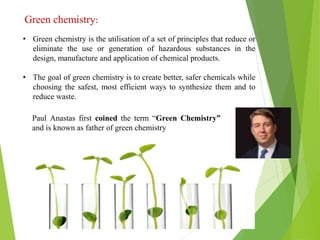
Paul Anastas first coined the term “Green Chemistry”
and is known as father of green chemistry
Need of Green Chemistry :
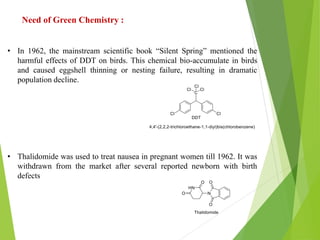
• In 1962, the mainstream scientific book “Silent Spring” mentioned the
harmful effects of DDT on birds. This chemical bio-accumulate in birds
and caused eggshell thinning or nesting failure, resulting in dramatic
population decline.
• Thalidomide was used to treat nausea in pregnant women till 1962. It was
withdrawn from the market after several reported newborn with birth
defects
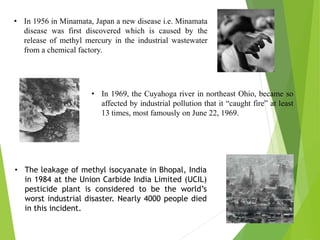
• In 1956 in Minamata, Japan a new disease i.e. Minamata
disease was first discovered which is caused by the
release of methyl mercury in the industrial wastewater
from a chemical factory.
• In 1969, the Cuyahoga river in northeast Ohio, became so
affected by industrial pollution that it “caught fire” at least
13 times, most famously on June 22, 1969.
• The leakage of methyl isocyanate in Bhopal, India
in 1984 at the Union Carbide India Limited (UCIL)
pesticide plant is considered to be the world’s
worst industrial disaster. Nearly 4000 people died
in this incident.
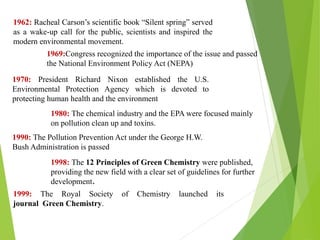
1962: Racheal Carson’s scientific book “Silent spring” served
as a wake-up call for the public, scientists and inspired the
modern environmental movement.
1969:Congress recognized the importance of the issue and passed
the National Environment Policy Act (NEPA)
1970: President Richard Nixon established the U.S.
Environmental Protection Agency which is devoted to
protecting human health and the environment
1980: The chemical industry and the EPA were focused mainly
on pollution clean up and toxins.
1990: The Pollution Prevention Act under the George H.W.
Bush Administration is passed
1998: The 12 Principles of Green Chemistry were published,
providing the new field with a clear set of guidelines for further
development.
1999: The Royal Society of Chemistry launched its
journal Green Chemistry.
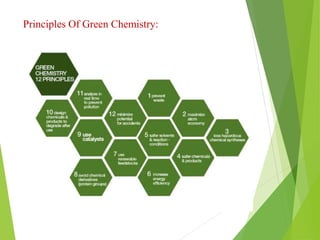
Principles Of Green Chemistry:
Safer solvents and Auxiliaries:
The use of auxiliary substances (e.g. solvents, drying agents should be
avoided, if possible. They may cause environment pollution or health
hazard.
What to do?
 Use of water as solvent:
• Water is one of the most abundant molecules on earth
• It is inexpensive, especially when compared to organic solvents
• nonflammable, and nontoxic
• Large heat capacity
 Use of liquid or supercritical fluid:
A supercritical fluid (SCF) is any substance at a temperature and pressure
above its critical point, where distinct liquid and gas phases do not exist. It can
effuse through solids like a gas, and dissolve materials like a liquid.
• Very high volatility so ideal for the extraction of thermally labile
compounds
• Complete separation of solvent from extract
• Lower production cost
• Easier generation
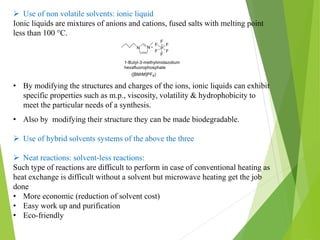
 Use of non volatile solvents: ionic liquid
Ionic liquids are mixtures of anions and cations, fused salts with melting point
less than 100 °C.
• By modifying the structures and charges of the ions, ionic liquids can exhibit
specific properties such as m.p., viscosity, volatility & hydrophobicity to
meet the particular needs of a synthesis.
• Also by modifying their structure they can be made biodegradable.
 Use of hybrid solvents systems of the above the three
 Neat reactions: solvent-less reactions:
Such type of reactions are difficult to perform in case of conventional heating as
heat exchange is difficult without a solvent but microwave heating get the job
done
• More economic (reduction of solvent cost)
• Easy work up and purification
• Eco-friendly
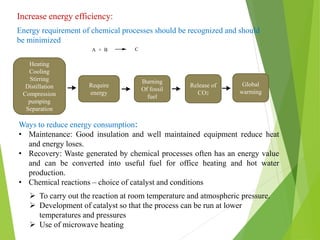
Increase energy efficiency:
Energy requirement of chemical processes should be recognized and should
be minimized
Ways to reduce energy consumption:
• Maintenance: Good insulation and well maintained equipment reduce heat
and energy loses.
• Recovery: Waste generated by chemical processes often has an energy value
and can be converted into useful fuel for office heating and hot water
production.
• Chemical reactions – choice of catalyst and conditions
 To carry out the reaction at room temperature and atmospheric pressure.
 Development of catalyst so that the process can be run at lower
temperatures and pressures
 Use of microwave heating
Heating
Cooling
Stirring
Distillation
Compression
pumping
Separation
Require
energy
Burning
Of fossil
fuel
Release of
CO2
Global
warming
Use of renewable feedstock:
A raw material or feedstock should be renewable rather than depleting
one, whenever technically and economically practical.
• synthesis of levulinic acid and HMF from bio waste: a
feedstock for the synthesis of various chemicals
• The fermentation of glucose in the presence of bacteria and propanoic
acid gives polyhydroxy alkanoates (PHAs). PHAs are similar to
polypropene or polyethene but biodegradable.
• Use of ethanol as biofuel
Use of renewable energy technologies that include solar energy,
wind power, hydropower, biomass energy and biofuels.
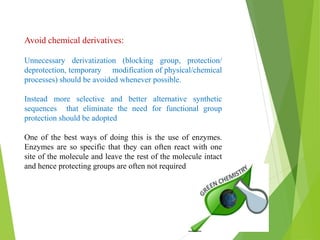
Avoid chemical derivatives:
Unnecessary derivatization (blocking group, protection/
deprotection, temporary modification of physical/chemical
processes) should be avoided whenever possible.
Instead more selective and better alternative synthetic
sequences that eliminate the need for functional group
protection should be adopted
One of the best ways of doing this is the use of enzymes.
Enzymes are so specific that they can often react with one
site of the molecule and leave the rest of the molecule intact
and hence protecting groups are often not required
THANK YOU…..
Let the green chemistry grow

Green chemistry

  • 1.
  • 2.
    Green chemistry: • Greenchemistry is the utilisation of a set of principles that reduce or eliminate the use or generation of hazardous substances in the design, manufacture and application of chemical products. • The goal of green chemistry is to create better, safer chemicals while choosing the safest, most efficient ways to synthesize them and to reduce waste. Paul Anastas first coined the term “Green Chemistry” and is known as father of green chemistry
  • 3.
    Need of GreenChemistry : • In 1962, the mainstream scientific book “Silent Spring” mentioned the harmful effects of DDT on birds. This chemical bio-accumulate in birds and caused eggshell thinning or nesting failure, resulting in dramatic population decline. • Thalidomide was used to treat nausea in pregnant women till 1962. It was withdrawn from the market after several reported newborn with birth defects
  • 4.
    • In 1956in Minamata, Japan a new disease i.e. Minamata disease was first discovered which is caused by the release of methyl mercury in the industrial wastewater from a chemical factory. • In 1969, the Cuyahoga river in northeast Ohio, became so affected by industrial pollution that it “caught fire” at least 13 times, most famously on June 22, 1969. • The leakage of methyl isocyanate in Bhopal, India in 1984 at the Union Carbide India Limited (UCIL) pesticide plant is considered to be the world’s worst industrial disaster. Nearly 4000 people died in this incident.
  • 5.
    1962: Racheal Carson’sscientific book “Silent spring” served as a wake-up call for the public, scientists and inspired the modern environmental movement. 1969:Congress recognized the importance of the issue and passed the National Environment Policy Act (NEPA) 1970: President Richard Nixon established the U.S. Environmental Protection Agency which is devoted to protecting human health and the environment 1980: The chemical industry and the EPA were focused mainly on pollution clean up and toxins. 1990: The Pollution Prevention Act under the George H.W. Bush Administration is passed 1998: The 12 Principles of Green Chemistry were published, providing the new field with a clear set of guidelines for further development. 1999: The Royal Society of Chemistry launched its journal Green Chemistry.
  • 6.
  • 7.
    Safer solvents andAuxiliaries: The use of auxiliary substances (e.g. solvents, drying agents should be avoided, if possible. They may cause environment pollution or health hazard. What to do?  Use of water as solvent: • Water is one of the most abundant molecules on earth • It is inexpensive, especially when compared to organic solvents • nonflammable, and nontoxic • Large heat capacity  Use of liquid or supercritical fluid: A supercritical fluid (SCF) is any substance at a temperature and pressure above its critical point, where distinct liquid and gas phases do not exist. It can effuse through solids like a gas, and dissolve materials like a liquid. • Very high volatility so ideal for the extraction of thermally labile compounds • Complete separation of solvent from extract • Lower production cost • Easier generation
  • 8.
     Use ofnon volatile solvents: ionic liquid Ionic liquids are mixtures of anions and cations, fused salts with melting point less than 100 °C. • By modifying the structures and charges of the ions, ionic liquids can exhibit specific properties such as m.p., viscosity, volatility & hydrophobicity to meet the particular needs of a synthesis. • Also by modifying their structure they can be made biodegradable.  Use of hybrid solvents systems of the above the three  Neat reactions: solvent-less reactions: Such type of reactions are difficult to perform in case of conventional heating as heat exchange is difficult without a solvent but microwave heating get the job done • More economic (reduction of solvent cost) • Easy work up and purification • Eco-friendly
  • 9.
    Increase energy efficiency: Energyrequirement of chemical processes should be recognized and should be minimized Ways to reduce energy consumption: • Maintenance: Good insulation and well maintained equipment reduce heat and energy loses. • Recovery: Waste generated by chemical processes often has an energy value and can be converted into useful fuel for office heating and hot water production. • Chemical reactions – choice of catalyst and conditions  To carry out the reaction at room temperature and atmospheric pressure.  Development of catalyst so that the process can be run at lower temperatures and pressures  Use of microwave heating Heating Cooling Stirring Distillation Compression pumping Separation Require energy Burning Of fossil fuel Release of CO2 Global warming
  • 10.
    Use of renewablefeedstock: A raw material or feedstock should be renewable rather than depleting one, whenever technically and economically practical. • synthesis of levulinic acid and HMF from bio waste: a feedstock for the synthesis of various chemicals • The fermentation of glucose in the presence of bacteria and propanoic acid gives polyhydroxy alkanoates (PHAs). PHAs are similar to polypropene or polyethene but biodegradable. • Use of ethanol as biofuel Use of renewable energy technologies that include solar energy, wind power, hydropower, biomass energy and biofuels.
  • 11.
    Avoid chemical derivatives: Unnecessaryderivatization (blocking group, protection/ deprotection, temporary modification of physical/chemical processes) should be avoided whenever possible. Instead more selective and better alternative synthetic sequences that eliminate the need for functional group protection should be adopted One of the best ways of doing this is the use of enzymes. Enzymes are so specific that they can often react with one site of the molecule and leave the rest of the molecule intact and hence protecting groups are often not required
  • 12.
    THANK YOU….. Let thegreen chemistry grow