GREEN CHEMISTRY
 Green chemistry, also called sustainable
chemistry, is a philosophy of chemical research
and engineering that encourages the design of
products and processes that minimize the use and
generation of hazardous substances.
 Green chemistry seeks to reduce and prevent
pollution at its source.
 The term green chemistry was coined by Paul
Anastas in 1991.
 Preventing pollution before it happens rather than
cleaning up the mess later.
 Saving companies money by using less energy and
fewer/safer chemicals, thus reducing the costs of
pollution control and waste disposal.
 Risk, in its most fundamental terms, is the
product of hazard and exposure:
 Risk = Hazard X Exposure
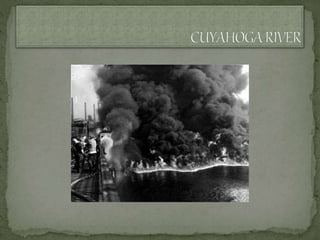
 The Cuyahoga River in Ohio became so polluted
with chemicals it caught fire.
 A plant accident in Bhopal, India, released methyl
isocyanate. Nearly 4000 people died.
 An accidental release of chemicals, including
dioxin, in Seveso, Italy, in 1976 resulted in death
of farm animals and long-term health problems
for many local residents.
Environmental disasters became important
rallying points for environmental issues
 Cuyahoga River- 1972 Clean Water Act
 Love Canal- 1980 Comprehensive
Environmental Response, Compensation &
Liability Act, better known as Superfund.
Emergency Planning & Community Right-to-
Know Act, requires that industries report
toxic releases.
MANY COUNTRIES HAVE ALREADY
ENACTED LAWS AND SIGNED
INTERNATIONAL TREATIES TO REDUCE
POLLUTION LEVELS, INCLUDING:
i. Montreal Protocol to Protect the Ozone
Layer
ii. Global Treaty on Persistent Organic
Pollutants
iii. Rio Declaration on Environment and
Development
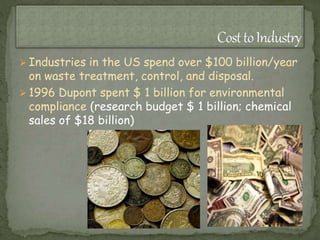
 Industries in the US spend over $100 billion/year
on waste treatment, control, and disposal.
 1996 Dupont spent $ 1 billion for environmental
compliance (research budget $ 1 billion; chemical
sales of $18 billion)
 Paul Anastas, then of the united states
Environmental Protection Agency, and John C.
Warner developed 12 principles of green chemistry,
which help to explain what the definition means in
practice. The principles cover such concepts as:
i. the design of processes to maximize the amount
of raw material that ends up in the product;
ii. the use of safe, environment-benign substances,
including solvents, whenever possible;
iii. the design of energy efficient processes;
iv. the best form of waste disposal: not to create it
in the first place.
The 12 principles are:
 It is better to prevent waste than to treat or clean up waste after it
is formed.
 Synthetic methods should be designed to maximize the incorporation
of all materials used in the process into the final product.
 Wherever practicable, synthetic methodologies should be designed to
use and generate substances that possess little or no toxicity to
human health and the environment.
 Chemical products should be designed to preserve efficacy of
function while reducing toxicity.
 The use of auxiliary substances (e.g. solvents, separation agents, etc.)
should be made unnecessary wherever possible and innocuous when
used.
 Energy requirements should be recognized for their environmental
and economic impacts and should be minimized. Synthetic methods
should be conducted at ambient temperature and pressure.
 A raw material or feedstock should be renewable rather
than depleting wherever technically and economically
practicable.
 Reduce derivatives - Unnecessary derivatization (blocking
group, protection/ deprotection, temporary modification)
should be avoided whenever possible.
 Catalytic reagents (as selective as possible) are superior to
stoichiometric reagents.
 Chemical products should be designed so that at the end of
their function they do not persist in the environment and
break down into innocuous degradation products.
 Analytical methodologies need to be further developed to
allow for real-time, in-process monitoring and control prior
to the formation of hazardous substances.
 Substances and the form of a substance used in a chemical
process should be chosen to minimize potential for
chemical accidents, including releases, explosions, and
fires.
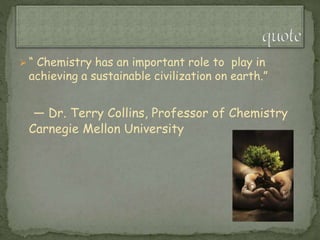
 “ Chemistry has an important role to play in
achieving a sustainable civilization on earth.”
— Dr. Terry Collins, Professor of Chemistry
Carnegie Mellon University
 Technologies used for production of needed goods
are not harmful to the environment or to human
health.
 Renewable resources (such as plant-based
substances or solar energy) are used rather than
those, like fossil fuels, that will eventually run
out.
 Manufacturing processes are either designed so
as not to produce waste products,
– OR –
 Waste products are recycled or biodegradable.
WHILE WE HAVE MADE SOME PROGRESS IN
ACHIEVING THESE GOALS, WE STILL
HAVE A LONG WAY TO GO…
Mountains of solid waste are piling up—
particularly in industrialized nations.
Air and water pollution continue to be
problems in many places.
BUT HOW CAN CHEMISTRY HELP US TO
ACHIEVE A SUSTAINABLE
CIVILIZATION?
The chemical industry produces many
products that improve our lives and upon which
we depend.
Antibiotics and other medicines
Fertilizers, pesticides
Plastics
Nylon, rayon, polyester, and
other synthetic materials
Gasoline and other fuels
Water purification
 “Most of the environmental problems of
past centuries and decades, such as the biological
contamination of drinking water, were solved only
when the methods of science in general—and
chemistry in particular—were applied to them.
The phenomenal rise in human life expectancy and
in the material quality of life that has come about
in recent decades is due in no small measure to
chemicals and chemistry.”
— Colin Baird, Environmental Chemistry.
• This was the U.S. environmental law
stating that the first choice for
preventing pollution is to design
industrial processes that do not lead to
waste production.
• This is the approach of green chemistry.
Making chemical products that do not
harm either our health or the
environment,[harmless chemicals]
Using industrial processes that reduce
or eliminate hazardous chemicals, and
Designing more efficient processes that
minimize the production of waste
materials.
New syntheses of Ibuprofen and Zoloft.
Integrated circuit production.
Removing Arsenic and Chromate from
pressure treated wood.
Many new pesticides.
New oxidants for bleaching paper and
disinfecting water.
Getting the lead out of automobile paints.
Recyclable carpeting.
Replacing VOCs and chlorinated solvents.
Biodegradable polymers from renewable
resources
Safer dry cleaning
 Initially gasoline and kerosene were used
 Chlorinated solvents are now used, such as
perc
 Supercritical/liquid carbon dioxide (CO2)
 Perchloroethylene (“perc”) is the
solvent most widely used in dry
cleaning clothing.
 Perc is suspected of causing cancer and
its disposal can contaminate ground
water.
 Liquid CO2 can be used as a safer solvent if a
wetting agent is used with it to dissolve
grease.
 This method is now being used commercially
by some dry cleaners
LEAD POLLUTION HAS BEEN DECREASED BY…
 Replacing lead in paint with safe
alternatives, and
 Replacing tetraethyl lead with less
toxic additives (e.g., “lead-free”
gasoline).
CHEMICAL FOAMS TO FIGHT FIRES
 Millions of tons of chemical fire-fighting foams
used worldwide have discharged toxic substances
into the environment, contaminating water
supplies and depleting the ozone layer.
 A new foam called Pyrocool FEF has now been
invented to put out fires effectively without
producing the toxic substances found in other
fire-fighting materials.
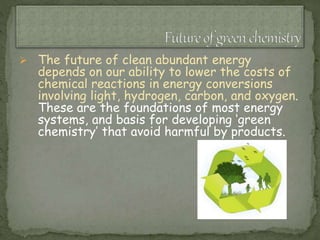
 The future of clean abundant energy
depends on our ability to lower the costs of
chemical reactions in energy conversions
involving light, hydrogen, carbon, and oxygen.
These are the foundations of most energy
systems, and basis for developing ‘green
chemistry’ that avoid harmful by products.
 This approach will be particularly important as we
strive to understand the fundamentals of
sustainability. While many of the current approaches
seek to address important elements of sustainability,
e.g., energy, or water, or food, it is important to
recognize that all of these elements of sustainability
are inextricably linked.
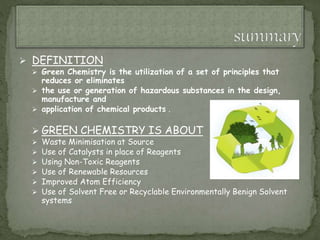
 DEFINITION
 Green Chemistry is the utilization of a set of principles that
reduces or eliminates
 the use or generation of hazardous substances in the design,
manufacture and
 application of chemical products .
 GREEN CHEMISTRY IS ABOUT
 Waste Minimisation at Source
 Use of Catalysts in place of Reagents
 Using Non-Toxic Reagents
 Use of Renewable Resources
 Improved Atom Efficiency
 Use of Solvent Free or Recyclable Environmentally Benign Solvent
systems
Green chemistry

Green chemistry

  • 1.
  • 2.
     Green chemistry,also called sustainable chemistry, is a philosophy of chemical research and engineering that encourages the design of products and processes that minimize the use and generation of hazardous substances.  Green chemistry seeks to reduce and prevent pollution at its source.  The term green chemistry was coined by Paul Anastas in 1991.
  • 3.
     Preventing pollutionbefore it happens rather than cleaning up the mess later.  Saving companies money by using less energy and fewer/safer chemicals, thus reducing the costs of pollution control and waste disposal.  Risk, in its most fundamental terms, is the product of hazard and exposure:  Risk = Hazard X Exposure
  • 5.
     The CuyahogaRiver in Ohio became so polluted with chemicals it caught fire.  A plant accident in Bhopal, India, released methyl isocyanate. Nearly 4000 people died.  An accidental release of chemicals, including dioxin, in Seveso, Italy, in 1976 resulted in death of farm animals and long-term health problems for many local residents.
  • 7.
    Environmental disasters becameimportant rallying points for environmental issues  Cuyahoga River- 1972 Clean Water Act  Love Canal- 1980 Comprehensive Environmental Response, Compensation & Liability Act, better known as Superfund. Emergency Planning & Community Right-to- Know Act, requires that industries report toxic releases.
  • 8.
    MANY COUNTRIES HAVEALREADY ENACTED LAWS AND SIGNED INTERNATIONAL TREATIES TO REDUCE POLLUTION LEVELS, INCLUDING: i. Montreal Protocol to Protect the Ozone Layer ii. Global Treaty on Persistent Organic Pollutants iii. Rio Declaration on Environment and Development
  • 9.
     Industries inthe US spend over $100 billion/year on waste treatment, control, and disposal.  1996 Dupont spent $ 1 billion for environmental compliance (research budget $ 1 billion; chemical sales of $18 billion)
  • 10.
     Paul Anastas,then of the united states Environmental Protection Agency, and John C. Warner developed 12 principles of green chemistry, which help to explain what the definition means in practice. The principles cover such concepts as: i. the design of processes to maximize the amount of raw material that ends up in the product; ii. the use of safe, environment-benign substances, including solvents, whenever possible; iii. the design of energy efficient processes; iv. the best form of waste disposal: not to create it in the first place.
  • 11.
    The 12 principlesare:  It is better to prevent waste than to treat or clean up waste after it is formed.  Synthetic methods should be designed to maximize the incorporation of all materials used in the process into the final product.  Wherever practicable, synthetic methodologies should be designed to use and generate substances that possess little or no toxicity to human health and the environment.  Chemical products should be designed to preserve efficacy of function while reducing toxicity.  The use of auxiliary substances (e.g. solvents, separation agents, etc.) should be made unnecessary wherever possible and innocuous when used.  Energy requirements should be recognized for their environmental and economic impacts and should be minimized. Synthetic methods should be conducted at ambient temperature and pressure.
  • 12.
     A rawmaterial or feedstock should be renewable rather than depleting wherever technically and economically practicable.  Reduce derivatives - Unnecessary derivatization (blocking group, protection/ deprotection, temporary modification) should be avoided whenever possible.  Catalytic reagents (as selective as possible) are superior to stoichiometric reagents.  Chemical products should be designed so that at the end of their function they do not persist in the environment and break down into innocuous degradation products.  Analytical methodologies need to be further developed to allow for real-time, in-process monitoring and control prior to the formation of hazardous substances.  Substances and the form of a substance used in a chemical process should be chosen to minimize potential for chemical accidents, including releases, explosions, and fires.
  • 13.
     “ Chemistryhas an important role to play in achieving a sustainable civilization on earth.” — Dr. Terry Collins, Professor of Chemistry Carnegie Mellon University
  • 14.
     Technologies usedfor production of needed goods are not harmful to the environment or to human health.  Renewable resources (such as plant-based substances or solar energy) are used rather than those, like fossil fuels, that will eventually run out.  Manufacturing processes are either designed so as not to produce waste products, – OR –  Waste products are recycled or biodegradable.
  • 15.
    WHILE WE HAVEMADE SOME PROGRESS IN ACHIEVING THESE GOALS, WE STILL HAVE A LONG WAY TO GO… Mountains of solid waste are piling up— particularly in industrialized nations. Air and water pollution continue to be problems in many places. BUT HOW CAN CHEMISTRY HELP US TO ACHIEVE A SUSTAINABLE CIVILIZATION?
  • 16.
    The chemical industryproduces many products that improve our lives and upon which we depend. Antibiotics and other medicines Fertilizers, pesticides Plastics Nylon, rayon, polyester, and other synthetic materials Gasoline and other fuels Water purification
  • 17.
     “Most ofthe environmental problems of past centuries and decades, such as the biological contamination of drinking water, were solved only when the methods of science in general—and chemistry in particular—were applied to them. The phenomenal rise in human life expectancy and in the material quality of life that has come about in recent decades is due in no small measure to chemicals and chemistry.” — Colin Baird, Environmental Chemistry.
  • 18.
    • This wasthe U.S. environmental law stating that the first choice for preventing pollution is to design industrial processes that do not lead to waste production. • This is the approach of green chemistry.
  • 19.
    Making chemical productsthat do not harm either our health or the environment,[harmless chemicals] Using industrial processes that reduce or eliminate hazardous chemicals, and Designing more efficient processes that minimize the production of waste materials.
  • 20.
    New syntheses ofIbuprofen and Zoloft. Integrated circuit production. Removing Arsenic and Chromate from pressure treated wood. Many new pesticides. New oxidants for bleaching paper and disinfecting water. Getting the lead out of automobile paints. Recyclable carpeting. Replacing VOCs and chlorinated solvents. Biodegradable polymers from renewable resources
  • 21.
    Safer dry cleaning Initially gasoline and kerosene were used  Chlorinated solvents are now used, such as perc  Supercritical/liquid carbon dioxide (CO2)  Perchloroethylene (“perc”) is the solvent most widely used in dry cleaning clothing.  Perc is suspected of causing cancer and its disposal can contaminate ground water.
  • 22.
     Liquid CO2can be used as a safer solvent if a wetting agent is used with it to dissolve grease.  This method is now being used commercially by some dry cleaners LEAD POLLUTION HAS BEEN DECREASED BY…  Replacing lead in paint with safe alternatives, and  Replacing tetraethyl lead with less toxic additives (e.g., “lead-free” gasoline).
  • 23.
    CHEMICAL FOAMS TOFIGHT FIRES  Millions of tons of chemical fire-fighting foams used worldwide have discharged toxic substances into the environment, contaminating water supplies and depleting the ozone layer.  A new foam called Pyrocool FEF has now been invented to put out fires effectively without producing the toxic substances found in other fire-fighting materials.
  • 24.
     The futureof clean abundant energy depends on our ability to lower the costs of chemical reactions in energy conversions involving light, hydrogen, carbon, and oxygen. These are the foundations of most energy systems, and basis for developing ‘green chemistry’ that avoid harmful by products.
  • 25.
     This approachwill be particularly important as we strive to understand the fundamentals of sustainability. While many of the current approaches seek to address important elements of sustainability, e.g., energy, or water, or food, it is important to recognize that all of these elements of sustainability are inextricably linked.
  • 26.
     DEFINITION  GreenChemistry is the utilization of a set of principles that reduces or eliminates  the use or generation of hazardous substances in the design, manufacture and  application of chemical products .  GREEN CHEMISTRY IS ABOUT  Waste Minimisation at Source  Use of Catalysts in place of Reagents  Using Non-Toxic Reagents  Use of Renewable Resources  Improved Atom Efficiency  Use of Solvent Free or Recyclable Environmentally Benign Solvent systems