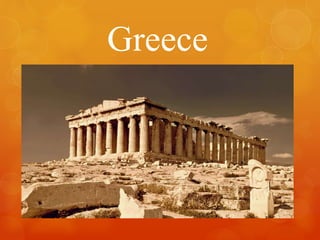
Greece
Location
Geographic Location
Greece is
located at the
southeast
end
of Europe
and it is the
southernmost
country of
the Balkan
Peninsula.
Background
Greece is a country approximately the same size as the
state of New York.. About one fifth of the land that
makes up Greece are islands. Almost the total population
is ethnic Greek.
Main products
Natural Products:
Olives & Olive Oil
Honey
Wine
Herbs
Nuts
Leather
population
The Demographics of Greece refer to the demography of the
population living on the Greek mainland. The population of
Greece was estimated as 10,815,197 in the 2011 census
Censo Population Cambiar
1971 8768372 -
1981 9739589 11,1%
1991 10259900 5,3%
2001 10964020 6,9%
2011 10815197 -0,98%
Age
Grou
p
1971 1981 1991 2001 2011
Popul
ation
%
Popul
ation
%
Popul
ation
%
Popul
ation
%
Popul
ation
%
0-14
2223
904
25.4
2307
297
23.7
1974
867
19.2
1664
085
15.2
1576
500
14.2
15-
64
5587
352
63.7
6192
751
63.6
6880
681
67.1
7468
395
68.1
7122
830
66.2
65 +
9571
16
10.9
1239
541
12.7
1404
352
13.7
1831
540
16.7
2108
807
19.6
Total 8768372 9739589 10259900 10964020 10815197
Age structure
This civilization developed over many centuries, so it must be divided into
several periods:
Archaic, classical period, which will its splendor and the Hellenistic.
Greek civilization
From ancient times to the present day, the
world has been divided into two main
groups: the Western and the distribution
follow oriental.Esta cultural criteria.
The history of Greece during his early
years, he developed one of the greatest
civilizations of antiquity, possessed of a
rich culture. Greece is often referred to as
the cradle of Western civilization and the
antique Athens was considered its center
Greek Education.
Education in Greece is
compulsory for all children
between 6-18 years, namely,
includes primary (dimotiko) and
lower secondary school
(gymnasium and lyceum). The
student life in the school,
however, can start from the age
of two years (preschool) in
institutions (private and public)
called “nipio and pronipio”
MAIN KNOWN FIGURES
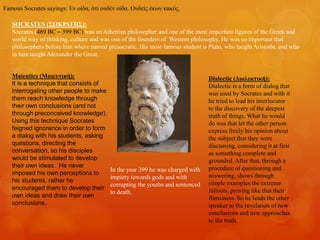
SOCRATES (ΣΩΚΡΑΤΗΣ):
Socrates (469 BC – 399 BC) was an Athenian philosopher and one of the most important figures of the Greek and
world way of thinking, culture and was one of the founders of Western philosophy. He was so important that
philosophers before him where named presocratic. His most famous student is Plato, who taught Aristotle, and who
in turn taught Alexander the Great.
Maieutics (Μαιευτική):
It is a technique that consists of
interrogating other people to make
them reach knowledge through
their own conclusions (and not
through preconceived knowledge).
Using this technique Socrates
feigned ignorance in order to form
a dialog with his students, asking
questions, directing the
conversation, so his disciples
would be stimulated to develop
their own ideas. He never
imposed his own perceptions to
his students, rather he
encouraged them to develop their
own ideas and draw their own
conclusions.
Dialectic (Διαλεκτική):
Dialectic is a form of dialog that
was used by Socrates and with it
he tried to lead his interlocutor
to the discovery of the deepest
truth of things. What he would
do was that let the other person
express freely his opinion about
the subject that they were
discussing, considering it at first
as something complete and
grounded. After that, through a
procedure of questioning and
answering, shows through
simple examples the extreme
fallouts, proving like that their
flimsiness. So he leads the other
speaker to the revelation of new
conclusions and new approaches
to the truth.
Famous Socrates sayings: Εν οίδα, ότι ουδέν οίδα. Ουδείς έκων κακός.
In the year 399 he was charged with
impiety towards gods and with
corrupting the youths and sentenced
to death.
PLATO (ΠΛΑΤΩΝ,
ΠΛΑΤΩΝΑΣ,
ΑΡΙΣΤΟΚΛΗΣ)
Plato (428/427 BC –
348/347 BC) was an
ancient Greek philosopher
from Athens, Socrates’s
most famous student and
Aristotle’s teacher and he
has exerted a huge
influence in the western
way of thinking.
ACADEMY (ΑΚΑΔΗΜΙΑ): He
founded the first and longest-
lasting university, the Academy,
which was named after
“Akadimos”, a mythical hero. From
there came thousands of other
Academies, we use words such as
“academic”. Typically it was a
religious establishment but
essentially, it was a famous
research and teaching center of
philosophy, politics, and sciences.
In the Academy they gave special
emphasis on mathematics and
geometry. Imagine that in its façade
it had written “Ουδείς
αγεωμέτρητος εισήτω“, “Nobody
who doesn’t about geometry should
enter”. He also accepted women
since he believed in equality of
both genders something very
radical and new at the time. After
his death in 347 BC his Academy
kept working until 529 when the
emperor Justinian I shut it down.
PLATO ON ON LEARNING AND
EDUCATION: Plato is considered the best
metaphysics (the branch of philosophy that
examines the nature of reality, including the
relationship between mind and matter,
substance and attribute, fact and value) analyst
of the soul. He believed that just like reality is
split in two parts, the world of ideas (the world
that is not known to us through senses) and the
sensible world (the one known through
senses), humans are also divided in two. One
part is the mortal body and the other is the
everlasting soul which comes from the world
of ideas. Because it comes from there, it
already knows the ideas. But when a person is
born forgets those ideas. Thus Plato says that
when someone learns something is not a new
knowledge but an old memory from when the
soul was in the world of ideas. So when the
opportunity and somebody who plays the role
of the teacher comes, like Socrates, that
memory may come back and Plato calls it
“ανάμνηση”, “memory”. In “the Republic” he
states that the most important role is played by
education since it depends on the performance
and inclination of each child on which of the
three social classes (producers, the ones that
produce and distribute all products, guardians,
soldiers protectors of the city and philosophers,
friends of wisdom who will of course be the
rulers). will be inducted and the Republic has
the responsibility of education.
HE WAS SUCH
A GREAT
TEACHER THAT
ALEXANDER
THE GREAT
WOULD SAY
“Στους γονείς
μου χρωστώ
το ζην,
στο δάσκαλό
μου το ευ
ζην.” “I OWE
MY PARENTS
MY LIFE BUT I
OWE MY
TEACHER THE
BEAUTY OF
LIFE.
ARISTOTLE(ΑΡΙΣΤΟΤΕΛΗΣ)
Aristotle (384 BC – 322 BC) was
a Greek philosopher and polymath, a student
of Plato and teacher of Alexander the Great. His
writings cover many
subjects,including physics, metaphysics, poetry, the
ater, music, logic, rhetoric, linguistics,
politics, government, ethics, biology, and zoology.
Together with Plato and Socrates (Plato's teacher),
Aristotle is one of the most important founding
figures in Western philosophy. Aristotle's writings
were the first to create a comprehensive system
of Western philosophy, encompassing ethics,
aesthetics, logic, science, politics, and metaphysics.
He’s considered to be the father of science and
logic because he created scientific thought. First of
all he was the first one to classify all knowledge
that was available back then. He also created logic
because he wanted to put all the classifications and
everything else in order. Even when we have
conversations we’re based on terms of logic that
Aristotle first expressed. Aristotle supported that in
order to live a human life we have to develop our
logic. Many of the constitutional laws are based on
his ideas about ethics.
He founded his school, the Lyceum (Λύκειο),
which is one of the most important schools of
antiquity.
ALEXANDER THE GREAT (ΜΕΓΑΣ ΑΛΕΞΑΝΔΡΟΣ)
Alexander the III of Macedon (20/21 July
356 in Pella – 10/11 June 323 BC
Babylon), most commonly known as
Alexander the Great, King of Macedonia,
Greece, conqueror of Asia, of North Africa,
and Pharaoh of Egypt. He was such a
bright and courageous military leader that
he never lost a battle even when he was
always outnumbered. His military tactics
are still used in warfare. Plus he always
fought in the first line. He was Aristotle’s
most famous student and also the most
powerful man in the world at that time. He
spread Greek culture all over but he also
accepted Persian and other cultures
marrying a Persian woman (Roxanne)
himself and having a son with her, to
combine Hellenistic and Persian way of
living. So he was something like the
Barack Obama of his time.
Contribution to education

Greece

  • 1.
  • 2.
    Location Geographic Location Greece is locatedat the southeast end of Europe and it is the southernmost country of the Balkan Peninsula.
  • 3.
    Background Greece is acountry approximately the same size as the state of New York.. About one fifth of the land that makes up Greece are islands. Almost the total population is ethnic Greek.
  • 4.
    Main products Natural Products: Olives& Olive Oil Honey Wine Herbs Nuts Leather
  • 5.
    population The Demographics ofGreece refer to the demography of the population living on the Greek mainland. The population of Greece was estimated as 10,815,197 in the 2011 census Censo Population Cambiar 1971 8768372 - 1981 9739589 11,1% 1991 10259900 5,3% 2001 10964020 6,9% 2011 10815197 -0,98% Age Grou p 1971 1981 1991 2001 2011 Popul ation % Popul ation % Popul ation % Popul ation % Popul ation % 0-14 2223 904 25.4 2307 297 23.7 1974 867 19.2 1664 085 15.2 1576 500 14.2 15- 64 5587 352 63.7 6192 751 63.6 6880 681 67.1 7468 395 68.1 7122 830 66.2 65 + 9571 16 10.9 1239 541 12.7 1404 352 13.7 1831 540 16.7 2108 807 19.6 Total 8768372 9739589 10259900 10964020 10815197 Age structure
  • 6.
    This civilization developedover many centuries, so it must be divided into several periods: Archaic, classical period, which will its splendor and the Hellenistic. Greek civilization From ancient times to the present day, the world has been divided into two main groups: the Western and the distribution follow oriental.Esta cultural criteria. The history of Greece during his early years, he developed one of the greatest civilizations of antiquity, possessed of a rich culture. Greece is often referred to as the cradle of Western civilization and the antique Athens was considered its center
  • 7.
    Greek Education. Education inGreece is compulsory for all children between 6-18 years, namely, includes primary (dimotiko) and lower secondary school (gymnasium and lyceum). The student life in the school, however, can start from the age of two years (preschool) in institutions (private and public) called “nipio and pronipio”
  • 8.
  • 9.
    SOCRATES (ΣΩΚΡΑΤΗΣ): Socrates (469BC – 399 BC) was an Athenian philosopher and one of the most important figures of the Greek and world way of thinking, culture and was one of the founders of Western philosophy. He was so important that philosophers before him where named presocratic. His most famous student is Plato, who taught Aristotle, and who in turn taught Alexander the Great. Maieutics (Μαιευτική): It is a technique that consists of interrogating other people to make them reach knowledge through their own conclusions (and not through preconceived knowledge). Using this technique Socrates feigned ignorance in order to form a dialog with his students, asking questions, directing the conversation, so his disciples would be stimulated to develop their own ideas. He never imposed his own perceptions to his students, rather he encouraged them to develop their own ideas and draw their own conclusions. Dialectic (Διαλεκτική): Dialectic is a form of dialog that was used by Socrates and with it he tried to lead his interlocutor to the discovery of the deepest truth of things. What he would do was that let the other person express freely his opinion about the subject that they were discussing, considering it at first as something complete and grounded. After that, through a procedure of questioning and answering, shows through simple examples the extreme fallouts, proving like that their flimsiness. So he leads the other speaker to the revelation of new conclusions and new approaches to the truth. Famous Socrates sayings: Εν οίδα, ότι ουδέν οίδα. Ουδείς έκων κακός. In the year 399 he was charged with impiety towards gods and with corrupting the youths and sentenced to death.
  • 10.
    PLATO (ΠΛΑΤΩΝ, ΠΛΑΤΩΝΑΣ, ΑΡΙΣΤΟΚΛΗΣ) Plato (428/427BC – 348/347 BC) was an ancient Greek philosopher from Athens, Socrates’s most famous student and Aristotle’s teacher and he has exerted a huge influence in the western way of thinking. ACADEMY (ΑΚΑΔΗΜΙΑ): He founded the first and longest- lasting university, the Academy, which was named after “Akadimos”, a mythical hero. From there came thousands of other Academies, we use words such as “academic”. Typically it was a religious establishment but essentially, it was a famous research and teaching center of philosophy, politics, and sciences. In the Academy they gave special emphasis on mathematics and geometry. Imagine that in its façade it had written “Ουδείς αγεωμέτρητος εισήτω“, “Nobody who doesn’t about geometry should enter”. He also accepted women since he believed in equality of both genders something very radical and new at the time. After his death in 347 BC his Academy kept working until 529 when the emperor Justinian I shut it down. PLATO ON ON LEARNING AND EDUCATION: Plato is considered the best metaphysics (the branch of philosophy that examines the nature of reality, including the relationship between mind and matter, substance and attribute, fact and value) analyst of the soul. He believed that just like reality is split in two parts, the world of ideas (the world that is not known to us through senses) and the sensible world (the one known through senses), humans are also divided in two. One part is the mortal body and the other is the everlasting soul which comes from the world of ideas. Because it comes from there, it already knows the ideas. But when a person is born forgets those ideas. Thus Plato says that when someone learns something is not a new knowledge but an old memory from when the soul was in the world of ideas. So when the opportunity and somebody who plays the role of the teacher comes, like Socrates, that memory may come back and Plato calls it “ανάμνηση”, “memory”. In “the Republic” he states that the most important role is played by education since it depends on the performance and inclination of each child on which of the three social classes (producers, the ones that produce and distribute all products, guardians, soldiers protectors of the city and philosophers, friends of wisdom who will of course be the rulers). will be inducted and the Republic has the responsibility of education.
  • 11.
    HE WAS SUCH AGREAT TEACHER THAT ALEXANDER THE GREAT WOULD SAY “Στους γονείς μου χρωστώ το ζην, στο δάσκαλό μου το ευ ζην.” “I OWE MY PARENTS MY LIFE BUT I OWE MY TEACHER THE BEAUTY OF LIFE. ARISTOTLE(ΑΡΙΣΤΟΤΕΛΗΣ) Aristotle (384 BC – 322 BC) was a Greek philosopher and polymath, a student of Plato and teacher of Alexander the Great. His writings cover many subjects,including physics, metaphysics, poetry, the ater, music, logic, rhetoric, linguistics, politics, government, ethics, biology, and zoology. Together with Plato and Socrates (Plato's teacher), Aristotle is one of the most important founding figures in Western philosophy. Aristotle's writings were the first to create a comprehensive system of Western philosophy, encompassing ethics, aesthetics, logic, science, politics, and metaphysics. He’s considered to be the father of science and logic because he created scientific thought. First of all he was the first one to classify all knowledge that was available back then. He also created logic because he wanted to put all the classifications and everything else in order. Even when we have conversations we’re based on terms of logic that Aristotle first expressed. Aristotle supported that in order to live a human life we have to develop our logic. Many of the constitutional laws are based on his ideas about ethics. He founded his school, the Lyceum (Λύκειο), which is one of the most important schools of antiquity.
  • 12.
    ALEXANDER THE GREAT(ΜΕΓΑΣ ΑΛΕΞΑΝΔΡΟΣ) Alexander the III of Macedon (20/21 July 356 in Pella – 10/11 June 323 BC Babylon), most commonly known as Alexander the Great, King of Macedonia, Greece, conqueror of Asia, of North Africa, and Pharaoh of Egypt. He was such a bright and courageous military leader that he never lost a battle even when he was always outnumbered. His military tactics are still used in warfare. Plus he always fought in the first line. He was Aristotle’s most famous student and also the most powerful man in the world at that time. He spread Greek culture all over but he also accepted Persian and other cultures marrying a Persian woman (Roxanne) himself and having a son with her, to combine Hellenistic and Persian way of living. So he was something like the Barack Obama of his time.
  • 13.