Greedy Algorithms
Md. Shafiuzzaman
Lecturer, Dept. of CSE, JUST
Greedy algorithms
• A greedy algorithm always makes the choice that
looks best at the moment
– The hope: a locally optimal choice will lead to a
globally optimal solution
– For some problems, it works
• Greedy algorithms tend to be easier to code
An Activity Selection Problem
(Conference Scheduling Problem)
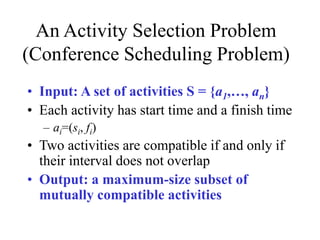
• Input: A set of activities S = {a1,…, an}
• Each activity has start time and a finish time
– ai=(si, fi)
• Two activities are compatible if and only if
their interval does not overlap
• Output: a maximum-size subset of
mutually compatible activities
The Activity Selection Problem
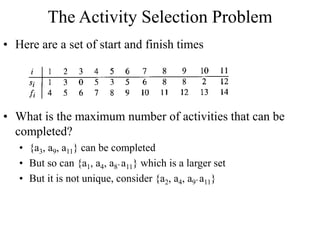
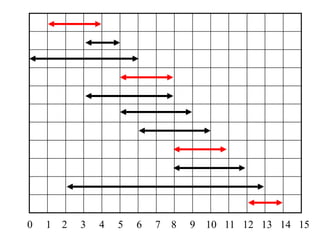
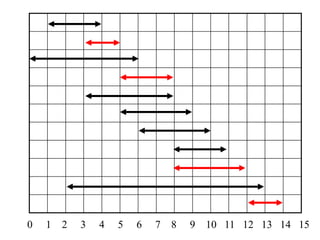
• Here are a set of start and finish times
• What is the maximum number of activities that can be
completed?
• {a3, a9, a11} can be completed
• But so can {a1, a4, a8’ a11} which is a larger set
• But it is not unique, consider {a2, a4, a9’ a11}
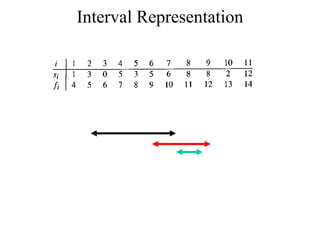
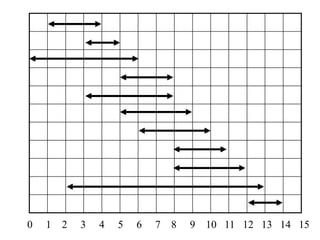
Interval Representation
0 1 2 3 4 5 6 7 8 9 10 11 12 13 14 15
0 1 2 3 4 5 6 7 8 9 10 11 12 13 14 15
0 1 2 3 4 5 6 7 8 9 10 11 12 13 14 15
0 1 2 3 4 5 6 7 8 9 10 11 12 13 14 15
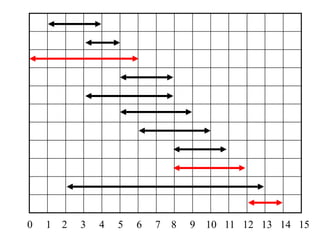
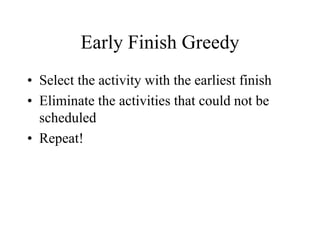
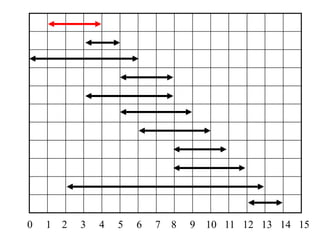
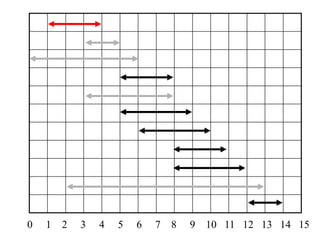
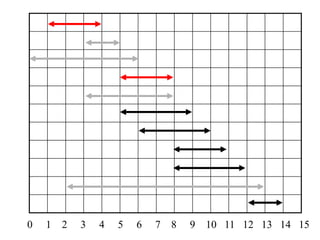
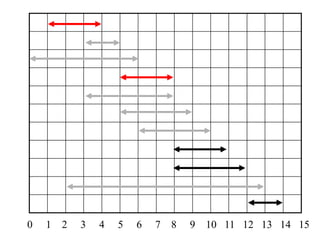
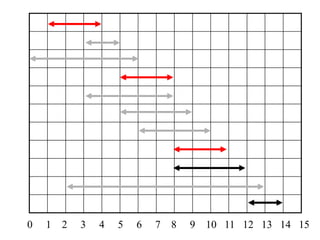
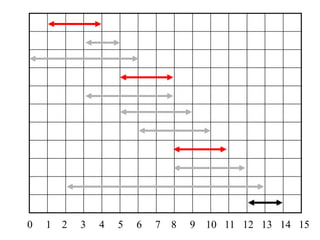
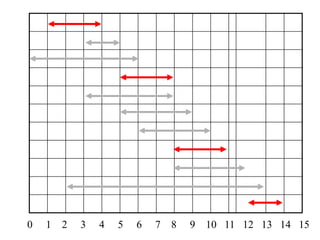
Early Finish Greedy
• Select the activity with the earliest finish
• Eliminate the activities that could not be
scheduled
• Repeat!
0 1 2 3 4 5 6 7 8 9 10 11 12 13 14 15
0 1 2 3 4 5 6 7 8 9 10 11 12 13 14 15
0 1 2 3 4 5 6 7 8 9 10 11 12 13 14 15
0 1 2 3 4 5 6 7 8 9 10 11 12 13 14 15
0 1 2 3 4 5 6 7 8 9 10 11 12 13 14 15
0 1 2 3 4 5 6 7 8 9 10 11 12 13 14 15
0 1 2 3 4 5 6 7 8 9 10 11 12 13 14 15
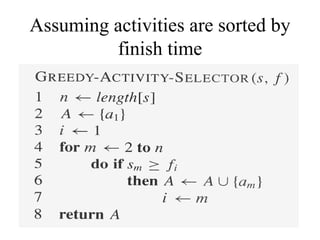
Assuming activities are sorted by
finish time
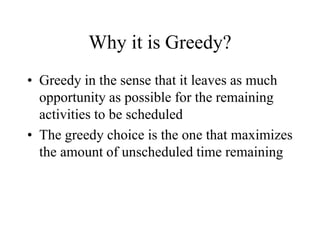
Why it is Greedy?
• Greedy in the sense that it leaves as much
opportunity as possible for the remaining
activities to be scheduled
• The greedy choice is the one that maximizes
the amount of unscheduled time remaining
Elements of Greedy Strategy
• An greedy algorithm makes a sequence of choices, each
of the choices that seems best at the moment is chosen
– NOT always produce an optimal solution
• Two ingredients that are exhibited by most problems
that lend themselves to a greedy strategy
– Greedy-choice property
– Optimal substructure
Greedy-Choice Property
• A globally optimal solution can be arrived at by
making a locally optimal (greedy) choice
– Make whatever choice seems best at the moment and
then solve the sub-problem arising after the choice is
made
– The choice made by a greedy algorithm may depend on
choices so far, but it cannot depend on any future
choices or on the solutions to sub-problems
• Of course, we must prove that a greedy choice at
each step yields a globally optimal solution
Optimal Substructures
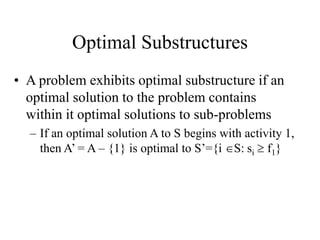
• A problem exhibits optimal substructure if an
optimal solution to the problem contains
within it optimal solutions to sub-problems
– If an optimal solution A to S begins with activity 1,
then A’ = A – {1} is optimal to S’={i S: si  f1}
Knapsack Problem
• One wants to pack n items in a luggage
– The ith item is worth vi dollars and weighs wi pounds
– Maximize the value but cannot exceed W pounds
– vi , wi, W are integers
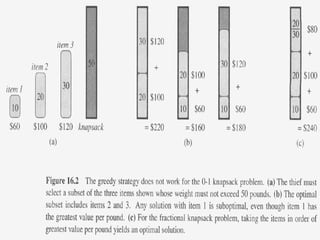
• 0-1 knapsack  each item is taken or not taken
• Fractional knapsack  fractions of items can be taken
• Both exhibit the optimal-substructure property
– 0-1: If item j is removed from an optimal packing, the remaining
packing is an optimal packing with weight at most W-wj
– Fractional: If w pounds of item j is removed from an optimal
packing, the remaining packing is an optimal packing with weight
at most W-w that can be taken from other n-1 items plus wj – w of
item j
Greedy Algorithm for Fractional
Knapsack problem
• Fractional knapsack can be solvable by the greedy
strategy
– Compute the value per pound vi/wi for each item
– Obeying a greedy strategy, take as much as possible of the
item with the greatest value per pound.
– If the supply of that item is exhausted and there is still more
room, take as much as possible of the item with the next value
per pound, and so forth until there is no more room
– O(n lg n) (we need to sort the items by value per pound)
– Greedy Algorithm?
– Correctness?
O-1 knapsack is harder!
• 0-1 knapsack cannot be solved by the greedy
strategy
– Unable to fill the knapsack to capacity, and the empty
space lowers the effective value per pound of the
packing
– We must compare the solution to the sub-problem in
which the item is included with the solution to the sub-
problem in which the item is excluded before we can
make the choice
– Dynamic Programming
Greedy algorithms

Greedy algorithms

  • 1.
  • 2.
    Greedy algorithms • Agreedy algorithm always makes the choice that looks best at the moment – The hope: a locally optimal choice will lead to a globally optimal solution – For some problems, it works • Greedy algorithms tend to be easier to code
  • 3.
    An Activity SelectionProblem (Conference Scheduling Problem) • Input: A set of activities S = {a1,…, an} • Each activity has start time and a finish time – ai=(si, fi) • Two activities are compatible if and only if their interval does not overlap • Output: a maximum-size subset of mutually compatible activities
  • 4.
    The Activity SelectionProblem • Here are a set of start and finish times • What is the maximum number of activities that can be completed? • {a3, a9, a11} can be completed • But so can {a1, a4, a8’ a11} which is a larger set • But it is not unique, consider {a2, a4, a9’ a11}
  • 5.
  • 6.
    0 1 23 4 5 6 7 8 9 10 11 12 13 14 15
  • 7.
    0 1 23 4 5 6 7 8 9 10 11 12 13 14 15
  • 8.
    0 1 23 4 5 6 7 8 9 10 11 12 13 14 15
  • 9.
    0 1 23 4 5 6 7 8 9 10 11 12 13 14 15
  • 10.
    Early Finish Greedy •Select the activity with the earliest finish • Eliminate the activities that could not be scheduled • Repeat!
  • 11.
    0 1 23 4 5 6 7 8 9 10 11 12 13 14 15
  • 12.
    0 1 23 4 5 6 7 8 9 10 11 12 13 14 15
  • 13.
    0 1 23 4 5 6 7 8 9 10 11 12 13 14 15
  • 14.
    0 1 23 4 5 6 7 8 9 10 11 12 13 14 15
  • 15.
    0 1 23 4 5 6 7 8 9 10 11 12 13 14 15
  • 16.
    0 1 23 4 5 6 7 8 9 10 11 12 13 14 15
  • 17.
    0 1 23 4 5 6 7 8 9 10 11 12 13 14 15
  • 18.
    Assuming activities aresorted by finish time
  • 19.
    Why it isGreedy? • Greedy in the sense that it leaves as much opportunity as possible for the remaining activities to be scheduled • The greedy choice is the one that maximizes the amount of unscheduled time remaining
  • 20.
    Elements of GreedyStrategy • An greedy algorithm makes a sequence of choices, each of the choices that seems best at the moment is chosen – NOT always produce an optimal solution • Two ingredients that are exhibited by most problems that lend themselves to a greedy strategy – Greedy-choice property – Optimal substructure
  • 21.
    Greedy-Choice Property • Aglobally optimal solution can be arrived at by making a locally optimal (greedy) choice – Make whatever choice seems best at the moment and then solve the sub-problem arising after the choice is made – The choice made by a greedy algorithm may depend on choices so far, but it cannot depend on any future choices or on the solutions to sub-problems • Of course, we must prove that a greedy choice at each step yields a globally optimal solution
  • 22.
    Optimal Substructures • Aproblem exhibits optimal substructure if an optimal solution to the problem contains within it optimal solutions to sub-problems – If an optimal solution A to S begins with activity 1, then A’ = A – {1} is optimal to S’={i S: si  f1}
  • 23.
    Knapsack Problem • Onewants to pack n items in a luggage – The ith item is worth vi dollars and weighs wi pounds – Maximize the value but cannot exceed W pounds – vi , wi, W are integers • 0-1 knapsack  each item is taken or not taken • Fractional knapsack  fractions of items can be taken • Both exhibit the optimal-substructure property – 0-1: If item j is removed from an optimal packing, the remaining packing is an optimal packing with weight at most W-wj – Fractional: If w pounds of item j is removed from an optimal packing, the remaining packing is an optimal packing with weight at most W-w that can be taken from other n-1 items plus wj – w of item j
  • 24.
    Greedy Algorithm forFractional Knapsack problem • Fractional knapsack can be solvable by the greedy strategy – Compute the value per pound vi/wi for each item – Obeying a greedy strategy, take as much as possible of the item with the greatest value per pound. – If the supply of that item is exhausted and there is still more room, take as much as possible of the item with the next value per pound, and so forth until there is no more room – O(n lg n) (we need to sort the items by value per pound) – Greedy Algorithm? – Correctness?
  • 25.
    O-1 knapsack isharder! • 0-1 knapsack cannot be solved by the greedy strategy – Unable to fill the knapsack to capacity, and the empty space lowers the effective value per pound of the packing – We must compare the solution to the sub-problem in which the item is included with the solution to the sub- problem in which the item is excluded before we can make the choice – Dynamic Programming