Greedy Approach
Brute Force
• Brute force approach is a straight forward approach to solve
the problem. It is directly based on the problem statement
and the concepts
• It is one of the simplest algorithm design to implement and
covers a wide range of problems under its gamut.
• Closest pair problem
• NC2 pairs.
• For each pair find distance.
• Find the minimum
• No clever thinking, no strategy
Optimization Problem
• Some problems may have more than one solutions.
• An optimization algorithm is a procedure which is executed
iteratively by comparing various solutions till an optimum or a
satisfactory solution is found.
• A optimization algorithm procedure aims to find the optimal
solutions to the objective function or functions under
constraints.
Greedy Method
• Greedy design technique is primarily used in Optimization
problems
• The Greedy approach helps in constructing a solution for a
problem through a sequence of steps where each step is
considered to be a partial solution.
• A greedy algorithm always makes the choice that looks best
at the moment.
• The choice of each step in a greedy approach is done based
on the following
– It must be feasible
– It must be locally optimal
– It must be irrevocable
Greedy Method
• In the greedy approach each step chosen has to satisfy the
constraints given in the problem.
• Each step is chosen such that it is the best alternative among
all feasible choices that are available.
• The choice of a step once made cannot be changed in
subsequent steps.
• This heuristic strategy does not always produce an global
optimal solution.
An activity-selection problem
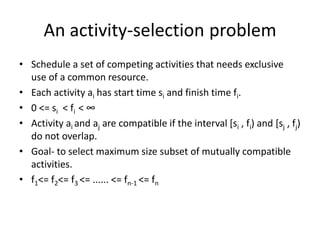
• Schedule a set of competing activities that needs exclusive
use of a common resource.
• Each activity ai has start time si and finish time fi.
• 0 <= si < fi < ∞
• Activity ai and aj are compatible if the interval [si , fi) and [sj , fj)
do not overlap.
• Goal- to select maximum size subset of mutually compatible
activities.
• f1<= f2<= f3 <= ...... <= fn-1 <= fn
Making the greedy choice
• If we make the greedy choice, we have only one remaining
subproblem to solve: finding activities that start after a1
finishes.
Recursive Algorithm
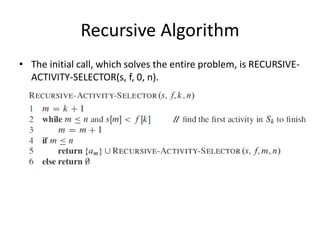
• The initial call, which solves the entire problem, is RECURSIVE-
ACTIVITY-SELECTOR(s, f, 0, n).
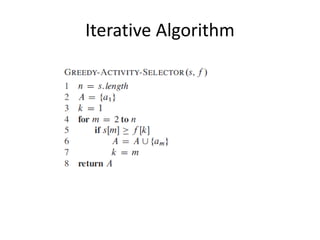
Iterative Algorithm
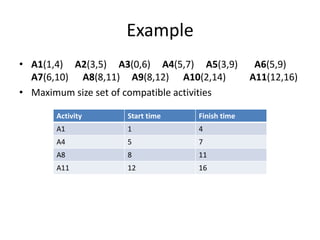
Example
• A1(1,4) A2(3,5) A3(0,6) A4(5,7) A5(3,9) A6(5,9)
A7(6,10) A8(8,11) A9(8,12) A10(2,14) A11(12,16)
• Maximum size set of compatible activities
Activity Start time Finish time
A1 1 4
A4 5 7
A8 8 11
A11 12 16
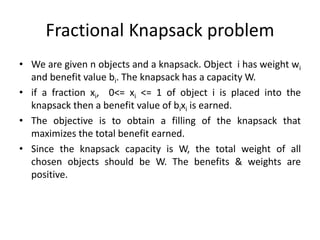
Fractional Knapsack problem
• We are given n objects and a knapsack. Object i has weight wi
and benefit value bi. The knapsack has a capacity W.
• if a fraction xi, 0<= xi <= 1 of object i is placed into the
knapsack then a benefit value of bixi is earned.
• The objective is to obtain a filling of the knapsack that
maximizes the total benefit earned.
• Since the knapsack capacity is W, the total weight of all
chosen objects should be W. The benefits & weights are
positive.
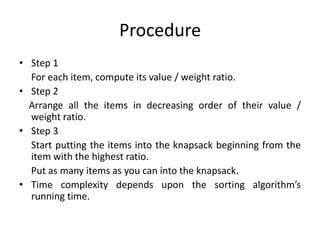
Procedure
• Step 1
For each item, compute its value / weight ratio.
• Step 2
Arrange all the items in decreasing order of their value /
weight ratio.
• Step 3
Start putting the items into the knapsack beginning from the
item with the highest ratio.
Put as many items as you can into the knapsack.
• Time complexity depends upon the sorting algorithm’s
running time.
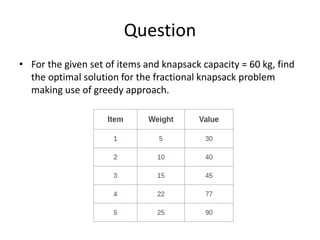
Question
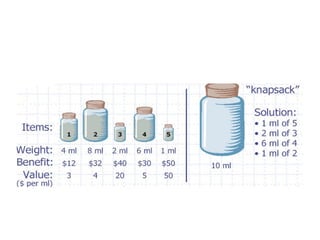
• For the given set of items and knapsack capacity = 60 kg, find
the optimal solution for the fractional knapsack problem
making use of greedy approach.
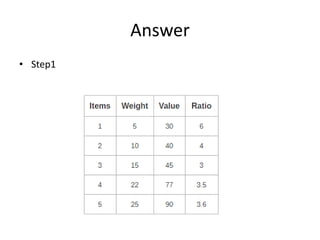
Answer
• Step1
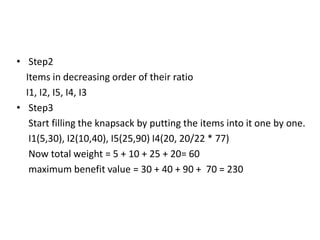
• Step2
Items in decreasing order of their ratio
I1, I2, I5, I4, I3
• Step3
Start filling the knapsack by putting the items into it one by one.
I1(5,30), I2(10,40), I5(25,90) I4(20, 20/22 * 77)
Now total weight = 5 + 10 + 25 + 20= 60
maximum benefit value = 30 + 40 + 90 + 70 = 230
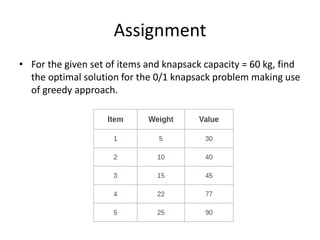
Assignment
• For the given set of items and knapsack capacity = 60 kg, find
the optimal solution for the 0/1 knapsack problem making use
of greedy approach.

greedy method.pdf

  • 1.
  • 2.
    Brute Force • Bruteforce approach is a straight forward approach to solve the problem. It is directly based on the problem statement and the concepts • It is one of the simplest algorithm design to implement and covers a wide range of problems under its gamut. • Closest pair problem • NC2 pairs. • For each pair find distance. • Find the minimum • No clever thinking, no strategy
  • 3.
    Optimization Problem • Someproblems may have more than one solutions. • An optimization algorithm is a procedure which is executed iteratively by comparing various solutions till an optimum or a satisfactory solution is found. • A optimization algorithm procedure aims to find the optimal solutions to the objective function or functions under constraints.
  • 4.
    Greedy Method • Greedydesign technique is primarily used in Optimization problems • The Greedy approach helps in constructing a solution for a problem through a sequence of steps where each step is considered to be a partial solution. • A greedy algorithm always makes the choice that looks best at the moment. • The choice of each step in a greedy approach is done based on the following – It must be feasible – It must be locally optimal – It must be irrevocable
  • 5.
    Greedy Method • Inthe greedy approach each step chosen has to satisfy the constraints given in the problem. • Each step is chosen such that it is the best alternative among all feasible choices that are available. • The choice of a step once made cannot be changed in subsequent steps. • This heuristic strategy does not always produce an global optimal solution.
  • 6.
    An activity-selection problem •Schedule a set of competing activities that needs exclusive use of a common resource. • Each activity ai has start time si and finish time fi. • 0 <= si < fi < ∞ • Activity ai and aj are compatible if the interval [si , fi) and [sj , fj) do not overlap. • Goal- to select maximum size subset of mutually compatible activities. • f1<= f2<= f3 <= ...... <= fn-1 <= fn
  • 7.
    Making the greedychoice • If we make the greedy choice, we have only one remaining subproblem to solve: finding activities that start after a1 finishes.
  • 8.
    Recursive Algorithm • Theinitial call, which solves the entire problem, is RECURSIVE- ACTIVITY-SELECTOR(s, f, 0, n).
  • 9.
  • 10.
    Example • A1(1,4) A2(3,5)A3(0,6) A4(5,7) A5(3,9) A6(5,9) A7(6,10) A8(8,11) A9(8,12) A10(2,14) A11(12,16) • Maximum size set of compatible activities Activity Start time Finish time A1 1 4 A4 5 7 A8 8 11 A11 12 16
  • 11.
    Fractional Knapsack problem •We are given n objects and a knapsack. Object i has weight wi and benefit value bi. The knapsack has a capacity W. • if a fraction xi, 0<= xi <= 1 of object i is placed into the knapsack then a benefit value of bixi is earned. • The objective is to obtain a filling of the knapsack that maximizes the total benefit earned. • Since the knapsack capacity is W, the total weight of all chosen objects should be W. The benefits & weights are positive.
  • 13.
    Procedure • Step 1 Foreach item, compute its value / weight ratio. • Step 2 Arrange all the items in decreasing order of their value / weight ratio. • Step 3 Start putting the items into the knapsack beginning from the item with the highest ratio. Put as many items as you can into the knapsack. • Time complexity depends upon the sorting algorithm’s running time.
  • 14.
    Question • For thegiven set of items and knapsack capacity = 60 kg, find the optimal solution for the fractional knapsack problem making use of greedy approach.
  • 15.
  • 16.
    • Step2 Items indecreasing order of their ratio I1, I2, I5, I4, I3 • Step3 Start filling the knapsack by putting the items into it one by one. I1(5,30), I2(10,40), I5(25,90) I4(20, 20/22 * 77) Now total weight = 5 + 10 + 25 + 20= 60 maximum benefit value = 30 + 40 + 90 + 70 = 230
  • 17.
    Assignment • For thegiven set of items and knapsack capacity = 60 kg, find the optimal solution for the 0/1 knapsack problem making use of greedy approach.