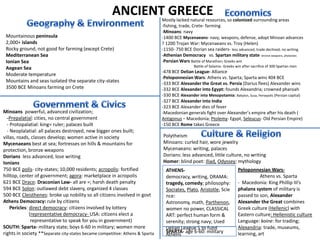
ANCIENT GREECE
Mountainous peninsula
2,000+ islands
Rocky ground, not good for farming (except Crete)
Mediterranean Sea
Ionian Sea
Aegean Sea
Moderate temperature
Mountains and seas isolated the separate city-states
3500 BCE Minoans farming on Crete
Mostly lacked natural resources, so colonized surrounding areas
-fishing, trade, Crete- farming
-Minoans: navy
-1400 BCE Mycenaeans- navy, weapons, defense, adopt Minoan advances
? 1200 Trojan War: Mycenaeans vs. Troy (Helen)
-1150- 750 BCE Dorian sea raiders- less advanced, trade declined; no writing
-Athenian Democracy vs. Spartan military state- bronze weapons, phalanxes
-Persian Wars Battle of Marathon; Greeks win
Battle of Salamis- Greeks win after sacrifice of 300 Spartan men
-478 BCE Delian League- Alliance
-Peloponnesian Wars: Athens vs. Sparta; Sparta wins 404 BCE
-333 BCE Alexander the Great vs. Persia (Darius flees) Alexander wins
-332 BCE Alexander into Egypt: founds Alexandria; crowned pharoah
-330 BCE Alexander into Mesopotamia: Babylon, Susa, Persepolis (Persian capital)
-327 BCE Alexander into India
-323 BCE Alexander dies of fever
-Macedonian generals fight over Alexander’s empire after his death (
Antigonus – Macedonia; Ptolemy- Egypt, Seleucus- Old Persian Empire)
-150 BCE Rome takes Greece
Minoans powerful, advanced civilization;
-Prepalatial: cities, no central government
- Protopalatial: king= ruler; palaces built
- Neoplalatial: all palaces destroyed, new bigger ones built;
villas, roads, classes develop; women active in society
Mycenaeans best at sea; fortresses on hills & mountains for
protection, bronze weapons
Dorians less advanced, lose writing
Ionians
750 BCE polis- city-states; 10,000 residents; acropolis: fortified
hilltop, center of government; agora: marketplace in acropolis
621 BCE Draco: Draconian Law- all are =; harsh death penalty
594 BCE Solon: outlawed debt slavery, organized 4 classes
500 BCE Cleisthenes: broke up nobility so all citizens involved in govt
Athens Democracy: rule by citizens
Pericles: direct democracy: citizens involved by lottery
(representative democracy- USA: citizens elect a
representative to speak for you in government)
SOUTH: Sparta- military state; boys 6-60 in military; women more
rights in society **Separate city-states became competitive: Athens & Sparta
Polytheism
Minoans: curled hair, wore jewelry
Mycenaeans: writing, palaces
Dorians: less advanced, little culture, no writing
Homer: blind poet: Iliad, Odyssey; mythology
ATHENS-
democracy, writing, DRAMA:
tragedy, comedy; philosophy:
Socrates, Plato, Aristotle, Scie
nce:
Astronomy, math, Parthenon,
women no power, CLASSICAL
ART: perfect human form &
serenity; strong navy; Used
Delian League $ to fund
Athens
SPARTA- age 6-60: military
Peloponnesian Wars-
Athens vs. Sparta
- Macedonia: King Phillip III’s
phalanx system of military is
passed to son, Alexander
Alexander the Great combines
Greek culture (Hellenic) with
Eastern culture: Hellenistic culture
Language: koine: for trading;
Alexandria: trade, museums,
learning, art

Ancient greece study guide

  • 1.
    ANCIENT GREECE Mountainous peninsula 2,000+islands Rocky ground, not good for farming (except Crete) Mediterranean Sea Ionian Sea Aegean Sea Moderate temperature Mountains and seas isolated the separate city-states 3500 BCE Minoans farming on Crete Mostly lacked natural resources, so colonized surrounding areas -fishing, trade, Crete- farming -Minoans: navy -1400 BCE Mycenaeans- navy, weapons, defense, adopt Minoan advances ? 1200 Trojan War: Mycenaeans vs. Troy (Helen) -1150- 750 BCE Dorian sea raiders- less advanced, trade declined; no writing -Athenian Democracy vs. Spartan military state- bronze weapons, phalanxes -Persian Wars Battle of Marathon; Greeks win Battle of Salamis- Greeks win after sacrifice of 300 Spartan men -478 BCE Delian League- Alliance -Peloponnesian Wars: Athens vs. Sparta; Sparta wins 404 BCE -333 BCE Alexander the Great vs. Persia (Darius flees) Alexander wins -332 BCE Alexander into Egypt: founds Alexandria; crowned pharoah -330 BCE Alexander into Mesopotamia: Babylon, Susa, Persepolis (Persian capital) -327 BCE Alexander into India -323 BCE Alexander dies of fever -Macedonian generals fight over Alexander’s empire after his death ( Antigonus – Macedonia; Ptolemy- Egypt, Seleucus- Old Persian Empire) -150 BCE Rome takes Greece Minoans powerful, advanced civilization; -Prepalatial: cities, no central government - Protopalatial: king= ruler; palaces built - Neoplalatial: all palaces destroyed, new bigger ones built; villas, roads, classes develop; women active in society Mycenaeans best at sea; fortresses on hills & mountains for protection, bronze weapons Dorians less advanced, lose writing Ionians 750 BCE polis- city-states; 10,000 residents; acropolis: fortified hilltop, center of government; agora: marketplace in acropolis 621 BCE Draco: Draconian Law- all are =; harsh death penalty 594 BCE Solon: outlawed debt slavery, organized 4 classes 500 BCE Cleisthenes: broke up nobility so all citizens involved in govt Athens Democracy: rule by citizens Pericles: direct democracy: citizens involved by lottery (representative democracy- USA: citizens elect a representative to speak for you in government) SOUTH: Sparta- military state; boys 6-60 in military; women more rights in society **Separate city-states became competitive: Athens & Sparta Polytheism Minoans: curled hair, wore jewelry Mycenaeans: writing, palaces Dorians: less advanced, little culture, no writing Homer: blind poet: Iliad, Odyssey; mythology ATHENS- democracy, writing, DRAMA: tragedy, comedy; philosophy: Socrates, Plato, Aristotle, Scie nce: Astronomy, math, Parthenon, women no power, CLASSICAL ART: perfect human form & serenity; strong navy; Used Delian League $ to fund Athens SPARTA- age 6-60: military Peloponnesian Wars- Athens vs. Sparta - Macedonia: King Phillip III’s phalanx system of military is passed to son, Alexander Alexander the Great combines Greek culture (Hellenic) with Eastern culture: Hellenistic culture Language: koine: for trading; Alexandria: trade, museums, learning, art