1©MapR Technologies - Confidential
Large-scale Single-pass k-Means
Clustering at Scale
Ted Dunning
2©MapR Technologies - Confidential
Large-scale Single-pass k-Means
Clustering
3©MapR Technologies - Confidential
Large-scale k-Means Clustering
4©MapR Technologies - Confidential
Goals
 Cluster very large data sets
 Facilitate large nearest neighbor search
 Allow very large number of clusters
 Achieve good quality
– low average distance to nearest centroid on held-out data
 Based on Mahout Math
 Runs on Hadoop (really MapR) cluster
 FAST – cluster tens of millions in minutes
5©MapR Technologies - Confidential
Non-goals
 Use map-reduce (but it is there)
 Minimize the number of clusters
 Support metrics other than L2
6©MapR Technologies - Confidential
Anti-goals
 Multiple passes over original data
 Scale as O(k n)
7©MapR Technologies - Confidential
Why?
8©MapR Technologies - Confidential
K-nearest Neighbor with
Super Fast k-means
9©MapR Technologies - Confidential
What’s that?
 Find the k nearest training examples
 Use the average value of the target variable from them
 This is easy … but hard
– easy because it is so conceptually simple and you don’t have knobs to turn
or models to build
– hard because of the stunning amount of math
– also hard because we need top 50,000 results
 Initial prototype was massively too slow
– 3K queries x 200K examples takes hours
– needed 20M x 25M in the same time
10©MapR Technologies - Confidential
How We Did It
 2 week hackathon with 6 developers from customer bank
 Agile-ish development
 To avoid IP issues
– all code is Apache Licensed (no ownership question)
– all data is synthetic (no question of private data)
– all development done on individual machines, hosting on Github
– open is easier than closed (in this case)
 Goal is new open technology to facilitate new closed solutions
 Ambitious goal of ~ 1,000,000 x speedup
11©MapR Technologies - Confidential
How We Did It
 2 week hackathon with 6 developers from customer bank
 Agile-ish development
 To avoid IP issues
– all code is Apache Licensed (no ownership question)
– all data is synthetic (no question of private data)
– all development done on individual machines, hosting on Github
– open is easier than closed (in this case)
 Goal is new open technology to facilitate new closed solutions
 Ambitious goal of ~ 1,000,000 x speedup
– well, really only 100-1000x after basic hygiene
12©MapR Technologies - Confidential
What We Did
 Mechanism for extending Mahout Vectors
– DelegatingVector, WeightedVector, Centroid
 Shared memory matrix
– FileBasedMatrix uses mmap to share very large dense matrices
 Searcher interface
– ProjectionSearch, KmeansSearch, LshSearch, Brute
 Super-fast clustering
– Kmeans, StreamingKmeans
13©MapR Technologies - Confidential
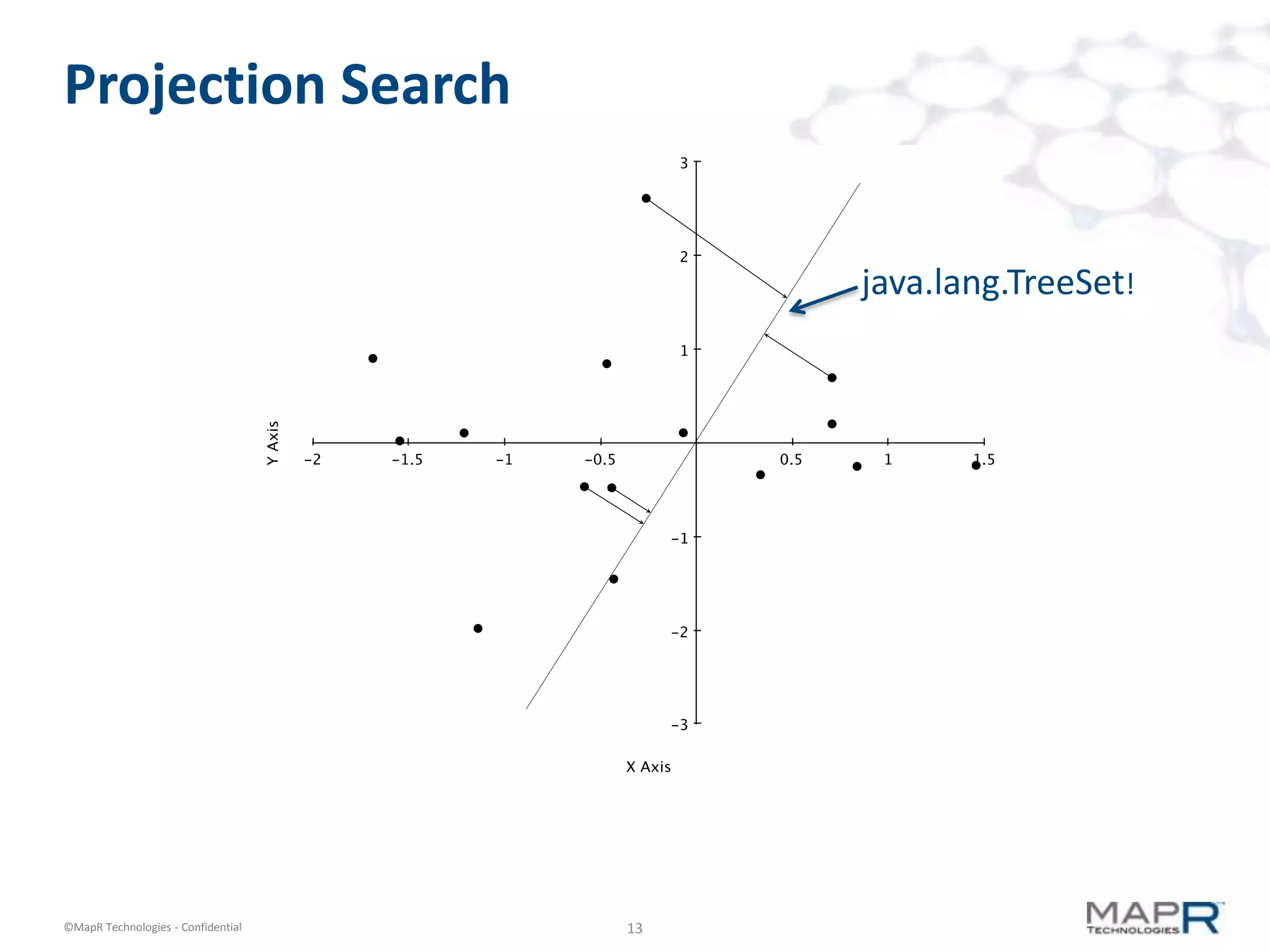
Projection Search
java.lang.TreeSet!
14©MapR Technologies - Confidential
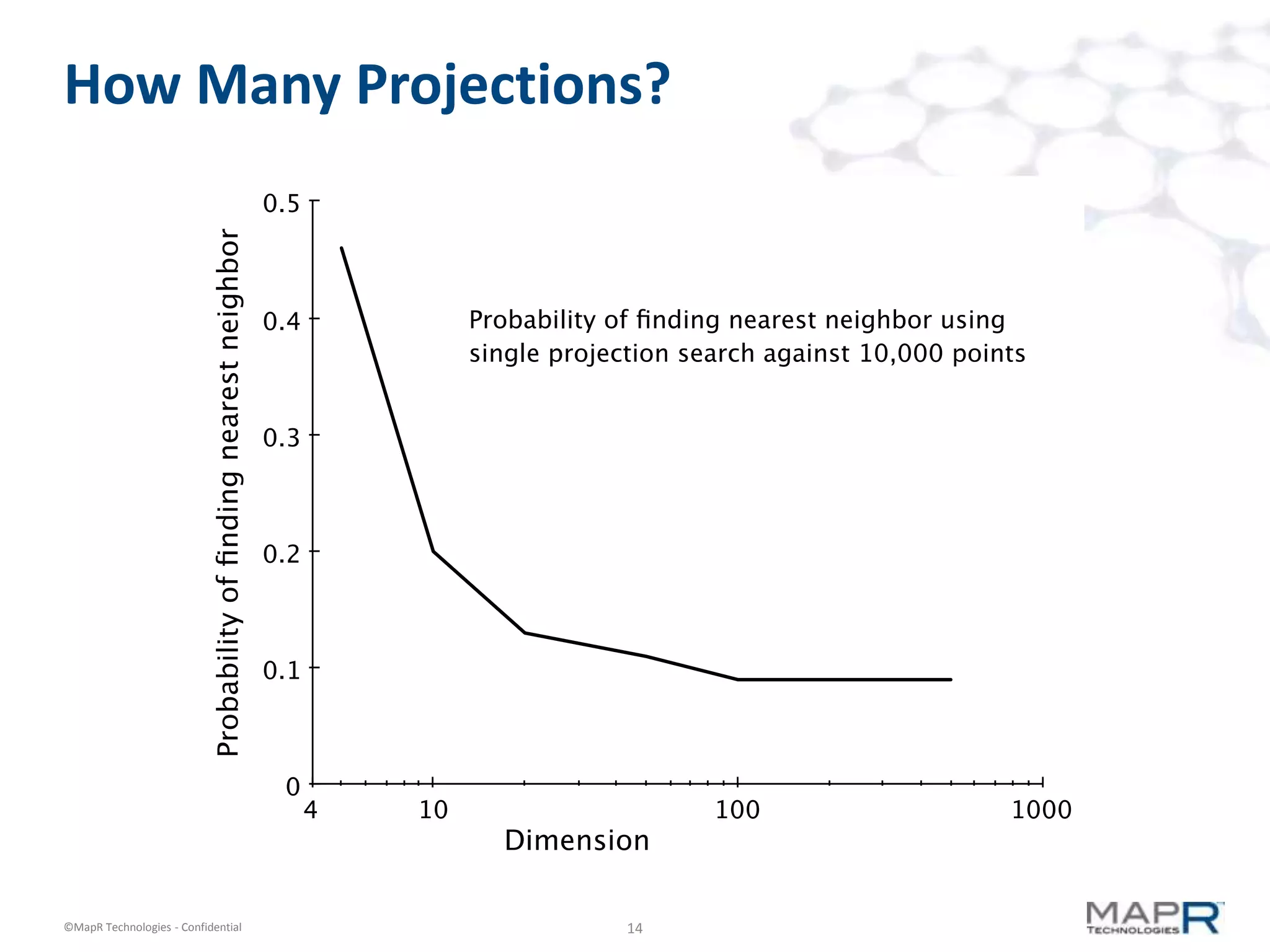
How Many Projections?
15©MapR Technologies - Confidential
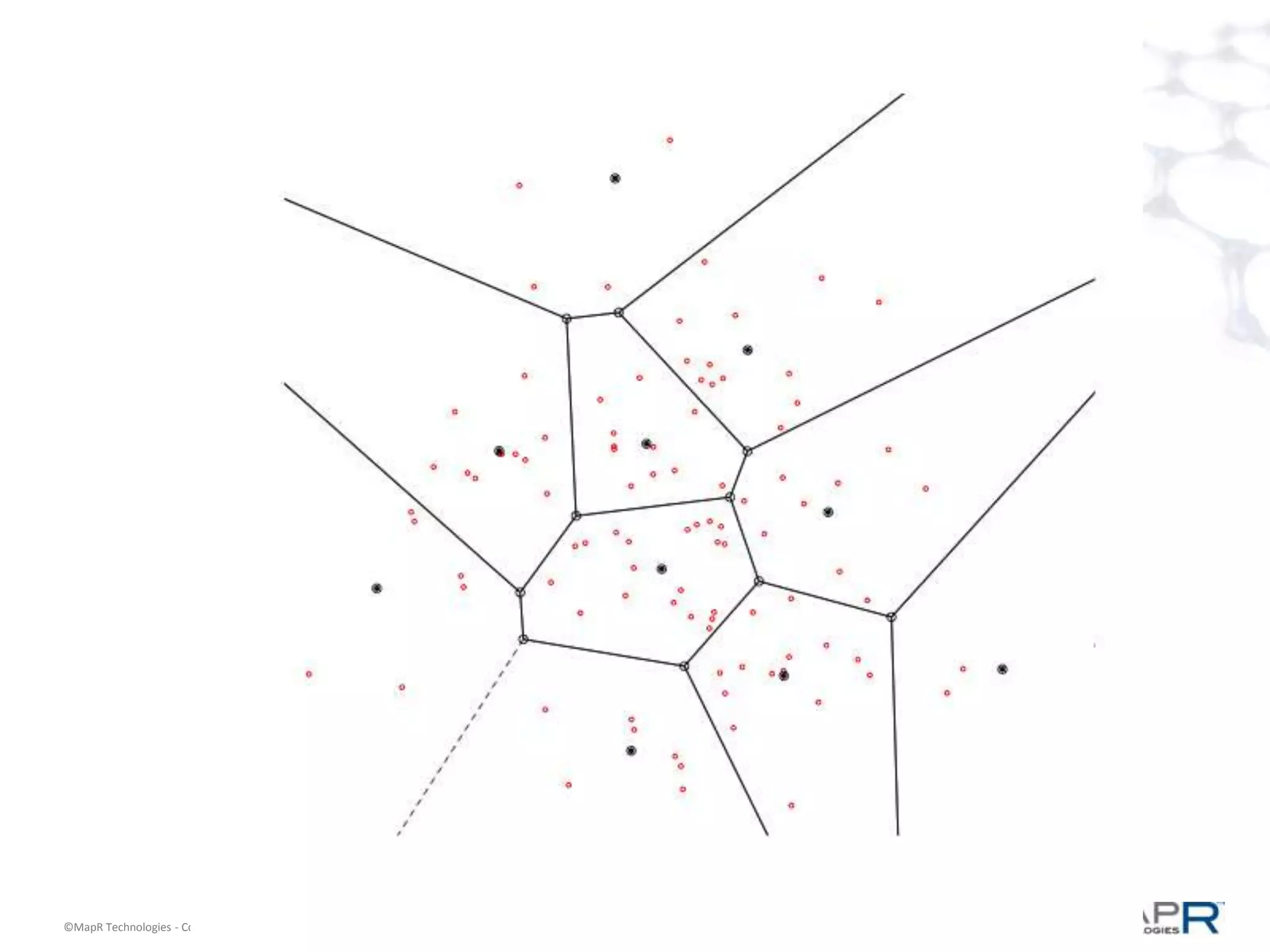
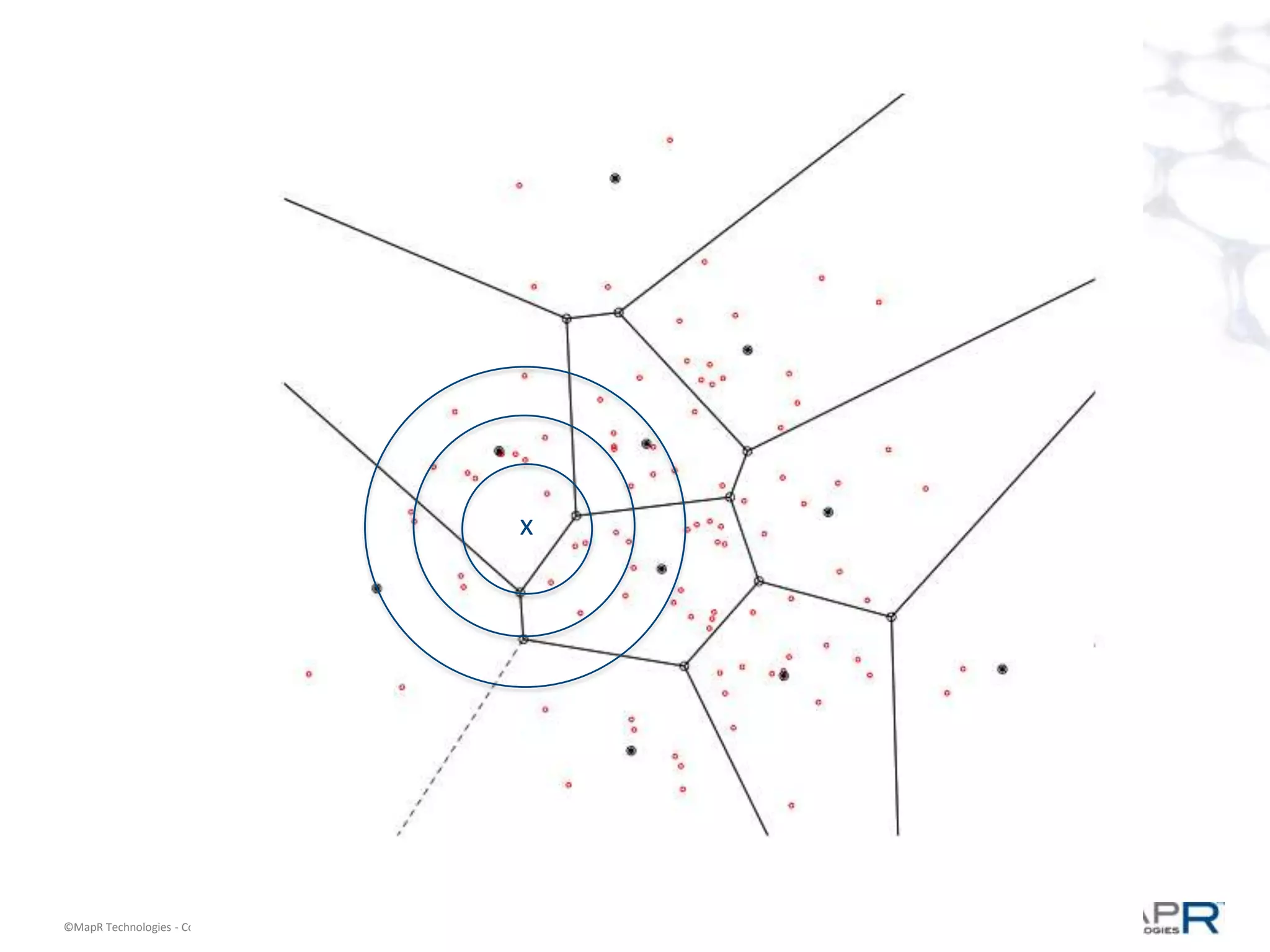
K-means Search
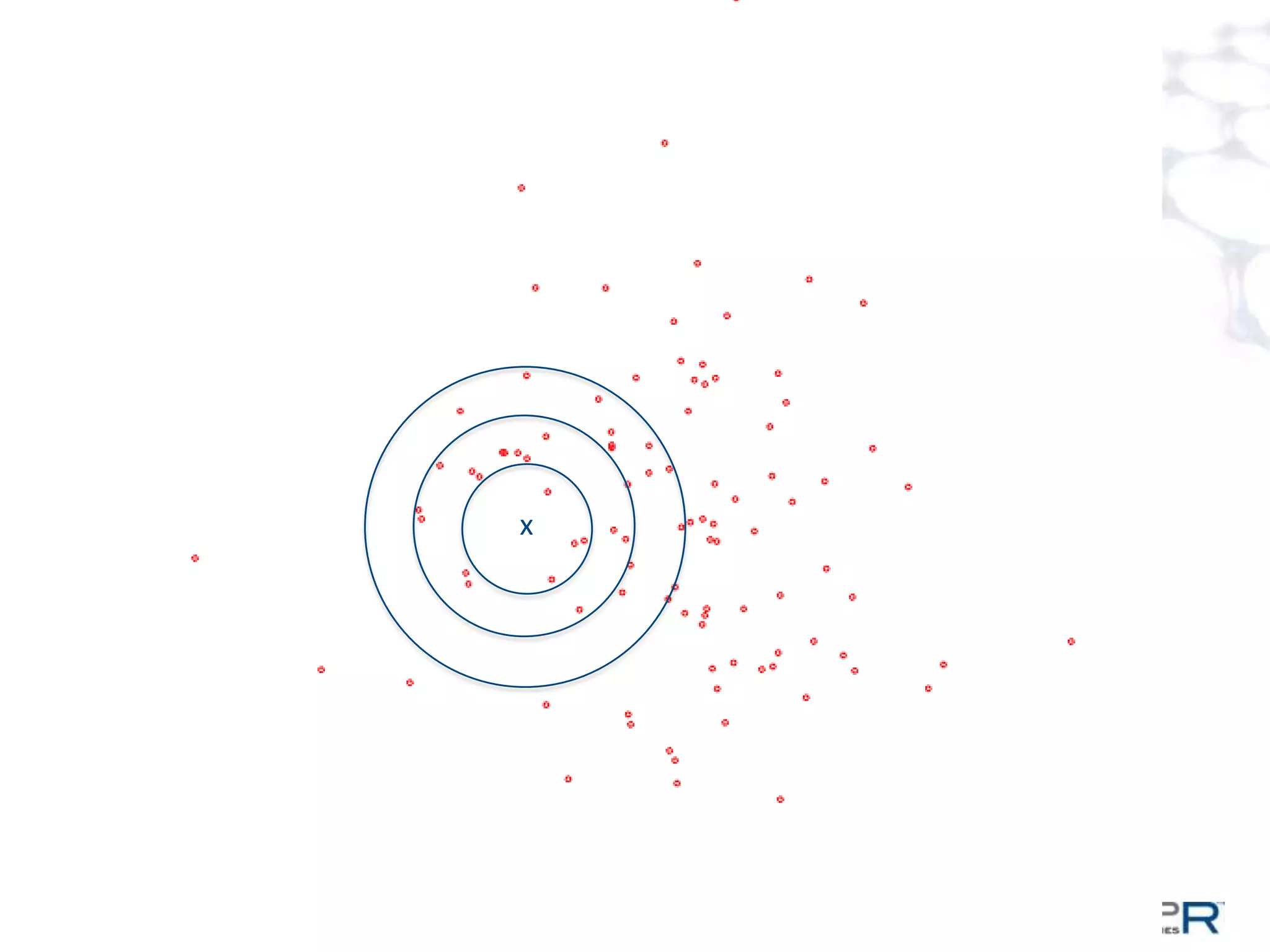
 Simple Idea
– pre-cluster the data
– to find the nearest points, search the nearest clusters
 Recursive application
– to search a cluster, use a Searcher!
16©MapR Technologies - Confidential
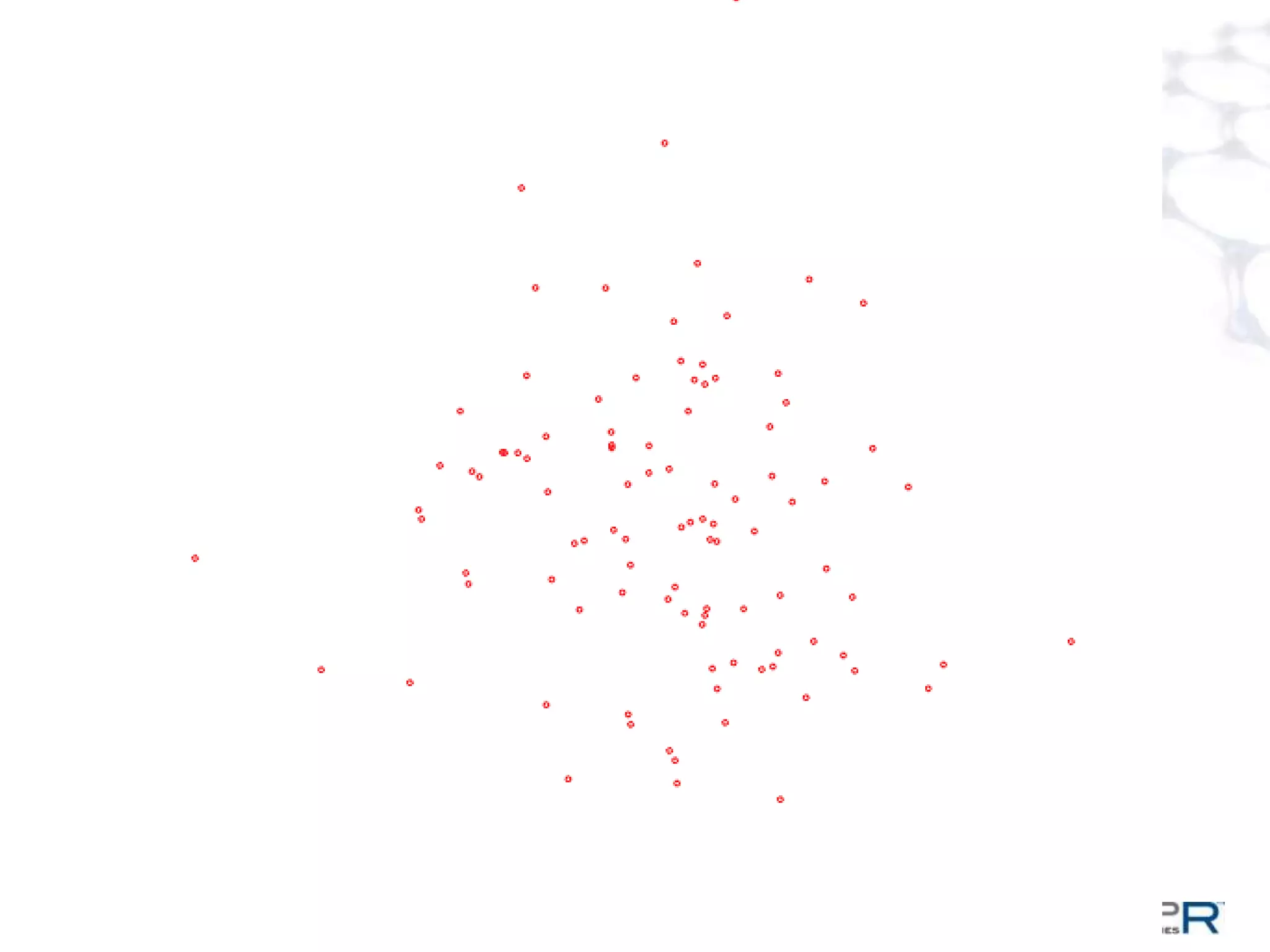
17©MapR Technologies - Confidential
x
18©MapR Technologies - Confidential
19©MapR Technologies - Confidential
20©MapR Technologies - Confidential
x
21©MapR Technologies - Confidential
But This Requires k-means!
 Need a new k-means algorithm to get speed
– Hadoop is very slow at iterative map-reduce
– Maybe Pregel clones like Giraph would be better
– Or maybe not
 Streaming k-means is
– One pass (through the original data)
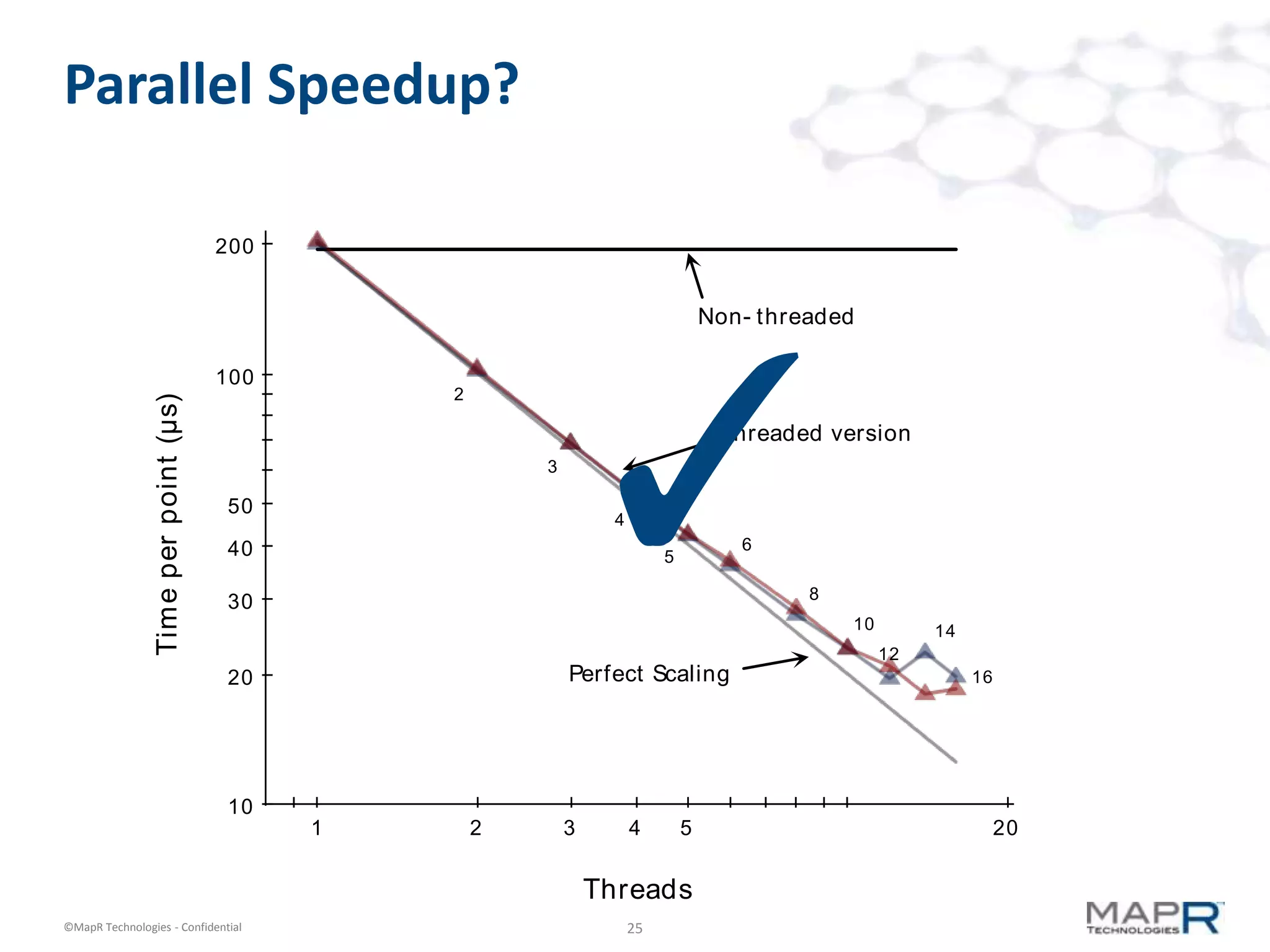
– Very fast (20 us per data point with threads)
– Very parallelizable
22©MapR Technologies - Confidential
Basic Method
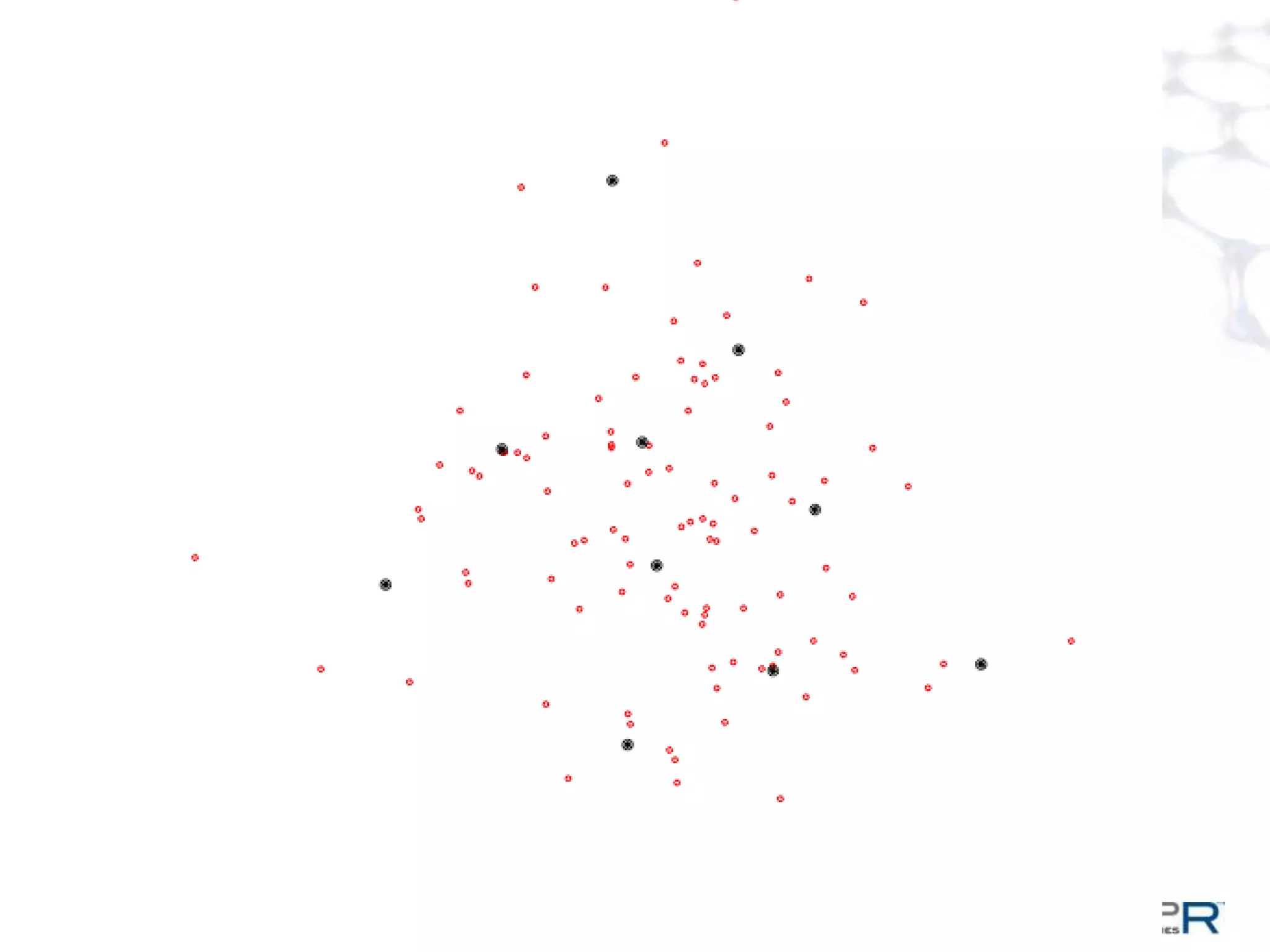
 Use a single pass of k-means with very many clusters
– output is a bad-ish clustering but a good surrogate
 Use weighted centroids from step 1 to do in-memory clustering
– output is a good clustering with fewer clusters
23©MapR Technologies - Confidential
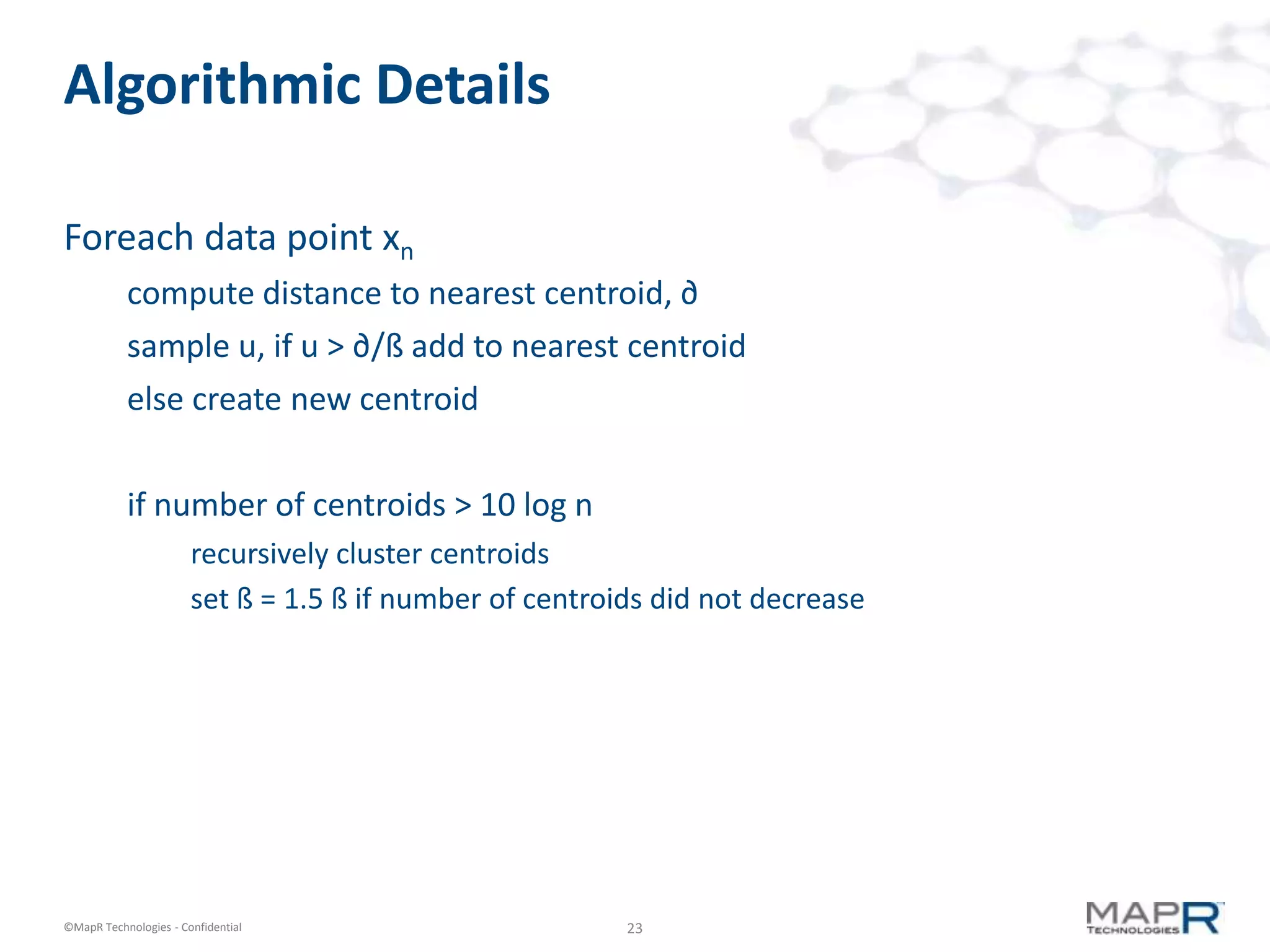
Algorithmic Details
Foreach data point xn
compute distance to nearest centroid, ∂
sample u, if u > ∂/ß add to nearest centroid
else create new centroid
if number of centroids > 10 log n
recursively cluster centroids
set ß = 1.5 ß if number of centroids did not decrease
24©MapR Technologies - Confidential
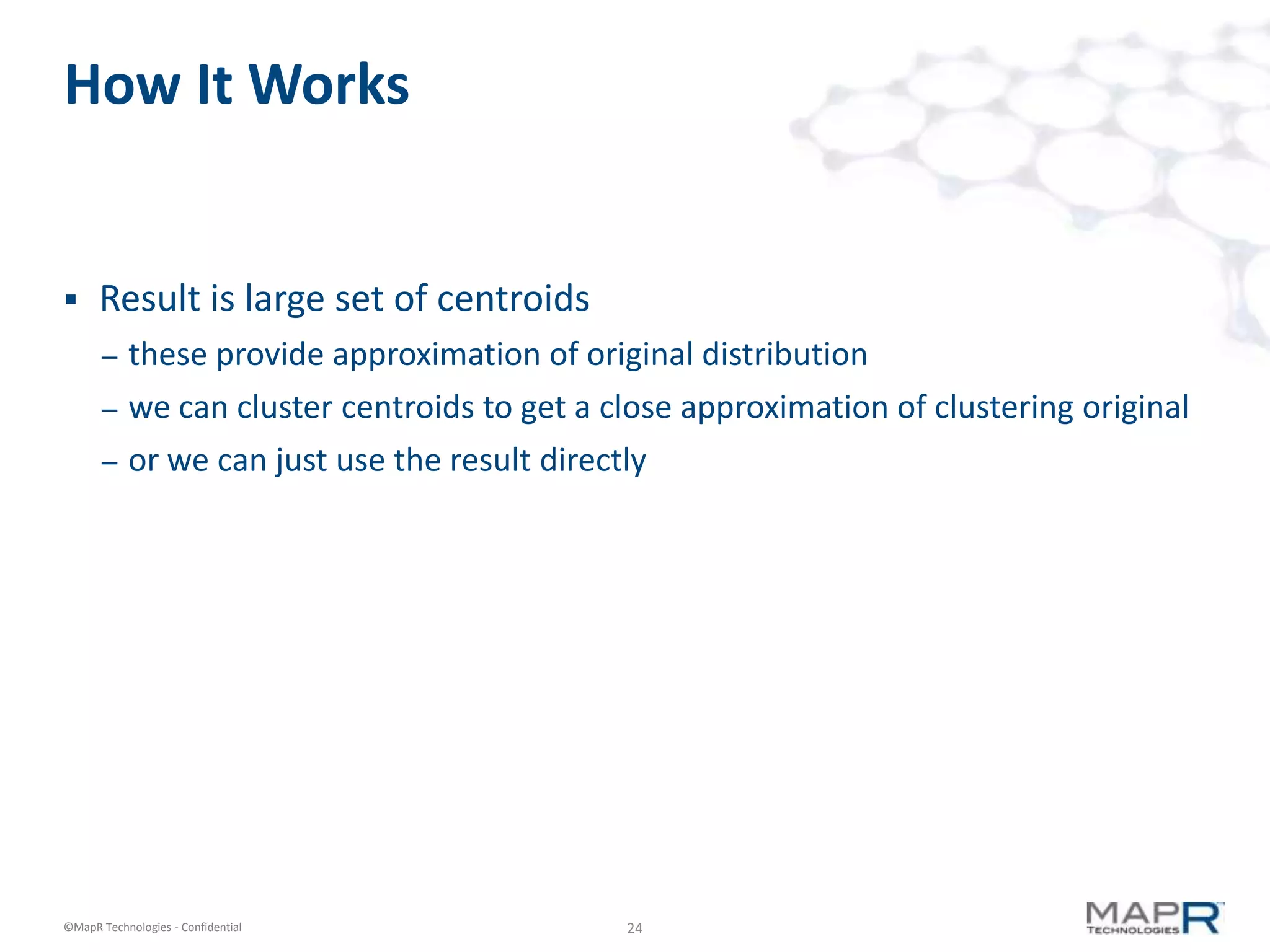
How It Works
 Result is large set of centroids
– these provide approximation of original distribution
– we can cluster centroids to get a close approximation of clustering original
– or we can just use the result directly
25©MapR Technologies - Confidential
Parallel Speedup?
1 2 3 4 5 20
10
100
20
30
40
50
200
Threads
Timeperpoint(μs)
2
3
4
5
6
8
10
12
14
16
Threaded version
Non- threaded
Perfect Scaling
✓
26©MapR Technologies - Confidential
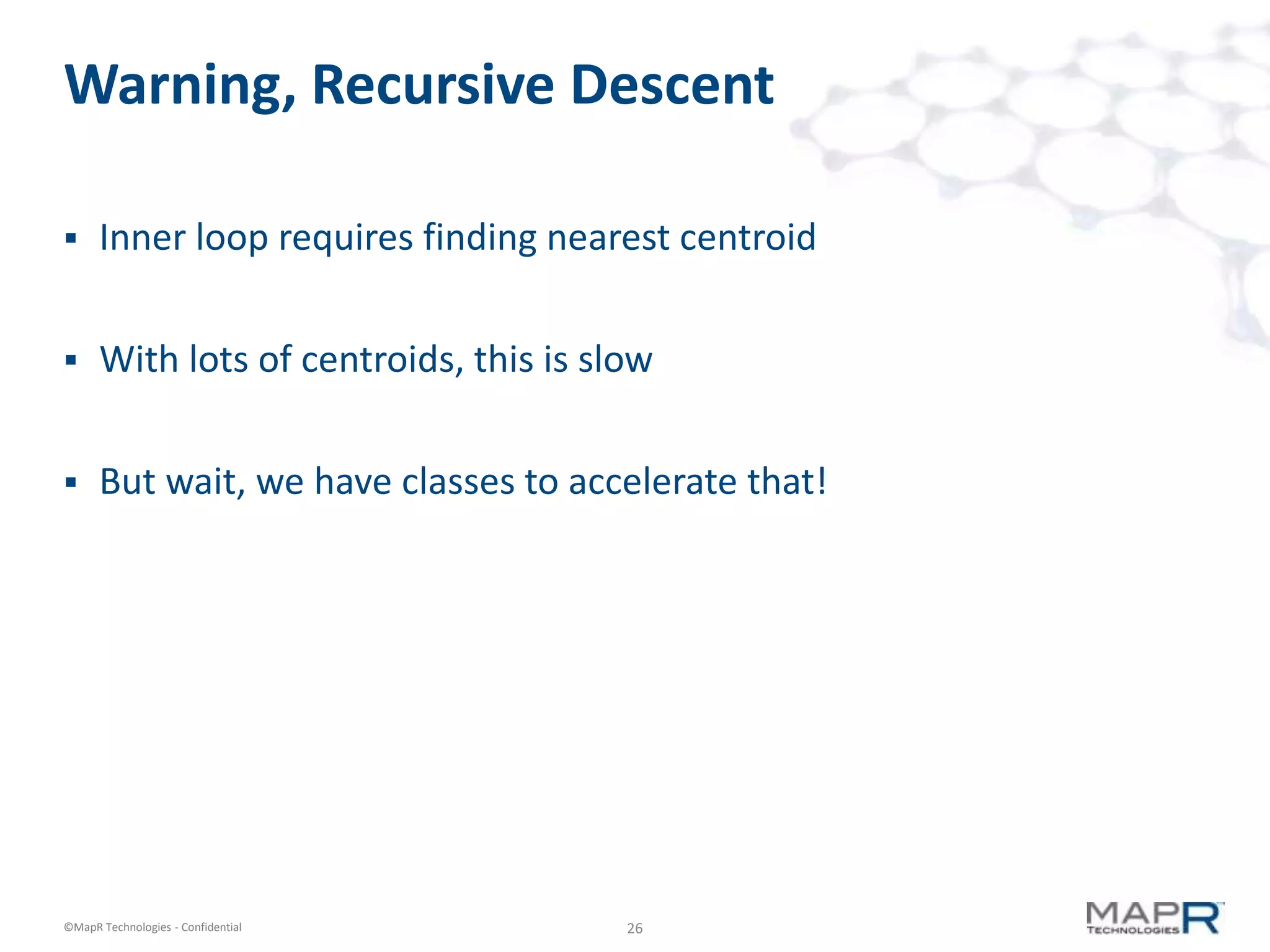
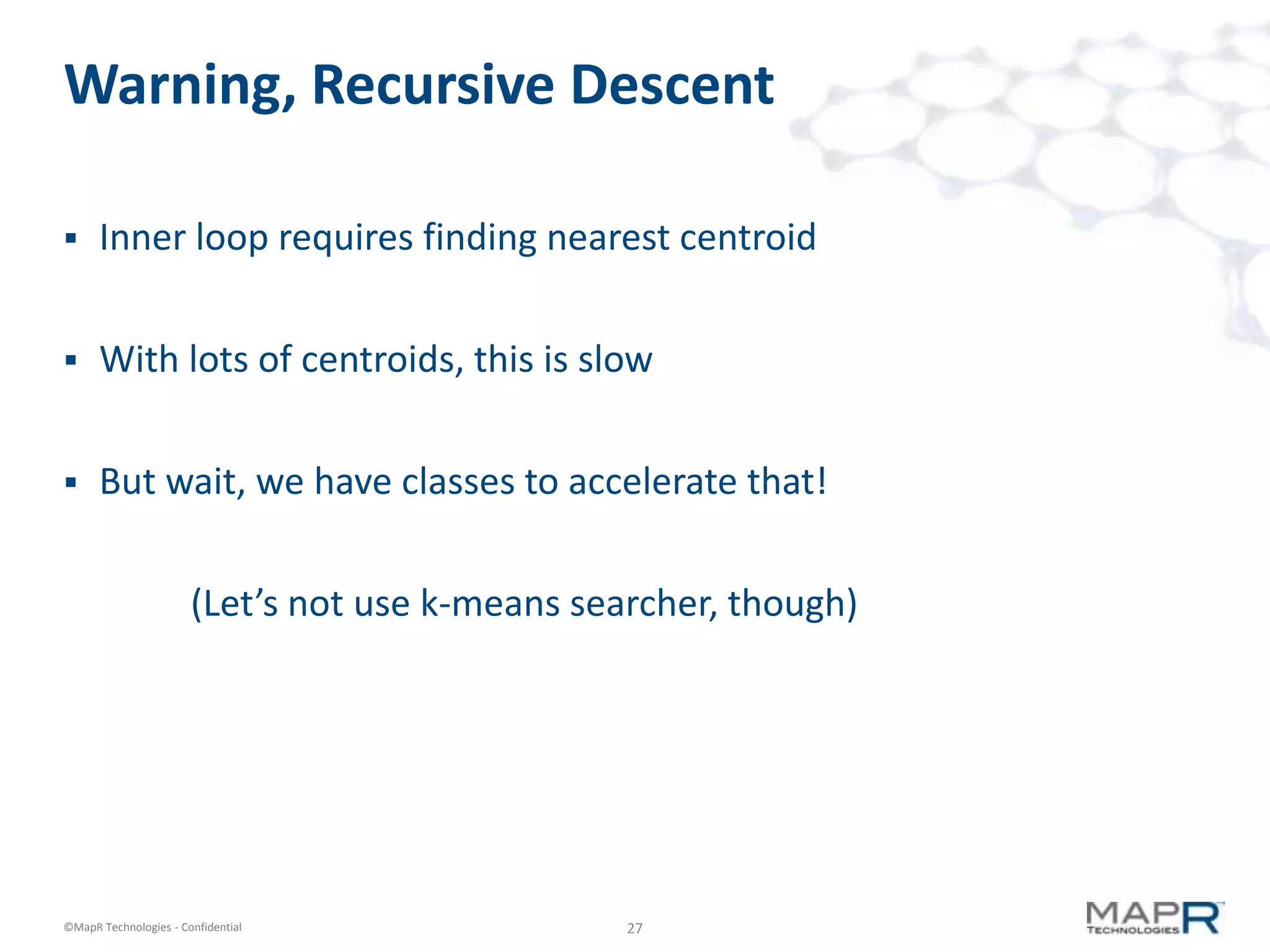
Warning, Recursive Descent
 Inner loop requires finding nearest centroid
 With lots of centroids, this is slow
 But wait, we have classes to accelerate that!
27©MapR Technologies - Confidential
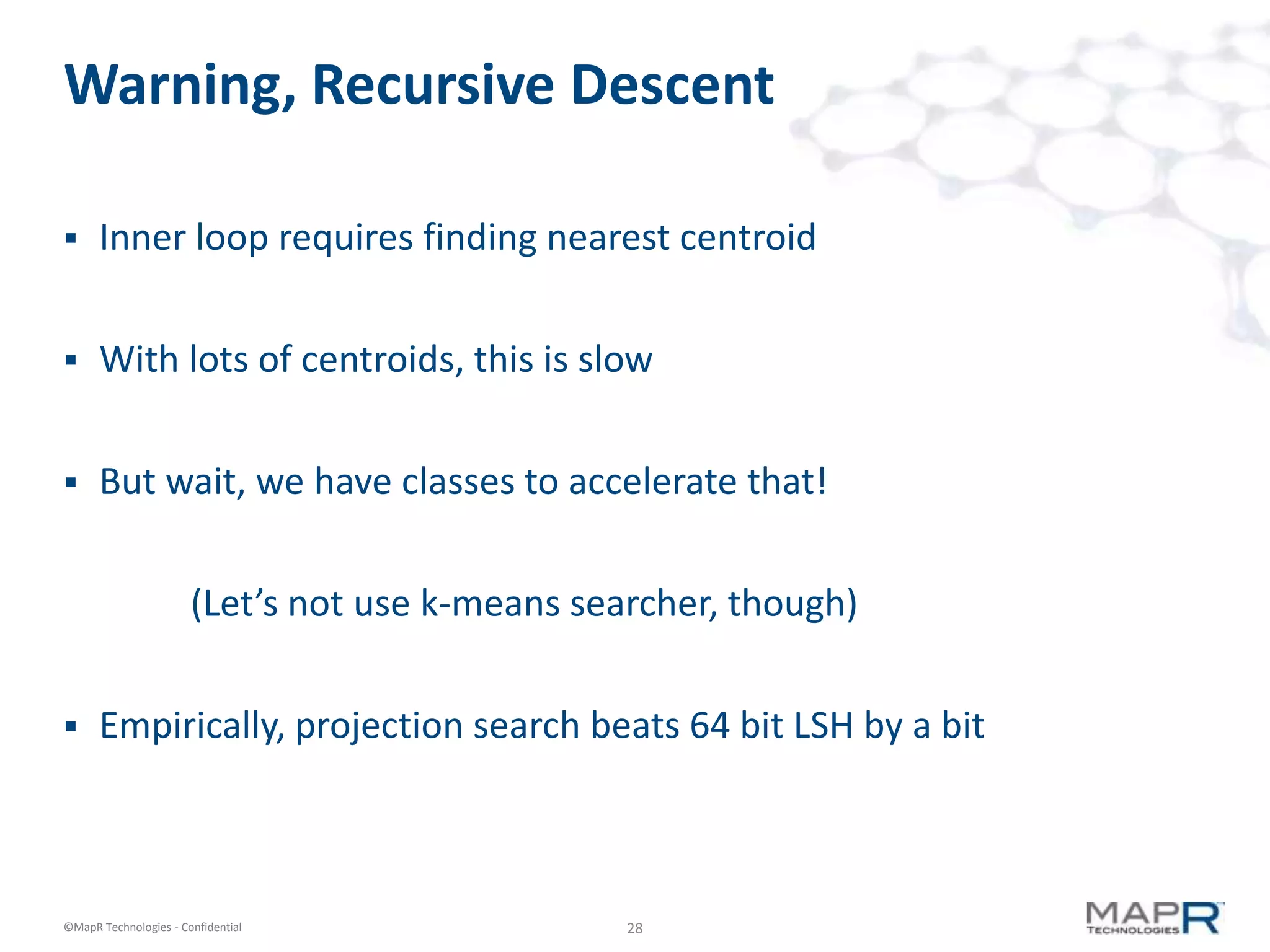
Warning, Recursive Descent
 Inner loop requires finding nearest centroid
 With lots of centroids, this is slow
 But wait, we have classes to accelerate that!
(Let’s not use k-means searcher, though)
28©MapR Technologies - Confidential
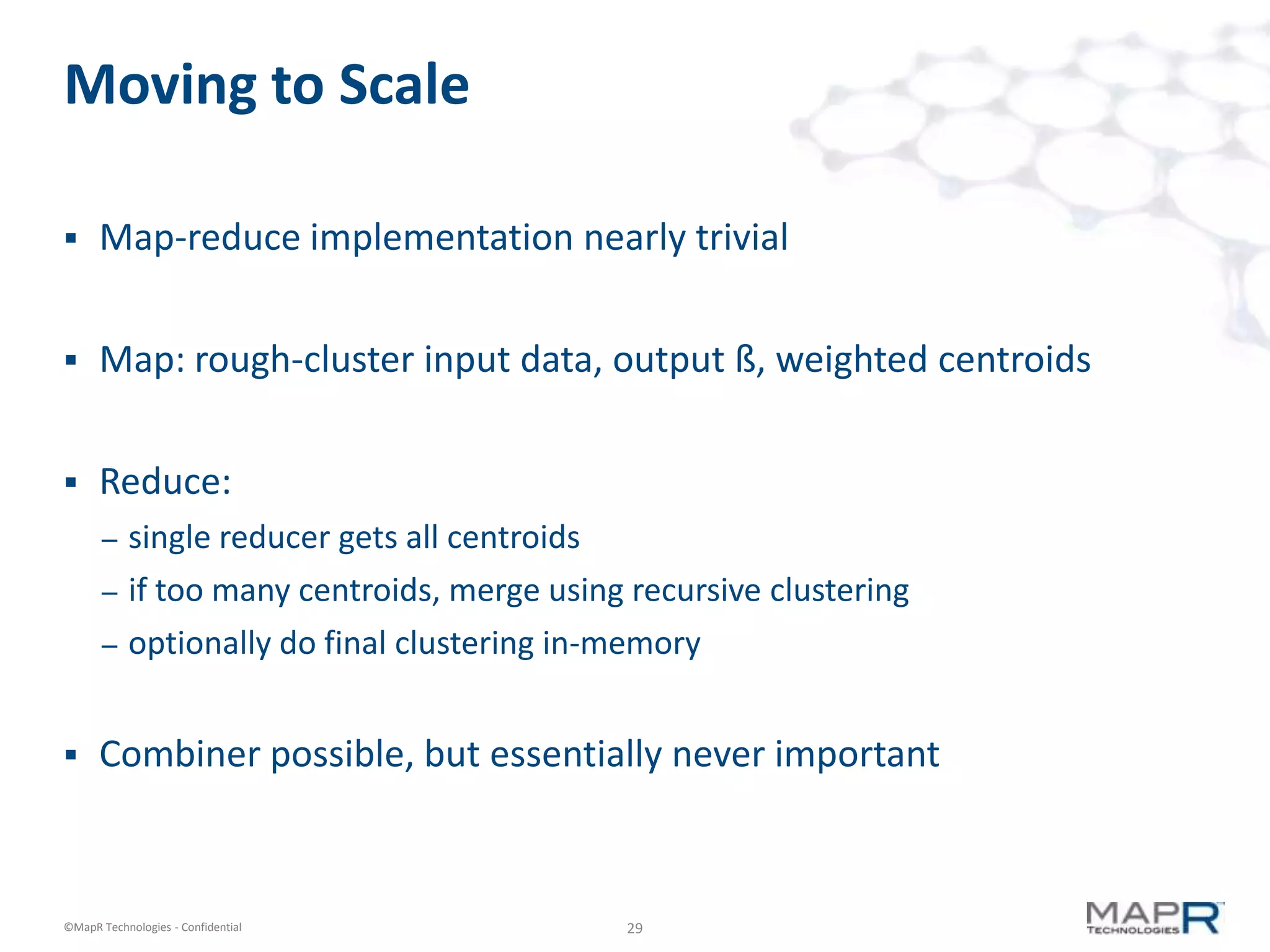
Warning, Recursive Descent
 Inner loop requires finding nearest centroid
 With lots of centroids, this is slow
 But wait, we have classes to accelerate that!
(Let’s not use k-means searcher, though)
 Empirically, projection search beats 64 bit LSH by a bit
29©MapR Technologies - Confidential
Moving to Scale
 Map-reduce implementation nearly trivial
 Map: rough-cluster input data, output ß, weighted centroids
 Reduce:
– single reducer gets all centroids
– if too many centroids, merge using recursive clustering
– optionally do final clustering in-memory
 Combiner possible, but essentially never important
30©MapR Technologies - Confidential
 Contact:
– tdunning@maprtech.com
– @ted_dunning
 Slides and such:
– http://info.mapr.com/ted-mlconf
Hash tags: #mlconf #mahout #mapr

Graphlab Ted Dunning Clustering

  • 1.
    1©MapR Technologies -Confidential Large-scale Single-pass k-Means Clustering at Scale Ted Dunning
  • 2.
    2©MapR Technologies -Confidential Large-scale Single-pass k-Means Clustering
  • 3.
    3©MapR Technologies -Confidential Large-scale k-Means Clustering
  • 4.
    4©MapR Technologies -Confidential Goals  Cluster very large data sets  Facilitate large nearest neighbor search  Allow very large number of clusters  Achieve good quality – low average distance to nearest centroid on held-out data  Based on Mahout Math  Runs on Hadoop (really MapR) cluster  FAST – cluster tens of millions in minutes
  • 5.
    5©MapR Technologies -Confidential Non-goals  Use map-reduce (but it is there)  Minimize the number of clusters  Support metrics other than L2
  • 6.
    6©MapR Technologies -Confidential Anti-goals  Multiple passes over original data  Scale as O(k n)
  • 7.
    7©MapR Technologies -Confidential Why?
  • 8.
    8©MapR Technologies -Confidential K-nearest Neighbor with Super Fast k-means
  • 9.
    9©MapR Technologies -Confidential What’s that?  Find the k nearest training examples  Use the average value of the target variable from them  This is easy … but hard – easy because it is so conceptually simple and you don’t have knobs to turn or models to build – hard because of the stunning amount of math – also hard because we need top 50,000 results  Initial prototype was massively too slow – 3K queries x 200K examples takes hours – needed 20M x 25M in the same time
  • 10.
    10©MapR Technologies -Confidential How We Did It  2 week hackathon with 6 developers from customer bank  Agile-ish development  To avoid IP issues – all code is Apache Licensed (no ownership question) – all data is synthetic (no question of private data) – all development done on individual machines, hosting on Github – open is easier than closed (in this case)  Goal is new open technology to facilitate new closed solutions  Ambitious goal of ~ 1,000,000 x speedup
  • 11.
    11©MapR Technologies -Confidential How We Did It  2 week hackathon with 6 developers from customer bank  Agile-ish development  To avoid IP issues – all code is Apache Licensed (no ownership question) – all data is synthetic (no question of private data) – all development done on individual machines, hosting on Github – open is easier than closed (in this case)  Goal is new open technology to facilitate new closed solutions  Ambitious goal of ~ 1,000,000 x speedup – well, really only 100-1000x after basic hygiene
  • 12.
    12©MapR Technologies -Confidential What We Did  Mechanism for extending Mahout Vectors – DelegatingVector, WeightedVector, Centroid  Shared memory matrix – FileBasedMatrix uses mmap to share very large dense matrices  Searcher interface – ProjectionSearch, KmeansSearch, LshSearch, Brute  Super-fast clustering – Kmeans, StreamingKmeans
  • 13.
    13©MapR Technologies -Confidential Projection Search java.lang.TreeSet!
  • 14.
    14©MapR Technologies -Confidential How Many Projections?
  • 15.
    15©MapR Technologies -Confidential K-means Search  Simple Idea – pre-cluster the data – to find the nearest points, search the nearest clusters  Recursive application – to search a cluster, use a Searcher!
  • 16.
  • 17.
  • 18.
  • 19.
  • 20.
  • 21.
    21©MapR Technologies -Confidential But This Requires k-means!  Need a new k-means algorithm to get speed – Hadoop is very slow at iterative map-reduce – Maybe Pregel clones like Giraph would be better – Or maybe not  Streaming k-means is – One pass (through the original data) – Very fast (20 us per data point with threads) – Very parallelizable
  • 22.
    22©MapR Technologies -Confidential Basic Method  Use a single pass of k-means with very many clusters – output is a bad-ish clustering but a good surrogate  Use weighted centroids from step 1 to do in-memory clustering – output is a good clustering with fewer clusters
  • 23.
    23©MapR Technologies -Confidential Algorithmic Details Foreach data point xn compute distance to nearest centroid, ∂ sample u, if u > ∂/ß add to nearest centroid else create new centroid if number of centroids > 10 log n recursively cluster centroids set ß = 1.5 ß if number of centroids did not decrease
  • 24.
    24©MapR Technologies -Confidential How It Works  Result is large set of centroids – these provide approximation of original distribution – we can cluster centroids to get a close approximation of clustering original – or we can just use the result directly
  • 25.
    25©MapR Technologies -Confidential Parallel Speedup? 1 2 3 4 5 20 10 100 20 30 40 50 200 Threads Timeperpoint(μs) 2 3 4 5 6 8 10 12 14 16 Threaded version Non- threaded Perfect Scaling ✓
  • 26.
    26©MapR Technologies -Confidential Warning, Recursive Descent  Inner loop requires finding nearest centroid  With lots of centroids, this is slow  But wait, we have classes to accelerate that!
  • 27.
    27©MapR Technologies -Confidential Warning, Recursive Descent  Inner loop requires finding nearest centroid  With lots of centroids, this is slow  But wait, we have classes to accelerate that! (Let’s not use k-means searcher, though)
  • 28.
    28©MapR Technologies -Confidential Warning, Recursive Descent  Inner loop requires finding nearest centroid  With lots of centroids, this is slow  But wait, we have classes to accelerate that! (Let’s not use k-means searcher, though)  Empirically, projection search beats 64 bit LSH by a bit
  • 29.
    29©MapR Technologies -Confidential Moving to Scale  Map-reduce implementation nearly trivial  Map: rough-cluster input data, output ß, weighted centroids  Reduce: – single reducer gets all centroids – if too many centroids, merge using recursive clustering – optionally do final clustering in-memory  Combiner possible, but essentially never important
  • 30.
    30©MapR Technologies -Confidential  Contact: – tdunning@maprtech.com – @ted_dunning  Slides and such: – http://info.mapr.com/ted-mlconf Hash tags: #mlconf #mahout #mapr