Technical Report
On
Analysis of Machine Learning Library
(H2O vs SparkMLlib)
Saurabh Chauhan
i
Contents
1 Better Machine Learning with H2O 1
2 End-to-End Machine Learning with SparkMLlib 2
3 Confused with H2O and SparkMLlib ? 2
4 H2O integration with SparkR 3
5 Experimental Results 3
6 Conclusions 6
ii
List of Figures
1 Predictive Analysis using H2O in SparkR . . . . . . . . . . . . . . . . . . . . . . . . 4
2 Predictive Analysis using SparkMLlib in SparkR . . . . . . . . . . . . . . . . . . . . 5
List of Tables
1 Score Models with Confidence . . . . . . . . . . . . . . . . . . . . . . . . . . . . . . . 2
2 H2O and SparkMLlib supported Machine Learning Algorithms . . . . . . . . . . . . 2
3 Comparison: Predictive Analysis algorithm using H2O and SparkMLlib . . . . . . . 5
iii
1 Better Machine Learning with H2O
H2O1 is open-source software from open-source community for big-data analysis targeting big-
data community. It enables the rapid solution of business problems by applying machine learning
algorithms. It provides following unique features to enable rapid application of machine learning
applications:
• Open Source Technology - It provides the freedom enabling machine learning and predic-
tive analysis offered by open source community. It offers flexibility by providing the integra-
tion with most popular big-data technology Apache Hadoop and Spark etc.
• User-friendly Interfaces - H2O embedded with the web-based graphical user interface and
programming interfaces with familiar environments like R, Scala, Java, Python etc.
• Data Agnostic Support - H2O provides data agnostic support with HDFS, S3, SQL, No-
SQL including all common database and file types. It also explore and model data through
R Studio, Tableau, MS Excel etc.
• State of the Art Machine Learning Algorithms - H2O available with bunch of machine
learning algorithms ranging from Generalized Linear Model (GLM), Random Forest, Gradient
Boosting (GBM), K-Means, Anomaly Detection, Deep Learning to Naive Bayes to solve the
business problems.
• Better Pre-processing - H2O equipped with following munge tools:
– Data Profiling - Summarize the shape of the dataset including missing values, zero
values upon data ingestion.
– Summary Statistics - Visualize the data with statistical measure including mean,
min-max, standard deviation, quartile and provides the preview of the dataset.
– Aggregate Column - Provides unique views with binning, filtering, group functions,
and derived columns.
– Transformation - Normalize, transform, and partition the data to fit into the model
by providing the right shape.
– PCA - It simplify and speed-up feature selection process with simple to use interface.
– Training and Validation Sampling - Provides random sampling plan to generate
training test for parameter estimation and validation set for model validation.
• Score Models with Confidence - Output of any model can be described using following
model metrics which defines goodness of fit for the model.
Thus by combining power of advanced machine learning and predictive analysis algorithms, the
truly open source freedom, scalable in-memory processing for big data make it faster, easier and
cost-effective for business problems.
1
http://www.h2o.ai/
Page 1
Model
Metrics
Description
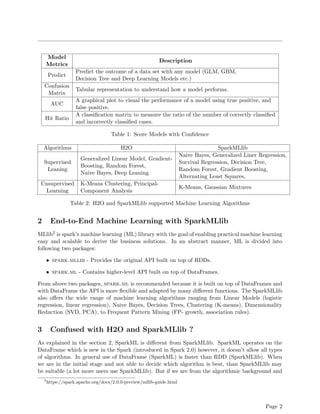
Predict
Predict the outcome of a data set with any model (GLM, GBM,
Decision Tree and Deep Learning Models etc.)
Confusion
Matrix
Tabular representation to understand how a model performs.
AUC
A graphical plot to visual the performance of a model using true positive, and
false positive.
Hit Ratio
A classification matrix to measure the ratio of the number of correctly classified
and incorrectly classified cases.
Table 1: Score Models with Confidence
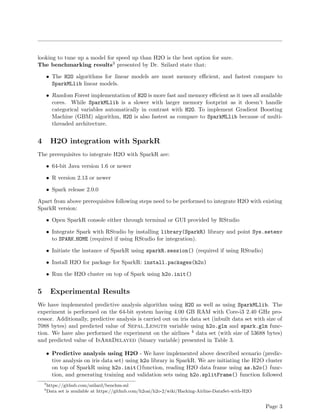
Algorithms H2O SparkMLlib
Supervised
Leaning
Generalized Linear Model, Gradient-
Boosting, Random Forest,
Naive Bayes, Deep Leaning
Naive Bayes, Generalized Liner Regression,
Survival Regression, Decision Tree,
Random Forest, Gradient Boosting,
Alternating Least Squares,
Unsupervised
Learning
K-Means Clustering, Principal-
Component Analysis
K-Means, Gaussian Mixtures
Table 2: H2O and SparkMLlib supported Machine Learning Algorithms
2 End-to-End Machine Learning with SparkMLlib
MLlib2 is spark’s machine learning (ML) library with the goal of enabling practical machine learning
easy and scalable to derive the business solutions. In an abstract manner, ML is divided into
following two packages:
• spark.mllib - Provides the original API built on top of RDDs.
• spark.ml - Contains higher-level API built on top of DataFrames.
From above two packages, spark.ml is recommended because it is built on top of DataFrames and
with DataFrame the API is more flexible and adapted by many different functions. The SparkMLlib
also offers the wide range of machine learning algorithms ranging from Linear Models (logistic
regression, linear regression), Naive Bayes, Decision Trees, Clustering (K-means), Dimensionality
Reduction (SVD, PCA), to Frequent Pattern Mining (FP- growth, association rules).
3 Confused with H2O and SparkMLlib ?
As explained in the section 2, SparkML is different from SparkMLlib. SparkML operates on the
DataFrame which is new in the Spark (introduced in Spark 2.0) however, it doesn’t allow all types
of algorithms. In general use of DataFrame (SparkML) is faster than RDD (SparkMLlib). When
we are in the initial stage and not able to decide which algorithm is best, than SparkMLlib may
be suitable (a lot more users use SparkMLlib). But if we are from the algorithmic background and
2
https://spark.apache.org/docs/2.0.0-preview/mllib-guide.html
Page 2
looking to tune up a model for speed up than H2O is the best option for sure.
The benchmarking results3 presented by Dr. Szilard state that:
• The H2O algorithms for linear models are most memory efficient, and fastest compare to
SparkMLlib linear models.
• Random Forest implementation of H2O is more fast and memory efficient as it uses all available
cores. While SparkMLlib is a slower with larger memory footprint as it doesn’t handle
categorical variables automatically in contrast with H2O. To implement Gradient Boosting
Machine (GBM) algorithm, H2O is also fastest as compare to SparkMLlib because of multi-
threaded architecture.
4 H2O integration with SparkR
The prerequisites to integrate H2O with SparkR are:
• 64-bit Java version 1.6 or newer
• R version 2.13 or newer
• Spark release 2.0.0
Apart from above prerequisites following steps need to be performed to integrate H2O with existing
SparkR version:
• Open SparkR console either through terminal or GUI provided by RStudio
• Integrate Spark with RStudio by installing library(SparkR) library and point Sys.setenv
to SPARK HOME (required if using RStudio for integration).
• Initiate the instance of SparkR using sparkR.session() (required if using RStudio)
• Install H2O for package for SparkR: install.packages(h2o)
• Run the H2O cluster on top of Spark using h2o.init()
5 Experimental Results
We have implemented predictive analysis algorithm using H2O as well as using SparkMLlib. The
experiment is performed on the 64-bit system having 4.00 GB RAM with Core-i3 2.40 GHz pro-
cessor. Additionally, predictive analysis is carried out on iris data set (inbuilt data set with size of
7088 bytes) and predicted value of Sepal Length variable using h2o.glm and spark.glm func-
tion. We have also performed the experiment on the airlines 4 data set (with size of 53688 bytes)
and predicted value of IsArrDelayed (binary variable) presented in Table 3.
• Predictive analysis using H2O - We have implemented above described scenario (predic-
tive analysis on iris data set) using h2o library in SparkR. We are initiating the H2O cluster
on top of SparkR using h2o.init()function, reading H2O data frame using as.h2o() func-
tion, and generating training and validation sets using h2o.splitFrame() function followed
3
https://github.com/szilard/benchm-ml
4
Data set is available at https://github.com/h2oai/h2o-2/wiki/Hacking-Airline-DataSet-with-H2O
Page 3
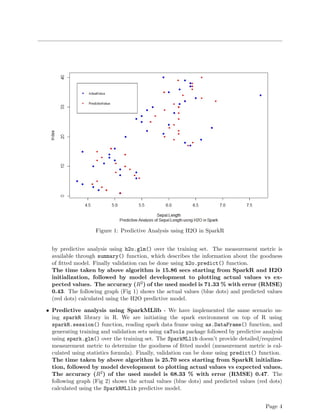
Figure 1: Predictive Analysis using H2O in SparkR
by predictive analysis using h2o.glm() over the training set. The measurement metric is
available through summary() function, which describes the information about the goodness
of fitted model. Finally validation can be done using h2o.predict() function.
The time taken by above algorithm is 15.86 secs starting from SparkR and H2O
initialization, followed by model development to plotting actual values vs ex-
pected values. The accuracy (R2) of the used model is 71.33 % with error (RMSE)
0.43. The following graph (Fig 1) shows the actual values (blue dots) and predicted values
(red dots) calculated using the H2O predictive model.
• Predictive analysis using SparkMLlib - We have implemented the same scenario us-
ing sparkR library in R. We are initiating the spark environment on top of R using
sparkR.session() function, reading spark data frame using as.DataFrame() function, and
generating training and validation sets using caTools package followed by predictive analysis
using spark.glm() over the training set. The SparkMLlib doesn’t provide detailed/required
measurement metric to determine the goodness of fitted model (measurement metric is cal-
culated using statistics formula). Finally, validation can be done using predict() function.
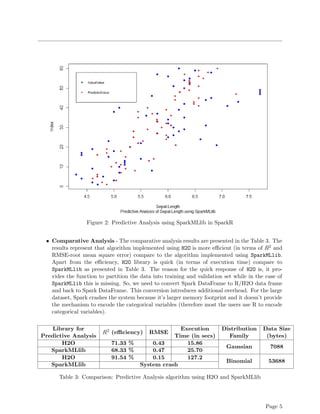
The time taken by above algorithm is 25.70 secs starting from SparkR initializa-
tion, followed by model development to plotting actual values vs expected values.
The accuracy (R2) of the used model is 68.33 % with error (RMSE) 0.47. The
following graph (Fig 2) shows the actual values (blue dots) and predicted values (red dots)
calculated using the SparkRMLlib predictive model.
Page 4
Figure 2: Predictive Analysis using SparkMLlib in SparkR
• Comparative Analysis - The comparative analysis results are presented in the Table 3. The
results represent that algorithm implemented using H2O is more efficient (in terms of R2 and
RMSE-root mean square error) compare to the algorithm implemented using SparkMLlib.
Apart from the efficiency, H2O library is quick (in terms of execution time) compare to
SparkMLlib as presented in Table 3. The reason for the quick response of H2O is, it pro-
vides the function to partition the data into training and validation set while in the case of
SparkMLlib this is missing. So, we need to convert Spark DataFrame to R/H2O data frame
and back to Spark DataFrame. This conversion introduces additional overhead. For the large
dataset, Spark crashes the system because it’s larger memory footprint and it doesn’t provide
the mechanism to encode the categorical variables (therefore most the users use R to encode
categorical variables).
Library for
Predictive Analysis
R2 (efficiency) RMSE
Execution
Time (in secs)
Distribution
Family
Data Size
(bytes)
H2O 71.33 % 0.43 15.86
Gaussian 7088
SparkMLlib 68.33 % 0.47 25.70
H2O 91.54 % 0.15 127.2
Binomial 53688
SparkMLlib System crash
Table 3: Comparison: Predictive Analysis algorithm using H2O and SparkMLlib
Page 5
6 Conclusions
• The benchmarking results state that H2O is much faster, accurate than SparkMLlib in the
various machine learning algorithms starting from linear models, random forest, gradient
machines, to deep neural networks.
• It also performs better with the data set having 10K records to 10M records.
• In addition to benchmarking result, experimental results highlight the features of H2O ma-
chine learning algorithm over SparkMLlib (machine learning) library.
• It’s not a huge leap to move from H2O machine learning library to SparkMLlib (if required).
Page 6

Technical_Report_on_ML_Library

  • 1.
    Technical Report On Analysis ofMachine Learning Library (H2O vs SparkMLlib) Saurabh Chauhan i
  • 2.
    Contents 1 Better MachineLearning with H2O 1 2 End-to-End Machine Learning with SparkMLlib 2 3 Confused with H2O and SparkMLlib ? 2 4 H2O integration with SparkR 3 5 Experimental Results 3 6 Conclusions 6 ii
  • 3.
    List of Figures 1Predictive Analysis using H2O in SparkR . . . . . . . . . . . . . . . . . . . . . . . . 4 2 Predictive Analysis using SparkMLlib in SparkR . . . . . . . . . . . . . . . . . . . . 5 List of Tables 1 Score Models with Confidence . . . . . . . . . . . . . . . . . . . . . . . . . . . . . . . 2 2 H2O and SparkMLlib supported Machine Learning Algorithms . . . . . . . . . . . . 2 3 Comparison: Predictive Analysis algorithm using H2O and SparkMLlib . . . . . . . 5 iii
  • 4.
    1 Better MachineLearning with H2O H2O1 is open-source software from open-source community for big-data analysis targeting big- data community. It enables the rapid solution of business problems by applying machine learning algorithms. It provides following unique features to enable rapid application of machine learning applications: • Open Source Technology - It provides the freedom enabling machine learning and predic- tive analysis offered by open source community. It offers flexibility by providing the integra- tion with most popular big-data technology Apache Hadoop and Spark etc. • User-friendly Interfaces - H2O embedded with the web-based graphical user interface and programming interfaces with familiar environments like R, Scala, Java, Python etc. • Data Agnostic Support - H2O provides data agnostic support with HDFS, S3, SQL, No- SQL including all common database and file types. It also explore and model data through R Studio, Tableau, MS Excel etc. • State of the Art Machine Learning Algorithms - H2O available with bunch of machine learning algorithms ranging from Generalized Linear Model (GLM), Random Forest, Gradient Boosting (GBM), K-Means, Anomaly Detection, Deep Learning to Naive Bayes to solve the business problems. • Better Pre-processing - H2O equipped with following munge tools: – Data Profiling - Summarize the shape of the dataset including missing values, zero values upon data ingestion. – Summary Statistics - Visualize the data with statistical measure including mean, min-max, standard deviation, quartile and provides the preview of the dataset. – Aggregate Column - Provides unique views with binning, filtering, group functions, and derived columns. – Transformation - Normalize, transform, and partition the data to fit into the model by providing the right shape. – PCA - It simplify and speed-up feature selection process with simple to use interface. – Training and Validation Sampling - Provides random sampling plan to generate training test for parameter estimation and validation set for model validation. • Score Models with Confidence - Output of any model can be described using following model metrics which defines goodness of fit for the model. Thus by combining power of advanced machine learning and predictive analysis algorithms, the truly open source freedom, scalable in-memory processing for big data make it faster, easier and cost-effective for business problems. 1 http://www.h2o.ai/ Page 1
  • 5.
    Model Metrics Description Predict Predict the outcomeof a data set with any model (GLM, GBM, Decision Tree and Deep Learning Models etc.) Confusion Matrix Tabular representation to understand how a model performs. AUC A graphical plot to visual the performance of a model using true positive, and false positive. Hit Ratio A classification matrix to measure the ratio of the number of correctly classified and incorrectly classified cases. Table 1: Score Models with Confidence Algorithms H2O SparkMLlib Supervised Leaning Generalized Linear Model, Gradient- Boosting, Random Forest, Naive Bayes, Deep Leaning Naive Bayes, Generalized Liner Regression, Survival Regression, Decision Tree, Random Forest, Gradient Boosting, Alternating Least Squares, Unsupervised Learning K-Means Clustering, Principal- Component Analysis K-Means, Gaussian Mixtures Table 2: H2O and SparkMLlib supported Machine Learning Algorithms 2 End-to-End Machine Learning with SparkMLlib MLlib2 is spark’s machine learning (ML) library with the goal of enabling practical machine learning easy and scalable to derive the business solutions. In an abstract manner, ML is divided into following two packages: • spark.mllib - Provides the original API built on top of RDDs. • spark.ml - Contains higher-level API built on top of DataFrames. From above two packages, spark.ml is recommended because it is built on top of DataFrames and with DataFrame the API is more flexible and adapted by many different functions. The SparkMLlib also offers the wide range of machine learning algorithms ranging from Linear Models (logistic regression, linear regression), Naive Bayes, Decision Trees, Clustering (K-means), Dimensionality Reduction (SVD, PCA), to Frequent Pattern Mining (FP- growth, association rules). 3 Confused with H2O and SparkMLlib ? As explained in the section 2, SparkML is different from SparkMLlib. SparkML operates on the DataFrame which is new in the Spark (introduced in Spark 2.0) however, it doesn’t allow all types of algorithms. In general use of DataFrame (SparkML) is faster than RDD (SparkMLlib). When we are in the initial stage and not able to decide which algorithm is best, than SparkMLlib may be suitable (a lot more users use SparkMLlib). But if we are from the algorithmic background and 2 https://spark.apache.org/docs/2.0.0-preview/mllib-guide.html Page 2
  • 6.
    looking to tuneup a model for speed up than H2O is the best option for sure. The benchmarking results3 presented by Dr. Szilard state that: • The H2O algorithms for linear models are most memory efficient, and fastest compare to SparkMLlib linear models. • Random Forest implementation of H2O is more fast and memory efficient as it uses all available cores. While SparkMLlib is a slower with larger memory footprint as it doesn’t handle categorical variables automatically in contrast with H2O. To implement Gradient Boosting Machine (GBM) algorithm, H2O is also fastest as compare to SparkMLlib because of multi- threaded architecture. 4 H2O integration with SparkR The prerequisites to integrate H2O with SparkR are: • 64-bit Java version 1.6 or newer • R version 2.13 or newer • Spark release 2.0.0 Apart from above prerequisites following steps need to be performed to integrate H2O with existing SparkR version: • Open SparkR console either through terminal or GUI provided by RStudio • Integrate Spark with RStudio by installing library(SparkR) library and point Sys.setenv to SPARK HOME (required if using RStudio for integration). • Initiate the instance of SparkR using sparkR.session() (required if using RStudio) • Install H2O for package for SparkR: install.packages(h2o) • Run the H2O cluster on top of Spark using h2o.init() 5 Experimental Results We have implemented predictive analysis algorithm using H2O as well as using SparkMLlib. The experiment is performed on the 64-bit system having 4.00 GB RAM with Core-i3 2.40 GHz pro- cessor. Additionally, predictive analysis is carried out on iris data set (inbuilt data set with size of 7088 bytes) and predicted value of Sepal Length variable using h2o.glm and spark.glm func- tion. We have also performed the experiment on the airlines 4 data set (with size of 53688 bytes) and predicted value of IsArrDelayed (binary variable) presented in Table 3. • Predictive analysis using H2O - We have implemented above described scenario (predic- tive analysis on iris data set) using h2o library in SparkR. We are initiating the H2O cluster on top of SparkR using h2o.init()function, reading H2O data frame using as.h2o() func- tion, and generating training and validation sets using h2o.splitFrame() function followed 3 https://github.com/szilard/benchm-ml 4 Data set is available at https://github.com/h2oai/h2o-2/wiki/Hacking-Airline-DataSet-with-H2O Page 3
  • 7.
    Figure 1: PredictiveAnalysis using H2O in SparkR by predictive analysis using h2o.glm() over the training set. The measurement metric is available through summary() function, which describes the information about the goodness of fitted model. Finally validation can be done using h2o.predict() function. The time taken by above algorithm is 15.86 secs starting from SparkR and H2O initialization, followed by model development to plotting actual values vs ex- pected values. The accuracy (R2) of the used model is 71.33 % with error (RMSE) 0.43. The following graph (Fig 1) shows the actual values (blue dots) and predicted values (red dots) calculated using the H2O predictive model. • Predictive analysis using SparkMLlib - We have implemented the same scenario us- ing sparkR library in R. We are initiating the spark environment on top of R using sparkR.session() function, reading spark data frame using as.DataFrame() function, and generating training and validation sets using caTools package followed by predictive analysis using spark.glm() over the training set. The SparkMLlib doesn’t provide detailed/required measurement metric to determine the goodness of fitted model (measurement metric is cal- culated using statistics formula). Finally, validation can be done using predict() function. The time taken by above algorithm is 25.70 secs starting from SparkR initializa- tion, followed by model development to plotting actual values vs expected values. The accuracy (R2) of the used model is 68.33 % with error (RMSE) 0.47. The following graph (Fig 2) shows the actual values (blue dots) and predicted values (red dots) calculated using the SparkRMLlib predictive model. Page 4
  • 8.
    Figure 2: PredictiveAnalysis using SparkMLlib in SparkR • Comparative Analysis - The comparative analysis results are presented in the Table 3. The results represent that algorithm implemented using H2O is more efficient (in terms of R2 and RMSE-root mean square error) compare to the algorithm implemented using SparkMLlib. Apart from the efficiency, H2O library is quick (in terms of execution time) compare to SparkMLlib as presented in Table 3. The reason for the quick response of H2O is, it pro- vides the function to partition the data into training and validation set while in the case of SparkMLlib this is missing. So, we need to convert Spark DataFrame to R/H2O data frame and back to Spark DataFrame. This conversion introduces additional overhead. For the large dataset, Spark crashes the system because it’s larger memory footprint and it doesn’t provide the mechanism to encode the categorical variables (therefore most the users use R to encode categorical variables). Library for Predictive Analysis R2 (efficiency) RMSE Execution Time (in secs) Distribution Family Data Size (bytes) H2O 71.33 % 0.43 15.86 Gaussian 7088 SparkMLlib 68.33 % 0.47 25.70 H2O 91.54 % 0.15 127.2 Binomial 53688 SparkMLlib System crash Table 3: Comparison: Predictive Analysis algorithm using H2O and SparkMLlib Page 5
  • 9.
    6 Conclusions • Thebenchmarking results state that H2O is much faster, accurate than SparkMLlib in the various machine learning algorithms starting from linear models, random forest, gradient machines, to deep neural networks. • It also performs better with the data set having 10K records to 10M records. • In addition to benchmarking result, experimental results highlight the features of H2O ma- chine learning algorithm over SparkMLlib (machine learning) library. • It’s not a huge leap to move from H2O machine learning library to SparkMLlib (if required). Page 6