FRANK HARARY
Professor of Mathematics
University of Michigan
GRAPH THEORY
The Advanced Book Program
CRC Press
Taylor &.Francis Group
Boca Raton London New York
CRC Press is an imprint of the
Taylor & Francis Group, an informa business
A CHAPMAN & HALL BOOK
Published 2018 by CRC Press
Taylor & Francis Group
6000 Broken Sound Parkway NW, Suite 300
Boca Raton, FL 33487-2742
CRC Press is an imprint of the Taylor & Francis Group, an informa business
Copyright © 1969 Taylor & Francis Group LLC
No claim to original U.S. Government works
This book contains information obtained from authentic and highly regarded
sources. Reasonable efforts have been made to publish reliable data and
information, but the author and publisher cannot assume responsibility for the
validity of all materials or the consequences of their use. The authors and
publishers have attempted to trace the copyright holders of all material
reproduced in this publication and apologize to copyright holders if permission
to publish in this form has not been obtained. If any copyright material has not
been acknowledged please write and let us know so we may rectify in any future
reprint.
Except as permitted under U.S. Copyright Law, no part of this book may be
reprinted, reproduced, transmitted, or utilized in any form by any electronic,
mechanical, or other means, now known or hereafter invented, including
photocopying, microfilming, and recording, or in any information storage or
retrieval system, without written permission from the publishers.
For permission to photocopy or use material electronically from this work,
please access w w w .copyright.com (http://www.copyright.com/) or contact the
Copyright Clearance Center, Inc. (CCC), 222 Rosewood Drive, Danvers, MA
01923, 978-750-8400. CCC is a not-for-profit organization that provides
licenses and registration for a variety of users. For organizations that have been
granted a photocopy license by the CCC, a separate system of payment has been
arranged.
Trademark Notice: Product or corporate names may be trademarks or registered
trademarks, and are used only for identification and explanation without intent
to infringe.
Visit the Taylor & Francis Web site at
http://www.taylorandfrancis.com
and the CRC Press Web site at
http://www.crcpress.com
First published 1969 by W estview Press
ISBN 13: 978-0-201-41033-4 (pbk)
ISBN 13: 978-0-201-02787-7 (hbk)
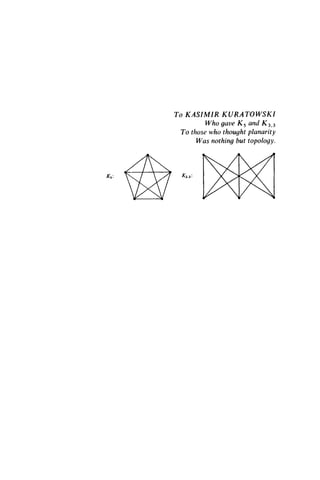
To K ASIM IR KU RATO W SKI
Who gave K 5 and K 3 3
To those who thought planarity
Was nothing but topology.
PREFACE
When I was a boy of 14 my father was so ignorant I could hardly
stand to have the old man around. But when I got to be 21,
I was astonished at how much the old man had learned in 7 years.
M ark . T w a in
There are several reasons for the acceleration of interest in graph theory. It
has become fashionable to mention that there are applications of graph
theory to some areas of physics, chemistry, communication science, computer
technology, electrical and civil engineering, architecture, operational research,
genetics, psychology, sociology, economics, anthropology, and linguistics.
The theory is also intimately related to many branches of mathematics,
including group theory, matrix theory, numerical analysis, probability,
topology, and combinatorics. The fact is that graph theory serves as a
mathematical model for any system involving a binary relation. Partly
because of their diagrammatic representation, graphs have an intuitive and
aesthetic appeal. Although there are many results in this field of an ele­
mentary nature, there is also an abundance of problems with enough
combinatorial subtlety to challenge the most sophisticated mathematician.
Earlier versions of this book have been used since 1956 when regular
courses on graph theory and combinatorial theory began in the Department
of Mathematics at the University of Michigan. It has been found pedagogi-
cally advantageous not to include proofs of all theorems. This device has
permitted the inclusion of more theorems than would otherwise have been
possible. The book can thus be used as a text in the tradition of the “Moore
Method,” with the student gaining mathematical power by being encouraged
to prove all theorems stated without proof. Note, however, that some of the
missing proofs are both difficult and long. The reader who masters the
content of this book will be qualified to continue with the study of special
topics and to apply graph theory to other fields.
An effort has been made to present the various topics in the theory of
graphs in a logical order, to indicate the historical background, and to
clarify the exposition by including figures to illustrate concepts and results.
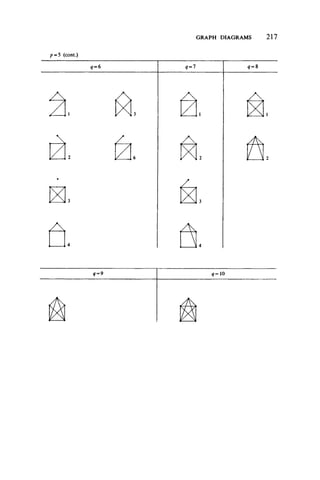
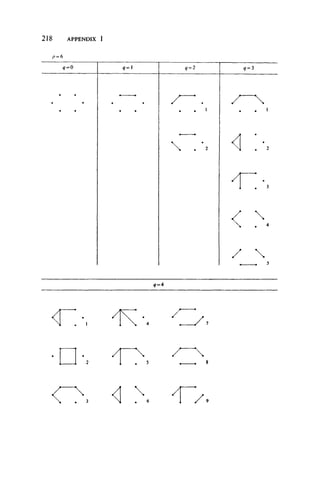
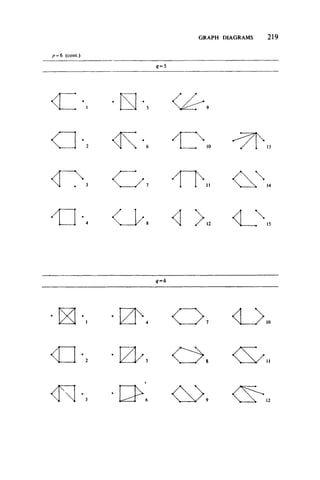
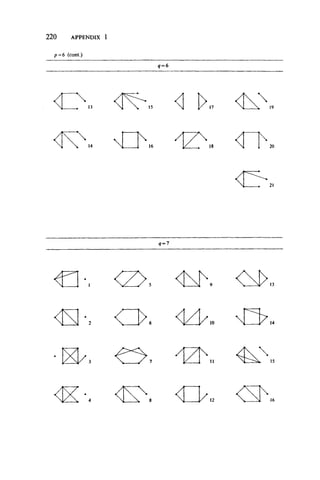
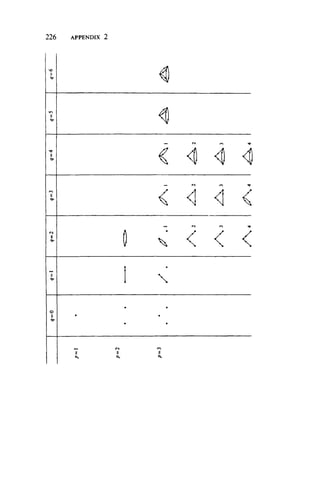
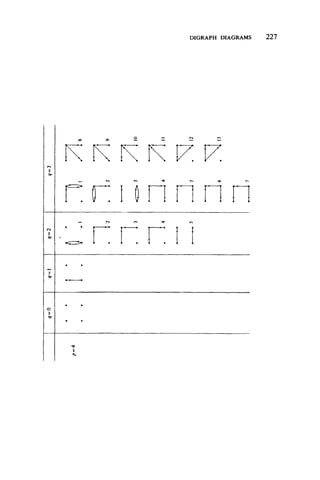
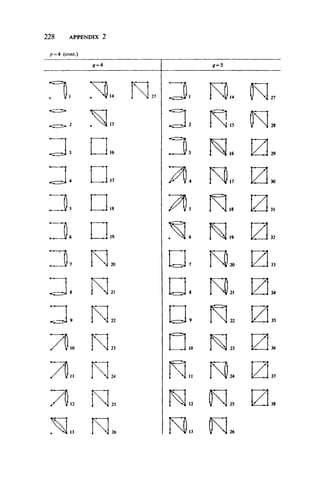
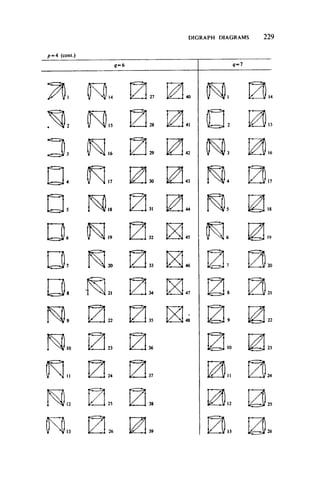
In addition, there are three appendices which provide diagrams of graphs,
Vi PREFACE
directed graphs, and trees. The emphasis throughout is on theorems rather
than algorithms or applications, which however are occasionally mentioned.
There are vast differences in the level of exercises. Those exercises which
are neither easy nor straightforward are so indicated by a bold-faced number.
Exercises which are really formidable are both bold faced and starred. The
reader is encouraged to consider every exercise in order to become familiar
with the material which it contains. Many of the “easier” exercises may be
quite difficult if the reader has not first studied the material in the chapter.
The reader is warned not to get bogged down in Chapter 2 and its many
exercises, which alone can be used as a miniature course in graph theory for
college freshmen or high-school seniors. The instructor can select material
from this book for a one-semester course on graph theory, while the entire
book can serve for a one-year course. Some of the later chapters are suitable
as topics for advanced seminars. Since the elusive attribute known as “mathe­
matical maturity” is really the only prerequisite for this book, it can be used
as a text at the undergraduate or graduate level. An acquaintance with
elementary group theory and matrix theory would be helpful in the last four
chapters.
I owe a substantial debt to many individuals for their invaluable as­
sistance and advice in the preparation of this book. Lowell Beineke and
Gary Chartrand have been the most helpful in this respect over a period of
many years! For the past year, my present doctoral students, Dennis Geller,
Bennet Manvel, and Paul Stockmeyer, have been especially enthusiastic in
supplying comments, suggestions, and insights. Considerable assistance was
also thoughtfully contributed by Stephen Hedetniemi, Edgar Palmer, and
Michael Plummer. Most recently, Branko Griinbaum and Dominic Welsh
kindly gave the complete book a careful reading. I am personally responsible
for all the errors and most of the off-color remarks.
Over the past two decades research support for published papers in the
theory of graphs was received by the author from the Air Force Office of
Scientific Research, the National Institutes of Health, the National Science
Foundation, the Office of Naval Research, and the Rockefeller Foundation.
During this time I have enjoyed the hospitality not only of the University
of Michigan, but also of the various other scholarly organizations which I
have had the opportunity to visit. These include the Institute for Advanced
Study, Princeton University, the Tavistock Institute of Human Relations in
London, University College London, and the London School of Economics.
Reliable, rapid typing was supplied by Alice Miller and Anne Jenne of the
Research Center for Group Dynamics. Finally, the author is especially
grateful to the Addison-Wesley Publishing Company for its patience in
waiting a full decade for this manuscript from the date the contract was
signed, and for its cooperation in all aspects of the production of this book.
July 1968 F. H.
CONTENTS
1 Discovery . . . .
The Konigsberg bridge problem
Electric networks
Chemical isomers
Around the world
The Four Color Conjecture .
Graph theory in the 20th century
I hate quotations. Tell me what you know.
R . W . E m er so n
1
1
2
......................................................................3
......................................................................4
......................................................................5
...................................................................... 5
2 Graphs . . . . . . . . . . . . 8
Varieties of graphs .......................................................................................... 8
Walks and connectedness . 1 3
Degrees .........................................................................................14
The problem of Ramsey . 1 5
Extremal graphs 17
Intersection graphs . 1 9
Operations on graphs ........................................................................................ 21
3 Blocks . . . . . . . . . . . . 26
Cutpoints, bridges, and blocks . . . . . . . . 26
Block graphs and cutpoint g r a p h s ....................................................................29
4 Trees . . . . . . . . . . . . 32
Characterization of trees . . . . . . . . . 32
Centers and centroids . . . . . . . . . . 35
Block-cutpoint trees . . . . . . . . . . 36
Independent cycles and cocycles . . . . . . . . 37
M a tr o i d s . . . . . . . . . . . . 4 0
vii
viii CONTENTS
5 Connectivity . . . . . . . . . . . 43
Connectivity and line-connectivity . . . . . . . 43
Graphical variations of Menger’s t h e o r e m ..........................................................47
Further variations of Menger’s t h e o r e m ..........................................................52
6 Partitions .............................................................................57
7 Traversability............................................................................................................ 64
Eulerian graphs ....................................................................64
Hamiltonian g r a p h s...................................................................................................65
8 Line G r a p h s ............................................................................................................ 71
Some properties of line g r a p h s ....................................................................... 71
Characterizations of line g ra p h s.............................................................................. 73
Special line graphs ....................................................................77
Line graphs and tra v ersa b ility .............................................................................. 79
Total g r a p h s ............................................................................................................. 82
9 F acto riza tio n ............................................................................................................ 84
1-factorization ............................................................................................................. 84
2-factorization ............................................................................................................. 88
Arboricity .............................................................................. 90
10 Coverings . . . . . . . . . . . . 94
Coverings and in d e p e n d e n c e ..............................................................................94
Critical points and l i n e s .........................................................................................97
Line-core and p o in t-c o r e .........................................................................................98
11 Planarity..................................................................................................................... 102
Plane and planar graphs 102
Outerplanar g r a p h s ..................................................................................................106
Kuratowski’s t h e o r e m ....................................................................................... 108
Other characterizations of planar g r a p h s ........................................................ 113
Genus, thickness, coarseness, crossing n u m b e r .............................................. 116
12 C o lo r a b ility ........................................................................................................... 126
The chromatic n u m b e r ..................................................................................126
The Five Color T h e o r e m ....................................................................................... 130
The Four Color Conjecture....................................................................................... 131
The Heawood map-coloring th e o r e m ............................................................. 135
Uniquely colorable graphs........................................................................................137
Critical gra p h s............................................................................................................141
CONTENTS ix
Homomorphisms . . . . . 1 4 3
The chromatic polynomial . . . 145
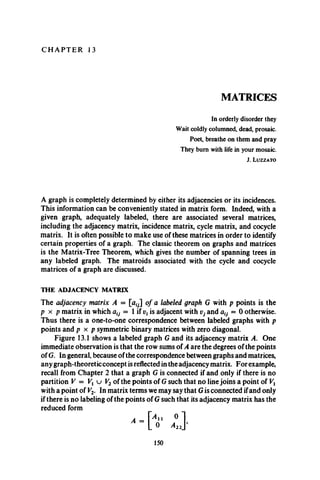
13 Matrices . . . . . . . . . . . . 150
The adjacency matrix . . . . 1 5 0
The incidence matrix . ................................................................................... 152
The cycle matrix . . 154
14 G r o u p s ...................................................................................................................... 160
The automorphism group of a g r a p h ................................................................... 160
Operations on permutation groups . . 1 6 3
The group of a composite graph ................................................................... 165
Graphs with a given group . . . . . . . . 1 6 8
Symmetric graphs . . 1 7 1
Highly symmetric graphs 173
15 Enumeration . . . . . . . . . . . 178
Labeled graphs . . 178
Polya’s enumeration theorem . 180
Enumeration of g r a p h s ......................................... . . 1 8 5
Enumeration of trees..................................................................................................187
Power group enumeration theorem . 1 9 1
Solved and unsolved graphical enumeration problems . 1 9 2
16 Digraphs . . . . . . . . . . . . 198
Digraphs and connectedness 198
Directional duality and acyclic digraphs . . . . . . 200
Digraphs and matrices 202
Tournaments . . . . . . . . . . . 205
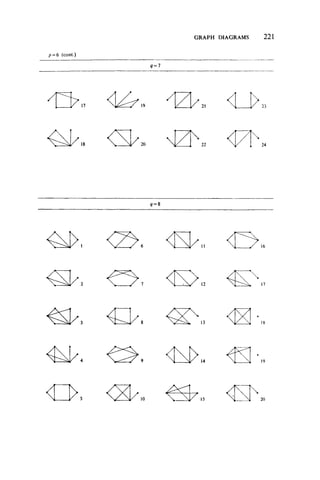
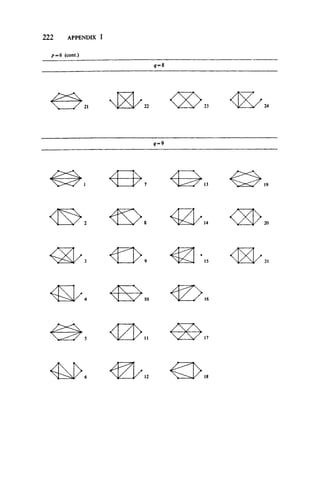
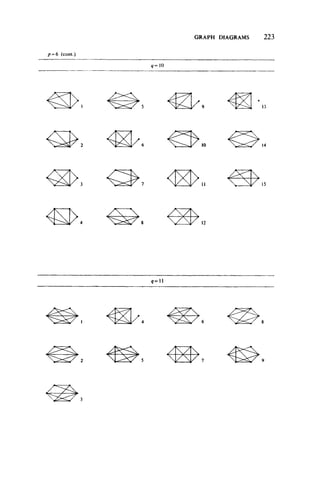
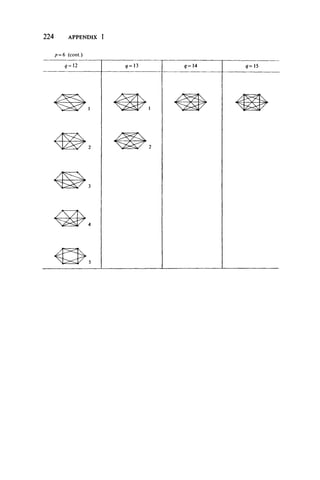
Appendix I Graph Diagrams . 213
Appendix II Digraph D i a g r a m s ...................................................................225
Appendix III Tree Diagrams . 2 3 1
B ib liograp h y............................................................................................................237
Index of S y m b o l s ..................................................................................................269
Index of D efinitions..................................................................................................273
C H A P T E R 1
DISCOVERY!
Eureka!
A r c h im ed es
It is no coincidence that graph theory has been independently discovered
many times, since it may quite properly be regarded as an area of applied
mathematics.* Indeed, the earliest recorded mention of the subject occurs in
the works of Euler, and although the original problem he was considering
might be regarded as a somewhat frivolous puzzle, it did arise from the
physical world. Subsequent rediscoveries of graph theory by Kirchhoff
and Cayley also had their roots in the physical world. KirchhofFs investiga­
tions of electric networks led to his development of the basic concepts and
theorems concerning trees in graphs, while Cayley considered trees arising
from the enumeration oforganic chemical isomers. Another puzzle approach
to graphs was proposed by Hamilton. After this, the celebrated Four Color
Conjecture came into prominence and has been notorious ever since. In
the present century, there have already been a great many rediscoveries of
graph theory which we can only mention most briefly in this chronological
account.
THE KONIGSBERG BRIDGE PROBLEM
Euler (1707-1782) became the father of graph theory as well as topology
when in 1736 he settled a famous unsolved problem of his day called the
Konigsberg Bridge Problem. There were two islands linked to each other
and to the banks of the Pregel River by seven bridges as shown in Fig. 1.1.
The problem was to begin at any of the four land areas, walk across each
bridge exactly once and return to the starting point. One can easily try to
* The basic combinatorial nature of graph theory and a clue to its wide applicability are
indicated in the words of Sylvester, “The theory of ramification is one of pure colligation, for
it takes no account of magnitude or position; geometrical lines are used, but have no more
real bearing on the matter than those employed in genealogical tables have in explaining the
laws of procreation.”
1
2 DISCOVERY!
Fig. 1.1. A park in Konigsberg, 1736.
solve this problem empirically, but all attempts must be unsuccessful, for
the tremendous contribution of Euler in this case was negative, see [E5].
In proving that the problem is unsolvable, Euler replaced each land area
by a point and each bridge by a line joining the corresponding points,
thereby producing a “graph.” This graph* is shown in Fig. 1.2, where the
points are labeled to correspond to the four land areas of Fig. 1.1. Showing
that the problem is unsolvable is equivalent to showing that the graph of
Fig. 1.2 cannot be traversed in a certain way.
Rather than treating this specific situation, Euler generalized the problem
and developed a criterion for a given graph to be so traversable; namely, that
it is connected and every point is incident with an even number of lines.
While the graph in Fig. 1.2 is connected, not every point is incident with an
even number of lines.
Fig. 1.2. The graph of the Konigsberg Bridge Problem.
ELECTRIC NETWORKS
Kirchhoff [K7] developed the theory of trees in 1847 in order to solve the
system of simultaneous linear equations which give the current in each
branch and around each circuit of an electric network. Although a physicist,
he thought like a mathematician when he abstracted an electric network
* Actually, this is a “multigraph” as we shall see in Chapter 2.
CHEMICAL ISOMERS 3
with its resistances, condensers, inductances, etc., and replaced it by its
corresponding combinatorial structure consisting only of points and lines
without any indication of the type of electrical element represented by in­
dividual lines. Thus, in effect, Kirchhoff replaced each electrical network
by its underlying graph and showed that it is not necessary to consider
every cycle in the graph of an electric network separately in order to solve
the system of equations. Instead, he pointed out by a simple but powerful
construction, which has since become standard procedure, that the inde­
pendent cycles of a graph determined by any of its “spanning trees” will
suffice. A contrived electrical network N, its underlying graph G, and a
spanning tree T are shown in Fig. 1.3.
Fig. 1.3. A network N, its underlying graph (7, and a spanning tree T.
CHEMICAL ISOMERS
In 1857, Cayley [C2] discovered the important class of graphs called trees
by considering the changes of variables in the differential calculus. Later, he
was engaged in enumerating the isomers of the saturated hydrocarbons
CnH 2n+2>with a given number n of carbon atoms, as shown in Fig. 1.4.
Of course, Cayley restated the problem abstractly: find the number
of trees with p points in which every point has degree 1 or 4. He did not
immediately succeed in solving this and so he altered the problem until he
was able to enumerate: rooted trees (in which one point is distinguished from
the others), trees, trees with points ofdegree at most 4, and finally the chemical
problem of trees in which every point has degree 1 or 4, see [C3]. Jordan
later (1869) independently discovered trees as a purely mathematical dis­
cipline, and Sylvester (1882) wrote that Jordan did so “without having any
suspicion of its bearing on modem chemical doctrine,” see [K10, p. 48].
4 DISCOVERY!
H
IH C H
IH
Methane Ethane Propane Butane
Fig. 1.4. The smallest saturated hydrocarbons.
Isobutane
AROUND THE WORLD
A game invented by Sir William Hamilton* in 1859 uses a regular solid
dodecahedron whose 20 vertices are labeled with the names of famous
cities. The player is challenged to travel “around the world” by finding a
closed circuit along the edges which passes through each vertex exactly
once. Hamilton sold his idea to a maker of games for 25 guineas; this was
a shrewd move since the game was not a financial success.
16
In graphical terms, the object of the game is to find a spanning cycle in
the graph of the dodecahedron, shown in Fig. 1.5. The points of the graph
are marked 1,2, • • •, 20 (rather than Amsterdam, Ann Arbor, Berlin, Budapest,
Dublin, Edinburgh, Jerusalem, London, Melbourne, Moscow, Novosibirsk,
New York, Paris, Peking, Prague, Rio di Janeiro, Rome, San Francisco,
Tokyo, and Warsaw), so that the existence of a spanning cycle is evident.
* See Ball and CoxeterfBCl, p. 262] for a more complete description.
GRAPH THEORY IN THE 20TH CENTURY 5
THE FOUR COLOR CONJECTURE
The most famous unsolved problem in graph theory and perhaps in all of
mathematics is the celebrated Four Color Conjecture. This remarkable
problem can be explained in five minutes by any mathematician to the so-
called man in the street. At the end of the explanation, both will understand
the problem, but neither will be able to solve it.
The following quotation from the definitive historical article by May
[M5] states the Four Color Conjecture and describes its role :
[The conjecture states that] any map on a plane or the surface of a sphere can be
colored with only four colors so that no two adjacent countries have the same
color. Each country must consist of a single connected region, and adjacent
countries are those having a boundary line (not merely a single point) in common.
The conjecture has acted as a catalyst in the branch of mathematics known as
combinatorial topology and is closely related to the currently fashionable field of
graph theory. More than half a century of work by many (some say all) mathe­
maticians has yielded proofs for special cases . .. The consensus is that the con­
jecture is correct but unlikely to be proved in general. It seems destined to retain
for some time the distinction of being both the simplest and most fascinating
unsolved problem of mathematics.
The Four Color Conjecture has an interesting history, but its origin
remains somewhat vague. There have been reports that Mobius was familiar
with this problem in 1840, but it is only definite that the problem was com­
municated to De Morgan by Guthrie about 1850. The first of many erroneous
“proofs” of the conjecture was given in 1879 by Kempe [K6]. An error was
found in 1890 by Heawood [H38] who showed, however, that the conjecture
becomes true when “four” is replaced by “five.” A counterexample, if ever
found, will necessarily be extremely large and complicated, for the con­
jecture was proved most recently by Ore and Stemple [OS1] for all maps
with fewer than 40 countries.
The Four Color Conjecture is a problem in graph theory because every
map yields a graph in which the countries (including the exterior region) are
the points, and two points are joined by a line whenever the corresponding
countries are adjacent. Such a graph obviously can be drawn in the plane
without intersecting lines. Thus, if it is possible to color the points of every
planar graph with four or fewer colors so that adjacent points have different
colors, then the Four Color Conjecture will have been proved.
GRAPH THEORY IN THE 20th CENTURY
The psychologist Lewin [L2] proposed in 1936 that the “fife space” of an
individual be represented by a planar map.* In such a map, the regions
would represent the various activities of a person, such as his work environ-
* Lewin used only planar maps because he always drew his figures in the plane.
6 DISCOVERY!
Fig. 1.6. A map and its corresponding graph.
ment, his home, and his hobbies. It was pointed out that Lewin was actually
dealing with graphs, as indicated by Fig. 1.6. This viewpoint led the psy­
chologists at the Research Center for Group Dynamics to another psycho­
logical interpretation of a graph, in which people are represented by points
and interpersonal relations by lines. Such relations include love, hate,
communication, and power. In fact, it was precisely this approach which led
the author to a personal discovery of graph theory, aided and abetted by
psychologists L. Festinger and D. Cartwright.
The world of theoretical physics discovered graph theory for its own
purposes more than once. In the study of statistical mechanics by Uhlenbeck
[U l], the points stand for molecules and two adjacent points indicate
nearest neighbor interaction of some physical kind, for example, magnetic
attraction or repulsion. In a similar interpretation by Lee and Yang [LY1],
the points stand for small cubes in euclidean space, where each cube may or
may not be occupied by a molecule. Then two points are adjacent whenever
both spaces are occupied. Another aspect of physics employs graph theory
rather as a pictorial device. Feynmann [F3] proposed the diagram in
which the points represent physical particles and the lines represent paths of
the particles after collisions.
The study of Markov chains in probability theory (see, for example,
Feller [F2, p. 340]) involves directed graphs in the sense that events are
represented by points, and a directed line from one point to another indicates
a positive probability of direct succession of these two events. This is made
explicit in the book [HNC1, p. 371] in which a Markov chain is defined as a
network with the sum of the values of the directed lines from each point
equal to 1. A similar representation of a directed graph arises in that part
of numerical analysis involving matrix inversion and the calculation of
eigenvalues. Examples are given by Varga [V2, p. 48]. A square matrix is
given, preferably “sparse,” and a directed graph is associated with it in the
following way. The points denote the index of the rows and columns of the
GRAPH THEORY IN THE 20TH CENTURY 7
given matrix, and there is a directed line from point / to point j whenever
the i, j entry of the matrix is nonzero. The similarity between this approach
and that for Markov chains is immediate.
The rapidly growing fields of linear programming and operational
research have also made use of a graph theoretic approach by the study of
flows in networks. The books by Ford and Fulkerson [FF2], Vajda [VI]
and Berge and Ghouila-Houri [BG2] involve graph theory in this way. The
points of a graph indicate physical locations where certain goods may be
stored or shipped, and a directed line from one place to another, together
with a positive number assigned to this line, stands for a channel for the
transmission of goods and a capacity giving the maximum possible quantity
which can be shipped at one time.
Within pure mathematics, graph theory is studied in the pioneering
book on topology by Veblen [V3, pp. 1-35]. A simplicial complex (or
briefly a complex) is defined to consist of a collection V of “points” together
with a prescribed collection S of nonempty subsets of V, called “simplexes,”
satisfying the following two conditions.
1. Every point is a simplex.
2. Every nonempty subset of a simplex is also a simplex.
The dimension ofa simplex is one less than the number of points in it;that
of a complex is the maximum dimension of any simplex in it. In these terms,
a graph may be defined as a complex of dimension 1 or 0. We call a 1-
dimensional simplex a line, and note that a complex is 0-dimensional if and
only if it consists of a collection of points, but no lines or other higher
dimensional simplexes. Aside from these “totally disconnected” graphs,
every graph is a 1-dimensional complex. It is for this reason that the subtitle
of the first book ever written on graph theory [K10] is “Kombinatorische
Topologie der Streckenkomplexe.”
It is precisely because of the traditional use of the words point and line
as undefined terms in axiom systems for geometric structures that we have
chosen to use this terminology. Whenever we are speaking of “geometric”
simplicial complexes as subsets of a euclidean space, as opposed to the
abstract complexes defined above, we shall then use the words vertex and
edge. Terminological questions will now be pursued in Chapter 2, together
with some of the basic concepts and elementary theorems of graph theory.
C H A P T E R 2
GRAPHS
What’s in a name? That which we call a rose
By any other name would smell as sweet.
W illia m S h a k e s p e a r e , R om eo an d J u liet
Most graph theorists use personalized terminology in their books, papers,
and lectures. In order to avoid quibbling at conferences on graph theory,
it has been found convenient to adopt the procedure that each man state in
advance the graph theoretic language he would use. Even the very word
“graph” has not been sacrosanct. Some authors actually define a “graph”
as a graph,* but others intend such alternatives as multigraph, pseudograph,
directed graph, or network. We believe that uniformity in graphical
terminology will never be attained, and is not necessarily desirable.
Alas, it is necessary to present a formidable number of definitions in
order to make available the basic concepts and terminology of graph theory.
In addition, we give short introductions to the study of complete subgraphs,
extremal graph theory (which investigates graphs with forbidden subgraphs),
intersection graphs (in which the points stand for sets and nonempty inter­
sections determine adjacency), and some useful operations on graphs.
VARIETIES OF GRAPHS
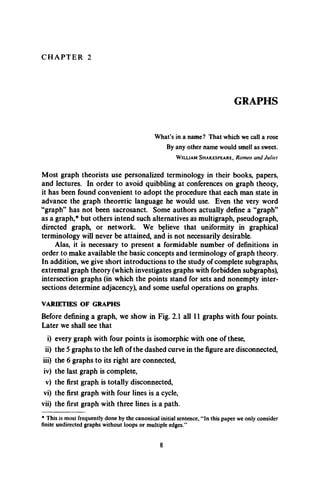
Before defining a graph, we show in Fig. 2.1 all 11 graphs with four points.
Later we shall see that
i) every graph with four points is isomorphic with one of these,
ii) the 5 graphs to the left of the dashed curve in the figure are disconnected,
iii) the 6 graphs to its right are connected,
iv) the last graph is complete,
v) the first graph is totally disconnected,
vi) the first graph with four lines is a cycle,
vii) the first graph with three lines is a path.
* This is most frequently done by the canonical initial sentence, “In this paper we only consider
finite undirected graphs without loops or multiple edges.”
VARIETIES OF GRAPHS 9
. r
i i
0
0
Fig. 2.1. The graphs with four points.
Rather than continue with an intuitive development of additional concepts,
we proceed with the tedious but essential sequence of definition upon
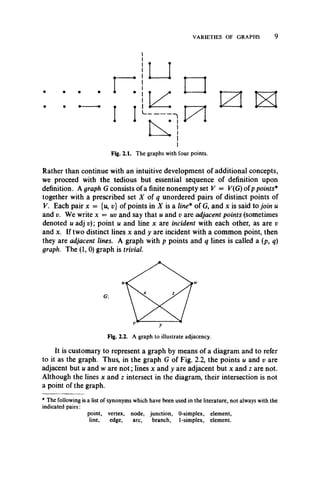
definition. A graph G consists of a finite nonempty set V = V(G)ofp points*
together with a prescribed set X of q unordered pairs of distinct points of
V. Each pair x = {w, p} of points in X is a line* of G, and x is said to join u
and v. We write x = uv and say that u and v are adjacent points (sometimes
denoted u adj v); point u and line x are incident with each other, as are v
and x. If two distinct lines x and y are incident with a common point, then
they are adjacent lines. A graph with p points and q lines is called a (p, q)
graph. The (1, 0) graph is trivial.
G:
Fig. 2.2. A graph to illustrate adjacency.
It is customary to represent a graph by means of a diagram and to refer
to it as the graph. Thus, in the graph G of Fig. 2.2, the points u and v are
adjacent but u and w are n o t; lines x and y are adjacent but x and z are not.
Although the lines x and z intersect in the diagram, their intersection is not
a point of the graph.
* The following is a list of synonyms which have been used in the literature, not always with the
indicated pairs:
point, vertex, node, junction, 0-simplex, element,
line, edge, arc, branch, 1-simplex, element.
10 GRAPHS
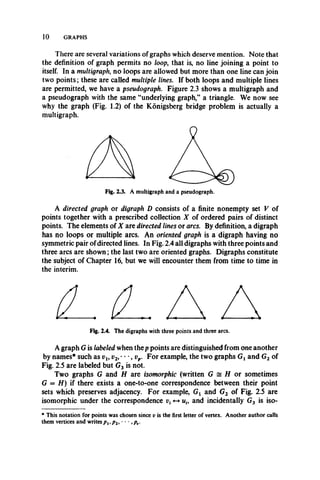
There are several variations of graphs which deserve mention. Note that
the definition of graph permits no loop, that is, no line joining a point to
itself. In a multigraph, no loops are allowed but more than one line can join
two points; these are called multiple lines. If both loops and multiple lines
are permitted, we have a pseudograph. Figure 2.3 shows a multigraph and
a pseudograph with the same “underlying graph,” a triangle. We now see
why the graph (Fig. 1.2) of the Konigsberg bridge problem is actually a
multigraph.
Fig. 2.3. A multigraph and a pseudograph.
A directed graph or digraph D consists of a finite nonempty set V of
points together with a prescribed collection X of ordered pairs of distinct
points. The elements of X are directed lines or arcs. By definition, a digraph
has no loops or multiple arcs. An oriented graph is a digraph having no
symmetric pair ofdirected lines. In Fig. 2.4 all digraphs with three points and
three arcs are shown; the last two are oriented graphs. Digraphs constitute
the subject of Chapter 16, but we will encounter them from time to time in
the interim.
Fig. 2.4. The digraphs with three points and three arcs.
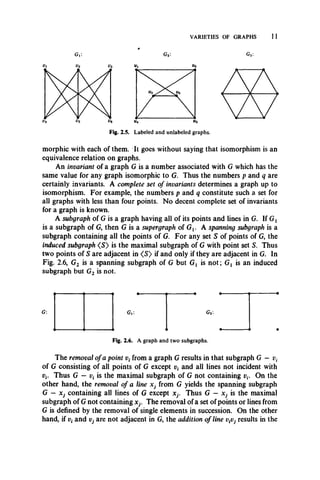
A graph G is labeled when the p points are distinguished from one another
by names* such as vt, v2, ***, vp. For example, the two graphs Gx and G2 of
Fig. 2.5 are labeled but G3 is not.
Two graphs G and H are isomorphic (written G = H or sometimes
G = H) if there exists a one-to-one correspondence between their point
sets which preserves adjacency. For example, Gt and G2 of Fig. 2.5 are
isomorphic under the correspondence v( «-» u„ and incidentally G3 is iso­
* This notation for points was chosen since v is the first letter of vertex. Another author calls
them vertices and writesPi,/>2»‘ ■• ,pv.
VARIETIES OF GRAPHS 11
Fig. 2.5. Labeled and unlabeled graphs.
morphic with each of them. It goes without saying that isomorphism is an
equivalence relation on graphs.
An invariant of a graph G is a number associated with G which has the
same value for any graph isomorphic to G. Thus the numbers p and q are
certainly invariants. A complete set of invariants determines a graph up to
isomorphism. For example, the numbers p and q constitute such a set for
all graphs with less than four points. No decent complete set of invariants
for a graph is known.
A subgraph of G is a graph having all of its points and lines in G. If Gx
is a subgraph of G, then G is a supergraph of Gv A spanning subgraph is a
subgraph containing all the points of G. For any set S of points of G, the
induced subgraph <S> is the maximal subgraph of G with point set S. Thus
two points of S are adjacent in <S> if and only if they are adjacent in G. In
Fig. 2.6, G2 is a spanning subgraph of G but Gx is not; Gj is an induced
subgraph but G2 is not.
G: Gx G2:
Fig. 2.6. A graph and two subgraphs.
The removal ofa point vt from a graph G results in that subgraph G —
of G consisting of all points of G except v{ and all lines not incident with
vt. Thus G — Vi is the maximal subgraph of G not containing v(. On the
other hand, the removal of a line Xj from G yields the spanning subgraph
G — Xj containing all lines of G except x}. Thus G — Xj is the maximal
subgraph of G not containing x}. The removal of a set of points or lines from
G is defined by the removal of single elements in succession. On the other
hand, if vt and Vj are not adjacent in G, the addition of line v(Vj results in the
12 GRAPHS
vt
G—v2v3:
Vs
G+v3u5:
04 l>3
Fig. 2.7. A graph plus or minus a specific point or line.
smallest supergraph of G containing the line v^j, These concepts are illus­
trated in Fig. 2.7.
There are certain graphs for which the result of deleting a point or line,
or adding a line, is independent of the particular point or line selected. If
this is so for a graph G, we denote the result accordingly by G — p, G - x,
or G + x ; see Fig. 2.8.
It was suggested by Ulam [U2, p. 29] in the following conjecture that
the collection of subgraphs G — pf of G gives quite a bit of information
about G itself.
Fig. 2.8. A graph plus or minus a point or line.
Ulam's Conjecture * Let G have p points pf and H have p points uf, with
p > 3. If for each i, the subgraphs G, = G - p, and tf, = H - u* are
isomorphic, then the graphs G and H are isomorphic.
There is an alternative point of view to this conjecture [H29]. Draw
each of the p unlabeled graphs G — p, on a 3 x 5 card. The conjecture then
states that any graph from which these subgraphs can be obtained by de­
leting one point at a time is isomorphic to G. Thus Ulam’s conjecture
* The reader is urged not to try to settle this conjecture since it appears to be rather difficult.
WALKS AND CONNECTEDNESS 13
asserts that any two graphs with the same deck of cards are isomorphic.
But we prefer to try to prove that from any legitimate* deck of cards, only
one graph can be reconstructed.
WALKS AND CONNECTEDNESS
One of the most elementary properties that any graph can enjoy is that of
being connected. In this section we develop the basic structure of connected
and disconnected graphs.
A walk of a graph G is an alternating sequence of points and lines
v0, x l9 vu • • •, vn- l9 xn, v„, beginning and ending with points, in which each
line is incident with the two points immediately preceding and following it.
This walk joins v0 and vn9 and may also be denoted v0 vl v2 - • • v„ (the lines
being evident by context); it is sometimes called a v0-v„ walk. It is closed
if v0 = vnand is open otherwise. It is a trail if all the lines are distinct, and
a path if all the points (and thus necessarily all the lines) are distinct. If
the walk is closed, then it is a cycle provided its n points are distinct and
n > 3.
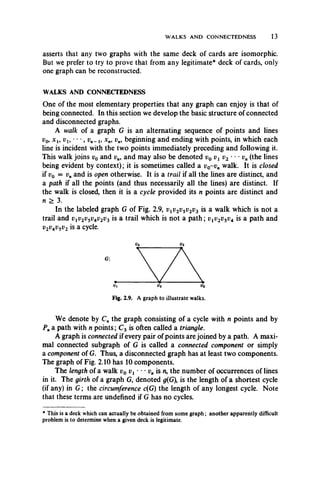
In the labeled graph G of Fig. 2.9, vlv2v5v2v3 is a walk which is not a
trail and vlv2vsv4v2v^ is a trail which is not a path; vtv2v5v4 is a path and
v2v4v5v2 is a cycle.
Fig. 2.9. A graph to illustrate walks.
We denote by Cn the graph consisting of a cycle with n points and by
Pna path with n points; C3 is often called a triangle.
A graph is connected if every pair of points are joined by a path. A maxi­
mal connected subgraph of G is called a connected component or simply
a component of G. Thus, a disconnected graph has at least two components.
The graph of Fig. 2.10 has 10 components.
The length of a walk v0 • • • vn is n, the number of occurrences of lines
in it. The girth of a graph G, denoted g{G is the length of a shortest cycle
(if any) in G ; the circumference c(G) the length of any longest cycle. Note
that these terms are undefined if G has no cycles.
* This is a deck which can actually be obtained from some graph; another apparently difficult
problem is to determine when a given deck is legitimate.
14 GRAPHS
Fig. 2.10. A graph with 10 components.
The distance d(u, p) between two points u and v in G is thelengthof a
shortest path joining them if any; otherwise d(u, p) = oo. Ina connected
graph, distance is a metric; that is, for all points w, p, and w,
1. d(u, v) > 0, with d(u, p) = 0 if and only if u = p.
2. p) = d(p, w).
3. d(n, p) + d(v, w) > d(u, w).
A shortest w-p path is often called a geodesic. The diameter d(G) of a
connected graph G is the length of any longest geodesic. The graph G of
Fig. 2.9 has girth g = 3, circumference c = 4, and diameter d = 2.
The square G2 of a graph G has F(G2) = F(G) with w, p adjacent in G2
whenever d(u, v) < 2 in G. The powers G3, G4, • •of G are defined similarly.
DEGREES
The degree* of a point p, in graph G, denoted or deg pf, is the number of
lines incident with vt. Since every line isincident with two points,it contrib­
utes 2 to the sum of the degrees of the points. We thus have a result, due to
Euler [E6], which was the first theorem of graph theory!
Theorem Z1 The sum of the degrees of the points of a graph G is twice
the number of lines,
£ deg = 2q. (2.1)
Corollary 2.1(a) In any graph, the number of points of odd degree is even.t
In a (p, q) graph, 0 < deg v < p — 1 for every point v. The minimum
degree among the points of G is denoted min deg G or <5(G) while A(G) =
max deg G is the largest such number. If 8(G) = A(G) = r, then all points
have the same degree and G is called regular of degree r. We then speak
of the degree of G and write deg G = r.
A regular graph of degree 0 has no lines at all. If G is regular of degree
1, then every component contains exactly one line; if it is regular of degree 2,
* Sometimes called valency.
t The reader is reminded (see the Preface) that not all theorems are proved in the text.
THE PROBLEM OF RAMSEY 15
Fig. 2.11. The cubic graphs with six points.
every component is a cycle, and conversely of course. The first interesting
regular graphs are those of degree 3; such graphs are called cubic. The
two cubic graphs with six points are shown in Fig. 2.11. The second of
these is isomorphic with each of the three graphs of Fig. 2.5.
Corollary 11(b) Every cubic graph has an even number of points.
It is convenient to have names for points of small degree. The point v
is isolated if deg v = 0; it is an endpoint if deg v = 1.
THE PROBLEM OF RAMSEY
A puzzle which has become quite well known may be stated in the following
form :
Prove that at any party with six people, there are three mutual acquain­
tances or three mutual nonacquaintances.
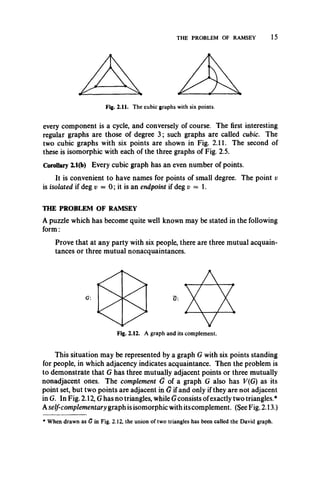
Fig. 2.12. A graph and its complement.
This situation may be represented by a graph G with six points standing
for people, in which adjacency indicates acquaintance. Then the problem is
to demonstrate that G has three mutually adjacent points or three mutually
nonadjacent ones. The complement G of a graph G also has V{G) as its
point set, but two points are adjacent in G if and only if they are not adjacent
in G. In Fig. 2.12, G has no triangles, while G consists ofexactly two triangles.*
A selfcomplementary graph is isomorphic with itscomplement. ($ee Fig. 2.13.)
* When drawn as &in Fig. 2.12, the union of two triangles has been called the David graph.
16 GRAPHS
Fig. 2.13. The smallest nontrivial self-complementary graphs.
The complete graph K p has every pair of its p points* adjacent. Thus
Kp has (5) lines and is regular of degree p — 1. As we have seen, K 3 is
called a triangle. The graphs Kp are totally disconnected, and are regular
of degree 0.
In these terms, the puzzle may be reformulated.
Theorem 2.2 For any graph G with six points, G or G contains a triangle.
Proof. Let v be a point of a graph G with six points. Since v is adjacent
either in G or in G to the other five points of G, we can assume without
loss of generality that there are three points uu u2, w3 adjacent to v in G.
If any two of these points are adjacent, then they are two points of a triangle
whose third point is v. If no two of them are adjacent in G, then uu n2, and
u3 are the points of a triangle in G.
The result of Theorem 2.2 suggests the general question: What is the
smallest integer r(ro, n) such that every graph with r(m, n) points contains
K mor K„1
The values r(m, n) are called Ramsey numbersf Of course r(m, n) =
r(n, m). The determination of the Ramsey numbers is an unsolved problem,
although a simple bound due to Erdos and Szekeres [ESI] is known.
( m + n — 2 
* ”•">4 -"-I )
This problem arose from a theorem of Ramsey. An infinite graph% has
an infinite point set and no loops or multiple lines. Ramsey [R2] proved
(in the language of set theory) that every infinite graph contains K0 mutually
adjacent points or K0 mutually nonadjacent points.
All known Ramsey numbers are given in Table 2.1, in accordance with
the review article by Graver and Yakel [GY1].
* Since V is not empty, p > 1. Some authors admit the “empty graph” (which we would
denote K0 if it existed) and are then faced with handling its properties and specifying that
certain theorems hold only for nonempty graphs, but we consider such a concept pointless.
t After Frank Ramsey, late brother of the present Archbishop of Canterbury. For a proof
that r(m, n) exists for all positive integers mand n, see for example Hall [H7, p. 57].
t Note that by definition, an infinite graph is not a graph. A review article on infinite graphs
was written by Nash-Williams [N3].
EXTREMAL GRAPHS 17
Table 2.1
RAMSEY NUMBERS
«m 2 3 4 5 6 7
2 2 3 4 5 6 7
3 3 6 9 14 18 23
4 4 9 18
EXTREMAL GRAPHS
The following famous theorem of Turan [T3] is the forerunner of the field
of extremal graph theory, see [E3]. As usual, let [r] be the greatest integer
not exceeding the real number r, and {r} = —[ —r], the smallest integer
not less than r.
Theorem 2.3 The maximum number of lines among all p point graphs with no
triangles is [p2/4].
Proof. The statement is obvious for small values of p. An inductive proof
may be given separately for odd p and for even p ; we present only the latter.
Suppose the statement is true for all even p < 2n. We then prove it for
p = In + 2. Thus, let G be a graph with p = In + 2 points and no triangles.
Since G is not totally disconnected, there are adjacent points u and v. The
subgraph G' = G — {u, v} has 2n points and no triangles, so that by the
inductive hypotheses G' has at most [4n2/4] = n2 lines. How many more
lines can G have? There can be no point w such that u and v are both adjacent
to w, for then u, v9and w would be points of a triangle in G. Thus if u is
adjacent to k points of G', v can be adjacent to at most 2n — k points. Then
G has at most
n2 + k 4- (2n — k) + 1 = n2 + In -f 1 = p2j4 = [p2/4] lines.
To complete the proof, we must show that for all even p, there exists a
(p, p2/4) graph with no triangles. Such a graph is formed as follows: Take
two sets Vx and V2 of p/2 points each and join each point of Vt with each
point of V2. For p = 6, this is the graph G{ of Fig. 2.5.
A bigraph (or bipartite graph*) G is a graph whose point set V can be
partitioned into two subsets Vl and V2 such that every line of Gjoins Vx with
V2. For example, the graph of Fig. 2.14(a) can be redrawn in the form of
Fig. 2.14(b) to display the fact that it is a bigraph.
If G contains every line joining Vxand V2, then G is a complete bigraph. If
Vx and V2 have m and n points, we write G = Kmn = K(m, n). A starf is a
* Also called bicolorable graph, pair graph, even graph, and other things,
t When n —3, Hoffman [H43] calls Kl na “claw”; Erdos and Renyi [ER1], a “cherry.”
18 GRAPHS
(a) (b)
Fig. 2.14. A bigraph.
complete bigraph K ln . Clearly K mn has mn lines. Thus, if p is even,
K(p/2, p/2) has p2/4 lines, while if p is odd, K([p/2], {p/2}) has [p/2] {p/2} =
[p2/4] lines. That all such graphs have no triangles follows from a theorem
of Konig [K10, p. 170].
Theorem 2.4 A graph is bipartite if and only if all its cycles are even.
Proof. If G is a bigraph, then its point set V can be partitioned into two sets
Vx and V2 so that every line of G joins a point of Vx with a point of V2. Thus
every cycle vxv2 • • • vnv1 in G necessarily has its oddly subscripted points
in Vu say, and the others in V2, so that its length n is even.
For the converse, we assume, without loss of generality, that G is
connected (for otherwise we can consider the components of G separately).
Take any point V, and let Vx consist of vt and all points at even distance
from vu while V2 = V — Vx. Since all the cycles of G are even, every line
of G joins a point of Vx with a point of V2. For suppose there is a line uv
joining two points of Vt. Then the union of geodesics from vx to v and from
vx to u together with the line uv contains an odd cycle, a contradiction.
Theorem 2.3 is the first instance of a problem in “extremal graph theory” :
for a given graph H, find ex (p, H  the maximum number of lines that a
graph with p points can have without containing the forbidden subgraph H.
Thus Theorem 2.3 states that ex (p, K 3) = [p2/4]. Some other results [E3]
in extremal graph theory are:
Turan [T3] generalized his Theorem 2.3 by determining the values of
ex (p, Kn) for all n < p,
ex (p, Cp) = 1 + (p - 1)(p - 2)/2,
ex (p, K a - x) = [p2/4],
ex (p, K 1i3 + x) = [p2/4].
(2.3)
(2.4)
(2.5)
(2.6)
INTERSECTION GRAPHS 19
where p = r mod (n - 1) and 0 < r < n — 1. A new proof of this result
was given by Motzkin and Straus [M SI].
It is also known that every (2n, n2 + 1) graph contains n triangles, every
(p, 3p — 5) graph contains two disjoint cycles for p > 6, and every
(3n, 3n2 4- 1) graph contains n2 cycles of length 4.
INTERSECTION GRAPHS
Let S be a set and F = {Sx, ■• • , Sp}a nonempty family of distinct nonempty
subsets of S whose union is S. The intersection graph of F is denoted Q(F)
and defined by F(Q(F)) = F, with S, and S, adjacent whenever i ^ j and
S. n # 0. Then a graph G is an intersection graph on S if there exists a
family F of subsets of S for which G = Q(F). An early result [M4] on inter­
section graphs is now stated.
Theorem 2.5 Every graph is an intersection graph.
Proof. For each point v( of G, let S, be the union of {pj with the set of lines
incident with i Then it is immediate that G is isomorphic with S1(F) where
F = {SJ.
In view of this theorem, we can meaningfully define another invariant.
The intersection number co(G) of a given graph G is the minimum number of
elements in a set S such that G is an intersection graph on S.
Corollary 2.5(a) If G is connected and p > 3, then co(G) < q.
Proof. In this case, the points can be omitted from the sets St used in the
proof of the theorem, so that S = X(G).
Corollary 2.5(b) If G has p0 isolated points and no K 2 components, then
a)(G) < q + p0.
The next result tells when the upper bound in Corollary 2.5(a) is attained.
Theorem 2.6 Let G be a connected graph with p > 3 points. Then co(G) = q
if and only if G has no triangles.
Proof. We first prove the sufficiency. In view of Corollary 2.5(a), it is only
necessary to show that co(G) > q for any connected G with at least 4 points
having no triangles. By definition of the intersection number, G is isomorphic
with an intersection graph Cl(F) on a set S with S = cu(G). For each point
vt of G, let St be the corresponding set. Because G has no triangles, no
element of S can belong to more than two of the sets and S, n Sj ^ 0
if and only if i i s a line of G. Thus we can form a 1-1 correspondence
between the lines of G and those elements of S which belong to exactly two
sets Therefore co(G) = S > q so that cu(G) = q.
To prove the necessity, let w(G) = q and assume that G has a triangle.
Then let Gj be a maximal triangle-free spanning subgraph of G. By the
preceding paragraph, a^G^ = qx ~ ^(G ^l. Suppose that Gx = Q(F),
2 0 GRAPHS
where F is a family of subsets of some set S with cardinality qt. Let x be a line
of G not in Gj and consider G2 = Gx + x. Since Gt is maximal triangle-free,
G2 must have some triangle, say ulu2w3, where x = uxu3. Denote by
S l9 S2, S3 the subsets of S corresponding to ul9 u2, u3. Now if u2 is adjacent
to only uv and u3 in Gu replace S2 by a singleton chosen from S t n S2, and
add that element to S3. Otherwise, replace S3 by the union of S3 and any
element in S t n S2. In either case this gives a family F' of distinct subsets
of S such that G2 = G(F'). Thus co(G2) < qt while X(G2) = q { + 1. If
G2 £ G, there is nothing to prove. But if G2 ^ G, then let
X(G) - X(G2) = q0.
It follows that G is an intersection graph on a set with qt + q0 elements.
However, qx + q0 = q - 1. Thus co(G) < q, completing the proof.
The intersection number of a graph had previously been studied by
Erdos, Goodman, and Posa [EGP1]. They obtained the best possible upper
bound for the intersection number of a graph with a given number of
points.
Theorem 2.7 For any graph G with p > 4 points, cu(G) < [p2/4].
Their proof is essentially the same as that of Theorem 2.3.
There is an intersection graph associated with every graph which depends
on its complete subgraphs. A clique of a graph is a maximal complete
subgraph. The clique graph of a given graph G is the intersection graph of
the family of cliques of G. For example, the graph G of Fig. 2.15 obviously
has K 4 as its clique graph. However, it is not true that every graph is the
clique graph of some graph, for Hamelink [H9] has shown that the same
graph G is a counterexample! F. Roberts and J. Spencer have just char­
acterized clique graphs:
Theorem 2.8 A graph G is a clique graph if and only if it contains a family
F of complete subgraphs, whose union is G, such that whenever every pair
of such complete graphs in some subfamily F ' have a nonempty inter­
section, the intersection of all the members of F' is not empty.
Fig. 2.15. A graph and its clique graph.
Excursion
A special class of intersection graphs was discovered in the field of genetics
by Benzer [B9] when he suggested that a string of genes representing a
OPERATIONS ON GRAPHS 21
bacterial chromosome be regarded as a closed interval on the real line.
Hajos [H2] independently proposed that a graph can be associated with
every finite family F of intervals Si9which in terms of intersection graphs, is
precisely Q(F). By an interval graph is meant one which is isomorphic to
some graph Q(F), where F is a family of intervals. Interval graphs have been
characterized by Boland and Lekkerkerker [BL2] and by Gilmore and
Hoffman [GH2].
Fig. 2.16. The union andjoin of two graphs.
OPERATIONS ON GRAPHS
It is rather convenient to be able to express the structure of a given graph
in terms of smaller and simpler graphs. It is also of value to have notational
abbreviations for graphs which occur frequently. We have already introduced
the complete graph K p and its complement Xp, the cycle C„, the path Pn,
and the complete bigraph K mn.
Throughout this section, graphs Gx and G2 have disjoint point sets Vx
and V2 and line sets X x and X 2 respectively. Their union* G = Gx u G2 has,
as expected, V = Vx u V2 and X = X x u X 2- Their join defined by
Zykov [Z l] is denoted Gx + G2 and consists of Gx u G2 and all lines
joining Vx with V2. In particular, K mn = Km + Kn. These operations are
illustrated in Fig. 2.16 with Gx = K 2 = P2 and G2 = K X2 = P 3.
For any connected graph G, we write nG for the graph with n components
each isomorphic with G. Then every graph can be written as in [HP14] in
the form U nfii with Gf different from Gj for i ^ j . For example, the
disconnected graph of Fig. 2.10 is 4K x u 3K 2 u 2K Z u K l 2.
There are several operations on Gx and G2 which result in a graph G
whose set of points is the cartesian product Vx x V2. These include the
product (or cartesian product, see Sabidussi [S5]), and the composition
[H21] (or lexicographic product, see Sabidussi [S6]). Other operationsf of
this form are developed in Harary and Wilcox [HW1].
*Ofcourse the union of two graphs which are not disjoint is also defined this way.
t These include the tensor product (Weichsel [W6J, MeAndrew [M7], Harary and Trauth
[HT1], Brualdi[Bl7|), and other kinds of product defined in Berge[B12, p. 23], 0re[05, p. 35],
and Teh and YapfTYl].
2 2 GRAPHS
G,:
(« 1. “ 2) (M l, v 2) ( u u W2)
U-x v2 w2
G2: • ■" « GxX G2*.
( » i. m2) (© ,, v 2) (v u w 2)
Fig. 2.17. The product of two graphs.
(Mi, u2) (M l, l>2) (M l, w2)
Fig. 2.18. Two compositions of graphs.
To define the product Gt x G2, consider any two points u = {ul9 u2)
and v = (vl9 v2) in V = Vt x F2. Then u and t>are adjacent in Gx x G2
whenever [ux = vt and u2 adj t?2] or [w2 = v2 and ux adj t^]. The product
of Gx = P2 and G2 = P3 is shown in Fig. 2.17.
The composition G = G ^ G J also has V = Vx x F2 as its point set,
and w = (ul9 u2) is adjacent with v = (i?t, v2) whenever [ux adj i?j] or
[ux = and u2 adj p2]. For the graphs Gx and G2 of Fig. 2.17, both com­
positions Gt[G2] and G ^ G ^ , which are obviously not isomorphic, are
shown in Fig. 2.18.
If Gt and G2are (pu qx) and (p2, q2) graphs respectively, then for each of
the above operations, one can calculate the number of points and lines in the
resulting graph, as shown in the following table.
Table 2.2
BINARY OPERATIONS ON GRAPHS
Operation Number of points Number of lines
Union Gi u G2 Pi + P2 <Ii + ?2
Join Gi + G2 Pi + P2 <h + 42 + P1P2
Product Gj x G2 P1P2 P1Q2 + P2Q1
Composition G,[G2] P1P2 Pl<l2 + Pill
EXERCISES 2 3
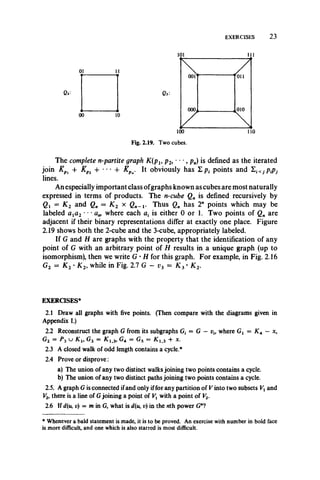
Fig. 2.19. Two cubes.
The complete n-partite graph K{pu p2, ***, pn) is defined as the iterated
join Kpi + KP2 4- **• 4- KPn. It obviously has £ p, points and Y,i<jpipj
lines.
An especially important class ofgraphs known as cubes are most naturally
expressed in terms of products. The n-cube Qn is defined recursively by
Ql = K 2 and Q„ = K 2 x Qn_x. Thus Q„ has 2n points which may be
labeled aia2 • • • where each at is either 0 or 1. Two points of Qn are
adjacent if their binary representations differ at exactly one place. Figure
2.19 shows both the 2-cube and the 3-cube, appropriately labeled.
If G and H are graphs with the property that the identification of any
point of G with an arbitrary point of H results in a unique graph (up to
isomorphism), then we write G • H for this graph. For example, in Fig. 2.16
G2 = K 2 - K 2, while in Fig. 2.7 G —v3 = K 3• K 2.
EXERCISES*
2.1 Draw all graphs with five points. (Then compare with the diagrams given in
Appendix I.)
2.2 Reconstruct the graph G from its subgraphs G ,= G — vh where Gt = K4 —x,
^ 2 = ^ 3 U ^ 1 > ^ 3 = ^ 1 ,3 > ^ 4 = G 5 = & i , 3 + X.
2.3 A closed walk of odd length contains a cycle.*
2.4 Prove or disprove:
a) The union of any two distinct walks joining two points contains a cycle.
b) The union of any two distinct paths joining two points contains a cycle.
2.5. A graph Gis connected ifand only iffor any partition of V into two subsets Vxand
V2, there is a line of Gjoining a point of Vj with a point of V2.
2.6 If d(ti, v) = m in G, what is d(u, v) in the nth power G"?
* Whenever a bald statement is made, it is to be proved. An exercise with number in bold face
is more difficult, and one which is also starred is most difficult.
2 4 GRAPHS
2.7 A graph H is a square root of G if H2 = G. A graph Gwith p points has a square
root if and only if it contains p complete subgraphs G, such that
1. u. eG,,
2. v{e Gj if and only if Vj e G,,
3. each line of G is in some G,. (Mukhopadhyay [M l8])
2.8 A finite metric space (5, d) is isomorphic to the distance space of some graph if
and only if
1. The distance between any two points of S is an integer,
2. If d(u, d) > 2, then there is a third point w such that d(u, w) + d(w, v) ~ d(u, v).
(Kay and Chartrand [KC1])
2.9 In a connected graph any two longest paths have a point in common.
2.10 It is not true that in every connected graph all longest paths have a point in
common. Verify that Fig. 2.20 demonstrates this. (Walther [W4])
2.11 Every graph with diameter d and girth 2d + 1 is regular. (Singleton [SI3])
2.12 Let G be a (p, q) graph all of whose points have degree k or k + 1. If G has
pk > 0 points of degree k and pk+xpoints of degree k + 1, then pk = (k + l)p —2q.
2.13 Construct a cubic graph with In points (n > 3) having no triangles.
2.14 If G has p points and <5(G) > (p — l)/2, then Gis connected.
2.15 If G is not connected then G is.
2.16 Every self-complementary graph has 4n or 4n + 1 points.
2.17 Draw any four of the ten self-complementary graphs with eight points.
2.18 Every nontrivial self-complementary graph has diameter 2 or 3.
(Ringel [R ll], Sachs [S8])
2.19 The Ramsey numbers satisfy the recurrence relation,
r(m, w) < r(m — 1, n) + r(mfn — 1). (Erdos and Szekeres [ESI])
2.20 Find the maximum number of lines in a graph with p points and no even cycles.
EXERCISES 25
2.21 Find the extremal graphs which do not contain K4.
2.22 Every (p, p 4- 4) graph contains two line-disjoint cycles.
(Turan [T3])
(Erdos [E3])
2.23 The only (p, [p2/4]) graph with no triangles is K([p/2], {p/2}).
2.24 Prove or disprove:The only graph on ppoints with maximum intersection number
is K([p/2], {p/2})-
2.25 The smallest graph having every line in at least two triangles but some line in no
126 Determine co(Kp), co(Cn 4- K x w(Cn + C„), and a)(Cn).
2.27 Prove or disprove:
a) The number of cliques of Gdoes not exceed co(G).
b) The number of cliques of G is not less than co(G).
128 Prove that the maximum number of cliques in a graphwith p points where
p - 4 = 3r + s, s - 0, 1 or 2, is 22_53r+s. (Moon and Moser[MM1])
2.29 A cycle of length 4 cannot be an induced subgraph of an interval graph.
2.30 Let s(n) denote the maximum number of points in the w-cube which induce a
cycle. Verify the following table:
2.31 Prove or disprove: If Gt and G2 are regular, then so is
a) Gj + G2. b) Gx x G2. c) Gj[G2].
2.32 Prove or disprove: If Gt and G2 are bipartite, then so is
a) Gj 4- G2. b) Gx x G2. c) Gt[G2].
2.33 Prove or disprove:
a) G1 4- G2 = Gx 4- G2. b) Gx x G2 = Gx x G2. c) Gj[G2] = C72[G2].
134 a) Calculate the number of cycles in the graphs (a) C„ 4- K x, (b) Kp1(c) Kmn.
(Harary and Manvel [HM1])
b) What is the maximum number of line-disjoint cycles in each of these three
graphs? (Chartrand, Geller, and Hedetniemi [CGH2])
2.35 The conjunction Gx a G2 has Vx x V2as its point set and u = (uu u2)is adjacent
to v = (vx, v2) whenever uxadj vxand u2adj v2. Then when Gxand G2 are connected,
Gj x G2 = G, a G2 if and only ifG t s G2 ^ C2m+X. (Miller [M il])
2.36 The conjunction Gj a G2 of two connected graphs is connected if and only if
Gxor G2 has an odd cycle.
*137 There exists a regular graph of degree r with r2 4- 1 points and diameter 2 only
for r = 2, 3, 7, and possibly 57. (Hoffman and Singleton [HS1])
*138 A graph G with p — 2n has the property that for every set S of n points, the
induced subgraphs <S> and (V —S) are isomorphic if and only if G is one of the
following: Kln, Kn x K2, 2Kn, 2C4, and their complements.
K4 is the octahedron K2 4- C4. (J. Cameron and A. R. Meetham)
n 2 3 4 5
s(n) 4 6 8 14 (Danzer and Klee [DK1])
(Kelly and Merriell [KM1])
C H A P T E R 3
BLOCKS
Not merely a chip of the old block,
but the old block itself.
E d m u n d B u r k e
Some connected graphs can be disconnected by the removal of a single
point, called a cutpoint. The distribution of such points is of considerable
assistance in the recognition of the structure of a connected graph. Lines
with the analogous cohesive property are known as bridges. The fragments
of a graph held together by its cutpoints are its blocks. After characterizing
these three concepts, we study two new graphs associated with a given
graph: its block graph and its cutpoint graph.
CUTPOINTS, BRIDGES, AND BLOCKS
A cutpoint of a graph is one whose removal increases the number of com­
ponents, and a bridge is such a line. Thus if v is a cutpoint of a connected
graph G, then G — v is disconnected. A nonseparable graph is connected,
nontrivial, and has no cutpoints. A block of a graph is a maximal nonsepar­
able subgraph. If G is nonseparable, then G itself is often called a block.
CUTPOINTS, BRIDGES, AND BLOCKS 27
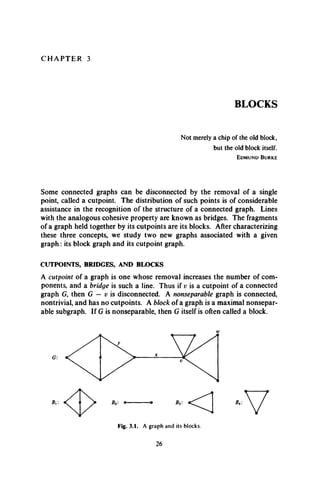
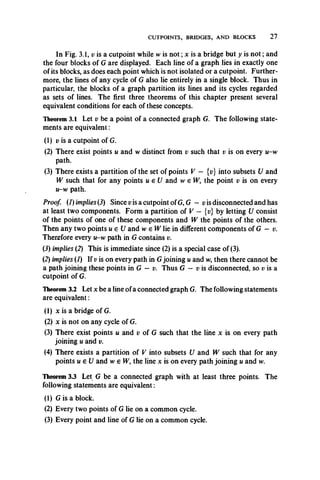
In Fig. 3.1, v is a cutpoint while w is n o t; x is a bridge but y is n o t; and
the four blocks of G are displayed. Each line of a graph lies in exactly one
of its blocks, as does each point which is not isolated or a cutpoint. Further­
more, the lines of any cycle of G also lie entirely in a single block. Thus in
particular, the blocks of a graph partition its lines and its cycles regarded
as sets of lines. The first three theorems of this chapter present several
equivalent conditions for each of these concepts.
Theorem 3.1 Let v be a point of a connected graph G. The following state­
ments are equivalent:
(1) v is a cutpoint of G.
(2) There exist points u and w distinct from v such that v is on every u-w
path.
(3) There exists a partition of the set of points V - {v} into subsets U and
W such that for any points u e U and w e W, the point v is on every
u-w path.
Proof. (1) implies (3) Since vis a cutpoint of G, G- v is disconnected and has
at least two components. Form a partition of V — {t;} by letting U consist
of the points of one of these components and W the points of the others.
Then any two points u e U and w e W lie in different components of G — v.
Therefore every u-w path in G contains v.
(3) implies (2) This is immediate since (2) is a special case of (3).
(2) implies (I) If v is on every path in G joining u and w, then there cannot be
a path joining these points in G —v. Thus G — v is disconnected, so v is a
cutpoint of G.
Theorem 3.2 Let x be a line of a connected graph G. The following statements
are equivalent:
(1) x is a bridge of G.
(2) x is not on any cycle of G.
(3) There exist points u and v of G such that the line x is on every path
joining u and v.
(4) There exists a partition of V into subsets U and W such that for any
points u e U and w e W, the line x is on every path joining u and w.
Theorem 3.3 Let G be a connected graph with at least three points. The
following statements are equivalent:
(1) G is a block.
(2) Every two points of G lie on a common cycle.
(3) Every point and line of G lie on a common cycle.
28 BLOCKS
(4) Every two lines of G lie on a common cycle.
(5) Given two points and one line of G, there is a path joining the points
which contains the line.
(6) For every three distinct points of G, there is a path joining any two of
them which contains the third.
(7) For every three distinct points of G, there is a path joining any two of
them which does not contain the third.
Proof (1) implies (2) Let u and v be distinct points of G, and let U be the set of
points different from u which lie on a cycle containing u. Since G has at
least three points and no cutpoints, it has no bridges; therefore, every point
adjacent to u is in 17, so U is not empty.
(a)
Fig. 3.2. Paths in blocks.
Suppose v is not in U. Let w be a point in U for which the distance
d(w, v) is minimum. Let P0 be a shortest w-v path, and let P x and P2 be the
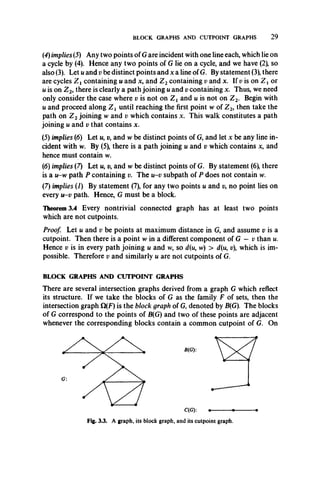
two u-w paths of a cycle containing u and w (see Fig. 3.2a). Since w is not a
cutpoint, there is a u-v path P not containing w (see Fig. 3.2b). Let w' be the
point nearest u in Pf which is also in Po, and let u' be the last point of the
u-w' subpath of P' in either P x or P2. Without loss of generality, we assume
u' is in P x.
Let Qx be the u-w' path consisting of the u-u' subpath of P x and the
u'-w' subpath of P. Let Q2 be the u-w' path consisting of P2 followed by the
w-w' subpath of P0. Then Qx and Q2 are disjoint u-w' paths. Together
they form a cycle, so w' is in U. Since w' is on a shortest w-v path,
d(w v) < d(w, v). This contradicts our choice of w, proving that u and v do
lie on a cycle.
(2) implies (3) Let u be a point and vw a line of G. Let Z be a cycle containing
u and v. A cycle Z' containing u and vw can be formed as follows. If w is on
Z, then Z' consists of vw together with the v-w path of Z containing u. If w
is not on Z, there is a w-u path P not containing v, since otherwise v would be a
cutpoint by Theorem 3.1. Let u' be the first point of P in Z. Then Z'consists
of vw followed by the w-u' subpath of P and the u'-v path in Z containing u.
(2) implies (4) This proof is analogous to the preceding one, and the details
are omitted.
BLOCK GRAPHS AND CUTPOINT GRAPHS 2 9
(4) implies (5) Any two points of G are incident with one line each, which lie on
a cycle by (4). Hence any two points of G lie on a cycle, and we have (2), so
also (3). Let u and v be distinct points and x a line of G. By statement (3), there
are cycles Z t containing u and x, and Z 2containing v and x. If p is on Z t or
u is on Z 2, there is clearly a path joining u and v containing x. Thus, we need
only consider the case where v is not on Z t and u is not on Z 2. Begin with
u and proceed along Z t until reaching the first point w of Z2, then take the
path on Z 2joining w and v which contains x. This walk constitutes a path
joining u and v that contains x.
(5) implies (6) L et«, v, and w be distinct points of G, and let x be any line in­
cident with w. By (5), there is a path joining u and v which contains x, and
hence must contain w.
(6) implies (7) Let w, v, and w be distinct points of G. By statement (6), there
is a u-w path P containing v. The u-v subpath of P does not contain w.
(7) implies (J) By statement (7), for any two points u and p, no point lies on
every u-v path. Hence, G must be a block.
Theorem 3.4 Every nontrivial connected graph has at least two points
which are not cutpoints.
Proof. Let u and v be points at maximum distance in G, and assume v is a
cutpoint. Then there is a point w in a different component of G — v than u.
Hence v is in every path joining u and w, so d(u, w) > d(u, v which is im­
possible. Therefore v and similarly u are not cutpoints of G.
BLOCK GRAPHS AND CUTPOINT GRAPHS
There are several intersection graphs derived from a graph G which reflect
its structure. If we take the blocks of G as the family F of sets, then the
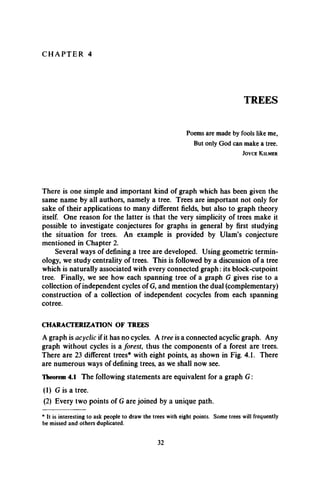
intersection graph Q(F) is the block graph of G, denoted by B(G). The blocks
of G correspond to the points of B(G) and two of these points are adjacent
whenever the corresponding blocks contain a common cutpoint of G. On
C(G):------- --------------- -
Fig. 3.3. A graph, its block graph, and its cutpoint graph.
3 0 BLOCKS
the other hand, to obtain a graph whose points correspond to the cutpoints
of G, we can take the sets S, to be the union of all blocks which contain the
cutpoint v(. The resulting intersection graph Q(F) is called the cutpoint
graph, C(G). Thus two points of C(G) are adjacent if the cutpoints of G to
which they correspond lie on a common block. Note that C(G) is defined
only for graphs G which have at least one cutpoint. Figure 3.3 illustrates
these concepts, which were introduced in [H28].
Theorem 3.5 A graph H is the block graph of some graph if and only if every
block of H is complete.
Proof. Let H = B(G), and assume there is a block ff, of H which is not
complete. Then there are two points in ff, which are nonadjacent and lie on
a shortest common cycle Z of length at least 4. But the union of the
blocks of G corresponding to the points of if, which lie on Z is then connected
and has no cutpoint, so it is itself contained in a block, contradicting the
maximality property of a block of a graph.
On the other hand, let if be a given graph in which every block is com­
plete. Form B(ff), and then form a new graph G by adding to each point if,
of B{H) a number of endlines equal to the number of points of the block if,
which are not cutpoints of if. Then it is easy to see that B(G) is isomorphic
to if.
Clearly the same criterion also characterizes cutpoint graphs.
EXERCISES
3.1 What is the maximum number of cutpoints in a graph with p points?
3.2 A cubic graph has a cutpoint if and only if it has a bridge.
3.3 The smallest number of points in a cubic graph with a bridge is 10.
3.4 If v is a cutpoint of G, then v is not a cutpoint of the complement G.
(Harary [H I5])
3.5 A point v of G is a cutpoint if and only if there are points u and w adjacent to
t; such that v is on every u-w path.
3.6 Prove or disprove: A connected graph G with p > 3 is a block if and only if
given any two points and one line, there is a path joining the points which does not
contain the line.
3.7 A connected graph with at least two lines is a block ifand only if any two adjacent
lines lie on a cycle.
3.8 Let G be a connected graph with at least three points. The following statements
are equivalent:
1. G has no bridges.
2. Every two points of G lie on a common closed trail.
3. Every point and line of G lie on a common closed trail.
EXERCISES 31
4. Every two lines of Glie on a common closed trail.
5. For every pair of points and every line of G, there is a trail joining the points
which contains the line.
6. For every pair of points and every line of G, there is a path joining the points
which does not contain the line.
7. For every three points there is a trail joining any two which contains the third.
3.9 If G is a block with S > 3, then there is a point v such that G — v is also a block.
(A. Kaugars)
3.10 The square of every nontrivial connected graph is a block.
3.11 If G is a connected graph with at least one cutpoint, then B(B(G)) is isomorphic
to C(G).
3.12 Let b(v) be the number of blocks to which point v belongs in a connected graph
G. Then the number of blocks of G is given by
b(G) - 1 = 1 [b(v) - 1]. (Harary [H22])
3.13 Let c(B) be the number of cutpoints of a connected graph G which are points of
the block B. Then the number of cutpoints of G is given by
c(G) - 1 = 1 [c(B) - 1]. (Gallai [G3])
3.14 A block G is line-critical if every subgraph G —x is not a block. A diagonal of G
is a line joining two points of a cycle not containing it. Let G be a line-critical block
with p > 4.
a) G has no diagonals.
b) G contains no triangles.
c) p < q ^ 2p - 4.
d) The removal of all points of degree 2 results in a disconnected graph, provided
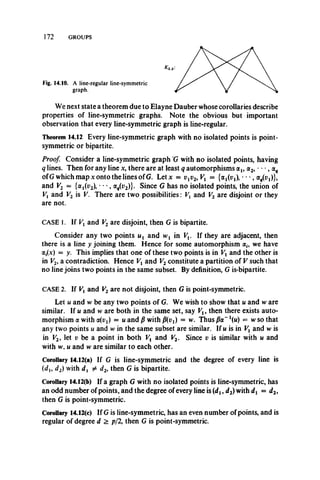
G is not a cycle. (Plummer [P4])
C H A P T E R 4
TREES
Poems are made by fools like me,
But only God can make a tree.
J o y c e K ilm er
There is one simple and important kind of graph which has been given the
same name by all authors, namely a tree. Trees are important not only for
sake of their applications to many different fields, but also to graph theory
itself. One reason for the latter is that the very simplicity of trees make it
possible to investigate conjectures for graphs in general by first studying
the situation for trees. An example is provided by Ulam’s conjecture
mentioned in Chapter 2.
Several ways of defining a tree are developed. Using geometric termin­
ology, we study centrality of trees. This is followed by a discussion of a tree
which is naturally associated with every connected graph: its block-cutpoint
tree. Finally, we see how each spanning tree of a graph G gives rise to a
collection of independent cycles of G, and mention the dual (complementary)
construction of a collection of independent cocycles from each spanning
cotree.
CHARACTERIZATION OF TREES
A graph is acyclic if it has no cycles. A tree is a connected acyclic graph. Any
graph without cycles is a forest, thus the components of a forest are trees.
There are 23 different trees* with eight points, a§ shown in Fig. 4.1. There
are numerous ways of defining trees, as we shall now see.
Theorem 4.1 The following statements are equivalent for a graph G :
(1) G is a tree.
(2) Every two points of G are joined by a unique path.
* It is interesting to ask people to draw the trees with eight points. Some trees will frequently
be missed and others duplicated.
32
CHARACTERIZATION OF TREES 33
(3) G is connected and p = q + 1.
(4) G is acyclic and p = q + 1.
(5) G is acyclic and if any two nonadjacent points of G are joined by a line x,
then G 4- x has exactly one cycle.
(6) G is connected, is not K p for p > 3, and if any two nonadjacent points
of G are joined by a line x, then G 4- x has exactly one cycle.
(7) G is not J(3 u X j or X 3 u K 2, p = q 4- 1, and if any two nonadjacent
points of G are joined by a line x, then G + x has exactly one cycle.
Proof. (1) implies (2) Since G is connected, every two points ofG are joined by
a path. Let P x and P2 be two distinct paths joining u and v in G, and let w
be the first point on P x (as we traverse P x from u to v) such that w is on both
P i and P2 but its successor on Px is not on P2. If we let w' be the next point
on P xwhich is also on P2, then the segments of P xand P2which are between
w and w' together form a cycle in G. Thus if G is acyclic, there is at most one
path joining any two points.
{2) implies (3) Clearly G is connected. We prove p = q + 1 by induction. It
is obvious for connected graphs of one or two points. Assume it is true
for graphs with fewer than p points. If G has p points, the removal of any
line of G disconnects G, because of the uniqueness of paths, and in fact this
new graph will have exactly two components. By the induction hypothesis
each component has one more point than line. Thus the total number of
lines in G must be p — 1.
(J) implies (4) Assume that G has a cycle of length n. Then there are n points
and n lines on the cycle and for each of the p — n points not on the cycle,
34 TREES
there is an incident line on a geodesic to a point of the cycle. Each such line
is different, so q > p, which is a contradiction.
(4) implies (5) Since G is acyclic, each component of G is a tree. If there are k
components, then, since each one has one more point than line, p = q -f k, so
k = 1 and G is connected. Thus G is a tree and there is exactly one path
connecting any two points of G. If we add a line uv to G, that line, together
with the unique path in Gjoining u and v, forms a cycle. The cycle is unique
because the path is unique.
(5) implies (6) Since every K p for p > 3 contains a cycle, G cannot be one of
them. Graph G must be connected, for otherwise a line x could be added
joining two points in different components of G, and G + x would be
acyclic.
(6) implies (7) We prove that every two points of G are joined by a unique
path and thus, because (2) implies (3), p = q -f 1. Certainly every two points
of G are joined by some path. If two points of G are joined by two paths, then
by the proof that (1) implies (2), G has a cycle. This cycle cannot have four or
more points because, if it did, then we could produce more than one cycle
in G + x by taking x joining two nonadjacent points on the cycle (if there
are no nonadjacent points on the cycle, then G itself has more than one
cycle). So the cycle is K 3, which must be a proper subgraph of G since by
hypothesis G is not complete with p > 3. Since G is connected, we may
assume there is another point in G which is joined to a point of this K 3.
Then it is clear that if any line can be added to G, then one may be added so as
to form at least two cycles in G + x. If no more lines may be added, so that
the second condition on G is trivially satisfied, then G is K p with p > 3,
contrary to hypothesis.
(7) implies (1) If G has a cycle, that cycle must be a triangle which is a com­
ponent of G, by an argument in the preceding paragraph. This component
has three points and three lines. All other components of G must be trees
and, in order to make p = q + 1, there can be only one other component. If
this tree contains a path of length 2, it will be possible to add a line x to G and
obtain two cycles in G + x. Thus this tree must be either K i or K 2. So
G must be/C3 u K 1 o r X 3 u K 2, which are the graphs which have been
excluded. Thus G is acyclic. But if G is acyclic and p = q 4- 1, then G is
connected since (4) implies (5) implies (6). So G is a tree, and the theorem is
proved.
Because a nontrivial tree has Z d, = 2q = 2(p — 1), there are at least
two points with degree less than 2.
Corollary 4.1(a) Every nontrivial tree has at least two endpoints.
This result also follows from Theorem 3.4.
CENTERS AND CENTROIDS 35
CENTERS AND CENTROIDS
The eccentricity e(v) of a point v in a connected graph G is max d(u, i;) for all
u in G. The radius r(G) is the minimum eccentricity of the points. Note that
the maximum eccentricity is the diameter. A point v is a central point if
e(v) = r(G), and the center of G is the set of all central points.
In the tree of Fig. 4.2, the eccentricity of each point is shown. This tree
has diameter 7, radius 4, and the center consists of the two points u and v9
each with minimum eccentricity 4. The fact that u and v are adjacent
illustrates a result discovered by Jordan* and independently by Sylvester;see
Konig [K10, p. 64].
Theorem 4.2 Every tree has a center consisting of either one point or two
adjacent points.
Proof. The result is obvious for the trees K x and K 2. We show that any
other tree T has the same central points as the tree T obtained by removing
all endpoints of T. Clearly, the maximum of the distances from a given point
u of T to any other point v of T will occur only when v is an endpoint.
Thus, the eccentricity of each point in T will be exactly one less than the
eccentricity of the same point in T. Hence the points of T which possess
minimum eccentricity in T are the same points having minimum eccentricity
in T', that is, T and T have the same center. If the process of removing
endpoints is repeated, we obtain successive trees having the same center
as T. Since T is finite, we eventually obtain a tree which is either K x or K 2.
In either case all points of this ultimate tree constitute the center of T which
thus consists of just a single point or of two adjacent points.
A branch at a point u of a tree T is a maximal subtree containing u as an
endpoint. Thus the number of branches at u is deg u. The weight at a point
u of T is the maximum number of lines in any branch at u. The weights at the
* Of Jordan Curve Theorem fame.
36 TREES
Fig. 4.3. The weights at the points of a tree.
nonendpoints of the tree in Fig. 4.3 are indicated. Of course the weight at
each endpoint is 14, the number of lines.
A point v is a centroid point of a tree T if v has minimum weight, and the
centroid of T consists of all such points. Jordan [J2] also proved a theorem
on the centroid of a tree analogous to his result for centers.
Theorem 4.3 Every tree has a centroid consisting of either one point or two
adjacent points.
The smallest trees with one and two central and centroid points are
shown in Fig. 4.4.
1
Centroid
2
Fig. 4.4. Trees with all combinations of one or two central and centroid points.
BLOCK-CUTPOINT TREES
It has often been observed that a connected graph with many cutpoints
bears a resemblance to a tree. This idea can be made more definite by as­
sociating with every connected graph a tree which displays the resemblance.
For a connected graph G with blocks {£,} and cutpoints {<;,}, the
block-cutpoint graph of G, denoted by bc(G), is defined as the graph having
point set {£J u {cj}, with two points adjacent if one corresponds to a block
Bi and the other to a cutpoint Cj and Cj is in £ f. Thus bc(G) is a bigraph. This
concept was introduced in Harary and Prins [HP22] and also in Gallai
[G3]. (See Fig. 4.5.)
1 Center 2
•
— <
— <
INDEPENDENT CYCLES AND COCYCLES 37
Fig. 4.5. A graph and its block-cutpoint graph.
Theorem 4.4 A graph G is the block-cutpoint graph of some graph H if
and only if it is a tree in which the distance between any two endpoints is
even.
In view ofthis theorem, we will speak of the block-cutpoint tree of a graph.
INDEPENDENT CYCLES AND COCYCLES
We describe two vector spaces associated with a graph G : its “cycle space”
and “cocycle space.” For convenience, these two vector spaces will be taken
over the two element field F2 = {0, 1}*, in which 1 + 1 = 0 (even though
the theory can be modified toehold for an arbitrary field). In particular, the
which occur repeatedly in the following definitions are always either 0 or 1.
As usual, let G be a graph with points vl9 • **, vp and lines x l9 • • *, xq.
A 0-chain of G is a formal linear combination E of points and a 1-chain
is a sum E e.x, of lines. The boundary operator d sends 1-chains to 0-chains
according to the rules:
a) d is linear.
b) if x = uv, then dx = u + v.
On the other hand, the coboundary operator S sends 0-chains to 1-chains by
the rules:
a) 5 is linear.
b) Sv = E e{x h where e* = 1 whenever x, is incident with v.
38 TREES
Fig. 4.6. A graph to illustrate the boundary and coboundary operators.
In Fig. 4.6, the 1-chain &1 = x x4 x2 + x4 4- x9 has boundary
dffi = (v, + v2) + (»! + t>3) + (i>2 + v4) + (i>5 + r6)
= V3 + v4 + vs + v6,
and the 0-chain o0 = v3 +v4 + v5+ v6 has as its coboundary
5o0 = (x2 4 x3 4 x64 x 7) 4 (x4 4 X8)
4- (x5 4- x6 4 x8 4 x9) 4 (x7 4- x9)
= x2 4 x3 4 x4 4 x5.
A 1-chain with boundary 0 is a cycle vector* of G and can be regarded as
a set of line-disjoint cycles. The collection of all cycle vectors forms a vector
space over F2 called the cycle space of G. A cycle basis of G is defined as a
basis for the cycle space of G which consists entirely of cycles. We say a
cycle-vector Z depends on the cycles Z l9 Z 2, • • •, Z k if it can be written
as =! fijZj. Thus a cycle basis of G is a maximal collection of independent
cycles of G, or a minimal collection of cycles on which all cycles depend.
A cutset of a connected graph is a collection of lines whose removal
results in a disconnected graph. A cocycle is a minimal cutset. A coboundary
of G is the coboundary of some 0-chain in G. The coboundary of a collection
U of points is just the set of all lines joining a point in U to a point not in
U. Thus every coboundary is a cutset. Since we define a cocycle as a minimal
cutset of G and any minimal cutset is a coboundary, we see that a cocycle
is just a minimal nonzero coboundary. The collection of all coboundaries
of G is called the cocycle space of G, and a basis for this space which consists
entirely of cocycles is called a cocycle basis for G.
We proceed to construct for the cycle space of G a basis which corre­
sponds to a spanning tree T. In a connected graph G, a chord of a spanning
tree T is a line of G which is not in T. Clearly the subgraph of G consisting
of T and any chord of T has exactly one cycle. Moreover, the set Z(T)
*Most topologists and some graph theorists call this a “cycle.” They then u^e “circuits” or
“elementary cycles” or “polygons” for our cycles.
INDEPENDENT CYCLES AND COCYCLES 39
zFig. 4.7. Graph, tree, and cotree.
Fig. 4.8. A cocycle basis for Gof Fig. 4.7.
of cycles obtained in this way (one from each chord) is independent, since
each contains a line not in any of the others. Also, every cycle Z depends
on the set Z(T), for Z is the symmetric difference of the cycles determined by
the chords of T which lie in Z. Thus if we define m(G), the cycle rank, to be
the number of cycles in a basis for the cycle space of G, we have the following
result.
Theorem 4.5 The cycle rank of a connected graph G is equal to the number
of chords of any spanning tree in G.
Corollary 4.5(a) If G is a connected (p, q) graph, then m(G) = q —p -f* 1.
Corollary 4.5(b) If G is a (p, q) graph with k components, then
Similar results are true for the cocycle space. The cotree T* ofa spanning
tree T in a connected graph G is the spanning subgraph of G containing
exactly those lines of G which are not in T. A cotree of G is the cotree of
some spanning tree T. In Fig. 4.7, a spanning tree T and its cotree T*
are displayed for the same graph G as in Fig. 4.6. The lines of G which are
not in T* are called its twigs. The subgraph of Gconsisting of T* and any
one of its twigs contains exactly one cocycle. The collection of cocycles
obtained by adding twigs to T*, one at a time, is seen to be a basis for the
cocycle space of G. This is illustrated in Fig. 4.8 for the graph G and cotree
T* of Fig. 4.7, with the cocycles indicated by heavy lines.. The cocycle rank
m*(G) is the number of cocycles in a basis for the cocycle space of G.
m(G) = q - p + k.
4 0 TREES
Theorem 4.6 The cocycle rank of a connected graph G is the number of
twigs in any spanning tree of T.
As in the case of cycles, we have two immediate corollaries.
Corollary 4.6(a) If G is a connected (p, q) graph, then m*(G) = p — 1.
Corollary 4.6(b) If G is a (p, q) graph with k components, then m*(G) = p — k.
Excursion
The 1-dimensional case of an important general result about simplicial
complexes can be derived from Theorem 4.5. The Euler-Poincare equation
a0 - a, + a2 - • • • = p0 - + p2 - • • •,
where the /?„ are the Betti numbers and the a„ are the numbers of simplexes
of each dimension, holds for every simplicial complex. Recall from Chapter 1
that every graph is a simplicial complex, with its points 0-simplexes and its
lines 1-simplexes. Foragraph,/?0 = fc, the number ofconnected components,
and fii = m(G), the number of independent cycles of G. Since no graph
contains an n-simplex with n > 1, a„ = /?„ = 0, for all n > 1. Thus
ao ~ a i = Po — Pi so p — q = k — m(G) and we see that Corollary 4.5(b)
is the Euler-Poincare equation for graphs.
MATROIDS
This subject was first introduced by Whitney [W15]. A discussion of the
basic properties of matroids, as well as several equivalent axiomatic formula­
tions, may be found in Whitney’s original paper.
A matroid consists of a finite set M of elements together with a family
= { c1# C2, • • •} of nonempty subsets of M, called circuits, satisfying the
axioms:
1. no proper subset of a circuit is a circuit;
2. if x e C 1 n C2, then C x u C2 — {x} contains a circuit.
With every graph G, one can associate a matroid by taking its set X of
lines as the set Af, and its cycles as the circuits. It is easily seen that the two
axioms are satisfied. It is slightly less obvious that G yields another matroid
by taking the cocycles of G as the circuits. These are called respectively the
cycle matroid and the cocycle matroid of G.
Another, equivalent, definition of matroid is as follows. Amatroid
consists of a finite set M of elements together with a familyof subsets of M
called independent sets such th at:
1. the empty set is independent;
MATROIDS 41
2. every subset of an independent set is independent;
3. for every subset A of M, all maximal independent sets contained in A
have the same number of elements.
A graph G yields a matroid in this sense by taking the lines of G as set
M and the acyclic subgraphs of G as the independent sets.
The duality (cycles vs. cocycles, trees vs. cotrees) which appears in the
preceding section is closely related to duality in matroids. Minty [M l2]
constructed a self-dual axiom system for “graphoids” which displays matroid
duality explicitly.
A graphoid consists of a set M of elements together with two collections
^ and Q) of nonempty subsets of M, called circuits and cocircuits respectively,
such th at:
1. for any C e ^ and D e |C n D| ^ 1;
2. no circuit properly contains another circuit and no cocircuit properly
contains another cocircuit;
3. for any painting of M which colors exactly one element green and the
rest either red or blue, there exists either
a) a circuit C containing the green element and no red elements, or
b) a cocircuit D containing the green element and no blue elements.
While the cycles of every graph form a matroid, not every matroid can
so arise from a graph, as we shall see in Chapter 13. Two comprehensive
references on matroid theory are Minty [M12] and Tutte [T19].
Excursion
Ulam’s conjecture is still as unsolved as ever for arbitrary graphs. But
Kelly [K5] proved its validity for trees. As we have seen, the point of view
toward this conjecture proposed in [H29] is that if G has p > 3 and one is
presented with the p unlabeled subgraphs G, = G — vi9 then the graph G
itself can be reconstructed uniquely from the Gt. Kelly’s result for trees
was extended in [HP6] where it is shown that every nontrivial tree T can be
reconstructed from only those subgraphs T{ = T — v{which are themselves
trees, that is, such that v(is an endpoint. This has been improved, in turn, by
Bondy, who showed [B15] that a tree T can be reconstructed from its
subgraphs T — with the the peripheral points, those whose eccentricity
equals the diameter of T. Manvel [M2] then showed that almost* every tree
T can be reconstructed using only those subtrees T — which are non­
isomorphic. Another class of graphs has been reconstructed by Manvel
[M3], namely unicyclic graphs, which are connected and have just one cycle.
* With just two pairs of exceptional trees.
4 2 TREES
EXERCISES
4.1 Draw all trees with nine points. Then compare your diagrams with those in
Appendix II.
4.2 Every tree is a bigraph. Which trees are complete bigraphs?
4.3 The following four statements are equivalent.
(1) G is a forest.
(2) Every line of G is a bridge.
(3) Every block of G is X 2.
(4) Every nonempty intersection of two connected subgraphs of G is connected.
4.4 The following four statements are equivalent.
(1) G is unicyclic.
(2) G is connected and p = q.
(3) For some line x of G, the graph G - x is a tree.
(4) G is connected and the set of linesof G which are not bridges form a cycle.
4.5 For any connected graph G, r(G) < d(G) < 2r(G).
4.6 Construct a tree with disjoint center and centroid, each having two points.
4.7 The center of any connected graph lies in a block. (Harary and Norman [HN2])
4.8 Given the block-cutpoint tree bc(G) of a connected graph G, determine the block-
graph B(G) and the cutpoint-graph C(G).
4.9 Determine the cycle ranks of (a) Kpi (b) Km (c) a connected cubic graph with
p points.
4.10 The intersection of a cycle and a cocycle contains an even number of lines.
4.11 A graph is bipartite if and only if every cycle in some cycle basis is even.
4.12 Every connected graph has a spanning tree.
4.13 Show how the block-cutpoint graph ofany graph can be defined as an intersection
graph.
4.14 A cotree of aconnected graph is a maximal subgraph containing no cocycles.
4.15 A tree with p> 3 has diameter 2 if and only if it is astar.
4.16 Prove or disprove:
a) If G has diameter 2, then it has a spanning star.
b) If G has a spanning star, then it has diameter 2.
4.17 Determine all connected graphs G for which G = bc(G).
*418 The maximum number of lines in a graph with p points and radius r is
(Anderson and Harary [AH1])
[pip ~ 2)/2] if r = 2,
4(p2 ~ 4rp H- 5p -f- 4r2 - 6r) if r > 3. (Vizing [V5])
4.19 G is a block if and only if every two lines lie on a common cocycle.
C H A P T E R 5
CONNECTIVITY
We must all hang together,
or assuredly we shall all hang separately.
B. F r a n k l in
The connectivity of graphs is a particularly intuitive area of graph theory
and extends the concepts of cutpoint, bridge, and block. Two invariants
called connectivity and line-connectivity are useful in deciding which of two
graphs is “more connected.”
There is a rich body of theorems concerning connectivity. Many of
these are variations of a classical result of Menger, which involves the number
of disjoint paths joining a given pair of points in a graph. We will see that
several such variations have been discovered in areas of mathematics other
than graph theory.
CONNECTIVITY AND LINE-CONNECTIVITY
The connectivity k = k(G) of a graph G is the minimum number of points
whose removal results in a disconnected or trivial graph. Thus the con­
nectivity of a disconnected graph is 0, while the connectivity of a connected
graph with a cutpoint is 1. The complete graph K pcannot be disconnected
by removing any number of points, but the trivial graph results after re­
moving p - 1 points; therefore, k(Kp) = p - 1. Sometimes k is called the
point-connectivity.
Analogously, the line-connectivity X = X(G) of a graph G is the minimum
number of lines whose removal results in a disconnected or trivial graph.
Thus X(Kt) = 0 and the line-connectivity of a disconnected graph is 0, while
that of a connected graph with a bridge is 1. Connectivity, line-connectivity,
and minimum degree are related by an inequality due to Whitney [W ll].
Theorem 5.1 For any graph G,
k(G) < X(G) < <5(G).
43
4 4 CONNECTIVITY
Proof. We first verify the second inequality. If G has no lines, then X = 0.
Otherwise, a disconnected graph results when all the lines incident with a
point of minimum degree are removed. In either case, X < <5.
To obtain the first inequality, various cases are considered. If G is
disconnected or trivial, then k = X = 0. If G is connected and has a bridge x,
then X = . In this case, k = 1 since either G has a cutpoint incident with x
or G is K 2. Finally, suppose G has X > 2 lines whose removal disconnects
it. Clearly, the removal of X — 1 of these lines produces a graph with a
bridge x = uv. For each ofthese X — 1lines, select an incident point different
from u or v. The removal of these points also removes the X — 1 lines and
quite possibly more. If the resulting graph is disconnected, then k < X; if
not, x is a bridge, and hence the removal of u or v will result in either a
disconnected or a trivial graph, so k < X in every case. (See Fig. 5.1.)
Chartrand and Harary [CH4] constructed a family of graphs with
prescribed connectivities which also have a given minimum degree. This
result shows that the restrictions on tc, X, and <5 imposed by Theorem 5.1
cannot be improved.
Theorem 5.2 For all integers a, b, c such that 0 < a < b < c, there exists a
graph G with k(G) = a, X(G) = b, and (5(G) = c.
Chartrand [C8] pointed out that if S is large enough, then the second
inequality of Theorem 5.1 becomes an equality.
Theorem 5.3 If G has p points and (5(G) > [p/2], then A(G) = (5(G).
For example, if G is regular of degree r > p/2, then A(G) = r. In
particular, X(Kp) = p — 1.
The analogue of Theorem 5.3 for connectivity does not hold. The
problem of determining the largest connectivity possible for a graph with a
given number ofpoints and lines was proposed by Berge [B11] and a solution
was given in [H26].
Theorem 5.4 Among all graphs with p points and q lines, the maximum
connectivity is 0 when q < p — 1 and is [2g/p], when q > p — 1.
CONNECTIVITY AND LINE-CONNECTIVITY 4 5
Outline ofproof Since the sum of the degrees of any (p, q) graph G is 2q, the
mean degree is 2q/p. Therefore <5(G) < [2q/p], so k(G) < 2q/p] by Theorem
5.1. To show that this value can actually be attained, an appropriate family
of graphs can be constructed. The same construction also gives those
(p, q) graphs with maximum line-connectivity.
Corollary 5.4(a) The maximum line-connectivity of a (p, q) graph equals the
maximum connectivity.
Only very recently the question of separating a graph by removing a
mixed set of points and lines has been studied. A connectivity pair of a graph
G is an ordered pair (a, b) of nonnegative integers such that there is some set
of a points and b lines whose removal disconnects the graph and there
is no set of a — 1 points and b lines or of a points and b — 1 lines with this
property. Thus in particular the two ordered pairs (k, 0) and (0, X) are
connectivity pairs for G, so that the concept of connectivity pair generalizes
both the point-connectivity and the line-connectivity of a graph. It is readily
seen that for each value of a, 0 < a < k , there is a unique connectivity pair
(a, ba); thus G has exactly k + 1 connectivity pairs.
The connectivity pairs of a graph G determine a function / from the
set (0, 1, • • •, k:} into the nonnegative integers such that /(k) = 0 (cf.
Theorem 5.1). This is called the connectivity function of G. It is strictly
decreasing, since if (a, b) is a connectivity pair with b > 0 there is obviously
a set of a + 1 points and b — 1 lines whose removal disconnects the graph
or leaves only one point. The following theorem, proved by construction in
Beineke and Harary [BH6], shows that these are the only conditions which
a connectivity function must satisfy.
Theorem 5.5 Every decreasing function / from {0, 1, •• •, k } into the non­
negative integers such that /(k) = 0 is the connectivity function of some
graph.
A graph G is n-connected if *c(G) > n and n-line-connected if 2(G) > n.
We note that a nontrivial graph is 1-connected if and only if it is connected,
and that it is 2-connected if and only if it is a block having more than one
line. So K 2 is the only block not 2-connected. From Theorem 3.3, it
therefore follows that G is 2-connected if and only if every two points of G
lie on a cycle. Dirac [D8] extended this observation to n-connected
graphs.
Theorem 5.6 If G is n-connected, n > 2, then every set of n points of G lie
on a cycle.
By taking G to be the cycle Cn itself, it is seen that the converse is not
true for n > 2.
A characterization of 3-connected graphs also exists, although its
formulation is not as easily given. In order to present this result, we need
4 6 CONNECTIVITY
the “wheel” invented by the eminent graph theorist W. T. Tutte. For n > 4,
the wheel Wn is defined to be the graph K x + C„_,. (See Fig. 5.2.)
Tutte’s theorem [T13] characterizing 3-connected graphs can now be
stated.
Theorem 5.7 A graph G is 3-connected if and only if G is a wheel or can be
obtained from a wheel by a sequence of operations of the following two
types:
1. The addition of a new line.
2. The replacement of a point v having degree at least 4 by two adjacent
points v', v" such that each point formerly joined to v is joined to exactly
one of vfand v”so that in the resulting graph, deg v' > 3 and deg v" > 3.
The graph G of Fig. 5.3 is 3-connected since it can be obtained from the
wheel W5 as indicated.
An n-component of a graph G is a maximal n-connected subgraph. In
particular, the 1-components of G are the nontrivial components of G while
the 2-components are the blocks of G with at least 3 points. It is readily
seen that two different 1-components have no points in common, and two
Fig. 5.3. Demonstration that a graph is 3-connected.
GRAPHICAL VARIATIONS OF MENGER’S THEOREM 4 7
Fig. 5.4. A graph with two 3-components which meet in two points.
distinct 2-components meet in at most one point. These facts have been
generalized by Harary and Kodama [HK1]. (See Fig. 5.4.)
Theorem 5.8 Two distinct n-components of a graph G have at most n — 1
points in common.
GRAPHICAL VARIATIONS OF MENGER’S THEOREM
In 1927 Menger [M9] showed that the connectivity of a graph is related to
the number of disjoint paths joining distinct points in the graph. Many
of the variations and extensions of Monger’s result which have since appeared
have been graphical, and we discuss some of these here. By emphasizing the
form these theorems take, it is possible to classify them in an illuminating
way.
Let u and v be two distinct points of a connected graph G. Two paths
joining u and v are called disjoint (sometimes called point-disjoint) if they
have no points other than u and v (and hence no lines) in common; they are
line-disjoint ifthey have no lines in common. A set S of points, lines, or points
and lines separates u and v if u and v are in different components of G —5.
Clearly, no set of points separates two adjacent points. Menger’s Theorem
was originally presented in the “point form” given in Theorem 5.9.
Theorem 5.9 The minimum number of points separating two nonadjacent
points s and t is the maximum number of disjoint s-t paths.
Proof. We follow the elegant proof of Dirac [DIO]. It is clear that if k
points separate s and t, then there can be no more than k disjoint paths
joining s and t.
It remains to show that if it takes k points to separate s and t in G, there
are k disjoint s-t paths in G. This is certainly true if k = 1. Assume it is not
true for some k > 1. Let h be the smallest such k, and let F be a graph with
the minimum number of points for which the theorem fails for h. We
remove lines from F until we obtain a graph G such that h points are required
to separate s and t in G but for any line x of G, only h — 1points are required to
separate s and tin G - x. We first investigate the properties of this graph G,
and then complete the proof of the theorem.
4 8 CONNECTIVITY
By the definition of G, for any line x of G there exists a set S(x) of h — 1
points which separates s and t in G —x. Now G — S(x) contains at least
one s-t path, since it takes h points to separate s and t in G. Each such s-t
path must contain the line x = uv since it is not a path in G — x. So
m, v $ S(x) and if u ^ s, t then S(x) u {u} separates s and t in G.
If there is a point w adjacent to both s and t in G, then G — w requires
h — 1 points to separate s and t and so it has h — 1 disjoint s-t paths.
Replacing w, we have h disjoint s-t paths in G. So we have shown:
(I) No point is adjacent to both s and t in G.
Let W be any collection of h points separating s and t in G. An s-W
path is a path joining s with some e W and containing no other point of
W. Call the collections ofall s-W paths and W -t paths Psand Pt respectively.
Then each s-t path begins with a member of Ps and ends with a member of
Pt, because every such path contains a point of W. Moreover, the paths in
Ps and Pt have the points of W and no others in common, since it is clear
that each w, is in at least one path in each collection and, if some other point
were in both an s-W and a W -t path, then there would be an s-t path con­
taining no point of W. Finally, either Ps — W = {s} or Pt — W = {t},
since, if not, then both Ps plus the lines {wjt, w2t, • *•} and Pt plus the lines
{swl5 sw2, • * } are graphs with fewer points than G in which s and t are
nonadjacent and /j-connected, and therefore in each there are h disjoint
s-t paths. Combining the s-W and W -t portions of these paths, we can
construct h disjoint s-t paths in G, and thus have a contradiction. Therefore
we have proved:
(II) Any collection W of h points separating s and t is adjacent either to
s or to t.
Now we can complete the proofofthe theorem. Let P = {s, uu m2, •*•, t}
be a shortest s-t path in G and let ulu2 = x. Note that by (I), u2 ^ t. Form
S(x) = {vt, v2, " ,v h^ 1} as above, separating s and t in G —x. By (I),
uxt i G, so by (II), with W = S(x) u {i^}, sv( e G, for all i. Thus by (I),
vtt 4 G, for all i. However, if we pick W = S(x) u {u2} instead, we have by
(II) that su2 e G, contradicting our choice of P as a shortest s-t path, and
completing the proof of the theorem.
In Fig. 5.5 we display a graph with two nonadjacent points s and t
which can be separated by removing three points but no fewer. In accordance
with the theorem, the maximum number of disjoint s-t paths is 3.
Chronologically the second variation of Menger’s Theorem was pub­
lished by Whitney in a paper [W ll] in which he included a criterion for a
graph to be n-connected.
Theorem 5.10 A graph is w-connected if and only if every pair of points are
joined by at least n point-disjoint paths.
GRAPHICAL VARIATIONS OF MENGER’S THEOREM 4 9
Fig. 5.5. A graph illustrating Menger s Theorem.
An indication of the relationship between Theorems 5.9 and 5.10 is easily
supplied by introducing the concept of local connectivity. The local con­
nectivity of two nonadjacent points u and v of a graph is denoted by k ( u , v)
and is defined as the smallest number of points whose removal separates
u and v. In these terms, Menger’s Theorem asserts that for any two specific
nonadjacent points u and p, k(w, v) = /z0(w, v), the maximum number of
point-disjoint paths joining u and p. Obviously both theorems hold for
complete graphs. If we are dealing with a graph G which is not complete,
then the observation which links Theorems 5.9 and 5.10 is that k(G) =
min k(u, v) over all pairs of nonadjacent points u and v.
Strangely enough, the theorem analogous to Theorem 5.9 in which the
pair of points are separated by a set of lines was not discovered until much
later. There are several nearly simultaneous discoveries of this result whichr
appeared in papers by Ford and Fulkerson [FF1] (as a special case of their
“max-flow, min-cut” theorem) and Elias, Feinstein, and Shannon [EFS1],
and also in unpublished work of A. Kotzig.
Theorem 5.11 For any two points of a graph, the maximum number of line-
disjoint paths joining them equals the minimum number of lines which
separate them.
Referring again to Fig. 5.5, we see that s and t can be separated by
the removal of five lines but no fewer, and that the maximum number of
line-disjoint s-t paths is five.
Even with only these three theorems available, we can see the beginnings
of a scheme for classifying them. The difference between Theorems 5.9 and
5.10 may be expressed by saying that Theorem 5.9 involves two specific
points of a graph while Theorem 5.10 gives a bound in terms of two general
points. This distinction, as well as the obvious one between Theorems 5.9
and 5.11, is indicated in Table 5.1.
Thus we see that with no additional effort we can get another variation of
Menger’s Theorem by stating the line form of the Whitney result.
50 CONNECTIVITY
Table 5.1
Theorem Objects separated Maximum number Minimum number
5.9 specific m, v disjoint paths points separating w, v
5.10 general w, v disjoint paths points separating u, v
5.11 specific uf v line-disjoint paths lines separating u, v
Theorem 5.12 A graph is n-line-connected if and only if every pair of points
are joined by at least n line-disjoint paths.
In Menger’s original paper there also appeared the following variation
involving sets of points rather than individual points.
Theorem 5.13 For any two disjoint nonempty sets of points Vx and the
maximum number ofdisjoint paths joining Vxand V2is equal to the minimum
number of points which separate Vx and V2.
Of course it must be specified that no point of Vx is adjacent with a
point of V2 for the same reason as in Theorem 5.9. Two paths joining Vx
and V2 are understood to be disjoint if they have no points in common other
than their endpoints. A proof of the equivalence of Theorems 5.9 and 5.13
is extremely straightforward and only involves shrinking the sets of points
Vx and V2 to individual points.
Another variation is given in the next theorem, considered by Dirac
[D9]. Because the proof involves typical methods in the demonstration of
equivalence of these variations, we include it in full.
Theorem 5.14 A graph with at least 2n points is n-connected if and only if
for any two disjoint sets Vx and V2 of n points each, there exist n disjoint
paths joining these two sets of points.
Note that in this theorem these n disjoint paths do not have any points
at all in common, not even their endpoints!
Proof, To show the sufficiency of the condition, we form the graph G' from
G by adding two new points wx and w2 with vvfadjacent to exactly the points
of Vi9 i = 1, 2. (See Fig. 5.6.)
Since G is n-connected, so is G', and hence by Theorem 5.9 there are n
disjoint paths joining wt and w2. The restrictions of these paths to G are
clearly the n disjoint Vx-V2 paths we need.
To prove the other “half,” let S be a set of at least n — 1 points which
separates G into Gx and G2, with points sets V and V2 respectively. Then,
since V > 1, V'2 > 1, and V + V2 + S = V > 2n, there is a
partition of S into two disjoint subsets S x and S2 such that V u S x > n
and |V2 u S2| ^ ft. Picking any n-subsets Vx of Vj u S X9and V2 of V’2 u S2,
GRAPHICAL VARIATIONS OF MENGER’S THEOREM 51
Fig. 5.6. Construction of G
we have two disjoint sets of n points each. Every path joining Vt and V2
must contain a point of S, and since we know there are n disjoint Vx-V 2
paths, we see that |S| > n, and G is n-connected.
We have defined connectivity pairs for a graph. Similarly, one can define
connectivity pairs for two specific points u and v. It is then natural to ask for
a mixed form of Menger’s Theorem involving connectivity pairs. The
following theorem of Beineke and Harary [BH6] is one such result; a proof
can be readily supplied by imitating that of Theorem 5.9.
Theorem 5.15 The ordered pair (a, b) is a connectivity pair for points u and v
in a graph G if and only if there exist a point-disjoint u-v paths and also b
line-disjoint u-v paths which are line-disjoint from the preceding a paths,
and further these are the maximum possible numbers of such paths.
In general, all of the theorems we have mentioned have corresponding
digraph forms, and in fact Dirac points out that his proof of Menger’s
Theorem works equally well for directed graphs. At this point, then, we
could add eleven more theorems to Table 5.1, namely Theorems 5.12 through
5.15, and the directed forms of Theorems 5.9 through 5.15. This would be a
somewhat futile effort, however, since it should be clear that the table would
still be far from complete. To count the total number of variations which
have been suggested up to this point, we note that we may consider either a
graph G or a digraph Z), in which we may separate
i) specific points u, v,
ii) general points w, v,
iii) two sets of points Vl9 V2 (as in Theorem 5.13).
This separation may be accomplished by removing
i) points,
ii) lines, or
iii) points and lines (as in Theorem 5.15).
52 CONNECTIVITY
By taking all possible combinations of these alternatives, we could
construct 2 - 3 - 3 = 18 theorems. The fact that all of these theorems are
true may be verified by the reader, although it would be a tedious exercise.
Finally, Fulkerson [F13] proved the following theorem, which deals
with disjoint cutsets instead of disjoint paths.
Theorem 5.16 In any graph, the maximum number of line-disjoint cutsets
of lines separating two points u and v is equal to the minimum number of
lines in a path joining u and v ; that is, to d(u9v).
Although this theorem is of Mengerian type, it is much easier to prove
than M^fTger’s Theorem. By taking all the possible variations of this theorem,
as we have with the theorems involving paths, we could increase the number
of Mengerian theorems again.
FURTHER VARIATIONS OF MENGER’S THEOREM
In this section we include several additional variations of Menger’s Theorem,
all discovered independently and only later seen to be related to each other
and to a graph theoretic formulation.
A network N may be regarded as a graph or directed graph together with
a function which assigns a positive real number to each line. For precise
definitions of “maximum flow” and “minimum cut capacity,” see the book
[FF2] by Ford and Fulkerson.
Fig. 5.7. A network with integral capacities.
Theorem 5.17 In any network N in which there is a path from u to v, the
maximum flow from u to v is equal to the minimum cut capacity.
It is straightforward but not entirely obvious to verify that in Fig. 5.7
the maximum flow in the network from u to v is 7, and that the minimum
cut capacity is also 7.
In the case where all the capacities are positive integers, as in this net­
work, there is an immediate equivalence between the maximum flow theorem
and that variation of Menger’s Theorem in which the setting is a directed
multigraph D and there are two specific points u and v. The transformation
FURTHER VARIATIONS OF MENGER’S THEOREM 53
Fig. 5.8. The transformation from network to multigraph.
which makes this equivalence apparent is displayed in Fig. 5.8 in which
the directed line from u to vx in Fig. 5.7 which has capacity 3 is transformed
into three directed lines without any capacity indicated.
Let us define a line of a matrix as either a row or a column. In a binary
matrix M, a collection of lines is said to cover all the unit entries of M
if every 1 is in one of these lines. Two l’s of M are called independent if they
are neither in the same row nor in the same column. Konig [K9] obtained
the next variation of Menger’s Theorem in these term s; compare Theorem
10.2.
Theorem 5.18 In any binary matrix, the maximum number of independent
unit elements equals the minimum number of lines which cover all the units.
'0 0 1 0 0 o" 0 0 1 0 0 o'
1 1 0 1 0 1 1 0 0 0 0 0
0 0 1 0 0 1 M' = 0 0 0 0 0 1
0 1 1 0 1 0 0 1 0 0 0 0
0 0 1 0 0 1 0 0 0 0 0 0
We illustrate Theorem 5.18 with the binary matrix M above. All the
unit entries of M are covered by rows 2 and 4 and columns 3 and 6, but there
is no collection of three lines of M which covers all its l’s. In the matrix M'
there are shown four independent unit entries of M and there is no set of five
independent l’s in M.
When this matrix M is regarded as an incidence matrix of sets versus
elements, Theorem 5.18 becomes very closely related to the celebrated
theorem of P. Hall [H8], which provides a criterion for a collection of finite
sets Sl9 S2, **•, Sm to possess a system of distinct representatives. This
means a set {el9 e2i - *, em} of distinct elements such that etis in S„ for each i.
We present here the proof of Hall’s Theorem which is due to Rado [R l].
Theorem 5.19 There exists a system of distinct representatives for a family
of sets S i9 S2, ' , S mif and only if the union of any k of these sets contains
at least k elements, for all k from 1 to m.
Proof The necessity is immediate. For the sufficiency we first prove that if
the collection {5f}satisfies the stated conditions and |SJ > 2, then there is an
element e in Smsuch that the collection of sets S u S2, • • *, Sm-i, Sm — {e}
54 CONNECTIVITY
also satisfies the conditions. Suppose this is not the case. Then there are
elements e and /in Smand subsets J and K of {1, 2, • • •, m — 1} such that
which is a contradiction.
The sufficiency now follows by induction on the maximum of the
numbers |Sf|. If each set is a singleton, there is nothing to prove. The in­
duction step is made by application (repeated if necessary) of the above
result to the sets of largest order.
In Fig. 5.9 we show a bipartite graph B in which the points refer either to
sets Si or to elements Two points of B are adjacent if and only if one is a
set point, the other is an element point, and the element is a member of the
set. The link between Theorem 5.19 and Menger’s Theorem is accomplished
by introducing two new points into a graph of the form of Fig. 5.9. Call
these points u and v and join u to every set point St and v with every element
point dj to obtain a new graph. Theorem 5.19 can then be proved by applying
either the maximum flow theorem or the appropriate line form of Menger’s
Theorem to this graph.
Although the following theorem due to Dilworth [D4] is expressed in
terms of lattice theory,* it has been established (see Mirsky and Perfect
[MP1]) that the result is equivalent to Hall’s Theorem. Two elements of a
lattice (see Birkhoff [B13]) are incomparable if neither dominates the other.
and
But then
|/| + K > |(u s.) U (Sm - {e}) + |(u s,) u (Sm - {/})
> J u K | + 1 + J n K  > |J| + |/q,
B:
Fig. 5.9. A bipartite graph illustrating Hall’s Theorem.
* More generally the result holds for partially ordered sets.
EXERCISES 55
By a chain in a lattice is meant a downward path from an upper element to a
lower element in the “Hasse diagram” of the lattice.
Theorem 5.20 In any finite lattice, the maximum number of incomparable
elements equals the minimum number of chains which include all the
elements.
For example, in the lattice of the 3-cube, there are at most three incom­
parable elements; it is easy to cover all the elements with three chains but
impossible to do so with only two chains.
We have seen in this section several theorems of Mengerian type
occurring in settings which are not graph theoretic. A more extensive
treatment of such results appears in the review article [H33]. For an elegant
summary of the vast literature on theorems involving systems of distinct
representatives, see Mirsky and Perfect [MP1].
EXERCISES
5.1 The connectivity of
a) the octahedron K2 + C4 is 4.
b) the square of a polygon C„, n > 5, is 4.
5.2 Every n-connected graph has at least pn/2 lines.
5.3 Construct a graph with k = 3, X — 4, <5 = 5.
5.4 Theorem 5.3 does not hold if X(G) is replaced by ic(G).
5.5 There exists no 3-connected graph with seven lines.
5.6 The connectivity and line-connectivity are equal in every cubic graph.
5.7 Determine which connectivity pairs can occur in 4-regular graphs.
5.8 If G is regular of degree r and k — 1, then X < [r/2].
5.9 Construct a family of (p, q) graphs with 2q/p integral such that k —2q/p.
5.10 Let G be a complete n-partite graph other than C4. Then every minimum line
cutset is the coboundary of some point. (M. D. Plummer)
5.11 Find the connectivity function for s and t in the graph of Fig. 5.5.
5.12 Find a graph with points s and t for which the connectivity function is (0, 5), (1, 3),
(2, 2 (3, 0).
5.13 Use Tutte’s Theorem 5.7 to show that the graph of the cube Q3is 3-connected.
5.14 Every block of a connected graph G is a wheel if and only if q = 2p - 2 and
k(u, v) = 1 or 3 for any two nonadjacent points u, v. (Bollobas [B14])
5.15 Every cubic triply-connected graph can be obtained from KA by the following
construction. Replace two distinct lines and u2v2 (u { = u 2 is permitted) by the
subgraph with two new points w l9 w2 and the new lines iqwj, WjWj, u 2w 2, w 2v2y and
WlW2.
56 CONNECTIVITY
5.16 Given two disjoint paths Px and P2joining two points u and v of a 3-connected
graph G, is it always possible to find a third path joining u and v which is disjoint from
both Pxand P2?
5.17 State the result analogous to Theorem 5.9 for the maximum number of disjoint
paths joining two adjacent points of a graph.
*5.18 Iffr(p) is the smallest number such that for q > fr(p) every (p, q) graph has two
points joined by r disjoint paths, then
flip) = A M p) = [<3p - m l and Up) = 2p - 1.
(Bollobas [B14])
5.19 If G has diameter d and k > 1, then p > tc(d — 1) + 2. (Watkins [W5])
5.21 If G is connected, then
k(G) =1-1- min tc(G —u)
veV
5.22 In any graph, the maximum number of disjoint cutsets of points separating two
points u and v equals d(u, v) — 1.
5.23 In a K-minimal graph G, k(G — x) < k(G ) for every line x.
a) Gis ic-minimal ifand only if k(u, u) = k(G ) for every pair of adjacent points u, v.
b) If G is jc-minimal then S = k. (Halin [H5]) ’
5.24 Prove the equivalence of Theorems 5.18 and 5.19. (See for example M. Hall
[H7, p. 49]).
5.25 If G is n-connected, n > 2, and <S(G) > (3n — l)/2, then there exists a point v in G
such that G — v is n-connected. (Chartrand, Kaugars, and Lick [CKL1])
C H A P T E R 6
PARTITIONS
Gallia est omnis divisa in tres partes.
J u l i u s C a e s a r , de Bello Gallico
The degrees dx, •• •, dp of the points of a graph form a sequence of non­
negative integers, whose sum is ofcourse 2q. In number theory it is customary
to define a partition of a positive integer n as a list or unordered sequence
ofpositive integers whose sum is n. Under this definition, 4 has five partitions :
4, 3 + 1, 2 + 2, 2 + 1 + 1, 1 + 1 + 1 + 1.
The order of the summands in a partition is not important. The degrees
of a graph with no isolated points determine such a partition of 2q, but
because of the importance of having a general definition holding for all
graphs, it is convenient to use an extended definition, changing positive
to nonnegative.
Fig. 6.1. T h e g ra p h ic a l p a rtitio n s o f 4.
A partition of a nonnegative integer n is a finite list of nonnegative
integers with sum n. In this sense, the partitions of 4 also allow an arbitrary
finite number of zero summands. The partition of a graph is the partition of
2q as the sum of the degrees of the points, 2q = E dh as in Theorem 2.1. Only
two of the five partitions of 4 into positive summands belong to a graph, see
Fig. 6.1.
A partition £ dt of n into p parts is graphical if there is a graph G whose
points have degrees dt. If such a partition is graphical, then certainly every
57
58 PARTITIONS
di < p — 1, and n is even. These two conditions are not sufficient for a
partition to be graphical, as shown by the partition 10 = 3 + 3 + 3 + 1.
Two related questions arise. First, how can one tell whether a given partition
is graphical? Second, how can one construct a graph for a given graphical
partition? An existential answer to the first was given by Erdos and Gallai
[EG1]. Another answer found independently by Havel [H36] and Hakimi
[H4] is constructive in nature, and so answers the second question as well.
We first give this result.
Theorem 6.1 A partition II = (du d2, " , dp) of an even number into p
parts with p — 1 > dx > d2 > **• > dp is graphical if and only if the
modified partition
IT = (d2 — 1, d2 — 1, • • •, ddi + j — 1, ddl +2, • • •, dp)
is graphical.
Proof. If IT is graphical, then so is n , since from a graph with partition II'
one can construct a graph with partition II by adding a new point adjacent
to points of degrees d2 — 1, d3 — I, • • •9ddl +i — 1.
Now let G be a graph with partition II. If a point of degree dxis adjacent
to points of degrees d( for i = 2 to dx + 1, then the removal of this point
results in a graph with partition II'.
Therefore we will show that from G one can get a graph with such a
point. Suppose that G has no such point. We assume that in G, point v4has
degree dh with vx being a point of degree dx for which the sum of the degrees
of the adjacent points is maximum. Then there are points v{ and Vj with
d( > dj such that vxVj is a line but vxv( is not. Therefore some point vk is
adjacent to vt but not to Vj. Removal of the lines vxVj and vkvt and addition
of vxVi and ykVj results in another graph with partition II in which the sum
of the degrees of the points adjacent to vx is greater than before. Repeating
this process results in a graph in which vx has the desired property.
The theorem gives an effective algorithm for constructing a graph with a
given partition, if one exists. If none exists, the algorithm cannot be applied
at some step.
Corollary 6.1 (Algorithm) A given partition II = (dx, d2, • • •, dp) with
p - 1 > dx > d2 > • • • > dp
is graphical if and only if the following procedure results in a partition with
every summand zero.
1. Determine the modified partition II' as in the statement of Theorem 6.1.
2. Reorder the terms of II' so that they are nonincreasing, and call the
resulting partition IIx.
PARTITIONS 59
Fig. 6.2. An example of the algorithm for graphical partitions.
3. Determine the modified partition FI" of U l as in step 1, and the re­
ordered partition U 2.
4. Continue the process as long as nonnegative summands can be obtained.
If a partition obtained at an intermediate stage is known to be graphical,
stop, since Ef itselfis then established as graphical. To illustrate this algorithm,
we test the partition
n= (5, 5, 3, 3, 2, 2, 2)
IT = ( 4,2,2, 1,1,2)
III = ( 4, 2, 2, 2, 1, 1)
i r = ( 1, 1, i, o, i).
Clearly II" is graphical, so II is also graphical. The graph so constructed is
shown in Fig. 6.2.
The theorem of Erdos and Gallai [EG1] is existential in nature, but its
proof uses the same construction.
Theorem 6.2 Let n = (dlJ d2, • • • , dp) be a partition of 2q into p > 1 parts,
dt > d 2 > - > d p. Then n is graphical if and only if for each integer r,
1 < r < p — 1,
X X < r(r - 1) + X m«n {»•>4}. (6.1)
i=l i=r+1
Proof. The necessity of these conditions (6.1) is straightforward. Given
that n is a partition of 2q belonging to a graph G, the sum of the r largest
degrees can be considered in two parts, the first being the contribution to this
sum of lines joining the corresponding r points with each other, and the
second obtained from lines joining one of these r points with one of the
remaining p — r points. These two parts are respectively at most r(r - l)and
S?=r+1 min {r, <*,}.
The proof of the sufficiency is by induction on p. Clearly the result holds
for sequences of two parts. Assume that it holds for sequences of p
parts, and let dt, d2, • • *, dp+x be a sequence satisfying the hypotheses of the
theorem.
Let m and n be the smallest and largest integers suchthat
^in+1 * +1 ' dn.
Form a new sequence of p terms by letting
for i = 1 to m — 1 and n - 1 —(dx - m) to n - 1,
6 0 PARTITIONS
1 - i
* U +i otherwise.
If the hypothesesof the theorem hold for the new sequence eu ', ep,
then by the induction hypothesis, there will be a graph with thenumbers et
as degrees. A graph having the given degree sequence dt will be formed by
adding a new point of degree dx adjacent to points of degrees corresponding
to those terms which were obtained by subtracting 1 from terms di+i as
above.
Clearly p > ex > e2 > ***> ep. Suppose that condition (6.1) does not
hold and let ft be the least value of r for which it does not. Then
£ c,- > ft(ft - 1) + £ min {ft, c,}. (6.2)
i= l *=#»+ 1
But the following inequalities do hold:
< h (h + 1) + min {ft + 1, d,}, (6.3)
i= l i =h+ 2
< (h - ix* - 2) + frn in {ft - 1, et}9 (6.4)
i = 1 i = /»
< (* - 2X* - 3) 4- t min {ft - 2, e,}. (6.5)
i = 1 i = h —1
Let s denote the number of values of i < ft for which e( = di^.l — 1.
Then (6.3)-(6.5) when combined with (6.2) yield
p
dx +s< 2ft -t- £ (min {ft + 1, di+l} - min (ft, ej), (6.6)
/=/»+ i
p
eh > 2(ft - 1) - min {ft - 1, eh} + £ (min {ft, c(} - min {ft - 1, et}),
i = It+ 1
(6.7)
e h ~ i + e h > 4 h - 6 - min {ft - 2, c * _ ,} - min {ft - 2, e*}
+ £ (min {ft, e,} - min {ft - 2, ef}). (6.8)
i = /i+ 1
PARTITIONS 61
Note that eh > h since otherwise inequality (6.7) gives a contradiction.
Let a, ft, and c denote the number of values of i > h for which ex> /!,£; = h,
and ex < ft, respectively. Furthermore, let a ft', and d denote the numbers
of these for which e{ = di+l — 1. Then
dt = s -f a' 4- b' 4- d. (6.9)
The inequalities (6.6)-(6.8) now become
dj 4- s < 2h 4- a 4- b' 4- c', (6.10)
eh > h 4- a + ft, (6.11)
p
e*_i + e„ > 2h - 1 + £ (min {Ji, e,} - min {/j - 2, ej). (6.12)
i=A+1
There are now several cases to consider.
CASE 1. d — 0. Since dx > eh, we have from (6.11),
ft 4- a 4- ft < d j.
But a combination of (6.9) and (6.10) gives
2dx < 2h + a + a' + 2ft',
which is a contradiction.
CASE 2. c' > 0 and dh+l > ft.This means that di+l = e, 4- 1 whenever
di+l > ft. Therefore since dh+l > ft, s = ft and a = a'. But theinequalities
(6.10) and (6.9) imply that
dx + ft < 2ft 4- a' 4- ft' 4- c' = dx + ft,
a contradiction.
CASE 3. c' > 1 and dh+l = h. Under these circumstances, eh = ft and a =
ft = 0, so dj = s 4- c'. Furthermore, since e* = d*+i, et = h — 1 for at
least c' values of i > ft. Hence inequality (6.12) implies
eh- i > ft — l 4 - c ' > f t
so that — dh — 1. Therefore s = ft — 1, and
dx = ft - 1 4- c' < < dh,
a contradiction.
CASE 4. c' = 1 and dh+l = ft. Again, eh = h, a = b = 0, and d{ = s + d.
Since s < ft - 1, = ft. Butthis implies s = 0 and dx = 1, so all dx = 1.
Thus (6.1) is obviously satisfied, which is a contradiction.
Since eh > ft and dh+1 > we see that cannot be less than ft.
Thus all possible cases have been considered and the proof is complete.
62 PARTITIONS
Fig. 6.3. Two trees with the same partition.
Sometimes, it can be determined quite rapidly whether a given partition
is graphical and, if it is, the nature of the graphs having this partition may
also be discernible. For example, it is easy to give a criterion for a partition
to belong to a tree. This result answers a question posed by Ore [05, p. 62];
it has been found independently many times.
Theorem 6.3 A partition 2q = 5^ dxbelongs to a tree if and only if each d( is
positive and q = p — 1.
As an illustration, consider the partition 16 = 5 + 3 + 2 + 1 + 1 +
1 + 1 + 1 + 1. Here d, > 0 for ea$h i and q = 8 while p = 9. Thus
Theorem 6.3 assures us that this is the partition of a tree. Two trees to which
this partition belongs are shown in Fig. 6.3. But the following graph has
the same partition and is not a tree.
EXERCISES
6.1 Which of the following partitions are graphical?
a )4 + 3 + 3 + 3 + 2 + 2 + 2 + l .
b )8 + 7 + 6 + 5 + 4 + 3 + 2 + 2 + l.
c)5 + 5 + 5 + 3 + 3 + 3 + 3 + 3.
d)5 + 4 + 3+ 2 + l + l + l + l + l + l + l + l.
6.2 Draw all the graphs havingthe partition 5 + 5 + 3 + 3 + 2 + 2.
6.3 The partition 16 = 5 + 3 + 2 + 1 + 1 + 1 + 1 + 1 + 1 belongs to each of
the trees in Fig. 6.3. Are there any other trees with this partition?
6.4 Construct all regular graphs with six points.
6.5 Construct all 5 connected cubic graphs with 8 points; all 19 with 10 points.
6.6 There is no graphical partition in which the parts are distinct. Whenever p > 2,
there are exactly two graphs with p points in which just two parts of the partition are
equal, and these graphs are complementary. (Behzad and Chartrand [BC3])
Fig. 6.4.
EXERCISES 63
6.7 A graphical partition is simple if there is exactly one graph with this partition.
Every graphical partition with four parts is simple, and the smallest number of parts
in a graphical partition which is not simple is five.
6.8 A partition (du d2, *• •, dp)belongs to a pseudograph (note that a loop contributes
2 to the degree of its point) if and only if £ d, is even. (Hakimi [H4])
6.9 If a partition of an even integer 2q has the form n = (du d2, •••, dp) with
dv > d2 > ••• > dp, then n belongs to some multigraph if and only if q > dv
(Hakimi [H4])
6.10 A partition IT which belongs to some multigraph (see preceding exercise) belongs
to exactly one if and only if at least one of the following conditions holds:
1. p < 3
2. di = d2 + ' ’• + dp
3. dj -+* 2 = d2 + ****+■ dpand d2 = d3 = • • = dp
4. p = 4 and d3 > d4 = 1
5. d2 = • •• = d„ = 1. (Senior [SI 1]; Hakimi [H4])
6.11 Prove or disprove: A tree partition belongs to more than one tree if and only if
at least one part is greater than 2, three parts are greater than 1, and if only three, then
they are not equal.
6.12 Let n = (dlt d2, • • •, dp) with dx > d2 > • • • > dp and p > 3 be a graphical
partition. Then
II belongs to some connected graph if and only if dp > 0 and L d, > 2(p - 1).
6.13 A graphical partition n as in the preceding exercise belongs to some n-line-
connected graph with n > 2 if and only if every d, > n. (Edmonds [El])
6.14 For any nontrivial graph G and for any partition p = p, + p2, there exists a
partition V = V, u V2such that VJi = p, and AK ^)) + A«K2» < A(G).
(Lovasz [L4])
C H A P T E R 7
TRAVERSABILITY
A lie will get you a long way,
but it won’t take you home.
A n o n y m o u s
One feature of graph theory that has helped to popularize the subject lies in
its applications to the area of puzzles and games. Often a puzzle can be
converted into a graphical problem: to determine the existence or non­
existence of an “eulerian trail” or a “hamiltonian cycle” within a graph. As
mentioned in Chapter 1, the concept of an eulerian graph was formulated
when Euler studied the problem of the Konigsberg bridges. Two char­
acterizations of eulerian graphs are presented. Hamiltonian graphs are
studied next and some necessary conditions and some sufficient conditions for
graphs to be hamiltonian are given. However, it still remains a challenging
unsolved problem to discover an elegant, useful characterization of
hamiltonian graphs, rather than only a disguised paraphrase of the definition.
EULERIAN GRAPHS
As we have seen in Chapter 1, Euler’s negative solution of the Konigsberg
Bridge Problem constituted the first publicized discovery of graph theory.
The perambulatory problem of crossing bridges can be abstracted to a
graphical one: given a graph G, is it possible to find a walk that traverses
each line exactly once, goes through all points, and ends at the starting point?
A graph for which this is possible is called eulerian. Thus, an eulerian graph
has an eulerian trail a closed trail containing all points and lines. Clearly,
an eulerian graph must be connected.
Theorem 7.1 The following statements are equivalent for a connected
graph* G :
(1) G is eulerian.
(2) Every point of G has even degree.
(3) The set of lines of G can be partitioned into cycles.
* The theorem clearly holds for multigraphs as well.
64
HAMILTONIAN GRAPHS 65
Proof. (7) implies (2) Let T be an eulerian trail in G. Each occurrence of a
given point in T contributes 2 to the degree of that point, and since each line
of G appears exactly once in T, every point must have even degree.
(2) implies (J) Since G is connected and nontrivial, every point has degree at
least 2, so G contains a cycle Z. The removal of the lines ofZ results in a span­
ning subgraph Gx in which every point still has even degree. If Gx has no
lines, then (3) already holds; otherwise, a repetition of the argument applied
to Gj results in a graph G2 in which again all points are even, etc. When a
totally disconnected graph G„ is obtained, we have a partition of the lines of
G into n cycles.
(2) implies (7) Let Z x be one of the cycles of this partition. If G consists only
of this cycle, then G is obviously eulerian. Otherwise, there is another cycle
Z 2 with a point v in common with Z v The walk beginning at v and con­
sisting of the cycles Z x and Z 2 in succession is a closed trail containing the
lines of these two cycles. By continuing this process, we can construct a
closed trail containing all lines of G ; hence G is eulerian.
For example, the connected graph of Fig. 7.1 in which every point has
even degree has an eulerian trail, and the set of lines can be partitioned into
cycles.
By Theorem 7.1 it follows that if a connected graph G has no points of
odd degree, then G has a closed trail containing all the points and lines of G.
There is an analogous result for connected graphs with some odd points.
Corollary 7.1(a) Let G be a connected graph with exactly 2n odd points,
n > 1. Then the set of lines of G can be partitioned into n open trails.
Corollary 7.1(b) Let G be a connected graph with exactly two odd points. Then
G has an open trail containing all the points and lines of G (which begins at
one of the odd points and ends at the other).
HAMILTONIAN GRAPHS
Sir William Hamilton suggested the class of graphs which bears his name
when he asked for the construction of a cycle containing every vertex of a
dodecahedron. If a graph G has a spanning cycle Z, then G is called a
hamiltonian graph and Z a hamiltonian cycle. No elegant characterization
66 TRAVERSABILITY
of hamiltonian graphs exists, although several necessary or sufficient con­
ditions are known.
A theta graph is a block with two nonadjacent points of degree 3 and all
other points of degree 2. Thus a theta graph consists of two points of degree
3 and three disjoint paths joining them, each of length at least 2.
Theorem 7.2 Every hamiltonian graph is 2-connected. Every nonhamiltonian
2-connected graph has a theta subgraph.
It is easy to find a theta subgraph in the nonhamiltonian block of Fig. 7.2.
The next theorem, due to Posa [P7], gives a sufficient condition for a
graph to be hamiltonian. It generalizes earlier results by Ore and Dirac
which appear as its corollaries.
Theorem 7.3 Let G have p > 3 points. If for every n, 1 < n < (p — l)/2,
the number of points of degree not exceeding n is less than n and if, for odd p,
the number of points of degree at most (p — l)/2 does not exceed (p — l)/2,
then G is hamiltonian.
Proof. Assume the theorem does not hold and let G be a maximal non­
hamiltonian graph with p points satisfying the hypothesis of the theorem.
It is easy to see that the addition of any line to a graph satisfying the con­
ditions of the theorem results in a graph which also satisfies these conditions.
Thus since the addition of any line to G results in a hamiltonian graph, any
two nonadjacent points must be joined by a spanning path.
We first show that every point of degree at least (p — l)/2 is adjacent
to every point of degree greater than (p — l)/2. Assume (without loss of
generality) that deg > (p — l)/2 and deg vp > p/2, but vx and vp are not
adjacent. Then there is a spanning path vi v2 ' " v p connecting vx and vp.
Let the points adjacent to vx be vil9 • • •, vin where n = deg vx and 2 =
*i < h < ' ** < V Clearly vp cannot be adjacent to any point of G of the
form Vi.-1, for otherwise there would be a hamiltonian cycle
vx v2 ‘ ' vtj—i vp tfp-i **• V^Vi
in G. Now since n > (p — l)/2, we have p/2 < deg vp < p — 1 —n < p/2
which is impossible, so vx and vp must be adjacent.
HAMILTONIAN GRAPHS 6 7
Fig. 7.3. Illustrations for the theorem of Posa.
It follows that if deg v > p/2 for all points v, then G is hamiltonian.
(This is stated below as Corollary 7.3(b).) For the above argument implies
that every pair of points of G are adjacent, so G is complete. But this is a
contradiction since K p is hamiltonian for all p > 3.
Therefore there is a point v in G with deg v < p/2. Let m be the maximum
degree among all such points and choose vxso that deg vx — m. By hypoth­
esis the number of points of degree not exceeding m is at most m < p/2.
Thus there must be more than m points having degree greater than m and
hence at least p/2. Therefore there is some point, say vp, of degree at least p/2
not adjacent to vx. Since vx and vpare not adjacent, there is a spanning path
ViV2 m , vp. As above, we write vh, • • •, vimas the points of G adjacent to
vx and note that vp cannot be adjacent to any of the m points vin l for
1 < j < m. But since vx and vp are not adjacent and vp has degree at least
p/2, m must be less than (p — l)/2, by the first part of the proof. Thus, by
hypothesis, the number of points of degree at most m is less than m, and so
at least one of the m points say v must have degree at least p/2.
We have thus exhibited two nonadjacent points vp and v each having
degree at least p/2, a contradiction which completes the proof.
These sufficient conditions are not necessary. The cubic graph Gx in
Fig. 7.3 is hamiltonian, yet it clearly does not satisfy the conditions of the
theorem. However, the theorem is best possible in that no weaker form of it
will suffice. For example, choose p > 3 and 1 < n < (p — l)/2, and form
a graph G2 with one cutpoint and two blocks, one of which,is Kn+x and the
other Kp_n. This graph is not hamiltonian, but it violates the theorem only
in that it has exactly n points of degree n. The construction is illustrated in
Fig. 7.3 for p = 8 and n — 3. If we choose p = 2n + 1, n > 1, and form the
graph G = K n>n+15then G is not hamiltonian but violates the theorem only
68 TRAVERSABILITY
by having (p - l)/2 + 1 points of degree (p - l)/2. The graph G3 = K 23
of Fig. 7.3 illustrates this construction for p = 5.
By specializing Posa’s Theorem, we obtain simpler but less powerful
sufficient conditions due to Ore [0 3 ] and Dirac [D6] respectively.
Corollary 7.3(a) If p > 3 and for every pair u and v of nonadjacent points,
deg u + deg v > p, then G is hamiltonian.
Corollary 73(b) If for all points v of G, deg v > p/2, where p > 3, then G is
hamiltonian.
Actually, the cubic hamiltonian graph Gt of Fig. 7.3 has four spanning
cycles. The smallest cubic hamiltonian graph,. K4, has three spanning cycles.
These observations serve to illustrate a theorem of C. A. B. Smith which
appears in a paper by Tutte [T6].
Theorem 7.4 Every cubic hamiltonian graph has at least three spanning
cycles.
Tait [T l] conjectured that every cubic 3-connected planar graph*
contains a spanning cycle. Tutte [T6] settled this in the negative by showing
that the 3-connected planar graph with 46 points ofFig. 7.4 is not hamiltonian.
The smallest known nonhamiltonian triply connected cubic planar graph,
having 38 points, was constructed independently by J. Lederberg, J. Bosak,
and D. Barnette; see Grunbaum [G10, p. 359].
The apparent lack of any relationship between eulerian and hamiltonian
graphs is illustrated in Fig. 7.5 where each graph is a block with eight points.
* See Chapter 11 for a discussion of planarity. Tait’s conjecture, if true, would have settled
the Four Color Conjecture.
EXERCISES 69
Hamiltonian Nonhamiltonian
Eulerian
Noneulerian
Fig. 7.5. Eulerian and/or hamiltonian graphs.
However, in the next chapter we shall relate eulerian and hamiltonian
graphs by way of the “line graph.”
Incidentally, M. D. Plummer conjectures that the square of every
2-connected graph is hamiltonian.
EXERCISES
7.1 Find an eulerian trail in the graph G of Fig. 7.1 and a partition of the lines of G
into cycles.
7.2 Ifevery block ofa connected graph Giseulerian, then Gis eulerian, and conversely.
7.3 In Corollary 7.1(a), the partition cannot be done with fewer than n trails. State
and prove the converse of Corollary 7.1(b).
7.4 A graph is arbitrarily traversablefrom a point v0if the following procedure always
results in an eulerian trail: Start at point v0by traversing any incident line;on arriving
at a point u depart by traversing any incident line not yet used, and continue until no
new lines remain.
a) An eulerian graph is arbitrarily traversable from v0 if and only if every cycle
contains v0. (Ore [02])
b) If G is arbitrarily traversable from v0, then v0 has maximum degree.
(Babler [Bl])
c) If G is arbitrarily traversable from v0, then either v0 is the only cutpoint or
G has no cutpoints. (Harary [HI7])
7.5 Prove or disprove: If a graph G contains an induced theta subgraph, then G is
not hamiltonian.
7.6 a) For any nontrivial connected graph G, every pair of points of G3are joined by
a spanning path. Hence every line of G3is in a hamiltonian cycle, when p > 3.
(Karaganis [K2])
b) If every pair of points of G are joined by a spanning path and p > 4, then G
is 3-connected.
70 TRAVERSABILITY
7.7 Give an example of a nonhamiltonian graph with 10 points such that for every
pair of nonadjacent points u and v, deg u -f deg v >9.
7.8 How many spanning cycles are there in the complete bigraphs K33 and K4>3?
7.9 A graph G is called randomly traceable [randomly hamiltonian] if a spanning
path [hamiltonian cycle] always results upon starting at any point of G and then
successively proceeding to any adjacent point not yet chosen until no new points are
available.
a) A graph Gwith p > 3 points is randomly traceable if and only if it is randomly
hamiltonian.
b) A graph Gwith p > 3joints is randomly traceable if and only if it is one of the
graphs Cp, Kpi or Knnwith p = 2n. (Chartrand and Kronk [CK1])
7.10 Theorem 7.3 can be regarded as giving sufficient conditions for a graph to be
2-connected. This can be generalized to the n-connected case.
Let G be nontrivial and let 1 < n < p. The following conditions are sufficient
for G to be n-connected:
1. For every k such that n —  < k < ( p + n —3)/2, the number of points of
degree not exceeding k does not exceed k + 1 — n.
2. The number of points of degree not exceeding (p + n —3)/2 does not exceed
p —n. (Chartrand, Kapoor, and Kronk [CKK1])
7.11 Posa’s theorem can also be generalized in another way.
Let G have p > 3 and let 0 < k < p - 2. If for every integer i with k + 1 <
i < (p + Ac)/2, the number of points not exceeding i is less than i —k, then every path of
length k is contained in a hamiltonian cycle. (Kronk [K13])
7.12 Recall that two labeled graphsare isomorphic if there is a label-preserving
isomorphism between them. By an e-graph is meant one in which every point has even
degree.
a) The number of labeled graphs with p points is 2p{p~1)/2.
b) The number of labeled e-graphs with p points equals the number of labeled
graphs with p — 1 points. (R. W. Robinson)
7.13 If G is a (p, q) graph with p > 3 and q > (p2 —3p + 6)/2, then G is hamiltonian.
(Ore [04])
7.14 If for any two nonadjacent points u and vof G, deg u + deg v > p -1-1, then there
is a spanning path joining every pair of distinct points. (Ore [06])
7.15 If G is a graph with p > 3 points such that the removal of any set of at most n
points results in a hamiltonian graph, then G is (n -I- 2)-connected.
(Chartrand, Kapoor, Kronk [CKK1])
7.16 Consider the nonhamiltonian graphs G such that every subgraph G — v is
hamiltonian. There is exactly one such graph with 10 points and none smaller.
(Gaudin, Herz, and Rossi [GHR1])
7.17 Do there exist nonhamiltonian graphs with arbitrarily high connectivity?
C H A P T E R 8
LINE GRAPHS
A straight line is the shortest distance between two points.
E u c l i d
The concept of the line graph of a given graph is so natural that it has been
independently discovered by many authors. Ofcourse, each gave it a different
name*:Ore [05] calls it the “interchange graph,” Sabidussi [S7] “derivative”
and Beineke [B8] “derived graph,” Seshu and Reed [SRI] “edge-to-vertex
dual,” Kasteleyn [K4] “covering graph,” and Menon [M10] “adjoint.”
Various characterizations of line graphs are developed. We also introduce
the total graph, first studied by Behzad [B4], which has surprisingly been
discovered only once thus far, and hence has no other names. Relationships
between line graphs and total graphs are studied, with particular emphasis
on eulerian and hamiltonian graphs.
SOME PROPERTIES OF LINE GRAPHS
Consider the set X of lines of a graph G with at least one line as a family
of 2-point subsets of V(G). The line graph of G, denoted L(G), is the intersec­
tion graph ). Thus the points of L(G) are the lines of G, with two points of
L(G) adjacent whenever the corresponding lines of G are. If x = uv is a line
of G, then the degree of x in L(G) is clearly deg u + deg v — 2. Two exam­
ples of graphs and their line graphs are given in Fig. 8.1. Note that in this
figure G2 = L(Gj), so that L(G2) = L(L(GX)). We write Lf(G) = L(G),
L2(G) = L(L(G)), and in general the iterated line graph is E(G) = L(E~ 1(G».
As an immediate consequence of the definition of L(G), we note that
every cutpoint ofL(G) is a bridge of G which is not an endline, and conversely.
When defining any class of graphs, it is desirable to know the number of
points and lines in each; this is easy to determine for line graphs.
* Hoffman [H46J uses “line graph” even though he chooses “edge.” Whitney [W 11] was the
first to discover these graphs but didn’t give them a name.
71
7 2 LINE GRAPHS
Fig. 8.1. Graphs and their line graphs.
Theorem 8.1 If G is a (p, q) graph whose points have degrees dh then L(G)
has q points and qL lines, where
Ql = —<1 + t Z d f -
Proof. By the definition of line graph, L(G) has q points. The d{ lines
incident with a point v( contribute (dj) to qLj so
4*. = 1 ( 2) = 414(4 - i) = *!«*? - 4 1 4 = 414? - 9.
The next result can be proved in many different ways, depending on
one’s whimsy.
Theorem 8.2 A connected graph is isomorphic to its line graph if and only
if it is a cycle.
Thus for a (not necessarily connected) graph, G = L(G) if and only if
G is regular of degree 2.
If Gj and G2 are isomorphic, then obviously L(Gi) and L(G2) are.
Whitney [W ll] found that the converse almost always holds by displaying
the only two different graphs with the same line graph. The proof given here
is due to Jung [J3].
Theorem 8.3 Let G and G' be connected graphs with isomorphic line graphs.
Then G and G' are isomorphic unless one is K 3 and the other is K t 3.
Proof First note that among the connected graphs with up to four points,
the only two different ones with isomorphic line graphs are K 3 and K t 3.
CHARACTERIZATIONS OF LINE GRAPHS 73
Note further that if </>is an isomorphism of G onto G', then there is a derived
isomorphism <f>t of L(G) onto L(G'). The theorem will be demonstrated
when the following stronger result is proved.
If G and G have more than four points, then any isomorphism <j)v of
L(G) onto L(G') is derived from exactly one isomorphism of G to G.
We first show that </>xis derived from at most one isomorphism. Assume
there are two such, </>and i//. We will prove that for any point v of G, <t>(v) =
[//(v). There must exist two lines x = uv and y = uw or vw. If y = vw, then
the points <t>(v) and j/(v) are on both lines <^>1(x) and <t>i(y), so that since only
one point is on both these lines, <j)(v) = ij/(v). By the same argument, when
y = mw, cf)(u) = so that since the line (t>t(x) contains the two points
(f)(v) and 0(w) = we again have <f>(v) = j/(v). Therefore (f>t is derived
from at most one isomorphism of G to G.
We now show the existence of an isomorphism <t>from which 4>i is
derived. The first step is to show that the lines x t = uvu x 2 = uv2, and
x3 = uv3 of a K 1>3 subgraph of G must go to the lines of a K 13 subgraph of
G' under <t>v Let y be another line adjacent with at least one ofthe x i9which is
adjacent with only one or all three. Such a line y must exist for any graph
with p > 5 and the theorem is trivial for p < 5. If the three lines <jMxf)
form a triangle instead of K 13 then (^(y) must be adjacent with precisely
two of the three. Therefore, every K l 3 must go to a K i 3.
Let S(v) denote the set of lines at v. We now show that to each v in G,
there is exactly one v' in G' such that S(v) goes to S(v') under <I>1. If deg v > 2,
let y i and y2be lines at v and let v' be the common point of <pi(yt)and <t>i(y2y
Then for each line x at v9v' is incident with <t>i(x) and for each line x' at v
v is incident with </>71(x'). If deg v = 1, let x = uv be the line at v. Then
deg m > 2 and hence S(u) goes to ^(n') and ^ (x ) = uV. Since for every line
x' at v'9the lines <j>i1(xr) and x must have a common point, u is on ^x')
and u' is on x'. That is, x' = ^^x) and deg v' = 1. The mapping (j) is
therefore one-to-one from V to V since S(m) = S(v) only when u = v. Now
given v' in V there is an incident line x'. Denote <t>ll(x’) by uv. Then
either <j)(u) = v' or 4>(v) = v' so 4>is onto.
Finally, we note that for each line x = uv in G, 0i(x) = <j>(u)(t)(v) and for
each line x' = m V in G', <t>il(x') = 0 _ 1 (m ')0 _ 1 (i;'), s o that <t> is an iso­
morphism from which is derived. This completes the proof.
CHARACTERIZATIONS OF LINE GRAPHS
A graph G is a line graph if it is isomorphic to the line graph L(H) of some
graph H. For example, K A — x is a line graph; see Fig. 8.1. On the other
hand, we now verify that the star K l 3 is not a line graph. Assume K l 3 =
L(H). Then H has four lines since K i3 has four points, and H must be
connected. All the connected graphs with four lines are shown in Fig. 8.2.
74 LINE GRAPHS
Since L(C4) = C4 by Theorem 8.3 and L(K l 3 + x) = JC4 — x (see Fig. 8.1),
it follows that H is one of the three trees. But the line graphs of these trees
are the path P 4, the graph K 2• K 2, and K A, showing that K l 3 is not a line
graph. We will see that the star K l 3plays an important role in characterizing
line graphs. The first characterization of line graphs, statement (2) of
the next theorem and due to Krausz [K12], was rather close to the defini­
tion. The situation was improved by van Rooij and Wilf [RW1] who were
able to describe in (3) a structural criterion for a graph to be a line graph.
Finally, Beineke [B8] and N. Robertson (unpublished) displayed exactly
those subgraphs which cannot occur in line graphs. Recall that an induced
subgraph is one which is maximal on its point set. A triangle T of a graph G
is called odd if there is a point of G adjacent to an odd number of its points,
and is even otherwise.
Theorem 8.4 The following statements are equivalent:
(1) G is a line graph.
(2) The lines of G can be partitioned into complete subgraphs in such a
way that no point lies in more than two of the subgraphs.
(3) G does not have K x 3 as an induced subgraph, and if two odd triangles
have a common line then the subgraph induced by their points is AT4.
(4) None of the nine graphs of Fig. 8.3 is an induced subgraph of G.
Proof. (1) implies (2) Let G be the line graph of H. Without loss of generality
we assume that H has no isolated points. Then the lines in the star at each
point of H induce a complete subgraph of G, and every line of G lies in exactly
one such subgraph. Since each line of H belongs to the stars of exactly
two points of //, no point of G is in more than two of these complete
subgraphs.
(2) implies (1) Given a decomposition of the lines of a graph G into complete
subgraphs Sj, S2, • • •, Sn satisfying (2), we indicate the construction of a
graph H whose line graph is G. The points of H correspond to the se( S of
CHARACTERIZATIONS OF LINE GRAPHS 75
Fig. 8.3. The nine forbidden subgraphs for line graphs.
subgraphs of the decomposition together with the set U of points of G
belonging to only one of the subgraphs S,. Thus S u U is the set of points of
H and two of these points are adjacent whenever they have a nonempty
intersection; that is, H is the intersection graph Cl(S u U).
(2) implies (4) It can be readily verified that none of the nine graphs of Fig. 8.3
can have its set of lines partitioned into complete subgraphs satisfying the
given condition. Since every induced subgraph of a line graph must itself
be a line graph, the result follows.
(4) implies (2) We show that ifG does not satisfy (3), then it has one of the nine
forbidden graphs as an induced subgraph. Assume that G has odd triangles
abc and abd with c and d not adjacent. There are two cases, depending on
whether or not there is a point v adjacent to an odd number of points of
both odd triangles.
76 LINE GRAPHS
CASE 1. There is a point v adjacent to an odd number of points of triangle
abc and of triangle abd. Now there are two possibilities:either v is adjacent to
exactly one point of each of these triangles or it is adjacent to more than one
point of one of them. In the latter situation, v must be adjacent to all four
points of the two triangles, giving G3 as an induced subgraph of G. In the
former, either v is adjacent only either to a or b, giving Gt, or to both c and d,
giving G2.
CASE 2. There is no point adjacent to an odd number of points of both
triangles. In this case, let u and v be adjacent to an odd number of points in
triangles abc and abd, respectively. There are three subcases to consider:
Case 2.1. Each of u, v is adjacent to exactly one point of the corre­
sponding triangle.
Case 2.2. One of u, v is adjacent to all three points of “its” triangle, the
other to only one.
Case 2.3. Each of u, v is adjacent to all three points of the corresponding
triangle.
Before these alternatives are considered, we note two facts. If u or v
is adjacent to a or b, then it is also adjacent to c or to d, since otherwise Gi is
an induced subgraph. Also, neither u nor v can be adjacent to both c and
d since then G2 or G3 is induced.
CASE 2.1. If uc, vde G then, depending on whether or not line uv is in G, we
have G4 or G7 as an induced subgraph. If ub, vdeG then it follows from
the preceding remarks that ud e G while vc $G ; if uv $G then points
{a, d, u, v} induce Gx, while if uv e G, then {a, b, c, d, u, v} induce G8. If
ub, vae G then necessarily ud, vc e G, so that if uv £ G, G8 is induced, while if
uv € G then G2appears. Finally ifub, vb e G, then again ud, vceG from which
it follows that either G9 or Gt is an induced subgraph of G, depending on
whether or not uv e G.
CASE 2.2. Let ua, ub, uc e G. Clearly if ude G then G3 is induced; thus
ud 4 G. Now v can be adjacent to d or b. If vd e G, then depending on
whether or not uv e G, we find G2 or G5 induced. If vb e G then either G3
or Gj is induced, depending on whether or not v is adjacent to both c and u.
CASE 2.3. If ud, vc, or uv € G, then G3 is induced. The only other possibility
gives G6.
3. implies 1. Suppose that G is a graph satisfying the conditions of the
statement. We may clearly take G to be connected. Now, exactly one of the
following statements must be true:
1. G contains two even triangles with a common line.
2. Whenever two triangles in G have a line in common, one of them is odd.
SPECIAL LINE GRAPHS 77
It can be shown that if G satisfies the first statement, then it is one of the
graphs H 1 = L (K t 3 + x), H 2 = L(H i), or H 3 = L(K^) displayed in
Fig. 8.4. So suppose that G satisfies the second statement. We indicate the
method of constructing a graph H such that G = L(H).
Let Fj be the family of all cliques of G which are not even triangles,
where each such clique is considered as a set of points. Let F 2 be the family
of points (taken as singletons) of G lying in some clique K in F t but not
adjacent to any point of G — K. Finally, let F 3 be the family of lines (each
taken as a set of two points) of G contained in a unique and even triangle. It
is not difficult to verify that G is isomorphic to the line graph of the inter­
section graph H = f2(Ft u F 2 u F 3). This completes the proof.
This last construction is illustrated in Fig. 8.5, in which the given graph
G has families F x = {{1, 2, 3, 4}, {4, 5, 6}}, F 2 = {{1}, {2}, {3}}, and
F 3 = {{5, 7}, {6, 7}) leading to the intersection graph H ; thus G = L(H).
Fig. 8.5. A line graph and its graph.
SPECIAL LINE GRAPHS
In this section, characterizations are presented for line graphs of trees,
complete graphs, and complete bigraphs.
The next result, due to G. T. Chartrand, specifies when a graph is the
line graph of a tree.
78 LINE GRAPHS
Theorem 8.5 A graph is the line graph of a tree if and only if it is a connected
block graph in which each cutpoint is on exactly two blocks.
Proof, Suppose G = L(T),T some tree. Then G is also B(T) since the lines
and blocks of a tree coincide. Each cutpoint x of G corresponds to a bridge
uv of T, and is on exactly those two blocks of G which correspond to the
stars at u and v. This proves the necessity of the condition.
To see the sufficiency, let G be a block graph in which each cutpoint is
on exactly two blocks. Since each block of a block graph is complete, there
exists a graph H such that L(H) = G by Theorem 8.4. If G = K 3, we can
take H = K l 3. If G is any other block graph, then we show that H must be
a tree. Assume that H is not a tree so that it contains a cycle. If H is itself
a cycle, then by Theorem 8.2, L(H) = H, but the only cycle which is a block
graph is X 3, a case not under consideration. Hence H must properly contain
a cycle, thereby implying that H has a cycle Z and a line x adjacent to two
lines of Z, but not adjacent to some line y of Z. The points x and y of L(H)
lie on a cycle of L(//), and they are not adjacent. This contradicts the
condition of Theorem 3.5 that L(H) is a block graph. Hence H is a tree, and
the theorem is proved.
In Fig. 8.6, a block graph G is shown in which each cutpoint lies on just
two blocks. The tree T of which G is the line graph is constructed by first
forming the block graph B(G) and then adding new points for the non-
cutpoints of G and the lines joining each block with its noncutpoints.
The line graphs of complete graphs and complete bigraphs are almost
always characterized by rather immediate observations involving adjacencies
of lines in K p and K m„. The case of complete graphs was independently
settled by Chang [C 7]’and Hoffman [H43], [H44].
LINE GRAPHS AND TRAVERSABILITY 79
Theorem 8.6 Unless p = 8, a graph G is the line graph of Kp if and only if
1. Ghas(£) points,
2. G is regular of degree 2(p — 2),
3. Every two nonadjacent points are mutually adjacent to exactly four
points,
4. Every two adjacent points are mutually adjacent to exactly p — 2
points.
It is evident that L(Kp) has these four properties. It is not at all obvious
that when p = 8, there are exactly three exceptional graphs satisfying the
conditions.
For complete bigraphs, the corresponding result was found by Moon
[M l3], and Hoffman .[H46].
Theorem 8.7 Unless m = n = 4, a graph G is the line graph of K mn if and
only if
1. G has mn points,
2. G is regular of degree m 4- n — 2,
3. Every two nonadjacent points are mutually adjacent to exactly two
points,
4. Among the adjacent pairs of points, exactly n(2) pairs are mutually
adjacent to exactly m — 2 points, and the other m(2) pairs to n — 2
points.
There is only one exceptional graph satisfying these conditions. It has
16 points, is not L(K4 4), and was found by Shrikhande [SI2] when he
proved Theorem 8.7 for the case m = n.
LINE GRAPHS AND TRAVERSABILITY
We now investigate the relationship of eulerian and hamiltonian graphs
with line graphs.
If x = uv is a line of G, and w is not a point of G, then x is subdivided
when it is replaced by the lines uw and wv. If every line of G is subdivided, the
Fig. 8.7. A graph and its subdivision graph.
80 LINE GRAPHS
L(G)
Fig. 8.9. Another counterexample.
resulting graph is the subdivision graph 5(G); see Fig. 8.7. If we denote by
5„(G) the graph obtained from G by inserting n new points of degree 2 into
every line of G, so that 5(G) = 5 t(G), we can then define a new graph
L„(G) = L(5b_j(G)). Note that, in general, Ln(G) qk ZT(G), the nth iterated
line graph of G.
Theorem 8.8 If G is eulerian, then L(G) is both eulerian and hamiltonian. If
G is hamiltonian, then L(G) is hamiltonian.
It is easy to supply counter-examples to the converses ofthese statements.
For example in Fig. 8.8, L(G) is eulerian and hamiltonian while G is not
eulerian; in Fig. 8.9, L(G) is hamiltonian while G is not.
A refinement of the second statement in Theorem 8.8 is provided by the
following result of Harary and Nash-Williams [HN1] which follows readily
from the preceding theorem and the fact that L2(G) = L(S(G)).
Theorem 8.9 A sufficient condition for L2(G) to be hamiltonian is that G
be hamiltonian and a necessary condition is that L(G) be hamiltonian.
The graphs of Figs. 8.10 and 8.9 show that the first of these conditions
is not necessary and the second is not sufficient for L2(G) to be hamiltonian.
We note also (see Fig. 8.11) that L(G) = L^G) and L2(G) may be hamiltonian
LINE GRAPHS AND TRAVERSABILITY 81
Fig. 8.10. Still another counterexample.
L(G)
Fig. 8.11. A sequence of graphs Ln(G).
without G being eulerian. However, the next graph L3(G) in this series
provides the link between these two properties.
Theorem 8.10 A graph G is eulerian if and only if L3(G) is hamiltonian.
For almost every connected graph G, however, nearly all of the graphs
12(G) are hamiltonian, as shown by Chartrand [C9].
Theorem 8.11 If G is a nontrivial connected graph with p points which is not
a path, then 12(G) is hamiltonian for all n > p — 3.
An example is given in Fig. 8.12 in which a 6-point graph G, as well as
L(G), L2(G), and the hamiltonian graph L3(G) are shown.
L(G) LHG)
Fig. 8.12. A sequence of iterated line graphs.
LHG)
82 LINE GRAPHS
TOTAL GRAPHS
The points and lines of a graph are called its elements. Two elements of a
graph are neighbors if they are either incident or adjacent. The total graph
T(G) has point set V(G) u X(G  and two points of T(G) are adjacent whenever
they are neighbors in G. Figure 8.13 depicts the formation of the total
graph T(K 3). It is easy to see that T(G) always contains both G and L(G) as
induced subgraphs.
An alternative characterization of total graphs was given by Behzad
[B4].
Theorem 8.12 The total graph T(G) is isomorphic to the square of the sub­
division graph 5(G).
Corollary 8.12(a) If v is a point of G, then the degree of point v in T(G) is
2 deg v. If x = uv is a line of G, then the degree of point x in T(G) is
deg u + deg v.
Corollary 8.12(b) If G is a (p, q) graph whose points have degrees dh then the
total graph T(G) has pT = p -f q points and qT = 2q + ^ £ df lines.
The Ramsey function r(m, n) was defined in Chapter 2, where it was noted
that its general determination remains an unsolved problem. Behzad and
Radjavi [BR1] defined and solved an analogue of the Ramsey problem,
suggested by line graphs. The line Ramsey number r^m, n) is the smallest
positive integer p such that every connected graph with p points contains
either n mutually disjoint lines or m mutually adjacent lines, that is, the star
K l m. Thus r^m, n) is the smallest integer p such that for any graph G
with p points, L(G) contains K mor L(G) contains K„.
Theorem 8.13 For n > 1, we always have rj(2, n) = 3. For all other m and w,
rj(m, ri) = (m — l)(n - 1) 4- 2.
Note that it is not always true that rt(m, n) = rt(n, m). Furthermore,
in contrast with Ramsey numbers, r^m^n) is defined only for connected
graphs.
EXERCISES 83
EXERCISES
8.1 Under what conditions can the lines of a line graph be partitioned into complete
subgraphs so that each point lies in exactly two of these subgraphs?
8.2 Determine the number of triangles in L(G) in terms of the number n of triangles of
Gand the partition of G.
8.3 Determine a criterion for a connected graph to have a regular line graph.
8.4 A graph G can be reconstructed from the collection of q spanning subgraphs
G - Xj if and only if its line graph L(G) satisfies Ulam’s Conjecture (p. 12).
(Hemminger [H41])
8.5 If G is n-line-connected, then
1. L(G) is n-connected,
2. L(G) is (2n —2)-line-connected, and
3. L2(G) is (2n —2)-connected. (Chartrand and Stewart [CS1])
8.6 a) Construct a connected graph G with p > 4 such that L(G) is not eulerian but
13(G) is.
b) There is no connected graph G with p > 5 such that L2(G) is not eulerian and
13(G) is.
8.7 The smallest block whose line graph is not hamiltonian is the theta graph with
8 points in which the distance between the points of degree 3 is 3. (J. W. Moon)
8.8 L(G) is hamiltonian if and only if there is a closed trail in G which includes at
least one point incident with each line of G.
8.9 The graph L2(G) is hamiltonian if and only if G has a closed spanning trail.
(Harary and Nash-Williams [HN1])
8.10 The following statements are equivalent
(1) L(G) is eulerian.
(2) The degrees of all the points of G are of the same parity and G is connected.
(3) T(G) is eulerian.
8.11 T(Kp) is isomorphic to L(Xp+j). (Behzad, Chartrand, and Nordhaus [BCN1])
8.12 Define a family F of subsets of elements of G such that T(G) = Q(F).
8.13 a) If G is hamiltonian, so is T(G). If G is eulerian, then T(G) is both eulerian and
hamiltonian.
b) The total graph T(G)ofevery nontrivial connected graph Gcontains a spanning
eulerian subgraph.
c) If a nontrivial graph G contains a spanning eulerian subgraph, then T(G) is
hamiltonian.
d) If G is nontrivial and connected, then T2(G) is hamiltonian.
(Behzad and Chartrand [BC2])
C H A P T E R 9
FACTORIZATION
The whole is equal to the sum of its parts.
E u c l i d , Elements
The whole is greater than the sum of its parts.
M a x W e r t h e i m e r , Productive Thinking
A problem which occurs in varying contexts is to determine whether a given
graph can be decomposed into line-disjoint spanning subgraphs possessing
a prescribed property. Most frequently, this property is that of regularity
of specified degree. In particular, a criterion for the existence in a graph of a
spanning regular subgraph of degree 1 was found by Tutte. Some observa­
tions are presented concerning the decomposition of complete graphs into
spanning subgraphs regular of degree 1 and 2.
The partitioning of the lines of a given graph into spanning forests is
also studied and gives rise to an invariant known as “arboricity.” A formula
for the arboricity of a graph in terms of its subgraphs was derived by Nash-
Williams, and explicit constructions for the minimum number of spanning
forests in complete graphs and bigraphs have been devised.
1-FACTORIZATION
Afactor of a graph G is a spanning subgraph of G which is not totally dis­
connected. We say that G is the sum* of factors Gf if it is their line-disjoint
union, and such a union is called afactorization of G. An n-factor is regular of
degree n. If G is the sum of n-factors, their union is called an n-factorization
and G itself is n-factorable. Unless otherwise stated, the results presented in
this chapter appear in or are readily inferred from theorems in Konig
[K10, pp. 155-195], where the topic is treated extensively.
When G has a 1-factor, say Gu it is clear that p is even and the lines of Gt
are point disjoint. In particular, K 2n+1 cannot have a 1-factor, but K ln
certainly can.
* Some call this product; others direct sum.
84
1-FACTORIZATION 85
Vs v4
G2:
C3: G4:
Fig. 9.1. A 1-factorization of K6.
Theorem 9.1 The complete graph K ln is 1-factorable.
Proof. We need only display a partition of the set X of lines of K ln into
(2n — 1) 1-factors. For this purpose we denote the points of G by
Vu v2>' ' ' >v2n> and define, for i = 1, 2, • • •, 2n — 1, the sets of lines
X { = {ViV2n} u {Vi-pi+J;j = 1, 2, • • •, n - 1}, where each of the subscripts
i —j and i 4- j is expressed as one of the numbers 1, 2, • • •, (2n — 1) modulo
(2n — 1). The collection {X,} is easily seen to give an appropriate partition
of X , and the sum of the subgraphs G, induced by X, is a 1-factorization of
*2„.
For example, consider the graph K 6 shown in Fig. 9.1. The 1-factoriza­
tion presented in the proof of the theorem produces the five 1-factors Gf.
Although the complete bigraphs K mn have no 1-factor if m # n, the
graphs Knnare 1-factorable, as seen by the next statement.
Theorem 9.2 Every regular bigraph is 1-factorable.
It is not an easy problem to determine whether a given graph is 1-
factorable, or, indeed, to establish whether there exists any 1-factor. Beineke
and Plummer [BP2] have shown, however, that many graphs cannot have
exactly one 1-factor.
Theorem 9.3 If a 2-connected graph has a 1-factor, then it has at least two
different 1-factors.
The graph G in Fig. 9.2 is a block with exactly two 1-factors, and they
have one common line.
The most significant result on factorization is due to Tutte [T7] and
characterizes graphs possessing a 1-factor. In general, this test for a 1-factor
is quite inconvenient to apply. The proof given here is based on Gallai [G I].
86 FACTORIZATION
A set of mutually nonadjacent lines is called independent. By an odd
component of G we mean one with an odd number of points.
Theorem 9.4 A graph G has a 1-factor if and only if p is even and there is no
set S of points such that the number of odd components of G —S exceeds
|S|.
Proof. The easier half of this theorem is its necessity. Let S be any set of
points of G and let H be a component of G - S. In any 1-factor of G, each
point of H must be paired with either another point of H or a point of S.
But if H has an odd number of points, then at least one point of H is matched
with a point of S. Let k0 be the number of odd components of G —S. If
G has a 1-factor then |S| > k0, since in a 1-factor each point of S can be
matched with at most one point of G — S and therefore can take care of
at most one odd component.
In order to prove the sufficiency, assume that G does not have a 1-factor,
and let S be a maximum set of independent lines. Let T denote the set of
lines not in S, and let u0 be a point incident only with lines in T. A trail is
called alternating if the lines alternately lie in S and T. For each point
v ^ w0, call v a 0-point if there are no u0-v alternating trails; if there is such
a trail, call v an 5-point if all these trails terminate in a line of 5 at v, a T-
point if each terminates in a line of T at v, and an ST-point if some terminate
in each type of line. The following statements are immediate consequences.
Every point adjacent to u0 is a T- or an ST-point.
No 5- or 0-point is adjacent to any S- or ST-point.
No T-point is joined by a line of S to any T- or 0-point.
Therefore, each S-point isjoined by a line ofS to a T-point. Furthermore,
each T-point v is incident with a line of S since otherwise the lines in an
alternating u0-v trail could be switched between S and T to obtain a larger
independent set.
1-FACTORIZATION 87
Let H be the graph obtained by deleting the T-points. One component
of H contains u0, and any other points in it are ST-points. The other com­
ponents either consist of an isolated S-point, only ST-points, or only
0-points.
We now show that any component H x of H containing ST-points has an
odd number of them. Obviously H t either contains u0 or has a point ux
joined in G to a T-point by a line of S such that some alternating u0-u i
trail contains this line and no other points of H v If H xcontains w0, we take
ut = Uq. The following argument will be used to show that within H x every
point v other than ux is incident with some line of S. This is accomplished by
showing that there is an alternating ux-v trail in H x which terminates in a
line of S.
The first step in doing this is showing that if there is an alternating
Ui-u trail P l9 then there is one which terminates in a line of S. Let P2 be
an alternating u0-v trail ending in a line of T, and let u'v' be the last line of
P2, if any, which does not lie in H v Then u' must be a T-point and u'vf a line
in S. Now go along P x from ux until a point W of P2 is reached. Continuing
along P2 in one of the two directions must give an alternating trail. If
going to v' results in an alternating path, then the original m0-Ui trail P0
followed by this new path and the line v’vt would be a u0- u l trail terminating
in a line of S and u' could not be a T-point. Hence there must be a ux-v
trail terminating in a line of S.
Now we show that there is necessarily a ux-v alternating trail by as­
suming there is not. Then there is a point w adjacent to v for which there is a
ux-w alternating trail. If line wv is in S, then the ut-w alternating trail
terminates in a line of T, while if wv is in T, the preceding argument shows
there is a ux-w trail terminating in a line of S. In either case, there is a
ux-v alternating trail.
This shows that the component H x has an odd number of points, and
that if H xdoes not contain u0, exactly one of its points is joined to a T-point
by a line of S. Hence, with the exception of the component of H containing
u0 and those consisting entirely of 0-points, each is paired with exactly one
T-point by a line in S. Since each of these and the component containing
u0 is odd, the theorem is proved.
The graph of Fig. 9.3 has an even number of points but contains no 1-
factor, for if the set S = {vu v2} is removed from G, four isolated points
(and therefore four odd components) remain.
Fig. 9.3. A graph with no 1-factor.
88 FACTORIZATION
Building up on his criterion for the existence of a 1-factor in a given
graph, Tutte [T10] was able to characterize those graphs having a spanning
subgraph with prescribed degree sequence, and later, [T il], proved this
result as a straightforward consequence of Theorem 9.4. Consider a labeling
of G and a function / from V into the nonnegative integers. Let S and
T be disjoint subsets of V, let H be a component of G —(S u T), and let
q(H, T) be the number of lines of G joining a point of H with one in T. Then
we may write fc0(S, T) as the number of components H of G — (S u T)
sue h that q(H, T ) + ZMeW/ (m) is odd.
Theorem 9.5 Let G be a given graph and let / be a function from V into the
nonnegative integers. Then G has no spanning subgraph whose degree se­
quence is prescribed by / if and only if there exist disjoint sets S and T of
points such that
2-FACTORIZATION
If a graph is 2-factorable, then each factor must be a union of disjoint cycles.
If a 2-factor is connected, it is a spanning cycle. We saw that a complete
graph is 1-factorable if and only if it has an even number of points. Since
a 2-factorable graph must have all points even, the complete graphs K 2n
are not 2-factorable. The odd complete graphs are 2-factorable, and in
fact a stronger statement can be made.
! / ( « ) < k0(S, T) + £[/(!>) - dG^ v ) l
Fig. 9.4. A 2-factorization of K-,.
2 -f a c t o r iz a t io n 89
Theorem 9.6 The graph K 2n+1 is the sum of n spanning cycles.
Proof. In order to construct n line-disjoint spanning cycles in K 2n+1, first
label its points vu v2, • • •, v2n+j. Then construct n paths Pt on the points
Vi,v2, ' ’ -,v 2„as follows: P, = vi vi_l vi+1 y,_2 • vi+m_ i Thus the ;th
point of Pi is vk, where k = i + (—l)J+1[y/2] and all subscripts are
taken as the integers 1, 2, • • •, 2n (mod 2n). The spanning cycle Z xis then
constructed by joining v2n+x to the endpoints of Pf.
This construction is illustrated in Fig. 9.4 for the graph K n. The lines
of the paths P* are solid and the two added lines are dashed.
There is a decomposition of K 2nwhich embellishes the result of Theorem
9.1.
Theorem 9.7 The complete graph K 2n is the sum of a 1-factor and n — 1
spanning cycles.
Of course, every regular graph of degree 1 is itself a 1-factor and every
regular graph of degree 2 is a 2-factor. If every component of a regular
graph G of degree 2 is an even cycle, then G is also 1-factorable since it can
be expressed as the sum of two 1-factors. If a cubic graph contains a 1-factor,
it must also have a 2-factor, but there are many cubic graphs which do not
have 1-factors.
The graph of Fig. 9.5 has three bridges. Petersen [P3] proved that any
cubic graph without a 1-factor must have a bridge.
Theorem 9.8 Every bridgeless cubic graph is the sum of a 1-factor and a
2-factor.
Petersen showed that this result could not be strengthened by exhibiting
a bridgeless cubic graph which is not the sum of three 1-factors. This well-
known graph, shown in Fig. 9.6, is called the Petersen graph. By Theorem 9.8,
it is the sum of a 1-factor and a 2-factor. The pentagon and pentagram
together constitute a 2-factor while the five lines joining the pentagon with
the pentagram form a 1-factor.
9 0 FACTORIZATION
A criterion for the decomposability of a graph into 2-factors was also
obtained by Petersen [P3].
Theorem 9.9 A graph is 2-factorable if and only if it is regular of even degree,
even degree.
ARBORICITY
In the only type of factorization considered thus far, each factor has been
an H-factor. Several other kinds of factorizations have been investigated
and we discuss one now and others in Chapter 11. Any graph G can be
expressed as a sum of spanning forests, simply by letting each factor contain
only one of the q lines of G. A natural problem is to determine the minimum
number of line-disjoint spanning forests into which G can be decomposed.
This number is called the arboricity of Gand is denoted by Y(G). For example,
T(X4) = 2 and Y(K s) = 3; minimal decompositions of these graphs into
spanning forests are shown in Fig. 9.7.
A formula discovered by Nash-Williams [N2] gives the arboricity of
any graph.
Theorem 9.10 Let G be a nontrivial (p, q) graph and let qn be the maximum
number of lines in any subgraph of G having n points. Then
The fact that Y(G) > max,, {qj(n - 1)} can be shown as follows.
Since G has p points, the maximum number of lines in any spanning forest
is p — 1. Hence, the minimum possible number of spanning forests required
Fig. 9.7. Minimal decompositions into spanning forests.
ARBORICITY 91
to fill G, which by definition is Y(G), is at least q/(p — 1). But the arboricity
ofG is an integer, so Y(G) > {q/(p — 1)}. The desired inequality now follows
from the fact that for any subgraph H of G, Y(G) > Y(H).
Among all subgraphs H with n < p points, max Y(H) will occur in those
induced subgraphs containing the greatest number of lines. Thus if H is a
subgraph of G, Y(H) can be greater than {q/{p - 1)}. The (10, 15) graph in
Fig. 9.8 illustrates this observation. Takings = 5and<?rt = 10 (for H = K s),
we have
For Kp9the maximum value of qj(n — 1) clearly occurs for n = p so that
Y(Kp) = {p/2}. Similarly, for the complete bigraph K rs, {qj{n - 1)}
assumes its maximum value when n = p = r + s.
Corollary 9.10(a) The arboricities of the complete graphs and bigraphs are
T(K, ) - { ? } and Y(K,,,) . .
Although Nash-Williams’ formula gives the minimum number of
spanning forests into which an arbitrary graph can be factored, his proof
does not display a specific decomposition. Beineke [B5] accomplished this
for complete graphs and bigraphs, the former of which we present here. For
p = 2n, K pcan actually be decomposed into n spanning paths. Labeling the
points vl9 v2, ' , v2ni we consider the same n paths
Pi = Vi !>(_, vi+l rf_2 vi+2 ■■■ V i _ n,
as in proof of Theorem 9.6. For p = 2n + 1, the arboricity of K p is n + 1
by Corollary 9.10(a). A decomposition is obtained by taking the paths just
described, adding an extra point labeled v2n+1 to each, and then constructing
92 FACTORIZATION
Fig. 9.9. A minimal decomposition of Kq into spanning forests.
a star by joining v2n+ 1 to the other 2n points. The construction for p = 9
is shown in Fig. 9.9. It is easily seen to consist of the star at one of the points
of K g together with spanning subforests corresponding to the four spanning
paths of K 8 indicated above.
EXERCISES
9.1 The graph K4 has a unique 1-factorization. Find the number of 1-factorizations
of K33 and of K6.
9.2 Display a 1-factorization for K%.
9.3 The number of 1-factors in K2nis (2n)!/(2"n!).
9.4 K6n_2has a 3-factorization.
9.5 Forn > 1, X4n+1 is 4-factorable.
9.6 Use Tutte’s Theorem 9.4 to show that the graph of Fig. 9.5 has no 1-factor.
9.7 If an n-connected graph G with p even is regular of degree n, then G has a 1-factor.
(Tutte [T7])
9.8 Prove or disprove: Let G be a graph with a 1-factor F. A line of G is in more than
one 1-factor if and only if it lies on a cycle whose lines are alternately in F.
(Beineke and Plummer [BP2])
9.9 Express Kgas the sum of four spanning cycles.
9.10 Is the Petersen graph hamiltonian?
EXERCISES 93
*9.11 Corresponding to any two integers d > 3 and g > 3, there exists a graph G with
the following properties:
1. G is regular of degreed.
2. G has girth g.
3. G is hamiltonian.
4. The cycles of length g are line-disjoint and constitute a 2-factor of G.
5. G is the sum of this 2-factor and (d —2) 1-factors. (Sachs [S9])
9.12 Display a minimal decomposition of K4A into spanning forests.
9.13 Find the smallest connected (p, q) graph G such that
max, {qr/(r - 1)} > {q/(p - 1)},
where qr is the maximum number of lines in any induced subgraph of G with r points.
C H A P T E R 10
COVERINGS
Through any point not on a given line, there passes
a unique line having no points in common with the given line.
E u c l i d
Through any point not on a given line, there passes
no line having no points in common with the given line.
R ie m a n n
Through any point not on a given line, there pass
more than one line having no points in common with the given line.
B o l y a i
It is natural to say that a line x = uv of G covers the points u and v. Similarly,
we may consider each point as covering all lines incident with it. From this
viewpoint, one defines two invariants of G : the minimum number of points
(lines) which cover all the lines (points). Two related invariants are the
maximum number of nonadjacent points and lines. These four numbers
associated with any graph satisfy several relations and also suggest the study
of special points and lines which are critical for covering purposes. These
concepts lead naturally to two special subgraphs of G called the line-core
and point-core. Criteria for the existence of such subgraphs are established
in terms of covering properties of the graph.
COVERINGS AND INDEPENDENCE
A point and a line are said to cover each other if they are incident. A set of
points which covers all the lines of a graph G is called a point cover for G,
while a set of lines which covers all the points is a line cover. The smallest
number of points in any point cover for G is called its point covering number
and is denoted by a0(G) or a0. Similarly, a^G) or <x{ is the smallest number of
lines in any line cover of G and is called its line covering number. For example,
oc0(Kp) = p — 1 and olx(Kp) = [(p + l)/2]. A point cover (line cover) is
called minimum if it contains a0 (respectively o^) elements. Observe that a
94
COVERINGS AND INDEPENDENCE 9 5
Fig. 10.1. The graph K4 ■K4.
point cover may be minimal without being minimum; such a set of points
is given by the 6 noncutpoints in Fig. 10.1. The same holds for line covers;
the 6 lines incident with the cutpoint serve.
A set of points in G is independent if no two of them are adjacent. The
largest number of points in such a set is called the point independence number
of G and is denoted by P0(G) or j30. Analogously, an independent set of lines
of G has no two of its lines adjacent and the maximum cardinality of such a
set is the line independence number P X(G) or p x. For the complete graph,
Po(Kp) = lan d Pi(Kp) = [p/2]. Obviously P f G ) = p/2 if and only if G has
a 1-factor. The numbers just defined are P0(G) = 2 and p x(G) = 3 for the
graph G of Fig. 10.1.
For this graph as well as for Kp,a 0 + /?o = a i + /?i = P- Gallai [G2]
proved that this identity always holds.
Theorem 10.1 For any nontrivial connected graph G,
«o + Po = P = <*i + Pi-
Proof. Let M 0be any maximum independent set ofpoints, so that M0 = p0.
Since no line joins two points of Af0, the remaining set of p — P0 points
constitutes a point cover for G so that a0 < p —p0. On the other hand,
if N 0 is a minimum point cover for G, then no line can join any two of the
remaining p —a0 points of G, so the set V — N 0 is independent. Hence,
Po > p — a0, proving the first equation.
To obtain the second equality, we begin with an independent set M x of
Pl lines. A line cover Y is then produced by taking the union of M x and a
set of lines, one incident line for each point of G not covered by any line
in M v Since  M X + |T| < p and Y > a 1? it follows that <xl + p x < p.
In order to show the inequality in the other direction, let us consider a
minimum line cover N xof G. Clearly, N xcannot contain a line both of whose
endpoints are incident with lines also in N x. This implies that N x is the sum
of stars of G (considered as sets of lines). If one line is selected from each of
these stars, we obtain an independent set W of lines. Now, N X + W = p
and W < px thus, olx + p x > p, completing the proof of the theorem.
9 6 COVERINGS
Hedetniemi [H39] noticed that the proof of the first equation in
Theorem 10.1,
a0 + Po = A
applies in a more general setting. A property P of a graph G is hereditary
if every subgraph of G also has this property. Examples of hereditary
properties include a graph being totally disconnected, acyclic, and bipartite.
A set S ofpoints of G is called a jP-set ifthe induced subgraph <S> has property
P ; it is called a P-set if every subgraph of G without property P contains a
point of S. Let fi0(P) be the maximum cardinality of a P-set of G and let
a0(P) be the minimum number of points of a P-seL Then the proof of the
next statement is obtained at once from that of Theorem 10.1.
Corollary 10.1(a) If P is an hereditary property of G, then a0(P) + fi0(P) = p.
A collection of independent lines of a graph G is sometimes called a
matching of G since it establishes a pairing ofthe points incident to them. For
this reason, a set of independent lines in G iscalled a maximum matchingofG.
If G is bipartite, then more can be said. The next theorem due to Kdnig [K9]
is intimately related to his Theorem 5.18 on systems ofdistinct representatives
stated in matrix form, in fact it is the same result.
Theorem 10.2 If G is bipartite, then the number of lines in a maximum
matching equals the point covering number, that is, pt = a0.
The problem of finding a maximum matching, the so-called matching
problem, is closely related to that of finding a minimum point cover.
Let M cz X(G) be a matching of G. In an alternating M-trail, exactly
one of any two consecutive lines is in M. An augmenting M-trail is an
alternating M-trail whose endpoints are not incident with any line of M.
Such a trail must be a path or cycle because M is a matching. If G has no
augmenting M-trail, then matching M is unaugmentable. Clearly every
maximum matching is unaugmentable; the converse is due to Berge [BIO]
and the proof given below appears in Norman and Rabin [NR1].
Theorem 103 Every unaugmentable matching is maximum.
Proof. Let M be unaugmentable and choose a maximum matching M ' for
which |M — M'|, the number of lines which are in M but not in M', is
minimum. If this number is zero then M = M'. Otherwise, construct a
trail W of maximum length whose lines alternate in M — M' and M'. Since
M' is unaugmentable, trail W cannot begin and end with lines ofM — M ' and
has equally many lines in M — M' and in M'. Now we form a maximum
matching N from M' by replacing those lines of W which are in M ' by the lines
of W in M — M'. Then |M — N < |M - M'|, contradicting the choice of
M' and completing the proof.
CRITICAL POINTS AND LINES 9 7
Norman and Rabin [NR1] developed an algorithm, based on the next
theorem, for finding all minimum line covers in a given graph. Let Y be a
line cover of G. An alternating 7-walk is a 7-reducing walk if its endlines
are in 7 and its endpoints are incident to lines of 7 which are not endlines of
the walk. Obviously every minimum line cover has no reducing walk.
Theorem 10.4 If 7 is a line cover of G such that there is no 7-reducing walk,
then 7 is a minimum line cover.
The cover invariants a0 and a1of G refer to the number of points needed
to cover all the lines and vice versa. We may also regard each point as
covering itself and two points as covering each other if they are adjacent, and
similarly for lines. Then other invariants suggest themselves.
Let a00 be the minimum number of points needed to cover V, and let
(Xqo be the minimum number* of independent points which cover V. Then
both these numbers are defined for any graph. Let ocxj and ol x have similar
meanings for the covering of lines by lines. The relationships among these
invariants were determined by Gupta [G il].
Theorem 10.5 For any graph G,
&oo ^ <*oo and a u = a'n .
CRITICAL POINTS AND LINES
Obviously, if H is a subgraph of G, then a0(H) < a0(G). In particular, this
inequality holds when H = G — v or H = G — x for any point v or line x.
If a0(G — v) < a0(G), then v is called a criticalf point ; if a0(G — x) < a0(G),
then x is a critical line of G. Clearly, if v and x are critical, it follows that
a0(G — v) = a0(G —x) = a0 — 1. Critical points are easily characterized.
Theorem 10.6 A point v is critical in a graph G if and only if some minimum
point cover contains v.
Proof. If M is a minimum point cover for G which contains v, then M — {v}
covers G — v; hence, a0(G — v) < M — (p}| = |Af| — 1 = a0(G) — 1 so
that v is critical in G.
Let v be a critical point of G and consider a minimum point cover M'
for G — v. The set M' u {p} is a point cover for G, and since it contains one
more element than Af', it is minimum.
If the removal of a line x = uv from G decreases the point covering
number, then the removal of u or v must also result in a graph with smaller
point covering number. Thus, if a line is critical both its endpoints are
* Berge [B12] calls a00 the “external stability number” and /?0 the “internal stability number”
t In this chapter, “critical” refers to covering; in Chapter 12, the same word will involve coloring.
The meanings should be clear by context.
98 COVERINGS
critical. If a graph has critical points, it need not have critical lines; for
example, every point of C4 is critical but no line is.
A graph in which every point is critical is called point-critical while one
having all lines critical is line-critical Thus a graph G is point-critical if and
only if each point of G lies in some minimum point cover for G. From our
previous remarks, every line-critical graph without isolated points is point-
critical. Among the line-critical graphs are the complete graphs, the cycles of
odd length, and the graphs of Fig. 10.2.
A constructive criterion for line-critical graphs is not known at present;
however, the first two corollaries to the following theorem of Beineke,
Harary, and Plummer [BHP1] place some rather stringent conditions on
such graphs.
Theorem 10.7 Any two adjacent critical lines of a graph lie on an odd cycle.
Corollary 10.7(a) Every connected line-critical graph is a block in which any
two adjacent lines lie on an odd cycle.
Theorem 10.7 was derived by generalizing the next result due to Dulmage
and Mendelsohn [DM1].
Corollary 10.7(b) Any two critical lines of a bipartite graph are independent.
LINE-CORE AND POINT-CORE
The line-core* CX(G) of a graph G is the subgraph of G induced by the union
of all independent sets Y of lines (if any) such that | Y — a0(G). This concept
was introduced by Dulmage and Mendelsohn [DM1], who made it an
integral part of their theory of decomposition for bipartite graphs. It is not
always the case that a graph has a line-core, though by Theorem 10.2, every
bipartite graph which is not totally disconnected has one. As an example of
a graph with no line-core, consider an odd cycle Cp. Here we find that
ao(CP) — (P + l)/2 but that Pi(Cp) = (p — l)/2, so Cp has no line-core.
* Called “core” in [DM1] and [HP 19].
LINE-CORE AND POINT-CORE 9 9
G: ♦------- < C'&y
V 7
Fig. 10.3. A graph and its line-core.
Harary and Plummer [HP 19] developed a criterion for a graph to have a
line-core. A minimum point cover Af for a graph G with point set V is said to
be external if for each subset Af' of Af, |Af'| < U(M'), where l/(Af') is the
set of all points of V — Af which are adjacent to a point of Af'.
Theorem 10.8 The following are equivalent for any graph G :
(1) G has a line-core.
(2) G has an external minimum point cover.
(3) Every minimum point cover for G is external.
As an example, consider the graph G of Fig. 10.3. This graph has two
minimum point covers: M x = {v2, v5, v6} and Af2 = {v2, v5, p7}. Let us
concentrate on M x. If M  = M u then U{M) = {t^, p3, p4, p7}. For
Af'J = {p5, p6}, G(Afi) = {p3, p4, p7}. We observe that M < U(M) and
M < |L/(Afi)|, a fact which is true for every subset of M x hence, by
definition, M x is external. Obviously, M 2 is also external.
On the other hand, there are graphs which are equal to their line-core.
This family of graphs is characterized in the next theorem, given in [HP19].
Following the terminology of Dulmage and Mendelsohn [DM1], we
consider a bigraph G whose point set V is the disjoint union S u T. We say
that G is semi-irreducible if G has exactly one minimum point cover M and
either Af n S or Af n T is empty. Next, G is irreducible if it has exactly two
minimum point covers Afj and Af2and either Afj n S = <£andAf2 n T = (f)
or Afx n T = <f>and M 2 n 5 = 0. Finally, G is reducible if it is neither
irreducible nor semi-irreducible.
G2:
Fig. 10.4. A semi-irreducible and an irreducible graph.
100 COVERINGS
Theorem 10.9 A graph G and its line-core Cj(G) are equal if and only if G is
bipartite and not reducible.
Consider the bigraphs Gx and G2 of Fig. 10.4. In Gl9 let S x = {v3, v6}
and Ti = {vu v2, v4, v5, vn}. The bigraph Gx has the unique minimum point
cover Mj = {v3, r6}, and since M x n Tx = </>, Gx is semi-irreducible and
hence equals its line-core. In G2, set S2 = {ul9 w4, u5} and T2 = {u2, u3, u6}.
There are two minimum point covers, namely, M 2 = {u1? u4, u5} and
N 2 = {u2, w3, m6}. However, Af2 n T2 = </> and N2 n S2 = </>; therefore,
G2 is irreducible and also equals its line-core.
EXERCISES
10.1 Prove or disprove: Every point cover of a graph G contains a minimum point
cover.
10.2 Prove or disprove: Every independent set of lines is contained in a maximum
independent set of lines.
10.3 For any graph G, a0(G) > /MG) and <xt(G) > p0(G).
10.4 Find a necessary and sufficient condition that at(G) = /MG).
10.5 If G has a closed trail containing a point cover, then L(G) is hamiltonian.
10.6 For any graph G, a0(G) > £(G).
10.7 If Gis a bigraph then q < a0p0, with equality holding only for complete bigraphs.
10.8 If G is a complete n-partite graph, then
a) a0 = S = k —L
b) G is hamiltonian if and only if p < 2<x0.
c) If G is not hamiltonian, then its circumference c = 2a0 and G has a unique
minimum point cover. (M.D. Plummer)
d) px = min {<5, [p/2]}. (Chartrand, Geller, Hedetniemi [CGH2])
10.9 a) Let PKbe the maximum number of points in a set S c: V(G) such that <S> is
disconnected. Then k —p — PK.
b) Defining px analogously, A = q - px. (Hedetniemi [H39])
10.10 Calculate:
a) au (K„), b) u00(KmJ , c) <xn (Kmj,).
10.11 The “chess-queen graph” has the 64 squares of a chess board as its points, two
of which are adjacent whenever one can be reached from the other by a single move of a
queen; the chess-knight, chess-bishop, and chess-rook graphs are defined similarly.
What is the number a00 for each of these four graphs?
(Solutions are displayed in Berge [B12, pp. 41-42])
10.12 Some relationships among ao, a00, and <Xo0 are as follows:
a) a00 < a0 if there are no isolated points.
b) For some graphs, a0 < <x'00.
c) For some graphs, a'00 < ao-
d) For some graphs, a00 < ao0.
EXERCISES 101
10.13 Prove ordisprove:Aline x is critical in a graph Gifand only ifthere is a minimum
line cover containing x.
10.14 Prove or disprove: Every 2-connected line-critical graph is hamiltonian.
10.15 The converse of Corollary 10.7(a) does not hold. Construct a block which is not
line-critical in which any two adjacent lines lie on an odd cycle.
10.16 A tree T equals its line-core if and only if T is a block-cutpoint tree.
(Harary and Plummer [HP19])
10.17 For any graph G, the following are equivalent:
1. G has a line-core,
2. ao(G) = P tfl
3. at(G) = p0(G). (Harary and Plummer [HP19])
10.18 If G is a connected graph having a line-core C^G), then
a) Ct(G) is a spanning subgraph of G,
b) C ^ C m = Cj(GX
c) the components of Ct(G)are bipartite subgraphs ofG which are not reducible.
(Harary and Plummer [HP 19])
iai9 if g is a graph with line-core Ct(G) andB is a bipartite subgraph of G properly
containing Ct(G), then B is reducible. (Harary and Plummer [HP 19])
10.20 The point-coreC0(G) is the subgraph ofGinduced by the union ofall independent
sets S of aj(G) points. A graph G has a point-core if and only if it has a line-core.
(Harary and Plummer [HP 18])
10.21 If G = C0(G), then G has a 1-factor. (Harary and Plummer [HP 18])
10.22 If G is regular of degree n, then there is a partition of V into at most 1 + [n/2]
subsets such that each point is adjacent to at most one other point in the same subset.
(Gerencser [G6])
C H A P T E R 11
PLANARITY
Return with me a while to the plains of Flatland,
and I will shew you that which you have often
reasoned and thought about. . .
Edwin A. A bbott, Flatland
Topological graph theory was first discovered in 1736 by Euler (V — E +
F = 2) and then was dormant for 191 years. The subject was revived when
Kuratowski found a criterion for a graph to be planar. Another pioneer in
topological graph theory was Whitney, who developed some important
properties of the embedding of graphs in the plane.
All the known criteria for planarity are presented. These include the
theorems of Kuratowski and Wagner, which characterize planar graphs in
terms of forbidden subgraphs, Whitney’s result in terms of the existence of a
combinatorial dual, and MacLane’s description of the existence of a pre­
scribed cycle basis.
Several topological invariants of a graph are introduced. The genus of
a graph has been determined for the complete graphs and bipartite graphs,
the thickness for “most” of them, and the crossing number for only a few.
PLANE AND PLANAR GRAPHS
A graph is said to be embedded in a surface S when it is drawn on S so that
no two edges intersect. As noted in Chapter 1, we shall use “points and lines”
for abstract graphs, “vertices and edges” for geometric graphs (embedded
in some surface). A graph is planar if it can be embedded in the plane; a
(a) (b)
Fig. 11.1. A planar graph and an embedding.
102
PLANE AND PLANAR GRAPHS 103
plane graph has already been embedded in the plane. For example, the cubic
graph of Fig. 11.1(a) is planar since it is isomorphic to the plane graph in
Fig. 11.1(b).
We will refer to the regions defined by a plane graph as its faces, the
unbounded region being called the exterior face. When the boundary of
a face of a plane graph is a cycle, we will sometimes refer to the cycle as a
face. The plane graph of Fig. 11.2 has three faces, f u f 2 and the exterior
face / 3. Of these, only f 2 is bounded by a cycle.
h
Fig. 11.2. A plane graph.
The subject of planar graphs was discovered by Euler in his investigation
of polyhedra. With every polyhedron there is associated a graph consisting
only of its vertices and edges, called its 1-skeleton. For example, the graph
Q3 is the 1-skeleton of the cube and K 2 2 2 that of the octahedron. The
Euler formula for polyhedra is one of the classical results of mathematics.
Theorem 11.1 (Euler Polyhedron Formula). For any spherical polyhedron
with V vertices, E edges, and F faces,
V - E + F = 2. (11.1)
For the 3-cube we have V = 8, E = 12, and F = 6 so that (11.1) holds;
for a tetrahedron, V = F = 4 and E = 6. Before proving this equation, we
will recast it in graph theoretic terms. A plane map is a connected plane
graph together with all its faces. One can restate (11.1) for a plane map in
terms of the numbers p of vertices, q of edges, and r of faces,
p - q + r = 2. (11.1')
It is easy to prove this theorem by induction. However, this equation
has already been proved in Chapter 4 where it was established that the cycle
rank m of a connected graph G is given by
m = q - p + 1.
Since it is easily seen that if (11.1') holds for the blocks of G separately, then
(11.1) holds for G also, we assume from the outset that G is 2-connected.
Thus every face of a plane embedding of G is a cycle.
We have just noted that p — V and q = E for a plane map. It only
remains to link m with F. We now show that the interior faces of a plane
graph G constitute a cycle basis for G, so that they are m in number. This
holds because the edges of every cycle Z of Gcan be regarded as the symmetric
difference of the faces of G contained in Z. Since the exterior face is thus the
sum (mod 2) of all the interior faces (regarded as edge sets), we see that
m = F — 1. Hencem — q — p + 1 b e c o m e s F - l = £ - F - f l .
Euler’s equation has many consequences.
Corollary 11.1(a) If G is a (p, q) plane map in which every face is an n-cycle,
then
q ~ n(P ~ 2)/(n —2). (11.2)
Proof. Since every face of G is an n-cycle, each line of G is on two faces and
each face has n edges. Thus nr — 2q, which when substituted into (11.1')
gives the result.
A maximal planar graph is one to which no line can be added without
losing planarity. Substituting n — 3 and 4 into (11.2) gives us the next
result.
Corollary 11.1(b) If G is a (p, q) maximal plane graph, then every face is a
triangle and q = 3p — 6. If G is a plane graph in which every face is a 4-cycle,
then q = 2p —4.
Because the maximum number of edges in a plane graph occurs when
each face is a triangle, we obtain a necessary condition for planarity of a
graph in terms of the number of lines.
Corollary 11.1(c) If G is any planar (p, q) graph with p > 3, then q < 3p — 6.
Furthermore, if G has no triangles, then q < 2p — 4.
Corollary 11.1(d) The graphs K s and K 33 are nonplanar.
Proof. The (5, 10) graph K 5 is nonplanar because q = 10 > 9 = 3p — 6;
for K 3 3, q = 9 and 2p — 4 = 8.
As we will soon see, the graphs K s and K 3t3 play a prominent role in
characterizing planarity. The above corollaries are extremely useful in
investigating planar graphs, especially maximal planar graphs.
Corollary 11.1(e) Every planar graph G with p > 4 has at least four points
of degree not exceeding 5.
Clearly, a graph is planar if and only if each of its components is planar.
Whitney [W12] showed that in studying planarity, it is sufficient to consider
2-connected graphs.
Theorem 11.2 A graph is planar if and only if each of its blocks is planar.
It is intuitively obvious that any planar graph can be embedded in the
sphere, and conversely. This fact enables us to embed a planar graph in the
plane in many different ways.
104 PLANARITY
PLANE AND PLANAR GRAPHS 105
Theorem 11.3 Every 2-connected plane graph can be embedded in the plane
so that any specified face is the exterior.
Proof. L et/be a nonexterior face of a plane block G. Embed G on a sphere
and call some point interior to/ the “North Pole ” Consider a plane tangent
to the sphere at the South Pole and project* G onto that plane from the
North Pole. The result is a plane graph isomorphic to G in which / is the
exterior face.
Corollary 11.3(a) Every planar graph can be embedded in the plane so that a
prescribed line is an edge of the exterior region.
Whitney also proved that every maximal planar graph is a block,
and more.
Theorem 11.4 Every maximal planar graph with p > 4 points is 3-connected.
Fig. 11.3. Plane wheels.
There are five ways of embedding the 3-connected wheel W5 in the
plane: one looks like Fig. 11.3(a), and the other four look like Fig. 11.3(b).
However, there is only one way of embedding W5on a sphere, an observation
which holds for all 3-connected graphs (Whitney [W 11]).
Theorem 11.5 Every 3-connected planar graph is uniquely embeddable on
the sphere.
Fig. 11.4. Two plane embeddings of a 2-connected graph.
To show the necessity of 3-connectedness, consider the isomorphic
graphs Gj and G2 of connectivity 2 shown in Fig. 11.4. The graph Gl is
embedded on the sphere so that none of its regions are bounded by five
edges while G2 has two regions bounded by five edges.
* This is usually called stereographic projection.
106 PLANARITY
A polyhedron is convex if the straight line segment joining any two of its
points lies entirely within it. The next theorem is due to Steinitz and
Rademacher [SR2].
Theorem 11.6 A graph is the 1-skeleton ofa convex 3-dimensional polyhedron
if and only if it is planar and 3-connected.
One of the most fascinating areas of study in the theory of planar
graphs is the interplay between considering a graph as a combinatorial
object and as a geometric figure. Very often the question arises of placing
geometric constraints on a graph. For example, Wagner [W l], Fary [FI],
and Stein [SI5] independently showed that every planar graph can be
embedded in the plane with straight edges.
Theorem 11.7 Every planar graph is isomorphic with a plane graph in which
all edges are straight line segments.
OUTERPLANAR GRAPHS
A planar graph is outerplanar if it can be embedded in the plane so that all its
vertices lie on the same face; we usually choose this face to be the exterior.
Figure 11.5 shows an outerplanar graph (a) and two outerplane embeddings
(b) and (c). In (c) all vertices lie on the exterior face.
(a) (b) (c)
Fig. 11.5. An outerplanar graph and two outerplane embeddings.
In this section we develop theorems for outerplanar graphs parallel
with those for planar graphs. The analogue of Theorem 11.2 is immediate.
Theorem 11.8 A graph G is outerplanar if and only if each of its blocks is
outerplanar.
An outerplanar graph G is maximal outerplanar if no line can be added
without losing outerplanarity. Clearly, every maximal outerplane graph is
a triangulation of a polygon, while every maximal plane graph is a tri­
angulation of the sphere. The three maximal outerplane graphs with 6
vertices are shown in Fig. 11.6.
Theorem 11.9 Let G be a maximal outerplane graph with p > 3 vertices all
lying on the exterior face. Then G has p — 2 interior faces.
OUTERPLANAR GRAPHS 107
Proof. Obviously the result holds for p = 3. Suppose it is true for p — n
and let G have p = n + 1 vertices and m interior faces. Clearly G must have
a vertex v of degree 2 on its exterior face. In forming G — v we reduce the
number of interior faces by 1 so that m — 1 = n —2. Thus m = n — 1 —
p — 2, the number of interior faces of G.
This theorem has several consequences.
Corollary 11.9(a) Every maximal outerplanar graph G with p points has
a) 2p — 3 lines,
b) at least three points of degree not exceeding 3,
c) at least two points of degree 2,
d) k(G) = 2.
All plane embeddings of K 4 and K l z are of the forms shown in Fig. 11.7,
in which each has a vertex inside the exterior cycle. Therefore, neither of these
graphs is outerplanar. We now observe that these are the two basic non-
outerplanar graphs, following [CH3].
Two graphs are homeomorphic if both can be obtained from the same
graph by a sequence of subdivisions of lines. For example, any two cycles
are homeomorphic, and Fig. 11.8 shows a homeomorph of K 4.
Theorem 11.10 A graph is outerplanar if and only if it has no subgraph
homeomorphic to K 4 or K 2,3 except K4 - x.
It is often important to investigate the complement of a graph wkh a
given property. For planar graphs, the following theorem due to Battle,
(b) (c)
Fig. 11.6. Three maximal outerplanar graphs.
Fig. 11.7. The forbidden graphs for outerplanarity.
108 PLANARITY
Harary, and Kodama [BHK1] and proved less clumsily by Tutte [T16],
provides a sufficient condition for the complement of a planar graph to be
planar.
Theorem l l .l l Ever) planar graph with at least nine points has a nonplanar
complement, and nine is the smallest such number.
This result was proved by exhaustion; no elegant or even reasonable
proof is known.
The analogous observation for outerplanar graphs was made in [G5].
Theorem 11.12 Every outerplanar graph with at least seven points has a
nonouterplanar complement, and seven is the smallest such number.
Fig. 11.9. The four maximal outerplanar graphs with seven points.
Proof. To prove the first part, it is sufficient to verify that the complement
of every maximal outerplanar graph with seven points is not outerplanar.
This holds because there are exactly four maximal outerplanar graphs with
p = 7 (Fig. 11.9) and the complement of each is readily seen to be non­
outerplanar. The minimality follows from the fact that the (maximal)
outerplanar graph of Fig. 11.6(b) with six points has an outerplanar
complement.
KURATOWSKI’S THEOREM
Until Kuratowski’s paper appeared [K14], it was a tantalizing unsolved
problem to characterize planar graphs. The following proof of his theorem
is based on that by Dirac and Schuster [DS1].
kuratow ski’s theorem 109
Theorem 11.13 A graph is planar if and only if it has no subgraph homeo-
morphic to K s or K 33.
Proof. Since K s and K 33 are nonplanar by Corollary 11.1(d), it follows that
if a graph contains a subgraph homeomorphic to either of these, it is also
nonplanar.
The proofofthe converse is a bit more involved. Assume it is false. Then
there is a nonplanar graph with no subgraph homeomorphic to either K 5
or K 33. Let G be any such graph having the minimum number oflines. Then
G must be a block with S{G) > 3. Let x 0 = u0v0 be an arbitrary line of G.
The graph F = G —x 0 is necessarily planar.
We will find it convenient to use two lemmas in the development of the
proof.
Lemma 11.13(a) There is a cycle in F containing u0 and v0.
Proof of Lemma. Assume that there is no cycle in F containing u0 and t?0.
Then u0 and v0 lie in different blocks of F by Theorem 3.3. Hence, there
exists a cutpoint w of F lying on every u0~v0 path. We form the graph F0
by adding to F the lines wu0 and wv0 if they are not already present in F.
In the graph F& u0 and v0 still lie in different blocks, say B l and B2, which
necessarily have the point w in common. Certainly, each of Bx and B2 has
fewer lines than G, so either B l is planar or it contains a subgraph homeo­
morphic to K 5or K 33. If, however, the insertion of wu0produces a subgraph
H of Bi homeomorphic to K s or K 3 3, then the subgraph of G obtained bf
replacing wu0 by a path from uQto w which begins with x 0 is necessarily
homeomorphic to H and so to K s or JC3t3, but this is a contradiction. Hence,
Bi and similarly B2 is planar. According to Corollary 11.3(a), both Bx and
B2can be drawn in the plane so that the lines wu0and wv0bound the exterior
region. Hence it is possible to embed the graph F0 in the plane with both
wu0 and wv0 on the exterior region. Inserting x 0 cannot then destroy the
planarity of F0. Since G is a subgraph of F0 -f x 0, G is planar; this contra­
diction shows that there is a cycle in F containing u0 and v0.
Let F be embedded in the plane in such a way that a cycle Z containing
u0 and v0 has a maximum number of regions interior to it. Orient the edges
of Z in a cyclic fashion, and let Z[u, v] denote the oriented path from u to v
along Z. If v does not immediately follow u on Z, we also write Z(u, v) to
indicate the subpath of Z[u, v] obtained by removing u and v.
By the exterior of cycle Z,we mean the subgraph of F induced by the
vertices lying outside Z, and the components of this subgraph are called the
exterior components of Z. By an outer piece of Z, we mean a connected sub­
graph of F induced by all edges incident with at least one vertex,in some
exterior component or by an edge (if any) exterior to Z meeting two ver­
tices of Z. In a like manner, we define the interior of cycle Z, interior com­
ponent, and inner piece.
110 PLANARITY
An outer or inner piece is called u-v separating if it meets both Z(u, u)
and Z(v, u). Clearly, an outer or inner piece cannot be u-v separating if u and
v are adjacent on Z.
Since F is connected, each outer piece must meet Z, and because F has
no cutvertices, each outer piece must have at least two vertices in common
with Z. No outer piece can meet Z(u0, v0) or Z(vo, u0) in more than one
vertex, for otherwise there would exist a cycle containing w0and v0with more
interior regions than Z. For the same reason, no outer piece can meet u0 or
v0. Hence, every outer piece meets Z in exactly two vertices and is u0-v 0
separating. Furthermore, since x0 cannot be added to F in planar fashion,
there is at least one u0-v 0 separating inner piece.
Lemma 11.13(b) There exists a u0-v0 separating outer piece meeting Z(u0, t?0),
say at uu and Z(v0, u0 say at vu such that there is an inner piece which is
both u0-i;0 separating and ux-v x separating.
Proof of Lemma. Suppose, to the contrary, that the lemma does not hold.
It will be helpful in understanding this proof to refer to Fig. 11.10.
We order the u0-v 0 separating inner pieces for the purpose of relocating
them in the plane. Consider any u0-v 0 separating inner piece I x which is
KURATOWSKfS THEOREM 1 11
Fig. 11.11. The possibilities for nonplanar subgraphs.
nearest to u0in the sense of encountering points of this inner piece on moving
along Z from u0. Continuing out from w0, we can index the u0-v 0 separating
inner pieces 12,1 3, and so on.
Let u2 and u3 be the first and last points of I x meeting Z(u0, v0) and v2
and v3be the first and last vertices of I x meeting Z(v0, u0). Every outer piece
necessarily has both its common vertices with Z on either Z[t>3, u2~ or
Z[u3, p2]> for otherwise there would exist an outer piece meeting Z(u0, v0)
at ux and Z(i?0, u0) at vx and an inner piece which is both u0-v0 separating
and u1- v 1 separating, contrary to the supposition that the lemma is false.
Therefore, a curve C joining v3and u2 can be drawn in the exterior region so
that it meets no edge of F. (See Fig. 11.10.) Thus, I j can be transferred outside
of C in a planar manner. Similarly, the remaining u0-v 0 separating inner
pieces can be transferred outside of Z, in order, so that the resulting graph
is plane. However, the edge x0 can then be added without destroying the
planarity of F, but this is a contradiction, completing the lemma.
Proof of Theorem. Let H be the inner piece guaranteed by Lemma 11.13(b)
which is both u0-v 0 separating and u1~vl separating. In addition, let
w0, Wo, wl5 and w be vertices at which H meets Z(u0, v0 Z(p0, w0), Z(wl5
and Z(vu mx), respectively. There are now four cases to consider, depending
on the relative position on Z of these four vertices.
CASE 1. One of the vertices Wj and w  is on Z(m0, v 0 ) and the other is on
Z(v09 u0). We can then take, say, w0 = wx and w'0 = w, in which case G
112 PLANARITY
contains a subgraph homeomorphic to K 33, as indicated in Fig. 11.11(a), in
which the two sets of vertices are indicated by open and closed dots.
CASE 2. Both vertices wxand Wxare on either Z(u^ v0) or Z(vq, u0). Without
loss of generality we assume the first situation. There are two possibilities:
either vx # w'0 or vx = W0. If vx # wj>, then G contains a subgraph homeo­
morphic to K 33, as shown in Fig. 11.11(b) or (c), depending on whether W0
lies on Z(ux,v x) or Z(vl9 ux respectively. If vx = w'0 (see Fig. 11.1 Id),
then H contains a vertex r from which there exist disjoint paths to wl9 w'l9
and vl9 all of whose vertices (except wi9 w'l9and vx) belong to H. In this case
also, G contains a subgraph homeomorphic to K 3 3.
CASE 3. wx = v0 and Wx # u0. Without loss of generality, let Wx be on
Z(uo, v0). Once again G contains a subgraph homeomorphic to K 33. If
w'0 is on (V& vt then G has a subgraph K 3t3 as shown in Fig. 11.11(e). I£ on
the other hand, w'0 is on Z(vl9 u0%there is a X 3 3 as indicated in Fig. 11.11(f).
This figure is easily modified to show G contains K 3 3 if w'0 = vt.
CASE 4. wx = v0 and w = ti0. Here we assume w0 = ut and w'Q = vu for
otherwise we are in a situation covered by one of the first 3 cases. We
distinguish between two subcases. Let P0 be a shortest path in H from u0
to Vq, and let Px be such a path from ux to vx. The paths P0 and P x must
intersect. If P0 and P x have more than one vertex in common, then G
contains a subgraph homeomorphic to K 3 39 as shown in Fig. 11.11(g);
otherwise, G contains a subgraph homeomorphic to K 5 as in Fig. 11.11(h).
Since these are all the possible cases, the theorem has been proved.
In his paper “How to draw a graph,” Tutte [T17] gives an algorithm
for drawing in the plane as much of a given graph as possible and shows
that whenever this process stops short of the entire graph, it must contain
a subgraph homeomorphic to K s or X 3 3. Thus his algorithm furnishes an
independent proof of Theorem 11.13.
An elementary contraction of a graph G is obtained by identifying two
adjacent points u and vythat is, by the removal of u and v and the addition
Fig. 11.12. Nonplanarity of the Petersen graph.
OTHER CHARACTERIZATIONS OF PLANAR GRAPHS 113
of a new point w adjacent to those points to which u or v was adjacent.
A graph G is contractible to a graph H U H can be obtained from G by a
sequence of elementary contractions. For example, as indicated in Fig.
11.12(a) and (b), the Petersen graph is contractible to K 5 by contracting
each of the five lines joining the pentagon with the pentagram to a new
point w,. A dual form of Kuratowski’s theorem (in the sense of duality in
matroid theory) was found independently by Wagner [W2] and Harary
and Tutte [HT3].
Theorem 11.14 A graph is planar if and only if it does not have a subgraph
contractible to K s or K 3 3.
We have just seen that the Petersen graph is contractible to K s. Since
every point has degree 3, it clearly does not have a subgraph homeomorphic
to K s ; Fig. 11.12(c) shows one homeomorphic to K 3 3.
OTHER CHARACTERIZATIONS OF PLANAR GRAPHS
Several other criteria for planarity have been discovered since the original
work of Kuratowski. We have already noted the “dual form” in terms of
contraction in Theorem 11.14. Tutte’s algorithm for drawing a graph in
the plane may also be regarded as a characterization.
Whitney [W12, W14] expressed planarity in terms of the existence of
dual graphs. Given a plane graph G, its geometric dual G* is constructed
as follows: place a vertex in each region of G (including the exterior region)
and, if two regions have an edge x in common, join the corresponding
vertices by an edge x* crossing only x. The result is always a plane pseudo­
graph, as indicated in Fig. 11.13 where G has solid edges and its dual G*
dashed edges. Clearly G* has a loop if and only if G has a bridge, and G*
has multiple edges if and only if two regions of G have at least two edges in
common. Thus, a 2-connected plane graph always has a graph or multi­
graph as its dual, while the dual of a 3-connected graph is always a graph.
Other examples of geometric duals are given by the Platonic graphs: the
tetrahedron is self-dual, whereas the cube and octahedron are duals, as are
the dodecahedron and the icosahedron.
Fig. 11.13. A plane graph and its geometric dual.
114 PLANARITY
Fig. 11.14. Different geometric duals of the same abstract graph.
As defined, the geometric dual of a connected plane graph G is also
plane, and it follows that the dual of the dual of G is the original graph G.
However, an abstract graph with more than one embedding on the sphere
can give rise to more than one dual graph. This is illustrated in Fig. 11.14 in
which graphs G and H are abstractly isomorphic, but as embedded they
have different duals G* and H*. However, since a triply connected graph
has only one spherical embedding, as noted in Theorem 11.5, it must have
a unique geometric dual.
Whitney gave a combinatorial definition of dual, which is an abstract
formulation of the geometric dual. To state this, we recall from Chapter 4
that for a graph G with k components, the cycle rank is given by m(G) =
q — p + k and the cocycle rank by m*(G) = p — k.
The relative complement G — H of a subgraph H of G is defined to be
that subgraph obtained by deleting the lines of H. A graph G* is a combina­
torial dual of graph G if there is a one-to-one correspondence between their
sets of lines such that for any choice Y and Y* of corresponding subsets of
lines,
m*(G - Y) = m*(G) - m «y*», (11.3)
where <T*> is the subgraph of G* with line set T*. This definition is illus­
trated by Fig. 11.15 where the correspondence is Here Y =
{x2,x 3,x 4,x 6}, so that m*(G — Y) = 4, m*(G) = 5, and m «Y *» = 1, so
OTHER CHARACTERIZATIONS OF PLANAR GRAPHS 115
Fig. 11.15. Combinatorial duals.
the defining equation is satisfied. It is of course very difficult to check
whether two graphs are duals using (11.3) since it involves verifying this
equation for every set Y of lines in G.
As with geometric duals, combinatorial duals of planar graphs are not
necessarily unique. However, if two graphs are combinatorial duals of
isomorphic graphs, there is a one-to-one correspondence between their sets
of lines which preserves cycles as sets of lines (that is, their cycle matroids
are isomorphic). The correspondence x, «-►}>, of G* and H* in Fig. 11.14
illustrates this.
Whitney proved that combinatorial duals are equivalent to geometric
duals, giving another criterion for planarity.
Theorem 11.15 A graph is planar if and only if it has a combinatorial dual.
Another criterion for planarity due to MacLane [M l] is expressed in
terms of cyclic structure.
Theorem 11.16 A graph G is planar if and only if every block of G with at least
three points has a cycle basis Z u Z2, • • •, Zmand one additional cycle Z0
such that every line occurs in exactly two of these m + 1 cycles.
We only indicate the necessity, which is much easier. As mentioned
in the proof of Theorem 11.1, all the interior faces of a 2-connected
plane graph G constitute a cycle basis Z 1?Z 2, • • •, Zm, where m is the cycle
rank of G. Let Z0 be the exterior cycle of G. Then obviously each edge of
G lies on exactly two of the m -f 1 cycles Z,.
To prove the sufficiency, it is necessary to construct a plane embedding
of a given graph G with the stipulated properties.
116 PLANARITY
All of these criteria for planarity are summarized in the following
list of equivalent conditions for a graph G.
(1) G is planar.
(2) G has no subgraph homeomorphic to K s or K 3 3.
(3) G has no subgraph contractible to K s or K 3>3.
(4) G has a combinatorial dual.
(5) Every nontrivial block of G has a cycle basis Z u Z 2, *• •, Z m and one
additional cycle Z 0 such that every line x occurs in exactly two of these
m + 1 cycles.
GENUS, THICKNESS, COARSENESS, CROSSING NUMBER
In this section four topological invariants of a graph G are considered.
These are genus: the number of handles needed on a sphere in order to
embed G, thickness: the number of planar graphs required to form G,
coarseness: the maximum number of line-disjoint nonplanar subgraphs
in G, and crossing num ber: the number of crossings there must be when G
is drawn in the plane. We will concentrate on three classes of graphs—com­
plete graphs, complete bigraphs, and cubes—and indicate the values of
these invariants for them as far as they are known.
Fig. 11.16. Embedding a graph on an orientable surface.
As observed by Konig, every graph is embeddible on some orientable
surface. This can easily be seen by drawing an arbitrary graph G in the plane,
possibly with edges that cross each other, and then attaching a handle to
the plane at each crossing and allowing one edge to go over the handle
and the other under it. For example, Fig. 11.16 shows an embedding of K s
in a plane to which one handle has been attached. Of course, this method
often uses more handles than are actually required. In fact, Konig also
showed that any embedding of a graph on an orientable surface with a
minimum number of handles has all its faces simply connected.
GENUS, THICKNESS, COARSENESS, CROSSING NUMBER 117
«I «2 u3 UA
3
2
6 4 6 K, «2 U3
Fig. 11.17. An embedding of Kn on the
torus.
Fig. 11.18. A toroidal embedding of
* 4.4-
We have already noted that planar graphs can be embedded on a sphere.
A toroidalgraph can be embedded on a torus. Both K 5and K 33 are toroidal;
in fact Figs. 11.17 and 11.18 show embeddings of X 7 and K+A on the torus,
represented as the familiar rectangle in which both pairs of opposite sides
are identified. No characterization of toroidal graphs analogous to Kura­
towski’s Theorem has been found. However, VoUmerhaus [V6] settled a
conjecture of Erdos in the affirmative by proving that for the torus as well
as any other orientable surface, there is a finite collection of forbidden
subgraphs.
The genus y(G) of a graph G is the minimum number of handles which
must be added to a sphere so that G can be embedded on the resulting surface.
Ofcourse, y(G) = 0 ifand only ifG is planar, and homeomorphic graphs have
the same genus.
The first theorem of this chapter presented the Euler characteristic
equation, V — E + F = 2, for spherical polyhedra. More generally, the
genus of a polyhedron* is the number of handles needed on the sphere for
a surface to contain the polyhedron. Theorem 11.1 has been generalized
to polyhedra of arbitrary genus, in a result also due to Euler. A proof may
be found in Courant and Robbins [CR1].
Theorem 11.17 For a polyhedron of genus y with V vertices, E edges and
F faces,
This equation is particularly useful in proving the easy half of the results
to follow on the genus and thickness of particular graphs. Its corollaries,
which offer no difficulty, are often more convenient for this purpose.
* For a combinatorial treatment of the theory of polyhedra, see Grunbaum[GI((|.
V - E + F = 2 - 2 y . (11.4)
118 PLANARITY
Corollary 11.17(a) If G is a connected graph of genus y in which every face
is a triangle, then
q = 3(p - 2 + 2y); (11.5)
when every face is a quadrilateral,
q = 2(p - 2 4- 2y). (11.6)
As mentioned in [BH2], it is easily verified from these two equations
that the genus of a graph has the following lower bounds.
Corollary 11.17(b) If G is a connected graph of genus y, then
y > h - % p - 2); (11.7)
if G has no triangles, then
y > h - ¥ p - 2). (ii.8)
The determination of the genus of the complete graphs has been a long,
interesting, difficult, successful struggle. In its dual form, it was known as
the Heawood Conjecture and stood unproved from 1890 to 1967. We
return to this aspect of the problem in the next chapter. There have been
many contributors to this result and the coup de grace, settling the conjecture
in full, was administered by Ringel and Youngs [RY1].
Theorem 11.18 For p > 3, the genus of the complete graph is
The proof of the easier half of equation (11.9) is due to Heawood [H38].
It amounts to substituting q(Kp) into inequality (11.7) to obtain
_ ' / n ( i> - 3 X p - 4 )
* i ? ) - i '" ~ 21 n •
Then since the genus of every graph is an integer,
The proof that this expression is also an upper bound for y{Kp) can only be
accomplished by displaying an embedding of K p into an orientable surface
of the indicated genus. When Heawood originally stated the conjecture
in 1890, he proved that y(K7) = 1, as verified by the embedding shown in
Fig. 11.17, which triangulates the torus.
Heffter proved (11.9) in 1891 for p = 8 through 12. Not until 1952 did
Ringel prove it for p = 13. At that stage, it was realized that because of its
form, it was natural to try to settle the question for one residue class of p
GENUS, THICKNESS, COARSENESS, CROSSING NUMBER 119
modulo 12 at a time. Writing p = 12s + r, Ringel (see [RIO]) proved (11.9)
in 1954 for all complete graphs K p with r = 5. During 1961-65, Ringel
extended the result to r = 7, 10, and 3, and concurrently Youngs [Y l] with
his colleagues Gustin, Terry, and Welch settled the cases r = 4, 0, 1, 9, 6. In
1967-68, Ringel and Youngs [RY1, 2] worked together to achieve appro­
priate embeddings of K p for r = 2, 8, and 11. The isolated cases p = 18,
20, and 23 remained unproved by these methods. The proof was completed
by the Professor of French Literature at the University of Montpellier,
named Jean Mayer, when he embedded K p for these three values of p,
see [M6].
For complete bigraphs, the corresponding result is less involved, and
was obtained by Ringel alone. Since inequality (11.8) applies to the graph
Km,n we have
, v , ^ 1 1 , , (m - 2)(n - 2)
y(Km.„) > -^mn - ~(m + n - 2) = ----------- - ------------ .
The other inequality is demonstrated [R12] by displaying a suitable em­
bedding of Kmn.
Theorem 11.19 The genus of the complete bigraph is
**..■> - ~ 24X" ~ 2>}. (11.10)
The genus of the cube was derived by Ringel [R13] and Beineke and
Harary [BH3]. For the graph Qn, we have p = 2" and q = «2n-1, so that
by (11.8),
y(Qn) > 1 -f (n - 4)2n_3,
proving the easier half of the next equation.
Theorem 11.20 The genus of the cube is
?(C„) = 1 + (n - 4)2"“ 3. (11.11)
We now mention some more general considerations involving genus.
It was shown in Battle, Harary, Kodama and Youngs [BHKY1] that the
genus of a graph depends only on the genus of its blocks, as anticipated in
Theorem 11.2.
Theorem 11.21 If a graph G has blocks Blt B2, • • •, B„, then
y(G) = £ y(B,). (11.12)
This result was generalized slightly by Harary and Kodama [HK1].
Recall from Theorem 5.8 that two (n + 1^components of a graph have at
most n points in common.
120 PLANARITY
Theorem 11.22 Let an w-connected graph G be the union of two (n + 1)-
components B and C. Let vl9 • • •, vn be the set of points of B n C. Call G0
the graph obtained by adding line t)tVj to G. If y(G0) = y(G) + 1 whenever
1 < i < j < n, then
y(G) = y(£) + y(C) 4- n - 1. (11.13)
We have already observed in Theorem 11.11 that every planar graph
with 9 points has a nonplanar complement. Define the thickness 6{G) of a
graph as the minimum number of planar subgraphs whose union is G.
Then Theorem 11.11 can be stated in the form 0(Kg) > 2. Actually the thick­
ness of K 9is 3 but K 9is critical with respect to thickness since 0(K9 — x) = 2.
Therefore 0{Kp) = 2 for p = 5 to 8. Of course 0(G) = 1 if and only if G
is planar. Since a maximal planar graph has q = 3p - 6 lines, it follows
that the thickness 0 of any (p, q) graph has the bound,
7 = 6 - < " 14>
This observation is useful in making conjectures about thickness and proving
the easier half.
The thickness of the complete graphs was investigated in [BH5] and
Beineke [B6], Applying (11.14) to we find
w n > - D/2
* -jjp - 2 ) ■
Applying some algebraic manipulations, we obtain
Theorem 11.23 Whenever p ^ 4 (mod 6), the thickness of the complete graph
m P) = (n.15)
unless p — 9.
When p = 4 (mod 6), sometimes equation (11.15) holds and sometimes
it doesn’t. For 0(K1O) = 3 # [^ ], but Hobbs and Grossman [HG1]
produced a decomposition of K 22 into 4 = [” ] planar subgraphs and
Beineke [B6] showed that 6(K2a) = 5 = [^ ]. Very recently, Jean Mayer
(again!) obtained constructions showing that 0{K3A) = 6 and 0(KM) = 7.
The onlyvalueof p < 45for which 6(Kp) is notyet known is p = 16. It is
conjecturedthat0(K16) = 4, but for all p = 4 (mod 6), and p > 46, that
(11.15) holds.
The thickness of complete bigraphs was studied in [BHM1] and Beineke
[B7],
GENUS, THICKNESS, COARSENESS, CROSSING NUMBER 121
Theorem 11.24 The thickness of the complete bigraph is
2(m + n — 2)
mn
}
(11.16)
except possibly when m < n, mn is odd, and there exists an integer k such
that n = [2k(m — 2)/(m — 2k)].
Corollary 11.24(a) The thickness of Knn is [(n -f 5)/4].
The corresponding problem for the cube was settled byKleinert [K8].
Theorem 11.25 The thickness of the cube is
P. Erdos (verbal communication) made a fortuitous slip, while trying
to describe the concept of thickness. By speaking of the maximum number
of line-disjoint nonplanar subgraphs contained in the given graph G, he
first defined the coarseness £(G). Thus both thickness and coarseness involve
constructions which factor a graph into spanning subgraphs (planar and
nonplanar respectively) in the sense of Chapter 9. Formulas for the coarse­
ness of a complete graph are not as neat as those for other topological
invariants. The reason is that K z 3 or a homeomorph thereof is a most
convenient subgraph for coarseness constructions. This suggests the reason
for the form of the next result due to Guy and Beineke [GB1]. Figure 11.19
shows four line-disjoint homeomorphs of K 3 3 contained in K l0.
Theorem 11.26 The coarseness of the complete graphs is given by
All of the values of £(Kp)are either known exactly from (11.18) or have the
value given in Table 11.1 or 1 greater; see [GB1].
For the coarseness of the complete bigraph, the results of Beineke and
Guy [BG1] are incomplete and involve many cases.
(11.17)
t(K 3n) =
(p = 3n > 30),
(11.18)
(p = 3n + 1 > 19
and p ^ 9r + 7),
122 PLANARITY
Fig. 11.19. Four nonplanar subgraphs of Kl0.
Theorem 11.27 The coarseness of the complete bigraph K mnsatisfies
i(K 3r+i,3s+e) = rs + min ^ y j , j^ y j^
[fl
£(K3r+2,3S) = rS +
< rs 4 min
e(K3r+2f3s+i) <
for d = 0 or 1 and e = 0 or 1.
when r > 1.
8r 4- 16s 4 2. (  r 4 si I"2s! TSr 4 16s 4 2~1
— 55— J J
( M - « )
Z(K3r+2,3 s + :
> rs 4 max
(These are equal when r > 2s.)
< rs 4 mm
(11.19)
for r > 2, s > 7.
> rs 4
The crossing number v(G) of a graph G is the minimum number of
pairwise intersections of its edges when G is drawn in the plane. Obviously
v(G) = 0 if and only if G is planar. The exact value of the crossing number
has not yet been determined for any of the three families of graphs; only
upper bounds are definitely established. The prevailing conjecture is that
the bounds in (11.20) and (11.21) are exact. Several authors have deluded
themselves into thinking they had proved equality. For details, see Guy
[G12],
EXERCISES 123
Table 11.1
CONJECTURED VALUES FOR Z(Kp)
p 13 18 21 24 27 9n + 7
7 15 21 28 36 (9n2 + 13n + 2)12
Theorem 11.28 The crossing number of the complete graph satisfies the
inequality
Theorem 11.29 The crossing number of the complete bigraph satisfies the
inequality
m m — 1" n
2_ 2 2J
(11.21)
T. Saaty showed that (11.20) is an equation for p < 10 while D. Kleitman
proved equality in (11.21) for m < 6. These are the only known values of
v(Kp) and v(Kmn). For the cubes, no one has even conjectured what is v.
EXERCISES
11.1 If a (plt qi) graph and a (p2, q2) graph are homeomorphic, then
Pi + = Pi + <?i*
11.2 Every plane eulerian graph contains an eulerian trail that never crosses itself.
11.3 A 3-connected graph with p > 6 is planar if and only if no subgraph is homeo­
morphic to K3t3. (D. W. Hall [H6])
*11.4 Every 4-connected planar graph is hamiltonian. (Tutte [T11|])
11.5 Every 5-connected planar graph has at least 12 points. Construct one.
11.6 There is no 6-connected planar graph.
*11.7 If Gis a maximal plane graph in which every triangle bounds a region, then Gis
hamiltonian. (Whitney, Ann. Math., 32 (1931), 378-390.)
11.8 Not every maximal planar graph is hamiltonian. (Whitney, same as above.)
11.9 If, in a drawing of G in the plane, every pair of nonadjacent edges cross an even
number of times, then G is planar.
(R. L. Brooks, C. A. B. Smith, A. H. Stone, and W. T. Tutte)
11.10 Prove or disprove: every connected nonplanar graph has K5 or K33 as a
contraction.
124 PLANARITY
11.11 Prove or disprove:A graph is planar if and only if every subgraph with at most
six points of degree at least 3 is homeomorphic to a subgraph of K2 4 PA.
11.12 Prove or disprove: The cycle basis of a plane graph consisting of the interior
faces always comes from a tree (cf. Chapter 4).
*11.13 Every triply connected planar graph has a spanning tree with maximum degree 3.
(Barnette [B3])
11.14 A plane graph is 2-connected if and only if its geometric dual is 2-connected.
11.15 All wheels are self-dual.
11.16 The square of a connected graph Gis outerplanar ifand only if G is K3or a path.
11.17 The following statements are equivalent:
(1) The line graph L(G) is outerplanar.
(2) The maximum degree A(G) < 3 and every point of degree 3 is a cutpoint.
(3) The total graph T(G) is planar.
(Chartrand, Geller, and Hedetniemi [CGH2], Behzad [B4])
11.18 A graph G other than <D> has a planar square ifand only ifA(G) < 3, every point
of degree 3 is a cutpoint, and all blocks of G with more than 3 points are even cycles.
(Harary, Karp, and Tutte [HKT1])
11.19 A graph G has a planar line graph if and only if G is planar, A(G) < 4, and every
point of degree 4 is a cutpoint. (Sedlacek [S10])
11.20 Find the genus and crossing number of the Petersen graph.
11.21 Prove or disprove: A nonplanar graph G has v = 1 if and only if G — x is
planar for some line x.
11.22 The arboricity of every planar graph is at most 3. Construct a planar graph with
arboricity 3.
11.23 Every graph is homeomorphic to a graph with arboricity 1 or 2, and hence of
thickness 1 or 2.
11.24 The skewness of G is the minimum number of lineswhose removal results in a
planar graph. Find the skewness of
a)K„, b) Km<n, c) g„. (A. Kotzig)
11.25 If G is outerplanar without triangles, then
q < OP - 4)/2.
11.26 If G is a graph such that for any two points, there are at most two point-disjoint
paths of length greater than 1joining them, then
a) G is planar.
b) q < 2p —2.
c) If G is nonseparable and p > 5, then there is a unique hamiltonian cycle.
(Tang [T2])
11.27 Embed the cube Qx on the surface of a torus.
EXERCISES 125
11.28 The genus y of any graph G with girth g has the lower bound
*11.29 y(Kt - ( n ~n,n,n) ( ^ J '
(Beineke and Harary [BH2])
(G. Ringel)
11.30 If Gxand G2are homeomorphic, then £(GX) = £(G2) and vfGJ = v(G2).
11.31 The maximum number of line-disjoint K3>3 subgraphs in Kmnis
Thus for all n,
. ( Y m Y Y n T
I)
(Beineke and Guy [BG1])
C H A P T E R 12
COLORABILITY
Suppose there’s a brown calf and a big brown dog, and an artist
is making a picture of them . . . He has got to paint them so you can
tell them apart the minute you look at them, hain’t he? Of course.
Well, then, do you want him to go and paint both of them brown?
Certainly you don’t. He paints one of them blue, and then you can’t
make no mistake. It’s just the same with maps.
That’s why they make every state a different color . . .
S a m u e l C l e m e n s ( M a r k T w a i n )
The Four Color Conjecture (4CC) can truly be renamed the “Four Color
Disease” for it exhibits so many properties of an infection. It is highly
contagious. Some cases are benign and others malignant or chronic. There
is no known vaccine, but men with a sufficiently strong constitution have
achieved life-long immunity after a mild bout. It is recurrent and has been
known to cause exquisite pain although there are no terminal cases on record.
At least one case of the disease was transmitted from father to son, so it
may be hereditary.
It is this problem which has stimulated results on colorability of graphs,
which have led in turn to the investigation of several other areas of graph
theory. After describing the coloring of a graph and its chromatic number,
the stage is set for a proof of the Five Color Theorem and a discussion of
the Four Color Conjecture. We then introduce uniquely colorable graphs,
which can only be colored in one way, and critical graphs, which are minimal
with respect to coloring. The intimate relationship between homomorphisms
and colorings is investigated. The chapter concludes with a development
of the properties of the chromatic polynomial.
THE CHROMATIC NUMBER
A coloring of a graph is an assignment of colors to its points so that no two
adjacent points have the same color. The set of all points with any one
color is independent and is called a color class. An n-coloring of a graph G
uses n colors; it thereby partitions V into n color classes. The chromatic
126
THE CHROMATIC NUMBER 127
1«---------- *2 2 ----------*3 2 ----------- 3
1 1------------>2 lo----------- »4
l i ----------i 2 3*---------- *1 3*----------- *2
(a) (b) (c)
Fig. 12.1. T h re e c o lo rin g s o f a g ra p h .
number x(G) is defined as the minimum n for which G has an n-coloring.
A graph G is n-colorable if x(G) < n and is n-chromatic if x(G) = n.
Since G obviously has a p-coloring and a ^(G)-coloring, it must also
have an n-coloring whenever x(G) < n < p. The graph of Fig. 12.1 is
2-chromatic; n-colorings for n = 2, 3, 4 are displayed, with positive integers
designating the colors.
The chromatic numbers of some of the familiar graphs are easily
determined, namely x(Kp) = p, x(Kp - x) = p - 1, x(Kp) = 1, = 2,
X(C2„) = 2, *(C2„+i) = 3, and for any nontrivial tree T, *(T) = 2.
Obviously, a graph is 1-chromatic if and only if it is totally disconnected.
A characterization of bicolorable (2-colorable) graphs was given by Konig
[K10, p. 170], as Theorem 2.4 already indicates.
Theorem 12.1 A graph is bicolorable if and only if it has no odd cycles.
It is likely to remain an unsolved problem to provide a characterization
of n-colorable graphs for n > 3, since such a criterion even for n = 3 would
help to settle the 4CC. No convenient method is known for determining the
chromatic number of an arbitrary graph. However, there are several known
bounds for %(G) in terms of various other invariants. One obvious lower
bound is the number of points in a largest complete subgraph of G. We now
consider upper bounds, the first of which is due to Szekeres and Wilf [SW1].
Theorem 12.2 For any graph G,
X(G) < 1 + max S{G'% (12.1)
where the maximum is taken over all induced subgraphs G of G.
Proof! The result is obvious for totally disconnected graphs. Let Gbe an arbi­
trary n-chromatic graph, n > 2. Let H be any smallest induced subgraph such
that x(H) = n. The graph H therefore has the property that x(H - v) = n — 1
for all its points v. It follows that deg v > n — 1 so that 5(H) > n — 1 and
hence
n — I < 5(H) < max 5(H') < max <5(G'),
the first maximum taken over all induced subgraphs H ' of H and the second
128 COLORABILITY
over all induced subgraphs G' of G. This implies that
X(G) = n < 1 + max S(G’).
Corollary 12.2(a) For any graph G, the chromatic number is at most one
greater than the maximum degree,
X < 1 + A. (12.2)
Brooks [B16] showed, however, that this bound can often be improved.
Theorem 12.3 If A(G) = n > 2, then G is n-colorable unless
i) n = 2 and G has a component which is an odd cycle, or
ii) n > 2 and K n+x is a component of G.
A lower bound, noted in Berge [B12, p. 37] and Ore [05, p. 225], and
an upper bound, Harary and Hedetniemi [HH1], involve the point inde­
pendence number p0 of G.
Theorem 12.4 For any graph G,
p / P o < X < P ~ P o + I- (12.3)
Proof. If x(G) = w, then V can be partitioned into n color classes
Vmeach of which, as noted above, is an independent set of points. If | — ph
then every p{ < p0 so that p = I < nf}0.
To verify ihe upper bound, let S be a maximal independent set containing
P0 points. It is clear that x(G — S) > x(G) — 1. Since G — S has p —po
points, x(G - S) < p - p0. Therefore, x(G) < x(G - S) + 1 < p - p0 + 1.
None of the bourtds presented here is particularly good in the sense
that for any bound and for every positive integer n, there exists a graph G
such that x(G) differs from the bound by more than n.
From the discussion thus far, one may very well be led to believe that
all graphs with large chromatic number have large cliques and hence contain
triangles. In fact, Dirac [D7] asked if there exists a graph with no triangles
but arbitrarily high chromatic number. This was answered affirmatively
and independently by Blanche Descartes* [D3], Mycielski [M l9], and
Zykov [Z l]. Their result was extended by Kelly and Kelly [KK1], who
proved that for all n > 2, there exists an n-chromatic graph whose girth
exceeds 5. In the same paper, they conjectured the following theorem,
which was first proved by Erdos [E2] using a probabilistic argument and
later by Lovasz [L5] constructively.
* This so-called lady is actually a nonempty subset of (Brooks, Smith, Stone, Tutte}; in this
case {Tutte}.
THE CHROMATIC NUMBER 129
Theorem 12.5 For every two positive integers m and n, there exists an n-
chromatic graph whose girth exceeds m.
The number x = x(G) = x(G) *s the minimum number of subsets which
partition the point set of G so that each subset induces a complete subgraph
of G. It is clear that x(G) > J30(G). Bounds on the sum and product of the
chromatic numbers of a graph and its complement were developed by
Nordhaus and Gaddum [NG1].
Theorem 12.6 For any graph G, the sum and product of x and x satisfy the
inequalities:
2y/p £ x + X ^ P + I (12.4)
p < xx £ ' ^12'5*
Proof Let G be n-chromatic and let Vl9 V2, • • •, Vnbe the color classes of G,
where |V{ = pf. Then of course I p, = p and max p, > p/n. Since each Vt
induces a complete subgraph of G, x > max pt > p/n so that xx ^ P- Since
the geometric mean of two positive numbers never exceeds their arithmetic
mean, it follows that jf + > 2v/p. This establishes both lower bounds.
To show that x + X ^ P + h we use induction on p, noting that
equality holds when p = 1. We thus asfsume that x(G) + x(G) < p for all
graphs G having p — 1 points. Let H and H be complementary graphs
with p points, and let v be a point of H. Then G = H — v and G = H — v
are complementary graphs with p — 1 points. Let the degree of v in H
be d so that the degree of v in H is p —d — 1. It is obvious that
X(H) < x(G) + 1 and *(tf) < x(G) + 1.
If either
X(H) < x(G) + 1 or x(H) < x(G) + 1,
then x(H) + x(H) < p + 1. Suppose then that x(H) = x(G) + 1 and
X(H) = x(G) + 1. This implies that the removal of v from H, producing G,
decreases the chromatic number so that d > x(G). Similarly
p - d — 1 > x(G);
thus x(G) + x(G) < p — 1. Therefore, we always have
X(H) + x(H) < p + 1.
Finally, applying the inequality 4*x < (x + X)2 we see that
XX < [(P + D /2]2.
130 COLORABILITY
THE FIVE COLOR THEOREM
Although it is not known whether all planar graphs are 4-colorable, they
are certainly 5-colorable. In this section we present a proof of this famous
result due to Heawood [H38].
Theorem 12.7 Every planar graph is 5-colorable.
Proof. We proceed by induction on the number p of points. For any planar
graph having p < 5 points, the result follows trivially since the graph is
p-colorable.
As the inductive hypothesis we assume that all planar graphs with p
points, p > 5, are 5-colorable. Let G be a plane graph with p 4- 1 vertices.
By Corollary 11.1(e), G contains a vertex v of degree 5 or less. By hypothesis,
the plane graph G — v is 5-colorable.
Consider an assignment of colors to the vertices of G — v so that a
5-coloring results, where the colors are denoted by ci9 1 < i < 5. Certainly,
if some color, say cj9 is not used in the coloring of the vertices adjacent with
v9then by assigning the color Cj to v, a 5-coloring of G results.
This leaves only the case to consider in which deg v = 5 and five colors
are used for the vertices of G adjacent with v. Permute the colors, ifnecessary,
so that the vertices colored cl9 c2, c3, c4, and c5 are arranged cyclically
about v. Now label the vertex adjacent with i; and colored c, by rf, 1 < i < 5
(see Fig. 12.2).
Let G13 denote the subgraph of G — v induced by those vertices colored
Cj or c3. If vt and v3belong to different components of G13, then a 5-coloring
of G — v may be accomplished by interchanging the colors of the vertices
in the component of G13 containing vv In this 5-coloring, however, no
vertex adjacent with v is colored cl9 so by coloring v with the color cl9 a
5-coloring of G results.
If, on the other hand, and v3 belong to the same component of G13,
then there exists in G a path between vx and v3 all of whose vertices are
colored cx or c3. This path together with the path vxvv3 produces a cycle
which necessarily encloses the vertex v2 or both the vertices and v5. In any
Fig. 12.2. A step in the proof of the Five Color Theorem.
THE FOUR COLOR CONJECTURE 131
case, there exists no path joining v2and v4, all of whose vertices are colored c2
or c4. Hence, if we let G24 denote the subgraph of G — v induced by the
vertices colored c2 or c4, then v2 and v4 belong to different components
of G24. Thus if we interchange colors of the vertices in the component of
G24 containing t?2, a 5-coloring of G — t; is produced in which no vertex
adjacent with v is colored c2. We may then obtain a 5-coloring of G by
assigning to v the color c2.
THE FOUR COLOR CONJECTURE
In Chapter 1 we mentioned that the 4CC served as a catalyst for graph
theory through attempts to settle it. We now present a graph-theoretic
discussion of this infamous problem. A coloring of a plane map G is an
assignment of colors to the regions of G so that no two adjacent regions are
assigned the same color. The map G is said to be n-colorable if there is a
coloring of G which uses n or fewer colors. The original conjecture as
described in Chapter 1 asserts that every plane map is 4-colorable.
Four Color Conjecture (4CC) Every planar graph is 4-colorable.
We emphasize that coloring a graph always refers to coloring its vertices
while coloring a map indicates that it is the regions which are colored!
Thus the conjecture that every plane map is 4-colorable is in fact equivalent
to this statement of the Four Color Conjecture. To see this, assume the
4CC holds and let G be any plane map. Let G* be the underlying graph of
the geometric dual of G. Since two regions of G are adjacent if and only
if the corresponding vertices of G* are adjacent, map G is 4-colorable
because graph G* is 4-colorable.
Conversely, assume that every plane map is 4-colorable and let H be
any planar graph. Without loss of generality, we suppose H is a connected
plane graph. Let H* be the dual of H, so drawn that each region of H *
encloses precisely one vertex of H. The connected plane pseudograph H*
can be converted into a plane graph //' by introducing two vertices into each
loop of H* and adding a new vertex into each edge in a set of multiple edges.
The 4-colorability of H' now implies that H is 4-colorable, completing the
verification of the equivalence.
If the 4CC is ever proved, the result will be best possible, for it is easy
to give examples of planar graphs which are 4-chromatic, such as K 4 and
W6(see Fig. 12.3).
Each of the graphs K 4 and W6 has more than 3 triangles, which is
necessary according to a theorem of Grunbaum [G9].
Theorem 12.8 Every planar graph with fewer than 4 triangles is 3-colorable,
From this the following corollary is immediate; it was originally proved
by Grotzsch [G8].
132 COLORABILITY
Fig. 12.3. Two 4-chromatic planar graphs.
Corollary 12.8(a) Every planar graph without triangles is 3-colorable.
Any plane map which requires 5 colors will necessarily contain a large
number of regions, for Ore and Stemple [OS1] showed that all plane maps
with up to 39 regions are 4-colorable, increasing by 4 regions the earlier
result of this kind.5,1 All evidence indicates that the Four Color Conjecture
is true. However, attempts to prove the 4CC using the plane map formulation
can be directed at a special class of plane maps, as we shall now see.
Theorem 12.9 The Four Color Conjecture holds if and only if every cubic
bridgeless plane map is 4-colorable.
Proof. We have already seen that every plane map is 4-colorable if and
only if the 4CC holds. This is also equivalent to the statement that every
bridgeless plane map is 4-colorable since the elementary contraction of
identifying the endvertices of a bridge affects neither the number of regions
in the map nor the adjacency of any of the regions.
Certainly, if every bridgeless plane map is 4-colorable, then every cubic
bridgeless plane map is 4-colorable. In order to verify the converse, let G
be a bridgeless plane map and assume all cubic bridgeless plane maps are
4-colorable. Since G is bridgeless, it has no endvertices. If G contains a
vertex v of degree 2 incident with edges y and z, we subdivide y and z, denoting
the subdivision vertices by u and w, respectively. We now remove v, identify u
with one of the vertices ofdegree 2 in a copy of the graph K A — x and identify
w with the other vertex of degree 2 in K+ —x. Observe that each new
vertex added has degree 3 (see Fig. 12.4). If G contains a vertex v0 of degree
n > 4 incident with edges x u x 2, • **, arranged cyclically about v0, we
subdivide each x ( producing a new vertex vt. We then remove v0 and add
the new edges 17^2, v2v3, • • •, vn-iv w vnvx. Again each ofthe vertices so added
has degree 3.
Denote the resulting bridgeless cubic plane map by G', which, by
hypothesis, is 4-colorable. If for each vertex i; of G with deg v ^ 3, we
* Finck and Sachs [FS1] proved that every plane graph with at most 21 triangles is 4-colorable.
THE FOUR COLOR CONJECTURE 133
After
*4
Fig. 12.4. Conversion of a graph into a cubic graph.
identify all the newly added vertices associated with v in the formation of
G', we arrive at G once again. Thus let there be given a 4-coloring of G'.
The aforementioned contraction of G' into G induces an m-coloring of G,
m < 4, which completes the proof.
Another interesting equivalence was proved by Whitney [W16].
Theorem 12.10 The Four Color Conjecture holds if and only if every
hamiltonian planar graph is 4-colorable.
As there are equivalents of the Four Color Conjecture involving the
coloring of regions, so too is there an equivalent of the 4CC concerned
with the coloring of lines.
A line-coloring of a graph G is an assignment of colors to its lines so that
no two adjacent lines are assigned the same color. An n-line-coloring of G
is a line-coloring of G which uses exactly n colors. The line-chromatic
number* x'(G) is the minimum n for which G has an n-line-coloring. It follows
that for any graph G which is not totally disconnected, x'(G) = #(L(G)).
Tight bounds on the line-chromatic number were obtained** by Vizing [V4].
Theorem 12.11 For any graph G, the line-chromatic number satisfies the
inequalities:
A < x' < A 4- 1. (12.6)
* Sometimes called the chromatic index.
** A proof in English can be found in Ore [07, p. 248].
134 COLORABILITY
tSiX'=A-H
for the line-chromatic number.
The two possible values for x'(G) are illustrated in Fig. 12.5. It is not
known in general for which graphs x' = A.
Theorem 12.12 The Four Color Conjecture is true if and only if x(G) = 3
for every bridgeless cubic planar graph G.
Proof. We have already shown in Theorem 12.9 that the 4CC is equivalent
to the statement that every cubic bridgeless plane map is 4-colorable. We
show now that a cubic bridgeless plane map G is 4-colorable if and only
if X'(G) = 3.
First we assume that G is a bridgeless, cubic plane map which is 4-
colorable. Without loss ofgenerality, we take G to be connected and therefore
a plane map which, by hypothesis, is 4-colorable. For the set of colors we
select the elements of the Klein four-group F, where addition in F is defined
by ki -f kt = k0 and k x + k2 = k3, with k0 the identity element.
Let there be given a 4-coloring of the map G. We define the color of an
edge to be the sum of the colors of the two distinct regions which are incident
with the edge. It is now immediate that the edges are colored with elements
of the set {kl9 k2, k3} and that no two adjacent edges are assigned the same
color; thus x'(G) = 3.
Conversely, let G be a bridgeless cubic plane graph with %'(G) = 3,
and color its edges with the three nonzero elements of F. Select some region
R 0 and assign to it the color k0. To any other region R of G, we assign a
color in the following manner. Let C be any curve in the plane joining the
interior of R 0 with the interior of R such that C does not pass through a
point of G. We then define the color of R to be the sum of the colors of those
edges which intersect C.
That the colors of the regions are well-defined depends on the fact that
the sum of the colors of the edges which intersect any simple closed curve
not passing through a vertex of G is k0. Let S be such a curve, and let
Ci, c2, • *•, cn be the colors of the edges which intersect S. In addition, let
du d2, - , d m be the colors of those edges interior to S. Observe that if
c(v) denotes the sum of the colors of the 3 edges incident with a vertex v,
then c(v) = k0. Hence for all vertices v interior to S, E c(v) = k0. On the
Fig. 12.5. The two values
THE HEAWOOD MAP-COLORING THEOREM 135
other hand, we also have
£ c(v) = ct + c2 + • *• 4- cn + 2{dt -f d2 + *• * 4- dm)
= ct + c2 + • • • -f
since every element of F is self-inverse. Thus cx -f c2 + • *• + cn — k0. It
is now a routine matter to show that this constitutes a 4-coloring of the regions
of G, completing the proof.
Since each line color class resulting from an n-line coloring of a regular
graph G of degree n is a 1-factor of G, the preceding result produces another
equivalent of the Four Color Conjecture.
Corollary 12.12(a) The Four Color Conjecture holds if and only if every
bridgeless, cubic planar graph is 1-factorable.
Theorem 12.12 has been generalized in terms of factorization (see Ore
[07, p. 103]).
Theorem 12.13 A necessary and sufficient condition that a connected planar
map G be 4-colorable is that G be the sum of three subgraphs Gu G2, G3such
that for each point v, the number of lines of each Gf incident with v are all
even or all odd.
Although it is the 4CC which has received the preponderance ofpublicity,
there are several other conjectures dealing with coloring. One of the most
interesting of these involves contractions and is due to Hadwiger [H I].
Hadwiger’s Conjecture. Every connected n-chromatic graph is contractible
to K n.
Not surprisingly, this conjecture is related to the 4CC. Hadwiger’s
Conjecture is known to be true for n < 4, a result of Dirac [D5]. For n — 5,
this conjecture states that every 5-chromatic graph G is contractible to K 5.
By Theorem 11.14, every such graph G is necessarily nonplanar. Thus
Hadwiger’s Conjecture for n = 5 implies the 4CC. The converse was
established by Wagner [W3].
Theorem 12.14 Hadwiger’s Conjecture for n = 5 is equivalent to the Four
Color Conjecture.
THE HEAWOOD MAP-COLORING THEOREM
Let S„ be the orientable surface of genus n ;thus, Snis topologically equivalent
to a sphere with n handles. The chromatic number of Sw denoted x(S„)> *s the
maximum chromatic number among all graphs which can be embedded
on Sn. The surface S0 is simply the sphere and the determination of x(S0)
is the problem we have already encountered on several occasions. The Four
136 COLORABILITY
*(S,
Color Conjecture states that x.(S0) = 4 although, of course, we know only
(by Theorem 12.7) that x(S0) is 4 or 5.
For the torus, Heawood [H38] was able to prove that x{St) = 7. The
inequality x ^ ) > 7 follows from the fact that it is possible to embed K 1
on the torus. This is shown in Fig. 11.17. The equality x(Si) = 7 comes from
the fact that Heawood was also able to prove (see the proof of Theorem 12.15
below) that the chromatic number of the orientable surface of positive
genus n has the upper bound
„> < [ W ‘ + 48"] (» > 0). (12.7)
For n — 1, we have x(Si) < 7, so that x(Si) = 7.
Heawood, who found the error in Kempe’s “proof’ of the Four Color
Conjecture, was himself not infallible. He believed that he had proved
equality in his formula, but just one year later, Heffter [H40] pointed out
errors of omission in Heawood’s arguments resulting in only the inequality
(12.7). Heffter did prove equality for 0 < n < 6. Eventually, the statement
that equality holds in Heawood’s formula became known as the Heawood
Map-Coloring Conjecture. We now show that when Ringel and Youngs
proved that y(Kp) = {(p — 3)(p —4)/12}, Theorem 11.18, they settled this
conjecture.
Theorem 12.15 (Heawood Map-Coloring Theorem). For every positive
integer n, the chromatic number of the orientable surface of genus n is
given by
X(S,.) = (« > 0). (12.8)
Proof. We first prove inequality (12.7). Let G be a (p, q) graph embedded
on Sn. We may assume G is a triangulation, since any graph can be aug­
mented to a triangulation of the same genus by adding edges, without
reducing x- If d is the average degree of the vertices of G, then p, q, and r (the
number of regions) are related by the equations
dp = 2q = 3r. (12.9)
Solving for q and r in terms of p and using Euler’s equation (11.4), we obtain
d = 12(n - l)/p + 6. (12.10)
Since d < p — 1, this gives the inequality
p - 1 > 12(it - 1)/p + 6. (12.11)
Solving for p and taking the positive root, we obtain
(12.12)
UNIQUELY COLORABLE GRAPHS 137
Let H(n) be the right-hand side of (12.8). Then we must show that
H{n) colors are sufficient to color the points of G. Clearly if p - H(n) we
have enough colors. If, on the other hand, p > H(n), we substitute H(n) for
p in (12.10), to obtain the inequality
d < 12(n - 1)/H(n) + 6 = H(n) - 1, (12.13)
with the latter equality obtained by routine algebraic manipulation. Thus
when p > H(n), there is a point v of degree at most H(n) - 2. Identify v
and any adjacent point (by an elementary contraction) to obtain a new
graph G'. If p' = p — 1 = H(n), then G' can be colored in H(n) colors.
If p' > H(n), repeat the argument. Eventually an H(n)-colorable graph will
be obtained. It is then easy to see that the coloring of this graph induces a
coloring of the preceding one in H(n) colors, and so forth, so that G itself
is H(n)-colorable.
The other half of the theorem is the difficult part, but Ringel and Youngs
have provided the means. If the complete graph K p can be embedded in
Sw then by equation (11.9),
* > , ( * , ) - j 1' - ” 1’ - 41}. (12.14,
Setting p to be the largest integer satisfying Eq. (12.14), we have
(p - 3Xp - 4) f(p - 3Xp - 4)] f(p - 2Xp - 3 )  , (p - 2Kp - y3)
— --------12— } * " * { ---------12 J '
Solving for p we find
1 <
12
5 + y T T W t 7 + J l -f 48n
Y__--------- < P <------- --------------
2 - 2
So
1,2.15,
Since x(KP) = we have found a graph with genus n and chromatic
number equal to H(n). This shows that H(n) is a lower bound for x(S„) and
completes the proof. Note: (12.8) specialized to n = 0 is precisely the 4CC.
UNIQUELY COLORABLE GRAPHS
Let G be a labeled graph. Any x(G)-coloring of G induces a partition of the
point set of G into x(G) color classes. If x(G) = n and every n-coloring of G
induces the same partition of V, then G is called uniquely n-colorahle or
simply uniquely colorable. The graph G of Fig. 12.6 is uniquely 3-colorable
since every 3-coloring of G has the partition {uj}, {u2, u4}, {u3, u5} while
the pentagon is not uniquely 3-colorable; indeed, five different partitions
of its point set are possible.
138 COLORABILITY
G:
Fig. 12.6. A uniquely colorable graph.
We begin with a few elementary observations concerning uniquely
colorable graphs. First, in any n-coloring of a uniquely n-colorable graph G,
every point v of G is adjacent with at least one point of every color different
from that assigned to v; for otherwise a different n-coloring of G could be
obtained by recoloring v. This further implies that 5(G) > n — 1. A
necessary condition for a graph to be uniquely colorable was found by
Cartwright and Harary [CH2].
Theorem 12.16 In the n-coloring of a uniquely n-colorable graph, the
subgraph induced by the union of any two color classes is connected.
Proof. Consider an n-coloring of a uniquely n-colorable graph G, and
suppose there exist two color classes of G, say Cx and C2, such that the
subgraph S of G induced by C x u C2 is disconnected. Let S x and S2 be two
components of S. From our earlier remarks, each of St and S2 must contain
points of both Cx and C2. An n-coloring different from the given one can
now be obtained if the color of the points in C x n S t is interchanged with
the color of the points in C2 n S v This implies that G is not uniquely
n-colorable, which is a contradiction.
The converse of Theorem 12.16 is not true, however. This can be seen
with the aid of the 3-chromatic graph G of Fig. 12.7. It has the property
that in any 3-coloring, the subgraph induced by the union of any 2 color
classes is connected, but G is not uniquely 3-colorable.
From Theorem 12.16, it now follows that every uniquely n-colorable
graph, n > 2, is connected. However, a stronger result can be given, due
to Chartrand and Geller [CG I].
G:
Fig. 12.7. A counterexample to the converse of Theorem 12.16.
UNIQUELY COLORABLE GRAPHS 139
that G is neither complete nor (n — l)-connected so that there exists a set U
of n — 2 points whose removal disconnects G. Thus, there are at least two
distinct colors, say cx and c2, not assigned to any point of U. By Theorem
12.16, a point colored cx is connected to any point colored c2 by a path all
of whose points are colored cx or c2. Hence, the set of points of G colored
Cj or c2 lies within the same component of G — 17, say Gx. Another n-
coloring of G can therefore be obtained by taking any point of G — U which
is not in Gx and recoloring it either cx or c2. This contradicts the hypothesis
that G is uniquely n-colorable; thus G is (n — l)-connected.
Since the union of any k color classes of a uniquely n-colorable graph,
2 < k < n, induces a uniquely fc-colorable graph, we arrive at the following
consequence.
Corollary 12.17(a) In any n-coloring of a uniquely n-colorable graph, the
subgraph induced by the union of any k color classes, 2 < k < n, is
(k - l)-connected.
It is easy to give examples of 3-chromatic graphs containing no triangles;
indeed we have seen in Theorem 12.5 that for any n, there exist n-chromatic
graphs with no triangles and hence no subgraphs isomorphic to K n. In this
connection, a stronger result was obtained by Harary, Hedetniemi, and
Robinson [HHR1].
Theorem 12.18 For all n > 3, there is a uniquely n-colorable graph which
contains no subgraph isomorphic to K n.
For n = 3, the graph G of Fig. 12.8 illustrates the theorem.
Naturally, a graph is uniquely 1-colorable if and only if it is 1-colorable,
that is, totally disconnected. It is also well known that a graph G is uniquely
2-colorable if and only if G is 2-chromatic and connected. As might be
expected, the information concerning uniquely n-colorable graphs, n > 3, is
140 COLORABILITY
very sparse. In the case where the graphs are planar, however, more can be
said, although in view of the Five Color Theorem, we need to consider only
the values 3 < n < 5. The results in this area are due to Chartrand and
Geller [CGI].
Theorem 12.19 Let G be a 3-chromatic plane graph. If G contains a triangle
T such that for each vertex v of G there is a sequence T, Tl9 T2, • • •, Tm of
triangles with v in Tmsuch that consecutive triangles in the sequence have
an edge in common, then G is uniquely 3-colorable.
The next result is now immediate.
Corollary 12.19(a) If a 2-connected 3-chromatic plane graph G has at most
one region which is not a triangle, then G is uniquely 3-colorable.
The converse of Corollary 12.19(a) is not true, for a uniquely 3-colorable
planar graph may have more than one region which is not a triangle; see
Fig. 12.9. However, every uniquely 3-colorable planar graph must contain
triangles.
Theorem 12.20 If G is a uniquely 3-colorable planar graph with at least 4
points, then G contains at least two triangles.
In the case of uniquely 4-colorable planar graphs, the situation is
particularly simple.
Theorem 12.21 Every uniquely 4-colorable planar graph is maximal planar.
Proof. Let there be given a 4-coloring of a uniquely 4-colorable planar graph
G with the color classes denoted by V{, 1 < i < 4, w herein = pf. Since the
subgraph induced by V{ u Vj9 i ^ j , is connected, G must have at least
£(P» + Pj - 1) lines, 1 < i < j < 4. However, this sum is obviously
3p - 6. Hence q > 3p - 6 and so by Corollary 11.1(b), G is maximal
planar.
Although the existence of a 5-chromatic planar graph is still open, a
result of Hedetniemi given in [C G I] settles the problem for unique 5-color-
ability; its proof is similar to that of the preceding theorem.
Theorem 12.22 No planar graph is uniquely 5-colorable.
CRITICAL GRAPHS 141
If the Four Color Conjecture is not true, then there must exist a smallest
5-chromatic planar graph. Such a graph G has the property that for every
point v, the subgraph G — v is 4-chromatic. Thus we have a natural approach
to a possible proof of the 4CC in its contrapositive formulation. This suggests
the basic problem of investigating such 5-chromatic graphs G or, more
generally, those n-chromatic graphs Gwith the property that *(G —v) = n - 1
for all points v of G.
Following Dirac [D5]', a graph G is called critical* if x(G — v) < x(G)
for all points v ; ifx(G) = n, then G is n-critical. Of course, if G is critical, then
X(G - v) = x(G) - I for every point v.
Obviously, no graph is 1-critical. The only 2-critical graph is X 2, while
the only 3-critical graphs are the odd cycles. For n > 4, the n-critical
graphs have not been characterized.
Ordinarily, it is extremely difficult to determine whether a given graph
is critical; however, every n-chromatic graph, n > 2, contains an n-critical
subgraph. In fact, if H is any smallest induced subgraph of G such that
X(H) = *(G), then H is critical.
It is clear that every critical graph G is connected; furthermore, since
X(G) = max x{B) over all blocks B of G, it follows that G must be a block.
This is only one of several properties which critical graphs enjoy.
The next statement has already been demonstrated within the proof
of Theorem 12.2.
Theorem 12.23 If G is an n-critical graph, then 5(G) > n — 1.
We now make an observation on the removal of points.
Theorem 12.24 No critical graph can be separated by a complete subgraph.
Corollary 12.24(a) Every cutset of points of a critical graph contains two
nonadjacent points.
Every complete graph is critical; indeed for U c: V(Kp x(Kp — 17) =
p - U. For any other critical graph, however, it is always possible to
remove more than one point without decreasing the chromatic number by
more than one; in fact, if S is any independent set of points of an n-critical
graph, then #(G — S) = n - 1. This further implies that if u and v are any
two nonadjacent points of an n-critical graph G which is not complete, there
exists an n-coloring of G such that u and v are in the same color class and an
n-coloring of G such that u and v are in different color classes.
CRITICAL GRAPHS
* If other kinds of critical graphs are present, these should be called color-critical.
142 COLORABILITY
One area of research on critical graphs deals with cycle length, in partic­
ular with circumference and girth. By Theorem 12.23 and Corollary 7.3(b), if
G is an n-critical graph with p points such that p < 2n —2, then G is
hamiltonian. More generally, Dirac [D6] proved the following result.
Theorem 12.25 If G is an n-critical graph, n > 3, then either G is hamiltonian
or the circumference of G is at least 2n —2.
Dirac [D6] once conjectured that every 4-critical graph is hamiltonian;
however, Kelly and Kelly [KK1] showed this conjecture is not true. Dirac
[D6] also conjectured that for all m and n, n > 3, there exists a sufficiently
large value of p such that all uncritical graphs with at least p points have
circumference exceeding m. Kelly and Kelly proved this to be true. It is a
consequence of Theorem 12.5 that for all m and n, there exists an n-critical
graph whose girth exceeds m.
A critical graph G may have the added property that for any line x of G,
X(G - x) = *(G) — 1; in such a case, G is called line-critical,and if *(G) = n,
G is n-line-critical. Although every line-critical graph without isolated
points is necessarily critical, the converse does not hold. For example, the
graph G of Fig. 12.10 is 4-critical but is not line-critical since x(G — x) = 4.
Fig. 12.10. A critical graph which is not line-critical.
Thus every property of critical graphs is also possessed by line-critical
graphs; but in some instances more can be said about the latter.
Theorem 12.26 If G is a 2-connected n-chromatic graph containing exactly one
point of degree exceeding n - 1, then G is n-line-critical.
Proof. Let x be any line of G, and consider G — x. Certainly, S(G — x) <
n —2, and, moreover, for every induced subgraph G'of G — x,<5(G') < n —2.
Thus by Theorem 12.2, x(G — x) < n — 1, implying that %(G —x) = n — 1
and that G is n-line-critical.
According to Theorem 12.23, if G is an n-critical graph, then 2q >
(n — 1)p. For line-critical graphs, however, Dirac [D7] improved this
result.
Theorem 12.27 If G is an n-line-critical graph without isolated points, n > 4,
which is not complete, then
2q > (n — l)p + n — 3.
HOMOMORPHISMS 143
HOMOMORPHISMS
It is convenient to consider only connected graphs in this section. An
elementary homomorphism of G is an identification of two nonadjacent
points. A homomorphism of G is a sequence of elementary homomorphisms.
If G' is the graph resulting from a homomorphism 0 of G we can consider </>
as a function from V onto V such that if u and v are adjacent in G, then
and (f>vare adjacent in G'. Note that every line of G' must come from some
line of G, that is, if u! and t/ are adjacent in G', then there are two adjacent
points u and v in G such that <t>u = u' and <f>v = t/. We say that ^ is a homo­
morphism ofG onto G', that G' is a homomorphic image of G, and write G' = <f>G.
Thus in particular every isomorphism is a homomorphism. The path
PAhas just 4 homomorphic images, shown in Fig. 12.11.
A homomorphism </>of G is complete of order n if <f>G = K n. Note that
any homomorphism $ of G onto K ncorresponds to an n-coloring of G since
the points ofK„can be regarded as colors and by definition ofhomomorphism
no two points ofG with the same color are adjacent. Each coloring defined by
a complete homomorphism has the property that for any two colors, there
are adjacent points u and v of G colored with these colors. In this case we have
a complete coloring. Figure 12.12 shows a graph with complete colorings
of order 3 and 4, where colors are indicated by positive integers. Obviously
the smallest order of all complete homomorphisms of G must be x(G).
The next theorem [HHP1] generalizes an earlier result due to Hajos
[H3] which appears as its corollary.
Theorem 12.28 For any graph G and any elementary homomorphism e of G,
Fig. 12.11. The homomorphic images of path P 4.
X(G) < *(eG) < 1 + x(G). (12.16)
4
3 2 4 4
Fig. 12.12. Two complete colorings of a graph.
144 COLORA3ILITY
Proof. Let e be the elementary homomorphism of G which identifies the
nonadjacent points u and v. Then any coloring of eG yields a coloring of G
when the same color is used for u and v, so x(G) < *(eG). On the other hand,
a coloring of eG is obtained from a coloring of G when the new point is given
a color different from all those used in coloring G, so that x(eG) < 1 + x(G).
Corollary 12.28(a) For any homomorphism (f>of G, x(G) < x(0G).
It is now natural to consider the maximum order of all complete homo-
morphisms ofG. This invariant is called the achromatic number and is denoted
^(G). Since at most p colors can be used, it is obvious that x(G) < i//(G) < p.
Neither of these inequalities is a particularly good bound for
Theorem 12.29 For any graph G and any elementary homomorphism e of G,
i//(G) - 2 < //(eG) < ij/(G). (12.17)
The example in Fig. 12.13 shows that the lower bound can be attained,
and hence is best possible. It is easy to verify that ^(G) = 5 while ^(eG) = 3.
Fig. 12.13. A homomorphism which decreases iff by 2.
The next result, called the Homomorphism Interpolation Theorem in
[HHP1] depends quite strongly on the bounds given in (12.16).
Theorem 12.30 For any graph G and any integer n between x and j/, there is a
complete homomorphism (and hence a complete coloring) of G of order n.
Proof Let ^(G) = t and let </>be a homomorphism of G onto Kv If <f) is
just an isomorphism, then G is K t and x(G) = j/(G). Otherwise, we can write
0 = em•••e2exwhere each e(is an elementary homomorphism. Let G1 = etG,
G2 = s2Gu ••, Kt = Gm = emGm_ j. We know from (12.16) that *(G, +x) <
X(Gi) + 1 for each i. Since x(Gm) = ^(G), it follows that for each n with
X(G) < n < t = ij/(G), there exists one graph in the sequence (Gf), say Gs,
with chromatic number n. But then Gs has a complete homomorphism <t>'
of order n, and so (/>'es • • • e2 et is a homomorphism of G onto K n.
Many upper bounds for x(G) are also bounds for ^(G). As an example,
we extend the upper bounds in (12.3) and (12.4), as in [HH1].
THE CHROMATIC POLYNOMIAL 145
Theorem 12.31 For any graph G,
+ X < P + 1. (12.18)
The next result follows from (12.18) and the fact that  > fi0.
Corollary 12.31(a) For any graph G,
< p - Po + 1- (12.19)
This inequality can also be proved directly using the proof of (12.3),
which it sharpens.
THE CHROMATIC POLYNOMIAL
The chromatic polynomial of a graph was introduced by Birkhoff and Lewis
[BL1] in their attack on the 4CC. Let G be a labeled graph. A coloring of G
from t colors is a coloring of G which uses t or fewer colors. Two colorings of
G from t colors will be considered different if at least one of the labeled
points is assigned different colors.
Let us denote by /(G , t) the number of different colorings of a labeled
graph G from t colors. Ofcourse/(G, t) = 0 if t < x(G). Indeed the smallest
t for which /(G, t) > 0 is the chromatic number of G. The 4CC therefore
asserts that for every planar graph G,/(G, 4) > 0.
For example, there are t ways of coloring any given point of K 3. For a
second point, any of t — 1colors may be used, while there are t — 2 ways of
coloring the remaining point. Thus
/(X 3, t) = t(t - IX* - 2).
This can be generalized to any complete graph,*
f(K p, t) = t(t - 1X* - 2) • •(t - p + 1) = tip). (12.20)
The corresponding polynomial of the totally disconnected graph K p is
particularly easy to find since each ofits p points may be colored independently
in any of t ways:
/ ( £ „ t) = t*. (12.21)
The central point v0 of K x 4 in Fig. 12.14 may be colored in any of t ways
while each endpoint may be colored in any of t — 1 ways. Therefore
f( K 1A, t) = t(t — l)4. In each of these examples,/(G, t) isa polynomial in t.
This is always the case, as we are about to see.
Theorem 12.32 If u and v are nonadjacent points in a graph G, and e is the
elementary homomorphism which identifies them, then
/(G, t) = /(G + uv, t) 4- /(cG, t). (12.22)
* Following Riordan[R15], we denote the expression for the falling factorial by t(p).
146 COLORABILITY
V2
V4 v3
Fig. 12.14. A labeled copy of K lA.
Proof. The equation follows directly from two observations. First, the
number of ways of coloring G from l colors where u and v are colored
differently is precisely the number of ways of coloring G + uv from l colors.
Second, the number of ways of coloring G from 1 colors where u and v are
colored the same is exactly the number of ways of coloring the homomorphic
image eG from l colors, where e identifies u and v.
This theorem now implies that if G is any noncomplete (p, q) graph, then
there are graphs Gx with q 4 1 lines and G2 with p — 1 points such that
/(G, t) = f{G u t) + /(G 2, t). The equation (12.22) can then be applied to
Gx and G2, and so on, until only complete graphs are present. Hence
/(G, i) is the sum of expressions of the formf( K p, t). Howeverf( K p, t) = tip)
is a polynomial in l.
Corollary 12.32(a) For any graph G,/(G, l) is a polynomial in 1.
We thus refer to /(G , 1) as the chromatic polynomial of G. To illustrate
the theorem, we employ a device introduced by Zykov [Z l] where a diagram
of the graph is used to denote its chromatic polynomial, with t understood.
We indicate by u and v the nonadjacent points considered at each step,
following the exposition of Read [R6].
Thus for the graph G of Fig. 12.15,
/(G, t) = 1(5) -h 3l(4) + 1(3) = l5 —7l4 + 18l3 —20l2 -f 8l.
In particular, the number of ways of coloring G from 3 colors is/(G, 3) = 6.
There are several properties of chromatic polynomials which now follow
directly from Theorem 12.32.
Theorem 12.33 Let G be a graph with p points, q lines, and k components
G1# G2, , Gk. Then
1. /(G , l) has degree p.
2. The coefficient of tp in/(G , 1) is 1.
3. The coefficient of tp~1 in/(G , l) is —q.
4. The constant term in/(G , i) is 0.
5. f(G , t) = n?=1/(G f, t).
6. The smallest exponent of 1in /(G, 1) with a nonzero coefficient is k.
THE CHROMATIC POLYNOMIAL 147
+ 2
+ 3
= f { K by t ) + l f { K Ay t ) + f ( K 3, t)
Fig. 12.15. The determination of a chromatic polynomial.
Not quite so obvious is the following result discovered by Whitney
[W10] and generalized by Rota [R20] using his powerful methods involving
Mobius inversion.
Theorem 12.34 The coefficients of every chromatic polynomial alternate in
sign.
Certainly, every two isomorphic graphs have the same chromatic
polynomial. However, there are often several nonisomorphic graphs with
the same chromatic polynomial; in fact, all trees with p points have equal
chromatic polynomials.
Theorem 12.35 A graph G with p points is a tree if and only if
/(G ,o = t ( t - ir 1.
Proof. First we show that every labeled tree T with p points has t(t — l)p_ 1
as its chromatic polynomial. We proceed by induction on p, the result being
obvious for p = 1 and p = 2. Assume the chromatic polynomial of all trees
withp — 1points is given by t(t - l)p-2. Let v be an endpoint of T and sup­
pose x = uv is the line of T incident with v. By hypothesis, the tree T — T —v
has t(t — l)p“ 2 for its chromatic polynomial. The point v can be assigned
any color different from that assigned to u, so that v may be colored in any
148 COLORABILITY
of £ — 1 ways. T hus/(T , t) = (t - 1)/(T', t) = t(t - I)*"1.
Conversely, let G be a graph such that/(G , f) = t(t — l)p_1. Since the
coefficient of t in /(G, t) is one, G is connected by Theorem 12.33(6). Further­
more, the coefficient of tp~1is —(p — 1)so that G has p — 1lines by Theorem
12.33(3). Theorem 4.1 now guarantees that G is a tree.
It remains an unsolved problem to characterize graphs which have the
same chromatic polynomial. Of a more basic nature is the unsolved problem
of determining what polynomials are chromatic. For example, the poly­
nomial t4 — 313 + 312 satisfies all the known properties of a chromatic
polynomial, but is not chromatic. For if it were/ (G, t) for some graph G, then
necessarily G would have 4 points, 3 lines, and 2 components so that
G = K 3 u K v However, the chromatic polynomial of this graph is
/(G , t) = f(3)f = t4 - 3r3 + 2t2.
It has been conjectured by Read [R6] that the absolute value of the
coefficients of every chromatic polynomial are strictly increasing at first,
then become strictly decreasing and remain so.
EXERCISES
12.1 Concerning the join of two graphs,
a) X(G, + G2) = X(Gy) + x(G2),
b) Gxand G2are critical if and only if their join Gx + G2is.
12.2 If n > 3 is the length of the longest odd cycle of G, then x(G) < n + 1.
(Erdos and Hajnal [EH1])
12.3 If the points of G are labeled vlt v2, " > v p so that dx > d2 > • • • > dp9 then
*(G) < max.min {i, d, 4-1}. (Welsh and Powell [WP1])
12.4 If not every line lies on a hamiltonian cycle, then £ < 1 4- p/2.
12.5 The chromatic number of the conjunction Gj a G2 of two graphs does not
exceed that of either graph. (S. T. Hedetniemi)
12.6 The only connected regular graph of degree n > 3 which is (rt 4- 1Achromatic
is Kn+1.
117 The following regular graphs are all those for which the upper bounds in (12.4)
and (12.5) are realized:
a) X + X = P + I only for Kp, and C5.
b) XX = [((P + l ) / 2 ) 2 ] only for X 2, X2, andC5. (Finck [F4])
118 a) If p = p(G) is a prime, then xx = Ponly for R pand Kp.
b) X2 + X2 —P2 + I *f and onlyif G = Kp or Kpotherwise
X2 4- x2 ^ (P “ I)2 4- 4. (Finck [F4])
12.9 Every outerplanar map is 3-colorable.
12.10 Every 4-connected plane map is 4-colorable.
EXERCISES 149
12.11 In any coloring of a line-graph, each point is adjacent with at most two points
of the same color.
12.12 Consider a connected graph G which is notan odd cycle. If all cycles have the
same parity, then /(G) = A(G). (J. A. Bondy and D. J. A. Welsh)
12.13 Find the line-chromatic numbers of Kpand of Kmn.
(Behzad, Chartrand, and Cooper [BCC1])
12.14 If H is the graph obtained from G by taking V(H) —X(G) and x, y are adjacent
in H whenever theydo not both lie in a complete subgraph of G, then x(H) is the minimum
number of complete subgraphs whose union is V u X. (Havel [H37])
12.15 Every toroidal graph has <5 < 6, and hence has x <1.
12.16 There is a 5-critical graph with 9 points.
12.17 What is the smallest uniquely 3-colorable graph which is not complete?
12.18 What is the minimum number of linesin a uniquely n-colorable graph with
p points? (Cartwright and Harary [CH2])
12.19 Obviously the chromatic number of any graph is at least as large as po. For any
odd cycle C2n+i, n > 2, p0 is 2 and x is 3. Construct a graph with no triangles,
Po = X and x = 4.
(This can be done with only 11 points.)
12.20 If x(G) = n > 5, then there are n points such that each pair are connected by at
least four disjoint paths. (Dirac [D8])
12.21 For any integers d and n such that 1 < d < n, there exists an n-critical graph
with po = d. (House [H47])
12.22 a) Every 3-chromatic maximal planar graph is uniquely 3-colorable.
b) An outerplanar graph G with at least 3 points is uniquely 3-colorable if and
only if it is maximal outerplanar. (Chartrand and Geller [CGI])
12.23 An n-critical graph cannot be separated by the points of a uniquely (n — 1)-
colorable subgraph. (Harary, Hedetniemi, and Robinson [HHR1])
12.24 For any independent set S of points of a critical graph G, x(G — S) = x(G) — 1.
(Dirac [D ll])
12.25 For any elementary contraction rj of a graph G, |x(G) — x(t/G)| < 1.
(Harary, Hedetniemi, and Prins [HHP1])
12.26 Determine the achromatic number of Pn>C„, Wn, and Kmn.
12.27 The n-chromatic number x„(G) is the smallest number m of colors needed to coloi
G such that not all points on any path of length n are colored the same.
a) For any n there is an outerplanar graph G such that x„(G) = 3.
b) For any n there is a planar graph G such that xJfi) = 4.
(Chartrand, Geller, and Hedetniemi [CGH1])
1X28 If e is the length of a longest path in G then /G ) < e + 1. (Gallai [G4])
12.29 The chromatic number of any graph G satisfies the lower bound
Jt(G) > p2/(p2 - 2q).
C H A P T E R 13
MATRICES
In orderly disorder they
Wait coldly columned, dead, prosaic.
Poet, breathe on them and pray
They bum with life in your mosaic.
J. L u z z a t o
A graph is completely determined by either its adjacencies or its incidences.
This information can be conveniently stated in matrix form. Indeed, with a
given graph, adequately labeled, there are associated several matrices,
including the adjacency matrix, incidence matrix, cycle matrix, and cocycle
matrix. It is often possible to make use of these matrices in order to identify
certain properties of a graph. The classic theorem on graphs and matrices
is the Matrix-Tree Theorem, which gives the number of spanning trees in
any labeled graph. The matroids associated with the cycle and cocycle
matrices of a graph are discussed.
THE ADJACENCY MATRIX
The adjacency matrix A = of a labeled graph G with p points is the
p x p matrix in which alV= 1 if vxis adjacent with Vj and = 0 otherwise.
Thus there is a one-to-one correspondence between labeled graphs with p
points and p x p symmetric binary matrices with zero diagonal.
Figure 13.1 shows a labeled graph G and its adjacency matrix A. One
immediate observation is that the row sums of A are the degrees of the points
of G. In general, because of the correspondence between graphs and matrices,
any graph-theoretic concept is reflected in the adjacency matrix. For example,
recall from Chapter 2 that a graph G is connected if and only if there is no
partition V = Vx u V2 of the points of G such that no line joins a point of Vx
with a point of Vv In matrix terms we may say that G is connected ifand only
if there is no labeling of the points of G such that its adjacency matrix has the
reduced form
150
THE ADJACENCY MATRIX 151
G: A = I 1 0 1
0 1 1 0
0 0 1 0
0 1 0 0
0 1 1 0
Fig. 13.1. A labeled graph and its adjacency matrix.
where A xx and A 22 are square. If A x and A 2 are adjacency matrices which
correspond to two different labelings of the same graph G, then for some
permutation matrix P9A x = P ~ lA 2P. Sometimes a labeling is irrelevant,
as in the following results which interpret the entries of the powers of the
adjacency matrix.
Theorem 13.1 Let G be a labeled graph with adjacency matrix A. Then the
i, j entry of Anis the number of walks of length n from to Vj.
Corollary 13.1(a) For i ^ j, the i, j entry of A 2 is the number of paths of
length 2 from vt to vy The i, i entry of A 2 is the degree of and that of A 3
is twice the number of triangles containing v£.
Corollary 13.1(b) If G is connected, the distance between and Vj for i ^ j
is the least integer n for which the i, j entry of Anis nonzero.
The adjacency matrix of a labeled digraph D is defined similarly: A =
.4(D) = [al7] has akj — 1 if arc VgVj is in D and is 0 otherwise. Thus A(D)
is not necessarily symmetric. Some results for digraphs using A(D) will
be given in Chapter 16. By definition of A(D the adjacency matrix of a
given graph can also be regarded as that of a symmetric digraph. We now
apply this observation to investigate the determinant of the adjacency
matrix of a graph, following [H27].
A linear subgraph of a digraph D is a spanning subgraph in which each
point has indegree one and outdegree one. Thus it consists of a disjoint
spanning collection of directed cycles.
Theorem 13.2 If D is a digraph whose linear subgraphs are Dh i = 1, • • •, n,
and Dt has e{even cycles, then
Every graph G is associated with that digraph D with arcs vpj and
whenever vtand Vj are adjacent in G. Under this correspondence, each linear
subgraph of D yields a spanning subgraph of G consisting of a point disjoint
collection of lines and cycles, which is called a linear subgraph of a graph.
n
det.4(D) = X ( - i r .
i= 1
152 MATRICES
Those components of a linear subgraph of G which are lines correspond to
the 2-cycles in the linear subgraph of D in a one-to-one fashion, but those
components which are cycles of G correspond to two directed cycles in D.
Since A{G) = A(D) when G and D are related as above, the determinant of
A(G) can be calculated.
Corollary 13.2(a) If G is a graph whose linear subgraphs are G,, i = 1
where G, has et even components and ct cycles, then
det A(G) = £ ( - 1 )e‘2Ci.
/= i
THE INCIDENCE MATRIX
A second matrix, associated with a graph G in which the points and lines are
labeled, is the incidence matrix B = [&jj. This p x q matrix has by = 1
if and Xj are incident and bu = 0 otherwise. As with the adjacency matrix,
the incidence matrix determines G up to isomorphism. In fact any p — 1
rows of B determine G since each row is the sum of all the others modulo 2.
The next theorem relates the adjacency matrix of the line graph of G to
the incidence matrix of G. We denote by BT the transpose of matrix B.
Theorem 13.3 For any (p, q) graph G with incidence matrix B,
A(L(G)) = BTB - 2Iq.
Let M denote the matrix obtained from —A by replacing the zth diagonal
entry by deg v{. The following theorem is contained in the pioneering work
of Kirchhoff [K7].
Theorem 13.4 (Matrix-Tree Theorem) Let G be a connected labeled graph
with adjacency matrix A. Then all cofactors of the matrix M are equal and
their common value is the number of spanning trees of G.
Proof. We begin the proof by changing either of the two l’s in each column
of the incidence matrix B of G to —1, thereby forming a new matrix E. (We
will see in Chapter 16 that this amounts to arbitrarily orienting the lines of
G and taking E as the incidence matrix of this oriented graph.)
The Uj entry of EET is en ejX + ei2eJ2 + • *• + eiqejq> which has the
value deg v( if i = j, —1 if v( and Vj are adjacent, and 0 otherwise. Hence
EEt = M.
Consider any submatrix of E consisting of p — 1 of its columns. This
p x (p — 1 ) matrix corresponds to a spanning subgraph H of G having
p - 1 lines. Remove an arbitrary row, say the fcth, from this matrix to
obtain a square matrix F of order p — 1. We will show that |det F is 1 or
0 according as H is or is not a tree. First, if H js not a tree, then because
H has p points and p — 1 lines, it is disconnected, implying that there is a
THE INCIDENCE MATRIX 153
Fig. 13.2. K4 — x and its spanning trees.
component not containing vk. Since the rows corresponding to the points of
this component are dependent, det F = 0. On the other hand, suppose H is a
tree. In this case, we can relabel its lines and points other than vkas follows:
Let ux 7* vkbe an endpoint of H (whose existence is guaranteed by Corollary
4.1(a)), and let y 1 be the line incident with it; let u2 ^ vk be any endpoint of
H —Uj and y2 its incident line, and so on. This relabeling of the points and
lines of H determines a new matrix F’ which can be obtained by permuting
the rows and columns ofF independently. T hus|detF | = |det F|. However,
F' is lower triangular with every diagonal entry -f 1or —1; hence, |det F — 1.
The following algebraic result, usually called the Binet-Cauchy Theorem,
will now be very useful.
Lemma 13.4(a) If P and Q are m x n and n x m matrices, respectively, with
m < n, then det PQ is the sum of the products of corresponding major
determinants of P and Q.
(A major determinant of P or Q has order m, and the phrase “corre­
sponding major determinants” means that the columns of P in the one
determinant are numbered like the rows of Q in the other.)
We apply this lemma to calculate the first principal cofactor of M.
Let be the (p — I) x q submatrix obtained from E by striking out its
first row. By letting P = E x and Q = £[, we find, from the lemma, that the
first principal cofactor of M is the sum of the products of the corre­
sponding major determinants of E t and Ej. Obviously, the corresponding
major determinants have the same value. We have seen that their product is
1ifthe columns from E xcorrespond to a spanning tree of G and is 0 otherwise.
Thus the sum of these products is exactly the number of spanning trees.
The equality of all the cofactors, both principal and otherwise, holds for
every matrix whose row sums and column sums are all zero, completing the
proof.
To illustrate the Matrix-Tree Theorem, we consider a labeled graph G
taken at random, say K 4 —x. This graph, shown in Fig. 13.2, has eight
154 MATRICES
Fig. 13.3. Two graphs with the same cycle matrix,
spanning trees, since the 2,3 cofactor, for example,
of M =
" 3 - 1 - 1 - 1"
- 1 2 - 1 0
- 1 - 1 3 - 1
- 1 0 - 1 2
is —
3 - 1 - 1
- 1 - 1 - 1
- 1 0 2
The number of labeled trees with p points is easily found by applying the
Matrix-Tree Theorem to K p. Each principal cofactor is the determinant
of order p — 1 :
p — 1 —1 • • * —1
- 1 p - 1 • • • - 1
- 1 - 1
Subtracting the first row from each of the others and adding the last p — 2
columns to the first yields an upper triangular matrix whose determinant
is pp~2.
Corollary 13.4(a) The number of labeled trees with p points is pp~2.
There appear to be as many different ways of proving this formula as
there are independent discoveries thereof. An interesting compilation of
such proofs is presented in Moon [M l5].
THE CYCLE MATRIX
Let G be a graph whose lines and cycles are labeled. The cycle matrix
C = [ c j of G has a row for each cycle and a column for each line with
Cij = 1 if the ith cycle contains line Xj and ctj = 0 otherwise. In contrast to
the adjacency and incidence matrices, the cycle matrix does not determine
a graph up to isomorphism. Obviously the presence or absence of lines
which lie on no cycle is not indicated. Even when such lines are excluded,
however, C does not determine G, as is shown by the pair ofgraphs in Fig. 13.3,
THE CYCLE MATRIX 155
which both have cycles
Zj = {xu x2, x 3}
Z 3 = {x6, x7, x8}
^ 5 = {*2> X5, X7, X8 }
and therefore share the cycle matrix
Z 2 = {x 2, x4, x5, x6}
Z4 = {xl9 x3, x4, x5, x6}
Z 6 = {Xj, x3, x4, x5, x7, x8}
C =
Xi x2x3 x4 x5x6 x7 x8
"1 1 1 0 0 0 0 0‘
0 1 0 1 1 1 0 0
0 0 0 0 0 1 1 1
1 0 1
0 1 0
1 0 1
1 1
1 1
1 1
1 0 0
1 1
1 1
Zi
Z 2
Z 3
Z4
^5
The next theorem provides a relationship between the cycle and incidence
matrices. In combinatorial topology this result is described by saying that
the boundary of the boundary of any chain is zero.
Theorem 13.5 If G has incidence matrix B and cycle matrix C, then
CBt = 0 (mod 2).
Proof. Consider the ith row of C and jth column of BT, which is the jth row
of B. The rth entries in these two rows are both nonzero if and only if xr is
in the ith cycle Z f and is incident with If xr is in Zf, then Vj is also, but
if Vj is in the cycle, then there are two lines of Z fincident with Vj so that the
i, j entry of CBT is 1 + 1 = 0 (mod 2).
Analogous to the cycle matrix, one can define the cocycle matrix C*(G).
If G is 2-connected, then each point of G corresponds to the cocycle (minimal
cutset) consisting ofthe lines incident with it. Therefore, the incidence matrix
of a block is contained in its cocycle matrix.
Since every row of the incidence matrix B is the sum modulo 2 of the
other rows, it is clear that the rank of B is at most p — 1. On the other hand,
if the rank of B is less than p — 1, then there is some set of fewer than p rows
whose sum, modulo 2, is zero. But then there can be no line joining a point
in the set belonging to those rows and a point not in that set, so G cannot be
connected. Thus we have one part of the next theorem. The other parts
follow directly from the results in Chapter 4 which give the dimensions of the
cycle and cocycle spaces of G.
Theorem 13.6 For a connected graph G, the ranks of the cycle, incidence,
and cocycle matrices are r(C) = q — p + 1 and r(B) = r(C*) = p — 1.
In view of Theorem 13.6, an important submatrix of the cycle matrix C
of a connected graph is given by any m = q — p + 1 rows representing a
156 MATRICES
cycle basis. Each such reduced matrix C0(G) is an m x q submatrix of C, and
similarly a reduced cocyle matrix CJ(G) is m* x q, where m* = p — 1.
Then by Theorem 13.5, we have immediately CC*T = 0 (mod 2) and hence
also C0C%T = 0 (mod 2). A reduced incidence matrix B0 is obtained from B
by deletion of the last row. By an earlier remark, no information is lost by
so reducing B.
If the cycles and cocycles are chosen in a special way, then the reduced
incidence, cycle, and cocycle matrices of a graph have particularly nice
forms. Recall from Chapter 4 that any spanning tree T determines a cycle
basis and a cocycle basis for G. In particular, if X t = {xt, x2, • • *, xp_ is
the set of twigs (lines) of T, and X 2 = {xp, xp+1, • •, x j is the setof its
chords, then there is a unique cycle Z f in G — X 2 + xf, p < i < q, and a
unique cocycle ZJ in G - X x + x j5 1 < j < p - 1, and these collections of
cycles and cocycles form bases for their respective spaces. For example, in the
graph G of Fig. 13.4 the cycles and cocycles determined by the particular
spanning tree T shown are
Z4 = {Xj, x 2, X4}, Z f = {Xj, x4, x5},
Z 5 = {*1, *2> *3> *s}> Z 2= {*2- X4, X5},
Z 3 = {*3, *5}-
The reduced matrices, which are determined both by G and the choice of T,
THE CYCLE MATRIX 157
an d X { X 2
z* 'i 0 0 1 1“
C%(G, T) = Z* 0 1 0 1 1
z t 0 0 1 0 1
It is easy to see that this is a special case of the following equations (all
modulo 2) which hold for any connected graph G and spanning tree T :
Xi x2 *2
£ 0 = f*0(G, T) = K f lj, C0 = C0(G, T) = [Ci 7 j ,
and
& * 2
C% = CJ(G, T) = £ CJ1
where C[ = B l 1B2 = C and CJ = B i lB0 = [ /w* C []. It follows from
these equations that, given G and T, each of the partitioned matrices £ 0,
C0, and CJ determines the other two.
Excursion—Matroids Revisited
The cycle and cocycle matrices are particular representations of the cycle
matroid and cocycle matroid of a graph, introduced in Chapter 4. A matroid
is called graphical if it is the cycle matroid of some graph, and cographical if it
is a cocycle matroid. Tutte [T12] has determined which matroids are
graphical or cographical, thereby inadvertently solving a previously open
problem in electric network theory.
The smallest example ofa matroid which is not graphical or cographical is
the self-dual matroid obtained by taking M = {1, 2, 3, 4} and the circuits
all 3-element subsets of Af.
Fig. 13.5. The new circuits in the whirl of W5.
Another example, Tutte [T19], of a matroid which is not graphical
involves the wheel Wn+l = + C„. Its cycle matroid has n2 — n 4-1
circuits since there are that many cycles in a wheel. If in this matroid we
remove from the collection of circuits the cycle C„ which forms the rim of the
wheel, and add to it all of the “spoked rims” (the sets of lines in the subgraphs
shown in Fig. 13.5), then it can be shown that the result is a new matroid
158 MATRICES
which is not graphical or cographical. This is called a whirl of order n and is
generated by n2 circuits.
Even if a matroid is graphical, it need not be cographical. For example,
the cycle matroid of K 5is not cographical. In fact a matroid is both graphical
and cographical if and only if it is the cycle matroid of some planar graph.
EXERCISES
13.1 a) Characterize the adjacency matrix of a bipartite graph.
b) A graph Gis bipartite ifand only iffor all odd nevery diagonal entry of A*is 0.
13.2 Let G be a connected graph with adjacency matrix A. What can be said about A if
a) is a cutpoint?
b) is a bridge?
13.3 If cn(G) is the number of w-cycles of a graph G with adjacency matrix A, then
a) c3(G) = |tr(/43).
b) c4(G) = i[tr(/44)- 2q - 2 I i#, <?>].
c) cs(G) = M trM 5)- 5 tr(/43) - 5 I f . au - 2)«<,3>].
(Harary and Manvel [HM1])
13.4 a) If G is a disconnected labeled graph, then every cofactor of M is 0.
b) If G is connected, the number of spanning trees of G is the product of the
number of spanning trees of the blocks of G.
(Brooks, Smith, Stone, and Tutte [BSST1])
13.5 Let G be a labeled graph with lines xl9x2, *• *, xq. Define the p x p matrix
M x = [my] by
( - x k if xk = v,vj
m{j = < for i # y,
(0 if Vi and Vj are not adjacent
-m u = X«i»-
n*/
By the term ofa spanning tree of Gis meant the product ofits lines. The tree polynomial
of G is defined as the sum of the terms of its spanning trees.
The Variable Matrix Tree Theorem asserts that the value of any cofactor of the
matrix Mx is the tree polynomial of G.
13.6 Do there exist two different graphs with the same cycle matrix which are smaller
than those in Fig. 13.3?
13.7 The “cycle-matroid” and “cocycle-matroid” of a graph do indeed satisfy the
first definition of matroid given in Chapter 4.
13.8 Two graphs G{ and G2 are cospectral if the polynomials det(/4t - tl) and
det (A2 — tl) are equal. There are just two different cospectral graphs with 5 points.
(F. Harary, C. King, and R. C. Read)
13.9 If the eigenvalues of A(G) are distinct, then every nonidentity automorphism of
G has order 2. (Mowshowitz [M l7])
EXERCISES 159
13.10 Let f(t) be a polynomial of minimum degree (if any) such that every entry of
f(A) is 1, where A is the adjacency matrix of G. Then a graph has such a polynomial if
and only if it is connected and regular. (Hoffman [H45])
13.11 An eulerian matroid has a partition of its set S of elements into circuits.
a) A graphical matroid is eulerian if and only if it is the cycle matroid of an
eulerian graph,
b) Not every eulerian matroid is graphical.
13.12 In a binary matroid, the intersection of every circuit and cocircuit has even
cardinality. Every cocircuit of a binary eulerian matroid has even cardinality. In other
words, the dual ofa binary eulerian matroid is a “bipartite matroid,”defined as expected.
(Welsh [W9])
C H A P T E R 14
GROUPS
Tyger! Tyger! burning bright
In the forests of the night,
What immortal hand or eye
Could frame thy fearful symmetry?
W il l ia m B l a k e
From its inception, the theory of groups has provided an interesting and
powerful abstract approach to the study of the symmetries of various con­
figurations. It is not surprising that there is a particularly fruitful interaction
between groups and graphs. In order to place the topic in its proper setting,
we recall some elementary but relevant facts about groups. In particular, we
develop several operations on permutation groups. These operations play
an important role in graph theory as they are closely related to operations on
graphs and are fundamental in graphical enumeration.
Any model of a given axiom system has an automorphism group, and
graphs are no exception. It is observed that the group of a composite graph
may be characterized in terms of the groups of its constituent graphs under
suitable circumstances. Results are also presented on the existence of a
graph with given group and given structural properties. The chapter is
concluded with a study of graphs which are symmetric with respect to their
points or lines.
THE AUTOMORPHISM GROUP OF A GRAPH
First we recall the usual definition of a group. The nonempty set A together
with a binary operation, denoted by the juxtaposition a ta2 for a 1? a 2 in A,
constitutes a group whenever the following four axioms are satisfied :
Axiom 1 (closure) For all otj, a2 in A, at(x2 is also an element of A .
Axiom 2 (associativity) For all a,, a2, a3 in A,
a i(a2a 3) = (a i<*2)a3-
160
THE AUTOMORPHISM GROUP OF A GRAPH 161
Fig. 14.1. Two identity graphs.
Axiom 3 (identity) There is an element i in A such that
ia = ai = a for all a in A.
Axiom 4 (inversion) If Axiom 3 holds, then for each a in A, there is an element
denoted a - 1 such that
aa ~1 = ol~ 1ol — i.
A 1-1 mapping from a finite set onto itself is called a permutation. The
usual composition of mappings provides a binary operation for permutations
on the same set. Furthermore, whenever a collection of permutations is
closed with respect to this composition, Axioms 2, 3, and 4 are automatically
satisfied and it is called a permutation group. If a permutation group A acts
on object set X 9then A is the order of this group and X is the degree.
When A and B are permutation groups acting on the sets X and Y
respectively, we will write A £ B to mean that A and B are isomorphic
groups. However A = B indicates not only isomorphism but that A and B
are identical permutation groups. More specifically A •= B if there is a 1-1
map h : A <-*- B between the permutations such that for all ax, ol2 in A,
h(axa2) = h(a1)h(a2). To define A = B precisely, we also require another
1-1 map f : X <-+ Y between the objects such that for all x in X and a in A,
/(ax) = h(oc)f(x).
An automorphism of a graph G is an isomorphism of G with itself. Thus
each automorphism a of G is a permutation of the point set V which preserves
adjacency. Of course, a sends any point onto another of the same degree.
Obviously any automorphism followed by another is also an automorphism,
hence the automorphisms of G form a permutation group, T(G), which acts
on the points of G. It is known as the group of G, or sometimes as the point-
group of G. The group T(D) of a digraph D is defined similarly.
The identity map from V onto V is of course always an automorphism
of G. For some graphs, it is the only automorphism; these are called identity
graphs. The smallest nontrivial identity tree has seven points and is shown in
Fig. 14.1, as is an identity graph with six points.
The point-group of G induces another permutation group T^G), called
the line-group of G, which acts on the lines of G. To illustrate the difference
between these two groups, consider K4 — x shown in Fig. 14.2 with points
162 GROUPS
Fig. 14.2. A graph with labeled points and
lines.
K 4- x :
labeled vl9 v2, v3, v4 and lines x l9 x2, x3, x4, x5. The point-group r(X 4 - x)
consists of the four permutations:
f o l^ X ^ ) -
The identity permutation of the point-group induces the identity
permutation on the lines, while induces a permutation on the
lines which fixes x5, interchanges x x with x4 and x2 with x3. In this way, one
sees that the line-group r t(K4 - x) consists of the following permutations,
induced respectively by the above members of the point-group:
( * lX * 2X * 3X *4X * 5), (x i X4 ) { x 2X3)(x 5), ( x 1X2X x 3X4K x 5), f o x ^ ^ ^ X ^ ) -
Of course the line-group and the point-group of K4 — x are isomorphic.
But they are certainly not identical permutation groups since TX(K4 —x)
has degree 5 and T(K4 —x) has degree 4. Note that the line x 5 is fixed by
every member of the line-group. Even the permutation group obtained from
Tl(K4 —x) by restricting its object set to x l9 x 2, x3, x4 is not identical with
r(K4 — x), since these two isomorphic permutation groups of the same
degree have different cycle structure. Furthermore, it can be shown that
even when two permutation groups have the same degree and the same cycle
structure, they still need not be identical; see Polya [P5, p. 176].
The next theorem [HP15] answers the question: when are T(G) and
r^G ) isomorphic? Sabidussi [SI] demonstrated the sufficiency using group
theoretic methods.
Theorem 14.1 The line-group and the point-group ofa graph Gare isomorphic
if and only if G has at most one isolated point and K2 is not a component
Proof. Let a' be the permutation in T t(G) which is induced by the permuta­
tion a in T(G). By the definition of multiplication in T^G), we have
for all a, /? in T(G). Thus the mapping a a' is a group homomorphism
from T(G) onto T^G). Hence T(G) ^ T^G) if and only if the kernel of this
mapping is trivial.
To prove the necessity, assume T(G) s T^G). Then a ^ i (the identity
permutation) implies a' ^ i. If G has distinct isolated points vt and vl9 we
can define a e T(G) by a ^ ) = i?2, ct{v2) = vl9 and a(y) = v for all v ^ vi9 v2.
of G.
a'/r = m
OPERATIONS ON PERMUTATION GROUPS 163
Then a ^ i but a' = i. If K 2 is a component of G, take the line of K 2 to be
x = vxv2 and define a e T(G) exactly as above to obtain a # i but a' = i.
To prove the sufficiency, assume that G has at most one isolated point
and that K 2 is not a component of G. If T(G) is trivial, then obviously T t(G)
fixes every line and hence T^G) is trivial. Therefore, suppose there exists
a 6 T(G) with a(u) = v ^ u. Then the degree of u is equal to the degree of p.
Since u and v are not isolated, this degree is not zero.
CASE 1. u is adjacent to v. Let x = uv. Since K 2 is not a component, the
degrees of both u and v are greater than one. Hence there is a line y # x
which is incident with u and ay) is incident with v. Therefore a'(y) ^ y
and so a' ^ *•
CASE 2. u is not adjacent to v. Let x be any line incident with u. Then
a'(x) 7^ x and so a' # i, completing the proof.
OPERATIONS ON PERMUTATION GROUPS
There are several important operations on permutation groups which
produce other permutation groups. We now develop four such binary
operations: sum, product, composition, and power group.
Let A be a permutation group oforder m = A| and degree d acting on the
set X = {xls x2, • • •, xd}, and let B be another permutation group of order
n = |£| and degree e acting on the set Y = [yl9 y2i ***, ye}• For example, let
A = C3, the cyclic group of degree 3, which acts on X = {1, 2, 3}. Then the
three permutations of C3 may be written (1)(2)(3), (123), and (132). With
B = S2i the symmetric group of degree 2, acting on Y = {a, h}, we have the
permutations (a){b) and (ab). We will use these two permutation groups to
illustrate the binary operations defined here.
Their sum* A 4* B is a permutation group which acts on the disjoint
union X u Y and whose elements are all the ordered pairs of permutations
a in A and P in B, written a + /?. Any object z of X u Y is permuted by
a + P according to the rule:
Thus C3 + S2 contains 6 permutations each of which can be written as the
sum of permutations a e C3 and p e S2 such as (123)(ab) = (123) 4- (ab).
The product** A x B of A and B is a permutation group which acts on
the set X x Y and whose permutations are all the ordered pairs, written
a x /?, of permutations a in A and P in B. The object (x, y) of X x Y is
* Sometimes called product or direct product and denoted accordingly.
** Also known as cartesian product; see [H i 8).
z e X
ze y '
(14.1)
164 GROUPS
Table 14.1
OPERATIONS ON PERMUTATION GROUPS
Sum Product Composition Power
group A B A + B A x B AIS] BA
objects X Y X u Y X x Y X x Y y X
order m n mn mn mnd mn
degree d e d + e de de ed
permuted by a x p as expected:
(a x p)(x, y) = (ax, py). (14.2)
The product C3 x S2 also has order 6 but while the degree of the sum
C3 + S2 is 5, that of the product is 6 . The permutation in C3 x S2 corre­
sponding to (123) + (ab) in the sum is (la 26 3a lb 2a 3b), where for brevity
la denotes (1, a).
The compassion* y4[J9] o f a r o u n d IT also acts on x Y. For each a
in A and any sequence (Pl9 P2, " , Pd)°f ^ (not necessarily distinct) permuta­
tions in B, there is a unique permutation in A[B] written (a; p l9 P2, ', Pd)
such that for (xif yy) in X x Y :
(a ; P u P * ' * *, y j ) = (a *i> &>>;)• (14.3)
The composition C3[S2] has degree 6 but its order is 24. Each permutation
in C3[S2] may be written in the form in which it acts on X x Y. Using the
same notation la for the ordered pair (1, a) and applying the definition (14.3),
one can verify that ((123); (a)(6), (a6), (aX6)) is expressible as (la 2a 36 16 26 3a).
Note that S2[C 3] has order 18 and so is not isomorphic to C3[S2].
The power group** denoted by BA acts on Yx, the set of all functions
from X into Y. We will always assume that the power group acts on more than
one function. For each pair of permutations a in A and P in B there is a
unique permutation, written p* in BA. We specify the action of pa on any
function / in Yx by the following equation which gives the image of each
x g X under the function /?*/:
(/?“/)(x) = Pf(*x). (14.4)
The power group S23has order 6 and degree 8. It is easy to see by applying
(14.4) that the permutation in this group obtained from a = (123) and
p = (a6) has one cycle of length 2 and one of length 6 .
Table 14.1 summarizes the information concerning the order and degree
of each of these four operations.
* Called “Gruppenkranz” by Polya[P6] and “wreath product” by Littlewood [L3] and others.
** Not called by any other name as yet.
THE GROUP OF A COMPOSITE GRAPH 165
Table 14.2
PERMUTATION GROUPS OF DEGREE p
Symbol Order Definition
Symmetric S, p! All permutations on {1, 2, • • • ,/>}
Alternating *p p!2 All even permutations on {1, 2, • • • ,/?}
Cyclic c . P Generated by (12 • • •p)
Dihedral 2P Generated by (12 • •p) and (lp)(2 p—1) • • •
Identity Ep 1 (1)(2) • • • (p) is the only permutation.
We now see that three of these operations are not all that different.
Theorem 14.2 The three groups A -b B, A x £, and BA are isomorphic.
It is easy to show that A + B s A x B. To see that A + B s BA, we
define the map / : BA -►A + B by /(a ; fi) = a " 1/!, and verify that / is an
isomorphism. Note that these three operations are commutative; in fact,
A + B = B + A , A x B = B x A9and BA = A8.
Table 14.2 introduces notation for five well-known permutation groups
of degree p. In these terms, we can describe the groups of two familiar
graphs with p points.
Theorem 14.3 a) The group T(G) is Sp if and only if G = K p or G = K p.
b) If G is a cycle of length p, then T(G) = Dp.
Thus two particular permutation groups of degree p, namely Sp and Dp,
belong to graphs with p points. For all p > 6, there exists an identity graph
with p points and in fact whenever p > 7, there is an identity tree.
THE GROUP OF A COMPOSITE GRAPH
Now we are ready to study the group associated with a graph formed from
other graphs by various operations. Since every automorphism of a graph
preserves both adjacency and nonadjacency, an obvious but important
result immediately follows.
Theorem 14.4 A graph and its complement have the same group,
n o = T(G). (14.5)
A “composite graph” is the result of one or more operations on disjoint
graphs. The group of a composite graph may often be expressed in terms of
the groups of the constituent graphs. Frucht [F10] described the group of
a graph nG which consists of n disjoint copies of a connected graph G.
T(nG) = SJT(G)]. (14.6)
To illustrate the theorem, consider the graph G = 5K3, whose group is
^ 5[S3]. An automorphism of G can always be obtained by performing an
arbitrary automorphism on each of the five triangles, and then following this
by any permutation of the triangles among themselves.
Theorem 14.6 If Gx and G2 are disjoint, connected, nonisomorphic graphs,
then
r(G j u G2) s n G x) 4- r(G 2). (14.7)
Any graph G can be written as G = HjGj u n2G2 u • • • u nrGr, where
nt is the number of components of G isomorphic to Gf. Applying the last
two theorems, we have the result,
n o = s ni[r(G ,)] + s„2[r(G 2)] + • • • + s j n c , ) ] . (14.8)
Corollary 14.6(a) The group of the union of two graphs is the sum of their
groups,
T(GXu G2) se T(GX) + T(G2), (14.9)
if and only if no component of Gx is isomorphic with a component of G2.
The next corollary follows from Theorem 14.4, the preceding corollary,
and the fact that the complement of the join of two graphs is the union of
their complements, that is,
Gi + G2 = Gx u G2. (14.10)
Corollary 14.6(b) The group of the join of two graphs is the sum of their
groups,
HGj + G2) = IXGj) + T(G2), (14.11)
if and only if no component of Gi is isomorphic with a component of G2.
A nontrivial graph G is prime if G = Gx x G2 implies that Gt or G2 is
trivial; G is composite if it is not prime. Sabidussi [S5] observed that the
cartesian product of graphs is commutative and associative. He also devel­
oped a criterion for the group of the product of two graphs to be the product
of their groups. Since he proved that every nontrivial graph is the unique
product of prime graphs, the meaning of relatively prime graphs is clear.
Theorem 14.7 The group of the product of two graphs is the product of their
groups,
T(Gj x G2) = HGj) x T(G2), (14.12)
if and only if Gx and G2 are relatively prime.
Sabidussi [S4] settled the question raised in [H21] by providing a
criterion for the group of the lexicographic product (composition) of two
166 GROUPS
Theorem 14.5 If G is a connected graph, then
THE GROUP OF A COMPOSITE GRAPH 167
Table 14.3
THE GROUPS OF THE LITTLE CONNECTED GRAPHS
graphs to be the composition oftheir groups. The neighborhood ofa point u is
the set N(u) consisting of all points v which are adjacent with u. The closed
neighborhood is N[u~ = N(u) u {«}.
Theorem 14.8 If Gxis not totally disconnected, then the group of the composi­
tion of two graphs Gx and G2 is the composition of their groups,
H G ^G J) s r(G1)[r(G2)], (14.13)
if and only if the following two conditions hold:
1. If there are two points in Gt with the same neighborhood, then G2 is
connected.
2. If there are two points in with the same closed neighborhood, then
G2 is connected.
With these results, the groups of all graphs with p < 4 points can be
symbolized. The group of one of these graphs, namely K 4 —x, has already
been illustrated. The groups of the disconnected graphs are not given in
Table 14.3 but can be obtained by using Theorem 14.4.
The conditions for the group of the lexicographic products of two
graphs to be identical to the composition of their groups are rather complex.
This suggests that another operation on graphs be constructed for the purpose
of realizing the composition of their groups only up to group isomorphism.
The corona Gt ° G2 of two graphs Gx and G2 was defined by Frucht and
Harary [FH1] as the graph G obtained by taking one copy of Gx (which has
168 GROUPS
Gx°
AFig. 14.3. Two graphs and their two coronas.
px points) and px copies of G2, and then joining the ith point of Gx to every
point in the zth copy of G2. For the graphs Gx = K 2 and G2 = K l 2, the
two different coronas Gx° G2 and G2 ° Gx are shown in Fig. 14.3. It follows
from the definition of the corona that Gx° G2 has px(1 4- p2) points and
qx + pxq2 + P1P2 lines.
Theorem 14.9 The group of the corona of two graphs Gx and G2 can be
written explicitly in terms of the composition of their groups,
if and only if Gj or G2 has no isolated points.
The term E x in (14.14) when applied to Corollary 14.6(a) gives the
next result.
Corollary 14.9(a) The group of the corona Gx o G2 of two graphs is isomorphic
to the composition r(G 1)[T(G2)] of their groups if and only if Gx or G2 has
no isolated points.
GRAPHS WITH A GIVEN GROUP
Konig [K10, p. 5] asked: When is a given abstract group isomorphic with
the group of some graph? An affirmative answer to this question was given
constructively by Frucht [F 8]. His proof that every group is the group of
some graph makes use of the Cayley “color-graph of a group” [C4] which we
now define. Let F = {/0, f u •••, f n_ x} be a finite group of order n whose
identity element is / 0. Let each nonidentity element / in F have associated
with it a different color. The color-graph of F, denoted D(F is a complete
symmetric digraph whose points are the n elements of F. In addition, each
arc of D(F), say from / to f j9 is labeled with the color associated with the
element f f V} of F. Of course, in practice we simply label both points and
arcs of D(F) with the elements of F.
For example, consider the cyclic group of order 3, C3 = {0, 1, 2}. The
color-graph Z)(C3) is shown in Fig. 14.4.
Frucht observed the next result, which is simple but very useful.
r(G, o g 2) = nG jp, + r(G2)], (14.14)
GRAPHS WITH A GIVEN GROUP 169
0
f,
Fig. 14.4. The color graph of the Fig. 14.5. Doubly-rooted graph to replace arc f j y
Lemma 14.10(a) Every finite group F is isomorphic with the group of those
automorphisms of D(F) which preserve arc colors.
To construct a graph G whose group T(G) is isomorphic with F, Frucht
replaced each a rc //, in D(F) by a doubly rooted graph. This is done in such a
way that every arc of the same color is replaced by the same graph. We
show in Fig. 14.5 the graph which replaces the a r c //,. L et//V } = /* and
introduce new points {um} and {vm} so that in Fig. 14.5 the paths joining u,
with Uj and p, with vj+ x contain 2k — 2 and 2/c — 1 points respectively. In
effect, Frucht’s construction assigns a colorful undirected arrow to each arc
f f j . Thus the resulting graph G has n2(2n — 1) points and T(G) ^ F.
Theorem 14.10 For every finite abstract group F, there exists a graph G such
that T(G) and F are isomorphic.
The graph obtained by this method from the cyclic group C3is shown in
Fig. 14.6(a). It should be clear from this example that the number of points in
(a) ^ (b)
Fig. 14.6. Frucht’s graph whose group is C3 and a smaller such graph.
170 GROUPS
any graph so constructed is excessive. Graphs with a given group and fewer
points can be obtained when the group is known to have m < n generators.
In that case the color-graph is modified to include only directed lines which
correspond to the m generators. Thus a graph containing n(m -f- 1)(2m -f 1)
points can be obtained for the given group. Since C3 can be generated by
one element, there is a graph with 18 points for C3. It is shown in Fig. 14.6(b).
Fig. 14.7. The smallest graph whose group
is Cy
The inefficiency of even this improvement of the method of construction
is shown by the graph of Fig. 14.7. This is the unique smallest graph
whose automorphism group is cyclic of order three [HP3] and it has only
9 points and 15 lines.
Later Frucht [F9] showed that one could also specify that G be cubic.
It was becoming apparent that requiring G to have a given abstract group of
automorphisms was not a severe restriction. In fact Sabidussi [S2] showed
that there are many graphs with a given abstract group having one of several
other specified properties such as connectivity, chromatic number, and
degree of regularity.
Theorem 14.11 Given any finite, abstract, nontrivial group F and an integer
j (1 < j < 4), there are infinitely many nonhomeomorphic graphs G such
that G is connected, has no point fixed by every automorphism, T(G) = F,
and G also has the property Pp defined by
P {: k(G) = n, n > 1
Pi ' X(G) = n, n > 2
P3: G is regular of degree n, n > 3
P4: G is spanned by a subgraph homeomorphic to a given graph.
When Theorem 14.11 was published, Izbicki [II] looked into the problem
of constructing a graph with a given group which satisfies several of these
conditions simultaneously. By exploiting the results of Sabidussi [S2]
on the product of two graphs and making some constructions, he was able
to obtain a corresponding result involving regular graphs of arbitrary
degree and chromatic number.
SYMMETRIC GRAPHS 171
Corollary 14.11(a) Given any finite group F and integers n and m where
n > 3 and 2 < m < n, there are an infinite number of graphs G such that
T(G) ~ F, x(G) = m, and G is regular of degree n.
SYMMETRIC GRAPHS
The study of symmetry in graphs was initiated by Foster [F6], who made
a tabulation of symmetric cubic graphs. Two points u and v of the graph G
are similar if for some automorphism a of G, ol{u ) = v. Afixed point is not
similar to any other point. Two lines x x = UiVx and x 2 = u2v2 are called
similar if there is an automorphism a of G such that a({wl5 vx}) = {u2, v2}.
We consider only graphs with no isolated points. A graph is point-symmetric
if every pair of points are similar; it is line-symmetric if every pair of lines are
similar; and it is symmetric if it is both point-symmetric and line-symmetric.
The smallest graphs that are point-symmetric but not line-symmetric
(the triangular prism K 3 x K 2) and vice versa (the star K 12) are shown in
Fig. 14.8.
Fig. 14.8. A point-symmetric and a line-symmetric graph.
Note that if a is an automorphism of G, then it is clear that G — u and
G — a(n) are isomorphic. Therefore, if u and v are similar, then G — u =
G — v. Surprisingly, the converse of this statement is not true.* The graph
in Fig. 14.9 provides a counterexample. It is the smallest graph which has
dissimilar points u and v such that G — u £ G —v, see [HP5].
The degree of a line x = uv is the unordered pair (du d2) with
dx = deg m, and d2 = deg v. A graph is line-regular if all lines have the
same degree. In Fig. 14.10, the complete bipartite graph K 2 3 is shown; it is
line-symmetric but not point-symmetric and is line-regular of degree (2, 3).
* A purported proof of Ulam’s conjecture depended heavily on this converse.
172 GROUPS
* 2 . 3
Fig. 14.10. A line-regular line-symmetric
graph.
We next state a theorem due to Elayne Dauber whose corollaries describe
properties of line-symmetric graphs. Note the obvious but important
observation that every line-symmetric graph is line-regular.
Theorem 14.12 Every line-symmetric graph with no isolated points is point-
symmetric or bipartite.
Proof. Consider a line-symmetric graph G with no isolated points, having
q lines. Then for any line x, there are at least q automorphisms olx, a2, • • •, aq
ofG which map x onto the lines of G. Letx = vxv2,Vx = {«i(t>i), • **, a*(t>i)},
and V2 = {ai(tf2)>**•, 0Lq{v2)}. Since G has no isolated points, the union of
Vx and V2 is V. There are two possibilities: Vx and V2 are disjoint or they
are not.
CASE 1. If and V2 are disjoint, then G is bipartite.
Consider any two points ux and wx in Vx. If they are adjacent, then
there is a line y joining them. Hence for some automorphism ocif we have
= y- This implies that one of these two points is in Vx and the other is
in V2, a contradiction. Hence Vx and V2 constitute a partition of V such that
no line joins two points in the same subset. By definition, G is*bipartite.
CASE 2. If Vx and V2 are not disjoint, then G is point-symmetric.
Let u and w be any two points of G. We wish to show that u and w are
similar. If u and w are both in the same set, say Vx, then there exists auto­
morphism a with a(Pj) = u and /? with P(vx) = w. Thus/tor^t/) = w so that
any two points u and w in the same subset are similar. If u is in Vy and w is
in V2, let i? be a point in both Vx and V2. Since v is similar with u and
with w, u and w are similar to each other.
Corollary 14.12(a) If G is line-symmetric and the degree of every line is
(dx, d2) with dx d2,then G is bipartite.
Corollary 14.12(b) If a graph G with no isolated points is line-symmetric, has
an odd number of points, and the degree of every line is (dXi d2) with dx = d2,
then G is point-symmetric.
Corollary 14.12(c) If G is line-symmetric, has an even number of points, and is
regular of degree d > p/2, then G is point-symmetric.
HIGHLY SYMMETRIC GRAPHS 173
With these three corollaries, the only line-symmetric graphs not yet
characterized are those having an even number of points which are regular
of degree d < p/2. The polygon with six points is an example of such a
line-symmetric graph which is both point-symmetric and bipartite. The
icosahedron, the dodecahedron, and the Petersen graph are examples of
such line-symmetric graphs which are point-symmetric but not bipartite.
But not all regular line-symmetric graphs are point-symmetric, as Folkman
[F5] discovered.
Theorem 14.13 Whenever p > 20 is divisible by 4, there exists a regular
graph G with p points which is line-symmetric but not point-symmetric.
HIGHLY SYMMETRIC GRAPHS
Following Tutte [T20], an n-route is a walk of length n with specified initial
point in which no line succeeds itself. A graph G is n-transitive, w > 1, if it
has an n-route and if there is always an automorphism of G sending each
n-route onto any other n-route. Obviously a cycle ofany length is n-transitive
for all n, and a path of length n is n-transitive. Note that not every line-sym­
metric graph is 1-transitive. For example, in the line-symmetric graph
K x>2 of Fig. 14.8, there is no automorphism sending the 1-route uv onto the
1-route vw.
If W is an n-route v0 vx • *- v„and u is any point other than vn_ x adjacent
with vn, then the n-route vx • • *vnu is called a successor of W. If W terminates
in an endpoint of G, then obviously W has no successor. For this reason, it
is specified in the next two theorems that G is a graph with no endpoints. We
now have a sufficient condition [T20, p. 60] for n-transitivity.
Theorem 14.14 Let G be a connected graph with no endpoints. If W is an
n-route such that there is an automorphism of G from W onto each of its
successors, then G is n-transitive.
There is a straightforward relationship [T20, p. 61] between n-transitivity
and the girth of a graph.
Theorem 14.15 If G is connected, n-transitive, is not a cycle, has no endpoints
and has girth g, then n < 1 4- g/2.
174 GROUPS
Using Theorem 14.14, it can be shown that the Heawood graph in
Fig. 14.11 is 4-transitive. Furthermore, it is easily seen from Theorem 14.15
that this graph is not 5-transitive.
There are regular graphs called “cages” which are, in a sense, even more
highly symmetric than n-transitive graphs. A graph G is n-unitransitive* ifit is
connected, cubic, and n-transitive, and if for any two n-routes Wx and W2,
there is exactly one automorphism a of G such that olWx = W2. An n-cage,
n > 3, is a cubic graph of girth n with the minimum possible number of
points. Information about cages is presented in the next statement
[T20, pp. 71-83].
Fig. 14.12. The 7-cage is the union of the above subgraphs as labeled.
Fig. 14.13. The 8-cage is the union of the above subgraphs as labeled.
* Called n-regular in[T20, p. 62].
HIGHLY SYMMETRIC GRAPHS 175
Table 14.4
THE KNOWN CAGES
n The w-cage n The «-cage
3 K4 (shown in Fig. 2.1) 6 Heawood graph (Fig. 14.11)
4 * 3,3 (Fig. 2.5) 7 McGee graph (Fig. 14.12)
5 Petersen graph (Fig. 9.6) 8 Levi graph (Fig. 14.13)
Theorem 14.16 There exists an n-cage for all n > 3. For n = 3 to 8 there is
a unique n-cage. Each of these n-cages is t-unitransitive for some t = t(n),
namely, t{3) = 2, t(4) = f(5) = 3, t(6) = r(7) = 4, and f(8) = 5.
All the known cages are now specified.
There are no n-transitive cubic graphs for n > 5, hence no n-unitransitive
ones; see Tutte [T8]. However, there are other n-unitransitive graphs,
n < 5, in addition to the cages. In particular, Frucht [F ll] constructed
a 1-unitransitive graph of girth 12 with 432 points, the cube Q3 and the
dodecahedron (Fig. 1.5) are 2-unitransitive, and Coxeter [CIO] found 3-
unitransitive graphs other than the 4-cage and 5-cage. One of these is
shown in Fig. 14.14.
This graph is a member of a class of graphs defined in [CH3]. For any
permutation a in Sp, the a-permutation graph of a labeled graph G is the
union of two disjoint copies Gx and G2 of G together with the lines joining
point vt of Gj with va{i) of G2. Thus Fig. 14.14 shows a permutation graph
of the cycle C10. The front cover of this book shows all four permutation
graphs of C5.
176 GROUPS
m.m
EXERCISES
14.1 Find the groups of the following graphs: (a) 3K 2, (b) K 2 -f C4, (c) K m
(<*) * i.2[* 2l (c) K4 u C4.
14.2 If a connected graph G has a point which is not in a cycle of length four, then G
is prime. (Sabidussi [S2])
14.3 Let G be connected with p > 3. Then L(G) is prime if and only if G is not Kmn
for m, n > 2. (Palmer [PI j)
14.5 Construct a connected graph with 11 points whose group is cyclic of order 6.
14.6 Construct a graph with 14 points whose group is cyclic of order 7.
(Sabidussi [S3])
*14.7 Let c(m) be the smallest number of points in a graph whose group is isomorphic
to Cm. Then the values of c(m) for m — nr and n prime are
a) c(2) = 2, and c(2r) = 2r + 6 when r > 1.
b) c(nr) = tf + 2n for n = 3,5.
c) c{nr) = nr -f n for n > 7.
[Note: c(m) can be calculated when m is not a prime power, but the expression is
complicated.] (R. L. Meriwether)
14.8 There are no nontrivial identity graphs with less than 6 points.
14.9 There are no cubic identity graphs with less than 12 points.
14.10 Construct a cubic graph whose group is cyclic of order 3.
14.11 The group of the Petersen graph is identical to the line-group of Ks.
14.12 There exists a graph G whose group is the dihedral group Dpsuch that G is not
a cycle or its complement. What is the smallest value of p for which this holds?
14.13 For p > 3 there are no graphs G such that T(G) = Apor Cp. And when p > 4
there are no digraphs D with T(D) = Ap. (Kagno [K l], Harary and Palmer [HP10])
14.14 The only connected graph with group isomorphic to Sn, n > 3,
a) with n points is K„,
b) with n 4-1 points is K l n,
c) with n + 2 points is 4- Kl n. (Gewirtz and Quintas [GQ1])
14.15 Given a finite group F, let G(F) be the graph obtained by Frucht’s Theorem.
Then every nonidentity automorphism of G(F) leaves no point fixed.
14.16 What is the smallest tree T containing dissimilar points u and v such that
T - u ^ T — v? (Harary and Palmer [HP2])
14.17 Every connected, point-symmetric graph G is a block.
14.18 A starred polygon is a graph G containing a spanning cycle v l v2 m” vp
such that whenever the line vmvm+„ is in G, so are all lines vtVjwherej — i = n(mod p). A
connected graph with a prime number p of points is point-symmetric if and only if it is
a starred polygon. (Turner [T4])
14.19 Prove or disprove the following eight statements: If two graphs are point-
symmetric (line-symmetric), then so are theirjoin, product, composition, and corona.
EXERCISES 177
1420 Every symmetric, connected graph of odd degree is 1-transitive.
(Tutte [T20, p. 59])
1421 Every symmetric, connected, cubic graph is n-transitive for some n.
(Tutte [T20, p. 63])
1422 Find necessary and sufficient conditions for the point-group and line-group of a
graph to be identical. (Harary and Palmer [HP15])
1423 If Gis connected, then T(G) s T(L(G)) if and only if G # K2, * i,3 + x , * 4 - x ,
or * 4. (Whitney [W11])
1424 If G is point-symmetric, then if T(G) is abelian, it is a group of the form
S2 + S2 + ••• + S2. (McAndrew [M8])
14.25 The only doubly transitive graphical permutation group of degree p is Sp.
14.26 Let A and B be two permutation groups acting on the sets * = {xl5 x2, ' **, xd}
and Y respectively. The exponentiation group, denoted [B]'4, acts on the functions
Yx. For each permutation a in A and each sequence of permutations /?2, • ••,
in B there is a unique permutation [a; /?2, • ••, in [B]A such that for x, in *
and /in Yx
[a; jg„ /?2, •■•, i) =
Then the group of the cube Q„is [S2]s"and the line-group of K„„is [S„]Sj.
(Harary [H18])
*14.27 There exists a unique, smallest graph of girth 5 which is regular of degree 4. It
has 19 points and its group is isomorphic to the dihedral group D12.
(Robertson [R18])
1428 Let G be a triply connected planar (p, q) graph whose group has order s. Then
4q/s is an integer and s = 4q if and only if G is one of the five platonic graphs.
(Weinberg [W8], Harary and Tutte [HT4])
14.29 The group of any tree can be obtained from symmetric groups by the operations
of sum and composition. (Polya [P5, p. 209])
14.30 A collection of p — 1 transpositions (ux t^), (u2v2), •*• on p objects generates
the symmetric group Spif and only if the graph with p points and the p — 1 lines u& is
a tree. (Polya [P5])
14.31 The a-permutation graph of a labeled 2-connected graph G is planar if and only
if G is outerplanar and can be drawn in the plane with a cyclic labeling of its points so
that a is in the dihedral group Dp. (Chartrand and Harary [CH3])
*14.32 An endomorphism of G is a homomorphism from G into itself. The semigroup
ofa graph is the collection of all its endomorphisms. Every finite semigroup with unit
is isomorphic with the semigroup of some graph. (Hedrlin and Pultr [HP23])
*1433 The smallest nontrivial graph having only the identity endomorphism has 8
points. (Hedrlin and Pultr [HP24J)
C H A P T E R 15
ENUMERATION
How do I love thee? Let me count the ways.
E l iz a b e t h B a r r e t t B r o w n i n g
There is something to be said for regarding enumerative methods in com­
binatorial analysis as more of an art than a science. With the discovery and
development of more general and powerful viewpoints and techniques, it is
to be hoped that this situation will become reversed. The pioneers in
graphical enumeration theory were Cayley, Redfield, and Polya. In fact,
as noted in [HP11], all graphical enumeration methods in current use were
anticipated in the unique paper by Redfield [R8] published in 1927 but
unfortunately overlooked.
We begin with the easiest enumeration problems, those for labeled graphs.
We then present Polya’s classical enumeration theorem and use it to derive
counting series for trees and various other kinds of graphs. Polya’s theorem
has been generalized to the Power Group Enumeration Theorem which is
useful for certain counting problems where the equivalence classes are
determined by two permutation groups. For the sake of completeness, we
conclude with lists of both solved and unsolved problems in graphical
enumeration.
LABELED GRAPHS
All of the labeled graphs with three points are shown in Fig. 15.1. We
see that the 4 different graphs with 3 points become 8 different labeled
graphs. To obtain the number of labeled graphs with p points, we need
only observe that each of the (5) possible lines is either present or absent.
Theorem 15.1 The number of labeled graphs with p points is 2 .
178
LABELED GRAPHS 179
v2m
l>3 ^ 2 ^
• U3 V 2«
Fig. 15.1. The labeled graphs with three points.
Corollary 15.1(a) The number of labeled (p, q) graphs is
Cayley [C6] was the first to state the corresponding result for trees:
The number of labeled trees with p points is pp” 2. Since 1889, when Cayley’s
paper appeared, many different proofs have been found for obtaining his
formula. Moon [M l5] presents an outline of these various methods of
proof, one of which was given in Corollary 13.4(a).
In Fig. 15.2 are all the 16 labeled trees with 4 points. The labels on these
trees are understood to be as in the first and last trees shown. We note
that among these 16 labeled trees, 12 are isomorphic to the path PA and 4
to K l 3. The order of r(jP4) is 2 and that of T(KX3) is 6. We observe that
since p = 4 here, we have 12 = 4!/|T(P4)| and 4 = 4!/|r(X1>3)|. The
Fig. 15.2. The labeled trees with four points.
180 ENUMERATION
expected generalization of these two observations holds not only for trees,
but also for graphs, digraphs, relations, and so forth;see [HR1] and [HPR1],
Theorem 15.2 The number of ways in which a given graph G can be labeled
isp!/|r(G)|.
Outline ofproof Let A be a permutation group acting on the set X of objects.
For any element x in X , the orbit of x, denoted 0(x), is the subset of X which
consists of all elements y in X such that for some permutation a in A, ax = y.
The stabilizer of x, denoted A(x is the subgroup of A which consists of all
the permutations in A which leave x fixed. The result follows from an
application of the well-known formula |0(x)| •|y4(x )| = A and its inter­
pretation in the present context.
POLYA’S ENUMERATION THEOREM
Many enumeration problems are formulated in such a way that the answer
can be given by finding a formula for the number of orbits (transitivity
systems) determined by a permutation group. Often, weights are assigned
to the orbits and Polya [P5] showed how to obtain a formula which enumer­
ates the orbits according to weight and which depends on the cycle structure
of the permutations in the given group. Polya’s theorem in turn depends on
a generalization of a well-known counting formula due to Burnside
[B20, p. 191].
Theorem 15.3 Let A be a permutation group acting on set X with orbits
01, 62, * *•,0„, andlet vv.be a function which assigns a weightto each orbit.
Furthermore, vvis defined on X so that w(x) = w(0,) whenever x € 0,. Then
the sum of the weights of the orbits is given by
Mli MOi) =Z! Z (151)
i = 1 aeA x = ax
Proof We have already seen that the orderA of the group A is the product
|/l(x)| • |0(x)| for any x in X, where A(x) is the stabilizer of x. Also, since the
weight function is constant on the elements in a given orbit, we see that
10.1 w(0|) = X Mx),
xe0,
for each orbit 0,. Combining these facts, we find that
Ml MOi) = XMWI Mx).
X€0i
Summing over all orbits, we have
MlZ MOi) =Z Z MMI w(*)>
i - 1 i = 1 xeOi
from which (15.1) follows readily.
POLYA’S ENUMERATION THEOREM 181
The conventional form of Burnside’s Lemma can now be stated as a
corollary to this theorem. For a permutation a, expressed as a product of
disjoint cycles, let jk(a) denote the number of cycles of length k.
Corollary 15.3(a) (Burnside’s Lemma) The number N(A) of orbits of the
permutation group A is given by
N(A) = L Yjjii«)•
1^1 aeA
Let A be a permutation group of order m and degree d. The cycle
index Z(A) is the polynomial in d variables at, a2, • mm, ad given by the
formula . d
(15.2)
ae A k = 1
Since, for any permutation a, the numbers jk = jk(cc) satisfy
Vi + 2/2 + • • • + djd = d,
they constitute a partition of the integer d. It is useful to employ the vector
notation (j) = {ju j 2, ***, jd) in describing a. We note that this method of
expressing partitions differs from that used in Chapter 6; for example, the
partition 5 = 3 4 - 1 + 1 corresponds to the vector (j) = (2, 0, 1, 0, 0).
The classical counting problems to which Polya’s Theorem applies all
have the same general form. Let there be given a domain £>, a range R, and
a weight function w defined on R. To illustrate with a particular weight
function, let w assign to each r e R an ordered pair vv(r) = (vvjr, w2r) of
nonnegative integers. The objects to be counted will then appear as functions
from D to R. To complete the statement of the problem, we need to stipulate
when two functions in RDare considered the same. This is done by specifying
a group A which acts on Z), so that two functions are equivalent when they
are in the same orbit of EA, where E is the identity group of degree R.
We digress for a moment to illustrate these ideas with the “necklace
problem.” Consider necklaces which are to have say 4 beads, some red and
some blue. Two such necklaces are regarded as equivalent if they can be
made “congruent,” with preservation of the colors of their beads. Here the
domain D is the set of locations where the beads are to be put, the range R is
the set {red bead, blue bead}, and a function f e RDis an assignment of one
bead to each place, giving a necklace. In this example, A is the dihedral
group Z>4, and the weight function w can be taken as w(red bead) = (1,0)
and w(blue bead = (0, 1).
Following the intuitive terminology of Polya, domain elements are
places, range elements are figures, functions are configurations, and the
permutation group A is the configuration group. We assign a weight W (f)
to each f e RDby the equation
W (f) = n xWl/(dy 2/(d)- (15.3)
d e D
182 ENUMERATION
It is easy to see that each function in a given orbit of RDunder EA has the
same weight, so that the weight of an orbit can be defined as the weight of
any function in it.
Suppose there are cmn figures of weight (m, n) in R and Cmn orbits
(equivalence classes of configurations) of weight xmyn in RD. The figure
counting series
c(x,y) = Y ,cmnXmyH (15.4)
enumerates the elements of R by weight, and the configuration counting
C (x j) = I W (15.5)
is the generating function for equivalence classes of functions. Polya’s
Theorem [P5] expresses C(x, y) in terms of c(x, y).
If in (15.2) we write Z(A) = Z (A ; au a2, • • •, ad), then for any function
h(x, y), we define
Z (A h(x, y)) = Z (A ; h(x, y h(x y2), • •, h(xd9/)). (15.6)
Theorem 15.4 (Polya’s Enumeration Theorem) The configuration counting
series is obtained by substituting the figure counting series into the cycle
index of the configuration group,
C(x, y) = Z(A, c(x, y)). (15.7)
Proof. Let a be a permutation in A, and let a be the corresponding permuta­
tion in the power group EA. Assume first that / is a configuration fixed by
a and that £ is a cycle of length k in the disjoint-cycle decomposition of a.
Then f(b) = /(£b) for every element b in the representation of £, so that all
elements permuted by £ must have the same image under f Conversely,
if the elements of each cycle of the permutation a have the same image under
a configuration f then a fixes f Therefore, all configurations fixed by £
are obtained by independently selecting an element r in R for each cycle £ of
a and setting/(b) = r for all b permuted by £. Then if the weight w(r) is
(m, n) where m = wtr and n = w2r and £ has length fc, the cycle £ contributes
a factor of 2 ^ (xmyn)k to the sum E/= a/ W(f). Therefore, since
X (*my")* = c(x*, y*),
reH
we have, for each a in A ,
E m n = n c(x fY " * 
/=«/ *=i
Summing both sides of this equation over all permutations a in A (or
equivalently over all a in EA) and dividing both sides by A = EA, we
obtain
■ i z S m f ) = ^ I n 4 A /)«•>. (15.8)
1 ^ 1 i e E A f = i f M l a e A k = 1
POLYA’S ENUMERATION THEOREM 183
The right hand side of this equation is Z(A, c(x, y)). To see that the left
hand side is C(x, y), we apply the version of Burnside’s lemma given in
Theorem 15.3. First note that for the power group EA, the sum of the weights
of the orbits is given by
Z = I C m nXmy n = C ( X , y). (15.9)
But it follows at once from (15.1) that the left sides of (15.9) and (15.8) are
equal, so that Z(A, c(x, y)) = C(x, y), proving the theorem.
Returning to the necklace problem with four beads mentioned above,
we note that the cycle index of the dihedral group Z)4 is
Z(D4) = fa * + 2aa2 + 3a + 2aA) (15.10)
and the figure counting series is c(x, y) = x ^ 0 + x°y1 = x + y. Sub­
stituting x + y into (15.10) in accordance with (15.6), we obtain
Z(Da, x + y) = £{(x + y)4 + 2(x + y)2(x2 + y2)
+ 3(x2 + y2)2 + 2(x4 + /) }
= x4 + x 3y + 2x 2y 2 + xy3 + / . (15.11)
The coefficient of xmy" in (15.11) is the number of different necklaces with
four beads, m red and n blue. The 6 different necklaces are shown in
Fig. 15.3.
All red All blue
Figure 15.3 The 4-bead, two-color
necklaces.
Incidentally, necklaces can also be counted by using 1 + x as the figure
counting series instead of x + y. In this case a red bead has weight 1 and a
blue bead weight 0. Then in Z(D4, 1 + x) = x4 4- x3 + 2x2 -h x + 1, the
coefficient of xm is the number of necklaces with m red beads and hence
4 — m blue ones; compare (15.11). As we shall see in the next section, the
figure counting series 1 + x plays an important role in enumeration problems,
since x° indicates absence of a figure and x 1presence. The reason is indicated
in the following consequence [H31] of Polya’s Theorem. An n-subset of a
set X is a subset with exactly n elements.
Corollary 15.4(a) If A is a permutation group acting on X , then the number of
orbits of n-subsets of X induced by A is the coefficient of x" in Z(A, 1 + x).
In applications of Polya’s Enumeration Theorem, certain permutation
groups occur frequently. The formulas for the cycle indexes of the five
important permutation groups listed in Table 14.2 are now given. In (15.12)
and (15.13), the sum is over all partitions (j) of p. In (15.14), 0(/c) is the
“Euler 0-function,” the number of positive integers less than k and relatively
prime to k, with 0(1) = 1.
184 ENUMERATION
There are several very useful formulas which give the cycle indexes of
the binary operations of the sum, product, composition, and power group of
A and B in terms ofZ(A) and Z(B). They are given in equations (15.17H 15.22)
and appear in [H31]. By Z(A)Z(B)~] we mean the polynomial obtained by
replacing each variable ak in Z(A) by the polynomial which is the result of
multiplying the subscripts of the variables in Z(B) by k.
with p the familiar number-theoretic mobius function.*
* By definition //(«) = 0 unless n is the product of distinct primes p u • • • ,p m in which case
m = ( - l r
a{1aJi • • • aJpp (15.12)
a{' <*£••■ 4" (15.13)
Z(CP) = - £ m a t
P *|j>
(15.14)
p even
(15.15)
Z(EP) = a (15.16)
Z(A + B) = Z(A)Z(B). (15.17)
(15.18)
where d(r, s) and m(r, s) are the g.c.d. and l.c.m. respectively.
Z(A[B]) = Z(A)[Z(B)l (15.19)
(15.20)
where (a; p) = fi* and
and for k > 1
(15.21)
(15.22)
ENUMERATION OF GRAPHS 185
We now describe how to obtain the polynomial gp(x) which enumerates
graphs with a given number p of points. Let gpq be the number of (p, q)
graphs and let
= X 9pq^ - (15.23)
4
By inspection of all graphs with 4 points, one easily verifies that
g4(x) = 1 4- x 4- 2x2 + 3x3 4- 2x4 4- x 5 4- x6. (15.24)
Let V = (1, 2, • • •, p} and let R = (0,1}. We denote by D = V(2) the
collection of subsets {i,j} of distinct elements of V, that is, of 2-subsets of V.
Then each function / from D into R represents a graph whose p points
are the elements of V, in which i is adjacent with j whenever f { i j } = 1.
Thus the image of {ij} under/ is 1 or 0 in accordance with the presence or
absence of a line joining i and j. The weight function w on R is defined by
w(0) = 0 and vv(l) = 1, so that it is the identity function. Hence the figure
counting series is c(x) = 1 4- x. Specializing (15.3) to one variable, the
weight of a function / is given by
W (f) = x £ w ( f { i J } ) (15.25)
where the sum is taken over all pairs (i,;} in V(2 Thus the weight of function
/is the number of lines in the graph corresponding to/
Now let E2 be the identity group acting on R and let Sp act on V. We
denote by Si2)the pair group which acts on Vi2) whose permutations are
mduced4)y^SF»_That is, for each permutation a in Sp, there is a permutation
a' in Si2) such that a'{/, j} = {a/, ay}. Applying Polya’s theorem to the
configuration group S{2 we have the next result, also due to Polya; see
[H ll],
Theorem 15.5 The counting polynomial for graphs with p points is
gjtx) = Z(S{2 1 + x), (15.26)
where
1 n» [p/2]
Z(S!?’) = j £ n , P],kt.n i o . * 1)'” . (1527)
P1(j) Ufc=1Jk‘ K k=l
Up - DI2) [p/2]
n n<(f) n <c$r-k=0 k=1 l<r<s<p-l
A derivation of (15.27) is also given in [H31, p. 38]. In Appendix I, the
number of (p, <?)-graphs is tabulated through p = 9.
Similar counting formulas have been obtained which enumerate rooted
graphs and connected graphs. Various classes of graphs have also been
enumerated by modifications of this method. These include directed
graphs, pseudographs, and multigraphs. We illustrate some of these
ENUMERATION OF GRAPHS
186 ENUMERATION
enumeration formulas by describing how they follow readily from the
preceding theorem. First to enumerate rooted graphs, it is necessary to fix
the root point and regard the remaining p — 1 points as interchangeable
before forming the pair group.
Corollary 15.5(a) The counting polynomial for rooted graphs with p points
is
rp(x) = Z((St + S p -tP , 1 4- x). (15.28)
When there are at most two lines joining each pair of points, we need
only replace the figure counting series for graphs by 1 -F x 4- x 2.
Corollary 15.5(b) The counting polynomial for multigraphs with at most
two lines joining each pair of points is
g;(x) = Z(S{2), 1 + x + x2). (15.29)
For arbitrary multigraphs, the figure counting series becomes
2 , 11 + x 4- x2 4- x3 4- • • • =
1 — X
Corollary 15.5(c) The counting polynomial for multigraphs with p points is
mp(x) = Z (s«p2>, . (15.30)
The enumeration of digraphs [H I 1] is also accomplished, as for graphs,
by finding a formula for the cycle index of the appropriate configuration
group and applying Polya’s theorem. For digraphs, we need to use the
reduced ordered pair group, denoted Slp21. As before Sp acts on
V = {1, 2, • • •, p}. By definition, S[2] acts on V{2 the ordered pairs of
distinct elements of V, as induced by Sp. Thus every permutation a in Sp
induces a permutation a' in S[p21 such that a'(i, j) = (a/, ay) for (i, j) in V[2
Applying Polya’s theorem to the cycle index of Slp21, obtain dp(x), the
polynomial in which the coefficient of xq is the number of digraphs with q
directed lines.
Theorem 15.6 The counting polynomial for digraphs with p points is
dp(x) = Z(S* 1 + x), (15.31)
where
n os-wP ' (j) 1A*= 1 Jk' K * = 1 l < r < s ^ p - l
Of course this theorem has corollaries analogous to those of Theorem
15.5.
ENUMERATION OF TREES 187
Appendix II includes a table for tl number of digraphs with p < 8
points.
Although rooted trees and trees were c Hinted much earlier than graphs,
the enumeration of graphs was presented above because of the simplicity
of the figure counting series, viz. 1 + x. We will see that for tree counting
purposes, the most useful figure counting series is the generating function
for rooted trees themselves.
ENUMERATION OF TREES
In order to find the number of trees it is necessary to start by counting
rooted trees. A rooted tree has one point, its root, distinguished from the
others. Let Tpbe the number of rooted trees with p points. From Fig. 15.4 in
which the root of each tree is visibly distinguished from the other points, we
see that T4 = 4. The counting series for rooted trees is denoted by
00
T(x) = X Tpxp. (15.33)
p = 1
We define tp and t(x) similarly for unrooted trees.
Fig. 15.4. The rooted trees
with four points. W ©
A recursive type of expression for counting rooted trees was found by
Cayley [C2].
Theorem 15.7 The counting series for rooted trees is given by
T(x) = x Y (  - xry Tr• (15.34)
r = 1
It is possibleto convert (15.34) into a form expressing T(x) in terms of
itself by takingthe logarithm of both sides and thenmanipulating power
series appropriately. This leads to (15.35), a result first obtained by Polya
[P5] by exploiting his enumeration theorem.
Theorem 15.8 The counting series for rooted trees satisfies the functional
equation
T(x) = x exp Y - T(xr). (15.35)
r* 1 r
188 ENUMERATION
Proof. Let T ^ x ) be the generating function for those rooted trees in which
the root has degree n, so that
T{x) = £ P"x). (15.36)
F!= 0
Thus for example, T(0)(x) = x counts the rooted trivial graph, while the
planted trees (rooted at an endpoint) are counted by T {l)(x) = xT(x). In
general a rooted tree with root degree n can be regarded as a configuration
whose figures are the n rooted trees obtained on removing the root. Figure
15.5 illustrates this for n = 3.
& © 0
Fig. 15.5. A given rooted tree T and its constituent rooted trees.
Since these n rooted trees are mutually interchangeable without altering
the isomorphism class of the given rooted tree, the figure counting series is
T(x) and the configuration group is S„, giving
(15.37)
The factor x accounts for the removal of the root of the given tree since the
weight of a tree is the number of points.
Fortunately, there is a well-known and easily derived identity which
may now be invoked (where Z(S0) is defined as 1):
P nx) = xZ(Sn, T(x)).
J Z(Sn, h(x)) = exp X ; h(xr).
11=0 r —1 '
(15.38)
On combining the last three equations, we obtain (15.35).
Cayley [C5] was the first to derive an expression for tp in terms of the
numbers Tn with n < p. He did this by counting separately the number of
centered and bicentered trees. Polya [P5] obtained an alternate expression
for tp by considering separately trees with 1 and 2 centroid points. Otter
[0 8 ] discovered the neatest possible formula for the number of trees in
terms of the number of rooted trees, entirely by means ofgenerating functions.
ENUMERATION OF TREES 189
Actually, Otter’s equation (15.41) can be derived directly from the Cayley
or Polya expressions for tp, as shown in [H12], by repeated application of the
adage, “Whenever you see two consecutive summation signs, interchange
the order of summation.” Otter derived (15.41) from the next observation,
which is of independent interest; it is sometimes called “the dissimilarity
characteristic equation for trees.” A symmetry line joins two similar points.
Theorem 15.9 For any tree T, let p* and q* be the number of similarity
classes of points and lines, respectively, and let s be the number of symmetry
lines. Then s = 0 or 1 and
p* - (q* - s) = 1. (15.39)
Outline ofproof Whenever T has one central point or two dissimilar central
points, there is no symmetry line, so s = 0. In this case there is a subtree
of T which contains exactly one point from each similarity class of points
in T and exactly one line from each class of lines. Since this subtree has p*
points and q* lines, we have p* — q* = 1.
The other possibility is that T has two similar central points and hence
s = 1. In this case there is a subtree which contains exactly one point from
each similarity class of points in T and, except for the symmetry line, one
line from each class of lines. Therefore this subtree has p* points and q* — 1
lines and so p* —(q* — 1) = 1. Thus in both cases (15.39) holds.
We also require a special theorem of Polya [P5] which was designed for
counting 1-1 functions. For convenience we use Z(An — S„) as an abbrevia­
tion for Z(A„) - Z(S„).
Theorem 15.10 The configuration counting series C(x) for 1-1 functions
from a set of n interchangeable elements into a set with figure counting
series c(x) is obtained by substituting c(x) into Z(An — Sn):
C(x) = Z(A„ — S„, c(x)). (15.40)
Although we will only use (15.40) in the case n = 2, it provides a useful
enumeration device in other contexts [HP20], and it enables us to present
a very concise proof of Otter’s formula for counting trees.
Theorem 15.11 The counting series for trees in terms of rooted trees is given
by the equation
t(x) = T(x) - [ T x ) - T(x2)]. (15.41)
Proof For i = 1 to tn, let pf, qf,and s, be the numbersof similarity classes
of points,lines, and symmetry lines for the ith tree with n points. Since
1 = pf —(qf — sf) for each i, by (15.39), we sum over i to obtain
tn = Tn ~ X («* “ Si)'
1
(15.42)
190 ENUMERATION
Furthermore E (qf — st) is the number of trees having n points which are
rooted at a line, not a symmetry line. Consider a tree T and take any line
y of T which is not a symmetry line. Then T — y may be regarded as two
rooted trees which must be nonisomorphic. Thus each nonsymmetry line
ofa tree corresponds to an unordered pair ofdifferent rooted trees. Counting
these pairs of trees is equivalent to counting 1-1 functions from a set of two
interchangeable elements into the collection of rooted trees. Therefore we
apply Theorem 15.10 with T(x) as the figure counting series to obtain
I [ L (tf - *.)] = Z (A 2 - S2, T(x)). (15.43)
Since Z(A2) = a and Z(S2) = j(aj + a2 we have
Z(A2 - S* T(x)) = i[T 2(x) - T(x2)]. (15.44)
Now the formula in the theorem follows from (15.42H 15.44).
Using (15.35) and (15.41) we obtain the explicit numbers of rooted and
unrooted trees through p = 12,
T(x) = x + x2 4- 2x3 + 4x4 4- 9x5 4 20x6 4- 48x7
4- 115x8 4- 286x9 4 719x10 4 1842X11 + 4766x12 4- ***
(15.45)
t(x) = x + x2 4 x3 + 2x4 + 3x5 4 6x6 + l l x 7 4- 23x8
4- 47x9 4- 106x10 4- 235X11 4 551x12 4- * * (15.46)
The diagrams for the trees counted in the first 10 terms of (15.46) may
be found in Appendix III, along with a table displaying tpand Tpfor p < 26.
The methods used to derive Theorem 15.11 can be extended to count
various species of trees. We illustrate with two species, homeomorphically
irreducible trees and identity trees [H P20]; others can be handled similarly,
for example colored trees [R14], trees with a given partition [HP20], and
so on. Let h(x H(x and H(x) be the counting series for homeomorphically
irreducible trees, rooted trees, and planted trees respectively.
Theorem 15.12 Homeomorphically irreducible trees are counted by the
three equations,
H(x) = (15.47)
1 4- x „ rr i rxr
H(x) = L ± _5 H ( x ) - ~ [H2(x) - H(x2) l (15.48)
X
h(x) = H(x) - 4 Ji2{x) - H(x2)]. (15.49)
POWER GROUP ENUMERATION THEOREM 191
The number of homeomorphically irreducible trees through 12 points is
found to b e:
h(x) = x + x 2 4- x4 + x5 -f 2x6 + 2x7 + 4x8 + 5x9
+ 10x10 + Mx11 + 26x12 + • • • (15.50)
Let u(x) and U(x) be the counting series for identity trees and rooted
trees for which the automorphism group is the identity group.
Theorem 15.13 Identity trees are counted by the equations
00 U(xn)
U(x) = x e x p X ( - l ) " +1- ^ . (15.51)
n=1 n
u(x) = U(x) - { V x ) 4- l/(x2)]. (15.52)
The number of identity trees through 12 points is given by
w(x) = x + x7 + x8 + 3x9 -f 6x10 + 15X11 + 29x12 + • • • (15.53)
POWER GROUP ENUMERATION THEOREM
There is a class of enumeration problems which can be solved using a power
group as the configuration group. Consider the power group BA acting on
Rd. The number of configurations (equivalence classes of functions deter­
mined by BA) can be derived from Polya’s Theorem as shown in [HP8],
and was discovered by deBruijn [B18] and [B19] in another formulation.
The equation (15.54) given by the next theorem can be readily modified to
count functions with respect to their weights.
Theorem 15.14 (Power Group Enumeration Theorem) The number of
equivalence classes of functions in RDdetermined by the power group BA is
N(BA) = -1 £ Z(A ; m m m M • • •, m /fl) (15.54)
I" I fieB
where
mk(P) = I s j M (15-55)
sk
To illustrate, we consider once again the necklace problem illustrated in
Fig. 15.3, but here we allow the two colors a, b of beads (say red and blue)
to be interchangeable. Clearly the number of necklaces with 4 beads of two
interchangeable colors is N(Sf4), the number of orbits of the power group
Sf4. For the identity permutation (a)(b)ofS2we have from (15.55)
mk((a)(b)) = 2
for all k. For the transposition (ab) in S2, mk((ab)) is 0 or 2 according as k is
odd or even. Applying (15.54) we see that the number of necklaces with
192 ENUMERATION
interchangeable colors is
i[Z(D4; 2, 2, 2, 2) + Z(D4; 0, 2, 0, 2)].
By substitution in formula (15.10) for Z(Z)4) we find that the number of such
necklaces is 4. This calculation is easily verified by observing that the last
two necklaces of Fig. 15.3 are equivalent to the first two, when red and blue
are interchangeable.
The self-complementary graphs with 4 and 5 points are shown in Fig. 2.13.
The result of Read [R5] for the number spof self-complementary graphs with
p points is easily obtained from the Power Group Enumeration Theorem.
For this purpose we define a new equivalence relation ~ for graphs with
p points, namely Gx ~ G2 if Gx ^ G2 or Gx s G2. Let cp be the number of
such equivalence classes of graphs with p points. Since we are dealing with
graphs on p points, we take A = S(2) acting on D(2). Because a graph and its
complement are equivalent we let B = S2 act on R = {0, 1}. Then under
the power group BA, two functions f x and f 2 from D(2) into R are equivalent
whenever they represent the same graph or one represents the complement
of the other. We have already seen the result of applying (15.^5) to the
permutations of S2. Hence we have
cp = i[Z(S<p2>; 2, 2, 2, 2, • • •) + Z(S<,2>; 0, 2, 0, 2, • • •)]. (15.56)
But since sp = 2cp — gp, we have the following formula obtained by Read.
Theorem 15.15 The number sp of self-complementary graphs on p points is
sp = Z(S{2); 0, 2, 0, 2, • ••)• (15.57)
Finite automata have also been counted using the Power Group
Enumeration Theorem by Harrison [H34] and Harary and Palmer [HP 12].
The groups for this problem are subgroups of the product of two power
groups.
SOLVED AND UNSOLVED GRAPHICAL ENUMERATION PROBLEMS
There have now been three lists of unsolved graphical enumeration problems
in the literature, [H24], [H30], and most recently [H32, p. 30]. It is frequently
necessary to bring these lists up to date. Because of the fact that new prob­
lems arise as old ones are solved, the number of unsolved problems re­
mains relatively constant. We might note that it is extremely unlikely that
all of these enumeration problems will soon be settled. For included among
such solutions there would be enough information to decide the validity ofthe
Four Color Conjecture by comparing the number of planar graphs with the
number of 4-colorable planar graphs.
Table 15.1 presents the fourth list of unsolved graphical enumeration
problems and is so titled. All of these problems can, of course, be proposed
GRAPHICAL ENUMERATION PROBLEMS 193
Table 15.1
UNSOLVED GRAPHICAL ENUM ERATION PROBLEMS IV
Category Enumerate
Digraph Strong digraphs
Unilateral digraphs
Digraphs with a source
Transitive digraphs
Digraphs which are both self-complementary and self-converse
Traversability Hamiltonian graphs
Hamiltonian cycles in a given graph
Eulerian trails in a given graph
Topological Simplicial complexes
/c-colorable graphs
Planar ^-colorable graphs
Rooted planar graphs
Edge-rooted plane maps
Plane and planar graphs
Symmetry Symmetric graphs
Identity graphs
Graphs with given automorphism group
Applications Even subgraphs of a labeled 3-lattice
Even subgraphs of a labeled 2-lattice with given area
Even subgraphs of a given labeled graph
Pavings of a 2-lattice
Animals
Miscellaneous Line graphs
Latin squares
Graphs with given radius or diameter
Graphs with given girth or circumference
Graphs with given connectivity
Graphs with given genus, thickness, chromatic number, etc.
for labeled graphs as well, and several of them have been solved in the labeled
case. A few additional definitions are needed for understanding these
problems, each of which challenges the mathematician to determine the
number ofconfigurations named in terms ofsuitable parameters. Definitions
needed for the digraph category may be found in the next chapter.
Tutte [T15] studied the enumeration of plane maps rooted in the
following way to destroy any symmetry that might be present. An edge-
rooted plane map is obtained from a plane map by orienting an arbitrary
194 ENUMERATION
edge and by then designating one of the two faces incident with this edge
as the exterior face of the map.
A 2-lattice is a graph whose points are ordered pairs of integers (i,j)
where i = 0, 1, • • •, m and j = 0, 1, • ••, n ; two of these points are adjacent
whenever their distance in the cartesian plane is 1. A 3-lattice is defined
similarly. An even subgraph H of a graph G is one in which every point has
even degree. Thus every even subgraph of a 2-lattice has a certain area,
the number of squares contained in its cycles.
By a paving of a 2-lattice is meant a covering of the squares of the lattice
by a given number of single unit squares and double squares like dominoes.
Of course larger and more complicated paving problems can be proposed.
There are three kinds of cell growth problems, one each for the triangle,
the square, and the hexagon, the only three regular polygons which can cover
the plane. Then an animal is a simply connected configuration containing
a given number of triangles, squares, or hexagons; see [H32, pp. 33-38].
We include here a comprehensive list of solved problems (which will
inevitably be incomplete) in the hope that unnecessary duplication of
combinatorial effort will be minimized. References are given to papers
where solutions are reported; unpublished solutions are credited only by the
name of the (eventual) author. These solved problems (Table 15.2) are
divided into four categories: trees, graphs, digraphs, and miscellaneous.
Table 15.2
SOLVED GRAPHICAL ENUMERATION PROBLEMS
Trees
Trees Polya [P5], Otter [08]
Labeled trees Cayley [C6], Moon [M l5]
Rooted trees Polya [P5]
Rooted trees with given height Riordan [R16]
Endlessly labeled trees Harary, Mowshowitz, Riordan [HMR1]
Plane trees Harary, Prins, Tutte [HPT1]
Plane trees with given partition Tutte [T18], Harary, Tutte [HT2]
Homeomorphically irreducible trees Harary, Prins [HP20]
Identity trees Harary, Prins [HP20]
Trees with given partition Harary, Prins [HP20]
Trees with given group Prins [P8]
Trees with given diameter Harary, Prins [HP20]
Directed trees Harary, Prins [HP20]
Oriented trees Harary, Prins [HP20]
Signed trees Harary, Prins [HP20]
Trees of given strength Harary, Prins [HP20]
Trees of given type Harary, Prins [HP20]
Block-cutpoint trees Harary, Prins [HP20]
Colored trees Riordan [R14]
Forests Harary, Palmer [HP 16]
GRAPHICAL ENUMERATION PROBLEMS 195
Graphs
Graphs
Rooted graphs
Line rooted graphs
Graphs rooted at an oriented line
Connected graphs
Multigraphs
Graphs of given strength
Graphs of given type
Spanning subgraphs and supergraphs of G
Self-complementary graphs
Signed graphs
Unicyclic graphs
Eulerian graphs
Graphs with given partition
Pseudographs with given partition
Superposed graphs
Superposed graphs with interchangeable
colors
Cubic graphs
Nonseparable graphs
fc-colored graphs
Bicolorable graphs
Edge-rooted triangulated maps
Cacti
Graphs with given blocks
Block graphs
Polya [H ll], Davis [D l]
Harary [HI 1]
Harary [H31]
Harary, Palmer [HP1]
Riddell, Uhlenbeck [RU1], Harary [H ll]
Harary [H IP
Harary H ll
Harary [H ll
Harary [H I3], [H14], [H19]
Read [R5]
Harary [H10], Harary, Palmer [HP 13]
Riordan [R15, p. 147]
(R. W. Robinson)
Parthasarathy [P2]
Read [R3]
Read [R3]
Palmer, Robinson [PR1]
(R. W. Robinson)
(R. W. Robinson)
Robinson [R19]
Harary, Prins [HP21]
Tutte [T14]
Harary, Norman [HN2], Harary,
Uhlenbeck [HU1]
Ford, Norman, Uhlenbeck [FNU1]
Harary, Prins [HP22]
Digraphs
Digraphs
Weakly connected digraphs
Self-complementary digraphs
Self-converse digraphs
Oriented graphs
Orientations of a given graph
Tournaments
Strong tournaments
Labeled transitive digraphs
Digraphs with given partition
Digraphs with all points of outdegree 2
Acyclic digraphs
Functional digraphs
Eulerian trails in a given digraph
Harary [H ll], Davis [D l]
Harary [H ll]
Read [R5]
Harary, Palmer [HP9]
Harary [H16]
Harary, Palmer [HP4]
Davis [D2]
Moon [M l6]
Evans, Harary, Lynn [EHL1]
Harary, Palmer [HP7]
(C. P. Lawes)
(R. W. Robinson)
Harary [H23], Read [R4]
de Bruijn, Ehrenfest [BE1], Smith, Tutte
[ST1]
196 ENUMERATION
Table 15.2 (continued)
Miscellaneous
Automata Harrison [H34], Harary, Palmer [HP 12]
Necklace problems Harary [H31]
Algebras of various kinds Harrison [H35]
Boolean functions Polya [P6], Slepian [S14]
Labeled series-parallel networks Carlitz, Riordan [CR1]
Periodic sequences Gilbert, Riordan [GR1]
Acyclic simplicial complexes Harary, Palmer [HP17], Beineke, Moon
[BM1], Beineke, Pippert [BP1]
EXERCISES
15.1 In how many ways can the graphs (a) R 3 -I- K2, (b) X 3 x K2, (c) Klt2[K2]
be labeled?
15.2 Write expressions for the cycle indexes of S3 + S2, S3 x S2, S3[S2], S3 and
Ss2
15.3 There is an integer k such that Z(Cn, 2) = Z(Dn, 2) holds for all n < k and fails
whenever n > k. Find k.
15.4 The number of partitions of n into at most m parts is the coefficient of x" in
15.5 Calculate Z(S(52)) and g5(x). Verify this result using Appendix I.
15.6 Find a counting series for unicyclic graphs. (Riordan [R15, p. 147])
15.7 Let gfa y) = £p= i 9P(x)yp be the generating function for graphs andJet c(x, y)
be that for connected graphs. Then
00 1
g(x, y) = exp £ - Cfx', /).
r = 1r
[Note the similarity to equation (15.38).]
15.8 Find the number of trees with p points which are (a) planted and labeled,
(b) rooted and labeled.
15.9 Let G be a labeled graph obtained from Kpby deleting r independent lines. The
number of spanning trees of G is (p — 2Jpp~2~r. (Weinberg [W7])
15.10 The number of rooted trees satisfies the inequality Tn+X< I"=1 7J7i-i+1. It
follows that
^ l/2n - 2
* * A . - , )
(Otter [08])
EXERCISES 197
15.11 Define the numbers R(n° by the equation R = Rj/Lj + Tn+1_,. Then the
number of rooted trees can be found using
nTn+l = i i W (Otter [08])
«=i
15.12 Determine the number sp of self-complementary graphs for p = 8 and 9, both
by formula (15.57) and by constructing them.
15.13 Derive a counting formula for self-complementary digraphs. (Read [R5])
15.14 Let sp and sp be the numbers of self-complementary graphs and digraphs,
respectively. Then s4fI = s2n. (Read [R5])
15.15 For any permutation group A with cycle index Z(A) as given in (15.2), the
number of orbits of A is
N(A) = ^-Z (A )
alia, = 1.
Therefore the number of similarity classes of points in a given graph G(whose permuta­
tion group T(G) has the variables y, in its cycle index) is
p* = ^Z (r(G ))
^ all y, = 1.
15.16 Let Gbe a connected graph with nsimilarity classes ofblocks. Ifp* is the number
of dissimilar points of G and p{ is the number of dissimilar points in blocks of the kth
similarity class, then
P* - 1 = Z (Pt - !)•
k= 1
Prove Theorem 15.9 as a corollary. (Harary and Norman [HN3])
C H A P T E R 16
DIGRAPHS
I shot an arrow in the air,
It fell to earth I know not where.
H e n r y W a d s w o r t h L o n g f e l l o w
There is so much to digraph theory that it is possible to write an entire book
on the subject.* For the most part we shall emphasize in this chapter those
properties of digraphs which set them apart from graphs. Thus we begin
by developing three different kinds of connectedness: strong, unilateral, and
weak. After presenting the Directional Duality Principle, we study matrices
related to digraphs and the analogue of the Matrix Tree Theorem for graphs.
We close with a brief description of tournaments.
DIGRAPHS AND CONNECTEDNESS
We have already seen all the digraphs with 3 points and 3 arcs in Fig. 2.4.
For completeness, we begin with definitions, including a few from Chapter 2.
A digraph D consists of a finite set V of points and a collection of ordered
pairs of distinct points. Any such pair (u, v) is called an arc or directed line
and will usually be denoted uv. The arc uv goes from u to v and is incident
with u and v. We also say that u is adjacent to v and v is adjacent from u.
The outdegree od(v) of a point v is the number of points adjacent from it, and
the indegree id(p) is the number adjacent to it.
A (idirected) walk in a digraph is an alternating sequence of points and
arcs, v09 x l9 vl9 • • •, xn9vn in which each arc x, is xv{. The length of such
a walk is n9the number of occurrences of arcs in it. A closed walk has the
same first and last points, and a spanning walk contains all the points. A
path is a walk in which all points are distinct; a cycle is a nontrivial closed
walk with all points distinct (except the first and last). If there is a path from
* In fact this has been done,[HNCl]. Most of the theorems in this chapter are proved in that
book. Also Moon [M l6 has written a monograph on tournaments.
198
DIGRAPHS AND CONNECTEDNESS 199
u to v, then v is said to be reachablefrom w, and the distance, d(u, v), from u to
v is the length of any shortest such path.
Each walk is directed from the first point v0to the last v„. We also need a
concept which does not have this property of direction and is analogous to a
walk in a graph. A semiwalk is again an alternating sequence p0, x l9 vl9 • • •,
xn9vn of points and arcs, but each arc x t may be either pf-_ or vivi^ l. A
semipath, semicycle, and so forth, are defined as expected.
Whereas a graph is either connected or it is not, there are three different
ways in which a digraph may be connected, and each has its own idio­
syncrasies. A digraph is strongly connected, or strong, if every two points
are mutually reachable; it is unilaterally connected, or unilateral, if for any
two points at least one is reachable from the other;and it is weakly connected.
or weak, if every two points are joined by a semipath. Clearly, every strong
digraph is unilateral and every unilateral digraph is weak, but the converse
statements are not true. A digraph is disconnected if it is not even weak. We
note that the trivial digraph, consisting of exactly one point, is (vacuously)
strong since it does not contain two distinct points.
We may now state necessary and sufficient conditions for a digraph to
satisfy each of the three kinds of connectedness.
Theorem 16.1 A digraph is strong if and only if it has a spanning closed walk,
it is unilateral if and only if it has a spanning walk, and it is weak if and only
if it has a spanning semiwalk.
Corresponding to connected components of a graph, there are three
different kinds of components of a digraph. A strong component of a digraph
is a maximal strong subgraph; a unilateral component is a maximal unilateral
subgraph; and a weak component is a maximal weak subgraph. It is very
easy to verify that every point and every arc of a digraph D is in just one weak
component and in at least one unilateral component. Furthermore each
point is in exactly one strong component, and an arc lies in one strong com­
ponent or none, depending on whether or not it is in some cycle.
The strong components of a digraph are the most important among
these. One reason is the way in which they yield a new digraph which,
Fig. 16.1. A digraph and its condensation.
2 0 0 DIGRAPHS
although simpler, retains some structural properties of the original. Let
S i9 S2, ' ,S n be the strong components of D. The condensation D* of D
has the strong components of D as its points, with an arc from to S7
whenever there is at least one arc in D from a point of S, to a point in Sj.
(See Fig. 16.1.)
It follows from the maximality of strong components that the con­
densation D* of any digraph D has no cycles. Obviously the condensation of
any strong digraph is the trivial digraph. It can be shown that a digraph is
unilateral if and only if its condensation has a unique spanning path.
DIRECTIONAL DUALITY AND ACYCLIC DIGRAPHS
The converse digraph D' of D has the same points as D and the arc uv is in D'
ifand only ifthe arc vu is in D. Thus the converse ofD is obtained by reversing
the direction of every arc of D. We have already encountered other converse
concepts, such as indegree and outdegree, and these concepts concerned
with direction are related by a rather powerful principle. This is a classical
result in the theory of binary relations.
Principle of Directional Duality For each theorem about digraphs, there is a
corresponding theorem obtained by replacing every concept by its converse.
We now illustrate how this principle generates new results. An acyclic
digraph contains no directed cycles.
Theorem 16.2 An acyclic digraph has at least one point of outdegree zero.
Proof. Consider the last point of any maximal path in the digraph. This
point can have no points adjacent from it since otherwise there would be a
cycle or the path would not be maximal.
The dual theorem follows immediately by applying the Principle of
Directional Duality. In keeping with the use of D' to denote the converse of
digraph D, we shall use primes to denote dual results.
Theorem 16.2' An acyclic digraph D has at least one point of indegree zero.
It was noted that the condensation of any digraph is acyclic, and the
preceding results give some information about acyclic digraphs. We now
provide several characterizations.
Theorem 16.3 The following properties of a digraph D are equivalent.
1. D is acyclic.
2. D* is isomorphic to D.
3. Every walk of D is a path.
4. It is possible to order the points of D so that the adjacency matrix A(D)
is upper triangular.
DIRECTIONAL DUALITY AND ACYCLIC DIGRAPHS 201
Fig. 16.2. An out-tree and the converse in-tree.
Two dual types of acyclic digraphs are of particular interest. A source
in D is a point which can reach all others; a sink is the dual concept. An
out-tree* is a digraph with a source having no semicycles; an in-tree is its
dual, see Fig. 16.2.
Theorem 16.4 A weak digraph is an out-tree if and only if exactly one point
has indegree 0 and all others have indegree 1.
Theorem 16.4' A weak digraph is an in-tree if and only if exactly one point has
outdegree 0 and all others have outdegree 1.
We next consider some digraphs which are closely related to the above.
Afunctional digraph is one in which every point has outdegree 1; a contra-
functional digraph is dual, see Fig. 16.3. The next theorem and its dual
provide structural characterizations.
Theorem 16.5 The following are equivalent for a weak digraph D.
1. D is functional.
2. D has exactly one cycle, the removal of whose arcs results in a digraph
in which each weak component is an in-tree with its sink in the cycle.
3. D has exactly one cycle Z, and the removal of any arc of Z results in an
in-tree.
A point basis of D is a minimal collection of points from which all points
are reachable. Thus, a set S ofpoints ofa digraph D is a point basis ifand only
ifevery point of D is reachable from a point of S and no point of S is reachable
from any other.
Theorem 16.6 Every acyclic digraph has a unique point basis consisting of
all points of indegree 0.
* This is called an “arborescence” by Berge[B12, p. 13].
2 0 2 DIGRAPHS
Corollary 16.6(a) Every point basis of a digraph D consists of exactly one
point from each of those strong components in D which form the point
basis of D*.
A I-basis is a minimal collection S of mutually nonadjacent points such
that every point of D is either in S or adjacent from a point of S. Every
digraph has a point basis, but not every digraph has a 1-basis. For example,
no odd cycle has one. A criterion for an arbitrary digraph to have a 1-basis
has not yet been found. The theorem by Richardson [R9] generalizes its
corollary, due to von Neumann and Morgenstern [NM1], and discovered
in their study of game theory.
Theorem 16.7 Every digraph with no odd cycles has a 1-basis.
Corollary 16.7(a) Every acyclic digraph has a 1-basis.
DIGRAPHS AND MATRICES
The adjacency matrix A(D) of a digraph D is the p x p matrix [al7] with
a,j = 1 if vtVj is an arc of Z>, and 0 otherwise. As the example in Fig. 16.4
shows, the row sums of A(D) give the outdegrees of the points of D and the
column sums are the indegrees.
As in the case ofgraphs, the powers of the adjacency matrix A ofa digraph
give information about the number of walks from one point to another.
•«>5
0i 02 •03 04 05 Row sum
01 “0 0 0 0 0 ' 0
02 1 0 1 1 0 3
A(D): v$ 1 0 0 0 0 1
04 0 0 I 0 0 1
05 _0 0 0 0 0_ 0
in sum 2 0 2 1 0
Fig. 16.4. A digraph and its adjacency matrix.
DIGRAPHS AND MATRICES 2 0 3
Theorem 16.8 The i, j entry atf of Anis the number of walks of length n from
Vf tO Vj.
We mention briefly three other matrices associated with D, namely the
reachability matrix, the distance matrix, and the detour matrix. In R, the
reachability matrix, is 1 if Vj is reachable from vh and 0 otherwise. The
i, j entry in the distance matrix gives the distance from the point v( to the
point Vj, and is infinity if there is no path from vt to Vj. In the detour matrix,
the z,j entry is the length of any longest path from v{ to vj9 and again is
infinity if there is no such path. These three matrices for the digraph D
of Fig. 16.4 are:
Reachability
Matrix
1 0 0 0 0
1 1 1 1 0
1 0 1 0 0
1 0 1 1 0
0 0 0 0 1
Distance
Matrix
00 00 OO 00
0
00
00
1
0
1
001
00 00
0 oo
00 00 00 00 0
Detour
Matrix
00 00 00 00
000
00
00
2
0
1
1
00 00
0 oo
00 00 00 oo 0
Corollary 16.8(a) The entries of the reachability and distance matrices can
be obtained from the powers of A as follows:
(1) for all I, rH = 1 and dti = 0.
(2) r0 = 1 if and only if for some n, atf > 0.
(3) d(vi9Vj) is the least n (if any) such that aj"* > 0, and is oo otherwise.
There is no efficient method for finding the entries of the detour matrix.
This problem is closely related to several other long-standing algorithmic
questions of graph theory, such as finding spanning cycles and solving the
traveling salesman problem.*
The elementwise product** B x C of two matrices B = [fc0] and C =
[c0] has bijCij as its i, j entry. The reachability matrix can be useful in finding
strong components.
Corollary 16.8(b) Let vt be a point of a digraph D. The strong component of
D containing vt is determined by the entries of 1 in the ith row (or column)
of the matrix R x R T.
The number of spanning in-trees in a given digraph was found by Bott
and Mayberry [BM2] and proved by Tutte [T9]. To give this result, called
* Consider a network N obtained from a strong digraph D by assigning a positive integer
(cost) to every arc of D. The traveling salesman problem asks for an algorithm for finding a
walk in N whereby the salesman can visit each point and return to the starting point while
traversing arcs with a minimum total cost.
** Sometimes called the “ Hadamard product.”
2 0 4 DIGRAPHS
l>2 l>3 V2 l?3
Fig. 16.5. Spanning in-trees and out-trees.
the matrix tree theorem for digraphs, we need some other matrices related
to D. Let Afod denote the matrix obtained from —A by replacing the ith
diagonal entry by od(pi). The matrix Afid is defined dually.
Theorem 16.9 For any labeled digraph D, the value of the cofactor of any
entry in the ith row of Mod is the number of spanning in-trees with vt as
sink.
Theorem 16.9' The value of the cofactor of any entry in the yth column of
M id is the number of spanning out-trees with Vj as source.
In accordance with Theorem 16.9, the matrix M ^ of the digraph of
Fig. 16.5 has all cofactors of its entries in the fourth row equal to 3 and the
three spanning in-trees of D with v4 as sink are displayed; the directional
dual, Theorem 16.9', is also illustrated by the second column of M id and the
two spanning out-trees with v2 as source.
An eulerian trail in a digraph D is a closed spanning walk in which each
arc of D occurs exactly once. A digraph is eulerian if it has such a trail. Just
as in Theorem 7.1 for graphs, one can easily show that a weak digraph D is
eulerian if and only if every point of D has equal indegree and outdegree.
We will now state a theorem giving the number ofeulerian trails in an eulerian
digraph. It is sometimes referred to as the BEST theorem after the initials
of de Bruijn, van Aardenne-Ehrenfest, Smith, and Tutte; the first two
[BE1] and the last two [ST1] discovered the theorem independently. It
can be elegantly proved using the matrix tree theorem for digraphs, see
Kasteleyn [K4, p. 76].
Corollary 16.9(a) In an eulerian digraph, the number of eulerian trails is
c - r m - D !
i= 1
where = id^,) and c is the common value of all the cofactors of Afod.
TOURNAMENTS 2 0 5
3 - 1 - 1 - 1
2 - 1 0
M^D) =
0 2 - 1
- 1 0 2.
Fig. 16.6. Counting eulerian trails.
Note that for an eulerian digraph D, we have Mod = Afidand all row sums
as well as column sums are zero, so that all cofactors are equal. For the
digraph ip Fig. 16.6, c = 7 and there are 14 eulerian trails. Two of them are
viv2v3v4v2viv3viv4v1and
We havejust given some indication of how matrices are used in the study
of digraphs. On the other hand digraphs can be used to give information
about matrices. Any square matrix M = [mfJ] gives rise to a digraph D,
and also possibly to loops if arc vpj is in D whenever ^ 0. The following
algorithm [H25] sometimes simplifies the determination of the eigenvalues
and the inverse (if it exists) of a matrix Af.
1. Form the digraph D associated with M.
2. Determine the strong components of D.
3. Form the condensation D*.
4. Order the strong components so that the adjacency matrix of D* is
upper triangular.
5. Reorder the points of D by strong components so that its adjacency
matrix A is upper block triangular.
6. Replace each unit entry of A by the entry of M to which it corresponds.
The eigenvalues of M are the eigenvalues of the diagonal blocks of the new
matrix, and the inverse of M can be found from the inverses of these diagonal
blocks.
When M is a sparse matrix,* (or rather has zero entries strategically
located so that there are several strong components), this method can be
quite effective. A generalization to a sometimes more powerful but also more
involved algorithm using bipartite graphs is given by Dulmage and
Mendelsohn [DM2].
TOURNAMENTS
A tournament is an oriented complete graph. All tournaments with two,
three, and four points are shown in Fig. 16.7. The first with three points is
called a transitive triple, the second a cyclic triple.
* In the literature, a sparse matrix has been defined as one with many zeros.
2 0 6 DIGRAPHS
Fig. 16.7. Small tournaments.
In a round-robin tournament, a given collection of players or teams
play a game in which the rules of the game do not allow for a draw. Every
pair of players encounter each other and exactly one from each pair emerges
victorious. The players are represented by points and for each pair of
points an arc is drawn from the winner to the loser, resulting in a tournament.
The first theorem on tournaments ever found is due to Redei [R7];
for small tournaments, it can be verified using Fig. 16.7.
Theorem 16.10 Every tournament has a spanning path.
Proof. The proofis by induction on the number ofpoints. Every tournament
with 2, 3, or 4 points has a spanning path, by inspection. Assume the result
is true for all tournaments with n points, and consider a tournament T
with n + 1 points. Let v0 be any point of T. Then T — v0 is a tournament
with n points, so it has a spanning path P., say vx v2 • • • vn. Either arc v0vx
or arc vxv0 is in T. If v0v x is in T, then v0 vx v2 • • • vnis a spanning path of T.
If vxv0 is in T, let v{ be the first point of P for which the arc v0vt is in
T, if any. Then xv0 is in T, so that vx v2 " • 1 v0 r **vnis a spanning
path. If no such point v( exists, then vx v2 • • • vn v0 is a spanning path, in
any case, we have shown that T has a spanning path, completing the proof.
Szele [SI6] extended this result by proving that every tournament has
an odd number of spanning paths. Another type of extension of Redei’s
theorem was provided by Gallai and Milgram [GM1] who showed that
every oriented graph D contains a collection of at most P0{D) point-disjoint
paths which cover V{D).
The next theorem is due to Moser [H M 2]; its corollary was discovered
by Foulkes [F7] and Camion [C l] and is the analogue for strong tourna­
ments of the preceding theorem for arbitrary tournaments.
Theorem 16.11 Every strong tournament with p points has a cycle of length n,
for n = 3, 4, • • •, p.
Proof , This proof is also by induction, but on the length of cycles. If a
tournament T is strong, then it must have a cyclic triple. Assume that T
TOURNAMENTS 2 0 7
has a cycle Z = vx v2 **- vn vx of length n < p. We will show that it has a
cycle of length n -h i. There are two cases: either there is a point u not
in Z both adjacent to and adjacent from points of Z, or there is no such
point.
CASE 1. Assume there is a point u not in Z and points v and w in Z such
that arcs uv and wu are in T. Without loss of generality, we assume that arc
vxu is in T. Let vt be the first point, going around Z from vu for which arc uvt
is in T. Then i;,_ xu is in T, and vx v2 • • • i>,_jt/1;, • • pn is a cycle of length
n + 1.
CASE 2. There is no such point u as in Case 1. Hence, all points of T which
are not in Z are partitioned into the two subsets U and W, where U is the
set of all points adjacent to every point of Z and W is the set adjacent from
every point of Z. Clearly these sets are disjoint, and neither set is empty
since otherwise T would not be strong. Furthermore, there are points u in
U and w in W such that arc wu is in T. Therefore uvt v2 • • • vn_ xwu is a
cycle of length n + 1 in T.
Hence, there is a cycle of length n + 1, completing the proof.
Corollary 16.11(a) A tournament is strong if and only if it has a spanning
cycle.
Using terminology from round-robin tournaments, we say that the
score of a point in a tournament is its outdegree. The next theorem due to
Landau [LI] was actually discovered during an empirical study of tourna­
ments (so-called “pecking orders”) in which the points were hens and the
arcs indicated pecking.
Theorem 16.12 The distance from a point with maximum score to any other
point is 1 or 2.
The number of transitive triples can be given in terms of the scores
of the points; see Harary and Moser [HM2]. As a corollary, one can
readily obtain the well-known formula of Kendall and Smith [KS1], which
has proved useful in statistical analysis. It was generalized from cyclic
triples to larger strong subtournaments by Beineke and Harary [BH4].
Theorem 16.13 The number of transitive triples in a tournament with score
sequence (sl9 s2, • *■, sp) is Z s^s, - l)/2.
Corollary 16.13(a) The maximum number of cyclic triples among all tourna­
ments with p points is r 3 _
- - - - - if p is odd,
P - 4p r— —— if p is even.
t(p, 3) =
2 0 8 DIGRAPHS
Fig. 16.8. Two pairs of nonreconstructable strong tournaments.
Excursion on Reconstruction of Tournaments
The special case of Ulam’s Conjecture for tournaments has been partially
solved. Just as for graphs, each tournament T with p points determines p
subtournaments 7] = T — vt. We proved* that any nonstrong tournament
with at least five points can be reconstructed. However, the conjecture does
not hold for strong tournaments with p = 5 and 6. This was established
by L. W. Beineke and E. M. Parker, who found that the two pairs of tourna­
ments, Fig. 16.8(a, b) and Fig. 16.8(c, d), are counterexamples.
No larger such examples are yet known, and we conjecture that there
are none!
EXERCISES
16.1 A digraph is strictly weak if it is weak but not unilateral; it is strictly unilateral
if it is unilateral but not strong. Let C0 contain all disconnected digraphs, Ct the
strictly weak ones, C2 strictly unilateral, and C3 those which are strong. Then the
maximum and minimum possible number q of arcs among all p point digraphs in
connectedness category Ch i = 0 to 3 is given in the following table:
Category
Minimum Number
of Arcs
Maximum Number
of Arcs
0 0 (p - lXp - 2)
1 P ~ 1 (p - lXp - 2)
2 P ~ 1 (P - I)2
3 P P (P - 1)
(Cartwright and Harary [CHI]
* F. Harary and E. M. Palmer, On the problem of reconstructing a tournament from sub­
tournaments, Monatsheftefur Math. 71, 14-23 (1967).
EXERCISES 2 0 9
16.2 The cartesian product Dt x D2 of two digraphs has Vl x V2 as its point set,
and (tij, u2) is adjacent to (v1#v2) whenever [«! = Vi and u2adj v2] or [n2 = v2 and
u a4j (This is defined just as for graphs in Chapter 2, except that adjacency is
directed.) When D is in connectedness category C„, we write c{D) = n. Then
c(Dx x D2) = min unless c(Dj) = c(D2) = 2 in which case c{Dl x D2 = 1.
(Harary and Trauth [HT1])
16.3 No strictly weak digraph contains a point whose removal results in a strong
digraph. (Harary and Ross [HR2])
*16.4 There exists a digraph with outdegree sequence (s1} s2, •••, sp), where p — 1 >
Sj > s2 > •• • > spi and indegree sequence (tu t2, • ••, rp) where every tj < p — 1
if and only if 2 s, = 1 r*, and for each integer k < p,
k k p
£ s, ^ £min {fc - 1, tf} + £ min {*, t,}.
i= 1 i=l *=fc+1
(Ryser [R21], Fulkerson [F12])
*16.5 There exists a strong digraph with outdegree and iiidegree sequences as in the
preceding exercise if and only if Z s, = Z th each s, > 0, each t{ > 0, and for each
integer k < p, the following strict inequality holds:
k k p
£ si < £ fi + Z min {k,t,}.
i = l i—1 i=fc+1
(Beineke and Harary [BH1])
16.6 The line digraph L(D) has the arcs of the given digraph D as its points* and x is
adjacent to y in L(D) whenever arcs x, y induce a walk in D. Calculate the number of
points and arcs of L(D) in terms of D. (Harary and Norman [HN4])
16.7 The line digraph L(D) of a weak digraph D is isomorphic to D if and only if D or
D' is functional. (Harary and Norman [HN4])
16.8 If D is disconnected, the assertion in the preceding exercise does not hold.
*16.9 Let S and T be disjoint sets of points of Dand let X(S, T) be the set of all arcs
from S to T. Then D isa line digraph if and onlyif there are no two-point sets S and
T such that |X(S, T) = 3. (Geller and Harary [GH1], Heuchenne [H42])
16.10 The number of eulerian trails of a digraph D equals the number of hamiltonian
cycles of L(D). (Kasteleyn [K3])
16.11 Let Tj consist of one point with 2 directed loops. Let T2 = L(Ti) be the line
digraph (more precisely pseudodigraph) of Tt defined as expected, and recursively let
T„ = L(rn_j). The structures Tn have been called “teleprinter diagrams.” Then the
number of eulerian trails in Tnis
22""1~B- (deBruijn and Ehrenfest [BE1])
*16.12 Every digraph in which id v, od v > p/2 for all points v is hamiltonian.
(Ghouila-Houri [G7])
16.13 Consider those digraphs in which for every point u, the sum £ d(u, r) of the
distances from u is constant. Construct such a digraph which is not point-symmetric.
(Harary [H20])
2 1 0 DIGRAPHS
16.14 The complement D and the converse D' both have the same group as D.
16.15 Let A be the adjacency matrix ofthe line digraph ofa complete symmetric digraph.
Then A2 4- A has all entries 1. (Hoffman [H45])
16.16 Two digraphs are cospectral if their adjacency matrices have the same character­
istic polynomial. There existjust three different cospectral strong digraphs with 4 points.
(F. Harary, C. King, and R. C. Read)
16.17 The conjunction D = D{ a D2 of two digraphs Dj and D2 has V = Fj x V2
as its point set, and u = (ui9u2) is adjacent to v = (uj, v2) in D whenever w, adj vx in
£>! and u2adj v2 in D2. The adjacency matrix A of the conjunction D = D, a D2 is
the tensor product of the adjacency matrices of Dxand Z)2.
(Harary and Trauth [HT1])
16.18 Let D{ and D2 be digraphs and let d, be the greatest common divisor of the
lengths of all the cycles in Dh i — 1, 2. Then the conjunction Dt a D2 is strong if and
only if Dxand D2are strong and dxand d2are relatively prime. (McAndrew [M7])
16.19 A digraph is called primitive if some power of its adjacency matrix A has all its
entries positive. A digraph is primitive if and only if it is strong and the lengths of its
cycles have greatest common divisor 1. (see Dulmage and Mendelsohn [DM3, p. 204])
*16.20 Let D be a primitive digraph.
a) If n is the smallest integer such that An > 0, then n < (p — l)2 + 1.
(Wielandt [W17])
b) Ifnhas the maximum possible value (p — l)2 + 1, then there exists a permuta­
tion matrix P such that PAP~1 has the form [u.J where au = 1 whenever
j — i 4- 1 and apl = 1, but atj = 0 otherwise.
(Dulmage and Mendelsohn [DM3, p. 209])
16.21 An orientation of a graph G is an assignment of a direction to each line of G.
A graph has a strongly connected orientation ifand only if it is connected and bridgeless.
(Robbins [R17])
16.22 Let B be the p x q incidence matrix of an arbitrary orientation D of a given
labeled graph G, so that the entry of B is 4-1 if oriented line xj is incident to point
— 1if Xj is incident from vi9and 0 otherwise. Then the common cofactor of BBTis the
number of spanning trees of G. (Compare the matrix BBTwith M of Chapter 13.)
(Kirchhoff [K7])
16.23 Recall from Chapter 5 that in a graph G, A(w, v) is the minimum number of lines
whose removal separates u and v. Similarly, when u and v are points of a digraph D,
let A(u, v) be the minimum number of arcs whose removal leaves no path from u to v.
For any orientation D of an eulerian graph G, l(u, t;) = l(v, u) = %X(u, v) for every
pair of points. (Nash-Williams [N l])
16.24 Every orientation of an «-chromatic graph G contains a path of length n — 1.
(Gallai [G4])
16.25 The scores s, of a tournament satisfy Z sf = £ (p — 1 —s,)2.
EXERCISES 211
16.26 All but two tournaments have a spanning path v2**f pwith a shortcut, the
arc vxvp. The two exceptions are the cyclic triple and tournament of Fig. 16.8(a).
(B. Griinbaum)
16.27 a) The number of cycles of length 4 in any p point tournament is equal to the
number of strong subtournaments with 4 points,
b) The maximum number of strong subtournaments with 4 points in any p
point tournament is t(p, 4) = j(p - 3)r(p, 3). See Corollary 16.13(a).
(Beineke and Harary [BH4])
16.28 A group is isomorphic to the point-group of some tournament if and only if it
has odd order. (Moon [M 14])
16.29 Let T be the point-group and T, the arc-group of a tournament T. Then Tt is
transitive if and only if the pair-group of T is transitive. (Jean [Jl])
16.30 Let t(x) and s(x) be the generating functions for tournaments and strong tourna­
ments, respectively. Then
/ >
^ - r n s j
(Moon [M l6, p. 88])
16.31 Consider a sequence of nonnegative integers sx < s2 < •• • < sp.
a) This is the score sequence of some tournament T if and only if
P k
Z si = P(P “ l)/2 and for all k < p, £ > k(k — l)/2.
i i
(Landau [LI])
b) Further, T is strong if and only if for all k < p,
£ S| > k(k - l)/2.
i
(Harary and Moser [HM2])
A P P E N D IX 1
GRAPH DIAGRAMS
One picture is worth more
than ten thousand words.
A n o n y m o u s
It is very useful to have diagrams of graphs available for the accumulation
of data leading to conjectures. Graphs with fewer than 6 points are easily
drawn. The diagrams of 6 point graphs which are presented here were
produced by D. W. Crowe, who also was apparently the first to draw all
7 point graphs. In listing the diagrams, no attempt was made to settle the
problem of assigning a canonical ordering to the various graphs with p
points and q lines. However an index n is assigned to each graph G, with the
same index going to the complementary graph G. Thus the graph Gpqn is
the nth (p, q) graph, and is identified to the right of its diagram by the
number n ; furthermore Gpqn = GPt(p)-qn. The (4, 3) and (5, 5) graphs
are of course exceptions to this rule.
As a supplement to tables of this kind, B. R. Heap developed a program
on the computer at the National Physical Laboratory in Middlesex which
has produced one card for each graph with 7 points and is in the process
of producing graphical cards for p = 8. It was found most convenient to
code the graphs in adjacency matrix form. The existence of such lists has
already proved valuable to investigators using computer methods.
For convenience we present here a table displaying the number of
graphs with a given number of points and lines, up through 9 points (cf.
Riordan [R15, p. 146]). The entries were obtained using Polya’s formula
(15.47).
213
2 1 4 APPENDIX 1
Table A1
THE NUMBER OF GRAPHS WITH p < 9 POINTS AND q LINES
VO
II
O'
II
ft.
<N
II
ft. II
ft.
rf
II
ft.
216 APPENDIX 1
GRAPH DIAGRAMS 2 1 7
21 8 APPENDIX 1
q = 4
GRAPH DIAGRAMS 219
/>= 6 (cont.)
q = 5
2 2 0 APPENDIX 1
p = 6 (cont.)
q = 6
q=l
<G-, <2>, <N <B>
10 M
B', <£3-. 'Eh
K »
GRAPH DIAGRAMS 221
<?=8
20
2 2 2 APPENDIX 1
GRAPH DIAGRAMS 223
p = 6 (cont.)
q= 10
2 2 4 APPENDIX 1
p = 6 (cont.)
A P P E N D IX 2
DIGRAPH DIAGRAMS
The hero jumped on his horse
and rode off in all directions.
S. L e a c o c k
The digraphs with at most 4 points are listed here according to the number
of points and arcs. Indices are assigned to each one in such a way that
complements receive the same index, except of course within the (3, 3) and
(4, 6) digraphs. The diagrams only go through p = 4 because to include
those for p = 5 would require another book almost the size of the present
volume. The following table due to Oberschelp [O l] gives the number of
digraphs with p points, p < 8. The entries may be computed using
equations (15.31, 15.32).
Table A2
THE NUMBER
OF DIGRAPHS
WITH p < 8 POINTS
p dP
1 1
2 3
3 16
4 218
5 9 608
6 1 540 944
7 882 033 440
8 1 793 359 192 848
225
APPENDIX
DIGRAPH DIAGRAMS 2 2 7
IIO'
K l K t P" [7.
_ fN T f *0 SO r-
T i i n n n n
Ti­
ll
Ck,
2 2 8 APPENDIX 2
p =4 (cont.)
q=4
n. 3 , N. J . NL N
N. (N
16 3, N. 3
h 17 3. R. ./
n □. 'A. 3,. /
•— ^
~ ___ V6 3. N„ /
3, N, ■c— 7 R. /
N, c— > 8 N. /
N, N. /
3,. N. - 10 N» '/
3„ N. ll„ N» /
N„
N.
N.
N.
N-
N»
/
<7=5
28
29
30
32
33
34
35
36
37
38
DIGRAPH DIAGRAMS 2 2 9
2 3 0 APPENDIX 2
A P P E N D IX 3
TREE DIAGRAMS
You can’t see the forest for the trees.
A n o n y m o u s
The diagrams of all the trees with p < 12 points were developed by Prins
and appear as an appendix in his doctoral dissertation [P8]. We present
here only those diagrams for p < 10, which are also given in [HP21]. The
ordering of trees with a given number of points is somewhat arbitrary, but in
general they are listed by increasing number of points of degree greater than
2. The following table presents the number of trees and rooted trees with p
points for p < 26 (cf. Riordan [R15, p. 138]) and the number of identity
trees and homeomorphically irreducible trees for p < 12 (cf. [HP20]).
These numbers were obtained using formulas (15.41), (15.35), (15.51 and
15.52), and (15.47, 15.48, and 15.49) respectively.
231
2 3 2 APPENDIX 3
Table A3
THE NUMBER OF TREES, ROOTED TREES, IDENTITY TREES,
AND HOMEOMORPHICALLY IRREDUCIBLE TREES WITH p POINTS
p tp h K P tp Tp
1 1 1 1 1 13 1 301 12 486
2 1 1 0 1 14 3 159 32 973
3 1 2 0 0 15 7 741 87 811
4 2 4 0 1 16 19 320 235 381
5 3 9 0 1 17 48 629 634 847
6 6 20 0 2 18 123 867 1 721 159
7 11 48 1 2 19 317 955 4 688 676
8 23 115 1 4 20 823 065 12 826 228
9 47 286 3 5 21 2 144 505 35 221 832
10 106 719 6 10 22 5 623 756 97 055 181
11 235 1842 15 14 23 14 828 074 268 282 855
12 551 4766 29 26 24 39 299 897 743 724 984
25 104 636 890 2 067 174 645
26 279 793 450 5 759 636 510
TREE DIAGRAMS 2 3 3
P= 1 *
/>=2 •-
p= 3 -
iP=4 —
p=5 -
p= 6 *-
p-7 -
* 4 -
• < - + ¥ X
f - f
P=%
H h — - K - # * > ~ < > 3 X [
W y~i~ m ~ ^ -f(- ~ y -
p«9 -<
>
— k 3 ~ f ? ~ x — &
-< > - v > 3
W * V -^ >— f* >—j-- V -j- H ~
>f -ff $K K ^ ^ ~K )+
3 vf-ttV V Y ^
2 3 4 APPENDIX 3
,„,0 - ~ <
— (<-e-< +
. , & ^ s , , , , /  . , . / s , , /  . . y
t p / s / %
xX > -/ x<f VX V<
K"'>/><V X X ' X
f-V*f x-HV f xf->4-VK
•   > 1— -K ^ ~ K ^ ' "Jl”
>
> -
> -j~ X * { : V £ x k X X
j>  L v / %, k  v.  v.. %-fe. 11 . i . . . i . i.
x f* ^ X  x x x /1v -n? i i i i
.rh . , , i i „ t . t i i t , i .I? ~u* 4-fc.II * II T k S ^ T * Ji> *TT*
X X *£***£*X~r ~r “f
V K x K ^
BIBLIOGRAPHY
BIBLIOGRAPHY
And thick and fast
They came at last,
And more and more and more.
L. C a r r o l l
The references listed below are intended to be those and only those which have been
cited in the text. It should be noted, however, that this list is considerably more selective
than the exceedingly comprehensive bibliography of graph theory and its applications
compiled by Turner [T5]. For the convenience of the reader, each item in this bibliog­
raphy is followed by one or more numbers in square bracketswhich indicate the pages
where the item is mentioned, following the useful innovationof Griinbaum[G10]. In
accordance with the procedure in Mathematical Reviews, all books are starred.!
Anderson, S. S.
[AH1] (with F. Harary), Trees and unicyclic graphs. Math. Teacher 60 (1967),
345-348. [42]
Babler, F.
[Bl] Uber eine spezielle Klasse Euler’scher Graphen. Comment. Math. Helv.
27 (1953), 81-100. [69]
Balaban, A. T.
[B2] Valence-isomerism of cyclopolyenes. Rev. Roumaine Chim. 11 (1966),
1097-1116. [62]
Ball, W. W. R.
* [BC1] (with H. S. M. Coxeter), Mathematical Recreations and Essays.
Macmillan, New York, 1947. [4]
Barnette, D.
[B3] Trees in polyhedral graphs. Canad. J. Math. 18 (1966), 731-736. [124]
See also p. 68.
f One publisher advertised a trigonometry text saying, “This book was starred in Math. Reviews.”
237
238 BIBLIOGRAPHY
Battle, J.
[BHK1] (with F. Harary and Y. Kodama), Every planar graph with nine points
has a nonplanar complement. Bull. Amer. Math. Soc. 68 (1962),
569-571. [108]
[BHKY1] (with F. Harary, Y. Kodama, J. W. T. Youngs), Additivity of the genus of
a graph. Bull. Amer. Math. Soc. 68 (1962), 565-568. [119]
Behzad, M.
[B4] A criterion for the planarity of a total graph. Proc. Cambridge Philos.
Soc. 63 (1967), 679-681. [71, 82, 124]
[BC2] (with G. Chartrand), Total graphs and traversability. Proc. Edinburgh
Math. Soc. 15 (1966), 117-120. [83]
[BC3] (with G. Chartrand), No graph is perfect. Amer. Math. Monthly 74
(1967), 962-963. [62]
[BCC1] (with G. Chartrand and J. Cooper), The colour numbers of complete
graphs. J. London Math. Soc. 42 (1967), 226-228. [149]
[BCN1] (with G. Chartrand and E. A. Nordhaus), Triangles in line-graphs and
total graphs. Indian J. Math, (to appear). [83]
[BR1] (with H. Radjavi), The line analog of Ramsey numbers. Israel J. Math.
5(1967), 93-96. [82]
Beineke, L. W.
[B5] Decompositions of complete graphs into forests. Magyar Tud. Akad.
Mat. Kutato Int. Kozl. 9 (1964), 589-594. [91]
[B6] The decomposition ofcomplete graphs into planar subgraphs. Chapter 4
in Graph Theory and Theoretical Physics (F. Harary, ed.) Academic
Press, London, 1967, pp. 139-154. [120]
[B7] Complete bipartite graphs: decomposition into planar subgraphs.
Chapter 7 in A Seminar in Graph Theory (F. Harary, ed.) Holt, Rinehart
and Winston, New York, 1967, pp. 42-53. [120]
[B8] Derived graphs and digraphs. Beitrdge zur Graphentheorie (H. Sachs,
H. Voss, and H. Walther, eds.) Teubner, Leipzig, 1968, pp. 17-33.
[71,74]
[BG1] (with R. K. Guy), The coarseness of Kmn. Canad. J. Math, (to appear).
[121, 125]
[BH1] (with F. Harary), Local restrictions for various classes of directed
graphs. J. London Math. Soc. 40 (1965), 87-95. [209]
[BH2] (with F. Harary), Inequalities involving the genus of a graph and its
thickness. Proc. Glasgow Math. Assoc. 7 (1965), 19-21. [118, 125]
[BH3] (with F. Harary), The genus of the n-cube. Canad. J. Math. 17 (1965),
494-496. [119]
[BH4] (with F. Harary), The maximum number of strongly connected sub-
tournaments. Canad. Math. Bull. 8 (1965), 491-498. [207, 211]
[BH5] (with F. Harary), The thickness of the complete graph. Canad. J. Math.
17(1965X 850-859. [120]
[BH6] (with F. HararyX The connectivity function of a graph. Mathematika
14(1967), 197-202. [45,51]
[BHM1] (with F. Harary and J. W. MoonX On the thickness of the complete
bipartite graph. Proc. Cambridge Philos. Soc. 60 (1964), 1-5. [120]
BIBLIOGRAPHY 2 3 9
[BHP1]
[BM1]
[BP1]
[BP2]
Benzer, S.
[B9]
Berge, C.
[BIO]
(with F. Harary and M. D. Plummer), On the critical lines of a graph.
Pacific J. Math. 22 (1967), 205-212. [98]
(with J. W. Moon), The number of labelled A>trees. Proof Techniques
in Graph Theory (F. Harary, ed.) Academic Press, New York, 1969.
[195]
(with R. E. Pippert) The enumeration of labelled /c-dimensional trees.
J. Combinatorial Theory (to appear). [195]
(with M. D. Plummer), On the 1-factors of a nonseparable graph.
J. Combinatorial Theory 2 (1967), 285-289. [85, 92]
See also [GB1].
On the topology of the genetic fine structure. Proc. Nat. Acad. Sci. USA
45 (1959), 1607-1620. [20]
* [BH]
* [B12]
[BG2]
Two theorems in graph theory. Proc. Nat. Acad. Sci. USA 43 (1957),
842-844. [96]
Theorie des Graphes et ses Applications. Dunod, Paris, 1958. [44]
The Theory of Graphs and its Applications. Methuen, London, 1962.
[21, 97, 100, 128, 201]
(with A. Ghouila-Houri), Programming, Games, and Transportation
Networks. Methuen, London, 1965. [7]
Binet, J. P. M. See p. 153.
Birkhoff, G.
* [B13] Lattice Theory. Amer. Math. Soc. Colloq. Publ., Vol. 25, Third Edition,
Providence, 1967. [54]
Birkhoflf, G. D.
[BL1] (with D. Lewis), Chromatic polynomials. Trans. Amer. Math. Soc. 60
(1946), 355-451. [145]
Boland, J.
[BL2]
Bollobas, B.
[B14]
Bondy, J. A.
[815]
(with C. Lekkerkerker), Representation of a finite graph by a set of
intervals on the real line. Fund. Math. 51 (1962), 45-64. [21]
On graphs with at most three independent paths connecting any two
vertices. Studia Sci. Math. Hungar. 1 (1966), 137-140. [55, 56]
On Kelly’s congruence theorem for trees. Proc. Cambridge Philos. Soc.
65(1969), 1-11. [41]
See also p. 149.
Bosak, J. See p. 68.
Bott, R.
[BM2] (with J. P. Mayberry), Matrices and trees. Economic activity analysis.
(O. Morgenstern, ed.) New York, Wiley, 391-400. [203]
Brooks, R. L.
[B16] On colouring the nodes of a network. Proc. Cambridge Philos. Soc. 37
(1941) 194-197. [128]
2 4 0 BIBLIOGRAPHY
[BSST1]
Brualdi, R. A.
[B17]
deBruijn, N. G.
[B18]
[B19]
[BE1]
(with C. A. B. Smith, A. H. Stone, and W. T. Tutte), The dissection of
rectangles into squares. Duke Math.J. 7 (1940), 312-340. [158]
See also p. 123.
Kronecker products of fully indecomposable matrices and of ultrastrong
digraphs, J. Combinatorial Theory 2 (1967), 135-139. [21]
Generalization of Polya’s fundamental theorem in enumeration com­
binatorial analysis. Indagationes Math. 21 (1959), 59-69. [191]
Polya’s theory of counting. Applied Combinatorial Mathematics
(E. F. Beckenbach, ed.) Wiley, New York, 1964, pp. 144-184. [191]
(with T. van Aardenne-Ehrenfest), Circuits and trees in oriented graphs.
Simon Stevin 28 (1951), 203-217. [195, 204, 209]
Burnside, W.
* [B20]
Cameron, J.
Camion, P.
[Cl]
Carlitz, L.
[CRl]
Cartwright D.
[CHI]
Theory of Groups of Finite Order(second edition)Cambridge Univ.
Press, Cambridge, 1911. [ 180]
See p. 25.
Chemie et circuits hamiltoniens des graphes complets.C.R. Acad. Sci.
Paris 249 (1959), 2151-2152. [206]
[CH2]
Cauchy, A. L.
Cayley, A.
[C2]
[C3]
[C4]
[C5]
[C6]
Chang, L. C.
[C7]
(with J. Riordan), The number of labelled two-terminal series-parallel
networks. Duke Math. J. 23 (1955), 435-445. [195]
(with F. Harary), The number of lines in a digraph of each connectedness
category. SIAM Review 3 (1961), 309-314. [208]
(with F. Harary), On colorings of signed graphs. Elem. Math. 23
(1968), 85-89. [138, 149]
See also [HNC1].
See p. 153.
On the theory of the analytical forms called trees. Philos. Mag. 13 (1857),
19-30. Mathematical Papers, Cambridge 3 (1891), 242-246. [3, 187]
On the mathematical theory of isomers. Philos. Mag. 67 (1874), 444-446.
Mathematical Papers, Cambridge 9 (1895), 202-204; and 9 (1895),
427-460. [3]
The theory of groups, graphical representation. Mathematical Papers,
Cambridge 10 (1895), 26-28. [168]
On the analytical forms called trees. Amer. Math. J. 4 (1881), 266-268.
Mathematical Papers, Cambridge 11 (1896), 365-367. [188]
A theorem on trees. Quart. J. Math. 23 (1889), 376-378. Mathematical
Papers,, Cambridge 13 (1897), 26-28. [179, 195]
The uniqueness and nonuniqueness of the triangular association scheme.
Sci. Record 3 (1959), 604-613. [78]
BIBLIOGRAPHY 241
Chartrand, G.
[C8] A graph-theoretic approach to a communications problem. J. SIAM
Appl. Math. 14 (1966), 778-781. [44]
[C9] On Hamiltonian line graphs. Trans. Amer. Math. Soc. (to appear).
[81]
[CGI] (with D. Geller), Uniquely colorable planar graphs. J. Combinatorial
Theory (to appear). [138, 140, 149]
[CGH1] (with D. Geller and S. Hedetniemi), A generalization of the chromatic
number. Proc. Cambridge Philos. Soc. 64 (1968), 265-211. [149]
[CGH2] (with D. Geller and S. Hedetniemi), Graphs with forbidden subgraphs.
J. Combinatorial Theory (to appear). [25, 100, 124]
[CH3] (with F. Harary), Planar permutation graphs. Ann. Inst. Henri Poincare
Sec. B 3 (1967), 433-438. [107, 175, 177]
[CH4] (with F. Harary), Graphs with prescribed connectivities. Theory of
Graphs (P. Erdos and G. Katona, eds.) Akademiai Kiado, Budapest,
1968,61-63. [44]
[CKK1] (with S. F. Kapoor and H. V. Kronk), The Hamiltonian hierarchy.
(to appear). [70]
[CKL1] (with A. Kaugars and D. R. Lick) Critically n-connected graphs.
Proc. Amer. Math. Soc. (submitted). [56]
[CK1] (with H. V. Kronk), Randomly traceable graphs. J. SIAM Appl. Math.
(to appear). [70]
[CS1] (with M. J. Stewart) The connectivity of line-graphs. Math. Ann.
(submitted). [83]
See also [BC2], [BC3], [BCC1], [BCN1], [KC1], and p. 77.
Cooper, J. See [BCC1].
Courant, R.
* [CR1] (with H. E. Robbins) What is Mathematics? Oxford U. Press, London,
1941. [117]
Coxeter, H. S. M.
[CIO] Self-dual configurations and regular graphs. Bull. Amer. Math. Soc.
56 (1950), 413-455. [175]
See also [BC1].
Crowe, D. W. See p. 213.
Danzer, L.
[DK.1] (with V. Klee) Lengths of snakes in boxes. J. Combinatorial Theory
2 (1967), 258-265. [25]
Dauber, E. See p. 172.
Davis, R. L.
[D l]
[D2]
The number of structures of finite relations. Proc. Amer. Math. Soc. 4
(1953), 486-495. [195]
Structures of dominance relations. Bull. Math. Biophys. 16 (1954),
131-140. [195]
2 4 2 BIBLIOGRAPHY
Descartes, B.
[D3] Solution to advanced problem no. 4526. Amer. Math. Monthly 61
(1954), 352. [128]
Dilworth, R. P.
[D4] A decomposition theorem for partially ordered sets. Ann. Math. 51
(1950), 161-166. [54]
Dirac, G. A.
[D5] A property of 4-chromatic graphs and some remarks on critical graphs.
J. London Math. Soc. 27 (1952), 85-92. [135, 141]
[D6] Some theorems on abstract graphs. Proc. London Math. Soc., Ser. 3, 2
(1952), 69-81. [68, 142]
[D7] The structure of k-chromatic graphs. Fund. Math. 40 (1953), 42-55.
[128, 142]
[D8] In abstrakten Graphen verhandene vollstandige 4-Graphen und ihre
Unterteilungen. Math. Nachr. 22 (I960), 61-85. [45,149]
[D9] Generalisations du theoreme de Menger. C.R. Acad. Sci. Paris 250
(1960), 4252-4253. [50]
[DIO] Short proof of Menger’s graph theorem. Mathematika 13 (1966),
42-44. [47]
[D ll] On the structure of k-chromatic graphs. Proc. Cambridge Philos. Soc.
63 (1967), 683-691. [149]
[DS1] (with S. Schuster), A theorem of Kuratowski. Nederl. Akad. Wetensch.
Proc. Ser. A 57 (1954), 343-348. [108]
Dulmage, A. L.
[DM 1] (with N. S. Mendelsohn), Coverings of bipartite graphs. Canad. J. Math.
10(1958), 517-534. [98,99]
[DM2] (with N. S. Mendelsohn), On the inversion of sparse matrices. Math.
Comp. 16 (1962), 494-496. [205]
[DM3] (with N. S. Mendelsohn), Graphs and matrices. Chapter 6 in Graph
Theory and Theoretical Physics (F. Harary, ed.) Academic Press, London,
1967, pp. 167-229. [210]
Edmonds, J.
[E l] Existence of k-edge connected ordinary graphs with prescribed degrees.
J. Res. Nat. Bur. Stand., Sect.B 68 (1964), 73-74. [63]
Ehrenfest, T. van Aardenne-. See [BE1].
Elias, P.
[EFS1] (with A. Feinstein and C. E. Shannon), A note on the maximum flow
through a network. IRE Trans. Inform. Theory, IT-2, (1956), 117-119.
[49]
Erdos, P
[E2] Graph theory and probability II. Canad. J. Math. 13 (1961), 346-352.
[128]
[E3] Extremal problems in graph theory. Chapter 8 of A Seminar on Graph
BIBLIOGRAPHY 2 4 3
Theory (F. Harary, ed.) Holt, Rinehart and Winston, New York, 1967,
pp. 54-59. [17, 18, 25]
[E4] Applications of probabilistic methods to graph theory. Chapter 9 in
A Seminar on Graph Theory (F. Harary, ed.) Holt, Rinehart and Winston,
New York, 1967, pp. 60-64. [24]
[EG1] (with T. Gallai) Graphs with prescribed degrees of vertices (Hungarian).
Mat. Lapok II (1960), 264-274. [58, 59]
[EGP1] (with A. Goodman and L. Posa) The representation of a graph by set
intersections. Canad. J. Math. 18 (1966), 106-112. [20]
[EH1] (with A. Hajnal) On chromatic numbers of graphs and set-systems.
Acta Math. Acad. Sci. Hungar. 17 (1966), 61-99. [148]
[ER1] (with A. Renyi) Asymmetric graphs. Acta Math. Acad. Sci. Hungar. 14
(1963), 295-315. [17]
[ESI] (with G. Szekeres) A combinatorial problem in geometry. Compositio
Math. 2 (1935), 463-470. [16]
See also p. 121.
Euler, L.
[E5] Solutio problematis ad geometriam situs pertinentis. Comment. Acade-
miae Sci. I. Petropolitanae 8 (1736) 128-140. Opera Omnia Series 1-7
(1766), 1-10. [2]
The Konigsberg bridges. Sci. Amer. 189 (1953) 66-70. [14]
See also p. 64 and 103.
(with F. Harary and M. S. Lynn) On the computer enumeration of finite
topologies. Comm. Assoc. Comp. Mach. 10 (1967), 295-298. [195]
See [AFPR1].
[E6]
Evans, J. W.
[EHL1]
Fagen, R. E.
Fary, I.
[Fl]
Feinstein, A.
Feller, W.
* [F2]
Feynmann, R.
[F3]
Finck, H. J.
[F4]
[FS1]
Folkman, J.
[F5]
On straight line representation of planar graphs. Acta Sci. Math.
Szeged. 11 (1948) 229-233. [106]
See [EFS1].
An Introduction to Probability Theory and its Applications, Vol. 1,
(2nd ed.) Wiley, New York, 1957. [6]
P.
Space-time approaches to quantum electrodynamics. Physical Review
76 (1949) 769-789. [6]
Uber die chromatischen Zahlen eines Graphen und Seines Komplements,
I and II. Wiss. Z. T. H. Ilmenau 12 (1966), 243-251. [148]
(with H. Sachs), Uber eine von H. S. Wilf angegebene Schranke fur
die chromatische Zahl endlicher Graphen. Math. Nachr. 39 (1969),
373-386. [132]
Regular line-symmetric graphs. J. Combinatorial Theory (to appear).
[173]
2 4 4 BIBLIOGRAPHY
Ford, G. W.
[FNU1] (with R. Z. Norman and G. E. Uhlenbeck), Combinatorial problems in
the theory of graphs, II. Proc. Nat. Acad. Sci. USA 42 (1956), 203-208.
[195]
Ford, L. R.
[FF1] (with D. R. Fulkerson), Maximal flow through a network, Canad. J.
Math. 8 (1956), 399-404. [49]
* [FF2] (with D. R. Fulkerson), Flows in Networks. Princeton University Press,
Princeton, 1962. [7, 52]
Foster, R. M.
[F6] Geometrical circuits of electrical networks. Trans. Amer. Inst. Elec.
Engrs. 51 (1932), 309-317. [171]
Foulkes, J. D.
[F7] Directed graphs and assembly schedules. Proc. Symp. Appl. Math.,
Amer. Math. Soc. 10 (1960), 281-289. [206]
Frucht, R.
[F8] Herstellung von Graphen mit vorgegebener abstrakten Gruppe.
Compositio Math. 6 (1938), 239-250. [168]
[F9] Graphs of degree three with a given abstract group. Canad. J. Math. 1
(1949), 365-378. [170]
[F10] On the groups of repeated graphs. Bull. Amer. Math. Soc. 55 (1949),
418-420. [165]
[FI 1] A one-regular graph of degree three. Canad. J. Math. 4 (1952), 240-247.
[175]
[FH1] (with F. HararyX On the corona of two graphs. Aequationes Math.
(to appear). [167]
See also p. 168.
Fulkerson, D. R.
[FI2] Zero-one matrices with zero trace. Pacific J. Math. 10 (I960), 831-836.
[209]
[FI3] Networks, frames, and blocking systems. Mathematics of the Decision
Sciences. Vol. II, Lectures in Applied Mathematics, (G. B. Dantzig
and A. F. Scott, eds.) 303-334. [52]
See also [FF1], and [FF2].
Gaddum, J. W. See [NG1].
Gallai, T.
[GI] On factorisation of graphs. Acta Math. Acad. Sci. Hungar. 1 (1950),
133-153. [85]
[G2] Uber extreme Punkt- und Kantenmengen. Ann. Univ. Sci. Budapest,
Eotvos Sect. Math. 2 (1959), 133-138. [95]
[G3] Elementare relationen beziiglich der glieder und trennenden punkte von
graphen. Magyar Tud. Akad. Mat. Kutato Int. Kozl. 9 (1964), 235-236.
[31, 36]
[G4] On directed paths and circuits. Theory of Graphs (P. Erdos and G.
Katona, eds.) Akademiai Kiado, Budapest, 1968. Also Academic Press,
New York, 1968, pp. 115-119. [149, 210]
BIBLIOGRAPHY 245
[GM1] (with A. N. Milgram) Verallgemeinerung eines graphen theoretischen
Satzes von Redei, Acta Scient. Math. 21 (1960), 181-186. [206]
See also [EG1].
Gaudin, T.
[GHR1] (with J. C. Herz and P. Rossi) Solution du probleme no. 29. Rev. Franc.
Rech. Oper. 8 (1964), 214-218. [70]
Geller, D. P.
[G5] Outerplanar graphs, (to appear). [108]
[GH1] (with F. Harary), Arrow diagrams are line digraphs. J. SIAM Appl
Math. 16 (1968), 1141-1145. [209]
See also [CGI], [CGH1], [CGH2], and p. 83.
Gerencser, L.
[G6] On coloring problems (Hungarian). Mat. Lapok 16 (1965) 274-277.
[101]
Gewirtz, A.
[GQ1] (with L. V. Quintas) Connected extremal edge graphs having symmetric
automorphism group. Recent Progress in Combinatorics (W. T. Tutte,
ed.) Academic Press, New York, 1969. [176]
Ghouila-Houri, A.
[G7] Une condition suffisante d’existence d’un circuit hamiltonien. C. R.
Acad. Sci. Paris 251 (1960), 495-497. [209]
See also [BG2].
Gilbert, E. N.
[GR1] (with J. Riordan) Symmetry types of periodic sequences. IllinoisJ. Math.
5 (1961), 657-665. [195]
Gilmore, P.
[GH2] (with A. J. Hoffman) A characterization of comparability graphs and
interval graphs. Canad. J. Math. 16 (1964) 539-548. [21]
Goodman, A. See [EGP1].
Graver, J. E.
[GY1] (with J. Yackel) Some graph theoretic results associated with Ramsey’s
theorem. J. Combinatorial Theory 4 (1968), 125-175. [16]
Grossman, J. W. See [HG1].
Grotzsch, H.
[G8] Ein Dreifarbensatz fur dreikreisfreie Netze auf der Kugel. Wiss. Z.
Martin-Luther Univ. Halle-Wittenberg. Math. Naturwiss. Reihe 8 (1958),
109-120. [131]
Griinbaum, B.
*[G9] Grotzsch’s theorem on 3-colorings. Michigan Math. J. 10 (1963),
303-310. [131]
[G10] Convex Polytopes, Wiley (Interscience) New York, 1967.
[68, 117, 235]
See also p. 211.
2 4 6 BIBLIOGRAPHY
Gupta, R. P.
[G il]
Guy, R. K.
* [G12]
[GB1]
Independence and covering numbers of line graphs and total graphs.
Proof Techniques in Graph Theory (F. Harary, ed.) Academic Press,
New York, 1969. [97]
The decline and fall of Zarankiewicz’s theorem. Proof Techniques in
Graph Theory (F. Harary, ed.) Academic Press, New York, 1969. [122]
(with L. W. Beineke), The coarseness of the complete graph. Canad. J.
Math. 20 (1966), 888-894. [121]
See also [BG1].
Hadwiger, H.
[HI]
Hajnal, A.
Hajos, G.
[H2]
[H3]
Hakimi, S.
[H4]
Halin, R.
[H5]
Hall, D. W.
[H6]
Hall, M.
* [H7]
Hall, P.
[H8]
Hamelink, R. C.
Uber eine Klassifikation der Streckenkomplexe.
forsch. Ges. Zurich 88 (1943), 133-142.
See [EH1].
Vierteljschr. Natur-
[135]
Uber eine Art von Graphen. Internat. Math. Nachr. 2 (1957), 65. [20]
Uber eine Konstruktion nicht n-farbbarer Graphen. Wiss. Z. Martin
Luther Univ. Halle-Wittenberg Math.-Natur. Reihe. 10(1961), 116-117.
[143]
On the realizability of a set of integers as degrees of the vertices of a
graph. J. SIAM Appl. Math. 10 (1962), 496-506. [58, 62, 63]
A theorem on w-connected graphs. J. Combinatorial Theory (to appear).
[56]
A n o te o n p r im itiv e s k e w c u r v e s .
935-937.
Bull. Amer. Math. Soc. 49 (1943),
[123]
Combinatorial Theory, Blaisdell, Waltham, 1967. [16, 56]
[H9]
Harary, F.
[H10]
[H ll]
[H12]
[H I 3]
On representations of subsets. J. London Math. Soc. 10 (1935), 26-30.
[53]
Combinatorial Theory
[20]
A partial characterization of clique graphs,
(to appear).
On the notion of balance of a signed graph. Mich. Math. J. 2 (1953),
143-146. [195]
The number of linear, directed, rooted, and connected graphs. Trans.
Amer. Math. Soc. 78 (1955), 445-463. [185, 186, 195]
Note on the Polya and Otter formulas for enumerating trees. Mich.
Math. J. 3 (1956), 109-112. [189]
On the number of dissimilar line-subgraphs of a given graph. Pacific J.
Math. 6 (1956), 57-64. [195]
BIBLIOGRAPHY 247
[HI 5]
[H16]
[H17]
[HI8]
[HI 9]
[H20]
[H21]
[H22]
[H23]
[H24]
[H25]
[H26]
[H27]
[H28]
[H29]
[H30]
[H31]
[H32]
[H33]
[HH1]
[H14]
[HHP1]
The number of dissimilar supergraphs of a linear graph. Pacific J. Math.
7 (1957), 903-911. [195]
Structural duality. Behavioral Sci. 2 (1957), 255-265. [30]
The number of oriented graphs. Mich. Math. J. 4 (1957), 221-224.
[195]
On arbitrarily traceable graphs and directed graphs. Scripta Math. 23
(1957), 37-41. [69]
On the number of bicolored graphs. Pacific J. Math. 8 (1958), 743-755.
[163, 177]
On the number of dissimilar graphs between a given graph-subgraph
pair. Canad. J. Math. 10 (1958), 513-516. [195]
Status and contrastatus. Sociometry 22 (1959), 23-43. [209]
On the group of the composition of two graphs. Duke Math. J. 26
(1959), 29-34. [21, 166]
An elementary theorem on graphs. Amer. Math. Monthly 66 (1959),
405-407. [31]
The number of functional digraphs. Math. Ann. 138 (1959), 203-210.
[195]
Unsolved problems in the enumeration of graphs. Publ. Math. Inst.
Hung. Acad. Sci. 5 (1960), 63-95. [192]
A graph theoretic approach to matrix inversion by partitioning. Numer.
Math. 4 (1962), 128-135. [205]
The maximum connectivity of a graph. Proc. Nat. Acad. Sci. USA 48
(1962), 1142-1146. [44]
The determinant of the adjacency matrix of a graph. SIAM Review 4
(1962), 202-210. [151]
A characterization of block-graphs. Canad. Math. Bull. 6 (1963), 1-6.
[30]
On the reconstruction of a graph from a collection of subgraphs. Theory
of Graphs and its Applications (M. Fiedler, ed.). Prague, 1964, 47-52;
reprinted, Academic Press, New York, 1964. [12, 41]
Combinatorial problems in graphical enumeration. Applied Combina­
torial Mathematics (E. F. Beckenbach, ed.) Wiley, New York, 1964,
pp. 185-220. [192]
Applications of Polya’s theorem to permutation groups. Chapter 5 in
A Seminar on Graph Theory (F. Harary, ed.) Holt, Rinehart and Winston,
New York, 1967, pp. 25-33. [183, 184, 185, 195]
Graphical enumeration problems. Chapter 1 in Graph Theory and
Theoretical Physics (F. Harary, ed.) Academic Press, London, 1967,
pp. 1-41. [192, 194]
Variations on a theorem by Menger. J. SIAM Appl. Math, (to appear).
[55]
(with S. Hedetniemi), The achromatic number of a graph. J. Combina­
torial Theory (to appear). [128, 144]
(with S. Hedetniemi and G. Prins), An interpolation theorem for graphical
homomorphisms. Port. Math, (to appear). [143, 144, 149]
248 BIBLIOGRAPHY
[HHR1]
[HKT1]
[HK1]
[HM1]
[HM2]
[HMR1]
[HN1]
[HN2]
[HN3]
[HN4]
* [HNC1]
[HP1]
[HP2]
[HP3]
[HP4]
[HP5]
[HP6]
[HP7]
[HP8]
[HP9]
[HP10]
[HP11]
[HP12]
(with S. T. Hedetniemi and R. W. Robinson), Uniquely colorable graphs.
J. Combinatorial Theory (to appear). [139, 149]
(with R. M. Karp and W. T. Tutte), A criterion for planarity of the
square of a graph. J. Combinatorial Theory 2 (1967), 395-405. [124]
(with Y. Kodama), On the genus of an n-connected graph. Fund. Math.
54 (1964), 7-13. [47,119]
(with B. Manvel), On the number of cycles in a graph. Math, casopis
(to appear). [25,158]
(with L. Moser), The theory of round robin tournaments. Amer. Math.
Monthly 73 (1966), 231-246. [206, 207, 211]
(with A. Mowshowitz and J. Riordan), Labeled trees with unlabeled
endpoint. J. Combinatorial Theory 6 (1969), 60-64. [195]
(with C. St. J. A. Nash-Williams), On Eulerian and Hamiltonian graphs
and line-graphs. Canad. Math. Bull. 8 (1965), 701-709. ' [81,83]
(with R. Z. Norman), The dissimilarity characteristic of Husimi trees.
Ann. ofMath. 58 (1953), 134-141. [42,195]
(with R. Z. Norman), Dissimilarity characteristic theorems for graphs.
Proc. Amer. Math. Soc. II (1960), 332-334. [197]
(with R. Z. Norman), Some properties of line digraphs. Rend. Circ.
Mat. Palermo 9 (1961), 161-168. [209]
(with R. Z. Norman and D. Cartwright), Structural Models: an introduc­
tion to the theory ofdirected graphs. Wiley, New York, 1965. [6, 198]
(with E. M. Palmer), The number of graphs rooted at an oriented line.
ICC Bull. 4 (1965), 91-98. [195]
(with E. M. Palmer), A note on similar points and similar lines of a
graph. Rev. Roum. Math. Pures et Appl. 10 (1965), 1489-1492. [176]
(with E. M. Palmer), The smallest graph whose group is cyclic. Czech.
Math. J. 16 (1966), 70-71. [170, 176]
(with E. M. Palmer), On the number of orientations of a given graph.
Bull. Acad. Polon. Sci. Ser. Sci. Math. Astronom. Phys. 14 (1966),
125-128. [195]
(with E. M. Palmer), On similar points of a graph. J. Math. Mech. 15
(1966), 623-630. [171]
(with E. M. Palmer), The reconstruction of a tree from its maximal
proper subtrees. Canad. J. Math. 18 (1966), 803-810. [41]
(with E. M. Palmer), Enumeration of locally restricted digraphs. Canad.
J. Math. 18 (1966), 853-860. [195]
(with E. M. Palmer), The power group enumeration theorem. J.
Combinatorial Theory 1 (1966), 157-173. [191]
(with E. M. Palmer), Enumeration of self-converse digraphs. Mathe-
matika 13 (1966), 151-157. [195]
(with E. M. Palmer), The groups of the small digraphs. J. Indian Statist.
Assoc. 4 (1966), 155-169. [176]
(with E. M. Palmer), The enumeration methods of Redfield. Amer. J.
Math. 89 (1967), 373-384. [178]
(with E. M. Palmer), Enumeration of finite automata. Information and
Control 10 (1967), 499-508. [192, 195]
BIBLIOGRAPHY 249
[HP14]
[HP15]
[HPI6]
[HP17]
[HPR1]
[HP18]
[HP19]
[HP20]
[HP21]
[HP22]
[HPT1]
[HR1]
[HR2]
[HT1]
[HT2]
[HT3]
[HT4]
[HU1]
[HW1]
[HP13] (with E. M. Palmer), On the number of balanced signed graphs. Bull
Math. Biophysics 29 (1967), 759-765. [195]
(with E. M. Palmer), On the group of a composite graph. Studia Sci.
Math. Hungar. 3 (to appear). [21]
(with E. M. Palmer), On the point-group and line-group of a graph.
Acta Math. Acad. Sci. Hung. 19 (1968), 263-269. [162, 177]
(with E. M. Palmer), Note on the number of forests. Mat. casopis
(to appear). [195]
(with E. M. Palmer), On acyclic simplicial complexes. Mathematika
15(1968), 119-122. [195]
(with E. M. Palmer and R, C. Read), The number of ways to label a
structure. Psychometrika 32 (1967), 155-156. [180]
(with M. D. Plummer), On the point-core of a graph. Math. Z. 94
(1966), 382-386. [101]
(with M. D. Plummer), On the core of a graph. Proc. London Math.
Soc. 17 (1967), 305-314. [98, 99, 101]
(with G. Prins), The number of homeomorphically irreducible trees,
and other species. Acta Math. 101 (1959), 141-162. [189, 231]
(with G. Prins), Enumeration of bicolourable graphs. Canad. J. Math.
15 (1963), 237-248. [195]
(with G. Prins), The block-cutpoint-tree of a graph. Publ. Math.
Debrecen 13 (1966), 103-107. [36, 195]
(with G. Prins and W. T. Tutte), The number of plane trees. Indagationes
Math. 26 (1964), 319-329. [195]
(with R. C. Read), The probability of a given 1-choice structure. Psycho­
metrika 31 (1966), 271-278. [180]
(with I. C. Ross), A description of strengthening and weakening group
members. Sociometry 22 (1959), 139-147. [209]
(with C. A. Trauth, Jr.), Connectedness of products of two directed
graphs. J. SIAM Appl. Math. 14 (1966), 250-254. [21, 209, 210]
(with W. T. Tutte), The number of plane trees with a given partition.
Mathematika 11 (1964), 99-101. [195]
(with W. T. Tutte), A dual form of Kuratowski’s theorem. Canad. Math.
Bull. 8 (1965), 17-20, 373. [113]
(with W. T. Tutte), On the order of the group of a planar map. J. Com­
binatorial Theory 1 (1966), 394-395. [177]
(with G. E. Uhlenbeck), On the number of Husimi trees, I. Proc. Nat.
Acad. Sci., USA 39 (1953), 315-322. [195]
(with G. Wilcox), Boolean operations on graphs. Math. Scand. 20
(1967), 41-51. [21]
See also [AH1], [BHK1], [BHKY1], [BH1], [BH2], [BH3], [BH4],
[BH5], [BH6], [BHM1], [BHP1], [CHI], [CH2], [CH3], [CH4],
[EHL1], [FH1], [GH1], and pp. 158 and 208.
Harrison, M. A.
[H34] A census of finite automata. Canad. J. Math. 17 (1965), 100-113.
[192, 195]
250 BIBLIOGRAPHY
[H35] Note on the number of finite algebras. J. Combinatorial Theory 1
(1966), 394. [195]
Havel, V.
[H36] A remark on the existence of finite graphs (Hungarian). Casopis Pest.
Mat. 80 (1955), 477-480. [58]
[H37] On the completeness-number of a finite graph. Beitrage zur Graphen-
theorie (H. Sachs, H. Voss, and H. Walther, eds.) Teubner, Leipzig,
1968, pp. 71-74. [149]
Heawood, P. J.
[H38] Map colour theorems. Quart. J. Math. 24 (1890), 332-338.
[5, 118, 130, 136]
Hedetniemi, S.
[H39] On hereditary properties of graphs. Studia Sci. Math. Hungar. (to
appear). [96, 100]
See also [CGH1], [CGH2], [HH1], [HHP1], [HHR1], and pp. 140
and 148.
Hedrlin, Z.
[HP23] (with A. Pultr), Symmetric relations (undirected graphs) with given
semigroup. Monatsh. Math. 69 (1965), 318-322. [177]
[HP24] (with A. Pultr), On rigid undirected graphs. Canad. J. Math. 18 (1966),
1237-1242. [177]
Heffter, L.
[H40] Uber das Problem der Nachbargebiete. Ann. Math. 38 (1891), 477-508.
[136]
Hemminger, R. L.
[H41 ] On reconstructing a graph. Proc. Amer. Math. Soc. 20 (1969), 185-187.
[83]
Herz, J. C. See [GHR1].
Heuchenne, C.
[H42] Sur une certaine correspondance entre graphes. Bull. Soc. Roy. Sci.
Liege 33 (1964), 743-753. [209]
Hobbs, A. M.
[HG1] (with J. W. Grossman), Thickness and connectivity in graphs. J. Res.
Nat. Bur. Stand. Sect. B (to appear). [120]
Hoffman, A. J.
[H43] On the uniqueness of the triangular association scheme. Ann. Math.
Statist. 31 (1960), 492-497. [17, 78]
[H44] On the exceptional case in a characterization of the arcs of complete
graphs. IBM J. Res. Develop. 4 (1960), 487-496. [78]
[H45] On the polynomial of a graph. Amer. Math. Monthly 70 (1963), 30-36.
[159,210]
[H46] On the line-graph of the complete bipartite graph. Ann. Math. Statist.
35(1964), 883-885. [71,79]
[HS1] (with R. R. Singleton), On Moore graphs with diameters 2 and 3. IBM
J. Res. Develop. 4 (1960), 497-504. [25]
See also [GH2].
BIBLIOGRAPHY 251
House, L. C.
[H47] A k-critical graph of given density. Amer. Math. Monthly 74 (1967),
829-831. [149]
Izbicki, H.
[II] Unendliche Graphen endlichen Grades mit vorgegebenen Eigenschaften.
Monatsh. Math. 63 (1959), 298-301. [170]
Jean, M.
[Jl] Edge-similar tournaments. Recent Progress in Combinatorics (W. T.
Tutte, ed.). Academic Press, New York, 1969. [211]
Jordan, C.
[J2] Sur les assemblages de lignes. J. Reine Angexv. Math. 70 (1869), 185-190.
[36]
See also p. 35.
Jung, H. A.
[J3] Zu einem Isomorphiesatz von Whitney fur Graphen. Math. Ann.
164 (1966), 270-271. [72]
Kagno, I. N.
[K l] Linear graphs of degree <6 and their groups. Amer. J. Math. 68 (1946),
505-520; 69 (1947), 872; 77 (1955), 392. [176]
Kapoor, S. F. See [CKK1].
Karaganis, J. J.
[K2] On the cube of a graph. Canad. Math. Bull, (to appear). [69]
Karp, R. M. See [HKT1].
Kasteleyn, P. W.
[K 3] A soluble self-avoiding walk problem . Physica 29 (1963), 1329-1337.
[209]
[K4] Graph theory and crystal physics. Chapter 2 in Graph Theory and
Theoretical Physics (F. Harary, ed.) Academic Press, London, 1967,
pp. 44-110. [71,204]
Kaugars, A. See [CKL1] and p. 31.
Kay, D. C.
[KC1] (with G. Chartrand), A characterization of certain ptolemaic graphs.
Canad. J. Math. 17 (1965), 342-346. [24]
Kelly, J. B.
[KK1] (with L. M. Kelly), Paths and circuits in critical graphs. Amer. J. Math.
76 (1954), 786-792. [128, 142]
Kelly, L. M. See [KK1].
Kelly, P. J.
[K5] A congruence theorem for trees. Pacific J. Math. 1 (1957), 961-968.
[41]
[KM1] (with D. Merriell), A class of graphs. Trans. Amer. Math. Soc. 96 (1960),
488-492. [25]
252 BIBLIOGRAPHY
Kempe, A. B.
[K6] On the geographical problem of four colors. Amer. J. Math. 2 (1879),
193-204. [5]
Kendall, M. G.
[KS1] (with B. B. Smith), On the method of paired comparisons. Biometrika 31
(1940), 324-345. [207]
King, C. See pp. 158 and 210.
Kirchhoff, G.
[K7] Uber die Auflosung der Gleichungen, auf welche man bei der Unter-
suchung der linearen Verteilung galvanischer Strome gefiihrt wird.
Ann. Phys. Chem. 72 (1847), 497-508. [2, 152, 210]
Klee, V. See [DK1].
Kleinert, M.
[K8] Die Dicke des n-dimensionalen Wiirfel-Graphen. J. Combinatorial
Theory 3 (1967), 10-15. [121]
Kleitman, D. See p. 123.
Kodama, Y. See [BHK1], [BHKY1], and [HK1].
Konig, D.
[K9] Graphen und Matrizen. Mat. Fiz. Lapok 38 (1931), 116-119. [53, 96]
* [K10] Theorie der endlichen undunendlichen Graphen. Leipzig, 1936, Reprinted
Chelsea, New York, 1950. [3, 7, 18, 35, 84, 127, 168]
See also p. 116.
Kotzig, A.
[K ll] On certain decompositions of a graph (in Slovakian). Mat.-Fyz.
Casopis 5 (1955), 144-151. [55]
See also pp. 49 and 124.
Krausz, J. Demonstration nouvelle d’un theoreme de Whitney sur les reseaux.
[K12]
Mat. Fiz. Lapok 50 (1943), 75-89. [74]
Kronk, H. V.
[K 13] Generalization of a theorem of Posa. Proc. Amer. Math. Soc.
[70]
See also [CKK1] and [CK1].
Kuratowski, K.
[K14] Sur le probleme des courbes gauches en topologie. Fund. Math. 15
(1930), 271-283. [108]
Landau, H. G.
[LI] On dominance relations and the structure of animal societies, III; the
condition for a score structure. Bull. Math. Biophys. 15 (1955), 143-148.
[207,211]
Lawes, P. See p. 195.
Lederberg, J. See p. 68.
BIBLIOGRAPHY 25 3
Lee, T. D.
[LY1] (with C. N. Yang), Many-body problems in quantum statistical mechan­
ics. Phys. Rev. 113 (1959), 1165-1177. [6]
Lekkerkerker, C. See [BL2].
Lewis, D. See [BL1].
Lewin, K.
* [L2] Principles of Topological Psychology, McGraw-Hill, New York, 1936.
[5]
Lick, D. R. See [CKL1].
Littlewood, D. E.
* [L3] The Theory of Group Characters. Clarendon, Oxford, 1940. [164]
Lovasz, L.
[L4] On decomposition of graphs. Studia Sci. Math. Hungar. 1 (1966),
237-238. [63]
[L5] On chromatic number of finite set-systems. Acta Math. Acad. Sci.
Hungar. 19 (1968), 59-67. [128]
Lynn, M.S. See [EHL1].
MacLane, S.
[M l] A structural characterization of planar combinatorial graphs. Duke
Math. J. 3 (1937), 340-472. [115]
Manvel, B.
[M2] Reconstruction of trees. Canad. J. Math, (to appear). [41]
[M3] Reconstruction of unicyclic graphs. Proof Techniques in Graph Theory
(F. Harary, ed.) Academic Press, New York, 1969. [41]
See also [HM1].
Marczewski, E.
[M4] Sur deux proprietes des classes d’ensembles. Fund. Math. 33 (1945),
303-307. [19]
May, K. O.
[M5] The origin of the four-color conjecture. Isis 56 (1965), 346-348. [5]
Mayberry, J. P. See [BM2].
Mayer, J.
[M6] Le probleme des regions voisines sur les surfaces closes orientables.
J. Combinatorial Theory (to appear). [119]
See also p. 120.
McAndrew, M. H.
[M7] On the product of directed graphs. Proc. Amer. Math. Soc. 14 (1963),
600-606. [21,210]
[M8] The polynomial of a directed graph. Proc. Amer. Math. Soc. 16 (1965),
303-309. [177]
Meetham, A. R. See p. 25.
Mendelsohn, N. S. See [DM1], [DM2], and [DM3].
254 BIBLIOGRAPHY
Menger, K.
[M9] Zur allgemeinen Kurventheorie. Fund. Math. 10 (1927), 96-115. [47]
Menon, V.
[M10] On repeated interchange graphs. Amer. Math. Monthly 13 (1966),
986-989. [71]
Meriwether, R. L. See p. 176.
Merriell, D. See [KM1].
Milgram, A. N. See[GM l].
Miller, D. J.
[M il] The categorical product of graphs. Canad. J. Math. 20 (1968), 1511—
1521. [25]
Minty, G.
[M l2] On the axiomatic foundations of the theories of directed linear graphs,
electrical networks and network-programming. J. Math. Mech. 15
(1966), 485-520. [41]
(with H. Perfect), Systems of representatives. J. Math. Anal. Applic.
15 (1966), 520-568. [54, 55]
On the line-graph of the complete bigraph. Ann. Math. Statist. 34 (1963),
664-667. [79]
An extension of Landau’s theorem on tournaments. Pacific J. Math.
13(1963), 1343-1345. [211]
Various proofs of Cayley’s formula for counting trees. Chapter 11 in
A Seminar on Graph Theory (F. Harary, ed.) Holt, Rinehart and Winston,
New York, 1967, pp. 70-78. [154, 179, 195]
Topics on Tournaments. Holt, Rinehart and Winston, New York, 1968.
[195, 198,211]
(with L. Moser), On cliques in graphs. Israel J. Math. 3 (1965), 23-28.
[25]
See also [BHM1], [BM1], and p. 83.
Mirsky, L.
[MP1]
Moon, J.
[Ml 3]
[M14]
[M l 5]
* [Ml6]
[MM1]
Morgenstern, O. See[NM l].
Moser, L. See [HM2] and [MM1].
Motzkin, T. S.
[MSI] (with E. G. Straus), Maxima for graphs and a new proof of a theorem of
Turan. Canad. J. Math. 17 (1965), 533-540. [19]
Mowshowitz, A.
[M 17] The group ofa graph whose adjacency matrix has all distinct eigenvalues.
Proof Techniques in Graph Theory (F. Harary, ed.) Academic Press,
New York, 1969. [158]
See also [HMR1].
Mukhopadhyay, A.
[M l8] The square root of a graph. J. Combinatorial Theory 2 (1967), 290-295.
[24]
BIBLIOGRAPHY 2 5 5
Mycielski, J.
[M19] Sur le coloriage des graphes. Colloq. Math. 3 (1955), 161-162. [128]
Nash-Williams, C. St. J. A.
[N l] On orientations, connectivity and odd-vertex pairings in finite graphs.
Canad. J. Math. 12 (1960), 555-567. [210]
[N2] Edge-disjoint spanning trees of finite graphs. J. London Math. Soc.
36 (1961), 445-450. [90]
[N3] Infinite graphs—a survey. J. Combinatorial Theory 3 (1967), 286-301.
[16]
See also [HN1],
von Neumann, J.
* [NM1] (with O. Morgenstern), Theory of Games and Economic Behavior.
Princeton UniversityPress, Princeton, 1944. [202]
Nordhaus, E. A.
[NG1] (with J. W. Gaddum), On complementary graphs. Amer. Math. Monthly
63(1956), 175-177. [129]
See also [BCN1].
Norman, R. Z.
[NR1] (with M. Rabin), Algorithm for a minimal cover of a graph. Proc.
Amer. Math. Soc. 10 (1959), 315-319. [96, 97]
See also [FNU1], [HN2], [HN3], [HN4], and [HNC1].
Oberschelp, W.
[01] Kombinatorische Anzahlbestimmungen in Relationen. Math. Ann. 174
(1967), 53-78. [225]
Ore, O.
[02] A problem regarding the tracing of graphs. Elemente der Math. 6
(1951), 49-53. [69]
[03] Note on Hamilton circuits. Amer. Math. Monthly 67 (1960), 55. [68]
[04] Arc coverings of graphs. Ann. Mat. Pura Appl. 55 (1961), 315-322.
[70]
* [05] Theory of Graphs. Amer. Math. Soc. Colloq. Publ. 38, Providence,
1962. [21, 62, 71, 128]
[06] Hamilton connected graphs. J. Math. Pures Appl. 42 (1963), 21-27.
[70]
* [07] The Four Color Problem. Academic Press, New York, 1967.
[133, 135]
[OS1] (with G. J. Stemple), Numerical methods in the four color problem.
Recent Progress in Combinatorics (W. T. Tutte, ed.) Academic Press,
New York, 1969. [5, 132]
Otter, R.
[08] The number of trees. Ann. of Math. 49 (1948), 583-599.
[188, 195, 196]
Palmer, E. M.
[PI] Prime line-graphs. Elem. Math, (to appear). [176]
[PR1] (with R. W. Robinson), The matrix group of two permutation groups.
Bull. Amer. Math. Soc. 73 (1967), 204-207. [195]
2 5 6 BIBLIOGRAPHY
See also [HP1], [HP2], [HP3], [HP4], [HP5], [HP6], [HP7], [HP8],
[HP9], [HP 10], [HP11], [HP12], [HP 13], [HP14], [HP15], [HP16],
[HP17], [HPR1], and p. 208.
Parthasarathy, K. R.
[P2] Enumeration of graphs with given partition. Canad. J. Math. 20 (1968),
40-47. [195]
Penney, W. F. See [AFPR1].
Perfect, H. See [MP1].
Petersen, J.
[P3] Die Theorie der regularen Graphen. Acta Math. 15 (1891), 193-220.
[89, 90]
Pippert, R. E. See [BP1].
Plummer, M. D.
[P4] On minimal blocks. Trans Amer. Math. Soc., 134 (1968), 85-94. [31]
See also [BHP1], [BP2], [HP18], [HP19], and pp. 55, 69, and 100.
Polya, G.
[P5] Kombinatorische Anzahlbestimmungen fur Gruppen, Graphen und
chemische Verbindungen. Acta Math. 68 (1937), 145-254.
[162,177, 180, 182, 187, 188,189]
[P6] Sur les types des propositions composees. J. Symb. Logic 5 (1940),
98-103. [164, 196]
See also p. 195.
Posa, L.
[P7] A theorem concerning hamilton lines. Magyar Tud. Akad. Mat. Kutato
Int. Kozl. 7 (1962), 225-226. [66]
See also [EGP1].
Powell, M.G. See [WP1].
Prins, G.
[P8] The automorphism group of a tree. Doctoral dissertation, University
of Michigan, 1957. [195,231]
See also [HHP1], [HP20], [HP21], [HP22], and [HPT1].
Pultr, A. See [HP23] and [HP24].
Quintas, L. V. See [GQ1].
Rabin, M. See [NR 1].
Rademacher, H. See [SR2].
Radjavi, H. See [BR1].
Rado, R.
[Rl] Note on the transfinite case of Hall’s theorem on representatives. J.
London Math. Soc. 42 (1967), 321-324. [53]
Ramsey, F. P.
[R2] On a problem of formal logic. Proc. London Math. Soc. 30 (1930),
264-286. [16]
BIBLIOGRAPHY 2 5 7
Read, R. C.
[R3]
[R4]
[R5]
[R6]
The enumeration of locally restricted graphs. I and II. J. London Math.
Soc. 34 (1959), 417-436; 35 (1960), 344-351. [195]
A note on the number of functional digraphs. Math. Ann. 143 (1961),
109-110. [195]
On the number of self-complementary graphs and digraphs. J. London
Math. Soc. 38 (1963), 99-104. [192, 195, 197]
An introduction to chromatic polynomials. J. Combinatorial Theory
4 (1968), 52-71. [146, 148]
See also [HPR1], [HR1], and pp. 158 and 210.
Ein kombinatorischer Satz. Acta Litt. Szeged 7 (1934), 39-43. [206]
The theory of group-reduced distributions. Amer. J. Math. 49 (1927),
433-455. [178]
Reed, M. See [SRI].
Renyi, A. See [ER1].
Redei, L.
[R7]
Redfield, J. H.
[R8]
Richardson,
[R9]
Riddell, R. J.
[Rui]
Ringel, G.
* [R10]
[R ll]
[R12]
[R13]
[RYl]
[RY2]
Riordan, J.
[R14]
* [R15]
[R 16]
M.
On weakly ordered systems. Bull. Amer. Math. Soc. 52 (1946), 113-116.
[202]
(with G. E. Uhlenbeck), On the theory of the virial development of the
equation of state of monoatomic gases. J. Chem. Physics 21 (1953),
2056-2064. [195]
Fdrbungsprobleme auf Flachen und Graphen. Deutscher Verlag der
Wissenschaften, Berlin, 1962. [119]
Selbstkomplementare Graphen. Arch. Math. 14 (1963), 354-358 [24]
Das Geschlecht des vollstandiger paaren Graphen. Abh. Math. Sem.
Univ. Hamburg 28 (1965), 139-150. [119]
Uber drei kombinatorische Probleme am n-dimensionalen Wiirfel und
Wiirfelgitter. Abh. Math. Sem. Univ. Hamburg 20 (1955), 10-19. [119]
(with J. W. T. Youngs), Solution of the Heawood map-coloring problem.
Proc. Nat. Acad. Sci. USA 60 (1968), 438-445. [119]
(with J. W. T. Youngs), Remarks on the Heawood conjecture. Proof
Techniques in Graph Theory (F. Harary, ed.) Academic Press, New York,
1969. [119]
See also p. 125.
The number of labelled colored and chromatic trees. Acta Math. 97
(1957), 211-225. [190, 195]
An Introduction to Combinatorial Analysis. Wiley, New York, 1958.
[145,213, 231]
The enumeration of trees by height and diameter. IBM J. Res. Develop.
4 (1960), 473-478. [195]
See also [AFPR1], [CR1], [GR1], and [HMR1].
258 BIBLIOGRAPHY
Robbins, H. E.
[R17] A theorem on graphs with an application to a problem of traffic control.
Amer. Math. Monthly 46 (1939), 281-283. [210]
See also [CR1].
Robertson, N.
[R18] The smallest graph of girth 5 and valency 4. Bull. Amer. Math. Soc.
70 (1964), 824-825. [177]
See also p. 74.
Robinson, R. W.
[R19] Enumeration of colored graphs. J. Combinatorial Theory 4 (1968),
181-190. [195]
See also [HHR1], [PR1], and p. 70.
van Rooij, A.
[RW1] (with H. Wilf), The interchange graphs of a finite graph. Acta Math.
Acad. Sci. Hungar. 16 (1965), 263-269. [74]
Ross, I.C. See [HR2].
Rossi, P. See [GHR1].
Rota, G.-C.
[R20] On the foundations of combinatorial theory, I: Theory of Mobius
functions. Z. Wahrscheinlichkeitstheorie und Verw. Gebiete 2 (1964),
340-368. [147]
Ryser, H. J.
[R21] Matrices of zeros and ones. Bull. Amer. Math. Soc. 66 (1960), 442-464.
[209]
Saaty, T. See p. 123.
Sabidussi, G.
[51] Loewy-groupoids related to linear graphs. Amer. J. Math. 76 (1954),
447-487. [162]
[52] Graphs with given group and given graph-theoretical properties.
Canad. J. Math. 9 (1957), 515-525. [170, 176]
[53] On the minimum order of graphs with given automorphism group.
Monatsh. Math. 63 (1959), 124-127. [176]
[54] The composition of graphs. Duke Math. J. 26 (1959), 693-696. [166]
[55] Graph multiplication. Math. Z. 72 (1960), 446-457. [21, 166]
[56] The lexicographic product of graphs. Duke Math. J. 28 (1961), 573-578.
[21]
[57] Graph derivatives. Math. Z. 76 (1961), 385-401. [71]
Sachs, H.
[58] Uber selbstkomplementare Graphen. Publ. Math. Debrecen 9 (1962),
270-288. [24]
[59] Regular graphs with given girth and restricted circuits. J. London Math.
Soc. 38 (1963), 423-429. [93]
See also [FS1].
Schuster, S. See [DS1].
BIBLIOGRAPHY 2 5 9
Sedlacek, J.
[S10] Some properties of interchange graphs. Theory of Graphs and its
Applications (M. Fiedler, ed.) Prague, 1962; Reprinted, Academic Press,
New York, 1962, pp. 145-150. [124]
Senior, J. K.
[SI 1] Partitions and their representative graphs. Amer. J. Math. 73 (1951),
663-689. [63]
Seshu, S.
* [SRI] (with M. Reed), Linear Graphs andElectrical Networks. Addison-Wesley,
Reading, 1961. [71]
Shannon, C. E. See [EFS1].
Shrikhande, S. S.
[512] On a characterization of the triangular association scheme. Ann.
Math. Statist. 30 (1959), 39-47. [79]
Singleton, R. R.
[513] There is no irregular Moore graph. Amer. Math. Monthly 75 (1968),
42-43. [24]
See also [HS1].
Slepian, D.
[514] On the number of symmetry types of Boolean functions of n variables.
Canad. J. Math. 5 (1953), 185-193. [195]
Smith, B.B. See [KS1].
Smith, C. A. B.
[ST1] (with W. T. Tutte), On unicursal paths in a network of degree 4. Amer.
Math. Monthly 48 (1941), 233-237. [195, 204]
See [BSST1] and pp. 68 and 123.
Stein, S. K.
[515] Convex maps. Proc. Amer. Math. Soc. 2 (1951), 464—466. [196]
Steinitz, E.
* [SR2] (with H. Rademacher), Vorlesungen uber die Theorie der Polyeder.
Springer, Berlin, 1934. [196]
Stemple, G. J. See [OS1].
Stewart, M. J. See [CS1].
Stone, A. H. See [BSST1] and p. 123.
Straus, E. G. See [MSI].
Sylvester, J. J. See pp. 1, 3, and 35.
Szekeres, G.
[SW1] (with H. S. Wilf), An inequality for the chromatic number of a graph.
J. Combinatorial Theory 4 (1968), 1-3. [127]
See also [ESI].
Szele, T.
[516] Kombinatorische Untersuchungen uber den gerichteten vollstandigen
graphen. Mat. Fiz. Lapok 50 (1943), 223-256. (In Hungarian.) [206]
2 6 0 BIBLIOGRAPHY
Tait, P. G.
[T l]
Tang, D. T.
[T2]
Teh, H, H,
[TY1]
Trauth, C. A.,
Turan, P.
[T3]
Turner, J.
[T4]
Remarks on the colouring of maps. Proc. Royal Soc. Edinburgh 10
(1880), 729. [68]
Bi-path networks and multicommodity flows. IEEE Trans. Circuit
Theory 11 (1964), 468-474. [124]
(with H. D. Yap), Some construction problems of homogeneous graphs.
Bull. Math. Soc. Nanyang Univ. (1964), 164-196. [21]
Jr. See [HT1] and [HT2].
Eine Extremalaufgabe aus der Graphentheorie. Mat. Fiz. Lapok 48
(1941), 436-452. (In Hungarian.) [17, 18, 25]
Point-symmetric graphs with a prime number ofpoints. J. Combinatorial
Theory 3 (1967), 136-145. [176]
[T5] A bibliography of graph theory. Proof. Techniques in Graph Theory
(F Harary, ed.) Academic Press, New York, 1969. [235]
Tutte, W. T.
[T6] On Hamilton circuits. J. London Math. Soc. 21 (1946), 98-101. [123]
[T7] The factorizations of linear graphs. J. London Math. Soc. 22 (1947),
107-111. [85,92]
[T8] A family of cubical graphs. Proc. Cambridge Philos. Soc. 43 (1947),
459-474. [175]
[T9] The dissection of equilateral triangles into equilateral triangles. Proc.
Cambridge Philos. Soc. 44 (1948), 463-482. [203]
[T10] The factors of graphs. Canad. J. Math. 4 (1952)314. [88]
[Tl 1] A short proof of the factor theorem for finite graphs. Canad. J. Math.
6 (1954), 347-352. [88]
[T ll£] A theorem on planar graphs, Trans. Amer. Math. Soc., 82 (1956)
99-116. [123]
[T12] An algorithm for determining whether a given binary matroid is graphic.
Proc. Amer. Math. Soc. 11 (1960), 905-917. [157]
[T13] A theory of 3-connected graphs. Indag. Math. 23(1961), 441-455. [46]
[T14] A census of planar triangulations. Canad. J. Math. 14 (1962) 21-38.
[195]
[T15] A new branch of enumerative graph theory. Bull. Amer. Math. Soc.
68(1962), 500-504. [193]
[T16] On the non-biplanar character of the complete 9-graph. Canad. Math.
Bull. 6 (1963), 319-330. [108]
[T17] How to draw a graph. Proc. London Math. Soc. 13 (1963), 743-767.
[112]
[T18] The number of planted plane trees with a given partition. Amer. Math.
Monthly 71 (1964), 272-277. [195]
[T19] Lectures on matroids. J. Res. Nat. Bur. Stand. Sect. B 69 (1965),
1-47. [41,156]
BIBLIOGRAPHY 261
* [T20] The Connectivity ofGraphs. Toronto Univ. Press, Toronto, 1967.
[173, 174, 177]
See also [BSST1], [HKT1], [HPT1], [HT3], [HT4], [STl], ,and pp. 123
and 128.
Uhlenbeck, G. E.
[U l] Successive approximation methods in classical statistical mechanics.
Physica 26 (1960), 17-27. [6]
See also [FNU1], [HU1], and [RU1].
Ulam, S. M.
* [U2] A Collection ofMathematical Problems. Wiley (Interscience), New York,
1960. [12]
Vajda, S.
* [VI] Mathematical Programming. Addison-Wesley, Reading, 1961. [7]
Varga, R. S.
* [V2] Matrix Iterative Analysis. Prentice Hall, Englewood Cliffs, 1962 [6]
Veblen, O.
[V3] Analysis Situs. Amer. Math. Soc. Colloq. Publ. Vol. 5, Cambridge, 1922.
Second edition, New York, 1931. [7]
Vizing, V. G.
[V4] On an estimate of the chromatic class of a p-graph (Russian) Diskret.
Analiz. 3 (1964), 25-30. [133]
[V5] On the number of edges in a graph with given radius (Russian) Dokl.
Akad. Nauk. SSSR 173 (1967), 1245-1246. [42]
Vollmerhaus, H.
[V6] Uber die Einbettung von Graphen in zweidimensionale orientierbare
Mannigfaltigkeiten kleinsten Geschlechts. Beitrage zur Graphentheorie
(H. Sachs, H. Voss, and H. Walther, eds.) Teubner, Leipzig, 1968,
pp. 163-168. [117]
Wagner, K.
[W l] Bemerkungen zum Vierfarbenproblem. Jber. Deutsch. Math.-Verein.
46 (1936), 26-32. [106]
[W2] Uber eine Eigenschaft der ebenen Komplexe. Math. Ann. 114 (1937),
570-590. [113]
[W3] Bemerkungen zu Hadwigers Vermutung, Math. Ann., 141 (1960),
433-451. [135]
Walther, H.
[W4] On intersections ofpaths in a graph. J. Combinatorial Theory(to appear).
[24]
Watkins, M. E.
[W5] A lower bound for the number of vertices of a graph. Amer. Math.
Monthly 14 (1961), 291. [56]
Weichsel, P. M.
[W6] The Kronecker product of graphs. Proc. Amer. Math. Soc. 13 (1963),
47-52. [21]
2 6 2 BIBLIOGRAPHY
Weinberg, L.
[W7] Number of trees in a graph. Proc. IRE 46 (1958), 1954-1955. [196]
[W8] On the maximum order of the automorphism group of a planar triply
connected graph. SIAM J. 14 (1966), 729-738. [177]
Welsh, D. J. A.
[W9]
[WP1]
Whitney, H.
[W10]
[W ll]
[W12]
[W13]
[W14]
[W15]
[W16]
Wielandt, H.
[W17] Unzerlegbare, nichtnegative Matrizen. Math. Z. 52 (1950), 642-648.
[210]
Wilcox, G. See [HW1],
Wilf, H. S. See [RW1] and [SW1],
Yackel, J. See [GY1],
Yang, C. N. See [LY1],
Yap, H. D. See [TY1],
Youngs, J. W. T.
[Y l] The Heawood map colouring conjecture. Chapter 12 in Graph Theory
and Theoretical Physics (F. Harary, ed.) Academic Press, London, 1967,
pp. 313-354. [119]
See also [BHKY1], [RY1], and [RY2],
Zykov, A. A.
[Z l] On some properties of linear complexes. (Russian) Mat. Sbornik 24
(1949), 163-188. Amer. Math. Soc. Translation N. 79, 1952.
[21, 128, 146]
Euler and bipartite matroids. J. Combinatorial Theory (to appear).
[159]
(with M. B. Powell), An upper bound for the chromatic number of a
graph and its application to timetabling problems. Computer J. 10
(1967), 85-87. [148]
See also p. 149.
The coloring of graphs. Ann. Math. (2) 33 (1932), 688-718. [147]
Congruent graphs and the connectivity of graphs. Amer. J. Math. 54
(1932) 150-168. [43, 48, 71, 72, 177]
Non-separable and planar graphs. Trans Amer. Math. Soc. 34 (1932),
339-362. [104, 113, 123]
A set of topological invariants for graphs. Amer. J. Math. 55 (1933),
231-235. [105]
Planar graphs. Fund. Math. 21 (1933), 73-84. [U 3]
On the abstract properties of linear dependence. Amer. J. Math. 57
(1935), 509-533. [40]
A theorem on graphs. Annals Math. 32 (1931), 378-390. [133]
INDEX OF SYMBOLS
INDEX OF SYMBOLS
The Greeks had a word for it...
Z . A k i n s
Most of the letters in the Roman and Greek alphabets have been used as symbols in
this book. Those symbols which occur most often are listed here, separated into three
categories: Roman letters, Greek letters, and operations on graphs and groups.
A adjacency matrix 150,151 Qn n-cube 23
alternating group 165 S(G) subdivision graph of G 81
B incidence matrix 152 s. symmetric group 165
B(G) block graph of G 29 s<2> pair group 185
C cycle matrix 154 s<;i reduced ordered pair |group
C* cocycle matrix 155 186
c n cycle of length n 13 T tree 32
c P cyclic group 165 T tournament 205
C(G) cutpoint graph of G 30 T* cotree of T 39
D digraph 198 T(G) total graph of G 84
D* condensation of D 200 V set of points of G 9
D' converse of D 200 wn wheel 46
» p
dihedral group 165 X set of lines 9
EP identity group 165 Z(A) cycle index of A 181
G graph 9
G —u removal of a point 11 bc(G) block-cutpoint tree of G 36
G - x removal of a line 11 c(G) circumference 13
G + x addition of a line 11 di degree of v( 14
G2 square of G 14 d(G) diameter 14
G* dual of G 113 d(u, v) distance 14, 199
K, complete graph 16 e(v) eccentricity 35
Km,n complete bigraph 17 9(G) girth 13
L(D) line digraph of D 209 id(v) indegree 198
L(G) line graph of G 71 jk(a) number of k-cycles 181
Pn path 13 k(G) number of components 40
265
266 INDEX OF SYMBOLS
m(G) cycle rank 39 <s> induced subgraph 11
m*(G) cocycle rank 39 Gi u G2 union of graphs 21
od(i;) outdegree 198 Gi + G2 join of graphs 21
P number of points 9 A + B sum of groups 163
(a q) p points, q lines 9 Gi x G2 product of graphs 21
q number of lines 9 A x B product of groups 163
fiG) radius 35 Gl[G2] composition of graphs 22
U , l W points 9 A[B composition of groups 164
x, y, z lines 9 Gj a G2 conjunction of graphs 25
BA power group 164
point covering number 94 G1° G2 corona of graphs 167
a! line covering number 94
/?0 point independence number
95
/?! line independence number
95
y genus 117
T(G) group of G 161
T^G) line group of G 161
S minimum degree 14
A maximum degree 14
0 thickness 120
k connectivity 43
k ( u , v) local connectivity 49
2 line-connectivity 43
v crossing number 122
coarseness 121
n(G) partition of a graph 57
Y(G) arboricity 90
X chromatic number 127
X' line-chromatic number 133
ij/ achromatic number 144
a> intersection number 19
Q(F) intersection graph 19
INDEX OF DEFINITIONS
In words, as fashions, the same rule will hold,
Alike fantastic if too new or old;
Be not the first by whom the new are tried,
Nor yet the last to lay the old aside.
A. Pope, Essay on C riticism
achromatic number, 144
acyclic, digraph, 200
graph, 32
addition of a line, 11
adjacency matrix, of a digraph, 151,202
of a graph, 150
adjacent lines, 9
adjacent points, in a digraph, 198
in a graph, 9
animal, 194
arbitrarily traversable graph, 69
arboricity, 90
arc, 10
automorphism, 161
1-basis, 202
bigraph, 17
complete, 17
bipartite graph, 17
block, 26
block graph, 29
block-cutpoint graph, 36
tree, 37
boundary, 37
branch,35
bridge, 26
n-cage, 174
center, 35
central point, 35
centroid, 36
centroid point, 36
0-chain, 37
1-chain, 37
chord, 38
^-chromatic graph, 127
chromatic number, of a graph, 127
of a manifold, 135
^-chromatic number, 149
chromatic polynomial, 146
circuits, 40, 41
circumference, 13
clique, 20
clique graph, 20
coarseness, 121
coboundary, 38
cocircuit, 41
cocycle, 38
cocycle basis, 38
matrix, 155
rank, 39
space, 38
color class, 126
color-graph, 168
w-colorable graph, 127
map, 131
coloring, 126
complete, 143
of a graph from t colors, 145
269
270 INDEX OF DEFINITIONS
of a plane map, 131
^-coloring, 126
complete bigraph, 17
complete graph, 16
complete w-partite graph, 23
complement, 15
complex, simplicial, 7
component, 13
/t-component, 46
composite graph, 166
composition, of graphs, 22
of permutation groups, 164
condensation, 200
configuration, 181
counting series, 182
group, 181
conjunction, of digraphs, 210
of graphs, 25
connected graph, 13
connected, strongly, 199
unilaterally, 199
weakly, 199
w-connected graph, 45
connectivity, 43
function, 45
local, 49
pair, 45
contractible, 113
contraction, elementary, 112
contrafunctional digraph, 201
converse, 200
corona,167
cospectral digraphs, 210
graphs, 158
cotree, 39
cover, minimum, 94
covering, in a graph, 94
in a matrix, 53
critical graph (color), 141
(cover), 98
n-critical graph (color), 141
critical line (cover), 97
critical point (cover), 97
crossing number, 122
n-cube, 23
cubic graph, 15
cutpoint, 26
graph,30
cutset, 38
cycle, in a digraph, 198
in a graph, 13
cycle basis, 38
matrix, 154
rank, 39
space, 38
vector, 38
cycle index, 181
cyclic triple, 205
degree, of a line, 171
of a permutation group, 161
of a point, 14
detour matrix, 203
diameter, 14
digraph, 198
acyclic, 200
adjacency matrix of, 151,202
contrafunctional, 201
disconnected, 199
eulerian, 204
functional, 201
line, 209
primitive, 210
strong, 199
trivial, 199
unilateral, 199
weak, 199
dimension of a simplex, 7
directed graph, 10
directed line, 10,198
disjoint paths, 47
distance, in a digraph, 199
in a graph, 14
matrix, 206
dual, combinatorial, 114
geometric, 113
eccentricity, 35
elementwise product, 203
embedding, 102
endomorphism, 177
endpoint, 15
eulerian digraph, 204
graph, 64
matroid, 159
INDEX OF DEFINITIONS
trail, in a digraph, 204
trail, in a graph, 64
exponentiation group, 177
face, 103
exterior, 103
factor, 84
n-factor, 84
//-factorable graph, 84
//-factorization, 84
figure, 181
counting series, 182
fixed point, 171
forest, 32
functional digraph, 201
genus, 117
geodesic, 14
girth, 13
graph, 7, 9
acyclic, 32
arbitrarily traversable, 69
bipartite, 17
block, 29
block-cutpoint, 36
/7-chromatic, 127
clique, 20
color-, 168
//-colorable, 127
complement of, 15
complete, 16
complete //-partite, 23
composite, 166
connected, 13
//-connected, 45
critical, 98, 141
//-critical (color), 141
cubic, 15
cutpoint, 30
directed, 10
eulerian, 64
^-factorable, 84
hamiltonian, 65
identity, 161
infinite, 16
intersection, 19
interval, 20
irreducible, 99
labeled, 10
line, 70
//-line connected, 45
line-critical, 98, 142
/7-line critical (color), 142
line-regular, 171
line-symmetric, 171
nonseparable, 26
oriented, 10
outerplanar, 106
planar, 102
plane, 102
point critical (cover), 98
point-symmetric, 171
prime, 166
reducible, 99
regular, 14
/i-regular, 174
self-complementary, 15
semi-irreducible, 99
subdivision, 81
symmetric, 171
theta, 66
toroidal, 117
total, 82
totally disconnected, 16
«-transitive, 173
trivial, 9
unicyclic, 41
uniquely colorable, 137
«-unitransitive, 174
graphoid, 41
group,160
color graph of, 168
configuration, 181
exponentiation, 177
pair, 185
permutation, 161
power, 164
group of a graph, 161
hamiltonian cycle, 65
graph,65
hereditary property, 96
homeomorphic graphs, 107
homomorphism, 143
272 INDEX OF DEFINITIONS
complete of order n, 143
elementary, 143
identical permutation groups, 161
identity graph, 161
in-tree, 201
incidence, in a digraph, 198
in a graph, 9
matrix, 152
indegree, 198
independent points, 95
lines, 86
set, 40
set of lines, 95
unit entries, 53
induced subgraph, 11
infinite graph, 16
intersection graph, 19
intersection number, 19
interval graph, 20
invariant, 11
irreducible graph, 99
isolated point, 15
isomorphic, graphs, 10
groups, 161
join, 21
joins, 9
labeled graph, 10
2-lattice, 194
3-lattice, 194
length, in a digraph, 199
in a graph, 13
line, of a graph, 9
of a matrix, 53
addition of, 11
cover, 94
covering number, 94
critical (cover), 97
directed, 198
independence number, 95
ramsey number, 82
removal of, 11
symmetry, 189
line digraph, 209
line graph, 71, 73
iterated, 133
line-chromatic number, 133
line-coloring, 133
n-line coloring, 133
n-line connected graph, 45
line-connectivity, 43
line-core, 98
line-covering number, 94
line-critical graph (color), 142
(cover), 98
w-line critical graph (color), 142
line disjoint paths, 47
line-group, 161
line-regular graph, 171
line-symmetric graph, 171
linear subgraph, 151
lines, multiple, 10
loop, 10
map, edge-rooted plane, 193
plane, 103
matching, maximum, 96
unaugmentable, 96
matrix, adjacency, of a digraph, 151, 202
adjacency, of a graph, 150
cocycle, 155
cycle, 154
degree, 152
detour, 203
distance, 206
incidence, 152
reachability, 203
matroid, 40, 157
binary, 159
cocycle, 40
cographical, 157
cycle, 40
eulerian, 159
graphical, 157
multigraph, 10
neighborhood, 167
closed, 167
network, 52
nonseparable graph, 26
orbit, 180
order of a permutation group, 161
orientation, 210
oriented graph, 10
INDEX OF DEFINITIONS
out-tree, 201
outdegree, 198
outerplanar graph, 106
maximal, 106
pair group, 185
reduced ordered, 186
partition, graphical, 57
of a graph, 57
of a non-negative integer, 57
simple, 61
path, in a digraph, 198
in a graph, 13
paving of a 2-lattice, 194
peripheral point, 41
permutation, 161
graph, 175
group,161
Petersen graph, 89
place, 181
planar graph, 102
maximal, 104
plane graph, 102
planted tree, 188
point, of a digraph, 198
of a graph, 9
central, 35
centroid, 36
cover, 94
covering number, 94
critical (cover), 98
end-, 15
fixed, 171
independence number, 95
isolated, 15
peripheral, 41
removal of, 11
weight at, 35
polyhedron, convex, 106
power group, 164
primative digraph, 210
prime graph, 166
product, of graphs, 21
of permutation groups, 163
pseudograph, 10
radius, 35
ramsey number, 16
line form, 82
reachability, 199
matrix, 203
reducible graph, 99
regular graph, 14
//-regular graph, 174
removal, of a point, 11
of a line, 11
rooted tree, 187
//-route, 173
score, 207
self-complementary graph, 15
semi-irreducible graph, 99
semicycle, 199
semigroup of a graph, 177
semipath, 199
semiwalk, 199
separates, 47
similar points, 171
lines, 171
sink, 201
1-skeleton, 103
source, 201
spanning subgraph, 11
square of a graph, 14
square root of a graph, 24
stabilizer, 180
star, 17
strong component, 199
digraph, 199
subdivision graph, 81
subgraph, 11
even, 194
induced, 11
linear, 151
spanning, 11
successor walk, 173
sum, of factors, 84
of permutation groups, 163
supergraph, 11
symmetric graph, 171
symmetry line, 189
theta graph, 66
thickness, 120
toroidal graph, 117
total graph, 82
274 INDEX OF DEFINITIONS
totally disconnected graph, 16
tournament, 205
trail, 13
eulerian, 64, 204
/i-transitive graph, 173
transitive triple, 205
tree, 32
block-cutpoint, 37
planted, 188
rooted, 187
triangle, 13
trivial digraph, 199
graph, 9
twig, 39
unicyclic graph, 41
unilateral component, 199
digraph, 199
unilaterally connected, 199
union, 21
uniquely colorable graph, 137
n-unitransitive graph, 174
walk, in a digraph, 198
in a graph, 13
closed, in a digraph, 198
closed, in a graph, 13
open, 13
spanning, 198
weak component, 199
digraph, 199
weakly connected, 199
weight at a point, 35
weight function, 180
wheel, 46
whirl, 158

Graph theory

  • 2.
    FRANK HARARY Professor ofMathematics University of Michigan GRAPH THEORY The Advanced Book Program CRC Press Taylor &.Francis Group Boca Raton London New York CRC Press is an imprint of the Taylor & Francis Group, an informa business A CHAPMAN & HALL BOOK
  • 3.
    Published 2018 byCRC Press Taylor & Francis Group 6000 Broken Sound Parkway NW, Suite 300 Boca Raton, FL 33487-2742 CRC Press is an imprint of the Taylor & Francis Group, an informa business Copyright © 1969 Taylor & Francis Group LLC No claim to original U.S. Government works This book contains information obtained from authentic and highly regarded sources. Reasonable efforts have been made to publish reliable data and information, but the author and publisher cannot assume responsibility for the validity of all materials or the consequences of their use. The authors and publishers have attempted to trace the copyright holders of all material reproduced in this publication and apologize to copyright holders if permission to publish in this form has not been obtained. If any copyright material has not been acknowledged please write and let us know so we may rectify in any future reprint. Except as permitted under U.S. Copyright Law, no part of this book may be reprinted, reproduced, transmitted, or utilized in any form by any electronic, mechanical, or other means, now known or hereafter invented, including photocopying, microfilming, and recording, or in any information storage or retrieval system, without written permission from the publishers. For permission to photocopy or use material electronically from this work, please access w w w .copyright.com (http://www.copyright.com/) or contact the Copyright Clearance Center, Inc. (CCC), 222 Rosewood Drive, Danvers, MA 01923, 978-750-8400. CCC is a not-for-profit organization that provides licenses and registration for a variety of users. For organizations that have been granted a photocopy license by the CCC, a separate system of payment has been arranged. Trademark Notice: Product or corporate names may be trademarks or registered trademarks, and are used only for identification and explanation without intent to infringe. Visit the Taylor & Francis Web site at http://www.taylorandfrancis.com and the CRC Press Web site at http://www.crcpress.com First published 1969 by W estview Press ISBN 13: 978-0-201-41033-4 (pbk) ISBN 13: 978-0-201-02787-7 (hbk)
  • 4.
    To K ASIMIR KU RATO W SKI Who gave K 5 and K 3 3 To those who thought planarity Was nothing but topology.
  • 6.
    PREFACE When I wasa boy of 14 my father was so ignorant I could hardly stand to have the old man around. But when I got to be 21, I was astonished at how much the old man had learned in 7 years. M ark . T w a in There are several reasons for the acceleration of interest in graph theory. It has become fashionable to mention that there are applications of graph theory to some areas of physics, chemistry, communication science, computer technology, electrical and civil engineering, architecture, operational research, genetics, psychology, sociology, economics, anthropology, and linguistics. The theory is also intimately related to many branches of mathematics, including group theory, matrix theory, numerical analysis, probability, topology, and combinatorics. The fact is that graph theory serves as a mathematical model for any system involving a binary relation. Partly because of their diagrammatic representation, graphs have an intuitive and aesthetic appeal. Although there are many results in this field of an ele­ mentary nature, there is also an abundance of problems with enough combinatorial subtlety to challenge the most sophisticated mathematician. Earlier versions of this book have been used since 1956 when regular courses on graph theory and combinatorial theory began in the Department of Mathematics at the University of Michigan. It has been found pedagogi- cally advantageous not to include proofs of all theorems. This device has permitted the inclusion of more theorems than would otherwise have been possible. The book can thus be used as a text in the tradition of the “Moore Method,” with the student gaining mathematical power by being encouraged to prove all theorems stated without proof. Note, however, that some of the missing proofs are both difficult and long. The reader who masters the content of this book will be qualified to continue with the study of special topics and to apply graph theory to other fields. An effort has been made to present the various topics in the theory of graphs in a logical order, to indicate the historical background, and to clarify the exposition by including figures to illustrate concepts and results. In addition, there are three appendices which provide diagrams of graphs,
  • 7.
    Vi PREFACE directed graphs,and trees. The emphasis throughout is on theorems rather than algorithms or applications, which however are occasionally mentioned. There are vast differences in the level of exercises. Those exercises which are neither easy nor straightforward are so indicated by a bold-faced number. Exercises which are really formidable are both bold faced and starred. The reader is encouraged to consider every exercise in order to become familiar with the material which it contains. Many of the “easier” exercises may be quite difficult if the reader has not first studied the material in the chapter. The reader is warned not to get bogged down in Chapter 2 and its many exercises, which alone can be used as a miniature course in graph theory for college freshmen or high-school seniors. The instructor can select material from this book for a one-semester course on graph theory, while the entire book can serve for a one-year course. Some of the later chapters are suitable as topics for advanced seminars. Since the elusive attribute known as “mathe­ matical maturity” is really the only prerequisite for this book, it can be used as a text at the undergraduate or graduate level. An acquaintance with elementary group theory and matrix theory would be helpful in the last four chapters. I owe a substantial debt to many individuals for their invaluable as­ sistance and advice in the preparation of this book. Lowell Beineke and Gary Chartrand have been the most helpful in this respect over a period of many years! For the past year, my present doctoral students, Dennis Geller, Bennet Manvel, and Paul Stockmeyer, have been especially enthusiastic in supplying comments, suggestions, and insights. Considerable assistance was also thoughtfully contributed by Stephen Hedetniemi, Edgar Palmer, and Michael Plummer. Most recently, Branko Griinbaum and Dominic Welsh kindly gave the complete book a careful reading. I am personally responsible for all the errors and most of the off-color remarks. Over the past two decades research support for published papers in the theory of graphs was received by the author from the Air Force Office of Scientific Research, the National Institutes of Health, the National Science Foundation, the Office of Naval Research, and the Rockefeller Foundation. During this time I have enjoyed the hospitality not only of the University of Michigan, but also of the various other scholarly organizations which I have had the opportunity to visit. These include the Institute for Advanced Study, Princeton University, the Tavistock Institute of Human Relations in London, University College London, and the London School of Economics. Reliable, rapid typing was supplied by Alice Miller and Anne Jenne of the Research Center for Group Dynamics. Finally, the author is especially grateful to the Addison-Wesley Publishing Company for its patience in waiting a full decade for this manuscript from the date the contract was signed, and for its cooperation in all aspects of the production of this book. July 1968 F. H.
  • 8.
    CONTENTS 1 Discovery .. . . The Konigsberg bridge problem Electric networks Chemical isomers Around the world The Four Color Conjecture . Graph theory in the 20th century I hate quotations. Tell me what you know. R . W . E m er so n 1 1 2 ......................................................................3 ......................................................................4 ......................................................................5 ...................................................................... 5 2 Graphs . . . . . . . . . . . . 8 Varieties of graphs .......................................................................................... 8 Walks and connectedness . 1 3 Degrees .........................................................................................14 The problem of Ramsey . 1 5 Extremal graphs 17 Intersection graphs . 1 9 Operations on graphs ........................................................................................ 21 3 Blocks . . . . . . . . . . . . 26 Cutpoints, bridges, and blocks . . . . . . . . 26 Block graphs and cutpoint g r a p h s ....................................................................29 4 Trees . . . . . . . . . . . . 32 Characterization of trees . . . . . . . . . 32 Centers and centroids . . . . . . . . . . 35 Block-cutpoint trees . . . . . . . . . . 36 Independent cycles and cocycles . . . . . . . . 37 M a tr o i d s . . . . . . . . . . . . 4 0 vii
  • 9.
    viii CONTENTS 5 Connectivity. . . . . . . . . . . 43 Connectivity and line-connectivity . . . . . . . 43 Graphical variations of Menger’s t h e o r e m ..........................................................47 Further variations of Menger’s t h e o r e m ..........................................................52 6 Partitions .............................................................................57 7 Traversability............................................................................................................ 64 Eulerian graphs ....................................................................64 Hamiltonian g r a p h s...................................................................................................65 8 Line G r a p h s ............................................................................................................ 71 Some properties of line g r a p h s ....................................................................... 71 Characterizations of line g ra p h s.............................................................................. 73 Special line graphs ....................................................................77 Line graphs and tra v ersa b ility .............................................................................. 79 Total g r a p h s ............................................................................................................. 82 9 F acto riza tio n ............................................................................................................ 84 1-factorization ............................................................................................................. 84 2-factorization ............................................................................................................. 88 Arboricity .............................................................................. 90 10 Coverings . . . . . . . . . . . . 94 Coverings and in d e p e n d e n c e ..............................................................................94 Critical points and l i n e s .........................................................................................97 Line-core and p o in t-c o r e .........................................................................................98 11 Planarity..................................................................................................................... 102 Plane and planar graphs 102 Outerplanar g r a p h s ..................................................................................................106 Kuratowski’s t h e o r e m ....................................................................................... 108 Other characterizations of planar g r a p h s ........................................................ 113 Genus, thickness, coarseness, crossing n u m b e r .............................................. 116 12 C o lo r a b ility ........................................................................................................... 126 The chromatic n u m b e r ..................................................................................126 The Five Color T h e o r e m ....................................................................................... 130 The Four Color Conjecture....................................................................................... 131 The Heawood map-coloring th e o r e m ............................................................. 135 Uniquely colorable graphs........................................................................................137 Critical gra p h s............................................................................................................141
  • 10.
    CONTENTS ix Homomorphisms .. . . . 1 4 3 The chromatic polynomial . . . 145 13 Matrices . . . . . . . . . . . . 150 The adjacency matrix . . . . 1 5 0 The incidence matrix . ................................................................................... 152 The cycle matrix . . 154 14 G r o u p s ...................................................................................................................... 160 The automorphism group of a g r a p h ................................................................... 160 Operations on permutation groups . . 1 6 3 The group of a composite graph ................................................................... 165 Graphs with a given group . . . . . . . . 1 6 8 Symmetric graphs . . 1 7 1 Highly symmetric graphs 173 15 Enumeration . . . . . . . . . . . 178 Labeled graphs . . 178 Polya’s enumeration theorem . 180 Enumeration of g r a p h s ......................................... . . 1 8 5 Enumeration of trees..................................................................................................187 Power group enumeration theorem . 1 9 1 Solved and unsolved graphical enumeration problems . 1 9 2 16 Digraphs . . . . . . . . . . . . 198 Digraphs and connectedness 198 Directional duality and acyclic digraphs . . . . . . 200 Digraphs and matrices 202 Tournaments . . . . . . . . . . . 205 Appendix I Graph Diagrams . 213 Appendix II Digraph D i a g r a m s ...................................................................225 Appendix III Tree Diagrams . 2 3 1 B ib liograp h y............................................................................................................237 Index of S y m b o l s ..................................................................................................269 Index of D efinitions..................................................................................................273
  • 12.
    C H AP T E R 1 DISCOVERY! Eureka! A r c h im ed es It is no coincidence that graph theory has been independently discovered many times, since it may quite properly be regarded as an area of applied mathematics.* Indeed, the earliest recorded mention of the subject occurs in the works of Euler, and although the original problem he was considering might be regarded as a somewhat frivolous puzzle, it did arise from the physical world. Subsequent rediscoveries of graph theory by Kirchhoff and Cayley also had their roots in the physical world. KirchhofFs investiga­ tions of electric networks led to his development of the basic concepts and theorems concerning trees in graphs, while Cayley considered trees arising from the enumeration oforganic chemical isomers. Another puzzle approach to graphs was proposed by Hamilton. After this, the celebrated Four Color Conjecture came into prominence and has been notorious ever since. In the present century, there have already been a great many rediscoveries of graph theory which we can only mention most briefly in this chronological account. THE KONIGSBERG BRIDGE PROBLEM Euler (1707-1782) became the father of graph theory as well as topology when in 1736 he settled a famous unsolved problem of his day called the Konigsberg Bridge Problem. There were two islands linked to each other and to the banks of the Pregel River by seven bridges as shown in Fig. 1.1. The problem was to begin at any of the four land areas, walk across each bridge exactly once and return to the starting point. One can easily try to * The basic combinatorial nature of graph theory and a clue to its wide applicability are indicated in the words of Sylvester, “The theory of ramification is one of pure colligation, for it takes no account of magnitude or position; geometrical lines are used, but have no more real bearing on the matter than those employed in genealogical tables have in explaining the laws of procreation.” 1
  • 13.
    2 DISCOVERY! Fig. 1.1.A park in Konigsberg, 1736. solve this problem empirically, but all attempts must be unsuccessful, for the tremendous contribution of Euler in this case was negative, see [E5]. In proving that the problem is unsolvable, Euler replaced each land area by a point and each bridge by a line joining the corresponding points, thereby producing a “graph.” This graph* is shown in Fig. 1.2, where the points are labeled to correspond to the four land areas of Fig. 1.1. Showing that the problem is unsolvable is equivalent to showing that the graph of Fig. 1.2 cannot be traversed in a certain way. Rather than treating this specific situation, Euler generalized the problem and developed a criterion for a given graph to be so traversable; namely, that it is connected and every point is incident with an even number of lines. While the graph in Fig. 1.2 is connected, not every point is incident with an even number of lines. Fig. 1.2. The graph of the Konigsberg Bridge Problem. ELECTRIC NETWORKS Kirchhoff [K7] developed the theory of trees in 1847 in order to solve the system of simultaneous linear equations which give the current in each branch and around each circuit of an electric network. Although a physicist, he thought like a mathematician when he abstracted an electric network * Actually, this is a “multigraph” as we shall see in Chapter 2.
  • 14.
    CHEMICAL ISOMERS 3 withits resistances, condensers, inductances, etc., and replaced it by its corresponding combinatorial structure consisting only of points and lines without any indication of the type of electrical element represented by in­ dividual lines. Thus, in effect, Kirchhoff replaced each electrical network by its underlying graph and showed that it is not necessary to consider every cycle in the graph of an electric network separately in order to solve the system of equations. Instead, he pointed out by a simple but powerful construction, which has since become standard procedure, that the inde­ pendent cycles of a graph determined by any of its “spanning trees” will suffice. A contrived electrical network N, its underlying graph G, and a spanning tree T are shown in Fig. 1.3. Fig. 1.3. A network N, its underlying graph (7, and a spanning tree T. CHEMICAL ISOMERS In 1857, Cayley [C2] discovered the important class of graphs called trees by considering the changes of variables in the differential calculus. Later, he was engaged in enumerating the isomers of the saturated hydrocarbons CnH 2n+2>with a given number n of carbon atoms, as shown in Fig. 1.4. Of course, Cayley restated the problem abstractly: find the number of trees with p points in which every point has degree 1 or 4. He did not immediately succeed in solving this and so he altered the problem until he was able to enumerate: rooted trees (in which one point is distinguished from the others), trees, trees with points ofdegree at most 4, and finally the chemical problem of trees in which every point has degree 1 or 4, see [C3]. Jordan later (1869) independently discovered trees as a purely mathematical dis­ cipline, and Sylvester (1882) wrote that Jordan did so “without having any suspicion of its bearing on modem chemical doctrine,” see [K10, p. 48].
  • 15.
    4 DISCOVERY! H IH CH IH Methane Ethane Propane Butane Fig. 1.4. The smallest saturated hydrocarbons. Isobutane AROUND THE WORLD A game invented by Sir William Hamilton* in 1859 uses a regular solid dodecahedron whose 20 vertices are labeled with the names of famous cities. The player is challenged to travel “around the world” by finding a closed circuit along the edges which passes through each vertex exactly once. Hamilton sold his idea to a maker of games for 25 guineas; this was a shrewd move since the game was not a financial success. 16 In graphical terms, the object of the game is to find a spanning cycle in the graph of the dodecahedron, shown in Fig. 1.5. The points of the graph are marked 1,2, • • •, 20 (rather than Amsterdam, Ann Arbor, Berlin, Budapest, Dublin, Edinburgh, Jerusalem, London, Melbourne, Moscow, Novosibirsk, New York, Paris, Peking, Prague, Rio di Janeiro, Rome, San Francisco, Tokyo, and Warsaw), so that the existence of a spanning cycle is evident. * See Ball and CoxeterfBCl, p. 262] for a more complete description.
  • 16.
    GRAPH THEORY INTHE 20TH CENTURY 5 THE FOUR COLOR CONJECTURE The most famous unsolved problem in graph theory and perhaps in all of mathematics is the celebrated Four Color Conjecture. This remarkable problem can be explained in five minutes by any mathematician to the so- called man in the street. At the end of the explanation, both will understand the problem, but neither will be able to solve it. The following quotation from the definitive historical article by May [M5] states the Four Color Conjecture and describes its role : [The conjecture states that] any map on a plane or the surface of a sphere can be colored with only four colors so that no two adjacent countries have the same color. Each country must consist of a single connected region, and adjacent countries are those having a boundary line (not merely a single point) in common. The conjecture has acted as a catalyst in the branch of mathematics known as combinatorial topology and is closely related to the currently fashionable field of graph theory. More than half a century of work by many (some say all) mathe­ maticians has yielded proofs for special cases . .. The consensus is that the con­ jecture is correct but unlikely to be proved in general. It seems destined to retain for some time the distinction of being both the simplest and most fascinating unsolved problem of mathematics. The Four Color Conjecture has an interesting history, but its origin remains somewhat vague. There have been reports that Mobius was familiar with this problem in 1840, but it is only definite that the problem was com­ municated to De Morgan by Guthrie about 1850. The first of many erroneous “proofs” of the conjecture was given in 1879 by Kempe [K6]. An error was found in 1890 by Heawood [H38] who showed, however, that the conjecture becomes true when “four” is replaced by “five.” A counterexample, if ever found, will necessarily be extremely large and complicated, for the con­ jecture was proved most recently by Ore and Stemple [OS1] for all maps with fewer than 40 countries. The Four Color Conjecture is a problem in graph theory because every map yields a graph in which the countries (including the exterior region) are the points, and two points are joined by a line whenever the corresponding countries are adjacent. Such a graph obviously can be drawn in the plane without intersecting lines. Thus, if it is possible to color the points of every planar graph with four or fewer colors so that adjacent points have different colors, then the Four Color Conjecture will have been proved. GRAPH THEORY IN THE 20th CENTURY The psychologist Lewin [L2] proposed in 1936 that the “fife space” of an individual be represented by a planar map.* In such a map, the regions would represent the various activities of a person, such as his work environ- * Lewin used only planar maps because he always drew his figures in the plane.
  • 17.
    6 DISCOVERY! Fig. 1.6.A map and its corresponding graph. ment, his home, and his hobbies. It was pointed out that Lewin was actually dealing with graphs, as indicated by Fig. 1.6. This viewpoint led the psy­ chologists at the Research Center for Group Dynamics to another psycho­ logical interpretation of a graph, in which people are represented by points and interpersonal relations by lines. Such relations include love, hate, communication, and power. In fact, it was precisely this approach which led the author to a personal discovery of graph theory, aided and abetted by psychologists L. Festinger and D. Cartwright. The world of theoretical physics discovered graph theory for its own purposes more than once. In the study of statistical mechanics by Uhlenbeck [U l], the points stand for molecules and two adjacent points indicate nearest neighbor interaction of some physical kind, for example, magnetic attraction or repulsion. In a similar interpretation by Lee and Yang [LY1], the points stand for small cubes in euclidean space, where each cube may or may not be occupied by a molecule. Then two points are adjacent whenever both spaces are occupied. Another aspect of physics employs graph theory rather as a pictorial device. Feynmann [F3] proposed the diagram in which the points represent physical particles and the lines represent paths of the particles after collisions. The study of Markov chains in probability theory (see, for example, Feller [F2, p. 340]) involves directed graphs in the sense that events are represented by points, and a directed line from one point to another indicates a positive probability of direct succession of these two events. This is made explicit in the book [HNC1, p. 371] in which a Markov chain is defined as a network with the sum of the values of the directed lines from each point equal to 1. A similar representation of a directed graph arises in that part of numerical analysis involving matrix inversion and the calculation of eigenvalues. Examples are given by Varga [V2, p. 48]. A square matrix is given, preferably “sparse,” and a directed graph is associated with it in the following way. The points denote the index of the rows and columns of the
  • 18.
    GRAPH THEORY INTHE 20TH CENTURY 7 given matrix, and there is a directed line from point / to point j whenever the i, j entry of the matrix is nonzero. The similarity between this approach and that for Markov chains is immediate. The rapidly growing fields of linear programming and operational research have also made use of a graph theoretic approach by the study of flows in networks. The books by Ford and Fulkerson [FF2], Vajda [VI] and Berge and Ghouila-Houri [BG2] involve graph theory in this way. The points of a graph indicate physical locations where certain goods may be stored or shipped, and a directed line from one place to another, together with a positive number assigned to this line, stands for a channel for the transmission of goods and a capacity giving the maximum possible quantity which can be shipped at one time. Within pure mathematics, graph theory is studied in the pioneering book on topology by Veblen [V3, pp. 1-35]. A simplicial complex (or briefly a complex) is defined to consist of a collection V of “points” together with a prescribed collection S of nonempty subsets of V, called “simplexes,” satisfying the following two conditions. 1. Every point is a simplex. 2. Every nonempty subset of a simplex is also a simplex. The dimension ofa simplex is one less than the number of points in it;that of a complex is the maximum dimension of any simplex in it. In these terms, a graph may be defined as a complex of dimension 1 or 0. We call a 1- dimensional simplex a line, and note that a complex is 0-dimensional if and only if it consists of a collection of points, but no lines or other higher dimensional simplexes. Aside from these “totally disconnected” graphs, every graph is a 1-dimensional complex. It is for this reason that the subtitle of the first book ever written on graph theory [K10] is “Kombinatorische Topologie der Streckenkomplexe.” It is precisely because of the traditional use of the words point and line as undefined terms in axiom systems for geometric structures that we have chosen to use this terminology. Whenever we are speaking of “geometric” simplicial complexes as subsets of a euclidean space, as opposed to the abstract complexes defined above, we shall then use the words vertex and edge. Terminological questions will now be pursued in Chapter 2, together with some of the basic concepts and elementary theorems of graph theory.
  • 19.
    C H AP T E R 2 GRAPHS What’s in a name? That which we call a rose By any other name would smell as sweet. W illia m S h a k e s p e a r e , R om eo an d J u liet Most graph theorists use personalized terminology in their books, papers, and lectures. In order to avoid quibbling at conferences on graph theory, it has been found convenient to adopt the procedure that each man state in advance the graph theoretic language he would use. Even the very word “graph” has not been sacrosanct. Some authors actually define a “graph” as a graph,* but others intend such alternatives as multigraph, pseudograph, directed graph, or network. We believe that uniformity in graphical terminology will never be attained, and is not necessarily desirable. Alas, it is necessary to present a formidable number of definitions in order to make available the basic concepts and terminology of graph theory. In addition, we give short introductions to the study of complete subgraphs, extremal graph theory (which investigates graphs with forbidden subgraphs), intersection graphs (in which the points stand for sets and nonempty inter­ sections determine adjacency), and some useful operations on graphs. VARIETIES OF GRAPHS Before defining a graph, we show in Fig. 2.1 all 11 graphs with four points. Later we shall see that i) every graph with four points is isomorphic with one of these, ii) the 5 graphs to the left of the dashed curve in the figure are disconnected, iii) the 6 graphs to its right are connected, iv) the last graph is complete, v) the first graph is totally disconnected, vi) the first graph with four lines is a cycle, vii) the first graph with three lines is a path. * This is most frequently done by the canonical initial sentence, “In this paper we only consider finite undirected graphs without loops or multiple edges.”
  • 20.
    VARIETIES OF GRAPHS9 . r i i 0 0 Fig. 2.1. The graphs with four points. Rather than continue with an intuitive development of additional concepts, we proceed with the tedious but essential sequence of definition upon definition. A graph G consists of a finite nonempty set V = V(G)ofp points* together with a prescribed set X of q unordered pairs of distinct points of V. Each pair x = {w, p} of points in X is a line* of G, and x is said to join u and v. We write x = uv and say that u and v are adjacent points (sometimes denoted u adj v); point u and line x are incident with each other, as are v and x. If two distinct lines x and y are incident with a common point, then they are adjacent lines. A graph with p points and q lines is called a (p, q) graph. The (1, 0) graph is trivial. G: Fig. 2.2. A graph to illustrate adjacency. It is customary to represent a graph by means of a diagram and to refer to it as the graph. Thus, in the graph G of Fig. 2.2, the points u and v are adjacent but u and w are n o t; lines x and y are adjacent but x and z are not. Although the lines x and z intersect in the diagram, their intersection is not a point of the graph. * The following is a list of synonyms which have been used in the literature, not always with the indicated pairs: point, vertex, node, junction, 0-simplex, element, line, edge, arc, branch, 1-simplex, element.
  • 21.
    10 GRAPHS There areseveral variations of graphs which deserve mention. Note that the definition of graph permits no loop, that is, no line joining a point to itself. In a multigraph, no loops are allowed but more than one line can join two points; these are called multiple lines. If both loops and multiple lines are permitted, we have a pseudograph. Figure 2.3 shows a multigraph and a pseudograph with the same “underlying graph,” a triangle. We now see why the graph (Fig. 1.2) of the Konigsberg bridge problem is actually a multigraph. Fig. 2.3. A multigraph and a pseudograph. A directed graph or digraph D consists of a finite nonempty set V of points together with a prescribed collection X of ordered pairs of distinct points. The elements of X are directed lines or arcs. By definition, a digraph has no loops or multiple arcs. An oriented graph is a digraph having no symmetric pair ofdirected lines. In Fig. 2.4 all digraphs with three points and three arcs are shown; the last two are oriented graphs. Digraphs constitute the subject of Chapter 16, but we will encounter them from time to time in the interim. Fig. 2.4. The digraphs with three points and three arcs. A graph G is labeled when the p points are distinguished from one another by names* such as vt, v2, ***, vp. For example, the two graphs Gx and G2 of Fig. 2.5 are labeled but G3 is not. Two graphs G and H are isomorphic (written G = H or sometimes G = H) if there exists a one-to-one correspondence between their point sets which preserves adjacency. For example, Gt and G2 of Fig. 2.5 are isomorphic under the correspondence v( «-» u„ and incidentally G3 is iso­ * This notation for points was chosen since v is the first letter of vertex. Another author calls them vertices and writesPi,/>2»‘ ■• ,pv.
  • 22.
    VARIETIES OF GRAPHS11 Fig. 2.5. Labeled and unlabeled graphs. morphic with each of them. It goes without saying that isomorphism is an equivalence relation on graphs. An invariant of a graph G is a number associated with G which has the same value for any graph isomorphic to G. Thus the numbers p and q are certainly invariants. A complete set of invariants determines a graph up to isomorphism. For example, the numbers p and q constitute such a set for all graphs with less than four points. No decent complete set of invariants for a graph is known. A subgraph of G is a graph having all of its points and lines in G. If Gx is a subgraph of G, then G is a supergraph of Gv A spanning subgraph is a subgraph containing all the points of G. For any set S of points of G, the induced subgraph <S> is the maximal subgraph of G with point set S. Thus two points of S are adjacent in <S> if and only if they are adjacent in G. In Fig. 2.6, G2 is a spanning subgraph of G but Gx is not; Gj is an induced subgraph but G2 is not. G: Gx G2: Fig. 2.6. A graph and two subgraphs. The removal ofa point vt from a graph G results in that subgraph G — of G consisting of all points of G except v{ and all lines not incident with vt. Thus G — Vi is the maximal subgraph of G not containing v(. On the other hand, the removal of a line Xj from G yields the spanning subgraph G — Xj containing all lines of G except x}. Thus G — Xj is the maximal subgraph of G not containing x}. The removal of a set of points or lines from G is defined by the removal of single elements in succession. On the other hand, if vt and Vj are not adjacent in G, the addition of line v(Vj results in the
  • 23.
    12 GRAPHS vt G—v2v3: Vs G+v3u5: 04 l>3 Fig.2.7. A graph plus or minus a specific point or line. smallest supergraph of G containing the line v^j, These concepts are illus­ trated in Fig. 2.7. There are certain graphs for which the result of deleting a point or line, or adding a line, is independent of the particular point or line selected. If this is so for a graph G, we denote the result accordingly by G — p, G - x, or G + x ; see Fig. 2.8. It was suggested by Ulam [U2, p. 29] in the following conjecture that the collection of subgraphs G — pf of G gives quite a bit of information about G itself. Fig. 2.8. A graph plus or minus a point or line. Ulam's Conjecture * Let G have p points pf and H have p points uf, with p > 3. If for each i, the subgraphs G, = G - p, and tf, = H - u* are isomorphic, then the graphs G and H are isomorphic. There is an alternative point of view to this conjecture [H29]. Draw each of the p unlabeled graphs G — p, on a 3 x 5 card. The conjecture then states that any graph from which these subgraphs can be obtained by de­ leting one point at a time is isomorphic to G. Thus Ulam’s conjecture * The reader is urged not to try to settle this conjecture since it appears to be rather difficult.
  • 24.
    WALKS AND CONNECTEDNESS13 asserts that any two graphs with the same deck of cards are isomorphic. But we prefer to try to prove that from any legitimate* deck of cards, only one graph can be reconstructed. WALKS AND CONNECTEDNESS One of the most elementary properties that any graph can enjoy is that of being connected. In this section we develop the basic structure of connected and disconnected graphs. A walk of a graph G is an alternating sequence of points and lines v0, x l9 vu • • •, vn- l9 xn, v„, beginning and ending with points, in which each line is incident with the two points immediately preceding and following it. This walk joins v0 and vn9 and may also be denoted v0 vl v2 - • • v„ (the lines being evident by context); it is sometimes called a v0-v„ walk. It is closed if v0 = vnand is open otherwise. It is a trail if all the lines are distinct, and a path if all the points (and thus necessarily all the lines) are distinct. If the walk is closed, then it is a cycle provided its n points are distinct and n > 3. In the labeled graph G of Fig. 2.9, vlv2v5v2v3 is a walk which is not a trail and vlv2vsv4v2v^ is a trail which is not a path; vtv2v5v4 is a path and v2v4v5v2 is a cycle. Fig. 2.9. A graph to illustrate walks. We denote by Cn the graph consisting of a cycle with n points and by Pna path with n points; C3 is often called a triangle. A graph is connected if every pair of points are joined by a path. A maxi­ mal connected subgraph of G is called a connected component or simply a component of G. Thus, a disconnected graph has at least two components. The graph of Fig. 2.10 has 10 components. The length of a walk v0 • • • vn is n, the number of occurrences of lines in it. The girth of a graph G, denoted g{G is the length of a shortest cycle (if any) in G ; the circumference c(G) the length of any longest cycle. Note that these terms are undefined if G has no cycles. * This is a deck which can actually be obtained from some graph; another apparently difficult problem is to determine when a given deck is legitimate.
  • 25.
    14 GRAPHS Fig. 2.10.A graph with 10 components. The distance d(u, p) between two points u and v in G is thelengthof a shortest path joining them if any; otherwise d(u, p) = oo. Ina connected graph, distance is a metric; that is, for all points w, p, and w, 1. d(u, v) > 0, with d(u, p) = 0 if and only if u = p. 2. p) = d(p, w). 3. d(n, p) + d(v, w) > d(u, w). A shortest w-p path is often called a geodesic. The diameter d(G) of a connected graph G is the length of any longest geodesic. The graph G of Fig. 2.9 has girth g = 3, circumference c = 4, and diameter d = 2. The square G2 of a graph G has F(G2) = F(G) with w, p adjacent in G2 whenever d(u, v) < 2 in G. The powers G3, G4, • •of G are defined similarly. DEGREES The degree* of a point p, in graph G, denoted or deg pf, is the number of lines incident with vt. Since every line isincident with two points,it contrib­ utes 2 to the sum of the degrees of the points. We thus have a result, due to Euler [E6], which was the first theorem of graph theory! Theorem Z1 The sum of the degrees of the points of a graph G is twice the number of lines, £ deg = 2q. (2.1) Corollary 2.1(a) In any graph, the number of points of odd degree is even.t In a (p, q) graph, 0 < deg v < p — 1 for every point v. The minimum degree among the points of G is denoted min deg G or <5(G) while A(G) = max deg G is the largest such number. If 8(G) = A(G) = r, then all points have the same degree and G is called regular of degree r. We then speak of the degree of G and write deg G = r. A regular graph of degree 0 has no lines at all. If G is regular of degree 1, then every component contains exactly one line; if it is regular of degree 2, * Sometimes called valency. t The reader is reminded (see the Preface) that not all theorems are proved in the text.
  • 26.
    THE PROBLEM OFRAMSEY 15 Fig. 2.11. The cubic graphs with six points. every component is a cycle, and conversely of course. The first interesting regular graphs are those of degree 3; such graphs are called cubic. The two cubic graphs with six points are shown in Fig. 2.11. The second of these is isomorphic with each of the three graphs of Fig. 2.5. Corollary 11(b) Every cubic graph has an even number of points. It is convenient to have names for points of small degree. The point v is isolated if deg v = 0; it is an endpoint if deg v = 1. THE PROBLEM OF RAMSEY A puzzle which has become quite well known may be stated in the following form : Prove that at any party with six people, there are three mutual acquain­ tances or three mutual nonacquaintances. Fig. 2.12. A graph and its complement. This situation may be represented by a graph G with six points standing for people, in which adjacency indicates acquaintance. Then the problem is to demonstrate that G has three mutually adjacent points or three mutually nonadjacent ones. The complement G of a graph G also has V{G) as its point set, but two points are adjacent in G if and only if they are not adjacent in G. In Fig. 2.12, G has no triangles, while G consists ofexactly two triangles.* A selfcomplementary graph is isomorphic with itscomplement. ($ee Fig. 2.13.) * When drawn as &in Fig. 2.12, the union of two triangles has been called the David graph.
  • 27.
    16 GRAPHS Fig. 2.13.The smallest nontrivial self-complementary graphs. The complete graph K p has every pair of its p points* adjacent. Thus Kp has (5) lines and is regular of degree p — 1. As we have seen, K 3 is called a triangle. The graphs Kp are totally disconnected, and are regular of degree 0. In these terms, the puzzle may be reformulated. Theorem 2.2 For any graph G with six points, G or G contains a triangle. Proof. Let v be a point of a graph G with six points. Since v is adjacent either in G or in G to the other five points of G, we can assume without loss of generality that there are three points uu u2, w3 adjacent to v in G. If any two of these points are adjacent, then they are two points of a triangle whose third point is v. If no two of them are adjacent in G, then uu n2, and u3 are the points of a triangle in G. The result of Theorem 2.2 suggests the general question: What is the smallest integer r(ro, n) such that every graph with r(m, n) points contains K mor K„1 The values r(m, n) are called Ramsey numbersf Of course r(m, n) = r(n, m). The determination of the Ramsey numbers is an unsolved problem, although a simple bound due to Erdos and Szekeres [ESI] is known. ( m + n — 2 * ”•">4 -"-I ) This problem arose from a theorem of Ramsey. An infinite graph% has an infinite point set and no loops or multiple lines. Ramsey [R2] proved (in the language of set theory) that every infinite graph contains K0 mutually adjacent points or K0 mutually nonadjacent points. All known Ramsey numbers are given in Table 2.1, in accordance with the review article by Graver and Yakel [GY1]. * Since V is not empty, p > 1. Some authors admit the “empty graph” (which we would denote K0 if it existed) and are then faced with handling its properties and specifying that certain theorems hold only for nonempty graphs, but we consider such a concept pointless. t After Frank Ramsey, late brother of the present Archbishop of Canterbury. For a proof that r(m, n) exists for all positive integers mand n, see for example Hall [H7, p. 57]. t Note that by definition, an infinite graph is not a graph. A review article on infinite graphs was written by Nash-Williams [N3].
  • 28.
    EXTREMAL GRAPHS 17 Table2.1 RAMSEY NUMBERS «m 2 3 4 5 6 7 2 2 3 4 5 6 7 3 3 6 9 14 18 23 4 4 9 18 EXTREMAL GRAPHS The following famous theorem of Turan [T3] is the forerunner of the field of extremal graph theory, see [E3]. As usual, let [r] be the greatest integer not exceeding the real number r, and {r} = —[ —r], the smallest integer not less than r. Theorem 2.3 The maximum number of lines among all p point graphs with no triangles is [p2/4]. Proof. The statement is obvious for small values of p. An inductive proof may be given separately for odd p and for even p ; we present only the latter. Suppose the statement is true for all even p < 2n. We then prove it for p = In + 2. Thus, let G be a graph with p = In + 2 points and no triangles. Since G is not totally disconnected, there are adjacent points u and v. The subgraph G' = G — {u, v} has 2n points and no triangles, so that by the inductive hypotheses G' has at most [4n2/4] = n2 lines. How many more lines can G have? There can be no point w such that u and v are both adjacent to w, for then u, v9and w would be points of a triangle in G. Thus if u is adjacent to k points of G', v can be adjacent to at most 2n — k points. Then G has at most n2 + k 4- (2n — k) + 1 = n2 + In -f 1 = p2j4 = [p2/4] lines. To complete the proof, we must show that for all even p, there exists a (p, p2/4) graph with no triangles. Such a graph is formed as follows: Take two sets Vx and V2 of p/2 points each and join each point of Vt with each point of V2. For p = 6, this is the graph G{ of Fig. 2.5. A bigraph (or bipartite graph*) G is a graph whose point set V can be partitioned into two subsets Vl and V2 such that every line of Gjoins Vx with V2. For example, the graph of Fig. 2.14(a) can be redrawn in the form of Fig. 2.14(b) to display the fact that it is a bigraph. If G contains every line joining Vxand V2, then G is a complete bigraph. If Vx and V2 have m and n points, we write G = Kmn = K(m, n). A starf is a * Also called bicolorable graph, pair graph, even graph, and other things, t When n —3, Hoffman [H43] calls Kl na “claw”; Erdos and Renyi [ER1], a “cherry.”
  • 29.
    18 GRAPHS (a) (b) Fig.2.14. A bigraph. complete bigraph K ln . Clearly K mn has mn lines. Thus, if p is even, K(p/2, p/2) has p2/4 lines, while if p is odd, K([p/2], {p/2}) has [p/2] {p/2} = [p2/4] lines. That all such graphs have no triangles follows from a theorem of Konig [K10, p. 170]. Theorem 2.4 A graph is bipartite if and only if all its cycles are even. Proof. If G is a bigraph, then its point set V can be partitioned into two sets Vx and V2 so that every line of G joins a point of Vx with a point of V2. Thus every cycle vxv2 • • • vnv1 in G necessarily has its oddly subscripted points in Vu say, and the others in V2, so that its length n is even. For the converse, we assume, without loss of generality, that G is connected (for otherwise we can consider the components of G separately). Take any point V, and let Vx consist of vt and all points at even distance from vu while V2 = V — Vx. Since all the cycles of G are even, every line of G joins a point of Vx with a point of V2. For suppose there is a line uv joining two points of Vt. Then the union of geodesics from vx to v and from vx to u together with the line uv contains an odd cycle, a contradiction. Theorem 2.3 is the first instance of a problem in “extremal graph theory” : for a given graph H, find ex (p, H the maximum number of lines that a graph with p points can have without containing the forbidden subgraph H. Thus Theorem 2.3 states that ex (p, K 3) = [p2/4]. Some other results [E3] in extremal graph theory are: Turan [T3] generalized his Theorem 2.3 by determining the values of ex (p, Kn) for all n < p, ex (p, Cp) = 1 + (p - 1)(p - 2)/2, ex (p, K a - x) = [p2/4], ex (p, K 1i3 + x) = [p2/4]. (2.3) (2.4) (2.5) (2.6)
  • 30.
    INTERSECTION GRAPHS 19 wherep = r mod (n - 1) and 0 < r < n — 1. A new proof of this result was given by Motzkin and Straus [M SI]. It is also known that every (2n, n2 + 1) graph contains n triangles, every (p, 3p — 5) graph contains two disjoint cycles for p > 6, and every (3n, 3n2 4- 1) graph contains n2 cycles of length 4. INTERSECTION GRAPHS Let S be a set and F = {Sx, ■• • , Sp}a nonempty family of distinct nonempty subsets of S whose union is S. The intersection graph of F is denoted Q(F) and defined by F(Q(F)) = F, with S, and S, adjacent whenever i ^ j and S. n # 0. Then a graph G is an intersection graph on S if there exists a family F of subsets of S for which G = Q(F). An early result [M4] on inter­ section graphs is now stated. Theorem 2.5 Every graph is an intersection graph. Proof. For each point v( of G, let S, be the union of {pj with the set of lines incident with i Then it is immediate that G is isomorphic with S1(F) where F = {SJ. In view of this theorem, we can meaningfully define another invariant. The intersection number co(G) of a given graph G is the minimum number of elements in a set S such that G is an intersection graph on S. Corollary 2.5(a) If G is connected and p > 3, then co(G) < q. Proof. In this case, the points can be omitted from the sets St used in the proof of the theorem, so that S = X(G). Corollary 2.5(b) If G has p0 isolated points and no K 2 components, then a)(G) < q + p0. The next result tells when the upper bound in Corollary 2.5(a) is attained. Theorem 2.6 Let G be a connected graph with p > 3 points. Then co(G) = q if and only if G has no triangles. Proof. We first prove the sufficiency. In view of Corollary 2.5(a), it is only necessary to show that co(G) > q for any connected G with at least 4 points having no triangles. By definition of the intersection number, G is isomorphic with an intersection graph Cl(F) on a set S with S = cu(G). For each point vt of G, let St be the corresponding set. Because G has no triangles, no element of S can belong to more than two of the sets and S, n Sj ^ 0 if and only if i i s a line of G. Thus we can form a 1-1 correspondence between the lines of G and those elements of S which belong to exactly two sets Therefore co(G) = S > q so that cu(G) = q. To prove the necessity, let w(G) = q and assume that G has a triangle. Then let Gj be a maximal triangle-free spanning subgraph of G. By the preceding paragraph, a^G^ = qx ~ ^(G ^l. Suppose that Gx = Q(F),
  • 31.
    2 0 GRAPHS whereF is a family of subsets of some set S with cardinality qt. Let x be a line of G not in Gj and consider G2 = Gx + x. Since Gt is maximal triangle-free, G2 must have some triangle, say ulu2w3, where x = uxu3. Denote by S l9 S2, S3 the subsets of S corresponding to ul9 u2, u3. Now if u2 is adjacent to only uv and u3 in Gu replace S2 by a singleton chosen from S t n S2, and add that element to S3. Otherwise, replace S3 by the union of S3 and any element in S t n S2. In either case this gives a family F' of distinct subsets of S such that G2 = G(F'). Thus co(G2) < qt while X(G2) = q { + 1. If G2 £ G, there is nothing to prove. But if G2 ^ G, then let X(G) - X(G2) = q0. It follows that G is an intersection graph on a set with qt + q0 elements. However, qx + q0 = q - 1. Thus co(G) < q, completing the proof. The intersection number of a graph had previously been studied by Erdos, Goodman, and Posa [EGP1]. They obtained the best possible upper bound for the intersection number of a graph with a given number of points. Theorem 2.7 For any graph G with p > 4 points, cu(G) < [p2/4]. Their proof is essentially the same as that of Theorem 2.3. There is an intersection graph associated with every graph which depends on its complete subgraphs. A clique of a graph is a maximal complete subgraph. The clique graph of a given graph G is the intersection graph of the family of cliques of G. For example, the graph G of Fig. 2.15 obviously has K 4 as its clique graph. However, it is not true that every graph is the clique graph of some graph, for Hamelink [H9] has shown that the same graph G is a counterexample! F. Roberts and J. Spencer have just char­ acterized clique graphs: Theorem 2.8 A graph G is a clique graph if and only if it contains a family F of complete subgraphs, whose union is G, such that whenever every pair of such complete graphs in some subfamily F ' have a nonempty inter­ section, the intersection of all the members of F' is not empty. Fig. 2.15. A graph and its clique graph. Excursion A special class of intersection graphs was discovered in the field of genetics by Benzer [B9] when he suggested that a string of genes representing a
  • 32.
    OPERATIONS ON GRAPHS21 bacterial chromosome be regarded as a closed interval on the real line. Hajos [H2] independently proposed that a graph can be associated with every finite family F of intervals Si9which in terms of intersection graphs, is precisely Q(F). By an interval graph is meant one which is isomorphic to some graph Q(F), where F is a family of intervals. Interval graphs have been characterized by Boland and Lekkerkerker [BL2] and by Gilmore and Hoffman [GH2]. Fig. 2.16. The union andjoin of two graphs. OPERATIONS ON GRAPHS It is rather convenient to be able to express the structure of a given graph in terms of smaller and simpler graphs. It is also of value to have notational abbreviations for graphs which occur frequently. We have already introduced the complete graph K p and its complement Xp, the cycle C„, the path Pn, and the complete bigraph K mn. Throughout this section, graphs Gx and G2 have disjoint point sets Vx and V2 and line sets X x and X 2 respectively. Their union* G = Gx u G2 has, as expected, V = Vx u V2 and X = X x u X 2- Their join defined by Zykov [Z l] is denoted Gx + G2 and consists of Gx u G2 and all lines joining Vx with V2. In particular, K mn = Km + Kn. These operations are illustrated in Fig. 2.16 with Gx = K 2 = P2 and G2 = K X2 = P 3. For any connected graph G, we write nG for the graph with n components each isomorphic with G. Then every graph can be written as in [HP14] in the form U nfii with Gf different from Gj for i ^ j . For example, the disconnected graph of Fig. 2.10 is 4K x u 3K 2 u 2K Z u K l 2. There are several operations on Gx and G2 which result in a graph G whose set of points is the cartesian product Vx x V2. These include the product (or cartesian product, see Sabidussi [S5]), and the composition [H21] (or lexicographic product, see Sabidussi [S6]). Other operationsf of this form are developed in Harary and Wilcox [HW1]. *Ofcourse the union of two graphs which are not disjoint is also defined this way. t These include the tensor product (Weichsel [W6J, MeAndrew [M7], Harary and Trauth [HT1], Brualdi[Bl7|), and other kinds of product defined in Berge[B12, p. 23], 0re[05, p. 35], and Teh and YapfTYl].
  • 33.
    2 2 GRAPHS G,: («1. “ 2) (M l, v 2) ( u u W2) U-x v2 w2 G2: • ■" « GxX G2*. ( » i. m2) (© ,, v 2) (v u w 2) Fig. 2.17. The product of two graphs. (Mi, u2) (M l, l>2) (M l, w2) Fig. 2.18. Two compositions of graphs. To define the product Gt x G2, consider any two points u = {ul9 u2) and v = (vl9 v2) in V = Vt x F2. Then u and t>are adjacent in Gx x G2 whenever [ux = vt and u2 adj t?2] or [w2 = v2 and ux adj t^]. The product of Gx = P2 and G2 = P3 is shown in Fig. 2.17. The composition G = G ^ G J also has V = Vx x F2 as its point set, and w = (ul9 u2) is adjacent with v = (i?t, v2) whenever [ux adj i?j] or [ux = and u2 adj p2]. For the graphs Gx and G2 of Fig. 2.17, both com­ positions Gt[G2] and G ^ G ^ , which are obviously not isomorphic, are shown in Fig. 2.18. If Gt and G2are (pu qx) and (p2, q2) graphs respectively, then for each of the above operations, one can calculate the number of points and lines in the resulting graph, as shown in the following table. Table 2.2 BINARY OPERATIONS ON GRAPHS Operation Number of points Number of lines Union Gi u G2 Pi + P2 <Ii + ?2 Join Gi + G2 Pi + P2 <h + 42 + P1P2 Product Gj x G2 P1P2 P1Q2 + P2Q1 Composition G,[G2] P1P2 Pl<l2 + Pill
  • 34.
    EXERCISES 2 3 Fig.2.19. Two cubes. The complete n-partite graph K{pu p2, ***, pn) is defined as the iterated join Kpi + KP2 4- **• 4- KPn. It obviously has £ p, points and Y,i<jpipj lines. An especially important class ofgraphs known as cubes are most naturally expressed in terms of products. The n-cube Qn is defined recursively by Ql = K 2 and Q„ = K 2 x Qn_x. Thus Q„ has 2n points which may be labeled aia2 • • • where each at is either 0 or 1. Two points of Qn are adjacent if their binary representations differ at exactly one place. Figure 2.19 shows both the 2-cube and the 3-cube, appropriately labeled. If G and H are graphs with the property that the identification of any point of G with an arbitrary point of H results in a unique graph (up to isomorphism), then we write G • H for this graph. For example, in Fig. 2.16 G2 = K 2 - K 2, while in Fig. 2.7 G —v3 = K 3• K 2. EXERCISES* 2.1 Draw all graphs with five points. (Then compare with the diagrams given in Appendix I.) 2.2 Reconstruct the graph G from its subgraphs G ,= G — vh where Gt = K4 —x, ^ 2 = ^ 3 U ^ 1 > ^ 3 = ^ 1 ,3 > ^ 4 = G 5 = & i , 3 + X. 2.3 A closed walk of odd length contains a cycle.* 2.4 Prove or disprove: a) The union of any two distinct walks joining two points contains a cycle. b) The union of any two distinct paths joining two points contains a cycle. 2.5. A graph Gis connected ifand only iffor any partition of V into two subsets Vxand V2, there is a line of Gjoining a point of Vj with a point of V2. 2.6 If d(ti, v) = m in G, what is d(u, v) in the nth power G"? * Whenever a bald statement is made, it is to be proved. An exercise with number in bold face is more difficult, and one which is also starred is most difficult.
  • 35.
    2 4 GRAPHS 2.7A graph H is a square root of G if H2 = G. A graph Gwith p points has a square root if and only if it contains p complete subgraphs G, such that 1. u. eG,, 2. v{e Gj if and only if Vj e G,, 3. each line of G is in some G,. (Mukhopadhyay [M l8]) 2.8 A finite metric space (5, d) is isomorphic to the distance space of some graph if and only if 1. The distance between any two points of S is an integer, 2. If d(u, d) > 2, then there is a third point w such that d(u, w) + d(w, v) ~ d(u, v). (Kay and Chartrand [KC1]) 2.9 In a connected graph any two longest paths have a point in common. 2.10 It is not true that in every connected graph all longest paths have a point in common. Verify that Fig. 2.20 demonstrates this. (Walther [W4]) 2.11 Every graph with diameter d and girth 2d + 1 is regular. (Singleton [SI3]) 2.12 Let G be a (p, q) graph all of whose points have degree k or k + 1. If G has pk > 0 points of degree k and pk+xpoints of degree k + 1, then pk = (k + l)p —2q. 2.13 Construct a cubic graph with In points (n > 3) having no triangles. 2.14 If G has p points and <5(G) > (p — l)/2, then Gis connected. 2.15 If G is not connected then G is. 2.16 Every self-complementary graph has 4n or 4n + 1 points. 2.17 Draw any four of the ten self-complementary graphs with eight points. 2.18 Every nontrivial self-complementary graph has diameter 2 or 3. (Ringel [R ll], Sachs [S8]) 2.19 The Ramsey numbers satisfy the recurrence relation, r(m, w) < r(m — 1, n) + r(mfn — 1). (Erdos and Szekeres [ESI]) 2.20 Find the maximum number of lines in a graph with p points and no even cycles.
  • 36.
    EXERCISES 25 2.21 Findthe extremal graphs which do not contain K4. 2.22 Every (p, p 4- 4) graph contains two line-disjoint cycles. (Turan [T3]) (Erdos [E3]) 2.23 The only (p, [p2/4]) graph with no triangles is K([p/2], {p/2}). 2.24 Prove or disprove:The only graph on ppoints with maximum intersection number is K([p/2], {p/2})- 2.25 The smallest graph having every line in at least two triangles but some line in no 126 Determine co(Kp), co(Cn 4- K x w(Cn + C„), and a)(Cn). 2.27 Prove or disprove: a) The number of cliques of Gdoes not exceed co(G). b) The number of cliques of G is not less than co(G). 128 Prove that the maximum number of cliques in a graphwith p points where p - 4 = 3r + s, s - 0, 1 or 2, is 22_53r+s. (Moon and Moser[MM1]) 2.29 A cycle of length 4 cannot be an induced subgraph of an interval graph. 2.30 Let s(n) denote the maximum number of points in the w-cube which induce a cycle. Verify the following table: 2.31 Prove or disprove: If Gt and G2 are regular, then so is a) Gj + G2. b) Gx x G2. c) Gj[G2]. 2.32 Prove or disprove: If Gt and G2 are bipartite, then so is a) Gj 4- G2. b) Gx x G2. c) Gt[G2]. 2.33 Prove or disprove: a) G1 4- G2 = Gx 4- G2. b) Gx x G2 = Gx x G2. c) Gj[G2] = C72[G2]. 134 a) Calculate the number of cycles in the graphs (a) C„ 4- K x, (b) Kp1(c) Kmn. (Harary and Manvel [HM1]) b) What is the maximum number of line-disjoint cycles in each of these three graphs? (Chartrand, Geller, and Hedetniemi [CGH2]) 2.35 The conjunction Gx a G2 has Vx x V2as its point set and u = (uu u2)is adjacent to v = (vx, v2) whenever uxadj vxand u2adj v2. Then when Gxand G2 are connected, Gj x G2 = G, a G2 if and only ifG t s G2 ^ C2m+X. (Miller [M il]) 2.36 The conjunction Gj a G2 of two connected graphs is connected if and only if Gxor G2 has an odd cycle. *137 There exists a regular graph of degree r with r2 4- 1 points and diameter 2 only for r = 2, 3, 7, and possibly 57. (Hoffman and Singleton [HS1]) *138 A graph G with p — 2n has the property that for every set S of n points, the induced subgraphs <S> and (V —S) are isomorphic if and only if G is one of the following: Kln, Kn x K2, 2Kn, 2C4, and their complements. K4 is the octahedron K2 4- C4. (J. Cameron and A. R. Meetham) n 2 3 4 5 s(n) 4 6 8 14 (Danzer and Klee [DK1]) (Kelly and Merriell [KM1])
  • 37.
    C H AP T E R 3 BLOCKS Not merely a chip of the old block, but the old block itself. E d m u n d B u r k e Some connected graphs can be disconnected by the removal of a single point, called a cutpoint. The distribution of such points is of considerable assistance in the recognition of the structure of a connected graph. Lines with the analogous cohesive property are known as bridges. The fragments of a graph held together by its cutpoints are its blocks. After characterizing these three concepts, we study two new graphs associated with a given graph: its block graph and its cutpoint graph. CUTPOINTS, BRIDGES, AND BLOCKS A cutpoint of a graph is one whose removal increases the number of com­ ponents, and a bridge is such a line. Thus if v is a cutpoint of a connected graph G, then G — v is disconnected. A nonseparable graph is connected, nontrivial, and has no cutpoints. A block of a graph is a maximal nonsepar­ able subgraph. If G is nonseparable, then G itself is often called a block.
  • 38.
    CUTPOINTS, BRIDGES, ANDBLOCKS 27 In Fig. 3.1, v is a cutpoint while w is n o t; x is a bridge but y is n o t; and the four blocks of G are displayed. Each line of a graph lies in exactly one of its blocks, as does each point which is not isolated or a cutpoint. Further­ more, the lines of any cycle of G also lie entirely in a single block. Thus in particular, the blocks of a graph partition its lines and its cycles regarded as sets of lines. The first three theorems of this chapter present several equivalent conditions for each of these concepts. Theorem 3.1 Let v be a point of a connected graph G. The following state­ ments are equivalent: (1) v is a cutpoint of G. (2) There exist points u and w distinct from v such that v is on every u-w path. (3) There exists a partition of the set of points V - {v} into subsets U and W such that for any points u e U and w e W, the point v is on every u-w path. Proof. (1) implies (3) Since vis a cutpoint of G, G- v is disconnected and has at least two components. Form a partition of V — {t;} by letting U consist of the points of one of these components and W the points of the others. Then any two points u e U and w e W lie in different components of G — v. Therefore every u-w path in G contains v. (3) implies (2) This is immediate since (2) is a special case of (3). (2) implies (I) If v is on every path in G joining u and w, then there cannot be a path joining these points in G —v. Thus G — v is disconnected, so v is a cutpoint of G. Theorem 3.2 Let x be a line of a connected graph G. The following statements are equivalent: (1) x is a bridge of G. (2) x is not on any cycle of G. (3) There exist points u and v of G such that the line x is on every path joining u and v. (4) There exists a partition of V into subsets U and W such that for any points u e U and w e W, the line x is on every path joining u and w. Theorem 3.3 Let G be a connected graph with at least three points. The following statements are equivalent: (1) G is a block. (2) Every two points of G lie on a common cycle. (3) Every point and line of G lie on a common cycle.
  • 39.
    28 BLOCKS (4) Everytwo lines of G lie on a common cycle. (5) Given two points and one line of G, there is a path joining the points which contains the line. (6) For every three distinct points of G, there is a path joining any two of them which contains the third. (7) For every three distinct points of G, there is a path joining any two of them which does not contain the third. Proof (1) implies (2) Let u and v be distinct points of G, and let U be the set of points different from u which lie on a cycle containing u. Since G has at least three points and no cutpoints, it has no bridges; therefore, every point adjacent to u is in 17, so U is not empty. (a) Fig. 3.2. Paths in blocks. Suppose v is not in U. Let w be a point in U for which the distance d(w, v) is minimum. Let P0 be a shortest w-v path, and let P x and P2 be the two u-w paths of a cycle containing u and w (see Fig. 3.2a). Since w is not a cutpoint, there is a u-v path P not containing w (see Fig. 3.2b). Let w' be the point nearest u in Pf which is also in Po, and let u' be the last point of the u-w' subpath of P' in either P x or P2. Without loss of generality, we assume u' is in P x. Let Qx be the u-w' path consisting of the u-u' subpath of P x and the u'-w' subpath of P. Let Q2 be the u-w' path consisting of P2 followed by the w-w' subpath of P0. Then Qx and Q2 are disjoint u-w' paths. Together they form a cycle, so w' is in U. Since w' is on a shortest w-v path, d(w v) < d(w, v). This contradicts our choice of w, proving that u and v do lie on a cycle. (2) implies (3) Let u be a point and vw a line of G. Let Z be a cycle containing u and v. A cycle Z' containing u and vw can be formed as follows. If w is on Z, then Z' consists of vw together with the v-w path of Z containing u. If w is not on Z, there is a w-u path P not containing v, since otherwise v would be a cutpoint by Theorem 3.1. Let u' be the first point of P in Z. Then Z'consists of vw followed by the w-u' subpath of P and the u'-v path in Z containing u. (2) implies (4) This proof is analogous to the preceding one, and the details are omitted.
  • 40.
    BLOCK GRAPHS ANDCUTPOINT GRAPHS 2 9 (4) implies (5) Any two points of G are incident with one line each, which lie on a cycle by (4). Hence any two points of G lie on a cycle, and we have (2), so also (3). Let u and v be distinct points and x a line of G. By statement (3), there are cycles Z t containing u and x, and Z 2containing v and x. If p is on Z t or u is on Z 2, there is clearly a path joining u and v containing x. Thus, we need only consider the case where v is not on Z t and u is not on Z 2. Begin with u and proceed along Z t until reaching the first point w of Z2, then take the path on Z 2joining w and v which contains x. This walk constitutes a path joining u and v that contains x. (5) implies (6) L et«, v, and w be distinct points of G, and let x be any line in­ cident with w. By (5), there is a path joining u and v which contains x, and hence must contain w. (6) implies (7) Let w, v, and w be distinct points of G. By statement (6), there is a u-w path P containing v. The u-v subpath of P does not contain w. (7) implies (J) By statement (7), for any two points u and p, no point lies on every u-v path. Hence, G must be a block. Theorem 3.4 Every nontrivial connected graph has at least two points which are not cutpoints. Proof. Let u and v be points at maximum distance in G, and assume v is a cutpoint. Then there is a point w in a different component of G — v than u. Hence v is in every path joining u and w, so d(u, w) > d(u, v which is im­ possible. Therefore v and similarly u are not cutpoints of G. BLOCK GRAPHS AND CUTPOINT GRAPHS There are several intersection graphs derived from a graph G which reflect its structure. If we take the blocks of G as the family F of sets, then the intersection graph Q(F) is the block graph of G, denoted by B(G). The blocks of G correspond to the points of B(G) and two of these points are adjacent whenever the corresponding blocks contain a common cutpoint of G. On C(G):------- --------------- - Fig. 3.3. A graph, its block graph, and its cutpoint graph.
  • 41.
    3 0 BLOCKS theother hand, to obtain a graph whose points correspond to the cutpoints of G, we can take the sets S, to be the union of all blocks which contain the cutpoint v(. The resulting intersection graph Q(F) is called the cutpoint graph, C(G). Thus two points of C(G) are adjacent if the cutpoints of G to which they correspond lie on a common block. Note that C(G) is defined only for graphs G which have at least one cutpoint. Figure 3.3 illustrates these concepts, which were introduced in [H28]. Theorem 3.5 A graph H is the block graph of some graph if and only if every block of H is complete. Proof. Let H = B(G), and assume there is a block ff, of H which is not complete. Then there are two points in ff, which are nonadjacent and lie on a shortest common cycle Z of length at least 4. But the union of the blocks of G corresponding to the points of if, which lie on Z is then connected and has no cutpoint, so it is itself contained in a block, contradicting the maximality property of a block of a graph. On the other hand, let if be a given graph in which every block is com­ plete. Form B(ff), and then form a new graph G by adding to each point if, of B{H) a number of endlines equal to the number of points of the block if, which are not cutpoints of if. Then it is easy to see that B(G) is isomorphic to if. Clearly the same criterion also characterizes cutpoint graphs. EXERCISES 3.1 What is the maximum number of cutpoints in a graph with p points? 3.2 A cubic graph has a cutpoint if and only if it has a bridge. 3.3 The smallest number of points in a cubic graph with a bridge is 10. 3.4 If v is a cutpoint of G, then v is not a cutpoint of the complement G. (Harary [H I5]) 3.5 A point v of G is a cutpoint if and only if there are points u and w adjacent to t; such that v is on every u-w path. 3.6 Prove or disprove: A connected graph G with p > 3 is a block if and only if given any two points and one line, there is a path joining the points which does not contain the line. 3.7 A connected graph with at least two lines is a block ifand only if any two adjacent lines lie on a cycle. 3.8 Let G be a connected graph with at least three points. The following statements are equivalent: 1. G has no bridges. 2. Every two points of G lie on a common closed trail. 3. Every point and line of G lie on a common closed trail.
  • 42.
    EXERCISES 31 4. Everytwo lines of Glie on a common closed trail. 5. For every pair of points and every line of G, there is a trail joining the points which contains the line. 6. For every pair of points and every line of G, there is a path joining the points which does not contain the line. 7. For every three points there is a trail joining any two which contains the third. 3.9 If G is a block with S > 3, then there is a point v such that G — v is also a block. (A. Kaugars) 3.10 The square of every nontrivial connected graph is a block. 3.11 If G is a connected graph with at least one cutpoint, then B(B(G)) is isomorphic to C(G). 3.12 Let b(v) be the number of blocks to which point v belongs in a connected graph G. Then the number of blocks of G is given by b(G) - 1 = 1 [b(v) - 1]. (Harary [H22]) 3.13 Let c(B) be the number of cutpoints of a connected graph G which are points of the block B. Then the number of cutpoints of G is given by c(G) - 1 = 1 [c(B) - 1]. (Gallai [G3]) 3.14 A block G is line-critical if every subgraph G —x is not a block. A diagonal of G is a line joining two points of a cycle not containing it. Let G be a line-critical block with p > 4. a) G has no diagonals. b) G contains no triangles. c) p < q ^ 2p - 4. d) The removal of all points of degree 2 results in a disconnected graph, provided G is not a cycle. (Plummer [P4])
  • 43.
    C H AP T E R 4 TREES Poems are made by fools like me, But only God can make a tree. J o y c e K ilm er There is one simple and important kind of graph which has been given the same name by all authors, namely a tree. Trees are important not only for sake of their applications to many different fields, but also to graph theory itself. One reason for the latter is that the very simplicity of trees make it possible to investigate conjectures for graphs in general by first studying the situation for trees. An example is provided by Ulam’s conjecture mentioned in Chapter 2. Several ways of defining a tree are developed. Using geometric termin­ ology, we study centrality of trees. This is followed by a discussion of a tree which is naturally associated with every connected graph: its block-cutpoint tree. Finally, we see how each spanning tree of a graph G gives rise to a collection of independent cycles of G, and mention the dual (complementary) construction of a collection of independent cocycles from each spanning cotree. CHARACTERIZATION OF TREES A graph is acyclic if it has no cycles. A tree is a connected acyclic graph. Any graph without cycles is a forest, thus the components of a forest are trees. There are 23 different trees* with eight points, a§ shown in Fig. 4.1. There are numerous ways of defining trees, as we shall now see. Theorem 4.1 The following statements are equivalent for a graph G : (1) G is a tree. (2) Every two points of G are joined by a unique path. * It is interesting to ask people to draw the trees with eight points. Some trees will frequently be missed and others duplicated. 32
  • 44.
    CHARACTERIZATION OF TREES33 (3) G is connected and p = q + 1. (4) G is acyclic and p = q + 1. (5) G is acyclic and if any two nonadjacent points of G are joined by a line x, then G 4- x has exactly one cycle. (6) G is connected, is not K p for p > 3, and if any two nonadjacent points of G are joined by a line x, then G 4- x has exactly one cycle. (7) G is not J(3 u X j or X 3 u K 2, p = q 4- 1, and if any two nonadjacent points of G are joined by a line x, then G + x has exactly one cycle. Proof. (1) implies (2) Since G is connected, every two points ofG are joined by a path. Let P x and P2 be two distinct paths joining u and v in G, and let w be the first point on P x (as we traverse P x from u to v) such that w is on both P i and P2 but its successor on Px is not on P2. If we let w' be the next point on P xwhich is also on P2, then the segments of P xand P2which are between w and w' together form a cycle in G. Thus if G is acyclic, there is at most one path joining any two points. {2) implies (3) Clearly G is connected. We prove p = q + 1 by induction. It is obvious for connected graphs of one or two points. Assume it is true for graphs with fewer than p points. If G has p points, the removal of any line of G disconnects G, because of the uniqueness of paths, and in fact this new graph will have exactly two components. By the induction hypothesis each component has one more point than line. Thus the total number of lines in G must be p — 1. (J) implies (4) Assume that G has a cycle of length n. Then there are n points and n lines on the cycle and for each of the p — n points not on the cycle,
  • 45.
    34 TREES there isan incident line on a geodesic to a point of the cycle. Each such line is different, so q > p, which is a contradiction. (4) implies (5) Since G is acyclic, each component of G is a tree. If there are k components, then, since each one has one more point than line, p = q -f k, so k = 1 and G is connected. Thus G is a tree and there is exactly one path connecting any two points of G. If we add a line uv to G, that line, together with the unique path in Gjoining u and v, forms a cycle. The cycle is unique because the path is unique. (5) implies (6) Since every K p for p > 3 contains a cycle, G cannot be one of them. Graph G must be connected, for otherwise a line x could be added joining two points in different components of G, and G + x would be acyclic. (6) implies (7) We prove that every two points of G are joined by a unique path and thus, because (2) implies (3), p = q -f 1. Certainly every two points of G are joined by some path. If two points of G are joined by two paths, then by the proof that (1) implies (2), G has a cycle. This cycle cannot have four or more points because, if it did, then we could produce more than one cycle in G + x by taking x joining two nonadjacent points on the cycle (if there are no nonadjacent points on the cycle, then G itself has more than one cycle). So the cycle is K 3, which must be a proper subgraph of G since by hypothesis G is not complete with p > 3. Since G is connected, we may assume there is another point in G which is joined to a point of this K 3. Then it is clear that if any line can be added to G, then one may be added so as to form at least two cycles in G + x. If no more lines may be added, so that the second condition on G is trivially satisfied, then G is K p with p > 3, contrary to hypothesis. (7) implies (1) If G has a cycle, that cycle must be a triangle which is a com­ ponent of G, by an argument in the preceding paragraph. This component has three points and three lines. All other components of G must be trees and, in order to make p = q + 1, there can be only one other component. If this tree contains a path of length 2, it will be possible to add a line x to G and obtain two cycles in G + x. Thus this tree must be either K i or K 2. So G must be/C3 u K 1 o r X 3 u K 2, which are the graphs which have been excluded. Thus G is acyclic. But if G is acyclic and p = q 4- 1, then G is connected since (4) implies (5) implies (6). So G is a tree, and the theorem is proved. Because a nontrivial tree has Z d, = 2q = 2(p — 1), there are at least two points with degree less than 2. Corollary 4.1(a) Every nontrivial tree has at least two endpoints. This result also follows from Theorem 3.4.
  • 46.
    CENTERS AND CENTROIDS35 CENTERS AND CENTROIDS The eccentricity e(v) of a point v in a connected graph G is max d(u, i;) for all u in G. The radius r(G) is the minimum eccentricity of the points. Note that the maximum eccentricity is the diameter. A point v is a central point if e(v) = r(G), and the center of G is the set of all central points. In the tree of Fig. 4.2, the eccentricity of each point is shown. This tree has diameter 7, radius 4, and the center consists of the two points u and v9 each with minimum eccentricity 4. The fact that u and v are adjacent illustrates a result discovered by Jordan* and independently by Sylvester;see Konig [K10, p. 64]. Theorem 4.2 Every tree has a center consisting of either one point or two adjacent points. Proof. The result is obvious for the trees K x and K 2. We show that any other tree T has the same central points as the tree T obtained by removing all endpoints of T. Clearly, the maximum of the distances from a given point u of T to any other point v of T will occur only when v is an endpoint. Thus, the eccentricity of each point in T will be exactly one less than the eccentricity of the same point in T. Hence the points of T which possess minimum eccentricity in T are the same points having minimum eccentricity in T', that is, T and T have the same center. If the process of removing endpoints is repeated, we obtain successive trees having the same center as T. Since T is finite, we eventually obtain a tree which is either K x or K 2. In either case all points of this ultimate tree constitute the center of T which thus consists of just a single point or of two adjacent points. A branch at a point u of a tree T is a maximal subtree containing u as an endpoint. Thus the number of branches at u is deg u. The weight at a point u of T is the maximum number of lines in any branch at u. The weights at the * Of Jordan Curve Theorem fame.
  • 47.
    36 TREES Fig. 4.3.The weights at the points of a tree. nonendpoints of the tree in Fig. 4.3 are indicated. Of course the weight at each endpoint is 14, the number of lines. A point v is a centroid point of a tree T if v has minimum weight, and the centroid of T consists of all such points. Jordan [J2] also proved a theorem on the centroid of a tree analogous to his result for centers. Theorem 4.3 Every tree has a centroid consisting of either one point or two adjacent points. The smallest trees with one and two central and centroid points are shown in Fig. 4.4. 1 Centroid 2 Fig. 4.4. Trees with all combinations of one or two central and centroid points. BLOCK-CUTPOINT TREES It has often been observed that a connected graph with many cutpoints bears a resemblance to a tree. This idea can be made more definite by as­ sociating with every connected graph a tree which displays the resemblance. For a connected graph G with blocks {£,} and cutpoints {<;,}, the block-cutpoint graph of G, denoted by bc(G), is defined as the graph having point set {£J u {cj}, with two points adjacent if one corresponds to a block Bi and the other to a cutpoint Cj and Cj is in £ f. Thus bc(G) is a bigraph. This concept was introduced in Harary and Prins [HP22] and also in Gallai [G3]. (See Fig. 4.5.) 1 Center 2 • — < — <
  • 48.
    INDEPENDENT CYCLES ANDCOCYCLES 37 Fig. 4.5. A graph and its block-cutpoint graph. Theorem 4.4 A graph G is the block-cutpoint graph of some graph H if and only if it is a tree in which the distance between any two endpoints is even. In view ofthis theorem, we will speak of the block-cutpoint tree of a graph. INDEPENDENT CYCLES AND COCYCLES We describe two vector spaces associated with a graph G : its “cycle space” and “cocycle space.” For convenience, these two vector spaces will be taken over the two element field F2 = {0, 1}*, in which 1 + 1 = 0 (even though the theory can be modified toehold for an arbitrary field). In particular, the which occur repeatedly in the following definitions are always either 0 or 1. As usual, let G be a graph with points vl9 • **, vp and lines x l9 • • *, xq. A 0-chain of G is a formal linear combination E of points and a 1-chain is a sum E e.x, of lines. The boundary operator d sends 1-chains to 0-chains according to the rules: a) d is linear. b) if x = uv, then dx = u + v. On the other hand, the coboundary operator S sends 0-chains to 1-chains by the rules: a) 5 is linear. b) Sv = E e{x h where e* = 1 whenever x, is incident with v.
  • 49.
    38 TREES Fig. 4.6.A graph to illustrate the boundary and coboundary operators. In Fig. 4.6, the 1-chain &1 = x x4 x2 + x4 4- x9 has boundary dffi = (v, + v2) + (»! + t>3) + (i>2 + v4) + (i>5 + r6) = V3 + v4 + vs + v6, and the 0-chain o0 = v3 +v4 + v5+ v6 has as its coboundary 5o0 = (x2 4 x3 4 x64 x 7) 4 (x4 4 X8) 4- (x5 4- x6 4 x8 4 x9) 4 (x7 4- x9) = x2 4 x3 4 x4 4 x5. A 1-chain with boundary 0 is a cycle vector* of G and can be regarded as a set of line-disjoint cycles. The collection of all cycle vectors forms a vector space over F2 called the cycle space of G. A cycle basis of G is defined as a basis for the cycle space of G which consists entirely of cycles. We say a cycle-vector Z depends on the cycles Z l9 Z 2, • • •, Z k if it can be written as =! fijZj. Thus a cycle basis of G is a maximal collection of independent cycles of G, or a minimal collection of cycles on which all cycles depend. A cutset of a connected graph is a collection of lines whose removal results in a disconnected graph. A cocycle is a minimal cutset. A coboundary of G is the coboundary of some 0-chain in G. The coboundary of a collection U of points is just the set of all lines joining a point in U to a point not in U. Thus every coboundary is a cutset. Since we define a cocycle as a minimal cutset of G and any minimal cutset is a coboundary, we see that a cocycle is just a minimal nonzero coboundary. The collection of all coboundaries of G is called the cocycle space of G, and a basis for this space which consists entirely of cocycles is called a cocycle basis for G. We proceed to construct for the cycle space of G a basis which corre­ sponds to a spanning tree T. In a connected graph G, a chord of a spanning tree T is a line of G which is not in T. Clearly the subgraph of G consisting of T and any chord of T has exactly one cycle. Moreover, the set Z(T) *Most topologists and some graph theorists call this a “cycle.” They then u^e “circuits” or “elementary cycles” or “polygons” for our cycles.
  • 50.
    INDEPENDENT CYCLES ANDCOCYCLES 39 zFig. 4.7. Graph, tree, and cotree. Fig. 4.8. A cocycle basis for Gof Fig. 4.7. of cycles obtained in this way (one from each chord) is independent, since each contains a line not in any of the others. Also, every cycle Z depends on the set Z(T), for Z is the symmetric difference of the cycles determined by the chords of T which lie in Z. Thus if we define m(G), the cycle rank, to be the number of cycles in a basis for the cycle space of G, we have the following result. Theorem 4.5 The cycle rank of a connected graph G is equal to the number of chords of any spanning tree in G. Corollary 4.5(a) If G is a connected (p, q) graph, then m(G) = q —p -f* 1. Corollary 4.5(b) If G is a (p, q) graph with k components, then Similar results are true for the cocycle space. The cotree T* ofa spanning tree T in a connected graph G is the spanning subgraph of G containing exactly those lines of G which are not in T. A cotree of G is the cotree of some spanning tree T. In Fig. 4.7, a spanning tree T and its cotree T* are displayed for the same graph G as in Fig. 4.6. The lines of G which are not in T* are called its twigs. The subgraph of Gconsisting of T* and any one of its twigs contains exactly one cocycle. The collection of cocycles obtained by adding twigs to T*, one at a time, is seen to be a basis for the cocycle space of G. This is illustrated in Fig. 4.8 for the graph G and cotree T* of Fig. 4.7, with the cocycles indicated by heavy lines.. The cocycle rank m*(G) is the number of cocycles in a basis for the cocycle space of G. m(G) = q - p + k.
  • 51.
    4 0 TREES Theorem4.6 The cocycle rank of a connected graph G is the number of twigs in any spanning tree of T. As in the case of cycles, we have two immediate corollaries. Corollary 4.6(a) If G is a connected (p, q) graph, then m*(G) = p — 1. Corollary 4.6(b) If G is a (p, q) graph with k components, then m*(G) = p — k. Excursion The 1-dimensional case of an important general result about simplicial complexes can be derived from Theorem 4.5. The Euler-Poincare equation a0 - a, + a2 - • • • = p0 - + p2 - • • •, where the /?„ are the Betti numbers and the a„ are the numbers of simplexes of each dimension, holds for every simplicial complex. Recall from Chapter 1 that every graph is a simplicial complex, with its points 0-simplexes and its lines 1-simplexes. Foragraph,/?0 = fc, the number ofconnected components, and fii = m(G), the number of independent cycles of G. Since no graph contains an n-simplex with n > 1, a„ = /?„ = 0, for all n > 1. Thus ao ~ a i = Po — Pi so p — q = k — m(G) and we see that Corollary 4.5(b) is the Euler-Poincare equation for graphs. MATROIDS This subject was first introduced by Whitney [W15]. A discussion of the basic properties of matroids, as well as several equivalent axiomatic formula­ tions, may be found in Whitney’s original paper. A matroid consists of a finite set M of elements together with a family = { c1# C2, • • •} of nonempty subsets of M, called circuits, satisfying the axioms: 1. no proper subset of a circuit is a circuit; 2. if x e C 1 n C2, then C x u C2 — {x} contains a circuit. With every graph G, one can associate a matroid by taking its set X of lines as the set Af, and its cycles as the circuits. It is easily seen that the two axioms are satisfied. It is slightly less obvious that G yields another matroid by taking the cocycles of G as the circuits. These are called respectively the cycle matroid and the cocycle matroid of G. Another, equivalent, definition of matroid is as follows. Amatroid consists of a finite set M of elements together with a familyof subsets of M called independent sets such th at: 1. the empty set is independent;
  • 52.
    MATROIDS 41 2. everysubset of an independent set is independent; 3. for every subset A of M, all maximal independent sets contained in A have the same number of elements. A graph G yields a matroid in this sense by taking the lines of G as set M and the acyclic subgraphs of G as the independent sets. The duality (cycles vs. cocycles, trees vs. cotrees) which appears in the preceding section is closely related to duality in matroids. Minty [M l2] constructed a self-dual axiom system for “graphoids” which displays matroid duality explicitly. A graphoid consists of a set M of elements together with two collections ^ and Q) of nonempty subsets of M, called circuits and cocircuits respectively, such th at: 1. for any C e ^ and D e |C n D| ^ 1; 2. no circuit properly contains another circuit and no cocircuit properly contains another cocircuit; 3. for any painting of M which colors exactly one element green and the rest either red or blue, there exists either a) a circuit C containing the green element and no red elements, or b) a cocircuit D containing the green element and no blue elements. While the cycles of every graph form a matroid, not every matroid can so arise from a graph, as we shall see in Chapter 13. Two comprehensive references on matroid theory are Minty [M12] and Tutte [T19]. Excursion Ulam’s conjecture is still as unsolved as ever for arbitrary graphs. But Kelly [K5] proved its validity for trees. As we have seen, the point of view toward this conjecture proposed in [H29] is that if G has p > 3 and one is presented with the p unlabeled subgraphs G, = G — vi9 then the graph G itself can be reconstructed uniquely from the Gt. Kelly’s result for trees was extended in [HP6] where it is shown that every nontrivial tree T can be reconstructed from only those subgraphs T{ = T — v{which are themselves trees, that is, such that v(is an endpoint. This has been improved, in turn, by Bondy, who showed [B15] that a tree T can be reconstructed from its subgraphs T — with the the peripheral points, those whose eccentricity equals the diameter of T. Manvel [M2] then showed that almost* every tree T can be reconstructed using only those subtrees T — which are non­ isomorphic. Another class of graphs has been reconstructed by Manvel [M3], namely unicyclic graphs, which are connected and have just one cycle. * With just two pairs of exceptional trees.
  • 53.
    4 2 TREES EXERCISES 4.1Draw all trees with nine points. Then compare your diagrams with those in Appendix II. 4.2 Every tree is a bigraph. Which trees are complete bigraphs? 4.3 The following four statements are equivalent. (1) G is a forest. (2) Every line of G is a bridge. (3) Every block of G is X 2. (4) Every nonempty intersection of two connected subgraphs of G is connected. 4.4 The following four statements are equivalent. (1) G is unicyclic. (2) G is connected and p = q. (3) For some line x of G, the graph G - x is a tree. (4) G is connected and the set of linesof G which are not bridges form a cycle. 4.5 For any connected graph G, r(G) < d(G) < 2r(G). 4.6 Construct a tree with disjoint center and centroid, each having two points. 4.7 The center of any connected graph lies in a block. (Harary and Norman [HN2]) 4.8 Given the block-cutpoint tree bc(G) of a connected graph G, determine the block- graph B(G) and the cutpoint-graph C(G). 4.9 Determine the cycle ranks of (a) Kpi (b) Km (c) a connected cubic graph with p points. 4.10 The intersection of a cycle and a cocycle contains an even number of lines. 4.11 A graph is bipartite if and only if every cycle in some cycle basis is even. 4.12 Every connected graph has a spanning tree. 4.13 Show how the block-cutpoint graph ofany graph can be defined as an intersection graph. 4.14 A cotree of aconnected graph is a maximal subgraph containing no cocycles. 4.15 A tree with p> 3 has diameter 2 if and only if it is astar. 4.16 Prove or disprove: a) If G has diameter 2, then it has a spanning star. b) If G has a spanning star, then it has diameter 2. 4.17 Determine all connected graphs G for which G = bc(G). *418 The maximum number of lines in a graph with p points and radius r is (Anderson and Harary [AH1]) [pip ~ 2)/2] if r = 2, 4(p2 ~ 4rp H- 5p -f- 4r2 - 6r) if r > 3. (Vizing [V5]) 4.19 G is a block if and only if every two lines lie on a common cocycle.
  • 54.
    C H AP T E R 5 CONNECTIVITY We must all hang together, or assuredly we shall all hang separately. B. F r a n k l in The connectivity of graphs is a particularly intuitive area of graph theory and extends the concepts of cutpoint, bridge, and block. Two invariants called connectivity and line-connectivity are useful in deciding which of two graphs is “more connected.” There is a rich body of theorems concerning connectivity. Many of these are variations of a classical result of Menger, which involves the number of disjoint paths joining a given pair of points in a graph. We will see that several such variations have been discovered in areas of mathematics other than graph theory. CONNECTIVITY AND LINE-CONNECTIVITY The connectivity k = k(G) of a graph G is the minimum number of points whose removal results in a disconnected or trivial graph. Thus the con­ nectivity of a disconnected graph is 0, while the connectivity of a connected graph with a cutpoint is 1. The complete graph K pcannot be disconnected by removing any number of points, but the trivial graph results after re­ moving p - 1 points; therefore, k(Kp) = p - 1. Sometimes k is called the point-connectivity. Analogously, the line-connectivity X = X(G) of a graph G is the minimum number of lines whose removal results in a disconnected or trivial graph. Thus X(Kt) = 0 and the line-connectivity of a disconnected graph is 0, while that of a connected graph with a bridge is 1. Connectivity, line-connectivity, and minimum degree are related by an inequality due to Whitney [W ll]. Theorem 5.1 For any graph G, k(G) < X(G) < <5(G). 43
  • 55.
    4 4 CONNECTIVITY Proof.We first verify the second inequality. If G has no lines, then X = 0. Otherwise, a disconnected graph results when all the lines incident with a point of minimum degree are removed. In either case, X < <5. To obtain the first inequality, various cases are considered. If G is disconnected or trivial, then k = X = 0. If G is connected and has a bridge x, then X = . In this case, k = 1 since either G has a cutpoint incident with x or G is K 2. Finally, suppose G has X > 2 lines whose removal disconnects it. Clearly, the removal of X — 1 of these lines produces a graph with a bridge x = uv. For each ofthese X — 1lines, select an incident point different from u or v. The removal of these points also removes the X — 1 lines and quite possibly more. If the resulting graph is disconnected, then k < X; if not, x is a bridge, and hence the removal of u or v will result in either a disconnected or a trivial graph, so k < X in every case. (See Fig. 5.1.) Chartrand and Harary [CH4] constructed a family of graphs with prescribed connectivities which also have a given minimum degree. This result shows that the restrictions on tc, X, and <5 imposed by Theorem 5.1 cannot be improved. Theorem 5.2 For all integers a, b, c such that 0 < a < b < c, there exists a graph G with k(G) = a, X(G) = b, and (5(G) = c. Chartrand [C8] pointed out that if S is large enough, then the second inequality of Theorem 5.1 becomes an equality. Theorem 5.3 If G has p points and (5(G) > [p/2], then A(G) = (5(G). For example, if G is regular of degree r > p/2, then A(G) = r. In particular, X(Kp) = p — 1. The analogue of Theorem 5.3 for connectivity does not hold. The problem of determining the largest connectivity possible for a graph with a given number ofpoints and lines was proposed by Berge [B11] and a solution was given in [H26]. Theorem 5.4 Among all graphs with p points and q lines, the maximum connectivity is 0 when q < p — 1 and is [2g/p], when q > p — 1.
  • 56.
    CONNECTIVITY AND LINE-CONNECTIVITY4 5 Outline ofproof Since the sum of the degrees of any (p, q) graph G is 2q, the mean degree is 2q/p. Therefore <5(G) < [2q/p], so k(G) < 2q/p] by Theorem 5.1. To show that this value can actually be attained, an appropriate family of graphs can be constructed. The same construction also gives those (p, q) graphs with maximum line-connectivity. Corollary 5.4(a) The maximum line-connectivity of a (p, q) graph equals the maximum connectivity. Only very recently the question of separating a graph by removing a mixed set of points and lines has been studied. A connectivity pair of a graph G is an ordered pair (a, b) of nonnegative integers such that there is some set of a points and b lines whose removal disconnects the graph and there is no set of a — 1 points and b lines or of a points and b — 1 lines with this property. Thus in particular the two ordered pairs (k, 0) and (0, X) are connectivity pairs for G, so that the concept of connectivity pair generalizes both the point-connectivity and the line-connectivity of a graph. It is readily seen that for each value of a, 0 < a < k , there is a unique connectivity pair (a, ba); thus G has exactly k + 1 connectivity pairs. The connectivity pairs of a graph G determine a function / from the set (0, 1, • • •, k:} into the nonnegative integers such that /(k) = 0 (cf. Theorem 5.1). This is called the connectivity function of G. It is strictly decreasing, since if (a, b) is a connectivity pair with b > 0 there is obviously a set of a + 1 points and b — 1 lines whose removal disconnects the graph or leaves only one point. The following theorem, proved by construction in Beineke and Harary [BH6], shows that these are the only conditions which a connectivity function must satisfy. Theorem 5.5 Every decreasing function / from {0, 1, •• •, k } into the non­ negative integers such that /(k) = 0 is the connectivity function of some graph. A graph G is n-connected if *c(G) > n and n-line-connected if 2(G) > n. We note that a nontrivial graph is 1-connected if and only if it is connected, and that it is 2-connected if and only if it is a block having more than one line. So K 2 is the only block not 2-connected. From Theorem 3.3, it therefore follows that G is 2-connected if and only if every two points of G lie on a cycle. Dirac [D8] extended this observation to n-connected graphs. Theorem 5.6 If G is n-connected, n > 2, then every set of n points of G lie on a cycle. By taking G to be the cycle Cn itself, it is seen that the converse is not true for n > 2. A characterization of 3-connected graphs also exists, although its formulation is not as easily given. In order to present this result, we need
  • 57.
    4 6 CONNECTIVITY the“wheel” invented by the eminent graph theorist W. T. Tutte. For n > 4, the wheel Wn is defined to be the graph K x + C„_,. (See Fig. 5.2.) Tutte’s theorem [T13] characterizing 3-connected graphs can now be stated. Theorem 5.7 A graph G is 3-connected if and only if G is a wheel or can be obtained from a wheel by a sequence of operations of the following two types: 1. The addition of a new line. 2. The replacement of a point v having degree at least 4 by two adjacent points v', v" such that each point formerly joined to v is joined to exactly one of vfand v”so that in the resulting graph, deg v' > 3 and deg v" > 3. The graph G of Fig. 5.3 is 3-connected since it can be obtained from the wheel W5 as indicated. An n-component of a graph G is a maximal n-connected subgraph. In particular, the 1-components of G are the nontrivial components of G while the 2-components are the blocks of G with at least 3 points. It is readily seen that two different 1-components have no points in common, and two Fig. 5.3. Demonstration that a graph is 3-connected.
  • 58.
    GRAPHICAL VARIATIONS OFMENGER’S THEOREM 4 7 Fig. 5.4. A graph with two 3-components which meet in two points. distinct 2-components meet in at most one point. These facts have been generalized by Harary and Kodama [HK1]. (See Fig. 5.4.) Theorem 5.8 Two distinct n-components of a graph G have at most n — 1 points in common. GRAPHICAL VARIATIONS OF MENGER’S THEOREM In 1927 Menger [M9] showed that the connectivity of a graph is related to the number of disjoint paths joining distinct points in the graph. Many of the variations and extensions of Monger’s result which have since appeared have been graphical, and we discuss some of these here. By emphasizing the form these theorems take, it is possible to classify them in an illuminating way. Let u and v be two distinct points of a connected graph G. Two paths joining u and v are called disjoint (sometimes called point-disjoint) if they have no points other than u and v (and hence no lines) in common; they are line-disjoint ifthey have no lines in common. A set S of points, lines, or points and lines separates u and v if u and v are in different components of G —5. Clearly, no set of points separates two adjacent points. Menger’s Theorem was originally presented in the “point form” given in Theorem 5.9. Theorem 5.9 The minimum number of points separating two nonadjacent points s and t is the maximum number of disjoint s-t paths. Proof. We follow the elegant proof of Dirac [DIO]. It is clear that if k points separate s and t, then there can be no more than k disjoint paths joining s and t. It remains to show that if it takes k points to separate s and t in G, there are k disjoint s-t paths in G. This is certainly true if k = 1. Assume it is not true for some k > 1. Let h be the smallest such k, and let F be a graph with the minimum number of points for which the theorem fails for h. We remove lines from F until we obtain a graph G such that h points are required to separate s and t in G but for any line x of G, only h — 1points are required to separate s and tin G - x. We first investigate the properties of this graph G, and then complete the proof of the theorem.
  • 59.
    4 8 CONNECTIVITY Bythe definition of G, for any line x of G there exists a set S(x) of h — 1 points which separates s and t in G —x. Now G — S(x) contains at least one s-t path, since it takes h points to separate s and t in G. Each such s-t path must contain the line x = uv since it is not a path in G — x. So m, v $ S(x) and if u ^ s, t then S(x) u {u} separates s and t in G. If there is a point w adjacent to both s and t in G, then G — w requires h — 1 points to separate s and t and so it has h — 1 disjoint s-t paths. Replacing w, we have h disjoint s-t paths in G. So we have shown: (I) No point is adjacent to both s and t in G. Let W be any collection of h points separating s and t in G. An s-W path is a path joining s with some e W and containing no other point of W. Call the collections ofall s-W paths and W -t paths Psand Pt respectively. Then each s-t path begins with a member of Ps and ends with a member of Pt, because every such path contains a point of W. Moreover, the paths in Ps and Pt have the points of W and no others in common, since it is clear that each w, is in at least one path in each collection and, if some other point were in both an s-W and a W -t path, then there would be an s-t path con­ taining no point of W. Finally, either Ps — W = {s} or Pt — W = {t}, since, if not, then both Ps plus the lines {wjt, w2t, • *•} and Pt plus the lines {swl5 sw2, • * } are graphs with fewer points than G in which s and t are nonadjacent and /j-connected, and therefore in each there are h disjoint s-t paths. Combining the s-W and W -t portions of these paths, we can construct h disjoint s-t paths in G, and thus have a contradiction. Therefore we have proved: (II) Any collection W of h points separating s and t is adjacent either to s or to t. Now we can complete the proofofthe theorem. Let P = {s, uu m2, •*•, t} be a shortest s-t path in G and let ulu2 = x. Note that by (I), u2 ^ t. Form S(x) = {vt, v2, " ,v h^ 1} as above, separating s and t in G —x. By (I), uxt i G, so by (II), with W = S(x) u {i^}, sv( e G, for all i. Thus by (I), vtt 4 G, for all i. However, if we pick W = S(x) u {u2} instead, we have by (II) that su2 e G, contradicting our choice of P as a shortest s-t path, and completing the proof of the theorem. In Fig. 5.5 we display a graph with two nonadjacent points s and t which can be separated by removing three points but no fewer. In accordance with the theorem, the maximum number of disjoint s-t paths is 3. Chronologically the second variation of Menger’s Theorem was pub­ lished by Whitney in a paper [W ll] in which he included a criterion for a graph to be n-connected. Theorem 5.10 A graph is w-connected if and only if every pair of points are joined by at least n point-disjoint paths.
  • 60.
    GRAPHICAL VARIATIONS OFMENGER’S THEOREM 4 9 Fig. 5.5. A graph illustrating Menger s Theorem. An indication of the relationship between Theorems 5.9 and 5.10 is easily supplied by introducing the concept of local connectivity. The local con­ nectivity of two nonadjacent points u and v of a graph is denoted by k ( u , v) and is defined as the smallest number of points whose removal separates u and v. In these terms, Menger’s Theorem asserts that for any two specific nonadjacent points u and p, k(w, v) = /z0(w, v), the maximum number of point-disjoint paths joining u and p. Obviously both theorems hold for complete graphs. If we are dealing with a graph G which is not complete, then the observation which links Theorems 5.9 and 5.10 is that k(G) = min k(u, v) over all pairs of nonadjacent points u and v. Strangely enough, the theorem analogous to Theorem 5.9 in which the pair of points are separated by a set of lines was not discovered until much later. There are several nearly simultaneous discoveries of this result whichr appeared in papers by Ford and Fulkerson [FF1] (as a special case of their “max-flow, min-cut” theorem) and Elias, Feinstein, and Shannon [EFS1], and also in unpublished work of A. Kotzig. Theorem 5.11 For any two points of a graph, the maximum number of line- disjoint paths joining them equals the minimum number of lines which separate them. Referring again to Fig. 5.5, we see that s and t can be separated by the removal of five lines but no fewer, and that the maximum number of line-disjoint s-t paths is five. Even with only these three theorems available, we can see the beginnings of a scheme for classifying them. The difference between Theorems 5.9 and 5.10 may be expressed by saying that Theorem 5.9 involves two specific points of a graph while Theorem 5.10 gives a bound in terms of two general points. This distinction, as well as the obvious one between Theorems 5.9 and 5.11, is indicated in Table 5.1. Thus we see that with no additional effort we can get another variation of Menger’s Theorem by stating the line form of the Whitney result.
  • 61.
    50 CONNECTIVITY Table 5.1 TheoremObjects separated Maximum number Minimum number 5.9 specific m, v disjoint paths points separating w, v 5.10 general w, v disjoint paths points separating u, v 5.11 specific uf v line-disjoint paths lines separating u, v Theorem 5.12 A graph is n-line-connected if and only if every pair of points are joined by at least n line-disjoint paths. In Menger’s original paper there also appeared the following variation involving sets of points rather than individual points. Theorem 5.13 For any two disjoint nonempty sets of points Vx and the maximum number ofdisjoint paths joining Vxand V2is equal to the minimum number of points which separate Vx and V2. Of course it must be specified that no point of Vx is adjacent with a point of V2 for the same reason as in Theorem 5.9. Two paths joining Vx and V2 are understood to be disjoint if they have no points in common other than their endpoints. A proof of the equivalence of Theorems 5.9 and 5.13 is extremely straightforward and only involves shrinking the sets of points Vx and V2 to individual points. Another variation is given in the next theorem, considered by Dirac [D9]. Because the proof involves typical methods in the demonstration of equivalence of these variations, we include it in full. Theorem 5.14 A graph with at least 2n points is n-connected if and only if for any two disjoint sets Vx and V2 of n points each, there exist n disjoint paths joining these two sets of points. Note that in this theorem these n disjoint paths do not have any points at all in common, not even their endpoints! Proof, To show the sufficiency of the condition, we form the graph G' from G by adding two new points wx and w2 with vvfadjacent to exactly the points of Vi9 i = 1, 2. (See Fig. 5.6.) Since G is n-connected, so is G', and hence by Theorem 5.9 there are n disjoint paths joining wt and w2. The restrictions of these paths to G are clearly the n disjoint Vx-V2 paths we need. To prove the other “half,” let S be a set of at least n — 1 points which separates G into Gx and G2, with points sets V and V2 respectively. Then, since V > 1, V'2 > 1, and V + V2 + S = V > 2n, there is a partition of S into two disjoint subsets S x and S2 such that V u S x > n and |V2 u S2| ^ ft. Picking any n-subsets Vx of Vj u S X9and V2 of V’2 u S2,
  • 62.
    GRAPHICAL VARIATIONS OFMENGER’S THEOREM 51 Fig. 5.6. Construction of G we have two disjoint sets of n points each. Every path joining Vt and V2 must contain a point of S, and since we know there are n disjoint Vx-V 2 paths, we see that |S| > n, and G is n-connected. We have defined connectivity pairs for a graph. Similarly, one can define connectivity pairs for two specific points u and v. It is then natural to ask for a mixed form of Menger’s Theorem involving connectivity pairs. The following theorem of Beineke and Harary [BH6] is one such result; a proof can be readily supplied by imitating that of Theorem 5.9. Theorem 5.15 The ordered pair (a, b) is a connectivity pair for points u and v in a graph G if and only if there exist a point-disjoint u-v paths and also b line-disjoint u-v paths which are line-disjoint from the preceding a paths, and further these are the maximum possible numbers of such paths. In general, all of the theorems we have mentioned have corresponding digraph forms, and in fact Dirac points out that his proof of Menger’s Theorem works equally well for directed graphs. At this point, then, we could add eleven more theorems to Table 5.1, namely Theorems 5.12 through 5.15, and the directed forms of Theorems 5.9 through 5.15. This would be a somewhat futile effort, however, since it should be clear that the table would still be far from complete. To count the total number of variations which have been suggested up to this point, we note that we may consider either a graph G or a digraph Z), in which we may separate i) specific points u, v, ii) general points w, v, iii) two sets of points Vl9 V2 (as in Theorem 5.13). This separation may be accomplished by removing i) points, ii) lines, or iii) points and lines (as in Theorem 5.15).
  • 63.
    52 CONNECTIVITY By takingall possible combinations of these alternatives, we could construct 2 - 3 - 3 = 18 theorems. The fact that all of these theorems are true may be verified by the reader, although it would be a tedious exercise. Finally, Fulkerson [F13] proved the following theorem, which deals with disjoint cutsets instead of disjoint paths. Theorem 5.16 In any graph, the maximum number of line-disjoint cutsets of lines separating two points u and v is equal to the minimum number of lines in a path joining u and v ; that is, to d(u9v). Although this theorem is of Mengerian type, it is much easier to prove than M^fTger’s Theorem. By taking all the possible variations of this theorem, as we have with the theorems involving paths, we could increase the number of Mengerian theorems again. FURTHER VARIATIONS OF MENGER’S THEOREM In this section we include several additional variations of Menger’s Theorem, all discovered independently and only later seen to be related to each other and to a graph theoretic formulation. A network N may be regarded as a graph or directed graph together with a function which assigns a positive real number to each line. For precise definitions of “maximum flow” and “minimum cut capacity,” see the book [FF2] by Ford and Fulkerson. Fig. 5.7. A network with integral capacities. Theorem 5.17 In any network N in which there is a path from u to v, the maximum flow from u to v is equal to the minimum cut capacity. It is straightforward but not entirely obvious to verify that in Fig. 5.7 the maximum flow in the network from u to v is 7, and that the minimum cut capacity is also 7. In the case where all the capacities are positive integers, as in this net­ work, there is an immediate equivalence between the maximum flow theorem and that variation of Menger’s Theorem in which the setting is a directed multigraph D and there are two specific points u and v. The transformation
  • 64.
    FURTHER VARIATIONS OFMENGER’S THEOREM 53 Fig. 5.8. The transformation from network to multigraph. which makes this equivalence apparent is displayed in Fig. 5.8 in which the directed line from u to vx in Fig. 5.7 which has capacity 3 is transformed into three directed lines without any capacity indicated. Let us define a line of a matrix as either a row or a column. In a binary matrix M, a collection of lines is said to cover all the unit entries of M if every 1 is in one of these lines. Two l’s of M are called independent if they are neither in the same row nor in the same column. Konig [K9] obtained the next variation of Menger’s Theorem in these term s; compare Theorem 10.2. Theorem 5.18 In any binary matrix, the maximum number of independent unit elements equals the minimum number of lines which cover all the units. '0 0 1 0 0 o" 0 0 1 0 0 o' 1 1 0 1 0 1 1 0 0 0 0 0 0 0 1 0 0 1 M' = 0 0 0 0 0 1 0 1 1 0 1 0 0 1 0 0 0 0 0 0 1 0 0 1 0 0 0 0 0 0 We illustrate Theorem 5.18 with the binary matrix M above. All the unit entries of M are covered by rows 2 and 4 and columns 3 and 6, but there is no collection of three lines of M which covers all its l’s. In the matrix M' there are shown four independent unit entries of M and there is no set of five independent l’s in M. When this matrix M is regarded as an incidence matrix of sets versus elements, Theorem 5.18 becomes very closely related to the celebrated theorem of P. Hall [H8], which provides a criterion for a collection of finite sets Sl9 S2, **•, Sm to possess a system of distinct representatives. This means a set {el9 e2i - *, em} of distinct elements such that etis in S„ for each i. We present here the proof of Hall’s Theorem which is due to Rado [R l]. Theorem 5.19 There exists a system of distinct representatives for a family of sets S i9 S2, ' , S mif and only if the union of any k of these sets contains at least k elements, for all k from 1 to m. Proof The necessity is immediate. For the sufficiency we first prove that if the collection {5f}satisfies the stated conditions and |SJ > 2, then there is an element e in Smsuch that the collection of sets S u S2, • • *, Sm-i, Sm — {e}
  • 65.
    54 CONNECTIVITY also satisfiesthe conditions. Suppose this is not the case. Then there are elements e and /in Smand subsets J and K of {1, 2, • • •, m — 1} such that which is a contradiction. The sufficiency now follows by induction on the maximum of the numbers |Sf|. If each set is a singleton, there is nothing to prove. The in­ duction step is made by application (repeated if necessary) of the above result to the sets of largest order. In Fig. 5.9 we show a bipartite graph B in which the points refer either to sets Si or to elements Two points of B are adjacent if and only if one is a set point, the other is an element point, and the element is a member of the set. The link between Theorem 5.19 and Menger’s Theorem is accomplished by introducing two new points into a graph of the form of Fig. 5.9. Call these points u and v and join u to every set point St and v with every element point dj to obtain a new graph. Theorem 5.19 can then be proved by applying either the maximum flow theorem or the appropriate line form of Menger’s Theorem to this graph. Although the following theorem due to Dilworth [D4] is expressed in terms of lattice theory,* it has been established (see Mirsky and Perfect [MP1]) that the result is equivalent to Hall’s Theorem. Two elements of a lattice (see Birkhoff [B13]) are incomparable if neither dominates the other. and But then |/| + K > |(u s.) U (Sm - {e}) + |(u s,) u (Sm - {/}) > J u K | + 1 + J n K > |J| + |/q, B: Fig. 5.9. A bipartite graph illustrating Hall’s Theorem. * More generally the result holds for partially ordered sets.
  • 66.
    EXERCISES 55 By achain in a lattice is meant a downward path from an upper element to a lower element in the “Hasse diagram” of the lattice. Theorem 5.20 In any finite lattice, the maximum number of incomparable elements equals the minimum number of chains which include all the elements. For example, in the lattice of the 3-cube, there are at most three incom­ parable elements; it is easy to cover all the elements with three chains but impossible to do so with only two chains. We have seen in this section several theorems of Mengerian type occurring in settings which are not graph theoretic. A more extensive treatment of such results appears in the review article [H33]. For an elegant summary of the vast literature on theorems involving systems of distinct representatives, see Mirsky and Perfect [MP1]. EXERCISES 5.1 The connectivity of a) the octahedron K2 + C4 is 4. b) the square of a polygon C„, n > 5, is 4. 5.2 Every n-connected graph has at least pn/2 lines. 5.3 Construct a graph with k = 3, X — 4, <5 = 5. 5.4 Theorem 5.3 does not hold if X(G) is replaced by ic(G). 5.5 There exists no 3-connected graph with seven lines. 5.6 The connectivity and line-connectivity are equal in every cubic graph. 5.7 Determine which connectivity pairs can occur in 4-regular graphs. 5.8 If G is regular of degree r and k — 1, then X < [r/2]. 5.9 Construct a family of (p, q) graphs with 2q/p integral such that k —2q/p. 5.10 Let G be a complete n-partite graph other than C4. Then every minimum line cutset is the coboundary of some point. (M. D. Plummer) 5.11 Find the connectivity function for s and t in the graph of Fig. 5.5. 5.12 Find a graph with points s and t for which the connectivity function is (0, 5), (1, 3), (2, 2 (3, 0). 5.13 Use Tutte’s Theorem 5.7 to show that the graph of the cube Q3is 3-connected. 5.14 Every block of a connected graph G is a wheel if and only if q = 2p - 2 and k(u, v) = 1 or 3 for any two nonadjacent points u, v. (Bollobas [B14]) 5.15 Every cubic triply-connected graph can be obtained from KA by the following construction. Replace two distinct lines and u2v2 (u { = u 2 is permitted) by the subgraph with two new points w l9 w2 and the new lines iqwj, WjWj, u 2w 2, w 2v2y and WlW2.
  • 67.
    56 CONNECTIVITY 5.16 Giventwo disjoint paths Px and P2joining two points u and v of a 3-connected graph G, is it always possible to find a third path joining u and v which is disjoint from both Pxand P2? 5.17 State the result analogous to Theorem 5.9 for the maximum number of disjoint paths joining two adjacent points of a graph. *5.18 Iffr(p) is the smallest number such that for q > fr(p) every (p, q) graph has two points joined by r disjoint paths, then flip) = A M p) = [<3p - m l and Up) = 2p - 1. (Bollobas [B14]) 5.19 If G has diameter d and k > 1, then p > tc(d — 1) + 2. (Watkins [W5]) 5.21 If G is connected, then k(G) =1-1- min tc(G —u) veV 5.22 In any graph, the maximum number of disjoint cutsets of points separating two points u and v equals d(u, v) — 1. 5.23 In a K-minimal graph G, k(G — x) < k(G ) for every line x. a) Gis ic-minimal ifand only if k(u, u) = k(G ) for every pair of adjacent points u, v. b) If G is jc-minimal then S = k. (Halin [H5]) ’ 5.24 Prove the equivalence of Theorems 5.18 and 5.19. (See for example M. Hall [H7, p. 49]). 5.25 If G is n-connected, n > 2, and <S(G) > (3n — l)/2, then there exists a point v in G such that G — v is n-connected. (Chartrand, Kaugars, and Lick [CKL1])
  • 68.
    C H AP T E R 6 PARTITIONS Gallia est omnis divisa in tres partes. J u l i u s C a e s a r , de Bello Gallico The degrees dx, •• •, dp of the points of a graph form a sequence of non­ negative integers, whose sum is ofcourse 2q. In number theory it is customary to define a partition of a positive integer n as a list or unordered sequence ofpositive integers whose sum is n. Under this definition, 4 has five partitions : 4, 3 + 1, 2 + 2, 2 + 1 + 1, 1 + 1 + 1 + 1. The order of the summands in a partition is not important. The degrees of a graph with no isolated points determine such a partition of 2q, but because of the importance of having a general definition holding for all graphs, it is convenient to use an extended definition, changing positive to nonnegative. Fig. 6.1. T h e g ra p h ic a l p a rtitio n s o f 4. A partition of a nonnegative integer n is a finite list of nonnegative integers with sum n. In this sense, the partitions of 4 also allow an arbitrary finite number of zero summands. The partition of a graph is the partition of 2q as the sum of the degrees of the points, 2q = E dh as in Theorem 2.1. Only two of the five partitions of 4 into positive summands belong to a graph, see Fig. 6.1. A partition £ dt of n into p parts is graphical if there is a graph G whose points have degrees dt. If such a partition is graphical, then certainly every 57
  • 69.
    58 PARTITIONS di <p — 1, and n is even. These two conditions are not sufficient for a partition to be graphical, as shown by the partition 10 = 3 + 3 + 3 + 1. Two related questions arise. First, how can one tell whether a given partition is graphical? Second, how can one construct a graph for a given graphical partition? An existential answer to the first was given by Erdos and Gallai [EG1]. Another answer found independently by Havel [H36] and Hakimi [H4] is constructive in nature, and so answers the second question as well. We first give this result. Theorem 6.1 A partition II = (du d2, " , dp) of an even number into p parts with p — 1 > dx > d2 > **• > dp is graphical if and only if the modified partition IT = (d2 — 1, d2 — 1, • • •, ddi + j — 1, ddl +2, • • •, dp) is graphical. Proof. If IT is graphical, then so is n , since from a graph with partition II' one can construct a graph with partition II by adding a new point adjacent to points of degrees d2 — 1, d3 — I, • • •9ddl +i — 1. Now let G be a graph with partition II. If a point of degree dxis adjacent to points of degrees d( for i = 2 to dx + 1, then the removal of this point results in a graph with partition II'. Therefore we will show that from G one can get a graph with such a point. Suppose that G has no such point. We assume that in G, point v4has degree dh with vx being a point of degree dx for which the sum of the degrees of the adjacent points is maximum. Then there are points v{ and Vj with d( > dj such that vxVj is a line but vxv( is not. Therefore some point vk is adjacent to vt but not to Vj. Removal of the lines vxVj and vkvt and addition of vxVi and ykVj results in another graph with partition II in which the sum of the degrees of the points adjacent to vx is greater than before. Repeating this process results in a graph in which vx has the desired property. The theorem gives an effective algorithm for constructing a graph with a given partition, if one exists. If none exists, the algorithm cannot be applied at some step. Corollary 6.1 (Algorithm) A given partition II = (dx, d2, • • •, dp) with p - 1 > dx > d2 > • • • > dp is graphical if and only if the following procedure results in a partition with every summand zero. 1. Determine the modified partition II' as in the statement of Theorem 6.1. 2. Reorder the terms of II' so that they are nonincreasing, and call the resulting partition IIx.
  • 70.
    PARTITIONS 59 Fig. 6.2.An example of the algorithm for graphical partitions. 3. Determine the modified partition FI" of U l as in step 1, and the re­ ordered partition U 2. 4. Continue the process as long as nonnegative summands can be obtained. If a partition obtained at an intermediate stage is known to be graphical, stop, since Ef itselfis then established as graphical. To illustrate this algorithm, we test the partition n= (5, 5, 3, 3, 2, 2, 2) IT = ( 4,2,2, 1,1,2) III = ( 4, 2, 2, 2, 1, 1) i r = ( 1, 1, i, o, i). Clearly II" is graphical, so II is also graphical. The graph so constructed is shown in Fig. 6.2. The theorem of Erdos and Gallai [EG1] is existential in nature, but its proof uses the same construction. Theorem 6.2 Let n = (dlJ d2, • • • , dp) be a partition of 2q into p > 1 parts, dt > d 2 > - > d p. Then n is graphical if and only if for each integer r, 1 < r < p — 1, X X < r(r - 1) + X m«n {»•>4}. (6.1) i=l i=r+1 Proof. The necessity of these conditions (6.1) is straightforward. Given that n is a partition of 2q belonging to a graph G, the sum of the r largest degrees can be considered in two parts, the first being the contribution to this sum of lines joining the corresponding r points with each other, and the second obtained from lines joining one of these r points with one of the remaining p — r points. These two parts are respectively at most r(r - l)and S?=r+1 min {r, <*,}.
  • 71.
    The proof ofthe sufficiency is by induction on p. Clearly the result holds for sequences of two parts. Assume that it holds for sequences of p parts, and let dt, d2, • • *, dp+x be a sequence satisfying the hypotheses of the theorem. Let m and n be the smallest and largest integers suchthat ^in+1 * +1 ' dn. Form a new sequence of p terms by letting for i = 1 to m — 1 and n - 1 —(dx - m) to n - 1, 6 0 PARTITIONS 1 - i * U +i otherwise. If the hypothesesof the theorem hold for the new sequence eu ', ep, then by the induction hypothesis, there will be a graph with thenumbers et as degrees. A graph having the given degree sequence dt will be formed by adding a new point of degree dx adjacent to points of degrees corresponding to those terms which were obtained by subtracting 1 from terms di+i as above. Clearly p > ex > e2 > ***> ep. Suppose that condition (6.1) does not hold and let ft be the least value of r for which it does not. Then £ c,- > ft(ft - 1) + £ min {ft, c,}. (6.2) i= l *=#»+ 1 But the following inequalities do hold: < h (h + 1) + min {ft + 1, d,}, (6.3) i= l i =h+ 2 < (h - ix* - 2) + frn in {ft - 1, et}9 (6.4) i = 1 i = /» < (* - 2X* - 3) 4- t min {ft - 2, e,}. (6.5) i = 1 i = h —1 Let s denote the number of values of i < ft for which e( = di^.l — 1. Then (6.3)-(6.5) when combined with (6.2) yield p dx +s< 2ft -t- £ (min {ft + 1, di+l} - min (ft, ej), (6.6) /=/»+ i p eh > 2(ft - 1) - min {ft - 1, eh} + £ (min {ft, c(} - min {ft - 1, et}), i = It+ 1 (6.7) e h ~ i + e h > 4 h - 6 - min {ft - 2, c * _ ,} - min {ft - 2, e*} + £ (min {ft, e,} - min {ft - 2, ef}). (6.8) i = /i+ 1
  • 72.
    PARTITIONS 61 Note thateh > h since otherwise inequality (6.7) gives a contradiction. Let a, ft, and c denote the number of values of i > h for which ex> /!,£; = h, and ex < ft, respectively. Furthermore, let a ft', and d denote the numbers of these for which e{ = di+l — 1. Then dt = s -f a' 4- b' 4- d. (6.9) The inequalities (6.6)-(6.8) now become dj 4- s < 2h 4- a 4- b' 4- c', (6.10) eh > h 4- a + ft, (6.11) p e*_i + e„ > 2h - 1 + £ (min {Ji, e,} - min {/j - 2, ej). (6.12) i=A+1 There are now several cases to consider. CASE 1. d — 0. Since dx > eh, we have from (6.11), ft 4- a 4- ft < d j. But a combination of (6.9) and (6.10) gives 2dx < 2h + a + a' + 2ft', which is a contradiction. CASE 2. c' > 0 and dh+l > ft.This means that di+l = e, 4- 1 whenever di+l > ft. Therefore since dh+l > ft, s = ft and a = a'. But theinequalities (6.10) and (6.9) imply that dx + ft < 2ft 4- a' 4- ft' 4- c' = dx + ft, a contradiction. CASE 3. c' > 1 and dh+l = h. Under these circumstances, eh = ft and a = ft = 0, so dj = s 4- c'. Furthermore, since e* = d*+i, et = h — 1 for at least c' values of i > ft. Hence inequality (6.12) implies eh- i > ft — l 4 - c ' > f t so that — dh — 1. Therefore s = ft — 1, and dx = ft - 1 4- c' < < dh, a contradiction. CASE 4. c' = 1 and dh+l = ft. Again, eh = h, a = b = 0, and d{ = s + d. Since s < ft - 1, = ft. Butthis implies s = 0 and dx = 1, so all dx = 1. Thus (6.1) is obviously satisfied, which is a contradiction. Since eh > ft and dh+1 > we see that cannot be less than ft. Thus all possible cases have been considered and the proof is complete.
  • 73.
    62 PARTITIONS Fig. 6.3.Two trees with the same partition. Sometimes, it can be determined quite rapidly whether a given partition is graphical and, if it is, the nature of the graphs having this partition may also be discernible. For example, it is easy to give a criterion for a partition to belong to a tree. This result answers a question posed by Ore [05, p. 62]; it has been found independently many times. Theorem 6.3 A partition 2q = 5^ dxbelongs to a tree if and only if each d( is positive and q = p — 1. As an illustration, consider the partition 16 = 5 + 3 + 2 + 1 + 1 + 1 + 1 + 1 + 1. Here d, > 0 for ea$h i and q = 8 while p = 9. Thus Theorem 6.3 assures us that this is the partition of a tree. Two trees to which this partition belongs are shown in Fig. 6.3. But the following graph has the same partition and is not a tree. EXERCISES 6.1 Which of the following partitions are graphical? a )4 + 3 + 3 + 3 + 2 + 2 + 2 + l . b )8 + 7 + 6 + 5 + 4 + 3 + 2 + 2 + l. c)5 + 5 + 5 + 3 + 3 + 3 + 3 + 3. d)5 + 4 + 3+ 2 + l + l + l + l + l + l + l + l. 6.2 Draw all the graphs havingthe partition 5 + 5 + 3 + 3 + 2 + 2. 6.3 The partition 16 = 5 + 3 + 2 + 1 + 1 + 1 + 1 + 1 + 1 belongs to each of the trees in Fig. 6.3. Are there any other trees with this partition? 6.4 Construct all regular graphs with six points. 6.5 Construct all 5 connected cubic graphs with 8 points; all 19 with 10 points. 6.6 There is no graphical partition in which the parts are distinct. Whenever p > 2, there are exactly two graphs with p points in which just two parts of the partition are equal, and these graphs are complementary. (Behzad and Chartrand [BC3]) Fig. 6.4.
  • 74.
    EXERCISES 63 6.7 Agraphical partition is simple if there is exactly one graph with this partition. Every graphical partition with four parts is simple, and the smallest number of parts in a graphical partition which is not simple is five. 6.8 A partition (du d2, *• •, dp)belongs to a pseudograph (note that a loop contributes 2 to the degree of its point) if and only if £ d, is even. (Hakimi [H4]) 6.9 If a partition of an even integer 2q has the form n = (du d2, •••, dp) with dv > d2 > ••• > dp, then n belongs to some multigraph if and only if q > dv (Hakimi [H4]) 6.10 A partition IT which belongs to some multigraph (see preceding exercise) belongs to exactly one if and only if at least one of the following conditions holds: 1. p < 3 2. di = d2 + ' ’• + dp 3. dj -+* 2 = d2 + ****+■ dpand d2 = d3 = • • = dp 4. p = 4 and d3 > d4 = 1 5. d2 = • •• = d„ = 1. (Senior [SI 1]; Hakimi [H4]) 6.11 Prove or disprove: A tree partition belongs to more than one tree if and only if at least one part is greater than 2, three parts are greater than 1, and if only three, then they are not equal. 6.12 Let n = (dlt d2, • • •, dp) with dx > d2 > • • • > dp and p > 3 be a graphical partition. Then II belongs to some connected graph if and only if dp > 0 and L d, > 2(p - 1). 6.13 A graphical partition n as in the preceding exercise belongs to some n-line- connected graph with n > 2 if and only if every d, > n. (Edmonds [El]) 6.14 For any nontrivial graph G and for any partition p = p, + p2, there exists a partition V = V, u V2such that VJi = p, and AK ^)) + A«K2» < A(G). (Lovasz [L4])
  • 75.
    C H AP T E R 7 TRAVERSABILITY A lie will get you a long way, but it won’t take you home. A n o n y m o u s One feature of graph theory that has helped to popularize the subject lies in its applications to the area of puzzles and games. Often a puzzle can be converted into a graphical problem: to determine the existence or non­ existence of an “eulerian trail” or a “hamiltonian cycle” within a graph. As mentioned in Chapter 1, the concept of an eulerian graph was formulated when Euler studied the problem of the Konigsberg bridges. Two char­ acterizations of eulerian graphs are presented. Hamiltonian graphs are studied next and some necessary conditions and some sufficient conditions for graphs to be hamiltonian are given. However, it still remains a challenging unsolved problem to discover an elegant, useful characterization of hamiltonian graphs, rather than only a disguised paraphrase of the definition. EULERIAN GRAPHS As we have seen in Chapter 1, Euler’s negative solution of the Konigsberg Bridge Problem constituted the first publicized discovery of graph theory. The perambulatory problem of crossing bridges can be abstracted to a graphical one: given a graph G, is it possible to find a walk that traverses each line exactly once, goes through all points, and ends at the starting point? A graph for which this is possible is called eulerian. Thus, an eulerian graph has an eulerian trail a closed trail containing all points and lines. Clearly, an eulerian graph must be connected. Theorem 7.1 The following statements are equivalent for a connected graph* G : (1) G is eulerian. (2) Every point of G has even degree. (3) The set of lines of G can be partitioned into cycles. * The theorem clearly holds for multigraphs as well. 64
  • 76.
    HAMILTONIAN GRAPHS 65 Proof.(7) implies (2) Let T be an eulerian trail in G. Each occurrence of a given point in T contributes 2 to the degree of that point, and since each line of G appears exactly once in T, every point must have even degree. (2) implies (J) Since G is connected and nontrivial, every point has degree at least 2, so G contains a cycle Z. The removal of the lines ofZ results in a span­ ning subgraph Gx in which every point still has even degree. If Gx has no lines, then (3) already holds; otherwise, a repetition of the argument applied to Gj results in a graph G2 in which again all points are even, etc. When a totally disconnected graph G„ is obtained, we have a partition of the lines of G into n cycles. (2) implies (7) Let Z x be one of the cycles of this partition. If G consists only of this cycle, then G is obviously eulerian. Otherwise, there is another cycle Z 2 with a point v in common with Z v The walk beginning at v and con­ sisting of the cycles Z x and Z 2 in succession is a closed trail containing the lines of these two cycles. By continuing this process, we can construct a closed trail containing all lines of G ; hence G is eulerian. For example, the connected graph of Fig. 7.1 in which every point has even degree has an eulerian trail, and the set of lines can be partitioned into cycles. By Theorem 7.1 it follows that if a connected graph G has no points of odd degree, then G has a closed trail containing all the points and lines of G. There is an analogous result for connected graphs with some odd points. Corollary 7.1(a) Let G be a connected graph with exactly 2n odd points, n > 1. Then the set of lines of G can be partitioned into n open trails. Corollary 7.1(b) Let G be a connected graph with exactly two odd points. Then G has an open trail containing all the points and lines of G (which begins at one of the odd points and ends at the other). HAMILTONIAN GRAPHS Sir William Hamilton suggested the class of graphs which bears his name when he asked for the construction of a cycle containing every vertex of a dodecahedron. If a graph G has a spanning cycle Z, then G is called a hamiltonian graph and Z a hamiltonian cycle. No elegant characterization
  • 77.
    66 TRAVERSABILITY of hamiltoniangraphs exists, although several necessary or sufficient con­ ditions are known. A theta graph is a block with two nonadjacent points of degree 3 and all other points of degree 2. Thus a theta graph consists of two points of degree 3 and three disjoint paths joining them, each of length at least 2. Theorem 7.2 Every hamiltonian graph is 2-connected. Every nonhamiltonian 2-connected graph has a theta subgraph. It is easy to find a theta subgraph in the nonhamiltonian block of Fig. 7.2. The next theorem, due to Posa [P7], gives a sufficient condition for a graph to be hamiltonian. It generalizes earlier results by Ore and Dirac which appear as its corollaries. Theorem 7.3 Let G have p > 3 points. If for every n, 1 < n < (p — l)/2, the number of points of degree not exceeding n is less than n and if, for odd p, the number of points of degree at most (p — l)/2 does not exceed (p — l)/2, then G is hamiltonian. Proof. Assume the theorem does not hold and let G be a maximal non­ hamiltonian graph with p points satisfying the hypothesis of the theorem. It is easy to see that the addition of any line to a graph satisfying the con­ ditions of the theorem results in a graph which also satisfies these conditions. Thus since the addition of any line to G results in a hamiltonian graph, any two nonadjacent points must be joined by a spanning path. We first show that every point of degree at least (p — l)/2 is adjacent to every point of degree greater than (p — l)/2. Assume (without loss of generality) that deg > (p — l)/2 and deg vp > p/2, but vx and vp are not adjacent. Then there is a spanning path vi v2 ' " v p connecting vx and vp. Let the points adjacent to vx be vil9 • • •, vin where n = deg vx and 2 = *i < h < ' ** < V Clearly vp cannot be adjacent to any point of G of the form Vi.-1, for otherwise there would be a hamiltonian cycle vx v2 ‘ ' vtj—i vp tfp-i **• V^Vi in G. Now since n > (p — l)/2, we have p/2 < deg vp < p — 1 —n < p/2 which is impossible, so vx and vp must be adjacent.
  • 78.
    HAMILTONIAN GRAPHS 67 Fig. 7.3. Illustrations for the theorem of Posa. It follows that if deg v > p/2 for all points v, then G is hamiltonian. (This is stated below as Corollary 7.3(b).) For the above argument implies that every pair of points of G are adjacent, so G is complete. But this is a contradiction since K p is hamiltonian for all p > 3. Therefore there is a point v in G with deg v < p/2. Let m be the maximum degree among all such points and choose vxso that deg vx — m. By hypoth­ esis the number of points of degree not exceeding m is at most m < p/2. Thus there must be more than m points having degree greater than m and hence at least p/2. Therefore there is some point, say vp, of degree at least p/2 not adjacent to vx. Since vx and vpare not adjacent, there is a spanning path ViV2 m , vp. As above, we write vh, • • •, vimas the points of G adjacent to vx and note that vp cannot be adjacent to any of the m points vin l for 1 < j < m. But since vx and vp are not adjacent and vp has degree at least p/2, m must be less than (p — l)/2, by the first part of the proof. Thus, by hypothesis, the number of points of degree at most m is less than m, and so at least one of the m points say v must have degree at least p/2. We have thus exhibited two nonadjacent points vp and v each having degree at least p/2, a contradiction which completes the proof. These sufficient conditions are not necessary. The cubic graph Gx in Fig. 7.3 is hamiltonian, yet it clearly does not satisfy the conditions of the theorem. However, the theorem is best possible in that no weaker form of it will suffice. For example, choose p > 3 and 1 < n < (p — l)/2, and form a graph G2 with one cutpoint and two blocks, one of which,is Kn+x and the other Kp_n. This graph is not hamiltonian, but it violates the theorem only in that it has exactly n points of degree n. The construction is illustrated in Fig. 7.3 for p = 8 and n — 3. If we choose p = 2n + 1, n > 1, and form the graph G = K n>n+15then G is not hamiltonian but violates the theorem only
  • 79.
    68 TRAVERSABILITY by having(p - l)/2 + 1 points of degree (p - l)/2. The graph G3 = K 23 of Fig. 7.3 illustrates this construction for p = 5. By specializing Posa’s Theorem, we obtain simpler but less powerful sufficient conditions due to Ore [0 3 ] and Dirac [D6] respectively. Corollary 7.3(a) If p > 3 and for every pair u and v of nonadjacent points, deg u + deg v > p, then G is hamiltonian. Corollary 73(b) If for all points v of G, deg v > p/2, where p > 3, then G is hamiltonian. Actually, the cubic hamiltonian graph Gt of Fig. 7.3 has four spanning cycles. The smallest cubic hamiltonian graph,. K4, has three spanning cycles. These observations serve to illustrate a theorem of C. A. B. Smith which appears in a paper by Tutte [T6]. Theorem 7.4 Every cubic hamiltonian graph has at least three spanning cycles. Tait [T l] conjectured that every cubic 3-connected planar graph* contains a spanning cycle. Tutte [T6] settled this in the negative by showing that the 3-connected planar graph with 46 points ofFig. 7.4 is not hamiltonian. The smallest known nonhamiltonian triply connected cubic planar graph, having 38 points, was constructed independently by J. Lederberg, J. Bosak, and D. Barnette; see Grunbaum [G10, p. 359]. The apparent lack of any relationship between eulerian and hamiltonian graphs is illustrated in Fig. 7.5 where each graph is a block with eight points. * See Chapter 11 for a discussion of planarity. Tait’s conjecture, if true, would have settled the Four Color Conjecture.
  • 80.
    EXERCISES 69 Hamiltonian Nonhamiltonian Eulerian Noneulerian Fig.7.5. Eulerian and/or hamiltonian graphs. However, in the next chapter we shall relate eulerian and hamiltonian graphs by way of the “line graph.” Incidentally, M. D. Plummer conjectures that the square of every 2-connected graph is hamiltonian. EXERCISES 7.1 Find an eulerian trail in the graph G of Fig. 7.1 and a partition of the lines of G into cycles. 7.2 Ifevery block ofa connected graph Giseulerian, then Gis eulerian, and conversely. 7.3 In Corollary 7.1(a), the partition cannot be done with fewer than n trails. State and prove the converse of Corollary 7.1(b). 7.4 A graph is arbitrarily traversablefrom a point v0if the following procedure always results in an eulerian trail: Start at point v0by traversing any incident line;on arriving at a point u depart by traversing any incident line not yet used, and continue until no new lines remain. a) An eulerian graph is arbitrarily traversable from v0 if and only if every cycle contains v0. (Ore [02]) b) If G is arbitrarily traversable from v0, then v0 has maximum degree. (Babler [Bl]) c) If G is arbitrarily traversable from v0, then either v0 is the only cutpoint or G has no cutpoints. (Harary [HI7]) 7.5 Prove or disprove: If a graph G contains an induced theta subgraph, then G is not hamiltonian. 7.6 a) For any nontrivial connected graph G, every pair of points of G3are joined by a spanning path. Hence every line of G3is in a hamiltonian cycle, when p > 3. (Karaganis [K2]) b) If every pair of points of G are joined by a spanning path and p > 4, then G is 3-connected.
  • 81.
    70 TRAVERSABILITY 7.7 Givean example of a nonhamiltonian graph with 10 points such that for every pair of nonadjacent points u and v, deg u -f deg v >9. 7.8 How many spanning cycles are there in the complete bigraphs K33 and K4>3? 7.9 A graph G is called randomly traceable [randomly hamiltonian] if a spanning path [hamiltonian cycle] always results upon starting at any point of G and then successively proceeding to any adjacent point not yet chosen until no new points are available. a) A graph Gwith p > 3 points is randomly traceable if and only if it is randomly hamiltonian. b) A graph Gwith p > 3joints is randomly traceable if and only if it is one of the graphs Cp, Kpi or Knnwith p = 2n. (Chartrand and Kronk [CK1]) 7.10 Theorem 7.3 can be regarded as giving sufficient conditions for a graph to be 2-connected. This can be generalized to the n-connected case. Let G be nontrivial and let 1 < n < p. The following conditions are sufficient for G to be n-connected: 1. For every k such that n — < k < ( p + n —3)/2, the number of points of degree not exceeding k does not exceed k + 1 — n. 2. The number of points of degree not exceeding (p + n —3)/2 does not exceed p —n. (Chartrand, Kapoor, and Kronk [CKK1]) 7.11 Posa’s theorem can also be generalized in another way. Let G have p > 3 and let 0 < k < p - 2. If for every integer i with k + 1 < i < (p + Ac)/2, the number of points not exceeding i is less than i —k, then every path of length k is contained in a hamiltonian cycle. (Kronk [K13]) 7.12 Recall that two labeled graphsare isomorphic if there is a label-preserving isomorphism between them. By an e-graph is meant one in which every point has even degree. a) The number of labeled graphs with p points is 2p{p~1)/2. b) The number of labeled e-graphs with p points equals the number of labeled graphs with p — 1 points. (R. W. Robinson) 7.13 If G is a (p, q) graph with p > 3 and q > (p2 —3p + 6)/2, then G is hamiltonian. (Ore [04]) 7.14 If for any two nonadjacent points u and vof G, deg u + deg v > p -1-1, then there is a spanning path joining every pair of distinct points. (Ore [06]) 7.15 If G is a graph with p > 3 points such that the removal of any set of at most n points results in a hamiltonian graph, then G is (n -I- 2)-connected. (Chartrand, Kapoor, Kronk [CKK1]) 7.16 Consider the nonhamiltonian graphs G such that every subgraph G — v is hamiltonian. There is exactly one such graph with 10 points and none smaller. (Gaudin, Herz, and Rossi [GHR1]) 7.17 Do there exist nonhamiltonian graphs with arbitrarily high connectivity?
  • 82.
    C H AP T E R 8 LINE GRAPHS A straight line is the shortest distance between two points. E u c l i d The concept of the line graph of a given graph is so natural that it has been independently discovered by many authors. Ofcourse, each gave it a different name*:Ore [05] calls it the “interchange graph,” Sabidussi [S7] “derivative” and Beineke [B8] “derived graph,” Seshu and Reed [SRI] “edge-to-vertex dual,” Kasteleyn [K4] “covering graph,” and Menon [M10] “adjoint.” Various characterizations of line graphs are developed. We also introduce the total graph, first studied by Behzad [B4], which has surprisingly been discovered only once thus far, and hence has no other names. Relationships between line graphs and total graphs are studied, with particular emphasis on eulerian and hamiltonian graphs. SOME PROPERTIES OF LINE GRAPHS Consider the set X of lines of a graph G with at least one line as a family of 2-point subsets of V(G). The line graph of G, denoted L(G), is the intersec­ tion graph ). Thus the points of L(G) are the lines of G, with two points of L(G) adjacent whenever the corresponding lines of G are. If x = uv is a line of G, then the degree of x in L(G) is clearly deg u + deg v — 2. Two exam­ ples of graphs and their line graphs are given in Fig. 8.1. Note that in this figure G2 = L(Gj), so that L(G2) = L(L(GX)). We write Lf(G) = L(G), L2(G) = L(L(G)), and in general the iterated line graph is E(G) = L(E~ 1(G». As an immediate consequence of the definition of L(G), we note that every cutpoint ofL(G) is a bridge of G which is not an endline, and conversely. When defining any class of graphs, it is desirable to know the number of points and lines in each; this is easy to determine for line graphs. * Hoffman [H46J uses “line graph” even though he chooses “edge.” Whitney [W 11] was the first to discover these graphs but didn’t give them a name. 71
  • 83.
    7 2 LINEGRAPHS Fig. 8.1. Graphs and their line graphs. Theorem 8.1 If G is a (p, q) graph whose points have degrees dh then L(G) has q points and qL lines, where Ql = —<1 + t Z d f - Proof. By the definition of line graph, L(G) has q points. The d{ lines incident with a point v( contribute (dj) to qLj so 4*. = 1 ( 2) = 414(4 - i) = *!«*? - 4 1 4 = 414? - 9. The next result can be proved in many different ways, depending on one’s whimsy. Theorem 8.2 A connected graph is isomorphic to its line graph if and only if it is a cycle. Thus for a (not necessarily connected) graph, G = L(G) if and only if G is regular of degree 2. If Gj and G2 are isomorphic, then obviously L(Gi) and L(G2) are. Whitney [W ll] found that the converse almost always holds by displaying the only two different graphs with the same line graph. The proof given here is due to Jung [J3]. Theorem 8.3 Let G and G' be connected graphs with isomorphic line graphs. Then G and G' are isomorphic unless one is K 3 and the other is K t 3. Proof First note that among the connected graphs with up to four points, the only two different ones with isomorphic line graphs are K 3 and K t 3.
  • 84.
    CHARACTERIZATIONS OF LINEGRAPHS 73 Note further that if </>is an isomorphism of G onto G', then there is a derived isomorphism <f>t of L(G) onto L(G'). The theorem will be demonstrated when the following stronger result is proved. If G and G have more than four points, then any isomorphism <j)v of L(G) onto L(G') is derived from exactly one isomorphism of G to G. We first show that </>xis derived from at most one isomorphism. Assume there are two such, </>and i//. We will prove that for any point v of G, <t>(v) = [//(v). There must exist two lines x = uv and y = uw or vw. If y = vw, then the points <t>(v) and j/(v) are on both lines <^>1(x) and <t>i(y), so that since only one point is on both these lines, <j)(v) = ij/(v). By the same argument, when y = mw, cf)(u) = so that since the line (t>t(x) contains the two points (f)(v) and 0(w) = we again have <f>(v) = j/(v). Therefore (f>t is derived from at most one isomorphism of G to G. We now show the existence of an isomorphism <t>from which 4>i is derived. The first step is to show that the lines x t = uvu x 2 = uv2, and x3 = uv3 of a K 1>3 subgraph of G must go to the lines of a K 13 subgraph of G' under <t>v Let y be another line adjacent with at least one ofthe x i9which is adjacent with only one or all three. Such a line y must exist for any graph with p > 5 and the theorem is trivial for p < 5. If the three lines <jMxf) form a triangle instead of K 13 then (^(y) must be adjacent with precisely two of the three. Therefore, every K l 3 must go to a K i 3. Let S(v) denote the set of lines at v. We now show that to each v in G, there is exactly one v' in G' such that S(v) goes to S(v') under <I>1. If deg v > 2, let y i and y2be lines at v and let v' be the common point of <pi(yt)and <t>i(y2y Then for each line x at v9v' is incident with <t>i(x) and for each line x' at v v is incident with </>71(x'). If deg v = 1, let x = uv be the line at v. Then deg m > 2 and hence S(u) goes to ^(n') and ^ (x ) = uV. Since for every line x' at v'9the lines <j>i1(xr) and x must have a common point, u is on ^x') and u' is on x'. That is, x' = ^^x) and deg v' = 1. The mapping (j) is therefore one-to-one from V to V since S(m) = S(v) only when u = v. Now given v' in V there is an incident line x'. Denote <t>ll(x’) by uv. Then either <j)(u) = v' or 4>(v) = v' so 4>is onto. Finally, we note that for each line x = uv in G, 0i(x) = <j>(u)(t)(v) and for each line x' = m V in G', <t>il(x') = 0 _ 1 (m ')0 _ 1 (i;'), s o that <t> is an iso­ morphism from which is derived. This completes the proof. CHARACTERIZATIONS OF LINE GRAPHS A graph G is a line graph if it is isomorphic to the line graph L(H) of some graph H. For example, K A — x is a line graph; see Fig. 8.1. On the other hand, we now verify that the star K l 3 is not a line graph. Assume K l 3 = L(H). Then H has four lines since K i3 has four points, and H must be connected. All the connected graphs with four lines are shown in Fig. 8.2.
  • 85.
    74 LINE GRAPHS SinceL(C4) = C4 by Theorem 8.3 and L(K l 3 + x) = JC4 — x (see Fig. 8.1), it follows that H is one of the three trees. But the line graphs of these trees are the path P 4, the graph K 2• K 2, and K A, showing that K l 3 is not a line graph. We will see that the star K l 3plays an important role in characterizing line graphs. The first characterization of line graphs, statement (2) of the next theorem and due to Krausz [K12], was rather close to the defini­ tion. The situation was improved by van Rooij and Wilf [RW1] who were able to describe in (3) a structural criterion for a graph to be a line graph. Finally, Beineke [B8] and N. Robertson (unpublished) displayed exactly those subgraphs which cannot occur in line graphs. Recall that an induced subgraph is one which is maximal on its point set. A triangle T of a graph G is called odd if there is a point of G adjacent to an odd number of its points, and is even otherwise. Theorem 8.4 The following statements are equivalent: (1) G is a line graph. (2) The lines of G can be partitioned into complete subgraphs in such a way that no point lies in more than two of the subgraphs. (3) G does not have K x 3 as an induced subgraph, and if two odd triangles have a common line then the subgraph induced by their points is AT4. (4) None of the nine graphs of Fig. 8.3 is an induced subgraph of G. Proof. (1) implies (2) Let G be the line graph of H. Without loss of generality we assume that H has no isolated points. Then the lines in the star at each point of H induce a complete subgraph of G, and every line of G lies in exactly one such subgraph. Since each line of H belongs to the stars of exactly two points of //, no point of G is in more than two of these complete subgraphs. (2) implies (1) Given a decomposition of the lines of a graph G into complete subgraphs Sj, S2, • • •, Sn satisfying (2), we indicate the construction of a graph H whose line graph is G. The points of H correspond to the se( S of
  • 86.
    CHARACTERIZATIONS OF LINEGRAPHS 75 Fig. 8.3. The nine forbidden subgraphs for line graphs. subgraphs of the decomposition together with the set U of points of G belonging to only one of the subgraphs S,. Thus S u U is the set of points of H and two of these points are adjacent whenever they have a nonempty intersection; that is, H is the intersection graph Cl(S u U). (2) implies (4) It can be readily verified that none of the nine graphs of Fig. 8.3 can have its set of lines partitioned into complete subgraphs satisfying the given condition. Since every induced subgraph of a line graph must itself be a line graph, the result follows. (4) implies (2) We show that ifG does not satisfy (3), then it has one of the nine forbidden graphs as an induced subgraph. Assume that G has odd triangles abc and abd with c and d not adjacent. There are two cases, depending on whether or not there is a point v adjacent to an odd number of points of both odd triangles.
  • 87.
    76 LINE GRAPHS CASE1. There is a point v adjacent to an odd number of points of triangle abc and of triangle abd. Now there are two possibilities:either v is adjacent to exactly one point of each of these triangles or it is adjacent to more than one point of one of them. In the latter situation, v must be adjacent to all four points of the two triangles, giving G3 as an induced subgraph of G. In the former, either v is adjacent only either to a or b, giving Gt, or to both c and d, giving G2. CASE 2. There is no point adjacent to an odd number of points of both triangles. In this case, let u and v be adjacent to an odd number of points in triangles abc and abd, respectively. There are three subcases to consider: Case 2.1. Each of u, v is adjacent to exactly one point of the corre­ sponding triangle. Case 2.2. One of u, v is adjacent to all three points of “its” triangle, the other to only one. Case 2.3. Each of u, v is adjacent to all three points of the corresponding triangle. Before these alternatives are considered, we note two facts. If u or v is adjacent to a or b, then it is also adjacent to c or to d, since otherwise Gi is an induced subgraph. Also, neither u nor v can be adjacent to both c and d since then G2 or G3 is induced. CASE 2.1. If uc, vde G then, depending on whether or not line uv is in G, we have G4 or G7 as an induced subgraph. If ub, vdeG then it follows from the preceding remarks that ud e G while vc $G ; if uv $G then points {a, d, u, v} induce Gx, while if uv e G, then {a, b, c, d, u, v} induce G8. If ub, vae G then necessarily ud, vc e G, so that if uv £ G, G8 is induced, while if uv € G then G2appears. Finally ifub, vb e G, then again ud, vceG from which it follows that either G9 or Gt is an induced subgraph of G, depending on whether or not uv e G. CASE 2.2. Let ua, ub, uc e G. Clearly if ude G then G3 is induced; thus ud 4 G. Now v can be adjacent to d or b. If vd e G, then depending on whether or not uv e G, we find G2 or G5 induced. If vb e G then either G3 or Gj is induced, depending on whether or not v is adjacent to both c and u. CASE 2.3. If ud, vc, or uv € G, then G3 is induced. The only other possibility gives G6. 3. implies 1. Suppose that G is a graph satisfying the conditions of the statement. We may clearly take G to be connected. Now, exactly one of the following statements must be true: 1. G contains two even triangles with a common line. 2. Whenever two triangles in G have a line in common, one of them is odd.
  • 88.
    SPECIAL LINE GRAPHS77 It can be shown that if G satisfies the first statement, then it is one of the graphs H 1 = L (K t 3 + x), H 2 = L(H i), or H 3 = L(K^) displayed in Fig. 8.4. So suppose that G satisfies the second statement. We indicate the method of constructing a graph H such that G = L(H). Let Fj be the family of all cliques of G which are not even triangles, where each such clique is considered as a set of points. Let F 2 be the family of points (taken as singletons) of G lying in some clique K in F t but not adjacent to any point of G — K. Finally, let F 3 be the family of lines (each taken as a set of two points) of G contained in a unique and even triangle. It is not difficult to verify that G is isomorphic to the line graph of the inter­ section graph H = f2(Ft u F 2 u F 3). This completes the proof. This last construction is illustrated in Fig. 8.5, in which the given graph G has families F x = {{1, 2, 3, 4}, {4, 5, 6}}, F 2 = {{1}, {2}, {3}}, and F 3 = {{5, 7}, {6, 7}) leading to the intersection graph H ; thus G = L(H). Fig. 8.5. A line graph and its graph. SPECIAL LINE GRAPHS In this section, characterizations are presented for line graphs of trees, complete graphs, and complete bigraphs. The next result, due to G. T. Chartrand, specifies when a graph is the line graph of a tree.
  • 89.
    78 LINE GRAPHS Theorem8.5 A graph is the line graph of a tree if and only if it is a connected block graph in which each cutpoint is on exactly two blocks. Proof, Suppose G = L(T),T some tree. Then G is also B(T) since the lines and blocks of a tree coincide. Each cutpoint x of G corresponds to a bridge uv of T, and is on exactly those two blocks of G which correspond to the stars at u and v. This proves the necessity of the condition. To see the sufficiency, let G be a block graph in which each cutpoint is on exactly two blocks. Since each block of a block graph is complete, there exists a graph H such that L(H) = G by Theorem 8.4. If G = K 3, we can take H = K l 3. If G is any other block graph, then we show that H must be a tree. Assume that H is not a tree so that it contains a cycle. If H is itself a cycle, then by Theorem 8.2, L(H) = H, but the only cycle which is a block graph is X 3, a case not under consideration. Hence H must properly contain a cycle, thereby implying that H has a cycle Z and a line x adjacent to two lines of Z, but not adjacent to some line y of Z. The points x and y of L(H) lie on a cycle of L(//), and they are not adjacent. This contradicts the condition of Theorem 3.5 that L(H) is a block graph. Hence H is a tree, and the theorem is proved. In Fig. 8.6, a block graph G is shown in which each cutpoint lies on just two blocks. The tree T of which G is the line graph is constructed by first forming the block graph B(G) and then adding new points for the non- cutpoints of G and the lines joining each block with its noncutpoints. The line graphs of complete graphs and complete bigraphs are almost always characterized by rather immediate observations involving adjacencies of lines in K p and K m„. The case of complete graphs was independently settled by Chang [C 7]’and Hoffman [H43], [H44].
  • 90.
    LINE GRAPHS ANDTRAVERSABILITY 79 Theorem 8.6 Unless p = 8, a graph G is the line graph of Kp if and only if 1. Ghas(£) points, 2. G is regular of degree 2(p — 2), 3. Every two nonadjacent points are mutually adjacent to exactly four points, 4. Every two adjacent points are mutually adjacent to exactly p — 2 points. It is evident that L(Kp) has these four properties. It is not at all obvious that when p = 8, there are exactly three exceptional graphs satisfying the conditions. For complete bigraphs, the corresponding result was found by Moon [M l3], and Hoffman .[H46]. Theorem 8.7 Unless m = n = 4, a graph G is the line graph of K mn if and only if 1. G has mn points, 2. G is regular of degree m 4- n — 2, 3. Every two nonadjacent points are mutually adjacent to exactly two points, 4. Among the adjacent pairs of points, exactly n(2) pairs are mutually adjacent to exactly m — 2 points, and the other m(2) pairs to n — 2 points. There is only one exceptional graph satisfying these conditions. It has 16 points, is not L(K4 4), and was found by Shrikhande [SI2] when he proved Theorem 8.7 for the case m = n. LINE GRAPHS AND TRAVERSABILITY We now investigate the relationship of eulerian and hamiltonian graphs with line graphs. If x = uv is a line of G, and w is not a point of G, then x is subdivided when it is replaced by the lines uw and wv. If every line of G is subdivided, the Fig. 8.7. A graph and its subdivision graph.
  • 91.
    80 LINE GRAPHS L(G) Fig.8.9. Another counterexample. resulting graph is the subdivision graph 5(G); see Fig. 8.7. If we denote by 5„(G) the graph obtained from G by inserting n new points of degree 2 into every line of G, so that 5(G) = 5 t(G), we can then define a new graph L„(G) = L(5b_j(G)). Note that, in general, Ln(G) qk ZT(G), the nth iterated line graph of G. Theorem 8.8 If G is eulerian, then L(G) is both eulerian and hamiltonian. If G is hamiltonian, then L(G) is hamiltonian. It is easy to supply counter-examples to the converses ofthese statements. For example in Fig. 8.8, L(G) is eulerian and hamiltonian while G is not eulerian; in Fig. 8.9, L(G) is hamiltonian while G is not. A refinement of the second statement in Theorem 8.8 is provided by the following result of Harary and Nash-Williams [HN1] which follows readily from the preceding theorem and the fact that L2(G) = L(S(G)). Theorem 8.9 A sufficient condition for L2(G) to be hamiltonian is that G be hamiltonian and a necessary condition is that L(G) be hamiltonian. The graphs of Figs. 8.10 and 8.9 show that the first of these conditions is not necessary and the second is not sufficient for L2(G) to be hamiltonian. We note also (see Fig. 8.11) that L(G) = L^G) and L2(G) may be hamiltonian
  • 92.
    LINE GRAPHS ANDTRAVERSABILITY 81 Fig. 8.10. Still another counterexample. L(G) Fig. 8.11. A sequence of graphs Ln(G). without G being eulerian. However, the next graph L3(G) in this series provides the link between these two properties. Theorem 8.10 A graph G is eulerian if and only if L3(G) is hamiltonian. For almost every connected graph G, however, nearly all of the graphs 12(G) are hamiltonian, as shown by Chartrand [C9]. Theorem 8.11 If G is a nontrivial connected graph with p points which is not a path, then 12(G) is hamiltonian for all n > p — 3. An example is given in Fig. 8.12 in which a 6-point graph G, as well as L(G), L2(G), and the hamiltonian graph L3(G) are shown. L(G) LHG) Fig. 8.12. A sequence of iterated line graphs. LHG)
  • 93.
    82 LINE GRAPHS TOTALGRAPHS The points and lines of a graph are called its elements. Two elements of a graph are neighbors if they are either incident or adjacent. The total graph T(G) has point set V(G) u X(G and two points of T(G) are adjacent whenever they are neighbors in G. Figure 8.13 depicts the formation of the total graph T(K 3). It is easy to see that T(G) always contains both G and L(G) as induced subgraphs. An alternative characterization of total graphs was given by Behzad [B4]. Theorem 8.12 The total graph T(G) is isomorphic to the square of the sub­ division graph 5(G). Corollary 8.12(a) If v is a point of G, then the degree of point v in T(G) is 2 deg v. If x = uv is a line of G, then the degree of point x in T(G) is deg u + deg v. Corollary 8.12(b) If G is a (p, q) graph whose points have degrees dh then the total graph T(G) has pT = p -f q points and qT = 2q + ^ £ df lines. The Ramsey function r(m, n) was defined in Chapter 2, where it was noted that its general determination remains an unsolved problem. Behzad and Radjavi [BR1] defined and solved an analogue of the Ramsey problem, suggested by line graphs. The line Ramsey number r^m, n) is the smallest positive integer p such that every connected graph with p points contains either n mutually disjoint lines or m mutually adjacent lines, that is, the star K l m. Thus r^m, n) is the smallest integer p such that for any graph G with p points, L(G) contains K mor L(G) contains K„. Theorem 8.13 For n > 1, we always have rj(2, n) = 3. For all other m and w, rj(m, ri) = (m — l)(n - 1) 4- 2. Note that it is not always true that rt(m, n) = rt(n, m). Furthermore, in contrast with Ramsey numbers, r^m^n) is defined only for connected graphs.
  • 94.
    EXERCISES 83 EXERCISES 8.1 Underwhat conditions can the lines of a line graph be partitioned into complete subgraphs so that each point lies in exactly two of these subgraphs? 8.2 Determine the number of triangles in L(G) in terms of the number n of triangles of Gand the partition of G. 8.3 Determine a criterion for a connected graph to have a regular line graph. 8.4 A graph G can be reconstructed from the collection of q spanning subgraphs G - Xj if and only if its line graph L(G) satisfies Ulam’s Conjecture (p. 12). (Hemminger [H41]) 8.5 If G is n-line-connected, then 1. L(G) is n-connected, 2. L(G) is (2n —2)-line-connected, and 3. L2(G) is (2n —2)-connected. (Chartrand and Stewart [CS1]) 8.6 a) Construct a connected graph G with p > 4 such that L(G) is not eulerian but 13(G) is. b) There is no connected graph G with p > 5 such that L2(G) is not eulerian and 13(G) is. 8.7 The smallest block whose line graph is not hamiltonian is the theta graph with 8 points in which the distance between the points of degree 3 is 3. (J. W. Moon) 8.8 L(G) is hamiltonian if and only if there is a closed trail in G which includes at least one point incident with each line of G. 8.9 The graph L2(G) is hamiltonian if and only if G has a closed spanning trail. (Harary and Nash-Williams [HN1]) 8.10 The following statements are equivalent (1) L(G) is eulerian. (2) The degrees of all the points of G are of the same parity and G is connected. (3) T(G) is eulerian. 8.11 T(Kp) is isomorphic to L(Xp+j). (Behzad, Chartrand, and Nordhaus [BCN1]) 8.12 Define a family F of subsets of elements of G such that T(G) = Q(F). 8.13 a) If G is hamiltonian, so is T(G). If G is eulerian, then T(G) is both eulerian and hamiltonian. b) The total graph T(G)ofevery nontrivial connected graph Gcontains a spanning eulerian subgraph. c) If a nontrivial graph G contains a spanning eulerian subgraph, then T(G) is hamiltonian. d) If G is nontrivial and connected, then T2(G) is hamiltonian. (Behzad and Chartrand [BC2])
  • 95.
    C H AP T E R 9 FACTORIZATION The whole is equal to the sum of its parts. E u c l i d , Elements The whole is greater than the sum of its parts. M a x W e r t h e i m e r , Productive Thinking A problem which occurs in varying contexts is to determine whether a given graph can be decomposed into line-disjoint spanning subgraphs possessing a prescribed property. Most frequently, this property is that of regularity of specified degree. In particular, a criterion for the existence in a graph of a spanning regular subgraph of degree 1 was found by Tutte. Some observa­ tions are presented concerning the decomposition of complete graphs into spanning subgraphs regular of degree 1 and 2. The partitioning of the lines of a given graph into spanning forests is also studied and gives rise to an invariant known as “arboricity.” A formula for the arboricity of a graph in terms of its subgraphs was derived by Nash- Williams, and explicit constructions for the minimum number of spanning forests in complete graphs and bigraphs have been devised. 1-FACTORIZATION Afactor of a graph G is a spanning subgraph of G which is not totally dis­ connected. We say that G is the sum* of factors Gf if it is their line-disjoint union, and such a union is called afactorization of G. An n-factor is regular of degree n. If G is the sum of n-factors, their union is called an n-factorization and G itself is n-factorable. Unless otherwise stated, the results presented in this chapter appear in or are readily inferred from theorems in Konig [K10, pp. 155-195], where the topic is treated extensively. When G has a 1-factor, say Gu it is clear that p is even and the lines of Gt are point disjoint. In particular, K 2n+1 cannot have a 1-factor, but K ln certainly can. * Some call this product; others direct sum. 84
  • 96.
    1-FACTORIZATION 85 Vs v4 G2: C3:G4: Fig. 9.1. A 1-factorization of K6. Theorem 9.1 The complete graph K ln is 1-factorable. Proof. We need only display a partition of the set X of lines of K ln into (2n — 1) 1-factors. For this purpose we denote the points of G by Vu v2>' ' ' >v2n> and define, for i = 1, 2, • • •, 2n — 1, the sets of lines X { = {ViV2n} u {Vi-pi+J;j = 1, 2, • • •, n - 1}, where each of the subscripts i —j and i 4- j is expressed as one of the numbers 1, 2, • • •, (2n — 1) modulo (2n — 1). The collection {X,} is easily seen to give an appropriate partition of X , and the sum of the subgraphs G, induced by X, is a 1-factorization of *2„. For example, consider the graph K 6 shown in Fig. 9.1. The 1-factoriza­ tion presented in the proof of the theorem produces the five 1-factors Gf. Although the complete bigraphs K mn have no 1-factor if m # n, the graphs Knnare 1-factorable, as seen by the next statement. Theorem 9.2 Every regular bigraph is 1-factorable. It is not an easy problem to determine whether a given graph is 1- factorable, or, indeed, to establish whether there exists any 1-factor. Beineke and Plummer [BP2] have shown, however, that many graphs cannot have exactly one 1-factor. Theorem 9.3 If a 2-connected graph has a 1-factor, then it has at least two different 1-factors. The graph G in Fig. 9.2 is a block with exactly two 1-factors, and they have one common line. The most significant result on factorization is due to Tutte [T7] and characterizes graphs possessing a 1-factor. In general, this test for a 1-factor is quite inconvenient to apply. The proof given here is based on Gallai [G I].
  • 97.
    86 FACTORIZATION A setof mutually nonadjacent lines is called independent. By an odd component of G we mean one with an odd number of points. Theorem 9.4 A graph G has a 1-factor if and only if p is even and there is no set S of points such that the number of odd components of G —S exceeds |S|. Proof. The easier half of this theorem is its necessity. Let S be any set of points of G and let H be a component of G - S. In any 1-factor of G, each point of H must be paired with either another point of H or a point of S. But if H has an odd number of points, then at least one point of H is matched with a point of S. Let k0 be the number of odd components of G —S. If G has a 1-factor then |S| > k0, since in a 1-factor each point of S can be matched with at most one point of G — S and therefore can take care of at most one odd component. In order to prove the sufficiency, assume that G does not have a 1-factor, and let S be a maximum set of independent lines. Let T denote the set of lines not in S, and let u0 be a point incident only with lines in T. A trail is called alternating if the lines alternately lie in S and T. For each point v ^ w0, call v a 0-point if there are no u0-v alternating trails; if there is such a trail, call v an 5-point if all these trails terminate in a line of 5 at v, a T- point if each terminates in a line of T at v, and an ST-point if some terminate in each type of line. The following statements are immediate consequences. Every point adjacent to u0 is a T- or an ST-point. No 5- or 0-point is adjacent to any S- or ST-point. No T-point is joined by a line of S to any T- or 0-point. Therefore, each S-point isjoined by a line ofS to a T-point. Furthermore, each T-point v is incident with a line of S since otherwise the lines in an alternating u0-v trail could be switched between S and T to obtain a larger independent set.
  • 98.
    1-FACTORIZATION 87 Let Hbe the graph obtained by deleting the T-points. One component of H contains u0, and any other points in it are ST-points. The other com­ ponents either consist of an isolated S-point, only ST-points, or only 0-points. We now show that any component H x of H containing ST-points has an odd number of them. Obviously H t either contains u0 or has a point ux joined in G to a T-point by a line of S such that some alternating u0-u i trail contains this line and no other points of H v If H xcontains w0, we take ut = Uq. The following argument will be used to show that within H x every point v other than ux is incident with some line of S. This is accomplished by showing that there is an alternating ux-v trail in H x which terminates in a line of S. The first step in doing this is showing that if there is an alternating Ui-u trail P l9 then there is one which terminates in a line of S. Let P2 be an alternating u0-v trail ending in a line of T, and let u'v' be the last line of P2, if any, which does not lie in H v Then u' must be a T-point and u'vf a line in S. Now go along P x from ux until a point W of P2 is reached. Continuing along P2 in one of the two directions must give an alternating trail. If going to v' results in an alternating path, then the original m0-Ui trail P0 followed by this new path and the line v’vt would be a u0- u l trail terminating in a line of S and u' could not be a T-point. Hence there must be a ux-v trail terminating in a line of S. Now we show that there is necessarily a ux-v alternating trail by as­ suming there is not. Then there is a point w adjacent to v for which there is a ux-w alternating trail. If line wv is in S, then the ut-w alternating trail terminates in a line of T, while if wv is in T, the preceding argument shows there is a ux-w trail terminating in a line of S. In either case, there is a ux-v alternating trail. This shows that the component H x has an odd number of points, and that if H xdoes not contain u0, exactly one of its points is joined to a T-point by a line of S. Hence, with the exception of the component of H containing u0 and those consisting entirely of 0-points, each is paired with exactly one T-point by a line in S. Since each of these and the component containing u0 is odd, the theorem is proved. The graph of Fig. 9.3 has an even number of points but contains no 1- factor, for if the set S = {vu v2} is removed from G, four isolated points (and therefore four odd components) remain. Fig. 9.3. A graph with no 1-factor.
  • 99.
    88 FACTORIZATION Building upon his criterion for the existence of a 1-factor in a given graph, Tutte [T10] was able to characterize those graphs having a spanning subgraph with prescribed degree sequence, and later, [T il], proved this result as a straightforward consequence of Theorem 9.4. Consider a labeling of G and a function / from V into the nonnegative integers. Let S and T be disjoint subsets of V, let H be a component of G —(S u T), and let q(H, T) be the number of lines of G joining a point of H with one in T. Then we may write fc0(S, T) as the number of components H of G — (S u T) sue h that q(H, T ) + ZMeW/ (m) is odd. Theorem 9.5 Let G be a given graph and let / be a function from V into the nonnegative integers. Then G has no spanning subgraph whose degree se­ quence is prescribed by / if and only if there exist disjoint sets S and T of points such that 2-FACTORIZATION If a graph is 2-factorable, then each factor must be a union of disjoint cycles. If a 2-factor is connected, it is a spanning cycle. We saw that a complete graph is 1-factorable if and only if it has an even number of points. Since a 2-factorable graph must have all points even, the complete graphs K 2n are not 2-factorable. The odd complete graphs are 2-factorable, and in fact a stronger statement can be made. ! / ( « ) < k0(S, T) + £[/(!>) - dG^ v ) l Fig. 9.4. A 2-factorization of K-,.
  • 100.
    2 -f ac t o r iz a t io n 89 Theorem 9.6 The graph K 2n+1 is the sum of n spanning cycles. Proof. In order to construct n line-disjoint spanning cycles in K 2n+1, first label its points vu v2, • • •, v2n+j. Then construct n paths Pt on the points Vi,v2, ' ’ -,v 2„as follows: P, = vi vi_l vi+1 y,_2 • vi+m_ i Thus the ;th point of Pi is vk, where k = i + (—l)J+1[y/2] and all subscripts are taken as the integers 1, 2, • • •, 2n (mod 2n). The spanning cycle Z xis then constructed by joining v2n+x to the endpoints of Pf. This construction is illustrated in Fig. 9.4 for the graph K n. The lines of the paths P* are solid and the two added lines are dashed. There is a decomposition of K 2nwhich embellishes the result of Theorem 9.1. Theorem 9.7 The complete graph K 2n is the sum of a 1-factor and n — 1 spanning cycles. Of course, every regular graph of degree 1 is itself a 1-factor and every regular graph of degree 2 is a 2-factor. If every component of a regular graph G of degree 2 is an even cycle, then G is also 1-factorable since it can be expressed as the sum of two 1-factors. If a cubic graph contains a 1-factor, it must also have a 2-factor, but there are many cubic graphs which do not have 1-factors. The graph of Fig. 9.5 has three bridges. Petersen [P3] proved that any cubic graph without a 1-factor must have a bridge. Theorem 9.8 Every bridgeless cubic graph is the sum of a 1-factor and a 2-factor. Petersen showed that this result could not be strengthened by exhibiting a bridgeless cubic graph which is not the sum of three 1-factors. This well- known graph, shown in Fig. 9.6, is called the Petersen graph. By Theorem 9.8, it is the sum of a 1-factor and a 2-factor. The pentagon and pentagram together constitute a 2-factor while the five lines joining the pentagon with the pentagram form a 1-factor.
  • 101.
    9 0 FACTORIZATION Acriterion for the decomposability of a graph into 2-factors was also obtained by Petersen [P3]. Theorem 9.9 A graph is 2-factorable if and only if it is regular of even degree, even degree. ARBORICITY In the only type of factorization considered thus far, each factor has been an H-factor. Several other kinds of factorizations have been investigated and we discuss one now and others in Chapter 11. Any graph G can be expressed as a sum of spanning forests, simply by letting each factor contain only one of the q lines of G. A natural problem is to determine the minimum number of line-disjoint spanning forests into which G can be decomposed. This number is called the arboricity of Gand is denoted by Y(G). For example, T(X4) = 2 and Y(K s) = 3; minimal decompositions of these graphs into spanning forests are shown in Fig. 9.7. A formula discovered by Nash-Williams [N2] gives the arboricity of any graph. Theorem 9.10 Let G be a nontrivial (p, q) graph and let qn be the maximum number of lines in any subgraph of G having n points. Then The fact that Y(G) > max,, {qj(n - 1)} can be shown as follows. Since G has p points, the maximum number of lines in any spanning forest is p — 1. Hence, the minimum possible number of spanning forests required Fig. 9.7. Minimal decompositions into spanning forests.
  • 102.
    ARBORICITY 91 to fillG, which by definition is Y(G), is at least q/(p — 1). But the arboricity ofG is an integer, so Y(G) > {q/(p — 1)}. The desired inequality now follows from the fact that for any subgraph H of G, Y(G) > Y(H). Among all subgraphs H with n < p points, max Y(H) will occur in those induced subgraphs containing the greatest number of lines. Thus if H is a subgraph of G, Y(H) can be greater than {q/{p - 1)}. The (10, 15) graph in Fig. 9.8 illustrates this observation. Takings = 5and<?rt = 10 (for H = K s), we have For Kp9the maximum value of qj(n — 1) clearly occurs for n = p so that Y(Kp) = {p/2}. Similarly, for the complete bigraph K rs, {qj{n - 1)} assumes its maximum value when n = p = r + s. Corollary 9.10(a) The arboricities of the complete graphs and bigraphs are T(K, ) - { ? } and Y(K,,,) . . Although Nash-Williams’ formula gives the minimum number of spanning forests into which an arbitrary graph can be factored, his proof does not display a specific decomposition. Beineke [B5] accomplished this for complete graphs and bigraphs, the former of which we present here. For p = 2n, K pcan actually be decomposed into n spanning paths. Labeling the points vl9 v2, ' , v2ni we consider the same n paths Pi = Vi !>(_, vi+l rf_2 vi+2 ■■■ V i _ n, as in proof of Theorem 9.6. For p = 2n + 1, the arboricity of K p is n + 1 by Corollary 9.10(a). A decomposition is obtained by taking the paths just described, adding an extra point labeled v2n+1 to each, and then constructing
  • 103.
    92 FACTORIZATION Fig. 9.9.A minimal decomposition of Kq into spanning forests. a star by joining v2n+ 1 to the other 2n points. The construction for p = 9 is shown in Fig. 9.9. It is easily seen to consist of the star at one of the points of K g together with spanning subforests corresponding to the four spanning paths of K 8 indicated above. EXERCISES 9.1 The graph K4 has a unique 1-factorization. Find the number of 1-factorizations of K33 and of K6. 9.2 Display a 1-factorization for K%. 9.3 The number of 1-factors in K2nis (2n)!/(2"n!). 9.4 K6n_2has a 3-factorization. 9.5 Forn > 1, X4n+1 is 4-factorable. 9.6 Use Tutte’s Theorem 9.4 to show that the graph of Fig. 9.5 has no 1-factor. 9.7 If an n-connected graph G with p even is regular of degree n, then G has a 1-factor. (Tutte [T7]) 9.8 Prove or disprove: Let G be a graph with a 1-factor F. A line of G is in more than one 1-factor if and only if it lies on a cycle whose lines are alternately in F. (Beineke and Plummer [BP2]) 9.9 Express Kgas the sum of four spanning cycles. 9.10 Is the Petersen graph hamiltonian?
  • 104.
    EXERCISES 93 *9.11 Correspondingto any two integers d > 3 and g > 3, there exists a graph G with the following properties: 1. G is regular of degreed. 2. G has girth g. 3. G is hamiltonian. 4. The cycles of length g are line-disjoint and constitute a 2-factor of G. 5. G is the sum of this 2-factor and (d —2) 1-factors. (Sachs [S9]) 9.12 Display a minimal decomposition of K4A into spanning forests. 9.13 Find the smallest connected (p, q) graph G such that max, {qr/(r - 1)} > {q/(p - 1)}, where qr is the maximum number of lines in any induced subgraph of G with r points.
  • 105.
    C H AP T E R 10 COVERINGS Through any point not on a given line, there passes a unique line having no points in common with the given line. E u c l i d Through any point not on a given line, there passes no line having no points in common with the given line. R ie m a n n Through any point not on a given line, there pass more than one line having no points in common with the given line. B o l y a i It is natural to say that a line x = uv of G covers the points u and v. Similarly, we may consider each point as covering all lines incident with it. From this viewpoint, one defines two invariants of G : the minimum number of points (lines) which cover all the lines (points). Two related invariants are the maximum number of nonadjacent points and lines. These four numbers associated with any graph satisfy several relations and also suggest the study of special points and lines which are critical for covering purposes. These concepts lead naturally to two special subgraphs of G called the line-core and point-core. Criteria for the existence of such subgraphs are established in terms of covering properties of the graph. COVERINGS AND INDEPENDENCE A point and a line are said to cover each other if they are incident. A set of points which covers all the lines of a graph G is called a point cover for G, while a set of lines which covers all the points is a line cover. The smallest number of points in any point cover for G is called its point covering number and is denoted by a0(G) or a0. Similarly, a^G) or <x{ is the smallest number of lines in any line cover of G and is called its line covering number. For example, oc0(Kp) = p — 1 and olx(Kp) = [(p + l)/2]. A point cover (line cover) is called minimum if it contains a0 (respectively o^) elements. Observe that a 94
  • 106.
    COVERINGS AND INDEPENDENCE9 5 Fig. 10.1. The graph K4 ■K4. point cover may be minimal without being minimum; such a set of points is given by the 6 noncutpoints in Fig. 10.1. The same holds for line covers; the 6 lines incident with the cutpoint serve. A set of points in G is independent if no two of them are adjacent. The largest number of points in such a set is called the point independence number of G and is denoted by P0(G) or j30. Analogously, an independent set of lines of G has no two of its lines adjacent and the maximum cardinality of such a set is the line independence number P X(G) or p x. For the complete graph, Po(Kp) = lan d Pi(Kp) = [p/2]. Obviously P f G ) = p/2 if and only if G has a 1-factor. The numbers just defined are P0(G) = 2 and p x(G) = 3 for the graph G of Fig. 10.1. For this graph as well as for Kp,a 0 + /?o = a i + /?i = P- Gallai [G2] proved that this identity always holds. Theorem 10.1 For any nontrivial connected graph G, «o + Po = P = <*i + Pi- Proof. Let M 0be any maximum independent set ofpoints, so that M0 = p0. Since no line joins two points of Af0, the remaining set of p — P0 points constitutes a point cover for G so that a0 < p —p0. On the other hand, if N 0 is a minimum point cover for G, then no line can join any two of the remaining p —a0 points of G, so the set V — N 0 is independent. Hence, Po > p — a0, proving the first equation. To obtain the second equality, we begin with an independent set M x of Pl lines. A line cover Y is then produced by taking the union of M x and a set of lines, one incident line for each point of G not covered by any line in M v Since M X + |T| < p and Y > a 1? it follows that <xl + p x < p. In order to show the inequality in the other direction, let us consider a minimum line cover N xof G. Clearly, N xcannot contain a line both of whose endpoints are incident with lines also in N x. This implies that N x is the sum of stars of G (considered as sets of lines). If one line is selected from each of these stars, we obtain an independent set W of lines. Now, N X + W = p and W < px thus, olx + p x > p, completing the proof of the theorem.
  • 107.
    9 6 COVERINGS Hedetniemi[H39] noticed that the proof of the first equation in Theorem 10.1, a0 + Po = A applies in a more general setting. A property P of a graph G is hereditary if every subgraph of G also has this property. Examples of hereditary properties include a graph being totally disconnected, acyclic, and bipartite. A set S ofpoints of G is called a jP-set ifthe induced subgraph <S> has property P ; it is called a P-set if every subgraph of G without property P contains a point of S. Let fi0(P) be the maximum cardinality of a P-set of G and let a0(P) be the minimum number of points of a P-seL Then the proof of the next statement is obtained at once from that of Theorem 10.1. Corollary 10.1(a) If P is an hereditary property of G, then a0(P) + fi0(P) = p. A collection of independent lines of a graph G is sometimes called a matching of G since it establishes a pairing ofthe points incident to them. For this reason, a set of independent lines in G iscalled a maximum matchingofG. If G is bipartite, then more can be said. The next theorem due to Kdnig [K9] is intimately related to his Theorem 5.18 on systems ofdistinct representatives stated in matrix form, in fact it is the same result. Theorem 10.2 If G is bipartite, then the number of lines in a maximum matching equals the point covering number, that is, pt = a0. The problem of finding a maximum matching, the so-called matching problem, is closely related to that of finding a minimum point cover. Let M cz X(G) be a matching of G. In an alternating M-trail, exactly one of any two consecutive lines is in M. An augmenting M-trail is an alternating M-trail whose endpoints are not incident with any line of M. Such a trail must be a path or cycle because M is a matching. If G has no augmenting M-trail, then matching M is unaugmentable. Clearly every maximum matching is unaugmentable; the converse is due to Berge [BIO] and the proof given below appears in Norman and Rabin [NR1]. Theorem 103 Every unaugmentable matching is maximum. Proof. Let M be unaugmentable and choose a maximum matching M ' for which |M — M'|, the number of lines which are in M but not in M', is minimum. If this number is zero then M = M'. Otherwise, construct a trail W of maximum length whose lines alternate in M — M' and M'. Since M' is unaugmentable, trail W cannot begin and end with lines ofM — M ' and has equally many lines in M — M' and in M'. Now we form a maximum matching N from M' by replacing those lines of W which are in M ' by the lines of W in M — M'. Then |M — N < |M - M'|, contradicting the choice of M' and completing the proof.
  • 108.
    CRITICAL POINTS ANDLINES 9 7 Norman and Rabin [NR1] developed an algorithm, based on the next theorem, for finding all minimum line covers in a given graph. Let Y be a line cover of G. An alternating 7-walk is a 7-reducing walk if its endlines are in 7 and its endpoints are incident to lines of 7 which are not endlines of the walk. Obviously every minimum line cover has no reducing walk. Theorem 10.4 If 7 is a line cover of G such that there is no 7-reducing walk, then 7 is a minimum line cover. The cover invariants a0 and a1of G refer to the number of points needed to cover all the lines and vice versa. We may also regard each point as covering itself and two points as covering each other if they are adjacent, and similarly for lines. Then other invariants suggest themselves. Let a00 be the minimum number of points needed to cover V, and let (Xqo be the minimum number* of independent points which cover V. Then both these numbers are defined for any graph. Let ocxj and ol x have similar meanings for the covering of lines by lines. The relationships among these invariants were determined by Gupta [G il]. Theorem 10.5 For any graph G, &oo ^ <*oo and a u = a'n . CRITICAL POINTS AND LINES Obviously, if H is a subgraph of G, then a0(H) < a0(G). In particular, this inequality holds when H = G — v or H = G — x for any point v or line x. If a0(G — v) < a0(G), then v is called a criticalf point ; if a0(G — x) < a0(G), then x is a critical line of G. Clearly, if v and x are critical, it follows that a0(G — v) = a0(G —x) = a0 — 1. Critical points are easily characterized. Theorem 10.6 A point v is critical in a graph G if and only if some minimum point cover contains v. Proof. If M is a minimum point cover for G which contains v, then M — {v} covers G — v; hence, a0(G — v) < M — (p}| = |Af| — 1 = a0(G) — 1 so that v is critical in G. Let v be a critical point of G and consider a minimum point cover M' for G — v. The set M' u {p} is a point cover for G, and since it contains one more element than Af', it is minimum. If the removal of a line x = uv from G decreases the point covering number, then the removal of u or v must also result in a graph with smaller point covering number. Thus, if a line is critical both its endpoints are * Berge [B12] calls a00 the “external stability number” and /?0 the “internal stability number” t In this chapter, “critical” refers to covering; in Chapter 12, the same word will involve coloring. The meanings should be clear by context.
  • 109.
    98 COVERINGS critical. Ifa graph has critical points, it need not have critical lines; for example, every point of C4 is critical but no line is. A graph in which every point is critical is called point-critical while one having all lines critical is line-critical Thus a graph G is point-critical if and only if each point of G lies in some minimum point cover for G. From our previous remarks, every line-critical graph without isolated points is point- critical. Among the line-critical graphs are the complete graphs, the cycles of odd length, and the graphs of Fig. 10.2. A constructive criterion for line-critical graphs is not known at present; however, the first two corollaries to the following theorem of Beineke, Harary, and Plummer [BHP1] place some rather stringent conditions on such graphs. Theorem 10.7 Any two adjacent critical lines of a graph lie on an odd cycle. Corollary 10.7(a) Every connected line-critical graph is a block in which any two adjacent lines lie on an odd cycle. Theorem 10.7 was derived by generalizing the next result due to Dulmage and Mendelsohn [DM1]. Corollary 10.7(b) Any two critical lines of a bipartite graph are independent. LINE-CORE AND POINT-CORE The line-core* CX(G) of a graph G is the subgraph of G induced by the union of all independent sets Y of lines (if any) such that | Y — a0(G). This concept was introduced by Dulmage and Mendelsohn [DM1], who made it an integral part of their theory of decomposition for bipartite graphs. It is not always the case that a graph has a line-core, though by Theorem 10.2, every bipartite graph which is not totally disconnected has one. As an example of a graph with no line-core, consider an odd cycle Cp. Here we find that ao(CP) — (P + l)/2 but that Pi(Cp) = (p — l)/2, so Cp has no line-core. * Called “core” in [DM1] and [HP 19].
  • 110.
    LINE-CORE AND POINT-CORE9 9 G: ♦------- < C'&y V 7 Fig. 10.3. A graph and its line-core. Harary and Plummer [HP 19] developed a criterion for a graph to have a line-core. A minimum point cover Af for a graph G with point set V is said to be external if for each subset Af' of Af, |Af'| < U(M'), where l/(Af') is the set of all points of V — Af which are adjacent to a point of Af'. Theorem 10.8 The following are equivalent for any graph G : (1) G has a line-core. (2) G has an external minimum point cover. (3) Every minimum point cover for G is external. As an example, consider the graph G of Fig. 10.3. This graph has two minimum point covers: M x = {v2, v5, v6} and Af2 = {v2, v5, p7}. Let us concentrate on M x. If M = M u then U{M) = {t^, p3, p4, p7}. For Af'J = {p5, p6}, G(Afi) = {p3, p4, p7}. We observe that M < U(M) and M < |L/(Afi)|, a fact which is true for every subset of M x hence, by definition, M x is external. Obviously, M 2 is also external. On the other hand, there are graphs which are equal to their line-core. This family of graphs is characterized in the next theorem, given in [HP19]. Following the terminology of Dulmage and Mendelsohn [DM1], we consider a bigraph G whose point set V is the disjoint union S u T. We say that G is semi-irreducible if G has exactly one minimum point cover M and either Af n S or Af n T is empty. Next, G is irreducible if it has exactly two minimum point covers Afj and Af2and either Afj n S = <£andAf2 n T = (f) or Afx n T = <f>and M 2 n 5 = 0. Finally, G is reducible if it is neither irreducible nor semi-irreducible. G2: Fig. 10.4. A semi-irreducible and an irreducible graph.
  • 111.
    100 COVERINGS Theorem 10.9A graph G and its line-core Cj(G) are equal if and only if G is bipartite and not reducible. Consider the bigraphs Gx and G2 of Fig. 10.4. In Gl9 let S x = {v3, v6} and Ti = {vu v2, v4, v5, vn}. The bigraph Gx has the unique minimum point cover Mj = {v3, r6}, and since M x n Tx = </>, Gx is semi-irreducible and hence equals its line-core. In G2, set S2 = {ul9 w4, u5} and T2 = {u2, u3, u6}. There are two minimum point covers, namely, M 2 = {u1? u4, u5} and N 2 = {u2, w3, m6}. However, Af2 n T2 = </> and N2 n S2 = </>; therefore, G2 is irreducible and also equals its line-core. EXERCISES 10.1 Prove or disprove: Every point cover of a graph G contains a minimum point cover. 10.2 Prove or disprove: Every independent set of lines is contained in a maximum independent set of lines. 10.3 For any graph G, a0(G) > /MG) and <xt(G) > p0(G). 10.4 Find a necessary and sufficient condition that at(G) = /MG). 10.5 If G has a closed trail containing a point cover, then L(G) is hamiltonian. 10.6 For any graph G, a0(G) > £(G). 10.7 If Gis a bigraph then q < a0p0, with equality holding only for complete bigraphs. 10.8 If G is a complete n-partite graph, then a) a0 = S = k —L b) G is hamiltonian if and only if p < 2<x0. c) If G is not hamiltonian, then its circumference c = 2a0 and G has a unique minimum point cover. (M.D. Plummer) d) px = min {<5, [p/2]}. (Chartrand, Geller, Hedetniemi [CGH2]) 10.9 a) Let PKbe the maximum number of points in a set S c: V(G) such that <S> is disconnected. Then k —p — PK. b) Defining px analogously, A = q - px. (Hedetniemi [H39]) 10.10 Calculate: a) au (K„), b) u00(KmJ , c) <xn (Kmj,). 10.11 The “chess-queen graph” has the 64 squares of a chess board as its points, two of which are adjacent whenever one can be reached from the other by a single move of a queen; the chess-knight, chess-bishop, and chess-rook graphs are defined similarly. What is the number a00 for each of these four graphs? (Solutions are displayed in Berge [B12, pp. 41-42]) 10.12 Some relationships among ao, a00, and <Xo0 are as follows: a) a00 < a0 if there are no isolated points. b) For some graphs, a0 < <x'00. c) For some graphs, a'00 < ao- d) For some graphs, a00 < ao0.
  • 112.
    EXERCISES 101 10.13 Proveordisprove:Aline x is critical in a graph Gifand only ifthere is a minimum line cover containing x. 10.14 Prove or disprove: Every 2-connected line-critical graph is hamiltonian. 10.15 The converse of Corollary 10.7(a) does not hold. Construct a block which is not line-critical in which any two adjacent lines lie on an odd cycle. 10.16 A tree T equals its line-core if and only if T is a block-cutpoint tree. (Harary and Plummer [HP19]) 10.17 For any graph G, the following are equivalent: 1. G has a line-core, 2. ao(G) = P tfl 3. at(G) = p0(G). (Harary and Plummer [HP19]) 10.18 If G is a connected graph having a line-core C^G), then a) Ct(G) is a spanning subgraph of G, b) C ^ C m = Cj(GX c) the components of Ct(G)are bipartite subgraphs ofG which are not reducible. (Harary and Plummer [HP 19]) iai9 if g is a graph with line-core Ct(G) andB is a bipartite subgraph of G properly containing Ct(G), then B is reducible. (Harary and Plummer [HP 19]) 10.20 The point-coreC0(G) is the subgraph ofGinduced by the union ofall independent sets S of aj(G) points. A graph G has a point-core if and only if it has a line-core. (Harary and Plummer [HP 18]) 10.21 If G = C0(G), then G has a 1-factor. (Harary and Plummer [HP 18]) 10.22 If G is regular of degree n, then there is a partition of V into at most 1 + [n/2] subsets such that each point is adjacent to at most one other point in the same subset. (Gerencser [G6])
  • 113.
    C H AP T E R 11 PLANARITY Return with me a while to the plains of Flatland, and I will shew you that which you have often reasoned and thought about. . . Edwin A. A bbott, Flatland Topological graph theory was first discovered in 1736 by Euler (V — E + F = 2) and then was dormant for 191 years. The subject was revived when Kuratowski found a criterion for a graph to be planar. Another pioneer in topological graph theory was Whitney, who developed some important properties of the embedding of graphs in the plane. All the known criteria for planarity are presented. These include the theorems of Kuratowski and Wagner, which characterize planar graphs in terms of forbidden subgraphs, Whitney’s result in terms of the existence of a combinatorial dual, and MacLane’s description of the existence of a pre­ scribed cycle basis. Several topological invariants of a graph are introduced. The genus of a graph has been determined for the complete graphs and bipartite graphs, the thickness for “most” of them, and the crossing number for only a few. PLANE AND PLANAR GRAPHS A graph is said to be embedded in a surface S when it is drawn on S so that no two edges intersect. As noted in Chapter 1, we shall use “points and lines” for abstract graphs, “vertices and edges” for geometric graphs (embedded in some surface). A graph is planar if it can be embedded in the plane; a (a) (b) Fig. 11.1. A planar graph and an embedding. 102
  • 114.
    PLANE AND PLANARGRAPHS 103 plane graph has already been embedded in the plane. For example, the cubic graph of Fig. 11.1(a) is planar since it is isomorphic to the plane graph in Fig. 11.1(b). We will refer to the regions defined by a plane graph as its faces, the unbounded region being called the exterior face. When the boundary of a face of a plane graph is a cycle, we will sometimes refer to the cycle as a face. The plane graph of Fig. 11.2 has three faces, f u f 2 and the exterior face / 3. Of these, only f 2 is bounded by a cycle. h Fig. 11.2. A plane graph. The subject of planar graphs was discovered by Euler in his investigation of polyhedra. With every polyhedron there is associated a graph consisting only of its vertices and edges, called its 1-skeleton. For example, the graph Q3 is the 1-skeleton of the cube and K 2 2 2 that of the octahedron. The Euler formula for polyhedra is one of the classical results of mathematics. Theorem 11.1 (Euler Polyhedron Formula). For any spherical polyhedron with V vertices, E edges, and F faces, V - E + F = 2. (11.1) For the 3-cube we have V = 8, E = 12, and F = 6 so that (11.1) holds; for a tetrahedron, V = F = 4 and E = 6. Before proving this equation, we will recast it in graph theoretic terms. A plane map is a connected plane graph together with all its faces. One can restate (11.1) for a plane map in terms of the numbers p of vertices, q of edges, and r of faces, p - q + r = 2. (11.1') It is easy to prove this theorem by induction. However, this equation has already been proved in Chapter 4 where it was established that the cycle rank m of a connected graph G is given by m = q - p + 1. Since it is easily seen that if (11.1') holds for the blocks of G separately, then (11.1) holds for G also, we assume from the outset that G is 2-connected. Thus every face of a plane embedding of G is a cycle. We have just noted that p — V and q = E for a plane map. It only remains to link m with F. We now show that the interior faces of a plane graph G constitute a cycle basis for G, so that they are m in number. This holds because the edges of every cycle Z of Gcan be regarded as the symmetric
  • 115.
    difference of thefaces of G contained in Z. Since the exterior face is thus the sum (mod 2) of all the interior faces (regarded as edge sets), we see that m = F — 1. Hencem — q — p + 1 b e c o m e s F - l = £ - F - f l . Euler’s equation has many consequences. Corollary 11.1(a) If G is a (p, q) plane map in which every face is an n-cycle, then q ~ n(P ~ 2)/(n —2). (11.2) Proof. Since every face of G is an n-cycle, each line of G is on two faces and each face has n edges. Thus nr — 2q, which when substituted into (11.1') gives the result. A maximal planar graph is one to which no line can be added without losing planarity. Substituting n — 3 and 4 into (11.2) gives us the next result. Corollary 11.1(b) If G is a (p, q) maximal plane graph, then every face is a triangle and q = 3p — 6. If G is a plane graph in which every face is a 4-cycle, then q = 2p —4. Because the maximum number of edges in a plane graph occurs when each face is a triangle, we obtain a necessary condition for planarity of a graph in terms of the number of lines. Corollary 11.1(c) If G is any planar (p, q) graph with p > 3, then q < 3p — 6. Furthermore, if G has no triangles, then q < 2p — 4. Corollary 11.1(d) The graphs K s and K 33 are nonplanar. Proof. The (5, 10) graph K 5 is nonplanar because q = 10 > 9 = 3p — 6; for K 3 3, q = 9 and 2p — 4 = 8. As we will soon see, the graphs K s and K 3t3 play a prominent role in characterizing planarity. The above corollaries are extremely useful in investigating planar graphs, especially maximal planar graphs. Corollary 11.1(e) Every planar graph G with p > 4 has at least four points of degree not exceeding 5. Clearly, a graph is planar if and only if each of its components is planar. Whitney [W12] showed that in studying planarity, it is sufficient to consider 2-connected graphs. Theorem 11.2 A graph is planar if and only if each of its blocks is planar. It is intuitively obvious that any planar graph can be embedded in the sphere, and conversely. This fact enables us to embed a planar graph in the plane in many different ways. 104 PLANARITY
  • 116.
    PLANE AND PLANARGRAPHS 105 Theorem 11.3 Every 2-connected plane graph can be embedded in the plane so that any specified face is the exterior. Proof. L et/be a nonexterior face of a plane block G. Embed G on a sphere and call some point interior to/ the “North Pole ” Consider a plane tangent to the sphere at the South Pole and project* G onto that plane from the North Pole. The result is a plane graph isomorphic to G in which / is the exterior face. Corollary 11.3(a) Every planar graph can be embedded in the plane so that a prescribed line is an edge of the exterior region. Whitney also proved that every maximal planar graph is a block, and more. Theorem 11.4 Every maximal planar graph with p > 4 points is 3-connected. Fig. 11.3. Plane wheels. There are five ways of embedding the 3-connected wheel W5 in the plane: one looks like Fig. 11.3(a), and the other four look like Fig. 11.3(b). However, there is only one way of embedding W5on a sphere, an observation which holds for all 3-connected graphs (Whitney [W 11]). Theorem 11.5 Every 3-connected planar graph is uniquely embeddable on the sphere. Fig. 11.4. Two plane embeddings of a 2-connected graph. To show the necessity of 3-connectedness, consider the isomorphic graphs Gj and G2 of connectivity 2 shown in Fig. 11.4. The graph Gl is embedded on the sphere so that none of its regions are bounded by five edges while G2 has two regions bounded by five edges. * This is usually called stereographic projection.
  • 117.
    106 PLANARITY A polyhedronis convex if the straight line segment joining any two of its points lies entirely within it. The next theorem is due to Steinitz and Rademacher [SR2]. Theorem 11.6 A graph is the 1-skeleton ofa convex 3-dimensional polyhedron if and only if it is planar and 3-connected. One of the most fascinating areas of study in the theory of planar graphs is the interplay between considering a graph as a combinatorial object and as a geometric figure. Very often the question arises of placing geometric constraints on a graph. For example, Wagner [W l], Fary [FI], and Stein [SI5] independently showed that every planar graph can be embedded in the plane with straight edges. Theorem 11.7 Every planar graph is isomorphic with a plane graph in which all edges are straight line segments. OUTERPLANAR GRAPHS A planar graph is outerplanar if it can be embedded in the plane so that all its vertices lie on the same face; we usually choose this face to be the exterior. Figure 11.5 shows an outerplanar graph (a) and two outerplane embeddings (b) and (c). In (c) all vertices lie on the exterior face. (a) (b) (c) Fig. 11.5. An outerplanar graph and two outerplane embeddings. In this section we develop theorems for outerplanar graphs parallel with those for planar graphs. The analogue of Theorem 11.2 is immediate. Theorem 11.8 A graph G is outerplanar if and only if each of its blocks is outerplanar. An outerplanar graph G is maximal outerplanar if no line can be added without losing outerplanarity. Clearly, every maximal outerplane graph is a triangulation of a polygon, while every maximal plane graph is a tri­ angulation of the sphere. The three maximal outerplane graphs with 6 vertices are shown in Fig. 11.6. Theorem 11.9 Let G be a maximal outerplane graph with p > 3 vertices all lying on the exterior face. Then G has p — 2 interior faces.
  • 118.
    OUTERPLANAR GRAPHS 107 Proof.Obviously the result holds for p = 3. Suppose it is true for p — n and let G have p = n + 1 vertices and m interior faces. Clearly G must have a vertex v of degree 2 on its exterior face. In forming G — v we reduce the number of interior faces by 1 so that m — 1 = n —2. Thus m = n — 1 — p — 2, the number of interior faces of G. This theorem has several consequences. Corollary 11.9(a) Every maximal outerplanar graph G with p points has a) 2p — 3 lines, b) at least three points of degree not exceeding 3, c) at least two points of degree 2, d) k(G) = 2. All plane embeddings of K 4 and K l z are of the forms shown in Fig. 11.7, in which each has a vertex inside the exterior cycle. Therefore, neither of these graphs is outerplanar. We now observe that these are the two basic non- outerplanar graphs, following [CH3]. Two graphs are homeomorphic if both can be obtained from the same graph by a sequence of subdivisions of lines. For example, any two cycles are homeomorphic, and Fig. 11.8 shows a homeomorph of K 4. Theorem 11.10 A graph is outerplanar if and only if it has no subgraph homeomorphic to K 4 or K 2,3 except K4 - x. It is often important to investigate the complement of a graph wkh a given property. For planar graphs, the following theorem due to Battle, (b) (c) Fig. 11.6. Three maximal outerplanar graphs. Fig. 11.7. The forbidden graphs for outerplanarity.
  • 119.
    108 PLANARITY Harary, andKodama [BHK1] and proved less clumsily by Tutte [T16], provides a sufficient condition for the complement of a planar graph to be planar. Theorem l l .l l Ever) planar graph with at least nine points has a nonplanar complement, and nine is the smallest such number. This result was proved by exhaustion; no elegant or even reasonable proof is known. The analogous observation for outerplanar graphs was made in [G5]. Theorem 11.12 Every outerplanar graph with at least seven points has a nonouterplanar complement, and seven is the smallest such number. Fig. 11.9. The four maximal outerplanar graphs with seven points. Proof. To prove the first part, it is sufficient to verify that the complement of every maximal outerplanar graph with seven points is not outerplanar. This holds because there are exactly four maximal outerplanar graphs with p = 7 (Fig. 11.9) and the complement of each is readily seen to be non­ outerplanar. The minimality follows from the fact that the (maximal) outerplanar graph of Fig. 11.6(b) with six points has an outerplanar complement. KURATOWSKI’S THEOREM Until Kuratowski’s paper appeared [K14], it was a tantalizing unsolved problem to characterize planar graphs. The following proof of his theorem is based on that by Dirac and Schuster [DS1].
  • 120.
    kuratow ski’s theorem109 Theorem 11.13 A graph is planar if and only if it has no subgraph homeo- morphic to K s or K 33. Proof. Since K s and K 33 are nonplanar by Corollary 11.1(d), it follows that if a graph contains a subgraph homeomorphic to either of these, it is also nonplanar. The proofofthe converse is a bit more involved. Assume it is false. Then there is a nonplanar graph with no subgraph homeomorphic to either K 5 or K 33. Let G be any such graph having the minimum number oflines. Then G must be a block with S{G) > 3. Let x 0 = u0v0 be an arbitrary line of G. The graph F = G —x 0 is necessarily planar. We will find it convenient to use two lemmas in the development of the proof. Lemma 11.13(a) There is a cycle in F containing u0 and v0. Proof of Lemma. Assume that there is no cycle in F containing u0 and t?0. Then u0 and v0 lie in different blocks of F by Theorem 3.3. Hence, there exists a cutpoint w of F lying on every u0~v0 path. We form the graph F0 by adding to F the lines wu0 and wv0 if they are not already present in F. In the graph F& u0 and v0 still lie in different blocks, say B l and B2, which necessarily have the point w in common. Certainly, each of Bx and B2 has fewer lines than G, so either B l is planar or it contains a subgraph homeo­ morphic to K 5or K 33. If, however, the insertion of wu0produces a subgraph H of Bi homeomorphic to K s or K 3 3, then the subgraph of G obtained bf replacing wu0 by a path from uQto w which begins with x 0 is necessarily homeomorphic to H and so to K s or JC3t3, but this is a contradiction. Hence, Bi and similarly B2 is planar. According to Corollary 11.3(a), both Bx and B2can be drawn in the plane so that the lines wu0and wv0bound the exterior region. Hence it is possible to embed the graph F0 in the plane with both wu0 and wv0 on the exterior region. Inserting x 0 cannot then destroy the planarity of F0. Since G is a subgraph of F0 -f x 0, G is planar; this contra­ diction shows that there is a cycle in F containing u0 and v0. Let F be embedded in the plane in such a way that a cycle Z containing u0 and v0 has a maximum number of regions interior to it. Orient the edges of Z in a cyclic fashion, and let Z[u, v] denote the oriented path from u to v along Z. If v does not immediately follow u on Z, we also write Z(u, v) to indicate the subpath of Z[u, v] obtained by removing u and v. By the exterior of cycle Z,we mean the subgraph of F induced by the vertices lying outside Z, and the components of this subgraph are called the exterior components of Z. By an outer piece of Z, we mean a connected sub­ graph of F induced by all edges incident with at least one vertex,in some exterior component or by an edge (if any) exterior to Z meeting two ver­ tices of Z. In a like manner, we define the interior of cycle Z, interior com­ ponent, and inner piece.
  • 121.
    110 PLANARITY An outeror inner piece is called u-v separating if it meets both Z(u, u) and Z(v, u). Clearly, an outer or inner piece cannot be u-v separating if u and v are adjacent on Z. Since F is connected, each outer piece must meet Z, and because F has no cutvertices, each outer piece must have at least two vertices in common with Z. No outer piece can meet Z(u0, v0) or Z(vo, u0) in more than one vertex, for otherwise there would exist a cycle containing w0and v0with more interior regions than Z. For the same reason, no outer piece can meet u0 or v0. Hence, every outer piece meets Z in exactly two vertices and is u0-v 0 separating. Furthermore, since x0 cannot be added to F in planar fashion, there is at least one u0-v 0 separating inner piece. Lemma 11.13(b) There exists a u0-v0 separating outer piece meeting Z(u0, t?0), say at uu and Z(v0, u0 say at vu such that there is an inner piece which is both u0-i;0 separating and ux-v x separating. Proof of Lemma. Suppose, to the contrary, that the lemma does not hold. It will be helpful in understanding this proof to refer to Fig. 11.10. We order the u0-v 0 separating inner pieces for the purpose of relocating them in the plane. Consider any u0-v 0 separating inner piece I x which is
  • 122.
    KURATOWSKfS THEOREM 111 Fig. 11.11. The possibilities for nonplanar subgraphs. nearest to u0in the sense of encountering points of this inner piece on moving along Z from u0. Continuing out from w0, we can index the u0-v 0 separating inner pieces 12,1 3, and so on. Let u2 and u3 be the first and last points of I x meeting Z(u0, v0) and v2 and v3be the first and last vertices of I x meeting Z(v0, u0). Every outer piece necessarily has both its common vertices with Z on either Z[t>3, u2~ or Z[u3, p2]> for otherwise there would exist an outer piece meeting Z(u0, v0) at ux and Z(i?0, u0) at vx and an inner piece which is both u0-v0 separating and u1- v 1 separating, contrary to the supposition that the lemma is false. Therefore, a curve C joining v3and u2 can be drawn in the exterior region so that it meets no edge of F. (See Fig. 11.10.) Thus, I j can be transferred outside of C in a planar manner. Similarly, the remaining u0-v 0 separating inner pieces can be transferred outside of Z, in order, so that the resulting graph is plane. However, the edge x0 can then be added without destroying the planarity of F, but this is a contradiction, completing the lemma. Proof of Theorem. Let H be the inner piece guaranteed by Lemma 11.13(b) which is both u0-v 0 separating and u1~vl separating. In addition, let w0, Wo, wl5 and w be vertices at which H meets Z(u0, v0 Z(p0, w0), Z(wl5 and Z(vu mx), respectively. There are now four cases to consider, depending on the relative position on Z of these four vertices. CASE 1. One of the vertices Wj and w is on Z(m0, v 0 ) and the other is on Z(v09 u0). We can then take, say, w0 = wx and w'0 = w, in which case G
  • 123.
    112 PLANARITY contains asubgraph homeomorphic to K 33, as indicated in Fig. 11.11(a), in which the two sets of vertices are indicated by open and closed dots. CASE 2. Both vertices wxand Wxare on either Z(u^ v0) or Z(vq, u0). Without loss of generality we assume the first situation. There are two possibilities: either vx # w'0 or vx = W0. If vx # wj>, then G contains a subgraph homeo­ morphic to K 33, as shown in Fig. 11.11(b) or (c), depending on whether W0 lies on Z(ux,v x) or Z(vl9 ux respectively. If vx = w'0 (see Fig. 11.1 Id), then H contains a vertex r from which there exist disjoint paths to wl9 w'l9 and vl9 all of whose vertices (except wi9 w'l9and vx) belong to H. In this case also, G contains a subgraph homeomorphic to K 3 3. CASE 3. wx = v0 and Wx # u0. Without loss of generality, let Wx be on Z(uo, v0). Once again G contains a subgraph homeomorphic to K 33. If w'0 is on (V& vt then G has a subgraph K 3t3 as shown in Fig. 11.11(e). I£ on the other hand, w'0 is on Z(vl9 u0%there is a X 3 3 as indicated in Fig. 11.11(f). This figure is easily modified to show G contains K 3 3 if w'0 = vt. CASE 4. wx = v0 and w = ti0. Here we assume w0 = ut and w'Q = vu for otherwise we are in a situation covered by one of the first 3 cases. We distinguish between two subcases. Let P0 be a shortest path in H from u0 to Vq, and let Px be such a path from ux to vx. The paths P0 and P x must intersect. If P0 and P x have more than one vertex in common, then G contains a subgraph homeomorphic to K 3 39 as shown in Fig. 11.11(g); otherwise, G contains a subgraph homeomorphic to K 5 as in Fig. 11.11(h). Since these are all the possible cases, the theorem has been proved. In his paper “How to draw a graph,” Tutte [T17] gives an algorithm for drawing in the plane as much of a given graph as possible and shows that whenever this process stops short of the entire graph, it must contain a subgraph homeomorphic to K s or X 3 3. Thus his algorithm furnishes an independent proof of Theorem 11.13. An elementary contraction of a graph G is obtained by identifying two adjacent points u and vythat is, by the removal of u and v and the addition Fig. 11.12. Nonplanarity of the Petersen graph.
  • 124.
    OTHER CHARACTERIZATIONS OFPLANAR GRAPHS 113 of a new point w adjacent to those points to which u or v was adjacent. A graph G is contractible to a graph H U H can be obtained from G by a sequence of elementary contractions. For example, as indicated in Fig. 11.12(a) and (b), the Petersen graph is contractible to K 5 by contracting each of the five lines joining the pentagon with the pentagram to a new point w,. A dual form of Kuratowski’s theorem (in the sense of duality in matroid theory) was found independently by Wagner [W2] and Harary and Tutte [HT3]. Theorem 11.14 A graph is planar if and only if it does not have a subgraph contractible to K s or K 3 3. We have just seen that the Petersen graph is contractible to K s. Since every point has degree 3, it clearly does not have a subgraph homeomorphic to K s ; Fig. 11.12(c) shows one homeomorphic to K 3 3. OTHER CHARACTERIZATIONS OF PLANAR GRAPHS Several other criteria for planarity have been discovered since the original work of Kuratowski. We have already noted the “dual form” in terms of contraction in Theorem 11.14. Tutte’s algorithm for drawing a graph in the plane may also be regarded as a characterization. Whitney [W12, W14] expressed planarity in terms of the existence of dual graphs. Given a plane graph G, its geometric dual G* is constructed as follows: place a vertex in each region of G (including the exterior region) and, if two regions have an edge x in common, join the corresponding vertices by an edge x* crossing only x. The result is always a plane pseudo­ graph, as indicated in Fig. 11.13 where G has solid edges and its dual G* dashed edges. Clearly G* has a loop if and only if G has a bridge, and G* has multiple edges if and only if two regions of G have at least two edges in common. Thus, a 2-connected plane graph always has a graph or multi­ graph as its dual, while the dual of a 3-connected graph is always a graph. Other examples of geometric duals are given by the Platonic graphs: the tetrahedron is self-dual, whereas the cube and octahedron are duals, as are the dodecahedron and the icosahedron. Fig. 11.13. A plane graph and its geometric dual.
  • 125.
    114 PLANARITY Fig. 11.14.Different geometric duals of the same abstract graph. As defined, the geometric dual of a connected plane graph G is also plane, and it follows that the dual of the dual of G is the original graph G. However, an abstract graph with more than one embedding on the sphere can give rise to more than one dual graph. This is illustrated in Fig. 11.14 in which graphs G and H are abstractly isomorphic, but as embedded they have different duals G* and H*. However, since a triply connected graph has only one spherical embedding, as noted in Theorem 11.5, it must have a unique geometric dual. Whitney gave a combinatorial definition of dual, which is an abstract formulation of the geometric dual. To state this, we recall from Chapter 4 that for a graph G with k components, the cycle rank is given by m(G) = q — p + k and the cocycle rank by m*(G) = p — k. The relative complement G — H of a subgraph H of G is defined to be that subgraph obtained by deleting the lines of H. A graph G* is a combina­ torial dual of graph G if there is a one-to-one correspondence between their sets of lines such that for any choice Y and Y* of corresponding subsets of lines, m*(G - Y) = m*(G) - m «y*», (11.3) where <T*> is the subgraph of G* with line set T*. This definition is illus­ trated by Fig. 11.15 where the correspondence is Here Y = {x2,x 3,x 4,x 6}, so that m*(G — Y) = 4, m*(G) = 5, and m «Y *» = 1, so
  • 126.
    OTHER CHARACTERIZATIONS OFPLANAR GRAPHS 115 Fig. 11.15. Combinatorial duals. the defining equation is satisfied. It is of course very difficult to check whether two graphs are duals using (11.3) since it involves verifying this equation for every set Y of lines in G. As with geometric duals, combinatorial duals of planar graphs are not necessarily unique. However, if two graphs are combinatorial duals of isomorphic graphs, there is a one-to-one correspondence between their sets of lines which preserves cycles as sets of lines (that is, their cycle matroids are isomorphic). The correspondence x, «-►}>, of G* and H* in Fig. 11.14 illustrates this. Whitney proved that combinatorial duals are equivalent to geometric duals, giving another criterion for planarity. Theorem 11.15 A graph is planar if and only if it has a combinatorial dual. Another criterion for planarity due to MacLane [M l] is expressed in terms of cyclic structure. Theorem 11.16 A graph G is planar if and only if every block of G with at least three points has a cycle basis Z u Z2, • • •, Zmand one additional cycle Z0 such that every line occurs in exactly two of these m + 1 cycles. We only indicate the necessity, which is much easier. As mentioned in the proof of Theorem 11.1, all the interior faces of a 2-connected plane graph G constitute a cycle basis Z 1?Z 2, • • •, Zm, where m is the cycle rank of G. Let Z0 be the exterior cycle of G. Then obviously each edge of G lies on exactly two of the m -f 1 cycles Z,. To prove the sufficiency, it is necessary to construct a plane embedding of a given graph G with the stipulated properties.
  • 127.
    116 PLANARITY All ofthese criteria for planarity are summarized in the following list of equivalent conditions for a graph G. (1) G is planar. (2) G has no subgraph homeomorphic to K s or K 3 3. (3) G has no subgraph contractible to K s or K 3>3. (4) G has a combinatorial dual. (5) Every nontrivial block of G has a cycle basis Z u Z 2, *• •, Z m and one additional cycle Z 0 such that every line x occurs in exactly two of these m + 1 cycles. GENUS, THICKNESS, COARSENESS, CROSSING NUMBER In this section four topological invariants of a graph G are considered. These are genus: the number of handles needed on a sphere in order to embed G, thickness: the number of planar graphs required to form G, coarseness: the maximum number of line-disjoint nonplanar subgraphs in G, and crossing num ber: the number of crossings there must be when G is drawn in the plane. We will concentrate on three classes of graphs—com­ plete graphs, complete bigraphs, and cubes—and indicate the values of these invariants for them as far as they are known. Fig. 11.16. Embedding a graph on an orientable surface. As observed by Konig, every graph is embeddible on some orientable surface. This can easily be seen by drawing an arbitrary graph G in the plane, possibly with edges that cross each other, and then attaching a handle to the plane at each crossing and allowing one edge to go over the handle and the other under it. For example, Fig. 11.16 shows an embedding of K s in a plane to which one handle has been attached. Of course, this method often uses more handles than are actually required. In fact, Konig also showed that any embedding of a graph on an orientable surface with a minimum number of handles has all its faces simply connected.
  • 128.
    GENUS, THICKNESS, COARSENESS,CROSSING NUMBER 117 «I «2 u3 UA 3 2 6 4 6 K, «2 U3 Fig. 11.17. An embedding of Kn on the torus. Fig. 11.18. A toroidal embedding of * 4.4- We have already noted that planar graphs can be embedded on a sphere. A toroidalgraph can be embedded on a torus. Both K 5and K 33 are toroidal; in fact Figs. 11.17 and 11.18 show embeddings of X 7 and K+A on the torus, represented as the familiar rectangle in which both pairs of opposite sides are identified. No characterization of toroidal graphs analogous to Kura­ towski’s Theorem has been found. However, VoUmerhaus [V6] settled a conjecture of Erdos in the affirmative by proving that for the torus as well as any other orientable surface, there is a finite collection of forbidden subgraphs. The genus y(G) of a graph G is the minimum number of handles which must be added to a sphere so that G can be embedded on the resulting surface. Ofcourse, y(G) = 0 ifand only ifG is planar, and homeomorphic graphs have the same genus. The first theorem of this chapter presented the Euler characteristic equation, V — E + F = 2, for spherical polyhedra. More generally, the genus of a polyhedron* is the number of handles needed on the sphere for a surface to contain the polyhedron. Theorem 11.1 has been generalized to polyhedra of arbitrary genus, in a result also due to Euler. A proof may be found in Courant and Robbins [CR1]. Theorem 11.17 For a polyhedron of genus y with V vertices, E edges and F faces, This equation is particularly useful in proving the easy half of the results to follow on the genus and thickness of particular graphs. Its corollaries, which offer no difficulty, are often more convenient for this purpose. * For a combinatorial treatment of the theory of polyhedra, see Grunbaum[GI((|. V - E + F = 2 - 2 y . (11.4)
  • 129.
    118 PLANARITY Corollary 11.17(a)If G is a connected graph of genus y in which every face is a triangle, then q = 3(p - 2 + 2y); (11.5) when every face is a quadrilateral, q = 2(p - 2 4- 2y). (11.6) As mentioned in [BH2], it is easily verified from these two equations that the genus of a graph has the following lower bounds. Corollary 11.17(b) If G is a connected graph of genus y, then y > h - % p - 2); (11.7) if G has no triangles, then y > h - ¥ p - 2). (ii.8) The determination of the genus of the complete graphs has been a long, interesting, difficult, successful struggle. In its dual form, it was known as the Heawood Conjecture and stood unproved from 1890 to 1967. We return to this aspect of the problem in the next chapter. There have been many contributors to this result and the coup de grace, settling the conjecture in full, was administered by Ringel and Youngs [RY1]. Theorem 11.18 For p > 3, the genus of the complete graph is The proof of the easier half of equation (11.9) is due to Heawood [H38]. It amounts to substituting q(Kp) into inequality (11.7) to obtain _ ' / n ( i> - 3 X p - 4 ) * i ? ) - i '" ~ 21 n • Then since the genus of every graph is an integer, The proof that this expression is also an upper bound for y{Kp) can only be accomplished by displaying an embedding of K p into an orientable surface of the indicated genus. When Heawood originally stated the conjecture in 1890, he proved that y(K7) = 1, as verified by the embedding shown in Fig. 11.17, which triangulates the torus. Heffter proved (11.9) in 1891 for p = 8 through 12. Not until 1952 did Ringel prove it for p = 13. At that stage, it was realized that because of its form, it was natural to try to settle the question for one residue class of p
  • 130.
    GENUS, THICKNESS, COARSENESS,CROSSING NUMBER 119 modulo 12 at a time. Writing p = 12s + r, Ringel (see [RIO]) proved (11.9) in 1954 for all complete graphs K p with r = 5. During 1961-65, Ringel extended the result to r = 7, 10, and 3, and concurrently Youngs [Y l] with his colleagues Gustin, Terry, and Welch settled the cases r = 4, 0, 1, 9, 6. In 1967-68, Ringel and Youngs [RY1, 2] worked together to achieve appro­ priate embeddings of K p for r = 2, 8, and 11. The isolated cases p = 18, 20, and 23 remained unproved by these methods. The proof was completed by the Professor of French Literature at the University of Montpellier, named Jean Mayer, when he embedded K p for these three values of p, see [M6]. For complete bigraphs, the corresponding result is less involved, and was obtained by Ringel alone. Since inequality (11.8) applies to the graph Km,n we have , v , ^ 1 1 , , (m - 2)(n - 2) y(Km.„) > -^mn - ~(m + n - 2) = ----------- - ------------ . The other inequality is demonstrated [R12] by displaying a suitable em­ bedding of Kmn. Theorem 11.19 The genus of the complete bigraph is **..■> - ~ 24X" ~ 2>}. (11.10) The genus of the cube was derived by Ringel [R13] and Beineke and Harary [BH3]. For the graph Qn, we have p = 2" and q = «2n-1, so that by (11.8), y(Qn) > 1 -f (n - 4)2n_3, proving the easier half of the next equation. Theorem 11.20 The genus of the cube is ?(C„) = 1 + (n - 4)2"“ 3. (11.11) We now mention some more general considerations involving genus. It was shown in Battle, Harary, Kodama and Youngs [BHKY1] that the genus of a graph depends only on the genus of its blocks, as anticipated in Theorem 11.2. Theorem 11.21 If a graph G has blocks Blt B2, • • •, B„, then y(G) = £ y(B,). (11.12) This result was generalized slightly by Harary and Kodama [HK1]. Recall from Theorem 5.8 that two (n + 1^components of a graph have at most n points in common.
  • 131.
    120 PLANARITY Theorem 11.22Let an w-connected graph G be the union of two (n + 1)- components B and C. Let vl9 • • •, vn be the set of points of B n C. Call G0 the graph obtained by adding line t)tVj to G. If y(G0) = y(G) + 1 whenever 1 < i < j < n, then y(G) = y(£) + y(C) 4- n - 1. (11.13) We have already observed in Theorem 11.11 that every planar graph with 9 points has a nonplanar complement. Define the thickness 6{G) of a graph as the minimum number of planar subgraphs whose union is G. Then Theorem 11.11 can be stated in the form 0(Kg) > 2. Actually the thick­ ness of K 9is 3 but K 9is critical with respect to thickness since 0(K9 — x) = 2. Therefore 0{Kp) = 2 for p = 5 to 8. Of course 0(G) = 1 if and only if G is planar. Since a maximal planar graph has q = 3p - 6 lines, it follows that the thickness 0 of any (p, q) graph has the bound, 7 = 6 - < " 14> This observation is useful in making conjectures about thickness and proving the easier half. The thickness of the complete graphs was investigated in [BH5] and Beineke [B6], Applying (11.14) to we find w n > - D/2 * -jjp - 2 ) ■ Applying some algebraic manipulations, we obtain Theorem 11.23 Whenever p ^ 4 (mod 6), the thickness of the complete graph m P) = (n.15) unless p — 9. When p = 4 (mod 6), sometimes equation (11.15) holds and sometimes it doesn’t. For 0(K1O) = 3 # [^ ], but Hobbs and Grossman [HG1] produced a decomposition of K 22 into 4 = [” ] planar subgraphs and Beineke [B6] showed that 6(K2a) = 5 = [^ ]. Very recently, Jean Mayer (again!) obtained constructions showing that 0{K3A) = 6 and 0(KM) = 7. The onlyvalueof p < 45for which 6(Kp) is notyet known is p = 16. It is conjecturedthat0(K16) = 4, but for all p = 4 (mod 6), and p > 46, that (11.15) holds. The thickness of complete bigraphs was studied in [BHM1] and Beineke [B7],
  • 132.
    GENUS, THICKNESS, COARSENESS,CROSSING NUMBER 121 Theorem 11.24 The thickness of the complete bigraph is 2(m + n — 2) mn } (11.16) except possibly when m < n, mn is odd, and there exists an integer k such that n = [2k(m — 2)/(m — 2k)]. Corollary 11.24(a) The thickness of Knn is [(n -f 5)/4]. The corresponding problem for the cube was settled byKleinert [K8]. Theorem 11.25 The thickness of the cube is P. Erdos (verbal communication) made a fortuitous slip, while trying to describe the concept of thickness. By speaking of the maximum number of line-disjoint nonplanar subgraphs contained in the given graph G, he first defined the coarseness £(G). Thus both thickness and coarseness involve constructions which factor a graph into spanning subgraphs (planar and nonplanar respectively) in the sense of Chapter 9. Formulas for the coarse­ ness of a complete graph are not as neat as those for other topological invariants. The reason is that K z 3 or a homeomorph thereof is a most convenient subgraph for coarseness constructions. This suggests the reason for the form of the next result due to Guy and Beineke [GB1]. Figure 11.19 shows four line-disjoint homeomorphs of K 3 3 contained in K l0. Theorem 11.26 The coarseness of the complete graphs is given by All of the values of £(Kp)are either known exactly from (11.18) or have the value given in Table 11.1 or 1 greater; see [GB1]. For the coarseness of the complete bigraph, the results of Beineke and Guy [BG1] are incomplete and involve many cases. (11.17) t(K 3n) = (p = 3n > 30), (11.18) (p = 3n + 1 > 19 and p ^ 9r + 7),
  • 133.
    122 PLANARITY Fig. 11.19.Four nonplanar subgraphs of Kl0. Theorem 11.27 The coarseness of the complete bigraph K mnsatisfies i(K 3r+i,3s+e) = rs + min ^ y j , j^ y j^ [fl £(K3r+2,3S) = rS + < rs 4 min e(K3r+2f3s+i) < for d = 0 or 1 and e = 0 or 1. when r > 1. 8r 4- 16s 4 2. ( r 4 si I"2s! TSr 4 16s 4 2~1 — 55— J J ( M - « ) Z(K3r+2,3 s + : > rs 4 max (These are equal when r > 2s.) < rs 4 mm (11.19) for r > 2, s > 7. > rs 4 The crossing number v(G) of a graph G is the minimum number of pairwise intersections of its edges when G is drawn in the plane. Obviously v(G) = 0 if and only if G is planar. The exact value of the crossing number has not yet been determined for any of the three families of graphs; only upper bounds are definitely established. The prevailing conjecture is that the bounds in (11.20) and (11.21) are exact. Several authors have deluded themselves into thinking they had proved equality. For details, see Guy [G12],
  • 134.
    EXERCISES 123 Table 11.1 CONJECTUREDVALUES FOR Z(Kp) p 13 18 21 24 27 9n + 7 7 15 21 28 36 (9n2 + 13n + 2)12 Theorem 11.28 The crossing number of the complete graph satisfies the inequality Theorem 11.29 The crossing number of the complete bigraph satisfies the inequality m m — 1" n 2_ 2 2J (11.21) T. Saaty showed that (11.20) is an equation for p < 10 while D. Kleitman proved equality in (11.21) for m < 6. These are the only known values of v(Kp) and v(Kmn). For the cubes, no one has even conjectured what is v. EXERCISES 11.1 If a (plt qi) graph and a (p2, q2) graph are homeomorphic, then Pi + = Pi + <?i* 11.2 Every plane eulerian graph contains an eulerian trail that never crosses itself. 11.3 A 3-connected graph with p > 6 is planar if and only if no subgraph is homeo­ morphic to K3t3. (D. W. Hall [H6]) *11.4 Every 4-connected planar graph is hamiltonian. (Tutte [T11|]) 11.5 Every 5-connected planar graph has at least 12 points. Construct one. 11.6 There is no 6-connected planar graph. *11.7 If Gis a maximal plane graph in which every triangle bounds a region, then Gis hamiltonian. (Whitney, Ann. Math., 32 (1931), 378-390.) 11.8 Not every maximal planar graph is hamiltonian. (Whitney, same as above.) 11.9 If, in a drawing of G in the plane, every pair of nonadjacent edges cross an even number of times, then G is planar. (R. L. Brooks, C. A. B. Smith, A. H. Stone, and W. T. Tutte) 11.10 Prove or disprove: every connected nonplanar graph has K5 or K33 as a contraction.
  • 135.
    124 PLANARITY 11.11 Proveor disprove:A graph is planar if and only if every subgraph with at most six points of degree at least 3 is homeomorphic to a subgraph of K2 4 PA. 11.12 Prove or disprove: The cycle basis of a plane graph consisting of the interior faces always comes from a tree (cf. Chapter 4). *11.13 Every triply connected planar graph has a spanning tree with maximum degree 3. (Barnette [B3]) 11.14 A plane graph is 2-connected if and only if its geometric dual is 2-connected. 11.15 All wheels are self-dual. 11.16 The square of a connected graph Gis outerplanar ifand only if G is K3or a path. 11.17 The following statements are equivalent: (1) The line graph L(G) is outerplanar. (2) The maximum degree A(G) < 3 and every point of degree 3 is a cutpoint. (3) The total graph T(G) is planar. (Chartrand, Geller, and Hedetniemi [CGH2], Behzad [B4]) 11.18 A graph G other than <D> has a planar square ifand only ifA(G) < 3, every point of degree 3 is a cutpoint, and all blocks of G with more than 3 points are even cycles. (Harary, Karp, and Tutte [HKT1]) 11.19 A graph G has a planar line graph if and only if G is planar, A(G) < 4, and every point of degree 4 is a cutpoint. (Sedlacek [S10]) 11.20 Find the genus and crossing number of the Petersen graph. 11.21 Prove or disprove: A nonplanar graph G has v = 1 if and only if G — x is planar for some line x. 11.22 The arboricity of every planar graph is at most 3. Construct a planar graph with arboricity 3. 11.23 Every graph is homeomorphic to a graph with arboricity 1 or 2, and hence of thickness 1 or 2. 11.24 The skewness of G is the minimum number of lineswhose removal results in a planar graph. Find the skewness of a)K„, b) Km<n, c) g„. (A. Kotzig) 11.25 If G is outerplanar without triangles, then q < OP - 4)/2. 11.26 If G is a graph such that for any two points, there are at most two point-disjoint paths of length greater than 1joining them, then a) G is planar. b) q < 2p —2. c) If G is nonseparable and p > 5, then there is a unique hamiltonian cycle. (Tang [T2]) 11.27 Embed the cube Qx on the surface of a torus.
  • 136.
    EXERCISES 125 11.28 Thegenus y of any graph G with girth g has the lower bound *11.29 y(Kt - ( n ~n,n,n) ( ^ J ' (Beineke and Harary [BH2]) (G. Ringel) 11.30 If Gxand G2are homeomorphic, then £(GX) = £(G2) and vfGJ = v(G2). 11.31 The maximum number of line-disjoint K3>3 subgraphs in Kmnis Thus for all n, . ( Y m Y Y n T I) (Beineke and Guy [BG1])
  • 137.
    C H AP T E R 12 COLORABILITY Suppose there’s a brown calf and a big brown dog, and an artist is making a picture of them . . . He has got to paint them so you can tell them apart the minute you look at them, hain’t he? Of course. Well, then, do you want him to go and paint both of them brown? Certainly you don’t. He paints one of them blue, and then you can’t make no mistake. It’s just the same with maps. That’s why they make every state a different color . . . S a m u e l C l e m e n s ( M a r k T w a i n ) The Four Color Conjecture (4CC) can truly be renamed the “Four Color Disease” for it exhibits so many properties of an infection. It is highly contagious. Some cases are benign and others malignant or chronic. There is no known vaccine, but men with a sufficiently strong constitution have achieved life-long immunity after a mild bout. It is recurrent and has been known to cause exquisite pain although there are no terminal cases on record. At least one case of the disease was transmitted from father to son, so it may be hereditary. It is this problem which has stimulated results on colorability of graphs, which have led in turn to the investigation of several other areas of graph theory. After describing the coloring of a graph and its chromatic number, the stage is set for a proof of the Five Color Theorem and a discussion of the Four Color Conjecture. We then introduce uniquely colorable graphs, which can only be colored in one way, and critical graphs, which are minimal with respect to coloring. The intimate relationship between homomorphisms and colorings is investigated. The chapter concludes with a development of the properties of the chromatic polynomial. THE CHROMATIC NUMBER A coloring of a graph is an assignment of colors to its points so that no two adjacent points have the same color. The set of all points with any one color is independent and is called a color class. An n-coloring of a graph G uses n colors; it thereby partitions V into n color classes. The chromatic 126
  • 138.
    THE CHROMATIC NUMBER127 1«---------- *2 2 ----------*3 2 ----------- 3 1 1------------>2 lo----------- »4 l i ----------i 2 3*---------- *1 3*----------- *2 (a) (b) (c) Fig. 12.1. T h re e c o lo rin g s o f a g ra p h . number x(G) is defined as the minimum n for which G has an n-coloring. A graph G is n-colorable if x(G) < n and is n-chromatic if x(G) = n. Since G obviously has a p-coloring and a ^(G)-coloring, it must also have an n-coloring whenever x(G) < n < p. The graph of Fig. 12.1 is 2-chromatic; n-colorings for n = 2, 3, 4 are displayed, with positive integers designating the colors. The chromatic numbers of some of the familiar graphs are easily determined, namely x(Kp) = p, x(Kp - x) = p - 1, x(Kp) = 1, = 2, X(C2„) = 2, *(C2„+i) = 3, and for any nontrivial tree T, *(T) = 2. Obviously, a graph is 1-chromatic if and only if it is totally disconnected. A characterization of bicolorable (2-colorable) graphs was given by Konig [K10, p. 170], as Theorem 2.4 already indicates. Theorem 12.1 A graph is bicolorable if and only if it has no odd cycles. It is likely to remain an unsolved problem to provide a characterization of n-colorable graphs for n > 3, since such a criterion even for n = 3 would help to settle the 4CC. No convenient method is known for determining the chromatic number of an arbitrary graph. However, there are several known bounds for %(G) in terms of various other invariants. One obvious lower bound is the number of points in a largest complete subgraph of G. We now consider upper bounds, the first of which is due to Szekeres and Wilf [SW1]. Theorem 12.2 For any graph G, X(G) < 1 + max S{G'% (12.1) where the maximum is taken over all induced subgraphs G of G. Proof! The result is obvious for totally disconnected graphs. Let Gbe an arbi­ trary n-chromatic graph, n > 2. Let H be any smallest induced subgraph such that x(H) = n. The graph H therefore has the property that x(H - v) = n — 1 for all its points v. It follows that deg v > n — 1 so that 5(H) > n — 1 and hence n — I < 5(H) < max 5(H') < max <5(G'), the first maximum taken over all induced subgraphs H ' of H and the second
  • 139.
    128 COLORABILITY over allinduced subgraphs G' of G. This implies that X(G) = n < 1 + max S(G’). Corollary 12.2(a) For any graph G, the chromatic number is at most one greater than the maximum degree, X < 1 + A. (12.2) Brooks [B16] showed, however, that this bound can often be improved. Theorem 12.3 If A(G) = n > 2, then G is n-colorable unless i) n = 2 and G has a component which is an odd cycle, or ii) n > 2 and K n+x is a component of G. A lower bound, noted in Berge [B12, p. 37] and Ore [05, p. 225], and an upper bound, Harary and Hedetniemi [HH1], involve the point inde­ pendence number p0 of G. Theorem 12.4 For any graph G, p / P o < X < P ~ P o + I- (12.3) Proof. If x(G) = w, then V can be partitioned into n color classes Vmeach of which, as noted above, is an independent set of points. If | — ph then every p{ < p0 so that p = I < nf}0. To verify ihe upper bound, let S be a maximal independent set containing P0 points. It is clear that x(G — S) > x(G) — 1. Since G — S has p —po points, x(G - S) < p - p0. Therefore, x(G) < x(G - S) + 1 < p - p0 + 1. None of the bourtds presented here is particularly good in the sense that for any bound and for every positive integer n, there exists a graph G such that x(G) differs from the bound by more than n. From the discussion thus far, one may very well be led to believe that all graphs with large chromatic number have large cliques and hence contain triangles. In fact, Dirac [D7] asked if there exists a graph with no triangles but arbitrarily high chromatic number. This was answered affirmatively and independently by Blanche Descartes* [D3], Mycielski [M l9], and Zykov [Z l]. Their result was extended by Kelly and Kelly [KK1], who proved that for all n > 2, there exists an n-chromatic graph whose girth exceeds 5. In the same paper, they conjectured the following theorem, which was first proved by Erdos [E2] using a probabilistic argument and later by Lovasz [L5] constructively. * This so-called lady is actually a nonempty subset of (Brooks, Smith, Stone, Tutte}; in this case {Tutte}.
  • 140.
    THE CHROMATIC NUMBER129 Theorem 12.5 For every two positive integers m and n, there exists an n- chromatic graph whose girth exceeds m. The number x = x(G) = x(G) *s the minimum number of subsets which partition the point set of G so that each subset induces a complete subgraph of G. It is clear that x(G) > J30(G). Bounds on the sum and product of the chromatic numbers of a graph and its complement were developed by Nordhaus and Gaddum [NG1]. Theorem 12.6 For any graph G, the sum and product of x and x satisfy the inequalities: 2y/p £ x + X ^ P + I (12.4) p < xx £ ' ^12'5* Proof Let G be n-chromatic and let Vl9 V2, • • •, Vnbe the color classes of G, where |V{ = pf. Then of course I p, = p and max p, > p/n. Since each Vt induces a complete subgraph of G, x > max pt > p/n so that xx ^ P- Since the geometric mean of two positive numbers never exceeds their arithmetic mean, it follows that jf + > 2v/p. This establishes both lower bounds. To show that x + X ^ P + h we use induction on p, noting that equality holds when p = 1. We thus asfsume that x(G) + x(G) < p for all graphs G having p — 1 points. Let H and H be complementary graphs with p points, and let v be a point of H. Then G = H — v and G = H — v are complementary graphs with p — 1 points. Let the degree of v in H be d so that the degree of v in H is p —d — 1. It is obvious that X(H) < x(G) + 1 and *(tf) < x(G) + 1. If either X(H) < x(G) + 1 or x(H) < x(G) + 1, then x(H) + x(H) < p + 1. Suppose then that x(H) = x(G) + 1 and X(H) = x(G) + 1. This implies that the removal of v from H, producing G, decreases the chromatic number so that d > x(G). Similarly p - d — 1 > x(G); thus x(G) + x(G) < p — 1. Therefore, we always have X(H) + x(H) < p + 1. Finally, applying the inequality 4*x < (x + X)2 we see that XX < [(P + D /2]2.
  • 141.
    130 COLORABILITY THE FIVECOLOR THEOREM Although it is not known whether all planar graphs are 4-colorable, they are certainly 5-colorable. In this section we present a proof of this famous result due to Heawood [H38]. Theorem 12.7 Every planar graph is 5-colorable. Proof. We proceed by induction on the number p of points. For any planar graph having p < 5 points, the result follows trivially since the graph is p-colorable. As the inductive hypothesis we assume that all planar graphs with p points, p > 5, are 5-colorable. Let G be a plane graph with p 4- 1 vertices. By Corollary 11.1(e), G contains a vertex v of degree 5 or less. By hypothesis, the plane graph G — v is 5-colorable. Consider an assignment of colors to the vertices of G — v so that a 5-coloring results, where the colors are denoted by ci9 1 < i < 5. Certainly, if some color, say cj9 is not used in the coloring of the vertices adjacent with v9then by assigning the color Cj to v, a 5-coloring of G results. This leaves only the case to consider in which deg v = 5 and five colors are used for the vertices of G adjacent with v. Permute the colors, ifnecessary, so that the vertices colored cl9 c2, c3, c4, and c5 are arranged cyclically about v. Now label the vertex adjacent with i; and colored c, by rf, 1 < i < 5 (see Fig. 12.2). Let G13 denote the subgraph of G — v induced by those vertices colored Cj or c3. If vt and v3belong to different components of G13, then a 5-coloring of G — v may be accomplished by interchanging the colors of the vertices in the component of G13 containing vv In this 5-coloring, however, no vertex adjacent with v is colored cl9 so by coloring v with the color cl9 a 5-coloring of G results. If, on the other hand, and v3 belong to the same component of G13, then there exists in G a path between vx and v3 all of whose vertices are colored cx or c3. This path together with the path vxvv3 produces a cycle which necessarily encloses the vertex v2 or both the vertices and v5. In any Fig. 12.2. A step in the proof of the Five Color Theorem.
  • 142.
    THE FOUR COLORCONJECTURE 131 case, there exists no path joining v2and v4, all of whose vertices are colored c2 or c4. Hence, if we let G24 denote the subgraph of G — v induced by the vertices colored c2 or c4, then v2 and v4 belong to different components of G24. Thus if we interchange colors of the vertices in the component of G24 containing t?2, a 5-coloring of G — t; is produced in which no vertex adjacent with v is colored c2. We may then obtain a 5-coloring of G by assigning to v the color c2. THE FOUR COLOR CONJECTURE In Chapter 1 we mentioned that the 4CC served as a catalyst for graph theory through attempts to settle it. We now present a graph-theoretic discussion of this infamous problem. A coloring of a plane map G is an assignment of colors to the regions of G so that no two adjacent regions are assigned the same color. The map G is said to be n-colorable if there is a coloring of G which uses n or fewer colors. The original conjecture as described in Chapter 1 asserts that every plane map is 4-colorable. Four Color Conjecture (4CC) Every planar graph is 4-colorable. We emphasize that coloring a graph always refers to coloring its vertices while coloring a map indicates that it is the regions which are colored! Thus the conjecture that every plane map is 4-colorable is in fact equivalent to this statement of the Four Color Conjecture. To see this, assume the 4CC holds and let G be any plane map. Let G* be the underlying graph of the geometric dual of G. Since two regions of G are adjacent if and only if the corresponding vertices of G* are adjacent, map G is 4-colorable because graph G* is 4-colorable. Conversely, assume that every plane map is 4-colorable and let H be any planar graph. Without loss of generality, we suppose H is a connected plane graph. Let H* be the dual of H, so drawn that each region of H * encloses precisely one vertex of H. The connected plane pseudograph H* can be converted into a plane graph //' by introducing two vertices into each loop of H* and adding a new vertex into each edge in a set of multiple edges. The 4-colorability of H' now implies that H is 4-colorable, completing the verification of the equivalence. If the 4CC is ever proved, the result will be best possible, for it is easy to give examples of planar graphs which are 4-chromatic, such as K 4 and W6(see Fig. 12.3). Each of the graphs K 4 and W6 has more than 3 triangles, which is necessary according to a theorem of Grunbaum [G9]. Theorem 12.8 Every planar graph with fewer than 4 triangles is 3-colorable, From this the following corollary is immediate; it was originally proved by Grotzsch [G8].
  • 143.
    132 COLORABILITY Fig. 12.3.Two 4-chromatic planar graphs. Corollary 12.8(a) Every planar graph without triangles is 3-colorable. Any plane map which requires 5 colors will necessarily contain a large number of regions, for Ore and Stemple [OS1] showed that all plane maps with up to 39 regions are 4-colorable, increasing by 4 regions the earlier result of this kind.5,1 All evidence indicates that the Four Color Conjecture is true. However, attempts to prove the 4CC using the plane map formulation can be directed at a special class of plane maps, as we shall now see. Theorem 12.9 The Four Color Conjecture holds if and only if every cubic bridgeless plane map is 4-colorable. Proof. We have already seen that every plane map is 4-colorable if and only if the 4CC holds. This is also equivalent to the statement that every bridgeless plane map is 4-colorable since the elementary contraction of identifying the endvertices of a bridge affects neither the number of regions in the map nor the adjacency of any of the regions. Certainly, if every bridgeless plane map is 4-colorable, then every cubic bridgeless plane map is 4-colorable. In order to verify the converse, let G be a bridgeless plane map and assume all cubic bridgeless plane maps are 4-colorable. Since G is bridgeless, it has no endvertices. If G contains a vertex v of degree 2 incident with edges y and z, we subdivide y and z, denoting the subdivision vertices by u and w, respectively. We now remove v, identify u with one of the vertices ofdegree 2 in a copy of the graph K A — x and identify w with the other vertex of degree 2 in K+ —x. Observe that each new vertex added has degree 3 (see Fig. 12.4). If G contains a vertex v0 of degree n > 4 incident with edges x u x 2, • **, arranged cyclically about v0, we subdivide each x ( producing a new vertex vt. We then remove v0 and add the new edges 17^2, v2v3, • • •, vn-iv w vnvx. Again each ofthe vertices so added has degree 3. Denote the resulting bridgeless cubic plane map by G', which, by hypothesis, is 4-colorable. If for each vertex i; of G with deg v ^ 3, we * Finck and Sachs [FS1] proved that every plane graph with at most 21 triangles is 4-colorable.
  • 144.
    THE FOUR COLORCONJECTURE 133 After *4 Fig. 12.4. Conversion of a graph into a cubic graph. identify all the newly added vertices associated with v in the formation of G', we arrive at G once again. Thus let there be given a 4-coloring of G'. The aforementioned contraction of G' into G induces an m-coloring of G, m < 4, which completes the proof. Another interesting equivalence was proved by Whitney [W16]. Theorem 12.10 The Four Color Conjecture holds if and only if every hamiltonian planar graph is 4-colorable. As there are equivalents of the Four Color Conjecture involving the coloring of regions, so too is there an equivalent of the 4CC concerned with the coloring of lines. A line-coloring of a graph G is an assignment of colors to its lines so that no two adjacent lines are assigned the same color. An n-line-coloring of G is a line-coloring of G which uses exactly n colors. The line-chromatic number* x'(G) is the minimum n for which G has an n-line-coloring. It follows that for any graph G which is not totally disconnected, x'(G) = #(L(G)). Tight bounds on the line-chromatic number were obtained** by Vizing [V4]. Theorem 12.11 For any graph G, the line-chromatic number satisfies the inequalities: A < x' < A 4- 1. (12.6) * Sometimes called the chromatic index. ** A proof in English can be found in Ore [07, p. 248].
  • 145.
    134 COLORABILITY tSiX'=A-H for theline-chromatic number. The two possible values for x'(G) are illustrated in Fig. 12.5. It is not known in general for which graphs x' = A. Theorem 12.12 The Four Color Conjecture is true if and only if x(G) = 3 for every bridgeless cubic planar graph G. Proof. We have already shown in Theorem 12.9 that the 4CC is equivalent to the statement that every cubic bridgeless plane map is 4-colorable. We show now that a cubic bridgeless plane map G is 4-colorable if and only if X'(G) = 3. First we assume that G is a bridgeless, cubic plane map which is 4- colorable. Without loss ofgenerality, we take G to be connected and therefore a plane map which, by hypothesis, is 4-colorable. For the set of colors we select the elements of the Klein four-group F, where addition in F is defined by ki -f kt = k0 and k x + k2 = k3, with k0 the identity element. Let there be given a 4-coloring of the map G. We define the color of an edge to be the sum of the colors of the two distinct regions which are incident with the edge. It is now immediate that the edges are colored with elements of the set {kl9 k2, k3} and that no two adjacent edges are assigned the same color; thus x'(G) = 3. Conversely, let G be a bridgeless cubic plane graph with %'(G) = 3, and color its edges with the three nonzero elements of F. Select some region R 0 and assign to it the color k0. To any other region R of G, we assign a color in the following manner. Let C be any curve in the plane joining the interior of R 0 with the interior of R such that C does not pass through a point of G. We then define the color of R to be the sum of the colors of those edges which intersect C. That the colors of the regions are well-defined depends on the fact that the sum of the colors of the edges which intersect any simple closed curve not passing through a vertex of G is k0. Let S be such a curve, and let Ci, c2, • *•, cn be the colors of the edges which intersect S. In addition, let du d2, - , d m be the colors of those edges interior to S. Observe that if c(v) denotes the sum of the colors of the 3 edges incident with a vertex v, then c(v) = k0. Hence for all vertices v interior to S, E c(v) = k0. On the Fig. 12.5. The two values
  • 146.
    THE HEAWOOD MAP-COLORINGTHEOREM 135 other hand, we also have £ c(v) = ct + c2 + • *• 4- cn + 2{dt -f d2 + *• * 4- dm) = ct + c2 + • • • -f since every element of F is self-inverse. Thus cx -f c2 + • *• + cn — k0. It is now a routine matter to show that this constitutes a 4-coloring of the regions of G, completing the proof. Since each line color class resulting from an n-line coloring of a regular graph G of degree n is a 1-factor of G, the preceding result produces another equivalent of the Four Color Conjecture. Corollary 12.12(a) The Four Color Conjecture holds if and only if every bridgeless, cubic planar graph is 1-factorable. Theorem 12.12 has been generalized in terms of factorization (see Ore [07, p. 103]). Theorem 12.13 A necessary and sufficient condition that a connected planar map G be 4-colorable is that G be the sum of three subgraphs Gu G2, G3such that for each point v, the number of lines of each Gf incident with v are all even or all odd. Although it is the 4CC which has received the preponderance ofpublicity, there are several other conjectures dealing with coloring. One of the most interesting of these involves contractions and is due to Hadwiger [H I]. Hadwiger’s Conjecture. Every connected n-chromatic graph is contractible to K n. Not surprisingly, this conjecture is related to the 4CC. Hadwiger’s Conjecture is known to be true for n < 4, a result of Dirac [D5]. For n — 5, this conjecture states that every 5-chromatic graph G is contractible to K 5. By Theorem 11.14, every such graph G is necessarily nonplanar. Thus Hadwiger’s Conjecture for n = 5 implies the 4CC. The converse was established by Wagner [W3]. Theorem 12.14 Hadwiger’s Conjecture for n = 5 is equivalent to the Four Color Conjecture. THE HEAWOOD MAP-COLORING THEOREM Let S„ be the orientable surface of genus n ;thus, Snis topologically equivalent to a sphere with n handles. The chromatic number of Sw denoted x(S„)> *s the maximum chromatic number among all graphs which can be embedded on Sn. The surface S0 is simply the sphere and the determination of x(S0) is the problem we have already encountered on several occasions. The Four
  • 147.
    136 COLORABILITY *(S, Color Conjecturestates that x.(S0) = 4 although, of course, we know only (by Theorem 12.7) that x(S0) is 4 or 5. For the torus, Heawood [H38] was able to prove that x{St) = 7. The inequality x ^ ) > 7 follows from the fact that it is possible to embed K 1 on the torus. This is shown in Fig. 11.17. The equality x(Si) = 7 comes from the fact that Heawood was also able to prove (see the proof of Theorem 12.15 below) that the chromatic number of the orientable surface of positive genus n has the upper bound „> < [ W ‘ + 48"] (» > 0). (12.7) For n — 1, we have x(Si) < 7, so that x(Si) = 7. Heawood, who found the error in Kempe’s “proof’ of the Four Color Conjecture, was himself not infallible. He believed that he had proved equality in his formula, but just one year later, Heffter [H40] pointed out errors of omission in Heawood’s arguments resulting in only the inequality (12.7). Heffter did prove equality for 0 < n < 6. Eventually, the statement that equality holds in Heawood’s formula became known as the Heawood Map-Coloring Conjecture. We now show that when Ringel and Youngs proved that y(Kp) = {(p — 3)(p —4)/12}, Theorem 11.18, they settled this conjecture. Theorem 12.15 (Heawood Map-Coloring Theorem). For every positive integer n, the chromatic number of the orientable surface of genus n is given by X(S,.) = (« > 0). (12.8) Proof. We first prove inequality (12.7). Let G be a (p, q) graph embedded on Sn. We may assume G is a triangulation, since any graph can be aug­ mented to a triangulation of the same genus by adding edges, without reducing x- If d is the average degree of the vertices of G, then p, q, and r (the number of regions) are related by the equations dp = 2q = 3r. (12.9) Solving for q and r in terms of p and using Euler’s equation (11.4), we obtain d = 12(n - l)/p + 6. (12.10) Since d < p — 1, this gives the inequality p - 1 > 12(it - 1)/p + 6. (12.11) Solving for p and taking the positive root, we obtain (12.12)
  • 148.
    UNIQUELY COLORABLE GRAPHS137 Let H(n) be the right-hand side of (12.8). Then we must show that H{n) colors are sufficient to color the points of G. Clearly if p - H(n) we have enough colors. If, on the other hand, p > H(n), we substitute H(n) for p in (12.10), to obtain the inequality d < 12(n - 1)/H(n) + 6 = H(n) - 1, (12.13) with the latter equality obtained by routine algebraic manipulation. Thus when p > H(n), there is a point v of degree at most H(n) - 2. Identify v and any adjacent point (by an elementary contraction) to obtain a new graph G'. If p' = p — 1 = H(n), then G' can be colored in H(n) colors. If p' > H(n), repeat the argument. Eventually an H(n)-colorable graph will be obtained. It is then easy to see that the coloring of this graph induces a coloring of the preceding one in H(n) colors, and so forth, so that G itself is H(n)-colorable. The other half of the theorem is the difficult part, but Ringel and Youngs have provided the means. If the complete graph K p can be embedded in Sw then by equation (11.9), * > , ( * , ) - j 1' - ” 1’ - 41}. (12.14, Setting p to be the largest integer satisfying Eq. (12.14), we have (p - 3Xp - 4) f(p - 3Xp - 4)] f(p - 2Xp - 3 ) , (p - 2Kp - y3) — --------12— } * " * { ---------12 J ' Solving for p we find 1 < 12 5 + y T T W t 7 + J l -f 48n Y__--------- < P <------- -------------- 2 - 2 So 1,2.15, Since x(KP) = we have found a graph with genus n and chromatic number equal to H(n). This shows that H(n) is a lower bound for x(S„) and completes the proof. Note: (12.8) specialized to n = 0 is precisely the 4CC. UNIQUELY COLORABLE GRAPHS Let G be a labeled graph. Any x(G)-coloring of G induces a partition of the point set of G into x(G) color classes. If x(G) = n and every n-coloring of G induces the same partition of V, then G is called uniquely n-colorahle or simply uniquely colorable. The graph G of Fig. 12.6 is uniquely 3-colorable since every 3-coloring of G has the partition {uj}, {u2, u4}, {u3, u5} while the pentagon is not uniquely 3-colorable; indeed, five different partitions of its point set are possible.
  • 149.
    138 COLORABILITY G: Fig. 12.6.A uniquely colorable graph. We begin with a few elementary observations concerning uniquely colorable graphs. First, in any n-coloring of a uniquely n-colorable graph G, every point v of G is adjacent with at least one point of every color different from that assigned to v; for otherwise a different n-coloring of G could be obtained by recoloring v. This further implies that 5(G) > n — 1. A necessary condition for a graph to be uniquely colorable was found by Cartwright and Harary [CH2]. Theorem 12.16 In the n-coloring of a uniquely n-colorable graph, the subgraph induced by the union of any two color classes is connected. Proof. Consider an n-coloring of a uniquely n-colorable graph G, and suppose there exist two color classes of G, say Cx and C2, such that the subgraph S of G induced by C x u C2 is disconnected. Let S x and S2 be two components of S. From our earlier remarks, each of St and S2 must contain points of both Cx and C2. An n-coloring different from the given one can now be obtained if the color of the points in C x n S t is interchanged with the color of the points in C2 n S v This implies that G is not uniquely n-colorable, which is a contradiction. The converse of Theorem 12.16 is not true, however. This can be seen with the aid of the 3-chromatic graph G of Fig. 12.7. It has the property that in any 3-coloring, the subgraph induced by the union of any 2 color classes is connected, but G is not uniquely 3-colorable. From Theorem 12.16, it now follows that every uniquely n-colorable graph, n > 2, is connected. However, a stronger result can be given, due to Chartrand and Geller [CG I]. G: Fig. 12.7. A counterexample to the converse of Theorem 12.16.
  • 150.
    UNIQUELY COLORABLE GRAPHS139 that G is neither complete nor (n — l)-connected so that there exists a set U of n — 2 points whose removal disconnects G. Thus, there are at least two distinct colors, say cx and c2, not assigned to any point of U. By Theorem 12.16, a point colored cx is connected to any point colored c2 by a path all of whose points are colored cx or c2. Hence, the set of points of G colored Cj or c2 lies within the same component of G — 17, say Gx. Another n- coloring of G can therefore be obtained by taking any point of G — U which is not in Gx and recoloring it either cx or c2. This contradicts the hypothesis that G is uniquely n-colorable; thus G is (n — l)-connected. Since the union of any k color classes of a uniquely n-colorable graph, 2 < k < n, induces a uniquely fc-colorable graph, we arrive at the following consequence. Corollary 12.17(a) In any n-coloring of a uniquely n-colorable graph, the subgraph induced by the union of any k color classes, 2 < k < n, is (k - l)-connected. It is easy to give examples of 3-chromatic graphs containing no triangles; indeed we have seen in Theorem 12.5 that for any n, there exist n-chromatic graphs with no triangles and hence no subgraphs isomorphic to K n. In this connection, a stronger result was obtained by Harary, Hedetniemi, and Robinson [HHR1]. Theorem 12.18 For all n > 3, there is a uniquely n-colorable graph which contains no subgraph isomorphic to K n. For n = 3, the graph G of Fig. 12.8 illustrates the theorem. Naturally, a graph is uniquely 1-colorable if and only if it is 1-colorable, that is, totally disconnected. It is also well known that a graph G is uniquely 2-colorable if and only if G is 2-chromatic and connected. As might be expected, the information concerning uniquely n-colorable graphs, n > 3, is
  • 151.
    140 COLORABILITY very sparse.In the case where the graphs are planar, however, more can be said, although in view of the Five Color Theorem, we need to consider only the values 3 < n < 5. The results in this area are due to Chartrand and Geller [CGI]. Theorem 12.19 Let G be a 3-chromatic plane graph. If G contains a triangle T such that for each vertex v of G there is a sequence T, Tl9 T2, • • •, Tm of triangles with v in Tmsuch that consecutive triangles in the sequence have an edge in common, then G is uniquely 3-colorable. The next result is now immediate. Corollary 12.19(a) If a 2-connected 3-chromatic plane graph G has at most one region which is not a triangle, then G is uniquely 3-colorable. The converse of Corollary 12.19(a) is not true, for a uniquely 3-colorable planar graph may have more than one region which is not a triangle; see Fig. 12.9. However, every uniquely 3-colorable planar graph must contain triangles. Theorem 12.20 If G is a uniquely 3-colorable planar graph with at least 4 points, then G contains at least two triangles. In the case of uniquely 4-colorable planar graphs, the situation is particularly simple. Theorem 12.21 Every uniquely 4-colorable planar graph is maximal planar. Proof. Let there be given a 4-coloring of a uniquely 4-colorable planar graph G with the color classes denoted by V{, 1 < i < 4, w herein = pf. Since the subgraph induced by V{ u Vj9 i ^ j , is connected, G must have at least £(P» + Pj - 1) lines, 1 < i < j < 4. However, this sum is obviously 3p - 6. Hence q > 3p - 6 and so by Corollary 11.1(b), G is maximal planar. Although the existence of a 5-chromatic planar graph is still open, a result of Hedetniemi given in [C G I] settles the problem for unique 5-color- ability; its proof is similar to that of the preceding theorem. Theorem 12.22 No planar graph is uniquely 5-colorable.
  • 152.
    CRITICAL GRAPHS 141 Ifthe Four Color Conjecture is not true, then there must exist a smallest 5-chromatic planar graph. Such a graph G has the property that for every point v, the subgraph G — v is 4-chromatic. Thus we have a natural approach to a possible proof of the 4CC in its contrapositive formulation. This suggests the basic problem of investigating such 5-chromatic graphs G or, more generally, those n-chromatic graphs Gwith the property that *(G —v) = n - 1 for all points v of G. Following Dirac [D5]', a graph G is called critical* if x(G — v) < x(G) for all points v ; ifx(G) = n, then G is n-critical. Of course, if G is critical, then X(G - v) = x(G) - I for every point v. Obviously, no graph is 1-critical. The only 2-critical graph is X 2, while the only 3-critical graphs are the odd cycles. For n > 4, the n-critical graphs have not been characterized. Ordinarily, it is extremely difficult to determine whether a given graph is critical; however, every n-chromatic graph, n > 2, contains an n-critical subgraph. In fact, if H is any smallest induced subgraph of G such that X(H) = *(G), then H is critical. It is clear that every critical graph G is connected; furthermore, since X(G) = max x{B) over all blocks B of G, it follows that G must be a block. This is only one of several properties which critical graphs enjoy. The next statement has already been demonstrated within the proof of Theorem 12.2. Theorem 12.23 If G is an n-critical graph, then 5(G) > n — 1. We now make an observation on the removal of points. Theorem 12.24 No critical graph can be separated by a complete subgraph. Corollary 12.24(a) Every cutset of points of a critical graph contains two nonadjacent points. Every complete graph is critical; indeed for U c: V(Kp x(Kp — 17) = p - U. For any other critical graph, however, it is always possible to remove more than one point without decreasing the chromatic number by more than one; in fact, if S is any independent set of points of an n-critical graph, then #(G — S) = n - 1. This further implies that if u and v are any two nonadjacent points of an n-critical graph G which is not complete, there exists an n-coloring of G such that u and v are in the same color class and an n-coloring of G such that u and v are in different color classes. CRITICAL GRAPHS * If other kinds of critical graphs are present, these should be called color-critical.
  • 153.
    142 COLORABILITY One areaof research on critical graphs deals with cycle length, in partic­ ular with circumference and girth. By Theorem 12.23 and Corollary 7.3(b), if G is an n-critical graph with p points such that p < 2n —2, then G is hamiltonian. More generally, Dirac [D6] proved the following result. Theorem 12.25 If G is an n-critical graph, n > 3, then either G is hamiltonian or the circumference of G is at least 2n —2. Dirac [D6] once conjectured that every 4-critical graph is hamiltonian; however, Kelly and Kelly [KK1] showed this conjecture is not true. Dirac [D6] also conjectured that for all m and n, n > 3, there exists a sufficiently large value of p such that all uncritical graphs with at least p points have circumference exceeding m. Kelly and Kelly proved this to be true. It is a consequence of Theorem 12.5 that for all m and n, there exists an n-critical graph whose girth exceeds m. A critical graph G may have the added property that for any line x of G, X(G - x) = *(G) — 1; in such a case, G is called line-critical,and if *(G) = n, G is n-line-critical. Although every line-critical graph without isolated points is necessarily critical, the converse does not hold. For example, the graph G of Fig. 12.10 is 4-critical but is not line-critical since x(G — x) = 4. Fig. 12.10. A critical graph which is not line-critical. Thus every property of critical graphs is also possessed by line-critical graphs; but in some instances more can be said about the latter. Theorem 12.26 If G is a 2-connected n-chromatic graph containing exactly one point of degree exceeding n - 1, then G is n-line-critical. Proof. Let x be any line of G, and consider G — x. Certainly, S(G — x) < n —2, and, moreover, for every induced subgraph G'of G — x,<5(G') < n —2. Thus by Theorem 12.2, x(G — x) < n — 1, implying that %(G —x) = n — 1 and that G is n-line-critical. According to Theorem 12.23, if G is an n-critical graph, then 2q > (n — 1)p. For line-critical graphs, however, Dirac [D7] improved this result. Theorem 12.27 If G is an n-line-critical graph without isolated points, n > 4, which is not complete, then 2q > (n — l)p + n — 3.
  • 154.
    HOMOMORPHISMS 143 HOMOMORPHISMS It isconvenient to consider only connected graphs in this section. An elementary homomorphism of G is an identification of two nonadjacent points. A homomorphism of G is a sequence of elementary homomorphisms. If G' is the graph resulting from a homomorphism 0 of G we can consider </> as a function from V onto V such that if u and v are adjacent in G, then and (f>vare adjacent in G'. Note that every line of G' must come from some line of G, that is, if u! and t/ are adjacent in G', then there are two adjacent points u and v in G such that <t>u = u' and <f>v = t/. We say that ^ is a homo­ morphism ofG onto G', that G' is a homomorphic image of G, and write G' = <f>G. Thus in particular every isomorphism is a homomorphism. The path PAhas just 4 homomorphic images, shown in Fig. 12.11. A homomorphism </>of G is complete of order n if <f>G = K n. Note that any homomorphism $ of G onto K ncorresponds to an n-coloring of G since the points ofK„can be regarded as colors and by definition ofhomomorphism no two points ofG with the same color are adjacent. Each coloring defined by a complete homomorphism has the property that for any two colors, there are adjacent points u and v of G colored with these colors. In this case we have a complete coloring. Figure 12.12 shows a graph with complete colorings of order 3 and 4, where colors are indicated by positive integers. Obviously the smallest order of all complete homomorphisms of G must be x(G). The next theorem [HHP1] generalizes an earlier result due to Hajos [H3] which appears as its corollary. Theorem 12.28 For any graph G and any elementary homomorphism e of G, Fig. 12.11. The homomorphic images of path P 4. X(G) < *(eG) < 1 + x(G). (12.16) 4 3 2 4 4 Fig. 12.12. Two complete colorings of a graph.
  • 155.
    144 COLORA3ILITY Proof. Lete be the elementary homomorphism of G which identifies the nonadjacent points u and v. Then any coloring of eG yields a coloring of G when the same color is used for u and v, so x(G) < *(eG). On the other hand, a coloring of eG is obtained from a coloring of G when the new point is given a color different from all those used in coloring G, so that x(eG) < 1 + x(G). Corollary 12.28(a) For any homomorphism (f>of G, x(G) < x(0G). It is now natural to consider the maximum order of all complete homo- morphisms ofG. This invariant is called the achromatic number and is denoted ^(G). Since at most p colors can be used, it is obvious that x(G) < i//(G) < p. Neither of these inequalities is a particularly good bound for Theorem 12.29 For any graph G and any elementary homomorphism e of G, i//(G) - 2 < //(eG) < ij/(G). (12.17) The example in Fig. 12.13 shows that the lower bound can be attained, and hence is best possible. It is easy to verify that ^(G) = 5 while ^(eG) = 3. Fig. 12.13. A homomorphism which decreases iff by 2. The next result, called the Homomorphism Interpolation Theorem in [HHP1] depends quite strongly on the bounds given in (12.16). Theorem 12.30 For any graph G and any integer n between x and j/, there is a complete homomorphism (and hence a complete coloring) of G of order n. Proof Let ^(G) = t and let </>be a homomorphism of G onto Kv If <f) is just an isomorphism, then G is K t and x(G) = j/(G). Otherwise, we can write 0 = em•••e2exwhere each e(is an elementary homomorphism. Let G1 = etG, G2 = s2Gu ••, Kt = Gm = emGm_ j. We know from (12.16) that *(G, +x) < X(Gi) + 1 for each i. Since x(Gm) = ^(G), it follows that for each n with X(G) < n < t = ij/(G), there exists one graph in the sequence (Gf), say Gs, with chromatic number n. But then Gs has a complete homomorphism <t>' of order n, and so (/>'es • • • e2 et is a homomorphism of G onto K n. Many upper bounds for x(G) are also bounds for ^(G). As an example, we extend the upper bounds in (12.3) and (12.4), as in [HH1].
  • 156.
    THE CHROMATIC POLYNOMIAL145 Theorem 12.31 For any graph G, + X < P + 1. (12.18) The next result follows from (12.18) and the fact that > fi0. Corollary 12.31(a) For any graph G, < p - Po + 1- (12.19) This inequality can also be proved directly using the proof of (12.3), which it sharpens. THE CHROMATIC POLYNOMIAL The chromatic polynomial of a graph was introduced by Birkhoff and Lewis [BL1] in their attack on the 4CC. Let G be a labeled graph. A coloring of G from t colors is a coloring of G which uses t or fewer colors. Two colorings of G from t colors will be considered different if at least one of the labeled points is assigned different colors. Let us denote by /(G , t) the number of different colorings of a labeled graph G from t colors. Ofcourse/(G, t) = 0 if t < x(G). Indeed the smallest t for which /(G, t) > 0 is the chromatic number of G. The 4CC therefore asserts that for every planar graph G,/(G, 4) > 0. For example, there are t ways of coloring any given point of K 3. For a second point, any of t — 1colors may be used, while there are t — 2 ways of coloring the remaining point. Thus /(X 3, t) = t(t - IX* - 2). This can be generalized to any complete graph,* f(K p, t) = t(t - 1X* - 2) • •(t - p + 1) = tip). (12.20) The corresponding polynomial of the totally disconnected graph K p is particularly easy to find since each ofits p points may be colored independently in any of t ways: / ( £ „ t) = t*. (12.21) The central point v0 of K x 4 in Fig. 12.14 may be colored in any of t ways while each endpoint may be colored in any of t — 1 ways. Therefore f( K 1A, t) = t(t — l)4. In each of these examples,/(G, t) isa polynomial in t. This is always the case, as we are about to see. Theorem 12.32 If u and v are nonadjacent points in a graph G, and e is the elementary homomorphism which identifies them, then /(G, t) = /(G + uv, t) 4- /(cG, t). (12.22) * Following Riordan[R15], we denote the expression for the falling factorial by t(p).
  • 157.
    146 COLORABILITY V2 V4 v3 Fig.12.14. A labeled copy of K lA. Proof. The equation follows directly from two observations. First, the number of ways of coloring G from l colors where u and v are colored differently is precisely the number of ways of coloring G + uv from l colors. Second, the number of ways of coloring G from 1 colors where u and v are colored the same is exactly the number of ways of coloring the homomorphic image eG from l colors, where e identifies u and v. This theorem now implies that if G is any noncomplete (p, q) graph, then there are graphs Gx with q 4 1 lines and G2 with p — 1 points such that /(G, t) = f{G u t) + /(G 2, t). The equation (12.22) can then be applied to Gx and G2, and so on, until only complete graphs are present. Hence /(G, i) is the sum of expressions of the formf( K p, t). Howeverf( K p, t) = tip) is a polynomial in l. Corollary 12.32(a) For any graph G,/(G, l) is a polynomial in 1. We thus refer to /(G , 1) as the chromatic polynomial of G. To illustrate the theorem, we employ a device introduced by Zykov [Z l] where a diagram of the graph is used to denote its chromatic polynomial, with t understood. We indicate by u and v the nonadjacent points considered at each step, following the exposition of Read [R6]. Thus for the graph G of Fig. 12.15, /(G, t) = 1(5) -h 3l(4) + 1(3) = l5 —7l4 + 18l3 —20l2 -f 8l. In particular, the number of ways of coloring G from 3 colors is/(G, 3) = 6. There are several properties of chromatic polynomials which now follow directly from Theorem 12.32. Theorem 12.33 Let G be a graph with p points, q lines, and k components G1# G2, , Gk. Then 1. /(G , l) has degree p. 2. The coefficient of tp in/(G , 1) is 1. 3. The coefficient of tp~1 in/(G , l) is —q. 4. The constant term in/(G , i) is 0. 5. f(G , t) = n?=1/(G f, t). 6. The smallest exponent of 1in /(G, 1) with a nonzero coefficient is k.
  • 158.
    THE CHROMATIC POLYNOMIAL147 + 2 + 3 = f { K by t ) + l f { K Ay t ) + f ( K 3, t) Fig. 12.15. The determination of a chromatic polynomial. Not quite so obvious is the following result discovered by Whitney [W10] and generalized by Rota [R20] using his powerful methods involving Mobius inversion. Theorem 12.34 The coefficients of every chromatic polynomial alternate in sign. Certainly, every two isomorphic graphs have the same chromatic polynomial. However, there are often several nonisomorphic graphs with the same chromatic polynomial; in fact, all trees with p points have equal chromatic polynomials. Theorem 12.35 A graph G with p points is a tree if and only if /(G ,o = t ( t - ir 1. Proof. First we show that every labeled tree T with p points has t(t — l)p_ 1 as its chromatic polynomial. We proceed by induction on p, the result being obvious for p = 1 and p = 2. Assume the chromatic polynomial of all trees withp — 1points is given by t(t - l)p-2. Let v be an endpoint of T and sup­ pose x = uv is the line of T incident with v. By hypothesis, the tree T — T —v has t(t — l)p“ 2 for its chromatic polynomial. The point v can be assigned any color different from that assigned to u, so that v may be colored in any
  • 159.
    148 COLORABILITY of £— 1 ways. T hus/(T , t) = (t - 1)/(T', t) = t(t - I)*"1. Conversely, let G be a graph such that/(G , f) = t(t — l)p_1. Since the coefficient of t in /(G, t) is one, G is connected by Theorem 12.33(6). Further­ more, the coefficient of tp~1is —(p — 1)so that G has p — 1lines by Theorem 12.33(3). Theorem 4.1 now guarantees that G is a tree. It remains an unsolved problem to characterize graphs which have the same chromatic polynomial. Of a more basic nature is the unsolved problem of determining what polynomials are chromatic. For example, the poly­ nomial t4 — 313 + 312 satisfies all the known properties of a chromatic polynomial, but is not chromatic. For if it were/ (G, t) for some graph G, then necessarily G would have 4 points, 3 lines, and 2 components so that G = K 3 u K v However, the chromatic polynomial of this graph is /(G , t) = f(3)f = t4 - 3r3 + 2t2. It has been conjectured by Read [R6] that the absolute value of the coefficients of every chromatic polynomial are strictly increasing at first, then become strictly decreasing and remain so. EXERCISES 12.1 Concerning the join of two graphs, a) X(G, + G2) = X(Gy) + x(G2), b) Gxand G2are critical if and only if their join Gx + G2is. 12.2 If n > 3 is the length of the longest odd cycle of G, then x(G) < n + 1. (Erdos and Hajnal [EH1]) 12.3 If the points of G are labeled vlt v2, " > v p so that dx > d2 > • • • > dp9 then *(G) < max.min {i, d, 4-1}. (Welsh and Powell [WP1]) 12.4 If not every line lies on a hamiltonian cycle, then £ < 1 4- p/2. 12.5 The chromatic number of the conjunction Gj a G2 of two graphs does not exceed that of either graph. (S. T. Hedetniemi) 12.6 The only connected regular graph of degree n > 3 which is (rt 4- 1Achromatic is Kn+1. 117 The following regular graphs are all those for which the upper bounds in (12.4) and (12.5) are realized: a) X + X = P + I only for Kp, and C5. b) XX = [((P + l ) / 2 ) 2 ] only for X 2, X2, andC5. (Finck [F4]) 118 a) If p = p(G) is a prime, then xx = Ponly for R pand Kp. b) X2 + X2 —P2 + I *f and onlyif G = Kp or Kpotherwise X2 4- x2 ^ (P “ I)2 4- 4. (Finck [F4]) 12.9 Every outerplanar map is 3-colorable. 12.10 Every 4-connected plane map is 4-colorable.
  • 160.
    EXERCISES 149 12.11 Inany coloring of a line-graph, each point is adjacent with at most two points of the same color. 12.12 Consider a connected graph G which is notan odd cycle. If all cycles have the same parity, then /(G) = A(G). (J. A. Bondy and D. J. A. Welsh) 12.13 Find the line-chromatic numbers of Kpand of Kmn. (Behzad, Chartrand, and Cooper [BCC1]) 12.14 If H is the graph obtained from G by taking V(H) —X(G) and x, y are adjacent in H whenever theydo not both lie in a complete subgraph of G, then x(H) is the minimum number of complete subgraphs whose union is V u X. (Havel [H37]) 12.15 Every toroidal graph has <5 < 6, and hence has x <1. 12.16 There is a 5-critical graph with 9 points. 12.17 What is the smallest uniquely 3-colorable graph which is not complete? 12.18 What is the minimum number of linesin a uniquely n-colorable graph with p points? (Cartwright and Harary [CH2]) 12.19 Obviously the chromatic number of any graph is at least as large as po. For any odd cycle C2n+i, n > 2, p0 is 2 and x is 3. Construct a graph with no triangles, Po = X and x = 4. (This can be done with only 11 points.) 12.20 If x(G) = n > 5, then there are n points such that each pair are connected by at least four disjoint paths. (Dirac [D8]) 12.21 For any integers d and n such that 1 < d < n, there exists an n-critical graph with po = d. (House [H47]) 12.22 a) Every 3-chromatic maximal planar graph is uniquely 3-colorable. b) An outerplanar graph G with at least 3 points is uniquely 3-colorable if and only if it is maximal outerplanar. (Chartrand and Geller [CGI]) 12.23 An n-critical graph cannot be separated by the points of a uniquely (n — 1)- colorable subgraph. (Harary, Hedetniemi, and Robinson [HHR1]) 12.24 For any independent set S of points of a critical graph G, x(G — S) = x(G) — 1. (Dirac [D ll]) 12.25 For any elementary contraction rj of a graph G, |x(G) — x(t/G)| < 1. (Harary, Hedetniemi, and Prins [HHP1]) 12.26 Determine the achromatic number of Pn>C„, Wn, and Kmn. 12.27 The n-chromatic number x„(G) is the smallest number m of colors needed to coloi G such that not all points on any path of length n are colored the same. a) For any n there is an outerplanar graph G such that x„(G) = 3. b) For any n there is a planar graph G such that xJfi) = 4. (Chartrand, Geller, and Hedetniemi [CGH1]) 1X28 If e is the length of a longest path in G then /G ) < e + 1. (Gallai [G4]) 12.29 The chromatic number of any graph G satisfies the lower bound Jt(G) > p2/(p2 - 2q).
  • 161.
    C H AP T E R 13 MATRICES In orderly disorder they Wait coldly columned, dead, prosaic. Poet, breathe on them and pray They bum with life in your mosaic. J. L u z z a t o A graph is completely determined by either its adjacencies or its incidences. This information can be conveniently stated in matrix form. Indeed, with a given graph, adequately labeled, there are associated several matrices, including the adjacency matrix, incidence matrix, cycle matrix, and cocycle matrix. It is often possible to make use of these matrices in order to identify certain properties of a graph. The classic theorem on graphs and matrices is the Matrix-Tree Theorem, which gives the number of spanning trees in any labeled graph. The matroids associated with the cycle and cocycle matrices of a graph are discussed. THE ADJACENCY MATRIX The adjacency matrix A = of a labeled graph G with p points is the p x p matrix in which alV= 1 if vxis adjacent with Vj and = 0 otherwise. Thus there is a one-to-one correspondence between labeled graphs with p points and p x p symmetric binary matrices with zero diagonal. Figure 13.1 shows a labeled graph G and its adjacency matrix A. One immediate observation is that the row sums of A are the degrees of the points of G. In general, because of the correspondence between graphs and matrices, any graph-theoretic concept is reflected in the adjacency matrix. For example, recall from Chapter 2 that a graph G is connected if and only if there is no partition V = Vx u V2 of the points of G such that no line joins a point of Vx with a point of Vv In matrix terms we may say that G is connected ifand only if there is no labeling of the points of G such that its adjacency matrix has the reduced form 150
  • 162.
    THE ADJACENCY MATRIX151 G: A = I 1 0 1 0 1 1 0 0 0 1 0 0 1 0 0 0 1 1 0 Fig. 13.1. A labeled graph and its adjacency matrix. where A xx and A 22 are square. If A x and A 2 are adjacency matrices which correspond to two different labelings of the same graph G, then for some permutation matrix P9A x = P ~ lA 2P. Sometimes a labeling is irrelevant, as in the following results which interpret the entries of the powers of the adjacency matrix. Theorem 13.1 Let G be a labeled graph with adjacency matrix A. Then the i, j entry of Anis the number of walks of length n from to Vj. Corollary 13.1(a) For i ^ j, the i, j entry of A 2 is the number of paths of length 2 from vt to vy The i, i entry of A 2 is the degree of and that of A 3 is twice the number of triangles containing v£. Corollary 13.1(b) If G is connected, the distance between and Vj for i ^ j is the least integer n for which the i, j entry of Anis nonzero. The adjacency matrix of a labeled digraph D is defined similarly: A = .4(D) = [al7] has akj — 1 if arc VgVj is in D and is 0 otherwise. Thus A(D) is not necessarily symmetric. Some results for digraphs using A(D) will be given in Chapter 16. By definition of A(D the adjacency matrix of a given graph can also be regarded as that of a symmetric digraph. We now apply this observation to investigate the determinant of the adjacency matrix of a graph, following [H27]. A linear subgraph of a digraph D is a spanning subgraph in which each point has indegree one and outdegree one. Thus it consists of a disjoint spanning collection of directed cycles. Theorem 13.2 If D is a digraph whose linear subgraphs are Dh i = 1, • • •, n, and Dt has e{even cycles, then Every graph G is associated with that digraph D with arcs vpj and whenever vtand Vj are adjacent in G. Under this correspondence, each linear subgraph of D yields a spanning subgraph of G consisting of a point disjoint collection of lines and cycles, which is called a linear subgraph of a graph. n det.4(D) = X ( - i r . i= 1
  • 163.
    152 MATRICES Those componentsof a linear subgraph of G which are lines correspond to the 2-cycles in the linear subgraph of D in a one-to-one fashion, but those components which are cycles of G correspond to two directed cycles in D. Since A{G) = A(D) when G and D are related as above, the determinant of A(G) can be calculated. Corollary 13.2(a) If G is a graph whose linear subgraphs are G,, i = 1 where G, has et even components and ct cycles, then det A(G) = £ ( - 1 )e‘2Ci. /= i THE INCIDENCE MATRIX A second matrix, associated with a graph G in which the points and lines are labeled, is the incidence matrix B = [&jj. This p x q matrix has by = 1 if and Xj are incident and bu = 0 otherwise. As with the adjacency matrix, the incidence matrix determines G up to isomorphism. In fact any p — 1 rows of B determine G since each row is the sum of all the others modulo 2. The next theorem relates the adjacency matrix of the line graph of G to the incidence matrix of G. We denote by BT the transpose of matrix B. Theorem 13.3 For any (p, q) graph G with incidence matrix B, A(L(G)) = BTB - 2Iq. Let M denote the matrix obtained from —A by replacing the zth diagonal entry by deg v{. The following theorem is contained in the pioneering work of Kirchhoff [K7]. Theorem 13.4 (Matrix-Tree Theorem) Let G be a connected labeled graph with adjacency matrix A. Then all cofactors of the matrix M are equal and their common value is the number of spanning trees of G. Proof. We begin the proof by changing either of the two l’s in each column of the incidence matrix B of G to —1, thereby forming a new matrix E. (We will see in Chapter 16 that this amounts to arbitrarily orienting the lines of G and taking E as the incidence matrix of this oriented graph.) The Uj entry of EET is en ejX + ei2eJ2 + • *• + eiqejq> which has the value deg v( if i = j, —1 if v( and Vj are adjacent, and 0 otherwise. Hence EEt = M. Consider any submatrix of E consisting of p — 1 of its columns. This p x (p — 1 ) matrix corresponds to a spanning subgraph H of G having p - 1 lines. Remove an arbitrary row, say the fcth, from this matrix to obtain a square matrix F of order p — 1. We will show that |det F is 1 or 0 according as H is or is not a tree. First, if H js not a tree, then because H has p points and p — 1 lines, it is disconnected, implying that there is a
  • 164.
    THE INCIDENCE MATRIX153 Fig. 13.2. K4 — x and its spanning trees. component not containing vk. Since the rows corresponding to the points of this component are dependent, det F = 0. On the other hand, suppose H is a tree. In this case, we can relabel its lines and points other than vkas follows: Let ux 7* vkbe an endpoint of H (whose existence is guaranteed by Corollary 4.1(a)), and let y 1 be the line incident with it; let u2 ^ vk be any endpoint of H —Uj and y2 its incident line, and so on. This relabeling of the points and lines of H determines a new matrix F’ which can be obtained by permuting the rows and columns ofF independently. T hus|detF | = |det F|. However, F' is lower triangular with every diagonal entry -f 1or —1; hence, |det F — 1. The following algebraic result, usually called the Binet-Cauchy Theorem, will now be very useful. Lemma 13.4(a) If P and Q are m x n and n x m matrices, respectively, with m < n, then det PQ is the sum of the products of corresponding major determinants of P and Q. (A major determinant of P or Q has order m, and the phrase “corre­ sponding major determinants” means that the columns of P in the one determinant are numbered like the rows of Q in the other.) We apply this lemma to calculate the first principal cofactor of M. Let be the (p — I) x q submatrix obtained from E by striking out its first row. By letting P = E x and Q = £[, we find, from the lemma, that the first principal cofactor of M is the sum of the products of the corre­ sponding major determinants of E t and Ej. Obviously, the corresponding major determinants have the same value. We have seen that their product is 1ifthe columns from E xcorrespond to a spanning tree of G and is 0 otherwise. Thus the sum of these products is exactly the number of spanning trees. The equality of all the cofactors, both principal and otherwise, holds for every matrix whose row sums and column sums are all zero, completing the proof. To illustrate the Matrix-Tree Theorem, we consider a labeled graph G taken at random, say K 4 —x. This graph, shown in Fig. 13.2, has eight
  • 165.
    154 MATRICES Fig. 13.3.Two graphs with the same cycle matrix, spanning trees, since the 2,3 cofactor, for example, of M = " 3 - 1 - 1 - 1" - 1 2 - 1 0 - 1 - 1 3 - 1 - 1 0 - 1 2 is — 3 - 1 - 1 - 1 - 1 - 1 - 1 0 2 The number of labeled trees with p points is easily found by applying the Matrix-Tree Theorem to K p. Each principal cofactor is the determinant of order p — 1 : p — 1 —1 • • * —1 - 1 p - 1 • • • - 1 - 1 - 1 Subtracting the first row from each of the others and adding the last p — 2 columns to the first yields an upper triangular matrix whose determinant is pp~2. Corollary 13.4(a) The number of labeled trees with p points is pp~2. There appear to be as many different ways of proving this formula as there are independent discoveries thereof. An interesting compilation of such proofs is presented in Moon [M l5]. THE CYCLE MATRIX Let G be a graph whose lines and cycles are labeled. The cycle matrix C = [ c j of G has a row for each cycle and a column for each line with Cij = 1 if the ith cycle contains line Xj and ctj = 0 otherwise. In contrast to the adjacency and incidence matrices, the cycle matrix does not determine a graph up to isomorphism. Obviously the presence or absence of lines which lie on no cycle is not indicated. Even when such lines are excluded, however, C does not determine G, as is shown by the pair ofgraphs in Fig. 13.3,
  • 166.
    THE CYCLE MATRIX155 which both have cycles Zj = {xu x2, x 3} Z 3 = {x6, x7, x8} ^ 5 = {*2> X5, X7, X8 } and therefore share the cycle matrix Z 2 = {x 2, x4, x5, x6} Z4 = {xl9 x3, x4, x5, x6} Z 6 = {Xj, x3, x4, x5, x7, x8} C = Xi x2x3 x4 x5x6 x7 x8 "1 1 1 0 0 0 0 0‘ 0 1 0 1 1 1 0 0 0 0 0 0 0 1 1 1 1 0 1 0 1 0 1 0 1 1 1 1 1 1 1 1 0 0 1 1 1 1 Zi Z 2 Z 3 Z4 ^5 The next theorem provides a relationship between the cycle and incidence matrices. In combinatorial topology this result is described by saying that the boundary of the boundary of any chain is zero. Theorem 13.5 If G has incidence matrix B and cycle matrix C, then CBt = 0 (mod 2). Proof. Consider the ith row of C and jth column of BT, which is the jth row of B. The rth entries in these two rows are both nonzero if and only if xr is in the ith cycle Z f and is incident with If xr is in Zf, then Vj is also, but if Vj is in the cycle, then there are two lines of Z fincident with Vj so that the i, j entry of CBT is 1 + 1 = 0 (mod 2). Analogous to the cycle matrix, one can define the cocycle matrix C*(G). If G is 2-connected, then each point of G corresponds to the cocycle (minimal cutset) consisting ofthe lines incident with it. Therefore, the incidence matrix of a block is contained in its cocycle matrix. Since every row of the incidence matrix B is the sum modulo 2 of the other rows, it is clear that the rank of B is at most p — 1. On the other hand, if the rank of B is less than p — 1, then there is some set of fewer than p rows whose sum, modulo 2, is zero. But then there can be no line joining a point in the set belonging to those rows and a point not in that set, so G cannot be connected. Thus we have one part of the next theorem. The other parts follow directly from the results in Chapter 4 which give the dimensions of the cycle and cocycle spaces of G. Theorem 13.6 For a connected graph G, the ranks of the cycle, incidence, and cocycle matrices are r(C) = q — p + 1 and r(B) = r(C*) = p — 1. In view of Theorem 13.6, an important submatrix of the cycle matrix C of a connected graph is given by any m = q — p + 1 rows representing a
  • 167.
    156 MATRICES cycle basis.Each such reduced matrix C0(G) is an m x q submatrix of C, and similarly a reduced cocyle matrix CJ(G) is m* x q, where m* = p — 1. Then by Theorem 13.5, we have immediately CC*T = 0 (mod 2) and hence also C0C%T = 0 (mod 2). A reduced incidence matrix B0 is obtained from B by deletion of the last row. By an earlier remark, no information is lost by so reducing B. If the cycles and cocycles are chosen in a special way, then the reduced incidence, cycle, and cocycle matrices of a graph have particularly nice forms. Recall from Chapter 4 that any spanning tree T determines a cycle basis and a cocycle basis for G. In particular, if X t = {xt, x2, • • *, xp_ is the set of twigs (lines) of T, and X 2 = {xp, xp+1, • •, x j is the setof its chords, then there is a unique cycle Z f in G — X 2 + xf, p < i < q, and a unique cocycle ZJ in G - X x + x j5 1 < j < p - 1, and these collections of cycles and cocycles form bases for their respective spaces. For example, in the graph G of Fig. 13.4 the cycles and cocycles determined by the particular spanning tree T shown are Z4 = {Xj, x 2, X4}, Z f = {Xj, x4, x5}, Z 5 = {*1, *2> *3> *s}> Z 2= {*2- X4, X5}, Z 3 = {*3, *5}- The reduced matrices, which are determined both by G and the choice of T,
  • 168.
    THE CYCLE MATRIX157 an d X { X 2 z* 'i 0 0 1 1“ C%(G, T) = Z* 0 1 0 1 1 z t 0 0 1 0 1 It is easy to see that this is a special case of the following equations (all modulo 2) which hold for any connected graph G and spanning tree T : Xi x2 *2 £ 0 = f*0(G, T) = K f lj, C0 = C0(G, T) = [Ci 7 j , and & * 2 C% = CJ(G, T) = £ CJ1 where C[ = B l 1B2 = C and CJ = B i lB0 = [ /w* C []. It follows from these equations that, given G and T, each of the partitioned matrices £ 0, C0, and CJ determines the other two. Excursion—Matroids Revisited The cycle and cocycle matrices are particular representations of the cycle matroid and cocycle matroid of a graph, introduced in Chapter 4. A matroid is called graphical if it is the cycle matroid of some graph, and cographical if it is a cocycle matroid. Tutte [T12] has determined which matroids are graphical or cographical, thereby inadvertently solving a previously open problem in electric network theory. The smallest example ofa matroid which is not graphical or cographical is the self-dual matroid obtained by taking M = {1, 2, 3, 4} and the circuits all 3-element subsets of Af. Fig. 13.5. The new circuits in the whirl of W5. Another example, Tutte [T19], of a matroid which is not graphical involves the wheel Wn+l = + C„. Its cycle matroid has n2 — n 4-1 circuits since there are that many cycles in a wheel. If in this matroid we remove from the collection of circuits the cycle C„ which forms the rim of the wheel, and add to it all of the “spoked rims” (the sets of lines in the subgraphs shown in Fig. 13.5), then it can be shown that the result is a new matroid
  • 169.
    158 MATRICES which isnot graphical or cographical. This is called a whirl of order n and is generated by n2 circuits. Even if a matroid is graphical, it need not be cographical. For example, the cycle matroid of K 5is not cographical. In fact a matroid is both graphical and cographical if and only if it is the cycle matroid of some planar graph. EXERCISES 13.1 a) Characterize the adjacency matrix of a bipartite graph. b) A graph Gis bipartite ifand only iffor all odd nevery diagonal entry of A*is 0. 13.2 Let G be a connected graph with adjacency matrix A. What can be said about A if a) is a cutpoint? b) is a bridge? 13.3 If cn(G) is the number of w-cycles of a graph G with adjacency matrix A, then a) c3(G) = |tr(/43). b) c4(G) = i[tr(/44)- 2q - 2 I i#, <?>]. c) cs(G) = M trM 5)- 5 tr(/43) - 5 I f . au - 2)«<,3>]. (Harary and Manvel [HM1]) 13.4 a) If G is a disconnected labeled graph, then every cofactor of M is 0. b) If G is connected, the number of spanning trees of G is the product of the number of spanning trees of the blocks of G. (Brooks, Smith, Stone, and Tutte [BSST1]) 13.5 Let G be a labeled graph with lines xl9x2, *• *, xq. Define the p x p matrix M x = [my] by ( - x k if xk = v,vj m{j = < for i # y, (0 if Vi and Vj are not adjacent -m u = X«i»- n*/ By the term ofa spanning tree of Gis meant the product ofits lines. The tree polynomial of G is defined as the sum of the terms of its spanning trees. The Variable Matrix Tree Theorem asserts that the value of any cofactor of the matrix Mx is the tree polynomial of G. 13.6 Do there exist two different graphs with the same cycle matrix which are smaller than those in Fig. 13.3? 13.7 The “cycle-matroid” and “cocycle-matroid” of a graph do indeed satisfy the first definition of matroid given in Chapter 4. 13.8 Two graphs G{ and G2 are cospectral if the polynomials det(/4t - tl) and det (A2 — tl) are equal. There are just two different cospectral graphs with 5 points. (F. Harary, C. King, and R. C. Read) 13.9 If the eigenvalues of A(G) are distinct, then every nonidentity automorphism of G has order 2. (Mowshowitz [M l7])
  • 170.
    EXERCISES 159 13.10 Letf(t) be a polynomial of minimum degree (if any) such that every entry of f(A) is 1, where A is the adjacency matrix of G. Then a graph has such a polynomial if and only if it is connected and regular. (Hoffman [H45]) 13.11 An eulerian matroid has a partition of its set S of elements into circuits. a) A graphical matroid is eulerian if and only if it is the cycle matroid of an eulerian graph, b) Not every eulerian matroid is graphical. 13.12 In a binary matroid, the intersection of every circuit and cocircuit has even cardinality. Every cocircuit of a binary eulerian matroid has even cardinality. In other words, the dual ofa binary eulerian matroid is a “bipartite matroid,”defined as expected. (Welsh [W9])
  • 171.
    C H AP T E R 14 GROUPS Tyger! Tyger! burning bright In the forests of the night, What immortal hand or eye Could frame thy fearful symmetry? W il l ia m B l a k e From its inception, the theory of groups has provided an interesting and powerful abstract approach to the study of the symmetries of various con­ figurations. It is not surprising that there is a particularly fruitful interaction between groups and graphs. In order to place the topic in its proper setting, we recall some elementary but relevant facts about groups. In particular, we develop several operations on permutation groups. These operations play an important role in graph theory as they are closely related to operations on graphs and are fundamental in graphical enumeration. Any model of a given axiom system has an automorphism group, and graphs are no exception. It is observed that the group of a composite graph may be characterized in terms of the groups of its constituent graphs under suitable circumstances. Results are also presented on the existence of a graph with given group and given structural properties. The chapter is concluded with a study of graphs which are symmetric with respect to their points or lines. THE AUTOMORPHISM GROUP OF A GRAPH First we recall the usual definition of a group. The nonempty set A together with a binary operation, denoted by the juxtaposition a ta2 for a 1? a 2 in A, constitutes a group whenever the following four axioms are satisfied : Axiom 1 (closure) For all otj, a2 in A, at(x2 is also an element of A . Axiom 2 (associativity) For all a,, a2, a3 in A, a i(a2a 3) = (a i<*2)a3- 160
  • 172.
    THE AUTOMORPHISM GROUPOF A GRAPH 161 Fig. 14.1. Two identity graphs. Axiom 3 (identity) There is an element i in A such that ia = ai = a for all a in A. Axiom 4 (inversion) If Axiom 3 holds, then for each a in A, there is an element denoted a - 1 such that aa ~1 = ol~ 1ol — i. A 1-1 mapping from a finite set onto itself is called a permutation. The usual composition of mappings provides a binary operation for permutations on the same set. Furthermore, whenever a collection of permutations is closed with respect to this composition, Axioms 2, 3, and 4 are automatically satisfied and it is called a permutation group. If a permutation group A acts on object set X 9then A is the order of this group and X is the degree. When A and B are permutation groups acting on the sets X and Y respectively, we will write A £ B to mean that A and B are isomorphic groups. However A = B indicates not only isomorphism but that A and B are identical permutation groups. More specifically A •= B if there is a 1-1 map h : A <-*- B between the permutations such that for all ax, ol2 in A, h(axa2) = h(a1)h(a2). To define A = B precisely, we also require another 1-1 map f : X <-+ Y between the objects such that for all x in X and a in A, /(ax) = h(oc)f(x). An automorphism of a graph G is an isomorphism of G with itself. Thus each automorphism a of G is a permutation of the point set V which preserves adjacency. Of course, a sends any point onto another of the same degree. Obviously any automorphism followed by another is also an automorphism, hence the automorphisms of G form a permutation group, T(G), which acts on the points of G. It is known as the group of G, or sometimes as the point- group of G. The group T(D) of a digraph D is defined similarly. The identity map from V onto V is of course always an automorphism of G. For some graphs, it is the only automorphism; these are called identity graphs. The smallest nontrivial identity tree has seven points and is shown in Fig. 14.1, as is an identity graph with six points. The point-group of G induces another permutation group T^G), called the line-group of G, which acts on the lines of G. To illustrate the difference between these two groups, consider K4 — x shown in Fig. 14.2 with points
  • 173.
    162 GROUPS Fig. 14.2.A graph with labeled points and lines. K 4- x : labeled vl9 v2, v3, v4 and lines x l9 x2, x3, x4, x5. The point-group r(X 4 - x) consists of the four permutations: f o l^ X ^ ) - The identity permutation of the point-group induces the identity permutation on the lines, while induces a permutation on the lines which fixes x5, interchanges x x with x4 and x2 with x3. In this way, one sees that the line-group r t(K4 - x) consists of the following permutations, induced respectively by the above members of the point-group: ( * lX * 2X * 3X *4X * 5), (x i X4 ) { x 2X3)(x 5), ( x 1X2X x 3X4K x 5), f o x ^ ^ ^ X ^ ) - Of course the line-group and the point-group of K4 — x are isomorphic. But they are certainly not identical permutation groups since TX(K4 —x) has degree 5 and T(K4 —x) has degree 4. Note that the line x 5 is fixed by every member of the line-group. Even the permutation group obtained from Tl(K4 —x) by restricting its object set to x l9 x 2, x3, x4 is not identical with r(K4 — x), since these two isomorphic permutation groups of the same degree have different cycle structure. Furthermore, it can be shown that even when two permutation groups have the same degree and the same cycle structure, they still need not be identical; see Polya [P5, p. 176]. The next theorem [HP15] answers the question: when are T(G) and r^G ) isomorphic? Sabidussi [SI] demonstrated the sufficiency using group theoretic methods. Theorem 14.1 The line-group and the point-group ofa graph Gare isomorphic if and only if G has at most one isolated point and K2 is not a component Proof. Let a' be the permutation in T t(G) which is induced by the permuta­ tion a in T(G). By the definition of multiplication in T^G), we have for all a, /? in T(G). Thus the mapping a a' is a group homomorphism from T(G) onto T^G). Hence T(G) ^ T^G) if and only if the kernel of this mapping is trivial. To prove the necessity, assume T(G) s T^G). Then a ^ i (the identity permutation) implies a' ^ i. If G has distinct isolated points vt and vl9 we can define a e T(G) by a ^ ) = i?2, ct{v2) = vl9 and a(y) = v for all v ^ vi9 v2. of G. a'/r = m
  • 174.
    OPERATIONS ON PERMUTATIONGROUPS 163 Then a ^ i but a' = i. If K 2 is a component of G, take the line of K 2 to be x = vxv2 and define a e T(G) exactly as above to obtain a # i but a' = i. To prove the sufficiency, assume that G has at most one isolated point and that K 2 is not a component of G. If T(G) is trivial, then obviously T t(G) fixes every line and hence T^G) is trivial. Therefore, suppose there exists a 6 T(G) with a(u) = v ^ u. Then the degree of u is equal to the degree of p. Since u and v are not isolated, this degree is not zero. CASE 1. u is adjacent to v. Let x = uv. Since K 2 is not a component, the degrees of both u and v are greater than one. Hence there is a line y # x which is incident with u and ay) is incident with v. Therefore a'(y) ^ y and so a' ^ *• CASE 2. u is not adjacent to v. Let x be any line incident with u. Then a'(x) 7^ x and so a' # i, completing the proof. OPERATIONS ON PERMUTATION GROUPS There are several important operations on permutation groups which produce other permutation groups. We now develop four such binary operations: sum, product, composition, and power group. Let A be a permutation group oforder m = A| and degree d acting on the set X = {xls x2, • • •, xd}, and let B be another permutation group of order n = |£| and degree e acting on the set Y = [yl9 y2i ***, ye}• For example, let A = C3, the cyclic group of degree 3, which acts on X = {1, 2, 3}. Then the three permutations of C3 may be written (1)(2)(3), (123), and (132). With B = S2i the symmetric group of degree 2, acting on Y = {a, h}, we have the permutations (a){b) and (ab). We will use these two permutation groups to illustrate the binary operations defined here. Their sum* A 4* B is a permutation group which acts on the disjoint union X u Y and whose elements are all the ordered pairs of permutations a in A and P in B, written a + /?. Any object z of X u Y is permuted by a + P according to the rule: Thus C3 + S2 contains 6 permutations each of which can be written as the sum of permutations a e C3 and p e S2 such as (123)(ab) = (123) 4- (ab). The product** A x B of A and B is a permutation group which acts on the set X x Y and whose permutations are all the ordered pairs, written a x /?, of permutations a in A and P in B. The object (x, y) of X x Y is * Sometimes called product or direct product and denoted accordingly. ** Also known as cartesian product; see [H i 8). z e X ze y ' (14.1)
  • 175.
    164 GROUPS Table 14.1 OPERATIONSON PERMUTATION GROUPS Sum Product Composition Power group A B A + B A x B AIS] BA objects X Y X u Y X x Y X x Y y X order m n mn mn mnd mn degree d e d + e de de ed permuted by a x p as expected: (a x p)(x, y) = (ax, py). (14.2) The product C3 x S2 also has order 6 but while the degree of the sum C3 + S2 is 5, that of the product is 6 . The permutation in C3 x S2 corre­ sponding to (123) + (ab) in the sum is (la 26 3a lb 2a 3b), where for brevity la denotes (1, a). The compassion* y4[J9] o f a r o u n d IT also acts on x Y. For each a in A and any sequence (Pl9 P2, " , Pd)°f ^ (not necessarily distinct) permuta­ tions in B, there is a unique permutation in A[B] written (a; p l9 P2, ', Pd) such that for (xif yy) in X x Y : (a ; P u P * ' * *, y j ) = (a *i> &>>;)• (14.3) The composition C3[S2] has degree 6 but its order is 24. Each permutation in C3[S2] may be written in the form in which it acts on X x Y. Using the same notation la for the ordered pair (1, a) and applying the definition (14.3), one can verify that ((123); (a)(6), (a6), (aX6)) is expressible as (la 2a 36 16 26 3a). Note that S2[C 3] has order 18 and so is not isomorphic to C3[S2]. The power group** denoted by BA acts on Yx, the set of all functions from X into Y. We will always assume that the power group acts on more than one function. For each pair of permutations a in A and P in B there is a unique permutation, written p* in BA. We specify the action of pa on any function / in Yx by the following equation which gives the image of each x g X under the function /?*/: (/?“/)(x) = Pf(*x). (14.4) The power group S23has order 6 and degree 8. It is easy to see by applying (14.4) that the permutation in this group obtained from a = (123) and p = (a6) has one cycle of length 2 and one of length 6 . Table 14.1 summarizes the information concerning the order and degree of each of these four operations. * Called “Gruppenkranz” by Polya[P6] and “wreath product” by Littlewood [L3] and others. ** Not called by any other name as yet.
  • 176.
    THE GROUP OFA COMPOSITE GRAPH 165 Table 14.2 PERMUTATION GROUPS OF DEGREE p Symbol Order Definition Symmetric S, p! All permutations on {1, 2, • • • ,/>} Alternating *p p!2 All even permutations on {1, 2, • • • ,/?} Cyclic c . P Generated by (12 • • •p) Dihedral 2P Generated by (12 • •p) and (lp)(2 p—1) • • • Identity Ep 1 (1)(2) • • • (p) is the only permutation. We now see that three of these operations are not all that different. Theorem 14.2 The three groups A -b B, A x £, and BA are isomorphic. It is easy to show that A + B s A x B. To see that A + B s BA, we define the map / : BA -►A + B by /(a ; fi) = a " 1/!, and verify that / is an isomorphism. Note that these three operations are commutative; in fact, A + B = B + A , A x B = B x A9and BA = A8. Table 14.2 introduces notation for five well-known permutation groups of degree p. In these terms, we can describe the groups of two familiar graphs with p points. Theorem 14.3 a) The group T(G) is Sp if and only if G = K p or G = K p. b) If G is a cycle of length p, then T(G) = Dp. Thus two particular permutation groups of degree p, namely Sp and Dp, belong to graphs with p points. For all p > 6, there exists an identity graph with p points and in fact whenever p > 7, there is an identity tree. THE GROUP OF A COMPOSITE GRAPH Now we are ready to study the group associated with a graph formed from other graphs by various operations. Since every automorphism of a graph preserves both adjacency and nonadjacency, an obvious but important result immediately follows. Theorem 14.4 A graph and its complement have the same group, n o = T(G). (14.5) A “composite graph” is the result of one or more operations on disjoint graphs. The group of a composite graph may often be expressed in terms of the groups of the constituent graphs. Frucht [F10] described the group of a graph nG which consists of n disjoint copies of a connected graph G.
  • 177.
    T(nG) = SJT(G)].(14.6) To illustrate the theorem, consider the graph G = 5K3, whose group is ^ 5[S3]. An automorphism of G can always be obtained by performing an arbitrary automorphism on each of the five triangles, and then following this by any permutation of the triangles among themselves. Theorem 14.6 If Gx and G2 are disjoint, connected, nonisomorphic graphs, then r(G j u G2) s n G x) 4- r(G 2). (14.7) Any graph G can be written as G = HjGj u n2G2 u • • • u nrGr, where nt is the number of components of G isomorphic to Gf. Applying the last two theorems, we have the result, n o = s ni[r(G ,)] + s„2[r(G 2)] + • • • + s j n c , ) ] . (14.8) Corollary 14.6(a) The group of the union of two graphs is the sum of their groups, T(GXu G2) se T(GX) + T(G2), (14.9) if and only if no component of Gx is isomorphic with a component of G2. The next corollary follows from Theorem 14.4, the preceding corollary, and the fact that the complement of the join of two graphs is the union of their complements, that is, Gi + G2 = Gx u G2. (14.10) Corollary 14.6(b) The group of the join of two graphs is the sum of their groups, HGj + G2) = IXGj) + T(G2), (14.11) if and only if no component of Gi is isomorphic with a component of G2. A nontrivial graph G is prime if G = Gx x G2 implies that Gt or G2 is trivial; G is composite if it is not prime. Sabidussi [S5] observed that the cartesian product of graphs is commutative and associative. He also devel­ oped a criterion for the group of the product of two graphs to be the product of their groups. Since he proved that every nontrivial graph is the unique product of prime graphs, the meaning of relatively prime graphs is clear. Theorem 14.7 The group of the product of two graphs is the product of their groups, T(Gj x G2) = HGj) x T(G2), (14.12) if and only if Gx and G2 are relatively prime. Sabidussi [S4] settled the question raised in [H21] by providing a criterion for the group of the lexicographic product (composition) of two 166 GROUPS Theorem 14.5 If G is a connected graph, then
  • 178.
    THE GROUP OFA COMPOSITE GRAPH 167 Table 14.3 THE GROUPS OF THE LITTLE CONNECTED GRAPHS graphs to be the composition oftheir groups. The neighborhood ofa point u is the set N(u) consisting of all points v which are adjacent with u. The closed neighborhood is N[u~ = N(u) u {«}. Theorem 14.8 If Gxis not totally disconnected, then the group of the composi­ tion of two graphs Gx and G2 is the composition of their groups, H G ^G J) s r(G1)[r(G2)], (14.13) if and only if the following two conditions hold: 1. If there are two points in Gt with the same neighborhood, then G2 is connected. 2. If there are two points in with the same closed neighborhood, then G2 is connected. With these results, the groups of all graphs with p < 4 points can be symbolized. The group of one of these graphs, namely K 4 —x, has already been illustrated. The groups of the disconnected graphs are not given in Table 14.3 but can be obtained by using Theorem 14.4. The conditions for the group of the lexicographic products of two graphs to be identical to the composition of their groups are rather complex. This suggests that another operation on graphs be constructed for the purpose of realizing the composition of their groups only up to group isomorphism. The corona Gt ° G2 of two graphs Gx and G2 was defined by Frucht and Harary [FH1] as the graph G obtained by taking one copy of Gx (which has
  • 179.
    168 GROUPS Gx° AFig. 14.3.Two graphs and their two coronas. px points) and px copies of G2, and then joining the ith point of Gx to every point in the zth copy of G2. For the graphs Gx = K 2 and G2 = K l 2, the two different coronas Gx° G2 and G2 ° Gx are shown in Fig. 14.3. It follows from the definition of the corona that Gx° G2 has px(1 4- p2) points and qx + pxq2 + P1P2 lines. Theorem 14.9 The group of the corona of two graphs Gx and G2 can be written explicitly in terms of the composition of their groups, if and only if Gj or G2 has no isolated points. The term E x in (14.14) when applied to Corollary 14.6(a) gives the next result. Corollary 14.9(a) The group of the corona Gx o G2 of two graphs is isomorphic to the composition r(G 1)[T(G2)] of their groups if and only if Gx or G2 has no isolated points. GRAPHS WITH A GIVEN GROUP Konig [K10, p. 5] asked: When is a given abstract group isomorphic with the group of some graph? An affirmative answer to this question was given constructively by Frucht [F 8]. His proof that every group is the group of some graph makes use of the Cayley “color-graph of a group” [C4] which we now define. Let F = {/0, f u •••, f n_ x} be a finite group of order n whose identity element is / 0. Let each nonidentity element / in F have associated with it a different color. The color-graph of F, denoted D(F is a complete symmetric digraph whose points are the n elements of F. In addition, each arc of D(F), say from / to f j9 is labeled with the color associated with the element f f V} of F. Of course, in practice we simply label both points and arcs of D(F) with the elements of F. For example, consider the cyclic group of order 3, C3 = {0, 1, 2}. The color-graph Z)(C3) is shown in Fig. 14.4. Frucht observed the next result, which is simple but very useful. r(G, o g 2) = nG jp, + r(G2)], (14.14)
  • 180.
    GRAPHS WITH AGIVEN GROUP 169 0 f, Fig. 14.4. The color graph of the Fig. 14.5. Doubly-rooted graph to replace arc f j y Lemma 14.10(a) Every finite group F is isomorphic with the group of those automorphisms of D(F) which preserve arc colors. To construct a graph G whose group T(G) is isomorphic with F, Frucht replaced each a rc //, in D(F) by a doubly rooted graph. This is done in such a way that every arc of the same color is replaced by the same graph. We show in Fig. 14.5 the graph which replaces the a r c //,. L et//V } = /* and introduce new points {um} and {vm} so that in Fig. 14.5 the paths joining u, with Uj and p, with vj+ x contain 2k — 2 and 2/c — 1 points respectively. In effect, Frucht’s construction assigns a colorful undirected arrow to each arc f f j . Thus the resulting graph G has n2(2n — 1) points and T(G) ^ F. Theorem 14.10 For every finite abstract group F, there exists a graph G such that T(G) and F are isomorphic. The graph obtained by this method from the cyclic group C3is shown in Fig. 14.6(a). It should be clear from this example that the number of points in (a) ^ (b) Fig. 14.6. Frucht’s graph whose group is C3 and a smaller such graph.
  • 181.
    170 GROUPS any graphso constructed is excessive. Graphs with a given group and fewer points can be obtained when the group is known to have m < n generators. In that case the color-graph is modified to include only directed lines which correspond to the m generators. Thus a graph containing n(m -f- 1)(2m -f 1) points can be obtained for the given group. Since C3 can be generated by one element, there is a graph with 18 points for C3. It is shown in Fig. 14.6(b). Fig. 14.7. The smallest graph whose group is Cy The inefficiency of even this improvement of the method of construction is shown by the graph of Fig. 14.7. This is the unique smallest graph whose automorphism group is cyclic of order three [HP3] and it has only 9 points and 15 lines. Later Frucht [F9] showed that one could also specify that G be cubic. It was becoming apparent that requiring G to have a given abstract group of automorphisms was not a severe restriction. In fact Sabidussi [S2] showed that there are many graphs with a given abstract group having one of several other specified properties such as connectivity, chromatic number, and degree of regularity. Theorem 14.11 Given any finite, abstract, nontrivial group F and an integer j (1 < j < 4), there are infinitely many nonhomeomorphic graphs G such that G is connected, has no point fixed by every automorphism, T(G) = F, and G also has the property Pp defined by P {: k(G) = n, n > 1 Pi ' X(G) = n, n > 2 P3: G is regular of degree n, n > 3 P4: G is spanned by a subgraph homeomorphic to a given graph. When Theorem 14.11 was published, Izbicki [II] looked into the problem of constructing a graph with a given group which satisfies several of these conditions simultaneously. By exploiting the results of Sabidussi [S2] on the product of two graphs and making some constructions, he was able to obtain a corresponding result involving regular graphs of arbitrary degree and chromatic number.
  • 182.
    SYMMETRIC GRAPHS 171 Corollary14.11(a) Given any finite group F and integers n and m where n > 3 and 2 < m < n, there are an infinite number of graphs G such that T(G) ~ F, x(G) = m, and G is regular of degree n. SYMMETRIC GRAPHS The study of symmetry in graphs was initiated by Foster [F6], who made a tabulation of symmetric cubic graphs. Two points u and v of the graph G are similar if for some automorphism a of G, ol{u ) = v. Afixed point is not similar to any other point. Two lines x x = UiVx and x 2 = u2v2 are called similar if there is an automorphism a of G such that a({wl5 vx}) = {u2, v2}. We consider only graphs with no isolated points. A graph is point-symmetric if every pair of points are similar; it is line-symmetric if every pair of lines are similar; and it is symmetric if it is both point-symmetric and line-symmetric. The smallest graphs that are point-symmetric but not line-symmetric (the triangular prism K 3 x K 2) and vice versa (the star K 12) are shown in Fig. 14.8. Fig. 14.8. A point-symmetric and a line-symmetric graph. Note that if a is an automorphism of G, then it is clear that G — u and G — a(n) are isomorphic. Therefore, if u and v are similar, then G — u = G — v. Surprisingly, the converse of this statement is not true.* The graph in Fig. 14.9 provides a counterexample. It is the smallest graph which has dissimilar points u and v such that G — u £ G —v, see [HP5]. The degree of a line x = uv is the unordered pair (du d2) with dx = deg m, and d2 = deg v. A graph is line-regular if all lines have the same degree. In Fig. 14.10, the complete bipartite graph K 2 3 is shown; it is line-symmetric but not point-symmetric and is line-regular of degree (2, 3). * A purported proof of Ulam’s conjecture depended heavily on this converse.
  • 183.
    172 GROUPS * 2. 3 Fig. 14.10. A line-regular line-symmetric graph. We next state a theorem due to Elayne Dauber whose corollaries describe properties of line-symmetric graphs. Note the obvious but important observation that every line-symmetric graph is line-regular. Theorem 14.12 Every line-symmetric graph with no isolated points is point- symmetric or bipartite. Proof. Consider a line-symmetric graph G with no isolated points, having q lines. Then for any line x, there are at least q automorphisms olx, a2, • • •, aq ofG which map x onto the lines of G. Letx = vxv2,Vx = {«i(t>i), • **, a*(t>i)}, and V2 = {ai(tf2)>**•, 0Lq{v2)}. Since G has no isolated points, the union of Vx and V2 is V. There are two possibilities: Vx and V2 are disjoint or they are not. CASE 1. If and V2 are disjoint, then G is bipartite. Consider any two points ux and wx in Vx. If they are adjacent, then there is a line y joining them. Hence for some automorphism ocif we have = y- This implies that one of these two points is in Vx and the other is in V2, a contradiction. Hence Vx and V2 constitute a partition of V such that no line joins two points in the same subset. By definition, G is*bipartite. CASE 2. If Vx and V2 are not disjoint, then G is point-symmetric. Let u and w be any two points of G. We wish to show that u and w are similar. If u and w are both in the same set, say Vx, then there exists auto­ morphism a with a(Pj) = u and /? with P(vx) = w. Thus/tor^t/) = w so that any two points u and w in the same subset are similar. If u is in Vy and w is in V2, let i? be a point in both Vx and V2. Since v is similar with u and with w, u and w are similar to each other. Corollary 14.12(a) If G is line-symmetric and the degree of every line is (dx, d2) with dx d2,then G is bipartite. Corollary 14.12(b) If a graph G with no isolated points is line-symmetric, has an odd number of points, and the degree of every line is (dXi d2) with dx = d2, then G is point-symmetric. Corollary 14.12(c) If G is line-symmetric, has an even number of points, and is regular of degree d > p/2, then G is point-symmetric.
  • 184.
    HIGHLY SYMMETRIC GRAPHS173 With these three corollaries, the only line-symmetric graphs not yet characterized are those having an even number of points which are regular of degree d < p/2. The polygon with six points is an example of such a line-symmetric graph which is both point-symmetric and bipartite. The icosahedron, the dodecahedron, and the Petersen graph are examples of such line-symmetric graphs which are point-symmetric but not bipartite. But not all regular line-symmetric graphs are point-symmetric, as Folkman [F5] discovered. Theorem 14.13 Whenever p > 20 is divisible by 4, there exists a regular graph G with p points which is line-symmetric but not point-symmetric. HIGHLY SYMMETRIC GRAPHS Following Tutte [T20], an n-route is a walk of length n with specified initial point in which no line succeeds itself. A graph G is n-transitive, w > 1, if it has an n-route and if there is always an automorphism of G sending each n-route onto any other n-route. Obviously a cycle ofany length is n-transitive for all n, and a path of length n is n-transitive. Note that not every line-sym­ metric graph is 1-transitive. For example, in the line-symmetric graph K x>2 of Fig. 14.8, there is no automorphism sending the 1-route uv onto the 1-route vw. If W is an n-route v0 vx • *- v„and u is any point other than vn_ x adjacent with vn, then the n-route vx • • *vnu is called a successor of W. If W terminates in an endpoint of G, then obviously W has no successor. For this reason, it is specified in the next two theorems that G is a graph with no endpoints. We now have a sufficient condition [T20, p. 60] for n-transitivity. Theorem 14.14 Let G be a connected graph with no endpoints. If W is an n-route such that there is an automorphism of G from W onto each of its successors, then G is n-transitive. There is a straightforward relationship [T20, p. 61] between n-transitivity and the girth of a graph. Theorem 14.15 If G is connected, n-transitive, is not a cycle, has no endpoints and has girth g, then n < 1 4- g/2.
  • 185.
    174 GROUPS Using Theorem14.14, it can be shown that the Heawood graph in Fig. 14.11 is 4-transitive. Furthermore, it is easily seen from Theorem 14.15 that this graph is not 5-transitive. There are regular graphs called “cages” which are, in a sense, even more highly symmetric than n-transitive graphs. A graph G is n-unitransitive* ifit is connected, cubic, and n-transitive, and if for any two n-routes Wx and W2, there is exactly one automorphism a of G such that olWx = W2. An n-cage, n > 3, is a cubic graph of girth n with the minimum possible number of points. Information about cages is presented in the next statement [T20, pp. 71-83]. Fig. 14.12. The 7-cage is the union of the above subgraphs as labeled. Fig. 14.13. The 8-cage is the union of the above subgraphs as labeled. * Called n-regular in[T20, p. 62].
  • 186.
    HIGHLY SYMMETRIC GRAPHS175 Table 14.4 THE KNOWN CAGES n The w-cage n The «-cage 3 K4 (shown in Fig. 2.1) 6 Heawood graph (Fig. 14.11) 4 * 3,3 (Fig. 2.5) 7 McGee graph (Fig. 14.12) 5 Petersen graph (Fig. 9.6) 8 Levi graph (Fig. 14.13) Theorem 14.16 There exists an n-cage for all n > 3. For n = 3 to 8 there is a unique n-cage. Each of these n-cages is t-unitransitive for some t = t(n), namely, t{3) = 2, t(4) = f(5) = 3, t(6) = r(7) = 4, and f(8) = 5. All the known cages are now specified. There are no n-transitive cubic graphs for n > 5, hence no n-unitransitive ones; see Tutte [T8]. However, there are other n-unitransitive graphs, n < 5, in addition to the cages. In particular, Frucht [F ll] constructed a 1-unitransitive graph of girth 12 with 432 points, the cube Q3 and the dodecahedron (Fig. 1.5) are 2-unitransitive, and Coxeter [CIO] found 3- unitransitive graphs other than the 4-cage and 5-cage. One of these is shown in Fig. 14.14. This graph is a member of a class of graphs defined in [CH3]. For any permutation a in Sp, the a-permutation graph of a labeled graph G is the union of two disjoint copies Gx and G2 of G together with the lines joining point vt of Gj with va{i) of G2. Thus Fig. 14.14 shows a permutation graph of the cycle C10. The front cover of this book shows all four permutation graphs of C5.
  • 187.
    176 GROUPS m.m EXERCISES 14.1 Findthe groups of the following graphs: (a) 3K 2, (b) K 2 -f C4, (c) K m (<*) * i.2[* 2l (c) K4 u C4. 14.2 If a connected graph G has a point which is not in a cycle of length four, then G is prime. (Sabidussi [S2]) 14.3 Let G be connected with p > 3. Then L(G) is prime if and only if G is not Kmn for m, n > 2. (Palmer [PI j) 14.5 Construct a connected graph with 11 points whose group is cyclic of order 6. 14.6 Construct a graph with 14 points whose group is cyclic of order 7. (Sabidussi [S3]) *14.7 Let c(m) be the smallest number of points in a graph whose group is isomorphic to Cm. Then the values of c(m) for m — nr and n prime are a) c(2) = 2, and c(2r) = 2r + 6 when r > 1. b) c(nr) = tf + 2n for n = 3,5. c) c{nr) = nr -f n for n > 7. [Note: c(m) can be calculated when m is not a prime power, but the expression is complicated.] (R. L. Meriwether) 14.8 There are no nontrivial identity graphs with less than 6 points. 14.9 There are no cubic identity graphs with less than 12 points. 14.10 Construct a cubic graph whose group is cyclic of order 3. 14.11 The group of the Petersen graph is identical to the line-group of Ks. 14.12 There exists a graph G whose group is the dihedral group Dpsuch that G is not a cycle or its complement. What is the smallest value of p for which this holds? 14.13 For p > 3 there are no graphs G such that T(G) = Apor Cp. And when p > 4 there are no digraphs D with T(D) = Ap. (Kagno [K l], Harary and Palmer [HP10]) 14.14 The only connected graph with group isomorphic to Sn, n > 3, a) with n points is K„, b) with n 4-1 points is K l n, c) with n + 2 points is 4- Kl n. (Gewirtz and Quintas [GQ1]) 14.15 Given a finite group F, let G(F) be the graph obtained by Frucht’s Theorem. Then every nonidentity automorphism of G(F) leaves no point fixed. 14.16 What is the smallest tree T containing dissimilar points u and v such that T - u ^ T — v? (Harary and Palmer [HP2]) 14.17 Every connected, point-symmetric graph G is a block. 14.18 A starred polygon is a graph G containing a spanning cycle v l v2 m” vp such that whenever the line vmvm+„ is in G, so are all lines vtVjwherej — i = n(mod p). A connected graph with a prime number p of points is point-symmetric if and only if it is a starred polygon. (Turner [T4]) 14.19 Prove or disprove the following eight statements: If two graphs are point- symmetric (line-symmetric), then so are theirjoin, product, composition, and corona.
  • 188.
    EXERCISES 177 1420 Everysymmetric, connected graph of odd degree is 1-transitive. (Tutte [T20, p. 59]) 1421 Every symmetric, connected, cubic graph is n-transitive for some n. (Tutte [T20, p. 63]) 1422 Find necessary and sufficient conditions for the point-group and line-group of a graph to be identical. (Harary and Palmer [HP15]) 1423 If Gis connected, then T(G) s T(L(G)) if and only if G # K2, * i,3 + x , * 4 - x , or * 4. (Whitney [W11]) 1424 If G is point-symmetric, then if T(G) is abelian, it is a group of the form S2 + S2 + ••• + S2. (McAndrew [M8]) 14.25 The only doubly transitive graphical permutation group of degree p is Sp. 14.26 Let A and B be two permutation groups acting on the sets * = {xl5 x2, ' **, xd} and Y respectively. The exponentiation group, denoted [B]'4, acts on the functions Yx. For each permutation a in A and each sequence of permutations /?2, • ••, in B there is a unique permutation [a; /?2, • ••, in [B]A such that for x, in * and /in Yx [a; jg„ /?2, •■•, i) = Then the group of the cube Q„is [S2]s"and the line-group of K„„is [S„]Sj. (Harary [H18]) *14.27 There exists a unique, smallest graph of girth 5 which is regular of degree 4. It has 19 points and its group is isomorphic to the dihedral group D12. (Robertson [R18]) 1428 Let G be a triply connected planar (p, q) graph whose group has order s. Then 4q/s is an integer and s = 4q if and only if G is one of the five platonic graphs. (Weinberg [W8], Harary and Tutte [HT4]) 14.29 The group of any tree can be obtained from symmetric groups by the operations of sum and composition. (Polya [P5, p. 209]) 14.30 A collection of p — 1 transpositions (ux t^), (u2v2), •*• on p objects generates the symmetric group Spif and only if the graph with p points and the p — 1 lines u& is a tree. (Polya [P5]) 14.31 The a-permutation graph of a labeled 2-connected graph G is planar if and only if G is outerplanar and can be drawn in the plane with a cyclic labeling of its points so that a is in the dihedral group Dp. (Chartrand and Harary [CH3]) *14.32 An endomorphism of G is a homomorphism from G into itself. The semigroup ofa graph is the collection of all its endomorphisms. Every finite semigroup with unit is isomorphic with the semigroup of some graph. (Hedrlin and Pultr [HP23]) *1433 The smallest nontrivial graph having only the identity endomorphism has 8 points. (Hedrlin and Pultr [HP24J)
  • 189.
    C H AP T E R 15 ENUMERATION How do I love thee? Let me count the ways. E l iz a b e t h B a r r e t t B r o w n i n g There is something to be said for regarding enumerative methods in com­ binatorial analysis as more of an art than a science. With the discovery and development of more general and powerful viewpoints and techniques, it is to be hoped that this situation will become reversed. The pioneers in graphical enumeration theory were Cayley, Redfield, and Polya. In fact, as noted in [HP11], all graphical enumeration methods in current use were anticipated in the unique paper by Redfield [R8] published in 1927 but unfortunately overlooked. We begin with the easiest enumeration problems, those for labeled graphs. We then present Polya’s classical enumeration theorem and use it to derive counting series for trees and various other kinds of graphs. Polya’s theorem has been generalized to the Power Group Enumeration Theorem which is useful for certain counting problems where the equivalence classes are determined by two permutation groups. For the sake of completeness, we conclude with lists of both solved and unsolved problems in graphical enumeration. LABELED GRAPHS All of the labeled graphs with three points are shown in Fig. 15.1. We see that the 4 different graphs with 3 points become 8 different labeled graphs. To obtain the number of labeled graphs with p points, we need only observe that each of the (5) possible lines is either present or absent. Theorem 15.1 The number of labeled graphs with p points is 2 . 178
  • 190.
    LABELED GRAPHS 179 v2m l>3^ 2 ^ • U3 V 2« Fig. 15.1. The labeled graphs with three points. Corollary 15.1(a) The number of labeled (p, q) graphs is Cayley [C6] was the first to state the corresponding result for trees: The number of labeled trees with p points is pp” 2. Since 1889, when Cayley’s paper appeared, many different proofs have been found for obtaining his formula. Moon [M l5] presents an outline of these various methods of proof, one of which was given in Corollary 13.4(a). In Fig. 15.2 are all the 16 labeled trees with 4 points. The labels on these trees are understood to be as in the first and last trees shown. We note that among these 16 labeled trees, 12 are isomorphic to the path PA and 4 to K l 3. The order of r(jP4) is 2 and that of T(KX3) is 6. We observe that since p = 4 here, we have 12 = 4!/|T(P4)| and 4 = 4!/|r(X1>3)|. The Fig. 15.2. The labeled trees with four points.
  • 191.
    180 ENUMERATION expected generalizationof these two observations holds not only for trees, but also for graphs, digraphs, relations, and so forth;see [HR1] and [HPR1], Theorem 15.2 The number of ways in which a given graph G can be labeled isp!/|r(G)|. Outline ofproof Let A be a permutation group acting on the set X of objects. For any element x in X , the orbit of x, denoted 0(x), is the subset of X which consists of all elements y in X such that for some permutation a in A, ax = y. The stabilizer of x, denoted A(x is the subgroup of A which consists of all the permutations in A which leave x fixed. The result follows from an application of the well-known formula |0(x)| •|y4(x )| = A and its inter­ pretation in the present context. POLYA’S ENUMERATION THEOREM Many enumeration problems are formulated in such a way that the answer can be given by finding a formula for the number of orbits (transitivity systems) determined by a permutation group. Often, weights are assigned to the orbits and Polya [P5] showed how to obtain a formula which enumer­ ates the orbits according to weight and which depends on the cycle structure of the permutations in the given group. Polya’s theorem in turn depends on a generalization of a well-known counting formula due to Burnside [B20, p. 191]. Theorem 15.3 Let A be a permutation group acting on set X with orbits 01, 62, * *•,0„, andlet vv.be a function which assigns a weightto each orbit. Furthermore, vvis defined on X so that w(x) = w(0,) whenever x € 0,. Then the sum of the weights of the orbits is given by Mli MOi) =Z! Z (151) i = 1 aeA x = ax Proof We have already seen that the orderA of the group A is the product |/l(x)| • |0(x)| for any x in X, where A(x) is the stabilizer of x. Also, since the weight function is constant on the elements in a given orbit, we see that 10.1 w(0|) = X Mx), xe0, for each orbit 0,. Combining these facts, we find that Ml MOi) = XMWI Mx). X€0i Summing over all orbits, we have MlZ MOi) =Z Z MMI w(*)> i - 1 i = 1 xeOi from which (15.1) follows readily.
  • 192.
    POLYA’S ENUMERATION THEOREM181 The conventional form of Burnside’s Lemma can now be stated as a corollary to this theorem. For a permutation a, expressed as a product of disjoint cycles, let jk(a) denote the number of cycles of length k. Corollary 15.3(a) (Burnside’s Lemma) The number N(A) of orbits of the permutation group A is given by N(A) = L Yjjii«)• 1^1 aeA Let A be a permutation group of order m and degree d. The cycle index Z(A) is the polynomial in d variables at, a2, • mm, ad given by the formula . d (15.2) ae A k = 1 Since, for any permutation a, the numbers jk = jk(cc) satisfy Vi + 2/2 + • • • + djd = d, they constitute a partition of the integer d. It is useful to employ the vector notation (j) = {ju j 2, ***, jd) in describing a. We note that this method of expressing partitions differs from that used in Chapter 6; for example, the partition 5 = 3 4 - 1 + 1 corresponds to the vector (j) = (2, 0, 1, 0, 0). The classical counting problems to which Polya’s Theorem applies all have the same general form. Let there be given a domain £>, a range R, and a weight function w defined on R. To illustrate with a particular weight function, let w assign to each r e R an ordered pair vv(r) = (vvjr, w2r) of nonnegative integers. The objects to be counted will then appear as functions from D to R. To complete the statement of the problem, we need to stipulate when two functions in RDare considered the same. This is done by specifying a group A which acts on Z), so that two functions are equivalent when they are in the same orbit of EA, where E is the identity group of degree R. We digress for a moment to illustrate these ideas with the “necklace problem.” Consider necklaces which are to have say 4 beads, some red and some blue. Two such necklaces are regarded as equivalent if they can be made “congruent,” with preservation of the colors of their beads. Here the domain D is the set of locations where the beads are to be put, the range R is the set {red bead, blue bead}, and a function f e RDis an assignment of one bead to each place, giving a necklace. In this example, A is the dihedral group Z>4, and the weight function w can be taken as w(red bead) = (1,0) and w(blue bead = (0, 1). Following the intuitive terminology of Polya, domain elements are places, range elements are figures, functions are configurations, and the permutation group A is the configuration group. We assign a weight W (f) to each f e RDby the equation W (f) = n xWl/(dy 2/(d)- (15.3) d e D
  • 193.
    182 ENUMERATION It iseasy to see that each function in a given orbit of RDunder EA has the same weight, so that the weight of an orbit can be defined as the weight of any function in it. Suppose there are cmn figures of weight (m, n) in R and Cmn orbits (equivalence classes of configurations) of weight xmyn in RD. The figure counting series c(x,y) = Y ,cmnXmyH (15.4) enumerates the elements of R by weight, and the configuration counting C (x j) = I W (15.5) is the generating function for equivalence classes of functions. Polya’s Theorem [P5] expresses C(x, y) in terms of c(x, y). If in (15.2) we write Z(A) = Z (A ; au a2, • • •, ad), then for any function h(x, y), we define Z (A h(x, y)) = Z (A ; h(x, y h(x y2), • •, h(xd9/)). (15.6) Theorem 15.4 (Polya’s Enumeration Theorem) The configuration counting series is obtained by substituting the figure counting series into the cycle index of the configuration group, C(x, y) = Z(A, c(x, y)). (15.7) Proof. Let a be a permutation in A, and let a be the corresponding permuta­ tion in the power group EA. Assume first that / is a configuration fixed by a and that £ is a cycle of length k in the disjoint-cycle decomposition of a. Then f(b) = /(£b) for every element b in the representation of £, so that all elements permuted by £ must have the same image under f Conversely, if the elements of each cycle of the permutation a have the same image under a configuration f then a fixes f Therefore, all configurations fixed by £ are obtained by independently selecting an element r in R for each cycle £ of a and setting/(b) = r for all b permuted by £. Then if the weight w(r) is (m, n) where m = wtr and n = w2r and £ has length fc, the cycle £ contributes a factor of 2 ^ (xmyn)k to the sum E/= a/ W(f). Therefore, since X (*my")* = c(x*, y*), reH we have, for each a in A , E m n = n c(x fY " * /=«/ *=i Summing both sides of this equation over all permutations a in A (or equivalently over all a in EA) and dividing both sides by A = EA, we obtain ■ i z S m f ) = ^ I n 4 A /)«•>. (15.8) 1 ^ 1 i e E A f = i f M l a e A k = 1
  • 194.
    POLYA’S ENUMERATION THEOREM183 The right hand side of this equation is Z(A, c(x, y)). To see that the left hand side is C(x, y), we apply the version of Burnside’s lemma given in Theorem 15.3. First note that for the power group EA, the sum of the weights of the orbits is given by Z = I C m nXmy n = C ( X , y). (15.9) But it follows at once from (15.1) that the left sides of (15.9) and (15.8) are equal, so that Z(A, c(x, y)) = C(x, y), proving the theorem. Returning to the necklace problem with four beads mentioned above, we note that the cycle index of the dihedral group Z)4 is Z(D4) = fa * + 2aa2 + 3a + 2aA) (15.10) and the figure counting series is c(x, y) = x ^ 0 + x°y1 = x + y. Sub­ stituting x + y into (15.10) in accordance with (15.6), we obtain Z(Da, x + y) = £{(x + y)4 + 2(x + y)2(x2 + y2) + 3(x2 + y2)2 + 2(x4 + /) } = x4 + x 3y + 2x 2y 2 + xy3 + / . (15.11) The coefficient of xmy" in (15.11) is the number of different necklaces with four beads, m red and n blue. The 6 different necklaces are shown in Fig. 15.3. All red All blue Figure 15.3 The 4-bead, two-color necklaces. Incidentally, necklaces can also be counted by using 1 + x as the figure counting series instead of x + y. In this case a red bead has weight 1 and a blue bead weight 0. Then in Z(D4, 1 + x) = x4 4- x3 + 2x2 -h x + 1, the coefficient of xm is the number of necklaces with m red beads and hence 4 — m blue ones; compare (15.11). As we shall see in the next section, the figure counting series 1 + x plays an important role in enumeration problems, since x° indicates absence of a figure and x 1presence. The reason is indicated in the following consequence [H31] of Polya’s Theorem. An n-subset of a set X is a subset with exactly n elements. Corollary 15.4(a) If A is a permutation group acting on X , then the number of orbits of n-subsets of X induced by A is the coefficient of x" in Z(A, 1 + x).
  • 195.
    In applications ofPolya’s Enumeration Theorem, certain permutation groups occur frequently. The formulas for the cycle indexes of the five important permutation groups listed in Table 14.2 are now given. In (15.12) and (15.13), the sum is over all partitions (j) of p. In (15.14), 0(/c) is the “Euler 0-function,” the number of positive integers less than k and relatively prime to k, with 0(1) = 1. 184 ENUMERATION There are several very useful formulas which give the cycle indexes of the binary operations of the sum, product, composition, and power group of A and B in terms ofZ(A) and Z(B). They are given in equations (15.17H 15.22) and appear in [H31]. By Z(A)Z(B)~] we mean the polynomial obtained by replacing each variable ak in Z(A) by the polynomial which is the result of multiplying the subscripts of the variables in Z(B) by k. with p the familiar number-theoretic mobius function.* * By definition //(«) = 0 unless n is the product of distinct primes p u • • • ,p m in which case m = ( - l r a{1aJi • • • aJpp (15.12) a{' <*£••■ 4" (15.13) Z(CP) = - £ m a t P *|j> (15.14) p even (15.15) Z(EP) = a (15.16) Z(A + B) = Z(A)Z(B). (15.17) (15.18) where d(r, s) and m(r, s) are the g.c.d. and l.c.m. respectively. Z(A[B]) = Z(A)[Z(B)l (15.19) (15.20) where (a; p) = fi* and and for k > 1 (15.21) (15.22)
  • 196.
    ENUMERATION OF GRAPHS185 We now describe how to obtain the polynomial gp(x) which enumerates graphs with a given number p of points. Let gpq be the number of (p, q) graphs and let = X 9pq^ - (15.23) 4 By inspection of all graphs with 4 points, one easily verifies that g4(x) = 1 4- x 4- 2x2 + 3x3 4- 2x4 4- x 5 4- x6. (15.24) Let V = (1, 2, • • •, p} and let R = (0,1}. We denote by D = V(2) the collection of subsets {i,j} of distinct elements of V, that is, of 2-subsets of V. Then each function / from D into R represents a graph whose p points are the elements of V, in which i is adjacent with j whenever f { i j } = 1. Thus the image of {ij} under/ is 1 or 0 in accordance with the presence or absence of a line joining i and j. The weight function w on R is defined by w(0) = 0 and vv(l) = 1, so that it is the identity function. Hence the figure counting series is c(x) = 1 4- x. Specializing (15.3) to one variable, the weight of a function / is given by W (f) = x £ w ( f { i J } ) (15.25) where the sum is taken over all pairs (i,;} in V(2 Thus the weight of function /is the number of lines in the graph corresponding to/ Now let E2 be the identity group acting on R and let Sp act on V. We denote by Si2)the pair group which acts on Vi2) whose permutations are mduced4)y^SF»_That is, for each permutation a in Sp, there is a permutation a' in Si2) such that a'{/, j} = {a/, ay}. Applying Polya’s theorem to the configuration group S{2 we have the next result, also due to Polya; see [H ll], Theorem 15.5 The counting polynomial for graphs with p points is gjtx) = Z(S{2 1 + x), (15.26) where 1 n» [p/2] Z(S!?’) = j £ n , P],kt.n i o . * 1)'” . (1527) P1(j) Ufc=1Jk‘ K k=l Up - DI2) [p/2] n n<(f) n <c$r-k=0 k=1 l<r<s<p-l A derivation of (15.27) is also given in [H31, p. 38]. In Appendix I, the number of (p, <?)-graphs is tabulated through p = 9. Similar counting formulas have been obtained which enumerate rooted graphs and connected graphs. Various classes of graphs have also been enumerated by modifications of this method. These include directed graphs, pseudographs, and multigraphs. We illustrate some of these ENUMERATION OF GRAPHS
  • 197.
    186 ENUMERATION enumeration formulasby describing how they follow readily from the preceding theorem. First to enumerate rooted graphs, it is necessary to fix the root point and regard the remaining p — 1 points as interchangeable before forming the pair group. Corollary 15.5(a) The counting polynomial for rooted graphs with p points is rp(x) = Z((St + S p -tP , 1 4- x). (15.28) When there are at most two lines joining each pair of points, we need only replace the figure counting series for graphs by 1 -F x 4- x 2. Corollary 15.5(b) The counting polynomial for multigraphs with at most two lines joining each pair of points is g;(x) = Z(S{2), 1 + x + x2). (15.29) For arbitrary multigraphs, the figure counting series becomes 2 , 11 + x 4- x2 4- x3 4- • • • = 1 — X Corollary 15.5(c) The counting polynomial for multigraphs with p points is mp(x) = Z (s«p2>, . (15.30) The enumeration of digraphs [H I 1] is also accomplished, as for graphs, by finding a formula for the cycle index of the appropriate configuration group and applying Polya’s theorem. For digraphs, we need to use the reduced ordered pair group, denoted Slp21. As before Sp acts on V = {1, 2, • • •, p}. By definition, S[2] acts on V{2 the ordered pairs of distinct elements of V, as induced by Sp. Thus every permutation a in Sp induces a permutation a' in S[p21 such that a'(i, j) = (a/, ay) for (i, j) in V[2 Applying Polya’s theorem to the cycle index of Slp21, obtain dp(x), the polynomial in which the coefficient of xq is the number of digraphs with q directed lines. Theorem 15.6 The counting polynomial for digraphs with p points is dp(x) = Z(S* 1 + x), (15.31) where n os-wP ' (j) 1A*= 1 Jk' K * = 1 l < r < s ^ p - l Of course this theorem has corollaries analogous to those of Theorem 15.5.
  • 198.
    ENUMERATION OF TREES187 Appendix II includes a table for tl number of digraphs with p < 8 points. Although rooted trees and trees were c Hinted much earlier than graphs, the enumeration of graphs was presented above because of the simplicity of the figure counting series, viz. 1 + x. We will see that for tree counting purposes, the most useful figure counting series is the generating function for rooted trees themselves. ENUMERATION OF TREES In order to find the number of trees it is necessary to start by counting rooted trees. A rooted tree has one point, its root, distinguished from the others. Let Tpbe the number of rooted trees with p points. From Fig. 15.4 in which the root of each tree is visibly distinguished from the other points, we see that T4 = 4. The counting series for rooted trees is denoted by 00 T(x) = X Tpxp. (15.33) p = 1 We define tp and t(x) similarly for unrooted trees. Fig. 15.4. The rooted trees with four points. W © A recursive type of expression for counting rooted trees was found by Cayley [C2]. Theorem 15.7 The counting series for rooted trees is given by T(x) = x Y ( - xry Tr• (15.34) r = 1 It is possibleto convert (15.34) into a form expressing T(x) in terms of itself by takingthe logarithm of both sides and thenmanipulating power series appropriately. This leads to (15.35), a result first obtained by Polya [P5] by exploiting his enumeration theorem. Theorem 15.8 The counting series for rooted trees satisfies the functional equation T(x) = x exp Y - T(xr). (15.35) r* 1 r
  • 199.
    188 ENUMERATION Proof. LetT ^ x ) be the generating function for those rooted trees in which the root has degree n, so that T{x) = £ P"x). (15.36) F!= 0 Thus for example, T(0)(x) = x counts the rooted trivial graph, while the planted trees (rooted at an endpoint) are counted by T {l)(x) = xT(x). In general a rooted tree with root degree n can be regarded as a configuration whose figures are the n rooted trees obtained on removing the root. Figure 15.5 illustrates this for n = 3. & © 0 Fig. 15.5. A given rooted tree T and its constituent rooted trees. Since these n rooted trees are mutually interchangeable without altering the isomorphism class of the given rooted tree, the figure counting series is T(x) and the configuration group is S„, giving (15.37) The factor x accounts for the removal of the root of the given tree since the weight of a tree is the number of points. Fortunately, there is a well-known and easily derived identity which may now be invoked (where Z(S0) is defined as 1): P nx) = xZ(Sn, T(x)). J Z(Sn, h(x)) = exp X ; h(xr). 11=0 r —1 ' (15.38) On combining the last three equations, we obtain (15.35). Cayley [C5] was the first to derive an expression for tp in terms of the numbers Tn with n < p. He did this by counting separately the number of centered and bicentered trees. Polya [P5] obtained an alternate expression for tp by considering separately trees with 1 and 2 centroid points. Otter [0 8 ] discovered the neatest possible formula for the number of trees in terms of the number of rooted trees, entirely by means ofgenerating functions.
  • 200.
    ENUMERATION OF TREES189 Actually, Otter’s equation (15.41) can be derived directly from the Cayley or Polya expressions for tp, as shown in [H12], by repeated application of the adage, “Whenever you see two consecutive summation signs, interchange the order of summation.” Otter derived (15.41) from the next observation, which is of independent interest; it is sometimes called “the dissimilarity characteristic equation for trees.” A symmetry line joins two similar points. Theorem 15.9 For any tree T, let p* and q* be the number of similarity classes of points and lines, respectively, and let s be the number of symmetry lines. Then s = 0 or 1 and p* - (q* - s) = 1. (15.39) Outline ofproof Whenever T has one central point or two dissimilar central points, there is no symmetry line, so s = 0. In this case there is a subtree of T which contains exactly one point from each similarity class of points in T and exactly one line from each class of lines. Since this subtree has p* points and q* lines, we have p* — q* = 1. The other possibility is that T has two similar central points and hence s = 1. In this case there is a subtree which contains exactly one point from each similarity class of points in T and, except for the symmetry line, one line from each class of lines. Therefore this subtree has p* points and q* — 1 lines and so p* —(q* — 1) = 1. Thus in both cases (15.39) holds. We also require a special theorem of Polya [P5] which was designed for counting 1-1 functions. For convenience we use Z(An — S„) as an abbrevia­ tion for Z(A„) - Z(S„). Theorem 15.10 The configuration counting series C(x) for 1-1 functions from a set of n interchangeable elements into a set with figure counting series c(x) is obtained by substituting c(x) into Z(An — Sn): C(x) = Z(A„ — S„, c(x)). (15.40) Although we will only use (15.40) in the case n = 2, it provides a useful enumeration device in other contexts [HP20], and it enables us to present a very concise proof of Otter’s formula for counting trees. Theorem 15.11 The counting series for trees in terms of rooted trees is given by the equation t(x) = T(x) - [ T x ) - T(x2)]. (15.41) Proof For i = 1 to tn, let pf, qf,and s, be the numbersof similarity classes of points,lines, and symmetry lines for the ith tree with n points. Since 1 = pf —(qf — sf) for each i, by (15.39), we sum over i to obtain tn = Tn ~ X («* “ Si)' 1 (15.42)
  • 201.
    190 ENUMERATION Furthermore E(qf — st) is the number of trees having n points which are rooted at a line, not a symmetry line. Consider a tree T and take any line y of T which is not a symmetry line. Then T — y may be regarded as two rooted trees which must be nonisomorphic. Thus each nonsymmetry line ofa tree corresponds to an unordered pair ofdifferent rooted trees. Counting these pairs of trees is equivalent to counting 1-1 functions from a set of two interchangeable elements into the collection of rooted trees. Therefore we apply Theorem 15.10 with T(x) as the figure counting series to obtain I [ L (tf - *.)] = Z (A 2 - S2, T(x)). (15.43) Since Z(A2) = a and Z(S2) = j(aj + a2 we have Z(A2 - S* T(x)) = i[T 2(x) - T(x2)]. (15.44) Now the formula in the theorem follows from (15.42H 15.44). Using (15.35) and (15.41) we obtain the explicit numbers of rooted and unrooted trees through p = 12, T(x) = x + x2 4- 2x3 + 4x4 4- 9x5 4 20x6 4- 48x7 4- 115x8 4- 286x9 4 719x10 4 1842X11 + 4766x12 4- *** (15.45) t(x) = x + x2 4 x3 + 2x4 + 3x5 4 6x6 + l l x 7 4- 23x8 4- 47x9 4- 106x10 4- 235X11 4 551x12 4- * * (15.46) The diagrams for the trees counted in the first 10 terms of (15.46) may be found in Appendix III, along with a table displaying tpand Tpfor p < 26. The methods used to derive Theorem 15.11 can be extended to count various species of trees. We illustrate with two species, homeomorphically irreducible trees and identity trees [H P20]; others can be handled similarly, for example colored trees [R14], trees with a given partition [HP20], and so on. Let h(x H(x and H(x) be the counting series for homeomorphically irreducible trees, rooted trees, and planted trees respectively. Theorem 15.12 Homeomorphically irreducible trees are counted by the three equations, H(x) = (15.47) 1 4- x „ rr i rxr H(x) = L ± _5 H ( x ) - ~ [H2(x) - H(x2) l (15.48) X h(x) = H(x) - 4 Ji2{x) - H(x2)]. (15.49)
  • 202.
    POWER GROUP ENUMERATIONTHEOREM 191 The number of homeomorphically irreducible trees through 12 points is found to b e: h(x) = x + x 2 4- x4 + x5 -f 2x6 + 2x7 + 4x8 + 5x9 + 10x10 + Mx11 + 26x12 + • • • (15.50) Let u(x) and U(x) be the counting series for identity trees and rooted trees for which the automorphism group is the identity group. Theorem 15.13 Identity trees are counted by the equations 00 U(xn) U(x) = x e x p X ( - l ) " +1- ^ . (15.51) n=1 n u(x) = U(x) - { V x ) 4- l/(x2)]. (15.52) The number of identity trees through 12 points is given by w(x) = x + x7 + x8 + 3x9 -f 6x10 + 15X11 + 29x12 + • • • (15.53) POWER GROUP ENUMERATION THEOREM There is a class of enumeration problems which can be solved using a power group as the configuration group. Consider the power group BA acting on Rd. The number of configurations (equivalence classes of functions deter­ mined by BA) can be derived from Polya’s Theorem as shown in [HP8], and was discovered by deBruijn [B18] and [B19] in another formulation. The equation (15.54) given by the next theorem can be readily modified to count functions with respect to their weights. Theorem 15.14 (Power Group Enumeration Theorem) The number of equivalence classes of functions in RDdetermined by the power group BA is N(BA) = -1 £ Z(A ; m m m M • • •, m /fl) (15.54) I" I fieB where mk(P) = I s j M (15-55) sk To illustrate, we consider once again the necklace problem illustrated in Fig. 15.3, but here we allow the two colors a, b of beads (say red and blue) to be interchangeable. Clearly the number of necklaces with 4 beads of two interchangeable colors is N(Sf4), the number of orbits of the power group Sf4. For the identity permutation (a)(b)ofS2we have from (15.55) mk((a)(b)) = 2 for all k. For the transposition (ab) in S2, mk((ab)) is 0 or 2 according as k is odd or even. Applying (15.54) we see that the number of necklaces with
  • 203.
    192 ENUMERATION interchangeable colorsis i[Z(D4; 2, 2, 2, 2) + Z(D4; 0, 2, 0, 2)]. By substitution in formula (15.10) for Z(Z)4) we find that the number of such necklaces is 4. This calculation is easily verified by observing that the last two necklaces of Fig. 15.3 are equivalent to the first two, when red and blue are interchangeable. The self-complementary graphs with 4 and 5 points are shown in Fig. 2.13. The result of Read [R5] for the number spof self-complementary graphs with p points is easily obtained from the Power Group Enumeration Theorem. For this purpose we define a new equivalence relation ~ for graphs with p points, namely Gx ~ G2 if Gx ^ G2 or Gx s G2. Let cp be the number of such equivalence classes of graphs with p points. Since we are dealing with graphs on p points, we take A = S(2) acting on D(2). Because a graph and its complement are equivalent we let B = S2 act on R = {0, 1}. Then under the power group BA, two functions f x and f 2 from D(2) into R are equivalent whenever they represent the same graph or one represents the complement of the other. We have already seen the result of applying (15.^5) to the permutations of S2. Hence we have cp = i[Z(S<p2>; 2, 2, 2, 2, • • •) + Z(S<,2>; 0, 2, 0, 2, • • •)]. (15.56) But since sp = 2cp — gp, we have the following formula obtained by Read. Theorem 15.15 The number sp of self-complementary graphs on p points is sp = Z(S{2); 0, 2, 0, 2, • ••)• (15.57) Finite automata have also been counted using the Power Group Enumeration Theorem by Harrison [H34] and Harary and Palmer [HP 12]. The groups for this problem are subgroups of the product of two power groups. SOLVED AND UNSOLVED GRAPHICAL ENUMERATION PROBLEMS There have now been three lists of unsolved graphical enumeration problems in the literature, [H24], [H30], and most recently [H32, p. 30]. It is frequently necessary to bring these lists up to date. Because of the fact that new prob­ lems arise as old ones are solved, the number of unsolved problems re­ mains relatively constant. We might note that it is extremely unlikely that all of these enumeration problems will soon be settled. For included among such solutions there would be enough information to decide the validity ofthe Four Color Conjecture by comparing the number of planar graphs with the number of 4-colorable planar graphs. Table 15.1 presents the fourth list of unsolved graphical enumeration problems and is so titled. All of these problems can, of course, be proposed
  • 204.
    GRAPHICAL ENUMERATION PROBLEMS193 Table 15.1 UNSOLVED GRAPHICAL ENUM ERATION PROBLEMS IV Category Enumerate Digraph Strong digraphs Unilateral digraphs Digraphs with a source Transitive digraphs Digraphs which are both self-complementary and self-converse Traversability Hamiltonian graphs Hamiltonian cycles in a given graph Eulerian trails in a given graph Topological Simplicial complexes /c-colorable graphs Planar ^-colorable graphs Rooted planar graphs Edge-rooted plane maps Plane and planar graphs Symmetry Symmetric graphs Identity graphs Graphs with given automorphism group Applications Even subgraphs of a labeled 3-lattice Even subgraphs of a labeled 2-lattice with given area Even subgraphs of a given labeled graph Pavings of a 2-lattice Animals Miscellaneous Line graphs Latin squares Graphs with given radius or diameter Graphs with given girth or circumference Graphs with given connectivity Graphs with given genus, thickness, chromatic number, etc. for labeled graphs as well, and several of them have been solved in the labeled case. A few additional definitions are needed for understanding these problems, each of which challenges the mathematician to determine the number ofconfigurations named in terms ofsuitable parameters. Definitions needed for the digraph category may be found in the next chapter. Tutte [T15] studied the enumeration of plane maps rooted in the following way to destroy any symmetry that might be present. An edge- rooted plane map is obtained from a plane map by orienting an arbitrary
  • 205.
    194 ENUMERATION edge andby then designating one of the two faces incident with this edge as the exterior face of the map. A 2-lattice is a graph whose points are ordered pairs of integers (i,j) where i = 0, 1, • • •, m and j = 0, 1, • ••, n ; two of these points are adjacent whenever their distance in the cartesian plane is 1. A 3-lattice is defined similarly. An even subgraph H of a graph G is one in which every point has even degree. Thus every even subgraph of a 2-lattice has a certain area, the number of squares contained in its cycles. By a paving of a 2-lattice is meant a covering of the squares of the lattice by a given number of single unit squares and double squares like dominoes. Of course larger and more complicated paving problems can be proposed. There are three kinds of cell growth problems, one each for the triangle, the square, and the hexagon, the only three regular polygons which can cover the plane. Then an animal is a simply connected configuration containing a given number of triangles, squares, or hexagons; see [H32, pp. 33-38]. We include here a comprehensive list of solved problems (which will inevitably be incomplete) in the hope that unnecessary duplication of combinatorial effort will be minimized. References are given to papers where solutions are reported; unpublished solutions are credited only by the name of the (eventual) author. These solved problems (Table 15.2) are divided into four categories: trees, graphs, digraphs, and miscellaneous. Table 15.2 SOLVED GRAPHICAL ENUMERATION PROBLEMS Trees Trees Polya [P5], Otter [08] Labeled trees Cayley [C6], Moon [M l5] Rooted trees Polya [P5] Rooted trees with given height Riordan [R16] Endlessly labeled trees Harary, Mowshowitz, Riordan [HMR1] Plane trees Harary, Prins, Tutte [HPT1] Plane trees with given partition Tutte [T18], Harary, Tutte [HT2] Homeomorphically irreducible trees Harary, Prins [HP20] Identity trees Harary, Prins [HP20] Trees with given partition Harary, Prins [HP20] Trees with given group Prins [P8] Trees with given diameter Harary, Prins [HP20] Directed trees Harary, Prins [HP20] Oriented trees Harary, Prins [HP20] Signed trees Harary, Prins [HP20] Trees of given strength Harary, Prins [HP20] Trees of given type Harary, Prins [HP20] Block-cutpoint trees Harary, Prins [HP20] Colored trees Riordan [R14] Forests Harary, Palmer [HP 16]
  • 206.
    GRAPHICAL ENUMERATION PROBLEMS195 Graphs Graphs Rooted graphs Line rooted graphs Graphs rooted at an oriented line Connected graphs Multigraphs Graphs of given strength Graphs of given type Spanning subgraphs and supergraphs of G Self-complementary graphs Signed graphs Unicyclic graphs Eulerian graphs Graphs with given partition Pseudographs with given partition Superposed graphs Superposed graphs with interchangeable colors Cubic graphs Nonseparable graphs fc-colored graphs Bicolorable graphs Edge-rooted triangulated maps Cacti Graphs with given blocks Block graphs Polya [H ll], Davis [D l] Harary [HI 1] Harary [H31] Harary, Palmer [HP1] Riddell, Uhlenbeck [RU1], Harary [H ll] Harary [H IP Harary H ll Harary [H ll Harary [H I3], [H14], [H19] Read [R5] Harary [H10], Harary, Palmer [HP 13] Riordan [R15, p. 147] (R. W. Robinson) Parthasarathy [P2] Read [R3] Read [R3] Palmer, Robinson [PR1] (R. W. Robinson) (R. W. Robinson) Robinson [R19] Harary, Prins [HP21] Tutte [T14] Harary, Norman [HN2], Harary, Uhlenbeck [HU1] Ford, Norman, Uhlenbeck [FNU1] Harary, Prins [HP22] Digraphs Digraphs Weakly connected digraphs Self-complementary digraphs Self-converse digraphs Oriented graphs Orientations of a given graph Tournaments Strong tournaments Labeled transitive digraphs Digraphs with given partition Digraphs with all points of outdegree 2 Acyclic digraphs Functional digraphs Eulerian trails in a given digraph Harary [H ll], Davis [D l] Harary [H ll] Read [R5] Harary, Palmer [HP9] Harary [H16] Harary, Palmer [HP4] Davis [D2] Moon [M l6] Evans, Harary, Lynn [EHL1] Harary, Palmer [HP7] (C. P. Lawes) (R. W. Robinson) Harary [H23], Read [R4] de Bruijn, Ehrenfest [BE1], Smith, Tutte [ST1]
  • 207.
    196 ENUMERATION Table 15.2(continued) Miscellaneous Automata Harrison [H34], Harary, Palmer [HP 12] Necklace problems Harary [H31] Algebras of various kinds Harrison [H35] Boolean functions Polya [P6], Slepian [S14] Labeled series-parallel networks Carlitz, Riordan [CR1] Periodic sequences Gilbert, Riordan [GR1] Acyclic simplicial complexes Harary, Palmer [HP17], Beineke, Moon [BM1], Beineke, Pippert [BP1] EXERCISES 15.1 In how many ways can the graphs (a) R 3 -I- K2, (b) X 3 x K2, (c) Klt2[K2] be labeled? 15.2 Write expressions for the cycle indexes of S3 + S2, S3 x S2, S3[S2], S3 and Ss2 15.3 There is an integer k such that Z(Cn, 2) = Z(Dn, 2) holds for all n < k and fails whenever n > k. Find k. 15.4 The number of partitions of n into at most m parts is the coefficient of x" in 15.5 Calculate Z(S(52)) and g5(x). Verify this result using Appendix I. 15.6 Find a counting series for unicyclic graphs. (Riordan [R15, p. 147]) 15.7 Let gfa y) = £p= i 9P(x)yp be the generating function for graphs andJet c(x, y) be that for connected graphs. Then 00 1 g(x, y) = exp £ - Cfx', /). r = 1r [Note the similarity to equation (15.38).] 15.8 Find the number of trees with p points which are (a) planted and labeled, (b) rooted and labeled. 15.9 Let G be a labeled graph obtained from Kpby deleting r independent lines. The number of spanning trees of G is (p — 2Jpp~2~r. (Weinberg [W7]) 15.10 The number of rooted trees satisfies the inequality Tn+X< I"=1 7J7i-i+1. It follows that ^ l/2n - 2 * * A . - , ) (Otter [08])
  • 208.
    EXERCISES 197 15.11 Definethe numbers R(n° by the equation R = Rj/Lj + Tn+1_,. Then the number of rooted trees can be found using nTn+l = i i W (Otter [08]) «=i 15.12 Determine the number sp of self-complementary graphs for p = 8 and 9, both by formula (15.57) and by constructing them. 15.13 Derive a counting formula for self-complementary digraphs. (Read [R5]) 15.14 Let sp and sp be the numbers of self-complementary graphs and digraphs, respectively. Then s4fI = s2n. (Read [R5]) 15.15 For any permutation group A with cycle index Z(A) as given in (15.2), the number of orbits of A is N(A) = ^-Z (A ) alia, = 1. Therefore the number of similarity classes of points in a given graph G(whose permuta­ tion group T(G) has the variables y, in its cycle index) is p* = ^Z (r(G )) ^ all y, = 1. 15.16 Let Gbe a connected graph with nsimilarity classes ofblocks. Ifp* is the number of dissimilar points of G and p{ is the number of dissimilar points in blocks of the kth similarity class, then P* - 1 = Z (Pt - !)• k= 1 Prove Theorem 15.9 as a corollary. (Harary and Norman [HN3])
  • 209.
    C H AP T E R 16 DIGRAPHS I shot an arrow in the air, It fell to earth I know not where. H e n r y W a d s w o r t h L o n g f e l l o w There is so much to digraph theory that it is possible to write an entire book on the subject.* For the most part we shall emphasize in this chapter those properties of digraphs which set them apart from graphs. Thus we begin by developing three different kinds of connectedness: strong, unilateral, and weak. After presenting the Directional Duality Principle, we study matrices related to digraphs and the analogue of the Matrix Tree Theorem for graphs. We close with a brief description of tournaments. DIGRAPHS AND CONNECTEDNESS We have already seen all the digraphs with 3 points and 3 arcs in Fig. 2.4. For completeness, we begin with definitions, including a few from Chapter 2. A digraph D consists of a finite set V of points and a collection of ordered pairs of distinct points. Any such pair (u, v) is called an arc or directed line and will usually be denoted uv. The arc uv goes from u to v and is incident with u and v. We also say that u is adjacent to v and v is adjacent from u. The outdegree od(v) of a point v is the number of points adjacent from it, and the indegree id(p) is the number adjacent to it. A (idirected) walk in a digraph is an alternating sequence of points and arcs, v09 x l9 vl9 • • •, xn9vn in which each arc x, is xv{. The length of such a walk is n9the number of occurrences of arcs in it. A closed walk has the same first and last points, and a spanning walk contains all the points. A path is a walk in which all points are distinct; a cycle is a nontrivial closed walk with all points distinct (except the first and last). If there is a path from * In fact this has been done,[HNCl]. Most of the theorems in this chapter are proved in that book. Also Moon [M l6 has written a monograph on tournaments. 198
  • 210.
    DIGRAPHS AND CONNECTEDNESS199 u to v, then v is said to be reachablefrom w, and the distance, d(u, v), from u to v is the length of any shortest such path. Each walk is directed from the first point v0to the last v„. We also need a concept which does not have this property of direction and is analogous to a walk in a graph. A semiwalk is again an alternating sequence p0, x l9 vl9 • • •, xn9vn of points and arcs, but each arc x t may be either pf-_ or vivi^ l. A semipath, semicycle, and so forth, are defined as expected. Whereas a graph is either connected or it is not, there are three different ways in which a digraph may be connected, and each has its own idio­ syncrasies. A digraph is strongly connected, or strong, if every two points are mutually reachable; it is unilaterally connected, or unilateral, if for any two points at least one is reachable from the other;and it is weakly connected. or weak, if every two points are joined by a semipath. Clearly, every strong digraph is unilateral and every unilateral digraph is weak, but the converse statements are not true. A digraph is disconnected if it is not even weak. We note that the trivial digraph, consisting of exactly one point, is (vacuously) strong since it does not contain two distinct points. We may now state necessary and sufficient conditions for a digraph to satisfy each of the three kinds of connectedness. Theorem 16.1 A digraph is strong if and only if it has a spanning closed walk, it is unilateral if and only if it has a spanning walk, and it is weak if and only if it has a spanning semiwalk. Corresponding to connected components of a graph, there are three different kinds of components of a digraph. A strong component of a digraph is a maximal strong subgraph; a unilateral component is a maximal unilateral subgraph; and a weak component is a maximal weak subgraph. It is very easy to verify that every point and every arc of a digraph D is in just one weak component and in at least one unilateral component. Furthermore each point is in exactly one strong component, and an arc lies in one strong com­ ponent or none, depending on whether or not it is in some cycle. The strong components of a digraph are the most important among these. One reason is the way in which they yield a new digraph which, Fig. 16.1. A digraph and its condensation.
  • 211.
    2 0 0DIGRAPHS although simpler, retains some structural properties of the original. Let S i9 S2, ' ,S n be the strong components of D. The condensation D* of D has the strong components of D as its points, with an arc from to S7 whenever there is at least one arc in D from a point of S, to a point in Sj. (See Fig. 16.1.) It follows from the maximality of strong components that the con­ densation D* of any digraph D has no cycles. Obviously the condensation of any strong digraph is the trivial digraph. It can be shown that a digraph is unilateral if and only if its condensation has a unique spanning path. DIRECTIONAL DUALITY AND ACYCLIC DIGRAPHS The converse digraph D' of D has the same points as D and the arc uv is in D' ifand only ifthe arc vu is in D. Thus the converse ofD is obtained by reversing the direction of every arc of D. We have already encountered other converse concepts, such as indegree and outdegree, and these concepts concerned with direction are related by a rather powerful principle. This is a classical result in the theory of binary relations. Principle of Directional Duality For each theorem about digraphs, there is a corresponding theorem obtained by replacing every concept by its converse. We now illustrate how this principle generates new results. An acyclic digraph contains no directed cycles. Theorem 16.2 An acyclic digraph has at least one point of outdegree zero. Proof. Consider the last point of any maximal path in the digraph. This point can have no points adjacent from it since otherwise there would be a cycle or the path would not be maximal. The dual theorem follows immediately by applying the Principle of Directional Duality. In keeping with the use of D' to denote the converse of digraph D, we shall use primes to denote dual results. Theorem 16.2' An acyclic digraph D has at least one point of indegree zero. It was noted that the condensation of any digraph is acyclic, and the preceding results give some information about acyclic digraphs. We now provide several characterizations. Theorem 16.3 The following properties of a digraph D are equivalent. 1. D is acyclic. 2. D* is isomorphic to D. 3. Every walk of D is a path. 4. It is possible to order the points of D so that the adjacency matrix A(D) is upper triangular.
  • 212.
    DIRECTIONAL DUALITY ANDACYCLIC DIGRAPHS 201 Fig. 16.2. An out-tree and the converse in-tree. Two dual types of acyclic digraphs are of particular interest. A source in D is a point which can reach all others; a sink is the dual concept. An out-tree* is a digraph with a source having no semicycles; an in-tree is its dual, see Fig. 16.2. Theorem 16.4 A weak digraph is an out-tree if and only if exactly one point has indegree 0 and all others have indegree 1. Theorem 16.4' A weak digraph is an in-tree if and only if exactly one point has outdegree 0 and all others have outdegree 1. We next consider some digraphs which are closely related to the above. Afunctional digraph is one in which every point has outdegree 1; a contra- functional digraph is dual, see Fig. 16.3. The next theorem and its dual provide structural characterizations. Theorem 16.5 The following are equivalent for a weak digraph D. 1. D is functional. 2. D has exactly one cycle, the removal of whose arcs results in a digraph in which each weak component is an in-tree with its sink in the cycle. 3. D has exactly one cycle Z, and the removal of any arc of Z results in an in-tree. A point basis of D is a minimal collection of points from which all points are reachable. Thus, a set S ofpoints ofa digraph D is a point basis ifand only ifevery point of D is reachable from a point of S and no point of S is reachable from any other. Theorem 16.6 Every acyclic digraph has a unique point basis consisting of all points of indegree 0. * This is called an “arborescence” by Berge[B12, p. 13].
  • 213.
    2 0 2DIGRAPHS Corollary 16.6(a) Every point basis of a digraph D consists of exactly one point from each of those strong components in D which form the point basis of D*. A I-basis is a minimal collection S of mutually nonadjacent points such that every point of D is either in S or adjacent from a point of S. Every digraph has a point basis, but not every digraph has a 1-basis. For example, no odd cycle has one. A criterion for an arbitrary digraph to have a 1-basis has not yet been found. The theorem by Richardson [R9] generalizes its corollary, due to von Neumann and Morgenstern [NM1], and discovered in their study of game theory. Theorem 16.7 Every digraph with no odd cycles has a 1-basis. Corollary 16.7(a) Every acyclic digraph has a 1-basis. DIGRAPHS AND MATRICES The adjacency matrix A(D) of a digraph D is the p x p matrix [al7] with a,j = 1 if vtVj is an arc of Z>, and 0 otherwise. As the example in Fig. 16.4 shows, the row sums of A(D) give the outdegrees of the points of D and the column sums are the indegrees. As in the case ofgraphs, the powers of the adjacency matrix A ofa digraph give information about the number of walks from one point to another. •«>5 0i 02 •03 04 05 Row sum 01 “0 0 0 0 0 ' 0 02 1 0 1 1 0 3 A(D): v$ 1 0 0 0 0 1 04 0 0 I 0 0 1 05 _0 0 0 0 0_ 0 in sum 2 0 2 1 0 Fig. 16.4. A digraph and its adjacency matrix.
  • 214.
    DIGRAPHS AND MATRICES2 0 3 Theorem 16.8 The i, j entry atf of Anis the number of walks of length n from Vf tO Vj. We mention briefly three other matrices associated with D, namely the reachability matrix, the distance matrix, and the detour matrix. In R, the reachability matrix, is 1 if Vj is reachable from vh and 0 otherwise. The i, j entry in the distance matrix gives the distance from the point v( to the point Vj, and is infinity if there is no path from vt to Vj. In the detour matrix, the z,j entry is the length of any longest path from v{ to vj9 and again is infinity if there is no such path. These three matrices for the digraph D of Fig. 16.4 are: Reachability Matrix 1 0 0 0 0 1 1 1 1 0 1 0 1 0 0 1 0 1 1 0 0 0 0 0 1 Distance Matrix 00 00 OO 00 0 00 00 1 0 1 001 00 00 0 oo 00 00 00 00 0 Detour Matrix 00 00 00 00 000 00 00 2 0 1 1 00 00 0 oo 00 00 00 oo 0 Corollary 16.8(a) The entries of the reachability and distance matrices can be obtained from the powers of A as follows: (1) for all I, rH = 1 and dti = 0. (2) r0 = 1 if and only if for some n, atf > 0. (3) d(vi9Vj) is the least n (if any) such that aj"* > 0, and is oo otherwise. There is no efficient method for finding the entries of the detour matrix. This problem is closely related to several other long-standing algorithmic questions of graph theory, such as finding spanning cycles and solving the traveling salesman problem.* The elementwise product** B x C of two matrices B = [fc0] and C = [c0] has bijCij as its i, j entry. The reachability matrix can be useful in finding strong components. Corollary 16.8(b) Let vt be a point of a digraph D. The strong component of D containing vt is determined by the entries of 1 in the ith row (or column) of the matrix R x R T. The number of spanning in-trees in a given digraph was found by Bott and Mayberry [BM2] and proved by Tutte [T9]. To give this result, called * Consider a network N obtained from a strong digraph D by assigning a positive integer (cost) to every arc of D. The traveling salesman problem asks for an algorithm for finding a walk in N whereby the salesman can visit each point and return to the starting point while traversing arcs with a minimum total cost. ** Sometimes called the “ Hadamard product.”
  • 215.
    2 0 4DIGRAPHS l>2 l>3 V2 l?3 Fig. 16.5. Spanning in-trees and out-trees. the matrix tree theorem for digraphs, we need some other matrices related to D. Let Afod denote the matrix obtained from —A by replacing the ith diagonal entry by od(pi). The matrix Afid is defined dually. Theorem 16.9 For any labeled digraph D, the value of the cofactor of any entry in the ith row of Mod is the number of spanning in-trees with vt as sink. Theorem 16.9' The value of the cofactor of any entry in the yth column of M id is the number of spanning out-trees with Vj as source. In accordance with Theorem 16.9, the matrix M ^ of the digraph of Fig. 16.5 has all cofactors of its entries in the fourth row equal to 3 and the three spanning in-trees of D with v4 as sink are displayed; the directional dual, Theorem 16.9', is also illustrated by the second column of M id and the two spanning out-trees with v2 as source. An eulerian trail in a digraph D is a closed spanning walk in which each arc of D occurs exactly once. A digraph is eulerian if it has such a trail. Just as in Theorem 7.1 for graphs, one can easily show that a weak digraph D is eulerian if and only if every point of D has equal indegree and outdegree. We will now state a theorem giving the number ofeulerian trails in an eulerian digraph. It is sometimes referred to as the BEST theorem after the initials of de Bruijn, van Aardenne-Ehrenfest, Smith, and Tutte; the first two [BE1] and the last two [ST1] discovered the theorem independently. It can be elegantly proved using the matrix tree theorem for digraphs, see Kasteleyn [K4, p. 76]. Corollary 16.9(a) In an eulerian digraph, the number of eulerian trails is c - r m - D ! i= 1 where = id^,) and c is the common value of all the cofactors of Afod.
  • 216.
    TOURNAMENTS 2 05 3 - 1 - 1 - 1 2 - 1 0 M^D) = 0 2 - 1 - 1 0 2. Fig. 16.6. Counting eulerian trails. Note that for an eulerian digraph D, we have Mod = Afidand all row sums as well as column sums are zero, so that all cofactors are equal. For the digraph ip Fig. 16.6, c = 7 and there are 14 eulerian trails. Two of them are viv2v3v4v2viv3viv4v1and We havejust given some indication of how matrices are used in the study of digraphs. On the other hand digraphs can be used to give information about matrices. Any square matrix M = [mfJ] gives rise to a digraph D, and also possibly to loops if arc vpj is in D whenever ^ 0. The following algorithm [H25] sometimes simplifies the determination of the eigenvalues and the inverse (if it exists) of a matrix Af. 1. Form the digraph D associated with M. 2. Determine the strong components of D. 3. Form the condensation D*. 4. Order the strong components so that the adjacency matrix of D* is upper triangular. 5. Reorder the points of D by strong components so that its adjacency matrix A is upper block triangular. 6. Replace each unit entry of A by the entry of M to which it corresponds. The eigenvalues of M are the eigenvalues of the diagonal blocks of the new matrix, and the inverse of M can be found from the inverses of these diagonal blocks. When M is a sparse matrix,* (or rather has zero entries strategically located so that there are several strong components), this method can be quite effective. A generalization to a sometimes more powerful but also more involved algorithm using bipartite graphs is given by Dulmage and Mendelsohn [DM2]. TOURNAMENTS A tournament is an oriented complete graph. All tournaments with two, three, and four points are shown in Fig. 16.7. The first with three points is called a transitive triple, the second a cyclic triple. * In the literature, a sparse matrix has been defined as one with many zeros.
  • 217.
    2 0 6DIGRAPHS Fig. 16.7. Small tournaments. In a round-robin tournament, a given collection of players or teams play a game in which the rules of the game do not allow for a draw. Every pair of players encounter each other and exactly one from each pair emerges victorious. The players are represented by points and for each pair of points an arc is drawn from the winner to the loser, resulting in a tournament. The first theorem on tournaments ever found is due to Redei [R7]; for small tournaments, it can be verified using Fig. 16.7. Theorem 16.10 Every tournament has a spanning path. Proof. The proofis by induction on the number ofpoints. Every tournament with 2, 3, or 4 points has a spanning path, by inspection. Assume the result is true for all tournaments with n points, and consider a tournament T with n + 1 points. Let v0 be any point of T. Then T — v0 is a tournament with n points, so it has a spanning path P., say vx v2 • • • vn. Either arc v0vx or arc vxv0 is in T. If v0v x is in T, then v0 vx v2 • • • vnis a spanning path of T. If vxv0 is in T, let v{ be the first point of P for which the arc v0vt is in T, if any. Then xv0 is in T, so that vx v2 " • 1 v0 r **vnis a spanning path. If no such point v( exists, then vx v2 • • • vn v0 is a spanning path, in any case, we have shown that T has a spanning path, completing the proof. Szele [SI6] extended this result by proving that every tournament has an odd number of spanning paths. Another type of extension of Redei’s theorem was provided by Gallai and Milgram [GM1] who showed that every oriented graph D contains a collection of at most P0{D) point-disjoint paths which cover V{D). The next theorem is due to Moser [H M 2]; its corollary was discovered by Foulkes [F7] and Camion [C l] and is the analogue for strong tourna­ ments of the preceding theorem for arbitrary tournaments. Theorem 16.11 Every strong tournament with p points has a cycle of length n, for n = 3, 4, • • •, p. Proof , This proof is also by induction, but on the length of cycles. If a tournament T is strong, then it must have a cyclic triple. Assume that T
  • 218.
    TOURNAMENTS 2 07 has a cycle Z = vx v2 **- vn vx of length n < p. We will show that it has a cycle of length n -h i. There are two cases: either there is a point u not in Z both adjacent to and adjacent from points of Z, or there is no such point. CASE 1. Assume there is a point u not in Z and points v and w in Z such that arcs uv and wu are in T. Without loss of generality, we assume that arc vxu is in T. Let vt be the first point, going around Z from vu for which arc uvt is in T. Then i;,_ xu is in T, and vx v2 • • • i>,_jt/1;, • • pn is a cycle of length n + 1. CASE 2. There is no such point u as in Case 1. Hence, all points of T which are not in Z are partitioned into the two subsets U and W, where U is the set of all points adjacent to every point of Z and W is the set adjacent from every point of Z. Clearly these sets are disjoint, and neither set is empty since otherwise T would not be strong. Furthermore, there are points u in U and w in W such that arc wu is in T. Therefore uvt v2 • • • vn_ xwu is a cycle of length n + 1 in T. Hence, there is a cycle of length n + 1, completing the proof. Corollary 16.11(a) A tournament is strong if and only if it has a spanning cycle. Using terminology from round-robin tournaments, we say that the score of a point in a tournament is its outdegree. The next theorem due to Landau [LI] was actually discovered during an empirical study of tourna­ ments (so-called “pecking orders”) in which the points were hens and the arcs indicated pecking. Theorem 16.12 The distance from a point with maximum score to any other point is 1 or 2. The number of transitive triples can be given in terms of the scores of the points; see Harary and Moser [HM2]. As a corollary, one can readily obtain the well-known formula of Kendall and Smith [KS1], which has proved useful in statistical analysis. It was generalized from cyclic triples to larger strong subtournaments by Beineke and Harary [BH4]. Theorem 16.13 The number of transitive triples in a tournament with score sequence (sl9 s2, • *■, sp) is Z s^s, - l)/2. Corollary 16.13(a) The maximum number of cyclic triples among all tourna­ ments with p points is r 3 _ - - - - - if p is odd, P - 4p r— —— if p is even. t(p, 3) =
  • 219.
    2 0 8DIGRAPHS Fig. 16.8. Two pairs of nonreconstructable strong tournaments. Excursion on Reconstruction of Tournaments The special case of Ulam’s Conjecture for tournaments has been partially solved. Just as for graphs, each tournament T with p points determines p subtournaments 7] = T — vt. We proved* that any nonstrong tournament with at least five points can be reconstructed. However, the conjecture does not hold for strong tournaments with p = 5 and 6. This was established by L. W. Beineke and E. M. Parker, who found that the two pairs of tourna­ ments, Fig. 16.8(a, b) and Fig. 16.8(c, d), are counterexamples. No larger such examples are yet known, and we conjecture that there are none! EXERCISES 16.1 A digraph is strictly weak if it is weak but not unilateral; it is strictly unilateral if it is unilateral but not strong. Let C0 contain all disconnected digraphs, Ct the strictly weak ones, C2 strictly unilateral, and C3 those which are strong. Then the maximum and minimum possible number q of arcs among all p point digraphs in connectedness category Ch i = 0 to 3 is given in the following table: Category Minimum Number of Arcs Maximum Number of Arcs 0 0 (p - lXp - 2) 1 P ~ 1 (p - lXp - 2) 2 P ~ 1 (P - I)2 3 P P (P - 1) (Cartwright and Harary [CHI] * F. Harary and E. M. Palmer, On the problem of reconstructing a tournament from sub­ tournaments, Monatsheftefur Math. 71, 14-23 (1967).
  • 220.
    EXERCISES 2 09 16.2 The cartesian product Dt x D2 of two digraphs has Vl x V2 as its point set, and (tij, u2) is adjacent to (v1#v2) whenever [«! = Vi and u2adj v2] or [n2 = v2 and u a4j (This is defined just as for graphs in Chapter 2, except that adjacency is directed.) When D is in connectedness category C„, we write c{D) = n. Then c(Dx x D2) = min unless c(Dj) = c(D2) = 2 in which case c{Dl x D2 = 1. (Harary and Trauth [HT1]) 16.3 No strictly weak digraph contains a point whose removal results in a strong digraph. (Harary and Ross [HR2]) *16.4 There exists a digraph with outdegree sequence (s1} s2, •••, sp), where p — 1 > Sj > s2 > •• • > spi and indegree sequence (tu t2, • ••, rp) where every tj < p — 1 if and only if 2 s, = 1 r*, and for each integer k < p, k k p £ s, ^ £min {fc - 1, tf} + £ min {*, t,}. i= 1 i=l *=fc+1 (Ryser [R21], Fulkerson [F12]) *16.5 There exists a strong digraph with outdegree and iiidegree sequences as in the preceding exercise if and only if Z s, = Z th each s, > 0, each t{ > 0, and for each integer k < p, the following strict inequality holds: k k p £ si < £ fi + Z min {k,t,}. i = l i—1 i=fc+1 (Beineke and Harary [BH1]) 16.6 The line digraph L(D) has the arcs of the given digraph D as its points* and x is adjacent to y in L(D) whenever arcs x, y induce a walk in D. Calculate the number of points and arcs of L(D) in terms of D. (Harary and Norman [HN4]) 16.7 The line digraph L(D) of a weak digraph D is isomorphic to D if and only if D or D' is functional. (Harary and Norman [HN4]) 16.8 If D is disconnected, the assertion in the preceding exercise does not hold. *16.9 Let S and T be disjoint sets of points of Dand let X(S, T) be the set of all arcs from S to T. Then D isa line digraph if and onlyif there are no two-point sets S and T such that |X(S, T) = 3. (Geller and Harary [GH1], Heuchenne [H42]) 16.10 The number of eulerian trails of a digraph D equals the number of hamiltonian cycles of L(D). (Kasteleyn [K3]) 16.11 Let Tj consist of one point with 2 directed loops. Let T2 = L(Ti) be the line digraph (more precisely pseudodigraph) of Tt defined as expected, and recursively let T„ = L(rn_j). The structures Tn have been called “teleprinter diagrams.” Then the number of eulerian trails in Tnis 22""1~B- (deBruijn and Ehrenfest [BE1]) *16.12 Every digraph in which id v, od v > p/2 for all points v is hamiltonian. (Ghouila-Houri [G7]) 16.13 Consider those digraphs in which for every point u, the sum £ d(u, r) of the distances from u is constant. Construct such a digraph which is not point-symmetric. (Harary [H20])
  • 221.
    2 1 0DIGRAPHS 16.14 The complement D and the converse D' both have the same group as D. 16.15 Let A be the adjacency matrix ofthe line digraph ofa complete symmetric digraph. Then A2 4- A has all entries 1. (Hoffman [H45]) 16.16 Two digraphs are cospectral if their adjacency matrices have the same character­ istic polynomial. There existjust three different cospectral strong digraphs with 4 points. (F. Harary, C. King, and R. C. Read) 16.17 The conjunction D = D{ a D2 of two digraphs Dj and D2 has V = Fj x V2 as its point set, and u = (ui9u2) is adjacent to v = (uj, v2) in D whenever w, adj vx in £>! and u2adj v2 in D2. The adjacency matrix A of the conjunction D = D, a D2 is the tensor product of the adjacency matrices of Dxand Z)2. (Harary and Trauth [HT1]) 16.18 Let D{ and D2 be digraphs and let d, be the greatest common divisor of the lengths of all the cycles in Dh i — 1, 2. Then the conjunction Dt a D2 is strong if and only if Dxand D2are strong and dxand d2are relatively prime. (McAndrew [M7]) 16.19 A digraph is called primitive if some power of its adjacency matrix A has all its entries positive. A digraph is primitive if and only if it is strong and the lengths of its cycles have greatest common divisor 1. (see Dulmage and Mendelsohn [DM3, p. 204]) *16.20 Let D be a primitive digraph. a) If n is the smallest integer such that An > 0, then n < (p — l)2 + 1. (Wielandt [W17]) b) Ifnhas the maximum possible value (p — l)2 + 1, then there exists a permuta­ tion matrix P such that PAP~1 has the form [u.J where au = 1 whenever j — i 4- 1 and apl = 1, but atj = 0 otherwise. (Dulmage and Mendelsohn [DM3, p. 209]) 16.21 An orientation of a graph G is an assignment of a direction to each line of G. A graph has a strongly connected orientation ifand only if it is connected and bridgeless. (Robbins [R17]) 16.22 Let B be the p x q incidence matrix of an arbitrary orientation D of a given labeled graph G, so that the entry of B is 4-1 if oriented line xj is incident to point — 1if Xj is incident from vi9and 0 otherwise. Then the common cofactor of BBTis the number of spanning trees of G. (Compare the matrix BBTwith M of Chapter 13.) (Kirchhoff [K7]) 16.23 Recall from Chapter 5 that in a graph G, A(w, v) is the minimum number of lines whose removal separates u and v. Similarly, when u and v are points of a digraph D, let A(u, v) be the minimum number of arcs whose removal leaves no path from u to v. For any orientation D of an eulerian graph G, l(u, t;) = l(v, u) = %X(u, v) for every pair of points. (Nash-Williams [N l]) 16.24 Every orientation of an «-chromatic graph G contains a path of length n — 1. (Gallai [G4]) 16.25 The scores s, of a tournament satisfy Z sf = £ (p — 1 —s,)2.
  • 222.
    EXERCISES 211 16.26 Allbut two tournaments have a spanning path v2**f pwith a shortcut, the arc vxvp. The two exceptions are the cyclic triple and tournament of Fig. 16.8(a). (B. Griinbaum) 16.27 a) The number of cycles of length 4 in any p point tournament is equal to the number of strong subtournaments with 4 points, b) The maximum number of strong subtournaments with 4 points in any p point tournament is t(p, 4) = j(p - 3)r(p, 3). See Corollary 16.13(a). (Beineke and Harary [BH4]) 16.28 A group is isomorphic to the point-group of some tournament if and only if it has odd order. (Moon [M 14]) 16.29 Let T be the point-group and T, the arc-group of a tournament T. Then Tt is transitive if and only if the pair-group of T is transitive. (Jean [Jl]) 16.30 Let t(x) and s(x) be the generating functions for tournaments and strong tourna­ ments, respectively. Then / > ^ - r n s j (Moon [M l6, p. 88]) 16.31 Consider a sequence of nonnegative integers sx < s2 < •• • < sp. a) This is the score sequence of some tournament T if and only if P k Z si = P(P “ l)/2 and for all k < p, £ > k(k — l)/2. i i (Landau [LI]) b) Further, T is strong if and only if for all k < p, £ S| > k(k - l)/2. i (Harary and Moser [HM2])
  • 224.
    A P PE N D IX 1 GRAPH DIAGRAMS One picture is worth more than ten thousand words. A n o n y m o u s It is very useful to have diagrams of graphs available for the accumulation of data leading to conjectures. Graphs with fewer than 6 points are easily drawn. The diagrams of 6 point graphs which are presented here were produced by D. W. Crowe, who also was apparently the first to draw all 7 point graphs. In listing the diagrams, no attempt was made to settle the problem of assigning a canonical ordering to the various graphs with p points and q lines. However an index n is assigned to each graph G, with the same index going to the complementary graph G. Thus the graph Gpqn is the nth (p, q) graph, and is identified to the right of its diagram by the number n ; furthermore Gpqn = GPt(p)-qn. The (4, 3) and (5, 5) graphs are of course exceptions to this rule. As a supplement to tables of this kind, B. R. Heap developed a program on the computer at the National Physical Laboratory in Middlesex which has produced one card for each graph with 7 points and is in the process of producing graphical cards for p = 8. It was found most convenient to code the graphs in adjacency matrix form. The existence of such lists has already proved valuable to investigators using computer methods. For convenience we present here a table displaying the number of graphs with a given number of points and lines, up through 9 points (cf. Riordan [R15, p. 146]). The entries were obtained using Polya’s formula (15.47). 213
  • 225.
    2 1 4APPENDIX 1 Table A1 THE NUMBER OF GRAPHS WITH p < 9 POINTS AND q LINES
  • 226.
  • 227.
  • 228.
  • 229.
  • 230.
    GRAPH DIAGRAMS 219 />=6 (cont.) q = 5
  • 231.
    2 2 0APPENDIX 1 p = 6 (cont.) q = 6 q=l <G-, <2>, <N <B> 10 M B', <£3-. 'Eh K »
  • 232.
  • 233.
    2 2 2APPENDIX 1
  • 234.
    GRAPH DIAGRAMS 223 p= 6 (cont.) q= 10
  • 235.
    2 2 4APPENDIX 1 p = 6 (cont.)
  • 236.
    A P PE N D IX 2 DIGRAPH DIAGRAMS The hero jumped on his horse and rode off in all directions. S. L e a c o c k The digraphs with at most 4 points are listed here according to the number of points and arcs. Indices are assigned to each one in such a way that complements receive the same index, except of course within the (3, 3) and (4, 6) digraphs. The diagrams only go through p = 4 because to include those for p = 5 would require another book almost the size of the present volume. The following table due to Oberschelp [O l] gives the number of digraphs with p points, p < 8. The entries may be computed using equations (15.31, 15.32). Table A2 THE NUMBER OF DIGRAPHS WITH p < 8 POINTS p dP 1 1 2 3 3 16 4 218 5 9 608 6 1 540 944 7 882 033 440 8 1 793 359 192 848 225
  • 237.
  • 238.
    DIGRAPH DIAGRAMS 22 7 IIO' K l K t P" [7. _ fN T f *0 SO r- T i i n n n n Ti­ ll Ck,
  • 239.
    2 2 8APPENDIX 2 p =4 (cont.) q=4 n. 3 , N. J . NL N N. (N 16 3, N. 3 h 17 3. R. ./ n □. 'A. 3,. / •— ^ ~ ___ V6 3. N„ / 3, N, ■c— 7 R. / N, c— > 8 N. / N, N. / 3,. N. - 10 N» '/ 3„ N. ll„ N» / N„ N. N. N. N- N» / <7=5 28 29 30 32 33 34 35 36 37 38
  • 240.
  • 241.
    2 3 0APPENDIX 2
  • 242.
    A P PE N D IX 3 TREE DIAGRAMS You can’t see the forest for the trees. A n o n y m o u s The diagrams of all the trees with p < 12 points were developed by Prins and appear as an appendix in his doctoral dissertation [P8]. We present here only those diagrams for p < 10, which are also given in [HP21]. The ordering of trees with a given number of points is somewhat arbitrary, but in general they are listed by increasing number of points of degree greater than 2. The following table presents the number of trees and rooted trees with p points for p < 26 (cf. Riordan [R15, p. 138]) and the number of identity trees and homeomorphically irreducible trees for p < 12 (cf. [HP20]). These numbers were obtained using formulas (15.41), (15.35), (15.51 and 15.52), and (15.47, 15.48, and 15.49) respectively. 231
  • 243.
    2 3 2APPENDIX 3 Table A3 THE NUMBER OF TREES, ROOTED TREES, IDENTITY TREES, AND HOMEOMORPHICALLY IRREDUCIBLE TREES WITH p POINTS p tp h K P tp Tp 1 1 1 1 1 13 1 301 12 486 2 1 1 0 1 14 3 159 32 973 3 1 2 0 0 15 7 741 87 811 4 2 4 0 1 16 19 320 235 381 5 3 9 0 1 17 48 629 634 847 6 6 20 0 2 18 123 867 1 721 159 7 11 48 1 2 19 317 955 4 688 676 8 23 115 1 4 20 823 065 12 826 228 9 47 286 3 5 21 2 144 505 35 221 832 10 106 719 6 10 22 5 623 756 97 055 181 11 235 1842 15 14 23 14 828 074 268 282 855 12 551 4766 29 26 24 39 299 897 743 724 984 25 104 636 890 2 067 174 645 26 279 793 450 5 759 636 510
  • 244.
    TREE DIAGRAMS 23 3 P= 1 * />=2 •- p= 3 - iP=4 — p=5 - p= 6 *- p-7 - * 4 - • < - + ¥ X f - f P=% H h — - K - # * > ~ < > 3 X [ W y~i~ m ~ ^ -f(- ~ y - p«9 -< > — k 3 ~ f ? ~ x — & -< > - v > 3 W * V -^ >— f* >—j-- V -j- H ~ >f -ff $K K ^ ^ ~K )+ 3 vf-ttV V Y ^
  • 245.
    2 3 4APPENDIX 3 ,„,0 - ~ < — (<-e-< + . , & ^ s , , , , / . , . / s , , / . . y t p / s / % xX > -/ x<f VX V< K"'>/><V X X ' X f-V*f x-HV f xf->4-VK • > 1— -K ^ ~ K ^ ' "Jl” > > - > -j~ X * { : V £ x k X X j> L v / %, k v. v.. %-fe. 11 . i . . . i . i. x f* ^ X x x x /1v -n? i i i i .rh . , , i i „ t . t i i t , i .I? ~u* 4-fc.II * II T k S ^ T * Ji> *TT* X X *£***£*X~r ~r “f V K x K ^
  • 246.
  • 248.
    BIBLIOGRAPHY And thick andfast They came at last, And more and more and more. L. C a r r o l l The references listed below are intended to be those and only those which have been cited in the text. It should be noted, however, that this list is considerably more selective than the exceedingly comprehensive bibliography of graph theory and its applications compiled by Turner [T5]. For the convenience of the reader, each item in this bibliog­ raphy is followed by one or more numbers in square bracketswhich indicate the pages where the item is mentioned, following the useful innovationof Griinbaum[G10]. In accordance with the procedure in Mathematical Reviews, all books are starred.! Anderson, S. S. [AH1] (with F. Harary), Trees and unicyclic graphs. Math. Teacher 60 (1967), 345-348. [42] Babler, F. [Bl] Uber eine spezielle Klasse Euler’scher Graphen. Comment. Math. Helv. 27 (1953), 81-100. [69] Balaban, A. T. [B2] Valence-isomerism of cyclopolyenes. Rev. Roumaine Chim. 11 (1966), 1097-1116. [62] Ball, W. W. R. * [BC1] (with H. S. M. Coxeter), Mathematical Recreations and Essays. Macmillan, New York, 1947. [4] Barnette, D. [B3] Trees in polyhedral graphs. Canad. J. Math. 18 (1966), 731-736. [124] See also p. 68. f One publisher advertised a trigonometry text saying, “This book was starred in Math. Reviews.” 237
  • 249.
    238 BIBLIOGRAPHY Battle, J. [BHK1](with F. Harary and Y. Kodama), Every planar graph with nine points has a nonplanar complement. Bull. Amer. Math. Soc. 68 (1962), 569-571. [108] [BHKY1] (with F. Harary, Y. Kodama, J. W. T. Youngs), Additivity of the genus of a graph. Bull. Amer. Math. Soc. 68 (1962), 565-568. [119] Behzad, M. [B4] A criterion for the planarity of a total graph. Proc. Cambridge Philos. Soc. 63 (1967), 679-681. [71, 82, 124] [BC2] (with G. Chartrand), Total graphs and traversability. Proc. Edinburgh Math. Soc. 15 (1966), 117-120. [83] [BC3] (with G. Chartrand), No graph is perfect. Amer. Math. Monthly 74 (1967), 962-963. [62] [BCC1] (with G. Chartrand and J. Cooper), The colour numbers of complete graphs. J. London Math. Soc. 42 (1967), 226-228. [149] [BCN1] (with G. Chartrand and E. A. Nordhaus), Triangles in line-graphs and total graphs. Indian J. Math, (to appear). [83] [BR1] (with H. Radjavi), The line analog of Ramsey numbers. Israel J. Math. 5(1967), 93-96. [82] Beineke, L. W. [B5] Decompositions of complete graphs into forests. Magyar Tud. Akad. Mat. Kutato Int. Kozl. 9 (1964), 589-594. [91] [B6] The decomposition ofcomplete graphs into planar subgraphs. Chapter 4 in Graph Theory and Theoretical Physics (F. Harary, ed.) Academic Press, London, 1967, pp. 139-154. [120] [B7] Complete bipartite graphs: decomposition into planar subgraphs. Chapter 7 in A Seminar in Graph Theory (F. Harary, ed.) Holt, Rinehart and Winston, New York, 1967, pp. 42-53. [120] [B8] Derived graphs and digraphs. Beitrdge zur Graphentheorie (H. Sachs, H. Voss, and H. Walther, eds.) Teubner, Leipzig, 1968, pp. 17-33. [71,74] [BG1] (with R. K. Guy), The coarseness of Kmn. Canad. J. Math, (to appear). [121, 125] [BH1] (with F. Harary), Local restrictions for various classes of directed graphs. J. London Math. Soc. 40 (1965), 87-95. [209] [BH2] (with F. Harary), Inequalities involving the genus of a graph and its thickness. Proc. Glasgow Math. Assoc. 7 (1965), 19-21. [118, 125] [BH3] (with F. Harary), The genus of the n-cube. Canad. J. Math. 17 (1965), 494-496. [119] [BH4] (with F. Harary), The maximum number of strongly connected sub- tournaments. Canad. Math. Bull. 8 (1965), 491-498. [207, 211] [BH5] (with F. Harary), The thickness of the complete graph. Canad. J. Math. 17(1965X 850-859. [120] [BH6] (with F. HararyX The connectivity function of a graph. Mathematika 14(1967), 197-202. [45,51] [BHM1] (with F. Harary and J. W. MoonX On the thickness of the complete bipartite graph. Proc. Cambridge Philos. Soc. 60 (1964), 1-5. [120]
  • 250.
    BIBLIOGRAPHY 2 39 [BHP1] [BM1] [BP1] [BP2] Benzer, S. [B9] Berge, C. [BIO] (with F. Harary and M. D. Plummer), On the critical lines of a graph. Pacific J. Math. 22 (1967), 205-212. [98] (with J. W. Moon), The number of labelled A>trees. Proof Techniques in Graph Theory (F. Harary, ed.) Academic Press, New York, 1969. [195] (with R. E. Pippert) The enumeration of labelled /c-dimensional trees. J. Combinatorial Theory (to appear). [195] (with M. D. Plummer), On the 1-factors of a nonseparable graph. J. Combinatorial Theory 2 (1967), 285-289. [85, 92] See also [GB1]. On the topology of the genetic fine structure. Proc. Nat. Acad. Sci. USA 45 (1959), 1607-1620. [20] * [BH] * [B12] [BG2] Two theorems in graph theory. Proc. Nat. Acad. Sci. USA 43 (1957), 842-844. [96] Theorie des Graphes et ses Applications. Dunod, Paris, 1958. [44] The Theory of Graphs and its Applications. Methuen, London, 1962. [21, 97, 100, 128, 201] (with A. Ghouila-Houri), Programming, Games, and Transportation Networks. Methuen, London, 1965. [7] Binet, J. P. M. See p. 153. Birkhoff, G. * [B13] Lattice Theory. Amer. Math. Soc. Colloq. Publ., Vol. 25, Third Edition, Providence, 1967. [54] Birkhoflf, G. D. [BL1] (with D. Lewis), Chromatic polynomials. Trans. Amer. Math. Soc. 60 (1946), 355-451. [145] Boland, J. [BL2] Bollobas, B. [B14] Bondy, J. A. [815] (with C. Lekkerkerker), Representation of a finite graph by a set of intervals on the real line. Fund. Math. 51 (1962), 45-64. [21] On graphs with at most three independent paths connecting any two vertices. Studia Sci. Math. Hungar. 1 (1966), 137-140. [55, 56] On Kelly’s congruence theorem for trees. Proc. Cambridge Philos. Soc. 65(1969), 1-11. [41] See also p. 149. Bosak, J. See p. 68. Bott, R. [BM2] (with J. P. Mayberry), Matrices and trees. Economic activity analysis. (O. Morgenstern, ed.) New York, Wiley, 391-400. [203] Brooks, R. L. [B16] On colouring the nodes of a network. Proc. Cambridge Philos. Soc. 37 (1941) 194-197. [128]
  • 251.
    2 4 0BIBLIOGRAPHY [BSST1] Brualdi, R. A. [B17] deBruijn, N. G. [B18] [B19] [BE1] (with C. A. B. Smith, A. H. Stone, and W. T. Tutte), The dissection of rectangles into squares. Duke Math.J. 7 (1940), 312-340. [158] See also p. 123. Kronecker products of fully indecomposable matrices and of ultrastrong digraphs, J. Combinatorial Theory 2 (1967), 135-139. [21] Generalization of Polya’s fundamental theorem in enumeration com­ binatorial analysis. Indagationes Math. 21 (1959), 59-69. [191] Polya’s theory of counting. Applied Combinatorial Mathematics (E. F. Beckenbach, ed.) Wiley, New York, 1964, pp. 144-184. [191] (with T. van Aardenne-Ehrenfest), Circuits and trees in oriented graphs. Simon Stevin 28 (1951), 203-217. [195, 204, 209] Burnside, W. * [B20] Cameron, J. Camion, P. [Cl] Carlitz, L. [CRl] Cartwright D. [CHI] Theory of Groups of Finite Order(second edition)Cambridge Univ. Press, Cambridge, 1911. [ 180] See p. 25. Chemie et circuits hamiltoniens des graphes complets.C.R. Acad. Sci. Paris 249 (1959), 2151-2152. [206] [CH2] Cauchy, A. L. Cayley, A. [C2] [C3] [C4] [C5] [C6] Chang, L. C. [C7] (with J. Riordan), The number of labelled two-terminal series-parallel networks. Duke Math. J. 23 (1955), 435-445. [195] (with F. Harary), The number of lines in a digraph of each connectedness category. SIAM Review 3 (1961), 309-314. [208] (with F. Harary), On colorings of signed graphs. Elem. Math. 23 (1968), 85-89. [138, 149] See also [HNC1]. See p. 153. On the theory of the analytical forms called trees. Philos. Mag. 13 (1857), 19-30. Mathematical Papers, Cambridge 3 (1891), 242-246. [3, 187] On the mathematical theory of isomers. Philos. Mag. 67 (1874), 444-446. Mathematical Papers, Cambridge 9 (1895), 202-204; and 9 (1895), 427-460. [3] The theory of groups, graphical representation. Mathematical Papers, Cambridge 10 (1895), 26-28. [168] On the analytical forms called trees. Amer. Math. J. 4 (1881), 266-268. Mathematical Papers, Cambridge 11 (1896), 365-367. [188] A theorem on trees. Quart. J. Math. 23 (1889), 376-378. Mathematical Papers,, Cambridge 13 (1897), 26-28. [179, 195] The uniqueness and nonuniqueness of the triangular association scheme. Sci. Record 3 (1959), 604-613. [78]
  • 252.
    BIBLIOGRAPHY 241 Chartrand, G. [C8]A graph-theoretic approach to a communications problem. J. SIAM Appl. Math. 14 (1966), 778-781. [44] [C9] On Hamiltonian line graphs. Trans. Amer. Math. Soc. (to appear). [81] [CGI] (with D. Geller), Uniquely colorable planar graphs. J. Combinatorial Theory (to appear). [138, 140, 149] [CGH1] (with D. Geller and S. Hedetniemi), A generalization of the chromatic number. Proc. Cambridge Philos. Soc. 64 (1968), 265-211. [149] [CGH2] (with D. Geller and S. Hedetniemi), Graphs with forbidden subgraphs. J. Combinatorial Theory (to appear). [25, 100, 124] [CH3] (with F. Harary), Planar permutation graphs. Ann. Inst. Henri Poincare Sec. B 3 (1967), 433-438. [107, 175, 177] [CH4] (with F. Harary), Graphs with prescribed connectivities. Theory of Graphs (P. Erdos and G. Katona, eds.) Akademiai Kiado, Budapest, 1968,61-63. [44] [CKK1] (with S. F. Kapoor and H. V. Kronk), The Hamiltonian hierarchy. (to appear). [70] [CKL1] (with A. Kaugars and D. R. Lick) Critically n-connected graphs. Proc. Amer. Math. Soc. (submitted). [56] [CK1] (with H. V. Kronk), Randomly traceable graphs. J. SIAM Appl. Math. (to appear). [70] [CS1] (with M. J. Stewart) The connectivity of line-graphs. Math. Ann. (submitted). [83] See also [BC2], [BC3], [BCC1], [BCN1], [KC1], and p. 77. Cooper, J. See [BCC1]. Courant, R. * [CR1] (with H. E. Robbins) What is Mathematics? Oxford U. Press, London, 1941. [117] Coxeter, H. S. M. [CIO] Self-dual configurations and regular graphs. Bull. Amer. Math. Soc. 56 (1950), 413-455. [175] See also [BC1]. Crowe, D. W. See p. 213. Danzer, L. [DK.1] (with V. Klee) Lengths of snakes in boxes. J. Combinatorial Theory 2 (1967), 258-265. [25] Dauber, E. See p. 172. Davis, R. L. [D l] [D2] The number of structures of finite relations. Proc. Amer. Math. Soc. 4 (1953), 486-495. [195] Structures of dominance relations. Bull. Math. Biophys. 16 (1954), 131-140. [195]
  • 253.
    2 4 2BIBLIOGRAPHY Descartes, B. [D3] Solution to advanced problem no. 4526. Amer. Math. Monthly 61 (1954), 352. [128] Dilworth, R. P. [D4] A decomposition theorem for partially ordered sets. Ann. Math. 51 (1950), 161-166. [54] Dirac, G. A. [D5] A property of 4-chromatic graphs and some remarks on critical graphs. J. London Math. Soc. 27 (1952), 85-92. [135, 141] [D6] Some theorems on abstract graphs. Proc. London Math. Soc., Ser. 3, 2 (1952), 69-81. [68, 142] [D7] The structure of k-chromatic graphs. Fund. Math. 40 (1953), 42-55. [128, 142] [D8] In abstrakten Graphen verhandene vollstandige 4-Graphen und ihre Unterteilungen. Math. Nachr. 22 (I960), 61-85. [45,149] [D9] Generalisations du theoreme de Menger. C.R. Acad. Sci. Paris 250 (1960), 4252-4253. [50] [DIO] Short proof of Menger’s graph theorem. Mathematika 13 (1966), 42-44. [47] [D ll] On the structure of k-chromatic graphs. Proc. Cambridge Philos. Soc. 63 (1967), 683-691. [149] [DS1] (with S. Schuster), A theorem of Kuratowski. Nederl. Akad. Wetensch. Proc. Ser. A 57 (1954), 343-348. [108] Dulmage, A. L. [DM 1] (with N. S. Mendelsohn), Coverings of bipartite graphs. Canad. J. Math. 10(1958), 517-534. [98,99] [DM2] (with N. S. Mendelsohn), On the inversion of sparse matrices. Math. Comp. 16 (1962), 494-496. [205] [DM3] (with N. S. Mendelsohn), Graphs and matrices. Chapter 6 in Graph Theory and Theoretical Physics (F. Harary, ed.) Academic Press, London, 1967, pp. 167-229. [210] Edmonds, J. [E l] Existence of k-edge connected ordinary graphs with prescribed degrees. J. Res. Nat. Bur. Stand., Sect.B 68 (1964), 73-74. [63] Ehrenfest, T. van Aardenne-. See [BE1]. Elias, P. [EFS1] (with A. Feinstein and C. E. Shannon), A note on the maximum flow through a network. IRE Trans. Inform. Theory, IT-2, (1956), 117-119. [49] Erdos, P [E2] Graph theory and probability II. Canad. J. Math. 13 (1961), 346-352. [128] [E3] Extremal problems in graph theory. Chapter 8 of A Seminar on Graph
  • 254.
    BIBLIOGRAPHY 2 43 Theory (F. Harary, ed.) Holt, Rinehart and Winston, New York, 1967, pp. 54-59. [17, 18, 25] [E4] Applications of probabilistic methods to graph theory. Chapter 9 in A Seminar on Graph Theory (F. Harary, ed.) Holt, Rinehart and Winston, New York, 1967, pp. 60-64. [24] [EG1] (with T. Gallai) Graphs with prescribed degrees of vertices (Hungarian). Mat. Lapok II (1960), 264-274. [58, 59] [EGP1] (with A. Goodman and L. Posa) The representation of a graph by set intersections. Canad. J. Math. 18 (1966), 106-112. [20] [EH1] (with A. Hajnal) On chromatic numbers of graphs and set-systems. Acta Math. Acad. Sci. Hungar. 17 (1966), 61-99. [148] [ER1] (with A. Renyi) Asymmetric graphs. Acta Math. Acad. Sci. Hungar. 14 (1963), 295-315. [17] [ESI] (with G. Szekeres) A combinatorial problem in geometry. Compositio Math. 2 (1935), 463-470. [16] See also p. 121. Euler, L. [E5] Solutio problematis ad geometriam situs pertinentis. Comment. Acade- miae Sci. I. Petropolitanae 8 (1736) 128-140. Opera Omnia Series 1-7 (1766), 1-10. [2] The Konigsberg bridges. Sci. Amer. 189 (1953) 66-70. [14] See also p. 64 and 103. (with F. Harary and M. S. Lynn) On the computer enumeration of finite topologies. Comm. Assoc. Comp. Mach. 10 (1967), 295-298. [195] See [AFPR1]. [E6] Evans, J. W. [EHL1] Fagen, R. E. Fary, I. [Fl] Feinstein, A. Feller, W. * [F2] Feynmann, R. [F3] Finck, H. J. [F4] [FS1] Folkman, J. [F5] On straight line representation of planar graphs. Acta Sci. Math. Szeged. 11 (1948) 229-233. [106] See [EFS1]. An Introduction to Probability Theory and its Applications, Vol. 1, (2nd ed.) Wiley, New York, 1957. [6] P. Space-time approaches to quantum electrodynamics. Physical Review 76 (1949) 769-789. [6] Uber die chromatischen Zahlen eines Graphen und Seines Komplements, I and II. Wiss. Z. T. H. Ilmenau 12 (1966), 243-251. [148] (with H. Sachs), Uber eine von H. S. Wilf angegebene Schranke fur die chromatische Zahl endlicher Graphen. Math. Nachr. 39 (1969), 373-386. [132] Regular line-symmetric graphs. J. Combinatorial Theory (to appear). [173]
  • 255.
    2 4 4BIBLIOGRAPHY Ford, G. W. [FNU1] (with R. Z. Norman and G. E. Uhlenbeck), Combinatorial problems in the theory of graphs, II. Proc. Nat. Acad. Sci. USA 42 (1956), 203-208. [195] Ford, L. R. [FF1] (with D. R. Fulkerson), Maximal flow through a network, Canad. J. Math. 8 (1956), 399-404. [49] * [FF2] (with D. R. Fulkerson), Flows in Networks. Princeton University Press, Princeton, 1962. [7, 52] Foster, R. M. [F6] Geometrical circuits of electrical networks. Trans. Amer. Inst. Elec. Engrs. 51 (1932), 309-317. [171] Foulkes, J. D. [F7] Directed graphs and assembly schedules. Proc. Symp. Appl. Math., Amer. Math. Soc. 10 (1960), 281-289. [206] Frucht, R. [F8] Herstellung von Graphen mit vorgegebener abstrakten Gruppe. Compositio Math. 6 (1938), 239-250. [168] [F9] Graphs of degree three with a given abstract group. Canad. J. Math. 1 (1949), 365-378. [170] [F10] On the groups of repeated graphs. Bull. Amer. Math. Soc. 55 (1949), 418-420. [165] [FI 1] A one-regular graph of degree three. Canad. J. Math. 4 (1952), 240-247. [175] [FH1] (with F. HararyX On the corona of two graphs. Aequationes Math. (to appear). [167] See also p. 168. Fulkerson, D. R. [FI2] Zero-one matrices with zero trace. Pacific J. Math. 10 (I960), 831-836. [209] [FI3] Networks, frames, and blocking systems. Mathematics of the Decision Sciences. Vol. II, Lectures in Applied Mathematics, (G. B. Dantzig and A. F. Scott, eds.) 303-334. [52] See also [FF1], and [FF2]. Gaddum, J. W. See [NG1]. Gallai, T. [GI] On factorisation of graphs. Acta Math. Acad. Sci. Hungar. 1 (1950), 133-153. [85] [G2] Uber extreme Punkt- und Kantenmengen. Ann. Univ. Sci. Budapest, Eotvos Sect. Math. 2 (1959), 133-138. [95] [G3] Elementare relationen beziiglich der glieder und trennenden punkte von graphen. Magyar Tud. Akad. Mat. Kutato Int. Kozl. 9 (1964), 235-236. [31, 36] [G4] On directed paths and circuits. Theory of Graphs (P. Erdos and G. Katona, eds.) Akademiai Kiado, Budapest, 1968. Also Academic Press, New York, 1968, pp. 115-119. [149, 210]
  • 256.
    BIBLIOGRAPHY 245 [GM1] (withA. N. Milgram) Verallgemeinerung eines graphen theoretischen Satzes von Redei, Acta Scient. Math. 21 (1960), 181-186. [206] See also [EG1]. Gaudin, T. [GHR1] (with J. C. Herz and P. Rossi) Solution du probleme no. 29. Rev. Franc. Rech. Oper. 8 (1964), 214-218. [70] Geller, D. P. [G5] Outerplanar graphs, (to appear). [108] [GH1] (with F. Harary), Arrow diagrams are line digraphs. J. SIAM Appl Math. 16 (1968), 1141-1145. [209] See also [CGI], [CGH1], [CGH2], and p. 83. Gerencser, L. [G6] On coloring problems (Hungarian). Mat. Lapok 16 (1965) 274-277. [101] Gewirtz, A. [GQ1] (with L. V. Quintas) Connected extremal edge graphs having symmetric automorphism group. Recent Progress in Combinatorics (W. T. Tutte, ed.) Academic Press, New York, 1969. [176] Ghouila-Houri, A. [G7] Une condition suffisante d’existence d’un circuit hamiltonien. C. R. Acad. Sci. Paris 251 (1960), 495-497. [209] See also [BG2]. Gilbert, E. N. [GR1] (with J. Riordan) Symmetry types of periodic sequences. IllinoisJ. Math. 5 (1961), 657-665. [195] Gilmore, P. [GH2] (with A. J. Hoffman) A characterization of comparability graphs and interval graphs. Canad. J. Math. 16 (1964) 539-548. [21] Goodman, A. See [EGP1]. Graver, J. E. [GY1] (with J. Yackel) Some graph theoretic results associated with Ramsey’s theorem. J. Combinatorial Theory 4 (1968), 125-175. [16] Grossman, J. W. See [HG1]. Grotzsch, H. [G8] Ein Dreifarbensatz fur dreikreisfreie Netze auf der Kugel. Wiss. Z. Martin-Luther Univ. Halle-Wittenberg. Math. Naturwiss. Reihe 8 (1958), 109-120. [131] Griinbaum, B. *[G9] Grotzsch’s theorem on 3-colorings. Michigan Math. J. 10 (1963), 303-310. [131] [G10] Convex Polytopes, Wiley (Interscience) New York, 1967. [68, 117, 235] See also p. 211.
  • 257.
    2 4 6BIBLIOGRAPHY Gupta, R. P. [G il] Guy, R. K. * [G12] [GB1] Independence and covering numbers of line graphs and total graphs. Proof Techniques in Graph Theory (F. Harary, ed.) Academic Press, New York, 1969. [97] The decline and fall of Zarankiewicz’s theorem. Proof Techniques in Graph Theory (F. Harary, ed.) Academic Press, New York, 1969. [122] (with L. W. Beineke), The coarseness of the complete graph. Canad. J. Math. 20 (1966), 888-894. [121] See also [BG1]. Hadwiger, H. [HI] Hajnal, A. Hajos, G. [H2] [H3] Hakimi, S. [H4] Halin, R. [H5] Hall, D. W. [H6] Hall, M. * [H7] Hall, P. [H8] Hamelink, R. C. Uber eine Klassifikation der Streckenkomplexe. forsch. Ges. Zurich 88 (1943), 133-142. See [EH1]. Vierteljschr. Natur- [135] Uber eine Art von Graphen. Internat. Math. Nachr. 2 (1957), 65. [20] Uber eine Konstruktion nicht n-farbbarer Graphen. Wiss. Z. Martin Luther Univ. Halle-Wittenberg Math.-Natur. Reihe. 10(1961), 116-117. [143] On the realizability of a set of integers as degrees of the vertices of a graph. J. SIAM Appl. Math. 10 (1962), 496-506. [58, 62, 63] A theorem on w-connected graphs. J. Combinatorial Theory (to appear). [56] A n o te o n p r im itiv e s k e w c u r v e s . 935-937. Bull. Amer. Math. Soc. 49 (1943), [123] Combinatorial Theory, Blaisdell, Waltham, 1967. [16, 56] [H9] Harary, F. [H10] [H ll] [H12] [H I 3] On representations of subsets. J. London Math. Soc. 10 (1935), 26-30. [53] Combinatorial Theory [20] A partial characterization of clique graphs, (to appear). On the notion of balance of a signed graph. Mich. Math. J. 2 (1953), 143-146. [195] The number of linear, directed, rooted, and connected graphs. Trans. Amer. Math. Soc. 78 (1955), 445-463. [185, 186, 195] Note on the Polya and Otter formulas for enumerating trees. Mich. Math. J. 3 (1956), 109-112. [189] On the number of dissimilar line-subgraphs of a given graph. Pacific J. Math. 6 (1956), 57-64. [195]
  • 258.
    BIBLIOGRAPHY 247 [HI 5] [H16] [H17] [HI8] [HI9] [H20] [H21] [H22] [H23] [H24] [H25] [H26] [H27] [H28] [H29] [H30] [H31] [H32] [H33] [HH1] [H14] [HHP1] The number of dissimilar supergraphs of a linear graph. Pacific J. Math. 7 (1957), 903-911. [195] Structural duality. Behavioral Sci. 2 (1957), 255-265. [30] The number of oriented graphs. Mich. Math. J. 4 (1957), 221-224. [195] On arbitrarily traceable graphs and directed graphs. Scripta Math. 23 (1957), 37-41. [69] On the number of bicolored graphs. Pacific J. Math. 8 (1958), 743-755. [163, 177] On the number of dissimilar graphs between a given graph-subgraph pair. Canad. J. Math. 10 (1958), 513-516. [195] Status and contrastatus. Sociometry 22 (1959), 23-43. [209] On the group of the composition of two graphs. Duke Math. J. 26 (1959), 29-34. [21, 166] An elementary theorem on graphs. Amer. Math. Monthly 66 (1959), 405-407. [31] The number of functional digraphs. Math. Ann. 138 (1959), 203-210. [195] Unsolved problems in the enumeration of graphs. Publ. Math. Inst. Hung. Acad. Sci. 5 (1960), 63-95. [192] A graph theoretic approach to matrix inversion by partitioning. Numer. Math. 4 (1962), 128-135. [205] The maximum connectivity of a graph. Proc. Nat. Acad. Sci. USA 48 (1962), 1142-1146. [44] The determinant of the adjacency matrix of a graph. SIAM Review 4 (1962), 202-210. [151] A characterization of block-graphs. Canad. Math. Bull. 6 (1963), 1-6. [30] On the reconstruction of a graph from a collection of subgraphs. Theory of Graphs and its Applications (M. Fiedler, ed.). Prague, 1964, 47-52; reprinted, Academic Press, New York, 1964. [12, 41] Combinatorial problems in graphical enumeration. Applied Combina­ torial Mathematics (E. F. Beckenbach, ed.) Wiley, New York, 1964, pp. 185-220. [192] Applications of Polya’s theorem to permutation groups. Chapter 5 in A Seminar on Graph Theory (F. Harary, ed.) Holt, Rinehart and Winston, New York, 1967, pp. 25-33. [183, 184, 185, 195] Graphical enumeration problems. Chapter 1 in Graph Theory and Theoretical Physics (F. Harary, ed.) Academic Press, London, 1967, pp. 1-41. [192, 194] Variations on a theorem by Menger. J. SIAM Appl. Math, (to appear). [55] (with S. Hedetniemi), The achromatic number of a graph. J. Combina­ torial Theory (to appear). [128, 144] (with S. Hedetniemi and G. Prins), An interpolation theorem for graphical homomorphisms. Port. Math, (to appear). [143, 144, 149]
  • 259.
    248 BIBLIOGRAPHY [HHR1] [HKT1] [HK1] [HM1] [HM2] [HMR1] [HN1] [HN2] [HN3] [HN4] * [HNC1] [HP1] [HP2] [HP3] [HP4] [HP5] [HP6] [HP7] [HP8] [HP9] [HP10] [HP11] [HP12] (withS. T. Hedetniemi and R. W. Robinson), Uniquely colorable graphs. J. Combinatorial Theory (to appear). [139, 149] (with R. M. Karp and W. T. Tutte), A criterion for planarity of the square of a graph. J. Combinatorial Theory 2 (1967), 395-405. [124] (with Y. Kodama), On the genus of an n-connected graph. Fund. Math. 54 (1964), 7-13. [47,119] (with B. Manvel), On the number of cycles in a graph. Math, casopis (to appear). [25,158] (with L. Moser), The theory of round robin tournaments. Amer. Math. Monthly 73 (1966), 231-246. [206, 207, 211] (with A. Mowshowitz and J. Riordan), Labeled trees with unlabeled endpoint. J. Combinatorial Theory 6 (1969), 60-64. [195] (with C. St. J. A. Nash-Williams), On Eulerian and Hamiltonian graphs and line-graphs. Canad. Math. Bull. 8 (1965), 701-709. ' [81,83] (with R. Z. Norman), The dissimilarity characteristic of Husimi trees. Ann. ofMath. 58 (1953), 134-141. [42,195] (with R. Z. Norman), Dissimilarity characteristic theorems for graphs. Proc. Amer. Math. Soc. II (1960), 332-334. [197] (with R. Z. Norman), Some properties of line digraphs. Rend. Circ. Mat. Palermo 9 (1961), 161-168. [209] (with R. Z. Norman and D. Cartwright), Structural Models: an introduc­ tion to the theory ofdirected graphs. Wiley, New York, 1965. [6, 198] (with E. M. Palmer), The number of graphs rooted at an oriented line. ICC Bull. 4 (1965), 91-98. [195] (with E. M. Palmer), A note on similar points and similar lines of a graph. Rev. Roum. Math. Pures et Appl. 10 (1965), 1489-1492. [176] (with E. M. Palmer), The smallest graph whose group is cyclic. Czech. Math. J. 16 (1966), 70-71. [170, 176] (with E. M. Palmer), On the number of orientations of a given graph. Bull. Acad. Polon. Sci. Ser. Sci. Math. Astronom. Phys. 14 (1966), 125-128. [195] (with E. M. Palmer), On similar points of a graph. J. Math. Mech. 15 (1966), 623-630. [171] (with E. M. Palmer), The reconstruction of a tree from its maximal proper subtrees. Canad. J. Math. 18 (1966), 803-810. [41] (with E. M. Palmer), Enumeration of locally restricted digraphs. Canad. J. Math. 18 (1966), 853-860. [195] (with E. M. Palmer), The power group enumeration theorem. J. Combinatorial Theory 1 (1966), 157-173. [191] (with E. M. Palmer), Enumeration of self-converse digraphs. Mathe- matika 13 (1966), 151-157. [195] (with E. M. Palmer), The groups of the small digraphs. J. Indian Statist. Assoc. 4 (1966), 155-169. [176] (with E. M. Palmer), The enumeration methods of Redfield. Amer. J. Math. 89 (1967), 373-384. [178] (with E. M. Palmer), Enumeration of finite automata. Information and Control 10 (1967), 499-508. [192, 195]
  • 260.
    BIBLIOGRAPHY 249 [HP14] [HP15] [HPI6] [HP17] [HPR1] [HP18] [HP19] [HP20] [HP21] [HP22] [HPT1] [HR1] [HR2] [HT1] [HT2] [HT3] [HT4] [HU1] [HW1] [HP13] (withE. M. Palmer), On the number of balanced signed graphs. Bull Math. Biophysics 29 (1967), 759-765. [195] (with E. M. Palmer), On the group of a composite graph. Studia Sci. Math. Hungar. 3 (to appear). [21] (with E. M. Palmer), On the point-group and line-group of a graph. Acta Math. Acad. Sci. Hung. 19 (1968), 263-269. [162, 177] (with E. M. Palmer), Note on the number of forests. Mat. casopis (to appear). [195] (with E. M. Palmer), On acyclic simplicial complexes. Mathematika 15(1968), 119-122. [195] (with E. M. Palmer and R, C. Read), The number of ways to label a structure. Psychometrika 32 (1967), 155-156. [180] (with M. D. Plummer), On the point-core of a graph. Math. Z. 94 (1966), 382-386. [101] (with M. D. Plummer), On the core of a graph. Proc. London Math. Soc. 17 (1967), 305-314. [98, 99, 101] (with G. Prins), The number of homeomorphically irreducible trees, and other species. Acta Math. 101 (1959), 141-162. [189, 231] (with G. Prins), Enumeration of bicolourable graphs. Canad. J. Math. 15 (1963), 237-248. [195] (with G. Prins), The block-cutpoint-tree of a graph. Publ. Math. Debrecen 13 (1966), 103-107. [36, 195] (with G. Prins and W. T. Tutte), The number of plane trees. Indagationes Math. 26 (1964), 319-329. [195] (with R. C. Read), The probability of a given 1-choice structure. Psycho­ metrika 31 (1966), 271-278. [180] (with I. C. Ross), A description of strengthening and weakening group members. Sociometry 22 (1959), 139-147. [209] (with C. A. Trauth, Jr.), Connectedness of products of two directed graphs. J. SIAM Appl. Math. 14 (1966), 250-254. [21, 209, 210] (with W. T. Tutte), The number of plane trees with a given partition. Mathematika 11 (1964), 99-101. [195] (with W. T. Tutte), A dual form of Kuratowski’s theorem. Canad. Math. Bull. 8 (1965), 17-20, 373. [113] (with W. T. Tutte), On the order of the group of a planar map. J. Com­ binatorial Theory 1 (1966), 394-395. [177] (with G. E. Uhlenbeck), On the number of Husimi trees, I. Proc. Nat. Acad. Sci., USA 39 (1953), 315-322. [195] (with G. Wilcox), Boolean operations on graphs. Math. Scand. 20 (1967), 41-51. [21] See also [AH1], [BHK1], [BHKY1], [BH1], [BH2], [BH3], [BH4], [BH5], [BH6], [BHM1], [BHP1], [CHI], [CH2], [CH3], [CH4], [EHL1], [FH1], [GH1], and pp. 158 and 208. Harrison, M. A. [H34] A census of finite automata. Canad. J. Math. 17 (1965), 100-113. [192, 195]
  • 261.
    250 BIBLIOGRAPHY [H35] Noteon the number of finite algebras. J. Combinatorial Theory 1 (1966), 394. [195] Havel, V. [H36] A remark on the existence of finite graphs (Hungarian). Casopis Pest. Mat. 80 (1955), 477-480. [58] [H37] On the completeness-number of a finite graph. Beitrage zur Graphen- theorie (H. Sachs, H. Voss, and H. Walther, eds.) Teubner, Leipzig, 1968, pp. 71-74. [149] Heawood, P. J. [H38] Map colour theorems. Quart. J. Math. 24 (1890), 332-338. [5, 118, 130, 136] Hedetniemi, S. [H39] On hereditary properties of graphs. Studia Sci. Math. Hungar. (to appear). [96, 100] See also [CGH1], [CGH2], [HH1], [HHP1], [HHR1], and pp. 140 and 148. Hedrlin, Z. [HP23] (with A. Pultr), Symmetric relations (undirected graphs) with given semigroup. Monatsh. Math. 69 (1965), 318-322. [177] [HP24] (with A. Pultr), On rigid undirected graphs. Canad. J. Math. 18 (1966), 1237-1242. [177] Heffter, L. [H40] Uber das Problem der Nachbargebiete. Ann. Math. 38 (1891), 477-508. [136] Hemminger, R. L. [H41 ] On reconstructing a graph. Proc. Amer. Math. Soc. 20 (1969), 185-187. [83] Herz, J. C. See [GHR1]. Heuchenne, C. [H42] Sur une certaine correspondance entre graphes. Bull. Soc. Roy. Sci. Liege 33 (1964), 743-753. [209] Hobbs, A. M. [HG1] (with J. W. Grossman), Thickness and connectivity in graphs. J. Res. Nat. Bur. Stand. Sect. B (to appear). [120] Hoffman, A. J. [H43] On the uniqueness of the triangular association scheme. Ann. Math. Statist. 31 (1960), 492-497. [17, 78] [H44] On the exceptional case in a characterization of the arcs of complete graphs. IBM J. Res. Develop. 4 (1960), 487-496. [78] [H45] On the polynomial of a graph. Amer. Math. Monthly 70 (1963), 30-36. [159,210] [H46] On the line-graph of the complete bipartite graph. Ann. Math. Statist. 35(1964), 883-885. [71,79] [HS1] (with R. R. Singleton), On Moore graphs with diameters 2 and 3. IBM J. Res. Develop. 4 (1960), 497-504. [25] See also [GH2].
  • 262.
    BIBLIOGRAPHY 251 House, L.C. [H47] A k-critical graph of given density. Amer. Math. Monthly 74 (1967), 829-831. [149] Izbicki, H. [II] Unendliche Graphen endlichen Grades mit vorgegebenen Eigenschaften. Monatsh. Math. 63 (1959), 298-301. [170] Jean, M. [Jl] Edge-similar tournaments. Recent Progress in Combinatorics (W. T. Tutte, ed.). Academic Press, New York, 1969. [211] Jordan, C. [J2] Sur les assemblages de lignes. J. Reine Angexv. Math. 70 (1869), 185-190. [36] See also p. 35. Jung, H. A. [J3] Zu einem Isomorphiesatz von Whitney fur Graphen. Math. Ann. 164 (1966), 270-271. [72] Kagno, I. N. [K l] Linear graphs of degree <6 and their groups. Amer. J. Math. 68 (1946), 505-520; 69 (1947), 872; 77 (1955), 392. [176] Kapoor, S. F. See [CKK1]. Karaganis, J. J. [K2] On the cube of a graph. Canad. Math. Bull, (to appear). [69] Karp, R. M. See [HKT1]. Kasteleyn, P. W. [K 3] A soluble self-avoiding walk problem . Physica 29 (1963), 1329-1337. [209] [K4] Graph theory and crystal physics. Chapter 2 in Graph Theory and Theoretical Physics (F. Harary, ed.) Academic Press, London, 1967, pp. 44-110. [71,204] Kaugars, A. See [CKL1] and p. 31. Kay, D. C. [KC1] (with G. Chartrand), A characterization of certain ptolemaic graphs. Canad. J. Math. 17 (1965), 342-346. [24] Kelly, J. B. [KK1] (with L. M. Kelly), Paths and circuits in critical graphs. Amer. J. Math. 76 (1954), 786-792. [128, 142] Kelly, L. M. See [KK1]. Kelly, P. J. [K5] A congruence theorem for trees. Pacific J. Math. 1 (1957), 961-968. [41] [KM1] (with D. Merriell), A class of graphs. Trans. Amer. Math. Soc. 96 (1960), 488-492. [25]
  • 263.
    252 BIBLIOGRAPHY Kempe, A.B. [K6] On the geographical problem of four colors. Amer. J. Math. 2 (1879), 193-204. [5] Kendall, M. G. [KS1] (with B. B. Smith), On the method of paired comparisons. Biometrika 31 (1940), 324-345. [207] King, C. See pp. 158 and 210. Kirchhoff, G. [K7] Uber die Auflosung der Gleichungen, auf welche man bei der Unter- suchung der linearen Verteilung galvanischer Strome gefiihrt wird. Ann. Phys. Chem. 72 (1847), 497-508. [2, 152, 210] Klee, V. See [DK1]. Kleinert, M. [K8] Die Dicke des n-dimensionalen Wiirfel-Graphen. J. Combinatorial Theory 3 (1967), 10-15. [121] Kleitman, D. See p. 123. Kodama, Y. See [BHK1], [BHKY1], and [HK1]. Konig, D. [K9] Graphen und Matrizen. Mat. Fiz. Lapok 38 (1931), 116-119. [53, 96] * [K10] Theorie der endlichen undunendlichen Graphen. Leipzig, 1936, Reprinted Chelsea, New York, 1950. [3, 7, 18, 35, 84, 127, 168] See also p. 116. Kotzig, A. [K ll] On certain decompositions of a graph (in Slovakian). Mat.-Fyz. Casopis 5 (1955), 144-151. [55] See also pp. 49 and 124. Krausz, J. Demonstration nouvelle d’un theoreme de Whitney sur les reseaux. [K12] Mat. Fiz. Lapok 50 (1943), 75-89. [74] Kronk, H. V. [K 13] Generalization of a theorem of Posa. Proc. Amer. Math. Soc. [70] See also [CKK1] and [CK1]. Kuratowski, K. [K14] Sur le probleme des courbes gauches en topologie. Fund. Math. 15 (1930), 271-283. [108] Landau, H. G. [LI] On dominance relations and the structure of animal societies, III; the condition for a score structure. Bull. Math. Biophys. 15 (1955), 143-148. [207,211] Lawes, P. See p. 195. Lederberg, J. See p. 68.
  • 264.
    BIBLIOGRAPHY 25 3 Lee,T. D. [LY1] (with C. N. Yang), Many-body problems in quantum statistical mechan­ ics. Phys. Rev. 113 (1959), 1165-1177. [6] Lekkerkerker, C. See [BL2]. Lewis, D. See [BL1]. Lewin, K. * [L2] Principles of Topological Psychology, McGraw-Hill, New York, 1936. [5] Lick, D. R. See [CKL1]. Littlewood, D. E. * [L3] The Theory of Group Characters. Clarendon, Oxford, 1940. [164] Lovasz, L. [L4] On decomposition of graphs. Studia Sci. Math. Hungar. 1 (1966), 237-238. [63] [L5] On chromatic number of finite set-systems. Acta Math. Acad. Sci. Hungar. 19 (1968), 59-67. [128] Lynn, M.S. See [EHL1]. MacLane, S. [M l] A structural characterization of planar combinatorial graphs. Duke Math. J. 3 (1937), 340-472. [115] Manvel, B. [M2] Reconstruction of trees. Canad. J. Math, (to appear). [41] [M3] Reconstruction of unicyclic graphs. Proof Techniques in Graph Theory (F. Harary, ed.) Academic Press, New York, 1969. [41] See also [HM1]. Marczewski, E. [M4] Sur deux proprietes des classes d’ensembles. Fund. Math. 33 (1945), 303-307. [19] May, K. O. [M5] The origin of the four-color conjecture. Isis 56 (1965), 346-348. [5] Mayberry, J. P. See [BM2]. Mayer, J. [M6] Le probleme des regions voisines sur les surfaces closes orientables. J. Combinatorial Theory (to appear). [119] See also p. 120. McAndrew, M. H. [M7] On the product of directed graphs. Proc. Amer. Math. Soc. 14 (1963), 600-606. [21,210] [M8] The polynomial of a directed graph. Proc. Amer. Math. Soc. 16 (1965), 303-309. [177] Meetham, A. R. See p. 25. Mendelsohn, N. S. See [DM1], [DM2], and [DM3].
  • 265.
    254 BIBLIOGRAPHY Menger, K. [M9]Zur allgemeinen Kurventheorie. Fund. Math. 10 (1927), 96-115. [47] Menon, V. [M10] On repeated interchange graphs. Amer. Math. Monthly 13 (1966), 986-989. [71] Meriwether, R. L. See p. 176. Merriell, D. See [KM1]. Milgram, A. N. See[GM l]. Miller, D. J. [M il] The categorical product of graphs. Canad. J. Math. 20 (1968), 1511— 1521. [25] Minty, G. [M l2] On the axiomatic foundations of the theories of directed linear graphs, electrical networks and network-programming. J. Math. Mech. 15 (1966), 485-520. [41] (with H. Perfect), Systems of representatives. J. Math. Anal. Applic. 15 (1966), 520-568. [54, 55] On the line-graph of the complete bigraph. Ann. Math. Statist. 34 (1963), 664-667. [79] An extension of Landau’s theorem on tournaments. Pacific J. Math. 13(1963), 1343-1345. [211] Various proofs of Cayley’s formula for counting trees. Chapter 11 in A Seminar on Graph Theory (F. Harary, ed.) Holt, Rinehart and Winston, New York, 1967, pp. 70-78. [154, 179, 195] Topics on Tournaments. Holt, Rinehart and Winston, New York, 1968. [195, 198,211] (with L. Moser), On cliques in graphs. Israel J. Math. 3 (1965), 23-28. [25] See also [BHM1], [BM1], and p. 83. Mirsky, L. [MP1] Moon, J. [Ml 3] [M14] [M l 5] * [Ml6] [MM1] Morgenstern, O. See[NM l]. Moser, L. See [HM2] and [MM1]. Motzkin, T. S. [MSI] (with E. G. Straus), Maxima for graphs and a new proof of a theorem of Turan. Canad. J. Math. 17 (1965), 533-540. [19] Mowshowitz, A. [M 17] The group ofa graph whose adjacency matrix has all distinct eigenvalues. Proof Techniques in Graph Theory (F. Harary, ed.) Academic Press, New York, 1969. [158] See also [HMR1]. Mukhopadhyay, A. [M l8] The square root of a graph. J. Combinatorial Theory 2 (1967), 290-295. [24]
  • 266.
    BIBLIOGRAPHY 2 55 Mycielski, J. [M19] Sur le coloriage des graphes. Colloq. Math. 3 (1955), 161-162. [128] Nash-Williams, C. St. J. A. [N l] On orientations, connectivity and odd-vertex pairings in finite graphs. Canad. J. Math. 12 (1960), 555-567. [210] [N2] Edge-disjoint spanning trees of finite graphs. J. London Math. Soc. 36 (1961), 445-450. [90] [N3] Infinite graphs—a survey. J. Combinatorial Theory 3 (1967), 286-301. [16] See also [HN1], von Neumann, J. * [NM1] (with O. Morgenstern), Theory of Games and Economic Behavior. Princeton UniversityPress, Princeton, 1944. [202] Nordhaus, E. A. [NG1] (with J. W. Gaddum), On complementary graphs. Amer. Math. Monthly 63(1956), 175-177. [129] See also [BCN1]. Norman, R. Z. [NR1] (with M. Rabin), Algorithm for a minimal cover of a graph. Proc. Amer. Math. Soc. 10 (1959), 315-319. [96, 97] See also [FNU1], [HN2], [HN3], [HN4], and [HNC1]. Oberschelp, W. [01] Kombinatorische Anzahlbestimmungen in Relationen. Math. Ann. 174 (1967), 53-78. [225] Ore, O. [02] A problem regarding the tracing of graphs. Elemente der Math. 6 (1951), 49-53. [69] [03] Note on Hamilton circuits. Amer. Math. Monthly 67 (1960), 55. [68] [04] Arc coverings of graphs. Ann. Mat. Pura Appl. 55 (1961), 315-322. [70] * [05] Theory of Graphs. Amer. Math. Soc. Colloq. Publ. 38, Providence, 1962. [21, 62, 71, 128] [06] Hamilton connected graphs. J. Math. Pures Appl. 42 (1963), 21-27. [70] * [07] The Four Color Problem. Academic Press, New York, 1967. [133, 135] [OS1] (with G. J. Stemple), Numerical methods in the four color problem. Recent Progress in Combinatorics (W. T. Tutte, ed.) Academic Press, New York, 1969. [5, 132] Otter, R. [08] The number of trees. Ann. of Math. 49 (1948), 583-599. [188, 195, 196] Palmer, E. M. [PI] Prime line-graphs. Elem. Math, (to appear). [176] [PR1] (with R. W. Robinson), The matrix group of two permutation groups. Bull. Amer. Math. Soc. 73 (1967), 204-207. [195]
  • 267.
    2 5 6BIBLIOGRAPHY See also [HP1], [HP2], [HP3], [HP4], [HP5], [HP6], [HP7], [HP8], [HP9], [HP 10], [HP11], [HP12], [HP 13], [HP14], [HP15], [HP16], [HP17], [HPR1], and p. 208. Parthasarathy, K. R. [P2] Enumeration of graphs with given partition. Canad. J. Math. 20 (1968), 40-47. [195] Penney, W. F. See [AFPR1]. Perfect, H. See [MP1]. Petersen, J. [P3] Die Theorie der regularen Graphen. Acta Math. 15 (1891), 193-220. [89, 90] Pippert, R. E. See [BP1]. Plummer, M. D. [P4] On minimal blocks. Trans Amer. Math. Soc., 134 (1968), 85-94. [31] See also [BHP1], [BP2], [HP18], [HP19], and pp. 55, 69, and 100. Polya, G. [P5] Kombinatorische Anzahlbestimmungen fur Gruppen, Graphen und chemische Verbindungen. Acta Math. 68 (1937), 145-254. [162,177, 180, 182, 187, 188,189] [P6] Sur les types des propositions composees. J. Symb. Logic 5 (1940), 98-103. [164, 196] See also p. 195. Posa, L. [P7] A theorem concerning hamilton lines. Magyar Tud. Akad. Mat. Kutato Int. Kozl. 7 (1962), 225-226. [66] See also [EGP1]. Powell, M.G. See [WP1]. Prins, G. [P8] The automorphism group of a tree. Doctoral dissertation, University of Michigan, 1957. [195,231] See also [HHP1], [HP20], [HP21], [HP22], and [HPT1]. Pultr, A. See [HP23] and [HP24]. Quintas, L. V. See [GQ1]. Rabin, M. See [NR 1]. Rademacher, H. See [SR2]. Radjavi, H. See [BR1]. Rado, R. [Rl] Note on the transfinite case of Hall’s theorem on representatives. J. London Math. Soc. 42 (1967), 321-324. [53] Ramsey, F. P. [R2] On a problem of formal logic. Proc. London Math. Soc. 30 (1930), 264-286. [16]
  • 268.
    BIBLIOGRAPHY 2 57 Read, R. C. [R3] [R4] [R5] [R6] The enumeration of locally restricted graphs. I and II. J. London Math. Soc. 34 (1959), 417-436; 35 (1960), 344-351. [195] A note on the number of functional digraphs. Math. Ann. 143 (1961), 109-110. [195] On the number of self-complementary graphs and digraphs. J. London Math. Soc. 38 (1963), 99-104. [192, 195, 197] An introduction to chromatic polynomials. J. Combinatorial Theory 4 (1968), 52-71. [146, 148] See also [HPR1], [HR1], and pp. 158 and 210. Ein kombinatorischer Satz. Acta Litt. Szeged 7 (1934), 39-43. [206] The theory of group-reduced distributions. Amer. J. Math. 49 (1927), 433-455. [178] Reed, M. See [SRI]. Renyi, A. See [ER1]. Redei, L. [R7] Redfield, J. H. [R8] Richardson, [R9] Riddell, R. J. [Rui] Ringel, G. * [R10] [R ll] [R12] [R13] [RYl] [RY2] Riordan, J. [R14] * [R15] [R 16] M. On weakly ordered systems. Bull. Amer. Math. Soc. 52 (1946), 113-116. [202] (with G. E. Uhlenbeck), On the theory of the virial development of the equation of state of monoatomic gases. J. Chem. Physics 21 (1953), 2056-2064. [195] Fdrbungsprobleme auf Flachen und Graphen. Deutscher Verlag der Wissenschaften, Berlin, 1962. [119] Selbstkomplementare Graphen. Arch. Math. 14 (1963), 354-358 [24] Das Geschlecht des vollstandiger paaren Graphen. Abh. Math. Sem. Univ. Hamburg 28 (1965), 139-150. [119] Uber drei kombinatorische Probleme am n-dimensionalen Wiirfel und Wiirfelgitter. Abh. Math. Sem. Univ. Hamburg 20 (1955), 10-19. [119] (with J. W. T. Youngs), Solution of the Heawood map-coloring problem. Proc. Nat. Acad. Sci. USA 60 (1968), 438-445. [119] (with J. W. T. Youngs), Remarks on the Heawood conjecture. Proof Techniques in Graph Theory (F. Harary, ed.) Academic Press, New York, 1969. [119] See also p. 125. The number of labelled colored and chromatic trees. Acta Math. 97 (1957), 211-225. [190, 195] An Introduction to Combinatorial Analysis. Wiley, New York, 1958. [145,213, 231] The enumeration of trees by height and diameter. IBM J. Res. Develop. 4 (1960), 473-478. [195] See also [AFPR1], [CR1], [GR1], and [HMR1].
  • 269.
    258 BIBLIOGRAPHY Robbins, H.E. [R17] A theorem on graphs with an application to a problem of traffic control. Amer. Math. Monthly 46 (1939), 281-283. [210] See also [CR1]. Robertson, N. [R18] The smallest graph of girth 5 and valency 4. Bull. Amer. Math. Soc. 70 (1964), 824-825. [177] See also p. 74. Robinson, R. W. [R19] Enumeration of colored graphs. J. Combinatorial Theory 4 (1968), 181-190. [195] See also [HHR1], [PR1], and p. 70. van Rooij, A. [RW1] (with H. Wilf), The interchange graphs of a finite graph. Acta Math. Acad. Sci. Hungar. 16 (1965), 263-269. [74] Ross, I.C. See [HR2]. Rossi, P. See [GHR1]. Rota, G.-C. [R20] On the foundations of combinatorial theory, I: Theory of Mobius functions. Z. Wahrscheinlichkeitstheorie und Verw. Gebiete 2 (1964), 340-368. [147] Ryser, H. J. [R21] Matrices of zeros and ones. Bull. Amer. Math. Soc. 66 (1960), 442-464. [209] Saaty, T. See p. 123. Sabidussi, G. [51] Loewy-groupoids related to linear graphs. Amer. J. Math. 76 (1954), 447-487. [162] [52] Graphs with given group and given graph-theoretical properties. Canad. J. Math. 9 (1957), 515-525. [170, 176] [53] On the minimum order of graphs with given automorphism group. Monatsh. Math. 63 (1959), 124-127. [176] [54] The composition of graphs. Duke Math. J. 26 (1959), 693-696. [166] [55] Graph multiplication. Math. Z. 72 (1960), 446-457. [21, 166] [56] The lexicographic product of graphs. Duke Math. J. 28 (1961), 573-578. [21] [57] Graph derivatives. Math. Z. 76 (1961), 385-401. [71] Sachs, H. [58] Uber selbstkomplementare Graphen. Publ. Math. Debrecen 9 (1962), 270-288. [24] [59] Regular graphs with given girth and restricted circuits. J. London Math. Soc. 38 (1963), 423-429. [93] See also [FS1]. Schuster, S. See [DS1].
  • 270.
    BIBLIOGRAPHY 2 59 Sedlacek, J. [S10] Some properties of interchange graphs. Theory of Graphs and its Applications (M. Fiedler, ed.) Prague, 1962; Reprinted, Academic Press, New York, 1962, pp. 145-150. [124] Senior, J. K. [SI 1] Partitions and their representative graphs. Amer. J. Math. 73 (1951), 663-689. [63] Seshu, S. * [SRI] (with M. Reed), Linear Graphs andElectrical Networks. Addison-Wesley, Reading, 1961. [71] Shannon, C. E. See [EFS1]. Shrikhande, S. S. [512] On a characterization of the triangular association scheme. Ann. Math. Statist. 30 (1959), 39-47. [79] Singleton, R. R. [513] There is no irregular Moore graph. Amer. Math. Monthly 75 (1968), 42-43. [24] See also [HS1]. Slepian, D. [514] On the number of symmetry types of Boolean functions of n variables. Canad. J. Math. 5 (1953), 185-193. [195] Smith, B.B. See [KS1]. Smith, C. A. B. [ST1] (with W. T. Tutte), On unicursal paths in a network of degree 4. Amer. Math. Monthly 48 (1941), 233-237. [195, 204] See [BSST1] and pp. 68 and 123. Stein, S. K. [515] Convex maps. Proc. Amer. Math. Soc. 2 (1951), 464—466. [196] Steinitz, E. * [SR2] (with H. Rademacher), Vorlesungen uber die Theorie der Polyeder. Springer, Berlin, 1934. [196] Stemple, G. J. See [OS1]. Stewart, M. J. See [CS1]. Stone, A. H. See [BSST1] and p. 123. Straus, E. G. See [MSI]. Sylvester, J. J. See pp. 1, 3, and 35. Szekeres, G. [SW1] (with H. S. Wilf), An inequality for the chromatic number of a graph. J. Combinatorial Theory 4 (1968), 1-3. [127] See also [ESI]. Szele, T. [516] Kombinatorische Untersuchungen uber den gerichteten vollstandigen graphen. Mat. Fiz. Lapok 50 (1943), 223-256. (In Hungarian.) [206]
  • 271.
    2 6 0BIBLIOGRAPHY Tait, P. G. [T l] Tang, D. T. [T2] Teh, H, H, [TY1] Trauth, C. A., Turan, P. [T3] Turner, J. [T4] Remarks on the colouring of maps. Proc. Royal Soc. Edinburgh 10 (1880), 729. [68] Bi-path networks and multicommodity flows. IEEE Trans. Circuit Theory 11 (1964), 468-474. [124] (with H. D. Yap), Some construction problems of homogeneous graphs. Bull. Math. Soc. Nanyang Univ. (1964), 164-196. [21] Jr. See [HT1] and [HT2]. Eine Extremalaufgabe aus der Graphentheorie. Mat. Fiz. Lapok 48 (1941), 436-452. (In Hungarian.) [17, 18, 25] Point-symmetric graphs with a prime number ofpoints. J. Combinatorial Theory 3 (1967), 136-145. [176] [T5] A bibliography of graph theory. Proof. Techniques in Graph Theory (F Harary, ed.) Academic Press, New York, 1969. [235] Tutte, W. T. [T6] On Hamilton circuits. J. London Math. Soc. 21 (1946), 98-101. [123] [T7] The factorizations of linear graphs. J. London Math. Soc. 22 (1947), 107-111. [85,92] [T8] A family of cubical graphs. Proc. Cambridge Philos. Soc. 43 (1947), 459-474. [175] [T9] The dissection of equilateral triangles into equilateral triangles. Proc. Cambridge Philos. Soc. 44 (1948), 463-482. [203] [T10] The factors of graphs. Canad. J. Math. 4 (1952)314. [88] [Tl 1] A short proof of the factor theorem for finite graphs. Canad. J. Math. 6 (1954), 347-352. [88] [T ll£] A theorem on planar graphs, Trans. Amer. Math. Soc., 82 (1956) 99-116. [123] [T12] An algorithm for determining whether a given binary matroid is graphic. Proc. Amer. Math. Soc. 11 (1960), 905-917. [157] [T13] A theory of 3-connected graphs. Indag. Math. 23(1961), 441-455. [46] [T14] A census of planar triangulations. Canad. J. Math. 14 (1962) 21-38. [195] [T15] A new branch of enumerative graph theory. Bull. Amer. Math. Soc. 68(1962), 500-504. [193] [T16] On the non-biplanar character of the complete 9-graph. Canad. Math. Bull. 6 (1963), 319-330. [108] [T17] How to draw a graph. Proc. London Math. Soc. 13 (1963), 743-767. [112] [T18] The number of planted plane trees with a given partition. Amer. Math. Monthly 71 (1964), 272-277. [195] [T19] Lectures on matroids. J. Res. Nat. Bur. Stand. Sect. B 69 (1965), 1-47. [41,156]
  • 272.
    BIBLIOGRAPHY 261 * [T20]The Connectivity ofGraphs. Toronto Univ. Press, Toronto, 1967. [173, 174, 177] See also [BSST1], [HKT1], [HPT1], [HT3], [HT4], [STl], ,and pp. 123 and 128. Uhlenbeck, G. E. [U l] Successive approximation methods in classical statistical mechanics. Physica 26 (1960), 17-27. [6] See also [FNU1], [HU1], and [RU1]. Ulam, S. M. * [U2] A Collection ofMathematical Problems. Wiley (Interscience), New York, 1960. [12] Vajda, S. * [VI] Mathematical Programming. Addison-Wesley, Reading, 1961. [7] Varga, R. S. * [V2] Matrix Iterative Analysis. Prentice Hall, Englewood Cliffs, 1962 [6] Veblen, O. [V3] Analysis Situs. Amer. Math. Soc. Colloq. Publ. Vol. 5, Cambridge, 1922. Second edition, New York, 1931. [7] Vizing, V. G. [V4] On an estimate of the chromatic class of a p-graph (Russian) Diskret. Analiz. 3 (1964), 25-30. [133] [V5] On the number of edges in a graph with given radius (Russian) Dokl. Akad. Nauk. SSSR 173 (1967), 1245-1246. [42] Vollmerhaus, H. [V6] Uber die Einbettung von Graphen in zweidimensionale orientierbare Mannigfaltigkeiten kleinsten Geschlechts. Beitrage zur Graphentheorie (H. Sachs, H. Voss, and H. Walther, eds.) Teubner, Leipzig, 1968, pp. 163-168. [117] Wagner, K. [W l] Bemerkungen zum Vierfarbenproblem. Jber. Deutsch. Math.-Verein. 46 (1936), 26-32. [106] [W2] Uber eine Eigenschaft der ebenen Komplexe. Math. Ann. 114 (1937), 570-590. [113] [W3] Bemerkungen zu Hadwigers Vermutung, Math. Ann., 141 (1960), 433-451. [135] Walther, H. [W4] On intersections ofpaths in a graph. J. Combinatorial Theory(to appear). [24] Watkins, M. E. [W5] A lower bound for the number of vertices of a graph. Amer. Math. Monthly 14 (1961), 291. [56] Weichsel, P. M. [W6] The Kronecker product of graphs. Proc. Amer. Math. Soc. 13 (1963), 47-52. [21]
  • 273.
    2 6 2BIBLIOGRAPHY Weinberg, L. [W7] Number of trees in a graph. Proc. IRE 46 (1958), 1954-1955. [196] [W8] On the maximum order of the automorphism group of a planar triply connected graph. SIAM J. 14 (1966), 729-738. [177] Welsh, D. J. A. [W9] [WP1] Whitney, H. [W10] [W ll] [W12] [W13] [W14] [W15] [W16] Wielandt, H. [W17] Unzerlegbare, nichtnegative Matrizen. Math. Z. 52 (1950), 642-648. [210] Wilcox, G. See [HW1], Wilf, H. S. See [RW1] and [SW1], Yackel, J. See [GY1], Yang, C. N. See [LY1], Yap, H. D. See [TY1], Youngs, J. W. T. [Y l] The Heawood map colouring conjecture. Chapter 12 in Graph Theory and Theoretical Physics (F. Harary, ed.) Academic Press, London, 1967, pp. 313-354. [119] See also [BHKY1], [RY1], and [RY2], Zykov, A. A. [Z l] On some properties of linear complexes. (Russian) Mat. Sbornik 24 (1949), 163-188. Amer. Math. Soc. Translation N. 79, 1952. [21, 128, 146] Euler and bipartite matroids. J. Combinatorial Theory (to appear). [159] (with M. B. Powell), An upper bound for the chromatic number of a graph and its application to timetabling problems. Computer J. 10 (1967), 85-87. [148] See also p. 149. The coloring of graphs. Ann. Math. (2) 33 (1932), 688-718. [147] Congruent graphs and the connectivity of graphs. Amer. J. Math. 54 (1932) 150-168. [43, 48, 71, 72, 177] Non-separable and planar graphs. Trans Amer. Math. Soc. 34 (1932), 339-362. [104, 113, 123] A set of topological invariants for graphs. Amer. J. Math. 55 (1933), 231-235. [105] Planar graphs. Fund. Math. 21 (1933), 73-84. [U 3] On the abstract properties of linear dependence. Amer. J. Math. 57 (1935), 509-533. [40] A theorem on graphs. Annals Math. 32 (1931), 378-390. [133]
  • 274.
  • 276.
    INDEX OF SYMBOLS TheGreeks had a word for it... Z . A k i n s Most of the letters in the Roman and Greek alphabets have been used as symbols in this book. Those symbols which occur most often are listed here, separated into three categories: Roman letters, Greek letters, and operations on graphs and groups. A adjacency matrix 150,151 Qn n-cube 23 alternating group 165 S(G) subdivision graph of G 81 B incidence matrix 152 s. symmetric group 165 B(G) block graph of G 29 s<2> pair group 185 C cycle matrix 154 s<;i reduced ordered pair |group C* cocycle matrix 155 186 c n cycle of length n 13 T tree 32 c P cyclic group 165 T tournament 205 C(G) cutpoint graph of G 30 T* cotree of T 39 D digraph 198 T(G) total graph of G 84 D* condensation of D 200 V set of points of G 9 D' converse of D 200 wn wheel 46 » p dihedral group 165 X set of lines 9 EP identity group 165 Z(A) cycle index of A 181 G graph 9 G —u removal of a point 11 bc(G) block-cutpoint tree of G 36 G - x removal of a line 11 c(G) circumference 13 G + x addition of a line 11 di degree of v( 14 G2 square of G 14 d(G) diameter 14 G* dual of G 113 d(u, v) distance 14, 199 K, complete graph 16 e(v) eccentricity 35 Km,n complete bigraph 17 9(G) girth 13 L(D) line digraph of D 209 id(v) indegree 198 L(G) line graph of G 71 jk(a) number of k-cycles 181 Pn path 13 k(G) number of components 40 265
  • 277.
    266 INDEX OFSYMBOLS m(G) cycle rank 39 <s> induced subgraph 11 m*(G) cocycle rank 39 Gi u G2 union of graphs 21 od(i;) outdegree 198 Gi + G2 join of graphs 21 P number of points 9 A + B sum of groups 163 (a q) p points, q lines 9 Gi x G2 product of graphs 21 q number of lines 9 A x B product of groups 163 fiG) radius 35 Gl[G2] composition of graphs 22 U , l W points 9 A[B composition of groups 164 x, y, z lines 9 Gj a G2 conjunction of graphs 25 BA power group 164 point covering number 94 G1° G2 corona of graphs 167 a! line covering number 94 /?0 point independence number 95 /?! line independence number 95 y genus 117 T(G) group of G 161 T^G) line group of G 161 S minimum degree 14 A maximum degree 14 0 thickness 120 k connectivity 43 k ( u , v) local connectivity 49 2 line-connectivity 43 v crossing number 122 coarseness 121 n(G) partition of a graph 57 Y(G) arboricity 90 X chromatic number 127 X' line-chromatic number 133 ij/ achromatic number 144 a> intersection number 19 Q(F) intersection graph 19
  • 278.
  • 280.
    INDEX OF DEFINITIONS Inwords, as fashions, the same rule will hold, Alike fantastic if too new or old; Be not the first by whom the new are tried, Nor yet the last to lay the old aside. A. Pope, Essay on C riticism achromatic number, 144 acyclic, digraph, 200 graph, 32 addition of a line, 11 adjacency matrix, of a digraph, 151,202 of a graph, 150 adjacent lines, 9 adjacent points, in a digraph, 198 in a graph, 9 animal, 194 arbitrarily traversable graph, 69 arboricity, 90 arc, 10 automorphism, 161 1-basis, 202 bigraph, 17 complete, 17 bipartite graph, 17 block, 26 block graph, 29 block-cutpoint graph, 36 tree, 37 boundary, 37 branch,35 bridge, 26 n-cage, 174 center, 35 central point, 35 centroid, 36 centroid point, 36 0-chain, 37 1-chain, 37 chord, 38 ^-chromatic graph, 127 chromatic number, of a graph, 127 of a manifold, 135 ^-chromatic number, 149 chromatic polynomial, 146 circuits, 40, 41 circumference, 13 clique, 20 clique graph, 20 coarseness, 121 coboundary, 38 cocircuit, 41 cocycle, 38 cocycle basis, 38 matrix, 155 rank, 39 space, 38 color class, 126 color-graph, 168 w-colorable graph, 127 map, 131 coloring, 126 complete, 143 of a graph from t colors, 145 269
  • 281.
    270 INDEX OFDEFINITIONS of a plane map, 131 ^-coloring, 126 complete bigraph, 17 complete graph, 16 complete w-partite graph, 23 complement, 15 complex, simplicial, 7 component, 13 /t-component, 46 composite graph, 166 composition, of graphs, 22 of permutation groups, 164 condensation, 200 configuration, 181 counting series, 182 group, 181 conjunction, of digraphs, 210 of graphs, 25 connected graph, 13 connected, strongly, 199 unilaterally, 199 weakly, 199 w-connected graph, 45 connectivity, 43 function, 45 local, 49 pair, 45 contractible, 113 contraction, elementary, 112 contrafunctional digraph, 201 converse, 200 corona,167 cospectral digraphs, 210 graphs, 158 cotree, 39 cover, minimum, 94 covering, in a graph, 94 in a matrix, 53 critical graph (color), 141 (cover), 98 n-critical graph (color), 141 critical line (cover), 97 critical point (cover), 97 crossing number, 122 n-cube, 23 cubic graph, 15 cutpoint, 26 graph,30 cutset, 38 cycle, in a digraph, 198 in a graph, 13 cycle basis, 38 matrix, 154 rank, 39 space, 38 vector, 38 cycle index, 181 cyclic triple, 205 degree, of a line, 171 of a permutation group, 161 of a point, 14 detour matrix, 203 diameter, 14 digraph, 198 acyclic, 200 adjacency matrix of, 151,202 contrafunctional, 201 disconnected, 199 eulerian, 204 functional, 201 line, 209 primitive, 210 strong, 199 trivial, 199 unilateral, 199 weak, 199 dimension of a simplex, 7 directed graph, 10 directed line, 10,198 disjoint paths, 47 distance, in a digraph, 199 in a graph, 14 matrix, 206 dual, combinatorial, 114 geometric, 113 eccentricity, 35 elementwise product, 203 embedding, 102 endomorphism, 177 endpoint, 15 eulerian digraph, 204 graph, 64 matroid, 159
  • 282.
    INDEX OF DEFINITIONS trail,in a digraph, 204 trail, in a graph, 64 exponentiation group, 177 face, 103 exterior, 103 factor, 84 n-factor, 84 //-factorable graph, 84 //-factorization, 84 figure, 181 counting series, 182 fixed point, 171 forest, 32 functional digraph, 201 genus, 117 geodesic, 14 girth, 13 graph, 7, 9 acyclic, 32 arbitrarily traversable, 69 bipartite, 17 block, 29 block-cutpoint, 36 /7-chromatic, 127 clique, 20 color-, 168 //-colorable, 127 complement of, 15 complete, 16 complete //-partite, 23 composite, 166 connected, 13 //-connected, 45 critical, 98, 141 //-critical (color), 141 cubic, 15 cutpoint, 30 directed, 10 eulerian, 64 ^-factorable, 84 hamiltonian, 65 identity, 161 infinite, 16 intersection, 19 interval, 20 irreducible, 99 labeled, 10 line, 70 //-line connected, 45 line-critical, 98, 142 /7-line critical (color), 142 line-regular, 171 line-symmetric, 171 nonseparable, 26 oriented, 10 outerplanar, 106 planar, 102 plane, 102 point critical (cover), 98 point-symmetric, 171 prime, 166 reducible, 99 regular, 14 /i-regular, 174 self-complementary, 15 semi-irreducible, 99 subdivision, 81 symmetric, 171 theta, 66 toroidal, 117 total, 82 totally disconnected, 16 «-transitive, 173 trivial, 9 unicyclic, 41 uniquely colorable, 137 «-unitransitive, 174 graphoid, 41 group,160 color graph of, 168 configuration, 181 exponentiation, 177 pair, 185 permutation, 161 power, 164 group of a graph, 161 hamiltonian cycle, 65 graph,65 hereditary property, 96 homeomorphic graphs, 107 homomorphism, 143
  • 283.
    272 INDEX OFDEFINITIONS complete of order n, 143 elementary, 143 identical permutation groups, 161 identity graph, 161 in-tree, 201 incidence, in a digraph, 198 in a graph, 9 matrix, 152 indegree, 198 independent points, 95 lines, 86 set, 40 set of lines, 95 unit entries, 53 induced subgraph, 11 infinite graph, 16 intersection graph, 19 intersection number, 19 interval graph, 20 invariant, 11 irreducible graph, 99 isolated point, 15 isomorphic, graphs, 10 groups, 161 join, 21 joins, 9 labeled graph, 10 2-lattice, 194 3-lattice, 194 length, in a digraph, 199 in a graph, 13 line, of a graph, 9 of a matrix, 53 addition of, 11 cover, 94 covering number, 94 critical (cover), 97 directed, 198 independence number, 95 ramsey number, 82 removal of, 11 symmetry, 189 line digraph, 209 line graph, 71, 73 iterated, 133 line-chromatic number, 133 line-coloring, 133 n-line coloring, 133 n-line connected graph, 45 line-connectivity, 43 line-core, 98 line-covering number, 94 line-critical graph (color), 142 (cover), 98 w-line critical graph (color), 142 line disjoint paths, 47 line-group, 161 line-regular graph, 171 line-symmetric graph, 171 linear subgraph, 151 lines, multiple, 10 loop, 10 map, edge-rooted plane, 193 plane, 103 matching, maximum, 96 unaugmentable, 96 matrix, adjacency, of a digraph, 151, 202 adjacency, of a graph, 150 cocycle, 155 cycle, 154 degree, 152 detour, 203 distance, 206 incidence, 152 reachability, 203 matroid, 40, 157 binary, 159 cocycle, 40 cographical, 157 cycle, 40 eulerian, 159 graphical, 157 multigraph, 10 neighborhood, 167 closed, 167 network, 52 nonseparable graph, 26 orbit, 180 order of a permutation group, 161 orientation, 210 oriented graph, 10
  • 284.
    INDEX OF DEFINITIONS out-tree,201 outdegree, 198 outerplanar graph, 106 maximal, 106 pair group, 185 reduced ordered, 186 partition, graphical, 57 of a graph, 57 of a non-negative integer, 57 simple, 61 path, in a digraph, 198 in a graph, 13 paving of a 2-lattice, 194 peripheral point, 41 permutation, 161 graph, 175 group,161 Petersen graph, 89 place, 181 planar graph, 102 maximal, 104 plane graph, 102 planted tree, 188 point, of a digraph, 198 of a graph, 9 central, 35 centroid, 36 cover, 94 covering number, 94 critical (cover), 98 end-, 15 fixed, 171 independence number, 95 isolated, 15 peripheral, 41 removal of, 11 weight at, 35 polyhedron, convex, 106 power group, 164 primative digraph, 210 prime graph, 166 product, of graphs, 21 of permutation groups, 163 pseudograph, 10 radius, 35 ramsey number, 16 line form, 82 reachability, 199 matrix, 203 reducible graph, 99 regular graph, 14 //-regular graph, 174 removal, of a point, 11 of a line, 11 rooted tree, 187 //-route, 173 score, 207 self-complementary graph, 15 semi-irreducible graph, 99 semicycle, 199 semigroup of a graph, 177 semipath, 199 semiwalk, 199 separates, 47 similar points, 171 lines, 171 sink, 201 1-skeleton, 103 source, 201 spanning subgraph, 11 square of a graph, 14 square root of a graph, 24 stabilizer, 180 star, 17 strong component, 199 digraph, 199 subdivision graph, 81 subgraph, 11 even, 194 induced, 11 linear, 151 spanning, 11 successor walk, 173 sum, of factors, 84 of permutation groups, 163 supergraph, 11 symmetric graph, 171 symmetry line, 189 theta graph, 66 thickness, 120 toroidal graph, 117 total graph, 82
  • 285.
    274 INDEX OFDEFINITIONS totally disconnected graph, 16 tournament, 205 trail, 13 eulerian, 64, 204 /i-transitive graph, 173 transitive triple, 205 tree, 32 block-cutpoint, 37 planted, 188 rooted, 187 triangle, 13 trivial digraph, 199 graph, 9 twig, 39 unicyclic graph, 41 unilateral component, 199 digraph, 199 unilaterally connected, 199 union, 21 uniquely colorable graph, 137 n-unitransitive graph, 174 walk, in a digraph, 198 in a graph, 13 closed, in a digraph, 198 closed, in a graph, 13 open, 13 spanning, 198 weak component, 199 digraph, 199 weakly connected, 199 weight at a point, 35 weight function, 180 wheel, 46 whirl, 158