GRAMMAR
NOTES
BY YASHWINI
Articles
 A and An means one
 used with countable nouns
 used to talk about just one
member in that group
 a used for singular nouns begin
with a consonant sound
 a lion a boat
 an used for singular nouns that
begin with a vowel sound (a, e, i, o,
u)
 an owl an arrow
a, an, the
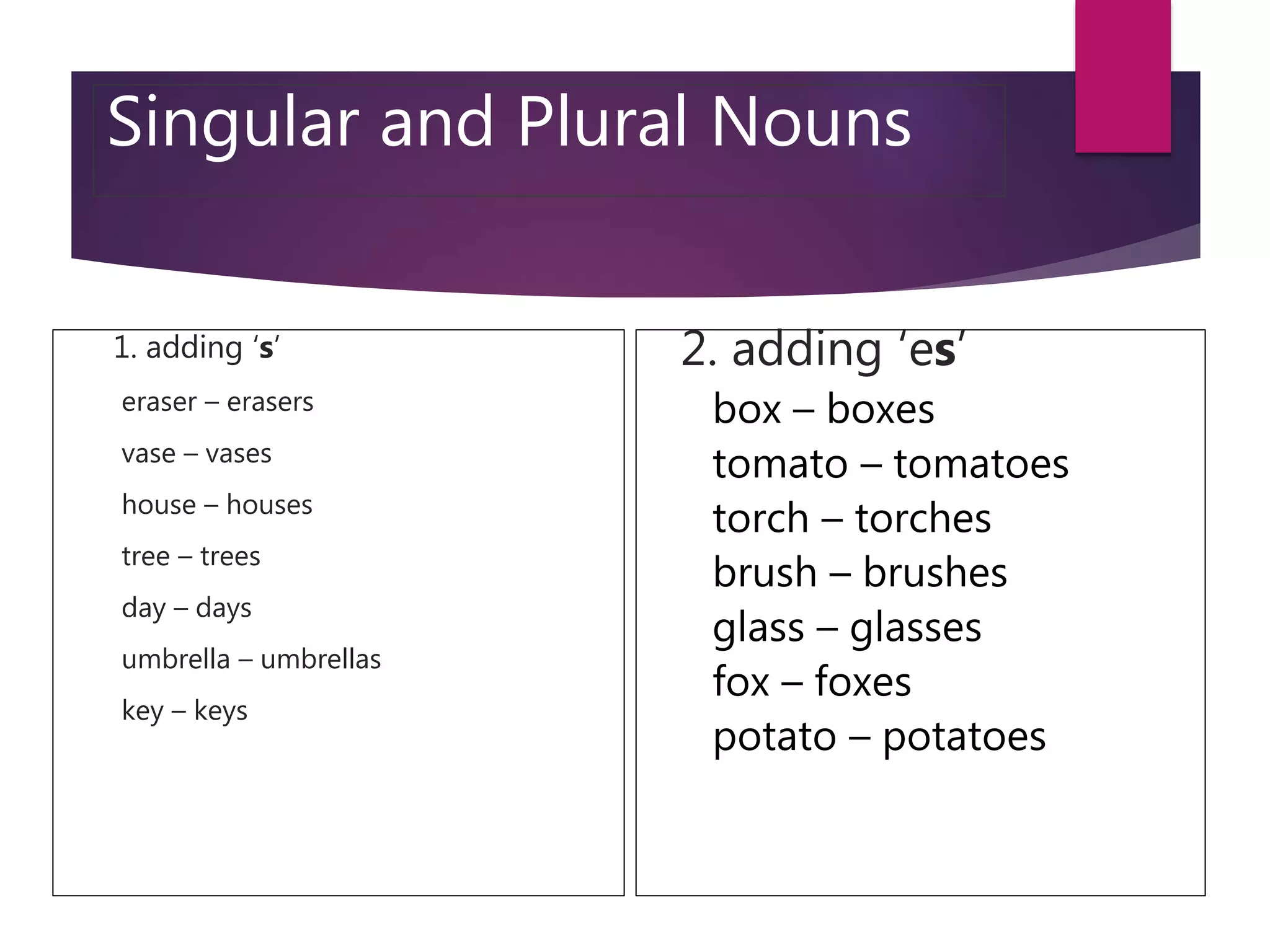
Singular and Plural Nouns
1. adding ‘s’
eraser – erasers
vase – vases
house – houses
tree – trees
day – days
umbrella – umbrellas
key – keys
2. adding ‘es’
box – boxes
tomato – tomatoes
torch – torches
brush – brushes
glass – glasses
fox – foxes
potato – potatoes
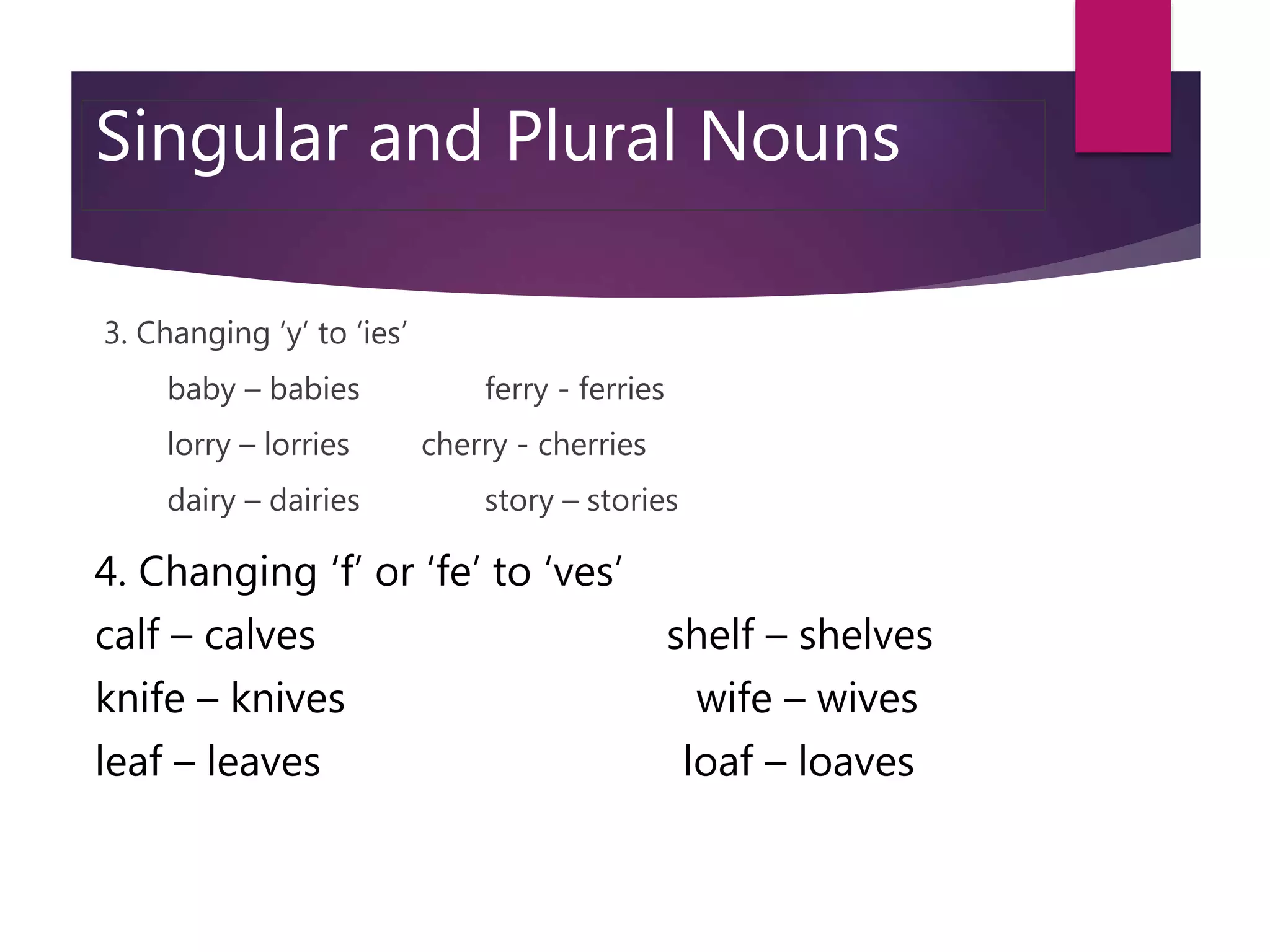
Singular and Plural Nouns
3. Changing ‘y’ to ‘ies’
baby – babies ferry - ferries
lorry – lorries cherry - cherries
dairy – dairies story – stories
4. Changing ‘f’ or ‘fe’ to ‘ves’
calf – calves shelf – shelves
knife – knives wife – wives
leaf – leaves loaf – loaves
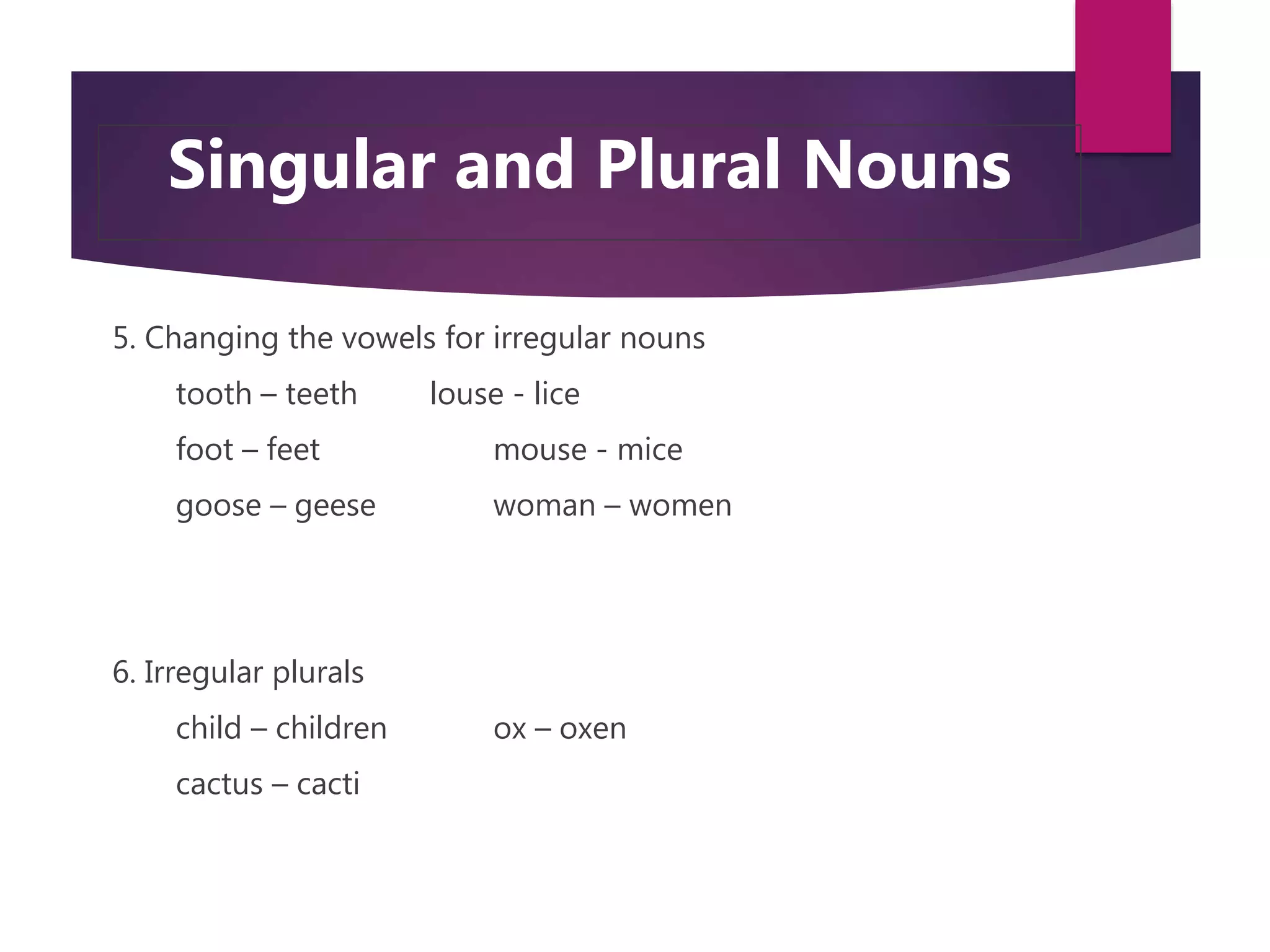
5. Changing the vowels for irregular nouns
tooth – teeth louse - lice
foot – feet mouse - mice
goose – geese woman – women
6. Irregular plurals
child – children ox – oxen
cactus – cacti
Singular and Plural Nouns
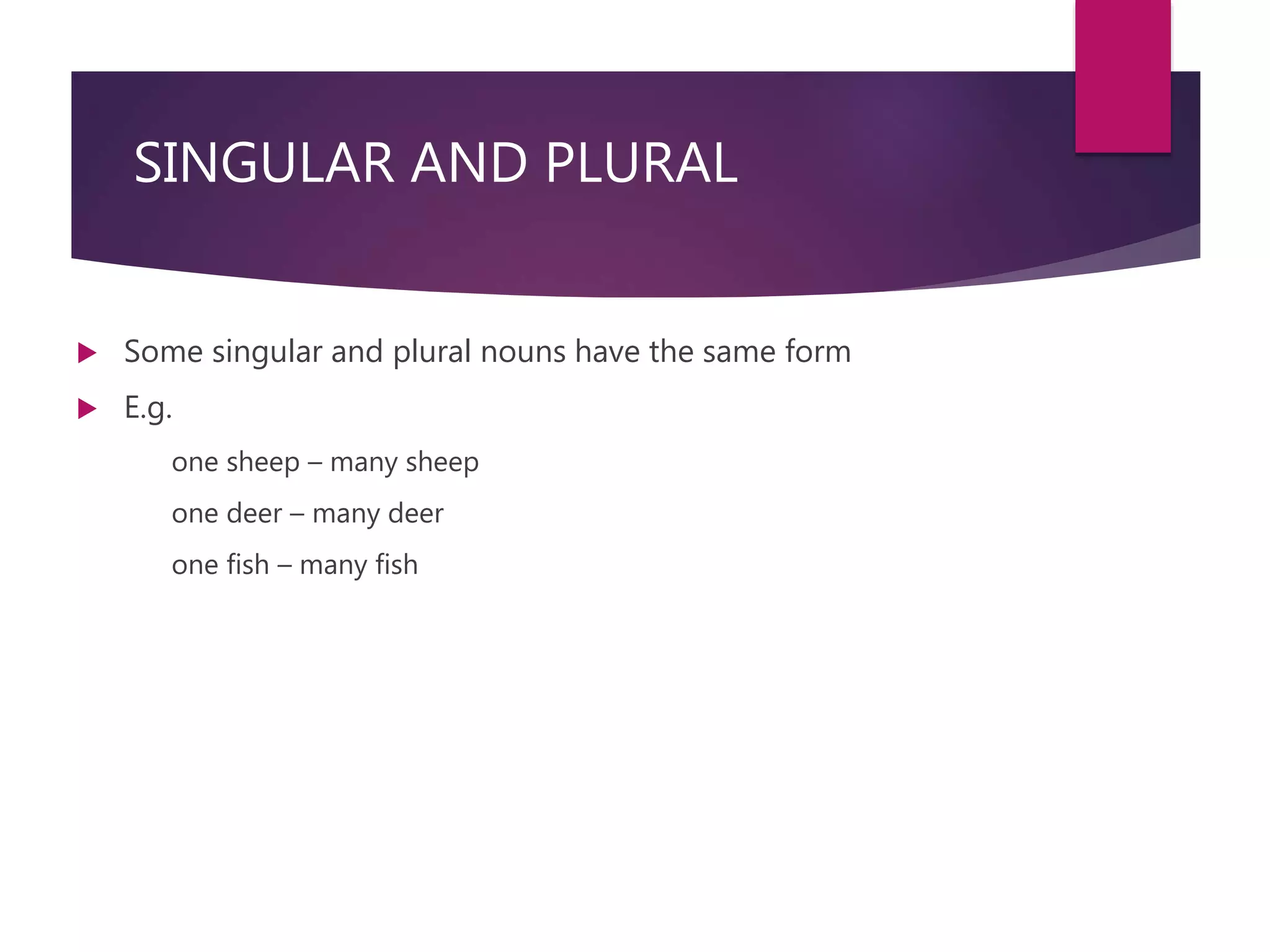
SINGULAR AND PLURAL
 Some singular and plural nouns have the same form
 E.g.
one sheep – many sheep
one deer – many deer
one fish – many fish
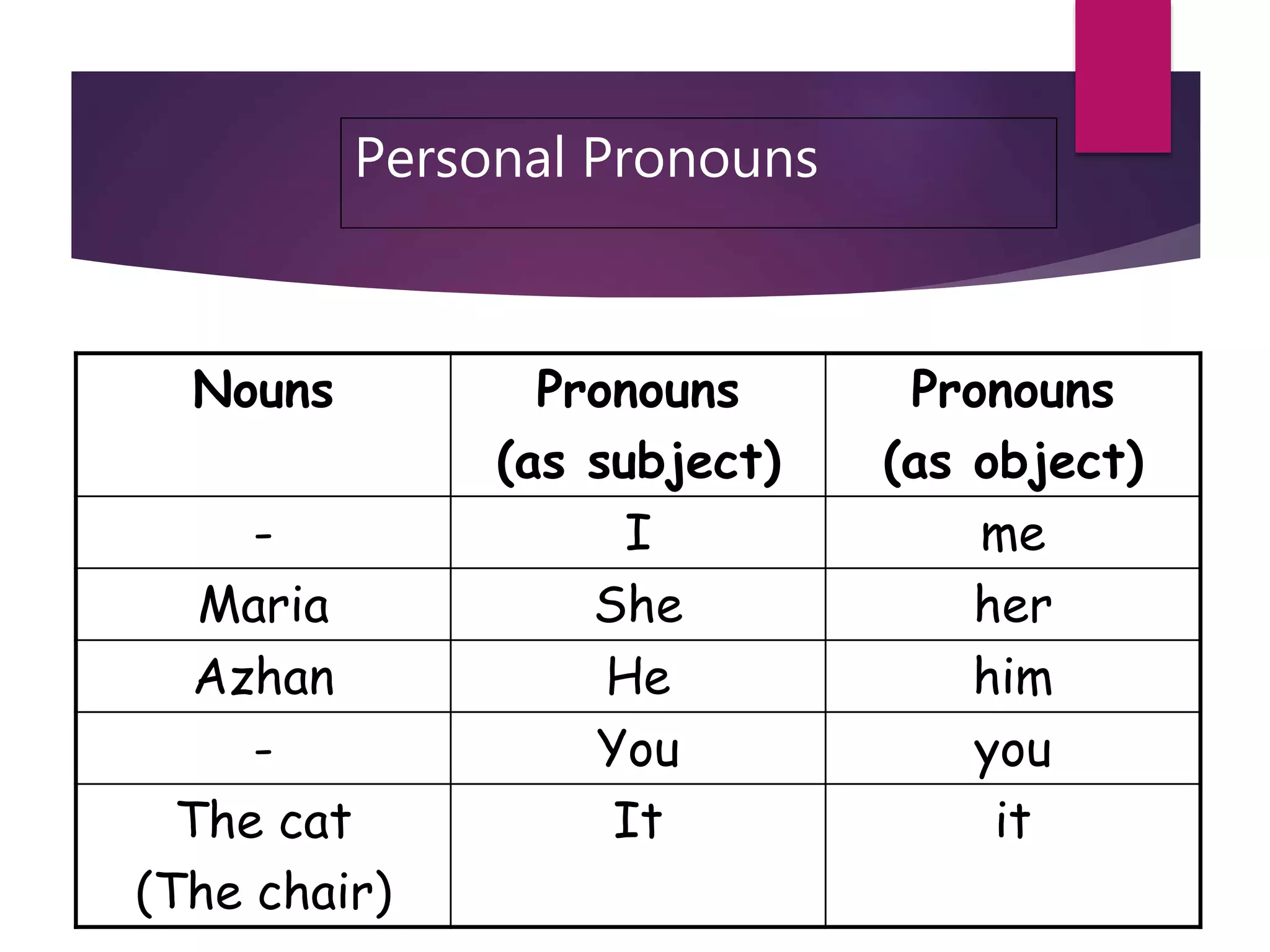
Personal Pronouns
Nouns Pronouns
(as subject)
Pronouns
(as object)
- I me
Maria She her
Azhan He him
- You you
The cat
(The chair)
It it
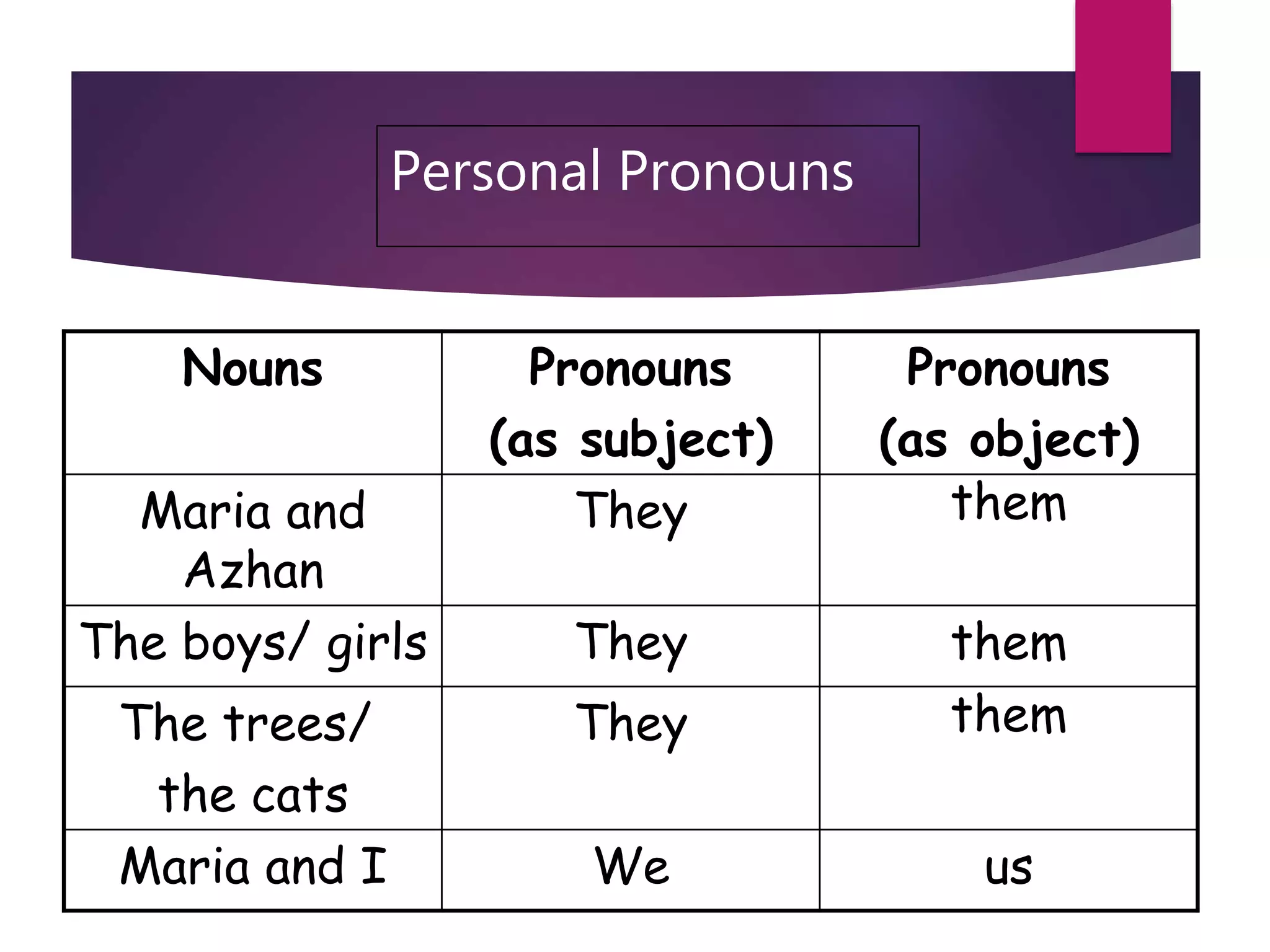
Personal Pronouns
Nouns Pronouns
(as subject)
Pronouns
(as object)
Maria and
Azhan
They them
The boys/ girls They them
The trees/
the cats
They them
Maria and I We us
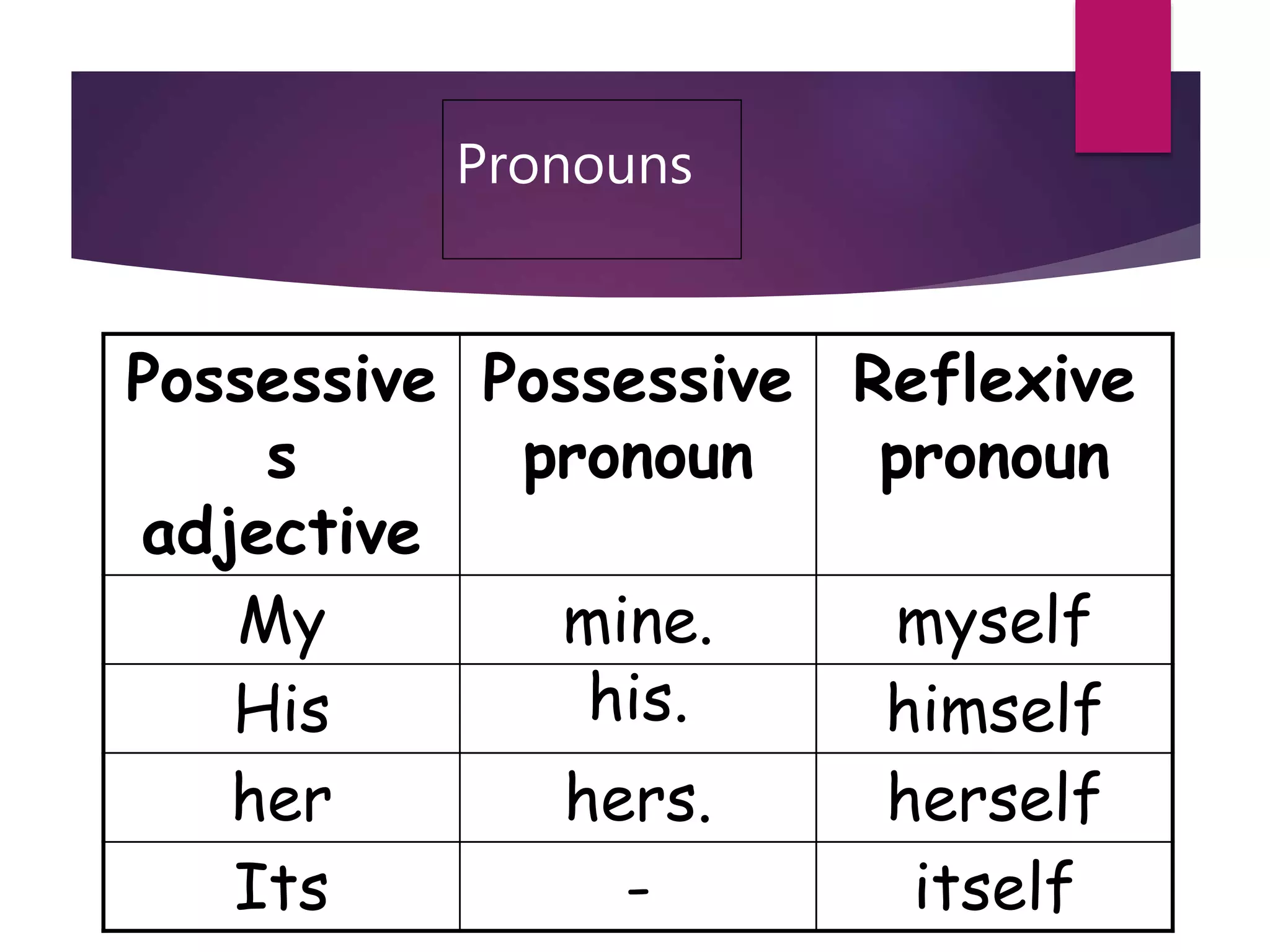
Pronouns
Possessive
s
adjective
Possessive
pronoun
Reflexive
pronoun
My mine. myself
His his. himself
her hers. herself
Its - itself
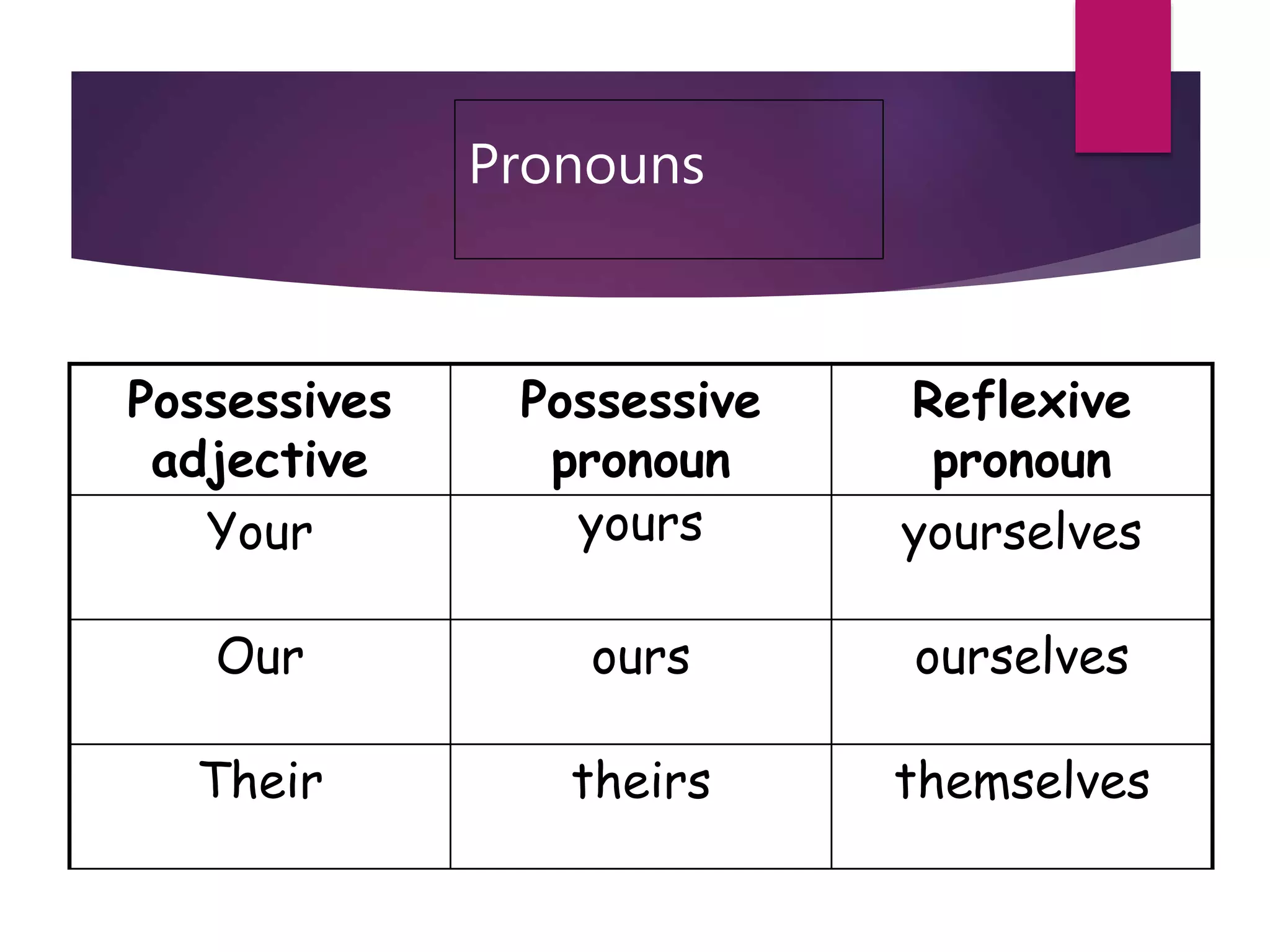
Pronouns
Possessives
adjective
Possessive
pronoun
Reflexive
pronoun
Your yours yourselves
Our ours ourselves
Their theirs themselves
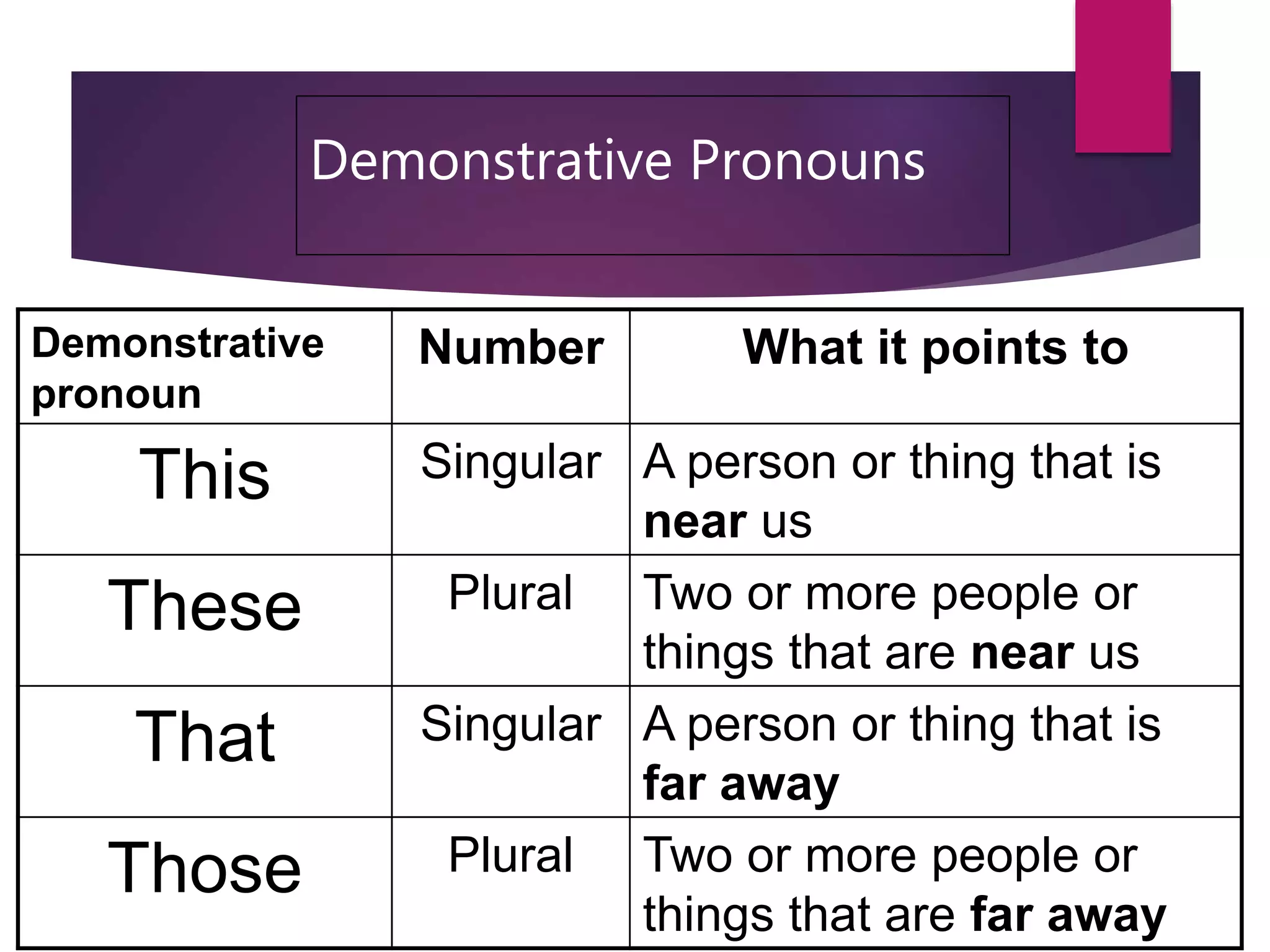
Demonstrative Pronouns
Demonstrative
pronoun
Number What it points to
This Singular A person or thing that is
near us
These Plural Two or more people or
things that are near us
That Singular A person or thing that is
far away
Those Plural Two or more people or
things that are far away
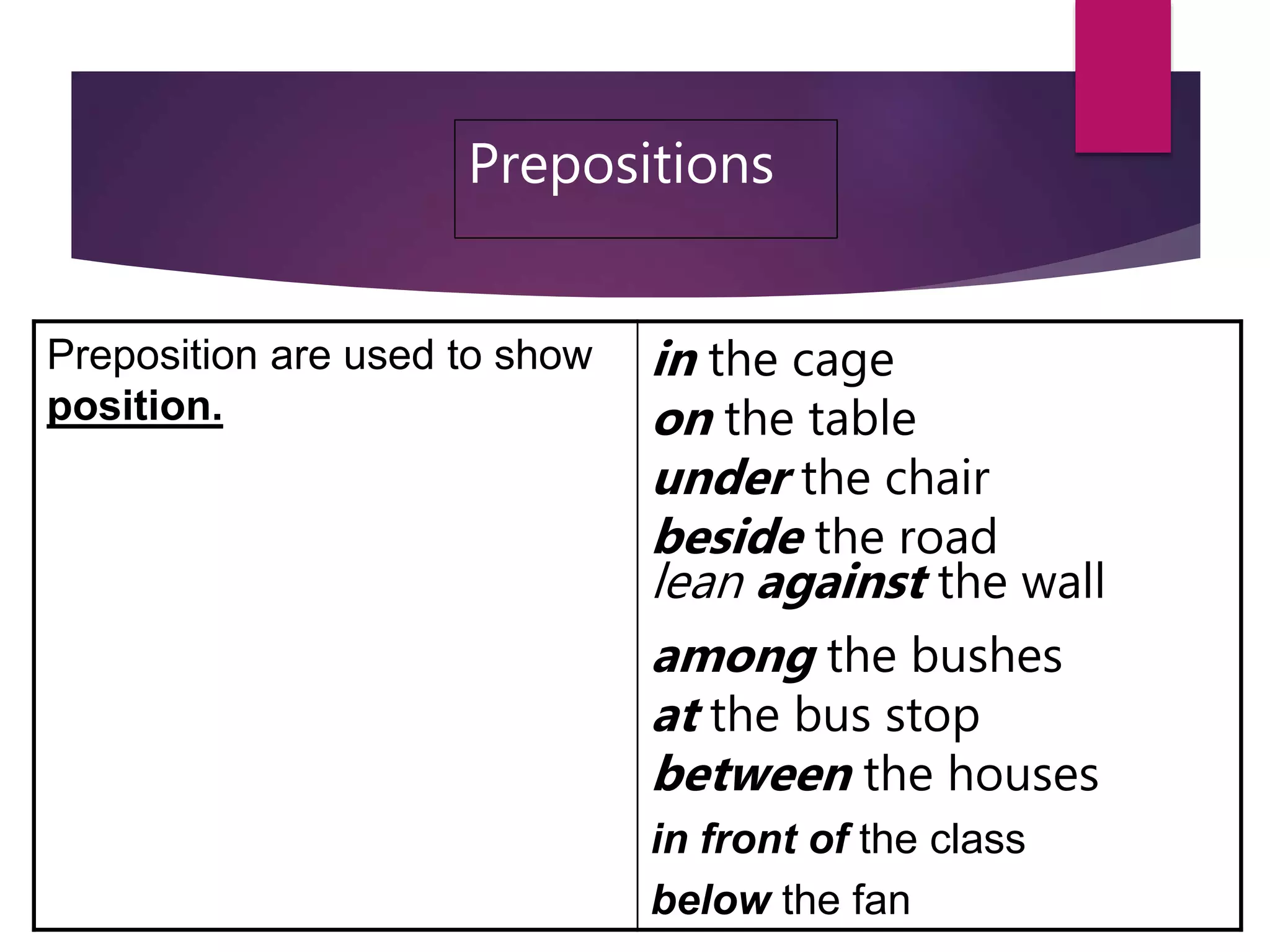
Prepositions
Preposition are used to show
position.
in the cage
on the table
under the chair
beside the road
lean against the wall
among the bushes
at the bus stop
between the houses
in front of the class
below the fan
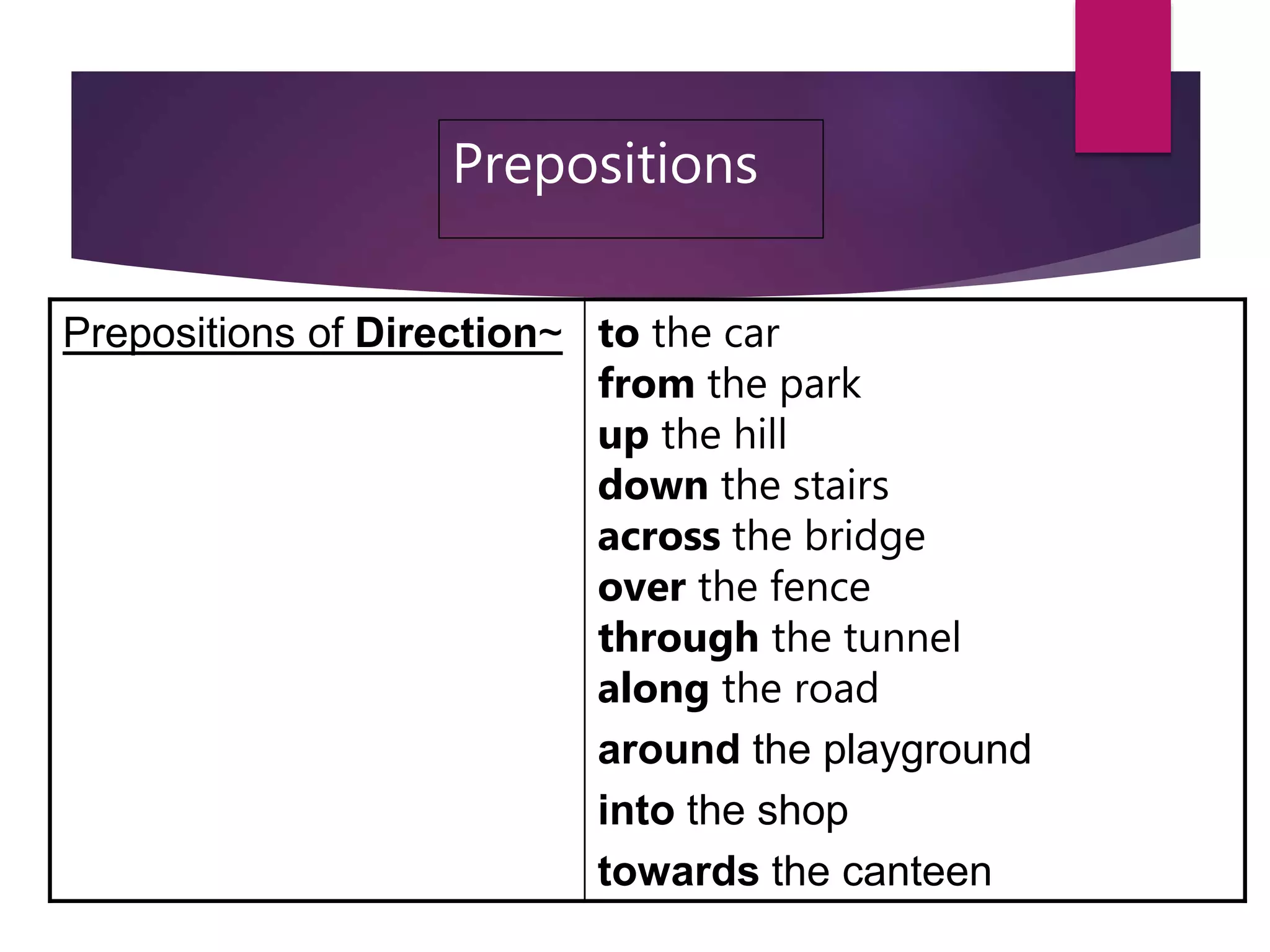
Prepositions
Prepositions of Direction~ to the car
from the park
up the hill
down the stairs
across the bridge
over the fence
through the tunnel
along the road
around the playground
into the shop
towards the canteen
Prepositions
Prepositions of time ~ in the morning
in January
on Tuesday
on your birthday
at 3 o’clock
at night
at noon
for a month
for ten minutes
for two years
Prepositions
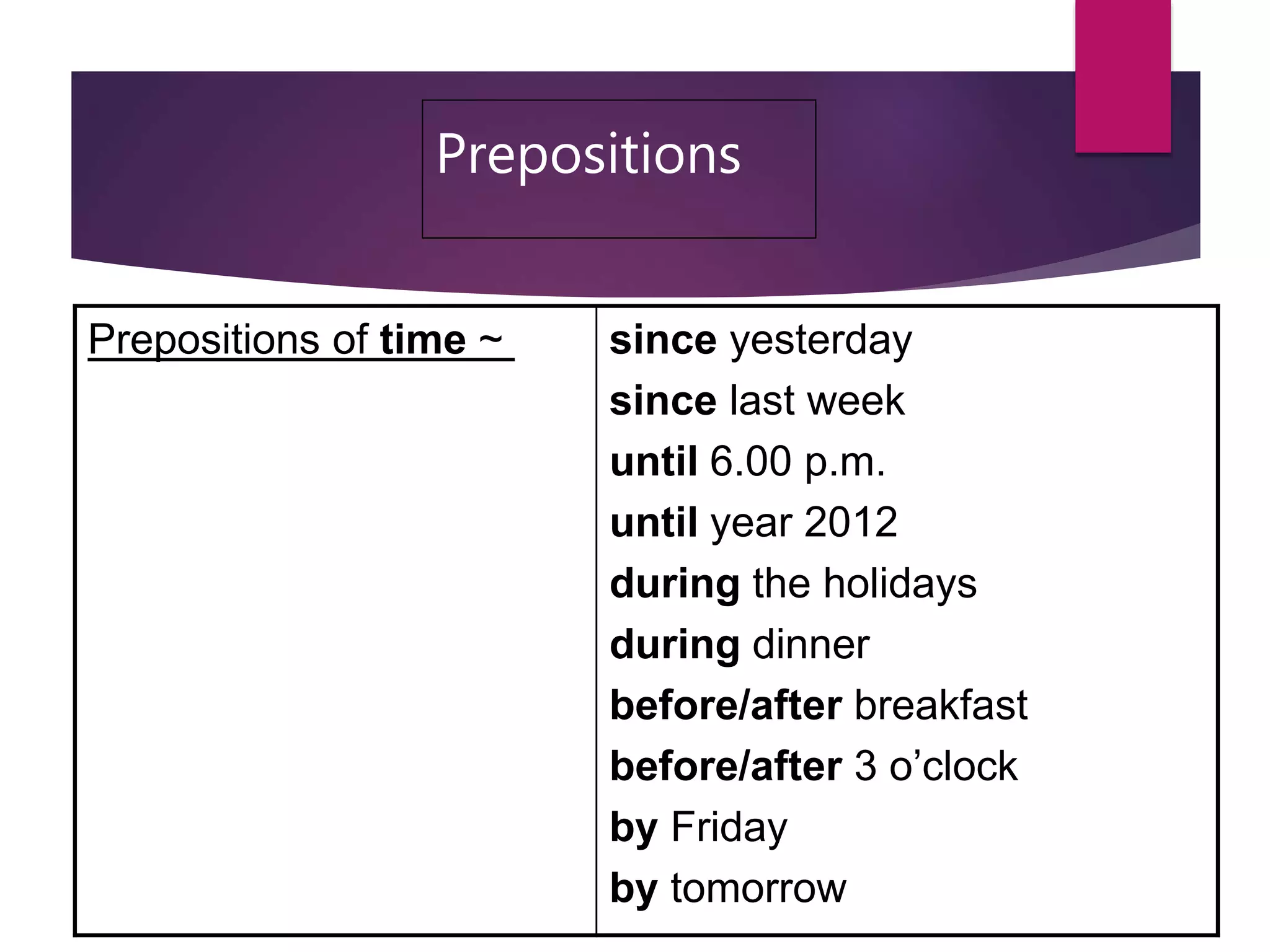
Prepositions of time ~ since yesterday
since last week
until 6.00 p.m.
until year 2012
during the holidays
during dinner
before/after breakfast
before/after 3 o’clock
by Friday
by tomorrow
Preposition also used with
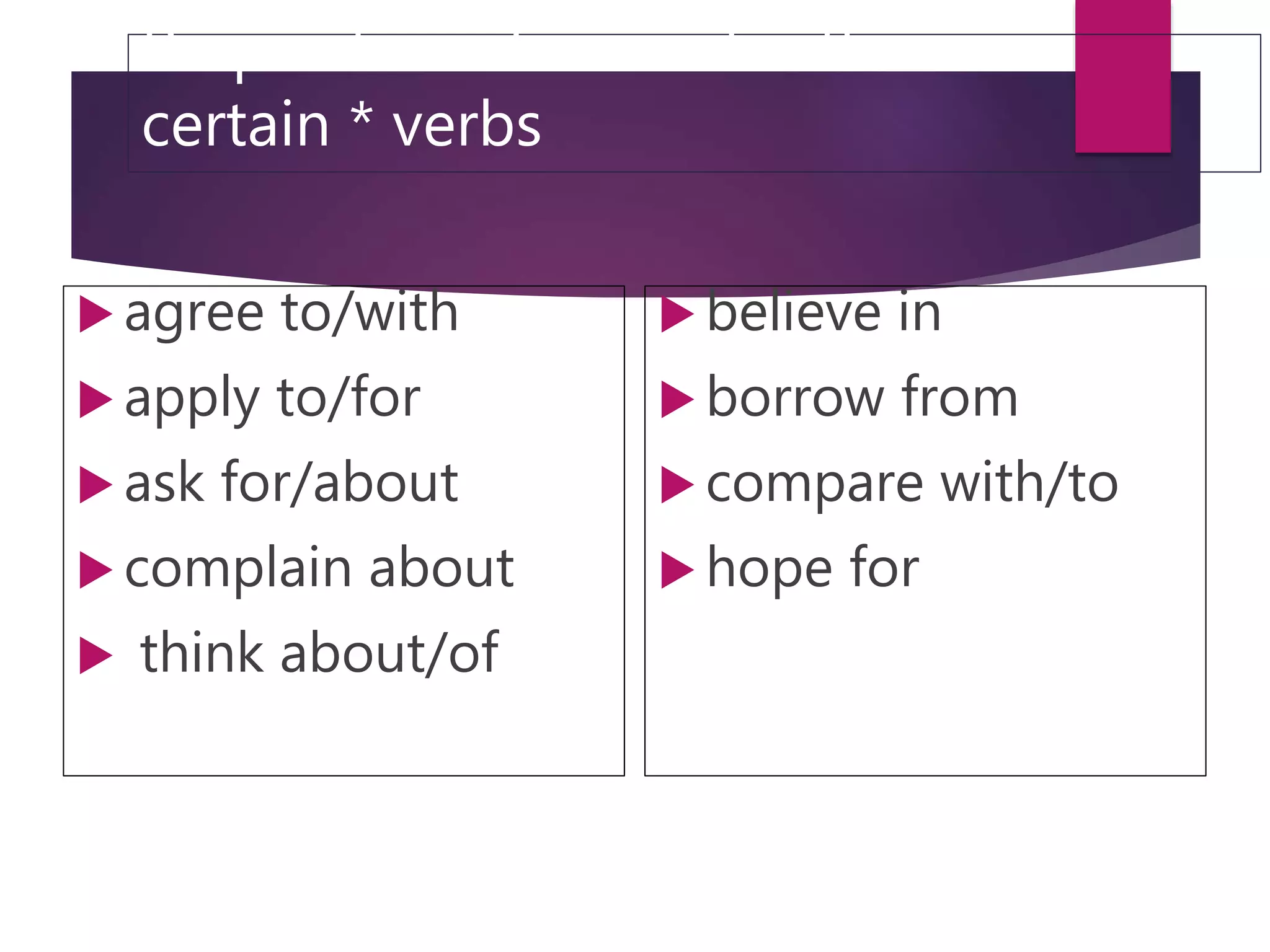
certain * verbs
 agree to/with
 apply to/for
 ask for/about
 complain about
 think about/of
 believe in
 borrow from
 compare with/to
 hope for
Preposition also used with
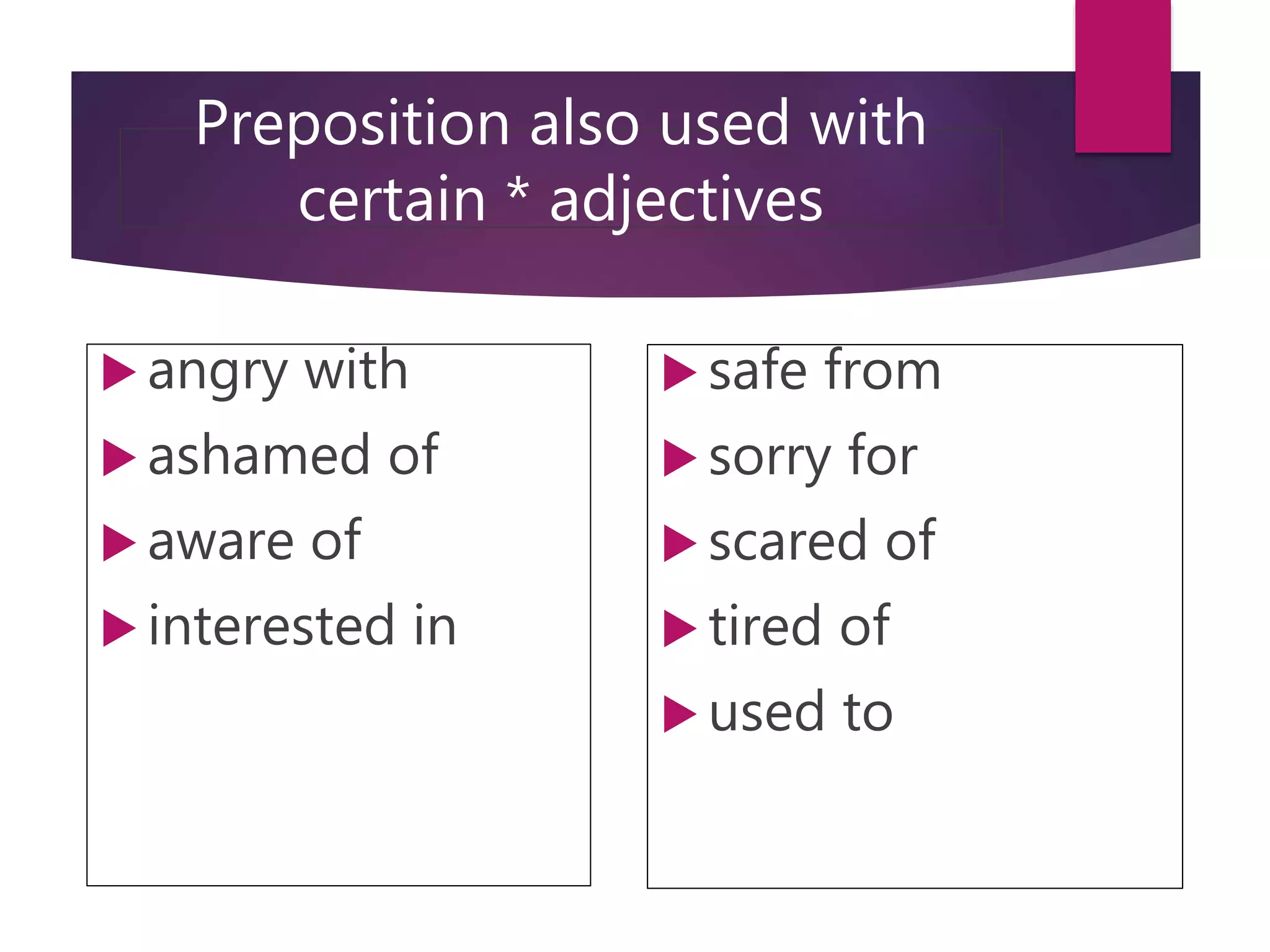
certain * adjectives
 angry with
 ashamed of
 aware of
 interested in
 safe from
 sorry for
 scared of
 tired of
 used to
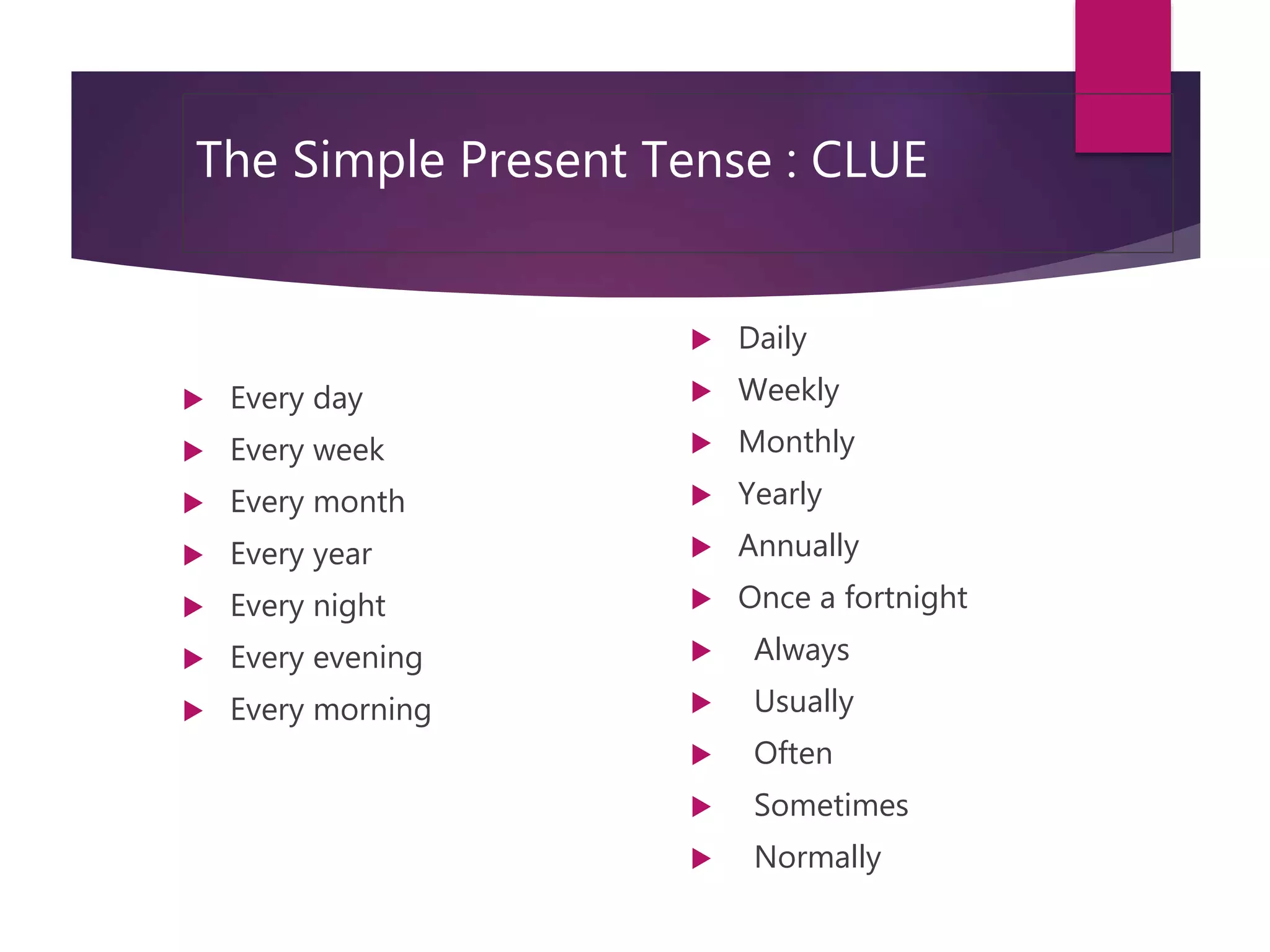
The Simple Present Tense : CLUE
 Every day
 Every week
 Every month
 Every year
 Every night
 Every evening
 Every morning
 Daily
 Weekly
 Monthly
 Yearly
 Annually
 Once a fortnight
 Always
 Usually
 Often
 Sometimes
 Normally
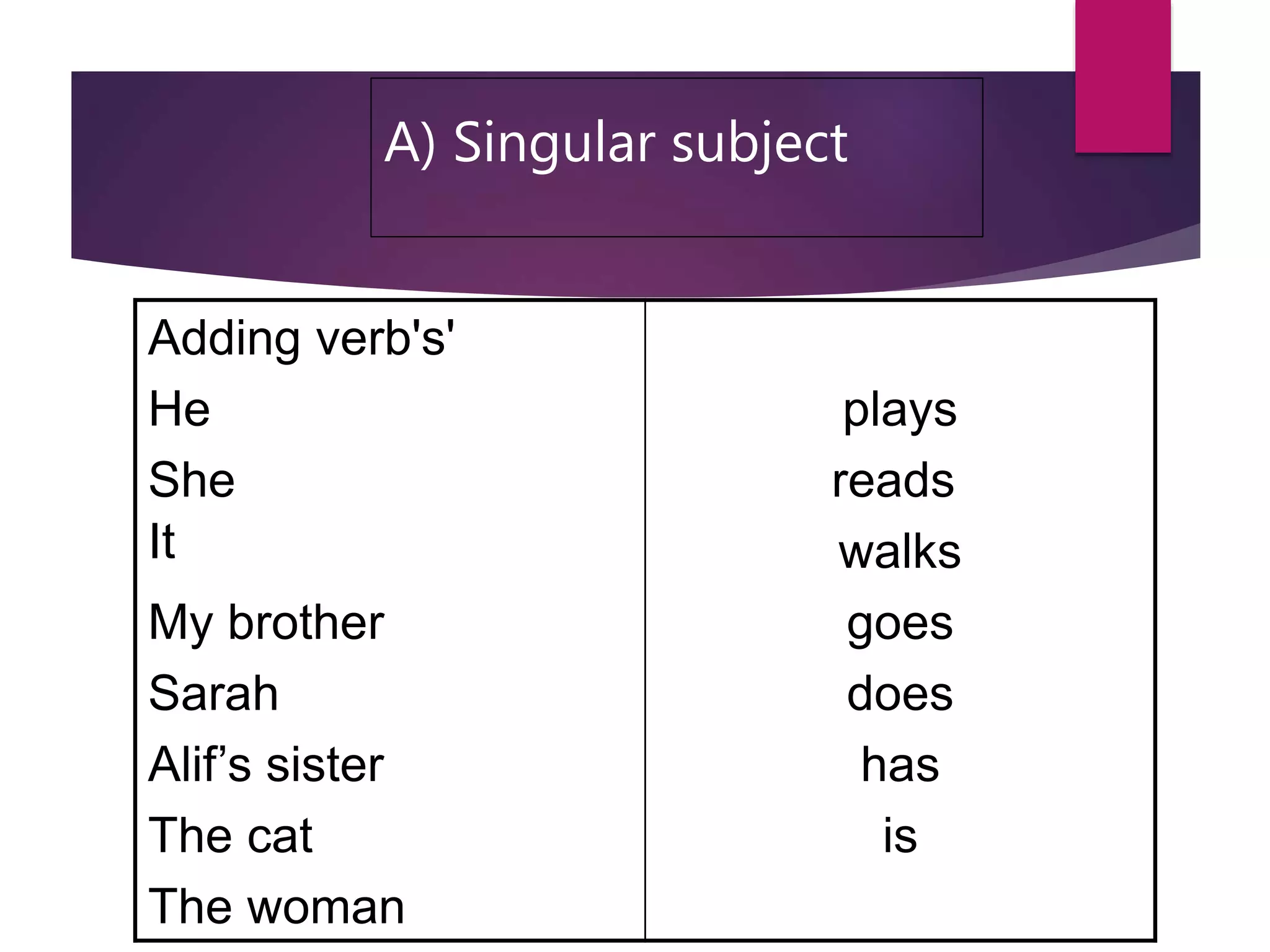
A) Singular subject
Adding verb's'
He
She
It
My brother
Sarah
Alif’s sister
The cat
The woman
plays
reads
walks
goes
does
has
is
B) Plural subject
Didn't adding verb 's'
I
You
We
They
Janet and Jennifer
My friends
The children
The durians
plan
study
arrange
hold
do
have
are
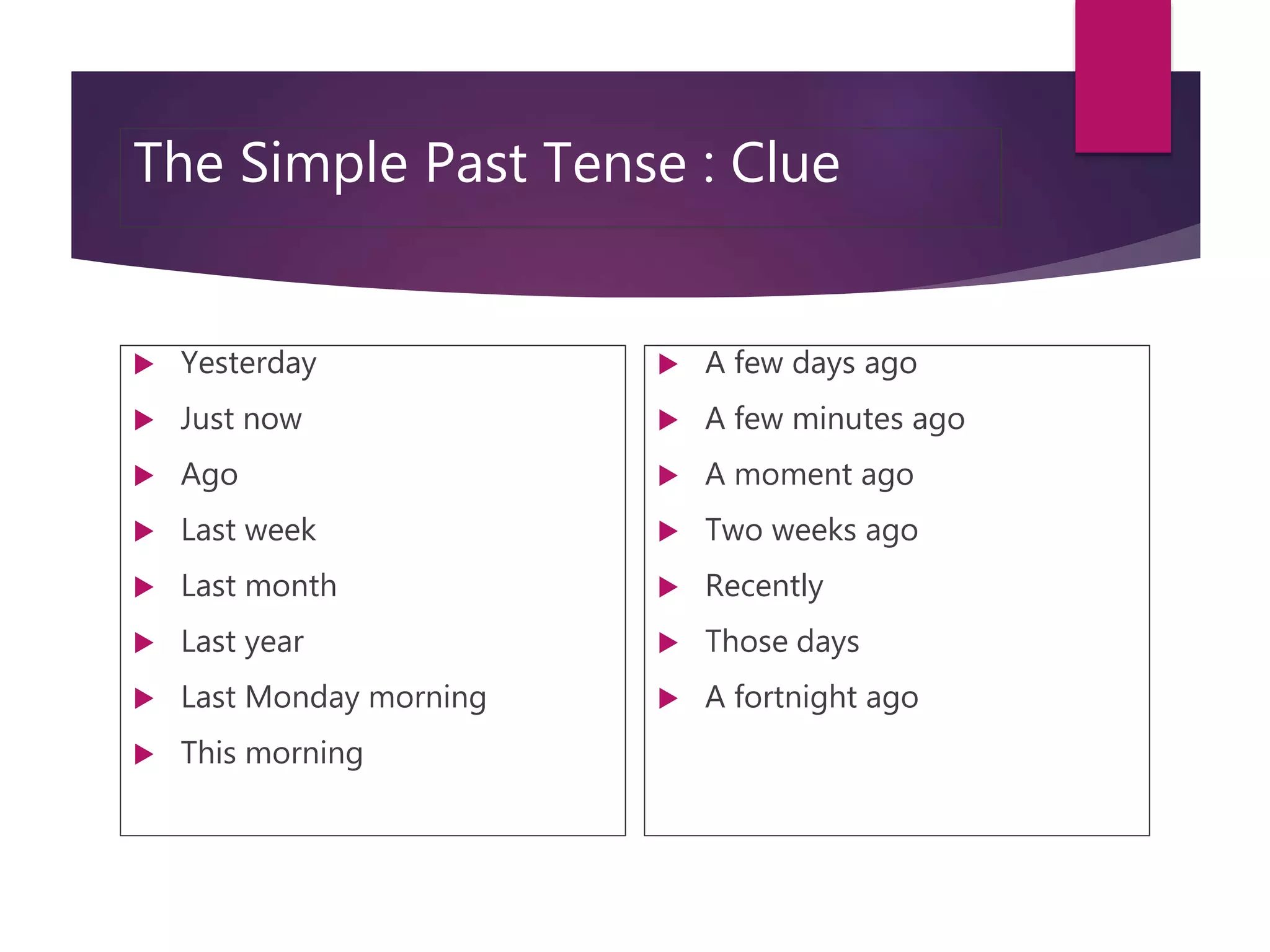
The Simple Past Tense : Clue
 Yesterday
 Just now
 Ago
 Last week
 Last month
 Last year
 Last Monday morning
 This morning
 A few days ago
 A few minutes ago
 A moment ago
 Two weeks ago
 Recently
 Those days
 A fortnight ago
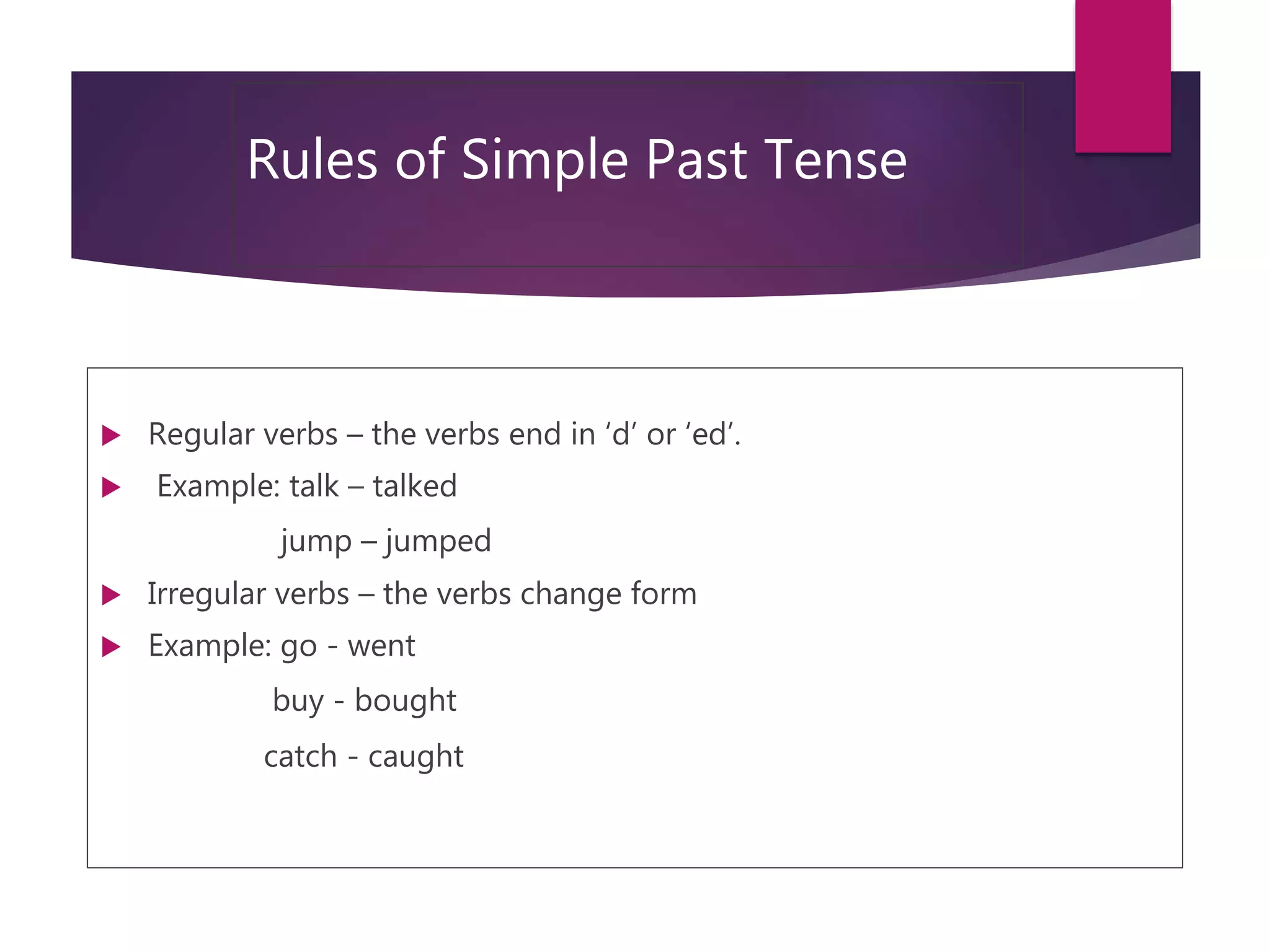
Rules of Simple Past Tense
 Regular verbs – the verbs end in ‘d’ or ‘ed’.
 Example: talk – talked
jump – jumped
 Irregular verbs – the verbs change form
 Example: go - went
buy - bought
catch - caught
The Continuous Tense
 Verb + ing
 Examples:
swimming
reading
teaching
writing
enjoying
 Present Tense
 am, is, are
 now
 at this moment
 Past Tense
 was, were
 while, when, as
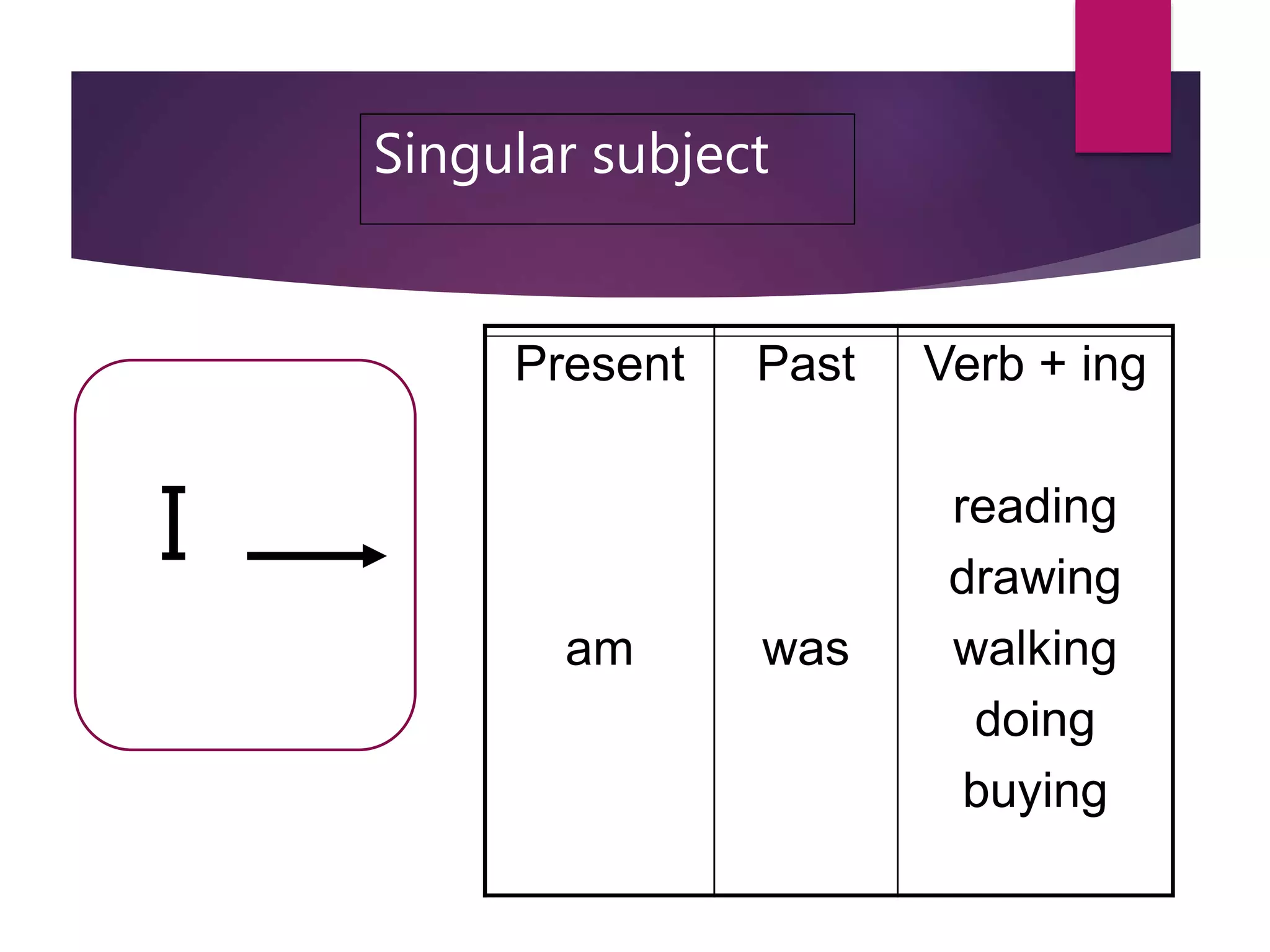
Singular subject
I
Present
am
Past
was
Verb + ing
reading
drawing
walking
doing
buying
He
She
It
Munif
Sarah
The girl
The boy
My uncle
The rabbit
Pn Suhaila
Singular subject
Present
is
Past
was
Verb+ing
reading
drawing
walking
sweeping
buying
sleeping
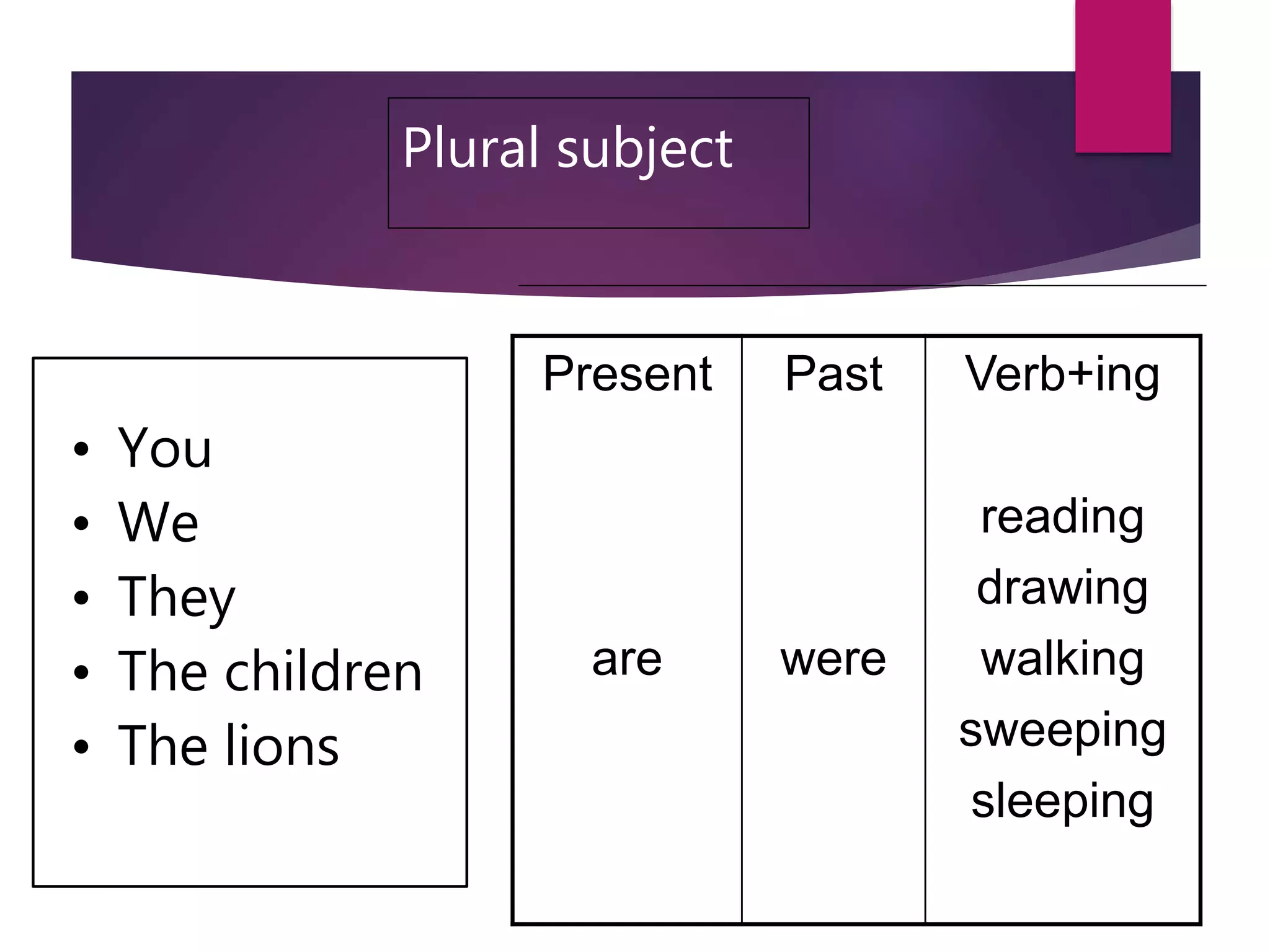
Plural subject
• You
• We
• They
• The children
• The lions
Present
are
Past
were
Verb+ing
reading
drawing
walking
sweeping
sleeping
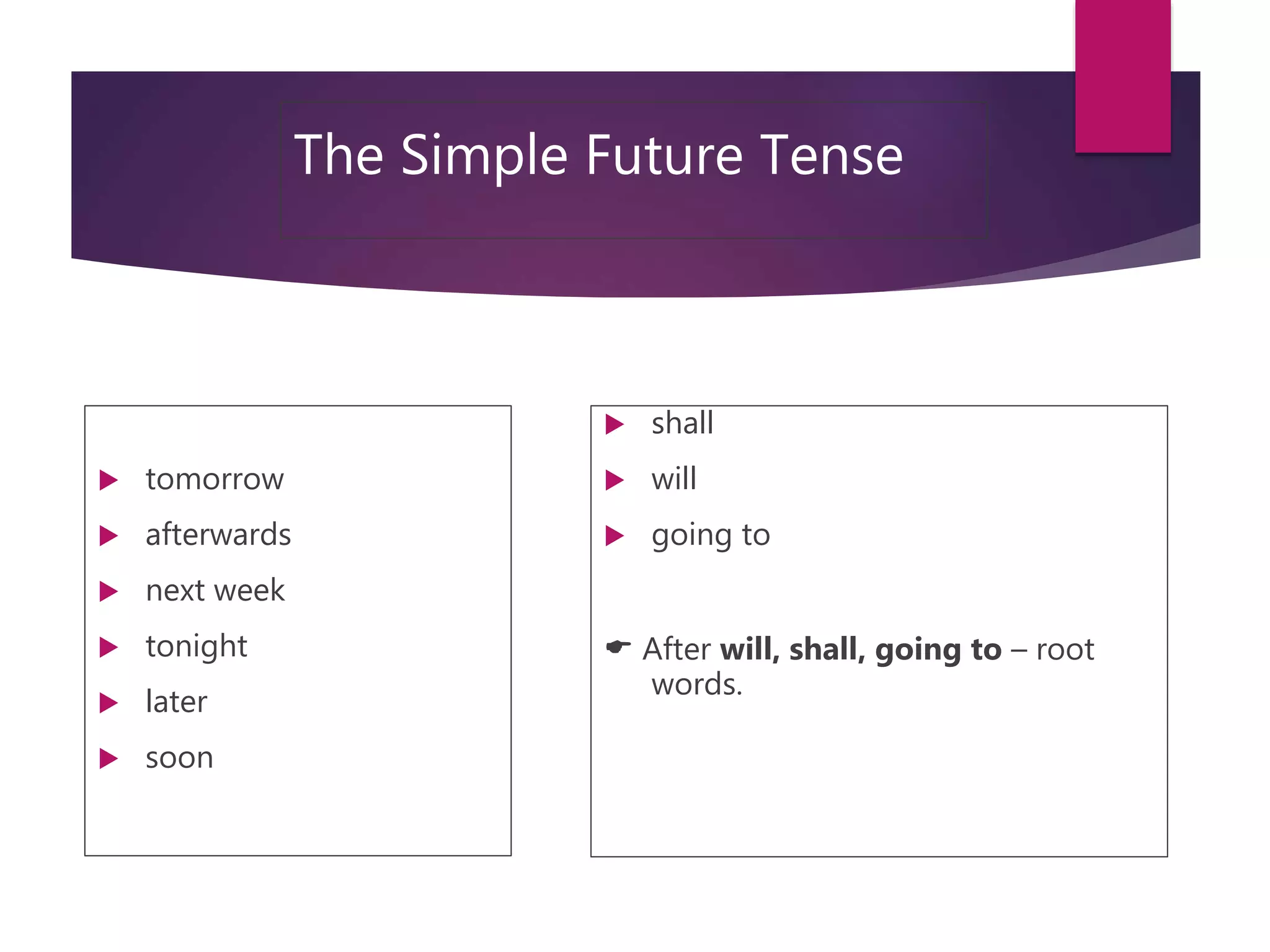
The Simple Future Tense
 tomorrow
 afterwards
 next week
 tonight
 later
 soon
 shall
 will
 going to
 After will, shall, going to – root
words.
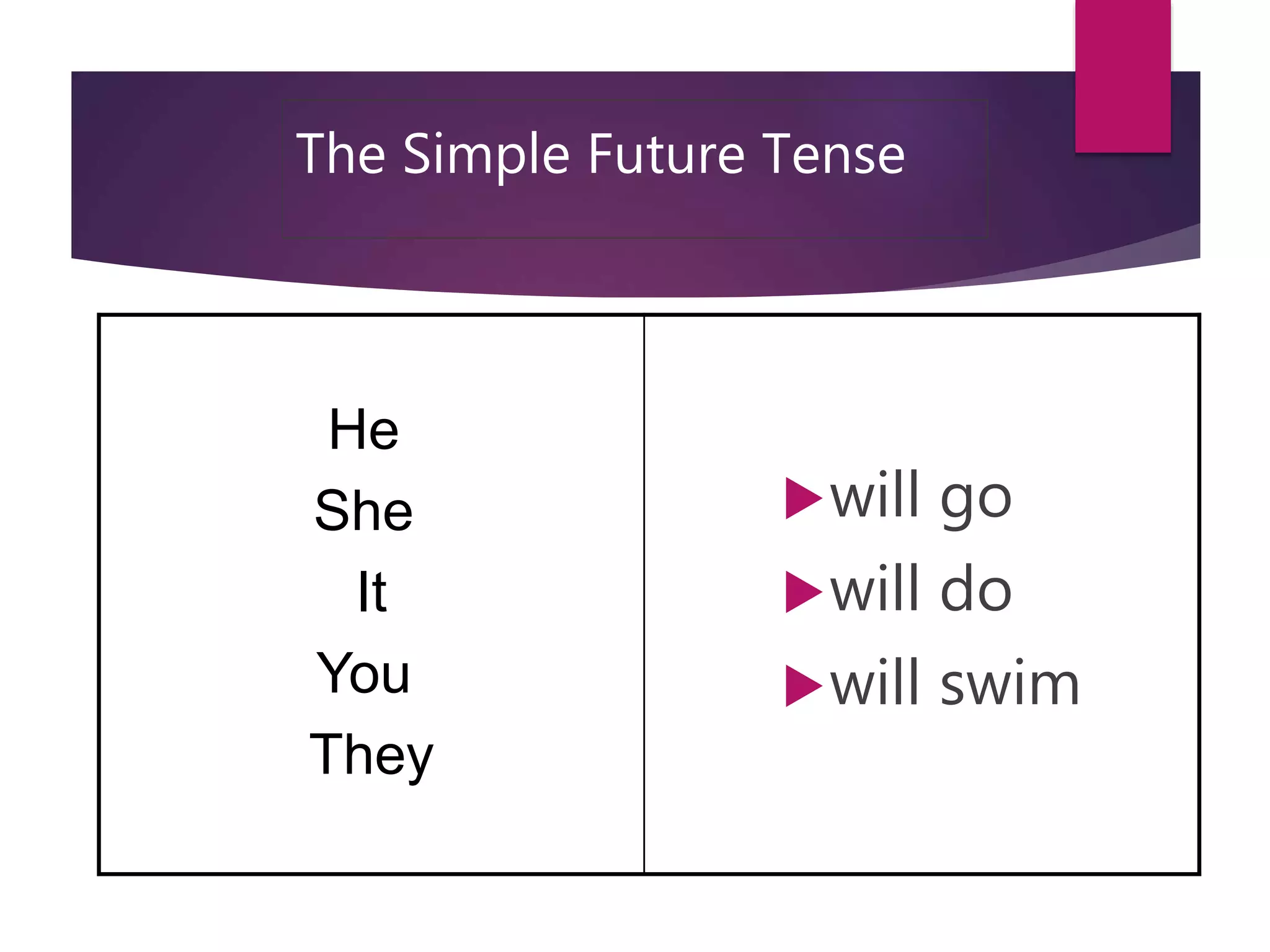
The Simple Future Tense
I
We
 shall walk
 shall finish
 shall attend
 will go
 will buy
 will choose
The Simple Future Tense
He
She
It
You
They
will go
will do
will swim
Singular subject + singular verb
 Each pupil
 Each of the girls
 Each of the boys
 One of the girls
 Any of the boys
 Anyone who
 Anybody
 Someone who
 Nobody
 No one
 Not one of them
has
goes
does
cycles
knows
bites
thinks
runs
plays
sings
reads
Uncountable nouns take a singular verb
 hair, grass,
rice, powder,
juice, syrup,
flour, sugar
oil, soup,
salt, pepper
money, water
sand, dust
 Singular verb-to-be
 is
 was
Either and neither take a singular verb
 Either of the girls
 Neither of the boys
 Either this man or that
man
 Neither Maria nor Azlina
 Neither you nor he
is
was
has
does
runs
sings
sleeps
Adjectives
 ………. as brave as a lion.
 ………. happier than ………
 ………. faster than ………..
 …… more expensive than my house.
 The largest …………
 The strongest …………
 The most beautiful ………
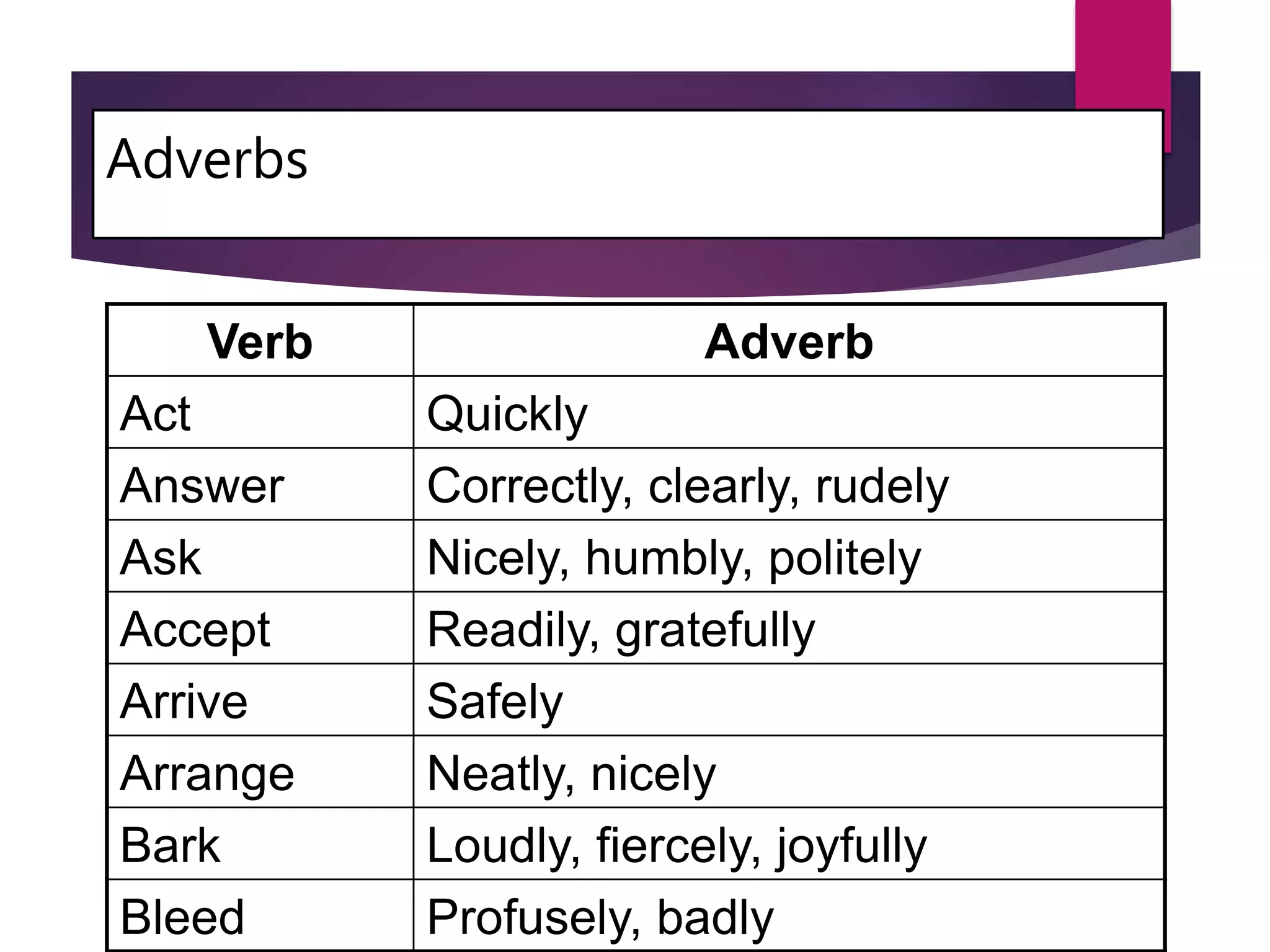
Adverbs
Verb Adverb
Act Quickly
Answer Correctly, clearly, rudely
Ask Nicely, humbly, politely
Accept Readily, gratefully
Arrive Safely
Arrange Neatly, nicely
Bark Loudly, fiercely, joyfully
Bleed Profusely, badly
Adverbs
Verb Adverb
Blow Gently, strongly,
Bow Humbly, respectfully
Clap Loudly, joyfully, excitedly
Cry Bitterly, sadly, softly, loudly
Cheer Loudly, joyfully
Dance Gracefully, beautifully, stylishly
Drive Carefully, cautiously, carelessly,
slowly, recklessly, dangerously,
Verb Adverb
Eat Hungrily, greedily
Explain Clearly, briefly, patiently
Fight Bravely, furiously
Give Generously, kindly, willingly
Greet Cheerfully, loudly, politely
Laugh Heartily, happily, loudly
Listen Carefully, attentively, intently
Look Shyly, longingly渴望地, lovingly
Adverbs
Verb Adverb
Read Carefully, silently, loudly, quietly
Shout Angrily, loudly, joyfully
Sleep Soundly, lightly
Smile Kindly, shyly, broadly, sweetly
Speak Boastfully, politely, kindly, clearly
Spend thriftily
Sing Softly, sweetly, happily
Wait Patiently, anxiously
Walk Hurriedly, slowly, briskly
Work Slowly, willingly, hard
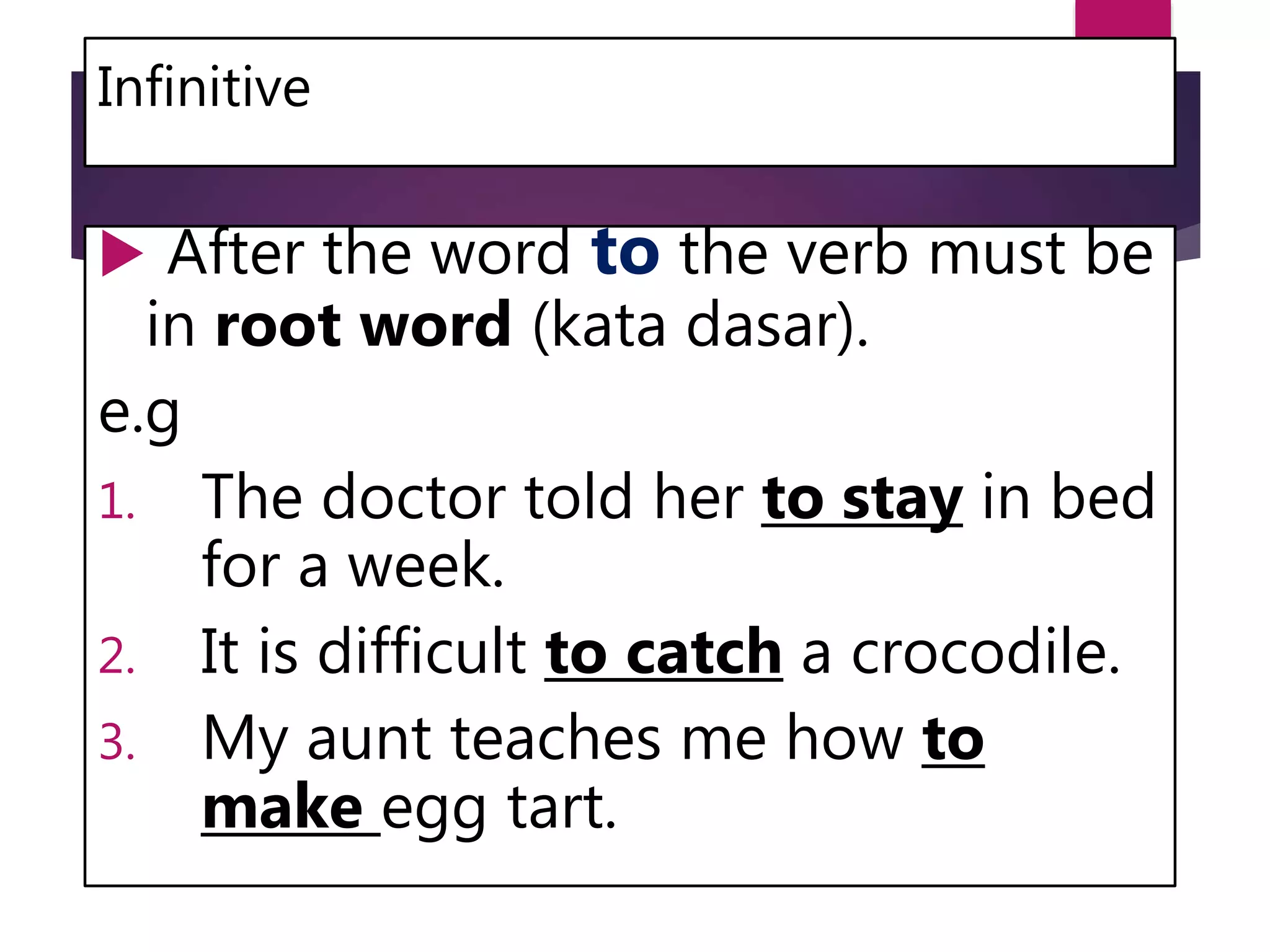
Infinitive
 After the word to the verb must be
in root word (kata dasar).
e.g
1. The doctor told her to stay in bed
for a week.
2. It is difficult to catch a crocodile.
3. My aunt teaches me how to
make egg tart.
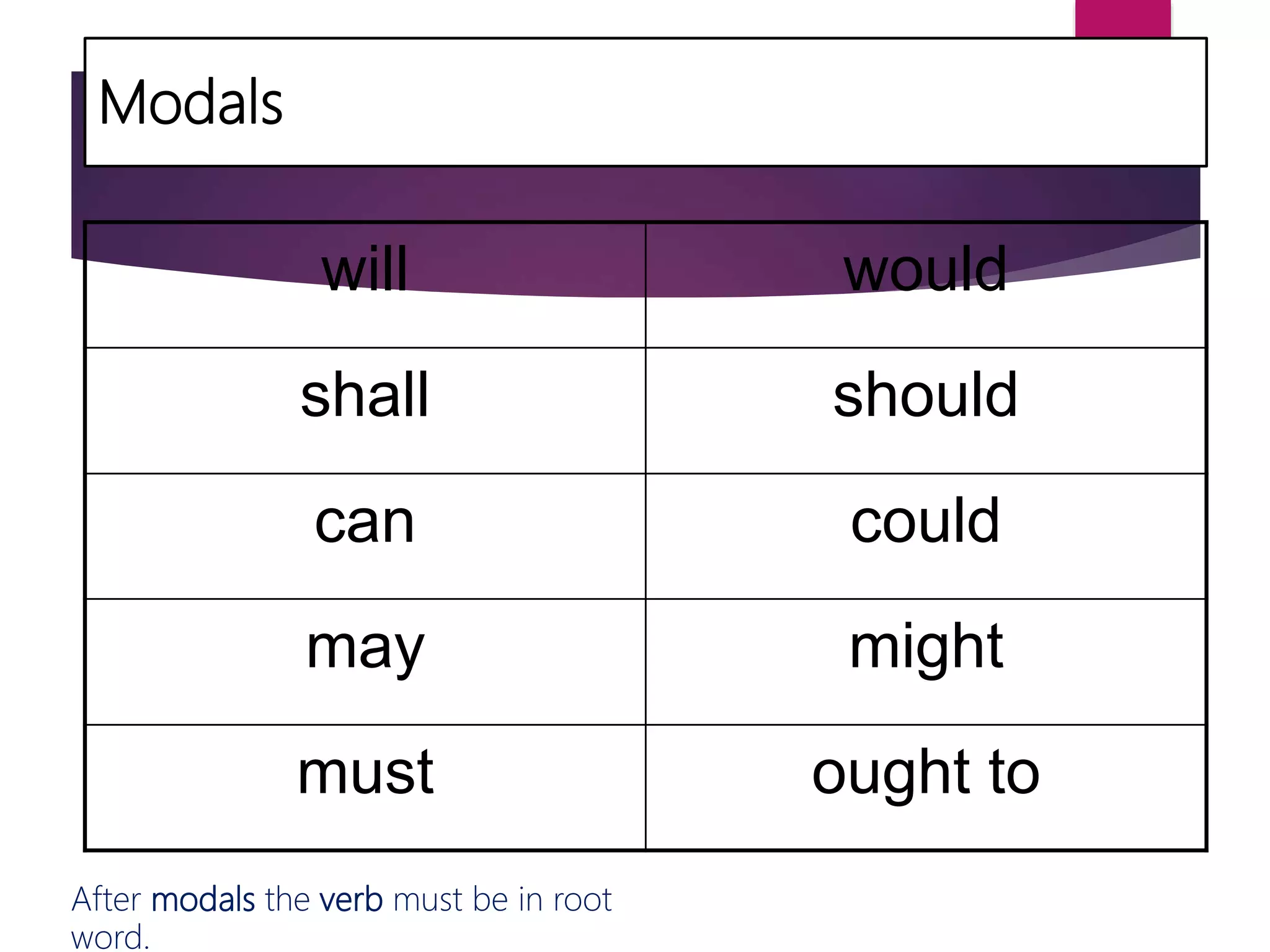
Modals
will would
shall should
can could
may might
must ought to
After modals the verb must be in root
word.
Clue
AFTER MODALS THE VERB MUST
BE IN ROOT WORD.
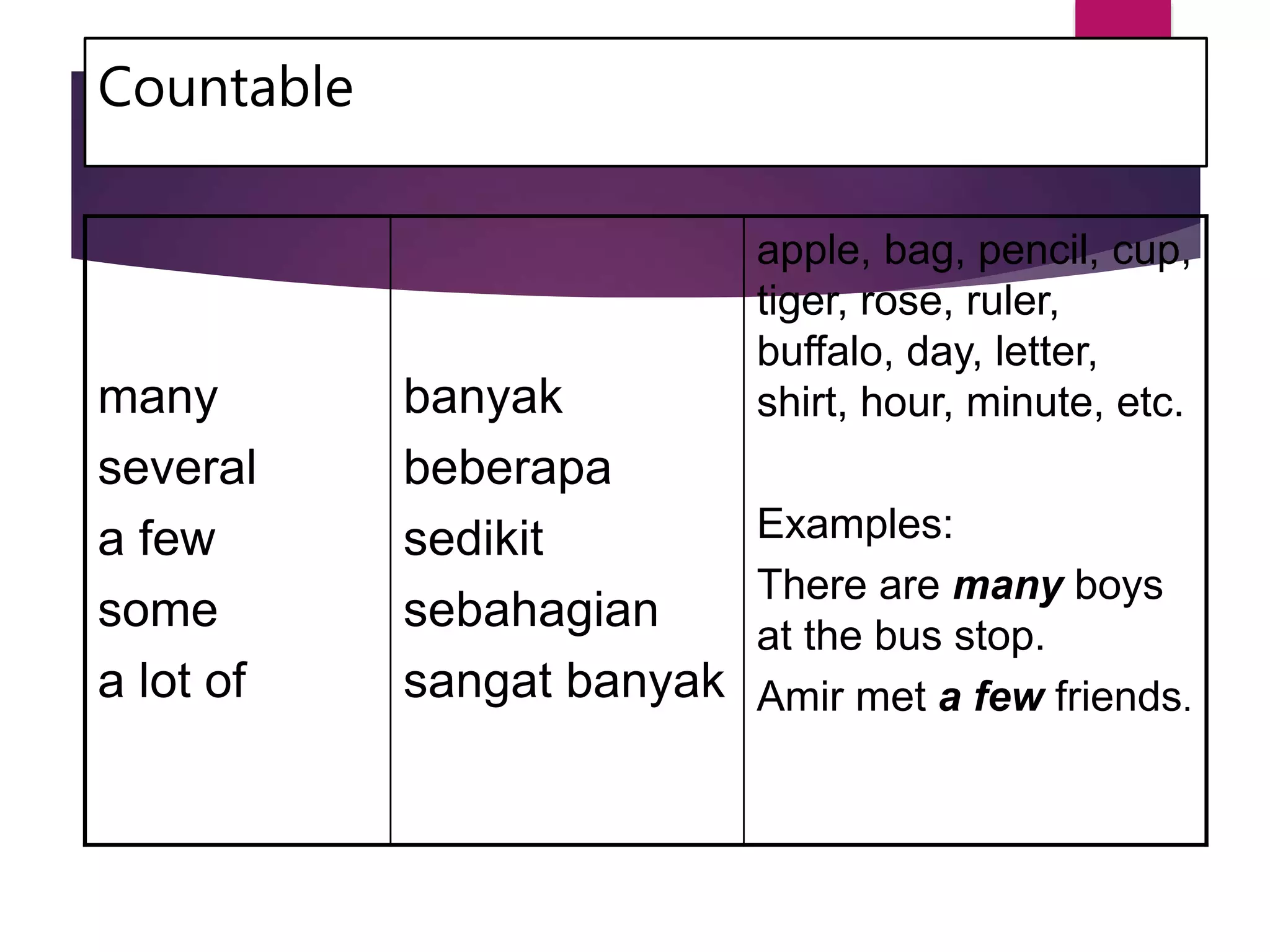
Countable
many
several
a few
some
a lot of
banyak
beberapa
sedikit
sebahagian
sangat banyak
apple, bag, pencil, cup,
tiger, rose, ruler,
buffalo, day, letter,
shirt, hour, minute, etc.
Examples:
There are many boys
at the bus stop.
Amir met a few friends.
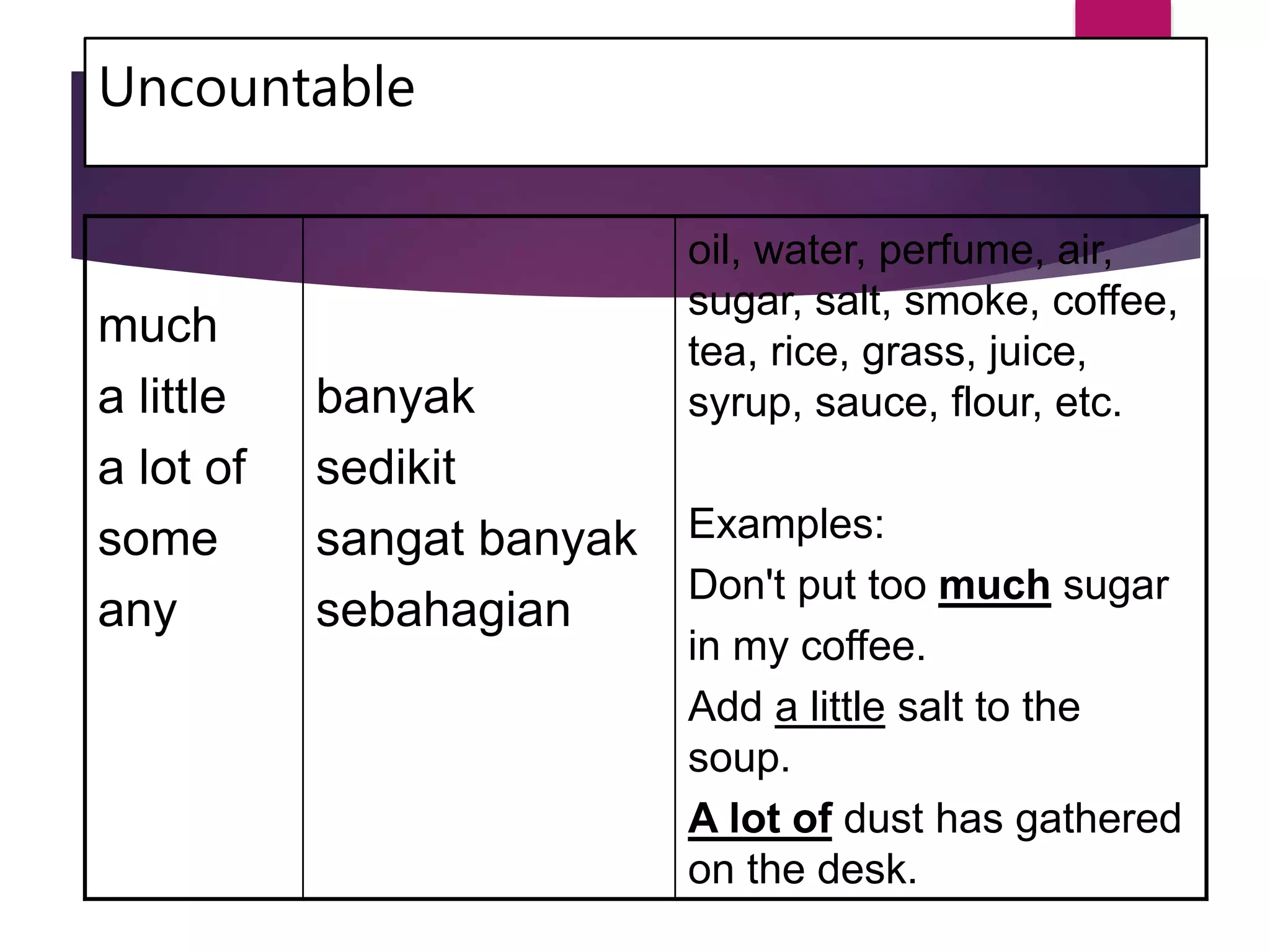
Uncountable
much
a little
a lot of
some
any
banyak
sedikit
sangat banyak
sebahagian
oil, water, perfume, air,
sugar, salt, smoke, coffee,
tea, rice, grass, juice,
syrup, sauce, flour, etc.
Examples:
Don't put too much sugar
in my coffee.
Add a little salt to the
soup.
A lot of dust has gathered
on the desk.
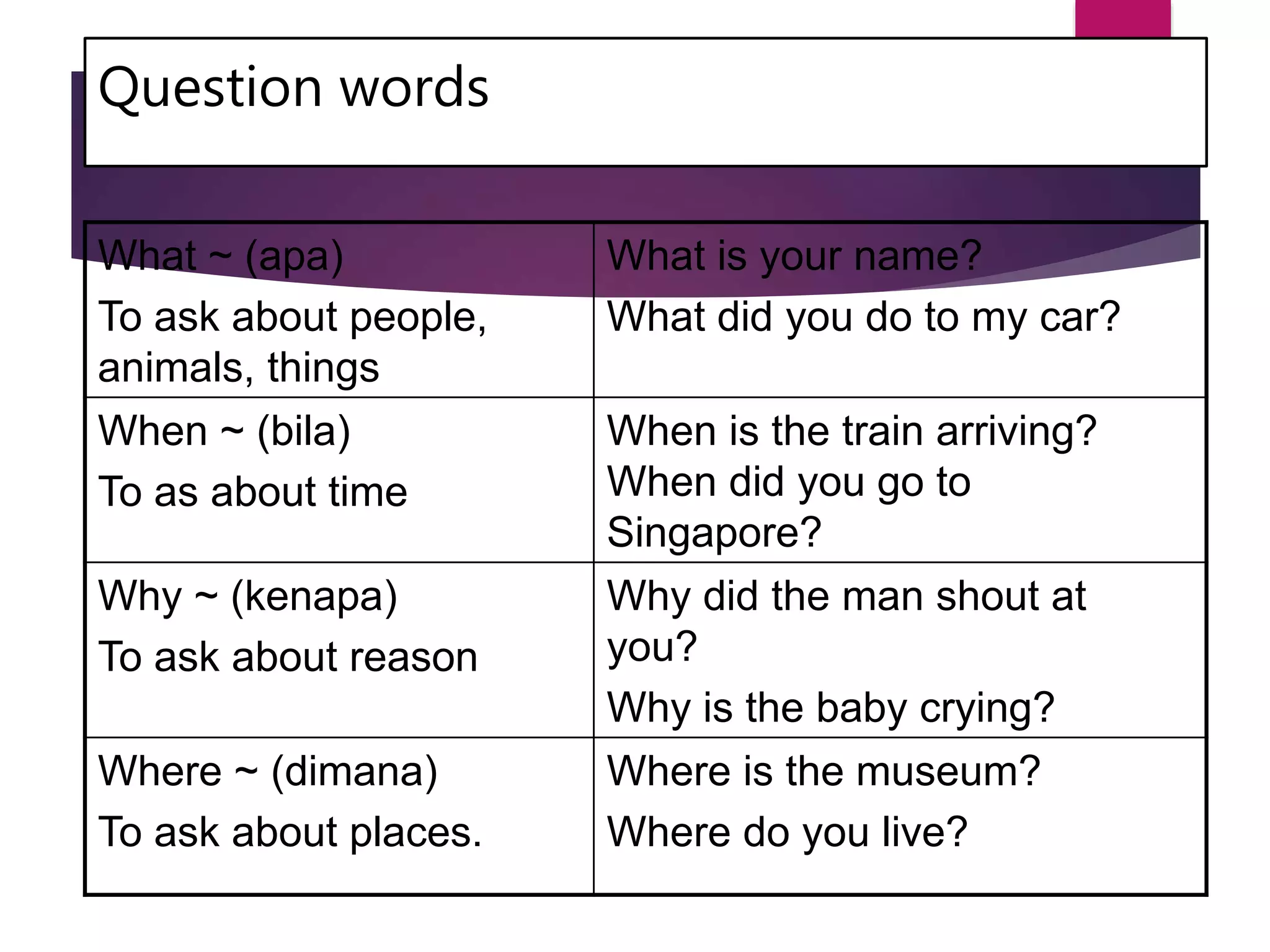
Question words
What ~ (apa)
To ask about people,
animals, things
What is your name?
What did you do to my car?
When ~ (bila)
To as about time
When is the train arriving?
When did you go to
Singapore?
Why ~ (kenapa)
To ask about reason
Why did the man shout at
you?
Why is the baby crying?
Where ~ (dimana)
To ask about places.
Where is the museum?
Where do you live?
Conjunction
 is a linking or joining words
 we use conjunctions to connect words, groups of words, clauses or
sentences
And But
Or If
So Because
As Although
Either ………..or Neither …….....nor
Therefore Moreover
However Furthermore
Even though
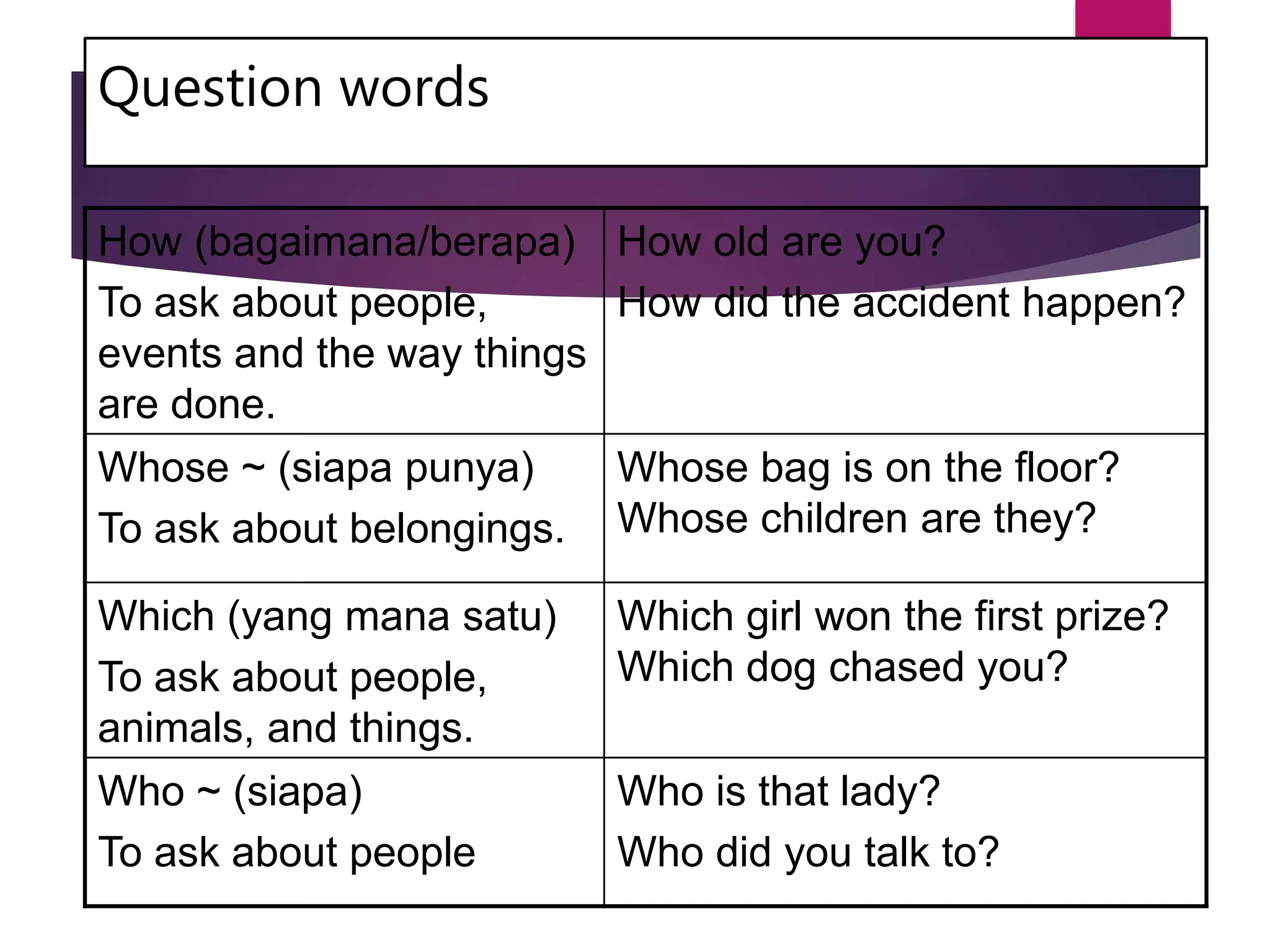
Question words
How (bagaimana/berapa)
To ask about people,
events and the way things
are done.
How old are you?
How did the accident happen?
Whose ~ (siapa punya)
To ask about belongings.
Whose bag is on the floor?
Whose children are they?
Which (yang mana satu)
To ask about people,
animals, and things.
Which girl won the first prize?
Which dog chased you?
Who ~ (siapa)
To ask about people
Who is that lady?
Who did you talk to?

Grammar notes UPSR

  • 1.
  • 2.
    Articles  A andAn means one  used with countable nouns  used to talk about just one member in that group  a used for singular nouns begin with a consonant sound  a lion a boat  an used for singular nouns that begin with a vowel sound (a, e, i, o, u)  an owl an arrow a, an, the
  • 3.
    Singular and PluralNouns 1. adding ‘s’ eraser – erasers vase – vases house – houses tree – trees day – days umbrella – umbrellas key – keys 2. adding ‘es’ box – boxes tomato – tomatoes torch – torches brush – brushes glass – glasses fox – foxes potato – potatoes
  • 4.
    Singular and PluralNouns 3. Changing ‘y’ to ‘ies’ baby – babies ferry - ferries lorry – lorries cherry - cherries dairy – dairies story – stories 4. Changing ‘f’ or ‘fe’ to ‘ves’ calf – calves shelf – shelves knife – knives wife – wives leaf – leaves loaf – loaves
  • 5.
    5. Changing thevowels for irregular nouns tooth – teeth louse - lice foot – feet mouse - mice goose – geese woman – women 6. Irregular plurals child – children ox – oxen cactus – cacti Singular and Plural Nouns
  • 6.
    SINGULAR AND PLURAL Some singular and plural nouns have the same form  E.g. one sheep – many sheep one deer – many deer one fish – many fish
  • 7.
    Personal Pronouns Nouns Pronouns (assubject) Pronouns (as object) - I me Maria She her Azhan He him - You you The cat (The chair) It it
  • 8.
    Personal Pronouns Nouns Pronouns (assubject) Pronouns (as object) Maria and Azhan They them The boys/ girls They them The trees/ the cats They them Maria and I We us
  • 9.
  • 10.
  • 11.
    Demonstrative Pronouns Demonstrative pronoun Number Whatit points to This Singular A person or thing that is near us These Plural Two or more people or things that are near us That Singular A person or thing that is far away Those Plural Two or more people or things that are far away
  • 12.
    Prepositions Preposition are usedto show position. in the cage on the table under the chair beside the road lean against the wall among the bushes at the bus stop between the houses in front of the class below the fan
  • 13.
    Prepositions Prepositions of Direction~to the car from the park up the hill down the stairs across the bridge over the fence through the tunnel along the road around the playground into the shop towards the canteen
  • 14.
    Prepositions Prepositions of time~ in the morning in January on Tuesday on your birthday at 3 o’clock at night at noon for a month for ten minutes for two years
  • 15.
    Prepositions Prepositions of time~ since yesterday since last week until 6.00 p.m. until year 2012 during the holidays during dinner before/after breakfast before/after 3 o’clock by Friday by tomorrow
  • 16.
    Preposition also usedwith certain * verbs  agree to/with  apply to/for  ask for/about  complain about  think about/of  believe in  borrow from  compare with/to  hope for
  • 17.
    Preposition also usedwith certain * adjectives  angry with  ashamed of  aware of  interested in  safe from  sorry for  scared of  tired of  used to
  • 18.
    The Simple PresentTense : CLUE  Every day  Every week  Every month  Every year  Every night  Every evening  Every morning  Daily  Weekly  Monthly  Yearly  Annually  Once a fortnight  Always  Usually  Often  Sometimes  Normally
  • 19.
    A) Singular subject Addingverb's' He She It My brother Sarah Alif’s sister The cat The woman plays reads walks goes does has is
  • 20.
    B) Plural subject Didn'tadding verb 's' I You We They Janet and Jennifer My friends The children The durians plan study arrange hold do have are
  • 21.
    The Simple PastTense : Clue  Yesterday  Just now  Ago  Last week  Last month  Last year  Last Monday morning  This morning  A few days ago  A few minutes ago  A moment ago  Two weeks ago  Recently  Those days  A fortnight ago
  • 22.
    Rules of SimplePast Tense  Regular verbs – the verbs end in ‘d’ or ‘ed’.  Example: talk – talked jump – jumped  Irregular verbs – the verbs change form  Example: go - went buy - bought catch - caught
  • 23.
    The Continuous Tense Verb + ing  Examples: swimming reading teaching writing enjoying  Present Tense  am, is, are  now  at this moment  Past Tense  was, were  while, when, as
  • 24.
    Singular subject I Present am Past was Verb +ing reading drawing walking doing buying
  • 25.
    He She It Munif Sarah The girl The boy Myuncle The rabbit Pn Suhaila Singular subject Present is Past was Verb+ing reading drawing walking sweeping buying sleeping
  • 26.
    Plural subject • You •We • They • The children • The lions Present are Past were Verb+ing reading drawing walking sweeping sleeping
  • 27.
    The Simple FutureTense  tomorrow  afterwards  next week  tonight  later  soon  shall  will  going to  After will, shall, going to – root words.
  • 28.
    The Simple FutureTense I We  shall walk  shall finish  shall attend  will go  will buy  will choose
  • 29.
    The Simple FutureTense He She It You They will go will do will swim
  • 30.
    Singular subject +singular verb  Each pupil  Each of the girls  Each of the boys  One of the girls  Any of the boys  Anyone who  Anybody  Someone who  Nobody  No one  Not one of them has goes does cycles knows bites thinks runs plays sings reads
  • 31.
    Uncountable nouns takea singular verb  hair, grass, rice, powder, juice, syrup, flour, sugar oil, soup, salt, pepper money, water sand, dust  Singular verb-to-be  is  was
  • 32.
    Either and neithertake a singular verb  Either of the girls  Neither of the boys  Either this man or that man  Neither Maria nor Azlina  Neither you nor he is was has does runs sings sleeps
  • 33.
    Adjectives  ………. asbrave as a lion.  ………. happier than ………  ………. faster than ………..  …… more expensive than my house.  The largest …………  The strongest …………  The most beautiful ………
  • 34.
    Adverbs Verb Adverb Act Quickly AnswerCorrectly, clearly, rudely Ask Nicely, humbly, politely Accept Readily, gratefully Arrive Safely Arrange Neatly, nicely Bark Loudly, fiercely, joyfully Bleed Profusely, badly
  • 37.
    Adverbs Verb Adverb Blow Gently,strongly, Bow Humbly, respectfully Clap Loudly, joyfully, excitedly Cry Bitterly, sadly, softly, loudly Cheer Loudly, joyfully Dance Gracefully, beautifully, stylishly Drive Carefully, cautiously, carelessly, slowly, recklessly, dangerously,
  • 38.
    Verb Adverb Eat Hungrily,greedily Explain Clearly, briefly, patiently Fight Bravely, furiously Give Generously, kindly, willingly Greet Cheerfully, loudly, politely Laugh Heartily, happily, loudly Listen Carefully, attentively, intently Look Shyly, longingly渴望地, lovingly Adverbs
  • 39.
    Verb Adverb Read Carefully,silently, loudly, quietly Shout Angrily, loudly, joyfully Sleep Soundly, lightly Smile Kindly, shyly, broadly, sweetly Speak Boastfully, politely, kindly, clearly Spend thriftily Sing Softly, sweetly, happily Wait Patiently, anxiously Walk Hurriedly, slowly, briskly Work Slowly, willingly, hard
  • 40.
    Infinitive  After theword to the verb must be in root word (kata dasar). e.g 1. The doctor told her to stay in bed for a week. 2. It is difficult to catch a crocodile. 3. My aunt teaches me how to make egg tart.
  • 41.
    Modals will would shall should cancould may might must ought to After modals the verb must be in root word.
  • 42.
    Clue AFTER MODALS THEVERB MUST BE IN ROOT WORD.
  • 43.
    Countable many several a few some a lotof banyak beberapa sedikit sebahagian sangat banyak apple, bag, pencil, cup, tiger, rose, ruler, buffalo, day, letter, shirt, hour, minute, etc. Examples: There are many boys at the bus stop. Amir met a few friends.
  • 44.
    Uncountable much a little a lotof some any banyak sedikit sangat banyak sebahagian oil, water, perfume, air, sugar, salt, smoke, coffee, tea, rice, grass, juice, syrup, sauce, flour, etc. Examples: Don't put too much sugar in my coffee. Add a little salt to the soup. A lot of dust has gathered on the desk.
  • 45.
    Question words What ~(apa) To ask about people, animals, things What is your name? What did you do to my car? When ~ (bila) To as about time When is the train arriving? When did you go to Singapore? Why ~ (kenapa) To ask about reason Why did the man shout at you? Why is the baby crying? Where ~ (dimana) To ask about places. Where is the museum? Where do you live?
  • 46.
    Conjunction  is alinking or joining words  we use conjunctions to connect words, groups of words, clauses or sentences And But Or If So Because As Although Either ………..or Neither …….....nor Therefore Moreover However Furthermore Even though
  • 47.
    Question words How (bagaimana/berapa) Toask about people, events and the way things are done. How old are you? How did the accident happen? Whose ~ (siapa punya) To ask about belongings. Whose bag is on the floor? Whose children are they? Which (yang mana satu) To ask about people, animals, and things. Which girl won the first prize? Which dog chased you? Who ~ (siapa) To ask about people Who is that lady? Who did you talk to?