RITVA TAMMI 2009


                   Grammar: Aikamuodot
                   PREESENS – nykyajan aikamuoto
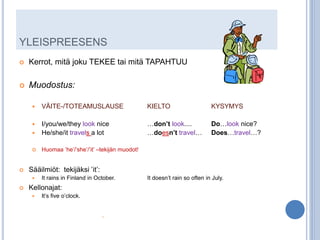
YLEISPREESENS
   Kerrot, mitä joku TEKEE tai mitä TAPAHTUU

   Muodostus:

        VÄITE-/TOTEAMUSLAUSE                      KIELTO                     KYSYMYS

      I/you/we/they look nice                     …don’t look....            Do…look nice?
      He/she/it travels a lot                     …doesn’t travel…           Does…travel…?

        Huomaa ’he’/’she’/’it’ –tekijän muodot!


   Sääilmiöt: tekijäksi ’it’:
        It rains in Finland in October.           It doesn’t rain so often in July.
   Kellonajat:
        It’s five o’clock.


                                  •
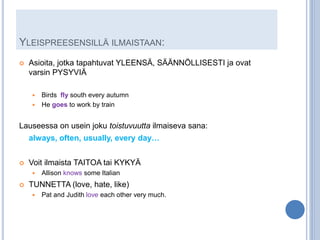
YLEISPREESENSILLÄ ILMAISTAAN:
   Asioita, jotka tapahtuvat YLEENSÄ, SÄÄNNÖLLISESTI ja ovat
    varsin PYSYVIÄ

     Birds fly south every autumn
     He goes to work by train


Lauseessa on usein joku toistuvuutta ilmaiseva sana:
    always, often, usually, every day…


   Voit ilmaista TAITOA tai KYKYÄ
       Allison knows some Italian
   TUNNETTA (love, hate, like)
       Pat and Judith love each other very much.
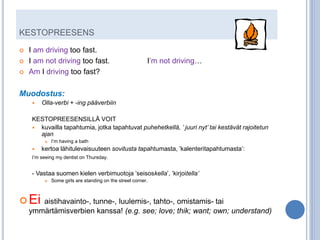
KESTOPREESENS
   I am driving too fast.
   I am not driving too fast.                            I’m not driving…
   Am I driving too fast?

Muodostus:
        Olla-verbi + -ing pääverbiin

     KESTOPREESENSILLÄ VOIT
      kuvailla tapahtumia, jotka tapahtuvat puhehetkellä, ’ juuri nyt’ tai kestävät rajoitetun
       ajan
             I’m having a bath
        kertoa lähitulevaisuuteen sovitusta tapahtumasta, ’kalenteritapahtumasta’:
     I’m seeing my dentist on Thursday.


     - Vastaa suomen kielen verbimuotoja ’seisoskella’, ’kirjoitella’
             Some girls are standing on the street corner.


 Ei aistihavainto-, tunne-, luulemis-, tahto-, omistamis- tai
    ymmärtämisverbien kanssa! (e.g. see; love; thik; want; own; understand)
                                                              sorry, 'THINK':)
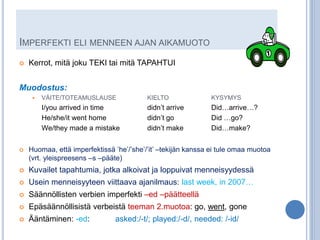
IMPERFEKTI ELI MENNEEN AJAN AIKAMUOTO
   Kerrot, mitä joku TEKI tai mitä TAPAHTUI


Muodostus:
        VÄITE/TOTEAMUSLAUSE              KIELTO              KYSYMYS
         I/you arrived in time            didn’t arrive       Did…arrive…?
         He/she/it went home              didn’t go           Did …go?
         We/they made a mistake           didn’t make         Did…make?


   Huomaa, että imperfektissä ’he’/’she’/’it’ –tekijän kanssa ei tule omaa muotoa
    (vrt. yleispreesens –s –pääte)
   Kuvailet tapahtumia, jotka alkoivat ja loppuivat menneisyydessä
   Usein menneisyyteen viittaava ajanilmaus: last week, in 2007…
   Säännöllisten verbien imperfekti –ed –päätteellä
   Epäsäännöllisistä verbeistä teeman 2.muotoa: go, went, gone
   Ääntäminen: -ed:           asked:/-t/; played:/-d/, needed: /-id/
KESTOIMPERFEKTI


   Was/were –ing                              Be-verbin imperfekti + pääverbi –ing -muodossa


       I/she/he/it was…-ing, we/you/they were…-ing


   Mitä joku oli tekemässä tietyllä hetkellä
   Haluat kuvailla tilanteen taustaa
   Haluat kuvailla keskeneräistä toimintaa


   The rain started when we were picking lingonberries.


---------------------------------------------------X----------------------------------------
PERFEKTI

   Mitä joku ON TEHNYT tai mitä ON TAPAHTUNUT
   Muodostus:
       Have/has + verbin teeman 3.muoto
     I have seen you before.                      ’olen nähnyt’
     She hasn’t visited him often.                ’ei ollut vieraillut’
     Have you bought the tickets?                 ’oletko ostanut?’


       Kuvailet toimintaa, joka alkoi menneisyydessä eikä ole vielä
        päättynyt/vaikuttaa yhä
            We have lived in this town since 1998.
            My friend has never been to the USA.
            I have bought a new LCD-TV.

       Huomaa ero:
            I lived in Italy for 10 years.        …but nowadays I live somewhere else!
            I have lived in Italy for 10 years.   ---and still do!
KESTOPERFEKTI


   Have/has been –ing

   I have been packing all morning            ’olen pakkaillut…’
   She has been packing…                      ’hän on pakkaillut…’


   Korostaa tapahtuman kestoa ja pitkäaikaisuutta
   Usein ajanmääre:
       For hours, all week, since yesterday
PLUSKVAMPERFEKTI

Muodostus:
        Had + verbin teeman 3.muoto

   I had walked ten miles.    ’olin kävellyt’
   She hadn’t even started.   ’ei ollut edes aloittanut’
   Had we won a prize?        ’olimmeko voittaneet?’
FUTUURI                                              TULEVA AIKA
   Kerrot tulevista tapahtumista

   How are you going to spend your summer holiday?
   We will have dinner when everybody is at home.
   Shall I drive you there?                        EHDOTUS
   John is meeting his friend on Tuesday.
   WILL- futuurilla
        ennustat tai toteat jotain
        päätät puhehetkellä tulevasta tekemisestä
   BE GOING TO + perusmuoto
        mitä joku aikoo tehdä
        mitä ilmeisesti tapahtuu
   KESTOPREESENS
        ’kalenteritapahtuma’ lähitulevaisuudessa
   YLEISPREESENS
        kerrot aikataulun tai ohjelman mukaisia (tulevia) tapahtumia

Grammar_ englannin aikamuodot

  • 1.
    RITVA TAMMI 2009 Grammar: Aikamuodot PREESENS – nykyajan aikamuoto
  • 2.
    YLEISPREESENS  Kerrot, mitä joku TEKEE tai mitä TAPAHTUU  Muodostus:  VÄITE-/TOTEAMUSLAUSE KIELTO KYSYMYS  I/you/we/they look nice …don’t look.... Do…look nice?  He/she/it travels a lot …doesn’t travel… Does…travel…?  Huomaa ’he’/’she’/’it’ –tekijän muodot!  Sääilmiöt: tekijäksi ’it’:  It rains in Finland in October. It doesn’t rain so often in July.  Kellonajat:  It’s five o’clock. •
  • 3.
    YLEISPREESENSILLÄ ILMAISTAAN:  Asioita, jotka tapahtuvat YLEENSÄ, SÄÄNNÖLLISESTI ja ovat varsin PYSYVIÄ  Birds fly south every autumn  He goes to work by train Lauseessa on usein joku toistuvuutta ilmaiseva sana: always, often, usually, every day…  Voit ilmaista TAITOA tai KYKYÄ  Allison knows some Italian  TUNNETTA (love, hate, like)  Pat and Judith love each other very much.
  • 4.
    KESTOPREESENS  I am driving too fast.  I am not driving too fast. I’m not driving…  Am I driving too fast? Muodostus:  Olla-verbi + -ing pääverbiin KESTOPREESENSILLÄ VOIT  kuvailla tapahtumia, jotka tapahtuvat puhehetkellä, ’ juuri nyt’ tai kestävät rajoitetun ajan  I’m having a bath  kertoa lähitulevaisuuteen sovitusta tapahtumasta, ’kalenteritapahtumasta’: I’m seeing my dentist on Thursday. - Vastaa suomen kielen verbimuotoja ’seisoskella’, ’kirjoitella’  Some girls are standing on the street corner.  Ei aistihavainto-, tunne-, luulemis-, tahto-, omistamis- tai ymmärtämisverbien kanssa! (e.g. see; love; thik; want; own; understand) sorry, 'THINK':)
  • 5.
    IMPERFEKTI ELI MENNEENAJAN AIKAMUOTO  Kerrot, mitä joku TEKI tai mitä TAPAHTUI Muodostus:  VÄITE/TOTEAMUSLAUSE KIELTO KYSYMYS I/you arrived in time didn’t arrive Did…arrive…? He/she/it went home didn’t go Did …go? We/they made a mistake didn’t make Did…make?  Huomaa, että imperfektissä ’he’/’she’/’it’ –tekijän kanssa ei tule omaa muotoa (vrt. yleispreesens –s –pääte)  Kuvailet tapahtumia, jotka alkoivat ja loppuivat menneisyydessä  Usein menneisyyteen viittaava ajanilmaus: last week, in 2007…  Säännöllisten verbien imperfekti –ed –päätteellä  Epäsäännöllisistä verbeistä teeman 2.muotoa: go, went, gone  Ääntäminen: -ed: asked:/-t/; played:/-d/, needed: /-id/
  • 6.
    KESTOIMPERFEKTI  Was/were –ing Be-verbin imperfekti + pääverbi –ing -muodossa  I/she/he/it was…-ing, we/you/they were…-ing  Mitä joku oli tekemässä tietyllä hetkellä  Haluat kuvailla tilanteen taustaa  Haluat kuvailla keskeneräistä toimintaa  The rain started when we were picking lingonberries. ---------------------------------------------------X----------------------------------------
  • 7.
    PERFEKTI  Mitä joku ON TEHNYT tai mitä ON TAPAHTUNUT  Muodostus:  Have/has + verbin teeman 3.muoto  I have seen you before. ’olen nähnyt’  She hasn’t visited him often. ’ei ollut vieraillut’  Have you bought the tickets? ’oletko ostanut?’  Kuvailet toimintaa, joka alkoi menneisyydessä eikä ole vielä päättynyt/vaikuttaa yhä  We have lived in this town since 1998.  My friend has never been to the USA.  I have bought a new LCD-TV.  Huomaa ero:  I lived in Italy for 10 years. …but nowadays I live somewhere else!  I have lived in Italy for 10 years. ---and still do!
  • 8.
    KESTOPERFEKTI  Have/has been –ing  I have been packing all morning ’olen pakkaillut…’  She has been packing… ’hän on pakkaillut…’  Korostaa tapahtuman kestoa ja pitkäaikaisuutta  Usein ajanmääre:  For hours, all week, since yesterday
  • 9.
    PLUSKVAMPERFEKTI Muodostus:  Had + verbin teeman 3.muoto  I had walked ten miles. ’olin kävellyt’  She hadn’t even started. ’ei ollut edes aloittanut’  Had we won a prize? ’olimmeko voittaneet?’
  • 10.
    FUTUURI TULEVA AIKA  Kerrot tulevista tapahtumista  How are you going to spend your summer holiday?  We will have dinner when everybody is at home.  Shall I drive you there? EHDOTUS  John is meeting his friend on Tuesday.  WILL- futuurilla  ennustat tai toteat jotain  päätät puhehetkellä tulevasta tekemisestä  BE GOING TO + perusmuoto  mitä joku aikoo tehdä  mitä ilmeisesti tapahtuu  KESTOPREESENS  ’kalenteritapahtuma’ lähitulevaisuudessa  YLEISPREESENS  kerrot aikataulun tai ohjelman mukaisia (tulevia) tapahtumia