






Tener que
AND Idioms with
Tener
Tener que + infinitive
is one way to express obligation or
necessity.
This expression can be
translated as
"someone has to do something."
Tener is conjugated
according to the
subject of the sentence.
Tengo que comer las verduras.
I have to eat the vegetables.
Ángel tiene que leer el periódico.
Ángel has to read the newspaper.
Ellos tienen que comprar una revista.
They have to buy a magazine.
Hay un examen.
Nosotros tenemos que estudiar.
Usted aprende el español.
Usted tiene que practicar mucho.
Bill está en España.
Bill tiene que hablar español.
No hay carro.
Tienes que tomar un taxi.
Idiomatic expressions with tener
An idiom is a group of words which, when used
together, has a different meaning from the one
which the individual words have. For example:
- How do you know about John's illness?
- Oh, I heard it on the grapevine.
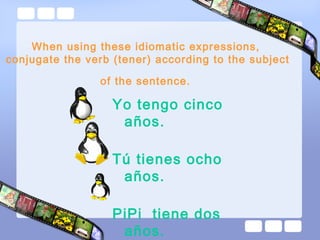
When using these idiomatic expressions,
conjugate the verb (tener) according to the subject
of the sentence.
Yo tengo cinco
años.
Tú tienes ocho
años.
PiPi tiene dos
años.
There are many idiomatic
expressions that use the verb tener.
This one
expresses age:
Idiom: tener _____ años
Literally: to have _____
years
True Meaning: to be _____
years old
Spanish also has many idiomatic
expressions.
Although their literal translations sound odd
to
English speakers, they sound perfectly
natural
to native speakers. Here is one example:
Idiom: Hace mucho calor.
Literally: It makes much
heat.
True Meaning: It is
very hot.
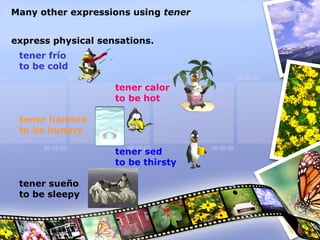
Many other expressions using tener
express physical sensations.
tener frío
to be cold
tener calor
to be hot
tener hambre
to be hungry
tener sed
to be thirsty
tener sueño
to be sleepy

tener idioms

  • 1.
  • 2.
    Tener que +infinitive is one way to express obligation or necessity.
  • 3.
    This expression canbe translated as "someone has to do something."
  • 4.
    Tener is conjugated accordingto the subject of the sentence.
  • 5.
    Tengo que comerlas verduras. I have to eat the vegetables.
  • 6.
    Ángel tiene queleer el periódico. Ángel has to read the newspaper.
  • 7.
    Ellos tienen quecomprar una revista. They have to buy a magazine.
  • 8.
    Hay un examen. Nosotrostenemos que estudiar.
  • 9.
    Usted aprende elespañol. Usted tiene que practicar mucho.
  • 10.
    Bill está enEspaña. Bill tiene que hablar español.
  • 11.
    No hay carro. Tienesque tomar un taxi.
  • 12.
    Idiomatic expressions withtener An idiom is a group of words which, when used together, has a different meaning from the one which the individual words have. For example: - How do you know about John's illness? - Oh, I heard it on the grapevine.
  • 13.
    When using theseidiomatic expressions, conjugate the verb (tener) according to the subject of the sentence. Yo tengo cinco años. Tú tienes ocho años. PiPi tiene dos años.
  • 14.
    There are manyidiomatic expressions that use the verb tener. This one expresses age: Idiom: tener _____ años Literally: to have _____ years True Meaning: to be _____ years old
  • 15.
    Spanish also hasmany idiomatic expressions. Although their literal translations sound odd to English speakers, they sound perfectly natural to native speakers. Here is one example: Idiom: Hace mucho calor. Literally: It makes much heat. True Meaning: It is very hot.
  • 16.
    Many other expressionsusing tener express physical sensations. tener frío to be cold tener calor to be hot tener hambre to be hungry tener sed to be thirsty tener sueño to be sleepy