Help me understand your requirement
✓ Your Background
✓ Objective
✓ Expectation from the course
✓ Anything Else?
PYTHON FOR
DATA SCIENCE
- Dr Nisha Arora
Dr. Nisha Arora is a proficient educator, passionate
trainer, You Tuber, occasional writer, and a learner
forever.
✓ PhD in Mathematics.
✓ Works in the area of Data Science, Statistical
Research, Data Visualization & Storytelling
✓ Creator of various courses
✓ Contributor to various research communities and
Q/A forums
✓ Mentor for women in Tech Global
4
About Me
An educator by heart & a
trainer by profession.
✓ In-depth Technical Answers
✓ Coding Queries
✓ Layman’s Term Explanation
✓ Research Queries
✓ Blog Posts
✓ Slide Decks
✓ Publications
✓ Tutorials /My Talks
✓ Mentoring
✓ Articles & Much More
My Contribution to the Community
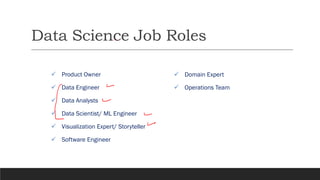
Data Science Job Roles
✓ Product Owner
✓ Data Engineer
✓ Data Analysts
✓ Data Scientist/ ML Engineer
✓ Visualization Expert/ Storyteller
✓ Software Engineer
✓ Domain Expert
✓ Operations Team
Required Technical Skills
Data Analysts Data Scientists Data Engineer
Excel
Statistical Analysis Python/ R
Databases Data Viz & Storytelling
SQL/ Databases
R/Python/SAS EDA/Data Wrangling/Data Prep Data Warehousing/Data Architecture
Tableau/PowerBI Machine Learning/Deep Learning
Distributed Computing (Hadoop/Map
Reduce)
Statistical Analysis SQL Data Management & Data Security
Data Viz & Storytelling R, Python, SAS (sometimes)
Docker, Kubernaties, Kafka, Spark, Git
GitHub
EDA/Data Wrangling/Data Prep Tensorflow, Keras Cloud Tech (AWS/Azure/GCP)
Dashboards & Reporting Git/ GitHub Big Data Services
11
Soft Skills
Domain Knowledge
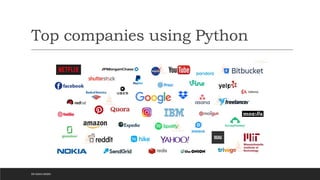
Top companies using Python
DR NISHA ARORA
Python is used for
DR NISHA ARORA
❑ Web development
❑ Desktop Application
❑ IOT Programming
❑ Data Science & Analytics
❑ Game development
Popularity of Python
DR NISHA ARORA
https://insights.stackoverflow.com/trends?tags=python
Python for Data Science
15
Coding Best
Practices
Tips & Tricks
✓ Programming Basics
✓ Data Science/ML Concepts
✓ Libraries for Data Science/ML
✓ Projects
Agenda
1. Getting started with Google Colab for
Python
2. Python Basics
3. Data Structure in Python
4. Numpy, Pandas, Matplotlib, Seaborn, Scikit-
learn
5. Data Analysis & Processing in Pandas
6. Data Visualization & Storytelling with Python
Bonus for Python Beginners
1. Downloading & Installing Python
2. Selecting the IDE
3. Python files (.py files) Vs ipython
notebooks (.ipynb files)
4. Getting started with Jupyter &
Jupyter Labs
5. Setting-up start-up folder in Jupyter
6. Getting started with Spyder
DR NISHA ARORA
What will you get?
DR NISHA ARORA
✓ Presentations
✓ Quick Summary of each lesson
✓ Code Files
✓ Data Files
✓ Use-cases
✓ Web-resources
✓ Recommended Readings
✓ Tips & Tricks
✓ Bonus Videos
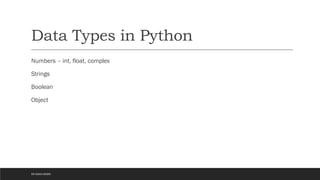
Data Types in Python
Numbers – int, float, complex
Strings
Boolean
Object
DR NISHA ARORA
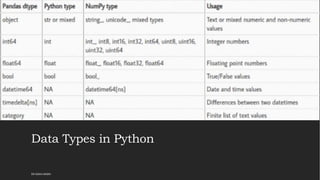
Data Types in Python
DR NISHA ARORA
Operators in Python
DR NISHA ARORA
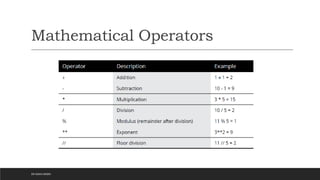
Mathematical Operators
DR NISHA ARORA
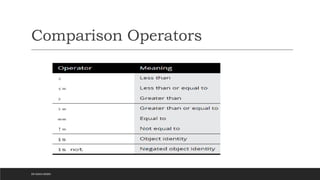
Comparison Operators
DR NISHA ARORA
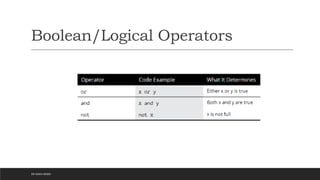
Boolean/Logical Operators
DR NISHA ARORA
Strings in Python
DR NISHA ARORA
Strings
Strings in Python are immutable, iterable and ordered.
which means
- we can not updates or delete values from a string
- we can iterate over elements of a string
- we can perform indexing & slicing over a string
DR NISHA ARORA
Escape Sequence
Escape character ``
Escaping allows the normal interpretation of the character to be suspended and that string to be
defined as normal.
DR NISHA ARORA
String Methods
Check with dir(str)
DR NISHA ARORA
String Slicing
1. Indexing/counting starts with 0. First character gets counted as zero
2. `[a:b]` means starting at ath position and extracting until (b-1)th position
3. `[a:]` means starting at ath position till end
4. `[:a]` means starting at the beginning until (a-1)th position
DR NISHA ARORA
String Slicing
5. negative sign with indices mean counting from right instead of natural left.
6. `[:-a]` means starting at the beginning and going up til ath position from end. Counting from end also starts
with 0.
7. `[-a:]` means starting at (a+1)th character from the end and going up till last character.
8. `[a:-b]` means starting at ath character at the beginning and going till bth position from end
9. `[-a:-b]` means starting at (a+1)th character from the end and going up till bth position from end
DR NISHA ARORA
String Slicing _ stride
The optional, third number in a slice specifies the stride.
If omitted, the default is 1: return every character in the requested range
To return every kth letter, set the stride to k.
Negative values of k reverse the string.
DR NISHA ARORA

1. python for data science

  • 1.
    Help me understandyour requirement ✓ Your Background ✓ Objective ✓ Expectation from the course ✓ Anything Else?
  • 2.
  • 3.
    Dr. Nisha Arorais a proficient educator, passionate trainer, You Tuber, occasional writer, and a learner forever. ✓ PhD in Mathematics. ✓ Works in the area of Data Science, Statistical Research, Data Visualization & Storytelling ✓ Creator of various courses ✓ Contributor to various research communities and Q/A forums ✓ Mentor for women in Tech Global 4 About Me An educator by heart & a trainer by profession.
  • 4.
    ✓ In-depth TechnicalAnswers ✓ Coding Queries ✓ Layman’s Term Explanation ✓ Research Queries ✓ Blog Posts ✓ Slide Decks ✓ Publications ✓ Tutorials /My Talks ✓ Mentoring ✓ Articles & Much More My Contribution to the Community
  • 5.
    Data Science JobRoles ✓ Product Owner ✓ Data Engineer ✓ Data Analysts ✓ Data Scientist/ ML Engineer ✓ Visualization Expert/ Storyteller ✓ Software Engineer ✓ Domain Expert ✓ Operations Team
  • 6.
    Required Technical Skills DataAnalysts Data Scientists Data Engineer Excel Statistical Analysis Python/ R Databases Data Viz & Storytelling SQL/ Databases R/Python/SAS EDA/Data Wrangling/Data Prep Data Warehousing/Data Architecture Tableau/PowerBI Machine Learning/Deep Learning Distributed Computing (Hadoop/Map Reduce) Statistical Analysis SQL Data Management & Data Security Data Viz & Storytelling R, Python, SAS (sometimes) Docker, Kubernaties, Kafka, Spark, Git GitHub EDA/Data Wrangling/Data Prep Tensorflow, Keras Cloud Tech (AWS/Azure/GCP) Dashboards & Reporting Git/ GitHub Big Data Services 11 Soft Skills Domain Knowledge
  • 7.
    Top companies usingPython DR NISHA ARORA
  • 8.
    Python is usedfor DR NISHA ARORA ❑ Web development ❑ Desktop Application ❑ IOT Programming ❑ Data Science & Analytics ❑ Game development
  • 9.
    Popularity of Python DRNISHA ARORA https://insights.stackoverflow.com/trends?tags=python
  • 10.
    Python for DataScience 15 Coding Best Practices Tips & Tricks ✓ Programming Basics ✓ Data Science/ML Concepts ✓ Libraries for Data Science/ML ✓ Projects
  • 11.
    Agenda 1. Getting startedwith Google Colab for Python 2. Python Basics 3. Data Structure in Python 4. Numpy, Pandas, Matplotlib, Seaborn, Scikit- learn 5. Data Analysis & Processing in Pandas 6. Data Visualization & Storytelling with Python Bonus for Python Beginners 1. Downloading & Installing Python 2. Selecting the IDE 3. Python files (.py files) Vs ipython notebooks (.ipynb files) 4. Getting started with Jupyter & Jupyter Labs 5. Setting-up start-up folder in Jupyter 6. Getting started with Spyder DR NISHA ARORA
  • 12.
    What will youget? DR NISHA ARORA ✓ Presentations ✓ Quick Summary of each lesson ✓ Code Files ✓ Data Files ✓ Use-cases ✓ Web-resources ✓ Recommended Readings ✓ Tips & Tricks ✓ Bonus Videos
  • 14.
    Data Types inPython Numbers – int, float, complex Strings Boolean Object DR NISHA ARORA
  • 15.
    Data Types inPython DR NISHA ARORA
  • 16.
  • 17.
  • 18.
  • 19.
  • 20.
  • 21.
    Strings Strings in Pythonare immutable, iterable and ordered. which means - we can not updates or delete values from a string - we can iterate over elements of a string - we can perform indexing & slicing over a string DR NISHA ARORA
  • 22.
    Escape Sequence Escape character`` Escaping allows the normal interpretation of the character to be suspended and that string to be defined as normal. DR NISHA ARORA
  • 23.
    String Methods Check withdir(str) DR NISHA ARORA
  • 24.
    String Slicing 1. Indexing/countingstarts with 0. First character gets counted as zero 2. `[a:b]` means starting at ath position and extracting until (b-1)th position 3. `[a:]` means starting at ath position till end 4. `[:a]` means starting at the beginning until (a-1)th position DR NISHA ARORA
  • 25.
    String Slicing 5. negativesign with indices mean counting from right instead of natural left. 6. `[:-a]` means starting at the beginning and going up til ath position from end. Counting from end also starts with 0. 7. `[-a:]` means starting at (a+1)th character from the end and going up till last character. 8. `[a:-b]` means starting at ath character at the beginning and going till bth position from end 9. `[-a:-b]` means starting at (a+1)th character from the end and going up till bth position from end DR NISHA ARORA
  • 26.
    String Slicing _stride The optional, third number in a slice specifies the stride. If omitted, the default is 1: return every character in the requested range To return every kth letter, set the stride to k. Negative values of k reverse the string. DR NISHA ARORA