Enhancing employability through
experiential learning
- a project-based approach
Stephen Grady: University of Wolverhampton Business School
Gareth Jones: In-Comm Training and Business Services
Laurren Wood-Bowness: BA (Hons) Business Management Student
Amarpreet Kaur: BA (Hons) Marketing Management Student
HEA Workshop: 14th November 2013
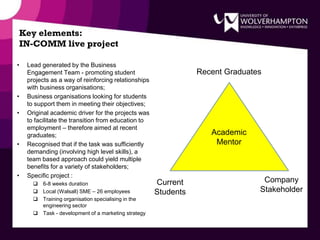
Key elements:
IN-COMM live project
Recent Graduates
• Lead generated by the Business
Engagement Team - promoting student
projects as a way of reinforcing relationships
with business organisations;
• Business organisations looking for students
to support them in meeting their objectives;
• Original academic driver for the projects was
to facilitate the transition from education to
employment – therefore aimed at recent
graduates;
• Recognised that if the task was sufficiently
demanding (involving high level skills), a
team based approach could yield multiple
benefits for a variety of stakeholders;
• Specific project :
 6-8 weeks duration
 Local (Walsall) SME – 26 employees
 Training organisation specialising in the
engineering sector
 Task - development of a marketing strategy
Current
Students
Company
Stakeholder
Academic
Mentor
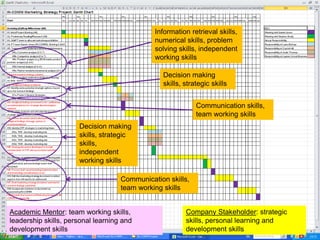
Information retrieval skills,
numerical skills, problem
solving skills, independent
working skills
Decision making
skills, strategic skills
Communication skills,
team working skills
Decision making
skills, strategic
skills,
independent
working skills
Communication skills,
team working skills
Academic Mentor: team working skills,
leadership skills, personal learning and
development skills
Company Stakeholder: strategic
skills, personal learning and
development skills
Organisational/employer context and
perspectives
• In-Comm Training & Business Services
• Managerial culture & attitudes
• External perception of In-Comm's activities
• Opinions of employees
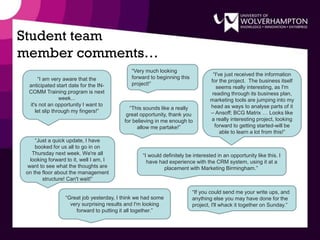
Student team
member comments…
“Great job yesterday, I think we had some
very surprising results and I'm looking
forward to putting it all together.”
“If you could send me your write ups, and
anything else you may have done for the
project, I'll whack it together on Sunday.”
“Just a quick update, I have
booked for us all to go in on
Thursday next week. We're all
looking forward to it, well I am, I
want to see what the thoughts are
on the floor about the management
structure! Can't wait!”
“Very much looking
forward to beginning this
project!”
“I am very aware that the
anticipated start date for the IN-
COMM Training program is next
week...
it's not an opportunity I want to
let slip through my fingers!”
“This sounds like a really
great opportunity, thank you
for believing in me enough to
allow me partake!”
“I've just received the information
for the project. The business itself
seems really interesting, as I'm
reading through its business plan,
marketing tools are jumping into my
head as ways to analyse parts of it
– Ansoff; BCG Matrix … Looks like
a really interesting project, looking
forward to getting started-will be
able to learn a lot from this!”
“I would definitely be interested in an opportunity like this. I
have had experience with the CRM system, using it at a
placement with Marketing Birmingham.”
What do the students get out of it?
• The chance to learn in a professional environment;
• Making our education “multi-dimensional”;
• Team and individual working;
• Networking;
• Work experience (and sampling);
• Investigating what motivates real employees;
• Provide possible career direction and perspective.
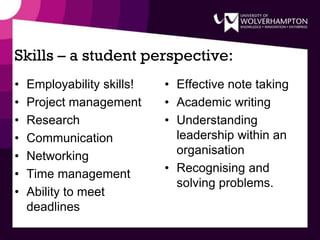
Skills – a student perspective:
• Employability skills!
• Project management
• Research
• Communication
• Networking
• Time management
• Ability to meet
deadlines
• Effective note taking
• Academic writing
• Understanding
leadership within an
organisation
• Recognising and
solving problems.
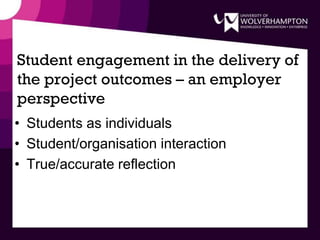
Student engagement in the delivery of
the project outcomes – an employer
perspective
• Students as individuals
• Student/organisation interaction
• True/accurate reflection
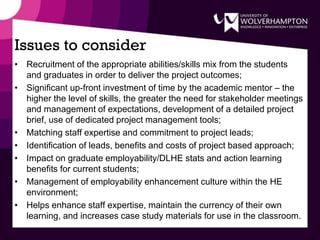
Issues to consider
• Recruitment of the appropriate abilities/skills mix from the students
and graduates in order to deliver the project outcomes;
• Significant up-front investment of time by the academic mentor – the
higher the level of skills, the greater the need for stakeholder meetings
and management of expectations, development of a detailed project
brief, use of dedicated project management tools;
• Matching staff expertise and commitment to project leads;
• Identification of leads, benefits and costs of project based approach;
• Impact on graduate employability/DLHE stats and action learning
benefits for current students;
• Management of employability enhancement culture within the HE
environment;
• Helps enhance staff expertise, maintain the currency of their own
learning, and increases case study materials for use in the classroom.

Enhancing employability through experiential learning - Steven Grady, Gareth Jones, Laurren Wood-Bowness and Amarpreet Kaur

  • 1.
    Enhancing employability through experientiallearning - a project-based approach Stephen Grady: University of Wolverhampton Business School Gareth Jones: In-Comm Training and Business Services Laurren Wood-Bowness: BA (Hons) Business Management Student Amarpreet Kaur: BA (Hons) Marketing Management Student HEA Workshop: 14th November 2013
  • 2.
    Key elements: IN-COMM liveproject Recent Graduates • Lead generated by the Business Engagement Team - promoting student projects as a way of reinforcing relationships with business organisations; • Business organisations looking for students to support them in meeting their objectives; • Original academic driver for the projects was to facilitate the transition from education to employment – therefore aimed at recent graduates; • Recognised that if the task was sufficiently demanding (involving high level skills), a team based approach could yield multiple benefits for a variety of stakeholders; • Specific project :  6-8 weeks duration  Local (Walsall) SME – 26 employees  Training organisation specialising in the engineering sector  Task - development of a marketing strategy Current Students Company Stakeholder Academic Mentor
  • 4.
    Information retrieval skills, numericalskills, problem solving skills, independent working skills Decision making skills, strategic skills Communication skills, team working skills Decision making skills, strategic skills, independent working skills Communication skills, team working skills Academic Mentor: team working skills, leadership skills, personal learning and development skills Company Stakeholder: strategic skills, personal learning and development skills
  • 5.
    Organisational/employer context and perspectives •In-Comm Training & Business Services • Managerial culture & attitudes • External perception of In-Comm's activities • Opinions of employees
  • 6.
    Student team member comments… “Greatjob yesterday, I think we had some very surprising results and I'm looking forward to putting it all together.” “If you could send me your write ups, and anything else you may have done for the project, I'll whack it together on Sunday.” “Just a quick update, I have booked for us all to go in on Thursday next week. We're all looking forward to it, well I am, I want to see what the thoughts are on the floor about the management structure! Can't wait!” “Very much looking forward to beginning this project!” “I am very aware that the anticipated start date for the IN- COMM Training program is next week... it's not an opportunity I want to let slip through my fingers!” “This sounds like a really great opportunity, thank you for believing in me enough to allow me partake!” “I've just received the information for the project. The business itself seems really interesting, as I'm reading through its business plan, marketing tools are jumping into my head as ways to analyse parts of it – Ansoff; BCG Matrix … Looks like a really interesting project, looking forward to getting started-will be able to learn a lot from this!” “I would definitely be interested in an opportunity like this. I have had experience with the CRM system, using it at a placement with Marketing Birmingham.”
  • 7.
    What do thestudents get out of it? • The chance to learn in a professional environment; • Making our education “multi-dimensional”; • Team and individual working; • Networking; • Work experience (and sampling); • Investigating what motivates real employees; • Provide possible career direction and perspective.
  • 8.
    Skills – astudent perspective: • Employability skills! • Project management • Research • Communication • Networking • Time management • Ability to meet deadlines • Effective note taking • Academic writing • Understanding leadership within an organisation • Recognising and solving problems.
  • 9.
    Student engagement inthe delivery of the project outcomes – an employer perspective • Students as individuals • Student/organisation interaction • True/accurate reflection
  • 10.
    Issues to consider •Recruitment of the appropriate abilities/skills mix from the students and graduates in order to deliver the project outcomes; • Significant up-front investment of time by the academic mentor – the higher the level of skills, the greater the need for stakeholder meetings and management of expectations, development of a detailed project brief, use of dedicated project management tools; • Matching staff expertise and commitment to project leads; • Identification of leads, benefits and costs of project based approach; • Impact on graduate employability/DLHE stats and action learning benefits for current students; • Management of employability enhancement culture within the HE environment; • Helps enhance staff expertise, maintain the currency of their own learning, and increases case study materials for use in the classroom.