JULIET S. ANINO
MST-MATH
ADVANCED CALCULUS
Let a scalar field f be given in space and a coordinate system chosen so that f = f
( x ,y , z ) and is defined and differentiable in a certain domain of space; thus the
first partial derivatives of f exist in this domain. They form the components of the
vector grad f , the gradient of the scalar f . Thus one has
For example, if f = x2y - z2, then
Formula (3.5) can be written in the following symbolic form:
where the suggested multiplication actually leads to a differentiation. The
expression
in parentheses is denoted by the symbol ∇ and is called "del" or "nabla." Thus
𝛁 is a "vector differential operator." By itself, the 𝛁 has no numerical
significance; it takes on such significance when it is applied to a function, that
is, in forming
It was shown in Section 2.14 that the directional derivative of the scalar f in the
direction of the unit vector u = cos𝜶i+cos 𝜷j +cos 𝛾 k is given by
This shows that grad f has a meaning independent of the coordinate system
chosen:
It’s component in a given direction represents the rate of change off in
that direction.
In particular, grad f points in the direction of maximum increase of f.
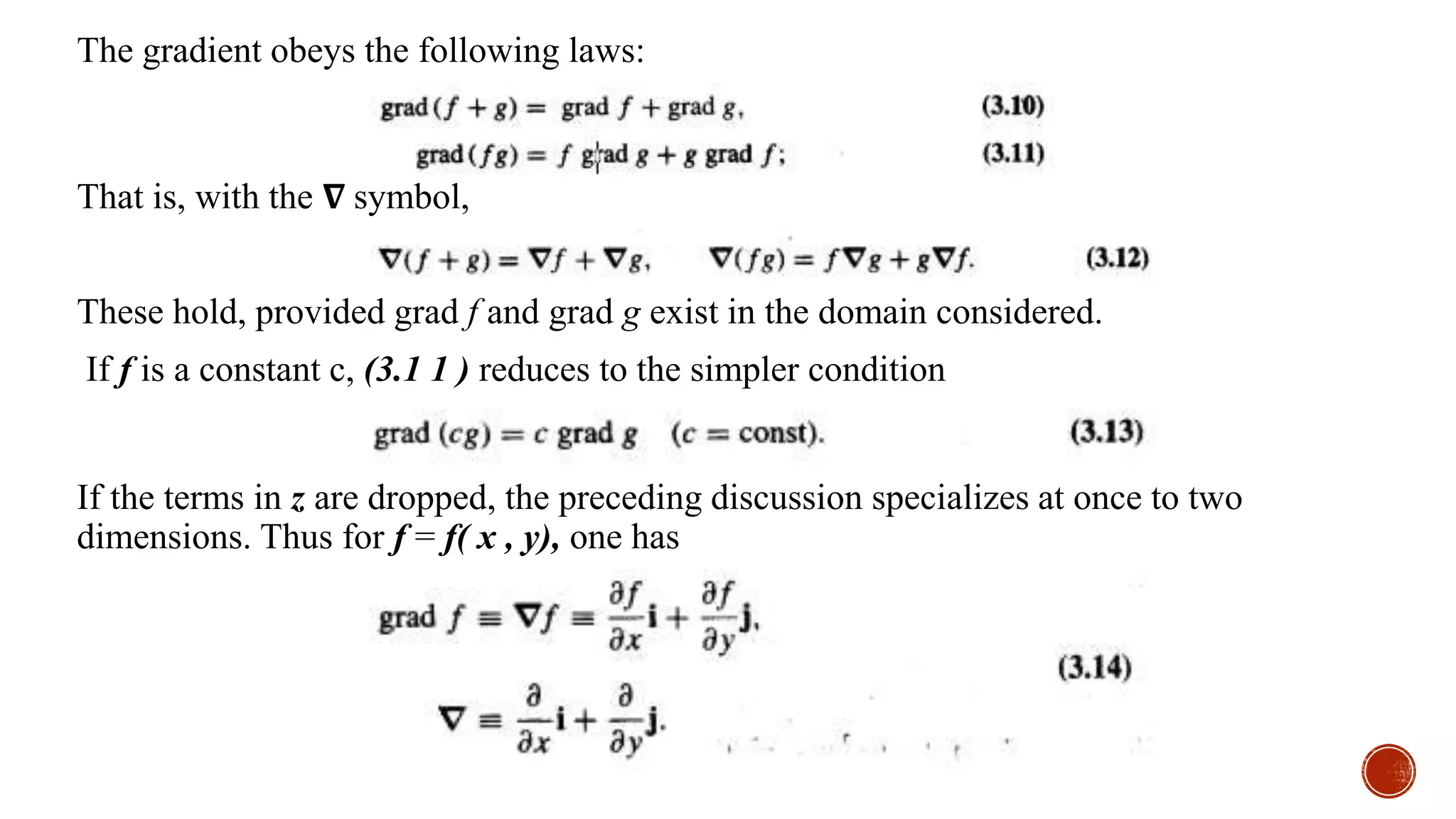
The gradient obeys the following laws:
That is, with the 𝛁 symbol,
These hold, provided grad f and grad g exist in the domain considered.
If f is a constant c, (3.1 1 ) reduces to the simpler condition
If the terms in z are dropped, the preceding discussion specializes at once to two
dimensions. Thus for f = f( x , y), one has
The gradient obeys the following laws:
That is, with the 𝛁 symbol,
These hold, provided grad f and grad g exist in the domain considered.
If f is a constant c, (3.1 1 ) reduces to the simpler condition
If the terms in z are dropped, the preceding discussion specializes at once to two
dimensions. Thus for f = f( x , y), one has
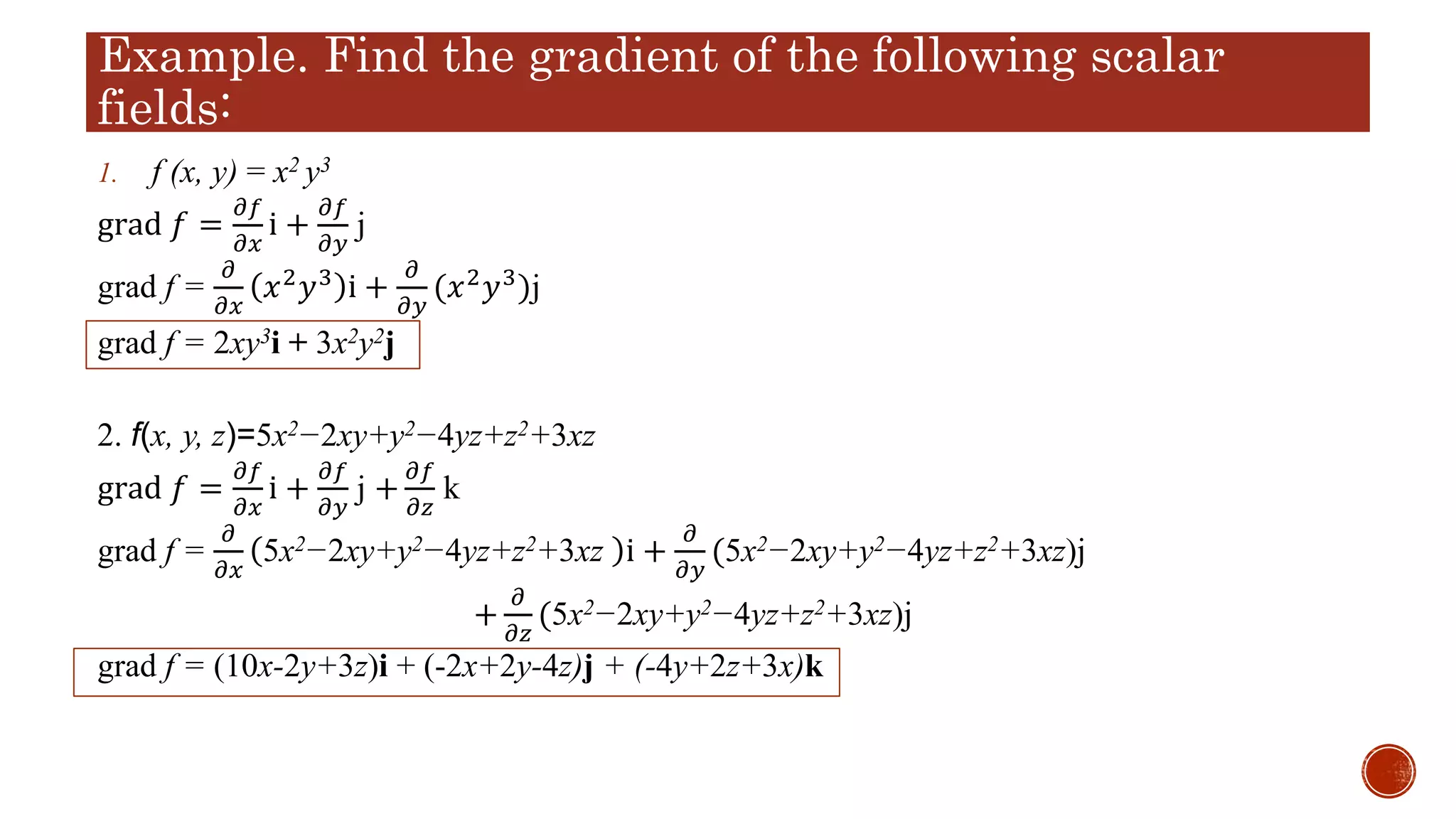
Example. Find the gradient of the following scalar
fields:
1. f (x, y) = x2 y3
grad 𝑓 =
𝜕𝑓
𝜕𝑥
i +
𝜕𝑓
𝜕𝑦
j
grad f =
𝜕
𝜕𝑥
𝑥2
𝑦3
i +
𝜕
𝜕𝑦
(𝑥2
𝑦3
)j
grad f = 2xy3i + 3x2y2j
2. f(x, y, z)=5x2−2xy+y2−4yz+z2+3xz
grad 𝑓 =
𝜕𝑓
𝜕𝑥
i +
𝜕𝑓
𝜕𝑦
j +
𝜕𝑓
𝜕𝑧
k
grad f =
𝜕
𝜕𝑥
5x2−2xy+y2−4yz+z2+3xz i +
𝜕
𝜕𝑦
(5x2−2xy+y2−4yz+z2+3xz)j
+
𝜕
𝜕𝑧
(5x2−2xy+y2−4yz+z2+3xz)j
grad f = (10x-2y+3z)i + (-2x+2y-4z)j + (-4y+2z+3x)k
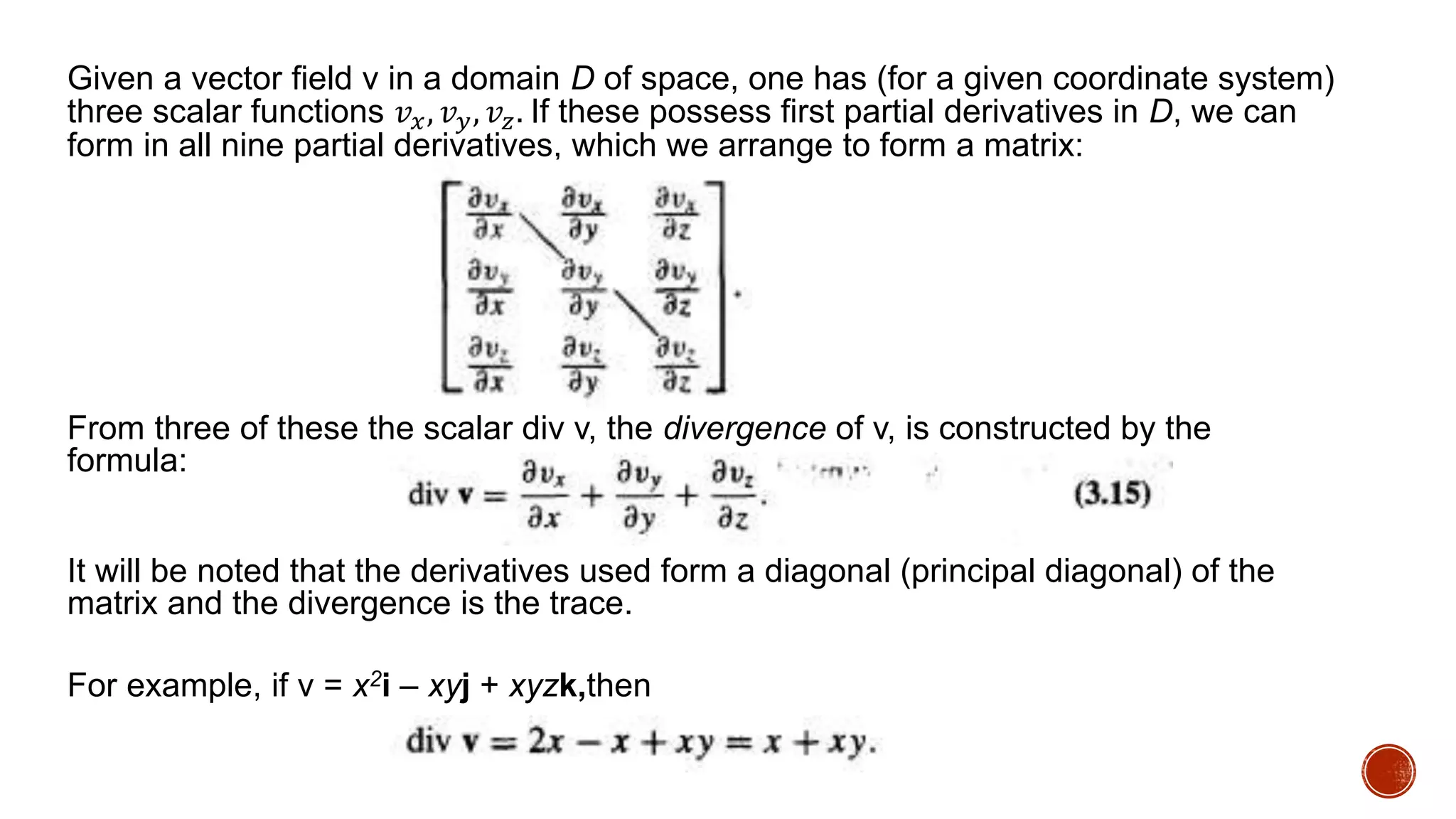
Given a vector field v in a domain D of space, one has (for a given coordinate system)
three scalar functions 𝑣𝑥, 𝑣𝑦, 𝑣𝑧. If these possess first partial derivatives in D, we can
form in all nine partial derivatives, which we arrange to form a matrix:
From three of these the scalar div v, the divergence of v, is constructed by the
formula:
It will be noted that the derivatives used form a diagonal (principal diagonal) of the
matrix and the divergence is the trace.
For example, if v = x2i – xyj + xyzk,then
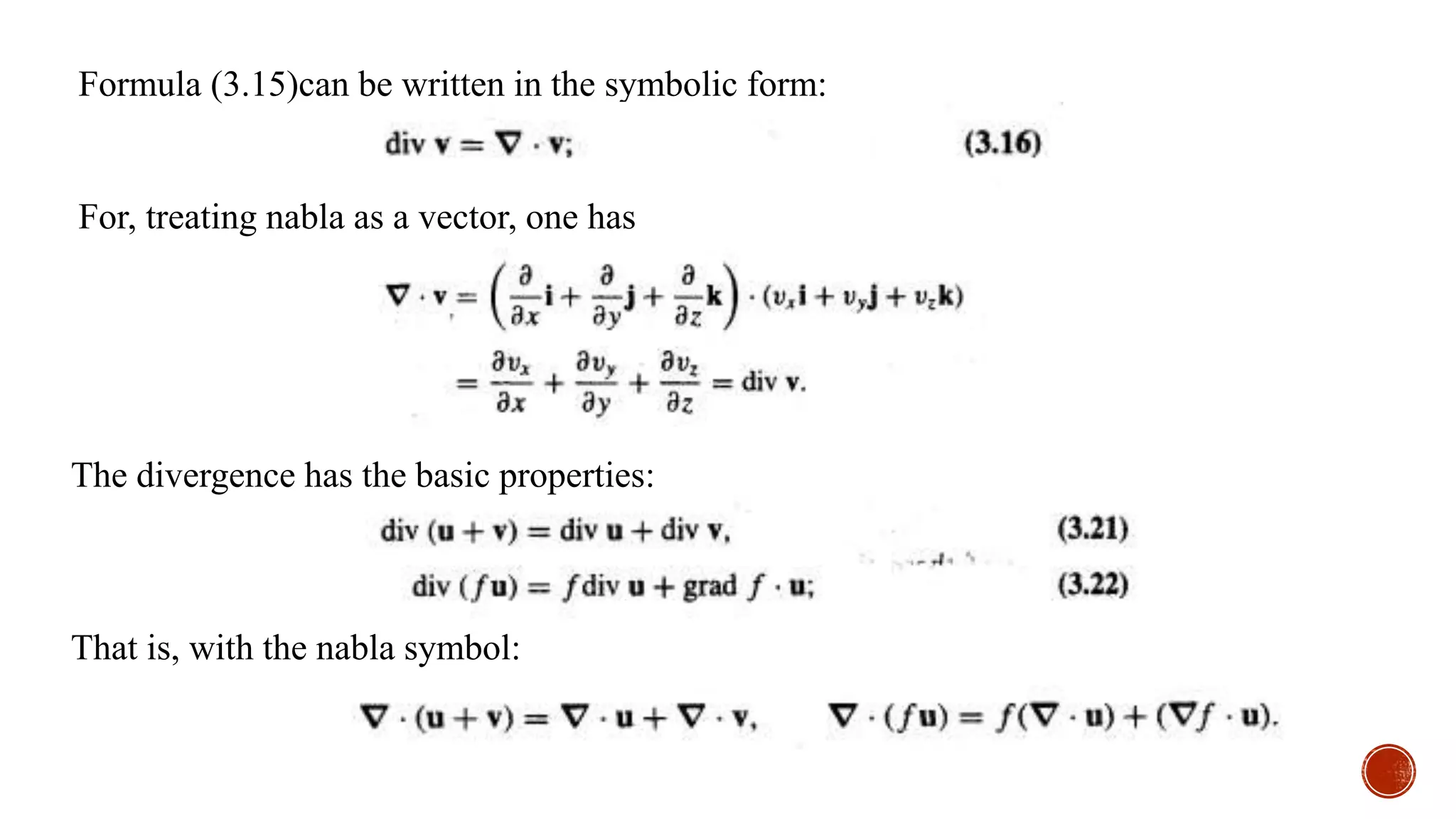
Formula (3.15)can be written in the symbolic form:
For, treating nabla as a vector, one has
The divergence has the basic properties:
That is, with the nabla symbol:
1. Compute div 𝐹 for 𝐹 = x2yi – (z3-3x)j + 4y2k
 2.
= 3 +
2𝑥3𝑦
𝑧
- 1 = 2 +
2𝑥2𝑦2
𝑧
Calculus report_The Gradient field.pptx

Calculus report_The Gradient field.pptx

  • 1.
  • 2.
    Let a scalarfield f be given in space and a coordinate system chosen so that f = f ( x ,y , z ) and is defined and differentiable in a certain domain of space; thus the first partial derivatives of f exist in this domain. They form the components of the vector grad f , the gradient of the scalar f . Thus one has For example, if f = x2y - z2, then Formula (3.5) can be written in the following symbolic form: where the suggested multiplication actually leads to a differentiation. The expression in parentheses is denoted by the symbol ∇ and is called "del" or "nabla." Thus
  • 3.
    𝛁 is a"vector differential operator." By itself, the 𝛁 has no numerical significance; it takes on such significance when it is applied to a function, that is, in forming It was shown in Section 2.14 that the directional derivative of the scalar f in the direction of the unit vector u = cos𝜶i+cos 𝜷j +cos 𝛾 k is given by This shows that grad f has a meaning independent of the coordinate system chosen: It’s component in a given direction represents the rate of change off in that direction. In particular, grad f points in the direction of maximum increase of f.
  • 4.
    The gradient obeysthe following laws: That is, with the 𝛁 symbol, These hold, provided grad f and grad g exist in the domain considered. If f is a constant c, (3.1 1 ) reduces to the simpler condition If the terms in z are dropped, the preceding discussion specializes at once to two dimensions. Thus for f = f( x , y), one has
  • 5.
    The gradient obeysthe following laws: That is, with the 𝛁 symbol, These hold, provided grad f and grad g exist in the domain considered. If f is a constant c, (3.1 1 ) reduces to the simpler condition If the terms in z are dropped, the preceding discussion specializes at once to two dimensions. Thus for f = f( x , y), one has
  • 6.
    Example. Find thegradient of the following scalar fields: 1. f (x, y) = x2 y3 grad 𝑓 = 𝜕𝑓 𝜕𝑥 i + 𝜕𝑓 𝜕𝑦 j grad f = 𝜕 𝜕𝑥 𝑥2 𝑦3 i + 𝜕 𝜕𝑦 (𝑥2 𝑦3 )j grad f = 2xy3i + 3x2y2j 2. f(x, y, z)=5x2−2xy+y2−4yz+z2+3xz grad 𝑓 = 𝜕𝑓 𝜕𝑥 i + 𝜕𝑓 𝜕𝑦 j + 𝜕𝑓 𝜕𝑧 k grad f = 𝜕 𝜕𝑥 5x2−2xy+y2−4yz+z2+3xz i + 𝜕 𝜕𝑦 (5x2−2xy+y2−4yz+z2+3xz)j + 𝜕 𝜕𝑧 (5x2−2xy+y2−4yz+z2+3xz)j grad f = (10x-2y+3z)i + (-2x+2y-4z)j + (-4y+2z+3x)k
  • 8.
    Given a vectorfield v in a domain D of space, one has (for a given coordinate system) three scalar functions 𝑣𝑥, 𝑣𝑦, 𝑣𝑧. If these possess first partial derivatives in D, we can form in all nine partial derivatives, which we arrange to form a matrix: From three of these the scalar div v, the divergence of v, is constructed by the formula: It will be noted that the derivatives used form a diagonal (principal diagonal) of the matrix and the divergence is the trace. For example, if v = x2i – xyj + xyzk,then
  • 9.
    Formula (3.15)can bewritten in the symbolic form: For, treating nabla as a vector, one has The divergence has the basic properties: That is, with the nabla symbol:
  • 10.
    1. Compute div𝐹 for 𝐹 = x2yi – (z3-3x)j + 4y2k  2. = 3 + 2𝑥3𝑦 𝑧 - 1 = 2 + 2𝑥2𝑦2 𝑧