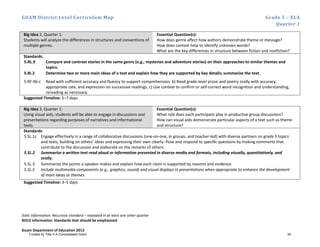
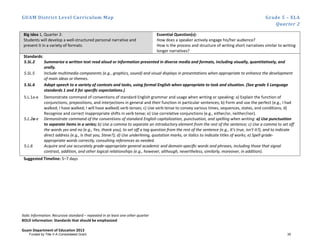
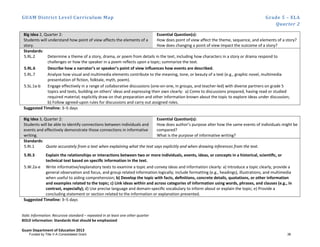
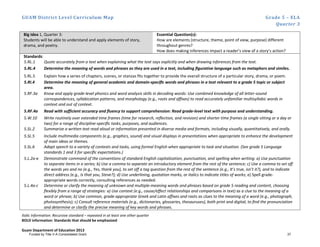
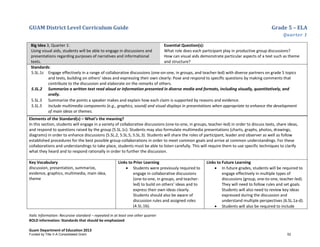
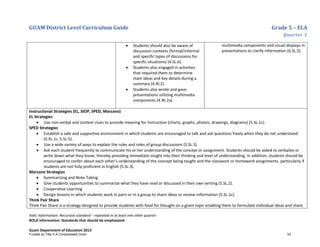
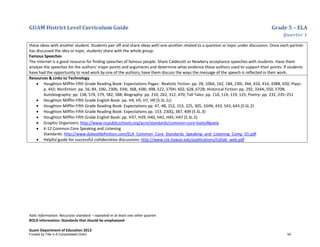
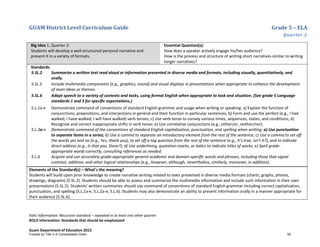
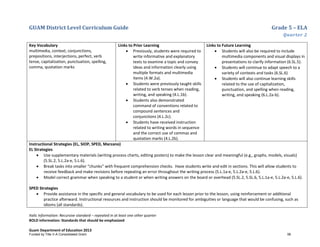
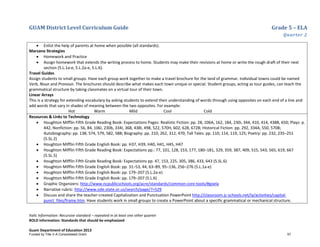
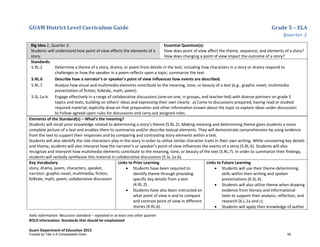
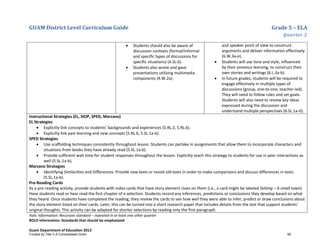
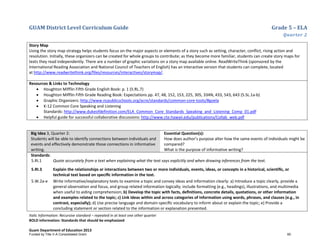
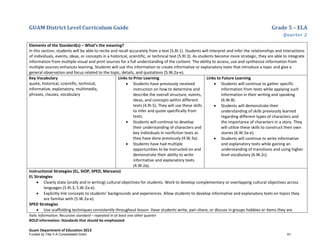
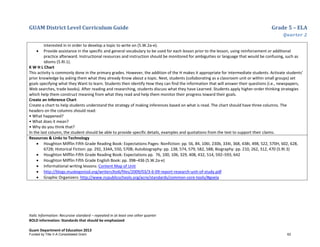
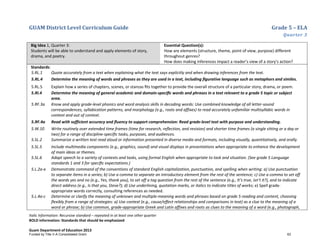
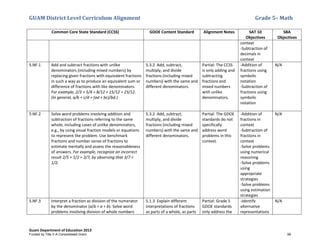
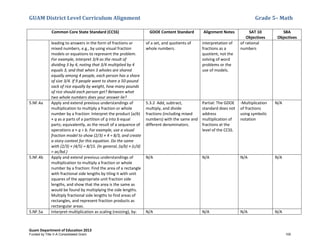
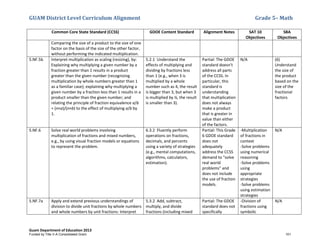
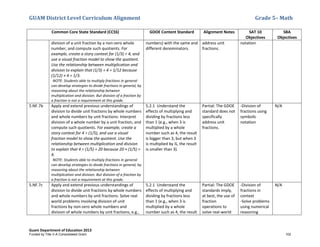
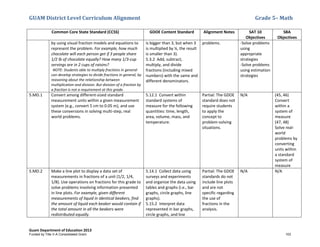
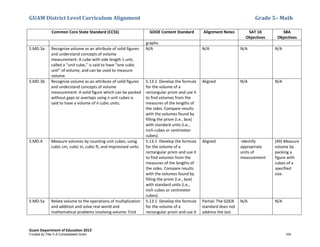
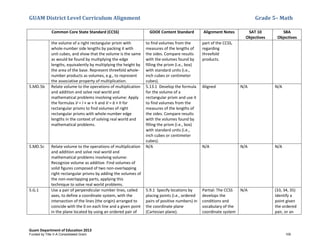
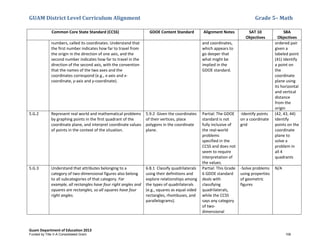
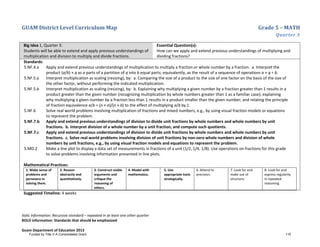
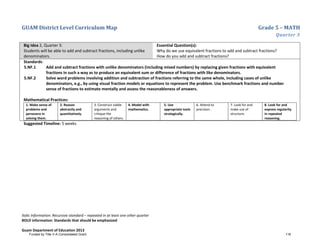
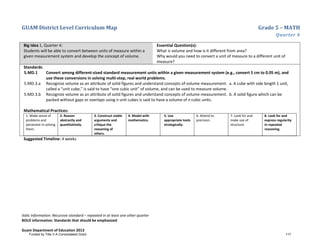
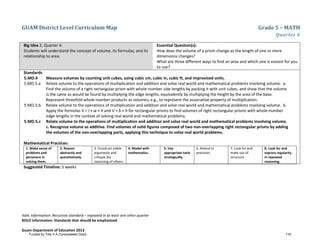
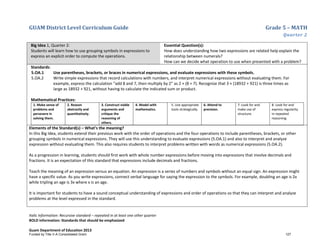
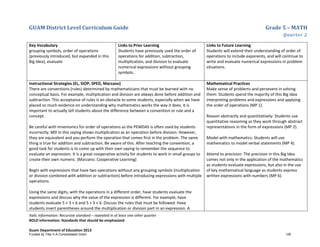
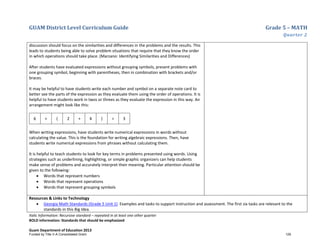
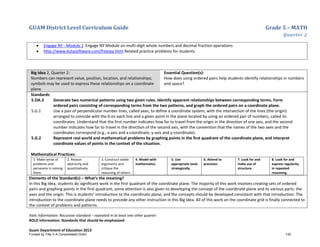
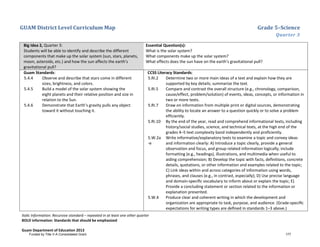
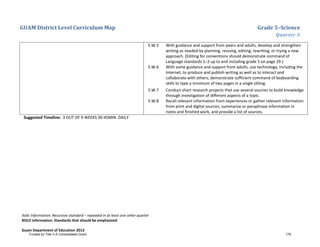
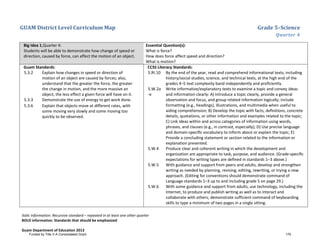
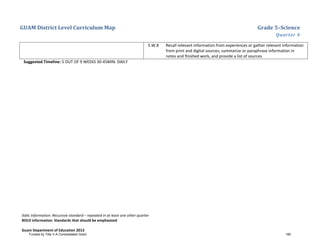
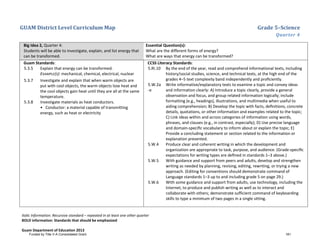
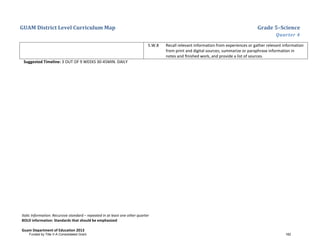
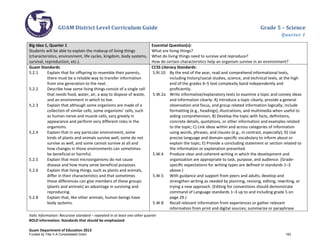
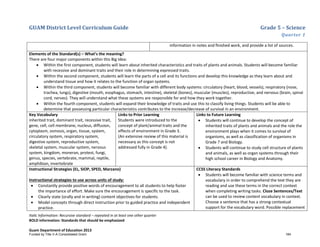
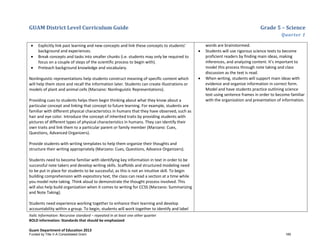
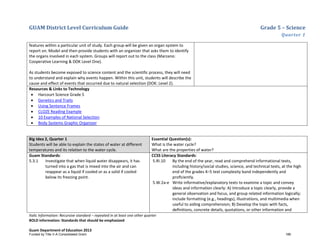
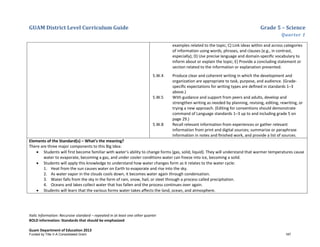
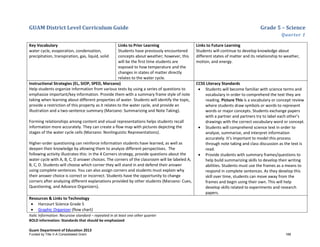
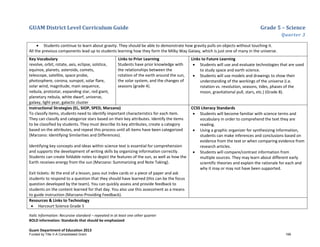
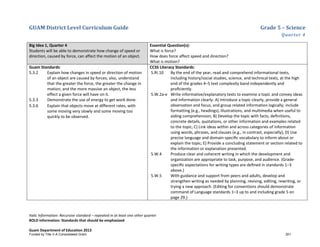
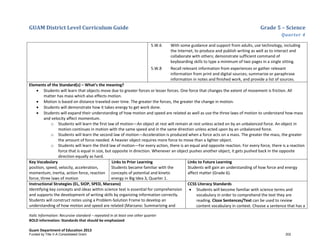
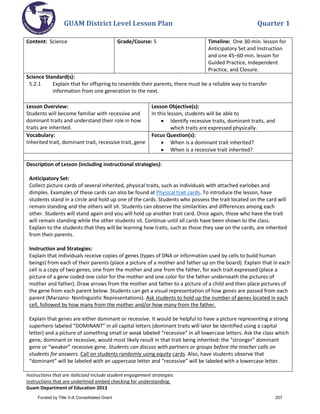
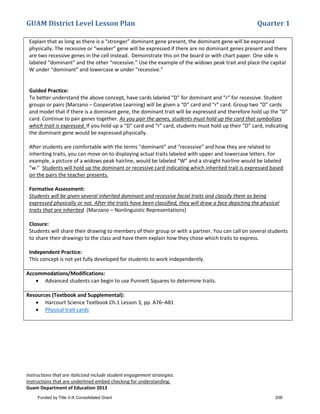
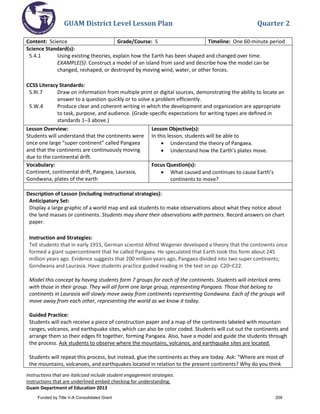
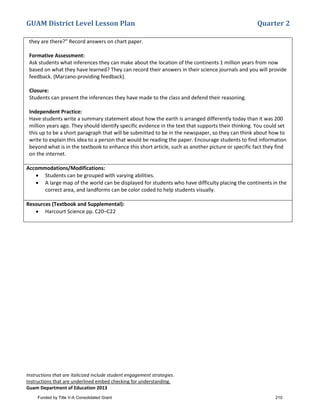
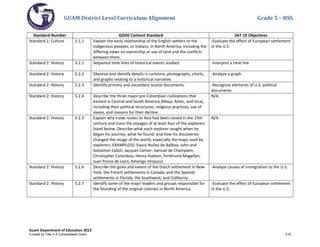
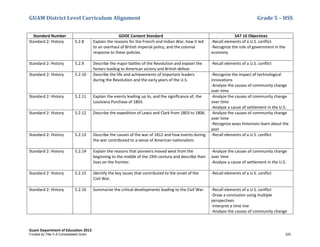
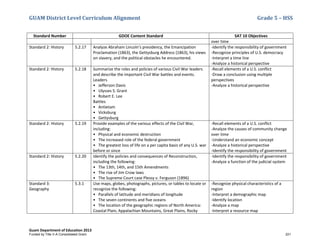
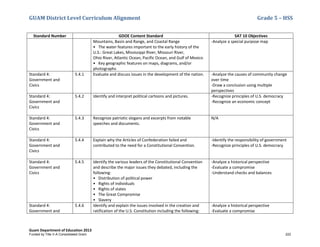
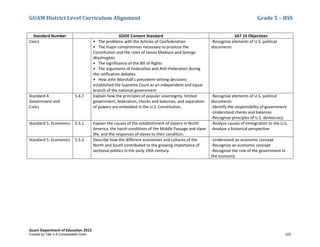
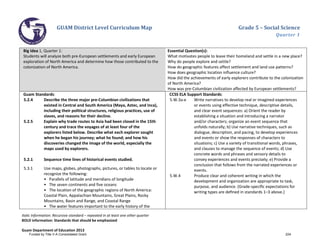
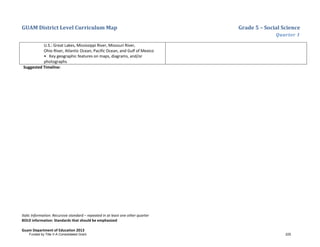
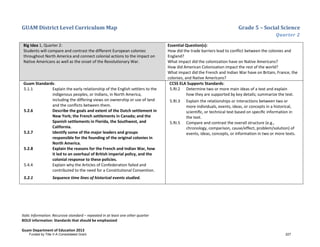
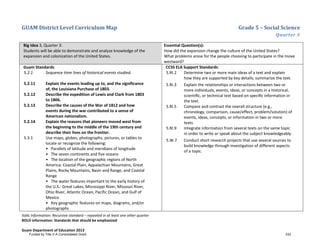
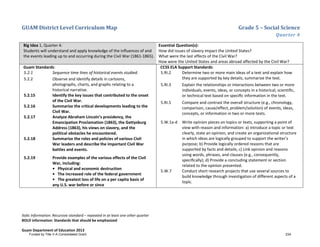
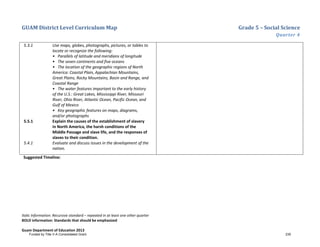
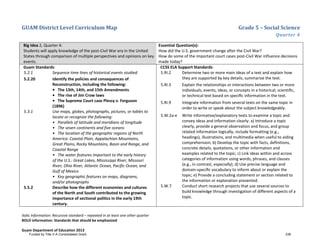
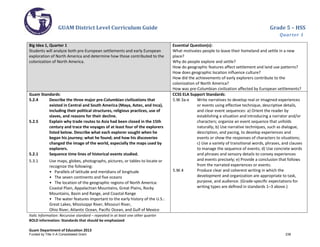
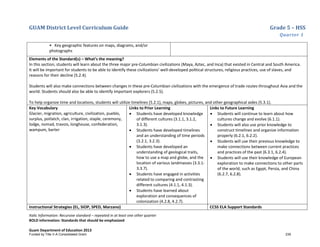
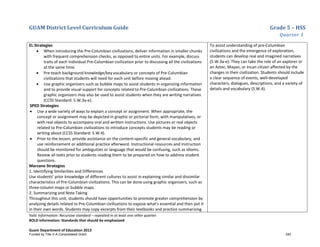
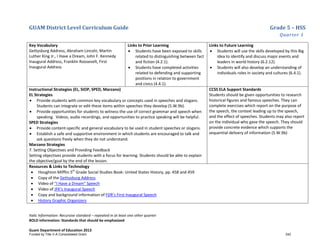
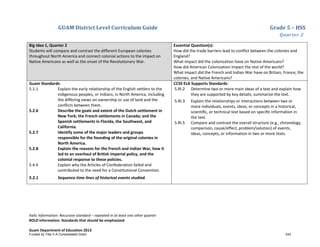
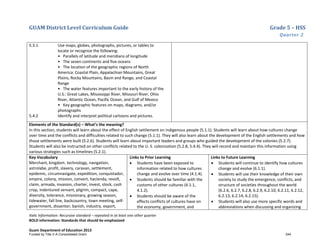
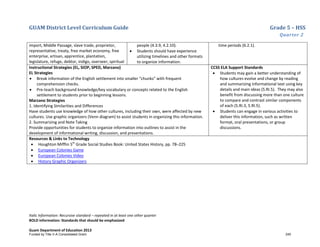
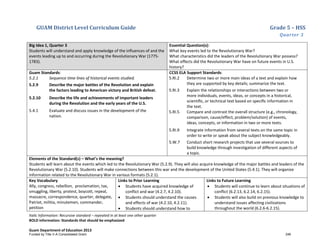
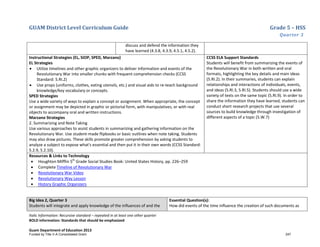
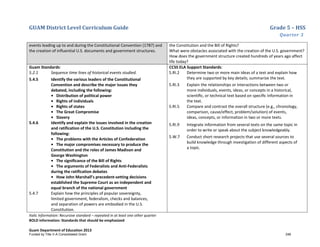
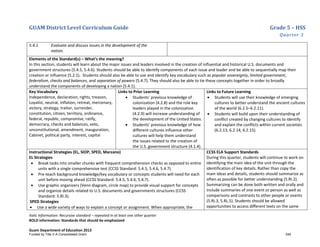
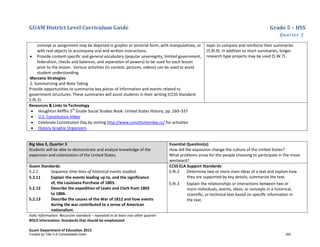
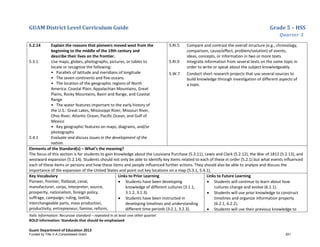
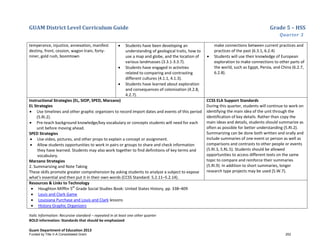
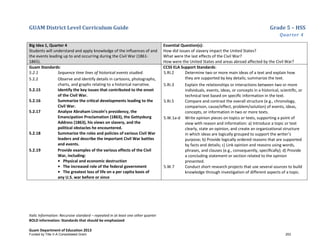
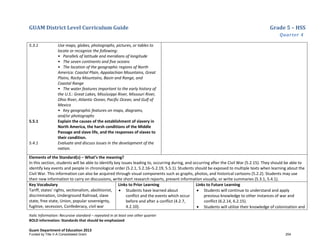
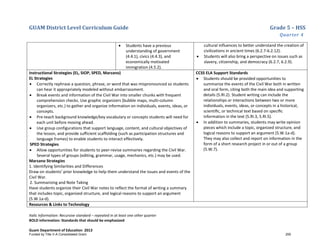
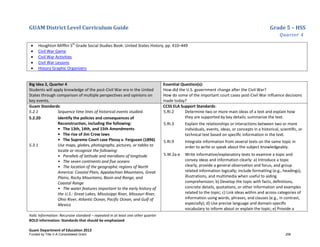
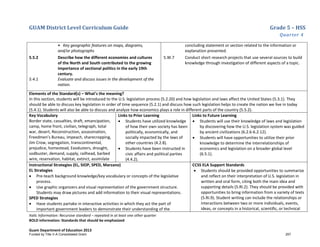
Table of Contents
Grade 5
English Language Arts
Curriculum Alignment ................................................................................................................. 1
Curriculum Map .......................................................................................................................... 29
Curriculum Guide ........................................................................................................................ 43
Lesson Plan Quarter 1 ................................................................................................................. 78
Lesson Plan Quarter 2 ................................................................................................................. 82
Lesson Plan Quarter 3 ................................................................................................................. 84
Lesson Plan Quarter 4 ................................................................................................................. 88
Math
Curriculum Alignment .................................................................................................................95
Curriculum Map .......................................................................................................................... 108
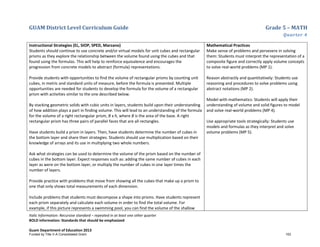
Curriculum Guide ........................................................................................................................ 119
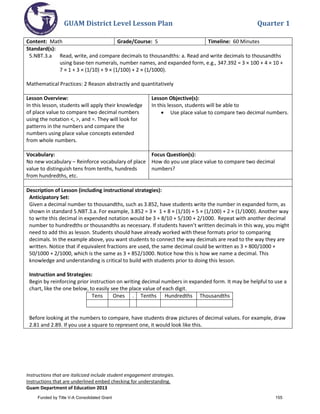
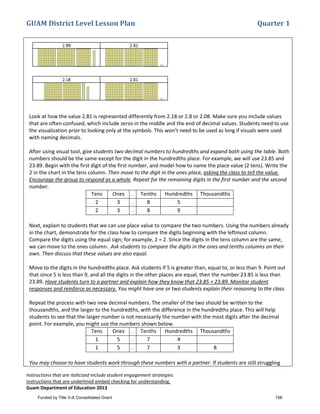
Lesson Plan Quarter 1 ................................................................................................................. 155
Lesson Plan Quarter 2 ................................................................................................................. 158
Lesson Plan Quarter 3 ................................................................................................................. 161
Lesson Plan Quarter 4 ................................................................................................................. 163
Science
Curriculum Alignment ................................................................................................................. 166
Curriculum Map .......................................................................................................................... 171
Curriculum Guide ........................................................................................................................ 183
Lesson Plan Quarter 1 .................................................................................................................207
Lesson Plan Quarter 2 .................................................................................................................209
Lesson Plan Quarter 3 .................................................................................................................211
Lesson Plan Quarter 4 ................................................................................................................. 215
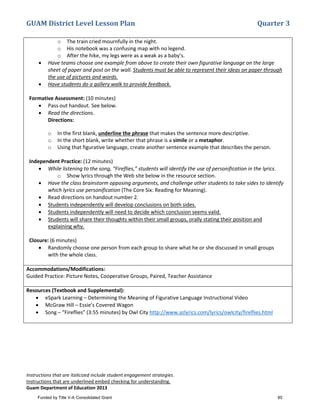
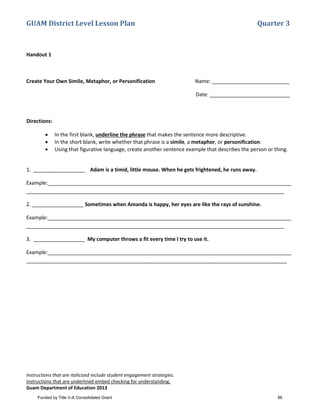
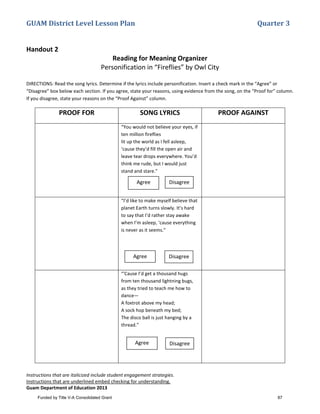
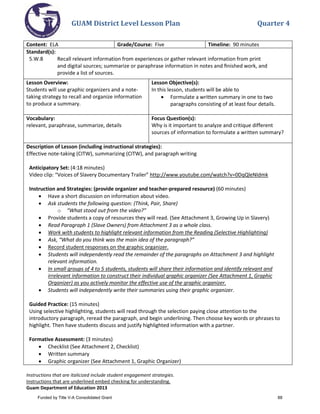
Social Science
Curriculum Alignment ................................................................................................................. 219
Curriculum Map .......................................................................................................................... 224
Curriculum Guide ........................................................................................................................ 238
Lesson Plan Quarter 1 ................................................................................................................. 259
Lesson Plan Quarter 2 ................................................................................................................. 262
Lesson Plan Quarter 3 ................................................................................................................. 264
Lesson Plan Quarter 4 ................................................................................................................. 271
Funded by Title V-A Consolidated Grant i
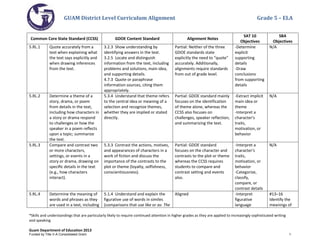
GUAM District Level Curriculum Alignment Grade 5 – ELA
*Skills and understandings that are particularly likely to require continued attention in higher grades as they are applied to increasingly sophisticated writing
and speaking
Guam Department of Education 2013
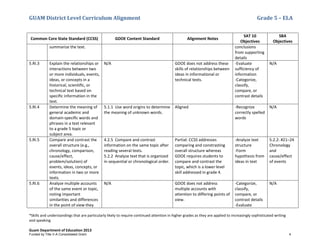
Common Core State Standard (CCSS) GDOE Content Standard Alignment Notes
SAT 10
Objectives
SBA
Objectives
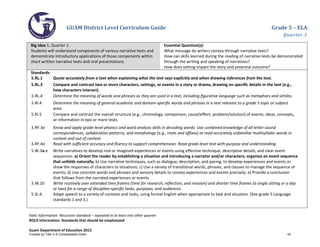
5.RL.1 Quote accurately from a
text when explaining what
the text says explicitly and
when drawing inferences
from the text.
3.2.3 Show understanding by
identifying answers in the text.
3.2.5 Locate and distinguish
information from the text, including
problems and solutions, main idea,
and supporting details.
4.7.3 Quote or paraphrase
information sources, citing them
appropriately.
Partial: Neither of the three
GDOE standards state
explicitly the need to “quote”
accurately. Additionally,
alignments require standards
from out of grade level.
-Determine
explicit
supporting
details
-Draw
conclusions
from supporting
details
N/A
5.RL.2 Determine a theme of a
story, drama, or poem
from details in the text,
including how characters in
a story or drama respond
to challenges or how the
speaker in a poem reflects
upon a topic; summarize
the text.
5.3.4 Understand that theme refers
to the central idea or meaning of a
selection and recognize themes,
whether they are implied or stated
directly.
Partial: GDOE standard mainly
focuses on the identification
of theme alone, whereas the
CCSS also focuses on
challenges, speaker reflection,
and summarizing the text.
-Extract implicit
main idea or
theme
-Interpret a
character's
traits,
motivation, or
behavior
N/A
5.RL.3 Compare and contrast two
or more characters,
settings, or events in a
story or drama, drawing on
specific details in the text
(e.g., how characters
interact).
5.3.3 Contrast the actions, motives,
and appearances of characters in a
work of fiction and discuss the
importance of the contrasts to the
plot or theme (loyalty, selfishness,
conscientiousness).
Partial: GDOE standard
focuses on the character and
contrasts to the plot or theme
whereas the CCSS requires
students to compare and
contrast setting and events
also.
-Interpret a
character's
traits,
motivation, or
behavior
-Categorize,
classify,
compare, or
contrast details
N/A
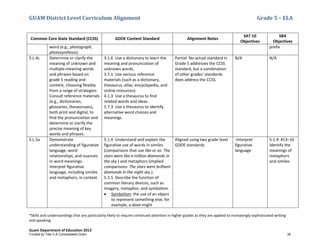
5.RL.4 Determine the meaning of
words and phrases as they
are used in a text, including
5.1.4 Understand and explain the
figurative use of words in similes
(comparisons that use like or as: The
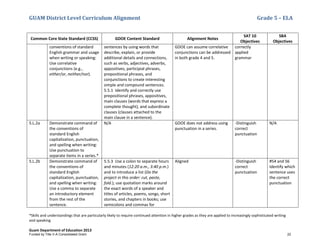
Aligned -Interpret
figurative
language
#13–16
Identify the
meanings of
Funded by Title V-A Consolidated Grant 1
GUAM District Level Curriculum Alignment Grade 5 – ELA
*Skills and understandings that are particularly likely to require continued attention in higher grades as they are applied to increasingly sophisticated writing
and speaking
Guam Department of Education 2013
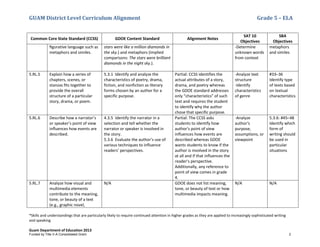
Common Core State Standard (CCSS) GDOE Content Standard Alignment Notes
SAT 10
Objectives
SBA
Objectives
figurative language such as
metaphors and similes.
stars were like a million diamonds in
the sky.) and metaphors (implied
comparisons: The stars were brilliant
diamonds in the night sky.).
-Determine
unknown words
from context
metaphors
and similes
5.RL.5 Explain how a series of
chapters, scenes, or
stanzas fits together to
provide the overall
structure of a particular
story, drama, or poem.
5.3.1 Identify and analyze the
characteristics of poetry, drama,
fiction, and nonfiction as literary
forms chosen by an author for a
specific purpose.
Partial: CCSS identifies the
actual attributes of a story,
drama, and poetry whereas
the GDOE standard addresses
only “characteristics” of such
text and requires the student
to identify why the author
chose that specific purpose.
-Analyze text
structure
-Identify
characteristics
of genre
#33–36
Identify type
of texts based
on textual
characteristics
5.RL.6 Describe how a narrator’s
or speaker’s point of view
influences how events are
described.
4.3.5 Identify the narrator in a
selection and tell whether the
narrator or speaker is involved in
the story.
5.3.6 Evaluate the author’s use of
various techniques to influence
readers’ perspectives.
Partial: The CCSS asks
students to identify how
author's point of view
influences how events are
described whereas GDOE
wants students to know if the
author is involved in the story
at all and if that influences the
reader's perspective.
Additionally, any reference to
point of view comes in grade
4.
-Analyze
author's
purpose,
assumptions, or
viewpoint
5.3.6: #45–48
Identify which
form of
writing should
be used in
particular
situations
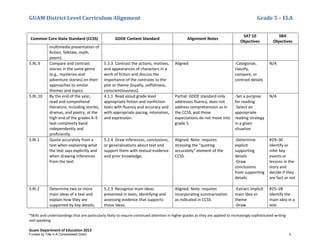
5.RL.7 Analyze how visual and
multimedia elements
contribute to the meaning,
tone, or beauty of a text
(e.g., graphic novel,
N/A GDOE does not list meaning,
tone, or beauty of text or how
multimedia impacts meaning.
N/A N/A
Funded by Title V-A Consolidated Grant 2
GUAM District Level Curriculum Alignment Grade 5 – ELA
*Skills and understandings that are particularly likely to require continued attention in higher grades as they are applied to increasingly sophisticated writing
and speaking
Guam Department of Education 2013
Common Core State Standard (CCSS) GDOE Content Standard Alignment Notes
SAT 10
Objectives
SBA
Objectives
multimedia presentation of
fiction, folktale, myth,
poem).
5.RL.9 Compare and contrast
stories in the same genre
(e.g., mysteries and
adventure stories) on their
approaches to similar
themes and topics.
5.3.3 Contrast the actions, motives,
and appearances of characters in a
work of fiction and discuss the
importance of the contrasts to the
plot or theme (loyalty, selfishness,
conscientiousness).
Aligned -Categorize,
classify,
compare, or
contrast details
N/A
5.RL.10 By the end of the year,
read and comprehend
literature, including stories,
dramas, and poetry, at the
high end of the grades 4–5
text complexity band
independently and
proficiently.
4.1.1 Read aloud grade level
appropriate fiction and nonfiction
texts with fluency and accuracy and
with appropriate pacing, intonation,
and expression.
Partial: GDOE standard only
addresses fluency, does not
address comprehension as in
the CCSS, and those
expectations do not move into
grade 5.
-Set a purpose
for reading
-Select an
appropriate
reading strategy
in a given
situation
N/A
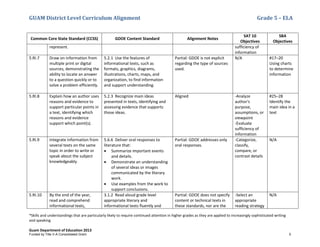
5.RI.1 Quote accurately from a
text when explaining what
the text says explicitly and
when drawing inferences
from the text.
5.2.4 Draw inferences, conclusions,
or generalizations about text and
support them with textual evidence
and prior knowledge.
Aligned. Note: requires
stressing the “quoting
accurately” element of the
CCSS.
-Determine
explicit
supporting
details
-Draw
conclusions
from supporting
details
#29–30
Identify or
infer key
events or
lessons in the
story and
decide if they
are fact or not
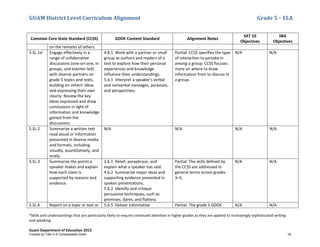
5.RI.2 Determine two or more
main ideas of a text and
explain how they are
supported by key details;
5.2.3 Recognize main ideas
presented in texts, identifying and
assessing evidence that supports
those ideas.
Aligned. Note: requires
incorporating summarization
as indicated in CCSS.
-Extract implicit
main idea or
theme
-Draw
#25–28
Identify the
main idea in a
text
Funded by Title V-A Consolidated Grant 3
GUAM District Level Curriculum Alignment Grade 5 – ELA
*Skills and understandings that are particularly likely to require continued attention in higher grades as they are applied to increasingly sophisticated writing
and speaking
Guam Department of Education 2013
Common Core State Standard (CCSS) GDOE Content Standard Alignment Notes
SAT 10
Objectives
SBA
Objectives
summarize the text. conclusions
from supporting
details
5.RI.3 Explain the relationships or
interactions between two
or more individuals, events,
ideas, or concepts in a
historical, scientific, or
technical text based on
specific information in the
text.
N/A GDOE does not address these
skills of relationships between
ideas in informational or
technical texts.
-Evaluate
sufficiency of
information
-Categorize,
classify,
compare, or
contrast details
N/A
5.RI.4 Determine the meaning of
general academic and
domain-specific words and
phrases in a text relevant
to a grade 5 topic or
subject area.
5.1.1 Use word origins to determine
the meaning of unknown words.
Aligned -Recognize
correctly spelled
words
N/A
5.RI.5 Compare and contrast the
overall structure (e.g.,
chronology, comparison,
cause/effect,
problem/solution) of
events, ideas, concepts, or
information in two or more
texts.
4.2.5 Compare and contrast
information on the same topic after
reading several texts.
5.2.2 Analyze text that is organized
in sequential or chronological order.
Partial: CCSS addresses
comparing and constrasting
overall structure whereas
GDOE requires students to
compare and contrast the
topic, which is a lower level
skill addressed in grade 4.
-Analyze text
structure
-Form
hypothesis from
ideas in text
5.2.2: #21–24
Chronology
and
cause/effect
of events
5.RI.6 Analyze multiple accounts
of the same event or topic,
noting important
similarities and differences
in the point of view they
N/A GDOE does not address
multiple accounts with
attention to differing points of
view.
-Categorize,
classify,
compare, or
contrast details
-Evaluate
N/A
Funded by Title V-A Consolidated Grant 4
GUAM District Level Curriculum Alignment Grade 5 – ELA
*Skills and understandings that are particularly likely to require continued attention in higher grades as they are applied to increasingly sophisticated writing
and speaking
Guam Department of Education 2013
Common Core State Standard (CCSS) GDOE Content Standard Alignment Notes
SAT 10
Objectives
SBA
Objectives
represent. sufficiency of
information
5.RI.7 Draw on information from
multiple print or digital
sources, demonstrating the
ability to locate an answer
to a question quickly or to
solve a problem efficiently.
5.2.1 Use the features of
informational texts, such as
formats, graphics, diagrams,
illustrations, charts, maps, and
organization, to find information
and support understanding.
Partial: GDOE is not explicit
regarding the type of sources
used.
N/A #17–20
Using charts
to determine
information
5.RI.8 Explain how an author uses
reasons and evidence to
support particular points in
a text, identifying which
reasons and evidence
support which point(s).
5.2.3 Recognize main ideas
presented in texts, identifying and
assessing evidence that supports
those ideas.
Aligned -Analyze
author's
purpose,
assumptions, or
viewpoint
-Evaluate
sufficiency of
information
#25–28
Identify the
main idea in a
text
5.RI.9 Integrate information from
several texts on the same
topic in order to write or
speak about the subject
knowledgeably.
5.6.6 Deliver oral responses to
literature that:
• Summarize important events
and details.
• Demonstrate an understanding
of several ideas or images
communicated by the literary
work.
• Use examples from the work to
support conclusions.
Partial: GDOE addresses only
oral responses.
-Categorize,
classify,
compare, or
contrast details
N/A
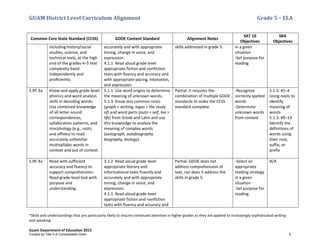
5.RI.10 By the end of the year,
read and comprehend
informational texts,
3.1.2 Read aloud grade level
appropriate literary and
informational texts fluently and
Partial: GDOE does not specify
content or technical texts in
these standards, nor are the
-Select an
appropriate
reading strategy
N/A
Funded by Title V-A Consolidated Grant 5
GUAM District Level Curriculum Alignment Grade 5 – ELA
*Skills and understandings that are particularly likely to require continued attention in higher grades as they are applied to increasingly sophisticated writing
and speaking
Guam Department of Education 2013
Common Core State Standard (CCSS) GDOE Content Standard Alignment Notes
SAT 10
Objectives
SBA
Objectives
including history/social
studies, science, and
technical texts, at the high
end of the grades 4–5 text
complexity band
independently and
proficiently.
accurately and with appropriate
timing, change in voice, and
expression.
4.1.1 Read aloud grade level
appropriate fiction and nonfiction
texts with fluency and accuracy and
with appropriate pacing, intonation,
and expression.
skills addressed in grade 5. in a given
situation
-Set purpose for
reading
5.RF.3a Know and apply grade-level
phonics and word analysis
skills in decoding words:
Use combined knowledge
of all letter-sound
correspondences,
syllabication patterns, and
morphology (e.g., roots
and affixes) to read
accurately unfamiliar
multisyllabic words in
context and out of context.
5.1.1 Use word origins to determine
the meaning of unknown words.
5.1.3 Know less common roots
(graph = writing, logos = the study
of) and word parts (auto = self, bio =
life) from Greek and Latin and use
this knowledge to analyze the
meaning of complex words
(autograph, autobiography,
biography, biology).
Partial: It requires the
combination of multiple GDOE
standards to make the CCSS
standard complete.
-Recognize
correctly spelled
words
-Determine
unknown words
from context
5.1.3: #1–4
Using roots to
identify
meaning of
words
5.1.3: #9–13
Identify the
definitions of
words using
their root,
suffix, or
prefix
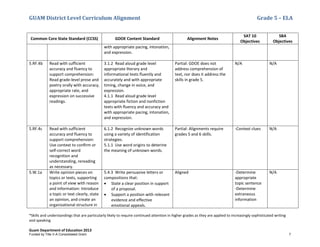
5.RF.4a Read with sufficient
accuracy and fluency to
support comprehension:
Read grade-level text with
purpose and
understanding.
3.1.2 Read aloud grade level
appropriate literary and
informational texts fluently and
accurately and with appropriate
timing, change in voice, and
expression.
4.1.1 Read aloud grade level
appropriate fiction and nonfiction
texts with fluency and accuracy and
Partial: GDOE does not
address comprehension of
text, nor does it address the
skills in grade 5.
-Select an
appropriate
reading strategy
in a given
situation
-Set purpose for
reading
N/A
Funded by Title V-A Consolidated Grant 6
GUAM District Level Curriculum Alignment Grade 5 – ELA
*Skills and understandings that are particularly likely to require continued attention in higher grades as they are applied to increasingly sophisticated writing
and speaking
Guam Department of Education 2013
Common Core State Standard (CCSS) GDOE Content Standard Alignment Notes
SAT 10
Objectives
SBA
Objectives
with appropriate pacing, intonation,
and expression.
5.RF.4b Read with sufficient
accuracy and fluency to
support comprehension:
Read grade-level prose and
poetry orally with accuracy,
appropriate rate, and
expression on successive
readings.
3.1.2 Read aloud grade level
appropriate literary and
informational texts fluently and
accurately and with appropriate
timing, change in voice, and
expression.
4.1.1 Read aloud grade level
appropriate fiction and nonfiction
texts with fluency and accuracy and
with appropriate pacing, intonation,
and expression.
Partial: GDOE does not
address comprehension of
text, nor does it address the
skills in grade 5.
N/A N/A
5.RF.4c Read with sufficient
accuracy and fluency to
support comprehension:
Use context to confirm or
self-correct word
recognition and
understanding, rereading
as necessary.
6.1.2 Recognize unknown words
using a variety of identification
strategies.
5.1.1 Use word origins to deterine
the meaning of unknown words.
Partial: Alignments require
grades 5 and 6 skills.
-Context clues N/A
5.W.1a Write opinion pieces on
topics or texts, supporting
a point of view with reason
and information: Introduce
a topic or text clearly, state
an opinion, and create an
organizational structure in
5.4.3 Write persuasive letters or
compositions that:
• State a clear position in support
of a proposal.
• Support a position with relevant
evidence and effective
emotional appeals.
Aligned -Determine
appropriate
topic sentence
-Determine
extraneous
information
N/A
Funded by Title V-A Consolidated Grant 7
GUAM District Level Curriculum Alignment Grade 5 – ELA
*Skills and understandings that are particularly likely to require continued attention in higher grades as they are applied to increasingly sophisticated writing
and speaking
Guam Department of Education 2013
Common Core State Standard (CCSS) GDOE Content Standard Alignment Notes
SAT 10
Objectives
SBA
Objectives
which ideas are logically
grouped to support the
writer’s purpose.
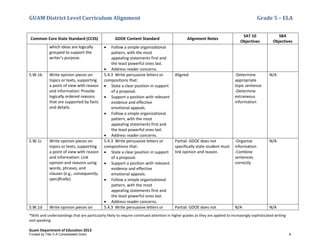
• Follow a simple organizational
pattern, with the most
appealing statements first and
the least powerful ones last.
• Address reader concerns.
5.W.1b Write opinion pieces on
topics or texts, supporting
a point of view with reason
and information: Provide
logically ordered reasons
that are supported by facts
and details.
5.4.3 Write persuasive letters or
compositions that:
• State a clear position in support
of a proposal.
• Support a position with relevant
evidence and effective
emotional appeals.
• Follow a simple organizational
pattern, with the most
appealing statements first and
the least powerful ones last.
• Address reader concerns.
Aligned -Determine
appropriate
topic sentence
-Determine
extraneous
information
N/A
5.W.1c Write opinion pieces on
topics or texts, supporting
a point of view with reason
and information: Link
opinion and reasons using
words, phrases, and
clauses (e.g., consequently,
specifically).
5.4.3 Write persuasive letters or
compositions that:
• State a clear position in support
of a proposal.
• Support a position with relevant
evidence and effective
emotional appeals.
• Follow a simple organizational
pattern, with the most
appealing statements first and
the least powerful ones last.
• Address reader concerns.
Partial: GDOE does not
specifically state student must
link opinion and reason.
-Organize
information
-Combine
sentences
correctly
N/A
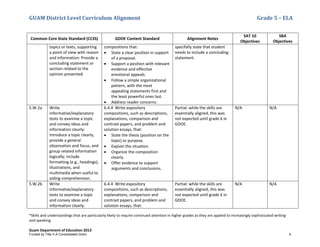
5.W.1d Write opinion pieces on 5.4.3 Write persuasive letters or Partial: GDOE does not N/A N/A
Funded by Title V-A Consolidated Grant 8
GUAM District Level Curriculum Alignment Grade 5 – ELA
*Skills and understandings that are particularly likely to require continued attention in higher grades as they are applied to increasingly sophisticated writing
and speaking
Guam Department of Education 2013
Common Core State Standard (CCSS) GDOE Content Standard Alignment Notes
SAT 10
Objectives
SBA
Objectives
topics or texts, supporting
a point of view with reason
and information: Provide a
concluding statement or
section related to the
opinion presented.
compositions that:
• State a clear position in support
of a proposal.
• Support a position with relevant
evidence and effective
emotional appeals.
• Follow a simple organizational
pattern, with the most
appealing statements first and
the least powerful ones last.
• Address reader concerns.
specifally state that student
needs to include a concluding
statement.
5.W.2a Write
informative/explanatory
texts to examine a topic
and convey ideas and
information clearly:
Introduce a topic clearly,
provide a general
observation and focus, and
group related information
logically; include
formatting (e.g., headings),
illustrations, and
multimedia when useful to
aiding comprehension.
6.4.4 Write expository
compositions, such as descriptions,
explanations, comparison and
contrast papers, and problem and
solution essays, that:
• State the thesis (position on the
topic) or purpose.
• Explain the situation.
• Organize the composition
clearly.
• Offer evidence to support
arguments and conclusions.
Partial: while the skills are
essentially aligned, this was
not expected until grade 6 in
GDOE.
N/A N/A
5.W.2b Write
informative/explanatory
texts to examine a topic
and convey ideas and
information clearly:
6.4.4 Write expository
compositions, such as descriptions,
explanations, comparison and
contrast papers, and problem and
solution essays, that:
Partial: while the skills are
essentially aligned, this was
not expected until grade 6 in
GDOE.
N/A N/A
Funded by Title V-A Consolidated Grant 9
GUAM District Level Curriculum Alignment Grade 5 – ELA
*Skills and understandings that are particularly likely to require continued attention in higher grades as they are applied to increasingly sophisticated writing
and speaking
Guam Department of Education 2013
Common Core State Standard (CCSS) GDOE Content Standard Alignment Notes
SAT 10
Objectives
SBA
Objectives
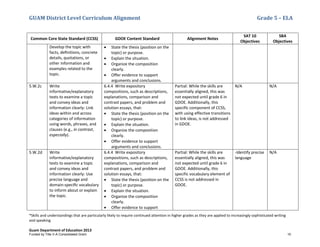
Develop the topic with
facts, definitions, concrete
details, quotations, or
other information and
examples related to the
topic.
• State the thesis (position on the
topic) or purpose.
• Explain the situation.
• Organize the composition
clearly.
• Offer evidence to support
arguments and conclusions.
5.W.2c Write
informative/explanatory
texts to examine a topic
and convey ideas and
information clearly: Link
ideas within and across
categories of information
using words, phrases, and
clauses (e.g., in contrast,
especially).
6.4.4 Write expository
compositions, such as descriptions,
explanations, comparison and
contrast papers, and problem and
solution essays, that:
• State the thesis (position on the
topic) or purpose.
• Explain the situation.
• Organize the composition
clearly.
• Offer evidence to support
arguments and conclusions.
Partial: While the skills are
essentially aligned, this was
not expected until grade 6 in
GDOE. Additionally, this
specific component of CCSS,
with using effective transitions
to link ideas, is not addressed
in GDOE.
N/A N/A
5.W.2d Write
informative/explanatory
texts to examine a topic
and convey ideas and
information clearly: Use
precise language and
domain-specific vocabulary
to inform about or explain
the topic.
6.4.4 Write expository
compositions, such as descriptions,
explanations, comparison and
contrast papers, and problem and
solution essays, that:
• State the thesis (position on the
topic) or purpose.
• Explain the situation.
• Organize the composition
clearly.
• Offer evidence to support
Partial: While the skills are
essentially aligned, this was
not expected until grade 6 in
GDOE. Additionally, this
specific vocabulary element of
CCSS is not addressed in
GDOE.
-Identify precise
language
N/A
Funded by Title V-A Consolidated Grant 10
GUAM District Level Curriculum Alignment Grade 5 – ELA
*Skills and understandings that are particularly likely to require continued attention in higher grades as they are applied to increasingly sophisticated writing
and speaking
Guam Department of Education 2013
Common Core State Standard (CCSS) GDOE Content Standard Alignment Notes
SAT 10
Objectives
SBA
Objectives
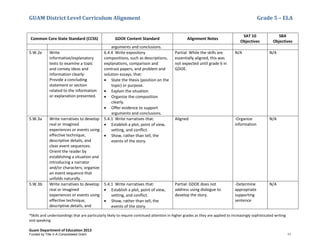
arguments and conclusions.
5.W.2e Write
informative/explanatory
texts to examine a topic
and convey ideas and
information clearly:
Provide a concluding
statement or section
related to the information
or explanation presented.
6.4.4 Write expository
compositions, such as descriptions,
explanations, comparison and
contrast papers, and problem and
solution essays, that:
• State the thesis (position on the
topic) or purpose.
• Explain the situation.
• Organize the composition
clearly.
• Offer evidence to support
arguments and conclusions.
Partial: While the skills are
essentially aligned, this was
not expected until grade 6 in
GDOE.
N/A N/A
5.W.3a Write narratives to develop
real or imagined
experiences or events using
effective technique,
descriptive details, and
clear event sequences:
Orient the reader by
establishing a situation and
introducing a narrator
and/or characters; organize
an event sequence that
unfolds naturally.
5.4.1 Write narratives that:
• Establish a plot, point of view,
setting, and conflict.
• Show, rather than tell, the
events of the story.
Aligned -Organize
information
N/A
5.W.3b Write narratives to develop
real or imagined
experiences or events using
effective technique,
descriptive details, and
5.4.1 Write narratives that:
• Establish a plot, point of view,
setting, and conflict.
• Show, rather than tell, the
events of the story.
Partial: GDOE does not
address using dialogue to
develop the story.
-Determine
appropriate
supporting
sentence
N/A
Funded by Title V-A Consolidated Grant 11
GUAM District Level Curriculum Alignment Grade 5 – ELA
*Skills and understandings that are particularly likely to require continued attention in higher grades as they are applied to increasingly sophisticated writing
and speaking
Guam Department of Education 2013
Common Core State Standard (CCSS) GDOE Content Standard Alignment Notes
SAT 10
Objectives
SBA
Objectives
clear event sequences: Use
narrative techniques, such
as dialogue, description,
and pacing, to develop
experiences and events or
show the responses of
characters to situations.
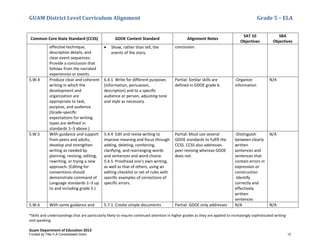
5.W.3c Write narratives to develop
real or imagined
experiences or events using
effective technique,
descriptive details, and
clear event sequences: Use
a variety of transitional
words, phrases, and
clauses to manage the
sequence of events.
5.4.1 Write narratives that:
• Establish a plot, point of view,
setting, and conflict.
• Show, rather than tell, the
events of the story.
Partial: GDOE does not
address use of transitions.
-Combine
sentences
correctly
N/A
5.W.3d Write narratives to develop
real or imagined
experiences or events using
effective technique,
descriptive details, and
clear event sequences: Use
concrete words and
phrases and sensory details
to convey experiences and
events precisely.
5.4.1 Write narratives that:
• Establish a plot, point of view,
setting, and conflict.
• Show, rather than tell, the
events of the story.
Aligned -Identify precise
language
N/A
5.W.3e Write narratives to develop
real or imagined
experiences or events using
5.4.1 Write narratives that:
• Establish a plot, point of view,
setting, and conflict.
Partial: CCSS specifies real or
imagined experiences or
events and focuses on the
N/A N/A
Funded by Title V-A Consolidated Grant 12
GUAM District Level Curriculum Alignment Grade 5 – ELA
*Skills and understandings that are particularly likely to require continued attention in higher grades as they are applied to increasingly sophisticated writing
and speaking
Guam Department of Education 2013
Common Core State Standard (CCSS) GDOE Content Standard Alignment Notes
SAT 10
Objectives
SBA
Objectives
effective technique,
descriptive details, and
clear event sequences:
Provide a conclusion that
follows from the narrated
experiences or events.
• Show, rather than tell, the
events of the story.
conclusion.
5.W.4 Produce clear and coherent
writing in which the
development and
organization are
appropriate to task,
purpose, and audience.
(Grade-specific
expectations for writing
types are defined in
standards 1–3 above.)
6.4.1 Write for different purposes
(information, persuasion,
description) and to a specific
audience or person, adjusting tone
and style as necessary.
Partial: Similar skills are
defined in GDOE grade 6.
-Organize
information
N/A
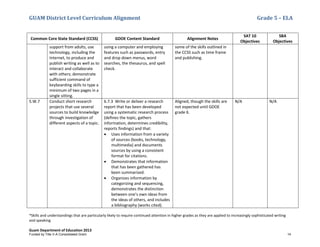
5.W.5 With guidance and support
from peers and adults,
develop and strengthen
writing as needed by
planning, revising, editing,
rewriting, or trying a new
approach. (Editing for
conventions should
demonstrate command of
Language standards 1–3 up
to and including grade 5.)
5.4.4 Edit and revise writing to
improve meaning and focus through
adding, deleting, combining,
clarifying, and rearranging words
and sentences and word choice.
5.4.5 Proofread one’s own writing,
as well as that of others, using an
editing checklist or set of rules with
specific examples of corrections of
specific errors.
Partial: Must use several
GDOE standards to fulfill the
CCSS. CCSS also addresses
peer revising whereas GDOE
does not.
-Distinguish
between clearly
written
sentences and
sentences that
contain errors in
expression or
construction
-Identify
correctly and
effectively
written
sentences
N/A
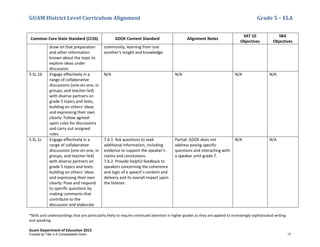
5.W.6 With some guidance and 5.7.1 Create simple documents Partial: GDOE only addresses N/A N/A
Funded by Title V-A Consolidated Grant 13
GUAM District Level Curriculum Alignment Grade 5 – ELA
*Skills and understandings that are particularly likely to require continued attention in higher grades as they are applied to increasingly sophisticated writing
and speaking
Guam Department of Education 2013
Common Core State Standard (CCSS) GDOE Content Standard Alignment Notes
SAT 10
Objectives
SBA
Objectives
support from adults, use
technology, including the
Internet, to produce and
publish writing as well as to
interact and collaborate
with others; demonstrate
sufficient command of
keyboarding skills to type a
minimum of two pages in a
single sitting.
using a computer and employing
features such as passwords, entry
and drop down menus, word
searches, the thesaurus, and spell
check.
some of the skills outlined in
the CCSS such as time frame
and publishing.
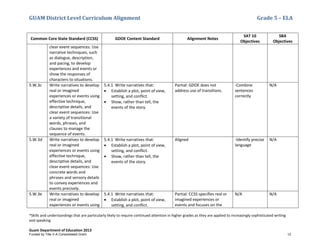
5.W.7 Conduct short research
projects that use several
sources to build knowledge
through investigation of
different aspects of a topic.
6.7.3 Write or deliver a research
report that has been developed
using a systematic research process
(defines the topic, gathers
information, determines credibility,
reports findings) and that:
• Uses information from a variety
of sources (books, technology,
multimedia) and documents
sources by using a consistent
format for citations.
• Demonstrates that information
that has been gathered has
been summarized.
• Organizes information by
categorizing and sequencing,
demonstrates the distinction
between one’s own ideas from
the ideas of others, and includes
a bibliography (works cited).
Aligned, though the skills are
not expected until GDOE
grade 6.
N/A N/A
Funded by Title V-A Consolidated Grant 14
GUAM District Level Curriculum Alignment Grade 5 – ELA
*Skills and understandings that are particularly likely to require continued attention in higher grades as they are applied to increasingly sophisticated writing
and speaking
Guam Department of Education 2013
Common Core State Standard (CCSS) GDOE Content Standard Alignment Notes
SAT 10
Objectives
SBA
Objectives
5.W.8 Recall relevant information
from experiences or gather
relevant information from
print and digital sources;
summarize or paraphrase
information in notes and
finished work, and provide
a list of sources.
4.7.3 Quote or paraphrase
information sources, citing them
appropriately.
5.7.2 Use text features of print such
as citations, endnotes, and
bibliographic references, to locate
relevant information.
5.7.4 Use note-taking skills (active
listening, identifying main ideas,
drawing diagrams to clarify notes)
when using technological and
informational resources to conduct
research.
Partial: Requires components
from multiple standards and
grades to align with CCSS.
N/A N/A
5.W.9a Draw evidence from
literary or informational
texts to support analysis,
reflection, and research:
Apply grade 5 Reading
standards to literature
(e.g., “Compare and
contrast two or more
characters, settings, or
events in a story or a
drama, drawing on specific
details in the text [e.g.,
how characters interact]”).
5.4.2 Write responses to literature
that:
• Demonstrate an understanding
of a literary work.
• Support statements with
evidence from the text.
• Develop interpretations that
exhibit careful reading and
understanding.
Partial: While both standards
deal with writing from
literature, the intent of the
CCSS is to dig into a piece of
text using research and
textual evidence to apply the
reading components such as
compare and contrast
character motivation.
N/A N/A
5.W.9b Draw evidence from
literary or informational
texts to support analysis,
reflection, and research:
6.4.4 Write expository
compositions, such as descriptions,
explanations, comparison and
contrast papers, and problem and
Partial: GDOE does not
address writing informational
texts until grade 6. Similarly,
with 5.W.9a, this CCSS focuses
N/A N/A
Funded by Title V-A Consolidated Grant 15
GUAM District Level Curriculum Alignment Grade 5 – ELA
*Skills and understandings that are particularly likely to require continued attention in higher grades as they are applied to increasingly sophisticated writing
and speaking
Guam Department of Education 2013
Common Core State Standard (CCSS) GDOE Content Standard Alignment Notes
SAT 10
Objectives
SBA
Objectives
Apply grade 5 Reading
standards to informational
texts (e.g., “Explain how an
author uses reasons and
evidence to support
particular points in a text,
identifying which reasons
and evidence support
which point[s]”).
solution essays, that:
• State the thesis (position on the
topic) or purpose.
• Explain the situation.
• Organize the composition clearly.
• Offer evidence to support
arguments and conclusions.
on the reading analysis skills
within the writing.
5.W.10 Write routinely over
extended time frames
(time for research,
reflection, and revision)
and shorter time frames (a
single sitting or a day or
two) for a range of
discipline-specific tasks,
purposes, and audiences.
N/A NA N/A N/A
5.SL.1a Engage effectively in a
range of collaborative
discussions (one-on-one, in
groups, and teacher-led)
with diverse partners on
grade 5 topics and texts,
building on others' ideas
and expressing their own
clearly: Come to
discussions prepared,
having read or studied
required material; explicitly
5.6.6 Deliver oral responses to
literature that:
• Summarize important events
and details.
• Demonstrate an understanding
of several ideas or images
communicated by the literary
work.
• Use examples from the work to
support conclusions.
5.8.1 Work together to leave a
positive impression on the school
Partial: CCSS expects student
to come to the discussion
prepared to engage. GDOE
does not specify this.
-Apply ideas
from text to
new situations
N/A
Funded by Title V-A Consolidated Grant 16
GUAM District Level Curriculum Alignment Grade 5 – ELA
*Skills and understandings that are particularly likely to require continued attention in higher grades as they are applied to increasingly sophisticated writing
and speaking
Guam Department of Education 2013
Common Core State Standard (CCSS) GDOE Content Standard Alignment Notes
SAT 10
Objectives
SBA
Objectives
draw on that preparation
and other information
known about the topic to
explore ideas under
discussion.
community, learning from one
another's insight and knowledge.
5.SL.1b Engage effectively in a
range of collaborative
discussions (one-on-one, in
groups, and teacher-led)
with diverse partners on
grade 5 topics and texts,
building on others' ideas
and expressing their own
clearly: Follow agreed-
upon rules for discussions
and carry out assigned
roles.
N/A N/A N/A N/A
5.SL.1c Engage effectively in a
range of collaborative
discussions (one-on-one, in
groups, and teacher-led)
with diverse partners on
grade 5 topics and texts,
building on others' ideas
and expressing their own
clearly: Pose and respond
to specific questions by
making comments that
contribute to the
discussion and elaborate
7.6.1 Ask questions to seek
additional information, including
evidence to support the speaker’s
claims and conclusions.
7.6.2 Provide helpful feedback to
speakers concerning the coherence
and logic of a speech’s content and
delivery and its overall impact upon
the listener.
Partial: GDOE does not
address posing specific
questions and interacting with
a speaker until grade 7.
N/A N/A
Funded by Title V-A Consolidated Grant 17
GUAM District Level Curriculum Alignment Grade 5 – ELA
*Skills and understandings that are particularly likely to require continued attention in higher grades as they are applied to increasingly sophisticated writing
and speaking
Guam Department of Education 2013
Common Core State Standard (CCSS) GDOE Content Standard Alignment Notes
SAT 10
Objectives
SBA
Objectives
on the remarks of others.
5.SL.1d Engage effectively in a
range of collaborative
discussions (one-on-one, in
groups, and teacher-led)
with diverse partners on
grade 5 topics and texts,
building on others' ideas
and expressing their own
clearly: Review the key
ideas expressed and draw
conclusions in light of
information and knowledge
gained from the
discussions.
4.8.1 Work with a partner or small
group as authors and readers of a
text to explore how their personal
experiences and knowledge
influence their understandings.
5.6.1 Interpret a speaker’s verbal
and nonverbal messages, purposes,
and perspectives.
Partial: CCSS specifies the type
of interaction to partake in
among a group. CCSS focuses
more on where to draw
information from to discuss in
a group.
N/A N/A
5.SL.2 Summarize a written text
read aloud or information
presented in diverse media
and formats, including
visually, quantitatively, and
orally.
N/A N/A N/A N/A
5.SL.3 Summarize the points a
speaker makes and explain
how each claim is
supported by reasons and
evidence.
3.6.1 Retell, paraphrase, and
explain what a speaker has said.
4.6.2 Summarize major ideas and
supporting evidence presented in
spoken presentations.
5.6.2 Identify and critique
persuasive techniques, such as
promises, dares, and flattery.
Partial: The skills defined by
the CCSS are addressed in
general terms across grades
3–5.
N/A N/A
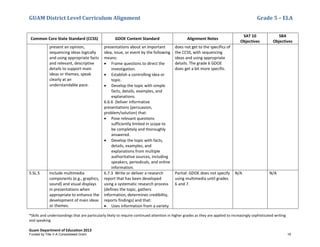
5.SL.4 Report on a topic or text or 5.6.5 Deliver informative Partial: The grade 5 GDOE N/A N/A
Funded by Title V-A Consolidated Grant 18
GUAM District Level Curriculum Alignment Grade 5 – ELA
*Skills and understandings that are particularly likely to require continued attention in higher grades as they are applied to increasingly sophisticated writing
and speaking
Guam Department of Education 2013
Common Core State Standard (CCSS) GDOE Content Standard Alignment Notes
SAT 10
Objectives
SBA
Objectives
present an opinion,
sequencing ideas logically
and using appropriate facts
and relevant, descriptive
details to support main
ideas or themes; speak
clearly at an
understandable pace.
presentations about an important
idea, issue, or event by the following
means:
• Frame questions to direct the
investigation.
• Establish a controlling idea or
topic.
• Develop the topic with simple
facts, details, examples, and
explanations.
6.6.6 Deliver informative
presentations (persuasion,
problem/solution) that:
• Pose relevant questions
sufficiently limited in scope to
be completely and thoroughly
answered.
• Develop the topic with facts,
details, examples, and
explanations from multiple
authoritative sources, including
speakers, periodicals, and online
information.
does not get to the specifics of
the CCSS, with sequencing
ideas and using appropriate
details. The grade 6 GDOE
does get a bit more specific.
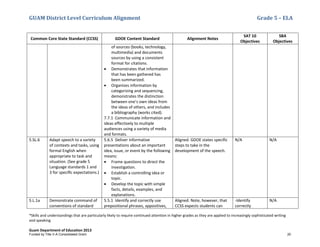
5.SL.5 Include multimedia
components (e.g., graphics,
sound) and visual displays
in presentations when
appropriate to enhance the
development of main ideas
or themes.
6.7.3 Write or deliver a research
report that has been developed
using a systematic research process
(defines the topic, gathers
information, determines credibility,
reports findings) and that:
• Uses information from a variety
Partial: GDOE does not specify
using multimedia until grades
6 and 7.
N/A N/A
Funded by Title V-A Consolidated Grant 19
GUAM District Level Curriculum Alignment Grade 5 – ELA
*Skills and understandings that are particularly likely to require continued attention in higher grades as they are applied to increasingly sophisticated writing
and speaking
Guam Department of Education 2013
Common Core State Standard (CCSS) GDOE Content Standard Alignment Notes
SAT 10
Objectives
SBA
Objectives
of sources (books, technology,
multimedia) and documents
sources by using a consistent
format for citations.
• Demonstrates that information
that has been gathered has
been summarized.
• Organizes information by
categorizing and sequencing,
demonstrates the distinction
between one’s own ideas from
the ideas of others, and includes
a bibliography (works cited).
7.7.1 Communicate information and
ideas effectively to multiple
audiences using a variety of media
and formats.
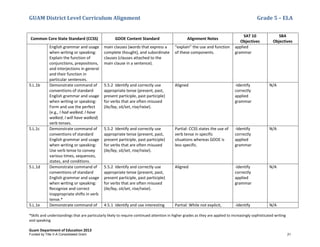
5.SL.6 Adapt speech to a variety
of contexts and tasks, using
formal English when
appropriate to task and
situation. (See grade 5
Language standards 1 and
3 for specific expectations.)
5.6.5 Deliver informative
presentations about an important
idea, issue, or event by the following
means:
• Frame questions to direct the
investigation.
• Establish a controlling idea or
topic.
• Develop the topic with simple
facts, details, examples, and
explanations.
Aligned. GDOE states specific
steps to take in the
development of the speech.
N/A N/A
5.L.1a Demonstrate command of
conventions of standard
5.5.1 Identify and correctly use
prepositional phrases, appositives,
Aligned. Note, however, that
CCSS expects students can
-Identify
correctly
N/A
Funded by Title V-A Consolidated Grant 20
GUAM District Level Curriculum Alignment Grade 5 – ELA
*Skills and understandings that are particularly likely to require continued attention in higher grades as they are applied to increasingly sophisticated writing
and speaking
Guam Department of Education 2013
Common Core State Standard (CCSS) GDOE Content Standard Alignment Notes
SAT 10
Objectives
SBA
Objectives
English grammar and usage
when writing or speaking:
Explain the function of
conjunctions, prepositions,
and interjections in general
and their function in
particular sentences.
main clauses (words that express a
complete thought), and subordinate
clauses (clauses attached to the
main clause in a sentence).
“explain” the use and function
of these components.
applied
grammar
5.L.1b Demonstrate command of
conventions of standard
English grammar and usage
when writing or speaking:
Form and use the perfect
(e.g., I had walked; I have
walked; I will have walked)
verb tenses.
5.5.2 Identify and correctly use
appropriate tense (present, past,
present participle, past participle)
for verbs that are often misused
(lie/lay, sit/set, rise/raise).
Aligned -Identify
correctly
applied
grammar
N/A
5.L.1c Demonstrate command of
conventions of standard
English grammar and usage
when writing or speaking:
Use verb tense to convey
various times, sequences,
states, and conditions.
5.5.2 Identify and correctly use
appropriate tense (present, past,
present participle, past participle)
for verbs that are often misused
(lie/lay, sit/set, rise/raise).
Partial: CCSS states the use of
verb tense in specific
situations whereas GDOE is
less specific.
-Identify
correctly
applied
grammar
N/A
5.L.1d Demonstrate command of
conventions of standard
English grammar and usage
when writing or speaking:
Recognize and correct
inappropriate shifts in verb
tense.*
5.5.2 Identify and correctly use
appropriate tense (present, past,
present participle, past participle)
for verbs that are often misused
(lie/lay, sit/set, rise/raise).
Aligned -Identify
correctly
applied
grammar
N/A
5.L.1e Demonstrate command of 4.5.1 Identify and use interesting Partial: While not explicit, -Identify N/A
Funded by Title V-A Consolidated Grant 21
GUAM District Level Curriculum Alignment Grade 5 – ELA
*Skills and understandings that are particularly likely to require continued attention in higher grades as they are applied to increasingly sophisticated writing
and speaking
Guam Department of Education 2013
Common Core State Standard (CCSS) GDOE Content Standard Alignment Notes
SAT 10
Objectives
SBA
Objectives
conventions of standard
English grammar and usage
when writing or speaking:
Use correlative
conjunctions (e.g.,
either/or, neither/nor).
sentences by using words that
describe, explain, or provide
additional details and connections,
such as verbs, adjectives, adverbs,
appositives, participial phrases,
prepositional phrases, and
conjunctions to create interesting
simple and compound sentences.
5.5.1 Identify and correctly use
prepositional phrases, appositives,
main clauses (words that express a
complete thought), and subordinate
clauses (clauses attached to the
main clause in a sentence).
GDOE can assume correlative
conjunctions can be addressed
in both grade 4 and 5.
correctly
applied
grammar
5.L.2a Demonstrate command of
the conventions of
standard English
capitalization, punctuation,
and spelling when writing:
Use punctuation to
separate items in a series.*
N/A GDOE does not address using
punctuation in a series.
-Distinguish
correct
punctuation
N/A
5.L.2b Demonstrate command of
the conventions of
standard English
capitalization, punctuation,
and spelling when writing:
Use a comma to separate
an introductory element
from the rest of the
sentence.
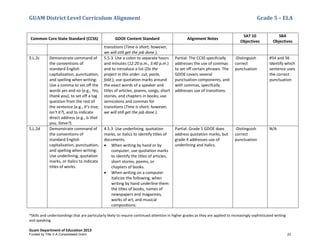
5.5.3 Use a colon to separate hours
and minutes (12:20 a.m., 3:40 p.m.)
and to introduce a list (Do the
project in this order: cut, paste,
fold.); use quotation marks around
the exact words of a speaker and
titles of articles, poems, songs, short
stories, and chapters in books; use
semicolons and commas for
Aligned -Distinguish
correct
punctuation
#54 and 56
Identify which
sentence uses
the correct
punctuation
Funded by Title V-A Consolidated Grant 22
GUAM District Level Curriculum Alignment Grade 5 – ELA
*Skills and understandings that are particularly likely to require continued attention in higher grades as they are applied to increasingly sophisticated writing
and speaking
Guam Department of Education 2013
Common Core State Standard (CCSS) GDOE Content Standard Alignment Notes
SAT 10
Objectives
SBA
Objectives
transitions (Time is short; however,
we will still get the job done.).
5.L.2c Demonstrate command of
the conventions of
standard English
capitalization, punctuation,
and spelling when writing:
Use a comma to set off the
words yes and no (e.g., Yes,
thank you), to set off a tag
question from the rest of
the sentence (e.g., It’s true,
isn’t it?), and to indicate
direct address (e.g., Is that
you, Steve?).
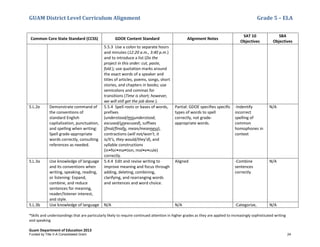
5.5.3 Use a colon to separate hours
and minutes (12:20 a.m., 3:40 p.m.)
and to introduce a list (Do the
project in this order: cut, paste,
fold.); use quotation marks around
the exact words of a speaker and
titles of articles, poems, songs, short
stories, and chapters in books; use
semicolons and commas for
transitions (Time is short; however,
we will still get the job done.).
Partial: The CCSS specifcially
addresses the use of commas
to set off certain phrases. The
GDOE covers several
punctuation components, and
with commas, specifcally
addresses use of transitions.
-Distinguish
correct
punctuation
#54 and 56
Identify which
sentence uses
the correct
punctuation
5.L.2d Demonstrate command of
the conventions of
standard English
capitalization, punctuation,
and spelling when writing:
Use underlining, quotation
marks, or italics to indicate
titles of works.
4.5.3 Use underlining, quotation
marks, or italics to identify titles of
documents.
• When writing by hand or by
computer, use quotation marks
to identify the titles of articles,
short stories, poems, or
chapters of books.
• When writing on a computer
italicize the following, when
writing by hand underline them:
the titles of books, names of
newspapers and magazines,
works of art, and musical
compositions.
Partial: Grade 5 GDOE does
address quotation marks, but
grade 4 addresses use of
underlining and italics.
-Distinguish
correct
punctuation
N/A
Funded by Title V-A Consolidated Grant 23
GUAM District Level Curriculum Alignment Grade 5 – ELA
*Skills and understandings that are particularly likely to require continued attention in higher grades as they are applied to increasingly sophisticated writing
and speaking
Guam Department of Education 2013
Common Core State Standard (CCSS) GDOE Content Standard Alignment Notes
SAT 10
Objectives
SBA
Objectives
5.5.3 Use a colon to separate hours
and minutes (12:20 a.m., 3:40 p.m.)
and to introduce a list (Do the
project in this order: cut, paste,
fold.); use quotation marks around
the exact words of a speaker and
titles of articles, poems, songs, short
stories, and chapters in books; use
semicolons and commas for
transitions (Time is short; however,
we will still get the job done.).
5.L.2e Demonstrate command of
the conventions of
standard English
capitalization, punctuation,
and spelling when writing:
Spell grade-appropriate
words correctly, consulting
references as needed.
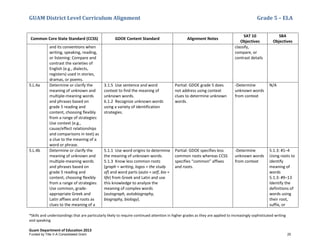
5.5.4 Spell roots or bases of words,
prefixes
(understood/misunderstood,
excused/unexcused), suffixes
(final/finally, mean/meanness),
contractions (will not/won’t, it
is/it’s, they would/they’d), and
syllable constructions
(in•for•ma•tion, mol•e•cule)
correctly.
Partial: GDOE specifies specific
types of words to spell
correctly, not grade-
appropriate words.
-Indentify
incorrect
spelling of
common
homophones in
context
N/A
5.L.3a Use knowledge of language
and its conventions when
writing, speaking, reading,
or listening: Expand,
combine, and reduce
sentences for meaning,
reader/listener interest,
and style.
5.4.4 Edit and revise writing to
improve meaning and focus through
adding, deleting, combining,
clarifying, and rearranging words
and sentences and word choice.
Aligned -Combine
sentences
correctly
N/A
5.L.3b Use knowledge of language N/A N/A -Categorize, N/A
Funded by Title V-A Consolidated Grant 24
GUAM District Level Curriculum Alignment Grade 5 – ELA
*Skills and understandings that are particularly likely to require continued attention in higher grades as they are applied to increasingly sophisticated writing
and speaking
Guam Department of Education 2013
Common Core State Standard (CCSS) GDOE Content Standard Alignment Notes
SAT 10
Objectives
SBA
Objectives
and its conventions when
writing, speaking, reading,
or listening: Compare and
contrast the varieties of
English (e.g., dialects,
registers) used in stories,
dramas, or poems.
classify,
compare, or
contrast details
5.L.4a Determine or clarify the
meaning of unknown and
multiple-meaning words
and phrases based on
grade 5 reading and
content, choosing flexibly
from a range of strategies:
Use context (e.g.,
cause/effect relationships
and comparisons in text) as
a clue to the meaning of a
word or phrase.
3.1.5 Use sentence and word
context to find the meaning of
unknown words.
6.1.2 Recognize unknown words
using a variety of identification
strategies.
Partial: GDOE grade 5 does
not address using context
clues to determine unknown
words.
-Determine
unknown words
from context
N/A
5.L.4b Determine or clarify the
meaning of unknown and
multiple-meaning words
and phrases based on
grade 5 reading and
content, choosing flexibly
from a range of strategies:
Use common, grade-
appropriate Greek and
Latin affixes and roots as
clues to the meaning of a
5.1.1 Use word origins to determine
the meaning of unknown words.
5.1.3 Know less common roots
(graph = writing, logos = the study
of) and word parts (auto = self, bio =
life) from Greek and Latin and use
this knowledge to analyze the
meaning of complex words
(autograph, autobiography,
biography, biology).
Partial: GDOE specifies less
common roots whereas CCSS
specifies “common” affixes
and roots.
-Determine
unknown words
from context
5.1.3: #1–4
Using roots to
identify
meaning of
words
5.1.3: #9–13
Identify the
definitions of
words using
their root,
suffix, or
Funded by Title V-A Consolidated Grant 25
GUAM District Level Curriculum Alignment Grade 5 – ELA
*Skills and understandings that are particularly likely to require continued attention in higher grades as they are applied to increasingly sophisticated writing
and speaking
Guam Department of Education 2013
Common Core State Standard (CCSS) GDOE Content Standard Alignment Notes
SAT 10
Objectives
SBA
Objectives
word (e.g., photograph,
photosynthesis).
prefix
5.L.4c Determine or clarify the
meaning of unknown and
multiple-meaning words
and phrases based on
grade 5 reading and
content, choosing flexibly
from a range of strategies:
Consult reference materials
(e.g., dictionaries,
glossaries, thesauruses),
both print and digital, to
find the pronunciation and
determine or clarify the
precise meaning of key
words and phrases.
3.1.6 Use a dictionary to learn the
meaning and pronunciation of
unknown words.
3.7.1 Use various reference
materials (such as a dictionary,
thesaurus, atlas, encyclopedia, and
online resources).
4.1.3 Use a thesaurus to find
related words and ideas.
5.7.3 Use a thesaurus to identify
alternative word choices and
meanings.
Partial: No actual standard in
Grade 5 addresses the CCSS
standard, but a combination
of other grades' standards
does address the CCSS.
N/A N/A
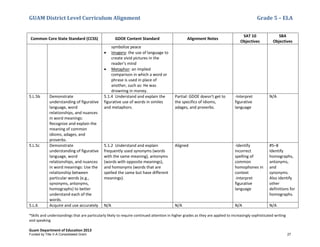
5.L.5a Demonstrate
understanding of figurative
language, word
relationships, and nuances
in word meanings:
Interpret figurative
language, including similes
and metaphors, in context.
5.1.4 Understand and explain the
figurative use of words in similes
(comparisons that use like or as: The
stars were like a million diamonds in
the sky.) and metaphors (implied
comparisons: The stars were brilliant
diamonds in the night sky.).
5.3.5 Describe the function of
common literary devices, such as
imagery, metaphor, and symbolism.
• Symbolism: the use of an object
to represent something else; for
example, a dove might
Aligned using two grade level
GDOE standards.
-Interpret
figurative
language
5.1.4: #13–16
Identify the
meanings of
metaphors
and similes
Funded by Title V-A Consolidated Grant 26
GUAM District Level Curriculum Alignment Grade 5 – ELA
*Skills and understandings that are particularly likely to require continued attention in higher grades as they are applied to increasingly sophisticated writing
and speaking
Guam Department of Education 2013
Common Core State Standard (CCSS) GDOE Content Standard Alignment Notes
SAT 10
Objectives
SBA
Objectives
symbolize peace
• Imagery: the use of language to
create vivid pictures in the
reader’s mind
• Metaphor: an implied
comparison in which a word or
phrase is used in place of
another, such as: He was
drowning in money.
5.L.5b Demonstrate
understanding of figurative
language, word
relationships, and nuances
in word meanings:
Recognize and explain the
meaning of common
idioms, adages, and
proverbs.
5.1.4 Understand and explain the
figurative use of words in similes
and metaphors.
Partial: GDOE doesn't get to
the specifics of idioms,
adages, and proverbs.
-Interpret
figurative
language
N/A
5.L.5c Demonstrate
understanding of figurative
language, word
relationships, and nuances
in word meanings: Use the
relationship between
particular words (e.g.,
synonyms, antonyms,
homographs) to better
understand each of the
words.
5.1.2 Understand and explain
frequently used synonyms (words
with the same meaning), antonyms
(words with opposite meanings),
and homonyms (words that are
spelled the same but have different
meanings).
Aligned -Identify
incorrect
spelling of
common
homophones in
context
-Interpret
figurative
language
#5–8
Identify
homographs,
antonyms,
and
synonyms.
Also identify
other
definitions for
homographs.
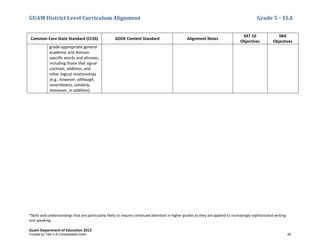
5.L.6 Acquire and use accurately N/A N/A N/A N/A
Funded by Title V-A Consolidated Grant 27
GUAM District Level Curriculum Alignment Grade 5 – ELA
*Skills and understandings that are particularly likely to require continued attention in higher grades as they are applied to increasingly sophisticated writing
and speaking
Guam Department of Education 2013
Common Core State Standard (CCSS) GDOE Content Standard Alignment Notes
SAT 10
Objectives
SBA
Objectives
grade-appropriate general
academic and domain-
specific words and phrases,
including those that signal
contrast, addition, and
other logical relationships
(e.g., however, although,
nevertheless, similarly,
moreover, in addition).
Funded by Title V-A Consolidated Grant 28
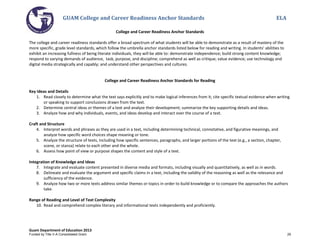
Guam GUAM College and Career Readiness Anchor Standards ELA
Guam Department of Education 2013
College and Career Readiness Anchor Standards
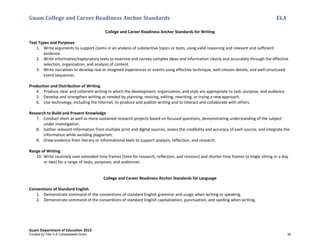
The college and career readiness standards offer a broad spectrum of what students will be able to demonstrate as a result of mastery of the
more specific, grade level standards, which follow the umbrella anchor standards listed below for reading and writing. In students’ abilities to
exhibit an increasing fullness of being literate individuals, they will be able to: demonstrate independence; build strong content knowledge;
respond to varying demands of audience, task, purpose, and discipline; comprehend as well as critique; value evidence; use technology and
digital media strategically and capably; and understand other perspectives and cultures.
College and Career Readiness Anchor Standards for Reading
Key Ideas and Details
1. Read closely to determine what the text says explicitly and to make logical inferences from it; cite specific textual evidence when writing
or speaking to support conclusions drawn from the text.
2. Determine central ideas or themes of a text and analyze their development; summarize the key supporting details and ideas.
3. Analyze how and why individuals, events, and ideas develop and interact over the course of a text.
Craft and Structure
4. Interpret words and phrases as they are used in a text, including determining technical, connotative, and figurative meanings, and
analyze how specific word choices shape meaning or tone.
5. Analyze the structure of texts, including how specific sentences, paragraphs, and larger portions of the text (e.g., a section, chapter,
scene, or stanza) relate to each other and the whole.
6. Assess how point of view or purpose shapes the content and style of a text.
Integration of Knowledge and Ideas
7. Integrate and evaluate content presented in diverse media and formats, including visually and quantitatively, as well as in words.
8. Delineate and evaluate the argument and specific claims in a text, including the validity of the reasoning as well as the relevance and
sufficiency of the evidence.
9. Analyze how two or more texts address similar themes or topics in order to build knowledge or to compare the approaches the authors
take.
Range of Reading and Level of Text Complexity
10. Read and comprehend complex literary and informational texts independently and proficiently.
Funded by Title V-A Consolidated Grant 29
Guam College and Career Readiness Anchor Standards ELA
Guam Department of Education 2013
College and Career Readiness Anchor Standards for Writing
Text Types and Purposes
1. Write arguments to support claims in an analysis of substantive topics or texts, using valid reasoning and relevant and sufficient
evidence.
2. Write informative/explanatory texts to examine and convey complex ideas and information clearly and accurately through the effective
selection, organization, and analysis of content.
3. Write narratives to develop real or imagined experiences or events using effective technique, well-chosen details, and well-structured
event sequences.
Production and Distribution of Writing
4. Produce clear and coherent writing in which the development, organization, and style are appropriate to task, purpose, and audience.
5. Develop and strengthen writing as needed by planning, revising, editing, rewriting, or trying a new approach.
6. Use technology, including the Internet, to produce and publish writing and to interact and collaborate with others.
Research to Build and Present Knowledge
7. Conduct short as well as more sustained research projects based on focused questions, demonstrating understanding of the subject
under investigation.
8. Gather relevant information from multiple print and digital sources, assess the credibility and accuracy of each source, and integrate the
information while avoiding plagiarism.
9. Draw evidence from literary or informational texts to support analysis, reflection, and research.
Range of Writing
10. Write routinely over extended time frames (time for research, reflection, and revision) and shorter time frames (a single sitting or a day
or two) for a range of tasks, purposes, and audiences.
College and Career Readiness Anchor Standards for Language
Conventions of Standard English
1. Demonstrate command of the conventions of standard English grammar and usage when writing or speaking.
2. Demonstrate command of the conventions of standard English capitalization, punctuation, and spelling when writing.
Funded by Title V-A Consolidated Grant 30
Guam College and Career Readiness Anchor Standards ELA
Guam Department of Education 2013
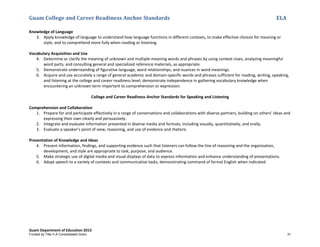
Knowledge of Language
3. Apply knowledge of language to understand how language functions in different contexts, to make effective choices for meaning or
style, and to comprehend more fully when reading or listening.
Vocabulary Acquisition and Use
4. Determine or clarify the meaning of unknown and multiple-meaning words and phrases by using context clues, analyzing meaningful
word parts, and consulting general and specialized reference materials, as appropriate.
5. Demonstrate understanding of figurative language, word relationships, and nuances in word meanings.
6. Acquire and use accurately a range of general academic and domain-specific words and phrases sufficient for reading, writing, speaking,
and listening at the college and career readiness level; demonstrate independence in gathering vocabulary knowledge when
encountering an unknown term important to comprehension or expression.
College and Career Readiness Anchor Standards for Speaking and Listening
Comprehension and Collaboration
1. Prepare for and participate effectively in a range of conversations and collaborations with diverse partners, building on others’ ideas and
expressing their own clearly and persuasively.
2. Integrate and evaluate information presented in diverse media and formats, including visually, quantitatively, and orally.
3. Evaluate a speaker’s point of view, reasoning, and use of evidence and rhetoric.
Presentation of Knowledge and Ideas
4. Present information, findings, and supporting evidence such that listeners can follow the line of reasoning and the organization,
development, and style are appropriate to task, purpose, and audience.
5. Make strategic use of digital media and visual displays of data to express information and enhance understanding of presentations.
6. Adapt speech to a variety of contexts and communicative tasks, demonstrating command of formal English when indicated.
Funded by Title V-A Consolidated Grant 31
GUAM District Level Curriculum Map Grade 5 – ELA
Quarter 1
Italic Information: Recursive standard – repeated in at least one other quarter
BOLD information: Standards that should be emphasized
Guam Department of Education 2013
Big Idea 1, Quarter 1:
Students will understand components of various narrative texts and
demonstrate introductory applications of those components within
short written narrative texts and oral presentations.
Essential Question(s):
What message do writers convey through narrative texts?
How can skills learned during the reading of narrative texts be demonstrated
through the writing and speaking of narratives?
How does setting impact the story and potential outcome?
Standards:
5.RL.1 Quote accurately from a text when explaining what the text says explicitly and when drawing inferences from the text.
5.RL.3 Compare and contrast two or more characters, settings, or events in a story or drama, drawing on specific details in the text (e.g.,
how characters interact).
5.RL.4 Determine the meaning of words and phrases as they are used in a text, including figurative language such as metaphors and similes.
5.RI.4 Determine the meaning of general academic and domain-specific words and phrases in a text relevant to a grade 5 topic or subject
area.
5.RI.5 Compare and contrast the overall structure (e.g., chronology, comparison, cause/effect, problem/solution) of events, ideas, concepts,
or information in two or more texts.
5.RF.3a Know and apply grade-level phonics and word analysis skills in decoding words: Use combined knowledge of all letter-sound
correspondences, syllabication patterns, and morphology (e.g., roots and affixes) to read accurately unfamiliar multisyllabic words in
context and out of context.
5.RF.4a Read with sufficient accuracy and fluency to support comprehension: Read grade-level text with purpose and understanding.
5.W.3a-e Write narratives to develop real or imagined experiences or events using effective technique, descriptive details, and clear event
sequences: a) Orient the reader by establishing a situation and introducing a narrator and/or characters; organize an event sequence
that unfolds naturally; b) Use narrative techniques, such as dialogue, description, and pacing, to develop experiences and events or
show the responses of characters to situations; c) Use a variety of transitional words, phrases, and clauses to manage the sequence of
events; d) Use concrete words and phrases and sensory details to convey experiences and events precisely; e) Provide a conclusion
that follows from the narrated experiences or events.
5.W.10 Write routinely over extended time frames (time for research, reflection, and revision) and shorter time frames (a single sitting or a day
or two) for a range of discipline-specific tasks, purposes, and audiences.
5.SL.6 Adapt speech to a variety of contexts and tasks, using formal English when appropriate to task and situation. (See grade 5 Language
standards 1 and 3.)
Funded by Title V-A Consolidated Grant 32
GUAM District Level Curriculum Map Grade 5 – ELA
Quarter 1
Italic Information: Recursive standard – repeated in at least one other quarter
BOLD information: Standards that should be emphasized
Guam Department of Education 2013
5.L.2a-e Demonstrate command of the conventions of standard English capitalization, punctuation, and spelling when writing: a) Use
punctuation to separate items in a series; b) Use a comma to separate an introductory element from the rest of the sentence; c) Use a
comma to set off the words yes and no (e.g., Yes, thank you), to set off a tag question from the rest of the sentence (e.g., It’s true, isn’t
it?), and to indicate direct address (e.g., Is that you, Steve?); d) Use underlining, quotation marks, or italics to indicate titles of works; e)
Spell grade-appropriate words correctly, consulting references as needed.
5.L.4a-c Determine or clarify the meaning of unknown and multiple-meaning words and phrases based on grade 5 reading and content,
choosing flexibly from a range of strategies: a) Use context (e.g., cause/effect relationships and comparisons in text) as a clue to the
meaning of a word or phrase; b) Use common, grade-appropriate Greek and Latin affixes and roots as clues to the meaning of a word
(e.g., photograph, photosynthesis); c) Consult reference materials (e.g., dictionaries, glossaries, thesauruses), both print and digital, to
find the pronunciation and determine or clarify the precise meaning of key words and phrases.
Suggested Timeline: 15 days
Funded by Title V-A Consolidated Grant 33
GUAM District Level Curriculum Map Grade 5 – ELA
Quarter 1
Italic Information: Recursive standard – repeated in at least one other quarter
BOLD information: Standards that should be emphasized
Guam Department of Education 2013
Big Idea 2, Quarter 1:
Students will analyze the differences in structures and conventions of
multiple genres.
Essential Question(s):
How does genre affect how authors demonstrate theme or message?
How does context help to identify unknown words?
What are the key differences in structure between fiction and nonfiction?
Standards:
5.RL.9 Compare and contrast stories in the same genre (e.g., mysteries and adventure stories) on their approaches to similar themes and
topics.
5.RI.2 Determine two or more main ideas of a text and explain how they are supported by key details; summarize the text.
5.RF.4b-c Read with sufficient accuracy and fluency to support comprehension: b) Read grade-level prose and poetry orally with accuracy,
appropriate rate, and expression on successive readings; c) Use context to confirm or self-correct word recognition and understanding,
rereading as necessary.
Suggested Timeline: 5–7 days
Big Idea 3, Quarter 1:
Using visual aids, students will be able to engage in discussions and
presentations regarding purposes of narratives and informational
texts.
Essential Question(s):
What role does each participant play in productive group discussions?
How can visual aids demonstrate particular aspects of a text such as theme
and structure?
Standards:
5.SL.1c Engage effectively in a range of collaborative discussions (one-on-one, in groups, and teacher-led) with diverse partners on grade 5 topics
and texts, building on others’ ideas and expressing their own clearly: Pose and respond to specific questions by making comments that
contribute to the discussion and elaborate on the remarks of others.
5.SL.2 Summarize a written text read aloud or information presented in diverse media and formats, including visually, quantitatively, and
orally.
5.SL.3 Summarize the points a speaker makes and explain how each claim is supported by reasons and evidence.
5.SL.5 Include multimedia components (e.g., graphics, sound) and visual displays in presentations when appropriate to enhance the development
of main ideas or themes.
Suggested Timeline: 3–5 days
Funded by Title V-A Consolidated Grant 34
GUAM District Level Curriculum Map Grade 5 – ELA
Quarter 2
Italic Information: Recursive standard – repeated in at least one other quarter
BOLD information: Standards that should be emphasized
Guam Department of Education 2013
Big Idea 1, Quarter 2:
Students will develop a well-structured personal narrative and
present it in a variety of formats.
Essential Question(s):
How does a speaker actively engage his/her audience?
How is the process and structure of writing short narratives similar to writing
longer narratives?
Standards:
5.SL.2 Summarize a written text read aloud or information presented in diverse media and formats, including visually, quantitatively, and
orally.
5.SL.5 Include multimedia components (e.g., graphics, sound) and visual displays in presentations when appropriate to enhance the development
of main ideas or themes.
5.SL.6 Adapt speech to a variety of contexts and tasks, using formal English when appropriate to task and situation. (See grade 5 Language
standards 1 and 3 for specific expectations.)
5.L.1a-e Demonstrate command of conventions of standard English grammar and usage when writing or speaking: a) Explain the function of
conjunctions, prepositions, and interjections in general and their function in particular sentences; b) Form and use the perfect (e.g., I had
walked; I have walked; I will have walked) verb tenses; c) Use verb tense to convey various times, sequences, states, and conditions; d)
Recognize and correct inappropriate shifts in verb tense; e) Use correlative conjunctions (e.g., either/or, neither/nor).
5.L.2a-e Demonstrate command of the conventions of standard English capitalization, punctuation, and spelling when writing: a) Use punctuation
to separate items in a series; b) Use a comma to separate an introductory element from the rest of the sentence; c) Use a comma to set off
the words yes and no (e.g., Yes, thank you), to set off a tag question from the rest of the sentence (e.g., It’s true, isn’t it?), and to indicate
direct address (e.g., Is that you, Steve?); d) Use underlining, quotation marks, or italics to indicate titles of works; e) Spell grade-
appropriate words correctly, consulting references as needed.
5.L.6 Acquire and use accurately grade-appropriate general academic and domain-specific words and phrases, including those that signal
contrast, addition, and other logical relationships (e.g., however, although, nevertheless, similarly, moreover, in addition).
Suggested Timeline: 5–7 days
Funded by Title V-A Consolidated Grant 35
GUAM District Level Curriculum Map Grade 5 – ELA
Quarter 2
Italic Information: Recursive standard – repeated in at least one other quarter
BOLD information: Standards that should be emphasized
Guam Department of Education 2013
Big Idea 2, Quarter 2:
Students will understand how point of view affects the elements of a
story.
Essential Question(s):
How does point of view affect the theme, sequence, and elements of a story?
How does changing a point of view impact the outcome of a story?
Standards:
5.RL.2 Determine a theme of a story, drama, or poem from details in the text, including how characters in a story or drama respond to
challenges or how the speaker in a poem reflects upon a topic; summarize the text.
5.RL.6 Describe how a narrator’s or speaker’s point of view influences how events are described.
5.RL.7 Analyze how visual and multimedia elements contribute to the meaning, tone, or beauty of a text (e.g., graphic novel, multimedia
presentation of fiction, folktale, myth, poem).
5.SL.1a-b Engage effectively in a range of collaborative discussions (one-on-one, in groups, and teacher-led) with diverse partners on grade 5
topics and texts, building on others’ ideas and expressing their own clearly: a) Come to discussions prepared, having read or studied
required material; explicitly draw on that preparation and other information known about the topic to explore ideas under discussion;
b) Follow agreed-upon rules for discussions and carry out assigned roles.
Suggested Timeline: 3–5 days
Big Idea 3, Quarter 2:
Students will be able to identify connections between individuals and
events and effectively demonstrate those connections in informative
writing.
Essential Question(s):
How does author’s purpose alter how the same events of individuals might be
compared?
What is the purpose of informative writing?
Standards:
5.RI.1 Quote accurately from a text when explaining what the text says explicitly and when drawing inferences from the text.
5.RI.3 Explain the relationships or interactions between two or more individuals, events, ideas, or concepts in a historical, scientific, or
technical text based on specific information in the text.
5.W.2a-e Write informative/explanatory texts to examine a topic and convey ideas and information clearly: a) Introduce a topic clearly, provide a
general observation and focus, and group related information logically; include formatting (e.g., headings), illustrations, and multimedia
when useful to aiding comprehension; b) Develop the topic with facts, definitions, concrete details, quotations, or other information
and examples related to the topic; c) Link ideas within and across categories of information using words, phrases, and clauses (e.g., in
contrast, especially); d) Use precise language and domain-specific vocabulary to inform about or explain the topic; e) Provide a
concluding statement or section related to the information or explanation presented.
Suggested Timeline: 3–5 days
Funded by Title V-A Consolidated Grant 36
GUAM District Level Curriculum Map Grade 5 – ELA
Quarter 3
Italic Information: Recursive standard – repeated in at least one other quarter
BOLD information: Standards that should be emphasized
Guam Department of Education 2013
Big Idea 1, Quarter 3:
Students will be able to understand and apply elements of story,
drama, and poetry.
Essential Question(s):
How are elements (structure, theme, point of view, purpose) different
throughout genres?
How does making inferences impact a reader’s view of a story’s action?
Standards:
5.RL.1 Quote accurately from a text when explaining what the text says explicitly and when drawing inferences from the text.
5.RL.4 Determine the meaning of words and phrases as they are used in a text, including figurative language such as metaphors and similes.
5.RL.5 Explain how a series of chapters, scenes, or stanzas fits together to provide the overall structure of a particular story, drama, or poem.
5.RI.4 Determine the meaning of general academic and domain-specific words and phrases in a text relevant to a grade 5 topic or subject
area.
5.RF.3a Know and apply grade-level phonics and word analysis skills in decoding words: Use combined knowledge of all letter-sound
correspondences, syllabication patterns, and morphology (e.g., roots and affixes) to read accurately unfamiliar multisyllabic words in
context and out of context.
5.RF.4a Read with sufficient accuracy and fluency to support comprehension: Read grade-level text with purpose and understanding.
5.W.10 Write routinely over extended time frames (time for research, reflection, and revision) and shorter time frames (a single sitting or a day or
two) for a range of discipline-specific tasks, purposes, and audiences.
5.SL.2 Summarize a written text read aloud or information presented in diverse media and formats, including visually, quantitatively, and orally.
5.SL.5 Include multimedia components (e.g., graphics, sound) and visual displays in presentations when appropriate to enhance the development
of main ideas or themes.
5.SL.6 Adapt speech to a variety of contexts and tasks, using formal English when appropriate to task and situation. (See grade 5 Language
standards 1 and 3 for specific expectations.)
5.L.2a-e Demonstrate command of the conventions of standard English capitalization, punctuation, and spelling when writing: a) Use punctuation
to separate items in a series; b) Use a comma to separate an introductory element from the rest of the sentence; c) Use a comma to set off
the words yes and no (e.g., Yes, thank you), to set off a tag question from the rest of the sentence (e.g., It’s true, isn’t it?), and to indicate
direct address (e.g., Is that you, Steve?); d) Use underlining, quotation marks, or italics to indicate titles of works; e) Spell grade-
appropriate words correctly, consulting references as needed.
5.L.4a-c Determine or clarify the meaning of unknown and multiple-meaning words and phrases based on grade 5 reading and content, choosing
flexibly from a range of strategies: a) Use context (e.g., cause/effect relationships and comparisons in text) as a clue to the meaning of a
word or phrase; b) Use common, grade-appropriate Greek and Latin affixes and roots as clues to the meaning of a word (e.g., photograph,
photosynthesis); c) Consult reference materials (e.g., dictionaries, glossaries, thesauruses), both print and digital, to find the pronunciation
and determine or clarify the precise meaning of key words and phrases.
Funded by Title V-A Consolidated Grant 37
GUAM District Level Curriculum Map Grade 5 – ELA
Quarter 3
Italic Information: Recursive standard – repeated in at least one other quarter
BOLD information: Standards that should be emphasized
Guam Department of Education 2013
5.L.5a-c Demonstrate understanding of figurative language, word relationships, and nuances in word meanings: a) Interpret figurative language,
including similes and metaphors, in context; b) Recognize and explain the meaning of common idioms, adages, and proverbs; c) Use the
relationship between particular words (e.g., synonyms, antonyms, homographs) to better understand each of the words.
5.L.6 Acquire and use accurately grade-appropriate general academic and domain-specific words and phrases, including those that signal
contrast, addition, and other logical relationships (e.g., however, although, nevertheless, similarly, moreover, in addition).
Suggested Timeline: 10–15 days
Funded by Title V-A Consolidated Grant 38
GUAM District Level Curriculum Map Grade 5 – ELA
Quarter 3
Italic Information: Recursive standard – repeated in at least one other quarter
BOLD information: Standards that should be emphasized
Guam Department of Education 2013
Big Idea 2, Quarter 3:
Students will be able to identify and demonstrate meaning of
variations in dialects, registers, and meaning in the English language.
Essential Question(s):
How does region and location affect the use of the English language?
How can context help to identify uncommon terms, figurative language,
dialects, and registers used?
Standards:
5.L.3a-b Use knowledge of language and its conventions when writing, speaking, reading, or listening: a) Expand, combine, and reduce sentences
for meaning, reader/listener interest, and style; b) Compare and contrast the varieties of English (e.g., dialects, registers) used in stories,
dramas, or poems.
5.L.5a-c Demonstrate understanding of figurative language, word relationships, and nuances in word meanings: a) Interpret figurative language,
including similes and metaphors, in context; b) Recognize and explain the meaning of common idioms, adages, and proverbs; c) Use the
relationship between particular words (e.g., synonyms, antonyms, homographs) to better understand each of the words.
Suggested Timeline: 3–5 days
Funded by Title V-A Consolidated Grant 39
GUAM District Level Curriculum Map Grade 5 – ELA
Quarter 3
Italic Information: Recursive standard – repeated in at least one other quarter
BOLD information: Standards that should be emphasized
Guam Department of Education 2013
Big Idea 3, Quarter 3:
Students will be able to analyze an author’s argument and create a
project that includes proper elements of argument and persuasion.
Essential Question(s):
How does an author’s argument affect the information included in the
document?
What is the impact of bias on the reader?
What are the best ways to support an argument?
Standards:
5.RI.7 Draw on information from multiple print or digital sources, demonstrating the ability to locate an answer to a question quickly or to
solve a problem efficiently.
5.RI.8 Explain how an author uses reasons and evidence to support particular points in a text, identifying which reasons and evidence
support which point(s).
5.W.1a-c Write opinion pieces on topics or texts, supporting a point of view with reason and information: a) Introduce a topic or text clearly, state
an opinion, and create an organizational structure in which ideas are logically grouped to support the writer’s purpose; b) Provide
logically ordered reasons that are supported by facts and details; c) Link opinion and reasons using words, phrases, and clauses (e.g.,
consequently, specifically); d) Provide a concluding statement or section related to the opinion presented.
5.W.4 Produce clear and coherent writing in which the development and organization are appropriate to task, purpose, and audience.
5.W.7 Conduct short research projects that use several sources to build knowledge through investigation of different aspects of a topic.
5.W.8 Recall relevant information from experiences or gather relevant information from print and digital sources; summarize or paraphrase
information in notes and finished work, and provide a list of sources.
5.SL.1d Engage effectively in a range of collaborative discussions (one-on-one, in groups, and teacher-led) with diverse partners on grade 5
topics and texts, building on others’ ideas and expressing their own clearly: Review the key ideas expressed and draw conclusions in
light of information and knowledge gained from the discussions.
Suggested Timeline: 5–7 days
Funded by Title V-A Consolidated Grant 40
GUAM District Level Curriculum Map Grade 5 – ELA
Quarter 4
Italic Information: Recursive standard – repeated in at least one other quarter
BOLD information: Standards that should be emphasized
Guam Department of Education 2013
Big Idea 1, Quarter 4:
Students will apply the components of writing a clear and coherent
opinion piece.
Essential Question(s):
How do writers effectively persuade readers?
How does the structure of opinion writing differ from narrative and
informative writing?
Standards:
5.RL.1 Quote accurately from a text when explaining what the text says explicitly and when drawing inferences from the text.
5.RF.4a Read with sufficient accuracy and fluency to support comprehension: Read grade-level text with purpose and understanding.
5.W.9a-b Draw evidence from literary or informational texts to support analysis, reflection, and research: a) Apply grade 5 Reading standards
to literature (e.g., “Compare and contrast two or more characters, settings, or events in a story or a drama, drawing on specific
details in the text [e.g., how characters interact]”); b) Apply grade 5 Reading standards to informational texts (e.g., “Explain how an
author uses reasons and evidence to support particular points in a text, identifying which reasons and evidence support which
point[s]”).
5.W.1a-d Write opinion pieces on topics or texts, supporting a point of view with reason and information: a) Introduce a topic or text clearly,
state an opinion, and create an organizational structure in which ideas are logically grouped to support the writer’s purpose; b)
Provide logically ordered reasons that are supported by facts and details; c) Link opinion and reasons using words, phrases, and
clauses (e.g., consequently, specifically); d) Provide a concluding statement or section related to the opinion presented.
5.W.4 Produce clear and coherent writing in which the development and organization are appropriate to task, purpose, and audience.
5.W.6 With some guidance and support from adults, use technology, including the Internet, to produce and publish writing as well as to
interact and collaborate with others; demonstrate sufficient command of keyboarding skills to type a minimum of two pages in a single
sitting.
5.SL.5 Include multimedia components (e.g., graphics, sound) and visual displays in presentations when appropriate to enhance the
development of main ideas or themes.
5.SL.6 Adapt speech to a variety of contexts and tasks, using formal English when appropriate to task and situation. (See grade 5 Language
standards 1 and 3 for specific expectations.)
5.L.2a-e Demonstrate command of the conventions of standard English capitalization, punctuation, and spelling when writing: a) Use
punctuation to separate items in a series; b) Use a comma to separate an introductory element from the rest of the sentence; c) Use a
comma to set off the words yes and no (e.g., Yes, thank you), to set off a tag question from the rest of the sentence (e.g., It’s true, isn’t
it?), and to indicate direct address (e.g., Is that you, Steve?); d) Use underlining, quotation marks, or italics to indicate titles of works; e)
Spell grade-appropriate words correctly, consulting references as needed.
5.L.6 Acquire and use accurately grade-appropriate general academic and domain-specific words and phrases, including those that signal
contrast, addition, and other logical relationships (e.g., however, although, nevertheless, similarly, moreover, in addition).
Suggested Timeline: 2 weeks
Funded by Title V-A Consolidated Grant 41
GUAM District Level Curriculum Map Grade 5 – ELA
Quarter 4
Italic Information: Recursive standard – repeated in at least one other quarter
BOLD information: Standards that should be emphasized
Guam Department of Education 2013
Big Idea 2, Quarter 4:
Students will use research skills to create a well-structured report on
a given topic.
Essential Question(s):
How is information organized for maximum effect?
How are the most important research skills used in determining quality
sources?
Standards:
5.RL.10 By the end of the year, read and comprehend literature, including stories, dramas, and poetry, at the high end of the grades 4–5 text
complexity band independently and proficiently.
5.RI.6 Analyze multiple accounts of the same event or topic, noting important similarities and differences in the point of view they represent.
5.RI.9 Integrate information from several texts on the same topic in order to write or speak about the subject knowledgeably.
5.RI.10 By the end of the year, read and comprehend informational texts, including history/social studies, science, and technical texts, at the high
end of the grades 4–5 text complexity band independently and proficiently.
5.W.5 With guidance and support from peers and adults, develop and strengthen writing as needed by planning, revising, editing, rewriting, or
trying a new approach. (Editing for conventions should demonstrate command of Language standards 1–3 up to and including grade 5.)
5.W.6 With some guidance and support from adults, use technology, including the Internet, to produce and publish writing as well as to
interact and collaborate with others; demonstrate sufficient command of keyboarding skills to type a minimum of two pages in a single
sitting.
5.W.7 Conduct short research projects that use several sources to build knowledge through investigation of different aspects of a topic.
5.W.8 Recall relevant information from experiences or gather relevant information from print and digital sources; summarize or paraphrase
information in notes and finished work, and provide a list of sources.
5.SL.4 Report on a topic or text or present an opinion, sequencing ideas logically and using appropriate facts and relevant, descriptive details
to support main ideas or themes; speak clearly at an understandable pace.
Suggested Timeline: 2 weeks
Funded by Title V-A Consolidated Grant
42
GUAM District Level Curriculum Guide Grade 5 – ELA
Quarter 1
Italic Information: Recursive standard – repeated in at least one other quarter
BOLD information: Standards that should be emphasized
Guam Department of Education 2013
Big Idea 1, Quarter 1:
Students will understand components of various narrative texts and
demonstrate introductory applications of those components within
short written narrative texts and oral presentations.
Essential Question(s):
What message do writers convey through narrative texts?
How can skills learned during the reading of narrative texts be demonstrated
through the writing and speaking of narratives?
How does setting impact the story and potential outcome?
Standards:
5.RL.1 Quote accurately from a text when explaining what the text says explicitly and when drawing inferences from the text.
5.RL.3 Compare and contrast two or more characters, settings, or events in a story or drama, drawing on specific details in the text (e.g.,
how characters interact).
5.RL.4 Determine the meaning of words and phrases as they are used in a text, including figurative language such as metaphors and similes.
5.RI.4 Determine the meaning of general academic and domain-specific words and phrases in a text relevant to a grade 5 topic or subject
area.
5.RI.5 Compare and contrast the overall structure (e.g., chronology, comparison, cause/effect, problem/solution) of events, ideas, concepts,
or information in two or more texts.
5.RF.3a Know and apply grade-level phonics and word analysis skills in decoding words: Use combined knowledge of all letter-sound
correspondences, syllabication patterns, and morphology (e.g., roots and affixes) to read accurately unfamiliar multisyllabic words in
context and out of context.
5.RF.4a Read with sufficient accuracy and fluency to support comprehension: Read grade-level text with purpose and understanding.
5.W.3a-e Write narratives to develop real or imagined experiences or events using effective technique, descriptive details, and clear event
sequences: a) Orient the reader by establishing a situation and introducing a narrator and/or characters; organize an event sequence
that unfolds naturally; b) Use narrative techniques, such as dialogue, description, and pacing, to develop experiences and events or
show the responses of characters to situations; c) Use a variety of transitional words, phrases, and clauses to manage the sequence of
events; d) Use concrete words and phrases and sensory details to convey experiences and events precisely; e) Provide a conclusion
that follows from the narrated experiences or events.
5.W.10 Write routinely over extended time frames (time for research, reflection, and revision) and shorter time frames (a single sitting or a day
or two) for a range of discipline-specific tasks, purposes, and audiences.
5.SL.6 Adapt speech to a variety of contexts and tasks, using formal English when appropriate to task and situation. (See grade 5 Language
standards 1 and 3.)
Funded by Title V-A Consolidated Grant 43
GUAM District Level Curriculum Guide Grade 5 – ELA
Quarter 1
Italic Information: Recursive standard – repeated in at least one other quarter
BOLD information: Standards that should be emphasized
Guam Department of Education 2013
5.L.2a-e Demonstrate command of the conventions of standard English capitalization, punctuation, and spelling when writing: a) Use
punctuation to separate items in a series; b) Use a comma to separate an introductory element from the rest of the sentence; c) Use a
comma to set off the words yes and no (e.g., Yes, thank you), to set off a tag question from the rest of the sentence (e.g., It’s true, isn’t
it?), and to indicate direct address (e.g., Is that you, Steve?); d) Use underlining, quotation marks, or italics to indicate titles of works; e)
Spell grade-appropriate words correctly, consulting references as needed.
5.L.4a-c Determine or clarify the meaning of unknown and multiple-meaning words and phrases based on grade 5 reading and content,
choosing flexibly from a range of strategies: a) Use context (e.g., cause/effect relationships and comparisons in text) as a clue to the
meaning of a word or phrase; b) Use common, grade-appropriate Greek and Latin affixes and roots as clues to the meaning of a word
(e.g., photograph, photosynthesis); c) Consult reference materials (e.g., dictionaries, glossaries, thesauruses), both print and digital, to
find the pronunciation and determine or clarify the precise meaning of key words and phrases.
Elements of the Standard(s) – What’s the meaning?
During this quarter, students will recall prior knowledge of grade-level phonics (5.RF.3a) and word analysis skills (5.RL.4) to identify and comprehend
grade-appropriate vocabulary, grammar, and conventions (5.RI.4). Students will interpret these concepts and skills to determine the meaning of
unfamiliar words, increasing fluency, and comprehension (5.RF.4a). Students will also have the opportunity to utilize resources such as thesauruses,
dictionaries, and glossaries (5.L.4a-c) to assist in their identification of word pronunciation and meaning.
In addition to individual work identification, students will also recall prior knowledge of identifying supporting details from a text to infer and compare
and contrast between similar narrative texts (5.RL.3, 5.RI.5). Students will apply concepts of vocabulary and examples from texts to write narratives of
their own that demonstrate command of capitalization, punctuation, and spelling (5.W.3a-e, 5.L.2a-e). Students will also write narratives using grade-
level appropriate words and descriptive details. Student narratives will continue to demonstrate an understanding of establishing a situation and
introducing the narrator; organizing event sequence that unfolds naturally; and using a variety of transitional words, phrases, and clauses to manage the
sequence of events. Students will also use concrete words, phrases, and sensory details to convey experiences and events precisely. Students should
provide a conclusion that follows the narrated experiences or events and demonstrate good command of the conventions of standard written English.
Students will be required to sit for extended periods of time while staying focused to complete their narrative writing (5.W.10). Opportunities for
collaboration and orally sharing their narratives should be made available (5.RL.1, 5.SL.6).
Key Vocabulary
word analysis, morphology, roots, affixes,
multisyllabic words, context, figurative
language, metaphors, similes, unknown
words, phrase, strategies, Greek roots, Latin
Links to Prior Learning
• In previous grade levels, students
needed to determine the theme of a
story, drama, or poem with
supporting details.
Links to Future Learning
• In preceding grades, students will continue to
identify new grade-specific vocabulary words
with multiple meanings using a variety of
strategies.
Funded by Title V-A Consolidated Grant 44
GUAM District Level Curriculum Guide Grade 5 – ELA
Quarter 1
Italic Information: Recursive standard – repeated in at least one other quarter
BOLD information: Standards that should be emphasized
Guam Department of Education 2013
roots, inferences, drama, chronology • They should be able to determine the
genre of a text using supporting
details.
• Students also have experience
deciphering the meaning of words by
using a variety of strategies including
text clues.
• Students have written stories or
completed activities in which they
were required to describe characters’
thoughts or actions and interpreted
and explained how characters’
thoughts contribute to
comprehension.
• Students have experience comparing
and contrasting texts on the same
topic to create narratives of real and
imagined experiences (they did this
activity in the last quarter of the
previous grade).
• Preceding grade standards include the writing
of narratives involving real or imagined
experiences or events using grade-
appropriate techniques.
• Students will also be required to utilize their
compare-and-contrast skills to write in
different formats.
Instructional Strategies (EL, SIOP, SPED, Marzano)
• Direct/Explicit teaching involves directing student attention toward specific learning by introducing teaching methods for reading and writing or
actively involving students in knowledge construction. The instruction is focused on producing specific learning outcomes (5.W.3a-e, 5.L.2a-e,
5.RL.3, 5.RL.4).
• Structured Overview (aka Lesson Preview) is part of the whole group instruction process. Structured Overview/Lesson Preview is a verbal,
visual, or written summary or outline of a topic. It can occur at the beginning of a unit, selection of literacy, a new concept or it may be used to
help relate a learned idea to the big picture (part to whole). A Structured Overview/Lesson Preview breaks down difficult or complex ideas into
simple definitions or explanations using verbal summaries, written explanations, and visual structures (5.W.3a-e, 5.RL.3, 5.RL.4, 5.RI.4, 5.L.4a-c).
• Prior Knowledge and Building Background can be part of the whole or small group instruction. Engaging students in prior knowledge and
building background experiences becomes a classroom routine where teachers value the knowledge and understanding students possess
Funded by Title V-A Consolidated Grant 45
GUAM District Level Curriculum Guide Grade 5 – ELA
Quarter 1
Italic Information: Recursive standard – repeated in at least one other quarter
BOLD information: Standards that should be emphasized
Guam Department of Education 2013
(5.RL.1, 5.RI.4, 5.RF.3a, 5.RF.4a, 5.L.4a-c).
• Graphic organizers: T-charts, 2-column notes, K-W-L chart, bubble maps, Venn diagrams (5.rL.3, 5.RI.5, 5.W.3a-e).
• Think-Pair-Share is a strategy designed to provide students with think time and collaborative discussion on a given topic, enabling them to
formulate individual ideas and share these ideas with other students (5.RF.3a, 5.RI.5).
Marzano
• #1 Identifying Similarities and Differences The ability to break a concept into its similar and dissimilar characteristics allows students to
understand (and often solve) complex problems by analyzing them in a more simple way. Teachers can either directly present similarities and
differences, accompanied by deep discussion and inquiry, or simply ask students to identify similarities and differences on their own. While
teacher-directed activities focus on identifying specific items, student-directed activities encourage variation and broaden understanding,
research shows. Research also notes that graphic forms are a good way to represent similarities and differences (5.RI.5, 5.RL.3).
• #7 Setting Objectives and Providing Feedback Setting objectives can provide students with a direction for their learning. Goals should not be
too specific; they should be easily adaptable to students' own objectives (5.SL.6, 5.RF.4a, 5.RL.1).
• #9 Cues, Questions, and Advance Organizers Cues, questions, and advance organizers help students use what they already know about a topic
to enhance further learning. Research shows that these tools should be highly analytical, should focus on what is important, and are most
effective when presented before a learning experience (5.RL.3, 5.RL.4, 5.RI.4, 5.RF.3a, 5.L.2a-e, 5.L.4a-c).
ELL Strategies
• Use non-verbal and context clues to provide meaning for instruction (pictures, maps, demonstrations, graphic organizers) (5.RL.4, 5.RI.4, 5.RL.3,
5.RI.5, 5.W.3a-e, 5.L.2a-e).
• Break tasks into smaller “chunks” with frequent comprehension checks as opposed to entire units with a single comprehensive test (5.W.3a-e,
5.W.10).
• Preteach background knowledge/key vocabulary or concepts students will need for each unit before moving ahead (5.RL.4, 5.RI.4, 5.RF.3a,
5.L.2a-e).
• Use strategies such as CRISS (read and say something, 2-column notes, etc.) to model thinking processes and language structures in the
classroom (5.RL.1, 5.RF.4a, 5.SL.6).
• Use graphic organizers to provide visual support for concepts (5.RL.3, 5.RI.5, 5.W.3a-e).
• Model correct answers on the board so ELLs can copy instead of writing what they hear (5.RL.3, 5.RL.3, 5.RI.4, 5.RL.4, 5.RI.5, 5.W.3a-e, 5.L.2a-e,
5.L.4a-c).
• Model correct grammar when speaking to a student or when writing answers on the board or overhead (5.RL.1, 5.RF.4a, 5.L.2a-e, 5.SL.6).
• Repeat back a question or phrase an ELL said incorrectly so they can hear it modeled without making them feel self-conscious about the error
(5.RL.1, 5.RF.4a,5.SL.6).
Funded by Title V-A Consolidated Grant 46
GUAM District Level Curriculum Guide Grade 5 – ELA
Quarter 1
Italic Information: Recursive standard – repeated in at least one other quarter
BOLD information: Standards that should be emphasized
Guam Department of Education 2013
• Provide word banks for any crossword puzzle or fill-in-the-blank assignments (5.RL.4, 5.RI.4, 5.RF.3, 5.L.4a-c).
SIOP Strategies
• Clearly state (orally and in writing) content objectives for students (5.L.2a-e, 5.RL.4, 5.RI.40).
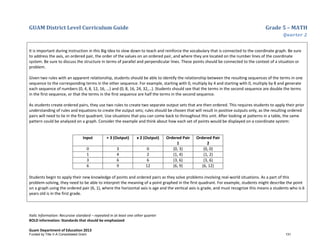
• Clearly state (orally and in writing) language objectives for students (5.RF.4a, 5.SL.6).
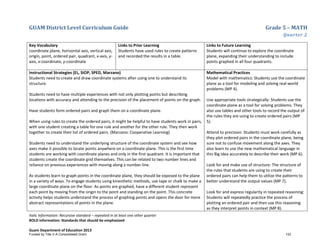
• Choose content concepts appropriate for age and educational background level of students (5.RL.3, 5.RL.3, 5.RI.5, 5.RF.4a).
• Use supplementary materials to a high degree to make the lesson clear and meaningful (e.g., graphs, models, visuals) (5.RL.3, 5.RI.5, 5.W.3a-e).
• Adapt content (e.g., text, assignment) to all levels of student proficiency. Plan meaningful activities that integrate lesson concepts (e.g., surveys,
letter writing, simulations, constructing models) with language practice opportunities for reading, writing, listening, and speaking (5.RL.1,
5.W.3a-e, 5.SL.6).
• Explicitly link concepts to students’ backgrounds and experiences (5.RF.4a, 5.W.3a-e, 5.W.10).
• Explicitly link past learning and new concepts (all standards).
• Emphasize key vocabulary (e.g., introduce, write, repeat, and highlight) for students (5.RL.4, 5.RI.4, 5.RF.3a, 5.L.4a-c).
• Use speech appropriate for students’ proficiency level (e.g., slower rate, enunciation, and simple sentence structure for beginners) (5.RF.4a,
5.RL.1, 5.SL.6).
• Explain academic tasks clearly (all standards).
• Use a variety of techniques to make content concepts clear (e.g., modeling, visuals, hands-on activities, demonstrations, gestures, body
language) (5.RL.3, 5.RI.5, 5.W.3a-e, 5.L.2a-e).
• Use scaffolding techniques consistently throughout the lesson (5.W.3a-e, 5.RI.5, 5.L.2a-e).
• Use a variety of question types including those that promote higher order thinking skills throughout the lesson (e.g., literal, analytical, and
interpretive questions) (5.RF.4a, 5.RL.3, 5.RF.3a, 5.RI.5).
• Provide frequent opportunities for interaction and discussion about lesson concepts both between teacher and student and among students,
and encourage elaborated responses (5.W.3a-e, 5.W.10).
• Use group configurations that support the language, content, and cultural objectives of the lesson, and provide sufficient scaffolding (such as
participation structures and language frames) to enable students to interact effectively (5.W.3a-e, 5.W.10, 5.SL.6).
• Provide activities for students to apply content, language, and cultural knowledge in the classroom (5.RL.1, 5.RF.4a, 5.W.3a-e, 5.W.10, 5.SL.6).
• Pace the lesson according to students’ ability levels (5.W.3a-e, 5.W.10, 5.RF.4a).
• Give a comprehensive review of key vocabulary (5.RL.4, 5.RI.4, 5.RF.3a, 5.L.4a-c).
• Provide feedback to students regularly on their output (e.g., speech, writing) (5.RF.4a, 5.W.3a-e, 5.SL.6).
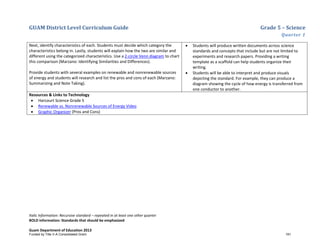
• Conduct assessments of student comprehension and learning throughout the lesson on all lesson objectives (e.g., spot checking, group
response) (all standards).
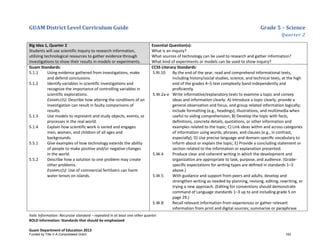
Funded by Title V-A Consolidated Grant 47
GUAM District Level Curriculum Guide Grade 5 – ELA
Quarter 1
Italic Information: Recursive standard – repeated in at least one other quarter
BOLD information: Standards that should be emphasized
Guam Department of Education 2013
SPED
• Establish a safe and supportive environment in which students are encouraged to talk and ask questions freely when they do not understand
(5.RL.1, 5.RF.4a, 5.W.3a-e, 5.W.10, 5.SL.6).
• Use a wide variety of ways to explain a concept or assignment. When appropriate, the concept or assignment may be depicted in graphic or
pictorial form, with manipulatives, or with real objects to accompany oral and written instructions (5.RL.3, 5.RI.5, 5.W.3a-e).
• Provide assistance in the specific and general vocabulary to be used for each lesson prior to the lesson, using reinforcement or additional
practice afterward. Instructional resources and instruction should be monitored for ambiguities or language that would be confusing, such as
idioms (5.RL.4, 5.RI.4, 5.RF.3a, 5.L.4a-c).
Resources & Links to Technology
• Houghton Mifflin Fifth Grade English Book: pp. 30, 116–117, 317, 318 (5.SL.6)
• Houghton Mifflin Fifth Grade English Book: pp. 180–207, H57 (5.L.2a-e)
• Houghton Mifflin Fifth Grade English Book: p. H18
• Houghton Mifflin Fifth Grade Reading Book: Expectations Pages: Throughout most stories (5.L.4a-c)
• Graphic Organizers: http://www.ncpublicschools.org/acre/standards/common-core-tools/#goela
• Narrative rubric: http://www.ode.state.or.us/search/page/?=529
• Common Core State Standards writing examples: http://www.corestandards.org/assets/Appendix_C.pdf
Big Idea 2, Quarter 1:
Students will analyze the differences in structures and conventions of
multiple genres.
Essential Question(s):
How does genre affect how authors demonstrate theme or message?
How does context help to identify unknown words?
What are the key differences in structure between fiction and nonfiction?
Standards:
5.RL.9 Compare and contrast stories in the same genre (e.g., mysteries and adventure stories) on their approaches to similar themes and
topics.
5.RI.2 Determine two or more main ideas of a text and explain how they are supported by key details; summarize the text.
5.RF.4b-c Read with sufficient accuracy and fluency to support comprehension: b) Read grade-level prose and poetry orally with accuracy,
appropriate rate, and expression on successive readings; c) Use context to confirm or self-correct word recognition and understanding,
Funded by Title V-A Consolidated Grant 48
GUAM District Level Curriculum Guide Grade 5 – ELA
Quarter 1
Italic Information: Recursive standard – repeated in at least one other quarter
BOLD information: Standards that should be emphasized
Guam Department of Education 2013
rereading as necessary.
Elements of the Standard(s) – What’s the meaning?
In this section, students will need to recall prior knowledge of the structure and components of various genres. Students can use these prior skills and
concepts to compare and contrast stories of the same or different genres (5.RL.9) after reading the stories with sufficient accuracy and fluency (5.RF.4b-
c). Students may complete these comparison and contrasts in written or oral form. Students should be able to include the theme or main idea and
specific key details from the text (5.RI.2).
Key Vocabulary
compare, contrast, genre, theme, topic, key
details, summarize, comprehension, poetry,
prose
Links to Prior Learning
• In previous grades, students
developed skills related to comparing
and contrasting the point of view
from different stories and the
difference between first- and third-
person narrations (4.RL.6).
• Students also previously learned to
compare and contrast a firsthand and
secondhand account of the same
event or topic and describe the
differences in focus and information
provided (4.RI.6).
• Students also learned to compare and
contrast the treatment of similar
themes and topics (e.g., opposition of
good and evil) and patterns of events
(e.g., the quest) in stories, myths, and
traditional literature from different
cultures (4.RI.9).
• These skills should be elaborated on,
and students should have the ability
to compare and contrast elements of
stories with greater detail while
Links to Future Learning
• In the next grades, students will be required
to utilize their compare-and-contrast skills in
their own writing. Using skills learned in 5th
grade and preceding grades, students will
develop their own stories and written analysis
of stories with similar elements (6.W.9a).
• Students will also be required to compare and
contrast stories, dramas, and poems
delivered in a variety of multimedia formats
(6.RL.7).
• Students will also use their 5th
grade skills to
compare and contrast an author’s
presentation of events with that of another
(6.RI.9).
• Students will also be required to compare and
contrast texts in different forms or genres
and use their skills to determine the
appropriate approach to similar themes and
topics (6.RL.9).
• Students will be required to determine a
central idea through particular details and
provide a summary without including
Funded by Title V-A Consolidated Grant 49
GUAM District Level Curriculum Guide Grade 5 – ELA
Quarter 1
Italic Information: Recursive standard – repeated in at least one other quarter
BOLD information: Standards that should be emphasized
Guam Department of Education 2013
utilizing a wider vocabulary.
• Students were required to identify the
main idea of a text and explain how it
is supported by key details.
• Students were also required to
summarize the text (4.RI.2).
• Students were required to read
fluently, with sufficient accuracy
(4.RF.4b). They were also required to
share what they had read either
through writing or through discussion,
citing key details from the text
(4.W.9a).
personal opinions or judgments (6.RI.2).
• Students will be required to draw evidence
from literary and informational texts at higher
levels. They will need to be able to analyze,
reflect, and research grade-appropriate texts
(6.W.9a).
Instructional Strategies (EL, SIOP, SPED, Marzano)
EL Strategies
• Clearly state (orally and in writing) cultural objectives for students. Work to develop complementary or overlapping cultural objectives across
languages (5.RL.9, 5.RI.2, 5.RF.4b-c).
• Use supplementary materials to a high degree to make the lesson clear and meaningful (e.g., graphs [bubble maps, T-charts], models, visuals)
(5.RL.9).
SPED Strategies
• Adapt content (e.g., text, assignment) to all levels of student proficiency (5.RL.9, 5.RF.4b-c).
• Use speech appropriate for students’ proficiency level (e.g., slower rate, enunciation, and simple sentence structure for beginners) (5.RL.9,
5.RF.4b-c).
• Provide sufficient wait time for student responses throughout the lesson. Explicitly teach this strategy to students for use in peer interactions as
well (5.RF.4b-c).
• Provide assistance in the specific and general vocabulary to be used for each lesson prior to the lesson, using reinforcement or additional
practice afterward. Instructional resources and instruction should be monitored for ambiguities or language that would be confusing, such as
idioms (5.RL.9, 5.RF.4b-c).
Marzano Strategies
Funded by Title V-A Consolidated Grant 50
GUAM District Level Curriculum Guide Grade 5 – ELA
Quarter 1
Italic Information: Recursive standard – repeated in at least one other quarter
BOLD information: Standards that should be emphasized
Guam Department of Education 2013
• Identifying Similarities and Differences
• Provide examples of similar and dissimilar texts to students. Students can use prior knowledge to identify commonalities and differences
between texts they have read previously and new texts (5.RL.9).
Cooperative Learning
Allow students to work in groups and pairs to read and discuss elements of texts (5.RL.9, 5.RF.4b-c).
Tall Tales – Genre Study
Students read and discuss folk tales focusing on character actions and traits. In collaborative groups, students work to summarize plot points and
character traits. As a group, post story information onto a multi-story character-study matrix, which includes appearance, ability, setting, relationships
with others, problems, accomplishments and resolutions. The process can be repeated for multiple characters across books so that characters can be
compared and contrasted. An example of a character-study matrix can be found at ReadWriteThink
at http://www.readwritethink.org/files/resources/lesson-docs/SampleCharacterMatrix.pdf.
It’s All a Matter of Perspective
Provide opportunities for students to read trade books with small main characters to explain perspective or point of view. Visual elements of the texts
help readers understand the idea that two people may see the same thing in different ways, or that one event can be interpreted in ways that are
impacted by point of view. Possible books to use for this activity are Seven Blind Mice (Ed Young), Two Bad Ants (Chris VanAllsburg and Mouse Views:
What the Class Pet Saw (Bruce McMillan).
Create an Inference Chart
Create a chart to help students understand the strategy of making inferences based on what is read. The chart should have three columns. The
headers on the columns should read:
• What happened?
• What does it mean?
• Why do you think that?
Resources & Links to Technology
• Houghton Mifflin Fifth Grade Reading Book: Expectations Pages: Realistic Fiction: pp. 28, 106A, 162, 184, 230i, 344, 410, 414, 438B, 650; Plays:
p. 442; Nonfiction: pp. 56, 84, 106I, 230b, 334I, 368, 438I, 498, 522, 570H, 602, 628, 672B; Historical Fiction: pp. 292, 334A, 550, 570B;
Autobiography: pp. 138, 574, 579, 582, 588; Biography: pp. 210, 262, 312, 470; Tall Tales: pp. 110, 114, 119, 125; Poetry: pp. 232, 235–251
(5.RF.4b-c)
• Sample Lessons and content: http://curriculum.austinisd.org/la/resources/documents/instResources/LA_res_connAcrssTxts_ORS.pdf
• Graphic Organizers: http://www.ncpublicschools.org/acre/standards/common-core-tools/#goela
Funded by Title V-A Consolidated Grant 51
GUAM District Level Curriculum Guide Grade 5 – ELA
Quarter 1
Italic Information: Recursive standard – repeated in at least one other quarter
BOLD information: Standards that should be emphasized
Guam Department of Education 2013
Big Idea 3, Quarter 1:
Using visual aids, students will be able to engage in discussions and
presentations regarding purposes of narratives and informational
texts.
Essential Question(s):
What role does each participant play in productive group discussions?
How can visual aids demonstrate particular aspects of a text such as theme
and structure?
Standards:
5.SL.1c Engage effectively in a range of collaborative discussions (one-on-one, in groups, and teacher-led) with diverse partners on grade 5 topics
and texts, building on others’ ideas and expressing their own clearly: Pose and respond to specific questions by making comments that
contribute to the discussion and elaborate on the remarks of others.
5.SL.2 Summarize a written text read aloud or information presented in diverse media and formats, including visually, quantitatively, and
orally.
5.SL.3 Summarize the points a speaker makes and explain how each claim is supported by reasons and evidence.
5.SL.5 Include multimedia components (e.g., graphics, sound) and visual displays in presentations when appropriate to enhance the development
of main ideas or themes.
Elements of the Standard(s) – What’s the meaning?
In this section, students will engage in a variety of collaborative discussions (one-to-one, in groups, teacher-led) in order to discuss texts, share ideas,
and respond to questions raised by the group (5.SL.1c). Students may also formulate multimedia presentations (charts, graphs, photos, drawings,
diagrams) in order to enhance discussions (5.SL.2, 5.SL.5, 5.SL.3). Students will share the roles of participant, leader and observer as well as follow
established procedures for the best possible group collaborations in order to meet common goals and arrive at common understandings. For these
collaborations and understandings to take place, students must be able to listen carefully. This will require them to use specific techniques to clarify
what they heard and to respond rationally in order to further the discussion.
Key Vocabulary
discussion, presentation, summarize,
evidence, graphics, multimedia, main idea,
theme
Links to Prior Learning
• Students were previously required to
engage in collaborative discussions
(one-to-one, in groups, and teacher-
led) to build on others’ ideas and to
express their own ideas clearly.
Students should also be aware of
discussion rules and assigned roles
(4.SL.1b).
Links to Future Learning
• In future grades, students will be required to
engage effectively in multiple types of
discussions (group, one-to-one, teacher-led).
They will need to follow rules and set goals.
Students will also need to review key ideas
expressed during the discussion and
understand multiple perspectives (6.SL.1a-d).
• Students will also be required to include
Funded by Title V-A Consolidated Grant 52
GUAM District Level Curriculum Guide Grade 5 – ELA
Quarter 1
Italic Information: Recursive standard – repeated in at least one other quarter
BOLD information: Standards that should be emphasized
Guam Department of Education 2013
• Students should also be aware of
discussion contexts (formal/informal
and specific types of discussions for
specific situations) (4.SL.6).
• Students also engaged in activities
that required them to determine
main ideas and key details during a
summary (4.RI.2).
• Students also wrote and gave
presentations utilizing multimedia
components (4.W.2a).
multimedia components and visual displays in
presentations to clarify information (6.SL.5).
Instructional Strategies (EL, SIOP, SPED, Marzano)
EL Strategies
• Use non-verbal and context clues to provide meaning for instruction (charts, graphs, photos, drawings, diagrams) (5.SL.1c).
SPED Strategies
• Establish a safe and supportive environment in which students are encouraged to talk and ask questions freely when they do not understand
(5.SL.1c, 5.SL.5).
• Use a wide variety of ways to explain the rules and roles of group discussions (5.SL.5).
• Ask each student frequently to communicate his or her understanding of the concept or assignment. Students should be asked to verbalize or
write down what they know, thereby providing immediate insight into their thinking and level of understanding. In addition, students should be
encouraged to confer about each other’s understanding of the concept being taught and the classwork or homework assignments, particularly if
students are not fully proficient in English (5.SL.3).
Marzano Strategies
• Summarizing and Note-Taking
• Give students opportunities to summarize what they have read or discussed in their own writing (5.SL.2).
• Cooperative Learning
• Design lessons in which students work in pairs or in a group to share ideas or review information (5.SL.1c).
Think Pair Share
Think Pair Share is a strategy designed to provide students with food for thought on a given topic enabling them to formulate individual ideas and share
Funded by Title V-A Consolidated Grant 53
GUAM District Level Curriculum Guide Grade 5 – ELA
Quarter 1
Italic Information: Recursive standard – repeated in at least one other quarter
BOLD information: Standards that should be emphasized
Guam Department of Education 2013
these ideas with another student. Students pair off and share ideas with one another related to a question or topic under discussion. Once each partner
has discussed the idea or topic, students share with the whole group.
Famous Speeches
The Internet is a good resource for finding speeches of famous people. Share Caldecott or Newbery acceptance speeches with students. Have them
analyze the speeches for the authors’ major points and arguments and determine what evidence these authors used to support their points. If students
have had the opportunity to read work by one of the authors, have them discuss the ways the message of the speech is reflected in their work.
Resources & Links to Technology
• Houghton Mifflin Fifth Grade Reading Book: Expectations Pages: Realistic Fiction: pp. 28, 106A, 162, 184, 230i, 344, 410, 414, 438B, 650; Plays:
p. 442; Nonfiction: pp. 56, 84, 106I, 230b, 334I, 368, 438I, 498, 522, 570H, 602, 628, 672B; Historical Fiction: pp. 292, 334A, 550, 570B;
Autobiography: pp. 138, 574, 579, 582, 588; Biography: pp. 210, 262, 312, 470; Tall Tales: pp. 110, 114, 119, 125; Poetry: pp. 232, 235–251
• Houghton Mifflin Fifth Grade English Book: pp. H4, H5, H7, H9 (5.SL.1c)
• Houghton Mifflin Fifth Grade Reading Book: Expectations pp. 47, 48, 152, 153, 225, 305, 334N, 433, 543, 643 (5.SL.2)
• Houghton Mifflin Fifth Grade Reading Book: Expectations pp. 153, 230Q, 387, 409 (5.SL.3)
• Houghton Mifflin Fifth Grade English Book: pp. H37, H39, H40, H41, H45, H47 (5.SL.5)
• Graphic Organizers: http://www.ncpublicschools.org/acre/standards/common-core-tools/#goela
• K-12 Common Core Speaking and Listening
Standards: http://www.dukeofdefinition.com/ELA_Common_Core_Standards_Speaking_and_Listening_Comp_01.pdf
• Helpful guide for successful collaborative discussions: http://www.cte.hawaii.edu/publications/Collab_web.pdf
Funded by Title V-A Consolidated Grant 54
GUAM District Level Curriculum Guide Grade 5 – ELA
Quarter 2
Italic Information: Recursive standard – repeated in at least one other quarter
BOLD information: Standards that should be emphasized
Guam Department of Education 2013
Big Idea 1, Quarter 2:
Students will develop a well-structured personal narrative and
present it in a variety of formats.
Essential Question(s):
How does a speaker actively engage his/her audience?
How is the process and structure of writing short narratives similar to writing
longer narratives?
Standards:
5.SL.2 Summarize a written text read aloud or information presented in diverse media and formats, including visually, quantitatively, and
orally.
5.SL.5 Include multimedia components (e.g., graphics, sound) and visual displays in presentations when appropriate to enhance the development
of main ideas or themes.
5.SL.6 Adapt speech to a variety of contexts and tasks, using formal English when appropriate to task and situation. (See grade 5 Language
standards 1 and 3 for specific expectations.)
5.L.1a-e Demonstrate command of conventions of standard English grammar and usage when writing or speaking: a) Explain the function of
conjunctions, prepositions, and interjections in general and their function in particular sentences; b) Form and use the perfect (e.g., I had
walked; I have walked; I will have walked) verb tenses; c) Use verb tense to convey various times, sequences, states, and conditions; d)
Recognize and correct inappropriate shifts in verb tense; e) Use correlative conjunctions (e.g., either/or, neither/nor).
5.L.2a-e Demonstrate command of the conventions of standard English capitalization, punctuation, and spelling when writing: a) Use punctuation
to separate items in a series; b) Use a comma to separate an introductory element from the rest of the sentence; c) Use a comma to set off
the words yes and no (e.g., Yes, thank you), to set off a tag question from the rest of the sentence (e.g., It’s true, isn’t it?), and to indicate
direct address (e.g., Is that you, Steve?); d) Use underlining, quotation marks, or italics to indicate titles of works; e) Spell grade-
appropriate words correctly, consulting references as needed.
5.L.6 Acquire and use accurately grade-appropriate general academic and domain-specific words and phrases, including those that signal
contrast, addition, and other logical relationships (e.g., however, although, nevertheless, similarly, moreover, in addition).
Elements of the Standard(s) – What’s the meaning?
Students will build upon prior knowledge to create narrative writing related to texts presented in diverse media formats (charts, graphs, photos,
drawings, diagrams) (5.SL.2). Students should be able to assess and summarize the multimedia information and include such information in their own
presentations (5.SL.5). Students’ written summaries should use command of conventions of standard English grammar including correct capitalization,
punctuation, and spelling (5.L.1a-e, 5.L.2a-e, 5.L.6). Students may also demonstrate an ability to present information orally in a manner appropriate for
their audience (5.SL.6).
Funded by Title V-A Consolidated Grant 55
GUAM District Level Curriculum Guide Grade 5 – ELA
Quarter 2
Italic Information: Recursive standard – repeated in at least one other quarter
BOLD information: Standards that should be emphasized
Guam Department of Education 2013
Key Vocabulary
multimedia, context, conjunctions,
prepositions, interjections, perfect, verb
tense, capitalization, punctuation, spelling,
comma, quotation marks
Links to Prior Learning
• Previously, students were required to
write informative and explanatory
texts to examine a topic and convey
ideas and information clearly using
multiple formats and multimedia
items (4.W.2a).
• Students were previously taught skills
related to verb tenses when reading,
writing, and speaking (4.L.1b).
• Students also demonstrated
command of conventions related to
compound sentences and
conjunctions (4.L.2c).
• Students have received instruction
related to writing words in sequence
and the correct use of commas and
quotation marks (4.L.2b).
Links to Future Learning
• Students will also be required to include
multimedia components and visual displays in
presentations to clarify information (6.SL.5).
• Students will continue to adapt speech to a
variety of contexts and tasks (6.SL.6)
• Students will also continue learning skills
related to the use of capitalization,
punctuation, and spelling when reading,
writing, and speaking (6.L.2a-b).
Instructional Strategies (EL, SIOP, SPED, Marzano)
EL Strategies
• Use supplementary materials (writing process charts, editing posters) to make the lesson clear and meaningful (e.g., graphs, models, visuals)
(5.SL.2, 5.L.2a-e, 5.L.6).
• Break tasks into smaller “chunks” with frequent comprehension checks. Have students write and edit in sections. This will allow students to
receive feedback and make revisions before repeating an error throughout the writing process (5.L.1a-e, 5.L.2a-e, 5.L.6).
• Model correct grammar when speaking to a student or when writing answers on the board or overhead (5.SL.2, 5.SL.6, 5.L.1a-e, 5.L.2a-e, 5.L.6).
SPED Strategies
• Provide assistance in the specific and general vocabulary to be used for each lesson prior to the lesson, using reinforcement or additional
practice afterward. Instructional resources and instruction should be monitored for ambiguities or language that would be confusing, such as
idioms (all standards).
Funded by Title V-A Consolidated Grant 56
GUAM District Level Curriculum Guide Grade 5 – ELA
Quarter 2
Italic Information: Recursive standard – repeated in at least one other quarter
BOLD information: Standards that should be emphasized
Guam Department of Education 2013
• Enlist the help of parents at home when possible (all standards).
Marzano Strategies
• Homework and Practice
• Assign homework that extends the writing process to home. Students may make their revisions at home or write the rough draft of their next
section (5.L.1a-e, 5.L.2a-e, 5.L.6).
Travel Guides
Assign students to small groups. Have each group work together to make a travel brochure for the land of grammar. Individual towns could be named
Verb, Noun and Pronoun. The brochures should describe what makes each town unique or special. Student groups, acting as tour guides, can teach the
grammatical structure by taking classmates on a virtual tour of their town.
Linear Arrays
This is a strategy for extending vocabulary by asking students to extend their understanding of words through using opposites on each end of a line and
add words that vary in shades of meaning between the two opposites. For example:
Hot Warm Mild Cool Cold
Resources & Links to Technology
• Houghton Mifflin Fifth Grade Reading Book: Expectations Pages: Realistic Fiction: pp. 28, 106A, 162, 184, 230i, 344, 410, 414, 438B, 650; Plays: p.
442, Nonfiction: pp. 56, 84, 106I, 230b, 334I, 368, 438I, 498, 522, 570H, 602, 628, 672B; Historical Fiction: pp. 292, 334A, 550, 570B;
Autobiography: pp. 138, 574, 579, 582, 588; Biography: pp. 210, 262, 312, 470; Tall Tales: pp. 110, 114, 119, 125; Poetry: pp. 232, 235–251
(5.SL.2)
• Houghton Mifflin Fifth Grade English Book: pp. H37, H39, H40, H41, H45, H47
• Houghton Mifflin Fifth Grade Reading Book: Expectations pp.: 77, 101, 128, 153, 177, 180–181, 329, 359, 387, 409, 515, 543, 565, 619, 667
(5.SL.5)
• Houghton Mifflin Fifth Grade Reading Book: Expectations pp. 47, 153, 225, 305, 386, 433, 643 (5.SL.6)
• Houghton Mifflin Fifth Grade English Book: pp. 31–53, 44, 63–89, 95–136, 256–276 (5.L.1a-e)
• Houghton Mifflin Fifth Grade English Book: pp. 179–207 (5.L.2a-e)
• Houghton Mifflin Fifth Grade English Book: pp. 179–207 (5.L.6)
• Graphic Organizers: http://www.ncpublicschools.org/acre/standards/common-core-tools/#goela
• Narrative rubric: http://www.ode.state.or.us/search/page/?=529
• Discuss and share the teacher-created Capitalization and Punctuation PowerPoint http://classroom.jc-schools.net/la/activities/capital-
punct_files/frame.htm. Have students work in small groups to create a PowerPoint about a specific grammatical or mechanical structure.
Funded by Title V-A Consolidated Grant 57
GUAM District Level Curriculum Guide Grade 5 – ELA
Quarter 2
Italic Information: Recursive standard – repeated in at least one other quarter
BOLD information: Standards that should be emphasized
Guam Department of Education 2013
Big Idea 2, Quarter 2:
Students will understand how point of view affects the elements of a
story.
Essential Question(s):
How does point of view affect the theme, sequence, and elements of a story?
How does changing a point of view impact the outcome of a story?
Standards:
5.RL.2 Determine a theme of a story, drama, or poem from details in the text, including how characters in a story or drama respond to
challenges or how the speaker in a poem reflects upon a topic; summarize the text.
5.RL.6 Describe how a narrator’s or speaker’s point of view influences how events are described.
5.RL.7 Analyze how visual and multimedia elements contribute to the meaning, tone, or beauty of a text (e.g., graphic novel, multimedia
presentation of fiction, folktale, myth, poem).
5.SL.1a-b Engage effectively in a range of collaborative discussions (one-on-one, in groups, and teacher-led) with diverse partners on grade 5
topics and texts, building on others’ ideas and expressing their own clearly: a) Come to discussions prepared, having read or studied
required material; explicitly draw on that preparation and other information known about the topic to explore ideas under discussion;
b) Follow agreed-upon rules for discussions and carry out assigned roles.
Elements of the Standard(s) – What’s the meaning?
Students will recall prior knowledge related to determining a story’s theme (5.RL.2). Making meaning and determining theme gives students a more
complete picture of a text and enables them to summarize and/or describe textual elements. They will demonstrate comprehension by using evidence
from the text to support their responses and by comparing and contrasting story elements within a text.
Students will also identify the role characters play in the story in order to utilize similar character traits in their own writing. While uncovering key details
and theme, students will also interpret how the narrator’s or speaker’s point of view influences the events of a story (5.RL.6). Students will also
recognize and interpret how multimedia elements contribute to the meaning, tone, or beauty of the text (5.RL.7). In order to summarize their findings,
students will verbally synthesize this material in collaborative discussions (5.SL.1a-b).
Key Vocabulary
story, drama, poem, characters, speaker,
narrator, graphic novel, multimedia, fiction,
folktale, myth, poem, collaborative discussion
Links to Prior Learning
• Students have been required to
identify theme through providing
specific key details from a text
(4.RL.2).
• Students have also been instructed on
what point of view is and to compare
and contrast point of view in different
stories (4.RL.6).
Links to Future Learning
• Students will use their theme-determining
skills within their writing and spoken
presentations (6.SL.4).
• Students will also utilize theme when drawing
evidence from literary and informational
texts to support their analysis, reflection, and
research (6.L.1a and c).
• Students will apply their knowledge of author
Funded by Title V-A Consolidated Grant 58
GUAM District Level Curriculum Guide Grade 5 – ELA
Quarter 2
Italic Information: Recursive standard – repeated in at least one other quarter
BOLD information: Standards that should be emphasized
Guam Department of Education 2013
• Students should also be aware of
discussion contexts (formal/informal
and specific types of discussions for
specific situations) (4.SL.6).
• Students also wrote and gave
presentations utilizing multimedia
components (4.W.2a).
and speaker point of view to construct
arguments and deliver information effectively
(6.W.3a-e).
• Students will use tone and style, influenced
by their previous learning, to construct their
own stories and writings (6.L.3a-b).
• In future grades, students will be required to
engage effectively in multiple types of
discussions (group, one-to-one, teacher-led).
They will need to follow rules and set goals.
Students will also need to review key ideas
expressed during the discussion and
understand multiple perspectives (6.SL.1a-d).
Instructional Strategies (EL, SIOP, SPED, Marzano)
EL Strategies
• Explicitly link concepts to students’ backgrounds and experiences (5.RL.2, 5.RL.6).
• Explicitly link past learning and new concepts (5.RL.6, 5.SL.1a-b).
SPED Strategies
• Use scaffolding techniques consistently throughout lesson. Students can partake in assignments that allow them to incorporate characters and
situations from books they have already read (5.SL.1a-b).
• Provide sufficient wait time for student responses throughout the lesson. Explicitly teach this strategy to students for use in peer interactions as
well (5.SL.1a-b).
Marzano Strategies
• Identifying Similarities and Differences: Provide new texts or revisit old texts in order to make comparisons and discuss differences in texts
(5.SL.1a-b).
Pre-Reading Cards
As a pre-reading activity, provide students with index cards that have story element clues on them (i.e., a card might be labeled Setting – A small town).
Have students read or hear read the first chapter of a selection. Students record any inferences, predictions or conclusions they develop based on what
they heard. Once students have completed the reading, they review the cards to see how well they were able to infer, predict or draw conclusions about
the story element listed on their cards. Later, this can be turned into a short research paper that includes details from the text that support students’
original thoughts. This activity can be adapted for shorter selections by reading only the first paragraph.
Funded by Title V-A Consolidated Grant 59
GUAM District Level Curriculum Guide Grade 5 – ELA
Quarter 2
Italic Information: Recursive standard – repeated in at least one other quarter
BOLD information: Standards that should be emphasized
Guam Department of Education 2013
Story Map
Using the story map strategy helps students focus on the major aspects or elements of a story such as setting, character, conflict, rising action and
resolution. Initially, these organizers can be created for whole groups to contribute; as they become more familiar, students can create story maps for
texts they read independently. There are a number of graphic variations on a story map available online. ReadWriteThink (sponsored by the
International Reading Association and National Council of Teachers of English) has an interactive version that students can complete, located
at http://www.readwritethink.org/files/resources/interactives/storymap/.
Resources & Links to Technology
• Houghton Mifflin Fifth Grade English Book: p. 1 (5.RL.7)
• Houghton Mifflin Fifth Grade Reading Book: Expectations pp. 47, 48, 152, 153, 225, 305, 334N, 433, 543, 643 (5.SL.1a-b)
• Graphic Organizers: http://www.ncpublicschools.org/acre/standards/common-core-tools/#goela
• K-12 Common Core Speaking and Listening
Standards: http://www.dukeofdefinition.com/ELA_Common_Core_Standards_Speaking_and_Listening_Comp_01.pdf
• Helpful guide for successful collaborative discussions: http://www.cte.hawaii.edu/publications/Collab_web.pdf
Big Idea 3, Quarter 2:
Students will be able to identify connections between individuals and
events and effectively demonstrate those connections in informative
writing.
Essential Question(s):
How does author’s purpose alter how the same events of individuals might be
compared?
What is the purpose of informative writing?
Standards:
5.RI.1 Quote accurately from a text when explaining what the text says explicitly and when drawing inferences from the text.
5.RI.3 Explain the relationships or interactions between two or more individuals, events, ideas, or concepts in a historical, scientific, or
technical text based on specific information in the text.
5.W.2a-e Write informative/explanatory texts to examine a topic and convey ideas and information clearly: a) Introduce a topic clearly, provide a
general observation and focus, and group related information logically; include formatting (e.g., headings), illustrations, and multimedia
when useful to aiding comprehension; b) Develop the topic with facts, definitions, concrete details, quotations, or other information
and examples related to the topic; c) Link ideas within and across categories of information using words, phrases, and clauses (e.g., in
contrast, especially); d) Use precise language and domain-specific vocabulary to inform about or explain the topic; e) Provide a
concluding statement or section related to the information or explanation presented.
Funded by Title V-A Consolidated Grant 60
GUAM District Level Curriculum Guide Grade 5 – ELA
Quarter 2
Italic Information: Recursive standard – repeated in at least one other quarter
BOLD information: Standards that should be emphasized
Guam Department of Education 2013
Elements of the Standard(s) – What’s the meaning?
In this section, students will be able to recite and recall accurately from a text (5.RI.1). Students will interpret and infer the relationships and interactions
of individuals, events, ideas, or concepts in a historical, scientific, or technical text (5.RI.3). As students become more strategic, they are able to integrate
information from multiple visual and print sources for a full understanding of the content. The ability to access, use and synthesize information from
multiple sources enhances learning. Students will use this information to create informative or explanatory texts that introduce a topic and give a
general observation and focus related to the topic, details, and quotations (5.W.2a-e).
Key Vocabulary
quote, historical, scientific, technical,
informative, explanatory, multimedia,
phrases, clauses, vocabulary
Links to Prior Learning
• Students have previously received
instruction on how to determine and
describe the overall structure, events,
ideas, and concepts within different
texts (4.RI.5). They will use these skills
to infer and quote specifically from
texts.
• Students will continue to develop
their understanding of characters and
key individuals in nonfiction texts as
they have done previously (4.W.3a).
• Students have had multiple
opportunities to be instructed on and
demonstrate their ability to write
informative and explanatory texts
(4.W.2a).
Links to Future Learning
• Students will continue to gather specific
information from texts while applying such
information in their writing and speaking
(6.W.8).
• Students will demonstrate their
understanding of skills previously learned
regarding different types of characters and
the importance of characters in a story. They
will utilize these skills to construct their own
stories (6.W.3a-e).
• Students will continue to write informative
and explanatory texts while gaining an
understanding of transitions and using higher
level vocabulary (6.W.2c).
Instructional Strategies (EL, SIOP, SPED, Marzano)
EL Strategies
• Clearly state (orally and in writing) cultural objectives for students. Work to develop complementary or overlapping cultural objectives across
languages (5.RI.3, 5.W.2a-e).
• Explicitly link concepts to students’ backgrounds and experiences. Allow students to develop informative and explanatory texts on topics they
are familiar with (5.W.2a-e).
SPED Strategies
• Use scaffolding techniques consistently throughout lesson. Have students write, pair-share, or discuss in groups hobbies or items they are
Funded by Title V-A Consolidated Grant 61
GUAM District Level Curriculum Guide Grade 5 – ELA
Quarter 2
Italic Information: Recursive standard – repeated in at least one other quarter
BOLD information: Standards that should be emphasized
Guam Department of Education 2013
interested in in order to develop a topic to write on (5.W.2a-e).
• Provide assistance in the specific and general vocabulary to be used for each lesson prior to the lesson, using reinforcement or additional
practice afterward. Instructional resources and instruction should be monitored for ambiguities or language that would be confusing, such as
idioms (5.RI.1).
K W H L Chart
This activity is commonly done in the primary grades. However, the addition of the H makes it appropriate for intermediate students. Activate students’
prior knowledge by asking them what they already Know about a topic. Next, students (collaborating as a classroom unit or within small groups) set
goals specifying what they Want to learn. Students then identify How they can find the information that will answer their questions (i.e., newspapers,
Web searches, trade books). After reading and researching, students discuss what they have Learned. Students apply higher-order thinking strategies
which help them construct meaning from what they read and help them monitor their progress toward their goals.
Create an Inference Chart
Create a chart to help students understand the strategy of making inferences based on what is read. The chart should have three columns. The
headers on the columns should read:
• What happened?
• What does it mean?
• Why do you think that?
In the last column, the student should be able to provide specific details, examples and quotations from the text to support their claims.
Resources & Links to Technology
• Houghton Mifflin Fifth Grade Reading Book: Expectations Pages: Nonfiction: pp. 56, 84, 106I, 230b, 334I, 368, 438I, 498, 522, 570H, 602, 628,
672B; Historical Fiction: pp. 292, 334A, 550, 570B; Autobiography: pp. 138, 574, 579, 582, 588; Biography: pp. 210, 262, 312, 470 (5.RI.3)
• Houghton Mifflin Fifth Grade Reading Book: Expectations pp. 76, 100, 106, 329, 408, 432, 514, 592–593, 642
• Houghton Mifflin Fifth Grade English Book: pp. 398–436 (5.W.2a-e)
• Informational writing lessons: Content Map of Unit
• http://blogs.muskegonisd.org/writers3to6/files/2009/03/3-6-09-report-research-unit-of-study.pdf
• Graphic Organizers: http://www.ncpublicschools.org/acre/standards/common-core-tools/#goela
Funded by Title V-A Consolidated Grant 62
GUAM District Level Curriculum Guide Grade 5 – ELA
Quarter 3
Italic Information: Recursive standard – repeated in at least one other quarter
BOLD information: Standards that should be emphasized
Guam Department of Education 2013
Big Idea 1, Quarter 3:
Students will be able to understand and apply elements of story,
drama, and poetry.
Essential Question(s):
How are elements (structure, theme, point of view, purpose) different
throughout genres?
How does making inferences impact a reader’s view of a story’s action?
Standards:
5.RL.1 Quote accurately from a text when explaining what the text says explicitly and when drawing inferences from the text.
5.RL.4 Determine the meaning of words and phrases as they are used in a text, including figurative language such as metaphors and similes.
5.RL.5 Explain how a series of chapters, scenes, or stanzas fits together to provide the overall structure of a particular story, drama, or poem.
5.RI.4 Determine the meaning of general academic and domain-specific words and phrases in a text relevant to a grade 5 topic or subject
area.
5.RF.3a Know and apply grade-level phonics and word analysis skills in decoding words: Use combined knowledge of all letter-sound
correspondences, syllabication patterns, and morphology (e.g., roots and affixes) to read accurately unfamiliar multisyllabic words in
context and out of context.
5.RF.4a Read with sufficient accuracy and fluency to support comprehension: Read grade-level text with purpose and understanding.
5.W.10 Write routinely over extended time frames (time for research, reflection, and revision) and shorter time frames (a single sitting or a day or
two) for a range of discipline-specific tasks, purposes, and audiences.
5.SL.2 Summarize a written text read aloud or information presented in diverse media and formats, including visually, quantitatively, and orally.
5.SL.5 Include multimedia components (e.g., graphics, sound) and visual displays in presentations when appropriate to enhance the development
of main ideas or themes.
5.SL.6 Adapt speech to a variety of contexts and tasks, using formal English when appropriate to task and situation. (See grade 5 Language
standards 1 and 3 for specific expectations.)
5.L.2a-e Demonstrate command of the conventions of standard English capitalization, punctuation, and spelling when writing: a) Use punctuation
to separate items in a series; b) Use a comma to separate an introductory element from the rest of the sentence; c) Use a comma to set off
the words yes and no (e.g., Yes, thank you), to set off a tag question from the rest of the sentence (e.g., It’s true, isn’t it?), and to indicate
direct address (e.g., Is that you, Steve?); d) Use underlining, quotation marks, or italics to indicate titles of works; e) Spell grade-
appropriate words correctly, consulting references as needed.
5.L.4a-c Determine or clarify the meaning of unknown and multiple-meaning words and phrases based on grade 5 reading and content, choosing
flexibly from a range of strategies: a) Use context (e.g., cause/effect relationships and comparisons in text) as a clue to the meaning of a
word or phrase; b) Use common, grade-appropriate Greek and Latin affixes and roots as clues to the meaning of a word (e.g., photograph,
Funded by Title V-A Consolidated Grant 63
GUAM District Level Curriculum Guide Grade 5 – ELA
Quarter 3
Italic Information: Recursive standard – repeated in at least one other quarter
BOLD information: Standards that should be emphasized
Guam Department of Education 2013
photosynthesis); c) Consult reference materials (e.g., dictionaries, glossaries, thesauruses), both print and digital, to find the pronunciation
and determine or clarify the precise meaning of key words and phrases.
5.L.5a-c Demonstrate understanding of figurative language, word relationships, and nuances in word meanings: a) Interpret figurative language,
including similes and metaphors, in context; b) Recognize and explain the meaning of common idioms, adages, and proverbs; c) Use the
relationship between particular words (e.g., synonyms, antonyms, homographs) to better understand each of the words.
5.L.6 Acquire and use accurately grade-appropriate general academic and domain-specific words and phrases, including those that signal
contrast, addition, and other logical relationships (e.g., however, although, nevertheless, similarly, moreover, in addition).
Elements of the Standard(s) – What’s the meaning?
This section is an important review of the elements of a story, drama, or poetry. Students have received prior instruction at varying levels throughout
their elementary school years. This section provides them an opportunity to elicit their prior knowledge, while being exposed to new stories. Students
will need to be given multiple texts to read from to engage their use of accuracy, fluency, and comprehension (5.RF.4a, 5.RF.3a). Students should be
reading by themselves and aloud to check for accuracy, and opportunities to demonstrate how to quote both orally and in written form from a text
should be given (5.RL.1).
During readings, students should be given time to reflect on what they have read. Students may also use graphic organizers or response questions to
illicit the extraction of figurative language, elements of the text, and specific vocabulary (5.RL.4, 5.RL.5, 5.RI.4, 5.L.4a-c, 5.L.5a-c, 5.L.6).
Knowing vocabulary goes beyond knowing a definition. Students acquire and use vocabulary through exposure to language-rich situations and events.
They use an array of strategies including language structure and origin, textual clues, and word relationships. They are able to note differences between
literal and figurative language in order to build vocabulary and enhance comprehension. Understanding the nuances of words and phrases (shades of
meaning) allows students to use vocabulary purposefully and precisely.
Students should be given opportunities to share and demonstrate their understanding of the elements of text through written or oral form. Students
can write over time to construct well-written summaries of the texts they have read (5.W.10, 5.SL.2, 5.L.2a-e). Students may also be given opportunities
to present the information they have learned orally or in a multimedia format (5.SL.5, 5.SL.6).
Key Vocabulary
inferences, figurative language, metaphors,
similes, chapters, scenes, stanzas, story,
drama, poem, multimedia, punctuation,
capitalization, Greek and Latin roots, idioms,
adages, proverbs, synonyms, antonyms,
Links to Prior Learning
Students have been developing their skills
regarding the identification and development
of elements of a story, drama, and poetry for
many years (4.RF.4c, 4.L.4a, 4.RF.3a, 4.RI.4,
4.L.4c, 4.RF.4a).
Links to Future Learning
• Students will continue to demonstrate an
understanding of the components of a story,
drama, and poetry (6.RL.1, 6.RL.2, 6.RL.3,
6.RL.4, 6.RL.5, 6.RI .6, 6.RL.7).
• They will also use these components to
Funded by Title V-A Consolidated Grant 64
GUAM District Level Curriculum Guide Grade 5 – ELA
Quarter 3
Italic Information: Recursive standard – repeated in at least one other quarter
BOLD information: Standards that should be emphasized
Guam Department of Education 2013
homographs create stories, dramas, and poetry of their
own (6.l.1b, 6.L.1, 6.L.3a and b, 6.L.4a-d,
6.L.5c, 6.L.6, 6.W.2a and c, 6.W.3a-e).
Instructional Strategies (EL, SIOP, SPED, Marzano)
EL Strategies
• Preteach background knowledge/key vocabulary or concepts students will need for each unit before moving ahead (5.RL.1, 5.Rl.4, 5.RL.5, 5.RI.4,
5.RF.3a, 5.RF.4a, 5.L.4a-c, 5.L.6).
• Use graphic organizers (Venn diagram, T-charts) to provide visual support for concepts (5.RF.4a, 5.SL.2).
• Explicitly link concepts to students’ backgrounds and experiences (5.L.5a-c).
SPED Strategies
• Establish a safe and supportive environment in which students are encouraged to talk and ask questions freely when they do not understand (all
standards).
• Use scaffolding techniques consistently throughout lesson. Encourage students to use scaffolding techniques themselves when they are serving
as peer models (5.RL.1, 5.Rl.4, 5.RL.5, 5.RI.4, 5.RF.3a, 5.RF.4a, 5.L.4a-c, 5.L.6, 5.SL.6).
• Set up tutoring situations that offer additional assistance. Tutoring by a qualified teacher is optimal. Peer or cross-age tutoring should be so
designed not to detract from the instructional time of either the tutor or tutee and should be supervised (5.SL.5, 5.SL.2, 5.W.10).
Marzano Strategies
• Homework and Practice
• Assign homework on tasks and skills related to content discussed in class. Students may also expand on their classwork (e.g., using vocabulary
from class to write sentences or complete an activity) (5.W.10, 5.SL.5, 5.SL.6).
• Summarizing and Note-Taking
• Students may be given opportunities to create definitions of new vocabulary words in their own words. This will assist them to develop and
understand a meaning for the words (5.SL.2, 5.SL.6).
Four Corners
This strategy focuses on vocabulary development. Have students divide their papers into four sections. Title the sections as follows:
• Synonyms/Word Families
• Word/Definition
• Sentence
• Illustration
Funded by Title V-A Consolidated Grant 65
GUAM District Level Curriculum Guide Grade 5 – ELA
Quarter 3
Italic Information: Recursive standard – repeated in at least one other quarter
BOLD information: Standards that should be emphasized
Guam Department of Education 2013
Students complete the four-corners sheet with new vocabulary and share with other students. Four-corners sheets can be kept in a binder, dictionary
style.
Picture Book Language
Give small groups of students several picture books and have them look for words and phrases from those texts that reflect figurative language. Have
the scribe for the group record these words and phrases. Group members should determine the specific type of figurative language the author used for
each word or phrase found (i.e., simile, metaphor). Each group can share their examples with the class and provide rationales for how each word or
phrase was labeled.
Resources & Links to Technology
• Houghton Mifflin Fifth Grade Reading Book: Expectations Pages: Throughout most stories
• Houghton Mifflin Fifth Grade English Book pp. 312, H11 (5.L.4a-c)
• Houghton Mifflin Fifth Grade Reading Book: Expectations pp. 47, 153, 225, 305, 386, 433, 543, 643 (5.L.6)
• Graphic Organizers: http://www.ncpublicschools.org/acre/standards/common-core-tools/#goela
• Resource for examples of fifth-grade summaries: http://www.mybookezzz.com/summarizing-practice-5th-grade/
Big Idea 2, Quarter 3:
Students will be able to identify and demonstrate meaning of
variations in dialects, registers, and meaning in the English language.
Essential Question(s):
How does region and location affect the use of the English language?
How can context help to identify uncommon terms, figurative language,
dialects, and registers used?
Standards:
5.L.3a-b Use knowledge of language and its conventions when writing, speaking, reading, or listening: a) Expand, combine, and reduce sentences
for meaning, reader/listener interest, and style; b) Compare and contrast the varieties of English (e.g., dialects, registers) used in stories,
dramas, or poems.
5.L.5a-c Demonstrate understanding of figurative language, word relationships, and nuances in word meanings: a) Interpret figurative language,
including similes and metaphors, in context; b) Recognize and explain the meaning of common idioms, adages, and proverbs; c) Use the
relationship between particular words (e.g., synonyms, antonyms, homographs) to better understand each of the words.
Elements of the Standard(s) – What’s the meaning?
There are many stories and opportunities (See Resource Section for CCSS link to Text Exemplars) for students to be exposed to different dialects,
registers, and versions of the English language. This section helps to expose students to various stories with examples of variations of English. Students
are exposed to a wide variety of stories, short videos, and recorded audio stories to help them capture the way people use the English language.
Funded by Title V-A Consolidated Grant 66
GUAM District Level Curriculum Guide Grade 5 – ELA
Quarter 3
Italic Information: Recursive standard – repeated in at least one other quarter
BOLD information: Standards that should be emphasized
Guam Department of Education 2013
Variations of the English language can also include regional use of certain figurative language (5.L.3a-b, 5.L.5a-c). It is important to instruct that writers
and speakers select language, word choice and punctuation appropriate for purpose, audience and effect. Students will begin to understand the ways
that formal and informal language can be used to impact audience and communicate a message. As instruction continues, students may record their
findings on graphic organizers, share their findings in groups, or conduct compare-and-contrast activities to compare their own use of the English
language with those of others.
Key Vocabulary
compare, contrast, drama, story, poem,
context, figurative language, idioms, proverbs,
synonym, antonym, homographs
Links to Prior Learning
Students have previously identified and
applied figurative language in the form of
nuances in word meanings, and recognizing
and using idioms, adages, and proverbs
(4.L.5b).
Links to Future Learning
• Students will continue to utilize and identify
figurative language while analyzing the
impact of a specific word choice on meaning
and tone (6.RL.4).
• Students will be able to identify and utilize
figurative language in texts and in their
writing (6.RI.4, 6.Rl.9).
Instructional Strategies (EL, SIOP, SPED, Marzano)
EL Strategies
• Use graphic organizers to provide visual support for concepts (Venn diagram to show relationship between words and concepts) (5.L.3a-b,
5.L.5a-c).
• Explicitly link concepts to students’ backgrounds and experiences (5.L.5a-c). Have students identify phrases or words in their own lives that may
be used as an example of a variation of English.
SPED Strategies
• Establish a safe and supportive environment in which students are encouraged to talk and ask questions freely when they do not understand (all
standards).
• Enlist the help of parents at home when possible. See Marzano Homework and Practice suggestions (all standards).
Marzano Strategies
• Identifying Similarities and Differences
• Students may be exposed to different dialects of figurative language and be asked to compare or contrast those forms of speech to other
examples (5.L.3a-b, 5.L.5a-c).
• Homework and Practice
Funded by Title V-A Consolidated Grant 67
GUAM District Level Curriculum Guide Grade 5 – ELA
Quarter 3
Italic Information: Recursive standard – repeated in at least one other quarter
BOLD information: Standards that should be emphasized
Guam Department of Education 2013
• Assign homework and practice that supports classroom learning. Students can create examples of their own figurative language and may also
illustrate their examples. Students may bring these examples to class and share in a group (5.L.3a-b, 5.L.5a-c).
I Can See A Rainbow
Give students multiple colors of highlighters. Have them color-code sentence types in a piece of their own writing (i.e., sentences that start with a noun,
declarative sentences, questions, complex sentences) using a different color for each sentence type. If students can’t see a rainbow, they know they are
not varying their sentence types.
Resources & Links to Technology
• Houghton Mifflin Fifth Grade Reading Book: Expectations Pages: Realistic Fiction: pp. 28, 106A, 162, 184, 230i, 344, 410, 414, 438B, 650; Plays: p.
442; Nonfiction: pp. 56, 84, 106I, 230b, 334I, 368, 438I, 498, 522, 570H, 602, 628, 672B; Historical Fiction: pp. 292, 334A, 550, 570B;
Autobiography: pp. 138, 574, 579, 582, 588; Biography: pp. 210, 262, 312, 470; Tall Tales: pp. 110, 114, 119, 125; Poetry: pp. 232, 235–251 (5.3a-
b, 5.L.5a-c)
• Common Core State Standards Text Exemplars: http://www.corestandards.org/assets/Appendix_B.pdf
• Graphic Organizers: http://www.ncpublicschools.org/acre/standards/common-core-tools/#goela
• Sample list of additional stories with figurative language: https://sites.google.com/site/mrsrichards5thgrade/figurative-language-stories
Big Idea 3, Quarter 3:
Students will be able to analyze an author’s argument and create a
project that includes proper elements of argument and persuasion.
Essential Question(s):
How does an author’s argument affect the information included in the
document?
What is the impact of bias on the reader?
What are the best ways to support an argument?
Standards:
5.RI.7 Draw on information from multiple print or digital sources, demonstrating the ability to locate an answer to a question quickly or to
solve a problem efficiently.
5.RI.8 Explain how an author uses reasons and evidence to support particular points in a text, identifying which reasons and evidence
support which point(s).
5.W.1a-c Write opinion pieces on topics or texts, supporting a point of view with reason and information: a) Introduce a topic or text clearly, state
an opinion, and create an organizational structure in which ideas are logically grouped to support the writer’s purpose; b) Provide
logically ordered reasons that are supported by facts and details; c) Link opinion and reasons using words, phrases, and clauses (e.g.,
Funded by Title V-A Consolidated Grant 68
GUAM District Level Curriculum Guide Grade 5 – ELA
Quarter 3
Italic Information: Recursive standard – repeated in at least one other quarter
BOLD information: Standards that should be emphasized
Guam Department of Education 2013
consequently, specifically); d) Provide a concluding statement or section related to the opinion presented.
5.W.4 Produce clear and coherent writing in which the development and organization are appropriate to task, purpose, and audience.
5.W.7 Conduct short research projects that use several sources to build knowledge through investigation of different aspects of a topic.
5.W.8 Recall relevant information from experiences or gather relevant information from print and digital sources; summarize or paraphrase
information in notes and finished work, and provide a list of sources.
5.SL.1d Engage effectively in a range of collaborative discussions (one-on-one, in groups, and teacher-led) with diverse partners on grade 5
topics and texts, building on others’ ideas and expressing their own clearly: Review the key ideas expressed and draw conclusions in
light of information and knowledge gained from the discussions.
Elements of the Standard(s) – What’s the meaning?
In this section, students will focus on the reading and investigation of multiple texts and sources to determine and report on author’s argument.
Students may use written texts and digital sources to find examples of an author’s argument (5.RI.7). While reading and researching, students should try
to determine how the author uses reasons and evidence to support particular points in a text (5.RI.8).
Students should collect this information in a variety of organized formats, including graphic organizers. Once they have collected information, they may
engage in discussion with partners or peers to begin to construct a well-written research-type opinion piece that includes information they have
uncovered during their investigation of multiple texts (5.W.1a-c, 5.W.8, 5.SL.1d). While writing, students should take time to share and edit their work
ensuring they have addressed the appropriate task, purpose, and written to the correct audience (5.W.4, 5.W.7). They understand that the research
process is about asking questions and searching for answers that may be presented in a variety of media.
Key Vocabulary
digital sources, evidence, opinion, research,
investigation, summarize
Links to Prior Learning
• Students have previously gathered
organized information into
informative text (4.W.2d, 4.W.2e).
• Students have also engaged in
collaborative discussions and
understand their roles and
responsibilities within such
discussions (4.SL.1b, 4.SL.1a).
• Students are also capable of writing
over extended periods of time
Links to Future Learning
• Students will continue to develop their
research, writing, and analysis skills when
constructing informative works (6.W.2e-f).
• Students also continue to develop their skills
within a discussion by researching
information and coming prepared to present
their findings in a different group setting
(6.SL.1a-d).
Funded by Title V-A Consolidated Grant 69
GUAM District Level Curriculum Guide Grade 5 – ELA
Quarter 3
Italic Information: Recursive standard – repeated in at least one other quarter
BOLD information: Standards that should be emphasized
Guam Department of Education 2013
(4.W.10).
Instructional Strategies (EL, SIOP, SPED, Marzano)
EL Strategies
• Break tasks into smaller “chunks” with frequent comprehension checks as opposed to entire units with a single comprehensive test (5.W.1a-c).
SPED Strategies
• Establish a safe and supportive environment in which students are encouraged to talk and ask questions freely when they do not understand (all
standards).
• Use scaffolding techniques consistently throughout lesson. Allow students opportunities to discuss author’s argument in previous texts. Student
may use graphic representations or diagrams to assist in their comparisons (Venn diagram) (5.SL.1d, 5.W.7).
Marzano Strategies
• Summarizing and Note-Taking
• These skills promote greater comprehension by asking students to analyze a subject to expose what’s essential and then put it in their own
words. Students may complete this task individually, in pairs, or in small groups (5.W.7, 5.W.8).
Out of Order
Take a paragraph or section of text from a novel, reading story, curriculum textbook, etc. Divide it into individual sentences, placing them on sentence
strips. Hand the strips out to individual students and have them work together to place them back into sequence, giving a rationale for why each was
placed where it was. Having students provide this justification encourages higher-order thinking skills.
Picture Book Practice
Use two informational pictures books on the same topic to compare the evidence the authors use to support their ideas. Students can work in small
groups to chart the similarities and differences. Repeat this activity before moving students on to more complex text.
Determining Importance
Use the SQ4R strategy to help students find the important information in a text before they begin writing.
• Survey: Read the table of contents, chapter headings and subheadings; examine graphics and illustrations
• Question: Generate questions based on what is found in those features
• Read: Read a part of the selection/book and look for answers to the generated questions
• Record: Reread and make notes about text
• Recite/Write: Summarize what you have read using the answers to the generated questions and notes
• Review: Go over the material once more to confirm summary.
Something Happened And Then
Use Rick Wormeli’s strategy to help a writer narrow focus or to help a reader summarize what has been read before they begin writing about it. Provide
Funded by Title V-A Consolidated Grant 70
GUAM District Level Curriculum Guide Grade 5 – ELA
Quarter 3
Italic Information: Recursive standard – repeated in at least one other quarter
BOLD information: Standards that should be emphasized
Guam Department of Education 2013
the following set of prompts to students before learning occurs.
• Something (independent variable)
• Happened (change in that independent variable)
• And (effect on the dependent variable)
• Then (conclusion)
Resources & Links to Technology
• Houghton Mifflin Fifth Grade English Book pp. 446-478 (5.W.1a-c)
• Houghton Mifflin Fifth Grade Reading Book: Expectations pp. 76, 100, 106, 329, 408, 432, 514, 592–593, 642 (5.W.4)
• Houghton Mifflin Fifth Grade English Book pp. 398–436 (5.W.7)
• Houghton Mifflin Fifth Grade Reading Book: Expectations pp. 77, 101, 128, 153, 177, 180–181, 329, 359, 387, 409, 515, 543, 565, 619, 667
(5.W.8)
• Houghton Mifflin Fifth Grade Reading Book: Expectations Pages: throughout stories (5.SL.1d)
• Houghton Mifflin Fifth Grade English Book pp. 446–478 (5.W.1a-c)
• Sample unit on this topic: http://schools.nyc.gov/NR/rdonlyres/C03E352F-F0EE-4152-8CBE-
76F1D62864F5/0/NYCDOEG5Literacy_TCRWP_Final.pdf
• Graphic Organizers: http://www.ncpublicschools.org/acre/standards/common-core-tools/#goela
Funded by Title V-A Consolidated Grant 71
GUAM District Level Curriculum Guide Grade 5 – ELA
Quarter 4
Italic Information: Recursive standard – repeated in at least one other quarter
BOLD information: Standards that should be emphasized
Guam Department of Education 2013
Big Idea 1, Quarter 4:
Students will apply the components of writing a clear and coherent
opinion piece.
Essential Question(s):
How do writers effectively persuade readers?
How does the structure of opinion writing differ from narrative and
informative writing?
Standards:
5.RL.1 Quote accurately from a text when explaining what the text says explicitly and when drawing inferences from the text.
5.RF.4a Read with sufficient accuracy and fluency to support comprehension: Read grade-level text with purpose and understanding.
5.W.9a-b Draw evidence from literary or informational texts to support analysis, reflection, and research: a) Apply grade 5 Reading standards
to literature (e.g., “Compare and contrast two or more characters, settings, or events in a story or a drama, drawing on specific
details in the text [e.g., how characters interact]”); b) Apply grade 5 Reading standards to informational texts (e.g., “Explain how an
author uses reasons and evidence to support particular points in a text, identifying which reasons and evidence support which
point[s]”).
5.W.1a-d Write opinion pieces on topics or texts, supporting a point of view with reason and information: a) Introduce a topic or text clearly,
state an opinion, and create an organizational structure in which ideas are logically grouped to support the writer’s purpose; b)
Provide logically ordered reasons that are supported by facts and details; c) Link opinion and reasons using words, phrases, and
clauses (e.g., consequently, specifically); d) Provide a concluding statement or section related to the opinion presented.
5.W.4 Produce clear and coherent writing in which the development and organization are appropriate to task, purpose, and audience.
5.W.6 With some guidance and support from adults, use technology, including the Internet, to produce and publish writing as well as to
interact and collaborate with others; demonstrate sufficient command of keyboarding skills to type a minimum of two pages in a single
sitting.
5.SL.5 Include multimedia components (e.g., graphics, sound) and visual displays in presentations when appropriate to enhance the
development of main ideas or themes.
5.SL.6 Adapt speech to a variety of contexts and tasks, using formal English when appropriate to task and situation. (See grade 5 Language
standards 1 and 3 for specific expectations.)
5.L.2a-e Demonstrate command of the conventions of standard English capitalization, punctuation, and spelling when writing: a) Use
punctuation to separate items in a series; b) Use a comma to separate an introductory element from the rest of the sentence; c) Use a
comma to set off the words yes and no (e.g., Yes, thank you), to set off a tag question from the rest of the sentence (e.g., It’s true, isn’t
it?), and to indicate direct address (e.g., Is that you, Steve?); d) Use underlining, quotation marks, or italics to indicate titles of works; e)
Spell grade-appropriate words correctly, consulting references as needed.
Funded by Title V-A Consolidated Grant 72
GUAM District Level Curriculum Guide Grade 5 – ELA
Quarter 4
Italic Information: Recursive standard – repeated in at least one other quarter
BOLD information: Standards that should be emphasized
Guam Department of Education 2013
5.L.6 Acquire and use accurately grade-appropriate general academic and domain-specific words and phrases, including those that signal
contrast, addition, and other logical relationships (e.g., however, although, nevertheless, similarly, moreover, in addition).
Elements of the Standard(s) – What’s the meaning?
In this section, students will recall their vocabulary, grammar, and mechanics skills to create an opinion piece of writing (5.L.2a-e). Students should have
multiple opportunities to be exposed to and read informational texts to inform their writing (5.RF.4a). Students will need to hear and read informational
text again and be guided to quote and extract information directly from the text (5.RL.1, 5.W.9a-b). Students may need additional demonstrations of
graphic organizers and how to structure their opinion piece prior to writing. Once the writing process begins, include multiple opportunities for students
to share with peers and adults to revise and edit their work to ensure their writing is clear and includes opinions and facts from multiple sources
(5.W.1a-d, 5.W.4). During the writing process, students should have an opportunity to type their final draft (5.W.6). Students can use online typing
games and practice to enhance their typing speed and accuracy. When students complete this assignment, they should be given the opportunity to
present their opinion pieces orally or through multimedia presentations (5.SL.5, 5.SL.6).
Key Vocabulary
quote, comprehension, evidence, analysis,
research, reflection, compare, contrast, text,
opinion, facts, details, phrase, clause,
technology, main idea, theme, comma,
quotation marks
Links to Prior Learning
• Students have had multiple
opportunities to engage in activities
related to constructing an opinion
piece.
• Students have had to state their point
of view and support that point of
view with reason and understanding
(4.W.1b).
• They have also been instructed in
linking their opinions and reasons
using words, phrases, and clauses
(4.W.1b).
• Students also have a foundational
understanding of grammar and
mechanics (4.L.1a-d, 4.L.2a-c).
Links to Future Learning
• Students will continue to build their skills
related to creating opinion pieces (6.W.1a-e).
• Students will be required to support their
claims with relevant evidence and credible
sources.
• Students will also be required to produce
clear and coherent writing appropriate to the
task, purpose, and audience (6.W.4).
Instructional Strategies (EL, SIOP, SPED, Marzano)
General instructional strategies (SIOP)
EL Strategies
Funded by Title V-A Consolidated Grant 73
GUAM District Level Curriculum Guide Grade 5 – ELA
Quarter 4
Italic Information: Recursive standard – repeated in at least one other quarter
BOLD information: Standards that should be emphasized
Guam Department of Education 2013
• Use graphic organizers to provide visual support for concepts. Students may use an outline or flowchart to organize their thoughts as they
engage in the writing process (5.W.1a-d, 5.W.4).
• Explicitly link concepts to students’ backgrounds and experiences. Students may draw on prior knowledge to form their supporting details or
opinion (5.W.4).
SPED Strategies
• Provide assistance in the specific and general vocabulary to be used for each lesson prior to the lesson, using reinforcement or additional
practice afterward. Instructional resources and instruction should be monitored for ambiguities or language that would be confusing, such as
idioms. It may be useful to create a word wall or bank to store words previously introduced in class. These words can assist students in their
future writing (5.L.2a-e, 5.L.6).
Marzano Strategies
• Homework and Practice
• Assign portions of the writing task (editing or revising) to be completed at home (5.W.1a-d).
Presenting with Multimedia
In small groups, students view and analyze sample multimedia presentations and create a list of characteristics of the genre and of what makes a good
presentation. Students then list programs and tools they could use to make their own multimedia presentations. Teachers can review copyright and
plagiarism with the students at this point. Small groups plan and make a storyboard for their own multimedia presentations. (Adapted from a lesson
at www.readwritethink.org.)
Powerful Words
This strategy helps students understand that words used in persuasive speaking are critical to the effectiveness of the outcome. Present students with a
series of paired statements and have them select the sentence that is the most persuasive. An example of sentence pairs is:
• Fifth-grade students should be allowed to chew gum in school.
• Because mint increases brainpower, chewing gum should be required in the fifth grade.
Resources & Links to Technology
• Houghton Mifflin Fifth Grade English Book pp. 446–478 (5.W.1a-d)
• Houghton Mifflin Fifth Grade Reading Book: Expectations pp. 76, 100, 106, 329, 408, 432, 514, 592–593, 642 (5.W.4)
• Houghton Mifflin Fifth Grade Reading Book: Expectations pp. 177, 387, 409, 515 (5.W.6)
• Houghton Mifflin Fifth Grade Reading Book: Expectations pp. 77, 101, 128, 153, 177, 180–181, 329, 359, 387, 409, 515, 543, 565, 619, 667
(5.SL.5)
• Houghton Mifflin Fifth Grade Reading Book: Expectations pp. 47, 48, 152, 153, 225, 305, 334N, 433, 543, 643 (5.SL.6)
Funded by Title V-A Consolidated Grant 74
GUAM District Level Curriculum Guide Grade 5 – ELA
Quarter 4
Italic Information: Recursive standard – repeated in at least one other quarter
BOLD information: Standards that should be emphasized
Guam Department of Education 2013
• Houghton Mifflin Fifth Grade English Book pp. 180–207, H57 (5.L.2a-e)
• Houghton Mifflin Fifth Grade English Book pp. 179–207 (5.L.6)
• Houghton Mifflin Fifth Grade English Book pp. 446–478 (5.W.1a-d)
• Houghton Mifflin Fifth Grade Reading Book: Expectations pp. 46, 76, 100, 106, 129, 207, 230, 305, 329, 408, 432, 514, 542, 592–593, 642
• Houghton Mifflin Fifth Grade English Book pp. 294–317, 319–352, 364–396, 398–436, 446–478, 480–507 (5.W.4)
• Graphic Organizers: http://www.ncpublicschools.org/acre/standards/common-core-tools/#goela
• Game to enhance typing ability: http://www.freetypinggame.net/
• How to create a PowerPoint video: http://www.youtube.com/watch?v=3ZUwFwooMrY
Big Idea 2, Quarter 4:
Students will use research skills to create a well-structured report on
a given topic.
Essential Question(s):
How is information organized for maximum effect?
How are the most important research skills used in determining quality
sources?
Standards:
5.RL.10 By the end of the year, read and comprehend literature, including stories, dramas, and poetry, at the high end of the grades 4–5 text
complexity band independently and proficiently.
5.RI.6 Analyze multiple accounts of the same event or topic, noting important similarities and differences in the point of view they represent.
5.RI.9 Integrate information from several texts on the same topic in order to write or speak about the subject knowledgeably.
5.RI.10 By the end of the year, read and comprehend informational texts, including history/social studies, science, and technical texts, at the high
end of the grades 4–5 text complexity band independently and proficiently.
5.W.5 With guidance and support from peers and adults, develop and strengthen writing as needed by planning, revising, editing, rewriting, or
trying a new approach. (Editing for conventions should demonstrate command of Language standards 1–3 up to and including grade 5.)
5.W.6 With some guidance and support from adults, use technology, including the Internet, to produce and publish writing as well as to
interact and collaborate with others; demonstrate sufficient command of keyboarding skills to type a minimum of two pages in a single
sitting.
5.W.7 Conduct short research projects that use several sources to build knowledge through investigation of different aspects of a topic.
Funded by Title V-A Consolidated Grant 75
GUAM District Level Curriculum Guide Grade 5 – ELA
Quarter 4
Italic Information: Recursive standard – repeated in at least one other quarter
BOLD information: Standards that should be emphasized
Guam Department of Education 2013
5.W.8 Recall relevant information from experiences or gather relevant information from print and digital sources; summarize or paraphrase
information in notes and finished work, and provide a list of sources.
5.SL.4 Report on a topic or text or present an opinion, sequencing ideas logically and using appropriate facts and relevant, descriptive details
to support main ideas or themes; speak clearly at an understandable pace.
Elements of the Standard(s) – What’s the meaning?
In this section, students will work to construct a well-structured report (5.W.7) drawing on information acquired throughout the year (5.RL.10, 5.RI.6,
5.RI.10). Students will need to report on a topic or present an opinion by drawing conclusions from texts (5.RI.9), citing evidence, and comparing similar
topics (5.SL.4). Students will also be engaging in the planning, revising, editing, and rewriting process (5.W.5). Students will also be integrating relevant
information and multimedia components (5.W.6, 5.W.8).
Key Vocabulary
revise, edit, rewrite, research, sequence,
digital, main idea, theme, fact, opinion
Links to Prior Learning
• Students have previously gathered
organized information into
informative text (4.W.2d, 4.W.2e).
• Students have also engaged in
collaborative discussions and
understand their roles and
responsibilities within such
discussions (4.SL.1b, 4.SL.1a).
• Students are also capable of writing
over extended periods of time
(4.W.10).
Links to Future Learning
• Students will continue to develop their
research, writing, and analysis skills when
constructing informative works (6.W.2e-f).
• Students also continue to develop their skills
within a discussion by researching
information and coming prepared to present
their findings in a different group setting
(6.SL.1a-d).
Instructional Strategies (EL, SIOP, SPED, Marzano)
EL Strategies
• Break tasks into smaller “chunks” with frequent comprehension checks. Teach students the steps to conduct accurate and thorough research.
Allow students opportunities to gather information from multiple sources while taking organized and detailed notes (5.W.7).
• Use graphic organizers to provide visual support for concepts. Use flowcharts, timelines, or bubble maps to help organize student research
(5.W.7, 5.W.8).
• Explicitly link concepts to students’ backgrounds and experiences by allowing students to research topics of interest (5.W.7, 5.W.8).
SPED Strategies
Funded by Title V-A Consolidated Grant 76
GUAM District Level Curriculum Guide Grade 5 – ELA
Quarter 4
Italic Information: Recursive standard – repeated in at least one other quarter
BOLD information: Standards that should be emphasized
Guam Department of Education 2013
• Establish a safe and supportive environment in which students are encouraged to talk and ask questions freely when they do not understand (all
standards).
• Enlist the help of parents at home when possible. Send home instructions on proper note-taking and the research cycle so parents are aware of
how to assist at home (all standards).
Marzano Strategies
• Summarizing and Note-Taking
• These skills promote greater comprehension by asking students to analyze a subject to expose what’s essential and then put it in their own
words. Students should be instructed on how to summarize information they are researching (5.RI.10, 5.W.7, 5.W.8).
Using Metacognition to Comprehend Text
To help students comprehend informational texts, encourage them to think metacognitively, to think not just about what they are reading, but how they
are reading it. As they encounter difficulty with the way a concept is presented, encourage them to follow these strategies in their thinking:
• Identify where the difficulty occurs
• Identify what the difficulty is
• Restate the difficult sentence or passage in their own words
• Look back through the text
• Look forward in the text for information that might help them resolve the difficulty
Drawing Connections
Read a section of informational text and think aloud about a connection that can be made. Model creating a visual representation. Then think aloud and
write a sentence or paragraph explaining the connection you made. Read another section of the same text to students and ask them to create visual
representations of their connections to the text. Next, have them write a sentence or paragraph explaining that connection. Have students share their
drawings and explain connections in small groups.
Resources & Links to Technology
• Houghton Mifflin Fifth Grade Reading Book: Expectations pp. 177, 387, 409, 515 (5.W.6)
• Houghton Mifflin Fifth Grade English Book pp. 398–436 (5.W.7, 5.W.8, 5.SL.4)
• Graphic Organizers: http://www.ncpublicschools.org/acre/standards/common-core-tools/#goela
Funded by Title V-A Consolidated Grant 77
GUAM District Level Lesson Plan Quarter 1
Instructions that are italicized include student engagement strategies.
Instructions that are underlined embed checking for understanding.
Guam Department of Education 2013
Content: English Grade/Course: Five Timeline: 60 minutes
Integrated reading and writing
Standard(s):
5.W.3b; d Write narratives to develop real or imagined experiences or events using effective technique,
descriptive details, and clear event sequences: b) Use narrative techniques, such as dialogue,
description, and pacing, to develop experiences and events or show the responses of characters
to situations; d) Use concrete words and phrases and sensory details to convey experiences and
events precisely.
5.W.10 Write routinely over extended time frames (time for research, reflection, and revision) and
shorter time frames (a single sitting or a day or two) for a range of discipline-specific tasks,
purposes, and audiences.
5.L.2b; d Demonstrate command of the conventions of standard English capitalization, punctuation, and
spelling when writing: b) Use a comma to separate an introductory element from the rest of the
sentence; d) Spell grade-appropriate words correctly, consulting references as needed.
Lesson Overview:
Using background and connections to “Dear Mr.
Henshaw,” the focus of the lesson is to introduce
students to a different form of narrative text
(journal and letter writing) and allow them to
apply this format to their own writing. Students
will also have an opportunity to use exact nouns to
enhance their writing.
Lesson Objective(s):
In this lesson, students will be able to
• Demonstrate an understanding of narratives
written in journal and/or letter form.
• Make connections to the text “Dear Mr. Henshaw”
through writing a letter or journal-style entry
regarding their favorite book and an aspect of
their life they are currently encountering.
• Use exact nouns to enhance their writing.
Vocabulary:
Exact noun, diary, description, difference,
experience, prose
Focus Question(s):
How do authors use different forms of narrative writing to
tell a story?
Description of Lesson (including instructional strategies):
Anticipatory Set: (10 minutes)
Students will complete a short exercise on “Using Exact Nouns,” located on p. 80 of the Houghton Mifflin
English book. Note: Photocopy p. 80 so students can write on the activity rather than transferring to another
sheet of paper.
Give students 4 minutes to read the directions, the example, and begin the “Apply It” exercise. Use the time to
walk around the room addressing questions and assisting students with special needs. For students working at
a faster pace, have them turn to p. 416 in their Houghton Mifflin Reading Book and begin reading the story,
trying to identify similarities between this warm-up activity and the story.
After 4 minutes, have students pair-share their responses. Then ask for volunteers to explain and give examples
to the whole class of exact nouns. (Marzano: Cooperative Learning)
Instruction and Strategies: (20 minutes)
Allow students another 4 minutes to complete the rest of the “Apply It” exercise. If students finish early, direct
them to p. 416 in the Houghton Mifflin Reading book to begin reading. Directing students to the reading book
will ease transition to the next activity because they will already have the book open to the story “Dear Mr.
Funded by Title V-A Consolidated Grant 78
GUAM District Level Lesson Plan Quarter 1
Instructions that are italicized include student engagement strategies.
Instructions that are underlined embed checking for understanding.
Guam Department of Education 2013
Henshaw.”
After the final 4 minutes, draw students’ attention to the format of the activity (friendly letter). Discuss the
aspects of a friendly letter (greeting, body, closing, signature). Discuss that there are multiple ways to write a
narrative story, not just in paragraphs, but in a series of letters and journal entries recounting the events of a
day. Ask students if they can recall any other stories written this was (“Diary of a Wimpy Kid,” “The Perks of
Being a Wallflower,” “The Diary of Anne Frank”) (Marzano). Discuss with students the purpose of writing in
such a manner and how this format can be interesting to readers.
Finish this introductory activity by asking students to share their exact noun substitutions.
1. Have students open to p. 416 in their Houghton Mifflin Reading Book.
2. Allow students to read “Dear Mr. Henshaw” silently for 10–12 minutes.
3. Begin discussion about who Leigh Botts is writing to (Boyd Henshaw, his favorite author) and what
some of the issues are in his life.
4. On the board, have students give the titles of their favorite books or authors.
Guided Practice: (15 minutes)
1. Have students take out a clean sheet of lined paper
2. On the board or large sheet of butcher paper, demonstrate how to organize a letter or journal entry.
3. Ask students to write a journal entry or letter to their favorite author describing an issue they are
having or the events of a special or normal day. If students give the name of the book and do not know
the author, have them write in a journal entry format, which does not require the author’s name.
4. Have students write for about 15 minutes. If students finish early, they may reread their journal or
letter and try to find words they can substitute with exact nouns. If they finish this task also, they may
find someone else to proofread their journal and look for grammar, punctuation, and word use errors.
5. Students who do not finish in time may complete at home (Marzano: Homework and Practice).
Formative Assessment:
1. Use journal entry or letter from Guided Practice as Formative Assessment to evaluate the students’
understanding of the task and use of exact nouns. You may also give students about 10 minutes the next day to
peer-revise and offer suggestions to enhance their assignment.
2. See Closure activity as another form of Formative Assessment.
Closure: (10 minutes)
Prior to lesson, create flashcards of sentences in need of exact nouns. Fifteen have been provided in the
supplemental section. Pass out cards to students. Have students use an exact noun in the sentence and share
with a partner. When partners have shared with each other, they may turn in the cards or find another pair to
share with using different exact nouns.
Independent Practice:
This concept is not yet fully developed for students to work independently.
Accommodations/Modifications:
• To accommodate students with special needs, the story may be photocopied (large if student has visual
impairment) and separated into multiple readings.
• Students may also write a summary next to each journal entry to summarize what is happening in the
text.
Funded by Title V-A Consolidated Grant 79
GUAM District Level Lesson Plan Quarter 1
Instructions that are italicized include student engagement strategies.
Instructions that are underlined embed checking for understanding.
Guam Department of Education 2013
• Students may also work in small groups with your assistance.
Resources (Textbook and Supplemental):
• Houghton Mifflin English book p. 80
• Houghton Mifflin 5th
grade Reading book pp. 416–433
Funded by Title V-A Consolidated Grant 80
GUAM District Level Lesson Plan Quarter 1
Instructions that are italicized include student engagement strategies.
Instructions that are underlined embed checking for understanding.
Guam Department of Education 2013
Closure Activity Supplemental Sentences:
1. I like to watch the animals at the zoo.
2. At noon, you can see guys feed them.
3. The seals leap up to catch food that someone tosses.
4. Sometimes we take a meal to the zoo park.
5. We bring sandwiches and drinks.
6. While we eat, we can hear the sounds of the lions.
7. Yesterday we went to a building to see a play.
8. We waited awhile in the big, cold room, but then the curtain went up.
9. There in the stage was a woman in a dazzling outfit.
10. She had a hat on her head.
11. She was sitting on a great chair.
12. England was under attack from the Spanish boats.
13. The queen shouted out words to all around her.
14. In the best scene, Good Queen Bess went to an army camp and asked every person to fight hard for England.
15. At the end, the actress who played the queen received a bunch of flowers.
Funded by Title V-A Consolidated Grant 81
GUAM District Level Lesson Plan Quarter 2
Instructions that are italicized include student engagement strategies.
Instructions that are underlined embed checking for understanding.
Guam Department of Education 2013
Content: English Grade/Course: Five Timeline: 60 minutes Writing
Standard(s):
5.RI.3 Explain the relationships or interactions between two or more individuals, events, ideas, or
concepts in a historical, scientific, or technical text based on specific information in the text.
5.W.2a-e Write informative/explanatory texts to examine a topic and convey ideas and information
clearly: a) Introduce a topic clearly, provide a general observation and focus, and group
related information logically; include formatting (e.g., headings), illustrations, and multimedia
when useful to aiding comprehension; b) Develop the topic with facts, definitions, concrete
details, quotations, or other information and examples related to the topic; c) Link ideas
within and across categories of information using words, phrases, and clauses (e.g., in
contrast, especially); d) Use precise language and domain-specific vocabulary to inform about
or explain the topic; e) Provide a concluding statement or section related to the information
or explanation presented.
Lesson Overview:
This lesson is designed to prepare students to
write an informative text in which they understand
how to construct their own purpose while
informing and comparing two items they know
well. This lesson introduces students to writing an
informational paragraph in which they cite details
from a graphic organizer.
Lesson Objective(s):
In this lesson, students will be able to
• Identify the purpose for informative writing.
• Compare and contrast two items they know well.
• Use information to demonstrate their purpose.
Vocabulary:
informative, purpose
Focus Question(s):
• How does author’s purpose alter how the same
events of individuals might be compared?
• What is the purpose of informative writing?
Description of Lesson (including instructional strategies):
Anticipatory Set (5 Minutes):
• Display pictures (tape on board or put on an overhead) of two different items (tiger/lion, apple/orange,
sports figures, etc.) within a Venn diagram (see Venn Diagrams).
• Have students turn to a partner and discuss how these items are different and how they are the same.
Students should play close attention to the information their partner is telling them.
• Stop partner discussion and ask for words to describe the two pictures. Write the words in the Venn
diagram.
• Discuss with students how items can be similar and different, as well as be described in different ways
by different people. (For example, if their partner referred to a tiger as “scary,” they may want to put
the image of a scary tiger in their partner’s mind to match their own feelings about tigers. Their
purpose for using the word “scary” is to change your mind or make you feel a certain way about the
tiger.)
Instruction and Strategies (20 Minutes):
1. Give students a copy of a blank Venn diagram and explain they will be comparing and contrasting two
different foods; their favorite food and their least favorite food. (Marzano: Similarities and Differences)
2. Allow students time to complete the Venn diagram while you circle the room to monitor their progress.
Funded by Title V-A Consolidated Grant 82
GUAM District Level Lesson Plan Quarter 2
Instructions that are italicized include student engagement strategies.
Instructions that are underlined embed checking for understanding.
Guam Department of Education 2013
3. Allow students to go back to a partner and read the details and name of either their favorite food or
their least favorite food, without telling their partner which is which. Allow students to guess if their
partner described their favorite or least favorite food. Have students share the words that helped them
to identify their choice. (Marzano: Cooperative Learning)
4. Gather students back into a whole group.
5. Explain to students they will be turning their Venn diagram into an informational paragraph.
6. On the board, write the definition of information paragraph: “The writer’s purpose is to share
information about a topic he or she knows well.”
7. Have students turn to p. 357 in Houghton Mifflin English book.
8. Review the elements of an informational paragraph (indent, topic sentence, supporting sentences,
concluding sentence)
9. Have students get out a piece of writing paper.
10. Display a similar piece of blank writing paper on the board.
11. Have students select which food they are going to write about, their favorite food or least favorite
food.
12. Take volunteers from the class to identify a topic sentence (The food I love most in the world is…., The
food I can’t stand to eat is…), demonstrating how to indent and write the Topic Sentence on your
paper.
Guided Practice (25 Minutes):
1. Allow students time to write (2) informational paragraphs about their favorite food and their least
favorite food using details from their Venn diagram.
2. Circle the room to monitor progress.
Formative Assessment:
The formative assessment will be the Venn diagram and informational paragraph.
Closure (10 Minutes):
Have students pick a different partner to share one of their informational paragraphs with. Have them leave out
the topic sentence in order to allow their partner to guess which food they have written about.
Independent Practice:
This concept is not yet fully developed for students to work independently.
Accommodations/Modifications:
• Students needing additional assistance may work in small groups or with teacher to develop Venn
diagram and/or one informational paragraph together.
• Students working at a faster pace may be allowed to write an additional compare/contrast paragraph.
Resources (Textbook and Supplemental):
• Houghton Mifflin English, p. 357
• Graphic Organizer: Venn Diagrams
Funded by Title V-A Consolidated Grant 83
GUAM District Level Lesson Plan Quarter 3
Instructions that are italicized include student engagement strategies.
Instructions that are underlined embed checking for understanding.
Guam Department of Education 2013
Content: ELA Grade/Course: Five Timeline: 60 minutes
Standard(s):
5.RL.4 Determine the meaning of words and phrases as they are used in a text, including figurative
language such as metaphors and similes.
Lesson Overview:
Students will create and interpret their
understanding of personification through their
examples.
This lesson will also integrate the use of graphic
organizers (thinking maps) to map textual
evidence.
Lesson Objective(s):
In this lesson, students will be able to
• Create their own sample of personification that
includes the use of figurative language with 80%
accuracy.
Vocabulary:
personification
Focus Question(s):
How does figurative language impact a reader’s
understanding of a story?
Description of Lesson (including instructional strategies): (2 minutes)
Prior to instruction: Review expectations for collaborative/team (active listening) and writing process.
Anticipatory Set: (5 minutes)
• Authors use figurative language to add beauty and complexity to their work. A metaphor is a type of
figurative language in which one thing is compared with another unlike object or thing to suggest
similarity. A simile is like a metaphor, except that the word “like” or “as” is used to draw the
comparison.
• Introduce passage “Sailing Across the Plains.”
Instruction and Strategies: (10 minutes)
• Have students read the passage with you. Ask them to identify similes and metaphors in the passage
and discuss with their groups the two things being compared.
• Randomly ask a team member to come up and circle the words in the passage that indicate figurative
language. Have them explain how the two things are compared.
• Introduce a new type of figurative language called personification. Personification is the attribution
of human nature or character to animals, inanimate objects, or abstract notion, especially as a
rhetorical figure.
• Identify the use of personification in this passage: Silver Tongue. The color silver is related to “classy.”
Grandma Essie is compared to a person who has a classy way with words.
Guided Practice: (15 minutes)
• Give students a large sheet of paper and markers, colored pencils, or other drawing tools.
• Have students read “Sailing Across the Plains.”
• Have students identify the figurative language in the story and discuss how each instance of
figurative language adds interest in the passage.
• Have students decide whether each of the sentences is an example of metaphor, simile, or
personification.
Funded by Title V-A Consolidated Grant 84
GUAM District Level Lesson Plan Quarter 3
Instructions that are italicized include student engagement strategies.
Instructions that are underlined embed checking for understanding.
Guam Department of Education 2013
o The train cried mournfully in the night.
o His notebook was a confusing map with no legend.
o After the hike, my legs were as a weak as a baby’s.
• Have teams choose one example from above to create their own figurative language on the large
sheet of paper and post on the wall. Students must be able to represent their ideas on paper through
the use of pictures and words.
• Have students do a gallery walk to provide feedback.
Formative Assessment: (10 minutes)
• Pass out handout. See below.
• Read the directions.
Directions:
o In the first blank, underline the phrase that makes the sentence more descriptive.
o In the short blank, write whether that phrase is a simile or a metaphor.
o Using that figurative language, create another sentence example that describes the person.
Independent Practice: (12 minutes)
• While listening to the song, “Fireflies,” students will identify the use of personification in the lyrics.
o Show lyrics through the Web site below in the resource section.
• Have the class brainstorm opposing arguments, and challenge other students to take sides to identify
which lyrics use personification (The Core Six: Reading for Meaning).
• Read directions on handout number 2.
• Students independently will develop conclusions on both sides.
• Students independently will need to decide which conclusion seems valid.
• Students will share their thoughts within their small groups, orally stating their position and
explaining why.
Closure: (6 minutes)
• Randomly choose one person from each group to share what he or she discussed in small groups
with the whole class.
Accommodations/Modifications:
Guided Practice: Picture Notes, Cooperative Groups, Paired, Teacher Assistance
Resources (Textbook and Supplemental):
• eSpark Learning – Determining the Meaning of Figurative Language Instructional Video
• McGraw Hill – Essie’s Covered Wagon
• Song – “Fireflies” (3:55 minutes) by Owl City http://www.azlyrics.com/lyrics/owlcity/fireflies.html
Funded by Title V-A Consolidated Grant 85
GUAM District Level Lesson Plan Quarter 3
Instructions that are italicized include student engagement strategies.
Instructions that are underlined embed checking for understanding.
Guam Department of Education 2013
Handout 1
Create Your Own Simile, Metaphor, or Personification Name: ___________________________
Date: ____________________________
Directions:
• In the first blank, underline the phrase that makes the sentence more descriptive.
• In the short blank, write whether that phrase is a simile, a metaphor, or personification.
• Using that figurative language, create another sentence example that describes the person or thing.
1. __________________ Adam is a timid, little mouse. When he gets frightened, he runs away.
Example:_____________________________________________________________________________________
__________________________________________________________________________________________
2. __________________ Sometimes when Amanda is happy, her eyes are like the rays of sunshine.
Example:_____________________________________________________________________________________
__________________________________________________________________________________________
3. __________________ My computer throws a fit every time I try to use it.
Example:_____________________________________________________________________________________
___________________________________________________________________________________________
Funded by Title V-A Consolidated Grant 86
GUAM District Level Lesson Plan Quarter 3
Instructions that are italicized include student engagement strategies.
Instructions that are underlined embed checking for understanding.
Guam Department of Education 2013
Handout 2
Reading for Meaning Organizer
Personification in “Fireflies” by Owl City
DIRECTIONS: Read the song lyrics. Determine if the lyrics include personification. Insert a check mark in the “Agree” or
“Disagree” box below each section. If you agree, state your reasons, using evidence from the song, on the “Proof for” column.
If you disagree, state your reasons on the “Proof Against” column.
PROOF FOR SONG LYRICS PROOF AGAINST
“You would not believe your eyes, if
ten million fireflies
lit up the world as I fell asleep,
‘cause they’d fill the open air and
leave tear drops everywhere. You’d
think me rude, but I would just
stand and stare.”
“I’d like to make myself believe that
planet Earth turns slowly. It’s hard
to say that I’d rather stay awake
when I’m asleep, ‘cause everything
is never as it seems.”
“'Cause I’d get a thousand hugs
from ten thousand lightning bugs,
as they tried to teach me how to
dance—
A foxtrot above my head;
A sock hop beneath my bed;
The disco ball is just hanging by a
thread.”
Agree Disagree
Agree Disagree
Agree Disagree
Funded by Title V-A Consolidated Grant 87
GUAM District Level Lesson Plan Quarter 4
Instructions that are italicized include student engagement strategies.
Instructions that are underlined embed checking for understanding.
Guam Department of Education 2013
Content: ELA Grade/Course: Five Timeline: 90 minutes
Standard(s):
5.W.8 Recall relevant information from experiences or gather relevant information from print
and digital sources; summarize or paraphrase information in notes and finished work, and
provide a list of sources.
Lesson Overview:
Students will use graphic organizers and a note-
taking strategy to recall and organize information
to produce a summary.
Lesson Objective(s):
In this lesson, students will be able to
• Formulate a written summary in one to two
paragraphs consisting of at least four details.
Vocabulary:
relevant, paraphrase, summarize, details
Focus Question(s):
Why is it important to analyze and critique different
sources of information to formulate a written summary?
Description of Lesson (including instructional strategies):
Effective note-taking (CITW), summarizing (CITW), and paragraph writing
Anticipatory Set: (4:18 minutes)
Video clip: “Voices of Slavery Documentary Trailer” http://www.youtube.com/watch?v=0DqQleNIdmk
Instruction and Strategies: (provide organizer and teacher-prepared resource) (60 minutes)
• Have a short discussion on information about video.
• Ask students the following question: (Think, Pair, Share)
o “What stood out from the video?”
• Provide students a copy of resources they will read. (See Attachment 3, Growing Up in Slavery)
• Read Paragraph 1 (Slave Owners) from Attachment 3 as a whole class.
• Work with students to highlight relevant information from the Reading (Selective Highlighting)
• Ask, “What do you think was the main idea of the paragraph?”
• Record student responses on the graphic organizer.
• Students will independently read the remainder of the paragraphs on Attachment 3 and highlight
relevant information.
• In small groups of 4 to 5 students, students will share their information and identify relevant and
irrelevant information to construct their individual graphic organizer (See Attachment 1, Graphic
Organizer) as you actively monitor the effective use of the graphic organizer.
• Students will independently write their summaries using their graphic organizer.
Guided Practice: (15 minutes)
Using selective highlighting, students will read through the selection paying close attention to the
introductory paragraph, reread the paragraph, and begin underlining. Then choose key words or phrases to
highlight. Then have students discuss and justify highlighted information with a partner.
Formative Assessment: (3 minutes)
• Checklist (See Attachment 2, Checklist)
• Written summary
• Graphic organizer (See Attachment 1, Graphic Organizer)
Funded by Title V-A Consolidated Grant 88
GUAM District Level Lesson Plan Quarter 4
Instructions that are italicized include student engagement strategies.
Instructions that are underlined embed checking for understanding.
Guam Department of Education 2013
• Team talk (check for understanding)
Closure: (5 minutes)
After students have completed their summaries, students will Think, Pair, Share with a partner or in groups.
Independent Practice:
This concept is not yet fully developed for students to work independently.
Accommodations/Modifications:
Provide modifications as needed.
Resources (Textbook and Supplemental):
• http://www.youtube.com/watch?v=0DqQleNIdmk
• Reading paragraphs from
http://teacher.scholastic.com/activities/bhistory/underground_railroad/children.htm
• Teacher-made Writing Checklist and Rubrics
Funded by Title V-A Consolidated Grant 89
GUAM District Level Lesson Plan Quarter 4
Instructions that are italicized include student engagement strategies.
Instructions that are underlined embed checking for understanding.
Guam Department of Education 2013
Attachment 1
GRAPHIC ORGANIZER
Funded by Title V-A Consolidated Grant 90
GUAM District Level Lesson Plan Quarter 4
Instructions that are italicized include student engagement strategies.
Instructions that are underlined embed checking for understanding.
Guam Department of Education 2013
Attachment 2
Fifth Grade Writing Checklist
Content/Ideas
Is the writing engaging?
Is the writing clear and focused?
Does the writing have developed relevant details?
Organization
Does my paragraph include at least four details?
Do the details run smoothly throughout my writing?
Funded by Title V-A Consolidated Grant 91
GUAM District Level Lesson Plan Quarter 4
Instructions that are italicized include student engagement strategies.
Instructions that are underlined embed checking for understanding.
Guam Department of Education 2013
Attachment 3
Growing Up in Slavery
Meet Fannie Moore, who was born a slave in South Carolina in 1849. She told her story in 1937 at the
age of 88.
Slave Owners
Nowadays when I hear folks growling and grumbling about not having this and that I just think what
would they done if they be brought up on the Moore plantation. The Moore plantation belong to Master
Jim Moore, in Moore, South Carolina. The Moores had own the same plantation and the same [slaves]
and their children for years back. When Master Jim’s pappy die he leave the whole thing to Master Jim,
if he take care of his mammy. [Master Jim’s mammy] sure was a rip-jack. She say [slaves] didn’t need
nothing to eat. They just like animals, not like other folks. She whip me, many time with a cow hide, till I
was black and blue.
Master Jim’s wife was Mary Anderson. She was the sweetest woman I ever saw. She was always good to
every [slave] on the plantation… She never talk mean. Just smile that sweet smile and talk in the softest
tone. And when she laugh, she sound just like the little stream back of the spring house gurgling past the
rocks. And her hair all white and curly, I can remember her always.
The Plantation
Master Jim own the biggest plantation in the whole country. Just thousands acres of land. And the old
Tiger River a running right through the middle of the plantation. One side of the river stood the big
house, where the white folks live and on the other side stood the quarters. The big house was a pretty
thing all painted white, a standing in a patch of oak trees. I can’t remember how many rooms in that
house but powerful many…
The quarters just long row of cabins daubed with dirt. Ever one in the family live in one big room. In one
end was a big fireplace. This had to heat the cabin and do the cooking too. We cooked in a big pot hung
on a rod over the fire and bake the corn pone [cornbread] in the ashes or else put it in the skillet and
cover the lid with coals. We always have plenty wood to keep us warm. That is if we have time to get it
out of the woods.
Family and Work
My granny she cook for us children while our mammy away in the field. There wasn’t much cooking to
do. Just make corn pone and bring in the milk. She have big wooden bowl with enough wooden spoons
to go round. She put the milk in the bowl and break it up. Then she put the bowl in the middle of the
floor and all the children grab a spoon.
My mammy she work in the field all day and piece and quilt all night. Then she have to spin enough
thread to make four cuts for the white folks every night. Why sometimes I never go to bed. Have to hold
the light for her to see by. She have to piece quilts for the white folks too…
Funded by Title V-A Consolidated Grant 92
GUAM District Level Lesson Plan Quarter 4
Instructions that are italicized include student engagement strategies.
Instructions that are underlined embed checking for understanding.
Guam Department of Education 2013
I never see how my mammy stand such hard work. She stand up for her children though. The old
overseer he hate my mammy, cause she fight him for beating her children. Why she get more whippings
for that then anything else. She have twelve children. I remember I see the three oldest stand in the
snow up to their knees to split rails, while the overseer stand off an’ grin…
My pappy he was a blacksmith. He shoe all the horses on the plantation. He work so hard he have no
time to go to the field. His name was Stephen Moore…He was sold to the Moores, and his mammy too.
She was brought over from Africa. She never could speak plain. All her life she been a slave. White folks
never recognize them any more than if they was a dog.
Keeping Control of Slaves
It was a terrible sight to see the speculators come to de plantation. They would go through the fields and
buy the slaves they wanted. Master Jim never sell pappy or mammy or any of their children. He always
like pappy. When the speculator come all the slaves start shaking. No one know who is a going. Then
sometimes they take them and sell them on the block…
The [slaves] always have to get pass to go anywhere off the plantation. They get the pass from the
master or the missus. Then when the paddyrollers [slave catchers] come they had to show de pass to
them, if you had no pass they strip you and beat you.
None of the [slaves] have any learning, was never allowed to as much as pick up a piece of paper. My
daddy slip and get a Webster book and then he take it out in the field and he learn to read. The white
folks afraid to let the children learn anything. They afraid they get too smart and be harder to manage.
They never let them know anything about anything. Never have any church. If you go you set in the back
of the white folks church. But the [slaves] slip off and pray and hold prayer-meeting in the woods then
they turn down a big wash pot and prop it up with a stick to drown out the sound of the singing…
Daily Life and Culture
Back in those time they wasn’t no way to put away fruit and things for winter like they is today. In the
fall of the year it certainly was a busy time. We peel bushels of apples and peaches to dry…The way they
done they peel the peaches and cut them up. Then they put a layer of peaches in a crock then a layer of
sugar then another layer of peaches until the crock was full. Then they seal the jar by putting a cloth
over the top then a layer of paste then another cloth then another layer of paste. They keep they meat
about the same way folks do today except they had to smoke it more since salt was so scarce back in
that day…They string up long strings of beans and let them dry and cook them with fatback in the
winter.
Folks back then never hear tell of all the ailments de folks have now. They was no doctors. Just use roots
and bark for teas of all kinds. My old granny used make tea out of dogwood bark and give it to us
children when we have a cold, else she make a tea out of wild cherry bark, pennyroil, or hoarhound. My
goodness but they was bitter. We do most anything to get out a taking the tea, but it was no use granny
just get you by the collar hold your nose and you just swallow it or get strangled…For stomach ache she
give us snake root. Sometime she make tea, other time she just cut it up in little pieces and make you
Funded by Title V-A Consolidated Grant 93
GUAM District Level Lesson Plan Quarter 4
Instructions that are italicized include student engagement strategies.
Instructions that are underlined embed checking for understanding.
Guam Department of Education 2013
eat one or two of them. When you have fever she wrap you up in cabbage leaves or ginsang leaves, this
made the fever go. When the fever got too bad she takes the hoofs off the hog that had been killed and
parch them in the ashes and then she beat them up and make a tea. This was de most trouble of all.
Civil War and Emancipation
The year before the war started Master Jim died…I hate to see Master Jim go, he not such a bad man.
After he die his boys, Tom and Andrew take charge of the plantation. They think they run things
different from they daddy, but they just get started when de war come. Master Tom and Master Andrew
both have to go. My pappy he go long with them to do their cooking. My pappy say that some day he
run four or five miles with the Yankees behind him afore he can stop to do any cooking. Then when he
stop he cook with the bullets a falling all round the kettles…
After the war pappy go back to work on the plantation. He make his own crop, on the plantation…He
sure was happy that he was free. Mammy she shout for joy and say her prayers were answered…
Funded by Title V-A Consolidated Grant 94
GUAM District Level Curriculum Alignment Grade 5– Math
Guam Department of Education 2013
Common Core State Standard (CCSS) GDOE Content Standard Alignment Notes SAT 10
Objectives
SBA
Objectives
5.OA.1 Use parentheses, brackets, or braces in numerical
expressions, and evaluate expressions with these
symbols.
4.2.3 Understand the use of
parentheses (round
brackets) for multiplication
and that multiplication and
division are performed
before addition and
subtraction in expressions
without parentheses.
Partial: The
indicated GDOE
standard is from a
lower grade.
-Translate
numerical
expressions into
appropriate
calculator
sequences
-Identify and
use order of
operation rules
N/A
5.OA.2 Write simple expressions that record calculations
with numbers, and interpret numerical
expressions without evaluating them. For
example, express the calculation “add 8 and 7,
then multiply by 2” as 2 × (8 + 7). Recognize that 3
× (18932 + 921) is three times as large as 18932 +
921, without having to calculate the indicated sum
or product.
5.5.2 Write simple algebraic
expressions in one or two
variables to represent
various mathematical
situations.
Partial: The GDOE
standard includes
variables, which is
beyond the scope
of the CCSS.
-Translate
between visual
representations,
sentences, and
symbolic
notation
-Translate
problem
situations into
algebraic
equations and
expressions
N/A
Funded by Title V-A Consolidated Grant 95
GUAM District Level Curriculum Alignment Grade 5– Math
Guam Department of Education 2013
Common Core State Standard (CCSS) GDOE Content Standard Alignment Notes SAT 10
Objectives
SBA
Objectives
5.OA.3 Generate two numerical patterns using two given
rules. Identify apparent relationships between
corresponding terms. Form ordered pairs
consisting of corresponding terms from the two
patterns, and graph the ordered pairs on a
coordinate plane. For example, given the rule
“Add 3” and the starting number 0, and given the
rule “Add 6” and the starting number 0, generate
terms in the resulting sequences, and observe
that the terms in one sequence are twice the
corresponding terms in the other sequence.
Explain informally why this is so.
N/A N/A -Solve problems
involving
patterns
(22) Create a
set of
ordered pairs
given data in
a table
5.NBT.1 Recognize that in a multi-digit number, a digit in
one place represents 10 times as much as it
represents in the place to its right and 1/10 of
what it represents in the place to its left.
4.1.2 Identify and interpret
place value in whole
numbers up to 1,000,000
and in numbers with two
decimal places.
Partial: It could be
argued that the
CCSS is implied in
the GDOE
standard, but in
practice, this is
seldom
addressed.
-Identify and
use field
properties of
addition and
multiplication
N/A
5.NBT.2 Explain patterns in the number of zeros of the
product when multiplying a number by powers of
10, and explain patterns in the placement of the
decimal point when a decimal is multiplied or
divided by a power of 10. Use whole-number
exponents to denote powers of 10.
5.3.3 Add, subtract,
multiply, and divide
decimals.
8.1.1 Represent very small
and very large numbers
using scientific notation.
Partial: The GDOE
does not address
the issue of
patterns in zeros
as described in
the CCSS. Also, the
Grade 8 GDOE
standard about
scientific notation
is more broad in
scope than the
intent of the CCSS.
(15) Multiply
a decimal
number by
powers of 10
Funded by Title V-A Consolidated Grant 96
GUAM District Level Curriculum Alignment Grade 5– Math
Guam Department of Education 2013
Common Core State Standard (CCSS) GDOE Content Standard Alignment Notes SAT 10
Objectives
SBA
Objectives
5.NBT.3a Read, write, and compare decimals to
thousandths: Read and write decimals to
thousandths using base-ten numerals, number
names, and expanded form, e.g., 347.392 = 3 ×
100 + 4 × 10 + 7 × 1 + 3 × (1/10) + 9 × (1/100) + 2
× (1/1000).
5.1.1 Convert between
numbers in words and
numerals up to millions and
decimals to thousandths
(e.g., 345.678 as three
hundred and forty-five and
six hundred and seventy-
eight thousandths, and vice
versa).
4.1.3 Relate the numbers in
the tenths and hundredths
decimal places to the
equivalent fraction (e.g.,
0.34 as 34/100)
and vice versa.
Partial: The GDOE
does not fully
address the CCSS
as written.
-Identify the
place value of a
digit in a whole
or decimal
number
(1) Read and
write
decimal
numbers
through
thousandths.
5.NBT.3b Read, write, and compare decimals to
thousandths: Compare two decimals to
thousandths based on meanings of the digits in
each place, using >, =, and < symbols to record
the results of comparisons.
5.1.2 Arrange in numerical
order and compare whole
numbers or decimals using
less than (<), greater than
(>), and equal to (=).
Aligned -Compare and
order rational
numbers
N/A
5.NBT.4 Use place value understanding to round decimals
to any place.
4.1.7 Round two-place
decimals to tenths or the
nearest whole number.
Partial: This Grade
4 GDOE standard
is more specific
than the CCSS,
which demands
rounding to "any
place."
-Round whole
numbers to a
specified place
value
N/A
5.NBT.5 Fluently multiply multi-digit whole numbers using
the standard algorithm.
4.3.2 Multiply up to 4-digit
numbers by 1- and 2-digit
numbers with and without
regrouping.
Partial: The Grade
5 GDOE standards
do not address
the CCSS at all,
and Grade 4 is
-Multiplication
of whole
numbers using
symbolic
notation
N/A
Funded by Title V-A Consolidated Grant 97
GUAM District Level Curriculum Alignment Grade 5– Math
Guam Department of Education 2013
Common Core State Standard (CCSS) GDOE Content Standard Alignment Notes SAT 10
Objectives
SBA
Objectives
limited in scope to
4-digit by 2-digit.
The intent of the
CCSS is to build
fluency with
multiplication.
-Multiplication
of whole
numbers in
context
5.NBT.6 Find whole-number quotients of whole numbers
with up to four-digit dividends and two-digit
divisors, using strategies based on place value,
the properties of operations, and/or the
relationship between multiplication and division.
Illustrate and explain the calculation by using
equations, rectangular arrays, and/or area
models.
5.3.4 Divide 3- and 4-digit
numbers by 2- and 3-digit
numbers (with and without
remainders).
Partial: The CCSS
expects students
to use a variety of
strategies to
divide, which is
not explicit in the
GDOE standard.
-Division of
whole numbers
using symbolic
notation
-Division of
whole numbers
in context
N/A
5.NBT.7 Add, subtract, multiply, and divide decimals to
hundredths, using concrete models or drawings
and strategies based on place value, properties of
operations, and/or the relationship between
addition and subtraction; relate the strategy to a
written method and explain the reasoning used.
5.3.3 Add, subtract,
multiply, and divide
decimals.
Partial: The CCSS
expects students
to use a variety of
strategies, which
is not explicit in
the GDOE
standard.
-Addition of
decimals using
symbolic
notation
-Subtraction of
decimals using
symbolic
notation
-Multiplication
of decimals
using symbolic
notation
-Division of
decimals using
symbolic
notation
-Addition of
decimals in
(9) Solve
real-world
problems by
adding
decimal
numbers
through
hundredths
Funded by Title V-A Consolidated Grant 98
GUAM District Level Curriculum Alignment Grade 5– Math
Guam Department of Education 2013
Common Core State Standard (CCSS) GDOE Content Standard Alignment Notes SAT 10
Objectives
SBA
Objectives
context
-Subtraction of
decimals in
context
5.NF.1 Add and subtract fractions with unlike
denominators (including mixed numbers) by
replacing given fractions with equivalent fractions
in such a way as to produce an equivalent sum or
difference of fractions with like denominators.
For example, 2/3 + 5/4 = 8/12 + 15/12 = 23/12.
(In general, a/b + c/d = (ad + bc)/bd.)
5.3.2 Add, subtract,
multiply, and divide
fractions (including mixed
numbers) with the same and
different denominators.
Partial: The CCSS
is only adding and
subtracting
fractions and
mixed numbers
with unlike
denominators.
-Addition of
fractions using
symbolic
notation
-Subtraction of
fractions using
symbolic
notation
N/A
5.NF.2 Solve word problems involving addition and
subtraction of fractions referring to the same
whole, including cases of unlike denominators,
e.g., by using visual fraction models or equations
to represent the problem. Use benchmark
fractions and number sense of fractions to
estimate mentally and assess the reasonableness
of answers. For example, recognize an incorrect
result 2/5 + 1/2 = 3/7, by observing that 3/7 <
1/2.
5.3.2 Add, subtract,
multiply, and divide
fractions (including mixed
numbers) with the same and
different denominators.
Partial: The GDOE
standards do not
specifically
address word
problems in this
context.
-Addition of
fractions in
context
-Subtraction of
fractions in
context
-Solve problems
using numerical
reasoning
-Solve problems
using
appropriate
strategies
-Solve problems
using estimation
strategies
N/A
5.NF.3 Interpret a fraction as division of the numerator
by the denominator (a/b = a ÷ b). Solve word
problems involving division of whole numbers
5.1.3 Explain different
interpretations of fractions
as parts of a whole, as parts
Partial: Grade 5
GDOE standards
only address the
-Identify
alternative
representations
N/A
Funded by Title V-A Consolidated Grant 99
GUAM District Level Curriculum Alignment Grade 5– Math
Guam Department of Education 2013
Common Core State Standard (CCSS) GDOE Content Standard Alignment Notes SAT 10
Objectives
SBA
Objectives
leading to answers in the form of fractions or
mixed numbers, e.g., by using visual fraction
models or equations to represent the problem.
For example, interpret 3/4 as the result of
dividing 3 by 4, noting that 3/4 multiplied by 4
equals 3, and that when 3 wholes are shared
equally among 4 people, each person has a share
of size 3/4. If 9 people want to share a 50-pound
sack of rice equally by weight, how many pounds
of rice should each person get? Between what
two whole numbers does your answer lie?
of a set, and quotients of
whole numbers.
interpretation of
fractions as a
quotient, not the
solving of word
problems or the
use of models.
of rational
numbers
5.NF.4a Apply and extend previous understandings of
multiplication to multiply a fraction or whole
number by a fraction: Interpret the product (a/b)
× q as a parts of a partition of q into b equal
parts; equivalently, as the result of a sequence of
operations a × q ÷ b. For example, use a visual
fraction model to show (2/3) × 4 = 8/3, and create
a story context for this equation. Do the same
with (2/3) × (4/5) = 8/15. (In general, (a/b) × (c/d)
= ac/bd.)
5.3.2 Add, subtract,
multiply, and divide
fractions (including mixed
numbers) with the same and
different denominators.
Partial: The GDOE
standard does not
address
multiplication of
fractions at the
level of the CCSS.
-Multiplication
of fractions
using symbolic
notation
N/A
5.NF.4b Apply and extend previous understandings of
multiplication to multiply a fraction or whole
number by a fraction: Find the area of a rectangle
with fractional side lengths by tiling it with unit
squares of the appropriate unit fraction side
lengths, and show that the area is the same as
would be found by multiplying the side lengths.
Multiply fractional side lengths to find areas of
rectangles, and represent fraction products as
rectangular areas.
N/A N/A N/A N/A
5.NF.5a Interpret multiplication as scaling (resizing), by: N/A N/A N/A N/A
Funded by Title V-A Consolidated Grant 100
GUAM District Level Curriculum Alignment Grade 5– Math
Guam Department of Education 2013
Common Core State Standard (CCSS) GDOE Content Standard Alignment Notes SAT 10
Objectives
SBA
Objectives
Comparing the size of a product to the size of one
factor on the basis of the size of the other factor,
without performing the indicated multiplication.
5.NF.5b Interpret multiplication as scaling (resizing), by:
Explaining why multiplying a given number by a
fraction greater than 1 results in a product
greater than the given number (recognizing
multiplication by whole numbers greater than 1
as a familiar case); explaining why multiplying a
given number by a fraction less than 1 results in a
product smaller than the given number; and
relating the principle of fraction equivalence a/b
= (n×a)/(n×b) to the effect of multiplying a/b by
1.
5.2.1 Understand the
effects of multiplying and
dividing by fractions less
than 1 (e.g., when 3 is
multiplied by a whole
number such as 4, the result
is bigger than 3, but when 3
is multiplied by ¼, the result
is smaller than 3).
Partial: The GDOE
standard doesn’t
address all parts
of the CCSS. In
particular, this
standard is
understanding
that multiplication
does not always
make a product
that is greater in
value than either
of the factors.
N/A (6)
Understand
the size of
the product
based on the
size of the
fractional
factors
5.NF.6 Solve real world problems involving
multiplication of fractions and mixed numbers,
e.g., by using visual fraction models or equations
to represent the problem.
6.3.2 Fluently perform
operations on fractions,
decimals, and percents
using a variety of strategies
(e.g., mental computations,
algorithms, calculators,
estimation).
Partial: This Grade
6 GDOE standard
does not
adequately
address the CCSS
demand to "solve
real world
problems" and
does not include
the use of fraction
models.
-Multiplication
of fractions in
context
-Solve problems
using numerical
reasoning
-Solve problems
using
appropriate
strategies
-Solve problems
using estimation
strategies
N/A
5.NF.7a Apply and extend previous understandings of
division to divide unit fractions by whole numbers
and whole numbers by unit fractions: Interpret
5.3.2 Add, subtract,
multiply, and divide
fractions (including mixed
Partial: The GDOE
standard does not
specifically
-Division of
fractions using
symbolic
N/A
Funded by Title V-A Consolidated Grant 101
GUAM District Level Curriculum Alignment Grade 5– Math
Guam Department of Education 2013
Common Core State Standard (CCSS) GDOE Content Standard Alignment Notes SAT 10
Objectives
SBA
Objectives
division of a unit fraction by a non-zero whole
number, and compute such quotients. For
example, create a story context for (1/3) ÷ 4, and
use a visual fraction model to show the quotient.
Use the relationship between multiplication and
division to explain that (1/3) ÷ 4 = 1/12 because
(1/12) × 4 = 1/3.
NOTE: Students able to multiply fractions in general
can develop strategies to divide fractions in general, by
reasoning about the relationship between
multiplication and division. But division of a fraction by
a fraction is not a requirement at this grade.
numbers) with the same and
different denominators.
address unit
fractions.
notation
5.NF.7b Apply and extend previous understandings of
division to divide unit fractions by whole numbers
and whole numbers by unit fractions: Interpret
division of a whole number by a unit fraction, and
compute such quotients. For example, create a
story context for 4 ÷ (1/5), and use a visual
fraction model to show the quotient. Use the
relationship between multiplication and division
to explain that 4 ÷ (1/5) = 20 because 20 × (1/5) =
4.
NOTE: Students able to multiply fractions in general
can develop strategies to divide fractions in general, by
reasoning about the relationship between
multiplication and division. But division of a fraction by
a fraction is not a requirement at this grade.
5.2.1 Understand the
effects of multiplying and
dividing by fractions less
than 1 (e.g., when 3 is
multiplied by a whole
number such as 4, the result
is bigger than 3, but when 3
is multiplied by ¼, the result
is smaller than 3).
Partial: The GDOE
standard does not
specifically
address unit
fractions.
-Division of
fractions using
symbolic
notation
N/A
5.NF.7c Apply and extend previous understandings of
division to divide unit fractions by whole numbers
and whole numbers by unit fractions: Solve real
world problems involving division of unit
fractions by non-zero whole numbers and
division of whole numbers by unit fractions, e.g.,
5.2.1 Understand the
effects of multiplying and
dividing by fractions less
than 1 (e.g., when 3 is
multiplied by a whole
number such as 4, the result
Partial: The GDOE
standards imply,
at best, the use of
fraction
operations to
solve real-world
-Division of
fractions in
context
-Solve problems
using numerical
reasoning
N/A
Funded by Title V-A Consolidated Grant 102
GUAM District Level Curriculum Alignment Grade 5– Math
Guam Department of Education 2013
Common Core State Standard (CCSS) GDOE Content Standard Alignment Notes SAT 10
Objectives
SBA
Objectives
by using visual fraction models and equations to
represent the problem. For example, how much
chocolate will each person get if 3 people share
1/2 lb of chocolate equally? How many 1/3-cup
servings are in 2 cups of raisins?
NOTE: Students able to multiply fractions in general
can develop strategies to divide fractions in general, by
reasoning about the relationship between
multiplication and division. But division of a fraction by
a fraction is not a requirement at this grade.
is bigger than 3, but when 3
is multiplied by ¼, the result
is smaller than 3).
5.3.2 Add, subtract,
multiply, and divide
fractions (including mixed
numbers) with the same and
different denominators.
problems. -Solve problems
using
appropriate
strategies
-Solve problems
using estimation
strategies
5.MD.1 Convert among different-sized standard
measurement units within a given measurement
system (e.g., convert 5 cm to 0.05 m), and use
these conversions in solving multi-step, real
world problems.
5.12.1 Convert within
standard systems of
measure for the following
quantities: time, length,
area, volume, mass, and
temperature.
Partial: The GDOE
standard does not
require students
to apply the
concept to
problem-solving
situations.
N/A (45, 46)
Convert
within a
system of
measure
(47, 48)
Solve real-
world
problems by
converting
units within
a standard
system of
measure
5.MD.2 Make a line plot to display a data set of
measurements in fractions of a unit (1/2, 1/4,
1/8). Use operations on fractions for this grade to
solve problems involving information presented
in line plots. For example, given different
measurements of liquid in identical beakers, find
the amount of liquid each beaker would contain if
the total amount in all the beakers were
redistributed equally.
5.14.1 Collect data using
surveys and experiments
and organize the data using
tables and graphs (i.e., bar
graphs, circle graphs, line
graphs).
5.15.2 Interpret data
represented in bar graphs,
circle graphs, and line
Partial: The GDOE
standards do not
include line plots
and are not
specific regarding
the use of
fractions in the
analysis.
N/A N/A
Funded by Title V-A Consolidated Grant 103
GUAM District Level Curriculum Alignment Grade 5– Math
Guam Department of Education 2013
Common Core State Standard (CCSS) GDOE Content Standard Alignment Notes SAT 10
Objectives
SBA
Objectives
graphs.
5.MD.3a Recognize volume as an attribute of solid figures
and understand concepts of volume
measurement: A cube with side length 1 unit,
called a “unit cube,” is said to have “one cubic
unit” of volume, and can be used to measure
volume.
N/A N/A N/A N/A
5.MD.3b Recognize volume as an attribute of solid figures
and understand concepts of volume
measurement: A solid figure which can be packed
without gaps or overlaps using n unit cubes is
said to have a volume of n cubic units.
5.13.1 Develop the formula
for the volume of a
rectangular prism and use it
to find volumes from the
measures of the lengths of
the sides. Compare results
with the volumes found by
filling the prism (i.e., box)
with standard units (i.e.,
inch cubes or centimeter
cubes).
Aligned N/A N/A
5.MD.4 Measure volumes by counting unit cubes, using
cubic cm, cubic in, cubic ft, and improvised units.
5.13.1 Develop the formula
for the volume of a
rectangular prism and use it
to find volumes from the
measures of the lengths of
the sides. Compare results
with the volumes found by
filling the prism (i.e., box)
with standard units (i.e.,
inch cubes or centimeter
cubes).
Aligned -Identify
appropriate
units of
measurement
(49) Measure
volume by
packing a
figure with
cubes of a
specified
size.
5.MD.5a Relate volume to the operations of multiplication
and addition and solve real world and
mathematical problems involving volume: Find
5.13.1 Develop the formula
for the volume of a
rectangular prism and use it
Partial: The GDOE
standard does not
address the last
N/A N/A
Funded by Title V-A Consolidated Grant 104
GUAM District Level Curriculum Alignment Grade 5– Math
Guam Department of Education 2013
Common Core State Standard (CCSS) GDOE Content Standard Alignment Notes SAT 10
Objectives
SBA
Objectives
the volume of a right rectangular prism with
whole-number side lengths by packing it with
unit cubes, and show that the volume is the same
as would be found by multiplying the edge
lengths, equivalently by multiplying the height by
the area of the base. Represent threefold whole-
number products as volumes, e.g., to represent
the associative property of multiplication.
to find volumes from the
measures of the lengths of
the sides. Compare results
with the volumes found by
filling the prism (i.e., box)
with standard units (i.e.,
inch cubes or centimeter
cubes).
part of the CCSS,
regarding
threefold
products.
5.MD.5b Relate volume to the operations of multiplication
and addition and solve real world and
mathematical problems involving volume: Apply
the formulas V = l × w × h and V = b × h for
rectangular prisms to find volumes of right
rectangular prisms with whole-number edge
lengths in the context of solving real world and
mathematical problems.
5.13.1 Develop the formula
for the volume of a
rectangular prism and use it
to find volumes from the
measures of the lengths of
the sides. Compare results
with the volumes found by
filling the prism (i.e., box)
with standard units (i.e.,
inch cubes or centimeter
cubes).
Aligned N/A N/A
5.MD.5c Relate volume to the operations of multiplication
and addition and solve real world and
mathematical problems involving volume:
Recognize volume as additive. Find volumes of
solid figures composed of two non-overlapping
right rectangular prisms by adding the volumes of
the non-overlapping parts, applying this
technique to solve real world problems.
N/A N/A N/A N/A
5.G.1 Use a pair of perpendicular number lines, called
axes, to define a coordinate system, with the
intersection of the lines (the origin) arranged to
coincide with the 0 on each line and a given point
in the plane located by using an ordered pair of
5.9.1 Specify locations by
placing points (i.e., ordered
pairs of positive numbers) in
the coordinate plane
(Cartesian plane).
Partial: The CCSS
develops the
conditions and
vocabulary of the
coordinate system
N/A (33, 34, 35)
Identify a
point given
the ordered
pair, or an
Funded by Title V-A Consolidated Grant 105
GUAM District Level Curriculum Alignment Grade 5– Math
Guam Department of Education 2013
Common Core State Standard (CCSS) GDOE Content Standard Alignment Notes SAT 10
Objectives
SBA
Objectives
numbers, called its coordinates. Understand that
the first number indicates how far to travel from
the origin in the direction of one axis, and the
second number indicates how far to travel in the
direction of the second axis, with the convention
that the names of the two axes and the
coordinates correspond (e.g., x-axis and x-
coordinate, y-axis and y-coordinate).
and coordinates,
which appears to
go deeper that
what might be
implied in the
GDOE standard.
ordered pair
given a
labeled point
(41) Identify
a point on
the
coordinate
plane using
its horizontal
and vertical
distance
from the
origin
5.G.2 Represent real world and mathematical problems
by graphing points in the first quadrant of the
coordinate plane, and interpret coordinate values
of points in the context of the situation.
5.9.2 Given the coordinates
of their vertices, place
polygons in the coordinate
plane.
Partial: The GDOE
standard is not
fully inclusive of
the real-world
problems
specified in the
CCSS and does not
seem to require
interpretation of
the values.
-Identify points
on a coordinate
grid
(42, 43, 44)
Identify
points on the
coordinate
plane to
solve a
problem in
all 4
quadrants
5.G.3 Understand that attributes belonging to a
category of two-dimensional figures also belong
to all subcategories of that category. For
example, all rectangles have four right angles and
squares are rectangles, so all squares have four
right angles.
6.8.1 Classify quadrilaterals
using their definitions and
explore relationships among
the types of quadrilaterals
(e.g., squares as equal sided
rectangles, rhombuses, and
parallelograms).
Partial: This Grade
6 GDOE standard
deals with
classifying
quadrilaterals,
while the CCSS
says any category
of two-
dimensional
-Solve problems
using properties
of geometric
figures
N/A
Funded by Title V-A Consolidated Grant 106
GUAM District Level Curriculum Alignment Grade 5– Math
Guam Department of Education 2013
Common Core State Standard (CCSS) GDOE Content Standard Alignment Notes SAT 10
Objectives
SBA
Objectives
figures.
5.G.4 Classify two-dimensional figures in a hierarchy
based on properties.
6.8.1 Classify quadrilaterals
using their definitions and
explore relationships among
the types of quadrilaterals
(e.g., squares as equal sided
rectangles, rhombuses, and
parallelograms).
Partial: This Grade
6 GDOE standard
deals with
classifying
quadrilaterals,
while the CCSS
says any category
of two-
dimensional
figures.
N/A
Funded by Title V-A Consolidated Grant 107
GUAM Critical Areas Grade 5 – MATH
Guam Department of Education 2013
GRADE 5 Common Core State Standards – Critical Areas
In Grade 5, instructional time should focus on three critical areas: (1) developing fluency with addition and subtraction of fractions, and
developing understanding of the multiplication of fractions and of division of fractions in limited cases (unit fractions divided by whole numbers
and whole numbers divided by unit fractions); (2) extending division to 2-digit divisors, integrating decimal fractions into the place value system
and developing understanding of operations with decimals to hundredths, and developing fluency with whole number and decimal operations;
and (3) developing understanding of volume.
(1) Students apply their understanding of fractions and fraction models to represent the addition and subtraction of fractions with unlike
denominators as equivalent calculations with like denominators. They develop fluency in calculating sums and differences of fractions, and
make reasonable estimates of them. Students also use the meaning of fractions, of multiplication and division, and the relationship between
multiplication and division to understand and explain why the procedures for multiplying and dividing fractions make sense. (Note: this is
limited to the case of dividing unit fractions by whole numbers and whole numbers by unit fractions.)
(2) Students develop understanding of why division procedures work based on the meaning of base-ten numerals and properties of operations.
They finalize fluency with multi-digit addition, subtraction, multiplication, and division. They apply their understandings of models for
decimals, decimal notation, and properties of operations to add and subtract decimals to hundredths. They develop fluency in these
computations, and make reasonable estimates of their results. Students use the relationship between decimals and fractions, as well as the
relationship between finite decimals and whole numbers (i.e., a finite decimal multiplied by an appropriate power of 10 is a whole number),
to understand and explain why the procedures for multiplying and dividing finite decimals make sense. They compute products and
quotients of decimals to hundredths efficiently and accurately.
(3) Students recognize volume as an attribute of three-dimensional space. They understand that volume can be measured by finding the total
number of same-size units of volume required to fill the space without gaps or overlaps. They understand that a 1-unit by 1-unit by 1-unit
cube is the standard unit for measuring volume. They select appropriate units, strategies, and tools for solving problems that involve
estimating and measuring volume. They decompose three-dimensional shapes and find volumes of right rectangular prisms by viewing them
as decomposed into layers of arrays of cubes. They measure necessary attributes of shapes in order to determine volumes to solve real-
world and mathematical problems.
Funded by Title V-A Consolidated Grant 108
GUAM District Level Curriculum Map Grade 5 – MATH
Quarter 1
Italic Information: Recursive standard – repeated in at least one other quarter
BOLD information: Standards that should be emphasized
Guam Department of Education 2013
Big Idea 1, Quarter 1:
Students will learn the meaning of decimal numbers and how the
patterns of decimals are connected to the powers of 10.
Essential Question(s):
How does place value in decimal numbers relate to place value in whole
numbers?
Standards:
5.NBT.1 Recognize that in a multi-digit number, a digit in one place represents 10 times as much as it represents in the place to its right and
1/10 of what it represents in the place to its left.
5.NBT.2 Explain patterns in the number of zeros of the product when multiplying a number by powers of 10, and explain patterns in the
placement of the decimal point when a decimal is multiplied or divided by a power of 10. Use whole-number exponents to denote
powers of 10.
5.NBT.3.a Read, write, and compare decimals to thousandths. a. Read and write decimals to thousandths using base-ten numerals, number
names, and expanded form, e.g., 347.392 = 3 × 100 + 4 × 10 + 7 × 1 + 3 × (1/10) + 9 × (1/100) + 2 × (1/1000).
5.NBT.3.b Read, write, and compare decimals to thousandths. b. Compare two decimals to thousandths based on meanings of the digits in each
place, using >, =, and < symbols to record the results of comparisons.
5.NBT.4 Use place value understanding to round decimals to any place.
Mathematical Practices:
1. Make sense of
problems and
persevere in
solving them.
2. Reason
abstractly and
quantitatively.
3. Construct viable
arguments and
critique the
reasoning of others.
4. Model with
mathematics.
5. Use appropriate
tools strategically.
6. Attend to
precision.
7. Look for and
make use of
structure.
8. Look for and
express regularity
in repeated
reasoning.
Suggested Timeline: 5 weeks
Funded by Title V-A Consolidated Grant 109
GUAM District Level Curriculum Map Grade 5 – MATH
Quarter 1
Italic Information: Recursive standard – repeated in at least one other quarter
BOLD information: Standards that should be emphasized
Guam Department of Education 2013
Big Idea 2, Quarter 1:
Students will be able to multiply multi-digit whole numbers with
fluency and use models and place value strategies to apply the
operations to decimal numbers.
Essential Question(s):
How are all four operations applied with decimals?
How are multiplication and division of whole numbers related?
Standards:
5.NBT.5 Fluently multiply multi-digit whole numbers using the standard algorithm.
5.NBT.6 Find whole-number quotients of whole numbers with up to four-digit dividends and two-digit divisors, using strategies based on
place value, the properties of operations, and/or the relationship between multiplication and division. Illustrate and explain the
calculation by using equations, rectangular arrays, and/or area models.
5.NBT.7 Add, subtract, multiply, and divide decimals to hundredths, using concrete models or drawings and strategies based on place value,
properties of operations, and/or the relationship between addition and subtraction; relate the strategy to a written method and
explain the reasoning used.
Mathematical Practices:
1. Make sense of
problems and
persevere in
solving them.
2. Reason
abstractly and
quantitatively.
3. Construct viable
arguments and
critique the
reasoning of
others.
4. Model with
mathematics.
5. Use appropriate
tools strategically.
6. Attend to
precision.
7. Look for and
make use of
structure.
8. Look for and
express regularity
in repeated
reasoning.
Suggested Timeline: 4 weeks
Funded by Title V-A Consolidated Grant 110
GUAM District Level Curriculum Map Grade 5 – MATH
Quarter 2
Italic Information: Recursive standard – repeated in at least one other quarter
BOLD information: Standards that should be emphasized
Guam Department of Education 2013
Big Idea 1, Quarter 2:
Students will learn how to use grouping symbols in expressions to
express an explicit order to compute the operations.
Essential Question(s):
How does understanding how two expressions are related help explain the
relationship between numerals?
How can we decide what operation to use when presented with a problem?
Standards:
5.OA.1 Use parentheses, brackets, or braces in numerical expressions, and evaluate expressions with these symbols.
5.OA.2 Write simple expressions that record calculations with numbers, and interpret numerical expressions without evaluating them. For
example, express the calculation “add 8 and 7, then multiply by 2” as 2 × (8 + 7). Recognize that 3 × (18932 + 921) is three times as
large as 18932 + 921, without having to calculate the indicated sum or product.
Mathematical Practices:
1. Make sense of
problems and
persevere in
solving them.
2. Reason
abstractly and
quantitatively.
3. Construct viable
arguments and
critique the
reasoning of
others.
4. Model with
mathematics.
5. Use appropriate
tools strategically.
6. Attend to
precision.
7. Look for and
make use of
structure.
8. Look for and
express regularity
in repeated
reasoning.
Suggested Timeline: 2 weeks
Funded by Title V-A Consolidated Grant 111
GUAM District Level Curriculum Map Grade 5 – MATH
Quarter 2
Italic Information: Recursive standard – repeated in at least one other quarter
BOLD information: Standards that should be emphasized
Guam Department of Education 2013
Big Idea 2, Quarter 2:
Numbers can represent value, position, location, and relationships;
symbols may be used to express these relationships on a coordinate
plane.
Essential Question(s):
How does using ordered pairs help students identify relationships in numbers
and space?
Standards:
5.OA.3 Generate two numerical patterns using two given rules. Identify apparent relationships between corresponding terms. Form
ordered pairs consisting of corresponding terms from the two patterns, and graph the ordered pairs on a coordinate plane.
5.G.1 Use a pair of perpendicular number lines, called axes, to define a coordinate system, with the intersection of the lines (the origin)
arranged to coincide with the 0 on each line and a given point in the plane located by using an ordered pair of numbers, called its
coordinates. Understand that the first number indicates how far to travel from the origin in the direction of one axis, and the second
number indicates how far to travel in the direction of the second axis, with the convention that the names of the two axes and the
coordinates correspond (e.g., x-axis and x-coordinate, y-axis and y-coordinate).
5.G.2 Represent real world and mathematical problems by graphing points in the first quadrant of the coordinate plane, and interpret
coordinate values of points in the context of the situation.
Mathematical Practices:
1. Make sense of
problems and
persevere in solving
them.
2. Reason
abstractly and
quantitatively.
3. Construct viable
arguments and
critique the
reasoning of others.
4. Model with
mathematics.
5. Use
appropriate tools
strategically.
6. Attend to
precision.
7. Look for and
make use of
structure.
8. Look for and
express regularity
in repeated
reasoning.
Suggested Timeline: 2 weeks
Funded by Title V-A Consolidated Grant 112
GUAM District Level Curriculum Map Grade 5 – MATH
Quarter 2
Italic Information: Recursive standard – repeated in at least one other quarter
BOLD information: Standards that should be emphasized
Guam Department of Education 2013
Big Idea 3, Quarter 2:
Students will be able to distinguish attributes of shapes and use these
attributes to describe the relationships and differences that exist in
classes of shapes.
Essential Question(s):
How does classifying geometrical shapes by attributes and features expand
student understanding?
Standards:
5.G.3 Understand that attributes belonging to a category of two-dimensional figures also belong to all subcategories of that category. For
example, all rectangles have four right angles and squares are rectangles, so all squares have four right angles.
5.G.4 Classify two-dimensional figures in a hierarchy based on properties.
Mathematical Practices:
1. Make sense of
problems and
persevere in
solving them.
2. Reason
abstractly and
quantitatively.
3. Construct viable
arguments and
critique the
reasoning of
others.
4. Model with
mathematics.
5. Use
appropriate tools
strategically.
6. Attend to
precision.
7. Look for and
make use of
structure.
8. Look for and
express regularity
in repeated
reasoning.
Timeline: 2 weeks
Funded by Title V-A Consolidated Grant 113
GUAM District Level Curriculum Map Grade 5 – MATH
Quarter 2
Italic Information: Recursive standard – repeated in at least one other quarter
BOLD information: Standards that should be emphasized
Guam Department of Education 2013
Big Idea 4, Quarter 2:
Students will be able to multiply a whole number or fraction by a
fraction, divide a whole number by a fraction, and explain how the
result is related to the results of whole number–only problems.
Essential Question(s):
How is the area of a rectangle affected when the length of the sides are a
fractional value?
How does a fraction impact a quotient when the dividend is a whole number?
Will this always be true?
How does multiplying a fraction by a fraction change the way we count the
whole and the parts?
Standards:
5.NF.3 Interpret a fraction as division of the numerator by the denominator (a/b = a ÷ b). Solve word problems involving division of whole
numbers leading to answers in the form of fractions or mixed numbers, e.g., by using visual fraction models or equations to represent
the problem.
5.NF.4.b Apply and extend previous understandings of multiplication to multiply a fraction or whole number by a fraction. b. Find the area
of a rectangle with fractional side lengths by tiling it with unit squares of the appropriate unit fraction side lengths, and show that
the area is the same as would be found by multiplying the side lengths. Multiply fractional side lengths to find areas of rectangles,
and represent fraction products as rectangular areas.
5.NF.7.a Apply and extend previous understandings of division to divide unit fractions by whole numbers and whole numbers by unit fractions.
a. Interpret division of a unit fraction by a non-zero whole number, and compute such quotients.
Mathematical Practices:
1. Make sense of
problems and
persevere in
solving them.
2. Reason
abstractly and
quantitatively.
3. Construct viable
arguments and
critique the
reasoning of others.
4. Model with
mathematics.
5. Use appropriate
tools strategically.
6. Attend to
precision.
7. Look for and
make use of
structure.
8. Look for and
express regularity
in repeated
reasoning.
Suggested Timeline: 3 weeks
Funded by Title V-A Consolidated Grant 114
GUAM District Level Curriculum Map Grade 5 – MATH
Quarter 3
Italic Information: Recursive standard – repeated in at least one other quarter
BOLD information: Standards that should be emphasized
Guam Department of Education 2013
Big Idea 1, Quarter 3:
Students will be able to extend and apply previous understandings of
multiplication and division to multiply and divide fractions.
Essential Question(s):
How can we apply and extend previous understandings of multiplying and
dividing fractions?
Standards:
5.NF.4.a Apply and extend previous understandings of multiplication to multiply a fraction or whole number by a fraction. a. Interpret the
product (a/b) × q as a parts of a partition of q into b equal parts; equivalently, as the result of a sequence of operations a × q ÷ b.
5.NF.5.a Interpret multiplication as scaling (resizing), by: a. Comparing the size of a product to the size of one factor on the basis of the size of
the other factor, without performing the indicated multiplication.
5.NF.5.b Interpret multiplication as scaling (resizing), by: b. Explaining why multiplying a given number by a fraction greater than 1 results in a
product greater than the given number (recognizing multiplication by whole numbers greater than 1 as a familiar case); explaining
why multiplying a given number by a fraction less than 1 results in a product smaller than the given number; and relating the principle
of fraction equivalence a/b = (n × a)/(n × b) to the effect of multiplying a/b by 1.
5.NF.6 Solve real world problems involving multiplication of fractions and mixed numbers, e.g., by using visual fraction models or equations
to represent the problem.
5.NF.7.b Apply and extend previous understandings of division to divide unit fractions by whole numbers and whole numbers by unit
fractions. b. Interpret division of a whole number by a unit fraction, and compute such quotients.
5.NF.7.c Apply and extend previous understandings of division to divide unit fractions by whole numbers and whole numbers by unit
fractions. c. Solve real world problems involving division of unit fractions by non-zero whole numbers and division of whole
numbers by unit fractions, e.g., by using visual fraction models and equations to represent the problem.
5.MD.2 Make a line plot to display a data set of measurements in fractions of a unit (1/2, 1/4, 1/8). Use operations on fractions for this grade
to solve problems involving information presented in line plots.
Mathematical Practices:
1. Make sense of
problems and
persevere in
solving them.
2. Reason
abstractly and
quantitatively.
3. Construct viable
arguments and
critique the
reasoning of
others.
4. Model with
mathematics.
5. Use
appropriate tools
strategically.
6. Attend to
precision.
7. Look for and
make use of
structure.
8. Look for and
express regularity
in repeated
reasoning.
Suggested Timeline: 4 weeks
Funded by Title V-A Consolidated Grant 115
GUAM District Level Curriculum Map Grade 5 – MATH
Quarter 3
Italic Information: Recursive standard – repeated in at least one other quarter
BOLD information: Standards that should be emphasized
Guam Department of Education 2013
Big Idea 2, Quarter 3:
Students will be able to add and subtract fractions, including unlike
denominators.
Essential Question(s):
Why do we use equivalent fractions to add and subtract fractions?
How do you add and subtract fractions?
Standards:
5.NF.1 Add and subtract fractions with unlike denominators (including mixed numbers) by replacing given fractions with equivalent
fractions in such a way as to produce an equivalent sum or difference of fractions with like denominators.
5.NF.2 Solve word problems involving addition and subtraction of fractions referring to the same whole, including cases of unlike
denominators, e.g., by using visual fraction models or equations to represent the problem. Use benchmark fractions and number
sense of fractions to estimate mentally and assess the reasonableness of answers.
Mathematical Practices:
1. Make sense of
problems and
persevere in
solving them.
2. Reason
abstractly and
quantitatively.
3. Construct viable
arguments and
critique the
reasoning of others.
4. Model with
mathematics.
5. Use
appropriate tools
strategically.
6. Attend to
precision.
7. Look for and
make use of
structure.
8. Look for and
express regularity
in repeated
reasoning.
Suggested Timeline: 5 weeks
Funded by Title V-A Consolidated Grant 116
GUAM District Level Curriculum Map Grade 5 – MATH
Quarter 4
Italic Information: Recursive standard – repeated in at least one other quarter
BOLD information: Standards that should be emphasized
Guam Department of Education 2013
Big Idea 1, Quarter 4:
Students will be able to convert between units of measure within a
given measurement system and develop the concept of volume.
Essential Question(s):
What is volume and how is it different from area?
Why would you need to convert a unit of measure to a different unit of
measure?
Standards:
5.MD.1 Convert among different-sized standard measurement units within a given measurement system (e.g., convert 5 cm to 0.05 m), and
use these conversions in solving multi-step, real world problems.
5.MD.3.a Recognize volume as an attribute of solid figures and understand concepts of volume measurement. a. A cube with side length 1 unit,
called a “unit cube,” is said to have “one cubic unit” of volume, and can be used to measure volume.
5.MD.3.b Recognize volume as an attribute of solid figures and understand concepts of volume measurement. b. A solid figure which can be
packed without gaps or overlaps using n unit cubes is said to have a volume of n cubic units.
Mathematical Practices:
1. Make sense of
problems and
persevere in solving
them.
2. Reason
abstractly and
quantitatively.
3. Construct viable
arguments and
critique the
reasoning of
others.
4. Model with
mathematics.
5. Use
appropriate tools
strategically.
6. Attend to
precision.
7. Look for and
make use of
structure.
8. Look for and
express regularity
in repeated
reasoning.
Suggested Timeline: 4 weeks
Funded by Title V-A Consolidated Grant 117
GUAM District Level Curriculum Map Grade 5 – MATH
Quarter 4
Italic Information: Recursive standard – repeated in at least one other quarter
BOLD information: Standards that should be emphasized
Guam Department of Education 2013
Big Idea 2, Quarter 4:
Students will understand the concept of volume, its formulas, and its
relationship to area.
Essential Question(s):
How does the volume of a prism change as the length of one or more
dimensions changes?
What are three different ways to find an area and which one is easiest for you
to use?
Standards:
5.MD.4 Measure volumes by counting unit cubes, using cubic cm, cubic in, cubic ft, and improvised units.
5.MD.5.a Relate volume to the operations of multiplication and addition and solve real world and mathematical problems involving volume. a.
Find the volume of a right rectangular prism with whole-number side lengths by packing it with unit cubes, and show that the volume
is the same as would be found by multiplying the edge lengths, equivalently by multiplying the height by the area of the base.
Represent threefold whole-number products as volumes, e.g., to represent the associative property of multiplication.
5.MD.5.b Relate volume to the operations of multiplication and addition and solve real world and mathematical problems involving volume. b.
Apply the formulas V = l × w × h and V = b × h for rectangular prisms to find volumes of right rectangular prisms with whole-number
edge lengths in the context of solving real world and mathematical problems.
5.MD.5.c Relate volume to the operations of multiplication and addition and solve real world and mathematical problems involving volume.
c. Recognize volume as additive. Find volumes of solid figures composed of two non-overlapping right rectangular prisms by adding
the volumes of the non-overlapping parts, applying this technique to solve real world problems.
Mathematical Practices:
1. Make sense of
problems and
persevere in
solving them.
2. Reason
abstractly and
quantitatively.
3. Construct viable
arguments and
critique the
reasoning of others.
4. Model with
mathematics.
5. Use
appropriate tools
strategically.
6. Attend to
precision.
7. Look for and
make use of
structure.
8. Look for and
express regularity
in repeated
reasoning.
Suggested Timeline: 5 weeks
Funded by Title V-A Consolidated Grant 118
GUAM District Level Curriculum Guide Grade 5 – MATH
Quarter 1
Italic Information: Recursive standard – repeated in at least one other quarter
BOLD information: Standards that should be emphasized
Guam Department of Education 2013
Big Idea 1, Quarter 1:
Students will learn the meaning of decimal numbers and how the
patterns of decimals are connected to the powers of 10.
Essential Question(s):
How does place value in decimal numbers relate to place value in whole
numbers?
Standards:
5.NBT.1 Recognize that in a multi-digit number, a digit in one place represents 10 times as much as it represents in the place to its right and
1/10 of what it represents in the place to its left.
5.NBT.2 Explain patterns in the number of zeros of the product when multiplying a number by powers of 10, and explain patterns in the
placement of the decimal point when a decimal is multiplied or divided by a power of 10. Use whole-number exponents to denote
powers of 10.
5.NBT.3.a Read, write, and compare decimals to thousandths. a. Read and write decimals to thousandths using base-ten numerals, number
names, and expanded form, e.g., 347.392 = 3 × 100 + 4 × 10 + 7 × 1 + 3 × (1/10) + 9 × (1/100) + 2 × (1/1000).
5.NBT.3.b Read, write, and compare decimals to thousandths. b. Compare two decimals to thousandths based on meanings of the digits in each
place, using >, =, and < symbols to record the results of comparisons.
5.NBT.4 Use place value understanding to round decimals to any place.
Mathematical Practices:
1. Make sense of
problems and
persevere in
solving them.
2. Reason
abstractly and
quantitatively.
3. Construct viable
arguments and
critique the
reasoning of others.
4. Model with
mathematics.
5. Use appropriate
tools strategically.
6. Attend to
precision.
7. Look for and
make use of
structure.
8. Look for and
express regularity
in repeated
reasoning.
Elements of the Standard(s) – What’s the meaning?
In this Big Idea, students build upon their understanding of place value and extend prior skills with decimal numbers to the thousandths place. Their
understanding of place value, developed in fourth grade, extends to comparisons between place values. In particular, students will learn that a digit in
any given place represents ten times the same digit one place to the right, and one tenth the same digit one place to the left. This understanding is
foundational to the other concepts in this Big Idea.
Students use place value to identify patterns in products and quotients involving powers of 10 and extending to decimal numbers. This is a natural
extension of the prior learning involving place value and is to be based on an analysis of the zeros in the numbers. The instruction flows into the use of
exponents as an abstract method of naming positive powers of 10.
Students apply their understanding of place value and decimal numbers to read decimal numbers, write them in a variety of ways, and also compare
Funded by Title V-A Consolidated Grant 119
GUAM District Level Curriculum Guide Grade 5 – MATH
Quarter 1
Italic Information: Recursive standard – repeated in at least one other quarter
BOLD information: Standards that should be emphasized
Guam Department of Education 2013
decimal numbers through thousandths. This requires students to flexibly apply what they know about place value and the relationship between digits in
a number to interpret the abstract representation of numbers. This application continues as students round decimal numbers to a given place value.
The key vocabulary in this Big Idea has been introduced in previous grades and should be reviewed as appropriate in the lessons.
Key Vocabulary
thousandths place
Links to Prior Learning
Students have previously explored place value
into the decimal numbers; read, written,
ordered, and compared decimal numbers; and
used place value concepts to round whole
numbers.
Links to Future Learning
Students will extend their understanding of exponents
to include bases other than 10 and integer exponents.
Instructional Strategies (EL, SIOP, SPED, Marzano)
As students review and extend their understanding of place value, some students will benefit
from the use of a concrete model such as a place value chart with counters or numeral cards to
represent the numbers they are working with. This concrete representation gives way to drawn
representations using a blank place value chart and ultimately to the purely abstract
representation with numbers and symbols.
The place value chart will be a key tool in helping students order and compare numbers and will
also give students a tool to help explain their thinking as they solve problems involving place
value and decimal numbers.
Use a number line as well as base-ten blocks, place value charts, grids, pictures, drawings, and
manipulatives to extend decimals into thousandths. Have students read decimals using
fractional language and write decimals in fractional form as well as expanded notation so that
students make connections to equivalencies such as 0.8 = 0.80 = 0.800.
Mathematical Practices
Make sense of problems and persevere in solving
them: As students explore and apply patterns in the
place value charts, they will have to make sense of the
structure and work through to the end (MP 1).
Model with mathematics: Students use the structure
of the place value chart to help them model decimal
numbers in a variety of ways, including written,
standard, and expanded form (MP 4).
MP.6 Attend to precision: When working with place
value, students need to be cautious to use the correct
place value notation and also to correctly name the
digits in a number. Precision also applies to the
vocabulary terms here, especially with place value
(MP 6).
Look for and make use of structure: Students will look
Funded by Title V-A Consolidated Grant 120
GUAM District Level Curriculum Guide Grade 5 – MATH
Quarter 1
Italic Information: Recursive standard – repeated in at least one other quarter
BOLD information: Standards that should be emphasized
Guam Department of Education 2013
While exploring the powers of ten in decimal numbers, it is often helpful to “back in” to the
concept by starting with thousands (10 x 10 x 10) and then dividing, recording the results in a
table. Have them see that hundreds are 1000/10, tens are 100/10, and ones are 10/10. Have
students make a prediction about what happens as they move to the tenths place, and then
demonstrate that it is equal to 1/10, and that the hundredths are equal to 1/(10 x 10) or 1/100.
(Marzano: Generating and Testing Hypotheses)
Money is a good medium to compare decimals. Present contextual situations that require the
comparison of the cost of two items to determine the lower or higher priced item. Students
should also be able to identify how many pennies, dimes, dollars, and ten dollars, etc., are in a
given value. Help students make connections between the number of each type of coin and the
value of each coin, and the expanded form of the number. Build on the understanding that it
always takes ten of the number to the right to make the number to the left.
Number cards, number cubes, spinners, and other manipulatives can be used to generate
decimal numbers. For example, have students roll three number cubes, then create the largest
and smallest numbers to the thousandths place. Ask students to represent the numbers with
numerals and words.
for patterns and apply the structure of those patterns
as they explore decimal numbers in greater depth.
This structure is a key point in this Big Idea (MP 7).
Look for and express regularity in repeated reasoning:
As students use the place value chart and structure of
decimal numbers, they will see that they apply the
same reasoning skills consistently from one problem
to the next (MP 8).
Funded by Title V-A Consolidated Grant 121
GUAM District Level Curriculum Guide Grade 5 – MATH
Quarter 1
Italic Information: Recursive standard – repeated in at least one other quarter
BOLD information: Standards that should be emphasized
Guam Department of Education 2013
Students who struggle with expressing decimal numbers in expanded or written form may
benefit from the use of place value cards that allow them to decompose a number and also see
the values that make up the number. These cards have many different names, but an example
follows.
3 . 2 4  3 0 . 2 0 . 0 4
Resources & Links to Technology
• Georgia Math Standards (Grade 5 Unit 2) Examples, vocabulary, tasks, and assessments to measure student understanding
• Engage NY - Module 1 Engage NY Module on place value and decimal fractions
Resources that will support 5th
grade with every Big Idea
• Kansas Flipbook This is one state’s unwrapping of all the standards in Grade 5 mathematics.
• National Science Digital Library This site links to multiple resources for CCSS. You can search by domain and down to the standard level.
• Illustrative Mathematics This site was specifically designed to support the CCSS. You can find examples and illustrations for the meaning of
every standard with ease.
• Georgia Standards - Units of Study The state of Georgia has designed units of study for the entire year. If you click on the right side to open up
5th
grade, you will find instructional units with many excellent lessons as well as links to other Web sites and lessons.
• National Library of Virtual Manipulatives A collection of online manipulatives that can be used by teachers and students.
Big Idea 2, Quarter 1:
Students will be able to multiply multi-digit whole numbers with
fluency and use models and place value strategies to apply the
operations to decimal numbers.
Essential Question(s):
How are all four operations applied with decimals?
How are multiplication and division of whole numbers related?
Standards:
5.NBT.5 Fluently multiply multi-digit whole numbers using the standard algorithm.
Funded by Title V-A Consolidated Grant 122
GUAM District Level Curriculum Guide Grade 5 – MATH
Quarter 1
Italic Information: Recursive standard – repeated in at least one other quarter
BOLD information: Standards that should be emphasized
Guam Department of Education 2013
5.NBT.6 Find whole-number quotients of whole numbers with up to four-digit dividends and two-digit divisors, using strategies based on
place value, the properties of operations, and/or the relationship between multiplication and division. Illustrate and explain the
calculation by using equations, rectangular arrays, and/or area models.
5.NBT.7 Add, subtract, multiply, and divide decimals to hundredths, using concrete models or drawings and strategies based on place value,
properties of operations, and/or the relationship between addition and subtraction; relate the strategy to a written method and
explain the reasoning used.
Mathematical Practices:
1. Make sense of
problems and
persevere in
solving them.
2. Reason
abstractly and
quantitatively.
3. Construct viable
arguments and
critique the
reasoning of
others.
4. Model with
mathematics.
5. Use appropriate
tools strategically.
6. Attend to
precision.
7. Look for and
make use of
structure.
8. Look for and
express regularity
in repeated
reasoning.
Elements of the Standard(s) – What’s the meaning?
In this Big Idea, students continue to use place value concepts to expand their understanding of whole number operations and begin to build knowledge
of operations with decimal numbers. Development of multi-digit multiplication with whole numbers moves to the fluency level. Procedural fluency is
defined by the Common Core as “skill in carrying out procedures flexibly, accurately, efficiently, and appropriately.”
Students extend their understanding of multi-digit division to include 2-digit divisors. They use the same strategies they used in grade 4 as they solve
division problems, such as arrays, area models, and place value charts. These strategies will be critical as students are exposed to strategies involving
place value, the relationship between multiplication and division, and properties of operations (including the associative and distributive properties); it is
important that instruction not focus on one single strategy, and that students be encouraged to use a variety of strategies as they make sense of the
problems.
Students also apply these same strategies as they begin to use the four operations with decimal numbers (to hundredths). They begin at the conceptual
level with concrete models and drawings in preparation for further abstract study of this skill. Explanation and justification are encouraged as a critical
part of this exploration.
Key Vocabulary
rounding, place value, decimal point, decimal
Links to Prior Learning
Students have already developed a
foundational understanding of multi-digit
multiplication and division using a variety of
Links to Future Learning
Students will continue to apply the four operations to
decimal numbers beyond hundredths and build
fluency with whole-number division.
Funded by Title V-A Consolidated Grant 123
GUAM District Level Curriculum Guide Grade 5 – MATH
Quarter 1
Italic Information: Recursive standard – repeated in at least one other quarter
BOLD information: Standards that should be emphasized
Guam Department of Education 2013
strategies.
Instructional Strategies (EL, SIOP, SPED, Marzano)
There is an emphasis in this Big Idea on the use of models, in particular the area model, to build
an understanding of the concepts. It may be necessary to introduce the area model with
smaller numbers, especially for students who are struggling to model multiplication and
division. This may extend down as far as 1-digit by 1-digit numbers as necessary. Here is an
example of how to use an area model to multiple 225 x 12 using place value. Each partial
product is added together to find the product.
Students may benefit from the partial products method of multiplication. This method helps
students to clearly see the connection to place value and helps build a solid foundation for their
ongoing work with multiplication. Consider this example:
234
× 8
32
240
1,600
1,872
Multiply the ones (8 x 4 ones = 32 ones).
Multiply the tens (8 x 3 tens = 24 tens = 240).
Multiply the hundreds (8 x 2 hundreds = 1600).
Add the partial products.
Mathematical Practices
Make sense of problems and persevere in solving
them: Students use models and drawings to
understand problems involving operations with
decimal numbers. These problems require students to
work through several steps and require diligence at
each step and throughout the process (MP 1).
Construct viable arguments and critique the reasoning
of others: As students explore concepts and progress
from concrete to abstract models, they have ample
opportunity to explain their thinking, question one
another, and justify their responses based on the
mathematics (MP 3).
Model with mathematics: Students use mathematics
as a tool to build understanding of new concepts,
through the use of structure and models (MP 4).
Attend to precision: Both multi-digit division and
operations with decimal numbers require students to
be thoughtful and careful as they solve problems (MP
6).
Look for and express regularity in repeated reasoning:
Students apply the structure of the base-ten system
to solve problems (MP 8).
Funded by Title V-A Consolidated Grant 124
GUAM District Level Curriculum Guide Grade 5 – MATH
Quarter 1
Italic Information: Recursive standard – repeated in at least one other quarter
BOLD information: Standards that should be emphasized
Guam Department of Education 2013
Note that students could also use this method working from left to right (starting with
hundreds), which may be more intuitive for some students.
Because students have used various models and strategies to solve problems involving
multiplication with whole numbers, they should be able to transition to using standard
algorithms effectively. With guidance, they should understand the connection between the
standard algorithm and their strategies. Connections between the algorithm for multiplying
multi-digit whole numbers and strategies such as partial products or lattice multiplication are
necessary for students’ understanding. You should connect the algorithm to the various
strategies by helping students to see how they are the same and how they are different.
(Marzano: Identifying Similarities and Differences)
As students developed efficient strategies to do whole number operations, they should also
develop efficient strategies with decimal operations.
Students should learn to estimate decimal computations before they compute with pencil and
paper. The focus on estimation should be on the meaning of the numbers and the operations,
not on how many decimal places are involved. For example, to estimate the product of 32.84 ×
4.6, the estimate would be more than 120, closer to 150. Students should consider that 32.84 is
closer to 30 and 4.6 is closer to 5. The product of 30 and 5 is 150. Therefore, the product of
32.84 × 4.6 should be close to 150. (Writing equations horizontally encourages using mental
math).
Students have gradually increased their understanding of multiplication over several grades.
Fluency is something that develops over time; practice with multi-digit multiplication should be
given over the course of the year as students solve problems related to other mathematical
studies. Opportunities to determine when to use paper pencil algorithms, mental math, or a
computing tool is also a necessary skill and should be provided in problem-solving situations.
As students explore the concept of division, they will use a variety of strategies from concrete
Funded by Title V-A Consolidated Grant 125
GUAM District Level Curriculum Guide Grade 5 – MATH
Quarter 1
Italic Information: Recursive standard – repeated in at least one other quarter
BOLD information: Standards that should be emphasized
Guam Department of Education 2013
models to math drawings, working toward the abstract representations with numbers and
symbols. Some students may need to start again with the concrete models, while others will be
ready to move directly to abstract representation, depending upon their retained foundational
knowledge of division.
The same progression––concrete to drawings to abstract representation––will apply as
students transition to operations with decimal numbers. The use of place value charts,
manipulatives, and drawings will help students make the connection to whole-number
operations and begin to build the foundation for decimal numbers.
Resources & Links to Technology
• NCTM Illuminations: Division with an Area Model
• Engage NY - Module 2 Engage NY Module on multi-digit whole numbers and decimal fraction operations
Funded by Title V-A Consolidated Grant 126
GUAM District Level Curriculum Guide Grade 5 – MATH
Quarter 2
Italic Information: Recursive standard – repeated in at least one other quarter
BOLD information: Standards that should be emphasized
Guam Department of Education 2013
Big Idea 1, Quarter 2:
Students will learn how to use grouping symbols in expressions to
express an explicit order to compute the operations.
Essential Question(s):
How does understanding how two expressions are related help explain the
relationship between numerals?
How can we decide what operation to use when presented with a problem?
Standards:
5.OA.1 Use parentheses, brackets, or braces in numerical expressions, and evaluate expressions with these symbols.
5.OA.2 Write simple expressions that record calculations with numbers, and interpret numerical expressions without evaluating them. For
example, express the calculation “add 8 and 7, then multiply by 2” as 2 × (8 + 7). Recognize that 3 × (18932 + 921) is three times as
large as 18932 + 921, without having to calculate the indicated sum or product.
Mathematical Practices:
1. Make sense of
problems and
persevere in
solving them.
2. Reason
abstractly and
quantitatively.
3. Construct viable
arguments and
critique the
reasoning of
others.
4. Model with
mathematics.
5. Use appropriate
tools strategically.
6. Attend to
precision.
7. Look for and
make use of
structure.
8. Look for and
express regularity
in repeated
reasoning.
Elements of the Standard(s) – What’s the meaning?
In this Big Idea, students extend their previous work with the order of operations and the four operations to include parentheses, brackets, or other
grouping symbols in numerical expressions. They will use this understanding to evaluate expressions (5.OA.1) and also to interpret and analyze
expression without evaluating them. This also requires students to interpret problems written with words as numerical expressions (5.OA.2).
As a progression in learning, students should first work with whole number expressions before moving into expressions that involve decimals and
fractions. It is an expectation of this standard that expressions include decimals and fractions.
Teach the meaning of an expression versus an equation. An expression is a series of numbers and symbols without an equal sign. An expression might
have a specific value. As you write expressions, connect verbal language for saying the expression to the symbols. For example, doubling an age is 2x
while tripling an age is 3x where x is an age.
It is important for students to have a sound conceptual understanding of expressions and order of operations so that they can interpret and analyze
problems at the level expressed in the standard.
Funded by Title V-A Consolidated Grant 127
GUAM District Level Curriculum Guide Grade 5 – MATH
Quarter 2
Italic Information: Recursive standard – repeated in at least one other quarter
BOLD information: Standards that should be emphasized
Guam Department of Education 2013
Key Vocabulary
grouping symbols, order of operations
(previously introduced, but expanded in this
Big Idea), evaluate
Links to Prior Learning
Students have previously used the order of
operations for addition, subtraction,
multiplication, and division to evaluate
numerical expressions without grouping
symbols.
Links to Future Learning
Students will extend their understanding of order of
operations to include exponents, and will continue to
write and evaluate numerical expressions in problem
situations.
Instructional Strategies (EL, SIOP, SPED, Marzano)
There are conventions (rules) determined by mathematicians that must be learned with no
conceptual basis. For example, multiplication and division are always done before addition and
subtraction. This acceptance of rules is an obstacle to some students, especially when we have
placed so much evidence on understanding why mathematics works the way it does. It is
important to actually tell students about the difference between a convention or rule and a
concept.
Be careful with mnemonics for order of operations as the PEMDAS is often used by students
incorrectly. MD in this saying shows multiplication as an operation before division. However,
they are equivalent and you perform the operation that comes first in the problem. The same
thing is true for addition and subtraction. Be aware of this. After teaching the convention, a
good task for students is to come up with their own saying to remember the sequence to
evaluate an expression. It is a great cooperative activity for students to work in small groups to
create their own numeric. (Marzano: Cooperative Learning)
Begin with expressions that have two operations without any grouping symbols (multiplication
or division combined with addition or subtraction) before introducing expressions with multiple
operations.
Using the same digits, with the operations in a different order, have students evaluate the
expressions and discuss why the value of the expression is different. For example, have
students evaluate 5 × 3 + 6 and 5 + 3 × 6. Discuss the rules that must be followed. Have
students insert parentheses around the multiplication or division part in an expression. A
Mathematical Practices
Make sense of problems and persevere in solving
them: Students spend the majority of this Big Idea
interpreting problems and expressions and applying
the order of operations (MP 1).
Reason abstractly and quantitatively: Students use
quantitative reasoning as they work through abstract
representations in the form of expressions (MP 2).
Model with mathematics: Students will use
mathematics to model verbal statements (MP 4).
Attend to precision: The precision in this Big Idea
comes not only in the application of the mathematics
as students evaluate expressions, but also in the use
of key mathematical language as students express
written expressions with numbers (MP 6).
Funded by Title V-A Consolidated Grant 128
GUAM District Level Curriculum Guide Grade 5 – MATH
Quarter 2
Italic Information: Recursive standard – repeated in at least one other quarter
BOLD information: Standards that should be emphasized
Guam Department of Education 2013
discussion should focus on the similarities and differences in the problems and the results. This
leads to students being able to solve problem situations that require that they know the order
in which operations should take place. (Marzano: Identifying Similarities and Differences)
After students have evaluated expressions without grouping symbols, present problems with
one grouping symbol, beginning with parentheses, then in combination with brackets and/or
braces.
It may be helpful to have students write each number and symbol on a separate note card to
better see the parts of the expression as they evaluate them using the order of operations. It is
helpful to have students work in twos or threes as they evaluate the expression in this way. An
arrangement might look like this:
6 + ( 2 + 4 ) ÷ 3
When writing expressions, have students write numerical expressions in words without
calculating the value. This is the foundation for writing algebraic expressions. Then, have
students write numerical expressions from phrases without calculating them.
It is helpful to teach students to look for key terms in problems presented using words. Using
strategies such as underlining, highlighting, or simple graphic organizers can help students
make sense of problems and accurately interpret their meaning. Particular attention should be
given to the following:
• Words that represent numbers
• Words that represent operations
• Words that represent grouping symbols
Resources & Links to Technology
• Georgia Math Standards (Grade 5 Unit 1) Examples and tasks to support instruction and assessment. The first six tasks are relevant to the
standards in this Big Idea.
Funded by Title V-A Consolidated Grant 129
GUAM District Level Curriculum Guide Grade 5 – MATH
Quarter 2
Italic Information: Recursive standard – repeated in at least one other quarter
BOLD information: Standards that should be emphasized
Guam Department of Education 2013
• Engage NY - Module 2 Engage NY Module on multi-digit whole numbers and decimal fraction operations
• http://www.kutasoftware.com/freeipa.html Related practice problems for students
Big Idea 2, Quarter 2:
Numbers can represent value, position, location, and relationships;
symbols may be used to express these relationships on a coordinate
plane.
Essential Question(s):
How does using ordered pairs help students identify relationships in numbers
and space?
Standards:
5.OA.3 Generate two numerical patterns using two given rules. Identify apparent relationships between corresponding terms. Form
ordered pairs consisting of corresponding terms from the two patterns, and graph the ordered pairs on a coordinate plane.
5.G.1 Use a pair of perpendicular number lines, called axes, to define a coordinate system, with the intersection of the lines (the origin)
arranged to coincide with the 0 on each line and a given point in the plane located by using an ordered pair of numbers, called its
coordinates. Understand that the first number indicates how far to travel from the origin in the direction of one axis, and the second
number indicates how far to travel in the direction of the second axis, with the convention that the names of the two axes and the
coordinates correspond (e.g., x-axis and x-coordinate, y-axis and y-coordinate).
5.G.2 Represent real world and mathematical problems by graphing points in the first quadrant of the coordinate plane, and interpret
coordinate values of points in the context of the situation.
Mathematical Practices:
1. Make sense of
problems and
persevere in solving
them.
2. Reason
abstractly and
quantitatively.
3. Construct viable
arguments and
critique the
reasoning of others.
4. Model with
mathematics.
5. Use
appropriate tools
strategically.
6. Attend to
precision.
7. Look for and
make use of
structure.
8. Look for and
express regularity
in repeated
reasoning.
Elements of the Standard(s) – What’s the meaning?
In this Big Idea, students do significant work in the first quadrant of the coordinate plane. The majority of this work involves creating sets of ordered
pairs and graphing points in the first quadrant; some attention is also given to developing the concept of the coordinate plane and its various parts: the
axes and the origin. This is students’ introduction to the coordinate plane, and the concepts should be developed consistent with that introduction. The
introduction to the coordinate plane needs to precede any other instruction in this Big Idea. All of this work on the coordinate grid is finally connected to
the context of problems and patterns.
Funded by Title V-A Consolidated Grant 130
GUAM District Level Curriculum Guide Grade 5 – MATH
Quarter 2
Italic Information: Recursive standard – repeated in at least one other quarter
BOLD information: Standards that should be emphasized
Guam Department of Education 2013
It is important during instruction in this Big Idea to slow down to teach and reinforce the vocabulary that is connected to the coordinate graph. Be sure
to address the axis, an ordered pair, the order of the values on an ordered pair, and where they are located on the number lines of the coordinate
system. Be sure to discuss the structure in terms of parallel and perpendicular lines. These points should be connected to the context of a situation or
problem.
Given two rules with an apparent relationship, students should be able to identify the relationship between the resulting sequences of the terms in one
sequence to the corresponding terms in the other sequence. For example, starting with 0, multiply by 4 and starting with 0, multiply by 8 and generate
each sequence of numbers (0, 4, 8, 12, 16, …) and (0, 8, 16, 24, 32,…). Students should see that the terms in the second sequence are double the terms
in the first sequence, or that the terms in the first sequence are half the terms in the second sequence.
As students create ordered pairs, they use two rules to create two separate output sets that are then ordered. This requires students to apply their prior
understanding of rules and equations to create the output sets; rules should be chosen that will result in positive outputs only, as the resulting ordered
pairs will need to lie in the first quadrant. Use situations that you can come back to throughout this unit. After looking at patterns in a table, the same
pattern could be analyzed on a graph. Consider the example and think about how each set of points would be displayed on a coordinate system:
Input + 3 (Output) x 2 (Output) Ordered Pair
1
Ordered Pair
2
0 3 0 (0, 3) (0, 0)
1 4 2 (1, 4) (1, 2)
3 6 6 (3, 6) (3, 6)
6 9 12 (6, 9) (6, 12)
Students begin to apply their new knowledge of points and ordered pairs as they solve problems involving real-world situations. As a part of this
problem-solving, they need to be able to interpret the meaning of a point graphed in the first quadrant. For example, students might describe the point
on a graph using the ordered pair (6, 1), where the horizontal axis is age and the vertical axis is grade, and must recognize this means a students who is 6
years old is in the first grade.
Funded by Title V-A Consolidated Grant 131
GUAM District Level Curriculum Guide Grade 5 – MATH
Quarter 2
Italic Information: Recursive standard – repeated in at least one other quarter
BOLD information: Standards that should be emphasized
Guam Department of Education 2013
Key Vocabulary
coordinate plane, horizontal axis, vertical axis,
origin, point, ordered pair, quadrant, x-axis, y-
axis, x-coordinate, y-coordinate
Links to Prior Learning
Students have used rules to create patterns
and recorded the results in a table.
Links to Future Learning
Students will continue to explore the coordinate
plane, expanding their understanding to include
points graphed in all four quadrants.
Instructional Strategies (EL, SIOP, SPED, Marzano)
Students need to create and draw coordinate systems after using one to understand its
structure.
Students need to have multiple experiences with not only plotting points but describing
locations with accuracy and attending to the precision of the placement of points on the graph.
Have students form ordered pairs and graph them on a coordinate plane.
When using rules to create the ordered pairs, it might be helpful to have students work in pairs,
with one student creating a table for one rule and another for the other rule. They then work
together to create their list of ordered pairs. (Marzano: Cooperative Learning)
Students need to understand the underlying structure of the coordinate system and see how
axes make it possible to locate points anywhere on a coordinate plane. This is the first time
students are working with coordinate planes and only in the first quadrant. It is important that
students create the coordinate grid themselves. This can be related to two number lines and
reliance on previous experiences with moving along a number line.
As students learn to graph points in the coordinate plane, they should be exposed to the plane
in a variety of ways. To engage students using kinesthetic methods, use tape or chalk to make a
large coordinate plane on the floor. As points are graphed, have a different student represent
each point by moving from the origin to the point and standing on the point. This concrete
activity helps students understand the process of graphing points and opens the door for more
abstract representations of points in the plane.
Mathematical Practices
Model with mathematics: Students use the coordinate
plane as a tool for modeling and solving real-world
problems (MP 4).
Use appropriate tools strategically: Students use the
coordinate plane as a tool for solving problems. They
also use tables and other tools to record the output of
the rules they are using to create ordered pairs (MP
5).
Attend to precision: Students must work carefully as
they plot ordered pairs in the coordinate plane, being
sure not to confuse movement along the axes. They
also learn to use the new mathematical language in
this Big Idea accurately to describe their work (MP 6).
Look for and make use of structure: The structure of
the rules that students are using to create their
ordered pairs can help them to utilize the patterns to
better understand the output values (MP 7).
Look for and express regularity in repeated reasoning:
Students will repeatedly practice the process of
plotting an ordered pair and then use this reasoning
as they interpret points in context (MP 8).
Funded by Title V-A Consolidated Grant 132
GUAM District Level Curriculum Guide Grade 5 – MATH
Quarter 2
Italic Information: Recursive standard – repeated in at least one other quarter
BOLD information: Standards that should be emphasized
Guam Department of Education 2013
Struggling students may also benefit from ready-made planes where they only need to label the
axes and plot and label the ordered pairs.
Gathering and graphing data is a valuable experience for students. It helps them to develop an
understanding of coordinates and what the overall graph represents. Students also need to
analyze the graph by interpreting the coordinate values in the context of the situation.
As students solve problems using the coordinate plane, it is important that they be given the
opportunity to discuss their work. Encourage students to explain their thinking, especially when
interpreting the meaning of a point, and expect them to ask questions of one another and be
prepared to justify their thinking. This process helps build the deep conceptual understanding
that is demanded by the standards.
Resources & Links to Technology
• LearnZillion Activities for Coordinate Plane Videos and tutorials for key content
• NCTM Illuminations – Finding Your Way Around Lesson and interactive tools to help students understand graphing points in the coordinate
plane
• Illuminations: Dynamic Paper A NCTM site that allows you to create number lines, grid paper, etc. in the scale and size you desire
Big Idea 3, Quarter 2:
Students will be able to distinguish attributes of shapes and use these
attributes to describe the relationships and differences that exist in
classes of shapes.
Essential Question(s):
How does classifying geometrical shapes by attributes and features expand
student understanding?
Standards:
5.G.3 Understand that attributes belonging to a category of two-dimensional figures also belong to all subcategories of that category. For
example, all rectangles have four right angles and squares are rectangles, so all squares have four right angles.
5.G.4 Classify two-dimensional figures in a hierarchy based on properties.
Mathematical Practices:
Funded by Title V-A Consolidated Grant 133
GUAM District Level Curriculum Guide Grade 5 – MATH
Quarter 2
Italic Information: Recursive standard – repeated in at least one other quarter
BOLD information: Standards that should be emphasized
Guam Department of Education 2013
1. Make sense of
problems and
persevere in
solving them.
2. Reason
abstractly and
quantitatively.
3. Construct viable
arguments and
critique the
reasoning of
others.
4. Model with
mathematics.
5. Use
appropriate tools
strategically.
6. Attend to
precision.
7. Look for and
make use of
structure.
8. Look for and
express regularity
in repeated
reasoning.
Elements of the Standard(s) – What’s the meaning?
In this Big Idea, students extend their prior understanding of basic geometric figures by categorizing two-dimensional figures based on their attributes.
In the previous grade, students learned about the basic figures (such as line segments, angles, parallel lines, and perpendicular lines) and identified them
in two-dimensional figures. Here, students are expected to see how these attributes are inherited by more specific shapes and how they can help
students understand the relationships between those shapes (5.G.3). Some specific attributes that should be examined and learned include:
• Properties of sides within a shapes: parallel sides, perpendicular sides, congruent sides
• Properties of angles within a shape: angle type, angle measurements, congruent angles
• Properties of symmetry: point symmetry, line symmetry
Students are expected to use these properties to justify naming of shapes and their attributes. For example, students should be able to justify and
defend whether or not a rectangle is a parallelogram or if all quadrilaterals have right angles.
Students will use these attributes to create a hierarchy of shapes for a variety of two-dimensional figures, including (at the highest level) triangles,
quadrilaterals, and other two-dimensional figures (5.G.4). The standard is vague as to the extent to which students are to take the classification; it is
reasonable to say that the majority of the classification will be done around triangles and quadrilaterals, with students recognizing that shapes with
more than four sides fall into neither of these groups. Classifications should include at least the following shapes: polygon, rhombus, square, triangle
quadrilateral, pentagon, hexagon, cube, trapezoid, circle, half circle. It should also be specific to include these ideas:
• Classify triangles by sides as equilateral, isosceles, scalene.
• Classify triangles by angles as right, acute, or obtuse.
• Classify triangles by both sides and angles to realize that, for example, an obtuse equilateral triangle is not possible.
• Quadrilaterals can be a parallelogram or a trapezoid. And, parallelograms can be a rectangle or a rhombus. A square is a specific rhombus, and it
is a specific rectangle.
Some of the vocabulary in this Big Idea has likely been explored in previous grades, but a review of some special terms (e.g., rhombus) could be
beneficial to students.
Funded by Title V-A Consolidated Grant 134
GUAM District Level Curriculum Guide Grade 5 – MATH
Quarter 2
Italic Information: Recursive standard – repeated in at least one other quarter
BOLD information: Standards that should be emphasized
Guam Department of Education 2013
Key Vocabulary
quadrilateral, parallelogram, rhombus,
rectangle, square, kite, trapezoid, triangle,
right triangle, acute triangle, obtuse triangle,
equilateral triangle, isosceles triangle, scalene
triangle, congruent
Links to Prior Learning
Students have learned basic shapes, and have
also explored basic geometric figures and
identified those figures in two-dimensional
figures.
Links to Future Learning
The formal classification of shapes will help students
as they further explore geometric figures and their
properties; for example, students will later learn
about regular polygons and some of their
characteristics. These classifications are also helpful as
students continue to learn about symmetry.
Instructional Strategies (EL, SIOP, SPED, Marzano)
The development of the new vocabulary in this Big Idea presents a challenge for many
students. Use tools such as graphic organizers, word walls, and other unpacking strategies at
the beginning of the Big Idea to introduce the terms, and then reinforce their use during the
lesson instruction. (Marzano: Cues, Questions, and Advance Organizers)
Students can use graphic organizers such as flow charts or T-charts to compare and contrast the
attributes of geometric figures. Have students create a T-chart with a shape on each side.
(Marzano: Cues, Questions, and Advance Organizers)
Have them list attributes of the shapes, such as number of sides, number of angles, types of
lines, etc. they need to determine what’s alike or different about the two shapes to get a larger
classification for the shapes and be able to explain these properties. (Marzano: Identifying
Similarities and Differences)
Students use a variety of visual tools as they categorize and classify shapes. A chart similar to
the one below may be helpful for students to see clearly the relationship between the shapes;
such a chart would be completed by students as part of a class discussion. It also makes it
easier for students to understand how some attributes are inherited from shapes higher on the
chart. A similar chart could be used with triangles. (Marzano: Nonlinguistic Representation)
Mathematical Practices
Make sense of problems and persevere in solving
them: Students must use their knowledge of the
attributes of shapes to classify and categorize the
shapes, and then infer inherited relationships (MP 1).
Construct viable arguments and critique the reasoning
of others: Students discuss, question, and justify their
work and the work of their peers as they classify
figures (MP 3).
Use appropriate tools strategically: Students use
models and charts to understand the relationships
between two-dimensional figures and classify them
appropriately (MP 5).
Attend to precision: The key requirement for precision
in this Big Idea lies not in the work students are doing,
but in the language they are using to describe and
classify shapes (MP 6).
Funded by Title V-A Consolidated Grant 135
GUAM District Level Curriculum Guide Grade 5 – MATH
Quarter 2
Italic Information: Recursive standard – repeated in at least one other quarter
BOLD information: Standards that should be emphasized
Guam Department of Education 2013
Pose questions such as, “Why is a square always a rectangle?”and “Why is a rectangle not
always a square?” Expect students to use precision in justifying and explaining their reasoning.
Students will better understand how the attributes are shared between shapes if they have the
opportunity to discuss their reasoning with their peers. The same process of explaining,
questioning, and justifying should be an ongoing part of the instruction in this Big Idea.
Resources & Links to Technology
• Illuminations: Dynamic Paper An NCTM site that allows you to create shapes for students to use in various activities and lessons
• Georgia Math Standards (Grade 5 Unit 6) Examples, vocabulary, and tasks to support instruction and assessment in the concepts in this Big Idea.
Big Idea 4, Quarter 2:
Students will be able to multiply a whole number or fraction by a
fraction, divide a whole number by a fraction, and explain how the
result is related to the results of whole number–only problems.
Essential Question(s):
How is the area of a rectangle affected when the length of the sides are a
fractional value?
How does a fraction impact a quotient when the dividend is a whole number?
Will this always be true?
Funded by Title V-A Consolidated Grant 136
GUAM District Level Curriculum Guide Grade 5 – MATH
Quarter 2
Italic Information: Recursive standard – repeated in at least one other quarter
BOLD information: Standards that should be emphasized
Guam Department of Education 2013
How does multiplying a fraction by a fraction change the way we count the
whole and the parts?
Standards:
5.NF.3 Interpret a fraction as division of the numerator by the denominator (a/b = a ÷ b). Solve word problems involving division of whole
numbers leading to answers in the form of fractions or mixed numbers, e.g., by using visual fraction models or equations to represent
the problem.
5.NF.4.b Apply and extend previous understandings of multiplication to multiply a fraction or whole number by a fraction. b. Find the area
of a rectangle with fractional side lengths by tiling it with unit squares of the appropriate unit fraction side lengths, and show that
the area is the same as would be found by multiplying the side lengths. Multiply fractional side lengths to find areas of rectangles,
and represent fraction products as rectangular areas.
5.NF.7.a Apply and extend previous understandings of division to divide unit fractions by whole numbers and whole numbers by unit fractions.
a. Interpret division of a unit fraction by a non-zero whole number, and compute such quotients.
Mathematical Practices:
1. Make sense of
problems and
persevere in
solving them.
2. Reason
abstractly and
quantitatively.
3. Construct viable
arguments and
critique the
reasoning of others.
4. Model with
mathematics.
5. Use appropriate
tools strategically.
6. Attend to
precision.
7. Look for and
make use of
structure.
8. Look for and
express regularity
in repeated
reasoning.
Elements of the Standard(s) – What’s the meaning?
In this Big Idea, students expand on their understanding of fractions and fraction operations to explore the relationship between a fraction and whole-
number division, and also to build further understanding of multiplication and division of fractions.
Students will explore the relationship between division of whole numbers and fractions. Although students have worked with fractions prior to this Big
Idea, they have not yet defined a fraction as a division problem. This concept moves students beyond the part-whole definition of a fraction and makes a
solid connection to the fact that division of whole numbers is simply dividing one whole number into smaller parts. Students will see that a fraction is
equivalent to dividing the numerator by the denominator, and that quotients can be written as fractions or mixed numbers (5.NF.3). Key to this
understanding is that remainders are really the numerator in a fraction, with the divisor as the denominator.
Students extend their understanding of fraction multiplication to include multiplication of both whole numbers and fractions by a fraction. This is a
natural extension of previous work involving whole numbers, and is intended to be addressed very visually, using an area model (5.NF.4.b). Students will
need to understand that the area of the unit squares with fractional lengths is a fraction and need to know how to find that fraction. Consider, for
Funded by Title V-A Consolidated Grant 137
GUAM District Level Curriculum Guide Grade 5 – MATH
Quarter 2
Italic Information: Recursive standard – repeated in at least one other quarter
BOLD information: Standards that should be emphasized
Guam Department of Education 2013
example, the model below.
3
8
1
8
1
64
1
8
5
8
The development of this concept should be done carefully and with a great deal of support for students, who are certain to struggle with these concepts
at first.
Finally, students begin to explore division of fractions as they work with whole numbers and unit fractions, dividing unit fractions by whole numbers.
This instruction is based on students’ previous work with division and may include the same strategies used previously to build conceptual
understanding of the procedure (5.NF.7.a).
Funded by Title V-A Consolidated Grant 138
GUAM District Level Curriculum Guide Grade 5 – MATH
Quarter 2
Italic Information: Recursive standard – repeated in at least one other quarter
BOLD information: Standards that should be emphasized
Guam Department of Educatio 2013
Key Vocabulary
fraction, unit fraction, product, quotient,
whole number
Links to Prior Learning
Students have worked extensively with the
four operations with whole numbers, and
have done significant work with adding,
subtracting, and multiplying fractions.
Links to Future Learning
Students will continue to develop their understanding
of fraction division as they divide whole numbers by
fractions and fractions by fractions.
Instructional Strategies (EL, SIOP, SPED, Marzano)
Students will benefit greatly from the use of visual models to help them understand and
interpret the problems in this Big Idea. These models may include area models and fraction
bars or circles. Students should be encouraged to draw a model as often as necessary as they
solve these kinds of problems. Begin with students modeling multiplication and division with
whole numbers. Have them explain how they used the model or drawing to arrive at the
solution.
Students who are struggling with the new application of the area model to include fractions
may benefit from working on whole-number problems using the area model to help them see
the connections between the two. Ask questions such as, “What does 2 × 3 mean?” and “What
does 12 ÷ 3 mean?” Then, follow with questions for multiplication with fractions, such as,
“What does 3/4 × 1/3 mean?” “What does 3/4 × 7 mean?”(7 sets of 3/4 ) and “What does 7 ×
3/4 mean?” (3/4 of a set of 7).
Use fraction bars as a tool to help students see what happens when a unit fraction is divided
into equal parts by a whole number. Consider the following as an example.
Begin by showing or reviewing the process for dividing a whole number by a fraction. Start with
2 ÷ (1/2). Model the whole number 2 with a bar model (see below). Establish the unit of ½ in
proportion to the bar model. Then show that the unit of ½ fits into the whole number 2 exactly
four times. Show that the quotient is 4; remind students that the quotient is the answer to a
division a problem.
Bar model for ½:
Mathematical Practices
Make sense of problems and persevere in solving
them: Students use models to help interpret the
problems accurately and as a means of checking as
they work through the problem (MP 1).
Attend to precision: Students use care as they work
with fractions, especially as they create area models
to use as they solve the problems (MP 6).
Look for and make use of structure: Students explore
fractions from a structural standpoint, breaking a
product down into its unit parts and using the area
model to understand the relationships (MP 7).
Look for and make use of regularity in repeated
reasoning: As students break the fractions down into
unit fractions, they see the repetition of the parts
within the model and how they work together to
show the product (MP 8).
Funded by Title V-A Consolidated Grant 139
GUAM District Level Curriculum Guide Grade 5 – MATH
Quarter 2
Italic Information: Recursive standard – repeated in at least one other quarter
BOLD information: Standards that should be emphasized
Guam Department of Education 2013
½ divided by 4:
Use calculators or other appropriate technology to help students recognize connections in
multiplication and division. For example, use calculators to explain what happens to the result
of multiplying a whole number by a fraction (3 × 12 , 4 × 12 , 5 × 12 …and 4 ×12 , 4 × 13 , 4 × 14
,…) and when multiplying a fraction by a number greater than 1. A similar strategy can be used
to explain what happens to the result when dividing a unit fraction by a non-zero whole
number (1/8 ÷ 4, 1/8 ÷ 8, 1/8 ÷ 1/6,…) and what happens to the result when dividing a whole
number by a unit fraction (4 ÷ 1/4, 8 ÷ 1/4, 12 ÷ 1/4,…).
Resources & Links to Technology
• Paper strips (fraction bars)
• Pattern blocks
Funded by Title V-A Consolidated Grant 140
GUAM District Level Curriculum Guide Grade 5 – MATH
Quarter 3
Italic Information: Recursive standard – repeated in at least one other quarter
BOLD information: Standards that should be emphasized
Guam Department of Education 2013
Big Idea 1, Quarter 3:
Students will be able to extend and apply previous understandings of
multiplication and division to multiply and divide fractions.
Essential Question(s):
How can we apply and extend previous understandings of multiplying and
dividing fractions?
Standards:
5.NF.4.a Apply and extend previous understandings of multiplication to multiply a fraction or whole number by a fraction. a. Interpret the
product (a/b) × q as a parts of a partition of q into b equal parts; equivalently, as the result of a sequence of operations a × q ÷ b.
5.NF.5.a Interpret multiplication as scaling (resizing), by: a. Comparing the size of a product to the size of one factor on the basis of the size of
the other factor, without performing the indicated multiplication.
5.NF.5.b Interpret multiplication as scaling (resizing), by: b. Explaining why multiplying a given number by a fraction greater than 1 results in a
product greater than the given number (recognizing multiplication by whole numbers greater than 1 as a familiar case); explaining
why multiplying a given number by a fraction less than 1 results in a product smaller than the given number; and relating the principle
of fraction equivalence a/b = (n × a)/(n × b) to the effect of multiplying a/b by 1.
5.NF.6 Solve real world problems involving multiplication of fractions and mixed numbers, e.g., by using visual fraction models or equations
to represent the problem.
5.NF.7.b Apply and extend previous understandings of division to divide unit fractions by whole numbers and whole numbers by unit
fractions. b. Interpret division of a whole number by a unit fraction, and compute such quotients.
5.NF.7.c Apply and extend previous understandings of division to divide unit fractions by whole numbers and whole numbers by unit
fractions. c. Solve real world problems involving division of unit fractions by non-zero whole numbers and division of whole
numbers by unit fractions, e.g., by using visual fraction models and equations to represent the problem.
5.MD.2 Make a line plot to display a data set of measurements in fractions of a unit (1/2, 1/4, 1/8). Use operations on fractions for this grade
to solve problems involving information presented in line plots.
Mathematical Practices:
1. Make sense of
problems and
persevere in
solving them.
2. Reason
abstractly and
quantitatively.
3. Construct viable
arguments and
critique the
reasoning of
others.
4. Model with
mathematics.
5. Use
appropriate tools
strategically.
6. Attend to
precision.
7. Look for and
make use of
structure.
8. Look for and
express regularity
in repeated
reasoning.
Elements of the Standard(s) – What’s the meaning?
In this Big Idea, students continue to work with products and quotients involving fractions, extending the work started in the previous Big Idea. The
emphasis is on division with fractions, but students also explore multiplication concepts.
Funded by Title V-A Consolidated Grant 141
GUAM District Level Curriculum Guide Grade 5 – MATH
Quarter 3
Italic Information: Recursive standard – repeated in at least one other quarter
BOLD information: Standards that should be emphasized
Guam Department of Education 2013
The key learning for students relative to multiplication with fractions is about scaling. In particular, students need to be able to understand the effects of
multiplying by a fraction less than 1, a fraction greater than 1, and also the effects of multiplying by a fraction equal to 1. This understanding is critical as
students solve problems involving the multiplication of fractions, as it is one tool that they can use to determine if their solutions are reasonable.
Students will build on their understanding of division with fractions to include division of a whole number by a unit fraction, and will solve division
problems involving whole numbers and unit fractions as both divisor and dividend. They then apply this understanding to solve problems involving
multiplication and division of fractions.
The key vocabulary in this Big Idea has been introduced and developed previously, and should be reinforced at point of use in the lessons.
Key Vocabulary
fraction, product, quotient, scale, unit fraction
Links to Prior Learning
Students have explored multiplication and
division of fractions.
Links to Future Learning
Students will continue to build understanding of the
four operations with fractions, moving to addition and
subtraction with unlike denominators.
Instructional Strategies (EL, SIOP, SPED, Marzano)
See Big Idea 4, Quarter 2 for relevant instructional strategies.
As students work with scale as a way to understand fraction relationships, they should use both
formal and informal fraction models to build understanding of the concepts. These concepts
should be taught in conjunction with the other fraction concepts rather than in isolation. Some
examples:
• ¾ x 7 is less than 7 because 7 is multiplied by a factor less than 1 so the product must be
less than 7.
Mathematical Practices
Make sense of problems and persevere in solving
them: Students should be encouraged to use
conversation and support one another as they solve
problems involving multiplication with fractions. Step
problems from whole numbers into fractions to
support students as they build connections (MP 1).
Construct viable arguments and critique the reasoning
of others: Students discuss, question, and justify their
work and the work of their peers as they find various
ways to represent multiplication of fractions (MP 3).
Model with mathematics: Students use fractions to
model word problems (MP 4).
Funded by Title V-A Consolidated Grant 142
GUAM District Level Curriculum Guide Grade 5 – MATH
Quarter 3
Italic Information: Recursive standard – repeated in at least one other quarter
BOLD information: Standards that should be emphasized
Guam Department of Education 2013
• 2 2/3 x 8 must be more than 8 because 2 groups of 8 is 16 and 2 2/3 is almost 3 groups of 8.
So the answer must be close to, but less than 24.
• ¾ = (5 x 3)/(5 x 4) because multiplying ¾ x 5/5 is the same as multiplying by 1.
In helping students develop a deep conceptual understanding of fraction operations, it is
important that attention be given to the concrete to abstract progression. Students should
work with a variety of hands-on tools, including fraction strips and other fraction models, which
give way to drawn representations of the fractions they are working with. With this conceptual
understanding, students will progress to the use of abstract representations using numbers and
symbols. Care should be exercised to understand students’ level of understanding and to move
them along this progression as appropriate. The transition to abstract representation should
not be rushed but should be encouraged as soon as possible.
Funded by Title V-A Consolidated Grant 143
GUAM District Level Curriculum Guide Grade 5 – MATH
Quarter 3
Italic Information: Recursive standard – repeated in at least one other quarter
BOLD information: Standards that should be emphasized
Guam Department of Education 2013
As students solve problems with fractions, continue to encourage discussion using the explain-
question-justify model used in earlier Big Ideas. This will help facilitate the development of
conceptual understanding and support students as they move to more abstract models.
Resources & Links to Technology
• LearnZillion Lessons of Fractions This is a series of video lessons to use in your classroom that address the value of the product when a fraction
is involved.
• Multiplying a Whole Number by a Fraction Learning Channel classroom video on teaching multiplication of a whole number by a fraction
• A fraction performance task
• Georgia Math Standards (Grade 5 Unit 4) Examples, tasks, and tools for instruction and assessment
Big Idea 2, Quarter 3:
Students will be able to add and subtract fractions, including unlike
denominators.
Essential Question(s):
Why do we use equivalent fractions to add and subtract fractions?
How do you add and subtract fractions?
Standards:
5.NF.1 Add and subtract fractions with unlike denominators (including mixed numbers) by replacing given fractions with equivalent
fractions in such a way as to produce an equivalent sum or difference of fractions with like denominators.
5.NF.2 Solve word problems involving addition and subtraction of fractions referring to the same whole, including cases of unlike
denominators, e.g., by using visual fraction models or equations to represent the problem. Use benchmark fractions and number
sense of fractions to estimate mentally and assess the reasonableness of answers.
Funded by Title V-A Consolidated Grant 144
GUAM District Level Curriculum Guide Grade 5 – MATH
Quarter 3
Italic Information: Recursive standard – repeated in at least one other quarter
BOLD information: Standards that should be emphasized
Guam Department of Education 2013
Mathematical Practices:
1. Make sense of
problems and
persevere in
solving them.
2. Reason
abstractly and
quantitatively.
3. Construct viable
arguments and
critique the
reasoning of others.
4. Model with
mathematics.
5. Use
appropriate tools
strategically.
6. Attend to
precision.
7. Look for and
make use of
structure.
8. Look for and
express regularity
in repeated
reasoning.
Elements of the Standard(s) – What’s the meaning?
In this Big Idea, students will continue their study of fractions and extend their understanding of addition and subtraction of fractions to include
fractions with unlike denominators. The emphasis is on finding and using equivalent fractions to rewrite problems with common denominators. Students
also apply their understanding of fraction addition and subtraction to solve word problems. Here are some specific pieces of content that must be
addressed during instruction.
• Instruction needs to continue to use area models, number lines, and other models to build meaning well prior to any use with an algorithm.
• Students need to understand the need for a common denominator. It is all about having the same size units so that counting can be used.
• Students need to develop the understanding that when adding or subtracting fractions, the fractions must refer to the same whole. Any models
used must refer to the same whole.
• Use estimation to predict a sum or difference before working any problem. Students can use benchmark values (0, ½, 1, etc.) to make these
estimates. For example, 3/8 + 2/3 = ? When you use benchmark numbers, both of these fractions are close to ½. So, ½ + ½ = 1. In fact, 3/8 is a
little less than ½ and 2/3 is a little greater than ½. So, 1 should be a really close approximation or estimate for this sum.
Key Vocabulary
equivalent fraction, like denominator,
simplify, estimate
Links to Prior Learning
Students have added and subtracted fractions
with like denominators and have used
equivalent fractions to find common
denominators for two fractions.
Links to Future Learning
Students will continue to use fractions as they work
with ratio and proportion problems.
Instructional Strategies (EL, SIOP, SPED, Marzano)
Students use a variety of models, both concrete and visual, to understand fraction equivalence.
This is especially useful for students who may be struggling to find common denominators; for
these students, it may be necessary to review the process of finding equivalent fractions before
they are ready to apply the skill in the context of this Big Idea.
Mathematical Practices
Make sense of problems and persevere in solving
them: Students apply their understanding of fractions
to make sense of, interpret, and rewrite problems
when fractions have unlike denominators (MP 1).
Funded by Title V-A Consolidated Grant 145
GUAM District Level Curriculum Guide Grade 5 – MATH
Quarter 3
Italic Information: Recursive standard – repeated in at least one other quarter
BOLD information: Standards that should be emphasized
Guam Department of Education 2013
As students add and subtract fractions, encourage them to use their understanding of
equivalent fractions to create a problem with like denominators.
Begin with situations where only one fraction needs to be changed (e.g., ½ + ¼) and then move
to problems where both fractions need to be changed (e.g., 1/3 + 1/5).
Use visual models as necessary to reinforce the process. Allow students to add and subtract
fractions using different strategies such as number lines, area models, fraction bars, or strips.
Have students share their strategies and discuss commonalities in them.
Students may find that a circular model might not be the best model when adding or
subtracting fractions. Some examples of useful models:
Area Model:
Linear Model:
Reason abstractly and quantitatively: Students must
both interpret and apply abstract representations of
fractions as they solve problems (MP 2).
Model with mathematics: Students use fractions to
model word problems (MP 4).
Use appropriate tools strategically: Students use
models to represent fractions and find equivalent
fractions (MP 5).
Funded by Title V-A Consolidated Grant 146
GUAM District Level Curriculum Guide Grade 5 – MATH
Quarter 3
Italic Information: Recursive standard – repeated in at least one other quarter
BOLD information: Standards that should be emphasized
Guam Department of Education 2013
As with solving word problems with whole number operations, regularly present word
problems involving addition or subtraction of fractions. The concept of adding or subtracting
fractions with unlike denominators will develop through solving problems. Mental
computations and estimation strategies should be used to determine the reasonableness of
answers. Students need to prove or disprove whether an answer provided for a problem is
reasonable.
Estimation is about getting useful answers; it is not about getting the right answer. It is
important for students to learn which strategy to use for estimation. Students need to think
about what might be a close answer and then explain their reasoning.
Discussion, including explaining, questioning, and justifying, will help students as they solve
problems involving the addition and subtraction of fractions. Encourage students to explain
their models and be prepared to ask questions of their peers. One strategy that will help
students learn to question is to have every student write down at least one question they
would like to ask; even if they do not get to verbalize their question(s) this will encourage the
kind of thinking that is required by the standards.
Funded by Title V-A Consolidated Grant 147
GUAM District Level Curriculum Guide Grade 5 – MATH
Quarter 3
Italic Information: Recursive standard – repeated in at least one other quarter
BOLD information: Standards that should be emphasized
Guam Department of Education 2013
Resources & Links to Technology
• Another Online Fraction Strip Interactive model that can be used to show equivalence
• Engage NY - Module 3 Engage NY module on addition and subtraction of fractions
Funded by Title V-A Consolidated Grant 148
GUAM District Level Curriculum Guide Grade 5 – MATH
Quarter 4
Italic Information: Recursive standard – repeated in at least one other quarter
BOLD information: Standards that should be emphasized
Guam Department of Education 2013
Big Idea 1, Quarter 4:
Students will be able to convert between units of measure within a
given measurement system and develop the concept of volume.
Essential Question(s):
What is volume and how is it different from area?
Why would you need to convert a unit of measure to a different unit of
measure?
Standards:
5.MD.1 Convert among different-sized standard measurement units within a given measurement system (e.g., convert 5 cm to 0.05 m), and
use these conversions in solving multi-step, real world problems.
5.MD.3.a Recognize volume as an attribute of solid figures and understand concepts of volume measurement. a. A cube with side length 1 unit,
called a “unit cube,” is said to have “one cubic unit” of volume, and can be used to measure volume.
5.MD.3.b Recognize volume as an attribute of solid figures and understand concepts of volume measurement. b. A solid figure which can be
packed without gaps or overlaps using n unit cubes is said to have a volume of n cubic units.
Mathematical Practices:
1. Make sense of
problems and
persevere in solving
them.
2. Reason
abstractly and
quantitatively.
3. Construct viable
arguments and
critique the
reasoning of
others.
4. Model with
mathematics.
5. Use
appropriate tools
strategically.
6. Attend to
precision.
7. Look for and
make use of
structure.
8. Look for and
express regularity
in repeated
reasoning.
Elements of the Standard(s) – What’s the meaning?
In this Big Idea, students are converting measurements of different-sized units and building meaning of volume.
Unit conversions remain in the same system, whereas previous work involved conversions only from larger units to smaller units. Students will now work
with conversions going both large to small and small to large. Having worked both directions, students also solve multi-step, real-world problems
involving conversion. Conversions still are within the same system of measurement.
Students also begin to explore the volume of a solid figure. Their previous experience with volume has included only liquid volume. At this point, volume
is approached from a very concrete perspective, with students developing the idea of a unit cube and volume as a total of the unit cubes inside an
object. Students need to understand volume as a type of measurement and meaning of the units of measure associated with volume. One thing to
differentiate for students is the difference between liquid volume (where we use measurements of mL or cups) and solid volume (where we use cubic
units). This understanding is critical to further study with volume and three-dimensional figures and should be limited to figures with whole-number side
lengths.
Funded by Title V-A Consolidated Grant 149
GUAM District Level Curriculum Guide Grade 5 – MATH
Quarter 4
Italic Information: Recursive standard – repeated in at least one other quarter
BOLD information: Standards that should be emphasized
Guam Department of Education 2013
Key Vocabulary
volume, unit cube, solid figure
Links to Prior Learning
Students have previously worked with unit
conversions from larger units to smaller units.
The idea of a unit cube is based in prior
learning on unit squares as students began to
explore area.
Links to Future Learning
Students will expand their understanding of volume as
they learn volume formulas and apply volume to
problem-solving situations.
Instructional Strategies (EL, SIOP, SPED, Marzano)
Use graphic organizers (foldables) and hands-on models to teach the key vocabulary in this Big
Idea.
To convert from one unit to another unit, the relationship between the units must be known. In
order for students to have a better understanding of the relationships between units, they
need to use measuring tools in class. The number of units must relate to the size of the unit.
For example, students have discovered that there are 12 inches in 1 foot and 3 feet in 1 yard.
This understanding is needed to convert inches to yards. Using 12-inch rulers and yardsticks,
students can see that three of the 12-inch rulers are equivalent to one yardstick (3 × 12 inches =
36 inches; 36 inches = 1 yard). Using this knowledge, students can decide whether to multiply
or divide when making conversions.
It may be helpful for all students to have available conversion tables as they work with unit
conversions. These tables can help students understand how the units are related. All students,
and especially those who struggle with language or skill with units, will benefit from a review of
common prefixes used with common unit systems.
Once students have an understanding of the relationships between units and how to do
conversions, they are ready to solve multi-step problems that require conversions within the
same system. Allow students to discuss methods used in solving the problems. Begin with
problems that allow for renaming the units to represent the solution before using problems
that require renaming to find the solution. The process of explaining, questioning, and justifying
will help students solidify the abstract reasoning that is required in this process.
Mathematical Practices
Reason abstractly and quantitatively: Students must
apply reasoning skills as they interpret and solve
conversion problems (MP 2).
Construct viable arguments and critique the reasoning
of others: Students explain, question, and justify as
they solve conversion problems (MP 3).
Model with mathematics: Students model real-world
conversion problems with abstract representations
(MP 4).
Use appropriate tools strategically: Students use
conversion tables as a tool to solve conversion
problems. Students need to have options of tools to
use for finding volume. Do they use cubes? Do they
use a ruler or measuring tape? And, how would they
use each of these tools to find the volume of a prism?
(MP 5)
Funded by Title V-A Consolidated Grant 150
GUAM District Level Curriculum Guide Grade 5 – MATH
Quarter 4
Italic Information: Recursive standard – repeated in at least one other quarter
BOLD information: Standards that should be emphasized
Guam Department of Education 2013
As students begin to explore volume, use hands-on models to encourage conceptual
development. For example, use centimeter cubes to fill a small box or other rectangular prism.
As students interact with the models, they will better understand the concept of volume, that it
is the total of the cubes packed into a solid figure.
Give students one block (a I- or 2- cubic centimeter or cubic-inch cube), a ruler with the
appropriate measure based on the type of cube, and a small rectangular box. Ask students to
determine the number of cubes needed to fill the box. Have students share their strategies
with the class using words, drawings, or numbers.
By stacking geometric solids with cubic units in layers, students can begin understanding the
concept of how addition and multiplication play a part in finding volume.
Resources & Links to Technology
NCTM Illuminations – Unit Conversion Activity for Customary Units – Unit Conversion Activity for Metric Units
Unit Conversion Online Resources
Big Idea 2, Quarter 4:
Students will understand the concept of volume, its formulas, and its
relationship to area.
Essential Question(s):
How does the volume of a prism change as the length of one or more
dimensions changes?
What are three different ways to find an area and which one is easiest for you
to use?
Funded by Title V-A Consolidated Grant 151
GUAM District Level Curriculum Guide Grade 5 – MATH
Quarter 4
Italic Information: Recursive standard – repeated in at least one other quarter
BOLD information: Standards that should be emphasized
Guam Department of Education 2013
Standards:
5.MD.4 Measure volumes by counting unit cubes, using cubic cm, cubic in, cubic ft, and improvised units.
5.MD.5.a Relate volume to the operations of multiplication and addition and solve real world and mathematical problems involving volume. a.
Find the volume of a right rectangular prism with whole-number side lengths by packing it with unit cubes, and show that the volume
is the same as would be found by multiplying the edge lengths, equivalently by multiplying the height by the area of the base.
Represent threefold whole-number products as volumes, e.g., to represent the associative property of multiplication.
5.MD.5.b Relate volume to the operations of multiplication and addition and solve real world and mathematical problems involving volume. b.
Apply the formulas V = l × w × h and V = b × h for rectangular prisms to find volumes of right rectangular prisms with whole-number
edge lengths in the context of solving real world and mathematical problems.
5.MD.5.c Relate volume to the operations of multiplication and addition and solve real world and mathematical problems involving volume.
c. Recognize volume as additive. Find volumes of solid figures composed of two non-overlapping right rectangular prisms by adding
the volumes of the non-overlapping parts, applying this technique to solve real world problems.
Mathematical Practices:
1. Make sense of
problems and
persevere in
solving them.
2. Reason
abstractly and
quantitatively.
3. Construct viable
arguments and
critique the
reasoning of others.
4. Model with
mathematics.
5. Use
appropriate tools
strategically.
6. Attend to
precision.
7. Look for and
make use of
structure.
8. Look for and
express regularity
in repeated
reasoning.
Elements of the Standard(s) – What’s the meaning?
In this Big Idea, students continue to explore volume as they find the volume of right rectangular prisms, including cubes. They will learn the standard
formulas for volume of a prism (l x w x h and B x h) and compare the results of the formulas to the volume found using unit cubes. Work with volume in
this Big Idea is restricted to right rectangular prisms with whole-number side lengths.
Students extend their knowledge of volume of rectangular prisms to include solids composed of two or more rectangular prisms and apply the formulas
to find the volume of each part and, by addition, the volume of the entire solid. These concepts are applied to real-world situations.
Key Vocabulary
prism, rectangular prism, cube, base, height
Links to Prior Learning
Immediately prior to this Big Idea, students
began to explore volume.
Links to Future Learning
Students will expand their knowledge of volume to
include other solid figures.
Funded by Title V-A Consolidated Grant 152
GUAM District Level Curriculum Guide Grade 5 – MATH
Quarter 4
Italic Information: Recursive standard – repeated in at least one other quarter
BOLD information: Standards that should be emphasized
Guam Department of Education 2013
Instructional Strategies (EL, SIOP, SPED, Marzano)
Students should continue to use concrete and/or virtual models for unit cubes and rectangular
prisms as they explore the relationship between the volume found using the cubes and that
found using the formulas. This will help to reinforce equivalence and encourages the
progression from concrete models to abstract (formula) representations.
Provide students with opportunities to find the volume of rectangular prisms by counting unit
cubes, in metric and standard units of measure, before the formula is presented. Multiple
opportunities are needed for students to develop the formula for the volume of a rectangular
prism with activities similar to the one described below.
By stacking geometric solids with cubic units in layers, students build upon their understanding
of how addition plays a part in finding volume. This will lead to an understanding of the formula
for the volume of a right rectangular prism, B x h, where B is the area of the base. A right
rectangular prism has three pairs of parallel faces that are all rectangles.
Have students build a prism in layers. Then, have students determine the number of cubes in
the bottom layer and share their strategies. Students should use multiplication based on their
knowledge of arrays and its use in multiplying two whole numbers.
Ask what strategies can be used to determine the volume of the prism based on the number of
cubes in the bottom layer. Expect responses such as: adding the same number of cubes in each
layer as were on the bottom layer, or multiply the number of cubes in one layer times the
number of layers.
Provide practice with problems that move from showing all the cubes that make up a prism to
one that only shows total measurements of each dimension.
Include problems that students must decompose a shape into prisms. Have students represent
each prism separately and calculate each volume in order to find the total volume. For
example, if this picture represents a swimming pool, you can find the volume of the shallow
Mathematical Practices
Make sense of problems and persevere in solving
them: Students must interpret the representation of a
composite figure and correctly apply volume concepts
to solve real-world problems (MP 1).
Reason abstractly and quantitatively: Students use
reasoning and procedures to solve problems using
abstract notations (MP 2).
Model with mathematics: Students will apply their
understanding of volume and solid figures to model
and solve real-world problems (MP 4).
Use appropriate tools strategically: Students use
models and formulas as they interpret and solve
volume problems (MP 5).
Funded by Title V-A Consolidated Grant 153
GUAM District Level Curriculum Guide Grade 5 – MATH
Quarter 4
Italic Information: Recursive standard – repeated in at least one other quarter
BOLD information: Standards that should be emphasized
Guam Department of Education 2013
end versus the deep end.
As students solve real-world problems, encourage discussion using the explain-question-justify
model. It is particularly important that students be able to clearly explain how they applied the
formulas and why their solution makes sense, and to then be able to justify their work.
Resources & Links to Technology
• Additional Online Resources for Volume
• LearnZillion Lessons on Volume LearnZillion is a collection of videos to use in the classroom. This series is all about understanding and
calculating solid volumes.
Funded by Title V-A Consolidated Grant 154
GUAM District Level Lesson Plan Quarter 1
Instructions that are italicized include student engagement strategies.
Instructions that are underlined embed checking for understanding.
Guam Department of Education 2013
Content: Math Grade/Course: 5 Timeline: 60 Minutes
Standard(s):
5.NBT.3.a Read, write, and compare decimals to thousandths: a. Read and write decimals to thousandths
using base-ten numerals, number names, and expanded form, e.g., 347.392 = 3 × 100 + 4 × 10 +
7 × 1 + 3 × (1/10) + 9 × (1/100) + 2 × (1/1000).
Mathematical Practices: 2 Reason abstractly and quantitatively
Lesson Overview:
In this lesson, students will apply their knowledge
of place value to compare two decimal numbers
using the notation <, >, and =. They will look for
patterns in the numbers and compare the
numbers using place value concepts extended
from whole numbers.
Lesson Objective(s):
In this lesson, students will be able to
• Use place value to compare two decimal numbers.
Vocabulary:
No new vocabulary – Reinforce vocabulary of place
value to distinguish tens from tenths, hundreds
from hundredths, etc.
Focus Question(s):
How do you use place value to compare two decimal
numbers?
Description of Lesson (including instructional strategies):
Anticipatory Set:
Given a decimal number to thousandths, such as 3.852, have students write the number in expanded form, as
shown in standard 5.NBT.3.a. For example, 3.852 = 3 × 1 + 8 × (1/10) + 5 × (1/100) + 2 × (1/1000). Another way
to write this decimal in expended notation would be 3 + 8/10 + 5/100 + 2/1000. Repeat with another decimal
number to hundredths or thousandths as necessary. If students haven’t written decimals in this way, you might
need to add this as lesson. Students should have already worked with these formats prior to comparing
decimals. In the example above, you want students to connect the way decimals are read to the way they are
written. Notice that if equivalent fractions are used, the same decimal could be written as 3 + 800/1000 +
50/1000 + 2/1000, which is the same as 3 + 852/1000. Notice how this is how we name a decimal. This
knowledge and understanding is critical to build with students prior to doing this lesson.
Instruction and Strategies:
Begin by reinforcing prior instruction on writing decimal numbers in expanded form. It may be helpful to use a
chart, like the one below, to easily see the place value of each digit.
Tens Ones . Tenths Hundredths Thousandths
Before looking at the numbers to compare, have students draw pictures of decimal values. For example, draw
2.81 and 2.89. If you use a square to represent one, it would look like this.
Funded by Title V-A Consolidated Grant 155
GUAM District Level Lesson Plan Quarter 1
Instructions that are italicized include student engagement strategies.
Instructions that are underlined embed checking for understanding.
Guam Department of Education 2013
Look at how the value 2.81 is represented differently from 2.18 or 2.8 or 2.08. Make sure you include values
that are often confused, which include zeros in the middle and the end of decimal values. Students need to use
the visualization prior to looking only at the symbols. This won’t need to be used as long if visuals were used
with naming decimals.
After using visual tool, give students two decimal numbers to hundredths and expand both using the table. Both
numbers should be the same except for the digit in the hundredths place. For example, we will use 23.85 and
23.89. Begin with the first digit of the first number, and model how to name the place value (2 tens). Write the
2 in the chart in the tens column. Then move to the digit in the ones place, asking the class to tell the value.
Encourage the group to respond as a whole. Repeat for the remaining digits in the first number and the second
number.
Tens Ones . Tenths Hundredths Thousandths
2 3 . 8 5
2 3 . 8 9
Next, explain to students that we can use place value to compare the two numbers. Using the numbers already
in the chart, demonstrate for the class how to compare the digits beginning with the leftmost column.
Compare the digits using the equal sign; for example, 2 = 2. Since the digits in the tens column are the same,
we can move to the ones column. Ask students to compare the digits in the ones and tenths columns on their
own. Then discuss that these values are also equal.
Move to the digits in the hundredths place. Ask students if 5 is greater than, equal to, or less than 9. Point out
that since 5 is less than 9, and all the digits in the other places are equal, then the number 23.85 is less than
23.89. Have students turn to a partner and explain how they know that 23.85 < 23.89. Monitor student
responses and reinforce as necessary. You might have one or two students explain their reasoning to the class.
Repeat the process with two new decimal numbers. The smaller of the two should be written to the
thousandths, and the larger to the hundredths, with the difference in the hundredths place. This will help
students to see that the larger number is not necessarily the number with the most digits after the decimal
point. For example, you might use the numbers shown below.
Tens Ones . Tenths Hundredths Thousandths
1 5 . 7 4
1 5 . 7 3 8
You may choose to have students work through these numbers with a partner. If students are still struggling
Funded by Title V-A Consolidated Grant 156
GUAM District Level Lesson Plan Quarter 1
Instructions that are italicized include student engagement strategies.
Instructions that are underlined embed checking for understanding.
Guam Department of Education 2013
with the process, then model the steps again using this example. Students should see that 15.74 > 15.738. Ask:
“How do you know that 15.74 is larger? Does your answer make sense?” (Marzano: Cues, Questions, and
Advance Organizers) Encourage students to discuss their responses to the questions with a partner or in a group
and to ask questions to be sure they understand their peers’ responses. (Marzano: Cooperative Learning)
Based on observation, you may wish to work through another example.
Guided Practice:
Have students complete two or three additional problems comparing decimal numbers. One of the problems
should include two decimal numbers to the thousandths, and the other two a mix of place values.
Formative Assessment:
Review the Focus Question with students. Then ask students to explain to a partner how they can use place
value to compare two decimal numbers. Encourage students to use an example in their explanation, and to ask
questions to be sure they understand their partner’s thinking.
Closure:
Ask students to think of ways that they have compared numbers in the past to solve a problem, and then to
think of a situation in which they might need to compare decimal numbers. Have them write a word problem
for the situation.
Independent Practice:
Independent practice should consist of a set of 8–10 problems that require students to compare decimal
numbers to a variety of place values, up to thousandths. Two or more of the problems should require some
kind of application of the concept.
Accommodations/Modifications:
It may help students to see the numbers “taken apart.” Write each digit using place value on a separate card.
For example, 1.253 would be written as 1, 0.2, 0.05, and 0.003. Then students can more easily compare two
numbers by seeing the value of each digit as they work form left to right.
Resources (Textbook and Supplemental):
• Practice Worksheet (If you use a simple practice sheet such as this one, do the following: Assign at least
five problems where students have to create a drawing to support their answer. Don’t assign all
problems; rather, assign some with numbers that are closely related. Choose one problem for students
to explain how they determined their solution.)
Funded by Title V-A Consolidated Grant 157
GUAM District Level Lesson Plan Quarter 2
Instructions that are italicized include student engagement strategies.
Instructions that are underlined embed checking for understanding.
Guam Department of Education 2013
Content: Math Grade/Course: 5 Timeline: 60 minutes
Standard(s):
5.G.1 Use a pair of perpendicular number lines, called axes, to define a coordinate system, with the
intersection of the lines (the origin) arranged to coincide with the 0 on each line and a given point
in the plane located by using an ordered pair of numbers, called its coordinates. Understand that
the first number indicates how far to travel from the origin in the direction of one axis, and the
second number indicates how far to travel in the direction of the second axis, with the convention
that the names of the two axes and the coordinates correspond (e.g., x-axis and x-coordinate, y-
axis and y-coordinate).
5.G.2 Represent real world and mathematical problems by graphing points in the first quadrant of the
coordinate plane, and interpret coordinate values of points in the context of the situation.
Mathematical Practice: 1. Make sense of problems and persevere in solving them, 4. Model with mathematics,
5. Use appropriate tools strategically
Lesson Overview:
In this lesson, students will learn to use the
coordinate plane as a tool to solve problems by
graphing and interpreting points in the context of
the problem.
Lesson Objective(s):
In this lesson, students will be able to
• Represent data from a problem as a set of points
in the coordinate plane.
• Interpret data given as points in a coordinate
plane as solutions to a problem.
Vocabulary:
Point, coordinate plane, coordinate, ordered pair,
horizontal axis, vertical axis, origin
Focus Question(s):
• How does a coordinate plane help solve real-world
problems?
Description of Lesson (including instructional strategies):
Anticipatory Set:
Give students a map of the classroom or school, with labeled points (A, B, C, etc.) at key positions (door,
window, teacher desk, etc.). Ask them to name the location of the items with their label. Explain that we can
use this kind of map to solve real-world problems. This is a continued practice in the vocabulary for coordinate
graphing and plotting points on a coordinate graph.
Use the Cyberchase video "Using a Coordinate Grid" to set the context for using a coordinate grid to solve
problems.
Instruction and Strategies:
Help students build the vocabulary for this lesson. Introduce them to the coordinate plane (quadrant 1 only).
Show and label the horizontal axis and vertical axis, and the point where they intersect. Define this point of
intersection as the origin. Discuss that any point on a coordinate plane can be identified by its location from
zero. The location is called an ordered pair, and is made up of two numbers: the distance over from zero and
the distance up from zero, in that order. Show students two or three points and how to find their ordered pair.
Now present students with a problem: “A new company is selling T-shirts. The first day, they sell 5 shirts. The
second day, they sell 4 more shirts than they sold the first day.” Have students discuss with a partner how they
could show the number of shirts from the first day on the coordinate plane. Discuss with students how they
could label each axis, and what scale they might use. Then demonstrate graphing the ordered pair for the first
Funded by Title V-A Consolidated Grant 158
GUAM District Level Lesson Plan Quarter 2
Instructions that are italicized include student engagement strategies.
Instructions that are underlined embed checking for understanding.
Guam Department of Education 2013
day at the point (1, 5). (See attachment for handout)
Now continue the problem: “Graph the point showing the number of shirts sold the second day.” Lead students
through a discussion of how to find the ordered pair for day two, by adding 5+4 to get 9. Ask students to write
and graph the ordered pair for the second day. Students should graph the point (2, 9).
Continue the problem: “Several days later, the owner of the company graphs the point (6, 35). Explain what
this point represents.” Ask students to explain to a partner what this point represents. Select two or three
students to share their responses with the class, then encourage students to ask questions. Ensure that students
get to the correct answer that on the sixth day the company sold 35 shirts.
Guided Practice:
Present students with a similar problem to the one above. The emphasis should be on solving a multi-step
problem that involves both representing the problem on the coordinate plane and then interpreting a point
within the context of the problem. (See attachment)
Formative Assessment:
Review the Focus Question with students. Ask them to explain how they used a coordinate plane to solve the
problems in the lesson. Have them write one question that they could answer about one of the problems using
the coordinate plane.
Closure:
Explain to students that we can use a coordinate plane in many ways. When we use points to solve problems,
we are using the coordinate plane to understand problems. Tell students that they will continue to use the
coordinate plane as they continue their study of mathematics.
Independent Practice:
Provide 2–4 real-world problems that involve using the coordinate plane to represent and/or interpret a real-
world problem. Students might also need additional practice in graphing points which several of the resources
address.
Accommodations/Modifications:
• For students who struggle to draw the coordinate plane, provide centimeter or ¼-inch grid paper with
axes and labels already included.
o It may be helpful to have students who are struggling to understand how to plot a point use a
large coordinate plane on the ground. You can create this using chalk on a paved surface or
masking tape on a carpeted surface; some teachers use a large shower curtain with paint or
tape for the coordinate plane so they can fold it up and put it away easily. Have students
represent the points on the plane, moving over and up form zero.
Resources (Textbook and Supplemental):
• Performance Task (with Rubric)
• "Using a Coordinate Grid" (Cyberchase video)
• Geometry and the Coordinate Plane (Georgia Department of Education)
• Illustrative Mathematics: Battleship Graphing
• Describe a Graph (National Council of Teachers of Mathematics)
Funded by Title V-A Consolidated Grant 159
GUAM District Level Lesson Plan Quarter 2
Instructions that are italicized include student engagement strategies.
Instructions that are underlined embed checking for understanding.
Guam Department of Education 2013
Selling T-Shirts
A new company is selling T-shirts. The first day, they sell 5 shirts. The second day, they sell 4 more shirts than they
sold the first day.
Selling T-Shirts
X
(day)
Y
(shirt sells)
Ordered
Pair
1 5 (1, 5)
2 9 (2, 9)
3 (3, ___)
Carnival Rides
The carnival charges $5.00 for admissions for children and each ride costs #2. Use the table to determine the total
cost you will pay if you go on 1 ride, 2 rides, 3 rides, 5 rides, or 10 rides. Use the graph to show this same
information.
Carnival Rides
X
(Number
of Rides)
Y
(Total Cost)
Ordered
Pair
You decide that next weekend you are going to a different carnival.
This carnival charges only $3 to get into the carnival but each ride costs $3. Create a table to show these ordered
pairs and use a different color to plot these values on the same graph as above. Which carnival is the better deal
and why?
Number of Days
Number of Rides
ShirtsSold
TotalCost
Funded by Title V-A Consolidated Grant 160
GUAM District Level Lesson Plan Quarter 3
Instructions that are italicized include students engagement strategies.
Instructions that are underlined embed checking for understanding.
Guam Department of Education 2013
Content: Math Grade/Course: 5 Timeline: 60 minutes
Standard(s):
5.NF.1 Add and subtract fractions with unlike denominators (including mixed numbers) by replacing
given fractions with equivalent fractions in such a way as to produce an equivalent sum or
difference of fractions with like denominators.
Mathematical Practices: 2. Reason abstractly and quantitatively, 4. Models with mathematics
Lesson Overview:
Students will learn how to create equivalent
fractions so that the units are the same, which will
allow them to add and subtract fractions that have
unlike denominators.
Lesson Objective(s):
In this lesson, students will be able to
• Convert unlike fractions (with different
denominators) to like fractions (with the same
denominators) with 80 percent accuracy.
Vocabulary:
No new vocabulary, but review from previous
lessons.
Focus Question(s):
How would you explain how to change unlike fractions to
like fractions?
Description of Lesson (including instructional strategies):
Anticipatory Set:
• Students are in groups of 4-5 members (Marzano: Cooperative Learning). Each team should have their
own whiteboard and colored markers.
“Today you will learn how to convert unlike fractions to like fractions. Yesterday we focused on finding the
least common multiple of unlike fractions. Let’s review.”
• Pass out premade unlike fraction problems on cards to each group (Attachment 1). Students are to
work as a team to identify the Least Common Multiple (LCM) of denominators. An assigned team
member (team recorder) will write their answer on their whiteboard Multiple Response Cards. After 1-
2 minutes, student will raise their whiteboards with their answers for you to confirm answers.
• If 50 percent of the teams are not able to find the LCM, review the steps of how to find the LCM: “Step
1: List the multiples of each denominator. Step 2: Find the least common multiple of the multiples by
circling it”.
• Have the teams fix up their errors.
Instruction and Strategies:
1. Write on the board: 3/5 + 2/3
Ask: “Why do you think we need to find the LCM of fractions before we add or subtract them? Think-Pair-
Share” (Marzano: Cooperative Learning). Encourage students’ answers.
Have teams find the LCM/LCD of 3 and 4 (denominators) and write on their whiteboards. First team to respond
with the correct answer will need to explain how they got their answer (students will take notes of the steps in
the math journal as the lesson proceeds).
2. Use the attached PowerPoint to guide students as they think about how to add fractions.
Guided Practice:
1. During the PowerPoint presentation, Show “Try these” problems.
Funded by Title V-A Consolidated Grant 161
GUAM District Level Lesson Plan Quarter 3
Instructions that are italicized include students engagement strategies.
Instructions that are underlined embed checking for understanding.
Guam Department of Education 2013
2. Assign each group a letter and have them solve the problems on their white board. Observe groups to
ensure students are working together and solving the problem correctly; redirect if needed.
3. After 5 minutes, groups will reveal their solution and explain their process of solving the problems.
4. After groups’ explanation, reveal the answers.
*If groups are making mistakes, redirect to proper problem solving process.
Formative Assessment:
Guided practice will be the formative assessment. This will involve students to re-evaluate their problem-
solving process.
Closure:
1.) Tell groups to “jigsaw” (all same number grouped together) (Marzano: Cooperative Learning).
2.) Ask: “How would you explain how to change unlike fractions to like fractions?”
3.) Have groups discuss amongst each other.
4.) Call a volunteer from each group to discuss their findings.
5.) Validate by asking students to show “thumbs up, if you all agree” and “thumbs down if you disagree”
and explain why. Review steps if there are thumbs down.
Independent Practice:
This concept not yet fully developed for students to work independently.
Accommodations/Modifications: (see Resources)
• Use the graphic organizer for students with Special Needs and English Language Learners.
• There are several interactive games that will push gifted and talented learners and allow them to move
at their own pace.
Resources (Textbook and Supplemental):
• Adding and Subtracting Fractions PowerPoint (Please see attached)
• After lesson activities: Interactive games will be provided for groups who have accomplished tasks.
o Fruit Shoot Fraction Addition
o Board Games: Adding and Subtracting Fractions
o Adding Fractions
Graphic organizer: fold paper into fourths
Step 1 Step 2
Step 3 Answer
Funded by Title V-A Consolidated Grant 162
GUAM District Level Lesson Plan Quarter 4
Instructions that are italicized include students engagement strategies.
Instructions that are underlined embed checking for understanding.
Guam Department of Education 2013
Content: Math Grade/Course: 5 Timeline: 60 minutes
Standard(s):
5.MD.5a Relate volume to the operations of multiplication and addition and solve real world and
mathematical problems involving volume: Find the volume of a right rectangular prism with
whole-number side lengths by packing it with unit cubes, and show that the volume is the same
as would be found by multiplying the edge lengths, equivalently by multiplying the height by the
area of the base. Represent threefold whole-number products as volumes, e.g., to represent the
associative property of multiplication.
5.MD.5b Relate volume to the operations of multiplication and addition and solve real world and
mathematical problems involving volume: Apply the formulas V = l × w × h and V = b × h for
rectangular prisms to find volumes of right rectangular prisms with whole-number edge lengths in
the context of solving real world and mathematical problems.
Mathematical Practices: 1. Make sense of problems and persevere in solving them, 2. Reason abstractly and
quantitatively, 4. Models with mathematics, 7. Look for and make use of structure, 8. Look for and express
regularity in repeated reasoning.
Lesson Overview:
In this lesson, students will understand the
concept of volume, its formulas, and its
relationship to area. This lesson builds on a prior
lesson where students would have used cubes to
fill a volume and counted the total cubes to
determine a volume.
Lesson Objective(s):
In this lesson, students will be able to
• Use a representation (drawing or model) and
connect it to an equation to calculate the volume
of a rectangular prism.
Vocabulary:
No new vocabulary; reinforce previously
introduced vocabulary (rectangular prism, volume,
3-dimensional, area, etc.)
Focus Question(s):
What are some ways to find the volume of a rectangular
prism that doesn’t involve counting all the cubes it takes
to fill the figure?
Description of Lesson (including instructional strategies):
Anticipatory Set:
Distribute boxes of different sizes to students. Ask them, “How can you find the volume of each box without
the snap cubes?” Students will work in small groups to answer the question. They will share their responses
with the class.
After students share out, let them know that today they will be learning another strategy for finding the
volume of each box.
Instruction and Strategies:
1. Using snap cubes, demonstrate how to create a rectangular prism.
2. Using the cubes, make a row of four and say that is the length, which is four centimeters.
3. Then make two rows of four cubes to make one layer and say that is the width, which is 8, or 2 x 4, or
4+4. This is also called the area of the figure (A = L x W).
4. Then make three layers of eight cubes and say that is the height, which is 24, or 3 x 2 x4, or 8 + 8+ 8.
This is the volume of the figure (V = L x W x H).
Funded by Title V-A Consolidated Grant 163
GUAM District Level Lesson Plan Quarter 4
Instructions that are italicized include students engagement strategies.
Instructions that are underlined embed checking for understanding.
Guam Department of Education 2013
5. So, the volume of the rectangular prism is 24 cubic centimeters.
6. Explain that there are different ways of finding the volume of a rectangular prism, instead of counting
individual cubes. You can add the number of layers or you can use the formula for volume, which is
length (l) x width (w) x height (h).
7. Demonstrate another problem similar to this one.
8. Before doing guided practice, check for understanding using “Fingers-Up”
9. If more than 50 percent of the class does not understand, demonstrate using another example.
Guided Practice:
1. Divide students into groups of 4 or 5 and instruct them to follow the steps in the Volume worksheet that
is attached below (Marzano: Cooperative Learning).
2. Distribute 36 snap cubes to each group.
3. Describe the base of the figure as the first floor of a rectangular prism-shaped building.
Ask students, “What is the area of the base?
4. Next, discuss the height of the figure. Ask students, “How many layers high is the cube?” or “How many
layers high is the prism?” The number of layers will represent the height.
5. Have students look at how the length, width, and height are related to the value of 36.
Formative Assessment:
Review the focus question with students using Think-Pair-Share. Ask them to pair with a partner and explain
how to get the volume of a rectangular prism. Have the class participate in whole class discussion about
volume. Students indicate their degree of understanding on a scale of zero to five by holding up the
corresponding number of fingers (Greenstein: Fingers-Up).
Closure:
Students will answer the question “What did you learn about volume today?” on an index card as an exit slip.
Independent Practice:
Students will work on assigned numbers from text book (Harcourt Math)
p. 594, #5–17
Accommodations/Modifications:
• Simplify directions
• Allow extra time
• Increase or decrease problems
Resources (Textbook and Supplemental):
• See attached Volume worksheet
• Volume and Measurement (Georgia Department of Education lesson plan)
Funded by Title V-A Consolidated Grant 164
GUAM District Level Lesson Plan Quarter 4
Instructions that are italicized include students engagement strategies.
Instructions that are underlined embed checking for understanding.
Guam Department of Education 2013
Volume
Name: _________________________________ Date: _________________
1. Count out 36 cubes.
2. Build all the rectangular prisms that can be made with the 36 cubes. For each
rectangular prism, record the length, width, height, and volume in cubic centimeters
in the table below.
3. What do you notice about the rectangular prisms you created?
4. How can you find the volume without building and counting the cubes?
Shape #
Volume Volume in
cubic
centimeters
( )
Length Width Height
1
2
3
4
5
6
7
8
9
10
Funded by Title V-A Consolidated Grant 165
GUAM District Level Curriculum Alignment Grade 5 - Science
Guam Department of Education 2013
Standard Number GDOE Content Standard SAT 10 Objectives SBA Objectives
Standard 1: Science
As Inquiry
5.1.1 Using evidence gathered from investigations,
make and defend conclusions.
-Apply an understanding of the type of
questions that can be answered by
experimentation
-Use observation skills to make
inferences about objects in the solar
system
(1-3) Collecting
evidence from
investigations
Standard 1: Science
As Inquiry
5.1.2 Identify variables in scientific investigations
and recognize the importance of controlling
variables in scientific explorations.
EXAMPLE(S): Describe how altering the
conditions of an investigation can result in
faulty comparisons of results.
-Identify a procedure that should be
followed to correct a possible
experimental error
(5-7) Identifying
variables/controls
Standard 1: Science
As Inquiry
5.1.3 Use models to represent and study objects,
events, or processes in the real world.
-Use observation skills to make
inferences about objects in the solar
system
-Apply an understanding of Earth's
motion using a model
-Use a model to determine motion
(9-12) Interpreting
models/diagrams
Standard 1: Science
As Inquiry
5.1.4 Explain how scientific work is varied and
engages men, women, and children of all
ages and backgrounds.
N/A (15-16) Examines
various
professions/inquiries
related to science
Standard 2: Life
Science
5.2.1 Explain that for offspring to resemble their
parents, there must be a reliable way to
transfer information from one generation to
the next.
N/A (17-19) Offspring and
inherited traits
Standard 2: Life
Science
5.2.2 Describe how some living things consist of a
single cell that needs food, water, air, a way
to dispose of waste, and an environment in
which to live.
-Identify characteristics common to
major groups of organisms
-Identify the role of given organisms in
an ecosystem
NA
Funded by Title V-A Consolidated Grant 166
GUAM District Level Curriculum Alignment Grade 5 - Science
Guam Department of Education 2013
Standard Number GDOE Content Standard SAT 10 Objectives SBA Objectives
Standard 2: Life
Science
5.2.3 Explain that although some organisms are
made of a collection of similar cells, some
organisms’ cells, such as human nerve and
muscle cells, vary greatly in appearance and
perform very different roles in the organisms.
-Identify characteristics common to
major groups of organisms
(22) Addresses types
of cells
Standard 2: Life
Science
5.2.4 Explain that in any particular environment,
some kinds of plants and animals survive
well, some do not survive as well, and some
cannot survive at all and how changes in
those environments can sometimes be
beneficial or harmful.
-Identify the role of given organisms in
an ecosystem
-Predict the effects of on a population
under given conditions
-Identify the effects on a population
from a given environmental change
-Identify habitats suitable for the
adaptations of common animals
(23-26) Examines
how environment
effects an organism
positively/negatively
Standard 2: Life
Science
5.2.5 Explain that most microorganisms do not
cause disease and how many serve beneficial
purposes.
-Identify methods of disease transfer in
humans
(27-28) Addresses
how microorganisms
are useful
Standard 2: Life
Science
5.2.6 Explain that living things, such as plants and
animals, differ in their characteristics and
that sometimes these differences can give
members of these groups (plants and
animals) an advantage in surviving and
reproducing.
-Predict the effects on a population
under given conditions
-Identify the effects on a population
from a given environmental change
-Identify habitats suitable for the
adaptations of common animals
(29-30)
Disadvantages and
advantages of certain
characteristics
Standard 2: Life
Science
5.2.7 Explain that living things, such as plants and
animals, differ in their characteristics and
that sometimes these differences can give
members of these groups (plants and
animals) an advantage in surviving and
reproducing.
Duplicate for 5.2.7 N/A
Standard 2: Life
Science
5.2.8 Explain that, like other animals, human
beings have body systems.
-Identify a basic function of a human
system
(32) Difference in
body systems among
animals
Funded by Title V-A Consolidated Grant 167
GUAM District Level Curriculum Alignment Grade 5 - Science
Guam Department of Education 2013
Standard Number GDOE Content Standard SAT 10 Objectives SBA Objectives
Standard 3: Physical
Science
5.3.1 Investigate that when liquid water
disappears, it has turned into a gas that is
mixed into the air and can reappear as a
liquid if cooled or as a solid if cooled below its
freezing point.
-Make an inference based on an
understanding of changes in the
properties of matter
-Determine the characteristics of water
at different temperatures
-Apply an understanding of properties
of matter
(33-35) Examines
conditions
contributing to
differences in matter
Standard 3: Physical
Science
5.3.2 Explain how changes in speed or direction of
motion of an object are caused by forces;
also, understand that the greater the force,
the greater the change in motion, and the
more massive an object, the less effect a
given force will have on it.
-Use a model to determine motion
-Draw a conclusion about motion based
on given data
-Predict the effects of forces on an
object
(36) Addresses types
of forces
Standard 3: Physical
Science
5.3.3 Demonstrate the use of energy to get work
done.
N/A (37-38) Examines
tools that transfer
energy to make work
quicker and more
efficient
Standard 3: Physical
Science
5.3.4 Compare and contrast renewable and non-
renewable sources of energy.
N/A (39-40) Examines
how energy is
converted
Standard 3: Physical
Science
5.3.5 Explain that energy can be transformed.
EXAMPLE(S): mechanical, chemical, electrical,
nuclear
-Identify basic characteristics of
materials involved in electrical currents
(41-43) Examines
examples of energy
conversion
Standard 3: Physical
Science
5.3.6 Explain that objects move at different rates,
with some moving very slowly and some
moving too quickly to be observed.
-Use a model to determine motion
-Draw a conclusion about motion based
on given data
-Use observation skills to make
inferences about objects in the solar
system
(44) Examines sound
wave production
Funded by Title V-A Consolidated Grant 168
GUAM District Level Curriculum Alignment Grade 5 - Science
Guam Department of Education 2013
Standard Number GDOE Content Standard SAT 10 Objectives SBA Objectives
Standard 3: Physical
Science
5.3.7 Investigate and explain that when warm
objects are put with cool objects, the warm
objects lose heat and the cool objects gain
heat until they are all at the same
temperature.
N/A (45, 48) Addresses
direction of energy
flow
Standard 3: Physical
Science
5.3.8 Investigate materials as heat conductors.
• Conductor: a material capable of
transmitting energy, such as heat or
electricity
-Identify the basic characteristics of
materials involved in electrical currents
-Make an inference based on an
understanding of changes in the
properties of matter
(46-47) Classifies
type of energy heat is
and types of heat
conductors
Standard 4: Earth
and Space Science
5.4.1 Using existing theories, explain how the Earth
has been shaped and changed over time.
EXAMPLE(S): Construct a model of an island
from sand and describe how the model can
be changed, reshaped, or destroyed by
moving wind, water, or other forces.
-Apply an understanding of organisms
on erosion
-Apply an understanding of the cause
of common landforms
(49-51) Focuses on
theory of plate
tectonics
Standard 4: Earth
and Space Science
5.4.2 Explain the relationship between oceans,
weather, and climate and how changes in
these affect the Earth.
-Apply an understanding of a model of
Earth's motion
-Apply an understanding of the
conditions required for precipitation
-Identify an effect of the force of
gravity on Earth
-Identify changes caused by Earth's
motion
(52-55) Examines
causes of climate
changes and ocean
tides
Standard 4: Earth
and Space Science
5.4.3 Demonstrate and explain the use of
stratification of rocks as a record of change.
-Apply an understanding of organisms
on erosion
-Make a prediction based on given
characteristics of Earth's crust
-Apply an understanding of the cause
of common landforms
(57-58) Examines
different types of
rock and rock layers
as it relates to time
and change
Funded by Title V-A Consolidated Grant 169
GUAM District Level Curriculum Alignment Grade 5 - Science
Guam Department of Education 2013
Standard Number GDOE Content Standard SAT 10 Objectives SBA Objectives
Standard 4: Earth
and Space Science
5.4.4 Observe and describe that stars come in
different sizes, brightness, and colors.
N/A (59-60) Addresses
reasons for star's
characteristics such
as brightness and size
Standard 4: Earth
and Space Science
5.4.5 Build a model of the solar system showing
the eight planets and their relative position
and size in relation to the Sun.
-Apply an understanding of Earth's
motion using a model
-Use a model to infer the effects of the
sun on Earth
-Use observation skills to make
inferences about objects in the solar
system
(62-63) Examines
events related to
position of planets as
well as order of the
planets
Standard 4: Earth
and Space Science
5.4.6 Demonstrate that Earth’s gravity pulls any
object toward it without touching it.
-Identify an effect of the force of
gravity on Earth
NA
Standard 5: Science
and Technology
5.5.1 Give examples of how technology extends
the ability of people to make positive and/or
negative changes in the world.
N/A (13-14) Using
technological tools to
make weather
predictions
(66) Examines
technological
advances that have a
positive impact on
the environment
Standard 5: Science
and Technology
5.5.2 Describe how a solution to one problem may
create other problems.
EXAMPLE(S): Use of commercial fertilizers
can harm water lenses on islands.
N/A (67-68) Examines
advances in the
world which have led
to environmental
problems
Funded by Title V-A Consolidated Grant 170
GUAM District Level Curriculum Map Grade 5–Science
Quarter 1
Italic Information: Recursive standard – repeated in at least one other quarter
BOLD information: Standards that should be emphasized
Guam Department of Education 2013
Funded by Title V-A Consolidated Grant
Big Idea 1, Quarter 1:
Students will be able to explain the makeup of living things
(characteristics, environment, life cycles, kingdom, body systems,
survival, reproduction, etc.)
Essential Question(s):
What are living things?
What do living things need to survive and reproduce?
How do certain characteristics help an organism survive in an environment?
Guam Standards:
5.2.1 Explain that for offspring to resemble their parents,
there must be a reliable way to transfer information
from one generation to the next.
5.2.2 Describe how some living things consist of a single
cell that needs food, water, air, a way to dispose of
waste, and an environment in which to live.
5.2.3 Explain that although some organisms are made of a
collection of similar cells, some organisms’ cells,
such as human nerve and muscle cells, vary greatly
in appearance and perform very different roles in
the organisms.
5.2.4 Explain that in any particular environment, some
kinds of plants and animals survive well, some do
not survive as well, and some cannot survive at all
and how changes in those environments can
sometimes be beneficial or harmful.
5.2.5 Explain that most microorganisms do not cause
disease and how many serve beneficial purposes.
5.2.6 Explain that living things, such as plants and animals,
differ in their characteristics and that sometimes
these differences can give members of these groups
(plants and animals) an advantage in surviving and
reproducing.
5.2.8 Explain that, like other animals, human beings have
body systems.
CCSS Literacy Standards:
5.RI.10 By the end of the year, read and comprehend informational texts, including
history/social studies, science, and technical texts, at the high end of the
grades 4–5 text complexity band independently and proficiently.
5.W.2a Write informative/explanatory texts to examine a topic and convey ideas
and information clearly: A) Introduce a topic clearly, provide a general
observation and focus, and group related information logically; include
formatting (e.g., headings), illustrations, and multimedia when useful to
aiding comprehension; B) Develop the topic with facts, definitions, concrete
details, quotations, or other information and examples related to the topic;
C) Link ideas within and across categories of information using words,
phrases, and clauses (e.g., in contrast, especially); D) Use precise language
and domain-specific vocabulary to inform about or explain the topic; E)
Provide a concluding statement or section related to the information or
explanation presented.
5.W.4 Produce clear and coherent writing in which the development and
organization are appropriate to task, purpose, and audience. (Grade-specific
expectations for writing types are defined in standards 1–3 above.)
5.W.5 With guidance and support from peers and adults, develop and strengthen
writing as needed by planning, revising, editing, rewriting, or trying a new
approach. (Editing for conventions should demonstrate command of
Language standards 1–3 up to and including grade 5 on page 29.)
5.W.8 Recall relevant information from experiences or gather relevant information
from print and digital sources; summarize or paraphrase information in
notes and finished work, and provide a list of sources.
Suggested Timeline: 5 OUT OF 9 WEEKS 30-45MIN. DAILY
171
GUAM District Level Curriculum Map Grade 5–Science
Quarter 1
Italic Information: Recursive standard – repeated in at least one other quarter
BOLD information: Standards that should be emphasized
Guam Department of Education 2013
Funded by Title V-A Consolidated Grant
Big Idea 2, Quarter 1:
Students will be able to explain the states of water at different
temperatures and its relation to the water cycle.
Essential Question(s):
What is the water cycle?
What are the properties of water?
Guam Standards:
5.3.1 Investigate that when liquid water disappears, it has
turned into a gas that is mixed into the air and can
reappear as a liquid if cooled or as a solid if cooled
below its freezing point.
CCSS Literacy Standards:
5.RI.10 By the end of the year, read and comprehend informational texts, including
history/social studies, science, and technical texts, at the high end of the
grades 4–5 text complexity band independently and proficiently.
5.W.2a
-e
Write informative/explanatory texts to examine a topic and convey ideas
and information clearly: A) Introduce a topic clearly, provide a general
observation and focus, and group related information logically; include
formatting (e.g., headings), illustrations, and multimedia when useful to
aiding comprehension; B) Develop the topic with facts, definitions, concrete
details, quotations, or other information and examples related to the topic;
C) Link ideas within and across categories of information using words,
phrases, and clauses (e.g., in contrast, especially); D) Use precise language
and domain-specific vocabulary to inform about or explain the topic; E)
Provide a concluding statement or section related to the information or
explanation presented.
5.W.4 Produce clear and coherent writing in which the development and
organization are appropriate to task, purpose, and audience. (Grade-specific
expectations for writing types are defined in standards 1–3 above.)
5.W.5 With guidance and support from peers and adults, develop and strengthen
writing as needed by planning, revising, editing, rewriting, or trying a new
approach. (Editing for conventions should demonstrate command of
Language standards 1–3 up to and including grade 5 on page 29.)
5.W.8 Recall relevant information from experiences or gather relevant information
from print and digital sources; summarize or paraphrase information in
notes and finished work, and provide a list of sources.
Suggested Timeline: 2 OUT OF 9 WEEKS 30-45 MIN. DAILY
172
GUAM District Level Curriculum Map Grade 5–Science
Quarter 1
Italic Information: Recursive standard – repeated in at least one other quarter
BOLD information: Standards that should be emphasized
Guam Department of Education 2013
Funded by Title V-A Consolidated Gra
Big Idea 3, Quarter 1:
The students will be able to identify, define, and compare and
contrast renewable and nonrenewable energy.
Essential Question(s):
What are renewable resources?
What are nonrenewable resources?
Guam Standards:
5.3.4 Compare and contrast renewable and non-
renewable sources of energy.
CCSS Literacy Standards:
5.RI.10 By the end of the year, read and comprehend informational texts, including
history/social studies, science, and technical texts, at the high end of the
grades 4–5 text complexity band independently and proficiently.
5.W.2a
-e
Write informative/explanatory texts to examine a topic and convey ideas
and information clearly: A) Introduce a topic clearly, provide a general
observation and focus, and group related information logically; include
formatting (e.g., headings), illustrations, and multimedia when useful to
aiding comprehension; B) Develop the topic with facts, definitions, concrete
details, quotations, or other information and examples related to the topic;
C) Link ideas within and across categories of information using words,
phrases, and clauses (e.g., in contrast, especially); D) Use precise language
and domain-specific vocabulary to inform about or explain the topic; E)
Provide a concluding statement or section related to the information or
explanation presented.
5.W.4 Produce clear and coherent writing in which the development and
organization are appropriate to task, purpose, and audience. (Grade-specific
expectations for writing types are defined in standards 1–3 above.)
5.W.5 With guidance and support from peers and adults, develop and strengthen
writing as needed by planning, revising, editing, rewriting, or trying a new
approach. (Editing for conventions should demonstrate command of
Language standards 1–3 up to and including grade 5 on page 29.)
5.W.8 Recall relevant information from experiences or gather relevant information
from print and digital sources; summarize or paraphrase information in
notes and finished work, and provide a list of sources.
Suggested Timeline: 2OUT OF 9 WEEKS 30-45MIN. DAILY
173
GUAM District Level Curriculum Map Grade 5–Science
Quarter 2
Italic Information: Recursive standard – repeated in at least one other quarter
BOLD information: Standards that should be emphasized
Guam Department of Education 2013
Big Idea 1, Quarter 2:
Students will use scientific inquiry to research information,
utilizing technological resources to gather evidence through
investigations to show their results in models or experiments.
Essential Question(s):
What is an inquiry?
What sources of technology can be used to research and gather information?
What kind of experiments or models can be used to show inquiry?
Guam Standards:
5.1.1 Using evidence gathered from investigations, make
and defend conclusions.
5.1.2 Identify variables in scientific investigations and
recognize the importance of controlling variables in
scientific explorations.
EXAMPLE(S): Describe how altering the conditions of
an investigation can result in faulty comparisons of
results.
5.1.3 Use models to represent and study objects, events,
or processes in the real world.
5.1.4 Explain how scientific work is varied and engages
men, women, and children of all ages and
backgrounds.
5.5.1 Give examples of how technology extends the ability
of people to make positive and/or negative changes
in the world.
5.5.2 Describe how a solution to one problem may create
other problems.
EXAMPLE(S): Use of commercial fertilizers can harm
water lenses on islands.
CCSS Literacy Standards:
5.RI.10 By the end of the year, read and comprehend informational texts, including
history/social studies, science, and technical texts, at the high end of the
grades 4–5 text complexity band independently and proficiently.
5.W.2a
-e
Write informative/explanatory texts to examine a topic and convey ideas
and information clearly: A) Introduce a topic clearly, provide a general
observation and focus, and group related information logically; include
formatting (e.g., headings), illustrations, and multimedia when useful to
aiding comprehension; B) Develop the topic with facts, definitions, concrete
details, quotations, or other information and examples related to the topic;
C) Link ideas within and across categories of information using words,
phrases, and clauses (e.g., in contrast, especially); D) Use precise language
and domain-specific vocabulary to inform about or explain the topic; E)
Provide a concluding statement or section related to the information or
explanation presented.
5.W.4 Produce clear and coherent writing in which the development and
organization are appropriate to task, purpose, and audience. (Grade-specific
expectations for writing types are defined in standards 1–3 above.)
5.W.5 With guidance and support from peers and adults, develop and strengthen
writing as needed by planning, revising, editing, rewriting, or trying a new
approach. (Editing for conventions should demonstrate command of
Language standards 1–3 up to and including grade 5 on page 29.)
5.W.8 Recall relevant information from experiences or gather relevant information
from print and digital sources; summarize or paraphrase information in
notes and finished work, and provide a list of sources.
Suggested Timeline: 4 OUT OF 9 WEEKS 30-45MIN. DAILY
Funded by Title V-A Consolidated Grant 174
GUAM District Level Curriculum Map Grade 5–Science
Quarter 3
Italic Information: Recursive standard – repeated in at least one other quarter
BOLD information: Standards that should be emphasized
Guam Department of Education 2013
Big Idea 1, Quarter 3:
Students will be able to explain how elements can shape and
change Earth’s appearance over time.
Essential Question(s):
What are the different elements?
What affect does each element have on Earth’s appearance?
What is Pangaea?
Guam Standards:
5.4.1 Using existing theories, explain how the Earth has
been shaped and changed over time.
EXAMPLE(S): Construct a model of an island from
sand and describe how the model can be changed,
reshaped, or destroyed by moving wind, water, or
other forces.
5.4.2 Explain the relationship between oceans, weather,
and climate and how changes in these affect the
Earth.
5.4.3 Demonstrate and explain the use of stratification of
rocks as a record of change.
CCSS Literacy Standards:
5.RI.2 Determine two or more main ideas of a text and explain how they are
supported by key details; summarize the text.
5.RI.5 Compare and contrast the overall structure (e.g., chronology, comparison,
cause/effect, problem/solution) of events, ideas, concepts, or information in
two or more texts.
5.RI.7 Draw on information from multiple print or digital sources, demonstrating
the ability to locate an answer to a question quickly or to solve a problem
efficiently.
5.RI.10 By the end of the year, read and comprehend informational texts, including
history/social studies, science, and technical texts, at the high end of the
grades 4–5 text complexity band independently and proficiently.
5.W.2a
-e
Write informative/explanatory texts to examine a topic and convey ideas
and information clearly: A) Introduce a topic clearly, provide a general
observation and focus, and group related information logically; include
formatting (e.g., headings), illustrations, and multimedia when useful to
aiding comprehension; B) Develop the topic with facts, definitions, concrete
details, quotations, or other information and examples related to the topic;
C) Link ideas within and across categories of information using words,
phrases, and clauses (e.g., in contrast, especially); D) Use precise language
and domain-specific vocabulary to inform about or explain the topic; E)
Provide a concluding statement or section related to the information or
explanation presented.
5.W.4 Produce clear and coherent writing in which the development and
organization are appropriate to task, purpose, and audience. (Grade-specific
expectations for writing types are defined in standards 1–3 above.)
Funded by Title V-A Consolidated Grant 175
GUAM District Level Curriculum Map Grade 5–Science
Quarter 3
Italic Information: Recursive standard – repeated in at least one other quarter
BOLD information: Standards that should be emphasized
Guam Department of Education 2013
5.W.5 With guidance and support from peers and adults, develop and strengthen
writing as needed by planning, revising, editing, rewriting, or trying a new
approach. (Editing for conventions should demonstrate command of
Language standards 1–3 up to and including grade 5 on page 29.)
5.W.6 With some guidance and support from adults, use technology, including the
Internet, to produce and publish writing as well as to interact and
collaborate with others; demonstrate sufficient command of keyboarding
skills to type a minimum of two pages in a single sitting.
5.W.7 Conduct short research projects that use several sources to build knowledge
through investigation of different aspects of a topic.
5.W.8 Recall relevant information from experiences or gather relevant information
from print and digital sources; summarize or paraphrase information in
notes and finished work, and provide a list of sources.
Suggested Timeline: 5 OUT OF 9 WEEKS 30-45MIN. DAILY
Funded by Title V-A Consolidated Grant 176
GUAM District Level Curriculum Map Grade 5–Science
Quarter 3
Italic Information: Recursive standard – repeated in at least one other quarter
BOLD information: Standards that should be emphasized
Guam Department of Education 2013
Big Idea 2, Quarter 3:
Students will be able to identify and describe the different
components that make up the solar system (sun, stars, planets,
moon, asteroids, etc.) and how the sun affects the earth’s
gravitational pull?
Essential Question(s):
What is the solar system?
What components make up the solar system?
What effects does the sun have on the earth’s gravitational pull?
Guam Standards:
5.4.4 Observe and describe that stars come in different
sizes, brightness, and colors.
5.4.5 Build a model of the solar system showing the
eight planets and their relative position and size in
relation to the Sun.
5.4.6 Demonstrate that Earth’s gravity pulls any object
toward it without touching it.
CCSS Literacy Standards:
5.RI.2 Determine two or more main ideas of a text and explain how they are
supported by key details; summarize the text.
5.RI.5 Compare and contrast the overall structure (e.g., chronology, comparison,
cause/effect, problem/solution) of events, ideas, concepts, or information in
two or more texts.
5.RI.7 Draw on information from multiple print or digital sources, demonstrating
the ability to locate an answer to a question quickly or to solve a problem
efficiently.
5.RI.10 By the end of the year, read and comprehend informational texts, including
history/social studies, science, and technical texts, at the high end of the
grades 4–5 text complexity band independently and proficiently.
5.W.2a
-e
Write informative/explanatory texts to examine a topic and convey ideas
and information clearly: A) Introduce a topic clearly, provide a general
observation and focus, and group related information logically; include
formatting (e.g., headings), illustrations, and multimedia when useful to
aiding comprehension; B) Develop the topic with facts, definitions, concrete
details, quotations, or other information and examples related to the topic;
C) Link ideas within and across categories of information using words,
phrases, and clauses (e.g., in contrast, especially); D) Use precise language
and domain-specific vocabulary to inform about or explain the topic; E)
Provide a concluding statement or section related to the information or
explanation presented.
5.W.4 Produce clear and coherent writing in which the development and
organization are appropriate to task, purpose, and audience. (Grade-specific
expectations for writing types are defined in standards 1–3 above.)
Funded by Title V-A Consolidated Grant 177
GUAM District Level Curriculum Map Grade 5–Science
Quarter 3
Italic Information: Recursive standard – repeated in at least one other quarter
BOLD information: Standards that should be emphasized
Guam Department of Education 2013
5.W.5 With guidance and support from peers and adults, develop and strengthen
writing as needed by planning, revising, editing, rewriting, or trying a new
approach. (Editing for conventions should demonstrate command of
Language standards 1–3 up to and including grade 5 on page 29.)
5.W.6 With some guidance and support from adults, use technology, including the
Internet, to produce and publish writing as well as to interact and
collaborate with others; demonstrate sufficient command of keyboarding
skills to type a minimum of two pages in a single sitting.
5.W.7 Conduct short research projects that use several sources to build knowledge
through investigation of different aspects of a topic.
5.W.8 Recall relevant information from experiences or gather relevant information
from print and digital sources; summarize or paraphrase information in
notes and finished work, and provide a list of sources.
Suggested Timeline: 3 OUT OF 9 WEEKS 30-45MIN. DAILY
Funded by Title V-A Consolidated Grant 178
GUAM District Level Curriculum Map Grade 5–Science
Quarter 4
Italic Information: Recursive standard – repeated in at least one other quarter
BOLD information: Standards that should be emphasized
Guam Department of Education 2013
Big Idea 1,Quarter 4:
Students will be able to demonstrate how change of speed or
direction, caused by force, can affect the motion of an object.
Essential Question(s):
What is force?
How does force affect speed and direction?
What is motion?
Guam Standards:
5.3.2 Explain how changes in speed or direction of
motion of an object are caused by forces; also,
understand that the greater the force, the greater
the change in motion, and the more massive an
object, the less effect a given force will have on it.
5.3.3 Demonstrate the use of energy to get work done.
5.3.6 Explain that objects move at different rates, with
some moving very slowly and some moving too
quickly to be observed.
CCSS Literacy Standards:
5.RI.10 By the end of the year, read and comprehend informational texts, including
history/social studies, science, and technical texts, at the high end of the
grades 4–5 text complexity band independently and proficiently.
5.W.2a
-e
Write informative/explanatory texts to examine a topic and convey ideas
and information clearly: A) Introduce a topic clearly, provide a general
observation and focus, and group related information logically; include
formatting (e.g., headings), illustrations, and multimedia when useful to
aiding comprehension; B) Develop the topic with facts, definitions, concrete
details, quotations, or other information and examples related to the topic;
C) Link ideas within and across categories of information using words,
phrases, and clauses (e.g., in contrast, especially); D) Use precise language
and domain-specific vocabulary to inform about or explain the topic; E)
Provide a concluding statement or section related to the information or
explanation presented.
5.W.4 Produce clear and coherent writing in which the development and
organization are appropriate to task, purpose, and audience. (Grade-specific
expectations for writing types are defined in standards 1–3 above.)
5.W.5 With guidance and support from peers and adults, develop and strengthen
writing as needed by planning, revising, editing, rewriting, or trying a new
approach. (Editing for conventions should demonstrate command of
Language standards 1–3 up to and including grade 5 on page 29.)
5.W.6 With some guidance and support from adults, use technology, including the
Internet, to produce and publish writing as well as to interact and
collaborate with others; demonstrate sufficient command of keyboarding
skills to type a minimum of two pages in a single sitting.
Funded by Title V-A Consolidated Grant 179
GUAM District Level Curriculum Map Grade 5–Science
Quarter 4
Italic Information: Recursive standard – repeated in at least one other quarter
BOLD information: Standards that should be emphasized
Guam Department of Education 2013
5.W.8 Recall relevant information from experiences or gather relevant information
from print and digital sources; summarize or paraphrase information in
notes and finished work, and provide a list of sources.
Suggested Timeline: 5 OUT OF 9 WEEKS 30-45MIN. DAILY
Funded by Title V-A Consolidated Grant 180
GUAM District Level Curriculum Map Grade 5–Science
Quarter 4
Italic Information: Recursive standard – repeated in at least one other quarter
BOLD information: Standards that should be emphasized
Guam Department of Education 2013
Big Idea 2, Quarter 4:
Students will be able to investigate, explain, and list energy that
can be transformed.
Essential Question(s):
What are the different forms of energy?
What are ways that energy can be transformed?
Guam Standards:
5.3.5 Explain that energy can be transformed.
EXAMPLE(S): mechanical, chemical, electrical, nuclear
5.3.7 Investigate and explain that when warm objects are
put with cool objects, the warm objects lose heat and
the cool objects gain heat until they are all at the same
temperature.
5.3.8 Investigate materials as heat conductors.
• Conductor: a material capable of transmitting
energy, such as heat or electricity
CCSS Literacy Standards:
5.RI.10 By the end of the year, read and comprehend informational texts, including
history/social studies, science, and technical texts, at the high end of the
grades 4–5 text complexity band independently and proficiently.
5.W.2a
-e
Write informative/explanatory texts to examine a topic and convey ideas
and information clearly: A) Introduce a topic clearly, provide a general
observation and focus, and group related information logically; include
formatting (e.g., headings), illustrations, and multimedia when useful to
aiding comprehension; B) Develop the topic with facts, definitions, concrete
details, quotations, or other information and examples related to the topic;
C) Link ideas within and across categories of information using words,
phrases, and clauses (e.g., in contrast, especially); D) Use precise language
and domain-specific vocabulary to inform about or explain the topic; E)
Provide a concluding statement or section related to the information or
explanation presented.
5.W.4 Produce clear and coherent writing in which the development and
organization are appropriate to task, purpose, and audience. (Grade-specific
expectations for writing types are defined in standards 1–3 above.)
5.W.5 With guidance and support from peers and adults, develop and strengthen
writing as needed by planning, revising, editing, rewriting, or trying a new
approach. (Editing for conventions should demonstrate command of
Language standards 1–3 up to and including grade 5 on page 29.)
5.W.6 With some guidance and support from adults, use technology, including the
Internet, to produce and publish writing as well as to interact and
collaborate with others; demonstrate sufficient command of keyboarding
skills to type a minimum of two pages in a single sitting.
Funded by Title V-A Consolidated Grant 181
GUAM District Level Curriculum Map Grade 5–Science
Quarter 4
Italic Information: Recursive standard – repeated in at least one other quarter
BOLD information: Standards that should be emphasized
Guam Department of Education 2013
5.W.8 Recall relevant information from experiences or gather relevant information
from print and digital sources; summarize or paraphrase information in
notes and finished work, and provide a list of sources.
Suggested Timeline: 3 OUT OF 9 WEEKS 30-45MIN. DAILY
Funded by Title V-A Consolidated Grant 182
GUAM District Level Curriculum Guide Grade 5 – Science
Quarter 1
Italic Information: Recursive standard – repeated in at least one other quarter
BOLD information: Standards that should be emphasized
Guam Department of Education 2013
Big Idea 1, Quarter 1
Students will be able to explain the makeup of living things
(characteristics, environment, life cycles, kingdom, body systems,
survival, reproduction, etc.).
Essential Question(s):
What are living things?
What do living things need to survive and reproduce?
How do certain characteristics help an organism survive in an environment?
Guam Standards:
5.2.1 Explain that for offspring to resemble their parents,
there must be a reliable way to transfer information
from one generation to the next.
5.2.2 Describe how some living things consist of a single cell
that needs food, water, air, a way to dispose of waste,
and an environment in which to live.
5.2.3 Explain that although some organisms are made of a
collection of similar cells, some organisms’ cells, such
as human nerve and muscle cells, vary greatly in
appearance and perform very different roles in the
organisms.
5.2.4 Explain that in any particular environment, some
kinds of plants and animals survive well, some do not
survive as well, and some cannot survive at all and
how changes in those environments can sometimes
be beneficial or harmful.
5.2.5 Explain that most microorganisms do not cause
disease and how many serve beneficial purposes.
5.2.6 Explain that living things, such as plants and animals,
differ in their characteristics and that sometimes
these differences can give members of these groups
(plants and animals) an advantage in surviving and
reproducing.
5.2.8 Explain that, like other animals, human beings have
body systems.
CCSS Literacy Standards:
5.RI.10 By the end of the year, read and comprehend informational texts,
including history/social studies, science, and technical texts, at the high
end of the grades 4–5 text complexity band independently and
proficiently.
5.W.2a Write informative/explanatory texts to examine a topic and convey ideas
and information clearly: A) Introduce a topic clearly, provide a general
observation and focus, and group related information logically; include
formatting (e.g., headings), illustrations, and multimedia when useful to
aiding comprehension; B) Develop the topic with facts, definitions,
concrete details, quotations, or other information and examples related
to the topic; C) Link ideas within and across categories of information
using words, phrases, and clauses (e.g., in contrast, especially); D) Use
precise language and domain-specific vocabulary to inform about or
explain the topic; E) Provide a concluding statement or section related to
the information or explanation presented.
5.W.4 Produce clear and coherent writing in which the development and
organization are appropriate to task, purpose, and audience. (Grade-
specific expectations for writing types are defined in standards 1–3
above.)
5.W.5 With guidance and support from peers and adults, develop and
strengthen writing as needed by planning, revising, editing, rewriting, or
trying a new approach. (Editing for conventions should demonstrate
command of Language standards 1–3 up to and including grade 5 on
page 29.)
5.W.8 Recall relevant information from experiences or gather relevant
information from print and digital sources; summarize or paraphrase
Funded by Title V-A Consolidated Grant 183
GUAM District Level Curriculum Guide Grade 5 – Science
Quarter 1
Italic Information: Recursive standard – repeated in at least one other quarter
BOLD information: Standards that should be emphasized
Guam Department of Education 2013
information in notes and finished work, and provide a list of sources.
Elements of the Standard(s) – What’s the meaning?
There are four major components within this Big Idea:
• Within the first component, students will learn about inherited characteristics and traits of plants and animals. Students will become familiar
with recessive and dominant traits and their role in determining expressed traits.
• Within the second component, students will learn the parts of a cell and its functions and develop this knowledge as they learn about and
understand tissue and how it relates to the function of organ systems.
• Within the third component, students will become familiar with different body systems: circulatory (heart, blood, vessels), respiratory (nose,
trachea, lungs), digestive (mouth, esophagus, stomach, intestine), skeletal (bones), muscular (muscles), reproductive, and nervous (brain, spinal
cord, nerves). They will understand what these systems are responsible for and how they work together.
• Within the fourth component, students will expand their knowledge of traits and use this to classify living things. Students will be able to
determine that possessing particular characteristics contributes to the increase/decrease of survival in an environment.
Key Vocabulary
inherited trait, dominant trait, recessive trait,
gene, cell, cell membrane, nucleus, diffusion,
cytoplasm, osmosis, organ, tissue, system,
circulatory system, respiratory system,
digestive system, reproductive system,
skeletal system, muscular system, nervous
system, kingdom, moneran, protest, fungi,
genus, species, vertebrate, mammal, reptile,
amphibian, invertebrate
Links to Prior Learning
Students were introduced to the
concept of plant/animal traits and the
effects of environment in Grade 3.
(An extensive review of this material is
necessary as this concept is not
addressed fully in Grade 4).
Links to Future Learning
• Students will continue to develop the concept of
inherited traits of plants and animals and the role the
environment plays when it comes to survival of
organisms, as well as classification of organisms in
Grade 7 and Biology.
• Students will continue to study cell structure of plants
and animals, as well as organ systems through their
high school career in Biology and Anatomy.
Instructional Strategies (EL, SIOP, SPED, Marzano)
Instructional strategies to use across units of study:
• Constantly provide positive words of encouragement to all students to help foster
the importance of effort. Make sure the encouragement is specific to the task.
• Clearly state (orally and in writing) content objectives for students.
• Model concepts through direct instruction prior to guided practice and independent
practice.
CCSS Literacy Standards
• Students will become familiar with science terms and
vocabulary in order to comprehend the text they are
reading and use these terms in the correct context
when completing writing tasks. Cloze Sentences/Text
can be used to review content vocabulary in context.
Choose a sentence that has a strong contextual
support for the vocabulary word. Possible replacement
Funded by Title V-A Consolidated Grant 184
GUAM District Level Curriculum Guide Grade 5 – Science
Quarter 1
Italic Information: Recursive standard – repeated in at least one other quarter
BOLD information: Standards that should be emphasized
Guam Department of Education 2013
• Explicitly link past learning and new concepts and link these concepts to students’
background and experiences.
• Break concepts and tasks into smaller chunks (i.e. students may only be required to
focus on a couple of steps of the scientific process to begin with).
• Preteach background knowledge and vocabulary.
Nonlinguistic representations help students construct meaning of specific content which
will help them store and recall the information later. Students can create illustrations or
models of plant and animal cells (Marzano: Nonlinguistic Representations).
Providing cues to students helps them begin thinking about what they know about a
particular concept and linking that concept to future learning. For example, students are
familiar with different physical characteristics in humans that they have observed, such as
hair and eye color. Introduce the concept of inherited traits by providing students with
pictures of different types of physical characteristics in humans. They can identify their
own traits and link them to a particular parent or family member (Marzano: Cues,
Questions, Advanced Organizers).
Provide students with writing templates to help them organize their thoughts and
structure their writing appropriately (Marzano: Cues, Questions, Advance Organizers).
Students need to become familiar with identifying key information in text in order to be
successful note takers and develop writing skills. Scaffolds and structured modeling need
to be put in place for students to be successful, as this is not an intuitive skill. To begin
building comprehension with expository text, the class can read a section at a time while
you model note taking. Think aloud to demonstrate the thought process involved. This
will also help build organization when it comes to writing for CCSS (Marzano: Summarizing
and Note Taking).
Students need experience working together to enhance their learning and develop
accountability within a group. To begin, students will work together to identify and label
words are brainstormed.
• Students will use rigorous science texts to become
proficient readers by finding main ideas, making
inferences, and analyzing content. It’s important to
model this process through note taking and class
discussion as the text is read.
• When writing, students will support main ideas with
evidence and organize information in correct form.
Model and have students practice outlining science
text using sentence frames in order to become familiar
with the organization and presentation of information.
Funded by Title V-A Consolidated Grant 185
GUAM District Level Curriculum Guide Grade 5 – Science
Quarter 1
Italic Information: Recursive standard – repeated in at least one other quarter
BOLD information: Standards that should be emphasized
Guam Department of Education 2013
features within a particular unit of study. Each group will be given an organ system to
report on. Model and then provide students with an organizer that asks them to identify
the organs involved in each system. Groups will report out to the class (Marzano:
Cooperative Learning & DOK Level One).
As students become exposed to science content and the scientific process, they will need
to understand and explain why events happen. Within this unit, students will describe the
cause and effect of events that occurred due to natural selection (DOK: Level 2).
Resources & Links to Technology
• Harcourt Science Grade 5
• Genetics and Traits
• Using Sentence Frames
• CLOZE Reading Example
• 10 Examples of National Selection
• Body Systems Graphic Organizer
Big Idea 2, Quarter 1
Students will be able to explain the states of water at different
temperatures and its relation to the water cycle.
Essential Question(s):
What is the water cycle?
What are the properties of water?
Guam Standards:
5.3.1 Investigate that when liquid water disappears, it has
turned into a gas that is mixed into the air and can
reappear as a liquid if cooled or as a solid if cooled
below its freezing point.
CCSS Literacy Standards:
5.RI.10 By the end of the year, read and comprehend informational texts,
including history/social studies, science, and technical texts, at the high
end of the grades 4–5 text complexity band independently and
proficiently.
5.W.2a-e Write informative/explanatory texts to examine a topic and convey
ideas and information clearly: A) Introduce a topic clearly, provide a
general observation and focus, and group related information logically;
include formatting (e.g., headings), illustrations, and multimedia when
useful to aiding comprehension; B) Develop the topic with facts,
definitions, concrete details, quotations, or other information and
Funded by Title V-A Consolidated Grant 186
GUAM District Level Curriculum Guide Grade 5 – Science
Quarter 1
Italic Information: Recursive standard – repeated in at least one other quarter
BOLD information: Standards that should be emphasized
Guam Department of Education 2013
examples related to the topic; C) Link ideas within and across categories
of information using words, phrases, and clauses (e.g., in contrast,
especially); D) Use precise language and domain-specific vocabulary to
inform about or explain the topic; E) Provide a concluding statement or
section related to the information or explanation presented.
5.W.4 Produce clear and coherent writing in which the development and
organization are appropriate to task, purpose, and audience. (Grade-
specific expectations for writing types are defined in standards 1–3
above.)
5.W.5 With guidance and support from peers and adults, develop and
strengthen writing as needed by planning, revising, editing, rewriting, or
trying a new approach. (Editing for conventions should demonstrate
command of Language standards 1–3 up to and including grade 5 on
page 29.)
5.W.8 Recall relevant information from experiences or gather relevant
information from print and digital sources; summarize or paraphrase
information in notes and finished work, and provide a list of sources.
Elements of the Standard(s) – What’s the meaning?
There are three major components to this Big Idea:
• Students will first become familiar with water’s ability to change forms (gas, solid, liquid). They will understand that warmer temperatures cause
water to evaporate, becoming a gas, and under cooler conditions water can freeze into ice, becoming a solid.
• Students will apply this knowledge to understand how water changes form as it relates to the water cycle:
1. Heat from the sun causes water on Earth to evaporate and rise into the sky.
2. As water vapor in the clouds cools down, it becomes water again through condensation.
3. Water falls from the sky in the form of rain, snow, hail, or sleet through a process called precipitation.
4. Oceans and lakes collect water that has fallen and the process continues over again.
• Students will learn that the various forms water takes affects the land, ocean, and atmosphere.
Funded by Title V-A Consolidated Grant 187
GUAM District Level Curriculum Guide Grade 5 – Science
Quarter 1
Italic Information: Recursive standard – repeated in at least one other quarter
BOLD information: Standards that should be emphasized
Guam Department of Education 2013
Key Vocabulary
water cycle, evaporation, condensation,
precipitation, transpiration, gas, liquid, solid
Links to Prior Learning
Students have previously encountered
concepts about weather; however, this
will be the first time students are
exposed to how temperature and the
changes in states of matter directly
relates to the water cycle.
Links to Future Learning
Students will continue to develop knowledge about
different states of matter and its relationship to weather,
motion, and energy.
Instructional Strategies (EL, SIOP, SPED, Marzano)
Help students organize information from various texts by using a series of questions to
emphasize important/key information. Provide them with a summary frame style of note
taking when learning about different properties of water. Students will identify the topic,
provide a restriction of this property as it relates to the water cycle, and provide an
illustration and a two-sentence summary (Marzano: Summarizing and Note Taking).
Forming relationships among content and visual representations helps students recall
information more accurately. They can create a flow map with pictures depicting the
stages of the water cycle cells (Marzano: Nonlinguistic Representations).
Higher-order questioning can reinforce information students have learned, as well as
deepen their knowledge by allowing them to analyze different perspectives. The
following activity illustrates this: in the 4 Corners strategy, provide questions about the
water cycle with A, B, C, D answer choices. The corners of the classroom will be labeled A,
B, C, D. Students will choose which corner they will stand in and defend their answer
using complete sentences. You can also assign corners and students must explain why
their answer choice is correct or incorrect. Students have the opportunity to change
corners after analyzing different explanations provided by other students (Marzano: Cues,
Questioning, and Advance Organizers).
CCSS Literacy Standards
• Students will become familiar with science terms and
vocabulary in order to comprehend the text they are
reading. Picture This is a vocabulary or concept review
where students draw symbols or words to represent
words or major concepts. Students exchange papers
with a partner and partners try to label each other’s
drawings with the correct vocabulary word or concept.
• Students will comprehend science text in order to
analyze, summarize, and interpret information
accurately. It’s important to model this process
through note taking and class discussion as the text is
read.
• Provide students with summary frames/questions to
help build summarizing skills to develop their writing
abilities. Students must use the frames as a means to
respond in complete sentences. As they develop this
skill over time, students can move away from the
frames and begin using their own. This will help
develop skills related to experiments and research
papers.
Resources & Links to Technology
• Harcourt Science Grade 5
• Graphic Organizer (flow chart)
Funded by Title V-A Consolidated Grant 188
GUAM District Level Curriculum Guide Grade 5 – Science
Quarter 1
Italic Information: Recursive standard – repeated in at least one other quarter
BOLD information: Standards that should be emphasized
Guam Department of Education 2013
• Using Sentence Frames
Big Idea 3, Quarter 1
The students will be able to identify, define, and compare and
contrast renewable and nonrenewable energy.
Essential Question(s):
What are renewable resources?
What are nonrenewable resources?
Guam Standards:
5.3.4 Compare and contrast renewable and non-
renewable sources of energy.
CCSS Literacy Standards:
5.RI.10 By the end of the year, read and comprehend informational texts,
including history/social studies, science, and technical texts, at the high
end of the grades 4–5 text complexity band independently and
proficiently.
5.W.2a-e Write informative/explanatory texts to examine a topic and convey ideas
and information clearly: A) Introduce a topic clearly, provide a general
observation and focus, and group related information logically; include
formatting (e.g., headings), illustrations, and multimedia when useful to
aiding comprehension; B) Develop the topic with facts, definitions,
concrete details, quotations, or other information and examples related
to the topic; C) Link ideas within and across categories of information
using words, phrases, and clauses (e.g., in contrast, especially); D) Use
precise language and domain-specific vocabulary to inform about or
explain the topic; E) Provide a concluding statement or section related to
the information or explanation presented.
5.W.4 Produce clear and coherent writing in which the development and
organization are appropriate to task, purpose, and audience. (Grade-
specific expectations for writing types are defined in standards 1–3
above.)
5.W.5 With guidance and support from peers and adults, develop and
strengthen writing as needed by planning, revising, editing, rewriting, or
trying a new approach. (Editing for conventions should demonstrate
command of Language standards 1–3 up to and including grade 5 on
page 29.)
Funded by Title V-A Consolidated Grant 189
GUAM District Level Curriculum Guide Grade 5 – Science
Quarter 1
Italic Information: Recursive standard – repeated in at least one other quarter
BOLD information: Standards that should be emphasized
Guam Department of Education 2013
5.W.8 Recall relevant information from experiences or gather relevant
information from print and digital sources; summarize or paraphrase
information in notes and finished work, and provide a list of sources.
Elements of the Standard(s) – What’s the meaning?
There are four components for students to master the Big Idea:
• Students will need to become familiar with energy forms and how energy is transferred prior to learning about renewable and nonrenewable
energy sources.
• Students will learn that energy sources can be classified as renewable; replenished within a short period of time, such as solar energy, or
nonrenewable; resources that cannot be replenished once they are used, such as fossil fuels.
• By understanding the fundamentals of energy, students will learn how renewable and nonrenewable energy works and be able to compare and
contrast each.
• Students will learn that the supply of nonrenewable resources is limited in the world and this has negative consequences on our environment.
Key Vocabulary
renewable energy, nonrenewable energy,
fossil fuel, energy, kinetic energy, potential
energy, transformation of energy, the law of
conservation of energy, mechanical energy,
thermal energy, electric energy, chemical
energy
Links to Prior Learning
Students have had prior
experience with what fossil fuels
are and where they came from,
basic understanding of the
transfer of energy, and thermal
energy (Grade 4).
Links to Future Learning
• In Big Idea 2, Quarter 4, students will further investigate how
energy is transformed.
• Students will continue to investigate how force and energy
affect matter and how the different ways of obtaining and
transferring energy can have environmental consequences
(Grade 6).
Instructional Strategies (EL, SIOP, SPED, Marzano)
Providing explicit cues can help access prior knowledge and help students develop
questions to further their understanding regarding a specific topic. Renewable and
nonrenewable sources of energy can be introduced to students through several
video clips. Students can discuss what they viewed and fill out a K-W-L chart
(Marzano: Cues, Questioning, and Advance Organizers).
Have students organize renewable and nonrenewable energy items into groups
based on their common characteristics. Students can complete a comparison
matrix and determine how these items are similar and different. First select two
items to compare; in this case, it will be renewable and nonrenewable energy.
CCSS Literacy Standards
• Students will become familiar with science terms and
vocabulary in order by using a definition frame. They need to
identify what is being defined, place it in an appropriate
category, identify characteristics, identify characteristics that
make it different, and provide a summary.
• Provide students with prepared notes that have blank
sections where important information should be filled in. This
is a scaffold that builds upon the prepared notes. After
students become familiar with comprehension and
organization, they can try it on their own.
Funded by Title V-A Consolidated Grant 190
GUAM District Level Curriculum Guide Grade 5 – Science
Quarter 1
Italic Information: Recursive standard – repeated in at least one other quarter
BOLD information: Standards that should be emphasized
Guam Department of Education 2013
Next, identify characteristics of each. Students must decide which category the
characteristics belong in. Lastly, students will explain how the two are similar and
different using the categorized characteristics. Use a 2-circle Venn diagram to chart
this comparison (Marzano: Identifying Similarities and Differences).
Provide students with several examples on renewable and nonrenewable sources
of energy and students will research and list the pros and cons of each (Marzano:
Summarizing and Note Taking).
• Students will produce written documents across science
standards and concepts that include but are not limited to
experiments and research papers. Providing a writing
template as a scaffold can help students organize their
writing.
• Students will be able to interpret and produce visuals
depicting the standard. For example, they can produce a
diagram showing the cycle of how energy is transferred from
one conductor to another.
Resources & Links to Technology
• Harcourt Science Grade 5
• Renewable vs. Nonrenewable Sources of Energy Video
• Graphic Organizer (Pros and Cons)
Funded by Title V-A Consolidated Grant 191
GUAM District Level Curriculum Guide Grade 5 – Science
Quarter 2
Italic Information: Recursive standard – repeated in at least one other quarter
BOLD information: Standards that should be emphasized
Guam Department of Education 2013
Big Idea 1, Quarter 2
Students will use scientific inquiry to research information,
utilizing technological resources to gather evidence through
investigations to show their results in models or experiments.
Essential Question(s):
What is an inquiry?
What sources of technology can be used to research and gather information?
What kind of experiments or models can be used to show inquiry?
Guam Standards:
5.1.1 Using evidence gathered from investigations, make
and defend conclusions.
5.1.2 Identify variables in scientific investigations and
recognize the importance of controlling variables in
scientific explorations.
EXAMPLE(S): Describe how altering the conditions of an
investigation can result in faulty comparisons of
results.
5.1.3 Use models to represent and study objects, events, or
processes in the real world.
5.1.4 Explain how scientific work is varied and engages
men, women, and children of all ages and
backgrounds.
5.5.1 Give examples of how technology extends the ability
of people to make positive and/or negative changes
in the world.
5.5.2 Describe how a solution to one problem may create
other problems.
EXAMPLE(S): Use of commercial fertilizers can harm
water lenses on islands.
CCSS Literacy Standards:
5.RI.10 By the end of the year, read and comprehend informational texts,
including history/social studies, science, and technical texts, at the high
end of the grades 4–5 text complexity band independently and
proficiently.
5.W.2a-e Write informative/explanatory texts to examine a topic and convey
ideas and information clearly: A) Introduce a topic clearly, provide a
general observation and focus, and group related information logically;
include formatting (e.g., headings), illustrations, and multimedia when
useful to aiding comprehension; B) Develop the topic with facts,
definitions, concrete details, quotations, or other information and
examples related to the topic; C) Link ideas within and across categories
of information using words, phrases, and clauses (e.g., in contrast,
especially); D) Use precise language and domain-specific vocabulary to
inform about or explain the topic; E) Provide a concluding statement or
section related to the information or explanation presented.
5.W.4 Produce clear and coherent writing in which the development and
organization are appropriate to task, purpose, and audience. (Grade-
specific expectations for writing types are defined in standards 1–3
above.)
5.W.5 With guidance and support from peers and adults, develop and
strengthen writing as needed by planning, revising, editing, rewriting, or
trying a new approach. (Editing for conventions should demonstrate
command of Language standards 1–3 up to and including grade 5 on
page 29.)
5.W.8 Recall relevant information from experiences or gather relevant
information from print and digital sources; summarize or paraphrase
Funded by Title V-A Consolidated Grant 192
GUAM District Level Curriculum Guide Grade 5 – Science
Quarter 2
Italic Information: Recursive standard – repeated in at least one other quarter
BOLD information: Standards that should be emphasized
Guam Department of Education 2013
information in notes and finished work, and provide a list of sources.
Elements of the Standard(s) – What’s the meaning?
There are several components to this Big Idea:
• Students will need a review of the scientific process in order to conduct investigations appropriately:
1. Ask a question—you can encourage students to think about what causes something or why something happens.
2. Gather information—students need to practice observing and gathering information about a specific topic.
3. Create a hypothesis—students will develop an educated guess based on the research collected.
4. Experiment and test your hypothesis—students must prove their hypothesis with tests and trials that show why their data and tests are
correct.
5. Analyze results—students will determine whether or not the experimental evidence supports their hypothesis or not. You can ask students
“What did you learn from your experiment? Did you find answers to your questions?”
6. Present conclusion—students will present their findings and provide questions for further investigation depending on their results.
• Students will need to become familiar with conducting research and gathering evidence and information from reliable and valid resources. Assist
students in developing comprehension of scientific research from multiple sources.
Key Vocabulary
investigation, relevant, evidence, hypothesis,
hypotheses, conclusion, experiment,
independent variable, dependent variable,
variable, analyze, interpret
Links to Prior Learning
Students were introduced to the
scientific method and focused on using
evidence from investigations to make
conclusions and identify variables in an
experiment.
Links to Future Learning
Students will continue to conduct investigations, using the
scientific process when applying their knowledge of science
standards throughout their science education.
Instructional Strategies (EL, SIOP, SPED, Marzano)
Provide students with a web organizer or flow chart to fill in the steps of the scientific
process. Using a sequence of events graphic organizer, organizes the process. Students
can also add an illustration to their notes to create a stronger, mental association with
the steps (Marzano: Summarizing and Note Taking & Nonlinguistic Representations).
Students need to develop accountability skills through group activities. Outline rules and
procedures for students when working in groups to help them become familiar with the
process. Providing students with cues, such as video clips, can help reinforce knowledge
regarding a specific topic as illustrated in the following strategy: in the carousal activity,
CCSS Literacy Standards
• Students will become familiar with science terms and
vocabulary in order to comprehend the text they are
reading. Cloze Sentences/Text can be used to review
content vocabulary in context. Choose a sentence that
has a strong contextual support for the vocabulary
word. Possible replacement words are brainstormed.
• Students will comprehend science text in order to
analyze, summarize, and interpret information
accurately. It’s important to model this process through
Funded by Title V-A Consolidated Grant 193
GUAM District Level Curriculum Guide Grade 5 – Science
Quarter 2
Italic Information: Recursive standard – repeated in at least one other quarter
BOLD information: Standards that should be emphasized
Guam Department of Education 2013
present a clip of an experiment and post each step of the scientific process on chart
paper. In small groups, students indicate which part of the experiment fits into each
section. Student groups rotate to each piece of chart paper (Marzano: Cooperative
Learning & Cues, Questions, Advance Organizers).
Students will get multiple opportunities to practice using technology to gather
information for research. You will need to explicitly model this process (Marzano:
Providing Practice).
note taking and class discussion as the text is read. As
students gain experience with technological resources,
it is important to model annotating the text in order to
gather relevant information.
• Students can begin getting familiar with organizing
information when generating a hypothesis and citing
evidence through the use of a T-chart graphic organizer.
• Students will be able to cite sources when conducting
research. Provide examples of the correct method for
citing sources and model this for students.
Resources & Links to Technology
• Harcourt Science Grade 5
• T-chart Example of Organizing Information
• Graphic Organizer (flow chart)
Funded by Title V-A Consolidated Grant 194
GUAM District Level Curriculum Guide Grade 5 – Science
Quarter 3
Italic Information: Recursive standard – repeated in at least one other quarter
BOLD information: Standards that should be emphasized
Guam Department of Education 2013
Big Idea 1, Quarter 3
Students will be able to explain how elements can shape and
change Earth’s appearance over time.
Essential Question(s):
What are the different elements?
What affect does each element have on Earth’s appearance?
What is Pangaea?
Guam Standards:
5.4.1 Using existing theories, explain how the Earth has
been shaped and changed over time.
EXAMPLE(S): Construct a model of an island from sand
and describe how the model can be changed,
reshaped, or destroyed by moving wind, water, or
other forces.
5.4.2 Explain the relationship between oceans, weather,
and climate and how changes in these affect the
Earth.
5.4.3 Demonstrate and explain the use of stratification of
rocks as a record of change.
CCSS Literacy Standards:
5.RI.2 Determine two or more main ideas of a text and explain how they are
supported by key details; summarize the text.
5.RI.5 Compare and contrast the overall structure (e.g., chronology,
comparison, cause/effect, problem/solution) of events, ideas, concepts,
or information in two or more texts.
5.RI.7 Draw on information from multiple print or digital sources,
demonstrating the ability to locate an answer to a question quickly or to
solve a problem efficiently.
5.RI.10 By the end of the year, read and comprehend informational texts,
including history/social studies, science, and technical texts, at the high
end of the grades 4–5 text complexity band independently and
proficiently.
5.W.2a-e Write informative/explanatory texts to examine a topic and convey ideas
and information clearly: A) Introduce a topic clearly, provide a general
observation and focus, and group related information logically; include
formatting (e.g., headings), illustrations, and multimedia when useful to
aiding comprehension; B) Develop the topic with facts, definitions,
concrete details, quotations, or other information and examples related
to the topic; C) Link ideas within and across categories of information
using words, phrases, and clauses (e.g., in contrast, especially); D) Use
precise language and domain-specific vocabulary to inform about or
explain the topic; E) Provide a concluding statement or section related to
the information or explanation presented.
5.W.4 Produce clear and coherent writing in which the development and
organization are appropriate to task, purpose, and audience. (Grade-
specific expectations for writing types are defined in standards 1–3
Funded by Title V-A Consolidated Grant 195
GUAM District Level Curriculum Guide Grade 5 – Science
Quarter 3
Italic Information: Recursive standard – repeated in at least one other quarter
BOLD information: Standards that should be emphasized
Guam Department of Education 2013
above.)
Elements of the Standard(s) – What’s the meaning?
There are three components to this Big Idea:
• Students will learn how water, ice, and wind change landforms.
• Students will observe Earth’s surface and learn what causes the formation of structures, such as mountains. They will learn what causes
volcanos and earthquakes and the landforms that are formed from these types of natural phenomenon.
• Students will become familiar with continental drift and how Earth has changed by investigating fossils.
Key Vocabulary
landforms, weathering, erosion, deposition,
mass movement, crust, mantle, core, plate,
magma, volcano, earthquake, fault,
continental drift, Pangaea, fossil
Links to Prior Learning
Students should have prior
knowledge on processes and events
that shape the Earth: earthquakes,
floods, volcanos, typhoons, etc.
(grade 4).
Links to Future Learning
Students will continue to expand and develop their
understanding of Earth’s features, processes, events, and
changes (grade 6).
Instructional Strategies (EL, SIOP, SPED, Marzano)
Students need to gain experience with identifying key concepts in scientific text for
increased comprehension. They can take combination notes (notes + summary).
Students will write important concepts or questions on the left side and an illustration
or answer to match on the right. They must write a summary of the information on the
bottom of the page. This format is also referred to as Cornell Notes. Students will also
gain practice with writing topic sentences (Marzano: Summarizing and Note Taking &
Nonlinguistic Representations).
Introducing a concept through video cues can help students connect prior knowledge
and new knowledge for a deeper understanding. Show students clips from United
Streaming to introduce concepts from the Big Idea. Students can generate questions
and discussions based on the information viewed that they would like to learn more
about (Marzano: Cues, Questions, and Advance Organizers). Try using Discovery
Education Videos.
Students will need to develop deduction (making a prediction) and induction (making
CCSS Literacy Standards
• Students will become familiar with science terms and
vocabulary in order to comprehend the text they are
reading. They can form groups and act out each
vocabulary word. Groups will perform each skit and the
class must guess which vocabulary word is acted out.
• Students will use Cornell Notes to aid in the
comprehension of science text. They will also practice
summarizing through the closure section of Cornell Notes.
• Students will follow the steps of the scientific process to
carry out investigations. Provide an example/template of
a scientific investigation to help students stay organized.
• Students will compare/contrast information from
multiple sources. They may learn about different early
scientific theories and explain the rationale for each and
why it may or may not have been supported.
Funded by Title V-A Consolidated Grant 196
GUAM District Level Curriculum Guide Grade 5 – Science
Quarter 3
Italic Information: Recursive standard – repeated in at least one other quarter
BOLD information: Standards that should be emphasized
Guam Department of Education 2013
inferences based on information) skills to generate and test hypotheses successfully.
Students will conduct a weathering and erosion lab where they will engage in
experimental inquiry. They will use prior knowledge, as well as research, to formulate a
hypothesis. They will generate explanations of observations and conclude whether or
not the results are consistent with theory (Marzano: Generating and Testing
Hypothesis).
Students will conduct labs in small groups. Each student will have role in conducting
the lab. As students gain lab experience, it is a good idea for you to organize the groups
and assign each member in the group a task at first. Student tasks can rotate so that
each member of the group practices taking responsibility and gains experience with
each task. (Marzano: Cooperative Learning).
Resources & Links to Technology
• Harcourt Science Grade 5
• Cornell Notes Example
• Erosion Lab
Big Idea 2, Quarter 3
Students will be able to identify and describe the different
components that make up the solar system (sun, stars, planets,
moon, asteroids, etc.) and how the sun affects the earth’s
gravitational pull?
Essential Question(s):
What is the solar system?
What components make up the solar system?
What effects does the sun have on the earth’s gravitational pull?
Guam Standards:
5.4.4 Observe and describe that stars come in different
sizes, brightness, and colors.
5.4.5 Build a model of the solar system showing the eight
planets and their relative position and size in
relation to the Sun.
5.4.6 Demonstrate that Earth’s gravity pulls any object
toward it without touching it.
CCSS Literacy Standards:
5.RI.2 Determine two or more main ideas of a text and explain how they are
supported by key details; summarize the text.
5.RI.5 Compare and contrast the overall structure (e.g., chronology, comparison,
cause/effect, problem/solution) of events, ideas, concepts, or information
in two or more texts.
5.RI.7 Draw on information from multiple print or digital sources, demonstrating
the ability to locate an answer to a question quickly or to solve a problem
Funded by Title V-A Consolidated Grant 197
GUAM District Level Curriculum Guide Grade 5 – Science
Quarter 3
Italic Information: Recursive standard – repeated in at least one other quarter
BOLD information: Standards that should be emphasized
Guam Department of Education 2013
efficiently.
5.RI.10 By the end of the year, read and comprehend informational texts,
including history/social studies, science, and technical texts, at the high
end of the grades 4–5 text complexity band independently and
proficiently.
5.W.2a-e Write informative/explanatory texts to examine a topic and convey ideas
and information clearly: A) Introduce a topic clearly, provide a general
observation and focus, and group related information logically; include
formatting (e.g., headings), illustrations, and multimedia when useful to
aiding comprehension; B) Develop the topic with facts, definitions,
concrete details, quotations, or other information and examples related
to the topic; C) Link ideas within and across categories of information
using words, phrases, and clauses (e.g., in contrast, especially); D) Use
precise language and domain-specific vocabulary to inform about or
explain the topic; E) Provide a concluding statement or section related to
the information or explanation presented.
5.W.4 Produce clear and coherent writing in which the development and
organization are appropriate to task, purpose, and audience. (Grade-
specific expectations for writing types are defined in standards 1–3
above.)
Elements of the Standard(s) – What’s the meaning?
There are six components to this Big Idea:
• Stars are unique. They vary in size, brightness, and colors. Students need to be able to observe and describe these differences.
• Students will study the life cycle of a star and how scientists classify stars based on its properties. They will need to understand that stars change
forms over time.
• Students will develop knowledge of the cycles of the solar system and its relation to rotation and time and how this effects the seasons on Earth.
• Students will learn how scientists investigate the solar system and what tools they use to gather information. They will be able to identify
differences in scientific theory as technology advances and understand that there are many things we still do not know about the universe.
They should be able to create a model that shows the relative positions of the planets to the sun and the relative sizes.
• Students will continue to learn about the features of the sun and how Earth benefits from the energy from the sun.
Funded by Title V-A Consolidated Grant 198
GUAM District Level Curriculum Guide Grade 5 – Science
Quarter 3
Italic Information: Recursive standard – repeated in at least one other quarter
BOLD information: Standards that should be emphasized
Guam Department of Education 2013
• Students continue to learn about gravity. They should be able to demonstrate how gravity pulls on objects without touching it.
All the previous components lead up to students learning how they form the Milky Way Galaxy, which is just one of many in the universe.
Key Vocabulary
revolve, orbit, rotate, axis, eclipse, solstice,
equinox, planets, asteroids, comets,
telescope, satellite, space probe,
photosphere, corona, sunspot, solar flare,
solar wind, magnitude, main sequence,
nebula, protostar, expanding star, red giant,
planetary nebula, white dwarf, universe,
galaxy, light year, galactic cluster
Links to Prior Learning
Students have prior knowledge with
the relationships between the
rotation of the earth around the sun,
the solar system, and the changes of
seasons (grade 4).
Links to Future Learning
• Students will use and evaluate technologies that are used
to study space and earth science.
• Students will use models and drawings to show their
understanding of the workings of the universe (i.e.
rotation vs. revolution, seasons, tides, phases of the
moon, gravitational pull, stars, etc.) (Grade 8).
Instructional Strategies (EL, SIOP, SPED, Marzano)
To classify items, students need to identify important characteristics for each item.
They can classify and categorize stars based on their key attributes. Identify the items
to be classified by students. They must describe its key attributes, create a category
based on the attributes, and repeat this process until all items have been categorized
(Marzano: Identifying Similarities and Differences).
Identifying key concepts and ideas within science text is essential for comprehension
and supports the development of writing skills by organizing information correctly.
Students can create foldable notes to depict the features of the sun, as well as how the
Earth receives energy from the sun (Marzano: Summarizing and Note Taking).
Exit tickets: At the end of a lesson, pass out index cards or a piece of paper and ask
students to respond to a question that they should have learned (this can be the focus
question developed by the team). You can quickly assess and provide feedback to
students on the content learned for that day. You also use this assessment as a means
to guide instruction (Marzano-Providing Feedback).
CCSS Literacy Standards
• Students will become familiar with science terms and
vocabulary in order to comprehend the text they are
reading.
• Using a graphic organizer for synthesizing information,
students can make inferences and conclusions based on
evidence from the text or when comparing evidence from
research articles.
• Students will compare/contrast information from
multiple sources. They may learn about different early
scientific theories and explain the rationale for each and
why it may or may not have been supported.
Resources & Links to Technology
• Harcourt Science Grade 5
Funded by Title V-A Consolidated Grant 199
GUAM District Level Curriculum Guide Grade 5 – Science
Quarter 3
Italic Information: Recursive standard – repeated in at least one other quarter
BOLD information: Standards that should be emphasized
Guam Department of Education 2013
• Foldable Science Notes
• Synthesizing Information Graphic Organizer
Funded by Title V-A Consolidated Grant 200
GUAM District Level Curriculum Guide Grade 5 – Science
Quarter 4
Italic Information: Recursive standard – repeated in at least one other quarter
BOLD information: Standards that should be emphasized
Guam Department of Education 2013
Big Idea 1, Quarter 4
Students will be able to demonstrate how change of speed or
direction, caused by force, can affect the motion of an object.
Essential Question(s):
What is force?
How does force affect speed and direction?
What is motion?
Guam Standards:
5.3.2 Explain how changes in speed or direction of motion
of an object are caused by forces; also, understand
that the greater the force, the greater the change in
motion, and the more massive an object, the less
effect a given force will have on it.
5.3.3 Demonstrate the use of energy to get work done.
5.3.6 Explain that objects move at different rates, with
some moving very slowly and some moving too
quickly to be observed.
CCSS Literacy Standards:
5.RI.10 By the end of the year, read and comprehend informational texts,
including history/social studies, science, and technical texts, at the high
end of the grades 4–5 text complexity band independently and
proficiently.
5.W.2a-e Write informative/explanatory texts to examine a topic and convey ideas
and information clearly: A) Introduce a topic clearly, provide a general
observation and focus, and group related information logically; include
formatting (e.g., headings), illustrations, and multimedia when useful to
aiding comprehension; B) Develop the topic with facts, definitions,
concrete details, quotations, or other information and examples related
to the topic; C) Link ideas within and across categories of information
using words, phrases, and clauses (e.g., in contrast, especially); D) Use
precise language and domain-specific vocabulary to inform about or
explain the topic; E) Provide a concluding statement or section related to
the information or explanation presented.
5.W.4 Produce clear and coherent writing in which the development and
organization are appropriate to task, purpose, and audience. (Grade-
specific expectations for writing types are defined in standards 1–3
above.)
5.W.5 With guidance and support from peers and adults, develop and
strengthen writing as needed by planning, revising, editing, rewriting, or
trying a new approach. (Editing for conventions should demonstrate
command of Language standards 1–3 up to and including grade 5 on
page 29.)
Funded by Title V-A Consolidated Grant 201
GUAM District Level Curriculum Guide Grade 5 – Science
Quarter 4
Italic Information: Recursive standard – repeated in at least one other quarter
BOLD information: Standards that should be emphasized
Guam Department of Education 2013
5.W.6 With some guidance and support from adults, use technology, including
the Internet, to produce and publish writing as well as to interact and
collaborate with others; demonstrate sufficient command of
keyboarding skills to type a minimum of two pages in a single sitting.
5.W.8 Recall relevant information from experiences or gather relevant
information from print and digital sources; summarize or paraphrase
information in notes and finished work, and provide a list of sources.
Elements of the Standard(s) – What’s the meaning?
• Students will learn that objects move due to greater forces or lesser forces. One force that changes the extent of movement is friction. All
matter has mass which also effects motion.
• Motion is based on distance traveled over time. The greater the forces, the greater the change in motion.
• Students will demonstrate how it takes energy to get work done.
• Students will expand their understanding of how motion and speed are related as well as use the three laws of motion to understand how mass
and velocity affect momentum.
o Students will learn the first law of motion—An object at rest will remain at rest unless acted on by an unbalanced force. An object in
motion continues in motion with the same speed and in the same direction unless acted upon by an unbalanced force.
o Students will learn the second law of motion—Acceleration is produced when a force acts on a mass. The greater the mass, the greater
the amount of force needed. A heavier object requires more force to move than a lighter object.
o Students will learn the third law of motion—For every action, there is an equal and opposite reaction. For every force, there is a reaction
force that is equal in size, but opposite in direction. Whenever an object pushes another object, it gets pushed back in the opposite
direction equally as hard.
Key Vocabulary
position, speed, velocity, acceleration,
momentum, inertia, action force, reaction
force, three laws of motion
Links to Prior Learning
Students became familiar with the
concepts of potential and kinetic
energy in Big Idea 3, Quarter 1.
Links to Future Learning
Students will gain an understanding of how force and energy
affect matter (Grade 6).
Instructional Strategies (EL, SIOP, SPED, Marzano)
Identifying key concepts and ideas within science text is essential for comprehension
and supports the development of writing skills by organizing information correctly.
Students will construct notes using a Problem-Solution Frame to develop an
understanding of how motion and speed are related (Marzano: Summarizing and
CCSS Literacy Standards
• Students will become familiar with science terms and
vocabulary in order to comprehend the text they are
reading. Cloze Sentences/Text can be used to review
content vocabulary in context. Choose a sentence that has a
Funded by Title V-A Consolidated Grant 202
GUAM District Level Curriculum Guide Grade 5 – Science
Quarter 4
Italic Information: Recursive standard – repeated in at least one other quarter
BOLD information: Standards that should be emphasized
Guam Department of Education 2013
Note Taking).
Since this can be a difficult concept for students, provide background information
using a video clip. Before watching the video, provide students with an anticipation
guide. The anticipation guide will contain statements relating to the learning goal
and students will agree or disagree. After watching the video, students will agree or
disagree with the statement once more and observe changes (Marzano: Advance
Organizers).
In groups, students will conduct labs based on laws of motion. Each student will have
role in conducting the lab. As students gain lab experience, it is a good idea to
organize the groups and assign each member in the group a task at first. Student
tasks can rotate so that each member of the group practices taking responsibility and
gains experience with each task (Marzano: Cooperative Learning).
strong contextual support for the vocabulary word. Possible
replacement words are brainstormed.
• Students will continue to be exposed to scientific research
in order to gain experience with science text to enhance
comprehension.
• Problem-Solution frames can be used to build reading
comprehension. Students identify the problem, come up
with two possible solutions, and explain which solution has
the best chance of succeeding and why.
Resources & Links to Technology
• Harcourt Science Grade 5
• Research Articles Related to Motion
• Laws of Motion Video
Big Idea 2, Quarter 4
Students will be able to investigate, explain, and list energy that
can be transformed.
Essential Question(s):
What are the different forms of energy?
What are ways that energy can be transformed?
Guam Standards:
5.3.5 Explain that energy can be transformed.
EXAMPLE(S): mechanical, chemical, electrical, nuclear
5.3.7 Investigate and explain that when warm objects are put
with cool objects, the warm objects lose heat and the
cool objects gain heat until they are all at the same
temperature.
CCSS Literacy Standards:
5.RI.10 By the end of the year, read and comprehend informational texts,
including history/social studies, science, and technical texts, at the high
end of the grades 4–5 text complexity band independently and
proficiently.
Funded by Title V-A Consolidated Grant 203
GUAM District Level Curriculum Guide Grade 5 – Science
Quarter 4
Italic Information: Recursive standard – repeated in at least one other quarter
BOLD information: Standards that should be emphasized
Guam Department of Education 2013
5.3.8 Investigate materials as heat conductors.
• Conductor: a material capable of transmitting
energy, such as heat or electricity
5.W.2a-e Write informative/explanatory texts to examine a topic and convey
ideas and information clearly: A) Introduce a topic clearly, provide a
general observation and focus, and group related information logically;
include formatting (e.g., headings), illustrations, and multimedia when
useful to aiding comprehension; B) Develop the topic with facts,
definitions, concrete details, quotations, or other information and
examples related to the topic; C) Link ideas within and across
categories of information using words, phrases, and clauses (e.g., in
contrast, especially); D) Use precise language and domain-specific
vocabulary to inform about or explain the topic; E) Provide a
concluding statement or section related to the information or
explanation presented.
5.W.4 Produce clear and coherent writing in which the development and
organization are appropriate to task, purpose, and audience. (Grade-
specific expectations for writing types are defined in standards 1–3
above.)
5.W.5 With guidance and support from peers and adults, develop and
strengthen writing as needed by planning, revising, editing, rewriting,
or trying a new approach. (Editing for conventions should demonstrate
command of Language standards 1–3 up to and including grade 5 on
page 29.)
5.W.6 With some guidance and support from adults, use technology,
including the Internet, to produce and publish writing as well as to
interact and collaborate with others; demonstrate sufficient command
of keyboarding skills to type a minimum of two pages in a single sitting.
5.W.8 Recall relevant information from experiences or gather relevant
information from print and digital sources; summarize or paraphrase
information in notes and finished work, and provide a list of sources.
Elements of the Standard(s) – What’s the meaning?
• Students will become familiar with the concept of kinetic energy (energy that is in motion). Moving water and electricity are examples of kinetic
energy. They will understand that although you may not be able to see kinetic energy, like in the electricity example, it does exist.
Funded by Title V-A Consolidated Grant 204
GUAM District Level Curriculum Guide Grade 5 – Science
Quarter 4
Italic Information: Recursive standard – repeated in at least one other quarter
BOLD information: Standards that should be emphasized
Guam Department of Education 2013
• Students will become familiar with potential energy; stored energy. If this type of energy were released, it would do a lot of work. Examples of
potential energy include a roller coaster sitting at the top of a track or a swing sitting still at a playground.
• Students will understand that energy can be transferred. This occurs through mechanical, chemical, electrical, and nuclear energy.
• One way that energy moves that students investigate is the temperatures. When warm things are put with cooler things, heat transfers to the
cooler item until both items are the same temperature. For example, when ice is put at room temperature, the warm temperature is absorbed
by the ice. Conduction is the transfer of thermal energy between things that are touching. This heating and cooling can cause changes in the
properties of materials and not all materials respond in the same way.
• Convection is the movement of thermal energy by the movement of thermal energy by the movement of liquids or gases. Convection in the
oceans and atmosphere helps to move thermal energy around Earth, and this influences weather and climate.
Key Vocabulary
potential energy, kinetic energy, electric
charge, electric force, electric current,
conductor, electric circuit, insulator, resistor,
electromagnet, reflection, refraction, lens,
pitch, volume, temperature, heat, conduction,
convection, radiation
Links to Prior Learning
Students became familiar with the
concepts of potential and kinetic
energy in Big Idea 3, Quarter 1.
Links to Future Learning
Students will gain an understanding of how force and energy
affect matter (grade 6).
Instructional Strategies (EL, SIOP, SPED, Marzano)
Engage students in reciprocal teaching which includes summarizing, questioning,
clarifying, and predicting when studying multiple sources of energy (Marzano:
Summarizing and Note Taking).
Students can compare and contrast different sources of energy using 3-circle Venn
diagram or compare and contrast chart where items are categorized by attributes
(Marzano: Identifying Similarities and Differences).
In groups, students will conduct labs based on potential/kinetic energy. Each student
will have role in conducting the lab. As students gain lab experience, it is a good idea
to organize the groups and assign each member in the group a task at first (Marzano:
Cooperative Learning).
Have students identify different types of materials and examples of conduction
CCSS Literacy Standards
• Students will become familiar with science terms and
vocabulary in order to comprehend the text they are
reading. They will become familiar with science terms and
vocabulary in order by using a definition frame. Students
need to identify what is being defined, place it in an
appropriate category, identify characteristics, identify
characteristics that make it different, and provide a
summary.
• Students can apply knowledge and receive feedback from
their peers through the use of a Dialectic Response Journal.
This journal records dialogue between the ideas in the text
to help students develop a deeper understanding of difficult
texts.
Funded by Title V-A Consolidated Grant 205
GUAM District Level Curriculum Guide Grade 5 – Science
Quarter 4
Italic Information: Recursive standard – repeated in at least one other quarter
BOLD information: Standards that should be emphasized
Guam Department of Education 2013
versus convection. Use these in a foldable to show how each one transfers energy. • Students will be able to cite sources when conducting
research. Provide examples of the correct method for citing
sources and model this for students.
Resources & Links to Technology
• Harcourt Science Grade 5
• Dialectic Response Journal
Funded by Title V-A Consolidated Grant 206
GUAM District Level Lesson Plan Quarter 1
Instructions that are italicized include student engagement strategies.
Instructions that are underlined embed checking for understanding.
Guam Department of Education 2013
Content: Science Grade/Course: 5 Timeline: One 30-min. lesson for
Anticipatory Set and Instruction
and one 45–60-min. lesson for
Guided Practice, Independent
Practice, and Closure.
Science Standard(s):
5.2.1 Explain that for offspring to resemble their parents, there must be a reliable way to transfer
information from one generation to the next.
Lesson Overview:
Students will become familiar with recessive and
dominant traits and understand their role in how
traits are inherited.
Lesson Objective(s):
In this lesson, students will be able to
• Identify recessive traits, dominant traits, and
which traits are expressed physically.
Vocabulary:
Inherited trait, dominant trait, recessive trait, gene
Focus Question(s):
• When is a dominant trait inherited?
• When is a recessive trait inherited?
Description of Lesson (including instructional strategies):
Anticipatory Set:
Collect picture cards of several inherited, physical traits, such as individuals with attached earlobes and
dimples. Examples of these cards can also be found at Physical trait cards. To introduce the lesson, have
students stand in a circle and hold up one of the cards. Students who possess the trait located on the card will
remain standing and the others will sit. Students can observe the similarities and differences among each
other. Students will stand again and you will hold up another trait card. Once again, those who have the trait
will remain standing while the other students sit. Continue until all cards have been shown to the class.
Explain to the students that they will be learning how traits, such as those they saw on the cards, are inherited
from their parents.
Instruction and Strategies:
Explain that individuals receive copies of genes (types of DNA or information used by cells to build human
beings) from each of their parents (place a picture of a mother and father up on the board). Explain that in each
cell is a copy of two genes, one from the mother and one from the father, for each trait expressed (place a
picture of a gene coded one color for the mother and one color for the father underneath the pictures of
mother and father). Draw arrows from the mother and father to a picture of a child and then place pictures of
the gene from each parent below. Students can get a visual representation of how genes are passed from each
parent (Marzano- Nonlinguistic Representations). Ask students to hold up the number of genes located in each
cell, followed by how many from the mother and/or how many from the father.
Explain that genes are either dominant or recessive. It would be helpful to have a picture representing a strong
superhero labeled “DOMINANT” in all capital letters (dominant traits will later be identified using a capital
letter) and a picture of something small or weak labeled “recessive” in all lowercase letters. Ask the class which
gene, dominant or recessive, would most likely result in that trait being inherited: the “stronger” dominant
gene or “weaker” recessive gene. Students can discuss with partners or groups before the teacher calls on
students for answers. Call on students randomly using equity cards. Also, have students observe that
“dominant” will be labeled with an uppercase letter and “recessive” will be labeled with a lowercase letter.
Funded by Title V-A Consolidated Grant 207
GUAM District Level Lesson Plan Quarter 1
Instructions that are italicized include student engagement strategies.
Instructions that are underlined embed checking for understanding.
Guam Department of Education 2013
Explain that as long as there is a “stronger” dominant gene present, the dominant gene will be expressed
physically. The recessive or “weaker” gene will be expressed if there are no dominant genes present and there
are two recessive genes in the cell instead. Demonstrate this on the board or with chart paper. One side is
labeled “dominant” and the other “recessive.” Use the example of the widows peak trait and place the capital
W under “dominant” and lowercase w under “recessive.”
Guided Practice:
To better understand the above concept, have cards labeled “D” for dominant and “r” for recessive. Student
groups or pairs (Marzano – Cooperative Learning) will be given a “D” card and “r” card. Group two “D” cards
and model that if there is a dominant gene, the dominant trait will be expressed and therefore hold up the “D”
card. Continue to pair genes together. As you pair the genes, students must hold up the card that symbolizes
which trait is expressed. If you hold up a “D” card and “r” card, students must hold up their “D” card, indicating
the dominant gene would be expressed physically.
After students are comfortable with the terms “dominant” and “recessive” and how they are related to
inheriting traits, you can move on to displaying actual traits labeled with upper and lowercase letters. For
example, a picture of a widows peak hairline, would be labeled “W” and a straight hairline would be labeled
“w.” Students will hold up the dominant or recessive card indicating which inherited trait is expressed based
on the pairs the teacher presents.
Formative Assessment:
Students will be given several inherited dominant and recessive facial traits and classify them as being
expressed physically or not. After the traits have been classified, they will draw a face depicting the physical
traits that are inherited. (Marzano – Nonlinguistic Representations)
Closure:
Students will share their drawing to members of their group or with a partner. You can call on several students
to share their drawings to the class and have them explain how they chose which traits to express.
Independent Practice:
This concept is not yet fully developed for students to work independently.
Accommodations/Modifications:
• Advanced students can begin to use Punnett Squares to determine traits.
Resources (Textbook and Supplemental):
• Harcourt Science Textbook Ch.1 Lesson 3, pp. A76–A81
• Physical trait cards
Funded by Title V-A Consolidated Grant 208
GUAM District Level Lesson Plan Quarter 2
Instructions that are italicized include student engagement strategies.
Instructions that are underlined embed checking for understanding.
Guam Department of Education 2013
Content: Science Grade/Course: 5 Timeline: One 60-minute period
Science Standard(s):
5.4.1 Using existing theories, explain how the Earth has been shaped and changed over time.
EXAMPLE(S): Construct a model of an island from sand and describe how the model can be
changed, reshaped, or destroyed by moving wind, water, or other forces.
CCSS Literacy Standards:
5.RI.7 Draw on information from multiple print or digital sources, demonstrating the ability to locate an
answer to a question quickly or to solve a problem efficiently.
5.W.4 Produce clear and coherent writing in which the development and organization are appropriate
to task, purpose, and audience. (Grade-specific expectations for writing types are defined in
standards 1–3 above.)
Lesson Overview:
Students will understand that the continents were
once one large “super continent” called Pangaea
and that the continents are continuously moving
due to the continental drift.
Lesson Objective(s):
In this lesson, students will be able to
• Understand the theory of Pangaea.
• Understand how the Earth’s plates move.
Vocabulary:
Continent, continental drift, Pangaea, Laurasia,
Gondwana, plates of the earth
Focus Question(s):
• What caused and continues to cause Earth’s
continents to move?
Description of Lesson (including instructional strategies):
Anticipatory Set:
Display a large graphic of a world map and ask students to make observations about what they notice about
the land masses or continents. Students may share their observations with partners. Record answers on chart
paper.
Instruction and Strategies:
Tell students that in early 1915, German scientist Alfred Wegener developed a theory that the continents once
formed a giant supercontinent that he called Pangaea. He speculated that Earth took this form about 245
million years ago. Evidence suggests that 200 million years ago, Pangaea divided into two super continents;
Gondwana and Laurasia. Have students practice guided reading in the text on pp. C20–C22.
Model this concept by having students form 7 groups for each of the continents. Students will interlock arms
with those in their group. They will all form one large group, representing Pangaea. Those that belong to
continents in Laurasia will slowly move away from continents representing Gondwana. Each of the groups will
move away from each other, representing the world as we know it today.
Guided Practice:
Students will each receive a piece of construction paper and a map of the continents labeled with mountain
ranges, volcanos, and earthquake sites, which can also be color coded. Students will cut out the continents and
arrange them so their edges fit together, forming Pangaea. Also, have a model and guide the students through
the process. Ask students to observe where the mountains, volcanos, and earthquake sites are located.
Students will repeat this process, but instead, glue the continents as they are today. Ask: “Where are most of
the mountains, volcanoes, and earthquakes located in relation to the present continents? Why do you think
Funded by Title V-A Consolidated Grant 209
GUAM District Level Lesson Plan Quarter 2
Instructions that are italicized include student engagement strategies.
Instructions that are underlined embed checking for understanding.
Guam Department of Education 2013
they are there?” Record answers on chart paper.
Formative Assessment:
Ask students what inferences they can make about the location of the continents 1 million years from now
based on what they have learned? They can record their answers in their science journals and you will provide
feedback. (Marzano-providing feedback).
Closure:
Students can present the inferences they have made to the class and defend their reasoning.
Independent Practice:
Have students write a summary statement about how the earth is arranged differently today than it was 200
million years ago. They should identify specific evidence in the text that supports their thinking. You could set
this up to be a short paragraph that will be submitted to be in the newspaper, so they can think about how to
write to explain this idea to a person that would be reading the paper. Encourage students to find information
beyond what is in the textbook to enhance this short article, such as another picture or specific fact they find
on the internet.
Accommodations/Modifications:
• Students can be grouped with varying abilities.
• A large map of the world can be displayed for students who have difficulty placing the continents in the
correct area, and landforms can be color coded to help students visually.
Resources (Textbook and Supplemental):
• Harcourt Science pp. C20–C22
Funded by Title V-A Consolidated Grant 210
GUAM District Level Lesson Plan Quarter 3
Instructions that are italicized include student engagement strategies.
Instructions that are underlined embed checking for understanding.
Guam Department of Education 2013
Content: Science Grade/Course: 5 Timeline: 60 minutes
Science Standard(s):
5.4.5 Build a model of the solar system showing the eight planets and their relative position and size in
relation to the Sun.
CCSS ELA Standards:
5.RI.5 Compare and contrast the overall structure (e.g., chronology, comparison, cause/effect,
problem/solution) of events, ideas, concepts, or information in two or more texts.
Lesson Overview:
Students will become familiar with the
characteristics of the eight planets in our solar
system.
Lesson Objective(s):
In this lesson, students will be able to
• Compare and contrast the inner and outer planets
in our solar system according to size, surface
composition, number of moons/rings, and rotation
using a chart.
Vocabulary:
Solar system, inner planets, outer planets, moon,
rotation, surface, rings
Focus Question(s):
• How does information about the surface, number
of moons, and rotation help to categorize inner
and outer planets?
• How do inner and outer planets compare and
contrast?
Description of Lesson (including instructional strategies):
Anticipatory Set:
To introduce the lesson, review the eight planets with students through the usage of mnemonic devices. Give
students a few written or verbal examples of how to memorize the eight planets, or even show a fun video (See
Sample Link Below). After, have students brainstorm and come up with their very own mnemonic devices based
on their personal interests. Explain that they will also be learning the different characteristics of the inner and
outer planets and later will be able to categorize them based on those characteristics.
Instruction and Strategies:
Divide students into eight cooperative research groups (Marzano: Cooperative Learning). Each group will be
assigned one planet. Groups will use reference materials, such as textbooks, encyclopedias, library books,
Internet (see links below), handouts, etc., to research their planets and fill in the appropriate information on the
Planet Characteristics worksheet (see attachment) given to them.
After students have completed filling in the information for their planets, regroup students making sure that
there is one member from each of the original research groups in the new groups. In their new groups, have
students exchange information so that each student has a completed worksheet. When finished, have students
return to their original cooperative groups. Task each group to now identify the characteristics of inner and
outer planets that are alike and different.
Guided Practice:
To better understand the topic, have students work on filling in the Double-Bubble graphic organizer worksheet
(Marzano: Cues, Questions, and Advanced Organizers) to compare and contrast inner and outer planet
characteristics. Students will complete this task in cooperative learning groups.
Funded by Title V-A Consolidated Grant 211
GUAM District Level Lesson Plan Quarter 3
Instructions that are italicized include student engagement strategies.
Instructions that are underlined embed checking for understanding.
Guam Department of Education 2013
After completing their Double-Bubble worksheets, pass out two cards, one labeled “Inner Planet,” and the
other labeled “Outer Planet,” to each group. Call out facts about the planet characteristics. Students will discuss
the answer in their groups and hold up the appropriate card that identifies that characteristic as an inner or
outer planet or both. Check for student understanding after every statement.
Formative Assessment:
In their journals, students will write a summary to answer the essential question: How do inner and outer
planets compare and contrast?
Closure:
Students will share their journal entries to members of their groups or to a partner. Call on a minimum of 2-3
students to share their journals with the entire class, explaining what they learned.
Independent Practice:
This concept is not yet fully developed for students to work independently.
Accommodations/Modifications:
• Cooperative Learning Groups
• Pair up students who can work well together, pairing those students who will need more assistance in
writing/reading with those capable of assisting their partners.
Resources (Textbook and Supplemental):
• Harcourt Science Textbook, Unit D Ch. 1, Lessons 1 and 2, pp. D2–D19
• Handouts: Planet Characteristics chart (see attachment), Double Bubble Thinking Map
• Encyclopedias, reference books, etc.
• Internet Resources:
o Characteristics of Inner and Outer Planets
o Bob the Alien’s Tour of the Solar System
o Differences Between the Inner and Outer Planets
o Kids Astronomy: Our Solar System
Funded by Title V-A Consolidated Grant 212
GUAM District Level Lesson Plan Quarter 3
Instructions that are italicized include student engagement strategies.
Instructions that are underlined embed checking for understanding.
Guam Department of Education 2013
PLANET CHARACTERISTICS
Size Surface
Composition
Number of
Moons
Number of
Rings
Rotation
Mercury
Venus
Earth
Mars
Jupiter
Saturn
Uranus
Neptune
Funded by Title V-A Consolidated Grant 213
Name: _____________________________________________________ Date: __________________ Period: ___________
© Freeology.com
Double Bubble Chart
Directions: Use this mind map to compare (find similarities) and contrast (find differences).
Funded by Title V-A Consolidated Grant 214
GUAM District Level Lesson Plan Quarter 4
Instructions that are italicized include student engagement strategies.
Instructions that are underlined embed checking for understanding.
Guam Department of Education 2013
Content: Science Grade/Course: 5 Timeline: 75 minutes in 2 days
Science Standard(s):
5.3.3 Demonstrate the use of energy to get work done.
CCSS ELA Standards:
5.SL.1a Engage effectively in a range of collaborative discussions (one-on-one, in groups, and teacher-
led) with diverse partners on grade 5 topics and texts, building on others' ideas and expressing
their own clearly: Come to discussions prepared, having read or studied required material;
explicitly draw on that preparation and other information known about the topic to explore ideas
under discussion.
Lesson Overview:
This lesson is an introduction to what is work and
how to measure work using the formula force x
distance = work. This lesson will take place after
students have been exposed to scientific terms
“force” and “motion.”
This will support the Big Idea: Students will be able
to demonstrate how change of speed or direction,
caused by force, can affect the motion of an
object.
Lesson Objective(s):
In this lesson, students will be able to
• Define work in a scientific context.
• Measure work using a given formula (Force x
distance = Work).
• Record data onto given table.
Vocabulary:
Force, work, power, distance, effort, joule,
Newton, meters
Focus Question(s):
How is force used to determine the amount of work
required to complete a task?
Description of Lesson (including instructional strategies):
Anticipatory Set: 5mins
In whole group, students will listen to The WORK and POWER Song and join in with the singer towards the end.
This song incorporates vocabulary terms that will be used in this lesson as well as summarizes the formula of
work.
Instruction and Strategies: 10–15 mins
Introduce vocabulary terms and how it is measured. (Marzano Nonlinguistic Representation and Note Taking)
Take virtual fieldtrip through Force and Motion ThinkQuest.
Guided Practice: 30mins
Refer to Attachment 1 below. Given various word problems, students in groups will solve and illustrate using
work formula (Marzano Cooperative Learning).
Formative Assessment: 5–10 mins
“One-word”- Students individually write one word that summarizes their learning and then explain why they
chose that word.
Closure: 5 mins
Overview Edheads activity, which illustrates graphic movements in households and short-answer questions
that give immediate feedback on student responses.
Funded by Title V-A Consolidated Grant 215
GUAM District Level Lesson Plan Quarter 4
Instructions that are italicized include student engagement strategies.
Instructions that are underlined embed checking for understanding.
Guam Department of Education 2013
Independent Practice: 5–10 mins
Refer to Attachment 2 Given teacher-generated worksheet consisting of different scenarios. Students will solve
amount of Joules, Newtons, or meters per problem.
Accommodations/Modifications:
• Extra assistance is provided when needed through a peer or teacher.
• Provide opportunities for cooperative learning
• Use a calculator to support students in the calculations of work.
Resources (Textbook and Supplemental):
• Harcourt Science Textbook
• The WORK and POWER Song
• Force and Motion ThinkQuest
• Edheads activity
• Attachments 1 & 2 (Formula for work)
Funded by Title V-A Consolidated Grant 216
GUAM District Level Lesson Plan Quarter 4
Instructions that are italicized include student engagement strategies.
Instructions that are underlined embed checking for understanding.
Guam Department of Education 2013
Attachment 1:
Group Name: ________________________________
Group Members: ____________________________
Work = force x distance
 The unit for force is measured in Newtons (N)
 The unit for distance is measured in meters (m)
 The unit for work is measured in Joules (J)
Problem 1:
A forklift moves 34m carrying a 1023N-box across a warehouse floor. How much work does the forklift do?
Problem 2:
How much work does a person who uses a force of 27.5N to move a grocery cart 12.3m do?
Problem 3:
55,000J of work is done to move a rock 25m. How much force was applied?
Funded by Title V-A Consolidated Grant 217
GUAM District Level Lesson Plan Quarter 4
Instructions that are italicized include student engagement strategies.
Instructions that are underlined embed checking for understanding.
Guam Department of Education 2013
Attachment 2:
Name: ________________________________
Work = force x distance
 The unit for force is measured in Newtons (N)
 The unit for distance is measured in meters (m)
 The unit for work is measured in Joules (J)
Problem 1:
A young boy applied a force of 2550N on his pit bull dog, who was sitting on the boy’s shoes. He was able to move
the dog 2m. How much work did he do trying to push the dog?
Problem 2:
If it takes 68J of work to push a desk chair 10m across a floor, how much force would be needed?
Funded by Title V-A Consolidated Grant 218
GUAM District Level Curriculum Alignment Grade 5 – HSS
Guam Department of Education 2013
Standard Number GDOE Content Standard SAT 10 Objectives
Standard 1: Culture 5.1.1 Explain the early relationship of the English settlers to the
indigenous peoples, or Indians, in North America, including the
differing views on ownership or use of land and the conflicts
between them.
-Evaluate the effect of European settlement
in the U.S.
Standard 2: History 5.2.1 Sequence time lines of historical events studied. -Interpret a time line
Standard 2: History 5.2.2 Observe and identify details in cartoons, photographs, charts,
and graphs relating to a historical narrative.
-Analyze a graph
Standard 2: History 5.2.3 Identify primary and secondary source documents. -Recognize elements of U.S. political
documents
Standard 2: History 5.2.4 Describe the three major pre-Columbian civilizations that
existed in Central and South America (Maya, Aztec, and Inca),
including their political structures, religious practices, use of
slaves, and reasons for their decline.
N/A
Standard 2: History 5.2.5 Explain why trade routes to Asia had been closed in the 15th
century and trace the voyages of at least four of the explorers
listed below. Describe what each explorer sought when he
began his journey; what he found; and how his discoveries
changed the image of the world, especially the maps used by
explorers. EXAMPLE(S): Vasco Nuñez de Balboa, John and
Sebastian Cabot, Jacques Cartier, Samuel de Champlain,
Christopher Columbus, Henry Hudson, Ferdinand Magellan,
Juan Ponce de Leon, Amerigo Vespucci
N/A
Standard 2: History 5.2.6 Describe the goals and extent of the Dutch settlement in New
York; the French settlements in Canada; and the Spanish
settlements in Florida, the Southwest, and California.
-Analyze causes of immigration to the U.S.
Standard 2: History 5.2.7 Identify some of the major leaders and groups responsible for
the founding of the original colonies in North America.
-Evaluate the effect of European settlement
in the U.S.
Funded by Title V-A Consolidated Grant 219
GUAM District Level Curriculum Alignment Grade 5 – HSS
Guam Department of Education 2013
Standard Number GDOE Content Standard SAT 10 Objectives
Standard 2: History 5.2.8 Explain the reasons for the French and Indian War, how it led
to an overhaul of British imperial policy, and the colonial
response to these policies.
-Recall elements of a U.S. conflict
-Recognize the role of government in the
economy
Standard 2: History 5.2.9 Describe the major battles of the Revolution and explain the
factors leading to American victory and British defeat.
-Recall elements of a U.S. conflict
Standard 2: History 5.2.10 Describe the life and achievements of important leaders
during the Revolution and the early years of the U.S.
-Recognize the impact of technological
innovations
-Analyze the causes of community change
over time
Standard 2: History 5.2.11 Explain the events leading up to, and the significance of, the
Louisiana Purchase of 1803.
-Analyze the causes of community change
over time
-Analyze a cause of settlement in the U.S.
Standard 2: History 5.2.12 Describe the expedition of Lewis and Clark from 1803 to 1806. -Analyze the causes of community change
over time
-Recognize ways historians learn about the
past
Standard 2: History 5.2.13 Describe the causes of the war of 1812 and how events during
the war contributed to a sense of American nationalism.
-Recall elements of a U.S. conflict
Standard 2: History 5.2.14 Explain the reasons that pioneers moved west from the
beginning to the middle of the 19th century and describe their
lives on the frontier.
-Analyze the causes of community change
over time
-Analyze a cause of settlement in the U.S.
Standard 2: History 5.2.15 Identify the key issues that contributed to the onset of the
Civil War.
-Recall elements of a U.S. conflict
Standard 2: History 5.2.16 Summarize the critical developments leading to the Civil War. -Recall elements of a U.S. conflict
-Draw a conclusion using multiple
perspectives
-Interpret a time line
-Analyze the causes of community change
Funded by Title V-A Consolidated Grant 220
GUAM District Level Curriculum Alignment Grade 5 – HSS
Guam Department of Education 2013
Standard Number GDOE Content Standard SAT 10 Objectives
over time
Standard 2: History 5.2.17 Analyze Abraham Lincoln’s presidency, the Emancipation
Proclamation (1863), the Gettysburg Address (1863), his views
on slavery, and the political obstacles he encountered.
-Identify the responsibility of government
-Recognize principles of U.S. democracy
-Interpret a time line
-Analyze a historical perspective
Standard 2: History 5.2.18 Summarize the roles and policies of various Civil War leaders
and describe the important Civil War battles and events.
Leaders
• Jefferson Davis
• Ulysses S. Grant
• Robert E. Lee
Battles
• Antietam
• Vicksburg
• Gettysburg
-Recall elements of a U.S. conflict
-Draw a conclusion using multiple
perspectives
-Analyze a historical perspective
Standard 2: History 5.2.19 Provide examples of the various effects of the Civil War,
including:
• Physical and economic destruction
• The increased role of the federal government
• The greatest loss of life on a per capita basis of any U.S. war
before or since
-Recall elements of a U.S. conflict
-Analyze the causes of community change
over time
-Understand an economic concept
-Analyze a historical perspective
-Identify the responsibility of government
Standard 2: History 5.2.20 Identify the policies and consequences of Reconstruction,
including the following:
• The 13th, 14th, and 15th Amendments
• The rise of Jim Crow laws
• The Supreme Court case Plessy v. Ferguson (1896)
-Identify the responsibility of government
-Analyze a function of the judicial system
Standard 3:
Geography
5.3.1 Use maps, globes, photographs, pictures, or tables to locate or
recognize the following:
• Parallels of latitude and meridians of longitude
• The seven continents and five oceans
• The location of the geographic regions of North America:
Coastal Plain, Appalachian Mountains, Great Plains, Rocky
-Recognize physical characteristics of a
region
-Interpret a demographic map
-Identify location
-Analyze a map
-Interpret a resource map
Funded by Title V-A Consolidated Grant 221
GUAM District Level Curriculum Alignment Grade 5 – HSS
Guam Department of Education 2013
Standard Number GDOE Content Standard SAT 10 Objectives
Mountains, Basin and Range, and Coastal Range
• The water features important to the early history of the
U.S.: Great Lakes, Mississippi River, Missouri River,
Ohio River, Atlantic Ocean, Pacific Ocean, and Gulf of Mexico
• Key geographic features on maps, diagrams, and/or
photographs
-Analyze a special purpose map
Standard 4:
Government and
Civics
5.4.1 Evaluate and discuss issues in the development of the nation. -Analyze the causes of community change
over time
-Draw a conclusion using multiple
perspectives
Standard 4:
Government and
Civics
5.4.2 Identify and interpret political cartoons and pictures. -Recognize principles of U.S. democracy
-Recognize an economic concept
Standard 4:
Government and
Civics
5.4.3 Recognize patriotic slogans and excerpts from notable
speeches and documents.
N/A
Standard 4:
Government and
Civics
5.4.4 Explain why the Articles of Confederation failed and
contributed to the need for a Constitutional Convention.
-Identify the responsibility of government
-Recognize principles of U.S. democracy
Standard 4:
Government and
Civics
5.4.5 Identify the various leaders of the Constitutional Convention
and describe the major issues they debated, including the
following:
• Distribution of political power
• Rights of individuals
• Rights of states
• The Great Compromise
• Slavery
-Analyze a historical perspective
-Evaluate a compromise
-Understand checks and balances
Standard 4:
Government and
5.4.6 Identify and explain the issues involved in the creation and
ratification of the U.S. Constitution including the following:
-Analyze a historical perspective
-Evaluate a compromise
Funded by Title V-A Consolidated Grant 222
GUAM District Level Curriculum Alignment Grade 5 – HSS
Guam Department of Education 2013
Standard Number GDOE Content Standard SAT 10 Objectives
Civics • The problems with the Articles of Confederation
• The major compromises necessary to produce the
Constitution and the roles of James Madison and George
Washington
• The significance of the Bill of Rights
• The arguments of Federalists and Anti-Federalists during
the ratification debates
• How John Marshall’s precedent-setting decisions
established the Supreme Court as an independent and equal
branch of the national government
-Recognize elements of U.S. political
documents
Standard 4:
Government and
Civics
5.4.7 Explain how the principles of popular sovereignty, limited
government, federalism, checks and balances, and separation
of powers are embodied in the U.S. Constitution.
-Recognize elements of U.S. political
documents
-Identify the responsibility of government
-Understand checks and balances
-Recognize principles of U.S. democracy
Standard 5: Economics 5.5.1 Explain the causes of the establishment of slavery in North
America, the harsh conditions of the Middle Passage and slave
life, and the responses of slaves to their condition.
-Analyze causes of immigration to the U.S.
-Analyze a historical perspective
Standard 5: Economics 5.5.2 Describe how the different economies and cultures of the
North and South contributed to the growing importance of
sectional politics in the early 19th century.
-Understand an economic concept
-Recognize an economic concept
-Recognize the role of the government in
the economy
Funded by Title V-A Consolidated Grant 223
GUAM District Level Curriculum Map Grade 5 – Social Science
Quarter 1
Italic Information: Recursive standard – repeated in at least one other quarter
BOLD information: Standards that should be emphasized
Guam Department of Education 2013
Big Idea 1, Quarter 1:
Students will analyze both pre-European settlements and early European
exploration of North America and determine how those contributed to the
colonization of North America.
Essential Question(s):
What motivates people to leave their homeland and settle in a new place?
Why do people explore and settle?
How do geographic features affect settlement and land use patterns?
How does geographic location influence culture?
How did the achievements of early explorers contribute to the colonization
of North America?
How was pre-Columbian civilization affected by European settlements?
Guam Standards:
5.2.4 Describe the three major pre-Columbian civilizations that
existed in Central and South America (Maya, Aztec, and Inca),
including their political structures, religious practices, use of
slaves, and reasons for their decline.
5.2.5 Explain why trade routes to Asia had been closed in the 15th
century and trace the voyages of at least four of the
explorers listed below. Describe what each explorer sought
when he began his journey; what he found; and how his
discoveries changed the image of the world, especially the
maps used by explorers.
5.2.1 Sequence time lines of historical events studied.
5.3.1 Use maps, globes, photographs, pictures, or tables to locate or
recognize the following:
• Parallels of latitude and meridians of longitude
• The seven continents and five oceans
• The location of the geographic regions of North America:
Coastal Plain, Appalachian Mountains, Great Plains, Rocky
Mountains, Basin and Range, and Coastal Range
• The water features important to the early history of the
CCSS ELA Support Standards:
5.W.3a-e Write narratives to develop real or imagined experiences
or events using effective technique, descriptive details,
and clear event sequences: a) Orient the reader by
establishing a situation and introducing a narrator
and/or characters; organize an event sequence that
unfolds naturally; b) Use narrative techniques, such as
dialogue, description, and pacing, to develop experiences
and events or show the responses of characters to
situations; c) Use a variety of transitional words, phrases,
and clauses to manage the sequence of events; d) Use
concrete words and phrases and sensory details to
convey experiences and events precisely; e) Provide a
conclusion that follows from the narrated experiences or
events.
5.W.4 Produce clear and coherent writing in which the
development and organization are appropriate to task,
purpose, and audience. (Grade-specific expectations for
writing types are defined in standards 1–3 above.)
Funded by Title V-A Consolidated Grant 224
GUAM District Level Curriculum Map Grade 5 – Social Science
Quarter 1
Italic Information: Recursive standard – repeated in at least one other quarter
BOLD information: Standards that should be emphasized
Guam Department of Education 2013
U.S.: Great Lakes, Mississippi River, Missouri River,
Ohio River, Atlantic Ocean, Pacific Ocean, and Gulf of Mexico
• Key geographic features on maps, diagrams, and/or
photographs
Suggested Timeline:
Funded by Title V-A Consolidated Grant 225
GUAM District Level Curriculum Map Grade 5 – Social Science
Quarter 1
Italic Information: Recursive standard – repeated in at least one other quarter
BOLD information: Standards that should be emphasized
Guam Department of Education 2013
Big Idea 2, Quarter 1:
Students will be able to recognize patriotic slogans and excerpts from
notable speeches and documents in order to apply such skills to student
council activities.
Note: Teach during the first two weeks of school to align with student council-
separate skill to be established at the beginning of the year.
Essential Question(s):
What qualities make speeches memorable?
Guam Standards:
5.4.3 Recognize patriotic slogans and excerpts from notable speeches
and documents.
CCSS Literacy Standards:
5.W.9b Draw evidence from literary or informational texts to
support analysis, reflection, and research: Apply grade 5
Reading standards to informational texts (e.g., “Explain
how an author uses reasons and evidence to support
particular points in a text, identifying which reasons and
evidence support which point[s]”).
Suggested Timeline:
Funded by Title V-A Consolidated Grant 226
GUAM District Level Curriculum Map Grade 5 – Social Science
Quarter 2
Italic Information: Recursive standard – repeated in at least one other quarter
BOLD information: Standards that should be emphasized
Guam Department of Education 2013
Big Idea 1, Quarter 2:
Students will compare and contrast the different European colonies
throughout North America and connect colonial actions to the impact on
Native Americans as well as the onset of the Revolutionary War.
Essential Question(s):
How did the trade barriers lead to conflict between the colonies and
England?
What impact did the colonization have on Native Americans?
How did American Colonization impact the rest of the world?
What impact did the French and Indian War have on Britain, France, the
colonies, and Native Americans?
Guam Standards:
5.1.1 Explain the early relationship of the English settlers to the
indigenous peoples, or Indians, in North America,
including the differing views on ownership or use of land
and the conflicts between them.
5.2.6 Describe the goals and extent of the Dutch settlement in
New York; the French settlements in Canada; and the
Spanish settlements in Florida, the Southwest, and
California.
5.2.7 Identify some of the major leaders and groups
responsible for the founding of the original colonies in
North America.
5.2.8 Explain the reasons for the French and Indian War, how
it led to an overhaul of British imperial policy, and the
colonial response to these policies.
5.4.4 Explain why the Articles of Confederation failed and
contributed to the need for a Constitutional Convention.
5.2.1 Sequence time lines of historical events studied.
CCSS ELA Supports Standards:
5.RI.2 Determine two or more main ideas of a text and explain
how they are supported by key details; summarize the text.
5.RI.3 Explain the relationships or interactions between two or
more individuals, events, ideas, or concepts in a historical,
scientific, or technical text based on specific information in
the text.
5.RI.5 Compare and contrast the overall structure (e.g.,
chronology, comparison, cause/effect, problem/solution) of
events, ideas, concepts, or information in two or more texts.
Funded by Title V-A Consolidated Grant 227
GUAM District Level Curriculum Map Grade 5 – Social Science
Quarter 2
Italic Information: Recursive standard – repeated in at least one other quarter
BOLD information: Standards that should be emphasized
Guam Department of Education 2013
5.3.1 Use maps, globes, photographs, pictures, or tables to
locate or recognize the following:
• Parallels of latitude and meridians of longitude
• The seven continents and five oceans
• The location of the geographic regions of North
America: Coastal Plain, Appalachian Mountains, Great
Plains, Rocky Mountains, Basin and Range, and Coastal
Range
• The water features important to the early history of
the U.S.: Great Lakes, Mississippi River, Missouri River,
Ohio River, Atlantic Ocean, Pacific Ocean, and Gulf of
Mexico
• Key geographic features on maps, diagrams, and/or
photographs
5.4.2 Identify and interpret political cartoons and pictures.
Suggested Timeline:
Funded by Title V-A Consolidated Grant 228
GUAM District Level Curriculum Map Grade 5 – Social Science
Quarter 3
Italic Information: Recursive standard – repeated in at least one other quarter
BOLD information: Standards that should be emphasized
Guam Department of Education 2013
Big Idea 1, Quarter 3:
Students will understand and apply knowledge of the influences of and the
events leading up to and occurring during the Revolutionary War (1775-
1783).
Essential Question(s):
What key events led to the Revolutionary War?
What characteristics did the leaders of the Revolutionary War possess?
What effects did the Revolutionary War have on future events in U.S.
history?
Guam Standards:
5.2.1 Sequence time lines of historical events studied.
5.2.9
Describe the major battles of the Revolution and explain
the factors leading to American victory and British
defeat.
5.2.10
Describe the life and achievements of important leaders
during the Revolution and the early years of the U.S.
5.4.1
Evaluate and discuss issues in the development of the
nation.
CCSS ELA Support Standards:
5.RI.2 Determine two or more main ideas of a text and explain
how they are supported by key details; summarize the text.
5.RI.3 Explain the relationships or interactions between two or
more individuals, events, ideas, or concepts in a historical,
scientific, or technical text based on specific information in
the text.
5.RI.5 Compare and contrast the overall structure (e.g.,
chronology, comparison, cause/effect, problem/solution) of
events, ideas, concepts, or information in two or more
texts.
5.RI.9 Integrate information from several texts on the same topic
in order to write or speak about the subject knowledgeably.
5.W.7 Conduct short research projects that use several sources to
build knowledge through investigation of different aspects
of a topic.
Suggested Timeline:
Funded by Title V-A Consolidated Grant 229
GUAM District Level Curriculum Map Grade 5 – Social Science
Quarter 3
Italic Information: Recursive standard – repeated in at least one other quarter
BOLD information: Standards that should be emphasized
Guam Department of Education 2013
Big Idea 2, Quarter 3:
Students will integrate and apply knowledge of the influences of and the
events leading up to and during the Constitutional Convention (1787) and
the creation of influential U.S. documents and government structures.
Essential Question(s):
How did events of the time influence the creation of such documents as
the Constitution and the Bill of Rights?
What were obstacles associated with the creation of the U.S. government?
How does the government structure created hundreds of years ago affect
life today?
Guam Standards:
5.2.1 Sequence time lines of historical events studied.
5.4.5 Identify the various leaders of the Constitutional
Convention and describe the major issues they
debated, including the following:
• Distribution of political power
• Rights of individuals
• Rights of states
• The Great Compromise
• Slavery
5.4.6 Identify and explain the issues involved in the creation
and ratification of the U.S. Constitution including the
following:
• The problems with the Articles of Confederation
• The major compromises necessary to produce the
Constitution and the roles of James Madison and
George Washington
• The significance of the Bill of Rights
• The arguments of Federalists and Anti-Federalists
during the ratification debates
• How John Marshall’s precedent-setting decisions
established the Supreme Court as an independent and
equal branch of the national government
CCSS ELA Support Standards:
5.RI.2 Determine two or more main ideas of a text and explain
how they are supported by key details; summarize the text.
5.RI.3 Explain the relationships or interactions between two or
more individuals, events, ideas, or concepts in a historical,
scientific, or technical text based on specific information in
the text.
5.RI.5 Compare and contrast the overall structure (e.g.,
chronology, comparison, cause/effect, problem/solution) of
events, ideas, concepts, or information in two or more
texts.
5.RI.9 Integrate information from several texts on the same topic
in order to write or speak about the subject knowledgeably.
5.W.7 Conduct short research projects that use several sources to
build knowledge through investigation of different aspects
of a topic.
Funded by Title V-A Consolidated Grant 230
GUAM District Level Curriculum Map Grade 5 – Social Science
Quarter 3
Italic Information: Recursive standard – repeated in at least one other quarter
BOLD information: Standards that should be emphasized
Guam Department of Education 2013
5.4.7 Explain how the principles of popular sovereignty,
limited government, federalism, checks and balances,
and separation of powers are embodied in the U.S.
Constitution.
5.4.1 Evaluate and discuss issues in the development of the
nation.
Suggested Timeline:
Funded by Title V-A Consolidated Grant 231
GUAM District Level Curriculum Map Grade 5 – Social Science
Quarter 3
Italic Information: Recursive standard – repeated in at least one other quarter
BOLD information: Standards that should be emphasized
Guam Department of Education 2013
Big Idea 3, Quarter 3:
Students will be able to demonstrate and analyze knowledge of the
expansion and colonization of the United States.
Essential Question(s):
How did the expansion change the culture of the United States?
What problems arose for the people choosing to participate in the move
westward?
Guam Standards:
5.2.1 Sequence time lines of historical events studied.
5.2.11 Explain the events leading up to, and the significance
of, the Louisiana Purchase of 1803.
5.2.12 Describe the expedition of Lewis and Clark from 1803
to 1806.
5.2.13 Describe the causes of the War of 1812 and how
events during the war contributed to a sense of
American nationalism.
5.2.14 Explain the reasons that pioneers moved west from
the beginning to the middle of the 19th century and
describe their lives on the frontier.
5.3.1 Use maps, globes, photographs, pictures, or tables to
locate or recognize the following:
• Parallels of latitude and meridians of longitude
• The seven continents and five oceans
• The location of the geographic regions of North
America: Coastal Plain, Appalachian Mountains, Great
Plains, Rocky Mountains, Basin and Range, and Coastal
Range
• The water features important to the early history of
the U.S.: Great Lakes, Mississippi River, Missouri River,
Ohio River, Atlantic Ocean, Pacific Ocean, and Gulf of
Mexico
• Key geographic features on maps, diagrams, and/or
photographs
CCSS ELA Support Standards:
5.RI.2 Determine two or more main ideas of a text and explain
how they are supported by key details; summarize the text.
5.RI.3 Explain the relationships or interactions between two or
more individuals, events, ideas, or concepts in a historical,
scientific, or technical text based on specific information in
the text.
5.RI.5 Compare and contrast the overall structure (e.g.,
chronology, comparison, cause/effect, problem/solution) of
events, ideas, concepts, or information in two or more
texts.
5.RI.9 Integrate information from several texts on the same topic
in order to write or speak about the subject knowledgeably.
5.W.7 Conduct short research projects that use several sources to
build knowledge through investigation of different aspects
of a topic.
Funded by Title V-A Consolidated Grant 232
GUAM District Level Curriculum Map Grade 5 – Social Science
Quarter 3
Italic Information: Recursive standard – repeated in at least one other quarter
BOLD information: Standards that should be emphasized
Guam Department of Education 2013
5.4.1 Evaluate and discuss issues in the development of the
nation.
Suggested Timeline:
Funded by Title V-A Consolidated Grant 233
GUAM District Level Curriculum Map Grade 5 – Social Science
Quarter 4
Italic Information: Recursive standard – repeated in at least one other quarter
BOLD information: Standards that should be emphasized
Guam Department of Education 2013
Big Idea 1, Quarter 4:
Students will understand and apply knowledge of the influences of and
the events leading up to and occurring during the Civil War (1861-1865).
Essential Question(s):
How did issues of slavery impact the United States?
What were the last effects of the Civil War?
How were the United States and areas abroad affected by the Civil War?
Guam Standards:
5.2.1 Sequence time lines of historical events studied.
5.2.2 Observe and identify details in cartoons,
photographs, charts, and graphs relating to a
historical narrative.
5.2.15 Identify the key issues that contributed to the onset
of the Civil War.
5.2.16 Summarize the critical developments leading to the
Civil War.
5.2.17 Analyze Abraham Lincoln’s presidency, the
Emancipation Proclamation (1863), the Gettysburg
Address (1863), his views on slavery, and the
political obstacles he encountered.
5.2.18 Summarize the roles and policies of various Civil
War leaders and describe the important Civil War
battles and events.
5.2.19 Provide examples of the various effects of the Civil
War, including:
• Physical and economic destruction
• The increased role of the federal government
• The greatest loss of life on a per capita basis of
any U.S. war before or since
CCSS ELA Support Standards:
5.RI.2 Determine two or more main ideas of a text and explain how
they are supported by key details; summarize the text.
5.RI.3 Explain the relationships or interactions between two or more
individuals, events, ideas, or concepts in a historical, scientific,
or technical text based on specific information in the text.
5.RI.5 Compare and contrast the overall structure (e.g., chronology,
comparison, cause/effect, problem/solution) of events, ideas,
concepts, or information in two or more texts.
5.W.1a-d Write opinion pieces on topics or texts, supporting a point of
view with reason and information: a) Introduce a topic or text
clearly, state an opinion, and create an organizational structure
in which ideas are logically grouped to support the writer’s
purpose; b) Provide logically ordered reasons that are
supported by facts and details; c) Link opinion and reasons
using words, phrases, and clauses (e.g., consequently,
specifically); d) Provide a concluding statement or section
related to the opinion presented.
5.W.7 Conduct short research projects that use several sources to
build knowledge through investigation of different aspects of a
topic.
Funded by Title V-A Consolidated Grant 234
GUAM District Level Curriculum Map Grade 5 – Social Science
Quarter 4
Italic Information: Recursive standard – repeated in at least one other quarter
BOLD information: Standards that should be emphasized
Guam Department of Education 2013
5.3.1 Use maps, globes, photographs, pictures, or tables to
locate or recognize the following:
• Parallels of latitude and meridians of longitude
• The seven continents and five oceans
• The location of the geographic regions of North
America: Coastal Plain, Appalachian Mountains,
Great Plains, Rocky Mountains, Basin and Range, and
Coastal Range
• The water features important to the early history
of the U.S.: Great Lakes, Mississippi River, Missouri
River, Ohio River, Atlantic Ocean, Pacific Ocean, and
Gulf of Mexico
• Key geographic features on maps, diagrams,
and/or photographs
5.5.1 Explain the causes of the establishment of slavery
in North America, the harsh conditions of the
Middle Passage and slave life, and the responses of
slaves to their condition.
5.4.1 Evaluate and discuss issues in the development of the
nation.
Suggested Timeline:
Funded by Title V-A Consolidated Grant 235
GUAM District Level Curriculum Map Grade 5 – Social Science
Quarter 4
Italic Information: Recursive standard – repeated in at least one other quarter
BOLD information: Standards that should be emphasized
Guam Department of Education 2013
Big Idea 2, Quarter 4:
Students will apply knowledge of the post-Civil War era in the United
States through comparison of multiple perspectives and opinions on key
events.
Essential Question(s):
How did the U.S. government change after the Civil War?
How do some of the important court cases post-Civil War influence decisions
made today?
Guam Standards:
5.2.1 Sequence time lines of historical events studied.
5.2.20 Identify the policies and consequences of
Reconstruction, including the following:
• The 13th, 14th, and 15th Amendments
• The rise of Jim Crow laws
• The Supreme Court case Plessy v. Ferguson
(1896)
5.3.1 Use maps, globes, photographs, pictures, or tables to
locate or recognize the following:
• Parallels of latitude and meridians of longitude
• The seven continents and five oceans
• The location of the geographic regions of North
America: Coastal Plain, Appalachian Mountains,
Great Plains, Rocky Mountains, Basin and Range, and
Coastal Range
• The water features important to the early history
of the U.S.: Great Lakes, Mississippi River, Missouri
River, Ohio River, Atlantic Ocean, Pacific Ocean, and
Gulf of Mexico
• Key geographic features on maps, diagrams,
and/or photographs
5.5.2 Describe how the different economies and cultures
of the North and South contributed to the growing
importance of sectional politics in the early 19th
century.
CCSS ELA Support Standards:
5.RI.2 Determine two or more main ideas of a text and explain how
they are supported by key details; summarize the text.
5.RI.3 Explain the relationships or interactions between two or more
individuals, events, ideas, or concepts in a historical, scientific,
or technical text based on specific information in the text.
5.RI.9 Integrate information from several texts on the same topic in
order to write or speak about the subject knowledgeably.
5.W.2a-e Write informative/explanatory texts to examine a topic and
convey ideas and information clearly: a) Introduce a topic
clearly, provide a general observation and focus, and group
related information logically; include formatting (e.g.,
headings), illustrations, and multimedia when useful to aiding
comprehension; b) Develop the topic with facts, definitions,
concrete details, quotations, or other information and
examples related to the topic; c) Link ideas within and across
categories of information using words, phrases, and clauses
(e.g., in contrast, especially); d) Use precise language and
domain-specific vocabulary to inform about or explain the
topic; e) Provide a concluding statement or section related to
the information or explanation presented.
5.W.7 Conduct short research projects that use several sources to
build knowledge through investigation of different aspects of a
topic.
Funded by Title V-A Consolidated Grant 236
GUAM District Level Curriculum Map Grade 5 – Social Science
Quarter 4
Italic Information: Recursive standard – repeated in at least one other quarter
BOLD information: Standards that should be emphasized
Guam Department of Education 2013
5.4.1 Evaluate and discuss issues in the development of the
nation.
Suggested Timeline:
Funded by Title V-A Consolidated Grant 237
GUAM District Level Curriculum Guide Grade 5 – HSS
Quarter 1
Italic Information: Recursive standard – repeated in at least one other quarter
BOLD information: Standards that should be emphasized
Guam Department of Education 2013
Big Idea 1, Quarter 1
Students will analyze both pre-European settlements and early European
exploration of North America and determine how those contributed to the
colonization of North America.
Essential Question(s):
What motivates people to leave their homeland and settle in a new
place?
Why do people explore and settle?
How do geographic features affect settlement and land use patterns?
How does geographic location influence culture?
How did the achievements of early explorers contribute to the
colonization of North America?
How was pre-Columbian civilization affected by European settlements?
Guam Standards:
5.2.4 Describe the three major pre-Columbian civilizations that
existed in Central and South America (Maya, Aztec, and Inca),
including their political structures, religious practices, use of
slaves, and reasons for their decline.
5.2.5 Explain why trade routes to Asia had been closed in the 15th
century and trace the voyages of at least four of the explorers
listed below. Describe what each explorer sought when he
began his journey; what he found; and how his discoveries
changed the image of the world, especially the maps used by
explorers.
5.2.1 Sequence time lines of historical events studied.
5.3.1 Use maps, globes, photographs, pictures, or tables to locate or
recognize the following:
• Parallels of latitude and meridians of longitude
• The seven continents and five oceans
• The location of the geographic regions of North America:
Coastal Plain, Appalachian Mountains, Great Plains, Rocky
Mountains, Basin and Range, and Coastal Range
• The water features important to the early history of the U.S.:
Great Lakes, Mississippi River, Missouri River,
Ohio River, Atlantic Ocean, Pacific Ocean, and Gulf of Mexico
CCSS ELA Support Standards:
5.W.3a-e Write narratives to develop real or imagined experiences
or events using effective technique, descriptive details,
and clear event sequences: a) Orient the reader by
establishing a situation and introducing a narrator and/or
characters; organize an event sequence that unfolds
naturally; b) Use narrative techniques, such as dialogue,
description, and pacing, to develop experiences and
events or show the responses of characters to situations;
c) Use a variety of transitional words, phrases, and clauses
to manage the sequence of events; d) Use concrete words
and phrases and sensory details to convey experiences
and events precisely; e) Provide a conclusion that follows
from the narrated experiences or events.
5.W.4 Produce clear and coherent writing in which the
development and organization are appropriate to task,
purpose, and audience. (Grade-specific expectations for
writing types are defined in standards 1–3 above.)
Funded by Title V-A Consolidated Grant 238
GUAM District Level Curriculum Guide Grade 5 – HSS
Quarter 1
Italic Information: Recursive standard – repeated in at least one other quarter
BOLD information: Standards that should be emphasized
Guam Department of Education 2013
• Key geographic features on maps, diagrams, and/or
photographs
Elements of the Standard(s) – What’s the meaning?
In this section, students will learn about the three major pre-Columbian civilizations (Maya, Aztec, and Inca) that existed in Central and South America.
It will be important for students to be able to identify these civilizations’ well-developed political structures, religious practices, use of slaves, and
reasons for their decline (5.2.4).
Students will also make connections between changes in these pre-Columbian civilizations with the emergence of trade routes throughout Asia and the
world. Students should also be able to identify important explorers (5.2.5).
To help organize time and locations, students will utilize timelines (5.2.1), maps, globes, pictures, and other geographical aides (5.3.1).
Key Vocabulary
Glacier, migration, agriculture, civilization, pueblo,
surplus, potlatch, clan, irrigation, staple, ceremony,
lodge, nomad, travois, longhouse, confederation,
wampum, barter
Links to Prior Learning
• Students have developed knowledge
of different cultures (3.1.1, 3.1.2,
3.1.3).
• Students have developed timelines
and an understanding of time periods
(3.2.1, 3.2.3).
• Students have developed an
understanding of geological traits,
how to use a map and globe, and the
location of various landmasses (3.3.1-
3.3.7).
• Students have engaged in activities
related to comparing and contrasting
different cultures (4.1.1, 4.1.3).
• Students have learned about
exploration and consequences of
colonization (4.2.8, 4.2.7).
Links to Future Learning
• Students will continue to learn about how
cultures change and evolve (6.1.1).
• Students will also use prior knowledge to
construct timelines and organize information
properly (6.2.1, 6.2.2).
• Students will use their previous knowledge to
make connections between current practices
and practices of the past (6.3.1, 6.2.4).
• Students will use their knowledge of European
exploration to make connections to other parts
of the world, such as Egypt, Persia, and China
(6.2.7, 6.2.8).
Instructional Strategies (EL, SIOP, SPED, Marzano) CCSS ELA Support Standards
Funded by Title V-A Consolidated Grant 239
GUAM District Level Curriculum Guide Grade 5 – HSS
Quarter 1
Italic Information: Recursive standard – repeated in at least one other quarter
BOLD information: Standards that should be emphasized
Guam Department of Education 2013
EL Strategies
• When introducing the Pre-Columbian civilizations, deliver information in smaller chunks
with frequent comprehension checks, as opposed to entire units. For example, discuss
traits of each individual Pre-Columbian civilization prior to discussing all the civilizations
at the same time.
• Pre-teach background knowledge/key vocabulary or concepts of Pre-Columbian
civilizations that students will need for each unit before moving ahead.
• Use graphic organizers such as bubble maps to assist students in organizing information
and to provide visual support for concepts related to Pre-Columbian civilizations. These
graphic organizers may also be used to assist students when they are writing narratives
(CCSS Standard: 5.W.3a-e).
SPED Strategies
• Use a wide variety of ways to explain a concept or assignment. When appropriate, the
concept or assignment may be depicted in graphic or pictorial form, with manipulatives, or
with real objects to accompany oral and written instructions. Use pictures or real objects
related to Pre-Columbian civilizations to introduce concepts students may be reading or
writing about (CCSS Standard: 5.W.4).
• Prior to the lesson, provide assistance on the content-specific and general vocabulary, and
use reinforcement or additional practice afterward. Instructional resources and instruction
should be monitored for ambiguities or language that would be confusing, such as idioms.
Review all texts prior to students reading them to be prepared on how to address student
questions.
Marzano Strategies
1. Identifying Similarities and Differences
Use students’ prior knowledge of different cultures to assist in explaining similar and dissimilar
characteristics of Pre-Columbian civilizations. This can be done using graphic organizers, such as
three-column maps or bubble maps.
2. Summarizing and Note Taking
Throughout this unit, students should have opportunities to promote greater comprehension by
analyzing details related to Pre-Columbian civilizations to expose what's essential and then put it
in their own words. Students may copy excerpts from their textbooks and practice summarizing
To assist understanding of pre-Columbian
civilizations and the emergence of exploration,
students can develop real and imagined narratives
(5.W.3a-e). They can take the role of an explorer or
an Aztec, Mayan, or Incan citizen affected by the
changes in their civilization. Students should include
a clear sequence of events, well-developed
characters, dialogues, descriptions, and a variety of
details and vocabulary (5.W.4).
Funded by Title V-A Consolidated Grant 240
GUAM District Level Curriculum Guide Grade 5 – HSS
Quarter 1
Italic Information: Recursive standard – repeated in at least one other quarter
BOLD information: Standards that should be emphasized
Guam Department of Education 2013
the excerpt in their own words. They can pair share with another student to check for accuracy.
These summary statements will also assist them in their writing.
Resources & Links to Technology
• Houghton Mifflin 5th
Grade Social Studies Book: United States History, pp. 36–77
• Spanish Explorers of North America (United Streaming lesson and video references)
• Ancient Americas (United Streaming supplemental content)
• Mayan Lesson plan
• History Graphic Organizers
Big Idea 2, Quarter 1
Students will be able to recognize patriotic slogans and excerpts from
notable speeches and documents in order to apply such skills to student
council activities.
Note: Teach during the first two weeks of school to align with student
council- separate skill to be established at the beginning of the year.
Essential Question(s):
What qualities make speeches memorable?
Guam Standards:
5.4.3 Recognize patriotic slogans and excerpts from notable speeches
and documents.
CCSS Literacy Standards:
5.W.9b Draw evidence from literary or informational texts to
support analysis, reflection, and research: Apply grade 5
Reading standards to informational texts (e.g., “Explain
how an author uses reasons and evidence to support
particular points in a text, identifying which reasons and
evidence support which point[s]”).
Elements of the Standard(s) – What’s the meaning?
Students will be exposed to various patriotic slogans and excerpts from notable speeches in order to develop their own skills as potential school leaders
in student council (5.4.3). They should be exposed to speeches through video and text and by delivering the speeches themselves to enhance their
speaking skills. Students can be provided with opportunities to bring in examples of slogans, develop their own slogans, and have opportunities to
discuss them in class.
Funded by Title V-A Consolidated Grant 241
GUAM District Level Curriculum Guide Grade 5 – HSS
Quarter 1
Italic Information: Recursive standard – repeated in at least one other quarter
BOLD information: Standards that should be emphasized
Guam Department of Education 2013
Key Vocabulary
Gettysburg Address, Abraham Lincoln, Martin
Luther King Jr., I Have a Dream, John F. Kennedy
Inaugural Address, Franklin Roosevelt, First
Inaugural Address
Links to Prior Learning
• Students have been exposed to skills
related to distinguishing between fact
and fiction (4.2.1).
• Students have completed activities
related to defending and supporting
positions in relation to government
and civics (4.4.1).
Links to Future Learning
• Students will use the skills developed by this Big
Idea to identify and discuss major events and
leaders in world history (6.2.12).
• Students will also develop an understanding of
individuals roles in society and cultures (6.4.1).
Instructional Strategies (EL, SIOP, SPED, Marzano)
EL Strategies
• Provide students with common key vocabulary or concepts used in speeches and slogans.
Students can integrate or edit these items within speeches they develop (5.W.9b).
• Provide opportunities for students to witness the use of correct grammar and speech when
speaking. Videos, audio recordings, and opportunities to practice speaking will be helpful.
SPED Strategies
• Provide content-specific and general vocabulary to be used in student speeches or slogans.
• Establish a safe and supportive environment in which students are encouraged to talk and
ask questions freely when they do not understand.
Marzano Strategies
7. Setting Objectives and Providing Feedback
Setting objectives provide students with a focus for learning. Students should be able to explain
the objective/goal by the end of the lesson.
CCSS ELA Support Standards
Students should be given opportunities to research
historical figures and famous speeches. They can
complete exercises which report on the purpose of
the speech, the context leading up to the speech,
and the effect of speeches. Students may also report
on the individual who gave the speech. They should
provide concrete evidence which supports the
sequential delivery of information (5.W.9b)
Resources & Links to Technology
• Houghton Mifflin 5th
Grade Social Studies Book: United States History, pp. 458 and 459
• Copy of the Gettysburg Address
• Video of “I Have a Dream” Speech
• Video of JFK’s Inaugural Speech
• Copy and background information of FDR’s First Inaugural Speech
• History Graphic Organizers
Funded by Title V-A Consolidated Grant 242
GUAM District Level Curriculum Guide Grade 5 – HSS
Quarter 2
Italic Information: Recursive standard – repeated in at least one other quarter
BOLD information: Standards that should be emphasized
Guam Department of Education 2013
Big Idea 1, Quarter 2
Students will compare and contrast the different European colonies
throughout North America and connect colonial actions to the impact on
Native Americans as well as the onset of the Revolutionary War.
Essential Question(s):
How did the trade barriers lead to conflict between the colonies and
England?
What impact did the colonization have on Native Americans?
How did American Colonization impact the rest of the world?
What impact did the French and Indian War have on Britain, France, the
colonies, and Native Americans?
Guam Standards:
5.1.1 Explain the early relationship of the English settlers to the
indigenous peoples, or Indians, in North America, including
the differing views on ownership or use of land and the
conflicts between them.
5.2.6 Describe the goals and extent of the Dutch settlement in
New York; the French settlements in Canada; and the
Spanish settlements in Florida, the Southwest, and
California.
5.2.7 Identify some of the major leaders and groups
responsible for the founding of the original colonies in
North America.
5.2.8 Explain the reasons for the French and Indian War, how it
led to an overhaul of British imperial policy, and the
colonial response to these policies.
5.4.4 Explain why the Articles of Confederation failed and
contributed to the need for a Constitutional Convention.
5.2.1 Sequence time lines of historical events studied.
CCSS ELA Supports Standards:
5.RI.2 Determine two or more main ideas of a text and explain how
they are supported by key details; summarize the text.
5.RI.3 Explain the relationships or interactions between two or
more individuals, events, ideas, or concepts in a historical,
scientific, or technical text based on specific information in
the text.
5.RI.5 Compare and contrast the overall structure (e.g., chronology,
comparison, cause/effect, problem/solution) of events,
ideas, concepts, or information in two or more texts.
Funded by Title V-A Consolidated Grant 243
GUAM District Level Curriculum Guide Grade 5 – HSS
Quarter 2
Italic Information: Recursive standard – repeated in at least one other quarter
BOLD information: Standards that should be emphasized
Guam Department of Education 2013
5.3.1 Use maps, globes, photographs, pictures, or tables to
locate or recognize the following:
• Parallels of latitude and meridians of longitude
• The seven continents and five oceans
• The location of the geographic regions of North
America: Coastal Plain, Appalachian Mountains, Great
Plains, Rocky Mountains, Basin and Range, and Coastal
Range
• The water features important to the early history of the
U.S.: Great Lakes, Mississippi River, Missouri River, Ohio
River, Atlantic Ocean, Pacific Ocean, and Gulf of Mexico
• Key geographic features on maps, diagrams, and/or
photographs
5.4.2 Identify and interpret political cartoons and pictures.
Elements of the Standard(s) – What’s the meaning?
In this section, students will learn about the effect of English settlement on indigenous people (5.1.1). Students will learn about how cultures change
over time and the conflicts and difficulties related to such change (5.1.1). They will also learn about the development of the English settlements and how
those settlements were built (5.2.6). Students will learn about important leaders and groups who guided the development of the colonies (5.2.7).
Students will also be instructed on other conflicts related to the U. S. colonization (5.2.8, 5.4.4). They will record and maintain this information using
various strategies such as timelines (5.2.1).
Key Vocabulary
Merchant, kingdom. technology, navigation,
astrolabe, profit, slavery, caravan, settlement,
epidemic, circumnavigate, expedition, conquistador,
empire, colony, mission, convert, hacienda, revolt,
claim, armada, invasion, charter, invest, stock, cash
crop, indentured servant, pilgrim, compact, cape,
diversity, tolerance, missionary, growing season,
tidewater, fall line, backcountry, town meeting, self-
government, dissenter, banish, industry, export,
Links to Prior Learning
• Students have been exposed to
information related to how cultures
change and evolve over time (4.1.4).
• Students should be familiar with the
customs of other cultures (4.1.1,
4.1.2).
• Students should be aware of the
effects conflicts of cultures have on
the economy, government, and
Links to Future Learning
• Students will continue to identify how cultures
change and evolve (6.1.1).
• Students will use their knowledge of their own
society to study the emergence, conflicts, and
structure of societies throughout the world
(6.2.6, 6.2.7, 6.2.8, 6.2.9, 6.2.10, 6.2.11, 6.2.12,
6.2.13, 6.2.14, 6.2.15).
• Students will also use more specific words and
abbreviations when discussing and organizing
Funded by Title V-A Consolidated Grant 244
GUAM District Level Curriculum Guide Grade 5 – HSS
Quarter 2
Italic Information: Recursive standard – repeated in at least one other quarter
BOLD information: Standards that should be emphasized
Guam Department of Education 2013
import, Middle Passage, slave trade, proprietor,
representative, treaty, free market economy, free
enterprise, artisan, apprentice, plantation,
legislature, refuge, debtor, indigo, overseer, spiritual
people (4.3.9, 4.2.10).
• Students should have experience
utilizing timelines and other formats
to organize information.
time periods (6.2.1).
Instructional Strategies (EL, SIOP, SPED, Marzano)
EL Strategies
• Break information of the English settlement into smaller “chunks” with frequent
comprehension checks.
• Pre-teach background knowledge/key vocabulary or concepts related to the English
settlement to students prior to beginning lessons.
Marzano Strategies
1. Identifying Similarities and Differences
Have students use knowledge of how other cultures, including their own, were affected by new
cultures. Use graphic organizers (Venn diagram) to assist students in organizing this information.
2. Summarizing and Note Taking
Provide opportunities for students to organize information into outlines to assist in the
development of informational writing, discussion, and presentations.
CCSS ELA Support Standards
• Students may gain a better understanding of
how cultures evolve and change by reading
and summarizing informational text using key
details and main ideas (5.RI.5). They may also
benefit from discussing more than one culture
to compare and contrast similar components
of each (5.RI.3, 5.RI.5).
• Students can engage in various activities to
deliver this information, such as written
format, oral presentations, or group
discussions.
Resources & Links to Technology
• Houghton Mifflin 5th
Grade Social Studies Book: United States History, pp. 78–225
• European Colonies Game
• European Colonies Video
• History Graphic Organizers
Funded by Title V-A Consolidated Grant 245
GUAM District Level Curriculum Guide Grade 5 – HSS
Quarter 3
Italic Information: Recursive standard – repeated in at least one other quarter
BOLD information: Standards that should be emphasized
Guam Department of Education 2013
Big Idea 1, Quarter 3
Students will understand and apply knowledge of the influences of and the
events leading up to and occurring during the Revolutionary War (1775-
1783).
Essential Question(s):
What key events led to the Revolutionary War?
What characteristics did the leaders of the Revolutionary War possess?
What effects did the Revolutionary War have on future events in U.S.
history?
Guam Standards:
5.2.1 Sequence time lines of historical events studied.
5.2.9 Describe the major battles of the Revolution and explain
the factors leading to American victory and British defeat.
5.2.10 Describe the life and achievements of important leaders
during the Revolution and the early years of the U.S.
5.4.1 Evaluate and discuss issues in the development of the
nation.
CCSS ELA Support Standards:
5.RI.2 Determine two or more main ideas of a text and explain how
they are supported by key details; summarize the text.
5.RI.3 Explain the relationships or interactions between two or
more individuals, events, ideas, or concepts in a historical,
scientific, or technical text based on specific information in
the text.
5.RI.5 Compare and contrast the overall structure (e.g., chronology,
comparison, cause/effect, problem/solution) of events,
ideas, concepts, or information in two or more texts.
5.RI.9 Integrate information from several texts on the same topic in
order to write or speak about the subject knowledgeably.
5.W.7 Conduct short research projects that use several sources to
build knowledge through investigation of different aspects of
a topic.
Elements of the Standard(s) – What’s the meaning?
Students will learn about the events which led to the Revolutionary War (5.2.9). They will also acquire knowledge of the major battles and leaders of the
Revolutionary War (5.2.10). Students will make connections between this war and the development of the United States (5.4.1). They will organize
information related to the Revolutionary War in various formats (5.2.1).
Key Vocabulary
Ally, congress, rebellion, proclamation, tax,
smuggling, liberty, protest, boycott, repeal,
massacre, correspondence, quarter, delegate,
Patriot, militia, minutemen, commander,
petition
Links to Prior Learning
• Students have acquired knowledge of
conflict and war (4.2.7, 4.2.10).
• Students should understand the causes
and effects of war (4.2.10, 4.2.11).
• Students should understand how to
Links to Future Learning
• Students will continue to learn about situations of
conflict (6.2.13, 6.2.14, 6.2.15).
• Students will also build on previous knowledge to
understand issues affecting civilizations
throughout the world (6.2.6-6.2.15).
Funded by Title V-A Consolidated Grant 246
GUAM District Level Curriculum Guide Grade 5 – HSS
Quarter 3
Italic Information: Recursive standard – repeated in at least one other quarter
BOLD information: Standards that should be emphasized
Guam Department of Education 2013
discuss and defend the information they
have learned (4.3.8, 4.3.9, 4.5.1, 4.5.2).
Instructional Strategies (EL, SIOP, SPED, Marzano)
EL Strategies
• Utilize timelines and other graphic organizers to deliver information and events of the
Revolutionary War into smaller chunks with frequent comprehension checks (CCSS
Standard: 5.RI.2)
• Use props (uniforms, clothes, eating utensils, etc.) and visual aids to re-teach background
knowledge/key vocabulary or concepts.
SPED Strategies
Use a wide variety of ways to explain a concept or assignment. When appropriate, the concept
or assignment may be depicted in graphic or pictorial form, with manipulatives, or with real
objects to accompany oral and written instructions.
Marzano Strategies
2. Summarizing and Note Taking
Use various approaches to assist students in summarizing and gathering information on the
Revolutionary War. Use student-made flipbooks or basic outlines when note taking. Students
may also draw pictures. These skills promote greater comprehension by asking students to
analyze a subject to expose what's essential and then put it in their own words (CCSS Standard:
5.2.9, 5.2.10).
CCSS ELA Support Standards
Students will benefit from summarizing the events of
the Revolutionary War in both written and oral
formats, highlighting the key details and main ideas
(5.RI.2). In their summaries, students can explain
relationships and interactions of individuals, events,
and ideas (5.RI.3, 5.RI.5). Students should use a wide
variety of texts on the same topic (5.RI.9). In order to
share the information they have learned, students can
conduct short research projects that use several
sources to build knowledge through investigation of
different aspects of a topic (5.W.7)
Resources & Links to Technology
• Houghton Mifflin 5th
Grade Social Studies Book: United States History, pp. 226–259
• Complete Timeline of Revolutionary War
• Revolutionary War Video
• Revolutionary Way Lesson
• History Graphic Organizers
Big Idea 2, Quarter 3
Students will integrate and apply knowledge of the influences of and the
Essential Question(s):
How did events of the time influence the creation of such documents as
Funded by Title V-A Consolidated Grant 247
GUAM District Level Curriculum Guide Grade 5 – HSS
Quarter 3
Italic Information: Recursive standard – repeated in at least one other quarter
BOLD information: Standards that should be emphasized
Guam Department of Education 2013
events leading up to and during the Constitutional Convention (1787) and
the creation of influential U.S. documents and government structures.
the Constitution and the Bill of Rights?
What were obstacles associated with the creation of the U.S. government?
How does the government structure created hundreds of years ago affect
life today?
Guam Standards:
5.2.1 Sequence time lines of historical events studied.
5.4.5 Identify the various leaders of the Constitutional
Convention and describe the major issues they
debated, including the following:
• Distribution of political power
• Rights of individuals
• Rights of states
• The Great Compromise
• Slavery
5.4.6 Identify and explain the issues involved in the creation
and ratification of the U.S. Constitution including the
following:
• The problems with the Articles of Confederation
• The major compromises necessary to produce the
Constitution and the roles of James Madison and
George Washington
• The significance of the Bill of Rights
• The arguments of Federalists and Anti-Federalists
during the ratification debates
• How John Marshall’s precedent-setting decisions
established the Supreme Court as an independent and
equal branch of the national government
5.4.7 Explain how the principles of popular sovereignty,
limited government, federalism, checks and balances,
and separation of powers are embodied in the U.S.
Constitution.
CCSS ELA Support Standards:
5.RI.2 Determine two or more main ideas of a text and explain how
they are supported by key details; summarize the text.
5.RI.3 Explain the relationships or interactions between two or
more individuals, events, ideas, or concepts in a historical,
scientific, or technical text based on specific information in
the text.
5.RI.5 Compare and contrast the overall structure (e.g., chronology,
comparison, cause/effect, problem/solution) of events,
ideas, concepts, or information in two or more texts.
5.RI.9 Integrate information from several texts on the same topic in
order to write or speak about the subject knowledgeably.
5.W.7 Conduct short research projects that use several sources to
build knowledge through investigation of different aspects of
a topic.
Funded by Title V-A Consolidated Grant 248
GUAM District Level Curriculum Guide Grade 5 – HSS
Quarter 3
Italic Information: Recursive standard – repeated in at least one other quarter
BOLD information: Standards that should be emphasized
Guam Department of Education 2013
5.4.1 Evaluate and discuss issues in the development of the
nation.
Elements of the Standard(s) – What’s the meaning?
In this section, students will learn about the major issues and leaders involved in the creation of influential and historical U.S. documents and
government structures (5.4.5, 5.4.6). Students should be able to identify components of each issue and leader and be able to sequentially map their
creation or influence (5.2.1). Students should also be able to use and identify key vocabulary such as popular sovereignty, limited government,
federalism, checks and balances, and separation of powers (5.4.7). They should also be able to tie these concepts together in order to broadly
understand the components of developing a nation (5.4.1).
Key Vocabulary
Independence, declaration, rights, treason,
Loyalist, neutral, inflation, retreat, mercenary,
victory, strategy, traitor, surrender,
constitution, citizen, territory, ordinance,
federal, republic, compromise, ratify,
democracy, checks and balances, veto,
unconstitutional, amendment, inauguration,
Cabinet, political party, interest, capital
Links to Prior Learning
• Students’ previous knowledge of
colonization (4.2.8) and the role key
leaders played in the colonization
(4.2.9) will increase understanding of
the development of the United States.
• Students’ previous knowledge of how
different cultures influence other
cultures will help them understand
the issues related to the creation of
the U.S. government structure (4.1.4).
Links to Future Learning
• Students will use their knowledge of emerging
cultures to better understand the ancient cultures
of the world (6.2.5–6.2.11).
• Students will build upon their understanding of
conflict created by changing cultures to identify
and explain the conflicts within current societies
(6.2.13, 6.2.14, 6.2.15).
Instructional Strategies (EL, SIOP, SPED, Marzano)
EL Strategies
• Break tasks into smaller chunks with frequent comprehension checks as opposed to entire
units with a single comprehensive test (CCSS Standard: 5.4.5, 5.4.6, 5.4.7).
• Pre-teach background knowledge/key vocabulary or concepts students will need for each
unit before moving ahead (CCSS Standard: 5.4.5, 5.4.6, 5.4.7).
• Use graphic organizers (Venn diagram, circle map) to provide visual support for concepts
and organize details related to U.S. documents and governments structures (CCSS
Standard: 5.RI.3).
SPED Strategies
• Use a wide variety of ways to explain a concept or assignment. When appropriate, the
CCSS ELA Support Standards
During this quarter, students will continue to work on
identifying the main idea of the unit through the
identification of key details. Rather than copy the
main ideas and details, students should summarize as
often as possible for better understanding (5.RI.2).
Summarizing can be done both written and orally and
include summaries of one event or person as well as
comparisons and contrasts to other people or events
(5.RI.3, 5.RL.5). Students should be allowed
opportunities to access different texts on the same
Funded by Title V-A Consolidated Grant 249
GUAM District Level Curriculum Guide Grade 5 – HSS
Quarter 3
Italic Information: Recursive standard – repeated in at least one other quarter
BOLD information: Standards that should be emphasized
Guam Department of Education 2013
concept or assignment may be depicted in graphic or pictorial form, with manipulatives, or
with real objects to accompany oral and written instructions.
• Provide content-specific and general vocabulary (popular sovereignty, limited government,
federalism, checks and balances, and separation of powers) to be used for each lesson
prior to the lesson. Various activities (in context, pictures, videos) can be used to assist
student understanding.
Marzano Strategies
2. Summarizing and Note Taking
Provide opportunities to summarize key pieces of information and events related to
government structures. These summaries will assist students in their writing (CCSS Standard:
5.RI.2).
topic to compare and reinforce their summaries
(5.RI.9). In addition to short summaries, longer
research type projects may be used (5.W.7).
Resources & Links to Technology
• Houghton Mifflin 5th
Grade Social Studies Book: United States History, pp. 260–337
• U.S. Constitution Video
• Celebrate Constitution Day by visiting http://www.constitutionday.cc/ for activities
• History Graphic Organizers
Big Idea 3, Quarter 3
Students will be able to demonstrate and analyze knowledge of the
expansion and colonization of the United States.
Essential Question(s):
How did the expansion change the culture of the United States?
What problems arose for the people choosing to participate in the move
westward?
Guam Standards:
5.2.1 Sequence time lines of historical events studied.
5.2.11 Explain the events leading up to, and the significance
of, the Louisiana Purchase of 1803.
5.2.12 Describe the expedition of Lewis and Clark from 1803
to 1806.
5.2.13 Describe the causes of the War of 1812 and how events
during the war contributed to a sense of American
nationalism.
CCSS ELA Support Standards:
5.RI.2 Determine two or more main ideas of a text and explain how
they are supported by key details; summarize the text.
5.RI.3 Explain the relationships or interactions between two or
more individuals, events, ideas, or concepts in a historical,
scientific, or technical text based on specific information in
the text.
Funded by Title V-A Consolidated Grant 250
GUAM District Level Curriculum Guide Grade 5 – HSS
Quarter 3
Italic Information: Recursive standard – repeated in at least one other quarter
BOLD information: Standards that should be emphasized
Guam Department of Education 2013
5.2.14 Explain the reasons that pioneers moved west from the
beginning to the middle of the 19th century and
describe their lives on the frontier.
5.3.1 Use maps, globes, photographs, pictures, or tables to
locate or recognize the following:
• Parallels of latitude and meridians of longitude
• The seven continents and five oceans
• The location of the geographic regions of North
America: Coastal Plain, Appalachian Mountains, Great
Plains, Rocky Mountains, Basin and Range, and Coastal
Range
• The water features important to the early history of
the U.S.: Great Lakes, Mississippi River, Missouri River,
Ohio River, Atlantic Ocean, Pacific Ocean, and Gulf of
Mexico
• Key geographic features on maps, diagrams, and/or
photographs
5.4.1 Evaluate and discuss issues in the development of the
nation.
5.RI.5 Compare and contrast the overall structure (e.g., chronology,
comparison, cause/effect, problem/solution) of events,
ideas, concepts, or information in two or more texts.
5.RI.9 Integrate information from several texts on the same topic in
order to write or speak about the subject knowledgeably.
5.W.7 Conduct short research projects that use several sources to
build knowledge through investigation of different aspects of
a topic.
Elements of the Standard(s) – What’s the meaning?
The focus of this section is for students to gain knowledge about the Louisiana Purchase (5.2.11), Lewis and Clark (5.2.12), the War of 1812 (5.2.13), and
westward expansion (5.2.14). Students should not only be able to identify key items related to each of these in order (5.2.1) but what events influenced
each of these items or persons and how these items and people influenced further actions. They should also be able to analyze and discuss the
importance of the expansion of the United States and point out key locations on a map (5.3.1, 5.4.1).
Key Vocabulary
Pioneer, frontier, flatboat, canal,
manufacturer, corps, interpreter, source,
prosperity, nationalism, foreign policy,
suffrage, campaign, ruling, textile,
interchangeable parts, mass production,
productivity, entrepreneur, famine, reform,
Links to Prior Learning
• Students have been developing
knowledge of different cultures (3.1.1,
3.1.2, 3.1.3).
• Students have been instructed in
developing timelines and understanding
different time periods (3.2.1, 3.2.3).
Links to Future Learning
• Students will continue to learn about how
cultures change and evolve (6.1.1).
• Students will use prior knowledge to construct
timelines and organize information properly
(6.2.1, 6.2.2).
• Students will use their previous knowledge to
Funded by Title V-A Consolidated Grant 251
GUAM District Level Curriculum Guide Grade 5 – HSS
Quarter 3
Italic Information: Recursive standard – repeated in at least one other quarter
BOLD information: Standards that should be emphasized
Guam Department of Education 2013
temperance, injustice, annexation, manifest
destiny, front, cession, wagon train, forty-
niner, gold rush, boomtown
• Students have been developing an
understanding of geological traits, how to
use a map and globe, and the location of
various landmasses (3.3.1-3.3.7).
• Students have engaged in activities
related to comparing and contrasting
different cultures (4.1.1, 4.1.3).
• Students have learned about exploration
and consequences of colonization (4.2.8,
4.2.7).
make connections between current practices and
practices of the past (6.3.1, 6.2.4)
• Students will use their knowledge of European
exploration to make connections to other parts of
the world, such as Egypt, Persia, and China (6.2.7,
6.2.8).
Instructional Strategies (EL, SIOP, SPED, Marzano)
EL Strategies
• Use timelines and other graphic organizers to record import dates and events of this period
(5.RI.2).
• Pre-teach background knowledge/key vocabulary or concepts students will need for each
unit before moving ahead.
SPED Strategies
• Use video, pictures, and other props to explain a concept or assignment.
• Allow students opportunities to work in pairs or groups to share and check information
they have learned. Students may also work together to find definitions of key terms and
vocabulary.
Marzano Strategies
2. Summarizing and Note Taking
These skills promote greater comprehension by asking students to analyze a subject to expose
what's essential and then put it in their own words (CCSS Standard: 5.2.11–5.2.14).
CCSS ELA Support Standards
During this quarter, students will continue to work on
identifying the main idea of the unit through the
identification of key details. Rather than copy the
main ideas and details, students should summarize as
often as possible for better understanding (5.RI.2).
Summarizing can be done both written and orally and
include summaries of one event or person as well as
comparisons and contrasts to other people or events
(5.RI.3, 5.RL.5). Students should be allowed
opportunities to access different texts on the same
topic to compare and reinforce their summaries
(5.RI.9). In addition to short summaries, longer
research type projects may be used (5.W.7).
Resources & Links to Technology
• Houghton Mifflin 5th
Grade Social Studies Book: United States History, pp. 338–409
• Louis and Clark Game
• Louisiana Purchase and Louis and Clark lessons
• History Graphic Organizers
Funded by Title V-A Consolidated Grant 252
GUAM District Level Curriculum Guide Grade 5 – HSS
Quarter 4
Italic Information: Recursive standard – repeated in at least one other quarter
BOLD information: Standards that should be emphasized
Guam Department of Education 2013
Big Idea 1, Quarter 4
Students will understand and apply knowledge of the influences of and
the events leading up to and occurring during the Civil War (1861-
1865).
Essential Question(s):
How did issues of slavery impact the United States?
What were the last effects of the Civil War?
How were the United States and areas abroad affected by the Civil War?
Guam Standards:
5.2.1 Sequence time lines of historical events studied.
5.2.2 Observe and identify details in cartoons, photographs,
charts, and graphs relating to a historical narrative.
5.2.15 Identify the key issues that contributed to the onset
of the Civil War.
5.2.16 Summarize the critical developments leading to the
Civil War.
5.2.17 Analyze Abraham Lincoln’s presidency, the
Emancipation Proclamation (1863), the Gettysburg
Address (1863), his views on slavery, and the
political obstacles he encountered.
5.2.18 Summarize the roles and policies of various Civil War
leaders and describe the important Civil War battles
and events.
5.2.19 Provide examples of the various effects of the Civil
War, including:
• Physical and economic destruction
• The increased role of the federal government
• The greatest loss of life on a per capita basis of
any U.S. war before or since
CCSS ELA Support Standards:
5.RI.2 Determine two or more main ideas of a text and explain how
they are supported by key details; summarize the text.
5.RI.3 Explain the relationships or interactions between two or more
individuals, events, ideas, or concepts in a historical, scientific, or
technical text based on specific information in the text.
5.RI.5 Compare and contrast the overall structure (e.g., chronology,
comparison, cause/effect, problem/solution) of events, ideas,
concepts, or information in two or more texts.
5.W.1a-d Write opinion pieces on topics or texts, supporting a point of
view with reason and information: a) Introduce a topic or text
clearly, state an opinion, and create an organizational structure
in which ideas are logically grouped to support the writer’s
purpose; b) Provide logically ordered reasons that are supported
by facts and details; c) Link opinion and reasons using words,
phrases, and clauses (e.g., consequently, specifically); d) Provide
a concluding statement or section related to the opinion
presented.
5.W.7 Conduct short research projects that use several sources to build
knowledge through investigation of different aspects of a topic.
Funded by Title V-A Consolidated Grant 253
GUAM District Level Curriculum Guide Grade 5 – HSS
Quarter 4
Italic Information: Recursive standard – repeated in at least one other quarter
BOLD information: Standards that should be emphasized
Guam Department of Education 2013
5.3.1 Use maps, globes, photographs, pictures, or tables to
locate or recognize the following:
• Parallels of latitude and meridians of longitude
• The seven continents and five oceans
• The location of the geographic regions of North
America: Coastal Plain, Appalachian Mountains, Great
Plains, Rocky Mountains, Basin and Range, and
Coastal Range
• The water features important to the early history of
the U.S.: Great Lakes, Mississippi River, Missouri River,
Ohio River, Atlantic Ocean, Pacific Ocean, and Gulf of
Mexico
• Key geographic features on maps, diagrams,
and/or photographs
5.5.1 Explain the causes of the establishment of slavery in
North America, the harsh conditions of the Middle
Passage and slave life, and the responses of slaves to
their condition.
5.4.1 Evaluate and discuss issues in the development of the
nation.
Elements of the Standard(s) – What’s the meaning?
In this section, students will be able to identify key issues leading to, occurring during, and occurring after the Civil War (5.2.15). They should be able to
identify key events and people in chronological order (5.2.1, 5.2.16–5.2.19, 5.5.1). Students should be exposed to multiple texts when learning about the
Civil War. This information can also be acquired through visual components such as graphs, photos, and historical cartoons (5.2.2). Students may use
their new information to carry on discussions, write short research reports, present information visually, or write summaries (5.3.1, 5.4.1).
Key Vocabulary
Tariff, states’ rights, sectionalism, abolitionist,
discrimination, Underground Railroad, slave
state, free state, Union, popular sovereignty,
fugitive, secession, Confederacy, civil war
Links to Prior Learning
• Students have learned about
conflict and the events which occur
before and after a conflict (4.2.7,
4.2.10).
Links to Future Learning
• Students will continue to understand and apply
previous knowledge to other instances of war and
conflict (6.2.14, 6.2.15).
• Students will utilize their knowledge of colonization and
Funded by Title V-A Consolidated Grant 254
GUAM District Level Curriculum Guide Grade 5 – HSS
Quarter 4
Italic Information: Recursive standard – repeated in at least one other quarter
BOLD information: Standards that should be emphasized
Guam Department of Education 2013
• Students have a previous
understanding of government
(4.4.1), civics (4.4.3), and
economically motivated
immigration (4.5.2).
cultural influences to better understand the creation of
civilizations in ancient times (6.2.7-6.2.12).
• Students will also bring a perspective on issues such as
slavery, citizenship, and democracy (6.2.7, 6.2.9).
Instructional Strategies (EL, SIOP, SPED, Marzano)
EL Strategies
• Correctly rephrase a question, phrase, or word that was mispronounced so students
can hear it appropriately modeled without embarrassment.
• Break events and information of the Civil War into smaller chunks with frequent
comprehension checks. Use graphic organizers (bubble maps, multi-column
organizers, etc.) to gather and organize information on individuals, events, ideas, or
concepts.
• Pre-teach background knowledge/key vocabulary or concepts students will need for
each unit before moving ahead.
• Use group configurations that support language, content, and cultural objectives of
the lesson, and provide sufficient scaffolding (such as participation structures and
language frames) to enable students to interact effectively.
SPED Strategies
• Allow opportunities for students to peer-revise summaries regarding the Civil War.
Several types of groups (editing, grammar, usage, mechanics, etc.) may be used.
Marzano Strategies
1. Identifying Similarities and Differences
Draw on students’ prior knowledge to help them understand the issues and events of the
Civil War.
2. Summarizing and Note Taking
Have students organize their Civil War notes to reflect the format of writing a summary
that includes topic, organized structure, and logical reasons to support an argument
(5.W.1a-d).
CCSS ELA Support Standards
• Students should be provided opportunities to
summarize the events of the Civil War both in written
and oral form, citing both the main idea and supporting
details (5.RI.2). Student writing can include the
relationships or interactions between two or more
individuals, events, ideas, or concepts in a historical,
scientific, or technical text based on specific
information in the text (5.RI.3, 5.RI.5).
• In addition to summaries, students may write opinion
pieces which include a topic, organized structure, and
logical reasons to support an argument (5.W.1a-d).
They may also collect and report on information in the
form of a short research project in or out of a group
(5.W.7).
Resources & Links to Technology
Funded by Title V-A Consolidated Grant 255
GUAM District Level Curriculum Guide Grade 5 – HSS
Quarter 4
Italic Information: Recursive standard – repeated in at least one other quarter
BOLD information: Standards that should be emphasized
Guam Department of Education 2013
• Houghton Mifflin 5th
Grade Social Studies Book: United States History, pp. 410–449
• Civil War Game
• Civil War Activities
• Civil War Lessons
• History Graphic Organizers
Big Idea 2, Quarter 4
Students will apply knowledge of the post-Civil War era in the United
States through comparison of multiple perspectives and opinions on
key events.
Essential Question(s):
How did the U.S. government change after the Civil War?
How do some of the important court cases post-Civil War influence decisions
made today?
Guam Standards:
5.2.1 Sequence time lines of historical events studied.
5.2.20 Identify the policies and consequences of
Reconstruction, including the following:
• The 13th, 14th, and 15th Amendments
• The rise of Jim Crow laws
• The Supreme Court case Plessy v. Ferguson (1896)
5.3.1 Use maps, globes, photographs, pictures, or tables to
locate or recognize the following:
• Parallels of latitude and meridians of longitude
• The seven continents and five oceans
• The location of the geographic regions of North
America: Coastal Plain, Appalachian Mountains, Great
Plains, Rocky Mountains, Basin and Range, and
Coastal Range
• The water features important to the early history of
the U.S.: Great Lakes, Mississippi River, Missouri River,
Ohio River, Atlantic Ocean, Pacific Ocean, and Gulf of
Mexico
CCSS ELA Support Standards:
5.RI.2 Determine two or more main ideas of a text and explain how
they are supported by key details; summarize the text.
5.RI.3 Explain the relationships or interactions between two or more
individuals, events, ideas, or concepts in a historical, scientific, or
technical text based on specific information in the text.
5.RI.9 Integrate information from several texts on the same topic in
order to write or speak about the subject knowledgeably.
5.W.2a-e Write informative/explanatory texts to examine a topic and
convey ideas and information clearly: a) Introduce a topic
clearly, provide a general observation and focus, and group
related information logically; include formatting (e.g., headings),
illustrations, and multimedia when useful to aiding
comprehension; b) Develop the topic with facts, definitions,
concrete details, quotations, or other information and examples
related to the topic; c) Link ideas within and across categories of
information using words, phrases, and clauses (e.g., in contrast,
especially); d) Use precise language and domain-specific
vocabulary to inform about or explain the topic; e) Provide a
Funded by Title V-A Consolidated Grant 256
GUAM District Level Curriculum Guide Grade 5 – HSS
Quarter 4
Italic Information: Recursive standard – repeated in at least one other quarter
BOLD information: Standards that should be emphasized
Guam Department of Education 2013
• Key geographic features on maps, diagrams,
and/or photographs
5.5.2 Describe how the different economies and cultures
of the North and South contributed to the growing
importance of sectional politics in the early 19th
century.
5.4.1 Evaluate and discuss issues in the development of the
nation.
concluding statement or section related to the information or
explanation presented.
5.W.7 Conduct short research projects that use several sources to build
knowledge through investigation of different aspects of a topic.
Elements of the Standard(s) – What’s the meaning?
In this section, students will be introduced to the U.S. legislation process (5.2.20) and how legislation and laws affect the United States (5.3.1). They
should be able to discuss key legislation in order of time sequence (5.2.1) and discuss how such legislation helps to create the nation we live in today
(5.4.1). Students will also be able to discuss and analyze how economics plays a role in different parts of the country (5.5.2).
Key Vocabulary
Border state, casualties, draft, emancipation,
camp, home front, civilian, telegraph, total
war, desert, Reconstruction, assassination,
Freedmen’s Bureau, impeach, sharecropping,
Jim Crow, segregation, transcontinental,
prejudice, homestead, Exodusters, drought,
sodbuster, demand, supply, railhead, barbed
wire, reservation, habitat, extinct, assimilate
Links to Prior Learning
• Students have utilized knowledge
of how their own society has been
politically, economically, and
socially impacted by the laws of
other countries (4.2.8).
• Students have been instructed in
civic affairs and political parties
(4.4.2).
Links to Future Learning
• Students will use their knowledge of laws and legislation
by discovering how the U.S. legislation system was guided
by ancient civilizations (6.2.6-6.2.12).
• Students will have opportunities to utilize their prior
knowledge to determine the interrelationships of
economics and legislation on a broader global level
(6.5.1).
Instructional Strategies (EL, SIOP, SPED, Marzano)
EL Strategies
• Pre-teach background knowledge/key vocabulary or concepts of the legislative
process.
• Use graphic organizers and visual representation of the government structure.
Students may draw pictures and add information to their visual representations.
SPED Strategies
• Have students partake in interactive activities in which they act the part of
important government leaders to demonstrate their understanding of the
CCSS ELA Support Standards
• Students should be provided opportunities to summarize
and reflect on their interpretation of U.S. legislation in
written and oral form, citing both the main idea and
supporting details (5.RI.2). They should be provided with
opportunities to bring information from a variety of texts
(5.RI.9). Student writing can include the relationships or
interactions between two or more individuals, events,
ideas, or concepts in a historical, scientific, or technical
Funded by Title V-A Consolidated Grant 257
GUAM District Level Curriculum Guide Grade 5 – HSS
Quarter 4
Italic Information: Recursive standard – repeated in at least one other quarter
BOLD information: Standards that should be emphasized
Guam Department of Education 2013
legislative process in a creative way.
Marzano Strategies
2. Summarizing and Note Taking
Provide opportunities for students to investigate the legislative process from various
types of texts (encyclopedia, online resources, etc.). Have them record information and
construct a detailed report of their findings.
text based on specific information in the text. (5.RI.3,
5.RI.5).
• In addition to summaries, students may write
informative/explanatory pieces which include a topic,
organized structure, and logical reasons to support an
argument (5.W.2a-e). They may also collect and report
on information in the form of a short research project in
or out of a group (5.W.7).
Resources & Links to Technology
• Houghton Mifflin 5th
Grade Social Studies Book: United States History, pp. 450–531
• History Graphic Organizers
• Post-Civil War lesson
Funded by Title V-A Consolidated Grant 258
GUAM District Level Lesson Plan Quarter 1
Instructions that are italicized include student engagement strategies.
Instructions that are underlined embed checking for understanding.
Guam Department of Education 2013
Content: History Grade/Course: Five Timeline: 45–60 minutes
Standard(s):
5.2.1 Sequence time lines of historical events studied.
5.2.4 Describe the three major pre-Columbian civilizations that existed in Central and South America
(Maya, Aztec, and Inca), including their political structures, religious practices, use of slaves, and
reasons for their decline.
Lesson Overview:
In this lesson, students will be shown note-taking
skills to enhance their understanding of pre-
Columbian civilizations.
Lesson Objective(s):
In this lesson, students will be able to
• Identify and demonstrate an understanding of key
details about pre-Columbian civilizations.
• Describe how pre-Columbian civilizations affect
our current society.
Vocabulary:
agriculture, clan, irrigation, nomad, glacier,
migration, agriculture, civilization
Focus Question(s):
How did pre-Columbian civilizations form, live their day-to-
day lives, and influence our lives today?
Description of Lesson (including instructional strategies):
Anticipatory Set: (10 minutes)
Prepare 10–15 (enough for two students to share) picture cards of images of pre-Columbian civilizations
(images available on Google, or for ideas visit a slideshow such as pre-Columbian slides). Try to make sure some
of the pictures are tied to information on pages 38–45 in the Houghton Mifflin Social Studies Book (possibly
include images of North and South America, hunters crossing a land bridge between Asia and North America,
Aztec civilizations, Tenochtitlan, etc.)
Have students work in pairs and discuss what is happening in the picture and any questions the picture
stimulates that they may want to learn more about (Marzano: Cooperative Learning). Students may record
these questions on a sheet of paper. You may call on a few pairs to share some of their thoughts or questions.
Collect the pictures and possibly display them on the board or around the class during this lesson.
Instruction and Strategies: (20 minutes)
• Explain to students they will be reading about the images that have been passed out. While they read,
they will be taking notes to collect new information and answer some of the questions they had
(Marzano: Summarizing and Note Taking). If the book does not address all their questions, they will
discuss places to find the answers they are looking for after the lesson.
• Before the lesson, prepare a piece of butcher paper to look like a piece of regular 8 ½ x 11 lined writing
paper.
• Tape the paper on the board. Have students take out one sheet of paper.
• With students, demonstrate how to set up their paper for note-taking using a graphic organizer called
Cornell Notes (Cornell Notes-graphic organizer).
• After students have set up their notes organizer, have them write their Anticipatory Set questions on
the back of their paper to record any answers they discover while reading.
• Read aloud as a class page 38. Students record any Key Points (Possibly use MAIN IDEA: People began
arriving in the Americas around 27,000 years ago) and Notes (i.e., One theory of how hunters first came
to the Americas was across a land bridge between Asia and North America). (See attached example.)
Funded by Title V-A Consolidated Grant 259
GUAM District Level Lesson Plan Quarter 1
Instructions that are italicized include student engagement strategies.
Instructions that are underlined embed checking for understanding.
Guam Department of Education 2013
• Write this MAIN IDEA and NOTE on your large paper to demonstrate how students take notes.
• Discuss any answered questions from the pictures distributed during the Anticipatory Set.
Guided Practice: (20 minutes)
• Select student volunteers to read page 39. Instruct students to write possible Key Points and Notes as
they listen or read.
• Stop at the end of the page to discuss Key Points and Notes. Write those items on your large paper for
students to copy.
• The rest of the lesson can be completed in this fashion, or students can be put into groups, or pairs to
complete the note-taking process. Students should be given about 20 minutes to read and note-take
(possibly to page 43). If they do not complete the activity, they may finish as homework (Marzano).
Formative Assessment:
You can collect the Cornell Notes organizer after students have completed it to determine if they understand
the structure of note-taking and have captured the Key Points from the reading.
Give students guidance and feedback if they have not captured the Key Points of the reading.
You may also formulate test or quiz questions from the Key Points and notes they have taken on their Cornell
Notes organizer.
Closure: (5-7 minutes)
Have students return to their Anticipatory Set partners and quickly share any answers to their picture
questions. If students have not found the answer, have them record on the back of their paper possible
locations (Internet, atlas, encyclopedia, etc.) where they can access the information. Students can also be
required to use such resources as homework (Marzano).
Independent Practice:
This concept is not yet fully developed for students to work independently.
Accommodations/Modifications:
• Students who need extra support can be given an already created Cornell Notes graphic organizer. If
they need more assistance, Key Points or Notes can be prefilled in for them to guide their reading.
Homogeneous or heterogeneous reading groups can be formed and assisted by the teacher.
• For students needing a challenge, consider having them write a summary of their Notes using the Key
Point as the topic of a paragraph and the Notes as details in the paragraph.
Resources (Textbook and Supplemental):
Houghton Mifflin Social Studies Fifth grade book (If you do not have this book, you can go online and pull
information about pre-Columbian civilizations that are written at a grade-appropriate level.)
Note-taking suggestions: Cornell Notes-graphic organizer.
Funded by Title V-A Consolidated Grant 260
GUAM District Level Lesson Plan Quarter 1
Instructions that are italicized include student engagement strategies.
Instructions that are underlined embed checking for understanding.
Guam Department of Education 2013
Sample Cornell Note-Taking Organizer
(Students put Key Points and corresponding page numbers in the left-hand column. Any notes/thoughts regarding
those points are described in the right-hand column. The bottom Summary section can be used at the end for
students to summarize all information.
Key Points/Main Ideas Notes Regarding Key Points
People began arriving in the
Americas around 27,000 years
ago.
One theory of how hunters first came to the Americas was across the land
bridge between Asia and North America.
Summary
Funded by Title V-A Consolidated Grant 261
GUAM District Level Lesson Plan Quarter 2
Instructions that are italicized include student engagement strategies.
Instructions that are underlined embed checking for understanding.
Guam Department of Education 2013
Content: History Grade/Course: Five Timeline: 30–45 minutes
Standard(s):
HSS Standards:
5.1.1 Explain the early relationship of the English settlers to the indigenous peoples, or Indians, in North
America, including the differing views on ownership or use of land and the conflicts between them.
ELA Support Standards:
5.RI.3 Explain the relationships or interactions between two or more individuals, events, ideas, or
concepts in a historical, scientific, or technical text based on specific information in the text.
Lesson Overview:
Students will continue their exploration of the 13
American colonies by identifying the impact of
colonization on the Native Americans in that area.
In this lesson, students will use a Venn diagram to
compare and contrast perceptions of Native
Americans in a video versus in their history book.
Students may begin to question the purpose of
each resource, which may help guide them in
future lessons regarding author’s point of view and
purpose.
Lesson Objective(s):
In this lesson, students will be able to
• Compare and contrast perceptions of how
American Colonization impacted Native
Americans.
Vocabulary:
colonization, Native Americans
Focus Question(s):
What impact did colonization have on Native Americans?
Description of Lesson (including instructional strategies):
Anticipatory Set: (5 minutes)
• Have students pair share about one of the following:
o How they felt when they were forced to share something
o How they felt being in a new situation (moving to a new city, going to a new school)
• Explain to students that the next session will deal with European settlers who came to live in America
among Native Americans who had already been living here and how the Native Americans and
colonists shared many of the same feelings as what students just discussed with their partners.
Instruction and Strategies: (10 minutes)
• Explain to students they will continue to learn about the European colonization of America.
• Remind students of the definition of colony: “an area of land ruled by another country.”
• Explain to students they will learn about important people and events involved in colonization as well
as how colonization impacted Native Americans already living in America.
• Show students the “Life in Jamestown” (Thirteen Colonies) video, which demonstrates the hardships
Europeans experienced when they came to America, how they survived colonization, and the impact of
colonization on Native Americans.
Guided Practice: (15 minutes)
• Have students turn to page 132 in the Houghton Mifflin Social Studies book and read the section
entitled “Jamestown and the Powhatans.”
Funded by Title V-A Consolidated Grant 262
GUAM District Level Lesson Plan Quarter 2
Instructions that are italicized include student engagement strategies.
Instructions that are underlined embed checking for understanding.
Guam Department of Education 2013
• Pass out the compare and contrast graphic organizer (see Venn Diagram).
• Duplicate the Venn diagram on the board. With a title of “Impact of Colonization,” write colonists on
one side and Native Americans on the other side.
• Allow students to work in pairs to identify details from the Powhatan event and the video regarding the
different and similar hardships and changes faced by colonists and Native Americans (Marzano:
Cooperative Learning).
• Possible Guiding Questions: (Marzano: Similarities and Differences)
o What were some of the colonists’ struggles when they came to a new land?
o What struggles did Native Americans experience when the colonists arrived?
o What were their actions toward each other?
o How did colonization help or hurt each group? Have students record their thoughts on the
diagram.
• When done, students may turn to page 168 and read the “Conflicts over Land” section and add more
information regarding the impact colonization had on Native Americans.
Formative Assessment: (5 minutes)
Collect Venn diagrams and evaluate for understanding.
Have students find another pair of students and have the four students share their findings. Ask two students
to answer how colonization impacted the Native Americans, while the other two students report on how
colonization affected the colonists. Ask students to share specific details from the movie and text. Students
may also have a short debate on which group was impacted most by colonization, citing details from the movie
and text.
Closure: (5 minutes)
Have students respond to the focus question on an exit ticket.
Independent Practice:
This concept is not yet fully developed for students to work independently.
Accommodations/Modifications:
• Students who need more assistance may work in a larger group with the teacher and complete the Venn
diagram together. Teachers may also complete sections of the Venn diagram before the paper is
distributed to assist students with filling in the rest.
• Students who need to be challenged can begin to read pp. 132–168 to identify any other information
regarding Native Americans.
Resources (Textbook and Supplemental):
• Core Lesson 2, Roanoke and Jamestown, Houghton Mifflin Social Studies, p. 132
• Venn diagram – Venn Diagram
• “Life in Jamestown” Thirteen Colonies
Funded by Title V-A Consolidated Grant 263
GUAM District Level Lesson Plan Quarter 3
Instructions that are italicized include student engagement strategies.
Instructions that are underlined embed checking for understanding.
Guam Department of Education 2013
Content: HSS Grade/Course: Five Timeline: 90 minutes
Standard(s):
HSS Standard:
5.4.5 Identify the various leaders of the Constitutional Convention and describe the major issues
they debated, including the following:
• Distribution of political power
• Rights of individuals
• Rights of states
• The Great Compromise
• Slavery
CCSS ELA Support Standard:
5.RI.9 Integrate information from several texts on the same topic in order to write or speak about the
subject knowledgeably.
Lesson Overview:
This lesson will be used to introduce the Bill of
Rights and to prepare our students for citizenship
in their constitutional democracy.
This lesson will come after a lesson about the
Constitution has been taught.
Lesson Objective(s):
In this lesson, students will be able to
• Analyze the Bill of Rights and explain how
Amendments 1–5 affect their daily lives.
Vocabulary:
amendment, militia, due process, religion, press,
assembly, arms, seizure, expression, quartering
Focus Question(s):
• Which of the first five Amendments do you think is
most important? Why?
Description of Lesson (including instructional strategies):
Anticipatory Set: (10 minutes)
Show students a set of pictures depicting something representing Amendments 1–5 (see PowerPoint).
Students pretend that they are a person/character in a picture. As a team, they will discuss the following
questions.
1. Who is in the picture with you?
2. Where are you?
3. Why are you there?
4. What do you predict will happen to you?
5. When did this picture take place?
Students will share their thoughts with the class.
Instruction and Strategies: (30 minutes)
• Explain to students that they will be learning about the Bill of Rights, Amendments 1–5.
• Introduce vocabulary words by having students work in pairs to complete a vocabulary map. Students
will list the vocabulary word in the center of a sticky note. In their words, students list a student-
friendly explanation, a synonym, and a quickly drawn picture. Students will write a sentence using the
vocabulary word. When they are done, they will share their vocabulary maps with another pair.
Funded by Title V-A Consolidated Grant 264
GUAM District Level Lesson Plan Quarter 3
Instructions that are italicized include student engagement strategies.
Instructions that are underlined embed checking for understanding.
Guam Department of Education 2013
Guided Practice: (30 minutes)
• Select students to read an Amendment from their textbooks pp. 334–335.
• Have students think about what the Amendment means to them. Think-Pair-Share
• Then students will share their thoughts with their partners. Think-Pair-Share
• Students will be randomly called to share their ideas with the class. Random Reporter
• Provide the class key points and an example of each Amendment. (You can refer to notes for
simplified version.)
Formative Assessment: (10 minutes)
Students will be asked a series of questions. They will use their fingers to signify the number of the
Amendment 1–5 that is being described. (e.g., A soldier goes to Joseph’s house to hide and his mom and dad
don’t know that he’s there. The soldier tells Joseph not to tell his mom and dad that he’s there. What
Amendment am I describing?)
Formulate a test or quiz questions that reflect Amendments 1–5, the Bill of Rights (see attached for
examples).
Closure: (10 minutes)
Provide a question prompt for students to discuss with their small groups or partners. “Which of the first five
Amendments in the Bill of Rights is most important to you? Why?”
Independent Practice:
This concept is not yet fully developed for students to work independently.
Accommodations/Modifications:
Allow students extra time to finish the assignment.
Resources (Textbook and Supplemental):
• www.billofrightsinstitute.org
• Houghton Mifflin Social Studies, United States History, textbook pp. 334–335
• What’s the Bill of Rights? by Nancy Harris
• PowerPoint: You Have the Right to Remain Silent
Funded by Title V-A Consolidated Grant 265
GUAM District Level Lesson Plan Quarter 3
Instructions that are italicized include student engagement strategies.
Instructions that are underlined embed checking for understanding.
Guam Department of Education 2013
The Bill of Rights
www.historyforkids.org
After the leaders of the new United States wrote the Constitution, they had to get the thirteen states to
agree to it. Some of the states didn't want to agree unless they could add some specific rights for
individual people. So in 1791 the United States added ten new rights to the Constitution. These are called
the Bill of Rights.
These are the ten rights that are in the Bill of Rights:
1. Congress can't make any law about your religion, or stop you from practicing your religion, or
keep you from saying whatever you want, or publishing whatever you want (like in a newspaper
or a book). And Congress can't stop you from meeting peacefully for a demonstration to ask the
government to change something.
2. Congress can't stop people from having and carrying weapons, because we need to be able to
defend ourselves.
3. You don't have to let soldiers live in your house, except if there is a war, and even then only if
Congress has passed a law about it.
4. Nobody can search your body, or your house, or your papers and things, unless they can prove to
a judge that they have a good reason to think you have committed a crime.
5. You can't be tried for any serious crime without a Grand Jury meeting first to decide whether
there's enough evidence for a trial. And if the jury decides you are innocent, the government
can't try again with another jury. You don't have to say anything at your trial. You can't be
killed, or put in jail, or fined, unless you were convicted of a crime by a jury. And the
government can't take your house or your farm or anything that is yours, unless the
government pays for it.
6. If you're arrested, you have a right to have your trial pretty soon, and the government can't keep
you in jail without trying you. The trial has to be public, so everyone knows what is happening.
The case has to be decided by a jury of ordinary people from your area. You have the right to
know what you are accused of, to see and hear the people who are witnesses against you, to
have the government help you get witnesses on your side, and you have the right to a lawyer to
help you.
7. You also have the right to a jury when it is a civil case (a law case between two people rather than
between you and the government).
8. The government can't make you pay more than is reasonable in bail or in fines, and the
government can't order you to have cruel or unusual punishments (like torture) even
if you are convicted of a crime.
9. Just because these rights are listed in the Constitution doesn't mean that you don't have other
rights too.
10. Anything that the Constitution doesn't say that Congress can do should be left up to the states, or
to the people.
Funded by Title V-A Consolidated Grant 266
GUAM District Level Lesson Plan Quarter 3
Instructions that are italicized include student engagement strategies.
Instructions that are underlined embed checking for understanding.
Guam Department of Education 2013
Name: ___________________________________Date: __________________
Bill of Rights – Alphabetical Order
Place the word bank words below in alphabetical order.
1. ________________________________________
2. ________________________________________
3. ________________________________________
4. ________________________________________
5. ________________________________________
6. ________________________________________
7. ________________________________________
8. ________________________________________
9. ________________________________________
10. ________________________________________
Funded by Title V-A Consolidated Grant 267
GUAM District Level Lesson Plan Quarter 3
Instructions that are italicized include student engagement strategies.
Instructions that are underlined embed checking for understanding.
Guam Department of Education 2013
11. ________________________________________
12. ________________________________________
13. _______________________________________
14. ________________________________________
15. ________________________________________
16. ________________________________________
Amendment Militia Due process Ratify
Freedoms Religion Press Assembly
Liberty Arms Rights Laws
Seizure Jury Expression Quartering
Funded by Title V-A Consolidated Grant 268
GUAM District Level Lesson Plan Quarter 3
Instructions that are italicized include student engagement strategies.
Instructions that are underlined embed checking for understanding.
Guam Department of Education 2013
Name: _______________________________________________Date: _________________________________
Bill of Rights Vocabulary Crossword
Across
3. Another word for weapons.
7. A body of citizens sworn to give a true
verdict according to the evidence presented in
a court of law.
8. A statement that is added to or revises or
improves a proposal or document.
10. The condition of being free; the power to
act or speak or think without externally
imposed restraints.
11. Living accommodations (especially those
assigned to military personnel)
12. The communication (in speech or writing)
Down
1. Civilians trained as soldiers but not part of
the regular army.
2. The administration of justice according to
established rules and principles; based on the
principle that a person cannot be deprived of
life or liberty or property without appropriate
legal procedures and safeguards.
3. A group of persons who are gathered
together for a common purpose.
4. The act of forcibly dispossessing an owner
of property.
5. A binding or enforceable rule.
Funded by Title V-A Consolidated Grant 269
GUAM District Level Lesson Plan Quarter 3
Instructions that are italicized include student engagement strategies.
Instructions that are underlined embed checking for understanding.
Guam Department of Education 2013
of your beliefs or opinions.
14. An abstract idea of that which is due to a
person.
15. Freedom of choice.
6. An institution to express belief in a divine
power.
9. The print and news media responsible for
gathering and publishing news in the form of
newspapers, magazines, or television.
13. Approve and express assent,
responsibility, or obligation.
Funded by Title V-A Consolidated Grant 270
GUAM District Level Lesson Plan Quarter 4
Instructions that are italicized include student engagement strategies.
Instructions that are underlined embed checking for understanding.
Guam Department of Education 2013
Content: HSS Grade/Course: Five Timeline: 90 minutes
Standard(s):
HSS Standards
5.2.1 Sequence time lines of historical events studied.
CCSS ELA Support Standards:
5.RI.3 Explain the relationships or interactions between two or more individuals, events, ideas, or
concepts in a historical, scientific, or technical text based on specific information in the text.
Lesson Overview:
This lesson will describe the state of the nation
and sequence the first events of the Civil War.
This lesson should be conducted after having
prior knowledge of creating a timeline.
Lesson Objective(s):
In this lesson, students will be able to
• Construct a timeline of events from the election of
Lincoln to the First Battle of Manassas.
Vocabulary:
citizenship, Civil War, Confederacy, debates,
succession
Focus Question(s):
How different would life be today if the events of the Civil
War did not occur?
Description of Lesson (including instructional strategies):
Anticipatory Set: (5 minutes)
• Pass out the events of the Civil War Timeline Sheet, one event per student (Please see attached
sheet “Civil War Timeline Sheet.”)
• Tell students to get into their designated teams. Teams have been grouped prior to this activity.
• Give each student a timeline sheet.
• Have students do the “Line up formative assessment” activity. With the Civil War Timeline Sheet,
have students line up according to the order of events (in sequential order). Give students 3 minutes
to create a timeline of the Civil War.
• After 3 minutes, take a picture of each team.
• Explain to them that they will be learning about the events of the Civil War.
Instruction and Strategies: (30 minutes)
• Discuss prior knowledge of a timeline with students. Ask students, “What are the essential
components of a timeline?”
• Introduce the new vocabulary.
• Discuss the events leading to the Civil War.
• Students will use Timeline Note Taking Foldable Graphic Organizer to summarize and take notes as
they watch the PowerPoint (see attached) on the Civil War timeline. (Marzano: Summarizing and
Note Taking)
Guided Practice: (10–15 minutes)
• Have the class return to their teams.
• Using their Timeline Note Taking Foldable Graphic Organizer, have students sequence the events of
the Civil War by using the timeline activity sheet with their team.
Funded by Title V-A Consolidated Grant 271
GUAM District Level Lesson Plan Quarter 4
Instructions that are italicized include student engagement strategies.
Instructions that are underlined embed checking for understanding.
Guam Department of Education 2013
Formative Assessment: (35 minutes)
• Create a timeline utilizing the sequence of events discussed. Students may use their notes from the
Timeline Note Taking Foldable Graphic Organizer. Students may utilize other resources and materials
to create their timeline.
• Have students return to their teams.
• Each team will present their timeline to the class. Presentation will be 2 minutes for each team.
Please use the American Civil War Timeline Project Rubrics to rate the teams (see attached).
Closure: (5 minutes)
• Pass out the events of the Civil War Timeline Sheet, one event per student (Please see attached
sheet “Civil War Timeline Sheet.”)
• Tell students to get into their designated teams. Teams have been grouped prior to this activity.
• Give each student a timeline sheet.
• Have students do the “Line up formative assessment” activity. With the Civil War Timeline Sheet,
have students line up according to the order of events (in sequential order). Give students 3 minutes
to create a timeline of the Civil War.
• After 3 minutes, take a picture of each team.
• Have students compare the two pictures (the before and after).
Accommodations/Modifications:
• Students can work in teams.
• Students can be a mixture of ability levels within a team.
Resources (Textbook and Supplemental):
• Line up formative assessment (Greenstein, L (2010)). What teachers really need to know about
formative assessment. ASCD.)
• The Civil War PowerPoint (see attachment)
• (http://www.civilwar.org/education/teachers/curriculum/civil-war-curriculum/elementary/lesson-
plans-elementary.html)
• Timeline Note Taking Foldable Graphic Organizer (see attached)
• American Civil War Timeline Project Rubrics (see attached)
Additional Resources:
• www.brainpop.com/socialstudies/freemovies/civilwar
• www.pbs.org/civilwar/images
• www.youtube.com/watch?v=3G09qUtyBk4
Funded by Title V-A Consolidated Grant 272
GUAM District Level Lesson Plan Quarter 4
Instructions that are italicized include student engagement strategies.
Instructions that are underlined embed checking for understanding.
Guam Department of Education 2013
Timeline Note Taking Foldable Graphic Organizer
(Please print out on cardstock. The dotted lines are to be cut and folded on bold line.)
Event Event Event Event Event Event Event Event
Date: Date: Date: Date: Date: Date: Date: Date:
Funded by Title V-A Consolidated Grant 273
GUAM District Level Lesson Plan Quarter 4
Instructions that are italicized include student engagement strategies.
Instructions that are underlined embed checking for understanding.
Guam Department of Education 2013
CIVIL WAR TIMELINE SHEET (Print on cardstock and cut for group activities.)
Lincoln elected
President
South Carolina
secedes
Shots fired at
steamship Star of
the West
Secession of 6 other
southern states
Jefferson Davis is
chosen as President
of the Confederacy
Creation of the
Constitution of the
Confederate States
Attack on Fort
Sumter
Secession of 4 more
southern states
Funded by Title V-A Consolidated Grant 274
GUAM District Level Lesson Plan Quarter 4
Instructions that are italicized include student engagement strategies.
Instructions that are underlined embed checking for understanding.
Guam Department of Education 2013
CIVIL WAR TIMELINE SHEET (Teacher answer key)
November 1860
Lincoln elected
President
December 1860
South Carolina
secedes
January 1861
Shots fired at
steamship Star of
the West
January/February
1861
Secession of 6 other
southern states
February 9, 1861
Jefferson Davis is
chosen as President
of the Confederacy
March 1861
Creation of the
Constitution of the
Confederate States
April 1861
Attack on Fort
Sumter
April–June 1861
Secession of 4 more
southern states
Funded by Title V-A Consolidated Grant 275
GUAM District Level Lesson Plan Quarter 4
Instructions that are italicized include student engagement strategies.
Instructions that are underlined embed checking for understanding.
Guam Department of Education 2013
American Civil War Timeline Project Rubrics
(Adapted from
http://www.rockdale.k12.ga.us/schools/ses/class/kdozier/Documents/Civil%20War%20Timeline%
20Project.pdf)
Project Overview
• Students will create a timeline that includes key events from the American Civil War.
• This will be their culminating activity for our unit on the American Civil War.
• The timeline should include key battles, events, and figures that greatly
impacted the Civil War.
• In order to earn a passing score on the timeline, they must have at least EIGHT (8)
events listed on the timeline, include pictures, detailed descriptions of events, and
organized in chronological order.
Timeline Rubric
Criteria
4
Exceeding
Standards
3
Meeting
Standards
2
Progressing
Toward
Standards
1
Little to No
Progress
Toward
Standards
Identifies Civil
War Events
Eight Civil War
events included
on timeline
Eight Civil War
events on
timeline
Five Civil War
events on
timeline
Four or fewer Civil
War events on
timeline
Pictorial
Representations
Includes eight
pictorial
representations
Includes eight
pictorial
representations
Includes five
pictorial
representations
Includes four or
fewer pictorial
representations
Explains the
events listed on
the timeline
Detailed
description of
eight events
Detailed
description of
eight events
Detailed
description of
five events
Four or fewer
detailed events
Organization of
timeline
Each event is
organized and
located correctly
on the timeline.
Use of
technology is
evident.
Each event
organized and
located
correctly on the
timeline.
Some events
are organized
and located
correctly on the
timeline.
Most events are not
clearly organized
and located
correctly on the
timeline.
Funded by Title V-A Consolidated Grant 276

Grade 5 final full

  • 1.
    Table of Contents Grade5 English Language Arts Curriculum Alignment ................................................................................................................. 1 Curriculum Map .......................................................................................................................... 29 Curriculum Guide ........................................................................................................................ 43 Lesson Plan Quarter 1 ................................................................................................................. 78 Lesson Plan Quarter 2 ................................................................................................................. 82 Lesson Plan Quarter 3 ................................................................................................................. 84 Lesson Plan Quarter 4 ................................................................................................................. 88 Math Curriculum Alignment .................................................................................................................95 Curriculum Map .......................................................................................................................... 108 Curriculum Guide ........................................................................................................................ 119 Lesson Plan Quarter 1 ................................................................................................................. 155 Lesson Plan Quarter 2 ................................................................................................................. 158 Lesson Plan Quarter 3 ................................................................................................................. 161 Lesson Plan Quarter 4 ................................................................................................................. 163 Science Curriculum Alignment ................................................................................................................. 166 Curriculum Map .......................................................................................................................... 171 Curriculum Guide ........................................................................................................................ 183 Lesson Plan Quarter 1 .................................................................................................................207 Lesson Plan Quarter 2 .................................................................................................................209 Lesson Plan Quarter 3 .................................................................................................................211 Lesson Plan Quarter 4 ................................................................................................................. 215 Social Science Curriculum Alignment ................................................................................................................. 219 Curriculum Map .......................................................................................................................... 224 Curriculum Guide ........................................................................................................................ 238 Lesson Plan Quarter 1 ................................................................................................................. 259 Lesson Plan Quarter 2 ................................................................................................................. 262 Lesson Plan Quarter 3 ................................................................................................................. 264 Lesson Plan Quarter 4 ................................................................................................................. 271 Funded by Title V-A Consolidated Grant i
  • 2.
    GUAM District LevelCurriculum Alignment Grade 5 – ELA *Skills and understandings that are particularly likely to require continued attention in higher grades as they are applied to increasingly sophisticated writing and speaking Guam Department of Education 2013 Common Core State Standard (CCSS) GDOE Content Standard Alignment Notes SAT 10 Objectives SBA Objectives 5.RL.1 Quote accurately from a text when explaining what the text says explicitly and when drawing inferences from the text. 3.2.3 Show understanding by identifying answers in the text. 3.2.5 Locate and distinguish information from the text, including problems and solutions, main idea, and supporting details. 4.7.3 Quote or paraphrase information sources, citing them appropriately. Partial: Neither of the three GDOE standards state explicitly the need to “quote” accurately. Additionally, alignments require standards from out of grade level. -Determine explicit supporting details -Draw conclusions from supporting details N/A 5.RL.2 Determine a theme of a story, drama, or poem from details in the text, including how characters in a story or drama respond to challenges or how the speaker in a poem reflects upon a topic; summarize the text. 5.3.4 Understand that theme refers to the central idea or meaning of a selection and recognize themes, whether they are implied or stated directly. Partial: GDOE standard mainly focuses on the identification of theme alone, whereas the CCSS also focuses on challenges, speaker reflection, and summarizing the text. -Extract implicit main idea or theme -Interpret a character's traits, motivation, or behavior N/A 5.RL.3 Compare and contrast two or more characters, settings, or events in a story or drama, drawing on specific details in the text (e.g., how characters interact). 5.3.3 Contrast the actions, motives, and appearances of characters in a work of fiction and discuss the importance of the contrasts to the plot or theme (loyalty, selfishness, conscientiousness). Partial: GDOE standard focuses on the character and contrasts to the plot or theme whereas the CCSS requires students to compare and contrast setting and events also. -Interpret a character's traits, motivation, or behavior -Categorize, classify, compare, or contrast details N/A 5.RL.4 Determine the meaning of words and phrases as they are used in a text, including 5.1.4 Understand and explain the figurative use of words in similes (comparisons that use like or as: The Aligned -Interpret figurative language #13–16 Identify the meanings of Funded by Title V-A Consolidated Grant 1
  • 3.
    GUAM District LevelCurriculum Alignment Grade 5 – ELA *Skills and understandings that are particularly likely to require continued attention in higher grades as they are applied to increasingly sophisticated writing and speaking Guam Department of Education 2013 Common Core State Standard (CCSS) GDOE Content Standard Alignment Notes SAT 10 Objectives SBA Objectives figurative language such as metaphors and similes. stars were like a million diamonds in the sky.) and metaphors (implied comparisons: The stars were brilliant diamonds in the night sky.). -Determine unknown words from context metaphors and similes 5.RL.5 Explain how a series of chapters, scenes, or stanzas fits together to provide the overall structure of a particular story, drama, or poem. 5.3.1 Identify and analyze the characteristics of poetry, drama, fiction, and nonfiction as literary forms chosen by an author for a specific purpose. Partial: CCSS identifies the actual attributes of a story, drama, and poetry whereas the GDOE standard addresses only “characteristics” of such text and requires the student to identify why the author chose that specific purpose. -Analyze text structure -Identify characteristics of genre #33–36 Identify type of texts based on textual characteristics 5.RL.6 Describe how a narrator’s or speaker’s point of view influences how events are described. 4.3.5 Identify the narrator in a selection and tell whether the narrator or speaker is involved in the story. 5.3.6 Evaluate the author’s use of various techniques to influence readers’ perspectives. Partial: The CCSS asks students to identify how author's point of view influences how events are described whereas GDOE wants students to know if the author is involved in the story at all and if that influences the reader's perspective. Additionally, any reference to point of view comes in grade 4. -Analyze author's purpose, assumptions, or viewpoint 5.3.6: #45–48 Identify which form of writing should be used in particular situations 5.RL.7 Analyze how visual and multimedia elements contribute to the meaning, tone, or beauty of a text (e.g., graphic novel, N/A GDOE does not list meaning, tone, or beauty of text or how multimedia impacts meaning. N/A N/A Funded by Title V-A Consolidated Grant 2
  • 4.
    GUAM District LevelCurriculum Alignment Grade 5 – ELA *Skills and understandings that are particularly likely to require continued attention in higher grades as they are applied to increasingly sophisticated writing and speaking Guam Department of Education 2013 Common Core State Standard (CCSS) GDOE Content Standard Alignment Notes SAT 10 Objectives SBA Objectives multimedia presentation of fiction, folktale, myth, poem). 5.RL.9 Compare and contrast stories in the same genre (e.g., mysteries and adventure stories) on their approaches to similar themes and topics. 5.3.3 Contrast the actions, motives, and appearances of characters in a work of fiction and discuss the importance of the contrasts to the plot or theme (loyalty, selfishness, conscientiousness). Aligned -Categorize, classify, compare, or contrast details N/A 5.RL.10 By the end of the year, read and comprehend literature, including stories, dramas, and poetry, at the high end of the grades 4–5 text complexity band independently and proficiently. 4.1.1 Read aloud grade level appropriate fiction and nonfiction texts with fluency and accuracy and with appropriate pacing, intonation, and expression. Partial: GDOE standard only addresses fluency, does not address comprehension as in the CCSS, and those expectations do not move into grade 5. -Set a purpose for reading -Select an appropriate reading strategy in a given situation N/A 5.RI.1 Quote accurately from a text when explaining what the text says explicitly and when drawing inferences from the text. 5.2.4 Draw inferences, conclusions, or generalizations about text and support them with textual evidence and prior knowledge. Aligned. Note: requires stressing the “quoting accurately” element of the CCSS. -Determine explicit supporting details -Draw conclusions from supporting details #29–30 Identify or infer key events or lessons in the story and decide if they are fact or not 5.RI.2 Determine two or more main ideas of a text and explain how they are supported by key details; 5.2.3 Recognize main ideas presented in texts, identifying and assessing evidence that supports those ideas. Aligned. Note: requires incorporating summarization as indicated in CCSS. -Extract implicit main idea or theme -Draw #25–28 Identify the main idea in a text Funded by Title V-A Consolidated Grant 3
  • 5.
    GUAM District LevelCurriculum Alignment Grade 5 – ELA *Skills and understandings that are particularly likely to require continued attention in higher grades as they are applied to increasingly sophisticated writing and speaking Guam Department of Education 2013 Common Core State Standard (CCSS) GDOE Content Standard Alignment Notes SAT 10 Objectives SBA Objectives summarize the text. conclusions from supporting details 5.RI.3 Explain the relationships or interactions between two or more individuals, events, ideas, or concepts in a historical, scientific, or technical text based on specific information in the text. N/A GDOE does not address these skills of relationships between ideas in informational or technical texts. -Evaluate sufficiency of information -Categorize, classify, compare, or contrast details N/A 5.RI.4 Determine the meaning of general academic and domain-specific words and phrases in a text relevant to a grade 5 topic or subject area. 5.1.1 Use word origins to determine the meaning of unknown words. Aligned -Recognize correctly spelled words N/A 5.RI.5 Compare and contrast the overall structure (e.g., chronology, comparison, cause/effect, problem/solution) of events, ideas, concepts, or information in two or more texts. 4.2.5 Compare and contrast information on the same topic after reading several texts. 5.2.2 Analyze text that is organized in sequential or chronological order. Partial: CCSS addresses comparing and constrasting overall structure whereas GDOE requires students to compare and contrast the topic, which is a lower level skill addressed in grade 4. -Analyze text structure -Form hypothesis from ideas in text 5.2.2: #21–24 Chronology and cause/effect of events 5.RI.6 Analyze multiple accounts of the same event or topic, noting important similarities and differences in the point of view they N/A GDOE does not address multiple accounts with attention to differing points of view. -Categorize, classify, compare, or contrast details -Evaluate N/A Funded by Title V-A Consolidated Grant 4
  • 6.
    GUAM District LevelCurriculum Alignment Grade 5 – ELA *Skills and understandings that are particularly likely to require continued attention in higher grades as they are applied to increasingly sophisticated writing and speaking Guam Department of Education 2013 Common Core State Standard (CCSS) GDOE Content Standard Alignment Notes SAT 10 Objectives SBA Objectives represent. sufficiency of information 5.RI.7 Draw on information from multiple print or digital sources, demonstrating the ability to locate an answer to a question quickly or to solve a problem efficiently. 5.2.1 Use the features of informational texts, such as formats, graphics, diagrams, illustrations, charts, maps, and organization, to find information and support understanding. Partial: GDOE is not explicit regarding the type of sources used. N/A #17–20 Using charts to determine information 5.RI.8 Explain how an author uses reasons and evidence to support particular points in a text, identifying which reasons and evidence support which point(s). 5.2.3 Recognize main ideas presented in texts, identifying and assessing evidence that supports those ideas. Aligned -Analyze author's purpose, assumptions, or viewpoint -Evaluate sufficiency of information #25–28 Identify the main idea in a text 5.RI.9 Integrate information from several texts on the same topic in order to write or speak about the subject knowledgeably. 5.6.6 Deliver oral responses to literature that: • Summarize important events and details. • Demonstrate an understanding of several ideas or images communicated by the literary work. • Use examples from the work to support conclusions. Partial: GDOE addresses only oral responses. -Categorize, classify, compare, or contrast details N/A 5.RI.10 By the end of the year, read and comprehend informational texts, 3.1.2 Read aloud grade level appropriate literary and informational texts fluently and Partial: GDOE does not specify content or technical texts in these standards, nor are the -Select an appropriate reading strategy N/A Funded by Title V-A Consolidated Grant 5
  • 7.
    GUAM District LevelCurriculum Alignment Grade 5 – ELA *Skills and understandings that are particularly likely to require continued attention in higher grades as they are applied to increasingly sophisticated writing and speaking Guam Department of Education 2013 Common Core State Standard (CCSS) GDOE Content Standard Alignment Notes SAT 10 Objectives SBA Objectives including history/social studies, science, and technical texts, at the high end of the grades 4–5 text complexity band independently and proficiently. accurately and with appropriate timing, change in voice, and expression. 4.1.1 Read aloud grade level appropriate fiction and nonfiction texts with fluency and accuracy and with appropriate pacing, intonation, and expression. skills addressed in grade 5. in a given situation -Set purpose for reading 5.RF.3a Know and apply grade-level phonics and word analysis skills in decoding words: Use combined knowledge of all letter-sound correspondences, syllabication patterns, and morphology (e.g., roots and affixes) to read accurately unfamiliar multisyllabic words in context and out of context. 5.1.1 Use word origins to determine the meaning of unknown words. 5.1.3 Know less common roots (graph = writing, logos = the study of) and word parts (auto = self, bio = life) from Greek and Latin and use this knowledge to analyze the meaning of complex words (autograph, autobiography, biography, biology). Partial: It requires the combination of multiple GDOE standards to make the CCSS standard complete. -Recognize correctly spelled words -Determine unknown words from context 5.1.3: #1–4 Using roots to identify meaning of words 5.1.3: #9–13 Identify the definitions of words using their root, suffix, or prefix 5.RF.4a Read with sufficient accuracy and fluency to support comprehension: Read grade-level text with purpose and understanding. 3.1.2 Read aloud grade level appropriate literary and informational texts fluently and accurately and with appropriate timing, change in voice, and expression. 4.1.1 Read aloud grade level appropriate fiction and nonfiction texts with fluency and accuracy and Partial: GDOE does not address comprehension of text, nor does it address the skills in grade 5. -Select an appropriate reading strategy in a given situation -Set purpose for reading N/A Funded by Title V-A Consolidated Grant 6
  • 8.
    GUAM District LevelCurriculum Alignment Grade 5 – ELA *Skills and understandings that are particularly likely to require continued attention in higher grades as they are applied to increasingly sophisticated writing and speaking Guam Department of Education 2013 Common Core State Standard (CCSS) GDOE Content Standard Alignment Notes SAT 10 Objectives SBA Objectives with appropriate pacing, intonation, and expression. 5.RF.4b Read with sufficient accuracy and fluency to support comprehension: Read grade-level prose and poetry orally with accuracy, appropriate rate, and expression on successive readings. 3.1.2 Read aloud grade level appropriate literary and informational texts fluently and accurately and with appropriate timing, change in voice, and expression. 4.1.1 Read aloud grade level appropriate fiction and nonfiction texts with fluency and accuracy and with appropriate pacing, intonation, and expression. Partial: GDOE does not address comprehension of text, nor does it address the skills in grade 5. N/A N/A 5.RF.4c Read with sufficient accuracy and fluency to support comprehension: Use context to confirm or self-correct word recognition and understanding, rereading as necessary. 6.1.2 Recognize unknown words using a variety of identification strategies. 5.1.1 Use word origins to deterine the meaning of unknown words. Partial: Alignments require grades 5 and 6 skills. -Context clues N/A 5.W.1a Write opinion pieces on topics or texts, supporting a point of view with reason and information: Introduce a topic or text clearly, state an opinion, and create an organizational structure in 5.4.3 Write persuasive letters or compositions that: • State a clear position in support of a proposal. • Support a position with relevant evidence and effective emotional appeals. Aligned -Determine appropriate topic sentence -Determine extraneous information N/A Funded by Title V-A Consolidated Grant 7
  • 9.
    GUAM District LevelCurriculum Alignment Grade 5 – ELA *Skills and understandings that are particularly likely to require continued attention in higher grades as they are applied to increasingly sophisticated writing and speaking Guam Department of Education 2013 Common Core State Standard (CCSS) GDOE Content Standard Alignment Notes SAT 10 Objectives SBA Objectives which ideas are logically grouped to support the writer’s purpose. • Follow a simple organizational pattern, with the most appealing statements first and the least powerful ones last. • Address reader concerns. 5.W.1b Write opinion pieces on topics or texts, supporting a point of view with reason and information: Provide logically ordered reasons that are supported by facts and details. 5.4.3 Write persuasive letters or compositions that: • State a clear position in support of a proposal. • Support a position with relevant evidence and effective emotional appeals. • Follow a simple organizational pattern, with the most appealing statements first and the least powerful ones last. • Address reader concerns. Aligned -Determine appropriate topic sentence -Determine extraneous information N/A 5.W.1c Write opinion pieces on topics or texts, supporting a point of view with reason and information: Link opinion and reasons using words, phrases, and clauses (e.g., consequently, specifically). 5.4.3 Write persuasive letters or compositions that: • State a clear position in support of a proposal. • Support a position with relevant evidence and effective emotional appeals. • Follow a simple organizational pattern, with the most appealing statements first and the least powerful ones last. • Address reader concerns. Partial: GDOE does not specifically state student must link opinion and reason. -Organize information -Combine sentences correctly N/A 5.W.1d Write opinion pieces on 5.4.3 Write persuasive letters or Partial: GDOE does not N/A N/A Funded by Title V-A Consolidated Grant 8
  • 10.
    GUAM District LevelCurriculum Alignment Grade 5 – ELA *Skills and understandings that are particularly likely to require continued attention in higher grades as they are applied to increasingly sophisticated writing and speaking Guam Department of Education 2013 Common Core State Standard (CCSS) GDOE Content Standard Alignment Notes SAT 10 Objectives SBA Objectives topics or texts, supporting a point of view with reason and information: Provide a concluding statement or section related to the opinion presented. compositions that: • State a clear position in support of a proposal. • Support a position with relevant evidence and effective emotional appeals. • Follow a simple organizational pattern, with the most appealing statements first and the least powerful ones last. • Address reader concerns. specifally state that student needs to include a concluding statement. 5.W.2a Write informative/explanatory texts to examine a topic and convey ideas and information clearly: Introduce a topic clearly, provide a general observation and focus, and group related information logically; include formatting (e.g., headings), illustrations, and multimedia when useful to aiding comprehension. 6.4.4 Write expository compositions, such as descriptions, explanations, comparison and contrast papers, and problem and solution essays, that: • State the thesis (position on the topic) or purpose. • Explain the situation. • Organize the composition clearly. • Offer evidence to support arguments and conclusions. Partial: while the skills are essentially aligned, this was not expected until grade 6 in GDOE. N/A N/A 5.W.2b Write informative/explanatory texts to examine a topic and convey ideas and information clearly: 6.4.4 Write expository compositions, such as descriptions, explanations, comparison and contrast papers, and problem and solution essays, that: Partial: while the skills are essentially aligned, this was not expected until grade 6 in GDOE. N/A N/A Funded by Title V-A Consolidated Grant 9
  • 11.
    GUAM District LevelCurriculum Alignment Grade 5 – ELA *Skills and understandings that are particularly likely to require continued attention in higher grades as they are applied to increasingly sophisticated writing and speaking Guam Department of Education 2013 Common Core State Standard (CCSS) GDOE Content Standard Alignment Notes SAT 10 Objectives SBA Objectives Develop the topic with facts, definitions, concrete details, quotations, or other information and examples related to the topic. • State the thesis (position on the topic) or purpose. • Explain the situation. • Organize the composition clearly. • Offer evidence to support arguments and conclusions. 5.W.2c Write informative/explanatory texts to examine a topic and convey ideas and information clearly: Link ideas within and across categories of information using words, phrases, and clauses (e.g., in contrast, especially). 6.4.4 Write expository compositions, such as descriptions, explanations, comparison and contrast papers, and problem and solution essays, that: • State the thesis (position on the topic) or purpose. • Explain the situation. • Organize the composition clearly. • Offer evidence to support arguments and conclusions. Partial: While the skills are essentially aligned, this was not expected until grade 6 in GDOE. Additionally, this specific component of CCSS, with using effective transitions to link ideas, is not addressed in GDOE. N/A N/A 5.W.2d Write informative/explanatory texts to examine a topic and convey ideas and information clearly: Use precise language and domain-specific vocabulary to inform about or explain the topic. 6.4.4 Write expository compositions, such as descriptions, explanations, comparison and contrast papers, and problem and solution essays, that: • State the thesis (position on the topic) or purpose. • Explain the situation. • Organize the composition clearly. • Offer evidence to support Partial: While the skills are essentially aligned, this was not expected until grade 6 in GDOE. Additionally, this specific vocabulary element of CCSS is not addressed in GDOE. -Identify precise language N/A Funded by Title V-A Consolidated Grant 10
  • 12.
    GUAM District LevelCurriculum Alignment Grade 5 – ELA *Skills and understandings that are particularly likely to require continued attention in higher grades as they are applied to increasingly sophisticated writing and speaking Guam Department of Education 2013 Common Core State Standard (CCSS) GDOE Content Standard Alignment Notes SAT 10 Objectives SBA Objectives arguments and conclusions. 5.W.2e Write informative/explanatory texts to examine a topic and convey ideas and information clearly: Provide a concluding statement or section related to the information or explanation presented. 6.4.4 Write expository compositions, such as descriptions, explanations, comparison and contrast papers, and problem and solution essays, that: • State the thesis (position on the topic) or purpose. • Explain the situation. • Organize the composition clearly. • Offer evidence to support arguments and conclusions. Partial: While the skills are essentially aligned, this was not expected until grade 6 in GDOE. N/A N/A 5.W.3a Write narratives to develop real or imagined experiences or events using effective technique, descriptive details, and clear event sequences: Orient the reader by establishing a situation and introducing a narrator and/or characters; organize an event sequence that unfolds naturally. 5.4.1 Write narratives that: • Establish a plot, point of view, setting, and conflict. • Show, rather than tell, the events of the story. Aligned -Organize information N/A 5.W.3b Write narratives to develop real or imagined experiences or events using effective technique, descriptive details, and 5.4.1 Write narratives that: • Establish a plot, point of view, setting, and conflict. • Show, rather than tell, the events of the story. Partial: GDOE does not address using dialogue to develop the story. -Determine appropriate supporting sentence N/A Funded by Title V-A Consolidated Grant 11
  • 13.
    GUAM District LevelCurriculum Alignment Grade 5 – ELA *Skills and understandings that are particularly likely to require continued attention in higher grades as they are applied to increasingly sophisticated writing and speaking Guam Department of Education 2013 Common Core State Standard (CCSS) GDOE Content Standard Alignment Notes SAT 10 Objectives SBA Objectives clear event sequences: Use narrative techniques, such as dialogue, description, and pacing, to develop experiences and events or show the responses of characters to situations. 5.W.3c Write narratives to develop real or imagined experiences or events using effective technique, descriptive details, and clear event sequences: Use a variety of transitional words, phrases, and clauses to manage the sequence of events. 5.4.1 Write narratives that: • Establish a plot, point of view, setting, and conflict. • Show, rather than tell, the events of the story. Partial: GDOE does not address use of transitions. -Combine sentences correctly N/A 5.W.3d Write narratives to develop real or imagined experiences or events using effective technique, descriptive details, and clear event sequences: Use concrete words and phrases and sensory details to convey experiences and events precisely. 5.4.1 Write narratives that: • Establish a plot, point of view, setting, and conflict. • Show, rather than tell, the events of the story. Aligned -Identify precise language N/A 5.W.3e Write narratives to develop real or imagined experiences or events using 5.4.1 Write narratives that: • Establish a plot, point of view, setting, and conflict. Partial: CCSS specifies real or imagined experiences or events and focuses on the N/A N/A Funded by Title V-A Consolidated Grant 12
  • 14.
    GUAM District LevelCurriculum Alignment Grade 5 – ELA *Skills and understandings that are particularly likely to require continued attention in higher grades as they are applied to increasingly sophisticated writing and speaking Guam Department of Education 2013 Common Core State Standard (CCSS) GDOE Content Standard Alignment Notes SAT 10 Objectives SBA Objectives effective technique, descriptive details, and clear event sequences: Provide a conclusion that follows from the narrated experiences or events. • Show, rather than tell, the events of the story. conclusion. 5.W.4 Produce clear and coherent writing in which the development and organization are appropriate to task, purpose, and audience. (Grade-specific expectations for writing types are defined in standards 1–3 above.) 6.4.1 Write for different purposes (information, persuasion, description) and to a specific audience or person, adjusting tone and style as necessary. Partial: Similar skills are defined in GDOE grade 6. -Organize information N/A 5.W.5 With guidance and support from peers and adults, develop and strengthen writing as needed by planning, revising, editing, rewriting, or trying a new approach. (Editing for conventions should demonstrate command of Language standards 1–3 up to and including grade 5.) 5.4.4 Edit and revise writing to improve meaning and focus through adding, deleting, combining, clarifying, and rearranging words and sentences and word choice. 5.4.5 Proofread one’s own writing, as well as that of others, using an editing checklist or set of rules with specific examples of corrections of specific errors. Partial: Must use several GDOE standards to fulfill the CCSS. CCSS also addresses peer revising whereas GDOE does not. -Distinguish between clearly written sentences and sentences that contain errors in expression or construction -Identify correctly and effectively written sentences N/A 5.W.6 With some guidance and 5.7.1 Create simple documents Partial: GDOE only addresses N/A N/A Funded by Title V-A Consolidated Grant 13
  • 15.
    GUAM District LevelCurriculum Alignment Grade 5 – ELA *Skills and understandings that are particularly likely to require continued attention in higher grades as they are applied to increasingly sophisticated writing and speaking Guam Department of Education 2013 Common Core State Standard (CCSS) GDOE Content Standard Alignment Notes SAT 10 Objectives SBA Objectives support from adults, use technology, including the Internet, to produce and publish writing as well as to interact and collaborate with others; demonstrate sufficient command of keyboarding skills to type a minimum of two pages in a single sitting. using a computer and employing features such as passwords, entry and drop down menus, word searches, the thesaurus, and spell check. some of the skills outlined in the CCSS such as time frame and publishing. 5.W.7 Conduct short research projects that use several sources to build knowledge through investigation of different aspects of a topic. 6.7.3 Write or deliver a research report that has been developed using a systematic research process (defines the topic, gathers information, determines credibility, reports findings) and that: • Uses information from a variety of sources (books, technology, multimedia) and documents sources by using a consistent format for citations. • Demonstrates that information that has been gathered has been summarized. • Organizes information by categorizing and sequencing, demonstrates the distinction between one’s own ideas from the ideas of others, and includes a bibliography (works cited). Aligned, though the skills are not expected until GDOE grade 6. N/A N/A Funded by Title V-A Consolidated Grant 14
  • 16.
    GUAM District LevelCurriculum Alignment Grade 5 – ELA *Skills and understandings that are particularly likely to require continued attention in higher grades as they are applied to increasingly sophisticated writing and speaking Guam Department of Education 2013 Common Core State Standard (CCSS) GDOE Content Standard Alignment Notes SAT 10 Objectives SBA Objectives 5.W.8 Recall relevant information from experiences or gather relevant information from print and digital sources; summarize or paraphrase information in notes and finished work, and provide a list of sources. 4.7.3 Quote or paraphrase information sources, citing them appropriately. 5.7.2 Use text features of print such as citations, endnotes, and bibliographic references, to locate relevant information. 5.7.4 Use note-taking skills (active listening, identifying main ideas, drawing diagrams to clarify notes) when using technological and informational resources to conduct research. Partial: Requires components from multiple standards and grades to align with CCSS. N/A N/A 5.W.9a Draw evidence from literary or informational texts to support analysis, reflection, and research: Apply grade 5 Reading standards to literature (e.g., “Compare and contrast two or more characters, settings, or events in a story or a drama, drawing on specific details in the text [e.g., how characters interact]”). 5.4.2 Write responses to literature that: • Demonstrate an understanding of a literary work. • Support statements with evidence from the text. • Develop interpretations that exhibit careful reading and understanding. Partial: While both standards deal with writing from literature, the intent of the CCSS is to dig into a piece of text using research and textual evidence to apply the reading components such as compare and contrast character motivation. N/A N/A 5.W.9b Draw evidence from literary or informational texts to support analysis, reflection, and research: 6.4.4 Write expository compositions, such as descriptions, explanations, comparison and contrast papers, and problem and Partial: GDOE does not address writing informational texts until grade 6. Similarly, with 5.W.9a, this CCSS focuses N/A N/A Funded by Title V-A Consolidated Grant 15
  • 17.
    GUAM District LevelCurriculum Alignment Grade 5 – ELA *Skills and understandings that are particularly likely to require continued attention in higher grades as they are applied to increasingly sophisticated writing and speaking Guam Department of Education 2013 Common Core State Standard (CCSS) GDOE Content Standard Alignment Notes SAT 10 Objectives SBA Objectives Apply grade 5 Reading standards to informational texts (e.g., “Explain how an author uses reasons and evidence to support particular points in a text, identifying which reasons and evidence support which point[s]”). solution essays, that: • State the thesis (position on the topic) or purpose. • Explain the situation. • Organize the composition clearly. • Offer evidence to support arguments and conclusions. on the reading analysis skills within the writing. 5.W.10 Write routinely over extended time frames (time for research, reflection, and revision) and shorter time frames (a single sitting or a day or two) for a range of discipline-specific tasks, purposes, and audiences. N/A NA N/A N/A 5.SL.1a Engage effectively in a range of collaborative discussions (one-on-one, in groups, and teacher-led) with diverse partners on grade 5 topics and texts, building on others' ideas and expressing their own clearly: Come to discussions prepared, having read or studied required material; explicitly 5.6.6 Deliver oral responses to literature that: • Summarize important events and details. • Demonstrate an understanding of several ideas or images communicated by the literary work. • Use examples from the work to support conclusions. 5.8.1 Work together to leave a positive impression on the school Partial: CCSS expects student to come to the discussion prepared to engage. GDOE does not specify this. -Apply ideas from text to new situations N/A Funded by Title V-A Consolidated Grant 16
  • 18.
    GUAM District LevelCurriculum Alignment Grade 5 – ELA *Skills and understandings that are particularly likely to require continued attention in higher grades as they are applied to increasingly sophisticated writing and speaking Guam Department of Education 2013 Common Core State Standard (CCSS) GDOE Content Standard Alignment Notes SAT 10 Objectives SBA Objectives draw on that preparation and other information known about the topic to explore ideas under discussion. community, learning from one another's insight and knowledge. 5.SL.1b Engage effectively in a range of collaborative discussions (one-on-one, in groups, and teacher-led) with diverse partners on grade 5 topics and texts, building on others' ideas and expressing their own clearly: Follow agreed- upon rules for discussions and carry out assigned roles. N/A N/A N/A N/A 5.SL.1c Engage effectively in a range of collaborative discussions (one-on-one, in groups, and teacher-led) with diverse partners on grade 5 topics and texts, building on others' ideas and expressing their own clearly: Pose and respond to specific questions by making comments that contribute to the discussion and elaborate 7.6.1 Ask questions to seek additional information, including evidence to support the speaker’s claims and conclusions. 7.6.2 Provide helpful feedback to speakers concerning the coherence and logic of a speech’s content and delivery and its overall impact upon the listener. Partial: GDOE does not address posing specific questions and interacting with a speaker until grade 7. N/A N/A Funded by Title V-A Consolidated Grant 17
  • 19.
    GUAM District LevelCurriculum Alignment Grade 5 – ELA *Skills and understandings that are particularly likely to require continued attention in higher grades as they are applied to increasingly sophisticated writing and speaking Guam Department of Education 2013 Common Core State Standard (CCSS) GDOE Content Standard Alignment Notes SAT 10 Objectives SBA Objectives on the remarks of others. 5.SL.1d Engage effectively in a range of collaborative discussions (one-on-one, in groups, and teacher-led) with diverse partners on grade 5 topics and texts, building on others' ideas and expressing their own clearly: Review the key ideas expressed and draw conclusions in light of information and knowledge gained from the discussions. 4.8.1 Work with a partner or small group as authors and readers of a text to explore how their personal experiences and knowledge influence their understandings. 5.6.1 Interpret a speaker’s verbal and nonverbal messages, purposes, and perspectives. Partial: CCSS specifies the type of interaction to partake in among a group. CCSS focuses more on where to draw information from to discuss in a group. N/A N/A 5.SL.2 Summarize a written text read aloud or information presented in diverse media and formats, including visually, quantitatively, and orally. N/A N/A N/A N/A 5.SL.3 Summarize the points a speaker makes and explain how each claim is supported by reasons and evidence. 3.6.1 Retell, paraphrase, and explain what a speaker has said. 4.6.2 Summarize major ideas and supporting evidence presented in spoken presentations. 5.6.2 Identify and critique persuasive techniques, such as promises, dares, and flattery. Partial: The skills defined by the CCSS are addressed in general terms across grades 3–5. N/A N/A 5.SL.4 Report on a topic or text or 5.6.5 Deliver informative Partial: The grade 5 GDOE N/A N/A Funded by Title V-A Consolidated Grant 18
  • 20.
    GUAM District LevelCurriculum Alignment Grade 5 – ELA *Skills and understandings that are particularly likely to require continued attention in higher grades as they are applied to increasingly sophisticated writing and speaking Guam Department of Education 2013 Common Core State Standard (CCSS) GDOE Content Standard Alignment Notes SAT 10 Objectives SBA Objectives present an opinion, sequencing ideas logically and using appropriate facts and relevant, descriptive details to support main ideas or themes; speak clearly at an understandable pace. presentations about an important idea, issue, or event by the following means: • Frame questions to direct the investigation. • Establish a controlling idea or topic. • Develop the topic with simple facts, details, examples, and explanations. 6.6.6 Deliver informative presentations (persuasion, problem/solution) that: • Pose relevant questions sufficiently limited in scope to be completely and thoroughly answered. • Develop the topic with facts, details, examples, and explanations from multiple authoritative sources, including speakers, periodicals, and online information. does not get to the specifics of the CCSS, with sequencing ideas and using appropriate details. The grade 6 GDOE does get a bit more specific. 5.SL.5 Include multimedia components (e.g., graphics, sound) and visual displays in presentations when appropriate to enhance the development of main ideas or themes. 6.7.3 Write or deliver a research report that has been developed using a systematic research process (defines the topic, gathers information, determines credibility, reports findings) and that: • Uses information from a variety Partial: GDOE does not specify using multimedia until grades 6 and 7. N/A N/A Funded by Title V-A Consolidated Grant 19
  • 21.
    GUAM District LevelCurriculum Alignment Grade 5 – ELA *Skills and understandings that are particularly likely to require continued attention in higher grades as they are applied to increasingly sophisticated writing and speaking Guam Department of Education 2013 Common Core State Standard (CCSS) GDOE Content Standard Alignment Notes SAT 10 Objectives SBA Objectives of sources (books, technology, multimedia) and documents sources by using a consistent format for citations. • Demonstrates that information that has been gathered has been summarized. • Organizes information by categorizing and sequencing, demonstrates the distinction between one’s own ideas from the ideas of others, and includes a bibliography (works cited). 7.7.1 Communicate information and ideas effectively to multiple audiences using a variety of media and formats. 5.SL.6 Adapt speech to a variety of contexts and tasks, using formal English when appropriate to task and situation. (See grade 5 Language standards 1 and 3 for specific expectations.) 5.6.5 Deliver informative presentations about an important idea, issue, or event by the following means: • Frame questions to direct the investigation. • Establish a controlling idea or topic. • Develop the topic with simple facts, details, examples, and explanations. Aligned. GDOE states specific steps to take in the development of the speech. N/A N/A 5.L.1a Demonstrate command of conventions of standard 5.5.1 Identify and correctly use prepositional phrases, appositives, Aligned. Note, however, that CCSS expects students can -Identify correctly N/A Funded by Title V-A Consolidated Grant 20
  • 22.
    GUAM District LevelCurriculum Alignment Grade 5 – ELA *Skills and understandings that are particularly likely to require continued attention in higher grades as they are applied to increasingly sophisticated writing and speaking Guam Department of Education 2013 Common Core State Standard (CCSS) GDOE Content Standard Alignment Notes SAT 10 Objectives SBA Objectives English grammar and usage when writing or speaking: Explain the function of conjunctions, prepositions, and interjections in general and their function in particular sentences. main clauses (words that express a complete thought), and subordinate clauses (clauses attached to the main clause in a sentence). “explain” the use and function of these components. applied grammar 5.L.1b Demonstrate command of conventions of standard English grammar and usage when writing or speaking: Form and use the perfect (e.g., I had walked; I have walked; I will have walked) verb tenses. 5.5.2 Identify and correctly use appropriate tense (present, past, present participle, past participle) for verbs that are often misused (lie/lay, sit/set, rise/raise). Aligned -Identify correctly applied grammar N/A 5.L.1c Demonstrate command of conventions of standard English grammar and usage when writing or speaking: Use verb tense to convey various times, sequences, states, and conditions. 5.5.2 Identify and correctly use appropriate tense (present, past, present participle, past participle) for verbs that are often misused (lie/lay, sit/set, rise/raise). Partial: CCSS states the use of verb tense in specific situations whereas GDOE is less specific. -Identify correctly applied grammar N/A 5.L.1d Demonstrate command of conventions of standard English grammar and usage when writing or speaking: Recognize and correct inappropriate shifts in verb tense.* 5.5.2 Identify and correctly use appropriate tense (present, past, present participle, past participle) for verbs that are often misused (lie/lay, sit/set, rise/raise). Aligned -Identify correctly applied grammar N/A 5.L.1e Demonstrate command of 4.5.1 Identify and use interesting Partial: While not explicit, -Identify N/A Funded by Title V-A Consolidated Grant 21
  • 23.
    GUAM District LevelCurriculum Alignment Grade 5 – ELA *Skills and understandings that are particularly likely to require continued attention in higher grades as they are applied to increasingly sophisticated writing and speaking Guam Department of Education 2013 Common Core State Standard (CCSS) GDOE Content Standard Alignment Notes SAT 10 Objectives SBA Objectives conventions of standard English grammar and usage when writing or speaking: Use correlative conjunctions (e.g., either/or, neither/nor). sentences by using words that describe, explain, or provide additional details and connections, such as verbs, adjectives, adverbs, appositives, participial phrases, prepositional phrases, and conjunctions to create interesting simple and compound sentences. 5.5.1 Identify and correctly use prepositional phrases, appositives, main clauses (words that express a complete thought), and subordinate clauses (clauses attached to the main clause in a sentence). GDOE can assume correlative conjunctions can be addressed in both grade 4 and 5. correctly applied grammar 5.L.2a Demonstrate command of the conventions of standard English capitalization, punctuation, and spelling when writing: Use punctuation to separate items in a series.* N/A GDOE does not address using punctuation in a series. -Distinguish correct punctuation N/A 5.L.2b Demonstrate command of the conventions of standard English capitalization, punctuation, and spelling when writing: Use a comma to separate an introductory element from the rest of the sentence. 5.5.3 Use a colon to separate hours and minutes (12:20 a.m., 3:40 p.m.) and to introduce a list (Do the project in this order: cut, paste, fold.); use quotation marks around the exact words of a speaker and titles of articles, poems, songs, short stories, and chapters in books; use semicolons and commas for Aligned -Distinguish correct punctuation #54 and 56 Identify which sentence uses the correct punctuation Funded by Title V-A Consolidated Grant 22
  • 24.
    GUAM District LevelCurriculum Alignment Grade 5 – ELA *Skills and understandings that are particularly likely to require continued attention in higher grades as they are applied to increasingly sophisticated writing and speaking Guam Department of Education 2013 Common Core State Standard (CCSS) GDOE Content Standard Alignment Notes SAT 10 Objectives SBA Objectives transitions (Time is short; however, we will still get the job done.). 5.L.2c Demonstrate command of the conventions of standard English capitalization, punctuation, and spelling when writing: Use a comma to set off the words yes and no (e.g., Yes, thank you), to set off a tag question from the rest of the sentence (e.g., It’s true, isn’t it?), and to indicate direct address (e.g., Is that you, Steve?). 5.5.3 Use a colon to separate hours and minutes (12:20 a.m., 3:40 p.m.) and to introduce a list (Do the project in this order: cut, paste, fold.); use quotation marks around the exact words of a speaker and titles of articles, poems, songs, short stories, and chapters in books; use semicolons and commas for transitions (Time is short; however, we will still get the job done.). Partial: The CCSS specifcially addresses the use of commas to set off certain phrases. The GDOE covers several punctuation components, and with commas, specifcally addresses use of transitions. -Distinguish correct punctuation #54 and 56 Identify which sentence uses the correct punctuation 5.L.2d Demonstrate command of the conventions of standard English capitalization, punctuation, and spelling when writing: Use underlining, quotation marks, or italics to indicate titles of works. 4.5.3 Use underlining, quotation marks, or italics to identify titles of documents. • When writing by hand or by computer, use quotation marks to identify the titles of articles, short stories, poems, or chapters of books. • When writing on a computer italicize the following, when writing by hand underline them: the titles of books, names of newspapers and magazines, works of art, and musical compositions. Partial: Grade 5 GDOE does address quotation marks, but grade 4 addresses use of underlining and italics. -Distinguish correct punctuation N/A Funded by Title V-A Consolidated Grant 23
  • 25.
    GUAM District LevelCurriculum Alignment Grade 5 – ELA *Skills and understandings that are particularly likely to require continued attention in higher grades as they are applied to increasingly sophisticated writing and speaking Guam Department of Education 2013 Common Core State Standard (CCSS) GDOE Content Standard Alignment Notes SAT 10 Objectives SBA Objectives 5.5.3 Use a colon to separate hours and minutes (12:20 a.m., 3:40 p.m.) and to introduce a list (Do the project in this order: cut, paste, fold.); use quotation marks around the exact words of a speaker and titles of articles, poems, songs, short stories, and chapters in books; use semicolons and commas for transitions (Time is short; however, we will still get the job done.). 5.L.2e Demonstrate command of the conventions of standard English capitalization, punctuation, and spelling when writing: Spell grade-appropriate words correctly, consulting references as needed. 5.5.4 Spell roots or bases of words, prefixes (understood/misunderstood, excused/unexcused), suffixes (final/finally, mean/meanness), contractions (will not/won’t, it is/it’s, they would/they’d), and syllable constructions (in•for•ma•tion, mol•e•cule) correctly. Partial: GDOE specifies specific types of words to spell correctly, not grade- appropriate words. -Indentify incorrect spelling of common homophones in context N/A 5.L.3a Use knowledge of language and its conventions when writing, speaking, reading, or listening: Expand, combine, and reduce sentences for meaning, reader/listener interest, and style. 5.4.4 Edit and revise writing to improve meaning and focus through adding, deleting, combining, clarifying, and rearranging words and sentences and word choice. Aligned -Combine sentences correctly N/A 5.L.3b Use knowledge of language N/A N/A -Categorize, N/A Funded by Title V-A Consolidated Grant 24
  • 26.
    GUAM District LevelCurriculum Alignment Grade 5 – ELA *Skills and understandings that are particularly likely to require continued attention in higher grades as they are applied to increasingly sophisticated writing and speaking Guam Department of Education 2013 Common Core State Standard (CCSS) GDOE Content Standard Alignment Notes SAT 10 Objectives SBA Objectives and its conventions when writing, speaking, reading, or listening: Compare and contrast the varieties of English (e.g., dialects, registers) used in stories, dramas, or poems. classify, compare, or contrast details 5.L.4a Determine or clarify the meaning of unknown and multiple-meaning words and phrases based on grade 5 reading and content, choosing flexibly from a range of strategies: Use context (e.g., cause/effect relationships and comparisons in text) as a clue to the meaning of a word or phrase. 3.1.5 Use sentence and word context to find the meaning of unknown words. 6.1.2 Recognize unknown words using a variety of identification strategies. Partial: GDOE grade 5 does not address using context clues to determine unknown words. -Determine unknown words from context N/A 5.L.4b Determine or clarify the meaning of unknown and multiple-meaning words and phrases based on grade 5 reading and content, choosing flexibly from a range of strategies: Use common, grade- appropriate Greek and Latin affixes and roots as clues to the meaning of a 5.1.1 Use word origins to determine the meaning of unknown words. 5.1.3 Know less common roots (graph = writing, logos = the study of) and word parts (auto = self, bio = life) from Greek and Latin and use this knowledge to analyze the meaning of complex words (autograph, autobiography, biography, biology). Partial: GDOE specifies less common roots whereas CCSS specifies “common” affixes and roots. -Determine unknown words from context 5.1.3: #1–4 Using roots to identify meaning of words 5.1.3: #9–13 Identify the definitions of words using their root, suffix, or Funded by Title V-A Consolidated Grant 25
  • 27.
    GUAM District LevelCurriculum Alignment Grade 5 – ELA *Skills and understandings that are particularly likely to require continued attention in higher grades as they are applied to increasingly sophisticated writing and speaking Guam Department of Education 2013 Common Core State Standard (CCSS) GDOE Content Standard Alignment Notes SAT 10 Objectives SBA Objectives word (e.g., photograph, photosynthesis). prefix 5.L.4c Determine or clarify the meaning of unknown and multiple-meaning words and phrases based on grade 5 reading and content, choosing flexibly from a range of strategies: Consult reference materials (e.g., dictionaries, glossaries, thesauruses), both print and digital, to find the pronunciation and determine or clarify the precise meaning of key words and phrases. 3.1.6 Use a dictionary to learn the meaning and pronunciation of unknown words. 3.7.1 Use various reference materials (such as a dictionary, thesaurus, atlas, encyclopedia, and online resources). 4.1.3 Use a thesaurus to find related words and ideas. 5.7.3 Use a thesaurus to identify alternative word choices and meanings. Partial: No actual standard in Grade 5 addresses the CCSS standard, but a combination of other grades' standards does address the CCSS. N/A N/A 5.L.5a Demonstrate understanding of figurative language, word relationships, and nuances in word meanings: Interpret figurative language, including similes and metaphors, in context. 5.1.4 Understand and explain the figurative use of words in similes (comparisons that use like or as: The stars were like a million diamonds in the sky.) and metaphors (implied comparisons: The stars were brilliant diamonds in the night sky.). 5.3.5 Describe the function of common literary devices, such as imagery, metaphor, and symbolism. • Symbolism: the use of an object to represent something else; for example, a dove might Aligned using two grade level GDOE standards. -Interpret figurative language 5.1.4: #13–16 Identify the meanings of metaphors and similes Funded by Title V-A Consolidated Grant 26
  • 28.
    GUAM District LevelCurriculum Alignment Grade 5 – ELA *Skills and understandings that are particularly likely to require continued attention in higher grades as they are applied to increasingly sophisticated writing and speaking Guam Department of Education 2013 Common Core State Standard (CCSS) GDOE Content Standard Alignment Notes SAT 10 Objectives SBA Objectives symbolize peace • Imagery: the use of language to create vivid pictures in the reader’s mind • Metaphor: an implied comparison in which a word or phrase is used in place of another, such as: He was drowning in money. 5.L.5b Demonstrate understanding of figurative language, word relationships, and nuances in word meanings: Recognize and explain the meaning of common idioms, adages, and proverbs. 5.1.4 Understand and explain the figurative use of words in similes and metaphors. Partial: GDOE doesn't get to the specifics of idioms, adages, and proverbs. -Interpret figurative language N/A 5.L.5c Demonstrate understanding of figurative language, word relationships, and nuances in word meanings: Use the relationship between particular words (e.g., synonyms, antonyms, homographs) to better understand each of the words. 5.1.2 Understand and explain frequently used synonyms (words with the same meaning), antonyms (words with opposite meanings), and homonyms (words that are spelled the same but have different meanings). Aligned -Identify incorrect spelling of common homophones in context -Interpret figurative language #5–8 Identify homographs, antonyms, and synonyms. Also identify other definitions for homographs. 5.L.6 Acquire and use accurately N/A N/A N/A N/A Funded by Title V-A Consolidated Grant 27
  • 29.
    GUAM District LevelCurriculum Alignment Grade 5 – ELA *Skills and understandings that are particularly likely to require continued attention in higher grades as they are applied to increasingly sophisticated writing and speaking Guam Department of Education 2013 Common Core State Standard (CCSS) GDOE Content Standard Alignment Notes SAT 10 Objectives SBA Objectives grade-appropriate general academic and domain- specific words and phrases, including those that signal contrast, addition, and other logical relationships (e.g., however, although, nevertheless, similarly, moreover, in addition). Funded by Title V-A Consolidated Grant 28
  • 30.
    Guam GUAM Collegeand Career Readiness Anchor Standards ELA Guam Department of Education 2013 College and Career Readiness Anchor Standards The college and career readiness standards offer a broad spectrum of what students will be able to demonstrate as a result of mastery of the more specific, grade level standards, which follow the umbrella anchor standards listed below for reading and writing. In students’ abilities to exhibit an increasing fullness of being literate individuals, they will be able to: demonstrate independence; build strong content knowledge; respond to varying demands of audience, task, purpose, and discipline; comprehend as well as critique; value evidence; use technology and digital media strategically and capably; and understand other perspectives and cultures. College and Career Readiness Anchor Standards for Reading Key Ideas and Details 1. Read closely to determine what the text says explicitly and to make logical inferences from it; cite specific textual evidence when writing or speaking to support conclusions drawn from the text. 2. Determine central ideas or themes of a text and analyze their development; summarize the key supporting details and ideas. 3. Analyze how and why individuals, events, and ideas develop and interact over the course of a text. Craft and Structure 4. Interpret words and phrases as they are used in a text, including determining technical, connotative, and figurative meanings, and analyze how specific word choices shape meaning or tone. 5. Analyze the structure of texts, including how specific sentences, paragraphs, and larger portions of the text (e.g., a section, chapter, scene, or stanza) relate to each other and the whole. 6. Assess how point of view or purpose shapes the content and style of a text. Integration of Knowledge and Ideas 7. Integrate and evaluate content presented in diverse media and formats, including visually and quantitatively, as well as in words. 8. Delineate and evaluate the argument and specific claims in a text, including the validity of the reasoning as well as the relevance and sufficiency of the evidence. 9. Analyze how two or more texts address similar themes or topics in order to build knowledge or to compare the approaches the authors take. Range of Reading and Level of Text Complexity 10. Read and comprehend complex literary and informational texts independently and proficiently. Funded by Title V-A Consolidated Grant 29
  • 31.
    Guam College andCareer Readiness Anchor Standards ELA Guam Department of Education 2013 College and Career Readiness Anchor Standards for Writing Text Types and Purposes 1. Write arguments to support claims in an analysis of substantive topics or texts, using valid reasoning and relevant and sufficient evidence. 2. Write informative/explanatory texts to examine and convey complex ideas and information clearly and accurately through the effective selection, organization, and analysis of content. 3. Write narratives to develop real or imagined experiences or events using effective technique, well-chosen details, and well-structured event sequences. Production and Distribution of Writing 4. Produce clear and coherent writing in which the development, organization, and style are appropriate to task, purpose, and audience. 5. Develop and strengthen writing as needed by planning, revising, editing, rewriting, or trying a new approach. 6. Use technology, including the Internet, to produce and publish writing and to interact and collaborate with others. Research to Build and Present Knowledge 7. Conduct short as well as more sustained research projects based on focused questions, demonstrating understanding of the subject under investigation. 8. Gather relevant information from multiple print and digital sources, assess the credibility and accuracy of each source, and integrate the information while avoiding plagiarism. 9. Draw evidence from literary or informational texts to support analysis, reflection, and research. Range of Writing 10. Write routinely over extended time frames (time for research, reflection, and revision) and shorter time frames (a single sitting or a day or two) for a range of tasks, purposes, and audiences. College and Career Readiness Anchor Standards for Language Conventions of Standard English 1. Demonstrate command of the conventions of standard English grammar and usage when writing or speaking. 2. Demonstrate command of the conventions of standard English capitalization, punctuation, and spelling when writing. Funded by Title V-A Consolidated Grant 30
  • 32.
    Guam College andCareer Readiness Anchor Standards ELA Guam Department of Education 2013 Knowledge of Language 3. Apply knowledge of language to understand how language functions in different contexts, to make effective choices for meaning or style, and to comprehend more fully when reading or listening. Vocabulary Acquisition and Use 4. Determine or clarify the meaning of unknown and multiple-meaning words and phrases by using context clues, analyzing meaningful word parts, and consulting general and specialized reference materials, as appropriate. 5. Demonstrate understanding of figurative language, word relationships, and nuances in word meanings. 6. Acquire and use accurately a range of general academic and domain-specific words and phrases sufficient for reading, writing, speaking, and listening at the college and career readiness level; demonstrate independence in gathering vocabulary knowledge when encountering an unknown term important to comprehension or expression. College and Career Readiness Anchor Standards for Speaking and Listening Comprehension and Collaboration 1. Prepare for and participate effectively in a range of conversations and collaborations with diverse partners, building on others’ ideas and expressing their own clearly and persuasively. 2. Integrate and evaluate information presented in diverse media and formats, including visually, quantitatively, and orally. 3. Evaluate a speaker’s point of view, reasoning, and use of evidence and rhetoric. Presentation of Knowledge and Ideas 4. Present information, findings, and supporting evidence such that listeners can follow the line of reasoning and the organization, development, and style are appropriate to task, purpose, and audience. 5. Make strategic use of digital media and visual displays of data to express information and enhance understanding of presentations. 6. Adapt speech to a variety of contexts and communicative tasks, demonstrating command of formal English when indicated. Funded by Title V-A Consolidated Grant 31
  • 33.
    GUAM District LevelCurriculum Map Grade 5 – ELA Quarter 1 Italic Information: Recursive standard – repeated in at least one other quarter BOLD information: Standards that should be emphasized Guam Department of Education 2013 Big Idea 1, Quarter 1: Students will understand components of various narrative texts and demonstrate introductory applications of those components within short written narrative texts and oral presentations. Essential Question(s): What message do writers convey through narrative texts? How can skills learned during the reading of narrative texts be demonstrated through the writing and speaking of narratives? How does setting impact the story and potential outcome? Standards: 5.RL.1 Quote accurately from a text when explaining what the text says explicitly and when drawing inferences from the text. 5.RL.3 Compare and contrast two or more characters, settings, or events in a story or drama, drawing on specific details in the text (e.g., how characters interact). 5.RL.4 Determine the meaning of words and phrases as they are used in a text, including figurative language such as metaphors and similes. 5.RI.4 Determine the meaning of general academic and domain-specific words and phrases in a text relevant to a grade 5 topic or subject area. 5.RI.5 Compare and contrast the overall structure (e.g., chronology, comparison, cause/effect, problem/solution) of events, ideas, concepts, or information in two or more texts. 5.RF.3a Know and apply grade-level phonics and word analysis skills in decoding words: Use combined knowledge of all letter-sound correspondences, syllabication patterns, and morphology (e.g., roots and affixes) to read accurately unfamiliar multisyllabic words in context and out of context. 5.RF.4a Read with sufficient accuracy and fluency to support comprehension: Read grade-level text with purpose and understanding. 5.W.3a-e Write narratives to develop real or imagined experiences or events using effective technique, descriptive details, and clear event sequences: a) Orient the reader by establishing a situation and introducing a narrator and/or characters; organize an event sequence that unfolds naturally; b) Use narrative techniques, such as dialogue, description, and pacing, to develop experiences and events or show the responses of characters to situations; c) Use a variety of transitional words, phrases, and clauses to manage the sequence of events; d) Use concrete words and phrases and sensory details to convey experiences and events precisely; e) Provide a conclusion that follows from the narrated experiences or events. 5.W.10 Write routinely over extended time frames (time for research, reflection, and revision) and shorter time frames (a single sitting or a day or two) for a range of discipline-specific tasks, purposes, and audiences. 5.SL.6 Adapt speech to a variety of contexts and tasks, using formal English when appropriate to task and situation. (See grade 5 Language standards 1 and 3.) Funded by Title V-A Consolidated Grant 32
  • 34.
    GUAM District LevelCurriculum Map Grade 5 – ELA Quarter 1 Italic Information: Recursive standard – repeated in at least one other quarter BOLD information: Standards that should be emphasized Guam Department of Education 2013 5.L.2a-e Demonstrate command of the conventions of standard English capitalization, punctuation, and spelling when writing: a) Use punctuation to separate items in a series; b) Use a comma to separate an introductory element from the rest of the sentence; c) Use a comma to set off the words yes and no (e.g., Yes, thank you), to set off a tag question from the rest of the sentence (e.g., It’s true, isn’t it?), and to indicate direct address (e.g., Is that you, Steve?); d) Use underlining, quotation marks, or italics to indicate titles of works; e) Spell grade-appropriate words correctly, consulting references as needed. 5.L.4a-c Determine or clarify the meaning of unknown and multiple-meaning words and phrases based on grade 5 reading and content, choosing flexibly from a range of strategies: a) Use context (e.g., cause/effect relationships and comparisons in text) as a clue to the meaning of a word or phrase; b) Use common, grade-appropriate Greek and Latin affixes and roots as clues to the meaning of a word (e.g., photograph, photosynthesis); c) Consult reference materials (e.g., dictionaries, glossaries, thesauruses), both print and digital, to find the pronunciation and determine or clarify the precise meaning of key words and phrases. Suggested Timeline: 15 days Funded by Title V-A Consolidated Grant 33
  • 35.
    GUAM District LevelCurriculum Map Grade 5 – ELA Quarter 1 Italic Information: Recursive standard – repeated in at least one other quarter BOLD information: Standards that should be emphasized Guam Department of Education 2013 Big Idea 2, Quarter 1: Students will analyze the differences in structures and conventions of multiple genres. Essential Question(s): How does genre affect how authors demonstrate theme or message? How does context help to identify unknown words? What are the key differences in structure between fiction and nonfiction? Standards: 5.RL.9 Compare and contrast stories in the same genre (e.g., mysteries and adventure stories) on their approaches to similar themes and topics. 5.RI.2 Determine two or more main ideas of a text and explain how they are supported by key details; summarize the text. 5.RF.4b-c Read with sufficient accuracy and fluency to support comprehension: b) Read grade-level prose and poetry orally with accuracy, appropriate rate, and expression on successive readings; c) Use context to confirm or self-correct word recognition and understanding, rereading as necessary. Suggested Timeline: 5–7 days Big Idea 3, Quarter 1: Using visual aids, students will be able to engage in discussions and presentations regarding purposes of narratives and informational texts. Essential Question(s): What role does each participant play in productive group discussions? How can visual aids demonstrate particular aspects of a text such as theme and structure? Standards: 5.SL.1c Engage effectively in a range of collaborative discussions (one-on-one, in groups, and teacher-led) with diverse partners on grade 5 topics and texts, building on others’ ideas and expressing their own clearly: Pose and respond to specific questions by making comments that contribute to the discussion and elaborate on the remarks of others. 5.SL.2 Summarize a written text read aloud or information presented in diverse media and formats, including visually, quantitatively, and orally. 5.SL.3 Summarize the points a speaker makes and explain how each claim is supported by reasons and evidence. 5.SL.5 Include multimedia components (e.g., graphics, sound) and visual displays in presentations when appropriate to enhance the development of main ideas or themes. Suggested Timeline: 3–5 days Funded by Title V-A Consolidated Grant 34
  • 36.
    GUAM District LevelCurriculum Map Grade 5 – ELA Quarter 2 Italic Information: Recursive standard – repeated in at least one other quarter BOLD information: Standards that should be emphasized Guam Department of Education 2013 Big Idea 1, Quarter 2: Students will develop a well-structured personal narrative and present it in a variety of formats. Essential Question(s): How does a speaker actively engage his/her audience? How is the process and structure of writing short narratives similar to writing longer narratives? Standards: 5.SL.2 Summarize a written text read aloud or information presented in diverse media and formats, including visually, quantitatively, and orally. 5.SL.5 Include multimedia components (e.g., graphics, sound) and visual displays in presentations when appropriate to enhance the development of main ideas or themes. 5.SL.6 Adapt speech to a variety of contexts and tasks, using formal English when appropriate to task and situation. (See grade 5 Language standards 1 and 3 for specific expectations.) 5.L.1a-e Demonstrate command of conventions of standard English grammar and usage when writing or speaking: a) Explain the function of conjunctions, prepositions, and interjections in general and their function in particular sentences; b) Form and use the perfect (e.g., I had walked; I have walked; I will have walked) verb tenses; c) Use verb tense to convey various times, sequences, states, and conditions; d) Recognize and correct inappropriate shifts in verb tense; e) Use correlative conjunctions (e.g., either/or, neither/nor). 5.L.2a-e Demonstrate command of the conventions of standard English capitalization, punctuation, and spelling when writing: a) Use punctuation to separate items in a series; b) Use a comma to separate an introductory element from the rest of the sentence; c) Use a comma to set off the words yes and no (e.g., Yes, thank you), to set off a tag question from the rest of the sentence (e.g., It’s true, isn’t it?), and to indicate direct address (e.g., Is that you, Steve?); d) Use underlining, quotation marks, or italics to indicate titles of works; e) Spell grade- appropriate words correctly, consulting references as needed. 5.L.6 Acquire and use accurately grade-appropriate general academic and domain-specific words and phrases, including those that signal contrast, addition, and other logical relationships (e.g., however, although, nevertheless, similarly, moreover, in addition). Suggested Timeline: 5–7 days Funded by Title V-A Consolidated Grant 35
  • 37.
    GUAM District LevelCurriculum Map Grade 5 – ELA Quarter 2 Italic Information: Recursive standard – repeated in at least one other quarter BOLD information: Standards that should be emphasized Guam Department of Education 2013 Big Idea 2, Quarter 2: Students will understand how point of view affects the elements of a story. Essential Question(s): How does point of view affect the theme, sequence, and elements of a story? How does changing a point of view impact the outcome of a story? Standards: 5.RL.2 Determine a theme of a story, drama, or poem from details in the text, including how characters in a story or drama respond to challenges or how the speaker in a poem reflects upon a topic; summarize the text. 5.RL.6 Describe how a narrator’s or speaker’s point of view influences how events are described. 5.RL.7 Analyze how visual and multimedia elements contribute to the meaning, tone, or beauty of a text (e.g., graphic novel, multimedia presentation of fiction, folktale, myth, poem). 5.SL.1a-b Engage effectively in a range of collaborative discussions (one-on-one, in groups, and teacher-led) with diverse partners on grade 5 topics and texts, building on others’ ideas and expressing their own clearly: a) Come to discussions prepared, having read or studied required material; explicitly draw on that preparation and other information known about the topic to explore ideas under discussion; b) Follow agreed-upon rules for discussions and carry out assigned roles. Suggested Timeline: 3–5 days Big Idea 3, Quarter 2: Students will be able to identify connections between individuals and events and effectively demonstrate those connections in informative writing. Essential Question(s): How does author’s purpose alter how the same events of individuals might be compared? What is the purpose of informative writing? Standards: 5.RI.1 Quote accurately from a text when explaining what the text says explicitly and when drawing inferences from the text. 5.RI.3 Explain the relationships or interactions between two or more individuals, events, ideas, or concepts in a historical, scientific, or technical text based on specific information in the text. 5.W.2a-e Write informative/explanatory texts to examine a topic and convey ideas and information clearly: a) Introduce a topic clearly, provide a general observation and focus, and group related information logically; include formatting (e.g., headings), illustrations, and multimedia when useful to aiding comprehension; b) Develop the topic with facts, definitions, concrete details, quotations, or other information and examples related to the topic; c) Link ideas within and across categories of information using words, phrases, and clauses (e.g., in contrast, especially); d) Use precise language and domain-specific vocabulary to inform about or explain the topic; e) Provide a concluding statement or section related to the information or explanation presented. Suggested Timeline: 3–5 days Funded by Title V-A Consolidated Grant 36
  • 38.
    GUAM District LevelCurriculum Map Grade 5 – ELA Quarter 3 Italic Information: Recursive standard – repeated in at least one other quarter BOLD information: Standards that should be emphasized Guam Department of Education 2013 Big Idea 1, Quarter 3: Students will be able to understand and apply elements of story, drama, and poetry. Essential Question(s): How are elements (structure, theme, point of view, purpose) different throughout genres? How does making inferences impact a reader’s view of a story’s action? Standards: 5.RL.1 Quote accurately from a text when explaining what the text says explicitly and when drawing inferences from the text. 5.RL.4 Determine the meaning of words and phrases as they are used in a text, including figurative language such as metaphors and similes. 5.RL.5 Explain how a series of chapters, scenes, or stanzas fits together to provide the overall structure of a particular story, drama, or poem. 5.RI.4 Determine the meaning of general academic and domain-specific words and phrases in a text relevant to a grade 5 topic or subject area. 5.RF.3a Know and apply grade-level phonics and word analysis skills in decoding words: Use combined knowledge of all letter-sound correspondences, syllabication patterns, and morphology (e.g., roots and affixes) to read accurately unfamiliar multisyllabic words in context and out of context. 5.RF.4a Read with sufficient accuracy and fluency to support comprehension: Read grade-level text with purpose and understanding. 5.W.10 Write routinely over extended time frames (time for research, reflection, and revision) and shorter time frames (a single sitting or a day or two) for a range of discipline-specific tasks, purposes, and audiences. 5.SL.2 Summarize a written text read aloud or information presented in diverse media and formats, including visually, quantitatively, and orally. 5.SL.5 Include multimedia components (e.g., graphics, sound) and visual displays in presentations when appropriate to enhance the development of main ideas or themes. 5.SL.6 Adapt speech to a variety of contexts and tasks, using formal English when appropriate to task and situation. (See grade 5 Language standards 1 and 3 for specific expectations.) 5.L.2a-e Demonstrate command of the conventions of standard English capitalization, punctuation, and spelling when writing: a) Use punctuation to separate items in a series; b) Use a comma to separate an introductory element from the rest of the sentence; c) Use a comma to set off the words yes and no (e.g., Yes, thank you), to set off a tag question from the rest of the sentence (e.g., It’s true, isn’t it?), and to indicate direct address (e.g., Is that you, Steve?); d) Use underlining, quotation marks, or italics to indicate titles of works; e) Spell grade- appropriate words correctly, consulting references as needed. 5.L.4a-c Determine or clarify the meaning of unknown and multiple-meaning words and phrases based on grade 5 reading and content, choosing flexibly from a range of strategies: a) Use context (e.g., cause/effect relationships and comparisons in text) as a clue to the meaning of a word or phrase; b) Use common, grade-appropriate Greek and Latin affixes and roots as clues to the meaning of a word (e.g., photograph, photosynthesis); c) Consult reference materials (e.g., dictionaries, glossaries, thesauruses), both print and digital, to find the pronunciation and determine or clarify the precise meaning of key words and phrases. Funded by Title V-A Consolidated Grant 37
  • 39.
    GUAM District LevelCurriculum Map Grade 5 – ELA Quarter 3 Italic Information: Recursive standard – repeated in at least one other quarter BOLD information: Standards that should be emphasized Guam Department of Education 2013 5.L.5a-c Demonstrate understanding of figurative language, word relationships, and nuances in word meanings: a) Interpret figurative language, including similes and metaphors, in context; b) Recognize and explain the meaning of common idioms, adages, and proverbs; c) Use the relationship between particular words (e.g., synonyms, antonyms, homographs) to better understand each of the words. 5.L.6 Acquire and use accurately grade-appropriate general academic and domain-specific words and phrases, including those that signal contrast, addition, and other logical relationships (e.g., however, although, nevertheless, similarly, moreover, in addition). Suggested Timeline: 10–15 days Funded by Title V-A Consolidated Grant 38
  • 40.
    GUAM District LevelCurriculum Map Grade 5 – ELA Quarter 3 Italic Information: Recursive standard – repeated in at least one other quarter BOLD information: Standards that should be emphasized Guam Department of Education 2013 Big Idea 2, Quarter 3: Students will be able to identify and demonstrate meaning of variations in dialects, registers, and meaning in the English language. Essential Question(s): How does region and location affect the use of the English language? How can context help to identify uncommon terms, figurative language, dialects, and registers used? Standards: 5.L.3a-b Use knowledge of language and its conventions when writing, speaking, reading, or listening: a) Expand, combine, and reduce sentences for meaning, reader/listener interest, and style; b) Compare and contrast the varieties of English (e.g., dialects, registers) used in stories, dramas, or poems. 5.L.5a-c Demonstrate understanding of figurative language, word relationships, and nuances in word meanings: a) Interpret figurative language, including similes and metaphors, in context; b) Recognize and explain the meaning of common idioms, adages, and proverbs; c) Use the relationship between particular words (e.g., synonyms, antonyms, homographs) to better understand each of the words. Suggested Timeline: 3–5 days Funded by Title V-A Consolidated Grant 39
  • 41.
    GUAM District LevelCurriculum Map Grade 5 – ELA Quarter 3 Italic Information: Recursive standard – repeated in at least one other quarter BOLD information: Standards that should be emphasized Guam Department of Education 2013 Big Idea 3, Quarter 3: Students will be able to analyze an author’s argument and create a project that includes proper elements of argument and persuasion. Essential Question(s): How does an author’s argument affect the information included in the document? What is the impact of bias on the reader? What are the best ways to support an argument? Standards: 5.RI.7 Draw on information from multiple print or digital sources, demonstrating the ability to locate an answer to a question quickly or to solve a problem efficiently. 5.RI.8 Explain how an author uses reasons and evidence to support particular points in a text, identifying which reasons and evidence support which point(s). 5.W.1a-c Write opinion pieces on topics or texts, supporting a point of view with reason and information: a) Introduce a topic or text clearly, state an opinion, and create an organizational structure in which ideas are logically grouped to support the writer’s purpose; b) Provide logically ordered reasons that are supported by facts and details; c) Link opinion and reasons using words, phrases, and clauses (e.g., consequently, specifically); d) Provide a concluding statement or section related to the opinion presented. 5.W.4 Produce clear and coherent writing in which the development and organization are appropriate to task, purpose, and audience. 5.W.7 Conduct short research projects that use several sources to build knowledge through investigation of different aspects of a topic. 5.W.8 Recall relevant information from experiences or gather relevant information from print and digital sources; summarize or paraphrase information in notes and finished work, and provide a list of sources. 5.SL.1d Engage effectively in a range of collaborative discussions (one-on-one, in groups, and teacher-led) with diverse partners on grade 5 topics and texts, building on others’ ideas and expressing their own clearly: Review the key ideas expressed and draw conclusions in light of information and knowledge gained from the discussions. Suggested Timeline: 5–7 days Funded by Title V-A Consolidated Grant 40
  • 42.
    GUAM District LevelCurriculum Map Grade 5 – ELA Quarter 4 Italic Information: Recursive standard – repeated in at least one other quarter BOLD information: Standards that should be emphasized Guam Department of Education 2013 Big Idea 1, Quarter 4: Students will apply the components of writing a clear and coherent opinion piece. Essential Question(s): How do writers effectively persuade readers? How does the structure of opinion writing differ from narrative and informative writing? Standards: 5.RL.1 Quote accurately from a text when explaining what the text says explicitly and when drawing inferences from the text. 5.RF.4a Read with sufficient accuracy and fluency to support comprehension: Read grade-level text with purpose and understanding. 5.W.9a-b Draw evidence from literary or informational texts to support analysis, reflection, and research: a) Apply grade 5 Reading standards to literature (e.g., “Compare and contrast two or more characters, settings, or events in a story or a drama, drawing on specific details in the text [e.g., how characters interact]”); b) Apply grade 5 Reading standards to informational texts (e.g., “Explain how an author uses reasons and evidence to support particular points in a text, identifying which reasons and evidence support which point[s]”). 5.W.1a-d Write opinion pieces on topics or texts, supporting a point of view with reason and information: a) Introduce a topic or text clearly, state an opinion, and create an organizational structure in which ideas are logically grouped to support the writer’s purpose; b) Provide logically ordered reasons that are supported by facts and details; c) Link opinion and reasons using words, phrases, and clauses (e.g., consequently, specifically); d) Provide a concluding statement or section related to the opinion presented. 5.W.4 Produce clear and coherent writing in which the development and organization are appropriate to task, purpose, and audience. 5.W.6 With some guidance and support from adults, use technology, including the Internet, to produce and publish writing as well as to interact and collaborate with others; demonstrate sufficient command of keyboarding skills to type a minimum of two pages in a single sitting. 5.SL.5 Include multimedia components (e.g., graphics, sound) and visual displays in presentations when appropriate to enhance the development of main ideas or themes. 5.SL.6 Adapt speech to a variety of contexts and tasks, using formal English when appropriate to task and situation. (See grade 5 Language standards 1 and 3 for specific expectations.) 5.L.2a-e Demonstrate command of the conventions of standard English capitalization, punctuation, and spelling when writing: a) Use punctuation to separate items in a series; b) Use a comma to separate an introductory element from the rest of the sentence; c) Use a comma to set off the words yes and no (e.g., Yes, thank you), to set off a tag question from the rest of the sentence (e.g., It’s true, isn’t it?), and to indicate direct address (e.g., Is that you, Steve?); d) Use underlining, quotation marks, or italics to indicate titles of works; e) Spell grade-appropriate words correctly, consulting references as needed. 5.L.6 Acquire and use accurately grade-appropriate general academic and domain-specific words and phrases, including those that signal contrast, addition, and other logical relationships (e.g., however, although, nevertheless, similarly, moreover, in addition). Suggested Timeline: 2 weeks Funded by Title V-A Consolidated Grant 41
  • 43.
    GUAM District LevelCurriculum Map Grade 5 – ELA Quarter 4 Italic Information: Recursive standard – repeated in at least one other quarter BOLD information: Standards that should be emphasized Guam Department of Education 2013 Big Idea 2, Quarter 4: Students will use research skills to create a well-structured report on a given topic. Essential Question(s): How is information organized for maximum effect? How are the most important research skills used in determining quality sources? Standards: 5.RL.10 By the end of the year, read and comprehend literature, including stories, dramas, and poetry, at the high end of the grades 4–5 text complexity band independently and proficiently. 5.RI.6 Analyze multiple accounts of the same event or topic, noting important similarities and differences in the point of view they represent. 5.RI.9 Integrate information from several texts on the same topic in order to write or speak about the subject knowledgeably. 5.RI.10 By the end of the year, read and comprehend informational texts, including history/social studies, science, and technical texts, at the high end of the grades 4–5 text complexity band independently and proficiently. 5.W.5 With guidance and support from peers and adults, develop and strengthen writing as needed by planning, revising, editing, rewriting, or trying a new approach. (Editing for conventions should demonstrate command of Language standards 1–3 up to and including grade 5.) 5.W.6 With some guidance and support from adults, use technology, including the Internet, to produce and publish writing as well as to interact and collaborate with others; demonstrate sufficient command of keyboarding skills to type a minimum of two pages in a single sitting. 5.W.7 Conduct short research projects that use several sources to build knowledge through investigation of different aspects of a topic. 5.W.8 Recall relevant information from experiences or gather relevant information from print and digital sources; summarize or paraphrase information in notes and finished work, and provide a list of sources. 5.SL.4 Report on a topic or text or present an opinion, sequencing ideas logically and using appropriate facts and relevant, descriptive details to support main ideas or themes; speak clearly at an understandable pace. Suggested Timeline: 2 weeks Funded by Title V-A Consolidated Grant 42
  • 44.
    GUAM District LevelCurriculum Guide Grade 5 – ELA Quarter 1 Italic Information: Recursive standard – repeated in at least one other quarter BOLD information: Standards that should be emphasized Guam Department of Education 2013 Big Idea 1, Quarter 1: Students will understand components of various narrative texts and demonstrate introductory applications of those components within short written narrative texts and oral presentations. Essential Question(s): What message do writers convey through narrative texts? How can skills learned during the reading of narrative texts be demonstrated through the writing and speaking of narratives? How does setting impact the story and potential outcome? Standards: 5.RL.1 Quote accurately from a text when explaining what the text says explicitly and when drawing inferences from the text. 5.RL.3 Compare and contrast two or more characters, settings, or events in a story or drama, drawing on specific details in the text (e.g., how characters interact). 5.RL.4 Determine the meaning of words and phrases as they are used in a text, including figurative language such as metaphors and similes. 5.RI.4 Determine the meaning of general academic and domain-specific words and phrases in a text relevant to a grade 5 topic or subject area. 5.RI.5 Compare and contrast the overall structure (e.g., chronology, comparison, cause/effect, problem/solution) of events, ideas, concepts, or information in two or more texts. 5.RF.3a Know and apply grade-level phonics and word analysis skills in decoding words: Use combined knowledge of all letter-sound correspondences, syllabication patterns, and morphology (e.g., roots and affixes) to read accurately unfamiliar multisyllabic words in context and out of context. 5.RF.4a Read with sufficient accuracy and fluency to support comprehension: Read grade-level text with purpose and understanding. 5.W.3a-e Write narratives to develop real or imagined experiences or events using effective technique, descriptive details, and clear event sequences: a) Orient the reader by establishing a situation and introducing a narrator and/or characters; organize an event sequence that unfolds naturally; b) Use narrative techniques, such as dialogue, description, and pacing, to develop experiences and events or show the responses of characters to situations; c) Use a variety of transitional words, phrases, and clauses to manage the sequence of events; d) Use concrete words and phrases and sensory details to convey experiences and events precisely; e) Provide a conclusion that follows from the narrated experiences or events. 5.W.10 Write routinely over extended time frames (time for research, reflection, and revision) and shorter time frames (a single sitting or a day or two) for a range of discipline-specific tasks, purposes, and audiences. 5.SL.6 Adapt speech to a variety of contexts and tasks, using formal English when appropriate to task and situation. (See grade 5 Language standards 1 and 3.) Funded by Title V-A Consolidated Grant 43
  • 45.
    GUAM District LevelCurriculum Guide Grade 5 – ELA Quarter 1 Italic Information: Recursive standard – repeated in at least one other quarter BOLD information: Standards that should be emphasized Guam Department of Education 2013 5.L.2a-e Demonstrate command of the conventions of standard English capitalization, punctuation, and spelling when writing: a) Use punctuation to separate items in a series; b) Use a comma to separate an introductory element from the rest of the sentence; c) Use a comma to set off the words yes and no (e.g., Yes, thank you), to set off a tag question from the rest of the sentence (e.g., It’s true, isn’t it?), and to indicate direct address (e.g., Is that you, Steve?); d) Use underlining, quotation marks, or italics to indicate titles of works; e) Spell grade-appropriate words correctly, consulting references as needed. 5.L.4a-c Determine or clarify the meaning of unknown and multiple-meaning words and phrases based on grade 5 reading and content, choosing flexibly from a range of strategies: a) Use context (e.g., cause/effect relationships and comparisons in text) as a clue to the meaning of a word or phrase; b) Use common, grade-appropriate Greek and Latin affixes and roots as clues to the meaning of a word (e.g., photograph, photosynthesis); c) Consult reference materials (e.g., dictionaries, glossaries, thesauruses), both print and digital, to find the pronunciation and determine or clarify the precise meaning of key words and phrases. Elements of the Standard(s) – What’s the meaning? During this quarter, students will recall prior knowledge of grade-level phonics (5.RF.3a) and word analysis skills (5.RL.4) to identify and comprehend grade-appropriate vocabulary, grammar, and conventions (5.RI.4). Students will interpret these concepts and skills to determine the meaning of unfamiliar words, increasing fluency, and comprehension (5.RF.4a). Students will also have the opportunity to utilize resources such as thesauruses, dictionaries, and glossaries (5.L.4a-c) to assist in their identification of word pronunciation and meaning. In addition to individual work identification, students will also recall prior knowledge of identifying supporting details from a text to infer and compare and contrast between similar narrative texts (5.RL.3, 5.RI.5). Students will apply concepts of vocabulary and examples from texts to write narratives of their own that demonstrate command of capitalization, punctuation, and spelling (5.W.3a-e, 5.L.2a-e). Students will also write narratives using grade- level appropriate words and descriptive details. Student narratives will continue to demonstrate an understanding of establishing a situation and introducing the narrator; organizing event sequence that unfolds naturally; and using a variety of transitional words, phrases, and clauses to manage the sequence of events. Students will also use concrete words, phrases, and sensory details to convey experiences and events precisely. Students should provide a conclusion that follows the narrated experiences or events and demonstrate good command of the conventions of standard written English. Students will be required to sit for extended periods of time while staying focused to complete their narrative writing (5.W.10). Opportunities for collaboration and orally sharing their narratives should be made available (5.RL.1, 5.SL.6). Key Vocabulary word analysis, morphology, roots, affixes, multisyllabic words, context, figurative language, metaphors, similes, unknown words, phrase, strategies, Greek roots, Latin Links to Prior Learning • In previous grade levels, students needed to determine the theme of a story, drama, or poem with supporting details. Links to Future Learning • In preceding grades, students will continue to identify new grade-specific vocabulary words with multiple meanings using a variety of strategies. Funded by Title V-A Consolidated Grant 44
  • 46.
    GUAM District LevelCurriculum Guide Grade 5 – ELA Quarter 1 Italic Information: Recursive standard – repeated in at least one other quarter BOLD information: Standards that should be emphasized Guam Department of Education 2013 roots, inferences, drama, chronology • They should be able to determine the genre of a text using supporting details. • Students also have experience deciphering the meaning of words by using a variety of strategies including text clues. • Students have written stories or completed activities in which they were required to describe characters’ thoughts or actions and interpreted and explained how characters’ thoughts contribute to comprehension. • Students have experience comparing and contrasting texts on the same topic to create narratives of real and imagined experiences (they did this activity in the last quarter of the previous grade). • Preceding grade standards include the writing of narratives involving real or imagined experiences or events using grade- appropriate techniques. • Students will also be required to utilize their compare-and-contrast skills to write in different formats. Instructional Strategies (EL, SIOP, SPED, Marzano) • Direct/Explicit teaching involves directing student attention toward specific learning by introducing teaching methods for reading and writing or actively involving students in knowledge construction. The instruction is focused on producing specific learning outcomes (5.W.3a-e, 5.L.2a-e, 5.RL.3, 5.RL.4). • Structured Overview (aka Lesson Preview) is part of the whole group instruction process. Structured Overview/Lesson Preview is a verbal, visual, or written summary or outline of a topic. It can occur at the beginning of a unit, selection of literacy, a new concept or it may be used to help relate a learned idea to the big picture (part to whole). A Structured Overview/Lesson Preview breaks down difficult or complex ideas into simple definitions or explanations using verbal summaries, written explanations, and visual structures (5.W.3a-e, 5.RL.3, 5.RL.4, 5.RI.4, 5.L.4a-c). • Prior Knowledge and Building Background can be part of the whole or small group instruction. Engaging students in prior knowledge and building background experiences becomes a classroom routine where teachers value the knowledge and understanding students possess Funded by Title V-A Consolidated Grant 45
  • 47.
    GUAM District LevelCurriculum Guide Grade 5 – ELA Quarter 1 Italic Information: Recursive standard – repeated in at least one other quarter BOLD information: Standards that should be emphasized Guam Department of Education 2013 (5.RL.1, 5.RI.4, 5.RF.3a, 5.RF.4a, 5.L.4a-c). • Graphic organizers: T-charts, 2-column notes, K-W-L chart, bubble maps, Venn diagrams (5.rL.3, 5.RI.5, 5.W.3a-e). • Think-Pair-Share is a strategy designed to provide students with think time and collaborative discussion on a given topic, enabling them to formulate individual ideas and share these ideas with other students (5.RF.3a, 5.RI.5). Marzano • #1 Identifying Similarities and Differences The ability to break a concept into its similar and dissimilar characteristics allows students to understand (and often solve) complex problems by analyzing them in a more simple way. Teachers can either directly present similarities and differences, accompanied by deep discussion and inquiry, or simply ask students to identify similarities and differences on their own. While teacher-directed activities focus on identifying specific items, student-directed activities encourage variation and broaden understanding, research shows. Research also notes that graphic forms are a good way to represent similarities and differences (5.RI.5, 5.RL.3). • #7 Setting Objectives and Providing Feedback Setting objectives can provide students with a direction for their learning. Goals should not be too specific; they should be easily adaptable to students' own objectives (5.SL.6, 5.RF.4a, 5.RL.1). • #9 Cues, Questions, and Advance Organizers Cues, questions, and advance organizers help students use what they already know about a topic to enhance further learning. Research shows that these tools should be highly analytical, should focus on what is important, and are most effective when presented before a learning experience (5.RL.3, 5.RL.4, 5.RI.4, 5.RF.3a, 5.L.2a-e, 5.L.4a-c). ELL Strategies • Use non-verbal and context clues to provide meaning for instruction (pictures, maps, demonstrations, graphic organizers) (5.RL.4, 5.RI.4, 5.RL.3, 5.RI.5, 5.W.3a-e, 5.L.2a-e). • Break tasks into smaller “chunks” with frequent comprehension checks as opposed to entire units with a single comprehensive test (5.W.3a-e, 5.W.10). • Preteach background knowledge/key vocabulary or concepts students will need for each unit before moving ahead (5.RL.4, 5.RI.4, 5.RF.3a, 5.L.2a-e). • Use strategies such as CRISS (read and say something, 2-column notes, etc.) to model thinking processes and language structures in the classroom (5.RL.1, 5.RF.4a, 5.SL.6). • Use graphic organizers to provide visual support for concepts (5.RL.3, 5.RI.5, 5.W.3a-e). • Model correct answers on the board so ELLs can copy instead of writing what they hear (5.RL.3, 5.RL.3, 5.RI.4, 5.RL.4, 5.RI.5, 5.W.3a-e, 5.L.2a-e, 5.L.4a-c). • Model correct grammar when speaking to a student or when writing answers on the board or overhead (5.RL.1, 5.RF.4a, 5.L.2a-e, 5.SL.6). • Repeat back a question or phrase an ELL said incorrectly so they can hear it modeled without making them feel self-conscious about the error (5.RL.1, 5.RF.4a,5.SL.6). Funded by Title V-A Consolidated Grant 46
  • 48.
    GUAM District LevelCurriculum Guide Grade 5 – ELA Quarter 1 Italic Information: Recursive standard – repeated in at least one other quarter BOLD information: Standards that should be emphasized Guam Department of Education 2013 • Provide word banks for any crossword puzzle or fill-in-the-blank assignments (5.RL.4, 5.RI.4, 5.RF.3, 5.L.4a-c). SIOP Strategies • Clearly state (orally and in writing) content objectives for students (5.L.2a-e, 5.RL.4, 5.RI.40). • Clearly state (orally and in writing) language objectives for students (5.RF.4a, 5.SL.6). • Choose content concepts appropriate for age and educational background level of students (5.RL.3, 5.RL.3, 5.RI.5, 5.RF.4a). • Use supplementary materials to a high degree to make the lesson clear and meaningful (e.g., graphs, models, visuals) (5.RL.3, 5.RI.5, 5.W.3a-e). • Adapt content (e.g., text, assignment) to all levels of student proficiency. Plan meaningful activities that integrate lesson concepts (e.g., surveys, letter writing, simulations, constructing models) with language practice opportunities for reading, writing, listening, and speaking (5.RL.1, 5.W.3a-e, 5.SL.6). • Explicitly link concepts to students’ backgrounds and experiences (5.RF.4a, 5.W.3a-e, 5.W.10). • Explicitly link past learning and new concepts (all standards). • Emphasize key vocabulary (e.g., introduce, write, repeat, and highlight) for students (5.RL.4, 5.RI.4, 5.RF.3a, 5.L.4a-c). • Use speech appropriate for students’ proficiency level (e.g., slower rate, enunciation, and simple sentence structure for beginners) (5.RF.4a, 5.RL.1, 5.SL.6). • Explain academic tasks clearly (all standards). • Use a variety of techniques to make content concepts clear (e.g., modeling, visuals, hands-on activities, demonstrations, gestures, body language) (5.RL.3, 5.RI.5, 5.W.3a-e, 5.L.2a-e). • Use scaffolding techniques consistently throughout the lesson (5.W.3a-e, 5.RI.5, 5.L.2a-e). • Use a variety of question types including those that promote higher order thinking skills throughout the lesson (e.g., literal, analytical, and interpretive questions) (5.RF.4a, 5.RL.3, 5.RF.3a, 5.RI.5). • Provide frequent opportunities for interaction and discussion about lesson concepts both between teacher and student and among students, and encourage elaborated responses (5.W.3a-e, 5.W.10). • Use group configurations that support the language, content, and cultural objectives of the lesson, and provide sufficient scaffolding (such as participation structures and language frames) to enable students to interact effectively (5.W.3a-e, 5.W.10, 5.SL.6). • Provide activities for students to apply content, language, and cultural knowledge in the classroom (5.RL.1, 5.RF.4a, 5.W.3a-e, 5.W.10, 5.SL.6). • Pace the lesson according to students’ ability levels (5.W.3a-e, 5.W.10, 5.RF.4a). • Give a comprehensive review of key vocabulary (5.RL.4, 5.RI.4, 5.RF.3a, 5.L.4a-c). • Provide feedback to students regularly on their output (e.g., speech, writing) (5.RF.4a, 5.W.3a-e, 5.SL.6). • Conduct assessments of student comprehension and learning throughout the lesson on all lesson objectives (e.g., spot checking, group response) (all standards). Funded by Title V-A Consolidated Grant 47
  • 49.
    GUAM District LevelCurriculum Guide Grade 5 – ELA Quarter 1 Italic Information: Recursive standard – repeated in at least one other quarter BOLD information: Standards that should be emphasized Guam Department of Education 2013 SPED • Establish a safe and supportive environment in which students are encouraged to talk and ask questions freely when they do not understand (5.RL.1, 5.RF.4a, 5.W.3a-e, 5.W.10, 5.SL.6). • Use a wide variety of ways to explain a concept or assignment. When appropriate, the concept or assignment may be depicted in graphic or pictorial form, with manipulatives, or with real objects to accompany oral and written instructions (5.RL.3, 5.RI.5, 5.W.3a-e). • Provide assistance in the specific and general vocabulary to be used for each lesson prior to the lesson, using reinforcement or additional practice afterward. Instructional resources and instruction should be monitored for ambiguities or language that would be confusing, such as idioms (5.RL.4, 5.RI.4, 5.RF.3a, 5.L.4a-c). Resources & Links to Technology • Houghton Mifflin Fifth Grade English Book: pp. 30, 116–117, 317, 318 (5.SL.6) • Houghton Mifflin Fifth Grade English Book: pp. 180–207, H57 (5.L.2a-e) • Houghton Mifflin Fifth Grade English Book: p. H18 • Houghton Mifflin Fifth Grade Reading Book: Expectations Pages: Throughout most stories (5.L.4a-c) • Graphic Organizers: http://www.ncpublicschools.org/acre/standards/common-core-tools/#goela • Narrative rubric: http://www.ode.state.or.us/search/page/?=529 • Common Core State Standards writing examples: http://www.corestandards.org/assets/Appendix_C.pdf Big Idea 2, Quarter 1: Students will analyze the differences in structures and conventions of multiple genres. Essential Question(s): How does genre affect how authors demonstrate theme or message? How does context help to identify unknown words? What are the key differences in structure between fiction and nonfiction? Standards: 5.RL.9 Compare and contrast stories in the same genre (e.g., mysteries and adventure stories) on their approaches to similar themes and topics. 5.RI.2 Determine two or more main ideas of a text and explain how they are supported by key details; summarize the text. 5.RF.4b-c Read with sufficient accuracy and fluency to support comprehension: b) Read grade-level prose and poetry orally with accuracy, appropriate rate, and expression on successive readings; c) Use context to confirm or self-correct word recognition and understanding, Funded by Title V-A Consolidated Grant 48
  • 50.
    GUAM District LevelCurriculum Guide Grade 5 – ELA Quarter 1 Italic Information: Recursive standard – repeated in at least one other quarter BOLD information: Standards that should be emphasized Guam Department of Education 2013 rereading as necessary. Elements of the Standard(s) – What’s the meaning? In this section, students will need to recall prior knowledge of the structure and components of various genres. Students can use these prior skills and concepts to compare and contrast stories of the same or different genres (5.RL.9) after reading the stories with sufficient accuracy and fluency (5.RF.4b- c). Students may complete these comparison and contrasts in written or oral form. Students should be able to include the theme or main idea and specific key details from the text (5.RI.2). Key Vocabulary compare, contrast, genre, theme, topic, key details, summarize, comprehension, poetry, prose Links to Prior Learning • In previous grades, students developed skills related to comparing and contrasting the point of view from different stories and the difference between first- and third- person narrations (4.RL.6). • Students also previously learned to compare and contrast a firsthand and secondhand account of the same event or topic and describe the differences in focus and information provided (4.RI.6). • Students also learned to compare and contrast the treatment of similar themes and topics (e.g., opposition of good and evil) and patterns of events (e.g., the quest) in stories, myths, and traditional literature from different cultures (4.RI.9). • These skills should be elaborated on, and students should have the ability to compare and contrast elements of stories with greater detail while Links to Future Learning • In the next grades, students will be required to utilize their compare-and-contrast skills in their own writing. Using skills learned in 5th grade and preceding grades, students will develop their own stories and written analysis of stories with similar elements (6.W.9a). • Students will also be required to compare and contrast stories, dramas, and poems delivered in a variety of multimedia formats (6.RL.7). • Students will also use their 5th grade skills to compare and contrast an author’s presentation of events with that of another (6.RI.9). • Students will also be required to compare and contrast texts in different forms or genres and use their skills to determine the appropriate approach to similar themes and topics (6.RL.9). • Students will be required to determine a central idea through particular details and provide a summary without including Funded by Title V-A Consolidated Grant 49
  • 51.
    GUAM District LevelCurriculum Guide Grade 5 – ELA Quarter 1 Italic Information: Recursive standard – repeated in at least one other quarter BOLD information: Standards that should be emphasized Guam Department of Education 2013 utilizing a wider vocabulary. • Students were required to identify the main idea of a text and explain how it is supported by key details. • Students were also required to summarize the text (4.RI.2). • Students were required to read fluently, with sufficient accuracy (4.RF.4b). They were also required to share what they had read either through writing or through discussion, citing key details from the text (4.W.9a). personal opinions or judgments (6.RI.2). • Students will be required to draw evidence from literary and informational texts at higher levels. They will need to be able to analyze, reflect, and research grade-appropriate texts (6.W.9a). Instructional Strategies (EL, SIOP, SPED, Marzano) EL Strategies • Clearly state (orally and in writing) cultural objectives for students. Work to develop complementary or overlapping cultural objectives across languages (5.RL.9, 5.RI.2, 5.RF.4b-c). • Use supplementary materials to a high degree to make the lesson clear and meaningful (e.g., graphs [bubble maps, T-charts], models, visuals) (5.RL.9). SPED Strategies • Adapt content (e.g., text, assignment) to all levels of student proficiency (5.RL.9, 5.RF.4b-c). • Use speech appropriate for students’ proficiency level (e.g., slower rate, enunciation, and simple sentence structure for beginners) (5.RL.9, 5.RF.4b-c). • Provide sufficient wait time for student responses throughout the lesson. Explicitly teach this strategy to students for use in peer interactions as well (5.RF.4b-c). • Provide assistance in the specific and general vocabulary to be used for each lesson prior to the lesson, using reinforcement or additional practice afterward. Instructional resources and instruction should be monitored for ambiguities or language that would be confusing, such as idioms (5.RL.9, 5.RF.4b-c). Marzano Strategies Funded by Title V-A Consolidated Grant 50
  • 52.
    GUAM District LevelCurriculum Guide Grade 5 – ELA Quarter 1 Italic Information: Recursive standard – repeated in at least one other quarter BOLD information: Standards that should be emphasized Guam Department of Education 2013 • Identifying Similarities and Differences • Provide examples of similar and dissimilar texts to students. Students can use prior knowledge to identify commonalities and differences between texts they have read previously and new texts (5.RL.9). Cooperative Learning Allow students to work in groups and pairs to read and discuss elements of texts (5.RL.9, 5.RF.4b-c). Tall Tales – Genre Study Students read and discuss folk tales focusing on character actions and traits. In collaborative groups, students work to summarize plot points and character traits. As a group, post story information onto a multi-story character-study matrix, which includes appearance, ability, setting, relationships with others, problems, accomplishments and resolutions. The process can be repeated for multiple characters across books so that characters can be compared and contrasted. An example of a character-study matrix can be found at ReadWriteThink at http://www.readwritethink.org/files/resources/lesson-docs/SampleCharacterMatrix.pdf. It’s All a Matter of Perspective Provide opportunities for students to read trade books with small main characters to explain perspective or point of view. Visual elements of the texts help readers understand the idea that two people may see the same thing in different ways, or that one event can be interpreted in ways that are impacted by point of view. Possible books to use for this activity are Seven Blind Mice (Ed Young), Two Bad Ants (Chris VanAllsburg and Mouse Views: What the Class Pet Saw (Bruce McMillan). Create an Inference Chart Create a chart to help students understand the strategy of making inferences based on what is read. The chart should have three columns. The headers on the columns should read: • What happened? • What does it mean? • Why do you think that? Resources & Links to Technology • Houghton Mifflin Fifth Grade Reading Book: Expectations Pages: Realistic Fiction: pp. 28, 106A, 162, 184, 230i, 344, 410, 414, 438B, 650; Plays: p. 442; Nonfiction: pp. 56, 84, 106I, 230b, 334I, 368, 438I, 498, 522, 570H, 602, 628, 672B; Historical Fiction: pp. 292, 334A, 550, 570B; Autobiography: pp. 138, 574, 579, 582, 588; Biography: pp. 210, 262, 312, 470; Tall Tales: pp. 110, 114, 119, 125; Poetry: pp. 232, 235–251 (5.RF.4b-c) • Sample Lessons and content: http://curriculum.austinisd.org/la/resources/documents/instResources/LA_res_connAcrssTxts_ORS.pdf • Graphic Organizers: http://www.ncpublicschools.org/acre/standards/common-core-tools/#goela Funded by Title V-A Consolidated Grant 51
  • 53.
    GUAM District LevelCurriculum Guide Grade 5 – ELA Quarter 1 Italic Information: Recursive standard – repeated in at least one other quarter BOLD information: Standards that should be emphasized Guam Department of Education 2013 Big Idea 3, Quarter 1: Using visual aids, students will be able to engage in discussions and presentations regarding purposes of narratives and informational texts. Essential Question(s): What role does each participant play in productive group discussions? How can visual aids demonstrate particular aspects of a text such as theme and structure? Standards: 5.SL.1c Engage effectively in a range of collaborative discussions (one-on-one, in groups, and teacher-led) with diverse partners on grade 5 topics and texts, building on others’ ideas and expressing their own clearly: Pose and respond to specific questions by making comments that contribute to the discussion and elaborate on the remarks of others. 5.SL.2 Summarize a written text read aloud or information presented in diverse media and formats, including visually, quantitatively, and orally. 5.SL.3 Summarize the points a speaker makes and explain how each claim is supported by reasons and evidence. 5.SL.5 Include multimedia components (e.g., graphics, sound) and visual displays in presentations when appropriate to enhance the development of main ideas or themes. Elements of the Standard(s) – What’s the meaning? In this section, students will engage in a variety of collaborative discussions (one-to-one, in groups, teacher-led) in order to discuss texts, share ideas, and respond to questions raised by the group (5.SL.1c). Students may also formulate multimedia presentations (charts, graphs, photos, drawings, diagrams) in order to enhance discussions (5.SL.2, 5.SL.5, 5.SL.3). Students will share the roles of participant, leader and observer as well as follow established procedures for the best possible group collaborations in order to meet common goals and arrive at common understandings. For these collaborations and understandings to take place, students must be able to listen carefully. This will require them to use specific techniques to clarify what they heard and to respond rationally in order to further the discussion. Key Vocabulary discussion, presentation, summarize, evidence, graphics, multimedia, main idea, theme Links to Prior Learning • Students were previously required to engage in collaborative discussions (one-to-one, in groups, and teacher- led) to build on others’ ideas and to express their own ideas clearly. Students should also be aware of discussion rules and assigned roles (4.SL.1b). Links to Future Learning • In future grades, students will be required to engage effectively in multiple types of discussions (group, one-to-one, teacher-led). They will need to follow rules and set goals. Students will also need to review key ideas expressed during the discussion and understand multiple perspectives (6.SL.1a-d). • Students will also be required to include Funded by Title V-A Consolidated Grant 52
  • 54.
    GUAM District LevelCurriculum Guide Grade 5 – ELA Quarter 1 Italic Information: Recursive standard – repeated in at least one other quarter BOLD information: Standards that should be emphasized Guam Department of Education 2013 • Students should also be aware of discussion contexts (formal/informal and specific types of discussions for specific situations) (4.SL.6). • Students also engaged in activities that required them to determine main ideas and key details during a summary (4.RI.2). • Students also wrote and gave presentations utilizing multimedia components (4.W.2a). multimedia components and visual displays in presentations to clarify information (6.SL.5). Instructional Strategies (EL, SIOP, SPED, Marzano) EL Strategies • Use non-verbal and context clues to provide meaning for instruction (charts, graphs, photos, drawings, diagrams) (5.SL.1c). SPED Strategies • Establish a safe and supportive environment in which students are encouraged to talk and ask questions freely when they do not understand (5.SL.1c, 5.SL.5). • Use a wide variety of ways to explain the rules and roles of group discussions (5.SL.5). • Ask each student frequently to communicate his or her understanding of the concept or assignment. Students should be asked to verbalize or write down what they know, thereby providing immediate insight into their thinking and level of understanding. In addition, students should be encouraged to confer about each other’s understanding of the concept being taught and the classwork or homework assignments, particularly if students are not fully proficient in English (5.SL.3). Marzano Strategies • Summarizing and Note-Taking • Give students opportunities to summarize what they have read or discussed in their own writing (5.SL.2). • Cooperative Learning • Design lessons in which students work in pairs or in a group to share ideas or review information (5.SL.1c). Think Pair Share Think Pair Share is a strategy designed to provide students with food for thought on a given topic enabling them to formulate individual ideas and share Funded by Title V-A Consolidated Grant 53
  • 55.
    GUAM District LevelCurriculum Guide Grade 5 – ELA Quarter 1 Italic Information: Recursive standard – repeated in at least one other quarter BOLD information: Standards that should be emphasized Guam Department of Education 2013 these ideas with another student. Students pair off and share ideas with one another related to a question or topic under discussion. Once each partner has discussed the idea or topic, students share with the whole group. Famous Speeches The Internet is a good resource for finding speeches of famous people. Share Caldecott or Newbery acceptance speeches with students. Have them analyze the speeches for the authors’ major points and arguments and determine what evidence these authors used to support their points. If students have had the opportunity to read work by one of the authors, have them discuss the ways the message of the speech is reflected in their work. Resources & Links to Technology • Houghton Mifflin Fifth Grade Reading Book: Expectations Pages: Realistic Fiction: pp. 28, 106A, 162, 184, 230i, 344, 410, 414, 438B, 650; Plays: p. 442; Nonfiction: pp. 56, 84, 106I, 230b, 334I, 368, 438I, 498, 522, 570H, 602, 628, 672B; Historical Fiction: pp. 292, 334A, 550, 570B; Autobiography: pp. 138, 574, 579, 582, 588; Biography: pp. 210, 262, 312, 470; Tall Tales: pp. 110, 114, 119, 125; Poetry: pp. 232, 235–251 • Houghton Mifflin Fifth Grade English Book: pp. H4, H5, H7, H9 (5.SL.1c) • Houghton Mifflin Fifth Grade Reading Book: Expectations pp. 47, 48, 152, 153, 225, 305, 334N, 433, 543, 643 (5.SL.2) • Houghton Mifflin Fifth Grade Reading Book: Expectations pp. 153, 230Q, 387, 409 (5.SL.3) • Houghton Mifflin Fifth Grade English Book: pp. H37, H39, H40, H41, H45, H47 (5.SL.5) • Graphic Organizers: http://www.ncpublicschools.org/acre/standards/common-core-tools/#goela • K-12 Common Core Speaking and Listening Standards: http://www.dukeofdefinition.com/ELA_Common_Core_Standards_Speaking_and_Listening_Comp_01.pdf • Helpful guide for successful collaborative discussions: http://www.cte.hawaii.edu/publications/Collab_web.pdf Funded by Title V-A Consolidated Grant 54
  • 56.
    GUAM District LevelCurriculum Guide Grade 5 – ELA Quarter 2 Italic Information: Recursive standard – repeated in at least one other quarter BOLD information: Standards that should be emphasized Guam Department of Education 2013 Big Idea 1, Quarter 2: Students will develop a well-structured personal narrative and present it in a variety of formats. Essential Question(s): How does a speaker actively engage his/her audience? How is the process and structure of writing short narratives similar to writing longer narratives? Standards: 5.SL.2 Summarize a written text read aloud or information presented in diverse media and formats, including visually, quantitatively, and orally. 5.SL.5 Include multimedia components (e.g., graphics, sound) and visual displays in presentations when appropriate to enhance the development of main ideas or themes. 5.SL.6 Adapt speech to a variety of contexts and tasks, using formal English when appropriate to task and situation. (See grade 5 Language standards 1 and 3 for specific expectations.) 5.L.1a-e Demonstrate command of conventions of standard English grammar and usage when writing or speaking: a) Explain the function of conjunctions, prepositions, and interjections in general and their function in particular sentences; b) Form and use the perfect (e.g., I had walked; I have walked; I will have walked) verb tenses; c) Use verb tense to convey various times, sequences, states, and conditions; d) Recognize and correct inappropriate shifts in verb tense; e) Use correlative conjunctions (e.g., either/or, neither/nor). 5.L.2a-e Demonstrate command of the conventions of standard English capitalization, punctuation, and spelling when writing: a) Use punctuation to separate items in a series; b) Use a comma to separate an introductory element from the rest of the sentence; c) Use a comma to set off the words yes and no (e.g., Yes, thank you), to set off a tag question from the rest of the sentence (e.g., It’s true, isn’t it?), and to indicate direct address (e.g., Is that you, Steve?); d) Use underlining, quotation marks, or italics to indicate titles of works; e) Spell grade- appropriate words correctly, consulting references as needed. 5.L.6 Acquire and use accurately grade-appropriate general academic and domain-specific words and phrases, including those that signal contrast, addition, and other logical relationships (e.g., however, although, nevertheless, similarly, moreover, in addition). Elements of the Standard(s) – What’s the meaning? Students will build upon prior knowledge to create narrative writing related to texts presented in diverse media formats (charts, graphs, photos, drawings, diagrams) (5.SL.2). Students should be able to assess and summarize the multimedia information and include such information in their own presentations (5.SL.5). Students’ written summaries should use command of conventions of standard English grammar including correct capitalization, punctuation, and spelling (5.L.1a-e, 5.L.2a-e, 5.L.6). Students may also demonstrate an ability to present information orally in a manner appropriate for their audience (5.SL.6). Funded by Title V-A Consolidated Grant 55
  • 57.
    GUAM District LevelCurriculum Guide Grade 5 – ELA Quarter 2 Italic Information: Recursive standard – repeated in at least one other quarter BOLD information: Standards that should be emphasized Guam Department of Education 2013 Key Vocabulary multimedia, context, conjunctions, prepositions, interjections, perfect, verb tense, capitalization, punctuation, spelling, comma, quotation marks Links to Prior Learning • Previously, students were required to write informative and explanatory texts to examine a topic and convey ideas and information clearly using multiple formats and multimedia items (4.W.2a). • Students were previously taught skills related to verb tenses when reading, writing, and speaking (4.L.1b). • Students also demonstrated command of conventions related to compound sentences and conjunctions (4.L.2c). • Students have received instruction related to writing words in sequence and the correct use of commas and quotation marks (4.L.2b). Links to Future Learning • Students will also be required to include multimedia components and visual displays in presentations to clarify information (6.SL.5). • Students will continue to adapt speech to a variety of contexts and tasks (6.SL.6) • Students will also continue learning skills related to the use of capitalization, punctuation, and spelling when reading, writing, and speaking (6.L.2a-b). Instructional Strategies (EL, SIOP, SPED, Marzano) EL Strategies • Use supplementary materials (writing process charts, editing posters) to make the lesson clear and meaningful (e.g., graphs, models, visuals) (5.SL.2, 5.L.2a-e, 5.L.6). • Break tasks into smaller “chunks” with frequent comprehension checks. Have students write and edit in sections. This will allow students to receive feedback and make revisions before repeating an error throughout the writing process (5.L.1a-e, 5.L.2a-e, 5.L.6). • Model correct grammar when speaking to a student or when writing answers on the board or overhead (5.SL.2, 5.SL.6, 5.L.1a-e, 5.L.2a-e, 5.L.6). SPED Strategies • Provide assistance in the specific and general vocabulary to be used for each lesson prior to the lesson, using reinforcement or additional practice afterward. Instructional resources and instruction should be monitored for ambiguities or language that would be confusing, such as idioms (all standards). Funded by Title V-A Consolidated Grant 56
  • 58.
    GUAM District LevelCurriculum Guide Grade 5 – ELA Quarter 2 Italic Information: Recursive standard – repeated in at least one other quarter BOLD information: Standards that should be emphasized Guam Department of Education 2013 • Enlist the help of parents at home when possible (all standards). Marzano Strategies • Homework and Practice • Assign homework that extends the writing process to home. Students may make their revisions at home or write the rough draft of their next section (5.L.1a-e, 5.L.2a-e, 5.L.6). Travel Guides Assign students to small groups. Have each group work together to make a travel brochure for the land of grammar. Individual towns could be named Verb, Noun and Pronoun. The brochures should describe what makes each town unique or special. Student groups, acting as tour guides, can teach the grammatical structure by taking classmates on a virtual tour of their town. Linear Arrays This is a strategy for extending vocabulary by asking students to extend their understanding of words through using opposites on each end of a line and add words that vary in shades of meaning between the two opposites. For example: Hot Warm Mild Cool Cold Resources & Links to Technology • Houghton Mifflin Fifth Grade Reading Book: Expectations Pages: Realistic Fiction: pp. 28, 106A, 162, 184, 230i, 344, 410, 414, 438B, 650; Plays: p. 442, Nonfiction: pp. 56, 84, 106I, 230b, 334I, 368, 438I, 498, 522, 570H, 602, 628, 672B; Historical Fiction: pp. 292, 334A, 550, 570B; Autobiography: pp. 138, 574, 579, 582, 588; Biography: pp. 210, 262, 312, 470; Tall Tales: pp. 110, 114, 119, 125; Poetry: pp. 232, 235–251 (5.SL.2) • Houghton Mifflin Fifth Grade English Book: pp. H37, H39, H40, H41, H45, H47 • Houghton Mifflin Fifth Grade Reading Book: Expectations pp.: 77, 101, 128, 153, 177, 180–181, 329, 359, 387, 409, 515, 543, 565, 619, 667 (5.SL.5) • Houghton Mifflin Fifth Grade Reading Book: Expectations pp. 47, 153, 225, 305, 386, 433, 643 (5.SL.6) • Houghton Mifflin Fifth Grade English Book: pp. 31–53, 44, 63–89, 95–136, 256–276 (5.L.1a-e) • Houghton Mifflin Fifth Grade English Book: pp. 179–207 (5.L.2a-e) • Houghton Mifflin Fifth Grade English Book: pp. 179–207 (5.L.6) • Graphic Organizers: http://www.ncpublicschools.org/acre/standards/common-core-tools/#goela • Narrative rubric: http://www.ode.state.or.us/search/page/?=529 • Discuss and share the teacher-created Capitalization and Punctuation PowerPoint http://classroom.jc-schools.net/la/activities/capital- punct_files/frame.htm. Have students work in small groups to create a PowerPoint about a specific grammatical or mechanical structure. Funded by Title V-A Consolidated Grant 57
  • 59.
    GUAM District LevelCurriculum Guide Grade 5 – ELA Quarter 2 Italic Information: Recursive standard – repeated in at least one other quarter BOLD information: Standards that should be emphasized Guam Department of Education 2013 Big Idea 2, Quarter 2: Students will understand how point of view affects the elements of a story. Essential Question(s): How does point of view affect the theme, sequence, and elements of a story? How does changing a point of view impact the outcome of a story? Standards: 5.RL.2 Determine a theme of a story, drama, or poem from details in the text, including how characters in a story or drama respond to challenges or how the speaker in a poem reflects upon a topic; summarize the text. 5.RL.6 Describe how a narrator’s or speaker’s point of view influences how events are described. 5.RL.7 Analyze how visual and multimedia elements contribute to the meaning, tone, or beauty of a text (e.g., graphic novel, multimedia presentation of fiction, folktale, myth, poem). 5.SL.1a-b Engage effectively in a range of collaborative discussions (one-on-one, in groups, and teacher-led) with diverse partners on grade 5 topics and texts, building on others’ ideas and expressing their own clearly: a) Come to discussions prepared, having read or studied required material; explicitly draw on that preparation and other information known about the topic to explore ideas under discussion; b) Follow agreed-upon rules for discussions and carry out assigned roles. Elements of the Standard(s) – What’s the meaning? Students will recall prior knowledge related to determining a story’s theme (5.RL.2). Making meaning and determining theme gives students a more complete picture of a text and enables them to summarize and/or describe textual elements. They will demonstrate comprehension by using evidence from the text to support their responses and by comparing and contrasting story elements within a text. Students will also identify the role characters play in the story in order to utilize similar character traits in their own writing. While uncovering key details and theme, students will also interpret how the narrator’s or speaker’s point of view influences the events of a story (5.RL.6). Students will also recognize and interpret how multimedia elements contribute to the meaning, tone, or beauty of the text (5.RL.7). In order to summarize their findings, students will verbally synthesize this material in collaborative discussions (5.SL.1a-b). Key Vocabulary story, drama, poem, characters, speaker, narrator, graphic novel, multimedia, fiction, folktale, myth, poem, collaborative discussion Links to Prior Learning • Students have been required to identify theme through providing specific key details from a text (4.RL.2). • Students have also been instructed on what point of view is and to compare and contrast point of view in different stories (4.RL.6). Links to Future Learning • Students will use their theme-determining skills within their writing and spoken presentations (6.SL.4). • Students will also utilize theme when drawing evidence from literary and informational texts to support their analysis, reflection, and research (6.L.1a and c). • Students will apply their knowledge of author Funded by Title V-A Consolidated Grant 58
  • 60.
    GUAM District LevelCurriculum Guide Grade 5 – ELA Quarter 2 Italic Information: Recursive standard – repeated in at least one other quarter BOLD information: Standards that should be emphasized Guam Department of Education 2013 • Students should also be aware of discussion contexts (formal/informal and specific types of discussions for specific situations) (4.SL.6). • Students also wrote and gave presentations utilizing multimedia components (4.W.2a). and speaker point of view to construct arguments and deliver information effectively (6.W.3a-e). • Students will use tone and style, influenced by their previous learning, to construct their own stories and writings (6.L.3a-b). • In future grades, students will be required to engage effectively in multiple types of discussions (group, one-to-one, teacher-led). They will need to follow rules and set goals. Students will also need to review key ideas expressed during the discussion and understand multiple perspectives (6.SL.1a-d). Instructional Strategies (EL, SIOP, SPED, Marzano) EL Strategies • Explicitly link concepts to students’ backgrounds and experiences (5.RL.2, 5.RL.6). • Explicitly link past learning and new concepts (5.RL.6, 5.SL.1a-b). SPED Strategies • Use scaffolding techniques consistently throughout lesson. Students can partake in assignments that allow them to incorporate characters and situations from books they have already read (5.SL.1a-b). • Provide sufficient wait time for student responses throughout the lesson. Explicitly teach this strategy to students for use in peer interactions as well (5.SL.1a-b). Marzano Strategies • Identifying Similarities and Differences: Provide new texts or revisit old texts in order to make comparisons and discuss differences in texts (5.SL.1a-b). Pre-Reading Cards As a pre-reading activity, provide students with index cards that have story element clues on them (i.e., a card might be labeled Setting – A small town). Have students read or hear read the first chapter of a selection. Students record any inferences, predictions or conclusions they develop based on what they heard. Once students have completed the reading, they review the cards to see how well they were able to infer, predict or draw conclusions about the story element listed on their cards. Later, this can be turned into a short research paper that includes details from the text that support students’ original thoughts. This activity can be adapted for shorter selections by reading only the first paragraph. Funded by Title V-A Consolidated Grant 59
  • 61.
    GUAM District LevelCurriculum Guide Grade 5 – ELA Quarter 2 Italic Information: Recursive standard – repeated in at least one other quarter BOLD information: Standards that should be emphasized Guam Department of Education 2013 Story Map Using the story map strategy helps students focus on the major aspects or elements of a story such as setting, character, conflict, rising action and resolution. Initially, these organizers can be created for whole groups to contribute; as they become more familiar, students can create story maps for texts they read independently. There are a number of graphic variations on a story map available online. ReadWriteThink (sponsored by the International Reading Association and National Council of Teachers of English) has an interactive version that students can complete, located at http://www.readwritethink.org/files/resources/interactives/storymap/. Resources & Links to Technology • Houghton Mifflin Fifth Grade English Book: p. 1 (5.RL.7) • Houghton Mifflin Fifth Grade Reading Book: Expectations pp. 47, 48, 152, 153, 225, 305, 334N, 433, 543, 643 (5.SL.1a-b) • Graphic Organizers: http://www.ncpublicschools.org/acre/standards/common-core-tools/#goela • K-12 Common Core Speaking and Listening Standards: http://www.dukeofdefinition.com/ELA_Common_Core_Standards_Speaking_and_Listening_Comp_01.pdf • Helpful guide for successful collaborative discussions: http://www.cte.hawaii.edu/publications/Collab_web.pdf Big Idea 3, Quarter 2: Students will be able to identify connections between individuals and events and effectively demonstrate those connections in informative writing. Essential Question(s): How does author’s purpose alter how the same events of individuals might be compared? What is the purpose of informative writing? Standards: 5.RI.1 Quote accurately from a text when explaining what the text says explicitly and when drawing inferences from the text. 5.RI.3 Explain the relationships or interactions between two or more individuals, events, ideas, or concepts in a historical, scientific, or technical text based on specific information in the text. 5.W.2a-e Write informative/explanatory texts to examine a topic and convey ideas and information clearly: a) Introduce a topic clearly, provide a general observation and focus, and group related information logically; include formatting (e.g., headings), illustrations, and multimedia when useful to aiding comprehension; b) Develop the topic with facts, definitions, concrete details, quotations, or other information and examples related to the topic; c) Link ideas within and across categories of information using words, phrases, and clauses (e.g., in contrast, especially); d) Use precise language and domain-specific vocabulary to inform about or explain the topic; e) Provide a concluding statement or section related to the information or explanation presented. Funded by Title V-A Consolidated Grant 60
  • 62.
    GUAM District LevelCurriculum Guide Grade 5 – ELA Quarter 2 Italic Information: Recursive standard – repeated in at least one other quarter BOLD information: Standards that should be emphasized Guam Department of Education 2013 Elements of the Standard(s) – What’s the meaning? In this section, students will be able to recite and recall accurately from a text (5.RI.1). Students will interpret and infer the relationships and interactions of individuals, events, ideas, or concepts in a historical, scientific, or technical text (5.RI.3). As students become more strategic, they are able to integrate information from multiple visual and print sources for a full understanding of the content. The ability to access, use and synthesize information from multiple sources enhances learning. Students will use this information to create informative or explanatory texts that introduce a topic and give a general observation and focus related to the topic, details, and quotations (5.W.2a-e). Key Vocabulary quote, historical, scientific, technical, informative, explanatory, multimedia, phrases, clauses, vocabulary Links to Prior Learning • Students have previously received instruction on how to determine and describe the overall structure, events, ideas, and concepts within different texts (4.RI.5). They will use these skills to infer and quote specifically from texts. • Students will continue to develop their understanding of characters and key individuals in nonfiction texts as they have done previously (4.W.3a). • Students have had multiple opportunities to be instructed on and demonstrate their ability to write informative and explanatory texts (4.W.2a). Links to Future Learning • Students will continue to gather specific information from texts while applying such information in their writing and speaking (6.W.8). • Students will demonstrate their understanding of skills previously learned regarding different types of characters and the importance of characters in a story. They will utilize these skills to construct their own stories (6.W.3a-e). • Students will continue to write informative and explanatory texts while gaining an understanding of transitions and using higher level vocabulary (6.W.2c). Instructional Strategies (EL, SIOP, SPED, Marzano) EL Strategies • Clearly state (orally and in writing) cultural objectives for students. Work to develop complementary or overlapping cultural objectives across languages (5.RI.3, 5.W.2a-e). • Explicitly link concepts to students’ backgrounds and experiences. Allow students to develop informative and explanatory texts on topics they are familiar with (5.W.2a-e). SPED Strategies • Use scaffolding techniques consistently throughout lesson. Have students write, pair-share, or discuss in groups hobbies or items they are Funded by Title V-A Consolidated Grant 61
  • 63.
    GUAM District LevelCurriculum Guide Grade 5 – ELA Quarter 2 Italic Information: Recursive standard – repeated in at least one other quarter BOLD information: Standards that should be emphasized Guam Department of Education 2013 interested in in order to develop a topic to write on (5.W.2a-e). • Provide assistance in the specific and general vocabulary to be used for each lesson prior to the lesson, using reinforcement or additional practice afterward. Instructional resources and instruction should be monitored for ambiguities or language that would be confusing, such as idioms (5.RI.1). K W H L Chart This activity is commonly done in the primary grades. However, the addition of the H makes it appropriate for intermediate students. Activate students’ prior knowledge by asking them what they already Know about a topic. Next, students (collaborating as a classroom unit or within small groups) set goals specifying what they Want to learn. Students then identify How they can find the information that will answer their questions (i.e., newspapers, Web searches, trade books). After reading and researching, students discuss what they have Learned. Students apply higher-order thinking strategies which help them construct meaning from what they read and help them monitor their progress toward their goals. Create an Inference Chart Create a chart to help students understand the strategy of making inferences based on what is read. The chart should have three columns. The headers on the columns should read: • What happened? • What does it mean? • Why do you think that? In the last column, the student should be able to provide specific details, examples and quotations from the text to support their claims. Resources & Links to Technology • Houghton Mifflin Fifth Grade Reading Book: Expectations Pages: Nonfiction: pp. 56, 84, 106I, 230b, 334I, 368, 438I, 498, 522, 570H, 602, 628, 672B; Historical Fiction: pp. 292, 334A, 550, 570B; Autobiography: pp. 138, 574, 579, 582, 588; Biography: pp. 210, 262, 312, 470 (5.RI.3) • Houghton Mifflin Fifth Grade Reading Book: Expectations pp. 76, 100, 106, 329, 408, 432, 514, 592–593, 642 • Houghton Mifflin Fifth Grade English Book: pp. 398–436 (5.W.2a-e) • Informational writing lessons: Content Map of Unit • http://blogs.muskegonisd.org/writers3to6/files/2009/03/3-6-09-report-research-unit-of-study.pdf • Graphic Organizers: http://www.ncpublicschools.org/acre/standards/common-core-tools/#goela Funded by Title V-A Consolidated Grant 62
  • 64.
    GUAM District LevelCurriculum Guide Grade 5 – ELA Quarter 3 Italic Information: Recursive standard – repeated in at least one other quarter BOLD information: Standards that should be emphasized Guam Department of Education 2013 Big Idea 1, Quarter 3: Students will be able to understand and apply elements of story, drama, and poetry. Essential Question(s): How are elements (structure, theme, point of view, purpose) different throughout genres? How does making inferences impact a reader’s view of a story’s action? Standards: 5.RL.1 Quote accurately from a text when explaining what the text says explicitly and when drawing inferences from the text. 5.RL.4 Determine the meaning of words and phrases as they are used in a text, including figurative language such as metaphors and similes. 5.RL.5 Explain how a series of chapters, scenes, or stanzas fits together to provide the overall structure of a particular story, drama, or poem. 5.RI.4 Determine the meaning of general academic and domain-specific words and phrases in a text relevant to a grade 5 topic or subject area. 5.RF.3a Know and apply grade-level phonics and word analysis skills in decoding words: Use combined knowledge of all letter-sound correspondences, syllabication patterns, and morphology (e.g., roots and affixes) to read accurately unfamiliar multisyllabic words in context and out of context. 5.RF.4a Read with sufficient accuracy and fluency to support comprehension: Read grade-level text with purpose and understanding. 5.W.10 Write routinely over extended time frames (time for research, reflection, and revision) and shorter time frames (a single sitting or a day or two) for a range of discipline-specific tasks, purposes, and audiences. 5.SL.2 Summarize a written text read aloud or information presented in diverse media and formats, including visually, quantitatively, and orally. 5.SL.5 Include multimedia components (e.g., graphics, sound) and visual displays in presentations when appropriate to enhance the development of main ideas or themes. 5.SL.6 Adapt speech to a variety of contexts and tasks, using formal English when appropriate to task and situation. (See grade 5 Language standards 1 and 3 for specific expectations.) 5.L.2a-e Demonstrate command of the conventions of standard English capitalization, punctuation, and spelling when writing: a) Use punctuation to separate items in a series; b) Use a comma to separate an introductory element from the rest of the sentence; c) Use a comma to set off the words yes and no (e.g., Yes, thank you), to set off a tag question from the rest of the sentence (e.g., It’s true, isn’t it?), and to indicate direct address (e.g., Is that you, Steve?); d) Use underlining, quotation marks, or italics to indicate titles of works; e) Spell grade- appropriate words correctly, consulting references as needed. 5.L.4a-c Determine or clarify the meaning of unknown and multiple-meaning words and phrases based on grade 5 reading and content, choosing flexibly from a range of strategies: a) Use context (e.g., cause/effect relationships and comparisons in text) as a clue to the meaning of a word or phrase; b) Use common, grade-appropriate Greek and Latin affixes and roots as clues to the meaning of a word (e.g., photograph, Funded by Title V-A Consolidated Grant 63
  • 65.
    GUAM District LevelCurriculum Guide Grade 5 – ELA Quarter 3 Italic Information: Recursive standard – repeated in at least one other quarter BOLD information: Standards that should be emphasized Guam Department of Education 2013 photosynthesis); c) Consult reference materials (e.g., dictionaries, glossaries, thesauruses), both print and digital, to find the pronunciation and determine or clarify the precise meaning of key words and phrases. 5.L.5a-c Demonstrate understanding of figurative language, word relationships, and nuances in word meanings: a) Interpret figurative language, including similes and metaphors, in context; b) Recognize and explain the meaning of common idioms, adages, and proverbs; c) Use the relationship between particular words (e.g., synonyms, antonyms, homographs) to better understand each of the words. 5.L.6 Acquire and use accurately grade-appropriate general academic and domain-specific words and phrases, including those that signal contrast, addition, and other logical relationships (e.g., however, although, nevertheless, similarly, moreover, in addition). Elements of the Standard(s) – What’s the meaning? This section is an important review of the elements of a story, drama, or poetry. Students have received prior instruction at varying levels throughout their elementary school years. This section provides them an opportunity to elicit their prior knowledge, while being exposed to new stories. Students will need to be given multiple texts to read from to engage their use of accuracy, fluency, and comprehension (5.RF.4a, 5.RF.3a). Students should be reading by themselves and aloud to check for accuracy, and opportunities to demonstrate how to quote both orally and in written form from a text should be given (5.RL.1). During readings, students should be given time to reflect on what they have read. Students may also use graphic organizers or response questions to illicit the extraction of figurative language, elements of the text, and specific vocabulary (5.RL.4, 5.RL.5, 5.RI.4, 5.L.4a-c, 5.L.5a-c, 5.L.6). Knowing vocabulary goes beyond knowing a definition. Students acquire and use vocabulary through exposure to language-rich situations and events. They use an array of strategies including language structure and origin, textual clues, and word relationships. They are able to note differences between literal and figurative language in order to build vocabulary and enhance comprehension. Understanding the nuances of words and phrases (shades of meaning) allows students to use vocabulary purposefully and precisely. Students should be given opportunities to share and demonstrate their understanding of the elements of text through written or oral form. Students can write over time to construct well-written summaries of the texts they have read (5.W.10, 5.SL.2, 5.L.2a-e). Students may also be given opportunities to present the information they have learned orally or in a multimedia format (5.SL.5, 5.SL.6). Key Vocabulary inferences, figurative language, metaphors, similes, chapters, scenes, stanzas, story, drama, poem, multimedia, punctuation, capitalization, Greek and Latin roots, idioms, adages, proverbs, synonyms, antonyms, Links to Prior Learning Students have been developing their skills regarding the identification and development of elements of a story, drama, and poetry for many years (4.RF.4c, 4.L.4a, 4.RF.3a, 4.RI.4, 4.L.4c, 4.RF.4a). Links to Future Learning • Students will continue to demonstrate an understanding of the components of a story, drama, and poetry (6.RL.1, 6.RL.2, 6.RL.3, 6.RL.4, 6.RL.5, 6.RI .6, 6.RL.7). • They will also use these components to Funded by Title V-A Consolidated Grant 64
  • 66.
    GUAM District LevelCurriculum Guide Grade 5 – ELA Quarter 3 Italic Information: Recursive standard – repeated in at least one other quarter BOLD information: Standards that should be emphasized Guam Department of Education 2013 homographs create stories, dramas, and poetry of their own (6.l.1b, 6.L.1, 6.L.3a and b, 6.L.4a-d, 6.L.5c, 6.L.6, 6.W.2a and c, 6.W.3a-e). Instructional Strategies (EL, SIOP, SPED, Marzano) EL Strategies • Preteach background knowledge/key vocabulary or concepts students will need for each unit before moving ahead (5.RL.1, 5.Rl.4, 5.RL.5, 5.RI.4, 5.RF.3a, 5.RF.4a, 5.L.4a-c, 5.L.6). • Use graphic organizers (Venn diagram, T-charts) to provide visual support for concepts (5.RF.4a, 5.SL.2). • Explicitly link concepts to students’ backgrounds and experiences (5.L.5a-c). SPED Strategies • Establish a safe and supportive environment in which students are encouraged to talk and ask questions freely when they do not understand (all standards). • Use scaffolding techniques consistently throughout lesson. Encourage students to use scaffolding techniques themselves when they are serving as peer models (5.RL.1, 5.Rl.4, 5.RL.5, 5.RI.4, 5.RF.3a, 5.RF.4a, 5.L.4a-c, 5.L.6, 5.SL.6). • Set up tutoring situations that offer additional assistance. Tutoring by a qualified teacher is optimal. Peer or cross-age tutoring should be so designed not to detract from the instructional time of either the tutor or tutee and should be supervised (5.SL.5, 5.SL.2, 5.W.10). Marzano Strategies • Homework and Practice • Assign homework on tasks and skills related to content discussed in class. Students may also expand on their classwork (e.g., using vocabulary from class to write sentences or complete an activity) (5.W.10, 5.SL.5, 5.SL.6). • Summarizing and Note-Taking • Students may be given opportunities to create definitions of new vocabulary words in their own words. This will assist them to develop and understand a meaning for the words (5.SL.2, 5.SL.6). Four Corners This strategy focuses on vocabulary development. Have students divide their papers into four sections. Title the sections as follows: • Synonyms/Word Families • Word/Definition • Sentence • Illustration Funded by Title V-A Consolidated Grant 65
  • 67.
    GUAM District LevelCurriculum Guide Grade 5 – ELA Quarter 3 Italic Information: Recursive standard – repeated in at least one other quarter BOLD information: Standards that should be emphasized Guam Department of Education 2013 Students complete the four-corners sheet with new vocabulary and share with other students. Four-corners sheets can be kept in a binder, dictionary style. Picture Book Language Give small groups of students several picture books and have them look for words and phrases from those texts that reflect figurative language. Have the scribe for the group record these words and phrases. Group members should determine the specific type of figurative language the author used for each word or phrase found (i.e., simile, metaphor). Each group can share their examples with the class and provide rationales for how each word or phrase was labeled. Resources & Links to Technology • Houghton Mifflin Fifth Grade Reading Book: Expectations Pages: Throughout most stories • Houghton Mifflin Fifth Grade English Book pp. 312, H11 (5.L.4a-c) • Houghton Mifflin Fifth Grade Reading Book: Expectations pp. 47, 153, 225, 305, 386, 433, 543, 643 (5.L.6) • Graphic Organizers: http://www.ncpublicschools.org/acre/standards/common-core-tools/#goela • Resource for examples of fifth-grade summaries: http://www.mybookezzz.com/summarizing-practice-5th-grade/ Big Idea 2, Quarter 3: Students will be able to identify and demonstrate meaning of variations in dialects, registers, and meaning in the English language. Essential Question(s): How does region and location affect the use of the English language? How can context help to identify uncommon terms, figurative language, dialects, and registers used? Standards: 5.L.3a-b Use knowledge of language and its conventions when writing, speaking, reading, or listening: a) Expand, combine, and reduce sentences for meaning, reader/listener interest, and style; b) Compare and contrast the varieties of English (e.g., dialects, registers) used in stories, dramas, or poems. 5.L.5a-c Demonstrate understanding of figurative language, word relationships, and nuances in word meanings: a) Interpret figurative language, including similes and metaphors, in context; b) Recognize and explain the meaning of common idioms, adages, and proverbs; c) Use the relationship between particular words (e.g., synonyms, antonyms, homographs) to better understand each of the words. Elements of the Standard(s) – What’s the meaning? There are many stories and opportunities (See Resource Section for CCSS link to Text Exemplars) for students to be exposed to different dialects, registers, and versions of the English language. This section helps to expose students to various stories with examples of variations of English. Students are exposed to a wide variety of stories, short videos, and recorded audio stories to help them capture the way people use the English language. Funded by Title V-A Consolidated Grant 66
  • 68.
    GUAM District LevelCurriculum Guide Grade 5 – ELA Quarter 3 Italic Information: Recursive standard – repeated in at least one other quarter BOLD information: Standards that should be emphasized Guam Department of Education 2013 Variations of the English language can also include regional use of certain figurative language (5.L.3a-b, 5.L.5a-c). It is important to instruct that writers and speakers select language, word choice and punctuation appropriate for purpose, audience and effect. Students will begin to understand the ways that formal and informal language can be used to impact audience and communicate a message. As instruction continues, students may record their findings on graphic organizers, share their findings in groups, or conduct compare-and-contrast activities to compare their own use of the English language with those of others. Key Vocabulary compare, contrast, drama, story, poem, context, figurative language, idioms, proverbs, synonym, antonym, homographs Links to Prior Learning Students have previously identified and applied figurative language in the form of nuances in word meanings, and recognizing and using idioms, adages, and proverbs (4.L.5b). Links to Future Learning • Students will continue to utilize and identify figurative language while analyzing the impact of a specific word choice on meaning and tone (6.RL.4). • Students will be able to identify and utilize figurative language in texts and in their writing (6.RI.4, 6.Rl.9). Instructional Strategies (EL, SIOP, SPED, Marzano) EL Strategies • Use graphic organizers to provide visual support for concepts (Venn diagram to show relationship between words and concepts) (5.L.3a-b, 5.L.5a-c). • Explicitly link concepts to students’ backgrounds and experiences (5.L.5a-c). Have students identify phrases or words in their own lives that may be used as an example of a variation of English. SPED Strategies • Establish a safe and supportive environment in which students are encouraged to talk and ask questions freely when they do not understand (all standards). • Enlist the help of parents at home when possible. See Marzano Homework and Practice suggestions (all standards). Marzano Strategies • Identifying Similarities and Differences • Students may be exposed to different dialects of figurative language and be asked to compare or contrast those forms of speech to other examples (5.L.3a-b, 5.L.5a-c). • Homework and Practice Funded by Title V-A Consolidated Grant 67
  • 69.
    GUAM District LevelCurriculum Guide Grade 5 – ELA Quarter 3 Italic Information: Recursive standard – repeated in at least one other quarter BOLD information: Standards that should be emphasized Guam Department of Education 2013 • Assign homework and practice that supports classroom learning. Students can create examples of their own figurative language and may also illustrate their examples. Students may bring these examples to class and share in a group (5.L.3a-b, 5.L.5a-c). I Can See A Rainbow Give students multiple colors of highlighters. Have them color-code sentence types in a piece of their own writing (i.e., sentences that start with a noun, declarative sentences, questions, complex sentences) using a different color for each sentence type. If students can’t see a rainbow, they know they are not varying their sentence types. Resources & Links to Technology • Houghton Mifflin Fifth Grade Reading Book: Expectations Pages: Realistic Fiction: pp. 28, 106A, 162, 184, 230i, 344, 410, 414, 438B, 650; Plays: p. 442; Nonfiction: pp. 56, 84, 106I, 230b, 334I, 368, 438I, 498, 522, 570H, 602, 628, 672B; Historical Fiction: pp. 292, 334A, 550, 570B; Autobiography: pp. 138, 574, 579, 582, 588; Biography: pp. 210, 262, 312, 470; Tall Tales: pp. 110, 114, 119, 125; Poetry: pp. 232, 235–251 (5.3a- b, 5.L.5a-c) • Common Core State Standards Text Exemplars: http://www.corestandards.org/assets/Appendix_B.pdf • Graphic Organizers: http://www.ncpublicschools.org/acre/standards/common-core-tools/#goela • Sample list of additional stories with figurative language: https://sites.google.com/site/mrsrichards5thgrade/figurative-language-stories Big Idea 3, Quarter 3: Students will be able to analyze an author’s argument and create a project that includes proper elements of argument and persuasion. Essential Question(s): How does an author’s argument affect the information included in the document? What is the impact of bias on the reader? What are the best ways to support an argument? Standards: 5.RI.7 Draw on information from multiple print or digital sources, demonstrating the ability to locate an answer to a question quickly or to solve a problem efficiently. 5.RI.8 Explain how an author uses reasons and evidence to support particular points in a text, identifying which reasons and evidence support which point(s). 5.W.1a-c Write opinion pieces on topics or texts, supporting a point of view with reason and information: a) Introduce a topic or text clearly, state an opinion, and create an organizational structure in which ideas are logically grouped to support the writer’s purpose; b) Provide logically ordered reasons that are supported by facts and details; c) Link opinion and reasons using words, phrases, and clauses (e.g., Funded by Title V-A Consolidated Grant 68
  • 70.
    GUAM District LevelCurriculum Guide Grade 5 – ELA Quarter 3 Italic Information: Recursive standard – repeated in at least one other quarter BOLD information: Standards that should be emphasized Guam Department of Education 2013 consequently, specifically); d) Provide a concluding statement or section related to the opinion presented. 5.W.4 Produce clear and coherent writing in which the development and organization are appropriate to task, purpose, and audience. 5.W.7 Conduct short research projects that use several sources to build knowledge through investigation of different aspects of a topic. 5.W.8 Recall relevant information from experiences or gather relevant information from print and digital sources; summarize or paraphrase information in notes and finished work, and provide a list of sources. 5.SL.1d Engage effectively in a range of collaborative discussions (one-on-one, in groups, and teacher-led) with diverse partners on grade 5 topics and texts, building on others’ ideas and expressing their own clearly: Review the key ideas expressed and draw conclusions in light of information and knowledge gained from the discussions. Elements of the Standard(s) – What’s the meaning? In this section, students will focus on the reading and investigation of multiple texts and sources to determine and report on author’s argument. Students may use written texts and digital sources to find examples of an author’s argument (5.RI.7). While reading and researching, students should try to determine how the author uses reasons and evidence to support particular points in a text (5.RI.8). Students should collect this information in a variety of organized formats, including graphic organizers. Once they have collected information, they may engage in discussion with partners or peers to begin to construct a well-written research-type opinion piece that includes information they have uncovered during their investigation of multiple texts (5.W.1a-c, 5.W.8, 5.SL.1d). While writing, students should take time to share and edit their work ensuring they have addressed the appropriate task, purpose, and written to the correct audience (5.W.4, 5.W.7). They understand that the research process is about asking questions and searching for answers that may be presented in a variety of media. Key Vocabulary digital sources, evidence, opinion, research, investigation, summarize Links to Prior Learning • Students have previously gathered organized information into informative text (4.W.2d, 4.W.2e). • Students have also engaged in collaborative discussions and understand their roles and responsibilities within such discussions (4.SL.1b, 4.SL.1a). • Students are also capable of writing over extended periods of time Links to Future Learning • Students will continue to develop their research, writing, and analysis skills when constructing informative works (6.W.2e-f). • Students also continue to develop their skills within a discussion by researching information and coming prepared to present their findings in a different group setting (6.SL.1a-d). Funded by Title V-A Consolidated Grant 69
  • 71.
    GUAM District LevelCurriculum Guide Grade 5 – ELA Quarter 3 Italic Information: Recursive standard – repeated in at least one other quarter BOLD information: Standards that should be emphasized Guam Department of Education 2013 (4.W.10). Instructional Strategies (EL, SIOP, SPED, Marzano) EL Strategies • Break tasks into smaller “chunks” with frequent comprehension checks as opposed to entire units with a single comprehensive test (5.W.1a-c). SPED Strategies • Establish a safe and supportive environment in which students are encouraged to talk and ask questions freely when they do not understand (all standards). • Use scaffolding techniques consistently throughout lesson. Allow students opportunities to discuss author’s argument in previous texts. Student may use graphic representations or diagrams to assist in their comparisons (Venn diagram) (5.SL.1d, 5.W.7). Marzano Strategies • Summarizing and Note-Taking • These skills promote greater comprehension by asking students to analyze a subject to expose what’s essential and then put it in their own words. Students may complete this task individually, in pairs, or in small groups (5.W.7, 5.W.8). Out of Order Take a paragraph or section of text from a novel, reading story, curriculum textbook, etc. Divide it into individual sentences, placing them on sentence strips. Hand the strips out to individual students and have them work together to place them back into sequence, giving a rationale for why each was placed where it was. Having students provide this justification encourages higher-order thinking skills. Picture Book Practice Use two informational pictures books on the same topic to compare the evidence the authors use to support their ideas. Students can work in small groups to chart the similarities and differences. Repeat this activity before moving students on to more complex text. Determining Importance Use the SQ4R strategy to help students find the important information in a text before they begin writing. • Survey: Read the table of contents, chapter headings and subheadings; examine graphics and illustrations • Question: Generate questions based on what is found in those features • Read: Read a part of the selection/book and look for answers to the generated questions • Record: Reread and make notes about text • Recite/Write: Summarize what you have read using the answers to the generated questions and notes • Review: Go over the material once more to confirm summary. Something Happened And Then Use Rick Wormeli’s strategy to help a writer narrow focus or to help a reader summarize what has been read before they begin writing about it. Provide Funded by Title V-A Consolidated Grant 70
  • 72.
    GUAM District LevelCurriculum Guide Grade 5 – ELA Quarter 3 Italic Information: Recursive standard – repeated in at least one other quarter BOLD information: Standards that should be emphasized Guam Department of Education 2013 the following set of prompts to students before learning occurs. • Something (independent variable) • Happened (change in that independent variable) • And (effect on the dependent variable) • Then (conclusion) Resources & Links to Technology • Houghton Mifflin Fifth Grade English Book pp. 446-478 (5.W.1a-c) • Houghton Mifflin Fifth Grade Reading Book: Expectations pp. 76, 100, 106, 329, 408, 432, 514, 592–593, 642 (5.W.4) • Houghton Mifflin Fifth Grade English Book pp. 398–436 (5.W.7) • Houghton Mifflin Fifth Grade Reading Book: Expectations pp. 77, 101, 128, 153, 177, 180–181, 329, 359, 387, 409, 515, 543, 565, 619, 667 (5.W.8) • Houghton Mifflin Fifth Grade Reading Book: Expectations Pages: throughout stories (5.SL.1d) • Houghton Mifflin Fifth Grade English Book pp. 446–478 (5.W.1a-c) • Sample unit on this topic: http://schools.nyc.gov/NR/rdonlyres/C03E352F-F0EE-4152-8CBE- 76F1D62864F5/0/NYCDOEG5Literacy_TCRWP_Final.pdf • Graphic Organizers: http://www.ncpublicschools.org/acre/standards/common-core-tools/#goela Funded by Title V-A Consolidated Grant 71
  • 73.
    GUAM District LevelCurriculum Guide Grade 5 – ELA Quarter 4 Italic Information: Recursive standard – repeated in at least one other quarter BOLD information: Standards that should be emphasized Guam Department of Education 2013 Big Idea 1, Quarter 4: Students will apply the components of writing a clear and coherent opinion piece. Essential Question(s): How do writers effectively persuade readers? How does the structure of opinion writing differ from narrative and informative writing? Standards: 5.RL.1 Quote accurately from a text when explaining what the text says explicitly and when drawing inferences from the text. 5.RF.4a Read with sufficient accuracy and fluency to support comprehension: Read grade-level text with purpose and understanding. 5.W.9a-b Draw evidence from literary or informational texts to support analysis, reflection, and research: a) Apply grade 5 Reading standards to literature (e.g., “Compare and contrast two or more characters, settings, or events in a story or a drama, drawing on specific details in the text [e.g., how characters interact]”); b) Apply grade 5 Reading standards to informational texts (e.g., “Explain how an author uses reasons and evidence to support particular points in a text, identifying which reasons and evidence support which point[s]”). 5.W.1a-d Write opinion pieces on topics or texts, supporting a point of view with reason and information: a) Introduce a topic or text clearly, state an opinion, and create an organizational structure in which ideas are logically grouped to support the writer’s purpose; b) Provide logically ordered reasons that are supported by facts and details; c) Link opinion and reasons using words, phrases, and clauses (e.g., consequently, specifically); d) Provide a concluding statement or section related to the opinion presented. 5.W.4 Produce clear and coherent writing in which the development and organization are appropriate to task, purpose, and audience. 5.W.6 With some guidance and support from adults, use technology, including the Internet, to produce and publish writing as well as to interact and collaborate with others; demonstrate sufficient command of keyboarding skills to type a minimum of two pages in a single sitting. 5.SL.5 Include multimedia components (e.g., graphics, sound) and visual displays in presentations when appropriate to enhance the development of main ideas or themes. 5.SL.6 Adapt speech to a variety of contexts and tasks, using formal English when appropriate to task and situation. (See grade 5 Language standards 1 and 3 for specific expectations.) 5.L.2a-e Demonstrate command of the conventions of standard English capitalization, punctuation, and spelling when writing: a) Use punctuation to separate items in a series; b) Use a comma to separate an introductory element from the rest of the sentence; c) Use a comma to set off the words yes and no (e.g., Yes, thank you), to set off a tag question from the rest of the sentence (e.g., It’s true, isn’t it?), and to indicate direct address (e.g., Is that you, Steve?); d) Use underlining, quotation marks, or italics to indicate titles of works; e) Spell grade-appropriate words correctly, consulting references as needed. Funded by Title V-A Consolidated Grant 72
  • 74.
    GUAM District LevelCurriculum Guide Grade 5 – ELA Quarter 4 Italic Information: Recursive standard – repeated in at least one other quarter BOLD information: Standards that should be emphasized Guam Department of Education 2013 5.L.6 Acquire and use accurately grade-appropriate general academic and domain-specific words and phrases, including those that signal contrast, addition, and other logical relationships (e.g., however, although, nevertheless, similarly, moreover, in addition). Elements of the Standard(s) – What’s the meaning? In this section, students will recall their vocabulary, grammar, and mechanics skills to create an opinion piece of writing (5.L.2a-e). Students should have multiple opportunities to be exposed to and read informational texts to inform their writing (5.RF.4a). Students will need to hear and read informational text again and be guided to quote and extract information directly from the text (5.RL.1, 5.W.9a-b). Students may need additional demonstrations of graphic organizers and how to structure their opinion piece prior to writing. Once the writing process begins, include multiple opportunities for students to share with peers and adults to revise and edit their work to ensure their writing is clear and includes opinions and facts from multiple sources (5.W.1a-d, 5.W.4). During the writing process, students should have an opportunity to type their final draft (5.W.6). Students can use online typing games and practice to enhance their typing speed and accuracy. When students complete this assignment, they should be given the opportunity to present their opinion pieces orally or through multimedia presentations (5.SL.5, 5.SL.6). Key Vocabulary quote, comprehension, evidence, analysis, research, reflection, compare, contrast, text, opinion, facts, details, phrase, clause, technology, main idea, theme, comma, quotation marks Links to Prior Learning • Students have had multiple opportunities to engage in activities related to constructing an opinion piece. • Students have had to state their point of view and support that point of view with reason and understanding (4.W.1b). • They have also been instructed in linking their opinions and reasons using words, phrases, and clauses (4.W.1b). • Students also have a foundational understanding of grammar and mechanics (4.L.1a-d, 4.L.2a-c). Links to Future Learning • Students will continue to build their skills related to creating opinion pieces (6.W.1a-e). • Students will be required to support their claims with relevant evidence and credible sources. • Students will also be required to produce clear and coherent writing appropriate to the task, purpose, and audience (6.W.4). Instructional Strategies (EL, SIOP, SPED, Marzano) General instructional strategies (SIOP) EL Strategies Funded by Title V-A Consolidated Grant 73
  • 75.
    GUAM District LevelCurriculum Guide Grade 5 – ELA Quarter 4 Italic Information: Recursive standard – repeated in at least one other quarter BOLD information: Standards that should be emphasized Guam Department of Education 2013 • Use graphic organizers to provide visual support for concepts. Students may use an outline or flowchart to organize their thoughts as they engage in the writing process (5.W.1a-d, 5.W.4). • Explicitly link concepts to students’ backgrounds and experiences. Students may draw on prior knowledge to form their supporting details or opinion (5.W.4). SPED Strategies • Provide assistance in the specific and general vocabulary to be used for each lesson prior to the lesson, using reinforcement or additional practice afterward. Instructional resources and instruction should be monitored for ambiguities or language that would be confusing, such as idioms. It may be useful to create a word wall or bank to store words previously introduced in class. These words can assist students in their future writing (5.L.2a-e, 5.L.6). Marzano Strategies • Homework and Practice • Assign portions of the writing task (editing or revising) to be completed at home (5.W.1a-d). Presenting with Multimedia In small groups, students view and analyze sample multimedia presentations and create a list of characteristics of the genre and of what makes a good presentation. Students then list programs and tools they could use to make their own multimedia presentations. Teachers can review copyright and plagiarism with the students at this point. Small groups plan and make a storyboard for their own multimedia presentations. (Adapted from a lesson at www.readwritethink.org.) Powerful Words This strategy helps students understand that words used in persuasive speaking are critical to the effectiveness of the outcome. Present students with a series of paired statements and have them select the sentence that is the most persuasive. An example of sentence pairs is: • Fifth-grade students should be allowed to chew gum in school. • Because mint increases brainpower, chewing gum should be required in the fifth grade. Resources & Links to Technology • Houghton Mifflin Fifth Grade English Book pp. 446–478 (5.W.1a-d) • Houghton Mifflin Fifth Grade Reading Book: Expectations pp. 76, 100, 106, 329, 408, 432, 514, 592–593, 642 (5.W.4) • Houghton Mifflin Fifth Grade Reading Book: Expectations pp. 177, 387, 409, 515 (5.W.6) • Houghton Mifflin Fifth Grade Reading Book: Expectations pp. 77, 101, 128, 153, 177, 180–181, 329, 359, 387, 409, 515, 543, 565, 619, 667 (5.SL.5) • Houghton Mifflin Fifth Grade Reading Book: Expectations pp. 47, 48, 152, 153, 225, 305, 334N, 433, 543, 643 (5.SL.6) Funded by Title V-A Consolidated Grant 74
  • 76.
    GUAM District LevelCurriculum Guide Grade 5 – ELA Quarter 4 Italic Information: Recursive standard – repeated in at least one other quarter BOLD information: Standards that should be emphasized Guam Department of Education 2013 • Houghton Mifflin Fifth Grade English Book pp. 180–207, H57 (5.L.2a-e) • Houghton Mifflin Fifth Grade English Book pp. 179–207 (5.L.6) • Houghton Mifflin Fifth Grade English Book pp. 446–478 (5.W.1a-d) • Houghton Mifflin Fifth Grade Reading Book: Expectations pp. 46, 76, 100, 106, 129, 207, 230, 305, 329, 408, 432, 514, 542, 592–593, 642 • Houghton Mifflin Fifth Grade English Book pp. 294–317, 319–352, 364–396, 398–436, 446–478, 480–507 (5.W.4) • Graphic Organizers: http://www.ncpublicschools.org/acre/standards/common-core-tools/#goela • Game to enhance typing ability: http://www.freetypinggame.net/ • How to create a PowerPoint video: http://www.youtube.com/watch?v=3ZUwFwooMrY Big Idea 2, Quarter 4: Students will use research skills to create a well-structured report on a given topic. Essential Question(s): How is information organized for maximum effect? How are the most important research skills used in determining quality sources? Standards: 5.RL.10 By the end of the year, read and comprehend literature, including stories, dramas, and poetry, at the high end of the grades 4–5 text complexity band independently and proficiently. 5.RI.6 Analyze multiple accounts of the same event or topic, noting important similarities and differences in the point of view they represent. 5.RI.9 Integrate information from several texts on the same topic in order to write or speak about the subject knowledgeably. 5.RI.10 By the end of the year, read and comprehend informational texts, including history/social studies, science, and technical texts, at the high end of the grades 4–5 text complexity band independently and proficiently. 5.W.5 With guidance and support from peers and adults, develop and strengthen writing as needed by planning, revising, editing, rewriting, or trying a new approach. (Editing for conventions should demonstrate command of Language standards 1–3 up to and including grade 5.) 5.W.6 With some guidance and support from adults, use technology, including the Internet, to produce and publish writing as well as to interact and collaborate with others; demonstrate sufficient command of keyboarding skills to type a minimum of two pages in a single sitting. 5.W.7 Conduct short research projects that use several sources to build knowledge through investigation of different aspects of a topic. Funded by Title V-A Consolidated Grant 75
  • 77.
    GUAM District LevelCurriculum Guide Grade 5 – ELA Quarter 4 Italic Information: Recursive standard – repeated in at least one other quarter BOLD information: Standards that should be emphasized Guam Department of Education 2013 5.W.8 Recall relevant information from experiences or gather relevant information from print and digital sources; summarize or paraphrase information in notes and finished work, and provide a list of sources. 5.SL.4 Report on a topic or text or present an opinion, sequencing ideas logically and using appropriate facts and relevant, descriptive details to support main ideas or themes; speak clearly at an understandable pace. Elements of the Standard(s) – What’s the meaning? In this section, students will work to construct a well-structured report (5.W.7) drawing on information acquired throughout the year (5.RL.10, 5.RI.6, 5.RI.10). Students will need to report on a topic or present an opinion by drawing conclusions from texts (5.RI.9), citing evidence, and comparing similar topics (5.SL.4). Students will also be engaging in the planning, revising, editing, and rewriting process (5.W.5). Students will also be integrating relevant information and multimedia components (5.W.6, 5.W.8). Key Vocabulary revise, edit, rewrite, research, sequence, digital, main idea, theme, fact, opinion Links to Prior Learning • Students have previously gathered organized information into informative text (4.W.2d, 4.W.2e). • Students have also engaged in collaborative discussions and understand their roles and responsibilities within such discussions (4.SL.1b, 4.SL.1a). • Students are also capable of writing over extended periods of time (4.W.10). Links to Future Learning • Students will continue to develop their research, writing, and analysis skills when constructing informative works (6.W.2e-f). • Students also continue to develop their skills within a discussion by researching information and coming prepared to present their findings in a different group setting (6.SL.1a-d). Instructional Strategies (EL, SIOP, SPED, Marzano) EL Strategies • Break tasks into smaller “chunks” with frequent comprehension checks. Teach students the steps to conduct accurate and thorough research. Allow students opportunities to gather information from multiple sources while taking organized and detailed notes (5.W.7). • Use graphic organizers to provide visual support for concepts. Use flowcharts, timelines, or bubble maps to help organize student research (5.W.7, 5.W.8). • Explicitly link concepts to students’ backgrounds and experiences by allowing students to research topics of interest (5.W.7, 5.W.8). SPED Strategies Funded by Title V-A Consolidated Grant 76
  • 78.
    GUAM District LevelCurriculum Guide Grade 5 – ELA Quarter 4 Italic Information: Recursive standard – repeated in at least one other quarter BOLD information: Standards that should be emphasized Guam Department of Education 2013 • Establish a safe and supportive environment in which students are encouraged to talk and ask questions freely when they do not understand (all standards). • Enlist the help of parents at home when possible. Send home instructions on proper note-taking and the research cycle so parents are aware of how to assist at home (all standards). Marzano Strategies • Summarizing and Note-Taking • These skills promote greater comprehension by asking students to analyze a subject to expose what’s essential and then put it in their own words. Students should be instructed on how to summarize information they are researching (5.RI.10, 5.W.7, 5.W.8). Using Metacognition to Comprehend Text To help students comprehend informational texts, encourage them to think metacognitively, to think not just about what they are reading, but how they are reading it. As they encounter difficulty with the way a concept is presented, encourage them to follow these strategies in their thinking: • Identify where the difficulty occurs • Identify what the difficulty is • Restate the difficult sentence or passage in their own words • Look back through the text • Look forward in the text for information that might help them resolve the difficulty Drawing Connections Read a section of informational text and think aloud about a connection that can be made. Model creating a visual representation. Then think aloud and write a sentence or paragraph explaining the connection you made. Read another section of the same text to students and ask them to create visual representations of their connections to the text. Next, have them write a sentence or paragraph explaining that connection. Have students share their drawings and explain connections in small groups. Resources & Links to Technology • Houghton Mifflin Fifth Grade Reading Book: Expectations pp. 177, 387, 409, 515 (5.W.6) • Houghton Mifflin Fifth Grade English Book pp. 398–436 (5.W.7, 5.W.8, 5.SL.4) • Graphic Organizers: http://www.ncpublicschools.org/acre/standards/common-core-tools/#goela Funded by Title V-A Consolidated Grant 77
  • 79.
    GUAM District LevelLesson Plan Quarter 1 Instructions that are italicized include student engagement strategies. Instructions that are underlined embed checking for understanding. Guam Department of Education 2013 Content: English Grade/Course: Five Timeline: 60 minutes Integrated reading and writing Standard(s): 5.W.3b; d Write narratives to develop real or imagined experiences or events using effective technique, descriptive details, and clear event sequences: b) Use narrative techniques, such as dialogue, description, and pacing, to develop experiences and events or show the responses of characters to situations; d) Use concrete words and phrases and sensory details to convey experiences and events precisely. 5.W.10 Write routinely over extended time frames (time for research, reflection, and revision) and shorter time frames (a single sitting or a day or two) for a range of discipline-specific tasks, purposes, and audiences. 5.L.2b; d Demonstrate command of the conventions of standard English capitalization, punctuation, and spelling when writing: b) Use a comma to separate an introductory element from the rest of the sentence; d) Spell grade-appropriate words correctly, consulting references as needed. Lesson Overview: Using background and connections to “Dear Mr. Henshaw,” the focus of the lesson is to introduce students to a different form of narrative text (journal and letter writing) and allow them to apply this format to their own writing. Students will also have an opportunity to use exact nouns to enhance their writing. Lesson Objective(s): In this lesson, students will be able to • Demonstrate an understanding of narratives written in journal and/or letter form. • Make connections to the text “Dear Mr. Henshaw” through writing a letter or journal-style entry regarding their favorite book and an aspect of their life they are currently encountering. • Use exact nouns to enhance their writing. Vocabulary: Exact noun, diary, description, difference, experience, prose Focus Question(s): How do authors use different forms of narrative writing to tell a story? Description of Lesson (including instructional strategies): Anticipatory Set: (10 minutes) Students will complete a short exercise on “Using Exact Nouns,” located on p. 80 of the Houghton Mifflin English book. Note: Photocopy p. 80 so students can write on the activity rather than transferring to another sheet of paper. Give students 4 minutes to read the directions, the example, and begin the “Apply It” exercise. Use the time to walk around the room addressing questions and assisting students with special needs. For students working at a faster pace, have them turn to p. 416 in their Houghton Mifflin Reading Book and begin reading the story, trying to identify similarities between this warm-up activity and the story. After 4 minutes, have students pair-share their responses. Then ask for volunteers to explain and give examples to the whole class of exact nouns. (Marzano: Cooperative Learning) Instruction and Strategies: (20 minutes) Allow students another 4 minutes to complete the rest of the “Apply It” exercise. If students finish early, direct them to p. 416 in the Houghton Mifflin Reading book to begin reading. Directing students to the reading book will ease transition to the next activity because they will already have the book open to the story “Dear Mr. Funded by Title V-A Consolidated Grant 78
  • 80.
    GUAM District LevelLesson Plan Quarter 1 Instructions that are italicized include student engagement strategies. Instructions that are underlined embed checking for understanding. Guam Department of Education 2013 Henshaw.” After the final 4 minutes, draw students’ attention to the format of the activity (friendly letter). Discuss the aspects of a friendly letter (greeting, body, closing, signature). Discuss that there are multiple ways to write a narrative story, not just in paragraphs, but in a series of letters and journal entries recounting the events of a day. Ask students if they can recall any other stories written this was (“Diary of a Wimpy Kid,” “The Perks of Being a Wallflower,” “The Diary of Anne Frank”) (Marzano). Discuss with students the purpose of writing in such a manner and how this format can be interesting to readers. Finish this introductory activity by asking students to share their exact noun substitutions. 1. Have students open to p. 416 in their Houghton Mifflin Reading Book. 2. Allow students to read “Dear Mr. Henshaw” silently for 10–12 minutes. 3. Begin discussion about who Leigh Botts is writing to (Boyd Henshaw, his favorite author) and what some of the issues are in his life. 4. On the board, have students give the titles of their favorite books or authors. Guided Practice: (15 minutes) 1. Have students take out a clean sheet of lined paper 2. On the board or large sheet of butcher paper, demonstrate how to organize a letter or journal entry. 3. Ask students to write a journal entry or letter to their favorite author describing an issue they are having or the events of a special or normal day. If students give the name of the book and do not know the author, have them write in a journal entry format, which does not require the author’s name. 4. Have students write for about 15 minutes. If students finish early, they may reread their journal or letter and try to find words they can substitute with exact nouns. If they finish this task also, they may find someone else to proofread their journal and look for grammar, punctuation, and word use errors. 5. Students who do not finish in time may complete at home (Marzano: Homework and Practice). Formative Assessment: 1. Use journal entry or letter from Guided Practice as Formative Assessment to evaluate the students’ understanding of the task and use of exact nouns. You may also give students about 10 minutes the next day to peer-revise and offer suggestions to enhance their assignment. 2. See Closure activity as another form of Formative Assessment. Closure: (10 minutes) Prior to lesson, create flashcards of sentences in need of exact nouns. Fifteen have been provided in the supplemental section. Pass out cards to students. Have students use an exact noun in the sentence and share with a partner. When partners have shared with each other, they may turn in the cards or find another pair to share with using different exact nouns. Independent Practice: This concept is not yet fully developed for students to work independently. Accommodations/Modifications: • To accommodate students with special needs, the story may be photocopied (large if student has visual impairment) and separated into multiple readings. • Students may also write a summary next to each journal entry to summarize what is happening in the text. Funded by Title V-A Consolidated Grant 79
  • 81.
    GUAM District LevelLesson Plan Quarter 1 Instructions that are italicized include student engagement strategies. Instructions that are underlined embed checking for understanding. Guam Department of Education 2013 • Students may also work in small groups with your assistance. Resources (Textbook and Supplemental): • Houghton Mifflin English book p. 80 • Houghton Mifflin 5th grade Reading book pp. 416–433 Funded by Title V-A Consolidated Grant 80
  • 82.
    GUAM District LevelLesson Plan Quarter 1 Instructions that are italicized include student engagement strategies. Instructions that are underlined embed checking for understanding. Guam Department of Education 2013 Closure Activity Supplemental Sentences: 1. I like to watch the animals at the zoo. 2. At noon, you can see guys feed them. 3. The seals leap up to catch food that someone tosses. 4. Sometimes we take a meal to the zoo park. 5. We bring sandwiches and drinks. 6. While we eat, we can hear the sounds of the lions. 7. Yesterday we went to a building to see a play. 8. We waited awhile in the big, cold room, but then the curtain went up. 9. There in the stage was a woman in a dazzling outfit. 10. She had a hat on her head. 11. She was sitting on a great chair. 12. England was under attack from the Spanish boats. 13. The queen shouted out words to all around her. 14. In the best scene, Good Queen Bess went to an army camp and asked every person to fight hard for England. 15. At the end, the actress who played the queen received a bunch of flowers. Funded by Title V-A Consolidated Grant 81
  • 83.
    GUAM District LevelLesson Plan Quarter 2 Instructions that are italicized include student engagement strategies. Instructions that are underlined embed checking for understanding. Guam Department of Education 2013 Content: English Grade/Course: Five Timeline: 60 minutes Writing Standard(s): 5.RI.3 Explain the relationships or interactions between two or more individuals, events, ideas, or concepts in a historical, scientific, or technical text based on specific information in the text. 5.W.2a-e Write informative/explanatory texts to examine a topic and convey ideas and information clearly: a) Introduce a topic clearly, provide a general observation and focus, and group related information logically; include formatting (e.g., headings), illustrations, and multimedia when useful to aiding comprehension; b) Develop the topic with facts, definitions, concrete details, quotations, or other information and examples related to the topic; c) Link ideas within and across categories of information using words, phrases, and clauses (e.g., in contrast, especially); d) Use precise language and domain-specific vocabulary to inform about or explain the topic; e) Provide a concluding statement or section related to the information or explanation presented. Lesson Overview: This lesson is designed to prepare students to write an informative text in which they understand how to construct their own purpose while informing and comparing two items they know well. This lesson introduces students to writing an informational paragraph in which they cite details from a graphic organizer. Lesson Objective(s): In this lesson, students will be able to • Identify the purpose for informative writing. • Compare and contrast two items they know well. • Use information to demonstrate their purpose. Vocabulary: informative, purpose Focus Question(s): • How does author’s purpose alter how the same events of individuals might be compared? • What is the purpose of informative writing? Description of Lesson (including instructional strategies): Anticipatory Set (5 Minutes): • Display pictures (tape on board or put on an overhead) of two different items (tiger/lion, apple/orange, sports figures, etc.) within a Venn diagram (see Venn Diagrams). • Have students turn to a partner and discuss how these items are different and how they are the same. Students should play close attention to the information their partner is telling them. • Stop partner discussion and ask for words to describe the two pictures. Write the words in the Venn diagram. • Discuss with students how items can be similar and different, as well as be described in different ways by different people. (For example, if their partner referred to a tiger as “scary,” they may want to put the image of a scary tiger in their partner’s mind to match their own feelings about tigers. Their purpose for using the word “scary” is to change your mind or make you feel a certain way about the tiger.) Instruction and Strategies (20 Minutes): 1. Give students a copy of a blank Venn diagram and explain they will be comparing and contrasting two different foods; their favorite food and their least favorite food. (Marzano: Similarities and Differences) 2. Allow students time to complete the Venn diagram while you circle the room to monitor their progress. Funded by Title V-A Consolidated Grant 82
  • 84.
    GUAM District LevelLesson Plan Quarter 2 Instructions that are italicized include student engagement strategies. Instructions that are underlined embed checking for understanding. Guam Department of Education 2013 3. Allow students to go back to a partner and read the details and name of either their favorite food or their least favorite food, without telling their partner which is which. Allow students to guess if their partner described their favorite or least favorite food. Have students share the words that helped them to identify their choice. (Marzano: Cooperative Learning) 4. Gather students back into a whole group. 5. Explain to students they will be turning their Venn diagram into an informational paragraph. 6. On the board, write the definition of information paragraph: “The writer’s purpose is to share information about a topic he or she knows well.” 7. Have students turn to p. 357 in Houghton Mifflin English book. 8. Review the elements of an informational paragraph (indent, topic sentence, supporting sentences, concluding sentence) 9. Have students get out a piece of writing paper. 10. Display a similar piece of blank writing paper on the board. 11. Have students select which food they are going to write about, their favorite food or least favorite food. 12. Take volunteers from the class to identify a topic sentence (The food I love most in the world is…., The food I can’t stand to eat is…), demonstrating how to indent and write the Topic Sentence on your paper. Guided Practice (25 Minutes): 1. Allow students time to write (2) informational paragraphs about their favorite food and their least favorite food using details from their Venn diagram. 2. Circle the room to monitor progress. Formative Assessment: The formative assessment will be the Venn diagram and informational paragraph. Closure (10 Minutes): Have students pick a different partner to share one of their informational paragraphs with. Have them leave out the topic sentence in order to allow their partner to guess which food they have written about. Independent Practice: This concept is not yet fully developed for students to work independently. Accommodations/Modifications: • Students needing additional assistance may work in small groups or with teacher to develop Venn diagram and/or one informational paragraph together. • Students working at a faster pace may be allowed to write an additional compare/contrast paragraph. Resources (Textbook and Supplemental): • Houghton Mifflin English, p. 357 • Graphic Organizer: Venn Diagrams Funded by Title V-A Consolidated Grant 83
  • 85.
    GUAM District LevelLesson Plan Quarter 3 Instructions that are italicized include student engagement strategies. Instructions that are underlined embed checking for understanding. Guam Department of Education 2013 Content: ELA Grade/Course: Five Timeline: 60 minutes Standard(s): 5.RL.4 Determine the meaning of words and phrases as they are used in a text, including figurative language such as metaphors and similes. Lesson Overview: Students will create and interpret their understanding of personification through their examples. This lesson will also integrate the use of graphic organizers (thinking maps) to map textual evidence. Lesson Objective(s): In this lesson, students will be able to • Create their own sample of personification that includes the use of figurative language with 80% accuracy. Vocabulary: personification Focus Question(s): How does figurative language impact a reader’s understanding of a story? Description of Lesson (including instructional strategies): (2 minutes) Prior to instruction: Review expectations for collaborative/team (active listening) and writing process. Anticipatory Set: (5 minutes) • Authors use figurative language to add beauty and complexity to their work. A metaphor is a type of figurative language in which one thing is compared with another unlike object or thing to suggest similarity. A simile is like a metaphor, except that the word “like” or “as” is used to draw the comparison. • Introduce passage “Sailing Across the Plains.” Instruction and Strategies: (10 minutes) • Have students read the passage with you. Ask them to identify similes and metaphors in the passage and discuss with their groups the two things being compared. • Randomly ask a team member to come up and circle the words in the passage that indicate figurative language. Have them explain how the two things are compared. • Introduce a new type of figurative language called personification. Personification is the attribution of human nature or character to animals, inanimate objects, or abstract notion, especially as a rhetorical figure. • Identify the use of personification in this passage: Silver Tongue. The color silver is related to “classy.” Grandma Essie is compared to a person who has a classy way with words. Guided Practice: (15 minutes) • Give students a large sheet of paper and markers, colored pencils, or other drawing tools. • Have students read “Sailing Across the Plains.” • Have students identify the figurative language in the story and discuss how each instance of figurative language adds interest in the passage. • Have students decide whether each of the sentences is an example of metaphor, simile, or personification. Funded by Title V-A Consolidated Grant 84
  • 86.
    GUAM District LevelLesson Plan Quarter 3 Instructions that are italicized include student engagement strategies. Instructions that are underlined embed checking for understanding. Guam Department of Education 2013 o The train cried mournfully in the night. o His notebook was a confusing map with no legend. o After the hike, my legs were as a weak as a baby’s. • Have teams choose one example from above to create their own figurative language on the large sheet of paper and post on the wall. Students must be able to represent their ideas on paper through the use of pictures and words. • Have students do a gallery walk to provide feedback. Formative Assessment: (10 minutes) • Pass out handout. See below. • Read the directions. Directions: o In the first blank, underline the phrase that makes the sentence more descriptive. o In the short blank, write whether that phrase is a simile or a metaphor. o Using that figurative language, create another sentence example that describes the person. Independent Practice: (12 minutes) • While listening to the song, “Fireflies,” students will identify the use of personification in the lyrics. o Show lyrics through the Web site below in the resource section. • Have the class brainstorm opposing arguments, and challenge other students to take sides to identify which lyrics use personification (The Core Six: Reading for Meaning). • Read directions on handout number 2. • Students independently will develop conclusions on both sides. • Students independently will need to decide which conclusion seems valid. • Students will share their thoughts within their small groups, orally stating their position and explaining why. Closure: (6 minutes) • Randomly choose one person from each group to share what he or she discussed in small groups with the whole class. Accommodations/Modifications: Guided Practice: Picture Notes, Cooperative Groups, Paired, Teacher Assistance Resources (Textbook and Supplemental): • eSpark Learning – Determining the Meaning of Figurative Language Instructional Video • McGraw Hill – Essie’s Covered Wagon • Song – “Fireflies” (3:55 minutes) by Owl City http://www.azlyrics.com/lyrics/owlcity/fireflies.html Funded by Title V-A Consolidated Grant 85
  • 87.
    GUAM District LevelLesson Plan Quarter 3 Instructions that are italicized include student engagement strategies. Instructions that are underlined embed checking for understanding. Guam Department of Education 2013 Handout 1 Create Your Own Simile, Metaphor, or Personification Name: ___________________________ Date: ____________________________ Directions: • In the first blank, underline the phrase that makes the sentence more descriptive. • In the short blank, write whether that phrase is a simile, a metaphor, or personification. • Using that figurative language, create another sentence example that describes the person or thing. 1. __________________ Adam is a timid, little mouse. When he gets frightened, he runs away. Example:_____________________________________________________________________________________ __________________________________________________________________________________________ 2. __________________ Sometimes when Amanda is happy, her eyes are like the rays of sunshine. Example:_____________________________________________________________________________________ __________________________________________________________________________________________ 3. __________________ My computer throws a fit every time I try to use it. Example:_____________________________________________________________________________________ ___________________________________________________________________________________________ Funded by Title V-A Consolidated Grant 86
  • 88.
    GUAM District LevelLesson Plan Quarter 3 Instructions that are italicized include student engagement strategies. Instructions that are underlined embed checking for understanding. Guam Department of Education 2013 Handout 2 Reading for Meaning Organizer Personification in “Fireflies” by Owl City DIRECTIONS: Read the song lyrics. Determine if the lyrics include personification. Insert a check mark in the “Agree” or “Disagree” box below each section. If you agree, state your reasons, using evidence from the song, on the “Proof for” column. If you disagree, state your reasons on the “Proof Against” column. PROOF FOR SONG LYRICS PROOF AGAINST “You would not believe your eyes, if ten million fireflies lit up the world as I fell asleep, ‘cause they’d fill the open air and leave tear drops everywhere. You’d think me rude, but I would just stand and stare.” “I’d like to make myself believe that planet Earth turns slowly. It’s hard to say that I’d rather stay awake when I’m asleep, ‘cause everything is never as it seems.” “'Cause I’d get a thousand hugs from ten thousand lightning bugs, as they tried to teach me how to dance— A foxtrot above my head; A sock hop beneath my bed; The disco ball is just hanging by a thread.” Agree Disagree Agree Disagree Agree Disagree Funded by Title V-A Consolidated Grant 87
  • 89.
    GUAM District LevelLesson Plan Quarter 4 Instructions that are italicized include student engagement strategies. Instructions that are underlined embed checking for understanding. Guam Department of Education 2013 Content: ELA Grade/Course: Five Timeline: 90 minutes Standard(s): 5.W.8 Recall relevant information from experiences or gather relevant information from print and digital sources; summarize or paraphrase information in notes and finished work, and provide a list of sources. Lesson Overview: Students will use graphic organizers and a note- taking strategy to recall and organize information to produce a summary. Lesson Objective(s): In this lesson, students will be able to • Formulate a written summary in one to two paragraphs consisting of at least four details. Vocabulary: relevant, paraphrase, summarize, details Focus Question(s): Why is it important to analyze and critique different sources of information to formulate a written summary? Description of Lesson (including instructional strategies): Effective note-taking (CITW), summarizing (CITW), and paragraph writing Anticipatory Set: (4:18 minutes) Video clip: “Voices of Slavery Documentary Trailer” http://www.youtube.com/watch?v=0DqQleNIdmk Instruction and Strategies: (provide organizer and teacher-prepared resource) (60 minutes) • Have a short discussion on information about video. • Ask students the following question: (Think, Pair, Share) o “What stood out from the video?” • Provide students a copy of resources they will read. (See Attachment 3, Growing Up in Slavery) • Read Paragraph 1 (Slave Owners) from Attachment 3 as a whole class. • Work with students to highlight relevant information from the Reading (Selective Highlighting) • Ask, “What do you think was the main idea of the paragraph?” • Record student responses on the graphic organizer. • Students will independently read the remainder of the paragraphs on Attachment 3 and highlight relevant information. • In small groups of 4 to 5 students, students will share their information and identify relevant and irrelevant information to construct their individual graphic organizer (See Attachment 1, Graphic Organizer) as you actively monitor the effective use of the graphic organizer. • Students will independently write their summaries using their graphic organizer. Guided Practice: (15 minutes) Using selective highlighting, students will read through the selection paying close attention to the introductory paragraph, reread the paragraph, and begin underlining. Then choose key words or phrases to highlight. Then have students discuss and justify highlighted information with a partner. Formative Assessment: (3 minutes) • Checklist (See Attachment 2, Checklist) • Written summary • Graphic organizer (See Attachment 1, Graphic Organizer) Funded by Title V-A Consolidated Grant 88
  • 90.
    GUAM District LevelLesson Plan Quarter 4 Instructions that are italicized include student engagement strategies. Instructions that are underlined embed checking for understanding. Guam Department of Education 2013 • Team talk (check for understanding) Closure: (5 minutes) After students have completed their summaries, students will Think, Pair, Share with a partner or in groups. Independent Practice: This concept is not yet fully developed for students to work independently. Accommodations/Modifications: Provide modifications as needed. Resources (Textbook and Supplemental): • http://www.youtube.com/watch?v=0DqQleNIdmk • Reading paragraphs from http://teacher.scholastic.com/activities/bhistory/underground_railroad/children.htm • Teacher-made Writing Checklist and Rubrics Funded by Title V-A Consolidated Grant 89
  • 91.
    GUAM District LevelLesson Plan Quarter 4 Instructions that are italicized include student engagement strategies. Instructions that are underlined embed checking for understanding. Guam Department of Education 2013 Attachment 1 GRAPHIC ORGANIZER Funded by Title V-A Consolidated Grant 90
  • 92.
    GUAM District LevelLesson Plan Quarter 4 Instructions that are italicized include student engagement strategies. Instructions that are underlined embed checking for understanding. Guam Department of Education 2013 Attachment 2 Fifth Grade Writing Checklist Content/Ideas Is the writing engaging? Is the writing clear and focused? Does the writing have developed relevant details? Organization Does my paragraph include at least four details? Do the details run smoothly throughout my writing? Funded by Title V-A Consolidated Grant 91
  • 93.
    GUAM District LevelLesson Plan Quarter 4 Instructions that are italicized include student engagement strategies. Instructions that are underlined embed checking for understanding. Guam Department of Education 2013 Attachment 3 Growing Up in Slavery Meet Fannie Moore, who was born a slave in South Carolina in 1849. She told her story in 1937 at the age of 88. Slave Owners Nowadays when I hear folks growling and grumbling about not having this and that I just think what would they done if they be brought up on the Moore plantation. The Moore plantation belong to Master Jim Moore, in Moore, South Carolina. The Moores had own the same plantation and the same [slaves] and their children for years back. When Master Jim’s pappy die he leave the whole thing to Master Jim, if he take care of his mammy. [Master Jim’s mammy] sure was a rip-jack. She say [slaves] didn’t need nothing to eat. They just like animals, not like other folks. She whip me, many time with a cow hide, till I was black and blue. Master Jim’s wife was Mary Anderson. She was the sweetest woman I ever saw. She was always good to every [slave] on the plantation… She never talk mean. Just smile that sweet smile and talk in the softest tone. And when she laugh, she sound just like the little stream back of the spring house gurgling past the rocks. And her hair all white and curly, I can remember her always. The Plantation Master Jim own the biggest plantation in the whole country. Just thousands acres of land. And the old Tiger River a running right through the middle of the plantation. One side of the river stood the big house, where the white folks live and on the other side stood the quarters. The big house was a pretty thing all painted white, a standing in a patch of oak trees. I can’t remember how many rooms in that house but powerful many… The quarters just long row of cabins daubed with dirt. Ever one in the family live in one big room. In one end was a big fireplace. This had to heat the cabin and do the cooking too. We cooked in a big pot hung on a rod over the fire and bake the corn pone [cornbread] in the ashes or else put it in the skillet and cover the lid with coals. We always have plenty wood to keep us warm. That is if we have time to get it out of the woods. Family and Work My granny she cook for us children while our mammy away in the field. There wasn’t much cooking to do. Just make corn pone and bring in the milk. She have big wooden bowl with enough wooden spoons to go round. She put the milk in the bowl and break it up. Then she put the bowl in the middle of the floor and all the children grab a spoon. My mammy she work in the field all day and piece and quilt all night. Then she have to spin enough thread to make four cuts for the white folks every night. Why sometimes I never go to bed. Have to hold the light for her to see by. She have to piece quilts for the white folks too… Funded by Title V-A Consolidated Grant 92
  • 94.
    GUAM District LevelLesson Plan Quarter 4 Instructions that are italicized include student engagement strategies. Instructions that are underlined embed checking for understanding. Guam Department of Education 2013 I never see how my mammy stand such hard work. She stand up for her children though. The old overseer he hate my mammy, cause she fight him for beating her children. Why she get more whippings for that then anything else. She have twelve children. I remember I see the three oldest stand in the snow up to their knees to split rails, while the overseer stand off an’ grin… My pappy he was a blacksmith. He shoe all the horses on the plantation. He work so hard he have no time to go to the field. His name was Stephen Moore…He was sold to the Moores, and his mammy too. She was brought over from Africa. She never could speak plain. All her life she been a slave. White folks never recognize them any more than if they was a dog. Keeping Control of Slaves It was a terrible sight to see the speculators come to de plantation. They would go through the fields and buy the slaves they wanted. Master Jim never sell pappy or mammy or any of their children. He always like pappy. When the speculator come all the slaves start shaking. No one know who is a going. Then sometimes they take them and sell them on the block… The [slaves] always have to get pass to go anywhere off the plantation. They get the pass from the master or the missus. Then when the paddyrollers [slave catchers] come they had to show de pass to them, if you had no pass they strip you and beat you. None of the [slaves] have any learning, was never allowed to as much as pick up a piece of paper. My daddy slip and get a Webster book and then he take it out in the field and he learn to read. The white folks afraid to let the children learn anything. They afraid they get too smart and be harder to manage. They never let them know anything about anything. Never have any church. If you go you set in the back of the white folks church. But the [slaves] slip off and pray and hold prayer-meeting in the woods then they turn down a big wash pot and prop it up with a stick to drown out the sound of the singing… Daily Life and Culture Back in those time they wasn’t no way to put away fruit and things for winter like they is today. In the fall of the year it certainly was a busy time. We peel bushels of apples and peaches to dry…The way they done they peel the peaches and cut them up. Then they put a layer of peaches in a crock then a layer of sugar then another layer of peaches until the crock was full. Then they seal the jar by putting a cloth over the top then a layer of paste then another cloth then another layer of paste. They keep they meat about the same way folks do today except they had to smoke it more since salt was so scarce back in that day…They string up long strings of beans and let them dry and cook them with fatback in the winter. Folks back then never hear tell of all the ailments de folks have now. They was no doctors. Just use roots and bark for teas of all kinds. My old granny used make tea out of dogwood bark and give it to us children when we have a cold, else she make a tea out of wild cherry bark, pennyroil, or hoarhound. My goodness but they was bitter. We do most anything to get out a taking the tea, but it was no use granny just get you by the collar hold your nose and you just swallow it or get strangled…For stomach ache she give us snake root. Sometime she make tea, other time she just cut it up in little pieces and make you Funded by Title V-A Consolidated Grant 93
  • 95.
    GUAM District LevelLesson Plan Quarter 4 Instructions that are italicized include student engagement strategies. Instructions that are underlined embed checking for understanding. Guam Department of Education 2013 eat one or two of them. When you have fever she wrap you up in cabbage leaves or ginsang leaves, this made the fever go. When the fever got too bad she takes the hoofs off the hog that had been killed and parch them in the ashes and then she beat them up and make a tea. This was de most trouble of all. Civil War and Emancipation The year before the war started Master Jim died…I hate to see Master Jim go, he not such a bad man. After he die his boys, Tom and Andrew take charge of the plantation. They think they run things different from they daddy, but they just get started when de war come. Master Tom and Master Andrew both have to go. My pappy he go long with them to do their cooking. My pappy say that some day he run four or five miles with the Yankees behind him afore he can stop to do any cooking. Then when he stop he cook with the bullets a falling all round the kettles… After the war pappy go back to work on the plantation. He make his own crop, on the plantation…He sure was happy that he was free. Mammy she shout for joy and say her prayers were answered… Funded by Title V-A Consolidated Grant 94
  • 96.
    GUAM District LevelCurriculum Alignment Grade 5– Math Guam Department of Education 2013 Common Core State Standard (CCSS) GDOE Content Standard Alignment Notes SAT 10 Objectives SBA Objectives 5.OA.1 Use parentheses, brackets, or braces in numerical expressions, and evaluate expressions with these symbols. 4.2.3 Understand the use of parentheses (round brackets) for multiplication and that multiplication and division are performed before addition and subtraction in expressions without parentheses. Partial: The indicated GDOE standard is from a lower grade. -Translate numerical expressions into appropriate calculator sequences -Identify and use order of operation rules N/A 5.OA.2 Write simple expressions that record calculations with numbers, and interpret numerical expressions without evaluating them. For example, express the calculation “add 8 and 7, then multiply by 2” as 2 × (8 + 7). Recognize that 3 × (18932 + 921) is three times as large as 18932 + 921, without having to calculate the indicated sum or product. 5.5.2 Write simple algebraic expressions in one or two variables to represent various mathematical situations. Partial: The GDOE standard includes variables, which is beyond the scope of the CCSS. -Translate between visual representations, sentences, and symbolic notation -Translate problem situations into algebraic equations and expressions N/A Funded by Title V-A Consolidated Grant 95
  • 97.
    GUAM District LevelCurriculum Alignment Grade 5– Math Guam Department of Education 2013 Common Core State Standard (CCSS) GDOE Content Standard Alignment Notes SAT 10 Objectives SBA Objectives 5.OA.3 Generate two numerical patterns using two given rules. Identify apparent relationships between corresponding terms. Form ordered pairs consisting of corresponding terms from the two patterns, and graph the ordered pairs on a coordinate plane. For example, given the rule “Add 3” and the starting number 0, and given the rule “Add 6” and the starting number 0, generate terms in the resulting sequences, and observe that the terms in one sequence are twice the corresponding terms in the other sequence. Explain informally why this is so. N/A N/A -Solve problems involving patterns (22) Create a set of ordered pairs given data in a table 5.NBT.1 Recognize that in a multi-digit number, a digit in one place represents 10 times as much as it represents in the place to its right and 1/10 of what it represents in the place to its left. 4.1.2 Identify and interpret place value in whole numbers up to 1,000,000 and in numbers with two decimal places. Partial: It could be argued that the CCSS is implied in the GDOE standard, but in practice, this is seldom addressed. -Identify and use field properties of addition and multiplication N/A 5.NBT.2 Explain patterns in the number of zeros of the product when multiplying a number by powers of 10, and explain patterns in the placement of the decimal point when a decimal is multiplied or divided by a power of 10. Use whole-number exponents to denote powers of 10. 5.3.3 Add, subtract, multiply, and divide decimals. 8.1.1 Represent very small and very large numbers using scientific notation. Partial: The GDOE does not address the issue of patterns in zeros as described in the CCSS. Also, the Grade 8 GDOE standard about scientific notation is more broad in scope than the intent of the CCSS. (15) Multiply a decimal number by powers of 10 Funded by Title V-A Consolidated Grant 96
  • 98.
    GUAM District LevelCurriculum Alignment Grade 5– Math Guam Department of Education 2013 Common Core State Standard (CCSS) GDOE Content Standard Alignment Notes SAT 10 Objectives SBA Objectives 5.NBT.3a Read, write, and compare decimals to thousandths: Read and write decimals to thousandths using base-ten numerals, number names, and expanded form, e.g., 347.392 = 3 × 100 + 4 × 10 + 7 × 1 + 3 × (1/10) + 9 × (1/100) + 2 × (1/1000). 5.1.1 Convert between numbers in words and numerals up to millions and decimals to thousandths (e.g., 345.678 as three hundred and forty-five and six hundred and seventy- eight thousandths, and vice versa). 4.1.3 Relate the numbers in the tenths and hundredths decimal places to the equivalent fraction (e.g., 0.34 as 34/100) and vice versa. Partial: The GDOE does not fully address the CCSS as written. -Identify the place value of a digit in a whole or decimal number (1) Read and write decimal numbers through thousandths. 5.NBT.3b Read, write, and compare decimals to thousandths: Compare two decimals to thousandths based on meanings of the digits in each place, using >, =, and < symbols to record the results of comparisons. 5.1.2 Arrange in numerical order and compare whole numbers or decimals using less than (<), greater than (>), and equal to (=). Aligned -Compare and order rational numbers N/A 5.NBT.4 Use place value understanding to round decimals to any place. 4.1.7 Round two-place decimals to tenths or the nearest whole number. Partial: This Grade 4 GDOE standard is more specific than the CCSS, which demands rounding to "any place." -Round whole numbers to a specified place value N/A 5.NBT.5 Fluently multiply multi-digit whole numbers using the standard algorithm. 4.3.2 Multiply up to 4-digit numbers by 1- and 2-digit numbers with and without regrouping. Partial: The Grade 5 GDOE standards do not address the CCSS at all, and Grade 4 is -Multiplication of whole numbers using symbolic notation N/A Funded by Title V-A Consolidated Grant 97
  • 99.
    GUAM District LevelCurriculum Alignment Grade 5– Math Guam Department of Education 2013 Common Core State Standard (CCSS) GDOE Content Standard Alignment Notes SAT 10 Objectives SBA Objectives limited in scope to 4-digit by 2-digit. The intent of the CCSS is to build fluency with multiplication. -Multiplication of whole numbers in context 5.NBT.6 Find whole-number quotients of whole numbers with up to four-digit dividends and two-digit divisors, using strategies based on place value, the properties of operations, and/or the relationship between multiplication and division. Illustrate and explain the calculation by using equations, rectangular arrays, and/or area models. 5.3.4 Divide 3- and 4-digit numbers by 2- and 3-digit numbers (with and without remainders). Partial: The CCSS expects students to use a variety of strategies to divide, which is not explicit in the GDOE standard. -Division of whole numbers using symbolic notation -Division of whole numbers in context N/A 5.NBT.7 Add, subtract, multiply, and divide decimals to hundredths, using concrete models or drawings and strategies based on place value, properties of operations, and/or the relationship between addition and subtraction; relate the strategy to a written method and explain the reasoning used. 5.3.3 Add, subtract, multiply, and divide decimals. Partial: The CCSS expects students to use a variety of strategies, which is not explicit in the GDOE standard. -Addition of decimals using symbolic notation -Subtraction of decimals using symbolic notation -Multiplication of decimals using symbolic notation -Division of decimals using symbolic notation -Addition of decimals in (9) Solve real-world problems by adding decimal numbers through hundredths Funded by Title V-A Consolidated Grant 98
  • 100.
    GUAM District LevelCurriculum Alignment Grade 5– Math Guam Department of Education 2013 Common Core State Standard (CCSS) GDOE Content Standard Alignment Notes SAT 10 Objectives SBA Objectives context -Subtraction of decimals in context 5.NF.1 Add and subtract fractions with unlike denominators (including mixed numbers) by replacing given fractions with equivalent fractions in such a way as to produce an equivalent sum or difference of fractions with like denominators. For example, 2/3 + 5/4 = 8/12 + 15/12 = 23/12. (In general, a/b + c/d = (ad + bc)/bd.) 5.3.2 Add, subtract, multiply, and divide fractions (including mixed numbers) with the same and different denominators. Partial: The CCSS is only adding and subtracting fractions and mixed numbers with unlike denominators. -Addition of fractions using symbolic notation -Subtraction of fractions using symbolic notation N/A 5.NF.2 Solve word problems involving addition and subtraction of fractions referring to the same whole, including cases of unlike denominators, e.g., by using visual fraction models or equations to represent the problem. Use benchmark fractions and number sense of fractions to estimate mentally and assess the reasonableness of answers. For example, recognize an incorrect result 2/5 + 1/2 = 3/7, by observing that 3/7 < 1/2. 5.3.2 Add, subtract, multiply, and divide fractions (including mixed numbers) with the same and different denominators. Partial: The GDOE standards do not specifically address word problems in this context. -Addition of fractions in context -Subtraction of fractions in context -Solve problems using numerical reasoning -Solve problems using appropriate strategies -Solve problems using estimation strategies N/A 5.NF.3 Interpret a fraction as division of the numerator by the denominator (a/b = a ÷ b). Solve word problems involving division of whole numbers 5.1.3 Explain different interpretations of fractions as parts of a whole, as parts Partial: Grade 5 GDOE standards only address the -Identify alternative representations N/A Funded by Title V-A Consolidated Grant 99
  • 101.
    GUAM District LevelCurriculum Alignment Grade 5– Math Guam Department of Education 2013 Common Core State Standard (CCSS) GDOE Content Standard Alignment Notes SAT 10 Objectives SBA Objectives leading to answers in the form of fractions or mixed numbers, e.g., by using visual fraction models or equations to represent the problem. For example, interpret 3/4 as the result of dividing 3 by 4, noting that 3/4 multiplied by 4 equals 3, and that when 3 wholes are shared equally among 4 people, each person has a share of size 3/4. If 9 people want to share a 50-pound sack of rice equally by weight, how many pounds of rice should each person get? Between what two whole numbers does your answer lie? of a set, and quotients of whole numbers. interpretation of fractions as a quotient, not the solving of word problems or the use of models. of rational numbers 5.NF.4a Apply and extend previous understandings of multiplication to multiply a fraction or whole number by a fraction: Interpret the product (a/b) × q as a parts of a partition of q into b equal parts; equivalently, as the result of a sequence of operations a × q ÷ b. For example, use a visual fraction model to show (2/3) × 4 = 8/3, and create a story context for this equation. Do the same with (2/3) × (4/5) = 8/15. (In general, (a/b) × (c/d) = ac/bd.) 5.3.2 Add, subtract, multiply, and divide fractions (including mixed numbers) with the same and different denominators. Partial: The GDOE standard does not address multiplication of fractions at the level of the CCSS. -Multiplication of fractions using symbolic notation N/A 5.NF.4b Apply and extend previous understandings of multiplication to multiply a fraction or whole number by a fraction: Find the area of a rectangle with fractional side lengths by tiling it with unit squares of the appropriate unit fraction side lengths, and show that the area is the same as would be found by multiplying the side lengths. Multiply fractional side lengths to find areas of rectangles, and represent fraction products as rectangular areas. N/A N/A N/A N/A 5.NF.5a Interpret multiplication as scaling (resizing), by: N/A N/A N/A N/A Funded by Title V-A Consolidated Grant 100
  • 102.
    GUAM District LevelCurriculum Alignment Grade 5– Math Guam Department of Education 2013 Common Core State Standard (CCSS) GDOE Content Standard Alignment Notes SAT 10 Objectives SBA Objectives Comparing the size of a product to the size of one factor on the basis of the size of the other factor, without performing the indicated multiplication. 5.NF.5b Interpret multiplication as scaling (resizing), by: Explaining why multiplying a given number by a fraction greater than 1 results in a product greater than the given number (recognizing multiplication by whole numbers greater than 1 as a familiar case); explaining why multiplying a given number by a fraction less than 1 results in a product smaller than the given number; and relating the principle of fraction equivalence a/b = (n×a)/(n×b) to the effect of multiplying a/b by 1. 5.2.1 Understand the effects of multiplying and dividing by fractions less than 1 (e.g., when 3 is multiplied by a whole number such as 4, the result is bigger than 3, but when 3 is multiplied by ¼, the result is smaller than 3). Partial: The GDOE standard doesn’t address all parts of the CCSS. In particular, this standard is understanding that multiplication does not always make a product that is greater in value than either of the factors. N/A (6) Understand the size of the product based on the size of the fractional factors 5.NF.6 Solve real world problems involving multiplication of fractions and mixed numbers, e.g., by using visual fraction models or equations to represent the problem. 6.3.2 Fluently perform operations on fractions, decimals, and percents using a variety of strategies (e.g., mental computations, algorithms, calculators, estimation). Partial: This Grade 6 GDOE standard does not adequately address the CCSS demand to "solve real world problems" and does not include the use of fraction models. -Multiplication of fractions in context -Solve problems using numerical reasoning -Solve problems using appropriate strategies -Solve problems using estimation strategies N/A 5.NF.7a Apply and extend previous understandings of division to divide unit fractions by whole numbers and whole numbers by unit fractions: Interpret 5.3.2 Add, subtract, multiply, and divide fractions (including mixed Partial: The GDOE standard does not specifically -Division of fractions using symbolic N/A Funded by Title V-A Consolidated Grant 101
  • 103.
    GUAM District LevelCurriculum Alignment Grade 5– Math Guam Department of Education 2013 Common Core State Standard (CCSS) GDOE Content Standard Alignment Notes SAT 10 Objectives SBA Objectives division of a unit fraction by a non-zero whole number, and compute such quotients. For example, create a story context for (1/3) ÷ 4, and use a visual fraction model to show the quotient. Use the relationship between multiplication and division to explain that (1/3) ÷ 4 = 1/12 because (1/12) × 4 = 1/3. NOTE: Students able to multiply fractions in general can develop strategies to divide fractions in general, by reasoning about the relationship between multiplication and division. But division of a fraction by a fraction is not a requirement at this grade. numbers) with the same and different denominators. address unit fractions. notation 5.NF.7b Apply and extend previous understandings of division to divide unit fractions by whole numbers and whole numbers by unit fractions: Interpret division of a whole number by a unit fraction, and compute such quotients. For example, create a story context for 4 ÷ (1/5), and use a visual fraction model to show the quotient. Use the relationship between multiplication and division to explain that 4 ÷ (1/5) = 20 because 20 × (1/5) = 4. NOTE: Students able to multiply fractions in general can develop strategies to divide fractions in general, by reasoning about the relationship between multiplication and division. But division of a fraction by a fraction is not a requirement at this grade. 5.2.1 Understand the effects of multiplying and dividing by fractions less than 1 (e.g., when 3 is multiplied by a whole number such as 4, the result is bigger than 3, but when 3 is multiplied by ¼, the result is smaller than 3). Partial: The GDOE standard does not specifically address unit fractions. -Division of fractions using symbolic notation N/A 5.NF.7c Apply and extend previous understandings of division to divide unit fractions by whole numbers and whole numbers by unit fractions: Solve real world problems involving division of unit fractions by non-zero whole numbers and division of whole numbers by unit fractions, e.g., 5.2.1 Understand the effects of multiplying and dividing by fractions less than 1 (e.g., when 3 is multiplied by a whole number such as 4, the result Partial: The GDOE standards imply, at best, the use of fraction operations to solve real-world -Division of fractions in context -Solve problems using numerical reasoning N/A Funded by Title V-A Consolidated Grant 102
  • 104.
    GUAM District LevelCurriculum Alignment Grade 5– Math Guam Department of Education 2013 Common Core State Standard (CCSS) GDOE Content Standard Alignment Notes SAT 10 Objectives SBA Objectives by using visual fraction models and equations to represent the problem. For example, how much chocolate will each person get if 3 people share 1/2 lb of chocolate equally? How many 1/3-cup servings are in 2 cups of raisins? NOTE: Students able to multiply fractions in general can develop strategies to divide fractions in general, by reasoning about the relationship between multiplication and division. But division of a fraction by a fraction is not a requirement at this grade. is bigger than 3, but when 3 is multiplied by ¼, the result is smaller than 3). 5.3.2 Add, subtract, multiply, and divide fractions (including mixed numbers) with the same and different denominators. problems. -Solve problems using appropriate strategies -Solve problems using estimation strategies 5.MD.1 Convert among different-sized standard measurement units within a given measurement system (e.g., convert 5 cm to 0.05 m), and use these conversions in solving multi-step, real world problems. 5.12.1 Convert within standard systems of measure for the following quantities: time, length, area, volume, mass, and temperature. Partial: The GDOE standard does not require students to apply the concept to problem-solving situations. N/A (45, 46) Convert within a system of measure (47, 48) Solve real- world problems by converting units within a standard system of measure 5.MD.2 Make a line plot to display a data set of measurements in fractions of a unit (1/2, 1/4, 1/8). Use operations on fractions for this grade to solve problems involving information presented in line plots. For example, given different measurements of liquid in identical beakers, find the amount of liquid each beaker would contain if the total amount in all the beakers were redistributed equally. 5.14.1 Collect data using surveys and experiments and organize the data using tables and graphs (i.e., bar graphs, circle graphs, line graphs). 5.15.2 Interpret data represented in bar graphs, circle graphs, and line Partial: The GDOE standards do not include line plots and are not specific regarding the use of fractions in the analysis. N/A N/A Funded by Title V-A Consolidated Grant 103
  • 105.
    GUAM District LevelCurriculum Alignment Grade 5– Math Guam Department of Education 2013 Common Core State Standard (CCSS) GDOE Content Standard Alignment Notes SAT 10 Objectives SBA Objectives graphs. 5.MD.3a Recognize volume as an attribute of solid figures and understand concepts of volume measurement: A cube with side length 1 unit, called a “unit cube,” is said to have “one cubic unit” of volume, and can be used to measure volume. N/A N/A N/A N/A 5.MD.3b Recognize volume as an attribute of solid figures and understand concepts of volume measurement: A solid figure which can be packed without gaps or overlaps using n unit cubes is said to have a volume of n cubic units. 5.13.1 Develop the formula for the volume of a rectangular prism and use it to find volumes from the measures of the lengths of the sides. Compare results with the volumes found by filling the prism (i.e., box) with standard units (i.e., inch cubes or centimeter cubes). Aligned N/A N/A 5.MD.4 Measure volumes by counting unit cubes, using cubic cm, cubic in, cubic ft, and improvised units. 5.13.1 Develop the formula for the volume of a rectangular prism and use it to find volumes from the measures of the lengths of the sides. Compare results with the volumes found by filling the prism (i.e., box) with standard units (i.e., inch cubes or centimeter cubes). Aligned -Identify appropriate units of measurement (49) Measure volume by packing a figure with cubes of a specified size. 5.MD.5a Relate volume to the operations of multiplication and addition and solve real world and mathematical problems involving volume: Find 5.13.1 Develop the formula for the volume of a rectangular prism and use it Partial: The GDOE standard does not address the last N/A N/A Funded by Title V-A Consolidated Grant 104
  • 106.
    GUAM District LevelCurriculum Alignment Grade 5– Math Guam Department of Education 2013 Common Core State Standard (CCSS) GDOE Content Standard Alignment Notes SAT 10 Objectives SBA Objectives the volume of a right rectangular prism with whole-number side lengths by packing it with unit cubes, and show that the volume is the same as would be found by multiplying the edge lengths, equivalently by multiplying the height by the area of the base. Represent threefold whole- number products as volumes, e.g., to represent the associative property of multiplication. to find volumes from the measures of the lengths of the sides. Compare results with the volumes found by filling the prism (i.e., box) with standard units (i.e., inch cubes or centimeter cubes). part of the CCSS, regarding threefold products. 5.MD.5b Relate volume to the operations of multiplication and addition and solve real world and mathematical problems involving volume: Apply the formulas V = l × w × h and V = b × h for rectangular prisms to find volumes of right rectangular prisms with whole-number edge lengths in the context of solving real world and mathematical problems. 5.13.1 Develop the formula for the volume of a rectangular prism and use it to find volumes from the measures of the lengths of the sides. Compare results with the volumes found by filling the prism (i.e., box) with standard units (i.e., inch cubes or centimeter cubes). Aligned N/A N/A 5.MD.5c Relate volume to the operations of multiplication and addition and solve real world and mathematical problems involving volume: Recognize volume as additive. Find volumes of solid figures composed of two non-overlapping right rectangular prisms by adding the volumes of the non-overlapping parts, applying this technique to solve real world problems. N/A N/A N/A N/A 5.G.1 Use a pair of perpendicular number lines, called axes, to define a coordinate system, with the intersection of the lines (the origin) arranged to coincide with the 0 on each line and a given point in the plane located by using an ordered pair of 5.9.1 Specify locations by placing points (i.e., ordered pairs of positive numbers) in the coordinate plane (Cartesian plane). Partial: The CCSS develops the conditions and vocabulary of the coordinate system N/A (33, 34, 35) Identify a point given the ordered pair, or an Funded by Title V-A Consolidated Grant 105
  • 107.
    GUAM District LevelCurriculum Alignment Grade 5– Math Guam Department of Education 2013 Common Core State Standard (CCSS) GDOE Content Standard Alignment Notes SAT 10 Objectives SBA Objectives numbers, called its coordinates. Understand that the first number indicates how far to travel from the origin in the direction of one axis, and the second number indicates how far to travel in the direction of the second axis, with the convention that the names of the two axes and the coordinates correspond (e.g., x-axis and x- coordinate, y-axis and y-coordinate). and coordinates, which appears to go deeper that what might be implied in the GDOE standard. ordered pair given a labeled point (41) Identify a point on the coordinate plane using its horizontal and vertical distance from the origin 5.G.2 Represent real world and mathematical problems by graphing points in the first quadrant of the coordinate plane, and interpret coordinate values of points in the context of the situation. 5.9.2 Given the coordinates of their vertices, place polygons in the coordinate plane. Partial: The GDOE standard is not fully inclusive of the real-world problems specified in the CCSS and does not seem to require interpretation of the values. -Identify points on a coordinate grid (42, 43, 44) Identify points on the coordinate plane to solve a problem in all 4 quadrants 5.G.3 Understand that attributes belonging to a category of two-dimensional figures also belong to all subcategories of that category. For example, all rectangles have four right angles and squares are rectangles, so all squares have four right angles. 6.8.1 Classify quadrilaterals using their definitions and explore relationships among the types of quadrilaterals (e.g., squares as equal sided rectangles, rhombuses, and parallelograms). Partial: This Grade 6 GDOE standard deals with classifying quadrilaterals, while the CCSS says any category of two- dimensional -Solve problems using properties of geometric figures N/A Funded by Title V-A Consolidated Grant 106
  • 108.
    GUAM District LevelCurriculum Alignment Grade 5– Math Guam Department of Education 2013 Common Core State Standard (CCSS) GDOE Content Standard Alignment Notes SAT 10 Objectives SBA Objectives figures. 5.G.4 Classify two-dimensional figures in a hierarchy based on properties. 6.8.1 Classify quadrilaterals using their definitions and explore relationships among the types of quadrilaterals (e.g., squares as equal sided rectangles, rhombuses, and parallelograms). Partial: This Grade 6 GDOE standard deals with classifying quadrilaterals, while the CCSS says any category of two- dimensional figures. N/A Funded by Title V-A Consolidated Grant 107
  • 109.
    GUAM Critical AreasGrade 5 – MATH Guam Department of Education 2013 GRADE 5 Common Core State Standards – Critical Areas In Grade 5, instructional time should focus on three critical areas: (1) developing fluency with addition and subtraction of fractions, and developing understanding of the multiplication of fractions and of division of fractions in limited cases (unit fractions divided by whole numbers and whole numbers divided by unit fractions); (2) extending division to 2-digit divisors, integrating decimal fractions into the place value system and developing understanding of operations with decimals to hundredths, and developing fluency with whole number and decimal operations; and (3) developing understanding of volume. (1) Students apply their understanding of fractions and fraction models to represent the addition and subtraction of fractions with unlike denominators as equivalent calculations with like denominators. They develop fluency in calculating sums and differences of fractions, and make reasonable estimates of them. Students also use the meaning of fractions, of multiplication and division, and the relationship between multiplication and division to understand and explain why the procedures for multiplying and dividing fractions make sense. (Note: this is limited to the case of dividing unit fractions by whole numbers and whole numbers by unit fractions.) (2) Students develop understanding of why division procedures work based on the meaning of base-ten numerals and properties of operations. They finalize fluency with multi-digit addition, subtraction, multiplication, and division. They apply their understandings of models for decimals, decimal notation, and properties of operations to add and subtract decimals to hundredths. They develop fluency in these computations, and make reasonable estimates of their results. Students use the relationship between decimals and fractions, as well as the relationship between finite decimals and whole numbers (i.e., a finite decimal multiplied by an appropriate power of 10 is a whole number), to understand and explain why the procedures for multiplying and dividing finite decimals make sense. They compute products and quotients of decimals to hundredths efficiently and accurately. (3) Students recognize volume as an attribute of three-dimensional space. They understand that volume can be measured by finding the total number of same-size units of volume required to fill the space without gaps or overlaps. They understand that a 1-unit by 1-unit by 1-unit cube is the standard unit for measuring volume. They select appropriate units, strategies, and tools for solving problems that involve estimating and measuring volume. They decompose three-dimensional shapes and find volumes of right rectangular prisms by viewing them as decomposed into layers of arrays of cubes. They measure necessary attributes of shapes in order to determine volumes to solve real- world and mathematical problems. Funded by Title V-A Consolidated Grant 108
  • 110.
    GUAM District LevelCurriculum Map Grade 5 – MATH Quarter 1 Italic Information: Recursive standard – repeated in at least one other quarter BOLD information: Standards that should be emphasized Guam Department of Education 2013 Big Idea 1, Quarter 1: Students will learn the meaning of decimal numbers and how the patterns of decimals are connected to the powers of 10. Essential Question(s): How does place value in decimal numbers relate to place value in whole numbers? Standards: 5.NBT.1 Recognize that in a multi-digit number, a digit in one place represents 10 times as much as it represents in the place to its right and 1/10 of what it represents in the place to its left. 5.NBT.2 Explain patterns in the number of zeros of the product when multiplying a number by powers of 10, and explain patterns in the placement of the decimal point when a decimal is multiplied or divided by a power of 10. Use whole-number exponents to denote powers of 10. 5.NBT.3.a Read, write, and compare decimals to thousandths. a. Read and write decimals to thousandths using base-ten numerals, number names, and expanded form, e.g., 347.392 = 3 × 100 + 4 × 10 + 7 × 1 + 3 × (1/10) + 9 × (1/100) + 2 × (1/1000). 5.NBT.3.b Read, write, and compare decimals to thousandths. b. Compare two decimals to thousandths based on meanings of the digits in each place, using >, =, and < symbols to record the results of comparisons. 5.NBT.4 Use place value understanding to round decimals to any place. Mathematical Practices: 1. Make sense of problems and persevere in solving them. 2. Reason abstractly and quantitatively. 3. Construct viable arguments and critique the reasoning of others. 4. Model with mathematics. 5. Use appropriate tools strategically. 6. Attend to precision. 7. Look for and make use of structure. 8. Look for and express regularity in repeated reasoning. Suggested Timeline: 5 weeks Funded by Title V-A Consolidated Grant 109
  • 111.
    GUAM District LevelCurriculum Map Grade 5 – MATH Quarter 1 Italic Information: Recursive standard – repeated in at least one other quarter BOLD information: Standards that should be emphasized Guam Department of Education 2013 Big Idea 2, Quarter 1: Students will be able to multiply multi-digit whole numbers with fluency and use models and place value strategies to apply the operations to decimal numbers. Essential Question(s): How are all four operations applied with decimals? How are multiplication and division of whole numbers related? Standards: 5.NBT.5 Fluently multiply multi-digit whole numbers using the standard algorithm. 5.NBT.6 Find whole-number quotients of whole numbers with up to four-digit dividends and two-digit divisors, using strategies based on place value, the properties of operations, and/or the relationship between multiplication and division. Illustrate and explain the calculation by using equations, rectangular arrays, and/or area models. 5.NBT.7 Add, subtract, multiply, and divide decimals to hundredths, using concrete models or drawings and strategies based on place value, properties of operations, and/or the relationship between addition and subtraction; relate the strategy to a written method and explain the reasoning used. Mathematical Practices: 1. Make sense of problems and persevere in solving them. 2. Reason abstractly and quantitatively. 3. Construct viable arguments and critique the reasoning of others. 4. Model with mathematics. 5. Use appropriate tools strategically. 6. Attend to precision. 7. Look for and make use of structure. 8. Look for and express regularity in repeated reasoning. Suggested Timeline: 4 weeks Funded by Title V-A Consolidated Grant 110
  • 112.
    GUAM District LevelCurriculum Map Grade 5 – MATH Quarter 2 Italic Information: Recursive standard – repeated in at least one other quarter BOLD information: Standards that should be emphasized Guam Department of Education 2013 Big Idea 1, Quarter 2: Students will learn how to use grouping symbols in expressions to express an explicit order to compute the operations. Essential Question(s): How does understanding how two expressions are related help explain the relationship between numerals? How can we decide what operation to use when presented with a problem? Standards: 5.OA.1 Use parentheses, brackets, or braces in numerical expressions, and evaluate expressions with these symbols. 5.OA.2 Write simple expressions that record calculations with numbers, and interpret numerical expressions without evaluating them. For example, express the calculation “add 8 and 7, then multiply by 2” as 2 × (8 + 7). Recognize that 3 × (18932 + 921) is three times as large as 18932 + 921, without having to calculate the indicated sum or product. Mathematical Practices: 1. Make sense of problems and persevere in solving them. 2. Reason abstractly and quantitatively. 3. Construct viable arguments and critique the reasoning of others. 4. Model with mathematics. 5. Use appropriate tools strategically. 6. Attend to precision. 7. Look for and make use of structure. 8. Look for and express regularity in repeated reasoning. Suggested Timeline: 2 weeks Funded by Title V-A Consolidated Grant 111
  • 113.
    GUAM District LevelCurriculum Map Grade 5 – MATH Quarter 2 Italic Information: Recursive standard – repeated in at least one other quarter BOLD information: Standards that should be emphasized Guam Department of Education 2013 Big Idea 2, Quarter 2: Numbers can represent value, position, location, and relationships; symbols may be used to express these relationships on a coordinate plane. Essential Question(s): How does using ordered pairs help students identify relationships in numbers and space? Standards: 5.OA.3 Generate two numerical patterns using two given rules. Identify apparent relationships between corresponding terms. Form ordered pairs consisting of corresponding terms from the two patterns, and graph the ordered pairs on a coordinate plane. 5.G.1 Use a pair of perpendicular number lines, called axes, to define a coordinate system, with the intersection of the lines (the origin) arranged to coincide with the 0 on each line and a given point in the plane located by using an ordered pair of numbers, called its coordinates. Understand that the first number indicates how far to travel from the origin in the direction of one axis, and the second number indicates how far to travel in the direction of the second axis, with the convention that the names of the two axes and the coordinates correspond (e.g., x-axis and x-coordinate, y-axis and y-coordinate). 5.G.2 Represent real world and mathematical problems by graphing points in the first quadrant of the coordinate plane, and interpret coordinate values of points in the context of the situation. Mathematical Practices: 1. Make sense of problems and persevere in solving them. 2. Reason abstractly and quantitatively. 3. Construct viable arguments and critique the reasoning of others. 4. Model with mathematics. 5. Use appropriate tools strategically. 6. Attend to precision. 7. Look for and make use of structure. 8. Look for and express regularity in repeated reasoning. Suggested Timeline: 2 weeks Funded by Title V-A Consolidated Grant 112
  • 114.
    GUAM District LevelCurriculum Map Grade 5 – MATH Quarter 2 Italic Information: Recursive standard – repeated in at least one other quarter BOLD information: Standards that should be emphasized Guam Department of Education 2013 Big Idea 3, Quarter 2: Students will be able to distinguish attributes of shapes and use these attributes to describe the relationships and differences that exist in classes of shapes. Essential Question(s): How does classifying geometrical shapes by attributes and features expand student understanding? Standards: 5.G.3 Understand that attributes belonging to a category of two-dimensional figures also belong to all subcategories of that category. For example, all rectangles have four right angles and squares are rectangles, so all squares have four right angles. 5.G.4 Classify two-dimensional figures in a hierarchy based on properties. Mathematical Practices: 1. Make sense of problems and persevere in solving them. 2. Reason abstractly and quantitatively. 3. Construct viable arguments and critique the reasoning of others. 4. Model with mathematics. 5. Use appropriate tools strategically. 6. Attend to precision. 7. Look for and make use of structure. 8. Look for and express regularity in repeated reasoning. Timeline: 2 weeks Funded by Title V-A Consolidated Grant 113
  • 115.
    GUAM District LevelCurriculum Map Grade 5 – MATH Quarter 2 Italic Information: Recursive standard – repeated in at least one other quarter BOLD information: Standards that should be emphasized Guam Department of Education 2013 Big Idea 4, Quarter 2: Students will be able to multiply a whole number or fraction by a fraction, divide a whole number by a fraction, and explain how the result is related to the results of whole number–only problems. Essential Question(s): How is the area of a rectangle affected when the length of the sides are a fractional value? How does a fraction impact a quotient when the dividend is a whole number? Will this always be true? How does multiplying a fraction by a fraction change the way we count the whole and the parts? Standards: 5.NF.3 Interpret a fraction as division of the numerator by the denominator (a/b = a ÷ b). Solve word problems involving division of whole numbers leading to answers in the form of fractions or mixed numbers, e.g., by using visual fraction models or equations to represent the problem. 5.NF.4.b Apply and extend previous understandings of multiplication to multiply a fraction or whole number by a fraction. b. Find the area of a rectangle with fractional side lengths by tiling it with unit squares of the appropriate unit fraction side lengths, and show that the area is the same as would be found by multiplying the side lengths. Multiply fractional side lengths to find areas of rectangles, and represent fraction products as rectangular areas. 5.NF.7.a Apply and extend previous understandings of division to divide unit fractions by whole numbers and whole numbers by unit fractions. a. Interpret division of a unit fraction by a non-zero whole number, and compute such quotients. Mathematical Practices: 1. Make sense of problems and persevere in solving them. 2. Reason abstractly and quantitatively. 3. Construct viable arguments and critique the reasoning of others. 4. Model with mathematics. 5. Use appropriate tools strategically. 6. Attend to precision. 7. Look for and make use of structure. 8. Look for and express regularity in repeated reasoning. Suggested Timeline: 3 weeks Funded by Title V-A Consolidated Grant 114
  • 116.
    GUAM District LevelCurriculum Map Grade 5 – MATH Quarter 3 Italic Information: Recursive standard – repeated in at least one other quarter BOLD information: Standards that should be emphasized Guam Department of Education 2013 Big Idea 1, Quarter 3: Students will be able to extend and apply previous understandings of multiplication and division to multiply and divide fractions. Essential Question(s): How can we apply and extend previous understandings of multiplying and dividing fractions? Standards: 5.NF.4.a Apply and extend previous understandings of multiplication to multiply a fraction or whole number by a fraction. a. Interpret the product (a/b) × q as a parts of a partition of q into b equal parts; equivalently, as the result of a sequence of operations a × q ÷ b. 5.NF.5.a Interpret multiplication as scaling (resizing), by: a. Comparing the size of a product to the size of one factor on the basis of the size of the other factor, without performing the indicated multiplication. 5.NF.5.b Interpret multiplication as scaling (resizing), by: b. Explaining why multiplying a given number by a fraction greater than 1 results in a product greater than the given number (recognizing multiplication by whole numbers greater than 1 as a familiar case); explaining why multiplying a given number by a fraction less than 1 results in a product smaller than the given number; and relating the principle of fraction equivalence a/b = (n × a)/(n × b) to the effect of multiplying a/b by 1. 5.NF.6 Solve real world problems involving multiplication of fractions and mixed numbers, e.g., by using visual fraction models or equations to represent the problem. 5.NF.7.b Apply and extend previous understandings of division to divide unit fractions by whole numbers and whole numbers by unit fractions. b. Interpret division of a whole number by a unit fraction, and compute such quotients. 5.NF.7.c Apply and extend previous understandings of division to divide unit fractions by whole numbers and whole numbers by unit fractions. c. Solve real world problems involving division of unit fractions by non-zero whole numbers and division of whole numbers by unit fractions, e.g., by using visual fraction models and equations to represent the problem. 5.MD.2 Make a line plot to display a data set of measurements in fractions of a unit (1/2, 1/4, 1/8). Use operations on fractions for this grade to solve problems involving information presented in line plots. Mathematical Practices: 1. Make sense of problems and persevere in solving them. 2. Reason abstractly and quantitatively. 3. Construct viable arguments and critique the reasoning of others. 4. Model with mathematics. 5. Use appropriate tools strategically. 6. Attend to precision. 7. Look for and make use of structure. 8. Look for and express regularity in repeated reasoning. Suggested Timeline: 4 weeks Funded by Title V-A Consolidated Grant 115
  • 117.
    GUAM District LevelCurriculum Map Grade 5 – MATH Quarter 3 Italic Information: Recursive standard – repeated in at least one other quarter BOLD information: Standards that should be emphasized Guam Department of Education 2013 Big Idea 2, Quarter 3: Students will be able to add and subtract fractions, including unlike denominators. Essential Question(s): Why do we use equivalent fractions to add and subtract fractions? How do you add and subtract fractions? Standards: 5.NF.1 Add and subtract fractions with unlike denominators (including mixed numbers) by replacing given fractions with equivalent fractions in such a way as to produce an equivalent sum or difference of fractions with like denominators. 5.NF.2 Solve word problems involving addition and subtraction of fractions referring to the same whole, including cases of unlike denominators, e.g., by using visual fraction models or equations to represent the problem. Use benchmark fractions and number sense of fractions to estimate mentally and assess the reasonableness of answers. Mathematical Practices: 1. Make sense of problems and persevere in solving them. 2. Reason abstractly and quantitatively. 3. Construct viable arguments and critique the reasoning of others. 4. Model with mathematics. 5. Use appropriate tools strategically. 6. Attend to precision. 7. Look for and make use of structure. 8. Look for and express regularity in repeated reasoning. Suggested Timeline: 5 weeks Funded by Title V-A Consolidated Grant 116
  • 118.
    GUAM District LevelCurriculum Map Grade 5 – MATH Quarter 4 Italic Information: Recursive standard – repeated in at least one other quarter BOLD information: Standards that should be emphasized Guam Department of Education 2013 Big Idea 1, Quarter 4: Students will be able to convert between units of measure within a given measurement system and develop the concept of volume. Essential Question(s): What is volume and how is it different from area? Why would you need to convert a unit of measure to a different unit of measure? Standards: 5.MD.1 Convert among different-sized standard measurement units within a given measurement system (e.g., convert 5 cm to 0.05 m), and use these conversions in solving multi-step, real world problems. 5.MD.3.a Recognize volume as an attribute of solid figures and understand concepts of volume measurement. a. A cube with side length 1 unit, called a “unit cube,” is said to have “one cubic unit” of volume, and can be used to measure volume. 5.MD.3.b Recognize volume as an attribute of solid figures and understand concepts of volume measurement. b. A solid figure which can be packed without gaps or overlaps using n unit cubes is said to have a volume of n cubic units. Mathematical Practices: 1. Make sense of problems and persevere in solving them. 2. Reason abstractly and quantitatively. 3. Construct viable arguments and critique the reasoning of others. 4. Model with mathematics. 5. Use appropriate tools strategically. 6. Attend to precision. 7. Look for and make use of structure. 8. Look for and express regularity in repeated reasoning. Suggested Timeline: 4 weeks Funded by Title V-A Consolidated Grant 117
  • 119.
    GUAM District LevelCurriculum Map Grade 5 – MATH Quarter 4 Italic Information: Recursive standard – repeated in at least one other quarter BOLD information: Standards that should be emphasized Guam Department of Education 2013 Big Idea 2, Quarter 4: Students will understand the concept of volume, its formulas, and its relationship to area. Essential Question(s): How does the volume of a prism change as the length of one or more dimensions changes? What are three different ways to find an area and which one is easiest for you to use? Standards: 5.MD.4 Measure volumes by counting unit cubes, using cubic cm, cubic in, cubic ft, and improvised units. 5.MD.5.a Relate volume to the operations of multiplication and addition and solve real world and mathematical problems involving volume. a. Find the volume of a right rectangular prism with whole-number side lengths by packing it with unit cubes, and show that the volume is the same as would be found by multiplying the edge lengths, equivalently by multiplying the height by the area of the base. Represent threefold whole-number products as volumes, e.g., to represent the associative property of multiplication. 5.MD.5.b Relate volume to the operations of multiplication and addition and solve real world and mathematical problems involving volume. b. Apply the formulas V = l × w × h and V = b × h for rectangular prisms to find volumes of right rectangular prisms with whole-number edge lengths in the context of solving real world and mathematical problems. 5.MD.5.c Relate volume to the operations of multiplication and addition and solve real world and mathematical problems involving volume. c. Recognize volume as additive. Find volumes of solid figures composed of two non-overlapping right rectangular prisms by adding the volumes of the non-overlapping parts, applying this technique to solve real world problems. Mathematical Practices: 1. Make sense of problems and persevere in solving them. 2. Reason abstractly and quantitatively. 3. Construct viable arguments and critique the reasoning of others. 4. Model with mathematics. 5. Use appropriate tools strategically. 6. Attend to precision. 7. Look for and make use of structure. 8. Look for and express regularity in repeated reasoning. Suggested Timeline: 5 weeks Funded by Title V-A Consolidated Grant 118
  • 120.
    GUAM District LevelCurriculum Guide Grade 5 – MATH Quarter 1 Italic Information: Recursive standard – repeated in at least one other quarter BOLD information: Standards that should be emphasized Guam Department of Education 2013 Big Idea 1, Quarter 1: Students will learn the meaning of decimal numbers and how the patterns of decimals are connected to the powers of 10. Essential Question(s): How does place value in decimal numbers relate to place value in whole numbers? Standards: 5.NBT.1 Recognize that in a multi-digit number, a digit in one place represents 10 times as much as it represents in the place to its right and 1/10 of what it represents in the place to its left. 5.NBT.2 Explain patterns in the number of zeros of the product when multiplying a number by powers of 10, and explain patterns in the placement of the decimal point when a decimal is multiplied or divided by a power of 10. Use whole-number exponents to denote powers of 10. 5.NBT.3.a Read, write, and compare decimals to thousandths. a. Read and write decimals to thousandths using base-ten numerals, number names, and expanded form, e.g., 347.392 = 3 × 100 + 4 × 10 + 7 × 1 + 3 × (1/10) + 9 × (1/100) + 2 × (1/1000). 5.NBT.3.b Read, write, and compare decimals to thousandths. b. Compare two decimals to thousandths based on meanings of the digits in each place, using >, =, and < symbols to record the results of comparisons. 5.NBT.4 Use place value understanding to round decimals to any place. Mathematical Practices: 1. Make sense of problems and persevere in solving them. 2. Reason abstractly and quantitatively. 3. Construct viable arguments and critique the reasoning of others. 4. Model with mathematics. 5. Use appropriate tools strategically. 6. Attend to precision. 7. Look for and make use of structure. 8. Look for and express regularity in repeated reasoning. Elements of the Standard(s) – What’s the meaning? In this Big Idea, students build upon their understanding of place value and extend prior skills with decimal numbers to the thousandths place. Their understanding of place value, developed in fourth grade, extends to comparisons between place values. In particular, students will learn that a digit in any given place represents ten times the same digit one place to the right, and one tenth the same digit one place to the left. This understanding is foundational to the other concepts in this Big Idea. Students use place value to identify patterns in products and quotients involving powers of 10 and extending to decimal numbers. This is a natural extension of the prior learning involving place value and is to be based on an analysis of the zeros in the numbers. The instruction flows into the use of exponents as an abstract method of naming positive powers of 10. Students apply their understanding of place value and decimal numbers to read decimal numbers, write them in a variety of ways, and also compare Funded by Title V-A Consolidated Grant 119
  • 121.
    GUAM District LevelCurriculum Guide Grade 5 – MATH Quarter 1 Italic Information: Recursive standard – repeated in at least one other quarter BOLD information: Standards that should be emphasized Guam Department of Education 2013 decimal numbers through thousandths. This requires students to flexibly apply what they know about place value and the relationship between digits in a number to interpret the abstract representation of numbers. This application continues as students round decimal numbers to a given place value. The key vocabulary in this Big Idea has been introduced in previous grades and should be reviewed as appropriate in the lessons. Key Vocabulary thousandths place Links to Prior Learning Students have previously explored place value into the decimal numbers; read, written, ordered, and compared decimal numbers; and used place value concepts to round whole numbers. Links to Future Learning Students will extend their understanding of exponents to include bases other than 10 and integer exponents. Instructional Strategies (EL, SIOP, SPED, Marzano) As students review and extend their understanding of place value, some students will benefit from the use of a concrete model such as a place value chart with counters or numeral cards to represent the numbers they are working with. This concrete representation gives way to drawn representations using a blank place value chart and ultimately to the purely abstract representation with numbers and symbols. The place value chart will be a key tool in helping students order and compare numbers and will also give students a tool to help explain their thinking as they solve problems involving place value and decimal numbers. Use a number line as well as base-ten blocks, place value charts, grids, pictures, drawings, and manipulatives to extend decimals into thousandths. Have students read decimals using fractional language and write decimals in fractional form as well as expanded notation so that students make connections to equivalencies such as 0.8 = 0.80 = 0.800. Mathematical Practices Make sense of problems and persevere in solving them: As students explore and apply patterns in the place value charts, they will have to make sense of the structure and work through to the end (MP 1). Model with mathematics: Students use the structure of the place value chart to help them model decimal numbers in a variety of ways, including written, standard, and expanded form (MP 4). MP.6 Attend to precision: When working with place value, students need to be cautious to use the correct place value notation and also to correctly name the digits in a number. Precision also applies to the vocabulary terms here, especially with place value (MP 6). Look for and make use of structure: Students will look Funded by Title V-A Consolidated Grant 120
  • 122.
    GUAM District LevelCurriculum Guide Grade 5 – MATH Quarter 1 Italic Information: Recursive standard – repeated in at least one other quarter BOLD information: Standards that should be emphasized Guam Department of Education 2013 While exploring the powers of ten in decimal numbers, it is often helpful to “back in” to the concept by starting with thousands (10 x 10 x 10) and then dividing, recording the results in a table. Have them see that hundreds are 1000/10, tens are 100/10, and ones are 10/10. Have students make a prediction about what happens as they move to the tenths place, and then demonstrate that it is equal to 1/10, and that the hundredths are equal to 1/(10 x 10) or 1/100. (Marzano: Generating and Testing Hypotheses) Money is a good medium to compare decimals. Present contextual situations that require the comparison of the cost of two items to determine the lower or higher priced item. Students should also be able to identify how many pennies, dimes, dollars, and ten dollars, etc., are in a given value. Help students make connections between the number of each type of coin and the value of each coin, and the expanded form of the number. Build on the understanding that it always takes ten of the number to the right to make the number to the left. Number cards, number cubes, spinners, and other manipulatives can be used to generate decimal numbers. For example, have students roll three number cubes, then create the largest and smallest numbers to the thousandths place. Ask students to represent the numbers with numerals and words. for patterns and apply the structure of those patterns as they explore decimal numbers in greater depth. This structure is a key point in this Big Idea (MP 7). Look for and express regularity in repeated reasoning: As students use the place value chart and structure of decimal numbers, they will see that they apply the same reasoning skills consistently from one problem to the next (MP 8). Funded by Title V-A Consolidated Grant 121
  • 123.
    GUAM District LevelCurriculum Guide Grade 5 – MATH Quarter 1 Italic Information: Recursive standard – repeated in at least one other quarter BOLD information: Standards that should be emphasized Guam Department of Education 2013 Students who struggle with expressing decimal numbers in expanded or written form may benefit from the use of place value cards that allow them to decompose a number and also see the values that make up the number. These cards have many different names, but an example follows. 3 . 2 4  3 0 . 2 0 . 0 4 Resources & Links to Technology • Georgia Math Standards (Grade 5 Unit 2) Examples, vocabulary, tasks, and assessments to measure student understanding • Engage NY - Module 1 Engage NY Module on place value and decimal fractions Resources that will support 5th grade with every Big Idea • Kansas Flipbook This is one state’s unwrapping of all the standards in Grade 5 mathematics. • National Science Digital Library This site links to multiple resources for CCSS. You can search by domain and down to the standard level. • Illustrative Mathematics This site was specifically designed to support the CCSS. You can find examples and illustrations for the meaning of every standard with ease. • Georgia Standards - Units of Study The state of Georgia has designed units of study for the entire year. If you click on the right side to open up 5th grade, you will find instructional units with many excellent lessons as well as links to other Web sites and lessons. • National Library of Virtual Manipulatives A collection of online manipulatives that can be used by teachers and students. Big Idea 2, Quarter 1: Students will be able to multiply multi-digit whole numbers with fluency and use models and place value strategies to apply the operations to decimal numbers. Essential Question(s): How are all four operations applied with decimals? How are multiplication and division of whole numbers related? Standards: 5.NBT.5 Fluently multiply multi-digit whole numbers using the standard algorithm. Funded by Title V-A Consolidated Grant 122
  • 124.
    GUAM District LevelCurriculum Guide Grade 5 – MATH Quarter 1 Italic Information: Recursive standard – repeated in at least one other quarter BOLD information: Standards that should be emphasized Guam Department of Education 2013 5.NBT.6 Find whole-number quotients of whole numbers with up to four-digit dividends and two-digit divisors, using strategies based on place value, the properties of operations, and/or the relationship between multiplication and division. Illustrate and explain the calculation by using equations, rectangular arrays, and/or area models. 5.NBT.7 Add, subtract, multiply, and divide decimals to hundredths, using concrete models or drawings and strategies based on place value, properties of operations, and/or the relationship between addition and subtraction; relate the strategy to a written method and explain the reasoning used. Mathematical Practices: 1. Make sense of problems and persevere in solving them. 2. Reason abstractly and quantitatively. 3. Construct viable arguments and critique the reasoning of others. 4. Model with mathematics. 5. Use appropriate tools strategically. 6. Attend to precision. 7. Look for and make use of structure. 8. Look for and express regularity in repeated reasoning. Elements of the Standard(s) – What’s the meaning? In this Big Idea, students continue to use place value concepts to expand their understanding of whole number operations and begin to build knowledge of operations with decimal numbers. Development of multi-digit multiplication with whole numbers moves to the fluency level. Procedural fluency is defined by the Common Core as “skill in carrying out procedures flexibly, accurately, efficiently, and appropriately.” Students extend their understanding of multi-digit division to include 2-digit divisors. They use the same strategies they used in grade 4 as they solve division problems, such as arrays, area models, and place value charts. These strategies will be critical as students are exposed to strategies involving place value, the relationship between multiplication and division, and properties of operations (including the associative and distributive properties); it is important that instruction not focus on one single strategy, and that students be encouraged to use a variety of strategies as they make sense of the problems. Students also apply these same strategies as they begin to use the four operations with decimal numbers (to hundredths). They begin at the conceptual level with concrete models and drawings in preparation for further abstract study of this skill. Explanation and justification are encouraged as a critical part of this exploration. Key Vocabulary rounding, place value, decimal point, decimal Links to Prior Learning Students have already developed a foundational understanding of multi-digit multiplication and division using a variety of Links to Future Learning Students will continue to apply the four operations to decimal numbers beyond hundredths and build fluency with whole-number division. Funded by Title V-A Consolidated Grant 123
  • 125.
    GUAM District LevelCurriculum Guide Grade 5 – MATH Quarter 1 Italic Information: Recursive standard – repeated in at least one other quarter BOLD information: Standards that should be emphasized Guam Department of Education 2013 strategies. Instructional Strategies (EL, SIOP, SPED, Marzano) There is an emphasis in this Big Idea on the use of models, in particular the area model, to build an understanding of the concepts. It may be necessary to introduce the area model with smaller numbers, especially for students who are struggling to model multiplication and division. This may extend down as far as 1-digit by 1-digit numbers as necessary. Here is an example of how to use an area model to multiple 225 x 12 using place value. Each partial product is added together to find the product. Students may benefit from the partial products method of multiplication. This method helps students to clearly see the connection to place value and helps build a solid foundation for their ongoing work with multiplication. Consider this example: 234 × 8 32 240 1,600 1,872 Multiply the ones (8 x 4 ones = 32 ones). Multiply the tens (8 x 3 tens = 24 tens = 240). Multiply the hundreds (8 x 2 hundreds = 1600). Add the partial products. Mathematical Practices Make sense of problems and persevere in solving them: Students use models and drawings to understand problems involving operations with decimal numbers. These problems require students to work through several steps and require diligence at each step and throughout the process (MP 1). Construct viable arguments and critique the reasoning of others: As students explore concepts and progress from concrete to abstract models, they have ample opportunity to explain their thinking, question one another, and justify their responses based on the mathematics (MP 3). Model with mathematics: Students use mathematics as a tool to build understanding of new concepts, through the use of structure and models (MP 4). Attend to precision: Both multi-digit division and operations with decimal numbers require students to be thoughtful and careful as they solve problems (MP 6). Look for and express regularity in repeated reasoning: Students apply the structure of the base-ten system to solve problems (MP 8). Funded by Title V-A Consolidated Grant 124
  • 126.
    GUAM District LevelCurriculum Guide Grade 5 – MATH Quarter 1 Italic Information: Recursive standard – repeated in at least one other quarter BOLD information: Standards that should be emphasized Guam Department of Education 2013 Note that students could also use this method working from left to right (starting with hundreds), which may be more intuitive for some students. Because students have used various models and strategies to solve problems involving multiplication with whole numbers, they should be able to transition to using standard algorithms effectively. With guidance, they should understand the connection between the standard algorithm and their strategies. Connections between the algorithm for multiplying multi-digit whole numbers and strategies such as partial products or lattice multiplication are necessary for students’ understanding. You should connect the algorithm to the various strategies by helping students to see how they are the same and how they are different. (Marzano: Identifying Similarities and Differences) As students developed efficient strategies to do whole number operations, they should also develop efficient strategies with decimal operations. Students should learn to estimate decimal computations before they compute with pencil and paper. The focus on estimation should be on the meaning of the numbers and the operations, not on how many decimal places are involved. For example, to estimate the product of 32.84 × 4.6, the estimate would be more than 120, closer to 150. Students should consider that 32.84 is closer to 30 and 4.6 is closer to 5. The product of 30 and 5 is 150. Therefore, the product of 32.84 × 4.6 should be close to 150. (Writing equations horizontally encourages using mental math). Students have gradually increased their understanding of multiplication over several grades. Fluency is something that develops over time; practice with multi-digit multiplication should be given over the course of the year as students solve problems related to other mathematical studies. Opportunities to determine when to use paper pencil algorithms, mental math, or a computing tool is also a necessary skill and should be provided in problem-solving situations. As students explore the concept of division, they will use a variety of strategies from concrete Funded by Title V-A Consolidated Grant 125
  • 127.
    GUAM District LevelCurriculum Guide Grade 5 – MATH Quarter 1 Italic Information: Recursive standard – repeated in at least one other quarter BOLD information: Standards that should be emphasized Guam Department of Education 2013 models to math drawings, working toward the abstract representations with numbers and symbols. Some students may need to start again with the concrete models, while others will be ready to move directly to abstract representation, depending upon their retained foundational knowledge of division. The same progression––concrete to drawings to abstract representation––will apply as students transition to operations with decimal numbers. The use of place value charts, manipulatives, and drawings will help students make the connection to whole-number operations and begin to build the foundation for decimal numbers. Resources & Links to Technology • NCTM Illuminations: Division with an Area Model • Engage NY - Module 2 Engage NY Module on multi-digit whole numbers and decimal fraction operations Funded by Title V-A Consolidated Grant 126
  • 128.
    GUAM District LevelCurriculum Guide Grade 5 – MATH Quarter 2 Italic Information: Recursive standard – repeated in at least one other quarter BOLD information: Standards that should be emphasized Guam Department of Education 2013 Big Idea 1, Quarter 2: Students will learn how to use grouping symbols in expressions to express an explicit order to compute the operations. Essential Question(s): How does understanding how two expressions are related help explain the relationship between numerals? How can we decide what operation to use when presented with a problem? Standards: 5.OA.1 Use parentheses, brackets, or braces in numerical expressions, and evaluate expressions with these symbols. 5.OA.2 Write simple expressions that record calculations with numbers, and interpret numerical expressions without evaluating them. For example, express the calculation “add 8 and 7, then multiply by 2” as 2 × (8 + 7). Recognize that 3 × (18932 + 921) is three times as large as 18932 + 921, without having to calculate the indicated sum or product. Mathematical Practices: 1. Make sense of problems and persevere in solving them. 2. Reason abstractly and quantitatively. 3. Construct viable arguments and critique the reasoning of others. 4. Model with mathematics. 5. Use appropriate tools strategically. 6. Attend to precision. 7. Look for and make use of structure. 8. Look for and express regularity in repeated reasoning. Elements of the Standard(s) – What’s the meaning? In this Big Idea, students extend their previous work with the order of operations and the four operations to include parentheses, brackets, or other grouping symbols in numerical expressions. They will use this understanding to evaluate expressions (5.OA.1) and also to interpret and analyze expression without evaluating them. This also requires students to interpret problems written with words as numerical expressions (5.OA.2). As a progression in learning, students should first work with whole number expressions before moving into expressions that involve decimals and fractions. It is an expectation of this standard that expressions include decimals and fractions. Teach the meaning of an expression versus an equation. An expression is a series of numbers and symbols without an equal sign. An expression might have a specific value. As you write expressions, connect verbal language for saying the expression to the symbols. For example, doubling an age is 2x while tripling an age is 3x where x is an age. It is important for students to have a sound conceptual understanding of expressions and order of operations so that they can interpret and analyze problems at the level expressed in the standard. Funded by Title V-A Consolidated Grant 127
  • 129.
    GUAM District LevelCurriculum Guide Grade 5 – MATH Quarter 2 Italic Information: Recursive standard – repeated in at least one other quarter BOLD information: Standards that should be emphasized Guam Department of Education 2013 Key Vocabulary grouping symbols, order of operations (previously introduced, but expanded in this Big Idea), evaluate Links to Prior Learning Students have previously used the order of operations for addition, subtraction, multiplication, and division to evaluate numerical expressions without grouping symbols. Links to Future Learning Students will extend their understanding of order of operations to include exponents, and will continue to write and evaluate numerical expressions in problem situations. Instructional Strategies (EL, SIOP, SPED, Marzano) There are conventions (rules) determined by mathematicians that must be learned with no conceptual basis. For example, multiplication and division are always done before addition and subtraction. This acceptance of rules is an obstacle to some students, especially when we have placed so much evidence on understanding why mathematics works the way it does. It is important to actually tell students about the difference between a convention or rule and a concept. Be careful with mnemonics for order of operations as the PEMDAS is often used by students incorrectly. MD in this saying shows multiplication as an operation before division. However, they are equivalent and you perform the operation that comes first in the problem. The same thing is true for addition and subtraction. Be aware of this. After teaching the convention, a good task for students is to come up with their own saying to remember the sequence to evaluate an expression. It is a great cooperative activity for students to work in small groups to create their own numeric. (Marzano: Cooperative Learning) Begin with expressions that have two operations without any grouping symbols (multiplication or division combined with addition or subtraction) before introducing expressions with multiple operations. Using the same digits, with the operations in a different order, have students evaluate the expressions and discuss why the value of the expression is different. For example, have students evaluate 5 × 3 + 6 and 5 + 3 × 6. Discuss the rules that must be followed. Have students insert parentheses around the multiplication or division part in an expression. A Mathematical Practices Make sense of problems and persevere in solving them: Students spend the majority of this Big Idea interpreting problems and expressions and applying the order of operations (MP 1). Reason abstractly and quantitatively: Students use quantitative reasoning as they work through abstract representations in the form of expressions (MP 2). Model with mathematics: Students will use mathematics to model verbal statements (MP 4). Attend to precision: The precision in this Big Idea comes not only in the application of the mathematics as students evaluate expressions, but also in the use of key mathematical language as students express written expressions with numbers (MP 6). Funded by Title V-A Consolidated Grant 128
  • 130.
    GUAM District LevelCurriculum Guide Grade 5 – MATH Quarter 2 Italic Information: Recursive standard – repeated in at least one other quarter BOLD information: Standards that should be emphasized Guam Department of Education 2013 discussion should focus on the similarities and differences in the problems and the results. This leads to students being able to solve problem situations that require that they know the order in which operations should take place. (Marzano: Identifying Similarities and Differences) After students have evaluated expressions without grouping symbols, present problems with one grouping symbol, beginning with parentheses, then in combination with brackets and/or braces. It may be helpful to have students write each number and symbol on a separate note card to better see the parts of the expression as they evaluate them using the order of operations. It is helpful to have students work in twos or threes as they evaluate the expression in this way. An arrangement might look like this: 6 + ( 2 + 4 ) ÷ 3 When writing expressions, have students write numerical expressions in words without calculating the value. This is the foundation for writing algebraic expressions. Then, have students write numerical expressions from phrases without calculating them. It is helpful to teach students to look for key terms in problems presented using words. Using strategies such as underlining, highlighting, or simple graphic organizers can help students make sense of problems and accurately interpret their meaning. Particular attention should be given to the following: • Words that represent numbers • Words that represent operations • Words that represent grouping symbols Resources & Links to Technology • Georgia Math Standards (Grade 5 Unit 1) Examples and tasks to support instruction and assessment. The first six tasks are relevant to the standards in this Big Idea. Funded by Title V-A Consolidated Grant 129
  • 131.
    GUAM District LevelCurriculum Guide Grade 5 – MATH Quarter 2 Italic Information: Recursive standard – repeated in at least one other quarter BOLD information: Standards that should be emphasized Guam Department of Education 2013 • Engage NY - Module 2 Engage NY Module on multi-digit whole numbers and decimal fraction operations • http://www.kutasoftware.com/freeipa.html Related practice problems for students Big Idea 2, Quarter 2: Numbers can represent value, position, location, and relationships; symbols may be used to express these relationships on a coordinate plane. Essential Question(s): How does using ordered pairs help students identify relationships in numbers and space? Standards: 5.OA.3 Generate two numerical patterns using two given rules. Identify apparent relationships between corresponding terms. Form ordered pairs consisting of corresponding terms from the two patterns, and graph the ordered pairs on a coordinate plane. 5.G.1 Use a pair of perpendicular number lines, called axes, to define a coordinate system, with the intersection of the lines (the origin) arranged to coincide with the 0 on each line and a given point in the plane located by using an ordered pair of numbers, called its coordinates. Understand that the first number indicates how far to travel from the origin in the direction of one axis, and the second number indicates how far to travel in the direction of the second axis, with the convention that the names of the two axes and the coordinates correspond (e.g., x-axis and x-coordinate, y-axis and y-coordinate). 5.G.2 Represent real world and mathematical problems by graphing points in the first quadrant of the coordinate plane, and interpret coordinate values of points in the context of the situation. Mathematical Practices: 1. Make sense of problems and persevere in solving them. 2. Reason abstractly and quantitatively. 3. Construct viable arguments and critique the reasoning of others. 4. Model with mathematics. 5. Use appropriate tools strategically. 6. Attend to precision. 7. Look for and make use of structure. 8. Look for and express regularity in repeated reasoning. Elements of the Standard(s) – What’s the meaning? In this Big Idea, students do significant work in the first quadrant of the coordinate plane. The majority of this work involves creating sets of ordered pairs and graphing points in the first quadrant; some attention is also given to developing the concept of the coordinate plane and its various parts: the axes and the origin. This is students’ introduction to the coordinate plane, and the concepts should be developed consistent with that introduction. The introduction to the coordinate plane needs to precede any other instruction in this Big Idea. All of this work on the coordinate grid is finally connected to the context of problems and patterns. Funded by Title V-A Consolidated Grant 130
  • 132.
    GUAM District LevelCurriculum Guide Grade 5 – MATH Quarter 2 Italic Information: Recursive standard – repeated in at least one other quarter BOLD information: Standards that should be emphasized Guam Department of Education 2013 It is important during instruction in this Big Idea to slow down to teach and reinforce the vocabulary that is connected to the coordinate graph. Be sure to address the axis, an ordered pair, the order of the values on an ordered pair, and where they are located on the number lines of the coordinate system. Be sure to discuss the structure in terms of parallel and perpendicular lines. These points should be connected to the context of a situation or problem. Given two rules with an apparent relationship, students should be able to identify the relationship between the resulting sequences of the terms in one sequence to the corresponding terms in the other sequence. For example, starting with 0, multiply by 4 and starting with 0, multiply by 8 and generate each sequence of numbers (0, 4, 8, 12, 16, …) and (0, 8, 16, 24, 32,…). Students should see that the terms in the second sequence are double the terms in the first sequence, or that the terms in the first sequence are half the terms in the second sequence. As students create ordered pairs, they use two rules to create two separate output sets that are then ordered. This requires students to apply their prior understanding of rules and equations to create the output sets; rules should be chosen that will result in positive outputs only, as the resulting ordered pairs will need to lie in the first quadrant. Use situations that you can come back to throughout this unit. After looking at patterns in a table, the same pattern could be analyzed on a graph. Consider the example and think about how each set of points would be displayed on a coordinate system: Input + 3 (Output) x 2 (Output) Ordered Pair 1 Ordered Pair 2 0 3 0 (0, 3) (0, 0) 1 4 2 (1, 4) (1, 2) 3 6 6 (3, 6) (3, 6) 6 9 12 (6, 9) (6, 12) Students begin to apply their new knowledge of points and ordered pairs as they solve problems involving real-world situations. As a part of this problem-solving, they need to be able to interpret the meaning of a point graphed in the first quadrant. For example, students might describe the point on a graph using the ordered pair (6, 1), where the horizontal axis is age and the vertical axis is grade, and must recognize this means a students who is 6 years old is in the first grade. Funded by Title V-A Consolidated Grant 131
  • 133.
    GUAM District LevelCurriculum Guide Grade 5 – MATH Quarter 2 Italic Information: Recursive standard – repeated in at least one other quarter BOLD information: Standards that should be emphasized Guam Department of Education 2013 Key Vocabulary coordinate plane, horizontal axis, vertical axis, origin, point, ordered pair, quadrant, x-axis, y- axis, x-coordinate, y-coordinate Links to Prior Learning Students have used rules to create patterns and recorded the results in a table. Links to Future Learning Students will continue to explore the coordinate plane, expanding their understanding to include points graphed in all four quadrants. Instructional Strategies (EL, SIOP, SPED, Marzano) Students need to create and draw coordinate systems after using one to understand its structure. Students need to have multiple experiences with not only plotting points but describing locations with accuracy and attending to the precision of the placement of points on the graph. Have students form ordered pairs and graph them on a coordinate plane. When using rules to create the ordered pairs, it might be helpful to have students work in pairs, with one student creating a table for one rule and another for the other rule. They then work together to create their list of ordered pairs. (Marzano: Cooperative Learning) Students need to understand the underlying structure of the coordinate system and see how axes make it possible to locate points anywhere on a coordinate plane. This is the first time students are working with coordinate planes and only in the first quadrant. It is important that students create the coordinate grid themselves. This can be related to two number lines and reliance on previous experiences with moving along a number line. As students learn to graph points in the coordinate plane, they should be exposed to the plane in a variety of ways. To engage students using kinesthetic methods, use tape or chalk to make a large coordinate plane on the floor. As points are graphed, have a different student represent each point by moving from the origin to the point and standing on the point. This concrete activity helps students understand the process of graphing points and opens the door for more abstract representations of points in the plane. Mathematical Practices Model with mathematics: Students use the coordinate plane as a tool for modeling and solving real-world problems (MP 4). Use appropriate tools strategically: Students use the coordinate plane as a tool for solving problems. They also use tables and other tools to record the output of the rules they are using to create ordered pairs (MP 5). Attend to precision: Students must work carefully as they plot ordered pairs in the coordinate plane, being sure not to confuse movement along the axes. They also learn to use the new mathematical language in this Big Idea accurately to describe their work (MP 6). Look for and make use of structure: The structure of the rules that students are using to create their ordered pairs can help them to utilize the patterns to better understand the output values (MP 7). Look for and express regularity in repeated reasoning: Students will repeatedly practice the process of plotting an ordered pair and then use this reasoning as they interpret points in context (MP 8). Funded by Title V-A Consolidated Grant 132
  • 134.
    GUAM District LevelCurriculum Guide Grade 5 – MATH Quarter 2 Italic Information: Recursive standard – repeated in at least one other quarter BOLD information: Standards that should be emphasized Guam Department of Education 2013 Struggling students may also benefit from ready-made planes where they only need to label the axes and plot and label the ordered pairs. Gathering and graphing data is a valuable experience for students. It helps them to develop an understanding of coordinates and what the overall graph represents. Students also need to analyze the graph by interpreting the coordinate values in the context of the situation. As students solve problems using the coordinate plane, it is important that they be given the opportunity to discuss their work. Encourage students to explain their thinking, especially when interpreting the meaning of a point, and expect them to ask questions of one another and be prepared to justify their thinking. This process helps build the deep conceptual understanding that is demanded by the standards. Resources & Links to Technology • LearnZillion Activities for Coordinate Plane Videos and tutorials for key content • NCTM Illuminations – Finding Your Way Around Lesson and interactive tools to help students understand graphing points in the coordinate plane • Illuminations: Dynamic Paper A NCTM site that allows you to create number lines, grid paper, etc. in the scale and size you desire Big Idea 3, Quarter 2: Students will be able to distinguish attributes of shapes and use these attributes to describe the relationships and differences that exist in classes of shapes. Essential Question(s): How does classifying geometrical shapes by attributes and features expand student understanding? Standards: 5.G.3 Understand that attributes belonging to a category of two-dimensional figures also belong to all subcategories of that category. For example, all rectangles have four right angles and squares are rectangles, so all squares have four right angles. 5.G.4 Classify two-dimensional figures in a hierarchy based on properties. Mathematical Practices: Funded by Title V-A Consolidated Grant 133
  • 135.
    GUAM District LevelCurriculum Guide Grade 5 – MATH Quarter 2 Italic Information: Recursive standard – repeated in at least one other quarter BOLD information: Standards that should be emphasized Guam Department of Education 2013 1. Make sense of problems and persevere in solving them. 2. Reason abstractly and quantitatively. 3. Construct viable arguments and critique the reasoning of others. 4. Model with mathematics. 5. Use appropriate tools strategically. 6. Attend to precision. 7. Look for and make use of structure. 8. Look for and express regularity in repeated reasoning. Elements of the Standard(s) – What’s the meaning? In this Big Idea, students extend their prior understanding of basic geometric figures by categorizing two-dimensional figures based on their attributes. In the previous grade, students learned about the basic figures (such as line segments, angles, parallel lines, and perpendicular lines) and identified them in two-dimensional figures. Here, students are expected to see how these attributes are inherited by more specific shapes and how they can help students understand the relationships between those shapes (5.G.3). Some specific attributes that should be examined and learned include: • Properties of sides within a shapes: parallel sides, perpendicular sides, congruent sides • Properties of angles within a shape: angle type, angle measurements, congruent angles • Properties of symmetry: point symmetry, line symmetry Students are expected to use these properties to justify naming of shapes and their attributes. For example, students should be able to justify and defend whether or not a rectangle is a parallelogram or if all quadrilaterals have right angles. Students will use these attributes to create a hierarchy of shapes for a variety of two-dimensional figures, including (at the highest level) triangles, quadrilaterals, and other two-dimensional figures (5.G.4). The standard is vague as to the extent to which students are to take the classification; it is reasonable to say that the majority of the classification will be done around triangles and quadrilaterals, with students recognizing that shapes with more than four sides fall into neither of these groups. Classifications should include at least the following shapes: polygon, rhombus, square, triangle quadrilateral, pentagon, hexagon, cube, trapezoid, circle, half circle. It should also be specific to include these ideas: • Classify triangles by sides as equilateral, isosceles, scalene. • Classify triangles by angles as right, acute, or obtuse. • Classify triangles by both sides and angles to realize that, for example, an obtuse equilateral triangle is not possible. • Quadrilaterals can be a parallelogram or a trapezoid. And, parallelograms can be a rectangle or a rhombus. A square is a specific rhombus, and it is a specific rectangle. Some of the vocabulary in this Big Idea has likely been explored in previous grades, but a review of some special terms (e.g., rhombus) could be beneficial to students. Funded by Title V-A Consolidated Grant 134
  • 136.
    GUAM District LevelCurriculum Guide Grade 5 – MATH Quarter 2 Italic Information: Recursive standard – repeated in at least one other quarter BOLD information: Standards that should be emphasized Guam Department of Education 2013 Key Vocabulary quadrilateral, parallelogram, rhombus, rectangle, square, kite, trapezoid, triangle, right triangle, acute triangle, obtuse triangle, equilateral triangle, isosceles triangle, scalene triangle, congruent Links to Prior Learning Students have learned basic shapes, and have also explored basic geometric figures and identified those figures in two-dimensional figures. Links to Future Learning The formal classification of shapes will help students as they further explore geometric figures and their properties; for example, students will later learn about regular polygons and some of their characteristics. These classifications are also helpful as students continue to learn about symmetry. Instructional Strategies (EL, SIOP, SPED, Marzano) The development of the new vocabulary in this Big Idea presents a challenge for many students. Use tools such as graphic organizers, word walls, and other unpacking strategies at the beginning of the Big Idea to introduce the terms, and then reinforce their use during the lesson instruction. (Marzano: Cues, Questions, and Advance Organizers) Students can use graphic organizers such as flow charts or T-charts to compare and contrast the attributes of geometric figures. Have students create a T-chart with a shape on each side. (Marzano: Cues, Questions, and Advance Organizers) Have them list attributes of the shapes, such as number of sides, number of angles, types of lines, etc. they need to determine what’s alike or different about the two shapes to get a larger classification for the shapes and be able to explain these properties. (Marzano: Identifying Similarities and Differences) Students use a variety of visual tools as they categorize and classify shapes. A chart similar to the one below may be helpful for students to see clearly the relationship between the shapes; such a chart would be completed by students as part of a class discussion. It also makes it easier for students to understand how some attributes are inherited from shapes higher on the chart. A similar chart could be used with triangles. (Marzano: Nonlinguistic Representation) Mathematical Practices Make sense of problems and persevere in solving them: Students must use their knowledge of the attributes of shapes to classify and categorize the shapes, and then infer inherited relationships (MP 1). Construct viable arguments and critique the reasoning of others: Students discuss, question, and justify their work and the work of their peers as they classify figures (MP 3). Use appropriate tools strategically: Students use models and charts to understand the relationships between two-dimensional figures and classify them appropriately (MP 5). Attend to precision: The key requirement for precision in this Big Idea lies not in the work students are doing, but in the language they are using to describe and classify shapes (MP 6). Funded by Title V-A Consolidated Grant 135
  • 137.
    GUAM District LevelCurriculum Guide Grade 5 – MATH Quarter 2 Italic Information: Recursive standard – repeated in at least one other quarter BOLD information: Standards that should be emphasized Guam Department of Education 2013 Pose questions such as, “Why is a square always a rectangle?”and “Why is a rectangle not always a square?” Expect students to use precision in justifying and explaining their reasoning. Students will better understand how the attributes are shared between shapes if they have the opportunity to discuss their reasoning with their peers. The same process of explaining, questioning, and justifying should be an ongoing part of the instruction in this Big Idea. Resources & Links to Technology • Illuminations: Dynamic Paper An NCTM site that allows you to create shapes for students to use in various activities and lessons • Georgia Math Standards (Grade 5 Unit 6) Examples, vocabulary, and tasks to support instruction and assessment in the concepts in this Big Idea. Big Idea 4, Quarter 2: Students will be able to multiply a whole number or fraction by a fraction, divide a whole number by a fraction, and explain how the result is related to the results of whole number–only problems. Essential Question(s): How is the area of a rectangle affected when the length of the sides are a fractional value? How does a fraction impact a quotient when the dividend is a whole number? Will this always be true? Funded by Title V-A Consolidated Grant 136
  • 138.
    GUAM District LevelCurriculum Guide Grade 5 – MATH Quarter 2 Italic Information: Recursive standard – repeated in at least one other quarter BOLD information: Standards that should be emphasized Guam Department of Education 2013 How does multiplying a fraction by a fraction change the way we count the whole and the parts? Standards: 5.NF.3 Interpret a fraction as division of the numerator by the denominator (a/b = a ÷ b). Solve word problems involving division of whole numbers leading to answers in the form of fractions or mixed numbers, e.g., by using visual fraction models or equations to represent the problem. 5.NF.4.b Apply and extend previous understandings of multiplication to multiply a fraction or whole number by a fraction. b. Find the area of a rectangle with fractional side lengths by tiling it with unit squares of the appropriate unit fraction side lengths, and show that the area is the same as would be found by multiplying the side lengths. Multiply fractional side lengths to find areas of rectangles, and represent fraction products as rectangular areas. 5.NF.7.a Apply and extend previous understandings of division to divide unit fractions by whole numbers and whole numbers by unit fractions. a. Interpret division of a unit fraction by a non-zero whole number, and compute such quotients. Mathematical Practices: 1. Make sense of problems and persevere in solving them. 2. Reason abstractly and quantitatively. 3. Construct viable arguments and critique the reasoning of others. 4. Model with mathematics. 5. Use appropriate tools strategically. 6. Attend to precision. 7. Look for and make use of structure. 8. Look for and express regularity in repeated reasoning. Elements of the Standard(s) – What’s the meaning? In this Big Idea, students expand on their understanding of fractions and fraction operations to explore the relationship between a fraction and whole- number division, and also to build further understanding of multiplication and division of fractions. Students will explore the relationship between division of whole numbers and fractions. Although students have worked with fractions prior to this Big Idea, they have not yet defined a fraction as a division problem. This concept moves students beyond the part-whole definition of a fraction and makes a solid connection to the fact that division of whole numbers is simply dividing one whole number into smaller parts. Students will see that a fraction is equivalent to dividing the numerator by the denominator, and that quotients can be written as fractions or mixed numbers (5.NF.3). Key to this understanding is that remainders are really the numerator in a fraction, with the divisor as the denominator. Students extend their understanding of fraction multiplication to include multiplication of both whole numbers and fractions by a fraction. This is a natural extension of previous work involving whole numbers, and is intended to be addressed very visually, using an area model (5.NF.4.b). Students will need to understand that the area of the unit squares with fractional lengths is a fraction and need to know how to find that fraction. Consider, for Funded by Title V-A Consolidated Grant 137
  • 139.
    GUAM District LevelCurriculum Guide Grade 5 – MATH Quarter 2 Italic Information: Recursive standard – repeated in at least one other quarter BOLD information: Standards that should be emphasized Guam Department of Education 2013 example, the model below. 3 8 1 8 1 64 1 8 5 8 The development of this concept should be done carefully and with a great deal of support for students, who are certain to struggle with these concepts at first. Finally, students begin to explore division of fractions as they work with whole numbers and unit fractions, dividing unit fractions by whole numbers. This instruction is based on students’ previous work with division and may include the same strategies used previously to build conceptual understanding of the procedure (5.NF.7.a). Funded by Title V-A Consolidated Grant 138
  • 140.
    GUAM District LevelCurriculum Guide Grade 5 – MATH Quarter 2 Italic Information: Recursive standard – repeated in at least one other quarter BOLD information: Standards that should be emphasized Guam Department of Educatio 2013 Key Vocabulary fraction, unit fraction, product, quotient, whole number Links to Prior Learning Students have worked extensively with the four operations with whole numbers, and have done significant work with adding, subtracting, and multiplying fractions. Links to Future Learning Students will continue to develop their understanding of fraction division as they divide whole numbers by fractions and fractions by fractions. Instructional Strategies (EL, SIOP, SPED, Marzano) Students will benefit greatly from the use of visual models to help them understand and interpret the problems in this Big Idea. These models may include area models and fraction bars or circles. Students should be encouraged to draw a model as often as necessary as they solve these kinds of problems. Begin with students modeling multiplication and division with whole numbers. Have them explain how they used the model or drawing to arrive at the solution. Students who are struggling with the new application of the area model to include fractions may benefit from working on whole-number problems using the area model to help them see the connections between the two. Ask questions such as, “What does 2 × 3 mean?” and “What does 12 ÷ 3 mean?” Then, follow with questions for multiplication with fractions, such as, “What does 3/4 × 1/3 mean?” “What does 3/4 × 7 mean?”(7 sets of 3/4 ) and “What does 7 × 3/4 mean?” (3/4 of a set of 7). Use fraction bars as a tool to help students see what happens when a unit fraction is divided into equal parts by a whole number. Consider the following as an example. Begin by showing or reviewing the process for dividing a whole number by a fraction. Start with 2 ÷ (1/2). Model the whole number 2 with a bar model (see below). Establish the unit of ½ in proportion to the bar model. Then show that the unit of ½ fits into the whole number 2 exactly four times. Show that the quotient is 4; remind students that the quotient is the answer to a division a problem. Bar model for ½: Mathematical Practices Make sense of problems and persevere in solving them: Students use models to help interpret the problems accurately and as a means of checking as they work through the problem (MP 1). Attend to precision: Students use care as they work with fractions, especially as they create area models to use as they solve the problems (MP 6). Look for and make use of structure: Students explore fractions from a structural standpoint, breaking a product down into its unit parts and using the area model to understand the relationships (MP 7). Look for and make use of regularity in repeated reasoning: As students break the fractions down into unit fractions, they see the repetition of the parts within the model and how they work together to show the product (MP 8). Funded by Title V-A Consolidated Grant 139
  • 141.
    GUAM District LevelCurriculum Guide Grade 5 – MATH Quarter 2 Italic Information: Recursive standard – repeated in at least one other quarter BOLD information: Standards that should be emphasized Guam Department of Education 2013 ½ divided by 4: Use calculators or other appropriate technology to help students recognize connections in multiplication and division. For example, use calculators to explain what happens to the result of multiplying a whole number by a fraction (3 × 12 , 4 × 12 , 5 × 12 …and 4 ×12 , 4 × 13 , 4 × 14 ,…) and when multiplying a fraction by a number greater than 1. A similar strategy can be used to explain what happens to the result when dividing a unit fraction by a non-zero whole number (1/8 ÷ 4, 1/8 ÷ 8, 1/8 ÷ 1/6,…) and what happens to the result when dividing a whole number by a unit fraction (4 ÷ 1/4, 8 ÷ 1/4, 12 ÷ 1/4,…). Resources & Links to Technology • Paper strips (fraction bars) • Pattern blocks Funded by Title V-A Consolidated Grant 140
  • 142.
    GUAM District LevelCurriculum Guide Grade 5 – MATH Quarter 3 Italic Information: Recursive standard – repeated in at least one other quarter BOLD information: Standards that should be emphasized Guam Department of Education 2013 Big Idea 1, Quarter 3: Students will be able to extend and apply previous understandings of multiplication and division to multiply and divide fractions. Essential Question(s): How can we apply and extend previous understandings of multiplying and dividing fractions? Standards: 5.NF.4.a Apply and extend previous understandings of multiplication to multiply a fraction or whole number by a fraction. a. Interpret the product (a/b) × q as a parts of a partition of q into b equal parts; equivalently, as the result of a sequence of operations a × q ÷ b. 5.NF.5.a Interpret multiplication as scaling (resizing), by: a. Comparing the size of a product to the size of one factor on the basis of the size of the other factor, without performing the indicated multiplication. 5.NF.5.b Interpret multiplication as scaling (resizing), by: b. Explaining why multiplying a given number by a fraction greater than 1 results in a product greater than the given number (recognizing multiplication by whole numbers greater than 1 as a familiar case); explaining why multiplying a given number by a fraction less than 1 results in a product smaller than the given number; and relating the principle of fraction equivalence a/b = (n × a)/(n × b) to the effect of multiplying a/b by 1. 5.NF.6 Solve real world problems involving multiplication of fractions and mixed numbers, e.g., by using visual fraction models or equations to represent the problem. 5.NF.7.b Apply and extend previous understandings of division to divide unit fractions by whole numbers and whole numbers by unit fractions. b. Interpret division of a whole number by a unit fraction, and compute such quotients. 5.NF.7.c Apply and extend previous understandings of division to divide unit fractions by whole numbers and whole numbers by unit fractions. c. Solve real world problems involving division of unit fractions by non-zero whole numbers and division of whole numbers by unit fractions, e.g., by using visual fraction models and equations to represent the problem. 5.MD.2 Make a line plot to display a data set of measurements in fractions of a unit (1/2, 1/4, 1/8). Use operations on fractions for this grade to solve problems involving information presented in line plots. Mathematical Practices: 1. Make sense of problems and persevere in solving them. 2. Reason abstractly and quantitatively. 3. Construct viable arguments and critique the reasoning of others. 4. Model with mathematics. 5. Use appropriate tools strategically. 6. Attend to precision. 7. Look for and make use of structure. 8. Look for and express regularity in repeated reasoning. Elements of the Standard(s) – What’s the meaning? In this Big Idea, students continue to work with products and quotients involving fractions, extending the work started in the previous Big Idea. The emphasis is on division with fractions, but students also explore multiplication concepts. Funded by Title V-A Consolidated Grant 141
  • 143.
    GUAM District LevelCurriculum Guide Grade 5 – MATH Quarter 3 Italic Information: Recursive standard – repeated in at least one other quarter BOLD information: Standards that should be emphasized Guam Department of Education 2013 The key learning for students relative to multiplication with fractions is about scaling. In particular, students need to be able to understand the effects of multiplying by a fraction less than 1, a fraction greater than 1, and also the effects of multiplying by a fraction equal to 1. This understanding is critical as students solve problems involving the multiplication of fractions, as it is one tool that they can use to determine if their solutions are reasonable. Students will build on their understanding of division with fractions to include division of a whole number by a unit fraction, and will solve division problems involving whole numbers and unit fractions as both divisor and dividend. They then apply this understanding to solve problems involving multiplication and division of fractions. The key vocabulary in this Big Idea has been introduced and developed previously, and should be reinforced at point of use in the lessons. Key Vocabulary fraction, product, quotient, scale, unit fraction Links to Prior Learning Students have explored multiplication and division of fractions. Links to Future Learning Students will continue to build understanding of the four operations with fractions, moving to addition and subtraction with unlike denominators. Instructional Strategies (EL, SIOP, SPED, Marzano) See Big Idea 4, Quarter 2 for relevant instructional strategies. As students work with scale as a way to understand fraction relationships, they should use both formal and informal fraction models to build understanding of the concepts. These concepts should be taught in conjunction with the other fraction concepts rather than in isolation. Some examples: • ¾ x 7 is less than 7 because 7 is multiplied by a factor less than 1 so the product must be less than 7. Mathematical Practices Make sense of problems and persevere in solving them: Students should be encouraged to use conversation and support one another as they solve problems involving multiplication with fractions. Step problems from whole numbers into fractions to support students as they build connections (MP 1). Construct viable arguments and critique the reasoning of others: Students discuss, question, and justify their work and the work of their peers as they find various ways to represent multiplication of fractions (MP 3). Model with mathematics: Students use fractions to model word problems (MP 4). Funded by Title V-A Consolidated Grant 142
  • 144.
    GUAM District LevelCurriculum Guide Grade 5 – MATH Quarter 3 Italic Information: Recursive standard – repeated in at least one other quarter BOLD information: Standards that should be emphasized Guam Department of Education 2013 • 2 2/3 x 8 must be more than 8 because 2 groups of 8 is 16 and 2 2/3 is almost 3 groups of 8. So the answer must be close to, but less than 24. • ¾ = (5 x 3)/(5 x 4) because multiplying ¾ x 5/5 is the same as multiplying by 1. In helping students develop a deep conceptual understanding of fraction operations, it is important that attention be given to the concrete to abstract progression. Students should work with a variety of hands-on tools, including fraction strips and other fraction models, which give way to drawn representations of the fractions they are working with. With this conceptual understanding, students will progress to the use of abstract representations using numbers and symbols. Care should be exercised to understand students’ level of understanding and to move them along this progression as appropriate. The transition to abstract representation should not be rushed but should be encouraged as soon as possible. Funded by Title V-A Consolidated Grant 143
  • 145.
    GUAM District LevelCurriculum Guide Grade 5 – MATH Quarter 3 Italic Information: Recursive standard – repeated in at least one other quarter BOLD information: Standards that should be emphasized Guam Department of Education 2013 As students solve problems with fractions, continue to encourage discussion using the explain- question-justify model used in earlier Big Ideas. This will help facilitate the development of conceptual understanding and support students as they move to more abstract models. Resources & Links to Technology • LearnZillion Lessons of Fractions This is a series of video lessons to use in your classroom that address the value of the product when a fraction is involved. • Multiplying a Whole Number by a Fraction Learning Channel classroom video on teaching multiplication of a whole number by a fraction • A fraction performance task • Georgia Math Standards (Grade 5 Unit 4) Examples, tasks, and tools for instruction and assessment Big Idea 2, Quarter 3: Students will be able to add and subtract fractions, including unlike denominators. Essential Question(s): Why do we use equivalent fractions to add and subtract fractions? How do you add and subtract fractions? Standards: 5.NF.1 Add and subtract fractions with unlike denominators (including mixed numbers) by replacing given fractions with equivalent fractions in such a way as to produce an equivalent sum or difference of fractions with like denominators. 5.NF.2 Solve word problems involving addition and subtraction of fractions referring to the same whole, including cases of unlike denominators, e.g., by using visual fraction models or equations to represent the problem. Use benchmark fractions and number sense of fractions to estimate mentally and assess the reasonableness of answers. Funded by Title V-A Consolidated Grant 144
  • 146.
    GUAM District LevelCurriculum Guide Grade 5 – MATH Quarter 3 Italic Information: Recursive standard – repeated in at least one other quarter BOLD information: Standards that should be emphasized Guam Department of Education 2013 Mathematical Practices: 1. Make sense of problems and persevere in solving them. 2. Reason abstractly and quantitatively. 3. Construct viable arguments and critique the reasoning of others. 4. Model with mathematics. 5. Use appropriate tools strategically. 6. Attend to precision. 7. Look for and make use of structure. 8. Look for and express regularity in repeated reasoning. Elements of the Standard(s) – What’s the meaning? In this Big Idea, students will continue their study of fractions and extend their understanding of addition and subtraction of fractions to include fractions with unlike denominators. The emphasis is on finding and using equivalent fractions to rewrite problems with common denominators. Students also apply their understanding of fraction addition and subtraction to solve word problems. Here are some specific pieces of content that must be addressed during instruction. • Instruction needs to continue to use area models, number lines, and other models to build meaning well prior to any use with an algorithm. • Students need to understand the need for a common denominator. It is all about having the same size units so that counting can be used. • Students need to develop the understanding that when adding or subtracting fractions, the fractions must refer to the same whole. Any models used must refer to the same whole. • Use estimation to predict a sum or difference before working any problem. Students can use benchmark values (0, ½, 1, etc.) to make these estimates. For example, 3/8 + 2/3 = ? When you use benchmark numbers, both of these fractions are close to ½. So, ½ + ½ = 1. In fact, 3/8 is a little less than ½ and 2/3 is a little greater than ½. So, 1 should be a really close approximation or estimate for this sum. Key Vocabulary equivalent fraction, like denominator, simplify, estimate Links to Prior Learning Students have added and subtracted fractions with like denominators and have used equivalent fractions to find common denominators for two fractions. Links to Future Learning Students will continue to use fractions as they work with ratio and proportion problems. Instructional Strategies (EL, SIOP, SPED, Marzano) Students use a variety of models, both concrete and visual, to understand fraction equivalence. This is especially useful for students who may be struggling to find common denominators; for these students, it may be necessary to review the process of finding equivalent fractions before they are ready to apply the skill in the context of this Big Idea. Mathematical Practices Make sense of problems and persevere in solving them: Students apply their understanding of fractions to make sense of, interpret, and rewrite problems when fractions have unlike denominators (MP 1). Funded by Title V-A Consolidated Grant 145
  • 147.
    GUAM District LevelCurriculum Guide Grade 5 – MATH Quarter 3 Italic Information: Recursive standard – repeated in at least one other quarter BOLD information: Standards that should be emphasized Guam Department of Education 2013 As students add and subtract fractions, encourage them to use their understanding of equivalent fractions to create a problem with like denominators. Begin with situations where only one fraction needs to be changed (e.g., ½ + ¼) and then move to problems where both fractions need to be changed (e.g., 1/3 + 1/5). Use visual models as necessary to reinforce the process. Allow students to add and subtract fractions using different strategies such as number lines, area models, fraction bars, or strips. Have students share their strategies and discuss commonalities in them. Students may find that a circular model might not be the best model when adding or subtracting fractions. Some examples of useful models: Area Model: Linear Model: Reason abstractly and quantitatively: Students must both interpret and apply abstract representations of fractions as they solve problems (MP 2). Model with mathematics: Students use fractions to model word problems (MP 4). Use appropriate tools strategically: Students use models to represent fractions and find equivalent fractions (MP 5). Funded by Title V-A Consolidated Grant 146
  • 148.
    GUAM District LevelCurriculum Guide Grade 5 – MATH Quarter 3 Italic Information: Recursive standard – repeated in at least one other quarter BOLD information: Standards that should be emphasized Guam Department of Education 2013 As with solving word problems with whole number operations, regularly present word problems involving addition or subtraction of fractions. The concept of adding or subtracting fractions with unlike denominators will develop through solving problems. Mental computations and estimation strategies should be used to determine the reasonableness of answers. Students need to prove or disprove whether an answer provided for a problem is reasonable. Estimation is about getting useful answers; it is not about getting the right answer. It is important for students to learn which strategy to use for estimation. Students need to think about what might be a close answer and then explain their reasoning. Discussion, including explaining, questioning, and justifying, will help students as they solve problems involving the addition and subtraction of fractions. Encourage students to explain their models and be prepared to ask questions of their peers. One strategy that will help students learn to question is to have every student write down at least one question they would like to ask; even if they do not get to verbalize their question(s) this will encourage the kind of thinking that is required by the standards. Funded by Title V-A Consolidated Grant 147
  • 149.
    GUAM District LevelCurriculum Guide Grade 5 – MATH Quarter 3 Italic Information: Recursive standard – repeated in at least one other quarter BOLD information: Standards that should be emphasized Guam Department of Education 2013 Resources & Links to Technology • Another Online Fraction Strip Interactive model that can be used to show equivalence • Engage NY - Module 3 Engage NY module on addition and subtraction of fractions Funded by Title V-A Consolidated Grant 148
  • 150.
    GUAM District LevelCurriculum Guide Grade 5 – MATH Quarter 4 Italic Information: Recursive standard – repeated in at least one other quarter BOLD information: Standards that should be emphasized Guam Department of Education 2013 Big Idea 1, Quarter 4: Students will be able to convert between units of measure within a given measurement system and develop the concept of volume. Essential Question(s): What is volume and how is it different from area? Why would you need to convert a unit of measure to a different unit of measure? Standards: 5.MD.1 Convert among different-sized standard measurement units within a given measurement system (e.g., convert 5 cm to 0.05 m), and use these conversions in solving multi-step, real world problems. 5.MD.3.a Recognize volume as an attribute of solid figures and understand concepts of volume measurement. a. A cube with side length 1 unit, called a “unit cube,” is said to have “one cubic unit” of volume, and can be used to measure volume. 5.MD.3.b Recognize volume as an attribute of solid figures and understand concepts of volume measurement. b. A solid figure which can be packed without gaps or overlaps using n unit cubes is said to have a volume of n cubic units. Mathematical Practices: 1. Make sense of problems and persevere in solving them. 2. Reason abstractly and quantitatively. 3. Construct viable arguments and critique the reasoning of others. 4. Model with mathematics. 5. Use appropriate tools strategically. 6. Attend to precision. 7. Look for and make use of structure. 8. Look for and express regularity in repeated reasoning. Elements of the Standard(s) – What’s the meaning? In this Big Idea, students are converting measurements of different-sized units and building meaning of volume. Unit conversions remain in the same system, whereas previous work involved conversions only from larger units to smaller units. Students will now work with conversions going both large to small and small to large. Having worked both directions, students also solve multi-step, real-world problems involving conversion. Conversions still are within the same system of measurement. Students also begin to explore the volume of a solid figure. Their previous experience with volume has included only liquid volume. At this point, volume is approached from a very concrete perspective, with students developing the idea of a unit cube and volume as a total of the unit cubes inside an object. Students need to understand volume as a type of measurement and meaning of the units of measure associated with volume. One thing to differentiate for students is the difference between liquid volume (where we use measurements of mL or cups) and solid volume (where we use cubic units). This understanding is critical to further study with volume and three-dimensional figures and should be limited to figures with whole-number side lengths. Funded by Title V-A Consolidated Grant 149
  • 151.
    GUAM District LevelCurriculum Guide Grade 5 – MATH Quarter 4 Italic Information: Recursive standard – repeated in at least one other quarter BOLD information: Standards that should be emphasized Guam Department of Education 2013 Key Vocabulary volume, unit cube, solid figure Links to Prior Learning Students have previously worked with unit conversions from larger units to smaller units. The idea of a unit cube is based in prior learning on unit squares as students began to explore area. Links to Future Learning Students will expand their understanding of volume as they learn volume formulas and apply volume to problem-solving situations. Instructional Strategies (EL, SIOP, SPED, Marzano) Use graphic organizers (foldables) and hands-on models to teach the key vocabulary in this Big Idea. To convert from one unit to another unit, the relationship between the units must be known. In order for students to have a better understanding of the relationships between units, they need to use measuring tools in class. The number of units must relate to the size of the unit. For example, students have discovered that there are 12 inches in 1 foot and 3 feet in 1 yard. This understanding is needed to convert inches to yards. Using 12-inch rulers and yardsticks, students can see that three of the 12-inch rulers are equivalent to one yardstick (3 × 12 inches = 36 inches; 36 inches = 1 yard). Using this knowledge, students can decide whether to multiply or divide when making conversions. It may be helpful for all students to have available conversion tables as they work with unit conversions. These tables can help students understand how the units are related. All students, and especially those who struggle with language or skill with units, will benefit from a review of common prefixes used with common unit systems. Once students have an understanding of the relationships between units and how to do conversions, they are ready to solve multi-step problems that require conversions within the same system. Allow students to discuss methods used in solving the problems. Begin with problems that allow for renaming the units to represent the solution before using problems that require renaming to find the solution. The process of explaining, questioning, and justifying will help students solidify the abstract reasoning that is required in this process. Mathematical Practices Reason abstractly and quantitatively: Students must apply reasoning skills as they interpret and solve conversion problems (MP 2). Construct viable arguments and critique the reasoning of others: Students explain, question, and justify as they solve conversion problems (MP 3). Model with mathematics: Students model real-world conversion problems with abstract representations (MP 4). Use appropriate tools strategically: Students use conversion tables as a tool to solve conversion problems. Students need to have options of tools to use for finding volume. Do they use cubes? Do they use a ruler or measuring tape? And, how would they use each of these tools to find the volume of a prism? (MP 5) Funded by Title V-A Consolidated Grant 150
  • 152.
    GUAM District LevelCurriculum Guide Grade 5 – MATH Quarter 4 Italic Information: Recursive standard – repeated in at least one other quarter BOLD information: Standards that should be emphasized Guam Department of Education 2013 As students begin to explore volume, use hands-on models to encourage conceptual development. For example, use centimeter cubes to fill a small box or other rectangular prism. As students interact with the models, they will better understand the concept of volume, that it is the total of the cubes packed into a solid figure. Give students one block (a I- or 2- cubic centimeter or cubic-inch cube), a ruler with the appropriate measure based on the type of cube, and a small rectangular box. Ask students to determine the number of cubes needed to fill the box. Have students share their strategies with the class using words, drawings, or numbers. By stacking geometric solids with cubic units in layers, students can begin understanding the concept of how addition and multiplication play a part in finding volume. Resources & Links to Technology NCTM Illuminations – Unit Conversion Activity for Customary Units – Unit Conversion Activity for Metric Units Unit Conversion Online Resources Big Idea 2, Quarter 4: Students will understand the concept of volume, its formulas, and its relationship to area. Essential Question(s): How does the volume of a prism change as the length of one or more dimensions changes? What are three different ways to find an area and which one is easiest for you to use? Funded by Title V-A Consolidated Grant 151
  • 153.
    GUAM District LevelCurriculum Guide Grade 5 – MATH Quarter 4 Italic Information: Recursive standard – repeated in at least one other quarter BOLD information: Standards that should be emphasized Guam Department of Education 2013 Standards: 5.MD.4 Measure volumes by counting unit cubes, using cubic cm, cubic in, cubic ft, and improvised units. 5.MD.5.a Relate volume to the operations of multiplication and addition and solve real world and mathematical problems involving volume. a. Find the volume of a right rectangular prism with whole-number side lengths by packing it with unit cubes, and show that the volume is the same as would be found by multiplying the edge lengths, equivalently by multiplying the height by the area of the base. Represent threefold whole-number products as volumes, e.g., to represent the associative property of multiplication. 5.MD.5.b Relate volume to the operations of multiplication and addition and solve real world and mathematical problems involving volume. b. Apply the formulas V = l × w × h and V = b × h for rectangular prisms to find volumes of right rectangular prisms with whole-number edge lengths in the context of solving real world and mathematical problems. 5.MD.5.c Relate volume to the operations of multiplication and addition and solve real world and mathematical problems involving volume. c. Recognize volume as additive. Find volumes of solid figures composed of two non-overlapping right rectangular prisms by adding the volumes of the non-overlapping parts, applying this technique to solve real world problems. Mathematical Practices: 1. Make sense of problems and persevere in solving them. 2. Reason abstractly and quantitatively. 3. Construct viable arguments and critique the reasoning of others. 4. Model with mathematics. 5. Use appropriate tools strategically. 6. Attend to precision. 7. Look for and make use of structure. 8. Look for and express regularity in repeated reasoning. Elements of the Standard(s) – What’s the meaning? In this Big Idea, students continue to explore volume as they find the volume of right rectangular prisms, including cubes. They will learn the standard formulas for volume of a prism (l x w x h and B x h) and compare the results of the formulas to the volume found using unit cubes. Work with volume in this Big Idea is restricted to right rectangular prisms with whole-number side lengths. Students extend their knowledge of volume of rectangular prisms to include solids composed of two or more rectangular prisms and apply the formulas to find the volume of each part and, by addition, the volume of the entire solid. These concepts are applied to real-world situations. Key Vocabulary prism, rectangular prism, cube, base, height Links to Prior Learning Immediately prior to this Big Idea, students began to explore volume. Links to Future Learning Students will expand their knowledge of volume to include other solid figures. Funded by Title V-A Consolidated Grant 152
  • 154.
    GUAM District LevelCurriculum Guide Grade 5 – MATH Quarter 4 Italic Information: Recursive standard – repeated in at least one other quarter BOLD information: Standards that should be emphasized Guam Department of Education 2013 Instructional Strategies (EL, SIOP, SPED, Marzano) Students should continue to use concrete and/or virtual models for unit cubes and rectangular prisms as they explore the relationship between the volume found using the cubes and that found using the formulas. This will help to reinforce equivalence and encourages the progression from concrete models to abstract (formula) representations. Provide students with opportunities to find the volume of rectangular prisms by counting unit cubes, in metric and standard units of measure, before the formula is presented. Multiple opportunities are needed for students to develop the formula for the volume of a rectangular prism with activities similar to the one described below. By stacking geometric solids with cubic units in layers, students build upon their understanding of how addition plays a part in finding volume. This will lead to an understanding of the formula for the volume of a right rectangular prism, B x h, where B is the area of the base. A right rectangular prism has three pairs of parallel faces that are all rectangles. Have students build a prism in layers. Then, have students determine the number of cubes in the bottom layer and share their strategies. Students should use multiplication based on their knowledge of arrays and its use in multiplying two whole numbers. Ask what strategies can be used to determine the volume of the prism based on the number of cubes in the bottom layer. Expect responses such as: adding the same number of cubes in each layer as were on the bottom layer, or multiply the number of cubes in one layer times the number of layers. Provide practice with problems that move from showing all the cubes that make up a prism to one that only shows total measurements of each dimension. Include problems that students must decompose a shape into prisms. Have students represent each prism separately and calculate each volume in order to find the total volume. For example, if this picture represents a swimming pool, you can find the volume of the shallow Mathematical Practices Make sense of problems and persevere in solving them: Students must interpret the representation of a composite figure and correctly apply volume concepts to solve real-world problems (MP 1). Reason abstractly and quantitatively: Students use reasoning and procedures to solve problems using abstract notations (MP 2). Model with mathematics: Students will apply their understanding of volume and solid figures to model and solve real-world problems (MP 4). Use appropriate tools strategically: Students use models and formulas as they interpret and solve volume problems (MP 5). Funded by Title V-A Consolidated Grant 153
  • 155.
    GUAM District LevelCurriculum Guide Grade 5 – MATH Quarter 4 Italic Information: Recursive standard – repeated in at least one other quarter BOLD information: Standards that should be emphasized Guam Department of Education 2013 end versus the deep end. As students solve real-world problems, encourage discussion using the explain-question-justify model. It is particularly important that students be able to clearly explain how they applied the formulas and why their solution makes sense, and to then be able to justify their work. Resources & Links to Technology • Additional Online Resources for Volume • LearnZillion Lessons on Volume LearnZillion is a collection of videos to use in the classroom. This series is all about understanding and calculating solid volumes. Funded by Title V-A Consolidated Grant 154
  • 156.
    GUAM District LevelLesson Plan Quarter 1 Instructions that are italicized include student engagement strategies. Instructions that are underlined embed checking for understanding. Guam Department of Education 2013 Content: Math Grade/Course: 5 Timeline: 60 Minutes Standard(s): 5.NBT.3.a Read, write, and compare decimals to thousandths: a. Read and write decimals to thousandths using base-ten numerals, number names, and expanded form, e.g., 347.392 = 3 × 100 + 4 × 10 + 7 × 1 + 3 × (1/10) + 9 × (1/100) + 2 × (1/1000). Mathematical Practices: 2 Reason abstractly and quantitatively Lesson Overview: In this lesson, students will apply their knowledge of place value to compare two decimal numbers using the notation <, >, and =. They will look for patterns in the numbers and compare the numbers using place value concepts extended from whole numbers. Lesson Objective(s): In this lesson, students will be able to • Use place value to compare two decimal numbers. Vocabulary: No new vocabulary – Reinforce vocabulary of place value to distinguish tens from tenths, hundreds from hundredths, etc. Focus Question(s): How do you use place value to compare two decimal numbers? Description of Lesson (including instructional strategies): Anticipatory Set: Given a decimal number to thousandths, such as 3.852, have students write the number in expanded form, as shown in standard 5.NBT.3.a. For example, 3.852 = 3 × 1 + 8 × (1/10) + 5 × (1/100) + 2 × (1/1000). Another way to write this decimal in expended notation would be 3 + 8/10 + 5/100 + 2/1000. Repeat with another decimal number to hundredths or thousandths as necessary. If students haven’t written decimals in this way, you might need to add this as lesson. Students should have already worked with these formats prior to comparing decimals. In the example above, you want students to connect the way decimals are read to the way they are written. Notice that if equivalent fractions are used, the same decimal could be written as 3 + 800/1000 + 50/1000 + 2/1000, which is the same as 3 + 852/1000. Notice how this is how we name a decimal. This knowledge and understanding is critical to build with students prior to doing this lesson. Instruction and Strategies: Begin by reinforcing prior instruction on writing decimal numbers in expanded form. It may be helpful to use a chart, like the one below, to easily see the place value of each digit. Tens Ones . Tenths Hundredths Thousandths Before looking at the numbers to compare, have students draw pictures of decimal values. For example, draw 2.81 and 2.89. If you use a square to represent one, it would look like this. Funded by Title V-A Consolidated Grant 155
  • 157.
    GUAM District LevelLesson Plan Quarter 1 Instructions that are italicized include student engagement strategies. Instructions that are underlined embed checking for understanding. Guam Department of Education 2013 Look at how the value 2.81 is represented differently from 2.18 or 2.8 or 2.08. Make sure you include values that are often confused, which include zeros in the middle and the end of decimal values. Students need to use the visualization prior to looking only at the symbols. This won’t need to be used as long if visuals were used with naming decimals. After using visual tool, give students two decimal numbers to hundredths and expand both using the table. Both numbers should be the same except for the digit in the hundredths place. For example, we will use 23.85 and 23.89. Begin with the first digit of the first number, and model how to name the place value (2 tens). Write the 2 in the chart in the tens column. Then move to the digit in the ones place, asking the class to tell the value. Encourage the group to respond as a whole. Repeat for the remaining digits in the first number and the second number. Tens Ones . Tenths Hundredths Thousandths 2 3 . 8 5 2 3 . 8 9 Next, explain to students that we can use place value to compare the two numbers. Using the numbers already in the chart, demonstrate for the class how to compare the digits beginning with the leftmost column. Compare the digits using the equal sign; for example, 2 = 2. Since the digits in the tens column are the same, we can move to the ones column. Ask students to compare the digits in the ones and tenths columns on their own. Then discuss that these values are also equal. Move to the digits in the hundredths place. Ask students if 5 is greater than, equal to, or less than 9. Point out that since 5 is less than 9, and all the digits in the other places are equal, then the number 23.85 is less than 23.89. Have students turn to a partner and explain how they know that 23.85 < 23.89. Monitor student responses and reinforce as necessary. You might have one or two students explain their reasoning to the class. Repeat the process with two new decimal numbers. The smaller of the two should be written to the thousandths, and the larger to the hundredths, with the difference in the hundredths place. This will help students to see that the larger number is not necessarily the number with the most digits after the decimal point. For example, you might use the numbers shown below. Tens Ones . Tenths Hundredths Thousandths 1 5 . 7 4 1 5 . 7 3 8 You may choose to have students work through these numbers with a partner. If students are still struggling Funded by Title V-A Consolidated Grant 156
  • 158.
    GUAM District LevelLesson Plan Quarter 1 Instructions that are italicized include student engagement strategies. Instructions that are underlined embed checking for understanding. Guam Department of Education 2013 with the process, then model the steps again using this example. Students should see that 15.74 > 15.738. Ask: “How do you know that 15.74 is larger? Does your answer make sense?” (Marzano: Cues, Questions, and Advance Organizers) Encourage students to discuss their responses to the questions with a partner or in a group and to ask questions to be sure they understand their peers’ responses. (Marzano: Cooperative Learning) Based on observation, you may wish to work through another example. Guided Practice: Have students complete two or three additional problems comparing decimal numbers. One of the problems should include two decimal numbers to the thousandths, and the other two a mix of place values. Formative Assessment: Review the Focus Question with students. Then ask students to explain to a partner how they can use place value to compare two decimal numbers. Encourage students to use an example in their explanation, and to ask questions to be sure they understand their partner’s thinking. Closure: Ask students to think of ways that they have compared numbers in the past to solve a problem, and then to think of a situation in which they might need to compare decimal numbers. Have them write a word problem for the situation. Independent Practice: Independent practice should consist of a set of 8–10 problems that require students to compare decimal numbers to a variety of place values, up to thousandths. Two or more of the problems should require some kind of application of the concept. Accommodations/Modifications: It may help students to see the numbers “taken apart.” Write each digit using place value on a separate card. For example, 1.253 would be written as 1, 0.2, 0.05, and 0.003. Then students can more easily compare two numbers by seeing the value of each digit as they work form left to right. Resources (Textbook and Supplemental): • Practice Worksheet (If you use a simple practice sheet such as this one, do the following: Assign at least five problems where students have to create a drawing to support their answer. Don’t assign all problems; rather, assign some with numbers that are closely related. Choose one problem for students to explain how they determined their solution.) Funded by Title V-A Consolidated Grant 157
  • 159.
    GUAM District LevelLesson Plan Quarter 2 Instructions that are italicized include student engagement strategies. Instructions that are underlined embed checking for understanding. Guam Department of Education 2013 Content: Math Grade/Course: 5 Timeline: 60 minutes Standard(s): 5.G.1 Use a pair of perpendicular number lines, called axes, to define a coordinate system, with the intersection of the lines (the origin) arranged to coincide with the 0 on each line and a given point in the plane located by using an ordered pair of numbers, called its coordinates. Understand that the first number indicates how far to travel from the origin in the direction of one axis, and the second number indicates how far to travel in the direction of the second axis, with the convention that the names of the two axes and the coordinates correspond (e.g., x-axis and x-coordinate, y- axis and y-coordinate). 5.G.2 Represent real world and mathematical problems by graphing points in the first quadrant of the coordinate plane, and interpret coordinate values of points in the context of the situation. Mathematical Practice: 1. Make sense of problems and persevere in solving them, 4. Model with mathematics, 5. Use appropriate tools strategically Lesson Overview: In this lesson, students will learn to use the coordinate plane as a tool to solve problems by graphing and interpreting points in the context of the problem. Lesson Objective(s): In this lesson, students will be able to • Represent data from a problem as a set of points in the coordinate plane. • Interpret data given as points in a coordinate plane as solutions to a problem. Vocabulary: Point, coordinate plane, coordinate, ordered pair, horizontal axis, vertical axis, origin Focus Question(s): • How does a coordinate plane help solve real-world problems? Description of Lesson (including instructional strategies): Anticipatory Set: Give students a map of the classroom or school, with labeled points (A, B, C, etc.) at key positions (door, window, teacher desk, etc.). Ask them to name the location of the items with their label. Explain that we can use this kind of map to solve real-world problems. This is a continued practice in the vocabulary for coordinate graphing and plotting points on a coordinate graph. Use the Cyberchase video "Using a Coordinate Grid" to set the context for using a coordinate grid to solve problems. Instruction and Strategies: Help students build the vocabulary for this lesson. Introduce them to the coordinate plane (quadrant 1 only). Show and label the horizontal axis and vertical axis, and the point where they intersect. Define this point of intersection as the origin. Discuss that any point on a coordinate plane can be identified by its location from zero. The location is called an ordered pair, and is made up of two numbers: the distance over from zero and the distance up from zero, in that order. Show students two or three points and how to find their ordered pair. Now present students with a problem: “A new company is selling T-shirts. The first day, they sell 5 shirts. The second day, they sell 4 more shirts than they sold the first day.” Have students discuss with a partner how they could show the number of shirts from the first day on the coordinate plane. Discuss with students how they could label each axis, and what scale they might use. Then demonstrate graphing the ordered pair for the first Funded by Title V-A Consolidated Grant 158
  • 160.
    GUAM District LevelLesson Plan Quarter 2 Instructions that are italicized include student engagement strategies. Instructions that are underlined embed checking for understanding. Guam Department of Education 2013 day at the point (1, 5). (See attachment for handout) Now continue the problem: “Graph the point showing the number of shirts sold the second day.” Lead students through a discussion of how to find the ordered pair for day two, by adding 5+4 to get 9. Ask students to write and graph the ordered pair for the second day. Students should graph the point (2, 9). Continue the problem: “Several days later, the owner of the company graphs the point (6, 35). Explain what this point represents.” Ask students to explain to a partner what this point represents. Select two or three students to share their responses with the class, then encourage students to ask questions. Ensure that students get to the correct answer that on the sixth day the company sold 35 shirts. Guided Practice: Present students with a similar problem to the one above. The emphasis should be on solving a multi-step problem that involves both representing the problem on the coordinate plane and then interpreting a point within the context of the problem. (See attachment) Formative Assessment: Review the Focus Question with students. Ask them to explain how they used a coordinate plane to solve the problems in the lesson. Have them write one question that they could answer about one of the problems using the coordinate plane. Closure: Explain to students that we can use a coordinate plane in many ways. When we use points to solve problems, we are using the coordinate plane to understand problems. Tell students that they will continue to use the coordinate plane as they continue their study of mathematics. Independent Practice: Provide 2–4 real-world problems that involve using the coordinate plane to represent and/or interpret a real- world problem. Students might also need additional practice in graphing points which several of the resources address. Accommodations/Modifications: • For students who struggle to draw the coordinate plane, provide centimeter or ¼-inch grid paper with axes and labels already included. o It may be helpful to have students who are struggling to understand how to plot a point use a large coordinate plane on the ground. You can create this using chalk on a paved surface or masking tape on a carpeted surface; some teachers use a large shower curtain with paint or tape for the coordinate plane so they can fold it up and put it away easily. Have students represent the points on the plane, moving over and up form zero. Resources (Textbook and Supplemental): • Performance Task (with Rubric) • "Using a Coordinate Grid" (Cyberchase video) • Geometry and the Coordinate Plane (Georgia Department of Education) • Illustrative Mathematics: Battleship Graphing • Describe a Graph (National Council of Teachers of Mathematics) Funded by Title V-A Consolidated Grant 159
  • 161.
    GUAM District LevelLesson Plan Quarter 2 Instructions that are italicized include student engagement strategies. Instructions that are underlined embed checking for understanding. Guam Department of Education 2013 Selling T-Shirts A new company is selling T-shirts. The first day, they sell 5 shirts. The second day, they sell 4 more shirts than they sold the first day. Selling T-Shirts X (day) Y (shirt sells) Ordered Pair 1 5 (1, 5) 2 9 (2, 9) 3 (3, ___) Carnival Rides The carnival charges $5.00 for admissions for children and each ride costs #2. Use the table to determine the total cost you will pay if you go on 1 ride, 2 rides, 3 rides, 5 rides, or 10 rides. Use the graph to show this same information. Carnival Rides X (Number of Rides) Y (Total Cost) Ordered Pair You decide that next weekend you are going to a different carnival. This carnival charges only $3 to get into the carnival but each ride costs $3. Create a table to show these ordered pairs and use a different color to plot these values on the same graph as above. Which carnival is the better deal and why? Number of Days Number of Rides ShirtsSold TotalCost Funded by Title V-A Consolidated Grant 160
  • 162.
    GUAM District LevelLesson Plan Quarter 3 Instructions that are italicized include students engagement strategies. Instructions that are underlined embed checking for understanding. Guam Department of Education 2013 Content: Math Grade/Course: 5 Timeline: 60 minutes Standard(s): 5.NF.1 Add and subtract fractions with unlike denominators (including mixed numbers) by replacing given fractions with equivalent fractions in such a way as to produce an equivalent sum or difference of fractions with like denominators. Mathematical Practices: 2. Reason abstractly and quantitatively, 4. Models with mathematics Lesson Overview: Students will learn how to create equivalent fractions so that the units are the same, which will allow them to add and subtract fractions that have unlike denominators. Lesson Objective(s): In this lesson, students will be able to • Convert unlike fractions (with different denominators) to like fractions (with the same denominators) with 80 percent accuracy. Vocabulary: No new vocabulary, but review from previous lessons. Focus Question(s): How would you explain how to change unlike fractions to like fractions? Description of Lesson (including instructional strategies): Anticipatory Set: • Students are in groups of 4-5 members (Marzano: Cooperative Learning). Each team should have their own whiteboard and colored markers. “Today you will learn how to convert unlike fractions to like fractions. Yesterday we focused on finding the least common multiple of unlike fractions. Let’s review.” • Pass out premade unlike fraction problems on cards to each group (Attachment 1). Students are to work as a team to identify the Least Common Multiple (LCM) of denominators. An assigned team member (team recorder) will write their answer on their whiteboard Multiple Response Cards. After 1- 2 minutes, student will raise their whiteboards with their answers for you to confirm answers. • If 50 percent of the teams are not able to find the LCM, review the steps of how to find the LCM: “Step 1: List the multiples of each denominator. Step 2: Find the least common multiple of the multiples by circling it”. • Have the teams fix up their errors. Instruction and Strategies: 1. Write on the board: 3/5 + 2/3 Ask: “Why do you think we need to find the LCM of fractions before we add or subtract them? Think-Pair- Share” (Marzano: Cooperative Learning). Encourage students’ answers. Have teams find the LCM/LCD of 3 and 4 (denominators) and write on their whiteboards. First team to respond with the correct answer will need to explain how they got their answer (students will take notes of the steps in the math journal as the lesson proceeds). 2. Use the attached PowerPoint to guide students as they think about how to add fractions. Guided Practice: 1. During the PowerPoint presentation, Show “Try these” problems. Funded by Title V-A Consolidated Grant 161
  • 163.
    GUAM District LevelLesson Plan Quarter 3 Instructions that are italicized include students engagement strategies. Instructions that are underlined embed checking for understanding. Guam Department of Education 2013 2. Assign each group a letter and have them solve the problems on their white board. Observe groups to ensure students are working together and solving the problem correctly; redirect if needed. 3. After 5 minutes, groups will reveal their solution and explain their process of solving the problems. 4. After groups’ explanation, reveal the answers. *If groups are making mistakes, redirect to proper problem solving process. Formative Assessment: Guided practice will be the formative assessment. This will involve students to re-evaluate their problem- solving process. Closure: 1.) Tell groups to “jigsaw” (all same number grouped together) (Marzano: Cooperative Learning). 2.) Ask: “How would you explain how to change unlike fractions to like fractions?” 3.) Have groups discuss amongst each other. 4.) Call a volunteer from each group to discuss their findings. 5.) Validate by asking students to show “thumbs up, if you all agree” and “thumbs down if you disagree” and explain why. Review steps if there are thumbs down. Independent Practice: This concept not yet fully developed for students to work independently. Accommodations/Modifications: (see Resources) • Use the graphic organizer for students with Special Needs and English Language Learners. • There are several interactive games that will push gifted and talented learners and allow them to move at their own pace. Resources (Textbook and Supplemental): • Adding and Subtracting Fractions PowerPoint (Please see attached) • After lesson activities: Interactive games will be provided for groups who have accomplished tasks. o Fruit Shoot Fraction Addition o Board Games: Adding and Subtracting Fractions o Adding Fractions Graphic organizer: fold paper into fourths Step 1 Step 2 Step 3 Answer Funded by Title V-A Consolidated Grant 162
  • 164.
    GUAM District LevelLesson Plan Quarter 4 Instructions that are italicized include students engagement strategies. Instructions that are underlined embed checking for understanding. Guam Department of Education 2013 Content: Math Grade/Course: 5 Timeline: 60 minutes Standard(s): 5.MD.5a Relate volume to the operations of multiplication and addition and solve real world and mathematical problems involving volume: Find the volume of a right rectangular prism with whole-number side lengths by packing it with unit cubes, and show that the volume is the same as would be found by multiplying the edge lengths, equivalently by multiplying the height by the area of the base. Represent threefold whole-number products as volumes, e.g., to represent the associative property of multiplication. 5.MD.5b Relate volume to the operations of multiplication and addition and solve real world and mathematical problems involving volume: Apply the formulas V = l × w × h and V = b × h for rectangular prisms to find volumes of right rectangular prisms with whole-number edge lengths in the context of solving real world and mathematical problems. Mathematical Practices: 1. Make sense of problems and persevere in solving them, 2. Reason abstractly and quantitatively, 4. Models with mathematics, 7. Look for and make use of structure, 8. Look for and express regularity in repeated reasoning. Lesson Overview: In this lesson, students will understand the concept of volume, its formulas, and its relationship to area. This lesson builds on a prior lesson where students would have used cubes to fill a volume and counted the total cubes to determine a volume. Lesson Objective(s): In this lesson, students will be able to • Use a representation (drawing or model) and connect it to an equation to calculate the volume of a rectangular prism. Vocabulary: No new vocabulary; reinforce previously introduced vocabulary (rectangular prism, volume, 3-dimensional, area, etc.) Focus Question(s): What are some ways to find the volume of a rectangular prism that doesn’t involve counting all the cubes it takes to fill the figure? Description of Lesson (including instructional strategies): Anticipatory Set: Distribute boxes of different sizes to students. Ask them, “How can you find the volume of each box without the snap cubes?” Students will work in small groups to answer the question. They will share their responses with the class. After students share out, let them know that today they will be learning another strategy for finding the volume of each box. Instruction and Strategies: 1. Using snap cubes, demonstrate how to create a rectangular prism. 2. Using the cubes, make a row of four and say that is the length, which is four centimeters. 3. Then make two rows of four cubes to make one layer and say that is the width, which is 8, or 2 x 4, or 4+4. This is also called the area of the figure (A = L x W). 4. Then make three layers of eight cubes and say that is the height, which is 24, or 3 x 2 x4, or 8 + 8+ 8. This is the volume of the figure (V = L x W x H). Funded by Title V-A Consolidated Grant 163
  • 165.
    GUAM District LevelLesson Plan Quarter 4 Instructions that are italicized include students engagement strategies. Instructions that are underlined embed checking for understanding. Guam Department of Education 2013 5. So, the volume of the rectangular prism is 24 cubic centimeters. 6. Explain that there are different ways of finding the volume of a rectangular prism, instead of counting individual cubes. You can add the number of layers or you can use the formula for volume, which is length (l) x width (w) x height (h). 7. Demonstrate another problem similar to this one. 8. Before doing guided practice, check for understanding using “Fingers-Up” 9. If more than 50 percent of the class does not understand, demonstrate using another example. Guided Practice: 1. Divide students into groups of 4 or 5 and instruct them to follow the steps in the Volume worksheet that is attached below (Marzano: Cooperative Learning). 2. Distribute 36 snap cubes to each group. 3. Describe the base of the figure as the first floor of a rectangular prism-shaped building. Ask students, “What is the area of the base? 4. Next, discuss the height of the figure. Ask students, “How many layers high is the cube?” or “How many layers high is the prism?” The number of layers will represent the height. 5. Have students look at how the length, width, and height are related to the value of 36. Formative Assessment: Review the focus question with students using Think-Pair-Share. Ask them to pair with a partner and explain how to get the volume of a rectangular prism. Have the class participate in whole class discussion about volume. Students indicate their degree of understanding on a scale of zero to five by holding up the corresponding number of fingers (Greenstein: Fingers-Up). Closure: Students will answer the question “What did you learn about volume today?” on an index card as an exit slip. Independent Practice: Students will work on assigned numbers from text book (Harcourt Math) p. 594, #5–17 Accommodations/Modifications: • Simplify directions • Allow extra time • Increase or decrease problems Resources (Textbook and Supplemental): • See attached Volume worksheet • Volume and Measurement (Georgia Department of Education lesson plan) Funded by Title V-A Consolidated Grant 164
  • 166.
    GUAM District LevelLesson Plan Quarter 4 Instructions that are italicized include students engagement strategies. Instructions that are underlined embed checking for understanding. Guam Department of Education 2013 Volume Name: _________________________________ Date: _________________ 1. Count out 36 cubes. 2. Build all the rectangular prisms that can be made with the 36 cubes. For each rectangular prism, record the length, width, height, and volume in cubic centimeters in the table below. 3. What do you notice about the rectangular prisms you created? 4. How can you find the volume without building and counting the cubes? Shape # Volume Volume in cubic centimeters ( ) Length Width Height 1 2 3 4 5 6 7 8 9 10 Funded by Title V-A Consolidated Grant 165
  • 167.
    GUAM District LevelCurriculum Alignment Grade 5 - Science Guam Department of Education 2013 Standard Number GDOE Content Standard SAT 10 Objectives SBA Objectives Standard 1: Science As Inquiry 5.1.1 Using evidence gathered from investigations, make and defend conclusions. -Apply an understanding of the type of questions that can be answered by experimentation -Use observation skills to make inferences about objects in the solar system (1-3) Collecting evidence from investigations Standard 1: Science As Inquiry 5.1.2 Identify variables in scientific investigations and recognize the importance of controlling variables in scientific explorations. EXAMPLE(S): Describe how altering the conditions of an investigation can result in faulty comparisons of results. -Identify a procedure that should be followed to correct a possible experimental error (5-7) Identifying variables/controls Standard 1: Science As Inquiry 5.1.3 Use models to represent and study objects, events, or processes in the real world. -Use observation skills to make inferences about objects in the solar system -Apply an understanding of Earth's motion using a model -Use a model to determine motion (9-12) Interpreting models/diagrams Standard 1: Science As Inquiry 5.1.4 Explain how scientific work is varied and engages men, women, and children of all ages and backgrounds. N/A (15-16) Examines various professions/inquiries related to science Standard 2: Life Science 5.2.1 Explain that for offspring to resemble their parents, there must be a reliable way to transfer information from one generation to the next. N/A (17-19) Offspring and inherited traits Standard 2: Life Science 5.2.2 Describe how some living things consist of a single cell that needs food, water, air, a way to dispose of waste, and an environment in which to live. -Identify characteristics common to major groups of organisms -Identify the role of given organisms in an ecosystem NA Funded by Title V-A Consolidated Grant 166
  • 168.
    GUAM District LevelCurriculum Alignment Grade 5 - Science Guam Department of Education 2013 Standard Number GDOE Content Standard SAT 10 Objectives SBA Objectives Standard 2: Life Science 5.2.3 Explain that although some organisms are made of a collection of similar cells, some organisms’ cells, such as human nerve and muscle cells, vary greatly in appearance and perform very different roles in the organisms. -Identify characteristics common to major groups of organisms (22) Addresses types of cells Standard 2: Life Science 5.2.4 Explain that in any particular environment, some kinds of plants and animals survive well, some do not survive as well, and some cannot survive at all and how changes in those environments can sometimes be beneficial or harmful. -Identify the role of given organisms in an ecosystem -Predict the effects of on a population under given conditions -Identify the effects on a population from a given environmental change -Identify habitats suitable for the adaptations of common animals (23-26) Examines how environment effects an organism positively/negatively Standard 2: Life Science 5.2.5 Explain that most microorganisms do not cause disease and how many serve beneficial purposes. -Identify methods of disease transfer in humans (27-28) Addresses how microorganisms are useful Standard 2: Life Science 5.2.6 Explain that living things, such as plants and animals, differ in their characteristics and that sometimes these differences can give members of these groups (plants and animals) an advantage in surviving and reproducing. -Predict the effects on a population under given conditions -Identify the effects on a population from a given environmental change -Identify habitats suitable for the adaptations of common animals (29-30) Disadvantages and advantages of certain characteristics Standard 2: Life Science 5.2.7 Explain that living things, such as plants and animals, differ in their characteristics and that sometimes these differences can give members of these groups (plants and animals) an advantage in surviving and reproducing. Duplicate for 5.2.7 N/A Standard 2: Life Science 5.2.8 Explain that, like other animals, human beings have body systems. -Identify a basic function of a human system (32) Difference in body systems among animals Funded by Title V-A Consolidated Grant 167
  • 169.
    GUAM District LevelCurriculum Alignment Grade 5 - Science Guam Department of Education 2013 Standard Number GDOE Content Standard SAT 10 Objectives SBA Objectives Standard 3: Physical Science 5.3.1 Investigate that when liquid water disappears, it has turned into a gas that is mixed into the air and can reappear as a liquid if cooled or as a solid if cooled below its freezing point. -Make an inference based on an understanding of changes in the properties of matter -Determine the characteristics of water at different temperatures -Apply an understanding of properties of matter (33-35) Examines conditions contributing to differences in matter Standard 3: Physical Science 5.3.2 Explain how changes in speed or direction of motion of an object are caused by forces; also, understand that the greater the force, the greater the change in motion, and the more massive an object, the less effect a given force will have on it. -Use a model to determine motion -Draw a conclusion about motion based on given data -Predict the effects of forces on an object (36) Addresses types of forces Standard 3: Physical Science 5.3.3 Demonstrate the use of energy to get work done. N/A (37-38) Examines tools that transfer energy to make work quicker and more efficient Standard 3: Physical Science 5.3.4 Compare and contrast renewable and non- renewable sources of energy. N/A (39-40) Examines how energy is converted Standard 3: Physical Science 5.3.5 Explain that energy can be transformed. EXAMPLE(S): mechanical, chemical, electrical, nuclear -Identify basic characteristics of materials involved in electrical currents (41-43) Examines examples of energy conversion Standard 3: Physical Science 5.3.6 Explain that objects move at different rates, with some moving very slowly and some moving too quickly to be observed. -Use a model to determine motion -Draw a conclusion about motion based on given data -Use observation skills to make inferences about objects in the solar system (44) Examines sound wave production Funded by Title V-A Consolidated Grant 168
  • 170.
    GUAM District LevelCurriculum Alignment Grade 5 - Science Guam Department of Education 2013 Standard Number GDOE Content Standard SAT 10 Objectives SBA Objectives Standard 3: Physical Science 5.3.7 Investigate and explain that when warm objects are put with cool objects, the warm objects lose heat and the cool objects gain heat until they are all at the same temperature. N/A (45, 48) Addresses direction of energy flow Standard 3: Physical Science 5.3.8 Investigate materials as heat conductors. • Conductor: a material capable of transmitting energy, such as heat or electricity -Identify the basic characteristics of materials involved in electrical currents -Make an inference based on an understanding of changes in the properties of matter (46-47) Classifies type of energy heat is and types of heat conductors Standard 4: Earth and Space Science 5.4.1 Using existing theories, explain how the Earth has been shaped and changed over time. EXAMPLE(S): Construct a model of an island from sand and describe how the model can be changed, reshaped, or destroyed by moving wind, water, or other forces. -Apply an understanding of organisms on erosion -Apply an understanding of the cause of common landforms (49-51) Focuses on theory of plate tectonics Standard 4: Earth and Space Science 5.4.2 Explain the relationship between oceans, weather, and climate and how changes in these affect the Earth. -Apply an understanding of a model of Earth's motion -Apply an understanding of the conditions required for precipitation -Identify an effect of the force of gravity on Earth -Identify changes caused by Earth's motion (52-55) Examines causes of climate changes and ocean tides Standard 4: Earth and Space Science 5.4.3 Demonstrate and explain the use of stratification of rocks as a record of change. -Apply an understanding of organisms on erosion -Make a prediction based on given characteristics of Earth's crust -Apply an understanding of the cause of common landforms (57-58) Examines different types of rock and rock layers as it relates to time and change Funded by Title V-A Consolidated Grant 169
  • 171.
    GUAM District LevelCurriculum Alignment Grade 5 - Science Guam Department of Education 2013 Standard Number GDOE Content Standard SAT 10 Objectives SBA Objectives Standard 4: Earth and Space Science 5.4.4 Observe and describe that stars come in different sizes, brightness, and colors. N/A (59-60) Addresses reasons for star's characteristics such as brightness and size Standard 4: Earth and Space Science 5.4.5 Build a model of the solar system showing the eight planets and their relative position and size in relation to the Sun. -Apply an understanding of Earth's motion using a model -Use a model to infer the effects of the sun on Earth -Use observation skills to make inferences about objects in the solar system (62-63) Examines events related to position of planets as well as order of the planets Standard 4: Earth and Space Science 5.4.6 Demonstrate that Earth’s gravity pulls any object toward it without touching it. -Identify an effect of the force of gravity on Earth NA Standard 5: Science and Technology 5.5.1 Give examples of how technology extends the ability of people to make positive and/or negative changes in the world. N/A (13-14) Using technological tools to make weather predictions (66) Examines technological advances that have a positive impact on the environment Standard 5: Science and Technology 5.5.2 Describe how a solution to one problem may create other problems. EXAMPLE(S): Use of commercial fertilizers can harm water lenses on islands. N/A (67-68) Examines advances in the world which have led to environmental problems Funded by Title V-A Consolidated Grant 170
  • 172.
    GUAM District LevelCurriculum Map Grade 5–Science Quarter 1 Italic Information: Recursive standard – repeated in at least one other quarter BOLD information: Standards that should be emphasized Guam Department of Education 2013 Funded by Title V-A Consolidated Grant Big Idea 1, Quarter 1: Students will be able to explain the makeup of living things (characteristics, environment, life cycles, kingdom, body systems, survival, reproduction, etc.) Essential Question(s): What are living things? What do living things need to survive and reproduce? How do certain characteristics help an organism survive in an environment? Guam Standards: 5.2.1 Explain that for offspring to resemble their parents, there must be a reliable way to transfer information from one generation to the next. 5.2.2 Describe how some living things consist of a single cell that needs food, water, air, a way to dispose of waste, and an environment in which to live. 5.2.3 Explain that although some organisms are made of a collection of similar cells, some organisms’ cells, such as human nerve and muscle cells, vary greatly in appearance and perform very different roles in the organisms. 5.2.4 Explain that in any particular environment, some kinds of plants and animals survive well, some do not survive as well, and some cannot survive at all and how changes in those environments can sometimes be beneficial or harmful. 5.2.5 Explain that most microorganisms do not cause disease and how many serve beneficial purposes. 5.2.6 Explain that living things, such as plants and animals, differ in their characteristics and that sometimes these differences can give members of these groups (plants and animals) an advantage in surviving and reproducing. 5.2.8 Explain that, like other animals, human beings have body systems. CCSS Literacy Standards: 5.RI.10 By the end of the year, read and comprehend informational texts, including history/social studies, science, and technical texts, at the high end of the grades 4–5 text complexity band independently and proficiently. 5.W.2a Write informative/explanatory texts to examine a topic and convey ideas and information clearly: A) Introduce a topic clearly, provide a general observation and focus, and group related information logically; include formatting (e.g., headings), illustrations, and multimedia when useful to aiding comprehension; B) Develop the topic with facts, definitions, concrete details, quotations, or other information and examples related to the topic; C) Link ideas within and across categories of information using words, phrases, and clauses (e.g., in contrast, especially); D) Use precise language and domain-specific vocabulary to inform about or explain the topic; E) Provide a concluding statement or section related to the information or explanation presented. 5.W.4 Produce clear and coherent writing in which the development and organization are appropriate to task, purpose, and audience. (Grade-specific expectations for writing types are defined in standards 1–3 above.) 5.W.5 With guidance and support from peers and adults, develop and strengthen writing as needed by planning, revising, editing, rewriting, or trying a new approach. (Editing for conventions should demonstrate command of Language standards 1–3 up to and including grade 5 on page 29.) 5.W.8 Recall relevant information from experiences or gather relevant information from print and digital sources; summarize or paraphrase information in notes and finished work, and provide a list of sources. Suggested Timeline: 5 OUT OF 9 WEEKS 30-45MIN. DAILY 171
  • 173.
    GUAM District LevelCurriculum Map Grade 5–Science Quarter 1 Italic Information: Recursive standard – repeated in at least one other quarter BOLD information: Standards that should be emphasized Guam Department of Education 2013 Funded by Title V-A Consolidated Grant Big Idea 2, Quarter 1: Students will be able to explain the states of water at different temperatures and its relation to the water cycle. Essential Question(s): What is the water cycle? What are the properties of water? Guam Standards: 5.3.1 Investigate that when liquid water disappears, it has turned into a gas that is mixed into the air and can reappear as a liquid if cooled or as a solid if cooled below its freezing point. CCSS Literacy Standards: 5.RI.10 By the end of the year, read and comprehend informational texts, including history/social studies, science, and technical texts, at the high end of the grades 4–5 text complexity band independently and proficiently. 5.W.2a -e Write informative/explanatory texts to examine a topic and convey ideas and information clearly: A) Introduce a topic clearly, provide a general observation and focus, and group related information logically; include formatting (e.g., headings), illustrations, and multimedia when useful to aiding comprehension; B) Develop the topic with facts, definitions, concrete details, quotations, or other information and examples related to the topic; C) Link ideas within and across categories of information using words, phrases, and clauses (e.g., in contrast, especially); D) Use precise language and domain-specific vocabulary to inform about or explain the topic; E) Provide a concluding statement or section related to the information or explanation presented. 5.W.4 Produce clear and coherent writing in which the development and organization are appropriate to task, purpose, and audience. (Grade-specific expectations for writing types are defined in standards 1–3 above.) 5.W.5 With guidance and support from peers and adults, develop and strengthen writing as needed by planning, revising, editing, rewriting, or trying a new approach. (Editing for conventions should demonstrate command of Language standards 1–3 up to and including grade 5 on page 29.) 5.W.8 Recall relevant information from experiences or gather relevant information from print and digital sources; summarize or paraphrase information in notes and finished work, and provide a list of sources. Suggested Timeline: 2 OUT OF 9 WEEKS 30-45 MIN. DAILY 172
  • 174.
    GUAM District LevelCurriculum Map Grade 5–Science Quarter 1 Italic Information: Recursive standard – repeated in at least one other quarter BOLD information: Standards that should be emphasized Guam Department of Education 2013 Funded by Title V-A Consolidated Gra Big Idea 3, Quarter 1: The students will be able to identify, define, and compare and contrast renewable and nonrenewable energy. Essential Question(s): What are renewable resources? What are nonrenewable resources? Guam Standards: 5.3.4 Compare and contrast renewable and non- renewable sources of energy. CCSS Literacy Standards: 5.RI.10 By the end of the year, read and comprehend informational texts, including history/social studies, science, and technical texts, at the high end of the grades 4–5 text complexity band independently and proficiently. 5.W.2a -e Write informative/explanatory texts to examine a topic and convey ideas and information clearly: A) Introduce a topic clearly, provide a general observation and focus, and group related information logically; include formatting (e.g., headings), illustrations, and multimedia when useful to aiding comprehension; B) Develop the topic with facts, definitions, concrete details, quotations, or other information and examples related to the topic; C) Link ideas within and across categories of information using words, phrases, and clauses (e.g., in contrast, especially); D) Use precise language and domain-specific vocabulary to inform about or explain the topic; E) Provide a concluding statement or section related to the information or explanation presented. 5.W.4 Produce clear and coherent writing in which the development and organization are appropriate to task, purpose, and audience. (Grade-specific expectations for writing types are defined in standards 1–3 above.) 5.W.5 With guidance and support from peers and adults, develop and strengthen writing as needed by planning, revising, editing, rewriting, or trying a new approach. (Editing for conventions should demonstrate command of Language standards 1–3 up to and including grade 5 on page 29.) 5.W.8 Recall relevant information from experiences or gather relevant information from print and digital sources; summarize or paraphrase information in notes and finished work, and provide a list of sources. Suggested Timeline: 2OUT OF 9 WEEKS 30-45MIN. DAILY 173
  • 175.
    GUAM District LevelCurriculum Map Grade 5–Science Quarter 2 Italic Information: Recursive standard – repeated in at least one other quarter BOLD information: Standards that should be emphasized Guam Department of Education 2013 Big Idea 1, Quarter 2: Students will use scientific inquiry to research information, utilizing technological resources to gather evidence through investigations to show their results in models or experiments. Essential Question(s): What is an inquiry? What sources of technology can be used to research and gather information? What kind of experiments or models can be used to show inquiry? Guam Standards: 5.1.1 Using evidence gathered from investigations, make and defend conclusions. 5.1.2 Identify variables in scientific investigations and recognize the importance of controlling variables in scientific explorations. EXAMPLE(S): Describe how altering the conditions of an investigation can result in faulty comparisons of results. 5.1.3 Use models to represent and study objects, events, or processes in the real world. 5.1.4 Explain how scientific work is varied and engages men, women, and children of all ages and backgrounds. 5.5.1 Give examples of how technology extends the ability of people to make positive and/or negative changes in the world. 5.5.2 Describe how a solution to one problem may create other problems. EXAMPLE(S): Use of commercial fertilizers can harm water lenses on islands. CCSS Literacy Standards: 5.RI.10 By the end of the year, read and comprehend informational texts, including history/social studies, science, and technical texts, at the high end of the grades 4–5 text complexity band independently and proficiently. 5.W.2a -e Write informative/explanatory texts to examine a topic and convey ideas and information clearly: A) Introduce a topic clearly, provide a general observation and focus, and group related information logically; include formatting (e.g., headings), illustrations, and multimedia when useful to aiding comprehension; B) Develop the topic with facts, definitions, concrete details, quotations, or other information and examples related to the topic; C) Link ideas within and across categories of information using words, phrases, and clauses (e.g., in contrast, especially); D) Use precise language and domain-specific vocabulary to inform about or explain the topic; E) Provide a concluding statement or section related to the information or explanation presented. 5.W.4 Produce clear and coherent writing in which the development and organization are appropriate to task, purpose, and audience. (Grade-specific expectations for writing types are defined in standards 1–3 above.) 5.W.5 With guidance and support from peers and adults, develop and strengthen writing as needed by planning, revising, editing, rewriting, or trying a new approach. (Editing for conventions should demonstrate command of Language standards 1–3 up to and including grade 5 on page 29.) 5.W.8 Recall relevant information from experiences or gather relevant information from print and digital sources; summarize or paraphrase information in notes and finished work, and provide a list of sources. Suggested Timeline: 4 OUT OF 9 WEEKS 30-45MIN. DAILY Funded by Title V-A Consolidated Grant 174
  • 176.
    GUAM District LevelCurriculum Map Grade 5–Science Quarter 3 Italic Information: Recursive standard – repeated in at least one other quarter BOLD information: Standards that should be emphasized Guam Department of Education 2013 Big Idea 1, Quarter 3: Students will be able to explain how elements can shape and change Earth’s appearance over time. Essential Question(s): What are the different elements? What affect does each element have on Earth’s appearance? What is Pangaea? Guam Standards: 5.4.1 Using existing theories, explain how the Earth has been shaped and changed over time. EXAMPLE(S): Construct a model of an island from sand and describe how the model can be changed, reshaped, or destroyed by moving wind, water, or other forces. 5.4.2 Explain the relationship between oceans, weather, and climate and how changes in these affect the Earth. 5.4.3 Demonstrate and explain the use of stratification of rocks as a record of change. CCSS Literacy Standards: 5.RI.2 Determine two or more main ideas of a text and explain how they are supported by key details; summarize the text. 5.RI.5 Compare and contrast the overall structure (e.g., chronology, comparison, cause/effect, problem/solution) of events, ideas, concepts, or information in two or more texts. 5.RI.7 Draw on information from multiple print or digital sources, demonstrating the ability to locate an answer to a question quickly or to solve a problem efficiently. 5.RI.10 By the end of the year, read and comprehend informational texts, including history/social studies, science, and technical texts, at the high end of the grades 4–5 text complexity band independently and proficiently. 5.W.2a -e Write informative/explanatory texts to examine a topic and convey ideas and information clearly: A) Introduce a topic clearly, provide a general observation and focus, and group related information logically; include formatting (e.g., headings), illustrations, and multimedia when useful to aiding comprehension; B) Develop the topic with facts, definitions, concrete details, quotations, or other information and examples related to the topic; C) Link ideas within and across categories of information using words, phrases, and clauses (e.g., in contrast, especially); D) Use precise language and domain-specific vocabulary to inform about or explain the topic; E) Provide a concluding statement or section related to the information or explanation presented. 5.W.4 Produce clear and coherent writing in which the development and organization are appropriate to task, purpose, and audience. (Grade-specific expectations for writing types are defined in standards 1–3 above.) Funded by Title V-A Consolidated Grant 175
  • 177.
    GUAM District LevelCurriculum Map Grade 5–Science Quarter 3 Italic Information: Recursive standard – repeated in at least one other quarter BOLD information: Standards that should be emphasized Guam Department of Education 2013 5.W.5 With guidance and support from peers and adults, develop and strengthen writing as needed by planning, revising, editing, rewriting, or trying a new approach. (Editing for conventions should demonstrate command of Language standards 1–3 up to and including grade 5 on page 29.) 5.W.6 With some guidance and support from adults, use technology, including the Internet, to produce and publish writing as well as to interact and collaborate with others; demonstrate sufficient command of keyboarding skills to type a minimum of two pages in a single sitting. 5.W.7 Conduct short research projects that use several sources to build knowledge through investigation of different aspects of a topic. 5.W.8 Recall relevant information from experiences or gather relevant information from print and digital sources; summarize or paraphrase information in notes and finished work, and provide a list of sources. Suggested Timeline: 5 OUT OF 9 WEEKS 30-45MIN. DAILY Funded by Title V-A Consolidated Grant 176
  • 178.
    GUAM District LevelCurriculum Map Grade 5–Science Quarter 3 Italic Information: Recursive standard – repeated in at least one other quarter BOLD information: Standards that should be emphasized Guam Department of Education 2013 Big Idea 2, Quarter 3: Students will be able to identify and describe the different components that make up the solar system (sun, stars, planets, moon, asteroids, etc.) and how the sun affects the earth’s gravitational pull? Essential Question(s): What is the solar system? What components make up the solar system? What effects does the sun have on the earth’s gravitational pull? Guam Standards: 5.4.4 Observe and describe that stars come in different sizes, brightness, and colors. 5.4.5 Build a model of the solar system showing the eight planets and their relative position and size in relation to the Sun. 5.4.6 Demonstrate that Earth’s gravity pulls any object toward it without touching it. CCSS Literacy Standards: 5.RI.2 Determine two or more main ideas of a text and explain how they are supported by key details; summarize the text. 5.RI.5 Compare and contrast the overall structure (e.g., chronology, comparison, cause/effect, problem/solution) of events, ideas, concepts, or information in two or more texts. 5.RI.7 Draw on information from multiple print or digital sources, demonstrating the ability to locate an answer to a question quickly or to solve a problem efficiently. 5.RI.10 By the end of the year, read and comprehend informational texts, including history/social studies, science, and technical texts, at the high end of the grades 4–5 text complexity band independently and proficiently. 5.W.2a -e Write informative/explanatory texts to examine a topic and convey ideas and information clearly: A) Introduce a topic clearly, provide a general observation and focus, and group related information logically; include formatting (e.g., headings), illustrations, and multimedia when useful to aiding comprehension; B) Develop the topic with facts, definitions, concrete details, quotations, or other information and examples related to the topic; C) Link ideas within and across categories of information using words, phrases, and clauses (e.g., in contrast, especially); D) Use precise language and domain-specific vocabulary to inform about or explain the topic; E) Provide a concluding statement or section related to the information or explanation presented. 5.W.4 Produce clear and coherent writing in which the development and organization are appropriate to task, purpose, and audience. (Grade-specific expectations for writing types are defined in standards 1–3 above.) Funded by Title V-A Consolidated Grant 177
  • 179.
    GUAM District LevelCurriculum Map Grade 5–Science Quarter 3 Italic Information: Recursive standard – repeated in at least one other quarter BOLD information: Standards that should be emphasized Guam Department of Education 2013 5.W.5 With guidance and support from peers and adults, develop and strengthen writing as needed by planning, revising, editing, rewriting, or trying a new approach. (Editing for conventions should demonstrate command of Language standards 1–3 up to and including grade 5 on page 29.) 5.W.6 With some guidance and support from adults, use technology, including the Internet, to produce and publish writing as well as to interact and collaborate with others; demonstrate sufficient command of keyboarding skills to type a minimum of two pages in a single sitting. 5.W.7 Conduct short research projects that use several sources to build knowledge through investigation of different aspects of a topic. 5.W.8 Recall relevant information from experiences or gather relevant information from print and digital sources; summarize or paraphrase information in notes and finished work, and provide a list of sources. Suggested Timeline: 3 OUT OF 9 WEEKS 30-45MIN. DAILY Funded by Title V-A Consolidated Grant 178
  • 180.
    GUAM District LevelCurriculum Map Grade 5–Science Quarter 4 Italic Information: Recursive standard – repeated in at least one other quarter BOLD information: Standards that should be emphasized Guam Department of Education 2013 Big Idea 1,Quarter 4: Students will be able to demonstrate how change of speed or direction, caused by force, can affect the motion of an object. Essential Question(s): What is force? How does force affect speed and direction? What is motion? Guam Standards: 5.3.2 Explain how changes in speed or direction of motion of an object are caused by forces; also, understand that the greater the force, the greater the change in motion, and the more massive an object, the less effect a given force will have on it. 5.3.3 Demonstrate the use of energy to get work done. 5.3.6 Explain that objects move at different rates, with some moving very slowly and some moving too quickly to be observed. CCSS Literacy Standards: 5.RI.10 By the end of the year, read and comprehend informational texts, including history/social studies, science, and technical texts, at the high end of the grades 4–5 text complexity band independently and proficiently. 5.W.2a -e Write informative/explanatory texts to examine a topic and convey ideas and information clearly: A) Introduce a topic clearly, provide a general observation and focus, and group related information logically; include formatting (e.g., headings), illustrations, and multimedia when useful to aiding comprehension; B) Develop the topic with facts, definitions, concrete details, quotations, or other information and examples related to the topic; C) Link ideas within and across categories of information using words, phrases, and clauses (e.g., in contrast, especially); D) Use precise language and domain-specific vocabulary to inform about or explain the topic; E) Provide a concluding statement or section related to the information or explanation presented. 5.W.4 Produce clear and coherent writing in which the development and organization are appropriate to task, purpose, and audience. (Grade-specific expectations for writing types are defined in standards 1–3 above.) 5.W.5 With guidance and support from peers and adults, develop and strengthen writing as needed by planning, revising, editing, rewriting, or trying a new approach. (Editing for conventions should demonstrate command of Language standards 1–3 up to and including grade 5 on page 29.) 5.W.6 With some guidance and support from adults, use technology, including the Internet, to produce and publish writing as well as to interact and collaborate with others; demonstrate sufficient command of keyboarding skills to type a minimum of two pages in a single sitting. Funded by Title V-A Consolidated Grant 179
  • 181.
    GUAM District LevelCurriculum Map Grade 5–Science Quarter 4 Italic Information: Recursive standard – repeated in at least one other quarter BOLD information: Standards that should be emphasized Guam Department of Education 2013 5.W.8 Recall relevant information from experiences or gather relevant information from print and digital sources; summarize or paraphrase information in notes and finished work, and provide a list of sources. Suggested Timeline: 5 OUT OF 9 WEEKS 30-45MIN. DAILY Funded by Title V-A Consolidated Grant 180
  • 182.
    GUAM District LevelCurriculum Map Grade 5–Science Quarter 4 Italic Information: Recursive standard – repeated in at least one other quarter BOLD information: Standards that should be emphasized Guam Department of Education 2013 Big Idea 2, Quarter 4: Students will be able to investigate, explain, and list energy that can be transformed. Essential Question(s): What are the different forms of energy? What are ways that energy can be transformed? Guam Standards: 5.3.5 Explain that energy can be transformed. EXAMPLE(S): mechanical, chemical, electrical, nuclear 5.3.7 Investigate and explain that when warm objects are put with cool objects, the warm objects lose heat and the cool objects gain heat until they are all at the same temperature. 5.3.8 Investigate materials as heat conductors. • Conductor: a material capable of transmitting energy, such as heat or electricity CCSS Literacy Standards: 5.RI.10 By the end of the year, read and comprehend informational texts, including history/social studies, science, and technical texts, at the high end of the grades 4–5 text complexity band independently and proficiently. 5.W.2a -e Write informative/explanatory texts to examine a topic and convey ideas and information clearly: A) Introduce a topic clearly, provide a general observation and focus, and group related information logically; include formatting (e.g., headings), illustrations, and multimedia when useful to aiding comprehension; B) Develop the topic with facts, definitions, concrete details, quotations, or other information and examples related to the topic; C) Link ideas within and across categories of information using words, phrases, and clauses (e.g., in contrast, especially); D) Use precise language and domain-specific vocabulary to inform about or explain the topic; E) Provide a concluding statement or section related to the information or explanation presented. 5.W.4 Produce clear and coherent writing in which the development and organization are appropriate to task, purpose, and audience. (Grade-specific expectations for writing types are defined in standards 1–3 above.) 5.W.5 With guidance and support from peers and adults, develop and strengthen writing as needed by planning, revising, editing, rewriting, or trying a new approach. (Editing for conventions should demonstrate command of Language standards 1–3 up to and including grade 5 on page 29.) 5.W.6 With some guidance and support from adults, use technology, including the Internet, to produce and publish writing as well as to interact and collaborate with others; demonstrate sufficient command of keyboarding skills to type a minimum of two pages in a single sitting. Funded by Title V-A Consolidated Grant 181
  • 183.
    GUAM District LevelCurriculum Map Grade 5–Science Quarter 4 Italic Information: Recursive standard – repeated in at least one other quarter BOLD information: Standards that should be emphasized Guam Department of Education 2013 5.W.8 Recall relevant information from experiences or gather relevant information from print and digital sources; summarize or paraphrase information in notes and finished work, and provide a list of sources. Suggested Timeline: 3 OUT OF 9 WEEKS 30-45MIN. DAILY Funded by Title V-A Consolidated Grant 182
  • 184.
    GUAM District LevelCurriculum Guide Grade 5 – Science Quarter 1 Italic Information: Recursive standard – repeated in at least one other quarter BOLD information: Standards that should be emphasized Guam Department of Education 2013 Big Idea 1, Quarter 1 Students will be able to explain the makeup of living things (characteristics, environment, life cycles, kingdom, body systems, survival, reproduction, etc.). Essential Question(s): What are living things? What do living things need to survive and reproduce? How do certain characteristics help an organism survive in an environment? Guam Standards: 5.2.1 Explain that for offspring to resemble their parents, there must be a reliable way to transfer information from one generation to the next. 5.2.2 Describe how some living things consist of a single cell that needs food, water, air, a way to dispose of waste, and an environment in which to live. 5.2.3 Explain that although some organisms are made of a collection of similar cells, some organisms’ cells, such as human nerve and muscle cells, vary greatly in appearance and perform very different roles in the organisms. 5.2.4 Explain that in any particular environment, some kinds of plants and animals survive well, some do not survive as well, and some cannot survive at all and how changes in those environments can sometimes be beneficial or harmful. 5.2.5 Explain that most microorganisms do not cause disease and how many serve beneficial purposes. 5.2.6 Explain that living things, such as plants and animals, differ in their characteristics and that sometimes these differences can give members of these groups (plants and animals) an advantage in surviving and reproducing. 5.2.8 Explain that, like other animals, human beings have body systems. CCSS Literacy Standards: 5.RI.10 By the end of the year, read and comprehend informational texts, including history/social studies, science, and technical texts, at the high end of the grades 4–5 text complexity band independently and proficiently. 5.W.2a Write informative/explanatory texts to examine a topic and convey ideas and information clearly: A) Introduce a topic clearly, provide a general observation and focus, and group related information logically; include formatting (e.g., headings), illustrations, and multimedia when useful to aiding comprehension; B) Develop the topic with facts, definitions, concrete details, quotations, or other information and examples related to the topic; C) Link ideas within and across categories of information using words, phrases, and clauses (e.g., in contrast, especially); D) Use precise language and domain-specific vocabulary to inform about or explain the topic; E) Provide a concluding statement or section related to the information or explanation presented. 5.W.4 Produce clear and coherent writing in which the development and organization are appropriate to task, purpose, and audience. (Grade- specific expectations for writing types are defined in standards 1–3 above.) 5.W.5 With guidance and support from peers and adults, develop and strengthen writing as needed by planning, revising, editing, rewriting, or trying a new approach. (Editing for conventions should demonstrate command of Language standards 1–3 up to and including grade 5 on page 29.) 5.W.8 Recall relevant information from experiences or gather relevant information from print and digital sources; summarize or paraphrase Funded by Title V-A Consolidated Grant 183
  • 185.
    GUAM District LevelCurriculum Guide Grade 5 – Science Quarter 1 Italic Information: Recursive standard – repeated in at least one other quarter BOLD information: Standards that should be emphasized Guam Department of Education 2013 information in notes and finished work, and provide a list of sources. Elements of the Standard(s) – What’s the meaning? There are four major components within this Big Idea: • Within the first component, students will learn about inherited characteristics and traits of plants and animals. Students will become familiar with recessive and dominant traits and their role in determining expressed traits. • Within the second component, students will learn the parts of a cell and its functions and develop this knowledge as they learn about and understand tissue and how it relates to the function of organ systems. • Within the third component, students will become familiar with different body systems: circulatory (heart, blood, vessels), respiratory (nose, trachea, lungs), digestive (mouth, esophagus, stomach, intestine), skeletal (bones), muscular (muscles), reproductive, and nervous (brain, spinal cord, nerves). They will understand what these systems are responsible for and how they work together. • Within the fourth component, students will expand their knowledge of traits and use this to classify living things. Students will be able to determine that possessing particular characteristics contributes to the increase/decrease of survival in an environment. Key Vocabulary inherited trait, dominant trait, recessive trait, gene, cell, cell membrane, nucleus, diffusion, cytoplasm, osmosis, organ, tissue, system, circulatory system, respiratory system, digestive system, reproductive system, skeletal system, muscular system, nervous system, kingdom, moneran, protest, fungi, genus, species, vertebrate, mammal, reptile, amphibian, invertebrate Links to Prior Learning Students were introduced to the concept of plant/animal traits and the effects of environment in Grade 3. (An extensive review of this material is necessary as this concept is not addressed fully in Grade 4). Links to Future Learning • Students will continue to develop the concept of inherited traits of plants and animals and the role the environment plays when it comes to survival of organisms, as well as classification of organisms in Grade 7 and Biology. • Students will continue to study cell structure of plants and animals, as well as organ systems through their high school career in Biology and Anatomy. Instructional Strategies (EL, SIOP, SPED, Marzano) Instructional strategies to use across units of study: • Constantly provide positive words of encouragement to all students to help foster the importance of effort. Make sure the encouragement is specific to the task. • Clearly state (orally and in writing) content objectives for students. • Model concepts through direct instruction prior to guided practice and independent practice. CCSS Literacy Standards • Students will become familiar with science terms and vocabulary in order to comprehend the text they are reading and use these terms in the correct context when completing writing tasks. Cloze Sentences/Text can be used to review content vocabulary in context. Choose a sentence that has a strong contextual support for the vocabulary word. Possible replacement Funded by Title V-A Consolidated Grant 184
  • 186.
    GUAM District LevelCurriculum Guide Grade 5 – Science Quarter 1 Italic Information: Recursive standard – repeated in at least one other quarter BOLD information: Standards that should be emphasized Guam Department of Education 2013 • Explicitly link past learning and new concepts and link these concepts to students’ background and experiences. • Break concepts and tasks into smaller chunks (i.e. students may only be required to focus on a couple of steps of the scientific process to begin with). • Preteach background knowledge and vocabulary. Nonlinguistic representations help students construct meaning of specific content which will help them store and recall the information later. Students can create illustrations or models of plant and animal cells (Marzano: Nonlinguistic Representations). Providing cues to students helps them begin thinking about what they know about a particular concept and linking that concept to future learning. For example, students are familiar with different physical characteristics in humans that they have observed, such as hair and eye color. Introduce the concept of inherited traits by providing students with pictures of different types of physical characteristics in humans. They can identify their own traits and link them to a particular parent or family member (Marzano: Cues, Questions, Advanced Organizers). Provide students with writing templates to help them organize their thoughts and structure their writing appropriately (Marzano: Cues, Questions, Advance Organizers). Students need to become familiar with identifying key information in text in order to be successful note takers and develop writing skills. Scaffolds and structured modeling need to be put in place for students to be successful, as this is not an intuitive skill. To begin building comprehension with expository text, the class can read a section at a time while you model note taking. Think aloud to demonstrate the thought process involved. This will also help build organization when it comes to writing for CCSS (Marzano: Summarizing and Note Taking). Students need experience working together to enhance their learning and develop accountability within a group. To begin, students will work together to identify and label words are brainstormed. • Students will use rigorous science texts to become proficient readers by finding main ideas, making inferences, and analyzing content. It’s important to model this process through note taking and class discussion as the text is read. • When writing, students will support main ideas with evidence and organize information in correct form. Model and have students practice outlining science text using sentence frames in order to become familiar with the organization and presentation of information. Funded by Title V-A Consolidated Grant 185
  • 187.
    GUAM District LevelCurriculum Guide Grade 5 – Science Quarter 1 Italic Information: Recursive standard – repeated in at least one other quarter BOLD information: Standards that should be emphasized Guam Department of Education 2013 features within a particular unit of study. Each group will be given an organ system to report on. Model and then provide students with an organizer that asks them to identify the organs involved in each system. Groups will report out to the class (Marzano: Cooperative Learning & DOK Level One). As students become exposed to science content and the scientific process, they will need to understand and explain why events happen. Within this unit, students will describe the cause and effect of events that occurred due to natural selection (DOK: Level 2). Resources & Links to Technology • Harcourt Science Grade 5 • Genetics and Traits • Using Sentence Frames • CLOZE Reading Example • 10 Examples of National Selection • Body Systems Graphic Organizer Big Idea 2, Quarter 1 Students will be able to explain the states of water at different temperatures and its relation to the water cycle. Essential Question(s): What is the water cycle? What are the properties of water? Guam Standards: 5.3.1 Investigate that when liquid water disappears, it has turned into a gas that is mixed into the air and can reappear as a liquid if cooled or as a solid if cooled below its freezing point. CCSS Literacy Standards: 5.RI.10 By the end of the year, read and comprehend informational texts, including history/social studies, science, and technical texts, at the high end of the grades 4–5 text complexity band independently and proficiently. 5.W.2a-e Write informative/explanatory texts to examine a topic and convey ideas and information clearly: A) Introduce a topic clearly, provide a general observation and focus, and group related information logically; include formatting (e.g., headings), illustrations, and multimedia when useful to aiding comprehension; B) Develop the topic with facts, definitions, concrete details, quotations, or other information and Funded by Title V-A Consolidated Grant 186
  • 188.
    GUAM District LevelCurriculum Guide Grade 5 – Science Quarter 1 Italic Information: Recursive standard – repeated in at least one other quarter BOLD information: Standards that should be emphasized Guam Department of Education 2013 examples related to the topic; C) Link ideas within and across categories of information using words, phrases, and clauses (e.g., in contrast, especially); D) Use precise language and domain-specific vocabulary to inform about or explain the topic; E) Provide a concluding statement or section related to the information or explanation presented. 5.W.4 Produce clear and coherent writing in which the development and organization are appropriate to task, purpose, and audience. (Grade- specific expectations for writing types are defined in standards 1–3 above.) 5.W.5 With guidance and support from peers and adults, develop and strengthen writing as needed by planning, revising, editing, rewriting, or trying a new approach. (Editing for conventions should demonstrate command of Language standards 1–3 up to and including grade 5 on page 29.) 5.W.8 Recall relevant information from experiences or gather relevant information from print and digital sources; summarize or paraphrase information in notes and finished work, and provide a list of sources. Elements of the Standard(s) – What’s the meaning? There are three major components to this Big Idea: • Students will first become familiar with water’s ability to change forms (gas, solid, liquid). They will understand that warmer temperatures cause water to evaporate, becoming a gas, and under cooler conditions water can freeze into ice, becoming a solid. • Students will apply this knowledge to understand how water changes form as it relates to the water cycle: 1. Heat from the sun causes water on Earth to evaporate and rise into the sky. 2. As water vapor in the clouds cools down, it becomes water again through condensation. 3. Water falls from the sky in the form of rain, snow, hail, or sleet through a process called precipitation. 4. Oceans and lakes collect water that has fallen and the process continues over again. • Students will learn that the various forms water takes affects the land, ocean, and atmosphere. Funded by Title V-A Consolidated Grant 187
  • 189.
    GUAM District LevelCurriculum Guide Grade 5 – Science Quarter 1 Italic Information: Recursive standard – repeated in at least one other quarter BOLD information: Standards that should be emphasized Guam Department of Education 2013 Key Vocabulary water cycle, evaporation, condensation, precipitation, transpiration, gas, liquid, solid Links to Prior Learning Students have previously encountered concepts about weather; however, this will be the first time students are exposed to how temperature and the changes in states of matter directly relates to the water cycle. Links to Future Learning Students will continue to develop knowledge about different states of matter and its relationship to weather, motion, and energy. Instructional Strategies (EL, SIOP, SPED, Marzano) Help students organize information from various texts by using a series of questions to emphasize important/key information. Provide them with a summary frame style of note taking when learning about different properties of water. Students will identify the topic, provide a restriction of this property as it relates to the water cycle, and provide an illustration and a two-sentence summary (Marzano: Summarizing and Note Taking). Forming relationships among content and visual representations helps students recall information more accurately. They can create a flow map with pictures depicting the stages of the water cycle cells (Marzano: Nonlinguistic Representations). Higher-order questioning can reinforce information students have learned, as well as deepen their knowledge by allowing them to analyze different perspectives. The following activity illustrates this: in the 4 Corners strategy, provide questions about the water cycle with A, B, C, D answer choices. The corners of the classroom will be labeled A, B, C, D. Students will choose which corner they will stand in and defend their answer using complete sentences. You can also assign corners and students must explain why their answer choice is correct or incorrect. Students have the opportunity to change corners after analyzing different explanations provided by other students (Marzano: Cues, Questioning, and Advance Organizers). CCSS Literacy Standards • Students will become familiar with science terms and vocabulary in order to comprehend the text they are reading. Picture This is a vocabulary or concept review where students draw symbols or words to represent words or major concepts. Students exchange papers with a partner and partners try to label each other’s drawings with the correct vocabulary word or concept. • Students will comprehend science text in order to analyze, summarize, and interpret information accurately. It’s important to model this process through note taking and class discussion as the text is read. • Provide students with summary frames/questions to help build summarizing skills to develop their writing abilities. Students must use the frames as a means to respond in complete sentences. As they develop this skill over time, students can move away from the frames and begin using their own. This will help develop skills related to experiments and research papers. Resources & Links to Technology • Harcourt Science Grade 5 • Graphic Organizer (flow chart) Funded by Title V-A Consolidated Grant 188
  • 190.
    GUAM District LevelCurriculum Guide Grade 5 – Science Quarter 1 Italic Information: Recursive standard – repeated in at least one other quarter BOLD information: Standards that should be emphasized Guam Department of Education 2013 • Using Sentence Frames Big Idea 3, Quarter 1 The students will be able to identify, define, and compare and contrast renewable and nonrenewable energy. Essential Question(s): What are renewable resources? What are nonrenewable resources? Guam Standards: 5.3.4 Compare and contrast renewable and non- renewable sources of energy. CCSS Literacy Standards: 5.RI.10 By the end of the year, read and comprehend informational texts, including history/social studies, science, and technical texts, at the high end of the grades 4–5 text complexity band independently and proficiently. 5.W.2a-e Write informative/explanatory texts to examine a topic and convey ideas and information clearly: A) Introduce a topic clearly, provide a general observation and focus, and group related information logically; include formatting (e.g., headings), illustrations, and multimedia when useful to aiding comprehension; B) Develop the topic with facts, definitions, concrete details, quotations, or other information and examples related to the topic; C) Link ideas within and across categories of information using words, phrases, and clauses (e.g., in contrast, especially); D) Use precise language and domain-specific vocabulary to inform about or explain the topic; E) Provide a concluding statement or section related to the information or explanation presented. 5.W.4 Produce clear and coherent writing in which the development and organization are appropriate to task, purpose, and audience. (Grade- specific expectations for writing types are defined in standards 1–3 above.) 5.W.5 With guidance and support from peers and adults, develop and strengthen writing as needed by planning, revising, editing, rewriting, or trying a new approach. (Editing for conventions should demonstrate command of Language standards 1–3 up to and including grade 5 on page 29.) Funded by Title V-A Consolidated Grant 189
  • 191.
    GUAM District LevelCurriculum Guide Grade 5 – Science Quarter 1 Italic Information: Recursive standard – repeated in at least one other quarter BOLD information: Standards that should be emphasized Guam Department of Education 2013 5.W.8 Recall relevant information from experiences or gather relevant information from print and digital sources; summarize or paraphrase information in notes and finished work, and provide a list of sources. Elements of the Standard(s) – What’s the meaning? There are four components for students to master the Big Idea: • Students will need to become familiar with energy forms and how energy is transferred prior to learning about renewable and nonrenewable energy sources. • Students will learn that energy sources can be classified as renewable; replenished within a short period of time, such as solar energy, or nonrenewable; resources that cannot be replenished once they are used, such as fossil fuels. • By understanding the fundamentals of energy, students will learn how renewable and nonrenewable energy works and be able to compare and contrast each. • Students will learn that the supply of nonrenewable resources is limited in the world and this has negative consequences on our environment. Key Vocabulary renewable energy, nonrenewable energy, fossil fuel, energy, kinetic energy, potential energy, transformation of energy, the law of conservation of energy, mechanical energy, thermal energy, electric energy, chemical energy Links to Prior Learning Students have had prior experience with what fossil fuels are and where they came from, basic understanding of the transfer of energy, and thermal energy (Grade 4). Links to Future Learning • In Big Idea 2, Quarter 4, students will further investigate how energy is transformed. • Students will continue to investigate how force and energy affect matter and how the different ways of obtaining and transferring energy can have environmental consequences (Grade 6). Instructional Strategies (EL, SIOP, SPED, Marzano) Providing explicit cues can help access prior knowledge and help students develop questions to further their understanding regarding a specific topic. Renewable and nonrenewable sources of energy can be introduced to students through several video clips. Students can discuss what they viewed and fill out a K-W-L chart (Marzano: Cues, Questioning, and Advance Organizers). Have students organize renewable and nonrenewable energy items into groups based on their common characteristics. Students can complete a comparison matrix and determine how these items are similar and different. First select two items to compare; in this case, it will be renewable and nonrenewable energy. CCSS Literacy Standards • Students will become familiar with science terms and vocabulary in order by using a definition frame. They need to identify what is being defined, place it in an appropriate category, identify characteristics, identify characteristics that make it different, and provide a summary. • Provide students with prepared notes that have blank sections where important information should be filled in. This is a scaffold that builds upon the prepared notes. After students become familiar with comprehension and organization, they can try it on their own. Funded by Title V-A Consolidated Grant 190
  • 192.
    GUAM District LevelCurriculum Guide Grade 5 – Science Quarter 1 Italic Information: Recursive standard – repeated in at least one other quarter BOLD information: Standards that should be emphasized Guam Department of Education 2013 Next, identify characteristics of each. Students must decide which category the characteristics belong in. Lastly, students will explain how the two are similar and different using the categorized characteristics. Use a 2-circle Venn diagram to chart this comparison (Marzano: Identifying Similarities and Differences). Provide students with several examples on renewable and nonrenewable sources of energy and students will research and list the pros and cons of each (Marzano: Summarizing and Note Taking). • Students will produce written documents across science standards and concepts that include but are not limited to experiments and research papers. Providing a writing template as a scaffold can help students organize their writing. • Students will be able to interpret and produce visuals depicting the standard. For example, they can produce a diagram showing the cycle of how energy is transferred from one conductor to another. Resources & Links to Technology • Harcourt Science Grade 5 • Renewable vs. Nonrenewable Sources of Energy Video • Graphic Organizer (Pros and Cons) Funded by Title V-A Consolidated Grant 191
  • 193.
    GUAM District LevelCurriculum Guide Grade 5 – Science Quarter 2 Italic Information: Recursive standard – repeated in at least one other quarter BOLD information: Standards that should be emphasized Guam Department of Education 2013 Big Idea 1, Quarter 2 Students will use scientific inquiry to research information, utilizing technological resources to gather evidence through investigations to show their results in models or experiments. Essential Question(s): What is an inquiry? What sources of technology can be used to research and gather information? What kind of experiments or models can be used to show inquiry? Guam Standards: 5.1.1 Using evidence gathered from investigations, make and defend conclusions. 5.1.2 Identify variables in scientific investigations and recognize the importance of controlling variables in scientific explorations. EXAMPLE(S): Describe how altering the conditions of an investigation can result in faulty comparisons of results. 5.1.3 Use models to represent and study objects, events, or processes in the real world. 5.1.4 Explain how scientific work is varied and engages men, women, and children of all ages and backgrounds. 5.5.1 Give examples of how technology extends the ability of people to make positive and/or negative changes in the world. 5.5.2 Describe how a solution to one problem may create other problems. EXAMPLE(S): Use of commercial fertilizers can harm water lenses on islands. CCSS Literacy Standards: 5.RI.10 By the end of the year, read and comprehend informational texts, including history/social studies, science, and technical texts, at the high end of the grades 4–5 text complexity band independently and proficiently. 5.W.2a-e Write informative/explanatory texts to examine a topic and convey ideas and information clearly: A) Introduce a topic clearly, provide a general observation and focus, and group related information logically; include formatting (e.g., headings), illustrations, and multimedia when useful to aiding comprehension; B) Develop the topic with facts, definitions, concrete details, quotations, or other information and examples related to the topic; C) Link ideas within and across categories of information using words, phrases, and clauses (e.g., in contrast, especially); D) Use precise language and domain-specific vocabulary to inform about or explain the topic; E) Provide a concluding statement or section related to the information or explanation presented. 5.W.4 Produce clear and coherent writing in which the development and organization are appropriate to task, purpose, and audience. (Grade- specific expectations for writing types are defined in standards 1–3 above.) 5.W.5 With guidance and support from peers and adults, develop and strengthen writing as needed by planning, revising, editing, rewriting, or trying a new approach. (Editing for conventions should demonstrate command of Language standards 1–3 up to and including grade 5 on page 29.) 5.W.8 Recall relevant information from experiences or gather relevant information from print and digital sources; summarize or paraphrase Funded by Title V-A Consolidated Grant 192
  • 194.
    GUAM District LevelCurriculum Guide Grade 5 – Science Quarter 2 Italic Information: Recursive standard – repeated in at least one other quarter BOLD information: Standards that should be emphasized Guam Department of Education 2013 information in notes and finished work, and provide a list of sources. Elements of the Standard(s) – What’s the meaning? There are several components to this Big Idea: • Students will need a review of the scientific process in order to conduct investigations appropriately: 1. Ask a question—you can encourage students to think about what causes something or why something happens. 2. Gather information—students need to practice observing and gathering information about a specific topic. 3. Create a hypothesis—students will develop an educated guess based on the research collected. 4. Experiment and test your hypothesis—students must prove their hypothesis with tests and trials that show why their data and tests are correct. 5. Analyze results—students will determine whether or not the experimental evidence supports their hypothesis or not. You can ask students “What did you learn from your experiment? Did you find answers to your questions?” 6. Present conclusion—students will present their findings and provide questions for further investigation depending on their results. • Students will need to become familiar with conducting research and gathering evidence and information from reliable and valid resources. Assist students in developing comprehension of scientific research from multiple sources. Key Vocabulary investigation, relevant, evidence, hypothesis, hypotheses, conclusion, experiment, independent variable, dependent variable, variable, analyze, interpret Links to Prior Learning Students were introduced to the scientific method and focused on using evidence from investigations to make conclusions and identify variables in an experiment. Links to Future Learning Students will continue to conduct investigations, using the scientific process when applying their knowledge of science standards throughout their science education. Instructional Strategies (EL, SIOP, SPED, Marzano) Provide students with a web organizer or flow chart to fill in the steps of the scientific process. Using a sequence of events graphic organizer, organizes the process. Students can also add an illustration to their notes to create a stronger, mental association with the steps (Marzano: Summarizing and Note Taking & Nonlinguistic Representations). Students need to develop accountability skills through group activities. Outline rules and procedures for students when working in groups to help them become familiar with the process. Providing students with cues, such as video clips, can help reinforce knowledge regarding a specific topic as illustrated in the following strategy: in the carousal activity, CCSS Literacy Standards • Students will become familiar with science terms and vocabulary in order to comprehend the text they are reading. Cloze Sentences/Text can be used to review content vocabulary in context. Choose a sentence that has a strong contextual support for the vocabulary word. Possible replacement words are brainstormed. • Students will comprehend science text in order to analyze, summarize, and interpret information accurately. It’s important to model this process through Funded by Title V-A Consolidated Grant 193
  • 195.
    GUAM District LevelCurriculum Guide Grade 5 – Science Quarter 2 Italic Information: Recursive standard – repeated in at least one other quarter BOLD information: Standards that should be emphasized Guam Department of Education 2013 present a clip of an experiment and post each step of the scientific process on chart paper. In small groups, students indicate which part of the experiment fits into each section. Student groups rotate to each piece of chart paper (Marzano: Cooperative Learning & Cues, Questions, Advance Organizers). Students will get multiple opportunities to practice using technology to gather information for research. You will need to explicitly model this process (Marzano: Providing Practice). note taking and class discussion as the text is read. As students gain experience with technological resources, it is important to model annotating the text in order to gather relevant information. • Students can begin getting familiar with organizing information when generating a hypothesis and citing evidence through the use of a T-chart graphic organizer. • Students will be able to cite sources when conducting research. Provide examples of the correct method for citing sources and model this for students. Resources & Links to Technology • Harcourt Science Grade 5 • T-chart Example of Organizing Information • Graphic Organizer (flow chart) Funded by Title V-A Consolidated Grant 194
  • 196.
    GUAM District LevelCurriculum Guide Grade 5 – Science Quarter 3 Italic Information: Recursive standard – repeated in at least one other quarter BOLD information: Standards that should be emphasized Guam Department of Education 2013 Big Idea 1, Quarter 3 Students will be able to explain how elements can shape and change Earth’s appearance over time. Essential Question(s): What are the different elements? What affect does each element have on Earth’s appearance? What is Pangaea? Guam Standards: 5.4.1 Using existing theories, explain how the Earth has been shaped and changed over time. EXAMPLE(S): Construct a model of an island from sand and describe how the model can be changed, reshaped, or destroyed by moving wind, water, or other forces. 5.4.2 Explain the relationship between oceans, weather, and climate and how changes in these affect the Earth. 5.4.3 Demonstrate and explain the use of stratification of rocks as a record of change. CCSS Literacy Standards: 5.RI.2 Determine two or more main ideas of a text and explain how they are supported by key details; summarize the text. 5.RI.5 Compare and contrast the overall structure (e.g., chronology, comparison, cause/effect, problem/solution) of events, ideas, concepts, or information in two or more texts. 5.RI.7 Draw on information from multiple print or digital sources, demonstrating the ability to locate an answer to a question quickly or to solve a problem efficiently. 5.RI.10 By the end of the year, read and comprehend informational texts, including history/social studies, science, and technical texts, at the high end of the grades 4–5 text complexity band independently and proficiently. 5.W.2a-e Write informative/explanatory texts to examine a topic and convey ideas and information clearly: A) Introduce a topic clearly, provide a general observation and focus, and group related information logically; include formatting (e.g., headings), illustrations, and multimedia when useful to aiding comprehension; B) Develop the topic with facts, definitions, concrete details, quotations, or other information and examples related to the topic; C) Link ideas within and across categories of information using words, phrases, and clauses (e.g., in contrast, especially); D) Use precise language and domain-specific vocabulary to inform about or explain the topic; E) Provide a concluding statement or section related to the information or explanation presented. 5.W.4 Produce clear and coherent writing in which the development and organization are appropriate to task, purpose, and audience. (Grade- specific expectations for writing types are defined in standards 1–3 Funded by Title V-A Consolidated Grant 195
  • 197.
    GUAM District LevelCurriculum Guide Grade 5 – Science Quarter 3 Italic Information: Recursive standard – repeated in at least one other quarter BOLD information: Standards that should be emphasized Guam Department of Education 2013 above.) Elements of the Standard(s) – What’s the meaning? There are three components to this Big Idea: • Students will learn how water, ice, and wind change landforms. • Students will observe Earth’s surface and learn what causes the formation of structures, such as mountains. They will learn what causes volcanos and earthquakes and the landforms that are formed from these types of natural phenomenon. • Students will become familiar with continental drift and how Earth has changed by investigating fossils. Key Vocabulary landforms, weathering, erosion, deposition, mass movement, crust, mantle, core, plate, magma, volcano, earthquake, fault, continental drift, Pangaea, fossil Links to Prior Learning Students should have prior knowledge on processes and events that shape the Earth: earthquakes, floods, volcanos, typhoons, etc. (grade 4). Links to Future Learning Students will continue to expand and develop their understanding of Earth’s features, processes, events, and changes (grade 6). Instructional Strategies (EL, SIOP, SPED, Marzano) Students need to gain experience with identifying key concepts in scientific text for increased comprehension. They can take combination notes (notes + summary). Students will write important concepts or questions on the left side and an illustration or answer to match on the right. They must write a summary of the information on the bottom of the page. This format is also referred to as Cornell Notes. Students will also gain practice with writing topic sentences (Marzano: Summarizing and Note Taking & Nonlinguistic Representations). Introducing a concept through video cues can help students connect prior knowledge and new knowledge for a deeper understanding. Show students clips from United Streaming to introduce concepts from the Big Idea. Students can generate questions and discussions based on the information viewed that they would like to learn more about (Marzano: Cues, Questions, and Advance Organizers). Try using Discovery Education Videos. Students will need to develop deduction (making a prediction) and induction (making CCSS Literacy Standards • Students will become familiar with science terms and vocabulary in order to comprehend the text they are reading. They can form groups and act out each vocabulary word. Groups will perform each skit and the class must guess which vocabulary word is acted out. • Students will use Cornell Notes to aid in the comprehension of science text. They will also practice summarizing through the closure section of Cornell Notes. • Students will follow the steps of the scientific process to carry out investigations. Provide an example/template of a scientific investigation to help students stay organized. • Students will compare/contrast information from multiple sources. They may learn about different early scientific theories and explain the rationale for each and why it may or may not have been supported. Funded by Title V-A Consolidated Grant 196
  • 198.
    GUAM District LevelCurriculum Guide Grade 5 – Science Quarter 3 Italic Information: Recursive standard – repeated in at least one other quarter BOLD information: Standards that should be emphasized Guam Department of Education 2013 inferences based on information) skills to generate and test hypotheses successfully. Students will conduct a weathering and erosion lab where they will engage in experimental inquiry. They will use prior knowledge, as well as research, to formulate a hypothesis. They will generate explanations of observations and conclude whether or not the results are consistent with theory (Marzano: Generating and Testing Hypothesis). Students will conduct labs in small groups. Each student will have role in conducting the lab. As students gain lab experience, it is a good idea for you to organize the groups and assign each member in the group a task at first. Student tasks can rotate so that each member of the group practices taking responsibility and gains experience with each task. (Marzano: Cooperative Learning). Resources & Links to Technology • Harcourt Science Grade 5 • Cornell Notes Example • Erosion Lab Big Idea 2, Quarter 3 Students will be able to identify and describe the different components that make up the solar system (sun, stars, planets, moon, asteroids, etc.) and how the sun affects the earth’s gravitational pull? Essential Question(s): What is the solar system? What components make up the solar system? What effects does the sun have on the earth’s gravitational pull? Guam Standards: 5.4.4 Observe and describe that stars come in different sizes, brightness, and colors. 5.4.5 Build a model of the solar system showing the eight planets and their relative position and size in relation to the Sun. 5.4.6 Demonstrate that Earth’s gravity pulls any object toward it without touching it. CCSS Literacy Standards: 5.RI.2 Determine two or more main ideas of a text and explain how they are supported by key details; summarize the text. 5.RI.5 Compare and contrast the overall structure (e.g., chronology, comparison, cause/effect, problem/solution) of events, ideas, concepts, or information in two or more texts. 5.RI.7 Draw on information from multiple print or digital sources, demonstrating the ability to locate an answer to a question quickly or to solve a problem Funded by Title V-A Consolidated Grant 197
  • 199.
    GUAM District LevelCurriculum Guide Grade 5 – Science Quarter 3 Italic Information: Recursive standard – repeated in at least one other quarter BOLD information: Standards that should be emphasized Guam Department of Education 2013 efficiently. 5.RI.10 By the end of the year, read and comprehend informational texts, including history/social studies, science, and technical texts, at the high end of the grades 4–5 text complexity band independently and proficiently. 5.W.2a-e Write informative/explanatory texts to examine a topic and convey ideas and information clearly: A) Introduce a topic clearly, provide a general observation and focus, and group related information logically; include formatting (e.g., headings), illustrations, and multimedia when useful to aiding comprehension; B) Develop the topic with facts, definitions, concrete details, quotations, or other information and examples related to the topic; C) Link ideas within and across categories of information using words, phrases, and clauses (e.g., in contrast, especially); D) Use precise language and domain-specific vocabulary to inform about or explain the topic; E) Provide a concluding statement or section related to the information or explanation presented. 5.W.4 Produce clear and coherent writing in which the development and organization are appropriate to task, purpose, and audience. (Grade- specific expectations for writing types are defined in standards 1–3 above.) Elements of the Standard(s) – What’s the meaning? There are six components to this Big Idea: • Stars are unique. They vary in size, brightness, and colors. Students need to be able to observe and describe these differences. • Students will study the life cycle of a star and how scientists classify stars based on its properties. They will need to understand that stars change forms over time. • Students will develop knowledge of the cycles of the solar system and its relation to rotation and time and how this effects the seasons on Earth. • Students will learn how scientists investigate the solar system and what tools they use to gather information. They will be able to identify differences in scientific theory as technology advances and understand that there are many things we still do not know about the universe. They should be able to create a model that shows the relative positions of the planets to the sun and the relative sizes. • Students will continue to learn about the features of the sun and how Earth benefits from the energy from the sun. Funded by Title V-A Consolidated Grant 198
  • 200.
    GUAM District LevelCurriculum Guide Grade 5 – Science Quarter 3 Italic Information: Recursive standard – repeated in at least one other quarter BOLD information: Standards that should be emphasized Guam Department of Education 2013 • Students continue to learn about gravity. They should be able to demonstrate how gravity pulls on objects without touching it. All the previous components lead up to students learning how they form the Milky Way Galaxy, which is just one of many in the universe. Key Vocabulary revolve, orbit, rotate, axis, eclipse, solstice, equinox, planets, asteroids, comets, telescope, satellite, space probe, photosphere, corona, sunspot, solar flare, solar wind, magnitude, main sequence, nebula, protostar, expanding star, red giant, planetary nebula, white dwarf, universe, galaxy, light year, galactic cluster Links to Prior Learning Students have prior knowledge with the relationships between the rotation of the earth around the sun, the solar system, and the changes of seasons (grade 4). Links to Future Learning • Students will use and evaluate technologies that are used to study space and earth science. • Students will use models and drawings to show their understanding of the workings of the universe (i.e. rotation vs. revolution, seasons, tides, phases of the moon, gravitational pull, stars, etc.) (Grade 8). Instructional Strategies (EL, SIOP, SPED, Marzano) To classify items, students need to identify important characteristics for each item. They can classify and categorize stars based on their key attributes. Identify the items to be classified by students. They must describe its key attributes, create a category based on the attributes, and repeat this process until all items have been categorized (Marzano: Identifying Similarities and Differences). Identifying key concepts and ideas within science text is essential for comprehension and supports the development of writing skills by organizing information correctly. Students can create foldable notes to depict the features of the sun, as well as how the Earth receives energy from the sun (Marzano: Summarizing and Note Taking). Exit tickets: At the end of a lesson, pass out index cards or a piece of paper and ask students to respond to a question that they should have learned (this can be the focus question developed by the team). You can quickly assess and provide feedback to students on the content learned for that day. You also use this assessment as a means to guide instruction (Marzano-Providing Feedback). CCSS Literacy Standards • Students will become familiar with science terms and vocabulary in order to comprehend the text they are reading. • Using a graphic organizer for synthesizing information, students can make inferences and conclusions based on evidence from the text or when comparing evidence from research articles. • Students will compare/contrast information from multiple sources. They may learn about different early scientific theories and explain the rationale for each and why it may or may not have been supported. Resources & Links to Technology • Harcourt Science Grade 5 Funded by Title V-A Consolidated Grant 199
  • 201.
    GUAM District LevelCurriculum Guide Grade 5 – Science Quarter 3 Italic Information: Recursive standard – repeated in at least one other quarter BOLD information: Standards that should be emphasized Guam Department of Education 2013 • Foldable Science Notes • Synthesizing Information Graphic Organizer Funded by Title V-A Consolidated Grant 200
  • 202.
    GUAM District LevelCurriculum Guide Grade 5 – Science Quarter 4 Italic Information: Recursive standard – repeated in at least one other quarter BOLD information: Standards that should be emphasized Guam Department of Education 2013 Big Idea 1, Quarter 4 Students will be able to demonstrate how change of speed or direction, caused by force, can affect the motion of an object. Essential Question(s): What is force? How does force affect speed and direction? What is motion? Guam Standards: 5.3.2 Explain how changes in speed or direction of motion of an object are caused by forces; also, understand that the greater the force, the greater the change in motion, and the more massive an object, the less effect a given force will have on it. 5.3.3 Demonstrate the use of energy to get work done. 5.3.6 Explain that objects move at different rates, with some moving very slowly and some moving too quickly to be observed. CCSS Literacy Standards: 5.RI.10 By the end of the year, read and comprehend informational texts, including history/social studies, science, and technical texts, at the high end of the grades 4–5 text complexity band independently and proficiently. 5.W.2a-e Write informative/explanatory texts to examine a topic and convey ideas and information clearly: A) Introduce a topic clearly, provide a general observation and focus, and group related information logically; include formatting (e.g., headings), illustrations, and multimedia when useful to aiding comprehension; B) Develop the topic with facts, definitions, concrete details, quotations, or other information and examples related to the topic; C) Link ideas within and across categories of information using words, phrases, and clauses (e.g., in contrast, especially); D) Use precise language and domain-specific vocabulary to inform about or explain the topic; E) Provide a concluding statement or section related to the information or explanation presented. 5.W.4 Produce clear and coherent writing in which the development and organization are appropriate to task, purpose, and audience. (Grade- specific expectations for writing types are defined in standards 1–3 above.) 5.W.5 With guidance and support from peers and adults, develop and strengthen writing as needed by planning, revising, editing, rewriting, or trying a new approach. (Editing for conventions should demonstrate command of Language standards 1–3 up to and including grade 5 on page 29.) Funded by Title V-A Consolidated Grant 201
  • 203.
    GUAM District LevelCurriculum Guide Grade 5 – Science Quarter 4 Italic Information: Recursive standard – repeated in at least one other quarter BOLD information: Standards that should be emphasized Guam Department of Education 2013 5.W.6 With some guidance and support from adults, use technology, including the Internet, to produce and publish writing as well as to interact and collaborate with others; demonstrate sufficient command of keyboarding skills to type a minimum of two pages in a single sitting. 5.W.8 Recall relevant information from experiences or gather relevant information from print and digital sources; summarize or paraphrase information in notes and finished work, and provide a list of sources. Elements of the Standard(s) – What’s the meaning? • Students will learn that objects move due to greater forces or lesser forces. One force that changes the extent of movement is friction. All matter has mass which also effects motion. • Motion is based on distance traveled over time. The greater the forces, the greater the change in motion. • Students will demonstrate how it takes energy to get work done. • Students will expand their understanding of how motion and speed are related as well as use the three laws of motion to understand how mass and velocity affect momentum. o Students will learn the first law of motion—An object at rest will remain at rest unless acted on by an unbalanced force. An object in motion continues in motion with the same speed and in the same direction unless acted upon by an unbalanced force. o Students will learn the second law of motion—Acceleration is produced when a force acts on a mass. The greater the mass, the greater the amount of force needed. A heavier object requires more force to move than a lighter object. o Students will learn the third law of motion—For every action, there is an equal and opposite reaction. For every force, there is a reaction force that is equal in size, but opposite in direction. Whenever an object pushes another object, it gets pushed back in the opposite direction equally as hard. Key Vocabulary position, speed, velocity, acceleration, momentum, inertia, action force, reaction force, three laws of motion Links to Prior Learning Students became familiar with the concepts of potential and kinetic energy in Big Idea 3, Quarter 1. Links to Future Learning Students will gain an understanding of how force and energy affect matter (Grade 6). Instructional Strategies (EL, SIOP, SPED, Marzano) Identifying key concepts and ideas within science text is essential for comprehension and supports the development of writing skills by organizing information correctly. Students will construct notes using a Problem-Solution Frame to develop an understanding of how motion and speed are related (Marzano: Summarizing and CCSS Literacy Standards • Students will become familiar with science terms and vocabulary in order to comprehend the text they are reading. Cloze Sentences/Text can be used to review content vocabulary in context. Choose a sentence that has a Funded by Title V-A Consolidated Grant 202
  • 204.
    GUAM District LevelCurriculum Guide Grade 5 – Science Quarter 4 Italic Information: Recursive standard – repeated in at least one other quarter BOLD information: Standards that should be emphasized Guam Department of Education 2013 Note Taking). Since this can be a difficult concept for students, provide background information using a video clip. Before watching the video, provide students with an anticipation guide. The anticipation guide will contain statements relating to the learning goal and students will agree or disagree. After watching the video, students will agree or disagree with the statement once more and observe changes (Marzano: Advance Organizers). In groups, students will conduct labs based on laws of motion. Each student will have role in conducting the lab. As students gain lab experience, it is a good idea to organize the groups and assign each member in the group a task at first. Student tasks can rotate so that each member of the group practices taking responsibility and gains experience with each task (Marzano: Cooperative Learning). strong contextual support for the vocabulary word. Possible replacement words are brainstormed. • Students will continue to be exposed to scientific research in order to gain experience with science text to enhance comprehension. • Problem-Solution frames can be used to build reading comprehension. Students identify the problem, come up with two possible solutions, and explain which solution has the best chance of succeeding and why. Resources & Links to Technology • Harcourt Science Grade 5 • Research Articles Related to Motion • Laws of Motion Video Big Idea 2, Quarter 4 Students will be able to investigate, explain, and list energy that can be transformed. Essential Question(s): What are the different forms of energy? What are ways that energy can be transformed? Guam Standards: 5.3.5 Explain that energy can be transformed. EXAMPLE(S): mechanical, chemical, electrical, nuclear 5.3.7 Investigate and explain that when warm objects are put with cool objects, the warm objects lose heat and the cool objects gain heat until they are all at the same temperature. CCSS Literacy Standards: 5.RI.10 By the end of the year, read and comprehend informational texts, including history/social studies, science, and technical texts, at the high end of the grades 4–5 text complexity band independently and proficiently. Funded by Title V-A Consolidated Grant 203
  • 205.
    GUAM District LevelCurriculum Guide Grade 5 – Science Quarter 4 Italic Information: Recursive standard – repeated in at least one other quarter BOLD information: Standards that should be emphasized Guam Department of Education 2013 5.3.8 Investigate materials as heat conductors. • Conductor: a material capable of transmitting energy, such as heat or electricity 5.W.2a-e Write informative/explanatory texts to examine a topic and convey ideas and information clearly: A) Introduce a topic clearly, provide a general observation and focus, and group related information logically; include formatting (e.g., headings), illustrations, and multimedia when useful to aiding comprehension; B) Develop the topic with facts, definitions, concrete details, quotations, or other information and examples related to the topic; C) Link ideas within and across categories of information using words, phrases, and clauses (e.g., in contrast, especially); D) Use precise language and domain-specific vocabulary to inform about or explain the topic; E) Provide a concluding statement or section related to the information or explanation presented. 5.W.4 Produce clear and coherent writing in which the development and organization are appropriate to task, purpose, and audience. (Grade- specific expectations for writing types are defined in standards 1–3 above.) 5.W.5 With guidance and support from peers and adults, develop and strengthen writing as needed by planning, revising, editing, rewriting, or trying a new approach. (Editing for conventions should demonstrate command of Language standards 1–3 up to and including grade 5 on page 29.) 5.W.6 With some guidance and support from adults, use technology, including the Internet, to produce and publish writing as well as to interact and collaborate with others; demonstrate sufficient command of keyboarding skills to type a minimum of two pages in a single sitting. 5.W.8 Recall relevant information from experiences or gather relevant information from print and digital sources; summarize or paraphrase information in notes and finished work, and provide a list of sources. Elements of the Standard(s) – What’s the meaning? • Students will become familiar with the concept of kinetic energy (energy that is in motion). Moving water and electricity are examples of kinetic energy. They will understand that although you may not be able to see kinetic energy, like in the electricity example, it does exist. Funded by Title V-A Consolidated Grant 204
  • 206.
    GUAM District LevelCurriculum Guide Grade 5 – Science Quarter 4 Italic Information: Recursive standard – repeated in at least one other quarter BOLD information: Standards that should be emphasized Guam Department of Education 2013 • Students will become familiar with potential energy; stored energy. If this type of energy were released, it would do a lot of work. Examples of potential energy include a roller coaster sitting at the top of a track or a swing sitting still at a playground. • Students will understand that energy can be transferred. This occurs through mechanical, chemical, electrical, and nuclear energy. • One way that energy moves that students investigate is the temperatures. When warm things are put with cooler things, heat transfers to the cooler item until both items are the same temperature. For example, when ice is put at room temperature, the warm temperature is absorbed by the ice. Conduction is the transfer of thermal energy between things that are touching. This heating and cooling can cause changes in the properties of materials and not all materials respond in the same way. • Convection is the movement of thermal energy by the movement of thermal energy by the movement of liquids or gases. Convection in the oceans and atmosphere helps to move thermal energy around Earth, and this influences weather and climate. Key Vocabulary potential energy, kinetic energy, electric charge, electric force, electric current, conductor, electric circuit, insulator, resistor, electromagnet, reflection, refraction, lens, pitch, volume, temperature, heat, conduction, convection, radiation Links to Prior Learning Students became familiar with the concepts of potential and kinetic energy in Big Idea 3, Quarter 1. Links to Future Learning Students will gain an understanding of how force and energy affect matter (grade 6). Instructional Strategies (EL, SIOP, SPED, Marzano) Engage students in reciprocal teaching which includes summarizing, questioning, clarifying, and predicting when studying multiple sources of energy (Marzano: Summarizing and Note Taking). Students can compare and contrast different sources of energy using 3-circle Venn diagram or compare and contrast chart where items are categorized by attributes (Marzano: Identifying Similarities and Differences). In groups, students will conduct labs based on potential/kinetic energy. Each student will have role in conducting the lab. As students gain lab experience, it is a good idea to organize the groups and assign each member in the group a task at first (Marzano: Cooperative Learning). Have students identify different types of materials and examples of conduction CCSS Literacy Standards • Students will become familiar with science terms and vocabulary in order to comprehend the text they are reading. They will become familiar with science terms and vocabulary in order by using a definition frame. Students need to identify what is being defined, place it in an appropriate category, identify characteristics, identify characteristics that make it different, and provide a summary. • Students can apply knowledge and receive feedback from their peers through the use of a Dialectic Response Journal. This journal records dialogue between the ideas in the text to help students develop a deeper understanding of difficult texts. Funded by Title V-A Consolidated Grant 205
  • 207.
    GUAM District LevelCurriculum Guide Grade 5 – Science Quarter 4 Italic Information: Recursive standard – repeated in at least one other quarter BOLD information: Standards that should be emphasized Guam Department of Education 2013 versus convection. Use these in a foldable to show how each one transfers energy. • Students will be able to cite sources when conducting research. Provide examples of the correct method for citing sources and model this for students. Resources & Links to Technology • Harcourt Science Grade 5 • Dialectic Response Journal Funded by Title V-A Consolidated Grant 206
  • 208.
    GUAM District LevelLesson Plan Quarter 1 Instructions that are italicized include student engagement strategies. Instructions that are underlined embed checking for understanding. Guam Department of Education 2013 Content: Science Grade/Course: 5 Timeline: One 30-min. lesson for Anticipatory Set and Instruction and one 45–60-min. lesson for Guided Practice, Independent Practice, and Closure. Science Standard(s): 5.2.1 Explain that for offspring to resemble their parents, there must be a reliable way to transfer information from one generation to the next. Lesson Overview: Students will become familiar with recessive and dominant traits and understand their role in how traits are inherited. Lesson Objective(s): In this lesson, students will be able to • Identify recessive traits, dominant traits, and which traits are expressed physically. Vocabulary: Inherited trait, dominant trait, recessive trait, gene Focus Question(s): • When is a dominant trait inherited? • When is a recessive trait inherited? Description of Lesson (including instructional strategies): Anticipatory Set: Collect picture cards of several inherited, physical traits, such as individuals with attached earlobes and dimples. Examples of these cards can also be found at Physical trait cards. To introduce the lesson, have students stand in a circle and hold up one of the cards. Students who possess the trait located on the card will remain standing and the others will sit. Students can observe the similarities and differences among each other. Students will stand again and you will hold up another trait card. Once again, those who have the trait will remain standing while the other students sit. Continue until all cards have been shown to the class. Explain to the students that they will be learning how traits, such as those they saw on the cards, are inherited from their parents. Instruction and Strategies: Explain that individuals receive copies of genes (types of DNA or information used by cells to build human beings) from each of their parents (place a picture of a mother and father up on the board). Explain that in each cell is a copy of two genes, one from the mother and one from the father, for each trait expressed (place a picture of a gene coded one color for the mother and one color for the father underneath the pictures of mother and father). Draw arrows from the mother and father to a picture of a child and then place pictures of the gene from each parent below. Students can get a visual representation of how genes are passed from each parent (Marzano- Nonlinguistic Representations). Ask students to hold up the number of genes located in each cell, followed by how many from the mother and/or how many from the father. Explain that genes are either dominant or recessive. It would be helpful to have a picture representing a strong superhero labeled “DOMINANT” in all capital letters (dominant traits will later be identified using a capital letter) and a picture of something small or weak labeled “recessive” in all lowercase letters. Ask the class which gene, dominant or recessive, would most likely result in that trait being inherited: the “stronger” dominant gene or “weaker” recessive gene. Students can discuss with partners or groups before the teacher calls on students for answers. Call on students randomly using equity cards. Also, have students observe that “dominant” will be labeled with an uppercase letter and “recessive” will be labeled with a lowercase letter. Funded by Title V-A Consolidated Grant 207
  • 209.
    GUAM District LevelLesson Plan Quarter 1 Instructions that are italicized include student engagement strategies. Instructions that are underlined embed checking for understanding. Guam Department of Education 2013 Explain that as long as there is a “stronger” dominant gene present, the dominant gene will be expressed physically. The recessive or “weaker” gene will be expressed if there are no dominant genes present and there are two recessive genes in the cell instead. Demonstrate this on the board or with chart paper. One side is labeled “dominant” and the other “recessive.” Use the example of the widows peak trait and place the capital W under “dominant” and lowercase w under “recessive.” Guided Practice: To better understand the above concept, have cards labeled “D” for dominant and “r” for recessive. Student groups or pairs (Marzano – Cooperative Learning) will be given a “D” card and “r” card. Group two “D” cards and model that if there is a dominant gene, the dominant trait will be expressed and therefore hold up the “D” card. Continue to pair genes together. As you pair the genes, students must hold up the card that symbolizes which trait is expressed. If you hold up a “D” card and “r” card, students must hold up their “D” card, indicating the dominant gene would be expressed physically. After students are comfortable with the terms “dominant” and “recessive” and how they are related to inheriting traits, you can move on to displaying actual traits labeled with upper and lowercase letters. For example, a picture of a widows peak hairline, would be labeled “W” and a straight hairline would be labeled “w.” Students will hold up the dominant or recessive card indicating which inherited trait is expressed based on the pairs the teacher presents. Formative Assessment: Students will be given several inherited dominant and recessive facial traits and classify them as being expressed physically or not. After the traits have been classified, they will draw a face depicting the physical traits that are inherited. (Marzano – Nonlinguistic Representations) Closure: Students will share their drawing to members of their group or with a partner. You can call on several students to share their drawings to the class and have them explain how they chose which traits to express. Independent Practice: This concept is not yet fully developed for students to work independently. Accommodations/Modifications: • Advanced students can begin to use Punnett Squares to determine traits. Resources (Textbook and Supplemental): • Harcourt Science Textbook Ch.1 Lesson 3, pp. A76–A81 • Physical trait cards Funded by Title V-A Consolidated Grant 208
  • 210.
    GUAM District LevelLesson Plan Quarter 2 Instructions that are italicized include student engagement strategies. Instructions that are underlined embed checking for understanding. Guam Department of Education 2013 Content: Science Grade/Course: 5 Timeline: One 60-minute period Science Standard(s): 5.4.1 Using existing theories, explain how the Earth has been shaped and changed over time. EXAMPLE(S): Construct a model of an island from sand and describe how the model can be changed, reshaped, or destroyed by moving wind, water, or other forces. CCSS Literacy Standards: 5.RI.7 Draw on information from multiple print or digital sources, demonstrating the ability to locate an answer to a question quickly or to solve a problem efficiently. 5.W.4 Produce clear and coherent writing in which the development and organization are appropriate to task, purpose, and audience. (Grade-specific expectations for writing types are defined in standards 1–3 above.) Lesson Overview: Students will understand that the continents were once one large “super continent” called Pangaea and that the continents are continuously moving due to the continental drift. Lesson Objective(s): In this lesson, students will be able to • Understand the theory of Pangaea. • Understand how the Earth’s plates move. Vocabulary: Continent, continental drift, Pangaea, Laurasia, Gondwana, plates of the earth Focus Question(s): • What caused and continues to cause Earth’s continents to move? Description of Lesson (including instructional strategies): Anticipatory Set: Display a large graphic of a world map and ask students to make observations about what they notice about the land masses or continents. Students may share their observations with partners. Record answers on chart paper. Instruction and Strategies: Tell students that in early 1915, German scientist Alfred Wegener developed a theory that the continents once formed a giant supercontinent that he called Pangaea. He speculated that Earth took this form about 245 million years ago. Evidence suggests that 200 million years ago, Pangaea divided into two super continents; Gondwana and Laurasia. Have students practice guided reading in the text on pp. C20–C22. Model this concept by having students form 7 groups for each of the continents. Students will interlock arms with those in their group. They will all form one large group, representing Pangaea. Those that belong to continents in Laurasia will slowly move away from continents representing Gondwana. Each of the groups will move away from each other, representing the world as we know it today. Guided Practice: Students will each receive a piece of construction paper and a map of the continents labeled with mountain ranges, volcanos, and earthquake sites, which can also be color coded. Students will cut out the continents and arrange them so their edges fit together, forming Pangaea. Also, have a model and guide the students through the process. Ask students to observe where the mountains, volcanos, and earthquake sites are located. Students will repeat this process, but instead, glue the continents as they are today. Ask: “Where are most of the mountains, volcanoes, and earthquakes located in relation to the present continents? Why do you think Funded by Title V-A Consolidated Grant 209
  • 211.
    GUAM District LevelLesson Plan Quarter 2 Instructions that are italicized include student engagement strategies. Instructions that are underlined embed checking for understanding. Guam Department of Education 2013 they are there?” Record answers on chart paper. Formative Assessment: Ask students what inferences they can make about the location of the continents 1 million years from now based on what they have learned? They can record their answers in their science journals and you will provide feedback. (Marzano-providing feedback). Closure: Students can present the inferences they have made to the class and defend their reasoning. Independent Practice: Have students write a summary statement about how the earth is arranged differently today than it was 200 million years ago. They should identify specific evidence in the text that supports their thinking. You could set this up to be a short paragraph that will be submitted to be in the newspaper, so they can think about how to write to explain this idea to a person that would be reading the paper. Encourage students to find information beyond what is in the textbook to enhance this short article, such as another picture or specific fact they find on the internet. Accommodations/Modifications: • Students can be grouped with varying abilities. • A large map of the world can be displayed for students who have difficulty placing the continents in the correct area, and landforms can be color coded to help students visually. Resources (Textbook and Supplemental): • Harcourt Science pp. C20–C22 Funded by Title V-A Consolidated Grant 210
  • 212.
    GUAM District LevelLesson Plan Quarter 3 Instructions that are italicized include student engagement strategies. Instructions that are underlined embed checking for understanding. Guam Department of Education 2013 Content: Science Grade/Course: 5 Timeline: 60 minutes Science Standard(s): 5.4.5 Build a model of the solar system showing the eight planets and their relative position and size in relation to the Sun. CCSS ELA Standards: 5.RI.5 Compare and contrast the overall structure (e.g., chronology, comparison, cause/effect, problem/solution) of events, ideas, concepts, or information in two or more texts. Lesson Overview: Students will become familiar with the characteristics of the eight planets in our solar system. Lesson Objective(s): In this lesson, students will be able to • Compare and contrast the inner and outer planets in our solar system according to size, surface composition, number of moons/rings, and rotation using a chart. Vocabulary: Solar system, inner planets, outer planets, moon, rotation, surface, rings Focus Question(s): • How does information about the surface, number of moons, and rotation help to categorize inner and outer planets? • How do inner and outer planets compare and contrast? Description of Lesson (including instructional strategies): Anticipatory Set: To introduce the lesson, review the eight planets with students through the usage of mnemonic devices. Give students a few written or verbal examples of how to memorize the eight planets, or even show a fun video (See Sample Link Below). After, have students brainstorm and come up with their very own mnemonic devices based on their personal interests. Explain that they will also be learning the different characteristics of the inner and outer planets and later will be able to categorize them based on those characteristics. Instruction and Strategies: Divide students into eight cooperative research groups (Marzano: Cooperative Learning). Each group will be assigned one planet. Groups will use reference materials, such as textbooks, encyclopedias, library books, Internet (see links below), handouts, etc., to research their planets and fill in the appropriate information on the Planet Characteristics worksheet (see attachment) given to them. After students have completed filling in the information for their planets, regroup students making sure that there is one member from each of the original research groups in the new groups. In their new groups, have students exchange information so that each student has a completed worksheet. When finished, have students return to their original cooperative groups. Task each group to now identify the characteristics of inner and outer planets that are alike and different. Guided Practice: To better understand the topic, have students work on filling in the Double-Bubble graphic organizer worksheet (Marzano: Cues, Questions, and Advanced Organizers) to compare and contrast inner and outer planet characteristics. Students will complete this task in cooperative learning groups. Funded by Title V-A Consolidated Grant 211
  • 213.
    GUAM District LevelLesson Plan Quarter 3 Instructions that are italicized include student engagement strategies. Instructions that are underlined embed checking for understanding. Guam Department of Education 2013 After completing their Double-Bubble worksheets, pass out two cards, one labeled “Inner Planet,” and the other labeled “Outer Planet,” to each group. Call out facts about the planet characteristics. Students will discuss the answer in their groups and hold up the appropriate card that identifies that characteristic as an inner or outer planet or both. Check for student understanding after every statement. Formative Assessment: In their journals, students will write a summary to answer the essential question: How do inner and outer planets compare and contrast? Closure: Students will share their journal entries to members of their groups or to a partner. Call on a minimum of 2-3 students to share their journals with the entire class, explaining what they learned. Independent Practice: This concept is not yet fully developed for students to work independently. Accommodations/Modifications: • Cooperative Learning Groups • Pair up students who can work well together, pairing those students who will need more assistance in writing/reading with those capable of assisting their partners. Resources (Textbook and Supplemental): • Harcourt Science Textbook, Unit D Ch. 1, Lessons 1 and 2, pp. D2–D19 • Handouts: Planet Characteristics chart (see attachment), Double Bubble Thinking Map • Encyclopedias, reference books, etc. • Internet Resources: o Characteristics of Inner and Outer Planets o Bob the Alien’s Tour of the Solar System o Differences Between the Inner and Outer Planets o Kids Astronomy: Our Solar System Funded by Title V-A Consolidated Grant 212
  • 214.
    GUAM District LevelLesson Plan Quarter 3 Instructions that are italicized include student engagement strategies. Instructions that are underlined embed checking for understanding. Guam Department of Education 2013 PLANET CHARACTERISTICS Size Surface Composition Number of Moons Number of Rings Rotation Mercury Venus Earth Mars Jupiter Saturn Uranus Neptune Funded by Title V-A Consolidated Grant 213
  • 215.
    Name: _____________________________________________________ Date:__________________ Period: ___________ © Freeology.com Double Bubble Chart Directions: Use this mind map to compare (find similarities) and contrast (find differences). Funded by Title V-A Consolidated Grant 214
  • 216.
    GUAM District LevelLesson Plan Quarter 4 Instructions that are italicized include student engagement strategies. Instructions that are underlined embed checking for understanding. Guam Department of Education 2013 Content: Science Grade/Course: 5 Timeline: 75 minutes in 2 days Science Standard(s): 5.3.3 Demonstrate the use of energy to get work done. CCSS ELA Standards: 5.SL.1a Engage effectively in a range of collaborative discussions (one-on-one, in groups, and teacher- led) with diverse partners on grade 5 topics and texts, building on others' ideas and expressing their own clearly: Come to discussions prepared, having read or studied required material; explicitly draw on that preparation and other information known about the topic to explore ideas under discussion. Lesson Overview: This lesson is an introduction to what is work and how to measure work using the formula force x distance = work. This lesson will take place after students have been exposed to scientific terms “force” and “motion.” This will support the Big Idea: Students will be able to demonstrate how change of speed or direction, caused by force, can affect the motion of an object. Lesson Objective(s): In this lesson, students will be able to • Define work in a scientific context. • Measure work using a given formula (Force x distance = Work). • Record data onto given table. Vocabulary: Force, work, power, distance, effort, joule, Newton, meters Focus Question(s): How is force used to determine the amount of work required to complete a task? Description of Lesson (including instructional strategies): Anticipatory Set: 5mins In whole group, students will listen to The WORK and POWER Song and join in with the singer towards the end. This song incorporates vocabulary terms that will be used in this lesson as well as summarizes the formula of work. Instruction and Strategies: 10–15 mins Introduce vocabulary terms and how it is measured. (Marzano Nonlinguistic Representation and Note Taking) Take virtual fieldtrip through Force and Motion ThinkQuest. Guided Practice: 30mins Refer to Attachment 1 below. Given various word problems, students in groups will solve and illustrate using work formula (Marzano Cooperative Learning). Formative Assessment: 5–10 mins “One-word”- Students individually write one word that summarizes their learning and then explain why they chose that word. Closure: 5 mins Overview Edheads activity, which illustrates graphic movements in households and short-answer questions that give immediate feedback on student responses. Funded by Title V-A Consolidated Grant 215
  • 217.
    GUAM District LevelLesson Plan Quarter 4 Instructions that are italicized include student engagement strategies. Instructions that are underlined embed checking for understanding. Guam Department of Education 2013 Independent Practice: 5–10 mins Refer to Attachment 2 Given teacher-generated worksheet consisting of different scenarios. Students will solve amount of Joules, Newtons, or meters per problem. Accommodations/Modifications: • Extra assistance is provided when needed through a peer or teacher. • Provide opportunities for cooperative learning • Use a calculator to support students in the calculations of work. Resources (Textbook and Supplemental): • Harcourt Science Textbook • The WORK and POWER Song • Force and Motion ThinkQuest • Edheads activity • Attachments 1 & 2 (Formula for work) Funded by Title V-A Consolidated Grant 216
  • 218.
    GUAM District LevelLesson Plan Quarter 4 Instructions that are italicized include student engagement strategies. Instructions that are underlined embed checking for understanding. Guam Department of Education 2013 Attachment 1: Group Name: ________________________________ Group Members: ____________________________ Work = force x distance  The unit for force is measured in Newtons (N)  The unit for distance is measured in meters (m)  The unit for work is measured in Joules (J) Problem 1: A forklift moves 34m carrying a 1023N-box across a warehouse floor. How much work does the forklift do? Problem 2: How much work does a person who uses a force of 27.5N to move a grocery cart 12.3m do? Problem 3: 55,000J of work is done to move a rock 25m. How much force was applied? Funded by Title V-A Consolidated Grant 217
  • 219.
    GUAM District LevelLesson Plan Quarter 4 Instructions that are italicized include student engagement strategies. Instructions that are underlined embed checking for understanding. Guam Department of Education 2013 Attachment 2: Name: ________________________________ Work = force x distance  The unit for force is measured in Newtons (N)  The unit for distance is measured in meters (m)  The unit for work is measured in Joules (J) Problem 1: A young boy applied a force of 2550N on his pit bull dog, who was sitting on the boy’s shoes. He was able to move the dog 2m. How much work did he do trying to push the dog? Problem 2: If it takes 68J of work to push a desk chair 10m across a floor, how much force would be needed? Funded by Title V-A Consolidated Grant 218
  • 220.
    GUAM District LevelCurriculum Alignment Grade 5 – HSS Guam Department of Education 2013 Standard Number GDOE Content Standard SAT 10 Objectives Standard 1: Culture 5.1.1 Explain the early relationship of the English settlers to the indigenous peoples, or Indians, in North America, including the differing views on ownership or use of land and the conflicts between them. -Evaluate the effect of European settlement in the U.S. Standard 2: History 5.2.1 Sequence time lines of historical events studied. -Interpret a time line Standard 2: History 5.2.2 Observe and identify details in cartoons, photographs, charts, and graphs relating to a historical narrative. -Analyze a graph Standard 2: History 5.2.3 Identify primary and secondary source documents. -Recognize elements of U.S. political documents Standard 2: History 5.2.4 Describe the three major pre-Columbian civilizations that existed in Central and South America (Maya, Aztec, and Inca), including their political structures, religious practices, use of slaves, and reasons for their decline. N/A Standard 2: History 5.2.5 Explain why trade routes to Asia had been closed in the 15th century and trace the voyages of at least four of the explorers listed below. Describe what each explorer sought when he began his journey; what he found; and how his discoveries changed the image of the world, especially the maps used by explorers. EXAMPLE(S): Vasco Nuñez de Balboa, John and Sebastian Cabot, Jacques Cartier, Samuel de Champlain, Christopher Columbus, Henry Hudson, Ferdinand Magellan, Juan Ponce de Leon, Amerigo Vespucci N/A Standard 2: History 5.2.6 Describe the goals and extent of the Dutch settlement in New York; the French settlements in Canada; and the Spanish settlements in Florida, the Southwest, and California. -Analyze causes of immigration to the U.S. Standard 2: History 5.2.7 Identify some of the major leaders and groups responsible for the founding of the original colonies in North America. -Evaluate the effect of European settlement in the U.S. Funded by Title V-A Consolidated Grant 219
  • 221.
    GUAM District LevelCurriculum Alignment Grade 5 – HSS Guam Department of Education 2013 Standard Number GDOE Content Standard SAT 10 Objectives Standard 2: History 5.2.8 Explain the reasons for the French and Indian War, how it led to an overhaul of British imperial policy, and the colonial response to these policies. -Recall elements of a U.S. conflict -Recognize the role of government in the economy Standard 2: History 5.2.9 Describe the major battles of the Revolution and explain the factors leading to American victory and British defeat. -Recall elements of a U.S. conflict Standard 2: History 5.2.10 Describe the life and achievements of important leaders during the Revolution and the early years of the U.S. -Recognize the impact of technological innovations -Analyze the causes of community change over time Standard 2: History 5.2.11 Explain the events leading up to, and the significance of, the Louisiana Purchase of 1803. -Analyze the causes of community change over time -Analyze a cause of settlement in the U.S. Standard 2: History 5.2.12 Describe the expedition of Lewis and Clark from 1803 to 1806. -Analyze the causes of community change over time -Recognize ways historians learn about the past Standard 2: History 5.2.13 Describe the causes of the war of 1812 and how events during the war contributed to a sense of American nationalism. -Recall elements of a U.S. conflict Standard 2: History 5.2.14 Explain the reasons that pioneers moved west from the beginning to the middle of the 19th century and describe their lives on the frontier. -Analyze the causes of community change over time -Analyze a cause of settlement in the U.S. Standard 2: History 5.2.15 Identify the key issues that contributed to the onset of the Civil War. -Recall elements of a U.S. conflict Standard 2: History 5.2.16 Summarize the critical developments leading to the Civil War. -Recall elements of a U.S. conflict -Draw a conclusion using multiple perspectives -Interpret a time line -Analyze the causes of community change Funded by Title V-A Consolidated Grant 220
  • 222.
    GUAM District LevelCurriculum Alignment Grade 5 – HSS Guam Department of Education 2013 Standard Number GDOE Content Standard SAT 10 Objectives over time Standard 2: History 5.2.17 Analyze Abraham Lincoln’s presidency, the Emancipation Proclamation (1863), the Gettysburg Address (1863), his views on slavery, and the political obstacles he encountered. -Identify the responsibility of government -Recognize principles of U.S. democracy -Interpret a time line -Analyze a historical perspective Standard 2: History 5.2.18 Summarize the roles and policies of various Civil War leaders and describe the important Civil War battles and events. Leaders • Jefferson Davis • Ulysses S. Grant • Robert E. Lee Battles • Antietam • Vicksburg • Gettysburg -Recall elements of a U.S. conflict -Draw a conclusion using multiple perspectives -Analyze a historical perspective Standard 2: History 5.2.19 Provide examples of the various effects of the Civil War, including: • Physical and economic destruction • The increased role of the federal government • The greatest loss of life on a per capita basis of any U.S. war before or since -Recall elements of a U.S. conflict -Analyze the causes of community change over time -Understand an economic concept -Analyze a historical perspective -Identify the responsibility of government Standard 2: History 5.2.20 Identify the policies and consequences of Reconstruction, including the following: • The 13th, 14th, and 15th Amendments • The rise of Jim Crow laws • The Supreme Court case Plessy v. Ferguson (1896) -Identify the responsibility of government -Analyze a function of the judicial system Standard 3: Geography 5.3.1 Use maps, globes, photographs, pictures, or tables to locate or recognize the following: • Parallels of latitude and meridians of longitude • The seven continents and five oceans • The location of the geographic regions of North America: Coastal Plain, Appalachian Mountains, Great Plains, Rocky -Recognize physical characteristics of a region -Interpret a demographic map -Identify location -Analyze a map -Interpret a resource map Funded by Title V-A Consolidated Grant 221
  • 223.
    GUAM District LevelCurriculum Alignment Grade 5 – HSS Guam Department of Education 2013 Standard Number GDOE Content Standard SAT 10 Objectives Mountains, Basin and Range, and Coastal Range • The water features important to the early history of the U.S.: Great Lakes, Mississippi River, Missouri River, Ohio River, Atlantic Ocean, Pacific Ocean, and Gulf of Mexico • Key geographic features on maps, diagrams, and/or photographs -Analyze a special purpose map Standard 4: Government and Civics 5.4.1 Evaluate and discuss issues in the development of the nation. -Analyze the causes of community change over time -Draw a conclusion using multiple perspectives Standard 4: Government and Civics 5.4.2 Identify and interpret political cartoons and pictures. -Recognize principles of U.S. democracy -Recognize an economic concept Standard 4: Government and Civics 5.4.3 Recognize patriotic slogans and excerpts from notable speeches and documents. N/A Standard 4: Government and Civics 5.4.4 Explain why the Articles of Confederation failed and contributed to the need for a Constitutional Convention. -Identify the responsibility of government -Recognize principles of U.S. democracy Standard 4: Government and Civics 5.4.5 Identify the various leaders of the Constitutional Convention and describe the major issues they debated, including the following: • Distribution of political power • Rights of individuals • Rights of states • The Great Compromise • Slavery -Analyze a historical perspective -Evaluate a compromise -Understand checks and balances Standard 4: Government and 5.4.6 Identify and explain the issues involved in the creation and ratification of the U.S. Constitution including the following: -Analyze a historical perspective -Evaluate a compromise Funded by Title V-A Consolidated Grant 222
  • 224.
    GUAM District LevelCurriculum Alignment Grade 5 – HSS Guam Department of Education 2013 Standard Number GDOE Content Standard SAT 10 Objectives Civics • The problems with the Articles of Confederation • The major compromises necessary to produce the Constitution and the roles of James Madison and George Washington • The significance of the Bill of Rights • The arguments of Federalists and Anti-Federalists during the ratification debates • How John Marshall’s precedent-setting decisions established the Supreme Court as an independent and equal branch of the national government -Recognize elements of U.S. political documents Standard 4: Government and Civics 5.4.7 Explain how the principles of popular sovereignty, limited government, federalism, checks and balances, and separation of powers are embodied in the U.S. Constitution. -Recognize elements of U.S. political documents -Identify the responsibility of government -Understand checks and balances -Recognize principles of U.S. democracy Standard 5: Economics 5.5.1 Explain the causes of the establishment of slavery in North America, the harsh conditions of the Middle Passage and slave life, and the responses of slaves to their condition. -Analyze causes of immigration to the U.S. -Analyze a historical perspective Standard 5: Economics 5.5.2 Describe how the different economies and cultures of the North and South contributed to the growing importance of sectional politics in the early 19th century. -Understand an economic concept -Recognize an economic concept -Recognize the role of the government in the economy Funded by Title V-A Consolidated Grant 223
  • 225.
    GUAM District LevelCurriculum Map Grade 5 – Social Science Quarter 1 Italic Information: Recursive standard – repeated in at least one other quarter BOLD information: Standards that should be emphasized Guam Department of Education 2013 Big Idea 1, Quarter 1: Students will analyze both pre-European settlements and early European exploration of North America and determine how those contributed to the colonization of North America. Essential Question(s): What motivates people to leave their homeland and settle in a new place? Why do people explore and settle? How do geographic features affect settlement and land use patterns? How does geographic location influence culture? How did the achievements of early explorers contribute to the colonization of North America? How was pre-Columbian civilization affected by European settlements? Guam Standards: 5.2.4 Describe the three major pre-Columbian civilizations that existed in Central and South America (Maya, Aztec, and Inca), including their political structures, religious practices, use of slaves, and reasons for their decline. 5.2.5 Explain why trade routes to Asia had been closed in the 15th century and trace the voyages of at least four of the explorers listed below. Describe what each explorer sought when he began his journey; what he found; and how his discoveries changed the image of the world, especially the maps used by explorers. 5.2.1 Sequence time lines of historical events studied. 5.3.1 Use maps, globes, photographs, pictures, or tables to locate or recognize the following: • Parallels of latitude and meridians of longitude • The seven continents and five oceans • The location of the geographic regions of North America: Coastal Plain, Appalachian Mountains, Great Plains, Rocky Mountains, Basin and Range, and Coastal Range • The water features important to the early history of the CCSS ELA Support Standards: 5.W.3a-e Write narratives to develop real or imagined experiences or events using effective technique, descriptive details, and clear event sequences: a) Orient the reader by establishing a situation and introducing a narrator and/or characters; organize an event sequence that unfolds naturally; b) Use narrative techniques, such as dialogue, description, and pacing, to develop experiences and events or show the responses of characters to situations; c) Use a variety of transitional words, phrases, and clauses to manage the sequence of events; d) Use concrete words and phrases and sensory details to convey experiences and events precisely; e) Provide a conclusion that follows from the narrated experiences or events. 5.W.4 Produce clear and coherent writing in which the development and organization are appropriate to task, purpose, and audience. (Grade-specific expectations for writing types are defined in standards 1–3 above.) Funded by Title V-A Consolidated Grant 224
  • 226.
    GUAM District LevelCurriculum Map Grade 5 – Social Science Quarter 1 Italic Information: Recursive standard – repeated in at least one other quarter BOLD information: Standards that should be emphasized Guam Department of Education 2013 U.S.: Great Lakes, Mississippi River, Missouri River, Ohio River, Atlantic Ocean, Pacific Ocean, and Gulf of Mexico • Key geographic features on maps, diagrams, and/or photographs Suggested Timeline: Funded by Title V-A Consolidated Grant 225
  • 227.
    GUAM District LevelCurriculum Map Grade 5 – Social Science Quarter 1 Italic Information: Recursive standard – repeated in at least one other quarter BOLD information: Standards that should be emphasized Guam Department of Education 2013 Big Idea 2, Quarter 1: Students will be able to recognize patriotic slogans and excerpts from notable speeches and documents in order to apply such skills to student council activities. Note: Teach during the first two weeks of school to align with student council- separate skill to be established at the beginning of the year. Essential Question(s): What qualities make speeches memorable? Guam Standards: 5.4.3 Recognize patriotic slogans and excerpts from notable speeches and documents. CCSS Literacy Standards: 5.W.9b Draw evidence from literary or informational texts to support analysis, reflection, and research: Apply grade 5 Reading standards to informational texts (e.g., “Explain how an author uses reasons and evidence to support particular points in a text, identifying which reasons and evidence support which point[s]”). Suggested Timeline: Funded by Title V-A Consolidated Grant 226
  • 228.
    GUAM District LevelCurriculum Map Grade 5 – Social Science Quarter 2 Italic Information: Recursive standard – repeated in at least one other quarter BOLD information: Standards that should be emphasized Guam Department of Education 2013 Big Idea 1, Quarter 2: Students will compare and contrast the different European colonies throughout North America and connect colonial actions to the impact on Native Americans as well as the onset of the Revolutionary War. Essential Question(s): How did the trade barriers lead to conflict between the colonies and England? What impact did the colonization have on Native Americans? How did American Colonization impact the rest of the world? What impact did the French and Indian War have on Britain, France, the colonies, and Native Americans? Guam Standards: 5.1.1 Explain the early relationship of the English settlers to the indigenous peoples, or Indians, in North America, including the differing views on ownership or use of land and the conflicts between them. 5.2.6 Describe the goals and extent of the Dutch settlement in New York; the French settlements in Canada; and the Spanish settlements in Florida, the Southwest, and California. 5.2.7 Identify some of the major leaders and groups responsible for the founding of the original colonies in North America. 5.2.8 Explain the reasons for the French and Indian War, how it led to an overhaul of British imperial policy, and the colonial response to these policies. 5.4.4 Explain why the Articles of Confederation failed and contributed to the need for a Constitutional Convention. 5.2.1 Sequence time lines of historical events studied. CCSS ELA Supports Standards: 5.RI.2 Determine two or more main ideas of a text and explain how they are supported by key details; summarize the text. 5.RI.3 Explain the relationships or interactions between two or more individuals, events, ideas, or concepts in a historical, scientific, or technical text based on specific information in the text. 5.RI.5 Compare and contrast the overall structure (e.g., chronology, comparison, cause/effect, problem/solution) of events, ideas, concepts, or information in two or more texts. Funded by Title V-A Consolidated Grant 227
  • 229.
    GUAM District LevelCurriculum Map Grade 5 – Social Science Quarter 2 Italic Information: Recursive standard – repeated in at least one other quarter BOLD information: Standards that should be emphasized Guam Department of Education 2013 5.3.1 Use maps, globes, photographs, pictures, or tables to locate or recognize the following: • Parallels of latitude and meridians of longitude • The seven continents and five oceans • The location of the geographic regions of North America: Coastal Plain, Appalachian Mountains, Great Plains, Rocky Mountains, Basin and Range, and Coastal Range • The water features important to the early history of the U.S.: Great Lakes, Mississippi River, Missouri River, Ohio River, Atlantic Ocean, Pacific Ocean, and Gulf of Mexico • Key geographic features on maps, diagrams, and/or photographs 5.4.2 Identify and interpret political cartoons and pictures. Suggested Timeline: Funded by Title V-A Consolidated Grant 228
  • 230.
    GUAM District LevelCurriculum Map Grade 5 – Social Science Quarter 3 Italic Information: Recursive standard – repeated in at least one other quarter BOLD information: Standards that should be emphasized Guam Department of Education 2013 Big Idea 1, Quarter 3: Students will understand and apply knowledge of the influences of and the events leading up to and occurring during the Revolutionary War (1775- 1783). Essential Question(s): What key events led to the Revolutionary War? What characteristics did the leaders of the Revolutionary War possess? What effects did the Revolutionary War have on future events in U.S. history? Guam Standards: 5.2.1 Sequence time lines of historical events studied. 5.2.9 Describe the major battles of the Revolution and explain the factors leading to American victory and British defeat. 5.2.10 Describe the life and achievements of important leaders during the Revolution and the early years of the U.S. 5.4.1 Evaluate and discuss issues in the development of the nation. CCSS ELA Support Standards: 5.RI.2 Determine two or more main ideas of a text and explain how they are supported by key details; summarize the text. 5.RI.3 Explain the relationships or interactions between two or more individuals, events, ideas, or concepts in a historical, scientific, or technical text based on specific information in the text. 5.RI.5 Compare and contrast the overall structure (e.g., chronology, comparison, cause/effect, problem/solution) of events, ideas, concepts, or information in two or more texts. 5.RI.9 Integrate information from several texts on the same topic in order to write or speak about the subject knowledgeably. 5.W.7 Conduct short research projects that use several sources to build knowledge through investigation of different aspects of a topic. Suggested Timeline: Funded by Title V-A Consolidated Grant 229
  • 231.
    GUAM District LevelCurriculum Map Grade 5 – Social Science Quarter 3 Italic Information: Recursive standard – repeated in at least one other quarter BOLD information: Standards that should be emphasized Guam Department of Education 2013 Big Idea 2, Quarter 3: Students will integrate and apply knowledge of the influences of and the events leading up to and during the Constitutional Convention (1787) and the creation of influential U.S. documents and government structures. Essential Question(s): How did events of the time influence the creation of such documents as the Constitution and the Bill of Rights? What were obstacles associated with the creation of the U.S. government? How does the government structure created hundreds of years ago affect life today? Guam Standards: 5.2.1 Sequence time lines of historical events studied. 5.4.5 Identify the various leaders of the Constitutional Convention and describe the major issues they debated, including the following: • Distribution of political power • Rights of individuals • Rights of states • The Great Compromise • Slavery 5.4.6 Identify and explain the issues involved in the creation and ratification of the U.S. Constitution including the following: • The problems with the Articles of Confederation • The major compromises necessary to produce the Constitution and the roles of James Madison and George Washington • The significance of the Bill of Rights • The arguments of Federalists and Anti-Federalists during the ratification debates • How John Marshall’s precedent-setting decisions established the Supreme Court as an independent and equal branch of the national government CCSS ELA Support Standards: 5.RI.2 Determine two or more main ideas of a text and explain how they are supported by key details; summarize the text. 5.RI.3 Explain the relationships or interactions between two or more individuals, events, ideas, or concepts in a historical, scientific, or technical text based on specific information in the text. 5.RI.5 Compare and contrast the overall structure (e.g., chronology, comparison, cause/effect, problem/solution) of events, ideas, concepts, or information in two or more texts. 5.RI.9 Integrate information from several texts on the same topic in order to write or speak about the subject knowledgeably. 5.W.7 Conduct short research projects that use several sources to build knowledge through investigation of different aspects of a topic. Funded by Title V-A Consolidated Grant 230
  • 232.
    GUAM District LevelCurriculum Map Grade 5 – Social Science Quarter 3 Italic Information: Recursive standard – repeated in at least one other quarter BOLD information: Standards that should be emphasized Guam Department of Education 2013 5.4.7 Explain how the principles of popular sovereignty, limited government, federalism, checks and balances, and separation of powers are embodied in the U.S. Constitution. 5.4.1 Evaluate and discuss issues in the development of the nation. Suggested Timeline: Funded by Title V-A Consolidated Grant 231
  • 233.
    GUAM District LevelCurriculum Map Grade 5 – Social Science Quarter 3 Italic Information: Recursive standard – repeated in at least one other quarter BOLD information: Standards that should be emphasized Guam Department of Education 2013 Big Idea 3, Quarter 3: Students will be able to demonstrate and analyze knowledge of the expansion and colonization of the United States. Essential Question(s): How did the expansion change the culture of the United States? What problems arose for the people choosing to participate in the move westward? Guam Standards: 5.2.1 Sequence time lines of historical events studied. 5.2.11 Explain the events leading up to, and the significance of, the Louisiana Purchase of 1803. 5.2.12 Describe the expedition of Lewis and Clark from 1803 to 1806. 5.2.13 Describe the causes of the War of 1812 and how events during the war contributed to a sense of American nationalism. 5.2.14 Explain the reasons that pioneers moved west from the beginning to the middle of the 19th century and describe their lives on the frontier. 5.3.1 Use maps, globes, photographs, pictures, or tables to locate or recognize the following: • Parallels of latitude and meridians of longitude • The seven continents and five oceans • The location of the geographic regions of North America: Coastal Plain, Appalachian Mountains, Great Plains, Rocky Mountains, Basin and Range, and Coastal Range • The water features important to the early history of the U.S.: Great Lakes, Mississippi River, Missouri River, Ohio River, Atlantic Ocean, Pacific Ocean, and Gulf of Mexico • Key geographic features on maps, diagrams, and/or photographs CCSS ELA Support Standards: 5.RI.2 Determine two or more main ideas of a text and explain how they are supported by key details; summarize the text. 5.RI.3 Explain the relationships or interactions between two or more individuals, events, ideas, or concepts in a historical, scientific, or technical text based on specific information in the text. 5.RI.5 Compare and contrast the overall structure (e.g., chronology, comparison, cause/effect, problem/solution) of events, ideas, concepts, or information in two or more texts. 5.RI.9 Integrate information from several texts on the same topic in order to write or speak about the subject knowledgeably. 5.W.7 Conduct short research projects that use several sources to build knowledge through investigation of different aspects of a topic. Funded by Title V-A Consolidated Grant 232
  • 234.
    GUAM District LevelCurriculum Map Grade 5 – Social Science Quarter 3 Italic Information: Recursive standard – repeated in at least one other quarter BOLD information: Standards that should be emphasized Guam Department of Education 2013 5.4.1 Evaluate and discuss issues in the development of the nation. Suggested Timeline: Funded by Title V-A Consolidated Grant 233
  • 235.
    GUAM District LevelCurriculum Map Grade 5 – Social Science Quarter 4 Italic Information: Recursive standard – repeated in at least one other quarter BOLD information: Standards that should be emphasized Guam Department of Education 2013 Big Idea 1, Quarter 4: Students will understand and apply knowledge of the influences of and the events leading up to and occurring during the Civil War (1861-1865). Essential Question(s): How did issues of slavery impact the United States? What were the last effects of the Civil War? How were the United States and areas abroad affected by the Civil War? Guam Standards: 5.2.1 Sequence time lines of historical events studied. 5.2.2 Observe and identify details in cartoons, photographs, charts, and graphs relating to a historical narrative. 5.2.15 Identify the key issues that contributed to the onset of the Civil War. 5.2.16 Summarize the critical developments leading to the Civil War. 5.2.17 Analyze Abraham Lincoln’s presidency, the Emancipation Proclamation (1863), the Gettysburg Address (1863), his views on slavery, and the political obstacles he encountered. 5.2.18 Summarize the roles and policies of various Civil War leaders and describe the important Civil War battles and events. 5.2.19 Provide examples of the various effects of the Civil War, including: • Physical and economic destruction • The increased role of the federal government • The greatest loss of life on a per capita basis of any U.S. war before or since CCSS ELA Support Standards: 5.RI.2 Determine two or more main ideas of a text and explain how they are supported by key details; summarize the text. 5.RI.3 Explain the relationships or interactions between two or more individuals, events, ideas, or concepts in a historical, scientific, or technical text based on specific information in the text. 5.RI.5 Compare and contrast the overall structure (e.g., chronology, comparison, cause/effect, problem/solution) of events, ideas, concepts, or information in two or more texts. 5.W.1a-d Write opinion pieces on topics or texts, supporting a point of view with reason and information: a) Introduce a topic or text clearly, state an opinion, and create an organizational structure in which ideas are logically grouped to support the writer’s purpose; b) Provide logically ordered reasons that are supported by facts and details; c) Link opinion and reasons using words, phrases, and clauses (e.g., consequently, specifically); d) Provide a concluding statement or section related to the opinion presented. 5.W.7 Conduct short research projects that use several sources to build knowledge through investigation of different aspects of a topic. Funded by Title V-A Consolidated Grant 234
  • 236.
    GUAM District LevelCurriculum Map Grade 5 – Social Science Quarter 4 Italic Information: Recursive standard – repeated in at least one other quarter BOLD information: Standards that should be emphasized Guam Department of Education 2013 5.3.1 Use maps, globes, photographs, pictures, or tables to locate or recognize the following: • Parallels of latitude and meridians of longitude • The seven continents and five oceans • The location of the geographic regions of North America: Coastal Plain, Appalachian Mountains, Great Plains, Rocky Mountains, Basin and Range, and Coastal Range • The water features important to the early history of the U.S.: Great Lakes, Mississippi River, Missouri River, Ohio River, Atlantic Ocean, Pacific Ocean, and Gulf of Mexico • Key geographic features on maps, diagrams, and/or photographs 5.5.1 Explain the causes of the establishment of slavery in North America, the harsh conditions of the Middle Passage and slave life, and the responses of slaves to their condition. 5.4.1 Evaluate and discuss issues in the development of the nation. Suggested Timeline: Funded by Title V-A Consolidated Grant 235
  • 237.
    GUAM District LevelCurriculum Map Grade 5 – Social Science Quarter 4 Italic Information: Recursive standard – repeated in at least one other quarter BOLD information: Standards that should be emphasized Guam Department of Education 2013 Big Idea 2, Quarter 4: Students will apply knowledge of the post-Civil War era in the United States through comparison of multiple perspectives and opinions on key events. Essential Question(s): How did the U.S. government change after the Civil War? How do some of the important court cases post-Civil War influence decisions made today? Guam Standards: 5.2.1 Sequence time lines of historical events studied. 5.2.20 Identify the policies and consequences of Reconstruction, including the following: • The 13th, 14th, and 15th Amendments • The rise of Jim Crow laws • The Supreme Court case Plessy v. Ferguson (1896) 5.3.1 Use maps, globes, photographs, pictures, or tables to locate or recognize the following: • Parallels of latitude and meridians of longitude • The seven continents and five oceans • The location of the geographic regions of North America: Coastal Plain, Appalachian Mountains, Great Plains, Rocky Mountains, Basin and Range, and Coastal Range • The water features important to the early history of the U.S.: Great Lakes, Mississippi River, Missouri River, Ohio River, Atlantic Ocean, Pacific Ocean, and Gulf of Mexico • Key geographic features on maps, diagrams, and/or photographs 5.5.2 Describe how the different economies and cultures of the North and South contributed to the growing importance of sectional politics in the early 19th century. CCSS ELA Support Standards: 5.RI.2 Determine two or more main ideas of a text and explain how they are supported by key details; summarize the text. 5.RI.3 Explain the relationships or interactions between two or more individuals, events, ideas, or concepts in a historical, scientific, or technical text based on specific information in the text. 5.RI.9 Integrate information from several texts on the same topic in order to write or speak about the subject knowledgeably. 5.W.2a-e Write informative/explanatory texts to examine a topic and convey ideas and information clearly: a) Introduce a topic clearly, provide a general observation and focus, and group related information logically; include formatting (e.g., headings), illustrations, and multimedia when useful to aiding comprehension; b) Develop the topic with facts, definitions, concrete details, quotations, or other information and examples related to the topic; c) Link ideas within and across categories of information using words, phrases, and clauses (e.g., in contrast, especially); d) Use precise language and domain-specific vocabulary to inform about or explain the topic; e) Provide a concluding statement or section related to the information or explanation presented. 5.W.7 Conduct short research projects that use several sources to build knowledge through investigation of different aspects of a topic. Funded by Title V-A Consolidated Grant 236
  • 238.
    GUAM District LevelCurriculum Map Grade 5 – Social Science Quarter 4 Italic Information: Recursive standard – repeated in at least one other quarter BOLD information: Standards that should be emphasized Guam Department of Education 2013 5.4.1 Evaluate and discuss issues in the development of the nation. Suggested Timeline: Funded by Title V-A Consolidated Grant 237
  • 239.
    GUAM District LevelCurriculum Guide Grade 5 – HSS Quarter 1 Italic Information: Recursive standard – repeated in at least one other quarter BOLD information: Standards that should be emphasized Guam Department of Education 2013 Big Idea 1, Quarter 1 Students will analyze both pre-European settlements and early European exploration of North America and determine how those contributed to the colonization of North America. Essential Question(s): What motivates people to leave their homeland and settle in a new place? Why do people explore and settle? How do geographic features affect settlement and land use patterns? How does geographic location influence culture? How did the achievements of early explorers contribute to the colonization of North America? How was pre-Columbian civilization affected by European settlements? Guam Standards: 5.2.4 Describe the three major pre-Columbian civilizations that existed in Central and South America (Maya, Aztec, and Inca), including their political structures, religious practices, use of slaves, and reasons for their decline. 5.2.5 Explain why trade routes to Asia had been closed in the 15th century and trace the voyages of at least four of the explorers listed below. Describe what each explorer sought when he began his journey; what he found; and how his discoveries changed the image of the world, especially the maps used by explorers. 5.2.1 Sequence time lines of historical events studied. 5.3.1 Use maps, globes, photographs, pictures, or tables to locate or recognize the following: • Parallels of latitude and meridians of longitude • The seven continents and five oceans • The location of the geographic regions of North America: Coastal Plain, Appalachian Mountains, Great Plains, Rocky Mountains, Basin and Range, and Coastal Range • The water features important to the early history of the U.S.: Great Lakes, Mississippi River, Missouri River, Ohio River, Atlantic Ocean, Pacific Ocean, and Gulf of Mexico CCSS ELA Support Standards: 5.W.3a-e Write narratives to develop real or imagined experiences or events using effective technique, descriptive details, and clear event sequences: a) Orient the reader by establishing a situation and introducing a narrator and/or characters; organize an event sequence that unfolds naturally; b) Use narrative techniques, such as dialogue, description, and pacing, to develop experiences and events or show the responses of characters to situations; c) Use a variety of transitional words, phrases, and clauses to manage the sequence of events; d) Use concrete words and phrases and sensory details to convey experiences and events precisely; e) Provide a conclusion that follows from the narrated experiences or events. 5.W.4 Produce clear and coherent writing in which the development and organization are appropriate to task, purpose, and audience. (Grade-specific expectations for writing types are defined in standards 1–3 above.) Funded by Title V-A Consolidated Grant 238
  • 240.
    GUAM District LevelCurriculum Guide Grade 5 – HSS Quarter 1 Italic Information: Recursive standard – repeated in at least one other quarter BOLD information: Standards that should be emphasized Guam Department of Education 2013 • Key geographic features on maps, diagrams, and/or photographs Elements of the Standard(s) – What’s the meaning? In this section, students will learn about the three major pre-Columbian civilizations (Maya, Aztec, and Inca) that existed in Central and South America. It will be important for students to be able to identify these civilizations’ well-developed political structures, religious practices, use of slaves, and reasons for their decline (5.2.4). Students will also make connections between changes in these pre-Columbian civilizations with the emergence of trade routes throughout Asia and the world. Students should also be able to identify important explorers (5.2.5). To help organize time and locations, students will utilize timelines (5.2.1), maps, globes, pictures, and other geographical aides (5.3.1). Key Vocabulary Glacier, migration, agriculture, civilization, pueblo, surplus, potlatch, clan, irrigation, staple, ceremony, lodge, nomad, travois, longhouse, confederation, wampum, barter Links to Prior Learning • Students have developed knowledge of different cultures (3.1.1, 3.1.2, 3.1.3). • Students have developed timelines and an understanding of time periods (3.2.1, 3.2.3). • Students have developed an understanding of geological traits, how to use a map and globe, and the location of various landmasses (3.3.1- 3.3.7). • Students have engaged in activities related to comparing and contrasting different cultures (4.1.1, 4.1.3). • Students have learned about exploration and consequences of colonization (4.2.8, 4.2.7). Links to Future Learning • Students will continue to learn about how cultures change and evolve (6.1.1). • Students will also use prior knowledge to construct timelines and organize information properly (6.2.1, 6.2.2). • Students will use their previous knowledge to make connections between current practices and practices of the past (6.3.1, 6.2.4). • Students will use their knowledge of European exploration to make connections to other parts of the world, such as Egypt, Persia, and China (6.2.7, 6.2.8). Instructional Strategies (EL, SIOP, SPED, Marzano) CCSS ELA Support Standards Funded by Title V-A Consolidated Grant 239
  • 241.
    GUAM District LevelCurriculum Guide Grade 5 – HSS Quarter 1 Italic Information: Recursive standard – repeated in at least one other quarter BOLD information: Standards that should be emphasized Guam Department of Education 2013 EL Strategies • When introducing the Pre-Columbian civilizations, deliver information in smaller chunks with frequent comprehension checks, as opposed to entire units. For example, discuss traits of each individual Pre-Columbian civilization prior to discussing all the civilizations at the same time. • Pre-teach background knowledge/key vocabulary or concepts of Pre-Columbian civilizations that students will need for each unit before moving ahead. • Use graphic organizers such as bubble maps to assist students in organizing information and to provide visual support for concepts related to Pre-Columbian civilizations. These graphic organizers may also be used to assist students when they are writing narratives (CCSS Standard: 5.W.3a-e). SPED Strategies • Use a wide variety of ways to explain a concept or assignment. When appropriate, the concept or assignment may be depicted in graphic or pictorial form, with manipulatives, or with real objects to accompany oral and written instructions. Use pictures or real objects related to Pre-Columbian civilizations to introduce concepts students may be reading or writing about (CCSS Standard: 5.W.4). • Prior to the lesson, provide assistance on the content-specific and general vocabulary, and use reinforcement or additional practice afterward. Instructional resources and instruction should be monitored for ambiguities or language that would be confusing, such as idioms. Review all texts prior to students reading them to be prepared on how to address student questions. Marzano Strategies 1. Identifying Similarities and Differences Use students’ prior knowledge of different cultures to assist in explaining similar and dissimilar characteristics of Pre-Columbian civilizations. This can be done using graphic organizers, such as three-column maps or bubble maps. 2. Summarizing and Note Taking Throughout this unit, students should have opportunities to promote greater comprehension by analyzing details related to Pre-Columbian civilizations to expose what's essential and then put it in their own words. Students may copy excerpts from their textbooks and practice summarizing To assist understanding of pre-Columbian civilizations and the emergence of exploration, students can develop real and imagined narratives (5.W.3a-e). They can take the role of an explorer or an Aztec, Mayan, or Incan citizen affected by the changes in their civilization. Students should include a clear sequence of events, well-developed characters, dialogues, descriptions, and a variety of details and vocabulary (5.W.4). Funded by Title V-A Consolidated Grant 240
  • 242.
    GUAM District LevelCurriculum Guide Grade 5 – HSS Quarter 1 Italic Information: Recursive standard – repeated in at least one other quarter BOLD information: Standards that should be emphasized Guam Department of Education 2013 the excerpt in their own words. They can pair share with another student to check for accuracy. These summary statements will also assist them in their writing. Resources & Links to Technology • Houghton Mifflin 5th Grade Social Studies Book: United States History, pp. 36–77 • Spanish Explorers of North America (United Streaming lesson and video references) • Ancient Americas (United Streaming supplemental content) • Mayan Lesson plan • History Graphic Organizers Big Idea 2, Quarter 1 Students will be able to recognize patriotic slogans and excerpts from notable speeches and documents in order to apply such skills to student council activities. Note: Teach during the first two weeks of school to align with student council- separate skill to be established at the beginning of the year. Essential Question(s): What qualities make speeches memorable? Guam Standards: 5.4.3 Recognize patriotic slogans and excerpts from notable speeches and documents. CCSS Literacy Standards: 5.W.9b Draw evidence from literary or informational texts to support analysis, reflection, and research: Apply grade 5 Reading standards to informational texts (e.g., “Explain how an author uses reasons and evidence to support particular points in a text, identifying which reasons and evidence support which point[s]”). Elements of the Standard(s) – What’s the meaning? Students will be exposed to various patriotic slogans and excerpts from notable speeches in order to develop their own skills as potential school leaders in student council (5.4.3). They should be exposed to speeches through video and text and by delivering the speeches themselves to enhance their speaking skills. Students can be provided with opportunities to bring in examples of slogans, develop their own slogans, and have opportunities to discuss them in class. Funded by Title V-A Consolidated Grant 241
  • 243.
    GUAM District LevelCurriculum Guide Grade 5 – HSS Quarter 1 Italic Information: Recursive standard – repeated in at least one other quarter BOLD information: Standards that should be emphasized Guam Department of Education 2013 Key Vocabulary Gettysburg Address, Abraham Lincoln, Martin Luther King Jr., I Have a Dream, John F. Kennedy Inaugural Address, Franklin Roosevelt, First Inaugural Address Links to Prior Learning • Students have been exposed to skills related to distinguishing between fact and fiction (4.2.1). • Students have completed activities related to defending and supporting positions in relation to government and civics (4.4.1). Links to Future Learning • Students will use the skills developed by this Big Idea to identify and discuss major events and leaders in world history (6.2.12). • Students will also develop an understanding of individuals roles in society and cultures (6.4.1). Instructional Strategies (EL, SIOP, SPED, Marzano) EL Strategies • Provide students with common key vocabulary or concepts used in speeches and slogans. Students can integrate or edit these items within speeches they develop (5.W.9b). • Provide opportunities for students to witness the use of correct grammar and speech when speaking. Videos, audio recordings, and opportunities to practice speaking will be helpful. SPED Strategies • Provide content-specific and general vocabulary to be used in student speeches or slogans. • Establish a safe and supportive environment in which students are encouraged to talk and ask questions freely when they do not understand. Marzano Strategies 7. Setting Objectives and Providing Feedback Setting objectives provide students with a focus for learning. Students should be able to explain the objective/goal by the end of the lesson. CCSS ELA Support Standards Students should be given opportunities to research historical figures and famous speeches. They can complete exercises which report on the purpose of the speech, the context leading up to the speech, and the effect of speeches. Students may also report on the individual who gave the speech. They should provide concrete evidence which supports the sequential delivery of information (5.W.9b) Resources & Links to Technology • Houghton Mifflin 5th Grade Social Studies Book: United States History, pp. 458 and 459 • Copy of the Gettysburg Address • Video of “I Have a Dream” Speech • Video of JFK’s Inaugural Speech • Copy and background information of FDR’s First Inaugural Speech • History Graphic Organizers Funded by Title V-A Consolidated Grant 242
  • 244.
    GUAM District LevelCurriculum Guide Grade 5 – HSS Quarter 2 Italic Information: Recursive standard – repeated in at least one other quarter BOLD information: Standards that should be emphasized Guam Department of Education 2013 Big Idea 1, Quarter 2 Students will compare and contrast the different European colonies throughout North America and connect colonial actions to the impact on Native Americans as well as the onset of the Revolutionary War. Essential Question(s): How did the trade barriers lead to conflict between the colonies and England? What impact did the colonization have on Native Americans? How did American Colonization impact the rest of the world? What impact did the French and Indian War have on Britain, France, the colonies, and Native Americans? Guam Standards: 5.1.1 Explain the early relationship of the English settlers to the indigenous peoples, or Indians, in North America, including the differing views on ownership or use of land and the conflicts between them. 5.2.6 Describe the goals and extent of the Dutch settlement in New York; the French settlements in Canada; and the Spanish settlements in Florida, the Southwest, and California. 5.2.7 Identify some of the major leaders and groups responsible for the founding of the original colonies in North America. 5.2.8 Explain the reasons for the French and Indian War, how it led to an overhaul of British imperial policy, and the colonial response to these policies. 5.4.4 Explain why the Articles of Confederation failed and contributed to the need for a Constitutional Convention. 5.2.1 Sequence time lines of historical events studied. CCSS ELA Supports Standards: 5.RI.2 Determine two or more main ideas of a text and explain how they are supported by key details; summarize the text. 5.RI.3 Explain the relationships or interactions between two or more individuals, events, ideas, or concepts in a historical, scientific, or technical text based on specific information in the text. 5.RI.5 Compare and contrast the overall structure (e.g., chronology, comparison, cause/effect, problem/solution) of events, ideas, concepts, or information in two or more texts. Funded by Title V-A Consolidated Grant 243
  • 245.
    GUAM District LevelCurriculum Guide Grade 5 – HSS Quarter 2 Italic Information: Recursive standard – repeated in at least one other quarter BOLD information: Standards that should be emphasized Guam Department of Education 2013 5.3.1 Use maps, globes, photographs, pictures, or tables to locate or recognize the following: • Parallels of latitude and meridians of longitude • The seven continents and five oceans • The location of the geographic regions of North America: Coastal Plain, Appalachian Mountains, Great Plains, Rocky Mountains, Basin and Range, and Coastal Range • The water features important to the early history of the U.S.: Great Lakes, Mississippi River, Missouri River, Ohio River, Atlantic Ocean, Pacific Ocean, and Gulf of Mexico • Key geographic features on maps, diagrams, and/or photographs 5.4.2 Identify and interpret political cartoons and pictures. Elements of the Standard(s) – What’s the meaning? In this section, students will learn about the effect of English settlement on indigenous people (5.1.1). Students will learn about how cultures change over time and the conflicts and difficulties related to such change (5.1.1). They will also learn about the development of the English settlements and how those settlements were built (5.2.6). Students will learn about important leaders and groups who guided the development of the colonies (5.2.7). Students will also be instructed on other conflicts related to the U. S. colonization (5.2.8, 5.4.4). They will record and maintain this information using various strategies such as timelines (5.2.1). Key Vocabulary Merchant, kingdom. technology, navigation, astrolabe, profit, slavery, caravan, settlement, epidemic, circumnavigate, expedition, conquistador, empire, colony, mission, convert, hacienda, revolt, claim, armada, invasion, charter, invest, stock, cash crop, indentured servant, pilgrim, compact, cape, diversity, tolerance, missionary, growing season, tidewater, fall line, backcountry, town meeting, self- government, dissenter, banish, industry, export, Links to Prior Learning • Students have been exposed to information related to how cultures change and evolve over time (4.1.4). • Students should be familiar with the customs of other cultures (4.1.1, 4.1.2). • Students should be aware of the effects conflicts of cultures have on the economy, government, and Links to Future Learning • Students will continue to identify how cultures change and evolve (6.1.1). • Students will use their knowledge of their own society to study the emergence, conflicts, and structure of societies throughout the world (6.2.6, 6.2.7, 6.2.8, 6.2.9, 6.2.10, 6.2.11, 6.2.12, 6.2.13, 6.2.14, 6.2.15). • Students will also use more specific words and abbreviations when discussing and organizing Funded by Title V-A Consolidated Grant 244
  • 246.
    GUAM District LevelCurriculum Guide Grade 5 – HSS Quarter 2 Italic Information: Recursive standard – repeated in at least one other quarter BOLD information: Standards that should be emphasized Guam Department of Education 2013 import, Middle Passage, slave trade, proprietor, representative, treaty, free market economy, free enterprise, artisan, apprentice, plantation, legislature, refuge, debtor, indigo, overseer, spiritual people (4.3.9, 4.2.10). • Students should have experience utilizing timelines and other formats to organize information. time periods (6.2.1). Instructional Strategies (EL, SIOP, SPED, Marzano) EL Strategies • Break information of the English settlement into smaller “chunks” with frequent comprehension checks. • Pre-teach background knowledge/key vocabulary or concepts related to the English settlement to students prior to beginning lessons. Marzano Strategies 1. Identifying Similarities and Differences Have students use knowledge of how other cultures, including their own, were affected by new cultures. Use graphic organizers (Venn diagram) to assist students in organizing this information. 2. Summarizing and Note Taking Provide opportunities for students to organize information into outlines to assist in the development of informational writing, discussion, and presentations. CCSS ELA Support Standards • Students may gain a better understanding of how cultures evolve and change by reading and summarizing informational text using key details and main ideas (5.RI.5). They may also benefit from discussing more than one culture to compare and contrast similar components of each (5.RI.3, 5.RI.5). • Students can engage in various activities to deliver this information, such as written format, oral presentations, or group discussions. Resources & Links to Technology • Houghton Mifflin 5th Grade Social Studies Book: United States History, pp. 78–225 • European Colonies Game • European Colonies Video • History Graphic Organizers Funded by Title V-A Consolidated Grant 245
  • 247.
    GUAM District LevelCurriculum Guide Grade 5 – HSS Quarter 3 Italic Information: Recursive standard – repeated in at least one other quarter BOLD information: Standards that should be emphasized Guam Department of Education 2013 Big Idea 1, Quarter 3 Students will understand and apply knowledge of the influences of and the events leading up to and occurring during the Revolutionary War (1775- 1783). Essential Question(s): What key events led to the Revolutionary War? What characteristics did the leaders of the Revolutionary War possess? What effects did the Revolutionary War have on future events in U.S. history? Guam Standards: 5.2.1 Sequence time lines of historical events studied. 5.2.9 Describe the major battles of the Revolution and explain the factors leading to American victory and British defeat. 5.2.10 Describe the life and achievements of important leaders during the Revolution and the early years of the U.S. 5.4.1 Evaluate and discuss issues in the development of the nation. CCSS ELA Support Standards: 5.RI.2 Determine two or more main ideas of a text and explain how they are supported by key details; summarize the text. 5.RI.3 Explain the relationships or interactions between two or more individuals, events, ideas, or concepts in a historical, scientific, or technical text based on specific information in the text. 5.RI.5 Compare and contrast the overall structure (e.g., chronology, comparison, cause/effect, problem/solution) of events, ideas, concepts, or information in two or more texts. 5.RI.9 Integrate information from several texts on the same topic in order to write or speak about the subject knowledgeably. 5.W.7 Conduct short research projects that use several sources to build knowledge through investigation of different aspects of a topic. Elements of the Standard(s) – What’s the meaning? Students will learn about the events which led to the Revolutionary War (5.2.9). They will also acquire knowledge of the major battles and leaders of the Revolutionary War (5.2.10). Students will make connections between this war and the development of the United States (5.4.1). They will organize information related to the Revolutionary War in various formats (5.2.1). Key Vocabulary Ally, congress, rebellion, proclamation, tax, smuggling, liberty, protest, boycott, repeal, massacre, correspondence, quarter, delegate, Patriot, militia, minutemen, commander, petition Links to Prior Learning • Students have acquired knowledge of conflict and war (4.2.7, 4.2.10). • Students should understand the causes and effects of war (4.2.10, 4.2.11). • Students should understand how to Links to Future Learning • Students will continue to learn about situations of conflict (6.2.13, 6.2.14, 6.2.15). • Students will also build on previous knowledge to understand issues affecting civilizations throughout the world (6.2.6-6.2.15). Funded by Title V-A Consolidated Grant 246
  • 248.
    GUAM District LevelCurriculum Guide Grade 5 – HSS Quarter 3 Italic Information: Recursive standard – repeated in at least one other quarter BOLD information: Standards that should be emphasized Guam Department of Education 2013 discuss and defend the information they have learned (4.3.8, 4.3.9, 4.5.1, 4.5.2). Instructional Strategies (EL, SIOP, SPED, Marzano) EL Strategies • Utilize timelines and other graphic organizers to deliver information and events of the Revolutionary War into smaller chunks with frequent comprehension checks (CCSS Standard: 5.RI.2) • Use props (uniforms, clothes, eating utensils, etc.) and visual aids to re-teach background knowledge/key vocabulary or concepts. SPED Strategies Use a wide variety of ways to explain a concept or assignment. When appropriate, the concept or assignment may be depicted in graphic or pictorial form, with manipulatives, or with real objects to accompany oral and written instructions. Marzano Strategies 2. Summarizing and Note Taking Use various approaches to assist students in summarizing and gathering information on the Revolutionary War. Use student-made flipbooks or basic outlines when note taking. Students may also draw pictures. These skills promote greater comprehension by asking students to analyze a subject to expose what's essential and then put it in their own words (CCSS Standard: 5.2.9, 5.2.10). CCSS ELA Support Standards Students will benefit from summarizing the events of the Revolutionary War in both written and oral formats, highlighting the key details and main ideas (5.RI.2). In their summaries, students can explain relationships and interactions of individuals, events, and ideas (5.RI.3, 5.RI.5). Students should use a wide variety of texts on the same topic (5.RI.9). In order to share the information they have learned, students can conduct short research projects that use several sources to build knowledge through investigation of different aspects of a topic (5.W.7) Resources & Links to Technology • Houghton Mifflin 5th Grade Social Studies Book: United States History, pp. 226–259 • Complete Timeline of Revolutionary War • Revolutionary War Video • Revolutionary Way Lesson • History Graphic Organizers Big Idea 2, Quarter 3 Students will integrate and apply knowledge of the influences of and the Essential Question(s): How did events of the time influence the creation of such documents as Funded by Title V-A Consolidated Grant 247
  • 249.
    GUAM District LevelCurriculum Guide Grade 5 – HSS Quarter 3 Italic Information: Recursive standard – repeated in at least one other quarter BOLD information: Standards that should be emphasized Guam Department of Education 2013 events leading up to and during the Constitutional Convention (1787) and the creation of influential U.S. documents and government structures. the Constitution and the Bill of Rights? What were obstacles associated with the creation of the U.S. government? How does the government structure created hundreds of years ago affect life today? Guam Standards: 5.2.1 Sequence time lines of historical events studied. 5.4.5 Identify the various leaders of the Constitutional Convention and describe the major issues they debated, including the following: • Distribution of political power • Rights of individuals • Rights of states • The Great Compromise • Slavery 5.4.6 Identify and explain the issues involved in the creation and ratification of the U.S. Constitution including the following: • The problems with the Articles of Confederation • The major compromises necessary to produce the Constitution and the roles of James Madison and George Washington • The significance of the Bill of Rights • The arguments of Federalists and Anti-Federalists during the ratification debates • How John Marshall’s precedent-setting decisions established the Supreme Court as an independent and equal branch of the national government 5.4.7 Explain how the principles of popular sovereignty, limited government, federalism, checks and balances, and separation of powers are embodied in the U.S. Constitution. CCSS ELA Support Standards: 5.RI.2 Determine two or more main ideas of a text and explain how they are supported by key details; summarize the text. 5.RI.3 Explain the relationships or interactions between two or more individuals, events, ideas, or concepts in a historical, scientific, or technical text based on specific information in the text. 5.RI.5 Compare and contrast the overall structure (e.g., chronology, comparison, cause/effect, problem/solution) of events, ideas, concepts, or information in two or more texts. 5.RI.9 Integrate information from several texts on the same topic in order to write or speak about the subject knowledgeably. 5.W.7 Conduct short research projects that use several sources to build knowledge through investigation of different aspects of a topic. Funded by Title V-A Consolidated Grant 248
  • 250.
    GUAM District LevelCurriculum Guide Grade 5 – HSS Quarter 3 Italic Information: Recursive standard – repeated in at least one other quarter BOLD information: Standards that should be emphasized Guam Department of Education 2013 5.4.1 Evaluate and discuss issues in the development of the nation. Elements of the Standard(s) – What’s the meaning? In this section, students will learn about the major issues and leaders involved in the creation of influential and historical U.S. documents and government structures (5.4.5, 5.4.6). Students should be able to identify components of each issue and leader and be able to sequentially map their creation or influence (5.2.1). Students should also be able to use and identify key vocabulary such as popular sovereignty, limited government, federalism, checks and balances, and separation of powers (5.4.7). They should also be able to tie these concepts together in order to broadly understand the components of developing a nation (5.4.1). Key Vocabulary Independence, declaration, rights, treason, Loyalist, neutral, inflation, retreat, mercenary, victory, strategy, traitor, surrender, constitution, citizen, territory, ordinance, federal, republic, compromise, ratify, democracy, checks and balances, veto, unconstitutional, amendment, inauguration, Cabinet, political party, interest, capital Links to Prior Learning • Students’ previous knowledge of colonization (4.2.8) and the role key leaders played in the colonization (4.2.9) will increase understanding of the development of the United States. • Students’ previous knowledge of how different cultures influence other cultures will help them understand the issues related to the creation of the U.S. government structure (4.1.4). Links to Future Learning • Students will use their knowledge of emerging cultures to better understand the ancient cultures of the world (6.2.5–6.2.11). • Students will build upon their understanding of conflict created by changing cultures to identify and explain the conflicts within current societies (6.2.13, 6.2.14, 6.2.15). Instructional Strategies (EL, SIOP, SPED, Marzano) EL Strategies • Break tasks into smaller chunks with frequent comprehension checks as opposed to entire units with a single comprehensive test (CCSS Standard: 5.4.5, 5.4.6, 5.4.7). • Pre-teach background knowledge/key vocabulary or concepts students will need for each unit before moving ahead (CCSS Standard: 5.4.5, 5.4.6, 5.4.7). • Use graphic organizers (Venn diagram, circle map) to provide visual support for concepts and organize details related to U.S. documents and governments structures (CCSS Standard: 5.RI.3). SPED Strategies • Use a wide variety of ways to explain a concept or assignment. When appropriate, the CCSS ELA Support Standards During this quarter, students will continue to work on identifying the main idea of the unit through the identification of key details. Rather than copy the main ideas and details, students should summarize as often as possible for better understanding (5.RI.2). Summarizing can be done both written and orally and include summaries of one event or person as well as comparisons and contrasts to other people or events (5.RI.3, 5.RL.5). Students should be allowed opportunities to access different texts on the same Funded by Title V-A Consolidated Grant 249
  • 251.
    GUAM District LevelCurriculum Guide Grade 5 – HSS Quarter 3 Italic Information: Recursive standard – repeated in at least one other quarter BOLD information: Standards that should be emphasized Guam Department of Education 2013 concept or assignment may be depicted in graphic or pictorial form, with manipulatives, or with real objects to accompany oral and written instructions. • Provide content-specific and general vocabulary (popular sovereignty, limited government, federalism, checks and balances, and separation of powers) to be used for each lesson prior to the lesson. Various activities (in context, pictures, videos) can be used to assist student understanding. Marzano Strategies 2. Summarizing and Note Taking Provide opportunities to summarize key pieces of information and events related to government structures. These summaries will assist students in their writing (CCSS Standard: 5.RI.2). topic to compare and reinforce their summaries (5.RI.9). In addition to short summaries, longer research type projects may be used (5.W.7). Resources & Links to Technology • Houghton Mifflin 5th Grade Social Studies Book: United States History, pp. 260–337 • U.S. Constitution Video • Celebrate Constitution Day by visiting http://www.constitutionday.cc/ for activities • History Graphic Organizers Big Idea 3, Quarter 3 Students will be able to demonstrate and analyze knowledge of the expansion and colonization of the United States. Essential Question(s): How did the expansion change the culture of the United States? What problems arose for the people choosing to participate in the move westward? Guam Standards: 5.2.1 Sequence time lines of historical events studied. 5.2.11 Explain the events leading up to, and the significance of, the Louisiana Purchase of 1803. 5.2.12 Describe the expedition of Lewis and Clark from 1803 to 1806. 5.2.13 Describe the causes of the War of 1812 and how events during the war contributed to a sense of American nationalism. CCSS ELA Support Standards: 5.RI.2 Determine two or more main ideas of a text and explain how they are supported by key details; summarize the text. 5.RI.3 Explain the relationships or interactions between two or more individuals, events, ideas, or concepts in a historical, scientific, or technical text based on specific information in the text. Funded by Title V-A Consolidated Grant 250
  • 252.
    GUAM District LevelCurriculum Guide Grade 5 – HSS Quarter 3 Italic Information: Recursive standard – repeated in at least one other quarter BOLD information: Standards that should be emphasized Guam Department of Education 2013 5.2.14 Explain the reasons that pioneers moved west from the beginning to the middle of the 19th century and describe their lives on the frontier. 5.3.1 Use maps, globes, photographs, pictures, or tables to locate or recognize the following: • Parallels of latitude and meridians of longitude • The seven continents and five oceans • The location of the geographic regions of North America: Coastal Plain, Appalachian Mountains, Great Plains, Rocky Mountains, Basin and Range, and Coastal Range • The water features important to the early history of the U.S.: Great Lakes, Mississippi River, Missouri River, Ohio River, Atlantic Ocean, Pacific Ocean, and Gulf of Mexico • Key geographic features on maps, diagrams, and/or photographs 5.4.1 Evaluate and discuss issues in the development of the nation. 5.RI.5 Compare and contrast the overall structure (e.g., chronology, comparison, cause/effect, problem/solution) of events, ideas, concepts, or information in two or more texts. 5.RI.9 Integrate information from several texts on the same topic in order to write or speak about the subject knowledgeably. 5.W.7 Conduct short research projects that use several sources to build knowledge through investigation of different aspects of a topic. Elements of the Standard(s) – What’s the meaning? The focus of this section is for students to gain knowledge about the Louisiana Purchase (5.2.11), Lewis and Clark (5.2.12), the War of 1812 (5.2.13), and westward expansion (5.2.14). Students should not only be able to identify key items related to each of these in order (5.2.1) but what events influenced each of these items or persons and how these items and people influenced further actions. They should also be able to analyze and discuss the importance of the expansion of the United States and point out key locations on a map (5.3.1, 5.4.1). Key Vocabulary Pioneer, frontier, flatboat, canal, manufacturer, corps, interpreter, source, prosperity, nationalism, foreign policy, suffrage, campaign, ruling, textile, interchangeable parts, mass production, productivity, entrepreneur, famine, reform, Links to Prior Learning • Students have been developing knowledge of different cultures (3.1.1, 3.1.2, 3.1.3). • Students have been instructed in developing timelines and understanding different time periods (3.2.1, 3.2.3). Links to Future Learning • Students will continue to learn about how cultures change and evolve (6.1.1). • Students will use prior knowledge to construct timelines and organize information properly (6.2.1, 6.2.2). • Students will use their previous knowledge to Funded by Title V-A Consolidated Grant 251
  • 253.
    GUAM District LevelCurriculum Guide Grade 5 – HSS Quarter 3 Italic Information: Recursive standard – repeated in at least one other quarter BOLD information: Standards that should be emphasized Guam Department of Education 2013 temperance, injustice, annexation, manifest destiny, front, cession, wagon train, forty- niner, gold rush, boomtown • Students have been developing an understanding of geological traits, how to use a map and globe, and the location of various landmasses (3.3.1-3.3.7). • Students have engaged in activities related to comparing and contrasting different cultures (4.1.1, 4.1.3). • Students have learned about exploration and consequences of colonization (4.2.8, 4.2.7). make connections between current practices and practices of the past (6.3.1, 6.2.4) • Students will use their knowledge of European exploration to make connections to other parts of the world, such as Egypt, Persia, and China (6.2.7, 6.2.8). Instructional Strategies (EL, SIOP, SPED, Marzano) EL Strategies • Use timelines and other graphic organizers to record import dates and events of this period (5.RI.2). • Pre-teach background knowledge/key vocabulary or concepts students will need for each unit before moving ahead. SPED Strategies • Use video, pictures, and other props to explain a concept or assignment. • Allow students opportunities to work in pairs or groups to share and check information they have learned. Students may also work together to find definitions of key terms and vocabulary. Marzano Strategies 2. Summarizing and Note Taking These skills promote greater comprehension by asking students to analyze a subject to expose what's essential and then put it in their own words (CCSS Standard: 5.2.11–5.2.14). CCSS ELA Support Standards During this quarter, students will continue to work on identifying the main idea of the unit through the identification of key details. Rather than copy the main ideas and details, students should summarize as often as possible for better understanding (5.RI.2). Summarizing can be done both written and orally and include summaries of one event or person as well as comparisons and contrasts to other people or events (5.RI.3, 5.RL.5). Students should be allowed opportunities to access different texts on the same topic to compare and reinforce their summaries (5.RI.9). In addition to short summaries, longer research type projects may be used (5.W.7). Resources & Links to Technology • Houghton Mifflin 5th Grade Social Studies Book: United States History, pp. 338–409 • Louis and Clark Game • Louisiana Purchase and Louis and Clark lessons • History Graphic Organizers Funded by Title V-A Consolidated Grant 252
  • 254.
    GUAM District LevelCurriculum Guide Grade 5 – HSS Quarter 4 Italic Information: Recursive standard – repeated in at least one other quarter BOLD information: Standards that should be emphasized Guam Department of Education 2013 Big Idea 1, Quarter 4 Students will understand and apply knowledge of the influences of and the events leading up to and occurring during the Civil War (1861- 1865). Essential Question(s): How did issues of slavery impact the United States? What were the last effects of the Civil War? How were the United States and areas abroad affected by the Civil War? Guam Standards: 5.2.1 Sequence time lines of historical events studied. 5.2.2 Observe and identify details in cartoons, photographs, charts, and graphs relating to a historical narrative. 5.2.15 Identify the key issues that contributed to the onset of the Civil War. 5.2.16 Summarize the critical developments leading to the Civil War. 5.2.17 Analyze Abraham Lincoln’s presidency, the Emancipation Proclamation (1863), the Gettysburg Address (1863), his views on slavery, and the political obstacles he encountered. 5.2.18 Summarize the roles and policies of various Civil War leaders and describe the important Civil War battles and events. 5.2.19 Provide examples of the various effects of the Civil War, including: • Physical and economic destruction • The increased role of the federal government • The greatest loss of life on a per capita basis of any U.S. war before or since CCSS ELA Support Standards: 5.RI.2 Determine two or more main ideas of a text and explain how they are supported by key details; summarize the text. 5.RI.3 Explain the relationships or interactions between two or more individuals, events, ideas, or concepts in a historical, scientific, or technical text based on specific information in the text. 5.RI.5 Compare and contrast the overall structure (e.g., chronology, comparison, cause/effect, problem/solution) of events, ideas, concepts, or information in two or more texts. 5.W.1a-d Write opinion pieces on topics or texts, supporting a point of view with reason and information: a) Introduce a topic or text clearly, state an opinion, and create an organizational structure in which ideas are logically grouped to support the writer’s purpose; b) Provide logically ordered reasons that are supported by facts and details; c) Link opinion and reasons using words, phrases, and clauses (e.g., consequently, specifically); d) Provide a concluding statement or section related to the opinion presented. 5.W.7 Conduct short research projects that use several sources to build knowledge through investigation of different aspects of a topic. Funded by Title V-A Consolidated Grant 253
  • 255.
    GUAM District LevelCurriculum Guide Grade 5 – HSS Quarter 4 Italic Information: Recursive standard – repeated in at least one other quarter BOLD information: Standards that should be emphasized Guam Department of Education 2013 5.3.1 Use maps, globes, photographs, pictures, or tables to locate or recognize the following: • Parallels of latitude and meridians of longitude • The seven continents and five oceans • The location of the geographic regions of North America: Coastal Plain, Appalachian Mountains, Great Plains, Rocky Mountains, Basin and Range, and Coastal Range • The water features important to the early history of the U.S.: Great Lakes, Mississippi River, Missouri River, Ohio River, Atlantic Ocean, Pacific Ocean, and Gulf of Mexico • Key geographic features on maps, diagrams, and/or photographs 5.5.1 Explain the causes of the establishment of slavery in North America, the harsh conditions of the Middle Passage and slave life, and the responses of slaves to their condition. 5.4.1 Evaluate and discuss issues in the development of the nation. Elements of the Standard(s) – What’s the meaning? In this section, students will be able to identify key issues leading to, occurring during, and occurring after the Civil War (5.2.15). They should be able to identify key events and people in chronological order (5.2.1, 5.2.16–5.2.19, 5.5.1). Students should be exposed to multiple texts when learning about the Civil War. This information can also be acquired through visual components such as graphs, photos, and historical cartoons (5.2.2). Students may use their new information to carry on discussions, write short research reports, present information visually, or write summaries (5.3.1, 5.4.1). Key Vocabulary Tariff, states’ rights, sectionalism, abolitionist, discrimination, Underground Railroad, slave state, free state, Union, popular sovereignty, fugitive, secession, Confederacy, civil war Links to Prior Learning • Students have learned about conflict and the events which occur before and after a conflict (4.2.7, 4.2.10). Links to Future Learning • Students will continue to understand and apply previous knowledge to other instances of war and conflict (6.2.14, 6.2.15). • Students will utilize their knowledge of colonization and Funded by Title V-A Consolidated Grant 254
  • 256.
    GUAM District LevelCurriculum Guide Grade 5 – HSS Quarter 4 Italic Information: Recursive standard – repeated in at least one other quarter BOLD information: Standards that should be emphasized Guam Department of Education 2013 • Students have a previous understanding of government (4.4.1), civics (4.4.3), and economically motivated immigration (4.5.2). cultural influences to better understand the creation of civilizations in ancient times (6.2.7-6.2.12). • Students will also bring a perspective on issues such as slavery, citizenship, and democracy (6.2.7, 6.2.9). Instructional Strategies (EL, SIOP, SPED, Marzano) EL Strategies • Correctly rephrase a question, phrase, or word that was mispronounced so students can hear it appropriately modeled without embarrassment. • Break events and information of the Civil War into smaller chunks with frequent comprehension checks. Use graphic organizers (bubble maps, multi-column organizers, etc.) to gather and organize information on individuals, events, ideas, or concepts. • Pre-teach background knowledge/key vocabulary or concepts students will need for each unit before moving ahead. • Use group configurations that support language, content, and cultural objectives of the lesson, and provide sufficient scaffolding (such as participation structures and language frames) to enable students to interact effectively. SPED Strategies • Allow opportunities for students to peer-revise summaries regarding the Civil War. Several types of groups (editing, grammar, usage, mechanics, etc.) may be used. Marzano Strategies 1. Identifying Similarities and Differences Draw on students’ prior knowledge to help them understand the issues and events of the Civil War. 2. Summarizing and Note Taking Have students organize their Civil War notes to reflect the format of writing a summary that includes topic, organized structure, and logical reasons to support an argument (5.W.1a-d). CCSS ELA Support Standards • Students should be provided opportunities to summarize the events of the Civil War both in written and oral form, citing both the main idea and supporting details (5.RI.2). Student writing can include the relationships or interactions between two or more individuals, events, ideas, or concepts in a historical, scientific, or technical text based on specific information in the text (5.RI.3, 5.RI.5). • In addition to summaries, students may write opinion pieces which include a topic, organized structure, and logical reasons to support an argument (5.W.1a-d). They may also collect and report on information in the form of a short research project in or out of a group (5.W.7). Resources & Links to Technology Funded by Title V-A Consolidated Grant 255
  • 257.
    GUAM District LevelCurriculum Guide Grade 5 – HSS Quarter 4 Italic Information: Recursive standard – repeated in at least one other quarter BOLD information: Standards that should be emphasized Guam Department of Education 2013 • Houghton Mifflin 5th Grade Social Studies Book: United States History, pp. 410–449 • Civil War Game • Civil War Activities • Civil War Lessons • History Graphic Organizers Big Idea 2, Quarter 4 Students will apply knowledge of the post-Civil War era in the United States through comparison of multiple perspectives and opinions on key events. Essential Question(s): How did the U.S. government change after the Civil War? How do some of the important court cases post-Civil War influence decisions made today? Guam Standards: 5.2.1 Sequence time lines of historical events studied. 5.2.20 Identify the policies and consequences of Reconstruction, including the following: • The 13th, 14th, and 15th Amendments • The rise of Jim Crow laws • The Supreme Court case Plessy v. Ferguson (1896) 5.3.1 Use maps, globes, photographs, pictures, or tables to locate or recognize the following: • Parallels of latitude and meridians of longitude • The seven continents and five oceans • The location of the geographic regions of North America: Coastal Plain, Appalachian Mountains, Great Plains, Rocky Mountains, Basin and Range, and Coastal Range • The water features important to the early history of the U.S.: Great Lakes, Mississippi River, Missouri River, Ohio River, Atlantic Ocean, Pacific Ocean, and Gulf of Mexico CCSS ELA Support Standards: 5.RI.2 Determine two or more main ideas of a text and explain how they are supported by key details; summarize the text. 5.RI.3 Explain the relationships or interactions between two or more individuals, events, ideas, or concepts in a historical, scientific, or technical text based on specific information in the text. 5.RI.9 Integrate information from several texts on the same topic in order to write or speak about the subject knowledgeably. 5.W.2a-e Write informative/explanatory texts to examine a topic and convey ideas and information clearly: a) Introduce a topic clearly, provide a general observation and focus, and group related information logically; include formatting (e.g., headings), illustrations, and multimedia when useful to aiding comprehension; b) Develop the topic with facts, definitions, concrete details, quotations, or other information and examples related to the topic; c) Link ideas within and across categories of information using words, phrases, and clauses (e.g., in contrast, especially); d) Use precise language and domain-specific vocabulary to inform about or explain the topic; e) Provide a Funded by Title V-A Consolidated Grant 256
  • 258.
    GUAM District LevelCurriculum Guide Grade 5 – HSS Quarter 4 Italic Information: Recursive standard – repeated in at least one other quarter BOLD information: Standards that should be emphasized Guam Department of Education 2013 • Key geographic features on maps, diagrams, and/or photographs 5.5.2 Describe how the different economies and cultures of the North and South contributed to the growing importance of sectional politics in the early 19th century. 5.4.1 Evaluate and discuss issues in the development of the nation. concluding statement or section related to the information or explanation presented. 5.W.7 Conduct short research projects that use several sources to build knowledge through investigation of different aspects of a topic. Elements of the Standard(s) – What’s the meaning? In this section, students will be introduced to the U.S. legislation process (5.2.20) and how legislation and laws affect the United States (5.3.1). They should be able to discuss key legislation in order of time sequence (5.2.1) and discuss how such legislation helps to create the nation we live in today (5.4.1). Students will also be able to discuss and analyze how economics plays a role in different parts of the country (5.5.2). Key Vocabulary Border state, casualties, draft, emancipation, camp, home front, civilian, telegraph, total war, desert, Reconstruction, assassination, Freedmen’s Bureau, impeach, sharecropping, Jim Crow, segregation, transcontinental, prejudice, homestead, Exodusters, drought, sodbuster, demand, supply, railhead, barbed wire, reservation, habitat, extinct, assimilate Links to Prior Learning • Students have utilized knowledge of how their own society has been politically, economically, and socially impacted by the laws of other countries (4.2.8). • Students have been instructed in civic affairs and political parties (4.4.2). Links to Future Learning • Students will use their knowledge of laws and legislation by discovering how the U.S. legislation system was guided by ancient civilizations (6.2.6-6.2.12). • Students will have opportunities to utilize their prior knowledge to determine the interrelationships of economics and legislation on a broader global level (6.5.1). Instructional Strategies (EL, SIOP, SPED, Marzano) EL Strategies • Pre-teach background knowledge/key vocabulary or concepts of the legislative process. • Use graphic organizers and visual representation of the government structure. Students may draw pictures and add information to their visual representations. SPED Strategies • Have students partake in interactive activities in which they act the part of important government leaders to demonstrate their understanding of the CCSS ELA Support Standards • Students should be provided opportunities to summarize and reflect on their interpretation of U.S. legislation in written and oral form, citing both the main idea and supporting details (5.RI.2). They should be provided with opportunities to bring information from a variety of texts (5.RI.9). Student writing can include the relationships or interactions between two or more individuals, events, ideas, or concepts in a historical, scientific, or technical Funded by Title V-A Consolidated Grant 257
  • 259.
    GUAM District LevelCurriculum Guide Grade 5 – HSS Quarter 4 Italic Information: Recursive standard – repeated in at least one other quarter BOLD information: Standards that should be emphasized Guam Department of Education 2013 legislative process in a creative way. Marzano Strategies 2. Summarizing and Note Taking Provide opportunities for students to investigate the legislative process from various types of texts (encyclopedia, online resources, etc.). Have them record information and construct a detailed report of their findings. text based on specific information in the text. (5.RI.3, 5.RI.5). • In addition to summaries, students may write informative/explanatory pieces which include a topic, organized structure, and logical reasons to support an argument (5.W.2a-e). They may also collect and report on information in the form of a short research project in or out of a group (5.W.7). Resources & Links to Technology • Houghton Mifflin 5th Grade Social Studies Book: United States History, pp. 450–531 • History Graphic Organizers • Post-Civil War lesson Funded by Title V-A Consolidated Grant 258
  • 260.
    GUAM District LevelLesson Plan Quarter 1 Instructions that are italicized include student engagement strategies. Instructions that are underlined embed checking for understanding. Guam Department of Education 2013 Content: History Grade/Course: Five Timeline: 45–60 minutes Standard(s): 5.2.1 Sequence time lines of historical events studied. 5.2.4 Describe the three major pre-Columbian civilizations that existed in Central and South America (Maya, Aztec, and Inca), including their political structures, religious practices, use of slaves, and reasons for their decline. Lesson Overview: In this lesson, students will be shown note-taking skills to enhance their understanding of pre- Columbian civilizations. Lesson Objective(s): In this lesson, students will be able to • Identify and demonstrate an understanding of key details about pre-Columbian civilizations. • Describe how pre-Columbian civilizations affect our current society. Vocabulary: agriculture, clan, irrigation, nomad, glacier, migration, agriculture, civilization Focus Question(s): How did pre-Columbian civilizations form, live their day-to- day lives, and influence our lives today? Description of Lesson (including instructional strategies): Anticipatory Set: (10 minutes) Prepare 10–15 (enough for two students to share) picture cards of images of pre-Columbian civilizations (images available on Google, or for ideas visit a slideshow such as pre-Columbian slides). Try to make sure some of the pictures are tied to information on pages 38–45 in the Houghton Mifflin Social Studies Book (possibly include images of North and South America, hunters crossing a land bridge between Asia and North America, Aztec civilizations, Tenochtitlan, etc.) Have students work in pairs and discuss what is happening in the picture and any questions the picture stimulates that they may want to learn more about (Marzano: Cooperative Learning). Students may record these questions on a sheet of paper. You may call on a few pairs to share some of their thoughts or questions. Collect the pictures and possibly display them on the board or around the class during this lesson. Instruction and Strategies: (20 minutes) • Explain to students they will be reading about the images that have been passed out. While they read, they will be taking notes to collect new information and answer some of the questions they had (Marzano: Summarizing and Note Taking). If the book does not address all their questions, they will discuss places to find the answers they are looking for after the lesson. • Before the lesson, prepare a piece of butcher paper to look like a piece of regular 8 ½ x 11 lined writing paper. • Tape the paper on the board. Have students take out one sheet of paper. • With students, demonstrate how to set up their paper for note-taking using a graphic organizer called Cornell Notes (Cornell Notes-graphic organizer). • After students have set up their notes organizer, have them write their Anticipatory Set questions on the back of their paper to record any answers they discover while reading. • Read aloud as a class page 38. Students record any Key Points (Possibly use MAIN IDEA: People began arriving in the Americas around 27,000 years ago) and Notes (i.e., One theory of how hunters first came to the Americas was across a land bridge between Asia and North America). (See attached example.) Funded by Title V-A Consolidated Grant 259
  • 261.
    GUAM District LevelLesson Plan Quarter 1 Instructions that are italicized include student engagement strategies. Instructions that are underlined embed checking for understanding. Guam Department of Education 2013 • Write this MAIN IDEA and NOTE on your large paper to demonstrate how students take notes. • Discuss any answered questions from the pictures distributed during the Anticipatory Set. Guided Practice: (20 minutes) • Select student volunteers to read page 39. Instruct students to write possible Key Points and Notes as they listen or read. • Stop at the end of the page to discuss Key Points and Notes. Write those items on your large paper for students to copy. • The rest of the lesson can be completed in this fashion, or students can be put into groups, or pairs to complete the note-taking process. Students should be given about 20 minutes to read and note-take (possibly to page 43). If they do not complete the activity, they may finish as homework (Marzano). Formative Assessment: You can collect the Cornell Notes organizer after students have completed it to determine if they understand the structure of note-taking and have captured the Key Points from the reading. Give students guidance and feedback if they have not captured the Key Points of the reading. You may also formulate test or quiz questions from the Key Points and notes they have taken on their Cornell Notes organizer. Closure: (5-7 minutes) Have students return to their Anticipatory Set partners and quickly share any answers to their picture questions. If students have not found the answer, have them record on the back of their paper possible locations (Internet, atlas, encyclopedia, etc.) where they can access the information. Students can also be required to use such resources as homework (Marzano). Independent Practice: This concept is not yet fully developed for students to work independently. Accommodations/Modifications: • Students who need extra support can be given an already created Cornell Notes graphic organizer. If they need more assistance, Key Points or Notes can be prefilled in for them to guide their reading. Homogeneous or heterogeneous reading groups can be formed and assisted by the teacher. • For students needing a challenge, consider having them write a summary of their Notes using the Key Point as the topic of a paragraph and the Notes as details in the paragraph. Resources (Textbook and Supplemental): Houghton Mifflin Social Studies Fifth grade book (If you do not have this book, you can go online and pull information about pre-Columbian civilizations that are written at a grade-appropriate level.) Note-taking suggestions: Cornell Notes-graphic organizer. Funded by Title V-A Consolidated Grant 260
  • 262.
    GUAM District LevelLesson Plan Quarter 1 Instructions that are italicized include student engagement strategies. Instructions that are underlined embed checking for understanding. Guam Department of Education 2013 Sample Cornell Note-Taking Organizer (Students put Key Points and corresponding page numbers in the left-hand column. Any notes/thoughts regarding those points are described in the right-hand column. The bottom Summary section can be used at the end for students to summarize all information. Key Points/Main Ideas Notes Regarding Key Points People began arriving in the Americas around 27,000 years ago. One theory of how hunters first came to the Americas was across the land bridge between Asia and North America. Summary Funded by Title V-A Consolidated Grant 261
  • 263.
    GUAM District LevelLesson Plan Quarter 2 Instructions that are italicized include student engagement strategies. Instructions that are underlined embed checking for understanding. Guam Department of Education 2013 Content: History Grade/Course: Five Timeline: 30–45 minutes Standard(s): HSS Standards: 5.1.1 Explain the early relationship of the English settlers to the indigenous peoples, or Indians, in North America, including the differing views on ownership or use of land and the conflicts between them. ELA Support Standards: 5.RI.3 Explain the relationships or interactions between two or more individuals, events, ideas, or concepts in a historical, scientific, or technical text based on specific information in the text. Lesson Overview: Students will continue their exploration of the 13 American colonies by identifying the impact of colonization on the Native Americans in that area. In this lesson, students will use a Venn diagram to compare and contrast perceptions of Native Americans in a video versus in their history book. Students may begin to question the purpose of each resource, which may help guide them in future lessons regarding author’s point of view and purpose. Lesson Objective(s): In this lesson, students will be able to • Compare and contrast perceptions of how American Colonization impacted Native Americans. Vocabulary: colonization, Native Americans Focus Question(s): What impact did colonization have on Native Americans? Description of Lesson (including instructional strategies): Anticipatory Set: (5 minutes) • Have students pair share about one of the following: o How they felt when they were forced to share something o How they felt being in a new situation (moving to a new city, going to a new school) • Explain to students that the next session will deal with European settlers who came to live in America among Native Americans who had already been living here and how the Native Americans and colonists shared many of the same feelings as what students just discussed with their partners. Instruction and Strategies: (10 minutes) • Explain to students they will continue to learn about the European colonization of America. • Remind students of the definition of colony: “an area of land ruled by another country.” • Explain to students they will learn about important people and events involved in colonization as well as how colonization impacted Native Americans already living in America. • Show students the “Life in Jamestown” (Thirteen Colonies) video, which demonstrates the hardships Europeans experienced when they came to America, how they survived colonization, and the impact of colonization on Native Americans. Guided Practice: (15 minutes) • Have students turn to page 132 in the Houghton Mifflin Social Studies book and read the section entitled “Jamestown and the Powhatans.” Funded by Title V-A Consolidated Grant 262
  • 264.
    GUAM District LevelLesson Plan Quarter 2 Instructions that are italicized include student engagement strategies. Instructions that are underlined embed checking for understanding. Guam Department of Education 2013 • Pass out the compare and contrast graphic organizer (see Venn Diagram). • Duplicate the Venn diagram on the board. With a title of “Impact of Colonization,” write colonists on one side and Native Americans on the other side. • Allow students to work in pairs to identify details from the Powhatan event and the video regarding the different and similar hardships and changes faced by colonists and Native Americans (Marzano: Cooperative Learning). • Possible Guiding Questions: (Marzano: Similarities and Differences) o What were some of the colonists’ struggles when they came to a new land? o What struggles did Native Americans experience when the colonists arrived? o What were their actions toward each other? o How did colonization help or hurt each group? Have students record their thoughts on the diagram. • When done, students may turn to page 168 and read the “Conflicts over Land” section and add more information regarding the impact colonization had on Native Americans. Formative Assessment: (5 minutes) Collect Venn diagrams and evaluate for understanding. Have students find another pair of students and have the four students share their findings. Ask two students to answer how colonization impacted the Native Americans, while the other two students report on how colonization affected the colonists. Ask students to share specific details from the movie and text. Students may also have a short debate on which group was impacted most by colonization, citing details from the movie and text. Closure: (5 minutes) Have students respond to the focus question on an exit ticket. Independent Practice: This concept is not yet fully developed for students to work independently. Accommodations/Modifications: • Students who need more assistance may work in a larger group with the teacher and complete the Venn diagram together. Teachers may also complete sections of the Venn diagram before the paper is distributed to assist students with filling in the rest. • Students who need to be challenged can begin to read pp. 132–168 to identify any other information regarding Native Americans. Resources (Textbook and Supplemental): • Core Lesson 2, Roanoke and Jamestown, Houghton Mifflin Social Studies, p. 132 • Venn diagram – Venn Diagram • “Life in Jamestown” Thirteen Colonies Funded by Title V-A Consolidated Grant 263
  • 265.
    GUAM District LevelLesson Plan Quarter 3 Instructions that are italicized include student engagement strategies. Instructions that are underlined embed checking for understanding. Guam Department of Education 2013 Content: HSS Grade/Course: Five Timeline: 90 minutes Standard(s): HSS Standard: 5.4.5 Identify the various leaders of the Constitutional Convention and describe the major issues they debated, including the following: • Distribution of political power • Rights of individuals • Rights of states • The Great Compromise • Slavery CCSS ELA Support Standard: 5.RI.9 Integrate information from several texts on the same topic in order to write or speak about the subject knowledgeably. Lesson Overview: This lesson will be used to introduce the Bill of Rights and to prepare our students for citizenship in their constitutional democracy. This lesson will come after a lesson about the Constitution has been taught. Lesson Objective(s): In this lesson, students will be able to • Analyze the Bill of Rights and explain how Amendments 1–5 affect their daily lives. Vocabulary: amendment, militia, due process, religion, press, assembly, arms, seizure, expression, quartering Focus Question(s): • Which of the first five Amendments do you think is most important? Why? Description of Lesson (including instructional strategies): Anticipatory Set: (10 minutes) Show students a set of pictures depicting something representing Amendments 1–5 (see PowerPoint). Students pretend that they are a person/character in a picture. As a team, they will discuss the following questions. 1. Who is in the picture with you? 2. Where are you? 3. Why are you there? 4. What do you predict will happen to you? 5. When did this picture take place? Students will share their thoughts with the class. Instruction and Strategies: (30 minutes) • Explain to students that they will be learning about the Bill of Rights, Amendments 1–5. • Introduce vocabulary words by having students work in pairs to complete a vocabulary map. Students will list the vocabulary word in the center of a sticky note. In their words, students list a student- friendly explanation, a synonym, and a quickly drawn picture. Students will write a sentence using the vocabulary word. When they are done, they will share their vocabulary maps with another pair. Funded by Title V-A Consolidated Grant 264
  • 266.
    GUAM District LevelLesson Plan Quarter 3 Instructions that are italicized include student engagement strategies. Instructions that are underlined embed checking for understanding. Guam Department of Education 2013 Guided Practice: (30 minutes) • Select students to read an Amendment from their textbooks pp. 334–335. • Have students think about what the Amendment means to them. Think-Pair-Share • Then students will share their thoughts with their partners. Think-Pair-Share • Students will be randomly called to share their ideas with the class. Random Reporter • Provide the class key points and an example of each Amendment. (You can refer to notes for simplified version.) Formative Assessment: (10 minutes) Students will be asked a series of questions. They will use their fingers to signify the number of the Amendment 1–5 that is being described. (e.g., A soldier goes to Joseph’s house to hide and his mom and dad don’t know that he’s there. The soldier tells Joseph not to tell his mom and dad that he’s there. What Amendment am I describing?) Formulate a test or quiz questions that reflect Amendments 1–5, the Bill of Rights (see attached for examples). Closure: (10 minutes) Provide a question prompt for students to discuss with their small groups or partners. “Which of the first five Amendments in the Bill of Rights is most important to you? Why?” Independent Practice: This concept is not yet fully developed for students to work independently. Accommodations/Modifications: Allow students extra time to finish the assignment. Resources (Textbook and Supplemental): • www.billofrightsinstitute.org • Houghton Mifflin Social Studies, United States History, textbook pp. 334–335 • What’s the Bill of Rights? by Nancy Harris • PowerPoint: You Have the Right to Remain Silent Funded by Title V-A Consolidated Grant 265
  • 267.
    GUAM District LevelLesson Plan Quarter 3 Instructions that are italicized include student engagement strategies. Instructions that are underlined embed checking for understanding. Guam Department of Education 2013 The Bill of Rights www.historyforkids.org After the leaders of the new United States wrote the Constitution, they had to get the thirteen states to agree to it. Some of the states didn't want to agree unless they could add some specific rights for individual people. So in 1791 the United States added ten new rights to the Constitution. These are called the Bill of Rights. These are the ten rights that are in the Bill of Rights: 1. Congress can't make any law about your religion, or stop you from practicing your religion, or keep you from saying whatever you want, or publishing whatever you want (like in a newspaper or a book). And Congress can't stop you from meeting peacefully for a demonstration to ask the government to change something. 2. Congress can't stop people from having and carrying weapons, because we need to be able to defend ourselves. 3. You don't have to let soldiers live in your house, except if there is a war, and even then only if Congress has passed a law about it. 4. Nobody can search your body, or your house, or your papers and things, unless they can prove to a judge that they have a good reason to think you have committed a crime. 5. You can't be tried for any serious crime without a Grand Jury meeting first to decide whether there's enough evidence for a trial. And if the jury decides you are innocent, the government can't try again with another jury. You don't have to say anything at your trial. You can't be killed, or put in jail, or fined, unless you were convicted of a crime by a jury. And the government can't take your house or your farm or anything that is yours, unless the government pays for it. 6. If you're arrested, you have a right to have your trial pretty soon, and the government can't keep you in jail without trying you. The trial has to be public, so everyone knows what is happening. The case has to be decided by a jury of ordinary people from your area. You have the right to know what you are accused of, to see and hear the people who are witnesses against you, to have the government help you get witnesses on your side, and you have the right to a lawyer to help you. 7. You also have the right to a jury when it is a civil case (a law case between two people rather than between you and the government). 8. The government can't make you pay more than is reasonable in bail or in fines, and the government can't order you to have cruel or unusual punishments (like torture) even if you are convicted of a crime. 9. Just because these rights are listed in the Constitution doesn't mean that you don't have other rights too. 10. Anything that the Constitution doesn't say that Congress can do should be left up to the states, or to the people. Funded by Title V-A Consolidated Grant 266
  • 268.
    GUAM District LevelLesson Plan Quarter 3 Instructions that are italicized include student engagement strategies. Instructions that are underlined embed checking for understanding. Guam Department of Education 2013 Name: ___________________________________Date: __________________ Bill of Rights – Alphabetical Order Place the word bank words below in alphabetical order. 1. ________________________________________ 2. ________________________________________ 3. ________________________________________ 4. ________________________________________ 5. ________________________________________ 6. ________________________________________ 7. ________________________________________ 8. ________________________________________ 9. ________________________________________ 10. ________________________________________ Funded by Title V-A Consolidated Grant 267
  • 269.
    GUAM District LevelLesson Plan Quarter 3 Instructions that are italicized include student engagement strategies. Instructions that are underlined embed checking for understanding. Guam Department of Education 2013 11. ________________________________________ 12. ________________________________________ 13. _______________________________________ 14. ________________________________________ 15. ________________________________________ 16. ________________________________________ Amendment Militia Due process Ratify Freedoms Religion Press Assembly Liberty Arms Rights Laws Seizure Jury Expression Quartering Funded by Title V-A Consolidated Grant 268
  • 270.
    GUAM District LevelLesson Plan Quarter 3 Instructions that are italicized include student engagement strategies. Instructions that are underlined embed checking for understanding. Guam Department of Education 2013 Name: _______________________________________________Date: _________________________________ Bill of Rights Vocabulary Crossword Across 3. Another word for weapons. 7. A body of citizens sworn to give a true verdict according to the evidence presented in a court of law. 8. A statement that is added to or revises or improves a proposal or document. 10. The condition of being free; the power to act or speak or think without externally imposed restraints. 11. Living accommodations (especially those assigned to military personnel) 12. The communication (in speech or writing) Down 1. Civilians trained as soldiers but not part of the regular army. 2. The administration of justice according to established rules and principles; based on the principle that a person cannot be deprived of life or liberty or property without appropriate legal procedures and safeguards. 3. A group of persons who are gathered together for a common purpose. 4. The act of forcibly dispossessing an owner of property. 5. A binding or enforceable rule. Funded by Title V-A Consolidated Grant 269
  • 271.
    GUAM District LevelLesson Plan Quarter 3 Instructions that are italicized include student engagement strategies. Instructions that are underlined embed checking for understanding. Guam Department of Education 2013 of your beliefs or opinions. 14. An abstract idea of that which is due to a person. 15. Freedom of choice. 6. An institution to express belief in a divine power. 9. The print and news media responsible for gathering and publishing news in the form of newspapers, magazines, or television. 13. Approve and express assent, responsibility, or obligation. Funded by Title V-A Consolidated Grant 270
  • 272.
    GUAM District LevelLesson Plan Quarter 4 Instructions that are italicized include student engagement strategies. Instructions that are underlined embed checking for understanding. Guam Department of Education 2013 Content: HSS Grade/Course: Five Timeline: 90 minutes Standard(s): HSS Standards 5.2.1 Sequence time lines of historical events studied. CCSS ELA Support Standards: 5.RI.3 Explain the relationships or interactions between two or more individuals, events, ideas, or concepts in a historical, scientific, or technical text based on specific information in the text. Lesson Overview: This lesson will describe the state of the nation and sequence the first events of the Civil War. This lesson should be conducted after having prior knowledge of creating a timeline. Lesson Objective(s): In this lesson, students will be able to • Construct a timeline of events from the election of Lincoln to the First Battle of Manassas. Vocabulary: citizenship, Civil War, Confederacy, debates, succession Focus Question(s): How different would life be today if the events of the Civil War did not occur? Description of Lesson (including instructional strategies): Anticipatory Set: (5 minutes) • Pass out the events of the Civil War Timeline Sheet, one event per student (Please see attached sheet “Civil War Timeline Sheet.”) • Tell students to get into their designated teams. Teams have been grouped prior to this activity. • Give each student a timeline sheet. • Have students do the “Line up formative assessment” activity. With the Civil War Timeline Sheet, have students line up according to the order of events (in sequential order). Give students 3 minutes to create a timeline of the Civil War. • After 3 minutes, take a picture of each team. • Explain to them that they will be learning about the events of the Civil War. Instruction and Strategies: (30 minutes) • Discuss prior knowledge of a timeline with students. Ask students, “What are the essential components of a timeline?” • Introduce the new vocabulary. • Discuss the events leading to the Civil War. • Students will use Timeline Note Taking Foldable Graphic Organizer to summarize and take notes as they watch the PowerPoint (see attached) on the Civil War timeline. (Marzano: Summarizing and Note Taking) Guided Practice: (10–15 minutes) • Have the class return to their teams. • Using their Timeline Note Taking Foldable Graphic Organizer, have students sequence the events of the Civil War by using the timeline activity sheet with their team. Funded by Title V-A Consolidated Grant 271
  • 273.
    GUAM District LevelLesson Plan Quarter 4 Instructions that are italicized include student engagement strategies. Instructions that are underlined embed checking for understanding. Guam Department of Education 2013 Formative Assessment: (35 minutes) • Create a timeline utilizing the sequence of events discussed. Students may use their notes from the Timeline Note Taking Foldable Graphic Organizer. Students may utilize other resources and materials to create their timeline. • Have students return to their teams. • Each team will present their timeline to the class. Presentation will be 2 minutes for each team. Please use the American Civil War Timeline Project Rubrics to rate the teams (see attached). Closure: (5 minutes) • Pass out the events of the Civil War Timeline Sheet, one event per student (Please see attached sheet “Civil War Timeline Sheet.”) • Tell students to get into their designated teams. Teams have been grouped prior to this activity. • Give each student a timeline sheet. • Have students do the “Line up formative assessment” activity. With the Civil War Timeline Sheet, have students line up according to the order of events (in sequential order). Give students 3 minutes to create a timeline of the Civil War. • After 3 minutes, take a picture of each team. • Have students compare the two pictures (the before and after). Accommodations/Modifications: • Students can work in teams. • Students can be a mixture of ability levels within a team. Resources (Textbook and Supplemental): • Line up formative assessment (Greenstein, L (2010)). What teachers really need to know about formative assessment. ASCD.) • The Civil War PowerPoint (see attachment) • (http://www.civilwar.org/education/teachers/curriculum/civil-war-curriculum/elementary/lesson- plans-elementary.html) • Timeline Note Taking Foldable Graphic Organizer (see attached) • American Civil War Timeline Project Rubrics (see attached) Additional Resources: • www.brainpop.com/socialstudies/freemovies/civilwar • www.pbs.org/civilwar/images • www.youtube.com/watch?v=3G09qUtyBk4 Funded by Title V-A Consolidated Grant 272
  • 274.
    GUAM District LevelLesson Plan Quarter 4 Instructions that are italicized include student engagement strategies. Instructions that are underlined embed checking for understanding. Guam Department of Education 2013 Timeline Note Taking Foldable Graphic Organizer (Please print out on cardstock. The dotted lines are to be cut and folded on bold line.) Event Event Event Event Event Event Event Event Date: Date: Date: Date: Date: Date: Date: Date: Funded by Title V-A Consolidated Grant 273
  • 275.
    GUAM District LevelLesson Plan Quarter 4 Instructions that are italicized include student engagement strategies. Instructions that are underlined embed checking for understanding. Guam Department of Education 2013 CIVIL WAR TIMELINE SHEET (Print on cardstock and cut for group activities.) Lincoln elected President South Carolina secedes Shots fired at steamship Star of the West Secession of 6 other southern states Jefferson Davis is chosen as President of the Confederacy Creation of the Constitution of the Confederate States Attack on Fort Sumter Secession of 4 more southern states Funded by Title V-A Consolidated Grant 274
  • 276.
    GUAM District LevelLesson Plan Quarter 4 Instructions that are italicized include student engagement strategies. Instructions that are underlined embed checking for understanding. Guam Department of Education 2013 CIVIL WAR TIMELINE SHEET (Teacher answer key) November 1860 Lincoln elected President December 1860 South Carolina secedes January 1861 Shots fired at steamship Star of the West January/February 1861 Secession of 6 other southern states February 9, 1861 Jefferson Davis is chosen as President of the Confederacy March 1861 Creation of the Constitution of the Confederate States April 1861 Attack on Fort Sumter April–June 1861 Secession of 4 more southern states Funded by Title V-A Consolidated Grant 275
  • 277.
    GUAM District LevelLesson Plan Quarter 4 Instructions that are italicized include student engagement strategies. Instructions that are underlined embed checking for understanding. Guam Department of Education 2013 American Civil War Timeline Project Rubrics (Adapted from http://www.rockdale.k12.ga.us/schools/ses/class/kdozier/Documents/Civil%20War%20Timeline% 20Project.pdf) Project Overview • Students will create a timeline that includes key events from the American Civil War. • This will be their culminating activity for our unit on the American Civil War. • The timeline should include key battles, events, and figures that greatly impacted the Civil War. • In order to earn a passing score on the timeline, they must have at least EIGHT (8) events listed on the timeline, include pictures, detailed descriptions of events, and organized in chronological order. Timeline Rubric Criteria 4 Exceeding Standards 3 Meeting Standards 2 Progressing Toward Standards 1 Little to No Progress Toward Standards Identifies Civil War Events Eight Civil War events included on timeline Eight Civil War events on timeline Five Civil War events on timeline Four or fewer Civil War events on timeline Pictorial Representations Includes eight pictorial representations Includes eight pictorial representations Includes five pictorial representations Includes four or fewer pictorial representations Explains the events listed on the timeline Detailed description of eight events Detailed description of eight events Detailed description of five events Four or fewer detailed events Organization of timeline Each event is organized and located correctly on the timeline. Use of technology is evident. Each event organized and located correctly on the timeline. Some events are organized and located correctly on the timeline. Most events are not clearly organized and located correctly on the timeline. Funded by Title V-A Consolidated Grant 276