Secondary ELARFacilitator MeetingApril 14, 2011
AgendaBYOD – Crysten Caviness8th Grade BookPre-AP / AP Summer Assignments		April 22 Rationales		May 13 AssignmentsNews from CRESTNewest BooksCurriculum SurveyALT Time SurveyOther
ELA/Reading UpdateCrestApril 4, 20113
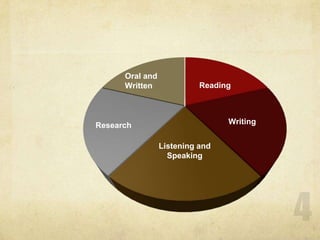
4
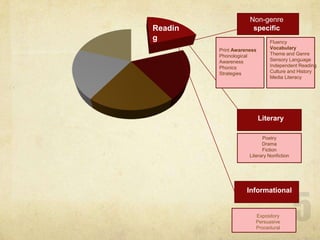
5Non-genrespecificReadingFluencyVocabularyTheme and GenreSensory LanguageIndependent ReadingCulture and HistoryMedia LiteracyPrint AwarenessPhonological AwarenessPhonicsStrategiesLiteraryPoetryDramaFictionLiterary NonfictionInformationalExpositoryPersuasiveProcedural
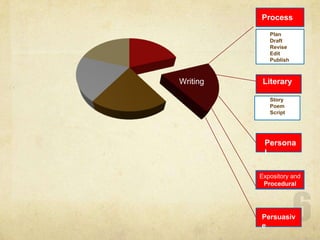
6ProcessPlanDraftReviseEditPublishLiteraryStoryPoemScriptPersonalExpositoryandProceduralPersuasive
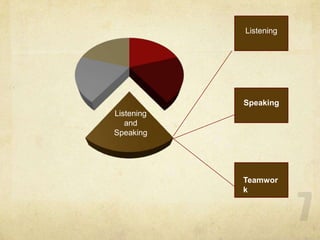
7ListeningSpeakingTeamwork
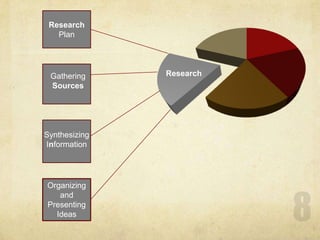
8ResearchPlanGatheringSourcesSynthesizingInformationOrganizingandPresentingIdeas
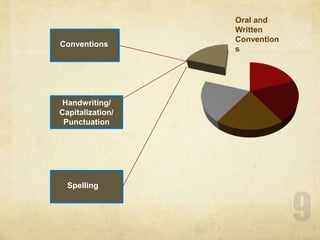
9Oral and Written ConventionsConventionsHandwriting/ Capitalization/ PunctuationSpelling
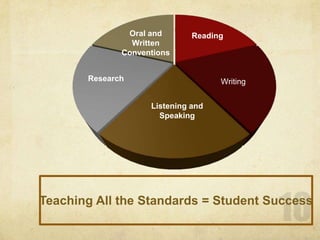
10Teaching All the Standards = Student Success
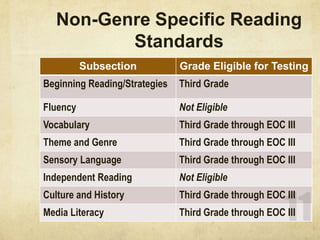
Non-Genre Specific Reading Standards11
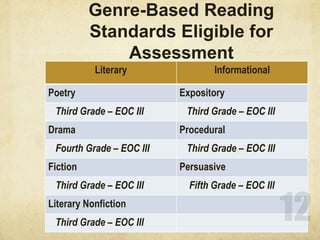
Genre-Based Reading Standards Eligible for Assessment12
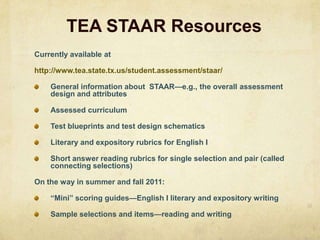
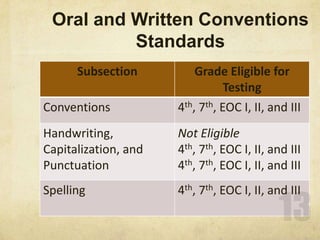
Oral and Written Conventions Standards13
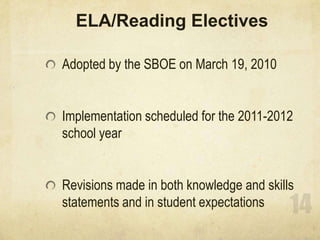
ELA/Reading ElectivesAdopted by the SBOE on March 19, 2010Implementation scheduled for the 2011-2012 school yearRevisions made in both knowledge and skills statements and in student expectations14
Instructional MaterialsProclamation 201115
Proclamation 2011 http://www.tea.state.tx.us/index2.aspx?id=2147486677The State Board of Education issued Proclamation 2011 in May 2008. Panels convened in Austin during the summer of 2010 to review instructional materials.The adoption of materials under Proclamation 2011 occurred in November 2010. The legislature decides funding.The adopted materials are scheduled to be available for use beginning with the 2011-2012 school year.16
STATE OF TEXAS ASSESSMENTS OF ACADEMIC READINESS (STAAR)Grades 3−8 ReadingGrades 4 and 7 WritingEnglish I, II, and IIIVictoria YoungDirector of Reading, Writing, and Social Studies AssessmentsTexas Education Agency
Reading—Structure of Reporting CategoriesRC 1: Questions about vocabulary and connections across texts for grades 3−8 (vocabulary only at grade 3); high school also includes short answer questionsRC 2: Questions about single literary texts: fiction, literary nonfiction, poetry, drama (drama beginning at grade 4)RC 3: Questions about informational texts: expository and persuasive (persuasive beginning at grade 5)18
Reading—Assessing DetailsDetails in literary texts in grades 3−5 only: they must be significant and support the development of the plot, characters, or main idea/themeDetails in expository texts in grades 3−8: they must be significant and support the development of the main ideaNo details assessed at any grade for persuasive textsNo details assessed for any type of text at high school19
Reading—Assessing PoetryVarying types of poems being developed for STAAR but emphasis not on identificationFocus is on how poet creates meaning using stanzas, word placement or emphasis, line length, repetition/rhythm/rhyme, sound effects, sensory languageAt middle and high school, how speaker’s point of view or perspective affects meaning20
Reading—Assessing DramaLimited number of characters, especially at lower gradesMostly excerpts being used—one or two scenes (dependent on length)Focus is on how the playwright creates meaning through the dialogue—interaction between and among charactersQuestions about stage directions are focused on their purpose: why they are there and how they influence the way the reader reads the scene (Stage directions = an extension of the playwright’s narrational strategies)21
Reading Test Design	STAAR reading assessments will emphasize students’ abilityto understand how to use text evidence to confirm the validity of their ideasto make connections within and across texts (“across texts” begins at grade 4)to think critically/inferentiallyto “go beyond” a literal understanding of what they read22
Student Success in Readingand on STAARStudents must be provided in-depth instruction in all genres represented by the ELA/R TEKSEqual weight must be given to fiction and expository genres—the readiness genres—at elementary, middle, and high schoolInstruction must emphasize critical/ inferential thinking rather than isolated skillsStudents must be able to make connections between different genres (and be able to “see” the thematic links)23
STAAR Reading Rubrics—Text EvidenceStudents must know that text evidence is always flawed when it isonly a general reference to the texttoo partial to support the ideaweakly linked to the ideaused inappropriately because it wrongly manipulates the meaning of the textStudents must know that to score a 2 or 3 on short answer reading, text evidence must be considered accurate and relevant (SP 2) or specific and well chosen (SP 3) 24
STAAR Writing DesignRevising and Editing25Revision and editing assessed separately, with increased focus on revision as students become more experienced and skilled writersFor Grade 4, 32% of multiple-choice score from revision (9 items) and 68% of score from editing (19 items)For Grade 7, 40% of multiple-choice score from revision (16 items) and 60% of score from editing (24 items)For English I, II, and III, 50% of multiple-choice score from revision (15 items) and  50% of score from editing (15 items)
Revision and Editing		Grades 4 and 7Example of Grade 4 revision stem:   David would like to improve his story by adding a strong concluding sentence after sentence 28. Which of these would be the BEST sentence to add?Example of Grade 7 revision stem:	The transition between the third paragraph (sentences 13–19) and the fourth paragraph (sentences 20–25) is abrupt. Which sentence could Veronica add before sentence 20 to help with this transition?26
Revision and EditingEnglish I, II, and III27Examples of high school revision questions:	Steven wants to more effectively establish the thesis in his paper. Which revision of sentence 5 can help him accomplish his goal?Cristina wants to strengthen the transition between the second and third paragraphs. What sentence should she add before sentence 10?  (beginning of paragraph 3)
STAAR Written Composition28Students will write two one-page essays (26 lines maximum) addressing different types of writingGrade 4—personal narrative and expositoryGrade 7−personal narrative (with extension) and expositoryEnglish I−literary and expositoryEnglish II−expository and persuasiveEnglish III−persuasive and analyticEssays will be weighted equallyNo “gatekeeper” (automatic fail of the writing test for a 1)
STAAR Writing Prompts 29Expository, persuasive, and analytic prompts contain a stimulus and are scaffolded:Read, Think, Write, Be Sure to −Personal narrative and literary prompts contain a stimulus and are scaffolded, though less so than other promptsAnalytic prompts contain a literary or informational text (approximately 425−500 words), which students must analyze
STAAR Analytic Essay 30A combination of expository writing and interpretation of one aspect of a literary or expository textScore based on the student’s ability to interpret the text and support it with relevant textual evidence (15C) AND quality of the writing (criteria under expository writing in 15A)
STAAR Writing Rubrics31A rubric is being developed for each writing type, but three overarching aspects of writing are addressed in all rubricsOrganization/ProgressionDevelopment of IdeasUse of Language/Conventions
STAAR Writing Rubrics32Organization/Progression—bullet #1: the degree to which the organizational structure is appropriate to the purpose and specific demands of the prompt. This bullet “plays out” in slightly different ways depending on the purpose for writing, so how do we know when we see it?
STAAR Writing Rubrics33Grade 7 Personal Narrative: The writer uses organizational strategies or literary devices that are particularly suited to the narrative task. The writer is able to clearly convey the experience and communicate its importance or meaning.Grade 9 Expository: The organizational strategies the writer uses enhance the clarity and quality of the essay.
STAAR Writing Rubrics34Development of Ideas—bullet #2: the degree to which the piece is thoughtful and engaging
STAAR Writing Rubrics35Grade 7 Personal Narrative: The writer demonstrates a deep understanding of the writing task by establishing a believable situation, providing plausible motivations for behavior or actions, and revealing changes or insights that developed as a result of the experience.Grade 9 Expository: The writer may approach the topic from an unusual perspective, may use his/her unique experiences or view of the world as a basis for writing, or may connect ideas in interesting ways. The writer demonstrates a deep understanding of the expository writing task.
STAAR Writing Rubrics36Use of Language/Conventions—bullet #1: the degree to which word choice is thoughtful and appropriate to the purpose and toneGrade 7 Personal Narrative: Effective diction enables the writer to recreate the experience in a way that reflects its importance or meaning.Grade 9 Expository: Word choice strongly contributes to the clarity of the essay.
TEA STAAR Resources37Currently available athttp://www.tea.state.tx.us/student.assessment/staar/General information about  STAAR—e.g., the overall assessment design and attributesAssessed curriculumTest blueprints and test design schematicsLiterary and expository rubrics for English IShort answer reading rubrics for single selection and pair (called connecting selections)On the way in summer and fall 2011:“Mini” scoring guides—English I literary and expository writingSample selections and items—reading and writing
Background KnowledgeAre we using Text Structures?Sentence Frames?Paragraph Frames?
Comprehension Going Forward//Recommendation Engine//Ask an AlgorithmWhich TV for Me?I want a Panasonic 103-inch TV.  My wife says that’s too big. Is she right?  Optimal viewing distance at 1080p-diagonal screen size /0.84; maximum OVD for 103-inch screen=122.619 inches.Recommendation:  If seat to screen distance > 122.619 inches;  Purchase TV; if < 122.619 inches:  Construct home theater space of necessary size; purchase TV.
Skilled Writers MakeThese Mental MovesMonitor their comprehensionVisualize and make sensory imagesDraw inferencesConnect to background knowledgeAsk questions of the textDetermine what’s importantSynthesize and summarize

Facilitator 4-14-11

  • 1.
  • 2.
    AgendaBYOD – CrystenCaviness8th Grade BookPre-AP / AP Summer Assignments April 22 Rationales May 13 AssignmentsNews from CRESTNewest BooksCurriculum SurveyALT Time SurveyOther
  • 3.
  • 4.
  • 5.
    5Non-genrespecificReadingFluencyVocabularyTheme and GenreSensoryLanguageIndependent ReadingCulture and HistoryMedia LiteracyPrint AwarenessPhonological AwarenessPhonicsStrategiesLiteraryPoetryDramaFictionLiterary NonfictionInformationalExpositoryPersuasiveProcedural
  • 6.
  • 7.
  • 8.
  • 9.
    9Oral and WrittenConventionsConventionsHandwriting/ Capitalization/ PunctuationSpelling
  • 10.
    10Teaching All theStandards = Student Success
  • 11.
  • 12.
    Genre-Based Reading StandardsEligible for Assessment12
  • 13.
    Oral and WrittenConventions Standards13
  • 14.
    ELA/Reading ElectivesAdopted bythe SBOE on March 19, 2010Implementation scheduled for the 2011-2012 school yearRevisions made in both knowledge and skills statements and in student expectations14
  • 15.
  • 16.
    Proclamation 2011 http://www.tea.state.tx.us/index2.aspx?id=2147486677TheState Board of Education issued Proclamation 2011 in May 2008. Panels convened in Austin during the summer of 2010 to review instructional materials.The adoption of materials under Proclamation 2011 occurred in November 2010. The legislature decides funding.The adopted materials are scheduled to be available for use beginning with the 2011-2012 school year.16
  • 17.
    STATE OF TEXASASSESSMENTS OF ACADEMIC READINESS (STAAR)Grades 3−8 ReadingGrades 4 and 7 WritingEnglish I, II, and IIIVictoria YoungDirector of Reading, Writing, and Social Studies AssessmentsTexas Education Agency
  • 18.
    Reading—Structure of ReportingCategoriesRC 1: Questions about vocabulary and connections across texts for grades 3−8 (vocabulary only at grade 3); high school also includes short answer questionsRC 2: Questions about single literary texts: fiction, literary nonfiction, poetry, drama (drama beginning at grade 4)RC 3: Questions about informational texts: expository and persuasive (persuasive beginning at grade 5)18
  • 19.
    Reading—Assessing DetailsDetails inliterary texts in grades 3−5 only: they must be significant and support the development of the plot, characters, or main idea/themeDetails in expository texts in grades 3−8: they must be significant and support the development of the main ideaNo details assessed at any grade for persuasive textsNo details assessed for any type of text at high school19
  • 20.
    Reading—Assessing PoetryVarying typesof poems being developed for STAAR but emphasis not on identificationFocus is on how poet creates meaning using stanzas, word placement or emphasis, line length, repetition/rhythm/rhyme, sound effects, sensory languageAt middle and high school, how speaker’s point of view or perspective affects meaning20
  • 21.
    Reading—Assessing DramaLimited numberof characters, especially at lower gradesMostly excerpts being used—one or two scenes (dependent on length)Focus is on how the playwright creates meaning through the dialogue—interaction between and among charactersQuestions about stage directions are focused on their purpose: why they are there and how they influence the way the reader reads the scene (Stage directions = an extension of the playwright’s narrational strategies)21
  • 22.
    Reading Test Design STAARreading assessments will emphasize students’ abilityto understand how to use text evidence to confirm the validity of their ideasto make connections within and across texts (“across texts” begins at grade 4)to think critically/inferentiallyto “go beyond” a literal understanding of what they read22
  • 23.
    Student Success inReadingand on STAARStudents must be provided in-depth instruction in all genres represented by the ELA/R TEKSEqual weight must be given to fiction and expository genres—the readiness genres—at elementary, middle, and high schoolInstruction must emphasize critical/ inferential thinking rather than isolated skillsStudents must be able to make connections between different genres (and be able to “see” the thematic links)23
  • 24.
    STAAR Reading Rubrics—TextEvidenceStudents must know that text evidence is always flawed when it isonly a general reference to the texttoo partial to support the ideaweakly linked to the ideaused inappropriately because it wrongly manipulates the meaning of the textStudents must know that to score a 2 or 3 on short answer reading, text evidence must be considered accurate and relevant (SP 2) or specific and well chosen (SP 3) 24
  • 25.
    STAAR Writing DesignRevisingand Editing25Revision and editing assessed separately, with increased focus on revision as students become more experienced and skilled writersFor Grade 4, 32% of multiple-choice score from revision (9 items) and 68% of score from editing (19 items)For Grade 7, 40% of multiple-choice score from revision (16 items) and 60% of score from editing (24 items)For English I, II, and III, 50% of multiple-choice score from revision (15 items) and 50% of score from editing (15 items)
  • 26.
    Revision and Editing Grades4 and 7Example of Grade 4 revision stem: David would like to improve his story by adding a strong concluding sentence after sentence 28. Which of these would be the BEST sentence to add?Example of Grade 7 revision stem: The transition between the third paragraph (sentences 13–19) and the fourth paragraph (sentences 20–25) is abrupt. Which sentence could Veronica add before sentence 20 to help with this transition?26
  • 27.
    Revision and EditingEnglishI, II, and III27Examples of high school revision questions: Steven wants to more effectively establish the thesis in his paper. Which revision of sentence 5 can help him accomplish his goal?Cristina wants to strengthen the transition between the second and third paragraphs. What sentence should she add before sentence 10? (beginning of paragraph 3)
  • 28.
    STAAR Written Composition28Studentswill write two one-page essays (26 lines maximum) addressing different types of writingGrade 4—personal narrative and expositoryGrade 7−personal narrative (with extension) and expositoryEnglish I−literary and expositoryEnglish II−expository and persuasiveEnglish III−persuasive and analyticEssays will be weighted equallyNo “gatekeeper” (automatic fail of the writing test for a 1)
  • 29.
    STAAR Writing Prompts29Expository, persuasive, and analytic prompts contain a stimulus and are scaffolded:Read, Think, Write, Be Sure to −Personal narrative and literary prompts contain a stimulus and are scaffolded, though less so than other promptsAnalytic prompts contain a literary or informational text (approximately 425−500 words), which students must analyze
  • 30.
    STAAR Analytic Essay30A combination of expository writing and interpretation of one aspect of a literary or expository textScore based on the student’s ability to interpret the text and support it with relevant textual evidence (15C) AND quality of the writing (criteria under expository writing in 15A)
  • 31.
    STAAR Writing Rubrics31Arubric is being developed for each writing type, but three overarching aspects of writing are addressed in all rubricsOrganization/ProgressionDevelopment of IdeasUse of Language/Conventions
  • 32.
    STAAR Writing Rubrics32Organization/Progression—bullet#1: the degree to which the organizational structure is appropriate to the purpose and specific demands of the prompt. This bullet “plays out” in slightly different ways depending on the purpose for writing, so how do we know when we see it?
  • 33.
    STAAR Writing Rubrics33Grade7 Personal Narrative: The writer uses organizational strategies or literary devices that are particularly suited to the narrative task. The writer is able to clearly convey the experience and communicate its importance or meaning.Grade 9 Expository: The organizational strategies the writer uses enhance the clarity and quality of the essay.
  • 34.
    STAAR Writing Rubrics34Developmentof Ideas—bullet #2: the degree to which the piece is thoughtful and engaging
  • 35.
    STAAR Writing Rubrics35Grade7 Personal Narrative: The writer demonstrates a deep understanding of the writing task by establishing a believable situation, providing plausible motivations for behavior or actions, and revealing changes or insights that developed as a result of the experience.Grade 9 Expository: The writer may approach the topic from an unusual perspective, may use his/her unique experiences or view of the world as a basis for writing, or may connect ideas in interesting ways. The writer demonstrates a deep understanding of the expository writing task.
  • 36.
    STAAR Writing Rubrics36Useof Language/Conventions—bullet #1: the degree to which word choice is thoughtful and appropriate to the purpose and toneGrade 7 Personal Narrative: Effective diction enables the writer to recreate the experience in a way that reflects its importance or meaning.Grade 9 Expository: Word choice strongly contributes to the clarity of the essay.
  • 37.
    TEA STAAR Resources37Currentlyavailable athttp://www.tea.state.tx.us/student.assessment/staar/General information about STAAR—e.g., the overall assessment design and attributesAssessed curriculumTest blueprints and test design schematicsLiterary and expository rubrics for English IShort answer reading rubrics for single selection and pair (called connecting selections)On the way in summer and fall 2011:“Mini” scoring guides—English I literary and expository writingSample selections and items—reading and writing
  • 38.
    Background KnowledgeAre weusing Text Structures?Sentence Frames?Paragraph Frames?
  • 39.
    Comprehension Going Forward//RecommendationEngine//Ask an AlgorithmWhich TV for Me?I want a Panasonic 103-inch TV. My wife says that’s too big. Is she right? Optimal viewing distance at 1080p-diagonal screen size /0.84; maximum OVD for 103-inch screen=122.619 inches.Recommendation: If seat to screen distance > 122.619 inches; Purchase TV; if < 122.619 inches: Construct home theater space of necessary size; purchase TV.
  • 40.
    Skilled Writers MakeTheseMental MovesMonitor their comprehensionVisualize and make sensory imagesDraw inferencesConnect to background knowledgeAsk questions of the textDetermine what’s importantSynthesize and summarize

Editor's Notes

  • #18 When the TAKS test first went out, we had extensive training on it, but this test will not have that much teacher training. TEA’s assessment dept. lost 12 people this summer, so there won’t be anyone to do the training.
  • #19 TAKS Objectives = STAAR Reporting Categories
  • #20 Details are assessed in reading when we ask students for sequence or summaries of the plot’s main events. After grade 5, details are gone literary. After grade 8, they are gone for informational or persuasive. That means we must work on the analytical skills in reading.
  • #21 We must focus on understanding poetry. Emphasize bullets 2 and 3. Use the word SPEAKER in poetry.
  • #22 4-6 characters
  • #23 We must go beyond the literal reading!
  • #24 There will be some interesting pairings like poem/expository. These pairs will not always have an obvious link.
  • #28 Essays will be worth 25% each
  • #30 The TEKS actually say:Thesis, organization, development, proofreadingExcept for the analytic prompt, the other prompts will have symbolic photographs—not real personal and not cartoonish
  • #31 This will feel like a combination of the short answer and the expository—writing and interpreting
  • #34 In grade 7, the curriculum is clear. Communicate the importance of the experience and the reasons for actions, or the consequences of the actions—that’s the extension. One or more of these will be written into the prompt—grade 7 is not a made up story!4th grade – central idea7th grade – controlling idea9-11th grades – thesis26 lines—period!
  • #37 Use language in appropriate ways
  • #38 Dictionaries—non-internet ok1:5 but 1:3 recommended