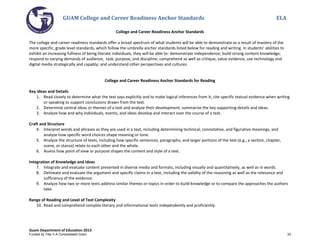
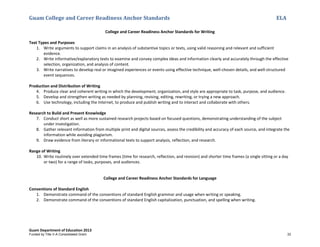
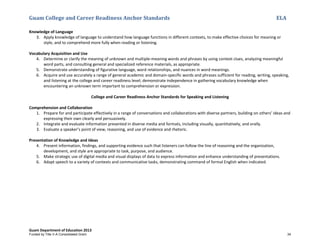
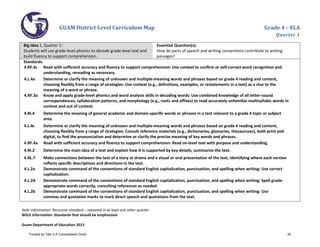
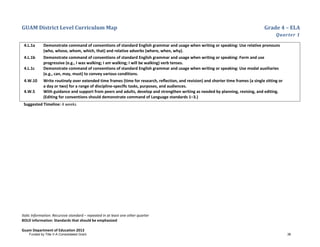
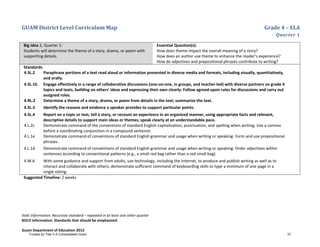
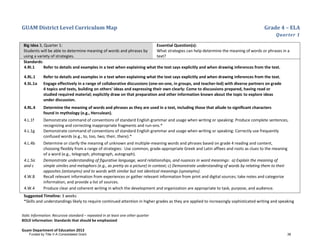
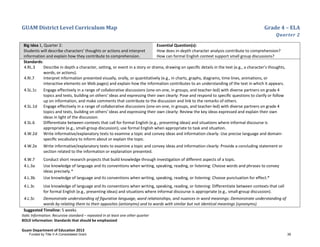
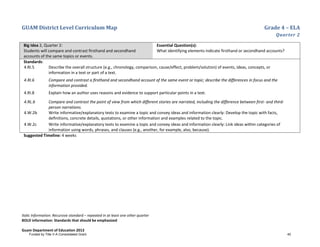
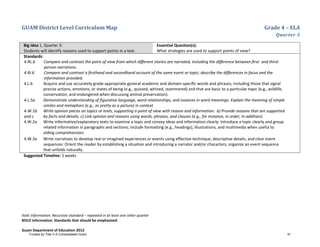
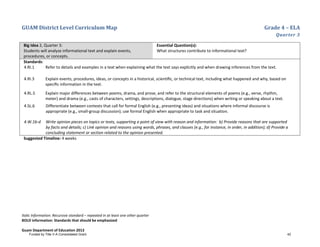
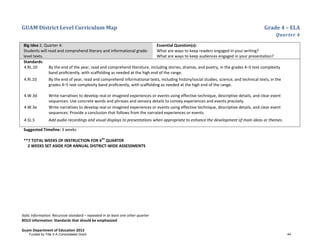
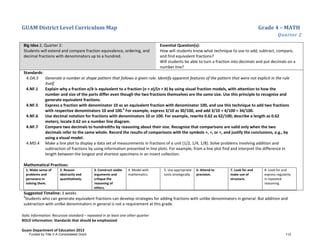
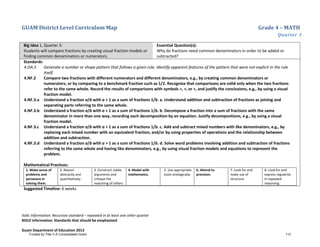
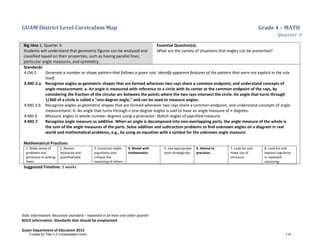
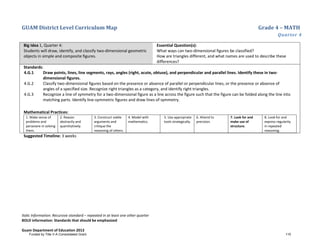
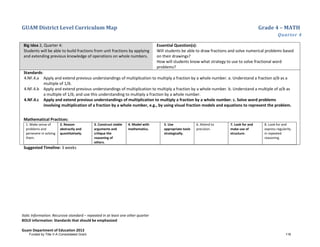
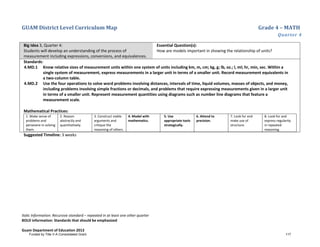
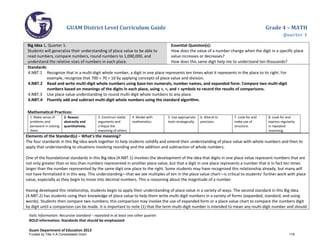
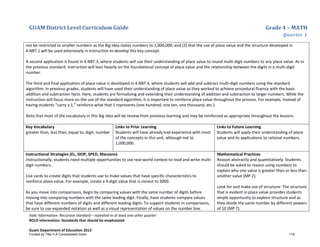
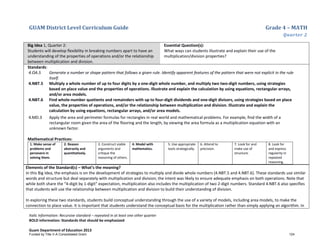
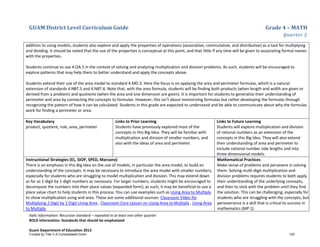
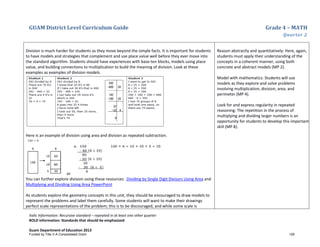
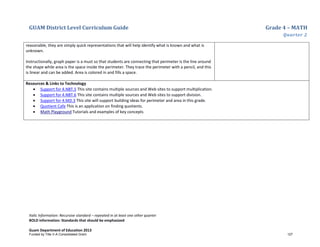
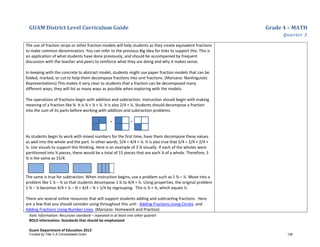
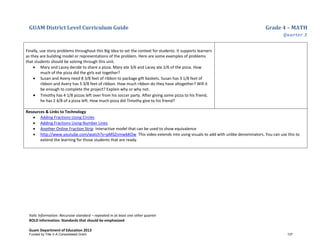
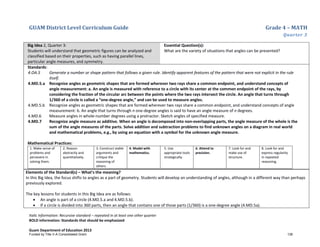
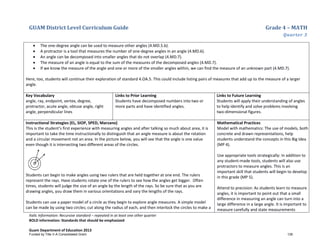
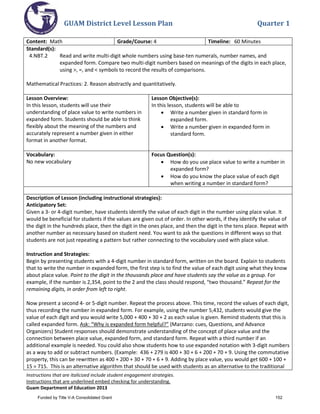
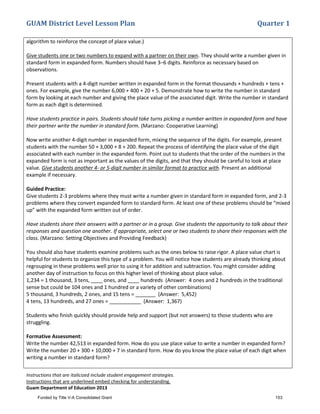
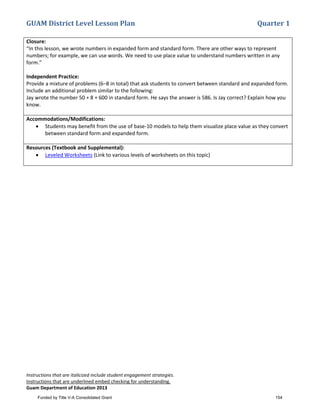
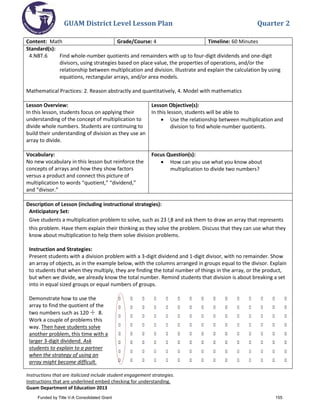
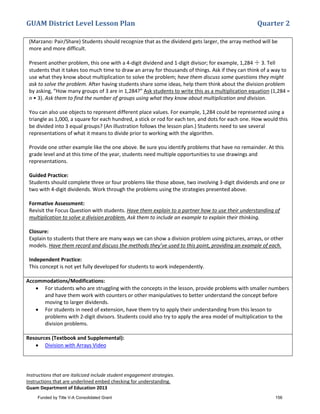
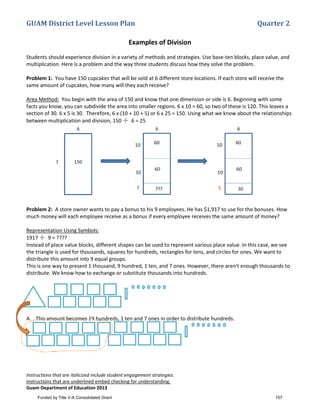
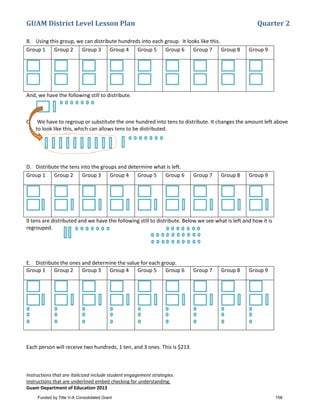
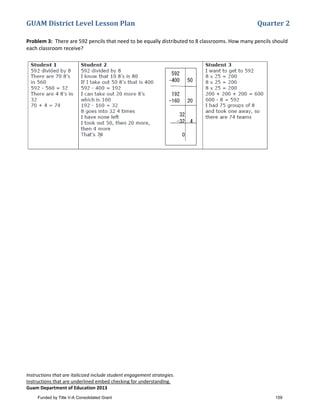
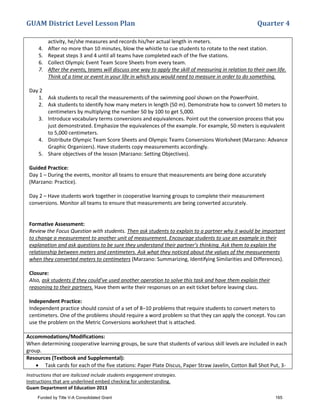
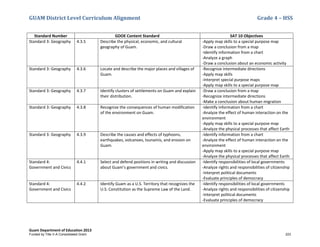
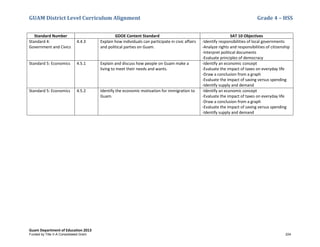
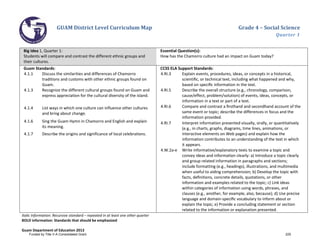
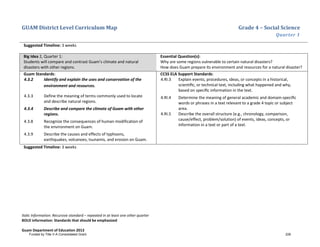
Table of Contents
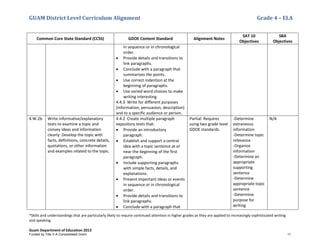
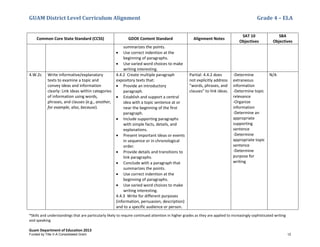
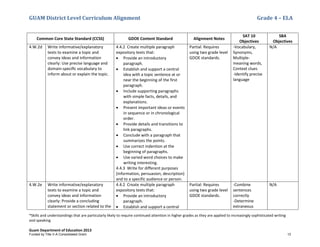
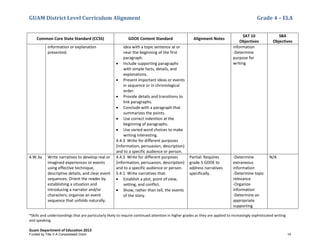
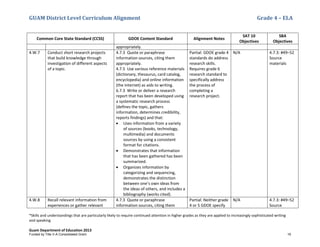
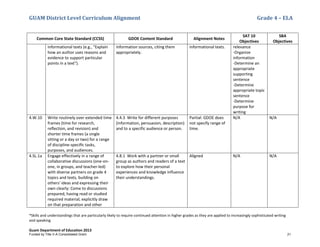
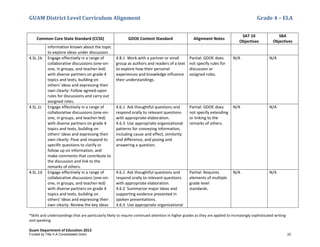
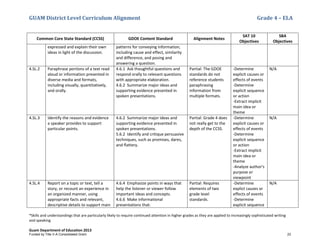
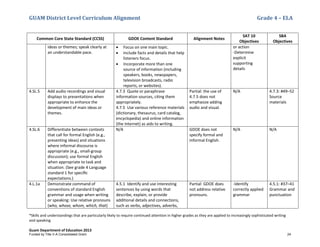
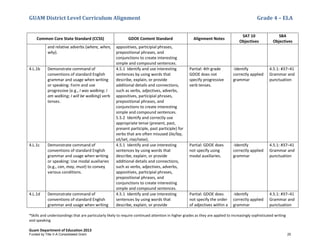
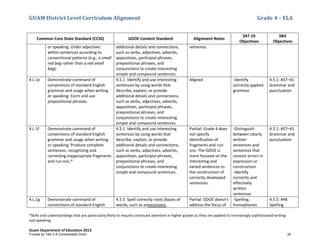
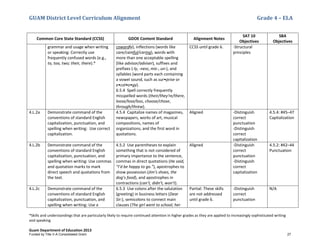
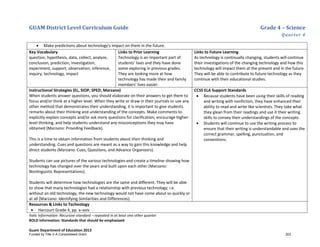
Grade 4
English Language Arts
Curriculum Alignment ................................................................................................................. 1
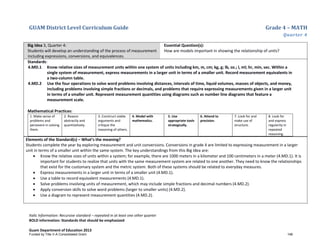
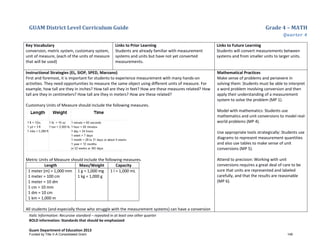
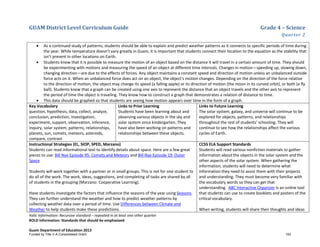
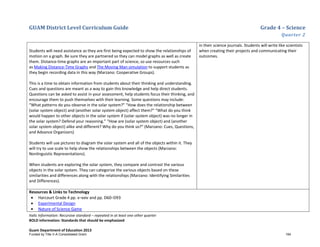
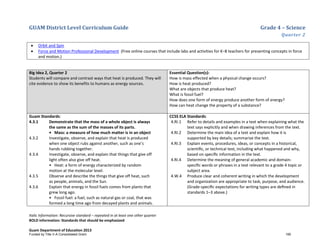
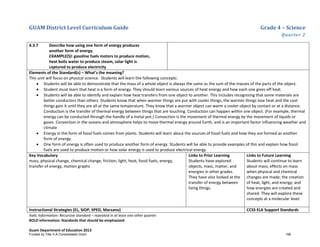
Curriculum Map .......................................................................................................................... 32
Curriculum Guide ........................................................................................................................ 45
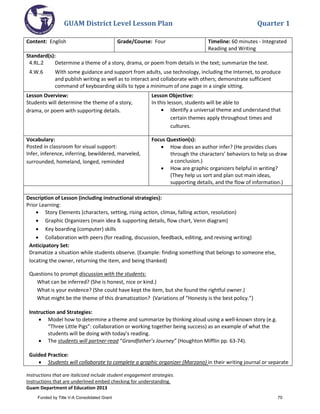
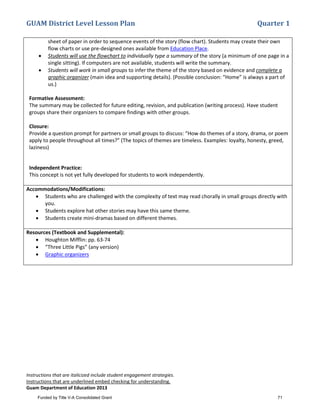
Lesson Plan Quarter 1 ................................................................................................................. 70
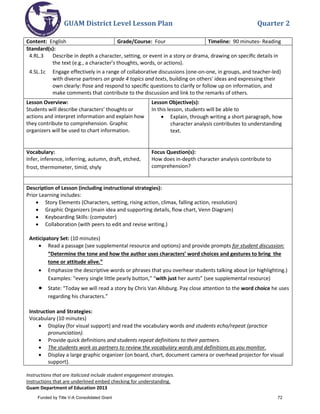
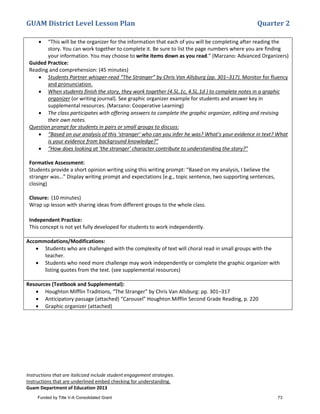
Lesson Plan Quarter 2 ................................................................................................................. 72
Lesson Plan Quarter 3 ................................................................................................................. 76
Lesson Plan Quarter 4 ................................................................................................................. 92
Math
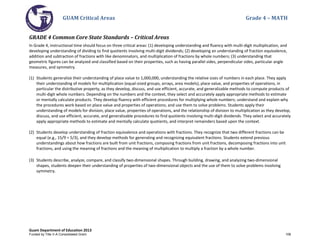
Curriculum Alignment ................................................................................................................. 96
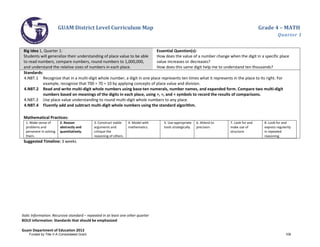
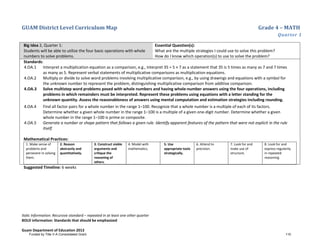
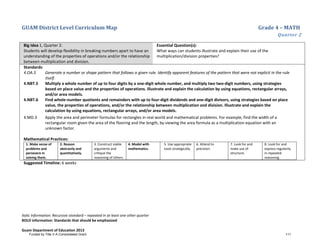
Curriculum Map .......................................................................................................................... 108
Curriculum Guide ........................................................................................................................ 118
Lesson Plan Quarter 1 ................................................................................................................. 152
Lesson Plan Quarter 2 ................................................................................................................. 155
Lesson Plan Quarter 3 .................................................................................................................160
Lesson Plan Quarter 4 ................................................................................................................. 164
Science
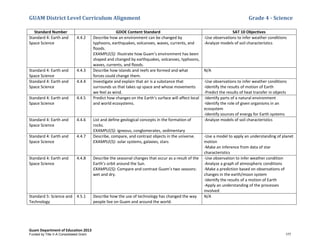
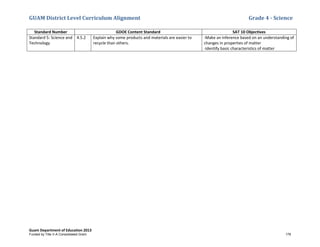
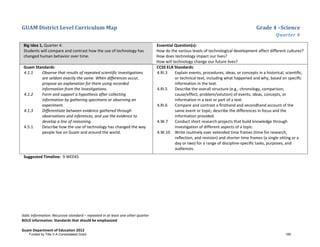
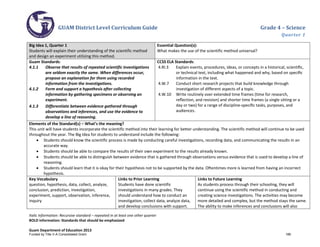
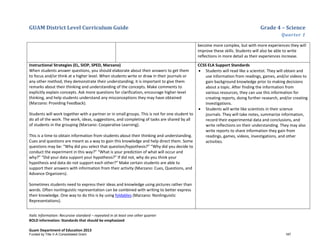
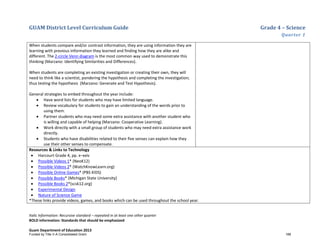
Curriculum Alignment ................................................................................................................. 175
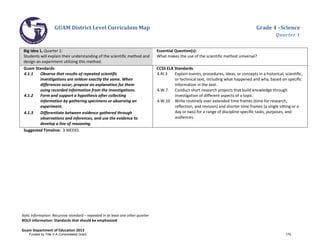
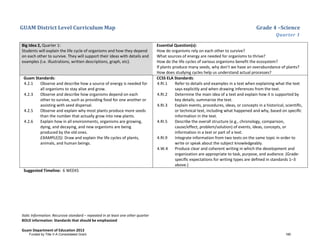
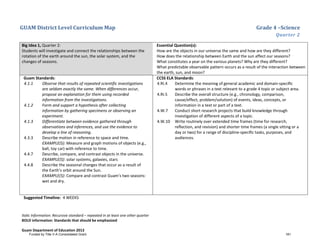
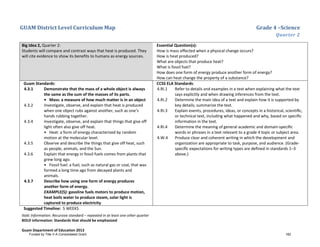
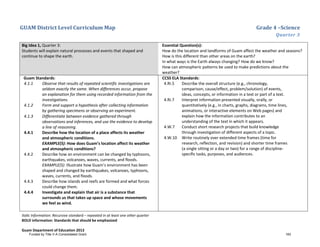
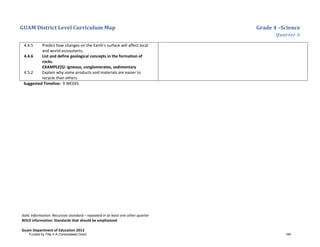
Curriculum Map .......................................................................................................................... 179
Curriculum Guide ........................................................................................................................ 186
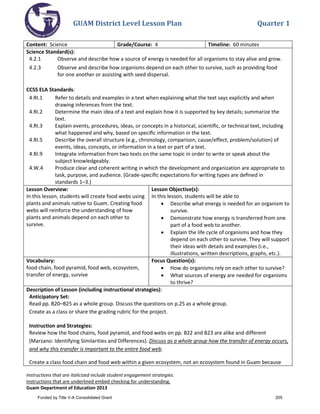
Lesson Plan Quarter 1 ................................................................................................................. 205
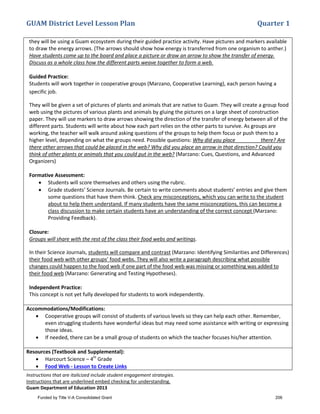
Lesson Plan Quarter 2 ................................................................................................................. 209
Lesson Plan Quarter 3 ................................................................................................................. 213
Lesson Plan Quarter 4 ................................................................................................................. 217
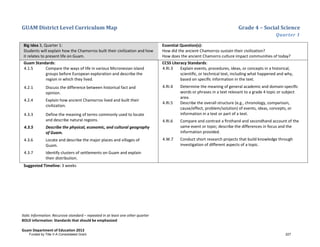
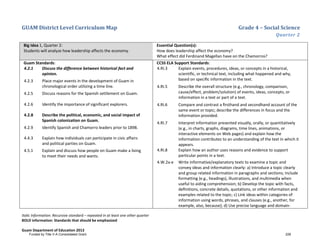
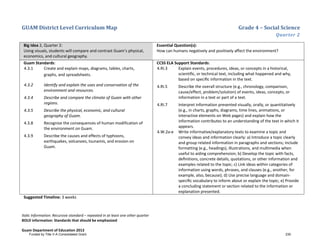
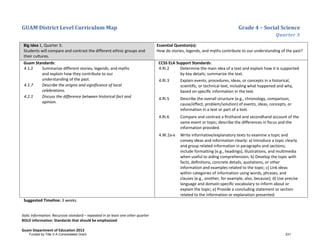
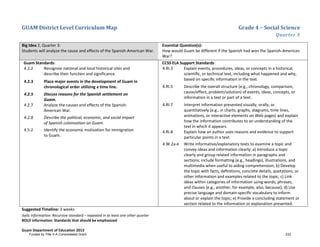
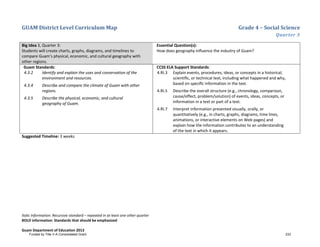
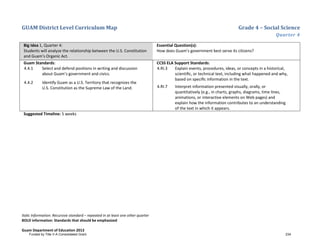
Social Science
Curriculum Alignment ................................................................................................................. 220
Curriculum Map .......................................................................................................................... 225
Curriculum Guide ........................................................................................................................ 236
Lesson Plan Quarter 1 ................................................................................................................. 265
Lesson Plan Quarter 2 ................................................................................................................. 267
Lesson Plan Quarter 3 ................................................................................................................. 272
Lesson Plan Quarter 4 ................................................................................................................. 274
Funded by Title V-A Consolidated Grant i
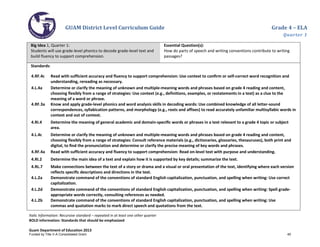
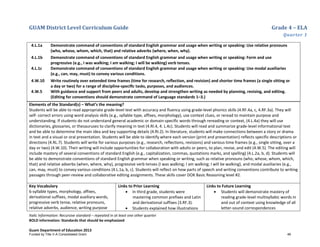
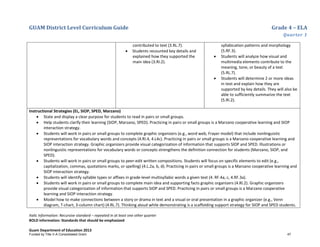
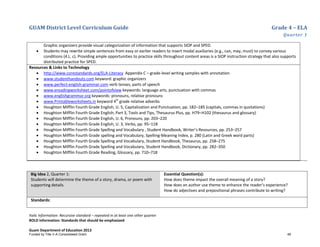
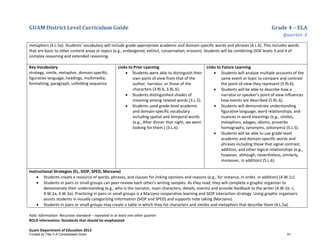
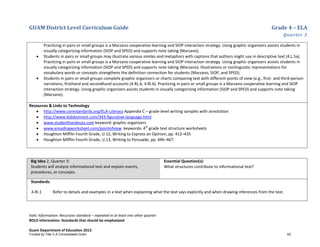
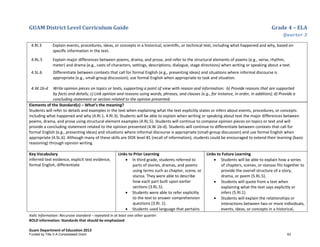
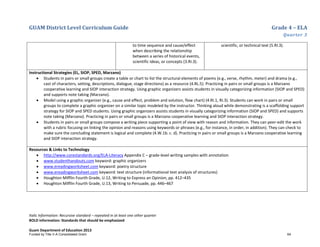
GUAM District Level Curriculum Alignment Grade 4 – ELA
*Skills and understandings that are particularly likely to require continued attention in higher grades as they are applied to increasingly sophisticated writing
and speaking
Guam Department of Education 2013
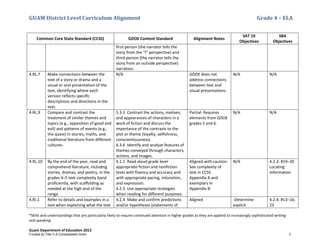
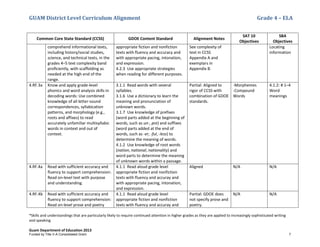
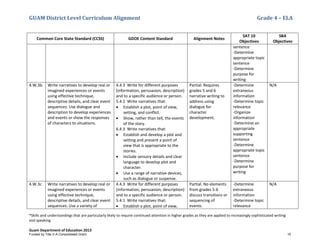
Common Core State Standard (CCSS) GDOE Content Standard Alignment Notes
SAT 10
Objectives
SBA
Objectives
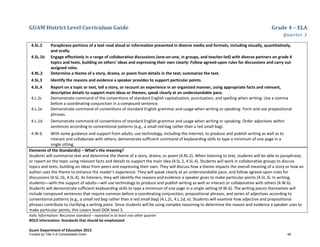
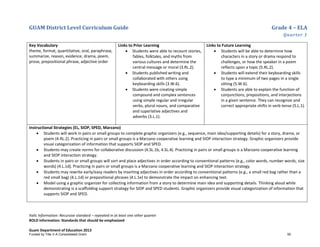
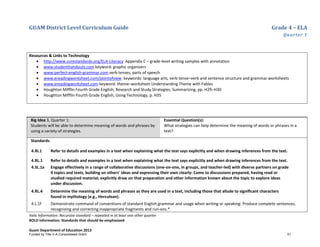
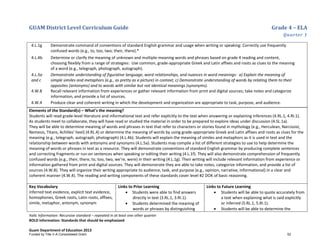
4.RL.1 Refer to details and examples in a
text when explaining what the text
says explicitly and when drawing
inferences from the text.
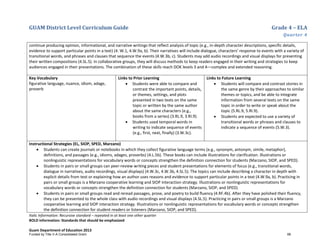
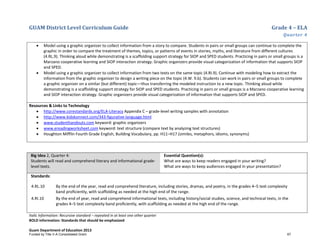
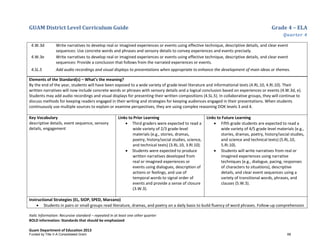
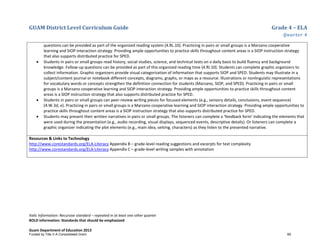
4.2.4 Make and confirm predictions
and/or hypotheses (statements of
theories or assumptions) about text
by using prior knowledge and ideas
presented in the text itself, including
illustrations, titles, topic sentences,
important words, foreshadowing
clues (clues that indicate what might
happen next), and direct quotations.
4.3.2 Identify the main events of the
plot, including their causes and the
effects of each event on future
actions, and the major theme from
the story action.
Partial: Requires a
combination of GDOE
nonfiction and
literary standards.
-Draw
conclusions from
details
4.2.4: #13–16;
23
Textual
details;
making
predictions
4.3.2: #17–18;
26; 29–32
Inferencing;
theme
4.RL.2 Determine a theme of a story,
drama, or poem from details in the
text; summarize the text.
4.3.2 Identify the main events of the
plot, including their causes and the
effects of each event on future
actions, and the major theme from
the story action.
4.6.2 Summarize major ideas and
supporting evidence presented in
spoken presentations.
Partial: GDOE does
not address
summarizing the text
that is read. Two
grade level standards
are needed for
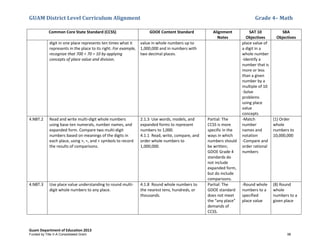
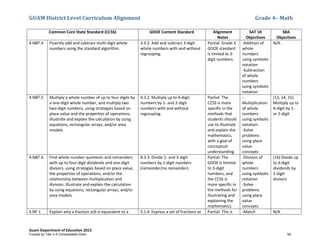
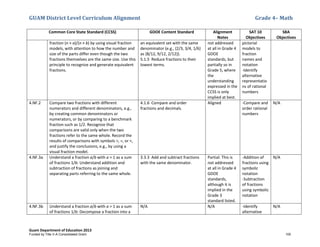
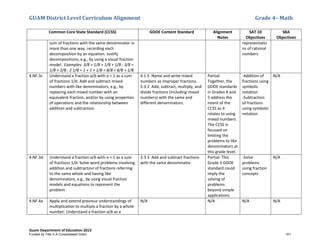
alignment.
-Extract implicit
theme or main
idea
4.3.2: #17–18;
26; 29–32
Inferencing;
theme
4.RL.3 Describe in depth a character,
setting, or event in a story or
drama, drawing on specific details
in the text (e.g., a character’s
thoughts, words, or actions).
4.3.3 Use knowledge of the situation,
setting, and a character's traits,
motivations, and feelings to
determine the causes for that
character's actions.
Partial: GDOE focuses
on the characters,
while CCSS includes
describing setting or
event in a story.
-Draw
conclusions from
details
-Interpret
chacter traits,
motivation, or
behavior
N/A
Funded by Title V-A Consolidated Grant 1
GUAM District Level Curriculum Alignment Grade 4 – ELA
*Skills and understandings that are particularly likely to require continued attention in higher grades as they are applied to increasingly sophisticated writing
and speaking
Guam Department of Education 2013
Common Core State Standard (CCSS) GDOE Content Standard Alignment Notes
SAT 10
Objectives
SBA
Objectives
4.RL.4 Determine the meaning of words
and phrases as they are used in a
text, including those that allude to
significant characters found in
mythology (e.g., Herculean).
4.1.2 Use knowledge of root words
(nation, national, nationality) and
word parts to determine the meaning
of unknown words within a passage.
4.1.4 Distinguish and interpret words
with multiple meanings (quarters) by
using context clues (the meaning of
the text around a word).
4.3.4 Define figurative language, such
as similes, metaphors, hyperbole, or
personification, and identify its use in
literary works.
Partial: Need
different portions of
the GDOE standards.
The CCSS also
mentions word parts
from mythological
characters, which
none of these GDOE
standards reference.
-Determine
unknown words
from context
4.1.2: #1–4
Word
meanings
4.1.4: #9–12
Word
meanings
4.3.4: #33–34
Figurative
language
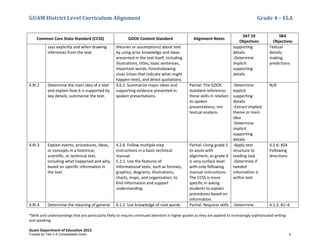
4.RL.5 Explain major differences between
poems, drama, and prose, and
refer to the structural elements of
poems (e.g., verse, rhythm, meter)
and drama (e.g., casts of
characters, settings, descriptions,
dialogue, stage directions) when
writing or speaking about a text.
4.3.1 Describe the differences of
various imaginative forms of
literature, including fantasies, fables,
myths, legends, and other tales.
Partial: Grade 4
GDOE does not
include poems,
prose, and structural
elements.
-Identify
characteristics of
genre
4.3.1: #25, 27,
28
Genre
characteristics
4.RL.6 Compare and contrast the point of
view from which different stories
are narrated, including the
difference between first- and third-
person narrations.
4.2.5 Compare and contrast
information on the same topic after
reading several texts.
4.3.5 Identify the narrator in a
selection and tell whether the
narrator or speaker is involved in the
story.
6.3.5 Identify the speaker and
recognize the difference between
Partial: Grade 4
GDOE does not
address comparing
multiple points of
view, which is not
addressed until 6th
grade.
N/A 4.2.5: #21–22
Locating
information
4.3.5: #35–36
Identifying
narrator
Funded by Title V-A Consolidated Grant 2
GUAM District Level Curriculum Alignment Grade 4 – ELA
*Skills and understandings that are particularly likely to require continued attention in higher grades as they are applied to increasingly sophisticated writing
and speaking
Guam Department of Education 2013
Common Core State Standard (CCSS) GDOE Content Standard Alignment Notes
SAT 10
Objectives
SBA
Objectives
first-person (the narrator tells the
story from the “I” perspective) and
third-person (the narrator tells the
story from an outside perspective)
narration.
4.RL.7 Make connections between the
text of a story or drama and a
visual or oral presentation of the
text, identifying where each
version reflects specific
descriptions and directions in the
text.
N/A GDOE does not
address connections
between text and
visual presentations.
N/A N/A
4.RL.9 Compare and contrast the
treatment of similar themes and
topics (e.g., opposition of good and
evil) and patterns of events (e.g.,
the quest) in stories, myths, and
traditional literature from different
cultures.
5.3.3 Contrast the actions, motives,
and appearances of characters in a
work of fiction and discuss the
importance of the contrasts to the
plot or theme (loyalty, selfishness,
conscientiousness).
6.3.6 Identify and analyze features of
themes conveyed through characters,
actions, and images.
Partial: Requires
elements from GDOE
grades 5 and 6.
N/A N/A
4.RL.10 By the end of the year, read and
comprehend literature, including
stories, dramas, and poetry, in the
grades 4–5 text complexity band
proficiently, with scaffolding as
needed at the high end of the
range.
4.1.1 Read aloud grade level
appropriate fiction and nonfiction
texts with fluency and accuracy and
with appropriate pacing, intonation,
and expression.
4.2.3 Use appropriate strategies
when reading for different purposes.
Aligned with caution:
See complexity of
text in CCSS
Appendix A and
exemplars in
Appendix B.
N/A 4.2.3: #19–20
Locating
information
4.RI.1 Refer to details and examples in a
text when explaining what the text
4.2.4 Make and confirm predictions
and/or hypotheses (statements of
Aligned -Determine
explicit
4.2.4: #13–16;
23
Funded by Title V-A Consolidated Grant 3
GUAM District Level Curriculum Alignment Grade 4 – ELA
*Skills and understandings that are particularly likely to require continued attention in higher grades as they are applied to increasingly sophisticated writing
and speaking
Guam Department of Education 2013
Common Core State Standard (CCSS) GDOE Content Standard Alignment Notes
SAT 10
Objectives
SBA
Objectives
says explicitly and when drawing
inferences from the text.
theories or assumptions) about text
by using prior knowledge and ideas
presented in the text itself, including
illustrations, titles, topic sentences,
important words, foreshadowing
clues (clues that indicate what might
happen next), and direct quotations.
supporting
details
-Determine
implicit
supporting
details
Textual
details;
making
predictions
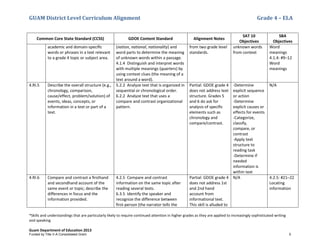
4.RI.2 Determine the main idea of a text
and explain how it is supported by
key details; summarize the text.
4.6.2 Summarize major ideas and
supporting evidence presented in
spoken presentations.
Partial: The GDOE
standard references
these skills in relation
to spoken
presentations, not
textual analysis.
-Determine
explicit
supporting
details
-Extract implied
theme or main
idea
-Determine
implicit
supporting
details
N/A
4.RI.3 Explain events, procedures, ideas,
or concepts in a historical,
scientific, or technical text,
including what happened and why,
based on specific information in
the text.
4.2.6 Follow multiple-step
instructions in a basic technical
manual.
5.2.1 Use the features of
informational texts, such as formats,
graphics, diagrams, illustrations,
charts, maps, and organization, to
find information and support
understanding.
Partial: Using grade 5
to assist with
alignment, as grade 4
is very surface level
with only following
manual instructions.
The CCSS is more
specific in asking
students to explain
procedures based on
information.
-Apply text
structure to
reading task
-Determine if
needed
information is
within text
4.2.6: #24
Following
directions
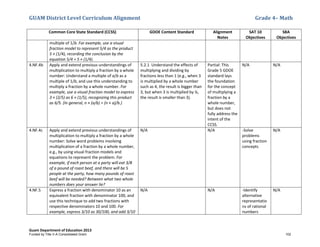
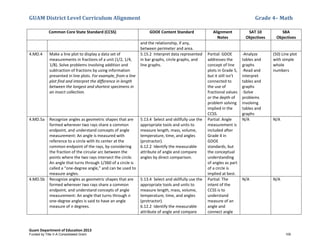
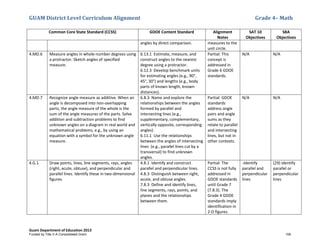
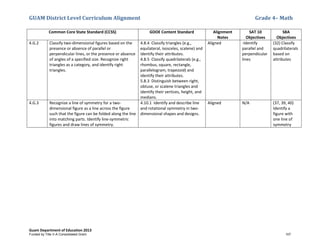
4.RI.4 Determine the meaning of general 4.1.2 Use knowledge of root words Partial: Requires skills -Determine 4.1.2: #1–4
Funded by Title V-A Consolidated Grant 4
GUAM District Level Curriculum Alignment Grade 4 – ELA
*Skills and understandings that are particularly likely to require continued attention in higher grades as they are applied to increasingly sophisticated writing
and speaking
Guam Department of Education 2013
Common Core State Standard (CCSS) GDOE Content Standard Alignment Notes
SAT 10
Objectives
SBA
Objectives
academic and domain-specific
words or phrases in a text relevant
to a grade 4 topic or subject area.
(nation, national, nationality) and
word parts to determine the meaning
of unknown words within a passage.
4.1.4 Distinguish and interpret words
with multiple meanings (quarters) by
using context clues (the meaning of a
text around a word).
from two grade level
standards.
unknown words
from context
Word
meanings
4.1.4: #9–12
Word
meanings
4.RI.5 Describe the overall structure (e.g.,
chronology, comparison,
cause/effect, problem/solution) of
events, ideas, concepts, or
information in a text or part of a
text.
5.2.2 Analyze text that is organized in
sequential or chronological order.
6.2.2 Analyze text that uses a
compare and contrast organizational
pattern.
Partial: GDOE grade 4
does not address text
structure. Grades 5
and 6 do ask for
analysis of specific
elements such as
chronology and
compare/contrast.
-Determine
explicit sequence
or action
-Determine
explicit causes or
effects for events
-Categorize,
classify,
compare, or
contrast
-Apply text
structure to
reading task
-Determine if
needed
information is
within text
N/A
4.RI.6 Compare and contrast a firsthand
and secondhand account of the
same event or topic; describe the
differences in focus and the
information provided.
4.2.5 Compare and contrast
information on the same topic after
reading several texts.
6.3.5 Identify the speaker and
recognize the difference between
first-person (the narrator tells the
Partial: GDOE grade 4
does not address 1st
and 2nd hand
account from
informational text.
This skill is alluded to
N/A 4.2.5: #21–22
Locating
information
Funded by Title V-A Consolidated Grant 5
GUAM District Level Curriculum Alignment Grade 4 – ELA
*Skills and understandings that are particularly likely to require continued attention in higher grades as they are applied to increasingly sophisticated writing
and speaking
Guam Department of Education 2013
Common Core State Standard (CCSS) GDOE Content Standard Alignment Notes
SAT 10
Objectives
SBA
Objectives
story from the “I” perspective) and
third-person (the narrator tells the
story from an outside perspective)
narration.
in grade 6.
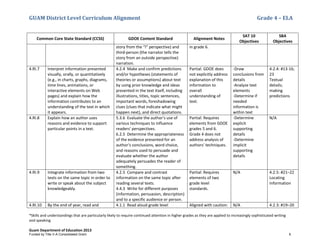
4.RI.7 Interpret information presented
visually, orally, or quantitatively
(e.g., in charts, graphs, diagrams,
time lines, animations, or
interactive elements on Web
pages) and explain how the
information contributes to an
understanding of the text in which
it appears.
4.2.4 Make and confirm predictions
and/or hypotheses (statements of
theories or assumptions) about text
by using prior knowledge and ideas
presented in the text itself, including
illustrations, titles, topic sentences,
important words, foreshadowing
clues (clues that indicate what might
happen next), and direct quotations.
Partial: GDOE does
not explicitly address
explanation of this
information to
overall
understanding of
text.
-Draw
conclusions from
details
-Analyze text
elements
-Determine if
needed
information is
within text
4.2.4: #13-16;
23
Textual
details;
making
predictions
4.RI.8 Explain how an author uses
reasons and evidence to support
particular points in a text.
5.3.6 Evaluate the author's use of
various techniques to influence
readers' perspectives.
6.2.5 Determine the appropriateness
of the evidence presented for an
author's conclusions, word choice,
and reasons used to persuade and
evaluate whether the author
adequately persuades the reader of
something.
Partial: Requires
elements from GDOE
grades 5 and 6.
Grade 4 does not
address analysis of
authors' techniques.
-Determine
explicit
supporting
details
-Determine
implicit
supporting
details
N/A
4.RI.9 Integrate information from two
texts on the same topic in order to
write or speak about the subject
knowledgeably.
4.2.5 Compare and contrast
information on the same topic after
reading several texts.
4.4.3 Write for different purposes
(information, persuasion, description)
and to a specific audience or person.
Partial: Requires
elements of two
grade level
standards.
N/A 4.2.5: #21–22
Locating
information
4.RI.10 By the end of year, read and 4.1.1 Read aloud grade level Aligned with caution: N/A 4.2.3: #19–20
Funded by Title V-A Consolidated Grant 6
GUAM District Level Curriculum Alignment Grade 4 – ELA
*Skills and understandings that are particularly likely to require continued attention in higher grades as they are applied to increasingly sophisticated writing
and speaking
Guam Department of Education 2013
Common Core State Standard (CCSS) GDOE Content Standard Alignment Notes
SAT 10
Objectives
SBA
Objectives
comprehend informational texts,
including history/social studies,
science, and technical texts, in the
grades 4–5 text complexity band
proficiently, with scaffolding as
needed at the high end of the
range.
appropriate fiction and nonfiction
texts with fluency and accuracy and
with appropriate pacing, intonation,
and expression.
4.2.3 Use appropriate strategies
when reading for different purposes.
See complexity of
text in CCSS
Appendix A and
exemplars in
Appendix B.
Locating
information
4.RF.3a Know and apply grade-level
phonics and word analysis skills in
decoding words: Use combined
knowledge of all letter-sound
correspondences, syllabication
patterns, and morphology (e.g.,
roots and affixes) to read
accurately unfamiliar multisyllabic
words in context and out of
context.
3.1.1 Read words with several
syllables.
3.1.6 Use a dictionary to learn the
meaning and pronunciation of
unknown words.
3.1.7 Use knowledge of prefixes
(word parts added at the beginning of
words, such as un-, pre) and suffixes
(word parts added at the end of
words, such as -er, -ful, -less) to
determine the meaning of words.
4.1.2 Use knowledge of root words
(nation, national, nationality) and
word parts to determine the meaning
of unknown words within a passage.
Partial: Aligned to
rigor of CCSS with
combination of GDOE
standards.
-Morphemes
-Compound
Words
4.1.2: # 1–4
Word
meanings
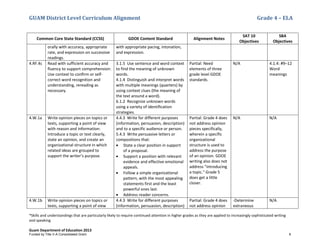
4.RF.4a Read with sufficient accuracy and
fluency to support comprehension:
Read on-level text with purpose
and understanding.
4.1.1 Read aloud grade level
appropriate fiction and nonfiction
texts with fluency and accuray and
with appropriate pacing, intonation,
and expression.
Aligned N/A N/A
4.RF.4b Read with sufficient accuracy and
fluency to support comprehension:
Read on-level prose and poetry
4.1.1 Read aloud grade level
appropriate fiction and nonfiction
texts with fluency and accuray and
Partial: GDOE does
not specify prose and
poetry.
N/A N/A
Funded by Title V-A Consolidated Grant 7
GUAM District Level Curriculum Alignment Grade 4 – ELA
*Skills and understandings that are particularly likely to require continued attention in higher grades as they are applied to increasingly sophisticated writing
and speaking
Guam Department of Education 2013
Common Core State Standard (CCSS) GDOE Content Standard Alignment Notes
SAT 10
Objectives
SBA
Objectives
orally with accuracy, appropriate
rate, and expression on successive
readings.
with appropriate pacing, intonation,
and expression.
4.RF.4c Read with sufficient accuracy and
fluency to support comprehension:
Use context to confirm or self-
correct word recognition and
understanding, rereading as
necessary.
3.1.5 Use sentence and word context
to find the meaning of unknown
words.
4.1.4 Distinguish and interpret words
with multiple meanings (quarters) by
using context clues (the meaning of
the text around a word).
6.1.2 Recognize unknown words
using a variety of identification
strategies.
Partial: Need
elements of three
grade level GDOE
standards.
N/A 4.1.4: #9–12
Word
meanings
4.W.1a Write opinion pieces on topics or
texts, supporting a point of view
with reason and information:
Introduce a topic or text clearly,
state an opinion, and create an
organizational structure in which
related ideas are grouped to
support the writer’s purpose.
4.4.3 Write for different purposes
(information, persuasion, description)
and to a specific audience or person.
5.4.3 Write persuasive letters or
compositions that:
• State a clear position in support
of a proposal.
• Support a position with relevant
evidence and effective emotional
appeals.
• Follow a simple organizational
pattern, with the most appealing
statements first and the least
powerful ones last.
• Address reader concerns.
Partial: Grade 4 does
not address opinion
pieces specifically,
wherein a specific
organizational
structure is used to
address the purpose
of an opinion. GDOE
writing also does not
address "introducing
a topic." Grade 5
does get a little
closer.
N/A N/A
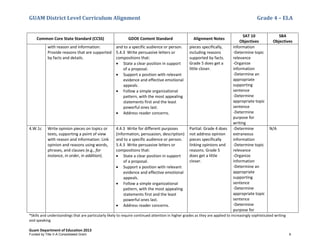
4.W.1b Write opinion pieces on topics or
texts, supporting a point of view
4.4.3 Write for different purposes
(information, persuasion, description)
Partial: Grade 4 does
not address opinion
-Determine
extraneous
N/A
Funded by Title V-A Consolidated Grant 8
GUAM District Level Curriculum Alignment Grade 4 – ELA
*Skills and understandings that are particularly likely to require continued attention in higher grades as they are applied to increasingly sophisticated writing
and speaking
Guam Department of Education 2013
Common Core State Standard (CCSS) GDOE Content Standard Alignment Notes
SAT 10
Objectives
SBA
Objectives
with reason and information:
Provide reasons that are supported
by facts and details.
and to a specific audience or person.
5.4.3 Write persuasive letters or
compositions that:
• State a clear position in support
of a proposal.
• Support a position with relevant
evidence and effective emotional
appeals.
• Follow a simple organizational
pattern, with the most appealing
statements first and the least
powerful ones last.
• Address reader concerns.
pieces specifically,
including reasons
supported by facts.
Grade 5 does get a
little closer.
information
-Determine topic
relevance
-Organize
information
-Determine an
appropriate
supporting
sentence
-Determine
appropriate topic
sentence
-Determine
purpose for
writing
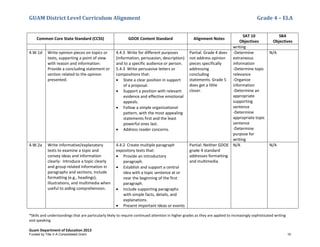
4.W.1c Write opinion pieces on topics or
texts, supporting a point of view
with reason and information: Link
opinion and reasons using words,
phrases, and clauses (e.g., for
instance, in order, in addition).
4.4.3 Write for different purposes
(information, persuasion, description)
and to a specific audience or person.
5.4.3 Write persuasive letters or
compositions that:
• State a clear position in support
of a proposal.
• Support a position with relevant
evidence and effective emotional
appeals.
• Follow a simple organizational
pattern, with the most appealing
statements first and the least
powerful ones last.
• Address reader concerns.
Partial: Grade 4 does
not address opinion
pieces specifically
linking opinions and
reasons. Grade 5
does get a little
closer.
-Determine
extraneous
information
-Determine topic
relevance
-Organize
information
-Determine an
appropriate
supporting
sentence
-Determine
appropriate topic
sentence
-Determine
purpose for
N/A
Funded by Title V-A Consolidated Grant 9
GUAM District Level Curriculum Alignment Grade 4 – ELA
*Skills and understandings that are particularly likely to require continued attention in higher grades as they are applied to increasingly sophisticated writing
and speaking
Guam Department of Education 2013
Common Core State Standard (CCSS) GDOE Content Standard Alignment Notes
SAT 10
Objectives
SBA
Objectives
writing
4.W.1d Write opinion pieces on topics or
texts, supporting a point of view
with reason and information:
Provide a concluding statement or
section related to the opinion
presented.
4.4.3 Write for different purposes
(information, persuasion, description)
and to a specific audience or person.
5.4.3 Write persuasive letters or
compositions that:
• State a clear position in support
of a proposal.
• Support a position with relevant
evidence and effective emotional
appeals.
• Follow a simple organizational
pattern, with the most appealing
statements first and the least
powerful ones last.
• Address reader concerns.
Partial: Grade 4 does
not address opinion
pieces specifically
addressing
concluding
statements. Grade 5
does get a little
closer.
-Determine
extraneous
information
-Determine topic
relevance
-Organize
information
-Determine an
appropriate
supporting
sentence
-Determine
appropriate topic
sentence
-Determine
purpose for
writing
N/A
4.W.2a Write informative/explanatory
texts to examine a topic and
convey ideas and information
clearly: Introduce a topic clearly
and group related information in
paragraphs and sections; include
formatting (e.g., headings),
illustrations, and multimedia when
useful to aiding comprehension.
4.4.2 Create multiple paragraph
expository texts that:
• Provide an introductory
paragraph.
• Establish and support a central
idea with a topic sentence at or
near the beginning of the first
paragraph.
• Include supporting paragraphs
with simple facts, details, and
explanations.
• Present important ideas or events
Partial: Neither GDOE
grade 4 standard
addresses formatting
and multimedia.
N/A N/A
Funded by Title V-A Consolidated Grant 10
GUAM District Level Curriculum Alignment Grade 4 – ELA
*Skills and understandings that are particularly likely to require continued attention in higher grades as they are applied to increasingly sophisticated writing
and speaking
Guam Department of Education 2013
Common Core State Standard (CCSS) GDOE Content Standard Alignment Notes
SAT 10
Objectives
SBA
Objectives
in sequence or in chronological
order.
• Provide details and transitions to
link paragraphs.
• Conclude with a paragraph that
summarizes the points.
• Use correct indention at the
beginning of paragraphs.
• Use varied word choices to make
writing interesting.
4.4.3 Write for different purposes
(information, persuasion, description)
and to a specific audience or person.
4.W.2b Write informative/explanatory
texts to examine a topic and
convey ideas and information
clearly: Develop the topic with
facts, definitions, concrete details,
quotations, or other information
and examples related to the topic.
4.4.2 Create multiple paragraph
expository texts that:
• Provide an introductory
paragraph.
• Establish and support a central
idea with a topic sentence at or
near the beginning of the first
paragraph.
• Include supporting paragraphs
with simple facts, details, and
explanations.
• Present important ideas or events
in sequence or in chronological
order.
• Provide details and transitions to
link paragraphs.
• Conclude with a paragraph that
Partial: Requires
using two grade level
GDOE standards.
-Determine
extraneous
information
-Determine topic
relevance
-Organize
information
-Determine an
appropriate
supporting
sentence
-Determine
appropriate topic
sentence
-Determine
purpose for
writing
N/A
Funded by Title V-A Consolidated Grant 11
GUAM District Level Curriculum Alignment Grade 4 – ELA
*Skills and understandings that are particularly likely to require continued attention in higher grades as they are applied to increasingly sophisticated writing
and speaking
Guam Department of Education 2013
Common Core State Standard (CCSS) GDOE Content Standard Alignment Notes
SAT 10
Objectives
SBA
Objectives
summarizes the points.
• Use correct indention at the
beginning of paragraphs.
• Use varied word choices to make
writing interesting.
4.W.2c Write informative/explanatory
texts to examine a topic and
convey ideas and information
clearly: Link ideas within categories
of information using words,
phrases, and clauses (e.g., another,
for example, also, because).
4.4.2 Create multiple paragraph
expository texts that:
• Provide an introductory
paragraph.
• Establish and support a central
idea with a topic sentence at or
near the beginning of the first
paragraph.
• Include supporting paragraphs
with simple facts, details, and
explanations.
• Present important ideas or events
in sequence or in chronological
order.
• Provide details and transitions to
link paragraphs.
• Conclude with a paragraph that
summarizes the points.
• Use correct indention at the
beginning of paragraphs.
• Use varied word choices to make
writing interesting.
4.4.3 Write for different purposes
(information, persuasion, description)
and to a specific audience or person.
Partial: 4.4.2 does
not explicitly address
"words, phrases, and
clauses" to link ideas.
-Determine
extraneous
information
-Determine topic
relevance
-Organize
information
-Determine an
appropriate
supporting
sentence
-Determine
appropriate topic
sentence
-Determine
purpose for
writing
N/A
Funded by Title V-A Consolidated Grant 12
GUAM District Level Curriculum Alignment Grade 4 – ELA
*Skills and understandings that are particularly likely to require continued attention in higher grades as they are applied to increasingly sophisticated writing
and speaking
Guam Department of Education 2013
Common Core State Standard (CCSS) GDOE Content Standard Alignment Notes
SAT 10
Objectives
SBA
Objectives
4.W.2d Write informative/explanatory
texts to examine a topic and
convey ideas and information
clearly: Use precise language and
domain-specific vocabulary to
inform about or explain the topic.
4.4.2 Create multiple paragraph
expository texts that:
• Provide an introductory
paragraph.
• Establish and support a central
idea with a topic sentence at or
near the beginning of the first
paragraph.
• Include supporting paragraphs
with simple facts, details, and
explanations.
• Present important ideas or events
in sequence or in chronological
order.
• Provide details and transitions to
link paragraphs.
• Conclude with a paragraph that
summarizes the points.
• Use correct indention at the
beginning of paragraphs.
• Use varied word choices to make
writing interesting.
4.4.3 Write for different purposes
(information, persuasion, description)
and to a specific audience or person.
Partial: Requires
using two grade level
GDOE standards.
-Vocabulary,
Synonyms,
Multiple-
meaning words,
Context clues
-Identify precise
language
N/A
4.W.2e Write informative/explanatory
texts to examine a topic and
convey ideas and information
clearly: Provide a concluding
statement or section related to the
4.4.2 Create multiple paragraph
expository texts that:
• Provide an introductory
paragraph.
• Establish and support a central
Partial: Requires
using two grade level
GDOE standards.
-Combine
sentences
correctly
-Determine
extraneous
N/A
Funded by Title V-A Consolidated Grant 13
GUAM District Level Curriculum Alignment Grade 4 – ELA
*Skills and understandings that are particularly likely to require continued attention in higher grades as they are applied to increasingly sophisticated writing
and speaking
Guam Department of Education 2013
Common Core State Standard (CCSS) GDOE Content Standard Alignment Notes
SAT 10
Objectives
SBA
Objectives
information or explanation
presented.
idea with a topic sentence at or
near the beginning of the first
paragraph.
• Include supporting paragraphs
with simple facts, details, and
explanations.
• Present important ideas or events
in sequence or in chronological
order.
• Provide details and transitions to
link paragraphs.
• Conclude with a paragraph that
summarizes the points.
• Use correct indention at the
beginning of paragraphs.
• Use varied word choices to make
writing interesting.
4.4.3 Write for different purposes
(information, persuasion, description)
and to a specific audience or person.
information
-Determine
purpose for
writing
4.W.3a Write narratives to develop real or
imagined experiences or events
using effective technique,
descriptive details, and clear event
sequences: Orient the reader by
establishing a situation and
introducing a narrator and/or
characters; organize an event
sequence that unfolds naturally.
4.4.3 Write for different purposes
(information, persuasion, description)
and to a specific audience or person.
5.4.1 Write narratives that:
• Establish a plot, point of view,
setting, and conflict.
• Show, rather than tell, the events
of the story.
Partial: Requires
grade 5 GDOE to
address narratives
specifically.
-Determine
extraneous
information
-Determine topic
relevance
-Organize
information
-Determine an
appropriate
supporting
N/A
Funded by Title V-A Consolidated Grant 14
GUAM District Level Curriculum Alignment Grade 4 – ELA
*Skills and understandings that are particularly likely to require continued attention in higher grades as they are applied to increasingly sophisticated writing
and speaking
Guam Department of Education 2013
Common Core State Standard (CCSS) GDOE Content Standard Alignment Notes
SAT 10
Objectives
SBA
Objectives
sentence
-Determine
appropriate topic
sentence
-Determine
purpose for
writing
4.W.3b Write narratives to develop real or
imagined experiences or events
using effective technique,
descriptive details, and clear event
sequences: Use dialogue and
description to develop experiences
and events or show the responses
of characters to situations.
4.4.3 Write for different purposes
(information, persuasion, description)
and to a specific audience or person.
5.4.1 Write narratives that:
• Establish a plot, point of view,
setting, and conflict.
• Show, rather than tell, the events
of the story.
6.4.3 Write narratives that:
• Establish and develop a plot and
setting and present a point of
view that is appropriate to the
stories.
• Include sensory details and clear
language to develop plot and
character.
• Use a range of narrative devices,
such as dialogue or suspense.
Partial: Requires
grades 5 and 6
narrative writing to
address using
dialogue for
character
development.
-Determine
extraneous
information
-Determine topic
relevance
-Organize
information
-Determine an
appropriate
supporting
sentence
-Determine
appropriate topic
sentence
-Determine
purpose for
writing
N/A
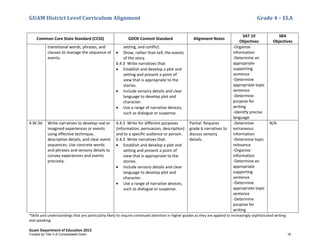
4.W.3c Write narratives to develop real or
imagined experiences or events
using effective technique,
descriptive details, and clear event
sequences: Use a variety of
4.4.3 Write for different purposes
(information, persuasion, description)
and to a specific audience or person.
5.4.1 Write narratives that:
• Establish a plot, point of view,
Partial: No elements
from grades 5-6
discuss transitions or
sequencing of
events.
-Determine
extraneous
information
-Determine topic
relevance
N/A
Funded by Title V-A Consolidated Grant 15
GUAM District Level Curriculum Alignment Grade 4 – ELA
*Skills and understandings that are particularly likely to require continued attention in higher grades as they are applied to increasingly sophisticated writing
and speaking
Guam Department of Education 2013
Common Core State Standard (CCSS) GDOE Content Standard Alignment Notes
SAT 10
Objectives
SBA
Objectives
transitional words, phrases, and
clauses to manage the sequence of
events.
setting, and conflict.
• Show, rather than tell, the events
of the story.
6.4.3 Write narratives that:
• Establish and develop a plot and
setting and present a point of
view that is appropriate to the
stories.
• Include sensory details and clear
language to develop plot and
character.
• Use a range of narrative devices,
such as dialogue or suspense.
-Organize
information
-Determine an
appropriate
supporting
sentence
-Determine
appropriate topic
sentence
-Determine
purpose for
writing
-Idenitfy precise
language
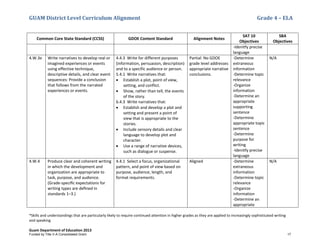
4.W.3d Write narratives to develop real or
imagined experiences or events
using effective technique,
descriptive details, and clear event
sequences: Use concrete words
and phrases and sensory details to
convey experiences and events
precisely.
4.4.3 Write for different purposes
(information, persuasion, description)
and to a specific audience or person.
6.4.3 Write narratives that:
• Establish and develop a plot and
setting and present a point of
view that is appropriate to the
stories.
• Include sensory details and clear
language to develop plot and
character.
• Use a range of narrative devices,
such as dialogue or suspense.
Partial: Requires
grade 6 narratives to
discuss sensory
details.
-Determine
extraneous
information
-Determine topic
relevance
-Organize
information
-Determine an
appropriate
supporting
sentence
-Determine
appropriate topic
sentence
-Determine
purpose for
writing
N/A
Funded by Title V-A Consolidated Grant 16
GUAM District Level Curriculum Alignment Grade 4 – ELA
*Skills and understandings that are particularly likely to require continued attention in higher grades as they are applied to increasingly sophisticated writing
and speaking
Guam Department of Education 2013
Common Core State Standard (CCSS) GDOE Content Standard Alignment Notes
SAT 10
Objectives
SBA
Objectives
-Idenitfy precise
language
4.W.3e Write narratives to develop real or
imagined experiences or events
using effective technique,
descriptive details, and clear event
sequences: Provide a conclusion
that follows from the narrated
experiences or events.
4.4.3 Write for different purposes
(information, persuasion, description)
and to a specific audience or person.
5.4.1 Write narratives that:
• Establish a plot, point of view,
setting, and conflict.
• Show, rather than tell, the events
of the story.
6.4.3 Write narratives that:
• Establish and develop a plot and
setting and present a point of
view that is appropriate to the
stories.
• Include sensory details and clear
language to develop plot and
character.
• Use a range of narrative devices,
such as dialogue or suspense.
Partial: No GDOE
grade level addresses
appropriate narrative
conclusions.
-Determine
extraneous
information
-Determine topic
relevance
-Organize
information
-Determine an
appropriate
supporting
sentence
-Determine
appropriate topic
sentence
-Determine
purpose for
writing
-Idenitfy precise
language
N/A
4.W.4 Produce clear and coherent writing
in which the development and
organization are appropriate to
task, purpose, and audience.
(Grade-specific expectations for
writing types are defined in
standards 1–3.)
4.4.1 Select a focus, organizational
pattern, and point of view based on
purpose, audience, length, and
format requirements.
Aligned -Determine
extraneous
information
-Determine topic
relevance
-Organize
information
-Determine an
appropriate
N/A
Funded by Title V-A Consolidated Grant 17
GUAM District Level Curriculum Alignment Grade 4 – ELA
*Skills and understandings that are particularly likely to require continued attention in higher grades as they are applied to increasingly sophisticated writing
and speaking
Guam Department of Education 2013
Common Core State Standard (CCSS) GDOE Content Standard Alignment Notes
SAT 10
Objectives
SBA
Objectives
supporting
sentence
-Determine
appropriate topic
sentence
-Determine
purpose for
writing
-Idenitfy precise
language
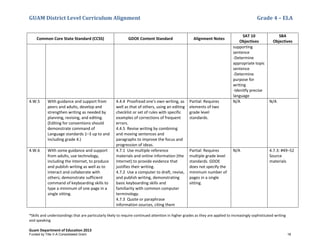
4.W.5 With guidance and support from
peers and adults, develop and
strengthen writing as needed by
planning, revising, and editing.
(Editing for conventions should
demonstrate command of
Language standards 1–3 up to and
including grade 4.)
4.4.4 Proofread one's own writing, as
well as that of others, using an editing
checklist or set of rules with specific
examples of corrections of frequent
errors.
4.4.5 Revise writing by combining
and moving sentences and
paragraphs to improve the focus and
progression of ideas.
Partial: Requires
elements of two
grade level
standards.
N/A N/A
4.W.6 With some guidance and support
from adults, use technology,
including the Internet, to produce
and publish writing as well as to
interact and collaborate with
others; demonstrate sufficient
command of keyboarding skills to
type a minimum of one page in a
single sitting.
4.7.1 Use multiple reference
materials and online information (the
Internet) to provide evidence that
justifies their writing.
4.7.2 Use a computer to draft, revise,
and publish writing, demonstrating
basic keyboarding skills and
familiarity with common computer
terminology.
4.7.3 Quote or paraphrase
information sources, citing them
Partial: Requires
multiple grade level
standards. GDOE
does not specify the
minimum number of
pages in a single
sitting.
N/A 4.7.3: #49–52
Source
materials
Funded by Title V-A Consolidated Grant 18
GUAM District Level Curriculum Alignment Grade 4 – ELA
*Skills and understandings that are particularly likely to require continued attention in higher grades as they are applied to increasingly sophisticated writing
and speaking
Guam Department of Education 2013
Common Core State Standard (CCSS) GDOE Content Standard Alignment Notes
SAT 10
Objectives
SBA
Objectives
appropriately.
4.W.7 Conduct short research projects
that build knowledge through
investigation of different aspects
of a topic.
4.7.3 Quote or paraphrase
information sources, citing them
appropriately.
4.7.5 Use various reference materials
(dictionary, thesaurus, card catalog,
encyclopedia) and online information
(the Internet) as aids to writing.
6.7.3 Write or deliver a research
report that has been developed using
a systematic research process
(defines the topic, gathers
information, determines credibility,
reports findings) and that:
• Uses information from a variety
of sources (books, technology,
multimedia) and documents
sources by using a consistent
format for citations.
• Demonstrates that information
that has been gathered has been
summarized.
• Organizes information by
categorizing and sequencing,
demonstrates the distinction
between one’s own ideas from
the ideas of others, and includes a
bibliography (works cited).
Partial: GDOE grade 4
standards do address
research skills.
Requires grade 6
research standard to
specifically address
the process of
completing a
research project.
N/A 4.7.3: #49–52
Source
materials
4.W.8 Recall relevant information from
experiences or gather relevant
4.7.3 Quote or paraphrase
information sources, citing them
Partial: Neither grade
4 or 5 GDOE specify
N/A 4.7.3: #49–52
Source
Funded by Title V-A Consolidated Grant 19
GUAM District Level Curriculum Alignment Grade 4 – ELA
*Skills and understandings that are particularly likely to require continued attention in higher grades as they are applied to increasingly sophisticated writing
and speaking
Guam Department of Education 2013
Common Core State Standard (CCSS) GDOE Content Standard Alignment Notes
SAT 10
Objectives
SBA
Objectives
information from print and digital
sources; take notes and categorize
information, and provide a list of
sources.
appropriately.
5.7.4 Use note-taking skills (active
listening, identifying main ideas,
drawing diagrams to clarify notes)
when using technological and
informational resources to conduct
research.
categorizing
information.
materials
4.W.9a Draw evidence from literary or
informational texts to support
analysis, reflection, and research:
Apply grade 4 Reading standards to
literature (e.g., “Describe in depth
a character, setting, or event in a
story or drama, drawing on specific
details in the text [e.g., a
character's thoughts, words, or
actions].").
5.4.1 Write narratives that:
• Establish a plot, point of view,
setting, and conflict.
• Show, rather than tell, the events
of the story.
6.4.5 Write responses to literature
that:
• Develop an interpretation that
shows careful reading,
understanding, and insight.
• Organize the interpretation
around several clear ideas.
• Support statements with
evidence from the text.
Partial: Requires
grade 5 and 6 to
address elements of
researching literary
elements.
-Determine
extraneous
information
-Determine topic
relevance
-Organize
information
-Determine an
appropriate
supporting
sentence
-Determine
appropriate topic
sentence
-Determine
purpose for
writing
-Idenitfy precise
language
N/A
4.W.9b Draw evidence from literary or
informational texts to support
analysis, reflection, and research:
Apply grade 4 Reading standards to
4.4.3 Write for different purposes
(information, persuasion, description)
and to a specific audience or person.
4.7.3 Quote and paraphrase
Partial: the CCSS
alludes to textual
analysis and research
of literary and
-Determine
extraneous
information
-Determine topic
4.7.3: #49–52
Source
materials
Funded by Title V-A Consolidated Grant 20
GUAM District Level Curriculum Alignment Grade 4 – ELA
*Skills and understandings that are particularly likely to require continued attention in higher grades as they are applied to increasingly sophisticated writing
and speaking
Guam Department of Education 2013
Common Core State Standard (CCSS) GDOE Content Standard Alignment Notes
SAT 10
Objectives
SBA
Objectives
informational texts (e.g., “Explain
how an author uses reasons and
evidence to support particular
points in a text").
information sources, citing them
appropriately.
informational texts. relevance
-Organize
information
-Determine an
appropriate
supporting
sentence
-Determine
appropriate topic
sentence
-Determine
purpose for
writing
4.W.10 Write routinely over extended time
frames (time for research,
reflection, and revision) and
shorter time frames (a single
sitting or a day or two) for a range
of discipline-specific tasks,
purposes, and audiences.
4.4.3 Write for different purposes
(information, persuasion, description)
and to a specific audience or person.
Partial: GDOE does
not specify range of
time.
N/A N/A
4.SL.1a Engage effectively in a range of
collaborative discussions (one-on-
one, in groups, and teacher-led)
with diverse partners on grade 4
topics and texts, building on
others' ideas and expressing their
own clearly: Come to discussions
prepared, having read or studied
required material; explicitly draw
on that preparation and other
4.8.1 Work with a partner or small
group as authors and readers of a text
to explore how their personal
experiences and knowledge influence
their understandings.
Aligned N/A N/A
Funded by Title V-A Consolidated Grant 21
GUAM District Level Curriculum Alignment Grade 4 – ELA
*Skills and understandings that are particularly likely to require continued attention in higher grades as they are applied to increasingly sophisticated writing
and speaking
Guam Department of Education 2013
Common Core State Standard (CCSS) GDOE Content Standard Alignment Notes
SAT 10
Objectives
SBA
Objectives
information known about the topic
to explore ideas under discussion.
4.SL.1b Engage effectively in a range of
collaborative discussions (one-on-
one, in groups, and teacher-led)
with diverse partners on grade 4
topics and texts, building on
others' ideas and expressing their
own clearly: Follow agreed-upon
rules for discussions and carry out
assigned roles.
4.8.1 Work with a partner or small
group as authors and readers of a text
to explore how their personal
experiences and knowledge influence
their understandings.
Partial: GDOE does
not specify rules for
discussion or
assigned roles.
N/A N/A
4.SL.1c Engage effectively in a range of
collaborative discussions (one-on-
one, in groups, and teacher-led)
with diverse partners on grade 4
topics and texts, building on
others' ideas and expressing their
own clearly: Pose and respond to
specific questions to clarify or
follow up on information, and
make comments that contribute to
the discussion and link to the
remarks of others.
4.6.1 Ask thoughtful questions and
respond orally to relevant questions
with appropriate elaboration.
4.6.3 Use appropriate organizational
patterns for conveying information,
including cause and effect, similarity
and difference, and posing and
answering a question.
Partial: GDOE does
not specify extending
or linking to the
remarks of others.
N/A N/A
4.SL.1d Engage effectively in a range of
collaborative discussions (one-on-
one, in groups, and teacher-led)
with diverse partners on grade 4
topics and texts, building on
others' ideas and expressing their
own clearly: Review the key ideas
4.6.1 Ask thoughtful questions and
respond orally to relevant questions
with appropriate elaboration.
4.6.2 Summarize major ideas and
supporting evidence presented in
spoken presentations.
4.6.3 Use appropriate organizational
Partial: Requires
elements of multiple
grade level
standards.
N/A N/A
Funded by Title V-A Consolidated Grant 22
GUAM District Level Curriculum Alignment Grade 4 – ELA
*Skills and understandings that are particularly likely to require continued attention in higher grades as they are applied to increasingly sophisticated writing
and speaking
Guam Department of Education 2013
Common Core State Standard (CCSS) GDOE Content Standard Alignment Notes
SAT 10
Objectives
SBA
Objectives
expressed and explain their own
ideas in light of the discussion.
patterns for conveying information,
including cause and effect, similarity
and difference, and posing and
answering a question.
4.SL.2 Paraphrase portions of a text read
aloud or information presented in
diverse media and formats,
including visually, quantitatively,
and orally.
4.6.1 Ask thoughtful questions and
respond orally to relevant questions
with appropriate elaboration.
4.6.2 Summarize major ideas and
supporting evidence presented in
spoken presentations.
Partial: The GDOE
standards do not
reference students
paraphrasing
information from
multiple formats.
-Determine
explicit causes or
effects of events
-Determine
explicit sequence
or action
-Extract implicit
main idea or
theme
N/A
4.SL.3 Identify the reasons and evidence
a speaker provides to support
particular points.
4.6.2 Summarize major ideas and
supporting evidence presented in
spoken presentations.
5.6.2 Identify and critique persuasive
techniques, such as promises, dares,
and flattery.
Partial: Grade 4 does
not really get to the
depth of the CCSS.
-Determine
explicit causes or
effects of events
-Determine
explicit sequence
or action
-Extract implicit
main idea or
theme
-Analyze author's
purpose or
viewpoint
N/A
4.SL.4 Report on a topic or text, tell a
story, or recount an experience in
an organized manner, using
appropriate facts and relevant,
descriptive details to support main
4.6.4 Emphasize points in ways that
help the listener or viewer follow
important ideas and concepts.
4.6.6 Make informational
presentations that:
Partial: Requires
elements of two
grade level
standards.
-Determine
explict causes or
effects of events
-Determine
explicit sequence
N/A
Funded by Title V-A Consolidated Grant 23
GUAM District Level Curriculum Alignment Grade 4 – ELA
*Skills and understandings that are particularly likely to require continued attention in higher grades as they are applied to increasingly sophisticated writing
and speaking
Guam Department of Education 2013
Common Core State Standard (CCSS) GDOE Content Standard Alignment Notes
SAT 10
Objectives
SBA
Objectives
ideas or themes; speak clearly at
an understandable pace.
• Focus on one main topic.
• Include facts and details that help
listeners focus.
• Incorporate more than one
source of information (including
speakers, books, newspapers,
television broadcasts, radio
reports, or websites).
or action
-Determine
explicit
supporting
details
4.SL.5 Add audio recordings and visual
displays to presentations when
appropriate to enhance the
development of main ideas or
themes.
4.7.3 Quote or paraphrase
information sources, citing them
appropriately.
4.7.5 Use various reference materials
(dictionary, thesaurus, card catalog,
encyclopedia) and online information
(the Internet) as aids to writing.
Partial: the use of
4.7.5 does not
emphasize adding
audio and visual.
N/A 4.7.3: #49–52
Source
materials
4.SL.6 Differentiate between contexts
that call for formal English (e.g.,
presenting ideas) and situations
where informal discourse is
appropriate (e.g., small-group
discussion); use formal English
when appropriate to task and
situation. (See grade 4 Language
standard 1 for specific
expectations.)
N/A GDOE does not
specify formal and
informal English.
N/A N/A
4.L.1a Demonstrate command of
conventions of standard English
grammar and usage when writing
or speaking: Use relative pronouns
(who, whose, whom, which, that)
4.5.1 Identify and use interesting
sentences by using words that
describe, explain, or provide
additional details and connections,
such as verbs, adjectives, adverbs,
Partial: GDOE does
not address relative
pronouns.
-Identify
correctly applied
grammar
4.5.1: #37–41
Grammar and
punctuation
Funded by Title V-A Consolidated Grant 24
GUAM District Level Curriculum Alignment Grade 4 – ELA
*Skills and understandings that are particularly likely to require continued attention in higher grades as they are applied to increasingly sophisticated writing
and speaking
Guam Department of Education 2013
Common Core State Standard (CCSS) GDOE Content Standard Alignment Notes
SAT 10
Objectives
SBA
Objectives
and relative adverbs (where, when,
why).
appositives, participial phrases,
prepositional phrases, and
conjunctions to create interesting
simple and compound sentences.
4.L.1b Demonstrate command of
conventions of standard English
grammar and usage when writing
or speaking: Form and use
progressive (e.g., I was walking; I
am walking; I will be walking) verb
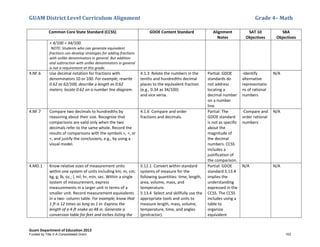
tenses.
4.5.1 Identify and use interesting
sentences by using words that
describe, explain, or provide
additional details and connections,
such as verbs, adjectives, adverbs,
appositives, participial phrases,
prepositional phrases, and
conjunctions to create interesting
simple and compound sentences.
5.5.2 Identify and correctly use
appropriate tense (present, past,
present participle, past participle) for
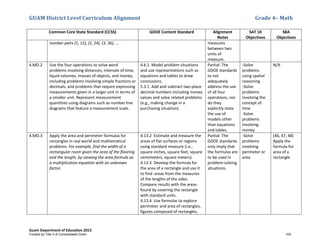
verbs that are often misused (lie/lay,
sit/set, rise/raise).
Partial: 4th grade
GDOE does not
specify progressive
verb tenses.
-Identify
correctly applied
grammar
4.5.1: #37–41
Grammar and
punctuation
4.L.1c Demonstrate command of
conventions of standard English
grammar and usage when writing
or speaking: Use modal auxiliaries
(e.g., can, may, must) to convey
various conditions.
4.5.1 Identify and use interesting
sentences by using words that
describe, explain, or provide
additional details and connections,
such as verbs, adjectives, adverbs,
appositives, participial phrases,
prepositional phrases, and
conjunctions to create interesting
simple and compound sentences.
Partial: GDOE does
not specify using
modal auxiliaries.
-Identify
correctly applied
grammar
4.5.1: #37–41
Grammar and
punctuation
4.L.1d Demonstrate command of
conventions of standard English
grammar and usage when writing
4.5.1 Identify and use interesting
sentences by using words that
describe, explain, or provide
Partial: GDOE does
not specify the order
of adjectives within a
-Identify
correctly applied
grammar
4.5.1: #37–41
Grammar and
punctuation
Funded by Title V-A Consolidated Grant 25
GUAM District Level Curriculum Alignment Grade 4 – ELA
*Skills and understandings that are particularly likely to require continued attention in higher grades as they are applied to increasingly sophisticated writing
and speaking
Guam Department of Education 2013
Common Core State Standard (CCSS) GDOE Content Standard Alignment Notes
SAT 10
Objectives
SBA
Objectives
or speaking: Order adjectives
within sentences according to
conventional patterns (e.g., a small
red bag rather than a red small
bag).
additional details and connections,
such as verbs, adjectives, adverbs,
appositives, participial phrases,
prepositional phrases, and
conjunctions to create interesting
simple and compound sentences.
sentence.
4.L.1e Demonstrate command of
conventions of standard English
grammar and usage when writing
or speaking: Form and use
prepositional phrases.
4.5.1 Identify and use interesting
sentences by using words that
describe, explain, or provide
additional details and connections,
such as verbs, adjectives, adverbs,
appositives, participial phrases,
prepositional phrases, and
conjunctions to create interesting
simple and compound sentences.
Aligned -Identify
correctly applied
grammar
4.5.1: #37–41
Grammar and
punctuation
4.L.1f Demonstrate command of
conventions of standard English
grammar and usage when writing
or speaking: Produce complete
sentences, recognizing and
correcting inappropriate fragments
and run-ons.*
4.5.1 Identify and use interesting
sentences by using words that
describe, explain, or provide
additional details and connections,
such as verbs, adjectives, adverbs,
appositives, participial phrases,
prepositional phrases, and
conjunctions to create interesting
simple and compound sentences.
Partial: Grade 4 does
not specify
identification of
fragments and run-
ons. The GDOE is
more focused on the
interesting and
varied sentences vs.
the construction of
correctly developed
sentences.
-Distinguish
between clearly
written
sentences and
sentences that
contain errors in
expression or
construction
-Identify
correctly and
effectively
written
sentences
4.5.1: #37–41
Grammar and
punctuation
4.L.1g Demonstrate command of
conventions of standard English
4.5.5 Spell correctly roots (bases of
words, such as unnecessary,
Partial: GDOE doesn't
address the focus of
-Spelling,
homophones
4.5.5: #48
Spelling
Funded by Title V-A Consolidated Grant 26
GUAM District Level Curriculum Alignment Grade 4 – ELA
*Skills and understandings that are particularly likely to require continued attention in higher grades as they are applied to increasingly sophisticated writing
and speaking
Guam Department of Education 2013
Common Core State Standard (CCSS) GDOE Content Standard Alignment Notes
SAT 10
Objectives
SBA
Objectives
grammar and usage when writing
or speaking: Correctly use
frequently confused words (e.g.,
to, too, two; their, there).*
cowardly), inflections (words like
care/careful/caring), words with
more than one acceptable spelling
(like advisor/adviser), suffixes and
prefixes (-ly, -ness, mis-, un-), and
syllables (word parts each containing
a vowel sound, such as sur•prise or
e•col•o•gy).
6.5.4 Spell correctly frequently
misspelled words (their/they're/there,
loose/lose/loss, choose/chose,
through/threw).
CCSS until grade 6. -Structural
principles
4.L.2a Demonstrate command of the
conventions of standard English
capitalization, punctuation, and
spelling when writing: Use correct
capitalization.
4.5.4 Capitalize names of magazines,
newspapers, works of art, musical
compositions, names of
organizations, and the first word in
quotations.
Aligned -Distinguish
correct
punctuation
-Distinguish
correct
capitalization
4.5.4: #45–47
Capitalization
4.L.2b Demonstrate command of the
conventions of standard English
capitalization, punctuation, and
spelling when writing: Use commas
and quotation marks to mark
direct speech and quotations from
the text.
4.5.2 Use parentheses to explain
something that is not considered of
primary importance to the sentence,
commas in direct quotations (He said,
“I’d be happy to go.”), apostrophes to
show possession (Jim’s shoes, the
dog’s food), and apostrophes in
contractions (can’t, didn’t, won’t).
Aligned -Distinguish
correct
punctuation
-Distinguish
correct
capitalization
4.5.2: #42–44
Punctuation
4.L.2c Demonstrate command of the
conventions of standard English
capitalization, punctuation, and
spelling when writing: Use a
6.5.3 Use colons after the salutation
(greeting) in business letters (Dear
Sir:), semicolons to connect main
clauses (The girl went to school; her
Partial: These skills
are not addressed
until grade 6.
-Distinguish
correct
punctuation
N/A
Funded by Title V-A Consolidated Grant 27
GUAM District Level Curriculum Alignment Grade 4 – ELA
*Skills and understandings that are particularly likely to require continued attention in higher grades as they are applied to increasingly sophisticated writing
and speaking
Guam Department of Education 2013
Common Core State Standard (CCSS) GDOE Content Standard Alignment Notes
SAT 10
Objectives
SBA
Objectives
comma before a coordinating
conjunction in a compound
sentence.
brother stayed home.), and commas
before the conjunction in compound
sentences (We worked all day, but we
didn’t complete the project.).
4.L.2d Demonstrate command of the
conventions of standard English
capitalization, punctuation, and
spelling when writing: Spell grade-
appropriate words correctly,
consulting references as needed.
4.5.5 Spell correctly roots (bases of
words, such as unnecessary,
cowardly), inflections (words like
care/careful/caring), words with
more than one acceptable spelling
(like advisor/adviser), suffixes and
prefixes (-ly, -ness, mis-, un-), and
syllables (word parts each containing
a vowel sound, such as sur•prise or
e•col•o•gy).
Aligned. Note: CCSS
implies using
reference materials
as needed.
-Spelling,
homophones
-Structural
principles
-Phonetic
principles
4.5.5: #48
Spelling
4.L.3a Use knowledge of language and its
conventions when writing,
speaking, reading, or listening:
Choose words and phrases to
convey ideas precisely.*
4.1.3 Use a thesaurus to find related
words and ideas.
4.4.4 Proofread one's own writing, as
well as that of others, using an editing
checklist or set of rules with specific
examples of corrections of frequent
errors.
Partial: It can be
assumed that both
GDOE standards
would address the
more global CCSS.
Vocabulary,
-Synonyms
-Multiple-
meaning words
-Context clues
-Determine
unknown words
from context
4.1.3: # 5–8
Using
reference
materials
4.L.3b Use knowledge of language and its
conventions when writing,
speaking, reading, or listening:
Choose punctuation for effect.*
3.5.1 Write correctly complete
sentences of statement, command,
question, or exclamation, with final
punctuation.
Partial: 4th grade
does not address
punctuation for
effect.
N/A N/A
4.L.3c Use knowledge of language and its
conventions when writing,
speaking, reading, or listening:
Differentiate between contexts
N/A N/A N/A N/A
Funded by Title V-A Consolidated Grant 28
GUAM District Level Curriculum Alignment Grade 4 – ELA
*Skills and understandings that are particularly likely to require continued attention in higher grades as they are applied to increasingly sophisticated writing
and speaking
Guam Department of Education 2013
Common Core State Standard (CCSS) GDOE Content Standard Alignment Notes
SAT 10
Objectives
SBA
Objectives
that call for formal English (e.g.,
presenting ideas) and situations
where informal discourse is
appropriate (e.g., small-group
discussion).
4.L.4a Determine or clarify the meaning
of unknown and multiple-meaning
words and phrases based on grade
4 reading and content, choosing
flexibly from a range of strategies:
Use context (e.g., definitions,
examples, or restatements in a
text) as a clue to the meaning of a
word or phrase.
4.1.4 Distinguish and interpret words
with multiple meanings (quarters) by
using context clues (the meaning of
the text around a word).
Aligned -Vocabulary,
context clues
-Determine
unknown words
from context
# 9–12
Word
meanings
4.L.4b Determine or clarify the meaning
of unknown and multiple-meaning
words and phrases based on grade
4 reading and content, choosing
flexibly from a range of strategies:
Use common, grade-appropriate
Greek and Latin affixes and roots
as clues to the meaning of a word
(e.g., telegraph, photograph,
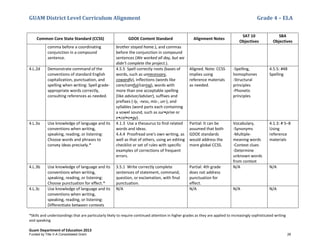
autograph).
4.1.2 Use knowledge of root words
(nation, national, nationality) and
word parts to determine the meaning
of unknown words within a passage.
Aligned -Word study
skills, structural
analysis:
morphemes,
compound words
# 1–4
Word
meanings
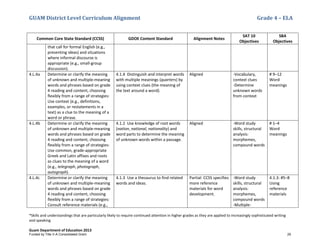
4.L.4c Determine or clarify the meaning
of unknown and multiple-meaning
words and phrases based on grade
4 reading and content, choosing
flexibly from a range of strategies:
Consult reference materials (e.g.,
4.1.3 Use a thesaurus to find related
words and ideas.
Partial: CCSS specifies
more reference
materials for word
development.
-Word study
skills, structural
analysis:
morphemes,
compound words
-Multiple-
4.1.3: #5–8
Using
reference
materials
Funded by Title V-A Consolidated Grant 29
GUAM District Level Curriculum Alignment Grade 4 – ELA
*Skills and understandings that are particularly likely to require continued attention in higher grades as they are applied to increasingly sophisticated writing
and speaking
Guam Department of Education 2013
Common Core State Standard (CCSS) GDOE Content Standard Alignment Notes
SAT 10
Objectives
SBA
Objectives
dictionaries, glossaries,
thesauruses), both print and
digital, to find the pronunciation
and determine or clarify the
precise meaning of key words and
phrases.
meaning words
4.L.5a Demonstrate understanding of
figurative language, word
relationships, and nuances in word
meanings: Explain the meaning of
simple similes and metaphors (e.g.,
as pretty as a picture) in context.
4.3.4 Define figurative language, such
as similes, metaphors, hyperbole, or
personification, and identify its use in
literary works.
Aligned -Interpret
figurative
language
-Determine
unknown words
from context
#33–34
Figurative
language
4.L.5b Demonstrate understanding of
figurative language, word
relationships, and nuances in word
meanings: Recognize and explain
the meaning of common idioms,
adages, and proverbs.
4.3.4 Define figurative language, such
as similes, metaphors, hyperbole, or
personification, and identify its use in
literary works.
Partial: 4th grade
GDOE does not
specify adages,
proverbs, or idioms.
-Interpret
figurative
language
-Determine
unknown words
from context
#33–34
Figurative
language
4.L.5c Demonstrate understanding of
figurative language, word
relationships, and nuances in word
meanings: Demonstrate
understanding of words by relating
them to their opposites
(antonyms) and to words with
similar but not identical meanings
(synonyms).
3.1.3 Determine the meanings of
words using knowledge of synonyms
(words with the same meaning),
antonyms (words with opposite
meanings), homophones (words that
sound the same but have different
meanings and spellings), and
homographs (words that are spelled
the same but have different
meanings).
Partial 4th grade
GDOE does not
address synonyms or
antonyms.
-Interpret
figurative
language
-Determine
unknown words
from context
N/A
4.L.6 Acquire and use accurately grade-
appropriate general academic and
4.1.1 Read aloud grade level
appropriate fiction and nonfiction
Partial: 4th grade
GDOE does not
-Interpret
figurative
N/A
Funded by Title V-A Consolidated Grant 30
GUAM District Level Curriculum Alignment Grade 4 – ELA
*Skills and understandings that are particularly likely to require continued attention in higher grades as they are applied to increasingly sophisticated writing
and speaking
Guam Department of Education 2013
Common Core State Standard (CCSS) GDOE Content Standard Alignment Notes
SAT 10
Objectives
SBA
Objectives
domain-specific words and
phrases, including those that signal
precise actions, emotions, or states
of being (e.g., quizzed, whined,
stammered) and that are basic to a
particular topic (e.g., wildlife,
conservation, and endangered
when discussing animal
preservation).
texts with fluency and accuracy and
with appropriate pacing, intonation,
and expression.
address domain-
specific words and
phrases.
language
-Determine
unknown words
from context
Funded by Title V-A Consolidated Grant 31
Guam GUAM College and Career Readiness Anchor Standards ELA
Guam Department of Education 2013
College and Career Readiness Anchor Standards
The college and career readiness standards offer a broad spectrum of what students will be able to demonstrate as a result of mastery of the
more specific, grade level standards, which follow the umbrella anchor standards listed below for reading and writing. In students’ abilities to
exhibit an increasing fullness of being literate individuals, they will be able to: demonstrate independence; build strong content knowledge;
respond to varying demands of audience, task, purpose, and discipline; comprehend as well as critique; value evidence; use technology and
digital media strategically and capably; and understand other perspectives and cultures.
College and Career Readiness Anchor Standards for Reading
Key Ideas and Details
1. Read closely to determine what the text says explicitly and to make logical inferences from it; cite specific textual evidence when writing
or speaking to support conclusions drawn from the text.
2. Determine central ideas or themes of a text and analyze their development; summarize the key supporting details and ideas.
3. Analyze how and why individuals, events, and ideas develop and interact over the course of a text.
Craft and Structure
4. Interpret words and phrases as they are used in a text, including determining technical, connotative, and figurative meanings, and
analyze how specific word choices shape meaning or tone.
5. Analyze the structure of texts, including how specific sentences, paragraphs, and larger portions of the text (e.g., a section, chapter,
scene, or stanza) relate to each other and the whole.
6. Assess how point of view or purpose shapes the content and style of a text.
Integration of Knowledge and Ideas
7. Integrate and evaluate content presented in diverse media and formats, including visually and quantitatively, as well as in words.
8. Delineate and evaluate the argument and specific claims in a text, including the validity of the reasoning as well as the relevance and
sufficiency of the evidence.
9. Analyze how two or more texts address similar themes or topics in order to build knowledge or to compare the approaches the authors
take.
Range of Reading and Level of Text Complexity
10. Read and comprehend complex literary and informational texts independently and proficiently.
Funded by Title V-A Consolidated Grant 32
Guam College and Career Readiness Anchor Standards ELA
Guam Department of Education 2013
College and Career Readiness Anchor Standards for Writing
Text Types and Purposes
1. Write arguments to support claims in an analysis of substantive topics or texts, using valid reasoning and relevant and sufficient
evidence.
2. Write informative/explanatory texts to examine and convey complex ideas and information clearly and accurately through the effective
selection, organization, and analysis of content.
3. Write narratives to develop real or imagined experiences or events using effective technique, well-chosen details, and well-structured
event sequences.
Production and Distribution of Writing
4. Produce clear and coherent writing in which the development, organization, and style are appropriate to task, purpose, and audience.
5. Develop and strengthen writing as needed by planning, revising, editing, rewriting, or trying a new approach.
6. Use technology, including the Internet, to produce and publish writing and to interact and collaborate with others.
Research to Build and Present Knowledge
7. Conduct short as well as more sustained research projects based on focused questions, demonstrating understanding of the subject
under investigation.
8. Gather relevant information from multiple print and digital sources, assess the credibility and accuracy of each source, and integrate the
information while avoiding plagiarism.
9. Draw evidence from literary or informational texts to support analysis, reflection, and research.
Range of Writing
10. Write routinely over extended time frames (time for research, reflection, and revision) and shorter time frames (a single sitting or a day
or two) for a range of tasks, purposes, and audiences.
College and Career Readiness Anchor Standards for Language
Conventions of Standard English
1. Demonstrate command of the conventions of standard English grammar and usage when writing or speaking.
2. Demonstrate command of the conventions of standard English capitalization, punctuation, and spelling when writing.
Funded by Title V-A Consolidated Grant 33
Guam College and Career Readiness Anchor Standards ELA
Guam Department of Education 2013
Knowledge of Language
3. Apply knowledge of language to understand how language functions in different contexts, to make effective choices for meaning or
style, and to comprehend more fully when reading or listening.
Vocabulary Acquisition and Use
4. Determine or clarify the meaning of unknown and multiple-meaning words and phrases by using context clues, analyzing meaningful
word parts, and consulting general and specialized reference materials, as appropriate.
5. Demonstrate understanding of figurative language, word relationships, and nuances in word meanings.
6. Acquire and use accurately a range of general academic and domain-specific words and phrases sufficient for reading, writing, speaking,
and listening at the college and career readiness level; demonstrate independence in gathering vocabulary knowledge when
encountering an unknown term important to comprehension or expression.
College and Career Readiness Anchor Standards for Speaking and Listening
Comprehension and Collaboration
1. Prepare for and participate effectively in a range of conversations and collaborations with diverse partners, building on others’ ideas and
expressing their own clearly and persuasively.
2. Integrate and evaluate information presented in diverse media and formats, including visually, quantitatively, and orally.
3. Evaluate a speaker’s point of view, reasoning, and use of evidence and rhetoric.
Presentation of Knowledge and Ideas
4. Present information, findings, and supporting evidence such that listeners can follow the line of reasoning and the organization,
development, and style are appropriate to task, purpose, and audience.
5. Make strategic use of digital media and visual displays of data to express information and enhance understanding of presentations.
6. Adapt speech to a variety of contexts and communicative tasks, demonstrating command of formal English when indicated.
Funded by Title V-A Consolidated Grant 34
GUAM District Level Curriculum Map Grade 4 – ELA
Quarter 1
Italic Information: Recursive standard – repeated in at least one other quarter
BOLD information: Standards that should be emphasized
Guam Department of Education 2013
Big Idea 1, Quarter 1:
Students will use grade-level phonics to decode grade-level text and
build fluency to support comprehension.
Essential Question(s):
How do parts of speech and writing conventions contribute to writing
passages?
Standards:
4.RF.4c Read with sufficient accuracy and fluency to support comprehension: Use context to confirm or self-correct word recognition and
understanding, rereading as necessary.
4.L.4a Determine or clarify the meaning of unknown and multiple-meaning words and phrases based on grade 4 reading and content,
choosing flexibly from a range of strategies: Use context (e.g., definitions, examples, or restatements in a text) as a clue to the
meaning of a word or phrase.
4.RF.3a Know and apply grade-level phonics and word analysis skills in decoding words: Use combined knowledge of all letter-sound
correspondences, syllabication patterns, and morphology (e.g., roots and affixes) to read accurately unfamiliar multisyllabic words in
context and out of context.
4.RI.4 Determine the meaning of general academic and domain-specific words or phrases in a text relevant to a grade 4 topic or subject
area.
4.L.4c Determine or clarify the meaning of unknown and multiple-meaning words and phrases based on grade 4 reading and content,
choosing flexibly from a range of strategies: Consult reference materials (e.g., dictionaries, glossaries, thesauruses), both print and
digital, to find the pronunciation and determine or clarify the precise meaning of key words and phrases.
4.RF.4a Read with sufficient accuracy and fluency to support comprehension: Read on-level text with purpose and understanding.
4.RI.2 Determine the main idea of a text and explain how it is supported by key details; summarize the text.
4.RL.7 Make connections between the text of a story or drama and a visual or oral presentation of the text, identifying where each version
reflects specific descriptions and directions in the text.
4.L.2a Demonstrate command of the conventions of standard English capitalization, punctuation, and spelling when writing: Use correct
capitalization.
4.L.2d Demonstrate command of the conventions of standard English capitalization, punctuation, and spelling when writing: Spell grade-
appropriate words correctly, consulting references as needed.
4.L.2b Demonstrate command of the conventions of standard English capitalization, punctuation, and spelling when writing: Use
commas and quotation marks to mark direct speech and quotations from the text.
Funded by Title V-A Consolidated Grant 35
GUAM District Level Curriculum Map Grade 4 – ELA
Quarter 1
Italic Information: Recursive standard – repeated in at least one other quarter
BOLD information: Standards that should be emphasized
Guam Department of Education 2013
4.L.1a Demonstrate command of conventions of standard English grammar and usage when writing or speaking: Use relative pronouns
(who, whose, whom, which, that) and relative adverbs (where, when, why).
4.L.1b Demonstrate command of conventions of standard English grammar and usage when writing or speaking: Form and use
progressive (e.g., I was walking; I am walking; I will be walking) verb tenses.
4.L.1c Demonstrate command of conventions of standard English grammar and usage when writing or speaking: Use modal auxiliaries
(e.g., can, may, must) to convey various conditions.
4.W.10 Write routinely over extended time frames (time for research, reflection, and revision) and shorter time frames (a single sitting or
a day or two) for a range of discipline-specific tasks, purposes, and audiences.
4.W.5 With guidance and support from peers and adults, develop and strengthen writing as needed by planning, revising, and editing.
(Editing for conventions should demonstrate command of Language standards 1–3.)
Suggested Timeline: 4 weeks
Funded by Title V-A Consolidated Grant 36
GUAM District Level Curriculum Map Grade 4 – ELA
Quarter 1
Italic Information: Recursive standard – repeated in at least one other quarter
BOLD information: Standards that should be emphasized
Guam Department of Education 2013
Big Idea 2, Quarter 1:
Students will determine the theme of a story, drama, or poem with
supporting details.
Essential Question(s):
How does theme impact the overall meaning of a story?
How does an author use theme to enhance the reader’s experience?
How do adjectives and prepositional phrases contribute to writing?
Standards:
4.SL.2 Paraphrase portions of a text read aloud or information presented in diverse media and formats, including visually, quantitatively,
and orally.
4.SL.1b Engage effectively in a range of collaborative discussions (one-on-one, in groups, and teacher-led) with diverse partners on grade 4
topics and texts, building on others' ideas and expressing their own clearly: Follow agreed-upon rules for discussions and carry out
assigned roles.
4.RL.2 Determine a theme of a story, drama, or poem from details in the text; summarize the text.
4.SL.3 Identify the reasons and evidence a speaker provides to support particular points.
4.SL.4 Report on a topic or text, tell a story, or recount an experience in an organized manner, using appropriate facts and relevant,
descriptive details to support main ideas or themes; speak clearly at an understandable pace.
4.L.2c Demonstrate command of the conventions of standard English capitalization, punctuation, and spelling when writing: Use a comma
before a coordinating conjunction in a compound sentence.
4.L.1e Demonstrate command of conventions of standard English grammar and usage when writing or speaking: Form and use prepositional
phrases.
4.L.1d Demonstrate command of conventions of standard English grammar and usage when writing or speaking: Order adjectives within
sentences according to conventional patterns (e.g., a small red bag rather than a red small bag).
4.W.6 With some guidance and support from adults, use technology, including the Internet, to produce and publish writing as well as to
interact and collaborate with others; demonstrate sufficient command of keyboarding skills to type a minimum of one page in a
single sitting.
Suggested Timeline: 2 weeks
Funded by Title V-A Consolidated Grant 37
GUAM District Level Curriculum Map Grade 4 – ELA
Quarter 1
Italic Information: Recursive standard – repeated in at least one other quarter
BOLD information: Standards that should be emphasized
Guam Department of Education 2013
Big Idea 3, Quarter 1:
Students will be able to determine meaning of words and phrases by
using a variety of strategies.
Essential Question(s):
What strategies can help determine the meaning of words or phrases in a
text?
Standards:
4.RI.1 Refer to details and examples in a text when explaining what the text says explicitly and when drawing inferences from the text.
4.RL.1 Refer to details and examples in a text when explaining what the text says explicitly and when drawing inferences from the text.
4.SL.1a Engage effectively in a range of collaborative discussions (one-on-one, in groups, and teacher-led) with diverse partners on grade
4 topics and texts, building on others' ideas and expressing their own clearly: Come to discussions prepared, having read or
studied required material; explicitly draw on that preparation and other information known about the topic to explore ideas
under discussion.
4.RL.4 Determine the meaning of words and phrases as they are used in a text, including those that allude to significant characters
found in mythology (e.g., Herculean).
4.L.1f Demonstrate command of conventions of standard English grammar and usage when writing or speaking: Produce complete sentences,
recognizing and correcting inappropriate fragments and run-ons.*
4.L.1g Demonstrate command of conventions of standard English grammar and usage when writing or speaking: Correctly use frequently
confused words (e.g., to, too, two; their, there).*
4.L.4b Determine or clarify the meaning of unknown and multiple-meaning words and phrases based on grade 4 reading and content,
choosing flexibly from a range of strategies: Use common, grade-appropriate Greek and Latin affixes and roots as clues to the meaning
of a word (e.g., telegraph, photograph, autograph).
4.L.5a
and c
Demonstrate understanding of figurative language, word relationships, and nuances in word meanings: a) Explain the meaning of
simple similes and metaphors (e.g., as pretty as a picture) in context; c) Demonstrate understanding of words by relating them to their
opposites (antonyms) and to words with similar but not identical meanings (synonyms).
4.W.8 Recall relevant information from experiences or gather relevant information from print and digital sources; take notes and categorize
information, and provide a list of sources.
4.W.4 Produce clear and coherent writing in which the development and organization are appropriate to task, purpose, and audience.
Suggested Timeline: 3 weeks
*Skills and understandings likely to require continued attention in higher grades as they are applied to increasingly sophisticated writing and speaking
Funded by Title V-A Consolidated Grant 38
GUAM District Level Curriculum Map Grade 4 – ELA
Quarter 2
Italic Information: Recursive standard – repeated in at least one other quarter
BOLD information: Standards that should be emphasized
Guam Department of Education 2013
Big Idea 1, Quarter 2:
Students will describe characters’ thoughts or actions and interpret
information and explain how they contribute to comprehension.
Essential Question(s):
How does in-depth character analysis contribute to comprehension?
How can formal English context support small group discussions?
Standards:
4.RL.3 Describe in depth a character, setting, or event in a story or drama, drawing on specific details in the text (e.g., a character’s thoughts,
words, or actions).
4.RI.7 Interpret information presented visually, orally, or quantitatively (e.g., in charts, graphs, diagrams, time lines, animations, or
interactive elements on Web pages) and explain how the information contributes to an understanding of the text in which it appears.
4.SL.1c Engage effectively in a range of collaborative discussions (one-on-one, in groups, and teacher-led) with diverse partners on grade 4
topics and texts, building on others' ideas and expressing their own clearly: Pose and respond to specific questions to clarify or follow
up on information, and make comments that contribute to the discussion and link to the remarks of others.
4.SL.1d Engage effectively in a range of collaborative discussions (one-on-one, in groups, and teacher-led) with diverse partners on grade 4
topics and texts, building on others' ideas and expressing their own clearly: Review the key ideas expressed and explain their own
ideas in light of the discussion.
4.SL.6 Differentiate between contexts that call for formal English (e.g., presenting ideas) and situations where informal discourse is
appropriate (e.g., small-group discussion); use formal English when appropriate to task and situation.
4.W.2d Write informative/explanatory texts to examine a topic and convey ideas and information clearly: Use precise language and domain-
specific vocabulary to inform about or explain the topic.
4.W.2e Write informative/explanatory texts to examine a topic and convey ideas and information clearly: Provide a concluding statement or
section related to the information or explanation presented.
4.W.7 Conduct short research projects that build knowledge through investigation of different aspects of a topic.
4.L.3a Use knowledge of language and its conventions when writing, speaking, reading, or listening: Choose words and phrases to convey
ideas precisely.*
4.L.3b Use knowledge of language and its conventions when writing, speaking, reading, or listening: Choose punctuation for effect.*
4.L.3c Use knowledge of language and its conventions when writing, speaking, reading, or listening: Differentiate between contexts that call
for formal English (e.g., presenting ideas) and situations where informal discourse is appropriate (e.g., small-group discussion).
4.L.5c Demonstrate understanding of figurative language, word relationships, and nuances in word meanings: Demonstrate understanding of
words by relating them to their opposites (antonyms) and to words with similar but not identical meanings (synonyms).
Suggested Timeline: 5 weeks
Funded by Title V-A Consolidated Grant 39
GUAM District Level Curriculum Map Grade 4 – ELA
Quarter 2
Italic Information: Recursive standard – repeated in at least one other quarter
BOLD information: Standards that should be emphasized
Guam Department of Education 2013
Big Idea 2, Quarter 2:
Students will compare and contrast firsthand and secondhand
accounts of the same topics or events.
Essential Question(s):
What identifying elements indicate firsthand or secondhand accounts?
Standards:
4.RI.5 Describe the overall structure (e.g., chronology, comparison, cause/effect, problem/solution) of events, ideas, concepts, or
information in a text or part of a text.
4.RI.6 Compare and contrast a firsthand and secondhand account of the same event or topic; describe the differences in focus and the
information provided.
4.RI.8 Explain how an author uses reasons and evidence to support particular points in a text.
4.RL.6 Compare and contrast the point of view from which different stories are narrated, including the difference between first- and third-
person narrations.
4.W.2b Write informative/explanatory texts to examine a topic and convey ideas and information clearly: Develop the topic with facts,
definitions, concrete details, quotations, or other information and examples related to the topic.
4.W.2c Write informative/explanatory texts to examine a topic and convey ideas and information clearly: Link ideas within categories of
information using words, phrases, and clauses (e.g., another, for example, also, because).
Suggested Timeline: 4 weeks
Funded by Title V-A Consolidated Grant 40
GUAM District Level Curriculum Map Grade 4 – ELA
Quarter 3
Italic Information: Recursive standard – repeated in at least one other quarter
BOLD information: Standards that should be emphasized
Guam Department of Education 2013
Big Idea 1, Quarter 3:
Students will identify reasons used to support points in a text.
Essential Question(s):
What strategies are used to support points of view?
Standards:
4.RL.6 Compare and contrast the point of view from which different stories are narrated, including the difference between first- and third-
person narrations.
4.RI.6 Compare and contrast a firsthand and secondhand account of the same event or topic; describe the differences in focus and the
information provided.
4.L.6 Acquire and use accurately grade-appropriate general academic and domain-specific words and phrases, including those that signal
precise actions, emotions, or states of being (e.g., quizzed, whined, stammered) and that are basic to a particular topic (e.g., wildlife,
conservation, and endangered when discussing animal preservation).
4.L.5a Demonstrate understanding of figurative language, word relationships, and nuances in word meanings: Explain the meaning of simple
similes and metaphors (e.g., as pretty as a picture) in context.
4.W.1b
and c
Write opinion pieces on topics or texts, supporting a point of view with reason and information: b) Provide reasons that are supported
by facts and details; c) Link opinion and reasons using words, phrases, and clauses (e.g., for instance, in order, in addition).
4.W.2a Write informative/explanatory texts to examine a topic and convey ideas and information clearly: Introduce a topic clearly and group
related information in paragraphs and sections; include formatting (e.g., headings), illustrations, and multimedia when useful to
aiding comprehension.
4.W.3a Write narratives to develop real or imagined experiences or events using effective technique, descriptive details, and clear event
sequences: Orient the reader by establishing a situation and introducing a narrator and/or characters; organize an event sequence
that unfolds naturally.
Suggested Timeline: 5 weeks
Funded by Title V-A Consolidated Grant 41
GUAM District Level Curriculum Map Grade 4 – ELA
Quarter 3
Italic Information: Recursive standard – repeated in at least one other quarter
BOLD information: Standards that should be emphasized
Guam Department of Education 2013
Big Idea 2, Quarter 3:
Students will analyze informational text and explain events,
procedures, or concepts.
Essential Question(s):
What structures contribute to informational text?
Standards:
4.RI.1 Refer to details and examples in a text when explaining what the text says explicitly and when drawing inferences from the text.
4.RI.3 Explain events, procedures, ideas, or concepts in a historical, scientific, or technical text, including what happened and why, based on
specific information in the text.
4.RL.5 Explain major differences between poems, drama, and prose, and refer to the structural elements of poems (e.g., verse, rhythm,
meter) and drama (e.g., casts of characters, settings, descriptions, dialogue, stage directions) when writing or speaking about a text.
4.SL.6 Differentiate between contexts that call for formal English (e.g., presenting ideas) and situations where informal discourse is
appropriate (e.g., small-group discussion); use formal English when appropriate to task and situation.
4.W.1b-d Write opinion pieces on topics or texts, supporting a point of view with reason and information: b) Provide reasons that are supported
by facts and details; c) Link opinion and reasons using words, phrases, and clauses (e.g., for instance, in order, in addition); d) Provide a
concluding statement or section related to the opinion presented.
Suggested Timeline: 4 weeks
Funded by Title V-A Consolidated Grant 42
GUAM District Level Curriculum Map Grade 4 – ELA
Quarter 4
Italic Information: Recursive standard – repeated in at least one other quarter
BOLD information: Standards that should be emphasized
Guam Department of Education 2013
Big Idea 1, Quarter 4:
Students will draw evidence from two texts on the same topic and
create narratives to develop real or imagined experiences.
Essential Question(s):
What are ways to keep readers engaged in your writing?
What are ways to keep audiences engaged in your presentation?
Standards:
4.RF.4b Read with sufficient accuracy and fluency to support comprehension: Read on-level prose and poetry orally with accuracy, appropriate
rate, and expression on successive readings.
4.RL.9 Compare and contrast the treatment of similar themes and topics (e.g., opposition of good and evil) and patterns of events (e.g., the
quest) in stories, myths, and traditional literature from different cultures.
4.RI.9 Integrate information from two texts on the same topic in order to write or speak about the subject knowledgeably.
4.L.5b Demonstrate understanding of figurative language, word relationships, and nuances in word meanings: Recognize and explain the
meaning of common idioms, adages, and proverbs.
4.W.9a Draw evidence from literary or informational texts to support analysis, reflection, and research: Apply grade 4 Reading standards to
literature (e.g., “Describe in depth a character, setting, or event in a story or drama, drawing on specific details in the text [e.g., a
character’s thoughts, words, or actions].”).
4.W.1a Write opinion pieces on topics or texts, supporting a point of view with reason and information: Introduce a topic or text clearly, state
an opinion, and create an organizational structure in which related ideas are grouped to support the writer’s purpose.
4.W.3b Write narratives to develop real or imagined experiences or events using effective technique, descriptive details, and clear event
sequences: Use dialogue and description to develop experiences and events or show the responses of characters to situations.
4.W.3c Write narratives to develop real or imagined experiences or events using effective technique, descriptive details, and clear event
sequences: Use a variety of transitional words, phrases, and clauses to manage the sequence of events.
4.W.9b Draw evidence from literary or informational texts to support analysis, reflection, and research: Apply grade 4 Reading standards to
informational texts (e.g., “Explain how an author uses reasons and evidence to support particular points in a text”).
4.SL.5 Add audio recordings and visual displays to presentations when appropriate to enhance the development of main ideas or themes.
Suggested Timeline: 4 weeks
Funded by Title V-A Consolidated Grant 43
GUAM District Level Curriculum Map Grade 4 – ELA
Quarter 4
Italic Information: Recursive standard – repeated in at least one other quarter
BOLD information: Standards that should be emphasized
Guam Department of Education 2013
Big Idea 2, Quarter 4:
Students will read and comprehend literary and informational grade-
level texts.
Essential Question(s):
What are ways to keep readers engaged in your writing?
What are ways to keep audiences engaged in your presentation?
Standards:
4.RL.10 By the end of the year, read and comprehend literature, including stories, dramas, and poetry, in the grades 4–5 text complexity
band proficiently, with scaffolding as needed at the high end of the range.
4.RI.10 By the end of year, read and comprehend informational texts, including history/social studies, science, and technical texts, in the
grades 4–5 text complexity band proficiently, with scaffolding as needed at the high end of the range.
4.W.3d Write narratives to develop real or imagined experiences or events using effective technique, descriptive details, and clear event
sequences: Use concrete words and phrases and sensory details to convey experiences and events precisely.
4.W.3e Write narratives to develop real or imagined experiences or events using effective technique, descriptive details, and clear event
sequences: Provide a conclusion that follows from the narrated experiences or events.
4.SL.5 Add audio recordings and visual displays to presentations when appropriate to enhance the development of main ideas or themes.
Suggested Timeline: 3 weeks
**7 TOTAL WEEKS OF INSTRUCTION FOR 4TH
QUARTER
2 WEEKS SET ASIDE FOR ANNUAL DISTRICT-WIDE ASSESSMENTS
Funded by Title V-A Consolidated Grant 44
GUAM District Level Curriculum Guide Grade 4 – ELA
Quarter 1
Italic Information: Recursive standard – repeated in at least one other quarter
BOLD information: Standards that should be emphasized
Guam Department of Education 2013
Big Idea 1, Quarter 1:
Students will use grade-level phonics to decode grade-level text and
build fluency to support comprehension.
Essential Question(s):
How do parts of speech and writing conventions contribute to writing
passages?
Standards:
4.RF.4c Read with sufficient accuracy and fluency to support comprehension: Use context to confirm or self-correct word recognition and
understanding, rereading as necessary.
4.L.4a Determine or clarify the meaning of unknown and multiple-meaning words and phrases based on grade 4 reading and content,
choosing flexibly from a range of strategies: Use context (e.g., definitions, examples, or restatements in a text) as a clue to the
meaning of a word or phrase.
4.RF.3a Know and apply grade-level phonics and word analysis skills in decoding words: Use combined knowledge of all letter-sound
correspondences, syllabication patterns, and morphology (e.g., roots and affixes) to read accurately unfamiliar multisyllabic words in
context and out of context.
4.RI.4 Determine the meaning of general academic and domain-specific words or phrases in a text relevant to a grade 4 topic or subject
area.
4.L.4c Determine or clarify the meaning of unknown and multiple-meaning words and phrases based on grade 4 reading and content,
choosing flexibly from a range of strategies: Consult reference materials (e.g., dictionaries, glossaries, thesauruses), both print and
digital, to find the pronunciation and determine or clarify the precise meaning of key words and phrases.
4.RF.4a Read with sufficient accuracy and fluency to support comprehension: Read on-level text with purpose and understanding.
4.RI.2 Determine the main idea of a text and explain how it is supported by key details; summarize the text.
4.RL.7 Make connections between the text of a story or drama and a visual or oral presentation of the text, identifying where each version
reflects specific descriptions and directions in the text.
4.L.2a Demonstrate command of the conventions of standard English capitalization, punctuation, and spelling when writing: Use correct
capitalization.
4.L.2d Demonstrate command of the conventions of standard English capitalization, punctuation, and spelling when writing: Spell grade-
appropriate words correctly, consulting references as needed.
4.L.2b Demonstrate command of the conventions of standard English capitalization, punctuation, and spelling when writing: Use
commas and quotation marks to mark direct speech and quotations from the text.
Funded by Title V-A Consolidated Grant 45
GUAM District Level Curriculum Guide Grade 4 – ELA
Quarter 1
Italic Information: Recursive standard – repeated in at least one other quarter
BOLD information: Standards that should be emphasized
Guam Department of Education 2013
4.L.1a Demonstrate command of conventions of standard English grammar and usage when writing or speaking: Use relative pronouns
(who, whose, whom, which, that) and relative adverbs (where, when, why).
4.L.1b Demonstrate command of conventions of standard English grammar and usage when writing or speaking: Form and use
progressive (e.g., I was walking; I am walking; I will be walking) verb tenses.
4.L.1c Demonstrate command of conventions of standard English grammar and usage when writing or speaking: Use modal auxiliaries
(e.g., can, may, must) to convey various conditions.
4.W.10 Write routinely over extended time frames (time for research, reflection, and revision) and shorter time frames (a single sitting or
a day or two) for a range of discipline-specific tasks, purposes, and audiences.
4.W.5 With guidance and support from peers and adults, develop and strengthen writing as needed by planning, revising, and editing.
(Editing for conventions should demonstrate command of Language standards 1–3.)
Elements of the Standard(s) – What’s the meaning?
Students will be able to read appropriate grade-level text with accuracy and fluency using grade-level phonics skills (4.RF.4a, c, 4.RF.3a). They will
self- correct errors using word analysis skills (e.g., syllable type, affixes, morphology), use context clues, or reread to maintain purpose and
understanding. If students do not understand general academic or domain-specific words through rereading or context, (4.L.4a) they will use
dictionaries, glossaries, or thesauruses to clarify meaning in text (4.RI.4, 4. L.4c). Students will read and summarize grade-level informational text
and be able to determine the main idea and key supporting details (4.RI.2). In literature, students will make connections between a story or drama
in text and a visual or oral presentation. Students will be able to identify where each version (print and presentation) reflects specific descriptions or
directions (4.RL.7). Students will write for various purposes (e.g., research, reflections, revisions) and various time frames (e.g., single sitting, over a
day or two) (4.W.10). Their writing will include opportunities for collaboration with adults or peers, to plan, revise, and edit (4.W.5). The editing will
include mastery of several conventions of standard English (e.g., capitalization, commas, quotations marks, and spelling) (4.L.2a, b, d). Students will
be able to demonstrate conventions of standard English grammar when speaking or writing, such as relative pronouns (who, whose, whom, which,
that) and relative adverbs (when, where, why), progressive verb tenses (I was walking; I am walking; I will be walking), and modal auxiliaries (e.g.,
can, may, must) to convey various conditions (4.L.1a, b, c). Students will reflect on how parts of speech and writing conventions contribute to writing
passages through peer-review and collaborative editing assignments. These skills cover DOK Basic Reasoning level #2.
Key Vocabulary
6-syllable types, morphology, affixes,
derivational suffixes, modal auxiliary words,
progressive verb tense, relative pronouns,
relative adverbs, audience, writing purpose
Links to Prior Learning
• In third grade, students were
mastering common prefixes and Latin
and derivational suffixes (3.RF.3).
• Students explained how illustrations
Links to Future Learning
• Students will demonstrate mastery of
reading grade-level multisyllabic words in
and out of context using knowledge of all
letter-sound correspondences
Funded by Title V-A Consolidated Grant 46
GUAM District Level Curriculum Guide Grade 4 – ELA
Quarter 1
Italic Information: Recursive standard – repeated in at least one other quarter
BOLD information: Standards that should be emphasized
Guam Department of Education 2013
contributed to text (3.RL.7).
• Students recounted key details and
explained how they supported the
main idea (3.RI.2).
syllabication patterns and morphology
(5.RF.3).
• Students will analyze how visual and
multimedia elements contribute to the
meaning, tone, or beauty of a text
(5.RL.7).
• Students will determine 2 or more ideas
in text and explain how they are
supported by key details. They will also be
able to sufficiently summarize the text
(5.RI.2).
Instructional Strategies (EL, SIOP, SPED, Marzano)
• State and display a clear purpose for students to read in pairs or small groups.
• Help students clarify their learning (SIOP, Marzano, SPED). Practicing in pairs or small groups is a Marzano cooperative learning and SIOP
interaction strategy.
• Students will work in pairs or small groups to complete graphic organizers (e.g., word web, Frayer model) that include nonlinguistic
representations for vocabulary words and concepts (4.RI.4, 4.L4c). Practicing in pairs or small groups is a Marzano cooperative learning and
SIOP interaction strategy. Graphic organizers provide visual categorization of information that supports SIOP and SPED. Illustrations or
nonlinguistic representations for vocabulary words or concepts strengthens the definition connection for students (Marzano, SIOP, and
SPED).
• Students will work in pairs or small groups to peer-edit written compositions. Students will focus on specific elements to edit (e.g.,
capitalization, commas, quotations marks, or spelling) (4.L.2a, b, d). Practicing in pairs or small groups is a Marzano cooperative learning and
SIOP interaction strategy.
• Students will identify syllable types or affixes in grade-level multisyllabic words a given text (4. RF.4a, c, 4.RF.3a).
• Students will work in pairs or small groups to complete main idea and supporting facts graphic organizers (4.RI.2). Graphic organizers
provide visual categorization of information that supports SIOP and SPED. Practicing in pairs or small groups is a Marzano cooperative
learning and SIOP interaction strategy.
• Model how to make connections between a story or drama in text and a visual or oral presentation in a graphic organizer (e.g., Venn
diagram, T-chart, 3-column chart) (4.RL.7). Thinking aloud while demonstrating is a scaffolding support strategy for SIOP and SPED students.
Funded by Title V-A Consolidated Grant 47
GUAM District Level Curriculum Guide Grade 4 – ELA
Quarter 1
Italic Information: Recursive standard – repeated in at least one other quarter
BOLD information: Standards that should be emphasized
Guam Department of Education 2013
Graphic organizers provide visual categorization of information that supports SIOP and SPED.
• Students may rewrite simple sentences from easy or earlier readers to insert modal auxiliaries (e.g., can, may, must) to convey various
conditions (4.L. c). Providing ample opportunities to practice skills throughout content areas is a SIOP instruction strategy that also supports
distributed practice for SPED.
Resources & Links to Technology
• http://www.corestandards.org/ELA-Literacy Appendix C – grade-level writing samples with annotation
• www.studenthandouts.com keyword: graphic organizers
• www.perfect-english-grammar.com verb tenses, parts of speech
• www.ereadingworksheet.com/pointofview keywords: language arts, punctuation with commas
• www.englishgrammar.org keywords: pronouns, relative pronouns
• www.Printableworksheets.in keyword 4th
grade relative adverbs
• Houghton Mifflin Fourth Grade English, U. 5, Capitalization and Punctuation, pp. 182–185 (capitals, commas in quotations)
• Houghton Mifflin Fourth Grade English, Part 3, Tools and Tips, Thesaurus Plus, pp. H79–H102 (thesaurus and glossary)
• Houghton Mifflin Fourth Grade English, U. 6, Pronouns, pp. 203–220
• Houghton Mifflin Fourth Grade English, U. 3, Verbs, pp. 95–118
• Houghton Mifflin Fourth Grade Spelling and Vocabulary , Student Handbook, Writer’s Resources, pp. 253–257
• Houghton Mifflin Fourth Grade spelling and Vocabulary, Spelling-Meaning Index, p. 280 (Latin and Greek word parts)
• Houghton Mifflin Fourth Grade Spelling and Vocabulary, Student Handbook, Thesaurus, pp. 258–275
• Houghton Mifflin Fourth Grade Spelling and Vocabulary, Student Handbook, Dictionary, pp. 282–350
• Houghton Mifflin Fourth Grade Reading, Glossary, pp. 710–718
Big Idea 2, Quarter 1:
Students will determine the theme of a story, drama, or poem with
supporting details.
Essential Question(s):
How does theme impact the overall meaning of a story?
How does an author use theme to enhance the reader’s experience?
How do adjectives and prepositional phrases contribute to writing?
Standards:
Funded by Title V-A Consolidated Grant 48
GUAM District Level Curriculum Guide Grade 4 – ELA
Quarter 1
Italic Information: Recursive standard – repeated in at least one other quarter
BOLD information: Standards that should be emphasized
Guam Department of Education 2013
4.SL.2 Paraphrase portions of a text read aloud or information presented in diverse media and formats, including visually, quantitatively,
and orally.
4.SL.1b Engage effectively in a range of collaborative discussions (one-on-one, in groups, and teacher-led) with diverse partners on grade 4
topics and texts, building on others' ideas and expressing their own clearly: Follow agreed-upon rules for discussions and carry out
assigned roles.
4.RL.2 Determine a theme of a story, drama, or poem from details in the text; summarize the text.
4.SL.3 Identify the reasons and evidence a speaker provides to support particular points.
4.SL.4 Report on a topic or text, tell a story, or recount an experience in an organized manner, using appropriate facts and relevant,
descriptive details to support main ideas or themes; speak clearly at an understandable pace.
4.L.2c Demonstrate command of the conventions of standard English capitalization, punctuation, and spelling when writing: Use a comma
before a coordinating conjunction in a compound sentence.
4.L.1e Demonstrate command of conventions of standard English grammar and usage when writing or speaking: Form and use prepositional
phrases.
4.L.1d Demonstrate command of conventions of standard English grammar and usage when writing or speaking: Order adjectives within
sentences according to conventional patterns (e.g., a small red bag rather than a red small bag).
4.W.6 With some guidance and support from adults, use technology, including the Internet, to produce and publish writing as well as to
interact and collaborate with others; demonstrate sufficient command of keyboarding skills to type a minimum of one page in a
single sitting.
Elements of the Standard(s) – What’s the meaning?
Students will summarize text and determine the theme of a story, drama, or poem (4.RL.2). When listening to text, students will be able to paraphrase,
or report on the topic using relevant facts and details to support the main idea (4.SL.2, 4.SL.4). Students will work in collaborative groups to discuss
topics and texts, building on ideas from peers and expressing their own. They will discuss how a theme impacts the overall meaning of a story or how an
author uses the theme to enhance the reader’s experience. They will speak clearly at an understandable pace, and follow agreed-upon rules for
discussions (4.SL.1b, 4.SL.4). As listeners, they will identify the reasons and evidence a speaker gives to make particular points (4.SL.3). In writing,
students––with the support of adults––will use technology to produce and publish writing as well as interact or collaborative with others (4.W.6).
Students will demonstrate sufficient keyboarding skills to type a minimum of one page in a single setting (4.W.6). The writing pieces themselves will
include compound sentences that require commas before a coordinating conjunction, prepositional phrases, and series of adjectives according to
conventional patterns (e.g., a small red bag rather than a red small bag) (4.L.2c, 4.L.1d, e). Students will examine how adjective and prepositional
phrases contribute to clarifying a writing piece. Since students will be using complex reasoning to determine the reason and evidence a speaker uses to
make particular points, this covers level DOK level 3.
Funded by Title V-A Consolidated Grant 49
GUAM District Level Curriculum Guide Grade 4 – ELA
Quarter 1
Italic Information: Recursive standard – repeated in at least one other quarter
BOLD information: Standards that should be emphasized
Guam Department of Education 2013
Key Vocabulary
theme, format, quantitative, oral, paraphrase,
summarize, reason, evidence, drama, poem,
prose, prepositional phrase, adjective order
Links to Prior Learning
• Students were able to recount stories,
fables, folktales, and myths from
various cultures and determine the
central message or moral (3.RL.2).
• Students published writing and
collaborated with others using
keyboarding skills (3.W.6).
• Students were creating simple
compound and complex sentences
using simple regular and irregular
verbs, plural nouns, and comparative
and superlative adjectives and
adverbs (3.L.1).
Links to Future Learning
• Students will be able to determine how
characters in a story or drama respond to
challenges, or how the speaker in a poem
reflects upon a topic (5.RL.2).
• Students will extend their keyboarding skills
to type a minimum of two pages in a single
sitting (5.W.6).
• Students are able to explain the function of
conjunctions, prepositions, and interjections
in a given sentence. They can recognize and
correct appropriate shifts in verb tense (5.L.1).
Instructional Strategies (EL, SIOP, SPED, Marzano)
• Students will work in pairs or small groups to complete graphic organizers (e.g., sequence, main idea/supporting details) for a story, drama, or
poem (4.RL.2). Practicing in pairs or small groups is a Marzano cooperative learning and SIOP interaction strategy. Graphic organizers provide
visual categorization of information that supports SIOP and SPED.
• Students may create norms for collaborative discussion (4.SL.1b, 4.SL.4). Practicing in pairs or small groups is a Marzano cooperative learning
and SIOP interaction strategy.
• Students in pairs or small groups will sort and place adjectives in order according to conventional patterns (e.g., color words, number words, size
words) (4.L.1d). Practicing in pairs or small groups is a Marzano cooperative learning and SIOP interaction strategy.
• Students may rewrite early/easy readers by inserting adjectives in order according to conventional patterns (e.g., a small red bag rather than a
red small bag) (4.L.1d) or prepositional phrases (4.L.1e) to demonstrate the impact on enhancing text.
• Model using a graphic organizer for collecting information from a story to determine main idea and supporting details. Thinking aloud while
demonstrating is a scaffolding support strategy for SIOP and SPED students. Graphic organizers provide visual categorization of information that
supports SIOP and SPED.
Funded by Title V-A Consolidated Grant 50
GUAM District Level Curriculum Guide Grade 4 – ELA
Quarter 1
Italic Information: Recursive standard – repeated in at least one other quarter
BOLD information: Standards that should be emphasized
Guam Department of Education 2013
Resources & Links to Technology
• http://www.corestandards.org/ELA-Literacy Appendix C – grade-level writing samples with annotation
• www.studenthandouts.com keyword: graphic organizers
• www.perfect-english-grammar.com verb tenses, parts of speech
• www.ereadingworksheet.com/pointofview keywords: language arts, verb tense–verb and sentence structure and grammar worksheets
• www.ereadingworksheet.com keyword: theme–worksheet Understanding Theme with Fables
• Houghton Mifflin Fourth Grade English, Research and Study Strategies, Summarizing, pp. H29–H30
• Houghton Mifflin Fourth Grade English, Using Technology, p. H35
Big Idea 3, Quarter 1:
Students will be able to determine meaning of words and phrases by
using a variety of strategies.
Essential Question(s):
What strategies can help determine the meaning of words or phrases in a
text?
Standards:
4.RI.1 Refer to details and examples in a text when explaining what the text says explicitly and when drawing inferences from the text.
4.RL.1 Refer to details and examples in a text when explaining what the text says explicitly and when drawing inferences from the text.
4.SL.1a Engage effectively in a range of collaborative discussions (one-on-one, in groups, and teacher-led) with diverse partners on grade
4 topics and texts, building on others' ideas and expressing their own clearly: Come to discussions prepared, having read or
studied required material; explicitly draw on that preparation and other information known about the topic to explore ideas
under discussion.
4.RL.4 Determine the meaning of words and phrases as they are used in a text, including those that allude to significant characters
found in mythology (e.g., Herculean).
4.L.1f Demonstrate command of conventions of standard English grammar and usage when writing or speaking: Produce complete sentences,
recognizing and correcting inappropriate fragments and run-ons.*
Funded by Title V-A Consolidated Grant 51
GUAM District Level Curriculum Guide Grade 4 – ELA
Quarter 1
Italic Information: Recursive standard – repeated in at least one other quarter
BOLD information: Standards that should be emphasized
Guam Department of Education 2013
4.L.1g Demonstrate command of conventions of standard English grammar and usage when writing or speaking: Correctly use frequently
confused words (e.g., to, too, two; their, there).*
4.L.4b Determine or clarify the meaning of unknown and multiple-meaning words and phrases based on grade 4 reading and content,
choosing flexibly from a range of strategies: Use common, grade-appropriate Greek and Latin affixes and roots as clues to the meaning
of a word (e.g., telegraph, photograph, autograph).
4.L.5a
and c
Demonstrate understanding of figurative language, word relationships, and nuances in word meanings: a) Explain the meaning of
simple similes and metaphors (e.g., as pretty as a picture) in context; c) Demonstrate understanding of words by relating them to their
opposites (antonyms) and to words with similar but not identical meanings (synonyms).
4.W.8 Recall relevant information from experiences or gather relevant information from print and digital sources; take notes and categorize
information, and provide a list of sources.
4.W.4 Produce clear and coherent writing in which the development and organization are appropriate to task, purpose, and audience.
Elements of the Standard(s) – What’s the meaning?
Students will read grade-level literature and informational text and refer explicitly to the text when answering or explaining inferences (4.RL.1, 4.RI.1).
As students meet to collaborate, they will have read or studied the material in order to be prepared to explore ideas under discussion (4.SL.1a).
They will be able to determine meaning of words and phrases in text that refer to characters or stories found in mythology (e.g., Herculean, Narcissist,
Nemesis, Titans, Achilles’ heel) (4.RL.4) or determine the meaning of words by using grade-appropriate Greek and Latin affixes and roots as clues for the
meaning (e.g., telegraph, autograph, photograph) (4.L.4b). Students will explain the meaning of similes and metaphors as it is used in text and the
relationship between words with antonyms and synonyms (4.L.5a). Students may compile a list of different strategies to use to help determine the
meaning of words or phrases in text as a resource. They will demonstrate conventions of standard English grammar by producing complete sentences
and correcting fragments or run-on sentences when speaking or editing their writing (4.L.1f). They will also demonstrate comprehension of frequently
confused words (e.g., their, there, to, too, two, we’re, were) in their writing (4.L.1g). Their writing will include relevant information from experience or
information gathered from print and digital sources. They will demonstrate they are able to take notes, categorize information, and provide a list of
sources (4.W.8). They will organize their writing appropriate to audience, task, and purpose (e.g., opinion, narrative, informational) in a clear and
coherent manner (4.W.4). The reading and writing components of these standards cover level #2 DOK of basic reasoning.
Key Vocabulary
inferred text evidence, explicit text evidence,
homophones, Greek roots, Latin roots, affixes,
simile, metaphor, antonym, synonym
Links to Prior Learning
• Students were able to find answers
directly in text (3.RL.1, 3.RI.1).
• Students determined the meaning of
words or phrases by distinguishing
Links to Future Learning
• Students will be able to quote accurately from
a text when explaining what is said explicitly
or inferred (5.RL.1, 5.RI.1).
• Students will be able to determine the
Funded by Title V-A Consolidated Grant 52
GUAM District Level Curriculum Guide Grade 4 – ELA
Quarter 1
Italic Information: Recursive standard – repeated in at least one other quarter
BOLD information: Standards that should be emphasized
Guam Department of Education 2013
literal from nonliteral language
(3.RL.4).
• Students were able to recall
information from print or experiences
and take brief notes and sort evidence
into categories (3.W.8).
meaning of figurative language used in text
(e.g., metaphors and similes) (5.RL.4).
• Students will be able to recall relevant
information from print, digital sources, or
experiences; summarize or paraphrase and
provide a list of sources (5.W.8).
Instructional Strategies (EL, SIOP, SPED, Marzano)
• Students will complete graphic organizers that demonstrate in writing or with illustrations a term from mythology and its modern-day use.
Example: Herculean: a drawing of Hercules showing muscles and lifting columns on one side of a T-chart with a caption: ‘Hercules had strength
more powerful than 10 men.’ The other side of the T-chart could be an illustration of a young student carrying several books home from school
with the caption: ‘Homework can seem like a Herculean task.’ (4.RL.4). Illustrations or nonlinguistic representations for vocabulary words or
concepts strengthen the definition connection for students (Marzano, SIOP and SPED). Graphic organizers provide visual categorization of
information that supports SIOP and SPED.
• Students will answer comprehension questions by pointing out and reading the specific text that indicates the answer (4.RI.4, 4RL.4).
• Students can rank descriptive words according to intensity (e.g., hot to cold, fragrant to putrid, walk to run, happy to sad). Example: hot, warm,
tepid, cool, cold, freezing (4. L.5c). They can show the relationship between the words––the end words are antonyms and the words next to
each other can be synonyms.
• Students can explain figurative language such as similes and metaphors found in text but then illustrate their literal meaning (4.L.5a).
Illustrations or nonlinguistic representations for vocabulary words or concepts strengthen the definition connection for students (Marzano, SIOP
and SPED).
• Provide cards with various reader/audience types printed on them (e.g., parent, principal, judge, mayor, kindergartener, teenager). Students in
pairs or small groups draw a card designating the reader/audience for their writing. This can also be done with writing purpose (e.g., apology,
request, thank you) and writing format (e.g., letter, note, lecture) (4.W.4). Practicing in pairs or small groups is a Marzano cooperative learning
and SIOP interaction strategy. Providing ample opportunities to practice skills throughout content areas is a SIOP instruction strategy that also
supports distributed practice for SPED.
Resources & Links to Technology
• http://www.corestandards.org/ELA-Literacy Appendix C – grade-level writing samples with annotation
• www.studenthandouts.com keyword: graphic organizers
Funded by Title V-A Consolidated Grant 53
GUAM District Level Curriculum Guide Grade 4 – ELA
Quarter 1
Italic Information: Recursive standard – repeated in at least one other quarter
BOLD information: Standards that should be emphasized
Guam Department of Education 2013
• http://www.plattscsd.org/oak/smartboard/vocabulary.htm
• www.perfect-english-grammar.com verb tenses, parts of speech worksheets for different grade levels
• Houghton Mifflin Fourth Grade English, Tools and Tips, Building Vocabulary, pp. H11–H17 (e.g., similes, metaphors, idioms, synonyms,
antonyms)
• Houghton Mifflin Fourth Grade English, U. 5, Combining Sentences, pp. 178–181 (using commas )
• Houghton Mifflin Fourth Grade English, U. 6, Pronouns and Homophones, pp. 218–220 (e.g., their, they’re, there)
• Houghton Mifflin Fourth Grade English, U. 7, What is a Preposition? pp. 244–247
Funded by Title V-A Consolidated Grant 54
GUAM District Level Curriculum Guide Grade 4 – ELA
Quarter 2
Italic Information: Recursive standard – repeated in at least one other quarter
BOLD information: Standards that should be emphasized
Guam Department of Education 2013
Big Idea 1, Quarter 2:
Students will describe characters’ thoughts or actions and interpret
information and explain how they contribute to comprehension.
Essential Question(s):
How does in-depth character analysis contribute to comprehension?
How can formal English context support small group discussions?
Standards:
4.RL.3 Describe in depth a character, setting, or event in a story or drama, drawing on specific details in the text (e.g., a character’s thoughts,
words, or actions).
4.RI.7 Interpret information presented visually, orally, or quantitatively (e.g., in charts, graphs, diagrams, time lines, animations, or
interactive elements on Web pages) and explain how the information contributes to an understanding of the text in which it appears.
4.SL.1c Engage effectively in a range of collaborative discussions (one-on-one, in groups, and teacher-led) with diverse partners on grade 4
topics and texts, building on others' ideas and expressing their own clearly: Pose and respond to specific questions to clarify or follow
up on information, and make comments that contribute to the discussion and link to the remarks of others.
4.SL.1d Engage effectively in a range of collaborative discussions (one-on-one, in groups, and teacher-led) with diverse partners on grade 4
topics and texts, building on others' ideas and expressing their own clearly: Review the key ideas expressed and explain their own
ideas in light of the discussion.
4.SL.6 Differentiate between contexts that call for formal English (e.g., presenting ideas) and situations where informal discourse is
appropriate (e.g., small-group discussion); use formal English when appropriate to task and situation.
4.W.2d Write informative/explanatory texts to examine a topic and convey ideas and information clearly: Use precise language and domain-
specific vocabulary to inform about or explain the topic.
4.W.2e Write informative/explanatory texts to examine a topic and convey ideas and information clearly: Provide a concluding statement or
section related to the information or explanation presented.
4.W.7 Conduct short research projects that build knowledge through investigation of different aspects of a topic.
4.L.3a Use knowledge of language and its conventions when writing, speaking, reading, or listening: Choose words and phrases to convey
ideas precisely.*
4.L.3b Use knowledge of language and its conventions when writing, speaking, reading, or listening: Choose punctuation for effect.*
4.L.3c Use knowledge of language and its conventions when writing, speaking, reading, or listening: Differentiate between contexts that call
for formal English (e.g., presenting ideas) and situations where informal discourse is appropriate (e.g., small-group discussion).
Funded by Title V-A Consolidated Grant 55
GUAM District Level Curriculum Guide Grade 4 – ELA
Quarter 2
Italic Information: Recursive standard – repeated in at least one other quarter
BOLD information: Standards that should be emphasized
Guam Department of Education 2013
4.L.5c Demonstrate understanding of figurative language, word relationships, and nuances in word meanings: Demonstrate understanding of
words by relating them to their opposites (antonyms) and to words with similar but not identical meanings (synonyms).
Elements of the Standard(s) – What’s the meaning?
Students will conduct research and write information/explanatory texts using precise domain-specific vocabulary and provide a concluding statement
(4.W.7, 4.W.2d, e). When students have collaborative discussions, they will pose or respond to questions, review or explain their own ideas that either
contribute to the discussion or clarify information (4.SL.1c, d). They will interpret information that is presented visually, orally, or quantitatively (e.g.,
charts, graphs, diagrams, timelines) and explain how the information contributes to comprehending the text in which it is located (4.RI.7). Students will
describe characters, settings, or events from a story or drama with specific details (e.g., a character’s thoughts, words, or actions) choosing words and
phrases to convey ideas precisely or choosing punctuation for effect (4.RL.3, 4.L.3a, b). They may discuss how in-depth analyses of characters contribute
to comprehension. Students will differentiate between contexts that call for formal English (e.g., presenting ideas) and situations where informal
discourse is appropriate (small-group discussion) and use formal English when appropriate (4.SL.6, 4.L.3c). When students use several sources to build a
specific topic, they are working from levels DOK 3 and 4 of complex and extended reasoning.
Key Vocabulary
setting, character, plot, collaborate, domain-
specific, concluding statement
Links to Prior Learning
• Students described character traits,
motivations, or feelings and explained
how their actions contributed to the
events (3.RL.3).
• Students used information gained
from maps, photographs, etc. to
understand where, when, why, and
how key events occurred (3.RI.7).
• Students conducted grade-level
research on a topic (3.W.7).
Links to Future Learning
• Students will compare two or more
characters, settings, or events in a story or
drama focusing on how the characters
interact (5.RL.3).
• Students will draw information from several
print or digital sources and demonstrate the
ability to locate an answer to a question
quickly or solve problems efficiently (5.RI.7).
• Students will conduct grade-level research
that uses several sources to build different
aspects of the topic (5.W.7).
Instructional Strategies (EL, SIOP, SPED, Marzano)
• Students in pairs or small groups can have one student take the role of a character and then be interviewed by the others. Question prompts can
be provided to assist students to stay on focus for examining the characters’ thoughts or actions (4.RL.3, 4.SL.1c, d). Practicing in pairs or small
groups is a Marzano cooperative learning and SIOP interaction strategy.
Funded by Title V-A Consolidated Grant 56
GUAM District Level Curriculum Guide Grade 4 – ELA
Quarter 2
Italic Information: Recursive standard – repeated in at least one other quarter
BOLD information: Standards that should be emphasized
Guam Department of Education 2013
• Students in pairs or small groups can evaluate the value of information that is presented to them visually, orally, or quantitatively (e.g., charts,
graphs, diagrams, timelines) from other students or materials from the instructor using a ‘score sheet’ rubric (4.RI.7, 4.SL.1c, d). Through
collaborative discussion, they arrive at a single score that includes constructive suggestions for improvement. Practicing in pairs or small groups
is a Marzano cooperative learning and SIOP interaction strategy.
• Students in pairs or small groups complete a graphic organizer distinguishing the evidence in text that determines formal English vs. informal
from a passage that is provided by the instructor (4.SL.6, 4.L.3). Practicing in pairs or small groups is a Marzano cooperative learning and SIOP
interaction strategy. Graphic organizers provide visual categorization of information that supports SIOP and SPED.
• Students in pairs or small groups will peer-edit written passages. They are provided a rubric for editing focus (e.g., domain-specific vocabulary,
concluding statement) (4.W.2d. e, 4.W.7). Practicing in pairs or small groups is a Marzano cooperative learning and SIOP interaction strategy.
Resources & Links to Technology
• http://www.corestandards.org/ELA-Literacy Appendix C – grade-level writing samples with annotation
• www.studenthandouts.com keyword: graphic organizers
• www.perfect-english-grammar.com verb tenses, parts of speech
• Houghton Mifflin Fourth Grade English, Getting Started: The Writing Process, pp. 7–27
• Houghton Mifflin Fourth Grade English, U.4 Adjectives, Writing with Adjectives, pp. 136–140 (elaborating and combining sentences)
• Houghton Mifflin Fourth Grade English, U.11 Writing a Research Report, pp. 368–389
• Houghton Mifflin Fourth Grade English, Tools and Tips, Using Technology, pp. H35–H45
Big Idea 2, Quarter 2:
Students will compare and contrast firsthand and secondhand
accounts of the same topics or events.
Essential Question(s):
What identifying elements indicate firsthand or secondhand accounts?
Standards:
4.RI.5 Describe the overall structure (e.g., chronology, comparison, cause/effect, problem/solution) of events, ideas, concepts, or
information in a text or part of a text.
Funded by Title V-A Consolidated Grant 57
GUAM District Level Curriculum Guide Grade 4 – ELA
Quarter 2
Italic Information: Recursive standard – repeated in at least one other quarter
BOLD information: Standards that should be emphasized
Guam Department of Education 2013
4.RI.6 Compare and contrast a firsthand and secondhand account of the same event or topic; describe the differences in focus and the
information provided.
4.RI.8 Explain how an author uses reasons and evidence to support particular points in a text.
4.RL.6 Compare and contrast the point of view from which different stories are narrated, including the difference between first- and third-
person narrations.
4.W.2b Write informative/explanatory texts to examine a topic and convey ideas and information clearly: Develop the topic with facts,
definitions, concrete details, quotations, or other information and examples related to the topic.
4.W.2c Write informative/explanatory texts to examine a topic and convey ideas and information clearly: Link ideas within categories of
information using words, phrases, and clauses (e.g., another, for example, also, because).
Elements of the Standard(s) – What’s the meaning?
Students will analyze firsthand and secondhand accounts of the same topic in informational text and first- and third-person narratives in literature
(4.RI.6, 4.RL.6). They may create anchor charts or resources identifying elements that indicate firsthand or secondhand accounts, first-person, or third-
person narrative. They will be able to describe the overall structure of events, ideas, or information (e.g., chronology, comparison, cause/effect) and
explain how an author uses reason and evidence to support points in a text (4.RI.5, 4. RI.8). Students will write informative/explanatory texts in which
they convey ideas by developing the topic with facts, concrete details, quotations, and examples and linking the ideas using words, phrases, and clauses
(e.g., another, for example, also, because) (4.W2b, c). These skills cover level DOK 3 of complex reasoning.
Key Vocabulary
firsthand, secondhand, first-person, third-
person, clause, phrase
Links to Prior Learning
• Students in third grade used text
features and search tools to locate
relevant information (3.RI.5).
• Students were able to distinguish their
own point of view from that of the
author, narrator, or those of the
characters (3.RI.6, 3.RL.6).
• Students described the connection
between sentences and paragraphs in
a text (3.RI.8).
Links to Future Learning
• Students will be able to compare and contrast
overall structures (e.g., chronology,
cause/effect, comparison) of events, ideas,
concepts, or information provided in two or
more texts (5.RI.5).
• Students will analyze multiple accounts of the
same event or topic to compare and contrast
the point of view they represent (5.RI.6).
• Students will be able to describe how a
narrator or speaker’s point of view influences
how events are described (5.RL.6).
Funded by Title V-A Consolidated Grant 58
GUAM District Level Curriculum Guide Grade 4 – ELA
Quarter 2
Italic Information: Recursive standard – repeated in at least one other quarter
BOLD information: Standards that should be emphasized
Guam Department of Education 2013
• Students will identify which reason(s) and
evidence support which point(s) the author is
making (5.RI.8).
Instructional Strategies (EL, SIOP, SPED, Marzano)
• Students in pairs or small groups create anchor charts as a resource for identifying elements that indicate firsthand or secondhand accounts,
first-person and third-person narratives (4.R.6, 4.RL.6) Practicing in pairs or small groups is a Marzano cooperative learning and SIOP interaction
strategy. Using graphic organizers assists students in visually categorizing information (SIOP and SPED) and supports note taking (Marzano).
• Students in pairs or small groups can have one student select the role of the author. The other students would then interview the ‘author’ to
inquire the reasons and evidence used to support particular points in text. Question prompts may be provided to help students stay on task
(4.RI.8). Practicing in pairs or small groups is a Marzano cooperative learning and SIOP interaction strategy.
• Students in pairs or small groups can complete a graphic organizer comparing stories that are told from different points of view. They can
discuss the value or effect between first- and third-person narrations and write a paragraph regarding their findings (4.RL.6, 4.W.2b, c).
Practicing in pairs or small groups is a Marzano cooperative learning and SIOP interaction strategy.
Resources & Links to Technology
• http://www.corestandards.org/ELA-Literacy Appendix C – grade-level writing samples with annotation
• www.studenthandouts.com keyword: graphic organizers
• www.perfect-english-grammar.com verb tenses, parts of speech
• www.ereadingworksheet.com/pointofview keywords: 4th
grade points of view in narrative writing
• Houghton Mifflin Fourth Grade English, Getting Started: Listening, Speaking and Viewing, pp. 1–6
• Houghton Mifflin Fourth Grade English, Summarizing, pp. H29–H30
Funded by Title V-A Consolidated Grant 59
GUAM District Level Curriculum Guide Grade 4 – ELA
Quarter 3
Italic Information: Recursive standard – repeated in at least one other quarter
BOLD information: Standards that should be emphasized
Guam Department of Education 2013
Big Idea 1, Quarter 3:
Students will identify reasons used to support points in a text.
Essential Question(s):
What strategies are used to support points of view?
Standards:
4.RL.6 Compare and contrast the point of view from which different stories are narrated, including the difference between first- and third-
person narrations.
4.RI.6 Compare and contrast a firsthand and secondhand account of the same event or topic; describe the differences in focus and the
information provided.
4.L.6 Acquire and use accurately grade-appropriate general academic and domain-specific words and phrases, including those that signal
precise actions, emotions, or states of being (e.g., quizzed, whined, stammered) and that are basic to a particular topic (e.g., wildlife,
conservation, and endangered when discussing animal preservation).
4.L.5a Demonstrate understanding of figurative language, word relationships, and nuances in word meanings: Explain the meaning of simple
similes and metaphors (e.g., as pretty as a picture) in context.
4.W.1b
and c
Write opinion pieces on topics or texts, supporting a point of view with reason and information: b) Provide reasons that are supported
by facts and details; c) Link opinion and reasons using words, phrases, and clauses (e.g., for instance, in order, in addition).
4.W.2a Write informative/explanatory texts to examine a topic and convey ideas and information clearly: Introduce a topic clearly and group
related information in paragraphs and sections; include formatting (e.g., headings), illustrations, and multimedia when useful to
aiding comprehension.
4.W.3a Write narratives to develop real or imagined experiences or events using effective technique, descriptive details, and clear event
sequences: Orient the reader by establishing a situation and introducing a narrator and/or characters; organize an event sequence
that unfolds naturally.
Elements of the Standard(s) – What’s the meaning?
Again, students will analyze firsthand and secondhand accounts of the same topic in informational text and first- and third-person narratives in literature
(4.RI.6, 4.RL.6). They may draw from anchor charts created in prior quarters for reviewing elements that indicate firsthand or secondhand accounts,
first-person or third-person narratives. Students will determine what strategies are used to support a point of view. Then in writing, they will compose
opinion pieces from a point of view that is supported by reasons of facts and details. These opinions and reasons will be linked by words, phrases, and
clauses (e.g., for instance, in order, in addition) (4.W.1b, c). Students will demonstrate knowledge of text structure by writing informative/explanatory
text in which a topic is clearly introduced and paragraphs and sections include headings, illustrations, and multimedia when useful to aiding
comprehension (4.W.2a). Knowledge of narrative structure will include writing about real or imagined experiences that introduce a narrator, characters
with descriptive details, and organized and clear event sequences that unfold naturally (4.W3a). Their descriptive details may include simple similes and
Funded by Title V-A Consolidated Grant 60
GUAM District Level Curriculum Guide Grade 4 – ELA
Quarter 3
Italic Information: Recursive standard – repeated in at least one other quarter
BOLD information: Standards that should be emphasized
Guam Department of Education 2013
metaphors (4.L.5a). Students’ vocabulary will include grade-appropriate academic and domain-specific words and phrases (4.L.6). This includes words
that are basic to other content areas or topics (e.g., endangered, extinct, conservation, erosion). Students will be combining DOK levels 3 and 4 of
complex reasoning and extended reasoning.
Key Vocabulary
strategy, simile, metaphor, domain-specific,
figurative language, headings, multimedia,
formatting, paragraph, unfolding sequence
Links to Prior Learning
• Students were able to distinguish their
own point of view from that of the
author, narrator, or those of the
characters (3.RI.6, 3.RL.6).
• Students distinguished shades of
meaning among related words (3.L.5).
• Students used grade-level academic
and domain-specific vocabulary
including spatial and temporal words
(e.g., After dinner that night, we went
looking for them.) (3.L.6).
Links to Future Learning
• Students will analyze multiple accounts of the
same event or topic to compare and contrast
the point of view they represent (5.RI.6).
• Students will be able to describe how a
narrator or speaker’s point of view influences
how events are described (5.RL.6).
• Students will demonstrate understanding
figurative language, word relationships, and
nuances in word meanings (e.g., similes,
metaphors, adages, idioms, proverbs
homographs, synonyms, antonyms) (5.L.5).
• Students will be able to use grade-level
academic and domain-specific words and
phrases including those that signal contrast,
addition, and other logical relationships (e.g.,
however, although, nevertheless, similarly,
moreover, in addition) (5.L.6).
Instructional Strategies (EL, SIOP, SPED, Marzano)
• Students create a resource of words, phrases, and clauses for linking opinions and reasons (e.g., for instance, in order, in addition) (4.W.1c).
• Students in pairs or small groups can peer-review each other’s writing samples. As they read, they will complete a graphic organizer to
demonstrate their understanding (e.g., who is the narrator, main characters, details, events) and provide feedback to the writer (4.W.1b. c,
4.W.2a, 4.W.3a). Practicing in pairs or small groups is a Marzano cooperative learning and SIOP interaction strategy. Using graphic organizers
assists students in visually categorizing information (SIOP and SPED) and supports note taking (Marzano).
• Students in pairs or small groups may create a table in which they list characters and similes and metaphors that describe them (4.L.5a).
Funded by Title V-A Consolidated Grant 61
GUAM District Level Curriculum Guide Grade 4 – ELA
Quarter 3
Italic Information: Recursive standard – repeated in at least one other quarter
BOLD information: Standards that should be emphasized
Guam Department of Education 2013
Practicing in pairs or small groups is a Marzano cooperative learning and SIOP interaction strategy. Using graphic organizers assists students in
visually categorizing information (SIOP and SPED) and supports note taking (Marzano).
• Students in pairs or small groups may illustrate various similes and metaphors with captions that authors might use in descriptive text (4.L.5a).
Practicing in pairs or small groups is a Marzano cooperative learning and SIOP interaction strategy. Using graphic organizers assists students in
visually categorizing information (SIOP and SPED) and supports note taking (Marzano). Illustrations or nonlinguistic representations for
vocabulary words or concepts strengthens the definition connection for students (Marzano, SIOP, and SPED).
• Students in pairs or small groups complete graphic organizers or charts comparing text with different points of view (e.g., first- and third-person
narrations, firsthand and secondhand accounts (4.RL.6, 4.RI.6). Practicing in pairs or small groups is a Marzano cooperative learning and SIOP
interaction strategy. Using graphic organizers assists students in visually categorizing information (SIOP and SPED) and supports note taking
(Marzano).
Resources & Links to Technology
• http://www.corestandards.org/ELA-Literacy Appendix C – grade-level writing samples with annotation
• http://www.kidskonnect.com/343-figurative-language.html
• www.studenthandouts.com keyword: graphic organizers
• www.ereadingworksheet.com/pointofview keywords: 4th
grade text structure worksheets
• Houghton Mifflin Fourth Grade, U.12, Writing to Express an Opinion, pp. 412–435
• Houghton Mifflin Fourth Grade, U.13, Writing to Persuade, pp. 446–467.
Big Idea 2, Quarter 3:
Students will analyze informational text and explain events,
procedures, or concepts.
Essential Question(s):
What structures contribute to informational text?
Standards:
4.RI.1 Refer to details and examples in a text when explaining what the text says explicitly and when drawing inferences from the text.
Funded by Title V-A Consolidated Grant 62
GUAM District Level Curriculum Guide Grade 4 – ELA
Quarter 3
Italic Information: Recursive standard – repeated in at least one other quarter
BOLD information: Standards that should be emphasized
Guam Department of Education 2013
4.RI.3 Explain events, procedures, ideas, or concepts in a historical, scientific, or technical text, including what happened and why, based on
specific information in the text.
4.RL.5 Explain major differences between poems, drama, and prose, and refer to the structural elements of poems (e.g., verse, rhythm,
meter) and drama (e.g., casts of characters, settings, descriptions, dialogue, stage directions) when writing or speaking about a text.
4.SL.6 Differentiate between contexts that call for formal English (e.g., presenting ideas) and situations where informal discourse is
appropriate (e.g., small-group discussion); use formal English when appropriate to task and situation.
4.W.1b-d Write opinion pieces on topics or texts, supporting a point of view with reason and information: b) Provide reasons that are supported
by facts and details; c) Link opinion and reasons using words, phrases, and clauses (e.g., for instance, in order, in addition); d) Provide a
concluding statement or section related to the opinion presented.
Elements of the Standard(s) – What’s the meaning?
Students will refer to details and examples in the text when explaining what the text explicitly states or infers about events, procedures, or concepts
including what happened and why (4.RI.1, 4.RI.3). Students will be able to explain when writing or speaking about text the major differences between
poems, drama, and prose using structural element examples (4.RL.5). Students will continue to compose opinion pieces on topics or text and will
provide a concluding statement related to the opinion presented (4.W.1b-d). Students will continue to differentiate between contexts that call for
formal English (e.g., presenting ideas) and situations where informal discourse is appropriate (small-group discussion) and use formal English when
appropriate (4.SL.6). Although many of these skills are DOK level #1 (recall of information), students could be encouraged to extend their learning (basic
reasoning) through opinion writing.
Key Vocabulary
inferred text evidence, explicit text evidence,
formal English, differentiate
Links to Prior Learning
• In third grade, students referred to
parts of stories, dramas, and poems
using terms such as chapter, scene, or
stanza. They were able to describe
how each part built upon earlier
sections (3.RL.5).
• Students were able to refer explicitly
to the text to answer comprehension
questions (3.RI. 1).
• Students used language that pertains
Links to Future Learning
• Students will be able to explain how a series
of chapters, scenes, or stanzas fits together to
provide the overall structure of a story,
drama, or poem (5.RL.5).
• Students will quote from a text when
explaining what the text says explicitly or
infers (5.RI.1).
• Students will explain the relationships or
interactions between two or more individuals,
events, ideas, or concepts in a historical,
Funded by Title V-A Consolidated Grant 63
GUAM District Level Curriculum Guide Grade 4 – ELA
Quarter 3
Italic Information: Recursive standard – repeated in at least one other quarter
BOLD information: Standards that should be emphasized
Guam Department of Education 2013
to time sequence and cause/effect
when describing the relationship
between a series of historical events,
scientific ideas, or concepts (3.RI.3).
scientific, or technical text (5.RI.3).
Instructional Strategies (EL, SIOP, SPED, Marzano)
• Students in pairs or small groups create a table or chart to list the structural elements of poems (e.g., verse, rhythm, meter) and drama (e.g.,
cast of characters, setting, descriptions, dialogue, stage directions) as a resource (4.RL.5). Practicing in pairs or small groups is a Marzano
cooperative learning and SIOP interaction strategy. Using graphic organizers assists students in visually categorizing information (SIOP and SPED)
and supports note taking (Marzano).
• Model using a graphic organizer (e.g., cause and effect, problem and solution, flow chart) (4.RI.1, RI.3). Students can work in pairs or small
groups to complete a graphic organizer on a similar topic modeled by the instructor. Thinking aloud while demonstrating is a scaffolding support
strategy for SIOP and SPED students. Using graphic organizers assists students in visually categorizing information (SIOP and SPED) and supports
note taking (Marzano). Practicing in pairs or small groups is a Marzano cooperative learning and SIOP interaction strategy.
• Students in pairs or small groups compose a writing piece supporting a point of view with reason and information. They can peer-edit the work
with a rubric focusing on linking the opinion and reasons using keywords or phrases (e.g., for instance, in order, in addition). They can check to
make sure the concluding statement is logical and complete (4.W.1b. c. d). Practicing in pairs or small groups is a Marzano cooperative learning
and SIOP interaction strategy.
Resources & Links to Technology
• http://www.corestandards.org/ELA-Literacy Appendix C – grade-level writing samples with annotation
• www.studenthandouts.com keyword: graphic organizers
• www.ereadingworksheet.com keyword: poetry structure
• www.ereadingworksheet.com keyword: text structure (informational text analysis of structures)
• Houghton Mifflin Fourth Grade, U.12, Writing to Express an Opinion, pp. 412–435
• Houghton Mifflin Fourth Grade, U.13, Writing to Persuade, pp. 446–467
Funded by Title V-A Consolidated Grant 64
GUAM District Level Curriculum Guide Grade 4 – ELA
Quarter 4
Italic Information: Recursive standard – repeated in at least one other quarter
BOLD information: Standards that should be emphasized
Guam Department of Education 2013
Big Idea 1, Quarter 4:
Students will draw evidence from two texts on the same topic and
create narratives to develop real or imagined experiences.
Essential Question(s):
What are ways to keep readers engaged in your writing?
What are ways to keep audiences engaged in your presentation?
Standards:
4.RF.4b Read with sufficient accuracy and fluency to support comprehension: Read on-level prose and poetry orally with accuracy, appropriate
rate, and expression on successive readings.
4.RL.9 Compare and contrast the treatment of similar themes and topics (e.g., opposition of good and evil) and patterns of events (e.g., the
quest) in stories, myths, and traditional literature from different cultures.
4.RI.9 Integrate information from two texts on the same topic in order to write or speak about the subject knowledgeably.
4.L.5b Demonstrate understanding of figurative language, word relationships, and nuances in word meanings: Recognize and explain the
meaning of common idioms, adages, and proverbs.
4.W.9a Draw evidence from literary or informational texts to support analysis, reflection, and research: Apply grade 4 Reading standards to
literature (e.g., “Describe in depth a character, setting, or event in a story or drama, drawing on specific details in the text [e.g., a
character’s thoughts, words, or actions].”).
4.W.1a Write opinion pieces on topics or texts, supporting a point of view with reason and information: Introduce a topic or text clearly, state
an opinion, and create an organizational structure in which related ideas are grouped to support the writer’s purpose.
4.W.3b Write narratives to develop real or imagined experiences or events using effective technique, descriptive details, and clear event
sequences: Use dialogue and description to develop experiences and events or show the responses of characters to situations.
4.W.3c Write narratives to develop real or imagined experiences or events using effective technique, descriptive details, and clear event
sequences: Use a variety of transitional words, phrases, and clauses to manage the sequence of events.
4.W.9b Draw evidence from literary or informational texts to support analysis, reflection, and research: Apply grade 4 Reading standards to
informational texts (e.g., “Explain how an author uses reasons and evidence to support particular points in a text”).
4.SL.5 Add audio recordings and visual displays to presentations when appropriate to enhance the development of main ideas or themes.
Elements of the Standard(s) – What’s the meaning?
Students will be reading with accuracy and fluency to gain comprehension and comparing similar themes, topics, or patterns of events in stories, myths,
and traditional literature (4. RF.4b, 4.RL.9). After reading two informational texts on the same topic, they will integrate information when writing or
speaking (4.RI.9). Comprehension will include understanding figurative language such as common idioms, adages, and proverbs (4.L.5b). They will
Funded by Title V-A Consolidated Grant 65
GUAM District Level Curriculum Guide Grade 4 – ELA
Quarter 4
Italic Information: Recursive standard – repeated in at least one other quarter
BOLD information: Standards that should be emphasized
Guam Department of Education 2013
continue producing opinion, informational, and narrative writings that reflect analysis of topic (e.g., in-depth character descriptions, specific details,
evidence to support particular points in a text) (4. W.1, 4.W.9a, b). Their narratives will include dialogue, characters’ response to events with a variety of
transitional words, and phrases and clauses that sequence the events (4.W.3b, c). Students may add audio recordings and visual displays for presenting
their written compositions (4.SL.5). In collaborative groups, they will discuss methods to keep readers engaged in their writing and strategies to keep
audiences engaged in their presentations. The combination of these skills reach DOK levels 3 and 4––complex and extended reasoning.
Key Vocabulary
figurative language, nuance, idiom, adage,
proverb
Links to Prior Learning
• Students were able to compare and
contrast the important points, details,
or themes, settings, and plots
presented in two texts on the same
topic or written by the same author
about the same characters (e.g.,
books from a series) (3.RL.9, 3.RI.9).
• Students used temporal words in
writing to indicate sequence of events
(e.g., first, next, finally) (3.W.3c).
Links to Future Learning
• Students will compare and contrast stories in
the same genre by their approaches to similar
themes or topics, and be able to integrate
information from several texts on the same
topic in order to write or speak about the
topic (5.RL.9, 5.RI.9).
• Students are expected to use a variety of
transitional words or phrases and clauses to
indicate a sequence of events (5.W.3).
Instructional Strategies (EL, SIOP, SPED, Marzano)
• Students can create journals or notebooks in which they collect figurative language terms (e.g., synonym, antonym, simile, metaphor),
definitions, and passages (e.g., idioms, adages, proverbs) (4.L.5b). These books can include illustrations for clarification. Illustrations or
nonlinguistic representations for vocabulary words or concepts strengthen the definition connection for students (Marzano, SIOP, and SPED).
• Students in pairs or small groups can peer-review writing pieces and student presentations for elements of focus (e.g., transitional words,
dialogue in narratives, audio recordings, visual displays) (4.W.3c, 4.W.3b, 4.SL.5). The topics can include describing a character in depth with
explicit details from text or explaining how an author uses reasons and evidence to support particular points in a text (4.W.9a, b). Practicing in
pairs or small groups is a Marzano cooperative learning and SIOP interaction strategy. Illustrations or nonlinguistic representations for
vocabulary words or concepts strengthen the definition connection for students (Marzano, SIOP, and SPED).
• Students in pairs or small groups read and reread passages, prose, and poetry to build fluency (4.RF.4b). After they have polished their fluency,
they can be presented to the whole class with audio recordings and visual displays (4.SL.5). Practicing in pairs or small groups is a Marzano
cooperative learning and SIOP interaction strategy. Illustrations or nonlinguistic representations for vocabulary words or concepts strengthen
the definition connection for student readers or listeners (Marzano, SIOP, and SPED).
Funded by Title V-A Consolidated Grant 66
GUAM District Level Curriculum Guide Grade 4 – ELA
Quarter 4
Italic Information: Recursive standard – repeated in at least one other quarter
BOLD information: Standards that should be emphasized
Guam Department of Education 2013
• Model using a graphic organizer to collect information from a story to compare. Students in pairs or small groups can continue to complete the
graphic in order to compare the treatment of themes, topics, or patterns of events in stories, myths, and literature from different cultures
(4.RL.9). Thinking aloud while demonstrating is a scaffolding support strategy for SIOP and SPED students. Practicing in pairs or small groups is a
Marzano cooperative learning and SIOP interaction strategy. Graphic organizers provide visual categorization of information that supports SIOP
and SPED.
• Model using a graphic organizer to collect information from two texts on the same topic (4.RI.9). Continue with modeling how to extract the
information from the graphic organizer to design a writing piece on the topic (4.W. 9.b). Students can work in pairs or small groups to complete
a graphic organizer on a similar (but different) topic––thus transferring the modeled instruction to a new topic. Thinking aloud while
demonstrating is a scaffolding support strategy for SIOP and SPED students. Practicing in pairs or small groups is a Marzano cooperative learning
and SIOP interaction strategy. Graphic organizers provide visual categorization of information that supports SIOP and SPED.
Resources & Links to Technology
• http://www.corestandards.org/ELA-Literacy Appendix C – grade-level writing samples with annotation
• http://www.kidskonnect.com/343-figurative-language.html
• www.studenthandouts.com keyword: graphic organizers
• www.ereadingworksheet.com keyword: text structure (compare text by analyzing text structures)
• Houghton Mifflin Fourth Grade English, Building Vocabulary, pp. H11–H17 (similes, metaphors, idioms, synonyms)
Big Idea 2, Quarter 4:
Students will read and comprehend literary and informational grade-
level texts.
Essential Question(s):
What are ways to keep readers engaged in your writing?
What are ways to keep audiences engaged in your presentation?
Standards:
4.RL.10 By the end of the year, read and comprehend literature, including stories, dramas, and poetry, in the grades 4–5 text complexity
band proficiently, with scaffolding as needed at the high end of the range.
4.RI.10 By the end of year, read and comprehend informational texts, including history/social studies, science, and technical texts, in the
grades 4–5 text complexity band proficiently, with scaffolding as needed at the high end of the range.
Funded by Title V-A Consolidated Grant 67
GUAM District Level Curriculum Guide Grade 4 – ELA
Quarter 4
Italic Information: Recursive standard – repeated in at least one other quarter
BOLD information: Standards that should be emphasized
Guam Department of Education 2013
4.W.3d Write narratives to develop real or imagined experiences or events using effective technique, descriptive details, and clear event
sequences: Use concrete words and phrases and sensory details to convey experiences and events precisely.
4.W.3e Write narratives to develop real or imagined experiences or events using effective technique, descriptive details, and clear event
sequences: Provide a conclusion that follows from the narrated experiences or events.
4.SL.5 Add audio recordings and visual displays to presentations when appropriate to enhance the development of main ideas or themes.
Elements of the Standard(s) – What’s the meaning?
By the end of the year, students will have been exposed to a wide variety of grade-level literature and informational texts (4.RL.10, 4.RI.10). Their
written narratives will now include concrete words or phrases with sensory details and a logical conclusion based on experiences or events (4.W.3d, e).
Students may add audio recordings and visual displays for presenting their written compositions (4.SL.5). In collaborative groups, they will continue to
discuss methods for keeping readers engaged in their writing and strategies for keeping audiences engaged in their presentations. When students
continuously use multiple sources to explain or examine perspectives, they are using complex reasoning DOK levels 3 and 4.
Key Vocabulary
descriptive details, event sequence, sensory
details, engagement
Links to Prior Learning
• Third graders were expected to read a
wide variety of 2/3 grade-level
materials (e.g., stories, dramas,
poetry, history/social studies, science,
and technical texts) (3.RL.10, 3.RI.10).
• Students were expected to produce
written narratives developed from
real or imagined experiences or
events using dialogues, description of
actions or feelings, and use of
temporal words to signal order of
events and provide a sense of closure
(3.W.3).
Links to Future Learning
• Fifth grade students are expected to read a
wide variety of 4/5 grade level materials (e.g.,
stories, dramas, poetry, history/social studies,
and science and technical texts) (5.RL.10,
5.RI.10).
• Students will write narratives from real or
imagined experiences using narrative
techniques (e.g., dialogue, pacing, responses
of characters to situations), descriptive
details, and clear event sequences using a
variety of transitional words, phrases, and
clauses (5.W.3).
Instructional Strategies (EL, SIOP, SPED, Marzano)
• Students in pairs or small groups read literature, dramas, and poetry on a daily basis to build fluency of word phrases. Follow-up comprehension
Funded by Title V-A Consolidated Grant 68
GUAM District Level Curriculum Guide Grade 4 – ELA
Quarter 4
Italic Information: Recursive standard – repeated in at least one other quarter
BOLD information: Standards that should be emphasized
Guam Department of Education 2013
questions can be provided as part of the organized reading system (4.RL.10). Practicing in pairs or small groups is a Marzano cooperative
learning and SIOP interaction strategy. Providing ample opportunities to practice skills throughout content areas is a SIOP instruction strategy
that also supports distributed practice for SPED.
• Students in pairs or small groups read history, social studies, science, and technical texts on a daily basis to build fluency and background
knowledge. Follow-up questions can be provided as part of this organized reading time (4.RI.10). Students can complete graphic organizers to
collect information. Graphic organizers provide visual categorization of information that supports SIOP and SPED. Students may illustrate in a
subject/content journal or notebook different concepts, diagrams, graphs, or maps as a resource. Illustrations or nonlinguistic representations
for vocabulary words or concepts strengthen the definition connection for students (Marzano, SIOP, and SPED). Practicing in pairs or small
groups is a Marzano cooperative learning and SIOP interaction strategy. Providing ample opportunities to practice skills throughout content
areas is a SIOP instruction strategy that also supports distributed practice for SPED.
• Students in pairs or small groups can peer-review writing pieces for focused elements (e.g., sensory details, conclusions, event sequence)
(4.W.3d, e). Practicing in pairs or small groups is a Marzano cooperative learning and SIOP interaction strategy. Providing ample opportunities to
practice skills throughout content areas is a SIOP instruction strategy that also supports distributed practice for SPED.
• Students may present their written narratives in pairs or small groups. The listeners can complete a ‘feedback form’ indicating the elements that
were used during the presentation (e.g., audio recording, visual displays, sequenced events, descriptive details). Or listeners can complete a
graphic organizer indicating the plot elements (e.g., main idea, setting, characters) as they listen to the presented narrative.
Resources & Links to Technology
http://www.corestandards.org/ELA-Literacy Appendix B – grade-level reading suggestions and excerpts for text complexity
http://www.corestandards.org/ELA-Literacy Appendix C – grade-level writing samples with annotation
Funded by Title V-A Consolidated Grant 69
GUAM District Level Lesson Plan Quarter 1
Instructions that are italicized include student engagement strategies.
Instructions that are underlined embed checking for understanding.
Guam Department of Education 2013
Content: English Grade/Course: Four Timeline: 60 minutes - Integrated
Reading and Writing
Standard(s):
4.RL.2 Determine a theme of a story, drama, or poem from details in the text; summarize the text.
4.W.6 With some guidance and support from adults, use technology, including the Internet, to produce
and publish writing as well as to interact and collaborate with others; demonstrate sufficient
command of keyboarding skills to type a minimum of one page in a single sitting.
Lesson Overview:
Students will determine the theme of a story,
drama, or poem with supporting details.
Lesson Objective:
In this lesson, students will be able to
• Identify a universal theme and understand that
certain themes apply throughout times and
cultures.
Vocabulary:
Posted in classroom for visual support:
Infer, inference, inferring, bewildered, marveled,
surrounded, homeland, longed, reminded
Focus Question(s):
• How does an author infer? (He provides clues
through the characters’ behaviors to help us draw
a conclusion.)
• How are graphic organizers helpful in writing?
(They help us sort and plan out main ideas,
supporting details, and the flow of information.)
Description of Lesson (including instructional strategies):
Prior Learning:
• Story Elements (characters, setting, rising action, climax, falling action, resolution)
• Graphic Organizers (main idea & supporting details, flow chart, Venn diagram)
• Key boarding (computer) skills
• Collaboration with peers (for reading, discussion, feedback, editing, and revising writing)
Anticipatory Set:
Dramatize a situation while students observe. (Example: finding something that belongs to someone else,
locating the owner, returning the item, and being thanked)
Questions to prompt discussion with the students:
What can be inferred? (She is honest, nice or kind.)
What is your evidence? (She could have kept the item, but she found the rightful owner.)
What might be the theme of this dramatization? (Variations of “Honesty is the best policy.”)
Instruction and Strategies:
• Model how to determine a theme and summarize by thinking aloud using a well-known story (e.g.
“Three Little Pigs”: collaboration or working together being success) as an example of what the
students will be doing with today’s reading.
• The students will partner-read “Grandfather’s Journey” (Houghton Mifflin pp. 63-74).
Guided Practice:
• Students will collaborate to complete a graphic organizer (Marzano) in their writing journal or separate
Funded by Title V-A Consolidated Grant 70
GUAM District Level Lesson Plan Quarter 1
Instructions that are italicized include student engagement strategies.
Instructions that are underlined embed checking for understanding.
Guam Department of Education 2013
sheet of paper in order to sequence events of the story (flow chart). Students may create their own
flow charts or use pre-designed ones available from Education Place.
• Students will use the flowchart to individually type a summary of the story (a minimum of one page in a
single sitting). If computers are not available, students will write the summary.
• Students will work in small groups to infer the theme of the story based on evidence and complete a
graphic organizer (main idea and supporting details). (Possible conclusion: “Home” is always a part of
us.)
Formative Assessment:
The summary may be collected for future editing, revision, and publication (writing process). Have student
groups share their organizers to compare findings with other groups.
Closure:
Provide a question prompt for partners or small groups to discuss: “How do themes of a story, drama, or poem
apply to people throughout all times?” (The topics of themes are timeless. Examples: loyalty, honesty, greed,
laziness)
Independent Practice:
This concept is not yet fully developed for students to work independently.
Accommodations/Modifications:
• Students who are challenged with the complexity of text may read chorally in small groups directly with
you.
• Students explore hat other stories may have this same theme.
• Students create mini-dramas based on different themes.
Resources (Textbook and Supplemental):
• Houghton Mifflin: pp. 63-74
• “Three Little Pigs” (any version)
• Graphic organizers
Funded by Title V-A Consolidated Grant 71
GUAM District Level Lesson Plan Quarter 2
Instructions that are italicized include student engagement strategies.
Instructions that are underlined embed checking for understanding.
Guam Department of Education 2013
Content: English Grade/Course: Four Timeline: 90 minutes- Reading
Standard(s):
4.RL.3 Describe in depth a character, setting, or event in a story or drama, drawing on specific details in
the text (e.g., a character’s thoughts, words, or actions).
4.SL.1c Engage effectively in a range of collaborative discussions (one-on-one, in groups, and teacher-led)
with diverse partners on grade 4 topics and texts, building on others' ideas and expressing their
own clearly: Pose and respond to specific questions to clarify or follow up on information, and
make comments that contribute to the discussion and link to the remarks of others.
Lesson Overview:
Students will describe characters’ thoughts or
actions and interpret information and explain how
they contribute to comprehension. Graphic
organizers will be used to chart information.
Lesson Objective(s):
In this lesson, students will be able to
• Explain, through writing a short paragraph, how
character analysis contributes to understanding
text.
Vocabulary:
Infer, inference, inferring, autumn, draft, etched,
frost, thermometer, timid, shyly
Focus Question(s):
How does in-depth character analysis contribute to
comprehension?
Description of Lesson (including instructional strategies):
Prior Learning includes:
• Story Elements (Characters, setting, rising action, climax, falling action, resolution)
• Graphic Organizers (main idea and supporting details, flow chart, Venn Diagram)
• Keyboarding Skills: (computer)
• Collaboration (with peers to edit and revise writing.)
Anticipatory Set: (10 minutes)
• Read a passage (see supplemental resource and options) and provide prompts for student discussion:
“Determine the tone and how the author uses characters’ word choices and gestures to bring the
tone or attitude alive.”
• Emphasize the descriptive words or phrases that you overhear students talking about (or highlighting.)
Examples: “every single little pearly button,” “with just her aunts” (see supplemental resource)
• State: “Today we will read a story by Chris Van Allsburg. Pay close attention to the word choice he uses
regarding his characters.”
Instruction and Strategies:
Vocabulary (10 minutes)
• Display (for visual support) and read the vocabulary words and students echo/repeat (practice
pronunciation).
• Provide quick definitions and students repeat definitions to their partners.
• The students work as partners to review the vocabulary words and definitions as you monitor.
• Display a large graphic organizer (on board, chart, document camera or overhead projector for visual
support).
Funded by Title V-A Consolidated Grant 72
GUAM District Level Lesson Plan Quarter 2
Instructions that are italicized include student engagement strategies.
Instructions that are underlined embed checking for understanding.
Guam Department of Education 2013
• “This will be the organizer for the information that each of you will be completing after reading the
story. You can work together to complete it. Be sure to list the page numbers where you are finding
your information. You may choose to write items down as you read.” (Marzano: Advanced Organizers)
Guided Practice:
Reading and comprehension: (45 minutes)
• Students Partner whisper-read “The Stranger” by Chris Van Allsburg (pp. 301–317). Monitor for fluency
and pronunciation.
• When students finish the story, they work together (4.SL.1c, 4.SL.1d ) to complete notes in a graphic
organizer (or writing journal). See graphic organizer example for students and answer key in
supplemental resources. (Marzano: Cooperative Learning)
• The class participates with offering answers to complete the graphic organizer, editing and revising
their own notes.
Question prompt for students in pairs or small groups to discuss:
• “Based on our analysis of this ‘stranger’ who can you infer he was? What’s your evidence in text? What
is your evidence from background knowledge?”
• “How does looking at ‘the stranger’ character contribute to understanding the story?”
Formative Assessment:
Students provide a short opinion writing using this writing prompt: “Based on my analysis, I believe the
stranger was…” Display writing prompt and expectations (e.g., topic sentence, two supporting sentences,
closing)
Closure: (10 minutes)
Wrap up lesson with sharing ideas from different groups to the whole class.
Independent Practice:
This concept is not yet fully developed for students to work independently.
Accommodations/Modifications:
• Students who are challenged with the complexity of text will choral read in small groups with the
teacher.
• Students who need more challenge may work independently or complete the graphic organizer with
listing quotes from the text. (see supplemental resources)
Resources (Textbook and Supplemental):
• Houghton Mifflin Traditions, “The Stranger” by Chris Van Allsburg: pp. 301–317
• Anticipatory passage (attached) “Carousel” Houghton Mifflin Second Grade Reading, p. 220
• Graphic organizer (attached)
Funded by Title V-A Consolidated Grant 73
GUAM District Level Lesson Plan Quarter 2
Instructions that are italicized include student engagement strategies.
Instructions that are underlined embed checking for understanding.
Guam Department of Education 2013
Anticipatory Set:
Options:
• Read by the teacher to whole class (listening comprehension)
• Remove bolded print (answers), copy and provide to class for students to read together and highlight key
words/phrases.
Carousel by Pat Cummings (excerpt)
Alex didn’t want her hair braided or her shiny shoes buckled or every single little pearly button buttoned
on her dress. And she definitely didn’t want her birthday cake after dinner with just her aunts.
“Where’s Daddy?” she grumbled for the eighth time.
“Hold still, Alex,” sighed her mother, tugging away.
Off went the sneakers. On went the bows. Off went the jeans. On came the frills.
Dinner lasted forever. Alex pushed peas from side to side on her plate. She stabbed a potato chunk with
her fork, dragged it through the gravy, and ate it like an ice-cream cone.
“Alex,” her mother warned, and then smiled at the aunts. “Let’s open your presents before we cut the
cake.”
Before Alex could say, “Let’s wait for Daddy,” her aunts had whisked away the dinner dishes, pulled
balloons out of bags, and popped party hats on everyone’s heads. There was a pile of presents to open.
Alex opened Auntie Lea’s gift first. “I have a million pairs of pajamas,” she mumbled grumpily.
She unwrapped a frothy ballerina tutu from Aunt Ruby. Aunt Ruby like things to sparkle. “Looks scratchy,”
Alex fussed under her breath. Her mother made a face at her, but Alex didn’t care.
Then burrowing through puffs of tissues, Alex found a pair of long, fuzzy, hot pink slipper-socks. They
rabbit ears and googly eyes and whiskers! Aunt rose scurried to grab her camera. “No way,” Alex groaned.
Funded by Title V-A Consolidated Grant 74
GUAM District Level Lesson Plan Quarter 2
Instructions that are italicized include student engagement strategies.
Instructions that are underlined embed checking for understanding.
Guam Department of Education 2013
Instructional Practices:
The Stranger by Chris Van Allsburg
Graphic organizer: (Answer Key includes what students may write + quote from text)
Analysis of the Stranger: Page
How they met. (hit by a car) p. 304
Clothing (“odd rough leather clothing”) p. 306
Communication (“didn’t seem to understand the questions.”) p. 306
Health (thermometer didn’t work) p. 306
Clothing (“seemed confused about buttonholes and buttons”) p. 308
Dinner (“The steam that rose from the hot food fascinated him.”) p. 308
Wild life (“Instead of running into the words, the rabbits took a hop in his direction.”)
(“The rabbits hopped away, then stopped and looked back, as if they expected the stranger to follow.”)
p. 308
Working (“But the stranger never tired. He didn’t even sweat.”) p. 310
Watching Geese (“He stared at them like a man who’d been hypnotized.”) p. 310
Concerned (“The more he thought about it, the more upset he became until finally he could think of
nothing else.”)
p. 314
Unexplained events: Page
Temperature (“Mrs. Bailey shivered.” And noticed: “there’s a draft in here tonight.”) p. 308
Weather (Famer Bailey could not help noticing how peculiar the weather had been.” p. 312
After he left (“The air had turned cold, and the leaves on the trees were no longer green.”) p. 314
Each autumn (“Then overnight they change their color to the brightest of any tree around.”) p. 316
On the window (“And etched in frost on the farmhouse window are words that say simply, “See you next
fall.”)
p.
3.17
The Stranger by Chris Van Allsburg
Student copy:
Analysis of the Stranger: Page
Unexplained events: Page
Funded by Title V-A Consolidated Grant 75
GUAM District Level Lesson Plan Quarter 3
Instructions that are italicized include student engagement strategies.
Instructions that are underlined embed checking for understanding.
Guam Department of Education 2013
Content: ELA Grade/Course: Four Timeline: 90 minutes
Standard(s):
4.RL.6 Compare and contrast the point of view from which different stories are narrated, including
the difference between first- and third-person narrations.
4.W.3a Write narratives to develop real or imagined experiences or events using effective technique,
descriptive details, and clear event sequences: Orient the reader by establishing a situation
and introducing a narrator and/or characters; organize an event sequence that unfolds
naturally.
Lesson Overview:
Students will identify similarities and differences
amongst characters and events.
Students must have prior knowledge of comparing
and contrasting characters, specifically in first-,
second-, and third-person accounts.
Lesson Objective(s):
In this lesson, students will be able to
• Compare and contrast a first-, second-, and third-
hand account of the same event or topic through
short stories/narratives (real or imaginary
experiences).
Vocabulary:
narration, point of view, first person, second
person, third person, compare, contrast, events,
plot, perspective
Focus Question(s):
• How might a story change if the point of view
changes?
• How do the authors portray themselves and their
characters?
• How do authors convey a feeling of growth or
change?
Description of Lesson (including instructional strategies):
Anticipatory Set: (10–15 minutes)
• Present PowerPoint 2 for point of view activity.
• Prepare students to identify point of view based on prior knowledge.
Instruction and Strategies: (30 minutes)
• Review the concepts of first-, second-, and third-hand accounts (See PowerPoint 1). (Prompt
questions throughout slide presentation.)
• What key words will help you identify the narrator’s point of view?
Appropriate responses:
o 1st
Person = Narrator tells the story of “I”
o 2nd
Person = Narrator tells the story of “you”
o 3rd
Person = Tells the story of “he” or “she”
• Differentiate between dialogue and narration.
Appropriate responses:
o Dialogue = When characters speak
o Narration = When the narrator speaks
o Example: I went home. My mom said, “Did you get out early?” I said, “No.”
Funded by Title V-A Consolidated Grant 76
GUAM District Level Lesson Plan Quarter 3
Instructions that are italicized include student engagement strategies.
Instructions that are underlined embed checking for understanding.
Guam Department of Education 2013
• Display various types of graphic organizers that may be used to compare and contrast first-, second-,
and third-person accounts (See Attachments 3, 4, 5, and 6).
Guided Practice: (30 minutes)
• Select a short story from Identifying Narrative Perspectives worksheet (See Attachment 1).
• Distribute graphic organizer worksheet. (Marzano: Advanced Cues and Organizers)
• Students will use/demonstrate their understanding of graphic organizers to compare and contrast.
• Utilizing chosen graphic organizers, students will write a draft of a short narrative story using first-,
second-, and third-person accounts.
• Students will partner up and share their drafted stories.
• Partners will provide feedback on additional information to improve their writing draft.
• Students will revise draft as needed, and you will provide additional feedback and suggestions.
Formative Assessment:
• Check for understanding through formative assessment (i.e., thumbs up, speedometer).
• Completed graphic organizer
• Sample draft of narrative story
• Revised draft of narrative story
Closure: (15 minutes)
Circle of knowledge (Cooperative Learning Groups) to reflect on focus questions based on selected reading
material:
• How might a story change if the point of view changes?
• How do the authors portray themselves and their characters?
• How do the authors convey a feeling of growth or change?
• Do these stories feel the same or different from other stories you have read? If so, why?
Independent Practice:
This concept is not yet fully developed for students to work independently.
Accommodations/Modifications:
Modify the rubric attachment for exceptional students (See How to Write Narratives – A Scholar Project).
Resources (Textbook and Supplemental):
• How to Write Narratives – A Scholar Project
• Graphic organizers (Venn diagrams, thinking maps, web, etc.)
• PowerPoint presentation
Funded by Title V-A Consolidated Grant 77
Name: __________________________
Identifying Narrative Perspective
Directions: Read the following passages and determine the narrative perspective, then explain how you
were able to identify the point of view- if the passage is third person, explain which character’s thoughts
are revealed.
Narrative Perspective (point of view): first-person, second-person, third-person objective, third-person
limited, third-person omniscient.
1. Sideways Stories from Wayside School by Louis Sachar
Leslie sat in front of Paul. She had two long, brown pigtails that reached all the way down to her waist.
Paul saw those pigtails, and a terrible urge came over him. He wanted to pull a pigtail. He wanted to
wrap his fist around it, feel the hair between his fingers, and just yank. He thought it would be fun to tie
the pigtails together, or better yet, tie them to her chair. But most of all, he just wanted to pull one.
Narrative Perspective: _________________________________________________________________
If it is third-person, which character’s thoughts are revealed? __________________________________
____________________________________________________________________________________
2. Invitation to the Game by Monica Hughes
And we scrounged. Next to survival, scrounge was probably the most important word in our new
vocabulary. We found a store that was throwing out water-damaged mattresses. Getting them home
was a problem, since we had to make two trips, leaving Brad and Katie, armed with sticks to guard over
the remained. I truly expected them to be challenged by some gang boss, but they said that the only
person who came by was a scrawny little rat of a girl living alone. We let her have one of the
mattresses.
Narrative Perspective: _________________________________________________________________
If it is third-person, which character’s thoughts are revealed? __________________________________
____________________________________________________________________________________
3. Tuck Everlasting by Natalie Babbitt
At dawn, Mae Tuck set out on her horse for the wood at the edge of the village of Treegap. She was
going there, as she did once every ten years, to meet her two sons, Miles and Jesse, and she was feeling
at ease. At noon time, Winnie Foster, whose family owned the Treegap wood, lost her patience at last
and decided to think about running away.
Narrative Perspective: _________________________________________________________________
If it is third-person, which character’s thoughts are revealed? __________________________________
____________________________________________________________________________________
Funded by Title V-A Consolidated Grant 78
4. Curious George and the Pizza by Margret Rey
At the pizza place, Tony the baker was getting the pizzas ready for baking. He flattened out a ball of
dough into a large pancake and tossed it in the air. He spread tomato sauce on it, sprinkled it with
cheese, and shoved it in the oven. Then the telephone rang. “A fellow from the factory wants a large
pizza delivered in a hurry,” Tony’s wife called. “OK, I’ll get my coat,” said Tony.
Narrative Perspective: _________________________________________________________________
If it is third-person, which character’s thoughts are revealed? __________________________________
____________________________________________________________________________________
5. The Baffled Parent's Guide to Great Basketball Drills by Jim Garland
Before each practice begins, make sure you check the court and remove any debris from the playing
surface. When your players arrive, check that they have the proper footwear and that they’ve removed
any jewelry, which could injure the player wearing the jewelry or another player. Always carry a list of
emergency phone numbers for your players, and know where the nearest phone is located. You should
also have a first-aid kit, and you might want to take a first-aid course.
Narrative Perspective: _________________________________________________________________
If it is third-person, which character’s thoughts are revealed? __________________________________
____________________________________________________________________________________
6. The Ninja Housewife by Deborah Hamlin
After dropping her son off at school, Sara sat at a traffic light and waited. She was on her way to her
office job as a secretary in a law office. It was mainly paperwork with very little time to interact with
other people, but Sara had gotten used to that. It also gave her plenty of time to daydream, something
she had also gotten quite used to. She was a woman in her mid-30s, married 13 years, with one child.
Narrative Perspective: _________________________________________________________________
If it is third-person, which character’s thoughts are revealed? __________________________________
____________________________________________________________________________________
7. The Patchwork Girl of Oz by Lyman Frank Baum
Unc Nunkie, Margolotte and the Magician all stood looking at the marvelous Powder, but Ojo was
more interested just then in the Patchwork Girl’s brains. Thinking it both unfair aand unkind to deprive
her of any good qualities that were handy, boy took down every bottle on the shelf and poured some of
the contents in Margolotte’s dish. No one saw him do this, for all were looking at the Powder of Life;
but soon the woman remembered what she had been doing, and came back to the cupboard.
Narrative Perspective: _________________________________________________________________
If it is third-person, which character’s thoughts are revealed? __________________________________
____________________________________________________________________________________
Funded by Title V-A Consolidated Grant 79
8. How to grill by Steven Raichlen
Once you have your grill assembled, the next thing to decide is where to put it. A grill puts out a lot of
heat, so you should position it several feet away from the side of the house or any plants or shrubbery.
You’ll have an easier time with a spot that is sheltered from the wind. When positioning a grill on a
wooden deck, remember that sparks and live embers can fall from a charcoal grill.
Narrative Perspective: _________________________________________________________________
If it is third-person, which character’s thoughts are revealed? __________________________________
____________________________________________________________________________________
9. Anne of Green Gables by L. M. Montgomery
Marilla’s lips twitched understandingly. She had expected Mrs. Rachel to say this; she had known that
the sight of Matthew jaunting off so unaccountably would be too much for her neighbor’s curiosity. If
Marilla had said that Matthew had gone to Bright River to meet a kangaroo from Australia Mrs. Rachel
could not have been more astonished. She was actually quiet for five seconds. It was unsupposable that
Marilla was making fun of her, but Mrs. Rachel was almost forced to suppose it.
Narrative Perspective: _________________________________________________________________
If it is third-person, which character’s thoughts are revealed? __________________________________
____________________________________________________________________________________
10. Alice's adventures in Wonderland by Lewis Carroll, John Tenniel
Alice was beginning to get very tired of sitting by her sister on the bank, and of having nothing to do:
once or twice she had peeped into the book her sister was reading, but it had no pictures or conversations
in it, “and what is the use of a book,” thought Alice, “without pictures or conversations?” So she was
considering, in her own mind whether the pleasure of making a daisy-chain would be worth the trouble
of getting up and picking the daisies, when suddenly a White Rabbit with pink eyes ran close by her.
Narrative Perspective: _________________________________________________________________
If it is third-person, which character’s thoughts are revealed? __________________________________
____________________________________________________________________________________
11. Shiloh by Phyllis Reynolds Naylor
The day Shiloh come, we’re having us a big Sunday dinner. Dara Lynn’s dipping bread in her glass of
cold tea, the way she likes, and Becky pushes her beans over the edge of her plate in her rush to get ’em
down. Ma gives us her scolding look. We live high up in the hills above Friendly, but hardly anybody
knows where that is. Friendly’s near Sistersville, which is halfway between Wheeling and Parkersburg.
Used to be, my daddy told me, Sistersville was once of the best places you could live in the whole state.
Narrative Perspective: _________________________________________________________________
If it is third-person, which character’s thoughts are revealed? __________________________________
____________________________________________________________________________________
Funded by Title V-A Consolidated Grant 80
12. The Skull of Truth: A Magic Shop Book by Bruce Coville, Gary A. Lippincott
To his astonishment, Charlie found himself standing next to his bicycle, back where he had entered the
swamp. That was bizarre and upsetting—but not as bad as the realization that he was still holding the
skull. He thought he had dropped it before he raced out the door. He certainly hadn’t intended to steal
the thing. He didn’t even really want it!
Narrative Perspective: _________________________________________________________________
If it is third-person, which character’s thoughts are revealed? __________________________________
____________________________________________________________________________________
13. From the Mixed-up Files of Mrs. Basil E. Frankweiler by E. L. Konigsburg
Claudia knew that she could never pull off the old-fashioned kind of running away. That is, running
away in the heat of anger with a knapsack on her back. She didn’t like discomfort; therefore, she
decided that her leaving home would not be just running from somewhere but would be running to
somewhere. To a large place, a comfortable place, an indoor place, and preferably a beautiful place.
And that’s why she decided upon the Metropolitan Museum of Art in New York City.
Narrative Perspective: _________________________________________________________________
If it is third-person, which character’s thoughts are revealed? __________________________________
____________________________________________________________________________________
14. White Fang by Jack London
They spoke no more until camp was made. Henry was bending over and adding ice to the bubbling pot
of beans when he was startled by the sound of a sharp snarling cry of pain from among the dogs. Henry
grunted with a tone that was not sympathy, and for a quarter of an hour they sat on in silence, Henry
staring at the fire, and Bill at the circle of eyes that burned in the darkness just beyond the firelight.
Narrative Perspective: _________________________________________________________________
If it is third-person, which character’s thoughts are revealed? __________________________________
____________________________________________________________________________________
15. Mary Poppins by P. L. Travers, Mary Shepard
They found themselves in bed and watching, by the dim light from the night-light, the rest of Mary
Poppin’s unpacking being performed. From the carpet bag she took out seven flannel nightgowns, four
cotton ones, a pair of boots, a set of dominoes, two bathing-caps and a postcard album. Jane an Michael
sat hugging themselves and watching. It was all so surprising that they could find nothing to say. But
they knew, both of them, that something strange and wonderful had happened at Number Sevennteen,
Cherry-Tree Lane.
Narrative Perspective: _________________________________________________________________
If it is third-person, which character’s thoughts are revealed? __________________________________
____________________________________________________________________________________
Funded by Title V-A Consolidated Grant 81
Name: __________________________
Identifying Narrative Perspective 2
Directions: Read the following passages and determine the narrative perspective, then explain how you
were able to identify the point of view.
Narrative Perspective (point of view): first-person, second-person, third-person objective, third-person
limited, third-person omniscient.
1. The Wizard of Oz by L Frank Baum
The Scarecrow found a tree full of nuts and filled Dorothy’s basket with them, so that she would not be
hungry for a long time. She thought this was very kind and thoughtful of the Scarecrow, but she
laughed heartily at the awkward way in which the poor creature picked up the nuts. His padded hands
were so clumsy that he dropped almost as many as he put in the basket. But the Scarecrow did not mind
how long it took him to fill the basket, for it enabled him to keep away from the fire, as he feared a spark
might get into his straw and burn him up (49).
Narrative Perspective: _________________________________________________________________
How do you know? ___________________________________________________________________
___________________________________________________________________________________
2. Ask a Ninja Presents: The Ninja Handbook by the International Order of Ninjas
Remember, any tool that you can use against an enemy may also be used against you. Therefore it is
highly recommended that you build a course with your clan to practice keeping your wits about you
when something is trying to set you off course. Ninjas train on special courses that really mess with
their perception of space, but that doesn’t mean you can’t make your own mini gauntlet to increase your
skills in your own backyard (78).
Narrative Perspective: _________________________________________________________________
How do you know? ___________________________________________________________________
___________________________________________________________________________________
3. Harry Houdini: A Photographic Story of a Life by Vicki Cobb
Harry called their grand finale “Metamorphosis,” which means “change in appearance.” Harry would
tie Theo’s hands behind his back with a rope, then put him in a sack and tie the top. The tied and
bagged Theo was then placed into the trunk which was locked and tied with ropes. A curtain was drawn
so that no one could see the trunk, although they could hear Theo banging around inside. With great
drama, Houdini told the audience, “When I clap my hands three times—behold a miracle!” He moved
behind the curtain, clapped three times, and out stepped Theo, arms raised triumphantly” (31).
Narrative Perspective: _________________________________________________________________
How do you know? ___________________________________________________________________
___________________________________________________________________________________
Funded by Title V-A Consolidated Grant 82
4. Holes by Louis Sachars
The next morning Mr. Sir marched the boys to another section of the lake, and each boy dug his own
hole, five feet deep and five feet wide. Stanley was glad to be away from the big hole. At least now he
knew just how much he had to dig for the day. And it was a relief not to have other shovels swinging
past his face, or the Warden hanging around (80).
Narrative Perspective: _________________________________________________________________
How do you know? ___________________________________________________________________
___________________________________________________________________________________
5. To Kill a Mocking Bird by Harper Lee
We lived on the main residential street in town—Atticus, Jem and I, plus Calpurnia our cook. Jem and I
found our father satisfactory: he played with us, read to us, and treated us with courteous detachment…
Our mother died when I was two, so I never felt her absence. She was a Graham from Montgomery;
Atticus met her when he was first elected to the state legislature (6).
Narrative Perspective: _________________________________________________________________
How do you know? ___________________________________________________________________
___________________________________________________________________________________
6. Siddhartha by Herman Hesse
Siddhartha sat and watched him and remembered how once he had considered this man his friend. He
gratefully accepted Vasudeva’s invitation. When they reached the river bank, he helped him to secure
the boat. Later, when the sun was beginning to set, they sat on the tree trunk and Siddhartha told him
about his origin and his life. The story lasted late into the night. Vasudeva listened with great attention.
It was one of Vasudeva’s greatest virtues that, like few people, he knew how to listen. He never thought
to interrupt the speaker with praise nor blame—he only listened. Siddhartha felt how wonderful it was
to have such a listener who could be absorbed in another person’s life, his strife, his sorrows (104).
Narrative Perspective: _________________________________________________________________
How do you know? ___________________________________________________________________
___________________________________________________________________________________
7. The Zombie Survival Guide by Max Brooks
Travelling light is essential to your journey. Before packing anything, ask yourself, “Do I really need
this?” Once you’ve compiled your gear, go down the list and ask that question again. Of course,
traveling light does not mean just holstering a .45, grabbing some beef jerky and a water bottle, and
heading down the road. Equipment will be vital, more so than in any other scenario where you are holed
up in a place—a prison, a school, your own home—where supplies are in abundance. The equipment
you take with you may be all you have (101).
Narrative Perspective: _________________________________________________________________
How do you know? ___________________________________________________________________
___________________________________________________________________________________
Funded by Title V-A Consolidated Grant 83
8. The Magic Finger by Roald Dahl
The farm next to ours is owned by Mr. and Mrs. Gregg. The Greggs have two children, both of them
boys. Their names are Philip and William. Sometimes I go over to their farm to play with them. I am a
girl and I am eight years old. Philip is also eight years old. Last week something very funny happened.
I am going to tell you about it as best as I can (1).
Narrative Perspective: _________________________________________________________________
How do you know? ___________________________________________________________________
___________________________________________________________________________________
9. The Pirates! In an Adventure with Scientists by Gideon Defoe
The Pirate Captain cut an impressive figure. If you were to compare him to a type of tree—and working
out what sort of tree they would be if they were trees instead of pirates was easily one of the crew’s
favorite pastimes—he would undoubtedly be an oak. Living at the sea tended to leave you with ratty,
matted hair, but the Pirate Captain somehow kept his beard silky and in good condition, and though
nobody knew his secret, they all respected him for it. The Pirate Captain was secretly relieved when he
heard the song of a rowdy shanty coming through the roof of the galley (4-5).
Narrative Perspective: _________________________________________________________________
How do you know? ___________________________________________________________________
___________________________________________________________________________________
10. No Way Out by Peggy Kern
Harold Davis took a deep breath and slowly started to peel the gauze from the wound on his
grandmother’s leg. “Hold on, Grandma. I’m almost done,” He said quietly. “Don’t worry, baby. It
doesn’t hurt too much,” she replied, wincing slightly. “Just take your time.” Harold glanced up at his
grandmother lying on the couch. He could tell she was in pain from the way she gripped the cushions,
but still she managed to smile back at him (1).
Narrative Perspective: _________________________________________________________________
How do you know? ___________________________________________________________________
___________________________________________________________________________________
11. The War of the Worlds by H.G. Wells
We crossed the road to a white house inside a walled garden, and found some food—two loaves of
bread, and uncooked steak, and half of a ham. We also found several bottles of beer, a sack of beans,
and a dozen or so cans of soup, salmon and vegetables. We sat in the kitchen in the dark—not daring to
strike a light—and ate bread and ham and drank beer out of the same bottle. The priest wanted to keep
going instead of resting and eating. I was urging him to eat and keep up his strength when, all of a
sudden, disaster struck! (134)
Narrative Perspective: _________________________________________________________________
How do you know? ___________________________________________________________________
___________________________________________________________________________________
Funded by Title V-A Consolidated Grant 84
12. Someone to Love Me by Anne Schraff
Lorraine, Cindy’s mother, came out of her bedroom carrying a small mirror. She peered at her reflection
as she walked, carefully examining the lipstick she had just put on. “Stop whinin’ baby. Just straighten
things up before you leave for school. I’m late for work.” “I’m not going to school today,” Cindy
declared. She waited to see if her mother would get angry and insist that she go. Cindy was a freshman
at Bluford High, and even though it was only October, she had already missed several days of school (1)
Narrative Perspective: _________________________________________________________________
How do you know? ___________________________________________________________________
___________________________________________________________________________________
13. Fahrenheit 451 by Ray Bradbury
The girl stopped and looked as if she might pull back in surprise, but instead stood regarding Montag
with eyes so dark and shinning that he felt he had said something quite wonderful. But he knew his
mouth had only moved to say hello. “Do you mind if I ask? How long’ve you worked at being a
fireman?” the girl asked. “Since I was twenty, ten years ago,” said Montag. They walked farther and the
girl said, “Is it true that long ago firemen put fires out instead of going to start them?” “No,” Montag
replied, “houses have always been fireproof, take my word for it,” but the girl knew this was not true (8)
Narrative Perspective: _________________________________________________________________
How do you know? ___________________________________________________________________
___________________________________________________________________________________
14. The Freedom Writers Diary by The Freedom Writers with Erin Gruwell
Dear Diary, Tonight I just finished one of the books for our read-a-thon, called The Wave. This story is
about a school experiment that shows how peer pressure can get out of hand. One of the main characters
was a guy by the name of Robert Billing. He pressured and bullied other teenagers into acting like
modern-day Nazis. The teenagers were like sheep blindly following a leader. After reading this book, I
realized how teens are very gullible; getting tricked into doing things to fit in or be popular (68-69).
Narrative Perspective: _________________________________________________________________
How do you know? ___________________________________________________________________
___________________________________________________________________________________
15. A Sleepy Story by Elisabeth Burrowes
Once there was a little girl. It was time to go to sleep. She hopped into bed a covered herself up to her
chin with her big red blanket. She said to her mother, “Tell me a story.” So her mother said: “Once
upon a time there was a giraffe, a little giraffe with a long, long neck. It was time to go to sleep. He
said to his mother ‘Tell me a story.’ So his mother said, “Once upon a time there was fox, a little red
fox with a big, bushy tail. It was time to go to sleep. He said to his mother, “Tell me a story” (2-8).
Narrative Perspective: _________________________________________________________________
How do you know? ___________________________________________________________________
___________________________________________________________________________________
Funded by Title V-A Consolidated Grant 85
book characters setting plot theme
Name:____________________________________________
Compare and Contrast
gwelk
Funded by Title V-A Consolidated Grant 86
Name:____________________________________________
gwelk
Compare and Contrast
Funded by Title V-A Consolidated Grant 87
Gretchen Welk
Funded by Title V-A Consolidated Grant 88
Date: ___________ Name: _____________________
Story Title 1: ________________________________________
Story Title 2: ________________________________________
Skill: Compare/Contrast the main characters from each story. Use
bullets to separate your ideas. Draw a picture of each character.
Name: ________________ Name: ________________
_____________________________________________________
_____________________________________________________
_____________________________________________________
_____________________________________________________
_____________________________________________________
_____________________________________________________
_____________________________________________________
_____________________________________________________
_____________________________________________________
©Susan Moon-Imagination Station 2013
Funded by Title V-A Consolidated Grant 89
like
some
both
the same as
in the same way
most important
similarly
too
as well as
Although
However
Differ
Unlike
Even though
Yet
But
Instead
On the other
hand
Whereas
While
Words that
contrast
Words
that
compare
2012 http://readandblacklearning.blogspot.com/
Fonts by www.kevinandamanda.com
67Funded by Title V-A Consolidated Grant 90
Compare and Contrast
The Whisper
A boy
Sound
Ears
Tickles
Wind
Secret
One stanza
Main idea
Characters
Stanza
Setting
Metaphor
Simile
Rhyme
Alliteration
Onomonopia
Personification
The Keepsake
Little girl
Grandmother’s coin
Purse
Hospital
Sick and dying
Nickel
Two stanzas
Both have real characters
Both have gifts to give.
The nickel and secret are gifts to children
Both take place at someone’s home
Both have similes
Similarities
Differences Criteria Differences
Funded by Title V-A Consolidated Grant 91
GUAM District Level Lesson Plan Quarter 4
Instructions that are italicized include student engagement strategies.
Instructions that are underlined embed checking for understanding.
Guam Department of Education 2013
Content: ELA Grade/Course: Four Timeline: 1 Day/30–45 minutes
Standard(s):
4.W.3c Write narratives to develop real or imagined experiences or events using effective technique,
descriptive details, and clear event sequences: Use a variety of transitional words, phrases, and
clauses to manage the sequence of events.
Lesson Overview:
This lesson involves students
brainstorming/planning for a narrative story using
transitional words or phrases.
Lesson Objective(s):
In this lesson, students will be able to
• Critique narrative stories with and without transitional
words.
• Plan a narrative story from a real or imagined experience
using transitional words or phrases in their story map.
Vocabulary:
narrative story, transitional words, transitional
phrases
Focus Question(s):
How do transitional words or phrases affect the flow of a
narrative story?
Description of Lesson (including instructional strategies):
Anticipatory Set: (7 minutes)
Read aloud and display two narrative stories, one with and one without transitional words. Then, ask students to
critique both narrative stories and quickly complete a Venn diagram to identify similarities and differences
(Marzano) between the two stories. Give students 3 minutes to complete this task. Using Random Reporters, the
reporter will share with the class their answers and which version of the story they liked best.
Instruction and Strategies: (10 minutes)
• Reference back to students’ Venn diagram and focus on the differences, mainly the transitional words
students mentioned.
• Review what a narrative story is and explain that transitional words or phrases are important in writing
because it helps organize a story and shows the sequence of events.
• Provide different examples of transitional words and phrases, and refer back to the transitional
words/phrases from the anticipatory set. Write the following. Students will add transitional words and or
phrases.
Transitional Words:
First, Second/Next, Third/Next, Then, Last
Transitional Phrases:
Once upon a time, In the beginning, After a short
time, When he got there, etc.
• Instruct students to tell their partner quickly what they learned about transitional words.
• Model how to use a story map. See example.
Funded by Title V-A Consolidated Grant 92
GUAM District Level Lesson Plan Quarter 4
Instructions that are italicized include student engagement strategies.
Instructions that are underlined embed checking for understanding.
Guam Department of Education 2013
Guided Practice: (10 minutes)
• Ask students to create a story map using their ideas from the previous lesson. Students should already have
their ideas written and or web completed.
• Students will use a story map to plan their narrative story.
• Students will complete their story map as you monitor.
• Students will engage in partner feedback (Share and Respond). Partners will share what they liked about the
story map and provide suggestions to improve it. If needed, review and model how to Share and Respond.
Example: I like how you included three supporting details with transitional words. You did not mention how
the problem was solved.
• Give immediate and specific feedback to students’ story maps and praise students on task.
Formative Assessment: (2 minutes)
Minute Paper Strategy—Students will write for one minute in response to the focus question, “How do transitional
words affect the flow of a narrative story?”
Closure: (5 minutes)
• Randomly select (Number Heads) students to share their individual answer to the focus question.
• Summarize students’ key points to end the lesson.
• Restate objectives and explain to students that they will use their story maps to write their first draft of
their narrative story for the next lesson.
• Celebrate students’ success through cheers, praise, incentives, etc.
Independent Practice:
This concept is not yet fully developed for students to work independently.
Accommodations/Modifications:
• Repeated/simplified instructions
• Story Map (simplified/ready-made)
• Teacher/peer assistance
Resources (Textbook and Supplemental):
• Story Map
STORY MAP
Title: Three Little Pigs Characters: Wolf, 3 Little Pigs
Setting: Town
Problem: The first two pigs could not build a strong enough home to protect them from the Big
Bad Wolf.
Event 1: In the beginning, the first Little Pig built his home out of straw, and the wolf blew it down.
Event 2: Next, the second Little Pig built his house out of twigs, and the wolf blew it down.
Event 3: Then, the third Little Pig built a brick house, and it was indestructible.
Solution: The Three Little Pigs were now safe from the big bad wolf because the brick house could not
be blown down.
Funded by Title V-A Consolidated Grant 93
GUAM District Level Lesson Plan Quarter 4
Instructions that are italicized include student engagement strategies.
Instructions that are underlined embed checking for understanding.
Guam Department of Education 2013
• Writing Wings TE or English Adopted Text (Houghton Mifflin English Text, page 14)
• Examples of two narrative stories, with and without transitional words.
Funded by Title V-A Consolidated Grant 94
GUAM District Level Lesson Plan Quarter 4
Instructions that are italicized include student engagement strategies.
Instructions that are underlined embed checking for understanding.
Guam Department of Education 2013
The Three Little Pigs as adapted by 4
th
grade ELA Curriculum Guide Group (Version 1)
Three little pigs were brothers. They grew up and moved into their own homes. One brother made his house out of straw.
One brother made his house out of twigs. One brother lived in a house made out of brick and mortar. The big, bad wolf was hungry.
He went into town to look for something to eat. He saw the brother in his straw house. He said, “Little pig, little pig let me come in.”
The little pig said, “Not by the hair on my chinny chin chin.” The big, bad wolf huffed and he puffed and he blew the house
down. The little pig ran away to his brother’s house that was made of twigs.
The big, bad wolf went to the house made of twigs. He said, “Little pigs, little pigs let me come in.”
The little pigs said, “Not by the hair on our chinny chin chins.” The big, bad wolf huffed and he puffed and he blew the
house down. The little pigs ran away to their brother’s house that was made of brick and mortar.
The big bad wolf went to the house made of brick and mortar. He said, “Little pigs, little pigs let me come in.”
The little pigs said, not by the hair on our chinny chin chins.” The big, bad wolf huffed and he puffed and he huffed and he
puffed and he huffed and he puffed. He couldn’t blow that house down. He decided to give up and buy something at McDonald’s for
lunch instead. The three pigs stayed happily together, safe in their brick and mortar house.
The Three Little Pigs as adapted by 4
th
grade ELA Curriculum Guide Group (Version 2)
Once upon a time, there were three little pigs that were brothers. After a short time, they grew up and moved into their
own homes. The first brother made his house out of straw. The second brother made his house out of twigs. The third, and oldest,
brother lived in a house made out of brick and mortar. One day, the big, bad wolf was hungry. So, he went into town to look for
something to eat. He saw the first brother in his straw house. He said, “Little pig, little pig let me come in.”
The first little pig said, “Not by the hair on my chinny chin chin.” So, the big, bad wolf huffed and he puffed and he blew
the house down. Then, the little pig ran away to his brother’s house that was made of twigs.
Next, the big, bad wolf went to the house made of twigs. When he got there, he said, “Little pigs, little pigs let me come
in.”
But, the little pigs said, “Not by the hair on our chinny chin chins.” So, the big, bad wolf huffed and he puffed and he blew
the house down. Then, the little pigs ran away to their brother’s house that was made of brick and mortar.
The big bad wolf, then went to the house made of brick and mortar. Again, he said, “Little pigs, little pigs let me come in.”
Once again, the little pigs said, "Not by the hair on our chinny chin chins.” One last time, the big, bad wolf huffed and he
puffed and he huffed and he puffed and he huffed and he puffed. But, he couldn’t blow that house down. So, he finally decided to
give up and buy something at McDonald’s for lunch instead. For the rest of their lives, the three little pigs stayed happily together,
safe in their brick and mortar house.
Funded by Title V-A Consolidated Grant 95
GUAM District Level Curriculum Alignment Grade 4– Math
Guam Department of Education 2013
Common Core State Standard (CCSS) GDOE Content Standard Alignment Notes SAT 10
Objectives
SBA
Objectives
4.OA.1 Interpret a multiplication equation as a
comparison, e.g., interpret 35 = 5 × 7 as a
statement that 35 is 5 times as many as 7 and 7
times as many as 5. Represent verbal
statements of multiplicative comparisons as
multiplication equations.
N/A N/A -Identify and
use field
properties of
addition and
multiplication
-Translate
between visual
representation,
sentences, and
symbolic
notation
N/A
4.OA.2 Multiply or divide to solve word problems
involving multiplicative comparison, e.g., by
using drawings and equations with a symbol for
the unknown number to represent the
problem, distinguishing multiplicative
comparison from additive comparison.
NOTE: See Glossary, Table 2
4.3.2 Multiply up to 4-digit numbers
by 1- and 2-digit numbers with and
without regrouping.
4.6.1 Model problem situations and
use representations such as
equations and tables to draw
conclusions.
Partial: It is
reasonably
assumed that
some word
problems are
intended by the
GDOE standard,
although not
explicitly stated.
Also, GDOE does
not reference
"unknown
number."
-Solve
problems using
appropriate
strategies
-Solve
problems using
numerical
reasoning
-Multiplication
of whole
numbers in
context
N/A
Funded by Title V-A Consolidated Grant 96
GUAM District Level Curriculum Alignment Grade 4– Math
Guam Department of Education 2013
Common Core State Standard (CCSS) GDOE Content Standard Alignment
Notes
SAT 10
Objectives
SBA
Objectives
4.OA.3 Solve multistep word problems posed with
whole numbers and having whole-number
answers using the four operations, including
problems in which remainders must be
interpreted. Represent these problems using
equations with a letter standing for the
unknown quantity. Assess the reasonableness
of answers using mental computation and
estimation strategies including rounding.
4.6.1 Model problem situations
and use representations such as
equations and tables to draw
conclusions.
5.3.5 Use estimation to decide
whether answers are reasonable
in addition, subtraction,
multiplication, and division
problems.
Partial: The
GDOE standards
do not explicitly
call out the
interpretation
of remainders.
-Solve
problems
using
appropriate
strategies
-Solve
problems
using
numerical
reasoning
N/A
4.OA.4 Find all factor pairs for a whole number in the
range 1–100. Recognize that a whole number is
a multiple of each of its factors. Determine
whether a given whole number in the range 1–
100 is a multiple of a given one-digit number.
Determine whether a given whole number in
the range 1–100 is prime or composite.
7.1.5 Identify prime and
composite numbers.
Partial: Aligns to
a GDOE grade 7
standard
N/A N/A
4.OA.5 Generate a number or shape pattern that
follows a given rule. Identify apparent features
of the pattern that were not explicit in the rule
itself. For example, given the rule “Add 3” and
the starting number 1, generate terms in the
resulting sequence and observe that the terms
appear to alternate between odd and even
numbers. Explain informally why the numbers
will continue to alternate in this way.
4.4.1 Identify, create, describe,
extend, and make generalizations
about numeric patterns involving
all operations.
4.4.2 Identify, create, describe,
extend, and make generalizations
about non-numeric repeating or
growing patterns.
Partial: Rules
are part of the
Grade 2 GDOE
standard, so the
use of a rule is
implied in the
Grade 4 GDOE
standards.
There is more
analysis and
description of
the pattern
beyond the rule
in the CCSS.
-Identify
missing
elements in a
visual pattern
-Extend a
numerical or
geometric
pattern
(17, 18, 19,
20) Extend or
complete a
given pattern
by finding a
rule
4.NBT.1 Recognize that in a multi-digit whole number, a 4.1.2 Identify and interpret place Aligned -Identify the N/A
Funded by Title V-A Consolidated Grant 97
GUAM District Level Curriculum Alignment Grade 4– Math
Guam Department of Education 2013
Common Core State Standard (CCSS) GDOE Content Standard Alignment
Notes
SAT 10
Objectives
SBA
Objectives
digit in one place represents ten times what it
represents in the place to its right. For example,
recognize that 700 ÷ 70 = 10 by applying
concepts of place value and division.
value in whole numbers up to
1,000,000 and in numbers with
two decimal places.
place value of
a digit in a
whole number
-Identify a
number that is
more or less
than a given
number by a
multiple of 10
-Solve
problems
using place
value
concepts
4.NBT.2 Read and write multi-digit whole numbers
using base-ten numerals, number names, and
expanded form. Compare two multi-digit
numbers based on meanings of the digits in
each place, using >, =, and < symbols to record
the results of comparisons.
2.1.3 Use words, models, and
expanded forms to represent
numbers to 1,000.
4.1.1 Read, write, compare, and
order whole numbers to
1,000,000.
Partial: The
CCSS is more
specific in the
ways in which
numbers should
be written;
GDOE Grade 4
standards do
not include
expanded form,
but do include
comparisons.
-Match
number
names and
notation
-Compare and
order rational
numbers
(1) Order
whole
numbers to
10,000,000
4.NBT.3 Use place value understanding to round multi-
digit whole numbers to any place.
4.1.8 Round whole numbers to
the nearest tens, hundreds, or
thousands.
Partial: The
GDOE standard
does not meet
the “any place”
demands of
CCSS.
-Round whole
numbers to a
specified
place value
(8) Round
whole
numbers to a
given place
Funded by Title V-A Consolidated Grant 98
GUAM District Level Curriculum Alignment Grade 4– Math
Guam Department of Education 2013
Common Core State Standard (CCSS) GDOE Content Standard Alignment
Notes
SAT 10
Objectives
SBA
Objectives
4.NBT.4 Fluently add and subtract multi-digit whole
numbers using the standard algorithm.
3.3.2 Add and subtract 3-digit
whole numbers with and without
regrouping.
Partial: Grade 3
GDOE standard
is limited to 3-
digit numbers.
-Addition of
whole
numbers
using symbolic
notation
-Subtraction
of whole
numbers
using symbolic
notation
N/A
4.NBT.5 Multiply a whole number of up to four digits by
a one-digit whole number, and multiply two
two-digit numbers, using strategies based on
place value and the properties of operations.
Illustrate and explain the calculation by using
equations, rectangular arrays, and/or area
models.
4.3.2 Multiply up to 4-digit
numbers by 1- and 2-digit
numbers with and without
regrouping.
Partial: The
CCSS is more
specific in the
methods that
students should
use to illustrate
and explain the
mathematics,
with a goal of
conceptual
understanding.
-
Multiplication
of whole
numbers
using symbolic
notation
-Solve
problems
using place
value
concepts
(13, 14, 15)
Multiply up to
4-digit by 1-
or 2-digit
4.NBT.6 Find whole-number quotients and remainders
with up to four-digit dividends and one-digit
divisors, using strategies based on place value,
the properties of operations, and/or the
relationship between multiplication and
division. Illustrate and explain the calculation
by using equations, rectangular arrays, and/or
area models.
4.3.3 Divide 2- and 3-digit
numbers by 1-digit numbers
(remainder/no remainder).
Partial: The
GDOE is limited
to 3-digit
numbers, and
the CCSS is
more specific in
the methods for
illustrating and
explaining the
mathematics.
-Division of
whole
numbers
using symbolic
notation
-Solve
problems
using place
value
concepts
(16) Divide up
to 4-digit
dividends by
1-digit
divisors
4.NF.1 Explain why a fraction a/b is equivalent to a 5.1.4 Express a set of fractions as Partial: This is -Match N/A
Funded by Title V-A Consolidated Grant 99
GUAM District Level Curriculum Alignment Grade 4– Math
Guam Department of Education 2013
Common Core State Standard (CCSS) GDOE Content Standard Alignment
Notes
SAT 10
Objectives
SBA
Objectives
fraction (n × a)/(n × b) by using visual fraction
models, with attention to how the number and
size of the parts differ even though the two
fractions themselves are the same size. Use this
principle to recognize and generate equivalent
fractions.
an equivalent set with the same
denominator (e.g., {2/3, 3/4, 1/6}
as {8/12, 9/12, 2/12}).
5.1.5 Reduce fractions to their
lowest terms.
not addressed
at all in Grade 4
GDOE
standards, but
partially so in
Grade 5, where
the
understanding
expressed in the
CCSS is only
implied at best.
pictorial
models to
fraction
names and
notation
-Identify
alternative
representatio
ns of rational
numbers
4.NF.2 Compare two fractions with different
numerators and different denominators, e.g.,
by creating common denominators or
numerators, or by comparing to a benchmark
fraction such as 1/2. Recognize that
comparisons are valid only when the two
fractions refer to the same whole. Record the
results of comparisons with symbols >, =, or <,
and justify the conclusions, e.g., by using a
visual fraction model.
4.1.6 Compare and order
fractions and decimals.
Aligned -Compare and
order rational
numbers
N/A
4.NF.3a Understand a fraction a/b with a > 1 as a sum
of fractions 1/b: Understand addition and
subtraction of fractions as joining and
separating parts referring to the same whole.
3.3.3 Add and subtract fractions
with the same denominator.
Partial: This is
not addressed
at all in Grade 4
GDOE
standards,
although it is
implied in the
Grade 3
standard listed.
-Addition of
fractions using
symbolic
notation
-Subtraction
of fractions
using symbolic
notation
N/A
4.NF.3b Understand a fraction a/b with a > 1 as a sum
of fractions 1/b: Decompose a fraction into a
N/A N/A -Identify
alternative
N/A
Funded by Title V-A Consolidated Grant 100
GUAM District Level Curriculum Alignment Grade 4– Math
Guam Department of Education 2013
Common Core State Standard (CCSS) GDOE Content Standard Alignment
Notes
SAT 10
Objectives
SBA
Objectives
sum of fractions with the same denominator in
more than one way, recording each
decomposition by an equation. Justify
decompositions, e.g., by using a visual fraction
model. Examples: 3/8 = 1/8 + 1/8 + 1/8 ; 3/8 =
1/8 + 2/8 ; 2 1/8 = 1 + 1 + 1/8 = 8/8 + 8/8 + 1/8.
representatio
ns of rational
numbers
4.NF.3c Understand a fraction a/b with a > 1 as a sum
of fractions 1/b: Add and subtract mixed
numbers with like denominators, e.g., by
replacing each mixed number with an
equivalent fraction, and/or by using properties
of operations and the relationship between
addition and subtraction.
4.1.5 Name and write mixed
numbers as improper fractions.
5.3.2 Add, subtract, multiply, and
divide fractions (including mixed
numbers) with the same and
different denominators.
Partial:
Together, the
GDOE standards
in Grades 4 and
5 address the
intent of the
CCSS as it
relates to using
mixed numbers.
The CCSS is
focused on
limiting the
problems to like
denominators at
this grade level.
-Addition of
fractions using
symbolic
notation
-Subtraction
of fractions
using symbolic
notation
N/A
4.NF.3d Understand a fraction a/b with a > 1 as a sum
of fractions 1/b: Solve word problems involving
addition and subtraction of fractions referring
to the same whole and having like
denominators, e.g., by using visual fraction
models and equations to represent the
problem.
3.3.3 Add and subtract fractions
with the same denominator.
Partial: This
Grade 3 GDOE
standard could
imply the
solving of
problems
beyond simple
applications.
-Solve
problems
using fraction
concepts
N/A
4.NF.4a Apply and extend previous understandings of
multiplication to multiply a fraction by a whole
number: Understand a fraction a/b as a
N/A N/A N/A N/A
Funded by Title V-A Consolidated Grant 101
GUAM District Level Curriculum Alignment Grade 4– Math
Guam Department of Education 2013
Common Core State Standard (CCSS) GDOE Content Standard Alignment
Notes
SAT 10
Objectives
SBA
Objectives
multiple of 1/b. For example, use a visual
fraction model to represent 5/4 as the product
5 × (1/4), recording the conclusion by the
equation 5/4 = 5 × (1/4).
4.NF.4b Apply and extend previous understandings of
multiplication to multiply a fraction by a whole
number: Understand a multiple of a/b as a
multiple of 1/b, and use this understanding to
multiply a fraction by a whole number. For
example, use a visual fraction model to express
3 × (2/5) as 6 × (1/5), recognizing this product
as 6/5. (In general, n × (a/b) = (n × a)/b.)
5.2.1 Understand the effects of
multiplying and dividing by
fractions less than 1 (e.g., when 3
is multiplied by a whole number
such as 4, the result is bigger than
3, but when 3 is multiplied by ¼,
the result is smaller than 3).
Partial: This
Grade 5 GDOE
standard lays
the foundation
for the concept
of multiplying a
fraction by a
whole number,
but does not
fully address the
intent of the
CCSS.
N/A N/A
4.NF.4c Apply and extend previous understandings of
multiplication to multiply a fraction by a whole
number: Solve word problems involving
multiplication of a fraction by a whole number,
e.g., by using visual fraction models and
equations to represent the problem. For
example, if each person at a party will eat 3/8
of a pound of roast beef, and there will be 5
people at the party, how many pounds of roast
beef will be needed? Between what two whole
numbers does your answer lie?
N/A N/A -Solve
problems
using fraction
concepts
N/A
4.NF.5 Express a fraction with denominator 10 as an
equivalent fraction with denominator 100, and
use this technique to add two fractions with
respective denominators 10 and 100. For
example, express 3/10 as 30/100, and add 3/10
N/A N/A -Identify
alternative
representatio
ns of rational
numbers
N/A
Funded by Title V-A Consolidated Grant 102
GUAM District Level Curriculum Alignment Grade 4– Math
Guam Department of Education 2013
Common Core State Standard (CCSS) GDOE Content Standard Alignment
Notes
SAT 10
Objectives
SBA
Objectives
+ 4/100 = 34/100.
NOTE: Students who can generate equivalent
fractions can develop strategies for adding fractions
with unlike denominators in general. But addition
and subtraction with unlike denominators in general
is not a requirement at this grade.
4.NF.6 Use decimal notation for fractions with
denominators 10 or 100. For example, rewrite
0.62 as 62/100; describe a length as 0.62
meters; locate 0.62 on a number line diagram.
4.1.3 Relate the numbers in the
tenths and hundredths decimal
places to the equivalent fraction
(e.g., 0.34 as 34/100)
and vice versa.
Partial: GDOE
standards do
not address
locating a
decimal number
on a number
line.
-Identify
alternative
representatio
ns of rational
numbers
N/A
4.NF.7 Compare two decimals to hundredths by
reasoning about their size. Recognize that
comparisons are valid only when the two
decimals refer to the same whole. Record the
results of comparisons with the symbols >, =, or
<, and justify the conclusions, e.g., by using a
visual model.
4.1.6 Compare and order
fractions and decimals.
Partial: The
GDOE standard
is not as specific
about the
magnitude of
the decimal
numbers. CCSS
includes a
justification of
the comparison.
-Compare and
order rational
numbers
N/A
4.MD.1 Know relative sizes of measurement units
within one system of units including km, m, cm;
kg, g; lb, oz.; l, ml; hr, min, sec. Within a single
system of measurement, express
measurements in a larger unit in terms of a
smaller unit. Record measurement equivalents
in a two- column table. For example, know that
1 ft is 12 times as long as 1 in. Express the
length of a 4-ft snake as 48 in. Generate a
conversion table for feet and inches listing the
5.12.1 Convert within standard
systems of measure for the
following quantities: time, length,
area, volume, mass, and
temperature.
5.13.4 Select and skillfully use the
appropriate tools and units to
measure length, mass, volume,
temperature, time, and angles
(protractor).
Partial: GDOE
standard 5.13.4
implies the
understanding
expressed in the
CCSS. The CCSS
includes using a
table to
organize
equivalent
N/A N/A
Funded by Title V-A Consolidated Grant 103
GUAM District Level Curriculum Alignment Grade 4– Math
Guam Department of Education 2013
Common Core State Standard (CCSS) GDOE Content Standard Alignment
Notes
SAT 10
Objectives
SBA
Objectives
number pairs (1, 12), (2, 24), (3, 36), ... measures
between two
units of
measure.
4.MD.2 Use the four operations to solve word
problems involving distances, intervals of time,
liquid volumes, masses of objects, and money,
including problems involving simple fractions or
decimals, and problems that require expressing
measurements given in a larger unit in terms of
a smaller unit. Represent measurement
quantities using diagrams such as number line
diagrams that feature a measurement scale.
4.6.1 Model problem situations
and use representations such as
equations and tables to draw
conclusions.
5.3.1 Add and subtract two-place
decimal numbers including money
values and solve related problems
(e.g., making change in a
purchasing situation).
Partial: The
GDOE standards
to not
adequately
address the use
of all four
operations, nor
do they
explicitly state
the use of
models other
than equations
and tables.
-Solve
problems
using spatial
reasoning
-Solve
problems
involving the
concept of
time
-Solve
problems
involving
money
N/A
4.MD.3 Apply the area and perimeter formulas for
rectangles in real world and mathematical
problems. For example, find the width of a
rectangular room given the area of the flooring
and the length, by viewing the area formula as
a multiplication equation with an unknown
factor.
4.13.2 Estimate and measure the
areas of flat surfaces or regions
using standard measure (i.e.,
square inches, square feet, square
centimeters, square meters).
4.13.3 Develop the formula for
the area of a rectangle and use it
to find areas from the measures
of the lengths of the sides.
Compare results with the areas
found by covering the rectangle
with standard units.
4.13.4 Use formulas to explore
perimeter and area of rectangles,
figures composed of rectangles,
Partial: The
GDOE standards
only imply that
the formulas are
to be used in
problem-solving
situations.
-Solve
problems
involving
perimeter or
area
(46, 47, 48)
Apply the
formula for
area of a
rectangle
Funded by Title V-A Consolidated Grant 104
GUAM District Level Curriculum Alignment Grade 4– Math
Guam Department of Education 2013
Common Core State Standard (CCSS) GDOE Content Standard Alignment
Notes
SAT 10
Objectives
SBA
Objectives
and the relationship, if any,
between perimeter and area.
4.MD.4 Make a line plot to display a data set of
measurements in fractions of a unit (1/2, 1/4,
1/8). Solve problems involving addition and
subtraction of fractions by using information
presented in line plots. For example, from a line
plot find and interpret the difference in length
between the longest and shortest specimens in
an insect collection.
5.15.2 Interpret data represented
in bar graphs, circle graphs, and
line graphs.
Partial: GDOE
addresses the
concept of line
plots in Grade 5,
but it still isn't
connected to
the use of
fractional values
or the depth of
problem solving
implied in the
CCSS.
-Analyze
tables and
graphs
-Read and
interpret
tables and
graphs
-Solve
problems
involving
tables and
graphs
(50) Line plot
with simple
whole
numbers
4.MD.5a Recognize angles as geometric shapes that are
formed wherever two rays share a common
endpoint, and understand concepts of angle
measurement: An angle is measured with
reference to a circle with its center at the
common endpoint of the rays, by considering
the fraction of the circular arc between the
points where the two rays intersect the circle.
An angle that turns through 1/360 of a circle is
called a “one-degree angle,” and can be used to
measure angles.
5.13.4 Select and skillfully use the
appropriate tools and units to
measure length, mass, volume,
temperature, time, and angles
(protractor).
6.12.2 Identify the measurable
attribute of angle and compare
angles by direct comparison.
Partial: Angle
measurement is
included after
Grade 4 in
GDOE
standards, but
the conceptual
understanding
of angles as part
of a circle is
implied at best.
N/A N/A
4.MD.5b Recognize angles as geometric shapes that are
formed wherever two rays share a common
endpoint, and understand concepts of angle
measurement: An angle that turns through n
one-degree angles is said to have an angle
measure of n degrees.
5.13.4 Select and skillfully use the
appropriate tools and units to
measure length, mass, volume,
temperature, time, and angles
(protractor).
6.12.2 Identify the measurable
attribute of angle and compare
Partial: The
intent of the
CCSS is to
understand
measure of an
angle and
connect angle
N/A N/A
Funded by Title V-A Consolidated Grant 105
GUAM District Level Curriculum Alignment Grade 4– Math
Guam Department of Education 2013
Common Core State Standard (CCSS) GDOE Content Standard Alignment
Notes
SAT 10
Objectives
SBA
Objectives
angles by direct comparison. measures to the
unit circle.
4.MD.6 Measure angles in whole-number degrees using
a protractor. Sketch angles of specified
measure.
6.13.1 Estimate, measure, and
construct angles to the nearest
degree using a protractor.
6.12.3 Develop benchmark units
for estimating angles (e.g., 90°,
45°, 30°) and lengths (e.g., body
parts of known length, known
distances).
Partial: This
concept is
addressed in
Grade 6 GDOE
standards.
N/A N/A
4.MD.7 Recognize angle measure as additive. When an
angle is decomposed into non-overlapping
parts, the angle measure of the whole is the
sum of the angle measures of the parts. Solve
addition and subtraction problems to find
unknown angles on a diagram in real world and
mathematical problems, e.g., by using an
equation with a symbol for the unknown angle
measure.
6.8.3 Name and explore the
relationships between the angles
formed by parallel and
intersecting lines (e.g.,
supplementary, complementary,
vertically opposite, corresponding
angles)
6.11.1 Use the relationships
between the angles of intersecting
lines (e.g., parallel lines cut by a
transversal) to find unknown
angles.
Partial: GDOE
standards
address angle
pairs and angle
sums as they
relate to parallel
and intersecting
lines, but not in
other contexts.
N/A N/A
4.G.1 Draw points, lines, line segments, rays, angles
(right, acute, obtuse), and perpendicular and
parallel lines. Identify these in two-dimensional
figures.
4.8.1 Identify and construct
parallel and perpendicular lines.
4.8.3 Distinguish between right,
acute, and obtuse angles.
7.8.3 Define and identify lines,
line segments, rays, points, and
planes and the relationships
between them.
Partial: The
CCSS is not fully
addressed in
GDOE standards
until Grade 7
(7.8.3). The
Grade 4 GDOE
standards imply
identification in
2-D figures.
-Identify
parallel and
perpendicular
lines
(29) Identify
parallel or
perpendicular
lines
Funded by Title V-A Consolidated Grant 106
GUAM District Level Curriculum Alignment Grade 4– Math
Guam Department of Education 2013
Common Core State Standard (CCSS) GDOE Content Standard Alignment
Notes
SAT 10
Objectives
SBA
Objectives
4.G.2 Classify two-dimensional figures based on the
presence or absence of parallel or
perpendicular lines, or the presence or absence
of angles of a specified size. Recognize right
triangles as a category, and identify right
triangles.
4.8.4 Classify triangles (e.g.,
equilateral, isosceles, scalene) and
identify their attributes.
4.8.5 Classify quadrilaterals (e.g.,
rhombus, square, rectangle,
parallelogram, trapezoid) and
identify their attributes.
5.8.3 Distinguish between right,
obtuse, or scalene triangles and
identify their vertices, height, and
medians.
Aligned -Identify
parallel and
perpendicular
lines
(32) Classify
quadrilaterals
based on
attributes
4.G.3 Recognize a line of symmetry for a two-
dimensional figure as a line across the figure
such that the figure can be folded along the line
into matching parts. Identify line-symmetric
figures and draw lines of symmetry.
4.10.1 Identify and describe line
and rotational symmetry in two-
dimensional shapes and designs.
Aligned N/A (37, 39, 40)
Identify a
figure with
one line of
symmetry
Funded by Title V-A Consolidated Grant 107
GUAM Critical Areas Grade 4 – MATH
Guam Department of Education 2013
GRADE 4 Common Core State Standards – Critical Areas
In Grade 4, instructional time should focus on three critical areas: (1) developing understanding and fluency with multi-digit multiplication, and
developing understanding of dividing to find quotients involving multi-digit dividends; (2) developing an understanding of fraction equivalence,
addition and subtraction of fractions with like denominators, and multiplication of fractions by whole numbers; (3) understanding that
geometric figures can be analyzed and classified based on their properties, such as having parallel sides, perpendicular sides, particular angle
measures, and symmetry.
(1) Students generalize their understanding of place value to 1,000,000, understanding the relative sizes of numbers in each place. They apply
their understanding of models for multiplication (equal-sized groups, arrays, area models), place value, and properties of operations, in
particular the distributive property, as they develop, discuss, and use efficient, accurate, and generalizable methods to compute products of
multi-digit whole numbers. Depending on the numbers and the context, they select and accurately apply appropriate methods to estimate
or mentally calculate products. They develop fluency with efficient procedures for multiplying whole numbers; understand and explain why
the procedures work based on place value and properties of operations; and use them to solve problems. Students apply their
understanding of models for division, place value, properties of operations, and the relationship of division to multiplication as they develop,
discuss, and use efficient, accurate, and generalizable procedures to find quotients involving multi-digit dividends. They select and accurately
apply appropriate methods to estimate and mentally calculate quotients, and interpret remainders based upon the context.
(2) Students develop understanding of fraction equivalence and operations with fractions. They recognize that two different fractions can be
equal (e.g., 15/9 = 5/3), and they develop methods for generating and recognizing equivalent fractions. Students extend previous
understandings about how fractions are built from unit fractions, composing fractions from unit fractions, decomposing fractions into unit
fractions, and using the meaning of fractions and the meaning of multiplication to multiply a fraction by a whole number.
(3) Students describe, analyze, compare, and classify two-dimensional shapes. Through building, drawing, and analyzing two-dimensional
shapes, students deepen their understanding of properties of two-dimensional objects and the use of them to solve problems involving
symmetry.
Funded by Title V-A Consolidated Grant 108
GUAM District Level Curriculum Map Grade 4 – MATH
Quarter 1
Italic Information: Recursive standard – repeated in at least one other quarter
BOLD information: Standards that should be emphasized
Guam Department of Education 2013
Big Idea 1, Quarter 1:
Students will generalize their understanding of place value to be able
to read numbers, compare numbers, round numbers to 1,000,000,
and understand the relative sizes of numbers in each place.
Essential Question(s):
How does the value of a number change when the digit in a specific place
value increases or decreases?
How does this same digit help me to understand ten thousands?
Standards:
4.NBT.1 Recognize that in a multi-digit whole number, a digit in one place represents ten times what it represents in the place to its right. For
example, recognize that 700 ÷ 70 = 10 by applying concepts of place value and division.
4.NBT.2 Read and write multi-digit whole numbers using base-ten numerals, number names, and expanded form. Compare two multi-digit
numbers based on meanings of the digits in each place, using >, =, and < symbols to record the results of comparisons.
4.NBT.3 Use place value understanding to round multi-digit whole numbers to any place.
4.NBT.4 Fluently add and subtract multi-digit whole numbers using the standard algorithm.
Mathematical Practices:
1. Make sense of
problems and
persevere in solving
them.
2. Reason
abstractly and
quantitatively.
3. Construct viable
arguments and
critique the
reasoning of others.
4. Model with
mathematics.
5. Use appropriate
tools strategically.
6. Attend to
precision.
7. Look for and
make use of
structure.
8. Look for and
express regularity
in repeated
reasoning.
Suggested Timeline: 3 weeks
Funded by Title V-A Consolidated Grant 109
GUAM District Level Curriculum Map Grade 4 – MATH
Quarter 1
Italic Information: Recursive standard – repeated in at least one other quarter
BOLD information: Standards that should be emphasized
Guam Department of Education 2013
Big Idea 2, Quarter 1:
Students will be able to utilize the four basic operations with whole
numbers to solve problems.
Essential Question(s):
What are the multiple strategies I could use to solve this problem?
How do I know which operation(s) to use to solve the problem?
Standards:
4.OA.1 Interpret a multiplication equation as a comparison, e.g., interpret 35 = 5 × 7 as a statement that 35 is 5 times as many as 7 and 7 times
as many as 5. Represent verbal statements of multiplicative comparisons as multiplication equations.
4.OA.2 Multiply or divide to solve word problems involving multiplicative comparison, e.g., by using drawings and equations with a symbol for
the unknown number to represent the problem, distinguishing multiplicative comparison from additive comparison.
4.OA.3 Solve multistep word problems posed with whole numbers and having whole-number answers using the four operations, including
problems in which remainders must be interpreted. Represent these problems using equations with a letter standing for the
unknown quantity. Assess the reasonableness of answers using mental computation and estimation strategies including rounding.
4.OA.4 Find all factor pairs for a whole number in the range 1–100. Recognize that a whole number is a multiple of each of its factors.
Determine whether a given whole number in the range 1–100 is a multiple of a given one-digit number. Determine whether a given
whole number in the range 1–100 is prime or composite.
4.OA.5 Generate a number or shape pattern that follows a given rule. Identify apparent features of the pattern that were not explicit in the rule
itself.
Mathematical Practices:
1. Make sense of
problems and
persevere in solving
them.
2. Reason
abstractly and
quantitatively.
3. Construct viable
arguments and
critique the
reasoning of
others.
4. Model with
mathematics.
5. Use
appropriate tools
strategically.
6. Attend to
precision.
7. Look for and
make use of
structure.
8. Look for and
express regularity
in repeated
reasoning.
Suggested Timeline: 6 weeks
Funded by Title V-A Consolidated Grant 110
GUAM District Level Curriculum Map Grade 4 – MATH
Quarter 2
Italic Information: Recursive standard – repeated in at least one other quarter
BOLD information: Standards that should be emphasized
Guam Department of Education 2013
Big Idea 1, Quarter 2:
Students will develop flexibility in breaking numbers apart to have an
understanding of the properties of operations and/or the relationship
between multiplication and division.
Essential Question(s):
What ways can students illustrate and explain their use of the
multiplication/division properties?
Standards:
4.OA.5 Generate a number or shape pattern that follows a given rule. Identify apparent features of the pattern that were not explicit in the rule
itself.
4.NBT.5 Multiply a whole number of up to four digits by a one-digit whole number, and multiply two two-digit numbers, using strategies
based on place value and the properties of operations. Illustrate and explain the calculation by using equations, rectangular arrays,
and/or area models.
4.NBT.6 Find whole-number quotients and remainders with up to four-digit dividends and one-digit divisors, using strategies based on place
value, the properties of operations, and/or the relationship between multiplication and division. Illustrate and explain the
calculation by using equations, rectangular arrays, and/or area models.
4.MD.3 Apply the area and perimeter formulas for rectangles in real world and mathematical problems. For example, find the width of a
rectangular room given the area of the flooring and the length, by viewing the area formula as a multiplication equation with an
unknown factor.
Mathematical Practices:
1. Make sense of
problems and
persevere in
solving them.
2. Reason
abstractly and
quantitatively.
3. Construct viable
arguments and
critique the
reasoning of others.
4. Model with
mathematics.
5. Use appropriate
tools strategically.
6. Attend to
precision.
7. Look for and
make use of
structure.
8. Look for and
express regularity
in repeated
reasoning.
Suggested Timeline: 6 weeks
Funded by Title V-A Consolidated Grant 111
GUAM District Level Curriculum Map Grade 4 – MATH
Quarter 2
Italic Information: Recursive standard – repeated in at least one other quarter
BOLD information: Standards that should be emphasized
Guam Department of Education 2013
Big Idea 2, Quarter 2:
Students will extend and compare fraction equivalence, ordering, and
decimal fractions with denominators up to a hundred.
Essential Question(s):
How will students know what technique to use to add, subtract, compare,
and find equivalent fractions?
Will students be able to turn a fraction into decimals and put decimals on a
number line?
Standards:
4.OA.5 Generate a number or shape pattern that follows a given rule. Identify apparent features of the pattern that were not explicit in the rule
itself.
4.NF.1 Explain why a fraction a/b is equivalent to a fraction (n × a)/(n × b) by using visual fraction models, with attention to how the
number and size of the parts differ even though the two fractions themselves are the same size. Use this principle to recognize and
generate equivalent fractions.
4.NF.5 Express a fraction with denominator 10 as an equivalent fraction with denominator 100, and use this technique to add two fractions
with respective denominators 10 and 100.4
For example, express 3/10 as 30/100, and add 3/10 + 4/100 = 34/100.
4.NF.6 Use decimal notation for fractions with denominators 10 or 100. For example, rewrite 0.62 as 62/100; describe a length as 0.62
meters; locate 0.62 on a number line diagram.
4.NF.7 Compare two decimals to hundredths by reasoning about their size. Recognize that comparisons are valid only when the two
decimals refer to the same whole. Record the results of comparisons with the symbols >, =, or <, and justify the conclusions, e.g., by
using a visual model.
4.MD.4 Make a line plot to display a data set of measurements in fractions of a unit (1/2, 1/4, 1/8). Solve problems involving addition and
subtraction of fractions by using information presented in line plots. For example, from a line plot find and interpret the difference in
length between the longest and shortest specimens in an insect collection.
Mathematical Practices:
1. Make sense of
problems and
persevere in
solving them.
2. Reason
abstractly and
quantitatively.
3. Construct viable
arguments and
critique the
reasoning of
others.
4. Model with
mathematics.
5. Use appropriate
tools strategically.
6. Attend to
precision.
7. Look for and
make use of
structure.
8. Look for and
express regularity
in repeated
reasoning.
Suggested Timeline: 3 weeks
4
Students who can generate equivalent fractions can develop strategies for adding fractions with unlike denominators in general. But addition and
subtraction with unlike denominators in general is not a requirement at this grade.
Funded by Title V-A Consolidated Grant 112
GUAM District Level Curriculum Map Grade 4 – MATH
Quarter 3
Italic Information: Recursive standard – repeated in at least one other quarter
BOLD information: Standards that should be emphasized
Guam Department of Education 2013
Big Idea 1, Quarter 3:
Students will compare fractions by creating visual fraction models or
finding common denominators or numerators.
Essential Question(s):
Why do fractions need common denominators in order to be added or
subtracted?
Standards:
4.OA.5 Generate a number or shape pattern that follows a given rule. Identify apparent features of the pattern that were not explicit in the rule
itself.
4.NF.2 Compare two fractions with different numerators and different denominators, e.g., by creating common denominators or
numerators, or by comparing to a benchmark fraction such as 1/2. Recognize that comparisons are valid only when the two fractions
refer to the same whole. Record the results of comparisons with symbols >, =, or <, and justify the conclusions, e.g., by using a visual
fraction model.
4.NF.3.a Understand a fraction a/b with a > 1 as a sum of fractions 1/b. a. Understand addition and subtraction of fractions as joining and
separating parts referring to the same whole.
4.NF.3.b Understand a fraction a/b with a > 1 as a sum of fractions 1/b. b. Decompose a fraction into a sum of fractions with the same
denominator in more than one way, recording each decomposition by an equation. Justify decompositions, e.g., by using a visual
fraction model.
4.NF.3.c Understand a fraction a/b with a > 1 as a sum of fractions 1/b. c. Add and subtract mixed numbers with like denominators, e.g., by
replacing each mixed number with an equivalent fraction, and/or by using properties of operations and the relationship between
addition and subtraction.
4.NF.3.d Understand a fraction a/b with a > 1 as a sum of fractions 1/b. d. Solve word problems involving addition and subtraction of fractions
referring to the same whole and having like denominators, e.g., by using visual fraction models and equations to represent the
problem.
Mathematical Practices:
1. Make sense of
problems and
persevere in
solving them.
2. Reason
abstractly and
quantitatively.
3. Construct viable
arguments and
critique the
reasoning of others.
4. Model with
mathematics.
5. Use appropriate
tools strategically.
6. Attend to
precision.
7. Look for and
make use of
structure.
8. Look for and
express regularity
in repeated
reasoning.
Suggested Timeline: 6 weeks
Funded by Title V-A Consolidated Grant 113
GUAM District Level Curriculum Map Grade 4 – MATH
Quarter 3
Italic Information: Recursive standard – repeated in at least one other quarter
BOLD information: Standards that should be emphasized
Guam Department of Education 2013
Big Idea 2, Quarter 3:
Students will understand that geometric figures can be analyzed and
classified based on their properties, such as having parallel lines,
particular angle measures, and symmetry.
Essential Question(s):
What are the variety of situations that angles can be presented?
Standards:
4.OA.5 Generate a number or shape pattern that follows a given rule. Identify apparent features of the pattern that were not explicit in the rule
itself.
4.MD.5.a Recognize angles as geometric shapes that are formed wherever two rays share a common endpoint, and understand concepts of
angle measurement: a. An angle is measured with reference to a circle with its center at the common endpoint of the rays, by
considering the fraction of the circular arc between the points where the two rays intersect the circle. An angle that turns through
1/360 of a circle is called a “one-degree angle,” and can be used to measure angles.
4.MD.5.b Recognize angles as geometric shapes that are formed wherever two rays share a common endpoint, and understand concepts of angle
measurement: b. An angle that turns through n one-degree angles is said to have an angle measure of n degrees.
4.MD.6 Measure angles in whole-number degrees using a protractor. Sketch angles of specified measure.
4.MD.7 Recognize angle measure as additive. When an angle is decomposed into non-overlapping parts, the angle measure of the whole is
the sum of the angle measures of the parts. Solve addition and subtraction problems to find unknown angles on a diagram in real
world and mathematical problems, e.g., by using an equation with a symbol for the unknown angle measure.
Mathematical Practices:
1. Make sense of
problems and
persevere in solving
them.
2. Reason
abstractly and
quantitatively.
3. Construct viable
arguments and
critique the
reasoning of others.
4. Model with
mathematics.
5. Use appropriate
tools strategically.
6. Attend to
precision.
7. Look for and
make use of
structure.
8. Look for and
express regularity
in repeated
reasoning.
Suggested Timeline: 3 weeks
Funded by Title V-A Consolidated Grant 114
GUAM District Level Curriculum Map Grade 4 – MATH
Quarter 4
Italic Information: Recursive standard – repeated in at least one other quarter
BOLD information: Standards that should be emphasized
Guam Department of Education 2013
Big Idea 1, Quarter 4:
Students will draw, identify, and classify two-dimensional geometric
objects in simple and composite figures.
Essential Question(s):
What ways can two-dimensional figures be classified?
How are triangles different, and what names are used to describe these
differences?
Standards:
4.G.1 Draw points, lines, line segments, rays, angles (right, acute, obtuse), and perpendicular and parallel lines. Identify these in two-
dimensional figures.
4.G.2 Classify two-dimensional figures based on the presence or absence of parallel or perpendicular lines, or the presence or absence of
angles of a specified size. Recognize right triangles as a category, and identify right triangles.
4.G.3 Recognize a line of symmetry for a two-dimensional figure as a line across the figure such that the figure can be folded along the line into
matching parts. Identify line-symmetric figures and draw lines of symmetry.
Mathematical Practices:
1. Make sense of
problems and
persevere in solving
them.
2. Reason
abstractly and
quantitatively.
3. Construct viable
arguments and
critique the
reasoning of others.
4. Model with
mathematics.
5. Use appropriate
tools strategically.
6. Attend to
precision.
7. Look for and
make use of
structure.
8. Look for and
express regularity
in repeated
reasoning.
Suggested Timeline: 3 weeks
Funded by Title V-A Consolidated Grant 115
GUAM District Level Curriculum Map Grade 4 – MATH
Quarter 4
Italic Information: Recursive standard – repeated in at least one other quarter
BOLD information: Standards that should be emphasized
Guam Department of Education 2013
Big Idea 2, Quarter 4:
Students will be able to build fractions from unit fractions by applying
and extending previous knowledge of operations on whole numbers.
Essential Question(s):
Will students be able to draw fractions and solve numerical problems based
on their drawings?
How will students know what strategy to use to solve fractional word
problems?
Standards:
4.NF.4.a Apply and extend previous understandings of multiplication to multiply a fraction by a whole number. a. Understand a fraction a/b as a
multiple of 1/b.
4.NF.4.b Apply and extend previous understandings of multiplication to multiply a fraction by a whole number. b. Understand a multiple of a/b as
a multiple of 1/b, and use this understanding to multiply a fraction by a whole number.
4.NF.4.c Apply and extend previous understandings of multiplication to multiply a fraction by a whole number. c. Solve word problems
involving multiplication of a fraction by a whole number, e.g., by using visual fraction models and equations to represent the problem.
Mathematical Practices:
1. Make sense of
problems and
persevere in solving
them.
2. Reason
abstractly and
quantitatively.
3. Construct viable
arguments and
critique the
reasoning of
others.
4. Model with
mathematics.
5. Use
appropriate tools
strategically.
6. Attend to
precision.
7. Look for and
make use of
structure.
8. Look for and
express regularity
in repeated
reasoning.
Suggested Timeline: 3 weeks
Funded by Title V-A Consolidated Grant 116
GUAM District Level Curriculum Map Grade 4 – MATH
Quarter 4
Italic Information: Recursive standard – repeated in at least one other quarter
BOLD information: Standards that should be emphasized
Guam Department of Education 2013
Big Idea 3, Quarter 4:
Students will develop an understanding of the process of
measurement including expressions, conversions, and equivalences.
Essential Question(s):
How are models important in showing the relationship of units?
Standards:
4.MD.1 Know relative sizes of measurement units within one system of units including km, m, cm; kg, g; lb, oz.; l, ml; hr, min, sec. Within a
single system of measurement, express measurements in a larger unit in terms of a smaller unit. Record measurement equivalents in
a two-column table.
4.MD.2 Use the four operations to solve word problems involving distances, intervals of time, liquid volumes, masses of objects, and money,
including problems involving simple fractions or decimals, and problems that require expressing measurements given in a larger unit
in terms of a smaller unit. Represent measurement quantities using diagrams such as number line diagrams that feature a
measurement scale.
Mathematical Practices:
1. Make sense of
problems and
persevere in solving
them.
2. Reason
abstractly and
quantitatively.
3. Construct viable
arguments and
critique the
reasoning of others.
4. Model with
mathematics.
5. Use
appropriate tools
strategically.
6. Attend to
precision.
7. Look for and
make use of
structure.
8. Look for and
express regularity
in repeated
reasoning.
Suggested Timeline: 3 weeks
Funded by Title V-A Consolidated Grant 117
GUAM District Level Curriculum Guide Grade 4 – MATH
Quarter 1
Italic Information: Recursive standard – repeated in at least one other quarter
BOLD information: Standards that should be emphasized
Guam Department of Education 2013
Big Idea 1, Quarter 1:
Students will generalize their understanding of place value to be able to
read numbers, compare numbers, round numbers to 1,000,000, and
understand the relative sizes of numbers in each place.
Essential Question(s):
How does the value of a number change when the digit in a specific place
value increases or decreases?
How does this same digit help me to understand ten thousands?
Standards:
4.NBT.1 Recognize that in a multi-digit whole number, a digit in one place represents ten times what it represents in the place to its right. For
example, recognize that 700 ÷ 70 = 10 by applying concepts of place value and division.
4.NBT.2 Read and write multi-digit whole numbers using base-ten numerals, number names, and expanded form. Compare two multi-digit
numbers based on meanings of the digits in each place, using >, =, and < symbols to record the results of comparisons.
4.NBT.3 Use place value understanding to round multi-digit whole numbers to any place.
4.NBT.4 Fluently add and subtract multi-digit whole numbers using the standard algorithm.
Mathematical Practices:
1. Make sense of
problems and
persevere in solving
them.
2. Reason
abstractly and
quantitatively.
3. Construct viable
arguments and
critique the
reasoning of others.
4. Model with
mathematics.
5. Use appropriate
tools strategically.
6. Attend to
precision.
7. Look for and
make use of
structure.
8. Look for and
express regularity
in repeated
reasoning.
Elements of the Standard(s) – What’s the meaning?
The four standards in this Big Idea work together to help students solidify and extend their understanding of place value with whole numbers and then to
apply that understanding to situations involving rounding and the addition and subtraction of whole numbers.
One of the foundational standards in this Big Idea (4.NBT.1) involves the development of the idea that digits in one place value represent numbers that are
not only greater than or less than numbers represented in another place value, but that a digit in one place represents a number that is in fact ten times
larger than the number represented by the same digit one place to the right. Some students may have recognized this relationship already, but many will
not have formalized it in this way. This understanding—that we see multiples of ten in the place value chart—is critical to students’ further work with place
value, especially as they begin to move into decimal numbers. This is reasoning about the magnitude of a number.
Having developed this relationship, students begin to apply their understanding of place value in a variety of ways. The second standard in this Big Idea
(4.NBT.2) has students using their knowledge of place value to help them write multi-digit numbers in a variety of forms (expanded, standard, and using
words). Students then compare two numbers; this comparison may involve the use of expanded form or a place value chart to compare the numbers digit
by digit until a comparison can be made. It is important to note (1) that the term multi-digit number is intended to mean any multi-digit number and should
Funded by Title V-A Consolidated Grant 118
GUAM District Level Curriculum Guide Grade 4 – MATH
Quarter 1
Italic Information: Recursive standard – repeated in at least one other quarter
BOLD information: Standards that should be emphasized
Guam Department of Education 2013
not be restricted to smaller numbers as the Big Idea states numbers to 1,000,000; and (2) that the use of place value and the structure developed in
4.NBT.1 will be used extensively in instruction to develop this key concept.
A second application is found in 4.NBT.3, where students will use their understanding of place value to round multi-digit numbers to any place value. As in
the previous standard, instruction will lean heavily on the foundational concept of place value and the relationship between the digits in a multi-digit
number.
The third and final application of place value is developed in 4.NBT.4, where students will add and subtract multi-digit numbers using the standard
algorithm. In previous grades, students will have used their understanding of place value as they worked to achieve procedural fluency with the basic
addition and subtraction facts. Here, students are formalizing and extending their understanding of addition and subtraction to larger numbers. While the
instruction will focus more on the use of the standard algorithm, it is important to reinforce place value throughout the process. For example, instead of
having students “carry a 1,” reinforce what that 1 represents (one hundred, one ten, one thousand, etc.).
Note that most of the vocabulary in this Big Idea will be review from previous learning and may be reinforced as appropriate throughout the lessons.
Key Vocabulary
greater than, less than, equal to, digit, number
Links to Prior Learning
Students will have already had experience with most
of the concepts in this unit, although not to
1,000,000.
Links to Future Learning
Students will apply their understanding of place
value and its applications to rational numbers.
Instructional Strategies (EL, SIOP, SPED, Marzano)
Instructionally, students need multiple opportunities to use real-world context to read and write multi-
digit numbers.
Use cards to create digits that students use to make values that have specific characteristics to
reinforce place value. For example, create a 4-digit value that is closest to 3000.
As you move into comparisons, begin by comparing values with the same number of digits before
moving into comparing numbers with the same leading digit. Finally, have students compare values
that have different numbers of digits and different leading digits. To support students in comparisons,
be sure to use expanded notation as well as a visual representation of values on the number line.
Mathematical Practices
Reason abstractly and quantitatively: Students
should be asked to reason using numbers to
explain why one value is greater than or less than
another value (MP 2).
Look for and make use of structure: The structure
that is evident in place value provides students
ample opportunity to explore structure and as
they divide the same number by different powers
of 10 (MP 7).
Funded by Title V-A Consolidated Grant 119
GUAM District Level Curriculum Guide Grade 4 – MATH
Quarter 1
Italic Information: Recursive standard – repeated in at least one other quarter
BOLD information: Standards that should be emphasized
Guam Department of Education 2013
Remember to stop to ask questions as students are comparing values so they really think about how
the value are the same and how they are different. (Marzano: Identifying Similarities and Differences)
For rounding, use context to assist this as well as solid questions, the number line, and hundreds
charts. For example, ask students about 48 in relationship to 50 and in relationship to 40. Where does
this value sit on the number line and which value is it closest to? Use these tools to help students
develop the rules for place value.
It is critical that students continue to move from concrete models to abstract representations as they
study place value. Instruction should always begin with and be continually reinforced by the use of
concrete manipulatives, such as base-ten blocks or counters on place value charts. As students become
more familiar with these models, they move to drawings representing the manipulatives (or even use
virtual manipulatives as technology permits). The goal is to move all students to the more abstract
representation as soon as possible, using manipulatives and drawings to help explain their work; all
students will move along this developmental progression at different rates, allowing for differentiation
to meet the needs of a variety of learners.
You will find additional support for this topic as well as all 4th
grade math content through the following
sources: Kansas Unwrapping the Standards, CCSS 4th Grade North Carolina Tasks, and CCSS 4th Grade
Lesson from Georgia
Resources & Links to Technology
• Illustrative Mathematics An online resource with sample items that can be used in class or for assessment
• National Library of Virtual Manipulatives A collection of online manipulatives that can be used by teachers and students
• Kansas Unwrapping the Standards This source unwraps each standard for 4th
grade and looks at strategies and misconceptions.
• CCSS 4th Grade North Carolina Tasks This source provides examples of tasks and assessments aligned to CCSS.
• CCSS 4th Grade Lesson from Georgia This Web site provides units of study as aligned to Georgia’s pacing guide for the CCSS.
Funded by Title V-A Consolidated Grant 120
GUAM District Level Curriculum Guide Grade 4 – MATH
Quarter 1
Italic Information: Recursive standard – repeated in at least one other quarter
BOLD information: Standards that should be emphasized
Guam Department of Education 2013
Big Idea 2, Quarter 1:
Students will be able to utilize the four basic operations with whole
numbers to solve problems.
Essential Question(s):
What are the multiple strategies I could use to solve this problem?
How do I know which operation(s) to use to solve the problem?
Standards:
4.OA.1 Interpret a multiplication equation as a comparison, e.g., interpret 35 = 5 × 7 as a statement that 35 is 5 times as many as 7 and 7 times as
many as 5. Represent verbal statements of multiplicative comparisons as multiplication equations.
4.OA.2 Multiply or divide to solve word problems involving multiplicative comparison, e.g., by using drawings and equations with a symbol for the
unknown number to represent the problem, distinguishing multiplicative comparison from additive comparison.
4.OA.3 Solve multistep word problems posed with whole numbers and having whole-number answers using the four operations, including
problems in which remainders must be interpreted. Represent these problems using equations with a letter standing for the unknown
quantity. Assess the reasonableness of answers using mental computation and estimation strategies including rounding.
4.OA.4 Find all factor pairs for a whole number in the range 1–100. Recognize that a whole number is a multiple of each of its factors. Determine
whether a given whole number in the range 1–100 is a multiple of a given one-digit number. Determine whether a given whole number in
the range 1–100 is prime or composite.
4.OA.5 Generate a number or shape pattern that follows a given rule. Identify apparent features of the pattern that were not explicit in the rule
itself.
Mathematical Practices:
1. Make sense of
problems and
persevere in solving
them.
2. Reason
abstractly and
quantitatively.
3. Construct viable
arguments and
critique the
reasoning of
others.
4. Model with
mathematics.
5. Use
appropriate tools
strategically.
6. Attend to
precision.
7. Look for and
make use of
structure.
8. Look for
and express
regularity in
repeated
reasoning.
Elements of the Standard(s) – What’s the meaning?
The intended outcome of this Big Idea is for students to use the four operations with whole numbers to solve problems (4.OA.3). With that in mind,
students will continue to develop their conceptual understanding of the key concepts identified in the standards here so that they can effectively translate
what they already know into applied understanding.
One key concept that students need to develop is the relationship between the factors in a multiplication problem (4.OA.1). In particular, students explore
the fact that a whole number with factors m and n represents both m groups of n things and n groups of m things. They will also establish that the product
of m and n is m times greater than n, and also n times greater than m. Having developed this understanding, students then learn to interpret statements of
Funded by Title V-A Consolidated Grant 121
GUAM District Level Curriculum Guide Grade 4 – MATH
Quarter 1
Italic Information: Recursive standard – repeated in at least one other quarter
BOLD information: Standards that should be emphasized
Guam Department of Education 2013
comparison given in words as equations. For example, “John has 4 games. Jim has 5 times as many games as John. How many games does Jim have?”
should be recognized as a multiplication problem and written as 4 x 5 = 20 (or in an equivalent form). Students will then extend their understanding of
multiplication comparison statements to division and solve word problems (4.OA.2). Note that, in this standard, students may use a variety of models,
including drawings and equations, to convey their understanding of the concept.
Students continue to explore the relationship amongst the factors as they identify all factors of a whole number (4.OA.4). Rather than simply listing the
factors, though, students develop an understanding of the relationship between a factor and the whole number—namely, for any factor, the whole
number is a multiple of the factor—and also determine if a given whole number is a multiple of another number by analyzing the factors. Standard 4.OA.4
concludes by asking students to use factors to determine if a given whole number is prime or composite. The theme for this standard is one of factors and
their relationship to whole numbers.
As students solve word problems involving the four operations, there is an emphasis on representation and interpretation. Rather than simply solving a
problem by applying their understanding of the concepts involved, students are expected to interpret their answers within the context of a problem.
Although the standard specifically mentions interpreting remainders in division problems, students interpret answers in problems involving any
combination of the four operations. Students are also expected to represent the problems using a variety of models, including an equation with a letter
representing the unknown quantity, in order to prepare them for future work with variables. This undoubtedly provides an opportunity to introduce
standard 4.OA.5, where students generate a pattern that follows an identified rule. For example, if I have an equation involving the expression “4 + p” then
it would be a natural next step to generate a number pattern by substituting values for p into the expression. Since this standard will be revisited later, it
should be treated as an introduction in this Big Idea.
After solving, interpreting, and representing a problem, students also analyze their answers using a variety of strategies, including estimation, rounding,
and mental computation. This type of analysis promotes the deep conceptual understanding that is at the heart of the Common Core State Standards and
should not be overlooked in the midst of the other concepts that are developed in this Big Idea.
As in the first Big Idea, much of the vocabulary in this unit is reviewed from previous learning.
Key Vocabulary
prime, composite, rule, factors, product,
comparison, equation, remainder, estimation,
rounding
Links to Prior Learning
Students have previously developed a foundation for
this Big Idea through their study of addition,
subtraction, multiplication, and division, as well as
strategies for estimation, rounding, and mental
computation.
Links to Future Learning
Students will continue to develop proficiency
with writing and solving equations that represent
word problems, including equations that are
written with a variable representing an unknown
value.
Funded by Title V-A Consolidated Grant 122
GUAM District Level Curriculum Guide Grade 4 – MATH
Quarter 1
Italic Information: Recursive standard – repeated in at least one other quarter
BOLD information: Standards that should be emphasized
Guam Department of Education 2013
Instructional Strategies (EL, SIOP, SPED, Marzano)
Students can investigate whether a number is prime or composite by building rectangles (arrays) that
have the area of the number. If more than one rectangle can be drawn, the number is a composite
number. Connect these areas to the factors of the number. After students have worked on using areas
to think about the factors of numbers, you should then define prime and composite values.
As students explore factors, it may be helpful to use models to identify factor pairs, such as tree
diagrams, factor rainbows, or arrays on graph paper. These models ensure that all possible pairs are
explored and identified. Asking questions like, “Can you find another way to show the number?”
encourages students to look for all possibilities. Encourage students to use other sources and games to
learn about factors such as this one: Factor Game
Explore patterns of factors to help students think about what types of numbers have 2 as a factor or 5
as a factor. This is setting the foundation for divisibility rules that students will learn later. Throughout,
reinforce vocabulary terms factor, product, multiple, even number, and odd number.
As students solve problems, it is important that they be given adequate time to talk with the teacher
and their peers about the mathematics as they do it. This discussion is encouraged as students work in
pairs to share their solutions and explanations, and is even more effective when students are
encouraged to ask questions of one another about their thinking processes. The justification that is
required as students respond to these questions will prepare them for the rigor of the Common Core
standards as expressed in this Big Idea.
Mathematical Practices
Reason abstractly and quantitatively: Students
must apply their understanding of factors and
products abstractly as they explore equality and
find factors for numbers (MP 2).
Construct viable arguments and critique the
reasoning of others: As students solve problems,
they will construct their own arguments in their
explanations and later in their justification
statements. Students also have the opportunity to
question one another, providing constructive
criticism in the form of questions (MP 3).
Use appropriate tools strategically: Students use a
variety of models to find and represent factors of
numbers and their relationships (MP 5).
Look for and make use of structure: Students use
the structure of factors in models as they explore
the concept and again in the solving of problems
(MP 7).
Resources & Links to Technology
• Illustrative Mathematics An online resource with sample items that can be used in class or for assessment
• Factor Game
• Product Game
Funded by Title V-A Consolidated Grant 123
GUAM District Level Curriculum Guide Grade 4 – MATH
Quarter 2
Italic Information: Recursive standard – repeated in at least one other quarter
BOLD information: Standards that should be emphasized
Guam Department of Education 2013
Big Idea 1, Quarter 2:
Students will develop flexibility in breaking numbers apart to have an
understanding of the properties of operations and/or the relationship
between multiplication and division.
Essential Question(s):
What ways can students illustrate and explain their use of the
multiplication/division properties?
Standards:
4.OA.5 Generate a number or shape pattern that follows a given rule. Identify apparent features of the pattern that were not explicit in the rule
itself.
4.NBT.5 Multiply a whole number of up to four digits by a one-digit whole number, and multiply two two-digit numbers, using strategies
based on place value and the properties of operations. Illustrate and explain the calculation by using equations, rectangular arrays,
and/or area models.
4.NBT.6 Find whole-number quotients and remainders with up to four-digit dividends and one-digit divisors, using strategies based on place
value, the properties of operations, and/or the relationship between multiplication and division. Illustrate and explain the
calculation by using equations, rectangular arrays, and/or area models.
4.MD.3 Apply the area and perimeter formulas for rectangles in real world and mathematical problems. For example, find the width of a
rectangular room given the area of the flooring and the length, by viewing the area formula as a multiplication equation with an
unknown factor.
Mathematical Practices:
1. Make sense of
problems and
persevere in
solving them.
2. Reason
abstractly and
quantitatively.
3. Construct viable
arguments and
critique the
reasoning of others.
4. Model with
mathematics.
5. Use appropriate
tools strategically.
6. Attend to
precision.
7. Look for and
make use of
structure.
8. Look for
and express
regularity in
repeated
reasoning.
Elements of the Standard(s) – What’s the meaning?
In this Big Idea, the emphasis is on the development of strategies to multiply and divide whole numbers (4.NBT.5 and 4.NBT.6). These standards use similar
words and structure but deal separately with multiplication and division; the intent was likely to ensure adequate emphasis on both operations. Note that
while both share the “4-digit by 1-digit” expectation, multiplication also includes the multiplication of two 2-digit numbers. Standard 4.NBT.6 also specifies
that students will use the relationship between multiplication and division to build their understanding of division.
In exploring these two standards, students build conceptual understanding through the use of a variety of models, including area models, to make the
connection to place value. It is important that students understand the conceptual basis for the multiplication rather than simply applying an algorithm. In
Funded by Title V-A Consolidated Grant 124
GUAM District Level Curriculum Guide Grade 4 – MATH
Quarter 2
Italic Information: Recursive standard – repeated in at least one other quarter
BOLD information: Standards that should be emphasized
Guam Department of Education 2013
addition to using models, students also explore and apply the properties of operations (associative, commutative, and distributive) as a tool for multiplying
and dividing. It should be noted that the use of the properties is conceptual at this point, and that little if any time will be given to associating formal names
with the properties.
Students continue to use 4.OA.5 in the context of solving and analyzing multiplication and division problems. As such, students will be encouraged to
explore patterns that may help them to better understand and apply the concepts above.
Students extend their use of the area model to standard 4.MD.3. Here the focus is on applying the area and perimeter formulas, which is a natural
extension of standards 4.NBT.5 and 4.NBT.6. Note that, with the area formula, students will be finding both products (when length and width are given or
derived from a problem) and quotients (when the area and one dimension are given). It is important for students to generalize their understanding of
perimeter and area by connecting the concepts to formulas. However, this isn’t about memorizing formulas but rather developing the formulas through
recognizing the pattern of how it can be calculated. Students in this grade are expected to understand and be able to communicate about why the formulas
work for finding a perimeter or area.
Key Vocabulary
product, quotient, rule, area, perimeter
Links to Prior Learning
Students have previously explored most of the
concepts in this Big Idea. They will be familiar with
multiplication and division of smaller numbers, and
also with the ideas of area and perimeter.
Links to Future Learning
Students will explore multiplication and division
of rational numbers as an extension of the
concepts in this Big Idea. They will also extend
their understanding of area and perimeter to
include rational number side lengths and into
three-dimensional models.
Instructional Strategies (EL, SIOP, SPED, Marzano)
There is an emphasis in this Big Idea on the use of models, in particular the area model, to build an
understanding of the concepts. It may be necessary to introduce the area model with smaller numbers,
especially for students who are struggling to model multiplication and division. This may extend down
as far as 1-digit by 1-digit numbers as necessary. For larger numbers, students might be encouraged to
decompose the numbers into their place values (expanded form); as such, it may be beneficial to use a
place value chart to help students in this process. You can use examples such as Using Area to Multiply
to show multiplication using and area. These are some additional sources: Classroom Video for
Multiplying 2 Digit by 1 Digit Using Area , Classroom Core Lesson on Using Area to Multiply , Using Area
to Multiply.
Mathematical Practices
Make sense of problems and persevere in solving
them: Solving multi-digit multiplication and
division problems requires students to both apply
their understanding of the underlying concepts,
and then to stick with the problem until they find
the solution. This can be challenging, especially for
students who are struggling with the concepts, but
perseverance is a skill that is critical to success in
mathematics (MP 1).
Funded by Title V-A Consolidated Grant 125
GUAM District Level Curriculum Guide Grade 4 – MATH
Quarter 2
Italic Information: Recursive standard – repeated in at least one other quarter
BOLD information: Standards that should be emphasized
Guam Department of Education 2013
Division is much harder for students as they move beyond the simple facts. It is important for students
to have models and strategies that complement and use place value well before they ever move into
the standard algorithm. Students should have experiences with base-ten blocks, models using place
value, and building connections to multiplication to build the meaning of division. Look at these
examples as examples of division models.
Here is an example of division using area and division as repeated subtraction.
or
You can further explore division using these resources: Dividing by Single Digit Divisors Using Area and
Multiplying and Dividing Using Area PowerPoint
As students explore the geometry concepts in this unit, they should be encouraged to draw models to
represent the problems and label them carefully. Some students will want to make their drawings
perfect scale representations of the problem; this is to be discouraged, and while some scale is
Reason abstractly and quantitatively: Here, again,
students must apply their understanding of the
concepts in a coherent manner, using both
concrete and abstract models (MP 2).
Model with mathematics: Students will use
models as they explore and solve problems
involving multiplication, division, area, and
perimeter (MP 4).
Look for and express regularity in repeated
reasoning: The repetition in the process of
multiplying and dividing larger numbers is an
opportunity for students to develop this important
skill (MP 8).
Funded by Title V-A Consolidated Grant 126
GUAM District Level Curriculum Guide Grade 4 – MATH
Quarter 2
Italic Information: Recursive standard – repeated in at least one other quarter
BOLD information: Standards that should be emphasized
Guam Department of Education 2013
reasonable, they are simply quick representations that will help identify what is known and what is
unknown.
Instructionally, graph paper is a must so that students are connecting that perimeter is the line around
the shape while area is the space inside the perimeter. They trace the perimeter with a pencil, and this
is linear and can be added. Area is colored in and fills a space.
Resources & Links to Technology
• Support for 4.NBT.5 This site contains multiple sources and Web sites to support multiplication.
• Support for 4.NBT.6 This site contains multiple sources and Web sites to support division.
• Support for 4.MD.3 This site will support building ideas for perimeter and area in this grade.
• Quotient Cafe This is an application on finding quotients.
• Math Playground Tutorials and examples of key concepts
Funded by Title V-A Consolidated Grant 127
GUAM District Level Curriculum Guide Grade 4 – MATH
Quarter 2
Italic Information: Recursive standard – repeated in at least one other quarter
BOLD information: Standards that should be emphasized
Guam Department of Education 2013
Big Idea 2, Quarter 2:
Students will extend and compare fraction equivalence, ordering, and
decimal fractions with denominators up to a hundred.
Essential Question(s):
How will students know what technique to use to add, subtract, compare,
and find equivalent fractions?
Will students be able to turn a fraction into decimals and put decimals on a
number line?
Standards:
4.OA.5 Generate a number or shape pattern that follows a given rule. Identify apparent features of the pattern that were not explicit in the rule
itself.
4.NF.1 Explain why a fraction a/b is equivalent to a fraction (n × a)/(n × b) by using visual fraction models, with attention to how the
number and size of the parts differ even though the two fractions themselves are the same size. Use this principle to recognize and
generate equivalent fractions.
4.NF.5 Express a fraction with denominator 10 as an equivalent fraction with denominator 100, and use this technique to add two fractions
with respective denominators 10 and 100.4
For example, express 3/10 as 30/100, and add 3/10 + 4/100 = 34/100.
4.NF.6 Use decimal notation for fractions with denominators 10 or 100. For example, rewrite 0.62 as 62/100; describe a length as 0.62
meters; locate 0.62 on a number line diagram.
4.NF.7 Compare two decimals to hundredths by reasoning about their size. Recognize that comparisons are valid only when the two
decimals refer to the same whole. Record the results of comparisons with the symbols >, =, or <, and justify the conclusions, e.g., by
using a visual model.
4.MD.4 Make a line plot to display a data set of measurements in fractions of a unit (1/2, 1/4, 1/8). Solve problems involving addition and
subtraction of fractions by using information presented in line plots. For example, from a line plot find and interpret the difference in
length between the longest and shortest specimens in an insect collection.
Mathematical Practices:
1. Make sense of
problems and
persevere in
solving them.
2. Reason
abstractly and
quantitatively.
3. Construct viable
arguments and
critique the
reasoning of
others.
4. Model with
mathematics.
5. Use appropriate
tools strategically.
6. Attend to
precision.
7. Look for and
make use of
structure.
8. Look for
and express
regularity in
repeated
reasoning.
Elements of the Standard(s) – What’s the meaning?
In this Big Idea, the instructional focus shifts to fractions and decimals. Students will develop a foundational understanding of equivalent fractions, as well
as the relationship between decimal numbers and fractions.
Funded by Title V-A Consolidated Grant 128
GUAM District Level Curriculum Guide Grade 4 – MATH
Quarter 2
Italic Information: Recursive standard – repeated in at least one other quarter
BOLD information: Standards that should be emphasized
Guam Department of Education 2013
Students will explore the relationship between two equivalent fractions (4.NF.1), namely, that when the numerator and denominator of a fraction are
multiplied by the same number, the resulting fraction is equivalent to the beginning fraction. Students should understand that the fractions are equivalent
even though the parts are smaller and the number of parts is larger. This instruction lends itself nicely to visual models, as described below.
Students will extend their understanding of equivalent fractions by exploring the decimal fractions, or fractions with denominators that are powers of 10
(4.NF.5). Here students need to create equivalent fractions, resulting in an application of the concept by adding two fractions with denominators of 10 and
100. The intent is to prepare students for the following instruction on decimal numbers, which they begin by converting decimal fractions to decimal
numbers (4.NF.6). The application of this concept comes as students work with lengths and locate decimal numbers on the number line.
Students also apply their understanding of fractions and fraction addition as they create and analyze line plots (4.MD.4). The standard is very clear in its
intent: to have students extend their previous understanding of line plots to include line plots with fractional labels and to interpret and analyze line plots
involving fractions. The major shift in this Big Idea is the inclusion of fractions in these data displays.
Having transitioned from fractions to decimal numbers, students are now prepared to begin analyzing decimal numbers. The analysis begins in this Big
Idea as students compare two decimal numbers (4.NF.7), extending the strategies they used in 4.NBT.2 in Quarter 1 to include decimal numbers. As
expressed in the standard, students need to recognize that a comparison between two decimal numbers will only work when the decimal numbers are
parts of the same whole; this may not, however, be taken to mean that they have to be shown as part of the same whole, but simply that the whole has to
be the same size.
Throughout the Big Idea, students continue to build understanding of Standard 4.OA.5 by recognizing and generating patterns. For example, students may
see that combining ten 1/100s is equivalent to 1/10.
Key Vocabulary
fraction, equivalent fractions, numerator,
denominator, whole, part, number line, line
plot
Links to Prior Learning
Students have previously developed conceptual
understanding of equivalence, addition, and
comparison as they studied whole numbers. They have
been introduced to line plots in earlier grades, again
with whole numbers.
Links to Future Learning
Students will extend their study of rational
numbers as they develop a general
understanding of addition and subtraction.
Instructional Strategies (EL, SIOP, SPED, Marzano)
As with place value, it is important to develop the concepts in this Big Idea using the concrete to
abstract progression. Students should use visual models including area models, linear models (number
Mathematical Practices
Reason abstractly and quantitatively: Students
solve and represent problems using both
Funded by Title V-A Consolidated Grant 129
GUAM District Level Curriculum Guide Grade 4 – MATH
Quarter 2
Italic Information: Recursive standard – repeated in at least one other quarter
BOLD information: Standards that should be emphasized
Guam Department of Education 2013
lines), and set models to explore the ideas of equivalency. (Marzano: Nonlinguistic Representations)
One example would be using fraction strips as models for number lines. Here is an example of how
area can be used to look at equivalent values.
It is important for students to connect the visual model to the symbols and how they count the parts
and wholes. This will support students as they generalize a rule for writing equivalent fractions. There
are also several applications that support students as they are learning about equivalency. Here are
two great ones as they connect multiple representations of equivalent fractions: Illuminations:
Equivalent Fractions and Finding Equivalent Fractions
As students move to decimal fractions, the use of a 100-square grid can help to make the connection
between tenths and hundredths. As before, the manipulatives give way to drawings and then to
abstract representations with numbers and symbols.
The instructional focus should be on using grids or other representations rather than algorithms. Base-
ten blocks and other models should be explored that have relationships between fractions with
denominators of 10 or 100. (Marzano: Nonlinguistic Representations) A decimal wheel is another
concrete and abstract models (MP 2).
Construct viable arguments and critique the
reasoning of others: As students move from
concrete models to abstract representations,
they will have adequate time to explain,
question, and justify (MP 3).
Attend to precision: While precision in
calculations is only one part of this standard, it is
important that students work carefully through
the problems and ensure their solutions are
complete and reasonable (MP 6).
Look for and make use of structure: Students use
the structure of the base-ten system to compare
and order decimal numbers (MP 7).
Funded by Title V-A Consolidated Grant 130
GUAM District Level Curriculum Guide Grade 4 – MATH
Quarter 2
Italic Information: Recursive standard – repeated in at least one other quarter
BOLD information: Standards that should be emphasized
Guam Department of Education 2013
model that will support students in writing any fraction with a denominator of 10 or 100 as a decimal.
Don’t forget to connect the written language to the spoken language. Three-tenths (0.3) on the first
circle below is equivalent to thirty hundredths (0.30) on the second circle below even though we say
them and write them differently. The unit or denominator is different. You can find a decimal wheel
within this unit of study on decimal numbers: Decimal Number Unit of Study.
As students compare and analyze decimal numbers, the place value chart is extended to include values
right of the decimal point, to thousandths. This will allow students to use the same strategies they
used earlier in the school year to compare and order numbers. As necessary, use a place value chart
and counters to help students visualize the numbers they are working with.
It is important when you are working on comparing decimals that you tackle some of the confusing
values such as 0.13 to 0.31 or 0.3 to 0.30 to 0.03. These types of problems help students to understand
that 0.32 is between 0.3 and 0.4, and they realize how small 0.03 is compared to 0.3 even though these
values look so similar.
Funded by Title V-A Consolidated Grant 131
GUAM District Level Curriculum Guide Grade 4 – MATH
Quarter 2
Italic Information: Recursive standard – repeated in at least one other quarter
BOLD information: Standards that should be emphasized
Guam Department of Education 2013
Resources & Links to Technology
• Illuminations: Equivalent Fractions
• Finding Equivalent Fractions
• Decimal Number Unit of Study
• Another Online Fraction Strip Interactive model that can be used to show equivalence
• Fraction Models Lessons that connect decimals and fractions
Funded by Title V-A Consolidated Grant 132
GUAM District Level Curriculum Guide Grade 4 – MATH
Quarter 3
Italic Information: Recursive standard – repeated in at least one other quarter
BOLD information: Standards that should be emphasized
Guam Department of Education 2013
Big Idea 1, Quarter 3:
Students will compare fractions by creating visual fraction models or
finding common denominators or numerators.
Essential Question(s):
Why do fractions need common denominators in order to be added or
subtracted?
Standards:
4.OA.5 Generate a number or shape pattern that follows a given rule. Identify apparent features of the pattern that were not explicit in the rule
itself.
4.NF.2 Compare two fractions with different numerators and different denominators, e.g., by creating common denominators or
numerators, or by comparing to a benchmark fraction such as 1/2. Recognize that comparisons are valid only when the two fractions
refer to the same whole. Record the results of comparisons with symbols >, =, or <, and justify the conclusions, e.g., by using a visual
fraction model.
4.NF.3.a Understand a fraction a/b with a > 1 as a sum of fractions 1/b. a. Understand addition and subtraction of fractions as joining and
separating parts referring to the same whole.
4.NF.3.b Understand a fraction a/b with a > 1 as a sum of fractions 1/b. b. Decompose a fraction into a sum of fractions with the same
denominator in more than one way, recording each decomposition by an equation. Justify decompositions, e.g., by using a visual
fraction model.
4.NF.3.c Understand a fraction a/b with a > 1 as a sum of fractions 1/b. c. Add and subtract mixed numbers with like denominators, e.g., by
replacing each mixed number with an equivalent fraction, and/or by using properties of operations and the relationship between
addition and subtraction.
4.NF.3.d Understand a fraction a/b with a > 1 as a sum of fractions 1/b. d. Solve word problems involving addition and subtraction of fractions
referring to the same whole and having like denominators, e.g., by using visual fraction models and equations to represent the
problem.
Mathematical Practices:
1. Make sense of
problems and
persevere in
solving them.
2. Reason
abstractly and
quantitatively.
3. Construct viable
arguments and
critique the
reasoning of others.
4. Model with
mathematics.
5. Use appropriate
tools strategically.
6. Attend to
precision.
7. Look for and
make use of
structure.
8. Look for
and express
regularity in
repeated
reasoning.
Elements of the Standard(s) – What’s the meaning?
This Big Idea begins students’ exploration of operations with fractions, laying the foundation for future development of fraction concepts.
Students begin by comparing fractions, building on the comparisons they did with decimals in the previous quarter (4.NF.2). In this case, however, they
Funded by Title V-A Consolidated Grant 133
GUAM District Level Curriculum Guide Grade 4 – MATH
Quarter 3
Italic Information: Recursive standard – repeated in at least one other quarter
BOLD information: Standards that should be emphasized
Guam Department of Education 2013
are comparing fractions that may or may not have the same denominators. Students build on their understanding of equivalent fractions to find a
common denominator, or they can use benchmark fractions as a comparison tool. They should be exposed to a variety of tools and strategies to make the
comparison and also to justify the results.
In the remainder of the standards, students use only fractions with like denominators as they build conceptual understanding of addition and subtraction
of fractions and mixed numbers. The overarching principle in standard 4.NF.3 is the development and application of the concept that a fraction a/b, where
the numerator is greater than 1, is equivalent to repeated addition of 1/b repeated a times. It is important to remember this, as it is implied but not
always stated in the four subparts of the standard (it is most clear in 4.NF.3.b).
In developing these concepts, students begin by first understanding that when we add or subtract fractions, we are adding or subtracting parts that are
part of the same whole (4.NF.3.a). In terms of a picture model, this would mean that the wholes must be represented by models (rectangles, circles, etc.)
that are the same size. This understanding is critical, because students need to understand, for example, that ¼ of a medium pizza and ¼ of a large pizza
cannot be added to make ½ of a pizza, since the whole is not the same.
Having established the conceptual basis for common denominators and equal wholes, students move on to representing a fraction as a sum of fractions
(4.NF.3.b). Students will see a variety of ways to decompose a single fraction, although the denominators remain the same at this point in the instruction.
The use of models and equations to represent and justify solutions is critical at this stage of conceptual development.
This Big Idea also extends students’ understanding of fractions and fraction operations to mixed numbers (4.NF.3.c). Addition and subtraction of mixed
numbers is nested within the representations mentioned above, as students use strategies such as converting the mixed number to a fraction to solve the
problems. Students may also apply the properties of operations to solve these problems; this would be a logical place to rewrite the mixed number as the
sum of two or more proper fractions that would make the computation easier.
The fourth part of standard 4.NF.3 deals with solving real-world problems that involve the addition and subtraction of fractions. Students will apply what
they have learned about decomposing fractions to solve word problems (4.NF.3.d). As with other word problems, these should be multi-step problems
that require students to apply the mathematical concepts in a variety of ways. The emphasis is on solving problems, not on the methods used to solve the
problems, as those are addressed in the previous standards.
Students also continue to develop an understanding of patterns and rules (4.OA.5) as they work with the fraction concepts in this Big Idea.
Funded by Title V-A Consolidated Grant 134
GUAM District Level Curriculum Guide Grade 4 – MATH
Quarter 3
Italic Information: Recursive standard – repeated in at least one other quarter
BOLD information: Standards that should be emphasized
Guam Department of Education 2013
Key Vocabulary
common denominator, mixed number,
improper fraction, proper fraction
Links to Prior Learning
Students build on their understanding of fractions
and fraction equivalence, as well as prior experience
with properties of operations.
Links to Future Learning
Students will continue to explore fraction
operations, including multiplication and division,
as well as continued work with mixed numbers.
Instructional Strategies (EL, SIOP, SPED, Marzano)
The most important idea to stress in this Big Idea is the importance of the whole. You can only
compare two fractions that have the same whole. It doesn’t matter what model is used as long as it is
the same. For example, here are two ways that students represent the value of ¼. It appears that
Melisa’s ¼ is greater than Nancy’s ¼. The problem is that they used different-sized grids as the whole.
You can only compare values when the whole is the same.
Examples should appear like these. You are looking at an area representation and a number line
representation to compare two cakes. One has ½ left to eat and the other has 5/12 left to eat.
Mathematical Practices
Make sense of problems and persevere in solving
them: Working with fractions and mixed numbers
can be challenging for students. As they work
through the concepts and skills in this Big Idea,
they will learn to persevere through challenging
problems (MP 1).
Model with mathematics: Students use fraction
models to help understand fractions and later
explain their reasoning as they work with fraction
problems (MP 4).
Attend to precision: While precision in
calculations is only one part of this standard, it is
important that students work carefully through
the problems and ensure their solutions are
complete and reasonable (MP 6).
Funded by Title V-A Consolidated Grant 135
GUAM District Level Curriculum Guide Grade 4 – MATH
Quarter 3
Italic Information: Recursive standard – repeated in at least one other quarter
BOLD information: Standards that should be emphasized
Guam Department of Education 2013
The use of fraction strips or other fraction models will help students as they create equivalent fractions
to make common denominators. You can refer to the previous Big Idea for links to support this. This is
an application of what students have done previously, and should be accompanied by frequent
discussion with the teacher and peers to reinforce what they are doing and why it makes sense.
In keeping with the concrete to abstract model, students might use paper fraction models that can be
folded, marked, or cut to help them decompose fractions into unit fractions. (Marzano: Nonlinguistic
Representations) This makes it very clear to students that a fraction can be decomposed many
different ways; they will list as many ways as possible when exploring with the models.
The operations of fractions begin with addition and subtraction. Instruction should begin with making
meaning of a fraction like ¾. It is ¼ + ¼ + ¼. It is also 2/4 + ¼. Students should decompose a fraction
into the sum of its parts before working with addition and subtraction problems.
As students begin to work with mixed numbers for the first time, have them decompose these values
as well into the whole and the part. In other words, 5/4 = 4/4 + ¼. It is also true that 5/4 = 2/4 + 2/4 +
¼. Use visuals to support this thinking. Here is an example of 3 ¾ visually. If each of the wholes were
partitioned into ¼ pieces, there would be a total of 15 pieces that are each ¼ of a whole. Therefore, 3
¾ is the same as 15/4.
The same is true for subtraction. When instruction begins, use a problem such as 1 ¾ – ¼. Move into a
problem like 1 ¼ – ¾ so that students decompose 1 ¼ to 4/4 + ¼. Using properties, the original problem
1 ¾ – ¼ becomes 4/4 + ¼ – ¾ = 4/4 – ¾ + 1/4 by regrouping. This is ¼ + ¼, which equals ½.
There are several online resources that will support students adding and subtracting fractions. Here
are a few that you should consider using throughout this unit: Adding Fractions Using Circles and
Adding Fractions Using Number Lines. (Marzano: Homework and Practice)
Funded by Title V-A Consolidated Grant 136
GUAM District Level Curriculum Guide Grade 4 – MATH
Quarter 3
Italic Information: Recursive standard – repeated in at least one other quarter
BOLD information: Standards that should be emphasized
Guam Department of Education 2013
Finally, use story problems throughout this Big Idea to set the context for students. It supports learners
as they are building model or representations of the problem. Here are some examples of problems
that students should be solving through this unit.
• Mary and Lacey decide to share a pizza. Mary ate 3/6 and Lacey ate 2/6 of the pizza. How
much of the pizza did the girls eat together?
• Susan and Avery need 8 3/8 feet of ribbon to package gift baskets. Susan has 3 1/8 feet of
ribbon and Avery has 5 3/8 feet of ribbon. How much ribbon do they have altogether? Will it
be enough to complete the project? Explain why or why not.
• Timothy has 4 1/8 pizzas left over from his soccer party. After giving some pizza to his friend,
he has 2 4/8 of a pizza left. How much pizza did Timothy give to his friend?
Resources & Links to Technology
• Adding Fractions Using Circles
• Adding Fractions Using Number Lines
• Another Online Fraction Strip Interactive model that can be used to show equivalence
• http://www.youtube.com/watch?v=pMSZnmwbKOw This video extends into using visuals to add with unlike denominators. You can use this to
extend the learning for those students that are ready.
Funded by Title V-A Consolidated Grant 137
GUAM District Level Curriculum Guide Grade 4 – MATH
Quarter 3
Italic Information: Recursive standard – repeated in at least one other quarter
BOLD information: Standards that should be emphasized
Guam Department of Education 2013
Big Idea 2, Quarter 3:
Students will understand that geometric figures can be analyzed and
classified based on their properties, such as having parallel lines,
particular angle measures, and symmetry.
Essential Question(s):
What are the variety of situations that angles can be presented?
Standards:
4.OA.5 Generate a number or shape pattern that follows a given rule. Identify apparent features of the pattern that were not explicit in the rule
itself.
4.MD.5.a Recognize angles as geometric shapes that are formed wherever two rays share a common endpoint, and understand concepts of
angle measurement: a. An angle is measured with reference to a circle with its center at the common endpoint of the rays, by
considering the fraction of the circular arc between the points where the two rays intersect the circle. An angle that turns through
1/360 of a circle is called a “one-degree angle,” and can be used to measure angles.
4.MD.5.b Recognize angles as geometric shapes that are formed wherever two rays share a common endpoint, and understand concepts of angle
measurement: b. An angle that turns through n one-degree angles is said to have an angle measure of n degrees.
4.MD.6 Measure angles in whole-number degrees using a protractor. Sketch angles of specified measure.
4.MD.7 Recognize angle measure as additive. When an angle is decomposed into non-overlapping parts, the angle measure of the whole is the
sum of the angle measures of the parts. Solve addition and subtraction problems to find unknown angles on a diagram in real world
and mathematical problems, e.g., by using an equation with a symbol for the unknown angle measure.
Mathematical Practices:
1. Make sense of
problems and
persevere in
solving them.
2. Reason
abstractly and
quantitatively.
3. Construct viable
arguments and
critique the
reasoning of
others.
4. Model with
mathematics.
5. Use
appropriate tools
strategically.
6. Attend to
precision.
7. Look for and
make use of
structure.
8. Look for and
express regularity
in repeated
reasoning.
Elements of the Standard(s) – What’s the meaning?
In this Big Idea, the focus shifts to angles as a part of geometry. Students will develop an understanding of angles, although in a different way than perhaps
previously explored.
The key lessons for students in this Big Idea are as follows:
• An angle is part of a circle (4.MD.5.a and 4.MD.5.b).
• If a circle is divided into 360 parts, then an angle that contains one of those parts (1/360) is a one-degree angle (4.MD.5a).
Funded by Title V-A Consolidated Grant 138
GUAM District Level Curriculum Guide Grade 4 – MATH
Quarter 3
Italic Information: Recursive standard – repeated in at least one other quarter
BOLD information: Standards that should be emphasized
Guam Department of Education 2013
• The one-degree angle can be used to measure other angles (4.MD.5.b).
• A protractor is a tool that measures the number of one-degree angles in an angle (4.MD.6).
• An angle can be decomposed into smaller angles that do not overlap (4.MD.7).
• The measure of an angle is equal to the sum of the measures of the decomposed angles (4.MD.7).
• If we know the measure of the angle and one or more of the smaller angles within, we can find the measure of an unknown part (4.MD.7).
Here, too, students will continue their exploration of standard 4.OA.5. This could include listing pairs of measures that add up to the measure of a larger
angle.
Key Vocabulary
angle, ray, endpoint, vertex, degree,
protractor, acute angle, obtuse angle, right
angle, perpendicular lines
Links to Prior Learning
Students have decomposed numbers into two or
more parts and have identified angles.
Links to Future Learning
Students will apply their understanding of angles
to help identify and solve problems involving
two-dimensional figures.
Instructional Strategies (EL, SIOP, SPED, Marzano)
This is the student’s first experience with measuring angles and after talking so much about area, it is
important to take the time instructionally to distinguish that an angle measure is about the rotation
and a circular movement not an area. In the picture below, you will see that the angle is one value
even though it is intersecting two different areas of the circles.
Students can begin to make angles using two rulers that are held together at one end. The rulers
represent the rays. Have students rotate one of the rulers to see how the angles get bigger. Often
times, students will judge the size of an angle by the length of the rays. So be sure that as you are
drawing angles, you draw them in various orientations and vary the lengths of the rays.
Students can use a paper model of a circle as they begin to explore angle measures. A simple model
can be made by using two circles; cut along the radius of each, and then interlock the circles to make a
Mathematical Practices
Model with mathematics: The use of models, both
concrete and drawn representations, help
students understand the concepts in this Big Idea
(MP 4).
Use appropriate tools strategically: In addition to
any student-made tools, students will also use
protractors to measure angles. This is an
important skill that students will begin to develop
in this grade (MP 5).
Attend to precision: As students learn to measure
angles, it is important to point out that a small
difference in measuring an angle can turn into a
large difference in a large angle. It is important to
measure carefully and state measurements
Funded by Title V-A Consolidated Grant 139
GUAM District Level Curriculum Guide Grade 4 – MATH
Quarter 3
Italic Information: Recursive standard – repeated in at least one other quarter
BOLD information: Standards that should be emphasized
Guam Department of Education 2013
model that can be rotated to show different angles. You can also give students small pieces of
transparency paper to trace one angle in order to compare it to another. This type of activity is helpful
to do prior to using the protractor so that students have already experienced the need to align the
vertex of the angle.
Students will then begin measuring angles and discovering the classifications of angles. (Marzano:
Identifying Similarities and Differences) You will need to specifically instruct on how to use a
protractor. You will find that if you begin with a semicircle that students fold in half and half again to
create the angles of 90 degrees and 45 degrees, students can first use this model to approximate angle
measures. From here, move into getting more precise by introducing the protractor as a tool for
measuring angles. You will need to discuss the units of 360 for the entire circle and relate the numbers
on the protractor to the rotation of the angle. By estimating angle measures and connecting the angle
to a rotation, you will find students are not so confused about the two scales that are on most
protractors.
Within this same part of instruction, be sure that you are having students not only measure angles but
drawing angles as well. They need to have both experiences during this unit. As they are drawing and
measuring, build the vocabulary that is associated to angle measures: acute angles, right angle, and
obtuse angles. You will also need to teach the concept of perpendicular lines as you discuss right
angles, which come in the next Big Idea, but you should lay this foundation with angles.
Use a graphic organizer to reinforce student understanding of the key vocabulary in this unit.
(Marzano: Cues, Questions, and Advance Organizers)
accurately (MP 6).
Funded by Title V-A Consolidated Grant 140
GUAM District Level Curriculum Guide Grade 4 – MATH
Quarter 3
Italic Information: Recursive standard – repeated in at least one other quarter
BOLD information: Standards that should be emphasized
Guam Department of Education 2013
Finally, students need to understand how angles, just like numbers, decompose into smaller angles.
Likewise, smaller angles can be put together into larger angles. Both of these are true as long as there
are no overlapping degrees of the individual angles. It may be helpful to have students find several
different ways to decompose a given angle, and then discuss, question, and justify their understanding.
In the example, if the angle m is 35 degrees, what would be the total degrees in the large angle? Would
the large angle be obtuse? Why or why not?
Resources & Links to Technology
• Illustrative Mathematics An online resource with sample items that can be used in class or for assessment
• NCTM Illuminations Online tools that can be used by teachers and students to reinforce concepts
Funded by Title V-A Consolidated Grant 141
GUAM District Level Curriculum Guide Grade 4 – MATH
Quarter 4
Italic Information: Recursive standard – repeated in at least one other quarter
BOLD information: Standards that should be emphasized
Guam Department of Education 2013
Big Idea 1, Quarter 4:
Students will draw, identify, and classify two-dimensional geometric
objects in simple and composite figures.
Essential Question(s):
What ways can two-dimensional figures be classified?
How are triangles different, and what names are used to describe these
differences?
Standards:
4.G.1 Draw points, lines, line segments, rays, angles (right, acute, obtuse), and perpendicular and parallel lines. Identify these in two-
dimensional figures.
4.G.2 Classify two-dimensional figures based on the presence or absence of parallel or perpendicular lines, or the presence or absence of angles
of a specified size. Recognize right triangles as a category, and identify right triangles.
4.G.3 Recognize a line of symmetry for a two-dimensional figure as a line across the figure such that the figure can be folded along the line into
matching parts. Identify line-symmetric figures and draw lines of symmetry.
Mathematical Practices:
1. Make sense of
problems and
persevere in solving
them.
2. Reason
abstractly and
quantitatively.
3. Construct viable
arguments and
critique the
reasoning of others.
4. Model with
mathematics.
5. Use appropriate
tools strategically.
6. Attend to
precision.
7. Look for and
make use of
structure.
8. Look for
and express
regularity in
repeated
reasoning.
Elements of the Standard(s) – What’s the meaning?
Students continue to explore geometric concepts in this Big Idea. The emphasis is on drawing a variety of basic geometric figures, with some further
application of these figures.
Key lessons:
• Accurately draw a point, line, line segment, and ray (4.G.1).
• Draw pairs of parallel and perpendicular lines (4.G.1).
• Extend understanding of angles to include right, acute, and obtuse angles (4.G.1).
• Identify these basic geometric figures in 2-dimensional figures (4.G.2).
• Classify 2-dimensional figures based on properties, including parallel and perpendicular sides and angles (4.G.2).
• Identify right triangles based on their definition (4.G.2).
• Explore line symmetry and identify figures that have a line of symmetry (4.G.3).
• Draw a line of symmetry (4.G.3).
Funded by Title V-A Consolidated Grant 142
GUAM District Level Curriculum Guide Grade 4 – MATH
Quarter 4
Italic Information: Recursive standard – repeated in at least one other quarter
BOLD information: Standards that should be emphasized
Guam Department of Education 2013
Key Vocabulary
point, line, line segment, right angle, acute
angle, obtuse angle, perpendicular lines,
parallel lines, right triangle, line of symmetry
Links to Prior Learning
Students have developed an understanding of
angles and angle measurement and are
familiar with symmetry.
Links to Future Learning
Students will apply their understanding of basic
geometric figures to identify and classify quadrilaterals
and other two-dimensional figures.
Instructional Strategies (EL, SIOP, SPED, Marzano)
This Big Idea is very vocabulary-heavy. Use a variety of strategies, including graphic organizers,
word walls, and unpacking strategies to help students develop an understanding of the key
vocabulary. Be sure you provide many examples of points, lines, line segments, angles, parallel,
and perpendicular prior to defining each term. This is an excellent place to bring in real-world
examples. A map of Guam could be used to define each of these. For example, their house is a
point on the map. The line segment from their house to the school is the shortest distance to
walk.
Also connect this vocabulary to attributes in shapes. For example, a parallelogram has parallel
sides. A trapezoid has a set of parallel sides. A rectangle has parallel and perpendicular sides. A
rectangle also has a right angle, whereas a trapezoid most likely has two acute and two obtuse
angles. Students can create a chart to show multiple examples of each of these terms. (Marzano:
Cues, Questions, and Advance Organizers)
To reinforce ideas of acute, right, and obtuse, have students fold a paper semicircle in half to
create a 90-degree angle. Students can use this as a quick benchmark to help them determine if
an angle is less than (acute), greater than (obtuse), or equal to 90 degrees (right). During this
unit, students should be able to classify an angle as acute, obtuse, or right without having to
measure it. When you have students recognizing 90-degree angles on such things as an ID card,
a piece of paper, or a notecard, they can use that as a tool to help them determine how to
classify an angle.
The standards do not ask for formal constructions at this grade level. Students simply need to be
able to draw a representation of each of the basic geometric figures. If students are struggling
with straight lines, they could use an unmarked straightedge to help (or a ruler if a straightedge
Mathematical Practices
Model with mathematics: Students use basic geometric
figures to model concepts and create more complex
figures. For example, having developed the definition of
a point, students then use two connected points to
create a line segment (MP 4).
Use appropriate tools strategically: Students will need to
use both formal and informal tools as they draw basic
geometric figures and identify angles based on their
measurement (MP 5).
Attend to precision: Accuracy in drawing the basic
figures is important, as the drawings must represent the
actual figure. This is especially the case with parallel and
perpendicular lines. Students also need to recognize that
only one angle––the 90-degree angle––can be a right
angle, and they must therefore measure carefully (MP
6).
Look for and make use of structure: Students identify the
basic geometric figures in more complex figures,
requiring them to identify characteristics of these figures
and look for some common structures (MP 7).
Funded by Title V-A Consolidated Grant 143
GUAM District Level Curriculum Guide Grade 4 – MATH
Quarter 4
Italic Information: Recursive standard – repeated in at least one other quarter
BOLD information: Standards that should be emphasized
Guam Department of Education 2013
is unavailable, although this runs the risk of having students get hung up on measurements).
Students can also use folding as an introduction to line symmetry. (Marzano: Nonlinguistic
Representations) A variety of figures can be used to differentiate instruction––some with only
one line of symmetry, and some with many lines of symmetry, and some with no lines of
symmetry. Students will be challenged to explain how they know a figure has a line of symmetry.
There are many great videos to share with your class on symmetry. Here is one example:
Classroom Lesson on Line Symmetry
Resources & Links to Technology
• Classroom Lesson on Line Symmetry
• www.geogebra.com Free software to download that allows you to draw and measure. It is a great tool to use during this unit.
Funded by Title V-A Consolidated Grant 144
GUAM District Level Curriculum Guide Grade 4 – MATH
Quarter 4
Italic Information: Recursive standard – repeated in at least one other quarter
BOLD information: Standards that should be emphasized
Guam Department of Education 2013
Big Idea 2, Quarter 4:
Students will be able to build fractions from unit fractions by applying
and extending previous knowledge of operations on whole numbers.
Essential Question(s):
Will students be able to draw fractions and solve numerical problems based
on their drawings?
How will students know what strategy to use to solve fractional word
problems?
Standards:
4.NF.4.a Apply and extend previous understandings of multiplication to multiply a fraction by a whole number. a. Understand a fraction a/b as
a multiple of 1/b.
4.NF.4.b Apply and extend previous understandings of multiplication to multiply a fraction by a whole number. b. Understand a multiple of a/b
as a multiple of 1/b, and use this understanding to multiply a fraction by a whole number.
4.NF.4.c Apply and extend previous understandings of multiplication to multiply a fraction by a whole number. c. Solve word problems
involving multiplication of a fraction by a whole number, e.g., by using visual fraction models and equations to represent the
problem.
Mathematical Practices:
1. Make sense of
problems and
persevere in solving
them.
2. Reason
abstractly and
quantitatively.
3. Construct viable
arguments and
critique the
reasoning of
others.
4. Model with
mathematics.
5. Use
appropriate tools
strategically.
6. Attend to
precision.
7. Look for and
make use of
structure.
8. Look for
and express
regularity in
repeated
reasoning.
Elements of the Standard(s) – What’s the meaning?
Students return to a focus on fractions, developing a conceptual understanding of multiplication of a fraction by a whole number. There are three primary
areas of focus:
• Build on prior understanding (from 4.NF.3.b), students must build meaning and see a fraction as a multiple of unit fractions. This shifts the model
from repeated addition to multiplication (4.NF.4.a).
• Extend this understanding to recognize that a whole-number multiple of a fraction is equivalent to a multiple of unit fractions, through the
associative property of multiplication (4.NF.4.b).
• Apply this understanding to solve problems involving multiplication of a fraction by a whole number, using models to support learning (4.NF.4.c).
Funded by Title V-A Consolidated Grant 145
GUAM District Level Curriculum Guide Grade 4 – MATH
Quarter 4
Italic Information: Recursive standard – repeated in at least one other quarter
BOLD information: Standards that should be emphasized
Guam Department of Education 2013
Key Vocabulary
multiple, unit fraction, part of a whole
Links to Prior Learning
Students previously learned that a fraction can be
written as the sum of unit fractions with the same
denominator.
Links to Future Learning
Students will apply this understanding to
multiply fractions by fractions and mixed
numbers by whole numbers.
Instructional Strategies (EL, SIOP, SPED, Marzano)
Many of the same strategies used when decomposing fractions will apply in this Big Idea. The use of
visual models to represent fractions will reinforce the concepts presented herein. Care should be given
to ensure that the whole remains the same when representing repeated fractions, and students should
progress from the concrete/visual model to the abstract representation with numbers and symbols.
(Marzano: Nonlinguistic Representations)
Estimation can play a key role in supporting students’ understanding as they will struggle with how
multiplication is making the solution smaller in value. Use the language with whole numbers to help
students. 3 x 4 is three groups of 4. Similarly, ½ x 4 is half of a group of 4. When you say this, does it
make sense that you won’t end up with a whole set of 4 but rather something smaller than 4?
Make connections to word problems as you teach this concept. Here are a couple of examples:
• Kim runs 2/3 mile every day. How far does she run in one week?
• Ms. Howard is making punch. The punch uses 3/4 cup of orange juice for one serving. If
she makes 8 servings, how many cups of orange juice does she need?
Consider using videos as way to instruct this idea. This is one in a series of seven short clips that you
can use directly in your classroom (Multiplying Fractions by a Whole Number). You can also use games
such as this one (Game: Multiplying Fractions by Whole Numbers) for students to practice this idea. It
is a great site as each problem is done with a visual using an area model. (Marzano: Homework and
Practice)
As in previous instruction, solving word problems will involve students working with a partner to
explain and justify their reasoning. This mathematics dialogue promotes rich conceptual understanding
and helps students learn to write formally about the mathematics as they do it.
Mathematical Practices
Reason abstractly and quantitatively: Students
must build understanding of the concepts in this
Big Idea as they move from concrete models to
abstract representations of the mathematics
(MP 2).
Construct viable arguments and critique the
reasoning of others: As students solve problems,
they will explain and justify their reasoning while
analyzing and questioning the reasoning of their
peers (MP 3).
Model with mathematics: Students use both
drawn representations and visual models to
interpret and solve problems involving fractions
(MP 4).
Use appropriate tools strategically: Students use
fraction models as a tool to help solve problems
in this Big Idea (MP 5).
Look for and make use of structure: Students use
the structure of repeated addition to understand
fraction multiplication, including decomposing a
fraction (MP 7).
Funded by Title V-A Consolidated Grant 146
GUAM District Level Curriculum Guide Grade 4 – MATH
Quarter 4
Italic Information: Recursive standard – repeated in at least one other quarter
BOLD information: Standards that should be emphasized
Guam Department of Education 2013
Resources & Links to Technology
• Multiplying Fractions by a Whole Number
• Game: Multiplying Fractions by Whole Numbers
• Support for 4.NF.4 This site contains several links for multiplying fractions by a whole number.
Funded by Title V-A Consolidated Grant 147
GUAM District Level Curriculum Guide Grade 4 – MATH
Quarter 4
Italic Information: Recursive standard – repeated in at least one other quarter
BOLD information: Standards that should be emphasized
Guam Department of Education 2013
Big Idea 3, Quarter 4:
Students will develop an understanding of the process of measurement
including expressions, conversions, and equivalences.
Essential Question(s):
How are models important in showing the relationship of units?
Standards:
4.MD.1 Know relative sizes of measurement units within one system of units including km, m, cm; kg, g; lb, oz.; l, ml; hr, min, sec. Within a
single system of measurement, express measurements in a larger unit in terms of a smaller unit. Record measurement equivalents in
a two-column table.
4.MD.2 Use the four operations to solve word problems involving distances, intervals of time, liquid volumes, masses of objects, and money,
including problems involving simple fractions or decimals, and problems that require expressing measurements given in a larger unit
in terms of a smaller unit. Represent measurement quantities using diagrams such as number line diagrams that feature a
measurement scale.
Mathematical Practices:
1. Make sense of
problems and
persevere in solving
them.
2. Reason
abstractly and
quantitatively.
3. Construct viable
arguments and
critique the
reasoning of others.
4. Model with
mathematics.
5. Use
appropriate tools
strategically.
6. Attend to
precision.
7. Look for and
make use of
structure.
8. Look for
and express
regularity in
repeated
reasoning.
Elements of the Standard(s) – What’s the meaning?
Students complete the year by exploring measurement and unit conversions. Conversions in grade 4 are limited to expressing measurement in a larger
unit in terms of a smaller unit within the same system. The key understandings from this Big Idea are:
• Know the relative sizes of units within a system; for example, there are 1000 meters in a kilometer and 100 centimeters in a meter (4.MD.1). It is
important for students to realize that units with the same measurement system are related to one another. They need to know the relationships
that exist for the customary system and the metric system. Both of these systems should be related to everyday measures.
• Express measurements in a larger unit in terms of a smaller unit (4.MD.1).
• Use a table to record equivalent measurements (4.MD.1).
• Solve problems involving units of measurement, which may include simple fractions and decimal numbers (4.MD.2).
• Apply conversion skills to solve word problems (larger to smaller units) (4.MD.2).
• Use a diagram to represent measurement quantities (4.MD.2).
Funded by Title V-A Consolidated Grant 148
GUAM District Level Curriculum Guide Grade 4 – MATH
Quarter 4
Italic Information: Recursive standard – repeated in at least one other quarter
BOLD information: Standards that should be emphasized
Guam Department of Education 2013
Key Vocabulary
conversion, metric system, customary system,
unit of measure, (each of the units of measure
that will be used)
Links to Prior Learning
Students are already familiar with measurement
systems and units but have not yet converted
measurements.
Links to Future Learning
Students will convert measurements between
systems and from smaller units to larger units.
Instructional Strategies (EL, SIOP, SPED, Marzano)
First and foremost, it is important for students to experience measurement with many hands-on
activities. They need opportunities to measure the same object using different units of measure. For
example, how tall are they in inches? How tall are they in feet? How are these measures related? How
tall are they in centimeters? How tall are they in meters? How are these related?
Customary Units of Measure should include the following measures.
Metric Units of Measure should include the following measures.
Length Mass/Weight Capacity
1 meter (m) = 1,000 mm
1 meter = 100 cm
1 meter = 10 dm
1 cm = 10 mm
1 dm = 10 cm
1 km = 1,000 m
1 g = 1,000 mg
1 kg = 1,000 g
1 l = 1,000 mL
All students (and especially those who struggle with the measurement systems) can have a conversion
Mathematical Practices
Make sense of problems and persevere in
solving them: Students must be able to interpret
a word problem involving conversion and then
apply their understanding of a measurement
system to solve the problem (MP 1).
Model with mathematics: Students use
mathematics and unit conversions to model real-
world problems (MP 4).
Use appropriate tools strategically: Students use
diagrams to represent measurement quantities
and also use tables to make sense of unit
conversions (MP 5).
Attend to precision: Working with unit
conversions requires a great deal of care to be
sure that units are represented and labeled
carefully, and that the results are reasonable
(MP 6).
Funded by Title V-A Consolidated Grant 149
GUAM District Level Curriculum Guide Grade 4 – MATH
Quarter 4
Italic Information: Recursive standard – repeated in at least one other quarter
BOLD information: Standards that should be emphasized
Guam Department of Education 2013
chart available as they work through the conversions in this Big Idea. It may be necessary to begin
instruction with “friendly” numbers, and then move on to any whole numbers for conversion.
Problems should increase in difficulty to include simple fractions and decimal numbers as indicated in
the standard. Be sure to use charts as a tool to support students to convert measurements. Here is an
example of a lesson that you might use in your classroom: Converting Units of Time. You can reinforce
the ideas using games such as concentration. Here is an example: Concentration Game on
Measurement Equivalencies. (Marzano: Homework and Practice) You should also consider how
students might create representations of the relationships of units of measure. Here is an example of
customary liquid capacities. (Marzano: Nonlinguistic Representation)
These conversions are done for a purpose and that is to solve problems involving measurements.
Instruction should embed multiple opportunities for students to use this information to solve
problems. You might begin with converting larger units to smaller units such as feet to inches or
meters to centimeters, or dollars to cents. Furthermore, the problems should involve multiple steps.
This link will provide you with several examples of multi-step problems involving measurement
(Support for 4.MD.2).
When students apply conversion to fractions and decimal numbers, they will refer back to the
strategies they used earlier in the year.
Funded by Title V-A Consolidated Grant 150
GUAM District Level Curriculum Guide Grade 4 – MATH
Quarter 4
Italic Information: Recursive standard – repeated in at least one other quarter
BOLD information: Standards that should be emphasized
Guam Department of Education 2013
Resources & Links to Technology:
• Concentration Game on Measurement Equivalencies
• Converting Units of Time
• Unit Conversion Online Resources
• Support for 4.MD.2
Funded by Title V-A Consolidated Grant 151
GUAM District Level Lesson Plan Quarter 1
Instructions that are italicized include student engagement strategies.
Instructions that are underlined embed checking for understanding.
Guam Department of Education 2013
Content: Math Grade/Course: 4 Timeline: 60 Minutes
Standard(s):
4.NBT.2 Read and write multi-digit whole numbers using base-ten numerals, number names, and
expanded form. Compare two multi-digit numbers based on meanings of the digits in each place,
using >, =, and < symbols to record the results of comparisons.
Mathematical Practices: 2. Reason abstractly and quantitatively.
Lesson Overview:
In this lesson, students will use their
understanding of place value to write numbers in
expanded form. Students should be able to think
flexibly about the meaning of the numbers and
accurately represent a number given in either
format in another format.
Lesson Objective(s):
In this lesson, students will be able to
• Write a number given in standard form in
expanded form.
• Write a number given in expanded form in
standard form.
Vocabulary:
No new vocabulary
Focus Question(s):
• How do you use place value to write a number in
expanded form?
• How do you know the place value of each digit
when writing a number in standard form?
Description of Lesson (including instructional strategies):
Anticipatory Set:
Given a 3- or 4-digit number, have students identify the value of each digit in the number using place value. It
would be beneficial for students if the values are given out of order. In other words, if they identify the value of
the digit in the hundreds place, then the digit in the ones place, and then the digit in the tens place. Repeat with
another number as necessary based on student need. You want to ask the questions in different ways so that
students are not just repeating a pattern but rather connecting to the vocabulary used with place value.
Instruction and Strategies:
Begin by presenting students with a 4-digit number in standard form, written on the board. Explain to students
that to write the number in expanded form, the first step is to find the value of each digit using what they know
about place value. Point to the digit in the thousands place and have students say the value as a group. For
example, if the number is 2,354, point to the 2 and the class should respond, “two thousand.” Repeat for the
remaining digits, in order from left to right.
Now present a second 4- or 5-digit number. Repeat the process above. This time, record the values of each digit,
thus recording the number in expanded form. For example, using the number 5,432, students would give the
value of each digit and you would write 5,000 + 400 + 30 + 2 as each value is given. Remind students that this is
called expanded form. Ask: “Why is expanded form helpful?” (Marzano: cues, Questions, and Advance
Organizers) Student responses should demonstrate understanding of the concept of place value and the
connection between place value, expanded form, and standard form. Repeat with a third number if an
additional example is needed. You could also show students how to use expanded notation with 3-digit numbers
as a way to add or subtract numbers. (Example: 436 + 279 is 400 + 30 + 6 + 200 + 70 + 9. Using the commutative
property, this can be rewritten as 400 + 200 + 30 + 70 + 6 + 9. Adding by place value, you would get 600 + 100 +
15 = 715. This is an alternative algorithm that should be used with students as an alternative to the traditional
Funded by Title V-A Consolidated Grant 152
GUAM District Level Lesson Plan Quarter 1
Instructions that are italicized include student engagement strategies.
Instructions that are underlined embed checking for understanding.
Guam Department of Education 2013
algorithm to reinforce the concept of place value.)
Give students one or two numbers to expand with a partner on their own. They should write a number given in
standard form in expanded form. Numbers should have 3–6 digits. Reinforce as necessary based on
observations.
Present students with a 4-digit number written in expanded form in the format thousands + hundreds + tens +
ones. For example, give the number 6,000 + 400 + 20 + 5. Demonstrate how to write the number in standard
form by looking at each number and giving the place value of the associated digit. Write the number in standard
form as each digit is determined.
Have students practice in pairs. Students should take turns picking a number written in expanded form and have
their partner write the number in standard form. (Marzano: Cooperative Learning)
Now write another 4-digit number in expanded form, mixing the sequence of the digits. For example, present
students with the number 50 + 3,000 + 8 + 200. Repeat the process of identifying the place value of the digit
associated with each number in the expanded form. Point out to students that the order of the numbers in the
expanded form is not as important as the values of the digits, and that they should be careful to look at place
value. Give students another 4- or 5-digit number in similar format to practice with. Present an additional
example if necessary.
Guided Practice:
Give students 2-3 problems where they must write a number given in standard form in expanded form, and 2-3
problems where they convert expanded form to standard form. At least one of these problems should be “mixed
up” with the expanded form written out of order.
Have students share their answers with a partner or in a group. Give students the opportunity to talk about their
responses and question one another. If appropriate, select one or two students to share their responses with the
class. (Marzano: Setting Objectives and Providing Feedback)
You should also have students examine problems such as the ones below to raise rigor. A place value chart is
helpful for students to organize this type of a problem. You will notice how students are already thinking about
regrouping in these problems well prior to using it for addition and subtraction. You might consider adding
another day of instruction to focus on this higher level of thinking about place value.
1,234 = 1 thousand, 3 tens, ____ ones, and ____ hundreds (Answer: 4 ones and 2 hundreds in the traditional
sense but could be 104 ones and 1 hundred or a variety of other combinations)
5 thousand, 3 hundreds, 2 ones, and 15 tens = _______ (Answer: 5,452)
4 tens, 13 hundreds, and 27 ones = ___________ (Answer: 1,367)
Students who finish quickly should provide help and support (but not answers) to those students who are
struggling.
Formative Assessment:
Write the number 42,513 in expanded form. How do you use place value to write a number in expanded form?
Write the number 20 + 300 + 10,000 + 7 in standard form. How do you know the place value of each digit when
writing a number in standard form?
Funded by Title V-A Consolidated Grant 153
GUAM District Level Lesson Plan Quarter 1
Instructions that are italicized include student engagement strategies.
Instructions that are underlined embed checking for understanding.
Guam Department of Education 2013
Closure:
“In this lesson, we wrote numbers in expanded form and standard form. There are other ways to represent
numbers; for example, we can use words. We need to use place value to understand numbers written in any
form.”
Independent Practice:
Provide a mixture of problems (6–8 in total) that ask students to convert between standard and expanded form.
Include an additional problem similar to the following:
Jay wrote the number 50 + 8 + 600 in standard form. He says the answer is 586. Is Jay correct? Explain how you
know.
Accommodations/Modifications:
• Students may benefit from the use of base-10 models to help them visualize place value as they convert
between standard form and expanded form.
Resources (Textbook and Supplemental):
• Leveled Worksheets (Link to various levels of worksheets on this topic)
Funded by Title V-A Consolidated Grant 154
GUAM District Level Lesson Plan Quarter 2
Instructions that are italicized include student engagement strategies.
Instructions that are underlined embed checking for understanding.
Guam Department of Education 2013
Content: Math Grade/Course: 4 Timeline: 60 Minutes
Standard(s):
4.NBT.6 Find whole-number quotients and remainders with up to four-digit dividends and one-digit
divisors, using strategies based on place value, the properties of operations, and/or the
relationship between multiplication and division. Illustrate and explain the calculation by using
equations, rectangular arrays, and/or area models.
Mathematical Practices: 2. Reason abstractly and quantitatively, 4. Model with mathematics
Lesson Overview:
In this lesson, students focus on applying their
understanding of the concept of multiplication to
divide whole numbers. Students are continuing to
build their understanding of division as they use an
array to divide.
Lesson Objective(s):
In this lesson, students will be able to
• Use the relationship between multiplication and
division to find whole-number quotients.
Vocabulary:
No new vocabulary in this lesson but reinforce the
concepts of arrays and how they show factors
versus a product and connect this picture of
multiplication to words “quotient,” “dividend,”
and “divisor.”
Focus Question(s):
• How can you use what you know about
multiplication to divide two numbers?
Description of Lesson (including instructional strategies):
Anticipatory Set:
Give students a multiplication problem to solve, such as 23 x8 and ask them to draw an array that represents
this problem. Have them explain their thinking as they solve the problem. Discuss that they can use what they
know about multiplication to help them solve division problems.
Instruction and Strategies:
Present students with a division problem with a 3-digit dividend and 1-digit divisor, with no remainder. Show
an array of objects, as in the example below, with the columns arranged in groups equal to the divisor. Explain
to students that when they multiply, they are finding the total number of things in the array, or the product,
but when we divide, we already know the total number. Remind students that division is about breaking a set
into in equal sized groups or equal numbers of groups.
Demonstrate how to use the
array to find the quotient of the
two numbers such as 120 ÷ 8.
Work a couple of problems this
way. Then have students solve
another problem, this time with a
larger 3-digit dividend. Ask
students to explain to a partner
when the strategy of using an
array might become difficult.
Funded by Title V-A Consolidated Grant 155
GUAM District Level Lesson Plan Quarter 2
Instructions that are italicized include student engagement strategies.
Instructions that are underlined embed checking for understanding.
Guam Department of Education 2013
(Marzano: Pair/Share) Students should recognize that as the dividend gets larger, the array method will be
more and more difficult.
Present another problem, this one with a 4-digit dividend and 1-digit divisor; for example, 1,284 ÷ 3. Tell
students that it takes too much time to draw an array for thousands of things. Ask if they can think of a way to
use what they know about multiplication to solve the problem; have them discuss some questions they might
ask to solve the problem. After having students share some ideas, help them think about the division problem
by asking, “How many groups of 3 are in 1,284?” Ask students to write this as a multiplication equation (1,284 =
n • 3). Ask them to find the number of groups using what they know about multiplication and division.
You can also use objects to represent different place values. For example, 1,284 could be represented using a
triangle as 1,000, a square for each hundred, a stick or rod for each ten, and dots for each one. How would this
be divided into 3 equal groups? (An illustration follows the lesson plan.) Students need to see several
representations of what it means to divide prior to working with the algorithm.
Provide one other example like the one above. Be sure you identify problems that have no remainder. At this
grade level and at this time of the year, students need multiple opportunities to use drawings and
representations.
Guided Practice:
Students should complete three or four problems like those above, two involving 3-digit dividends and one or
two with 4-digit dividends. Work through the problems using the strategies presented above.
Formative Assessment:
Revisit the Focus Question with students. Have them explain to a partner how to use their understanding of
multiplication to solve a division problem. Ask them to include an example to explain their thinking.
Closure:
Explain to students that there are many ways we can show a division problem using pictures, arrays, or other
models. Have them record and discuss the methods they’ve used to this point, providing an example of each.
Independent Practice:
This concept is not yet fully developed for students to work independently.
Accommodations/Modifications:
• For students who are struggling with the concepts in the lesson, provide problems with smaller numbers
and have them work with counters or other manipulatives to better understand the concept before
moving to larger dividends.
• For students in need of extension, have them try to apply their understanding from this lesson to
problems with 2-digit divisors. Students could also try to apply the area model of multiplication to the
division problems.
Resources (Textbook and Supplemental):
• Division with Arrays Video
Funded by Title V-A Consolidated Grant 156
GUAM District Level Lesson Plan Quarter 2
Instructions that are italicized include student engagement strategies.
Instructions that are underlined embed checking for understanding.
Guam Department of Education 2013
Examples of Division
Students should experience division in a variety of methods and strategies. Use base-ten blocks, place value, and
multiplication. Here is a problem and the way three students discuss how they solve the problem.
Problem 1: You have 150 cupcakes that will be sold at 6 different store locations. If each store will receive the
same amount of cupcakes, how many will they each receive?
Area Method: You begin with the area of 150 and know that one dimension or side is 6. Beginning with some
facts you know, you can subdivide the area into smaller regions. 6 x 10 = 60, so two of these is 120. This leaves a
section of 30. 6 x 5 is 30. Therefore, 6 x (10 + 10 + 5) or 6 x 25 = 150. Using what we know about the relationships
between multiplication and division, 150 ÷ 6 = 25
Problem 2: A store owner wants to pay a bonus to his 9 employees. He has $1,917 to use for the bonuses. How
much money will each employee receive as a bonus if every employee receives the same amount of money?
Representation Using Symbols:
1917 ÷ 9 = ????
Instead of place value blocks, different shapes can be used to represent various place value. In this case, we see
the triangle is used for thousands, squares for hundreds, rectangles for tens, and circles for ones. We want to
distribute this amount into 9 equal groups.
This is one way to present 1 thousand, 9 hundred, 1 ten, and 7 ones. However, there aren’t enough thousands to
distribute. We know how to exchange or substitute thousands into hundreds.
A. This amount becomes 19 hundreds, 1 ten and 7 ones in order to distribute hundreds.
Funded by Title V-A Consolidated Grant 157
GUAM District Level Lesson Plan Quarter 2
Instructions that are italicized include student engagement strategies.
Instructions that are underlined embed checking for understanding.
Guam Department of Education 2013
B. Using this group, we can distribute hundreds into each group. It looks like this.
Group 1 Group 2 Group 3 Group 4 Group 5 Group 6 Group 7 Group 8 Group 9
And, we have the following still to distribute.
C. We have to regroup or substitute the one hundred into tens to distribute. It changes the amount left above
to look like this, which can allows tens to be distributed.
D. Distribute the tens into the groups and determine what is left.
Group 1 Group 2 Group 3 Group 4 Group 5 Group 6 Group 7 Group 8 Group 9
9 tens are distributed and we have the following still to distribute. Below we see what is left and how it is
regrouped.
E. Distribute the ones and determine the value for each group.
Group 1 Group 2 Group 3 Group 4 Group 5 Group 6 Group 7 Group 8 Group 9
Each person will receive two hundreds, 1 ten, and 3 ones. This is $213.
Funded by Title V-A Consolidated Grant 158
GUAM District Level Lesson Plan Quarter 2
Instructions that are italicized include student engagement strategies.
Instructions that are underlined embed checking for understanding.
Guam Department of Education 2013
Problem 3: There are 592 pencils that need to be equally distributed to 8 classrooms. How many pencils should
each classroom receive?
Funded by Title V-A Consolidated Grant 159
GUAM District Level Lesson Plan Quarter 3
Instructions that are italicized include students engagement strategies.
Instructions that are underlined embed checking for understanding.
Guam Department of Education 2013
Content: Math Grade/Course: 4 Timeline: 1 hour
Standard(s):
4.NF.2 Compare two fractions with different numerators and different denominators, e.g., by creating
common denominators or numerators, or by comparing to a benchmark fraction such as 1/2.
Recognize that comparisons are valid only when the two fractions refer to the same whole. Record
the results of comparisons with symbols >, =, or <, and justify the conclusions, e.g., by using a visual
fraction model.
Mathematical Practices: 1. Make sense of problems and persevere in solving them, 2. Reason abstractly and
quantitatively, 3. Construct viable arguments and critique the reasoning of others, 4. Models with mathematics, 6.
Attend to precision.
Lesson Overview:
Students will compare fractions by using visual
and numeric fraction models.
Lesson Objective(s):
In this lesson, students will be able to
• Compare fractions that have like numerators
and unlike denominators using visual and
numeric representations with 80% accuracy.
Vocabulary:
None – reinforce previous vocabulary
Focus Question(s):
How can I tell if a fraction is greater than, less than, or equal
to another fraction with a different denominator?
Ex: Which is greater? 2/5 or 2/3
Description of Lesson (including instructional strategies):
Anticipatory Set:
Before the start of the lesson, review with students how fractions are parts of a whole. Using an ELMO, project
the attached worksheet of blank fraction circles on the board. If an ELMO isn’t available, use an overhead
projector or provide students with individual copies. Facilitate a group discussion of how shading in parts of the
whole creates the fraction, using the worksheet to provide students with a visual representation.
Instruction and Strategies
After the discussion, have students pull out “Pizza Wheels.” These could have been done as a homework
assignment from the previous day or you may have students create them as part of the lesson. See Resources
for link to instructions on making “Pizza Wheels.”
Tell students to make one pizza that shows 1/6 and one pizza that shows 1/8. Ask the question “Which fraction
is greater?” You want students to focus how the fractions are the same and how they are different both as a
symbol and as a representation. As you are working on this particular lesson, be sure to keep numerators the
same so students can compare using different denominators.
Students show 2/6 and 2/8. Ask: “Which one is greater? Why?”
Students show 3/6 and 3/8. Ask: “Which one is greater? Why?”
Ask: “Does anyone see a pattern?” (Wait for student responses)
If a student responds, say “Let’s keep going to see if he/she is right.”
If there is no response, say “Let’s start looking for a pattern.”
Continue with more examples:
Funded by Title V-A Consolidated Grant 160
GUAM District Level Lesson Plan Quarter 3
Instructions that are italicized include students engagement strategies.
Instructions that are underlined embed checking for understanding.
Guam Department of Education 2013
Students show 4/6 and 4/8. Ask: “Which one is greater? Why?”
Students show 5/6 and 5/8. Ask: “Which one is greater? Why?”
Students show 6/6 and 6/8. Ask: “Which one is greater? Why?”
After all examples are given, ask students either:
“Was (student responder) right?” OR “What pattern did we find?”
Talk about the pattern (the fraction with 6 as the denominator was always greater). Have students pair up and
discuss why. [Think-Pair-Share]
Regroup and call on pairs to share with class. (Marzano: Nonlinguistic Representations/Reinforcing Effort and
Providing Recognition/Cues, Questions, and Advanced Organizers)
Guided Practice:
Embedded in instruction
Formative Assessment:
Fingers- Up Activity (Marzano: Reinforcing Effort and Providing Recognition)
Ask students to hold up fingers to represent their level of understanding for the following statement:
“I can tell if a fraction is greater than, less than, or equal to another fraction with a different
denominator.”
One means “I don’t understand. I need help!” – Small group instruction. Repeat instruction using “Pizza Wheel.”
Two means “I think I’ve got it. I need a little help.” – Cooperative learning group with peers.
Three means “I got it!” – Cooperative learning group with peers.
Closure:
Comparing Fractions Exit Cards (Marzano: Homework and Practice)
Independent Practice:
Comparing Fractions Worksheet—Students will shade in the area to represent the fractions then compare the
fractions with 80 percent accuracy. (Marzano: Homework and Practice)
Accommodations/Modifications:
Based on the Fingers-Up Activity Formative Assessment, students with “one” can be re-taught in a small group.
“Three” students can work with “two” students using Pizza Wheels for more independent practice [Think-Pair-
Share]. (Marzano: Cooperative Learning)
Resources (Textbook and Supplemental):
• Blank Fraction Circles
• Pizza Wheel (The link shows instructions for pizzas divided into four (4) and eight (8) slices. For this
lesson students need to make one pizza divided into six (6) slices and one pizza divided into eight(8)
slices.)
• Comparing Fractions Exit Cards (attached to lesson)
• Worksheet for Independent Practice
o Independent Practice - Comparing Fractions
Funded by Title V-A Consolidated Grant 161
GUAM District Level Lesson Plan Quarter 3
Instructions that are italicized include students engagement strategies.
Instructions that are underlined embed checking for understanding.
Guam Department of Education 2013
• Interactive Websites:
o Balloon Fractions Game
o Compare Fractions Practice
Funded by Title V-A Consolidated Grant 162
GUAM District Level Lesson Plan Quarter 3
Instructions that are italicized include students engagement strategies.
Instructions that are underlined embed checking for understanding.
Guam Department of Education 2013
1/4 1/6
Name: _____________________ Date: _________________________
Objective: Students are able to compare fractions.
Color the picture according to its fraction. Which fraction is greater?
-----------------------CUT TO CREATE TWO EXIT CARDS-----------------------------
Name: _____________________ Date: _________________________
Objective: Students are able to compare fractions.
Color the picture according to its fraction. Which fraction is greater?
1/4 1/8
Funded by Title V-A Consolidated Grant 163
GUAM District Level Lesson Plan Quarter 4
Instructions that are italicized include students engagement strategies.
Instructions that are underlined embed checking for understanding.
Guam Department of Education 2013
Content: Math Grade/Course: 4 Timeline: Two 60-minute sessions
Standard(s):
4.MD.1 Know relative sizes of measurement units within one system of units including km, m, cm; kg, g; lb,
oz.; L, mL; hr, min, sec. Within a single system of measurement, express measurements in a larger
unit in terms of a smaller unit. Record measurement equivalents in a two-column table.
Mathematical Practices: 1. Make sense of problems and persevere in solving them, 2. Reason abstractly and
quantitatively, 5. Use appropriate tools strategically.
Lesson Overview:
In this lesson, students will use the measurement
process to express and convert metric
measurements, specifically meters to centimeters,
and then record these equivalences. They will use
stations to collect data to use as conversions.
Lesson Objective(s):
In this lesson, students will be able to
• Convert meters to centimeters by multiplying
number of meters by 100.
• Record measurement equivalents from meters to
centimeters in a two-column table
Vocabulary:
conversion, equivalences
Focus Question(s):
Why would it be important to be able to change a
measurement you take to another unit of measure?
Description of Lesson (including instructional strategies):
Anticipatory Set:
Before using the attached PowerPoint, be sure to preview.
Before starting the lesson, be sure students are in cooperative learning groups (4-5 students) (Marzano:
Cooperative Learning).
Pose follow-up questions from yesterday’s lesson: What did you notice when we measured the same objects
using both centimeters and meters? Did the measurements change? How did they change?
Begin the lesson with the attached PowerPoint (Marzano: Nonlinguistic Representation). After viewing the
PowerPoint, ask students to give reasons why they use meters instead of centimeters during the Olympic
Swimming Event. Ask them why they measure the basketball net in centimeters rather than meters.
Instruction and Strategies:
Management Suggestions
1. Share ground rules ahead of time.
a. Teams must choose a team captain. Teams must also decide which member will complete which
Olympic event.
b. One person at a time. Always place your feet at the starting line.
c. Wait until that person is finished measuring their distance.
d. Record the distances on their Olympic Team Score Sheet.
e. Measure to the nearest whole unit.
Day 1
1. Students should already know how to measure distances using meters and centimeters to nearest
whole unit.
2. There are a total of five stations with a different task at each station (Paper Plate Discus, Paper Straw
Javelin, Cotton Ball Shot Put, 3-Second Dash, and 2-Step Jump). Each station should have a task card
with complete instructions and materials available. Each group is assigned to one station.
3. Each team captain may read the instructions to their team. After each team member performs their
Funded by Title V-A Consolidated Grant 164
GUAM District Level Lesson Plan Quarter 4
Instructions that are italicized include students engagement strategies.
Instructions that are underlined embed checking for understanding.
Guam Department of Education 2013
activity, he/she measures and records his/her actual length in meters.
4. After no more than 10 minutes, blow the whistle to cue students to rotate to the next station.
5. Repeat steps 3 and 4 until all teams have completed each of the five stations.
6. Collect Olympic Event Team Score Sheets from every team.
7. After the events, teams will discuss one way to apply the skill of measuring in relation to their own life.
Think of a time or event in your life in which you would need to measure in order to do something.
Day 2
1. Ask students to recall the measurements of the swimming pool shown on the PowerPoint.
2. Ask students to identify how many meters in length (50 m). Demonstrate how to convert 50 meters to
centimeters by multiplying the number 50 by 100 to get 5,000.
3. Introduce vocabulary terms conversions and equivalences. Point out the conversion process that you
just demonstrated. Emphasize the equivalences of the example. For example, 50 meters is equivalent
to 5,000 centimeters.
4. Distribute Olympic Team Score Sheets and Olympic Teams Conversions Worksheet (Marzano: Advance
Graphic Organizers). Have students copy measurements accordingly.
5. Share objectives of the lesson (Marzano: Setting Objectives).
Guided Practice:
Day 1 – During the events, monitor all teams to ensure that measurements are being done accurately
(Marzano: Practice).
Day 2 – Have students work together in cooperative learning groups to complete their measurement
conversions. Monitor all teams to ensure that measurements are being converted accurately.
Formative Assessment:
Review the Focus Question with students. Then ask students to explain to a partner why it would be important
to change a measurement to another unit of measurement. Encourage students to use an example in their
explanation and ask questions to be sure they understand their partner’s thinking. Ask them to explain the
relationship between meters and centimeters. Ask what they noticed about the values of the measurements
when they converted meters to centimeters (Marzano: Summarizing, Identifying Similarities and Differences).
Closure:
Also, ask students if they could’ve used another operation to solve this task and have them explain their
reasoning to their partners. Have them write their responses on an exit ticket before leaving class.
Independent Practice:
Independent practice should consist of a set of 8–10 problems that require students to convert meters to
centimeters. One of the problems should require a word problem so that they can apply the concept. You can
use the problem on the Metric Conversions worksheet that is attached.
Accommodations/Modifications:
When determining cooperative learning groups, be sure that students of various skill levels are included in each
group.
Resources (Textbook and Supplemental):
• Task cards for each of the five stations: Paper Plate Discus, Paper Straw Javelin, Cotton Ball Shot Put, 3-
Funded by Title V-A Consolidated Grant 165
GUAM District Level Lesson Plan Quarter 4
Instructions that are italicized include students engagement strategies.
Instructions that are underlined embed checking for understanding.
Guam Department of Education 2013
Second Dash, and 2-Step Jump (See below for task cards)
• Attached PowerPoint
• Olympic Team Score Sheet (attached PDF file)
• Olympic Team Conversions Score Sheet (attached PDF file)
• Metric Conversions worksheet (attached PDF File)
• Equipment: whistle, 5 sets of measuring tape, 5 sets of meter sticks, cone, timer, clipboards, pencil, tape
to mark off starting line
Funded by Title V-A Consolidated Grant 166
GUAM District Level Lesson Plan Quarter 4
Instructions that are italicized include students engagement strategies.
Instructions that are underlined embed checking for understanding.
Guam Department of Education 2013
PAPER STRAW JAVELIN THROW
Supplies: straws, meter stick and measuring
tape
1. Place feet on starting line. Throw
javelin. One throw only.
2. Measure the distance from starting line
to the position of the javelin.
3. Record measurement on Olympic Team
Score Sheet.
Funded by Title V-A Consolidated Grant 167
GUAM District Level Lesson Plan Quarter 4
Instructions that are italicized include students engagement strategies.
Instructions that are underlined embed checking for understanding.
Guam Department of Education 2013
PAPER PLATE DISCUS
Supplies: Styrofoam plates, meter stick,
measuring tape
1. Place feet on starting line. Throw the
discus. One throw only.
2. Measure the distance from the
starting line to the position of the
paper plate.
3. Record measurements on Olympic
Team Score Sheet.
Funded by Title V-A Consolidated Grant 168
GUAM District Level Lesson Plan Quarter 4
Instructions that are italicized include students engagement strategies.
Instructions that are underlined embed checking for understanding.
Guam Department of Education 2013
COTTON BALL SHOT PUT
Supplies: large cotton balls, meter stick,
measuring tape
1. Place feet on starting line. Throw the
cotton ball. One throw only.
2. Measure the distance from the starting
line to the position of the cotton ball.
3. Record measurements on Olympic
Team Score Sheet.
Funded by Title V-A Consolidated Grant 169
GUAM District Level Lesson Plan Quarter 4
Instructions that are italicized include students engagement strategies.
Instructions that are underlined embed checking for understanding.
Guam Department of Education 2013
3-SECOND DASH
Supplies: timer, cone, measuring tape,
meter stick
1. Place feet on starting line.
2. One team member will hold the timer
and tell runner when to go.
3. Runner runs.
4. Timer yells STOP at three seconds.
5. Place cone where the runner has
stopped.
6. Measure the distance from the starting
line to the position of the cone.
7. Record measurements on Olympic
Team Score Sheet.
Funded by Title V-A Consolidated Grant 170
GUAM District Level Lesson Plan Quarter 4
Instructions that are italicized include students engagement strategies.
Instructions that are underlined embed checking for understanding.
Guam Department of Education 2013
2-STEP JUMP
Supplies: cone, meter stick, measuring tape
1. Stand two steps behind the starting line.
2. Take two steps forward and jump FROM
the starting line.
3. Place cone where the jumper has landed.
4. Measure the distance from the starting
line to the position of the cone.
5. Record measurements on Olympic Team
Score Sheet.
Funded by Title V-A Consolidated Grant 171
OLYMPIC TEAM SCORE SHEET
Team:
Directions: Record your distances in meters.
Name of Team Member Event Distance (m)
Paper Plate Discus
Paper Straw Javelin
Cotton Ball Shot Put
3-Second Dash
2-Step Jump
Funded by Title V-A Consolidated Grant 172
OLYMPIC TEAM CONVERSION SCORE SHEET
Team:
Directions: Copy your distances in meters. Convert your distance from meters to centimeters. Don’t forget to show your work.
Name of Team Member Event Distance
(m)
Show your work Distance
(cm)
Paper Plate Discus
Paper Straw Javelin
Cotton Ball Shot Put
3-Second dash
2-Step jump
Funded by Title V-A Consolidated Grant 173
Name : Date:
Metric Conversions Worksheet
(Meters to Centimeters)
Directions: Complete the tables below and answer the questions that follow.
Rule: Multiply by 100
meters 15 30 55 40 17
centimeters
a.) How many cm are in 17 m?
b.) How many cm are in 30 m?
c.) How many m are in 150 cm?
d.) How many m are in 400 cm?
e.) If a swimming pool is 200 meters long, how many centimeters will it be? (Show
your work)
Funded by Title V-A Consolidated Grant 174
GUAM District Level Curriculum Alignment Grade 4 - Science
Guam Department of Education 2013
Standard Number GDOE Content Standard SAT 10 Objectives
Standard 1: Science As
Inquiry
4.1.1 Observe that results of repeated scientific investigations
are seldom exactly the same. When differences occur,
propose an explanation for them using recorded
information from the investigations.
-Evaluate an experimental procedure
-Evaluate methods of reporting quantitative data
Standard 1: Science As
Inquiry
4.1.2 Form and support a hypothesis after collecting
information by gathering specimens or observing an
experiment.
-Evaluate an experimental procedure
Standard 1: Science As
Inquiry
4.1.3 Differentiate between evidence gathered through
observations and inferences, and use the evidence to
develop a line of reasoning.
-Evaluate an experimental procedure
-Evaluate methods of reporting quantitative data
Standard 2: Life Science 4.2.1 Observe and describe how a source of energy is needed
for all organisms to stay alive and grow.
-Recognize the relationship between the number
of organisms and available resources
Standard 2: Life Science 4.2.2 No indicator language N/A
Standard 2: Life Science 4.2.3 Observe and describe how organisms depend on each
other to survive, such as providing food for one another or
assisting with seed dispersal.
-Identify parts of a natural environment
-Identify the role of given organisms in an
ecosystem
-Infer methods of seed dispersal based on the
form of fruits
Standard 2: Life Science 4.2.4 Observe and describe how a source of energy is needed
for all organisms to stay alive and grow.
-Identify parts of a natural environment
-Identify the role of given functions of structures
in organisms
-Recognize the relationship between the number
of organisms and available resources
Standard 2: Life Science 4.2.5 Observe and explain why most plants produce more seeds
than the number that actually grow into new plants.
-Apply an understanding of functions of
structures in organisms
-Infer methods of seed dispersal based on the
form of fruits
Standard 2: Life Science 4.2.6 Explain how in all environments, organisms are growing,
dying, and decaying, and new organisms are being
produced by the old ones.
EXAMPLE(S): Draw and explain the life cycles of plants,
animals, and human beings.
-Recognize commonalities in the life cycles of
organisms
-Identify changes in organisms' life cycles
-Identify the role of given organisms in an
ecosystem
Funded by Title V-A Consolidated Grant 175
GUAM District Level Curriculum Alignment Grade 4 - Science
Guam Department of Education 2013
Standard Number GDOE Content Standard SAT 10 Objectives
Standard 3: Physical
Science
4.3.1 Demonstrate that the mass of a whole object is always the
same as the sum of the masses of its parts.
• Mass: a measure of how much matter is in an object
-Make an inference based on an understanding of
changes in properties of matter
-Identify basic characteristics of matter
Standard 3: Physical
Science
4.3. 2 Investigate, observe, and explain that heat is produced
when one object rubs against another, such as one’s hands
rubbing together.
-Identify a source of heat in a changing system
-Identify a result of friction
-Predict the effects of forces on an object
Standard 3: Physical
Science
4.3. 3 Describe motion in reference to space and time.
EXAMPLE(S): Measure and graph motions of objects (e.g.,
ball, toy car) with reference to time.
-Predict the effects of forces on an object
-Identify forces that cause motion
-Interpret graphs of information
-Using graphing information to make an inference
Standard 3: Physical
Science
4.3. 4 Investigate, observe, and explain that things that give off
light often also give off heat.
• Heat: a form of energy characterized by random motion
at the molecular level.
-Analyze models of light behavior
-Identify a source of heat in a changing system
-Predict the results of heat transfer in objects
Standard 3: Physical
Science
4.3.5 Observe and describe the things that give off heat, such as
people, animals, and the Sun.
-Analyze models of light behavior
-Identify a source of heat in a changing system
-Predict the results of heat transfer in objects
Standard 3: Physical
Science
4.3.6 Explain that energy in fossil fuels comes from plants that
grew long ago.
• Fossil fuel: a fuel, such as natural gas or coal, that was
formed a long time ago from decayed plants and animals
-Make an inference based on an understanding of
changes in properties of matter
-Identify sources of energy for Earth systems
-Make an inference supported by given fossil
evidence
Standard 3: Physical
Science
4.3.7 Describe how using one form of energy produces another
form of energy.
EXAMPLE(S): gasoline fuels motors to produce motion,
heat boils water to produce steam, solar light is captured
to produce electricity
-Make an inference based on an understanding of
changes in properties of matter
-Predict the results of heat transfer in objects
-Predict the effects of forces on an object
-Identify the causes of sound
Standard 4: Earth and
Space Science
4.4.1 Describe how the location of a place affects its weather
and atmospheric conditions.
EXAMPLE(S): How does Guam’s location affect its weather
and atmospheric conditions?
-Use observations to infer weather conditions
-Identify the results of motion of Earth
-Identify a source of heat in a changing system
Funded by Title V-A Consolidated Grant 176
GUAM District Level Curriculum Alignment Grade 4 - Science
Guam Department of Education 2013
Standard Number GDOE Content Standard SAT 10 Objectives
Standard 4: Earth and
Space Science
4.4.2 Describe how an environment can be changed by
typhoons, earthquakes, volcanoes, waves, currents, and
floods.
EXAMPLE(S): Illustrate how Guam’s environment has been
shaped and changed by earthquakes, volcanoes, typhoons,
waves, currents, and floods.
-Use observations to infer weather conditions
-Analyze models of soil characteristics
Standard 4: Earth and
Space Science
4.4.3 Describe how islands and reefs are formed and what
forces could change them.
N/A
Standard 4: Earth and
Space Science
4.4.4 Investigate and explain that air is a substance that
surrounds us that takes up space and whose movements
we feel as wind.
-Use observations to infer weather conditions
-Identify the results of motion of Earth
-Predict the results of heat transfer in objects
Standard 4: Earth and
Space Science
4.4.5 Predict how changes on the Earth’s surface will affect local
and world ecosystems.
-Identify parts of a natural environment
-Identify the role of given organisms in an
ecosystem
-Identify sources of energy for Earth systems
Standard 4: Earth and
Space Science
4.4.6 List and define geological concepts in the formation of
rocks.
EXAMPLE(S): igneous, conglomerates, sedimentary
-Analyze models of soil characteristics
Standard 4: Earth and
Space Science
4.4.7 Describe, compare, and contrast objects in the universe.
EXAMPLE(S): solar systems, galaxies, stars
-Use a model to apply an understanding of planet
motion
-Make an inference from data of star
characteristics
Standard 4: Earth and
Space Science
4.4.8 Describe the seasonal changes that occur as a result of the
Earth’s orbit around the Sun.
EXAMPLE(S): Compare and contrast Guam’s two seasons:
wet and dry.
-Use observation to infer weather condition
-Analyze a graph of atmospheric conditions
-Make a prediction based on observations of
changes in the earth/moon system
-Identify the results of a motion of Earth
-Apply an understanding of the processes
involved
Standard 5: Science and
Technology
4.5.1 Describe how the use of technology has changed the way
people live on Guam and around the world.
N/A
Funded by Title V-A Consolidated Grant 177
GUAM District Level Curriculum Alignment Grade 4 - Science
Guam Department of Education 2013
Standard Number GDOE Content Standard SAT 10 Objectives
Standard 5: Science and
Technology
4.5.2 Explain why some products and materials are easier to
recycle than others.
-Make an inference based on an understanding of
changes in properties of matter
-Identify basic characteristics of matter
Funded by Title V-A Consolidated Grant 178
GUAM District Level Curriculum Map Grade 4 –Science
Quarter 1
Italic Information: Recursive standard – repeated in at least one other quarter
BOLD information: Standards that should be emphasized
Guam Department of Education 2013
Big Idea 1, Quarter 1:
Students will explain their understanding of the scientific method and
design an experiment utilizing this method.
Essential Question(s):
What makes the use of the scientific method universal?
Guam Standards:
4.1.1 Observe that results of repeated scientific
investigations are seldom exactly the same. When
differences occur, propose an explanation for them
using recorded information from the investigations.
4.1.2 Form and support a hypothesis after collecting
information by gathering specimens or observing an
experiment.
4.1.3 Differentiate between evidence gathered through
observations and inferences, and use the evidence to
develop a line of reasoning.
CCSS ELA Standards:
4.RI.3 Explain events, procedures, ideas, or concepts in a historical, scientific,
or technical text, including what happened and why, based on specific
information in the text.
4.W.7 Conduct short research projects that build knowledge through
investigation of different aspects of a topic.
4.W.10 Write routinely over extended time frames (time for research,
reflection, and revision) and shorter time frames (a single sitting or a
day or two) for a range of discipline-specific tasks, purposes, and
audiences.
Suggested Timeline: 3 WEEKS
Funded by Title V-A Consolidated Grant 179
GUAM District Level Curriculum Map Grade 4 –Science
Quarter 1
Italic Information: Recursive standard – repeated in at least one other quarter
BOLD information: Standards that should be emphasized
Guam Department of Education 2013
Big Idea 2, Quarter 1:
Students will explain the life cycle of organisms and how they depend
on each other to survive. They will support their ideas with details and
examples (i.e. illustrations, written descriptions, graph, etc).
Essential Question(s):
How do organisms rely on each other to survive?
What sources of energy are needed for organisms to thrive?
How do the life cycles of various organisms benefit the ecosystem?
If plants produce many seeds, why don’t we have an overabundance of plants?
How does studying cycles help us understand actual processes?
Guam Standards:
4.2.1 Observe and describe how a source of energy is needed for
all organisms to stay alive and grow.
4.2.3 Observe and describe how organisms depend on each
other to survive, such as providing food for one another or
assisting with seed dispersal.
4.2.5 Observe and explain why most plants produce more seeds
than the number that actually grow into new plants.
4.2.6 Explain how in all environments, organisms are growing,
dying, and decaying, and new organisms are being
produced by the old ones.
EXAMPLE(S): Draw and explain the life cycles of plants,
animals, and human beings.
CCSS ELA Standards:
4.RI.1 Refer to details and examples in a text when explaining what the text
says explicitly and when drawing inferences from the text.
4.RI.2 Determine the main idea of a text and explain how it is supported by
key details; summarize the text.
4.RI.3 Explain events, procedures, ideas, or concepts in a historical, scientific,
or technical text, including what happened and why, based on specific
information in the text.
4.RI.5 Describe the overall structure (e.g., chronology, comparison,
cause/effect, problem/solution) of events, ideas, concepts, or
information in a text or part of a text.
4.RI.9 Integrate information from two texts on the same topic in order to
write or speak about the subject knowledgeably.
4.W.4 Produce clear and coherent writing in which the development and
organization are appropriate to task, purpose, and audience. (Grade-
specific expectations for writing types are defined in standards 1–3
above.)
Suggested Timeline: 6 WEEKS
Funded by Title V-A Consolidated Grant 180
GUAM District Level Curriculum Map Grade 4 –Science
Quarter 2
Italic Information: Recursive standard – repeated in at least one other quarter
BOLD information: Standards that should be emphasized
Guam Department of Education 2013
Big Idea 1, Quarter 2:
Students will investigate and connect the relationships between the
rotation of the earth around the sun, the solar system, and the
changes of seasons.
Essential Question(s):
How are the objects in our universe the same and how are they different?
How does the relationship between Earth and the sun affect our seasons?
What constitutes a year on the various planets? Why are they different?
What predictable observable pattern occurs as a result of the interaction between
the earth, sun, and moon?
Guam Standards:
4.1.1 Observe that results of repeated scientific investigations
are seldom exactly the same. When differences occur,
propose an explanation for them using recorded
information from the investigations.
4.1.2 Form and support a hypothesis after collecting
information by gathering specimens or observing an
experiment.
4.1.3 Differentiate between evidence gathered through
observations and inferences, and use the evidence to
develop a line of reasoning.
4.3.3 Describe motion in reference to space and time.
EXAMPLE(S): Measure and graph motions of objects (e.g.,
ball, toy car) with reference to time.
4.4.7 Describe, compare, and contrast objects in the universe.
EXAMPLE(S): solar systems, galaxies, stars
4.4.8 Describe the seasonal changes that occur as a result of
the Earth’s orbit around the Sun.
EXAMPLE(S): Compare and contrast Guam’s two seasons:
wet and dry.
CCSS ELA Standards:
4.RI.4 Determine the meaning of general academic and domain-specific
words or phrases in a text relevant to a grade 4 topic or subject area.
4.RI.5 Describe the overall structure (e.g., chronology, comparison,
cause/effect, problem/solution) of events, ideas, concepts, or
information in a text or part of a text.
4.W.7 Conduct short research projects that build knowledge through
investigation of different aspects of a topic.
4.W.10 Write routinely over extended time frames (time for research,
reflection, and revision) and shorter time frames (a single sitting or a
day or two) for a range of discipline-specific tasks, purposes, and
audiences.
Suggested Timeline: 4 WEEKS
Funded by Title V-A Consolidated Grant 181
GUAM District Level Curriculum Map Grade 4 –Science
Quarter 2
Italic Information: Recursive standard – repeated in at least one other quarter
BOLD information: Standards that should be emphasized
Guam Department of Education 2013
Big Idea 2, Quarter 2:
Students will compare and contrast ways that heat is produced. They
will cite evidence to show its benefits to humans as energy sources.
Essential Question(s):
How is mass effected when a physical change occurs?
How is heat produced?
What are objects that produce heat?
What is fossil fuel?
How does one form of energy produce another form of energy?
How can heat change the property of a substance?
Guam Standards:
4.3.1 Demonstrate that the mass of a whole object is always
the same as the sum of the masses of its parts.
• Mass: a measure of how much matter is in an object
4.3.2 Investigate, observe, and explain that heat is produced
when one object rubs against another, such as one’s
hands rubbing together.
4.3.4 Investigate, observe, and explain that things that give off
light often also give off heat.
• Heat: a form of energy characterized by random
motion at the molecular level.
4.3.5 Observe and describe the things that give off heat, such
as people, animals, and the Sun.
4.3.6 Explain that energy in fossil fuels comes from plants that
grew long ago.
• Fossil fuel: a fuel, such as natural gas or coal, that was
formed a long time ago from decayed plants and
animals.
4.3.7 Describe how using one form of energy produces
another form of energy.
EXAMPLE(S): gasoline fuels motors to produce motion,
heat boils water to produce steam, solar light is
captured to produce electricity
CCSS ELA Standards:
4.RI.1 Refer to details and examples in a text when explaining what the text
says explicitly and when drawing inferences from the text.
4.RI.2 Determine the main idea of a text and explain how it is supported by
key details; summarize the text.
4.RI.3 Explain events, procedures, ideas, or concepts in a historical, scientific,
or technical text, including what happened and why, based on specific
information in the text.
4.RI.4 Determine the meaning of general academic and domain-specific
words or phrases in a text relevant to a grade 4 topic or subject area.
4.W.4 Produce clear and coherent writing in which the development and
organization are appropriate to task, purpose, and audience. (Grade-
specific expectations for writing types are defined in standards 1–3
above.)
Suggested Timeline: 5 WEEKS
Funded by Title V-A Consolidated Grant 182
GUAM District Level Curriculum Map Grade 4 –Science
Quarter 3
Italic Information: Recursive standard – repeated in at least one other quarter
BOLD information: Standards that should be emphasized
Guam Department of Education 2013
Big Idea 1, Quarter 3:
Students will explain natural processes and events that shaped and
continue to shape the earth.
Essential Question(s):
How do the location and landforms of Guam affect the weather and seasons?
How is this different than other areas on the earth?
In what ways is the Earth always changing? How do we know?
How can atmospheric patterns be used to make predictions about the
weather?
Guam Standards:
4.1.1 Observe that results of repeated scientific investigations are
seldom exactly the same. When differences occur, propose
an explanation for them using recorded information from the
investigations.
4.1.2 Form and support a hypothesis after collecting information
by gathering specimens or observing an experiment.
4.1.3 Differentiate between evidence gathered through
observations and inferences, and use the evidence to develop
a line of reasoning.
4.4.1 Describe how the location of a place affects its weather
and atmospheric conditions.
EXAMPLE(S): How does Guam’s location affect its weather
and atmospheric conditions?
4.4.2 Describe how an environment can be changed by typhoons,
earthquakes, volcanoes, waves, currents, and floods.
EXAMPLE(S): Illustrate how Guam’s environment has been
shaped and changed by earthquakes, volcanoes, typhoons,
waves, currents, and floods.
4.4.3 Describe how islands and reefs are formed and what forces
could change them.
4.4.4 Investigate and explain that air is a substance that
surrounds us that takes up space and whose movements
we feel as wind.
CCSS ELA Standards:
4.RI.5 Describe the overall structure (e.g., chronology,
comparison, cause/effect, problem/solution) of events,
ideas, concepts, or information in a text or part of a text.
4.RI.7 Interpret information presented visually, orally, or
quantitatively (e.g., in charts, graphs, diagrams, time lines,
animations, or interactive elements on Web pages) and
explain how the information contributes to an
understanding of the text in which it appears.
4.W.7 Conduct short research projects that build knowledge
through investigation of different aspects of a topic.
4.W.10 Write routinely over extended time frames (time for
research, reflection, and revision) and shorter time frames
(a single sitting or a day or two) for a range of discipline-
specific tasks, purposes, and audiences.
Funded by Title V-A Consolidated Grant 183
GUAM District Level Curriculum Map Grade 4 –Science
Quarter 3
Italic Information: Recursive standard – repeated in at least one other quarter
BOLD information: Standards that should be emphasized
Guam Department of Education 2013
4.4.5 Predict how changes on the Earth’s surface will affect local
and world ecosystems.
4.4.6 List and define geological concepts in the formation of
rocks.
EXAMPLE(S): igneous, conglomerates, sedimentary
4.5.2 Explain why some products and materials are easier to
recycle than others.
Suggested Timeline: 9 WEEKS
Funded by Title V-A Consolidated Grant 184
GUAM District Level Curriculum Map Grade 4 –Science
Quarter 4
Italic Information: Recursive standard – repeated in at least one other quarter
BOLD information: Standards that should be emphasized
Guam Department of Education 2013
Big Idea 1, Quarter 4:
Students will compare and contrast how the use of technology has
changed human behavior over time.
Essential Question(s):
How do the various levels of technological development affect different cultures?
How does technology impact our lives?
How will technology change our future lives?
Guam Standards:
4.1.1 Observe that results of repeated scientific investigations
are seldom exactly the same. When differences occur,
propose an explanation for them using recorded
information from the investigations.
4.1.2 Form and support a hypothesis after collecting
information by gathering specimens or observing an
experiment.
4.1.3 Differentiate between evidence gathered through
observations and inferences, and use the evidence to
develop a line of reasoning.
4.5.1 Describe how the use of technology has changed the way
people live on Guam and around the world.
CCSS ELA Standards:
4.RI.3 Explain events, procedures, ideas, or concepts in a historical, scientific,
or technical text, including what happened and why, based on specific
information in the text.
4.RI.5 Describe the overall structure (e.g., chronology, comparison,
cause/effect, problem/solution) of events, ideas, concepts, or
information in a text or part of a text.
4.RI.6 Compare and contrast a firsthand and secondhand account of the
same event or topic; describe the differences in focus and the
information provided.
4.W.7 Conduct short research projects that build knowledge through
investigation of different aspects of a topic.
4.W.10 Write routinely over extended time frames (time for research,
reflection, and revision) and shorter time frames (a single sitting or a
day or two) for a range of discipline-specific tasks, purposes, and
audiences.
Suggested Timeline: 9 WEEKS
Funded by Title V-A Consolidated Grant 185
GUAM District Level Curriculum Guide Grade 4 – Science
Quarter 1
Italic Information: Recursive standard – repeated in at least one other quarter
BOLD information: Standards that should be emphasized
Guam Department of Education 2013
Big Idea 1, Quarter 1
Students will explain their understanding of the scientific method
and design an experiment utilizing this method.
Essential Question(s):
What makes the use of the scientific method universal?
Guam Standards:
4.1.1 Observe that results of repeated scientific investigations
are seldom exactly the same. When differences occur,
propose an explanation for them using recorded
information from the investigations.
4.1.2 Form and support a hypothesis after collecting
information by gathering specimens or observing an
experiment.
4.1.3 Differentiate between evidence gathered through
observations and inferences, and use the evidence to
develop a line of reasoning.
CCSS ELA Standards:
4.RI.3 Explain events, procedures, ideas, or concepts in a historical, scientific,
or technical text, including what happened and why, based on specific
information in the text.
4.W.7 Conduct short research projects that build knowledge through
investigation of different aspects of a topic.
4.W.10 Write routinely over extended time frames (time for research,
reflection, and revision) and shorter time frames (a single sitting or a
day or two) for a range of discipline-specific tasks, purposes, and
audiences.
Elements of the Standard(s) – What’s the meaning?
This unit will have students incorporate the scientific method into their learning for better understanding. The scientific method will continue to be used
throughout the year. The Big Idea for students to understand include the following:
• Students should know the scientific process is made by conducting careful investigations, recording data, and communicating the results in an
accurate way.
• Students should be able to compare the results of their own experiment to the results already known.
• Students should be able to distinguish between evidence that is gathered through observations versus evidence that is used to develop a line of
reasoning.
• Students should learn that it is okay for their hypothesis not to be supported by the data. Oftentimes more is learned from having an incorrect
hypothesis.
Key Vocabulary
question, hypothesis, data, collect, analyze,
conclusion, prediction, investigation,
experiment, support, observation, inference,
inquiry
Links to Prior Learning
Students have done scientific
investigations in many grades. They
should understand how to conduct an
investigation, collect data, analyze data,
and develop conclusions with support.
Links to Future Learning
As students process through their schooling, they will
continue using the scientific method in conducting and
creating science investigations. The activities may become
more detailed and complex, but the method stays the same.
The ability to make inferences and conclusions will also
Funded by Title V-A Consolidated Grant 186
GUAM District Level Curriculum Guide Grade 4 – Science
Quarter 1
Italic Information: Recursive standard – repeated in at least one other quarter
BOLD information: Standards that should be emphasized
Guam Department of Education 2013
become more complex, but with more experiences they will
improve these skills. Students will also be able to write
reflections in more detail as their experiences increase.
Instructional Strategies (EL, SIOP, SPED, Marzano)
When students answer questions, you should elaborate about their answers to get them
to focus and/or think at a higher level. When students write or draw in their journals or
any other method, they demonstrate their understanding; it is important to give them
remarks about their thinking and understanding of the concepts. Make comments to
explicitly explain concepts. Ask more questions for clarification, encourage higher-level
thinking, and help students understand any misconceptions they may have obtained
(Marzano: Providing Feedback).
Students will work together with a partner or in small groups. This is not for one student to
do all of the work. The work, ideas, suggestions, and completing of tasks are shared by all
of students in the grouping (Marzano: Cooperative Learning).
This is a time to obtain information from students about their thinking and understanding.
Cues and questions are meant as a way to gain this knowledge and help direct them. Some
questions may be: “Why did you select that question/hypothesis?” “Why did you decide to
conduct the experiment in this way?” “What is your prediction of what will occur and
why?” “Did your data support your hypothesis?” If did not, why do you think your
hypothesis and data do not support each other?” Make certain students are able to
support their answers with information from their activity (Marzano: Cues, Questions, and
Advance Organizers).
Sometimes students need to express their ideas and knowledge using pictures rather than
words. Often nonlinguistic representation can be combined with writing to better express
their knowledge. One way to do this is by using foldables (Marzano: Nonlinguistic
Representations).
CCSS ELA Support Standards
• Students will read like a scientist. They will obtain and
use information from readings, games, and/or videos to
gain background knowledge prior to making decisions
about a topic. After finding the information from
various resources, they can use this information for
creating reports, doing further research, and/or creating
investigations.
• Students will write like scientists in their science
journals. They will take notes, summarize information,
record their experimental data and conclusions, and
write reflections on their understanding. They may also
write reports to share information they gain from
readings, games, videos, investigations, and other
activities.
Funded by Title V-A Consolidated Grant 187
GUAM District Level Curriculum Guide Grade 4 – Science
Quarter 1
Italic Information: Recursive standard – repeated in at least one other quarter
BOLD information: Standards that should be emphasized
Guam Department of Education 2013
When students compare and/or contrast information, they are using information they are
learning with previous information they learned and finding how they are alike and
different. The 2-circle Venn diagram is the most common way used to demonstrate this
thinking (Marzano: Identifying Similarities and Differences).
When students are completing an existing investigation or creating their own, they will
need to think like a scientist, pondering the hypothesis and completing the investigation;
thus testing the hypothesis (Marzano: Generate and Test Hypothesis).
General strategies to embed throughout the year include:
• Have word lists for students who may have limited language.
• Review vocabulary for students to gain an understanding of the words prior to
using them.
• Partner students who may need some extra assistance with another student who
is willing and capable of helping (Marzano: Cooperative Learning).
• Work directly with a small group of students who may need extra assistance work
directly.
• Students who have disabilities related to their five senses can explain how they
use their other senses to compensate.
Resources & Links to Technology
• Harcourt Grade 4, pp. x–xxiv
• Possible Videos 1* (NeoK12)
• Possible Videos 2* (WatchKnowLearn.org)
• Possible Online Games* (PBS KIDS)
• Possible Books* (Michigan State University)
• Possible Books 2*(scsk12.org)
• Experimental Design
• Nature of Science Game
*These links provide videos, games, and books which can be used throughout the school year.
Funded by Title V-A Consolidated Grant 188
GUAM District Level Curriculum Guide Grade 4 – Science
Quarter 1
Italic Information: Recursive standard – repeated in at least one other quarter
BOLD information: Standards that should be emphasized
Guam Department of Education 2013
Big Idea 2, Quarter 1
Students will explain the life cycle of organisms and how they depend
on each other to survive. They will support their ideas with details and
examples (i.e. illustrations, written descriptions, graph, etc.).
Essential Question(s):
How do organisms rely on each other to survive?
What sources of energy are needed for organisms to thrive?
How do the life cycles of various organisms benefit the ecosystem?
If plants produce many seeds, why don’t we have an overabundance of plants?
How does studying cycles help us understand actual processes?
Guam Standards:
4.2.1 Observe and describe how a source of energy is needed for
all organisms to stay alive and grow.
4.2.3 Observe and describe how organisms depend on each other
to survive, such as providing food for one another or
assisting with seed dispersal.
4.2.5 Observe and explain why most plants produce more seeds
than the number that actually grow into new plants.
4.2.6 Explain how in all environments, organisms are growing,
dying, and decaying, and new organisms are being produced
by the old ones.
EXAMPLE(S): Draw and explain the life cycles of plants,
animals, and human beings.
CCSS ELA Standards:
4.RI.1 Refer to details and examples in a text when explaining what the
text says explicitly and when drawing inferences from the text.
4.RI.2 Determine the main idea of a text and explain how it is supported by
key details; summarize the text.
4.RI.3 Explain events, procedures, ideas, or concepts in a historical,
scientific, or technical text, including what happened and why,
based on specific information in the text.
4.RI.5 Describe the overall structure (e.g., chronology, comparison,
cause/effect, problem/solution) of events, ideas, concepts, or
information in a text or part of a text.
4.RI.9 Integrate information from two texts on the same topic in order to
write or speak about the subject knowledgeably.
4.W.4 Produce clear and coherent writing in which the development and
organization are appropriate to task, purpose, and audience.
(Grade-specific expectations for writing types are defined in
standards 1–3 above.)
Elements of the Standard(s) – What’s the meaning?
In this unit, students will need to learn about the following concepts:
• Students will focus on what organisms require to survive and thrive in various ecosystems. This includes understanding how changes in the
environment can be both beneficial and detrimental to an ecosystem. Students know that for any particular environment, some kinds of plants
and animals survive well, some survive less well, and some do not survive at all. When the insect population grows in an area that is frequented
by insect-eating birds, this is advantageous for the birds. Conversely, if the insect populations are decreased by disease in a similar scenario, the
population of birds would be stressed and likely reduced. Students should look specifically at terrestrial or land-based ecosystems such as forests
and grasslands, as well as aquatic or water-based ecosystems such as lakes or oceans.
Funded by Title V-A Consolidated Grant 189
GUAM District Level Curriculum Guide Grade 4 – Science
Quarter 1
Italic Information: Recursive standard – repeated in at least one other quarter
BOLD information: Standards that should be emphasized
Guam Department of Education 2013
• Students should explore how energy is transferred from one living thing to another in food chains and food webs, learning that organisms rely on
each other whether they are living, dying, or decaying. This also includes the life cycle of a plant (photosynthesis) and of human beings. Students
know that there is variation among individuals of one kind within a population. They know that sometimes this variation results in individuals
having an advantage in surviving and reproducing. Survival advantage is not something that is acquired by an organism through choice; rather it is
the result of characteristics that the organism already possesses.
• Students should be able to examine and explain why plants produce more seeds than needed to produce the number of plants which actually
grow.
Key Vocabulary
organisms, ecosystems, environments, food
chain, food web, energy, survive, thrive,
producer, consumer, produce, dying, and
decomposing, cytoplasm, chloroplast,
photosynthesis, chlorophyll, sepal, pistil,
stamen, ovary, dormant, fertilization
Links to Prior Learning
Students have been exposed to
organisms, ecosystems, etc., in previous
grades.
Links to Future Learning
Students will delve deeper into all the concepts associated
with organisms and ecosystems as they continue with their
schooling. They will explore effects on organisms and
ecosystems (such adaptions, endangerment, and extinction)
as the world changes.
Instructional Strategies (EL, SIOP, SPED, Marzano)
There are many details in this unit for students. Be sure you are using graphic organizers
as a way to support students as they track similar facts across different ecosystems. Here
are a couple of links that contain organizers that are specific to ecosystems: Multiple
Graphic Organizers for Ecosystems and Ecosystem Graphic Organizer (Marzano: Cues,
Questions, and Advance Organizers).
Have student groups present their research on a specific major biome. This student-made
site on ecosystems will get your class started as students work cooperatively to find
specific facts. Be sure you have students discuss how humans affect their particular
ecosystem.
Don’t be afraid to use some outside sources to supplement your textbook. Texas A&M
University has a Web site containing 4 modules on ecosystems that you can project for
students to read. It includes wonderful writing tasks to align to the CCSS literacy
standards as well as activities that will support students as they learn this concept.
CCSS ELA Support Standards
Students will read like a scientist. As they read for the main
ideas, they will focus on details and examples as they
summarize and draw inferences. They will discover that
oftentimes in science there is an order or procedure and
history associated with the concepts. As time continues,
more information is added to the concept because more
knowledge is gained about the concept.
Students will determine the overall structure the author
used when writing. They will understand that as a scientist,
more than one resource is required when making a decision
about information.
Students will write like scientists in their science journals.
They will take notes, summarize information, record their
experiment’s data and conclusions, and write/reflect on their
Funded by Title V-A Consolidated Grant 190
GUAM District Level Curriculum Guide Grade 4 – Science
Quarter 1
Italic Information: Recursive standard – repeated in at least one other quarter
BOLD information: Standards that should be emphasized
Guam Department of Education 2013
This is a time to obtain information from students about their thinking and
understanding. Cues and questions are meant as a way to gain this knowledge and help
direct students. Some suggested questions might be: “How are the organisms in this
ecosystem reliant on each other to survive and thrive?” “What is the difference between
a food web and a food chain?” “What type of energy is being transferred from one
organism to another?” “What happens to the amount of energy as it transferred from
one organism to another?” “Why do you think a plant would produce more seeds than
are needed for more plants to grow?” “What are some of the cycles?” “How do these
cycles help the organisms?” When students are answering questions, make certain to
have them support their answers with accurate information. Listening to students when
they answer questions and work on activities is an excellent way to assess their
understanding of the concepts. It also allows you to assess student learning (Marzano:
Cues, Questions, and Advance Organizers).
understanding. They may also write reports to share
information they gain from readings, games, videos,
investigations, and other activities. When writing the
reports, students will practice writing skills such as
introducing the topic, using supporting details, providing an
appropriate conclusion, and using proper conventions.
Resources & Links to Technology
• Harcourt Grade 4, pp. x–xxiv; pp. A36–A92; pp. B2–B18; pp. B48–B78
• Deer Predation
• Predator Prey Simulation
• Graphic Organizers: Food Chains
• Bill Nye Classroom Episodes and Resources
• Bill Nye Episode 26: Food Web
• Bill Nye Episode 52: Ocean Life
Funded by Title V-A Consolidated Grant 191
GUAM District Level Curriculum Guide Grade 4 – Science
Quarter 2
Italic Information: Recursive standard – repeated in at least one other quarter
BOLD information: Standards that should be emphasized
Guam Department of Education 2013
Big Idea 1, Quarter 2
Students will investigate and connect the relationships between the
rotation of the earth around the sun, the solar system, and the
changes of seasons.
Essential Question(s):
How are the objects in our universe the same and how are they different?
How does the relationship between Earth and the sun affect our seasons?
What constitutes a year on the various planets? Why are they different?
What predictable observable pattern occurs as a result of the interaction
between the earth, sun, and moon?
Guam Standards:
4.1.1 Observe that results of repeated scientific investigations
are seldom exactly the same. When differences occur,
propose an explanation for them using recorded
information from the investigations.
4.1.2 Form and support a hypothesis after collecting information
by gathering specimens or observing an experiment.
4.1.3 Differentiate between evidence gathered through
observations and inferences, and use the evidence to
develop a line of reasoning.
4.3.3 Describe motion in reference to space and time.
EXAMPLE(S): Measure and graph motions of objects (e.g.,
ball, toy car) with reference to time.
4.4.7 Describe, compare, and contrast objects in the universe.
EXAMPLE(S): solar systems, galaxies, stars
4.4.8 Describe the seasonal changes that occur as a result of the
Earth’s orbit around the Sun.
EXAMPLE(S): Compare and contrast Guam’s two seasons:
wet and dry.
CCSS ELA Standards:
4.RI.4 Determine the meaning of general academic and domain-specific
words or phrases in a text relevant to a grade 4 topic or subject area.
4.RI.5 Describe the overall structure (e.g., chronology, comparison,
cause/effect, problem/solution) of events, ideas, concepts, or
information in a text or part of a text.
4.W.7 Conduct short research projects that build knowledge through
investigation of different aspects of a topic.
4.W.10 Write routinely over extended time frames (time for research,
reflection, and revision) and shorter time frames (a single sitting or a
day or two) for a range of discipline-specific tasks, purposes, and
audiences.
Elements of the Standard(s) – What’s the meaning?
Students should be learning the following concepts as they study the relationships of space and time.
• Students should focus on comparing and contrasting various objects in the solar system. This includes the relationships within the solar system as
well as galaxies and stars. One example would be length of years on the planets.
• Students should look for patterns and relationships between the objects and how these relationships affect the objects.
Funded by Title V-A Consolidated Grant 192
GUAM District Level Curriculum Guide Grade 4 – Science
Quarter 2
Italic Information: Recursive standard – repeated in at least one other quarter
BOLD information: Standards that should be emphasized
Guam Department of Education 2013
• As a continued study of patterns, students should be able to explain and predict weather patterns as it connects to specific periods of time during
the year. While temperature doesn’t vary greatly in Guam, it is important that students connect their location to the equation as the stability that
isn’t present in other locations on Earth.
• Students know that it is possible to measure the motion of an object based on the distance it will travel in a certain amount of time. They should
be experimenting with motions and measuring the speed of an object at different time intervals. Changes in motion—speeding up, slowing down,
changing direction—are due to the effects of forces. Any object maintains a constant speed and direction of motion unless an unbalanced outside
force acts on it. When an unbalanced force does act on an object, the object's motion changes. Depending on the direction of the force relative
to the direction of motion, the object may change its speed (a falling apple) or its direction of motion (the moon in its curved orbit), or both (a fly
ball). Students know that a graph can be created using one axis to represent the distance that an object travels and the other axis to represent
the period of time the object is traveling. They know how to construct a graph that demonstrates a relation of distance to time.
• This data should be graphed so that students are seeing how motion appears over time in the form of a graph.
Key Vocabulary
question, hypothesis, data, collect, analyze,
conclusion, prediction, investigation,
experiment, support, observation, inference,
inquiry, solar system, patterns, relationships,
planets, sun, comets, meteors, asteroids,
compare, contrast
Links to Prior Learning
Students have been learning about and
observing various objects in the sky and
solar system since kindergarten. They
have also been working on patterns and
relationships between these objects.
Links to Future Learning
The solar system, galaxy, and universe will continue to be
explored for objects, patterns, and relationships
throughout the rest of students’ schooling. They will
continue to see how the relationships affect the various
cycles of Earth.
Instructional Strategies (EL, SIOP, SPED, Marzano)
Students can read informational text to identify details about space. Here are a few great
pieces to use: Bill Nye Episode 95: Comets and Meteors and Bill Nye Episode 19: Outer
Space
Students will work together with a partner or in small groups. This is not for one student to
do all of the work. The work, ideas, suggestions, and completing of tasks are shared by all
of students in the grouping (Marzano: Cooperative Learning).
Have students investigate the factors that influence the seasons of the year using Seasons.
They can further understand the weather and how to predict weather patterns by
collecting weather data over a period of time. Use Differences between Climate and
Weather to help students make these predictions.
CCSS ELA Support Standards
Students will read various nonfiction materials to gather
information about the objects in the solar system and the
other aspects of the solar system. When gathering the
information, students will need to determine what
information they need to assist them with their projects
and understanding. They must become very familiar with
the vocabulary words so they can get that
understanding. ABC Interactive Organizer is an online tool
that students can use to create booklets and posters of the
critical vocabulary.
When writing, students will share their thoughts and ideas
Funded by Title V-A Consolidated Grant 193
GUAM District Level Curriculum Guide Grade 4 – Science
Quarter 2
Italic Information: Recursive standard – repeated in at least one other quarter
BOLD information: Standards that should be emphasized
Guam Department of Education 2013
Students will need assistance as they are first being expected to show the relationships of
motion on a graph. Be sure they are partnered so they can model graphs as well as create
them. Distance-time graphs are an important part of science, so use resources such
as Making Distance-Time Graphs and The Moving Man simulation to support students as
they begin recording data in this way (Marzano: Cooperative Groups).
This is a time to obtain information from students about their thinking and understanding.
Cues and questions are meant as a way to gain this knowledge and help direct students.
Questions can be asked to assist in your assessment, help students focus their thinking, and
encourage them to push themselves with their learning. Some questions may include:
“What patterns do you observe in the solar system?” “How does the relationship between
(solar system object) and (another solar system object) affect them?” “What do you think
would happen to other objects in the solar system if (solar system object) was no longer in
the solar system? Defend your reasoning.” “How are (solar system object) and (another
solar system object) alike and different? Why do you think so?” (Marzano: Cues, Questions,
and Advance Organizers)
Students will use pictures to diagram the solar system and all of the objects within it. They
will try to use scale to help show the relationships between the objects (Marzano:
Nonlinguistic Representations).
When students are exploring the solar system, they compare and contrast the various
objects in the solar system. They can categorize the various objects based on these
similarities and differences along with the relationships (Marzano: Identifying Similarities
and Differences).
in their science journals. Students will write like scientists
when creating their projects and communicating their
outcomes.
Resources & Links to Technology
• Harcourt Grade 4 pp. x–xxiv and pp. D60–D93
• Experimental Design
• Nature of Science Game
Funded by Title V-A Consolidated Grant 194
GUAM District Level Curriculum Guide Grade 4 – Science
Quarter 2
Italic Information: Recursive standard – repeated in at least one other quarter
BOLD information: Standards that should be emphasized
Guam Department of Education 2013
• Orbit and Spin
• Force and Motion Professional Development (Free online courses that include labs and activities for K–8 teachers for presenting concepts in force
and motion.)
Big Idea 2, Quarter 2
Students will compare and contrast ways that heat is produced. They will
cite evidence to show its benefits to humans as energy sources.
Essential Question(s):
How is mass effected when a physical change occurs?
How is heat produced?
What are objects that produce heat?
What is fossil fuel?
How does one form of energy produce another form of energy?
How can heat change the property of a substance?
Guam Standards:
4.3.1 Demonstrate that the mass of a whole object is always
the same as the sum of the masses of its parts.
• Mass: a measure of how much matter is in an object
4.3.2 Investigate, observe, and explain that heat is produced
when one object rubs against another, such as one’s
hands rubbing together.
4.3.4 Investigate, observe, and explain that things that give off
light often also give off heat.
• Heat: a form of energy characterized by random
motion at the molecular level.
4.3.5 Observe and describe the things that give off heat, such
as people, animals, and the Sun.
4.3.6 Explain that energy in fossil fuels comes from plants that
grew long ago.
• Fossil fuel: a fuel, such as natural gas or coal, that was
formed a long time ago from decayed plants and animals.
CCSS ELA Standards:
4.RI.1 Refer to details and examples in a text when explaining what the
text says explicitly and when drawing inferences from the text.
4.RI.2 Determine the main idea of a text and explain how it is
supported by key details; summarize the text.
4.RI.3 Explain events, procedures, ideas, or concepts in a historical,
scientific, or technical text, including what happened and why,
based on specific information in the text.
4.RI.4 Determine the meaning of general academic and domain-
specific words or phrases in a text relevant to a grade 4 topic or
subject area.
4.W.4 Produce clear and coherent writing in which the development
and organization are appropriate to task, purpose, and audience.
(Grade-specific expectations for writing types are defined in
standards 1–3 above.)
Funded by Title V-A Consolidated Grant 195
GUAM District Level Curriculum Guide Grade 4 – Science
Quarter 2
Italic Information: Recursive standard – repeated in at least one other quarter
BOLD information: Standards that should be emphasized
Guam Department of Education 2013
4.3.7 Describe how using one form of energy produces
another form of energy.
EXAMPLE(S): gasoline fuels motors to produce motion,
heat boils water to produce steam, solar light is
captured to produce electricity
Elements of the Standard(s) – What’s the meaning?
This unit will focus on physical science. Students will learn the following concepts:
• Students will be able to demonstrate that the mass of a whole object is always the same as the sum of the masses of the parts of the object.
• Student must learn that heat is a form of energy. They should learn various sources of heat energy and how each one gives off heat.
• Students will be able to identify and explain how heat transfers from one object to another. This includes recognizing that some materials are
better conductors than others. Students know that when warmer things are put with cooler things, the warmer things lose heat and the cool
things gain it until they are all at the same temperature. They know that a warmer object can warm a cooler object by contact or at a distance.
Conduction is the transfer of thermal energy between things that are touching. Conduction can happen within one object. (For example, thermal
energy can be conducted through the handle of a metal pot.) Convection is the movement of thermal energy by the movement of liquids or
gases. Convection in the oceans and atmosphere helps to move thermal energy around Earth, and is an important factor influencing weather and
climate
• Energy in the form of fossil fuels comes from plants. Students will learn about the sources of fossil fuels and how they are formed as another
form of energy.
• One form of energy is often used to produce another form of energy. Students will be able to provide examples of this and explain how fossil
fuels are used to produce motion or how solar energy is used to produce electrical energy.
Key Vocabulary
mass, physical change, chemical change, friction, light, heat, fossil fuels, energy,
transfer of energy, motion graphs
Links to Prior Learning
Students have explored
objects, mass, matter, and
energies in other grades.
They have also looked at the
transfer of energy between
living things.
Links to Future Learning
Students will continue to learn
about mass; effects on mass
when physical and chemical
changes are made; the creation
of heat, light, and energy; and
how energies are created and
shared. They will explore these
concepts at a molecular level.
Instructional Strategies (EL, SIOP, SPED, Marzano) CCSS ELA Support Standards
Funded by Title V-A Consolidated Grant 196
GUAM District Level Curriculum Guide Grade 4 – Science
Quarter 2
Italic Information: Recursive standard – repeated in at least one other quarter
BOLD information: Standards that should be emphasized
Guam Department of Education 2013
This is a time to obtain information from students about their thinking and understanding. Cues and questions are
meant as a way to gain this knowledge and help direct students. Possible questions for students to be able to answer
might be: “What is mass?” “How are mass and matter related?” “What is the difference between mass and weight?”
“How can you produce heat with just using your hands?” “What are some things that give off heat?” “How are heat
and light related?” “How can energy be transferred from one energy source to another energy source?” “What is
fossil fuel, and what energy is produced from fossil fuel?” Use questions to encourage, get students to focus on their
learning, and check for students’ understanding. These questions allow you to better focus the instruction students
require to gain understanding of the concepts being learned (Marzano: Cues, Questions, and Advance Organizers).
Students will use pictures to convey their understanding of the various forms of resources. They will be able to use
the pictures to categorize the renewable vs. nonrenewable resources. They can also use pictures to demonstrate how
nonrenewable resources are created and how renewable resources are recycled (Marzano: Nonlinguistic
Representations).
Students will need to show how renewable and non-renewable resources are the same and different. They will use
their critical thinking skills to determine how these resources are used and will become of people, when non-
renewable resources are no longer available (Marzano: Identifying Similarities and Differences).
As students learn more about renewable and non-renewable resources, they can try to create ways to use renewable
resources which are at the point time run with non-renewable resources (Marzano: Generate and Test Hypothesis).
Students will continue to hone
their skills of reading and writing
like a scientist. They use their
critical thinking skills to make
determine what information
they need for understanding and
what information they want to
share when communicating to
others their findings.
Resources & Links to Technology
• Harcourt Grade 4, pp. x–xxiv; E2–E64; E96–E118; C50–C58
• Renewable Energy Activity Book
Funded by Title V-A Consolidated Grant 197
GUAM District Level Curriculum Guide Grade 4 – Science
Quarter 3
Italic Information: Recursive standard – repeated in at least one other quarter
BOLD information: Standards that should be emphasized
Guam Department of Education 2013
Big Idea 1, Quarter 3
Students will explain natural processes and events that shaped and
continue to shape the earth.
Essential Question(s):
How do the location and landforms of Guam affect the weather and
seasons?
How is this different than other areas on the earth?
In what ways is the Earth always changing? How do we know?
How can atmospheric patterns be used to make predictions about the
weather?
Guam Standards:
4.1.1 Observe that results of repeated scientific investigations are
seldom exactly the same. When differences occur, propose an
explanation for them using recorded information from the
investigations.
4.1.2 Form and support a hypothesis after collecting information by
gathering specimens or observing an experiment.
4.1.3 Differentiate between evidence gathered through
observations and inferences, and use the evidence to develop
a line of reasoning.
4.4.1 Describe how the location of a place affects its weather and
atmospheric conditions.
EXAMPLE(S): How does Guam’s location affect its weather
and atmospheric conditions?
4.4.2 Describe how an environment can be changed by typhoons,
earthquakes, volcanoes, waves, currents, and floods.
EXAMPLE(S): Illustrate how Guam’s environment has been
shaped and changed by earthquakes, volcanoes, typhoons,
waves, currents, and floods.
4.4.3 Describe how islands and reefs are formed and what forces
could change them.
4.4.4 Investigate and explain that air is a substance that surrounds
us that takes up space and whose movements we feel as
CCSS ELA Standards:
4.RI.5 Describe the overall structure (e.g., chronology, comparison,
cause/effect, problem/solution) of events, ideas, concepts,
or information in a text or part of a text.
4.RI.7 Interpret information presented visually, orally, or
quantitatively (e.g., in charts, graphs, diagrams, time lines,
animations, or interactive elements on Web pages) and
explain how the information contributes to an understanding
of the text in which it appears.
4.W.7 Conduct short research projects that build knowledge
through investigation of different aspects of a topic.
4.W.10 Write routinely over extended time frames (time for
research, reflection, and revision) and shorter time frames (a
single sitting or a day or two) for a range of discipline-specific
tasks, purposes, and audiences.
Funded by Title V-A Consolidated Grant 198
GUAM District Level Curriculum Guide Grade 4 – Science
Quarter 3
Italic Information: Recursive standard – repeated in at least one other quarter
BOLD information: Standards that should be emphasized
Guam Department of Education 2013
wind.
4.4.5 Predict how changes on the Earth’s surface will affect local
and world ecosystems.
4.4.6 List and define geological concepts in the formation of rocks.
EXAMPLE(S): igneous, conglomerates, sedimentary
4.5.2 Explain why some products and materials are easier to recycle
than others.
Elements of the Standard(s) – What’s the meaning?
In this unit, students are learning about the Earth. In particular, they will study the changes in the Earth’s surface and the causes in order to predict
impacts on ecosystem including weather patterns and rock formations.
• Landforms may result from slow processes such as erosion and decomposition or from fast processes such as volcanoes, earthquakes,
landslides, floods, typhoons, and human activity. Students know that there are many factors that contribute to these changes. They know that
such changes may be slow or rapid, subtle or drastic. Erosion and weathering are processes that change the Earth. Wind, water (including ice),
and chemicals break down rock and can carry soil from one place to another. Under the right conditions, gravity can cause large sections of soil
and rock to move suddenly down an incline. This is known as a landslide. Volcanic eruptions occur when heat and pressure of melted rock and
gases under the ground cause the crust of the Earth to crack and release these materials. Solid rock can deform or break if it is subject to
sufficient pressure. The vibration produced by this is called an earthquake.
• Students will be able describe how an environment is changed by these events. This should include but not be limited to Guam’s environment.
One piece to be sure to address is how wind and water impact the ecosystem in each process.
• Students should be able to describe how islands and reefs are formed as well as understand the forces that can change them.
• Students should be able to predict how changes on the Earth’s surface will affect any ecosystem on Earth.
• The slow and fast processes that occur on Earth form different types of rocks. Again, wind, water, and ice (a form of water) change the Earth’s
materials. Students should be able to list and define the three types of rocks by the processes that create them. They should be able to test
rocks for harness and streak and sort rocks by size, shape, texture, and color and know the conditions that produce the different types of rocks.
Sedimentary rocks are formed from deposited rock particles that are then compacted. Igneous rocks are formed from molten rock. Igneous and
sedimentary rocks can be transformed into metamorphic rock through extreme heat and pressure over time.
• Students should be able to compare and contrast the weather of Guam with other places on Earth. Specifically, they should understand how
weather is connected to the atmospheric conditions. This includes knowing that air is a substance that surrounds us, takes up space, and moves
around us as wind.
• Many of the concepts in this Big Idea are about products of Earth. Students will also need to explain why some of these natural products and
Funded by Title V-A Consolidated Grant 199
GUAM District Level Curriculum Guide Grade 4 – Science
Quarter 3
Italic Information: Recursive standard – repeated in at least one other quarter
BOLD information: Standards that should be emphasized
Guam Department of Education 2013
materials, as well as manmade products and materials, have varying degrees of success with recycling. In other words, students must
understand and explain why are some products are easy to recycle while others are much harder.
• Students should continue to investigate using the scientific process as they learn about weather patterns, rocks, and changes in land formations.
Key Vocabulary
water cycle, evaporation, groundwater,
precipitation, hurricane, typhoon, tornado,
blizzard, humidity, front, meteorologist,
barometer, wind vane, tropical depression,
tropical storm, storm surge, vortex,
landforms, weather, atmosphere, sedimentary
rock, igneous rock, metamorphic rock,
geology, geological
Links to Prior Learning
Students have explored weather, landforms,
rocks, and recycling in previous grades.
Links to Future Learning
Students will continue investigating these concepts in
future learning; however, they will delve more in
depth as they gain more information about various
science ideas which will enable them to understand.
Instructional Strategies (EL, SIOP, SPED, Marzano)
Have students experience the effects of weather using various simulations. Here is one example
that utilizes 12 stations for students to rotate through as they work in small groups: Weather
and Erosion (Marzano: Cooperative learning and Generating and Testing Hypothesis).
Students can create a book with the various landforms they encounter in Guam. They can use
pictures to demonstrate how these landforms influence the weather. You can use this video to
support students as they learn about the various landforms that exist on the island.
Students can participate in a lab to better understand air masses and fronts.
In order to understand the differences in rocks, have students experience the rock cycle using
this Sugar-Rock Cycle Lab, Modelling the Rock Cycle, and Crayon Rock Cycle Lab.
Students will compare and/or contrast the landforms and effects they have on the weather
using an interactive Venn diagram (Marzano: Identifying Similarities and Differences).
In term of topographical maps, students are most likely seeing these for the first time. You
CCSS ELA Support Standards
Students will read about the weather and how it can
be affected by landforms. They can take the
information and apply it to Guam. As they read,
students will take notes and summarize information
to use when they are writing about their findings.
Students will share their findings in their science
journals, reports, and projects.
Funded by Title V-A Consolidated Grant 200
GUAM District Level Curriculum Guide Grade 4 – Science
Quarter 3
Italic Information: Recursive standard – repeated in at least one other quarter
BOLD information: Standards that should be emphasized
Guam Department of Education 2013
might find that having students create a topographical map is the easiest way for them to learn
how to read other maps.
This is a time to obtain information from students about their thinking and understanding. Cues
and questions are meant as a way to gain this knowledge and help direct students. Some
questions may be: “Why did you select that question/hypothesis?” “Why did you decide to
conduct the experiment in this way?” “What is your prediction of what will occur and why?
“Did you data support your hypothesis?” “If not, why do you think your hypothesis and data do
not support each other?” Make certain students are able to support their answers with
information from their activity (Marzano: Cues, Questions, and Advance Organizers).
Resources & Links to Technology
• Harcourt Grade 4, pp. x–xxiv
• Nature of Science Game
• Bill Nye Episodes (Go to Rocks and Soil under Earth Science)
Funded by Title V-A Consolidated Grant 201
GUAM District Level Curriculum Guide Grade 4 – Science
Quarter 4
Italic Information: Recursive standard – repeated in at least one other quarter
BOLD information: Standards that should be emphasized
Guam Department of Education 2013
Big Idea 1, Quarter 4
Students will compare and contrast how the use of technology has
changed human behavior over time.
Essential Question(s):
How do the various levels of technological development affect different
cultures?
How does technology impact our lives?
How will technology change our future lives?
Guam Standards:
4.1.1 Observe that results of repeated scientific investigations
are seldom exactly the same. When differences occur,
propose an explanation for them using recorded
information from the investigations.
4.1.2 Form and support a hypothesis after collecting information
by gathering specimens or observing an experiment.
4.1.3 Differentiate between evidence gathered through
observations and inferences, and use the evidence to
develop a line of reasoning.
4.5.1 Describe how the use of technology has changed the way
people live on Guam and around the world.
CCSS ELA Standards:
4.RI.3 Explain events, procedures, ideas, or concepts in a historical,
scientific, or technical text, including what happened and why,
based on specific information in the text.
4.RI.5 Describe the overall structure (e.g., chronology, comparison,
cause/effect, problem/solution) of events, ideas, concepts, or
information in a text or part of a text.
4.RI.6 Compare and contrast a firsthand and secondhand account of the
same event or topic; describe the differences in focus and the
information provided.
4.W.7 Conduct short research projects that build knowledge through
investigation of different aspects of a topic.
4.W.10 Write routinely over extended time frames (time for research,
reflection, and revision) and shorter time frames (a single sitting or a
day or two) for a range of discipline-specific tasks, purposes, and
audiences.
Elements of the Standard(s) – What’s the meaning?
Students will be conducting scientific investigations, either by reading and following directions or by creating their own investigations. Students will use
This unit will have the students incorporate the Scientific Method into their learning for better understanding. The Scientific Method will continue to be
used throughout the year. Students will . . .
• be able to create questions, develop a hypothesis, conduct an experiment, collect and analyze data, and come up with a conclusion supported
by the data.
• learn that it is okay for their hypothesis not to be supported by the data. Oftentimes more is learned from not having a correct hypothesis.
• investigate how technology has changed and will continue to change.
• discover how the technology has an impact on their lives, even if they are not using the technology.
Funded by Title V-A Consolidated Grant 202
GUAM District Level Curriculum Guide Grade 4 – Science
Quarter 4
Italic Information: Recursive standard – repeated in at least one other quarter
BOLD information: Standards that should be emphasized
Guam Department of Education 2013
• Make predictions about technology’s impact on them in the future.
Key Vocabulary
question, hypothesis, data, collect, analyze,
conclusion, prediction, investigation,
experiment, support, observation, inference,
inquiry, technology, impact
Links to Prior Learning
Technology is an important part of
students’ lives and they have done
some exploring in previous grades.
They are looking more at how
technology has made their and family
members’ lives easier.
Links to Future Learning
As technology is continually changing, students will continue
their investigations of the changing technology and how this
technology will impact them at the present and in the future.
They will be able to contribute to future technology as they
continue with their educational studies.
Instructional Strategies (EL, SIOP, SPED, Marzano)
When students answer questions, you should elaborate on their answers to get them to
focus and/or think at a higher level. When they write or draw in their journals or use any
other method that demonstrates their understanding, it is important to give students
remarks about their thinking and understanding of the concepts. Make comments to
explicitly explain concepts and/or ask more questions for clarification, encourage higher-
level thinking, and help students understand any misconceptions they may have
obtained (Marzano: Providing Feedback).
This is a time to obtain information from students about their thinking and
understanding. Cues and questions are meant as a way to gain this knowledge and help
direct students (Marzano: Cues, Questions, and Advance Organizers).
Students can use pictures of the various technologies and create a timeline showing how
technology has changed over the years and built upon each other (Marzano:
Nonlinguistic Representations).
Students will determine how technologies are the same and different. They will be able
to show that many technologies had a relationship with previous technology; i.e.
without an old technology, the new technology would not have come about so quickly or
at all (Marzano: Identifying Similarities and Differences).
CCSS ELA Support Standards
• Because students have been using their skills of reading
and writing with nonfiction, they have enhanced their
ability to read and write like scientists. They take what
they glean from their readings and use it their writing
skills to convey their understandings of the concepts.
• Students will continue to use the writing process to
ensure that their writing is understandable and uses the
correct grammar, spelling, punctuation, and
conventions.
Resources & Links to Technology
• Harcourt Grade 4, pp. x–xxiv
Funded by Title V-A Consolidated Grant 203
GUAM District Level Curriculum Guide Grade 4 – Science
Quarter 4
Italic Information: Recursive standard – repeated in at least one other quarter
BOLD information: Standards that should be emphasized
Guam Department of Education 2013
• Inventions
• History of Lighting
Funded by Title V-A Consolidated Grant 204
GUAM District Level Lesson Plan Quarter 1
Instructions that are italicized include student engagement strategies.
Instructions that are underlined embed checking for understanding.
Guam Department of Education 2013
Content: Science Grade/Course: 4 Timeline: 60 minutes
Science Standard(s):
4.2.1 Observe and describe how a source of energy is needed for all organisms to stay alive and grow.
4.2.3 Observe and describe how organisms depend on each other to survive, such as providing food
for one another or assisting with seed dispersal.
CCSS ELA Standards:
4.RI.1 Refer to details and examples in a text when explaining what the text says explicitly and when
drawing inferences from the text.
4.RI.2 Determine the main idea of a text and explain how it is supported by key details; summarize the
text.
4.RI.3 Explain events, procedures, ideas, or concepts in a historical, scientific, or technical text, including
what happened and why, based on specific information in the text.
4.RI.5 Describe the overall structure (e.g., chronology, comparison, cause/effect, problem/solution) of
events, ideas, concepts, or information in a text or part of a text.
4.RI.9 Integrate information from two texts on the same topic in order to write or speak about the
subject knowledgeably.
4.W.4 Produce clear and coherent writing in which the development and organization are appropriate to
task, purpose, and audience. (Grade-specific expectations for writing types are defined in
standards 1–3.)
Lesson Overview:
In this lesson, students will create food webs using
plants and animals native to Guam. Creating food
webs will reinforce the understanding of how
plants and animals depend on each other to
survive.
Lesson Objective(s):
In this lesson, students will be able to
• Describe what energy is needed for an organism to
survive.
• Demonstrate how energy is transferred from one
part of a food web to another.
• Explain the life cycle of organisms and how they
depend on each other to survive. They will support
their ideas with details and examples (i.e.,
illustrations, written descriptions, graphs, etc.).
Vocabulary:
food chain, food pyramid, food web, ecosystem,
transfer of energy, survive
Focus Question(s):
• How do organisms rely on each other to survive?
• What sources of energy are needed for organisms
to thrive?
Description of Lesson (including instructional strategies):
Anticipatory Set:
Read pp. B20–B25 as a whole group. Discuss the questions on p.25 as a whole group.
Create as a class or share the grading rubric for the project.
Instruction and Strategies:
Review how the food chains, food pyramid, and food webs on pp. B22 and B23 are alike and different
(Marzano: Identifying Similarities and Differences). Discuss as a whole group how the transfer of energy occurs,
and why this transfer is important to the entire food web.
Create a class food chain and food web within a given ecosystem, not an ecosystem found in Guam because
Funded by Title V-A Consolidated Grant 205
GUAM District Level Lesson Plan Quarter 1
Instructions that are italicized include student engagement strategies.
Instructions that are underlined embed checking for understanding.
Guam Department of Education 2013
they will be using a Guam ecosystem during their guided practice activity. Have pictures and markers available
to draw the energy arrows. (The arrows should show how energy is transferred from one organism to anther.)
Have students come up to the board and place a picture or draw an arrow to show the transfer of energy.
Discuss as a whole class how the different parts weave together to form a web.
Guided Practice:
Students will work together in cooperative groups (Marzano, Cooperative Learning), each person having a
specific job.
They will be given a set of pictures of plants and animals that are native to Guam. They will create a group food
web using the pictures of various plants and animals by gluing the pictures on a large sheet of construction
paper. They will use markers to draw arrows showing the direction of the transfer of energy between all of the
different parts. Students will write about how each part relies on the other parts to survive. As groups are
working, the teacher will walk around asking questions of the groups to help them focus or push them to a
higher level, depending on what the groups need. Possible questions: Why did you place ________ there? Are
there other arrows that could be placed in the web? Why did you place an arrow in that direction? Could you
think of other plants or animals that you could put in the web? (Marzano: Cues, Questions, and Advanced
Organizers)
Formative Assessment:
• Students will score themselves and others using the rubric.
• Grade students’ Science Journals. Be certain to write comments about students’ entries and give them
some questions that have them think. Check any misconceptions, which you can write to the student
about to help them understand. If many students have the same misconceptions, this can become a
class discussion to make certain students have an understanding of the correct concept (Marzano:
Providing Feedback).
Closure:
Groups will share with the rest of the class their food webs and writings.
In their Science Journals, students will compare and contrast (Marzano: Identifying Similarities and Differences)
their food web with other groups’ food webs. They will also write a paragraph describing what possible
changes could happen to the food web if one part of the food web was missing or something was added to
their food web (Marzano: Generating and Testing Hypotheses).
Independent Practice:
This concept is not yet fully developed for students to work independently.
Accommodations/Modifications:
• Cooperative groups will consist of students of various levels so they can help each other. Remember,
even struggling students have wonderful ideas but may need some assistance with writing or expressing
those ideas.
• If needed, there can be a small group of students on which the teacher focuses his/her attention.
Resources (Textbook and Supplemental):
• Harcourt Science – 4th
Grade
• Food Web - Lesson to Create Links
Funded by Title V-A Consolidated Grant 206
GUAM District Level Lesson Plan Quarter 1
Instructions that are italicized include student engagement strategies.
Instructions that are underlined embed checking for understanding.
Guam Department of Education 2013
• Food Web - Drag and Drop to create Food Web for 4 Different Ecosystems
• National Geographic Simulation of a Food Web
Funded by Title V-A Consolidated Grant 207
GUAM District Level Lesson Plan Quarter 1
Instructions that are italicized include student engagement strategies.
Instructions that are underlined embed checking for understanding.
Guam Department of Education 2013
Examples of Food Webs
Funded by Title V-A Consolidated Grant 208
GUAM District Level Lesson Plan Quarter 2
Instructions that are italicized include student engagement strategies.
Instructions that are underlined embed checking for understanding.
Guam Department of Education 2013
Content: Science Grade/Course: 4 Timeline: 60 minutes
Science Standard(s):
4.3.1 Describe motion in reference to space and time.
EXAMPLE(S): Measure and graph motions of objects (e.g., ball, toy car) with reference to time.
CCSS ELA Standards:
4.RI.1 Refer to details and examples in a text when explaining what the text says explicitly and when
drawing inferences from the text.
4.RI.2 Determine the main idea of a text and explain how it is supported by key details; summarize the
text.
4.RI.3 Explain events, procedures, ideas, or concepts in a historical, scientific, or technical text, including
what happened and why, based on specific information in the text.
4.RI.4 Determine the meaning of general academic and domain-specific words or phrases in a text relevant
to a grade 4 topic or subject area.
4.W.4 Produce clear and coherent writing in which the development and organization are appropriate to
task, purpose, and audience. (Grade-specific expectations for writing types are defined in standards
1–3 above.)
Lesson Overview:
This lesson allows students to physically change
objects and see that mass stays the same even
after a physical change has occurred.
Lesson Objective(s):
In this lesson, students will be able to
• Determine that the mass of an object stays the
same, even if it goes through a physical change.
Vocabulary:
physical change, mass
Focus Question(s):
• In what ways does the mass change when a
physical change occurs?
• Why doesn’t mass change during a physical
change?
Description of Lesson (including instructional strategies):
Student should have read pp.E26–E31 and discussed questions on p. E31 in a previous lesson.
Anticipatory Set:
“Yesterday we read about physical and chemical changes. Today we are going to focus on physical changes.”
Ask students to brainstorm examples of physical changes with an elbow partner. Give students three minutes
and then popcorn around the room to generate a list of physical changes.
Find the mass of a pencil using a balance as a demonstration for the students. Then take the pencil and break it
into small parts in front of the class. Have the students discuss (Marzano – Cooperative Learning) what
happened to the pencil and talk about the different broken parts.
Ask the students to discuss if the mass of the pencil changed or stayed the same. “If I take all of the pieces of
the pencil I just broke and put them on the balance, what do you think the mass will be of the pieces of the
pencil? Will the mass of the pieces of pencil be the same as the mass of the whole pencil? Why do you think
so?” Have students explain why they believe it would stay the same or change. Measure the broken pieces to
determine the mass. At this point, don’t make any summary statements, as you want students to wonder if this
will continue to be true. “This is only one physical change so will the mass stay the same with a different type of
physical change?”
Funded by Title V-A Consolidated Grant 209
GUAM District Level Lesson Plan Quarter 2
Instructions that are italicized include student engagement strategies.
Instructions that are underlined embed checking for understanding.
Guam Department of Education 2013
At this point, have students use the record sheet Mass and Physical Changes to record predictions, record data,
and make inferences.
Put an ice cube into a baggie. Ask the students to record their prediction about the change in mass of the
contents as the ice melts to liquid water. Measure and record the mass of the ice cube before it melts.
Students can fill this mass on the chart. You might need to have a heat source to melt the ice and then re-
measure the ice cube in it melted state. Again, support student in recording this measure on the record sheet.
You can also see that you can come back to this ice after students have worked through the guided practice
giving it an opportunity to melt.
Instruction and Strategies:
Students are put in to cooperative groups. Make certain students understand how cooperative groups work
and each student has a job. (Marzano – Cooperative Learning)
Guided Practice:
Each group is given a balance or scale (Make sure students know how to use the balance or scale before doing
this lesson) and some objects (suggestion: melting a popsicle, breaking up modeling clay, tearing a piece of
paper, separating a candy bar, smashing a soda can, mixing two liquids, stacking up pieces of paper, freezing
something, etc.) Find a variety of objects that can have various types of physical changes.
An important piece of this experiment is for students to predict before they do any measuring (Marzano –
Generating and Testing Hypotheses). You should consider having students record the objects being used,
describe the physical change that will occur, and make a prediction prior to having them work with the scale.
Students will take turns finding the mass of an object, making a physical change, and finding the mass of the
pieces after making the physical changes. After they gather all the data on the masses, students can then
complete the final column of finding the difference between the masses prior to the change and after the
change.
EXAMPLE OF WORKSHEET: (Add more rows for the different objects.)
Object Mass of Object Physical Change Prediction of
Mass after
Physical Change
Mass of Object
after Physical
Change
Was there any
difference
between
beginning and
ending mass?
As students are working on finding the mass of their objects, walk around and ask questions of students who
are struggling and encourage students who are working quickly to think at a higher level.
Return to the ice cube in the baggie. Ask students for the predictions that were made at the beginning of class.
Measure the mass and compare to the original measurement. Discuss the finding with the class.
Possible Questions: (Marzano – Cues and Questions)
Funded by Title V-A Consolidated Grant 210
GUAM District Level Lesson Plan Quarter 2
Instructions that are italicized include student engagement strategies.
Instructions that are underlined embed checking for understanding.
Guam Department of Education 2013
• Why did you make that (physical change) to the object?
• Do you think there is going to be a change the mass of (object) after making your (physical change)?
• Are there other objects you may want to try with this activity? (Marzano – Generating and Testing
Hypotheses)
After students have completed the table, have the groups discuss and complete the analysis of their data using
the questions on the record sheet that are below the table.
Formative Assessment:
Make observational notes while students are working on the project and sharing out their data.
Read the students’ journals and make notes in their journals about their thinking. Give them instructional
feedback about their answers. (Marzano – Providing Feedback) You can use the questions on the record sheet
to assess what students understand about how a physical change impacts the mass of an object.
Closure:
Students share their observations about the mass and physical changes. It is important in this closure to
formalize the idea that a physical change doesn’t change the mass of an object.
They will answer the following questions using data from their chart in their science journals.
Questions to answer is science journal: (Marzano – Cues and Questions)
• What was something you learned about mass and the relationship to physical change?
• Do you think that no matter what physical change is made to an object the mass will stay the same?
• Do you think there will be a change to mass if there is a chemical change?
Independent Practice:
Have students go back to the reading to identify text to support two things. First, have them find specific
examples in the reading that support their idea about how a physical change impacts mass. Second, have
students define “mass” and “physical change,” using the examples they identified in part 1. Finally, have them
write a paragraph to the principal explaining to him how a physical change impacts the mass of an object.
Students should use appropriate vocabulary.
Accommodations/Modifications:
• For students who have difficulties with writing, allow them to draw and label their observations in their
journal.
• Provide more difficult objects – such as water and Kool-Aid. Does the mass change when these two are
made into a mixture? (Marzano – Generating and Testing Hypotheses) Students can select how they
present their data: acting out, dance, musically, etc.
Resources (Textbook and Supplemental):
• Harcourt Science – Grade 4: pp. E26–E31
Funded by Title V-A Consolidated Grant 211
GUAM District Level Lesson Plan Quarter 2
Instructions that are italicized include student engagement strategies.
Instructions that are underlined embed checking for understanding.
Guam Department of Education 2013
Mass and Physical Changes
Object: Ice Cube
Prediction of Mass after melting:
Use the table below to record your predictions and data about the mass of an object before and after
a physical change.
1. Name the object and describe the physical change.
2. Predict what will happen to the mass of the object as a result of the physical change.
3. Record the mass of the object before the physical change
4. Record the mass of the object after the physical change
5. Find the difference between the masses.
Object Physical
Change
Prediction of Mass after Physical
Change
Mass prior
to Physical
Change
Mass after
Physical
Change
Difference
of the
masses
Ice Cube melting
Mass and Physical Changes:
1. What happened to the mass of your objects after a physical change occurred?
2. Will this always happen? Why or why not?
3. What physical changes would produce a different result? Why?
4. What did you learn about the mass of an object when it goes through a physical change? Will this always be
true?
5. Challenge: If you find an object that has a different mass before and after a physical change, what might be
the cause of this change?
Funded by Title V-A Consolidated Grant 212
GUAM District Level Lesson Plan Quarter 3
Instructions that are italicized include student engagement strategies.
Instructions that are underlined embed checking for understanding.
Guam Department of Education 2013
Content: Science Grade/Course: 4 Timeline: 2 days / 120 minutes
Science Standard(s):
4.4.1 Describe how the location of a place affects its weather and atmospheric conditions.
EXAMPLE(S): How does Guam’s location affect its weather and atmospheric conditions?
CCSS ELA Standards:
4.RI.7 Interpret information presented visually, orally, or quantitatively (e.g., in charts, graphs, diagrams,
time lines, animations, or interactive elements on Web pages) and explain how the information
contributes to an understanding of the text in which it appears.
Lesson Overview:
In this lesson, students will explore the changes
that happen in the layers of the atmosphere,
comparing the temperature, air density, and
function of each layer. This is the first of a series of
lessons on weather in this unit.
Lesson Objective(s):
In this lesson, students will be able to
• Make a poster of each layer of Earth’s atmosphere
with 80 percent accuracy.
• Show changes in temperature, air density, and
function with 80 percent accuracy
Vocabulary:
Atmosphere, troposphere, stratosphere,
mesosphere, thermosphere
Focus Question(s):
Why does the earth have different layers in its
atmosphere?
Description of Lesson (including instructional strategies):
Anticipatory Set:
Ask the class:
“How many of you have walk to the top of Mt. Lam Lam? Did you feel any changes as you went up the
mountain? Did your ears pop? Did it get cooler? Was it harder to breath at the top or the bottom?”
“Did you know we have a protective blanket that surrounds the earth that is called the atmosphere? Like
climbing a mountain, as you move higher in the atmosphere, changes occur.”
Read lesson objective to students. (Marzano: Setting Objectives)
Distribute “Video Notes: Atmosphere” (Attachment 1) (Marzano: Summarizing and Note Taking).
Explain to students that, during the video presentation, they will answer the questions on the worksheet.
Explain that they will also be required to come up with three informed questions about the atmosphere to
discuss with the class after the video.
Introduce the video: Bill Nye, a science educator, produced this video entitled “Atmosphere 1.”
Show video (Run time 12:36 minutes)
Q & A: Discuss the answers to the questions on the worksheet.
Instruction and Strategies:
Present PowerPoint presentation, “Earth’s Atmosphere” (Attachment 2).
Have students take turns reading PowerPoint slides.
Open discussion will take place between as each slide is presented.
Q & A:
What is the atmosphere?
What are the four layers of the atmosphere?
Which layer of the atmosphere is closest to Earth?
What do you think causes air particles to be farther apart the higher you go in the atmosphere?
Funded by Title V-A Consolidated Grant 213
GUAM District Level Lesson Plan Quarter 3
Instructions that are italicized include student engagement strategies.
Instructions that are underlined embed checking for understanding.
Guam Department of Education 2013
Where is most of Earth’s ozone?
What is the hottest layer of air?
What is the coldest layer of air?
Guided Practice:
Direct students to look at their Harcourt Science textbook, pp. D6–D9.
Pass out worksheet “Label the Earth’s Atmosphere” (Attachment 3). Instruct students to label the layers of the
atmosphere on their worksheet. Walk around and check students’ work to verify understanding of the
atmospheric spheres.
Formative Assessment:
Check for understanding: “Bump in the Road” Have student quickly get into groups of 4 and discuss the
questions they made on the notes during the video.
Were all the questions answered? Do students still have questions?
Closure:
Atmosphere Rap video
Independent Practice:
Direct students to form groups of 3 or 4 (or you may want to group certain students together prior to activity).
Assign each group a “sphere.” Provide each group with a poster board and some medium for creating a picture
(paint, markers, crayons, colored pencils, etc.). Using both the worksheet and the text book, groups must create
a poster board showing changes in temperature, air density, and function. Students should be creative and
include graphics as well as data. Once posters are complete, have each group present their sphere to the class
and mount to the wall in the proper order.
Accommodations/Modifications:
• Students who have difficult time writing should be encouraged to use graphic illustrations on their
Cornell Notes.
• Students who are unable to read the PowerPoint independently will be provided guided reading.
• Use diversified learning communities for cooperative work.
Resources (Textbook and Supplemental):
• Harcourt Science textbook, pp. D6–D9
• Video Notes: Atmosphere, Attachment 1
• PowerPoint presentation, Earth’s Atmosphere (Attachment)
• Label the Earth’s Atmosphere worksheet (Attachments below)
• Atmosphere Rap (Video)
Materials
• Pencils
• Poster board
• Markers, crayons, colored pencils, paint, etc.
• Mounting tape
• 3M Projector, promethean board, or Elmo
• Laptop
• Screen, whiteboard, or other surface for projection
• Speakers, extension cord
Funded by Title V-A Consolidated Grant 214
GUAM District Level Lesson Plan Quarter 3
Instructions that are italicized include student engagement strategies.
Instructions that are underlined embed checking for understanding.
Guam Department of Education 2013
Video Notes: Atmosphere
• What would happen if Earth had no atmosphere?
_________________________________________________________
_________________________________________________________
• What is the lowest layer of the atmosphere?
• As you go up in the atmosphere, does the atmospheric
pressure get lower or higher?
_________________________________________________________
• If mountaintops are closer to the sun, why is it not hotter
on the top of the mountain?
_________________________________________________________
_________________________________________________________
• How many layers of the atmosphere can you name?
_________________________________________________________
_________________________________________________________
_________________________________________________________
_________________________________________________________
Funded by Title V-A Consolidated Grant 215
GUAM District Level Lesson Plan Quarter 3
Instructions that are italicized include student engagement strategies.
Instructions that are underlined embed checking for understanding.
Guam Department of Education 2013
WRITE AT LEAST THREE
QUESTIONS YOU HAVE
ABOUT SOMETHING IN THE
VIDEO.
______________________
______________________
______________________
______________________
______________________
______________________
______________________
______________________
______________________
______________________
______________________
______________________
______________________
______________________
______________________
______________________
Video Notes: Atmosphere
• What would happen if the Earth
had no atmosphere?
_______________________________
__
_______________________________
__
_______________________________
__
• What is the lowest layer of the
atmosphere?
_______________________________
_
• As you go up in the atmosphere,
does the atmospheric pressure get
lower or higher?
• ____________________________
_
_______________________________
_
What do cells do?
• ____________________________
_______________________________
Can you name some different kinds of
animal cells?
• ____________________________
_
_______________________________
___
Can you name some things made from
cells?
• ____________________________
_
_______________________________
Funded by Title V-A Consolidated Grant 216
GUAM District Level Lesson Plan Quarter 4
Instructions that are italicized include student engagement strategies.
Instructions that are underlined embed checking for understanding.
Guam Department of Education 2013
Content: Science Grade/Course: 4 Timeline: 60 minutes
Science Standard(s):
4.5.1 Describe how the use of technology has changed the way people live on Guam and around the
world.
CCSS ELA Standards:
4.RI.6 Compare and contrast a firsthand and secondhand account of the same event or topic; describe
the differences in focus and the information provided.
Lesson Overview:
Since fishing is an integral part of the Chamoru
industry, students will acquire knowledge of how
technology has improved the quality of life for
Chamoru fishermen and the island.
Lesson Objective(s):
In this lesson, students will be able to
• Compare and contrast different technologies used
for fishing that has influenced and improved
human productivity in Guam.
Vocabulary:
Radar, satellite navigation system, global position
system
Focus Question(s):
How has technology improved local fishing practices in
Guam?
Description of Lesson (including instructional strategies):
Anticipatory Set:
Show a video clip of a global positioning system being used to find fish (GPS Fish Finder)
Instruction and Strategies:
Give students background knowledge of the fishing industry in Guam. A guest speaker (i.e., Fishermen’s Coop)
could present past techniques and various modern technologies used for fishing in Guam. He or she could
emphasize this lesson’s key vocabulary. After the presentation, you could facilitate a conversation using the
following questions/concepts:
• What technologies were mentioned during the presentation and how each was used?
• Have students describe radar, satellite navigation system, and global position system, using their own
words.
• Direct class discussion on how technology has improved fishing compared to the past. Model the use of
the Venn diagram.
Guided Practice:
Using their cooperative learning groups, assign each group a specific technology to present to the class. As a
group, they need to understand how the specific technology is used to improve fishing and discuss how it is
different from what was used in the past.
• Radar: A system that detecting the presence, direction, distance, and speed of aircraft, ships, and other
objects, by sending out pulses of high-frequency electromagnetic waves that are reflected off the
object back to the source
• Satellite Navigation (sat nav system): A system of satellites that provides autonomous geo-spatial
positioning with global coverage
Funded by Title V-A Consolidated Grant 217
GUAM District Level Lesson Plan Quarter 4
Instructions that are italicized include student engagement strategies.
Instructions that are underlined embed checking for understanding.
Guam Department of Education 2013
• Global Position System (GPS): A navigational system involving satellites and computers that can
determine the latitude and longitude of a receiver on Earth by computing the time difference for
signals from different satellites to reach the receiver
Students can use pictures and drawings to help them in their presentation. Monitor students’ work.
Formative Assessment:
• Venn diagram (Marzano: Identifying Similarities and Differences, Cooperative Learning)
Present group diagrams.
Time limit for group presentation is 3–5 minutes.
Closure:
Post all Venn diagrams on the Science bulletin board. “Today we learned how technology improved fishing on
Guam. Through the next few days, I would like you to think of other ways technology has improved the quality
of life and human productivity in Guam. (i.e. Have interviews with relatives that are fishermen using these
specific technologies, research them in related magazines, etc.) We will present our findings during homeroom
and/or in the following Science class period.” (Marzano: Homework and Practice)
Independent Practice:
This concept is not yet fully developed for students to work independently.
Accommodations/Modifications:
• Students with special needs and/or ELL could receive a Venn diagram as a worksheet. You may also give
them a word bank to think and sort.
• Students work with groups and time is extended if needed.
Resources (Textbook and Supplemental):
• Encyclopedia to find in depth information on vocabulary words
• Guest speaker from the Fishermen’s Coop
• GPS Fish Finder
PAST SIMILARITY PRESENT
Funded by Title V-A Consolidated Grant 218
GUAM District Level Lesson Plan Quarter 4
Instructions that are italicized include student engagement strategies.
Instructions that are underlined embed checking for understanding.
Guam Department of Education 2013
Past Similarities Present
Funded by Title V-A Consolidated Grant 219
GUAM District Level Curriculum Alignment Grade 4 – HSS
Guam Department of Education 2013
Standard Number GDOE Content Standard SAT 10 Objectives
Standard 1: Culture 4.1.1 Discuss the similarities and differences of Chamorro
traditions and customs with other ethnic groups
found on Guam.
-Analyze how communities change over time
-Analyze the process of immigrations to the U.S.
-Analyze the effect of human interaction on the
environment
Standard 1: Culture 4.1.2 Summarize different stories, legends, and myths and
explain how they contribute to our understanding of
the past.
-Analyze ways historians learn about the past
Standard 1: Culture 4.1.3 Recognize the different cultural groups found on
Guam and express appreciation for the cultural
diversity of the island.
-Analyze how communities change over time
-Identify the significance of a historical figure
Standard 1: Culture 4.1.4 List ways in which one culture can influence other
cultures and bring about change.
-Interpret a time line
-Recognize innovations in communication
-Analyze how communities change over time
Standard 1: Culture 4.1.5 Compare the ways of life in various Micronesian
island groups before European exploration and
describe the region in which they lived.
-Analyze how communities change over time
-Analyze the effect of human interaction on the
environment
-Make a conclusion about human migration
Standard 1: Culture 4.1.6 Sing the Guam Hymn in Chamorro and English and
explain its meaning.
-Recognize the purpose of patriotic symbols
Standard 1: Culture 4.1.7 Describe the origins and significance of local
celebrations.
-Understand the significance of national holidays
-Recognize the purpose of patriotic symbols
Standard 2: History 4.2.1 Discuss the difference between historical fact and
opinion.
-Interpret a time line
-Evaluate a series of reasons for making a
decision
Standard 2: History 4.2.2 Recognize national and local historical sites and
describe their function and significance.
-Identify the significance of a historical figure
-Analyze ways historians learn about the past
-Apply map skills to a special purpose map
Funded by Title V-A Consolidated Grant 220
GUAM District Level Curriculum Alignment Grade 4 – HSS
Guam Department of Education 2013
Standard Number GDOE Content Standard SAT 10 Objectives
Standard 2: History 4.2.3 Place major events in the development of Guam in
chronological order utilizing a time line.
-Interpret a time line
Standard 2: History 4.2.4 Explain how ancient Chamorros lived and built their
civilization.
-Interpret a time line
-Analyze how communities change over time
-Analyze ways historians learn about the past
-Apply map skills
-Analyze the effect of human interaction on the
environment
Standard 2: History 4.2.5 Discuss reasons for the Spanish settlement on Guam. -Interpret a time line
-Analyze how communities change over time
-Analyze ways historians learn about the past
-Apply map skills
-Analyze the effect of human interaction on the
environment
Standard 2: History 4.2.6 Identify the importance of significant explorers. -Identify the significance of a historical figure
-Analyze ways historians learn about the past
-Apply map skills to a special purpose map
Standard 2: History 4.2.7 Analyze the causes and effects of the Spanish-
American War.
-Interpret a time line
-Analyze how communities change over time
-Identify the significance of a historical figure
-Apply map skills
Standard 2: History 4.2.8 Describe the political, economic, and social impact of
Spanish colonization on Guam.
-Interpret a time line
-Analyze how communities change over time
-Analyze the effect of human interaction on the
environment
-Make a conclusion about human migration
-Draw a conclusion about an economic activity
Standard 2: History 4.2.9 Identify Spanish and Chamorro leaders prior to 1898. -Identify the significance of a historical figure
-Analyze ways historians learn about the past
Funded by Title V-A Consolidated Grant 221
GUAM District Level Curriculum Alignment Grade 4 – HSS
Guam Department of Education 2013
Standard Number GDOE Content Standard SAT 10 Objectives
Standard 2: History 4.2.11 Discuss the impact of the Japanese occupation on
Guam.
-Recognize innovations in communications
-Interpret a time line
-Evaluate a series of reasons for making a
decision
Standard 2: History 4.2.12 Describe the political, economic, and social impact of
Americanization on Guam from post WWII to the
present.
-Compare the impact of technological
innovations
-Interpret a time line
-Identify the responsibilities of local
governments
-Analyze rights and responsibilities of citizenship
-Draw a conclusion from a graph
Standard 3: Geography 4.3.1 Create and explain maps, diagrams, tables, charts,
graphs, and spreadsheets.
-Interpret a time line
-Apply map skills
-Draw a conclusion from a map
-Interpret special purpose maps
-Identify information from a chart
Standard 3: Geography 4.3.2 Identify and explain the uses and conservation of the
environment and resources.
-Interpret special purpose maps
-Apply map skills to a special purpose map
-Analyze the physical processes that affect Earth
Standard 3: Geography 4.3.3 Define the meaning of terms commonly used to
locate and describe natural regions.
-Interpret special purpose maps
-Apply map skills to a special purpose map
-Analyze the physical processes that affect Earth
Standard 3: Geography 4.3.4 Describe and compare the climate of Guam with
other regions.
-Interpret special purpose maps
-Apply map skills to a special purpose map
-Analyze the physical processes that affect Earth
Funded by Title V-A Consolidated Grant 222
GUAM District Level Curriculum Alignment Grade 4 – HSS
Guam Department of Education 2013
Standard Number GDOE Content Standard SAT 10 Objectives
Standard 3: Geography 4.3.5 Describe the physical, economic, and cultural
geography of Guam.
-Apply map skills to a special purpose map
-Draw a conclusion from a map
-Identify information from a chart
-Analyze a graph
-Draw a conclusion about an economic activity
Standard 3: Geography 4.3.6 Locate and describe the major places and villages of
Guam.
-Recognize intermediate directions
-Apply map skills
-Interpret special purpose maps
-Apply map skills to a special purpose map
Standard 3: Geography 4.3.7 Identify clusters of settlements on Guam and explain
their distribution.
-Draw a conclusion from a map
-Recognize intermediate directions
-Make a conclusion about human migration
Standard 3: Geography 4.3.8 Recognize the consequences of human modification
of the environment on Guam.
-Identify information from a chart
-Analyze the effect of human interaction on the
environment
-Apply map skills to a special purpose map
-Analyze the physical processes that affect Earth
Standard 3: Geography 4.3.9 Describe the causes and effects of typhoons,
earthquakes, volcanoes, tsunamis, and erosion on
Guam.
-Identify information from a chart
-Analyze the effect of human interaction on the
environment
-Apply map skills to a special purpose map
-Analyze the physical processes that affect Earth
Standard 4:
Government and Civics
4.4.1 Select and defend positions in writing and discussion
about Guam’s government and civics.
-Identify responsibilities of local governments
-Analyze rights and responsibilities of citizenship
-Interpret political documents
-Evaluate principles of democracy
Standard 4:
Government and Civics
4.4.2 Identify Guam as a U.S. Territory that recognizes the
U.S. Constitution as the Supreme Law of the Land.
-Identify responsibilities of local governments
-Analyze rights and responsibilities of citizenship
-Interpret political documents
-Evaluate principles of democracy
Funded by Title V-A Consolidated Grant 223
GUAM District Level Curriculum Alignment Grade 4 – HSS
Guam Department of Education 2013
Standard Number GDOE Content Standard SAT 10 Objectives
Standard 4:
Government and Civics
4.4.3 Explain how individuals can participate in civic affairs
and political parties on Guam.
-Identify responsibilities of local governments
-Analyze rights and responsibilities of citizenship
-Interpret political documents
-Evaluate principles of democracy
Standard 5: Economics 4.5.1 Explain and discuss how people on Guam make a
living to meet their needs and wants.
-Identify an economic concept
-Evaluate the impact of taxes on everyday life
-Draw a conclusion from a graph
-Evaluate the impact of saving versus spending
-Identify supply and demand
Standard 5: Economics 4.5.2 Identify the economic motivation for immigration to
Guam.
-Identify an economic concept
-Evaluate the impact of taxes on everyday life
-Draw a conclusion from a graph
-Evaluate the impact of saving versus spending
-Identify supply and demand
Funded by Title V-A Consolidated Grant 224
GUAM District Level Curriculum Map Grade 4 – Social Science
Quarter 1
Italic Information: Recursive standard – repeated in at least one other quarter
BOLD information: Standards that should be emphasized
Guam Department of Education 2013
Big Idea 1, Quarter 1:
Students will compare and contrast the different ethnic groups and
their cultures.
Essential Question(s):
How has the Chamorro culture had an impact on Guam today?
Guam Standards:
4.1.1 Discuss the similarities and differences of Chamorro
traditions and customs with other ethnic groups found on
Guam.
4.1.3 Recognize the different cultural groups found on Guam and
express appreciation for the cultural diversity of the island.
4.1.4 List ways in which one culture can influence other cultures
and bring about change.
4.1.6 Sing the Guam Hymn in Chamorro and English and explain
its meaning.
4.1.7 Describe the origins and significance of local celebrations.
CCSS ELA Support Standards:
4.RI.3 Explain events, procedures, ideas, or concepts in a historical,
scientific, or technical text, including what happened and why,
based on specific information in the text.
4.RI.5 Describe the overall structure (e.g., chronology, comparison,
cause/effect, problem/solution) of events, ideas, concepts, or
information in a text or part of a text.
4.RI.6 Compare and contrast a firsthand and secondhand account of the
same event or topic; describe the differences in focus and the
information provided.
4.RI.7 Interpret information presented visually, orally, or quantitatively
(e.g., in charts, graphs, diagrams, time lines, animations, or
interactive elements on Web pages) and explain how the
information contributes to an understanding of the text in which
it appears.
4.W.2a-e Write informative/explanatory texts to examine a topic and
convey ideas and information clearly: a) Introduce a topic clearly
and group related information in paragraphs and sections;
include formatting (e.g., headings), illustrations, and multimedia
when useful to aiding comprehension; b) Develop the topic with
facts, definitions, concrete details, quotations, or other
information and examples related to the topic; c) Link ideas
within categories of information using words, phrases, and
clauses (e.g., another, for example, also, because); d) Use precise
language and domain-specific vocabulary to inform about or
explain the topic; e) Provide a concluding statement or section
related to the information or explanation presented.
Funded by Title V-A Consolidated Grant 225
GUAM District Level Curriculum Map Grade 4 – Social Science
Quarter 1
Italic Information: Recursive standard – repeated in at least one other quarter
BOLD information: Standards that should be emphasized
Guam Department of Education 2013
Suggested Timeline: 3 weeks
Big Idea 2, Quarter 1:
Students will compare and contrast Guam’s climate and natural
disasters with other regions.
Essential Question(s):
Why are some regions vulnerable to certain natural disasters?
How does Guam prepare its environment and resources for a natural disaster?
Guam Standards:
4.3.2 Identify and explain the uses and conservation of the
environment and resources.
4.3.3 Define the meaning of terms commonly used to locate
and describe natural regions.
4.3.4 Describe and compare the climate of Guam with other
regions.
4.3.8 Recognize the consequences of human modification of
the environment on Guam.
4.3.9 Describe the causes and effects of typhoons,
earthquakes, volcanoes, tsunamis, and erosion on Guam.
CCSS ELA Support Standards:
4.RI.3 Explain events, procedures, ideas, or concepts in a historical,
scientific, or technical text, including what happened and why,
based on specific information in the text.
4.RI.4 Determine the meaning of general academic and domain-specific
words or phrases in a text relevant to a grade 4 topic or subject
area.
4.RI.5 Describe the overall structure (e.g., chronology, comparison,
cause/effect, problem/solution) of events, ideas, concepts, or
information in a text or part of a text.
Suggested Timeline: 3 weeks
Funded by Title V-A Consolidated Grant 226
GUAM District Level Curriculum Map Grade 4 – Social Science
Quarter 1
Italic Information: Recursive standard – repeated in at least one other quarter
BOLD information: Standards that should be emphasized
Guam Department of Education 2013
Big Idea 3, Quarter 1:
Students will explain how the Chamorros built their civilization and how
it relates to present life on Guam.
Essential Question(s):
How did the ancient Chamorros sustain their civilization?
How does the ancient Chamorro culture impact communities of today?
Guam Standards:
4.1.5 Compare the ways of life in various Micronesian island
groups before European exploration and describe the
region in which they lived.
4.2.1 Discuss the difference between historical fact and
opinion.
4.2.4 Explain how ancient Chamorros lived and built their
civilization.
4.3.3 Define the meaning of terms commonly used to locate
and describe natural regions.
4.3.5 Describe the physical, economic, and cultural geography
of Guam.
4.3.6 Locate and describe the major places and villages of
Guam.
4.3.7 Identify clusters of settlements on Guam and explain
their distribution.
CCSS Literacy Standards:
4.RI.3 Explain events, procedures, ideas, or concepts in a historical,
scientific, or technical text, including what happened and why,
based on specific information in the text.
4.RI.4 Determine the meaning of general academic and domain-specific
words or phrases in a text relevant to a grade 4 topic or subject
area.
4.RI.5 Describe the overall structure (e.g., chronology, comparison,
cause/effect, problem/solution) of events, ideas, concepts, or
information in a text or part of a text.
4.RI.6 Compare and contrast a firsthand and secondhand account of the
same event or topic; describe the differences in focus and the
information provided.
4.W.7 Conduct short research projects that build knowledge through
investigation of different aspects of a topic.
Suggested Timeline: 3 weeks
Funded by Title V-A Consolidated Grant 227
GUAM District Level Curriculum Map Grade 4 – Social Science
Quarter 2
Italic Information: Recursive standard – repeated in at least one other quarter
BOLD information: Standards that should be emphasized
Guam Department of Education 2013
Big Idea 1, Quarter 2:
Students will analyze how leadership affects the economy.
Essential Question(s):
How does leadership affect the economy?
What effect did Ferdinand Magellan have on the Chamorros?
Guam Standards:
4.2.1 Discuss the difference between historical fact and
opinion.
4.2.3 Place major events in the development of Guam in
chronological order utilizing a time line.
4.2.5 Discuss reasons for the Spanish settlement on Guam.
4.2.6 Identify the importance of significant explorers.
4.2.8 Describe the political, economic, and social impact of
Spanish colonization on Guam.
4.2.9 Identify Spanish and Chamorro leaders prior to 1898.
4.4.3 Explain how individuals can participate in civic affairs
and political parties on Guam.
4.5.1 Explain and discuss how people on Guam make a living
to meet their needs and wants.
CCSS ELA Support Standards:
4.RI.3 Explain events, procedures, ideas, or concepts in a historical,
scientific, or technical text, including what happened and why,
based on specific information in the text.
4.RI.5 Describe the overall structure (e.g., chronology, comparison,
cause/effect, problem/solution) of events, ideas, concepts, or
information in a text or part of a text.
4.RI.6 Compare and contrast a firsthand and secondhand account of the
same event or topic; describe the differences in focus and the
information provided.
4.RI.7 Interpret information presented visually, orally, or quantitatively
(e.g., in charts, graphs, diagrams, time lines, animations, or
interactive elements on Web pages) and explain how the
information contributes to an understanding of the text in which it
appears.
4.RI.8 Explain how an author uses reasons and evidence to support
particular points in a text.
4.W.2a-e Write informative/explanatory texts to examine a topic and
convey ideas and information clearly: a) Introduce a topic clearly
and group related information in paragraphs and sections; include
formatting (e.g., headings), illustrations, and multimedia when
useful to aiding comprehension; b) Develop the topic with facts,
definitions, concrete details, quotations, or other information and
examples related to the topic; c) Link ideas within categories of
information using words, phrases, and clauses (e.g., another, for
example, also, because); d) Use precise language and domain-
Funded by Title V-A Consolidated Grant 228
GUAM District Level Curriculum Map Grade 4 – Social Science
Quarter 2
Italic Information: Recursive standard – repeated in at least one other quarter
BOLD information: Standards that should be emphasized
Guam Department of Education 2013
specific vocabulary to inform about or explain the topic; e) Provide
a concluding statement or section related to the information or
explanation presented.
Suggested Timeline: 6 weeks
Funded by Title V-A Consolidated Grant 229
GUAM District Level Curriculum Map Grade 4 – Social Science
Quarter 2
Italic Information: Recursive standard – repeated in at least one other quarter
BOLD information: Standards that should be emphasized
Guam Department of Education 2013
Big Idea 2, Quarter 2:
Using visuals, students will compare and contrast Guam’s physical,
economics, and cultural geography.
Essential Question(s):
How can humans negatively and positively affect the environment?
Guam Standards:
4.3.1 Create and explain maps, diagrams, tables, charts,
graphs, and spreadsheets.
4.3.2 Identify and explain the uses and conservation of the
environment and resources.
4.3.4 Describe and compare the climate of Guam with other
regions.
4.3.5 Describe the physical, economic, and cultural
geography of Guam.
4.3.8 Recognize the consequences of human modification of
the environment on Guam.
4.3.9 Describe the causes and effects of typhoons,
earthquakes, volcanoes, tsunamis, and erosion on
Guam.
CCSS ELA Support Standards:
4.RI.3 Explain events, procedures, ideas, or concepts in a historical,
scientific, or technical text, including what happened and why,
based on specific information in the text.
4.RI.5 Describe the overall structure (e.g., chronology, comparison,
cause/effect, problem/solution) of events, ideas, concepts, or
information in a text or part of a text.
4.RI.7 Interpret information presented visually, orally, or quantitatively
(e.g., in charts, graphs, diagrams, time lines, animations, or
interactive elements on Web pages) and explain how the
information contributes to an understanding of the text in which it
appears.
4.W.2a-e Write informative/explanatory texts to examine a topic and
convey ideas and information clearly: a) Introduce a topic clearly
and group related information in paragraphs and sections; include
formatting (e.g., headings), illustrations, and multimedia when
useful to aiding comprehension; b) Develop the topic with facts,
definitions, concrete details, quotations, or other information and
examples related to the topic; c) Link ideas within categories of
information using words, phrases, and clauses (e.g., another, for
example, also, because); d) Use precise language and domain-
specific vocabulary to inform about or explain the topic; e) Provide
a concluding statement or section related to the information or
explanation presented.
Suggested Timeline: 3 weeks
Funded by Title V-A Consolidated Grant 230
GUAM District Level Curriculum Map Grade 4 – Social Science
Quarter 3
Italic Information: Recursive standard – repeated in at least one other quarter
BOLD information: Standards that should be emphasized
Guam Department of Education 2013
Big Idea 1, Quarter 3:
Students will compare and contrast the different ethnic groups and
their cultures.
Essential Question(s):
How do stories, legends, and myths contribute to our understanding of the past?
Guam Standards:
4.1.2 Summarize different stories, legends, and myths
and explain how they contribute to our
understanding of the past.
4.1.7 Describe the origins and significance of local
celebrations.
4.2.1 Discuss the difference between historical fact and
opinion.
CCSS ELA Support Standards:
4.RI.2 Determine the main idea of a text and explain how it is supported
by key details; summarize the text.
4.RI.3 Explain events, procedures, ideas, or concepts in a historical,
scientific, or technical text, including what happened and why,
based on specific information in the text.
4.RI.5 Describe the overall structure (e.g., chronology, comparison,
cause/effect, problem/solution) of events, ideas, concepts, or
information in a text or part of a text.
4.RI.6 Compare and contrast a firsthand and secondhand account of the
same event or topic; describe the differences in focus and the
information provided.
4.W.2a-e Write informative/explanatory texts to examine a topic and
convey ideas and information clearly: a) Introduce a topic clearly
and group related information in paragraphs and sections;
include formatting (e.g., headings), illustrations, and multimedia
when useful to aiding comprehension; b) Develop the topic with
facts, definitions, concrete details, quotations, or other
information and examples related to the topic; c) Link ideas
within categories of information using words, phrases, and
clauses (e.g., another, for example, also, because); d) Use precise
language and domain-specific vocabulary to inform about or
explain the topic; e) Provide a concluding statement or section
related to the information or explanation presented.
Suggested Timeline: 3 weeks
Funded by Title V-A Consolidated Grant 231
GUAM District Level Curriculum Map Grade 4 – Social Science
Quarter 3
Italic Information: Recursive standard – repeated in at least one other quarter
BOLD information: Standards that should be emphasized
Guam Department of Education 2013
Big Idea 2, Quarter 3:
Students will analyze the cause and effects of the Spanish-American War.
Essential Question(s):
How would Guam be different if the Spanish had won the Spanish-American
War?
Guam Standards:
4.2.2 Recognize national and local historical sites and
describe their function and significance.
4.2.3 Place major events in the development of Guam in
chronological order utilizing a time line.
4.2.5 Discuss reasons for the Spanish settlement on
Guam.
4.2.7 Analyze the causes and effects of the Spanish-
American War.
4.2.8 Describe the political, economic, and social impact
of Spanish colonization on Guam.
4.5.2 Identify the economic motivation for immigration
to Guam.
CCSS ELA Support Standards:
4.RI.3 Explain events, procedures, ideas, or concepts in a historical,
scientific, or technical text, including what happened and why,
based on specific information in the text.
4.RI.5 Describe the overall structure (e.g., chronology, comparison,
cause/effect, problem/solution) of events, ideas, concepts, or
information in a text or part of a text.
4.RI.7 Interpret information presented visually, orally, or
quantitatively (e.g., in charts, graphs, diagrams, time lines,
animations, or interactive elements on Web pages) and explain
how the information contributes to an understanding of the
text in which it appears.
4.RI.8 Explain how an author uses reasons and evidence to support
particular points in a text.
4.W.2a-e Write informative/explanatory texts to examine a topic and
convey ideas and information clearly: a) Introduce a topic
clearly and group related information in paragraphs and
sections; include formatting (e.g., headings), illustrations, and
multimedia when useful to aiding comprehension; b) Develop
the topic with facts, definitions, concrete details, quotations, or
other information and examples related to the topic; c) Link
ideas within categories of information using words, phrases,
and clauses (e.g., another, for example, also, because); d) Use
precise language and domain-specific vocabulary to inform
about or explain the topic; e) Provide a concluding statement or
section related to the information or explanation presented.
Suggested Timeline: 3 weeks
Funded by Title V-A Consolidated Grant 232
GUAM District Level Curriculum Map Grade 4 – Social Science
Quarter 3
Italic Information: Recursive standard – repeated in at least one other quarter
BOLD information: Standards that should be emphasized
Guam Department of Education 2013
Big Idea 3, Quarter 3:
Students will create charts, graphs, diagrams, and timelines to
compare Guam’s physical, economic, and cultural geography with
other regions.
Essential Question(s):
How does geography influence the industry of Guam?
Guam Standards:
4.3.2 Identify and explain the uses and conservation of the
environment and resources.
4.3.4 Describe and compare the climate of Guam with other
regions.
4.3.5 Describe the physical, economic, and cultural
geography of Guam.
CCSS ELA Support Standards:
4.RI.3 Explain events, procedures, ideas, or concepts in a historical,
scientific, or technical text, including what happened and why,
based on specific information in the text.
4.RI.5 Describe the overall structure (e.g., chronology, comparison,
cause/effect, problem/solution) of events, ideas, concepts, or
information in a text or part of a text.
4.RI.7 Interpret information presented visually, orally, or
quantitatively (e.g., in charts, graphs, diagrams, time lines,
animations, or interactive elements on Web pages) and
explain how the information contributes to an understanding
of the text in which it appears.
Suggested Timeline: 3 weeks
Funded by Title V-A Consolidated Grant 233
GUAM District Level Curriculum Map Grade 4 – Social Science
Quarter 4
Italic Information: Recursive standard – repeated in at least one other quarter
BOLD information: Standards that should be emphasized
Guam Department of Education 2013
Big Idea 1, Quarter 4:
Students will analyze the relationship between the U.S. Constitution
and Guam’s Organic Act.
Essential Question(s):
How does Guam’s government best serve its citizens?
Guam Standards:
4.4.1 Select and defend positions in writing and discussion
about Guam’s government and civics.
4.4.2 Identify Guam as a U.S. Territory that recognizes the
U.S. Constitution as the Supreme Law of the Land.
CCSS ELA Support Standards:
4.RI.3 Explain events, procedures, ideas, or concepts in a historical,
scientific, or technical text, including what happened and why,
based on specific information in the text.
4.RI.7 Interpret information presented visually, orally, or
quantitatively (e.g., in charts, graphs, diagrams, time lines,
animations, or interactive elements on Web pages) and
explain how the information contributes to an understanding
of the text in which it appears.
Suggested Timeline: 5 weeks
Funded by Title V-A Consolidated Grant 234
GUAM District Level Curriculum Map Grade 4 – Social Science
Quarter 4
Italic Information: Recursive standard – repeated in at least one other quarter
BOLD information: Standards that should be emphasized
Guam Department of Education 2013
Big Idea 2, Quarter 4:
Students will analyze the impact of the various occupations on Guam.
Essential Question(s):
Summarize the Americanization on Guam from post-WWII to the present.
Guam Standards:
4.2.1 Discuss the difference between historical fact and
opinion.
4.2.7 Analyze the causes and effects of the Spanish-
American War.
4.2.10 Explain how the American occupation before WWII
impacted life on Guam.
4.2.11 Discuss the impact of the Japanese occupation on
Guam.
4.2.12 Describe the political, economic, and social impact
of Americanization on Guam from post WWII to the
present.
CCSS ELA Support Standards:
4.RI.5 Describe the overall structure (e.g., chronology, comparison,
cause/effect, problem/solution) of events, ideas, concepts, or
information in a text or part of a text.
4.RI.6 Compare and contrast a firsthand and secondhand account of
the same event or topic; describe the differences in focus and
the information provided.
Suggested Timeline: 4 weeks
Funded by Title V-A Consolidated Grant 235
GUAM District Level Curriculum Guide Grade 4 – HSS
Quarter 1
Italic Information: Recursive standard – repeated in at least one other quarter
BOLD information: Standards that should be emphasized
Guam Department of Education 2013
Big Idea 1, Quarter 1
Students will compare and contrast the different ethnic groups and
their cultures.
Essential Question(s):
How has the Chamorro culture had an impact on Guam today?
Guam Standards:
4.1.1 Discuss the similarities and differences of Chamorro
traditions and customs with other ethnic groups found on
Guam.
4.1.3 Recognize the different cultural groups found on Guam and
express appreciation for the cultural diversity of the island.
4.1.4 List ways in which one culture can influence other cultures
and bring about change.
4.1.6 Sing the Guam Hymn in Chamorro and English and explain its
meaning.
4.1.7 Describe the origins and significance of local celebrations.
CCSS ELA Support Standards:
4.RI.3 Explain events, procedures, ideas, or concepts in a historical,
scientific, or technical text, including what happened and why,
based on specific information in the text.
4.RI.5 Describe the overall structure (e.g., chronology, comparison,
cause/effect, problem/solution) of events, ideas, concepts, or
information in a text or part of a text.
4.RI.6 Compare and contrast a firsthand and secondhand account of
the same event or topic; describe the differences in focus and
the information provided.
4.RI.7 Interpret information presented visually, orally, or quantitatively
(e.g., in charts, graphs, diagrams, time lines, animations, or
interactive elements on Web pages) and explain how the
information contributes to an understanding of the text in which
it appears.
4.W.2a-e Write informative/explanatory texts to examine a topic and
convey ideas and information clearly: a) Introduce a topic clearly
and group related information in paragraphs and sections;
include formatting (e.g., headings), illustrations, and multimedia
when useful to aiding comprehension; b) Develop the topic with
facts, definitions, concrete details, quotations, or other
information and examples related to the topic; c) Link ideas
within categories of information using words, phrases, and
clauses (e.g., another, for example, also, because); d) Use
precise language and domain-specific vocabulary to inform
about or explain the topic; e) Provide a concluding statement or
section related to the information or explanation presented.
Funded by Title V-A Consolidated Grant 236
GUAM District Level Curriculum Guide Grade 4 – HSS
Quarter 1
Italic Information: Recursive standard – repeated in at least one other quarter
BOLD information: Standards that should be emphasized
Guam Department of Education 2013
Elements of the Standard(s) – What’s the meaning?
In general, students will learn about the many ethnic and cultural groups found within our region and among the ever-changing population of our island.
Standards link to the Big Idea as students will be identifying (DOK: Level 1) selected groups and their specific cultural characteristics and comparing
(DOK: Level 3) these characteristics with the culture of Chamorro’s. Specifically, focus on recognizing (DOK: Level 1) differences as well as identifying
(DOK: Level 1) similarities to allow an understanding for, and an appreciation of, cultural diversity. As much as possible, draw upon (DOK: Level 1) the
knowledge students possess about their own culture and how it relates to the cultures of their classmates. Standards link to Essential Questions as
students recognize (DOK: Level 1) how the Chamorro culture presently impacts Guam.
Key Vocabulary
culture, traditions, ethnicity, diversity, influence,
significance, Inifresi, Fanohge Chamoru, Guam
Hymn, Yapese, Palauan, Marshallese, Chuukese,
Pohnpeian, Carolinian, Kosraean, Korean, Chinese,
Japanese, Chamorro, American, Our day of
Kamalen, Fiesta, “Liberation Day”
Links to Prior Learning
• In third grade, students
described and explained the
significance of traditional food,
customs, sports, games, and
music of the place they
originated (3.1.1).
• Students examined the origins of
traditions from other countries
that can be found on Guam and
in the United States today
(3.1.2).
• Students also compared the
different cultures in their local
communities (3.1.3).
• Students viewed regional
historic artifacts and sites and
were able to describe their
function, construction, and
significance (3.1.4).
Links to Future Learning
In fifth grade, students will examine the relationships of
the English settlers with the indigenous people of North
America. This will include comparing the differing views
of ownership or use of land. This study will benefit from
students having a strong sense of understanding cultures
and occupation from different ethnic groups (5.1.1).
Instructional Strategies (EL, SIOP, SPED, Marzano)
• Display and state the objective for the lesson. Have students in pairs or small groups
repeat the focus and the expected learning. This also helps with the closure of the
lesson, as students should be able to answer or show that they acquired the new
CCSS ELA Support Standards
Students will be able to explain events or concepts such
as what happened and why based on specific information
in the text (4.RI.3). They’ll use their knowledge of
Funded by Title V-A Consolidated Grant 237
GUAM District Level Curriculum Guide Grade 4 – HSS
Quarter 1
Italic Information: Recursive standard – repeated in at least one other quarter
BOLD information: Standards that should be emphasized
Guam Department of Education 2013
information/skill. Setting objectives and providing feedback help students clarify their
learning (SIOP, Marzano, SPED). Practicing in pairs or small groups is a Marzano
cooperative learning and SIOP interaction strategy. Providing ample opportunities to
practice skills with peer collaboration throughout content areas is a SIOP instruction
strategy that also supports distributed practice for SPED.
• Begin the day with a recording of the Inifresi. Students can take turns leading the rest
of the class. Incorporating physical gestures can assist in remembering the words.
Using physical models, hands-on, and movement is a Marzano and SIOP strategy that
supports SPED sensory learning.
• Students in pairs or small groups can illustrate meaningful background displays for the
printed words of Inifresi (4.1.6). They must be able to explain the connection of their
background to the meaning of the words. Illustrations or nonlinguistic representations
for vocabulary words or concepts strengthens the definition connection for students
(Marzano, SIOP and SPED). Practicing in pairs or small groups is a Marzano cooperative
learning and SIOP interaction strategy.
• Students keep a social science journal or notebook for recording domain-specific
vocabulary, definitions, nonlinguistic representations, graphs, and charts. This becomes
a resource that they can refer to throughout the year. Illustrations or nonlinguistic
representations for vocabulary words or concepts strengthens the definition
connection for students (Marzano, SIOP and SPED).
• Model setting up a graphic organizer for collecting information about ethnic groups on
Guam (4.1.1). Students in pairs or small groups complete a chart of ethnic groups,
traditions, customs, celebrations, and origins. Thinking aloud while demonstrating is a
scaffolding support strategy for SIOP and SPED students. Graphic organizers provide
visual categorization of information that supports SIOP and SPED. Practicing in pairs or
small groups is a Marzano cooperative learning and SIOP interaction strategy
• Students in pairs or small groups will write informative text explaining the benefits for
cultural diversity found in Guam (4.1.3) or how one culture can influence other cultures
and bring about change (4.1.4). Their reports will include illustrations, necessary
charts, or graphs. Practicing in pairs or small groups is a Marzano cooperative learning
and SIOP interaction strategy. Providing ample opportunities to practice skills with
different structures found in informational text (e.g.,
cause/effect, chronology, problem/solution) to help them
determine the graphic organizer needed for recording
their information (4.RI.5). They will be provided with
firsthand and secondhand accounts of the same event or
topic in order to compare how the information is
described (4.RI.6). Students will gain additional
information beyond reading text from charts, graphs,
diagrams, and timelines that they created or were
provided (4.RI.7). As students study the topic, they will
assimilate the information into producing an informative
or explanatory text (4.W.2a-e). The writing can be
accomplished individually, in collaborative groups, or by
using peer editing of the finished product. The writing will
demonstrate that students can develop the topic with
supporting facts, definitions, and domain-specific terms
or examples, and link ideas with appropriate words,
phrases, or clauses. They will also provide a concluding
statement related to the topic or explanation (4.W.2a-e).
Funded by Title V-A Consolidated Grant 238
GUAM District Level Curriculum Guide Grade 4 – HSS
Quarter 1
Italic Information: Recursive standard – repeated in at least one other quarter
BOLD information: Standards that should be emphasized
Guam Department of Education 2013
peer collaboration throughout content areas is a SIOP instruction strategy that also
supports distributed practice for SPED. Illustrations or nonlinguistic representations for
vocabulary words or concepts strengthens the definition connection for students
(Marzano, SIOP and SPED).
Resources & Links to Technology
• www.studenthandouts.com (Keyword: graphic organizers)
• http://guampedia.com/
• http://www.guam-online.com/ (Maps and information regarding Guam)
• http://www.guam.gov/ (Maps and information regarding Guam)
• http://ns.gov.gu/fanoghe/ (Words to Inifresi Song)
• Houghton Mifflin Fourth Grade English, The Writing Process, pp.7–27
• Houghton Mifflin Fourth Grade Social Studies, Chapter 11, Many Regions, One Nation, pp. 314–317
Big Idea 2, Quarter 1
Students will compare and contrast Guam’s climate and natural
disasters with other regions.
Essential Question(s):
Why are some regions vulnerable to certain natural disasters?
How does Guam prepare its environment and resources for a natural disaster?
Guam Standards:
4.3.2 Identify and explain the uses and conservation of the
environment and resources.
4.3.3 Define the meaning of terms commonly used to locate and
describe natural regions.
4.3.4 Describe and compare the climate of Guam with other
regions.
4.3.8 Recognize the consequences of human modification of the
environment on Guam.
4.3.9 Describe the causes and effects of typhoons, earthquakes,
volcanoes, tsunamis, and erosion on Guam.
CCSS ELA Support Standards:
4.RI.3 Explain events, procedures, ideas, or concepts in a historical,
scientific, or technical text, including what happened and why,
based on specific information in the text.
4.RI.4 Determine the meaning of general academic and domain-specific
words or phrases in a text relevant to a grade 4 topic or subject
area.
4.RI.5 Describe the overall structure (e.g., chronology, comparison,
cause/effect, problem/solution) of events, ideas, concepts, or
information in a text or part of a text.
Elements of the Standard(s) – What’s the meaning?
In general, students will be gaining an understanding (DOK: Level 2) of the climate of Marianas and the types of natural disasters that occur in this
Funded by Title V-A Consolidated Grant 239
GUAM District Level Curriculum Guide Grade 4 – HSS
Quarter 1
Italic Information: Recursive standard – repeated in at least one other quarter
BOLD information: Standards that should be emphasized
Guam Department of Education 2013
region. Standards link to the Big Idea as students identify, describe, and compare (DOK: Levels 1, 2, and 3) the climate and natural disasters of the
Marianas with the climate and natural disasters of other regions. Specifically, instruction should focus on cultivating the ability to understand cause and
effect (DOK: Level 2) and the ability to recognize (DOK: Level 1) consequences that have occurred as a result of humans as they relate to the
environment of the Marianas. An understanding (DOK: Level 1) of the uses and conservation of terrestrial and marine resources should be highlighted.
Standards link to Essential questions as students identify (DOK: Level 1) reasons for natural disasters and the preparations that take place, with the
knowledge that natural disasters will occur, in order to preserve life and property.
Key Vocabulary
typhoon, tsunamis, erosions, run-off, pollution,
earthquake, climate, weather, region, precipitation,
temperature, elevation, conservation, coral
bleaching, shutters, concrete home construction,
warning systems, S.O.P.s (typhoon, tsunami)
Links to Prior Learning
• In third grade, students used various
maps in which they used cardinal and
intermediate directions to locate
places on maps and globes (3.3.3,
3.3.4).
• Students drew maps with map
elements (e.g., title, compass rose,
legend, scale) of places and regions
(3.3.7).
Links to Future Learning
• In fifth grade, students will use maps and locate
the parallels of latitude, meridians of longitude,
seven continents, five oceans, and the locations
of geographic regions of North America (5.3.1).
• Students will look at regions within the
continental United States and identify the
effects of climate.
Instructional Strategies (EL, SIOP, SPED, Marzano)
• Display and state the objective for the lesson. Have students in pairs or small groups repeat
the focus and the expected learning. This also helps with the closure of the lesson, as
students should be able to answer or show that they acquired the new information/skill.
Setting objectives and providing feedback help students clarify their learning (SIOP,
Marzano, SPED). Practicing in pairs or small groups is a Marzano cooperative learning and
SIOP interaction strategy. Providing ample opportunities to practice skills with peer
collaboration throughout content areas is a SIOP instruction strategy that also supports
distributed practice for SPED.
• Model setting up a graphic organizer, such as a table or chart, for collecting information
about regions and natural disasters (4.3.4, 4.3.9). Students in pairs or small groups
complete a chart of regions, description, and possible natural disasters. Thinking aloud
while demonstrating is a scaffolding support strategy for SIOP and SPED students. Graphic
organizers provide visual categorization of information that supports SIOP and SPED.
Practicing in pairs or small groups is a Marzano cooperative learning and SIOP interaction
CCSS ELA Support Standards
• Students will be able to explain events or
concepts such as what happened and why
based on specific information in the text
(4.RI.3).
• Students will use various strategies (e.g., word
parts, illustrations, context clues) to determine
the meaning of domain-specific words or
phrases (4.RI.4).
• Students will use their knowledge of different
structures found in informational text (e.g.,
cause/effect, chronology, problem/solution) to
help them determine the graphic organizer
needed for recording their information (4.RI.5).
Funded by Title V-A Consolidated Grant 240
GUAM District Level Curriculum Guide Grade 4 – HSS
Quarter 1
Italic Information: Recursive standard – repeated in at least one other quarter
BOLD information: Standards that should be emphasized
Guam Department of Education 2013
strategy.
• Students keep a journal or notebook for recording domain-specific vocabulary, definitions,
nonlinguistic representations, graphs, and charts (4.3.3). This becomes a resource that
students can refer to throughout the year. Illustrations or nonlinguistic representations for
vocabulary words or concepts strengthens the definition connection for students (Marzano,
SIOP and SPED).
• Model setting up a graphic organizer (e.g., cause and effect, problem/solution) for
collecting information about consequences as the result of human modification in the
Guam environment (4.3.8). Students in pairs or small groups complete a chart of regions,
description, and possible natural disasters. Thinking aloud while demonstrating is a
scaffolding support strategy for SIOP and SPED students. Graphic organizers provide visual
categorization of information that supports SIOP and SPED. Practicing in pairs or small
groups is a Marzano cooperative learning and SIOP interaction strategy.
• Model extracting information from a graphic organizer (e.g., table, chart) to produce an
explanatory writing piece explaining the uses and conservations of the environmental
resources (4.3.2).
Resources & Links to Technology
• www.studenthandouts.com (Keyword: graphic organizers) (cause and effect)
• http://guampedia.com/
• http://www.guam-online.com/ (Maps and information regarding Guam)
• http://www.guam.gov/ (Maps and information regarding Guam)
• http://www.tropicalweather.net (Conditions for typhoons, hurricanes, effects from earthquakes)
• Houghton Mifflin Fourth Grade Social Studies, Chapter 2, Climate and Regions, pp. 36–40, 52–57
• Houghton Mifflin Fourth Grade Social Studies, Chapter 10, Rage of Fire, pp. 292–295 (volcano story)
• Houghton Mifflin Fourth Grade Reading, Theme 6, Nature, Friend and Foe, pp. 626–708
Big Idea 3, Quarter 1
Students will explain how the Chamorros built their civilization and how
it relates to present life on Guam.
Essential Question(s):
How did the ancient Chamorros sustain their civilization?
How does the ancient Chamorro culture impact communities of today?
Funded by Title V-A Consolidated Grant 241
GUAM District Level Curriculum Guide Grade 4 – HSS
Quarter 1
Italic Information: Recursive standard – repeated in at least one other quarter
BOLD information: Standards that should be emphasized
Guam Department of Education 2013
Guam Standards:
4.1.5 Compare the ways of life in various Micronesian island
groups before European exploration and describe the
region in which they lived.
4.2.1 Discuss the difference between historical fact and opinion.
4.2.4 Explain how ancient Chamorros lived and built their
civilization.
4.3.3 Define the meaning of terms commonly used to locate and
describe natural regions.
4.3.5 Describe the physical, economic, and cultural geography
of Guam.
4.3.6 Locate and describe the major places and villages of Guam.
4.3.7 Identify clusters of settlements on Guam and explain their
distribution.
CCSS Literacy Standards:
4.RI.3 Explain events, procedures, ideas, or concepts in a historical,
scientific, or technical text, including what happened and why,
based on specific information in the text.
4.RI.4 Determine the meaning of general academic and domain-specific
words or phrases in a text relevant to a grade 4 topic or subject
area.
4.RI.5 Describe the overall structure (e.g., chronology, comparison,
cause/effect, problem/solution) of events, ideas, concepts, or
information in a text or part of a text.
4.RI.6 Compare and contrast a firsthand and secondhand account of the
same event or topic; describe the differences in focus and the
information provided.
4.W.7 Conduct short research projects that build knowledge through
investigation of different aspects of a topic.
Elements of the Standard(s) – What’s the meaning?
In general, students will be gaining an understanding (DOK-1) of specific the characteristics of Chamorro civilization prior to colonization by the Spanish.
Instruction will focus on cultivating the ability of students to identify (DOK-1) and explain (DOK-2) the types of dwellings, sea vessels as well as the social
structure and cultural values, among other characteristics, of the time. Standards link to Big Idea and Essential questions as students relate (DOK-2)
how Guam’s past relates to Guam’s present. Additionally, students will be identifying (DOK-1) and comparing (DOK-3) the ways of life prior to
colonization in island groups of the FSM, the Marshall and Palau with that of the Marianas. As part of this Big Idea instruction should focus on the
geography of Guam, its villages and sites, as well as the geography of the region known as Micronesia of which Guam belongs.
Key Vocabulary
economic geography, cultural geography, physical
geography, civilization, distribution, settlement,
fact, opinion, latte, lusong, adaze, clan, proa,
galadie, sakman
Links to Prior Learning
• Students compared the similarities
among the culture in their class and
community (3.1.3).
• Students explained the origins of
traditions or customs from other
countries that can be found on Guam
today (3.1.2).
Links to Future Learning
• Understanding the ancient cultures and
colonization of Guam will enable students to
connect with viewing the history of other
regions in the world.
• Fifth graders will analyze both pre-European
settlements and early European explorations of
North America and determine how those
Funded by Title V-A Consolidated Grant 242
GUAM District Level Curriculum Guide Grade 4 – HSS
Quarter 1
Italic Information: Recursive standard – repeated in at least one other quarter
BOLD information: Standards that should be emphasized
Guam Department of Education 2013
contributed to the colonization of North
America (5.2.4).
• Students will identify key issues that
contributed to the onset of the U.S. Civil War
and be able to summarize those critical
developments (5.2.15, 5.2.16).
Instructional Strategies (EL, SIOP, SPED, Marzano)
• Students keep a journal or notebook for recording domain-specific vocabulary, definitions,
nonlinguistic representations, graphs, and charts (4.3.3, 4.3.5). This becomes a resource that
students can refer to throughout the year. Illustrations or nonlinguistic representations for
vocabulary words or concepts strengthens the definition connection for students (Marzano,
SIOP and SPED).
• Model setting up a graphic organizer (e.g., Venn diagram, T-chart, or 3-column chart) for
collecting information about life in various Micronesian island groups before European
exploration and the changes that occurred (4.1.5). Students in pairs or small groups
complete a chart of regions, description, and changes that occurred. Thinking aloud while
demonstrating (modeling) is a scaffolding support strategy for SIOP and SPED students.
Graphic organizers provide visual categorization of information that supports SIOP and SPED.
Practicing in pairs or small groups is a Marzano cooperative learning and SIOP interaction
strategy.
• Model determining whether a statement is historical fact or opinion (4.2.1). Have students
write a list possible ‘signal words’ that indicate opinion. Signal words can be highlighted in
passages to alert students. These lists can be recorded in their journals as a resource.
Thinking aloud while demonstrating (modeling) is a scaffolding support strategy for SIOP and
SPED students.
• Model setting up a graphic organizer (e.g., flow chart, sequence graphic, timeline) for
collecting information about how ancient Chamorros lived and built their civilization (4.2.4).
Students in pairs or small groups complete a chart of regions, description, and possible
natural disasters. Thinking aloud while demonstrating (modeling) is a scaffolding support
strategy for SIOP and SPED students. Graphic organizers provide visual categorization of
information that supports SIOP and SPED. Practicing in pairs or small groups is a Marzano
CCSS ELA Support Standards
• Students will be able to explain events or
concepts such as what happened and why
based on specific information in the text
(4.RI.3).
• Students will use various strategies (e.g., word
parts, illustrations, context clues) to determine
the meaning of domain-specific words or
phrases (4.RI.4).
• Students will use their knowledge of different
structures found in informational text (e.g.,
cause/effect, chronology, problem/solution) to
help them determine the graphic organizer
needed for recording their information (4.RI.5).
• Students will be provided with firsthand and
secondhand account of the same event or topic
in order to compare how the information is
described (4.RI.6).
• Students will conduct short research projects in
which they look deeper into the topics
presented. This information can be shared back
in small groups or the whole class (4.W.7).
Funded by Title V-A Consolidated Grant 243
GUAM District Level Curriculum Guide Grade 4 – HSS
Quarter 1
Italic Information: Recursive standard – repeated in at least one other quarter
BOLD information: Standards that should be emphasized
Guam Department of Education 2013
cooperative learning and SIOP interaction strategy.
• Model extracting information from a graphic organizer to write a short essay on how the
ancient Chamorros sustained their civilization. Students can work in pairs or small groups to
produce an explanatory writing piece. Thinking aloud while demonstrating (modeling) is a
scaffolding support strategy for SIOP and SPED students. Practicing or working in pairs or
small groups is a Marzano cooperative learning and SIOP interaction strategy.
• Students work in pairs or small groups to locate villages and clusters of settlements on Guam
on a map or illustration. They can collaborate to provide written description and explanation
of their distribution (4.3.6, 4.3.7). Practicing or working in pairs or small groups is a Marzano
cooperative learning and SIOP interaction strategy. Illustrations or nonlinguistic
representations for vocabulary words or concepts strengthens the definition or meaning
connection for students (Marzano, SIOP and SPED)
Resources & Links to Technology
• www.studenthandouts.com (Keyword: graphic organizers)
• http://guampedia.com/
• http://www.guam-online.com/ (Maps and information regarding Guam)
• http://www.guam.gov/ (Maps and information regarding Guam)
Funded by Title V-A Consolidated Grant 244
GUAM District Level Curriculum Guide Grade 4 – HSS
Quarter 2
Italic Information: Recursive standard – repeated in at least one other quarter
BOLD information: Standards that should be emphasized
Guam Department of Education 2013
Big Idea 1, Quarter 2
Students will analyze how leadership affects the economy.
Essential Question(s):
How does leadership affect the economy?
What effect did Ferdinand Magellan have on the Chamorros?
Guam Standards:
4.2.1 Discuss the difference between historical fact and
opinion.
4.2.3 Place major events in the development of Guam in
chronological order utilizing a time line.
4.2.5 Discuss reasons for the Spanish settlement on Guam.
4.2.6 Identify the importance of significant explorers.
4.2.8 Describe the political, economic, and social impact of
Spanish colonization on Guam.
4.2.9 Identify Spanish and Chamorro leaders prior to 1898.
4.4.3 Explain how individuals can participate in civic affairs and
political parties on Guam.
4.5.1 Explain and discuss how people on Guam make a living to
meet their needs and wants.
CCSS ELA Support Standards:
4.RI.3 Explain events, procedures, ideas, or concepts in a historical,
scientific, or technical text, including what happened and why,
based on specific information in the text.
4.RI.5 Describe the overall structure (e.g., chronology, comparison,
cause/effect, problem/solution) of events, ideas, concepts, or
information in a text or part of a text.
4.RI.6 Compare and contrast a firsthand and secondhand account of the
same event or topic; describe the differences in focus and the
information provided.
4.RI.7 Interpret information presented visually, orally, or quantitatively
(e.g., in charts, graphs, diagrams, time lines, animations, or
interactive elements on Web pages) and explain how the
information contributes to an understanding of the text in which it
appears.
4.RI.8 Explain how an author uses reasons and evidence to support
particular points in a text.
4.W.2a-e Write informative/explanatory texts to examine a topic and convey
ideas and information clearly: a) Introduce a topic clearly and
group related information in paragraphs and sections; include
formatting (e.g., headings), illustrations, and multimedia when
useful to aiding comprehension; b) Develop the topic with facts,
definitions, concrete details, quotations, or other information and
examples related to the topic; c) Link ideas within categories of
information using words, phrases, and clauses (e.g., another, for
example, also, because); d) Use precise language and domain-
specific vocabulary to inform about or explain the topic; e) Provide
a concluding statement or section related to the information or
Funded by Title V-A Consolidated Grant 245
GUAM District Level Curriculum Guide Grade 4 – HSS
Quarter 2
Italic Information: Recursive standard – repeated in at least one other quarter
BOLD information: Standards that should be emphasized
Guam Department of Education 2013
explanation presented.
Elements of the Standard(s) – What’s the meaning?
In general, students will learn about the events and individuals that shaped the Marianas between 1521 and 1898. Students will identify (DOK: Level 1)
significant events and individuals that occurred during this period to include a mix of Chamorros, missionaries, explorers, and colonial governors.
Standards link to the Big Idea and essential questions as students analyze (DOK: Level 3) the various leaders of the period with a focus on how they, and
the colonial governments they operated under, shaped the economy and affected the people. Additionally, students will identify (DOK: Level 1) and
separate historical facts from common misconceptions of the time. Standards link to the essential questions as students utilize timeslines in order to
show (DOK: Level 2) the increased attention the Marianas received from Europeans after the accounts of Magellan’s voyage became known.
Key Vocabulary
needs and wants, colony, colonization, civic affairs,
timeline, proclamaintion, Luis de Torres, Magellan,
San Vitores, Legazpi, Kipuha, Mata’pang, Hurao,
Hineti, Agualin (Aguarin), Quiroga, Irisarri, Esplana,
Palacio, Almacen, Estancias, Lanchu, subsistence,
Padre Palomo
Links to Prior Learning
• Students created and
interpreted timelines to chart
major events (3.2.3).
• Students were able to explain
how people can serve their
community, state, and nation
(3.4.2).
• In third grade, students
identified and described the
three branches of government
and their functions (3.4.3).
• Students were able to explain
how local government services
are financed through taxes
(3.5.1).
Links to Future Learning
• Understanding the impact of leadership on the
economy and government will enable students to
connect with historic issues in other parts of the
world.
• Fifth graders will analyze both pre-European
settlements and early European explorations of North
America and determine how those contributed to the
colonization of North America (5.2.4).
• Students will provide examples of various effects of
the U.S. Civil War including physical and economic
destruction and the increased role of the federal
government (5.2.19).
Instructional Strategies (EL, SIOP, SPED, Marzano)
• Display and state the objective for the lesson. Have students in pairs or small groups
repeat the focus and the expected learning. This also helps with the closure of the
lesson, as students should be able to answer or show that they acquired the new
information/skill. Setting objectives and providing feedback help students clarify their
learning (SIOP, Marzano, SPED). Practicing in pairs or small groups is a Marzano
CCSS ELA Support Standards
• Students will be able to explain events or concepts
such as what happened and why based on specific
information in the text (4.RI.3).
• Students will use their knowledge of different
structures found in informational text (e.g.,
Funded by Title V-A Consolidated Grant 246
GUAM District Level Curriculum Guide Grade 4 – HSS
Quarter 2
Italic Information: Recursive standard – repeated in at least one other quarter
BOLD information: Standards that should be emphasized
Guam Department of Education 2013
cooperative learning and SIOP interaction strategy. Providing ample opportunities to
practice skills with peer collaboration throughout content areas is a SIOP instruction
strategy that also supports distributed practice for SPED.
• Model using a graphic organizer (e.g., timeline) to place major events, significant
explorers, and Chamorro leaders in the development of Guam on a timeline (4.2.3,
4.26, 429). Students in pairs or small groups to write descriptions for the events placed
on the timeline. Practicing or working in pairs or small groups is a Marzano
cooperative learning and SIOP interaction strategy. Thinking aloud while
demonstrating (modeling) is a scaffolding support strategy for SIOP and SPED students.
Graphic organizers, such as timelines provide visual categorization of information that
supports SIOP and SPED.
• Model using a graphic organizer (e.g., cause and effect, problem/solution) for placing
various social, economic, or political changes from Spanish colonization influence
(4.2.8). Additional topics can also use this type of graphic organizer, such as listing the
effect Ferdinand Magellan had on the Chamorros. Students can work in pairs or small
groups to extract the information from graphic organizers and produce written
explanatory text. Practicing or working in pairs or small groups is a Marzano
cooperative learning and SIOP interaction strategy. Thinking aloud while
demonstrating (modeling) is a scaffolding support strategy for SIOP and SPED students.
Graphic organizers provide visual categorization of information that supports SIOP and
SPED.
• Students in pairs or small groups can create posters inviting others to participate in
various civic affairs or political parties on Guam (4.4.3). You will need to establish the
specific elements that need to be displayed on the poster (e.g., who, what, why and
perspective outcome). Practicing or working in pairs or small groups is a Marzano
cooperative learning and SIOP interaction strategy. Illustrations or nonlinguistic
representations for vocabulary words or concepts strengthens the definition or
meaning connection for students (Marzano, SIOP and SPED).
cause/effect, chronology, problem/solution) to help
them determine the graphic organizer needed for
recording their information (4.RI.5).
• Students will be provided with firsthand and
secondhand account of the same event or topic in
order to compare how the information is described
(4.RI.6).
• Beyond reading text, students will gain additional
information from charts, graphs, diagrams, and
timelines that they created or were provided (4.RI.7).
• As students read closely, they will identify and be
able to explain the reasons and evidence (e.g.,
examples, quotes, photos) an author uses to support
their particular points (4.RI.8).
• As students study the topic, they will assimilate the
information into producing an informative or
explanatory text (4.W.2a-e). The writing can be
accomplished individually or in collaborative groups
or by using peer editing of the finished product. The
writing will demonstrate that students can develop
the topic with supporting facts, definitions, and
domain-specific terms or examples, and link ideas
with appropriate words, phrases or clauses. They will
also provide a concluding statement related to the
topic or explanation (4.W.2a-e).
Resources & Links to Technology
• www.studenthandouts.com (Keyword: graphic organizers)
• http://guampedia.com/
Funded by Title V-A Consolidated Grant 247
GUAM District Level Curriculum Guide Grade 4 – HSS
Quarter 2
Italic Information: Recursive standard – repeated in at least one other quarter
BOLD information: Standards that should be emphasized
Guam Department of Education 2013
• http://www.guam-online.com/ (Maps and information regarding Guam)
• http://www.guam.gov/ (Maps and information regarding Guam)
• Houghton Mifflin Fourth Grade English, U11, Make a Timeline, p. 390, H54
• Houghton Mifflin Fourth Grade Social Studies, U6, Chapter 12, Types of Economies, pp. 352 and 353
• Houghton Mifflin Fourth Grade Social Studies, U2, Chapter 3, Make a Timeline, p. 100
Big Idea 2, Quarter 2
Using visuals, students will compare and contrast Guam’s physical,
economics, and cultural geography.
Essential Question(s):
How can humans negatively and positively affect the environment?
Guam Standards:
4.3.1 Create and explain maps, diagrams, tables, charts,
graphs, and spreadsheets.
4.3.2 Identify and explain the uses and conservation of the
environment and resources.
4.3.4 Describe and compare the climate of Guam with other
regions.
4.3.5 Describe the physical, economic, and cultural geography
of Guam.
4.3.8 Recognize the consequences of human modification of
the environment on Guam.
4.3.9 Describe the causes and effects of typhoons,
earthquakes, volcanoes, tsunamis, and erosion on
Guam.
CCSS ELA Support Standards:
4.RI.3 Explain events, procedures, ideas, or concepts in a historical,
scientific, or technical text, including what happened and why,
based on specific information in the text.
4.RI.5 Describe the overall structure (e.g., chronology, comparison,
cause/effect, problem/solution) of events, ideas, concepts, or
information in a text or part of a text.
4.RI.7 Interpret information presented visually, orally, or quantitatively
(e.g., in charts, graphs, diagrams, time lines, animations, or
interactive elements on Web pages) and explain how the
information contributes to an understanding of the text in which it
appears.
4.W.2a-e Write informative/explanatory texts to examine a topic and convey
ideas and information clearly: a) Introduce a topic clearly and
group related information in paragraphs and sections; include
formatting (e.g., headings), illustrations, and multimedia when
useful to aiding comprehension; b) Develop the topic with facts,
definitions, concrete details, quotations, or other information and
examples related to the topic; c) Link ideas within categories of
information using words, phrases, and clauses (e.g., another, for
example, also, because); d) Use precise language and domain-
Funded by Title V-A Consolidated Grant 248
GUAM District Level Curriculum Guide Grade 4 – HSS
Quarter 2
Italic Information: Recursive standard – repeated in at least one other quarter
BOLD information: Standards that should be emphasized
Guam Department of Education 2013
specific vocabulary to inform about or explain the topic; e) Provide
a concluding statement or section related to the information or
explanation presented.
Elements of the Standard(s) – What’s the meaning?
In general, students will learn about Guam’s physical, economic, and cultural geography. Standards link to the Big Idea as students make comparisons
(DOK: Level 2) among Guam’s unique physical, economic, and cultural landscapes aided by the use and creation of visuals to include maps, graphs,
charts, diagrams, tables, and spreadsheets. Standards link to the essential question as students identify (DOK: Level 1) and describe (DOK: Level 2) the
ways in which the people of Guam both positively and negatively affect the environment. Specifically, students will describe the causes of natural
disasters that affect the Marianas and identify (DOK: Level 1) efforts made by the inhabitants of Guam to guard against these phenomena.
Key Vocabulary
consequence, environment, typhoon, tsunamis,
erosions, earthquake, climate, region, precipitation,
temperature, elevation
Links to Prior Learning
Students have created maps in which they
identified the equator and prime meridian
to identify the hemispheres and used
cardinal and intermediate directions to
locate places (3.3.4, 3.3.5).
Links to Future Learning
• Students will use maps and globes with
efficiency. They will be able to use parallels of
latitude and meridians of longitude to locate
places (5.3.1).
• In fifth grade, students will compare and
contrast different European colonies
throughout North American and their impact
on Native Americans (5.1.1).
Instructional Strategies (EL, SIOP, SPED, Marzano)
• Display and state the objective for the lesson. Have students in pairs or small groups repeat
the focus and the expected learning. This also helps with the closure of the lesson, as
students should be able to answer or show that they acquired the new information/skill.
Setting objectives and providing feedback help students clarify their learning (SIOP, Marzano,
SPED). Practicing in pairs or small groups is a Marzano cooperative learning and SIOP
interaction strategy. Providing ample opportunities to practice skills with peer collaboration
throughout content areas is a SIOP instruction strategy that also supports distributed
practice for SPED.
• Model setting up a graphic organizer (e.g., Venn diagram, T-chart, or 3-column chart) for
collecting information to compare and contrast Guam’s physical, economics and cultural
geography (4.3.5). Students in pairs or small groups complete a chart of regions, description,
CCSS ELA Support Standards
• Students will be able to explain events or
concepts such as what happened and why
based on specific information in the text
(4.RI.3).
• Students will use their knowledge of different
structures found in informational text (e.g.,
cause/effect, chronology, problem/solution) to
help them determine the graphic organizer
needed for recording their information
(4.RI.5).
• Beyond reading text, students will gain
Funded by Title V-A Consolidated Grant 249
GUAM District Level Curriculum Guide Grade 4 – HSS
Quarter 2
Italic Information: Recursive standard – repeated in at least one other quarter
BOLD information: Standards that should be emphasized
Guam Department of Education 2013
economics and cultural attributes. Thinking aloud while demonstrating (modeling) is a
scaffolding support strategy for SIOP and SPED students. Graphic organizers provide visual
categorization of information that supports SIOP and SPED. Practicing in pairs or small groups
is a Marzano cooperative learning and SIOP interaction strategy.
• Students work in pairs or small groups to practice explaining maps, diagrams, tables, charts,
graphs, and spreadsheets provided for the area of study (4.3.1). Practicing or working in pairs
or small groups is a Marzano cooperative learning and SIOP interaction strategy.
• Model setting up a graphic organizer, such as a table or chart, for collecting information
about regions and natural disasters (4.3.4, 4.3.9). Students in pairs or small groups complete
a chart of regions, description, and possible natural disasters. Thinking aloud while
demonstrating is a scaffolding support strategy for SIOP and SPED students. Graphic
organizers provide visual categorization of information that supports SIOP and SPED.
Practicing in pairs or small groups is a Marzano cooperative learning and SIOP interaction
strategy.
• Students keep a journal or notebook for recording domain-specific vocabulary, definitions,
nonlinguistic representations, graphs, and charts (4.3.3). This becomes a resource that
students can refer to throughout the year. Illustrations or nonlinguistic representations for
vocabulary words or concepts strengthens the definition connection for students (Marzano,
SIOP and SPED).
• Model setting up a graphic organizer (e.g., cause and effect, problem/solution) for collecting
information about consequences as the result of human modification in the Guam
environment (4.3.8). Students in pairs or small groups complete a chart of regions,
description, and possible natural disasters. Thinking aloud while demonstrating is a
scaffolding support strategy for SIOP and SPED students. Graphic organizers provide visual
categorization of information that supports SIOP and SPED. Practicing in pairs or small groups
is a Marzano cooperative learning and SIOP interaction strategy.
• Model extracting information from a graphic organizer (e.g., table, chart) to produce an
explanatory writing piece explaining the uses and conservations of the environmental
resources (4.3.2).
additional information from charts, graphs,
diagrams, and timelines that they created or
were provided (4.RI.7).
• As students study the topic, they will
assimilate the information into producing an
informative or explanatory text (4.W.2a-e).
The writing can be accomplished individually
or in collaborative groups or by using peer
editing of the finished product. The writing will
demonstrate that students can develop the
topic with supporting facts, definitions, and
domain-specific terms or examples, and link
ideas with appropriate words, phrases or
clauses. They will also provide a concluding
statement related to the topic or explanation
(4.W.2a-e).
Resources & Links to Technology
• www.studenthandouts.com (Keyword: graphic organizers)
Funded by Title V-A Consolidated Grant 250
GUAM District Level Curriculum Guide Grade 4 – HSS
Quarter 2
Italic Information: Recursive standard – repeated in at least one other quarter
BOLD information: Standards that should be emphasized
Guam Department of Education 2013
• http://guampedia.com/
• http://www.guam-online.com/ (Maps and information regarding Guam)
• http://www.guam.gov/ (Maps and information regarding Guam)
• Houghton Mifflin Fourth Grade Social Studies, Chapter 2, Climate and Regions, pp. 36–40, 52–57
• Houghton Mifflin Fourth Grade Social Studies, Chapter 10, Rage of Fire, pp. 292–295 (volcano story)
• Houghton Mifflin Fourth Grade Reading, Theme 6, Nature, Friend and Foe, pp. 626–708
Funded by Title V-A Consolidated Grant 251
GUAM District Level Curriculum Guide Grade 4 – HSS
Quarter 3
Italic Information: Recursive standard – repeated in at least one other quarter
BOLD information: Standards that should be emphasized
Guam Department of Education 2013
Big Idea 1, Quarter 3
Students will compare and contrast the different ethnic groups and
their cultures.
Essential Question(s):
How do stories, legends, and myths contribute to our understanding of the past?
Guam Standards:
4.1.2 Summarize different stories, legends, and myths
and explain how they contribute to our
understanding of the past.
4.1.7 Describe the origins and significance of local
celebrations.
4.2.1 Discuss the difference between historical fact and
opinion.
CCSS ELA Support Standards:
4.RI.2 Determine the main idea of a text and explain how it is supported
by key details; summarize the text.
4.RI.3 Explain events, procedures, ideas, or concepts in a historical,
scientific, or technical text, including what happened and why,
based on specific information in the text.
4.RI.5 Describe the overall structure (e.g., chronology, comparison,
cause/effect, problem/solution) of events, ideas, concepts, or
information in a text or part of a text.
4.RI.6 Compare and contrast a firsthand and secondhand account of the
same event or topic; describe the differences in focus and the
information provided.
4.W.2a-e Write informative/explanatory texts to examine a topic and
convey ideas and information clearly: a) Introduce a topic clearly
and group related information in paragraphs and sections; include
formatting (e.g., headings), illustrations, and multimedia when
useful to aiding comprehension; b) Develop the topic with facts,
definitions, concrete details, quotations, or other information and
examples related to the topic; c) Link ideas within categories of
information using words, phrases, and clauses (e.g., another, for
example, also, because); d) Use precise language and domain-
specific vocabulary to inform about or explain the topic; e)
Provide a concluding statement or section related to the
information or explanation presented.
Elements of the Standard(s) – What’s the meaning?
In general, students will learn about the stories, myths, and legends created by different ethnic groups found within the region. Standards link to the Big
Idea as students identify (DOK: Level 1) and gain the ability to summarize (DOK: Level 2) popular folklore and beliefs. Standards link to the essential
question as students gain the ability to distinguish (DOK: Level 2) cultural values and characteristics by examining (DOK: Level 3) popular folklore.
Funded by Title V-A Consolidated Grant 252
GUAM District Level Curriculum Guide Grade 4 – HSS
Quarter 3
Italic Information: Recursive standard – repeated in at least one other quarter
BOLD information: Standards that should be emphasized
Guam Department of Education 2013
Additionally, as part of this Big Idea, students will be able to identify (DOK: Level 1) folklores either a myth or a legend.
Key Vocabulary
opinion, historical fact, legend, myth,
summarize, Serena, Alupang, Puntan Patgon,
Puntan Yan Fu’una, Chief Gadao,
Taotaomo’na, Duendes
Links to Prior Learning
Students were able to describe local or
regional historic artifacts and sites and
provide information about their function,
construction, and significance. They have
observed historic paintings or illustrations
that accompany historical narratives that
describe clothing, setting, or action. This is
contrast with the legends and folktales they
will read in fourth grade (3.1.4, 3.2.2).
Links to Future Learning
• Understanding the ancient cultures and
colonization of Guam will enable students to
connect with viewing the history of other regions
in the world.
• Students will examine what motivates people to
explore or leave their homeland and settle in a
new country (5.2.4, 5.2.5).
• Students will evaluate and discuss issues in the
development of a nation including the different
changes that occur (5.4.1).
Instructional Strategies (EL, SIOP, SPED, Marzano)
• Display and state the objective for the lesson. Have students in pairs or small groups
repeat the focus and the expected learning. This also helps with the closure of the lesson,
as students should be able to answer or show that they acquired the new
information/skill. Setting objectives and providing feedback help students clarify their
learning (SIOP, Marzano, SPED). Practicing in pairs or small groups is a Marzano
cooperative learning and SIOP interaction strategy. Providing ample opportunities to
practice skills with peer collaboration throughout content areas is a SIOP instruction
strategy that also supports distributed practice for SPED.
• Model setting up a graphic organizer, such as a table or chart, for collecting information
from stories, myths, and legends (4.1.2). Students in pairs or small groups complete a
chart of characters, setting, theme, and challenge of the hero/heroine. Thinking aloud
while demonstrating (modeling) is a scaffolding support strategy for SIOP and SPED
students. Graphic organizers provide visual categorization of information that supports
SIOP and SPED. Practicing in pairs or small groups is a Marzano cooperative learning and
SIOP interaction strategy.
• Students in pairs or small groups can select a story, legend, or myths to produce a written
piece explaining how it contributed to understanding the past (4.1.2). Practicing or
CCSS ELA Support Standards
• As students listen to or read in pairs or small
groups, they will be able to summarize the text
and identify the main topic and supporting facts.
Graphic organizers assist students in recording
this information (4.RI.2).
• Students will be able to explain events or
concepts such as what happened and why based
on specific information in the text (4.RI.3).
• Students will use their knowledge of different
structures found in informational text (e.g.,
cause/effect, chronology, problem/solution) to
help them determine the graphic organizer
needed for recording their information (4.RI.5).
• Students will be provided with firsthand and
secondhand account of the same event or topic in
order to compare how the information is
described (4.RI.6).
Funded by Title V-A Consolidated Grant 253
GUAM District Level Curriculum Guide Grade 4 – HSS
Quarter 3
Italic Information: Recursive standard – repeated in at least one other quarter
BOLD information: Standards that should be emphasized
Guam Department of Education 2013
working in pairs or small groups is a Marzano cooperative learning and SIOP interaction
strategy.
• Students in pairs or small groups can compare and contrast two types of text on the same
topic. For example: Students compare the text structure and descriptive vocabulary in
“Puntan Dos Amantes” folktale and a traveler’s brochure of Two Lover’s Point. Practicing
or working in pairs or small groups is a Marzano cooperative learning and SIOP interaction
strategy.
• As students study the topic, they will assimilate
the information into producing an informative or
explanatory text (4.W.2a-e). The writing can be
accomplished individually or in collaborative
groups or by using peer editing of the finished
product. The writing will demonstrate that
students can develop the topic with supporting
facts, definitions, and domain-specific terms or
examples and link ideas with appropriate words,
phrases or clauses. They will also provide a
concluding statement related to the topic or
explanation (4.W.2a-e).
Resources & Links to Technology
• www.studenthandouts.com (Keyword: graphic organizers)
• http://guampedia.com/ (Chamorro folktales)
• http://www.guam-online.com/ (Maps and information regarding Guam)
• http://www.guam.gov/ (Maps and information regarding Guam)
Big Idea 2, Quarter 3
Students will analyze the cause and effects of the Spanish-American
War.
Essential Question(s):
How would Guam be different if the Spanish had won the Spanish-American
War?
Guam Standards:
4.2.2 Recognize national and local historical sites and
describe their function and significance.
4.2.3 Place major events in the development of Guam in
chronological order utilizing a time line.
4.2.5 Discuss reasons for the Spanish settlement on
Guam.
4.2.7 Analyze the causes and effects of the Spanish-
American War.
CCSS ELA Support Standards:
4.RI.3 Explain events, procedures, ideas, or concepts in a historical,
scientific, or technical text, including what happened and why,
based on specific information in the text.
4.RI.5 Describe the overall structure (e.g., chronology, comparison,
cause/effect, problem/solution) of events, ideas, concepts, or
information in a text or part of a text.
Funded by Title V-A Consolidated Grant 254
GUAM District Level Curriculum Guide Grade 4 – HSS
Quarter 3
Italic Information: Recursive standard – repeated in at least one other quarter
BOLD information: Standards that should be emphasized
Guam Department of Education 2013
4.2.8 Describe the political, economic, and social impact of
Spanish colonization on Guam.
4.5.2 Identify the economic motivation for immigration to
Guam.
4.RI.7 Interpret information presented visually, orally, or
quantitatively (e.g., in charts, graphs, diagrams, time lines,
animations, or interactive elements on Web pages) and explain
how the information contributes to an understanding of the
text in which it appears.
4.RI.8 Explain how an author uses reasons and evidence to support
particular points in a text.
4.W.2a-e Write informative/explanatory texts to examine a topic and
convey ideas and information clearly: a) Introduce a topic
clearly and group related information in paragraphs and
sections; include formatting (e.g., headings), illustrations, and
multimedia when useful to aiding comprehension; b) Develop
the topic with facts, definitions, concrete details, quotations, or
other information and examples related to the topic; c) Link
ideas within categories of information using words, phrases,
and clauses (e.g., another, for example, also, because); d) Use
precise language and domain-specific vocabulary to inform
about or explain the topic; e) Provide a concluding statement or
section related to the information or explanation presented.
Elements of the Standard(s) – What’s the meaning?
In general, students will learn of what occurred in the Marianas, the Pacific, and the world as a result of the Spanish-American War. Standards link to the
Big Idea as students identify (DOK: Level 1) and categorize (DOK: Level 2) significant events and individuals of this time period through the use of
timelines. Additionally, standards link to the Big Idea as students describe how Spanish colonization influenced the economy, social system, and political
system of Guam and the Marianas. Standards link to the essential question as students utilize knowledge of changes that occurred during Spanish
colonization to make predictions (DOK: Level 2) and cite evidence (DOK: Level 2) supporting these statements of what major differences would have
resulted if the Spanish retained control over the Marianas.
Key Vocabulary
timeline, influence, impact, cause and effect,
Plaza de Esplana, colonization, coaling station,
epidemic, influenza, venereal disease,
reduccion
Links to Prior Learning
In third grade, students created and
interpreted historic time lines (3.2.3). They
discussed and explained the importance of
basic (3.4.2) principles that created the
Links to Future Learning
As students had examined the influence of other
countries in Guam, in fifth grade, they will extend
their examination to include (5.2.6) looking at the
impact of French settlements in Canada, Spanish
Funded by Title V-A Consolidated Grant 255
GUAM District Level Curriculum Guide Grade 4 – HSS
Quarter 3
Italic Information: Recursive standard – repeated in at least one other quarter
BOLD information: Standards that should be emphasized
Guam Department of Education 2013
foundation of government that is used today.
They read about key contributions from the
lives of historic people.
settlements in Florida, and Dutch settlement in New
York (5.1.1). They will compare and contrast the
different European colonies throughout North
America and their impact on Native Americans.
Instructional Strategies (EL, SIOP, SPED, Marzano)
• Display and state the objective for the lesson. Have students in pairs or small groups
repeat the focus and the expected learning. This also helps with the closure of the lesson,
as students should be able to answer or show that they acquired the new
information/skill. Setting objectives and providing feedback help students clarify their
learning (SIOP, Marzano, SPED). Practicing in pairs or small groups is a Marzano
cooperative learning and SIOP interaction strategy. Providing ample opportunities to
practice skills with peer collaboration throughout content areas is a SIOP instruction
strategy that also supports distributed practice for SPED.
• Model setting up a graphic organizer, such as cause and effect or problem/solution chart,
for collecting reasons for Spanish settlement in Guam and different impacts in political,
economic, and social changes or influence that may have occurred (4.2.5, 4.2.8, 4.5.2).
Students in pairs or small groups complete a chart of characters, setting, theme, and
challenge of the hero/heroine. Thinking aloud while demonstrating (modeling) is a
scaffolding support strategy for SIOP and SPED students. Graphic organizers provide visual
categorization of information that supports SIOP and SPED. Practicing in pairs or small
groups is a Marzano cooperative learning and SIOP interaction strategy.
• Model setting up a graphic organizer, such as cause and effect or problem/solution and
timeline, for collecting information about the Spanish American War (4.2.7). Major events
can be placed on a timeline in chronological order. Students in pairs or small groups can
select events from the timeline to produce in-depth written details with illustrations to
share with the class (4.2.3). Thinking aloud while demonstrating (modeling) is a scaffolding
support strategy for SIOP and SPED students. Graphic organizers provide visual
categorization of information that supports SIOP and SPED. Practicing in pairs or small
groups is a Marzano cooperative learning and SIOP interaction strategy.
• Students in pairs or small groups can produce written explanations regarding national and
historical sites (4.2.2). Their reports would include making a connection to the historic
CCSS ELA Support Standards
• Students will be able to explain events or
concepts such as what happened and why based
on specific information in the text (4.RI.3).
• Students will use their knowledge of different
structures found in informational text (e.g.,
cause/effect, chronology, problem/solution) to
help them determine the graphic organizer
needed for recording their information (4.RI.5).
• Beyond reading text, students will gain additional
information from charts, graphs, diagrams, and
timelines that they created or were provided
(4.RI.7).
• As students read closely, they will identify and be
able to explain the reasons and evidence (e.g.,
examples, quotes, photos) an author uses to
support their particular points (4.RI.8).
• As students study the topic, they will assimilate
the information into producing an informative or
explanatory text (4.W.2a-e). The writing can be
accomplished individually or in collaborative
groups or by using peer editing of the finished
product. The writing will demonstrate that
students can develop the topic with supporting
facts, definitions, and domain-specific terms or
examples, and link ideas with appropriate words,
phrases, or clauses. They will also provide a
Funded by Title V-A Consolidated Grant 256
GUAM District Level Curriculum Guide Grade 4 – HSS
Quarter 3
Italic Information: Recursive standard – repeated in at least one other quarter
BOLD information: Standards that should be emphasized
Guam Department of Education 2013
timeline that has been created in prior lessons. Practicing in pairs or small groups is a
Marzano cooperative learning and SIOP interaction strategy Graphic organizers such as
timelines provide visual categorization of information that supports SIOP and SPED.
• Students keep a journal or notebook for recording domain-specific vocabulary, definitions,
nonlinguistic representations, graphs, and charts (4.3.3). This becomes a resource that
students can refer to throughout the year. Illustrations or nonlinguistic representations for
vocabulary words or concepts strengthens the definition connection for students
(Marzano, SIOP and SPED)
concluding statement related to the topic or
explanation (4.W.2a-e).
Resources & Links to Technology
• www.studenthandouts.com (Keyword: graphic organizers)
• http://guampedia.com/
• http://www.guam-online.com/ (Maps and information regarding Guam
• http://www.guam.gov/ (Maps and information regarding Guam)
• http://www.spanamwar.com/Guam (Information regarding the Spanish-American War and Guam)
Big Idea 3, Quarter 3
Students will create charts, graphs, diagrams, and timelines to
compare Guam’s physical, economic, and cultural geography with
other regions.
Essential Question(s):
How does geography influence the industry of Guam?
Guam Standards:
4.3.2 Identify and explain the uses and conservation of the
environment and resources.
4.3.4 Describe and compare the climate of Guam with other
regions.
4.3.5 Describe the physical, economic, and cultural geography
of Guam.
CCSS ELA Support Standards:
4.RI.3 Explain events, procedures, ideas, or concepts in a historical,
scientific, or technical text, including what happened and why,
based on specific information in the text.
4.RI.5 Describe the overall structure (e.g., chronology, comparison,
cause/effect, problem/solution) of events, ideas, concepts, or
information in a text or part of a text.
4.RI.7 Interpret information presented visually, orally, or
quantitatively (e.g., in charts, graphs, diagrams, time lines,
animations, or interactive elements on Web pages) and explain
how the information contributes to an understanding of the
Funded by Title V-A Consolidated Grant 257
GUAM District Level Curriculum Guide Grade 4 – HSS
Quarter 3
Italic Information: Recursive standard – repeated in at least one other quarter
BOLD information: Standards that should be emphasized
Guam Department of Education 2013
text in which it appears.
Elements of the Standard(s) – What’s the meaning?
In general, students will learn how Guam’s geography and physical influence the island’s economics. Standards link to the Big Idea as students utilize and
create (DOK: Level 4) charts, diagrams, graphs, and timelines to identify (DOK: Level 1) and explain (DOK: Level 2) how Guam’s physical environment
(including climate and natural resources) influences the types of industry that has developed. Standards link to the essential question as students
identify (DOK: Level 1) how Guam’s geography, or location that is close to Asia in the Pacific, influences the type of industry that currently exists.
Tourism will be one the main topics as part of this Big Idea.
Key Vocabulary
diagram, economic geography, cultural geography,
chart, graph, conservation, tourism, tropics,
climate
Links to Prior Learning
Students compared and contrasted
different cultures in their communities.
They looked at the elements of ethnicity,
economics, relation, and traditions as they
are represented in their classroom (3.1.3).
They have created and interpreted
timelines, maps, tables, graphs, and charts
to support understanding of a concept or
idea (3.3.1, 3.2.3).
Links to Future Learning
• Students will be able to create timelines of
historical events studied and use maps globes,
tables, or diagrams efficiently (5.2.1, 5.3.1).
• They will be studying the American Civil War
and comparing the physical economic and
cultural issues from different voices (e.g., the
North, the South, slaves) (5.2.15).
• Students will describe how different
economies and cultures of the North and
South contributed to the growing importance
of sectional politics in the early 19th
century
(5.5.2).
Instructional Strategies (EL, SIOP, SPED, Marzano)
• Display and state the objective for the lesson. Have students in pairs or small groups repeat
the focus and the expected learning. This also helps with the closure of the lesson, as
students should be able to answer or show that they acquired the new information/skill.
Setting objectives and providing feedback help students clarify their learning (SIOP, Marzano,
SPED). Practicing in pairs or small groups is a Marzano cooperative learning and SIOP
interaction strategy. Providing ample opportunities to practice skills with peer collaboration
throughout content areas is a SIOP instruction strategy that also supports distributed
practice for SPED.
• Model setting up a graphic organizer, such as a table or chart, for collecting information
CCSS ELA Support Standards
• Students will be able to explain events or
concepts such as what happened and why
based on specific information in the text
(4.RI.3).
• Students will use their knowledge of different
structures found in informational text (e.g.,
cause/effect, chronology, problem/solution) to
help them determine the graphic organizer
needed for recording their information
Funded by Title V-A Consolidated Grant 258
GUAM District Level Curriculum Guide Grade 4 – HSS
Quarter 3
Italic Information: Recursive standard – repeated in at least one other quarter
BOLD information: Standards that should be emphasized
Guam Department of Education 2013
about regions physical, economic and cultural geography (4.3.4, 4.3.5). Students in pairs or
small groups complete a chart with details or descriptions. Thinking aloud while
demonstrating is a scaffolding support strategy for SIOP and SPED students. Graphic
organizers provide visual categorization of information that supports SIOP and SPED.
Practicing in pairs or small groups is a Marzano cooperative learning and SIOP interaction
strategy.
• Students keep a journal or notebook for recording domain-specific vocabulary, definitions,
nonlinguistic representations, graphs, and charts. This becomes a resource that students can
refer to throughout the year. Illustrations or nonlinguistic representations for vocabulary
words or concepts strengthens the definition connection for students (Marzano, SIOP and
SPED).
• Model setting up a graphic organizer (e.g., cause and effect, problem/solution) for collecting
information about uses and conservation of Guam’s environmental resources (4.3.2).
Students in pairs or small groups complete a chart of regions, description, and possible
natural disasters. Thinking aloud while demonstrating is a scaffolding support strategy for
SIOP and SPED students. Graphic organizers provide visual categorization of information that
supports SIOP and SPED. Practicing in pairs or small groups is a Marzano cooperative learning
and SIOP interaction strategy.
• Model extracting information from a graphic organizer (e.g., table, chart) to produce an
explanatory writing piece explaining the uses and conservations of the environmental
resources (4.3.2) or how the geography influences the industry of Guam. Provide a list of
expectations for the written product (e.g., must include charts, graphs, or diagrams).
Thinking aloud while demonstrating (modeling) is a scaffolding support strategy for SIOP and
SPED students.
(4.RI.5).
• Beyond reading text, students will gain
additional information from charts, graphs,
diagrams, and timelines that they created or
were provided (4.RI.7).
Resources & Links to Technology
• www.studenthandouts.com (Keyword: graphic organizers)
• http://guampedia.com/
• http://www.guam-online.com/ (Maps and information regarding Guam)
• http://www.guam.gov/ (Maps and information regarding Guam)
Funded by Title V-A Consolidated Grant 259
GUAM District Level Curriculum Guide Grade 4 – HSS
Quarter 4
Italic Information: Recursive standard – repeated in at least one other quarter
BOLD information: Standards that should be emphasized
Guam Department of Education 2013
Big Idea 1, Quarter 4
Students will analyze the relationship between the U.S. Constitution and
Guam’s Organic Act.
Essential Question(s):
How does Guam’s government best serve its citizens?
Guam Standards:
4.4.1 Select and defend positions in writing and discussion
about Guam’s government and civics.
4.4.2 Identify Guam as a U.S. Territory that recognizes the
U.S. Constitution as the Supreme Law of the Land.
CCSS ELA Support Standards:
4.RI.3 Explain events, procedures, ideas, or concepts in a historical,
scientific, or technical text, including what happened and why,
based on specific information in the text.
4.RI.7 Interpret information presented visually, orally, or
quantitatively (e.g., in charts, graphs, diagrams, time lines,
animations, or interactive elements on Web pages) and explain
how the information contributes to an understanding of the
text in which it appears.
Elements of the Standard(s) – What’s the meaning?
In general, students will learn about The Organic Act of 1950. Specifically, they will gain an understanding (DOK: Level 2) of the contents of individual
sections and identify (DOK: Level 1) how this document determines how Guam is governed. Standards link to the Big Idea as students analyze (DOK:
Level 3) the relationship between Guam’s Organic Act and the U.S. Constitution while identifying (DOK: Level 1) characteristics of Guam’s
unincorporated political status condition. Standards link to the essential question as students select (DOK: Level 2) and defend (DOK: Level 3) positions
about how Guam’s government can best serve its people.
Key Vocabulary
insular cases, Organic Act of 1950, Guam
Congress Walkout, U.S. Constitution, position,
unincorporated territory, political status,
Treaty of Paris
Links to Prior Learning
Students were able to explain the basic
principles that created the foundation of a
republican form of government. They
discussed how people can serve their
community, state, and nation (3.4.2).
Students defined the purpose of taxes and
provided different examples of their use
(3.5.1).
Links to Future Learning
• Students will look deeper into the formation and
changes that occur with a government (5.2.20).
They will identify the policies and consequences
of Reconstruction, including Amendments 13, 14
and 15, the rise of Jim Crow laws, and the
Supreme Court case Plessy v. Ferguson (1896).
• Students will be able to describe how different
economies and cultures of the North and South
contributed to the growing importance of
sectional politics (5.5.2).
Instructional Strategies (EL, SIOP, SPED, Marzano)
• Display and state the objective for the lesson. Have students in pairs or small groups
CCSS ELA Support Standards
• Students will be able to explain events or
Funded by Title V-A Consolidated Grant 260
GUAM District Level Curriculum Guide Grade 4 – HSS
Quarter 4
Italic Information: Recursive standard – repeated in at least one other quarter
BOLD information: Standards that should be emphasized
Guam Department of Education 2013
repeat the focus and the expected learning. This also helps with the closure of the lesson,
as students should be able to answer or show that they acquired the new
information/skill. Setting objectives and providing feedback help students clarify their
learning (SIOP, Marzano, SPED). Practicing in pairs or small groups is a Marzano
cooperative learning and SIOP interaction strategy. Providing ample opportunities to
practice skills with peer collaboration throughout content areas is a SIOP instruction
strategy that also supports distributed practice for SPED.
• Students in pairs or small groups will select sections of Guam’s Organic Act to explain to
the class (4.4.1, 4.4.2). As each section is explained, students will take notes on a graphic
organizer (e.g., 2-column notes, Cornell notes, main idea and supporting details).
Practicing or working in pairs or small groups is a Marzano cooperative learning and SIOP
interaction strategy. Graphic organizers provide visual categorization of information that
supports SIOP and SPED.
• Students keep a journal or notebook for recording domain-specific vocabulary, definitions,
nonlinguistic representations, graphs, and charts, such as recording notes from peer
presentations on the Organic Act of 1950. This becomes a resource that students can refer
to throughout the year. Illustrations or nonlinguistic representations for vocabulary words
or concepts strengthens the definition connection for students (Marzano, SIOP and SPED).
concepts such as what happened and why based
on specific information in the text (4.RI.3).
• Beyond reading text, students will gain additional
information from charts, graphs, diagrams, and
timelines that they created or were provided
(4.RI.7).
Resources & Links to Technology
• www.studenthandouts.com (Keyword: graphic organizers)
• http://guampedia.com/
• http://www.guam-online.com/ (Maps and information regarding Guam)
• http://www.guam.gov/ (Maps and information regarding Guam)
Big Idea 2, Quarter 4
Students will analyze the impact of the various occupations on Guam.
Essential Question(s):
Summarize the Americanization on Guam from post-WWII to the present.
Guam Standards:
4.2.1 Discuss the difference between historical fact and
opinion.
CCSS ELA Support Standards:
Funded by Title V-A Consolidated Grant 261
GUAM District Level Curriculum Guide Grade 4 – HSS
Quarter 4
Italic Information: Recursive standard – repeated in at least one other quarter
BOLD information: Standards that should be emphasized
Guam Department of Education 2013
4.2.7 Analyze the causes and effects of the Spanish-
American War.
4.2.10 Explain how the American occupation before WWII
impacted life on Guam.
4.2.11 Discuss the impact of the Japanese occupation on
Guam.
4.2.12 Describe the political, economic, and social impact of
Americanization on Guam from post WWII to the
present.
4.RI.5 Describe the overall structure (e.g., chronology, comparison,
cause/effect, problem/solution) of events, ideas, concepts, or
information in a text or part of a text.
4.RI.6 Compare and contrast a firsthand and secondhand account of
the same event or topic; describe the differences in focus and
the information provided.
Elements of the Standard(s) – What’s the meaning?
In general, students will learn about the significant events and individuals from the beginning of American occupation until the present day. Major focus
will be on events, individuals, and themes that have occurred after the conclusion of WWII. Standards link to the Big Idea as students explain (DOK: Level
2) how the American and Japanese occupations impacted Guam and its people. Standards link to the essential question as students identify (DOK: Level
1), summarize (DOK: Level 2), and discuss (DOK: Level 2) the impact of Americanization of Guam while separating (DOK: Level 2) historical fact from
popular misconceptions.
Key Vocabulary
Americanization, occupation, influence,
impact, assimilation, benevolent, policy,
petition, Petition of 1902, unincorporated
territory, political status
Links to Prior Learning
• Prior grades established a firm and
appreciative ethnic background for
students.
• In third grade, students described and
explained the significance of traditional
food, customs, sports, games, and music
of the place they originated (3.1.1).
• Students examined the origins of
traditions from other countries that can
be found on Guam and in the United
States today (3.1.2).
• Students also compared the different
cultures in their local communities
(3.1.3).
Links to Future Learning
• As students had examined the influence of other
countries in Guam, in fifth grade, they will
extend their examination to include (5.2.6)
looking at the impact of French settlements in
Canada, Spanish settlements in Florida and
Dutch settlement in New York (5.1.1). They will
compare and contrast the different European
colonies throughout North America and their
impact on Native Americans.
• Students will study the American Civil War and
comparing the physical economic and cultural
issues from different voices (e.g., the North, the
South, slaves) (5.2.15).
• Students will describe how different economies
Funded by Title V-A Consolidated Grant 262
GUAM District Level Curriculum Guide Grade 4 – HSS
Quarter 4
Italic Information: Recursive standard – repeated in at least one other quarter
BOLD information: Standards that should be emphasized
Guam Department of Education 2013
• Students viewed regional historic
artifacts and sites and were able to
describe their function, construction, and
significance (3.1.4).
and cultures of the North and South contributed
to the need for sectional politics in the early 19th
century (5.5.2).
Instructional Strategies (EL, SIOP, SPED, Marzano)
• Display and state the objective for the lesson. Have students in pairs or small groups
repeat the focus and the expected learning. This also helps with the closure of the lesson,
as students should be able to answer or show that they acquired the new
information/skill. Setting objectives and providing feedback help students clarify their
learning (SIOP, Marzano, SPED). Practicing in pairs or small groups is a Marzano
cooperative learning and SIOP interaction strategy. Providing ample opportunities to
practice skills with peer collaboration throughout content areas is a SIOP instruction
strategy that also supports distributed practice for SPED.
• Model setting up a graphic organizer, such as a cause and effect or problem/solution and
timeline, for collecting information about the Spanish-American War (4.2.7). Major events
can be placed on a timeline in chronological order. Students in pairs or small groups can
select events from the timeline to produce in-depth written details with illustrations to
share with the class (4.2.3). Thinking aloud while demonstrating (modeling) is a scaffolding
support strategy for SIOP and SPED students. Graphic organizers provide visual
categorization of information that supports SIOP and SPED. Practicing in pairs or small
groups is a Marzano cooperative learning and SIOP interaction strategy.
• Students in pairs or small groups can produce written descriptions of how American or
Japanese occupation impacted life on Guam (4.2.10, 4.2.11, 4.2.12). Their reports would
include making a connection to the historic timeline that has been created in prior lessons.
Practicing in pairs or small groups is a Marzano cooperative learning and SIOP interaction
strategy Graphic organizers such as timelines provide visual categorization of information
that supports SIOP and SPED.
• Students keep a journal or notebook for recording domain-specific vocabulary, definitions,
nonlinguistic representations, graphs, and charts. This becomes a resource that students
can refer to throughout the year. Illustrations or nonlinguistic representations for
vocabulary words or concepts strengthens the definition connection for students
CCSS ELA Support Standards
• Students will use their knowledge of different
structures found in informational text (e.g.,
cause/effect, chronology, problem/solution) to
help them determine the graphic organizer
needed for recording their information (4.RI.5).
• Students will be provided with firsthand and
secondhand accounts of the same event or topic
in order to compare how the information is
described (4.RI.6).
Funded by Title V-A Consolidated Grant 263
GUAM District Level Curriculum Guide Grade 4 – HSS
Quarter 4
Italic Information: Recursive standard – repeated in at least one other quarter
BOLD information: Standards that should be emphasized
Guam Department of Education 2013
(Marzano, SIOP and SPED)
• Model setting up a graphic organizer, such as a table or chart, for collecting information
about physical, economic, and social impact (4.2.10, 4.2.11, 4.2.12) on Guam by America
and Japan. Students in pairs or small groups complete a chart with details or descriptions.
Thinking aloud while demonstrating is a scaffolding support strategy for SIOP and SPED
students. Graphic organizers provide visual categorization of information that supports
SIOP and SPED. Practicing in pairs or small groups is a Marzano cooperative learning and
SIOP interaction strategy.
Resources & Links to Technology
• www.studenthandouts.com (Keyword: graphic organizers)
• http://guampedia.com/
• http://www.guam-online.com/ (Maps and information regarding Guam)
• http://www.guam.gov/ (Maps and information regarding Guam)
Funded by Title V-A Consolidated Grant 264
GUAM District Level Lesson Plan Quarter 1
Instructions that are italicized include student engagement strategies.
Instructions that are underlined embed checking for understanding.
Guam Department of Education 2013
Content: History Grade/Course: Four Timeline: 40 minutes
Standard(s):
HSS Standards:
4.1.1 Discuss the similarities and differences of Chamorro traditions and customs with other ethnic
groups found on Guam.
ELA Support Standards:
4.RI.3 Explain events, procedures, ideas, or concepts in a historical, scientific, or technical text, including
what happened and why, based on specific information in the text.
Lesson Overview:
Students will compare and contrast different
ethnic groups with the Chamorro culture.
Lesson Objective(s):
In this lesson, students will be able to
• Explain how knowing about different cultural
groups improves appreciation of Guam.
Vocabulary:
ethnic group, ethnicity, traditions, culture,
customs, cultural diversity
(These terms should have been previously
instructed as “new” terms, but reinforced
throughout this lesson)
Focus Question(s):
• How does knowing about different cultural groups
improve appreciation of Guam?
• In what ways are the ethnic groups of Guam the
same?
• In what ways are the ethnic groups of Guam
different?
Description of Lesson (including instructional strategies):
Prior Learning:
• Vocabulary
• Compare and contrast graphic organizers (Marzano) (e.g., Venn diagram, T-chart, 3-column chart)
• Partner-sharing (conversational manners)
Anticipatory Set: (5 minutes)
Provide question prompt for discussion between student partners: “How might understanding or knowing
about different cultural groups improve our appreciation of Guam?” Collect a variety of answers that are heard
while monitoring the discussion and share with the whole class.
Instruction and Strategies: (15 minutes)
• Provide student teams text selections that cover ethnic groups in Guam. Each team will read about a
different group.
• The groups of students will read their selection, highlighting key elements of culture.
• Post a column/graphic organizer (Marzano) for comparing the ethnic groups by cultural attributes––a
visual support (e.g. foods, celebrations, religion, customs).
Guided Practice: (15 minutes)
• Groups of students will share information regarding traditions and customs from their reading to
compare.
Funded by Title V-A Consolidated Grant 265
GUAM District Level Lesson Plan Quarter 1
Instructions that are italicized include student engagement strategies.
Instructions that are underlined embed checking for understanding.
Guam Department of Education 2013
• Students will rewrite the graphic organizer into their notes as a resource for later use.
• Students will also share interesting information that they found in their reading that was not used in
the comparison (e.g., explain key historical events, ideas, or concepts).
Formative Assessment: (15 minutes)
Any of the following options may be appropriate as formative assessment in this lesson.
• Students may use the information gathered during Guided Practice to write a short informational piece
of writing.(Marzano: Summarizing and Note Taking)
• Students compile notes into an opinion composition specifically on the topic: “Positive results from
cultural diversity.”
• Students use the Internet to locate information for informational writing. (4.W.6: With some guidance
and support from adults, use technology, including the Internet to produce and publish writing as well
as to interact and collaborate with others, demonstrate sufficient command of keyboarding skills to
type a minimum of one page in a single sitting.)
Closure: (2 minutes)
Students will ask and answer the following question with their partner: “How are traditions and customs of
Chamorro similar and different to other ethnic groups in Guam?” (Marzano: Similarities and Differences)
Independent Practice:
This concept is not yet fully developed for students to work independently.
Accommodations/Modifications:
• Divide the reading passages between strong and weak readers to support students who may have
difficulty in reading the text.
• Divide the reading passages with different size groups depending on the material to be read.
Resources (Textbook and Supplemental):
Possible Web sites to be used for articles:
• www.guamonline.com
• www.guampedia.com
• http://guam.gov/
• http://ns.gov.gu
• www.janeresture.com
• www.chamorro.com
Funded by Title V-A Consolidated Grant 266
GUAM District Level Lesson Plan Quarter 2
Instructions that are italicized include student engagement strategies.
Instructions that are underlined embed checking for understanding.
Guam Department of Education 2013
Content: History Grade/Course: Four Timeline: 45–60 minutes
Standard(s):
HSS Standards:
4.3.1 Create and explain maps, diagrams, tables, charts, graphs, and spreadsheets.
4.3.4 Describe and compare the climate of Guam with other regions.
ELA Support Standards:
4.RI.3 Explain events, procedures, ideas, or concepts in a historical, scientific, or technical text, including
what happened and why, based on specific information in the text.
4.RI.7 Interpret information presented visually, orally, or quantitatively (e.g., in charts, graphs, diagrams,
time lines, animations, or interactive elements on Web pages) and explain how the information
contributes to an understanding of the text in which it appears.
Lesson Overview:
Using visuals, students will compare and contrast
Guam’s physical, economic, and cultural
geography.
Lesson Objective(s):
In this lesson, students will be able to
• Compare the climate and geography of Guam with
other regions.
Vocabulary:
climate, map title, map legend, elevation,
precipitation, physical maps, latitude,
temperature, compass rose
Focus Question(s):
• How do people adjust to climates? (People adjust
by what they wear, what they plan for activities,
what they do for work, and how and where they
travel.)
• How does climate differ from weather? (Weather
affects daily activities. Climate affects how people
live and work all year long––the usual weather
conditions in a place over a long period of time.
Climate is affected by 3 factors: latitude, distance
from a major body of water, and elevation)
Description of Lesson (including instructional strategies):
Prior Learning:
• Note-taking procedures (e.g., Cornell Notes, main idea and supporting details)
• Procedures for working /reading in pairs or small groups with a ‘table captain’
• Using compare and contrast graphic organizers (e.g., Venn diagram, T-chart, 3-column chart)
Anticipatory Set: (8 minutes)
• Guide students on a ‘book-walk’ through physical maps on pages 107, 190–192, 286–287, 321–322,
329, and R63–R72 in Harcourt Horizons Fourth Grade Social Studies Book.
• “Today we’re going to work on physical maps to focus on the effect climates have in different regions.”
Instruction and Strategies:
I-do: (implicit vocabulary definitions and modeling) (15 minutes)
• Display (on the board, chart paper, document camera, or overhead projector to provide visual support)
Funded by Title V-A Consolidated Grant 267
GUAM District Level Lesson Plan Quarter 2
Instructions that are italicized include student engagement strategies.
Instructions that are underlined embed checking for understanding.
Guam Department of Education 2013
the vocabulary words and student-friendly definitions.
• Read the vocabulary words and the class echoes. (Check for correct pronunciation.)
• Students work with partners and read through the list of words and definitions while you monitor.
• Display (on the board, chart paper, document camera, or overhead projector to provide visual support)
a physical map of Guam.
• Model writing (or highlighting) Guam Physical Map as the map title, map legend with elevation and
precipitation information for Guam.
• Outline general climate regions of Guam.
• Display (on the board, chart paper, document camera, or overhead projector to provide visual support)
the expectations for this map assignment. (See supplemental resource graphic organizer.)
• Prepare index cards with U.S. state names (see supplemental resources) for students to select what
area they will compare to Guam. (These cards should be prepared prior to this lesson)
• Ask table/group captains to select a card to determine which U.S. state physical map their group will
compare to Guam.
• Direct students to read pages 52–57 (Houghton Mifflin Fourth Grade Social Studies, States and Regions)
in pairs or small groups.
Guided Practice:
We-do: (45 minutes)
• Students will whisper-read with their partner (or in small group) pages 52–57 in Houghton Mifflin Social
Studies, States and Regions, while you monitor the classroom. This will provide information regarding
climate of regions.
• Provide students with a map of Guam and graphic organizers (chart provided in supplemental
resources) (Marzano: Advanced Organizers).
• Provide a model using Guam for the expectations on the graphic organizer. (See supplemental
resources.)
• Students work with partners or small groups to summarize the climate of Guam from Physical Map
while you monitor for accuracy (Marzano: Summarizing and Note Taking).
You-Do:
• Students work with partners or small groups to write notes on a comparison of their Physical Map of
Guam with the state that their table captain selected (pages R66–R71) (Marzano: Identifying
Similarities and Differences).
• Provide assistance in summarizing the information.
Formative Assessment:
Students orally present to new groups or the whole class their physical map comparison.
Closure: (5 minutes)
Students will ask and answer the following questions with their partner:
• How does climate differ from weather? (Weather affects daily activities. Climate affects how people
live and work all year long––the usual weather conditions in a place over a long period of time. Climate
is affected by 3 factors: latitude, distance from a major body of water, and elevation).
• What impact does the climate of Guam have on people? (People of Guam adjust by what they wear,
what they plan for activities, what they do for work, and how and where they travel.)
Funded by Title V-A Consolidated Grant 268
GUAM District Level Lesson Plan Quarter 2
Instructions that are italicized include student engagement strategies.
Instructions that are underlined embed checking for understanding.
Guam Department of Education 2013
Independent Practice:
This concept is not yet fully developed for students to work independently.
Accommodations/Modifications:
• Divide up the reading passages between strong and weak readers to support students who may have
difficulty in reading the text.
• Create partners or small groups that work supportively.
For extensions:
• (4.W.6): with some guidance and support from adults, use technology, including the Internet to
produce, and publish writing as well as to interact and collaborate with others, demonstrate sufficient
command of keyboarding skills to type a minimum of one page in a single sitting.
• Students use the Internet to locate information creating maps (www.googlemaps.com) or informational
writing.
Resources (Textbook and Supplemental):
• www.guamonline.com – free maps
• www.guampedia.com – history and overall information regarding Guam
• Houghton Mifflin Fourth Grade Social Studies, States and Regions, (Maps) pp. 52–57, 190–192,
286–287, 321–322, 329, R63–R71
• Drawing paper
• Crayons or colored pencils
• Physical map of Guam
Funded by Title V-A Consolidated Grant 269
GUAM District Level Lesson Plan Quarter 2
Instructions that are italicized include student engagement strategies.
Instructions that are underlined embed checking for understanding.
Guam Department of Education 2013
Physical Map of Guam:
Funded by Title V-A Consolidated Grant 270
GUAM District Level Lesson Plan Quarter 2
Instructions that are italicized include student engagement strategies.
Instructions that are underlined embed checking for understanding.
Guam Department of Education 2013
Option 1:
Enlarge and cut into strips for student pairs or small groups to select.
Using knowledge of climate (comprehension from pages 52–57), students will create an oral comparison using
physical maps of Guam and a U.S. state. (pp. R67–R72).
Michigan Montana California
Nevada Louisiana Maine
Texas Georgia Ohio
New York Washington Iowa
Option 2:
Graphic organizer for students to collect and compare information (Column for Guam is completed as a model for
students.)
Guam Same or Different U.S. State
Amount of sunshine
Types of vegetation
Amount of rainfall
Elevation
Summary of comparison
Funded by Title V-A Consolidated Grant 271
GUAM District Level Lesson Plan Quarter 3
Instructions that are italicized include student engagement strategies.
Instructions that are underlined embed checking for understanding.
Guam Department of Education 2013
Content: HSS Grade/Course: Four Timeline: 60 minutes
Standard(s):
HSS Standard:
4.3.4 Describe and compare the climate of Guam with other regions.
CCSS ELA Support Standard:
4.RI.7 Interpret information presented visually, orally, or quantitatively (e.g., in charts, graphs,
diagrams, time lines, animations, or interactive elements on Web pages) and explain how the
information contributes to an understanding of the text in which it appears.
Lesson Overview:
After introducing lessons on climates of Guam and
different regions, students will identify the
similarities and differences between Guam’s
climate and other regions and how it affects
industry.
Lesson Objective(s):
In this lesson, students will be able to
• Compare and contrast the effect of climate on
Guam’s industry with other regions using visuals
and informational texts.
Vocabulary:
atoll, doldrums, El Niño, global warming, humid,
trade winds, tropical cyclones, tropics, typhoon,
industry
Focus Question(s):
How does climate influence the industry of an area?
Description of Lesson (including instructional strategies):
Anticipatory Set: (7–10 minutes)
Show several pictures of weather in the tundra, desert, tropical rainforest, and temperate forest (Pictures
can be found on Google. See resources for links). Ask students, “How does this weather/climate affect daily
activities? Give examples of what people would do in these types of climate areas.” Have students share in a
cooperative learning group for about two minutes. (Marzano: Cooperative Learning)
After sharing, bring students back to a whole group discussion and ask two or three students to share what
their group discussed.
Instruction and Strategies: (15–20 minutes)
• Introduce new vocabulary words.
• “Today we will be using the information we have learned in the past few days to create a Venn
diagram, comparing and contrasting Guam’s climate with other regions and how it affects their
industry.”
• Explain that the Venn diagram is a diagram that shows all possible logical relations between finite
collections of sets. (Marzano: Identifying Similarities and Differences)
• In cooperative learning groups of 4–5, students will draw a Venn diagram on medium-sized chart
paper.
• Each cooperative learning group will randomly pick a climate of another region from a bowl/hat.
Guided Practice: (15–20 minutes)
• Students will create a Venn diagram as they discuss with their groups the similarities and differences
Funded by Title V-A Consolidated Grant 272
GUAM District Level Lesson Plan Quarter 3
Instructions that are italicized include student engagement strategies.
Instructions that are underlined embed checking for understanding.
Guam Department of Education 2013
of Guam’s climate and their chosen region.
• After the Venn diagram has been created in a group, students will individually write one or two
sentences about how the climate from both regions can affect their industries.
Formative Assessment: (10–15 minutes)
• Students present the information from their Venn diagram to the whole class.
Closure: (3–5 minutes)
• Exit Slips: Students will write on a sticky note what they have learned from the other group’s
presentations (formative assessment).
Independent Practice:
This concept is not yet fully developed for students to work independently.
Accommodations/Modifications:
• Provide visuals
• Preferential seating
• Give extra time to complete assignment
Resources (Textbook and Supplemental):
• Pacific Neighbors, Second Edition, pp. 16–19
• Google Images http://wallpaperstock.net/frozen-tundra_wallpapers_31042_1920x1200_1.html (tundra)
• http://wspc.ca/2011/10/12/water-in-the-desert/ (desert)
• http://www.1zoom.net/Nature/wallpaper/253793/z519.9/ (tropical)
• http://biomesfirst09.wikispaces.com/Temperate+Deciduous+Home (temperate)
• Pacific Daily News (PDN)
Funded by Title V-A Consolidated Grant 273
GUAM District Level Lesson Plan Quarter 4
Instructions that are italicized include student engagement strategies.
Instructions that are underlined embed checking for understanding.
Guam Department of Education 2013
Content: HSS Grade/Course: Four Timeline: 60 minutes
Standard(s):
HSS Standard:
4.2.11 Discuss the impact of the Japanese occupation on Guam.
CCSS ELA Support Standard:
4.RI.5 Describe the overall structure (e.g., chronology, comparison, cause/effect, problem/solution)
of events, ideas, concepts, or information in a text or part of a text.
Lesson Overview:
In this lesson, students will discuss the impact of
the Japanese occupation on Guam’s culture in the
1940s.
Lesson Objective(s):
In this lesson, students will be able to
• Use 2 sources to cite evidence of at least one
effect the Japanese occupation had on Guam.
• Create a pictorial representation of their assigned
effect.
• Present their final product to the class.
Vocabulary:
New vocabulary: Imperial, Japan(ese), occupation,
liberation
Prior vocabulary: influence, impact
Focus Question(s):
What was the impact of the Japanese occupation on
Guam’s culture in the 1940s?
Description of Lesson (including instructional strategies):
Anticipatory Set: (5 minutes)
Read aloud “Bombers overhead” (see attachment 1).
Instruction and Strategies:
• Inform students that at the end of the lesson they will be able to use 2 sources to cite evidence of at
least one effect the Japanese occupation had on Guam in the 1940s. (Marzano: Setting Objectives
and Providing Feedback)
• On an index card, students write the statement, “I will be able to use 2 sources to cite evidence of at
least one effect the Japanese occupation had on Guam in the 1940s. I will be able to create a pictorial
representation of their chosen effect. I will be able to present my final product to the class.” Collect
cards for use during closure. (Marzano: Setting Objectives and Providing Feedback)
• Ask students to think and reflect on what sources they might need to achieve the objective.
• Ask students to discuss with a partner what sources they might need. (1 minute) (Marzano:
Cooperative Learning)
• Call on individual students to share what sources they and their partner discussed.
• List resources on the board.
• Tell students that each group will be assigned a different aspect of culture and they will be asked to
find at least one impact of the Japanese occupation on their assigned aspect of 1940s culture on
Guam.
• Tell students that the assigned aspects will be: social, political, economic, religious, and
Funded by Title V-A Consolidated Grant 274
GUAM District Level Lesson Plan Quarter 4
Instructions that are italicized include student engagement strategies.
Instructions that are underlined embed checking for understanding.
Guam Department of Education 2013
environmental.
• Tell students they will be presenting their findings to the class using chart paper. Explain that their
presentation should have the following: A picture of the impact on Guam and their two sources
cited. (Marzano: Nonlinguistic Representation)
Guided Practice:
• Have students get into groups to work and give them their assigned aspect. (Marzano: Cooperative
Learning)
• Students will work on their presentation. (20 minutes)
• While students are discussing and working, walk around, monitor, and provide feedback where
necessary. (Setting Objectives and Providing Feedback)
Formative Assessment:
• All groups will present their poster to the class, being sure to explain what impact their picture
represents and showing the sources they cited. (Marzano: Cooperative Learning)
Closure: (10 minutes)
• Referencing the objective, ask students the following questions: Were you able to find one impact of
the Japanese occupation on Guam culture in the 1940s? Were you able to cite 2 sources to support
your position? Were you able to create a pictorial representation of your position? Were you able to
discuss and present your opinions and findings with the class? (Marzano: Setting Objectives and
Providing Feedback)
• If all answers are yes, pass out index cards from anticipatory set and have students change from “I
will” statements to “I can” statements.
• Have students read I can statements orally as a class.
• Recognize student effort and achievement. (Marzano: Reinforcing Effort and Providing Recognition)
Independent Practice:
For homework, students will write a paragraph about the impact of the Japanese occupation on Guam
culture in the 1940s inclusive of all aspects of culture discussed in the lesson. (Marzano: Homework and
Practice) Rubric Attachment 1
Accommodations/Modifications:
• Pictures available for students to use
• Assign students to groups
• Peer buddies
Resources (Textbook and Supplemental):
Suggested materials that can be used for the lesson:
• Natural Destiny by Sherry Dixon
• Hold the Marianas: The Japanese Defense of the Islands by D. Colt Denfeld
• A History of Guam by Lawrence J. Cunningham/Janice J. Beaty
• Guahan Guam: The History of Our Island by Pedro C. Sanchez
Funded by Title V-A Consolidated Grant 275
GUAM District Level Lesson Plan Quarter 4
Instructions that are italicized include student engagement strategies.
Instructions that are underlined embed checking for understanding.
Guam Department of Education 2013
Attachment 1
Guahan Guam: The History of Our Island
By Pedro C. Sanchez
pp. 175–176
Bombers overhead
Japanese planes first appeared over Guam from the north, shortly after eight o’clock in the morning. The
formation of nine planes flew over Agana heading south. At the sight of the planes, too high to see their insignias
with the naked eye, many Agana residents were jubilant as some thought they were American carrier-based
planes giving notice to the people of Guam that the United States Navy was protecting them. The planes
disappeared to the south.
The mixed mood of that morning was reported in a book by the Most Reverend Bishop Miguel de Olano y
Urtega, then vicar Apostolic of Guam, who was celebrating Solemn High Mass as the Japanese planes were
winging their way over Guam. He wrote:
“It was a beautiful morning, People, especially the younger men and women thronged the door of the
Cathedral to attend the Solemn High Mass in honor of the Immaculate Conception. The Mass was to begin at
eight. The Cathedral was bedecked in gala attire, for Agana, Guam, was ready for the celebration. The altar of
white Ifil-wood was practically smothered by bouquets of tropical flowers and ribbons, while garlands entwined its
fluted, gilded columns. The mural of the Immaculate Conception on the ceiling above the altar seemed ethereally
lovelier as she looked down upon that crowd of over two thousand people gathered to honor the Blessed Mother
on her feast day. There was a general air of festivity but the people’s heart and minds were haunted with fear and
anxiety as the threatening shadow of war drew nearer; yet their faith was stronger than their fear and so they had
all come to Mass. It was a mixed congregation. There were Chamorros (natives) in their colorful native costumes,
Americans, Spanish and Japanese old-timers and a sprinkling of other nationalities.
But this momentary peace, this beauty and grandeur of our faith was shattered by the fatal news that war
had come; which spread with the velocity of gun-powder into the quietly devout congregation. I notice crying,
hissing, whisperings and a restless hysteria take possession of the people at the moment I was asking the people to
go to our Blessed Mother if war should come. The swooping roars of aeroplanes above the Cathedral at that very
moment brought home to everyone of us the sweeping realization that war was knocking at our doors. As I sang in
Chamorro the glories of the Virgin I asked the people to pray to Her and to trust Her.”
Funded by Title V-A Consolidated Grant 276
GUAM District Level Lesson Plan Quarter 4
Instructions that are italicized include student engagement strategies.
Instructions that are underlined embed checking for understanding.
Guam Department of Education 2013
Attachment 2
Beginning
1
Developing
2
Accomplished
3
Exemplary
4
Score
Student will
be able to
discuss the
impact of the
Japanese
occupation
on Guam.
Answer is
correct but
work is not
finished.
Answer is
clearly stated
and has 1
aspect
covered.
Answer is
clearly stated
and has 2
aspects
covered.
Answer is
clearly stated
and has at
least 2 or
more aspects
covered; has
text
reference.
Funded by Title V-A Consolidated Grant 277

Grade 4 final full

  • 1.
    Table of Contents Grade4 English Language Arts Curriculum Alignment ................................................................................................................. 1 Curriculum Map .......................................................................................................................... 32 Curriculum Guide ........................................................................................................................ 45 Lesson Plan Quarter 1 ................................................................................................................. 70 Lesson Plan Quarter 2 ................................................................................................................. 72 Lesson Plan Quarter 3 ................................................................................................................. 76 Lesson Plan Quarter 4 ................................................................................................................. 92 Math Curriculum Alignment ................................................................................................................. 96 Curriculum Map .......................................................................................................................... 108 Curriculum Guide ........................................................................................................................ 118 Lesson Plan Quarter 1 ................................................................................................................. 152 Lesson Plan Quarter 2 ................................................................................................................. 155 Lesson Plan Quarter 3 .................................................................................................................160 Lesson Plan Quarter 4 ................................................................................................................. 164 Science Curriculum Alignment ................................................................................................................. 175 Curriculum Map .......................................................................................................................... 179 Curriculum Guide ........................................................................................................................ 186 Lesson Plan Quarter 1 ................................................................................................................. 205 Lesson Plan Quarter 2 ................................................................................................................. 209 Lesson Plan Quarter 3 ................................................................................................................. 213 Lesson Plan Quarter 4 ................................................................................................................. 217 Social Science Curriculum Alignment ................................................................................................................. 220 Curriculum Map .......................................................................................................................... 225 Curriculum Guide ........................................................................................................................ 236 Lesson Plan Quarter 1 ................................................................................................................. 265 Lesson Plan Quarter 2 ................................................................................................................. 267 Lesson Plan Quarter 3 ................................................................................................................. 272 Lesson Plan Quarter 4 ................................................................................................................. 274 Funded by Title V-A Consolidated Grant i
  • 2.
    GUAM District LevelCurriculum Alignment Grade 4 – ELA *Skills and understandings that are particularly likely to require continued attention in higher grades as they are applied to increasingly sophisticated writing and speaking Guam Department of Education 2013 Common Core State Standard (CCSS) GDOE Content Standard Alignment Notes SAT 10 Objectives SBA Objectives 4.RL.1 Refer to details and examples in a text when explaining what the text says explicitly and when drawing inferences from the text. 4.2.4 Make and confirm predictions and/or hypotheses (statements of theories or assumptions) about text by using prior knowledge and ideas presented in the text itself, including illustrations, titles, topic sentences, important words, foreshadowing clues (clues that indicate what might happen next), and direct quotations. 4.3.2 Identify the main events of the plot, including their causes and the effects of each event on future actions, and the major theme from the story action. Partial: Requires a combination of GDOE nonfiction and literary standards. -Draw conclusions from details 4.2.4: #13–16; 23 Textual details; making predictions 4.3.2: #17–18; 26; 29–32 Inferencing; theme 4.RL.2 Determine a theme of a story, drama, or poem from details in the text; summarize the text. 4.3.2 Identify the main events of the plot, including their causes and the effects of each event on future actions, and the major theme from the story action. 4.6.2 Summarize major ideas and supporting evidence presented in spoken presentations. Partial: GDOE does not address summarizing the text that is read. Two grade level standards are needed for alignment. -Extract implicit theme or main idea 4.3.2: #17–18; 26; 29–32 Inferencing; theme 4.RL.3 Describe in depth a character, setting, or event in a story or drama, drawing on specific details in the text (e.g., a character’s thoughts, words, or actions). 4.3.3 Use knowledge of the situation, setting, and a character's traits, motivations, and feelings to determine the causes for that character's actions. Partial: GDOE focuses on the characters, while CCSS includes describing setting or event in a story. -Draw conclusions from details -Interpret chacter traits, motivation, or behavior N/A Funded by Title V-A Consolidated Grant 1
  • 3.
    GUAM District LevelCurriculum Alignment Grade 4 – ELA *Skills and understandings that are particularly likely to require continued attention in higher grades as they are applied to increasingly sophisticated writing and speaking Guam Department of Education 2013 Common Core State Standard (CCSS) GDOE Content Standard Alignment Notes SAT 10 Objectives SBA Objectives 4.RL.4 Determine the meaning of words and phrases as they are used in a text, including those that allude to significant characters found in mythology (e.g., Herculean). 4.1.2 Use knowledge of root words (nation, national, nationality) and word parts to determine the meaning of unknown words within a passage. 4.1.4 Distinguish and interpret words with multiple meanings (quarters) by using context clues (the meaning of the text around a word). 4.3.4 Define figurative language, such as similes, metaphors, hyperbole, or personification, and identify its use in literary works. Partial: Need different portions of the GDOE standards. The CCSS also mentions word parts from mythological characters, which none of these GDOE standards reference. -Determine unknown words from context 4.1.2: #1–4 Word meanings 4.1.4: #9–12 Word meanings 4.3.4: #33–34 Figurative language 4.RL.5 Explain major differences between poems, drama, and prose, and refer to the structural elements of poems (e.g., verse, rhythm, meter) and drama (e.g., casts of characters, settings, descriptions, dialogue, stage directions) when writing or speaking about a text. 4.3.1 Describe the differences of various imaginative forms of literature, including fantasies, fables, myths, legends, and other tales. Partial: Grade 4 GDOE does not include poems, prose, and structural elements. -Identify characteristics of genre 4.3.1: #25, 27, 28 Genre characteristics 4.RL.6 Compare and contrast the point of view from which different stories are narrated, including the difference between first- and third- person narrations. 4.2.5 Compare and contrast information on the same topic after reading several texts. 4.3.5 Identify the narrator in a selection and tell whether the narrator or speaker is involved in the story. 6.3.5 Identify the speaker and recognize the difference between Partial: Grade 4 GDOE does not address comparing multiple points of view, which is not addressed until 6th grade. N/A 4.2.5: #21–22 Locating information 4.3.5: #35–36 Identifying narrator Funded by Title V-A Consolidated Grant 2
  • 4.
    GUAM District LevelCurriculum Alignment Grade 4 – ELA *Skills and understandings that are particularly likely to require continued attention in higher grades as they are applied to increasingly sophisticated writing and speaking Guam Department of Education 2013 Common Core State Standard (CCSS) GDOE Content Standard Alignment Notes SAT 10 Objectives SBA Objectives first-person (the narrator tells the story from the “I” perspective) and third-person (the narrator tells the story from an outside perspective) narration. 4.RL.7 Make connections between the text of a story or drama and a visual or oral presentation of the text, identifying where each version reflects specific descriptions and directions in the text. N/A GDOE does not address connections between text and visual presentations. N/A N/A 4.RL.9 Compare and contrast the treatment of similar themes and topics (e.g., opposition of good and evil) and patterns of events (e.g., the quest) in stories, myths, and traditional literature from different cultures. 5.3.3 Contrast the actions, motives, and appearances of characters in a work of fiction and discuss the importance of the contrasts to the plot or theme (loyalty, selfishness, conscientiousness). 6.3.6 Identify and analyze features of themes conveyed through characters, actions, and images. Partial: Requires elements from GDOE grades 5 and 6. N/A N/A 4.RL.10 By the end of the year, read and comprehend literature, including stories, dramas, and poetry, in the grades 4–5 text complexity band proficiently, with scaffolding as needed at the high end of the range. 4.1.1 Read aloud grade level appropriate fiction and nonfiction texts with fluency and accuracy and with appropriate pacing, intonation, and expression. 4.2.3 Use appropriate strategies when reading for different purposes. Aligned with caution: See complexity of text in CCSS Appendix A and exemplars in Appendix B. N/A 4.2.3: #19–20 Locating information 4.RI.1 Refer to details and examples in a text when explaining what the text 4.2.4 Make and confirm predictions and/or hypotheses (statements of Aligned -Determine explicit 4.2.4: #13–16; 23 Funded by Title V-A Consolidated Grant 3
  • 5.
    GUAM District LevelCurriculum Alignment Grade 4 – ELA *Skills and understandings that are particularly likely to require continued attention in higher grades as they are applied to increasingly sophisticated writing and speaking Guam Department of Education 2013 Common Core State Standard (CCSS) GDOE Content Standard Alignment Notes SAT 10 Objectives SBA Objectives says explicitly and when drawing inferences from the text. theories or assumptions) about text by using prior knowledge and ideas presented in the text itself, including illustrations, titles, topic sentences, important words, foreshadowing clues (clues that indicate what might happen next), and direct quotations. supporting details -Determine implicit supporting details Textual details; making predictions 4.RI.2 Determine the main idea of a text and explain how it is supported by key details; summarize the text. 4.6.2 Summarize major ideas and supporting evidence presented in spoken presentations. Partial: The GDOE standard references these skills in relation to spoken presentations, not textual analysis. -Determine explicit supporting details -Extract implied theme or main idea -Determine implicit supporting details N/A 4.RI.3 Explain events, procedures, ideas, or concepts in a historical, scientific, or technical text, including what happened and why, based on specific information in the text. 4.2.6 Follow multiple-step instructions in a basic technical manual. 5.2.1 Use the features of informational texts, such as formats, graphics, diagrams, illustrations, charts, maps, and organization, to find information and support understanding. Partial: Using grade 5 to assist with alignment, as grade 4 is very surface level with only following manual instructions. The CCSS is more specific in asking students to explain procedures based on information. -Apply text structure to reading task -Determine if needed information is within text 4.2.6: #24 Following directions 4.RI.4 Determine the meaning of general 4.1.2 Use knowledge of root words Partial: Requires skills -Determine 4.1.2: #1–4 Funded by Title V-A Consolidated Grant 4
  • 6.
    GUAM District LevelCurriculum Alignment Grade 4 – ELA *Skills and understandings that are particularly likely to require continued attention in higher grades as they are applied to increasingly sophisticated writing and speaking Guam Department of Education 2013 Common Core State Standard (CCSS) GDOE Content Standard Alignment Notes SAT 10 Objectives SBA Objectives academic and domain-specific words or phrases in a text relevant to a grade 4 topic or subject area. (nation, national, nationality) and word parts to determine the meaning of unknown words within a passage. 4.1.4 Distinguish and interpret words with multiple meanings (quarters) by using context clues (the meaning of a text around a word). from two grade level standards. unknown words from context Word meanings 4.1.4: #9–12 Word meanings 4.RI.5 Describe the overall structure (e.g., chronology, comparison, cause/effect, problem/solution) of events, ideas, concepts, or information in a text or part of a text. 5.2.2 Analyze text that is organized in sequential or chronological order. 6.2.2 Analyze text that uses a compare and contrast organizational pattern. Partial: GDOE grade 4 does not address text structure. Grades 5 and 6 do ask for analysis of specific elements such as chronology and compare/contrast. -Determine explicit sequence or action -Determine explicit causes or effects for events -Categorize, classify, compare, or contrast -Apply text structure to reading task -Determine if needed information is within text N/A 4.RI.6 Compare and contrast a firsthand and secondhand account of the same event or topic; describe the differences in focus and the information provided. 4.2.5 Compare and contrast information on the same topic after reading several texts. 6.3.5 Identify the speaker and recognize the difference between first-person (the narrator tells the Partial: GDOE grade 4 does not address 1st and 2nd hand account from informational text. This skill is alluded to N/A 4.2.5: #21–22 Locating information Funded by Title V-A Consolidated Grant 5
  • 7.
    GUAM District LevelCurriculum Alignment Grade 4 – ELA *Skills and understandings that are particularly likely to require continued attention in higher grades as they are applied to increasingly sophisticated writing and speaking Guam Department of Education 2013 Common Core State Standard (CCSS) GDOE Content Standard Alignment Notes SAT 10 Objectives SBA Objectives story from the “I” perspective) and third-person (the narrator tells the story from an outside perspective) narration. in grade 6. 4.RI.7 Interpret information presented visually, orally, or quantitatively (e.g., in charts, graphs, diagrams, time lines, animations, or interactive elements on Web pages) and explain how the information contributes to an understanding of the text in which it appears. 4.2.4 Make and confirm predictions and/or hypotheses (statements of theories or assumptions) about text by using prior knowledge and ideas presented in the text itself, including illustrations, titles, topic sentences, important words, foreshadowing clues (clues that indicate what might happen next), and direct quotations. Partial: GDOE does not explicitly address explanation of this information to overall understanding of text. -Draw conclusions from details -Analyze text elements -Determine if needed information is within text 4.2.4: #13-16; 23 Textual details; making predictions 4.RI.8 Explain how an author uses reasons and evidence to support particular points in a text. 5.3.6 Evaluate the author's use of various techniques to influence readers' perspectives. 6.2.5 Determine the appropriateness of the evidence presented for an author's conclusions, word choice, and reasons used to persuade and evaluate whether the author adequately persuades the reader of something. Partial: Requires elements from GDOE grades 5 and 6. Grade 4 does not address analysis of authors' techniques. -Determine explicit supporting details -Determine implicit supporting details N/A 4.RI.9 Integrate information from two texts on the same topic in order to write or speak about the subject knowledgeably. 4.2.5 Compare and contrast information on the same topic after reading several texts. 4.4.3 Write for different purposes (information, persuasion, description) and to a specific audience or person. Partial: Requires elements of two grade level standards. N/A 4.2.5: #21–22 Locating information 4.RI.10 By the end of year, read and 4.1.1 Read aloud grade level Aligned with caution: N/A 4.2.3: #19–20 Funded by Title V-A Consolidated Grant 6
  • 8.
    GUAM District LevelCurriculum Alignment Grade 4 – ELA *Skills and understandings that are particularly likely to require continued attention in higher grades as they are applied to increasingly sophisticated writing and speaking Guam Department of Education 2013 Common Core State Standard (CCSS) GDOE Content Standard Alignment Notes SAT 10 Objectives SBA Objectives comprehend informational texts, including history/social studies, science, and technical texts, in the grades 4–5 text complexity band proficiently, with scaffolding as needed at the high end of the range. appropriate fiction and nonfiction texts with fluency and accuracy and with appropriate pacing, intonation, and expression. 4.2.3 Use appropriate strategies when reading for different purposes. See complexity of text in CCSS Appendix A and exemplars in Appendix B. Locating information 4.RF.3a Know and apply grade-level phonics and word analysis skills in decoding words: Use combined knowledge of all letter-sound correspondences, syllabication patterns, and morphology (e.g., roots and affixes) to read accurately unfamiliar multisyllabic words in context and out of context. 3.1.1 Read words with several syllables. 3.1.6 Use a dictionary to learn the meaning and pronunciation of unknown words. 3.1.7 Use knowledge of prefixes (word parts added at the beginning of words, such as un-, pre) and suffixes (word parts added at the end of words, such as -er, -ful, -less) to determine the meaning of words. 4.1.2 Use knowledge of root words (nation, national, nationality) and word parts to determine the meaning of unknown words within a passage. Partial: Aligned to rigor of CCSS with combination of GDOE standards. -Morphemes -Compound Words 4.1.2: # 1–4 Word meanings 4.RF.4a Read with sufficient accuracy and fluency to support comprehension: Read on-level text with purpose and understanding. 4.1.1 Read aloud grade level appropriate fiction and nonfiction texts with fluency and accuray and with appropriate pacing, intonation, and expression. Aligned N/A N/A 4.RF.4b Read with sufficient accuracy and fluency to support comprehension: Read on-level prose and poetry 4.1.1 Read aloud grade level appropriate fiction and nonfiction texts with fluency and accuray and Partial: GDOE does not specify prose and poetry. N/A N/A Funded by Title V-A Consolidated Grant 7
  • 9.
    GUAM District LevelCurriculum Alignment Grade 4 – ELA *Skills and understandings that are particularly likely to require continued attention in higher grades as they are applied to increasingly sophisticated writing and speaking Guam Department of Education 2013 Common Core State Standard (CCSS) GDOE Content Standard Alignment Notes SAT 10 Objectives SBA Objectives orally with accuracy, appropriate rate, and expression on successive readings. with appropriate pacing, intonation, and expression. 4.RF.4c Read with sufficient accuracy and fluency to support comprehension: Use context to confirm or self- correct word recognition and understanding, rereading as necessary. 3.1.5 Use sentence and word context to find the meaning of unknown words. 4.1.4 Distinguish and interpret words with multiple meanings (quarters) by using context clues (the meaning of the text around a word). 6.1.2 Recognize unknown words using a variety of identification strategies. Partial: Need elements of three grade level GDOE standards. N/A 4.1.4: #9–12 Word meanings 4.W.1a Write opinion pieces on topics or texts, supporting a point of view with reason and information: Introduce a topic or text clearly, state an opinion, and create an organizational structure in which related ideas are grouped to support the writer’s purpose. 4.4.3 Write for different purposes (information, persuasion, description) and to a specific audience or person. 5.4.3 Write persuasive letters or compositions that: • State a clear position in support of a proposal. • Support a position with relevant evidence and effective emotional appeals. • Follow a simple organizational pattern, with the most appealing statements first and the least powerful ones last. • Address reader concerns. Partial: Grade 4 does not address opinion pieces specifically, wherein a specific organizational structure is used to address the purpose of an opinion. GDOE writing also does not address "introducing a topic." Grade 5 does get a little closer. N/A N/A 4.W.1b Write opinion pieces on topics or texts, supporting a point of view 4.4.3 Write for different purposes (information, persuasion, description) Partial: Grade 4 does not address opinion -Determine extraneous N/A Funded by Title V-A Consolidated Grant 8
  • 10.
    GUAM District LevelCurriculum Alignment Grade 4 – ELA *Skills and understandings that are particularly likely to require continued attention in higher grades as they are applied to increasingly sophisticated writing and speaking Guam Department of Education 2013 Common Core State Standard (CCSS) GDOE Content Standard Alignment Notes SAT 10 Objectives SBA Objectives with reason and information: Provide reasons that are supported by facts and details. and to a specific audience or person. 5.4.3 Write persuasive letters or compositions that: • State a clear position in support of a proposal. • Support a position with relevant evidence and effective emotional appeals. • Follow a simple organizational pattern, with the most appealing statements first and the least powerful ones last. • Address reader concerns. pieces specifically, including reasons supported by facts. Grade 5 does get a little closer. information -Determine topic relevance -Organize information -Determine an appropriate supporting sentence -Determine appropriate topic sentence -Determine purpose for writing 4.W.1c Write opinion pieces on topics or texts, supporting a point of view with reason and information: Link opinion and reasons using words, phrases, and clauses (e.g., for instance, in order, in addition). 4.4.3 Write for different purposes (information, persuasion, description) and to a specific audience or person. 5.4.3 Write persuasive letters or compositions that: • State a clear position in support of a proposal. • Support a position with relevant evidence and effective emotional appeals. • Follow a simple organizational pattern, with the most appealing statements first and the least powerful ones last. • Address reader concerns. Partial: Grade 4 does not address opinion pieces specifically linking opinions and reasons. Grade 5 does get a little closer. -Determine extraneous information -Determine topic relevance -Organize information -Determine an appropriate supporting sentence -Determine appropriate topic sentence -Determine purpose for N/A Funded by Title V-A Consolidated Grant 9
  • 11.
    GUAM District LevelCurriculum Alignment Grade 4 – ELA *Skills and understandings that are particularly likely to require continued attention in higher grades as they are applied to increasingly sophisticated writing and speaking Guam Department of Education 2013 Common Core State Standard (CCSS) GDOE Content Standard Alignment Notes SAT 10 Objectives SBA Objectives writing 4.W.1d Write opinion pieces on topics or texts, supporting a point of view with reason and information: Provide a concluding statement or section related to the opinion presented. 4.4.3 Write for different purposes (information, persuasion, description) and to a specific audience or person. 5.4.3 Write persuasive letters or compositions that: • State a clear position in support of a proposal. • Support a position with relevant evidence and effective emotional appeals. • Follow a simple organizational pattern, with the most appealing statements first and the least powerful ones last. • Address reader concerns. Partial: Grade 4 does not address opinion pieces specifically addressing concluding statements. Grade 5 does get a little closer. -Determine extraneous information -Determine topic relevance -Organize information -Determine an appropriate supporting sentence -Determine appropriate topic sentence -Determine purpose for writing N/A 4.W.2a Write informative/explanatory texts to examine a topic and convey ideas and information clearly: Introduce a topic clearly and group related information in paragraphs and sections; include formatting (e.g., headings), illustrations, and multimedia when useful to aiding comprehension. 4.4.2 Create multiple paragraph expository texts that: • Provide an introductory paragraph. • Establish and support a central idea with a topic sentence at or near the beginning of the first paragraph. • Include supporting paragraphs with simple facts, details, and explanations. • Present important ideas or events Partial: Neither GDOE grade 4 standard addresses formatting and multimedia. N/A N/A Funded by Title V-A Consolidated Grant 10
  • 12.
    GUAM District LevelCurriculum Alignment Grade 4 – ELA *Skills and understandings that are particularly likely to require continued attention in higher grades as they are applied to increasingly sophisticated writing and speaking Guam Department of Education 2013 Common Core State Standard (CCSS) GDOE Content Standard Alignment Notes SAT 10 Objectives SBA Objectives in sequence or in chronological order. • Provide details and transitions to link paragraphs. • Conclude with a paragraph that summarizes the points. • Use correct indention at the beginning of paragraphs. • Use varied word choices to make writing interesting. 4.4.3 Write for different purposes (information, persuasion, description) and to a specific audience or person. 4.W.2b Write informative/explanatory texts to examine a topic and convey ideas and information clearly: Develop the topic with facts, definitions, concrete details, quotations, or other information and examples related to the topic. 4.4.2 Create multiple paragraph expository texts that: • Provide an introductory paragraph. • Establish and support a central idea with a topic sentence at or near the beginning of the first paragraph. • Include supporting paragraphs with simple facts, details, and explanations. • Present important ideas or events in sequence or in chronological order. • Provide details and transitions to link paragraphs. • Conclude with a paragraph that Partial: Requires using two grade level GDOE standards. -Determine extraneous information -Determine topic relevance -Organize information -Determine an appropriate supporting sentence -Determine appropriate topic sentence -Determine purpose for writing N/A Funded by Title V-A Consolidated Grant 11
  • 13.
    GUAM District LevelCurriculum Alignment Grade 4 – ELA *Skills and understandings that are particularly likely to require continued attention in higher grades as they are applied to increasingly sophisticated writing and speaking Guam Department of Education 2013 Common Core State Standard (CCSS) GDOE Content Standard Alignment Notes SAT 10 Objectives SBA Objectives summarizes the points. • Use correct indention at the beginning of paragraphs. • Use varied word choices to make writing interesting. 4.W.2c Write informative/explanatory texts to examine a topic and convey ideas and information clearly: Link ideas within categories of information using words, phrases, and clauses (e.g., another, for example, also, because). 4.4.2 Create multiple paragraph expository texts that: • Provide an introductory paragraph. • Establish and support a central idea with a topic sentence at or near the beginning of the first paragraph. • Include supporting paragraphs with simple facts, details, and explanations. • Present important ideas or events in sequence or in chronological order. • Provide details and transitions to link paragraphs. • Conclude with a paragraph that summarizes the points. • Use correct indention at the beginning of paragraphs. • Use varied word choices to make writing interesting. 4.4.3 Write for different purposes (information, persuasion, description) and to a specific audience or person. Partial: 4.4.2 does not explicitly address "words, phrases, and clauses" to link ideas. -Determine extraneous information -Determine topic relevance -Organize information -Determine an appropriate supporting sentence -Determine appropriate topic sentence -Determine purpose for writing N/A Funded by Title V-A Consolidated Grant 12
  • 14.
    GUAM District LevelCurriculum Alignment Grade 4 – ELA *Skills and understandings that are particularly likely to require continued attention in higher grades as they are applied to increasingly sophisticated writing and speaking Guam Department of Education 2013 Common Core State Standard (CCSS) GDOE Content Standard Alignment Notes SAT 10 Objectives SBA Objectives 4.W.2d Write informative/explanatory texts to examine a topic and convey ideas and information clearly: Use precise language and domain-specific vocabulary to inform about or explain the topic. 4.4.2 Create multiple paragraph expository texts that: • Provide an introductory paragraph. • Establish and support a central idea with a topic sentence at or near the beginning of the first paragraph. • Include supporting paragraphs with simple facts, details, and explanations. • Present important ideas or events in sequence or in chronological order. • Provide details and transitions to link paragraphs. • Conclude with a paragraph that summarizes the points. • Use correct indention at the beginning of paragraphs. • Use varied word choices to make writing interesting. 4.4.3 Write for different purposes (information, persuasion, description) and to a specific audience or person. Partial: Requires using two grade level GDOE standards. -Vocabulary, Synonyms, Multiple- meaning words, Context clues -Identify precise language N/A 4.W.2e Write informative/explanatory texts to examine a topic and convey ideas and information clearly: Provide a concluding statement or section related to the 4.4.2 Create multiple paragraph expository texts that: • Provide an introductory paragraph. • Establish and support a central Partial: Requires using two grade level GDOE standards. -Combine sentences correctly -Determine extraneous N/A Funded by Title V-A Consolidated Grant 13
  • 15.
    GUAM District LevelCurriculum Alignment Grade 4 – ELA *Skills and understandings that are particularly likely to require continued attention in higher grades as they are applied to increasingly sophisticated writing and speaking Guam Department of Education 2013 Common Core State Standard (CCSS) GDOE Content Standard Alignment Notes SAT 10 Objectives SBA Objectives information or explanation presented. idea with a topic sentence at or near the beginning of the first paragraph. • Include supporting paragraphs with simple facts, details, and explanations. • Present important ideas or events in sequence or in chronological order. • Provide details and transitions to link paragraphs. • Conclude with a paragraph that summarizes the points. • Use correct indention at the beginning of paragraphs. • Use varied word choices to make writing interesting. 4.4.3 Write for different purposes (information, persuasion, description) and to a specific audience or person. information -Determine purpose for writing 4.W.3a Write narratives to develop real or imagined experiences or events using effective technique, descriptive details, and clear event sequences: Orient the reader by establishing a situation and introducing a narrator and/or characters; organize an event sequence that unfolds naturally. 4.4.3 Write for different purposes (information, persuasion, description) and to a specific audience or person. 5.4.1 Write narratives that: • Establish a plot, point of view, setting, and conflict. • Show, rather than tell, the events of the story. Partial: Requires grade 5 GDOE to address narratives specifically. -Determine extraneous information -Determine topic relevance -Organize information -Determine an appropriate supporting N/A Funded by Title V-A Consolidated Grant 14
  • 16.
    GUAM District LevelCurriculum Alignment Grade 4 – ELA *Skills and understandings that are particularly likely to require continued attention in higher grades as they are applied to increasingly sophisticated writing and speaking Guam Department of Education 2013 Common Core State Standard (CCSS) GDOE Content Standard Alignment Notes SAT 10 Objectives SBA Objectives sentence -Determine appropriate topic sentence -Determine purpose for writing 4.W.3b Write narratives to develop real or imagined experiences or events using effective technique, descriptive details, and clear event sequences: Use dialogue and description to develop experiences and events or show the responses of characters to situations. 4.4.3 Write for different purposes (information, persuasion, description) and to a specific audience or person. 5.4.1 Write narratives that: • Establish a plot, point of view, setting, and conflict. • Show, rather than tell, the events of the story. 6.4.3 Write narratives that: • Establish and develop a plot and setting and present a point of view that is appropriate to the stories. • Include sensory details and clear language to develop plot and character. • Use a range of narrative devices, such as dialogue or suspense. Partial: Requires grades 5 and 6 narrative writing to address using dialogue for character development. -Determine extraneous information -Determine topic relevance -Organize information -Determine an appropriate supporting sentence -Determine appropriate topic sentence -Determine purpose for writing N/A 4.W.3c Write narratives to develop real or imagined experiences or events using effective technique, descriptive details, and clear event sequences: Use a variety of 4.4.3 Write for different purposes (information, persuasion, description) and to a specific audience or person. 5.4.1 Write narratives that: • Establish a plot, point of view, Partial: No elements from grades 5-6 discuss transitions or sequencing of events. -Determine extraneous information -Determine topic relevance N/A Funded by Title V-A Consolidated Grant 15
  • 17.
    GUAM District LevelCurriculum Alignment Grade 4 – ELA *Skills and understandings that are particularly likely to require continued attention in higher grades as they are applied to increasingly sophisticated writing and speaking Guam Department of Education 2013 Common Core State Standard (CCSS) GDOE Content Standard Alignment Notes SAT 10 Objectives SBA Objectives transitional words, phrases, and clauses to manage the sequence of events. setting, and conflict. • Show, rather than tell, the events of the story. 6.4.3 Write narratives that: • Establish and develop a plot and setting and present a point of view that is appropriate to the stories. • Include sensory details and clear language to develop plot and character. • Use a range of narrative devices, such as dialogue or suspense. -Organize information -Determine an appropriate supporting sentence -Determine appropriate topic sentence -Determine purpose for writing -Idenitfy precise language 4.W.3d Write narratives to develop real or imagined experiences or events using effective technique, descriptive details, and clear event sequences: Use concrete words and phrases and sensory details to convey experiences and events precisely. 4.4.3 Write for different purposes (information, persuasion, description) and to a specific audience or person. 6.4.3 Write narratives that: • Establish and develop a plot and setting and present a point of view that is appropriate to the stories. • Include sensory details and clear language to develop plot and character. • Use a range of narrative devices, such as dialogue or suspense. Partial: Requires grade 6 narratives to discuss sensory details. -Determine extraneous information -Determine topic relevance -Organize information -Determine an appropriate supporting sentence -Determine appropriate topic sentence -Determine purpose for writing N/A Funded by Title V-A Consolidated Grant 16
  • 18.
    GUAM District LevelCurriculum Alignment Grade 4 – ELA *Skills and understandings that are particularly likely to require continued attention in higher grades as they are applied to increasingly sophisticated writing and speaking Guam Department of Education 2013 Common Core State Standard (CCSS) GDOE Content Standard Alignment Notes SAT 10 Objectives SBA Objectives -Idenitfy precise language 4.W.3e Write narratives to develop real or imagined experiences or events using effective technique, descriptive details, and clear event sequences: Provide a conclusion that follows from the narrated experiences or events. 4.4.3 Write for different purposes (information, persuasion, description) and to a specific audience or person. 5.4.1 Write narratives that: • Establish a plot, point of view, setting, and conflict. • Show, rather than tell, the events of the story. 6.4.3 Write narratives that: • Establish and develop a plot and setting and present a point of view that is appropriate to the stories. • Include sensory details and clear language to develop plot and character. • Use a range of narrative devices, such as dialogue or suspense. Partial: No GDOE grade level addresses appropriate narrative conclusions. -Determine extraneous information -Determine topic relevance -Organize information -Determine an appropriate supporting sentence -Determine appropriate topic sentence -Determine purpose for writing -Idenitfy precise language N/A 4.W.4 Produce clear and coherent writing in which the development and organization are appropriate to task, purpose, and audience. (Grade-specific expectations for writing types are defined in standards 1–3.) 4.4.1 Select a focus, organizational pattern, and point of view based on purpose, audience, length, and format requirements. Aligned -Determine extraneous information -Determine topic relevance -Organize information -Determine an appropriate N/A Funded by Title V-A Consolidated Grant 17
  • 19.
    GUAM District LevelCurriculum Alignment Grade 4 – ELA *Skills and understandings that are particularly likely to require continued attention in higher grades as they are applied to increasingly sophisticated writing and speaking Guam Department of Education 2013 Common Core State Standard (CCSS) GDOE Content Standard Alignment Notes SAT 10 Objectives SBA Objectives supporting sentence -Determine appropriate topic sentence -Determine purpose for writing -Idenitfy precise language 4.W.5 With guidance and support from peers and adults, develop and strengthen writing as needed by planning, revising, and editing. (Editing for conventions should demonstrate command of Language standards 1–3 up to and including grade 4.) 4.4.4 Proofread one's own writing, as well as that of others, using an editing checklist or set of rules with specific examples of corrections of frequent errors. 4.4.5 Revise writing by combining and moving sentences and paragraphs to improve the focus and progression of ideas. Partial: Requires elements of two grade level standards. N/A N/A 4.W.6 With some guidance and support from adults, use technology, including the Internet, to produce and publish writing as well as to interact and collaborate with others; demonstrate sufficient command of keyboarding skills to type a minimum of one page in a single sitting. 4.7.1 Use multiple reference materials and online information (the Internet) to provide evidence that justifies their writing. 4.7.2 Use a computer to draft, revise, and publish writing, demonstrating basic keyboarding skills and familiarity with common computer terminology. 4.7.3 Quote or paraphrase information sources, citing them Partial: Requires multiple grade level standards. GDOE does not specify the minimum number of pages in a single sitting. N/A 4.7.3: #49–52 Source materials Funded by Title V-A Consolidated Grant 18
  • 20.
    GUAM District LevelCurriculum Alignment Grade 4 – ELA *Skills and understandings that are particularly likely to require continued attention in higher grades as they are applied to increasingly sophisticated writing and speaking Guam Department of Education 2013 Common Core State Standard (CCSS) GDOE Content Standard Alignment Notes SAT 10 Objectives SBA Objectives appropriately. 4.W.7 Conduct short research projects that build knowledge through investigation of different aspects of a topic. 4.7.3 Quote or paraphrase information sources, citing them appropriately. 4.7.5 Use various reference materials (dictionary, thesaurus, card catalog, encyclopedia) and online information (the Internet) as aids to writing. 6.7.3 Write or deliver a research report that has been developed using a systematic research process (defines the topic, gathers information, determines credibility, reports findings) and that: • Uses information from a variety of sources (books, technology, multimedia) and documents sources by using a consistent format for citations. • Demonstrates that information that has been gathered has been summarized. • Organizes information by categorizing and sequencing, demonstrates the distinction between one’s own ideas from the ideas of others, and includes a bibliography (works cited). Partial: GDOE grade 4 standards do address research skills. Requires grade 6 research standard to specifically address the process of completing a research project. N/A 4.7.3: #49–52 Source materials 4.W.8 Recall relevant information from experiences or gather relevant 4.7.3 Quote or paraphrase information sources, citing them Partial: Neither grade 4 or 5 GDOE specify N/A 4.7.3: #49–52 Source Funded by Title V-A Consolidated Grant 19
  • 21.
    GUAM District LevelCurriculum Alignment Grade 4 – ELA *Skills and understandings that are particularly likely to require continued attention in higher grades as they are applied to increasingly sophisticated writing and speaking Guam Department of Education 2013 Common Core State Standard (CCSS) GDOE Content Standard Alignment Notes SAT 10 Objectives SBA Objectives information from print and digital sources; take notes and categorize information, and provide a list of sources. appropriately. 5.7.4 Use note-taking skills (active listening, identifying main ideas, drawing diagrams to clarify notes) when using technological and informational resources to conduct research. categorizing information. materials 4.W.9a Draw evidence from literary or informational texts to support analysis, reflection, and research: Apply grade 4 Reading standards to literature (e.g., “Describe in depth a character, setting, or event in a story or drama, drawing on specific details in the text [e.g., a character's thoughts, words, or actions]."). 5.4.1 Write narratives that: • Establish a plot, point of view, setting, and conflict. • Show, rather than tell, the events of the story. 6.4.5 Write responses to literature that: • Develop an interpretation that shows careful reading, understanding, and insight. • Organize the interpretation around several clear ideas. • Support statements with evidence from the text. Partial: Requires grade 5 and 6 to address elements of researching literary elements. -Determine extraneous information -Determine topic relevance -Organize information -Determine an appropriate supporting sentence -Determine appropriate topic sentence -Determine purpose for writing -Idenitfy precise language N/A 4.W.9b Draw evidence from literary or informational texts to support analysis, reflection, and research: Apply grade 4 Reading standards to 4.4.3 Write for different purposes (information, persuasion, description) and to a specific audience or person. 4.7.3 Quote and paraphrase Partial: the CCSS alludes to textual analysis and research of literary and -Determine extraneous information -Determine topic 4.7.3: #49–52 Source materials Funded by Title V-A Consolidated Grant 20
  • 22.
    GUAM District LevelCurriculum Alignment Grade 4 – ELA *Skills and understandings that are particularly likely to require continued attention in higher grades as they are applied to increasingly sophisticated writing and speaking Guam Department of Education 2013 Common Core State Standard (CCSS) GDOE Content Standard Alignment Notes SAT 10 Objectives SBA Objectives informational texts (e.g., “Explain how an author uses reasons and evidence to support particular points in a text"). information sources, citing them appropriately. informational texts. relevance -Organize information -Determine an appropriate supporting sentence -Determine appropriate topic sentence -Determine purpose for writing 4.W.10 Write routinely over extended time frames (time for research, reflection, and revision) and shorter time frames (a single sitting or a day or two) for a range of discipline-specific tasks, purposes, and audiences. 4.4.3 Write for different purposes (information, persuasion, description) and to a specific audience or person. Partial: GDOE does not specify range of time. N/A N/A 4.SL.1a Engage effectively in a range of collaborative discussions (one-on- one, in groups, and teacher-led) with diverse partners on grade 4 topics and texts, building on others' ideas and expressing their own clearly: Come to discussions prepared, having read or studied required material; explicitly draw on that preparation and other 4.8.1 Work with a partner or small group as authors and readers of a text to explore how their personal experiences and knowledge influence their understandings. Aligned N/A N/A Funded by Title V-A Consolidated Grant 21
  • 23.
    GUAM District LevelCurriculum Alignment Grade 4 – ELA *Skills and understandings that are particularly likely to require continued attention in higher grades as they are applied to increasingly sophisticated writing and speaking Guam Department of Education 2013 Common Core State Standard (CCSS) GDOE Content Standard Alignment Notes SAT 10 Objectives SBA Objectives information known about the topic to explore ideas under discussion. 4.SL.1b Engage effectively in a range of collaborative discussions (one-on- one, in groups, and teacher-led) with diverse partners on grade 4 topics and texts, building on others' ideas and expressing their own clearly: Follow agreed-upon rules for discussions and carry out assigned roles. 4.8.1 Work with a partner or small group as authors and readers of a text to explore how their personal experiences and knowledge influence their understandings. Partial: GDOE does not specify rules for discussion or assigned roles. N/A N/A 4.SL.1c Engage effectively in a range of collaborative discussions (one-on- one, in groups, and teacher-led) with diverse partners on grade 4 topics and texts, building on others' ideas and expressing their own clearly: Pose and respond to specific questions to clarify or follow up on information, and make comments that contribute to the discussion and link to the remarks of others. 4.6.1 Ask thoughtful questions and respond orally to relevant questions with appropriate elaboration. 4.6.3 Use appropriate organizational patterns for conveying information, including cause and effect, similarity and difference, and posing and answering a question. Partial: GDOE does not specify extending or linking to the remarks of others. N/A N/A 4.SL.1d Engage effectively in a range of collaborative discussions (one-on- one, in groups, and teacher-led) with diverse partners on grade 4 topics and texts, building on others' ideas and expressing their own clearly: Review the key ideas 4.6.1 Ask thoughtful questions and respond orally to relevant questions with appropriate elaboration. 4.6.2 Summarize major ideas and supporting evidence presented in spoken presentations. 4.6.3 Use appropriate organizational Partial: Requires elements of multiple grade level standards. N/A N/A Funded by Title V-A Consolidated Grant 22
  • 24.
    GUAM District LevelCurriculum Alignment Grade 4 – ELA *Skills and understandings that are particularly likely to require continued attention in higher grades as they are applied to increasingly sophisticated writing and speaking Guam Department of Education 2013 Common Core State Standard (CCSS) GDOE Content Standard Alignment Notes SAT 10 Objectives SBA Objectives expressed and explain their own ideas in light of the discussion. patterns for conveying information, including cause and effect, similarity and difference, and posing and answering a question. 4.SL.2 Paraphrase portions of a text read aloud or information presented in diverse media and formats, including visually, quantitatively, and orally. 4.6.1 Ask thoughtful questions and respond orally to relevant questions with appropriate elaboration. 4.6.2 Summarize major ideas and supporting evidence presented in spoken presentations. Partial: The GDOE standards do not reference students paraphrasing information from multiple formats. -Determine explicit causes or effects of events -Determine explicit sequence or action -Extract implicit main idea or theme N/A 4.SL.3 Identify the reasons and evidence a speaker provides to support particular points. 4.6.2 Summarize major ideas and supporting evidence presented in spoken presentations. 5.6.2 Identify and critique persuasive techniques, such as promises, dares, and flattery. Partial: Grade 4 does not really get to the depth of the CCSS. -Determine explicit causes or effects of events -Determine explicit sequence or action -Extract implicit main idea or theme -Analyze author's purpose or viewpoint N/A 4.SL.4 Report on a topic or text, tell a story, or recount an experience in an organized manner, using appropriate facts and relevant, descriptive details to support main 4.6.4 Emphasize points in ways that help the listener or viewer follow important ideas and concepts. 4.6.6 Make informational presentations that: Partial: Requires elements of two grade level standards. -Determine explict causes or effects of events -Determine explicit sequence N/A Funded by Title V-A Consolidated Grant 23
  • 25.
    GUAM District LevelCurriculum Alignment Grade 4 – ELA *Skills and understandings that are particularly likely to require continued attention in higher grades as they are applied to increasingly sophisticated writing and speaking Guam Department of Education 2013 Common Core State Standard (CCSS) GDOE Content Standard Alignment Notes SAT 10 Objectives SBA Objectives ideas or themes; speak clearly at an understandable pace. • Focus on one main topic. • Include facts and details that help listeners focus. • Incorporate more than one source of information (including speakers, books, newspapers, television broadcasts, radio reports, or websites). or action -Determine explicit supporting details 4.SL.5 Add audio recordings and visual displays to presentations when appropriate to enhance the development of main ideas or themes. 4.7.3 Quote or paraphrase information sources, citing them appropriately. 4.7.5 Use various reference materials (dictionary, thesaurus, card catalog, encyclopedia) and online information (the Internet) as aids to writing. Partial: the use of 4.7.5 does not emphasize adding audio and visual. N/A 4.7.3: #49–52 Source materials 4.SL.6 Differentiate between contexts that call for formal English (e.g., presenting ideas) and situations where informal discourse is appropriate (e.g., small-group discussion); use formal English when appropriate to task and situation. (See grade 4 Language standard 1 for specific expectations.) N/A GDOE does not specify formal and informal English. N/A N/A 4.L.1a Demonstrate command of conventions of standard English grammar and usage when writing or speaking: Use relative pronouns (who, whose, whom, which, that) 4.5.1 Identify and use interesting sentences by using words that describe, explain, or provide additional details and connections, such as verbs, adjectives, adverbs, Partial: GDOE does not address relative pronouns. -Identify correctly applied grammar 4.5.1: #37–41 Grammar and punctuation Funded by Title V-A Consolidated Grant 24
  • 26.
    GUAM District LevelCurriculum Alignment Grade 4 – ELA *Skills and understandings that are particularly likely to require continued attention in higher grades as they are applied to increasingly sophisticated writing and speaking Guam Department of Education 2013 Common Core State Standard (CCSS) GDOE Content Standard Alignment Notes SAT 10 Objectives SBA Objectives and relative adverbs (where, when, why). appositives, participial phrases, prepositional phrases, and conjunctions to create interesting simple and compound sentences. 4.L.1b Demonstrate command of conventions of standard English grammar and usage when writing or speaking: Form and use progressive (e.g., I was walking; I am walking; I will be walking) verb tenses. 4.5.1 Identify and use interesting sentences by using words that describe, explain, or provide additional details and connections, such as verbs, adjectives, adverbs, appositives, participial phrases, prepositional phrases, and conjunctions to create interesting simple and compound sentences. 5.5.2 Identify and correctly use appropriate tense (present, past, present participle, past participle) for verbs that are often misused (lie/lay, sit/set, rise/raise). Partial: 4th grade GDOE does not specify progressive verb tenses. -Identify correctly applied grammar 4.5.1: #37–41 Grammar and punctuation 4.L.1c Demonstrate command of conventions of standard English grammar and usage when writing or speaking: Use modal auxiliaries (e.g., can, may, must) to convey various conditions. 4.5.1 Identify and use interesting sentences by using words that describe, explain, or provide additional details and connections, such as verbs, adjectives, adverbs, appositives, participial phrases, prepositional phrases, and conjunctions to create interesting simple and compound sentences. Partial: GDOE does not specify using modal auxiliaries. -Identify correctly applied grammar 4.5.1: #37–41 Grammar and punctuation 4.L.1d Demonstrate command of conventions of standard English grammar and usage when writing 4.5.1 Identify and use interesting sentences by using words that describe, explain, or provide Partial: GDOE does not specify the order of adjectives within a -Identify correctly applied grammar 4.5.1: #37–41 Grammar and punctuation Funded by Title V-A Consolidated Grant 25
  • 27.
    GUAM District LevelCurriculum Alignment Grade 4 – ELA *Skills and understandings that are particularly likely to require continued attention in higher grades as they are applied to increasingly sophisticated writing and speaking Guam Department of Education 2013 Common Core State Standard (CCSS) GDOE Content Standard Alignment Notes SAT 10 Objectives SBA Objectives or speaking: Order adjectives within sentences according to conventional patterns (e.g., a small red bag rather than a red small bag). additional details and connections, such as verbs, adjectives, adverbs, appositives, participial phrases, prepositional phrases, and conjunctions to create interesting simple and compound sentences. sentence. 4.L.1e Demonstrate command of conventions of standard English grammar and usage when writing or speaking: Form and use prepositional phrases. 4.5.1 Identify and use interesting sentences by using words that describe, explain, or provide additional details and connections, such as verbs, adjectives, adverbs, appositives, participial phrases, prepositional phrases, and conjunctions to create interesting simple and compound sentences. Aligned -Identify correctly applied grammar 4.5.1: #37–41 Grammar and punctuation 4.L.1f Demonstrate command of conventions of standard English grammar and usage when writing or speaking: Produce complete sentences, recognizing and correcting inappropriate fragments and run-ons.* 4.5.1 Identify and use interesting sentences by using words that describe, explain, or provide additional details and connections, such as verbs, adjectives, adverbs, appositives, participial phrases, prepositional phrases, and conjunctions to create interesting simple and compound sentences. Partial: Grade 4 does not specify identification of fragments and run- ons. The GDOE is more focused on the interesting and varied sentences vs. the construction of correctly developed sentences. -Distinguish between clearly written sentences and sentences that contain errors in expression or construction -Identify correctly and effectively written sentences 4.5.1: #37–41 Grammar and punctuation 4.L.1g Demonstrate command of conventions of standard English 4.5.5 Spell correctly roots (bases of words, such as unnecessary, Partial: GDOE doesn't address the focus of -Spelling, homophones 4.5.5: #48 Spelling Funded by Title V-A Consolidated Grant 26
  • 28.
    GUAM District LevelCurriculum Alignment Grade 4 – ELA *Skills and understandings that are particularly likely to require continued attention in higher grades as they are applied to increasingly sophisticated writing and speaking Guam Department of Education 2013 Common Core State Standard (CCSS) GDOE Content Standard Alignment Notes SAT 10 Objectives SBA Objectives grammar and usage when writing or speaking: Correctly use frequently confused words (e.g., to, too, two; their, there).* cowardly), inflections (words like care/careful/caring), words with more than one acceptable spelling (like advisor/adviser), suffixes and prefixes (-ly, -ness, mis-, un-), and syllables (word parts each containing a vowel sound, such as sur•prise or e•col•o•gy). 6.5.4 Spell correctly frequently misspelled words (their/they're/there, loose/lose/loss, choose/chose, through/threw). CCSS until grade 6. -Structural principles 4.L.2a Demonstrate command of the conventions of standard English capitalization, punctuation, and spelling when writing: Use correct capitalization. 4.5.4 Capitalize names of magazines, newspapers, works of art, musical compositions, names of organizations, and the first word in quotations. Aligned -Distinguish correct punctuation -Distinguish correct capitalization 4.5.4: #45–47 Capitalization 4.L.2b Demonstrate command of the conventions of standard English capitalization, punctuation, and spelling when writing: Use commas and quotation marks to mark direct speech and quotations from the text. 4.5.2 Use parentheses to explain something that is not considered of primary importance to the sentence, commas in direct quotations (He said, “I’d be happy to go.”), apostrophes to show possession (Jim’s shoes, the dog’s food), and apostrophes in contractions (can’t, didn’t, won’t). Aligned -Distinguish correct punctuation -Distinguish correct capitalization 4.5.2: #42–44 Punctuation 4.L.2c Demonstrate command of the conventions of standard English capitalization, punctuation, and spelling when writing: Use a 6.5.3 Use colons after the salutation (greeting) in business letters (Dear Sir:), semicolons to connect main clauses (The girl went to school; her Partial: These skills are not addressed until grade 6. -Distinguish correct punctuation N/A Funded by Title V-A Consolidated Grant 27
  • 29.
    GUAM District LevelCurriculum Alignment Grade 4 – ELA *Skills and understandings that are particularly likely to require continued attention in higher grades as they are applied to increasingly sophisticated writing and speaking Guam Department of Education 2013 Common Core State Standard (CCSS) GDOE Content Standard Alignment Notes SAT 10 Objectives SBA Objectives comma before a coordinating conjunction in a compound sentence. brother stayed home.), and commas before the conjunction in compound sentences (We worked all day, but we didn’t complete the project.). 4.L.2d Demonstrate command of the conventions of standard English capitalization, punctuation, and spelling when writing: Spell grade- appropriate words correctly, consulting references as needed. 4.5.5 Spell correctly roots (bases of words, such as unnecessary, cowardly), inflections (words like care/careful/caring), words with more than one acceptable spelling (like advisor/adviser), suffixes and prefixes (-ly, -ness, mis-, un-), and syllables (word parts each containing a vowel sound, such as sur•prise or e•col•o•gy). Aligned. Note: CCSS implies using reference materials as needed. -Spelling, homophones -Structural principles -Phonetic principles 4.5.5: #48 Spelling 4.L.3a Use knowledge of language and its conventions when writing, speaking, reading, or listening: Choose words and phrases to convey ideas precisely.* 4.1.3 Use a thesaurus to find related words and ideas. 4.4.4 Proofread one's own writing, as well as that of others, using an editing checklist or set of rules with specific examples of corrections of frequent errors. Partial: It can be assumed that both GDOE standards would address the more global CCSS. Vocabulary, -Synonyms -Multiple- meaning words -Context clues -Determine unknown words from context 4.1.3: # 5–8 Using reference materials 4.L.3b Use knowledge of language and its conventions when writing, speaking, reading, or listening: Choose punctuation for effect.* 3.5.1 Write correctly complete sentences of statement, command, question, or exclamation, with final punctuation. Partial: 4th grade does not address punctuation for effect. N/A N/A 4.L.3c Use knowledge of language and its conventions when writing, speaking, reading, or listening: Differentiate between contexts N/A N/A N/A N/A Funded by Title V-A Consolidated Grant 28
  • 30.
    GUAM District LevelCurriculum Alignment Grade 4 – ELA *Skills and understandings that are particularly likely to require continued attention in higher grades as they are applied to increasingly sophisticated writing and speaking Guam Department of Education 2013 Common Core State Standard (CCSS) GDOE Content Standard Alignment Notes SAT 10 Objectives SBA Objectives that call for formal English (e.g., presenting ideas) and situations where informal discourse is appropriate (e.g., small-group discussion). 4.L.4a Determine or clarify the meaning of unknown and multiple-meaning words and phrases based on grade 4 reading and content, choosing flexibly from a range of strategies: Use context (e.g., definitions, examples, or restatements in a text) as a clue to the meaning of a word or phrase. 4.1.4 Distinguish and interpret words with multiple meanings (quarters) by using context clues (the meaning of the text around a word). Aligned -Vocabulary, context clues -Determine unknown words from context # 9–12 Word meanings 4.L.4b Determine or clarify the meaning of unknown and multiple-meaning words and phrases based on grade 4 reading and content, choosing flexibly from a range of strategies: Use common, grade-appropriate Greek and Latin affixes and roots as clues to the meaning of a word (e.g., telegraph, photograph, autograph). 4.1.2 Use knowledge of root words (nation, national, nationality) and word parts to determine the meaning of unknown words within a passage. Aligned -Word study skills, structural analysis: morphemes, compound words # 1–4 Word meanings 4.L.4c Determine or clarify the meaning of unknown and multiple-meaning words and phrases based on grade 4 reading and content, choosing flexibly from a range of strategies: Consult reference materials (e.g., 4.1.3 Use a thesaurus to find related words and ideas. Partial: CCSS specifies more reference materials for word development. -Word study skills, structural analysis: morphemes, compound words -Multiple- 4.1.3: #5–8 Using reference materials Funded by Title V-A Consolidated Grant 29
  • 31.
    GUAM District LevelCurriculum Alignment Grade 4 – ELA *Skills and understandings that are particularly likely to require continued attention in higher grades as they are applied to increasingly sophisticated writing and speaking Guam Department of Education 2013 Common Core State Standard (CCSS) GDOE Content Standard Alignment Notes SAT 10 Objectives SBA Objectives dictionaries, glossaries, thesauruses), both print and digital, to find the pronunciation and determine or clarify the precise meaning of key words and phrases. meaning words 4.L.5a Demonstrate understanding of figurative language, word relationships, and nuances in word meanings: Explain the meaning of simple similes and metaphors (e.g., as pretty as a picture) in context. 4.3.4 Define figurative language, such as similes, metaphors, hyperbole, or personification, and identify its use in literary works. Aligned -Interpret figurative language -Determine unknown words from context #33–34 Figurative language 4.L.5b Demonstrate understanding of figurative language, word relationships, and nuances in word meanings: Recognize and explain the meaning of common idioms, adages, and proverbs. 4.3.4 Define figurative language, such as similes, metaphors, hyperbole, or personification, and identify its use in literary works. Partial: 4th grade GDOE does not specify adages, proverbs, or idioms. -Interpret figurative language -Determine unknown words from context #33–34 Figurative language 4.L.5c Demonstrate understanding of figurative language, word relationships, and nuances in word meanings: Demonstrate understanding of words by relating them to their opposites (antonyms) and to words with similar but not identical meanings (synonyms). 3.1.3 Determine the meanings of words using knowledge of synonyms (words with the same meaning), antonyms (words with opposite meanings), homophones (words that sound the same but have different meanings and spellings), and homographs (words that are spelled the same but have different meanings). Partial 4th grade GDOE does not address synonyms or antonyms. -Interpret figurative language -Determine unknown words from context N/A 4.L.6 Acquire and use accurately grade- appropriate general academic and 4.1.1 Read aloud grade level appropriate fiction and nonfiction Partial: 4th grade GDOE does not -Interpret figurative N/A Funded by Title V-A Consolidated Grant 30
  • 32.
    GUAM District LevelCurriculum Alignment Grade 4 – ELA *Skills and understandings that are particularly likely to require continued attention in higher grades as they are applied to increasingly sophisticated writing and speaking Guam Department of Education 2013 Common Core State Standard (CCSS) GDOE Content Standard Alignment Notes SAT 10 Objectives SBA Objectives domain-specific words and phrases, including those that signal precise actions, emotions, or states of being (e.g., quizzed, whined, stammered) and that are basic to a particular topic (e.g., wildlife, conservation, and endangered when discussing animal preservation). texts with fluency and accuracy and with appropriate pacing, intonation, and expression. address domain- specific words and phrases. language -Determine unknown words from context Funded by Title V-A Consolidated Grant 31
  • 33.
    Guam GUAM Collegeand Career Readiness Anchor Standards ELA Guam Department of Education 2013 College and Career Readiness Anchor Standards The college and career readiness standards offer a broad spectrum of what students will be able to demonstrate as a result of mastery of the more specific, grade level standards, which follow the umbrella anchor standards listed below for reading and writing. In students’ abilities to exhibit an increasing fullness of being literate individuals, they will be able to: demonstrate independence; build strong content knowledge; respond to varying demands of audience, task, purpose, and discipline; comprehend as well as critique; value evidence; use technology and digital media strategically and capably; and understand other perspectives and cultures. College and Career Readiness Anchor Standards for Reading Key Ideas and Details 1. Read closely to determine what the text says explicitly and to make logical inferences from it; cite specific textual evidence when writing or speaking to support conclusions drawn from the text. 2. Determine central ideas or themes of a text and analyze their development; summarize the key supporting details and ideas. 3. Analyze how and why individuals, events, and ideas develop and interact over the course of a text. Craft and Structure 4. Interpret words and phrases as they are used in a text, including determining technical, connotative, and figurative meanings, and analyze how specific word choices shape meaning or tone. 5. Analyze the structure of texts, including how specific sentences, paragraphs, and larger portions of the text (e.g., a section, chapter, scene, or stanza) relate to each other and the whole. 6. Assess how point of view or purpose shapes the content and style of a text. Integration of Knowledge and Ideas 7. Integrate and evaluate content presented in diverse media and formats, including visually and quantitatively, as well as in words. 8. Delineate and evaluate the argument and specific claims in a text, including the validity of the reasoning as well as the relevance and sufficiency of the evidence. 9. Analyze how two or more texts address similar themes or topics in order to build knowledge or to compare the approaches the authors take. Range of Reading and Level of Text Complexity 10. Read and comprehend complex literary and informational texts independently and proficiently. Funded by Title V-A Consolidated Grant 32
  • 34.
    Guam College andCareer Readiness Anchor Standards ELA Guam Department of Education 2013 College and Career Readiness Anchor Standards for Writing Text Types and Purposes 1. Write arguments to support claims in an analysis of substantive topics or texts, using valid reasoning and relevant and sufficient evidence. 2. Write informative/explanatory texts to examine and convey complex ideas and information clearly and accurately through the effective selection, organization, and analysis of content. 3. Write narratives to develop real or imagined experiences or events using effective technique, well-chosen details, and well-structured event sequences. Production and Distribution of Writing 4. Produce clear and coherent writing in which the development, organization, and style are appropriate to task, purpose, and audience. 5. Develop and strengthen writing as needed by planning, revising, editing, rewriting, or trying a new approach. 6. Use technology, including the Internet, to produce and publish writing and to interact and collaborate with others. Research to Build and Present Knowledge 7. Conduct short as well as more sustained research projects based on focused questions, demonstrating understanding of the subject under investigation. 8. Gather relevant information from multiple print and digital sources, assess the credibility and accuracy of each source, and integrate the information while avoiding plagiarism. 9. Draw evidence from literary or informational texts to support analysis, reflection, and research. Range of Writing 10. Write routinely over extended time frames (time for research, reflection, and revision) and shorter time frames (a single sitting or a day or two) for a range of tasks, purposes, and audiences. College and Career Readiness Anchor Standards for Language Conventions of Standard English 1. Demonstrate command of the conventions of standard English grammar and usage when writing or speaking. 2. Demonstrate command of the conventions of standard English capitalization, punctuation, and spelling when writing. Funded by Title V-A Consolidated Grant 33
  • 35.
    Guam College andCareer Readiness Anchor Standards ELA Guam Department of Education 2013 Knowledge of Language 3. Apply knowledge of language to understand how language functions in different contexts, to make effective choices for meaning or style, and to comprehend more fully when reading or listening. Vocabulary Acquisition and Use 4. Determine or clarify the meaning of unknown and multiple-meaning words and phrases by using context clues, analyzing meaningful word parts, and consulting general and specialized reference materials, as appropriate. 5. Demonstrate understanding of figurative language, word relationships, and nuances in word meanings. 6. Acquire and use accurately a range of general academic and domain-specific words and phrases sufficient for reading, writing, speaking, and listening at the college and career readiness level; demonstrate independence in gathering vocabulary knowledge when encountering an unknown term important to comprehension or expression. College and Career Readiness Anchor Standards for Speaking and Listening Comprehension and Collaboration 1. Prepare for and participate effectively in a range of conversations and collaborations with diverse partners, building on others’ ideas and expressing their own clearly and persuasively. 2. Integrate and evaluate information presented in diverse media and formats, including visually, quantitatively, and orally. 3. Evaluate a speaker’s point of view, reasoning, and use of evidence and rhetoric. Presentation of Knowledge and Ideas 4. Present information, findings, and supporting evidence such that listeners can follow the line of reasoning and the organization, development, and style are appropriate to task, purpose, and audience. 5. Make strategic use of digital media and visual displays of data to express information and enhance understanding of presentations. 6. Adapt speech to a variety of contexts and communicative tasks, demonstrating command of formal English when indicated. Funded by Title V-A Consolidated Grant 34
  • 36.
    GUAM District LevelCurriculum Map Grade 4 – ELA Quarter 1 Italic Information: Recursive standard – repeated in at least one other quarter BOLD information: Standards that should be emphasized Guam Department of Education 2013 Big Idea 1, Quarter 1: Students will use grade-level phonics to decode grade-level text and build fluency to support comprehension. Essential Question(s): How do parts of speech and writing conventions contribute to writing passages? Standards: 4.RF.4c Read with sufficient accuracy and fluency to support comprehension: Use context to confirm or self-correct word recognition and understanding, rereading as necessary. 4.L.4a Determine or clarify the meaning of unknown and multiple-meaning words and phrases based on grade 4 reading and content, choosing flexibly from a range of strategies: Use context (e.g., definitions, examples, or restatements in a text) as a clue to the meaning of a word or phrase. 4.RF.3a Know and apply grade-level phonics and word analysis skills in decoding words: Use combined knowledge of all letter-sound correspondences, syllabication patterns, and morphology (e.g., roots and affixes) to read accurately unfamiliar multisyllabic words in context and out of context. 4.RI.4 Determine the meaning of general academic and domain-specific words or phrases in a text relevant to a grade 4 topic or subject area. 4.L.4c Determine or clarify the meaning of unknown and multiple-meaning words and phrases based on grade 4 reading and content, choosing flexibly from a range of strategies: Consult reference materials (e.g., dictionaries, glossaries, thesauruses), both print and digital, to find the pronunciation and determine or clarify the precise meaning of key words and phrases. 4.RF.4a Read with sufficient accuracy and fluency to support comprehension: Read on-level text with purpose and understanding. 4.RI.2 Determine the main idea of a text and explain how it is supported by key details; summarize the text. 4.RL.7 Make connections between the text of a story or drama and a visual or oral presentation of the text, identifying where each version reflects specific descriptions and directions in the text. 4.L.2a Demonstrate command of the conventions of standard English capitalization, punctuation, and spelling when writing: Use correct capitalization. 4.L.2d Demonstrate command of the conventions of standard English capitalization, punctuation, and spelling when writing: Spell grade- appropriate words correctly, consulting references as needed. 4.L.2b Demonstrate command of the conventions of standard English capitalization, punctuation, and spelling when writing: Use commas and quotation marks to mark direct speech and quotations from the text. Funded by Title V-A Consolidated Grant 35
  • 37.
    GUAM District LevelCurriculum Map Grade 4 – ELA Quarter 1 Italic Information: Recursive standard – repeated in at least one other quarter BOLD information: Standards that should be emphasized Guam Department of Education 2013 4.L.1a Demonstrate command of conventions of standard English grammar and usage when writing or speaking: Use relative pronouns (who, whose, whom, which, that) and relative adverbs (where, when, why). 4.L.1b Demonstrate command of conventions of standard English grammar and usage when writing or speaking: Form and use progressive (e.g., I was walking; I am walking; I will be walking) verb tenses. 4.L.1c Demonstrate command of conventions of standard English grammar and usage when writing or speaking: Use modal auxiliaries (e.g., can, may, must) to convey various conditions. 4.W.10 Write routinely over extended time frames (time for research, reflection, and revision) and shorter time frames (a single sitting or a day or two) for a range of discipline-specific tasks, purposes, and audiences. 4.W.5 With guidance and support from peers and adults, develop and strengthen writing as needed by planning, revising, and editing. (Editing for conventions should demonstrate command of Language standards 1–3.) Suggested Timeline: 4 weeks Funded by Title V-A Consolidated Grant 36
  • 38.
    GUAM District LevelCurriculum Map Grade 4 – ELA Quarter 1 Italic Information: Recursive standard – repeated in at least one other quarter BOLD information: Standards that should be emphasized Guam Department of Education 2013 Big Idea 2, Quarter 1: Students will determine the theme of a story, drama, or poem with supporting details. Essential Question(s): How does theme impact the overall meaning of a story? How does an author use theme to enhance the reader’s experience? How do adjectives and prepositional phrases contribute to writing? Standards: 4.SL.2 Paraphrase portions of a text read aloud or information presented in diverse media and formats, including visually, quantitatively, and orally. 4.SL.1b Engage effectively in a range of collaborative discussions (one-on-one, in groups, and teacher-led) with diverse partners on grade 4 topics and texts, building on others' ideas and expressing their own clearly: Follow agreed-upon rules for discussions and carry out assigned roles. 4.RL.2 Determine a theme of a story, drama, or poem from details in the text; summarize the text. 4.SL.3 Identify the reasons and evidence a speaker provides to support particular points. 4.SL.4 Report on a topic or text, tell a story, or recount an experience in an organized manner, using appropriate facts and relevant, descriptive details to support main ideas or themes; speak clearly at an understandable pace. 4.L.2c Demonstrate command of the conventions of standard English capitalization, punctuation, and spelling when writing: Use a comma before a coordinating conjunction in a compound sentence. 4.L.1e Demonstrate command of conventions of standard English grammar and usage when writing or speaking: Form and use prepositional phrases. 4.L.1d Demonstrate command of conventions of standard English grammar and usage when writing or speaking: Order adjectives within sentences according to conventional patterns (e.g., a small red bag rather than a red small bag). 4.W.6 With some guidance and support from adults, use technology, including the Internet, to produce and publish writing as well as to interact and collaborate with others; demonstrate sufficient command of keyboarding skills to type a minimum of one page in a single sitting. Suggested Timeline: 2 weeks Funded by Title V-A Consolidated Grant 37
  • 39.
    GUAM District LevelCurriculum Map Grade 4 – ELA Quarter 1 Italic Information: Recursive standard – repeated in at least one other quarter BOLD information: Standards that should be emphasized Guam Department of Education 2013 Big Idea 3, Quarter 1: Students will be able to determine meaning of words and phrases by using a variety of strategies. Essential Question(s): What strategies can help determine the meaning of words or phrases in a text? Standards: 4.RI.1 Refer to details and examples in a text when explaining what the text says explicitly and when drawing inferences from the text. 4.RL.1 Refer to details and examples in a text when explaining what the text says explicitly and when drawing inferences from the text. 4.SL.1a Engage effectively in a range of collaborative discussions (one-on-one, in groups, and teacher-led) with diverse partners on grade 4 topics and texts, building on others' ideas and expressing their own clearly: Come to discussions prepared, having read or studied required material; explicitly draw on that preparation and other information known about the topic to explore ideas under discussion. 4.RL.4 Determine the meaning of words and phrases as they are used in a text, including those that allude to significant characters found in mythology (e.g., Herculean). 4.L.1f Demonstrate command of conventions of standard English grammar and usage when writing or speaking: Produce complete sentences, recognizing and correcting inappropriate fragments and run-ons.* 4.L.1g Demonstrate command of conventions of standard English grammar and usage when writing or speaking: Correctly use frequently confused words (e.g., to, too, two; their, there).* 4.L.4b Determine or clarify the meaning of unknown and multiple-meaning words and phrases based on grade 4 reading and content, choosing flexibly from a range of strategies: Use common, grade-appropriate Greek and Latin affixes and roots as clues to the meaning of a word (e.g., telegraph, photograph, autograph). 4.L.5a and c Demonstrate understanding of figurative language, word relationships, and nuances in word meanings: a) Explain the meaning of simple similes and metaphors (e.g., as pretty as a picture) in context; c) Demonstrate understanding of words by relating them to their opposites (antonyms) and to words with similar but not identical meanings (synonyms). 4.W.8 Recall relevant information from experiences or gather relevant information from print and digital sources; take notes and categorize information, and provide a list of sources. 4.W.4 Produce clear and coherent writing in which the development and organization are appropriate to task, purpose, and audience. Suggested Timeline: 3 weeks *Skills and understandings likely to require continued attention in higher grades as they are applied to increasingly sophisticated writing and speaking Funded by Title V-A Consolidated Grant 38
  • 40.
    GUAM District LevelCurriculum Map Grade 4 – ELA Quarter 2 Italic Information: Recursive standard – repeated in at least one other quarter BOLD information: Standards that should be emphasized Guam Department of Education 2013 Big Idea 1, Quarter 2: Students will describe characters’ thoughts or actions and interpret information and explain how they contribute to comprehension. Essential Question(s): How does in-depth character analysis contribute to comprehension? How can formal English context support small group discussions? Standards: 4.RL.3 Describe in depth a character, setting, or event in a story or drama, drawing on specific details in the text (e.g., a character’s thoughts, words, or actions). 4.RI.7 Interpret information presented visually, orally, or quantitatively (e.g., in charts, graphs, diagrams, time lines, animations, or interactive elements on Web pages) and explain how the information contributes to an understanding of the text in which it appears. 4.SL.1c Engage effectively in a range of collaborative discussions (one-on-one, in groups, and teacher-led) with diverse partners on grade 4 topics and texts, building on others' ideas and expressing their own clearly: Pose and respond to specific questions to clarify or follow up on information, and make comments that contribute to the discussion and link to the remarks of others. 4.SL.1d Engage effectively in a range of collaborative discussions (one-on-one, in groups, and teacher-led) with diverse partners on grade 4 topics and texts, building on others' ideas and expressing their own clearly: Review the key ideas expressed and explain their own ideas in light of the discussion. 4.SL.6 Differentiate between contexts that call for formal English (e.g., presenting ideas) and situations where informal discourse is appropriate (e.g., small-group discussion); use formal English when appropriate to task and situation. 4.W.2d Write informative/explanatory texts to examine a topic and convey ideas and information clearly: Use precise language and domain- specific vocabulary to inform about or explain the topic. 4.W.2e Write informative/explanatory texts to examine a topic and convey ideas and information clearly: Provide a concluding statement or section related to the information or explanation presented. 4.W.7 Conduct short research projects that build knowledge through investigation of different aspects of a topic. 4.L.3a Use knowledge of language and its conventions when writing, speaking, reading, or listening: Choose words and phrases to convey ideas precisely.* 4.L.3b Use knowledge of language and its conventions when writing, speaking, reading, or listening: Choose punctuation for effect.* 4.L.3c Use knowledge of language and its conventions when writing, speaking, reading, or listening: Differentiate between contexts that call for formal English (e.g., presenting ideas) and situations where informal discourse is appropriate (e.g., small-group discussion). 4.L.5c Demonstrate understanding of figurative language, word relationships, and nuances in word meanings: Demonstrate understanding of words by relating them to their opposites (antonyms) and to words with similar but not identical meanings (synonyms). Suggested Timeline: 5 weeks Funded by Title V-A Consolidated Grant 39
  • 41.
    GUAM District LevelCurriculum Map Grade 4 – ELA Quarter 2 Italic Information: Recursive standard – repeated in at least one other quarter BOLD information: Standards that should be emphasized Guam Department of Education 2013 Big Idea 2, Quarter 2: Students will compare and contrast firsthand and secondhand accounts of the same topics or events. Essential Question(s): What identifying elements indicate firsthand or secondhand accounts? Standards: 4.RI.5 Describe the overall structure (e.g., chronology, comparison, cause/effect, problem/solution) of events, ideas, concepts, or information in a text or part of a text. 4.RI.6 Compare and contrast a firsthand and secondhand account of the same event or topic; describe the differences in focus and the information provided. 4.RI.8 Explain how an author uses reasons and evidence to support particular points in a text. 4.RL.6 Compare and contrast the point of view from which different stories are narrated, including the difference between first- and third- person narrations. 4.W.2b Write informative/explanatory texts to examine a topic and convey ideas and information clearly: Develop the topic with facts, definitions, concrete details, quotations, or other information and examples related to the topic. 4.W.2c Write informative/explanatory texts to examine a topic and convey ideas and information clearly: Link ideas within categories of information using words, phrases, and clauses (e.g., another, for example, also, because). Suggested Timeline: 4 weeks Funded by Title V-A Consolidated Grant 40
  • 42.
    GUAM District LevelCurriculum Map Grade 4 – ELA Quarter 3 Italic Information: Recursive standard – repeated in at least one other quarter BOLD information: Standards that should be emphasized Guam Department of Education 2013 Big Idea 1, Quarter 3: Students will identify reasons used to support points in a text. Essential Question(s): What strategies are used to support points of view? Standards: 4.RL.6 Compare and contrast the point of view from which different stories are narrated, including the difference between first- and third- person narrations. 4.RI.6 Compare and contrast a firsthand and secondhand account of the same event or topic; describe the differences in focus and the information provided. 4.L.6 Acquire and use accurately grade-appropriate general academic and domain-specific words and phrases, including those that signal precise actions, emotions, or states of being (e.g., quizzed, whined, stammered) and that are basic to a particular topic (e.g., wildlife, conservation, and endangered when discussing animal preservation). 4.L.5a Demonstrate understanding of figurative language, word relationships, and nuances in word meanings: Explain the meaning of simple similes and metaphors (e.g., as pretty as a picture) in context. 4.W.1b and c Write opinion pieces on topics or texts, supporting a point of view with reason and information: b) Provide reasons that are supported by facts and details; c) Link opinion and reasons using words, phrases, and clauses (e.g., for instance, in order, in addition). 4.W.2a Write informative/explanatory texts to examine a topic and convey ideas and information clearly: Introduce a topic clearly and group related information in paragraphs and sections; include formatting (e.g., headings), illustrations, and multimedia when useful to aiding comprehension. 4.W.3a Write narratives to develop real or imagined experiences or events using effective technique, descriptive details, and clear event sequences: Orient the reader by establishing a situation and introducing a narrator and/or characters; organize an event sequence that unfolds naturally. Suggested Timeline: 5 weeks Funded by Title V-A Consolidated Grant 41
  • 43.
    GUAM District LevelCurriculum Map Grade 4 – ELA Quarter 3 Italic Information: Recursive standard – repeated in at least one other quarter BOLD information: Standards that should be emphasized Guam Department of Education 2013 Big Idea 2, Quarter 3: Students will analyze informational text and explain events, procedures, or concepts. Essential Question(s): What structures contribute to informational text? Standards: 4.RI.1 Refer to details and examples in a text when explaining what the text says explicitly and when drawing inferences from the text. 4.RI.3 Explain events, procedures, ideas, or concepts in a historical, scientific, or technical text, including what happened and why, based on specific information in the text. 4.RL.5 Explain major differences between poems, drama, and prose, and refer to the structural elements of poems (e.g., verse, rhythm, meter) and drama (e.g., casts of characters, settings, descriptions, dialogue, stage directions) when writing or speaking about a text. 4.SL.6 Differentiate between contexts that call for formal English (e.g., presenting ideas) and situations where informal discourse is appropriate (e.g., small-group discussion); use formal English when appropriate to task and situation. 4.W.1b-d Write opinion pieces on topics or texts, supporting a point of view with reason and information: b) Provide reasons that are supported by facts and details; c) Link opinion and reasons using words, phrases, and clauses (e.g., for instance, in order, in addition); d) Provide a concluding statement or section related to the opinion presented. Suggested Timeline: 4 weeks Funded by Title V-A Consolidated Grant 42
  • 44.
    GUAM District LevelCurriculum Map Grade 4 – ELA Quarter 4 Italic Information: Recursive standard – repeated in at least one other quarter BOLD information: Standards that should be emphasized Guam Department of Education 2013 Big Idea 1, Quarter 4: Students will draw evidence from two texts on the same topic and create narratives to develop real or imagined experiences. Essential Question(s): What are ways to keep readers engaged in your writing? What are ways to keep audiences engaged in your presentation? Standards: 4.RF.4b Read with sufficient accuracy and fluency to support comprehension: Read on-level prose and poetry orally with accuracy, appropriate rate, and expression on successive readings. 4.RL.9 Compare and contrast the treatment of similar themes and topics (e.g., opposition of good and evil) and patterns of events (e.g., the quest) in stories, myths, and traditional literature from different cultures. 4.RI.9 Integrate information from two texts on the same topic in order to write or speak about the subject knowledgeably. 4.L.5b Demonstrate understanding of figurative language, word relationships, and nuances in word meanings: Recognize and explain the meaning of common idioms, adages, and proverbs. 4.W.9a Draw evidence from literary or informational texts to support analysis, reflection, and research: Apply grade 4 Reading standards to literature (e.g., “Describe in depth a character, setting, or event in a story or drama, drawing on specific details in the text [e.g., a character’s thoughts, words, or actions].”). 4.W.1a Write opinion pieces on topics or texts, supporting a point of view with reason and information: Introduce a topic or text clearly, state an opinion, and create an organizational structure in which related ideas are grouped to support the writer’s purpose. 4.W.3b Write narratives to develop real or imagined experiences or events using effective technique, descriptive details, and clear event sequences: Use dialogue and description to develop experiences and events or show the responses of characters to situations. 4.W.3c Write narratives to develop real or imagined experiences or events using effective technique, descriptive details, and clear event sequences: Use a variety of transitional words, phrases, and clauses to manage the sequence of events. 4.W.9b Draw evidence from literary or informational texts to support analysis, reflection, and research: Apply grade 4 Reading standards to informational texts (e.g., “Explain how an author uses reasons and evidence to support particular points in a text”). 4.SL.5 Add audio recordings and visual displays to presentations when appropriate to enhance the development of main ideas or themes. Suggested Timeline: 4 weeks Funded by Title V-A Consolidated Grant 43
  • 45.
    GUAM District LevelCurriculum Map Grade 4 – ELA Quarter 4 Italic Information: Recursive standard – repeated in at least one other quarter BOLD information: Standards that should be emphasized Guam Department of Education 2013 Big Idea 2, Quarter 4: Students will read and comprehend literary and informational grade- level texts. Essential Question(s): What are ways to keep readers engaged in your writing? What are ways to keep audiences engaged in your presentation? Standards: 4.RL.10 By the end of the year, read and comprehend literature, including stories, dramas, and poetry, in the grades 4–5 text complexity band proficiently, with scaffolding as needed at the high end of the range. 4.RI.10 By the end of year, read and comprehend informational texts, including history/social studies, science, and technical texts, in the grades 4–5 text complexity band proficiently, with scaffolding as needed at the high end of the range. 4.W.3d Write narratives to develop real or imagined experiences or events using effective technique, descriptive details, and clear event sequences: Use concrete words and phrases and sensory details to convey experiences and events precisely. 4.W.3e Write narratives to develop real or imagined experiences or events using effective technique, descriptive details, and clear event sequences: Provide a conclusion that follows from the narrated experiences or events. 4.SL.5 Add audio recordings and visual displays to presentations when appropriate to enhance the development of main ideas or themes. Suggested Timeline: 3 weeks **7 TOTAL WEEKS OF INSTRUCTION FOR 4TH QUARTER 2 WEEKS SET ASIDE FOR ANNUAL DISTRICT-WIDE ASSESSMENTS Funded by Title V-A Consolidated Grant 44
  • 46.
    GUAM District LevelCurriculum Guide Grade 4 – ELA Quarter 1 Italic Information: Recursive standard – repeated in at least one other quarter BOLD information: Standards that should be emphasized Guam Department of Education 2013 Big Idea 1, Quarter 1: Students will use grade-level phonics to decode grade-level text and build fluency to support comprehension. Essential Question(s): How do parts of speech and writing conventions contribute to writing passages? Standards: 4.RF.4c Read with sufficient accuracy and fluency to support comprehension: Use context to confirm or self-correct word recognition and understanding, rereading as necessary. 4.L.4a Determine or clarify the meaning of unknown and multiple-meaning words and phrases based on grade 4 reading and content, choosing flexibly from a range of strategies: Use context (e.g., definitions, examples, or restatements in a text) as a clue to the meaning of a word or phrase. 4.RF.3a Know and apply grade-level phonics and word analysis skills in decoding words: Use combined knowledge of all letter-sound correspondences, syllabication patterns, and morphology (e.g., roots and affixes) to read accurately unfamiliar multisyllabic words in context and out of context. 4.RI.4 Determine the meaning of general academic and domain-specific words or phrases in a text relevant to a grade 4 topic or subject area. 4.L.4c Determine or clarify the meaning of unknown and multiple-meaning words and phrases based on grade 4 reading and content, choosing flexibly from a range of strategies: Consult reference materials (e.g., dictionaries, glossaries, thesauruses), both print and digital, to find the pronunciation and determine or clarify the precise meaning of key words and phrases. 4.RF.4a Read with sufficient accuracy and fluency to support comprehension: Read on-level text with purpose and understanding. 4.RI.2 Determine the main idea of a text and explain how it is supported by key details; summarize the text. 4.RL.7 Make connections between the text of a story or drama and a visual or oral presentation of the text, identifying where each version reflects specific descriptions and directions in the text. 4.L.2a Demonstrate command of the conventions of standard English capitalization, punctuation, and spelling when writing: Use correct capitalization. 4.L.2d Demonstrate command of the conventions of standard English capitalization, punctuation, and spelling when writing: Spell grade- appropriate words correctly, consulting references as needed. 4.L.2b Demonstrate command of the conventions of standard English capitalization, punctuation, and spelling when writing: Use commas and quotation marks to mark direct speech and quotations from the text. Funded by Title V-A Consolidated Grant 45
  • 47.
    GUAM District LevelCurriculum Guide Grade 4 – ELA Quarter 1 Italic Information: Recursive standard – repeated in at least one other quarter BOLD information: Standards that should be emphasized Guam Department of Education 2013 4.L.1a Demonstrate command of conventions of standard English grammar and usage when writing or speaking: Use relative pronouns (who, whose, whom, which, that) and relative adverbs (where, when, why). 4.L.1b Demonstrate command of conventions of standard English grammar and usage when writing or speaking: Form and use progressive (e.g., I was walking; I am walking; I will be walking) verb tenses. 4.L.1c Demonstrate command of conventions of standard English grammar and usage when writing or speaking: Use modal auxiliaries (e.g., can, may, must) to convey various conditions. 4.W.10 Write routinely over extended time frames (time for research, reflection, and revision) and shorter time frames (a single sitting or a day or two) for a range of discipline-specific tasks, purposes, and audiences. 4.W.5 With guidance and support from peers and adults, develop and strengthen writing as needed by planning, revising, and editing. (Editing for conventions should demonstrate command of Language standards 1–3.) Elements of the Standard(s) – What’s the meaning? Students will be able to read appropriate grade-level text with accuracy and fluency using grade-level phonics skills (4.RF.4a, c, 4.RF.3a). They will self- correct errors using word analysis skills (e.g., syllable type, affixes, morphology), use context clues, or reread to maintain purpose and understanding. If students do not understand general academic or domain-specific words through rereading or context, (4.L.4a) they will use dictionaries, glossaries, or thesauruses to clarify meaning in text (4.RI.4, 4. L.4c). Students will read and summarize grade-level informational text and be able to determine the main idea and key supporting details (4.RI.2). In literature, students will make connections between a story or drama in text and a visual or oral presentation. Students will be able to identify where each version (print and presentation) reflects specific descriptions or directions (4.RL.7). Students will write for various purposes (e.g., research, reflections, revisions) and various time frames (e.g., single sitting, over a day or two) (4.W.10). Their writing will include opportunities for collaboration with adults or peers, to plan, revise, and edit (4.W.5). The editing will include mastery of several conventions of standard English (e.g., capitalization, commas, quotations marks, and spelling) (4.L.2a, b, d). Students will be able to demonstrate conventions of standard English grammar when speaking or writing, such as relative pronouns (who, whose, whom, which, that) and relative adverbs (when, where, why), progressive verb tenses (I was walking; I am walking; I will be walking), and modal auxiliaries (e.g., can, may, must) to convey various conditions (4.L.1a, b, c). Students will reflect on how parts of speech and writing conventions contribute to writing passages through peer-review and collaborative editing assignments. These skills cover DOK Basic Reasoning level #2. Key Vocabulary 6-syllable types, morphology, affixes, derivational suffixes, modal auxiliary words, progressive verb tense, relative pronouns, relative adverbs, audience, writing purpose Links to Prior Learning • In third grade, students were mastering common prefixes and Latin and derivational suffixes (3.RF.3). • Students explained how illustrations Links to Future Learning • Students will demonstrate mastery of reading grade-level multisyllabic words in and out of context using knowledge of all letter-sound correspondences Funded by Title V-A Consolidated Grant 46
  • 48.
    GUAM District LevelCurriculum Guide Grade 4 – ELA Quarter 1 Italic Information: Recursive standard – repeated in at least one other quarter BOLD information: Standards that should be emphasized Guam Department of Education 2013 contributed to text (3.RL.7). • Students recounted key details and explained how they supported the main idea (3.RI.2). syllabication patterns and morphology (5.RF.3). • Students will analyze how visual and multimedia elements contribute to the meaning, tone, or beauty of a text (5.RL.7). • Students will determine 2 or more ideas in text and explain how they are supported by key details. They will also be able to sufficiently summarize the text (5.RI.2). Instructional Strategies (EL, SIOP, SPED, Marzano) • State and display a clear purpose for students to read in pairs or small groups. • Help students clarify their learning (SIOP, Marzano, SPED). Practicing in pairs or small groups is a Marzano cooperative learning and SIOP interaction strategy. • Students will work in pairs or small groups to complete graphic organizers (e.g., word web, Frayer model) that include nonlinguistic representations for vocabulary words and concepts (4.RI.4, 4.L4c). Practicing in pairs or small groups is a Marzano cooperative learning and SIOP interaction strategy. Graphic organizers provide visual categorization of information that supports SIOP and SPED. Illustrations or nonlinguistic representations for vocabulary words or concepts strengthens the definition connection for students (Marzano, SIOP, and SPED). • Students will work in pairs or small groups to peer-edit written compositions. Students will focus on specific elements to edit (e.g., capitalization, commas, quotations marks, or spelling) (4.L.2a, b, d). Practicing in pairs or small groups is a Marzano cooperative learning and SIOP interaction strategy. • Students will identify syllable types or affixes in grade-level multisyllabic words a given text (4. RF.4a, c, 4.RF.3a). • Students will work in pairs or small groups to complete main idea and supporting facts graphic organizers (4.RI.2). Graphic organizers provide visual categorization of information that supports SIOP and SPED. Practicing in pairs or small groups is a Marzano cooperative learning and SIOP interaction strategy. • Model how to make connections between a story or drama in text and a visual or oral presentation in a graphic organizer (e.g., Venn diagram, T-chart, 3-column chart) (4.RL.7). Thinking aloud while demonstrating is a scaffolding support strategy for SIOP and SPED students. Funded by Title V-A Consolidated Grant 47
  • 49.
    GUAM District LevelCurriculum Guide Grade 4 – ELA Quarter 1 Italic Information: Recursive standard – repeated in at least one other quarter BOLD information: Standards that should be emphasized Guam Department of Education 2013 Graphic organizers provide visual categorization of information that supports SIOP and SPED. • Students may rewrite simple sentences from easy or earlier readers to insert modal auxiliaries (e.g., can, may, must) to convey various conditions (4.L. c). Providing ample opportunities to practice skills throughout content areas is a SIOP instruction strategy that also supports distributed practice for SPED. Resources & Links to Technology • http://www.corestandards.org/ELA-Literacy Appendix C – grade-level writing samples with annotation • www.studenthandouts.com keyword: graphic organizers • www.perfect-english-grammar.com verb tenses, parts of speech • www.ereadingworksheet.com/pointofview keywords: language arts, punctuation with commas • www.englishgrammar.org keywords: pronouns, relative pronouns • www.Printableworksheets.in keyword 4th grade relative adverbs • Houghton Mifflin Fourth Grade English, U. 5, Capitalization and Punctuation, pp. 182–185 (capitals, commas in quotations) • Houghton Mifflin Fourth Grade English, Part 3, Tools and Tips, Thesaurus Plus, pp. H79–H102 (thesaurus and glossary) • Houghton Mifflin Fourth Grade English, U. 6, Pronouns, pp. 203–220 • Houghton Mifflin Fourth Grade English, U. 3, Verbs, pp. 95–118 • Houghton Mifflin Fourth Grade Spelling and Vocabulary , Student Handbook, Writer’s Resources, pp. 253–257 • Houghton Mifflin Fourth Grade spelling and Vocabulary, Spelling-Meaning Index, p. 280 (Latin and Greek word parts) • Houghton Mifflin Fourth Grade Spelling and Vocabulary, Student Handbook, Thesaurus, pp. 258–275 • Houghton Mifflin Fourth Grade Spelling and Vocabulary, Student Handbook, Dictionary, pp. 282–350 • Houghton Mifflin Fourth Grade Reading, Glossary, pp. 710–718 Big Idea 2, Quarter 1: Students will determine the theme of a story, drama, or poem with supporting details. Essential Question(s): How does theme impact the overall meaning of a story? How does an author use theme to enhance the reader’s experience? How do adjectives and prepositional phrases contribute to writing? Standards: Funded by Title V-A Consolidated Grant 48
  • 50.
    GUAM District LevelCurriculum Guide Grade 4 – ELA Quarter 1 Italic Information: Recursive standard – repeated in at least one other quarter BOLD information: Standards that should be emphasized Guam Department of Education 2013 4.SL.2 Paraphrase portions of a text read aloud or information presented in diverse media and formats, including visually, quantitatively, and orally. 4.SL.1b Engage effectively in a range of collaborative discussions (one-on-one, in groups, and teacher-led) with diverse partners on grade 4 topics and texts, building on others' ideas and expressing their own clearly: Follow agreed-upon rules for discussions and carry out assigned roles. 4.RL.2 Determine a theme of a story, drama, or poem from details in the text; summarize the text. 4.SL.3 Identify the reasons and evidence a speaker provides to support particular points. 4.SL.4 Report on a topic or text, tell a story, or recount an experience in an organized manner, using appropriate facts and relevant, descriptive details to support main ideas or themes; speak clearly at an understandable pace. 4.L.2c Demonstrate command of the conventions of standard English capitalization, punctuation, and spelling when writing: Use a comma before a coordinating conjunction in a compound sentence. 4.L.1e Demonstrate command of conventions of standard English grammar and usage when writing or speaking: Form and use prepositional phrases. 4.L.1d Demonstrate command of conventions of standard English grammar and usage when writing or speaking: Order adjectives within sentences according to conventional patterns (e.g., a small red bag rather than a red small bag). 4.W.6 With some guidance and support from adults, use technology, including the Internet, to produce and publish writing as well as to interact and collaborate with others; demonstrate sufficient command of keyboarding skills to type a minimum of one page in a single sitting. Elements of the Standard(s) – What’s the meaning? Students will summarize text and determine the theme of a story, drama, or poem (4.RL.2). When listening to text, students will be able to paraphrase, or report on the topic using relevant facts and details to support the main idea (4.SL.2, 4.SL.4). Students will work in collaborative groups to discuss topics and texts, building on ideas from peers and expressing their own. They will discuss how a theme impacts the overall meaning of a story or how an author uses the theme to enhance the reader’s experience. They will speak clearly at an understandable pace, and follow agreed-upon rules for discussions (4.SL.1b, 4.SL.4). As listeners, they will identify the reasons and evidence a speaker gives to make particular points (4.SL.3). In writing, students––with the support of adults––will use technology to produce and publish writing as well as interact or collaborative with others (4.W.6). Students will demonstrate sufficient keyboarding skills to type a minimum of one page in a single setting (4.W.6). The writing pieces themselves will include compound sentences that require commas before a coordinating conjunction, prepositional phrases, and series of adjectives according to conventional patterns (e.g., a small red bag rather than a red small bag) (4.L.2c, 4.L.1d, e). Students will examine how adjective and prepositional phrases contribute to clarifying a writing piece. Since students will be using complex reasoning to determine the reason and evidence a speaker uses to make particular points, this covers level DOK level 3. Funded by Title V-A Consolidated Grant 49
  • 51.
    GUAM District LevelCurriculum Guide Grade 4 – ELA Quarter 1 Italic Information: Recursive standard – repeated in at least one other quarter BOLD information: Standards that should be emphasized Guam Department of Education 2013 Key Vocabulary theme, format, quantitative, oral, paraphrase, summarize, reason, evidence, drama, poem, prose, prepositional phrase, adjective order Links to Prior Learning • Students were able to recount stories, fables, folktales, and myths from various cultures and determine the central message or moral (3.RL.2). • Students published writing and collaborated with others using keyboarding skills (3.W.6). • Students were creating simple compound and complex sentences using simple regular and irregular verbs, plural nouns, and comparative and superlative adjectives and adverbs (3.L.1). Links to Future Learning • Students will be able to determine how characters in a story or drama respond to challenges, or how the speaker in a poem reflects upon a topic (5.RL.2). • Students will extend their keyboarding skills to type a minimum of two pages in a single sitting (5.W.6). • Students are able to explain the function of conjunctions, prepositions, and interjections in a given sentence. They can recognize and correct appropriate shifts in verb tense (5.L.1). Instructional Strategies (EL, SIOP, SPED, Marzano) • Students will work in pairs or small groups to complete graphic organizers (e.g., sequence, main idea/supporting details) for a story, drama, or poem (4.RL.2). Practicing in pairs or small groups is a Marzano cooperative learning and SIOP interaction strategy. Graphic organizers provide visual categorization of information that supports SIOP and SPED. • Students may create norms for collaborative discussion (4.SL.1b, 4.SL.4). Practicing in pairs or small groups is a Marzano cooperative learning and SIOP interaction strategy. • Students in pairs or small groups will sort and place adjectives in order according to conventional patterns (e.g., color words, number words, size words) (4.L.1d). Practicing in pairs or small groups is a Marzano cooperative learning and SIOP interaction strategy. • Students may rewrite early/easy readers by inserting adjectives in order according to conventional patterns (e.g., a small red bag rather than a red small bag) (4.L.1d) or prepositional phrases (4.L.1e) to demonstrate the impact on enhancing text. • Model using a graphic organizer for collecting information from a story to determine main idea and supporting details. Thinking aloud while demonstrating is a scaffolding support strategy for SIOP and SPED students. Graphic organizers provide visual categorization of information that supports SIOP and SPED. Funded by Title V-A Consolidated Grant 50
  • 52.
    GUAM District LevelCurriculum Guide Grade 4 – ELA Quarter 1 Italic Information: Recursive standard – repeated in at least one other quarter BOLD information: Standards that should be emphasized Guam Department of Education 2013 Resources & Links to Technology • http://www.corestandards.org/ELA-Literacy Appendix C – grade-level writing samples with annotation • www.studenthandouts.com keyword: graphic organizers • www.perfect-english-grammar.com verb tenses, parts of speech • www.ereadingworksheet.com/pointofview keywords: language arts, verb tense–verb and sentence structure and grammar worksheets • www.ereadingworksheet.com keyword: theme–worksheet Understanding Theme with Fables • Houghton Mifflin Fourth Grade English, Research and Study Strategies, Summarizing, pp. H29–H30 • Houghton Mifflin Fourth Grade English, Using Technology, p. H35 Big Idea 3, Quarter 1: Students will be able to determine meaning of words and phrases by using a variety of strategies. Essential Question(s): What strategies can help determine the meaning of words or phrases in a text? Standards: 4.RI.1 Refer to details and examples in a text when explaining what the text says explicitly and when drawing inferences from the text. 4.RL.1 Refer to details and examples in a text when explaining what the text says explicitly and when drawing inferences from the text. 4.SL.1a Engage effectively in a range of collaborative discussions (one-on-one, in groups, and teacher-led) with diverse partners on grade 4 topics and texts, building on others' ideas and expressing their own clearly: Come to discussions prepared, having read or studied required material; explicitly draw on that preparation and other information known about the topic to explore ideas under discussion. 4.RL.4 Determine the meaning of words and phrases as they are used in a text, including those that allude to significant characters found in mythology (e.g., Herculean). 4.L.1f Demonstrate command of conventions of standard English grammar and usage when writing or speaking: Produce complete sentences, recognizing and correcting inappropriate fragments and run-ons.* Funded by Title V-A Consolidated Grant 51
  • 53.
    GUAM District LevelCurriculum Guide Grade 4 – ELA Quarter 1 Italic Information: Recursive standard – repeated in at least one other quarter BOLD information: Standards that should be emphasized Guam Department of Education 2013 4.L.1g Demonstrate command of conventions of standard English grammar and usage when writing or speaking: Correctly use frequently confused words (e.g., to, too, two; their, there).* 4.L.4b Determine or clarify the meaning of unknown and multiple-meaning words and phrases based on grade 4 reading and content, choosing flexibly from a range of strategies: Use common, grade-appropriate Greek and Latin affixes and roots as clues to the meaning of a word (e.g., telegraph, photograph, autograph). 4.L.5a and c Demonstrate understanding of figurative language, word relationships, and nuances in word meanings: a) Explain the meaning of simple similes and metaphors (e.g., as pretty as a picture) in context; c) Demonstrate understanding of words by relating them to their opposites (antonyms) and to words with similar but not identical meanings (synonyms). 4.W.8 Recall relevant information from experiences or gather relevant information from print and digital sources; take notes and categorize information, and provide a list of sources. 4.W.4 Produce clear and coherent writing in which the development and organization are appropriate to task, purpose, and audience. Elements of the Standard(s) – What’s the meaning? Students will read grade-level literature and informational text and refer explicitly to the text when answering or explaining inferences (4.RL.1, 4.RI.1). As students meet to collaborate, they will have read or studied the material in order to be prepared to explore ideas under discussion (4.SL.1a). They will be able to determine meaning of words and phrases in text that refer to characters or stories found in mythology (e.g., Herculean, Narcissist, Nemesis, Titans, Achilles’ heel) (4.RL.4) or determine the meaning of words by using grade-appropriate Greek and Latin affixes and roots as clues for the meaning (e.g., telegraph, autograph, photograph) (4.L.4b). Students will explain the meaning of similes and metaphors as it is used in text and the relationship between words with antonyms and synonyms (4.L.5a). Students may compile a list of different strategies to use to help determine the meaning of words or phrases in text as a resource. They will demonstrate conventions of standard English grammar by producing complete sentences and correcting fragments or run-on sentences when speaking or editing their writing (4.L.1f). They will also demonstrate comprehension of frequently confused words (e.g., their, there, to, too, two, we’re, were) in their writing (4.L.1g). Their writing will include relevant information from experience or information gathered from print and digital sources. They will demonstrate they are able to take notes, categorize information, and provide a list of sources (4.W.8). They will organize their writing appropriate to audience, task, and purpose (e.g., opinion, narrative, informational) in a clear and coherent manner (4.W.4). The reading and writing components of these standards cover level #2 DOK of basic reasoning. Key Vocabulary inferred text evidence, explicit text evidence, homophones, Greek roots, Latin roots, affixes, simile, metaphor, antonym, synonym Links to Prior Learning • Students were able to find answers directly in text (3.RL.1, 3.RI.1). • Students determined the meaning of words or phrases by distinguishing Links to Future Learning • Students will be able to quote accurately from a text when explaining what is said explicitly or inferred (5.RL.1, 5.RI.1). • Students will be able to determine the Funded by Title V-A Consolidated Grant 52
  • 54.
    GUAM District LevelCurriculum Guide Grade 4 – ELA Quarter 1 Italic Information: Recursive standard – repeated in at least one other quarter BOLD information: Standards that should be emphasized Guam Department of Education 2013 literal from nonliteral language (3.RL.4). • Students were able to recall information from print or experiences and take brief notes and sort evidence into categories (3.W.8). meaning of figurative language used in text (e.g., metaphors and similes) (5.RL.4). • Students will be able to recall relevant information from print, digital sources, or experiences; summarize or paraphrase and provide a list of sources (5.W.8). Instructional Strategies (EL, SIOP, SPED, Marzano) • Students will complete graphic organizers that demonstrate in writing or with illustrations a term from mythology and its modern-day use. Example: Herculean: a drawing of Hercules showing muscles and lifting columns on one side of a T-chart with a caption: ‘Hercules had strength more powerful than 10 men.’ The other side of the T-chart could be an illustration of a young student carrying several books home from school with the caption: ‘Homework can seem like a Herculean task.’ (4.RL.4). Illustrations or nonlinguistic representations for vocabulary words or concepts strengthen the definition connection for students (Marzano, SIOP and SPED). Graphic organizers provide visual categorization of information that supports SIOP and SPED. • Students will answer comprehension questions by pointing out and reading the specific text that indicates the answer (4.RI.4, 4RL.4). • Students can rank descriptive words according to intensity (e.g., hot to cold, fragrant to putrid, walk to run, happy to sad). Example: hot, warm, tepid, cool, cold, freezing (4. L.5c). They can show the relationship between the words––the end words are antonyms and the words next to each other can be synonyms. • Students can explain figurative language such as similes and metaphors found in text but then illustrate their literal meaning (4.L.5a). Illustrations or nonlinguistic representations for vocabulary words or concepts strengthen the definition connection for students (Marzano, SIOP and SPED). • Provide cards with various reader/audience types printed on them (e.g., parent, principal, judge, mayor, kindergartener, teenager). Students in pairs or small groups draw a card designating the reader/audience for their writing. This can also be done with writing purpose (e.g., apology, request, thank you) and writing format (e.g., letter, note, lecture) (4.W.4). Practicing in pairs or small groups is a Marzano cooperative learning and SIOP interaction strategy. Providing ample opportunities to practice skills throughout content areas is a SIOP instruction strategy that also supports distributed practice for SPED. Resources & Links to Technology • http://www.corestandards.org/ELA-Literacy Appendix C – grade-level writing samples with annotation • www.studenthandouts.com keyword: graphic organizers Funded by Title V-A Consolidated Grant 53
  • 55.
    GUAM District LevelCurriculum Guide Grade 4 – ELA Quarter 1 Italic Information: Recursive standard – repeated in at least one other quarter BOLD information: Standards that should be emphasized Guam Department of Education 2013 • http://www.plattscsd.org/oak/smartboard/vocabulary.htm • www.perfect-english-grammar.com verb tenses, parts of speech worksheets for different grade levels • Houghton Mifflin Fourth Grade English, Tools and Tips, Building Vocabulary, pp. H11–H17 (e.g., similes, metaphors, idioms, synonyms, antonyms) • Houghton Mifflin Fourth Grade English, U. 5, Combining Sentences, pp. 178–181 (using commas ) • Houghton Mifflin Fourth Grade English, U. 6, Pronouns and Homophones, pp. 218–220 (e.g., their, they’re, there) • Houghton Mifflin Fourth Grade English, U. 7, What is a Preposition? pp. 244–247 Funded by Title V-A Consolidated Grant 54
  • 56.
    GUAM District LevelCurriculum Guide Grade 4 – ELA Quarter 2 Italic Information: Recursive standard – repeated in at least one other quarter BOLD information: Standards that should be emphasized Guam Department of Education 2013 Big Idea 1, Quarter 2: Students will describe characters’ thoughts or actions and interpret information and explain how they contribute to comprehension. Essential Question(s): How does in-depth character analysis contribute to comprehension? How can formal English context support small group discussions? Standards: 4.RL.3 Describe in depth a character, setting, or event in a story or drama, drawing on specific details in the text (e.g., a character’s thoughts, words, or actions). 4.RI.7 Interpret information presented visually, orally, or quantitatively (e.g., in charts, graphs, diagrams, time lines, animations, or interactive elements on Web pages) and explain how the information contributes to an understanding of the text in which it appears. 4.SL.1c Engage effectively in a range of collaborative discussions (one-on-one, in groups, and teacher-led) with diverse partners on grade 4 topics and texts, building on others' ideas and expressing their own clearly: Pose and respond to specific questions to clarify or follow up on information, and make comments that contribute to the discussion and link to the remarks of others. 4.SL.1d Engage effectively in a range of collaborative discussions (one-on-one, in groups, and teacher-led) with diverse partners on grade 4 topics and texts, building on others' ideas and expressing their own clearly: Review the key ideas expressed and explain their own ideas in light of the discussion. 4.SL.6 Differentiate between contexts that call for formal English (e.g., presenting ideas) and situations where informal discourse is appropriate (e.g., small-group discussion); use formal English when appropriate to task and situation. 4.W.2d Write informative/explanatory texts to examine a topic and convey ideas and information clearly: Use precise language and domain- specific vocabulary to inform about or explain the topic. 4.W.2e Write informative/explanatory texts to examine a topic and convey ideas and information clearly: Provide a concluding statement or section related to the information or explanation presented. 4.W.7 Conduct short research projects that build knowledge through investigation of different aspects of a topic. 4.L.3a Use knowledge of language and its conventions when writing, speaking, reading, or listening: Choose words and phrases to convey ideas precisely.* 4.L.3b Use knowledge of language and its conventions when writing, speaking, reading, or listening: Choose punctuation for effect.* 4.L.3c Use knowledge of language and its conventions when writing, speaking, reading, or listening: Differentiate between contexts that call for formal English (e.g., presenting ideas) and situations where informal discourse is appropriate (e.g., small-group discussion). Funded by Title V-A Consolidated Grant 55
  • 57.
    GUAM District LevelCurriculum Guide Grade 4 – ELA Quarter 2 Italic Information: Recursive standard – repeated in at least one other quarter BOLD information: Standards that should be emphasized Guam Department of Education 2013 4.L.5c Demonstrate understanding of figurative language, word relationships, and nuances in word meanings: Demonstrate understanding of words by relating them to their opposites (antonyms) and to words with similar but not identical meanings (synonyms). Elements of the Standard(s) – What’s the meaning? Students will conduct research and write information/explanatory texts using precise domain-specific vocabulary and provide a concluding statement (4.W.7, 4.W.2d, e). When students have collaborative discussions, they will pose or respond to questions, review or explain their own ideas that either contribute to the discussion or clarify information (4.SL.1c, d). They will interpret information that is presented visually, orally, or quantitatively (e.g., charts, graphs, diagrams, timelines) and explain how the information contributes to comprehending the text in which it is located (4.RI.7). Students will describe characters, settings, or events from a story or drama with specific details (e.g., a character’s thoughts, words, or actions) choosing words and phrases to convey ideas precisely or choosing punctuation for effect (4.RL.3, 4.L.3a, b). They may discuss how in-depth analyses of characters contribute to comprehension. Students will differentiate between contexts that call for formal English (e.g., presenting ideas) and situations where informal discourse is appropriate (small-group discussion) and use formal English when appropriate (4.SL.6, 4.L.3c). When students use several sources to build a specific topic, they are working from levels DOK 3 and 4 of complex and extended reasoning. Key Vocabulary setting, character, plot, collaborate, domain- specific, concluding statement Links to Prior Learning • Students described character traits, motivations, or feelings and explained how their actions contributed to the events (3.RL.3). • Students used information gained from maps, photographs, etc. to understand where, when, why, and how key events occurred (3.RI.7). • Students conducted grade-level research on a topic (3.W.7). Links to Future Learning • Students will compare two or more characters, settings, or events in a story or drama focusing on how the characters interact (5.RL.3). • Students will draw information from several print or digital sources and demonstrate the ability to locate an answer to a question quickly or solve problems efficiently (5.RI.7). • Students will conduct grade-level research that uses several sources to build different aspects of the topic (5.W.7). Instructional Strategies (EL, SIOP, SPED, Marzano) • Students in pairs or small groups can have one student take the role of a character and then be interviewed by the others. Question prompts can be provided to assist students to stay on focus for examining the characters’ thoughts or actions (4.RL.3, 4.SL.1c, d). Practicing in pairs or small groups is a Marzano cooperative learning and SIOP interaction strategy. Funded by Title V-A Consolidated Grant 56
  • 58.
    GUAM District LevelCurriculum Guide Grade 4 – ELA Quarter 2 Italic Information: Recursive standard – repeated in at least one other quarter BOLD information: Standards that should be emphasized Guam Department of Education 2013 • Students in pairs or small groups can evaluate the value of information that is presented to them visually, orally, or quantitatively (e.g., charts, graphs, diagrams, timelines) from other students or materials from the instructor using a ‘score sheet’ rubric (4.RI.7, 4.SL.1c, d). Through collaborative discussion, they arrive at a single score that includes constructive suggestions for improvement. Practicing in pairs or small groups is a Marzano cooperative learning and SIOP interaction strategy. • Students in pairs or small groups complete a graphic organizer distinguishing the evidence in text that determines formal English vs. informal from a passage that is provided by the instructor (4.SL.6, 4.L.3). Practicing in pairs or small groups is a Marzano cooperative learning and SIOP interaction strategy. Graphic organizers provide visual categorization of information that supports SIOP and SPED. • Students in pairs or small groups will peer-edit written passages. They are provided a rubric for editing focus (e.g., domain-specific vocabulary, concluding statement) (4.W.2d. e, 4.W.7). Practicing in pairs or small groups is a Marzano cooperative learning and SIOP interaction strategy. Resources & Links to Technology • http://www.corestandards.org/ELA-Literacy Appendix C – grade-level writing samples with annotation • www.studenthandouts.com keyword: graphic organizers • www.perfect-english-grammar.com verb tenses, parts of speech • Houghton Mifflin Fourth Grade English, Getting Started: The Writing Process, pp. 7–27 • Houghton Mifflin Fourth Grade English, U.4 Adjectives, Writing with Adjectives, pp. 136–140 (elaborating and combining sentences) • Houghton Mifflin Fourth Grade English, U.11 Writing a Research Report, pp. 368–389 • Houghton Mifflin Fourth Grade English, Tools and Tips, Using Technology, pp. H35–H45 Big Idea 2, Quarter 2: Students will compare and contrast firsthand and secondhand accounts of the same topics or events. Essential Question(s): What identifying elements indicate firsthand or secondhand accounts? Standards: 4.RI.5 Describe the overall structure (e.g., chronology, comparison, cause/effect, problem/solution) of events, ideas, concepts, or information in a text or part of a text. Funded by Title V-A Consolidated Grant 57
  • 59.
    GUAM District LevelCurriculum Guide Grade 4 – ELA Quarter 2 Italic Information: Recursive standard – repeated in at least one other quarter BOLD information: Standards that should be emphasized Guam Department of Education 2013 4.RI.6 Compare and contrast a firsthand and secondhand account of the same event or topic; describe the differences in focus and the information provided. 4.RI.8 Explain how an author uses reasons and evidence to support particular points in a text. 4.RL.6 Compare and contrast the point of view from which different stories are narrated, including the difference between first- and third- person narrations. 4.W.2b Write informative/explanatory texts to examine a topic and convey ideas and information clearly: Develop the topic with facts, definitions, concrete details, quotations, or other information and examples related to the topic. 4.W.2c Write informative/explanatory texts to examine a topic and convey ideas and information clearly: Link ideas within categories of information using words, phrases, and clauses (e.g., another, for example, also, because). Elements of the Standard(s) – What’s the meaning? Students will analyze firsthand and secondhand accounts of the same topic in informational text and first- and third-person narratives in literature (4.RI.6, 4.RL.6). They may create anchor charts or resources identifying elements that indicate firsthand or secondhand accounts, first-person, or third- person narrative. They will be able to describe the overall structure of events, ideas, or information (e.g., chronology, comparison, cause/effect) and explain how an author uses reason and evidence to support points in a text (4.RI.5, 4. RI.8). Students will write informative/explanatory texts in which they convey ideas by developing the topic with facts, concrete details, quotations, and examples and linking the ideas using words, phrases, and clauses (e.g., another, for example, also, because) (4.W2b, c). These skills cover level DOK 3 of complex reasoning. Key Vocabulary firsthand, secondhand, first-person, third- person, clause, phrase Links to Prior Learning • Students in third grade used text features and search tools to locate relevant information (3.RI.5). • Students were able to distinguish their own point of view from that of the author, narrator, or those of the characters (3.RI.6, 3.RL.6). • Students described the connection between sentences and paragraphs in a text (3.RI.8). Links to Future Learning • Students will be able to compare and contrast overall structures (e.g., chronology, cause/effect, comparison) of events, ideas, concepts, or information provided in two or more texts (5.RI.5). • Students will analyze multiple accounts of the same event or topic to compare and contrast the point of view they represent (5.RI.6). • Students will be able to describe how a narrator or speaker’s point of view influences how events are described (5.RL.6). Funded by Title V-A Consolidated Grant 58
  • 60.
    GUAM District LevelCurriculum Guide Grade 4 – ELA Quarter 2 Italic Information: Recursive standard – repeated in at least one other quarter BOLD information: Standards that should be emphasized Guam Department of Education 2013 • Students will identify which reason(s) and evidence support which point(s) the author is making (5.RI.8). Instructional Strategies (EL, SIOP, SPED, Marzano) • Students in pairs or small groups create anchor charts as a resource for identifying elements that indicate firsthand or secondhand accounts, first-person and third-person narratives (4.R.6, 4.RL.6) Practicing in pairs or small groups is a Marzano cooperative learning and SIOP interaction strategy. Using graphic organizers assists students in visually categorizing information (SIOP and SPED) and supports note taking (Marzano). • Students in pairs or small groups can have one student select the role of the author. The other students would then interview the ‘author’ to inquire the reasons and evidence used to support particular points in text. Question prompts may be provided to help students stay on task (4.RI.8). Practicing in pairs or small groups is a Marzano cooperative learning and SIOP interaction strategy. • Students in pairs or small groups can complete a graphic organizer comparing stories that are told from different points of view. They can discuss the value or effect between first- and third-person narrations and write a paragraph regarding their findings (4.RL.6, 4.W.2b, c). Practicing in pairs or small groups is a Marzano cooperative learning and SIOP interaction strategy. Resources & Links to Technology • http://www.corestandards.org/ELA-Literacy Appendix C – grade-level writing samples with annotation • www.studenthandouts.com keyword: graphic organizers • www.perfect-english-grammar.com verb tenses, parts of speech • www.ereadingworksheet.com/pointofview keywords: 4th grade points of view in narrative writing • Houghton Mifflin Fourth Grade English, Getting Started: Listening, Speaking and Viewing, pp. 1–6 • Houghton Mifflin Fourth Grade English, Summarizing, pp. H29–H30 Funded by Title V-A Consolidated Grant 59
  • 61.
    GUAM District LevelCurriculum Guide Grade 4 – ELA Quarter 3 Italic Information: Recursive standard – repeated in at least one other quarter BOLD information: Standards that should be emphasized Guam Department of Education 2013 Big Idea 1, Quarter 3: Students will identify reasons used to support points in a text. Essential Question(s): What strategies are used to support points of view? Standards: 4.RL.6 Compare and contrast the point of view from which different stories are narrated, including the difference between first- and third- person narrations. 4.RI.6 Compare and contrast a firsthand and secondhand account of the same event or topic; describe the differences in focus and the information provided. 4.L.6 Acquire and use accurately grade-appropriate general academic and domain-specific words and phrases, including those that signal precise actions, emotions, or states of being (e.g., quizzed, whined, stammered) and that are basic to a particular topic (e.g., wildlife, conservation, and endangered when discussing animal preservation). 4.L.5a Demonstrate understanding of figurative language, word relationships, and nuances in word meanings: Explain the meaning of simple similes and metaphors (e.g., as pretty as a picture) in context. 4.W.1b and c Write opinion pieces on topics or texts, supporting a point of view with reason and information: b) Provide reasons that are supported by facts and details; c) Link opinion and reasons using words, phrases, and clauses (e.g., for instance, in order, in addition). 4.W.2a Write informative/explanatory texts to examine a topic and convey ideas and information clearly: Introduce a topic clearly and group related information in paragraphs and sections; include formatting (e.g., headings), illustrations, and multimedia when useful to aiding comprehension. 4.W.3a Write narratives to develop real or imagined experiences or events using effective technique, descriptive details, and clear event sequences: Orient the reader by establishing a situation and introducing a narrator and/or characters; organize an event sequence that unfolds naturally. Elements of the Standard(s) – What’s the meaning? Again, students will analyze firsthand and secondhand accounts of the same topic in informational text and first- and third-person narratives in literature (4.RI.6, 4.RL.6). They may draw from anchor charts created in prior quarters for reviewing elements that indicate firsthand or secondhand accounts, first-person or third-person narratives. Students will determine what strategies are used to support a point of view. Then in writing, they will compose opinion pieces from a point of view that is supported by reasons of facts and details. These opinions and reasons will be linked by words, phrases, and clauses (e.g., for instance, in order, in addition) (4.W.1b, c). Students will demonstrate knowledge of text structure by writing informative/explanatory text in which a topic is clearly introduced and paragraphs and sections include headings, illustrations, and multimedia when useful to aiding comprehension (4.W.2a). Knowledge of narrative structure will include writing about real or imagined experiences that introduce a narrator, characters with descriptive details, and organized and clear event sequences that unfold naturally (4.W3a). Their descriptive details may include simple similes and Funded by Title V-A Consolidated Grant 60
  • 62.
    GUAM District LevelCurriculum Guide Grade 4 – ELA Quarter 3 Italic Information: Recursive standard – repeated in at least one other quarter BOLD information: Standards that should be emphasized Guam Department of Education 2013 metaphors (4.L.5a). Students’ vocabulary will include grade-appropriate academic and domain-specific words and phrases (4.L.6). This includes words that are basic to other content areas or topics (e.g., endangered, extinct, conservation, erosion). Students will be combining DOK levels 3 and 4 of complex reasoning and extended reasoning. Key Vocabulary strategy, simile, metaphor, domain-specific, figurative language, headings, multimedia, formatting, paragraph, unfolding sequence Links to Prior Learning • Students were able to distinguish their own point of view from that of the author, narrator, or those of the characters (3.RI.6, 3.RL.6). • Students distinguished shades of meaning among related words (3.L.5). • Students used grade-level academic and domain-specific vocabulary including spatial and temporal words (e.g., After dinner that night, we went looking for them.) (3.L.6). Links to Future Learning • Students will analyze multiple accounts of the same event or topic to compare and contrast the point of view they represent (5.RI.6). • Students will be able to describe how a narrator or speaker’s point of view influences how events are described (5.RL.6). • Students will demonstrate understanding figurative language, word relationships, and nuances in word meanings (e.g., similes, metaphors, adages, idioms, proverbs homographs, synonyms, antonyms) (5.L.5). • Students will be able to use grade-level academic and domain-specific words and phrases including those that signal contrast, addition, and other logical relationships (e.g., however, although, nevertheless, similarly, moreover, in addition) (5.L.6). Instructional Strategies (EL, SIOP, SPED, Marzano) • Students create a resource of words, phrases, and clauses for linking opinions and reasons (e.g., for instance, in order, in addition) (4.W.1c). • Students in pairs or small groups can peer-review each other’s writing samples. As they read, they will complete a graphic organizer to demonstrate their understanding (e.g., who is the narrator, main characters, details, events) and provide feedback to the writer (4.W.1b. c, 4.W.2a, 4.W.3a). Practicing in pairs or small groups is a Marzano cooperative learning and SIOP interaction strategy. Using graphic organizers assists students in visually categorizing information (SIOP and SPED) and supports note taking (Marzano). • Students in pairs or small groups may create a table in which they list characters and similes and metaphors that describe them (4.L.5a). Funded by Title V-A Consolidated Grant 61
  • 63.
    GUAM District LevelCurriculum Guide Grade 4 – ELA Quarter 3 Italic Information: Recursive standard – repeated in at least one other quarter BOLD information: Standards that should be emphasized Guam Department of Education 2013 Practicing in pairs or small groups is a Marzano cooperative learning and SIOP interaction strategy. Using graphic organizers assists students in visually categorizing information (SIOP and SPED) and supports note taking (Marzano). • Students in pairs or small groups may illustrate various similes and metaphors with captions that authors might use in descriptive text (4.L.5a). Practicing in pairs or small groups is a Marzano cooperative learning and SIOP interaction strategy. Using graphic organizers assists students in visually categorizing information (SIOP and SPED) and supports note taking (Marzano). Illustrations or nonlinguistic representations for vocabulary words or concepts strengthens the definition connection for students (Marzano, SIOP, and SPED). • Students in pairs or small groups complete graphic organizers or charts comparing text with different points of view (e.g., first- and third-person narrations, firsthand and secondhand accounts (4.RL.6, 4.RI.6). Practicing in pairs or small groups is a Marzano cooperative learning and SIOP interaction strategy. Using graphic organizers assists students in visually categorizing information (SIOP and SPED) and supports note taking (Marzano). Resources & Links to Technology • http://www.corestandards.org/ELA-Literacy Appendix C – grade-level writing samples with annotation • http://www.kidskonnect.com/343-figurative-language.html • www.studenthandouts.com keyword: graphic organizers • www.ereadingworksheet.com/pointofview keywords: 4th grade text structure worksheets • Houghton Mifflin Fourth Grade, U.12, Writing to Express an Opinion, pp. 412–435 • Houghton Mifflin Fourth Grade, U.13, Writing to Persuade, pp. 446–467. Big Idea 2, Quarter 3: Students will analyze informational text and explain events, procedures, or concepts. Essential Question(s): What structures contribute to informational text? Standards: 4.RI.1 Refer to details and examples in a text when explaining what the text says explicitly and when drawing inferences from the text. Funded by Title V-A Consolidated Grant 62
  • 64.
    GUAM District LevelCurriculum Guide Grade 4 – ELA Quarter 3 Italic Information: Recursive standard – repeated in at least one other quarter BOLD information: Standards that should be emphasized Guam Department of Education 2013 4.RI.3 Explain events, procedures, ideas, or concepts in a historical, scientific, or technical text, including what happened and why, based on specific information in the text. 4.RL.5 Explain major differences between poems, drama, and prose, and refer to the structural elements of poems (e.g., verse, rhythm, meter) and drama (e.g., casts of characters, settings, descriptions, dialogue, stage directions) when writing or speaking about a text. 4.SL.6 Differentiate between contexts that call for formal English (e.g., presenting ideas) and situations where informal discourse is appropriate (e.g., small-group discussion); use formal English when appropriate to task and situation. 4.W.1b-d Write opinion pieces on topics or texts, supporting a point of view with reason and information: b) Provide reasons that are supported by facts and details; c) Link opinion and reasons using words, phrases, and clauses (e.g., for instance, in order, in addition); d) Provide a concluding statement or section related to the opinion presented. Elements of the Standard(s) – What’s the meaning? Students will refer to details and examples in the text when explaining what the text explicitly states or infers about events, procedures, or concepts including what happened and why (4.RI.1, 4.RI.3). Students will be able to explain when writing or speaking about text the major differences between poems, drama, and prose using structural element examples (4.RL.5). Students will continue to compose opinion pieces on topics or text and will provide a concluding statement related to the opinion presented (4.W.1b-d). Students will continue to differentiate between contexts that call for formal English (e.g., presenting ideas) and situations where informal discourse is appropriate (small-group discussion) and use formal English when appropriate (4.SL.6). Although many of these skills are DOK level #1 (recall of information), students could be encouraged to extend their learning (basic reasoning) through opinion writing. Key Vocabulary inferred text evidence, explicit text evidence, formal English, differentiate Links to Prior Learning • In third grade, students referred to parts of stories, dramas, and poems using terms such as chapter, scene, or stanza. They were able to describe how each part built upon earlier sections (3.RL.5). • Students were able to refer explicitly to the text to answer comprehension questions (3.RI. 1). • Students used language that pertains Links to Future Learning • Students will be able to explain how a series of chapters, scenes, or stanzas fits together to provide the overall structure of a story, drama, or poem (5.RL.5). • Students will quote from a text when explaining what the text says explicitly or infers (5.RI.1). • Students will explain the relationships or interactions between two or more individuals, events, ideas, or concepts in a historical, Funded by Title V-A Consolidated Grant 63
  • 65.
    GUAM District LevelCurriculum Guide Grade 4 – ELA Quarter 3 Italic Information: Recursive standard – repeated in at least one other quarter BOLD information: Standards that should be emphasized Guam Department of Education 2013 to time sequence and cause/effect when describing the relationship between a series of historical events, scientific ideas, or concepts (3.RI.3). scientific, or technical text (5.RI.3). Instructional Strategies (EL, SIOP, SPED, Marzano) • Students in pairs or small groups create a table or chart to list the structural elements of poems (e.g., verse, rhythm, meter) and drama (e.g., cast of characters, setting, descriptions, dialogue, stage directions) as a resource (4.RL.5). Practicing in pairs or small groups is a Marzano cooperative learning and SIOP interaction strategy. Using graphic organizers assists students in visually categorizing information (SIOP and SPED) and supports note taking (Marzano). • Model using a graphic organizer (e.g., cause and effect, problem and solution, flow chart) (4.RI.1, RI.3). Students can work in pairs or small groups to complete a graphic organizer on a similar topic modeled by the instructor. Thinking aloud while demonstrating is a scaffolding support strategy for SIOP and SPED students. Using graphic organizers assists students in visually categorizing information (SIOP and SPED) and supports note taking (Marzano). Practicing in pairs or small groups is a Marzano cooperative learning and SIOP interaction strategy. • Students in pairs or small groups compose a writing piece supporting a point of view with reason and information. They can peer-edit the work with a rubric focusing on linking the opinion and reasons using keywords or phrases (e.g., for instance, in order, in addition). They can check to make sure the concluding statement is logical and complete (4.W.1b. c. d). Practicing in pairs or small groups is a Marzano cooperative learning and SIOP interaction strategy. Resources & Links to Technology • http://www.corestandards.org/ELA-Literacy Appendix C – grade-level writing samples with annotation • www.studenthandouts.com keyword: graphic organizers • www.ereadingworksheet.com keyword: poetry structure • www.ereadingworksheet.com keyword: text structure (informational text analysis of structures) • Houghton Mifflin Fourth Grade, U.12, Writing to Express an Opinion, pp. 412–435 • Houghton Mifflin Fourth Grade, U.13, Writing to Persuade, pp. 446–467 Funded by Title V-A Consolidated Grant 64
  • 66.
    GUAM District LevelCurriculum Guide Grade 4 – ELA Quarter 4 Italic Information: Recursive standard – repeated in at least one other quarter BOLD information: Standards that should be emphasized Guam Department of Education 2013 Big Idea 1, Quarter 4: Students will draw evidence from two texts on the same topic and create narratives to develop real or imagined experiences. Essential Question(s): What are ways to keep readers engaged in your writing? What are ways to keep audiences engaged in your presentation? Standards: 4.RF.4b Read with sufficient accuracy and fluency to support comprehension: Read on-level prose and poetry orally with accuracy, appropriate rate, and expression on successive readings. 4.RL.9 Compare and contrast the treatment of similar themes and topics (e.g., opposition of good and evil) and patterns of events (e.g., the quest) in stories, myths, and traditional literature from different cultures. 4.RI.9 Integrate information from two texts on the same topic in order to write or speak about the subject knowledgeably. 4.L.5b Demonstrate understanding of figurative language, word relationships, and nuances in word meanings: Recognize and explain the meaning of common idioms, adages, and proverbs. 4.W.9a Draw evidence from literary or informational texts to support analysis, reflection, and research: Apply grade 4 Reading standards to literature (e.g., “Describe in depth a character, setting, or event in a story or drama, drawing on specific details in the text [e.g., a character’s thoughts, words, or actions].”). 4.W.1a Write opinion pieces on topics or texts, supporting a point of view with reason and information: Introduce a topic or text clearly, state an opinion, and create an organizational structure in which related ideas are grouped to support the writer’s purpose. 4.W.3b Write narratives to develop real or imagined experiences or events using effective technique, descriptive details, and clear event sequences: Use dialogue and description to develop experiences and events or show the responses of characters to situations. 4.W.3c Write narratives to develop real or imagined experiences or events using effective technique, descriptive details, and clear event sequences: Use a variety of transitional words, phrases, and clauses to manage the sequence of events. 4.W.9b Draw evidence from literary or informational texts to support analysis, reflection, and research: Apply grade 4 Reading standards to informational texts (e.g., “Explain how an author uses reasons and evidence to support particular points in a text”). 4.SL.5 Add audio recordings and visual displays to presentations when appropriate to enhance the development of main ideas or themes. Elements of the Standard(s) – What’s the meaning? Students will be reading with accuracy and fluency to gain comprehension and comparing similar themes, topics, or patterns of events in stories, myths, and traditional literature (4. RF.4b, 4.RL.9). After reading two informational texts on the same topic, they will integrate information when writing or speaking (4.RI.9). Comprehension will include understanding figurative language such as common idioms, adages, and proverbs (4.L.5b). They will Funded by Title V-A Consolidated Grant 65
  • 67.
    GUAM District LevelCurriculum Guide Grade 4 – ELA Quarter 4 Italic Information: Recursive standard – repeated in at least one other quarter BOLD information: Standards that should be emphasized Guam Department of Education 2013 continue producing opinion, informational, and narrative writings that reflect analysis of topic (e.g., in-depth character descriptions, specific details, evidence to support particular points in a text) (4. W.1, 4.W.9a, b). Their narratives will include dialogue, characters’ response to events with a variety of transitional words, and phrases and clauses that sequence the events (4.W.3b, c). Students may add audio recordings and visual displays for presenting their written compositions (4.SL.5). In collaborative groups, they will discuss methods to keep readers engaged in their writing and strategies to keep audiences engaged in their presentations. The combination of these skills reach DOK levels 3 and 4––complex and extended reasoning. Key Vocabulary figurative language, nuance, idiom, adage, proverb Links to Prior Learning • Students were able to compare and contrast the important points, details, or themes, settings, and plots presented in two texts on the same topic or written by the same author about the same characters (e.g., books from a series) (3.RL.9, 3.RI.9). • Students used temporal words in writing to indicate sequence of events (e.g., first, next, finally) (3.W.3c). Links to Future Learning • Students will compare and contrast stories in the same genre by their approaches to similar themes or topics, and be able to integrate information from several texts on the same topic in order to write or speak about the topic (5.RL.9, 5.RI.9). • Students are expected to use a variety of transitional words or phrases and clauses to indicate a sequence of events (5.W.3). Instructional Strategies (EL, SIOP, SPED, Marzano) • Students can create journals or notebooks in which they collect figurative language terms (e.g., synonym, antonym, simile, metaphor), definitions, and passages (e.g., idioms, adages, proverbs) (4.L.5b). These books can include illustrations for clarification. Illustrations or nonlinguistic representations for vocabulary words or concepts strengthen the definition connection for students (Marzano, SIOP, and SPED). • Students in pairs or small groups can peer-review writing pieces and student presentations for elements of focus (e.g., transitional words, dialogue in narratives, audio recordings, visual displays) (4.W.3c, 4.W.3b, 4.SL.5). The topics can include describing a character in depth with explicit details from text or explaining how an author uses reasons and evidence to support particular points in a text (4.W.9a, b). Practicing in pairs or small groups is a Marzano cooperative learning and SIOP interaction strategy. Illustrations or nonlinguistic representations for vocabulary words or concepts strengthen the definition connection for students (Marzano, SIOP, and SPED). • Students in pairs or small groups read and reread passages, prose, and poetry to build fluency (4.RF.4b). After they have polished their fluency, they can be presented to the whole class with audio recordings and visual displays (4.SL.5). Practicing in pairs or small groups is a Marzano cooperative learning and SIOP interaction strategy. Illustrations or nonlinguistic representations for vocabulary words or concepts strengthen the definition connection for student readers or listeners (Marzano, SIOP, and SPED). Funded by Title V-A Consolidated Grant 66
  • 68.
    GUAM District LevelCurriculum Guide Grade 4 – ELA Quarter 4 Italic Information: Recursive standard – repeated in at least one other quarter BOLD information: Standards that should be emphasized Guam Department of Education 2013 • Model using a graphic organizer to collect information from a story to compare. Students in pairs or small groups can continue to complete the graphic in order to compare the treatment of themes, topics, or patterns of events in stories, myths, and literature from different cultures (4.RL.9). Thinking aloud while demonstrating is a scaffolding support strategy for SIOP and SPED students. Practicing in pairs or small groups is a Marzano cooperative learning and SIOP interaction strategy. Graphic organizers provide visual categorization of information that supports SIOP and SPED. • Model using a graphic organizer to collect information from two texts on the same topic (4.RI.9). Continue with modeling how to extract the information from the graphic organizer to design a writing piece on the topic (4.W. 9.b). Students can work in pairs or small groups to complete a graphic organizer on a similar (but different) topic––thus transferring the modeled instruction to a new topic. Thinking aloud while demonstrating is a scaffolding support strategy for SIOP and SPED students. Practicing in pairs or small groups is a Marzano cooperative learning and SIOP interaction strategy. Graphic organizers provide visual categorization of information that supports SIOP and SPED. Resources & Links to Technology • http://www.corestandards.org/ELA-Literacy Appendix C – grade-level writing samples with annotation • http://www.kidskonnect.com/343-figurative-language.html • www.studenthandouts.com keyword: graphic organizers • www.ereadingworksheet.com keyword: text structure (compare text by analyzing text structures) • Houghton Mifflin Fourth Grade English, Building Vocabulary, pp. H11–H17 (similes, metaphors, idioms, synonyms) Big Idea 2, Quarter 4: Students will read and comprehend literary and informational grade- level texts. Essential Question(s): What are ways to keep readers engaged in your writing? What are ways to keep audiences engaged in your presentation? Standards: 4.RL.10 By the end of the year, read and comprehend literature, including stories, dramas, and poetry, in the grades 4–5 text complexity band proficiently, with scaffolding as needed at the high end of the range. 4.RI.10 By the end of year, read and comprehend informational texts, including history/social studies, science, and technical texts, in the grades 4–5 text complexity band proficiently, with scaffolding as needed at the high end of the range. Funded by Title V-A Consolidated Grant 67
  • 69.
    GUAM District LevelCurriculum Guide Grade 4 – ELA Quarter 4 Italic Information: Recursive standard – repeated in at least one other quarter BOLD information: Standards that should be emphasized Guam Department of Education 2013 4.W.3d Write narratives to develop real or imagined experiences or events using effective technique, descriptive details, and clear event sequences: Use concrete words and phrases and sensory details to convey experiences and events precisely. 4.W.3e Write narratives to develop real or imagined experiences or events using effective technique, descriptive details, and clear event sequences: Provide a conclusion that follows from the narrated experiences or events. 4.SL.5 Add audio recordings and visual displays to presentations when appropriate to enhance the development of main ideas or themes. Elements of the Standard(s) – What’s the meaning? By the end of the year, students will have been exposed to a wide variety of grade-level literature and informational texts (4.RL.10, 4.RI.10). Their written narratives will now include concrete words or phrases with sensory details and a logical conclusion based on experiences or events (4.W.3d, e). Students may add audio recordings and visual displays for presenting their written compositions (4.SL.5). In collaborative groups, they will continue to discuss methods for keeping readers engaged in their writing and strategies for keeping audiences engaged in their presentations. When students continuously use multiple sources to explain or examine perspectives, they are using complex reasoning DOK levels 3 and 4. Key Vocabulary descriptive details, event sequence, sensory details, engagement Links to Prior Learning • Third graders were expected to read a wide variety of 2/3 grade-level materials (e.g., stories, dramas, poetry, history/social studies, science, and technical texts) (3.RL.10, 3.RI.10). • Students were expected to produce written narratives developed from real or imagined experiences or events using dialogues, description of actions or feelings, and use of temporal words to signal order of events and provide a sense of closure (3.W.3). Links to Future Learning • Fifth grade students are expected to read a wide variety of 4/5 grade level materials (e.g., stories, dramas, poetry, history/social studies, and science and technical texts) (5.RL.10, 5.RI.10). • Students will write narratives from real or imagined experiences using narrative techniques (e.g., dialogue, pacing, responses of characters to situations), descriptive details, and clear event sequences using a variety of transitional words, phrases, and clauses (5.W.3). Instructional Strategies (EL, SIOP, SPED, Marzano) • Students in pairs or small groups read literature, dramas, and poetry on a daily basis to build fluency of word phrases. Follow-up comprehension Funded by Title V-A Consolidated Grant 68
  • 70.
    GUAM District LevelCurriculum Guide Grade 4 – ELA Quarter 4 Italic Information: Recursive standard – repeated in at least one other quarter BOLD information: Standards that should be emphasized Guam Department of Education 2013 questions can be provided as part of the organized reading system (4.RL.10). Practicing in pairs or small groups is a Marzano cooperative learning and SIOP interaction strategy. Providing ample opportunities to practice skills throughout content areas is a SIOP instruction strategy that also supports distributed practice for SPED. • Students in pairs or small groups read history, social studies, science, and technical texts on a daily basis to build fluency and background knowledge. Follow-up questions can be provided as part of this organized reading time (4.RI.10). Students can complete graphic organizers to collect information. Graphic organizers provide visual categorization of information that supports SIOP and SPED. Students may illustrate in a subject/content journal or notebook different concepts, diagrams, graphs, or maps as a resource. Illustrations or nonlinguistic representations for vocabulary words or concepts strengthen the definition connection for students (Marzano, SIOP, and SPED). Practicing in pairs or small groups is a Marzano cooperative learning and SIOP interaction strategy. Providing ample opportunities to practice skills throughout content areas is a SIOP instruction strategy that also supports distributed practice for SPED. • Students in pairs or small groups can peer-review writing pieces for focused elements (e.g., sensory details, conclusions, event sequence) (4.W.3d, e). Practicing in pairs or small groups is a Marzano cooperative learning and SIOP interaction strategy. Providing ample opportunities to practice skills throughout content areas is a SIOP instruction strategy that also supports distributed practice for SPED. • Students may present their written narratives in pairs or small groups. The listeners can complete a ‘feedback form’ indicating the elements that were used during the presentation (e.g., audio recording, visual displays, sequenced events, descriptive details). Or listeners can complete a graphic organizer indicating the plot elements (e.g., main idea, setting, characters) as they listen to the presented narrative. Resources & Links to Technology http://www.corestandards.org/ELA-Literacy Appendix B – grade-level reading suggestions and excerpts for text complexity http://www.corestandards.org/ELA-Literacy Appendix C – grade-level writing samples with annotation Funded by Title V-A Consolidated Grant 69
  • 71.
    GUAM District LevelLesson Plan Quarter 1 Instructions that are italicized include student engagement strategies. Instructions that are underlined embed checking for understanding. Guam Department of Education 2013 Content: English Grade/Course: Four Timeline: 60 minutes - Integrated Reading and Writing Standard(s): 4.RL.2 Determine a theme of a story, drama, or poem from details in the text; summarize the text. 4.W.6 With some guidance and support from adults, use technology, including the Internet, to produce and publish writing as well as to interact and collaborate with others; demonstrate sufficient command of keyboarding skills to type a minimum of one page in a single sitting. Lesson Overview: Students will determine the theme of a story, drama, or poem with supporting details. Lesson Objective: In this lesson, students will be able to • Identify a universal theme and understand that certain themes apply throughout times and cultures. Vocabulary: Posted in classroom for visual support: Infer, inference, inferring, bewildered, marveled, surrounded, homeland, longed, reminded Focus Question(s): • How does an author infer? (He provides clues through the characters’ behaviors to help us draw a conclusion.) • How are graphic organizers helpful in writing? (They help us sort and plan out main ideas, supporting details, and the flow of information.) Description of Lesson (including instructional strategies): Prior Learning: • Story Elements (characters, setting, rising action, climax, falling action, resolution) • Graphic Organizers (main idea & supporting details, flow chart, Venn diagram) • Key boarding (computer) skills • Collaboration with peers (for reading, discussion, feedback, editing, and revising writing) Anticipatory Set: Dramatize a situation while students observe. (Example: finding something that belongs to someone else, locating the owner, returning the item, and being thanked) Questions to prompt discussion with the students: What can be inferred? (She is honest, nice or kind.) What is your evidence? (She could have kept the item, but she found the rightful owner.) What might be the theme of this dramatization? (Variations of “Honesty is the best policy.”) Instruction and Strategies: • Model how to determine a theme and summarize by thinking aloud using a well-known story (e.g. “Three Little Pigs”: collaboration or working together being success) as an example of what the students will be doing with today’s reading. • The students will partner-read “Grandfather’s Journey” (Houghton Mifflin pp. 63-74). Guided Practice: • Students will collaborate to complete a graphic organizer (Marzano) in their writing journal or separate Funded by Title V-A Consolidated Grant 70
  • 72.
    GUAM District LevelLesson Plan Quarter 1 Instructions that are italicized include student engagement strategies. Instructions that are underlined embed checking for understanding. Guam Department of Education 2013 sheet of paper in order to sequence events of the story (flow chart). Students may create their own flow charts or use pre-designed ones available from Education Place. • Students will use the flowchart to individually type a summary of the story (a minimum of one page in a single sitting). If computers are not available, students will write the summary. • Students will work in small groups to infer the theme of the story based on evidence and complete a graphic organizer (main idea and supporting details). (Possible conclusion: “Home” is always a part of us.) Formative Assessment: The summary may be collected for future editing, revision, and publication (writing process). Have student groups share their organizers to compare findings with other groups. Closure: Provide a question prompt for partners or small groups to discuss: “How do themes of a story, drama, or poem apply to people throughout all times?” (The topics of themes are timeless. Examples: loyalty, honesty, greed, laziness) Independent Practice: This concept is not yet fully developed for students to work independently. Accommodations/Modifications: • Students who are challenged with the complexity of text may read chorally in small groups directly with you. • Students explore hat other stories may have this same theme. • Students create mini-dramas based on different themes. Resources (Textbook and Supplemental): • Houghton Mifflin: pp. 63-74 • “Three Little Pigs” (any version) • Graphic organizers Funded by Title V-A Consolidated Grant 71
  • 73.
    GUAM District LevelLesson Plan Quarter 2 Instructions that are italicized include student engagement strategies. Instructions that are underlined embed checking for understanding. Guam Department of Education 2013 Content: English Grade/Course: Four Timeline: 90 minutes- Reading Standard(s): 4.RL.3 Describe in depth a character, setting, or event in a story or drama, drawing on specific details in the text (e.g., a character’s thoughts, words, or actions). 4.SL.1c Engage effectively in a range of collaborative discussions (one-on-one, in groups, and teacher-led) with diverse partners on grade 4 topics and texts, building on others' ideas and expressing their own clearly: Pose and respond to specific questions to clarify or follow up on information, and make comments that contribute to the discussion and link to the remarks of others. Lesson Overview: Students will describe characters’ thoughts or actions and interpret information and explain how they contribute to comprehension. Graphic organizers will be used to chart information. Lesson Objective(s): In this lesson, students will be able to • Explain, through writing a short paragraph, how character analysis contributes to understanding text. Vocabulary: Infer, inference, inferring, autumn, draft, etched, frost, thermometer, timid, shyly Focus Question(s): How does in-depth character analysis contribute to comprehension? Description of Lesson (including instructional strategies): Prior Learning includes: • Story Elements (Characters, setting, rising action, climax, falling action, resolution) • Graphic Organizers (main idea and supporting details, flow chart, Venn Diagram) • Keyboarding Skills: (computer) • Collaboration (with peers to edit and revise writing.) Anticipatory Set: (10 minutes) • Read a passage (see supplemental resource and options) and provide prompts for student discussion: “Determine the tone and how the author uses characters’ word choices and gestures to bring the tone or attitude alive.” • Emphasize the descriptive words or phrases that you overhear students talking about (or highlighting.) Examples: “every single little pearly button,” “with just her aunts” (see supplemental resource) • State: “Today we will read a story by Chris Van Allsburg. Pay close attention to the word choice he uses regarding his characters.” Instruction and Strategies: Vocabulary (10 minutes) • Display (for visual support) and read the vocabulary words and students echo/repeat (practice pronunciation). • Provide quick definitions and students repeat definitions to their partners. • The students work as partners to review the vocabulary words and definitions as you monitor. • Display a large graphic organizer (on board, chart, document camera or overhead projector for visual support). Funded by Title V-A Consolidated Grant 72
  • 74.
    GUAM District LevelLesson Plan Quarter 2 Instructions that are italicized include student engagement strategies. Instructions that are underlined embed checking for understanding. Guam Department of Education 2013 • “This will be the organizer for the information that each of you will be completing after reading the story. You can work together to complete it. Be sure to list the page numbers where you are finding your information. You may choose to write items down as you read.” (Marzano: Advanced Organizers) Guided Practice: Reading and comprehension: (45 minutes) • Students Partner whisper-read “The Stranger” by Chris Van Allsburg (pp. 301–317). Monitor for fluency and pronunciation. • When students finish the story, they work together (4.SL.1c, 4.SL.1d ) to complete notes in a graphic organizer (or writing journal). See graphic organizer example for students and answer key in supplemental resources. (Marzano: Cooperative Learning) • The class participates with offering answers to complete the graphic organizer, editing and revising their own notes. Question prompt for students in pairs or small groups to discuss: • “Based on our analysis of this ‘stranger’ who can you infer he was? What’s your evidence in text? What is your evidence from background knowledge?” • “How does looking at ‘the stranger’ character contribute to understanding the story?” Formative Assessment: Students provide a short opinion writing using this writing prompt: “Based on my analysis, I believe the stranger was…” Display writing prompt and expectations (e.g., topic sentence, two supporting sentences, closing) Closure: (10 minutes) Wrap up lesson with sharing ideas from different groups to the whole class. Independent Practice: This concept is not yet fully developed for students to work independently. Accommodations/Modifications: • Students who are challenged with the complexity of text will choral read in small groups with the teacher. • Students who need more challenge may work independently or complete the graphic organizer with listing quotes from the text. (see supplemental resources) Resources (Textbook and Supplemental): • Houghton Mifflin Traditions, “The Stranger” by Chris Van Allsburg: pp. 301–317 • Anticipatory passage (attached) “Carousel” Houghton Mifflin Second Grade Reading, p. 220 • Graphic organizer (attached) Funded by Title V-A Consolidated Grant 73
  • 75.
    GUAM District LevelLesson Plan Quarter 2 Instructions that are italicized include student engagement strategies. Instructions that are underlined embed checking for understanding. Guam Department of Education 2013 Anticipatory Set: Options: • Read by the teacher to whole class (listening comprehension) • Remove bolded print (answers), copy and provide to class for students to read together and highlight key words/phrases. Carousel by Pat Cummings (excerpt) Alex didn’t want her hair braided or her shiny shoes buckled or every single little pearly button buttoned on her dress. And she definitely didn’t want her birthday cake after dinner with just her aunts. “Where’s Daddy?” she grumbled for the eighth time. “Hold still, Alex,” sighed her mother, tugging away. Off went the sneakers. On went the bows. Off went the jeans. On came the frills. Dinner lasted forever. Alex pushed peas from side to side on her plate. She stabbed a potato chunk with her fork, dragged it through the gravy, and ate it like an ice-cream cone. “Alex,” her mother warned, and then smiled at the aunts. “Let’s open your presents before we cut the cake.” Before Alex could say, “Let’s wait for Daddy,” her aunts had whisked away the dinner dishes, pulled balloons out of bags, and popped party hats on everyone’s heads. There was a pile of presents to open. Alex opened Auntie Lea’s gift first. “I have a million pairs of pajamas,” she mumbled grumpily. She unwrapped a frothy ballerina tutu from Aunt Ruby. Aunt Ruby like things to sparkle. “Looks scratchy,” Alex fussed under her breath. Her mother made a face at her, but Alex didn’t care. Then burrowing through puffs of tissues, Alex found a pair of long, fuzzy, hot pink slipper-socks. They rabbit ears and googly eyes and whiskers! Aunt rose scurried to grab her camera. “No way,” Alex groaned. Funded by Title V-A Consolidated Grant 74
  • 76.
    GUAM District LevelLesson Plan Quarter 2 Instructions that are italicized include student engagement strategies. Instructions that are underlined embed checking for understanding. Guam Department of Education 2013 Instructional Practices: The Stranger by Chris Van Allsburg Graphic organizer: (Answer Key includes what students may write + quote from text) Analysis of the Stranger: Page How they met. (hit by a car) p. 304 Clothing (“odd rough leather clothing”) p. 306 Communication (“didn’t seem to understand the questions.”) p. 306 Health (thermometer didn’t work) p. 306 Clothing (“seemed confused about buttonholes and buttons”) p. 308 Dinner (“The steam that rose from the hot food fascinated him.”) p. 308 Wild life (“Instead of running into the words, the rabbits took a hop in his direction.”) (“The rabbits hopped away, then stopped and looked back, as if they expected the stranger to follow.”) p. 308 Working (“But the stranger never tired. He didn’t even sweat.”) p. 310 Watching Geese (“He stared at them like a man who’d been hypnotized.”) p. 310 Concerned (“The more he thought about it, the more upset he became until finally he could think of nothing else.”) p. 314 Unexplained events: Page Temperature (“Mrs. Bailey shivered.” And noticed: “there’s a draft in here tonight.”) p. 308 Weather (Famer Bailey could not help noticing how peculiar the weather had been.” p. 312 After he left (“The air had turned cold, and the leaves on the trees were no longer green.”) p. 314 Each autumn (“Then overnight they change their color to the brightest of any tree around.”) p. 316 On the window (“And etched in frost on the farmhouse window are words that say simply, “See you next fall.”) p. 3.17 The Stranger by Chris Van Allsburg Student copy: Analysis of the Stranger: Page Unexplained events: Page Funded by Title V-A Consolidated Grant 75
  • 77.
    GUAM District LevelLesson Plan Quarter 3 Instructions that are italicized include student engagement strategies. Instructions that are underlined embed checking for understanding. Guam Department of Education 2013 Content: ELA Grade/Course: Four Timeline: 90 minutes Standard(s): 4.RL.6 Compare and contrast the point of view from which different stories are narrated, including the difference between first- and third-person narrations. 4.W.3a Write narratives to develop real or imagined experiences or events using effective technique, descriptive details, and clear event sequences: Orient the reader by establishing a situation and introducing a narrator and/or characters; organize an event sequence that unfolds naturally. Lesson Overview: Students will identify similarities and differences amongst characters and events. Students must have prior knowledge of comparing and contrasting characters, specifically in first-, second-, and third-person accounts. Lesson Objective(s): In this lesson, students will be able to • Compare and contrast a first-, second-, and third- hand account of the same event or topic through short stories/narratives (real or imaginary experiences). Vocabulary: narration, point of view, first person, second person, third person, compare, contrast, events, plot, perspective Focus Question(s): • How might a story change if the point of view changes? • How do the authors portray themselves and their characters? • How do authors convey a feeling of growth or change? Description of Lesson (including instructional strategies): Anticipatory Set: (10–15 minutes) • Present PowerPoint 2 for point of view activity. • Prepare students to identify point of view based on prior knowledge. Instruction and Strategies: (30 minutes) • Review the concepts of first-, second-, and third-hand accounts (See PowerPoint 1). (Prompt questions throughout slide presentation.) • What key words will help you identify the narrator’s point of view? Appropriate responses: o 1st Person = Narrator tells the story of “I” o 2nd Person = Narrator tells the story of “you” o 3rd Person = Tells the story of “he” or “she” • Differentiate between dialogue and narration. Appropriate responses: o Dialogue = When characters speak o Narration = When the narrator speaks o Example: I went home. My mom said, “Did you get out early?” I said, “No.” Funded by Title V-A Consolidated Grant 76
  • 78.
    GUAM District LevelLesson Plan Quarter 3 Instructions that are italicized include student engagement strategies. Instructions that are underlined embed checking for understanding. Guam Department of Education 2013 • Display various types of graphic organizers that may be used to compare and contrast first-, second-, and third-person accounts (See Attachments 3, 4, 5, and 6). Guided Practice: (30 minutes) • Select a short story from Identifying Narrative Perspectives worksheet (See Attachment 1). • Distribute graphic organizer worksheet. (Marzano: Advanced Cues and Organizers) • Students will use/demonstrate their understanding of graphic organizers to compare and contrast. • Utilizing chosen graphic organizers, students will write a draft of a short narrative story using first-, second-, and third-person accounts. • Students will partner up and share their drafted stories. • Partners will provide feedback on additional information to improve their writing draft. • Students will revise draft as needed, and you will provide additional feedback and suggestions. Formative Assessment: • Check for understanding through formative assessment (i.e., thumbs up, speedometer). • Completed graphic organizer • Sample draft of narrative story • Revised draft of narrative story Closure: (15 minutes) Circle of knowledge (Cooperative Learning Groups) to reflect on focus questions based on selected reading material: • How might a story change if the point of view changes? • How do the authors portray themselves and their characters? • How do the authors convey a feeling of growth or change? • Do these stories feel the same or different from other stories you have read? If so, why? Independent Practice: This concept is not yet fully developed for students to work independently. Accommodations/Modifications: Modify the rubric attachment for exceptional students (See How to Write Narratives – A Scholar Project). Resources (Textbook and Supplemental): • How to Write Narratives – A Scholar Project • Graphic organizers (Venn diagrams, thinking maps, web, etc.) • PowerPoint presentation Funded by Title V-A Consolidated Grant 77
  • 79.
    Name: __________________________ Identifying NarrativePerspective Directions: Read the following passages and determine the narrative perspective, then explain how you were able to identify the point of view- if the passage is third person, explain which character’s thoughts are revealed. Narrative Perspective (point of view): first-person, second-person, third-person objective, third-person limited, third-person omniscient. 1. Sideways Stories from Wayside School by Louis Sachar Leslie sat in front of Paul. She had two long, brown pigtails that reached all the way down to her waist. Paul saw those pigtails, and a terrible urge came over him. He wanted to pull a pigtail. He wanted to wrap his fist around it, feel the hair between his fingers, and just yank. He thought it would be fun to tie the pigtails together, or better yet, tie them to her chair. But most of all, he just wanted to pull one. Narrative Perspective: _________________________________________________________________ If it is third-person, which character’s thoughts are revealed? __________________________________ ____________________________________________________________________________________ 2. Invitation to the Game by Monica Hughes And we scrounged. Next to survival, scrounge was probably the most important word in our new vocabulary. We found a store that was throwing out water-damaged mattresses. Getting them home was a problem, since we had to make two trips, leaving Brad and Katie, armed with sticks to guard over the remained. I truly expected them to be challenged by some gang boss, but they said that the only person who came by was a scrawny little rat of a girl living alone. We let her have one of the mattresses. Narrative Perspective: _________________________________________________________________ If it is third-person, which character’s thoughts are revealed? __________________________________ ____________________________________________________________________________________ 3. Tuck Everlasting by Natalie Babbitt At dawn, Mae Tuck set out on her horse for the wood at the edge of the village of Treegap. She was going there, as she did once every ten years, to meet her two sons, Miles and Jesse, and she was feeling at ease. At noon time, Winnie Foster, whose family owned the Treegap wood, lost her patience at last and decided to think about running away. Narrative Perspective: _________________________________________________________________ If it is third-person, which character’s thoughts are revealed? __________________________________ ____________________________________________________________________________________ Funded by Title V-A Consolidated Grant 78
  • 80.
    4. Curious Georgeand the Pizza by Margret Rey At the pizza place, Tony the baker was getting the pizzas ready for baking. He flattened out a ball of dough into a large pancake and tossed it in the air. He spread tomato sauce on it, sprinkled it with cheese, and shoved it in the oven. Then the telephone rang. “A fellow from the factory wants a large pizza delivered in a hurry,” Tony’s wife called. “OK, I’ll get my coat,” said Tony. Narrative Perspective: _________________________________________________________________ If it is third-person, which character’s thoughts are revealed? __________________________________ ____________________________________________________________________________________ 5. The Baffled Parent's Guide to Great Basketball Drills by Jim Garland Before each practice begins, make sure you check the court and remove any debris from the playing surface. When your players arrive, check that they have the proper footwear and that they’ve removed any jewelry, which could injure the player wearing the jewelry or another player. Always carry a list of emergency phone numbers for your players, and know where the nearest phone is located. You should also have a first-aid kit, and you might want to take a first-aid course. Narrative Perspective: _________________________________________________________________ If it is third-person, which character’s thoughts are revealed? __________________________________ ____________________________________________________________________________________ 6. The Ninja Housewife by Deborah Hamlin After dropping her son off at school, Sara sat at a traffic light and waited. She was on her way to her office job as a secretary in a law office. It was mainly paperwork with very little time to interact with other people, but Sara had gotten used to that. It also gave her plenty of time to daydream, something she had also gotten quite used to. She was a woman in her mid-30s, married 13 years, with one child. Narrative Perspective: _________________________________________________________________ If it is third-person, which character’s thoughts are revealed? __________________________________ ____________________________________________________________________________________ 7. The Patchwork Girl of Oz by Lyman Frank Baum Unc Nunkie, Margolotte and the Magician all stood looking at the marvelous Powder, but Ojo was more interested just then in the Patchwork Girl’s brains. Thinking it both unfair aand unkind to deprive her of any good qualities that were handy, boy took down every bottle on the shelf and poured some of the contents in Margolotte’s dish. No one saw him do this, for all were looking at the Powder of Life; but soon the woman remembered what she had been doing, and came back to the cupboard. Narrative Perspective: _________________________________________________________________ If it is third-person, which character’s thoughts are revealed? __________________________________ ____________________________________________________________________________________ Funded by Title V-A Consolidated Grant 79
  • 81.
    8. How togrill by Steven Raichlen Once you have your grill assembled, the next thing to decide is where to put it. A grill puts out a lot of heat, so you should position it several feet away from the side of the house or any plants or shrubbery. You’ll have an easier time with a spot that is sheltered from the wind. When positioning a grill on a wooden deck, remember that sparks and live embers can fall from a charcoal grill. Narrative Perspective: _________________________________________________________________ If it is third-person, which character’s thoughts are revealed? __________________________________ ____________________________________________________________________________________ 9. Anne of Green Gables by L. M. Montgomery Marilla’s lips twitched understandingly. She had expected Mrs. Rachel to say this; she had known that the sight of Matthew jaunting off so unaccountably would be too much for her neighbor’s curiosity. If Marilla had said that Matthew had gone to Bright River to meet a kangaroo from Australia Mrs. Rachel could not have been more astonished. She was actually quiet for five seconds. It was unsupposable that Marilla was making fun of her, but Mrs. Rachel was almost forced to suppose it. Narrative Perspective: _________________________________________________________________ If it is third-person, which character’s thoughts are revealed? __________________________________ ____________________________________________________________________________________ 10. Alice's adventures in Wonderland by Lewis Carroll, John Tenniel Alice was beginning to get very tired of sitting by her sister on the bank, and of having nothing to do: once or twice she had peeped into the book her sister was reading, but it had no pictures or conversations in it, “and what is the use of a book,” thought Alice, “without pictures or conversations?” So she was considering, in her own mind whether the pleasure of making a daisy-chain would be worth the trouble of getting up and picking the daisies, when suddenly a White Rabbit with pink eyes ran close by her. Narrative Perspective: _________________________________________________________________ If it is third-person, which character’s thoughts are revealed? __________________________________ ____________________________________________________________________________________ 11. Shiloh by Phyllis Reynolds Naylor The day Shiloh come, we’re having us a big Sunday dinner. Dara Lynn’s dipping bread in her glass of cold tea, the way she likes, and Becky pushes her beans over the edge of her plate in her rush to get ’em down. Ma gives us her scolding look. We live high up in the hills above Friendly, but hardly anybody knows where that is. Friendly’s near Sistersville, which is halfway between Wheeling and Parkersburg. Used to be, my daddy told me, Sistersville was once of the best places you could live in the whole state. Narrative Perspective: _________________________________________________________________ If it is third-person, which character’s thoughts are revealed? __________________________________ ____________________________________________________________________________________ Funded by Title V-A Consolidated Grant 80
  • 82.
    12. The Skullof Truth: A Magic Shop Book by Bruce Coville, Gary A. Lippincott To his astonishment, Charlie found himself standing next to his bicycle, back where he had entered the swamp. That was bizarre and upsetting—but not as bad as the realization that he was still holding the skull. He thought he had dropped it before he raced out the door. He certainly hadn’t intended to steal the thing. He didn’t even really want it! Narrative Perspective: _________________________________________________________________ If it is third-person, which character’s thoughts are revealed? __________________________________ ____________________________________________________________________________________ 13. From the Mixed-up Files of Mrs. Basil E. Frankweiler by E. L. Konigsburg Claudia knew that she could never pull off the old-fashioned kind of running away. That is, running away in the heat of anger with a knapsack on her back. She didn’t like discomfort; therefore, she decided that her leaving home would not be just running from somewhere but would be running to somewhere. To a large place, a comfortable place, an indoor place, and preferably a beautiful place. And that’s why she decided upon the Metropolitan Museum of Art in New York City. Narrative Perspective: _________________________________________________________________ If it is third-person, which character’s thoughts are revealed? __________________________________ ____________________________________________________________________________________ 14. White Fang by Jack London They spoke no more until camp was made. Henry was bending over and adding ice to the bubbling pot of beans when he was startled by the sound of a sharp snarling cry of pain from among the dogs. Henry grunted with a tone that was not sympathy, and for a quarter of an hour they sat on in silence, Henry staring at the fire, and Bill at the circle of eyes that burned in the darkness just beyond the firelight. Narrative Perspective: _________________________________________________________________ If it is third-person, which character’s thoughts are revealed? __________________________________ ____________________________________________________________________________________ 15. Mary Poppins by P. L. Travers, Mary Shepard They found themselves in bed and watching, by the dim light from the night-light, the rest of Mary Poppin’s unpacking being performed. From the carpet bag she took out seven flannel nightgowns, four cotton ones, a pair of boots, a set of dominoes, two bathing-caps and a postcard album. Jane an Michael sat hugging themselves and watching. It was all so surprising that they could find nothing to say. But they knew, both of them, that something strange and wonderful had happened at Number Sevennteen, Cherry-Tree Lane. Narrative Perspective: _________________________________________________________________ If it is third-person, which character’s thoughts are revealed? __________________________________ ____________________________________________________________________________________ Funded by Title V-A Consolidated Grant 81
  • 83.
    Name: __________________________ Identifying NarrativePerspective 2 Directions: Read the following passages and determine the narrative perspective, then explain how you were able to identify the point of view. Narrative Perspective (point of view): first-person, second-person, third-person objective, third-person limited, third-person omniscient. 1. The Wizard of Oz by L Frank Baum The Scarecrow found a tree full of nuts and filled Dorothy’s basket with them, so that she would not be hungry for a long time. She thought this was very kind and thoughtful of the Scarecrow, but she laughed heartily at the awkward way in which the poor creature picked up the nuts. His padded hands were so clumsy that he dropped almost as many as he put in the basket. But the Scarecrow did not mind how long it took him to fill the basket, for it enabled him to keep away from the fire, as he feared a spark might get into his straw and burn him up (49). Narrative Perspective: _________________________________________________________________ How do you know? ___________________________________________________________________ ___________________________________________________________________________________ 2. Ask a Ninja Presents: The Ninja Handbook by the International Order of Ninjas Remember, any tool that you can use against an enemy may also be used against you. Therefore it is highly recommended that you build a course with your clan to practice keeping your wits about you when something is trying to set you off course. Ninjas train on special courses that really mess with their perception of space, but that doesn’t mean you can’t make your own mini gauntlet to increase your skills in your own backyard (78). Narrative Perspective: _________________________________________________________________ How do you know? ___________________________________________________________________ ___________________________________________________________________________________ 3. Harry Houdini: A Photographic Story of a Life by Vicki Cobb Harry called their grand finale “Metamorphosis,” which means “change in appearance.” Harry would tie Theo’s hands behind his back with a rope, then put him in a sack and tie the top. The tied and bagged Theo was then placed into the trunk which was locked and tied with ropes. A curtain was drawn so that no one could see the trunk, although they could hear Theo banging around inside. With great drama, Houdini told the audience, “When I clap my hands three times—behold a miracle!” He moved behind the curtain, clapped three times, and out stepped Theo, arms raised triumphantly” (31). Narrative Perspective: _________________________________________________________________ How do you know? ___________________________________________________________________ ___________________________________________________________________________________ Funded by Title V-A Consolidated Grant 82
  • 84.
    4. Holes byLouis Sachars The next morning Mr. Sir marched the boys to another section of the lake, and each boy dug his own hole, five feet deep and five feet wide. Stanley was glad to be away from the big hole. At least now he knew just how much he had to dig for the day. And it was a relief not to have other shovels swinging past his face, or the Warden hanging around (80). Narrative Perspective: _________________________________________________________________ How do you know? ___________________________________________________________________ ___________________________________________________________________________________ 5. To Kill a Mocking Bird by Harper Lee We lived on the main residential street in town—Atticus, Jem and I, plus Calpurnia our cook. Jem and I found our father satisfactory: he played with us, read to us, and treated us with courteous detachment… Our mother died when I was two, so I never felt her absence. She was a Graham from Montgomery; Atticus met her when he was first elected to the state legislature (6). Narrative Perspective: _________________________________________________________________ How do you know? ___________________________________________________________________ ___________________________________________________________________________________ 6. Siddhartha by Herman Hesse Siddhartha sat and watched him and remembered how once he had considered this man his friend. He gratefully accepted Vasudeva’s invitation. When they reached the river bank, he helped him to secure the boat. Later, when the sun was beginning to set, they sat on the tree trunk and Siddhartha told him about his origin and his life. The story lasted late into the night. Vasudeva listened with great attention. It was one of Vasudeva’s greatest virtues that, like few people, he knew how to listen. He never thought to interrupt the speaker with praise nor blame—he only listened. Siddhartha felt how wonderful it was to have such a listener who could be absorbed in another person’s life, his strife, his sorrows (104). Narrative Perspective: _________________________________________________________________ How do you know? ___________________________________________________________________ ___________________________________________________________________________________ 7. The Zombie Survival Guide by Max Brooks Travelling light is essential to your journey. Before packing anything, ask yourself, “Do I really need this?” Once you’ve compiled your gear, go down the list and ask that question again. Of course, traveling light does not mean just holstering a .45, grabbing some beef jerky and a water bottle, and heading down the road. Equipment will be vital, more so than in any other scenario where you are holed up in a place—a prison, a school, your own home—where supplies are in abundance. The equipment you take with you may be all you have (101). Narrative Perspective: _________________________________________________________________ How do you know? ___________________________________________________________________ ___________________________________________________________________________________ Funded by Title V-A Consolidated Grant 83
  • 85.
    8. The MagicFinger by Roald Dahl The farm next to ours is owned by Mr. and Mrs. Gregg. The Greggs have two children, both of them boys. Their names are Philip and William. Sometimes I go over to their farm to play with them. I am a girl and I am eight years old. Philip is also eight years old. Last week something very funny happened. I am going to tell you about it as best as I can (1). Narrative Perspective: _________________________________________________________________ How do you know? ___________________________________________________________________ ___________________________________________________________________________________ 9. The Pirates! In an Adventure with Scientists by Gideon Defoe The Pirate Captain cut an impressive figure. If you were to compare him to a type of tree—and working out what sort of tree they would be if they were trees instead of pirates was easily one of the crew’s favorite pastimes—he would undoubtedly be an oak. Living at the sea tended to leave you with ratty, matted hair, but the Pirate Captain somehow kept his beard silky and in good condition, and though nobody knew his secret, they all respected him for it. The Pirate Captain was secretly relieved when he heard the song of a rowdy shanty coming through the roof of the galley (4-5). Narrative Perspective: _________________________________________________________________ How do you know? ___________________________________________________________________ ___________________________________________________________________________________ 10. No Way Out by Peggy Kern Harold Davis took a deep breath and slowly started to peel the gauze from the wound on his grandmother’s leg. “Hold on, Grandma. I’m almost done,” He said quietly. “Don’t worry, baby. It doesn’t hurt too much,” she replied, wincing slightly. “Just take your time.” Harold glanced up at his grandmother lying on the couch. He could tell she was in pain from the way she gripped the cushions, but still she managed to smile back at him (1). Narrative Perspective: _________________________________________________________________ How do you know? ___________________________________________________________________ ___________________________________________________________________________________ 11. The War of the Worlds by H.G. Wells We crossed the road to a white house inside a walled garden, and found some food—two loaves of bread, and uncooked steak, and half of a ham. We also found several bottles of beer, a sack of beans, and a dozen or so cans of soup, salmon and vegetables. We sat in the kitchen in the dark—not daring to strike a light—and ate bread and ham and drank beer out of the same bottle. The priest wanted to keep going instead of resting and eating. I was urging him to eat and keep up his strength when, all of a sudden, disaster struck! (134) Narrative Perspective: _________________________________________________________________ How do you know? ___________________________________________________________________ ___________________________________________________________________________________ Funded by Title V-A Consolidated Grant 84
  • 86.
    12. Someone toLove Me by Anne Schraff Lorraine, Cindy’s mother, came out of her bedroom carrying a small mirror. She peered at her reflection as she walked, carefully examining the lipstick she had just put on. “Stop whinin’ baby. Just straighten things up before you leave for school. I’m late for work.” “I’m not going to school today,” Cindy declared. She waited to see if her mother would get angry and insist that she go. Cindy was a freshman at Bluford High, and even though it was only October, she had already missed several days of school (1) Narrative Perspective: _________________________________________________________________ How do you know? ___________________________________________________________________ ___________________________________________________________________________________ 13. Fahrenheit 451 by Ray Bradbury The girl stopped and looked as if she might pull back in surprise, but instead stood regarding Montag with eyes so dark and shinning that he felt he had said something quite wonderful. But he knew his mouth had only moved to say hello. “Do you mind if I ask? How long’ve you worked at being a fireman?” the girl asked. “Since I was twenty, ten years ago,” said Montag. They walked farther and the girl said, “Is it true that long ago firemen put fires out instead of going to start them?” “No,” Montag replied, “houses have always been fireproof, take my word for it,” but the girl knew this was not true (8) Narrative Perspective: _________________________________________________________________ How do you know? ___________________________________________________________________ ___________________________________________________________________________________ 14. The Freedom Writers Diary by The Freedom Writers with Erin Gruwell Dear Diary, Tonight I just finished one of the books for our read-a-thon, called The Wave. This story is about a school experiment that shows how peer pressure can get out of hand. One of the main characters was a guy by the name of Robert Billing. He pressured and bullied other teenagers into acting like modern-day Nazis. The teenagers were like sheep blindly following a leader. After reading this book, I realized how teens are very gullible; getting tricked into doing things to fit in or be popular (68-69). Narrative Perspective: _________________________________________________________________ How do you know? ___________________________________________________________________ ___________________________________________________________________________________ 15. A Sleepy Story by Elisabeth Burrowes Once there was a little girl. It was time to go to sleep. She hopped into bed a covered herself up to her chin with her big red blanket. She said to her mother, “Tell me a story.” So her mother said: “Once upon a time there was a giraffe, a little giraffe with a long, long neck. It was time to go to sleep. He said to his mother ‘Tell me a story.’ So his mother said, “Once upon a time there was fox, a little red fox with a big, bushy tail. It was time to go to sleep. He said to his mother, “Tell me a story” (2-8). Narrative Perspective: _________________________________________________________________ How do you know? ___________________________________________________________________ ___________________________________________________________________________________ Funded by Title V-A Consolidated Grant 85
  • 87.
    book characters settingplot theme Name:____________________________________________ Compare and Contrast gwelk Funded by Title V-A Consolidated Grant 86
  • 88.
  • 89.
    Gretchen Welk Funded byTitle V-A Consolidated Grant 88
  • 90.
    Date: ___________ Name:_____________________ Story Title 1: ________________________________________ Story Title 2: ________________________________________ Skill: Compare/Contrast the main characters from each story. Use bullets to separate your ideas. Draw a picture of each character. Name: ________________ Name: ________________ _____________________________________________________ _____________________________________________________ _____________________________________________________ _____________________________________________________ _____________________________________________________ _____________________________________________________ _____________________________________________________ _____________________________________________________ _____________________________________________________ ©Susan Moon-Imagination Station 2013 Funded by Title V-A Consolidated Grant 89
  • 91.
    like some both the same as inthe same way most important similarly too as well as Although However Differ Unlike Even though Yet But Instead On the other hand Whereas While Words that contrast Words that compare 2012 http://readandblacklearning.blogspot.com/ Fonts by www.kevinandamanda.com 67Funded by Title V-A Consolidated Grant 90
  • 92.
    Compare and Contrast TheWhisper A boy Sound Ears Tickles Wind Secret One stanza Main idea Characters Stanza Setting Metaphor Simile Rhyme Alliteration Onomonopia Personification The Keepsake Little girl Grandmother’s coin Purse Hospital Sick and dying Nickel Two stanzas Both have real characters Both have gifts to give. The nickel and secret are gifts to children Both take place at someone’s home Both have similes Similarities Differences Criteria Differences Funded by Title V-A Consolidated Grant 91
  • 93.
    GUAM District LevelLesson Plan Quarter 4 Instructions that are italicized include student engagement strategies. Instructions that are underlined embed checking for understanding. Guam Department of Education 2013 Content: ELA Grade/Course: Four Timeline: 1 Day/30–45 minutes Standard(s): 4.W.3c Write narratives to develop real or imagined experiences or events using effective technique, descriptive details, and clear event sequences: Use a variety of transitional words, phrases, and clauses to manage the sequence of events. Lesson Overview: This lesson involves students brainstorming/planning for a narrative story using transitional words or phrases. Lesson Objective(s): In this lesson, students will be able to • Critique narrative stories with and without transitional words. • Plan a narrative story from a real or imagined experience using transitional words or phrases in their story map. Vocabulary: narrative story, transitional words, transitional phrases Focus Question(s): How do transitional words or phrases affect the flow of a narrative story? Description of Lesson (including instructional strategies): Anticipatory Set: (7 minutes) Read aloud and display two narrative stories, one with and one without transitional words. Then, ask students to critique both narrative stories and quickly complete a Venn diagram to identify similarities and differences (Marzano) between the two stories. Give students 3 minutes to complete this task. Using Random Reporters, the reporter will share with the class their answers and which version of the story they liked best. Instruction and Strategies: (10 minutes) • Reference back to students’ Venn diagram and focus on the differences, mainly the transitional words students mentioned. • Review what a narrative story is and explain that transitional words or phrases are important in writing because it helps organize a story and shows the sequence of events. • Provide different examples of transitional words and phrases, and refer back to the transitional words/phrases from the anticipatory set. Write the following. Students will add transitional words and or phrases. Transitional Words: First, Second/Next, Third/Next, Then, Last Transitional Phrases: Once upon a time, In the beginning, After a short time, When he got there, etc. • Instruct students to tell their partner quickly what they learned about transitional words. • Model how to use a story map. See example. Funded by Title V-A Consolidated Grant 92
  • 94.
    GUAM District LevelLesson Plan Quarter 4 Instructions that are italicized include student engagement strategies. Instructions that are underlined embed checking for understanding. Guam Department of Education 2013 Guided Practice: (10 minutes) • Ask students to create a story map using their ideas from the previous lesson. Students should already have their ideas written and or web completed. • Students will use a story map to plan their narrative story. • Students will complete their story map as you monitor. • Students will engage in partner feedback (Share and Respond). Partners will share what they liked about the story map and provide suggestions to improve it. If needed, review and model how to Share and Respond. Example: I like how you included three supporting details with transitional words. You did not mention how the problem was solved. • Give immediate and specific feedback to students’ story maps and praise students on task. Formative Assessment: (2 minutes) Minute Paper Strategy—Students will write for one minute in response to the focus question, “How do transitional words affect the flow of a narrative story?” Closure: (5 minutes) • Randomly select (Number Heads) students to share their individual answer to the focus question. • Summarize students’ key points to end the lesson. • Restate objectives and explain to students that they will use their story maps to write their first draft of their narrative story for the next lesson. • Celebrate students’ success through cheers, praise, incentives, etc. Independent Practice: This concept is not yet fully developed for students to work independently. Accommodations/Modifications: • Repeated/simplified instructions • Story Map (simplified/ready-made) • Teacher/peer assistance Resources (Textbook and Supplemental): • Story Map STORY MAP Title: Three Little Pigs Characters: Wolf, 3 Little Pigs Setting: Town Problem: The first two pigs could not build a strong enough home to protect them from the Big Bad Wolf. Event 1: In the beginning, the first Little Pig built his home out of straw, and the wolf blew it down. Event 2: Next, the second Little Pig built his house out of twigs, and the wolf blew it down. Event 3: Then, the third Little Pig built a brick house, and it was indestructible. Solution: The Three Little Pigs were now safe from the big bad wolf because the brick house could not be blown down. Funded by Title V-A Consolidated Grant 93
  • 95.
    GUAM District LevelLesson Plan Quarter 4 Instructions that are italicized include student engagement strategies. Instructions that are underlined embed checking for understanding. Guam Department of Education 2013 • Writing Wings TE or English Adopted Text (Houghton Mifflin English Text, page 14) • Examples of two narrative stories, with and without transitional words. Funded by Title V-A Consolidated Grant 94
  • 96.
    GUAM District LevelLesson Plan Quarter 4 Instructions that are italicized include student engagement strategies. Instructions that are underlined embed checking for understanding. Guam Department of Education 2013 The Three Little Pigs as adapted by 4 th grade ELA Curriculum Guide Group (Version 1) Three little pigs were brothers. They grew up and moved into their own homes. One brother made his house out of straw. One brother made his house out of twigs. One brother lived in a house made out of brick and mortar. The big, bad wolf was hungry. He went into town to look for something to eat. He saw the brother in his straw house. He said, “Little pig, little pig let me come in.” The little pig said, “Not by the hair on my chinny chin chin.” The big, bad wolf huffed and he puffed and he blew the house down. The little pig ran away to his brother’s house that was made of twigs. The big, bad wolf went to the house made of twigs. He said, “Little pigs, little pigs let me come in.” The little pigs said, “Not by the hair on our chinny chin chins.” The big, bad wolf huffed and he puffed and he blew the house down. The little pigs ran away to their brother’s house that was made of brick and mortar. The big bad wolf went to the house made of brick and mortar. He said, “Little pigs, little pigs let me come in.” The little pigs said, not by the hair on our chinny chin chins.” The big, bad wolf huffed and he puffed and he huffed and he puffed and he huffed and he puffed. He couldn’t blow that house down. He decided to give up and buy something at McDonald’s for lunch instead. The three pigs stayed happily together, safe in their brick and mortar house. The Three Little Pigs as adapted by 4 th grade ELA Curriculum Guide Group (Version 2) Once upon a time, there were three little pigs that were brothers. After a short time, they grew up and moved into their own homes. The first brother made his house out of straw. The second brother made his house out of twigs. The third, and oldest, brother lived in a house made out of brick and mortar. One day, the big, bad wolf was hungry. So, he went into town to look for something to eat. He saw the first brother in his straw house. He said, “Little pig, little pig let me come in.” The first little pig said, “Not by the hair on my chinny chin chin.” So, the big, bad wolf huffed and he puffed and he blew the house down. Then, the little pig ran away to his brother’s house that was made of twigs. Next, the big, bad wolf went to the house made of twigs. When he got there, he said, “Little pigs, little pigs let me come in.” But, the little pigs said, “Not by the hair on our chinny chin chins.” So, the big, bad wolf huffed and he puffed and he blew the house down. Then, the little pigs ran away to their brother’s house that was made of brick and mortar. The big bad wolf, then went to the house made of brick and mortar. Again, he said, “Little pigs, little pigs let me come in.” Once again, the little pigs said, "Not by the hair on our chinny chin chins.” One last time, the big, bad wolf huffed and he puffed and he huffed and he puffed and he huffed and he puffed. But, he couldn’t blow that house down. So, he finally decided to give up and buy something at McDonald’s for lunch instead. For the rest of their lives, the three little pigs stayed happily together, safe in their brick and mortar house. Funded by Title V-A Consolidated Grant 95
  • 97.
    GUAM District LevelCurriculum Alignment Grade 4– Math Guam Department of Education 2013 Common Core State Standard (CCSS) GDOE Content Standard Alignment Notes SAT 10 Objectives SBA Objectives 4.OA.1 Interpret a multiplication equation as a comparison, e.g., interpret 35 = 5 × 7 as a statement that 35 is 5 times as many as 7 and 7 times as many as 5. Represent verbal statements of multiplicative comparisons as multiplication equations. N/A N/A -Identify and use field properties of addition and multiplication -Translate between visual representation, sentences, and symbolic notation N/A 4.OA.2 Multiply or divide to solve word problems involving multiplicative comparison, e.g., by using drawings and equations with a symbol for the unknown number to represent the problem, distinguishing multiplicative comparison from additive comparison. NOTE: See Glossary, Table 2 4.3.2 Multiply up to 4-digit numbers by 1- and 2-digit numbers with and without regrouping. 4.6.1 Model problem situations and use representations such as equations and tables to draw conclusions. Partial: It is reasonably assumed that some word problems are intended by the GDOE standard, although not explicitly stated. Also, GDOE does not reference "unknown number." -Solve problems using appropriate strategies -Solve problems using numerical reasoning -Multiplication of whole numbers in context N/A Funded by Title V-A Consolidated Grant 96
  • 98.
    GUAM District LevelCurriculum Alignment Grade 4– Math Guam Department of Education 2013 Common Core State Standard (CCSS) GDOE Content Standard Alignment Notes SAT 10 Objectives SBA Objectives 4.OA.3 Solve multistep word problems posed with whole numbers and having whole-number answers using the four operations, including problems in which remainders must be interpreted. Represent these problems using equations with a letter standing for the unknown quantity. Assess the reasonableness of answers using mental computation and estimation strategies including rounding. 4.6.1 Model problem situations and use representations such as equations and tables to draw conclusions. 5.3.5 Use estimation to decide whether answers are reasonable in addition, subtraction, multiplication, and division problems. Partial: The GDOE standards do not explicitly call out the interpretation of remainders. -Solve problems using appropriate strategies -Solve problems using numerical reasoning N/A 4.OA.4 Find all factor pairs for a whole number in the range 1–100. Recognize that a whole number is a multiple of each of its factors. Determine whether a given whole number in the range 1– 100 is a multiple of a given one-digit number. Determine whether a given whole number in the range 1–100 is prime or composite. 7.1.5 Identify prime and composite numbers. Partial: Aligns to a GDOE grade 7 standard N/A N/A 4.OA.5 Generate a number or shape pattern that follows a given rule. Identify apparent features of the pattern that were not explicit in the rule itself. For example, given the rule “Add 3” and the starting number 1, generate terms in the resulting sequence and observe that the terms appear to alternate between odd and even numbers. Explain informally why the numbers will continue to alternate in this way. 4.4.1 Identify, create, describe, extend, and make generalizations about numeric patterns involving all operations. 4.4.2 Identify, create, describe, extend, and make generalizations about non-numeric repeating or growing patterns. Partial: Rules are part of the Grade 2 GDOE standard, so the use of a rule is implied in the Grade 4 GDOE standards. There is more analysis and description of the pattern beyond the rule in the CCSS. -Identify missing elements in a visual pattern -Extend a numerical or geometric pattern (17, 18, 19, 20) Extend or complete a given pattern by finding a rule 4.NBT.1 Recognize that in a multi-digit whole number, a 4.1.2 Identify and interpret place Aligned -Identify the N/A Funded by Title V-A Consolidated Grant 97
  • 99.
    GUAM District LevelCurriculum Alignment Grade 4– Math Guam Department of Education 2013 Common Core State Standard (CCSS) GDOE Content Standard Alignment Notes SAT 10 Objectives SBA Objectives digit in one place represents ten times what it represents in the place to its right. For example, recognize that 700 ÷ 70 = 10 by applying concepts of place value and division. value in whole numbers up to 1,000,000 and in numbers with two decimal places. place value of a digit in a whole number -Identify a number that is more or less than a given number by a multiple of 10 -Solve problems using place value concepts 4.NBT.2 Read and write multi-digit whole numbers using base-ten numerals, number names, and expanded form. Compare two multi-digit numbers based on meanings of the digits in each place, using >, =, and < symbols to record the results of comparisons. 2.1.3 Use words, models, and expanded forms to represent numbers to 1,000. 4.1.1 Read, write, compare, and order whole numbers to 1,000,000. Partial: The CCSS is more specific in the ways in which numbers should be written; GDOE Grade 4 standards do not include expanded form, but do include comparisons. -Match number names and notation -Compare and order rational numbers (1) Order whole numbers to 10,000,000 4.NBT.3 Use place value understanding to round multi- digit whole numbers to any place. 4.1.8 Round whole numbers to the nearest tens, hundreds, or thousands. Partial: The GDOE standard does not meet the “any place” demands of CCSS. -Round whole numbers to a specified place value (8) Round whole numbers to a given place Funded by Title V-A Consolidated Grant 98
  • 100.
    GUAM District LevelCurriculum Alignment Grade 4– Math Guam Department of Education 2013 Common Core State Standard (CCSS) GDOE Content Standard Alignment Notes SAT 10 Objectives SBA Objectives 4.NBT.4 Fluently add and subtract multi-digit whole numbers using the standard algorithm. 3.3.2 Add and subtract 3-digit whole numbers with and without regrouping. Partial: Grade 3 GDOE standard is limited to 3- digit numbers. -Addition of whole numbers using symbolic notation -Subtraction of whole numbers using symbolic notation N/A 4.NBT.5 Multiply a whole number of up to four digits by a one-digit whole number, and multiply two two-digit numbers, using strategies based on place value and the properties of operations. Illustrate and explain the calculation by using equations, rectangular arrays, and/or area models. 4.3.2 Multiply up to 4-digit numbers by 1- and 2-digit numbers with and without regrouping. Partial: The CCSS is more specific in the methods that students should use to illustrate and explain the mathematics, with a goal of conceptual understanding. - Multiplication of whole numbers using symbolic notation -Solve problems using place value concepts (13, 14, 15) Multiply up to 4-digit by 1- or 2-digit 4.NBT.6 Find whole-number quotients and remainders with up to four-digit dividends and one-digit divisors, using strategies based on place value, the properties of operations, and/or the relationship between multiplication and division. Illustrate and explain the calculation by using equations, rectangular arrays, and/or area models. 4.3.3 Divide 2- and 3-digit numbers by 1-digit numbers (remainder/no remainder). Partial: The GDOE is limited to 3-digit numbers, and the CCSS is more specific in the methods for illustrating and explaining the mathematics. -Division of whole numbers using symbolic notation -Solve problems using place value concepts (16) Divide up to 4-digit dividends by 1-digit divisors 4.NF.1 Explain why a fraction a/b is equivalent to a 5.1.4 Express a set of fractions as Partial: This is -Match N/A Funded by Title V-A Consolidated Grant 99
  • 101.
    GUAM District LevelCurriculum Alignment Grade 4– Math Guam Department of Education 2013 Common Core State Standard (CCSS) GDOE Content Standard Alignment Notes SAT 10 Objectives SBA Objectives fraction (n × a)/(n × b) by using visual fraction models, with attention to how the number and size of the parts differ even though the two fractions themselves are the same size. Use this principle to recognize and generate equivalent fractions. an equivalent set with the same denominator (e.g., {2/3, 3/4, 1/6} as {8/12, 9/12, 2/12}). 5.1.5 Reduce fractions to their lowest terms. not addressed at all in Grade 4 GDOE standards, but partially so in Grade 5, where the understanding expressed in the CCSS is only implied at best. pictorial models to fraction names and notation -Identify alternative representatio ns of rational numbers 4.NF.2 Compare two fractions with different numerators and different denominators, e.g., by creating common denominators or numerators, or by comparing to a benchmark fraction such as 1/2. Recognize that comparisons are valid only when the two fractions refer to the same whole. Record the results of comparisons with symbols >, =, or <, and justify the conclusions, e.g., by using a visual fraction model. 4.1.6 Compare and order fractions and decimals. Aligned -Compare and order rational numbers N/A 4.NF.3a Understand a fraction a/b with a > 1 as a sum of fractions 1/b: Understand addition and subtraction of fractions as joining and separating parts referring to the same whole. 3.3.3 Add and subtract fractions with the same denominator. Partial: This is not addressed at all in Grade 4 GDOE standards, although it is implied in the Grade 3 standard listed. -Addition of fractions using symbolic notation -Subtraction of fractions using symbolic notation N/A 4.NF.3b Understand a fraction a/b with a > 1 as a sum of fractions 1/b: Decompose a fraction into a N/A N/A -Identify alternative N/A Funded by Title V-A Consolidated Grant 100
  • 102.
    GUAM District LevelCurriculum Alignment Grade 4– Math Guam Department of Education 2013 Common Core State Standard (CCSS) GDOE Content Standard Alignment Notes SAT 10 Objectives SBA Objectives sum of fractions with the same denominator in more than one way, recording each decomposition by an equation. Justify decompositions, e.g., by using a visual fraction model. Examples: 3/8 = 1/8 + 1/8 + 1/8 ; 3/8 = 1/8 + 2/8 ; 2 1/8 = 1 + 1 + 1/8 = 8/8 + 8/8 + 1/8. representatio ns of rational numbers 4.NF.3c Understand a fraction a/b with a > 1 as a sum of fractions 1/b: Add and subtract mixed numbers with like denominators, e.g., by replacing each mixed number with an equivalent fraction, and/or by using properties of operations and the relationship between addition and subtraction. 4.1.5 Name and write mixed numbers as improper fractions. 5.3.2 Add, subtract, multiply, and divide fractions (including mixed numbers) with the same and different denominators. Partial: Together, the GDOE standards in Grades 4 and 5 address the intent of the CCSS as it relates to using mixed numbers. The CCSS is focused on limiting the problems to like denominators at this grade level. -Addition of fractions using symbolic notation -Subtraction of fractions using symbolic notation N/A 4.NF.3d Understand a fraction a/b with a > 1 as a sum of fractions 1/b: Solve word problems involving addition and subtraction of fractions referring to the same whole and having like denominators, e.g., by using visual fraction models and equations to represent the problem. 3.3.3 Add and subtract fractions with the same denominator. Partial: This Grade 3 GDOE standard could imply the solving of problems beyond simple applications. -Solve problems using fraction concepts N/A 4.NF.4a Apply and extend previous understandings of multiplication to multiply a fraction by a whole number: Understand a fraction a/b as a N/A N/A N/A N/A Funded by Title V-A Consolidated Grant 101
  • 103.
    GUAM District LevelCurriculum Alignment Grade 4– Math Guam Department of Education 2013 Common Core State Standard (CCSS) GDOE Content Standard Alignment Notes SAT 10 Objectives SBA Objectives multiple of 1/b. For example, use a visual fraction model to represent 5/4 as the product 5 × (1/4), recording the conclusion by the equation 5/4 = 5 × (1/4). 4.NF.4b Apply and extend previous understandings of multiplication to multiply a fraction by a whole number: Understand a multiple of a/b as a multiple of 1/b, and use this understanding to multiply a fraction by a whole number. For example, use a visual fraction model to express 3 × (2/5) as 6 × (1/5), recognizing this product as 6/5. (In general, n × (a/b) = (n × a)/b.) 5.2.1 Understand the effects of multiplying and dividing by fractions less than 1 (e.g., when 3 is multiplied by a whole number such as 4, the result is bigger than 3, but when 3 is multiplied by ¼, the result is smaller than 3). Partial: This Grade 5 GDOE standard lays the foundation for the concept of multiplying a fraction by a whole number, but does not fully address the intent of the CCSS. N/A N/A 4.NF.4c Apply and extend previous understandings of multiplication to multiply a fraction by a whole number: Solve word problems involving multiplication of a fraction by a whole number, e.g., by using visual fraction models and equations to represent the problem. For example, if each person at a party will eat 3/8 of a pound of roast beef, and there will be 5 people at the party, how many pounds of roast beef will be needed? Between what two whole numbers does your answer lie? N/A N/A -Solve problems using fraction concepts N/A 4.NF.5 Express a fraction with denominator 10 as an equivalent fraction with denominator 100, and use this technique to add two fractions with respective denominators 10 and 100. For example, express 3/10 as 30/100, and add 3/10 N/A N/A -Identify alternative representatio ns of rational numbers N/A Funded by Title V-A Consolidated Grant 102
  • 104.
    GUAM District LevelCurriculum Alignment Grade 4– Math Guam Department of Education 2013 Common Core State Standard (CCSS) GDOE Content Standard Alignment Notes SAT 10 Objectives SBA Objectives + 4/100 = 34/100. NOTE: Students who can generate equivalent fractions can develop strategies for adding fractions with unlike denominators in general. But addition and subtraction with unlike denominators in general is not a requirement at this grade. 4.NF.6 Use decimal notation for fractions with denominators 10 or 100. For example, rewrite 0.62 as 62/100; describe a length as 0.62 meters; locate 0.62 on a number line diagram. 4.1.3 Relate the numbers in the tenths and hundredths decimal places to the equivalent fraction (e.g., 0.34 as 34/100) and vice versa. Partial: GDOE standards do not address locating a decimal number on a number line. -Identify alternative representatio ns of rational numbers N/A 4.NF.7 Compare two decimals to hundredths by reasoning about their size. Recognize that comparisons are valid only when the two decimals refer to the same whole. Record the results of comparisons with the symbols >, =, or <, and justify the conclusions, e.g., by using a visual model. 4.1.6 Compare and order fractions and decimals. Partial: The GDOE standard is not as specific about the magnitude of the decimal numbers. CCSS includes a justification of the comparison. -Compare and order rational numbers N/A 4.MD.1 Know relative sizes of measurement units within one system of units including km, m, cm; kg, g; lb, oz.; l, ml; hr, min, sec. Within a single system of measurement, express measurements in a larger unit in terms of a smaller unit. Record measurement equivalents in a two- column table. For example, know that 1 ft is 12 times as long as 1 in. Express the length of a 4-ft snake as 48 in. Generate a conversion table for feet and inches listing the 5.12.1 Convert within standard systems of measure for the following quantities: time, length, area, volume, mass, and temperature. 5.13.4 Select and skillfully use the appropriate tools and units to measure length, mass, volume, temperature, time, and angles (protractor). Partial: GDOE standard 5.13.4 implies the understanding expressed in the CCSS. The CCSS includes using a table to organize equivalent N/A N/A Funded by Title V-A Consolidated Grant 103
  • 105.
    GUAM District LevelCurriculum Alignment Grade 4– Math Guam Department of Education 2013 Common Core State Standard (CCSS) GDOE Content Standard Alignment Notes SAT 10 Objectives SBA Objectives number pairs (1, 12), (2, 24), (3, 36), ... measures between two units of measure. 4.MD.2 Use the four operations to solve word problems involving distances, intervals of time, liquid volumes, masses of objects, and money, including problems involving simple fractions or decimals, and problems that require expressing measurements given in a larger unit in terms of a smaller unit. Represent measurement quantities using diagrams such as number line diagrams that feature a measurement scale. 4.6.1 Model problem situations and use representations such as equations and tables to draw conclusions. 5.3.1 Add and subtract two-place decimal numbers including money values and solve related problems (e.g., making change in a purchasing situation). Partial: The GDOE standards to not adequately address the use of all four operations, nor do they explicitly state the use of models other than equations and tables. -Solve problems using spatial reasoning -Solve problems involving the concept of time -Solve problems involving money N/A 4.MD.3 Apply the area and perimeter formulas for rectangles in real world and mathematical problems. For example, find the width of a rectangular room given the area of the flooring and the length, by viewing the area formula as a multiplication equation with an unknown factor. 4.13.2 Estimate and measure the areas of flat surfaces or regions using standard measure (i.e., square inches, square feet, square centimeters, square meters). 4.13.3 Develop the formula for the area of a rectangle and use it to find areas from the measures of the lengths of the sides. Compare results with the areas found by covering the rectangle with standard units. 4.13.4 Use formulas to explore perimeter and area of rectangles, figures composed of rectangles, Partial: The GDOE standards only imply that the formulas are to be used in problem-solving situations. -Solve problems involving perimeter or area (46, 47, 48) Apply the formula for area of a rectangle Funded by Title V-A Consolidated Grant 104
  • 106.
    GUAM District LevelCurriculum Alignment Grade 4– Math Guam Department of Education 2013 Common Core State Standard (CCSS) GDOE Content Standard Alignment Notes SAT 10 Objectives SBA Objectives and the relationship, if any, between perimeter and area. 4.MD.4 Make a line plot to display a data set of measurements in fractions of a unit (1/2, 1/4, 1/8). Solve problems involving addition and subtraction of fractions by using information presented in line plots. For example, from a line plot find and interpret the difference in length between the longest and shortest specimens in an insect collection. 5.15.2 Interpret data represented in bar graphs, circle graphs, and line graphs. Partial: GDOE addresses the concept of line plots in Grade 5, but it still isn't connected to the use of fractional values or the depth of problem solving implied in the CCSS. -Analyze tables and graphs -Read and interpret tables and graphs -Solve problems involving tables and graphs (50) Line plot with simple whole numbers 4.MD.5a Recognize angles as geometric shapes that are formed wherever two rays share a common endpoint, and understand concepts of angle measurement: An angle is measured with reference to a circle with its center at the common endpoint of the rays, by considering the fraction of the circular arc between the points where the two rays intersect the circle. An angle that turns through 1/360 of a circle is called a “one-degree angle,” and can be used to measure angles. 5.13.4 Select and skillfully use the appropriate tools and units to measure length, mass, volume, temperature, time, and angles (protractor). 6.12.2 Identify the measurable attribute of angle and compare angles by direct comparison. Partial: Angle measurement is included after Grade 4 in GDOE standards, but the conceptual understanding of angles as part of a circle is implied at best. N/A N/A 4.MD.5b Recognize angles as geometric shapes that are formed wherever two rays share a common endpoint, and understand concepts of angle measurement: An angle that turns through n one-degree angles is said to have an angle measure of n degrees. 5.13.4 Select and skillfully use the appropriate tools and units to measure length, mass, volume, temperature, time, and angles (protractor). 6.12.2 Identify the measurable attribute of angle and compare Partial: The intent of the CCSS is to understand measure of an angle and connect angle N/A N/A Funded by Title V-A Consolidated Grant 105
  • 107.
    GUAM District LevelCurriculum Alignment Grade 4– Math Guam Department of Education 2013 Common Core State Standard (CCSS) GDOE Content Standard Alignment Notes SAT 10 Objectives SBA Objectives angles by direct comparison. measures to the unit circle. 4.MD.6 Measure angles in whole-number degrees using a protractor. Sketch angles of specified measure. 6.13.1 Estimate, measure, and construct angles to the nearest degree using a protractor. 6.12.3 Develop benchmark units for estimating angles (e.g., 90°, 45°, 30°) and lengths (e.g., body parts of known length, known distances). Partial: This concept is addressed in Grade 6 GDOE standards. N/A N/A 4.MD.7 Recognize angle measure as additive. When an angle is decomposed into non-overlapping parts, the angle measure of the whole is the sum of the angle measures of the parts. Solve addition and subtraction problems to find unknown angles on a diagram in real world and mathematical problems, e.g., by using an equation with a symbol for the unknown angle measure. 6.8.3 Name and explore the relationships between the angles formed by parallel and intersecting lines (e.g., supplementary, complementary, vertically opposite, corresponding angles) 6.11.1 Use the relationships between the angles of intersecting lines (e.g., parallel lines cut by a transversal) to find unknown angles. Partial: GDOE standards address angle pairs and angle sums as they relate to parallel and intersecting lines, but not in other contexts. N/A N/A 4.G.1 Draw points, lines, line segments, rays, angles (right, acute, obtuse), and perpendicular and parallel lines. Identify these in two-dimensional figures. 4.8.1 Identify and construct parallel and perpendicular lines. 4.8.3 Distinguish between right, acute, and obtuse angles. 7.8.3 Define and identify lines, line segments, rays, points, and planes and the relationships between them. Partial: The CCSS is not fully addressed in GDOE standards until Grade 7 (7.8.3). The Grade 4 GDOE standards imply identification in 2-D figures. -Identify parallel and perpendicular lines (29) Identify parallel or perpendicular lines Funded by Title V-A Consolidated Grant 106
  • 108.
    GUAM District LevelCurriculum Alignment Grade 4– Math Guam Department of Education 2013 Common Core State Standard (CCSS) GDOE Content Standard Alignment Notes SAT 10 Objectives SBA Objectives 4.G.2 Classify two-dimensional figures based on the presence or absence of parallel or perpendicular lines, or the presence or absence of angles of a specified size. Recognize right triangles as a category, and identify right triangles. 4.8.4 Classify triangles (e.g., equilateral, isosceles, scalene) and identify their attributes. 4.8.5 Classify quadrilaterals (e.g., rhombus, square, rectangle, parallelogram, trapezoid) and identify their attributes. 5.8.3 Distinguish between right, obtuse, or scalene triangles and identify their vertices, height, and medians. Aligned -Identify parallel and perpendicular lines (32) Classify quadrilaterals based on attributes 4.G.3 Recognize a line of symmetry for a two- dimensional figure as a line across the figure such that the figure can be folded along the line into matching parts. Identify line-symmetric figures and draw lines of symmetry. 4.10.1 Identify and describe line and rotational symmetry in two- dimensional shapes and designs. Aligned N/A (37, 39, 40) Identify a figure with one line of symmetry Funded by Title V-A Consolidated Grant 107
  • 109.
    GUAM Critical AreasGrade 4 – MATH Guam Department of Education 2013 GRADE 4 Common Core State Standards – Critical Areas In Grade 4, instructional time should focus on three critical areas: (1) developing understanding and fluency with multi-digit multiplication, and developing understanding of dividing to find quotients involving multi-digit dividends; (2) developing an understanding of fraction equivalence, addition and subtraction of fractions with like denominators, and multiplication of fractions by whole numbers; (3) understanding that geometric figures can be analyzed and classified based on their properties, such as having parallel sides, perpendicular sides, particular angle measures, and symmetry. (1) Students generalize their understanding of place value to 1,000,000, understanding the relative sizes of numbers in each place. They apply their understanding of models for multiplication (equal-sized groups, arrays, area models), place value, and properties of operations, in particular the distributive property, as they develop, discuss, and use efficient, accurate, and generalizable methods to compute products of multi-digit whole numbers. Depending on the numbers and the context, they select and accurately apply appropriate methods to estimate or mentally calculate products. They develop fluency with efficient procedures for multiplying whole numbers; understand and explain why the procedures work based on place value and properties of operations; and use them to solve problems. Students apply their understanding of models for division, place value, properties of operations, and the relationship of division to multiplication as they develop, discuss, and use efficient, accurate, and generalizable procedures to find quotients involving multi-digit dividends. They select and accurately apply appropriate methods to estimate and mentally calculate quotients, and interpret remainders based upon the context. (2) Students develop understanding of fraction equivalence and operations with fractions. They recognize that two different fractions can be equal (e.g., 15/9 = 5/3), and they develop methods for generating and recognizing equivalent fractions. Students extend previous understandings about how fractions are built from unit fractions, composing fractions from unit fractions, decomposing fractions into unit fractions, and using the meaning of fractions and the meaning of multiplication to multiply a fraction by a whole number. (3) Students describe, analyze, compare, and classify two-dimensional shapes. Through building, drawing, and analyzing two-dimensional shapes, students deepen their understanding of properties of two-dimensional objects and the use of them to solve problems involving symmetry. Funded by Title V-A Consolidated Grant 108
  • 110.
    GUAM District LevelCurriculum Map Grade 4 – MATH Quarter 1 Italic Information: Recursive standard – repeated in at least one other quarter BOLD information: Standards that should be emphasized Guam Department of Education 2013 Big Idea 1, Quarter 1: Students will generalize their understanding of place value to be able to read numbers, compare numbers, round numbers to 1,000,000, and understand the relative sizes of numbers in each place. Essential Question(s): How does the value of a number change when the digit in a specific place value increases or decreases? How does this same digit help me to understand ten thousands? Standards: 4.NBT.1 Recognize that in a multi-digit whole number, a digit in one place represents ten times what it represents in the place to its right. For example, recognize that 700 ÷ 70 = 10 by applying concepts of place value and division. 4.NBT.2 Read and write multi-digit whole numbers using base-ten numerals, number names, and expanded form. Compare two multi-digit numbers based on meanings of the digits in each place, using >, =, and < symbols to record the results of comparisons. 4.NBT.3 Use place value understanding to round multi-digit whole numbers to any place. 4.NBT.4 Fluently add and subtract multi-digit whole numbers using the standard algorithm. Mathematical Practices: 1. Make sense of problems and persevere in solving them. 2. Reason abstractly and quantitatively. 3. Construct viable arguments and critique the reasoning of others. 4. Model with mathematics. 5. Use appropriate tools strategically. 6. Attend to precision. 7. Look for and make use of structure. 8. Look for and express regularity in repeated reasoning. Suggested Timeline: 3 weeks Funded by Title V-A Consolidated Grant 109
  • 111.
    GUAM District LevelCurriculum Map Grade 4 – MATH Quarter 1 Italic Information: Recursive standard – repeated in at least one other quarter BOLD information: Standards that should be emphasized Guam Department of Education 2013 Big Idea 2, Quarter 1: Students will be able to utilize the four basic operations with whole numbers to solve problems. Essential Question(s): What are the multiple strategies I could use to solve this problem? How do I know which operation(s) to use to solve the problem? Standards: 4.OA.1 Interpret a multiplication equation as a comparison, e.g., interpret 35 = 5 × 7 as a statement that 35 is 5 times as many as 7 and 7 times as many as 5. Represent verbal statements of multiplicative comparisons as multiplication equations. 4.OA.2 Multiply or divide to solve word problems involving multiplicative comparison, e.g., by using drawings and equations with a symbol for the unknown number to represent the problem, distinguishing multiplicative comparison from additive comparison. 4.OA.3 Solve multistep word problems posed with whole numbers and having whole-number answers using the four operations, including problems in which remainders must be interpreted. Represent these problems using equations with a letter standing for the unknown quantity. Assess the reasonableness of answers using mental computation and estimation strategies including rounding. 4.OA.4 Find all factor pairs for a whole number in the range 1–100. Recognize that a whole number is a multiple of each of its factors. Determine whether a given whole number in the range 1–100 is a multiple of a given one-digit number. Determine whether a given whole number in the range 1–100 is prime or composite. 4.OA.5 Generate a number or shape pattern that follows a given rule. Identify apparent features of the pattern that were not explicit in the rule itself. Mathematical Practices: 1. Make sense of problems and persevere in solving them. 2. Reason abstractly and quantitatively. 3. Construct viable arguments and critique the reasoning of others. 4. Model with mathematics. 5. Use appropriate tools strategically. 6. Attend to precision. 7. Look for and make use of structure. 8. Look for and express regularity in repeated reasoning. Suggested Timeline: 6 weeks Funded by Title V-A Consolidated Grant 110
  • 112.
    GUAM District LevelCurriculum Map Grade 4 – MATH Quarter 2 Italic Information: Recursive standard – repeated in at least one other quarter BOLD information: Standards that should be emphasized Guam Department of Education 2013 Big Idea 1, Quarter 2: Students will develop flexibility in breaking numbers apart to have an understanding of the properties of operations and/or the relationship between multiplication and division. Essential Question(s): What ways can students illustrate and explain their use of the multiplication/division properties? Standards: 4.OA.5 Generate a number or shape pattern that follows a given rule. Identify apparent features of the pattern that were not explicit in the rule itself. 4.NBT.5 Multiply a whole number of up to four digits by a one-digit whole number, and multiply two two-digit numbers, using strategies based on place value and the properties of operations. Illustrate and explain the calculation by using equations, rectangular arrays, and/or area models. 4.NBT.6 Find whole-number quotients and remainders with up to four-digit dividends and one-digit divisors, using strategies based on place value, the properties of operations, and/or the relationship between multiplication and division. Illustrate and explain the calculation by using equations, rectangular arrays, and/or area models. 4.MD.3 Apply the area and perimeter formulas for rectangles in real world and mathematical problems. For example, find the width of a rectangular room given the area of the flooring and the length, by viewing the area formula as a multiplication equation with an unknown factor. Mathematical Practices: 1. Make sense of problems and persevere in solving them. 2. Reason abstractly and quantitatively. 3. Construct viable arguments and critique the reasoning of others. 4. Model with mathematics. 5. Use appropriate tools strategically. 6. Attend to precision. 7. Look for and make use of structure. 8. Look for and express regularity in repeated reasoning. Suggested Timeline: 6 weeks Funded by Title V-A Consolidated Grant 111
  • 113.
    GUAM District LevelCurriculum Map Grade 4 – MATH Quarter 2 Italic Information: Recursive standard – repeated in at least one other quarter BOLD information: Standards that should be emphasized Guam Department of Education 2013 Big Idea 2, Quarter 2: Students will extend and compare fraction equivalence, ordering, and decimal fractions with denominators up to a hundred. Essential Question(s): How will students know what technique to use to add, subtract, compare, and find equivalent fractions? Will students be able to turn a fraction into decimals and put decimals on a number line? Standards: 4.OA.5 Generate a number or shape pattern that follows a given rule. Identify apparent features of the pattern that were not explicit in the rule itself. 4.NF.1 Explain why a fraction a/b is equivalent to a fraction (n × a)/(n × b) by using visual fraction models, with attention to how the number and size of the parts differ even though the two fractions themselves are the same size. Use this principle to recognize and generate equivalent fractions. 4.NF.5 Express a fraction with denominator 10 as an equivalent fraction with denominator 100, and use this technique to add two fractions with respective denominators 10 and 100.4 For example, express 3/10 as 30/100, and add 3/10 + 4/100 = 34/100. 4.NF.6 Use decimal notation for fractions with denominators 10 or 100. For example, rewrite 0.62 as 62/100; describe a length as 0.62 meters; locate 0.62 on a number line diagram. 4.NF.7 Compare two decimals to hundredths by reasoning about their size. Recognize that comparisons are valid only when the two decimals refer to the same whole. Record the results of comparisons with the symbols >, =, or <, and justify the conclusions, e.g., by using a visual model. 4.MD.4 Make a line plot to display a data set of measurements in fractions of a unit (1/2, 1/4, 1/8). Solve problems involving addition and subtraction of fractions by using information presented in line plots. For example, from a line plot find and interpret the difference in length between the longest and shortest specimens in an insect collection. Mathematical Practices: 1. Make sense of problems and persevere in solving them. 2. Reason abstractly and quantitatively. 3. Construct viable arguments and critique the reasoning of others. 4. Model with mathematics. 5. Use appropriate tools strategically. 6. Attend to precision. 7. Look for and make use of structure. 8. Look for and express regularity in repeated reasoning. Suggested Timeline: 3 weeks 4 Students who can generate equivalent fractions can develop strategies for adding fractions with unlike denominators in general. But addition and subtraction with unlike denominators in general is not a requirement at this grade. Funded by Title V-A Consolidated Grant 112
  • 114.
    GUAM District LevelCurriculum Map Grade 4 – MATH Quarter 3 Italic Information: Recursive standard – repeated in at least one other quarter BOLD information: Standards that should be emphasized Guam Department of Education 2013 Big Idea 1, Quarter 3: Students will compare fractions by creating visual fraction models or finding common denominators or numerators. Essential Question(s): Why do fractions need common denominators in order to be added or subtracted? Standards: 4.OA.5 Generate a number or shape pattern that follows a given rule. Identify apparent features of the pattern that were not explicit in the rule itself. 4.NF.2 Compare two fractions with different numerators and different denominators, e.g., by creating common denominators or numerators, or by comparing to a benchmark fraction such as 1/2. Recognize that comparisons are valid only when the two fractions refer to the same whole. Record the results of comparisons with symbols >, =, or <, and justify the conclusions, e.g., by using a visual fraction model. 4.NF.3.a Understand a fraction a/b with a > 1 as a sum of fractions 1/b. a. Understand addition and subtraction of fractions as joining and separating parts referring to the same whole. 4.NF.3.b Understand a fraction a/b with a > 1 as a sum of fractions 1/b. b. Decompose a fraction into a sum of fractions with the same denominator in more than one way, recording each decomposition by an equation. Justify decompositions, e.g., by using a visual fraction model. 4.NF.3.c Understand a fraction a/b with a > 1 as a sum of fractions 1/b. c. Add and subtract mixed numbers with like denominators, e.g., by replacing each mixed number with an equivalent fraction, and/or by using properties of operations and the relationship between addition and subtraction. 4.NF.3.d Understand a fraction a/b with a > 1 as a sum of fractions 1/b. d. Solve word problems involving addition and subtraction of fractions referring to the same whole and having like denominators, e.g., by using visual fraction models and equations to represent the problem. Mathematical Practices: 1. Make sense of problems and persevere in solving them. 2. Reason abstractly and quantitatively. 3. Construct viable arguments and critique the reasoning of others. 4. Model with mathematics. 5. Use appropriate tools strategically. 6. Attend to precision. 7. Look for and make use of structure. 8. Look for and express regularity in repeated reasoning. Suggested Timeline: 6 weeks Funded by Title V-A Consolidated Grant 113
  • 115.
    GUAM District LevelCurriculum Map Grade 4 – MATH Quarter 3 Italic Information: Recursive standard – repeated in at least one other quarter BOLD information: Standards that should be emphasized Guam Department of Education 2013 Big Idea 2, Quarter 3: Students will understand that geometric figures can be analyzed and classified based on their properties, such as having parallel lines, particular angle measures, and symmetry. Essential Question(s): What are the variety of situations that angles can be presented? Standards: 4.OA.5 Generate a number or shape pattern that follows a given rule. Identify apparent features of the pattern that were not explicit in the rule itself. 4.MD.5.a Recognize angles as geometric shapes that are formed wherever two rays share a common endpoint, and understand concepts of angle measurement: a. An angle is measured with reference to a circle with its center at the common endpoint of the rays, by considering the fraction of the circular arc between the points where the two rays intersect the circle. An angle that turns through 1/360 of a circle is called a “one-degree angle,” and can be used to measure angles. 4.MD.5.b Recognize angles as geometric shapes that are formed wherever two rays share a common endpoint, and understand concepts of angle measurement: b. An angle that turns through n one-degree angles is said to have an angle measure of n degrees. 4.MD.6 Measure angles in whole-number degrees using a protractor. Sketch angles of specified measure. 4.MD.7 Recognize angle measure as additive. When an angle is decomposed into non-overlapping parts, the angle measure of the whole is the sum of the angle measures of the parts. Solve addition and subtraction problems to find unknown angles on a diagram in real world and mathematical problems, e.g., by using an equation with a symbol for the unknown angle measure. Mathematical Practices: 1. Make sense of problems and persevere in solving them. 2. Reason abstractly and quantitatively. 3. Construct viable arguments and critique the reasoning of others. 4. Model with mathematics. 5. Use appropriate tools strategically. 6. Attend to precision. 7. Look for and make use of structure. 8. Look for and express regularity in repeated reasoning. Suggested Timeline: 3 weeks Funded by Title V-A Consolidated Grant 114
  • 116.
    GUAM District LevelCurriculum Map Grade 4 – MATH Quarter 4 Italic Information: Recursive standard – repeated in at least one other quarter BOLD information: Standards that should be emphasized Guam Department of Education 2013 Big Idea 1, Quarter 4: Students will draw, identify, and classify two-dimensional geometric objects in simple and composite figures. Essential Question(s): What ways can two-dimensional figures be classified? How are triangles different, and what names are used to describe these differences? Standards: 4.G.1 Draw points, lines, line segments, rays, angles (right, acute, obtuse), and perpendicular and parallel lines. Identify these in two- dimensional figures. 4.G.2 Classify two-dimensional figures based on the presence or absence of parallel or perpendicular lines, or the presence or absence of angles of a specified size. Recognize right triangles as a category, and identify right triangles. 4.G.3 Recognize a line of symmetry for a two-dimensional figure as a line across the figure such that the figure can be folded along the line into matching parts. Identify line-symmetric figures and draw lines of symmetry. Mathematical Practices: 1. Make sense of problems and persevere in solving them. 2. Reason abstractly and quantitatively. 3. Construct viable arguments and critique the reasoning of others. 4. Model with mathematics. 5. Use appropriate tools strategically. 6. Attend to precision. 7. Look for and make use of structure. 8. Look for and express regularity in repeated reasoning. Suggested Timeline: 3 weeks Funded by Title V-A Consolidated Grant 115
  • 117.
    GUAM District LevelCurriculum Map Grade 4 – MATH Quarter 4 Italic Information: Recursive standard – repeated in at least one other quarter BOLD information: Standards that should be emphasized Guam Department of Education 2013 Big Idea 2, Quarter 4: Students will be able to build fractions from unit fractions by applying and extending previous knowledge of operations on whole numbers. Essential Question(s): Will students be able to draw fractions and solve numerical problems based on their drawings? How will students know what strategy to use to solve fractional word problems? Standards: 4.NF.4.a Apply and extend previous understandings of multiplication to multiply a fraction by a whole number. a. Understand a fraction a/b as a multiple of 1/b. 4.NF.4.b Apply and extend previous understandings of multiplication to multiply a fraction by a whole number. b. Understand a multiple of a/b as a multiple of 1/b, and use this understanding to multiply a fraction by a whole number. 4.NF.4.c Apply and extend previous understandings of multiplication to multiply a fraction by a whole number. c. Solve word problems involving multiplication of a fraction by a whole number, e.g., by using visual fraction models and equations to represent the problem. Mathematical Practices: 1. Make sense of problems and persevere in solving them. 2. Reason abstractly and quantitatively. 3. Construct viable arguments and critique the reasoning of others. 4. Model with mathematics. 5. Use appropriate tools strategically. 6. Attend to precision. 7. Look for and make use of structure. 8. Look for and express regularity in repeated reasoning. Suggested Timeline: 3 weeks Funded by Title V-A Consolidated Grant 116
  • 118.
    GUAM District LevelCurriculum Map Grade 4 – MATH Quarter 4 Italic Information: Recursive standard – repeated in at least one other quarter BOLD information: Standards that should be emphasized Guam Department of Education 2013 Big Idea 3, Quarter 4: Students will develop an understanding of the process of measurement including expressions, conversions, and equivalences. Essential Question(s): How are models important in showing the relationship of units? Standards: 4.MD.1 Know relative sizes of measurement units within one system of units including km, m, cm; kg, g; lb, oz.; l, ml; hr, min, sec. Within a single system of measurement, express measurements in a larger unit in terms of a smaller unit. Record measurement equivalents in a two-column table. 4.MD.2 Use the four operations to solve word problems involving distances, intervals of time, liquid volumes, masses of objects, and money, including problems involving simple fractions or decimals, and problems that require expressing measurements given in a larger unit in terms of a smaller unit. Represent measurement quantities using diagrams such as number line diagrams that feature a measurement scale. Mathematical Practices: 1. Make sense of problems and persevere in solving them. 2. Reason abstractly and quantitatively. 3. Construct viable arguments and critique the reasoning of others. 4. Model with mathematics. 5. Use appropriate tools strategically. 6. Attend to precision. 7. Look for and make use of structure. 8. Look for and express regularity in repeated reasoning. Suggested Timeline: 3 weeks Funded by Title V-A Consolidated Grant 117
  • 119.
    GUAM District LevelCurriculum Guide Grade 4 – MATH Quarter 1 Italic Information: Recursive standard – repeated in at least one other quarter BOLD information: Standards that should be emphasized Guam Department of Education 2013 Big Idea 1, Quarter 1: Students will generalize their understanding of place value to be able to read numbers, compare numbers, round numbers to 1,000,000, and understand the relative sizes of numbers in each place. Essential Question(s): How does the value of a number change when the digit in a specific place value increases or decreases? How does this same digit help me to understand ten thousands? Standards: 4.NBT.1 Recognize that in a multi-digit whole number, a digit in one place represents ten times what it represents in the place to its right. For example, recognize that 700 ÷ 70 = 10 by applying concepts of place value and division. 4.NBT.2 Read and write multi-digit whole numbers using base-ten numerals, number names, and expanded form. Compare two multi-digit numbers based on meanings of the digits in each place, using >, =, and < symbols to record the results of comparisons. 4.NBT.3 Use place value understanding to round multi-digit whole numbers to any place. 4.NBT.4 Fluently add and subtract multi-digit whole numbers using the standard algorithm. Mathematical Practices: 1. Make sense of problems and persevere in solving them. 2. Reason abstractly and quantitatively. 3. Construct viable arguments and critique the reasoning of others. 4. Model with mathematics. 5. Use appropriate tools strategically. 6. Attend to precision. 7. Look for and make use of structure. 8. Look for and express regularity in repeated reasoning. Elements of the Standard(s) – What’s the meaning? The four standards in this Big Idea work together to help students solidify and extend their understanding of place value with whole numbers and then to apply that understanding to situations involving rounding and the addition and subtraction of whole numbers. One of the foundational standards in this Big Idea (4.NBT.1) involves the development of the idea that digits in one place value represent numbers that are not only greater than or less than numbers represented in another place value, but that a digit in one place represents a number that is in fact ten times larger than the number represented by the same digit one place to the right. Some students may have recognized this relationship already, but many will not have formalized it in this way. This understanding—that we see multiples of ten in the place value chart—is critical to students’ further work with place value, especially as they begin to move into decimal numbers. This is reasoning about the magnitude of a number. Having developed this relationship, students begin to apply their understanding of place value in a variety of ways. The second standard in this Big Idea (4.NBT.2) has students using their knowledge of place value to help them write multi-digit numbers in a variety of forms (expanded, standard, and using words). Students then compare two numbers; this comparison may involve the use of expanded form or a place value chart to compare the numbers digit by digit until a comparison can be made. It is important to note (1) that the term multi-digit number is intended to mean any multi-digit number and should Funded by Title V-A Consolidated Grant 118
  • 120.
    GUAM District LevelCurriculum Guide Grade 4 – MATH Quarter 1 Italic Information: Recursive standard – repeated in at least one other quarter BOLD information: Standards that should be emphasized Guam Department of Education 2013 not be restricted to smaller numbers as the Big Idea states numbers to 1,000,000; and (2) that the use of place value and the structure developed in 4.NBT.1 will be used extensively in instruction to develop this key concept. A second application is found in 4.NBT.3, where students will use their understanding of place value to round multi-digit numbers to any place value. As in the previous standard, instruction will lean heavily on the foundational concept of place value and the relationship between the digits in a multi-digit number. The third and final application of place value is developed in 4.NBT.4, where students will add and subtract multi-digit numbers using the standard algorithm. In previous grades, students will have used their understanding of place value as they worked to achieve procedural fluency with the basic addition and subtraction facts. Here, students are formalizing and extending their understanding of addition and subtraction to larger numbers. While the instruction will focus more on the use of the standard algorithm, it is important to reinforce place value throughout the process. For example, instead of having students “carry a 1,” reinforce what that 1 represents (one hundred, one ten, one thousand, etc.). Note that most of the vocabulary in this Big Idea will be review from previous learning and may be reinforced as appropriate throughout the lessons. Key Vocabulary greater than, less than, equal to, digit, number Links to Prior Learning Students will have already had experience with most of the concepts in this unit, although not to 1,000,000. Links to Future Learning Students will apply their understanding of place value and its applications to rational numbers. Instructional Strategies (EL, SIOP, SPED, Marzano) Instructionally, students need multiple opportunities to use real-world context to read and write multi- digit numbers. Use cards to create digits that students use to make values that have specific characteristics to reinforce place value. For example, create a 4-digit value that is closest to 3000. As you move into comparisons, begin by comparing values with the same number of digits before moving into comparing numbers with the same leading digit. Finally, have students compare values that have different numbers of digits and different leading digits. To support students in comparisons, be sure to use expanded notation as well as a visual representation of values on the number line. Mathematical Practices Reason abstractly and quantitatively: Students should be asked to reason using numbers to explain why one value is greater than or less than another value (MP 2). Look for and make use of structure: The structure that is evident in place value provides students ample opportunity to explore structure and as they divide the same number by different powers of 10 (MP 7). Funded by Title V-A Consolidated Grant 119
  • 121.
    GUAM District LevelCurriculum Guide Grade 4 – MATH Quarter 1 Italic Information: Recursive standard – repeated in at least one other quarter BOLD information: Standards that should be emphasized Guam Department of Education 2013 Remember to stop to ask questions as students are comparing values so they really think about how the value are the same and how they are different. (Marzano: Identifying Similarities and Differences) For rounding, use context to assist this as well as solid questions, the number line, and hundreds charts. For example, ask students about 48 in relationship to 50 and in relationship to 40. Where does this value sit on the number line and which value is it closest to? Use these tools to help students develop the rules for place value. It is critical that students continue to move from concrete models to abstract representations as they study place value. Instruction should always begin with and be continually reinforced by the use of concrete manipulatives, such as base-ten blocks or counters on place value charts. As students become more familiar with these models, they move to drawings representing the manipulatives (or even use virtual manipulatives as technology permits). The goal is to move all students to the more abstract representation as soon as possible, using manipulatives and drawings to help explain their work; all students will move along this developmental progression at different rates, allowing for differentiation to meet the needs of a variety of learners. You will find additional support for this topic as well as all 4th grade math content through the following sources: Kansas Unwrapping the Standards, CCSS 4th Grade North Carolina Tasks, and CCSS 4th Grade Lesson from Georgia Resources & Links to Technology • Illustrative Mathematics An online resource with sample items that can be used in class or for assessment • National Library of Virtual Manipulatives A collection of online manipulatives that can be used by teachers and students • Kansas Unwrapping the Standards This source unwraps each standard for 4th grade and looks at strategies and misconceptions. • CCSS 4th Grade North Carolina Tasks This source provides examples of tasks and assessments aligned to CCSS. • CCSS 4th Grade Lesson from Georgia This Web site provides units of study as aligned to Georgia’s pacing guide for the CCSS. Funded by Title V-A Consolidated Grant 120
  • 122.
    GUAM District LevelCurriculum Guide Grade 4 – MATH Quarter 1 Italic Information: Recursive standard – repeated in at least one other quarter BOLD information: Standards that should be emphasized Guam Department of Education 2013 Big Idea 2, Quarter 1: Students will be able to utilize the four basic operations with whole numbers to solve problems. Essential Question(s): What are the multiple strategies I could use to solve this problem? How do I know which operation(s) to use to solve the problem? Standards: 4.OA.1 Interpret a multiplication equation as a comparison, e.g., interpret 35 = 5 × 7 as a statement that 35 is 5 times as many as 7 and 7 times as many as 5. Represent verbal statements of multiplicative comparisons as multiplication equations. 4.OA.2 Multiply or divide to solve word problems involving multiplicative comparison, e.g., by using drawings and equations with a symbol for the unknown number to represent the problem, distinguishing multiplicative comparison from additive comparison. 4.OA.3 Solve multistep word problems posed with whole numbers and having whole-number answers using the four operations, including problems in which remainders must be interpreted. Represent these problems using equations with a letter standing for the unknown quantity. Assess the reasonableness of answers using mental computation and estimation strategies including rounding. 4.OA.4 Find all factor pairs for a whole number in the range 1–100. Recognize that a whole number is a multiple of each of its factors. Determine whether a given whole number in the range 1–100 is a multiple of a given one-digit number. Determine whether a given whole number in the range 1–100 is prime or composite. 4.OA.5 Generate a number or shape pattern that follows a given rule. Identify apparent features of the pattern that were not explicit in the rule itself. Mathematical Practices: 1. Make sense of problems and persevere in solving them. 2. Reason abstractly and quantitatively. 3. Construct viable arguments and critique the reasoning of others. 4. Model with mathematics. 5. Use appropriate tools strategically. 6. Attend to precision. 7. Look for and make use of structure. 8. Look for and express regularity in repeated reasoning. Elements of the Standard(s) – What’s the meaning? The intended outcome of this Big Idea is for students to use the four operations with whole numbers to solve problems (4.OA.3). With that in mind, students will continue to develop their conceptual understanding of the key concepts identified in the standards here so that they can effectively translate what they already know into applied understanding. One key concept that students need to develop is the relationship between the factors in a multiplication problem (4.OA.1). In particular, students explore the fact that a whole number with factors m and n represents both m groups of n things and n groups of m things. They will also establish that the product of m and n is m times greater than n, and also n times greater than m. Having developed this understanding, students then learn to interpret statements of Funded by Title V-A Consolidated Grant 121
  • 123.
    GUAM District LevelCurriculum Guide Grade 4 – MATH Quarter 1 Italic Information: Recursive standard – repeated in at least one other quarter BOLD information: Standards that should be emphasized Guam Department of Education 2013 comparison given in words as equations. For example, “John has 4 games. Jim has 5 times as many games as John. How many games does Jim have?” should be recognized as a multiplication problem and written as 4 x 5 = 20 (or in an equivalent form). Students will then extend their understanding of multiplication comparison statements to division and solve word problems (4.OA.2). Note that, in this standard, students may use a variety of models, including drawings and equations, to convey their understanding of the concept. Students continue to explore the relationship amongst the factors as they identify all factors of a whole number (4.OA.4). Rather than simply listing the factors, though, students develop an understanding of the relationship between a factor and the whole number—namely, for any factor, the whole number is a multiple of the factor—and also determine if a given whole number is a multiple of another number by analyzing the factors. Standard 4.OA.4 concludes by asking students to use factors to determine if a given whole number is prime or composite. The theme for this standard is one of factors and their relationship to whole numbers. As students solve word problems involving the four operations, there is an emphasis on representation and interpretation. Rather than simply solving a problem by applying their understanding of the concepts involved, students are expected to interpret their answers within the context of a problem. Although the standard specifically mentions interpreting remainders in division problems, students interpret answers in problems involving any combination of the four operations. Students are also expected to represent the problems using a variety of models, including an equation with a letter representing the unknown quantity, in order to prepare them for future work with variables. This undoubtedly provides an opportunity to introduce standard 4.OA.5, where students generate a pattern that follows an identified rule. For example, if I have an equation involving the expression “4 + p” then it would be a natural next step to generate a number pattern by substituting values for p into the expression. Since this standard will be revisited later, it should be treated as an introduction in this Big Idea. After solving, interpreting, and representing a problem, students also analyze their answers using a variety of strategies, including estimation, rounding, and mental computation. This type of analysis promotes the deep conceptual understanding that is at the heart of the Common Core State Standards and should not be overlooked in the midst of the other concepts that are developed in this Big Idea. As in the first Big Idea, much of the vocabulary in this unit is reviewed from previous learning. Key Vocabulary prime, composite, rule, factors, product, comparison, equation, remainder, estimation, rounding Links to Prior Learning Students have previously developed a foundation for this Big Idea through their study of addition, subtraction, multiplication, and division, as well as strategies for estimation, rounding, and mental computation. Links to Future Learning Students will continue to develop proficiency with writing and solving equations that represent word problems, including equations that are written with a variable representing an unknown value. Funded by Title V-A Consolidated Grant 122
  • 124.
    GUAM District LevelCurriculum Guide Grade 4 – MATH Quarter 1 Italic Information: Recursive standard – repeated in at least one other quarter BOLD information: Standards that should be emphasized Guam Department of Education 2013 Instructional Strategies (EL, SIOP, SPED, Marzano) Students can investigate whether a number is prime or composite by building rectangles (arrays) that have the area of the number. If more than one rectangle can be drawn, the number is a composite number. Connect these areas to the factors of the number. After students have worked on using areas to think about the factors of numbers, you should then define prime and composite values. As students explore factors, it may be helpful to use models to identify factor pairs, such as tree diagrams, factor rainbows, or arrays on graph paper. These models ensure that all possible pairs are explored and identified. Asking questions like, “Can you find another way to show the number?” encourages students to look for all possibilities. Encourage students to use other sources and games to learn about factors such as this one: Factor Game Explore patterns of factors to help students think about what types of numbers have 2 as a factor or 5 as a factor. This is setting the foundation for divisibility rules that students will learn later. Throughout, reinforce vocabulary terms factor, product, multiple, even number, and odd number. As students solve problems, it is important that they be given adequate time to talk with the teacher and their peers about the mathematics as they do it. This discussion is encouraged as students work in pairs to share their solutions and explanations, and is even more effective when students are encouraged to ask questions of one another about their thinking processes. The justification that is required as students respond to these questions will prepare them for the rigor of the Common Core standards as expressed in this Big Idea. Mathematical Practices Reason abstractly and quantitatively: Students must apply their understanding of factors and products abstractly as they explore equality and find factors for numbers (MP 2). Construct viable arguments and critique the reasoning of others: As students solve problems, they will construct their own arguments in their explanations and later in their justification statements. Students also have the opportunity to question one another, providing constructive criticism in the form of questions (MP 3). Use appropriate tools strategically: Students use a variety of models to find and represent factors of numbers and their relationships (MP 5). Look for and make use of structure: Students use the structure of factors in models as they explore the concept and again in the solving of problems (MP 7). Resources & Links to Technology • Illustrative Mathematics An online resource with sample items that can be used in class or for assessment • Factor Game • Product Game Funded by Title V-A Consolidated Grant 123
  • 125.
    GUAM District LevelCurriculum Guide Grade 4 – MATH Quarter 2 Italic Information: Recursive standard – repeated in at least one other quarter BOLD information: Standards that should be emphasized Guam Department of Education 2013 Big Idea 1, Quarter 2: Students will develop flexibility in breaking numbers apart to have an understanding of the properties of operations and/or the relationship between multiplication and division. Essential Question(s): What ways can students illustrate and explain their use of the multiplication/division properties? Standards: 4.OA.5 Generate a number or shape pattern that follows a given rule. Identify apparent features of the pattern that were not explicit in the rule itself. 4.NBT.5 Multiply a whole number of up to four digits by a one-digit whole number, and multiply two two-digit numbers, using strategies based on place value and the properties of operations. Illustrate and explain the calculation by using equations, rectangular arrays, and/or area models. 4.NBT.6 Find whole-number quotients and remainders with up to four-digit dividends and one-digit divisors, using strategies based on place value, the properties of operations, and/or the relationship between multiplication and division. Illustrate and explain the calculation by using equations, rectangular arrays, and/or area models. 4.MD.3 Apply the area and perimeter formulas for rectangles in real world and mathematical problems. For example, find the width of a rectangular room given the area of the flooring and the length, by viewing the area formula as a multiplication equation with an unknown factor. Mathematical Practices: 1. Make sense of problems and persevere in solving them. 2. Reason abstractly and quantitatively. 3. Construct viable arguments and critique the reasoning of others. 4. Model with mathematics. 5. Use appropriate tools strategically. 6. Attend to precision. 7. Look for and make use of structure. 8. Look for and express regularity in repeated reasoning. Elements of the Standard(s) – What’s the meaning? In this Big Idea, the emphasis is on the development of strategies to multiply and divide whole numbers (4.NBT.5 and 4.NBT.6). These standards use similar words and structure but deal separately with multiplication and division; the intent was likely to ensure adequate emphasis on both operations. Note that while both share the “4-digit by 1-digit” expectation, multiplication also includes the multiplication of two 2-digit numbers. Standard 4.NBT.6 also specifies that students will use the relationship between multiplication and division to build their understanding of division. In exploring these two standards, students build conceptual understanding through the use of a variety of models, including area models, to make the connection to place value. It is important that students understand the conceptual basis for the multiplication rather than simply applying an algorithm. In Funded by Title V-A Consolidated Grant 124
  • 126.
    GUAM District LevelCurriculum Guide Grade 4 – MATH Quarter 2 Italic Information: Recursive standard – repeated in at least one other quarter BOLD information: Standards that should be emphasized Guam Department of Education 2013 addition to using models, students also explore and apply the properties of operations (associative, commutative, and distributive) as a tool for multiplying and dividing. It should be noted that the use of the properties is conceptual at this point, and that little if any time will be given to associating formal names with the properties. Students continue to use 4.OA.5 in the context of solving and analyzing multiplication and division problems. As such, students will be encouraged to explore patterns that may help them to better understand and apply the concepts above. Students extend their use of the area model to standard 4.MD.3. Here the focus is on applying the area and perimeter formulas, which is a natural extension of standards 4.NBT.5 and 4.NBT.6. Note that, with the area formula, students will be finding both products (when length and width are given or derived from a problem) and quotients (when the area and one dimension are given). It is important for students to generalize their understanding of perimeter and area by connecting the concepts to formulas. However, this isn’t about memorizing formulas but rather developing the formulas through recognizing the pattern of how it can be calculated. Students in this grade are expected to understand and be able to communicate about why the formulas work for finding a perimeter or area. Key Vocabulary product, quotient, rule, area, perimeter Links to Prior Learning Students have previously explored most of the concepts in this Big Idea. They will be familiar with multiplication and division of smaller numbers, and also with the ideas of area and perimeter. Links to Future Learning Students will explore multiplication and division of rational numbers as an extension of the concepts in this Big Idea. They will also extend their understanding of area and perimeter to include rational number side lengths and into three-dimensional models. Instructional Strategies (EL, SIOP, SPED, Marzano) There is an emphasis in this Big Idea on the use of models, in particular the area model, to build an understanding of the concepts. It may be necessary to introduce the area model with smaller numbers, especially for students who are struggling to model multiplication and division. This may extend down as far as 1-digit by 1-digit numbers as necessary. For larger numbers, students might be encouraged to decompose the numbers into their place values (expanded form); as such, it may be beneficial to use a place value chart to help students in this process. You can use examples such as Using Area to Multiply to show multiplication using and area. These are some additional sources: Classroom Video for Multiplying 2 Digit by 1 Digit Using Area , Classroom Core Lesson on Using Area to Multiply , Using Area to Multiply. Mathematical Practices Make sense of problems and persevere in solving them: Solving multi-digit multiplication and division problems requires students to both apply their understanding of the underlying concepts, and then to stick with the problem until they find the solution. This can be challenging, especially for students who are struggling with the concepts, but perseverance is a skill that is critical to success in mathematics (MP 1). Funded by Title V-A Consolidated Grant 125
  • 127.
    GUAM District LevelCurriculum Guide Grade 4 – MATH Quarter 2 Italic Information: Recursive standard – repeated in at least one other quarter BOLD information: Standards that should be emphasized Guam Department of Education 2013 Division is much harder for students as they move beyond the simple facts. It is important for students to have models and strategies that complement and use place value well before they ever move into the standard algorithm. Students should have experiences with base-ten blocks, models using place value, and building connections to multiplication to build the meaning of division. Look at these examples as examples of division models. Here is an example of division using area and division as repeated subtraction. or You can further explore division using these resources: Dividing by Single Digit Divisors Using Area and Multiplying and Dividing Using Area PowerPoint As students explore the geometry concepts in this unit, they should be encouraged to draw models to represent the problems and label them carefully. Some students will want to make their drawings perfect scale representations of the problem; this is to be discouraged, and while some scale is Reason abstractly and quantitatively: Here, again, students must apply their understanding of the concepts in a coherent manner, using both concrete and abstract models (MP 2). Model with mathematics: Students will use models as they explore and solve problems involving multiplication, division, area, and perimeter (MP 4). Look for and express regularity in repeated reasoning: The repetition in the process of multiplying and dividing larger numbers is an opportunity for students to develop this important skill (MP 8). Funded by Title V-A Consolidated Grant 126
  • 128.
    GUAM District LevelCurriculum Guide Grade 4 – MATH Quarter 2 Italic Information: Recursive standard – repeated in at least one other quarter BOLD information: Standards that should be emphasized Guam Department of Education 2013 reasonable, they are simply quick representations that will help identify what is known and what is unknown. Instructionally, graph paper is a must so that students are connecting that perimeter is the line around the shape while area is the space inside the perimeter. They trace the perimeter with a pencil, and this is linear and can be added. Area is colored in and fills a space. Resources & Links to Technology • Support for 4.NBT.5 This site contains multiple sources and Web sites to support multiplication. • Support for 4.NBT.6 This site contains multiple sources and Web sites to support division. • Support for 4.MD.3 This site will support building ideas for perimeter and area in this grade. • Quotient Cafe This is an application on finding quotients. • Math Playground Tutorials and examples of key concepts Funded by Title V-A Consolidated Grant 127
  • 129.
    GUAM District LevelCurriculum Guide Grade 4 – MATH Quarter 2 Italic Information: Recursive standard – repeated in at least one other quarter BOLD information: Standards that should be emphasized Guam Department of Education 2013 Big Idea 2, Quarter 2: Students will extend and compare fraction equivalence, ordering, and decimal fractions with denominators up to a hundred. Essential Question(s): How will students know what technique to use to add, subtract, compare, and find equivalent fractions? Will students be able to turn a fraction into decimals and put decimals on a number line? Standards: 4.OA.5 Generate a number or shape pattern that follows a given rule. Identify apparent features of the pattern that were not explicit in the rule itself. 4.NF.1 Explain why a fraction a/b is equivalent to a fraction (n × a)/(n × b) by using visual fraction models, with attention to how the number and size of the parts differ even though the two fractions themselves are the same size. Use this principle to recognize and generate equivalent fractions. 4.NF.5 Express a fraction with denominator 10 as an equivalent fraction with denominator 100, and use this technique to add two fractions with respective denominators 10 and 100.4 For example, express 3/10 as 30/100, and add 3/10 + 4/100 = 34/100. 4.NF.6 Use decimal notation for fractions with denominators 10 or 100. For example, rewrite 0.62 as 62/100; describe a length as 0.62 meters; locate 0.62 on a number line diagram. 4.NF.7 Compare two decimals to hundredths by reasoning about their size. Recognize that comparisons are valid only when the two decimals refer to the same whole. Record the results of comparisons with the symbols >, =, or <, and justify the conclusions, e.g., by using a visual model. 4.MD.4 Make a line plot to display a data set of measurements in fractions of a unit (1/2, 1/4, 1/8). Solve problems involving addition and subtraction of fractions by using information presented in line plots. For example, from a line plot find and interpret the difference in length between the longest and shortest specimens in an insect collection. Mathematical Practices: 1. Make sense of problems and persevere in solving them. 2. Reason abstractly and quantitatively. 3. Construct viable arguments and critique the reasoning of others. 4. Model with mathematics. 5. Use appropriate tools strategically. 6. Attend to precision. 7. Look for and make use of structure. 8. Look for and express regularity in repeated reasoning. Elements of the Standard(s) – What’s the meaning? In this Big Idea, the instructional focus shifts to fractions and decimals. Students will develop a foundational understanding of equivalent fractions, as well as the relationship between decimal numbers and fractions. Funded by Title V-A Consolidated Grant 128
  • 130.
    GUAM District LevelCurriculum Guide Grade 4 – MATH Quarter 2 Italic Information: Recursive standard – repeated in at least one other quarter BOLD information: Standards that should be emphasized Guam Department of Education 2013 Students will explore the relationship between two equivalent fractions (4.NF.1), namely, that when the numerator and denominator of a fraction are multiplied by the same number, the resulting fraction is equivalent to the beginning fraction. Students should understand that the fractions are equivalent even though the parts are smaller and the number of parts is larger. This instruction lends itself nicely to visual models, as described below. Students will extend their understanding of equivalent fractions by exploring the decimal fractions, or fractions with denominators that are powers of 10 (4.NF.5). Here students need to create equivalent fractions, resulting in an application of the concept by adding two fractions with denominators of 10 and 100. The intent is to prepare students for the following instruction on decimal numbers, which they begin by converting decimal fractions to decimal numbers (4.NF.6). The application of this concept comes as students work with lengths and locate decimal numbers on the number line. Students also apply their understanding of fractions and fraction addition as they create and analyze line plots (4.MD.4). The standard is very clear in its intent: to have students extend their previous understanding of line plots to include line plots with fractional labels and to interpret and analyze line plots involving fractions. The major shift in this Big Idea is the inclusion of fractions in these data displays. Having transitioned from fractions to decimal numbers, students are now prepared to begin analyzing decimal numbers. The analysis begins in this Big Idea as students compare two decimal numbers (4.NF.7), extending the strategies they used in 4.NBT.2 in Quarter 1 to include decimal numbers. As expressed in the standard, students need to recognize that a comparison between two decimal numbers will only work when the decimal numbers are parts of the same whole; this may not, however, be taken to mean that they have to be shown as part of the same whole, but simply that the whole has to be the same size. Throughout the Big Idea, students continue to build understanding of Standard 4.OA.5 by recognizing and generating patterns. For example, students may see that combining ten 1/100s is equivalent to 1/10. Key Vocabulary fraction, equivalent fractions, numerator, denominator, whole, part, number line, line plot Links to Prior Learning Students have previously developed conceptual understanding of equivalence, addition, and comparison as they studied whole numbers. They have been introduced to line plots in earlier grades, again with whole numbers. Links to Future Learning Students will extend their study of rational numbers as they develop a general understanding of addition and subtraction. Instructional Strategies (EL, SIOP, SPED, Marzano) As with place value, it is important to develop the concepts in this Big Idea using the concrete to abstract progression. Students should use visual models including area models, linear models (number Mathematical Practices Reason abstractly and quantitatively: Students solve and represent problems using both Funded by Title V-A Consolidated Grant 129
  • 131.
    GUAM District LevelCurriculum Guide Grade 4 – MATH Quarter 2 Italic Information: Recursive standard – repeated in at least one other quarter BOLD information: Standards that should be emphasized Guam Department of Education 2013 lines), and set models to explore the ideas of equivalency. (Marzano: Nonlinguistic Representations) One example would be using fraction strips as models for number lines. Here is an example of how area can be used to look at equivalent values. It is important for students to connect the visual model to the symbols and how they count the parts and wholes. This will support students as they generalize a rule for writing equivalent fractions. There are also several applications that support students as they are learning about equivalency. Here are two great ones as they connect multiple representations of equivalent fractions: Illuminations: Equivalent Fractions and Finding Equivalent Fractions As students move to decimal fractions, the use of a 100-square grid can help to make the connection between tenths and hundredths. As before, the manipulatives give way to drawings and then to abstract representations with numbers and symbols. The instructional focus should be on using grids or other representations rather than algorithms. Base- ten blocks and other models should be explored that have relationships between fractions with denominators of 10 or 100. (Marzano: Nonlinguistic Representations) A decimal wheel is another concrete and abstract models (MP 2). Construct viable arguments and critique the reasoning of others: As students move from concrete models to abstract representations, they will have adequate time to explain, question, and justify (MP 3). Attend to precision: While precision in calculations is only one part of this standard, it is important that students work carefully through the problems and ensure their solutions are complete and reasonable (MP 6). Look for and make use of structure: Students use the structure of the base-ten system to compare and order decimal numbers (MP 7). Funded by Title V-A Consolidated Grant 130
  • 132.
    GUAM District LevelCurriculum Guide Grade 4 – MATH Quarter 2 Italic Information: Recursive standard – repeated in at least one other quarter BOLD information: Standards that should be emphasized Guam Department of Education 2013 model that will support students in writing any fraction with a denominator of 10 or 100 as a decimal. Don’t forget to connect the written language to the spoken language. Three-tenths (0.3) on the first circle below is equivalent to thirty hundredths (0.30) on the second circle below even though we say them and write them differently. The unit or denominator is different. You can find a decimal wheel within this unit of study on decimal numbers: Decimal Number Unit of Study. As students compare and analyze decimal numbers, the place value chart is extended to include values right of the decimal point, to thousandths. This will allow students to use the same strategies they used earlier in the school year to compare and order numbers. As necessary, use a place value chart and counters to help students visualize the numbers they are working with. It is important when you are working on comparing decimals that you tackle some of the confusing values such as 0.13 to 0.31 or 0.3 to 0.30 to 0.03. These types of problems help students to understand that 0.32 is between 0.3 and 0.4, and they realize how small 0.03 is compared to 0.3 even though these values look so similar. Funded by Title V-A Consolidated Grant 131
  • 133.
    GUAM District LevelCurriculum Guide Grade 4 – MATH Quarter 2 Italic Information: Recursive standard – repeated in at least one other quarter BOLD information: Standards that should be emphasized Guam Department of Education 2013 Resources & Links to Technology • Illuminations: Equivalent Fractions • Finding Equivalent Fractions • Decimal Number Unit of Study • Another Online Fraction Strip Interactive model that can be used to show equivalence • Fraction Models Lessons that connect decimals and fractions Funded by Title V-A Consolidated Grant 132
  • 134.
    GUAM District LevelCurriculum Guide Grade 4 – MATH Quarter 3 Italic Information: Recursive standard – repeated in at least one other quarter BOLD information: Standards that should be emphasized Guam Department of Education 2013 Big Idea 1, Quarter 3: Students will compare fractions by creating visual fraction models or finding common denominators or numerators. Essential Question(s): Why do fractions need common denominators in order to be added or subtracted? Standards: 4.OA.5 Generate a number or shape pattern that follows a given rule. Identify apparent features of the pattern that were not explicit in the rule itself. 4.NF.2 Compare two fractions with different numerators and different denominators, e.g., by creating common denominators or numerators, or by comparing to a benchmark fraction such as 1/2. Recognize that comparisons are valid only when the two fractions refer to the same whole. Record the results of comparisons with symbols >, =, or <, and justify the conclusions, e.g., by using a visual fraction model. 4.NF.3.a Understand a fraction a/b with a > 1 as a sum of fractions 1/b. a. Understand addition and subtraction of fractions as joining and separating parts referring to the same whole. 4.NF.3.b Understand a fraction a/b with a > 1 as a sum of fractions 1/b. b. Decompose a fraction into a sum of fractions with the same denominator in more than one way, recording each decomposition by an equation. Justify decompositions, e.g., by using a visual fraction model. 4.NF.3.c Understand a fraction a/b with a > 1 as a sum of fractions 1/b. c. Add and subtract mixed numbers with like denominators, e.g., by replacing each mixed number with an equivalent fraction, and/or by using properties of operations and the relationship between addition and subtraction. 4.NF.3.d Understand a fraction a/b with a > 1 as a sum of fractions 1/b. d. Solve word problems involving addition and subtraction of fractions referring to the same whole and having like denominators, e.g., by using visual fraction models and equations to represent the problem. Mathematical Practices: 1. Make sense of problems and persevere in solving them. 2. Reason abstractly and quantitatively. 3. Construct viable arguments and critique the reasoning of others. 4. Model with mathematics. 5. Use appropriate tools strategically. 6. Attend to precision. 7. Look for and make use of structure. 8. Look for and express regularity in repeated reasoning. Elements of the Standard(s) – What’s the meaning? This Big Idea begins students’ exploration of operations with fractions, laying the foundation for future development of fraction concepts. Students begin by comparing fractions, building on the comparisons they did with decimals in the previous quarter (4.NF.2). In this case, however, they Funded by Title V-A Consolidated Grant 133
  • 135.
    GUAM District LevelCurriculum Guide Grade 4 – MATH Quarter 3 Italic Information: Recursive standard – repeated in at least one other quarter BOLD information: Standards that should be emphasized Guam Department of Education 2013 are comparing fractions that may or may not have the same denominators. Students build on their understanding of equivalent fractions to find a common denominator, or they can use benchmark fractions as a comparison tool. They should be exposed to a variety of tools and strategies to make the comparison and also to justify the results. In the remainder of the standards, students use only fractions with like denominators as they build conceptual understanding of addition and subtraction of fractions and mixed numbers. The overarching principle in standard 4.NF.3 is the development and application of the concept that a fraction a/b, where the numerator is greater than 1, is equivalent to repeated addition of 1/b repeated a times. It is important to remember this, as it is implied but not always stated in the four subparts of the standard (it is most clear in 4.NF.3.b). In developing these concepts, students begin by first understanding that when we add or subtract fractions, we are adding or subtracting parts that are part of the same whole (4.NF.3.a). In terms of a picture model, this would mean that the wholes must be represented by models (rectangles, circles, etc.) that are the same size. This understanding is critical, because students need to understand, for example, that ¼ of a medium pizza and ¼ of a large pizza cannot be added to make ½ of a pizza, since the whole is not the same. Having established the conceptual basis for common denominators and equal wholes, students move on to representing a fraction as a sum of fractions (4.NF.3.b). Students will see a variety of ways to decompose a single fraction, although the denominators remain the same at this point in the instruction. The use of models and equations to represent and justify solutions is critical at this stage of conceptual development. This Big Idea also extends students’ understanding of fractions and fraction operations to mixed numbers (4.NF.3.c). Addition and subtraction of mixed numbers is nested within the representations mentioned above, as students use strategies such as converting the mixed number to a fraction to solve the problems. Students may also apply the properties of operations to solve these problems; this would be a logical place to rewrite the mixed number as the sum of two or more proper fractions that would make the computation easier. The fourth part of standard 4.NF.3 deals with solving real-world problems that involve the addition and subtraction of fractions. Students will apply what they have learned about decomposing fractions to solve word problems (4.NF.3.d). As with other word problems, these should be multi-step problems that require students to apply the mathematical concepts in a variety of ways. The emphasis is on solving problems, not on the methods used to solve the problems, as those are addressed in the previous standards. Students also continue to develop an understanding of patterns and rules (4.OA.5) as they work with the fraction concepts in this Big Idea. Funded by Title V-A Consolidated Grant 134
  • 136.
    GUAM District LevelCurriculum Guide Grade 4 – MATH Quarter 3 Italic Information: Recursive standard – repeated in at least one other quarter BOLD information: Standards that should be emphasized Guam Department of Education 2013 Key Vocabulary common denominator, mixed number, improper fraction, proper fraction Links to Prior Learning Students build on their understanding of fractions and fraction equivalence, as well as prior experience with properties of operations. Links to Future Learning Students will continue to explore fraction operations, including multiplication and division, as well as continued work with mixed numbers. Instructional Strategies (EL, SIOP, SPED, Marzano) The most important idea to stress in this Big Idea is the importance of the whole. You can only compare two fractions that have the same whole. It doesn’t matter what model is used as long as it is the same. For example, here are two ways that students represent the value of ¼. It appears that Melisa’s ¼ is greater than Nancy’s ¼. The problem is that they used different-sized grids as the whole. You can only compare values when the whole is the same. Examples should appear like these. You are looking at an area representation and a number line representation to compare two cakes. One has ½ left to eat and the other has 5/12 left to eat. Mathematical Practices Make sense of problems and persevere in solving them: Working with fractions and mixed numbers can be challenging for students. As they work through the concepts and skills in this Big Idea, they will learn to persevere through challenging problems (MP 1). Model with mathematics: Students use fraction models to help understand fractions and later explain their reasoning as they work with fraction problems (MP 4). Attend to precision: While precision in calculations is only one part of this standard, it is important that students work carefully through the problems and ensure their solutions are complete and reasonable (MP 6). Funded by Title V-A Consolidated Grant 135
  • 137.
    GUAM District LevelCurriculum Guide Grade 4 – MATH Quarter 3 Italic Information: Recursive standard – repeated in at least one other quarter BOLD information: Standards that should be emphasized Guam Department of Education 2013 The use of fraction strips or other fraction models will help students as they create equivalent fractions to make common denominators. You can refer to the previous Big Idea for links to support this. This is an application of what students have done previously, and should be accompanied by frequent discussion with the teacher and peers to reinforce what they are doing and why it makes sense. In keeping with the concrete to abstract model, students might use paper fraction models that can be folded, marked, or cut to help them decompose fractions into unit fractions. (Marzano: Nonlinguistic Representations) This makes it very clear to students that a fraction can be decomposed many different ways; they will list as many ways as possible when exploring with the models. The operations of fractions begin with addition and subtraction. Instruction should begin with making meaning of a fraction like ¾. It is ¼ + ¼ + ¼. It is also 2/4 + ¼. Students should decompose a fraction into the sum of its parts before working with addition and subtraction problems. As students begin to work with mixed numbers for the first time, have them decompose these values as well into the whole and the part. In other words, 5/4 = 4/4 + ¼. It is also true that 5/4 = 2/4 + 2/4 + ¼. Use visuals to support this thinking. Here is an example of 3 ¾ visually. If each of the wholes were partitioned into ¼ pieces, there would be a total of 15 pieces that are each ¼ of a whole. Therefore, 3 ¾ is the same as 15/4. The same is true for subtraction. When instruction begins, use a problem such as 1 ¾ – ¼. Move into a problem like 1 ¼ – ¾ so that students decompose 1 ¼ to 4/4 + ¼. Using properties, the original problem 1 ¾ – ¼ becomes 4/4 + ¼ – ¾ = 4/4 – ¾ + 1/4 by regrouping. This is ¼ + ¼, which equals ½. There are several online resources that will support students adding and subtracting fractions. Here are a few that you should consider using throughout this unit: Adding Fractions Using Circles and Adding Fractions Using Number Lines. (Marzano: Homework and Practice) Funded by Title V-A Consolidated Grant 136
  • 138.
    GUAM District LevelCurriculum Guide Grade 4 – MATH Quarter 3 Italic Information: Recursive standard – repeated in at least one other quarter BOLD information: Standards that should be emphasized Guam Department of Education 2013 Finally, use story problems throughout this Big Idea to set the context for students. It supports learners as they are building model or representations of the problem. Here are some examples of problems that students should be solving through this unit. • Mary and Lacey decide to share a pizza. Mary ate 3/6 and Lacey ate 2/6 of the pizza. How much of the pizza did the girls eat together? • Susan and Avery need 8 3/8 feet of ribbon to package gift baskets. Susan has 3 1/8 feet of ribbon and Avery has 5 3/8 feet of ribbon. How much ribbon do they have altogether? Will it be enough to complete the project? Explain why or why not. • Timothy has 4 1/8 pizzas left over from his soccer party. After giving some pizza to his friend, he has 2 4/8 of a pizza left. How much pizza did Timothy give to his friend? Resources & Links to Technology • Adding Fractions Using Circles • Adding Fractions Using Number Lines • Another Online Fraction Strip Interactive model that can be used to show equivalence • http://www.youtube.com/watch?v=pMSZnmwbKOw This video extends into using visuals to add with unlike denominators. You can use this to extend the learning for those students that are ready. Funded by Title V-A Consolidated Grant 137
  • 139.
    GUAM District LevelCurriculum Guide Grade 4 – MATH Quarter 3 Italic Information: Recursive standard – repeated in at least one other quarter BOLD information: Standards that should be emphasized Guam Department of Education 2013 Big Idea 2, Quarter 3: Students will understand that geometric figures can be analyzed and classified based on their properties, such as having parallel lines, particular angle measures, and symmetry. Essential Question(s): What are the variety of situations that angles can be presented? Standards: 4.OA.5 Generate a number or shape pattern that follows a given rule. Identify apparent features of the pattern that were not explicit in the rule itself. 4.MD.5.a Recognize angles as geometric shapes that are formed wherever two rays share a common endpoint, and understand concepts of angle measurement: a. An angle is measured with reference to a circle with its center at the common endpoint of the rays, by considering the fraction of the circular arc between the points where the two rays intersect the circle. An angle that turns through 1/360 of a circle is called a “one-degree angle,” and can be used to measure angles. 4.MD.5.b Recognize angles as geometric shapes that are formed wherever two rays share a common endpoint, and understand concepts of angle measurement: b. An angle that turns through n one-degree angles is said to have an angle measure of n degrees. 4.MD.6 Measure angles in whole-number degrees using a protractor. Sketch angles of specified measure. 4.MD.7 Recognize angle measure as additive. When an angle is decomposed into non-overlapping parts, the angle measure of the whole is the sum of the angle measures of the parts. Solve addition and subtraction problems to find unknown angles on a diagram in real world and mathematical problems, e.g., by using an equation with a symbol for the unknown angle measure. Mathematical Practices: 1. Make sense of problems and persevere in solving them. 2. Reason abstractly and quantitatively. 3. Construct viable arguments and critique the reasoning of others. 4. Model with mathematics. 5. Use appropriate tools strategically. 6. Attend to precision. 7. Look for and make use of structure. 8. Look for and express regularity in repeated reasoning. Elements of the Standard(s) – What’s the meaning? In this Big Idea, the focus shifts to angles as a part of geometry. Students will develop an understanding of angles, although in a different way than perhaps previously explored. The key lessons for students in this Big Idea are as follows: • An angle is part of a circle (4.MD.5.a and 4.MD.5.b). • If a circle is divided into 360 parts, then an angle that contains one of those parts (1/360) is a one-degree angle (4.MD.5a). Funded by Title V-A Consolidated Grant 138
  • 140.
    GUAM District LevelCurriculum Guide Grade 4 – MATH Quarter 3 Italic Information: Recursive standard – repeated in at least one other quarter BOLD information: Standards that should be emphasized Guam Department of Education 2013 • The one-degree angle can be used to measure other angles (4.MD.5.b). • A protractor is a tool that measures the number of one-degree angles in an angle (4.MD.6). • An angle can be decomposed into smaller angles that do not overlap (4.MD.7). • The measure of an angle is equal to the sum of the measures of the decomposed angles (4.MD.7). • If we know the measure of the angle and one or more of the smaller angles within, we can find the measure of an unknown part (4.MD.7). Here, too, students will continue their exploration of standard 4.OA.5. This could include listing pairs of measures that add up to the measure of a larger angle. Key Vocabulary angle, ray, endpoint, vertex, degree, protractor, acute angle, obtuse angle, right angle, perpendicular lines Links to Prior Learning Students have decomposed numbers into two or more parts and have identified angles. Links to Future Learning Students will apply their understanding of angles to help identify and solve problems involving two-dimensional figures. Instructional Strategies (EL, SIOP, SPED, Marzano) This is the student’s first experience with measuring angles and after talking so much about area, it is important to take the time instructionally to distinguish that an angle measure is about the rotation and a circular movement not an area. In the picture below, you will see that the angle is one value even though it is intersecting two different areas of the circles. Students can begin to make angles using two rulers that are held together at one end. The rulers represent the rays. Have students rotate one of the rulers to see how the angles get bigger. Often times, students will judge the size of an angle by the length of the rays. So be sure that as you are drawing angles, you draw them in various orientations and vary the lengths of the rays. Students can use a paper model of a circle as they begin to explore angle measures. A simple model can be made by using two circles; cut along the radius of each, and then interlock the circles to make a Mathematical Practices Model with mathematics: The use of models, both concrete and drawn representations, help students understand the concepts in this Big Idea (MP 4). Use appropriate tools strategically: In addition to any student-made tools, students will also use protractors to measure angles. This is an important skill that students will begin to develop in this grade (MP 5). Attend to precision: As students learn to measure angles, it is important to point out that a small difference in measuring an angle can turn into a large difference in a large angle. It is important to measure carefully and state measurements Funded by Title V-A Consolidated Grant 139
  • 141.
    GUAM District LevelCurriculum Guide Grade 4 – MATH Quarter 3 Italic Information: Recursive standard – repeated in at least one other quarter BOLD information: Standards that should be emphasized Guam Department of Education 2013 model that can be rotated to show different angles. You can also give students small pieces of transparency paper to trace one angle in order to compare it to another. This type of activity is helpful to do prior to using the protractor so that students have already experienced the need to align the vertex of the angle. Students will then begin measuring angles and discovering the classifications of angles. (Marzano: Identifying Similarities and Differences) You will need to specifically instruct on how to use a protractor. You will find that if you begin with a semicircle that students fold in half and half again to create the angles of 90 degrees and 45 degrees, students can first use this model to approximate angle measures. From here, move into getting more precise by introducing the protractor as a tool for measuring angles. You will need to discuss the units of 360 for the entire circle and relate the numbers on the protractor to the rotation of the angle. By estimating angle measures and connecting the angle to a rotation, you will find students are not so confused about the two scales that are on most protractors. Within this same part of instruction, be sure that you are having students not only measure angles but drawing angles as well. They need to have both experiences during this unit. As they are drawing and measuring, build the vocabulary that is associated to angle measures: acute angles, right angle, and obtuse angles. You will also need to teach the concept of perpendicular lines as you discuss right angles, which come in the next Big Idea, but you should lay this foundation with angles. Use a graphic organizer to reinforce student understanding of the key vocabulary in this unit. (Marzano: Cues, Questions, and Advance Organizers) accurately (MP 6). Funded by Title V-A Consolidated Grant 140
  • 142.
    GUAM District LevelCurriculum Guide Grade 4 – MATH Quarter 3 Italic Information: Recursive standard – repeated in at least one other quarter BOLD information: Standards that should be emphasized Guam Department of Education 2013 Finally, students need to understand how angles, just like numbers, decompose into smaller angles. Likewise, smaller angles can be put together into larger angles. Both of these are true as long as there are no overlapping degrees of the individual angles. It may be helpful to have students find several different ways to decompose a given angle, and then discuss, question, and justify their understanding. In the example, if the angle m is 35 degrees, what would be the total degrees in the large angle? Would the large angle be obtuse? Why or why not? Resources & Links to Technology • Illustrative Mathematics An online resource with sample items that can be used in class or for assessment • NCTM Illuminations Online tools that can be used by teachers and students to reinforce concepts Funded by Title V-A Consolidated Grant 141
  • 143.
    GUAM District LevelCurriculum Guide Grade 4 – MATH Quarter 4 Italic Information: Recursive standard – repeated in at least one other quarter BOLD information: Standards that should be emphasized Guam Department of Education 2013 Big Idea 1, Quarter 4: Students will draw, identify, and classify two-dimensional geometric objects in simple and composite figures. Essential Question(s): What ways can two-dimensional figures be classified? How are triangles different, and what names are used to describe these differences? Standards: 4.G.1 Draw points, lines, line segments, rays, angles (right, acute, obtuse), and perpendicular and parallel lines. Identify these in two- dimensional figures. 4.G.2 Classify two-dimensional figures based on the presence or absence of parallel or perpendicular lines, or the presence or absence of angles of a specified size. Recognize right triangles as a category, and identify right triangles. 4.G.3 Recognize a line of symmetry for a two-dimensional figure as a line across the figure such that the figure can be folded along the line into matching parts. Identify line-symmetric figures and draw lines of symmetry. Mathematical Practices: 1. Make sense of problems and persevere in solving them. 2. Reason abstractly and quantitatively. 3. Construct viable arguments and critique the reasoning of others. 4. Model with mathematics. 5. Use appropriate tools strategically. 6. Attend to precision. 7. Look for and make use of structure. 8. Look for and express regularity in repeated reasoning. Elements of the Standard(s) – What’s the meaning? Students continue to explore geometric concepts in this Big Idea. The emphasis is on drawing a variety of basic geometric figures, with some further application of these figures. Key lessons: • Accurately draw a point, line, line segment, and ray (4.G.1). • Draw pairs of parallel and perpendicular lines (4.G.1). • Extend understanding of angles to include right, acute, and obtuse angles (4.G.1). • Identify these basic geometric figures in 2-dimensional figures (4.G.2). • Classify 2-dimensional figures based on properties, including parallel and perpendicular sides and angles (4.G.2). • Identify right triangles based on their definition (4.G.2). • Explore line symmetry and identify figures that have a line of symmetry (4.G.3). • Draw a line of symmetry (4.G.3). Funded by Title V-A Consolidated Grant 142
  • 144.
    GUAM District LevelCurriculum Guide Grade 4 – MATH Quarter 4 Italic Information: Recursive standard – repeated in at least one other quarter BOLD information: Standards that should be emphasized Guam Department of Education 2013 Key Vocabulary point, line, line segment, right angle, acute angle, obtuse angle, perpendicular lines, parallel lines, right triangle, line of symmetry Links to Prior Learning Students have developed an understanding of angles and angle measurement and are familiar with symmetry. Links to Future Learning Students will apply their understanding of basic geometric figures to identify and classify quadrilaterals and other two-dimensional figures. Instructional Strategies (EL, SIOP, SPED, Marzano) This Big Idea is very vocabulary-heavy. Use a variety of strategies, including graphic organizers, word walls, and unpacking strategies to help students develop an understanding of the key vocabulary. Be sure you provide many examples of points, lines, line segments, angles, parallel, and perpendicular prior to defining each term. This is an excellent place to bring in real-world examples. A map of Guam could be used to define each of these. For example, their house is a point on the map. The line segment from their house to the school is the shortest distance to walk. Also connect this vocabulary to attributes in shapes. For example, a parallelogram has parallel sides. A trapezoid has a set of parallel sides. A rectangle has parallel and perpendicular sides. A rectangle also has a right angle, whereas a trapezoid most likely has two acute and two obtuse angles. Students can create a chart to show multiple examples of each of these terms. (Marzano: Cues, Questions, and Advance Organizers) To reinforce ideas of acute, right, and obtuse, have students fold a paper semicircle in half to create a 90-degree angle. Students can use this as a quick benchmark to help them determine if an angle is less than (acute), greater than (obtuse), or equal to 90 degrees (right). During this unit, students should be able to classify an angle as acute, obtuse, or right without having to measure it. When you have students recognizing 90-degree angles on such things as an ID card, a piece of paper, or a notecard, they can use that as a tool to help them determine how to classify an angle. The standards do not ask for formal constructions at this grade level. Students simply need to be able to draw a representation of each of the basic geometric figures. If students are struggling with straight lines, they could use an unmarked straightedge to help (or a ruler if a straightedge Mathematical Practices Model with mathematics: Students use basic geometric figures to model concepts and create more complex figures. For example, having developed the definition of a point, students then use two connected points to create a line segment (MP 4). Use appropriate tools strategically: Students will need to use both formal and informal tools as they draw basic geometric figures and identify angles based on their measurement (MP 5). Attend to precision: Accuracy in drawing the basic figures is important, as the drawings must represent the actual figure. This is especially the case with parallel and perpendicular lines. Students also need to recognize that only one angle––the 90-degree angle––can be a right angle, and they must therefore measure carefully (MP 6). Look for and make use of structure: Students identify the basic geometric figures in more complex figures, requiring them to identify characteristics of these figures and look for some common structures (MP 7). Funded by Title V-A Consolidated Grant 143
  • 145.
    GUAM District LevelCurriculum Guide Grade 4 – MATH Quarter 4 Italic Information: Recursive standard – repeated in at least one other quarter BOLD information: Standards that should be emphasized Guam Department of Education 2013 is unavailable, although this runs the risk of having students get hung up on measurements). Students can also use folding as an introduction to line symmetry. (Marzano: Nonlinguistic Representations) A variety of figures can be used to differentiate instruction––some with only one line of symmetry, and some with many lines of symmetry, and some with no lines of symmetry. Students will be challenged to explain how they know a figure has a line of symmetry. There are many great videos to share with your class on symmetry. Here is one example: Classroom Lesson on Line Symmetry Resources & Links to Technology • Classroom Lesson on Line Symmetry • www.geogebra.com Free software to download that allows you to draw and measure. It is a great tool to use during this unit. Funded by Title V-A Consolidated Grant 144
  • 146.
    GUAM District LevelCurriculum Guide Grade 4 – MATH Quarter 4 Italic Information: Recursive standard – repeated in at least one other quarter BOLD information: Standards that should be emphasized Guam Department of Education 2013 Big Idea 2, Quarter 4: Students will be able to build fractions from unit fractions by applying and extending previous knowledge of operations on whole numbers. Essential Question(s): Will students be able to draw fractions and solve numerical problems based on their drawings? How will students know what strategy to use to solve fractional word problems? Standards: 4.NF.4.a Apply and extend previous understandings of multiplication to multiply a fraction by a whole number. a. Understand a fraction a/b as a multiple of 1/b. 4.NF.4.b Apply and extend previous understandings of multiplication to multiply a fraction by a whole number. b. Understand a multiple of a/b as a multiple of 1/b, and use this understanding to multiply a fraction by a whole number. 4.NF.4.c Apply and extend previous understandings of multiplication to multiply a fraction by a whole number. c. Solve word problems involving multiplication of a fraction by a whole number, e.g., by using visual fraction models and equations to represent the problem. Mathematical Practices: 1. Make sense of problems and persevere in solving them. 2. Reason abstractly and quantitatively. 3. Construct viable arguments and critique the reasoning of others. 4. Model with mathematics. 5. Use appropriate tools strategically. 6. Attend to precision. 7. Look for and make use of structure. 8. Look for and express regularity in repeated reasoning. Elements of the Standard(s) – What’s the meaning? Students return to a focus on fractions, developing a conceptual understanding of multiplication of a fraction by a whole number. There are three primary areas of focus: • Build on prior understanding (from 4.NF.3.b), students must build meaning and see a fraction as a multiple of unit fractions. This shifts the model from repeated addition to multiplication (4.NF.4.a). • Extend this understanding to recognize that a whole-number multiple of a fraction is equivalent to a multiple of unit fractions, through the associative property of multiplication (4.NF.4.b). • Apply this understanding to solve problems involving multiplication of a fraction by a whole number, using models to support learning (4.NF.4.c). Funded by Title V-A Consolidated Grant 145
  • 147.
    GUAM District LevelCurriculum Guide Grade 4 – MATH Quarter 4 Italic Information: Recursive standard – repeated in at least one other quarter BOLD information: Standards that should be emphasized Guam Department of Education 2013 Key Vocabulary multiple, unit fraction, part of a whole Links to Prior Learning Students previously learned that a fraction can be written as the sum of unit fractions with the same denominator. Links to Future Learning Students will apply this understanding to multiply fractions by fractions and mixed numbers by whole numbers. Instructional Strategies (EL, SIOP, SPED, Marzano) Many of the same strategies used when decomposing fractions will apply in this Big Idea. The use of visual models to represent fractions will reinforce the concepts presented herein. Care should be given to ensure that the whole remains the same when representing repeated fractions, and students should progress from the concrete/visual model to the abstract representation with numbers and symbols. (Marzano: Nonlinguistic Representations) Estimation can play a key role in supporting students’ understanding as they will struggle with how multiplication is making the solution smaller in value. Use the language with whole numbers to help students. 3 x 4 is three groups of 4. Similarly, ½ x 4 is half of a group of 4. When you say this, does it make sense that you won’t end up with a whole set of 4 but rather something smaller than 4? Make connections to word problems as you teach this concept. Here are a couple of examples: • Kim runs 2/3 mile every day. How far does she run in one week? • Ms. Howard is making punch. The punch uses 3/4 cup of orange juice for one serving. If she makes 8 servings, how many cups of orange juice does she need? Consider using videos as way to instruct this idea. This is one in a series of seven short clips that you can use directly in your classroom (Multiplying Fractions by a Whole Number). You can also use games such as this one (Game: Multiplying Fractions by Whole Numbers) for students to practice this idea. It is a great site as each problem is done with a visual using an area model. (Marzano: Homework and Practice) As in previous instruction, solving word problems will involve students working with a partner to explain and justify their reasoning. This mathematics dialogue promotes rich conceptual understanding and helps students learn to write formally about the mathematics as they do it. Mathematical Practices Reason abstractly and quantitatively: Students must build understanding of the concepts in this Big Idea as they move from concrete models to abstract representations of the mathematics (MP 2). Construct viable arguments and critique the reasoning of others: As students solve problems, they will explain and justify their reasoning while analyzing and questioning the reasoning of their peers (MP 3). Model with mathematics: Students use both drawn representations and visual models to interpret and solve problems involving fractions (MP 4). Use appropriate tools strategically: Students use fraction models as a tool to help solve problems in this Big Idea (MP 5). Look for and make use of structure: Students use the structure of repeated addition to understand fraction multiplication, including decomposing a fraction (MP 7). Funded by Title V-A Consolidated Grant 146
  • 148.
    GUAM District LevelCurriculum Guide Grade 4 – MATH Quarter 4 Italic Information: Recursive standard – repeated in at least one other quarter BOLD information: Standards that should be emphasized Guam Department of Education 2013 Resources & Links to Technology • Multiplying Fractions by a Whole Number • Game: Multiplying Fractions by Whole Numbers • Support for 4.NF.4 This site contains several links for multiplying fractions by a whole number. Funded by Title V-A Consolidated Grant 147
  • 149.
    GUAM District LevelCurriculum Guide Grade 4 – MATH Quarter 4 Italic Information: Recursive standard – repeated in at least one other quarter BOLD information: Standards that should be emphasized Guam Department of Education 2013 Big Idea 3, Quarter 4: Students will develop an understanding of the process of measurement including expressions, conversions, and equivalences. Essential Question(s): How are models important in showing the relationship of units? Standards: 4.MD.1 Know relative sizes of measurement units within one system of units including km, m, cm; kg, g; lb, oz.; l, ml; hr, min, sec. Within a single system of measurement, express measurements in a larger unit in terms of a smaller unit. Record measurement equivalents in a two-column table. 4.MD.2 Use the four operations to solve word problems involving distances, intervals of time, liquid volumes, masses of objects, and money, including problems involving simple fractions or decimals, and problems that require expressing measurements given in a larger unit in terms of a smaller unit. Represent measurement quantities using diagrams such as number line diagrams that feature a measurement scale. Mathematical Practices: 1. Make sense of problems and persevere in solving them. 2. Reason abstractly and quantitatively. 3. Construct viable arguments and critique the reasoning of others. 4. Model with mathematics. 5. Use appropriate tools strategically. 6. Attend to precision. 7. Look for and make use of structure. 8. Look for and express regularity in repeated reasoning. Elements of the Standard(s) – What’s the meaning? Students complete the year by exploring measurement and unit conversions. Conversions in grade 4 are limited to expressing measurement in a larger unit in terms of a smaller unit within the same system. The key understandings from this Big Idea are: • Know the relative sizes of units within a system; for example, there are 1000 meters in a kilometer and 100 centimeters in a meter (4.MD.1). It is important for students to realize that units with the same measurement system are related to one another. They need to know the relationships that exist for the customary system and the metric system. Both of these systems should be related to everyday measures. • Express measurements in a larger unit in terms of a smaller unit (4.MD.1). • Use a table to record equivalent measurements (4.MD.1). • Solve problems involving units of measurement, which may include simple fractions and decimal numbers (4.MD.2). • Apply conversion skills to solve word problems (larger to smaller units) (4.MD.2). • Use a diagram to represent measurement quantities (4.MD.2). Funded by Title V-A Consolidated Grant 148
  • 150.
    GUAM District LevelCurriculum Guide Grade 4 – MATH Quarter 4 Italic Information: Recursive standard – repeated in at least one other quarter BOLD information: Standards that should be emphasized Guam Department of Education 2013 Key Vocabulary conversion, metric system, customary system, unit of measure, (each of the units of measure that will be used) Links to Prior Learning Students are already familiar with measurement systems and units but have not yet converted measurements. Links to Future Learning Students will convert measurements between systems and from smaller units to larger units. Instructional Strategies (EL, SIOP, SPED, Marzano) First and foremost, it is important for students to experience measurement with many hands-on activities. They need opportunities to measure the same object using different units of measure. For example, how tall are they in inches? How tall are they in feet? How are these measures related? How tall are they in centimeters? How tall are they in meters? How are these related? Customary Units of Measure should include the following measures. Metric Units of Measure should include the following measures. Length Mass/Weight Capacity 1 meter (m) = 1,000 mm 1 meter = 100 cm 1 meter = 10 dm 1 cm = 10 mm 1 dm = 10 cm 1 km = 1,000 m 1 g = 1,000 mg 1 kg = 1,000 g 1 l = 1,000 mL All students (and especially those who struggle with the measurement systems) can have a conversion Mathematical Practices Make sense of problems and persevere in solving them: Students must be able to interpret a word problem involving conversion and then apply their understanding of a measurement system to solve the problem (MP 1). Model with mathematics: Students use mathematics and unit conversions to model real- world problems (MP 4). Use appropriate tools strategically: Students use diagrams to represent measurement quantities and also use tables to make sense of unit conversions (MP 5). Attend to precision: Working with unit conversions requires a great deal of care to be sure that units are represented and labeled carefully, and that the results are reasonable (MP 6). Funded by Title V-A Consolidated Grant 149
  • 151.
    GUAM District LevelCurriculum Guide Grade 4 – MATH Quarter 4 Italic Information: Recursive standard – repeated in at least one other quarter BOLD information: Standards that should be emphasized Guam Department of Education 2013 chart available as they work through the conversions in this Big Idea. It may be necessary to begin instruction with “friendly” numbers, and then move on to any whole numbers for conversion. Problems should increase in difficulty to include simple fractions and decimal numbers as indicated in the standard. Be sure to use charts as a tool to support students to convert measurements. Here is an example of a lesson that you might use in your classroom: Converting Units of Time. You can reinforce the ideas using games such as concentration. Here is an example: Concentration Game on Measurement Equivalencies. (Marzano: Homework and Practice) You should also consider how students might create representations of the relationships of units of measure. Here is an example of customary liquid capacities. (Marzano: Nonlinguistic Representation) These conversions are done for a purpose and that is to solve problems involving measurements. Instruction should embed multiple opportunities for students to use this information to solve problems. You might begin with converting larger units to smaller units such as feet to inches or meters to centimeters, or dollars to cents. Furthermore, the problems should involve multiple steps. This link will provide you with several examples of multi-step problems involving measurement (Support for 4.MD.2). When students apply conversion to fractions and decimal numbers, they will refer back to the strategies they used earlier in the year. Funded by Title V-A Consolidated Grant 150
  • 152.
    GUAM District LevelCurriculum Guide Grade 4 – MATH Quarter 4 Italic Information: Recursive standard – repeated in at least one other quarter BOLD information: Standards that should be emphasized Guam Department of Education 2013 Resources & Links to Technology: • Concentration Game on Measurement Equivalencies • Converting Units of Time • Unit Conversion Online Resources • Support for 4.MD.2 Funded by Title V-A Consolidated Grant 151
  • 153.
    GUAM District LevelLesson Plan Quarter 1 Instructions that are italicized include student engagement strategies. Instructions that are underlined embed checking for understanding. Guam Department of Education 2013 Content: Math Grade/Course: 4 Timeline: 60 Minutes Standard(s): 4.NBT.2 Read and write multi-digit whole numbers using base-ten numerals, number names, and expanded form. Compare two multi-digit numbers based on meanings of the digits in each place, using >, =, and < symbols to record the results of comparisons. Mathematical Practices: 2. Reason abstractly and quantitatively. Lesson Overview: In this lesson, students will use their understanding of place value to write numbers in expanded form. Students should be able to think flexibly about the meaning of the numbers and accurately represent a number given in either format in another format. Lesson Objective(s): In this lesson, students will be able to • Write a number given in standard form in expanded form. • Write a number given in expanded form in standard form. Vocabulary: No new vocabulary Focus Question(s): • How do you use place value to write a number in expanded form? • How do you know the place value of each digit when writing a number in standard form? Description of Lesson (including instructional strategies): Anticipatory Set: Given a 3- or 4-digit number, have students identify the value of each digit in the number using place value. It would be beneficial for students if the values are given out of order. In other words, if they identify the value of the digit in the hundreds place, then the digit in the ones place, and then the digit in the tens place. Repeat with another number as necessary based on student need. You want to ask the questions in different ways so that students are not just repeating a pattern but rather connecting to the vocabulary used with place value. Instruction and Strategies: Begin by presenting students with a 4-digit number in standard form, written on the board. Explain to students that to write the number in expanded form, the first step is to find the value of each digit using what they know about place value. Point to the digit in the thousands place and have students say the value as a group. For example, if the number is 2,354, point to the 2 and the class should respond, “two thousand.” Repeat for the remaining digits, in order from left to right. Now present a second 4- or 5-digit number. Repeat the process above. This time, record the values of each digit, thus recording the number in expanded form. For example, using the number 5,432, students would give the value of each digit and you would write 5,000 + 400 + 30 + 2 as each value is given. Remind students that this is called expanded form. Ask: “Why is expanded form helpful?” (Marzano: cues, Questions, and Advance Organizers) Student responses should demonstrate understanding of the concept of place value and the connection between place value, expanded form, and standard form. Repeat with a third number if an additional example is needed. You could also show students how to use expanded notation with 3-digit numbers as a way to add or subtract numbers. (Example: 436 + 279 is 400 + 30 + 6 + 200 + 70 + 9. Using the commutative property, this can be rewritten as 400 + 200 + 30 + 70 + 6 + 9. Adding by place value, you would get 600 + 100 + 15 = 715. This is an alternative algorithm that should be used with students as an alternative to the traditional Funded by Title V-A Consolidated Grant 152
  • 154.
    GUAM District LevelLesson Plan Quarter 1 Instructions that are italicized include student engagement strategies. Instructions that are underlined embed checking for understanding. Guam Department of Education 2013 algorithm to reinforce the concept of place value.) Give students one or two numbers to expand with a partner on their own. They should write a number given in standard form in expanded form. Numbers should have 3–6 digits. Reinforce as necessary based on observations. Present students with a 4-digit number written in expanded form in the format thousands + hundreds + tens + ones. For example, give the number 6,000 + 400 + 20 + 5. Demonstrate how to write the number in standard form by looking at each number and giving the place value of the associated digit. Write the number in standard form as each digit is determined. Have students practice in pairs. Students should take turns picking a number written in expanded form and have their partner write the number in standard form. (Marzano: Cooperative Learning) Now write another 4-digit number in expanded form, mixing the sequence of the digits. For example, present students with the number 50 + 3,000 + 8 + 200. Repeat the process of identifying the place value of the digit associated with each number in the expanded form. Point out to students that the order of the numbers in the expanded form is not as important as the values of the digits, and that they should be careful to look at place value. Give students another 4- or 5-digit number in similar format to practice with. Present an additional example if necessary. Guided Practice: Give students 2-3 problems where they must write a number given in standard form in expanded form, and 2-3 problems where they convert expanded form to standard form. At least one of these problems should be “mixed up” with the expanded form written out of order. Have students share their answers with a partner or in a group. Give students the opportunity to talk about their responses and question one another. If appropriate, select one or two students to share their responses with the class. (Marzano: Setting Objectives and Providing Feedback) You should also have students examine problems such as the ones below to raise rigor. A place value chart is helpful for students to organize this type of a problem. You will notice how students are already thinking about regrouping in these problems well prior to using it for addition and subtraction. You might consider adding another day of instruction to focus on this higher level of thinking about place value. 1,234 = 1 thousand, 3 tens, ____ ones, and ____ hundreds (Answer: 4 ones and 2 hundreds in the traditional sense but could be 104 ones and 1 hundred or a variety of other combinations) 5 thousand, 3 hundreds, 2 ones, and 15 tens = _______ (Answer: 5,452) 4 tens, 13 hundreds, and 27 ones = ___________ (Answer: 1,367) Students who finish quickly should provide help and support (but not answers) to those students who are struggling. Formative Assessment: Write the number 42,513 in expanded form. How do you use place value to write a number in expanded form? Write the number 20 + 300 + 10,000 + 7 in standard form. How do you know the place value of each digit when writing a number in standard form? Funded by Title V-A Consolidated Grant 153
  • 155.
    GUAM District LevelLesson Plan Quarter 1 Instructions that are italicized include student engagement strategies. Instructions that are underlined embed checking for understanding. Guam Department of Education 2013 Closure: “In this lesson, we wrote numbers in expanded form and standard form. There are other ways to represent numbers; for example, we can use words. We need to use place value to understand numbers written in any form.” Independent Practice: Provide a mixture of problems (6–8 in total) that ask students to convert between standard and expanded form. Include an additional problem similar to the following: Jay wrote the number 50 + 8 + 600 in standard form. He says the answer is 586. Is Jay correct? Explain how you know. Accommodations/Modifications: • Students may benefit from the use of base-10 models to help them visualize place value as they convert between standard form and expanded form. Resources (Textbook and Supplemental): • Leveled Worksheets (Link to various levels of worksheets on this topic) Funded by Title V-A Consolidated Grant 154
  • 156.
    GUAM District LevelLesson Plan Quarter 2 Instructions that are italicized include student engagement strategies. Instructions that are underlined embed checking for understanding. Guam Department of Education 2013 Content: Math Grade/Course: 4 Timeline: 60 Minutes Standard(s): 4.NBT.6 Find whole-number quotients and remainders with up to four-digit dividends and one-digit divisors, using strategies based on place value, the properties of operations, and/or the relationship between multiplication and division. Illustrate and explain the calculation by using equations, rectangular arrays, and/or area models. Mathematical Practices: 2. Reason abstractly and quantitatively, 4. Model with mathematics Lesson Overview: In this lesson, students focus on applying their understanding of the concept of multiplication to divide whole numbers. Students are continuing to build their understanding of division as they use an array to divide. Lesson Objective(s): In this lesson, students will be able to • Use the relationship between multiplication and division to find whole-number quotients. Vocabulary: No new vocabulary in this lesson but reinforce the concepts of arrays and how they show factors versus a product and connect this picture of multiplication to words “quotient,” “dividend,” and “divisor.” Focus Question(s): • How can you use what you know about multiplication to divide two numbers? Description of Lesson (including instructional strategies): Anticipatory Set: Give students a multiplication problem to solve, such as 23 x8 and ask them to draw an array that represents this problem. Have them explain their thinking as they solve the problem. Discuss that they can use what they know about multiplication to help them solve division problems. Instruction and Strategies: Present students with a division problem with a 3-digit dividend and 1-digit divisor, with no remainder. Show an array of objects, as in the example below, with the columns arranged in groups equal to the divisor. Explain to students that when they multiply, they are finding the total number of things in the array, or the product, but when we divide, we already know the total number. Remind students that division is about breaking a set into in equal sized groups or equal numbers of groups. Demonstrate how to use the array to find the quotient of the two numbers such as 120 ÷ 8. Work a couple of problems this way. Then have students solve another problem, this time with a larger 3-digit dividend. Ask students to explain to a partner when the strategy of using an array might become difficult. Funded by Title V-A Consolidated Grant 155
  • 157.
    GUAM District LevelLesson Plan Quarter 2 Instructions that are italicized include student engagement strategies. Instructions that are underlined embed checking for understanding. Guam Department of Education 2013 (Marzano: Pair/Share) Students should recognize that as the dividend gets larger, the array method will be more and more difficult. Present another problem, this one with a 4-digit dividend and 1-digit divisor; for example, 1,284 ÷ 3. Tell students that it takes too much time to draw an array for thousands of things. Ask if they can think of a way to use what they know about multiplication to solve the problem; have them discuss some questions they might ask to solve the problem. After having students share some ideas, help them think about the division problem by asking, “How many groups of 3 are in 1,284?” Ask students to write this as a multiplication equation (1,284 = n • 3). Ask them to find the number of groups using what they know about multiplication and division. You can also use objects to represent different place values. For example, 1,284 could be represented using a triangle as 1,000, a square for each hundred, a stick or rod for each ten, and dots for each one. How would this be divided into 3 equal groups? (An illustration follows the lesson plan.) Students need to see several representations of what it means to divide prior to working with the algorithm. Provide one other example like the one above. Be sure you identify problems that have no remainder. At this grade level and at this time of the year, students need multiple opportunities to use drawings and representations. Guided Practice: Students should complete three or four problems like those above, two involving 3-digit dividends and one or two with 4-digit dividends. Work through the problems using the strategies presented above. Formative Assessment: Revisit the Focus Question with students. Have them explain to a partner how to use their understanding of multiplication to solve a division problem. Ask them to include an example to explain their thinking. Closure: Explain to students that there are many ways we can show a division problem using pictures, arrays, or other models. Have them record and discuss the methods they’ve used to this point, providing an example of each. Independent Practice: This concept is not yet fully developed for students to work independently. Accommodations/Modifications: • For students who are struggling with the concepts in the lesson, provide problems with smaller numbers and have them work with counters or other manipulatives to better understand the concept before moving to larger dividends. • For students in need of extension, have them try to apply their understanding from this lesson to problems with 2-digit divisors. Students could also try to apply the area model of multiplication to the division problems. Resources (Textbook and Supplemental): • Division with Arrays Video Funded by Title V-A Consolidated Grant 156
  • 158.
    GUAM District LevelLesson Plan Quarter 2 Instructions that are italicized include student engagement strategies. Instructions that are underlined embed checking for understanding. Guam Department of Education 2013 Examples of Division Students should experience division in a variety of methods and strategies. Use base-ten blocks, place value, and multiplication. Here is a problem and the way three students discuss how they solve the problem. Problem 1: You have 150 cupcakes that will be sold at 6 different store locations. If each store will receive the same amount of cupcakes, how many will they each receive? Area Method: You begin with the area of 150 and know that one dimension or side is 6. Beginning with some facts you know, you can subdivide the area into smaller regions. 6 x 10 = 60, so two of these is 120. This leaves a section of 30. 6 x 5 is 30. Therefore, 6 x (10 + 10 + 5) or 6 x 25 = 150. Using what we know about the relationships between multiplication and division, 150 ÷ 6 = 25 Problem 2: A store owner wants to pay a bonus to his 9 employees. He has $1,917 to use for the bonuses. How much money will each employee receive as a bonus if every employee receives the same amount of money? Representation Using Symbols: 1917 ÷ 9 = ???? Instead of place value blocks, different shapes can be used to represent various place value. In this case, we see the triangle is used for thousands, squares for hundreds, rectangles for tens, and circles for ones. We want to distribute this amount into 9 equal groups. This is one way to present 1 thousand, 9 hundred, 1 ten, and 7 ones. However, there aren’t enough thousands to distribute. We know how to exchange or substitute thousands into hundreds. A. This amount becomes 19 hundreds, 1 ten and 7 ones in order to distribute hundreds. Funded by Title V-A Consolidated Grant 157
  • 159.
    GUAM District LevelLesson Plan Quarter 2 Instructions that are italicized include student engagement strategies. Instructions that are underlined embed checking for understanding. Guam Department of Education 2013 B. Using this group, we can distribute hundreds into each group. It looks like this. Group 1 Group 2 Group 3 Group 4 Group 5 Group 6 Group 7 Group 8 Group 9 And, we have the following still to distribute. C. We have to regroup or substitute the one hundred into tens to distribute. It changes the amount left above to look like this, which can allows tens to be distributed. D. Distribute the tens into the groups and determine what is left. Group 1 Group 2 Group 3 Group 4 Group 5 Group 6 Group 7 Group 8 Group 9 9 tens are distributed and we have the following still to distribute. Below we see what is left and how it is regrouped. E. Distribute the ones and determine the value for each group. Group 1 Group 2 Group 3 Group 4 Group 5 Group 6 Group 7 Group 8 Group 9 Each person will receive two hundreds, 1 ten, and 3 ones. This is $213. Funded by Title V-A Consolidated Grant 158
  • 160.
    GUAM District LevelLesson Plan Quarter 2 Instructions that are italicized include student engagement strategies. Instructions that are underlined embed checking for understanding. Guam Department of Education 2013 Problem 3: There are 592 pencils that need to be equally distributed to 8 classrooms. How many pencils should each classroom receive? Funded by Title V-A Consolidated Grant 159
  • 161.
    GUAM District LevelLesson Plan Quarter 3 Instructions that are italicized include students engagement strategies. Instructions that are underlined embed checking for understanding. Guam Department of Education 2013 Content: Math Grade/Course: 4 Timeline: 1 hour Standard(s): 4.NF.2 Compare two fractions with different numerators and different denominators, e.g., by creating common denominators or numerators, or by comparing to a benchmark fraction such as 1/2. Recognize that comparisons are valid only when the two fractions refer to the same whole. Record the results of comparisons with symbols >, =, or <, and justify the conclusions, e.g., by using a visual fraction model. Mathematical Practices: 1. Make sense of problems and persevere in solving them, 2. Reason abstractly and quantitatively, 3. Construct viable arguments and critique the reasoning of others, 4. Models with mathematics, 6. Attend to precision. Lesson Overview: Students will compare fractions by using visual and numeric fraction models. Lesson Objective(s): In this lesson, students will be able to • Compare fractions that have like numerators and unlike denominators using visual and numeric representations with 80% accuracy. Vocabulary: None – reinforce previous vocabulary Focus Question(s): How can I tell if a fraction is greater than, less than, or equal to another fraction with a different denominator? Ex: Which is greater? 2/5 or 2/3 Description of Lesson (including instructional strategies): Anticipatory Set: Before the start of the lesson, review with students how fractions are parts of a whole. Using an ELMO, project the attached worksheet of blank fraction circles on the board. If an ELMO isn’t available, use an overhead projector or provide students with individual copies. Facilitate a group discussion of how shading in parts of the whole creates the fraction, using the worksheet to provide students with a visual representation. Instruction and Strategies After the discussion, have students pull out “Pizza Wheels.” These could have been done as a homework assignment from the previous day or you may have students create them as part of the lesson. See Resources for link to instructions on making “Pizza Wheels.” Tell students to make one pizza that shows 1/6 and one pizza that shows 1/8. Ask the question “Which fraction is greater?” You want students to focus how the fractions are the same and how they are different both as a symbol and as a representation. As you are working on this particular lesson, be sure to keep numerators the same so students can compare using different denominators. Students show 2/6 and 2/8. Ask: “Which one is greater? Why?” Students show 3/6 and 3/8. Ask: “Which one is greater? Why?” Ask: “Does anyone see a pattern?” (Wait for student responses) If a student responds, say “Let’s keep going to see if he/she is right.” If there is no response, say “Let’s start looking for a pattern.” Continue with more examples: Funded by Title V-A Consolidated Grant 160
  • 162.
    GUAM District LevelLesson Plan Quarter 3 Instructions that are italicized include students engagement strategies. Instructions that are underlined embed checking for understanding. Guam Department of Education 2013 Students show 4/6 and 4/8. Ask: “Which one is greater? Why?” Students show 5/6 and 5/8. Ask: “Which one is greater? Why?” Students show 6/6 and 6/8. Ask: “Which one is greater? Why?” After all examples are given, ask students either: “Was (student responder) right?” OR “What pattern did we find?” Talk about the pattern (the fraction with 6 as the denominator was always greater). Have students pair up and discuss why. [Think-Pair-Share] Regroup and call on pairs to share with class. (Marzano: Nonlinguistic Representations/Reinforcing Effort and Providing Recognition/Cues, Questions, and Advanced Organizers) Guided Practice: Embedded in instruction Formative Assessment: Fingers- Up Activity (Marzano: Reinforcing Effort and Providing Recognition) Ask students to hold up fingers to represent their level of understanding for the following statement: “I can tell if a fraction is greater than, less than, or equal to another fraction with a different denominator.” One means “I don’t understand. I need help!” – Small group instruction. Repeat instruction using “Pizza Wheel.” Two means “I think I’ve got it. I need a little help.” – Cooperative learning group with peers. Three means “I got it!” – Cooperative learning group with peers. Closure: Comparing Fractions Exit Cards (Marzano: Homework and Practice) Independent Practice: Comparing Fractions Worksheet—Students will shade in the area to represent the fractions then compare the fractions with 80 percent accuracy. (Marzano: Homework and Practice) Accommodations/Modifications: Based on the Fingers-Up Activity Formative Assessment, students with “one” can be re-taught in a small group. “Three” students can work with “two” students using Pizza Wheels for more independent practice [Think-Pair- Share]. (Marzano: Cooperative Learning) Resources (Textbook and Supplemental): • Blank Fraction Circles • Pizza Wheel (The link shows instructions for pizzas divided into four (4) and eight (8) slices. For this lesson students need to make one pizza divided into six (6) slices and one pizza divided into eight(8) slices.) • Comparing Fractions Exit Cards (attached to lesson) • Worksheet for Independent Practice o Independent Practice - Comparing Fractions Funded by Title V-A Consolidated Grant 161
  • 163.
    GUAM District LevelLesson Plan Quarter 3 Instructions that are italicized include students engagement strategies. Instructions that are underlined embed checking for understanding. Guam Department of Education 2013 • Interactive Websites: o Balloon Fractions Game o Compare Fractions Practice Funded by Title V-A Consolidated Grant 162
  • 164.
    GUAM District LevelLesson Plan Quarter 3 Instructions that are italicized include students engagement strategies. Instructions that are underlined embed checking for understanding. Guam Department of Education 2013 1/4 1/6 Name: _____________________ Date: _________________________ Objective: Students are able to compare fractions. Color the picture according to its fraction. Which fraction is greater? -----------------------CUT TO CREATE TWO EXIT CARDS----------------------------- Name: _____________________ Date: _________________________ Objective: Students are able to compare fractions. Color the picture according to its fraction. Which fraction is greater? 1/4 1/8 Funded by Title V-A Consolidated Grant 163
  • 165.
    GUAM District LevelLesson Plan Quarter 4 Instructions that are italicized include students engagement strategies. Instructions that are underlined embed checking for understanding. Guam Department of Education 2013 Content: Math Grade/Course: 4 Timeline: Two 60-minute sessions Standard(s): 4.MD.1 Know relative sizes of measurement units within one system of units including km, m, cm; kg, g; lb, oz.; L, mL; hr, min, sec. Within a single system of measurement, express measurements in a larger unit in terms of a smaller unit. Record measurement equivalents in a two-column table. Mathematical Practices: 1. Make sense of problems and persevere in solving them, 2. Reason abstractly and quantitatively, 5. Use appropriate tools strategically. Lesson Overview: In this lesson, students will use the measurement process to express and convert metric measurements, specifically meters to centimeters, and then record these equivalences. They will use stations to collect data to use as conversions. Lesson Objective(s): In this lesson, students will be able to • Convert meters to centimeters by multiplying number of meters by 100. • Record measurement equivalents from meters to centimeters in a two-column table Vocabulary: conversion, equivalences Focus Question(s): Why would it be important to be able to change a measurement you take to another unit of measure? Description of Lesson (including instructional strategies): Anticipatory Set: Before using the attached PowerPoint, be sure to preview. Before starting the lesson, be sure students are in cooperative learning groups (4-5 students) (Marzano: Cooperative Learning). Pose follow-up questions from yesterday’s lesson: What did you notice when we measured the same objects using both centimeters and meters? Did the measurements change? How did they change? Begin the lesson with the attached PowerPoint (Marzano: Nonlinguistic Representation). After viewing the PowerPoint, ask students to give reasons why they use meters instead of centimeters during the Olympic Swimming Event. Ask them why they measure the basketball net in centimeters rather than meters. Instruction and Strategies: Management Suggestions 1. Share ground rules ahead of time. a. Teams must choose a team captain. Teams must also decide which member will complete which Olympic event. b. One person at a time. Always place your feet at the starting line. c. Wait until that person is finished measuring their distance. d. Record the distances on their Olympic Team Score Sheet. e. Measure to the nearest whole unit. Day 1 1. Students should already know how to measure distances using meters and centimeters to nearest whole unit. 2. There are a total of five stations with a different task at each station (Paper Plate Discus, Paper Straw Javelin, Cotton Ball Shot Put, 3-Second Dash, and 2-Step Jump). Each station should have a task card with complete instructions and materials available. Each group is assigned to one station. 3. Each team captain may read the instructions to their team. After each team member performs their Funded by Title V-A Consolidated Grant 164
  • 166.
    GUAM District LevelLesson Plan Quarter 4 Instructions that are italicized include students engagement strategies. Instructions that are underlined embed checking for understanding. Guam Department of Education 2013 activity, he/she measures and records his/her actual length in meters. 4. After no more than 10 minutes, blow the whistle to cue students to rotate to the next station. 5. Repeat steps 3 and 4 until all teams have completed each of the five stations. 6. Collect Olympic Event Team Score Sheets from every team. 7. After the events, teams will discuss one way to apply the skill of measuring in relation to their own life. Think of a time or event in your life in which you would need to measure in order to do something. Day 2 1. Ask students to recall the measurements of the swimming pool shown on the PowerPoint. 2. Ask students to identify how many meters in length (50 m). Demonstrate how to convert 50 meters to centimeters by multiplying the number 50 by 100 to get 5,000. 3. Introduce vocabulary terms conversions and equivalences. Point out the conversion process that you just demonstrated. Emphasize the equivalences of the example. For example, 50 meters is equivalent to 5,000 centimeters. 4. Distribute Olympic Team Score Sheets and Olympic Teams Conversions Worksheet (Marzano: Advance Graphic Organizers). Have students copy measurements accordingly. 5. Share objectives of the lesson (Marzano: Setting Objectives). Guided Practice: Day 1 – During the events, monitor all teams to ensure that measurements are being done accurately (Marzano: Practice). Day 2 – Have students work together in cooperative learning groups to complete their measurement conversions. Monitor all teams to ensure that measurements are being converted accurately. Formative Assessment: Review the Focus Question with students. Then ask students to explain to a partner why it would be important to change a measurement to another unit of measurement. Encourage students to use an example in their explanation and ask questions to be sure they understand their partner’s thinking. Ask them to explain the relationship between meters and centimeters. Ask what they noticed about the values of the measurements when they converted meters to centimeters (Marzano: Summarizing, Identifying Similarities and Differences). Closure: Also, ask students if they could’ve used another operation to solve this task and have them explain their reasoning to their partners. Have them write their responses on an exit ticket before leaving class. Independent Practice: Independent practice should consist of a set of 8–10 problems that require students to convert meters to centimeters. One of the problems should require a word problem so that they can apply the concept. You can use the problem on the Metric Conversions worksheet that is attached. Accommodations/Modifications: When determining cooperative learning groups, be sure that students of various skill levels are included in each group. Resources (Textbook and Supplemental): • Task cards for each of the five stations: Paper Plate Discus, Paper Straw Javelin, Cotton Ball Shot Put, 3- Funded by Title V-A Consolidated Grant 165
  • 167.
    GUAM District LevelLesson Plan Quarter 4 Instructions that are italicized include students engagement strategies. Instructions that are underlined embed checking for understanding. Guam Department of Education 2013 Second Dash, and 2-Step Jump (See below for task cards) • Attached PowerPoint • Olympic Team Score Sheet (attached PDF file) • Olympic Team Conversions Score Sheet (attached PDF file) • Metric Conversions worksheet (attached PDF File) • Equipment: whistle, 5 sets of measuring tape, 5 sets of meter sticks, cone, timer, clipboards, pencil, tape to mark off starting line Funded by Title V-A Consolidated Grant 166
  • 168.
    GUAM District LevelLesson Plan Quarter 4 Instructions that are italicized include students engagement strategies. Instructions that are underlined embed checking for understanding. Guam Department of Education 2013 PAPER STRAW JAVELIN THROW Supplies: straws, meter stick and measuring tape 1. Place feet on starting line. Throw javelin. One throw only. 2. Measure the distance from starting line to the position of the javelin. 3. Record measurement on Olympic Team Score Sheet. Funded by Title V-A Consolidated Grant 167
  • 169.
    GUAM District LevelLesson Plan Quarter 4 Instructions that are italicized include students engagement strategies. Instructions that are underlined embed checking for understanding. Guam Department of Education 2013 PAPER PLATE DISCUS Supplies: Styrofoam plates, meter stick, measuring tape 1. Place feet on starting line. Throw the discus. One throw only. 2. Measure the distance from the starting line to the position of the paper plate. 3. Record measurements on Olympic Team Score Sheet. Funded by Title V-A Consolidated Grant 168
  • 170.
    GUAM District LevelLesson Plan Quarter 4 Instructions that are italicized include students engagement strategies. Instructions that are underlined embed checking for understanding. Guam Department of Education 2013 COTTON BALL SHOT PUT Supplies: large cotton balls, meter stick, measuring tape 1. Place feet on starting line. Throw the cotton ball. One throw only. 2. Measure the distance from the starting line to the position of the cotton ball. 3. Record measurements on Olympic Team Score Sheet. Funded by Title V-A Consolidated Grant 169
  • 171.
    GUAM District LevelLesson Plan Quarter 4 Instructions that are italicized include students engagement strategies. Instructions that are underlined embed checking for understanding. Guam Department of Education 2013 3-SECOND DASH Supplies: timer, cone, measuring tape, meter stick 1. Place feet on starting line. 2. One team member will hold the timer and tell runner when to go. 3. Runner runs. 4. Timer yells STOP at three seconds. 5. Place cone where the runner has stopped. 6. Measure the distance from the starting line to the position of the cone. 7. Record measurements on Olympic Team Score Sheet. Funded by Title V-A Consolidated Grant 170
  • 172.
    GUAM District LevelLesson Plan Quarter 4 Instructions that are italicized include students engagement strategies. Instructions that are underlined embed checking for understanding. Guam Department of Education 2013 2-STEP JUMP Supplies: cone, meter stick, measuring tape 1. Stand two steps behind the starting line. 2. Take two steps forward and jump FROM the starting line. 3. Place cone where the jumper has landed. 4. Measure the distance from the starting line to the position of the cone. 5. Record measurements on Olympic Team Score Sheet. Funded by Title V-A Consolidated Grant 171
  • 173.
    OLYMPIC TEAM SCORESHEET Team: Directions: Record your distances in meters. Name of Team Member Event Distance (m) Paper Plate Discus Paper Straw Javelin Cotton Ball Shot Put 3-Second Dash 2-Step Jump Funded by Title V-A Consolidated Grant 172
  • 174.
    OLYMPIC TEAM CONVERSIONSCORE SHEET Team: Directions: Copy your distances in meters. Convert your distance from meters to centimeters. Don’t forget to show your work. Name of Team Member Event Distance (m) Show your work Distance (cm) Paper Plate Discus Paper Straw Javelin Cotton Ball Shot Put 3-Second dash 2-Step jump Funded by Title V-A Consolidated Grant 173
  • 175.
    Name : Date: MetricConversions Worksheet (Meters to Centimeters) Directions: Complete the tables below and answer the questions that follow. Rule: Multiply by 100 meters 15 30 55 40 17 centimeters a.) How many cm are in 17 m? b.) How many cm are in 30 m? c.) How many m are in 150 cm? d.) How many m are in 400 cm? e.) If a swimming pool is 200 meters long, how many centimeters will it be? (Show your work) Funded by Title V-A Consolidated Grant 174
  • 176.
    GUAM District LevelCurriculum Alignment Grade 4 - Science Guam Department of Education 2013 Standard Number GDOE Content Standard SAT 10 Objectives Standard 1: Science As Inquiry 4.1.1 Observe that results of repeated scientific investigations are seldom exactly the same. When differences occur, propose an explanation for them using recorded information from the investigations. -Evaluate an experimental procedure -Evaluate methods of reporting quantitative data Standard 1: Science As Inquiry 4.1.2 Form and support a hypothesis after collecting information by gathering specimens or observing an experiment. -Evaluate an experimental procedure Standard 1: Science As Inquiry 4.1.3 Differentiate between evidence gathered through observations and inferences, and use the evidence to develop a line of reasoning. -Evaluate an experimental procedure -Evaluate methods of reporting quantitative data Standard 2: Life Science 4.2.1 Observe and describe how a source of energy is needed for all organisms to stay alive and grow. -Recognize the relationship between the number of organisms and available resources Standard 2: Life Science 4.2.2 No indicator language N/A Standard 2: Life Science 4.2.3 Observe and describe how organisms depend on each other to survive, such as providing food for one another or assisting with seed dispersal. -Identify parts of a natural environment -Identify the role of given organisms in an ecosystem -Infer methods of seed dispersal based on the form of fruits Standard 2: Life Science 4.2.4 Observe and describe how a source of energy is needed for all organisms to stay alive and grow. -Identify parts of a natural environment -Identify the role of given functions of structures in organisms -Recognize the relationship between the number of organisms and available resources Standard 2: Life Science 4.2.5 Observe and explain why most plants produce more seeds than the number that actually grow into new plants. -Apply an understanding of functions of structures in organisms -Infer methods of seed dispersal based on the form of fruits Standard 2: Life Science 4.2.6 Explain how in all environments, organisms are growing, dying, and decaying, and new organisms are being produced by the old ones. EXAMPLE(S): Draw and explain the life cycles of plants, animals, and human beings. -Recognize commonalities in the life cycles of organisms -Identify changes in organisms' life cycles -Identify the role of given organisms in an ecosystem Funded by Title V-A Consolidated Grant 175
  • 177.
    GUAM District LevelCurriculum Alignment Grade 4 - Science Guam Department of Education 2013 Standard Number GDOE Content Standard SAT 10 Objectives Standard 3: Physical Science 4.3.1 Demonstrate that the mass of a whole object is always the same as the sum of the masses of its parts. • Mass: a measure of how much matter is in an object -Make an inference based on an understanding of changes in properties of matter -Identify basic characteristics of matter Standard 3: Physical Science 4.3. 2 Investigate, observe, and explain that heat is produced when one object rubs against another, such as one’s hands rubbing together. -Identify a source of heat in a changing system -Identify a result of friction -Predict the effects of forces on an object Standard 3: Physical Science 4.3. 3 Describe motion in reference to space and time. EXAMPLE(S): Measure and graph motions of objects (e.g., ball, toy car) with reference to time. -Predict the effects of forces on an object -Identify forces that cause motion -Interpret graphs of information -Using graphing information to make an inference Standard 3: Physical Science 4.3. 4 Investigate, observe, and explain that things that give off light often also give off heat. • Heat: a form of energy characterized by random motion at the molecular level. -Analyze models of light behavior -Identify a source of heat in a changing system -Predict the results of heat transfer in objects Standard 3: Physical Science 4.3.5 Observe and describe the things that give off heat, such as people, animals, and the Sun. -Analyze models of light behavior -Identify a source of heat in a changing system -Predict the results of heat transfer in objects Standard 3: Physical Science 4.3.6 Explain that energy in fossil fuels comes from plants that grew long ago. • Fossil fuel: a fuel, such as natural gas or coal, that was formed a long time ago from decayed plants and animals -Make an inference based on an understanding of changes in properties of matter -Identify sources of energy for Earth systems -Make an inference supported by given fossil evidence Standard 3: Physical Science 4.3.7 Describe how using one form of energy produces another form of energy. EXAMPLE(S): gasoline fuels motors to produce motion, heat boils water to produce steam, solar light is captured to produce electricity -Make an inference based on an understanding of changes in properties of matter -Predict the results of heat transfer in objects -Predict the effects of forces on an object -Identify the causes of sound Standard 4: Earth and Space Science 4.4.1 Describe how the location of a place affects its weather and atmospheric conditions. EXAMPLE(S): How does Guam’s location affect its weather and atmospheric conditions? -Use observations to infer weather conditions -Identify the results of motion of Earth -Identify a source of heat in a changing system Funded by Title V-A Consolidated Grant 176
  • 178.
    GUAM District LevelCurriculum Alignment Grade 4 - Science Guam Department of Education 2013 Standard Number GDOE Content Standard SAT 10 Objectives Standard 4: Earth and Space Science 4.4.2 Describe how an environment can be changed by typhoons, earthquakes, volcanoes, waves, currents, and floods. EXAMPLE(S): Illustrate how Guam’s environment has been shaped and changed by earthquakes, volcanoes, typhoons, waves, currents, and floods. -Use observations to infer weather conditions -Analyze models of soil characteristics Standard 4: Earth and Space Science 4.4.3 Describe how islands and reefs are formed and what forces could change them. N/A Standard 4: Earth and Space Science 4.4.4 Investigate and explain that air is a substance that surrounds us that takes up space and whose movements we feel as wind. -Use observations to infer weather conditions -Identify the results of motion of Earth -Predict the results of heat transfer in objects Standard 4: Earth and Space Science 4.4.5 Predict how changes on the Earth’s surface will affect local and world ecosystems. -Identify parts of a natural environment -Identify the role of given organisms in an ecosystem -Identify sources of energy for Earth systems Standard 4: Earth and Space Science 4.4.6 List and define geological concepts in the formation of rocks. EXAMPLE(S): igneous, conglomerates, sedimentary -Analyze models of soil characteristics Standard 4: Earth and Space Science 4.4.7 Describe, compare, and contrast objects in the universe. EXAMPLE(S): solar systems, galaxies, stars -Use a model to apply an understanding of planet motion -Make an inference from data of star characteristics Standard 4: Earth and Space Science 4.4.8 Describe the seasonal changes that occur as a result of the Earth’s orbit around the Sun. EXAMPLE(S): Compare and contrast Guam’s two seasons: wet and dry. -Use observation to infer weather condition -Analyze a graph of atmospheric conditions -Make a prediction based on observations of changes in the earth/moon system -Identify the results of a motion of Earth -Apply an understanding of the processes involved Standard 5: Science and Technology 4.5.1 Describe how the use of technology has changed the way people live on Guam and around the world. N/A Funded by Title V-A Consolidated Grant 177
  • 179.
    GUAM District LevelCurriculum Alignment Grade 4 - Science Guam Department of Education 2013 Standard Number GDOE Content Standard SAT 10 Objectives Standard 5: Science and Technology 4.5.2 Explain why some products and materials are easier to recycle than others. -Make an inference based on an understanding of changes in properties of matter -Identify basic characteristics of matter Funded by Title V-A Consolidated Grant 178
  • 180.
    GUAM District LevelCurriculum Map Grade 4 –Science Quarter 1 Italic Information: Recursive standard – repeated in at least one other quarter BOLD information: Standards that should be emphasized Guam Department of Education 2013 Big Idea 1, Quarter 1: Students will explain their understanding of the scientific method and design an experiment utilizing this method. Essential Question(s): What makes the use of the scientific method universal? Guam Standards: 4.1.1 Observe that results of repeated scientific investigations are seldom exactly the same. When differences occur, propose an explanation for them using recorded information from the investigations. 4.1.2 Form and support a hypothesis after collecting information by gathering specimens or observing an experiment. 4.1.3 Differentiate between evidence gathered through observations and inferences, and use the evidence to develop a line of reasoning. CCSS ELA Standards: 4.RI.3 Explain events, procedures, ideas, or concepts in a historical, scientific, or technical text, including what happened and why, based on specific information in the text. 4.W.7 Conduct short research projects that build knowledge through investigation of different aspects of a topic. 4.W.10 Write routinely over extended time frames (time for research, reflection, and revision) and shorter time frames (a single sitting or a day or two) for a range of discipline-specific tasks, purposes, and audiences. Suggested Timeline: 3 WEEKS Funded by Title V-A Consolidated Grant 179
  • 181.
    GUAM District LevelCurriculum Map Grade 4 –Science Quarter 1 Italic Information: Recursive standard – repeated in at least one other quarter BOLD information: Standards that should be emphasized Guam Department of Education 2013 Big Idea 2, Quarter 1: Students will explain the life cycle of organisms and how they depend on each other to survive. They will support their ideas with details and examples (i.e. illustrations, written descriptions, graph, etc). Essential Question(s): How do organisms rely on each other to survive? What sources of energy are needed for organisms to thrive? How do the life cycles of various organisms benefit the ecosystem? If plants produce many seeds, why don’t we have an overabundance of plants? How does studying cycles help us understand actual processes? Guam Standards: 4.2.1 Observe and describe how a source of energy is needed for all organisms to stay alive and grow. 4.2.3 Observe and describe how organisms depend on each other to survive, such as providing food for one another or assisting with seed dispersal. 4.2.5 Observe and explain why most plants produce more seeds than the number that actually grow into new plants. 4.2.6 Explain how in all environments, organisms are growing, dying, and decaying, and new organisms are being produced by the old ones. EXAMPLE(S): Draw and explain the life cycles of plants, animals, and human beings. CCSS ELA Standards: 4.RI.1 Refer to details and examples in a text when explaining what the text says explicitly and when drawing inferences from the text. 4.RI.2 Determine the main idea of a text and explain how it is supported by key details; summarize the text. 4.RI.3 Explain events, procedures, ideas, or concepts in a historical, scientific, or technical text, including what happened and why, based on specific information in the text. 4.RI.5 Describe the overall structure (e.g., chronology, comparison, cause/effect, problem/solution) of events, ideas, concepts, or information in a text or part of a text. 4.RI.9 Integrate information from two texts on the same topic in order to write or speak about the subject knowledgeably. 4.W.4 Produce clear and coherent writing in which the development and organization are appropriate to task, purpose, and audience. (Grade- specific expectations for writing types are defined in standards 1–3 above.) Suggested Timeline: 6 WEEKS Funded by Title V-A Consolidated Grant 180
  • 182.
    GUAM District LevelCurriculum Map Grade 4 –Science Quarter 2 Italic Information: Recursive standard – repeated in at least one other quarter BOLD information: Standards that should be emphasized Guam Department of Education 2013 Big Idea 1, Quarter 2: Students will investigate and connect the relationships between the rotation of the earth around the sun, the solar system, and the changes of seasons. Essential Question(s): How are the objects in our universe the same and how are they different? How does the relationship between Earth and the sun affect our seasons? What constitutes a year on the various planets? Why are they different? What predictable observable pattern occurs as a result of the interaction between the earth, sun, and moon? Guam Standards: 4.1.1 Observe that results of repeated scientific investigations are seldom exactly the same. When differences occur, propose an explanation for them using recorded information from the investigations. 4.1.2 Form and support a hypothesis after collecting information by gathering specimens or observing an experiment. 4.1.3 Differentiate between evidence gathered through observations and inferences, and use the evidence to develop a line of reasoning. 4.3.3 Describe motion in reference to space and time. EXAMPLE(S): Measure and graph motions of objects (e.g., ball, toy car) with reference to time. 4.4.7 Describe, compare, and contrast objects in the universe. EXAMPLE(S): solar systems, galaxies, stars 4.4.8 Describe the seasonal changes that occur as a result of the Earth’s orbit around the Sun. EXAMPLE(S): Compare and contrast Guam’s two seasons: wet and dry. CCSS ELA Standards: 4.RI.4 Determine the meaning of general academic and domain-specific words or phrases in a text relevant to a grade 4 topic or subject area. 4.RI.5 Describe the overall structure (e.g., chronology, comparison, cause/effect, problem/solution) of events, ideas, concepts, or information in a text or part of a text. 4.W.7 Conduct short research projects that build knowledge through investigation of different aspects of a topic. 4.W.10 Write routinely over extended time frames (time for research, reflection, and revision) and shorter time frames (a single sitting or a day or two) for a range of discipline-specific tasks, purposes, and audiences. Suggested Timeline: 4 WEEKS Funded by Title V-A Consolidated Grant 181
  • 183.
    GUAM District LevelCurriculum Map Grade 4 –Science Quarter 2 Italic Information: Recursive standard – repeated in at least one other quarter BOLD information: Standards that should be emphasized Guam Department of Education 2013 Big Idea 2, Quarter 2: Students will compare and contrast ways that heat is produced. They will cite evidence to show its benefits to humans as energy sources. Essential Question(s): How is mass effected when a physical change occurs? How is heat produced? What are objects that produce heat? What is fossil fuel? How does one form of energy produce another form of energy? How can heat change the property of a substance? Guam Standards: 4.3.1 Demonstrate that the mass of a whole object is always the same as the sum of the masses of its parts. • Mass: a measure of how much matter is in an object 4.3.2 Investigate, observe, and explain that heat is produced when one object rubs against another, such as one’s hands rubbing together. 4.3.4 Investigate, observe, and explain that things that give off light often also give off heat. • Heat: a form of energy characterized by random motion at the molecular level. 4.3.5 Observe and describe the things that give off heat, such as people, animals, and the Sun. 4.3.6 Explain that energy in fossil fuels comes from plants that grew long ago. • Fossil fuel: a fuel, such as natural gas or coal, that was formed a long time ago from decayed plants and animals. 4.3.7 Describe how using one form of energy produces another form of energy. EXAMPLE(S): gasoline fuels motors to produce motion, heat boils water to produce steam, solar light is captured to produce electricity CCSS ELA Standards: 4.RI.1 Refer to details and examples in a text when explaining what the text says explicitly and when drawing inferences from the text. 4.RI.2 Determine the main idea of a text and explain how it is supported by key details; summarize the text. 4.RI.3 Explain events, procedures, ideas, or concepts in a historical, scientific, or technical text, including what happened and why, based on specific information in the text. 4.RI.4 Determine the meaning of general academic and domain-specific words or phrases in a text relevant to a grade 4 topic or subject area. 4.W.4 Produce clear and coherent writing in which the development and organization are appropriate to task, purpose, and audience. (Grade- specific expectations for writing types are defined in standards 1–3 above.) Suggested Timeline: 5 WEEKS Funded by Title V-A Consolidated Grant 182
  • 184.
    GUAM District LevelCurriculum Map Grade 4 –Science Quarter 3 Italic Information: Recursive standard – repeated in at least one other quarter BOLD information: Standards that should be emphasized Guam Department of Education 2013 Big Idea 1, Quarter 3: Students will explain natural processes and events that shaped and continue to shape the earth. Essential Question(s): How do the location and landforms of Guam affect the weather and seasons? How is this different than other areas on the earth? In what ways is the Earth always changing? How do we know? How can atmospheric patterns be used to make predictions about the weather? Guam Standards: 4.1.1 Observe that results of repeated scientific investigations are seldom exactly the same. When differences occur, propose an explanation for them using recorded information from the investigations. 4.1.2 Form and support a hypothesis after collecting information by gathering specimens or observing an experiment. 4.1.3 Differentiate between evidence gathered through observations and inferences, and use the evidence to develop a line of reasoning. 4.4.1 Describe how the location of a place affects its weather and atmospheric conditions. EXAMPLE(S): How does Guam’s location affect its weather and atmospheric conditions? 4.4.2 Describe how an environment can be changed by typhoons, earthquakes, volcanoes, waves, currents, and floods. EXAMPLE(S): Illustrate how Guam’s environment has been shaped and changed by earthquakes, volcanoes, typhoons, waves, currents, and floods. 4.4.3 Describe how islands and reefs are formed and what forces could change them. 4.4.4 Investigate and explain that air is a substance that surrounds us that takes up space and whose movements we feel as wind. CCSS ELA Standards: 4.RI.5 Describe the overall structure (e.g., chronology, comparison, cause/effect, problem/solution) of events, ideas, concepts, or information in a text or part of a text. 4.RI.7 Interpret information presented visually, orally, or quantitatively (e.g., in charts, graphs, diagrams, time lines, animations, or interactive elements on Web pages) and explain how the information contributes to an understanding of the text in which it appears. 4.W.7 Conduct short research projects that build knowledge through investigation of different aspects of a topic. 4.W.10 Write routinely over extended time frames (time for research, reflection, and revision) and shorter time frames (a single sitting or a day or two) for a range of discipline- specific tasks, purposes, and audiences. Funded by Title V-A Consolidated Grant 183
  • 185.
    GUAM District LevelCurriculum Map Grade 4 –Science Quarter 3 Italic Information: Recursive standard – repeated in at least one other quarter BOLD information: Standards that should be emphasized Guam Department of Education 2013 4.4.5 Predict how changes on the Earth’s surface will affect local and world ecosystems. 4.4.6 List and define geological concepts in the formation of rocks. EXAMPLE(S): igneous, conglomerates, sedimentary 4.5.2 Explain why some products and materials are easier to recycle than others. Suggested Timeline: 9 WEEKS Funded by Title V-A Consolidated Grant 184
  • 186.
    GUAM District LevelCurriculum Map Grade 4 –Science Quarter 4 Italic Information: Recursive standard – repeated in at least one other quarter BOLD information: Standards that should be emphasized Guam Department of Education 2013 Big Idea 1, Quarter 4: Students will compare and contrast how the use of technology has changed human behavior over time. Essential Question(s): How do the various levels of technological development affect different cultures? How does technology impact our lives? How will technology change our future lives? Guam Standards: 4.1.1 Observe that results of repeated scientific investigations are seldom exactly the same. When differences occur, propose an explanation for them using recorded information from the investigations. 4.1.2 Form and support a hypothesis after collecting information by gathering specimens or observing an experiment. 4.1.3 Differentiate between evidence gathered through observations and inferences, and use the evidence to develop a line of reasoning. 4.5.1 Describe how the use of technology has changed the way people live on Guam and around the world. CCSS ELA Standards: 4.RI.3 Explain events, procedures, ideas, or concepts in a historical, scientific, or technical text, including what happened and why, based on specific information in the text. 4.RI.5 Describe the overall structure (e.g., chronology, comparison, cause/effect, problem/solution) of events, ideas, concepts, or information in a text or part of a text. 4.RI.6 Compare and contrast a firsthand and secondhand account of the same event or topic; describe the differences in focus and the information provided. 4.W.7 Conduct short research projects that build knowledge through investigation of different aspects of a topic. 4.W.10 Write routinely over extended time frames (time for research, reflection, and revision) and shorter time frames (a single sitting or a day or two) for a range of discipline-specific tasks, purposes, and audiences. Suggested Timeline: 9 WEEKS Funded by Title V-A Consolidated Grant 185
  • 187.
    GUAM District LevelCurriculum Guide Grade 4 – Science Quarter 1 Italic Information: Recursive standard – repeated in at least one other quarter BOLD information: Standards that should be emphasized Guam Department of Education 2013 Big Idea 1, Quarter 1 Students will explain their understanding of the scientific method and design an experiment utilizing this method. Essential Question(s): What makes the use of the scientific method universal? Guam Standards: 4.1.1 Observe that results of repeated scientific investigations are seldom exactly the same. When differences occur, propose an explanation for them using recorded information from the investigations. 4.1.2 Form and support a hypothesis after collecting information by gathering specimens or observing an experiment. 4.1.3 Differentiate between evidence gathered through observations and inferences, and use the evidence to develop a line of reasoning. CCSS ELA Standards: 4.RI.3 Explain events, procedures, ideas, or concepts in a historical, scientific, or technical text, including what happened and why, based on specific information in the text. 4.W.7 Conduct short research projects that build knowledge through investigation of different aspects of a topic. 4.W.10 Write routinely over extended time frames (time for research, reflection, and revision) and shorter time frames (a single sitting or a day or two) for a range of discipline-specific tasks, purposes, and audiences. Elements of the Standard(s) – What’s the meaning? This unit will have students incorporate the scientific method into their learning for better understanding. The scientific method will continue to be used throughout the year. The Big Idea for students to understand include the following: • Students should know the scientific process is made by conducting careful investigations, recording data, and communicating the results in an accurate way. • Students should be able to compare the results of their own experiment to the results already known. • Students should be able to distinguish between evidence that is gathered through observations versus evidence that is used to develop a line of reasoning. • Students should learn that it is okay for their hypothesis not to be supported by the data. Oftentimes more is learned from having an incorrect hypothesis. Key Vocabulary question, hypothesis, data, collect, analyze, conclusion, prediction, investigation, experiment, support, observation, inference, inquiry Links to Prior Learning Students have done scientific investigations in many grades. They should understand how to conduct an investigation, collect data, analyze data, and develop conclusions with support. Links to Future Learning As students process through their schooling, they will continue using the scientific method in conducting and creating science investigations. The activities may become more detailed and complex, but the method stays the same. The ability to make inferences and conclusions will also Funded by Title V-A Consolidated Grant 186
  • 188.
    GUAM District LevelCurriculum Guide Grade 4 – Science Quarter 1 Italic Information: Recursive standard – repeated in at least one other quarter BOLD information: Standards that should be emphasized Guam Department of Education 2013 become more complex, but with more experiences they will improve these skills. Students will also be able to write reflections in more detail as their experiences increase. Instructional Strategies (EL, SIOP, SPED, Marzano) When students answer questions, you should elaborate about their answers to get them to focus and/or think at a higher level. When students write or draw in their journals or any other method, they demonstrate their understanding; it is important to give them remarks about their thinking and understanding of the concepts. Make comments to explicitly explain concepts. Ask more questions for clarification, encourage higher-level thinking, and help students understand any misconceptions they may have obtained (Marzano: Providing Feedback). Students will work together with a partner or in small groups. This is not for one student to do all of the work. The work, ideas, suggestions, and completing of tasks are shared by all of students in the grouping (Marzano: Cooperative Learning). This is a time to obtain information from students about their thinking and understanding. Cues and questions are meant as a way to gain this knowledge and help direct them. Some questions may be: “Why did you select that question/hypothesis?” “Why did you decide to conduct the experiment in this way?” “What is your prediction of what will occur and why?” “Did your data support your hypothesis?” If did not, why do you think your hypothesis and data do not support each other?” Make certain students are able to support their answers with information from their activity (Marzano: Cues, Questions, and Advance Organizers). Sometimes students need to express their ideas and knowledge using pictures rather than words. Often nonlinguistic representation can be combined with writing to better express their knowledge. One way to do this is by using foldables (Marzano: Nonlinguistic Representations). CCSS ELA Support Standards • Students will read like a scientist. They will obtain and use information from readings, games, and/or videos to gain background knowledge prior to making decisions about a topic. After finding the information from various resources, they can use this information for creating reports, doing further research, and/or creating investigations. • Students will write like scientists in their science journals. They will take notes, summarize information, record their experimental data and conclusions, and write reflections on their understanding. They may also write reports to share information they gain from readings, games, videos, investigations, and other activities. Funded by Title V-A Consolidated Grant 187
  • 189.
    GUAM District LevelCurriculum Guide Grade 4 – Science Quarter 1 Italic Information: Recursive standard – repeated in at least one other quarter BOLD information: Standards that should be emphasized Guam Department of Education 2013 When students compare and/or contrast information, they are using information they are learning with previous information they learned and finding how they are alike and different. The 2-circle Venn diagram is the most common way used to demonstrate this thinking (Marzano: Identifying Similarities and Differences). When students are completing an existing investigation or creating their own, they will need to think like a scientist, pondering the hypothesis and completing the investigation; thus testing the hypothesis (Marzano: Generate and Test Hypothesis). General strategies to embed throughout the year include: • Have word lists for students who may have limited language. • Review vocabulary for students to gain an understanding of the words prior to using them. • Partner students who may need some extra assistance with another student who is willing and capable of helping (Marzano: Cooperative Learning). • Work directly with a small group of students who may need extra assistance work directly. • Students who have disabilities related to their five senses can explain how they use their other senses to compensate. Resources & Links to Technology • Harcourt Grade 4, pp. x–xxiv • Possible Videos 1* (NeoK12) • Possible Videos 2* (WatchKnowLearn.org) • Possible Online Games* (PBS KIDS) • Possible Books* (Michigan State University) • Possible Books 2*(scsk12.org) • Experimental Design • Nature of Science Game *These links provide videos, games, and books which can be used throughout the school year. Funded by Title V-A Consolidated Grant 188
  • 190.
    GUAM District LevelCurriculum Guide Grade 4 – Science Quarter 1 Italic Information: Recursive standard – repeated in at least one other quarter BOLD information: Standards that should be emphasized Guam Department of Education 2013 Big Idea 2, Quarter 1 Students will explain the life cycle of organisms and how they depend on each other to survive. They will support their ideas with details and examples (i.e. illustrations, written descriptions, graph, etc.). Essential Question(s): How do organisms rely on each other to survive? What sources of energy are needed for organisms to thrive? How do the life cycles of various organisms benefit the ecosystem? If plants produce many seeds, why don’t we have an overabundance of plants? How does studying cycles help us understand actual processes? Guam Standards: 4.2.1 Observe and describe how a source of energy is needed for all organisms to stay alive and grow. 4.2.3 Observe and describe how organisms depend on each other to survive, such as providing food for one another or assisting with seed dispersal. 4.2.5 Observe and explain why most plants produce more seeds than the number that actually grow into new plants. 4.2.6 Explain how in all environments, organisms are growing, dying, and decaying, and new organisms are being produced by the old ones. EXAMPLE(S): Draw and explain the life cycles of plants, animals, and human beings. CCSS ELA Standards: 4.RI.1 Refer to details and examples in a text when explaining what the text says explicitly and when drawing inferences from the text. 4.RI.2 Determine the main idea of a text and explain how it is supported by key details; summarize the text. 4.RI.3 Explain events, procedures, ideas, or concepts in a historical, scientific, or technical text, including what happened and why, based on specific information in the text. 4.RI.5 Describe the overall structure (e.g., chronology, comparison, cause/effect, problem/solution) of events, ideas, concepts, or information in a text or part of a text. 4.RI.9 Integrate information from two texts on the same topic in order to write or speak about the subject knowledgeably. 4.W.4 Produce clear and coherent writing in which the development and organization are appropriate to task, purpose, and audience. (Grade-specific expectations for writing types are defined in standards 1–3 above.) Elements of the Standard(s) – What’s the meaning? In this unit, students will need to learn about the following concepts: • Students will focus on what organisms require to survive and thrive in various ecosystems. This includes understanding how changes in the environment can be both beneficial and detrimental to an ecosystem. Students know that for any particular environment, some kinds of plants and animals survive well, some survive less well, and some do not survive at all. When the insect population grows in an area that is frequented by insect-eating birds, this is advantageous for the birds. Conversely, if the insect populations are decreased by disease in a similar scenario, the population of birds would be stressed and likely reduced. Students should look specifically at terrestrial or land-based ecosystems such as forests and grasslands, as well as aquatic or water-based ecosystems such as lakes or oceans. Funded by Title V-A Consolidated Grant 189
  • 191.
    GUAM District LevelCurriculum Guide Grade 4 – Science Quarter 1 Italic Information: Recursive standard – repeated in at least one other quarter BOLD information: Standards that should be emphasized Guam Department of Education 2013 • Students should explore how energy is transferred from one living thing to another in food chains and food webs, learning that organisms rely on each other whether they are living, dying, or decaying. This also includes the life cycle of a plant (photosynthesis) and of human beings. Students know that there is variation among individuals of one kind within a population. They know that sometimes this variation results in individuals having an advantage in surviving and reproducing. Survival advantage is not something that is acquired by an organism through choice; rather it is the result of characteristics that the organism already possesses. • Students should be able to examine and explain why plants produce more seeds than needed to produce the number of plants which actually grow. Key Vocabulary organisms, ecosystems, environments, food chain, food web, energy, survive, thrive, producer, consumer, produce, dying, and decomposing, cytoplasm, chloroplast, photosynthesis, chlorophyll, sepal, pistil, stamen, ovary, dormant, fertilization Links to Prior Learning Students have been exposed to organisms, ecosystems, etc., in previous grades. Links to Future Learning Students will delve deeper into all the concepts associated with organisms and ecosystems as they continue with their schooling. They will explore effects on organisms and ecosystems (such adaptions, endangerment, and extinction) as the world changes. Instructional Strategies (EL, SIOP, SPED, Marzano) There are many details in this unit for students. Be sure you are using graphic organizers as a way to support students as they track similar facts across different ecosystems. Here are a couple of links that contain organizers that are specific to ecosystems: Multiple Graphic Organizers for Ecosystems and Ecosystem Graphic Organizer (Marzano: Cues, Questions, and Advance Organizers). Have student groups present their research on a specific major biome. This student-made site on ecosystems will get your class started as students work cooperatively to find specific facts. Be sure you have students discuss how humans affect their particular ecosystem. Don’t be afraid to use some outside sources to supplement your textbook. Texas A&M University has a Web site containing 4 modules on ecosystems that you can project for students to read. It includes wonderful writing tasks to align to the CCSS literacy standards as well as activities that will support students as they learn this concept. CCSS ELA Support Standards Students will read like a scientist. As they read for the main ideas, they will focus on details and examples as they summarize and draw inferences. They will discover that oftentimes in science there is an order or procedure and history associated with the concepts. As time continues, more information is added to the concept because more knowledge is gained about the concept. Students will determine the overall structure the author used when writing. They will understand that as a scientist, more than one resource is required when making a decision about information. Students will write like scientists in their science journals. They will take notes, summarize information, record their experiment’s data and conclusions, and write/reflect on their Funded by Title V-A Consolidated Grant 190
  • 192.
    GUAM District LevelCurriculum Guide Grade 4 – Science Quarter 1 Italic Information: Recursive standard – repeated in at least one other quarter BOLD information: Standards that should be emphasized Guam Department of Education 2013 This is a time to obtain information from students about their thinking and understanding. Cues and questions are meant as a way to gain this knowledge and help direct students. Some suggested questions might be: “How are the organisms in this ecosystem reliant on each other to survive and thrive?” “What is the difference between a food web and a food chain?” “What type of energy is being transferred from one organism to another?” “What happens to the amount of energy as it transferred from one organism to another?” “Why do you think a plant would produce more seeds than are needed for more plants to grow?” “What are some of the cycles?” “How do these cycles help the organisms?” When students are answering questions, make certain to have them support their answers with accurate information. Listening to students when they answer questions and work on activities is an excellent way to assess their understanding of the concepts. It also allows you to assess student learning (Marzano: Cues, Questions, and Advance Organizers). understanding. They may also write reports to share information they gain from readings, games, videos, investigations, and other activities. When writing the reports, students will practice writing skills such as introducing the topic, using supporting details, providing an appropriate conclusion, and using proper conventions. Resources & Links to Technology • Harcourt Grade 4, pp. x–xxiv; pp. A36–A92; pp. B2–B18; pp. B48–B78 • Deer Predation • Predator Prey Simulation • Graphic Organizers: Food Chains • Bill Nye Classroom Episodes and Resources • Bill Nye Episode 26: Food Web • Bill Nye Episode 52: Ocean Life Funded by Title V-A Consolidated Grant 191
  • 193.
    GUAM District LevelCurriculum Guide Grade 4 – Science Quarter 2 Italic Information: Recursive standard – repeated in at least one other quarter BOLD information: Standards that should be emphasized Guam Department of Education 2013 Big Idea 1, Quarter 2 Students will investigate and connect the relationships between the rotation of the earth around the sun, the solar system, and the changes of seasons. Essential Question(s): How are the objects in our universe the same and how are they different? How does the relationship between Earth and the sun affect our seasons? What constitutes a year on the various planets? Why are they different? What predictable observable pattern occurs as a result of the interaction between the earth, sun, and moon? Guam Standards: 4.1.1 Observe that results of repeated scientific investigations are seldom exactly the same. When differences occur, propose an explanation for them using recorded information from the investigations. 4.1.2 Form and support a hypothesis after collecting information by gathering specimens or observing an experiment. 4.1.3 Differentiate between evidence gathered through observations and inferences, and use the evidence to develop a line of reasoning. 4.3.3 Describe motion in reference to space and time. EXAMPLE(S): Measure and graph motions of objects (e.g., ball, toy car) with reference to time. 4.4.7 Describe, compare, and contrast objects in the universe. EXAMPLE(S): solar systems, galaxies, stars 4.4.8 Describe the seasonal changes that occur as a result of the Earth’s orbit around the Sun. EXAMPLE(S): Compare and contrast Guam’s two seasons: wet and dry. CCSS ELA Standards: 4.RI.4 Determine the meaning of general academic and domain-specific words or phrases in a text relevant to a grade 4 topic or subject area. 4.RI.5 Describe the overall structure (e.g., chronology, comparison, cause/effect, problem/solution) of events, ideas, concepts, or information in a text or part of a text. 4.W.7 Conduct short research projects that build knowledge through investigation of different aspects of a topic. 4.W.10 Write routinely over extended time frames (time for research, reflection, and revision) and shorter time frames (a single sitting or a day or two) for a range of discipline-specific tasks, purposes, and audiences. Elements of the Standard(s) – What’s the meaning? Students should be learning the following concepts as they study the relationships of space and time. • Students should focus on comparing and contrasting various objects in the solar system. This includes the relationships within the solar system as well as galaxies and stars. One example would be length of years on the planets. • Students should look for patterns and relationships between the objects and how these relationships affect the objects. Funded by Title V-A Consolidated Grant 192
  • 194.
    GUAM District LevelCurriculum Guide Grade 4 – Science Quarter 2 Italic Information: Recursive standard – repeated in at least one other quarter BOLD information: Standards that should be emphasized Guam Department of Education 2013 • As a continued study of patterns, students should be able to explain and predict weather patterns as it connects to specific periods of time during the year. While temperature doesn’t vary greatly in Guam, it is important that students connect their location to the equation as the stability that isn’t present in other locations on Earth. • Students know that it is possible to measure the motion of an object based on the distance it will travel in a certain amount of time. They should be experimenting with motions and measuring the speed of an object at different time intervals. Changes in motion—speeding up, slowing down, changing direction—are due to the effects of forces. Any object maintains a constant speed and direction of motion unless an unbalanced outside force acts on it. When an unbalanced force does act on an object, the object's motion changes. Depending on the direction of the force relative to the direction of motion, the object may change its speed (a falling apple) or its direction of motion (the moon in its curved orbit), or both (a fly ball). Students know that a graph can be created using one axis to represent the distance that an object travels and the other axis to represent the period of time the object is traveling. They know how to construct a graph that demonstrates a relation of distance to time. • This data should be graphed so that students are seeing how motion appears over time in the form of a graph. Key Vocabulary question, hypothesis, data, collect, analyze, conclusion, prediction, investigation, experiment, support, observation, inference, inquiry, solar system, patterns, relationships, planets, sun, comets, meteors, asteroids, compare, contrast Links to Prior Learning Students have been learning about and observing various objects in the sky and solar system since kindergarten. They have also been working on patterns and relationships between these objects. Links to Future Learning The solar system, galaxy, and universe will continue to be explored for objects, patterns, and relationships throughout the rest of students’ schooling. They will continue to see how the relationships affect the various cycles of Earth. Instructional Strategies (EL, SIOP, SPED, Marzano) Students can read informational text to identify details about space. Here are a few great pieces to use: Bill Nye Episode 95: Comets and Meteors and Bill Nye Episode 19: Outer Space Students will work together with a partner or in small groups. This is not for one student to do all of the work. The work, ideas, suggestions, and completing of tasks are shared by all of students in the grouping (Marzano: Cooperative Learning). Have students investigate the factors that influence the seasons of the year using Seasons. They can further understand the weather and how to predict weather patterns by collecting weather data over a period of time. Use Differences between Climate and Weather to help students make these predictions. CCSS ELA Support Standards Students will read various nonfiction materials to gather information about the objects in the solar system and the other aspects of the solar system. When gathering the information, students will need to determine what information they need to assist them with their projects and understanding. They must become very familiar with the vocabulary words so they can get that understanding. ABC Interactive Organizer is an online tool that students can use to create booklets and posters of the critical vocabulary. When writing, students will share their thoughts and ideas Funded by Title V-A Consolidated Grant 193
  • 195.
    GUAM District LevelCurriculum Guide Grade 4 – Science Quarter 2 Italic Information: Recursive standard – repeated in at least one other quarter BOLD information: Standards that should be emphasized Guam Department of Education 2013 Students will need assistance as they are first being expected to show the relationships of motion on a graph. Be sure they are partnered so they can model graphs as well as create them. Distance-time graphs are an important part of science, so use resources such as Making Distance-Time Graphs and The Moving Man simulation to support students as they begin recording data in this way (Marzano: Cooperative Groups). This is a time to obtain information from students about their thinking and understanding. Cues and questions are meant as a way to gain this knowledge and help direct students. Questions can be asked to assist in your assessment, help students focus their thinking, and encourage them to push themselves with their learning. Some questions may include: “What patterns do you observe in the solar system?” “How does the relationship between (solar system object) and (another solar system object) affect them?” “What do you think would happen to other objects in the solar system if (solar system object) was no longer in the solar system? Defend your reasoning.” “How are (solar system object) and (another solar system object) alike and different? Why do you think so?” (Marzano: Cues, Questions, and Advance Organizers) Students will use pictures to diagram the solar system and all of the objects within it. They will try to use scale to help show the relationships between the objects (Marzano: Nonlinguistic Representations). When students are exploring the solar system, they compare and contrast the various objects in the solar system. They can categorize the various objects based on these similarities and differences along with the relationships (Marzano: Identifying Similarities and Differences). in their science journals. Students will write like scientists when creating their projects and communicating their outcomes. Resources & Links to Technology • Harcourt Grade 4 pp. x–xxiv and pp. D60–D93 • Experimental Design • Nature of Science Game Funded by Title V-A Consolidated Grant 194
  • 196.
    GUAM District LevelCurriculum Guide Grade 4 – Science Quarter 2 Italic Information: Recursive standard – repeated in at least one other quarter BOLD information: Standards that should be emphasized Guam Department of Education 2013 • Orbit and Spin • Force and Motion Professional Development (Free online courses that include labs and activities for K–8 teachers for presenting concepts in force and motion.) Big Idea 2, Quarter 2 Students will compare and contrast ways that heat is produced. They will cite evidence to show its benefits to humans as energy sources. Essential Question(s): How is mass effected when a physical change occurs? How is heat produced? What are objects that produce heat? What is fossil fuel? How does one form of energy produce another form of energy? How can heat change the property of a substance? Guam Standards: 4.3.1 Demonstrate that the mass of a whole object is always the same as the sum of the masses of its parts. • Mass: a measure of how much matter is in an object 4.3.2 Investigate, observe, and explain that heat is produced when one object rubs against another, such as one’s hands rubbing together. 4.3.4 Investigate, observe, and explain that things that give off light often also give off heat. • Heat: a form of energy characterized by random motion at the molecular level. 4.3.5 Observe and describe the things that give off heat, such as people, animals, and the Sun. 4.3.6 Explain that energy in fossil fuels comes from plants that grew long ago. • Fossil fuel: a fuel, such as natural gas or coal, that was formed a long time ago from decayed plants and animals. CCSS ELA Standards: 4.RI.1 Refer to details and examples in a text when explaining what the text says explicitly and when drawing inferences from the text. 4.RI.2 Determine the main idea of a text and explain how it is supported by key details; summarize the text. 4.RI.3 Explain events, procedures, ideas, or concepts in a historical, scientific, or technical text, including what happened and why, based on specific information in the text. 4.RI.4 Determine the meaning of general academic and domain- specific words or phrases in a text relevant to a grade 4 topic or subject area. 4.W.4 Produce clear and coherent writing in which the development and organization are appropriate to task, purpose, and audience. (Grade-specific expectations for writing types are defined in standards 1–3 above.) Funded by Title V-A Consolidated Grant 195
  • 197.
    GUAM District LevelCurriculum Guide Grade 4 – Science Quarter 2 Italic Information: Recursive standard – repeated in at least one other quarter BOLD information: Standards that should be emphasized Guam Department of Education 2013 4.3.7 Describe how using one form of energy produces another form of energy. EXAMPLE(S): gasoline fuels motors to produce motion, heat boils water to produce steam, solar light is captured to produce electricity Elements of the Standard(s) – What’s the meaning? This unit will focus on physical science. Students will learn the following concepts: • Students will be able to demonstrate that the mass of a whole object is always the same as the sum of the masses of the parts of the object. • Student must learn that heat is a form of energy. They should learn various sources of heat energy and how each one gives off heat. • Students will be able to identify and explain how heat transfers from one object to another. This includes recognizing that some materials are better conductors than others. Students know that when warmer things are put with cooler things, the warmer things lose heat and the cool things gain it until they are all at the same temperature. They know that a warmer object can warm a cooler object by contact or at a distance. Conduction is the transfer of thermal energy between things that are touching. Conduction can happen within one object. (For example, thermal energy can be conducted through the handle of a metal pot.) Convection is the movement of thermal energy by the movement of liquids or gases. Convection in the oceans and atmosphere helps to move thermal energy around Earth, and is an important factor influencing weather and climate • Energy in the form of fossil fuels comes from plants. Students will learn about the sources of fossil fuels and how they are formed as another form of energy. • One form of energy is often used to produce another form of energy. Students will be able to provide examples of this and explain how fossil fuels are used to produce motion or how solar energy is used to produce electrical energy. Key Vocabulary mass, physical change, chemical change, friction, light, heat, fossil fuels, energy, transfer of energy, motion graphs Links to Prior Learning Students have explored objects, mass, matter, and energies in other grades. They have also looked at the transfer of energy between living things. Links to Future Learning Students will continue to learn about mass; effects on mass when physical and chemical changes are made; the creation of heat, light, and energy; and how energies are created and shared. They will explore these concepts at a molecular level. Instructional Strategies (EL, SIOP, SPED, Marzano) CCSS ELA Support Standards Funded by Title V-A Consolidated Grant 196
  • 198.
    GUAM District LevelCurriculum Guide Grade 4 – Science Quarter 2 Italic Information: Recursive standard – repeated in at least one other quarter BOLD information: Standards that should be emphasized Guam Department of Education 2013 This is a time to obtain information from students about their thinking and understanding. Cues and questions are meant as a way to gain this knowledge and help direct students. Possible questions for students to be able to answer might be: “What is mass?” “How are mass and matter related?” “What is the difference between mass and weight?” “How can you produce heat with just using your hands?” “What are some things that give off heat?” “How are heat and light related?” “How can energy be transferred from one energy source to another energy source?” “What is fossil fuel, and what energy is produced from fossil fuel?” Use questions to encourage, get students to focus on their learning, and check for students’ understanding. These questions allow you to better focus the instruction students require to gain understanding of the concepts being learned (Marzano: Cues, Questions, and Advance Organizers). Students will use pictures to convey their understanding of the various forms of resources. They will be able to use the pictures to categorize the renewable vs. nonrenewable resources. They can also use pictures to demonstrate how nonrenewable resources are created and how renewable resources are recycled (Marzano: Nonlinguistic Representations). Students will need to show how renewable and non-renewable resources are the same and different. They will use their critical thinking skills to determine how these resources are used and will become of people, when non- renewable resources are no longer available (Marzano: Identifying Similarities and Differences). As students learn more about renewable and non-renewable resources, they can try to create ways to use renewable resources which are at the point time run with non-renewable resources (Marzano: Generate and Test Hypothesis). Students will continue to hone their skills of reading and writing like a scientist. They use their critical thinking skills to make determine what information they need for understanding and what information they want to share when communicating to others their findings. Resources & Links to Technology • Harcourt Grade 4, pp. x–xxiv; E2–E64; E96–E118; C50–C58 • Renewable Energy Activity Book Funded by Title V-A Consolidated Grant 197
  • 199.
    GUAM District LevelCurriculum Guide Grade 4 – Science Quarter 3 Italic Information: Recursive standard – repeated in at least one other quarter BOLD information: Standards that should be emphasized Guam Department of Education 2013 Big Idea 1, Quarter 3 Students will explain natural processes and events that shaped and continue to shape the earth. Essential Question(s): How do the location and landforms of Guam affect the weather and seasons? How is this different than other areas on the earth? In what ways is the Earth always changing? How do we know? How can atmospheric patterns be used to make predictions about the weather? Guam Standards: 4.1.1 Observe that results of repeated scientific investigations are seldom exactly the same. When differences occur, propose an explanation for them using recorded information from the investigations. 4.1.2 Form and support a hypothesis after collecting information by gathering specimens or observing an experiment. 4.1.3 Differentiate between evidence gathered through observations and inferences, and use the evidence to develop a line of reasoning. 4.4.1 Describe how the location of a place affects its weather and atmospheric conditions. EXAMPLE(S): How does Guam’s location affect its weather and atmospheric conditions? 4.4.2 Describe how an environment can be changed by typhoons, earthquakes, volcanoes, waves, currents, and floods. EXAMPLE(S): Illustrate how Guam’s environment has been shaped and changed by earthquakes, volcanoes, typhoons, waves, currents, and floods. 4.4.3 Describe how islands and reefs are formed and what forces could change them. 4.4.4 Investigate and explain that air is a substance that surrounds us that takes up space and whose movements we feel as CCSS ELA Standards: 4.RI.5 Describe the overall structure (e.g., chronology, comparison, cause/effect, problem/solution) of events, ideas, concepts, or information in a text or part of a text. 4.RI.7 Interpret information presented visually, orally, or quantitatively (e.g., in charts, graphs, diagrams, time lines, animations, or interactive elements on Web pages) and explain how the information contributes to an understanding of the text in which it appears. 4.W.7 Conduct short research projects that build knowledge through investigation of different aspects of a topic. 4.W.10 Write routinely over extended time frames (time for research, reflection, and revision) and shorter time frames (a single sitting or a day or two) for a range of discipline-specific tasks, purposes, and audiences. Funded by Title V-A Consolidated Grant 198
  • 200.
    GUAM District LevelCurriculum Guide Grade 4 – Science Quarter 3 Italic Information: Recursive standard – repeated in at least one other quarter BOLD information: Standards that should be emphasized Guam Department of Education 2013 wind. 4.4.5 Predict how changes on the Earth’s surface will affect local and world ecosystems. 4.4.6 List and define geological concepts in the formation of rocks. EXAMPLE(S): igneous, conglomerates, sedimentary 4.5.2 Explain why some products and materials are easier to recycle than others. Elements of the Standard(s) – What’s the meaning? In this unit, students are learning about the Earth. In particular, they will study the changes in the Earth’s surface and the causes in order to predict impacts on ecosystem including weather patterns and rock formations. • Landforms may result from slow processes such as erosion and decomposition or from fast processes such as volcanoes, earthquakes, landslides, floods, typhoons, and human activity. Students know that there are many factors that contribute to these changes. They know that such changes may be slow or rapid, subtle or drastic. Erosion and weathering are processes that change the Earth. Wind, water (including ice), and chemicals break down rock and can carry soil from one place to another. Under the right conditions, gravity can cause large sections of soil and rock to move suddenly down an incline. This is known as a landslide. Volcanic eruptions occur when heat and pressure of melted rock and gases under the ground cause the crust of the Earth to crack and release these materials. Solid rock can deform or break if it is subject to sufficient pressure. The vibration produced by this is called an earthquake. • Students will be able describe how an environment is changed by these events. This should include but not be limited to Guam’s environment. One piece to be sure to address is how wind and water impact the ecosystem in each process. • Students should be able to describe how islands and reefs are formed as well as understand the forces that can change them. • Students should be able to predict how changes on the Earth’s surface will affect any ecosystem on Earth. • The slow and fast processes that occur on Earth form different types of rocks. Again, wind, water, and ice (a form of water) change the Earth’s materials. Students should be able to list and define the three types of rocks by the processes that create them. They should be able to test rocks for harness and streak and sort rocks by size, shape, texture, and color and know the conditions that produce the different types of rocks. Sedimentary rocks are formed from deposited rock particles that are then compacted. Igneous rocks are formed from molten rock. Igneous and sedimentary rocks can be transformed into metamorphic rock through extreme heat and pressure over time. • Students should be able to compare and contrast the weather of Guam with other places on Earth. Specifically, they should understand how weather is connected to the atmospheric conditions. This includes knowing that air is a substance that surrounds us, takes up space, and moves around us as wind. • Many of the concepts in this Big Idea are about products of Earth. Students will also need to explain why some of these natural products and Funded by Title V-A Consolidated Grant 199
  • 201.
    GUAM District LevelCurriculum Guide Grade 4 – Science Quarter 3 Italic Information: Recursive standard – repeated in at least one other quarter BOLD information: Standards that should be emphasized Guam Department of Education 2013 materials, as well as manmade products and materials, have varying degrees of success with recycling. In other words, students must understand and explain why are some products are easy to recycle while others are much harder. • Students should continue to investigate using the scientific process as they learn about weather patterns, rocks, and changes in land formations. Key Vocabulary water cycle, evaporation, groundwater, precipitation, hurricane, typhoon, tornado, blizzard, humidity, front, meteorologist, barometer, wind vane, tropical depression, tropical storm, storm surge, vortex, landforms, weather, atmosphere, sedimentary rock, igneous rock, metamorphic rock, geology, geological Links to Prior Learning Students have explored weather, landforms, rocks, and recycling in previous grades. Links to Future Learning Students will continue investigating these concepts in future learning; however, they will delve more in depth as they gain more information about various science ideas which will enable them to understand. Instructional Strategies (EL, SIOP, SPED, Marzano) Have students experience the effects of weather using various simulations. Here is one example that utilizes 12 stations for students to rotate through as they work in small groups: Weather and Erosion (Marzano: Cooperative learning and Generating and Testing Hypothesis). Students can create a book with the various landforms they encounter in Guam. They can use pictures to demonstrate how these landforms influence the weather. You can use this video to support students as they learn about the various landforms that exist on the island. Students can participate in a lab to better understand air masses and fronts. In order to understand the differences in rocks, have students experience the rock cycle using this Sugar-Rock Cycle Lab, Modelling the Rock Cycle, and Crayon Rock Cycle Lab. Students will compare and/or contrast the landforms and effects they have on the weather using an interactive Venn diagram (Marzano: Identifying Similarities and Differences). In term of topographical maps, students are most likely seeing these for the first time. You CCSS ELA Support Standards Students will read about the weather and how it can be affected by landforms. They can take the information and apply it to Guam. As they read, students will take notes and summarize information to use when they are writing about their findings. Students will share their findings in their science journals, reports, and projects. Funded by Title V-A Consolidated Grant 200
  • 202.
    GUAM District LevelCurriculum Guide Grade 4 – Science Quarter 3 Italic Information: Recursive standard – repeated in at least one other quarter BOLD information: Standards that should be emphasized Guam Department of Education 2013 might find that having students create a topographical map is the easiest way for them to learn how to read other maps. This is a time to obtain information from students about their thinking and understanding. Cues and questions are meant as a way to gain this knowledge and help direct students. Some questions may be: “Why did you select that question/hypothesis?” “Why did you decide to conduct the experiment in this way?” “What is your prediction of what will occur and why? “Did you data support your hypothesis?” “If not, why do you think your hypothesis and data do not support each other?” Make certain students are able to support their answers with information from their activity (Marzano: Cues, Questions, and Advance Organizers). Resources & Links to Technology • Harcourt Grade 4, pp. x–xxiv • Nature of Science Game • Bill Nye Episodes (Go to Rocks and Soil under Earth Science) Funded by Title V-A Consolidated Grant 201
  • 203.
    GUAM District LevelCurriculum Guide Grade 4 – Science Quarter 4 Italic Information: Recursive standard – repeated in at least one other quarter BOLD information: Standards that should be emphasized Guam Department of Education 2013 Big Idea 1, Quarter 4 Students will compare and contrast how the use of technology has changed human behavior over time. Essential Question(s): How do the various levels of technological development affect different cultures? How does technology impact our lives? How will technology change our future lives? Guam Standards: 4.1.1 Observe that results of repeated scientific investigations are seldom exactly the same. When differences occur, propose an explanation for them using recorded information from the investigations. 4.1.2 Form and support a hypothesis after collecting information by gathering specimens or observing an experiment. 4.1.3 Differentiate between evidence gathered through observations and inferences, and use the evidence to develop a line of reasoning. 4.5.1 Describe how the use of technology has changed the way people live on Guam and around the world. CCSS ELA Standards: 4.RI.3 Explain events, procedures, ideas, or concepts in a historical, scientific, or technical text, including what happened and why, based on specific information in the text. 4.RI.5 Describe the overall structure (e.g., chronology, comparison, cause/effect, problem/solution) of events, ideas, concepts, or information in a text or part of a text. 4.RI.6 Compare and contrast a firsthand and secondhand account of the same event or topic; describe the differences in focus and the information provided. 4.W.7 Conduct short research projects that build knowledge through investigation of different aspects of a topic. 4.W.10 Write routinely over extended time frames (time for research, reflection, and revision) and shorter time frames (a single sitting or a day or two) for a range of discipline-specific tasks, purposes, and audiences. Elements of the Standard(s) – What’s the meaning? Students will be conducting scientific investigations, either by reading and following directions or by creating their own investigations. Students will use This unit will have the students incorporate the Scientific Method into their learning for better understanding. The Scientific Method will continue to be used throughout the year. Students will . . . • be able to create questions, develop a hypothesis, conduct an experiment, collect and analyze data, and come up with a conclusion supported by the data. • learn that it is okay for their hypothesis not to be supported by the data. Oftentimes more is learned from not having a correct hypothesis. • investigate how technology has changed and will continue to change. • discover how the technology has an impact on their lives, even if they are not using the technology. Funded by Title V-A Consolidated Grant 202
  • 204.
    GUAM District LevelCurriculum Guide Grade 4 – Science Quarter 4 Italic Information: Recursive standard – repeated in at least one other quarter BOLD information: Standards that should be emphasized Guam Department of Education 2013 • Make predictions about technology’s impact on them in the future. Key Vocabulary question, hypothesis, data, collect, analyze, conclusion, prediction, investigation, experiment, support, observation, inference, inquiry, technology, impact Links to Prior Learning Technology is an important part of students’ lives and they have done some exploring in previous grades. They are looking more at how technology has made their and family members’ lives easier. Links to Future Learning As technology is continually changing, students will continue their investigations of the changing technology and how this technology will impact them at the present and in the future. They will be able to contribute to future technology as they continue with their educational studies. Instructional Strategies (EL, SIOP, SPED, Marzano) When students answer questions, you should elaborate on their answers to get them to focus and/or think at a higher level. When they write or draw in their journals or use any other method that demonstrates their understanding, it is important to give students remarks about their thinking and understanding of the concepts. Make comments to explicitly explain concepts and/or ask more questions for clarification, encourage higher- level thinking, and help students understand any misconceptions they may have obtained (Marzano: Providing Feedback). This is a time to obtain information from students about their thinking and understanding. Cues and questions are meant as a way to gain this knowledge and help direct students (Marzano: Cues, Questions, and Advance Organizers). Students can use pictures of the various technologies and create a timeline showing how technology has changed over the years and built upon each other (Marzano: Nonlinguistic Representations). Students will determine how technologies are the same and different. They will be able to show that many technologies had a relationship with previous technology; i.e. without an old technology, the new technology would not have come about so quickly or at all (Marzano: Identifying Similarities and Differences). CCSS ELA Support Standards • Because students have been using their skills of reading and writing with nonfiction, they have enhanced their ability to read and write like scientists. They take what they glean from their readings and use it their writing skills to convey their understandings of the concepts. • Students will continue to use the writing process to ensure that their writing is understandable and uses the correct grammar, spelling, punctuation, and conventions. Resources & Links to Technology • Harcourt Grade 4, pp. x–xxiv Funded by Title V-A Consolidated Grant 203
  • 205.
    GUAM District LevelCurriculum Guide Grade 4 – Science Quarter 4 Italic Information: Recursive standard – repeated in at least one other quarter BOLD information: Standards that should be emphasized Guam Department of Education 2013 • Inventions • History of Lighting Funded by Title V-A Consolidated Grant 204
  • 206.
    GUAM District LevelLesson Plan Quarter 1 Instructions that are italicized include student engagement strategies. Instructions that are underlined embed checking for understanding. Guam Department of Education 2013 Content: Science Grade/Course: 4 Timeline: 60 minutes Science Standard(s): 4.2.1 Observe and describe how a source of energy is needed for all organisms to stay alive and grow. 4.2.3 Observe and describe how organisms depend on each other to survive, such as providing food for one another or assisting with seed dispersal. CCSS ELA Standards: 4.RI.1 Refer to details and examples in a text when explaining what the text says explicitly and when drawing inferences from the text. 4.RI.2 Determine the main idea of a text and explain how it is supported by key details; summarize the text. 4.RI.3 Explain events, procedures, ideas, or concepts in a historical, scientific, or technical text, including what happened and why, based on specific information in the text. 4.RI.5 Describe the overall structure (e.g., chronology, comparison, cause/effect, problem/solution) of events, ideas, concepts, or information in a text or part of a text. 4.RI.9 Integrate information from two texts on the same topic in order to write or speak about the subject knowledgeably. 4.W.4 Produce clear and coherent writing in which the development and organization are appropriate to task, purpose, and audience. (Grade-specific expectations for writing types are defined in standards 1–3.) Lesson Overview: In this lesson, students will create food webs using plants and animals native to Guam. Creating food webs will reinforce the understanding of how plants and animals depend on each other to survive. Lesson Objective(s): In this lesson, students will be able to • Describe what energy is needed for an organism to survive. • Demonstrate how energy is transferred from one part of a food web to another. • Explain the life cycle of organisms and how they depend on each other to survive. They will support their ideas with details and examples (i.e., illustrations, written descriptions, graphs, etc.). Vocabulary: food chain, food pyramid, food web, ecosystem, transfer of energy, survive Focus Question(s): • How do organisms rely on each other to survive? • What sources of energy are needed for organisms to thrive? Description of Lesson (including instructional strategies): Anticipatory Set: Read pp. B20–B25 as a whole group. Discuss the questions on p.25 as a whole group. Create as a class or share the grading rubric for the project. Instruction and Strategies: Review how the food chains, food pyramid, and food webs on pp. B22 and B23 are alike and different (Marzano: Identifying Similarities and Differences). Discuss as a whole group how the transfer of energy occurs, and why this transfer is important to the entire food web. Create a class food chain and food web within a given ecosystem, not an ecosystem found in Guam because Funded by Title V-A Consolidated Grant 205
  • 207.
    GUAM District LevelLesson Plan Quarter 1 Instructions that are italicized include student engagement strategies. Instructions that are underlined embed checking for understanding. Guam Department of Education 2013 they will be using a Guam ecosystem during their guided practice activity. Have pictures and markers available to draw the energy arrows. (The arrows should show how energy is transferred from one organism to anther.) Have students come up to the board and place a picture or draw an arrow to show the transfer of energy. Discuss as a whole class how the different parts weave together to form a web. Guided Practice: Students will work together in cooperative groups (Marzano, Cooperative Learning), each person having a specific job. They will be given a set of pictures of plants and animals that are native to Guam. They will create a group food web using the pictures of various plants and animals by gluing the pictures on a large sheet of construction paper. They will use markers to draw arrows showing the direction of the transfer of energy between all of the different parts. Students will write about how each part relies on the other parts to survive. As groups are working, the teacher will walk around asking questions of the groups to help them focus or push them to a higher level, depending on what the groups need. Possible questions: Why did you place ________ there? Are there other arrows that could be placed in the web? Why did you place an arrow in that direction? Could you think of other plants or animals that you could put in the web? (Marzano: Cues, Questions, and Advanced Organizers) Formative Assessment: • Students will score themselves and others using the rubric. • Grade students’ Science Journals. Be certain to write comments about students’ entries and give them some questions that have them think. Check any misconceptions, which you can write to the student about to help them understand. If many students have the same misconceptions, this can become a class discussion to make certain students have an understanding of the correct concept (Marzano: Providing Feedback). Closure: Groups will share with the rest of the class their food webs and writings. In their Science Journals, students will compare and contrast (Marzano: Identifying Similarities and Differences) their food web with other groups’ food webs. They will also write a paragraph describing what possible changes could happen to the food web if one part of the food web was missing or something was added to their food web (Marzano: Generating and Testing Hypotheses). Independent Practice: This concept is not yet fully developed for students to work independently. Accommodations/Modifications: • Cooperative groups will consist of students of various levels so they can help each other. Remember, even struggling students have wonderful ideas but may need some assistance with writing or expressing those ideas. • If needed, there can be a small group of students on which the teacher focuses his/her attention. Resources (Textbook and Supplemental): • Harcourt Science – 4th Grade • Food Web - Lesson to Create Links Funded by Title V-A Consolidated Grant 206
  • 208.
    GUAM District LevelLesson Plan Quarter 1 Instructions that are italicized include student engagement strategies. Instructions that are underlined embed checking for understanding. Guam Department of Education 2013 • Food Web - Drag and Drop to create Food Web for 4 Different Ecosystems • National Geographic Simulation of a Food Web Funded by Title V-A Consolidated Grant 207
  • 209.
    GUAM District LevelLesson Plan Quarter 1 Instructions that are italicized include student engagement strategies. Instructions that are underlined embed checking for understanding. Guam Department of Education 2013 Examples of Food Webs Funded by Title V-A Consolidated Grant 208
  • 210.
    GUAM District LevelLesson Plan Quarter 2 Instructions that are italicized include student engagement strategies. Instructions that are underlined embed checking for understanding. Guam Department of Education 2013 Content: Science Grade/Course: 4 Timeline: 60 minutes Science Standard(s): 4.3.1 Describe motion in reference to space and time. EXAMPLE(S): Measure and graph motions of objects (e.g., ball, toy car) with reference to time. CCSS ELA Standards: 4.RI.1 Refer to details and examples in a text when explaining what the text says explicitly and when drawing inferences from the text. 4.RI.2 Determine the main idea of a text and explain how it is supported by key details; summarize the text. 4.RI.3 Explain events, procedures, ideas, or concepts in a historical, scientific, or technical text, including what happened and why, based on specific information in the text. 4.RI.4 Determine the meaning of general academic and domain-specific words or phrases in a text relevant to a grade 4 topic or subject area. 4.W.4 Produce clear and coherent writing in which the development and organization are appropriate to task, purpose, and audience. (Grade-specific expectations for writing types are defined in standards 1–3 above.) Lesson Overview: This lesson allows students to physically change objects and see that mass stays the same even after a physical change has occurred. Lesson Objective(s): In this lesson, students will be able to • Determine that the mass of an object stays the same, even if it goes through a physical change. Vocabulary: physical change, mass Focus Question(s): • In what ways does the mass change when a physical change occurs? • Why doesn’t mass change during a physical change? Description of Lesson (including instructional strategies): Student should have read pp.E26–E31 and discussed questions on p. E31 in a previous lesson. Anticipatory Set: “Yesterday we read about physical and chemical changes. Today we are going to focus on physical changes.” Ask students to brainstorm examples of physical changes with an elbow partner. Give students three minutes and then popcorn around the room to generate a list of physical changes. Find the mass of a pencil using a balance as a demonstration for the students. Then take the pencil and break it into small parts in front of the class. Have the students discuss (Marzano – Cooperative Learning) what happened to the pencil and talk about the different broken parts. Ask the students to discuss if the mass of the pencil changed or stayed the same. “If I take all of the pieces of the pencil I just broke and put them on the balance, what do you think the mass will be of the pieces of the pencil? Will the mass of the pieces of pencil be the same as the mass of the whole pencil? Why do you think so?” Have students explain why they believe it would stay the same or change. Measure the broken pieces to determine the mass. At this point, don’t make any summary statements, as you want students to wonder if this will continue to be true. “This is only one physical change so will the mass stay the same with a different type of physical change?” Funded by Title V-A Consolidated Grant 209
  • 211.
    GUAM District LevelLesson Plan Quarter 2 Instructions that are italicized include student engagement strategies. Instructions that are underlined embed checking for understanding. Guam Department of Education 2013 At this point, have students use the record sheet Mass and Physical Changes to record predictions, record data, and make inferences. Put an ice cube into a baggie. Ask the students to record their prediction about the change in mass of the contents as the ice melts to liquid water. Measure and record the mass of the ice cube before it melts. Students can fill this mass on the chart. You might need to have a heat source to melt the ice and then re- measure the ice cube in it melted state. Again, support student in recording this measure on the record sheet. You can also see that you can come back to this ice after students have worked through the guided practice giving it an opportunity to melt. Instruction and Strategies: Students are put in to cooperative groups. Make certain students understand how cooperative groups work and each student has a job. (Marzano – Cooperative Learning) Guided Practice: Each group is given a balance or scale (Make sure students know how to use the balance or scale before doing this lesson) and some objects (suggestion: melting a popsicle, breaking up modeling clay, tearing a piece of paper, separating a candy bar, smashing a soda can, mixing two liquids, stacking up pieces of paper, freezing something, etc.) Find a variety of objects that can have various types of physical changes. An important piece of this experiment is for students to predict before they do any measuring (Marzano – Generating and Testing Hypotheses). You should consider having students record the objects being used, describe the physical change that will occur, and make a prediction prior to having them work with the scale. Students will take turns finding the mass of an object, making a physical change, and finding the mass of the pieces after making the physical changes. After they gather all the data on the masses, students can then complete the final column of finding the difference between the masses prior to the change and after the change. EXAMPLE OF WORKSHEET: (Add more rows for the different objects.) Object Mass of Object Physical Change Prediction of Mass after Physical Change Mass of Object after Physical Change Was there any difference between beginning and ending mass? As students are working on finding the mass of their objects, walk around and ask questions of students who are struggling and encourage students who are working quickly to think at a higher level. Return to the ice cube in the baggie. Ask students for the predictions that were made at the beginning of class. Measure the mass and compare to the original measurement. Discuss the finding with the class. Possible Questions: (Marzano – Cues and Questions) Funded by Title V-A Consolidated Grant 210
  • 212.
    GUAM District LevelLesson Plan Quarter 2 Instructions that are italicized include student engagement strategies. Instructions that are underlined embed checking for understanding. Guam Department of Education 2013 • Why did you make that (physical change) to the object? • Do you think there is going to be a change the mass of (object) after making your (physical change)? • Are there other objects you may want to try with this activity? (Marzano – Generating and Testing Hypotheses) After students have completed the table, have the groups discuss and complete the analysis of their data using the questions on the record sheet that are below the table. Formative Assessment: Make observational notes while students are working on the project and sharing out their data. Read the students’ journals and make notes in their journals about their thinking. Give them instructional feedback about their answers. (Marzano – Providing Feedback) You can use the questions on the record sheet to assess what students understand about how a physical change impacts the mass of an object. Closure: Students share their observations about the mass and physical changes. It is important in this closure to formalize the idea that a physical change doesn’t change the mass of an object. They will answer the following questions using data from their chart in their science journals. Questions to answer is science journal: (Marzano – Cues and Questions) • What was something you learned about mass and the relationship to physical change? • Do you think that no matter what physical change is made to an object the mass will stay the same? • Do you think there will be a change to mass if there is a chemical change? Independent Practice: Have students go back to the reading to identify text to support two things. First, have them find specific examples in the reading that support their idea about how a physical change impacts mass. Second, have students define “mass” and “physical change,” using the examples they identified in part 1. Finally, have them write a paragraph to the principal explaining to him how a physical change impacts the mass of an object. Students should use appropriate vocabulary. Accommodations/Modifications: • For students who have difficulties with writing, allow them to draw and label their observations in their journal. • Provide more difficult objects – such as water and Kool-Aid. Does the mass change when these two are made into a mixture? (Marzano – Generating and Testing Hypotheses) Students can select how they present their data: acting out, dance, musically, etc. Resources (Textbook and Supplemental): • Harcourt Science – Grade 4: pp. E26–E31 Funded by Title V-A Consolidated Grant 211
  • 213.
    GUAM District LevelLesson Plan Quarter 2 Instructions that are italicized include student engagement strategies. Instructions that are underlined embed checking for understanding. Guam Department of Education 2013 Mass and Physical Changes Object: Ice Cube Prediction of Mass after melting: Use the table below to record your predictions and data about the mass of an object before and after a physical change. 1. Name the object and describe the physical change. 2. Predict what will happen to the mass of the object as a result of the physical change. 3. Record the mass of the object before the physical change 4. Record the mass of the object after the physical change 5. Find the difference between the masses. Object Physical Change Prediction of Mass after Physical Change Mass prior to Physical Change Mass after Physical Change Difference of the masses Ice Cube melting Mass and Physical Changes: 1. What happened to the mass of your objects after a physical change occurred? 2. Will this always happen? Why or why not? 3. What physical changes would produce a different result? Why? 4. What did you learn about the mass of an object when it goes through a physical change? Will this always be true? 5. Challenge: If you find an object that has a different mass before and after a physical change, what might be the cause of this change? Funded by Title V-A Consolidated Grant 212
  • 214.
    GUAM District LevelLesson Plan Quarter 3 Instructions that are italicized include student engagement strategies. Instructions that are underlined embed checking for understanding. Guam Department of Education 2013 Content: Science Grade/Course: 4 Timeline: 2 days / 120 minutes Science Standard(s): 4.4.1 Describe how the location of a place affects its weather and atmospheric conditions. EXAMPLE(S): How does Guam’s location affect its weather and atmospheric conditions? CCSS ELA Standards: 4.RI.7 Interpret information presented visually, orally, or quantitatively (e.g., in charts, graphs, diagrams, time lines, animations, or interactive elements on Web pages) and explain how the information contributes to an understanding of the text in which it appears. Lesson Overview: In this lesson, students will explore the changes that happen in the layers of the atmosphere, comparing the temperature, air density, and function of each layer. This is the first of a series of lessons on weather in this unit. Lesson Objective(s): In this lesson, students will be able to • Make a poster of each layer of Earth’s atmosphere with 80 percent accuracy. • Show changes in temperature, air density, and function with 80 percent accuracy Vocabulary: Atmosphere, troposphere, stratosphere, mesosphere, thermosphere Focus Question(s): Why does the earth have different layers in its atmosphere? Description of Lesson (including instructional strategies): Anticipatory Set: Ask the class: “How many of you have walk to the top of Mt. Lam Lam? Did you feel any changes as you went up the mountain? Did your ears pop? Did it get cooler? Was it harder to breath at the top or the bottom?” “Did you know we have a protective blanket that surrounds the earth that is called the atmosphere? Like climbing a mountain, as you move higher in the atmosphere, changes occur.” Read lesson objective to students. (Marzano: Setting Objectives) Distribute “Video Notes: Atmosphere” (Attachment 1) (Marzano: Summarizing and Note Taking). Explain to students that, during the video presentation, they will answer the questions on the worksheet. Explain that they will also be required to come up with three informed questions about the atmosphere to discuss with the class after the video. Introduce the video: Bill Nye, a science educator, produced this video entitled “Atmosphere 1.” Show video (Run time 12:36 minutes) Q & A: Discuss the answers to the questions on the worksheet. Instruction and Strategies: Present PowerPoint presentation, “Earth’s Atmosphere” (Attachment 2). Have students take turns reading PowerPoint slides. Open discussion will take place between as each slide is presented. Q & A: What is the atmosphere? What are the four layers of the atmosphere? Which layer of the atmosphere is closest to Earth? What do you think causes air particles to be farther apart the higher you go in the atmosphere? Funded by Title V-A Consolidated Grant 213
  • 215.
    GUAM District LevelLesson Plan Quarter 3 Instructions that are italicized include student engagement strategies. Instructions that are underlined embed checking for understanding. Guam Department of Education 2013 Where is most of Earth’s ozone? What is the hottest layer of air? What is the coldest layer of air? Guided Practice: Direct students to look at their Harcourt Science textbook, pp. D6–D9. Pass out worksheet “Label the Earth’s Atmosphere” (Attachment 3). Instruct students to label the layers of the atmosphere on their worksheet. Walk around and check students’ work to verify understanding of the atmospheric spheres. Formative Assessment: Check for understanding: “Bump in the Road” Have student quickly get into groups of 4 and discuss the questions they made on the notes during the video. Were all the questions answered? Do students still have questions? Closure: Atmosphere Rap video Independent Practice: Direct students to form groups of 3 or 4 (or you may want to group certain students together prior to activity). Assign each group a “sphere.” Provide each group with a poster board and some medium for creating a picture (paint, markers, crayons, colored pencils, etc.). Using both the worksheet and the text book, groups must create a poster board showing changes in temperature, air density, and function. Students should be creative and include graphics as well as data. Once posters are complete, have each group present their sphere to the class and mount to the wall in the proper order. Accommodations/Modifications: • Students who have difficult time writing should be encouraged to use graphic illustrations on their Cornell Notes. • Students who are unable to read the PowerPoint independently will be provided guided reading. • Use diversified learning communities for cooperative work. Resources (Textbook and Supplemental): • Harcourt Science textbook, pp. D6–D9 • Video Notes: Atmosphere, Attachment 1 • PowerPoint presentation, Earth’s Atmosphere (Attachment) • Label the Earth’s Atmosphere worksheet (Attachments below) • Atmosphere Rap (Video) Materials • Pencils • Poster board • Markers, crayons, colored pencils, paint, etc. • Mounting tape • 3M Projector, promethean board, or Elmo • Laptop • Screen, whiteboard, or other surface for projection • Speakers, extension cord Funded by Title V-A Consolidated Grant 214
  • 216.
    GUAM District LevelLesson Plan Quarter 3 Instructions that are italicized include student engagement strategies. Instructions that are underlined embed checking for understanding. Guam Department of Education 2013 Video Notes: Atmosphere • What would happen if Earth had no atmosphere? _________________________________________________________ _________________________________________________________ • What is the lowest layer of the atmosphere? • As you go up in the atmosphere, does the atmospheric pressure get lower or higher? _________________________________________________________ • If mountaintops are closer to the sun, why is it not hotter on the top of the mountain? _________________________________________________________ _________________________________________________________ • How many layers of the atmosphere can you name? _________________________________________________________ _________________________________________________________ _________________________________________________________ _________________________________________________________ Funded by Title V-A Consolidated Grant 215
  • 217.
    GUAM District LevelLesson Plan Quarter 3 Instructions that are italicized include student engagement strategies. Instructions that are underlined embed checking for understanding. Guam Department of Education 2013 WRITE AT LEAST THREE QUESTIONS YOU HAVE ABOUT SOMETHING IN THE VIDEO. ______________________ ______________________ ______________________ ______________________ ______________________ ______________________ ______________________ ______________________ ______________________ ______________________ ______________________ ______________________ ______________________ ______________________ ______________________ ______________________ Video Notes: Atmosphere • What would happen if the Earth had no atmosphere? _______________________________ __ _______________________________ __ _______________________________ __ • What is the lowest layer of the atmosphere? _______________________________ _ • As you go up in the atmosphere, does the atmospheric pressure get lower or higher? • ____________________________ _ _______________________________ _ What do cells do? • ____________________________ _______________________________ Can you name some different kinds of animal cells? • ____________________________ _ _______________________________ ___ Can you name some things made from cells? • ____________________________ _ _______________________________ Funded by Title V-A Consolidated Grant 216
  • 218.
    GUAM District LevelLesson Plan Quarter 4 Instructions that are italicized include student engagement strategies. Instructions that are underlined embed checking for understanding. Guam Department of Education 2013 Content: Science Grade/Course: 4 Timeline: 60 minutes Science Standard(s): 4.5.1 Describe how the use of technology has changed the way people live on Guam and around the world. CCSS ELA Standards: 4.RI.6 Compare and contrast a firsthand and secondhand account of the same event or topic; describe the differences in focus and the information provided. Lesson Overview: Since fishing is an integral part of the Chamoru industry, students will acquire knowledge of how technology has improved the quality of life for Chamoru fishermen and the island. Lesson Objective(s): In this lesson, students will be able to • Compare and contrast different technologies used for fishing that has influenced and improved human productivity in Guam. Vocabulary: Radar, satellite navigation system, global position system Focus Question(s): How has technology improved local fishing practices in Guam? Description of Lesson (including instructional strategies): Anticipatory Set: Show a video clip of a global positioning system being used to find fish (GPS Fish Finder) Instruction and Strategies: Give students background knowledge of the fishing industry in Guam. A guest speaker (i.e., Fishermen’s Coop) could present past techniques and various modern technologies used for fishing in Guam. He or she could emphasize this lesson’s key vocabulary. After the presentation, you could facilitate a conversation using the following questions/concepts: • What technologies were mentioned during the presentation and how each was used? • Have students describe radar, satellite navigation system, and global position system, using their own words. • Direct class discussion on how technology has improved fishing compared to the past. Model the use of the Venn diagram. Guided Practice: Using their cooperative learning groups, assign each group a specific technology to present to the class. As a group, they need to understand how the specific technology is used to improve fishing and discuss how it is different from what was used in the past. • Radar: A system that detecting the presence, direction, distance, and speed of aircraft, ships, and other objects, by sending out pulses of high-frequency electromagnetic waves that are reflected off the object back to the source • Satellite Navigation (sat nav system): A system of satellites that provides autonomous geo-spatial positioning with global coverage Funded by Title V-A Consolidated Grant 217
  • 219.
    GUAM District LevelLesson Plan Quarter 4 Instructions that are italicized include student engagement strategies. Instructions that are underlined embed checking for understanding. Guam Department of Education 2013 • Global Position System (GPS): A navigational system involving satellites and computers that can determine the latitude and longitude of a receiver on Earth by computing the time difference for signals from different satellites to reach the receiver Students can use pictures and drawings to help them in their presentation. Monitor students’ work. Formative Assessment: • Venn diagram (Marzano: Identifying Similarities and Differences, Cooperative Learning) Present group diagrams. Time limit for group presentation is 3–5 minutes. Closure: Post all Venn diagrams on the Science bulletin board. “Today we learned how technology improved fishing on Guam. Through the next few days, I would like you to think of other ways technology has improved the quality of life and human productivity in Guam. (i.e. Have interviews with relatives that are fishermen using these specific technologies, research them in related magazines, etc.) We will present our findings during homeroom and/or in the following Science class period.” (Marzano: Homework and Practice) Independent Practice: This concept is not yet fully developed for students to work independently. Accommodations/Modifications: • Students with special needs and/or ELL could receive a Venn diagram as a worksheet. You may also give them a word bank to think and sort. • Students work with groups and time is extended if needed. Resources (Textbook and Supplemental): • Encyclopedia to find in depth information on vocabulary words • Guest speaker from the Fishermen’s Coop • GPS Fish Finder PAST SIMILARITY PRESENT Funded by Title V-A Consolidated Grant 218
  • 220.
    GUAM District LevelLesson Plan Quarter 4 Instructions that are italicized include student engagement strategies. Instructions that are underlined embed checking for understanding. Guam Department of Education 2013 Past Similarities Present Funded by Title V-A Consolidated Grant 219
  • 221.
    GUAM District LevelCurriculum Alignment Grade 4 – HSS Guam Department of Education 2013 Standard Number GDOE Content Standard SAT 10 Objectives Standard 1: Culture 4.1.1 Discuss the similarities and differences of Chamorro traditions and customs with other ethnic groups found on Guam. -Analyze how communities change over time -Analyze the process of immigrations to the U.S. -Analyze the effect of human interaction on the environment Standard 1: Culture 4.1.2 Summarize different stories, legends, and myths and explain how they contribute to our understanding of the past. -Analyze ways historians learn about the past Standard 1: Culture 4.1.3 Recognize the different cultural groups found on Guam and express appreciation for the cultural diversity of the island. -Analyze how communities change over time -Identify the significance of a historical figure Standard 1: Culture 4.1.4 List ways in which one culture can influence other cultures and bring about change. -Interpret a time line -Recognize innovations in communication -Analyze how communities change over time Standard 1: Culture 4.1.5 Compare the ways of life in various Micronesian island groups before European exploration and describe the region in which they lived. -Analyze how communities change over time -Analyze the effect of human interaction on the environment -Make a conclusion about human migration Standard 1: Culture 4.1.6 Sing the Guam Hymn in Chamorro and English and explain its meaning. -Recognize the purpose of patriotic symbols Standard 1: Culture 4.1.7 Describe the origins and significance of local celebrations. -Understand the significance of national holidays -Recognize the purpose of patriotic symbols Standard 2: History 4.2.1 Discuss the difference between historical fact and opinion. -Interpret a time line -Evaluate a series of reasons for making a decision Standard 2: History 4.2.2 Recognize national and local historical sites and describe their function and significance. -Identify the significance of a historical figure -Analyze ways historians learn about the past -Apply map skills to a special purpose map Funded by Title V-A Consolidated Grant 220
  • 222.
    GUAM District LevelCurriculum Alignment Grade 4 – HSS Guam Department of Education 2013 Standard Number GDOE Content Standard SAT 10 Objectives Standard 2: History 4.2.3 Place major events in the development of Guam in chronological order utilizing a time line. -Interpret a time line Standard 2: History 4.2.4 Explain how ancient Chamorros lived and built their civilization. -Interpret a time line -Analyze how communities change over time -Analyze ways historians learn about the past -Apply map skills -Analyze the effect of human interaction on the environment Standard 2: History 4.2.5 Discuss reasons for the Spanish settlement on Guam. -Interpret a time line -Analyze how communities change over time -Analyze ways historians learn about the past -Apply map skills -Analyze the effect of human interaction on the environment Standard 2: History 4.2.6 Identify the importance of significant explorers. -Identify the significance of a historical figure -Analyze ways historians learn about the past -Apply map skills to a special purpose map Standard 2: History 4.2.7 Analyze the causes and effects of the Spanish- American War. -Interpret a time line -Analyze how communities change over time -Identify the significance of a historical figure -Apply map skills Standard 2: History 4.2.8 Describe the political, economic, and social impact of Spanish colonization on Guam. -Interpret a time line -Analyze how communities change over time -Analyze the effect of human interaction on the environment -Make a conclusion about human migration -Draw a conclusion about an economic activity Standard 2: History 4.2.9 Identify Spanish and Chamorro leaders prior to 1898. -Identify the significance of a historical figure -Analyze ways historians learn about the past Funded by Title V-A Consolidated Grant 221
  • 223.
    GUAM District LevelCurriculum Alignment Grade 4 – HSS Guam Department of Education 2013 Standard Number GDOE Content Standard SAT 10 Objectives Standard 2: History 4.2.11 Discuss the impact of the Japanese occupation on Guam. -Recognize innovations in communications -Interpret a time line -Evaluate a series of reasons for making a decision Standard 2: History 4.2.12 Describe the political, economic, and social impact of Americanization on Guam from post WWII to the present. -Compare the impact of technological innovations -Interpret a time line -Identify the responsibilities of local governments -Analyze rights and responsibilities of citizenship -Draw a conclusion from a graph Standard 3: Geography 4.3.1 Create and explain maps, diagrams, tables, charts, graphs, and spreadsheets. -Interpret a time line -Apply map skills -Draw a conclusion from a map -Interpret special purpose maps -Identify information from a chart Standard 3: Geography 4.3.2 Identify and explain the uses and conservation of the environment and resources. -Interpret special purpose maps -Apply map skills to a special purpose map -Analyze the physical processes that affect Earth Standard 3: Geography 4.3.3 Define the meaning of terms commonly used to locate and describe natural regions. -Interpret special purpose maps -Apply map skills to a special purpose map -Analyze the physical processes that affect Earth Standard 3: Geography 4.3.4 Describe and compare the climate of Guam with other regions. -Interpret special purpose maps -Apply map skills to a special purpose map -Analyze the physical processes that affect Earth Funded by Title V-A Consolidated Grant 222
  • 224.
    GUAM District LevelCurriculum Alignment Grade 4 – HSS Guam Department of Education 2013 Standard Number GDOE Content Standard SAT 10 Objectives Standard 3: Geography 4.3.5 Describe the physical, economic, and cultural geography of Guam. -Apply map skills to a special purpose map -Draw a conclusion from a map -Identify information from a chart -Analyze a graph -Draw a conclusion about an economic activity Standard 3: Geography 4.3.6 Locate and describe the major places and villages of Guam. -Recognize intermediate directions -Apply map skills -Interpret special purpose maps -Apply map skills to a special purpose map Standard 3: Geography 4.3.7 Identify clusters of settlements on Guam and explain their distribution. -Draw a conclusion from a map -Recognize intermediate directions -Make a conclusion about human migration Standard 3: Geography 4.3.8 Recognize the consequences of human modification of the environment on Guam. -Identify information from a chart -Analyze the effect of human interaction on the environment -Apply map skills to a special purpose map -Analyze the physical processes that affect Earth Standard 3: Geography 4.3.9 Describe the causes and effects of typhoons, earthquakes, volcanoes, tsunamis, and erosion on Guam. -Identify information from a chart -Analyze the effect of human interaction on the environment -Apply map skills to a special purpose map -Analyze the physical processes that affect Earth Standard 4: Government and Civics 4.4.1 Select and defend positions in writing and discussion about Guam’s government and civics. -Identify responsibilities of local governments -Analyze rights and responsibilities of citizenship -Interpret political documents -Evaluate principles of democracy Standard 4: Government and Civics 4.4.2 Identify Guam as a U.S. Territory that recognizes the U.S. Constitution as the Supreme Law of the Land. -Identify responsibilities of local governments -Analyze rights and responsibilities of citizenship -Interpret political documents -Evaluate principles of democracy Funded by Title V-A Consolidated Grant 223
  • 225.
    GUAM District LevelCurriculum Alignment Grade 4 – HSS Guam Department of Education 2013 Standard Number GDOE Content Standard SAT 10 Objectives Standard 4: Government and Civics 4.4.3 Explain how individuals can participate in civic affairs and political parties on Guam. -Identify responsibilities of local governments -Analyze rights and responsibilities of citizenship -Interpret political documents -Evaluate principles of democracy Standard 5: Economics 4.5.1 Explain and discuss how people on Guam make a living to meet their needs and wants. -Identify an economic concept -Evaluate the impact of taxes on everyday life -Draw a conclusion from a graph -Evaluate the impact of saving versus spending -Identify supply and demand Standard 5: Economics 4.5.2 Identify the economic motivation for immigration to Guam. -Identify an economic concept -Evaluate the impact of taxes on everyday life -Draw a conclusion from a graph -Evaluate the impact of saving versus spending -Identify supply and demand Funded by Title V-A Consolidated Grant 224
  • 226.
    GUAM District LevelCurriculum Map Grade 4 – Social Science Quarter 1 Italic Information: Recursive standard – repeated in at least one other quarter BOLD information: Standards that should be emphasized Guam Department of Education 2013 Big Idea 1, Quarter 1: Students will compare and contrast the different ethnic groups and their cultures. Essential Question(s): How has the Chamorro culture had an impact on Guam today? Guam Standards: 4.1.1 Discuss the similarities and differences of Chamorro traditions and customs with other ethnic groups found on Guam. 4.1.3 Recognize the different cultural groups found on Guam and express appreciation for the cultural diversity of the island. 4.1.4 List ways in which one culture can influence other cultures and bring about change. 4.1.6 Sing the Guam Hymn in Chamorro and English and explain its meaning. 4.1.7 Describe the origins and significance of local celebrations. CCSS ELA Support Standards: 4.RI.3 Explain events, procedures, ideas, or concepts in a historical, scientific, or technical text, including what happened and why, based on specific information in the text. 4.RI.5 Describe the overall structure (e.g., chronology, comparison, cause/effect, problem/solution) of events, ideas, concepts, or information in a text or part of a text. 4.RI.6 Compare and contrast a firsthand and secondhand account of the same event or topic; describe the differences in focus and the information provided. 4.RI.7 Interpret information presented visually, orally, or quantitatively (e.g., in charts, graphs, diagrams, time lines, animations, or interactive elements on Web pages) and explain how the information contributes to an understanding of the text in which it appears. 4.W.2a-e Write informative/explanatory texts to examine a topic and convey ideas and information clearly: a) Introduce a topic clearly and group related information in paragraphs and sections; include formatting (e.g., headings), illustrations, and multimedia when useful to aiding comprehension; b) Develop the topic with facts, definitions, concrete details, quotations, or other information and examples related to the topic; c) Link ideas within categories of information using words, phrases, and clauses (e.g., another, for example, also, because); d) Use precise language and domain-specific vocabulary to inform about or explain the topic; e) Provide a concluding statement or section related to the information or explanation presented. Funded by Title V-A Consolidated Grant 225
  • 227.
    GUAM District LevelCurriculum Map Grade 4 – Social Science Quarter 1 Italic Information: Recursive standard – repeated in at least one other quarter BOLD information: Standards that should be emphasized Guam Department of Education 2013 Suggested Timeline: 3 weeks Big Idea 2, Quarter 1: Students will compare and contrast Guam’s climate and natural disasters with other regions. Essential Question(s): Why are some regions vulnerable to certain natural disasters? How does Guam prepare its environment and resources for a natural disaster? Guam Standards: 4.3.2 Identify and explain the uses and conservation of the environment and resources. 4.3.3 Define the meaning of terms commonly used to locate and describe natural regions. 4.3.4 Describe and compare the climate of Guam with other regions. 4.3.8 Recognize the consequences of human modification of the environment on Guam. 4.3.9 Describe the causes and effects of typhoons, earthquakes, volcanoes, tsunamis, and erosion on Guam. CCSS ELA Support Standards: 4.RI.3 Explain events, procedures, ideas, or concepts in a historical, scientific, or technical text, including what happened and why, based on specific information in the text. 4.RI.4 Determine the meaning of general academic and domain-specific words or phrases in a text relevant to a grade 4 topic or subject area. 4.RI.5 Describe the overall structure (e.g., chronology, comparison, cause/effect, problem/solution) of events, ideas, concepts, or information in a text or part of a text. Suggested Timeline: 3 weeks Funded by Title V-A Consolidated Grant 226
  • 228.
    GUAM District LevelCurriculum Map Grade 4 – Social Science Quarter 1 Italic Information: Recursive standard – repeated in at least one other quarter BOLD information: Standards that should be emphasized Guam Department of Education 2013 Big Idea 3, Quarter 1: Students will explain how the Chamorros built their civilization and how it relates to present life on Guam. Essential Question(s): How did the ancient Chamorros sustain their civilization? How does the ancient Chamorro culture impact communities of today? Guam Standards: 4.1.5 Compare the ways of life in various Micronesian island groups before European exploration and describe the region in which they lived. 4.2.1 Discuss the difference between historical fact and opinion. 4.2.4 Explain how ancient Chamorros lived and built their civilization. 4.3.3 Define the meaning of terms commonly used to locate and describe natural regions. 4.3.5 Describe the physical, economic, and cultural geography of Guam. 4.3.6 Locate and describe the major places and villages of Guam. 4.3.7 Identify clusters of settlements on Guam and explain their distribution. CCSS Literacy Standards: 4.RI.3 Explain events, procedures, ideas, or concepts in a historical, scientific, or technical text, including what happened and why, based on specific information in the text. 4.RI.4 Determine the meaning of general academic and domain-specific words or phrases in a text relevant to a grade 4 topic or subject area. 4.RI.5 Describe the overall structure (e.g., chronology, comparison, cause/effect, problem/solution) of events, ideas, concepts, or information in a text or part of a text. 4.RI.6 Compare and contrast a firsthand and secondhand account of the same event or topic; describe the differences in focus and the information provided. 4.W.7 Conduct short research projects that build knowledge through investigation of different aspects of a topic. Suggested Timeline: 3 weeks Funded by Title V-A Consolidated Grant 227
  • 229.
    GUAM District LevelCurriculum Map Grade 4 – Social Science Quarter 2 Italic Information: Recursive standard – repeated in at least one other quarter BOLD information: Standards that should be emphasized Guam Department of Education 2013 Big Idea 1, Quarter 2: Students will analyze how leadership affects the economy. Essential Question(s): How does leadership affect the economy? What effect did Ferdinand Magellan have on the Chamorros? Guam Standards: 4.2.1 Discuss the difference between historical fact and opinion. 4.2.3 Place major events in the development of Guam in chronological order utilizing a time line. 4.2.5 Discuss reasons for the Spanish settlement on Guam. 4.2.6 Identify the importance of significant explorers. 4.2.8 Describe the political, economic, and social impact of Spanish colonization on Guam. 4.2.9 Identify Spanish and Chamorro leaders prior to 1898. 4.4.3 Explain how individuals can participate in civic affairs and political parties on Guam. 4.5.1 Explain and discuss how people on Guam make a living to meet their needs and wants. CCSS ELA Support Standards: 4.RI.3 Explain events, procedures, ideas, or concepts in a historical, scientific, or technical text, including what happened and why, based on specific information in the text. 4.RI.5 Describe the overall structure (e.g., chronology, comparison, cause/effect, problem/solution) of events, ideas, concepts, or information in a text or part of a text. 4.RI.6 Compare and contrast a firsthand and secondhand account of the same event or topic; describe the differences in focus and the information provided. 4.RI.7 Interpret information presented visually, orally, or quantitatively (e.g., in charts, graphs, diagrams, time lines, animations, or interactive elements on Web pages) and explain how the information contributes to an understanding of the text in which it appears. 4.RI.8 Explain how an author uses reasons and evidence to support particular points in a text. 4.W.2a-e Write informative/explanatory texts to examine a topic and convey ideas and information clearly: a) Introduce a topic clearly and group related information in paragraphs and sections; include formatting (e.g., headings), illustrations, and multimedia when useful to aiding comprehension; b) Develop the topic with facts, definitions, concrete details, quotations, or other information and examples related to the topic; c) Link ideas within categories of information using words, phrases, and clauses (e.g., another, for example, also, because); d) Use precise language and domain- Funded by Title V-A Consolidated Grant 228
  • 230.
    GUAM District LevelCurriculum Map Grade 4 – Social Science Quarter 2 Italic Information: Recursive standard – repeated in at least one other quarter BOLD information: Standards that should be emphasized Guam Department of Education 2013 specific vocabulary to inform about or explain the topic; e) Provide a concluding statement or section related to the information or explanation presented. Suggested Timeline: 6 weeks Funded by Title V-A Consolidated Grant 229
  • 231.
    GUAM District LevelCurriculum Map Grade 4 – Social Science Quarter 2 Italic Information: Recursive standard – repeated in at least one other quarter BOLD information: Standards that should be emphasized Guam Department of Education 2013 Big Idea 2, Quarter 2: Using visuals, students will compare and contrast Guam’s physical, economics, and cultural geography. Essential Question(s): How can humans negatively and positively affect the environment? Guam Standards: 4.3.1 Create and explain maps, diagrams, tables, charts, graphs, and spreadsheets. 4.3.2 Identify and explain the uses and conservation of the environment and resources. 4.3.4 Describe and compare the climate of Guam with other regions. 4.3.5 Describe the physical, economic, and cultural geography of Guam. 4.3.8 Recognize the consequences of human modification of the environment on Guam. 4.3.9 Describe the causes and effects of typhoons, earthquakes, volcanoes, tsunamis, and erosion on Guam. CCSS ELA Support Standards: 4.RI.3 Explain events, procedures, ideas, or concepts in a historical, scientific, or technical text, including what happened and why, based on specific information in the text. 4.RI.5 Describe the overall structure (e.g., chronology, comparison, cause/effect, problem/solution) of events, ideas, concepts, or information in a text or part of a text. 4.RI.7 Interpret information presented visually, orally, or quantitatively (e.g., in charts, graphs, diagrams, time lines, animations, or interactive elements on Web pages) and explain how the information contributes to an understanding of the text in which it appears. 4.W.2a-e Write informative/explanatory texts to examine a topic and convey ideas and information clearly: a) Introduce a topic clearly and group related information in paragraphs and sections; include formatting (e.g., headings), illustrations, and multimedia when useful to aiding comprehension; b) Develop the topic with facts, definitions, concrete details, quotations, or other information and examples related to the topic; c) Link ideas within categories of information using words, phrases, and clauses (e.g., another, for example, also, because); d) Use precise language and domain- specific vocabulary to inform about or explain the topic; e) Provide a concluding statement or section related to the information or explanation presented. Suggested Timeline: 3 weeks Funded by Title V-A Consolidated Grant 230
  • 232.
    GUAM District LevelCurriculum Map Grade 4 – Social Science Quarter 3 Italic Information: Recursive standard – repeated in at least one other quarter BOLD information: Standards that should be emphasized Guam Department of Education 2013 Big Idea 1, Quarter 3: Students will compare and contrast the different ethnic groups and their cultures. Essential Question(s): How do stories, legends, and myths contribute to our understanding of the past? Guam Standards: 4.1.2 Summarize different stories, legends, and myths and explain how they contribute to our understanding of the past. 4.1.7 Describe the origins and significance of local celebrations. 4.2.1 Discuss the difference between historical fact and opinion. CCSS ELA Support Standards: 4.RI.2 Determine the main idea of a text and explain how it is supported by key details; summarize the text. 4.RI.3 Explain events, procedures, ideas, or concepts in a historical, scientific, or technical text, including what happened and why, based on specific information in the text. 4.RI.5 Describe the overall structure (e.g., chronology, comparison, cause/effect, problem/solution) of events, ideas, concepts, or information in a text or part of a text. 4.RI.6 Compare and contrast a firsthand and secondhand account of the same event or topic; describe the differences in focus and the information provided. 4.W.2a-e Write informative/explanatory texts to examine a topic and convey ideas and information clearly: a) Introduce a topic clearly and group related information in paragraphs and sections; include formatting (e.g., headings), illustrations, and multimedia when useful to aiding comprehension; b) Develop the topic with facts, definitions, concrete details, quotations, or other information and examples related to the topic; c) Link ideas within categories of information using words, phrases, and clauses (e.g., another, for example, also, because); d) Use precise language and domain-specific vocabulary to inform about or explain the topic; e) Provide a concluding statement or section related to the information or explanation presented. Suggested Timeline: 3 weeks Funded by Title V-A Consolidated Grant 231
  • 233.
    GUAM District LevelCurriculum Map Grade 4 – Social Science Quarter 3 Italic Information: Recursive standard – repeated in at least one other quarter BOLD information: Standards that should be emphasized Guam Department of Education 2013 Big Idea 2, Quarter 3: Students will analyze the cause and effects of the Spanish-American War. Essential Question(s): How would Guam be different if the Spanish had won the Spanish-American War? Guam Standards: 4.2.2 Recognize national and local historical sites and describe their function and significance. 4.2.3 Place major events in the development of Guam in chronological order utilizing a time line. 4.2.5 Discuss reasons for the Spanish settlement on Guam. 4.2.7 Analyze the causes and effects of the Spanish- American War. 4.2.8 Describe the political, economic, and social impact of Spanish colonization on Guam. 4.5.2 Identify the economic motivation for immigration to Guam. CCSS ELA Support Standards: 4.RI.3 Explain events, procedures, ideas, or concepts in a historical, scientific, or technical text, including what happened and why, based on specific information in the text. 4.RI.5 Describe the overall structure (e.g., chronology, comparison, cause/effect, problem/solution) of events, ideas, concepts, or information in a text or part of a text. 4.RI.7 Interpret information presented visually, orally, or quantitatively (e.g., in charts, graphs, diagrams, time lines, animations, or interactive elements on Web pages) and explain how the information contributes to an understanding of the text in which it appears. 4.RI.8 Explain how an author uses reasons and evidence to support particular points in a text. 4.W.2a-e Write informative/explanatory texts to examine a topic and convey ideas and information clearly: a) Introduce a topic clearly and group related information in paragraphs and sections; include formatting (e.g., headings), illustrations, and multimedia when useful to aiding comprehension; b) Develop the topic with facts, definitions, concrete details, quotations, or other information and examples related to the topic; c) Link ideas within categories of information using words, phrases, and clauses (e.g., another, for example, also, because); d) Use precise language and domain-specific vocabulary to inform about or explain the topic; e) Provide a concluding statement or section related to the information or explanation presented. Suggested Timeline: 3 weeks Funded by Title V-A Consolidated Grant 232
  • 234.
    GUAM District LevelCurriculum Map Grade 4 – Social Science Quarter 3 Italic Information: Recursive standard – repeated in at least one other quarter BOLD information: Standards that should be emphasized Guam Department of Education 2013 Big Idea 3, Quarter 3: Students will create charts, graphs, diagrams, and timelines to compare Guam’s physical, economic, and cultural geography with other regions. Essential Question(s): How does geography influence the industry of Guam? Guam Standards: 4.3.2 Identify and explain the uses and conservation of the environment and resources. 4.3.4 Describe and compare the climate of Guam with other regions. 4.3.5 Describe the physical, economic, and cultural geography of Guam. CCSS ELA Support Standards: 4.RI.3 Explain events, procedures, ideas, or concepts in a historical, scientific, or technical text, including what happened and why, based on specific information in the text. 4.RI.5 Describe the overall structure (e.g., chronology, comparison, cause/effect, problem/solution) of events, ideas, concepts, or information in a text or part of a text. 4.RI.7 Interpret information presented visually, orally, or quantitatively (e.g., in charts, graphs, diagrams, time lines, animations, or interactive elements on Web pages) and explain how the information contributes to an understanding of the text in which it appears. Suggested Timeline: 3 weeks Funded by Title V-A Consolidated Grant 233
  • 235.
    GUAM District LevelCurriculum Map Grade 4 – Social Science Quarter 4 Italic Information: Recursive standard – repeated in at least one other quarter BOLD information: Standards that should be emphasized Guam Department of Education 2013 Big Idea 1, Quarter 4: Students will analyze the relationship between the U.S. Constitution and Guam’s Organic Act. Essential Question(s): How does Guam’s government best serve its citizens? Guam Standards: 4.4.1 Select and defend positions in writing and discussion about Guam’s government and civics. 4.4.2 Identify Guam as a U.S. Territory that recognizes the U.S. Constitution as the Supreme Law of the Land. CCSS ELA Support Standards: 4.RI.3 Explain events, procedures, ideas, or concepts in a historical, scientific, or technical text, including what happened and why, based on specific information in the text. 4.RI.7 Interpret information presented visually, orally, or quantitatively (e.g., in charts, graphs, diagrams, time lines, animations, or interactive elements on Web pages) and explain how the information contributes to an understanding of the text in which it appears. Suggested Timeline: 5 weeks Funded by Title V-A Consolidated Grant 234
  • 236.
    GUAM District LevelCurriculum Map Grade 4 – Social Science Quarter 4 Italic Information: Recursive standard – repeated in at least one other quarter BOLD information: Standards that should be emphasized Guam Department of Education 2013 Big Idea 2, Quarter 4: Students will analyze the impact of the various occupations on Guam. Essential Question(s): Summarize the Americanization on Guam from post-WWII to the present. Guam Standards: 4.2.1 Discuss the difference between historical fact and opinion. 4.2.7 Analyze the causes and effects of the Spanish- American War. 4.2.10 Explain how the American occupation before WWII impacted life on Guam. 4.2.11 Discuss the impact of the Japanese occupation on Guam. 4.2.12 Describe the political, economic, and social impact of Americanization on Guam from post WWII to the present. CCSS ELA Support Standards: 4.RI.5 Describe the overall structure (e.g., chronology, comparison, cause/effect, problem/solution) of events, ideas, concepts, or information in a text or part of a text. 4.RI.6 Compare and contrast a firsthand and secondhand account of the same event or topic; describe the differences in focus and the information provided. Suggested Timeline: 4 weeks Funded by Title V-A Consolidated Grant 235
  • 237.
    GUAM District LevelCurriculum Guide Grade 4 – HSS Quarter 1 Italic Information: Recursive standard – repeated in at least one other quarter BOLD information: Standards that should be emphasized Guam Department of Education 2013 Big Idea 1, Quarter 1 Students will compare and contrast the different ethnic groups and their cultures. Essential Question(s): How has the Chamorro culture had an impact on Guam today? Guam Standards: 4.1.1 Discuss the similarities and differences of Chamorro traditions and customs with other ethnic groups found on Guam. 4.1.3 Recognize the different cultural groups found on Guam and express appreciation for the cultural diversity of the island. 4.1.4 List ways in which one culture can influence other cultures and bring about change. 4.1.6 Sing the Guam Hymn in Chamorro and English and explain its meaning. 4.1.7 Describe the origins and significance of local celebrations. CCSS ELA Support Standards: 4.RI.3 Explain events, procedures, ideas, or concepts in a historical, scientific, or technical text, including what happened and why, based on specific information in the text. 4.RI.5 Describe the overall structure (e.g., chronology, comparison, cause/effect, problem/solution) of events, ideas, concepts, or information in a text or part of a text. 4.RI.6 Compare and contrast a firsthand and secondhand account of the same event or topic; describe the differences in focus and the information provided. 4.RI.7 Interpret information presented visually, orally, or quantitatively (e.g., in charts, graphs, diagrams, time lines, animations, or interactive elements on Web pages) and explain how the information contributes to an understanding of the text in which it appears. 4.W.2a-e Write informative/explanatory texts to examine a topic and convey ideas and information clearly: a) Introduce a topic clearly and group related information in paragraphs and sections; include formatting (e.g., headings), illustrations, and multimedia when useful to aiding comprehension; b) Develop the topic with facts, definitions, concrete details, quotations, or other information and examples related to the topic; c) Link ideas within categories of information using words, phrases, and clauses (e.g., another, for example, also, because); d) Use precise language and domain-specific vocabulary to inform about or explain the topic; e) Provide a concluding statement or section related to the information or explanation presented. Funded by Title V-A Consolidated Grant 236
  • 238.
    GUAM District LevelCurriculum Guide Grade 4 – HSS Quarter 1 Italic Information: Recursive standard – repeated in at least one other quarter BOLD information: Standards that should be emphasized Guam Department of Education 2013 Elements of the Standard(s) – What’s the meaning? In general, students will learn about the many ethnic and cultural groups found within our region and among the ever-changing population of our island. Standards link to the Big Idea as students will be identifying (DOK: Level 1) selected groups and their specific cultural characteristics and comparing (DOK: Level 3) these characteristics with the culture of Chamorro’s. Specifically, focus on recognizing (DOK: Level 1) differences as well as identifying (DOK: Level 1) similarities to allow an understanding for, and an appreciation of, cultural diversity. As much as possible, draw upon (DOK: Level 1) the knowledge students possess about their own culture and how it relates to the cultures of their classmates. Standards link to Essential Questions as students recognize (DOK: Level 1) how the Chamorro culture presently impacts Guam. Key Vocabulary culture, traditions, ethnicity, diversity, influence, significance, Inifresi, Fanohge Chamoru, Guam Hymn, Yapese, Palauan, Marshallese, Chuukese, Pohnpeian, Carolinian, Kosraean, Korean, Chinese, Japanese, Chamorro, American, Our day of Kamalen, Fiesta, “Liberation Day” Links to Prior Learning • In third grade, students described and explained the significance of traditional food, customs, sports, games, and music of the place they originated (3.1.1). • Students examined the origins of traditions from other countries that can be found on Guam and in the United States today (3.1.2). • Students also compared the different cultures in their local communities (3.1.3). • Students viewed regional historic artifacts and sites and were able to describe their function, construction, and significance (3.1.4). Links to Future Learning In fifth grade, students will examine the relationships of the English settlers with the indigenous people of North America. This will include comparing the differing views of ownership or use of land. This study will benefit from students having a strong sense of understanding cultures and occupation from different ethnic groups (5.1.1). Instructional Strategies (EL, SIOP, SPED, Marzano) • Display and state the objective for the lesson. Have students in pairs or small groups repeat the focus and the expected learning. This also helps with the closure of the lesson, as students should be able to answer or show that they acquired the new CCSS ELA Support Standards Students will be able to explain events or concepts such as what happened and why based on specific information in the text (4.RI.3). They’ll use their knowledge of Funded by Title V-A Consolidated Grant 237
  • 239.
    GUAM District LevelCurriculum Guide Grade 4 – HSS Quarter 1 Italic Information: Recursive standard – repeated in at least one other quarter BOLD information: Standards that should be emphasized Guam Department of Education 2013 information/skill. Setting objectives and providing feedback help students clarify their learning (SIOP, Marzano, SPED). Practicing in pairs or small groups is a Marzano cooperative learning and SIOP interaction strategy. Providing ample opportunities to practice skills with peer collaboration throughout content areas is a SIOP instruction strategy that also supports distributed practice for SPED. • Begin the day with a recording of the Inifresi. Students can take turns leading the rest of the class. Incorporating physical gestures can assist in remembering the words. Using physical models, hands-on, and movement is a Marzano and SIOP strategy that supports SPED sensory learning. • Students in pairs or small groups can illustrate meaningful background displays for the printed words of Inifresi (4.1.6). They must be able to explain the connection of their background to the meaning of the words. Illustrations or nonlinguistic representations for vocabulary words or concepts strengthens the definition connection for students (Marzano, SIOP and SPED). Practicing in pairs or small groups is a Marzano cooperative learning and SIOP interaction strategy. • Students keep a social science journal or notebook for recording domain-specific vocabulary, definitions, nonlinguistic representations, graphs, and charts. This becomes a resource that they can refer to throughout the year. Illustrations or nonlinguistic representations for vocabulary words or concepts strengthens the definition connection for students (Marzano, SIOP and SPED). • Model setting up a graphic organizer for collecting information about ethnic groups on Guam (4.1.1). Students in pairs or small groups complete a chart of ethnic groups, traditions, customs, celebrations, and origins. Thinking aloud while demonstrating is a scaffolding support strategy for SIOP and SPED students. Graphic organizers provide visual categorization of information that supports SIOP and SPED. Practicing in pairs or small groups is a Marzano cooperative learning and SIOP interaction strategy • Students in pairs or small groups will write informative text explaining the benefits for cultural diversity found in Guam (4.1.3) or how one culture can influence other cultures and bring about change (4.1.4). Their reports will include illustrations, necessary charts, or graphs. Practicing in pairs or small groups is a Marzano cooperative learning and SIOP interaction strategy. Providing ample opportunities to practice skills with different structures found in informational text (e.g., cause/effect, chronology, problem/solution) to help them determine the graphic organizer needed for recording their information (4.RI.5). They will be provided with firsthand and secondhand accounts of the same event or topic in order to compare how the information is described (4.RI.6). Students will gain additional information beyond reading text from charts, graphs, diagrams, and timelines that they created or were provided (4.RI.7). As students study the topic, they will assimilate the information into producing an informative or explanatory text (4.W.2a-e). The writing can be accomplished individually, in collaborative groups, or by using peer editing of the finished product. The writing will demonstrate that students can develop the topic with supporting facts, definitions, and domain-specific terms or examples, and link ideas with appropriate words, phrases, or clauses. They will also provide a concluding statement related to the topic or explanation (4.W.2a-e). Funded by Title V-A Consolidated Grant 238
  • 240.
    GUAM District LevelCurriculum Guide Grade 4 – HSS Quarter 1 Italic Information: Recursive standard – repeated in at least one other quarter BOLD information: Standards that should be emphasized Guam Department of Education 2013 peer collaboration throughout content areas is a SIOP instruction strategy that also supports distributed practice for SPED. Illustrations or nonlinguistic representations for vocabulary words or concepts strengthens the definition connection for students (Marzano, SIOP and SPED). Resources & Links to Technology • www.studenthandouts.com (Keyword: graphic organizers) • http://guampedia.com/ • http://www.guam-online.com/ (Maps and information regarding Guam) • http://www.guam.gov/ (Maps and information regarding Guam) • http://ns.gov.gu/fanoghe/ (Words to Inifresi Song) • Houghton Mifflin Fourth Grade English, The Writing Process, pp.7–27 • Houghton Mifflin Fourth Grade Social Studies, Chapter 11, Many Regions, One Nation, pp. 314–317 Big Idea 2, Quarter 1 Students will compare and contrast Guam’s climate and natural disasters with other regions. Essential Question(s): Why are some regions vulnerable to certain natural disasters? How does Guam prepare its environment and resources for a natural disaster? Guam Standards: 4.3.2 Identify and explain the uses and conservation of the environment and resources. 4.3.3 Define the meaning of terms commonly used to locate and describe natural regions. 4.3.4 Describe and compare the climate of Guam with other regions. 4.3.8 Recognize the consequences of human modification of the environment on Guam. 4.3.9 Describe the causes and effects of typhoons, earthquakes, volcanoes, tsunamis, and erosion on Guam. CCSS ELA Support Standards: 4.RI.3 Explain events, procedures, ideas, or concepts in a historical, scientific, or technical text, including what happened and why, based on specific information in the text. 4.RI.4 Determine the meaning of general academic and domain-specific words or phrases in a text relevant to a grade 4 topic or subject area. 4.RI.5 Describe the overall structure (e.g., chronology, comparison, cause/effect, problem/solution) of events, ideas, concepts, or information in a text or part of a text. Elements of the Standard(s) – What’s the meaning? In general, students will be gaining an understanding (DOK: Level 2) of the climate of Marianas and the types of natural disasters that occur in this Funded by Title V-A Consolidated Grant 239
  • 241.
    GUAM District LevelCurriculum Guide Grade 4 – HSS Quarter 1 Italic Information: Recursive standard – repeated in at least one other quarter BOLD information: Standards that should be emphasized Guam Department of Education 2013 region. Standards link to the Big Idea as students identify, describe, and compare (DOK: Levels 1, 2, and 3) the climate and natural disasters of the Marianas with the climate and natural disasters of other regions. Specifically, instruction should focus on cultivating the ability to understand cause and effect (DOK: Level 2) and the ability to recognize (DOK: Level 1) consequences that have occurred as a result of humans as they relate to the environment of the Marianas. An understanding (DOK: Level 1) of the uses and conservation of terrestrial and marine resources should be highlighted. Standards link to Essential questions as students identify (DOK: Level 1) reasons for natural disasters and the preparations that take place, with the knowledge that natural disasters will occur, in order to preserve life and property. Key Vocabulary typhoon, tsunamis, erosions, run-off, pollution, earthquake, climate, weather, region, precipitation, temperature, elevation, conservation, coral bleaching, shutters, concrete home construction, warning systems, S.O.P.s (typhoon, tsunami) Links to Prior Learning • In third grade, students used various maps in which they used cardinal and intermediate directions to locate places on maps and globes (3.3.3, 3.3.4). • Students drew maps with map elements (e.g., title, compass rose, legend, scale) of places and regions (3.3.7). Links to Future Learning • In fifth grade, students will use maps and locate the parallels of latitude, meridians of longitude, seven continents, five oceans, and the locations of geographic regions of North America (5.3.1). • Students will look at regions within the continental United States and identify the effects of climate. Instructional Strategies (EL, SIOP, SPED, Marzano) • Display and state the objective for the lesson. Have students in pairs or small groups repeat the focus and the expected learning. This also helps with the closure of the lesson, as students should be able to answer or show that they acquired the new information/skill. Setting objectives and providing feedback help students clarify their learning (SIOP, Marzano, SPED). Practicing in pairs or small groups is a Marzano cooperative learning and SIOP interaction strategy. Providing ample opportunities to practice skills with peer collaboration throughout content areas is a SIOP instruction strategy that also supports distributed practice for SPED. • Model setting up a graphic organizer, such as a table or chart, for collecting information about regions and natural disasters (4.3.4, 4.3.9). Students in pairs or small groups complete a chart of regions, description, and possible natural disasters. Thinking aloud while demonstrating is a scaffolding support strategy for SIOP and SPED students. Graphic organizers provide visual categorization of information that supports SIOP and SPED. Practicing in pairs or small groups is a Marzano cooperative learning and SIOP interaction CCSS ELA Support Standards • Students will be able to explain events or concepts such as what happened and why based on specific information in the text (4.RI.3). • Students will use various strategies (e.g., word parts, illustrations, context clues) to determine the meaning of domain-specific words or phrases (4.RI.4). • Students will use their knowledge of different structures found in informational text (e.g., cause/effect, chronology, problem/solution) to help them determine the graphic organizer needed for recording their information (4.RI.5). Funded by Title V-A Consolidated Grant 240
  • 242.
    GUAM District LevelCurriculum Guide Grade 4 – HSS Quarter 1 Italic Information: Recursive standard – repeated in at least one other quarter BOLD information: Standards that should be emphasized Guam Department of Education 2013 strategy. • Students keep a journal or notebook for recording domain-specific vocabulary, definitions, nonlinguistic representations, graphs, and charts (4.3.3). This becomes a resource that students can refer to throughout the year. Illustrations or nonlinguistic representations for vocabulary words or concepts strengthens the definition connection for students (Marzano, SIOP and SPED). • Model setting up a graphic organizer (e.g., cause and effect, problem/solution) for collecting information about consequences as the result of human modification in the Guam environment (4.3.8). Students in pairs or small groups complete a chart of regions, description, and possible natural disasters. Thinking aloud while demonstrating is a scaffolding support strategy for SIOP and SPED students. Graphic organizers provide visual categorization of information that supports SIOP and SPED. Practicing in pairs or small groups is a Marzano cooperative learning and SIOP interaction strategy. • Model extracting information from a graphic organizer (e.g., table, chart) to produce an explanatory writing piece explaining the uses and conservations of the environmental resources (4.3.2). Resources & Links to Technology • www.studenthandouts.com (Keyword: graphic organizers) (cause and effect) • http://guampedia.com/ • http://www.guam-online.com/ (Maps and information regarding Guam) • http://www.guam.gov/ (Maps and information regarding Guam) • http://www.tropicalweather.net (Conditions for typhoons, hurricanes, effects from earthquakes) • Houghton Mifflin Fourth Grade Social Studies, Chapter 2, Climate and Regions, pp. 36–40, 52–57 • Houghton Mifflin Fourth Grade Social Studies, Chapter 10, Rage of Fire, pp. 292–295 (volcano story) • Houghton Mifflin Fourth Grade Reading, Theme 6, Nature, Friend and Foe, pp. 626–708 Big Idea 3, Quarter 1 Students will explain how the Chamorros built their civilization and how it relates to present life on Guam. Essential Question(s): How did the ancient Chamorros sustain their civilization? How does the ancient Chamorro culture impact communities of today? Funded by Title V-A Consolidated Grant 241
  • 243.
    GUAM District LevelCurriculum Guide Grade 4 – HSS Quarter 1 Italic Information: Recursive standard – repeated in at least one other quarter BOLD information: Standards that should be emphasized Guam Department of Education 2013 Guam Standards: 4.1.5 Compare the ways of life in various Micronesian island groups before European exploration and describe the region in which they lived. 4.2.1 Discuss the difference between historical fact and opinion. 4.2.4 Explain how ancient Chamorros lived and built their civilization. 4.3.3 Define the meaning of terms commonly used to locate and describe natural regions. 4.3.5 Describe the physical, economic, and cultural geography of Guam. 4.3.6 Locate and describe the major places and villages of Guam. 4.3.7 Identify clusters of settlements on Guam and explain their distribution. CCSS Literacy Standards: 4.RI.3 Explain events, procedures, ideas, or concepts in a historical, scientific, or technical text, including what happened and why, based on specific information in the text. 4.RI.4 Determine the meaning of general academic and domain-specific words or phrases in a text relevant to a grade 4 topic or subject area. 4.RI.5 Describe the overall structure (e.g., chronology, comparison, cause/effect, problem/solution) of events, ideas, concepts, or information in a text or part of a text. 4.RI.6 Compare and contrast a firsthand and secondhand account of the same event or topic; describe the differences in focus and the information provided. 4.W.7 Conduct short research projects that build knowledge through investigation of different aspects of a topic. Elements of the Standard(s) – What’s the meaning? In general, students will be gaining an understanding (DOK-1) of specific the characteristics of Chamorro civilization prior to colonization by the Spanish. Instruction will focus on cultivating the ability of students to identify (DOK-1) and explain (DOK-2) the types of dwellings, sea vessels as well as the social structure and cultural values, among other characteristics, of the time. Standards link to Big Idea and Essential questions as students relate (DOK-2) how Guam’s past relates to Guam’s present. Additionally, students will be identifying (DOK-1) and comparing (DOK-3) the ways of life prior to colonization in island groups of the FSM, the Marshall and Palau with that of the Marianas. As part of this Big Idea instruction should focus on the geography of Guam, its villages and sites, as well as the geography of the region known as Micronesia of which Guam belongs. Key Vocabulary economic geography, cultural geography, physical geography, civilization, distribution, settlement, fact, opinion, latte, lusong, adaze, clan, proa, galadie, sakman Links to Prior Learning • Students compared the similarities among the culture in their class and community (3.1.3). • Students explained the origins of traditions or customs from other countries that can be found on Guam today (3.1.2). Links to Future Learning • Understanding the ancient cultures and colonization of Guam will enable students to connect with viewing the history of other regions in the world. • Fifth graders will analyze both pre-European settlements and early European explorations of North America and determine how those Funded by Title V-A Consolidated Grant 242
  • 244.
    GUAM District LevelCurriculum Guide Grade 4 – HSS Quarter 1 Italic Information: Recursive standard – repeated in at least one other quarter BOLD information: Standards that should be emphasized Guam Department of Education 2013 contributed to the colonization of North America (5.2.4). • Students will identify key issues that contributed to the onset of the U.S. Civil War and be able to summarize those critical developments (5.2.15, 5.2.16). Instructional Strategies (EL, SIOP, SPED, Marzano) • Students keep a journal or notebook for recording domain-specific vocabulary, definitions, nonlinguistic representations, graphs, and charts (4.3.3, 4.3.5). This becomes a resource that students can refer to throughout the year. Illustrations or nonlinguistic representations for vocabulary words or concepts strengthens the definition connection for students (Marzano, SIOP and SPED). • Model setting up a graphic organizer (e.g., Venn diagram, T-chart, or 3-column chart) for collecting information about life in various Micronesian island groups before European exploration and the changes that occurred (4.1.5). Students in pairs or small groups complete a chart of regions, description, and changes that occurred. Thinking aloud while demonstrating (modeling) is a scaffolding support strategy for SIOP and SPED students. Graphic organizers provide visual categorization of information that supports SIOP and SPED. Practicing in pairs or small groups is a Marzano cooperative learning and SIOP interaction strategy. • Model determining whether a statement is historical fact or opinion (4.2.1). Have students write a list possible ‘signal words’ that indicate opinion. Signal words can be highlighted in passages to alert students. These lists can be recorded in their journals as a resource. Thinking aloud while demonstrating (modeling) is a scaffolding support strategy for SIOP and SPED students. • Model setting up a graphic organizer (e.g., flow chart, sequence graphic, timeline) for collecting information about how ancient Chamorros lived and built their civilization (4.2.4). Students in pairs or small groups complete a chart of regions, description, and possible natural disasters. Thinking aloud while demonstrating (modeling) is a scaffolding support strategy for SIOP and SPED students. Graphic organizers provide visual categorization of information that supports SIOP and SPED. Practicing in pairs or small groups is a Marzano CCSS ELA Support Standards • Students will be able to explain events or concepts such as what happened and why based on specific information in the text (4.RI.3). • Students will use various strategies (e.g., word parts, illustrations, context clues) to determine the meaning of domain-specific words or phrases (4.RI.4). • Students will use their knowledge of different structures found in informational text (e.g., cause/effect, chronology, problem/solution) to help them determine the graphic organizer needed for recording their information (4.RI.5). • Students will be provided with firsthand and secondhand account of the same event or topic in order to compare how the information is described (4.RI.6). • Students will conduct short research projects in which they look deeper into the topics presented. This information can be shared back in small groups or the whole class (4.W.7). Funded by Title V-A Consolidated Grant 243
  • 245.
    GUAM District LevelCurriculum Guide Grade 4 – HSS Quarter 1 Italic Information: Recursive standard – repeated in at least one other quarter BOLD information: Standards that should be emphasized Guam Department of Education 2013 cooperative learning and SIOP interaction strategy. • Model extracting information from a graphic organizer to write a short essay on how the ancient Chamorros sustained their civilization. Students can work in pairs or small groups to produce an explanatory writing piece. Thinking aloud while demonstrating (modeling) is a scaffolding support strategy for SIOP and SPED students. Practicing or working in pairs or small groups is a Marzano cooperative learning and SIOP interaction strategy. • Students work in pairs or small groups to locate villages and clusters of settlements on Guam on a map or illustration. They can collaborate to provide written description and explanation of their distribution (4.3.6, 4.3.7). Practicing or working in pairs or small groups is a Marzano cooperative learning and SIOP interaction strategy. Illustrations or nonlinguistic representations for vocabulary words or concepts strengthens the definition or meaning connection for students (Marzano, SIOP and SPED) Resources & Links to Technology • www.studenthandouts.com (Keyword: graphic organizers) • http://guampedia.com/ • http://www.guam-online.com/ (Maps and information regarding Guam) • http://www.guam.gov/ (Maps and information regarding Guam) Funded by Title V-A Consolidated Grant 244
  • 246.
    GUAM District LevelCurriculum Guide Grade 4 – HSS Quarter 2 Italic Information: Recursive standard – repeated in at least one other quarter BOLD information: Standards that should be emphasized Guam Department of Education 2013 Big Idea 1, Quarter 2 Students will analyze how leadership affects the economy. Essential Question(s): How does leadership affect the economy? What effect did Ferdinand Magellan have on the Chamorros? Guam Standards: 4.2.1 Discuss the difference between historical fact and opinion. 4.2.3 Place major events in the development of Guam in chronological order utilizing a time line. 4.2.5 Discuss reasons for the Spanish settlement on Guam. 4.2.6 Identify the importance of significant explorers. 4.2.8 Describe the political, economic, and social impact of Spanish colonization on Guam. 4.2.9 Identify Spanish and Chamorro leaders prior to 1898. 4.4.3 Explain how individuals can participate in civic affairs and political parties on Guam. 4.5.1 Explain and discuss how people on Guam make a living to meet their needs and wants. CCSS ELA Support Standards: 4.RI.3 Explain events, procedures, ideas, or concepts in a historical, scientific, or technical text, including what happened and why, based on specific information in the text. 4.RI.5 Describe the overall structure (e.g., chronology, comparison, cause/effect, problem/solution) of events, ideas, concepts, or information in a text or part of a text. 4.RI.6 Compare and contrast a firsthand and secondhand account of the same event or topic; describe the differences in focus and the information provided. 4.RI.7 Interpret information presented visually, orally, or quantitatively (e.g., in charts, graphs, diagrams, time lines, animations, or interactive elements on Web pages) and explain how the information contributes to an understanding of the text in which it appears. 4.RI.8 Explain how an author uses reasons and evidence to support particular points in a text. 4.W.2a-e Write informative/explanatory texts to examine a topic and convey ideas and information clearly: a) Introduce a topic clearly and group related information in paragraphs and sections; include formatting (e.g., headings), illustrations, and multimedia when useful to aiding comprehension; b) Develop the topic with facts, definitions, concrete details, quotations, or other information and examples related to the topic; c) Link ideas within categories of information using words, phrases, and clauses (e.g., another, for example, also, because); d) Use precise language and domain- specific vocabulary to inform about or explain the topic; e) Provide a concluding statement or section related to the information or Funded by Title V-A Consolidated Grant 245
  • 247.
    GUAM District LevelCurriculum Guide Grade 4 – HSS Quarter 2 Italic Information: Recursive standard – repeated in at least one other quarter BOLD information: Standards that should be emphasized Guam Department of Education 2013 explanation presented. Elements of the Standard(s) – What’s the meaning? In general, students will learn about the events and individuals that shaped the Marianas between 1521 and 1898. Students will identify (DOK: Level 1) significant events and individuals that occurred during this period to include a mix of Chamorros, missionaries, explorers, and colonial governors. Standards link to the Big Idea and essential questions as students analyze (DOK: Level 3) the various leaders of the period with a focus on how they, and the colonial governments they operated under, shaped the economy and affected the people. Additionally, students will identify (DOK: Level 1) and separate historical facts from common misconceptions of the time. Standards link to the essential questions as students utilize timeslines in order to show (DOK: Level 2) the increased attention the Marianas received from Europeans after the accounts of Magellan’s voyage became known. Key Vocabulary needs and wants, colony, colonization, civic affairs, timeline, proclamaintion, Luis de Torres, Magellan, San Vitores, Legazpi, Kipuha, Mata’pang, Hurao, Hineti, Agualin (Aguarin), Quiroga, Irisarri, Esplana, Palacio, Almacen, Estancias, Lanchu, subsistence, Padre Palomo Links to Prior Learning • Students created and interpreted timelines to chart major events (3.2.3). • Students were able to explain how people can serve their community, state, and nation (3.4.2). • In third grade, students identified and described the three branches of government and their functions (3.4.3). • Students were able to explain how local government services are financed through taxes (3.5.1). Links to Future Learning • Understanding the impact of leadership on the economy and government will enable students to connect with historic issues in other parts of the world. • Fifth graders will analyze both pre-European settlements and early European explorations of North America and determine how those contributed to the colonization of North America (5.2.4). • Students will provide examples of various effects of the U.S. Civil War including physical and economic destruction and the increased role of the federal government (5.2.19). Instructional Strategies (EL, SIOP, SPED, Marzano) • Display and state the objective for the lesson. Have students in pairs or small groups repeat the focus and the expected learning. This also helps with the closure of the lesson, as students should be able to answer or show that they acquired the new information/skill. Setting objectives and providing feedback help students clarify their learning (SIOP, Marzano, SPED). Practicing in pairs or small groups is a Marzano CCSS ELA Support Standards • Students will be able to explain events or concepts such as what happened and why based on specific information in the text (4.RI.3). • Students will use their knowledge of different structures found in informational text (e.g., Funded by Title V-A Consolidated Grant 246
  • 248.
    GUAM District LevelCurriculum Guide Grade 4 – HSS Quarter 2 Italic Information: Recursive standard – repeated in at least one other quarter BOLD information: Standards that should be emphasized Guam Department of Education 2013 cooperative learning and SIOP interaction strategy. Providing ample opportunities to practice skills with peer collaboration throughout content areas is a SIOP instruction strategy that also supports distributed practice for SPED. • Model using a graphic organizer (e.g., timeline) to place major events, significant explorers, and Chamorro leaders in the development of Guam on a timeline (4.2.3, 4.26, 429). Students in pairs or small groups to write descriptions for the events placed on the timeline. Practicing or working in pairs or small groups is a Marzano cooperative learning and SIOP interaction strategy. Thinking aloud while demonstrating (modeling) is a scaffolding support strategy for SIOP and SPED students. Graphic organizers, such as timelines provide visual categorization of information that supports SIOP and SPED. • Model using a graphic organizer (e.g., cause and effect, problem/solution) for placing various social, economic, or political changes from Spanish colonization influence (4.2.8). Additional topics can also use this type of graphic organizer, such as listing the effect Ferdinand Magellan had on the Chamorros. Students can work in pairs or small groups to extract the information from graphic organizers and produce written explanatory text. Practicing or working in pairs or small groups is a Marzano cooperative learning and SIOP interaction strategy. Thinking aloud while demonstrating (modeling) is a scaffolding support strategy for SIOP and SPED students. Graphic organizers provide visual categorization of information that supports SIOP and SPED. • Students in pairs or small groups can create posters inviting others to participate in various civic affairs or political parties on Guam (4.4.3). You will need to establish the specific elements that need to be displayed on the poster (e.g., who, what, why and perspective outcome). Practicing or working in pairs or small groups is a Marzano cooperative learning and SIOP interaction strategy. Illustrations or nonlinguistic representations for vocabulary words or concepts strengthens the definition or meaning connection for students (Marzano, SIOP and SPED). cause/effect, chronology, problem/solution) to help them determine the graphic organizer needed for recording their information (4.RI.5). • Students will be provided with firsthand and secondhand account of the same event or topic in order to compare how the information is described (4.RI.6). • Beyond reading text, students will gain additional information from charts, graphs, diagrams, and timelines that they created or were provided (4.RI.7). • As students read closely, they will identify and be able to explain the reasons and evidence (e.g., examples, quotes, photos) an author uses to support their particular points (4.RI.8). • As students study the topic, they will assimilate the information into producing an informative or explanatory text (4.W.2a-e). The writing can be accomplished individually or in collaborative groups or by using peer editing of the finished product. The writing will demonstrate that students can develop the topic with supporting facts, definitions, and domain-specific terms or examples, and link ideas with appropriate words, phrases or clauses. They will also provide a concluding statement related to the topic or explanation (4.W.2a-e). Resources & Links to Technology • www.studenthandouts.com (Keyword: graphic organizers) • http://guampedia.com/ Funded by Title V-A Consolidated Grant 247
  • 249.
    GUAM District LevelCurriculum Guide Grade 4 – HSS Quarter 2 Italic Information: Recursive standard – repeated in at least one other quarter BOLD information: Standards that should be emphasized Guam Department of Education 2013 • http://www.guam-online.com/ (Maps and information regarding Guam) • http://www.guam.gov/ (Maps and information regarding Guam) • Houghton Mifflin Fourth Grade English, U11, Make a Timeline, p. 390, H54 • Houghton Mifflin Fourth Grade Social Studies, U6, Chapter 12, Types of Economies, pp. 352 and 353 • Houghton Mifflin Fourth Grade Social Studies, U2, Chapter 3, Make a Timeline, p. 100 Big Idea 2, Quarter 2 Using visuals, students will compare and contrast Guam’s physical, economics, and cultural geography. Essential Question(s): How can humans negatively and positively affect the environment? Guam Standards: 4.3.1 Create and explain maps, diagrams, tables, charts, graphs, and spreadsheets. 4.3.2 Identify and explain the uses and conservation of the environment and resources. 4.3.4 Describe and compare the climate of Guam with other regions. 4.3.5 Describe the physical, economic, and cultural geography of Guam. 4.3.8 Recognize the consequences of human modification of the environment on Guam. 4.3.9 Describe the causes and effects of typhoons, earthquakes, volcanoes, tsunamis, and erosion on Guam. CCSS ELA Support Standards: 4.RI.3 Explain events, procedures, ideas, or concepts in a historical, scientific, or technical text, including what happened and why, based on specific information in the text. 4.RI.5 Describe the overall structure (e.g., chronology, comparison, cause/effect, problem/solution) of events, ideas, concepts, or information in a text or part of a text. 4.RI.7 Interpret information presented visually, orally, or quantitatively (e.g., in charts, graphs, diagrams, time lines, animations, or interactive elements on Web pages) and explain how the information contributes to an understanding of the text in which it appears. 4.W.2a-e Write informative/explanatory texts to examine a topic and convey ideas and information clearly: a) Introduce a topic clearly and group related information in paragraphs and sections; include formatting (e.g., headings), illustrations, and multimedia when useful to aiding comprehension; b) Develop the topic with facts, definitions, concrete details, quotations, or other information and examples related to the topic; c) Link ideas within categories of information using words, phrases, and clauses (e.g., another, for example, also, because); d) Use precise language and domain- Funded by Title V-A Consolidated Grant 248
  • 250.
    GUAM District LevelCurriculum Guide Grade 4 – HSS Quarter 2 Italic Information: Recursive standard – repeated in at least one other quarter BOLD information: Standards that should be emphasized Guam Department of Education 2013 specific vocabulary to inform about or explain the topic; e) Provide a concluding statement or section related to the information or explanation presented. Elements of the Standard(s) – What’s the meaning? In general, students will learn about Guam’s physical, economic, and cultural geography. Standards link to the Big Idea as students make comparisons (DOK: Level 2) among Guam’s unique physical, economic, and cultural landscapes aided by the use and creation of visuals to include maps, graphs, charts, diagrams, tables, and spreadsheets. Standards link to the essential question as students identify (DOK: Level 1) and describe (DOK: Level 2) the ways in which the people of Guam both positively and negatively affect the environment. Specifically, students will describe the causes of natural disasters that affect the Marianas and identify (DOK: Level 1) efforts made by the inhabitants of Guam to guard against these phenomena. Key Vocabulary consequence, environment, typhoon, tsunamis, erosions, earthquake, climate, region, precipitation, temperature, elevation Links to Prior Learning Students have created maps in which they identified the equator and prime meridian to identify the hemispheres and used cardinal and intermediate directions to locate places (3.3.4, 3.3.5). Links to Future Learning • Students will use maps and globes with efficiency. They will be able to use parallels of latitude and meridians of longitude to locate places (5.3.1). • In fifth grade, students will compare and contrast different European colonies throughout North American and their impact on Native Americans (5.1.1). Instructional Strategies (EL, SIOP, SPED, Marzano) • Display and state the objective for the lesson. Have students in pairs or small groups repeat the focus and the expected learning. This also helps with the closure of the lesson, as students should be able to answer or show that they acquired the new information/skill. Setting objectives and providing feedback help students clarify their learning (SIOP, Marzano, SPED). Practicing in pairs or small groups is a Marzano cooperative learning and SIOP interaction strategy. Providing ample opportunities to practice skills with peer collaboration throughout content areas is a SIOP instruction strategy that also supports distributed practice for SPED. • Model setting up a graphic organizer (e.g., Venn diagram, T-chart, or 3-column chart) for collecting information to compare and contrast Guam’s physical, economics and cultural geography (4.3.5). Students in pairs or small groups complete a chart of regions, description, CCSS ELA Support Standards • Students will be able to explain events or concepts such as what happened and why based on specific information in the text (4.RI.3). • Students will use their knowledge of different structures found in informational text (e.g., cause/effect, chronology, problem/solution) to help them determine the graphic organizer needed for recording their information (4.RI.5). • Beyond reading text, students will gain Funded by Title V-A Consolidated Grant 249
  • 251.
    GUAM District LevelCurriculum Guide Grade 4 – HSS Quarter 2 Italic Information: Recursive standard – repeated in at least one other quarter BOLD information: Standards that should be emphasized Guam Department of Education 2013 economics and cultural attributes. Thinking aloud while demonstrating (modeling) is a scaffolding support strategy for SIOP and SPED students. Graphic organizers provide visual categorization of information that supports SIOP and SPED. Practicing in pairs or small groups is a Marzano cooperative learning and SIOP interaction strategy. • Students work in pairs or small groups to practice explaining maps, diagrams, tables, charts, graphs, and spreadsheets provided for the area of study (4.3.1). Practicing or working in pairs or small groups is a Marzano cooperative learning and SIOP interaction strategy. • Model setting up a graphic organizer, such as a table or chart, for collecting information about regions and natural disasters (4.3.4, 4.3.9). Students in pairs or small groups complete a chart of regions, description, and possible natural disasters. Thinking aloud while demonstrating is a scaffolding support strategy for SIOP and SPED students. Graphic organizers provide visual categorization of information that supports SIOP and SPED. Practicing in pairs or small groups is a Marzano cooperative learning and SIOP interaction strategy. • Students keep a journal or notebook for recording domain-specific vocabulary, definitions, nonlinguistic representations, graphs, and charts (4.3.3). This becomes a resource that students can refer to throughout the year. Illustrations or nonlinguistic representations for vocabulary words or concepts strengthens the definition connection for students (Marzano, SIOP and SPED). • Model setting up a graphic organizer (e.g., cause and effect, problem/solution) for collecting information about consequences as the result of human modification in the Guam environment (4.3.8). Students in pairs or small groups complete a chart of regions, description, and possible natural disasters. Thinking aloud while demonstrating is a scaffolding support strategy for SIOP and SPED students. Graphic organizers provide visual categorization of information that supports SIOP and SPED. Practicing in pairs or small groups is a Marzano cooperative learning and SIOP interaction strategy. • Model extracting information from a graphic organizer (e.g., table, chart) to produce an explanatory writing piece explaining the uses and conservations of the environmental resources (4.3.2). additional information from charts, graphs, diagrams, and timelines that they created or were provided (4.RI.7). • As students study the topic, they will assimilate the information into producing an informative or explanatory text (4.W.2a-e). The writing can be accomplished individually or in collaborative groups or by using peer editing of the finished product. The writing will demonstrate that students can develop the topic with supporting facts, definitions, and domain-specific terms or examples, and link ideas with appropriate words, phrases or clauses. They will also provide a concluding statement related to the topic or explanation (4.W.2a-e). Resources & Links to Technology • www.studenthandouts.com (Keyword: graphic organizers) Funded by Title V-A Consolidated Grant 250
  • 252.
    GUAM District LevelCurriculum Guide Grade 4 – HSS Quarter 2 Italic Information: Recursive standard – repeated in at least one other quarter BOLD information: Standards that should be emphasized Guam Department of Education 2013 • http://guampedia.com/ • http://www.guam-online.com/ (Maps and information regarding Guam) • http://www.guam.gov/ (Maps and information regarding Guam) • Houghton Mifflin Fourth Grade Social Studies, Chapter 2, Climate and Regions, pp. 36–40, 52–57 • Houghton Mifflin Fourth Grade Social Studies, Chapter 10, Rage of Fire, pp. 292–295 (volcano story) • Houghton Mifflin Fourth Grade Reading, Theme 6, Nature, Friend and Foe, pp. 626–708 Funded by Title V-A Consolidated Grant 251
  • 253.
    GUAM District LevelCurriculum Guide Grade 4 – HSS Quarter 3 Italic Information: Recursive standard – repeated in at least one other quarter BOLD information: Standards that should be emphasized Guam Department of Education 2013 Big Idea 1, Quarter 3 Students will compare and contrast the different ethnic groups and their cultures. Essential Question(s): How do stories, legends, and myths contribute to our understanding of the past? Guam Standards: 4.1.2 Summarize different stories, legends, and myths and explain how they contribute to our understanding of the past. 4.1.7 Describe the origins and significance of local celebrations. 4.2.1 Discuss the difference between historical fact and opinion. CCSS ELA Support Standards: 4.RI.2 Determine the main idea of a text and explain how it is supported by key details; summarize the text. 4.RI.3 Explain events, procedures, ideas, or concepts in a historical, scientific, or technical text, including what happened and why, based on specific information in the text. 4.RI.5 Describe the overall structure (e.g., chronology, comparison, cause/effect, problem/solution) of events, ideas, concepts, or information in a text or part of a text. 4.RI.6 Compare and contrast a firsthand and secondhand account of the same event or topic; describe the differences in focus and the information provided. 4.W.2a-e Write informative/explanatory texts to examine a topic and convey ideas and information clearly: a) Introduce a topic clearly and group related information in paragraphs and sections; include formatting (e.g., headings), illustrations, and multimedia when useful to aiding comprehension; b) Develop the topic with facts, definitions, concrete details, quotations, or other information and examples related to the topic; c) Link ideas within categories of information using words, phrases, and clauses (e.g., another, for example, also, because); d) Use precise language and domain- specific vocabulary to inform about or explain the topic; e) Provide a concluding statement or section related to the information or explanation presented. Elements of the Standard(s) – What’s the meaning? In general, students will learn about the stories, myths, and legends created by different ethnic groups found within the region. Standards link to the Big Idea as students identify (DOK: Level 1) and gain the ability to summarize (DOK: Level 2) popular folklore and beliefs. Standards link to the essential question as students gain the ability to distinguish (DOK: Level 2) cultural values and characteristics by examining (DOK: Level 3) popular folklore. Funded by Title V-A Consolidated Grant 252
  • 254.
    GUAM District LevelCurriculum Guide Grade 4 – HSS Quarter 3 Italic Information: Recursive standard – repeated in at least one other quarter BOLD information: Standards that should be emphasized Guam Department of Education 2013 Additionally, as part of this Big Idea, students will be able to identify (DOK: Level 1) folklores either a myth or a legend. Key Vocabulary opinion, historical fact, legend, myth, summarize, Serena, Alupang, Puntan Patgon, Puntan Yan Fu’una, Chief Gadao, Taotaomo’na, Duendes Links to Prior Learning Students were able to describe local or regional historic artifacts and sites and provide information about their function, construction, and significance. They have observed historic paintings or illustrations that accompany historical narratives that describe clothing, setting, or action. This is contrast with the legends and folktales they will read in fourth grade (3.1.4, 3.2.2). Links to Future Learning • Understanding the ancient cultures and colonization of Guam will enable students to connect with viewing the history of other regions in the world. • Students will examine what motivates people to explore or leave their homeland and settle in a new country (5.2.4, 5.2.5). • Students will evaluate and discuss issues in the development of a nation including the different changes that occur (5.4.1). Instructional Strategies (EL, SIOP, SPED, Marzano) • Display and state the objective for the lesson. Have students in pairs or small groups repeat the focus and the expected learning. This also helps with the closure of the lesson, as students should be able to answer or show that they acquired the new information/skill. Setting objectives and providing feedback help students clarify their learning (SIOP, Marzano, SPED). Practicing in pairs or small groups is a Marzano cooperative learning and SIOP interaction strategy. Providing ample opportunities to practice skills with peer collaboration throughout content areas is a SIOP instruction strategy that also supports distributed practice for SPED. • Model setting up a graphic organizer, such as a table or chart, for collecting information from stories, myths, and legends (4.1.2). Students in pairs or small groups complete a chart of characters, setting, theme, and challenge of the hero/heroine. Thinking aloud while demonstrating (modeling) is a scaffolding support strategy for SIOP and SPED students. Graphic organizers provide visual categorization of information that supports SIOP and SPED. Practicing in pairs or small groups is a Marzano cooperative learning and SIOP interaction strategy. • Students in pairs or small groups can select a story, legend, or myths to produce a written piece explaining how it contributed to understanding the past (4.1.2). Practicing or CCSS ELA Support Standards • As students listen to or read in pairs or small groups, they will be able to summarize the text and identify the main topic and supporting facts. Graphic organizers assist students in recording this information (4.RI.2). • Students will be able to explain events or concepts such as what happened and why based on specific information in the text (4.RI.3). • Students will use their knowledge of different structures found in informational text (e.g., cause/effect, chronology, problem/solution) to help them determine the graphic organizer needed for recording their information (4.RI.5). • Students will be provided with firsthand and secondhand account of the same event or topic in order to compare how the information is described (4.RI.6). Funded by Title V-A Consolidated Grant 253
  • 255.
    GUAM District LevelCurriculum Guide Grade 4 – HSS Quarter 3 Italic Information: Recursive standard – repeated in at least one other quarter BOLD information: Standards that should be emphasized Guam Department of Education 2013 working in pairs or small groups is a Marzano cooperative learning and SIOP interaction strategy. • Students in pairs or small groups can compare and contrast two types of text on the same topic. For example: Students compare the text structure and descriptive vocabulary in “Puntan Dos Amantes” folktale and a traveler’s brochure of Two Lover’s Point. Practicing or working in pairs or small groups is a Marzano cooperative learning and SIOP interaction strategy. • As students study the topic, they will assimilate the information into producing an informative or explanatory text (4.W.2a-e). The writing can be accomplished individually or in collaborative groups or by using peer editing of the finished product. The writing will demonstrate that students can develop the topic with supporting facts, definitions, and domain-specific terms or examples and link ideas with appropriate words, phrases or clauses. They will also provide a concluding statement related to the topic or explanation (4.W.2a-e). Resources & Links to Technology • www.studenthandouts.com (Keyword: graphic organizers) • http://guampedia.com/ (Chamorro folktales) • http://www.guam-online.com/ (Maps and information regarding Guam) • http://www.guam.gov/ (Maps and information regarding Guam) Big Idea 2, Quarter 3 Students will analyze the cause and effects of the Spanish-American War. Essential Question(s): How would Guam be different if the Spanish had won the Spanish-American War? Guam Standards: 4.2.2 Recognize national and local historical sites and describe their function and significance. 4.2.3 Place major events in the development of Guam in chronological order utilizing a time line. 4.2.5 Discuss reasons for the Spanish settlement on Guam. 4.2.7 Analyze the causes and effects of the Spanish- American War. CCSS ELA Support Standards: 4.RI.3 Explain events, procedures, ideas, or concepts in a historical, scientific, or technical text, including what happened and why, based on specific information in the text. 4.RI.5 Describe the overall structure (e.g., chronology, comparison, cause/effect, problem/solution) of events, ideas, concepts, or information in a text or part of a text. Funded by Title V-A Consolidated Grant 254
  • 256.
    GUAM District LevelCurriculum Guide Grade 4 – HSS Quarter 3 Italic Information: Recursive standard – repeated in at least one other quarter BOLD information: Standards that should be emphasized Guam Department of Education 2013 4.2.8 Describe the political, economic, and social impact of Spanish colonization on Guam. 4.5.2 Identify the economic motivation for immigration to Guam. 4.RI.7 Interpret information presented visually, orally, or quantitatively (e.g., in charts, graphs, diagrams, time lines, animations, or interactive elements on Web pages) and explain how the information contributes to an understanding of the text in which it appears. 4.RI.8 Explain how an author uses reasons and evidence to support particular points in a text. 4.W.2a-e Write informative/explanatory texts to examine a topic and convey ideas and information clearly: a) Introduce a topic clearly and group related information in paragraphs and sections; include formatting (e.g., headings), illustrations, and multimedia when useful to aiding comprehension; b) Develop the topic with facts, definitions, concrete details, quotations, or other information and examples related to the topic; c) Link ideas within categories of information using words, phrases, and clauses (e.g., another, for example, also, because); d) Use precise language and domain-specific vocabulary to inform about or explain the topic; e) Provide a concluding statement or section related to the information or explanation presented. Elements of the Standard(s) – What’s the meaning? In general, students will learn of what occurred in the Marianas, the Pacific, and the world as a result of the Spanish-American War. Standards link to the Big Idea as students identify (DOK: Level 1) and categorize (DOK: Level 2) significant events and individuals of this time period through the use of timelines. Additionally, standards link to the Big Idea as students describe how Spanish colonization influenced the economy, social system, and political system of Guam and the Marianas. Standards link to the essential question as students utilize knowledge of changes that occurred during Spanish colonization to make predictions (DOK: Level 2) and cite evidence (DOK: Level 2) supporting these statements of what major differences would have resulted if the Spanish retained control over the Marianas. Key Vocabulary timeline, influence, impact, cause and effect, Plaza de Esplana, colonization, coaling station, epidemic, influenza, venereal disease, reduccion Links to Prior Learning In third grade, students created and interpreted historic time lines (3.2.3). They discussed and explained the importance of basic (3.4.2) principles that created the Links to Future Learning As students had examined the influence of other countries in Guam, in fifth grade, they will extend their examination to include (5.2.6) looking at the impact of French settlements in Canada, Spanish Funded by Title V-A Consolidated Grant 255
  • 257.
    GUAM District LevelCurriculum Guide Grade 4 – HSS Quarter 3 Italic Information: Recursive standard – repeated in at least one other quarter BOLD information: Standards that should be emphasized Guam Department of Education 2013 foundation of government that is used today. They read about key contributions from the lives of historic people. settlements in Florida, and Dutch settlement in New York (5.1.1). They will compare and contrast the different European colonies throughout North America and their impact on Native Americans. Instructional Strategies (EL, SIOP, SPED, Marzano) • Display and state the objective for the lesson. Have students in pairs or small groups repeat the focus and the expected learning. This also helps with the closure of the lesson, as students should be able to answer or show that they acquired the new information/skill. Setting objectives and providing feedback help students clarify their learning (SIOP, Marzano, SPED). Practicing in pairs or small groups is a Marzano cooperative learning and SIOP interaction strategy. Providing ample opportunities to practice skills with peer collaboration throughout content areas is a SIOP instruction strategy that also supports distributed practice for SPED. • Model setting up a graphic organizer, such as cause and effect or problem/solution chart, for collecting reasons for Spanish settlement in Guam and different impacts in political, economic, and social changes or influence that may have occurred (4.2.5, 4.2.8, 4.5.2). Students in pairs or small groups complete a chart of characters, setting, theme, and challenge of the hero/heroine. Thinking aloud while demonstrating (modeling) is a scaffolding support strategy for SIOP and SPED students. Graphic organizers provide visual categorization of information that supports SIOP and SPED. Practicing in pairs or small groups is a Marzano cooperative learning and SIOP interaction strategy. • Model setting up a graphic organizer, such as cause and effect or problem/solution and timeline, for collecting information about the Spanish American War (4.2.7). Major events can be placed on a timeline in chronological order. Students in pairs or small groups can select events from the timeline to produce in-depth written details with illustrations to share with the class (4.2.3). Thinking aloud while demonstrating (modeling) is a scaffolding support strategy for SIOP and SPED students. Graphic organizers provide visual categorization of information that supports SIOP and SPED. Practicing in pairs or small groups is a Marzano cooperative learning and SIOP interaction strategy. • Students in pairs or small groups can produce written explanations regarding national and historical sites (4.2.2). Their reports would include making a connection to the historic CCSS ELA Support Standards • Students will be able to explain events or concepts such as what happened and why based on specific information in the text (4.RI.3). • Students will use their knowledge of different structures found in informational text (e.g., cause/effect, chronology, problem/solution) to help them determine the graphic organizer needed for recording their information (4.RI.5). • Beyond reading text, students will gain additional information from charts, graphs, diagrams, and timelines that they created or were provided (4.RI.7). • As students read closely, they will identify and be able to explain the reasons and evidence (e.g., examples, quotes, photos) an author uses to support their particular points (4.RI.8). • As students study the topic, they will assimilate the information into producing an informative or explanatory text (4.W.2a-e). The writing can be accomplished individually or in collaborative groups or by using peer editing of the finished product. The writing will demonstrate that students can develop the topic with supporting facts, definitions, and domain-specific terms or examples, and link ideas with appropriate words, phrases, or clauses. They will also provide a Funded by Title V-A Consolidated Grant 256
  • 258.
    GUAM District LevelCurriculum Guide Grade 4 – HSS Quarter 3 Italic Information: Recursive standard – repeated in at least one other quarter BOLD information: Standards that should be emphasized Guam Department of Education 2013 timeline that has been created in prior lessons. Practicing in pairs or small groups is a Marzano cooperative learning and SIOP interaction strategy Graphic organizers such as timelines provide visual categorization of information that supports SIOP and SPED. • Students keep a journal or notebook for recording domain-specific vocabulary, definitions, nonlinguistic representations, graphs, and charts (4.3.3). This becomes a resource that students can refer to throughout the year. Illustrations or nonlinguistic representations for vocabulary words or concepts strengthens the definition connection for students (Marzano, SIOP and SPED) concluding statement related to the topic or explanation (4.W.2a-e). Resources & Links to Technology • www.studenthandouts.com (Keyword: graphic organizers) • http://guampedia.com/ • http://www.guam-online.com/ (Maps and information regarding Guam • http://www.guam.gov/ (Maps and information regarding Guam) • http://www.spanamwar.com/Guam (Information regarding the Spanish-American War and Guam) Big Idea 3, Quarter 3 Students will create charts, graphs, diagrams, and timelines to compare Guam’s physical, economic, and cultural geography with other regions. Essential Question(s): How does geography influence the industry of Guam? Guam Standards: 4.3.2 Identify and explain the uses and conservation of the environment and resources. 4.3.4 Describe and compare the climate of Guam with other regions. 4.3.5 Describe the physical, economic, and cultural geography of Guam. CCSS ELA Support Standards: 4.RI.3 Explain events, procedures, ideas, or concepts in a historical, scientific, or technical text, including what happened and why, based on specific information in the text. 4.RI.5 Describe the overall structure (e.g., chronology, comparison, cause/effect, problem/solution) of events, ideas, concepts, or information in a text or part of a text. 4.RI.7 Interpret information presented visually, orally, or quantitatively (e.g., in charts, graphs, diagrams, time lines, animations, or interactive elements on Web pages) and explain how the information contributes to an understanding of the Funded by Title V-A Consolidated Grant 257
  • 259.
    GUAM District LevelCurriculum Guide Grade 4 – HSS Quarter 3 Italic Information: Recursive standard – repeated in at least one other quarter BOLD information: Standards that should be emphasized Guam Department of Education 2013 text in which it appears. Elements of the Standard(s) – What’s the meaning? In general, students will learn how Guam’s geography and physical influence the island’s economics. Standards link to the Big Idea as students utilize and create (DOK: Level 4) charts, diagrams, graphs, and timelines to identify (DOK: Level 1) and explain (DOK: Level 2) how Guam’s physical environment (including climate and natural resources) influences the types of industry that has developed. Standards link to the essential question as students identify (DOK: Level 1) how Guam’s geography, or location that is close to Asia in the Pacific, influences the type of industry that currently exists. Tourism will be one the main topics as part of this Big Idea. Key Vocabulary diagram, economic geography, cultural geography, chart, graph, conservation, tourism, tropics, climate Links to Prior Learning Students compared and contrasted different cultures in their communities. They looked at the elements of ethnicity, economics, relation, and traditions as they are represented in their classroom (3.1.3). They have created and interpreted timelines, maps, tables, graphs, and charts to support understanding of a concept or idea (3.3.1, 3.2.3). Links to Future Learning • Students will be able to create timelines of historical events studied and use maps globes, tables, or diagrams efficiently (5.2.1, 5.3.1). • They will be studying the American Civil War and comparing the physical economic and cultural issues from different voices (e.g., the North, the South, slaves) (5.2.15). • Students will describe how different economies and cultures of the North and South contributed to the growing importance of sectional politics in the early 19th century (5.5.2). Instructional Strategies (EL, SIOP, SPED, Marzano) • Display and state the objective for the lesson. Have students in pairs or small groups repeat the focus and the expected learning. This also helps with the closure of the lesson, as students should be able to answer or show that they acquired the new information/skill. Setting objectives and providing feedback help students clarify their learning (SIOP, Marzano, SPED). Practicing in pairs or small groups is a Marzano cooperative learning and SIOP interaction strategy. Providing ample opportunities to practice skills with peer collaboration throughout content areas is a SIOP instruction strategy that also supports distributed practice for SPED. • Model setting up a graphic organizer, such as a table or chart, for collecting information CCSS ELA Support Standards • Students will be able to explain events or concepts such as what happened and why based on specific information in the text (4.RI.3). • Students will use their knowledge of different structures found in informational text (e.g., cause/effect, chronology, problem/solution) to help them determine the graphic organizer needed for recording their information Funded by Title V-A Consolidated Grant 258
  • 260.
    GUAM District LevelCurriculum Guide Grade 4 – HSS Quarter 3 Italic Information: Recursive standard – repeated in at least one other quarter BOLD information: Standards that should be emphasized Guam Department of Education 2013 about regions physical, economic and cultural geography (4.3.4, 4.3.5). Students in pairs or small groups complete a chart with details or descriptions. Thinking aloud while demonstrating is a scaffolding support strategy for SIOP and SPED students. Graphic organizers provide visual categorization of information that supports SIOP and SPED. Practicing in pairs or small groups is a Marzano cooperative learning and SIOP interaction strategy. • Students keep a journal or notebook for recording domain-specific vocabulary, definitions, nonlinguistic representations, graphs, and charts. This becomes a resource that students can refer to throughout the year. Illustrations or nonlinguistic representations for vocabulary words or concepts strengthens the definition connection for students (Marzano, SIOP and SPED). • Model setting up a graphic organizer (e.g., cause and effect, problem/solution) for collecting information about uses and conservation of Guam’s environmental resources (4.3.2). Students in pairs or small groups complete a chart of regions, description, and possible natural disasters. Thinking aloud while demonstrating is a scaffolding support strategy for SIOP and SPED students. Graphic organizers provide visual categorization of information that supports SIOP and SPED. Practicing in pairs or small groups is a Marzano cooperative learning and SIOP interaction strategy. • Model extracting information from a graphic organizer (e.g., table, chart) to produce an explanatory writing piece explaining the uses and conservations of the environmental resources (4.3.2) or how the geography influences the industry of Guam. Provide a list of expectations for the written product (e.g., must include charts, graphs, or diagrams). Thinking aloud while demonstrating (modeling) is a scaffolding support strategy for SIOP and SPED students. (4.RI.5). • Beyond reading text, students will gain additional information from charts, graphs, diagrams, and timelines that they created or were provided (4.RI.7). Resources & Links to Technology • www.studenthandouts.com (Keyword: graphic organizers) • http://guampedia.com/ • http://www.guam-online.com/ (Maps and information regarding Guam) • http://www.guam.gov/ (Maps and information regarding Guam) Funded by Title V-A Consolidated Grant 259
  • 261.
    GUAM District LevelCurriculum Guide Grade 4 – HSS Quarter 4 Italic Information: Recursive standard – repeated in at least one other quarter BOLD information: Standards that should be emphasized Guam Department of Education 2013 Big Idea 1, Quarter 4 Students will analyze the relationship between the U.S. Constitution and Guam’s Organic Act. Essential Question(s): How does Guam’s government best serve its citizens? Guam Standards: 4.4.1 Select and defend positions in writing and discussion about Guam’s government and civics. 4.4.2 Identify Guam as a U.S. Territory that recognizes the U.S. Constitution as the Supreme Law of the Land. CCSS ELA Support Standards: 4.RI.3 Explain events, procedures, ideas, or concepts in a historical, scientific, or technical text, including what happened and why, based on specific information in the text. 4.RI.7 Interpret information presented visually, orally, or quantitatively (e.g., in charts, graphs, diagrams, time lines, animations, or interactive elements on Web pages) and explain how the information contributes to an understanding of the text in which it appears. Elements of the Standard(s) – What’s the meaning? In general, students will learn about The Organic Act of 1950. Specifically, they will gain an understanding (DOK: Level 2) of the contents of individual sections and identify (DOK: Level 1) how this document determines how Guam is governed. Standards link to the Big Idea as students analyze (DOK: Level 3) the relationship between Guam’s Organic Act and the U.S. Constitution while identifying (DOK: Level 1) characteristics of Guam’s unincorporated political status condition. Standards link to the essential question as students select (DOK: Level 2) and defend (DOK: Level 3) positions about how Guam’s government can best serve its people. Key Vocabulary insular cases, Organic Act of 1950, Guam Congress Walkout, U.S. Constitution, position, unincorporated territory, political status, Treaty of Paris Links to Prior Learning Students were able to explain the basic principles that created the foundation of a republican form of government. They discussed how people can serve their community, state, and nation (3.4.2). Students defined the purpose of taxes and provided different examples of their use (3.5.1). Links to Future Learning • Students will look deeper into the formation and changes that occur with a government (5.2.20). They will identify the policies and consequences of Reconstruction, including Amendments 13, 14 and 15, the rise of Jim Crow laws, and the Supreme Court case Plessy v. Ferguson (1896). • Students will be able to describe how different economies and cultures of the North and South contributed to the growing importance of sectional politics (5.5.2). Instructional Strategies (EL, SIOP, SPED, Marzano) • Display and state the objective for the lesson. Have students in pairs or small groups CCSS ELA Support Standards • Students will be able to explain events or Funded by Title V-A Consolidated Grant 260
  • 262.
    GUAM District LevelCurriculum Guide Grade 4 – HSS Quarter 4 Italic Information: Recursive standard – repeated in at least one other quarter BOLD information: Standards that should be emphasized Guam Department of Education 2013 repeat the focus and the expected learning. This also helps with the closure of the lesson, as students should be able to answer or show that they acquired the new information/skill. Setting objectives and providing feedback help students clarify their learning (SIOP, Marzano, SPED). Practicing in pairs or small groups is a Marzano cooperative learning and SIOP interaction strategy. Providing ample opportunities to practice skills with peer collaboration throughout content areas is a SIOP instruction strategy that also supports distributed practice for SPED. • Students in pairs or small groups will select sections of Guam’s Organic Act to explain to the class (4.4.1, 4.4.2). As each section is explained, students will take notes on a graphic organizer (e.g., 2-column notes, Cornell notes, main idea and supporting details). Practicing or working in pairs or small groups is a Marzano cooperative learning and SIOP interaction strategy. Graphic organizers provide visual categorization of information that supports SIOP and SPED. • Students keep a journal or notebook for recording domain-specific vocabulary, definitions, nonlinguistic representations, graphs, and charts, such as recording notes from peer presentations on the Organic Act of 1950. This becomes a resource that students can refer to throughout the year. Illustrations or nonlinguistic representations for vocabulary words or concepts strengthens the definition connection for students (Marzano, SIOP and SPED). concepts such as what happened and why based on specific information in the text (4.RI.3). • Beyond reading text, students will gain additional information from charts, graphs, diagrams, and timelines that they created or were provided (4.RI.7). Resources & Links to Technology • www.studenthandouts.com (Keyword: graphic organizers) • http://guampedia.com/ • http://www.guam-online.com/ (Maps and information regarding Guam) • http://www.guam.gov/ (Maps and information regarding Guam) Big Idea 2, Quarter 4 Students will analyze the impact of the various occupations on Guam. Essential Question(s): Summarize the Americanization on Guam from post-WWII to the present. Guam Standards: 4.2.1 Discuss the difference between historical fact and opinion. CCSS ELA Support Standards: Funded by Title V-A Consolidated Grant 261
  • 263.
    GUAM District LevelCurriculum Guide Grade 4 – HSS Quarter 4 Italic Information: Recursive standard – repeated in at least one other quarter BOLD information: Standards that should be emphasized Guam Department of Education 2013 4.2.7 Analyze the causes and effects of the Spanish- American War. 4.2.10 Explain how the American occupation before WWII impacted life on Guam. 4.2.11 Discuss the impact of the Japanese occupation on Guam. 4.2.12 Describe the political, economic, and social impact of Americanization on Guam from post WWII to the present. 4.RI.5 Describe the overall structure (e.g., chronology, comparison, cause/effect, problem/solution) of events, ideas, concepts, or information in a text or part of a text. 4.RI.6 Compare and contrast a firsthand and secondhand account of the same event or topic; describe the differences in focus and the information provided. Elements of the Standard(s) – What’s the meaning? In general, students will learn about the significant events and individuals from the beginning of American occupation until the present day. Major focus will be on events, individuals, and themes that have occurred after the conclusion of WWII. Standards link to the Big Idea as students explain (DOK: Level 2) how the American and Japanese occupations impacted Guam and its people. Standards link to the essential question as students identify (DOK: Level 1), summarize (DOK: Level 2), and discuss (DOK: Level 2) the impact of Americanization of Guam while separating (DOK: Level 2) historical fact from popular misconceptions. Key Vocabulary Americanization, occupation, influence, impact, assimilation, benevolent, policy, petition, Petition of 1902, unincorporated territory, political status Links to Prior Learning • Prior grades established a firm and appreciative ethnic background for students. • In third grade, students described and explained the significance of traditional food, customs, sports, games, and music of the place they originated (3.1.1). • Students examined the origins of traditions from other countries that can be found on Guam and in the United States today (3.1.2). • Students also compared the different cultures in their local communities (3.1.3). Links to Future Learning • As students had examined the influence of other countries in Guam, in fifth grade, they will extend their examination to include (5.2.6) looking at the impact of French settlements in Canada, Spanish settlements in Florida and Dutch settlement in New York (5.1.1). They will compare and contrast the different European colonies throughout North America and their impact on Native Americans. • Students will study the American Civil War and comparing the physical economic and cultural issues from different voices (e.g., the North, the South, slaves) (5.2.15). • Students will describe how different economies Funded by Title V-A Consolidated Grant 262
  • 264.
    GUAM District LevelCurriculum Guide Grade 4 – HSS Quarter 4 Italic Information: Recursive standard – repeated in at least one other quarter BOLD information: Standards that should be emphasized Guam Department of Education 2013 • Students viewed regional historic artifacts and sites and were able to describe their function, construction, and significance (3.1.4). and cultures of the North and South contributed to the need for sectional politics in the early 19th century (5.5.2). Instructional Strategies (EL, SIOP, SPED, Marzano) • Display and state the objective for the lesson. Have students in pairs or small groups repeat the focus and the expected learning. This also helps with the closure of the lesson, as students should be able to answer or show that they acquired the new information/skill. Setting objectives and providing feedback help students clarify their learning (SIOP, Marzano, SPED). Practicing in pairs or small groups is a Marzano cooperative learning and SIOP interaction strategy. Providing ample opportunities to practice skills with peer collaboration throughout content areas is a SIOP instruction strategy that also supports distributed practice for SPED. • Model setting up a graphic organizer, such as a cause and effect or problem/solution and timeline, for collecting information about the Spanish-American War (4.2.7). Major events can be placed on a timeline in chronological order. Students in pairs or small groups can select events from the timeline to produce in-depth written details with illustrations to share with the class (4.2.3). Thinking aloud while demonstrating (modeling) is a scaffolding support strategy for SIOP and SPED students. Graphic organizers provide visual categorization of information that supports SIOP and SPED. Practicing in pairs or small groups is a Marzano cooperative learning and SIOP interaction strategy. • Students in pairs or small groups can produce written descriptions of how American or Japanese occupation impacted life on Guam (4.2.10, 4.2.11, 4.2.12). Their reports would include making a connection to the historic timeline that has been created in prior lessons. Practicing in pairs or small groups is a Marzano cooperative learning and SIOP interaction strategy Graphic organizers such as timelines provide visual categorization of information that supports SIOP and SPED. • Students keep a journal or notebook for recording domain-specific vocabulary, definitions, nonlinguistic representations, graphs, and charts. This becomes a resource that students can refer to throughout the year. Illustrations or nonlinguistic representations for vocabulary words or concepts strengthens the definition connection for students CCSS ELA Support Standards • Students will use their knowledge of different structures found in informational text (e.g., cause/effect, chronology, problem/solution) to help them determine the graphic organizer needed for recording their information (4.RI.5). • Students will be provided with firsthand and secondhand accounts of the same event or topic in order to compare how the information is described (4.RI.6). Funded by Title V-A Consolidated Grant 263
  • 265.
    GUAM District LevelCurriculum Guide Grade 4 – HSS Quarter 4 Italic Information: Recursive standard – repeated in at least one other quarter BOLD information: Standards that should be emphasized Guam Department of Education 2013 (Marzano, SIOP and SPED) • Model setting up a graphic organizer, such as a table or chart, for collecting information about physical, economic, and social impact (4.2.10, 4.2.11, 4.2.12) on Guam by America and Japan. Students in pairs or small groups complete a chart with details or descriptions. Thinking aloud while demonstrating is a scaffolding support strategy for SIOP and SPED students. Graphic organizers provide visual categorization of information that supports SIOP and SPED. Practicing in pairs or small groups is a Marzano cooperative learning and SIOP interaction strategy. Resources & Links to Technology • www.studenthandouts.com (Keyword: graphic organizers) • http://guampedia.com/ • http://www.guam-online.com/ (Maps and information regarding Guam) • http://www.guam.gov/ (Maps and information regarding Guam) Funded by Title V-A Consolidated Grant 264
  • 266.
    GUAM District LevelLesson Plan Quarter 1 Instructions that are italicized include student engagement strategies. Instructions that are underlined embed checking for understanding. Guam Department of Education 2013 Content: History Grade/Course: Four Timeline: 40 minutes Standard(s): HSS Standards: 4.1.1 Discuss the similarities and differences of Chamorro traditions and customs with other ethnic groups found on Guam. ELA Support Standards: 4.RI.3 Explain events, procedures, ideas, or concepts in a historical, scientific, or technical text, including what happened and why, based on specific information in the text. Lesson Overview: Students will compare and contrast different ethnic groups with the Chamorro culture. Lesson Objective(s): In this lesson, students will be able to • Explain how knowing about different cultural groups improves appreciation of Guam. Vocabulary: ethnic group, ethnicity, traditions, culture, customs, cultural diversity (These terms should have been previously instructed as “new” terms, but reinforced throughout this lesson) Focus Question(s): • How does knowing about different cultural groups improve appreciation of Guam? • In what ways are the ethnic groups of Guam the same? • In what ways are the ethnic groups of Guam different? Description of Lesson (including instructional strategies): Prior Learning: • Vocabulary • Compare and contrast graphic organizers (Marzano) (e.g., Venn diagram, T-chart, 3-column chart) • Partner-sharing (conversational manners) Anticipatory Set: (5 minutes) Provide question prompt for discussion between student partners: “How might understanding or knowing about different cultural groups improve our appreciation of Guam?” Collect a variety of answers that are heard while monitoring the discussion and share with the whole class. Instruction and Strategies: (15 minutes) • Provide student teams text selections that cover ethnic groups in Guam. Each team will read about a different group. • The groups of students will read their selection, highlighting key elements of culture. • Post a column/graphic organizer (Marzano) for comparing the ethnic groups by cultural attributes––a visual support (e.g. foods, celebrations, religion, customs). Guided Practice: (15 minutes) • Groups of students will share information regarding traditions and customs from their reading to compare. Funded by Title V-A Consolidated Grant 265
  • 267.
    GUAM District LevelLesson Plan Quarter 1 Instructions that are italicized include student engagement strategies. Instructions that are underlined embed checking for understanding. Guam Department of Education 2013 • Students will rewrite the graphic organizer into their notes as a resource for later use. • Students will also share interesting information that they found in their reading that was not used in the comparison (e.g., explain key historical events, ideas, or concepts). Formative Assessment: (15 minutes) Any of the following options may be appropriate as formative assessment in this lesson. • Students may use the information gathered during Guided Practice to write a short informational piece of writing.(Marzano: Summarizing and Note Taking) • Students compile notes into an opinion composition specifically on the topic: “Positive results from cultural diversity.” • Students use the Internet to locate information for informational writing. (4.W.6: With some guidance and support from adults, use technology, including the Internet to produce and publish writing as well as to interact and collaborate with others, demonstrate sufficient command of keyboarding skills to type a minimum of one page in a single sitting.) Closure: (2 minutes) Students will ask and answer the following question with their partner: “How are traditions and customs of Chamorro similar and different to other ethnic groups in Guam?” (Marzano: Similarities and Differences) Independent Practice: This concept is not yet fully developed for students to work independently. Accommodations/Modifications: • Divide the reading passages between strong and weak readers to support students who may have difficulty in reading the text. • Divide the reading passages with different size groups depending on the material to be read. Resources (Textbook and Supplemental): Possible Web sites to be used for articles: • www.guamonline.com • www.guampedia.com • http://guam.gov/ • http://ns.gov.gu • www.janeresture.com • www.chamorro.com Funded by Title V-A Consolidated Grant 266
  • 268.
    GUAM District LevelLesson Plan Quarter 2 Instructions that are italicized include student engagement strategies. Instructions that are underlined embed checking for understanding. Guam Department of Education 2013 Content: History Grade/Course: Four Timeline: 45–60 minutes Standard(s): HSS Standards: 4.3.1 Create and explain maps, diagrams, tables, charts, graphs, and spreadsheets. 4.3.4 Describe and compare the climate of Guam with other regions. ELA Support Standards: 4.RI.3 Explain events, procedures, ideas, or concepts in a historical, scientific, or technical text, including what happened and why, based on specific information in the text. 4.RI.7 Interpret information presented visually, orally, or quantitatively (e.g., in charts, graphs, diagrams, time lines, animations, or interactive elements on Web pages) and explain how the information contributes to an understanding of the text in which it appears. Lesson Overview: Using visuals, students will compare and contrast Guam’s physical, economic, and cultural geography. Lesson Objective(s): In this lesson, students will be able to • Compare the climate and geography of Guam with other regions. Vocabulary: climate, map title, map legend, elevation, precipitation, physical maps, latitude, temperature, compass rose Focus Question(s): • How do people adjust to climates? (People adjust by what they wear, what they plan for activities, what they do for work, and how and where they travel.) • How does climate differ from weather? (Weather affects daily activities. Climate affects how people live and work all year long––the usual weather conditions in a place over a long period of time. Climate is affected by 3 factors: latitude, distance from a major body of water, and elevation) Description of Lesson (including instructional strategies): Prior Learning: • Note-taking procedures (e.g., Cornell Notes, main idea and supporting details) • Procedures for working /reading in pairs or small groups with a ‘table captain’ • Using compare and contrast graphic organizers (e.g., Venn diagram, T-chart, 3-column chart) Anticipatory Set: (8 minutes) • Guide students on a ‘book-walk’ through physical maps on pages 107, 190–192, 286–287, 321–322, 329, and R63–R72 in Harcourt Horizons Fourth Grade Social Studies Book. • “Today we’re going to work on physical maps to focus on the effect climates have in different regions.” Instruction and Strategies: I-do: (implicit vocabulary definitions and modeling) (15 minutes) • Display (on the board, chart paper, document camera, or overhead projector to provide visual support) Funded by Title V-A Consolidated Grant 267
  • 269.
    GUAM District LevelLesson Plan Quarter 2 Instructions that are italicized include student engagement strategies. Instructions that are underlined embed checking for understanding. Guam Department of Education 2013 the vocabulary words and student-friendly definitions. • Read the vocabulary words and the class echoes. (Check for correct pronunciation.) • Students work with partners and read through the list of words and definitions while you monitor. • Display (on the board, chart paper, document camera, or overhead projector to provide visual support) a physical map of Guam. • Model writing (or highlighting) Guam Physical Map as the map title, map legend with elevation and precipitation information for Guam. • Outline general climate regions of Guam. • Display (on the board, chart paper, document camera, or overhead projector to provide visual support) the expectations for this map assignment. (See supplemental resource graphic organizer.) • Prepare index cards with U.S. state names (see supplemental resources) for students to select what area they will compare to Guam. (These cards should be prepared prior to this lesson) • Ask table/group captains to select a card to determine which U.S. state physical map their group will compare to Guam. • Direct students to read pages 52–57 (Houghton Mifflin Fourth Grade Social Studies, States and Regions) in pairs or small groups. Guided Practice: We-do: (45 minutes) • Students will whisper-read with their partner (or in small group) pages 52–57 in Houghton Mifflin Social Studies, States and Regions, while you monitor the classroom. This will provide information regarding climate of regions. • Provide students with a map of Guam and graphic organizers (chart provided in supplemental resources) (Marzano: Advanced Organizers). • Provide a model using Guam for the expectations on the graphic organizer. (See supplemental resources.) • Students work with partners or small groups to summarize the climate of Guam from Physical Map while you monitor for accuracy (Marzano: Summarizing and Note Taking). You-Do: • Students work with partners or small groups to write notes on a comparison of their Physical Map of Guam with the state that their table captain selected (pages R66–R71) (Marzano: Identifying Similarities and Differences). • Provide assistance in summarizing the information. Formative Assessment: Students orally present to new groups or the whole class their physical map comparison. Closure: (5 minutes) Students will ask and answer the following questions with their partner: • How does climate differ from weather? (Weather affects daily activities. Climate affects how people live and work all year long––the usual weather conditions in a place over a long period of time. Climate is affected by 3 factors: latitude, distance from a major body of water, and elevation). • What impact does the climate of Guam have on people? (People of Guam adjust by what they wear, what they plan for activities, what they do for work, and how and where they travel.) Funded by Title V-A Consolidated Grant 268
  • 270.
    GUAM District LevelLesson Plan Quarter 2 Instructions that are italicized include student engagement strategies. Instructions that are underlined embed checking for understanding. Guam Department of Education 2013 Independent Practice: This concept is not yet fully developed for students to work independently. Accommodations/Modifications: • Divide up the reading passages between strong and weak readers to support students who may have difficulty in reading the text. • Create partners or small groups that work supportively. For extensions: • (4.W.6): with some guidance and support from adults, use technology, including the Internet to produce, and publish writing as well as to interact and collaborate with others, demonstrate sufficient command of keyboarding skills to type a minimum of one page in a single sitting. • Students use the Internet to locate information creating maps (www.googlemaps.com) or informational writing. Resources (Textbook and Supplemental): • www.guamonline.com – free maps • www.guampedia.com – history and overall information regarding Guam • Houghton Mifflin Fourth Grade Social Studies, States and Regions, (Maps) pp. 52–57, 190–192, 286–287, 321–322, 329, R63–R71 • Drawing paper • Crayons or colored pencils • Physical map of Guam Funded by Title V-A Consolidated Grant 269
  • 271.
    GUAM District LevelLesson Plan Quarter 2 Instructions that are italicized include student engagement strategies. Instructions that are underlined embed checking for understanding. Guam Department of Education 2013 Physical Map of Guam: Funded by Title V-A Consolidated Grant 270
  • 272.
    GUAM District LevelLesson Plan Quarter 2 Instructions that are italicized include student engagement strategies. Instructions that are underlined embed checking for understanding. Guam Department of Education 2013 Option 1: Enlarge and cut into strips for student pairs or small groups to select. Using knowledge of climate (comprehension from pages 52–57), students will create an oral comparison using physical maps of Guam and a U.S. state. (pp. R67–R72). Michigan Montana California Nevada Louisiana Maine Texas Georgia Ohio New York Washington Iowa Option 2: Graphic organizer for students to collect and compare information (Column for Guam is completed as a model for students.) Guam Same or Different U.S. State Amount of sunshine Types of vegetation Amount of rainfall Elevation Summary of comparison Funded by Title V-A Consolidated Grant 271
  • 273.
    GUAM District LevelLesson Plan Quarter 3 Instructions that are italicized include student engagement strategies. Instructions that are underlined embed checking for understanding. Guam Department of Education 2013 Content: HSS Grade/Course: Four Timeline: 60 minutes Standard(s): HSS Standard: 4.3.4 Describe and compare the climate of Guam with other regions. CCSS ELA Support Standard: 4.RI.7 Interpret information presented visually, orally, or quantitatively (e.g., in charts, graphs, diagrams, time lines, animations, or interactive elements on Web pages) and explain how the information contributes to an understanding of the text in which it appears. Lesson Overview: After introducing lessons on climates of Guam and different regions, students will identify the similarities and differences between Guam’s climate and other regions and how it affects industry. Lesson Objective(s): In this lesson, students will be able to • Compare and contrast the effect of climate on Guam’s industry with other regions using visuals and informational texts. Vocabulary: atoll, doldrums, El Niño, global warming, humid, trade winds, tropical cyclones, tropics, typhoon, industry Focus Question(s): How does climate influence the industry of an area? Description of Lesson (including instructional strategies): Anticipatory Set: (7–10 minutes) Show several pictures of weather in the tundra, desert, tropical rainforest, and temperate forest (Pictures can be found on Google. See resources for links). Ask students, “How does this weather/climate affect daily activities? Give examples of what people would do in these types of climate areas.” Have students share in a cooperative learning group for about two minutes. (Marzano: Cooperative Learning) After sharing, bring students back to a whole group discussion and ask two or three students to share what their group discussed. Instruction and Strategies: (15–20 minutes) • Introduce new vocabulary words. • “Today we will be using the information we have learned in the past few days to create a Venn diagram, comparing and contrasting Guam’s climate with other regions and how it affects their industry.” • Explain that the Venn diagram is a diagram that shows all possible logical relations between finite collections of sets. (Marzano: Identifying Similarities and Differences) • In cooperative learning groups of 4–5, students will draw a Venn diagram on medium-sized chart paper. • Each cooperative learning group will randomly pick a climate of another region from a bowl/hat. Guided Practice: (15–20 minutes) • Students will create a Venn diagram as they discuss with their groups the similarities and differences Funded by Title V-A Consolidated Grant 272
  • 274.
    GUAM District LevelLesson Plan Quarter 3 Instructions that are italicized include student engagement strategies. Instructions that are underlined embed checking for understanding. Guam Department of Education 2013 of Guam’s climate and their chosen region. • After the Venn diagram has been created in a group, students will individually write one or two sentences about how the climate from both regions can affect their industries. Formative Assessment: (10–15 minutes) • Students present the information from their Venn diagram to the whole class. Closure: (3–5 minutes) • Exit Slips: Students will write on a sticky note what they have learned from the other group’s presentations (formative assessment). Independent Practice: This concept is not yet fully developed for students to work independently. Accommodations/Modifications: • Provide visuals • Preferential seating • Give extra time to complete assignment Resources (Textbook and Supplemental): • Pacific Neighbors, Second Edition, pp. 16–19 • Google Images http://wallpaperstock.net/frozen-tundra_wallpapers_31042_1920x1200_1.html (tundra) • http://wspc.ca/2011/10/12/water-in-the-desert/ (desert) • http://www.1zoom.net/Nature/wallpaper/253793/z519.9/ (tropical) • http://biomesfirst09.wikispaces.com/Temperate+Deciduous+Home (temperate) • Pacific Daily News (PDN) Funded by Title V-A Consolidated Grant 273
  • 275.
    GUAM District LevelLesson Plan Quarter 4 Instructions that are italicized include student engagement strategies. Instructions that are underlined embed checking for understanding. Guam Department of Education 2013 Content: HSS Grade/Course: Four Timeline: 60 minutes Standard(s): HSS Standard: 4.2.11 Discuss the impact of the Japanese occupation on Guam. CCSS ELA Support Standard: 4.RI.5 Describe the overall structure (e.g., chronology, comparison, cause/effect, problem/solution) of events, ideas, concepts, or information in a text or part of a text. Lesson Overview: In this lesson, students will discuss the impact of the Japanese occupation on Guam’s culture in the 1940s. Lesson Objective(s): In this lesson, students will be able to • Use 2 sources to cite evidence of at least one effect the Japanese occupation had on Guam. • Create a pictorial representation of their assigned effect. • Present their final product to the class. Vocabulary: New vocabulary: Imperial, Japan(ese), occupation, liberation Prior vocabulary: influence, impact Focus Question(s): What was the impact of the Japanese occupation on Guam’s culture in the 1940s? Description of Lesson (including instructional strategies): Anticipatory Set: (5 minutes) Read aloud “Bombers overhead” (see attachment 1). Instruction and Strategies: • Inform students that at the end of the lesson they will be able to use 2 sources to cite evidence of at least one effect the Japanese occupation had on Guam in the 1940s. (Marzano: Setting Objectives and Providing Feedback) • On an index card, students write the statement, “I will be able to use 2 sources to cite evidence of at least one effect the Japanese occupation had on Guam in the 1940s. I will be able to create a pictorial representation of their chosen effect. I will be able to present my final product to the class.” Collect cards for use during closure. (Marzano: Setting Objectives and Providing Feedback) • Ask students to think and reflect on what sources they might need to achieve the objective. • Ask students to discuss with a partner what sources they might need. (1 minute) (Marzano: Cooperative Learning) • Call on individual students to share what sources they and their partner discussed. • List resources on the board. • Tell students that each group will be assigned a different aspect of culture and they will be asked to find at least one impact of the Japanese occupation on their assigned aspect of 1940s culture on Guam. • Tell students that the assigned aspects will be: social, political, economic, religious, and Funded by Title V-A Consolidated Grant 274
  • 276.
    GUAM District LevelLesson Plan Quarter 4 Instructions that are italicized include student engagement strategies. Instructions that are underlined embed checking for understanding. Guam Department of Education 2013 environmental. • Tell students they will be presenting their findings to the class using chart paper. Explain that their presentation should have the following: A picture of the impact on Guam and their two sources cited. (Marzano: Nonlinguistic Representation) Guided Practice: • Have students get into groups to work and give them their assigned aspect. (Marzano: Cooperative Learning) • Students will work on their presentation. (20 minutes) • While students are discussing and working, walk around, monitor, and provide feedback where necessary. (Setting Objectives and Providing Feedback) Formative Assessment: • All groups will present their poster to the class, being sure to explain what impact their picture represents and showing the sources they cited. (Marzano: Cooperative Learning) Closure: (10 minutes) • Referencing the objective, ask students the following questions: Were you able to find one impact of the Japanese occupation on Guam culture in the 1940s? Were you able to cite 2 sources to support your position? Were you able to create a pictorial representation of your position? Were you able to discuss and present your opinions and findings with the class? (Marzano: Setting Objectives and Providing Feedback) • If all answers are yes, pass out index cards from anticipatory set and have students change from “I will” statements to “I can” statements. • Have students read I can statements orally as a class. • Recognize student effort and achievement. (Marzano: Reinforcing Effort and Providing Recognition) Independent Practice: For homework, students will write a paragraph about the impact of the Japanese occupation on Guam culture in the 1940s inclusive of all aspects of culture discussed in the lesson. (Marzano: Homework and Practice) Rubric Attachment 1 Accommodations/Modifications: • Pictures available for students to use • Assign students to groups • Peer buddies Resources (Textbook and Supplemental): Suggested materials that can be used for the lesson: • Natural Destiny by Sherry Dixon • Hold the Marianas: The Japanese Defense of the Islands by D. Colt Denfeld • A History of Guam by Lawrence J. Cunningham/Janice J. Beaty • Guahan Guam: The History of Our Island by Pedro C. Sanchez Funded by Title V-A Consolidated Grant 275
  • 277.
    GUAM District LevelLesson Plan Quarter 4 Instructions that are italicized include student engagement strategies. Instructions that are underlined embed checking for understanding. Guam Department of Education 2013 Attachment 1 Guahan Guam: The History of Our Island By Pedro C. Sanchez pp. 175–176 Bombers overhead Japanese planes first appeared over Guam from the north, shortly after eight o’clock in the morning. The formation of nine planes flew over Agana heading south. At the sight of the planes, too high to see their insignias with the naked eye, many Agana residents were jubilant as some thought they were American carrier-based planes giving notice to the people of Guam that the United States Navy was protecting them. The planes disappeared to the south. The mixed mood of that morning was reported in a book by the Most Reverend Bishop Miguel de Olano y Urtega, then vicar Apostolic of Guam, who was celebrating Solemn High Mass as the Japanese planes were winging their way over Guam. He wrote: “It was a beautiful morning, People, especially the younger men and women thronged the door of the Cathedral to attend the Solemn High Mass in honor of the Immaculate Conception. The Mass was to begin at eight. The Cathedral was bedecked in gala attire, for Agana, Guam, was ready for the celebration. The altar of white Ifil-wood was practically smothered by bouquets of tropical flowers and ribbons, while garlands entwined its fluted, gilded columns. The mural of the Immaculate Conception on the ceiling above the altar seemed ethereally lovelier as she looked down upon that crowd of over two thousand people gathered to honor the Blessed Mother on her feast day. There was a general air of festivity but the people’s heart and minds were haunted with fear and anxiety as the threatening shadow of war drew nearer; yet their faith was stronger than their fear and so they had all come to Mass. It was a mixed congregation. There were Chamorros (natives) in their colorful native costumes, Americans, Spanish and Japanese old-timers and a sprinkling of other nationalities. But this momentary peace, this beauty and grandeur of our faith was shattered by the fatal news that war had come; which spread with the velocity of gun-powder into the quietly devout congregation. I notice crying, hissing, whisperings and a restless hysteria take possession of the people at the moment I was asking the people to go to our Blessed Mother if war should come. The swooping roars of aeroplanes above the Cathedral at that very moment brought home to everyone of us the sweeping realization that war was knocking at our doors. As I sang in Chamorro the glories of the Virgin I asked the people to pray to Her and to trust Her.” Funded by Title V-A Consolidated Grant 276
  • 278.
    GUAM District LevelLesson Plan Quarter 4 Instructions that are italicized include student engagement strategies. Instructions that are underlined embed checking for understanding. Guam Department of Education 2013 Attachment 2 Beginning 1 Developing 2 Accomplished 3 Exemplary 4 Score Student will be able to discuss the impact of the Japanese occupation on Guam. Answer is correct but work is not finished. Answer is clearly stated and has 1 aspect covered. Answer is clearly stated and has 2 aspects covered. Answer is clearly stated and has at least 2 or more aspects covered; has text reference. Funded by Title V-A Consolidated Grant 277