B M S Evening College of Engineering
(Affiliated to Visvesvaraya Technological University)
Bangalore - 560019
Technical
Seminar on
Space Debris
Under the Guidance of
Dr. / Prof. HPJ SIR
Designation,
Dept. of Mechanical
Engineering
BMSECE
BASAVARAJU AL
USN: 1BE19ME404
Digital Signature with
date
of in-charge faculty
BMSECE Dept. of Mechanical Engineering 2
Technical
Seminar
Abstract.
1.What is sky debris..?
Is any piece of machinery or debris left by human in space. It can refer to big
objects such as dead satellites that have failed or been left in orbit at the end of their
mission. off a rocket.
Ex; Paint flecks, solidified liquids expelled from spacecraft, and unburned particles
from solid rocket motors.
2. Effect of Space trash:
more than 128 million pieces of debris smaller than 1 cm (0.4 in), about 900,000
pieces of debris 1–10 cm, and around 34,000 of pieces larger than 10 cm (3.9 in)
were estimated to be in orbit around the Earth. Space debris represents a risk to
spacecraft. that could nonetheless prove disastrous if they hit something else.
3. How can we clean up space junk?
Planning some technique to remove the debris dragging them back into the
atmosphere, where they will burn up.
1.Harpoon grab satellite, catching it in huge net.
2.Electrostatic force.
3.Laser Booming.
3
BMSECE Dept. of Mechanical Engineering
Technical
Seminar
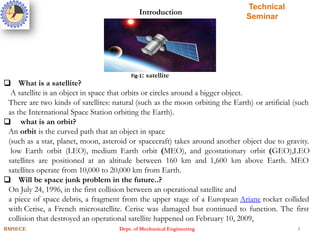
❑ What is a satellite?
A satellite is an object in space that orbits or circles around a bigger object.
There are two kinds of satellites: natural (such as the moon orbiting the Earth) or artificial (such
as the International Space Station orbiting the Earth).
❑ what is an orbit?
An orbit is the curved path that an object in space
(such as a star, planet, moon, asteroid or spacecraft) takes around another object due to gravity.
low Earth orbit (LEO), medium Earth orbit (MEO), and geostationary orbit (GEO),LEO
satellites are positioned at an altitude between 160 km and 1,600 km above Earth. MEO
satellites operate from 10,000 to 20,000 km from Earth.
❑ Will be space junk problem in the future..?
On July 24, 1996, in the first collision between an operational satellite and
a piece of space debris, a fragment from the upper stage of a European Ariane rocket collided
with Cerise, a French microsatellite. Cerise was damaged but continued to function. The first
collision that destroyed an operational satellite happened on February 10, 2009,
Introduction
Fig-1: satellite
4
BMSECE Dept. of Mechanical Engineering
Technical
Seminar
SPACE DEBRIS
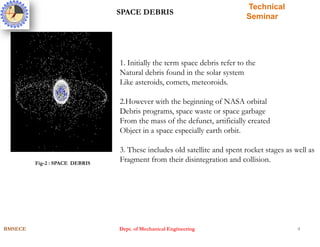
1. Initially the term space debris refer to the
Natural debris found in the solar system
Like asteroids, comets, meteoroids.
2.However with the beginning of NASA orbital
Debris programs, space waste or space garbage
From the mass of the defunct, artificially created
Object in a space especially earth orbit.
3. These includes old satellite and spent rocket stages as well as
Fragment from their disintegration and collision.
Fig-2 : SPACE DEBRIS
5
BMSECE Dept. of Mechanical Engineering
Technical
Seminar
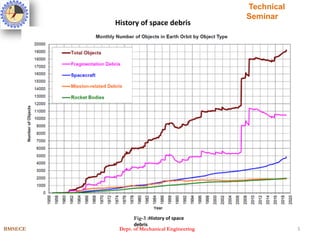
History of space debris
Fig-3 :History of space
debris
6
BMSECE Dept. of Mechanical Engineering
Technical
Seminar
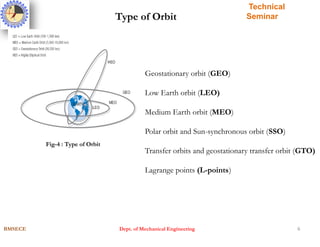
Type of Orbit
Geostationary orbit (GEO)
Low Earth orbit (LEO)
Medium Earth orbit (MEO)
Polar orbit and Sun-synchronous orbit (SSO)
Transfer orbits and geostationary transfer orbit (GTO)
Lagrange points (L-points)
Fig-4 : Type of Orbit
7
BMSECE Dept. of Mechanical Engineering
Technical
Seminar
Tracing and Measurement
1.Radar and optical detector such as LIDAR is the main tool to use tracking of the space debris
2.Radio waves have been recently used. These waves are transmitted inti space ,and they bounce
Off the space junk back to the origin and that will be detect and tack the object
3.Ground based radar facilities, and space telescopes are also used track the debris.
4.Return hardware of space debris is valuable source of information of environment
5.Some of the models used were:
LDEF (Long duration exposer facilities) satellite
EURECA(European Retrievable carrier)
STS-61 Endeavour
STS-109 Columbia
8
BMSECE Dept. of Mechanical Engineering
Technical
Seminar
HOW CAN WE CLEAN UP SPACE JUNK
1. Electrodynamic tethers
2. Laser Booming
3. Solar sails
4. Space nets & Harpoon
5. Electrostatic force
9
BMSECE Dept. of Mechanical Engineering
Technical
Seminar
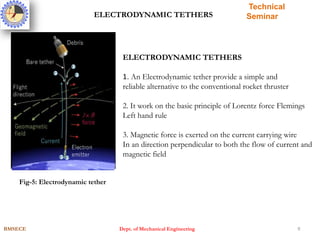
Fig-5: Electrodynamic tether
ELECTRODYNAMIC TETHERS
1. An Electrodynamic tether provide a simple and
reliable alternative to the conventional rocket thruster
2. It work on the basic principle of Lorentz force Flemings
Left hand rule
3. Magnetic force is exerted on the current carrying wire
In an direction perpendicular to both the flow of current and
magnetic field
ELECTRODYNAMIC TETHERS
10
BMSECE Dept. of Mechanical Engineering
Technical
Seminar
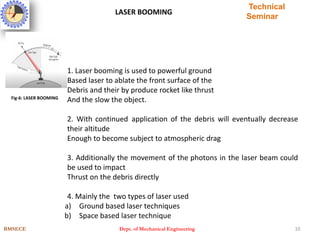
LASER BOOMING
1. Laser booming is used to powerful ground
Based laser to ablate the front surface of the
Debris and their by produce rocket like thrust
And the slow the object.
2. With continued application of the debris will eventually decrease
their altitude
Enough to become subject to atmospheric drag
3. Additionally the movement of the photons in the laser beam could
be used to impact
Thrust on the debris directly
4. Mainly the two types of laser used
a) Ground based laser techniques
b) Space based laser technique
Fig-6: LASER BOOMING
11
BMSECE Dept. of Mechanical Engineering
Technical
Seminar
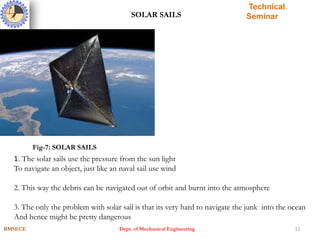
SOLAR SAILS
1. The solar sails use the pressure from the sun light
To navigate an object, just like an naval sail use wind
2. This way the debris can be navigated out of orbit and burnt into the atmosphere
3. The only the problem with solar sail is that its very hard to navigate the junk into the ocean
And hence might be pretty dangerous
Fig-7: SOLAR SAILS
12
BMSECE Dept. of Mechanical Engineering
Technical
Seminar
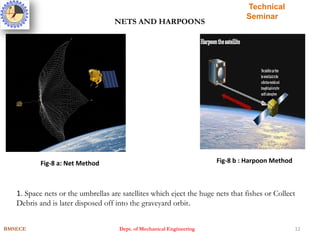
NETS AND HARPOONS
1. Space nets or the umbrellas are satellites which eject the huge nets that fishes or Collect
Debris and is later disposed off into the graveyard orbit.
Fig-8 a: Net Method Fig-8 b : Harpoon Method
13
BMSECE Dept. of Mechanical Engineering
Technical
Seminar
ELECTROSTATIC FORCE
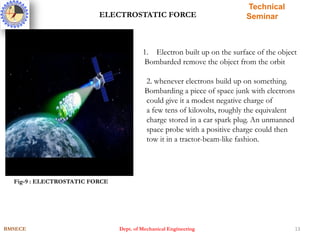
1. Electron built up on the surface of the object
Bombarded remove the object from the orbit
2. whenever electrons build up on something.
Bombarding a piece of space junk with electrons
could give it a modest negative charge of
a few tens of kilovolts, roughly the equivalent
charge stored in a car spark plug. An unmanned
space probe with a positive charge could then
tow it in a tractor-beam-like fashion.
Fig-9 : ELECTROSTATIC FORCE
14
BMSECE Dept. of Mechanical Engineering
Technical
Seminar
Collector satellite
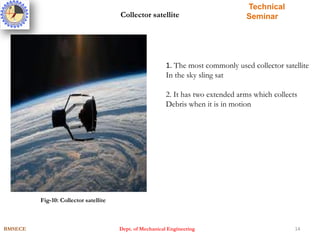
1. The most commonly used collector satellite
In the sky sling sat
2. It has two extended arms which collects
Debris when it is in motion
Fig-10: Collector satellite
15
BMSECE Dept. of Mechanical Engineering
Technical
Seminar
REFERENCE
1] Anderson, B.J (ed.) and Smith, R.E. (compiler): 1994, Natural Orbital Environment
Guidelines for Use in Aerospace Vehicle Development, NASA Technical Memorandum 4527,
Marshall Space Flight Center, Huntsville, Alabama, USA.
2] Bade, A., Reynolds, R.C. and Kessler, D.J.: 1996, Tethers for Power Generation
on the International Space Station Alpha, NASA JSC-27362, Johnson Space Center, Houston,
Texas, USA.
3] Cosmo, M.L. and Lorenzini, E.C. (eds.): 1997, Tethers in Space Handbook,
Third Edition, Smithsonian Astrophysical Observatory, Cambridge, Massachusetts, USA.
4] Forward, R.L., Hoyt, R.P. and Uphoff, C.: 1998, The Terminator Tether: A Near-Term
Commercial Application of the NASA/MSFC ProSEDS Experiment, Proceedings of the Tether
Technical Interchange Meeting, NASA CP-1998-206900, Marshall Space Flight Center,
Huntsville, Alabama, USA, p. 109
5] Goldstein, R.M., Goldstein, S.J. and Kessler, D.J.: 1998, Radar Observation of Space Debris,
Planet. Space Sci., 46, 1007-1013.
6] Pardini, C., Anselmo, L., Rossi, A., Cordelli, A. and Farinella, P.: 1998, A New Orbital Debris
Reference Model, The Journal of the Astronautical Sciences, 46, No. 3.
16
BMSECE Dept. of Mechanical Engineering
Technical
Seminar

technical seminar on space debirs ppt...

  • 1.
    B M SEvening College of Engineering (Affiliated to Visvesvaraya Technological University) Bangalore - 560019 Technical Seminar on Space Debris Under the Guidance of Dr. / Prof. HPJ SIR Designation, Dept. of Mechanical Engineering BMSECE BASAVARAJU AL USN: 1BE19ME404 Digital Signature with date of in-charge faculty
  • 2.
    BMSECE Dept. ofMechanical Engineering 2 Technical Seminar Abstract. 1.What is sky debris..? Is any piece of machinery or debris left by human in space. It can refer to big objects such as dead satellites that have failed or been left in orbit at the end of their mission. off a rocket. Ex; Paint flecks, solidified liquids expelled from spacecraft, and unburned particles from solid rocket motors. 2. Effect of Space trash: more than 128 million pieces of debris smaller than 1 cm (0.4 in), about 900,000 pieces of debris 1–10 cm, and around 34,000 of pieces larger than 10 cm (3.9 in) were estimated to be in orbit around the Earth. Space debris represents a risk to spacecraft. that could nonetheless prove disastrous if they hit something else. 3. How can we clean up space junk? Planning some technique to remove the debris dragging them back into the atmosphere, where they will burn up. 1.Harpoon grab satellite, catching it in huge net. 2.Electrostatic force. 3.Laser Booming.
  • 3.
    3 BMSECE Dept. ofMechanical Engineering Technical Seminar ❑ What is a satellite? A satellite is an object in space that orbits or circles around a bigger object. There are two kinds of satellites: natural (such as the moon orbiting the Earth) or artificial (such as the International Space Station orbiting the Earth). ❑ what is an orbit? An orbit is the curved path that an object in space (such as a star, planet, moon, asteroid or spacecraft) takes around another object due to gravity. low Earth orbit (LEO), medium Earth orbit (MEO), and geostationary orbit (GEO),LEO satellites are positioned at an altitude between 160 km and 1,600 km above Earth. MEO satellites operate from 10,000 to 20,000 km from Earth. ❑ Will be space junk problem in the future..? On July 24, 1996, in the first collision between an operational satellite and a piece of space debris, a fragment from the upper stage of a European Ariane rocket collided with Cerise, a French microsatellite. Cerise was damaged but continued to function. The first collision that destroyed an operational satellite happened on February 10, 2009, Introduction Fig-1: satellite
  • 4.
    4 BMSECE Dept. ofMechanical Engineering Technical Seminar SPACE DEBRIS 1. Initially the term space debris refer to the Natural debris found in the solar system Like asteroids, comets, meteoroids. 2.However with the beginning of NASA orbital Debris programs, space waste or space garbage From the mass of the defunct, artificially created Object in a space especially earth orbit. 3. These includes old satellite and spent rocket stages as well as Fragment from their disintegration and collision. Fig-2 : SPACE DEBRIS
  • 5.
    5 BMSECE Dept. ofMechanical Engineering Technical Seminar History of space debris Fig-3 :History of space debris
  • 6.
    6 BMSECE Dept. ofMechanical Engineering Technical Seminar Type of Orbit Geostationary orbit (GEO) Low Earth orbit (LEO) Medium Earth orbit (MEO) Polar orbit and Sun-synchronous orbit (SSO) Transfer orbits and geostationary transfer orbit (GTO) Lagrange points (L-points) Fig-4 : Type of Orbit
  • 7.
    7 BMSECE Dept. ofMechanical Engineering Technical Seminar Tracing and Measurement 1.Radar and optical detector such as LIDAR is the main tool to use tracking of the space debris 2.Radio waves have been recently used. These waves are transmitted inti space ,and they bounce Off the space junk back to the origin and that will be detect and tack the object 3.Ground based radar facilities, and space telescopes are also used track the debris. 4.Return hardware of space debris is valuable source of information of environment 5.Some of the models used were: LDEF (Long duration exposer facilities) satellite EURECA(European Retrievable carrier) STS-61 Endeavour STS-109 Columbia
  • 8.
    8 BMSECE Dept. ofMechanical Engineering Technical Seminar HOW CAN WE CLEAN UP SPACE JUNK 1. Electrodynamic tethers 2. Laser Booming 3. Solar sails 4. Space nets & Harpoon 5. Electrostatic force
  • 9.
    9 BMSECE Dept. ofMechanical Engineering Technical Seminar Fig-5: Electrodynamic tether ELECTRODYNAMIC TETHERS 1. An Electrodynamic tether provide a simple and reliable alternative to the conventional rocket thruster 2. It work on the basic principle of Lorentz force Flemings Left hand rule 3. Magnetic force is exerted on the current carrying wire In an direction perpendicular to both the flow of current and magnetic field ELECTRODYNAMIC TETHERS
  • 10.
    10 BMSECE Dept. ofMechanical Engineering Technical Seminar LASER BOOMING 1. Laser booming is used to powerful ground Based laser to ablate the front surface of the Debris and their by produce rocket like thrust And the slow the object. 2. With continued application of the debris will eventually decrease their altitude Enough to become subject to atmospheric drag 3. Additionally the movement of the photons in the laser beam could be used to impact Thrust on the debris directly 4. Mainly the two types of laser used a) Ground based laser techniques b) Space based laser technique Fig-6: LASER BOOMING
  • 11.
    11 BMSECE Dept. ofMechanical Engineering Technical Seminar SOLAR SAILS 1. The solar sails use the pressure from the sun light To navigate an object, just like an naval sail use wind 2. This way the debris can be navigated out of orbit and burnt into the atmosphere 3. The only the problem with solar sail is that its very hard to navigate the junk into the ocean And hence might be pretty dangerous Fig-7: SOLAR SAILS
  • 12.
    12 BMSECE Dept. ofMechanical Engineering Technical Seminar NETS AND HARPOONS 1. Space nets or the umbrellas are satellites which eject the huge nets that fishes or Collect Debris and is later disposed off into the graveyard orbit. Fig-8 a: Net Method Fig-8 b : Harpoon Method
  • 13.
    13 BMSECE Dept. ofMechanical Engineering Technical Seminar ELECTROSTATIC FORCE 1. Electron built up on the surface of the object Bombarded remove the object from the orbit 2. whenever electrons build up on something. Bombarding a piece of space junk with electrons could give it a modest negative charge of a few tens of kilovolts, roughly the equivalent charge stored in a car spark plug. An unmanned space probe with a positive charge could then tow it in a tractor-beam-like fashion. Fig-9 : ELECTROSTATIC FORCE
  • 14.
    14 BMSECE Dept. ofMechanical Engineering Technical Seminar Collector satellite 1. The most commonly used collector satellite In the sky sling sat 2. It has two extended arms which collects Debris when it is in motion Fig-10: Collector satellite
  • 15.
    15 BMSECE Dept. ofMechanical Engineering Technical Seminar REFERENCE 1] Anderson, B.J (ed.) and Smith, R.E. (compiler): 1994, Natural Orbital Environment Guidelines for Use in Aerospace Vehicle Development, NASA Technical Memorandum 4527, Marshall Space Flight Center, Huntsville, Alabama, USA. 2] Bade, A., Reynolds, R.C. and Kessler, D.J.: 1996, Tethers for Power Generation on the International Space Station Alpha, NASA JSC-27362, Johnson Space Center, Houston, Texas, USA. 3] Cosmo, M.L. and Lorenzini, E.C. (eds.): 1997, Tethers in Space Handbook, Third Edition, Smithsonian Astrophysical Observatory, Cambridge, Massachusetts, USA. 4] Forward, R.L., Hoyt, R.P. and Uphoff, C.: 1998, The Terminator Tether: A Near-Term Commercial Application of the NASA/MSFC ProSEDS Experiment, Proceedings of the Tether Technical Interchange Meeting, NASA CP-1998-206900, Marshall Space Flight Center, Huntsville, Alabama, USA, p. 109 5] Goldstein, R.M., Goldstein, S.J. and Kessler, D.J.: 1998, Radar Observation of Space Debris, Planet. Space Sci., 46, 1007-1013. 6] Pardini, C., Anselmo, L., Rossi, A., Cordelli, A. and Farinella, P.: 1998, A New Orbital Debris Reference Model, The Journal of the Astronautical Sciences, 46, No. 3.
  • 16.
    16 BMSECE Dept. ofMechanical Engineering Technical Seminar