PHYSICAL ASSESSMENT OF A
CHILD
APPROACH
Pediatric Assessment: The Major Focus
• Major differences between children and
adults
• Specific approaches and techniques to
physical exam
• Normal findings, variations and common
pathological conditions
• Interpretation of exam results
Major Concepts in Pediatric Physical Assessment
• Children are not little adults
• Understanding differences from adults is
important
• Differences relate to both growth and
development patterns
• Differences exist in motor skills and
coordination, and in physiologic, psychosocial,
behavioral, temperamental, language, and
cognition areas
Exam Settings
• Outpatient (office, clinic emergency room)
– Well child check
– Illness visit
•
• Inpatient
– Moderate to severe illness
– Anxiety and stress
• School setting or health office
•
– Children usually healthy
– Illness visits primarily common acute problems and some chronic
illness issues
– Health screenings
Standard Measurements
– Weight
– Height
– Head Circumference
– Chest Circumference
– Vital Signs
• Temperature
• Pulse, Heart Rate
• Respiration
• Blood Pressure
– Gestational Age Assessment and Intrauterine Growth
Charts
Sensory Issues
– Smell: usually not tested; observe for unusual odors
from child
– Taste: usually not tested; infants often prefer sweet
tasting foods
– Touch: well developed in infant; if stimulated can
invalidate other sensory tests
– Vision: right eye (OD), left eye (OS), both eyes (OU)
– Hearing: correlates with language development;
localization requires both ears
Approach to Physical Exam
– Consider age and developmental level; observe for “readiness”
clues
– Take time to get “acquainted”
– Use play techniques for infants and young children
– Determine best exam place ( table, parent’s lap, examiner’s lap)
– Use systematic approach; but be flexible to accommodate
child’s behavior
– Examine least intrusive areas first (i.e., hands, arms)
– Examine sensitive, painful or intrusive areas last (i.e. ears, nose,
mouth)
– Determine what exam you want to complete before possible
crying (i.e. heart, abdomen)
Age Groups
– Neonate/Newborn Birth to 28 days
• Pre-term Gestational age <37 weeks
• Term Gestational age 37-42 weeks
• Post-term Gestational age > 42 weeks
– Infant Birth to 1 year
• Young, Immobile Birth to 6 months
• Older, Mobile 6 to 12 months
– Young Child 1-5 years
• Toddler 1-3 years
• Pre Schooler 3-6 years
– School Age or Older Child 6-12 years
– Adolescent 13 to 18/21 years
• Pre-Adolescent10-12 years
General Assessment:
Body: Symmetry, nutrition, build, hygiene, breath, odor,
posture, movement, coordination, facial expression
Behavior: Development, attitude, affect,
responsiveness/awareness,
cooperation, speech, LOC (person, place, time), thought
process, attention span, concentration, memory
Distress: Posture, (flexion/extension), pain, facial
grimace, respiration
Skin, Hair and Nails: Skin – Key Points
• Color:Jaundice, pallor, cyanosis, erythema, ecchymosis
• Texture & Turgor: Degree of hydration or dehydration
• Edema: Periorbital (crying, allergies, renal disease, juvenile
hypothyroidism) Dependent (renal or cardiac disease)
• Birth Marks
• Pigmentations: Hyperpigmentation (endocrine, growth dis turbance);
hypopigmentation
• Infectious lesions: Viral, bacterial, fungal (erythema, macule, papule,
vesicule, pustule)
• Capillary bleeding: Petichiae and purpura usually indicate serious conditions
• Infestations: Pediculosis, scabies, insect bites
• Pruritis: Dry skin, allergy, eczema, contact dermatitis, hepatic, renal, lesions
• Trauma: Scars, ecchymosis, signs of abuse
• Hand:Dermatoglyphic variations associated with syndromes
Common Skin Variations in Newborns
and Infants
• Thin, transparent skin, especially premature
• Color Variations
• Vascular Markings
• Pigmentations
• Lanugo (downy hair) more prominent in
premature
• Original hair may shed at 4-8 weeks, and be
replaced
Skin Color Variations
• Jaundice:Pathologic in first 24 hrs. physiologic
after 24 hrs.
• Acrocyanosis Cyanotic, cool extremities; warm,
pink trunk
• Cutis marmorata Bluish mottling due to
chilling or stress
• Erythema toxicum Papules, vesicles on
erythematous base @24-48 hrs.
• Harlequin color change Lower side of body
red, upper side pale – change reverses it
CUTIS MARMORATA
• Milia White papular epidermal cysts with
sebaceous retention
• Miliaria (4 types) Obstruction of sweat
ducts from head and humidity
• Neonatal acne, prickly head Miliaria –
crystallina, rubra, pustulosa, profunda
• Pallor Anemia or anoxia
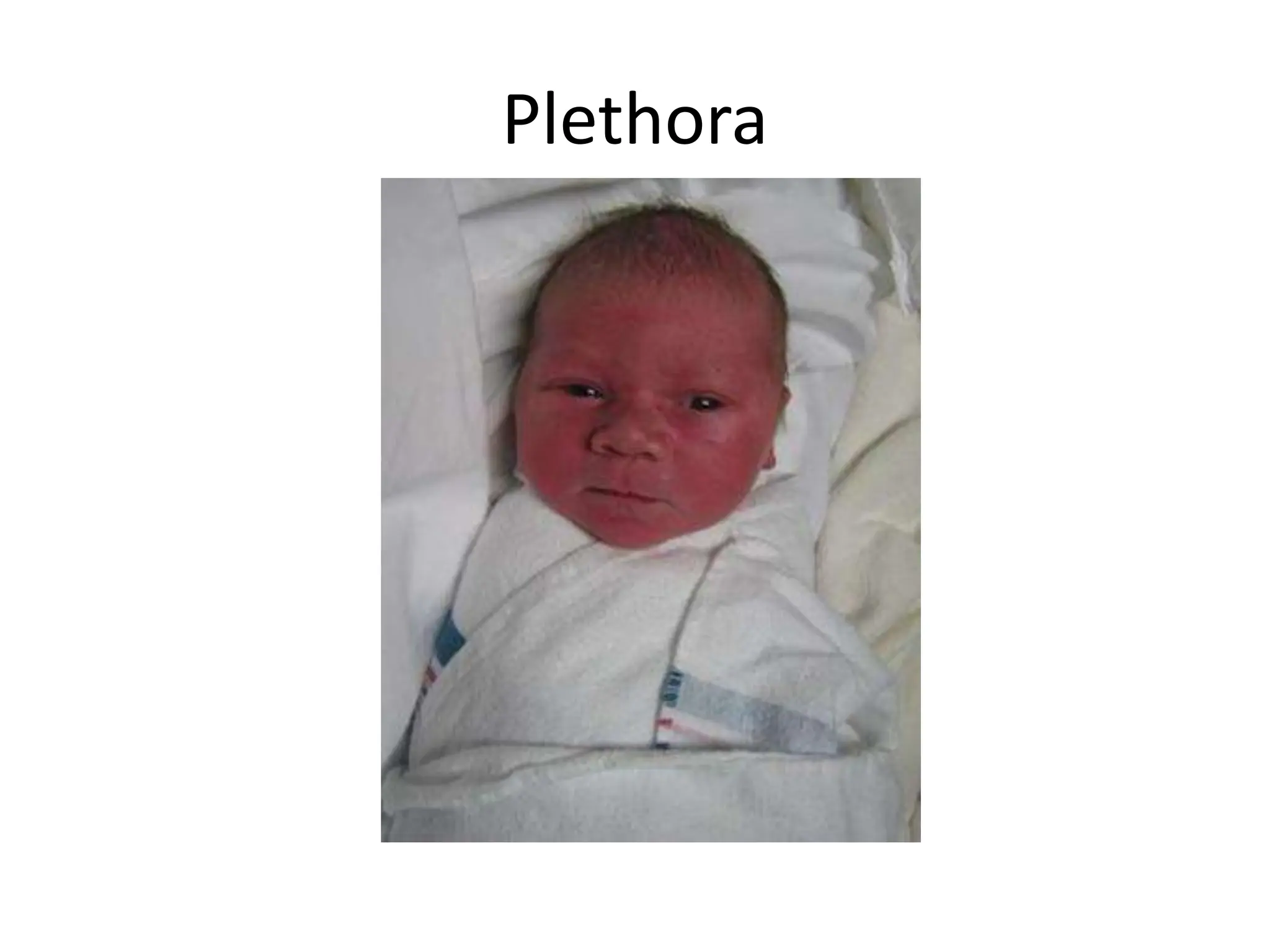
• Plethora Erythematous flush, due to
polycythemia
Milia
Plethora
Skin Vascular Markings
Capillary hemangiomas (telangiectasia or
telangiectataic nevus or nevus simplex --- “stork
bites,” “angel kisses”) --- usually fade
Nevus flammeus (“port wine stains”), nevus
vasculosis ---not likely to fade Can be associated
with Sturge-Weber Syndrome
Strawberry hemangioma: bright red, lobulated
tumor
Capillary hemangiomas
Nevus flammeus
Strawberry hemangioma:
Skin Pigmentations
• Mongolian spots in darker pigmented infants
• Pigmented nevi,
• Café au Lait (<3cm and <6 in # are WNL –
larger size or more spots associated with
Neurofibromatosis , or Von Recklinghausen
Disease) – an autosomal-dominant disorder,
with tumors on peripheral or cranial nerves
Mongolian spots
Yellow Skin Color
Jaundice: Observed in sclera, skin, fingernails, soles, palms &
oral mucosa . Does not blanche with pressure over chest or nose areas
Is associated with liver disease, hepatitis, red cell hemolysis, biliary
Obstruction & sever infection during infancy.
Carotenemia: Observed in palms, soles, face, skin
(not in sclera or mucous membranes)
Blanches easily to pressure over chest or nose Occurs in older infants,
with eating yellow vegetables
Renal Disease: Yellowing of exposed skin areas (not sclera or mucous
membranes) May be associated with chronic renal disease
Hemolytic Jaundice of Newborn:
Biirubin above 5ml/dl
• Pathologic: Occurs first 24 hrs of life. Bilirubin
increases faster than 5ml/dl/day
• Physiologic: Onset after 24 hrs, with peak from 72-
90 hrs. Declines at 4 to 7 days
Breast Feeding: Early onset: Onset at 2 to 4 days.
Peak at 3 to 5 days
• Late onset: Onset at 5-7 days. Peak at 10 to 15
days.
• May remain jaundiced for 3 to 12 weeks
Hair: Key Points
• Assess for distribution, color, texture, amount,
quality and for infestations
• Coarse, dry, brittle or depigmented hair may
indicate nutrition deficiency or thyroid disorder
• Alopecia may be related to tinea capitus, hair
pulling or persistent positioning
• White eggs (nits) attached to hair shafts indicate
pediculosis
• Hair tufts on spine or buttocks may indicate spina
bifida
FLAG SIGN
Nails: Key Points
• Inspect for color, shape, condition, nail biting
and infection
• Clubbing may indicate chronic hypoxia
(respiratory or cardiac dis ease)
• “Spoon” nails may indicate iron deficiency
anemia
• Pitted nails may indicate psoriasis
• Splinter hemorrhages under nails may indicate
trauma or endocarditis
HEENT: Head & Neck: Eyes: Ears:
Nose, Face, Mouth & Throat
• Head: Symmetry of skull and face
• Neck: Structure, movement, trachea, thyroid,
vessels and lymph nodes
• Eyes: Vision, placement, external and internal
fundoscopic exam
• Ears: Hearing, external, ear canal and
otoscopic exam of tympanic membrane
• Nose: Exam of nose and sinuses
• Mouth: Structures of mouth, teeth and pharynx
• Head Circumference (HC): Frontal Occipital
Circumference (FOC)
• Fontannels/sutures: Anterior closes at 10-18 months,
posterior by 2 months
• Symmetry & shape: Face & skull
• Bruits: Temporal bruits may be significant after 5 yrs
• Hair: Patterns, loss, hygiene, pediculosis in school
aged child
• Sinuses: Palpate for tenderness in older children
• Facial expression: Saddness, signs of abuse, allergy, fatigue
• Abnormal facies: “Diagnostic facies” of common
syndromes or illnesses
MONKEY FACIES
Capput succedaneum(scalp swelling)
Cephalohematoma (subperiosteal
hemorrhage)
CRANIOSYNTOSIS
Macewen’s sign:“Cracked pot” sound with
tapping over parietal bone.
• May be WNL in infants, or associated with ICP
& suture separation (i.e. lead encephalopathy,
tumor)
Flattened head areas: Especially occipital
flattening with hair loss, may indicate persistent
placement of baby in same position.
Eyes: Key Points
• Vision: Red reflex & blink in neonate
• Visual following at 5-6 wks
• 180 degree tracking at 4 months
• E chart & strabismus check for preschool child Snellen
charts for older children
• Irritations & infections
• PERRLA
• Amblyopia (lazy eye): Corneal light reflex, cover-uncover
test
• EOMs: tracking 6 fields of vision
• Fundoscopic exam of internal eye & retina
Eyes: Variations
• Placement & symmetry: Wide set:
hypertelorism – Down syndrome
• Close set: hypotelorism
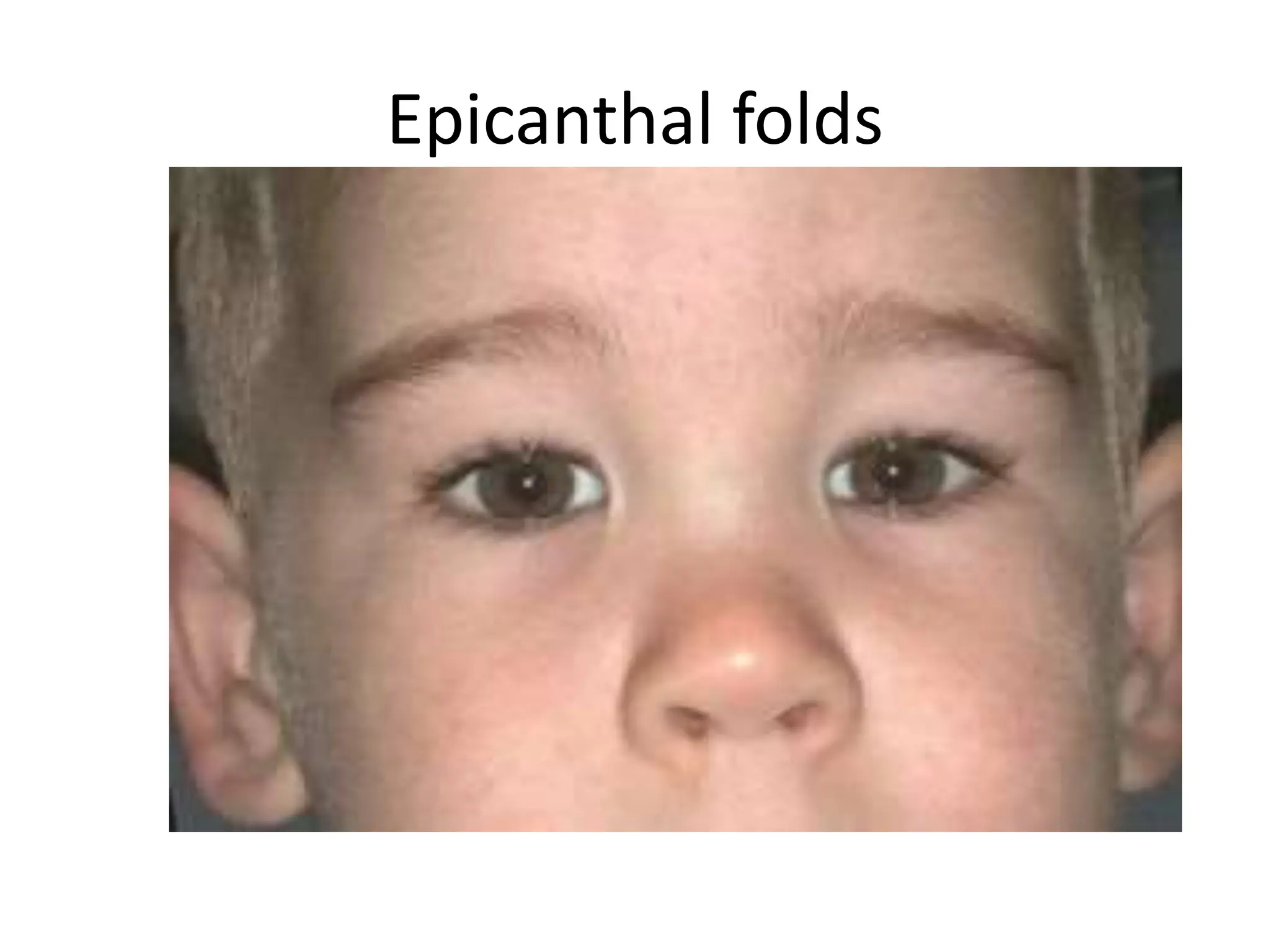
• Epicanthal folds or upward slants – ethnicity,
Down s. Character of eyebrows
Epicanthal folds
Ptosis
Dacryocystitis
Conjunctive: Inflammation, pallor (anemia),
• Cobblestone appearance may indicate allergy
• Sclera: Jaundice (liver disease), injection
(conjunctivitis), Hemorrhage, blue color (osteogenesis
imperfecta)
• Cornea: Smooth, moist,clear (not injected with
conjunctivitis red eye)
• Pupil & Iris:Brushfield’s spots (light speckling of iris) seen in
Down s.
• Coloboma (notch at outer edge or iris) may indicate visual
field defect.
• Othalmoscope: Partial or dark red reflex
indicates pathology, various retinal anomalies
or opacities of cornea, anterior chamber or
lens (i.e. cataract)
• Glabellar/blinking reflex
Ears: Variations
• External: Malformed auricle/pinna, or low-set or
obliquely-set ears may be Associated with many
syndromes, or genitourinary & chromosomal
abnormalities.
• Otitis externa: Pain with movement of auricle or
tragus, discharge in canal, occurs More often in summer
(“swimmer’s ear”)
• Otitis media: Proper position & holding of otoscope
facilitates comfortable . As middle ear pressure or fluid
increases, the tympanic membrane (TM) becomes less
mobile with pneumatic otoscopy.
• Exam nose & mouth after ears (after crying from
ear exam)
• Observe shape & structural deviations
• Nares: ( check patency, mucous membranes,
discharge, bleeding)
• Septum: (check for deviation)
• Infants are obligate nose breathers
• Nasal flaring is associated with respiratory
distress
Nose: Variations
Allergy: Pale, boggy mucous membranes & interior turbinates , watery
discharge, mouth breathing & “allergic salute” line across nose.
Infection: Erythematous, edematous mucous membranes, with
purulent yellow or green nasal discharge
Foreign body: Foul odor or unilateral discharge
Excoriation: Irritating discharge, frequent wiping or nose picking
Asymmetry of nasolabial folds may indicate facial nerve impairment or Bell’s
palsy.
Sinuses: Key Points
• Palpate maxillary & frontal sinus areas for
tenderness of sinusitis in older children
• Development of facial sinuses and location of
sinus pain is listed below:
Sinus Pain Location Age of Development
· Maxillary cheek & upper teeth present @ birth
· Ethmoid medial & deep to eye present @ birth
· Frontal forehead & above eyebrow approximately 7 years
· Sphenoid deep behind eye in occiput adolescence
Mouth & Pharynx: Key Points
• Inspect lips for color, symmetry, moisture, swelling, sores,
fissures
• Inspect buccal mucosa, gingivae, tongue & palate for
moisture, color, intactness, bleeding, lesions.
• Inspect tongue & frenulum for movement, size & texture
• Count teeth & inspect for caries, malocclusion and loose
teeth.
• 20 deciduous teeth, begin eruption at 6 months & continue
adding approximately 1/month 32 permanent teeth, erupt
from 6 to 25 years, with molar eruption from 1to 25 years
• Observe for quality of voice
• Observe infants for rooting and sucking reflexes, Epstein
pearls & thrush
• Observe breath for halitosis
Variations
• Newborn cysts: Epstein’s pearls occur along midline
of palate.
• Fissure/cracked lips: May be due to harsh climate or
vitamin deficiencies.
• Color variations: Central cyanosis can be observed in
lips & mucosa.. Pallor may indicate anemia.
• Cherry red coloration may be seen in acidosis.
• Koplik’s spots, small white, red rimmed eruptions on
buccal mucosa next to first & second molars, appear
and disappear before the onset of Measles (rubeola)
rash.
Epstein’s pearls
• Tongue variations: A smooth, red tongue may
be related to vitamin deficiencies,
• “Baby bottle” caries
• Brown-white mottling may indicate excessive
fluoride intake.
• Green & black staining may indicate oral iron
intake contacting teeth
Neck: Variations
• Head lag: Significant lag after 6 months may indicate cerebral palsy
• Torticollis: “Stiff neck” with resistance to lateral head turn as result of
injury to sternocleidomastoid muscle, more often seen in newborn
• Clavicle: Check for fracture in newborn, associated with shortening,
break in contour, Crepitus at fracture site, and decreased motion of arm
• Webbing: Feature of “Turner’s syndrome” or other congenital
abnormalities
• Meningeal: Irritation indicated by nuchal rigidiy, opisthotonos, tripod
position with sitting, Positive Brudzinski’s sign (with patient supine, neck
flexion produces pain and flexion of hips and knees).
• Positive Kernig’s sign (with patient supine, hip & knee flexed, extension of
knee Produces pain & resistance
• Nodes: Lymphadenopathy common with infection in older children,
upper neck areas, and below angle of jaw, usually bilateral. Should not be
deep cervical or clavicular.
Thorax & Lungs: Key Points
• Structure: Observe for shape, symmetry &
posture
– AP diameter: round chest or 1:1 ratio during
infancy, with transverse diameter increasing, with
AP:lateral ration 1:2 during school age years.
Pectus carinatum or pigeon breast: concavity of sternum
Pectus excavatum or funnel chest protrusive sternum
Breast: Key Points
• Inspection: size, color, symmetry, color,
nipples/accessory nipples, dimpling
• Palpation: masses, consistency, elasticity,
nipple discharge
• Male gynecomastia
• Self Exam
Retractions
Tanner Stages
Lungs & Respiratory Status: Key
Points
• Symmetry of expansion, decreased expansion (pneumonia, pneumothorax, FB)
• Prolonged expiratory phase
• Resp irate (>40 at rest, after neonate period = respiratory distress)
• Color: cyanosis or mottling
• Clubbing
• Nasal flaring
• Grunting (expiratory)
• Stridor (inspiratory): croup
• Snoring (expiratory): upper airway obstruction, allergy, enlarged lymph tissue
• Retractions
• Respiratory movement: males abdominal, females thoracic-costal,
• elderly shallow, infants abdominal
• Dyspnea
• Orthopnea
• Dullness to percussion: fluid or mass
• Quality: vesicular (bronchioles, alveoli)
• bronchovesicular (bronchi) bronchial (trachea)
• Adventitious (adventitious) sounds
– Crackles (rales)
– Rhonchi (course breath sounds)
– Wheeze
• Pleural friction rub
Cardiovascular: Key Points
• Vital signs: compare with normal/age values
• Peripheral pulses: apical, carotid, radial/brachial, femoral, pedal
• Rate, rhythm: compare cardiac rhythm with pulse
• Peripheral vascular: color, temperature, edema, skin
texture/changes
• Capillary refill: immediate
• Peripheral pulses: femoral pulses absent or diminished in aortic
stenosis
• Deep vein thrombosis: Homan's sign
• Skin: pallor, cyanosis (lips, nail beds, ear lobes)
• Clubbing
• Pulsating neck vessels (JVD)
• Heart
•
– Rate, rhythm, heart sounds
– Auscultation: sitting, lying, left recumbent &
bending forward
– location & size of heart: midclavicular 5th
intercostal space (4th/infant)
• Murmurs:may be systolic, diastolic or
continuous (timing, location, quality (course,
harsh, blowing, high pitched)
Abdomen: Key Points
– Contour
– Peristalsis
– Skin: color, veins
– Umbilicus
– Tenderness
– Ridigity
– Hernias: umbilical, inguinal, femoral
– Masses - size, shape, dullness, position, mobility
– Liver
– Spleen
– Kidneys
– Bladder
Female Genitalia
– External genitalia: Pelvic 16-18 years or when
sexually active
– Mons pubic, prepuce (clitoral hood), clitoris, labia
minora/majora, vagina, Skene's & Bartholin's
ducts, anus
– Size, color, skin integrity, masses
– Redness, swelling, labial adhesions/fusion, lesions,
discharge (foul-smelling)
Male Genitalia
– Penis: Size, color, skin integrity, circumcision
– Urethral meatus: Shape, placement, discharge,
ulceration, discharge meatal stenosis,
hypospadias, epispadias
– Scrotum: Color, size, symmetry, edema, masses,
lesions, tenderness,
– testes descended bilaterally
– Pubic hair
Musculoskeletal: Key Points
– Alignment, contour, strength, weakness &
symmetry
– Limb, joint mobility: ROM, stiffness, contractures -
Neck, shoulder, elbow, wrist, hip, knee, ankle, foot
– Digits
– Dermatoglyphics
BOWED LEGS
KNOCK KNEES
https://youtu.be/0sqCIzuotWo
physical ASSESSMENT CHILDREN AND NEONATES.pptx

physical ASSESSMENT CHILDREN AND NEONATES.pptx

  • 1.
  • 2.
    APPROACH Pediatric Assessment: TheMajor Focus • Major differences between children and adults • Specific approaches and techniques to physical exam • Normal findings, variations and common pathological conditions • Interpretation of exam results
  • 3.
    Major Concepts inPediatric Physical Assessment • Children are not little adults • Understanding differences from adults is important • Differences relate to both growth and development patterns • Differences exist in motor skills and coordination, and in physiologic, psychosocial, behavioral, temperamental, language, and cognition areas
  • 4.
    Exam Settings • Outpatient(office, clinic emergency room) – Well child check – Illness visit • • Inpatient – Moderate to severe illness – Anxiety and stress • School setting or health office • – Children usually healthy – Illness visits primarily common acute problems and some chronic illness issues – Health screenings
  • 5.
    Standard Measurements – Weight –Height – Head Circumference – Chest Circumference – Vital Signs • Temperature • Pulse, Heart Rate • Respiration • Blood Pressure – Gestational Age Assessment and Intrauterine Growth Charts
  • 6.
    Sensory Issues – Smell:usually not tested; observe for unusual odors from child – Taste: usually not tested; infants often prefer sweet tasting foods – Touch: well developed in infant; if stimulated can invalidate other sensory tests – Vision: right eye (OD), left eye (OS), both eyes (OU) – Hearing: correlates with language development; localization requires both ears
  • 7.
    Approach to PhysicalExam – Consider age and developmental level; observe for “readiness” clues – Take time to get “acquainted” – Use play techniques for infants and young children – Determine best exam place ( table, parent’s lap, examiner’s lap) – Use systematic approach; but be flexible to accommodate child’s behavior – Examine least intrusive areas first (i.e., hands, arms) – Examine sensitive, painful or intrusive areas last (i.e. ears, nose, mouth) – Determine what exam you want to complete before possible crying (i.e. heart, abdomen)
  • 8.
    Age Groups – Neonate/NewbornBirth to 28 days • Pre-term Gestational age <37 weeks • Term Gestational age 37-42 weeks • Post-term Gestational age > 42 weeks – Infant Birth to 1 year • Young, Immobile Birth to 6 months • Older, Mobile 6 to 12 months – Young Child 1-5 years • Toddler 1-3 years • Pre Schooler 3-6 years – School Age or Older Child 6-12 years – Adolescent 13 to 18/21 years • Pre-Adolescent10-12 years
  • 9.
    General Assessment: Body: Symmetry,nutrition, build, hygiene, breath, odor, posture, movement, coordination, facial expression Behavior: Development, attitude, affect, responsiveness/awareness, cooperation, speech, LOC (person, place, time), thought process, attention span, concentration, memory Distress: Posture, (flexion/extension), pain, facial grimace, respiration
  • 10.
    Skin, Hair andNails: Skin – Key Points • Color:Jaundice, pallor, cyanosis, erythema, ecchymosis • Texture & Turgor: Degree of hydration or dehydration • Edema: Periorbital (crying, allergies, renal disease, juvenile hypothyroidism) Dependent (renal or cardiac disease) • Birth Marks • Pigmentations: Hyperpigmentation (endocrine, growth dis turbance); hypopigmentation • Infectious lesions: Viral, bacterial, fungal (erythema, macule, papule, vesicule, pustule) • Capillary bleeding: Petichiae and purpura usually indicate serious conditions • Infestations: Pediculosis, scabies, insect bites • Pruritis: Dry skin, allergy, eczema, contact dermatitis, hepatic, renal, lesions • Trauma: Scars, ecchymosis, signs of abuse • Hand:Dermatoglyphic variations associated with syndromes
  • 11.
    Common Skin Variationsin Newborns and Infants • Thin, transparent skin, especially premature • Color Variations • Vascular Markings • Pigmentations • Lanugo (downy hair) more prominent in premature • Original hair may shed at 4-8 weeks, and be replaced
  • 12.
    Skin Color Variations •Jaundice:Pathologic in first 24 hrs. physiologic after 24 hrs. • Acrocyanosis Cyanotic, cool extremities; warm, pink trunk • Cutis marmorata Bluish mottling due to chilling or stress • Erythema toxicum Papules, vesicles on erythematous base @24-48 hrs. • Harlequin color change Lower side of body red, upper side pale – change reverses it
  • 15.
  • 16.
    • Milia Whitepapular epidermal cysts with sebaceous retention • Miliaria (4 types) Obstruction of sweat ducts from head and humidity • Neonatal acne, prickly head Miliaria – crystallina, rubra, pustulosa, profunda • Pallor Anemia or anoxia • Plethora Erythematous flush, due to polycythemia
  • 17.
  • 18.
  • 19.
    Skin Vascular Markings Capillaryhemangiomas (telangiectasia or telangiectataic nevus or nevus simplex --- “stork bites,” “angel kisses”) --- usually fade Nevus flammeus (“port wine stains”), nevus vasculosis ---not likely to fade Can be associated with Sturge-Weber Syndrome Strawberry hemangioma: bright red, lobulated tumor
  • 20.
  • 21.
  • 22.
  • 23.
    Skin Pigmentations • Mongolianspots in darker pigmented infants • Pigmented nevi, • Café au Lait (<3cm and <6 in # are WNL – larger size or more spots associated with Neurofibromatosis , or Von Recklinghausen Disease) – an autosomal-dominant disorder, with tumors on peripheral or cranial nerves
  • 24.
  • 25.
    Yellow Skin Color Jaundice:Observed in sclera, skin, fingernails, soles, palms & oral mucosa . Does not blanche with pressure over chest or nose areas Is associated with liver disease, hepatitis, red cell hemolysis, biliary Obstruction & sever infection during infancy. Carotenemia: Observed in palms, soles, face, skin (not in sclera or mucous membranes) Blanches easily to pressure over chest or nose Occurs in older infants, with eating yellow vegetables Renal Disease: Yellowing of exposed skin areas (not sclera or mucous membranes) May be associated with chronic renal disease
  • 26.
    Hemolytic Jaundice ofNewborn: Biirubin above 5ml/dl • Pathologic: Occurs first 24 hrs of life. Bilirubin increases faster than 5ml/dl/day • Physiologic: Onset after 24 hrs, with peak from 72- 90 hrs. Declines at 4 to 7 days Breast Feeding: Early onset: Onset at 2 to 4 days. Peak at 3 to 5 days • Late onset: Onset at 5-7 days. Peak at 10 to 15 days. • May remain jaundiced for 3 to 12 weeks
  • 27.
    Hair: Key Points •Assess for distribution, color, texture, amount, quality and for infestations • Coarse, dry, brittle or depigmented hair may indicate nutrition deficiency or thyroid disorder • Alopecia may be related to tinea capitus, hair pulling or persistent positioning • White eggs (nits) attached to hair shafts indicate pediculosis • Hair tufts on spine or buttocks may indicate spina bifida
  • 28.
  • 29.
    Nails: Key Points •Inspect for color, shape, condition, nail biting and infection • Clubbing may indicate chronic hypoxia (respiratory or cardiac dis ease) • “Spoon” nails may indicate iron deficiency anemia • Pitted nails may indicate psoriasis • Splinter hemorrhages under nails may indicate trauma or endocarditis
  • 34.
    HEENT: Head &Neck: Eyes: Ears: Nose, Face, Mouth & Throat • Head: Symmetry of skull and face • Neck: Structure, movement, trachea, thyroid, vessels and lymph nodes • Eyes: Vision, placement, external and internal fundoscopic exam • Ears: Hearing, external, ear canal and otoscopic exam of tympanic membrane • Nose: Exam of nose and sinuses • Mouth: Structures of mouth, teeth and pharynx
  • 35.
    • Head Circumference(HC): Frontal Occipital Circumference (FOC) • Fontannels/sutures: Anterior closes at 10-18 months, posterior by 2 months • Symmetry & shape: Face & skull • Bruits: Temporal bruits may be significant after 5 yrs • Hair: Patterns, loss, hygiene, pediculosis in school aged child • Sinuses: Palpate for tenderness in older children • Facial expression: Saddness, signs of abuse, allergy, fatigue • Abnormal facies: “Diagnostic facies” of common syndromes or illnesses
  • 36.
  • 38.
  • 39.
  • 40.
  • 41.
    Macewen’s sign:“Cracked pot”sound with tapping over parietal bone. • May be WNL in infants, or associated with ICP & suture separation (i.e. lead encephalopathy, tumor)
  • 43.
    Flattened head areas:Especially occipital flattening with hair loss, may indicate persistent placement of baby in same position.
  • 44.
    Eyes: Key Points •Vision: Red reflex & blink in neonate • Visual following at 5-6 wks • 180 degree tracking at 4 months • E chart & strabismus check for preschool child Snellen charts for older children • Irritations & infections • PERRLA • Amblyopia (lazy eye): Corneal light reflex, cover-uncover test • EOMs: tracking 6 fields of vision • Fundoscopic exam of internal eye & retina
  • 47.
    Eyes: Variations • Placement& symmetry: Wide set: hypertelorism – Down syndrome • Close set: hypotelorism • Epicanthal folds or upward slants – ethnicity, Down s. Character of eyebrows
  • 49.
  • 50.
  • 51.
  • 52.
    Conjunctive: Inflammation, pallor(anemia), • Cobblestone appearance may indicate allergy
  • 53.
    • Sclera: Jaundice(liver disease), injection (conjunctivitis), Hemorrhage, blue color (osteogenesis imperfecta) • Cornea: Smooth, moist,clear (not injected with conjunctivitis red eye) • Pupil & Iris:Brushfield’s spots (light speckling of iris) seen in Down s. • Coloboma (notch at outer edge or iris) may indicate visual field defect.
  • 54.
    • Othalmoscope: Partialor dark red reflex indicates pathology, various retinal anomalies or opacities of cornea, anterior chamber or lens (i.e. cataract) • Glabellar/blinking reflex
  • 55.
    Ears: Variations • External:Malformed auricle/pinna, or low-set or obliquely-set ears may be Associated with many syndromes, or genitourinary & chromosomal abnormalities. • Otitis externa: Pain with movement of auricle or tragus, discharge in canal, occurs More often in summer (“swimmer’s ear”) • Otitis media: Proper position & holding of otoscope facilitates comfortable . As middle ear pressure or fluid increases, the tympanic membrane (TM) becomes less mobile with pneumatic otoscopy.
  • 58.
    • Exam nose& mouth after ears (after crying from ear exam) • Observe shape & structural deviations • Nares: ( check patency, mucous membranes, discharge, bleeding) • Septum: (check for deviation) • Infants are obligate nose breathers • Nasal flaring is associated with respiratory distress
  • 59.
    Nose: Variations Allergy: Pale,boggy mucous membranes & interior turbinates , watery discharge, mouth breathing & “allergic salute” line across nose. Infection: Erythematous, edematous mucous membranes, with purulent yellow or green nasal discharge Foreign body: Foul odor or unilateral discharge Excoriation: Irritating discharge, frequent wiping or nose picking Asymmetry of nasolabial folds may indicate facial nerve impairment or Bell’s palsy.
  • 60.
    Sinuses: Key Points •Palpate maxillary & frontal sinus areas for tenderness of sinusitis in older children • Development of facial sinuses and location of sinus pain is listed below: Sinus Pain Location Age of Development · Maxillary cheek & upper teeth present @ birth · Ethmoid medial & deep to eye present @ birth · Frontal forehead & above eyebrow approximately 7 years · Sphenoid deep behind eye in occiput adolescence
  • 62.
    Mouth & Pharynx:Key Points • Inspect lips for color, symmetry, moisture, swelling, sores, fissures • Inspect buccal mucosa, gingivae, tongue & palate for moisture, color, intactness, bleeding, lesions. • Inspect tongue & frenulum for movement, size & texture • Count teeth & inspect for caries, malocclusion and loose teeth. • 20 deciduous teeth, begin eruption at 6 months & continue adding approximately 1/month 32 permanent teeth, erupt from 6 to 25 years, with molar eruption from 1to 25 years • Observe for quality of voice • Observe infants for rooting and sucking reflexes, Epstein pearls & thrush • Observe breath for halitosis
  • 64.
    Variations • Newborn cysts:Epstein’s pearls occur along midline of palate. • Fissure/cracked lips: May be due to harsh climate or vitamin deficiencies. • Color variations: Central cyanosis can be observed in lips & mucosa.. Pallor may indicate anemia. • Cherry red coloration may be seen in acidosis. • Koplik’s spots, small white, red rimmed eruptions on buccal mucosa next to first & second molars, appear and disappear before the onset of Measles (rubeola) rash.
  • 68.
  • 69.
    • Tongue variations:A smooth, red tongue may be related to vitamin deficiencies, • “Baby bottle” caries • Brown-white mottling may indicate excessive fluoride intake. • Green & black staining may indicate oral iron intake contacting teeth
  • 72.
    Neck: Variations • Headlag: Significant lag after 6 months may indicate cerebral palsy • Torticollis: “Stiff neck” with resistance to lateral head turn as result of injury to sternocleidomastoid muscle, more often seen in newborn • Clavicle: Check for fracture in newborn, associated with shortening, break in contour, Crepitus at fracture site, and decreased motion of arm • Webbing: Feature of “Turner’s syndrome” or other congenital abnormalities • Meningeal: Irritation indicated by nuchal rigidiy, opisthotonos, tripod position with sitting, Positive Brudzinski’s sign (with patient supine, neck flexion produces pain and flexion of hips and knees). • Positive Kernig’s sign (with patient supine, hip & knee flexed, extension of knee Produces pain & resistance • Nodes: Lymphadenopathy common with infection in older children, upper neck areas, and below angle of jaw, usually bilateral. Should not be deep cervical or clavicular.
  • 78.
    Thorax & Lungs:Key Points • Structure: Observe for shape, symmetry & posture – AP diameter: round chest or 1:1 ratio during infancy, with transverse diameter increasing, with AP:lateral ration 1:2 during school age years.
  • 79.
    Pectus carinatum orpigeon breast: concavity of sternum
  • 80.
    Pectus excavatum orfunnel chest protrusive sternum
  • 82.
    Breast: Key Points •Inspection: size, color, symmetry, color, nipples/accessory nipples, dimpling • Palpation: masses, consistency, elasticity, nipple discharge • Male gynecomastia • Self Exam
  • 83.
  • 84.
  • 86.
    Lungs & RespiratoryStatus: Key Points • Symmetry of expansion, decreased expansion (pneumonia, pneumothorax, FB) • Prolonged expiratory phase • Resp irate (>40 at rest, after neonate period = respiratory distress) • Color: cyanosis or mottling • Clubbing • Nasal flaring • Grunting (expiratory) • Stridor (inspiratory): croup • Snoring (expiratory): upper airway obstruction, allergy, enlarged lymph tissue • Retractions • Respiratory movement: males abdominal, females thoracic-costal, • elderly shallow, infants abdominal • Dyspnea • Orthopnea
  • 87.
    • Dullness topercussion: fluid or mass • Quality: vesicular (bronchioles, alveoli) • bronchovesicular (bronchi) bronchial (trachea) • Adventitious (adventitious) sounds – Crackles (rales) – Rhonchi (course breath sounds) – Wheeze • Pleural friction rub
  • 88.
    Cardiovascular: Key Points •Vital signs: compare with normal/age values • Peripheral pulses: apical, carotid, radial/brachial, femoral, pedal • Rate, rhythm: compare cardiac rhythm with pulse • Peripheral vascular: color, temperature, edema, skin texture/changes • Capillary refill: immediate • Peripheral pulses: femoral pulses absent or diminished in aortic stenosis • Deep vein thrombosis: Homan's sign • Skin: pallor, cyanosis (lips, nail beds, ear lobes) • Clubbing • Pulsating neck vessels (JVD)
  • 89.
    • Heart • – Rate,rhythm, heart sounds – Auscultation: sitting, lying, left recumbent & bending forward – location & size of heart: midclavicular 5th intercostal space (4th/infant) • Murmurs:may be systolic, diastolic or continuous (timing, location, quality (course, harsh, blowing, high pitched)
  • 91.
    Abdomen: Key Points –Contour – Peristalsis – Skin: color, veins – Umbilicus – Tenderness – Ridigity – Hernias: umbilical, inguinal, femoral – Masses - size, shape, dullness, position, mobility – Liver – Spleen – Kidneys – Bladder
  • 92.
    Female Genitalia – Externalgenitalia: Pelvic 16-18 years or when sexually active – Mons pubic, prepuce (clitoral hood), clitoris, labia minora/majora, vagina, Skene's & Bartholin's ducts, anus – Size, color, skin integrity, masses – Redness, swelling, labial adhesions/fusion, lesions, discharge (foul-smelling)
  • 93.
    Male Genitalia – Penis:Size, color, skin integrity, circumcision – Urethral meatus: Shape, placement, discharge, ulceration, discharge meatal stenosis, hypospadias, epispadias – Scrotum: Color, size, symmetry, edema, masses, lesions, tenderness, – testes descended bilaterally – Pubic hair
  • 95.
    Musculoskeletal: Key Points –Alignment, contour, strength, weakness & symmetry – Limb, joint mobility: ROM, stiffness, contractures - Neck, shoulder, elbow, wrist, hip, knee, ankle, foot – Digits – Dermatoglyphics
  • 101.
  • 102.
  • 103.