15/e


Accounting for Governmental
& Nonprofit Entities
                 EARL R. WILSON
                 JACQUELINE L. RECK
                 SUSAN C. KATTELUS
Chapter

                                                                              1
        Introduction to Accounting and
                   Financial
        Reporting for Governmental and
                    Not-for-
                Profit Entities

McGraw-Hill/Irwin     Copyright © 2010 by The McGraw-Hill Companies, Inc. All rights reserved.
Learning Objectives

After studying Chapter 1, you should be able to:
 Identify and explain the characteristics that
  distinguish governmental and not-for-profit entities
  from for-profit entities
 Identify the authoritative bodies responsible for
  setting GAAP and financial reporting standards for all
  governmental and not-for-profit organizations
 Contrast and compare the objectives of financial
  reporting for state and local governments, the federal
  government, and not-for-profit organizations
Learning Objectives (Cont’d)

 Explain the minimum requirements for general
  purpose external financial reporting of state and local
  governments and how they relate to comprehensive
  annual financial reports
   Explain the different objectives, measurement focus,
    and basis of accounting of the government-wide
    financial statements and fund financial statements of
    state and local governments
What are Governmental Organizations?

 General   purpose governments
   Provide   a wide variety of services
   Examples: Federal government, state governments,
    cities, towns, townships, villages, counties, boroughs,
    and parishes
 Special   purpose governments
   Usually provide only a single or just a few services
   Examples: Independent school systems, public colleges
    and universities, public hospitals, fire protection districts,
    sewer districts, transportation authorities, and many
    others
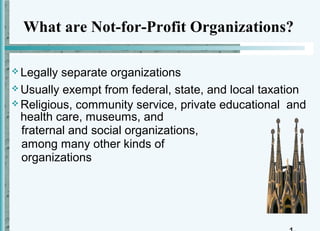
What are Not-for-Profit Organizations?

 Legally separate organizations
 Usually exempt from federal, state, and local taxation
 Religious, community service, private educational and
  health care, museums, and
  fraternal and social organizations,
  among many other kinds of
  organizations
How Do Governmental and
       Not-For-Profit Organizations Differ
         from Business Organizations?


 Resource  providers do not expect to
  receive proportional benefits
 Lack of a profit motive
 Absence of transferable

  ownership rights
How Do Governmental Entities Differ
From Not-For-Profit Organizations?

   Power ultimately rests in the hands of the people
   People delegate power to public officials through
    the election process
   Empowered by and accountable to a higher level
    government
   Taxation powers
Criteria for Determining Whether
          an NPO is Governmental

   Public corporations and bodies corporate and
    politic
   Other organizations with one or more of the
    following characteristics:
      Popular election of officers, or appointment
        of a controlling majority of the governing
        body by officials of another government
      Potential dissolution by a government with
        net assets reverting to a government
      Power to enact and enforce a tax levy
Sources of GAAP and
    Financial Reporting Standards

      FASB
 Business organizations

 Nongovernmental not-for-profits

      GASB
 Governmental organizations

 Governmental not-for-profits

     FASAB
 Federal government and its agencies
Why Must Governmental Financial Reporting
 Differ from Business Financial Reporting?


   Different financial report users with different
    needs
   Governmental financial reporting focuses on
    stewardship and accountability for how public
    resources are raised and used to provide
    services
Objectives of Financial Reporting—State
    and Local Governments (SLG)

Governmental financial reports are used primarily to:
 Compare actual financial results with legally
  adopted budget
 Assess financial condition and results of
  operations
 Assist in determining compliance with finance-
  related laws, rules, and regulations
 Assist in evaluating efficiency and effectiveness
Objectives of Financial Reporting—
            SLG (Cont’d)


“ACCOUNTABILITY is the cornerstone of all
 financial reporting in government “ (GASB
 Concepts Statement No. 1, par. 56)
Objectives of Financial Reporting—
           SLG (Cont’d)

Q: What do we mean by
   accountability?

A: Accountability arises from citizens’
   “right to know” It imposes a duty on
   public officials to be accountable to
   citizens for raising public monies and
   how they are spent
Objectives of Financial Reporting—SLG
                (Cont’d)

Q: How does “interperiod equity” relate
  to accountability?

A: Interperiod equity is a government’s
   obligation to disclose whether current-
   year revenues were sufficient to pay for
   current-year benefits—or did current
   citizens defer payments to future
   taxpayers?
Objectives of Financial Reporting—
       Federal Government


   Accountability is also the foundation of
    federal government financial reporting
   Federal Accounting Standards Advisory
    Board (FASAB) standards are targeted at
    both internal users (management) and
    external users
Objectives of Financial Reporting—
    Federal Government (Cont’d)

Federal government financial reporting should assist
report users in evaluating:
 Budgetary integrity

 Operating performance

 Stewardship

 Adequacy of systems and controls
Objectives of Financial Reporting—
   Not-for-Profit (NFP) Organizations

NFP financial reporting should provide information
useful in:
 Making resource allocation decisions

 Assessing services and ability to provide services

 Assessing management stewardship and
  performance
 Assessing economic resources, obligations, net
  resources, and changes in them
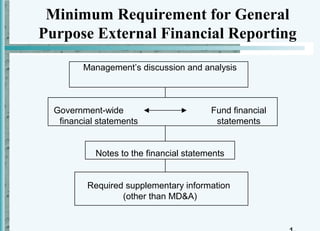
Minimum Requirement for General
Purpose External Financial Reporting

         Management’s discussion and analysis


  Government-wide                        Fund financial
   financial statements                   statements


            Notes to the financial statements


          Required supplementary information
                  (other than MD&A)
Fund Accounting


   Funds have separate self-balancing sets of
    accounts used to account for resources
    segregated for specific purposes or restricted
    as to use by donors or grantors
   Funds are separate accounting and fiscal
    entities (Chapters 2-9 provide detail)
Fund Accounting


Fund categories:
   Governmental
   Proprietary
   Fiduciary
Governmental Funds

Characteristics:
 Focus on short-term flow of financial resources

 Only account for current assets and current liabilities

 Use modified accrual basis of accounting (revenues
  recognized when measurable and available for
  spending and expenditures when incurred)
 Closely tied to budgetary accounting
Proprietary and Fiduciary Funds

Characteristics:
 Focus on flow of economic resources

 Accrual basis of accounting (revenues recognized
  when earned and expenses when incurred)
 Account for both current and noncurrent assets and
  current and noncurrent liabilities—similar to
  business accounting
Comprehensive Annual Financial Report
              (CAFR)

Introductory section

Financial section

Statistical section
CAFR - Introductory Section


              Title page
              Contents page
              Letter of transmittal
              Other (as desired by
               management)
CAFR - Financial Section


   Auditor’s report
   Basic financial statements
   Required supplementary information
    (RSI)(other than MD&A)
   Combining and individual fund
    statements and schedules
Management’s Discussion and Analysis
            (MD&A)


   providing management’s
   analysis of the government’s
   financial performance
Basic Financial Statements


Government-wide financial statements
   Statement of net assets (Illustration A1-1)
   Statement of activities (Illustration A1-2)
Basic Financial Statements—
Government-wide Financial Statements
              (Cont’d)
Points of interest (Ill. A1-1 and A1-2)
 Information
            is reported separately for the
 primary government and discretely presented
 component units
 Withinthe primary government, information is
 reported separately for governmental and
 business-type activities
Basic Financial Statement—Government-
  wide Financial Statements (Cont’d)

 Points of interest (Cont’d)
    All financial information in the government-wide
     financial statements is reported on the accrual
     basis with an economic resources focus—
     similar to business financial reporting
    Assists in assessing operational accountability
     —how efficiently resources are being used
Basic Financial Statements—Fund
           Financial Statements

Governmental funds
   Balance sheet—governmental funds (Ill. A1-3) with
    reconciliation (Ill. A1-4)
   Statement of revenues, expenditures, and changes
    in fund balances—governmental funds (Ill. A1-5)
    with reconciliation (Ill. A1-6)
   These statements report information separately for
    the General Fund and other major funds (Chapter 2
    defines major funds)
Basic Financial Statements—Fund
       Financial Statements (Cont’d)

Governmental funds—points of interest
   Focus on flow of current (i.e., short-term)
    financial resources recognized on the modified
    accrual basis of accounting
   Assist in assessing fiscal accountability—
    whether financial resources were raised and
    expended in compliance with budgetary and
    other legal provisions
Basic Financial Statements—Fund
      Financial Statements (Cont’d)

Governmental funds—points of interest
(Cont’d)
   Reporting the same information about
    governmental activities in two different ways
    creates a need to reconcile the information
    reported in the governmental fund financial
    statements to that in the Governmental
    Activities Column of the government-wide
    statements (see Illustrations A1-4 and A1-6)
Basic Financial Statements—Fund
      Financial Statements (Cont’d)

Proprietary funds
   Statement of net assets—proprietary funds
    (Ill. A1-7)
   Statement of revenues, expenses, and
    changes in fund net assets—proprietary funds
    (Ill. A1-8)
   Statement of cash flows—proprietary funds
    (Ill. A1-9)
Basic Financial Statements—Fund
            Financial Statements

Proprietary funds—points of interest
   Reports information for enterprise funds and
    internal service funds using an economic
    resources focus and accrual basis of accounting
   Information is reported in separate columns for
    major enterprise funds. All internal service fund
    information reported is combined in a single
    column
Basic Financial Statements—Fund
      Financial Statements (Cont’d)

Fiduciary funds
   Statement of fiduciary net assets (Ill. A1-10)
   Statement of changes in fiduciary net assets
    (Ill. A1-11)
Basic Financial Statements—Fund
      Financial Statements (Cont’d)

Fiduciary funds—points of interest
   Fiduciary activities relate to the government’s
    responsibility as an agent or trustee to hold
    and/or manage resources for the benefit of
    private parties
   Since fiduciary resources cannot be used by
    the government, they are reported only in the
    fiduciary fund financial statements—not in the
    government-wide statements
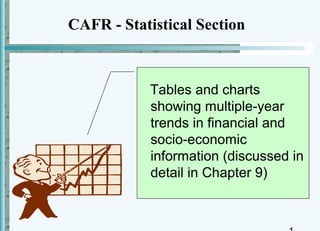
CAFR - Statistical Section


            Tables and charts
            showing multiple-year
            trends in financial and
            socio-economic
            information (discussed in
            detail in Chapter 9)
Concluding Comments

   In this course you will become familiar with
    current GASB, FASB, and FASAB standards
    relative to governmental and not-for-profit
    organizations
   Accounting and reporting for governmental and
    not-for-profit entities differ from those of for-
    profit entities because each type of entity has
    different purposes and reporting objectives
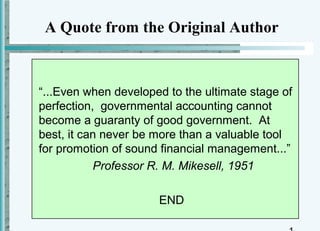
A Quote from the Original Author


“...Even when developed to the ultimate stage of
perfection, governmental accounting cannot
become a guaranty of good government. At
best, it can never be more than a valuable tool
for promotion of sound financial management...”
           Professor R. M. Mikesell, 1951

                      END

rr

  • 1.
    15/e Accounting for Governmental &Nonprofit Entities EARL R. WILSON JACQUELINE L. RECK SUSAN C. KATTELUS
  • 2.
    Chapter 1 Introduction to Accounting and Financial Reporting for Governmental and Not-for- Profit Entities McGraw-Hill/Irwin Copyright © 2010 by The McGraw-Hill Companies, Inc. All rights reserved.
  • 3.
    Learning Objectives After studyingChapter 1, you should be able to:  Identify and explain the characteristics that distinguish governmental and not-for-profit entities from for-profit entities  Identify the authoritative bodies responsible for setting GAAP and financial reporting standards for all governmental and not-for-profit organizations  Contrast and compare the objectives of financial reporting for state and local governments, the federal government, and not-for-profit organizations
  • 4.
    Learning Objectives (Cont’d) Explain the minimum requirements for general purpose external financial reporting of state and local governments and how they relate to comprehensive annual financial reports  Explain the different objectives, measurement focus, and basis of accounting of the government-wide financial statements and fund financial statements of state and local governments
  • 5.
    What are GovernmentalOrganizations?  General purpose governments  Provide a wide variety of services  Examples: Federal government, state governments, cities, towns, townships, villages, counties, boroughs, and parishes  Special purpose governments  Usually provide only a single or just a few services  Examples: Independent school systems, public colleges and universities, public hospitals, fire protection districts, sewer districts, transportation authorities, and many others
  • 6.
    What are Not-for-ProfitOrganizations?  Legally separate organizations  Usually exempt from federal, state, and local taxation  Religious, community service, private educational and health care, museums, and fraternal and social organizations, among many other kinds of organizations
  • 7.
    How Do Governmentaland Not-For-Profit Organizations Differ from Business Organizations?  Resource providers do not expect to receive proportional benefits  Lack of a profit motive  Absence of transferable ownership rights
  • 8.
    How Do GovernmentalEntities Differ From Not-For-Profit Organizations?  Power ultimately rests in the hands of the people  People delegate power to public officials through the election process  Empowered by and accountable to a higher level government  Taxation powers
  • 9.
    Criteria for DeterminingWhether an NPO is Governmental  Public corporations and bodies corporate and politic  Other organizations with one or more of the following characteristics:  Popular election of officers, or appointment of a controlling majority of the governing body by officials of another government  Potential dissolution by a government with net assets reverting to a government  Power to enact and enforce a tax levy
  • 10.
    Sources of GAAPand Financial Reporting Standards FASB  Business organizations  Nongovernmental not-for-profits GASB  Governmental organizations  Governmental not-for-profits FASAB  Federal government and its agencies
  • 11.
    Why Must GovernmentalFinancial Reporting Differ from Business Financial Reporting?  Different financial report users with different needs  Governmental financial reporting focuses on stewardship and accountability for how public resources are raised and used to provide services
  • 12.
    Objectives of FinancialReporting—State and Local Governments (SLG) Governmental financial reports are used primarily to:  Compare actual financial results with legally adopted budget  Assess financial condition and results of operations  Assist in determining compliance with finance- related laws, rules, and regulations  Assist in evaluating efficiency and effectiveness
  • 13.
    Objectives of FinancialReporting— SLG (Cont’d) “ACCOUNTABILITY is the cornerstone of all financial reporting in government “ (GASB Concepts Statement No. 1, par. 56)
  • 14.
    Objectives of FinancialReporting— SLG (Cont’d) Q: What do we mean by accountability? A: Accountability arises from citizens’ “right to know” It imposes a duty on public officials to be accountable to citizens for raising public monies and how they are spent
  • 15.
    Objectives of FinancialReporting—SLG (Cont’d) Q: How does “interperiod equity” relate to accountability? A: Interperiod equity is a government’s obligation to disclose whether current- year revenues were sufficient to pay for current-year benefits—or did current citizens defer payments to future taxpayers?
  • 16.
    Objectives of FinancialReporting— Federal Government  Accountability is also the foundation of federal government financial reporting  Federal Accounting Standards Advisory Board (FASAB) standards are targeted at both internal users (management) and external users
  • 17.
    Objectives of FinancialReporting— Federal Government (Cont’d) Federal government financial reporting should assist report users in evaluating:  Budgetary integrity  Operating performance  Stewardship  Adequacy of systems and controls
  • 18.
    Objectives of FinancialReporting— Not-for-Profit (NFP) Organizations NFP financial reporting should provide information useful in:  Making resource allocation decisions  Assessing services and ability to provide services  Assessing management stewardship and performance  Assessing economic resources, obligations, net resources, and changes in them
  • 19.
    Minimum Requirement forGeneral Purpose External Financial Reporting Management’s discussion and analysis Government-wide Fund financial financial statements statements Notes to the financial statements Required supplementary information (other than MD&A)
  • 20.
    Fund Accounting  Funds have separate self-balancing sets of accounts used to account for resources segregated for specific purposes or restricted as to use by donors or grantors  Funds are separate accounting and fiscal entities (Chapters 2-9 provide detail)
  • 21.
    Fund Accounting Fund categories:  Governmental  Proprietary  Fiduciary
  • 22.
    Governmental Funds Characteristics:  Focuson short-term flow of financial resources  Only account for current assets and current liabilities  Use modified accrual basis of accounting (revenues recognized when measurable and available for spending and expenditures when incurred)  Closely tied to budgetary accounting
  • 23.
    Proprietary and FiduciaryFunds Characteristics:  Focus on flow of economic resources  Accrual basis of accounting (revenues recognized when earned and expenses when incurred)  Account for both current and noncurrent assets and current and noncurrent liabilities—similar to business accounting
  • 24.
    Comprehensive Annual FinancialReport (CAFR) Introductory section Financial section Statistical section
  • 25.
    CAFR - IntroductorySection  Title page  Contents page  Letter of transmittal  Other (as desired by management)
  • 26.
    CAFR - FinancialSection  Auditor’s report  Basic financial statements  Required supplementary information (RSI)(other than MD&A)  Combining and individual fund statements and schedules
  • 27.
    Management’s Discussion andAnalysis (MD&A) providing management’s analysis of the government’s financial performance
  • 28.
    Basic Financial Statements Government-widefinancial statements  Statement of net assets (Illustration A1-1)  Statement of activities (Illustration A1-2)
  • 29.
    Basic Financial Statements— Government-wideFinancial Statements (Cont’d) Points of interest (Ill. A1-1 and A1-2)  Information is reported separately for the primary government and discretely presented component units  Withinthe primary government, information is reported separately for governmental and business-type activities
  • 30.
    Basic Financial Statement—Government- wide Financial Statements (Cont’d) Points of interest (Cont’d)  All financial information in the government-wide financial statements is reported on the accrual basis with an economic resources focus— similar to business financial reporting  Assists in assessing operational accountability —how efficiently resources are being used
  • 31.
    Basic Financial Statements—Fund Financial Statements Governmental funds  Balance sheet—governmental funds (Ill. A1-3) with reconciliation (Ill. A1-4)  Statement of revenues, expenditures, and changes in fund balances—governmental funds (Ill. A1-5) with reconciliation (Ill. A1-6)  These statements report information separately for the General Fund and other major funds (Chapter 2 defines major funds)
  • 32.
    Basic Financial Statements—Fund Financial Statements (Cont’d) Governmental funds—points of interest  Focus on flow of current (i.e., short-term) financial resources recognized on the modified accrual basis of accounting  Assist in assessing fiscal accountability— whether financial resources were raised and expended in compliance with budgetary and other legal provisions
  • 33.
    Basic Financial Statements—Fund Financial Statements (Cont’d) Governmental funds—points of interest (Cont’d)  Reporting the same information about governmental activities in two different ways creates a need to reconcile the information reported in the governmental fund financial statements to that in the Governmental Activities Column of the government-wide statements (see Illustrations A1-4 and A1-6)
  • 34.
    Basic Financial Statements—Fund Financial Statements (Cont’d) Proprietary funds  Statement of net assets—proprietary funds (Ill. A1-7)  Statement of revenues, expenses, and changes in fund net assets—proprietary funds (Ill. A1-8)  Statement of cash flows—proprietary funds (Ill. A1-9)
  • 35.
    Basic Financial Statements—Fund Financial Statements Proprietary funds—points of interest  Reports information for enterprise funds and internal service funds using an economic resources focus and accrual basis of accounting  Information is reported in separate columns for major enterprise funds. All internal service fund information reported is combined in a single column
  • 36.
    Basic Financial Statements—Fund Financial Statements (Cont’d) Fiduciary funds  Statement of fiduciary net assets (Ill. A1-10)  Statement of changes in fiduciary net assets (Ill. A1-11)
  • 37.
    Basic Financial Statements—Fund Financial Statements (Cont’d) Fiduciary funds—points of interest  Fiduciary activities relate to the government’s responsibility as an agent or trustee to hold and/or manage resources for the benefit of private parties  Since fiduciary resources cannot be used by the government, they are reported only in the fiduciary fund financial statements—not in the government-wide statements
  • 38.
    CAFR - StatisticalSection Tables and charts showing multiple-year trends in financial and socio-economic information (discussed in detail in Chapter 9)
  • 39.
    Concluding Comments  In this course you will become familiar with current GASB, FASB, and FASAB standards relative to governmental and not-for-profit organizations  Accounting and reporting for governmental and not-for-profit entities differ from those of for- profit entities because each type of entity has different purposes and reporting objectives
  • 40.
    A Quote fromthe Original Author “...Even when developed to the ultimate stage of perfection, governmental accounting cannot become a guaranty of good government. At best, it can never be more than a valuable tool for promotion of sound financial management...” Professor R. M. Mikesell, 1951 END

Editor's Notes