1
Accounting for public
sector and civil society
AcFn 3071
2
Chapter One
Overview of Financial
Reporting for
Governmental and NFP
Entities
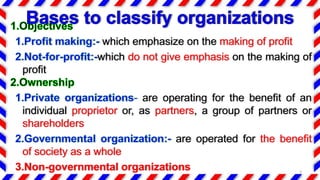
which emphasize on the making of profit
which do not give emphasis on the making of
profit
are operating for the benefit of an
individual proprietor or, as partners, a group of partners or
shareholders
are operated for the benefit
of society as a whole
3.Non-governmental organizations 3
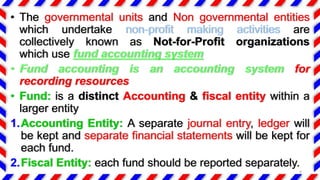
• The governmental units and Non governmental entities
which undertake non-profit making activities are
collectively known as Not-for-Profit organizations
which use fund accounting system
• Fund accounting is an accounting system for
recording resources
• Fund: is a distinct Accounting & fiscal entity within a
larger entity
1.Accounting Entity: A separate journal entry, ledger will
be kept and separate financial statements will be kept for
each fund.
2.Fiscal Entity: each fund should be reported separately.
4
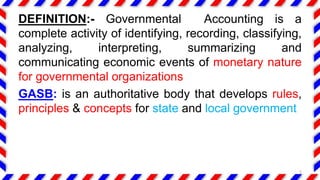
DEFINITION:- Governmental Accounting is a
complete activity of identifying, recording, classifying,
analyzing, interpreting, summarizing and
communicating economic events of monetary nature
for governmental organizations
GASB: is an authoritative body that develops rules,
principles & concepts for state and local government
5
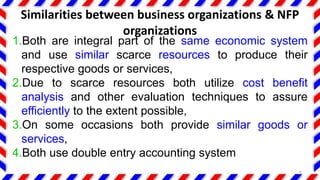
Similarities between business organizations & NFP
organizations
1.Both are integral part of the same economic system
and use similar scarce resources to produce their
respective goods or services,
2.Due to scarce resources both utilize cost benefit
analysis and other evaluation techniques to assure
efficiently to the extent possible,
3.On some occasions both provide similar goods or
services,
4.Both use double entry accounting system
6
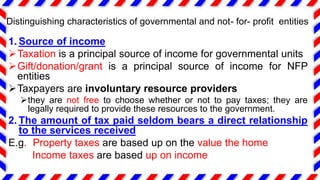
1. Source of income
Taxation is a principal source of income for governmental units
Gift/donation/grant is a principal source of income for NFP
entities
Taxpayers are involuntary resource providers
they are not free to choose whether or not to pay taxes; they are
legally required to provide these resources to the government.
2. The amount of tax paid seldom bears a direct relationship
to the services received
E.g. Property taxes are based up on the value the home
Income taxes are based up on income
7
Distinguishing characteristics of governmental and not- for- profit entities
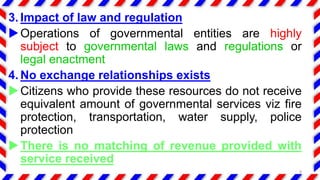
3. Impact of law and regulation
Operations of governmental entities are highly
subject to governmental laws and regulations or
legal enactment
4. No exchange relationships exists
Citizens who provide these resources do not receive
equivalent amount of governmental services viz fire
protection, transportation, water supply, police
protection
There is no matching of revenue provided with
service received
8
5. Ownership and Management
There is no defined ownership is evidenced by
separate share of stock, or any other means.
6.Government often monopolizes Certain
Services
• Good examples are police & fire protection, defense,
telecommunication & water supply, electricity power
supply
9
• In addition to the aforementioned ones,
Governmental units and private NFP
organizations would have the following common
characteristics.
7. Organization to serve the society (citizens)
8. General absence of profit motive
9. Society as a principal source of revenue
10. Importance of budget
10
1. Profit motive: Commercial units have presented profit
motive as part of their objectives. where as
governmental units with some exceptions do not
operate with the objective of earning a profit.
2. Governance: The legislative and executive branches
of a governmental unit share the responsibilities for
their governance where as in the case of commercial
entities; it is governed by elected or appointed directors
or managers. 11
DIFFERENCES BETWEEN BUSINESS & NFP
ORGANIZATIONS
3. Basis of accounting: The modified accrual basis of
accounting is mostly used by some governmental
units but in case of commercial entities the basis of
accounting is the accrual basis.
4. Source of revenue in nature: The primary source of
revenue for commercial entitles is through sales or
services they provide, whereas in case of
governmental units, with some exceptions, the main
source of revenue is though tax, gift or donations
12
5. Beneficiaries: Governmental units are operating for
the benefit of the citizenry where as commercial
entities are operating for the interest and benefit of
the owners.
6. Sources of financial reporting standards
• Accounting and financial reporting standards for state
and local governmental units are established by the
GASB
• Accounting and financial reporting standards for profit
seeking enterprise by the FASB
13
7. Governmental fund accounting focuses on financial
resources, whereas business enterprises focus on
economic resource
8. Treatment of fixed assets and long term liability
governmental funds do not account for their fixed asset
and long term liability under their fund financial
statement. However, long term assets and long term
liabilities of governmental funds will be included
under government wide financial statement (GWFS).
14
• Government Wide financial statements report all
financial transactions for the government for the year.
9. Budgetary accounts: budgetary accounts are
integrated into the accounting system of the
governmental units. However; there is no record of debt
and credits for budget in business enterprises.
10. Encumbrance accounting: is used and integrated in
the accounting system of governmental units.
11. Flow of financial resources: in business enterprises
is different from that of governmental units.
15
Sources of financial reporting standards for
Governmental and NFP entities
• Accounting and financial reporting standards for
state and local governmental units are established
by the governmental accounting standard board
(GASB). Accounting and financial reporting
standards for profit seeking enterprise are
established by the financial accounting standard
board(FASB).
16
Objectives of financial reporting in Government and NFP
entities
• What are the overall purpose of financial reporting ?
1) Assess financial position and economic condition
Users need to analyze the entities past results and
current financial position (assets compared with
liabilities) and its overall economic condition to
determine the entity’s ability to meet its obligations and
to continue to provide expected services
17
2) Compare actual results with the budget
Users want assurance that the entity adheres its adopted
budget. Significant variations between a budget & actual
performance signify existence of poor management or
unforeseen circumstances, that require an explanation.
3) Determine compliance with laws, regulations, and
restrictions on the use of the funds
Users want to be assured to compliance with legal and
contractual requirements, such as bond covenant, donor &
grantor restrictions, taxing & debt limitations, & applicable
laws.
18
4) Evaluate efficiency and effectiveness
• Users want to know whether the entity is achieving
its objectives and, if so, how efficiently and
effectively. They need to compare
accomplishments (outcomes) with service efforts
and costs (resource inputs).
19
Specific objectives of financial reporting as set forth by
the GASB
GASB, in its concepts statement no.1 “Objectives of Financial
Reporting”, established the following 3 objectives.
1.Financial reporting should assist in fulfilling government’s
duty to be publicly accountable & should enable users to
assess that accountability
2.Financial reporting should assist users in evaluating the
operating results of the governmental entity for the year
3.Financial reporting should assist users in assessing the
level of services that can be provided by the governmental
entity and its ability to meet its obligations as it become
due 20
• Because of the unique characteristics of governments and
their environment, the GASB has established accountability
as the cornerstone of financial reporting. ‘Accountability,’’ it
says, ‘‘requires governments to answer to the citizenry to
justify the raising of public resources and the purposes for
which they are used.’’
• Accountability ‘‘is based on the belief that the citizenry has a
‘right to know,’
• Inter period equity. ‘‘Financial reporting should provide
information to determine whether current-year revenues
were sufficient to pay for cost of current-year services.’’
21
IPSAS versus IFRS
• IPSASs are the international financial reporting
standards for public sectors
• 41standards approved (accrual basis) covering all
main areas of government activities, 1 cash basis
standard
• The standards are issued by international public
sector accounting standards board (IPSASB)
22
Applicability of IPSAS
• The IPSASs are designed to apply to public sector
entities that meet all the following criteria
Are responsible for delivery of services to benefit the
public and/or to redistribute income and Wealth
Mainly finance their activities , directly or indirectly , by
means of taxes and/or transfer from other level of
government, social contributions, debt or fees and
Do not have a primary objective to make profit
23
• IFRS stands for international financial reporting standards
• The standards are design as a common global language
for business affairs
• The objective is to make companys’ accounts
understandable and comparable across international
boundaries
• IFRS is a set of rules that must be followed by accountants
to maintain books of accounts
• The rules will make the books comparable,
understandable, reliable and relevant for internal and
external users
• The standards are issued by International Accounting
Standards Board (IASB) 24
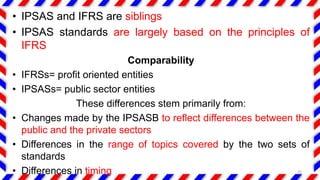
• IPSAS and IFRS are siblings
• IPSAS standards are largely based on the principles of
IFRS
Comparability
• IFRSs= profit oriented entities
• IPSASs= public sector entities
These differences stem primarily from:
• Changes made by the IPSASB to reflect differences between the
public and the private sectors
• Differences in the range of topics covered by the two sets of
standards
• Differences in timing 25
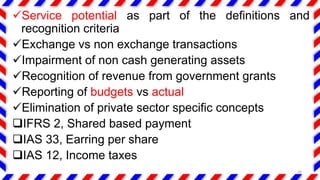
Service potential as part of the definitions and
recognition criteria
Exchange vs non exchange transactions
Impairment of non cash generating assets
Recognition of revenue from government grants
Reporting of budgets vs actual
Elimination of private sector specific concepts
IFRS 2, Shared based payment
IAS 33, Earring per share
IAS 12, Income taxes
26
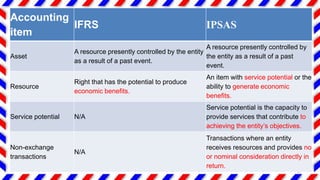
27
Accounting
item
IFRS IPSAS
Asset
A resource presently controlled by the entity
as a result of a past event.
A resource presently controlled by
the entity as a result of a past
event.
Resource
Right that has the potential to produce
economic benefits.
An item with service potential or the
ability to generate economic
benefits.
Service potential N/A
Service potential is the capacity to
provide services that contribute to
achieving the entity’s objectives.
Non-exchange
transactions
N/A
Transactions where an entity
receives resources and provides no
or nominal consideration directly in
return.
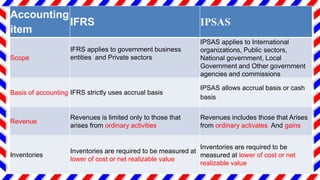
28
Accounting
item
IFRS IPSAS
Scope
IFRS applies to government business
entities and Private sectors
IPSAS applies to International
organizations, Public sectors,
National government, Local
Government and Other government
agencies and commissions
Basis of accounting IFRS strictly uses accrual basis
IPSAS allows accrual basis or cash
basis
Revenue
Revenues is limited only to those that
arises from ordinary activities
Revenues includes those that Arises
from ordinary activates And gains
Inventories
Inventories are required to be measured at
lower of cost or net realizable value
Inventories are required to be
measured at lower of cost or net
realizable value
The Conceptual Framework for Public Sector
Accounting [The IPSASB]
The Conceptual Framework is a body of interrelated
objectives and fundamentals. The objectives identify the
goals and purposes of financial reporting and the
fundamentals are the underlying concepts that help achieve
those objectives. The conceptual framework is composed of a
basic objective, fundamental concepts, and recognition,
measurement, and disclosure concepts.
The objectives of financial reporting by public sector entities
are to provide information about the entity that is useful
to users of GPFRs for accountability purposes and for
decision-making purposes
29
The Conceptual Framework for Public Sector
Accounting [The IPSASB]
IPSAS 22, Disclosure of financial information
about the general government sector
• What Is Disclosure? In the financial world,
disclosure refers to the timely release of all
information about a company that may
influence an investor's decision. It reveals both
positive and negative news, data, and operational
details that impact its business.
30
IPSAS 29, financial instruments: Recognition and Measurement
• A financial instrument is defined as a contract between
individuals/parties that holds a monetary value.
• A financial instrument is an asset or liability that gives a right to
receive or an obligation to pay cash
• FI are monetary contacts between parties
• Some examples of financial instruments are cheques, shares,
stocks, bonds, futures and options contracts.
• The objective of IPSAS 29 is to establish principles for recognizing
and measuring financial assets, financial liabilities and some
contracts to buy or sell non-financial items.
• Financial instruments are initially recognized when an entity
becomes a party to the contractual provision of the instrument . A
financial asset or financial liability is measure initially at fair value
31
Govt & NFP Accounting- Ch1.pptx presentation

Govt & NFP Accounting- Ch1.pptx presentation

  • 1.
    1 Accounting for public sectorand civil society AcFn 3071
  • 2.
    2 Chapter One Overview ofFinancial Reporting for Governmental and NFP Entities
  • 3.
    which emphasize onthe making of profit which do not give emphasis on the making of profit are operating for the benefit of an individual proprietor or, as partners, a group of partners or shareholders are operated for the benefit of society as a whole 3.Non-governmental organizations 3
  • 4.
    • The governmentalunits and Non governmental entities which undertake non-profit making activities are collectively known as Not-for-Profit organizations which use fund accounting system • Fund accounting is an accounting system for recording resources • Fund: is a distinct Accounting & fiscal entity within a larger entity 1.Accounting Entity: A separate journal entry, ledger will be kept and separate financial statements will be kept for each fund. 2.Fiscal Entity: each fund should be reported separately. 4
  • 5.
    DEFINITION:- Governmental Accountingis a complete activity of identifying, recording, classifying, analyzing, interpreting, summarizing and communicating economic events of monetary nature for governmental organizations GASB: is an authoritative body that develops rules, principles & concepts for state and local government 5
  • 6.
    Similarities between businessorganizations & NFP organizations 1.Both are integral part of the same economic system and use similar scarce resources to produce their respective goods or services, 2.Due to scarce resources both utilize cost benefit analysis and other evaluation techniques to assure efficiently to the extent possible, 3.On some occasions both provide similar goods or services, 4.Both use double entry accounting system 6
  • 7.
    1. Source ofincome Taxation is a principal source of income for governmental units Gift/donation/grant is a principal source of income for NFP entities Taxpayers are involuntary resource providers they are not free to choose whether or not to pay taxes; they are legally required to provide these resources to the government. 2. The amount of tax paid seldom bears a direct relationship to the services received E.g. Property taxes are based up on the value the home Income taxes are based up on income 7 Distinguishing characteristics of governmental and not- for- profit entities
  • 8.
    3. Impact oflaw and regulation Operations of governmental entities are highly subject to governmental laws and regulations or legal enactment 4. No exchange relationships exists Citizens who provide these resources do not receive equivalent amount of governmental services viz fire protection, transportation, water supply, police protection There is no matching of revenue provided with service received 8
  • 9.
    5. Ownership andManagement There is no defined ownership is evidenced by separate share of stock, or any other means. 6.Government often monopolizes Certain Services • Good examples are police & fire protection, defense, telecommunication & water supply, electricity power supply 9
  • 10.
    • In additionto the aforementioned ones, Governmental units and private NFP organizations would have the following common characteristics. 7. Organization to serve the society (citizens) 8. General absence of profit motive 9. Society as a principal source of revenue 10. Importance of budget 10
  • 11.
    1. Profit motive:Commercial units have presented profit motive as part of their objectives. where as governmental units with some exceptions do not operate with the objective of earning a profit. 2. Governance: The legislative and executive branches of a governmental unit share the responsibilities for their governance where as in the case of commercial entities; it is governed by elected or appointed directors or managers. 11 DIFFERENCES BETWEEN BUSINESS & NFP ORGANIZATIONS
  • 12.
    3. Basis ofaccounting: The modified accrual basis of accounting is mostly used by some governmental units but in case of commercial entities the basis of accounting is the accrual basis. 4. Source of revenue in nature: The primary source of revenue for commercial entitles is through sales or services they provide, whereas in case of governmental units, with some exceptions, the main source of revenue is though tax, gift or donations 12
  • 13.
    5. Beneficiaries: Governmentalunits are operating for the benefit of the citizenry where as commercial entities are operating for the interest and benefit of the owners. 6. Sources of financial reporting standards • Accounting and financial reporting standards for state and local governmental units are established by the GASB • Accounting and financial reporting standards for profit seeking enterprise by the FASB 13
  • 14.
    7. Governmental fundaccounting focuses on financial resources, whereas business enterprises focus on economic resource 8. Treatment of fixed assets and long term liability governmental funds do not account for their fixed asset and long term liability under their fund financial statement. However, long term assets and long term liabilities of governmental funds will be included under government wide financial statement (GWFS). 14
  • 15.
    • Government Widefinancial statements report all financial transactions for the government for the year. 9. Budgetary accounts: budgetary accounts are integrated into the accounting system of the governmental units. However; there is no record of debt and credits for budget in business enterprises. 10. Encumbrance accounting: is used and integrated in the accounting system of governmental units. 11. Flow of financial resources: in business enterprises is different from that of governmental units. 15
  • 16.
    Sources of financialreporting standards for Governmental and NFP entities • Accounting and financial reporting standards for state and local governmental units are established by the governmental accounting standard board (GASB). Accounting and financial reporting standards for profit seeking enterprise are established by the financial accounting standard board(FASB). 16
  • 17.
    Objectives of financialreporting in Government and NFP entities • What are the overall purpose of financial reporting ? 1) Assess financial position and economic condition Users need to analyze the entities past results and current financial position (assets compared with liabilities) and its overall economic condition to determine the entity’s ability to meet its obligations and to continue to provide expected services 17
  • 18.
    2) Compare actualresults with the budget Users want assurance that the entity adheres its adopted budget. Significant variations between a budget & actual performance signify existence of poor management or unforeseen circumstances, that require an explanation. 3) Determine compliance with laws, regulations, and restrictions on the use of the funds Users want to be assured to compliance with legal and contractual requirements, such as bond covenant, donor & grantor restrictions, taxing & debt limitations, & applicable laws. 18
  • 19.
    4) Evaluate efficiencyand effectiveness • Users want to know whether the entity is achieving its objectives and, if so, how efficiently and effectively. They need to compare accomplishments (outcomes) with service efforts and costs (resource inputs). 19
  • 20.
    Specific objectives offinancial reporting as set forth by the GASB GASB, in its concepts statement no.1 “Objectives of Financial Reporting”, established the following 3 objectives. 1.Financial reporting should assist in fulfilling government’s duty to be publicly accountable & should enable users to assess that accountability 2.Financial reporting should assist users in evaluating the operating results of the governmental entity for the year 3.Financial reporting should assist users in assessing the level of services that can be provided by the governmental entity and its ability to meet its obligations as it become due 20
  • 21.
    • Because ofthe unique characteristics of governments and their environment, the GASB has established accountability as the cornerstone of financial reporting. ‘Accountability,’’ it says, ‘‘requires governments to answer to the citizenry to justify the raising of public resources and the purposes for which they are used.’’ • Accountability ‘‘is based on the belief that the citizenry has a ‘right to know,’ • Inter period equity. ‘‘Financial reporting should provide information to determine whether current-year revenues were sufficient to pay for cost of current-year services.’’ 21
  • 22.
    IPSAS versus IFRS •IPSASs are the international financial reporting standards for public sectors • 41standards approved (accrual basis) covering all main areas of government activities, 1 cash basis standard • The standards are issued by international public sector accounting standards board (IPSASB) 22
  • 23.
    Applicability of IPSAS •The IPSASs are designed to apply to public sector entities that meet all the following criteria Are responsible for delivery of services to benefit the public and/or to redistribute income and Wealth Mainly finance their activities , directly or indirectly , by means of taxes and/or transfer from other level of government, social contributions, debt or fees and Do not have a primary objective to make profit 23
  • 24.
    • IFRS standsfor international financial reporting standards • The standards are design as a common global language for business affairs • The objective is to make companys’ accounts understandable and comparable across international boundaries • IFRS is a set of rules that must be followed by accountants to maintain books of accounts • The rules will make the books comparable, understandable, reliable and relevant for internal and external users • The standards are issued by International Accounting Standards Board (IASB) 24
  • 25.
    • IPSAS andIFRS are siblings • IPSAS standards are largely based on the principles of IFRS Comparability • IFRSs= profit oriented entities • IPSASs= public sector entities These differences stem primarily from: • Changes made by the IPSASB to reflect differences between the public and the private sectors • Differences in the range of topics covered by the two sets of standards • Differences in timing 25
  • 26.
    Service potential aspart of the definitions and recognition criteria Exchange vs non exchange transactions Impairment of non cash generating assets Recognition of revenue from government grants Reporting of budgets vs actual Elimination of private sector specific concepts IFRS 2, Shared based payment IAS 33, Earring per share IAS 12, Income taxes 26
  • 27.
    27 Accounting item IFRS IPSAS Asset A resourcepresently controlled by the entity as a result of a past event. A resource presently controlled by the entity as a result of a past event. Resource Right that has the potential to produce economic benefits. An item with service potential or the ability to generate economic benefits. Service potential N/A Service potential is the capacity to provide services that contribute to achieving the entity’s objectives. Non-exchange transactions N/A Transactions where an entity receives resources and provides no or nominal consideration directly in return.
  • 28.
    28 Accounting item IFRS IPSAS Scope IFRS appliesto government business entities and Private sectors IPSAS applies to International organizations, Public sectors, National government, Local Government and Other government agencies and commissions Basis of accounting IFRS strictly uses accrual basis IPSAS allows accrual basis or cash basis Revenue Revenues is limited only to those that arises from ordinary activities Revenues includes those that Arises from ordinary activates And gains Inventories Inventories are required to be measured at lower of cost or net realizable value Inventories are required to be measured at lower of cost or net realizable value
  • 29.
    The Conceptual Frameworkfor Public Sector Accounting [The IPSASB] The Conceptual Framework is a body of interrelated objectives and fundamentals. The objectives identify the goals and purposes of financial reporting and the fundamentals are the underlying concepts that help achieve those objectives. The conceptual framework is composed of a basic objective, fundamental concepts, and recognition, measurement, and disclosure concepts. The objectives of financial reporting by public sector entities are to provide information about the entity that is useful to users of GPFRs for accountability purposes and for decision-making purposes 29
  • 30.
    The Conceptual Frameworkfor Public Sector Accounting [The IPSASB] IPSAS 22, Disclosure of financial information about the general government sector • What Is Disclosure? In the financial world, disclosure refers to the timely release of all information about a company that may influence an investor's decision. It reveals both positive and negative news, data, and operational details that impact its business. 30
  • 31.
    IPSAS 29, financialinstruments: Recognition and Measurement • A financial instrument is defined as a contract between individuals/parties that holds a monetary value. • A financial instrument is an asset or liability that gives a right to receive or an obligation to pay cash • FI are monetary contacts between parties • Some examples of financial instruments are cheques, shares, stocks, bonds, futures and options contracts. • The objective of IPSAS 29 is to establish principles for recognizing and measuring financial assets, financial liabilities and some contracts to buy or sell non-financial items. • Financial instruments are initially recognized when an entity becomes a party to the contractual provision of the instrument . A financial asset or financial liability is measure initially at fair value 31