Proactive Measures to
Fight Fraud
Karin M. Smith, MBA, SFO, CFE
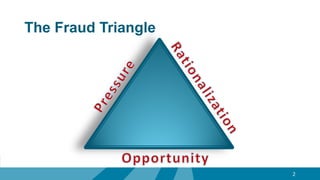
The Fraud Triangle
2
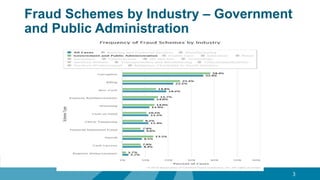
Fraud Schemes by Industry – Government
and Public Administration
3
Fraud Prevention
Fraud Prevention - Culture
 Tone at the top (proper modeling)
 Hire honest people and provide fraud awareness training
• Verify all information on applicant’s resume/application
• Require applicants to certify information on the resume/application is accurate
• Employees involved in interviews should be trained on how to conduct thorough and skillful
interviews
• Once hired, participation in an employee awareness program (orientation)
 Positive work environment
• Well-defined code of conduct
• Open-door policy
• Not operating on a crisis basis
• Positive personnel and operating procedures
• Communicate expectations
 Provide an employee assistance program that helps employees deal with personal
pressures
 Proper handling of fraud and fraud perpetrators when fraud occurs
5
Fraud Prevention – Assess Risks
Assess Risks
Develop concrete responses to mitigate risks and
eliminate opportunities for fraud
Types of Risk
• Theft of cash
• Theft of property – inventory, fuel, other assets
• Noncompliance – timeliness of cash receipting
• Too much or improper access
• Implementation of new systems
• Changes in personnel
6
Fraud Prevention – Assess Risks
Internal controls
Informing those outside the organization of the entity’s
policies (collusion prevention)
Monitoring employees
Institute a whistleblowing system
Create an expectation of punishment
Conduct proactive auditing
7
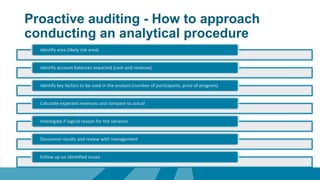
Proactive auditing - How to approach
conducting an analytical procedure
Identify area (likely risk area)
Identify account balances impacted (cash and revenue)
Identify key factors to be used in the analysis (number of participants, price of program)
Calculate expected revenues and compare to actual
Investigate if logical reason for the variance
Document results and review with management
Follow up on identified issues
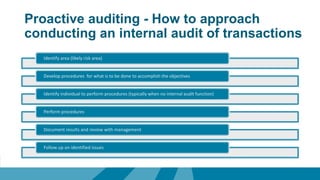
Proactive auditing - How to approach
conducting an internal audit of transactions
Identify area (likely risk area)
Develop procedures for what is to be done to accomplish the objectives
Identify individual to perform procedures (typically when no internal audit function)
Perform procedures
Document results and review with management
Follow up on identified issues
Fraud Detection
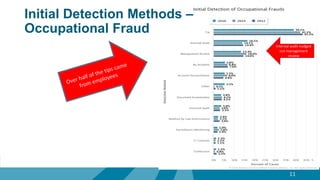
Initial Detection Methods –
Occupational Fraud
11
Internal audit nudged
out management
review
Symptoms of fraud
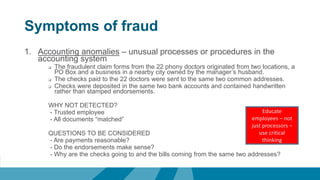
1. Accounting anomalies – unusual processes or procedures in the
accounting system
 The fraudulent claim forms from the 22 phony doctors originated from two locations, a
PO Box and a business in a nearby city owned by the manager’s husband.
 The checks paid to the 22 doctors were sent to the same two common addresses.
 Checks were deposited in the same two bank accounts and contained handwritten
rather than stamped endorsements.
WHY NOT DETECTED?
- Trusted employee
- All documents “matched”
QUESTIONS TO BE CONSIDERED
- Are payments reasonable?
- Do the endorsements make sense?
- Why are the checks going to and the bills coming from the same two addresses?
Educate
employees – not
just processors –
use critical
thinking
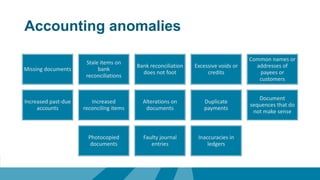
Accounting anomalies
Missing documents
Stale items on
bank
reconciliations
Bank reconciliation
does not foot
Excessive voids or
credits
Common names or
addresses of
payees or
customers
Increased past-due
accounts
Increased
reconciling items
Alterations on
documents
Duplicate
payments
Document
sequences that do
not make sense
Photocopied
documents
Faulty journal
entries
Inaccuracies in
ledgers
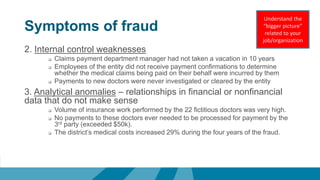
Symptoms of fraud
2. Internal control weaknesses
 Claims payment department manager had not taken a vacation in 10 years
 Employees of the entity did not receive payment confirmations to determine
whether the medical claims being paid on their behalf were incurred by them
 Payments to new doctors were never investigated or cleared by the entity
3. Analytical anomalies – relationships in financial or nonfinancial
data that do not make sense
 Volume of insurance work performed by the 22 fictitious doctors was very high.
 No payments to these doctors ever needed to be processed for payment by the
3rd party (exceeded $50k).
 The district’s medical costs increased 29% during the four years of the fraud.
Understand the
“bigger picture”
related to your
job/organization
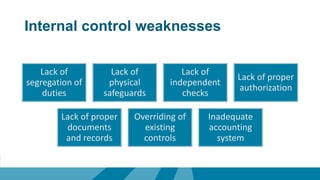
Internal control weaknesses
Lack of
segregation of
duties
Lack of
physical
safeguards
Lack of
independent
checks
Lack of proper
authorization
Lack of proper
documents
and records
Overriding of
existing
controls
Inadequate
accounting
system
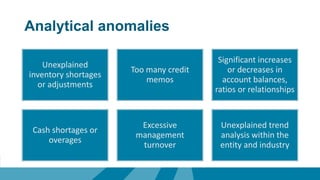
Analytical anomalies
Unexplained
inventory shortages
or adjustments
Too many credit
memos
Significant increases
or decreases in
account balances,
ratios or relationships
Cash shortages or
overages
Excessive
management
turnover
Unexplained trend
analysis within the
entity and industry
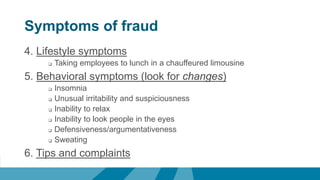
Symptoms of fraud
4. Lifestyle symptoms
 Taking employees to lunch in a chauffeured limousine
5. Behavioral symptoms (look for changes)
 Insomnia
 Unusual irritability and suspiciousness
 Inability to relax
 Inability to look people in the eyes
 Defensiveness/argumentativeness
 Sweating
6. Tips and complaints
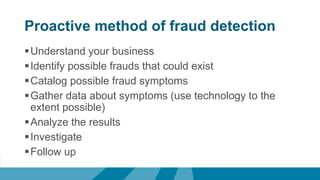
Proactive method of fraud detection
Understand your business
Identify possible frauds that could exist
Catalog possible fraud symptoms
Gather data about symptoms (use technology to the
extent possible)
Analyze the results
Investigate
Follow up

Proactive Measures to Fight Fraud

  • 1.
    Proactive Measures to FightFraud Karin M. Smith, MBA, SFO, CFE
  • 2.
  • 3.
    Fraud Schemes byIndustry – Government and Public Administration 3
  • 4.
  • 5.
    Fraud Prevention -Culture  Tone at the top (proper modeling)  Hire honest people and provide fraud awareness training • Verify all information on applicant’s resume/application • Require applicants to certify information on the resume/application is accurate • Employees involved in interviews should be trained on how to conduct thorough and skillful interviews • Once hired, participation in an employee awareness program (orientation)  Positive work environment • Well-defined code of conduct • Open-door policy • Not operating on a crisis basis • Positive personnel and operating procedures • Communicate expectations  Provide an employee assistance program that helps employees deal with personal pressures  Proper handling of fraud and fraud perpetrators when fraud occurs 5
  • 6.
    Fraud Prevention –Assess Risks Assess Risks Develop concrete responses to mitigate risks and eliminate opportunities for fraud Types of Risk • Theft of cash • Theft of property – inventory, fuel, other assets • Noncompliance – timeliness of cash receipting • Too much or improper access • Implementation of new systems • Changes in personnel 6
  • 7.
    Fraud Prevention –Assess Risks Internal controls Informing those outside the organization of the entity’s policies (collusion prevention) Monitoring employees Institute a whistleblowing system Create an expectation of punishment Conduct proactive auditing 7
  • 8.
    Proactive auditing -How to approach conducting an analytical procedure Identify area (likely risk area) Identify account balances impacted (cash and revenue) Identify key factors to be used in the analysis (number of participants, price of program) Calculate expected revenues and compare to actual Investigate if logical reason for the variance Document results and review with management Follow up on identified issues
  • 9.
    Proactive auditing -How to approach conducting an internal audit of transactions Identify area (likely risk area) Develop procedures for what is to be done to accomplish the objectives Identify individual to perform procedures (typically when no internal audit function) Perform procedures Document results and review with management Follow up on identified issues
  • 10.
  • 11.
    Initial Detection Methods– Occupational Fraud 11 Internal audit nudged out management review
  • 12.
    Symptoms of fraud 1.Accounting anomalies – unusual processes or procedures in the accounting system  The fraudulent claim forms from the 22 phony doctors originated from two locations, a PO Box and a business in a nearby city owned by the manager’s husband.  The checks paid to the 22 doctors were sent to the same two common addresses.  Checks were deposited in the same two bank accounts and contained handwritten rather than stamped endorsements. WHY NOT DETECTED? - Trusted employee - All documents “matched” QUESTIONS TO BE CONSIDERED - Are payments reasonable? - Do the endorsements make sense? - Why are the checks going to and the bills coming from the same two addresses? Educate employees – not just processors – use critical thinking
  • 13.
    Accounting anomalies Missing documents Staleitems on bank reconciliations Bank reconciliation does not foot Excessive voids or credits Common names or addresses of payees or customers Increased past-due accounts Increased reconciling items Alterations on documents Duplicate payments Document sequences that do not make sense Photocopied documents Faulty journal entries Inaccuracies in ledgers
  • 14.
    Symptoms of fraud 2.Internal control weaknesses  Claims payment department manager had not taken a vacation in 10 years  Employees of the entity did not receive payment confirmations to determine whether the medical claims being paid on their behalf were incurred by them  Payments to new doctors were never investigated or cleared by the entity 3. Analytical anomalies – relationships in financial or nonfinancial data that do not make sense  Volume of insurance work performed by the 22 fictitious doctors was very high.  No payments to these doctors ever needed to be processed for payment by the 3rd party (exceeded $50k).  The district’s medical costs increased 29% during the four years of the fraud. Understand the “bigger picture” related to your job/organization
  • 15.
    Internal control weaknesses Lackof segregation of duties Lack of physical safeguards Lack of independent checks Lack of proper authorization Lack of proper documents and records Overriding of existing controls Inadequate accounting system
  • 16.
    Analytical anomalies Unexplained inventory shortages oradjustments Too many credit memos Significant increases or decreases in account balances, ratios or relationships Cash shortages or overages Excessive management turnover Unexplained trend analysis within the entity and industry
  • 17.
    Symptoms of fraud 4.Lifestyle symptoms  Taking employees to lunch in a chauffeured limousine 5. Behavioral symptoms (look for changes)  Insomnia  Unusual irritability and suspiciousness  Inability to relax  Inability to look people in the eyes  Defensiveness/argumentativeness  Sweating 6. Tips and complaints
  • 18.
    Proactive method offraud detection Understand your business Identify possible frauds that could exist Catalog possible fraud symptoms Gather data about symptoms (use technology to the extent possible) Analyze the results Investigate Follow up