Government Terms
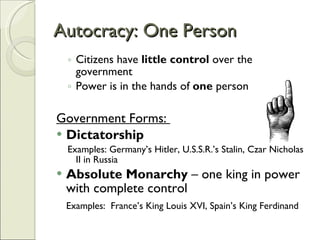
Autocracy: One Person Citizens have  little control  over the government  Power is in the hands of  one  person Government Forms:  Dictatorship   Examples: Germany’s Hitler, U.S.S.R.’s Stalin, Czar Nicholas II in Russia Absolute Monarchy  – one king in power with complete control Examples:  France’s King Louis XVI, Spain’s King Ferdinand
Autocracies of the World
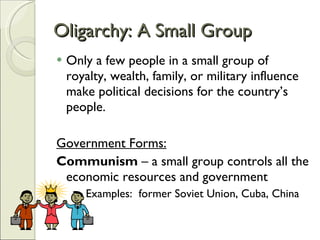
Oligarchy: A Small Group Only a few people in a small group of royalty, wealth, family, or military influence make political decisions for the country’s people. Government Forms: Communism  – a small group controls all the economic resources and government Examples:  former Soviet Union, Cuba, China
Democracy: The Citizens The citizens have a say in their government by voting in elections. Most democracies today are  republics , where the people elect leaders to  represent  them in the government. Most countries in the world are democracies.
Democratic Governments There are two predominate forms of democratic governments Parliamentary Presidential Both are designed to represent and protect the rights of the people
Presidential Democracy Citizens usually vote for members of the executive AND legislative branch  Citizens directly vote for the leader A  single person is elected as the leader The president is both head of government (chief executive) and head of state  Examples:  U.S.A., Russia, Mexico
Parliamentary Democracy Citizens vote for members of the legislative branch, and then the legislature chooses the leader Head of government and head of state are TWO different people  Examples:  United Kingdom, Germany, Canada,  Australia
Executive Legislature Citizens Citizens Legislature Executive Elect Elect Select Elect Parliamentary System Presidential System
Why Do We Have Governments? All countries require governments to function. Governments provide laws, structure, public services, and national defense. There are different types of governments: democracies republics monarchies dictatorships
How Is Power Shared? Federal Confederation Unitary
Federal Government Federal – Power is shared by a powerful central government and the state or local governments. States or provinces are given considerable self rule, usually through their own legislatures. Examples:  United States Russian Federation Germany
Federal Governments of the World (All countries in green)
Unitary Government Unitary  – a system in which the power is held by one central authority All power is given to the one branch of government. Examples: France United Kingdom (U.K.) Sweden Spain Former Soviet Union
Unitary Governments of the World (All countries in blue)
Confederation Confederation  - a system in which power is shared by an alliance or union of political organizations Independent states voluntarily work together for some common purpose and agree to certain limits on their freedom of action as a confederation. Examples: European Union Switzerland

Government terms

  • 1.
  • 2.
    Autocracy: One PersonCitizens have little control over the government Power is in the hands of one person Government Forms: Dictatorship Examples: Germany’s Hitler, U.S.S.R.’s Stalin, Czar Nicholas II in Russia Absolute Monarchy – one king in power with complete control Examples: France’s King Louis XVI, Spain’s King Ferdinand
  • 3.
  • 4.
    Oligarchy: A SmallGroup Only a few people in a small group of royalty, wealth, family, or military influence make political decisions for the country’s people. Government Forms: Communism – a small group controls all the economic resources and government Examples: former Soviet Union, Cuba, China
  • 5.
    Democracy: The CitizensThe citizens have a say in their government by voting in elections. Most democracies today are republics , where the people elect leaders to represent them in the government. Most countries in the world are democracies.
  • 6.
    Democratic Governments Thereare two predominate forms of democratic governments Parliamentary Presidential Both are designed to represent and protect the rights of the people
  • 7.
    Presidential Democracy Citizensusually vote for members of the executive AND legislative branch Citizens directly vote for the leader A single person is elected as the leader The president is both head of government (chief executive) and head of state Examples: U.S.A., Russia, Mexico
  • 8.
    Parliamentary Democracy Citizensvote for members of the legislative branch, and then the legislature chooses the leader Head of government and head of state are TWO different people Examples: United Kingdom, Germany, Canada, Australia
  • 9.
    Executive Legislature CitizensCitizens Legislature Executive Elect Elect Select Elect Parliamentary System Presidential System
  • 10.
    Why Do WeHave Governments? All countries require governments to function. Governments provide laws, structure, public services, and national defense. There are different types of governments: democracies republics monarchies dictatorships
  • 11.
    How Is PowerShared? Federal Confederation Unitary
  • 12.
    Federal Government Federal– Power is shared by a powerful central government and the state or local governments. States or provinces are given considerable self rule, usually through their own legislatures. Examples: United States Russian Federation Germany
  • 13.
    Federal Governments ofthe World (All countries in green)
  • 14.
    Unitary Government Unitary – a system in which the power is held by one central authority All power is given to the one branch of government. Examples: France United Kingdom (U.K.) Sweden Spain Former Soviet Union
  • 15.
    Unitary Governments ofthe World (All countries in blue)
  • 16.
    Confederation Confederation - a system in which power is shared by an alliance or union of political organizations Independent states voluntarily work together for some common purpose and agree to certain limits on their freedom of action as a confederation. Examples: European Union Switzerland