Citizen Participation in Government
Citizen Participation In each country, the people have different rights to participate in the government In some countries, any citizen can run for office or vote in elections In other countries there are restrictions placed on who can run for office and who can vote There are also countries where no citizen can vote and there are no elections
Review of Governments Types  of Government are based on two key questions:  1. Who has the power?  2. What is the citizen participation? Three types of governments are: Autocracy, Oligarchy, and Democracy
Autocracy The oldest form of government. One of the most common forms of government. Maintain power through inheritance or ruthless use of military and police power. Can you think of any governments like this?
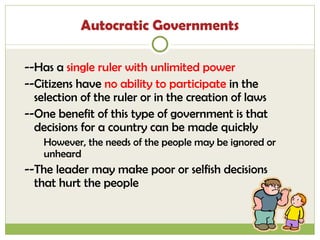
Autocratic Governments --Has a  single ruler with unlimited power --Citizens have  no ability to participate  in the selection of the ruler or in the creation of laws --One benefit of this type of government is that decisions for a country can be made quickly However, the needs of the people may be ignored or unheard --The leader may make poor or selfish decisions that hurt the people
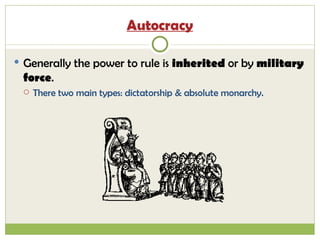
Autocracy Generally the power to rule is  inherited  or by  military force . There two main types: dictatorship & absolute monarchy.
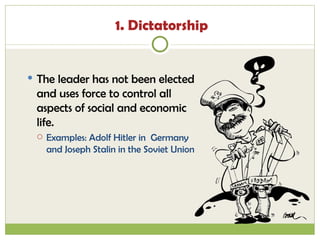
1. Dictatorship The leader has not been elected and uses force to control all aspects of social and economic life. Examples: Adolf Hitler in  Germany and Joseph Stalin in the Soviet Union
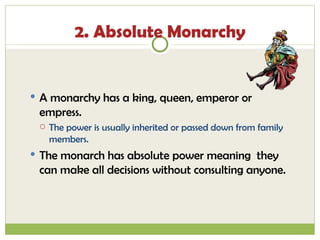
2. Absolute Monarchy A monarchy has a king, queen, emperor or empress. The power is usually inherited or passed down from family members.  The monarch has absolute power meaning  they can make all decisions without consulting anyone.
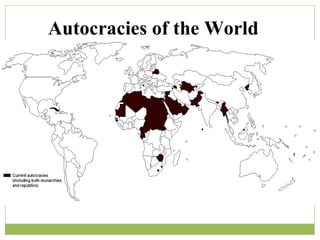
Autocracies of the World
Oligarchic Governments --“rule by a few” = country is  ruled by a small group of people An advantage is that decisions can be made relatively quickly --Compared to an autocratic system, oligarchies have more heads to think through problems and should make better choices However, the  citizen do not participate in the government
Oligarchy --A government in which a few people such as a dominant clan or clique have power. --The group gets their power from either military, wealth, religion, or social status. -- Examples- Communist countries such as China and Cuba --Leaders in the party and armed forces control government.
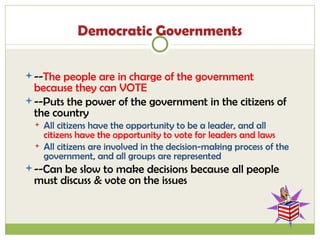
Democratic Governments -- The people are in charge of the government because they can VOTE --Puts the power of the government in the citizens of the country All citizens have the opportunity to be a leader, and all  citizens have the opportunity to vote for leaders and laws All citizens are involved in the decision-making process of the government, and all groups are represented --Can be slow to make decisions because all people must discuss & vote on the issues
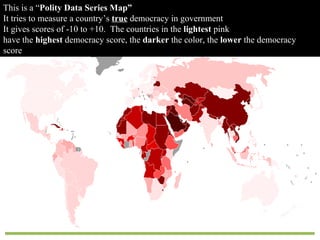
This is a “ Polity Data Series Map” It tries to measure a country’s  true  democracy in government It gives scores of -10 to +10.  The countries in the  lightest  pink  have the  highest  democracy score, the  darker  the color, the  lower  the democracy score
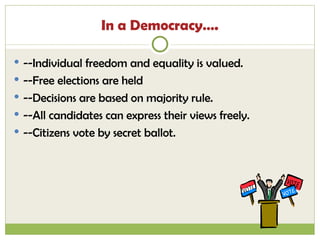
In a Democracy…. --Individual freedom and equality is valued. --Free elections are held --Decisions are based on majority rule. --All candidates can express their views freely. --Citizens vote by secret ballot.
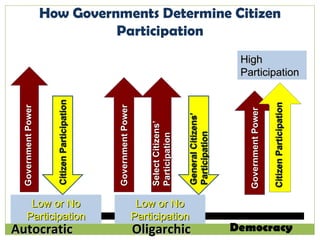
How Governments Determine Citizen Participation Democracy Oligarchic Autocratic Government Power Citizen Participation Government Power General Citizens’ Participation Government Power Citizen Participation Select Citizens’ Participation High Participation Low or No Participation Low or No Participation

Citizen participation-in-government.2011-12ppt

  • 1.
  • 2.
    Citizen Participation Ineach country, the people have different rights to participate in the government In some countries, any citizen can run for office or vote in elections In other countries there are restrictions placed on who can run for office and who can vote There are also countries where no citizen can vote and there are no elections
  • 3.
    Review of GovernmentsTypes of Government are based on two key questions: 1. Who has the power? 2. What is the citizen participation? Three types of governments are: Autocracy, Oligarchy, and Democracy
  • 4.
    Autocracy The oldestform of government. One of the most common forms of government. Maintain power through inheritance or ruthless use of military and police power. Can you think of any governments like this?
  • 5.
    Autocratic Governments --Hasa single ruler with unlimited power --Citizens have no ability to participate in the selection of the ruler or in the creation of laws --One benefit of this type of government is that decisions for a country can be made quickly However, the needs of the people may be ignored or unheard --The leader may make poor or selfish decisions that hurt the people
  • 6.
    Autocracy Generally thepower to rule is inherited or by military force . There two main types: dictatorship & absolute monarchy.
  • 7.
    1. Dictatorship Theleader has not been elected and uses force to control all aspects of social and economic life. Examples: Adolf Hitler in Germany and Joseph Stalin in the Soviet Union
  • 8.
    2. Absolute MonarchyA monarchy has a king, queen, emperor or empress. The power is usually inherited or passed down from family members. The monarch has absolute power meaning they can make all decisions without consulting anyone.
  • 9.
  • 10.
    Oligarchic Governments --“ruleby a few” = country is ruled by a small group of people An advantage is that decisions can be made relatively quickly --Compared to an autocratic system, oligarchies have more heads to think through problems and should make better choices However, the citizen do not participate in the government
  • 11.
    Oligarchy --A governmentin which a few people such as a dominant clan or clique have power. --The group gets their power from either military, wealth, religion, or social status. -- Examples- Communist countries such as China and Cuba --Leaders in the party and armed forces control government.
  • 12.
    Democratic Governments --The people are in charge of the government because they can VOTE --Puts the power of the government in the citizens of the country All citizens have the opportunity to be a leader, and all citizens have the opportunity to vote for leaders and laws All citizens are involved in the decision-making process of the government, and all groups are represented --Can be slow to make decisions because all people must discuss & vote on the issues
  • 13.
    This is a“ Polity Data Series Map” It tries to measure a country’s true democracy in government It gives scores of -10 to +10. The countries in the lightest pink have the highest democracy score, the darker the color, the lower the democracy score
  • 14.
    In a Democracy….--Individual freedom and equality is valued. --Free elections are held --Decisions are based on majority rule. --All candidates can express their views freely. --Citizens vote by secret ballot.
  • 15.
    How Governments DetermineCitizen Participation Democracy Oligarchic Autocratic Government Power Citizen Participation Government Power General Citizens’ Participation Government Power Citizen Participation Select Citizens’ Participation High Participation Low or No Participation Low or No Participation

Editor's Notes

  • #5 Remy, Richard C., United States Government- Democracy in Action (Columbus, OH: Glencoe, McGraw-Hill, 2006)