A WAC is a Soldier too!By Jason Kreimer, Jason Conley,  Steve Young, Emily Holmes, Misty Goetz
Why did we choose the WAC topic?Misty and Emily yelled that we wanted to do this.Jason K. ran up to the paper and signed us up first.Steve had a uniform.Jason C. didn’t care.
WAC learning objectives:Students will analyze the roles women filled during WWII.Students will learn information about the Women’s Auxiliary Corps including recruitment techniques.Students will compare and contrast the recruitment techniques with the recruitment techniques today.Students will apply the recruitment techniques to jobs today.Students will learn about the significance of the WAC Band.
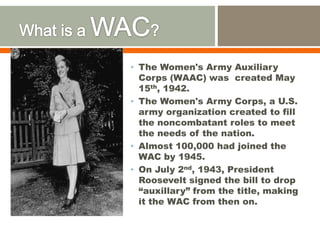
What is a WAC?The Women's Army Auxiliary Corps (WAAC) was  created May 15th, 1942.The Women's Army Corps, a U.S. army organization created to fill the noncombatant roles to meet the needs of the nation. Almost 100,000 had joined the WAC by 1945. On July 2nd, 1943, President Roosevelt signed the bill to drop “auxillary” from the title, making it the WAC from then on.
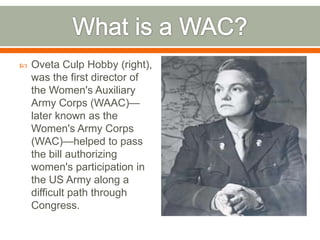
What is a WAC?Oveta Culp Hobby (right), was the first director of the Women's Auxiliary Army Corps (WAAC)—later known as the Women's Army Corps (WAC)—helped to pass the bill authorizing women's participation in the US Army along a difficult path through Congress.
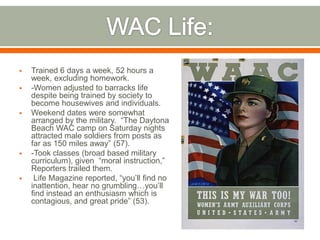
WAC Life:Trained 6 days a week, 52 hours a week, excluding homework.
-Women adjusted to barracks life despite being trained by society to become housewives and individuals.
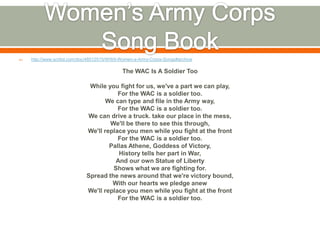
Weekend dates were somewhat arranged by the military.  “The Daytona Beach WAC camp on Saturday nights attracted male soldiers from posts as far as 150 miles away” (57).
-Took classes (broad based military curriculum), given  “moral instruction,” Reporters trailed them.
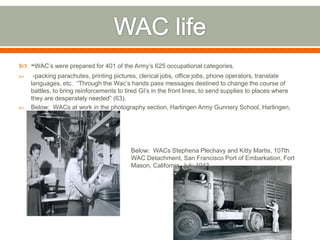
 Life Magazine reported, “you’ll find no inattention, hear no grumbling…you’ll find instead an enthusiasm which is contagious, and great pride” (53).WAC life-WAC’s were prepared for 401 of the Army’s 625 occupational categories. -packing parachutes, printing pictures, clerical jobs, office jobs, phone operators, translate languages, etc.  “Through the Wac’s hands pass messages destined to change the course of battles, to bring reinforcements to tired GI’s in the front lines, to send supplies to places where they are desperately needed” (63).Below:  WACs at work in the photography section, Harlingen Army Gunnery School, Harlingen, Texas.Below:  WACs StephenaPlechavy and Kitty Martis, 107th WAC Detachment, San Francisco Port of Embarkation, Fort Mason, California, July 1943.
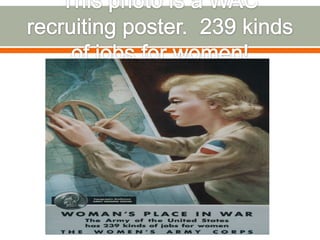
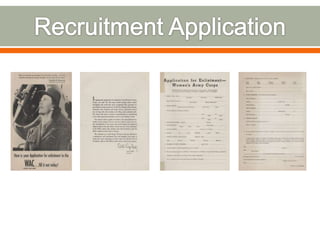
RecruitmentApplicants had to be U.S. citizens between the ages of 21 and 45 with no dependents, be at least five feet tall, and weigh 100 pounds or more. Over 35,000 women from all over the country applied for less than 1,000 anticipated positions. Recruiting was strong at first but tapered off by Christmas 1943.Oveta Culp Hobby began recruiting drives and enlisted the help of Women’s clubs and organizations.Specific drives were even held for Chinese and Japanese Americans (pg. 35.)
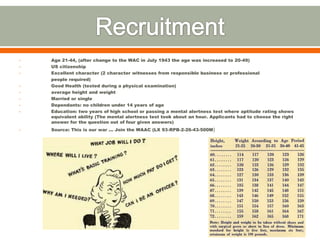
Recruitment	Age 21-44, (after change to the WAC in July 1943 the age was increased to 20-49)
	US citizenship
	Excellent character (2 character witnesses from responsible business or professional 	people required)	Good Health (tested during a physical examination)
	average height and weight
	Married or single
Dependants: no children under 14 years of age
	Education: two years of high school or passing a mental alertness test where aptitude rating shows 	equivalent ability (The mental alertness test took about an hour. Applicants had to choose the right 	answer for the question out of four given answers)
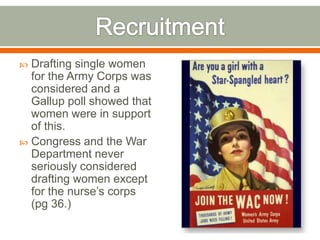
	Source: This is our war ... Join the WAAC (LX 93-RPB-2-26-43-500M)RecruitmentDrafting single women for the Army Corps was considered and a Gallup poll showed that women were in support of this.  Congress and the War Department never seriously considered drafting women except for the nurse’s corps (pg 36.)
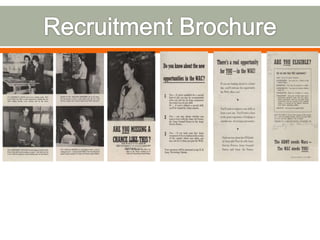
Recruitment Brochure
Recruitment Application
Recruitment Videohttp://www.history.com/videos/womens-army-auxiliary-corps#womens-army-auxiliary-corpsAt 1:15 into video.

War women powerpoint

  • 1.
    A WAC isa Soldier too!By Jason Kreimer, Jason Conley, Steve Young, Emily Holmes, Misty Goetz
  • 2.
    Why did wechoose the WAC topic?Misty and Emily yelled that we wanted to do this.Jason K. ran up to the paper and signed us up first.Steve had a uniform.Jason C. didn’t care.
  • 3.
    WAC learning objectives:Studentswill analyze the roles women filled during WWII.Students will learn information about the Women’s Auxiliary Corps including recruitment techniques.Students will compare and contrast the recruitment techniques with the recruitment techniques today.Students will apply the recruitment techniques to jobs today.Students will learn about the significance of the WAC Band.
  • 4.
    What is aWAC?The Women's Army Auxiliary Corps (WAAC) was created May 15th, 1942.The Women's Army Corps, a U.S. army organization created to fill the noncombatant roles to meet the needs of the nation. Almost 100,000 had joined the WAC by 1945. On July 2nd, 1943, President Roosevelt signed the bill to drop “auxillary” from the title, making it the WAC from then on.
  • 5.
    What is aWAC?Oveta Culp Hobby (right), was the first director of the Women's Auxiliary Army Corps (WAAC)—later known as the Women's Army Corps (WAC)—helped to pass the bill authorizing women's participation in the US Army along a difficult path through Congress.
  • 6.
    WAC Life:Trained 6days a week, 52 hours a week, excluding homework.
  • 7.
    -Women adjusted tobarracks life despite being trained by society to become housewives and individuals.
  • 8.
    Weekend dates weresomewhat arranged by the military. “The Daytona Beach WAC camp on Saturday nights attracted male soldiers from posts as far as 150 miles away” (57).
  • 9.
    -Took classes (broadbased military curriculum), given “moral instruction,” Reporters trailed them.
  • 10.
    Life Magazinereported, “you’ll find no inattention, hear no grumbling…you’ll find instead an enthusiasm which is contagious, and great pride” (53).WAC life-WAC’s were prepared for 401 of the Army’s 625 occupational categories. -packing parachutes, printing pictures, clerical jobs, office jobs, phone operators, translate languages, etc. “Through the Wac’s hands pass messages destined to change the course of battles, to bring reinforcements to tired GI’s in the front lines, to send supplies to places where they are desperately needed” (63).Below: WACs at work in the photography section, Harlingen Army Gunnery School, Harlingen, Texas.Below: WACs StephenaPlechavy and Kitty Martis, 107th WAC Detachment, San Francisco Port of Embarkation, Fort Mason, California, July 1943.
  • 11.
    RecruitmentApplicants had tobe U.S. citizens between the ages of 21 and 45 with no dependents, be at least five feet tall, and weigh 100 pounds or more. Over 35,000 women from all over the country applied for less than 1,000 anticipated positions. Recruiting was strong at first but tapered off by Christmas 1943.Oveta Culp Hobby began recruiting drives and enlisted the help of Women’s clubs and organizations.Specific drives were even held for Chinese and Japanese Americans (pg. 35.)
  • 12.
    Recruitment Age 21-44, (afterchange to the WAC in July 1943 the age was increased to 20-49)
  • 13.
  • 14.
    Excellent character (2character witnesses from responsible business or professional people required) Good Health (tested during a physical examination)
  • 15.
  • 16.
  • 17.
    Dependants: no childrenunder 14 years of age
  • 18.
    Education: two yearsof high school or passing a mental alertness test where aptitude rating shows equivalent ability (The mental alertness test took about an hour. Applicants had to choose the right answer for the question out of four given answers)
  • 19.
    Source: This isour war ... Join the WAAC (LX 93-RPB-2-26-43-500M)RecruitmentDrafting single women for the Army Corps was considered and a Gallup poll showed that women were in support of this. Congress and the War Department never seriously considered drafting women except for the nurse’s corps (pg 36.)
  • 20.
  • 21.
  • 22.