THE WORLD BANK
An Overview of World Bank
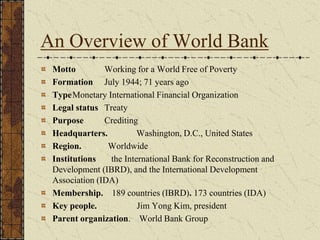
Motto Working for a World Free of Poverty
Formation July 1944; 71 years ago
TypeMonetary International Financial Organization
Legal status Treaty
Purpose Crediting
Headquarters. Washington, D.C., United States
Region. Worldwide
Institutions the International Bank for Reconstruction and
Development (IBRD), and the International Development
Association (IDA)
Membership. 189 countries (IBRD). 173 countries (IDA)
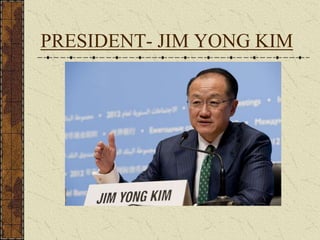
Key people. Jim Yong Kim, president
Parent organization. World Bank Group
World Bank was formed in July 1944 at the Bretton
Woods Monetary Conference in Bretton Woods
The headquarters buildings are in the Washington
DC, United States.
The president of The World Bank has always been a
US citizen nominated by the US which is the largest
shareholder.
The current president , Jim Yong Kim became the
12th President of the World Bank Group on July 1,
2012.
Is a component of the World Bank Group and a
member of the United Nations Development
Group.
World Bank is an international financial institution
that provides loans to developing countries for
capital programs.
Comprises of the International Bank for
Reconstruction and Development Association
(IBRD) and the International Development
Association (IDA).
PRESIDENT- JIM YONG KIM
History OF World Bank
1944–1974 - Before 1974, the
reconstruction and development loans
provided by the World Bank were relatively
small. The Bank's staff were aware of the
need to instill confidence in the bank. Fiscal
conservatism ruled, and loan applications
had to meet strict criteria.
The first country to receive a World Bank
loan was France in 1947.
1974–1980 - From 1974 to 1980, the bank
concentrated on meeting the basic needs of
people in the developing world. The size
and number of loans to borrowers was
greatly increased as loan targets expanded
from infrastructure into social services and
other sectors
1989 (present time) - Beginning in 1989, in
response to harsh criticism from many groups, the
bank began including environmental groups and
NGOs in its loans to mitigate the past effects of its
development policies that had prompted the
criticism. It also formed an implementing agency,
in accordance with the Montreal Protocols, to stop
ozone-depletion damage to the Earth's atmosphere
by phasing out the use of 95% of ozone-depleting
chemicals
Objectives of the World Bank
The principle objectives of the world bank were:
1. Help to improve the lives of under-served populations
worldwide
2. Eradicate extreme poverty and hunger
3. Achieve universal primary education
4. Promote gender equality
5. 4.Reduce child mortality
6. Improve maternal health
7. Combat HIV/AIDS , malaria and other diseases
8. Ensure environmental sustainability
9. Develop a global partnership for a development
What is Governance?
Governance consists of the traditions and
institutions by which authority in a country
is exercised. This includes the process by
which governments are selected, monitored
and replaced; the capacity of the
government to effectively formulate and
implement sound policies; and the respect
of citizens and the state for the institutions
that govern economic and social
interactions among them.
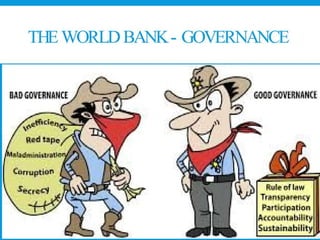
What Constitutes good governance
according to World Bank
1.Public sector management(equitable &
inclusive)
2.Accountability
3.A legal framework for development
4.Transparency
5.Participation
1.PUBLIC SECTOR
MANAGEMENT
This deals with the improvement in the
efficiency of the public institutions.
The World Bank define “government
effectiveness” as: “measuring the quality of
public services, the quality of the civil service
and the degree of independence from political
pressures, the quality of policy formulation and
implementation and the credibility of the
government’s commitment to such policies”.
Continuation…
Examples of a good public sector mgt are:
i)Public investments
ii)Good budget planning concerning operation
and maintenance and
iii)Strengthening the budget process
2.ACCOUNTABILITY
Accountability is described as holding
public officials /government responsible for
their actions.
At the political means making rulers
accountable to the ruled.
The concept of accountability is equating
one performance with another specific
outcome.
3.LEGAL FRAMEWORK FOR
DEVELOPMENT.
This refers to the rule of law approach.
It refers to a substantive dimension that
includes the contents of laws and the legal
concepts such as justice, fairness and
liberty.
All the above legal framework helps in the
development of the private sector and the
relation with the public.
4.TRANSPARENCY
Transparency would is beneficial in a
number of ways;
i)Decision making- Helps in the access to
information on governmental policies and
transparency of the decision processes.
-The population would benefit from this
understanding and have the possibility to
influence the decision-making processes.
Continuation…
iii) Prevention of corruption-Transparency
improves the interaction between
government and the public in terms of
rendering more transparency in the
decision-making processes .
-This steers the government in using the funds
on major challenges because a good
decision has been arrived at.
Continuation…
Former World Bank president Wolfowitz
stressed: “Improving governance is
certainly about fighting corruption, although
it is also about much more than fighting
corruption”.
5.PARTICIPATION
According to World Bank,participation is the
process through which stakeholders influence
and share control over priority setting, policy-
making, resource allocations and access to
public goods and services.
Participation is also a cross-cutting theme
throughout good governance. Especially
accountability and transparency that focuses on
the participation of the population.
WHAT IS GOOD GORVENANCE
THEN?
The manner in which power is exercised in
the management of a country’s economic
and social resources for development
The manner in this case combining all the
contents of good governance discussed
above.
The (Gross National Income)
GNI Per capita
The classifications of GNI per capita;
1.Low income countries
2.Lower middle income countries
3.Upper middle income countries
4.High income countries
Continuation…
Comparisons of national wealth are frequently made on the
basis of nominal GDP and savings (not just income), which do
not reflect differences in the cost of living in different countries
(See List of countries by GDP (nominal) per capital); hence,
using a PPP basis is arguably more useful when
comparing generalized differences in living standards between
nations because PPP takes into account the relative cost of
living and the inflation rates of the countries, rather than using
only exchange rates, which may distort the real differences in
income. This is why GDP (PPP) per capita is often considered
one of the indicators of a country's standard of living although
this can be problematic because GDP per capita is not a measure
of personal income.
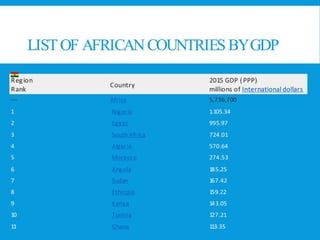
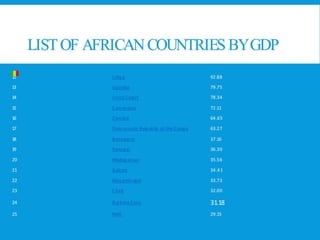
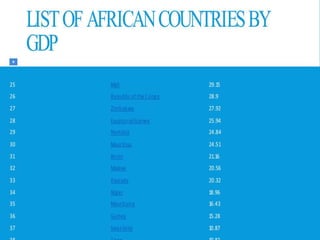
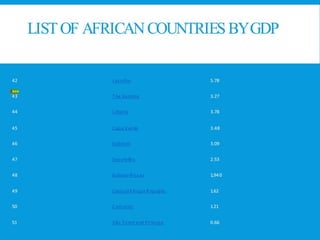
Indices of African Nations
List of the indices of African Nations
COMPARISON OF NIGERIA
AND SAO TOME
NIGERIA
Inflation Rate
Inflation Rate in Nigeria averaged 12.13
percent from 1996 until 2016, reaching an
all time high of 47.56 percent in January of
1996 and a record low of -2.49 percent in
January of 2000. Inflation Rate in Nigeria is
reported by the National Bureau of
Statistics, Nigeria.
Corruption Index
Nigeria is the 136 least corrupt nation out of
175 countries, according to the 2015
Corruption Perceptions Index reported by
Transparency International. Corruption
Rank in Nigeria averaged 118.30 from 1996
until 2015, reaching an all time high of 152
in 2005 and a record low of 52 in 1997.
Open Markets
Nigeria’s average tariff rate is 10.1 percent.
Meat and poultry imports are restricted.
Foreign investors face regulatory and
judicial barriers. The government’s import
substitution policy interferes with trade and
investment flows.
Continuation
Financial-sector reform is ongoing, but the
state continues to influence the allocation of
credit. Measures to improve access to
finance for local small and medium-sized
companies have been introduced.
Sao Tome
Principle of GDP
As of 2014 the country was worth 0.35
billion dollars. This represents less than
0.01 percent of the world economy.
Continuation…
Since the gross domestic product (GDP) is
equal to the total expenditures for all final
goods and services produced within the
country in a stipulated period of time. It can
thus be inferred that the citizens of Sao
Tome have minimal disposable income, low
consumerism, which are vital to growth in
GDP.
Continuation…
Take for instance Nigeria with its large
population as opposed to Sao Tome and it
minimal population. The larger the
population, the larger the pool of consumers
disposable income and rate of consumerism
High Inflation
The average inflation rate in the country from
1997 to 2016 was rated at 16.30% with an all-
time percentile of 86.80% in 1998. But as of
now, it rated at 6.2% as of May 2016.
Corruption Index
According to the 2015 Corruption
Perceptions Index reported by Transparency
International, it was ranked as the 66th least
corrupt country of the 175 countries that
were ranked.
Open Markets
Domestic and foreign investors are
generally treated equally under the law. The
underdeveloped financial sector does not
provide much access to banking services for
a large portion of the population.
Continuation…
With such institutional structures local
investors are disadvantaged owing to the
fact that the native population is already
disadvantaged. Further due to the fragile
market, credit services are not accessible to
the masses.
Resource Based Economies
Sao Tome’s economy is driven by cocoa
production and a young tourism industry.
Like most of African resource based
economy, the rate of accountability is
wanting and the amount of technology used
in such industries is beyond such nations. It
has been termed as the ‘resource-curse’ that
has been seen in African resource based
economies
Continuation…
Though both are resource based economies,
it is clear that oil is more profitable and
economically vialble
CRITICS ON THE GOVERNANCE
ON THE WORLD BANK
The World Bank has long been criticized by
non-governmental organisations such as the
indigenous rights group Survival International,
and academics including its former chief
economist Joseph Stiglitz,Henry Hazlitt and
Ludwig Von Mises.
The following are the Criticisms:
Governance of the World Bank
One of the strongest criticisms of the world
bank has been the way in which it is
governed.
While the world bank represents 188
countries, it is run by a small number of
economically powerful countries.
Continuation…
These (the economically powerful)
countries (which also provide most of the
institution’s funding) choose the leadership
and senior management of the World Bank
and so their interests dominate the bank.
Continuation…
Decisions are made and policies
implemented by leading industrialized
countries—the G7—because they represent
the largest donors without much
consultation with poor and developing
countries.
Unequal Voting Power
Titus Alexander argues that the unequal
voting power of western countries and the
World Bank’s role in developing countries
makes it similar to the South African
Development Bank under apartheid, and
therefore a pillar of global apartheid.
Conditionality
The World Bank often attach loan
conditionality based on what is termed the
‘Washington Consensus’, focusing on
liberalization of trade, investment and the
financial sector, deregulation and
privatization of nationalized industries.
Continuation…
Often the conditionality is attached without
due regard for the borrower countries’
individual circumstances and the
prescriptive recommendations by the World
Bank fail to resolve the economic problems
within the countries.
Over-emphasis on Private Sector
It is feared that this may undermine the role
of the state as the primary provider of
essential goods and services, such as
healthcare and education, resulting in the
shortfall of such services in countries badly
in need of them
Continuation…
As an increasing shift from public to private
funding in development finance has been
observed recently, the Bank’s private sector
lending arm – the International Finance
Corporation (IFC) has also been criticized for
its business model, the increasing use of
financial intermediaries such as private equity
funds and funding of companies associated
with tax havens
Group Members
1. Hanifa Mohamed
2. Nthuku Mumo
3. Samira Tifow
4. Faaiza Khan
5. Abdulsami Gaid
6. Lynnette Luba
7. Berguy Kinsila
8. Rita Amadi
9. Michael Kiragu
10. Brian Kabui
11. Bhagyashree Halai
12. Manish Halai
13. Richard Muro
14. Ravina Shah
15. Sarah Mwangi
16. Ian Kola
17. Margaret Mutuku
18. Gilbert Etemesi
19. Veronicah Mwangi
20. Faith Kamau
END
THANK
YOU

The world bank gorvernance lite

  • 1.
  • 2.
    An Overview ofWorld Bank Motto Working for a World Free of Poverty Formation July 1944; 71 years ago TypeMonetary International Financial Organization Legal status Treaty Purpose Crediting Headquarters. Washington, D.C., United States Region. Worldwide Institutions the International Bank for Reconstruction and Development (IBRD), and the International Development Association (IDA) Membership. 189 countries (IBRD). 173 countries (IDA) Key people. Jim Yong Kim, president Parent organization. World Bank Group
  • 3.
    World Bank wasformed in July 1944 at the Bretton Woods Monetary Conference in Bretton Woods The headquarters buildings are in the Washington DC, United States. The president of The World Bank has always been a US citizen nominated by the US which is the largest shareholder. The current president , Jim Yong Kim became the 12th President of the World Bank Group on July 1, 2012.
  • 4.
    Is a componentof the World Bank Group and a member of the United Nations Development Group. World Bank is an international financial institution that provides loans to developing countries for capital programs. Comprises of the International Bank for Reconstruction and Development Association (IBRD) and the International Development Association (IDA).
  • 5.
  • 6.
    History OF WorldBank 1944–1974 - Before 1974, the reconstruction and development loans provided by the World Bank were relatively small. The Bank's staff were aware of the need to instill confidence in the bank. Fiscal conservatism ruled, and loan applications had to meet strict criteria. The first country to receive a World Bank loan was France in 1947.
  • 7.
    1974–1980 - From1974 to 1980, the bank concentrated on meeting the basic needs of people in the developing world. The size and number of loans to borrowers was greatly increased as loan targets expanded from infrastructure into social services and other sectors
  • 8.
    1989 (present time)- Beginning in 1989, in response to harsh criticism from many groups, the bank began including environmental groups and NGOs in its loans to mitigate the past effects of its development policies that had prompted the criticism. It also formed an implementing agency, in accordance with the Montreal Protocols, to stop ozone-depletion damage to the Earth's atmosphere by phasing out the use of 95% of ozone-depleting chemicals
  • 9.
    Objectives of theWorld Bank The principle objectives of the world bank were: 1. Help to improve the lives of under-served populations worldwide 2. Eradicate extreme poverty and hunger 3. Achieve universal primary education 4. Promote gender equality 5. 4.Reduce child mortality 6. Improve maternal health 7. Combat HIV/AIDS , malaria and other diseases 8. Ensure environmental sustainability 9. Develop a global partnership for a development
  • 10.
    What is Governance? Governanceconsists of the traditions and institutions by which authority in a country is exercised. This includes the process by which governments are selected, monitored and replaced; the capacity of the government to effectively formulate and implement sound policies; and the respect of citizens and the state for the institutions that govern economic and social interactions among them.
  • 11.
    What Constitutes goodgovernance according to World Bank 1.Public sector management(equitable & inclusive) 2.Accountability 3.A legal framework for development 4.Transparency 5.Participation
  • 12.
    1.PUBLIC SECTOR MANAGEMENT This dealswith the improvement in the efficiency of the public institutions. The World Bank define “government effectiveness” as: “measuring the quality of public services, the quality of the civil service and the degree of independence from political pressures, the quality of policy formulation and implementation and the credibility of the government’s commitment to such policies”.
  • 13.
    Continuation… Examples of agood public sector mgt are: i)Public investments ii)Good budget planning concerning operation and maintenance and iii)Strengthening the budget process
  • 14.
    2.ACCOUNTABILITY Accountability is describedas holding public officials /government responsible for their actions. At the political means making rulers accountable to the ruled. The concept of accountability is equating one performance with another specific outcome.
  • 15.
    3.LEGAL FRAMEWORK FOR DEVELOPMENT. Thisrefers to the rule of law approach. It refers to a substantive dimension that includes the contents of laws and the legal concepts such as justice, fairness and liberty. All the above legal framework helps in the development of the private sector and the relation with the public.
  • 16.
    4.TRANSPARENCY Transparency would isbeneficial in a number of ways; i)Decision making- Helps in the access to information on governmental policies and transparency of the decision processes. -The population would benefit from this understanding and have the possibility to influence the decision-making processes.
  • 17.
    Continuation… iii) Prevention ofcorruption-Transparency improves the interaction between government and the public in terms of rendering more transparency in the decision-making processes . -This steers the government in using the funds on major challenges because a good decision has been arrived at.
  • 18.
    Continuation… Former World Bankpresident Wolfowitz stressed: “Improving governance is certainly about fighting corruption, although it is also about much more than fighting corruption”.
  • 19.
    5.PARTICIPATION According to WorldBank,participation is the process through which stakeholders influence and share control over priority setting, policy- making, resource allocations and access to public goods and services. Participation is also a cross-cutting theme throughout good governance. Especially accountability and transparency that focuses on the participation of the population.
  • 20.
    WHAT IS GOODGORVENANCE THEN? The manner in which power is exercised in the management of a country’s economic and social resources for development The manner in this case combining all the contents of good governance discussed above.
  • 21.
    The (Gross NationalIncome) GNI Per capita The classifications of GNI per capita; 1.Low income countries 2.Lower middle income countries 3.Upper middle income countries 4.High income countries
  • 22.
    Continuation… Comparisons of nationalwealth are frequently made on the basis of nominal GDP and savings (not just income), which do not reflect differences in the cost of living in different countries (See List of countries by GDP (nominal) per capital); hence, using a PPP basis is arguably more useful when comparing generalized differences in living standards between nations because PPP takes into account the relative cost of living and the inflation rates of the countries, rather than using only exchange rates, which may distort the real differences in income. This is why GDP (PPP) per capita is often considered one of the indicators of a country's standard of living although this can be problematic because GDP per capita is not a measure of personal income.
  • 23.
  • 24.
    List of theindices of African Nations
  • 29.
  • 30.
  • 31.
    Inflation Rate Inflation Ratein Nigeria averaged 12.13 percent from 1996 until 2016, reaching an all time high of 47.56 percent in January of 1996 and a record low of -2.49 percent in January of 2000. Inflation Rate in Nigeria is reported by the National Bureau of Statistics, Nigeria.
  • 32.
    Corruption Index Nigeria isthe 136 least corrupt nation out of 175 countries, according to the 2015 Corruption Perceptions Index reported by Transparency International. Corruption Rank in Nigeria averaged 118.30 from 1996 until 2015, reaching an all time high of 152 in 2005 and a record low of 52 in 1997.
  • 33.
    Open Markets Nigeria’s averagetariff rate is 10.1 percent. Meat and poultry imports are restricted. Foreign investors face regulatory and judicial barriers. The government’s import substitution policy interferes with trade and investment flows.
  • 34.
    Continuation Financial-sector reform isongoing, but the state continues to influence the allocation of credit. Measures to improve access to finance for local small and medium-sized companies have been introduced.
  • 35.
  • 36.
    Principle of GDP Asof 2014 the country was worth 0.35 billion dollars. This represents less than 0.01 percent of the world economy.
  • 37.
    Continuation… Since the grossdomestic product (GDP) is equal to the total expenditures for all final goods and services produced within the country in a stipulated period of time. It can thus be inferred that the citizens of Sao Tome have minimal disposable income, low consumerism, which are vital to growth in GDP.
  • 38.
    Continuation… Take for instanceNigeria with its large population as opposed to Sao Tome and it minimal population. The larger the population, the larger the pool of consumers disposable income and rate of consumerism
  • 39.
    High Inflation The averageinflation rate in the country from 1997 to 2016 was rated at 16.30% with an all- time percentile of 86.80% in 1998. But as of now, it rated at 6.2% as of May 2016.
  • 40.
    Corruption Index According tothe 2015 Corruption Perceptions Index reported by Transparency International, it was ranked as the 66th least corrupt country of the 175 countries that were ranked.
  • 41.
    Open Markets Domestic andforeign investors are generally treated equally under the law. The underdeveloped financial sector does not provide much access to banking services for a large portion of the population.
  • 42.
    Continuation… With such institutionalstructures local investors are disadvantaged owing to the fact that the native population is already disadvantaged. Further due to the fragile market, credit services are not accessible to the masses.
  • 43.
    Resource Based Economies SaoTome’s economy is driven by cocoa production and a young tourism industry. Like most of African resource based economy, the rate of accountability is wanting and the amount of technology used in such industries is beyond such nations. It has been termed as the ‘resource-curse’ that has been seen in African resource based economies
  • 44.
    Continuation… Though both areresource based economies, it is clear that oil is more profitable and economically vialble
  • 45.
    CRITICS ON THEGOVERNANCE ON THE WORLD BANK The World Bank has long been criticized by non-governmental organisations such as the indigenous rights group Survival International, and academics including its former chief economist Joseph Stiglitz,Henry Hazlitt and Ludwig Von Mises. The following are the Criticisms:
  • 46.
    Governance of theWorld Bank One of the strongest criticisms of the world bank has been the way in which it is governed. While the world bank represents 188 countries, it is run by a small number of economically powerful countries.
  • 47.
    Continuation… These (the economicallypowerful) countries (which also provide most of the institution’s funding) choose the leadership and senior management of the World Bank and so their interests dominate the bank.
  • 48.
    Continuation… Decisions are madeand policies implemented by leading industrialized countries—the G7—because they represent the largest donors without much consultation with poor and developing countries.
  • 49.
    Unequal Voting Power TitusAlexander argues that the unequal voting power of western countries and the World Bank’s role in developing countries makes it similar to the South African Development Bank under apartheid, and therefore a pillar of global apartheid.
  • 50.
    Conditionality The World Bankoften attach loan conditionality based on what is termed the ‘Washington Consensus’, focusing on liberalization of trade, investment and the financial sector, deregulation and privatization of nationalized industries.
  • 51.
    Continuation… Often the conditionalityis attached without due regard for the borrower countries’ individual circumstances and the prescriptive recommendations by the World Bank fail to resolve the economic problems within the countries.
  • 52.
    Over-emphasis on PrivateSector It is feared that this may undermine the role of the state as the primary provider of essential goods and services, such as healthcare and education, resulting in the shortfall of such services in countries badly in need of them
  • 53.
    Continuation… As an increasingshift from public to private funding in development finance has been observed recently, the Bank’s private sector lending arm – the International Finance Corporation (IFC) has also been criticized for its business model, the increasing use of financial intermediaries such as private equity funds and funding of companies associated with tax havens
  • 54.
    Group Members 1. HanifaMohamed 2. Nthuku Mumo 3. Samira Tifow 4. Faaiza Khan 5. Abdulsami Gaid 6. Lynnette Luba 7. Berguy Kinsila 8. Rita Amadi 9. Michael Kiragu 10. Brian Kabui 11. Bhagyashree Halai 12. Manish Halai 13. Richard Muro 14. Ravina Shah 15. Sarah Mwangi 16. Ian Kola 17. Margaret Mutuku 18. Gilbert Etemesi 19. Veronicah Mwangi 20. Faith Kamau
  • 55.

Editor's Notes

  • #11 World Governance Indicators, http://info.worldbank.org/governance/wgi/index.aspx#home accessed 30/06/16
  • #35 http://www.heritage.org/index/country/nigeria
  • #37 Sao Tome and Principe GDP,<http://www.tradingeconomics.com/sao-tome-and-principe/gdp> Accessed 8/7/2016
  • #39 However, large populations do not always mean a stronger GDP, it has to be in co-relation with other factors.
  • #40 Sao Tome and Principe Inflation Rate, http://www.tradingeconomics.com/sao-tome-and-principe/inflation-cpi Accessed 8/7/2016
  • #42 2016 Index of Economic Freedom, Sao Tome and Principe,< http://www.heritage.org/index/country/saotomeprincipe Accessed 8/7/2016