THE CONCEPT OF
GOVERNANCE
T H E O R I E S A N D F R A M E W O R K S O F G O V E R N A N C E
B Y :
M A R Y G R A C E B O R B O N
E L I Z A B E T H C O R D E R O
J A C L Y N D E G U Z M A N
What does Governance mean?
Governance can be defined as: “The system by which
entities are directed and controlled. It is concerned
with structure and processes for decision making,
accountability, control and behavior at the top of
an entity. Governance influences how an
organisation’s objectives are set and achieved,
how risk is monitored and addressed and how
performance is optimised”.
Governance has gained popularity in
management sciences and in academic public
policy discourse because of its multivalency – its
ability to link up with many
other arguments and theoretical concepts.
The Concepts of Governance
Theories and Frameworks
Currently, it not only occupies the central stage of development
discourse but it is also considered as the fundamental component to
be incorporated in the development policy of both developed and
developing nations (Hye 2000).
The Concepts of Governance
Theories and Frameworks
As a concept, governance incorporates a very long history of
governing, rule, authority structures, and domination (Tiihonen 2004).
The Concepts of Governance
Theories and Frameworks
Despite its growing importance to the researchers, development
practitioners, policy makers, and international aid agencies,
governance is far from a “finished product.” Rather it is a dynamic
concept and worth examining analytically and systematically
(Farazmand 2012).
It is also evident that the wealth or poverty of any nation goes
hand in hand with the state of governance and not merely with,
e.g., the natural resources (Werlin 2003).
The Concepts of Governance
Theories and Frameworks
Farazmand (2012) highlighted governance from three faces, for
example, the good, the bad, and the ugly, and concluded that
none of these offers a full-scale and comprehensive perspective of
the concept.
To summarize, we can say that the concept of governance
applies to multiple forms of collective action. However, it is
about more strategic aspects of steering of a society:
the larger decisions about direction and roles. That is,
governance is not only about where to go but also about who
should be involved in deciding and in what capacity.
The Concepts of Governance | Theories and Frameworks
Four areas or zones where the concept is
particularly relevant:
Governance in “global space” or global governance
Governance in “national space”
Organizational governance (governance in “organization
space”)
Service space governance
Community governance (governance in “community space”)
Theories
Theories
and
and
Frameworks
Frameworks
of Governance
of Governance
Stoker's Perspective of
Governance as a Theory
These five propositions are:
1. Governance refers to a set of
institutions and actors that occupy
government bodies and “beyond”.
2. Governance identifies the blurring of
boundaries and responsibilities for tackling
social and economic issues.
Stoker's Perspective of Governance as a Theory
3. Governance identifies the power
dependence involved in the relationships
between institutions involved in collective
actions.
Stoker's Perspective of Governance as a Theory
4. Governance is about autonomous
self governing networks of actors.
5. Governance recognizes the capacity
to get things done which does not rest
within the power of government to
command or use its authority.
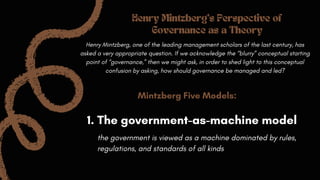
Mintzberg Five Models:
Henry Mintzberg, one of the leading management scholars of the last century, has
asked a very appropriate question. If we acknowledge the “blurry” conceptual starting
point of “governance,” then we might ask, in order to shed light to this conceptual
confusion by asking, how should governance be managed and led?
1. The government-as-machine model
Henry Mintzberg's Perspective of
Governance as a Theory
the government is viewed as a machine dominated by rules,
regulations, and standards of all kinds
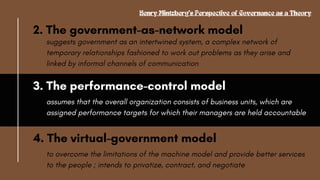
2. The government-as-network model
Henry Mintzberg's Perspective of Governance as a Theory
suggests government as an intertwined system, a complex network of
temporary relationships fashioned to work out problems as they arise and
linked by informal channels of communication
3. The performance-control model
assumes that the overall organization consists of business units, which are
assigned performance targets for which their managers are held accountable
4. The virtual-government model
to overcome the limitations of the machine model and provide better services
to the people ; intends to privatize, contract, and negotiate
Henry Mintzberg's Perspective of
Governance as a Theory
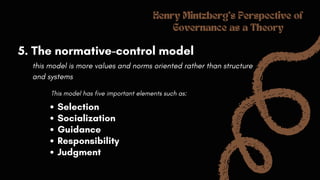
5. The normative-control model
this model is more values and norms oriented rather than structure
and systems
This model has five important elements such as:
Selection
Socialization
Guidance
Responsibility
Judgment
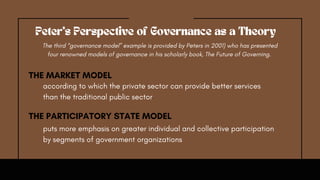
according to which the private sector can provide better services
than the traditional public sector
Peter's Perspective of Governance as a Theory
The third “governance model” example is provided by Peters in 2001) who has presented
four renowned models of governance in his scholarly book, The Future of Governing.
THE MARKET MODEL
THE PARTICIPATORY STATE MODEL
puts more emphasis on greater individual and collective participation
by segments of government organizations
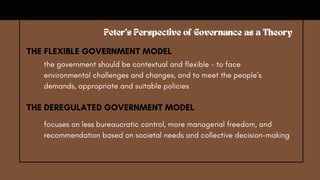
the government should be contextual and flexible - to face
environmental challenges and changes, and to meet the people’s
demands, appropriate and suitable policies
Peter's Perspective of Governance as a Theory
THE FLEXIBLE GOVERNMENT MODEL
THE DEREGULATED GOVERNMENT MODEL
focuses on less bureaucratic control, more managerial freedom, and
recommendation based on societal needs and collective decision-making
HEADY'S THREE THEORETICAL APPROACHES
Organizational theory
Cultural theory
Structural-functional theory
Heady's Perspective of Governance
as a Theory
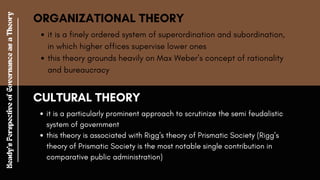
ORGANIZATIONAL THEORY
it is a finely ordered system of superordination and subordination,
in which higher offices supervise lower ones
this theory grounds heavily on Max Weber’s concept of rationality
and bureaucracy
CULTURAL THEORY
it is a particularly prominent approach to scrutinize the semi feudalistic
system of government
this theory is associated with Rigg's theory of Prismatic Society (Rigg’s
theory of Prismatic Society is the most notable single contribution in
comparative public administration)
Heady's
Perspective
of
Governance
as
a
Theory
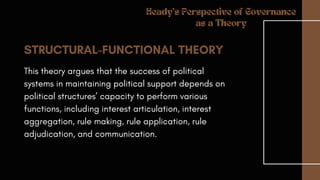
STRUCTURAL-FUNCTIONAL THEORY
This theory argues that the success of political
systems in maintaining political support depends on
political structures’ capacity to perform various
functions, including interest articulation, interest
aggregation, rule making, rule application, rule
adjudication, and communication.
Heady's Perspective of Governance
as a Theory
What Is A Governance Framework?
A governance framework is essential for modern
governance and legal operations; it directs how
people interact with the organization, with
regulators and with stakeholders to closely guide
and monitor operations.
What Is A Governance Framework?
A governance framework helps to center an
organization’s approach around common themes,
including who has a voice, who makes decisions and
who has accountability.
Why is good governance important?
The fundamental reasons why organisations should
adopt good governance practises include:
To preserve and strengthen stakeholder
confidence
To provide the foundation for a high-performing
organisation
To ensure the organisation is well placed to
respond to a changing external environment
In summary, governance encompasses the processes
by which organizations are directed, controlled and
held to account. It includes the authority,
accountability, leadership, direction and control
exercised in an organization.
Thank you
Thank you
&
&
God bless!
God bless!
How does good governance
contribute to sustainable
development?

Group-6-The-Concept-of-Governance.pdf

  • 1.
    THE CONCEPT OF GOVERNANCE TH E O R I E S A N D F R A M E W O R K S O F G O V E R N A N C E B Y : M A R Y G R A C E B O R B O N E L I Z A B E T H C O R D E R O J A C L Y N D E G U Z M A N
  • 2.
    What does Governancemean? Governance can be defined as: “The system by which entities are directed and controlled. It is concerned with structure and processes for decision making, accountability, control and behavior at the top of an entity. Governance influences how an organisation’s objectives are set and achieved, how risk is monitored and addressed and how performance is optimised”.
  • 3.
    Governance has gainedpopularity in management sciences and in academic public policy discourse because of its multivalency – its ability to link up with many other arguments and theoretical concepts. The Concepts of Governance Theories and Frameworks
  • 4.
    Currently, it notonly occupies the central stage of development discourse but it is also considered as the fundamental component to be incorporated in the development policy of both developed and developing nations (Hye 2000). The Concepts of Governance Theories and Frameworks As a concept, governance incorporates a very long history of governing, rule, authority structures, and domination (Tiihonen 2004).
  • 5.
    The Concepts ofGovernance Theories and Frameworks Despite its growing importance to the researchers, development practitioners, policy makers, and international aid agencies, governance is far from a “finished product.” Rather it is a dynamic concept and worth examining analytically and systematically (Farazmand 2012).
  • 6.
    It is alsoevident that the wealth or poverty of any nation goes hand in hand with the state of governance and not merely with, e.g., the natural resources (Werlin 2003). The Concepts of Governance Theories and Frameworks Farazmand (2012) highlighted governance from three faces, for example, the good, the bad, and the ugly, and concluded that none of these offers a full-scale and comprehensive perspective of the concept.
  • 7.
    To summarize, wecan say that the concept of governance applies to multiple forms of collective action. However, it is about more strategic aspects of steering of a society: the larger decisions about direction and roles. That is, governance is not only about where to go but also about who should be involved in deciding and in what capacity. The Concepts of Governance | Theories and Frameworks
  • 8.
    Four areas orzones where the concept is particularly relevant: Governance in “global space” or global governance Governance in “national space” Organizational governance (governance in “organization space”) Service space governance Community governance (governance in “community space”)
  • 9.
  • 10.
    Stoker's Perspective of Governanceas a Theory These five propositions are: 1. Governance refers to a set of institutions and actors that occupy government bodies and “beyond”.
  • 11.
    2. Governance identifiesthe blurring of boundaries and responsibilities for tackling social and economic issues. Stoker's Perspective of Governance as a Theory 3. Governance identifies the power dependence involved in the relationships between institutions involved in collective actions.
  • 12.
    Stoker's Perspective ofGovernance as a Theory 4. Governance is about autonomous self governing networks of actors. 5. Governance recognizes the capacity to get things done which does not rest within the power of government to command or use its authority.
  • 13.
    Mintzberg Five Models: HenryMintzberg, one of the leading management scholars of the last century, has asked a very appropriate question. If we acknowledge the “blurry” conceptual starting point of “governance,” then we might ask, in order to shed light to this conceptual confusion by asking, how should governance be managed and led? 1. The government-as-machine model Henry Mintzberg's Perspective of Governance as a Theory the government is viewed as a machine dominated by rules, regulations, and standards of all kinds
  • 14.
    2. The government-as-networkmodel Henry Mintzberg's Perspective of Governance as a Theory suggests government as an intertwined system, a complex network of temporary relationships fashioned to work out problems as they arise and linked by informal channels of communication 3. The performance-control model assumes that the overall organization consists of business units, which are assigned performance targets for which their managers are held accountable 4. The virtual-government model to overcome the limitations of the machine model and provide better services to the people ; intends to privatize, contract, and negotiate
  • 15.
    Henry Mintzberg's Perspectiveof Governance as a Theory 5. The normative-control model this model is more values and norms oriented rather than structure and systems This model has five important elements such as: Selection Socialization Guidance Responsibility Judgment
  • 16.
    according to whichthe private sector can provide better services than the traditional public sector Peter's Perspective of Governance as a Theory The third “governance model” example is provided by Peters in 2001) who has presented four renowned models of governance in his scholarly book, The Future of Governing. THE MARKET MODEL THE PARTICIPATORY STATE MODEL puts more emphasis on greater individual and collective participation by segments of government organizations
  • 17.
    the government shouldbe contextual and flexible - to face environmental challenges and changes, and to meet the people’s demands, appropriate and suitable policies Peter's Perspective of Governance as a Theory THE FLEXIBLE GOVERNMENT MODEL THE DEREGULATED GOVERNMENT MODEL focuses on less bureaucratic control, more managerial freedom, and recommendation based on societal needs and collective decision-making
  • 18.
    HEADY'S THREE THEORETICALAPPROACHES Organizational theory Cultural theory Structural-functional theory Heady's Perspective of Governance as a Theory
  • 19.
    ORGANIZATIONAL THEORY it isa finely ordered system of superordination and subordination, in which higher offices supervise lower ones this theory grounds heavily on Max Weber’s concept of rationality and bureaucracy CULTURAL THEORY it is a particularly prominent approach to scrutinize the semi feudalistic system of government this theory is associated with Rigg's theory of Prismatic Society (Rigg’s theory of Prismatic Society is the most notable single contribution in comparative public administration) Heady's Perspective of Governance as a Theory
  • 20.
    STRUCTURAL-FUNCTIONAL THEORY This theoryargues that the success of political systems in maintaining political support depends on political structures’ capacity to perform various functions, including interest articulation, interest aggregation, rule making, rule application, rule adjudication, and communication. Heady's Perspective of Governance as a Theory
  • 21.
    What Is AGovernance Framework? A governance framework is essential for modern governance and legal operations; it directs how people interact with the organization, with regulators and with stakeholders to closely guide and monitor operations.
  • 22.
    What Is AGovernance Framework? A governance framework helps to center an organization’s approach around common themes, including who has a voice, who makes decisions and who has accountability.
  • 23.
    Why is goodgovernance important? The fundamental reasons why organisations should adopt good governance practises include: To preserve and strengthen stakeholder confidence To provide the foundation for a high-performing organisation To ensure the organisation is well placed to respond to a changing external environment
  • 24.
    In summary, governanceencompasses the processes by which organizations are directed, controlled and held to account. It includes the authority, accountability, leadership, direction and control exercised in an organization.
  • 25.
    Thank you Thank you & & Godbless! God bless!
  • 26.
    How does goodgovernance contribute to sustainable development?