





MaRS Best Practices:
Getting Bought by a Heavyweight

Anthony De Fazekas, Miller Thomson
Dan Servos, Locationary
Introduction
•  Building a valuable startup
•  Goal: strategies that can lead to BIGGER
   EXITS
•  Insights from Dan Servos, Locationary,
   previously Social Deck
•  Lessons learned, and things observed in
   the deal rooms
Introduction, cont.
•  Interactive Session
•  IP Best Practices
Dan Servos!
  Chief Operating Officer"


Confidential – Do not Distribute without Permission
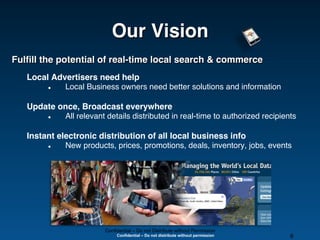
Our Vision!
Fulfill the potential of real-time local search & commerce!
   Local Advertisers need help!
        l    Local Business owners need better solutions and information"

   Update once, Broadcast everywhere"
        l    All relevant details distributed in real-time to authorized recipients"

   Instant electronic distribution of all local business info!
        l    New products, prices, promotions, deals, inventory, jobs, events"


   "


                          Confidential – Do not Distribute without Permission
                               Confidential – Do not distribute without permission   6
powered by"


Confidential – Do not Distribute without Permission
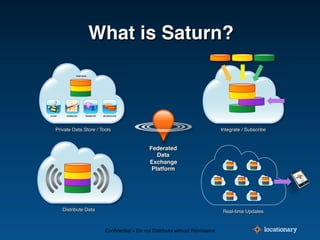
What is Saturn?!
                  YOUR DATA!


CLEAN!    NORMALIZE!      TRANSLATE!   DE-DUPLICATE!


    Private Data Store / Tools"                                                               Integrate / Subscribe"


                                                            Federated!
                                                               Data!
                                                            Exchange!
                                                             Platform!


         Distribute Data"                                                                      Real-time Updates"


                                        Confidential – Do not Distribute without Permission
Confidential – Do not Distribute without Permission
IP is HOT!!!
•  IP is very hot, especially now
•  IP, especially patents, are playing an important in the traction of
   new companies, new technologies
•  IP of early stage companies is being noticed and a real enabler in
   investments, in strategic relationships with large tech partners, and
   in acquisitions
•  Patent licensing companies e.g. Mosaid, IBM Licensing are making
   a lot of money. New patent licensing companies are popping up all
   the time, e.g. i4i
•  It is NOT TRUE that IP is only noticed if you have a multimillion
   dollar war chest – experience proves the contrary
    •    Nobody wants to be the next NTP
    •    Contingency patent cases in the U.S. have changed everything
    •    Established companies are very interested in early mover IP
Do what the big companies do, but more
                cheaply….
•  Develop an IP strategy
•  Prioritize, do as much as you can with
   internal resources, and scale the IP as the
   business scales
•  Ensure you are developing IP assets that
   map as clearly as possible to your
   strategic opportunities
What is IP Strategy?
•  Mining and Protection of IP in a way that is consistent with a
   “business strategy”
•  It can be a highly structured document, or more of an “approach” to
   IP
•  What is not: “knee jerk filings”
•  Looking for “platform” filings
•  “Omnibus” filings are often ideal, and also the least expensive
•  Build IP in areas, and directed specifically at opportunities, where
   traction is likely to occur (examples)
•  Make difficult IP decisions (e.g. pulling the plug on portfolios for
   strategic reasons)
•  Companies that develop, update, and follow an IP Strategy, tend to
   develop an “IP Culture” which helps build significant value
•  Some of the attributes of “IP Culture” are “inclusion” in IP efforts,
   integration of IP objectives in various aspects of business, and
   generally more “bang for buck” for IP
Struggles with disclosure
•  Really should not disclose your invention
   publicly, before you have developed an IP
   strategy
•  But you need to know, realistically, what your
   “invention” is
•  High level marketing may or may not disclose
   the invention
•  Generally speaking use “selective disclosure”
•  Try to have NDAs in place, but have plan for
   how to deal with important disclosures without
   NDAs
•  Remember: not all NDAs are created alike!
Forms of IP – “The Social Network”
•  October 1, 2005 Facebook completes its
   university expansion
•  Initially patents are not filed (Mike Z was
   somewhat anti-patent initially…)
•  But in 2006 Facebook embarks on protection of
   various aspects of their innovation for example:
  –  Technologies for feeding updates for your “wall”
  –  Technologies for updating your profile, and matching
     you to potential friends automatically
  –  Specific user workflows that embody “user
     engagement” innovation
  –  “Next territories” that Facebook wants to occupy such
     as “social gifting”
Why is Facebook interesting?
•  Fairly typical IP strategy that start-ups can
   follow as well, from the outset
•  Illustrate different “layers” or protectability
•  Really all that matters is the usual
   “standards” of patentability
•  Although admittedly there are “strong” and
   “weaker” patents
•  But what is most important is the idea/
   business “strong” or “weak”???
Starting Point of a Patent
•  Important market differentiation
•  Business methods are hard to patent, but
   implementation of a business method in a practical
   system (e.g. Amazon) is much easier
•  Provides some useful advantage:
    –  New platform
    –  Components may be old, but combination/adaptation/
       integration is non-obvious perhaps because of
       synergy resulting from the new combination
    –  Less expensive, easier to transport
    –  More entertaining
    –  “Natural” interface, e.g. Autodesk
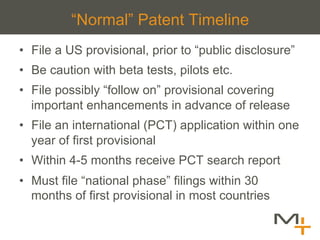
“Normal” Patent Timeline
•  File a US provisional, prior to “public disclosure”
•  Be caution with beta tests, pilots etc.
•  File possibly “follow on” provisional covering
   important enhancements in advance of release
•  File an international (PCT) application within one
   year of first provisional
•  Within 4-5 months receive PCT search report
•  Must file “national phase” filings within 30
   months of first provisional in most countries
What are tech majors looking for?
•  Big potential market
•  A domain that is “heating up” that they
   did not have plans for
•  A strong team
•  Less about technology, and more about
   “deep expertise”
Legal and Housekeeping Aspects
•  Good housekeeping.
  –  Properly documenting and addressing the business
     structure
•  Having good advisors
  –  (e.g. an advisory board, mentors etc.)
•  Professional advisors
  –  (e.g. lawyers and accountant and others)
  –  Sewing good positive relationships in the eco system
•  Avoiding “problem agreements”
•  Be ready for “each stage” e.g. technical due
   diligence
Behind the scenes
•  Behind the scene negotiations
    –  The form of the deal will depend on whether it is an asset/technology
       sale versus a share sale versus a licensing arrangement/joint venture
•  Real life back and forth regarding valuation (valuation will be a
   combination of art and science – unlike in traditional businesses
   where you valuate a company based on revenue and goodwill,
   startups look at the future potential)
•  Value touch points – what seems to interest tech majors, again and
   again (personnel, validated evidence of traction and IP if there are
   IP objectives at play)
•  Due diligence: what matters and what does not? (Keeping the house
   in order, documenting agreements and arrangements, keeping
   minute books up to date, consideration of a non-disclosure during
   due diligence phases)
Things to avoid…
•  Complex legal structure
•  Ownership of technology or IP is not properly
   documented
  –  Contributors may come out of the woodwork (the
      skeletons )
  –  Inadequate consideration for assignments
•  IP is oversold – IP is weak
  –  Narrow claims,
  –  Overly abstract patent apps
•  Patent protection does not cover key markets
How much does IP really matter?
•  Chilling effect of patents while company gains traction is
   generally very important
•  When choosing between two companies focusing on the
   same technology, the major generally tries to buy the
   company with IP before the one without IP
•  The IP usually provides a bump in valuation –
   sometimes 10%, sometimes 30%, sometimes more – it
   depends
•  Sometimes the transaction mostly about IP – especially
   when there are competitive concerns - Bumptop
•  The point is: it is hard to predict, so it is important to
   do what you can (reasonably), and whatever IP is
   filed, make sure it is as strong as possible
Best Practices
•  Make sure you are not reinventing wheel: “right” amount of
   searching
•  Avoid long prior art lists – they can hurt you especially in
   prosecution
•  Choose patent targets very carefully
    –  Construct strong scenarios of patentability around key value
       propositions
    –  Grab early as possible priority dates, but drive sufficient detail into
       applications
•  Start off with omnibus applications (you can divide later, but you
   cannot aggregate)
•  Focus on platform filings!!!!!
•  Focus not only on technology but value delivered by technology
•  Describe specifically implications of technology on potential
   acquirers e.g. our technology would integrate with….. By….
Best Practices, cont.
•  File robust provisional patent applications initially, for
   flexibility
•  PCT applications will provide within 4-5 months a reliable
   search report to get your bearings
•  Build disclosures that explain the nature of innovation
   clearly
•  Clear focus on domains that resonate with Examiners –
   automation, analytics, architecture, non-obvious user
   workflows etc.
•  Need a clear plan on what prosecution is likely to yield,
   and what this may deliver for the company
•  Clear plan to scale IP coverage, if this make sense, and
   if necessary recalibrate (IP strategy needs to be reset all
   the time)
Best Practices
•  What is the “right” amount of IP coverage for this company, at this
   point?
•  Sometimes it is important to wait to file patent later, once the
   development pipeline yields further detail that can make claims
   more robust (don’t blow the bank on subject matter that realistically
   is unlikely to yield strong claims).
•  Establish clear goals for prosecution, and reset goals based on
   progress of prosecution and market movement
•  Be careful not to let international protection consume resources
   better spent elsewhere
•  Figure out what is the “right” or “realistic” amount of protection, and
   make sure that you have a good explanation for your decisions
•  A cogent strategy is more important than a patent portfolio
Best Practices, cont.
•  Availability of a compelling, distilled IP
   strategy
•  Evidence that company “lives” the IP
   strategy
•  Protection of IP, using careful agreements
•  Organize your documents well: user
   engagement, customer feedback,
   agreement used at different times e.g.
   privacy policy
Questions???


     Anthony De Fazekas
adefazekas@millerthomson.com
VANCOUVER

CALGARY

EDMONTON

SASKATOON

REGINA

LONDON

KITCHENER – WATERLOO

GUELPH

TORONTO

MARKHAM

MONTRÉAL

Getting Bought by Google: Or another technology heavyweight - MaRS Best Practices

  • 2.
    MaRS Best Practices: GettingBought by a Heavyweight Anthony De Fazekas, Miller Thomson Dan Servos, Locationary
  • 3.
    Introduction •  Building avaluable startup •  Goal: strategies that can lead to BIGGER EXITS •  Insights from Dan Servos, Locationary, previously Social Deck •  Lessons learned, and things observed in the deal rooms
  • 4.
    Introduction, cont. •  InteractiveSession •  IP Best Practices
  • 5.
    Dan Servos! Chief Operating Officer" Confidential – Do not Distribute without Permission
  • 6.
    Our Vision! Fulfill thepotential of real-time local search & commerce! Local Advertisers need help! l  Local Business owners need better solutions and information" Update once, Broadcast everywhere" l  All relevant details distributed in real-time to authorized recipients" Instant electronic distribution of all local business info! l  New products, prices, promotions, deals, inventory, jobs, events" " Confidential – Do not Distribute without Permission Confidential – Do not distribute without permission 6
  • 7.
    powered by" Confidential –Do not Distribute without Permission
  • 8.
    What is Saturn?! YOUR DATA! CLEAN! NORMALIZE! TRANSLATE! DE-DUPLICATE! Private Data Store / Tools" Integrate / Subscribe" Federated! Data! Exchange! Platform! Distribute Data" Real-time Updates" Confidential – Do not Distribute without Permission
  • 9.
    Confidential – Donot Distribute without Permission
  • 10.
    IP is HOT!!! • IP is very hot, especially now •  IP, especially patents, are playing an important in the traction of new companies, new technologies •  IP of early stage companies is being noticed and a real enabler in investments, in strategic relationships with large tech partners, and in acquisitions •  Patent licensing companies e.g. Mosaid, IBM Licensing are making a lot of money. New patent licensing companies are popping up all the time, e.g. i4i •  It is NOT TRUE that IP is only noticed if you have a multimillion dollar war chest – experience proves the contrary •  Nobody wants to be the next NTP •  Contingency patent cases in the U.S. have changed everything •  Established companies are very interested in early mover IP
  • 11.
    Do what thebig companies do, but more cheaply…. •  Develop an IP strategy •  Prioritize, do as much as you can with internal resources, and scale the IP as the business scales •  Ensure you are developing IP assets that map as clearly as possible to your strategic opportunities
  • 12.
    What is IPStrategy? •  Mining and Protection of IP in a way that is consistent with a “business strategy” •  It can be a highly structured document, or more of an “approach” to IP •  What is not: “knee jerk filings” •  Looking for “platform” filings •  “Omnibus” filings are often ideal, and also the least expensive •  Build IP in areas, and directed specifically at opportunities, where traction is likely to occur (examples) •  Make difficult IP decisions (e.g. pulling the plug on portfolios for strategic reasons) •  Companies that develop, update, and follow an IP Strategy, tend to develop an “IP Culture” which helps build significant value •  Some of the attributes of “IP Culture” are “inclusion” in IP efforts, integration of IP objectives in various aspects of business, and generally more “bang for buck” for IP
  • 13.
    Struggles with disclosure • Really should not disclose your invention publicly, before you have developed an IP strategy •  But you need to know, realistically, what your “invention” is •  High level marketing may or may not disclose the invention •  Generally speaking use “selective disclosure” •  Try to have NDAs in place, but have plan for how to deal with important disclosures without NDAs •  Remember: not all NDAs are created alike!
  • 14.
    Forms of IP– “The Social Network” •  October 1, 2005 Facebook completes its university expansion •  Initially patents are not filed (Mike Z was somewhat anti-patent initially…) •  But in 2006 Facebook embarks on protection of various aspects of their innovation for example: –  Technologies for feeding updates for your “wall” –  Technologies for updating your profile, and matching you to potential friends automatically –  Specific user workflows that embody “user engagement” innovation –  “Next territories” that Facebook wants to occupy such as “social gifting”
  • 15.
    Why is Facebookinteresting? •  Fairly typical IP strategy that start-ups can follow as well, from the outset •  Illustrate different “layers” or protectability •  Really all that matters is the usual “standards” of patentability •  Although admittedly there are “strong” and “weaker” patents •  But what is most important is the idea/ business “strong” or “weak”???
  • 16.
    Starting Point ofa Patent •  Important market differentiation •  Business methods are hard to patent, but implementation of a business method in a practical system (e.g. Amazon) is much easier •  Provides some useful advantage: –  New platform –  Components may be old, but combination/adaptation/ integration is non-obvious perhaps because of synergy resulting from the new combination –  Less expensive, easier to transport –  More entertaining –  “Natural” interface, e.g. Autodesk
  • 17.
    “Normal” Patent Timeline • File a US provisional, prior to “public disclosure” •  Be caution with beta tests, pilots etc. •  File possibly “follow on” provisional covering important enhancements in advance of release •  File an international (PCT) application within one year of first provisional •  Within 4-5 months receive PCT search report •  Must file “national phase” filings within 30 months of first provisional in most countries
  • 18.
    What are techmajors looking for? •  Big potential market •  A domain that is “heating up” that they did not have plans for •  A strong team •  Less about technology, and more about “deep expertise”
  • 19.
    Legal and HousekeepingAspects •  Good housekeeping. –  Properly documenting and addressing the business structure •  Having good advisors –  (e.g. an advisory board, mentors etc.) •  Professional advisors –  (e.g. lawyers and accountant and others) –  Sewing good positive relationships in the eco system •  Avoiding “problem agreements” •  Be ready for “each stage” e.g. technical due diligence
  • 20.
    Behind the scenes • Behind the scene negotiations –  The form of the deal will depend on whether it is an asset/technology sale versus a share sale versus a licensing arrangement/joint venture •  Real life back and forth regarding valuation (valuation will be a combination of art and science – unlike in traditional businesses where you valuate a company based on revenue and goodwill, startups look at the future potential) •  Value touch points – what seems to interest tech majors, again and again (personnel, validated evidence of traction and IP if there are IP objectives at play) •  Due diligence: what matters and what does not? (Keeping the house in order, documenting agreements and arrangements, keeping minute books up to date, consideration of a non-disclosure during due diligence phases)
  • 21.
    Things to avoid… • Complex legal structure •  Ownership of technology or IP is not properly documented –  Contributors may come out of the woodwork (the skeletons ) –  Inadequate consideration for assignments •  IP is oversold – IP is weak –  Narrow claims, –  Overly abstract patent apps •  Patent protection does not cover key markets
  • 22.
    How much doesIP really matter? •  Chilling effect of patents while company gains traction is generally very important •  When choosing between two companies focusing on the same technology, the major generally tries to buy the company with IP before the one without IP •  The IP usually provides a bump in valuation – sometimes 10%, sometimes 30%, sometimes more – it depends •  Sometimes the transaction mostly about IP – especially when there are competitive concerns - Bumptop •  The point is: it is hard to predict, so it is important to do what you can (reasonably), and whatever IP is filed, make sure it is as strong as possible
  • 23.
    Best Practices •  Makesure you are not reinventing wheel: “right” amount of searching •  Avoid long prior art lists – they can hurt you especially in prosecution •  Choose patent targets very carefully –  Construct strong scenarios of patentability around key value propositions –  Grab early as possible priority dates, but drive sufficient detail into applications •  Start off with omnibus applications (you can divide later, but you cannot aggregate) •  Focus on platform filings!!!!! •  Focus not only on technology but value delivered by technology •  Describe specifically implications of technology on potential acquirers e.g. our technology would integrate with….. By….
  • 24.
    Best Practices, cont. • File robust provisional patent applications initially, for flexibility •  PCT applications will provide within 4-5 months a reliable search report to get your bearings •  Build disclosures that explain the nature of innovation clearly •  Clear focus on domains that resonate with Examiners – automation, analytics, architecture, non-obvious user workflows etc. •  Need a clear plan on what prosecution is likely to yield, and what this may deliver for the company •  Clear plan to scale IP coverage, if this make sense, and if necessary recalibrate (IP strategy needs to be reset all the time)
  • 25.
    Best Practices •  Whatis the “right” amount of IP coverage for this company, at this point? •  Sometimes it is important to wait to file patent later, once the development pipeline yields further detail that can make claims more robust (don’t blow the bank on subject matter that realistically is unlikely to yield strong claims). •  Establish clear goals for prosecution, and reset goals based on progress of prosecution and market movement •  Be careful not to let international protection consume resources better spent elsewhere •  Figure out what is the “right” or “realistic” amount of protection, and make sure that you have a good explanation for your decisions •  A cogent strategy is more important than a patent portfolio
  • 26.
    Best Practices, cont. • Availability of a compelling, distilled IP strategy •  Evidence that company “lives” the IP strategy •  Protection of IP, using careful agreements •  Organize your documents well: user engagement, customer feedback, agreement used at different times e.g. privacy policy
  • 27.
    Questions??? Anthony De Fazekas adefazekas@millerthomson.com
  • 28.