salesgeneration
 new perspective


   Aalto Summer of Startups 2012
   Customer Development Basics
   Dr. Juha Mattsson               June 11th, 2012
   CEO & Co-founder, Symbioosi
   juha.mattsson@symbioosi.fi
2   June 15th, 2012   (c) Symbioosi Partners, Juha Mattsson
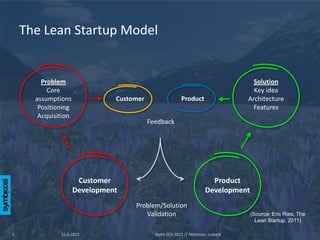
The Lean Startup Model


        Problem                                                                     Solution
          Core                                                                      Key idea
      assumptions              Customer                  Product                  Architecture
       Positioning                                                                  Features
       Acquisition
                                          Feedback


                      Customer                                          Product
                     Development                                      Development
                                    Problem/Solution
                                       Validation                                   (Source: Eric Ries, The
                                                                                      Lean Startup, 2011)

3             11.6.2012                     Aalto SOS 2012 // Mattsson, Leskelä
Things to learn from startup methodology

      Good ideas are “dime a dozen”, execution is the key
      Acting like an entrepreneur:
         – Investing your personal money on a high-risk venture
         – Sacrificing your scarce time in front of more secure options
         – Obtain just enough funding (and dilute your ownership) as necessary to
            execute to next phase
      Managing a chaos
         – Fast-moving business environments
         – Zero existing structures (organization, customers, markets, brand, etc.)
      Fighting natural psychological tendencies to
         – Believing in your own ideas and assumptions
         – One-pont-estimation
      The fail fast -principle!


4              11.6.2012                    Aalto SOS 2012 // Mattsson, Leskelä
Lean Startups

     Lean startups combine fast, iterative product development methodologies with
      customer development principles
        – Origins in software business where open source platforms and free software
           have enabled a new ”lean” approach to business creation
        – Agile development methodologies
        – Rapid, repetitive customer-centric iteration of core soltion

     Customer development team works on constantly testing core assumptions
       – Who is the customer
       – What need/problem to solve
       – What the solution should be
     The Product development team actually builds the solution


5               11.6.2012                   Aalto SOS 2012 // Mattsson, Leskelä
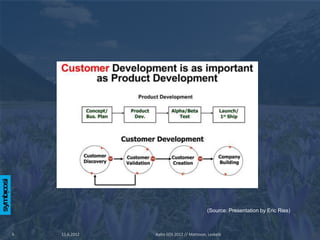
(Source: Presentation by Eric Ries)


6   11.6.2012   Aalto SOS 2012 // Mattsson, Leskelä
A few notes about the Customer Development
    approach
     The customer development process iterates on
        – core business assumptions (customer-problem-solution)
        – product functionality & features
        – assumptions of customer acquisition and conversion

     Tasks
        – To validate core hypotheses (customer-problem-solution)
        – To develop a Minimum Viable Product
        – To achieve product-market fit
        – To produce a development and marketing/sales roadmap for building scale

     Two desired outcomes from the process
        1. A thriving, successful company
           (build organization and scale the business)
        2. Realization that there is no real market or the market is insufficient
           (stop and change direction)


7                11.6.2012                        Aalto SOS 2012 // Mattsson, Leskelä
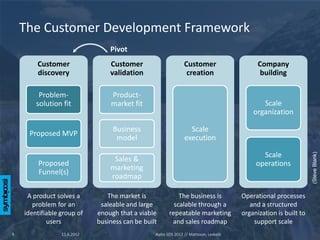
The Customer Development Framework
                                 Pivot
        Customer                 Customer                       Customer                     Company
        discovery                validation                      creation                     building

         Problem-                Product-
        solution fit             market fit                                                   Scale
                                                                                           organization

                                  Business                        Scale
     Proposed MVP
                                   model                        execution

                                                                                              Scale


                                                                                                                  (Steve Blank)
                                  Sales &
        Proposed                                                                            operations
                                 marketing
        Funnel(s)
                                 roadmap

     A product solves a         The market is               The business is            Operational processes
       problem for an         saleable and large          scalable through a              and a structured
    identifiable group of    enough that a viable       repeatable marketing           organization is built to
            users            business can be built       and sales roadmap                 support scale
8                11.6.2012                       Aalto SOS 2012 // Mattsson, Leskelä
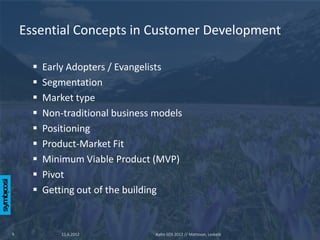
Essential Concepts in Customer Development

         Early Adopters / Evangelists
         Segmentation
         Market type
         Non-traditional business models
         Positioning
         Product-Market Fit
         Minimum Viable Product (MVP)
         Pivot
         Getting out of the building


9             11.6.2012            Aalto SOS 2012 // Mattsson, Leskelä
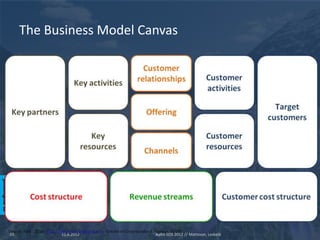
The Business Model Canvas


10         11.6.2012      Aalto SOS 2012 // Mattsson, Leskelä
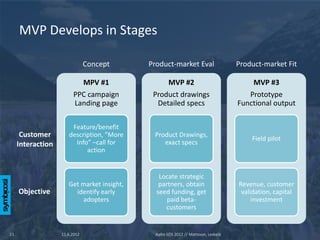
MVP Develops in Stages

                               Concept      Product-market Eval                     Product-market Fit

                          MPV #1                 MVP #2                                 MVP #3
                        PPC campaign         Product drawings                          Prototype
                        Landing page          Detailed specs                        Functional output

                       Feature/benefit
      Customer        description, ”More     Product Drawings,
                                                                                        Field pilot
     Interaction        Info” –call for         exact specs
                            action


                                               Locate strategic
                      Get market insight,      partners, obtain                     Revenue, customer
     Objective          identify early        seed funding, get                      validation, capital
                          adopters                paid beta-                             investment
                                                 customers


11                 11.6.2012                  Aalto SOS 2012 // Mattsson, Leskelä
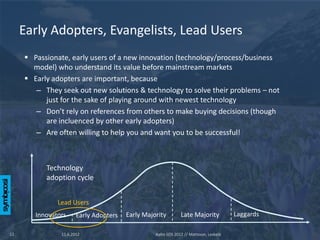
Early Adopters, Evangelists, Lead Users
      Passionate, early users of a new innovation (technology/process/business
       model) who understand its value before mainstream markets
      Early adopters are important, because
        – They seek out new solutions & technology to solve their problems – not
           just for the sake of playing around with newest technology
        – Don’t rely on references from others to make buying decisions (though
           are incluenced by other early adopters)
        – Are often willing to help you and want you to be successful!


           Technology
           adoption cycle


               Lead Users
        Innovators     Early Adopters   Early Majority         Late Majority            Laggards

12              11.6.2012                         Aalto SOS 2012 // Mattsson, Leskelä
Segmentation

      The practice of breaking down a larger market into smaller identifiable groups of
       users that
         – share a specific need/problem
         – can be approached by a common marketing/sales program
         – have access to each other and use one other as a trusted reference

      Benefits of segmentation
        – Focus: validating specific Customer-Problem-Solution (CPS) -hypotheses
        – Prioritization: allocating scarce resources effectively
        – Systematization: executing effective sales&marketing campaings targeted at
           specific segments
        – Positioning: attaining a market leader position in a specific user/customer base
        – Phasing: generating a series of meaningful steps for scaling up the business


13                11.6.2012                    Aalto SOS 2012 // Mattsson, Leskelä
Market Type

     Three relevant ways of thinking your markets:
        1. A new product to a new market
        2. A new product to an existing market
        3. Re-segmenting an existing market

     ”There is a tendency of entrepreneurs to believe that they have a new product for a
     new market, though this is rarely the case”
                Thus, most likely, you are re-segmenting an existing market.

     Important
        – Your customer’s view of your market is more important than yours
        – You can choose your market type!


14              11.6.2012                   Aalto SOS 2012 // Mattsson, Leskelä
Non-Traditional business models

      Business models that do not sell a product to a customer directly for a set amount of
       money

      Freemium business models: offering multiple account levels differentiated on
       product functionality and price
         – Example: almost all SAAS based corporate productivity tools such as Box.net,
            Basecamp, LinkedIn, etc.
      Free business models: offering something for free to a specific group of users while
       the user bases itself enables alternative revenue models
         – E.g. Google, Facebook
      Pre-revenue business models: giving the basic product initially out for free to grow
       user base and criticall mass. Introducing payments as product/category/brand gets
       established
         – E.g. YouSendIt.com, Shazam, Skype
      Many related options and concepts: gamification, crowdsourcing, open-source,
       customization/consultation, service/maintenance, donations
15                11.6.2012                    Aalto SOS 2012 // Mattsson, Leskelä
Positioning

      The act of placing your product/brand within a market landscape, in your audience’s
       mind

      Key idea: to make your target customers to understand what benefit they willl
       receive from you and why you are better than anyone else

      Important: positioning may vary by audience (media, investors, opinion leaders,
       early adopters, mainstream customers, etc.)


16               11.6.2012                    Aalto SOS 2012 // Mattsson, Leskelä
Product-Market Fit

      Product-Marketg Fit is reached when a product shows strong demand by passionate
       users representing a sizeable market

      Qualifiers
        – The customer is willing to pay for the product
        – The cost of acquiring a customer is less than what they are willing to pay
        – There is evidence that indicates the underlying market is large enough

     ”Achieving Product-Market fit requires at least 40% of users saying they would be very
     disappointed wouthout the product.” (Sean Ellis)


17                11.6.2012                    Aalto SOS 2012 // Mattsson, Leskelä
Minimum Viable Product (MVP)

      Key idea: A product with the fewest number of features needed to achieve a specific
       need-satisfying objecive, and users are willing to pay in terms of some scarce resource

      The aim is to produce a product version with minimum effort and features that allows
       maximum learning about the behavior of core customers
        – Conversely: minimize damage & lost efforts if this version of the product doesn’t
            ultimately work out, i.e. fit the market & customer need

      Important
         – It is central to know which is the smallest feature set customers are willing to pay
           for in the first actual release
         – There are typically different MVP versions along the development cycle
         – The MVP is usually centered around a specific problem and solution, a ”core use
           case”
         – Scarce resource = time, money, attention, etc. that represents a sacrifice from
           the customer’s part
18                11.6.2012                     Aalto SOS 2012 // Mattsson, Leskelä
”Getting out of the
     Pivot
                                                    building”
      Key idea: change some element(s) of           Key idea: Don’t accept your
       your customer-problem-solution                 assumptions and visions but get out of
       hypothesis or business model, based            the building and talk face-to-face to
       on learning from customers                     living and breathing customers.

      Fail fast!                                    Analytics, surveys, other fancy user-
                                                      facing testing tools are, at best,
                                                      complementary to concrete customer
                                                      development and getting out of the
                                                      building


19                  11.6.2012                Aalto SOS 2012 // Mattsson, Leskelä
The 8 Steps to Customer Discovery

         1. Document C-P-S hypotheses

         2. Brainstorm business model hypotheses

         3. Find prospects to talk to

         4. Reach out to prospects

         5. Engaging prospects

         6. Phase gate I: compile, measure, test

         7. Problem-solution fit / MVP testing

         8. Phase gate II: compile, measure, test


20            11.6.2012                 Aalto SOS 2012 // Mattsson, Leskelä
Task 1: Get together and choose a NPD idea

      Get together with your group
        – Short introductions, if needed
        – Choose a project manager (who’ll keep everything together)
        – Decide on other roles & responsibilities if you find it useful (”PPT wizard”, ”idea
            owner”, ”industry expert”, etc.)

      Choose a NPD idea/template to work with
        – This can be an actual idea/context from one of the participants’ organizations!
        – Or a ”fictional” (but realistic enough) concept


21                11.6.2012                    Aalto SOS 2012 // Mattsson, Leskelä
Task 2: The whiteboard excercise

     1. Draw a map of your ecosystem
         – Entities involved (users, customers, channel partners, technical partners,
            strategic partners, advertisers, customers’ customers, etc.)
         – Value flows (either direct or indirect)
         – Money flows
         – Product distribution (assumptions of how your product moves through your
            channels to reach end users)

     2. Define a value proposition for each partner
         – What benefit will each entity in the ecosystem gain by participating?
         – What will they need to sacrifice/pay?
         – Transfer each value proposition to a C-P-S hypothesis, if possible


22                11.6.2012                   Aalto SOS 2012 // Mattsson, Leskelä
Task 2: The whiteboard excercise

     3. Sketch a final MVP
         – Also intermediate MVP’s if necessary/relevant
         – Think of what you need to provide to each entity with whom you have a direct
             relationship, in order to achieve the value identified above?
         – Currency: what the user/buyer ”pays” for using the MVP
         – MPV metric: what are you measuring to determine viability
         – Value determinants: what features and functionality do the users/buyers require at
             minimum to pay their currency?

     4. Evaluate risks and critical success factors
         – Short term vs. long term risks, their implications, and how to account for
         – How the ecosystem needs to change/remain in order for your business to work?
         – Critical dependencies and players?

     5. Draw a value path
         – That describes how the MVP’s and business model develops step-by-step, constantly
            increasing the value generated to the ecosystem

23                11.6.2012                     Aalto SOS 2012 // Mattsson, Leskelä
Step 3: Design an action plan for the 8 steps to
     Customer Discovery

         1. Document C-P-S hypotheses

         2. Brainstorm business model hypotheses

         3. Find prospects to talk to

         4. Reach out to prospects

         5. Engaging prospects

         6. Phase gate I: compile, measure, test

         7. Problem-solution fit / MVP testing

         8. Phase gate II: compile, measure, test


24            11.6.2012                 Aalto SOS 2012 // Mattsson, Leskelä
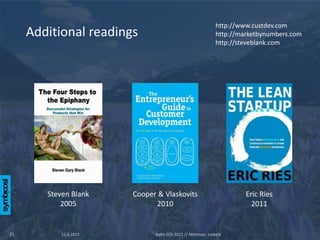
http://www.custdev.com
     Additional readings                                      http://marketbynumbers.com
                                                              http://steveblank.com


        Steven Blank    Cooper & Vlaskovits                            Eric Ries
            2005              2010                                       2011


25          11.6.2012         Aalto SOS 2012 // Mattsson, Leskelä
Thank you!

        Our new book:

       Best Cases in B2B
      Sales Management

     Mattsson & Parvinen,
            2011


         Juha Mattsson
         juha.mattsson@symbioosi.fi
         www.symbioosi.fi

26           June 15th, 2012          (c) Symbioosi Partners, Juha Mattsson

Customer Development @ Aalto SOS 2012

  • 1.
    salesgeneration new perspective Aalto Summer of Startups 2012 Customer Development Basics Dr. Juha Mattsson June 11th, 2012 CEO & Co-founder, Symbioosi juha.mattsson@symbioosi.fi
  • 2.
    2 June 15th, 2012 (c) Symbioosi Partners, Juha Mattsson
  • 3.
    The Lean StartupModel Problem Solution Core Key idea assumptions Customer Product Architecture Positioning Features Acquisition Feedback Customer Product Development Development Problem/Solution Validation (Source: Eric Ries, The Lean Startup, 2011) 3 11.6.2012 Aalto SOS 2012 // Mattsson, Leskelä
  • 4.
    Things to learnfrom startup methodology  Good ideas are “dime a dozen”, execution is the key  Acting like an entrepreneur: – Investing your personal money on a high-risk venture – Sacrificing your scarce time in front of more secure options – Obtain just enough funding (and dilute your ownership) as necessary to execute to next phase  Managing a chaos – Fast-moving business environments – Zero existing structures (organization, customers, markets, brand, etc.)  Fighting natural psychological tendencies to – Believing in your own ideas and assumptions – One-pont-estimation  The fail fast -principle! 4 11.6.2012 Aalto SOS 2012 // Mattsson, Leskelä
  • 5.
    Lean Startups  Lean startups combine fast, iterative product development methodologies with customer development principles – Origins in software business where open source platforms and free software have enabled a new ”lean” approach to business creation – Agile development methodologies – Rapid, repetitive customer-centric iteration of core soltion  Customer development team works on constantly testing core assumptions – Who is the customer – What need/problem to solve – What the solution should be  The Product development team actually builds the solution 5 11.6.2012 Aalto SOS 2012 // Mattsson, Leskelä
  • 6.
    (Source: Presentation byEric Ries) 6 11.6.2012 Aalto SOS 2012 // Mattsson, Leskelä
  • 7.
    A few notesabout the Customer Development approach  The customer development process iterates on – core business assumptions (customer-problem-solution) – product functionality & features – assumptions of customer acquisition and conversion  Tasks – To validate core hypotheses (customer-problem-solution) – To develop a Minimum Viable Product – To achieve product-market fit – To produce a development and marketing/sales roadmap for building scale  Two desired outcomes from the process 1. A thriving, successful company (build organization and scale the business) 2. Realization that there is no real market or the market is insufficient (stop and change direction) 7 11.6.2012 Aalto SOS 2012 // Mattsson, Leskelä
  • 8.
    The Customer DevelopmentFramework Pivot Customer Customer Customer Company discovery validation creation building Problem- Product- solution fit market fit Scale organization Business Scale Proposed MVP model execution Scale (Steve Blank) Sales & Proposed operations marketing Funnel(s) roadmap A product solves a The market is The business is Operational processes problem for an saleable and large scalable through a and a structured identifiable group of enough that a viable repeatable marketing organization is built to users business can be built and sales roadmap support scale 8 11.6.2012 Aalto SOS 2012 // Mattsson, Leskelä
  • 9.
    Essential Concepts inCustomer Development  Early Adopters / Evangelists  Segmentation  Market type  Non-traditional business models  Positioning  Product-Market Fit  Minimum Viable Product (MVP)  Pivot  Getting out of the building 9 11.6.2012 Aalto SOS 2012 // Mattsson, Leskelä
  • 10.
    The Business ModelCanvas 10 11.6.2012 Aalto SOS 2012 // Mattsson, Leskelä
  • 11.
    MVP Develops inStages Concept Product-market Eval Product-market Fit MPV #1 MVP #2 MVP #3 PPC campaign Product drawings Prototype Landing page Detailed specs Functional output Feature/benefit Customer description, ”More Product Drawings, Field pilot Interaction Info” –call for exact specs action Locate strategic Get market insight, partners, obtain Revenue, customer Objective identify early seed funding, get validation, capital adopters paid beta- investment customers 11 11.6.2012 Aalto SOS 2012 // Mattsson, Leskelä
  • 12.
    Early Adopters, Evangelists,Lead Users  Passionate, early users of a new innovation (technology/process/business model) who understand its value before mainstream markets  Early adopters are important, because – They seek out new solutions & technology to solve their problems – not just for the sake of playing around with newest technology – Don’t rely on references from others to make buying decisions (though are incluenced by other early adopters) – Are often willing to help you and want you to be successful! Technology adoption cycle Lead Users Innovators Early Adopters Early Majority Late Majority Laggards 12 11.6.2012 Aalto SOS 2012 // Mattsson, Leskelä
  • 13.
    Segmentation  The practice of breaking down a larger market into smaller identifiable groups of users that – share a specific need/problem – can be approached by a common marketing/sales program – have access to each other and use one other as a trusted reference  Benefits of segmentation – Focus: validating specific Customer-Problem-Solution (CPS) -hypotheses – Prioritization: allocating scarce resources effectively – Systematization: executing effective sales&marketing campaings targeted at specific segments – Positioning: attaining a market leader position in a specific user/customer base – Phasing: generating a series of meaningful steps for scaling up the business 13 11.6.2012 Aalto SOS 2012 // Mattsson, Leskelä
  • 14.
    Market Type Three relevant ways of thinking your markets: 1. A new product to a new market 2. A new product to an existing market 3. Re-segmenting an existing market ”There is a tendency of entrepreneurs to believe that they have a new product for a new market, though this is rarely the case”  Thus, most likely, you are re-segmenting an existing market. Important – Your customer’s view of your market is more important than yours – You can choose your market type! 14 11.6.2012 Aalto SOS 2012 // Mattsson, Leskelä
  • 15.
    Non-Traditional business models  Business models that do not sell a product to a customer directly for a set amount of money  Freemium business models: offering multiple account levels differentiated on product functionality and price – Example: almost all SAAS based corporate productivity tools such as Box.net, Basecamp, LinkedIn, etc.  Free business models: offering something for free to a specific group of users while the user bases itself enables alternative revenue models – E.g. Google, Facebook  Pre-revenue business models: giving the basic product initially out for free to grow user base and criticall mass. Introducing payments as product/category/brand gets established – E.g. YouSendIt.com, Shazam, Skype  Many related options and concepts: gamification, crowdsourcing, open-source, customization/consultation, service/maintenance, donations 15 11.6.2012 Aalto SOS 2012 // Mattsson, Leskelä
  • 16.
    Positioning  The act of placing your product/brand within a market landscape, in your audience’s mind  Key idea: to make your target customers to understand what benefit they willl receive from you and why you are better than anyone else  Important: positioning may vary by audience (media, investors, opinion leaders, early adopters, mainstream customers, etc.) 16 11.6.2012 Aalto SOS 2012 // Mattsson, Leskelä
  • 17.
    Product-Market Fit  Product-Marketg Fit is reached when a product shows strong demand by passionate users representing a sizeable market  Qualifiers – The customer is willing to pay for the product – The cost of acquiring a customer is less than what they are willing to pay – There is evidence that indicates the underlying market is large enough ”Achieving Product-Market fit requires at least 40% of users saying they would be very disappointed wouthout the product.” (Sean Ellis) 17 11.6.2012 Aalto SOS 2012 // Mattsson, Leskelä
  • 18.
    Minimum Viable Product(MVP)  Key idea: A product with the fewest number of features needed to achieve a specific need-satisfying objecive, and users are willing to pay in terms of some scarce resource  The aim is to produce a product version with minimum effort and features that allows maximum learning about the behavior of core customers – Conversely: minimize damage & lost efforts if this version of the product doesn’t ultimately work out, i.e. fit the market & customer need  Important – It is central to know which is the smallest feature set customers are willing to pay for in the first actual release – There are typically different MVP versions along the development cycle – The MVP is usually centered around a specific problem and solution, a ”core use case” – Scarce resource = time, money, attention, etc. that represents a sacrifice from the customer’s part 18 11.6.2012 Aalto SOS 2012 // Mattsson, Leskelä
  • 19.
    ”Getting out ofthe Pivot building”  Key idea: change some element(s) of  Key idea: Don’t accept your your customer-problem-solution assumptions and visions but get out of hypothesis or business model, based the building and talk face-to-face to on learning from customers living and breathing customers.  Fail fast!  Analytics, surveys, other fancy user- facing testing tools are, at best, complementary to concrete customer development and getting out of the building 19 11.6.2012 Aalto SOS 2012 // Mattsson, Leskelä
  • 20.
    The 8 Stepsto Customer Discovery 1. Document C-P-S hypotheses 2. Brainstorm business model hypotheses 3. Find prospects to talk to 4. Reach out to prospects 5. Engaging prospects 6. Phase gate I: compile, measure, test 7. Problem-solution fit / MVP testing 8. Phase gate II: compile, measure, test 20 11.6.2012 Aalto SOS 2012 // Mattsson, Leskelä
  • 21.
    Task 1: Gettogether and choose a NPD idea  Get together with your group – Short introductions, if needed – Choose a project manager (who’ll keep everything together) – Decide on other roles & responsibilities if you find it useful (”PPT wizard”, ”idea owner”, ”industry expert”, etc.)  Choose a NPD idea/template to work with – This can be an actual idea/context from one of the participants’ organizations! – Or a ”fictional” (but realistic enough) concept 21 11.6.2012 Aalto SOS 2012 // Mattsson, Leskelä
  • 22.
    Task 2: Thewhiteboard excercise 1. Draw a map of your ecosystem – Entities involved (users, customers, channel partners, technical partners, strategic partners, advertisers, customers’ customers, etc.) – Value flows (either direct or indirect) – Money flows – Product distribution (assumptions of how your product moves through your channels to reach end users) 2. Define a value proposition for each partner – What benefit will each entity in the ecosystem gain by participating? – What will they need to sacrifice/pay? – Transfer each value proposition to a C-P-S hypothesis, if possible 22 11.6.2012 Aalto SOS 2012 // Mattsson, Leskelä
  • 23.
    Task 2: Thewhiteboard excercise 3. Sketch a final MVP – Also intermediate MVP’s if necessary/relevant – Think of what you need to provide to each entity with whom you have a direct relationship, in order to achieve the value identified above? – Currency: what the user/buyer ”pays” for using the MVP – MPV metric: what are you measuring to determine viability – Value determinants: what features and functionality do the users/buyers require at minimum to pay their currency? 4. Evaluate risks and critical success factors – Short term vs. long term risks, their implications, and how to account for – How the ecosystem needs to change/remain in order for your business to work? – Critical dependencies and players? 5. Draw a value path – That describes how the MVP’s and business model develops step-by-step, constantly increasing the value generated to the ecosystem 23 11.6.2012 Aalto SOS 2012 // Mattsson, Leskelä
  • 24.
    Step 3: Designan action plan for the 8 steps to Customer Discovery 1. Document C-P-S hypotheses 2. Brainstorm business model hypotheses 3. Find prospects to talk to 4. Reach out to prospects 5. Engaging prospects 6. Phase gate I: compile, measure, test 7. Problem-solution fit / MVP testing 8. Phase gate II: compile, measure, test 24 11.6.2012 Aalto SOS 2012 // Mattsson, Leskelä
  • 25.
    http://www.custdev.com Additional readings http://marketbynumbers.com http://steveblank.com Steven Blank Cooper & Vlaskovits Eric Ries 2005 2010 2011 25 11.6.2012 Aalto SOS 2012 // Mattsson, Leskelä
  • 26.
    Thank you! Our new book: Best Cases in B2B Sales Management Mattsson & Parvinen, 2011 Juha Mattsson juha.mattsson@symbioosi.fi www.symbioosi.fi 26 June 15th, 2012 (c) Symbioosi Partners, Juha Mattsson