www.sti-innsbruck.at© Copyright 2008 STI INNSBRUCK www.sti-innsbruck.at
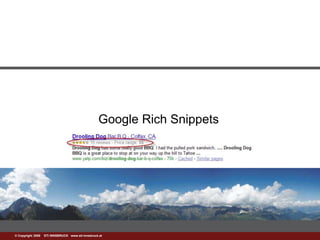
Google Rich Snippets
www.sti-innsbruck.at
Overview
• May 2009, Google announced that they would be parsing the hCard,
hReview, and hProduct microformats and using them to populate
search result pages
• These Rich Snippets give users convenient summary information about
their search results at a glance
– Structured data from pages showed in Google's search results
– Enabled by embedding microformats and RDFa
2
www.sti-innsbruck.at
Development
• October 2009
– Release of Rich Snippet testing tool
– Extension of RDFa support with some fields from FOAF and vCard
– Mark-up of Video Content
3
www.sti-innsbruck.at
Development
• Support of multiple information types
– Reviews
– People profiles
– Products
– Business listings
– Recipes
– Events
• Mark up
– Microdata
– Microformats
– RDFa
4
www.sti-innsbruck.at
Schema.org
• June 2011, Introduction of schema.org (Google, Bing, Yahoo) as
preferred way of annotation
– Using microdata (is a balance between the extensibility of RDFa and the simplicity of
microformats) markup format and a vocabulary that is shared by all search engines
– Covers broad range of domains
– Old (RDFa, Microformats) markups still work
5
www.sti-innsbruck.at
GoodRelations and schema.org
• GoodRelations
– Powerful Web vocabulary specifically designed for e-commerce scenarios, covering
business, store, product, offer, warranty, payment, delivery, and other information
• For e-commerce scenarios, both schema.org and GoodRelations can
be used
• Combination of both maximize impact for the visibility in search engines
– Use GoodRelations to extend schema.org markup in Microdata syntax
– Use schema.org types to extend GoodRelations
markup in RDFa syntax
6
www.sti-innsbruck.at
Conclusions
• Why annotate your website?
– SEO
– Visibility
– Data integration possibilities for the future
– Make a website understandable for humans as well as computers
• Microdata annotation using schema.org vocabulary very interesting
especially for businesses
• Not all fields form schema.org influence the search results
• Not clear yet if schema.org will be successful
• Criticism around the fact that microdata is the only supported format
7

Googlesnippets

  • 1.
    www.sti-innsbruck.at© Copyright 2008STI INNSBRUCK www.sti-innsbruck.at Google Rich Snippets
  • 2.
    www.sti-innsbruck.at Overview • May 2009,Google announced that they would be parsing the hCard, hReview, and hProduct microformats and using them to populate search result pages • These Rich Snippets give users convenient summary information about their search results at a glance – Structured data from pages showed in Google's search results – Enabled by embedding microformats and RDFa 2
  • 3.
    www.sti-innsbruck.at Development • October 2009 –Release of Rich Snippet testing tool – Extension of RDFa support with some fields from FOAF and vCard – Mark-up of Video Content 3
  • 4.
    www.sti-innsbruck.at Development • Support ofmultiple information types – Reviews – People profiles – Products – Business listings – Recipes – Events • Mark up – Microdata – Microformats – RDFa 4
  • 5.
    www.sti-innsbruck.at Schema.org • June 2011,Introduction of schema.org (Google, Bing, Yahoo) as preferred way of annotation – Using microdata (is a balance between the extensibility of RDFa and the simplicity of microformats) markup format and a vocabulary that is shared by all search engines – Covers broad range of domains – Old (RDFa, Microformats) markups still work 5
  • 6.
    www.sti-innsbruck.at GoodRelations and schema.org •GoodRelations – Powerful Web vocabulary specifically designed for e-commerce scenarios, covering business, store, product, offer, warranty, payment, delivery, and other information • For e-commerce scenarios, both schema.org and GoodRelations can be used • Combination of both maximize impact for the visibility in search engines – Use GoodRelations to extend schema.org markup in Microdata syntax – Use schema.org types to extend GoodRelations markup in RDFa syntax 6
  • 7.
    www.sti-innsbruck.at Conclusions • Why annotateyour website? – SEO – Visibility – Data integration possibilities for the future – Make a website understandable for humans as well as computers • Microdata annotation using schema.org vocabulary very interesting especially for businesses • Not all fields form schema.org influence the search results • Not clear yet if schema.org will be successful • Criticism around the fact that microdata is the only supported format 7