Integrated Solutions. Measurable Results.


                                                                                                            July 2011

               360i Point of View on the
               Schema.org Data Markup Initiative
Overview
In June 2011, Google, Yahoo and Bing jointly announced a new supported
web initiative, called schema.org, which aims to provide much needed
momentum to the creation of the semantic web. The web standard
provides a common vocabulary for structured data markup on web pages
and serves as a resource for webmasters to improve their natural search
results within the three major engines.
This initiative – built upon pre-existing standards and in anticipation for
broader support of HTML5 – establishes a vocabulary by which webmasters (and ultimately
marketers) can better ascribe meaning to their content, products and services.

In this report, we discuss the potential implications schema.org adoption may have in driving better
qualified visitors, and how search engines may come to integrate schema.org microdata into their
ranking algorithms.

 What is schema.org?
 Schema.org is a website that provides webmasters with a collection of vocabularies that give
 greater “meaning” to web content. Google, Bing and Yahoo! have joined forces in standardizing
 this markup to improve search results and help people more easily find the pages for which they
 are looking.

 To date, search engines have primarily relied upon HTML tags and Natural Language Processing
 (NLP) to make sense of web content they index for search. HTML has been a key underpinning to
 the growth of world wide web as Tim Berners-Lee envisioned it, but has not evolved much beyond
 acting as a container for web content. Similarly, NLP has served search engines well by
 extrapolating a sufficient level of meaning to content they encounter, but this remains a resource
 intensive process.

 Schema.org is positioned to piggyback on the growing adoption of HTML5, which unlocks a
 greater flexibility to structure discrete parts of web content like articles, menu navigation, footers,
 video and more. HTML5 formalizes how web developers provide greater context for their content
 available to search engines. For search engines, the net result reduces the need for expensive
 NLP, and provides a richer, machine-readable representation of content on the web.

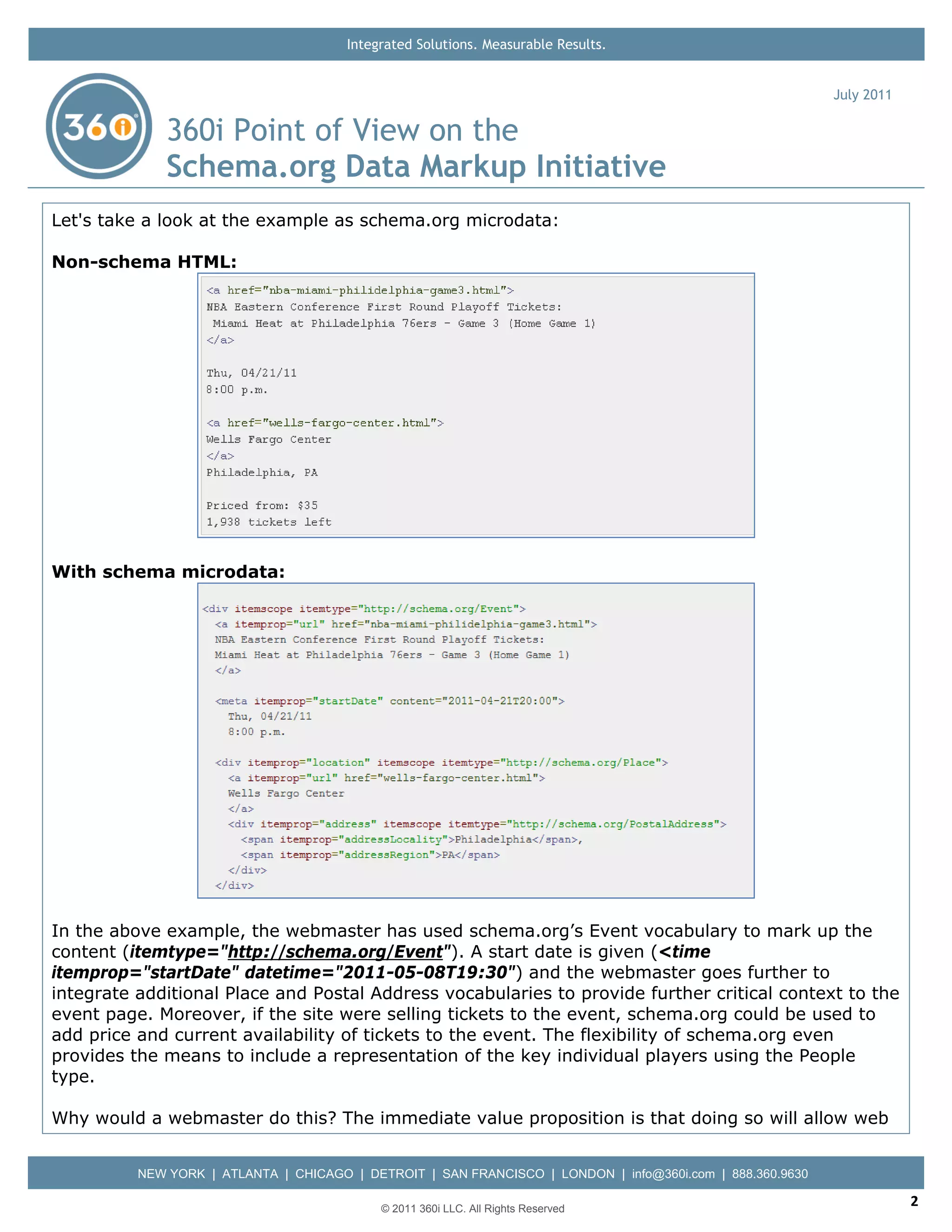
 To illustrate this, consider a web page within NBA.com that provides details on an upcoming
 basketball playoff game. The NBA.com webmaster could use schema.org to emphasize that the
 web page describes an event, focusing on the date and time of the game and the venue’s
 address. By leveraging schema.org, the site owner could unambiguously structure the most
 significant details of the game to better reach someone searching for this information within an
 engine.


           NEW YORK | ATLANTA | CHICAGO | DETROIT | SAN FRANCISCO | LONDON | info@360i.com | 888.360.9630

                                             © 2011 360i LLC. All Rights Reserved
                                                                                                                        1
Integrated Solutions. Measurable Results.


                                                                                                           July 2011

              360i Point of View on the
              Schema.org Data Markup Initiative
Let's take a look at the example as schema.org microdata:

Non-schema HTML:


With schema microdata:


In the above example, the webmaster has used schema.org’s Event vocabulary to mark up the
content (itemtype="http://schema.org/Event"). A start date is given (<time
itemprop="startDate" datetime="2011-05-08T19:30") and the webmaster goes further to
integrate additional Place and Postal Address vocabularies to provide further critical context to the
event page. Moreover, if the site were selling tickets to the event, schema.org could be used to
add price and current availability of tickets to the event. The flexibility of schema.org even
provides the means to include a representation of the key individual players using the People
type.

Why would a webmaster do this? The immediate value proposition is that doing so will allow web


          NEW YORK | ATLANTA | CHICAGO | DETROIT | SAN FRANCISCO | LONDON | info@360i.com | 888.360.9630

                                            © 2011 360i LLC. All Rights Reserved
                                                                                                                       2
Integrated Solutions. Measurable Results.


                                                                                                           July 2011

              360i Point of View on the
              Schema.org Data Markup Initiative
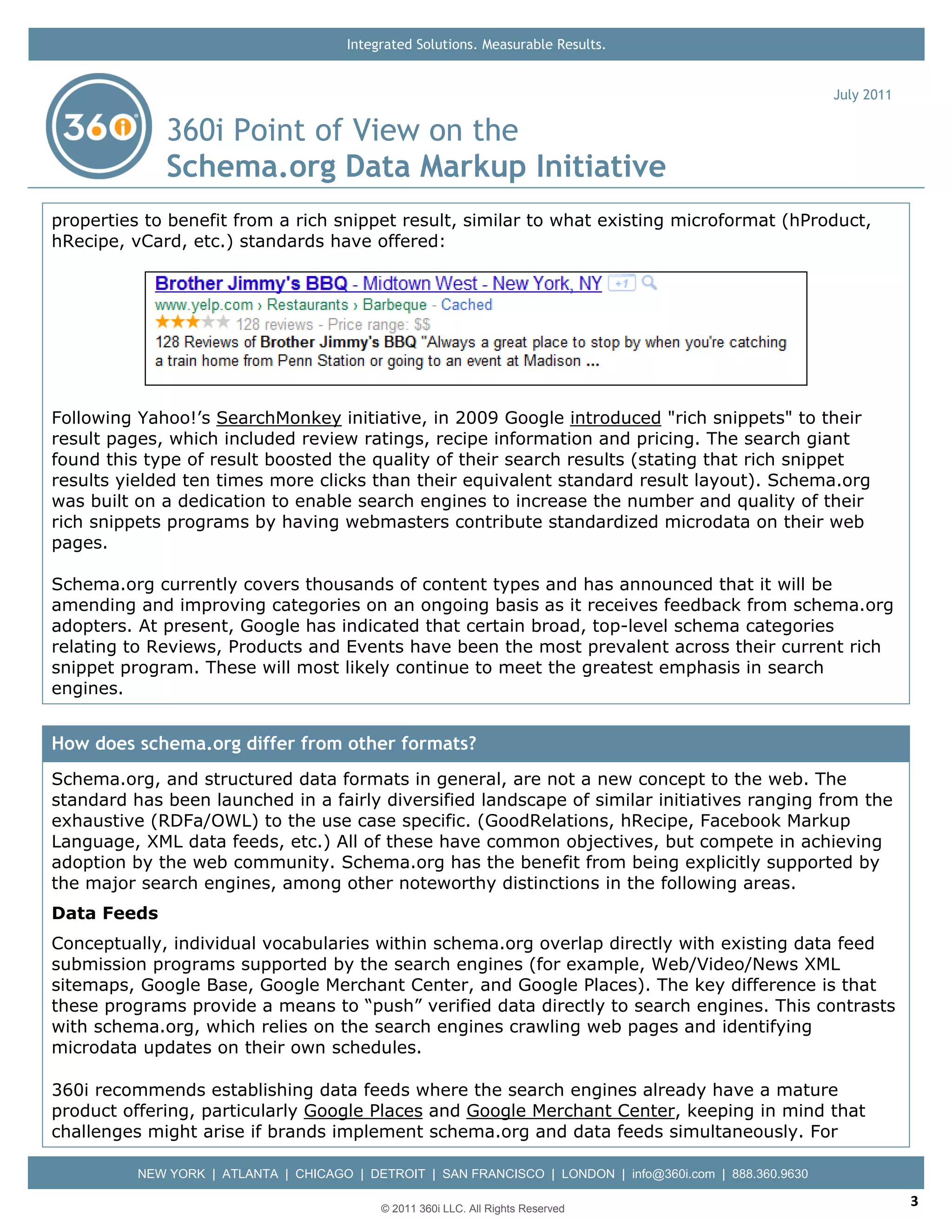
properties to benefit from a rich snippet result, similar to what existing microformat (hProduct,
hRecipe, vCard, etc.) standards have offered:


Following Yahoo!’s SearchMonkey initiative, in 2009 Google introduced "rich snippets" to their
result pages, which included review ratings, recipe information and pricing. The search giant
found this type of result boosted the quality of their search results (stating that rich snippet
results yielded ten times more clicks than their equivalent standard result layout). Schema.org
was built on a dedication to enable search engines to increase the number and quality of their
rich snippets programs by having webmasters contribute standardized microdata on their web
pages.

Schema.org currently covers thousands of content types and has announced that it will be
amending and improving categories on an ongoing basis as it receives feedback from schema.org
adopters. At present, Google has indicated that certain broad, top-level schema categories
relating to Reviews, Products and Events have been the most prevalent across their current rich
snippet program. These will most likely continue to meet the greatest emphasis in search
engines.


How does schema.org differ from other formats?
Schema.org, and structured data formats in general, are not a new concept to the web. The
standard has been launched in a fairly diversified landscape of similar initiatives ranging from the
exhaustive (RDFa/OWL) to the use case specific. (GoodRelations, hRecipe, Facebook Markup
Language, XML data feeds, etc.) All of these have common objectives, but compete in achieving
adoption by the web community. Schema.org has the benefit from being explicitly supported by
the major search engines, among other noteworthy distinctions in the following areas.
Data Feeds
Conceptually, individual vocabularies within schema.org overlap directly with existing data feed
submission programs supported by the search engines (for example, Web/Video/News XML
sitemaps, Google Base, Google Merchant Center, and Google Places). The key difference is that
these programs provide a means to “push” verified data directly to search engines. This contrasts
with schema.org, which relies on the search engines crawling web pages and identifying
microdata updates on their own schedules.

360i recommends establishing data feeds where the search engines already have a mature
product offering, particularly Google Places and Google Merchant Center, keeping in mind that
challenges might arise if brands implement schema.org and data feeds simultaneously. For

          NEW YORK | ATLANTA | CHICAGO | DETROIT | SAN FRANCISCO | LONDON | info@360i.com | 888.360.9630

                                            © 2011 360i LLC. All Rights Reserved
                                                                                                                       3
Integrated Solutions. Measurable Results.


                                                                                                           July 2011

              360i Point of View on the
              Schema.org Data Markup Initiative
example, providing schema.org markup for product pages while also pushing product feeds to
Google Merchant Center may cause synchronization issues, as these two operations are on
different update schedules. In this instance, Google Merchant Center would be favored favored,
as it is actively manageable and provides enhanced tie-ins with Local Shopping.

Other Microformats/Vocabularies
Schema.org supports a vast collection of vocabularies spanning media and entertainment content
to local business data. There are standards (incidentally back by the W3C), such as RDFa, that
are more expressive and extensible than schema.org – however their sheer complexity has led to
slow adoption. Equally, microformats such as hRecipe or other vocabularies such GoodRelations
have already been integrated into search results and have met a reasonable level of adoption.

All these microformats/vocabularies were fully considered in the conception of schema.org and
will continue to be supported in the midterm. Specifically, as RDFa evolves features are to be
ported over to schema.org based upon their uptake – the standard was designed to be easily
mapped over to RDFa and OWL.


What are the benefits of using schema.org?
The immediate value to marketers is the potential to drive increased search visitors by securing a
rich search snippet by virtue of schema.org implementation.

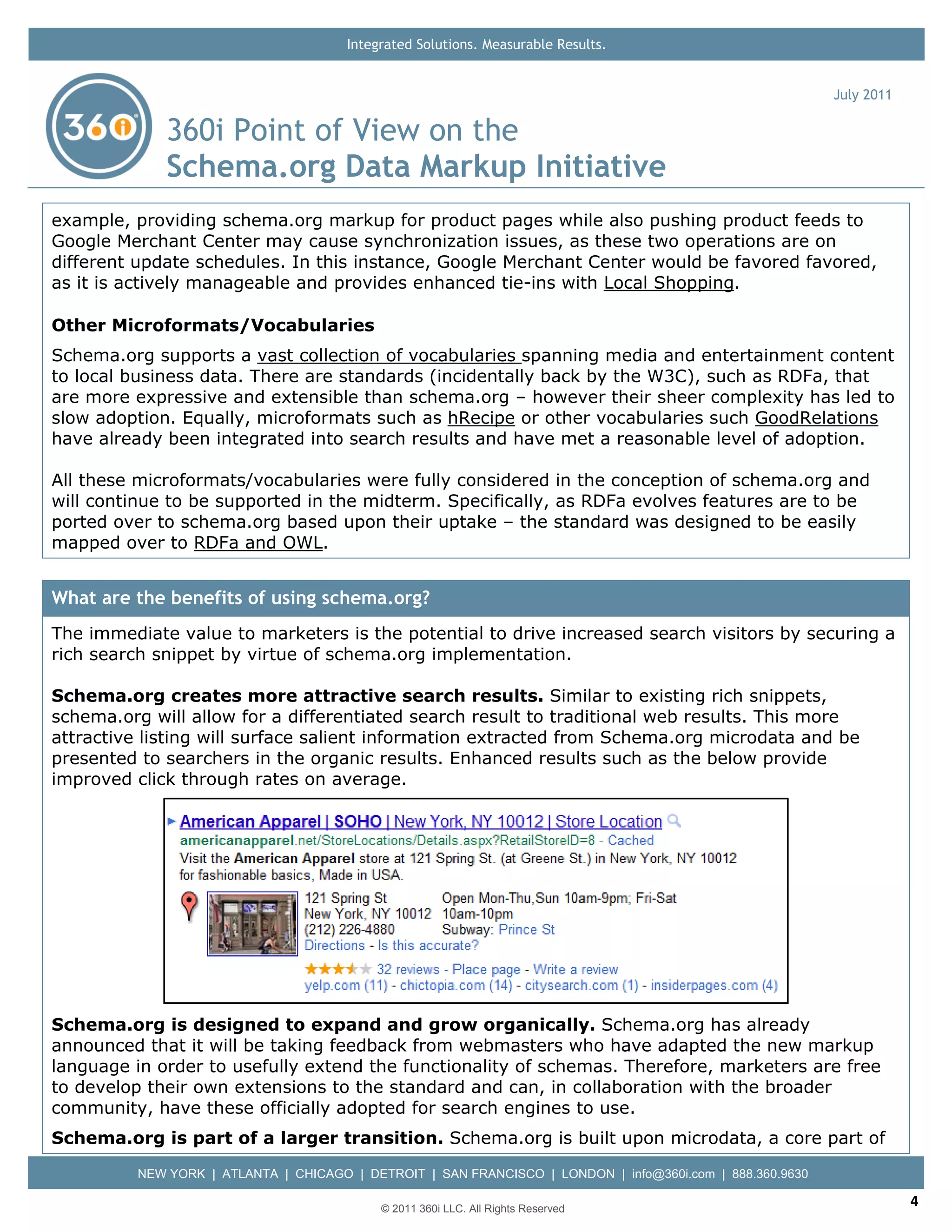
Schema.org creates more attractive search results. Similar to existing rich snippets,
schema.org will allow for a differentiated search result to traditional web results. This more
attractive listing will surface salient information extracted from Schema.org microdata and be
presented to searchers in the organic results. Enhanced results such as the below provide
improved click through rates on average.


Schema.org is designed to expand and grow organically. Schema.org has already
announced that it will be taking feedback from webmasters who have adapted the new markup
language in order to usefully extend the functionality of schemas. Therefore, marketers are free
to develop their own extensions to the standard and can, in collaboration with the broader
community, have these officially adopted for search engines to use.
Schema.org is part of a larger transition. Schema.org is built upon microdata, a core part of
          NEW YORK | ATLANTA | CHICAGO | DETROIT | SAN FRANCISCO | LONDON | info@360i.com | 888.360.9630

                                            © 2011 360i LLC. All Rights Reserved
                                                                                                                       4
Integrated Solutions. Measurable Results.


                                                                                                           July 2011

              360i Point of View on the
              Schema.org Data Markup Initiative
the new HTML5 standard. This means that it will be easier for webmasters to integrate
schema.org as part of an eventual HTML5 transition.
The search engines are giving you lemons, so make lemonade. Much of SEO is working
within the known parameters of Google, Yahoo and Bing and adhering to best practices. The key
aim is to best align the relevance of a brand’s content to respond to consumer needs. The desired
result is to give your site the best opportunity to rank in natural search results, as well as being
of value to existing and prospective customers.

In the case of schema.org, all three major search engines have come together to support a
common approach in better describing web content. This partnership underlines how strategically
important content is to them in providing a rich, relevant search experience. It does not, then,
require a great leap of the imagination to consider how providing additional context through an
initiative such as schema.org may eventually be a factor that contributes to whether your content
is seen to be relevant by search algorithms.


What challenges do schema.org and its adopters face?
Is schema.org reinventing the wheel? Widely used and recognized structured data
vocabularies already exist. The major search engines are, therefore, choosing to embark on a
new path without the full support of the communities that have helped develop those
vocabularies. Should schema.org fail to achieve the traction expected from it, the standard may
become an unreliable source of knowledge for search engines to bet user interface and relevancy
decisions upon.
Search engines will have the data, but how will they use it? Because the Schema markup
format is similar in style and potential functionality to previous markup formats, we can feasibly
predict how it will be used out of the gate. However, it is unknown exactly how much (or even if)
Schema.org markup will trickle through to the search results page.
Arguably, absolute data transparency may work against a brand’s competitive advantage. Or
perhaps Google is looking to use schema formats to create new search verticals such as Google
Recipe search, and perhaps Bing is going to benefit by enhancing its burgeoning social search
features by bridging web markup involving people and its preferred access to the Facebook Open
Graph.
Adapting will require having to do some work. Integrating schema.org micro-data into
websites that are not dynamically driven through a web publishing platform, or do not currently
have their content structured in an easily retrievable manner, could require substantial technical
resources. However, if you are planning to redesign your site, or add new content, schema.org
may integrate into that process with greater ease. Furthermore, the immediate return on
investment is not 100% certain, and marketers should be ready to take a leap of faith, or work
with a 360i strategist to develop a potential test.


          NEW YORK | ATLANTA | CHICAGO | DETROIT | SAN FRANCISCO | LONDON | info@360i.com | 888.360.9630

                                            © 2011 360i LLC. All Rights Reserved
                                                                                                                       5
Integrated Solutions. Measurable Results.


                                                                                                            July 2011

               360i Point of View on the
               Schema.org Data Markup Initiative
 Who will benefit the most and how?
 Schema.org is comprehensive enough to enable nearly any web content owner to benefit from
 rich snippets and the enriched relevance it may one day provide. The standard even backs some
 key generalized elements from HTML5 that better delineate common structural elements such as
 navigation, footer, and menu areas from actual unique content. However, some specific verticals
 are set to have more direct benefits from Schema.org:
    •   Media & Entertainment: Schema.org provides an extensive vocabulary to provide
        context to multimedia assets that have traditionally presented challenges for search
        engines to identify (video, movies, music videos, playlists, images, audio, etc.).
        Additionally, the Person type is well aligned to capture celebrity and actor relationships to
        their creative works.
    •   CPG Brands: Couponing and offer-based content can easily be communicated through the
        Offer type. Food brands hold a natural alignment to the Recipe type.
    •   Retailers: To a more limited extent as product data feeds provide better real-time data
        sources to search engines. Furthermore, the current Product type is somewhat lacking in
        specificity compared to other standards.
    •   Social Media Sites: Schema.org provides a good blend of support for community based
        sites that could leverage mixed types such as Person, Event, User Interaction (checkins,
        likes, “+1”s and comments are all represented) and even location-based data such as
        LocalBusiness.
    •   Search Engines: Schema.org microdata could well inform content-based advertising such
        as Google AdSense, or even play a role in establish landing page Quality Score. Moreover,
        we could see a larger number of specialized search applications similar to the recent Recipe
        Search product.
           o   Bing + Facebook may well be in a prime position to pioneer the next evolution
               where semantic markup on the public web is seamlessly tied into “owned” social
               data such as the Open Graph. This has the potential to create new ways to connect
               people to what they enjoy and do around the web.
 In its current state, schema.org is really about rich snippets that offer improved visibility, and
 click-through rate improvements with potential downstream sales/revenue lift. What is unclear is
 to what extent search engines will in fact display rich snippets for websites that implement
 schema.org microdata.


Next Steps
360i sees schema.org as a positive innovation for the web in general, and one that may offer an
acceptable value proposition to many marketers. However, 360i will continue to prioritize data feed
submission methods to provide enhanced context to Google, Yahoo! and Bing for range of data
types - in a trusted, centralized and timely manner.


           NEW YORK | ATLANTA | CHICAGO | DETROIT | SAN FRANCISCO | LONDON | info@360i.com | 888.360.9630

                                             © 2011 360i LLC. All Rights Reserved
                                                                                                                        6
Integrated Solutions. Measurable Results.


                                                                                                                 July 2011

                 360i Point of View on the
                 Schema.org Data Markup Initiative
The immediate question of whether or not to adopt schema.org boils down to how easily this can be
implemented (upcoming redesign), and whether or not schema.org currently provides a vocabulary
that aligns against your particular line of business. To help determine this, please contact your 360i
strategic advisor.

 About 360i
 360i is an award-winning digital marketing agency that drives results for Fortune 500 marketers through insights, ideas
 and technologies. 360i helps its clients think differently about their online presence and evolve their strategies to take
 advantage of the new world of marketing communications – one where brands and consumers engage in interactive
 and multi-directional conversations. 360i was selected to of Ad Age’s Agency A-List and Fast Company’s roster of the
 “World’s Most Innovative Companies.” Current clients include Oreo, jcpenney, Coca-Cola, Bravo and Diageo, among
 others. For more information, please visit blog.360i.com or follow us on Twitter @360i.


             NEW YORK | ATLANTA | CHICAGO | DETROIT | SAN FRANCISCO | LONDON | info@360i.com | 888.360.9630

                                                © 2011 360i LLC. All Rights Reserved
                                                                                                                              7

360i POV on the Schema.org Markup Initiative

  • 1.
    Integrated Solutions. MeasurableResults. July 2011 360i Point of View on the Schema.org Data Markup Initiative Overview In June 2011, Google, Yahoo and Bing jointly announced a new supported web initiative, called schema.org, which aims to provide much needed momentum to the creation of the semantic web. The web standard provides a common vocabulary for structured data markup on web pages and serves as a resource for webmasters to improve their natural search results within the three major engines. This initiative – built upon pre-existing standards and in anticipation for broader support of HTML5 – establishes a vocabulary by which webmasters (and ultimately marketers) can better ascribe meaning to their content, products and services. In this report, we discuss the potential implications schema.org adoption may have in driving better qualified visitors, and how search engines may come to integrate schema.org microdata into their ranking algorithms. What is schema.org? Schema.org is a website that provides webmasters with a collection of vocabularies that give greater “meaning” to web content. Google, Bing and Yahoo! have joined forces in standardizing this markup to improve search results and help people more easily find the pages for which they are looking. To date, search engines have primarily relied upon HTML tags and Natural Language Processing (NLP) to make sense of web content they index for search. HTML has been a key underpinning to the growth of world wide web as Tim Berners-Lee envisioned it, but has not evolved much beyond acting as a container for web content. Similarly, NLP has served search engines well by extrapolating a sufficient level of meaning to content they encounter, but this remains a resource intensive process. Schema.org is positioned to piggyback on the growing adoption of HTML5, which unlocks a greater flexibility to structure discrete parts of web content like articles, menu navigation, footers, video and more. HTML5 formalizes how web developers provide greater context for their content available to search engines. For search engines, the net result reduces the need for expensive NLP, and provides a richer, machine-readable representation of content on the web. To illustrate this, consider a web page within NBA.com that provides details on an upcoming basketball playoff game. The NBA.com webmaster could use schema.org to emphasize that the web page describes an event, focusing on the date and time of the game and the venue’s address. By leveraging schema.org, the site owner could unambiguously structure the most significant details of the game to better reach someone searching for this information within an engine. NEW YORK | ATLANTA | CHICAGO | DETROIT | SAN FRANCISCO | LONDON | info@360i.com | 888.360.9630 © 2011 360i LLC. All Rights Reserved 1
  • 2.
    Integrated Solutions. MeasurableResults. July 2011 360i Point of View on the Schema.org Data Markup Initiative Let's take a look at the example as schema.org microdata: Non-schema HTML: With schema microdata: In the above example, the webmaster has used schema.org’s Event vocabulary to mark up the content (itemtype="http://schema.org/Event"). A start date is given (<time itemprop="startDate" datetime="2011-05-08T19:30") and the webmaster goes further to integrate additional Place and Postal Address vocabularies to provide further critical context to the event page. Moreover, if the site were selling tickets to the event, schema.org could be used to add price and current availability of tickets to the event. The flexibility of schema.org even provides the means to include a representation of the key individual players using the People type. Why would a webmaster do this? The immediate value proposition is that doing so will allow web NEW YORK | ATLANTA | CHICAGO | DETROIT | SAN FRANCISCO | LONDON | info@360i.com | 888.360.9630 © 2011 360i LLC. All Rights Reserved 2
  • 3.
    Integrated Solutions. MeasurableResults. July 2011 360i Point of View on the Schema.org Data Markup Initiative properties to benefit from a rich snippet result, similar to what existing microformat (hProduct, hRecipe, vCard, etc.) standards have offered: Following Yahoo!’s SearchMonkey initiative, in 2009 Google introduced "rich snippets" to their result pages, which included review ratings, recipe information and pricing. The search giant found this type of result boosted the quality of their search results (stating that rich snippet results yielded ten times more clicks than their equivalent standard result layout). Schema.org was built on a dedication to enable search engines to increase the number and quality of their rich snippets programs by having webmasters contribute standardized microdata on their web pages. Schema.org currently covers thousands of content types and has announced that it will be amending and improving categories on an ongoing basis as it receives feedback from schema.org adopters. At present, Google has indicated that certain broad, top-level schema categories relating to Reviews, Products and Events have been the most prevalent across their current rich snippet program. These will most likely continue to meet the greatest emphasis in search engines. How does schema.org differ from other formats? Schema.org, and structured data formats in general, are not a new concept to the web. The standard has been launched in a fairly diversified landscape of similar initiatives ranging from the exhaustive (RDFa/OWL) to the use case specific. (GoodRelations, hRecipe, Facebook Markup Language, XML data feeds, etc.) All of these have common objectives, but compete in achieving adoption by the web community. Schema.org has the benefit from being explicitly supported by the major search engines, among other noteworthy distinctions in the following areas. Data Feeds Conceptually, individual vocabularies within schema.org overlap directly with existing data feed submission programs supported by the search engines (for example, Web/Video/News XML sitemaps, Google Base, Google Merchant Center, and Google Places). The key difference is that these programs provide a means to “push” verified data directly to search engines. This contrasts with schema.org, which relies on the search engines crawling web pages and identifying microdata updates on their own schedules. 360i recommends establishing data feeds where the search engines already have a mature product offering, particularly Google Places and Google Merchant Center, keeping in mind that challenges might arise if brands implement schema.org and data feeds simultaneously. For NEW YORK | ATLANTA | CHICAGO | DETROIT | SAN FRANCISCO | LONDON | info@360i.com | 888.360.9630 © 2011 360i LLC. All Rights Reserved 3
  • 4.
    Integrated Solutions. MeasurableResults. July 2011 360i Point of View on the Schema.org Data Markup Initiative example, providing schema.org markup for product pages while also pushing product feeds to Google Merchant Center may cause synchronization issues, as these two operations are on different update schedules. In this instance, Google Merchant Center would be favored favored, as it is actively manageable and provides enhanced tie-ins with Local Shopping. Other Microformats/Vocabularies Schema.org supports a vast collection of vocabularies spanning media and entertainment content to local business data. There are standards (incidentally back by the W3C), such as RDFa, that are more expressive and extensible than schema.org – however their sheer complexity has led to slow adoption. Equally, microformats such as hRecipe or other vocabularies such GoodRelations have already been integrated into search results and have met a reasonable level of adoption. All these microformats/vocabularies were fully considered in the conception of schema.org and will continue to be supported in the midterm. Specifically, as RDFa evolves features are to be ported over to schema.org based upon their uptake – the standard was designed to be easily mapped over to RDFa and OWL. What are the benefits of using schema.org? The immediate value to marketers is the potential to drive increased search visitors by securing a rich search snippet by virtue of schema.org implementation. Schema.org creates more attractive search results. Similar to existing rich snippets, schema.org will allow for a differentiated search result to traditional web results. This more attractive listing will surface salient information extracted from Schema.org microdata and be presented to searchers in the organic results. Enhanced results such as the below provide improved click through rates on average. Schema.org is designed to expand and grow organically. Schema.org has already announced that it will be taking feedback from webmasters who have adapted the new markup language in order to usefully extend the functionality of schemas. Therefore, marketers are free to develop their own extensions to the standard and can, in collaboration with the broader community, have these officially adopted for search engines to use. Schema.org is part of a larger transition. Schema.org is built upon microdata, a core part of NEW YORK | ATLANTA | CHICAGO | DETROIT | SAN FRANCISCO | LONDON | info@360i.com | 888.360.9630 © 2011 360i LLC. All Rights Reserved 4
  • 5.
    Integrated Solutions. MeasurableResults. July 2011 360i Point of View on the Schema.org Data Markup Initiative the new HTML5 standard. This means that it will be easier for webmasters to integrate schema.org as part of an eventual HTML5 transition. The search engines are giving you lemons, so make lemonade. Much of SEO is working within the known parameters of Google, Yahoo and Bing and adhering to best practices. The key aim is to best align the relevance of a brand’s content to respond to consumer needs. The desired result is to give your site the best opportunity to rank in natural search results, as well as being of value to existing and prospective customers. In the case of schema.org, all three major search engines have come together to support a common approach in better describing web content. This partnership underlines how strategically important content is to them in providing a rich, relevant search experience. It does not, then, require a great leap of the imagination to consider how providing additional context through an initiative such as schema.org may eventually be a factor that contributes to whether your content is seen to be relevant by search algorithms. What challenges do schema.org and its adopters face? Is schema.org reinventing the wheel? Widely used and recognized structured data vocabularies already exist. The major search engines are, therefore, choosing to embark on a new path without the full support of the communities that have helped develop those vocabularies. Should schema.org fail to achieve the traction expected from it, the standard may become an unreliable source of knowledge for search engines to bet user interface and relevancy decisions upon. Search engines will have the data, but how will they use it? Because the Schema markup format is similar in style and potential functionality to previous markup formats, we can feasibly predict how it will be used out of the gate. However, it is unknown exactly how much (or even if) Schema.org markup will trickle through to the search results page. Arguably, absolute data transparency may work against a brand’s competitive advantage. Or perhaps Google is looking to use schema formats to create new search verticals such as Google Recipe search, and perhaps Bing is going to benefit by enhancing its burgeoning social search features by bridging web markup involving people and its preferred access to the Facebook Open Graph. Adapting will require having to do some work. Integrating schema.org micro-data into websites that are not dynamically driven through a web publishing platform, or do not currently have their content structured in an easily retrievable manner, could require substantial technical resources. However, if you are planning to redesign your site, or add new content, schema.org may integrate into that process with greater ease. Furthermore, the immediate return on investment is not 100% certain, and marketers should be ready to take a leap of faith, or work with a 360i strategist to develop a potential test. NEW YORK | ATLANTA | CHICAGO | DETROIT | SAN FRANCISCO | LONDON | info@360i.com | 888.360.9630 © 2011 360i LLC. All Rights Reserved 5
  • 6.
    Integrated Solutions. MeasurableResults. July 2011 360i Point of View on the Schema.org Data Markup Initiative Who will benefit the most and how? Schema.org is comprehensive enough to enable nearly any web content owner to benefit from rich snippets and the enriched relevance it may one day provide. The standard even backs some key generalized elements from HTML5 that better delineate common structural elements such as navigation, footer, and menu areas from actual unique content. However, some specific verticals are set to have more direct benefits from Schema.org: • Media & Entertainment: Schema.org provides an extensive vocabulary to provide context to multimedia assets that have traditionally presented challenges for search engines to identify (video, movies, music videos, playlists, images, audio, etc.). Additionally, the Person type is well aligned to capture celebrity and actor relationships to their creative works. • CPG Brands: Couponing and offer-based content can easily be communicated through the Offer type. Food brands hold a natural alignment to the Recipe type. • Retailers: To a more limited extent as product data feeds provide better real-time data sources to search engines. Furthermore, the current Product type is somewhat lacking in specificity compared to other standards. • Social Media Sites: Schema.org provides a good blend of support for community based sites that could leverage mixed types such as Person, Event, User Interaction (checkins, likes, “+1”s and comments are all represented) and even location-based data such as LocalBusiness. • Search Engines: Schema.org microdata could well inform content-based advertising such as Google AdSense, or even play a role in establish landing page Quality Score. Moreover, we could see a larger number of specialized search applications similar to the recent Recipe Search product. o Bing + Facebook may well be in a prime position to pioneer the next evolution where semantic markup on the public web is seamlessly tied into “owned” social data such as the Open Graph. This has the potential to create new ways to connect people to what they enjoy and do around the web. In its current state, schema.org is really about rich snippets that offer improved visibility, and click-through rate improvements with potential downstream sales/revenue lift. What is unclear is to what extent search engines will in fact display rich snippets for websites that implement schema.org microdata. Next Steps 360i sees schema.org as a positive innovation for the web in general, and one that may offer an acceptable value proposition to many marketers. However, 360i will continue to prioritize data feed submission methods to provide enhanced context to Google, Yahoo! and Bing for range of data types - in a trusted, centralized and timely manner. NEW YORK | ATLANTA | CHICAGO | DETROIT | SAN FRANCISCO | LONDON | info@360i.com | 888.360.9630 © 2011 360i LLC. All Rights Reserved 6
  • 7.
    Integrated Solutions. MeasurableResults. July 2011 360i Point of View on the Schema.org Data Markup Initiative The immediate question of whether or not to adopt schema.org boils down to how easily this can be implemented (upcoming redesign), and whether or not schema.org currently provides a vocabulary that aligns against your particular line of business. To help determine this, please contact your 360i strategic advisor. About 360i 360i is an award-winning digital marketing agency that drives results for Fortune 500 marketers through insights, ideas and technologies. 360i helps its clients think differently about their online presence and evolve their strategies to take advantage of the new world of marketing communications – one where brands and consumers engage in interactive and multi-directional conversations. 360i was selected to of Ad Age’s Agency A-List and Fast Company’s roster of the “World’s Most Innovative Companies.” Current clients include Oreo, jcpenney, Coca-Cola, Bravo and Diageo, among others. For more information, please visit blog.360i.com or follow us on Twitter @360i. NEW YORK | ATLANTA | CHICAGO | DETROIT | SAN FRANCISCO | LONDON | info@360i.com | 888.360.9630 © 2011 360i LLC. All Rights Reserved 7