Cloud Dataflow
A Google Service and SDK
The Presenter
Alex Van Boxel, Software Architect, software engineer, devops, tester,...
at Vente-Exclusive.com
Introduction
Twitter @alexvb
Plus +AlexVanBoxel
E-mail alex@vanboxel.be
Web http://alex.vanboxel.be
Dataflow
what, how, where?
Dataflow is...
A set of SDK that define the
programming model that
you use to build your
streaming and batch
processing pipeline (*)
Google Cloud Dataflow is a
fully managed service that
will run and optimize your
pipeline
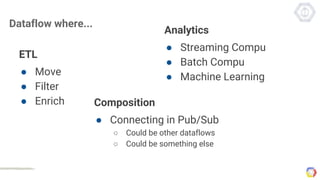
Dataflow where...
ETL
● Move
● Filter
● Enrich
Analytics
● Streaming Compu
● Batch Compu
● Machine Learning
Composition
● Connecting in Pub/Sub
○ Could be other dataflows
○ Could be something else
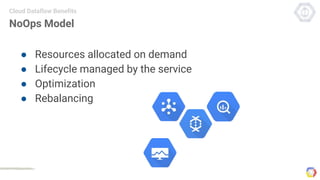
NoOps Model
● Resources allocated on demand
● Lifecycle managed by the service
● Optimization
● Rebalancing
Cloud Dataflow Benefits
Unified Programming Model
Unified: Streaming and Batch
Open Sourced
● Java 8 implementation
● Python in the works
Cloud Dataflow Benefits
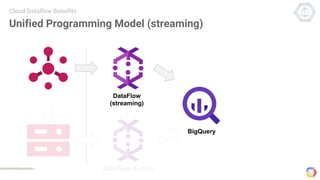
Unified Programming Model (streaming)
Cloud Dataflow Benefits
DataFlow
(streaming)
DataFlow (batch)
BigQuery
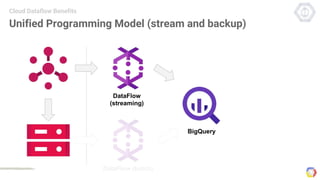
Unified Programming Model (stream and backup)
Cloud Dataflow Benefits
DataFlow
(streaming)
DataFlow (batch)
BigQuery
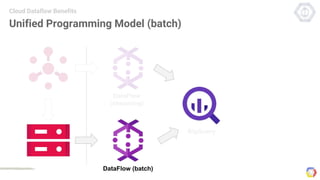
Unified Programming Model (batch)
Cloud Dataflow Benefits
DataFlow
(streaming)
DataFlow (batch)
BigQuery
Beam
Apache Incubation
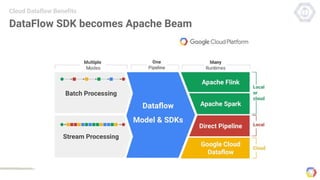
DataFlow SDK becomes Apache Beam
Cloud Dataflow Benefits
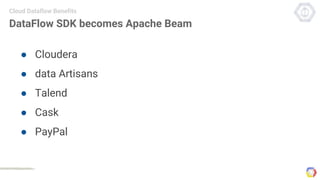
DataFlow SDK becomes Apache Beam
● Pipeline first, runtime second
○ focus your data pipelines, not the characteristics runner
● Portability
○ portable across a number of runtime engines
○ runtime based on any number of considerations
■ performance
■ cost
■ scalability
Cloud Dataflow Benefits
DataFlow SDK becomes Apache Beam
● Unified model
○ Batch and streaming are integrated into a unified model
○ Powerful semantics, such as windowing, ordering and triggering
● Development tooling
○ tools you need to create portable data pipelines quickly and easily
using open-source languages, libraries and tools.
Cloud Dataflow Benefits
DataFlow SDK becomes Apache Beam
● Scala Implementation
● Alternative Runners
○ Spark Runner from Cloudera Labs
○ Flink Runner from data Artisans
Cloud Dataflow Benefits
DataFlow SDK becomes Apache Beam
● Cloudera
● data Artisans
● Talend
● Cask
● PayPal
Cloud Dataflow Benefits
SDK Primitives
Autopsy of a dataflow pipeline
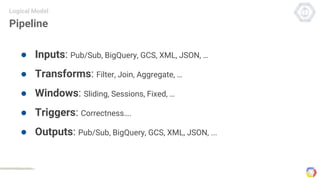
Pipeline
● Inputs: Pub/Sub, BigQuery, GCS, XML, JSON, …
● Transforms: Filter, Join, Aggregate, …
● Windows: Sliding, Sessions, Fixed, …
● Triggers: Correctness….
● Outputs: Pub/Sub, BigQuery, GCS, XML, JSON, ...
Logical Model
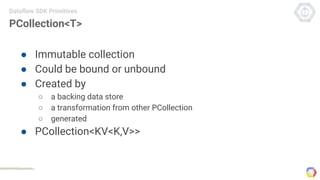
PCollection<T>
● Immutable collection
● Could be bound or unbound
● Created by
○ a backing data store
○ a transformation from other PCollection
○ generated
● PCollection<KV<K,V>>
Dataflow SDK Primitives
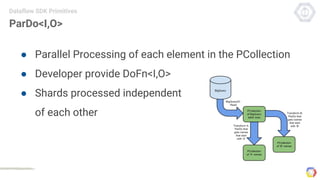
ParDo<I,O>
● Parallel Processing of each element in the PCollection
● Developer provide DoFn<I,O>
● Shards processed independent
of each other
Dataflow SDK Primitives
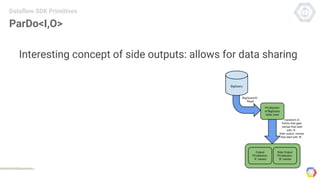
ParDo<I,O>
Interesting concept of side outputs: allows for data sharing
Dataflow SDK Primitives
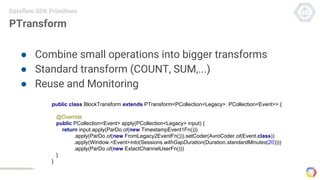
PTransform
● Combine small operations into bigger transforms
● Standard transform (COUNT, SUM,...)
● Reuse and Monitoring
Dataflow SDK Primitives
public class BlockTransform extends PTransform<PCollection<Legacy>, PCollection<Event>> {
@Override
public PCollection<Event> apply(PCollection<Legacy> input) {
return input.apply(ParDo.of(new TimestampEvent1Fn()))
.apply(ParDo.of(new FromLegacy2EventFn())).setCoder(AvroCoder.of(Event.class))
.apply(Window.<Event>into(Sessions.withGapDuration(Duration.standardMinutes(20))))
.apply(ParDo.of(new ExtactChannelUserFn()))
}
}
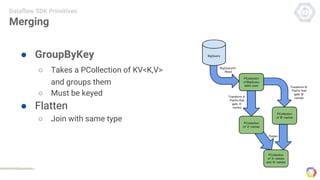
Merging
● GroupByKey
○ Takes a PCollection of KV<K,V>
and groups them
○ Must be keyed
● Flatten
○ Join with same type
Dataflow SDK Primitives
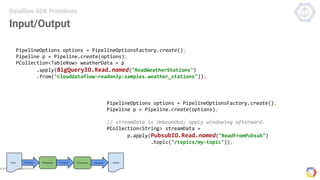
Input/Output
Dataflow SDK Primitives
PipelineOptions options = PipelineOptionsFactory.create();
Pipeline p = Pipeline.create(options);
// streamData is Unbounded; apply windowing afterward.
PCollection<String> streamData =
p.apply(PubsubIO.Read.named("ReadFromPubsub")
.topic("/topics/my-topic"));
PipelineOptions options = PipelineOptionsFactory.create();
Pipeline p = Pipeline.create(options);
PCollection<TableRow> weatherData = p
.apply(BigQueryIO.Read.named("ReadWeatherStations")
.from("clouddataflow-readonly:samples.weather_stations"));
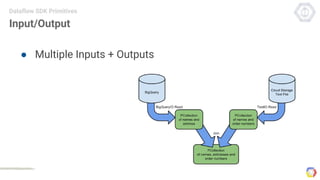
● Multiple Inputs + Outputs
Input/Output
Dataflow SDK Primitives
Primitives on steroids
Autopsy of a dataflow pipeline
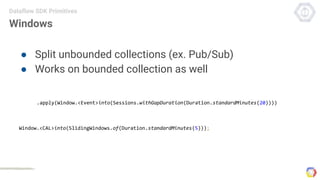
Windows
● Split unbounded collections (ex. Pub/Sub)
● Works on bounded collection as well
Dataflow SDK Primitives
.apply(Window.<Event>into(Sessions.withGapDuration(Duration.standardMinutes(20))))
Window.<CAL>into(SlidingWindows.of(Duration.standardMinutes(5)));
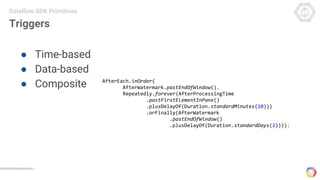
Triggers
● Time-based
● Data-based
● Composite
Dataflow SDK Primitives
AfterEach.inOrder(
AfterWatermark.pastEndOfWindow(),
Repeatedly.forever(AfterProcessingTime
.pastFirstElementInPane()
.plusDelayOf(Duration.standardMinutes(10)))
.orFinally(AfterWatermark
.pastEndOfWindow()
.plusDelayOf(Duration.standardDays(2))));
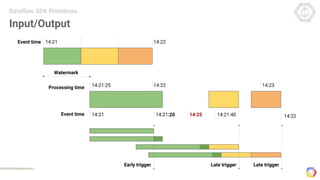
14:22Event time 14:21
Input/Output
Dataflow SDK Primitives
14:21 14:22
14:21:25Processing time
Event time
14:2314:22
Watermark
14:21:20 14:21:40
Early trigger Late trigger Late trigger
14:25
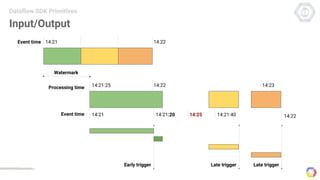
14:22Event time 14:21
Input/Output
Dataflow SDK Primitives
14:21 14:22
14:21:25Processing time
Event time
14:2314:22
Watermark
14:21:20 14:21:40
Early trigger Late trigger Late trigger
14:25
Google Cloud Dataflow
The service
What you need
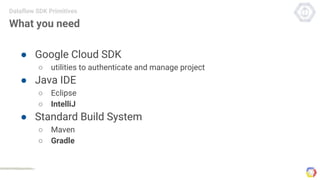
● Google Cloud SDK
○ utilities to authenticate and manage project
● Java IDE
○ Eclipse
○ IntelliJ
● Standard Build System
○ Maven
○ Gradle
Dataflow SDK Primitives
What you need
Dataflow SDK Primitives
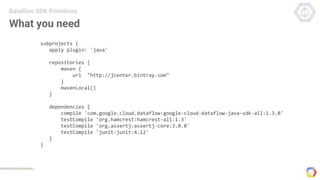
subprojects {
apply plugin: 'java'
repositories {
maven {
url "http://jcenter.bintray.com"
}
mavenLocal()
}
dependencies {
compile 'com.google.cloud.dataflow:google-cloud-dataflow-java-sdk-all:1.3.0'
testCompile 'org.hamcrest:hamcrest-all:1.3'
testCompile 'org.assertj:assertj-core:3.0.0'
testCompile 'junit:junit:4.12'
}
}
How it work
Google Cloud Dataflow Service
Pipeline p = Pipeline.create(options);
p.apply(TextIO.Read.from("gs://dataflow-samples/shakespeare/*"))
.apply(FlatMapElements.via((String word) -> Arrays.asList(word.split("[^a-zA-Z']+")))
.withOutputType(new TypeDescriptor<String>() {}))
.apply(Filter.byPredicate((String word) -> !word.isEmpty()))
.apply(Count.<String>perElement())
.apply(MapElements
.via((KV<String, Long> wordCount) -> wordCount.getKey() + ": " + wordCount.getValue())
.withOutputType(new TypeDescriptor<String>() {}))
.apply(TextIO.Write.to("gs://YOUR_OUTPUT_BUCKET/AND_OUTPUT_PREFIX"));
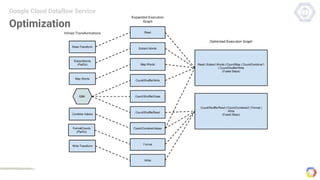
Service
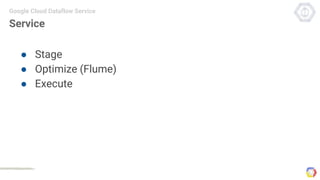
● Stage
● Optimize (Flume)
● Execute
Google Cloud Dataflow Service
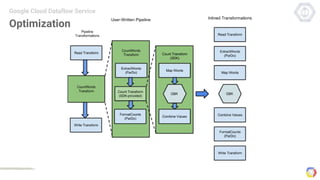
Optimization
Google Cloud Dataflow Service
Optimization
Google Cloud Dataflow Service
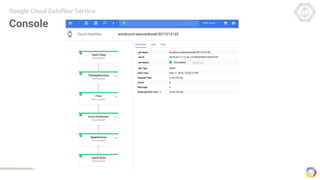
Console
Google Cloud Dataflow Service
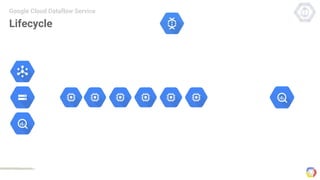
Lifecycle
Google Cloud Dataflow Service
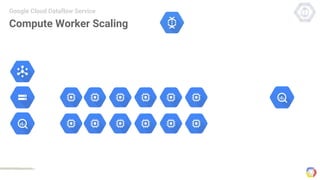
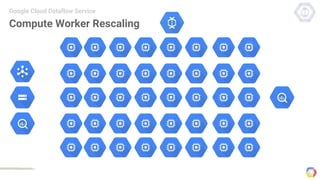
Compute Worker Scaling
Google Cloud Dataflow Service
Compute Worker Rescaling
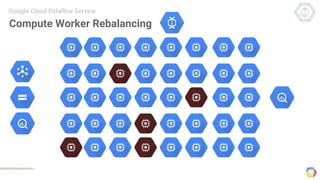
Google Cloud Dataflow Service
Compute Worker Rebalancing
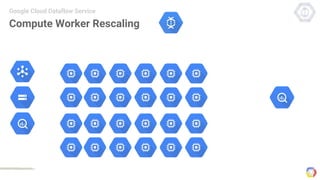
Google Cloud Dataflow Service
Compute Worker Rescaling
Google Cloud Dataflow Service
Lifecycle
Google Cloud Dataflow Service
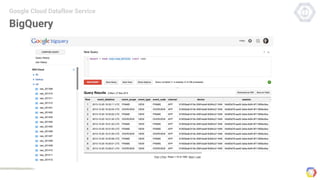
BigQuery
Google Cloud Dataflow Service
Testability
Test Driven Development Build-In
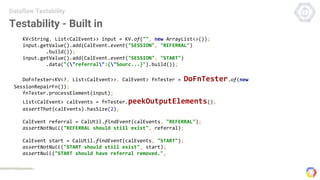
Testability - Built in
Dataflow Testability
KV<String, List<CalEvent>> input = KV.of("", new ArrayList<>());
input.getValue().add(CalEvent.event("SESSION", "REFERRAL")
.build());
input.getValue().add(CalEvent.event("SESSION", "START")
.data("{"referral":{"Sourc...}").build());
DoFnTester<KV<?, List<CalEvent>>, CalEvent> fnTester = DoFnTester.of(new
SessionRepairFn());
fnTester.processElement(input);
List<CalEvent> calEvents = fnTester.peekOutputElements();
assertThat(calEvents).hasSize(2);
CalEvent referral = CalUtil.findEvent(calEvents, "REFERRAL");
assertNotNull("REFERRAL should still exist", referral);
CalEvent start = CalUtil.findEvent(calEvents, "START");
assertNotNull("START should still exist", start);
assertNull("START should have referral removed.",
Appendix
Follow the yellow brick road
Paper - Flume Java
FlumeJava: Easy, Efficient Data-Parallel Pipelines
http://pages.cs.wisc.edu/~akella/CS838/F12/838-
CloudPapers/FlumeJava.pdf
More Dataflow Resources
DataFlow/Bean vs Spark
Dataflow/Beam & Spark: A Programming Model
Comparison
https://cloud.google.com/dataflow/blog/dataflow-beam-
and-spark-comparison
More Dataflow Resources
Github - Integrate Dataflow with Luigi
Google Cloud integration for Luigi
https://github.com/alexvanboxel/luigiext-gcloud
More Dataflow Resources
Questions and Answers
The last slide
Twitter @alexvb
Plus +AlexVanBoxel
E-mail alex@vanboxel.be
Web http://alex.vanboxel.be

Google Cloud Dataflow

  • 1.
    Cloud Dataflow A GoogleService and SDK
  • 2.
    The Presenter Alex VanBoxel, Software Architect, software engineer, devops, tester,... at Vente-Exclusive.com Introduction Twitter @alexvb Plus +AlexVanBoxel E-mail alex@vanboxel.be Web http://alex.vanboxel.be
  • 3.
  • 4.
    Dataflow is... A setof SDK that define the programming model that you use to build your streaming and batch processing pipeline (*) Google Cloud Dataflow is a fully managed service that will run and optimize your pipeline
  • 5.
    Dataflow where... ETL ● Move ●Filter ● Enrich Analytics ● Streaming Compu ● Batch Compu ● Machine Learning Composition ● Connecting in Pub/Sub ○ Could be other dataflows ○ Could be something else
  • 6.
    NoOps Model ● Resourcesallocated on demand ● Lifecycle managed by the service ● Optimization ● Rebalancing Cloud Dataflow Benefits
  • 7.
    Unified Programming Model Unified:Streaming and Batch Open Sourced ● Java 8 implementation ● Python in the works Cloud Dataflow Benefits
  • 8.
    Unified Programming Model(streaming) Cloud Dataflow Benefits DataFlow (streaming) DataFlow (batch) BigQuery
  • 9.
    Unified Programming Model(stream and backup) Cloud Dataflow Benefits DataFlow (streaming) DataFlow (batch) BigQuery
  • 10.
    Unified Programming Model(batch) Cloud Dataflow Benefits DataFlow (streaming) DataFlow (batch) BigQuery
  • 11.
  • 12.
    DataFlow SDK becomesApache Beam Cloud Dataflow Benefits
  • 13.
    DataFlow SDK becomesApache Beam ● Pipeline first, runtime second ○ focus your data pipelines, not the characteristics runner ● Portability ○ portable across a number of runtime engines ○ runtime based on any number of considerations ■ performance ■ cost ■ scalability Cloud Dataflow Benefits
  • 14.
    DataFlow SDK becomesApache Beam ● Unified model ○ Batch and streaming are integrated into a unified model ○ Powerful semantics, such as windowing, ordering and triggering ● Development tooling ○ tools you need to create portable data pipelines quickly and easily using open-source languages, libraries and tools. Cloud Dataflow Benefits
  • 15.
    DataFlow SDK becomesApache Beam ● Scala Implementation ● Alternative Runners ○ Spark Runner from Cloudera Labs ○ Flink Runner from data Artisans Cloud Dataflow Benefits
  • 16.
    DataFlow SDK becomesApache Beam ● Cloudera ● data Artisans ● Talend ● Cask ● PayPal Cloud Dataflow Benefits
  • 17.
    SDK Primitives Autopsy ofa dataflow pipeline
  • 18.
    Pipeline ● Inputs: Pub/Sub,BigQuery, GCS, XML, JSON, … ● Transforms: Filter, Join, Aggregate, … ● Windows: Sliding, Sessions, Fixed, … ● Triggers: Correctness…. ● Outputs: Pub/Sub, BigQuery, GCS, XML, JSON, ... Logical Model
  • 19.
    PCollection<T> ● Immutable collection ●Could be bound or unbound ● Created by ○ a backing data store ○ a transformation from other PCollection ○ generated ● PCollection<KV<K,V>> Dataflow SDK Primitives
  • 20.
    ParDo<I,O> ● Parallel Processingof each element in the PCollection ● Developer provide DoFn<I,O> ● Shards processed independent of each other Dataflow SDK Primitives
  • 21.
    ParDo<I,O> Interesting concept ofside outputs: allows for data sharing Dataflow SDK Primitives
  • 22.
    PTransform ● Combine smalloperations into bigger transforms ● Standard transform (COUNT, SUM,...) ● Reuse and Monitoring Dataflow SDK Primitives public class BlockTransform extends PTransform<PCollection<Legacy>, PCollection<Event>> { @Override public PCollection<Event> apply(PCollection<Legacy> input) { return input.apply(ParDo.of(new TimestampEvent1Fn())) .apply(ParDo.of(new FromLegacy2EventFn())).setCoder(AvroCoder.of(Event.class)) .apply(Window.<Event>into(Sessions.withGapDuration(Duration.standardMinutes(20)))) .apply(ParDo.of(new ExtactChannelUserFn())) } }
  • 23.
    Merging ● GroupByKey ○ Takesa PCollection of KV<K,V> and groups them ○ Must be keyed ● Flatten ○ Join with same type Dataflow SDK Primitives
  • 24.
    Input/Output Dataflow SDK Primitives PipelineOptionsoptions = PipelineOptionsFactory.create(); Pipeline p = Pipeline.create(options); // streamData is Unbounded; apply windowing afterward. PCollection<String> streamData = p.apply(PubsubIO.Read.named("ReadFromPubsub") .topic("/topics/my-topic")); PipelineOptions options = PipelineOptionsFactory.create(); Pipeline p = Pipeline.create(options); PCollection<TableRow> weatherData = p .apply(BigQueryIO.Read.named("ReadWeatherStations") .from("clouddataflow-readonly:samples.weather_stations"));
  • 25.
    ● Multiple Inputs+ Outputs Input/Output Dataflow SDK Primitives
  • 26.
    Primitives on steroids Autopsyof a dataflow pipeline
  • 27.
    Windows ● Split unboundedcollections (ex. Pub/Sub) ● Works on bounded collection as well Dataflow SDK Primitives .apply(Window.<Event>into(Sessions.withGapDuration(Duration.standardMinutes(20)))) Window.<CAL>into(SlidingWindows.of(Duration.standardMinutes(5)));
  • 28.
    Triggers ● Time-based ● Data-based ●Composite Dataflow SDK Primitives AfterEach.inOrder( AfterWatermark.pastEndOfWindow(), Repeatedly.forever(AfterProcessingTime .pastFirstElementInPane() .plusDelayOf(Duration.standardMinutes(10))) .orFinally(AfterWatermark .pastEndOfWindow() .plusDelayOf(Duration.standardDays(2))));
  • 29.
    14:22Event time 14:21 Input/Output DataflowSDK Primitives 14:21 14:22 14:21:25Processing time Event time 14:2314:22 Watermark 14:21:20 14:21:40 Early trigger Late trigger Late trigger 14:25
  • 30.
    14:22Event time 14:21 Input/Output DataflowSDK Primitives 14:21 14:22 14:21:25Processing time Event time 14:2314:22 Watermark 14:21:20 14:21:40 Early trigger Late trigger Late trigger 14:25
  • 31.
  • 32.
    What you need ●Google Cloud SDK ○ utilities to authenticate and manage project ● Java IDE ○ Eclipse ○ IntelliJ ● Standard Build System ○ Maven ○ Gradle Dataflow SDK Primitives
  • 33.
    What you need DataflowSDK Primitives subprojects { apply plugin: 'java' repositories { maven { url "http://jcenter.bintray.com" } mavenLocal() } dependencies { compile 'com.google.cloud.dataflow:google-cloud-dataflow-java-sdk-all:1.3.0' testCompile 'org.hamcrest:hamcrest-all:1.3' testCompile 'org.assertj:assertj-core:3.0.0' testCompile 'junit:junit:4.12' } }
  • 34.
    How it work GoogleCloud Dataflow Service Pipeline p = Pipeline.create(options); p.apply(TextIO.Read.from("gs://dataflow-samples/shakespeare/*")) .apply(FlatMapElements.via((String word) -> Arrays.asList(word.split("[^a-zA-Z']+"))) .withOutputType(new TypeDescriptor<String>() {})) .apply(Filter.byPredicate((String word) -> !word.isEmpty())) .apply(Count.<String>perElement()) .apply(MapElements .via((KV<String, Long> wordCount) -> wordCount.getKey() + ": " + wordCount.getValue()) .withOutputType(new TypeDescriptor<String>() {})) .apply(TextIO.Write.to("gs://YOUR_OUTPUT_BUCKET/AND_OUTPUT_PREFIX"));
  • 35.
    Service ● Stage ● Optimize(Flume) ● Execute Google Cloud Dataflow Service
  • 36.
  • 37.
  • 38.
  • 39.
  • 40.
    Compute Worker Scaling GoogleCloud Dataflow Service
  • 41.
    Compute Worker Rescaling GoogleCloud Dataflow Service
  • 42.
    Compute Worker Rebalancing GoogleCloud Dataflow Service
  • 43.
    Compute Worker Rescaling GoogleCloud Dataflow Service
  • 44.
  • 45.
  • 46.
  • 47.
    Testability - Builtin Dataflow Testability KV<String, List<CalEvent>> input = KV.of("", new ArrayList<>()); input.getValue().add(CalEvent.event("SESSION", "REFERRAL") .build()); input.getValue().add(CalEvent.event("SESSION", "START") .data("{"referral":{"Sourc...}").build()); DoFnTester<KV<?, List<CalEvent>>, CalEvent> fnTester = DoFnTester.of(new SessionRepairFn()); fnTester.processElement(input); List<CalEvent> calEvents = fnTester.peekOutputElements(); assertThat(calEvents).hasSize(2); CalEvent referral = CalUtil.findEvent(calEvents, "REFERRAL"); assertNotNull("REFERRAL should still exist", referral); CalEvent start = CalUtil.findEvent(calEvents, "START"); assertNotNull("START should still exist", start); assertNull("START should have referral removed.",
  • 48.
  • 49.
    Paper - FlumeJava FlumeJava: Easy, Efficient Data-Parallel Pipelines http://pages.cs.wisc.edu/~akella/CS838/F12/838- CloudPapers/FlumeJava.pdf More Dataflow Resources
  • 50.
    DataFlow/Bean vs Spark Dataflow/Beam& Spark: A Programming Model Comparison https://cloud.google.com/dataflow/blog/dataflow-beam- and-spark-comparison More Dataflow Resources
  • 51.
    Github - IntegrateDataflow with Luigi Google Cloud integration for Luigi https://github.com/alexvanboxel/luigiext-gcloud More Dataflow Resources
  • 52.
    Questions and Answers Thelast slide Twitter @alexvb Plus +AlexVanBoxel E-mail alex@vanboxel.be Web http://alex.vanboxel.be