UX Sofia
May 26, 2011
Sofia
Bulgaria
The problem
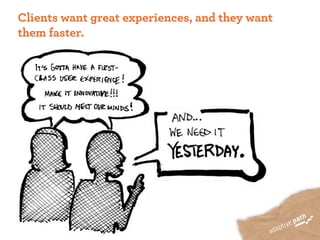
Clients want great experiences, and they want
them faster.
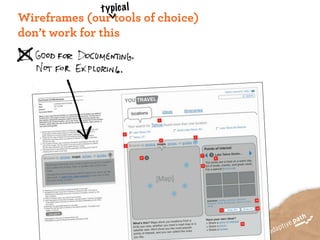
t y p ic a l
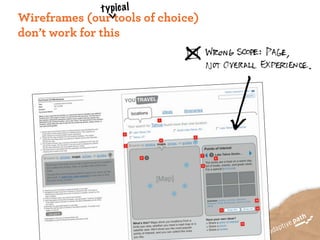
Wireframes (our tools of choice)
don’t work for this
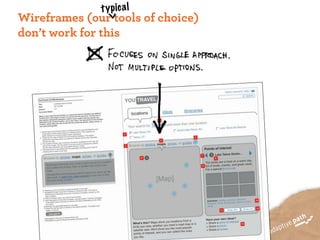
t y p ic a l
Wireframes (our tools of choice)
don’t work for this
t y p ic a l
Wireframes (our tools of choice)
don’t work for this
An approach inspired by the design studio...


http://www.flickr.com/photos/98736785@N00/1589941777/
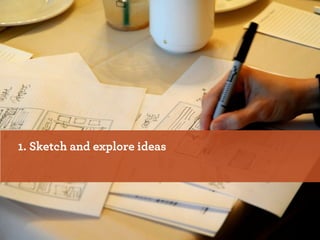
1. Sketch and explore ideas
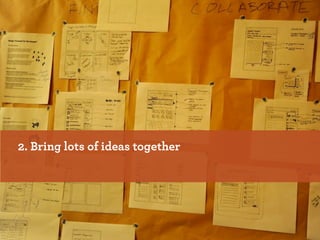
2. Bring lots of ideas together
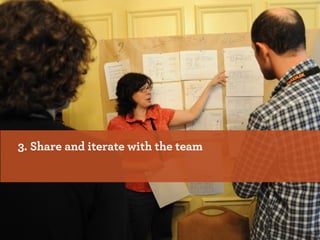
3. Share and iterate with the team
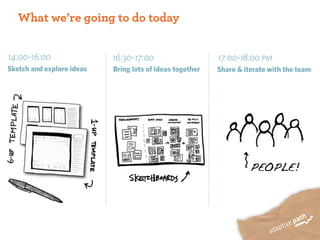
What we’re going to do today


14:00-16:00                16:30-17:00                    17:00-18:00 pm
Sketch and explore ideas   Bring lots of ideas together   Share & iterate with the team


                                                                    PEOPLE!
What do you want to accomplish today?
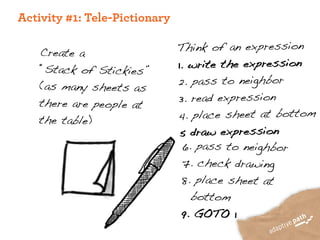
Activity #1: Tele-Pictionary

   Create a                    Think of an expression
   “Stack of Stickies”         1. write the expression
   (as many sheets as          2. pass to neighbor
   there are people at         3. read expression
   the table)                  4. place sheet at bottom
                               5 draw expression
                               6. pass to neighbor
                               7. check drawing
                               8. place sheet at
                                 bottom
                               9. GOTO 1
Sketching
hacks
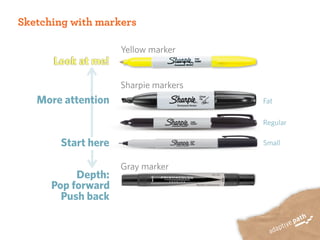
Sketching with markers

                    Yellow marker
      Look at me!

                    Sharpie markers
   More attention                     Fat

                                      Regular

       Start here                     Small


                    Gray marker
           Depth:
      Pop forward
        Push back
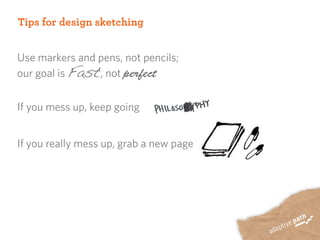
Tips for design sketching


Use markers and pens, not pencils;
our goal is Fast, not perfect


If you mess up, keep going


If you really mess up, grab a new page
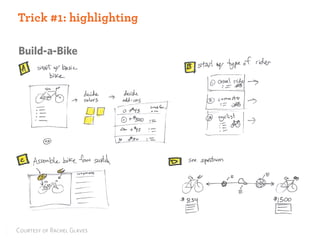
ACTIVITY highlighting
 Trick #1: ONE:

Build-a-Bike


Courtesy of Rachel Glaves
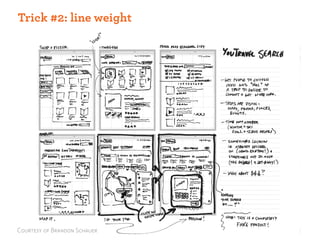
ACTIVITY line weight
 Trick #2: ONE:


Courtesy of Brandon Schauer
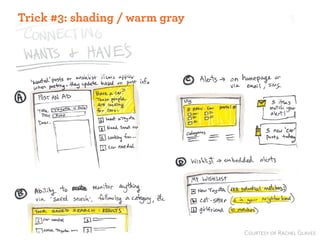
ACTIVITY shading / warm gray
 Trick #3: ONE:


                               Courtesy of Rachel Glaves
ACTIVITY ONE:
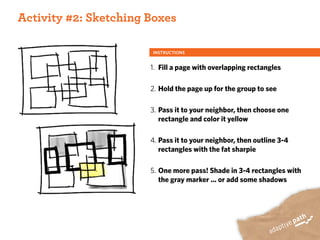
 Activity #2: Sketching Boxes

                        INSTRUCTIONS


                        1. Fill a page with overlapping rectangles

                        2. Hold the page up for the group to see

                        3. Pass it to your neighbor, then choose one
                           rectangle and color it yellow

                        4. Pass it to your neighbor, then outline 3-4
                           rectangles with the fat sharpie

                        5. One more pass! Shade in 3-4 rectangles with
                           the gray marker ... or add some shadows
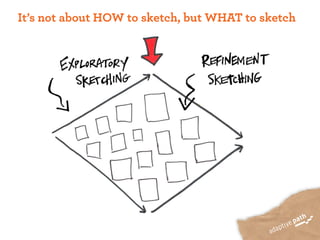
It’s not about HOW to sketch, but WHAT to sketch
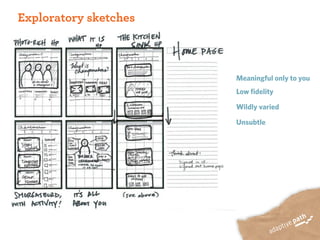
Exploratory sketches


                       Meaningful only to you
                       Low fidelity

                       Wildly varied

                       Unsubtle
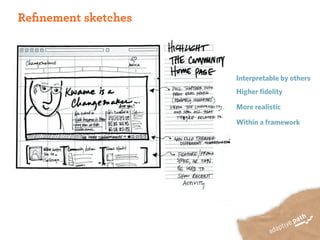
Refinement sketches


                     Interpretable by others
                     Higher fidelity

                     More realistic

                     Within a framework
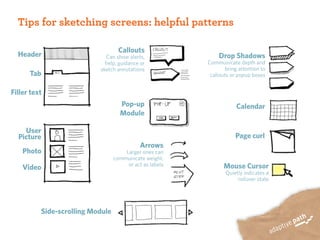
Tips for sketching screens: helpful patterns

                                    Callouts
  Header                     Can show alerts,                  Drop Shadows
                             help, guidance or            Communicate depth and
                           sketch annotations                     bring attention to
      Tab                                                  callouts or popup boxes


Filler text
                                    Pop-up                            Calendar
                                    Module

    User
  Picture                                                             Page curl
                                             Arrows
    Photo                             Larger ones can
                                  communicate weight,
                                       or act as labels          Mouse Cursor
    Video
                                                                 Quietly indicates a
                                                                      rollover state


          Side-scrolling Module
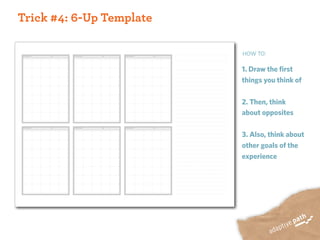
Trick #4: 6-Up Template

                          HOW TO:

                          1. Draw the first
                          things you think of

                          2. Then, think
                          about opposites

                          3. Also, think about
                          other goals of the
                          experience
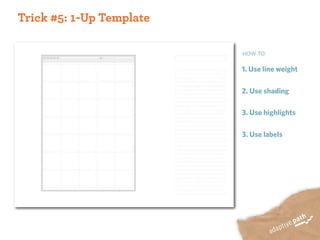
Trick #5: 1-Up Template

                          HOW TO:

                          1. Use line weight

                          2. Use shading

                          3. Use highlights

                          3. Use labels
Let’s try it out
your personal SHOPPER &
      NUTRITIONIST &
                  CHEF &
                FOODIE.
ACTIVITY ONE:
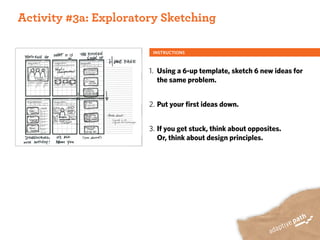
 Activity #3a: Exploratory Sketching

                         INSTRUCTIONS


                        1. Using a 6-up template, sketch 6 new ideas for
                           the same problem.


                        2. Put your first ideas down.


                        3. If you get stuck, think about opposites.
                           Or, think about design principles.
ACTIVITY ONE:
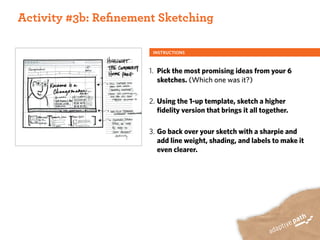
 Activity #3b: Refinement Sketching

                        INSTRUCTIONS


                       1. Pick the most promising ideas from your 6
                          sketches. (Which one was it?)

                       2. Using the 1-up template, sketch a higher
                          fidelity version that brings it all together.

                       3. Go back over your sketch with a sharpie and
                          add line weight, shading, and labels to make it
                          even clearer.
30  minute
  B REAK
   (пауза)
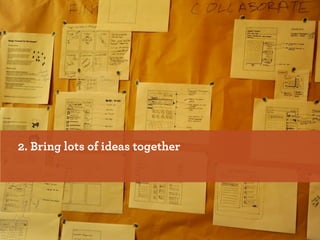
2. Bring lots of ideas together
Enter Sketchboards


“A new buzzword for a blatantly obvious
technique” —danny.hope
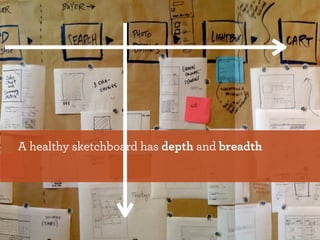
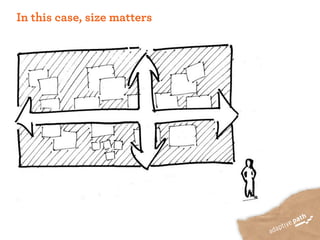
A healthy sketchboard has depth and breadth
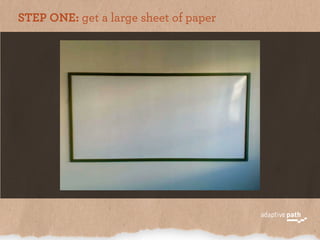
STEP ONE: get a large sheet of paper
In this case, size matters
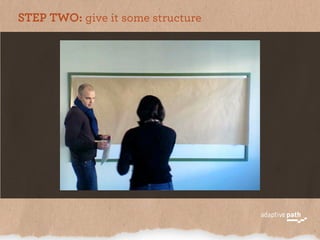
STEP TWO: give it some structure
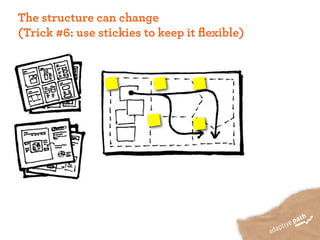
The structure can change
(Trick #6: use stickies to keep it flexible)
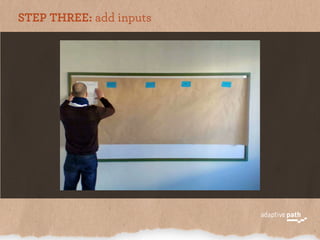
STEP THREE: add inputs
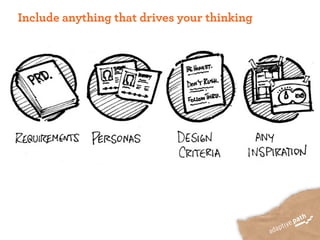
Include anything that drives your thinking
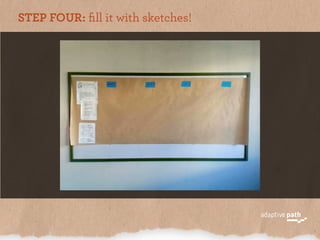
STEP FOUR: fill it with sketches!
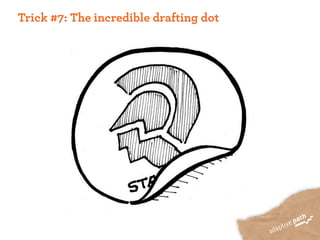
Trick #7: The incredible drafting dot
ACTIVITY ONE:
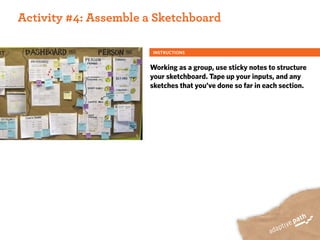
 Activity #4: Assemble a Sketchboard

                        INSTRUCTIONS


                       Working as a group, use sticky notes to structure
                       your sketchboard. Tape up your inputs, and any
                       sketches that you’ve done so far in each section.
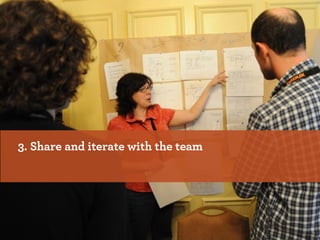
3. Share and iterate with the team
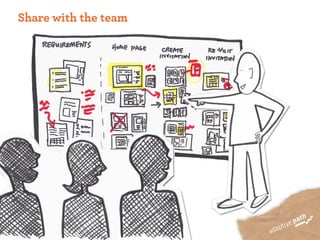
Share with the team
How?


       X
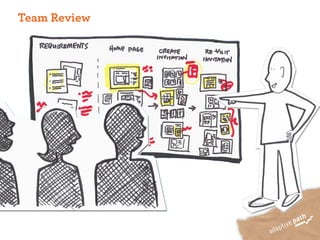
Team Review
ACTIVITY ONE:
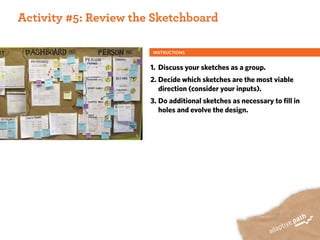
 Activity #5: Review the Sketchboard

                        INSTRUCTIONS


                        1. Discuss your sketches as a group.
                        2. Decide which sketches are the most viable
                           direction (consider your inputs).
                        3. Do additional sketches as necessary to fill in
                           holes and evolve the design.
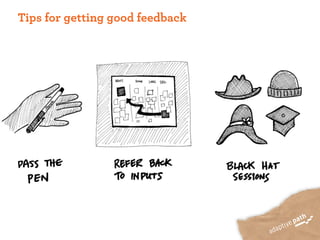
Tips for getting good feedback
ACTIVITY ONE:
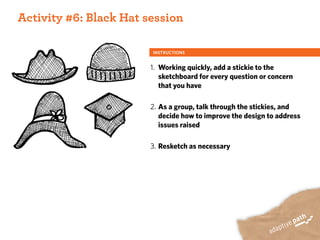
 Activity #6: Black Hat session

                         INSTRUCTIONS


                         1. Working quickly, add a stickie to the
                            sketchboard for every question or concern
                            that you have

                         2. As a group, talk through the stickies, and
                            decide how to improve the design to address
                            issues raised

                         3. Resketch as necessary
Bringing it all together
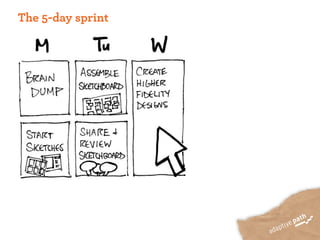
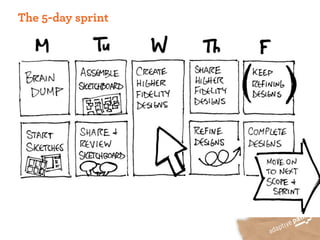
The 5-day sprint
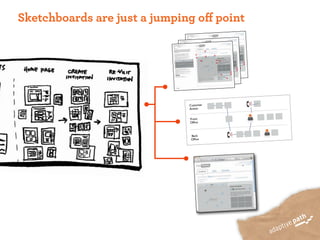
Sketchboards are just a jumping off point


                              Customer
                              Action


                              Front
                              Office


                               Back
                               Office
The 5-day sprint
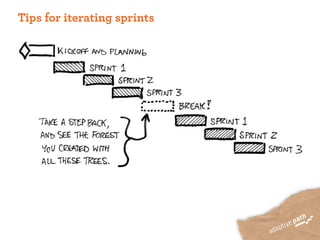
Tips for iterating sprints
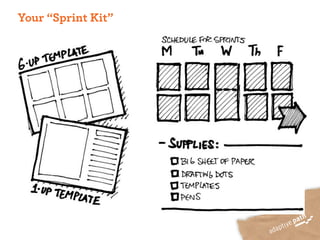
Your “Sprint Kit”
Resources to get you started

 Peter Boersma
 peter.boersma@adaptivepath.com


 Sketchboards: Discover Better + Faster UX Solutions
 http://www.adaptivepath.com/ideas/essays/archives/000863.php


 6-up and 1-up Templates
 http://www.ugleah.com/ux-team-of-one/


 Thanks to
 Leah Buley
 Brandon Schauer
 Rachel Glaves
 Kate Rutter
Thank you!
Yo u were awesome!
Good Design Faster at UX Sofia

Good Design Faster at UX Sofia

  • 2.
    UX Sofia May 26,2011 Sofia Bulgaria
  • 3.
  • 4.
    Clients want greatexperiences, and they want them faster.
  • 5.
    t y pic a l Wireframes (our tools of choice) don’t work for this
  • 6.
    t y pic a l Wireframes (our tools of choice) don’t work for this
  • 7.
    t y pic a l Wireframes (our tools of choice) don’t work for this
  • 8.
    An approach inspiredby the design studio... http://www.flickr.com/photos/98736785@N00/1589941777/
  • 9.
    1. Sketch andexplore ideas
  • 10.
    2. Bring lotsof ideas together
  • 11.
    3. Share anditerate with the team
  • 12.
    What we’re goingto do today 14:00-16:00 16:30-17:00 17:00-18:00 pm Sketch and explore ideas Bring lots of ideas together Share & iterate with the team PEOPLE!
  • 13.
    What do youwant to accomplish today?
  • 14.
    Activity #1: Tele-Pictionary Create a Think of an expression “Stack of Stickies” 1. write the expression (as many sheets as 2. pass to neighbor there are people at 3. read expression the table) 4. place sheet at bottom 5 draw expression 6. pass to neighbor 7. check drawing 8. place sheet at bottom 9. GOTO 1
  • 15.
  • 16.
    Sketching with markers Yellow marker Look at me! Sharpie markers More attention Fat Regular Start here Small Gray marker Depth: Pop forward Push back
  • 17.
    Tips for designsketching Use markers and pens, not pencils; our goal is Fast, not perfect If you mess up, keep going If you really mess up, grab a new page
  • 18.
    ACTIVITY highlighting Trick#1: ONE: Build-a-Bike Courtesy of Rachel Glaves
  • 19.
    ACTIVITY line weight Trick #2: ONE: Courtesy of Brandon Schauer
  • 20.
    ACTIVITY shading /warm gray Trick #3: ONE: Courtesy of Rachel Glaves
  • 21.
    ACTIVITY ONE: Activity#2: Sketching Boxes INSTRUCTIONS 1. Fill a page with overlapping rectangles 2. Hold the page up for the group to see 3. Pass it to your neighbor, then choose one rectangle and color it yellow 4. Pass it to your neighbor, then outline 3-4 rectangles with the fat sharpie 5. One more pass! Shade in 3-4 rectangles with the gray marker ... or add some shadows
  • 22.
    It’s not aboutHOW to sketch, but WHAT to sketch
  • 23.
    Exploratory sketches Meaningful only to you Low fidelity Wildly varied Unsubtle
  • 24.
    Refinement sketches Interpretable by others Higher fidelity More realistic Within a framework
  • 25.
    Tips for sketchingscreens: helpful patterns Callouts Header Can show alerts, Drop Shadows help, guidance or Communicate depth and sketch annotations bring attention to Tab callouts or popup boxes Filler text Pop-up Calendar Module User Picture Page curl Arrows Photo Larger ones can communicate weight, or act as labels Mouse Cursor Video Quietly indicates a rollover state Side-scrolling Module
  • 26.
    Trick #4: 6-UpTemplate HOW TO: 1. Draw the first things you think of 2. Then, think about opposites 3. Also, think about other goals of the experience
  • 27.
    Trick #5: 1-UpTemplate HOW TO: 1. Use line weight 2. Use shading 3. Use highlights 3. Use labels
  • 28.
  • 29.
    your personal SHOPPER& NUTRITIONIST & CHEF & FOODIE.
  • 30.
    ACTIVITY ONE: Activity#3a: Exploratory Sketching INSTRUCTIONS 1. Using a 6-up template, sketch 6 new ideas for the same problem. 2. Put your first ideas down. 3. If you get stuck, think about opposites. Or, think about design principles.
  • 31.
    ACTIVITY ONE: Activity#3b: Refinement Sketching INSTRUCTIONS 1. Pick the most promising ideas from your 6 sketches. (Which one was it?) 2. Using the 1-up template, sketch a higher fidelity version that brings it all together. 3. Go back over your sketch with a sharpie and add line weight, shading, and labels to make it even clearer.
  • 32.
    30 minute B REAK (пауза)
  • 33.
    2. Bring lotsof ideas together
  • 34.
    Enter Sketchboards “A newbuzzword for a blatantly obvious technique” —danny.hope
  • 35.
    A healthy sketchboardhas depth and breadth
  • 36.
    STEP ONE: geta large sheet of paper
  • 37.
    In this case,size matters
  • 38.
    STEP TWO: giveit some structure
  • 39.
    The structure canchange (Trick #6: use stickies to keep it flexible)
  • 40.
  • 41.
    Include anything thatdrives your thinking
  • 42.
    STEP FOUR: fillit with sketches!
  • 43.
    Trick #7: Theincredible drafting dot
  • 44.
    ACTIVITY ONE: Activity#4: Assemble a Sketchboard INSTRUCTIONS Working as a group, use sticky notes to structure your sketchboard. Tape up your inputs, and any sketches that you’ve done so far in each section.
  • 45.
    3. Share anditerate with the team
  • 46.
  • 47.
  • 48.
  • 49.
    ACTIVITY ONE: Activity#5: Review the Sketchboard INSTRUCTIONS 1. Discuss your sketches as a group. 2. Decide which sketches are the most viable direction (consider your inputs). 3. Do additional sketches as necessary to fill in holes and evolve the design.
  • 50.
    Tips for gettinggood feedback
  • 51.
    ACTIVITY ONE: Activity#6: Black Hat session INSTRUCTIONS 1. Working quickly, add a stickie to the sketchboard for every question or concern that you have 2. As a group, talk through the stickies, and decide how to improve the design to address issues raised 3. Resketch as necessary
  • 52.
  • 53.
  • 54.
    Sketchboards are justa jumping off point Customer Action Front Office Back Office
  • 55.
  • 56.
  • 57.
  • 59.
    Resources to getyou started Peter Boersma peter.boersma@adaptivepath.com Sketchboards: Discover Better + Faster UX Solutions http://www.adaptivepath.com/ideas/essays/archives/000863.php 6-up and 1-up Templates http://www.ugleah.com/ux-team-of-one/ Thanks to Leah Buley Brandon Schauer Rachel Glaves Kate Rutter
  • 60.
    Thank you! Yo uwere awesome!