Building Creative Confidence
Through Sketching
Or, ‘How I learned to stop worrying and love the Sharpie’
@robcolenso
Tonight’s agenda
6:30 – 6:45 Networking
6:45 – 7:00 Introductions
7:00 – 7:15 Workshop overview
7:15 – 7:25 Warm-up sketching
7:30 – 7:45 Design Studio, Round 1 – 6-Ups
7:45 – 8:00 Design Studio, Round 2 – Remix & Iterate
8:00 – 8:30 Design Studio, Round 3 – Rapid Collaboration
8:30 – 8:45 Group presentations
8:45 – 9:00 Feedback and debrief
About me
Hi, I’m Rob!
Oh, and one more thing …
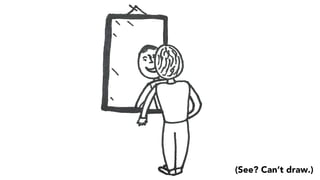
I can’t draw.
So why the hell am I up here, right?!
Being a terrible artist
is my superpower.
‘Our job isn’t to teach them creativity.
It’s to help them rediscover
their creative confidence.’
– Tom & David Kelley
‘Reclaim Your Creative Confidence,’ Tom and David
Kelley, Harvard Business Review, December 2012
So what holds people back?
FEAR.
Of the messy
unknown.
Of being
judged.
Of the
first step.
Of losing
control.
‘Reclaim Your Creative Confidence,’ Tom and David
Kelley, Harvard Business Review, December 2012
Cool. Makes sense.
But how does sketching help?
If we can get our partners to pick up a , , it unlocks
huge potential for faster, better outcomes.
It helps us read minds
It helps us align
It helps us build buy-in
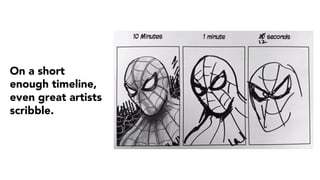
On a short
enough timeline,
even great artists
scribble.
So here’s where my superpower
(and this workshop framework)
come in:
I can’t draw.
I can’t draw. And so can YOU!
Design Studio structure
Sketch
Present
& Critique
Converge
Prioritize
1.
2.
3.
4.
Within this framework,
you should feel free
to adapt and remix
methods as needed
to meet your goals…
Where sketching fits
raw refined
Post-It
ideas
Half-sheet
ideas
‘Paper on
the table’
Idea
dashboard
•  Give a title/idea name
•  One-line fast description
•  Annotated sketch/diagram
•  Give a quick title/headline
•  Sketch to provide visual cues
•  Large tabletop sheet, or whiteboard
•  Build on a Post-It Idea or a Half-Sheet
idea with teammates
•  Give a title/idea name
•  One-line fast description
•  Annotated sketch/diagram
•  2-5 attribute categories that
add detail – differentiator,
assets needed, etc
Source: Design Thinking manual, Capital One
You are
here
Your sketches
will look like
this:
LOLZ!
Just kidding.
More like this:
Typical sketch objects
If you can draw
a , a , and
a , you know
everything you
need to know
to start sketching!
Sketch objects by Rachel Graves
Typical sketch tools
Okay,
let’s do
this!
Warm-Up 1:
Squiggle Birds!
Grab a sheet of paper
and a pen.
We’re gonna draw
some birds.
5 mins
Boom.
Squiggle
Birds.
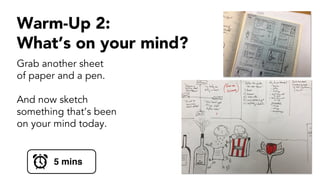
Warm-Up 2:
What’s on your mind?
Grab another sheet
of paper and a pen.
And now sketch
something that’s been
on your mind today.
5 mins
Let’s
sketch!
Our
Design
Challenge:
Design a solution for displaying
flowers in your home
Individual Ideation: Round 1
Directions:
•  Individual work, using a ‘Six-Up’ template
•  Six different concepts, or variations on a theme
•  Go for quantity! Don’t take too much time on each sketch
•  Push your thinking as you go through each sketch
6 mins
Present & Critique: Round 1
Directions:
•  Each participant gets 2 minutes to present and get feedback
•  Presenter should explicitly state the problem they’re solving
•  Keep feedback brief, focusing on clarifying the presenter’s intent
•  For ex., ‘how does this address the user’s problem’?
10 mins
Individual Ideation: Round 2
Directions:
•  Individual work, using a ‘One-Up’ template
•  Take your original six ideas and, using your feedback,
refine your thinking into one ‘big’ idea on a single sheet
•  The goal: Pick the idea that has the most merit and
develop a more evolved version of that idea
6 mins
Present & Critique: Round 2
10 mins
Directions:
•  Each participant gets 2 minutes to present and get feedback
•  Presenter should explicitly state the problem they’re solving
•  Keep feedback brief, focusing on clarifying the presenter’s intent
•  For ex., ‘how does this feature address the user’s problem’?
Let’s
sketch
(again)!
Team Ideation
20 mins
Directions:
•  Each team should converge on a single concept
•  The goal: Narrow to the idea the team believes is strongest
•  On a large Post-It, sketch key components and user flows
•  To get to consensus, you’ll need to prioritize and pare back
features – save the ones that don’t make it in a ‘parking lot’
Ideation #protip
To push your thinking as a group, try these methods:
S - Substitute
C - Combine
A - Adapt
M - Modify, Magnify or Minimize
P - Put to another use
E - Eliminate
R - Reverse or Rearrange
Present & Critique: Round 3
15 mins
Directions:
•  Each team gets 3 minutes to present and get feedback
•  Presenters should clearly state the problem they’re solving
Feedback
& debrief
Cheers!
Resources
Dead Trees
•  ‘Six Thinking Hats’ – Edward de Bono
•  ‘The Design Studio Method’ – Brian Sullivan
•  ‘Sketching User Experiences’ – Bill Buxton
(plus workbook)
•  ‘Lean UX’ – Jeff Gothelf
•  ‘The UX Team of One’ – Leah Buley
•  ‘The Back of the Napkin’ – Dan Roam
Interwebs
•  ‘Facilitating an effective design studio
workshop’ – Kate Kaplan, Nielsen Norman
Group
•  ‘What we talk about when we talk about
sketching’ – Dane Petersen, Adaptive Path
•  ‘Charrettes (design sketching): ½ inspiration,
½ buy-in’ – Kara Pernice, Nielsen Norman
Group
•  ‘The Design Studio Method’ – Todd Zaki
Warfel, Vimeo
@robcolenso
(See? Can’t draw.)

Building Creative Confidence through Sketching

  • 1.
    Building Creative Confidence ThroughSketching Or, ‘How I learned to stop worrying and love the Sharpie’ @robcolenso
  • 2.
    Tonight’s agenda 6:30 –6:45 Networking 6:45 – 7:00 Introductions 7:00 – 7:15 Workshop overview 7:15 – 7:25 Warm-up sketching 7:30 – 7:45 Design Studio, Round 1 – 6-Ups 7:45 – 8:00 Design Studio, Round 2 – Remix & Iterate 8:00 – 8:30 Design Studio, Round 3 – Rapid Collaboration 8:30 – 8:45 Group presentations 8:45 – 9:00 Feedback and debrief
  • 3.
  • 4.
    Oh, and onemore thing …
  • 5.
  • 7.
    So why thehell am I up here, right?!
  • 8.
    Being a terribleartist is my superpower.
  • 9.
    ‘Our job isn’tto teach them creativity. It’s to help them rediscover their creative confidence.’ – Tom & David Kelley ‘Reclaim Your Creative Confidence,’ Tom and David Kelley, Harvard Business Review, December 2012
  • 10.
    So what holdspeople back?
  • 12.
    FEAR. Of the messy unknown. Ofbeing judged. Of the first step. Of losing control. ‘Reclaim Your Creative Confidence,’ Tom and David Kelley, Harvard Business Review, December 2012
  • 13.
    Cool. Makes sense. Buthow does sketching help?
  • 14.
    If we canget our partners to pick up a , , it unlocks huge potential for faster, better outcomes.
  • 15.
    It helps usread minds
  • 16.
  • 17.
    It helps usbuild buy-in
  • 18.
    On a short enoughtimeline, even great artists scribble.
  • 19.
    So here’s wheremy superpower (and this workshop framework) come in:
  • 20.
  • 21.
    I can’t draw.And so can YOU!
  • 22.
    Design Studio structure Sketch Present &Critique Converge Prioritize 1. 2. 3. 4. Within this framework, you should feel free to adapt and remix methods as needed to meet your goals…
  • 23.
    Where sketching fits rawrefined Post-It ideas Half-sheet ideas ‘Paper on the table’ Idea dashboard •  Give a title/idea name •  One-line fast description •  Annotated sketch/diagram •  Give a quick title/headline •  Sketch to provide visual cues •  Large tabletop sheet, or whiteboard •  Build on a Post-It Idea or a Half-Sheet idea with teammates •  Give a title/idea name •  One-line fast description •  Annotated sketch/diagram •  2-5 attribute categories that add detail – differentiator, assets needed, etc Source: Design Thinking manual, Capital One You are here
  • 24.
  • 26.
  • 28.
    Typical sketch objects Ifyou can draw a , a , and a , you know everything you need to know to start sketching! Sketch objects by Rachel Graves
  • 29.
  • 30.
  • 31.
    Warm-Up 1: Squiggle Birds! Graba sheet of paper and a pen. We’re gonna draw some birds. 5 mins
  • 32.
  • 33.
    Warm-Up 2: What’s onyour mind? Grab another sheet of paper and a pen. And now sketch something that’s been on your mind today. 5 mins
  • 34.
  • 35.
    Our Design Challenge: Design a solutionfor displaying flowers in your home
  • 36.
    Individual Ideation: Round1 Directions: •  Individual work, using a ‘Six-Up’ template •  Six different concepts, or variations on a theme •  Go for quantity! Don’t take too much time on each sketch •  Push your thinking as you go through each sketch 6 mins
  • 37.
    Present & Critique:Round 1 Directions: •  Each participant gets 2 minutes to present and get feedback •  Presenter should explicitly state the problem they’re solving •  Keep feedback brief, focusing on clarifying the presenter’s intent •  For ex., ‘how does this address the user’s problem’? 10 mins
  • 38.
    Individual Ideation: Round2 Directions: •  Individual work, using a ‘One-Up’ template •  Take your original six ideas and, using your feedback, refine your thinking into one ‘big’ idea on a single sheet •  The goal: Pick the idea that has the most merit and develop a more evolved version of that idea 6 mins
  • 39.
    Present & Critique:Round 2 10 mins Directions: •  Each participant gets 2 minutes to present and get feedback •  Presenter should explicitly state the problem they’re solving •  Keep feedback brief, focusing on clarifying the presenter’s intent •  For ex., ‘how does this feature address the user’s problem’?
  • 40.
  • 41.
    Team Ideation 20 mins Directions: • Each team should converge on a single concept •  The goal: Narrow to the idea the team believes is strongest •  On a large Post-It, sketch key components and user flows •  To get to consensus, you’ll need to prioritize and pare back features – save the ones that don’t make it in a ‘parking lot’
  • 42.
    Ideation #protip To pushyour thinking as a group, try these methods: S - Substitute C - Combine A - Adapt M - Modify, Magnify or Minimize P - Put to another use E - Eliminate R - Reverse or Rearrange
  • 43.
    Present & Critique:Round 3 15 mins Directions: •  Each team gets 3 minutes to present and get feedback •  Presenters should clearly state the problem they’re solving
  • 44.
  • 45.
  • 46.
    Resources Dead Trees •  ‘SixThinking Hats’ – Edward de Bono •  ‘The Design Studio Method’ – Brian Sullivan •  ‘Sketching User Experiences’ – Bill Buxton (plus workbook) •  ‘Lean UX’ – Jeff Gothelf •  ‘The UX Team of One’ – Leah Buley •  ‘The Back of the Napkin’ – Dan Roam Interwebs •  ‘Facilitating an effective design studio workshop’ – Kate Kaplan, Nielsen Norman Group •  ‘What we talk about when we talk about sketching’ – Dane Petersen, Adaptive Path •  ‘Charrettes (design sketching): ½ inspiration, ½ buy-in’ – Kara Pernice, Nielsen Norman Group •  ‘The Design Studio Method’ – Todd Zaki Warfel, Vimeo
  • 47.
  • 48.