Seafood Certification Schemes
December 2013
Our Presenter Today
Cormac O'Sullivan
• Technical Manager for Seafood with SAI Global
• Degree in Applied Ecology and a Master’s Degree in Environmental
Protection
• Involved in Aquaculture, Fisheries, Environmental Consultation and
Seafood Certification for over 20 years in both the government and
private industry
• Speaker at conferences, workshops and forums in Europe and North
America on all aspects of Seafood Standards and Certification and
currently sits on numerous Technical Advisory Committees.
• Extensive knowledge of environmental and seafood legislation in many
countries with a working International experience in over 15 countries
Agenda

• Introduction to Seafood Certification Programs
• Aquaculture
• Chain of Custody
• Seafood Safety
• Questions & Answers
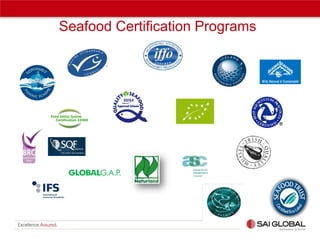
Seafood Certification Programs
Aquaculture

“Aquaculture, not the Internet,
represents the most promising
investment opportunity of the 21st
century”
Peter Drucker, Nobel Laureate
Aquaculture Growth
• In 2012, global Aquaculture production was 66.5million
tons. This is expected to expected to grow at an annual
growth rate of 2.3% from 2013 to 2019.
• Reductions in volumes of captured fish is expected to be
one of the primary factors driving global aquaculture
production over the next few years.
• In addition, increasing consumer awareness regarding
health benefits associated with consumption of fish and fish
products is expected to boost aquaculture production.
Potential Negative Impacts of Aquaculture
•

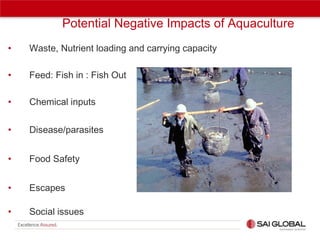
Waste, Nutrient loading and carrying capacity

•

Feed: Fish in : Fish Out

•

Chemical inputs

•

Disease/parasites

•

Food Safety

•

Escapes

•

Social issues
Consequently, what is contained in Aquaculture
Standards?

• Quality and Safety
Systems

• Chemical
Management

• Waste Management
• Feed Management

• Escape
Management

• Harvest
Management

• Diseases
Management
• Sustainability
Indicators
Interested Stakeholders
Environmental Groups

Food Processors

Independent Scientists

Governments

Research Institutes

Fishermen Associations

Consumers / Associations

Fish Farmers / Associations

Brokers and Distributors

Fishmeal and Fish Oil Producers

Food Service Buyers

Financiers and Investors

Retailer Buyers

Coastal Communities
What are the range of Aquaculture
Certification Schemes?
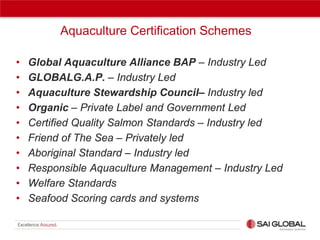
Aquaculture Certification Schemes
•
•
•
•
•
•
•
•
•
•

Global Aquaculture Alliance BAP – Industry Led
GLOBALG.A.P. – Industry Led
Aquaculture Stewardship Council– Industry led
Organic – Private Label and Government Led
Certified Quality Salmon Standards – Industry led
Friend of The Sea – Privately led
Aboriginal Standard – Industry led
Responsible Aquaculture Management – Industry Led
Welfare Standards
Seafood Scoring cards and systems
Aquaculture Certification Schemes
• Global Aquaculture Alliance BAP

• A non-profit trade association dedicated to advancing
environmentally and socially responsible aquaculture
• Standards focus on community, environment, animal
welfare, food safety and traceability
• Consumer facing Logo
• The audit process is 1 day per farm site
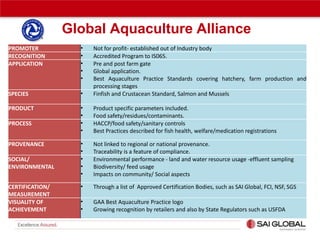
Global Aquaculture Alliance
PROMOTER
RECOGNITION
APPLICATION

•
•
•
•
•

SPECIES

•

Not for profit- established out of Industry body
Accredited Program to IS065.
Pre and post farm gate
Global application.
Best Aquaculture Practice Standards covering hatchery, farm production and
processing stages
Finfish and Crustacean Standard, Salmon and Mussels

PRODUCT

•
•
•
•

Product specific parameters included.
Food safety/residues/contaminants.
HACCP/food safety/sanitary controls
Best Practices described for fish health, welfare/medication registrations

•
•
•
•
•

Not linked to regional or national provenance.
Traceability is a feature of compliance.
Environmental performance - land and water resource usage -effluent sampling
Biodiversity/ feed usage
Impacts on community/ Social aspects

•

Through a list of Approved Certification Bodies, such as SAI Global, FCI, NSF, SGS

•
•

GAA Best Aquaculture Practice logo
Growing recognition by retailers and also by State Regulators such as USFDA

PROCESS
PROVENANCE
SOCIAL/
ENVIRONMENTAL
CERTIFICATION/
MEASUREMENT
VISUALITY OF
ACHIEVEMENT
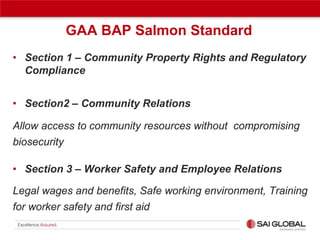
GAA BAP Salmon Standard
• Section 1 – Community Property Rights and Regulatory
Compliance
• Section2 – Community Relations
Allow access to community resources without compromising
biosecurity
• Section 3 – Worker Safety and Employee Relations
Legal wages and benefits, Safe working environment, Training
for worker safety and first aid
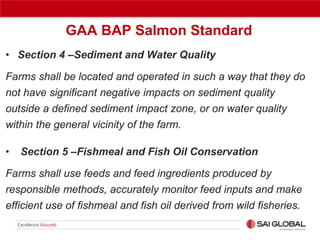
GAA BAP Salmon Standard
• Section 4 –Sediment and Water Quality
Farms shall be located and operated in such a way that they do
not have significant negative impacts on sediment quality
outside a defined sediment impact zone, or on water quality
within the general vicinity of the farm.
•

Section 5 –Fishmeal and Fish Oil Conservation

Farms shall use feeds and feed ingredients produced by
responsible methods, accurately monitor feed inputs and make
efficient use of fishmeal and fish oil derived from wild fisheries.
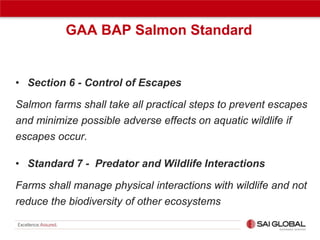
GAA BAP Salmon Standard

• Section 6 - Control of Escapes
Salmon farms shall take all practical steps to prevent escapes
and minimize possible adverse effects on aquatic wildlife if
escapes occur.
• Standard 7 - Predator and Wildlife Interactions
Farms shall manage physical interactions with wildlife and not
reduce the biodiversity of other ecosystems
GAA BAP Salmon Standard
• Section 8 – Storage and Disposal of Farm Supplies
Feed, fuel, lubricants and chemicals shall be stored and disposed
of in a safe and responsible manner. Paper and plastic refuse shall
be disposed of in a sanitary and responsible way
• Section 9 – Animal Health and Welfare
Producers shall demonstrate that all operations on farms that
involve fish are conducted with animal welfare in mind. Employees
shall be trained to provide appropriate levels of husbandry and
care.
GAA BAP Salmon Standard

• Standard 10- Biosecurity and Disease Management
Farms shall operate with the aim of preventing disease out
break, but when diseases or parasites infect farmed fish,
diagnosis and treatment shall be carried out promptly and
judiciously under the supervision of a fish health professional in a
manner that minimizes impacts on the environment.
GAA BAP Salmon Standard
• Standard 11- Control of Residues and
Contaminants
Chemical residues and contaminants shall be controlled
and kept below regulatory limits through good farming
practices and regular monitoring. Banned antibiotics,
drugs and other chemical compounds shall not be used

• Traceability and Record Keeping Requirement
View the full recording on-demand
Want to see the full presentation?
View the recording and download slides on our website
Remaining slides cover:
- ASC Salmon Standard
- GLOBALG.A.P.
- Canadian Organic Aquaculture Standard
- Seafood Chain of Custody
- RFM and MSC CoC
- Seafood Safety Certifications
Request more information on Training and Certification
www.saiglobal.com/assurance

SAI Global Assurance Services
USA : 1 800 247 0802
CANADA : 1 800 465 3717
Email: certification.americas@saiglobal.com
www.saiglobal.com/assurance

Seafood Certification Programs

  • 1.
  • 2.
    Our Presenter Today CormacO'Sullivan • Technical Manager for Seafood with SAI Global • Degree in Applied Ecology and a Master’s Degree in Environmental Protection • Involved in Aquaculture, Fisheries, Environmental Consultation and Seafood Certification for over 20 years in both the government and private industry • Speaker at conferences, workshops and forums in Europe and North America on all aspects of Seafood Standards and Certification and currently sits on numerous Technical Advisory Committees. • Extensive knowledge of environmental and seafood legislation in many countries with a working International experience in over 15 countries
  • 3.
    Agenda • Introduction toSeafood Certification Programs • Aquaculture • Chain of Custody • Seafood Safety • Questions & Answers
  • 4.
  • 5.
    Aquaculture “Aquaculture, not theInternet, represents the most promising investment opportunity of the 21st century” Peter Drucker, Nobel Laureate
  • 6.
    Aquaculture Growth • In2012, global Aquaculture production was 66.5million tons. This is expected to expected to grow at an annual growth rate of 2.3% from 2013 to 2019. • Reductions in volumes of captured fish is expected to be one of the primary factors driving global aquaculture production over the next few years. • In addition, increasing consumer awareness regarding health benefits associated with consumption of fish and fish products is expected to boost aquaculture production.
  • 7.
    Potential Negative Impactsof Aquaculture • Waste, Nutrient loading and carrying capacity • Feed: Fish in : Fish Out • Chemical inputs • Disease/parasites • Food Safety • Escapes • Social issues
  • 8.
    Consequently, what iscontained in Aquaculture Standards? • Quality and Safety Systems • Chemical Management • Waste Management • Feed Management • Escape Management • Harvest Management • Diseases Management • Sustainability Indicators
  • 9.
    Interested Stakeholders Environmental Groups FoodProcessors Independent Scientists Governments Research Institutes Fishermen Associations Consumers / Associations Fish Farmers / Associations Brokers and Distributors Fishmeal and Fish Oil Producers Food Service Buyers Financiers and Investors Retailer Buyers Coastal Communities
  • 10.
    What are therange of Aquaculture Certification Schemes?
  • 11.
    Aquaculture Certification Schemes • • • • • • • • • • GlobalAquaculture Alliance BAP – Industry Led GLOBALG.A.P. – Industry Led Aquaculture Stewardship Council– Industry led Organic – Private Label and Government Led Certified Quality Salmon Standards – Industry led Friend of The Sea – Privately led Aboriginal Standard – Industry led Responsible Aquaculture Management – Industry Led Welfare Standards Seafood Scoring cards and systems
  • 12.
    Aquaculture Certification Schemes •Global Aquaculture Alliance BAP • A non-profit trade association dedicated to advancing environmentally and socially responsible aquaculture • Standards focus on community, environment, animal welfare, food safety and traceability • Consumer facing Logo • The audit process is 1 day per farm site
  • 13.
    Global Aquaculture Alliance PROMOTER RECOGNITION APPLICATION • • • • • SPECIES • Notfor profit- established out of Industry body Accredited Program to IS065. Pre and post farm gate Global application. Best Aquaculture Practice Standards covering hatchery, farm production and processing stages Finfish and Crustacean Standard, Salmon and Mussels PRODUCT • • • • Product specific parameters included. Food safety/residues/contaminants. HACCP/food safety/sanitary controls Best Practices described for fish health, welfare/medication registrations • • • • • Not linked to regional or national provenance. Traceability is a feature of compliance. Environmental performance - land and water resource usage -effluent sampling Biodiversity/ feed usage Impacts on community/ Social aspects • Through a list of Approved Certification Bodies, such as SAI Global, FCI, NSF, SGS • • GAA Best Aquaculture Practice logo Growing recognition by retailers and also by State Regulators such as USFDA PROCESS PROVENANCE SOCIAL/ ENVIRONMENTAL CERTIFICATION/ MEASUREMENT VISUALITY OF ACHIEVEMENT
  • 14.
    GAA BAP SalmonStandard • Section 1 – Community Property Rights and Regulatory Compliance • Section2 – Community Relations Allow access to community resources without compromising biosecurity • Section 3 – Worker Safety and Employee Relations Legal wages and benefits, Safe working environment, Training for worker safety and first aid
  • 15.
    GAA BAP SalmonStandard • Section 4 –Sediment and Water Quality Farms shall be located and operated in such a way that they do not have significant negative impacts on sediment quality outside a defined sediment impact zone, or on water quality within the general vicinity of the farm. • Section 5 –Fishmeal and Fish Oil Conservation Farms shall use feeds and feed ingredients produced by responsible methods, accurately monitor feed inputs and make efficient use of fishmeal and fish oil derived from wild fisheries.
  • 16.
    GAA BAP SalmonStandard • Section 6 - Control of Escapes Salmon farms shall take all practical steps to prevent escapes and minimize possible adverse effects on aquatic wildlife if escapes occur. • Standard 7 - Predator and Wildlife Interactions Farms shall manage physical interactions with wildlife and not reduce the biodiversity of other ecosystems
  • 17.
    GAA BAP SalmonStandard • Section 8 – Storage and Disposal of Farm Supplies Feed, fuel, lubricants and chemicals shall be stored and disposed of in a safe and responsible manner. Paper and plastic refuse shall be disposed of in a sanitary and responsible way • Section 9 – Animal Health and Welfare Producers shall demonstrate that all operations on farms that involve fish are conducted with animal welfare in mind. Employees shall be trained to provide appropriate levels of husbandry and care.
  • 18.
    GAA BAP SalmonStandard • Standard 10- Biosecurity and Disease Management Farms shall operate with the aim of preventing disease out break, but when diseases or parasites infect farmed fish, diagnosis and treatment shall be carried out promptly and judiciously under the supervision of a fish health professional in a manner that minimizes impacts on the environment.
  • 19.
    GAA BAP SalmonStandard • Standard 11- Control of Residues and Contaminants Chemical residues and contaminants shall be controlled and kept below regulatory limits through good farming practices and regular monitoring. Banned antibiotics, drugs and other chemical compounds shall not be used • Traceability and Record Keeping Requirement
  • 20.
    View the fullrecording on-demand Want to see the full presentation? View the recording and download slides on our website Remaining slides cover: - ASC Salmon Standard - GLOBALG.A.P. - Canadian Organic Aquaculture Standard - Seafood Chain of Custody - RFM and MSC CoC - Seafood Safety Certifications
  • 21.
    Request more informationon Training and Certification www.saiglobal.com/assurance SAI Global Assurance Services USA : 1 800 247 0802 CANADA : 1 800 465 3717 Email: certification.americas@saiglobal.com www.saiglobal.com/assurance